WO2020004144A1 - Corps de forme d'origine d'une carte de circuit imprimé flexible, procédé de fabrication de carte de circuit imprimé flexible, module de génération d'énergie photovoltaïque concentrée et module électroluminescent - Google Patents
Corps de forme d'origine d'une carte de circuit imprimé flexible, procédé de fabrication de carte de circuit imprimé flexible, module de génération d'énergie photovoltaïque concentrée et module électroluminescent Download PDFInfo
- Publication number
- WO2020004144A1 WO2020004144A1 PCT/JP2019/024095 JP2019024095W WO2020004144A1 WO 2020004144 A1 WO2020004144 A1 WO 2020004144A1 JP 2019024095 W JP2019024095 W JP 2019024095W WO 2020004144 A1 WO2020004144 A1 WO 2020004144A1
- Authority
- WO
- WIPO (PCT)
- Prior art keywords
- wiring board
- flexible
- flexible printed
- printed wiring
- connection band
- Prior art date
- Legal status (The legal status is an assumption and is not a legal conclusion. Google has not performed a legal analysis and makes no representation as to the accuracy of the status listed.)
- Ceased
Links
Images




Classifications
-
- H—ELECTRICITY
- H05—ELECTRIC TECHNIQUES NOT OTHERWISE PROVIDED FOR
- H05K—PRINTED CIRCUITS; CASINGS OR CONSTRUCTIONAL DETAILS OF ELECTRIC APPARATUS; MANUFACTURE OF ASSEMBLAGES OF ELECTRICAL COMPONENTS
- H05K1/00—Printed circuits
- H05K1/02—Details
- H05K1/0277—Bendability or stretchability details
- H05K1/028—Bending or folding regions of flexible printed circuits
-
- H—ELECTRICITY
- H05—ELECTRIC TECHNIQUES NOT OTHERWISE PROVIDED FOR
- H05K—PRINTED CIRCUITS; CASINGS OR CONSTRUCTIONAL DETAILS OF ELECTRIC APPARATUS; MANUFACTURE OF ASSEMBLAGES OF ELECTRICAL COMPONENTS
- H05K1/00—Printed circuits
- H05K1/02—Details
- H05K1/0286—Programmable, customizable or modifiable circuits
- H05K1/0287—Programmable, customizable or modifiable circuits having an universal lay-out, e.g. pad or land grid patterns or mesh patterns
-
- H—ELECTRICITY
- H05—ELECTRIC TECHNIQUES NOT OTHERWISE PROVIDED FOR
- H05K—PRINTED CIRCUITS; CASINGS OR CONSTRUCTIONAL DETAILS OF ELECTRIC APPARATUS; MANUFACTURE OF ASSEMBLAGES OF ELECTRICAL COMPONENTS
- H05K1/00—Printed circuits
- H05K1/02—Details
- H05K1/14—Structural association of two or more printed circuits
- H05K1/142—Arrangements of planar printed circuit boards in the same plane, e.g. auxiliary printed circuit insert mounted in a main printed circuit
-
- H—ELECTRICITY
- H05—ELECTRIC TECHNIQUES NOT OTHERWISE PROVIDED FOR
- H05K—PRINTED CIRCUITS; CASINGS OR CONSTRUCTIONAL DETAILS OF ELECTRIC APPARATUS; MANUFACTURE OF ASSEMBLAGES OF ELECTRICAL COMPONENTS
- H05K1/00—Printed circuits
- H05K1/18—Printed circuits structurally associated with non-printed electric components
- H05K1/189—Printed circuits structurally associated with non-printed electric components characterised by the use of flexible or folded printed circuits
-
- H—ELECTRICITY
- H05—ELECTRIC TECHNIQUES NOT OTHERWISE PROVIDED FOR
- H05K—PRINTED CIRCUITS; CASINGS OR CONSTRUCTIONAL DETAILS OF ELECTRIC APPARATUS; MANUFACTURE OF ASSEMBLAGES OF ELECTRICAL COMPONENTS
- H05K3/00—Apparatus or processes for manufacturing printed circuits
- H05K3/0011—Working of insulating substrates or insulating layers
- H05K3/0044—Mechanical working of the substrate, e.g. drilling or punching
- H05K3/0052—Depaneling, i.e. dividing a panel into circuit boards; Working of the edges of circuit boards
-
- H—ELECTRICITY
- H10—SEMICONDUCTOR DEVICES; ELECTRIC SOLID-STATE DEVICES NOT OTHERWISE PROVIDED FOR
- H10F—INORGANIC SEMICONDUCTOR DEVICES SENSITIVE TO INFRARED RADIATION, LIGHT, ELECTROMAGNETIC RADIATION OF SHORTER WAVELENGTH OR CORPUSCULAR RADIATION
- H10F19/00—Integrated devices, or assemblies of multiple devices, comprising at least one photovoltaic cell covered by group H10F10/00, e.g. photovoltaic modules
-
- H—ELECTRICITY
- H10—SEMICONDUCTOR DEVICES; ELECTRIC SOLID-STATE DEVICES NOT OTHERWISE PROVIDED FOR
- H10F—INORGANIC SEMICONDUCTOR DEVICES SENSITIVE TO INFRARED RADIATION, LIGHT, ELECTROMAGNETIC RADIATION OF SHORTER WAVELENGTH OR CORPUSCULAR RADIATION
- H10F19/00—Integrated devices, or assemblies of multiple devices, comprising at least one photovoltaic cell covered by group H10F10/00, e.g. photovoltaic modules
- H10F19/80—Encapsulations or containers for integrated devices, or assemblies of multiple devices, having photovoltaic cells
-
- H—ELECTRICITY
- H10—SEMICONDUCTOR DEVICES; ELECTRIC SOLID-STATE DEVICES NOT OTHERWISE PROVIDED FOR
- H10F—INORGANIC SEMICONDUCTOR DEVICES SENSITIVE TO INFRARED RADIATION, LIGHT, ELECTROMAGNETIC RADIATION OF SHORTER WAVELENGTH OR CORPUSCULAR RADIATION
- H10F19/00—Integrated devices, or assemblies of multiple devices, comprising at least one photovoltaic cell covered by group H10F10/00, e.g. photovoltaic modules
- H10F19/90—Structures for connecting between photovoltaic cells, e.g. interconnections or insulating spacers
- H10F19/902—Structures for connecting between photovoltaic cells, e.g. interconnections or insulating spacers for series or parallel connection of photovoltaic cells
- H10F19/904—Structures for connecting between photovoltaic cells, e.g. interconnections or insulating spacers for series or parallel connection of photovoltaic cells characterised by the shapes of the structures
-
- H—ELECTRICITY
- H10—SEMICONDUCTOR DEVICES; ELECTRIC SOLID-STATE DEVICES NOT OTHERWISE PROVIDED FOR
- H10F—INORGANIC SEMICONDUCTOR DEVICES SENSITIVE TO INFRARED RADIATION, LIGHT, ELECTROMAGNETIC RADIATION OF SHORTER WAVELENGTH OR CORPUSCULAR RADIATION
- H10F77/00—Constructional details of devices covered by this subclass
- H10F77/93—Interconnections
- H10F77/933—Interconnections for devices having potential barriers
- H10F77/935—Interconnections for devices having potential barriers for photovoltaic devices or modules
-
- H—ELECTRICITY
- H10—SEMICONDUCTOR DEVICES; ELECTRIC SOLID-STATE DEVICES NOT OTHERWISE PROVIDED FOR
- H10W—GENERIC PACKAGES, INTERCONNECTIONS, CONNECTORS OR OTHER CONSTRUCTIONAL DETAILS OF DEVICES COVERED BY CLASS H10
- H10W90/00—Package configurations
-
- H—ELECTRICITY
- H02—GENERATION; CONVERSION OR DISTRIBUTION OF ELECTRIC POWER
- H02S—GENERATION OF ELECTRIC POWER BY CONVERSION OF INFRARED RADIATION, VISIBLE LIGHT OR ULTRAVIOLET LIGHT, e.g. USING PHOTOVOLTAIC [PV] MODULES
- H02S40/00—Components or accessories in combination with PV modules, not provided for in groups H02S10/00 - H02S30/00
- H02S40/20—Optical components
- H02S40/22—Light-reflecting or light-concentrating means
-
- H—ELECTRICITY
- H05—ELECTRIC TECHNIQUES NOT OTHERWISE PROVIDED FOR
- H05K—PRINTED CIRCUITS; CASINGS OR CONSTRUCTIONAL DETAILS OF ELECTRIC APPARATUS; MANUFACTURE OF ASSEMBLAGES OF ELECTRICAL COMPONENTS
- H05K2201/00—Indexing scheme relating to printed circuits covered by H05K1/00
- H05K2201/09—Shape and layout
- H05K2201/09009—Substrate related
- H05K2201/09027—Non-rectangular flat PCB, e.g. circular
-
- H—ELECTRICITY
- H05—ELECTRIC TECHNIQUES NOT OTHERWISE PROVIDED FOR
- H05K—PRINTED CIRCUITS; CASINGS OR CONSTRUCTIONAL DETAILS OF ELECTRIC APPARATUS; MANUFACTURE OF ASSEMBLAGES OF ELECTRICAL COMPONENTS
- H05K2201/00—Indexing scheme relating to printed circuits covered by H05K1/00
- H05K2201/09—Shape and layout
- H05K2201/09818—Shape or layout details not covered by a single group of H05K2201/09009 - H05K2201/09809
- H05K2201/0999—Circuit printed on or in housing, e.g. housing as PCB; Circuit printed on the case of a component; PCB affixed to housing
-
- H—ELECTRICITY
- H05—ELECTRIC TECHNIQUES NOT OTHERWISE PROVIDED FOR
- H05K—PRINTED CIRCUITS; CASINGS OR CONSTRUCTIONAL DETAILS OF ELECTRIC APPARATUS; MANUFACTURE OF ASSEMBLAGES OF ELECTRICAL COMPONENTS
- H05K2201/00—Indexing scheme relating to printed circuits covered by H05K1/00
- H05K2201/10—Details of components or other objects attached to or integrated in a printed circuit board
- H05K2201/10007—Types of components
- H05K2201/10106—Light emitting diode [LED]
-
- H—ELECTRICITY
- H05—ELECTRIC TECHNIQUES NOT OTHERWISE PROVIDED FOR
- H05K—PRINTED CIRCUITS; CASINGS OR CONSTRUCTIONAL DETAILS OF ELECTRIC APPARATUS; MANUFACTURE OF ASSEMBLAGES OF ELECTRICAL COMPONENTS
- H05K2201/00—Indexing scheme relating to printed circuits covered by H05K1/00
- H05K2201/10—Details of components or other objects attached to or integrated in a printed circuit board
- H05K2201/10007—Types of components
- H05K2201/10143—Solar cell
-
- H—ELECTRICITY
- H10—SEMICONDUCTOR DEVICES; ELECTRIC SOLID-STATE DEVICES NOT OTHERWISE PROVIDED FOR
- H10F—INORGANIC SEMICONDUCTOR DEVICES SENSITIVE TO INFRARED RADIATION, LIGHT, ELECTROMAGNETIC RADIATION OF SHORTER WAVELENGTH OR CORPUSCULAR RADIATION
- H10F77/00—Constructional details of devices covered by this subclass
- H10F77/40—Optical elements or arrangements
- H10F77/42—Optical elements or arrangements directly associated or integrated with photovoltaic cells, e.g. light-reflecting means or light-concentrating means
- H10F77/484—Refractive light-concentrating means, e.g. lenses
-
- Y—GENERAL TAGGING OF NEW TECHNOLOGICAL DEVELOPMENTS; GENERAL TAGGING OF CROSS-SECTIONAL TECHNOLOGIES SPANNING OVER SEVERAL SECTIONS OF THE IPC; TECHNICAL SUBJECTS COVERED BY FORMER USPC CROSS-REFERENCE ART COLLECTIONS [XRACs] AND DIGESTS
- Y02—TECHNOLOGIES OR APPLICATIONS FOR MITIGATION OR ADAPTATION AGAINST CLIMATE CHANGE
- Y02E—REDUCTION OF GREENHOUSE GAS [GHG] EMISSIONS, RELATED TO ENERGY GENERATION, TRANSMISSION OR DISTRIBUTION
- Y02E10/00—Energy generation through renewable energy sources
- Y02E10/50—Photovoltaic [PV] energy
- Y02E10/52—PV systems with concentrators
Definitions
- the present invention relates to a prototype of a flexible printed wiring board, a method for manufacturing a flexible printed wiring board, a concentrating solar power generation module, and a light emitting module.
- This application claims the priority based on Japanese Patent Application No. 2018-121660 filed on June 27, 2018, and incorporates all the contents described in the Japanese application.
- a flexible substrate can be used as a substrate for mounting cells and the like in the concentrating solar power generation module (for example, see Patent Documents 1 and 2). Since the cell only needs to be at a position where sunlight gathers, a strip-shaped substrate instead of a planar one is more convenient in terms of cost.
- the flexible substrate is a substrate made of polyimide and has a high degree of flexibility.
- the flexible substrate can be stretched around the bottom of a large-sized housing such as a concentrating solar power generation module, and a cell can be mounted thereon.
- flexible substrates are manufactured in a dense form to improve the yield.
- a thin release paper is attached to one surface of such a prototype of the flexible printed wiring board in order to prevent shape deformation or the like during transportation.
- the original form of the flexible printed wiring board according to an expression of the present invention is a flexible printed wiring board that is provided by being developed on the bottom surface of a housing of a concentrating solar power generation module that collects sunlight and generates power.
- a prototype when one direction is the X direction, a strip-shaped flexible substrate extending in the X direction, a plurality of cells mounted on the flexible substrate at equal intervals in the X direction, and the cell
- a printed circuit portion including an electric circuit relating to the Y-direction, and connecting the plurality of flexible substrates to each other in a state where a plurality of the flexible substrates are arranged close to each other in a Y direction orthogonal to the X direction.
- a plurality of connection bands extending in the direction.
- the method for manufacturing a flexible printed wiring board according to an expression of the present invention includes, when one direction is an X direction, mounting a printed circuit portion including an electric circuit on a strip-shaped flexible substrate extending in the X direction. A state in which the plurality of flexible substrates are arranged adjacent to each other in the Y direction orthogonal to the X direction, and the plurality of flexible substrates are connected to each other by the plurality of connection bands extending in the Y direction.
- the connecting band is cut so as to be separated from each other in the Y direction in the middle of two adjacent flexible substrates.
- the plurality of flexible substrates separated from each other are developed into a desired shape to form a flexible printed wiring board.
- the concentrating solar power generation module is a concentrating solar power generation module that collects sunlight to generate power and faces a housing and a bottom surface of the housing. And a flexible printed wiring board provided in a plurality of rows on the bottom surface of the housing, and the flexible printed wiring boards in each row have one direction as the X direction.
- the strip-shaped flexible substrate extending in the X direction and a plurality of cells mounted on the flexible substrate at equal intervals in the X direction and performing photoelectric conversion by sunlight condensed by the light condensing unit, and A printed circuit portion including an electric circuit related to the cell; and a remnant of a connection band remaining on the flexible substrate and extending in the Y direction orthogonal to the X direction.
- the light-emitting module is a light-emitting module that emits light by receiving power supply from the outside, and includes a housing, a light-transmitting plate attached to a bottom surface of the housing, And a flexible printed wiring board provided in a plurality of rows on the bottom surface of the housing, wherein the flexible printed wiring boards in each row have a strip shape extending in the X direction when one direction is defined as the X direction.
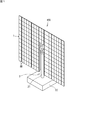
- FIG. 1 is a perspective view of one example of a concentrating solar power generation device as viewed from the light receiving surface side, and shows the solar power generation device in a completed state.
- FIG. 2 is a perspective view of one example of a concentrating solar power generation device as viewed from the light-receiving surface side, and shows the solar power generation device in the middle of assembly.
- FIG. 3 is a perspective view showing, as an example, the attitude of the array facing the sun.
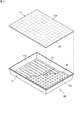
- FIG. 4 is a perspective view showing an example of the configuration of the concentrating solar power generation module.
- FIG. 5 is a cross-sectional view illustrating a configuration example of a light receiving unit of the concentrator photovoltaic module.
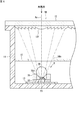
- FIG. 6 is a cross-sectional view showing an example of a concentrating photovoltaic power generation unit as a basic configuration of a concentrating photovoltaic power generation optical system constituting the concentrating photovoltaic power generation module.
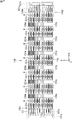
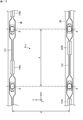
- FIG. 7 is a diagram showing an example of the original form of the flexible printed wiring board before being developed.
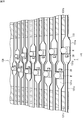
- FIG. 8 is a perspective view of a part of the original form of the flexible printed wiring board viewed obliquely from above.
- FIG. 9 is a YZ cross-sectional view of a portion having a connection band.
- FIG. 10 is a diagram showing a procedure for separating a connection band of a prototype.
- FIG. 11 is a plan view of a part of, for example, four flexible substrates when mounted on the bottom surface of the housing.
- FIG. 11 is a plan view of a part of, for example, four flexible substrates when mounted on the bottom surface of the housing.
- FIG. 12 is a plan view showing a part of a state in which a heat radiation tape is attached to the bottom surface of the housing and a developed flexible substrate is attached.
- FIG. 13 is a plan view focusing on only two adjacent flexible substrates and viewing a connection band before separation.
- FIG. 14 is a plan view showing a first example of a positioning procedure using a connection band remaining on the flexible substrate.
- FIG. 15 is a plan view showing a second example of the positioning procedure using the connection band remaining on the flexible substrate.
- FIG. 16 is a plan view showing a third example of the positioning procedure using the connection band remaining on the flexible substrate.
- FIG. 17 is a plan view showing a fourth example of the positioning procedure using the connection band remaining on the flexible substrate.
- an object of the present disclosure is to make it easy to handle an original form of a flexible printed wiring board regardless of release paper.
- the gist of the embodiments of the present invention includes at least the following.
- This is an original form of a flexible printed wiring board that is provided by being developed on the bottom surface of a housing of a concentrating solar power generation module that collects sunlight to generate power, and one direction is X
- a strip-shaped flexible substrate extending in the X direction
- a plurality of cells mounted on the flexible substrate at equal intervals in the X direction
- a printed circuit unit including an electric circuit related to the cell
- connection band In the original form of the flexible printed wiring board as described above, since a plurality of flexible substrates are connected by a connection band, the plurality of flexible substrates are suppressed from overlapping or twisting, and one sheet Can be handled Therefore, it is easy to handle the original form of the flexible printed wiring board without using release paper.
- the connection band is cut in the middle of the Y direction and separated from each other.
- the connection band remaining after separation can serve as a mark for correct attachment and positioning of the flexible printed wiring board, and if the connection band is bonded to the installation surface, there is an effect of strengthening the bonding of the entire flexible printed wiring board.
- connection band In the original form of the flexible printed wiring board of (1), a copper pattern having a shape that is easy to cut in the middle in the Y direction and hard to cut in other than the middle is provided on one surface of the connection band. Is also good. In this case, when the connection band is cut, it is difficult to cause cutting or tearing to have an unintended end face shape, so that it is possible to increase the reliability of cutting with a desired end face shape.
- a perforation may be formed at a position in the middle of the connection band in the Y direction.
- cutting or tearing to an unintended end face shape is unlikely to occur, so that it is possible to increase the reliability of cutting with the desired end face shape along the perforation.
- cutting can be easily performed without using a dedicated cutting machine.
- a printed circuit portion including an electric circuit is mounted on a strip-shaped flexible substrate extending in the X direction, and Y is orthogonal to the X direction.
- a flexible printed wiring is provided in a state where the plurality of flexible substrates are arranged close to each other in the direction, and the plurality of flexible substrates are connected to each other by a plurality of connection bands extending in the Y direction.
- the connecting band is cut so as to be separated from each other in the Y direction between two adjacent flexible boards, and a plurality of pieces are separated from each other.
- a flexible printed wiring board manufacturing method comprising developing the flexible substrate into a desired shape to form a flexible printed wiring board.
- connection band In the method for manufacturing a flexible printed wiring board as described above, at the stage of the original form, a plurality of flexible substrates are connected by a connection band, so that a plurality of flexible substrates are suppressed from overlapping or twisting. It can be handled as one sheet. Therefore, it is easy to handle the original form of the flexible printed wiring board without using release paper.
- the connection band remaining after separation can be a mark for correct mounting and positioning of the flexible printed wiring board, and if the connection band is bonded to the installation surface, there is an effect of strengthening the bonding of the entire flexible printed wiring board.
- the flexible printed circuit board may be cut such that a concave portion or a convex portion remains at a cut portion in the Y direction of the connection band of the adjacent flexible substrate.
- the concave portion or the convex portion remaining after the separation can be used as a mark for positioning when the flexible printed wiring board is mounted. Therefore, accurate mounting can be easily performed.
- a mark for aligning with the connection band after separation may be formed on an installation surface of the installation object. In this case, the positioning of each part of the flexible substrate can be accurately performed using the connection band remaining after the separation.
- this is a concentrating solar power generation module that condenses sunlight and generates power, and includes a housing, and a condensing light mounted to face the bottom surface of the housing. And a flexible printed wiring board provided in a plurality of rows on the bottom surface of the housing, and the flexible printed wiring boards in each row are arranged in the X direction when one direction is the X direction.
- An elongated strip-shaped flexible substrate, and a plurality of cells mounted on the flexible substrate at equal intervals in the X direction and performing photoelectric conversion by sunlight condensed by the light condensing unit, and an electric circuit related to the cell.
- a printed circuit part including a connection strip remaining on the flexible substrate and extending in a Y direction orthogonal to the X direction.
- connection band connecting the plurality of flexible substrates is cut off at the time of mounting before mounting, but remains as a remnant of the connection band extending in the Y direction.
- the bonding of the flexible substrate to the mounting surface becomes more stable and reliable, and the bonding of the entire flexible printed wiring board can be strengthened.
- the connection band remaining after the separation can be a mark for correct attachment and positioning of the flexible printed wiring board.
- a light emitting module including a similar structure. That is, a light-emitting module that receives light from an external power supply, emits light, and includes a housing, a light-transmitting plate attached to face the bottom surface of the housing, and a plurality of rows formed on the bottom surface of the housing. And a flexible printed wiring board provided, wherein the flexible printed wiring boards in each row, when one direction is an X direction, a strip-shaped flexible substrate extending in the X direction, and an equal interval in the X direction.
- FIG. 1 and FIG. 2 are perspective views of one example of a concentrating solar power generation device as viewed from the light receiving surface side.
- FIG. 1 shows the photovoltaic power generation device 100 in a completed state
- FIG. 2 shows the photovoltaic power generation device 100 in a state of being assembled.
- FIG. 2 shows a state in which the framework of the tracking gantry 25 is visible in the right half, and a state in which the concentrating photovoltaic module (hereinafter, also simply referred to as a module) 1M is attached is shown in the left half.
- the module 1M When actually mounting the module 1M on the tracking gantry 25, the mounting is performed with the tracking gantry 25 laid on the ground.
- the photovoltaic power generation device 100 includes an array (entire photovoltaic power generation panel) 1 that is continuous on the upper side and divided into left and right sides on the lower side, and a support device 2 for the array.
- the array 1 is configured by arranging the modules 1M on a tracking rack 25 (FIG. 2) on the rear side.
- the support device 2 includes a support 21, a foundation 22, a two-axis drive unit 23, and a horizontal shaft 24 (FIG. 2) serving as a drive shaft.
- the support 21 has a lower end fixed to the foundation 22 and a biaxial drive unit 23 at the upper end.
- the foundation 22 is buried firmly in the ground so that only the upper surface can be seen.
- the columns 21 are vertical and the horizontal axis 24 (FIG. 2) is horizontal.
- the two-axis driving unit 23 can rotate the horizontal axis 24 in two directions of an azimuth (an angle with the support 21 as a central axis) and an elevation (an angle with the horizontal axis 24 as a central axis).
- a reinforcing member 25 a for reinforcing the tracking gantry 25 is attached to the horizontal shaft 24.
- a plurality of horizontal rails 25b are attached to the reinforcing member 25a.
- FIG. 3 is a perspective view showing the attitude of the array 1 facing the sun as an example.
- the array 1 takes a horizontal posture with the light receiving surface facing the sun.
- the light receiving surface of the array 1 is oriented horizontally with the light receiving surface facing the ground.
- FIG. 4 is a perspective view illustrating an example of a configuration of the concentrating solar power generation module 1M.
- the module 1M includes, as a physical form in appearance, a rectangular flat-bottomed container 11 made of, for example, metal or resin, and a light collector 12 mounted thereon like a lid. I have.
- the condensing unit 12 is configured by, for example, attaching a resin primary lens (Fresnel lens) 12f to the back surface of a single light-transmitting glass plate 12a.
- a resin primary lens Resnel lens
- each of the sections of the illustrated square (14 ⁇ 10 in this example, but the number is merely an example for explanation) is a primary lens 12f, and converges sunlight to a focal position. be able to.
- one elongated flexible printed wiring board 13 is arranged so as to be aligned while changing the direction as illustrated.
- the flexible printed wiring board 13 has a relatively wide portion and a narrow portion.
- a cell (not shown) is mounted on a wide area. The cells are arranged at positions corresponding to the respective optical axes of the Fresnel lens 12f.
- a metal shielding plate 14 is attached between the flexible printed wiring board 13 and the light collector 12.
- a square opening 14a similar to the square of the primary lens 12f is formed at a position corresponding to the center of each primary lens 12f. If the array 1 accurately tracks the sun and the incident angle of the sunlight on the module 1M is 0 degree, the light collected by the primary lens 12f can pass through the opening 14a. If the tracking deviates significantly, the collected light is shielded by the shield plate 14. However, when the tracking shift is slight, the collected light passes through the opening 14a.
- FIG. 5 is a cross-sectional view illustrating a configuration example of the light receiving unit R of the concentrating solar power generation module. Each part shown in FIG. 5 is appropriately enlarged and drawn for convenience of description of the structure, and is not necessarily a figure proportional to actual dimensions (similarly in FIG. 6).
- the light receiving unit R includes a secondary lens 30, a support unit 31, a package 32, a cell 33, a lead frame (P side) 34, a gold wire 35, a lead frame 36 (N side), and a sealing unit 37. It has.
- the light receiving unit R is mounted on the flexible printed wiring board 13.
- a bypass diode is connected to the cell 33 in parallel, but is not shown here.
- the secondary lens 30 is, for example, a ball lens.
- the secondary lens 30 is supported by the inner peripheral edge 31 e of the upper end of the support portion 31 so that a gap in the optical axis Ax direction is formed between the secondary lens 30 and the cell 33.
- the support portion 31 is, for example, cylindrical and made of resin or glass.
- the support part 31 is fixed on a flat package 32.
- the package 32 is made of resin, and holds the cell 33 together with its lead frames 34 and 36.
- the output of the cell 33 is led out to the lead frame 34 on the P side and to the lead frame 36 via the gold wire 35 on the N side.
- the sealing portion 37 is made of a light-transmitting silicone resin, and is provided to fill a space formed between the secondary lens 30 and the cell 33 inside the support portion 31.
- the upper end portion of the support portion 31 has a form in which an end surface 31a is extended outside the secondary lens 30 around the optical axis Ax.
- a washer-shaped metal protection plate may be placed on the end surface 31a.
- FIG. 6 is a cross-sectional view illustrating an example of a concentrating photovoltaic power generation unit 1U as a basic configuration of an optical system for concentrating power generation that forms the module 1M.
- the secondary lens 30 of the light receiving unit R and the cell are disposed on the optical axis Ax of the primary lens 12f.
- the light condensed by the primary lens 12f passes through the opening 14a of the shielding plate 14, is taken into the secondary lens 30 of the light receiving unit R, and guided to the cell 33.
- FIG. 7 is a diagram illustrating an example of a prototype 13A of the flexible printed wiring board 13 before being developed.
- this prototype 13A includes 140 light receiving portions R, and when expanded, corresponds to the total number of primary lenses 12f (FIG. 4).
- the number is only an example, and in short, the flexible printed wiring board 13 on which the number of light receiving units R corresponding to the total number of the primary lenses 12f is mounted is required.
- the prototype 13A has a certain height in the light receiving portion R and the like in the Z direction.
- the overall shape is a single sheet on the XY plane.
- the electrical connection is separated between the upper half and the lower half in the Y direction, and is constituted by an original half 13A1 of the upper half and a lower half 13A2.
- the original body 13A1 of the upper half is provided with ten strip-shaped flexible substrates 131 extending in the X direction and adjacent to each other in the Y direction.
- the ten wires are electrically connected in series while turning as a whole at the left end and the right end.
- a portion where the light receiving portion R is mounted is a wide portion 131w having a relatively large width in the Y direction, and a width between two light receiving portions R adjacent in the X direction is relatively large. It is a narrow portion 131n.
- the lower half prototype 13A2 is similarly configured, and includes 20 flexible substrates 131 as a whole of the prototype 13A.
- Two flexible substrates 131 adjacent to each other in the Y direction are arranged such that the positions of the wide portions 131w in the X direction are shifted from each other, whereby the 20 flexible substrates 131 are densely arranged as a whole, and the production with a high yield is achieved. It is possible.
- the folded portion 131c at the left end and the right end is folded at the same width as the narrow portion 131n.
- the original shape 13A (13A1) can be freely expanded by utilizing its thinness and shifted in the X direction.
- 13A2 can be developed into a desired shape.
- connection strips 131b extending in the Y direction connect the two flexible boards 131 to each other in a state where they are arranged close to each other.
- the entire prototype 13A including the 20 flexible substrates 131 becomes a single sheet, which facilitates handling.
- the margins 131x at the left and right ends are provided for necessity in manufacturing, and are cut off before mounting the prototype 13A as a flexible printed wiring board.
- FIG. 8 is a perspective view of a part of the original form 13A of the flexible printed wiring board 13 viewed from diagonally above.
- the connection band 131b is shown with diagonal lines.
- a light receiving unit R mounted at equal intervals in the X direction and a printed circuit unit 131p including an electric circuit related to the light receiving unit R are mounted thereon. I have.
- a bypass diode 39 which is a part of the printed circuit unit 131p is provided beside the light receiving unit R.
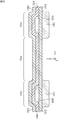
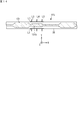
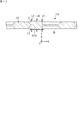
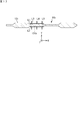
- FIG. 9 is a YZ cross-sectional view of a portion where the connection band 131b exists.
- X, Y, and Z in three orthogonal directions are common to FIG.
- the narrow portion 131n of the flexible substrate 131 has a configuration in which, for example, a copper pattern 1311 on the back surface, an insulating base 1312 made of polyimide, a copper pattern 1313 on the front surface, an adhesive layer 1314, and a coverlay 1315 made of polyimide are stacked.
- the connection band 131b is configured by, for example, directly expanding the insulating base 1312, the adhesive layer 1314, and the cover lay 1315.
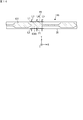
- FIG. 10 is a diagram showing a procedure for separating the connection band 131b of the prototype 13A.
- Each flexible substrate 131 can be separated from each other by cutting the connection band 131b between two adjacent flexible substrates 131, for example, in the middle of the Y direction. After the separation, the positions of the light receiving units R in the X direction are aligned by shifting in the X direction.
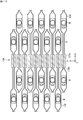
- FIG. 11 is a plan view of a part of, for example, four flexible substrates 131 when mounted on the bottom surface 11 b (FIG. 4) of the housing 11.
- the distance d between two light receiving units R adjacent in the X direction is the same as the distance d between two light receiving units R adjacent in the Y direction. This distance d is the same as the vertical and horizontal spacing of the matrix at the center of the optical axis of the primary lens 12f (FIG. 4).
- a connection band 131 b (a connection band as a remnant) remains on the flexible substrate 131.
- FIG. 12 is a plan view showing a part of a state where a heat radiation tape 38 is attached to the bottom surface 11 b of the housing 11 and the developed flexible substrate 131 is attached.
- the connection band 131b also serves as a mark for positioning at the time of mounting.
- it also serves as a mark indicating polarity. That is, it can be seen at a glance that the polarity of the one having the connection band 131b is plus (or minus) when looking at a certain distance range from the light receiving unit R.
- FIG. 13 is a plan view focusing on only two adjacent flexible boards 131 and viewing the connection band 131b before separation.
- (B) is an enlarged view showing an example of the configuration of the back surface of (a).
- a copper pattern 1316 (shaded portion) having a shape as shown in the figure is provided in close contact with the back surface of the connection band 131b.
- the connection band 131b is easily cut in the middle of the Y direction in parallel with the X direction. Except for the middle in the Y direction, it is difficult to cut. Therefore, cutting or tearing (transfer) that results in an unintended end face shape is unlikely to occur, and it is possible to increase the reliability of cutting with a desired end face shape.
- (C) of FIG. 13 is an enlarged view as an example of the surface side of (a).
- a perforation m is formed in the middle of the connection band 131b in the Y direction and parallel to the X direction.
- the connection band 131b is easily cut in the middle of the Y direction in parallel with the X direction. Except for the middle in the Y direction, it is difficult to cut. Therefore, cutting or tearing (transfer) that results in an unintended end face shape is unlikely to occur, and it is possible to increase the reliability of cutting with a desired end face shape. In this case, cutting can be easily performed without using a dedicated cutting machine.
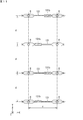
- FIG. 14 is a plan view showing a first example of a positioning procedure using the connection band 131b remaining on the flexible substrate 131.
- the hatched portion is the flexible substrate 131 (the same applies hereinafter).
- the marking line can be easily attached to the bottom surface 11b (the same applies hereinafter). Therefore, the marking lines L1, L2, L3, L4, and L5 are attached in advance.
- connection band 131b align both ends of the heat dissipation tape 38 in the Y direction with the marking lines L1 and L2. Furthermore, when attaching the flexible substrate 131, the positional relationship between both ends in the X direction of the connection band 131b and the marking lines L3 and L5, and the positional relationship between the center of the connection band 131b in the X direction and the marking line L4. , X direction. If the gaps between the marking lines L1 and L2 and both ends in the Y direction of the connection band 131b are made uniform, the connection band 131b can be positioned also in the Y direction.
- FIG. 15 is a plan view showing a second example of a positioning procedure using the connection band 131b remaining on the flexible board 131. Also in this case, the marking lines L1, L2, L3, L4, and L5 are attached in advance.
- FIG. 16 is a plan view showing a third example of a positioning procedure using the connection band 131b remaining on the flexible substrate 131.
- the connection band 131b has a triangular concave portion P1 and a triangular concave portion P2 formed at the center in the X direction and at both ends in the Y direction. Such irregularities can be easily formed when cutting the connection band 131b. Also in this case, the marking lines L1, L2, L3, L4, and L5 are attached in advance.
- both ends of the heat radiation tape 38 align both ends of the heat radiation tape 38 in the Y direction with the marking lines L1 and L2. Furthermore, when attaching the flexible board 131, both ends in the X direction of the connection band 131b are aligned with the marking lines L3 and L5, and the concave portion P1 and the convex portion P2 of the connection band 131b are aligned with the marking line L4. In this way, positioning can be performed more accurately in the X direction. Further, by aligning both ends in the Y direction of the connection band 131b with the marking lines L1 and L2, the Y direction of the connection band 131b can be determined.
- FIG. 17 is a plan view showing a fourth example of the positioning procedure using the connection band 131b remaining on the flexible substrate 131.
- This is an example in which a heat radiation tape is not used.
- the marking lines L1, L2, L3, L4, and L5 are attached in advance.
- both ends of the connection band 131b in the X direction are aligned with the marking lines L3 and L5, and the center of the connection band 131b in the X direction is aligned with the marking line L4.
- the positioning in the X direction can be performed.
- the Y direction of the connection band 131b can be determined.
- a mark may be formed by another method such as marking.
- the prototype 13A of the flexible printed wiring board according to the present embodiment has a plurality of flexible boards 131 arranged close to each other in the Y direction orthogonal to the X direction in which the flexible boards 131 extend. And a plurality of connection bands 131b extending in the Y direction, which connect the plurality of flexible substrates 131 to each other.
- the original form 13A of the flexible printed wiring board having such a connection band 131b since the plurality of flexible substrates 131 are connected by the connection band 131b, the plurality of flexible substrates 131 may be overlapped with each other or twisted. , And can be handled as one sheet. Accordingly, the original form of the flexible printed wiring board 13 can be easily handled without using release paper.
- the connecting band 131b is cut so as to be separated from each other in the Y direction in the middle of the two adjacent flexible substrates 131, and the plurality of separated flexible substrates 131 are separated from each other as desired.
- the flexible printed wiring board 13 is developed into a shape.
- the connection band 131b remaining after the separation can be a mark for correct attachment and positioning of the flexible printed wiring board 13 (flexible substrate 131).
- the connection band 131b is bonded to the installation surface, the entire flexible printed wiring board 13 is bonded. There is also a function and effect of strengthening.
- the concentrating photovoltaic module 1M has been described.
- the configuration shown in FIG. 7 which is developed from the prototype 13A of the flexible printed wiring board 13 and disposed on the bottom surface of the module is also applicable to a light emitting module. It is.
- a light emitting module a light emitting element such as an LED (Light Emitting Diode) is arranged instead of the light receiving unit R in FIG.
- a light-transmitting plate that is not clear, such as frosted glass is used instead of the light condensing part 12 (FIG. 4), light emission occurs.
- Modules can be configured. Electric power is supplied, for example, from the outside to cause the LED to emit light.
Landscapes
- Engineering & Computer Science (AREA)
- Microelectronics & Electronic Packaging (AREA)
- Manufacturing & Machinery (AREA)
- Photovoltaic Devices (AREA)
- Structure Of Printed Boards (AREA)
Abstract
Priority Applications (5)
| Application Number | Priority Date | Filing Date | Title |
|---|---|---|---|
| AU2019293111A AU2019293111A1 (en) | 2018-06-27 | 2019-06-18 | Original form body of flexible printed-wiring board, method of manufacturing flexible printed-wiring board, concentrated photovoltaic power generation module, and light emitting module |
| US16/972,277 US20210243881A1 (en) | 2018-06-27 | 2019-06-18 | Original form body of flexible printed-wiring board, method of manufacturing flexible printed-wiring board, concentrated photovoltaic power generation module, and light emitting module |
| JP2020527429A JP7424288B2 (ja) | 2018-06-27 | 2019-06-18 | フレキシブルプリント配線板の原形体、フレキシブルプリント配線板の製造方法、集光型太陽光発電モジュール、及び、発光モジュール |
| EP19825673.7A EP3817519A4 (fr) | 2018-06-27 | 2019-06-18 | Corps de forme d'origine d'une carte de circuit imprimé flexible, procédé de fabrication de carte de circuit imprimé flexible, module de génération d'énergie photovoltaïque concentrée et module électroluminescent |
| CN201980043367.2A CN112369128A (zh) | 2018-06-27 | 2019-06-18 | 柔性印刷线路板的前体、制造柔性印刷线路板的方法、聚光型光伏发电模块和发光模块 |
Applications Claiming Priority (2)
| Application Number | Priority Date | Filing Date | Title |
|---|---|---|---|
| JP2018121660 | 2018-06-27 | ||
| JP2018-121660 | 2018-06-27 |
Publications (1)
| Publication Number | Publication Date |
|---|---|
| WO2020004144A1 true WO2020004144A1 (fr) | 2020-01-02 |
Family
ID=68984920
Family Applications (1)
| Application Number | Title | Priority Date | Filing Date |
|---|---|---|---|
| PCT/JP2019/024095 Ceased WO2020004144A1 (fr) | 2018-06-27 | 2019-06-18 | Corps de forme d'origine d'une carte de circuit imprimé flexible, procédé de fabrication de carte de circuit imprimé flexible, module de génération d'énergie photovoltaïque concentrée et module électroluminescent |
Country Status (7)
| Country | Link |
|---|---|
| US (1) | US20210243881A1 (fr) |
| EP (1) | EP3817519A4 (fr) |
| JP (1) | JP7424288B2 (fr) |
| CN (1) | CN112369128A (fr) |
| AU (1) | AU2019293111A1 (fr) |
| TW (1) | TW202018962A (fr) |
| WO (1) | WO2020004144A1 (fr) |
Citations (7)
| Publication number | Priority date | Publication date | Assignee | Title |
|---|---|---|---|---|
| JPH0685409A (ja) * | 1992-09-01 | 1994-03-25 | Nitto Denko Corp | フレキシブル板 |
| JP2014035502A (ja) * | 2012-08-10 | 2014-02-24 | Togu:Kk | ライン照明装置 |
| JP2015170699A (ja) * | 2014-03-06 | 2015-09-28 | 住友電気工業株式会社 | フレキシブルプリント基板および太陽光発電モジュール |
| JP2016018991A (ja) | 2015-05-25 | 2016-02-01 | 住友電気工業株式会社 | 太陽光発電モジュール、太陽光発電装置および太陽光発電モジュールの製造方法 |
| JP2016096309A (ja) * | 2014-11-17 | 2016-05-26 | シャープ株式会社 | フレキシブルプリント配線板、太陽電池モジュールおよび太陽光発電装置 |
| JP2017126777A (ja) | 2017-03-23 | 2017-07-20 | 住友電気工業株式会社 | フレキシブルプリント基板およびフレキシブルプリント基板の固定方法 |
| JP2018121660A (ja) | 2009-12-28 | 2018-08-09 | サノフィ ワクチン テクノロジーズ エス.エー.エス. | 微細藻類における異種ポリペプチド、微細藻類細胞外体、組成物の産生、ならびにそれらの作製および使用の方法 |
Family Cites Families (7)
| Publication number | Priority date | Publication date | Assignee | Title |
|---|---|---|---|---|
| FR2555011B1 (fr) * | 1983-11-15 | 1986-01-24 | Thomson Csf | Carte imprimee a empreintes |
| JP2008257001A (ja) * | 2007-04-06 | 2008-10-23 | Toshiba Matsushita Display Technology Co Ltd | 表示装置 |
| US10030863B2 (en) * | 2011-04-19 | 2018-07-24 | Cree, Inc. | Heat sink structures, lighting elements and lamps incorporating same, and methods of making same |
| JP5814725B2 (ja) * | 2011-10-03 | 2015-11-17 | 住友電気工業株式会社 | 集光型太陽光発電モジュール及び集光型太陽光発電パネル |
| TWI656653B (zh) * | 2014-07-10 | 2019-04-11 | 日商住友電氣工業股份有限公司 | 太陽光發電模組及太陽光發電裝置 |
| JP6414485B2 (ja) * | 2015-02-27 | 2018-10-31 | 日亜化学工業株式会社 | 発光装置 |
| JP6561661B2 (ja) * | 2015-08-03 | 2019-08-21 | 住友電気工業株式会社 | 集光型太陽光発電ユニット、集光型太陽光発電モジュール、集光型太陽光発電パネル及び集光型太陽光発電装置 |
-
2019
- 2019-06-18 WO PCT/JP2019/024095 patent/WO2020004144A1/fr not_active Ceased
- 2019-06-18 JP JP2020527429A patent/JP7424288B2/ja active Active
- 2019-06-18 US US16/972,277 patent/US20210243881A1/en not_active Abandoned
- 2019-06-18 CN CN201980043367.2A patent/CN112369128A/zh active Pending
- 2019-06-18 EP EP19825673.7A patent/EP3817519A4/fr not_active Withdrawn
- 2019-06-18 AU AU2019293111A patent/AU2019293111A1/en not_active Abandoned
- 2019-06-26 TW TW108122278A patent/TW202018962A/zh unknown
Patent Citations (7)
| Publication number | Priority date | Publication date | Assignee | Title |
|---|---|---|---|---|
| JPH0685409A (ja) * | 1992-09-01 | 1994-03-25 | Nitto Denko Corp | フレキシブル板 |
| JP2018121660A (ja) | 2009-12-28 | 2018-08-09 | サノフィ ワクチン テクノロジーズ エス.エー.エス. | 微細藻類における異種ポリペプチド、微細藻類細胞外体、組成物の産生、ならびにそれらの作製および使用の方法 |
| JP2014035502A (ja) * | 2012-08-10 | 2014-02-24 | Togu:Kk | ライン照明装置 |
| JP2015170699A (ja) * | 2014-03-06 | 2015-09-28 | 住友電気工業株式会社 | フレキシブルプリント基板および太陽光発電モジュール |
| JP2016096309A (ja) * | 2014-11-17 | 2016-05-26 | シャープ株式会社 | フレキシブルプリント配線板、太陽電池モジュールおよび太陽光発電装置 |
| JP2016018991A (ja) | 2015-05-25 | 2016-02-01 | 住友電気工業株式会社 | 太陽光発電モジュール、太陽光発電装置および太陽光発電モジュールの製造方法 |
| JP2017126777A (ja) | 2017-03-23 | 2017-07-20 | 住友電気工業株式会社 | フレキシブルプリント基板およびフレキシブルプリント基板の固定方法 |
Non-Patent Citations (1)
| Title |
|---|
| See also references of EP3817519A4 |
Also Published As
| Publication number | Publication date |
|---|---|
| JPWO2020004144A1 (ja) | 2021-08-02 |
| CN112369128A (zh) | 2021-02-12 |
| AU2019293111A1 (en) | 2021-01-07 |
| EP3817519A4 (fr) | 2022-03-23 |
| US20210243881A1 (en) | 2021-08-05 |
| JP7424288B2 (ja) | 2024-01-30 |
| EP3817519A1 (fr) | 2021-05-05 |
| TW202018962A (zh) | 2020-05-16 |
Similar Documents
| Publication | Publication Date | Title |
|---|---|---|
| US10680127B2 (en) | Power generation circuit unit | |
| JP5814725B2 (ja) | 集光型太陽光発電モジュール及び集光型太陽光発電パネル | |
| US9948232B2 (en) | Method for fabricating flexible solar panel module | |
| US20090064994A1 (en) | Concentrating solar collector | |
| JP5384164B2 (ja) | 太陽電池及び太陽電池モジュール | |
| JP2008543066A (ja) | 光起電集光装置及び前記から形成された光起電集光モジュール並びにこれらのための生産方法 | |
| AU2016267138B2 (en) | Concentrator photovoltaic module, concentrator photovoltaic panel, and concentrator photovoltaic apparatus | |
| US20160126380A1 (en) | Flexible solar panel and method of fabricating the same | |
| JP2018032859A (ja) | 太陽電池モジュールの製造方法及びそれに従う太陽電池モジュール | |
| JP5948890B2 (ja) | 集光型太陽光発電モジュール、集光型太陽光発電パネル、及び、集光型太陽光発電モジュール用フレキシブルプリント配線板 | |
| KR20200134328A (ko) | 양면 광전지 모듈 | |
| US20160284877A1 (en) | Flexible-printed-circuit joint structure, concentrator photovoltaic module, and flexible-printed-circuit joining method | |
| JP5196821B2 (ja) | 太陽電池モジュール | |
| JP7424288B2 (ja) | フレキシブルプリント配線板の原形体、フレキシブルプリント配線板の製造方法、集光型太陽光発電モジュール、及び、発光モジュール | |
| EP3667741B1 (fr) | Module photovoltaïque à concentrateur, panneau photovoltaïque à concentrateur et dispositif photovoltaïque à concentrateur | |
| EP2965364B1 (fr) | Méthode d'assemblage d'un module photovoltaïque | |
| JP2014173361A (ja) | 太陽電池モジュールの取付構造及び建造物 | |
| JP2011160008A (ja) | 太陽電池モジュール | |
| JP2022015028A (ja) | 集光型太陽光発電モジュール及び集光型太陽光発電装置 |
Legal Events
| Date | Code | Title | Description |
|---|---|---|---|
| 121 | Ep: the epo has been informed by wipo that ep was designated in this application |
Ref document number: 19825673 Country of ref document: EP Kind code of ref document: A1 |
|
| ENP | Entry into the national phase |
Ref document number: 2020527429 Country of ref document: JP Kind code of ref document: A |
|
| NENP | Non-entry into the national phase |
Ref country code: DE |
|
| ENP | Entry into the national phase |
Ref document number: 2019293111 Country of ref document: AU Date of ref document: 20190618 Kind code of ref document: A |
|
| ENP | Entry into the national phase |
Ref document number: 2019825673 Country of ref document: EP Effective date: 20210127 |
|
| WWW | Wipo information: withdrawn in national office |
Ref document number: 2019825673 Country of ref document: EP |