WO2020004171A1 - Dispositif de gestion de changement d'agencement, procédé de gestion de changement d'agencement, et support d'enregistrement dans lequel un programme de gestion de changement d'agencement est stocké - Google Patents
Dispositif de gestion de changement d'agencement, procédé de gestion de changement d'agencement, et support d'enregistrement dans lequel un programme de gestion de changement d'agencement est stocké Download PDFInfo
- Publication number
- WO2020004171A1 WO2020004171A1 PCT/JP2019/024277 JP2019024277W WO2020004171A1 WO 2020004171 A1 WO2020004171 A1 WO 2020004171A1 JP 2019024277 W JP2019024277 W JP 2019024277W WO 2020004171 A1 WO2020004171 A1 WO 2020004171A1
- Authority
- WO
- WIPO (PCT)
- Prior art keywords
- arrangement
- candidate
- state
- wireless communication
- change
- Prior art date
- Legal status (The legal status is an assumption and is not a legal conclusion. Google has not performed a legal analysis and makes no representation as to the accuracy of the status listed.)
- Ceased
Links
Images




Classifications
-
- H—ELECTRICITY
- H04—ELECTRIC COMMUNICATION TECHNIQUE
- H04W—WIRELESS COMMUNICATION NETWORKS
- H04W16/00—Network planning, e.g. coverage or traffic planning tools; Network deployment, e.g. resource partitioning or cells structures
- H04W16/18—Network planning tools
-
- H—ELECTRICITY
- H04—ELECTRIC COMMUNICATION TECHNIQUE
- H04W—WIRELESS COMMUNICATION NETWORKS
- H04W24/00—Supervisory, monitoring or testing arrangements
- H04W24/02—Arrangements for optimising operational condition
-
- H—ELECTRICITY
- H04—ELECTRIC COMMUNICATION TECHNIQUE
- H04W—WIRELESS COMMUNICATION NETWORKS
- H04W4/00—Services specially adapted for wireless communication networks; Facilities therefor
- H04W4/02—Services making use of location information
- H04W4/029—Location-based management or tracking services
-
- H—ELECTRICITY
- H04—ELECTRIC COMMUNICATION TECHNIQUE
- H04W—WIRELESS COMMUNICATION NETWORKS
- H04W64/00—Locating users or terminals or network equipment for network management purposes, e.g. mobility management
- H04W64/006—Locating users or terminals or network equipment for network management purposes, e.g. mobility management with additional information processing, e.g. for direction or speed determination
-
- H—ELECTRICITY
- H04—ELECTRIC COMMUNICATION TECHNIQUE
- H04W—WIRELESS COMMUNICATION NETWORKS
- H04W72/00—Local resource management
- H04W72/20—Control channels or signalling for resource management
- H04W72/23—Control channels or signalling for resource management in the downlink direction of a wireless link, i.e. towards a terminal
-
- H—ELECTRICITY
- H04—ELECTRIC COMMUNICATION TECHNIQUE
- H04W—WIRELESS COMMUNICATION NETWORKS
- H04W72/00—Local resource management
- H04W72/50—Allocation or scheduling criteria for wireless resources
- H04W72/51—Allocation or scheduling criteria for wireless resources based on terminal or device properties
-
- H—ELECTRICITY
- H04—ELECTRIC COMMUNICATION TECHNIQUE
- H04W—WIRELESS COMMUNICATION NETWORKS
- H04W72/00—Local resource management
- H04W72/50—Allocation or scheduling criteria for wireless resources
- H04W72/54—Allocation or scheduling criteria for wireless resources based on quality criteria
- H04W72/542—Allocation or scheduling criteria for wireless resources based on quality criteria using measured or perceived quality
-
- H—ELECTRICITY
- H04—ELECTRIC COMMUNICATION TECHNIQUE
- H04W—WIRELESS COMMUNICATION NETWORKS
- H04W24/00—Supervisory, monitoring or testing arrangements
- H04W24/08—Testing, supervising or monitoring using real traffic
-
- H—ELECTRICITY
- H04—ELECTRIC COMMUNICATION TECHNIQUE
- H04W—WIRELESS COMMUNICATION NETWORKS
- H04W4/00—Services specially adapted for wireless communication networks; Facilities therefor
- H04W4/02—Services making use of location information
Definitions
- the present invention relates to a technique for managing a change in arrangement of wireless communication devices according to a change in the communication environment in a place where the communication environment of the wireless communication device changes.
- ICT Information and Communication Technology
- wireless networks For example, at a construction site, by remotely controlling a construction machine via a wireless network, work at a dangerous site can be performed safely.
- the production efficiency can be improved by analyzing the waiting time, inefficient behavior, and the like in the work based on the position information of the worker acquired via the wireless network.
- the radio communication environment (the environment in which radio waves propagate) changes greatly as the physical environment changes as the work progresses, so that the communication quality of the radio communication may be significantly reduced. Therefore, there is an increasing expectation for a technology that can construct a stable wireless communication environment in a place where the environment of wireless communication changes rapidly.
- the topography information of a work site and AP (access point) information including installation cost information and relocation cost information of an access point to be used are input and accessed.
- a wireless network system for generating a time-series arrangement plan of points is disclosed.
- time-series excavation schedule information based on a plan and time-series communication area information are also input.
- the system displays at least one of the installation information, the relocation information, and the removal information in a time series for one or more access points.
- Patent Document 2 discloses a system that determines an optimal or suitable configuration setting for a wireless or wired network device in order to obtain a desired level of network performance.
- This system displays on a display the physical environment in which the communication system is deployed.
- the system includes a plurality of wireless communication components located at a plurality of different locations in a physical environment, and displays a graphical icon on a display to identify the location or presence of the wireless communication component.
- the system retrieves, stores or processes information describing each of the plurality of wireless communication components associated with the display, and defines a predefined communication method for at least some of the wireless communication components. Includes an identifying data processor.
- the system includes providing at least one of the wireless communication components when at least one graphical icon associated with at least one of the plurality of wireless communication components is selectively identified on the display. And / or graphics information and / or text information are selectively displayed on a display via a data processor associated with.
- Patent Document 3 discloses an operation environment setting system that easily sets an operation environment required when an access destination of a mobile communication terminal is changed.
- Mobile communication terminals mounted on construction machines in this system include satellite communication terminals and wireless LAN (Local Area Network) terminals.
- the mobile communication terminal transmits an operation environment setting request and position information from the satellite communication terminal to the management server.
- the management server selects the operation environment setting data of the wireless LAN at the construction site based on the received position information and transmits the data to the satellite communication terminal of the mobile communication terminal. Then, the mobile communication terminal automatically sets the operation environment setting of the wireless LAN terminal based on the received setting data.
- Patent Documents 1 to 3 do not particularly mention this problem.
- a main object of the present invention is to provide an arrangement change management device or the like that solves this problem.
- the arrangement change management device when the communication environment of the wireless communication device changes from the first state to the second state, the arrangement of the wireless communication device in the first state As different, generating means for generating one or more arrangement candidates of the wireless communication device in the second state, and estimating means for estimating the communication quality of the arrangement candidate by the wireless communication device in the second state, Calculating means for calculating the arrangement change cost required for changing the arrangement of the wireless communication device from the arrangement in the first state to the arrangement candidate, for the arrangement candidate; and the communication quality and the arrangement for the arrangement candidate. Selecting means for selecting a specific arrangement candidate satisfying a criterion from the arrangement candidates based on the change cost.
- the arrangement change management method provides a method for managing an arrangement change in a case where a communication environment of a wireless communication device changes from a first state to a second state by an information processing device. Generating one or more arrangement candidates of the wireless communication device in the second state so as to be different from the arrangement of the wireless communication device in the first state, and setting the arrangement candidate of the wireless communication device in the second state. Estimating the communication quality related to the arrangement candidate, calculating the arrangement change cost required to change the arrangement of the wireless communication device from the arrangement in the first state to the arrangement candidate, for the arrangement candidate, Based on the communication quality and the placement change cost, a specific placement candidate that satisfies a criterion is selected from the placement candidates.
- the arrangement change management program provides the arrangement change management program, wherein the communication environment of the wireless communication device changes from the first state to the second state.
- a generation process of generating one or more arrangement candidates of the wireless communication device in the second state, and the generation processing by the wireless communication device in the second state Estimation processing for estimating the communication quality related to the arrangement candidate, and calculation processing for calculating the arrangement change cost required to change the arrangement of the wireless communication devices from the arrangement in the first state to the arrangement candidate with respect to the arrangement candidate
- a specific arrangement candidate satisfying a criterion among the arrangement candidates To execute a selection process for-option, to a computer.
- the present invention can be realized by a computer-readable, non-volatile recording medium that stores such an arrangement change management program (computer program).
- the present invention makes it possible to reliably and efficiently construct a wireless communication environment with stable quality even in a place where the environment related to wireless communication changes drastically.
- FIG. 2 is a diagram illustrating an example of a current access point arrangement at a work site according to the first embodiment of the present invention, and communication quality estimated by the arrangement estimated by the arrangement change management device 10.
- FIG. 4 is a diagram illustrating an example of individual information 152-0 indicating the current arrangement of access points illustrated in FIG. 3;
- FIG. 5 is a diagram illustrating an example of individual information 152-1 generated by the generation unit 11 according to the first embodiment of the present invention based on the individual information 152-0 illustrated in FIG.
- FIG. 6 is a diagram illustrating an example of individual information 152-2 generated based on the individual information 152-1 illustrated in FIG. 5 by the generation unit 11 according to the first embodiment of the present invention.
- FIG. 7 is a diagram illustrating an example of individual information 152-3 generated based on the individual information 152-2 illustrated in FIG. 6 by the generation unit 11 according to the first embodiment of the present invention.
- FIG. 6 is a diagram illustrating communication quality estimated by an estimating unit 12 according to the first embodiment of the present invention when an access point is arranged as indicated by individual information 152-1 illustrated in FIG. 5.
- FIG. 5 is a diagram illustrating an example of individual information 152-1 generated by the generation unit 11 according to the first embodiment of the present invention based on the individual information 152-0 illustrated in FIG.
- FIG. 6 is a diagram illustrating an example of individual information 152-2 generated based on the
- FIG. 7 is a diagram illustrating a communication quality estimated by an estimating unit 12 according to the first embodiment of the present invention when an access point is arranged as indicated by individual information 152-2 illustrated in FIG. 6.
- FIG. 8 is a diagram illustrating communication quality estimated by an estimating unit 12 according to the first embodiment of the present invention when an access point is arranged as indicated by individual information 152-3 illustrated in FIG. 7.
- It is a flowchart (1/2) which shows the operation
- composition of information processor 900 which can perform arrangement change management device concerning each embodiment of the present invention.
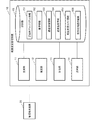
- FIG. 1 is a block diagram showing the configuration of the arrangement change management device 10 according to the first embodiment of the present invention.
- the arrangement change management device 10 is, for example, a work site such as a construction site or a factory, and uses a wireless communication access point (hereinafter sometimes referred to as “AP” in this application) due to a change in the physical environment.
- AP wireless communication access point
- An information processing apparatus that manages a change in the arrangement (relocation) of access points according to a change in the communication environment in a place where the communication environment changes.
- the arrangement change management device 10 is communicably connected to the management terminal device 20.
- the management terminal device 20 is, for example, a terminal such as a personal computer used when a user inputs information to the arrangement change management device 10 or the user checks information output from the arrangement change management device 10. Device.
- the arrangement change management device 10 includes a generation unit 11, an estimation unit 12, a calculation unit 13, a selection unit 14, and a storage unit 15.
- the storage unit 15 is, for example, a storage device such as an electronic memory or a magnetic disk.
- the storage unit 15 stores genetic algorithm information 151, individual information 152, communication environment information 153, communication quality information 154, arrangement change cost information 155, and arrangement candidate selection results 156. Details of these pieces of information stored in the storage unit 15 will be described later.
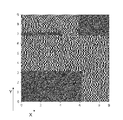
- FIG. 2 is a diagram exemplifying a current situation regarding an area where communication by a wireless communication device such as a mobile terminal is required in a work site where the arrangement change management device 10 according to the present embodiment manages an AP arrangement change.
- the arrangement change management device 10 has at least 100 XY coordinates (0, 0) to (9, 9). It manages the placement of APs installed in any of them.
- a region represented by a dark color that is, a rectangular region having vertices at XY coordinates (0, 0), (0, 3), (6, 0), (6, 3), and XY coordinates
- a rectangular area having (6, 7), (6, 9), (9, 7), and (9, 9) as vertices requires wireless communication via a wireless communication device via an AP in a work site. It represents an area that is not used.
- a dark region connecting the XY coordinates (0, 7) and (4, 7) represents a wall at the work site. However, this wall has a height in a direction perpendicular to the XY plane (paper surface) illustrated in FIG.
- the light-colored area excluding the dark-colored area described above indicates an area where wireless communication via the AP by the wireless communication device is required in work at a work site. ing. That is, the arrangement change management device 10 according to the present embodiment allocates the AP such that the communication quality of the wireless communication satisfies the criterion in the area shown in FIG. 2 where the wireless communication by the wireless communication device via the AP is required. The arrangement of APs is managed as if they were arranged.
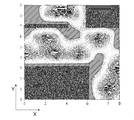
- FIG. 3 is a diagram showing a current AP arrangement at a work site where the arrangement change management apparatus 10 according to the present embodiment manages AP arrangement changes, and a communication quality of wireless communication based on the arrangement estimated by the arrangement change management apparatus 10.
- FIG. An asterisk “ ⁇ ” in FIG. 3 indicates a location where the AP is currently located.
- a portion represented by a dark color and not shaded by hatching is a wireless communication estimated by the placement change management device 10. Indicates a place where the communication quality is good (satisfies the criteria).
- a portion shaded by oblique lines indicates that the communication quality of the wireless communication estimated by the placement change management device 10 is higher. This indicates a place that is defective (does not meet the criteria). The operation of estimating the communication quality of wireless communication by the arrangement change management device 10 will be described later.
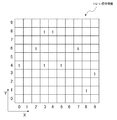
- FIG. 4 is a diagram illustrating the individual information 152-0 (arrangement information) indicating the current arrangement of the APs illustrated in FIG.
- the individual information 152 stored in the storage unit 15 represents, in addition to the information indicating the current AP arrangement, an arrangement candidate (arrangement plan) in which the AP arrangement has been changed and generated by the generation unit 11 described later.
- the information indicating the current AP arrangement is referred to as the individual information 152-0 as described above.
- the value relating to the XY coordinates indicated by the star in FIG. 3 is “1”, and the other XY coordinates (that is, the AP is installed). This is the information for setting the value regarding the location (not present) to “0”. However, in the present application, for convenience of description, “0” in FIG. 4 (the same applies to FIGS. 5 to 7 described later) is omitted and described.
- the individual information 152-0 may be information input by a user via the management terminal device 20, or may be a generation unit described later based on information input by the user via the management terminal device 20. 11 may be generated.
- the generation unit 11 illustrated in FIG. 1 is used when the communication environment of the AP changes from a first state (for example, a state when the AP is placed at a current position) to a second state (for example, a current state).
- a first state for example, a state when the AP is placed at a current position
- a second state for example, a current state
- One or more AP arrangement candidates in the second state are generated differently from the arrangement of the APs in the first state.
- the generation unit 11 according to the present embodiment generates AP arrangement candidates in the second state based on the genetic algorithm information 151.
- the genetic algorithm information 151 is stored in the storage unit 15 by, for example, an input operation performed on the management terminal device 20 by a user.
- the genetic algorithm represented by the genetic algorithm information 151 is a procedure for generating the next generation of individual information by generating a crossover, mutation, or the like with respect to a gene element included in a certain individual information. is there.
- the individual information corresponds to the information indicating the arrangement of the AP as described above, and the elements of the genes included in the individual information are the individual positions where the AP can be arranged (for example, 100 positions illustrated in FIG. 4). XY coordinates).
- crossover in the genetic algorithm corresponds to relocating an AP arranged at a certain position to another position.
- the mutation in the genetic algorithm corresponds to removing an AP arranged at a certain position or newly installing an AP at a certain position.
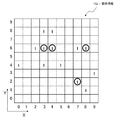
- FIG. 5 is a diagram illustrating an example of the individual information 152-1, which is generated based on the individual information 152-0 illustrated in FIG.
- the generation unit 11 generates four XY coordinates (3, 6), (4, 6), indicated by a circle “ ⁇ ” for the individual information 152-0 illustrated in FIG.
- individual information 152-1 representing the arrangement candidate (arrangement plan) after the arrangement change for newly installing the AP is generated. That is, the generation unit 11 generates the individual information 152-1 by causing a mutation in the four XY coordinates where the AP is not arranged in the individual information 152-0.
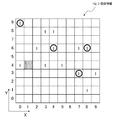
- FIG. 6 is a diagram exemplifying the individual information 152-2 that is generated by the generation unit 11 based on the individual information 152-1 illustrated in FIG.
- the generation unit 11 generates five XY coordinates (0, 9), (1, 4), and (3) indicated by the shaded unit with respect to the individual information 152-1 illustrated in FIG. , 6), (7, 2), and (7, 3), individual information 152-2 representing the arrangement candidate after the arrangement change is generated.
- the generation unit 11 generates the individual information 152-2 by causing a crossover or a mutation in the five XY coordinates in the individual information 152-1.
- the five XY coordinates indicated by the circles “ ⁇ ” indicate that the arrangement of the AP is changed between the individual information 152-0 and the individual information 152-2. Represents the location where you are.
- FIG. 7 is a diagram exemplifying the individual information 152-3 that is generated by the generation unit 11 based on the individual information 152-2 illustrated in FIG.
- the generation unit 11 changes the arrangement of removing the AP arranged at the XY coordinates (1, 4) indicated by the shaded unit with respect to the individual information 152-2 illustrated in FIG. 6.
- the individual information 152-3 representing the placement candidate after the execution is generated. That is, the generation unit 11 generates the individual information 152-3 by causing a mutation to the XY coordinates (1, 4) where the AP is located in the individual information 152-2.
- the four XY coordinates indicated by the circles “ ⁇ ” indicate that the arrangement of the AP is changed between the individual information 152-0 and the individual information 152-3. Represents the location where you are.
- the generation unit 11 converts the individual information 152-i of a certain generation i (i is any integer equal to or greater than 0) from the individual information 152-i of the next generation based on the genetic algorithm information 151.
- the operation of generating 152- (i + 1) is performed over one or more generations.
- the generation unit 11 may generate a plurality of pieces of individual information 152- (i + 1) from one piece of individual information 152-i.
- the generation unit 11 stores the generated individual information 152 in the storage unit 15.
- the estimating unit 12 illustrated in FIG. 1 performs the second based on the individual information 152 generated by the generating unit 11 and the communication environment information 153 indicating the communication environment in the second state (for example, the current state) described above.
- the communication quality by the AP is estimated for each arrangement candidate represented by the individual information 152 in the state. More specifically, the estimating unit 12 estimates, for example, a ratio of a region where the communication quality satisfies a criterion to a region where communication by the AP is required in a work site.
- the communication environment information 153 is information representing the physical environment of the work site in the second state, and is stored in the storage unit 15 by, for example, an input operation performed on the management terminal device 20 by a user. .
- the estimating unit 12 estimates the communication quality of the AP at each location in the work site by performing a simulation on radio wave propagation using, for example, a ray tracing method that is an existing technology. At this time, the estimating unit 12 may use measurement data related to communication quality by the AP at the work site, which is input by a user's input operation on the management terminal device 20. Note that the simulation related to radio wave propagation using the ray tracing method or the like is an existing technology, and therefore detailed description thereof is omitted in the present application.
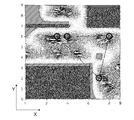
- FIG. 8 is a diagram illustrating communication quality estimated by the estimating unit 12 according to the present embodiment when an AP is arranged as indicated by the individual information 152-1 illustrated in FIG. As shown in FIG. 5, the circle “ ⁇ ” in FIG. 8 indicates the XY coordinates at which the arrangement has been changed from the current AP arrangement shown in FIGS. 3 and 4.
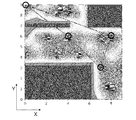
- FIG. 9 is a diagram illustrating communication quality estimated by the estimation unit 12 according to the present embodiment when an AP is arranged as indicated by the individual information 152-2 illustrated in FIG.
- the circle “ ⁇ ” in FIG. 9 indicates the XY coordinates at which the arrangement has been changed from the current AP arrangement shown in FIGS. 3 and 4, as described above with reference to FIG.
- FIG. 10 is a diagram illustrating communication quality estimated by the estimating unit 12 according to the present embodiment when an AP is arranged as indicated by the individual information 152-3 illustrated in FIG.
- the circle “ ⁇ ” in FIG. 10 indicates the XY coordinates at which the arrangement has been changed from the current AP arrangement shown in FIGS. 3 and 4, as described above with reference to FIG.
- the estimation unit 12 stores, in the storage unit 15, the communication quality information 154 indicating the result of estimating the communication quality by the AP as described above for each arrangement candidate indicated by the individual information 152-i.
- the calculation unit 13 shown in FIG. 1 changes the arrangement of the AP from the current arrangement represented by the individual information 152-0 to the arrangement candidate represented by the individual information 152-i generated by the generation unit 11.
- the cost is calculated for each arrangement candidate.
- the arrangement change cost calculated by the calculation unit 13 may be, for example, a cost required for new installation, removal, or relocation of the AP (cost based on work time, material cost, etc.), or a worker (or a device for performing the arrangement change work). Is an index depending on the time required to move the installation location of the target AP.
- a straight line connecting the four circles “ ⁇ ”illustrated in FIG. 8 indicates a case where the arrangement of the AP is changed from the current arrangement represented by the individual information 152-0 to the arrangement candidate represented by the individual information 152-1. It represents a route on which a worker moves at a work site.
- a straight line connecting five circles “ ⁇ ”illustrated in FIG. 9 changes the AP arrangement from the current arrangement indicated by the individual information 152-0 to an arrangement candidate indicated by the individual information 152-2. In this case, it indicates a route on which a worker moves at a work site.
- a straight line connecting the four circles “ ⁇ ”illustrated in FIG. 10 changes the AP arrangement from the current arrangement indicated by the individual information 152-0 to an arrangement candidate indicated by the individual information 152-3. In this case, it indicates a route on which a worker moves at a work site.
- the calculation unit 13 calculates the shortest route for the worker or the like to move to the installation location of the AP whose layout is to be changed.
- the calculation unit 13 can obtain the shortest path using, for example, a mathematical method for the traveling salesman problem. 8 to 10, for convenience of explanation, a straight line connecting circles “ ⁇ ⁇ ⁇ ” is simply represented as a path along which the worker or the like moves. It is necessary to move while avoiding obstacles such as walls, for example. Therefore, the calculation unit 13 more accurately calculates the route on which the worker or the like moves by referring to the communication environment information 153 indicating the physical environment of the work site.
- the calculation unit 13 stores the arrangement change cost information 155 indicating the arrangement change cost calculated for each arrangement candidate as described above in the storage unit 15.
- the procedure for determining the time required to move the AP installation location based on the calculated route on which the worker or the like moves, or information relating to the cost required for new installation, removal, or relocation of the AP, etc., is calculated by the calculation unit 13. Shall be given in advance.
- the selection unit 14 can adopt, for example, that the arrangement change evaluation value Eval ( ⁇ ) represented by Expression 1 is the maximum as the criterion.
- Eval ( ⁇ ) Cover ( ⁇ ) ⁇ K 1 xReloc ( ⁇ 0 , ⁇ ) ... (Equation 1)
- “ ⁇ ” represents the arrangement candidate generated by the generation unit 11
- “ ⁇ 0 ” represents the current AP arrangement represented by the individual information 152-0.
- Equation 1 Cover ( ⁇ ) represents the communication quality of the arrangement candidate ⁇ (that is, the value indicated by the communication quality information 154), and Reloc ( ⁇ 0 , ⁇ ) represents the current AP arrangement ⁇ 0 to the arrangement candidate ⁇ . (That is, the value indicated by the arrangement change cost information 155).
- K 1 is a parameter for adjusting the weight between the communication quality and the arrangement change cost in the calculation of the arrangement change evaluation value Eval ( ⁇ ), and is given by, for example, a user.
- ⁇ and “x” are operators representing subtraction and multiplication, respectively.
- the selection unit 14 determines the arrangement candidates (referred to as arrangement candidates ⁇ 1) represented by the individual information 152-1 illustrated in FIGS. 5 and 8 and the arrangement represented by the individual information 152-2 illustrated in FIGS. Operation when a specific arrangement candidate is selected from a candidate (referred to as an arrangement candidate ⁇ 2) and an arrangement candidate (referred to as an arrangement candidate ⁇ 3) represented by the individual information 152-3 illustrated in FIGS. 7 and 10. explain.
- the arrangement candidates ⁇ 2 and ⁇ 3 are equivalent, and it is assumed that the arrangement candidate ⁇ 1 is smaller than the arrangement candidates ⁇ 2 and ⁇ 3. Can be.
- the values of Cover ( ⁇ 1), Cover ( ⁇ 2), and Cover ( ⁇ 3) are assumed to be, for example, “1”, “3”, and “3” in order based on the order of the magnitude of the value. .
- the values of Reloc ( ⁇ 0 , ⁇ ) shown in Expression 1 can be regarded as arrangement candidates ⁇ 2, ⁇ 3, and ⁇ 1, in order from the larger value, as illustrated in FIGS.
- the values of Reloc ( ⁇ 0 , ⁇ 1), Reloc ( ⁇ 0 , ⁇ 2), and Reloc ( ⁇ 0 , ⁇ 3) are, for example, “1”, “3”, , "2".
- the selection unit 14 stores the arrangement candidate selection result 156 representing the selected arrangement candidate in the storage unit 15. Further, the user can check the arrangement candidate selection result 156 stored in the storage unit 15 via the management terminal device 20.
- the estimation unit 12 estimates the communication quality of the current work site based on the individual information 152-0 indicating the current arrangement of the APs and the communication environment information 153 (step S101). If the communication quality at the current work site satisfies the criterion (Yes in step S102), the entire process ends. When the communication quality of the current work site does not satisfy the criterion (No in step S102), the placement change management device 10 sets the variable "i" to "1" (step S103).
- the generation unit 11 generates one or more pieces of individual information 152-i representing an AP arrangement candidate based on the individual information 152-0 and the genetic algorithm information 151 (step S104).
- the estimating unit 12 estimates the communication quality of the AP arrangement candidate indicated by the individual information 152-i based on the generated one or more individual information 152-i and the communication environment information 153 (step S105).
- the calculation unit 13 obtains a difference between the individual information 152-i and the individual information 152-0, and calculates an arrangement change cost for an AP arrangement candidate represented by the individual information 152-i based on the obtained difference (step S106). ).
- the selecting unit 14 calculates an arrangement change evaluation value Eval obtained by weighting and adding the estimated communication quality and the calculated arrangement change cost for each AP arrangement candidate represented by the individual information 152-i (step S107).
- the selection unit 14 determines the maximum value of Eval related to the previously generated (previous generation) individual information 152- (i-1) and the currently generated (current generation) individual information 152-i for the arrangement change evaluation value Eval. Is compared with the maximum value of Eval (step S108).
- the placement change management device 10 sets "i + 1" to the variable "i" (step S110).
- the generator 11 receives one or more new (next generation) individual information 152-i based on the individual information 152- (i-1) and the genetic algorithm information 151 under the control of the selector 14. It is generated (step S111), and the process returns to step S105.
- the selecting unit 14 specifies the individual information 152 having the largest arrangement change evaluation value Eval among the individual information 152 generated so far. Then, the arrangement candidate selection result 156 representing the specified individual information 152 is stored in the storage unit 15 (step S112), and the entire process ends.
- the arrangement change management device 10 can reliably and efficiently construct a wireless communication environment with stable quality even in a place where the environment related to wireless communication changes drastically.
- the reason is that the arrangement change management device 10 estimates the communication quality when the arrangement of the wireless communication device is changed from the current arrangement to another arrangement different from the arrangement, and also determines the arrangement required for the arrangement change to the arrangement candidate. This is because the change cost is calculated, and a specific arrangement candidate satisfying the criteria is selected based on the communication quality and the arrangement change cost for the arrangement candidate.
- the arrangement before the change is not limited to the current arrangement, and may be an arrangement at any time.
- the arrangement change management device 10 includes a generating unit 11, an estimating unit 12, a calculating unit 13, and a selecting unit 14, and refer to FIGS. Operates as described above. That is, when the communication environment of the access point (wireless communication device) changes from the first state to the second state, the generation unit 11 sets the second AP to be different from the AP arrangement in the first state. In this state, one or more AP arrangement candidates are generated.
- the estimating unit 12 estimates the communication quality of the placement candidate by the AP in the second state.
- the calculation unit 13 calculates an arrangement change cost required to change the arrangement of the APs from the arrangement in the first state to the arrangement candidates with respect to the arrangement candidates. Then, the selection unit 14 selects a specific arrangement candidate that satisfies the criterion among the arrangement candidates based on the communication quality and the arrangement change cost regarding the arrangement candidate.
- the arrangement change management device 10 manages the arrangement change based on both the degree of improvement in the communication quality due to the arrangement change of the wireless communication device and the cost required for the arrangement change. It is possible to reliably and efficiently construct a wireless communication environment with stable quality even in a place where the communication environment changes drastically.
- the calculation unit 13 calculates a placement change cost for the AP, which includes at least one of a new installation cost, a removal cost, and a relocation cost.
- the calculating unit 13 also calculates a movement route when performing an operation of changing the arrangement of the AP from the arrangement in the first state (current arrangement) to an arrangement candidate. Thereby, the calculation unit 13 can calculate the arrangement change cost with high accuracy. Therefore, the arrangement change management device 10 according to the present embodiment can more efficiently construct a wireless communication environment with stable quality even in a place where the environment related to wireless communication changes drastically.
- the generation unit 11 generates AP arrangement candidates for one or more generations by using a genetic algorithm. For example, the calculation for finding an AP placement candidate that makes the communication quality at the work site satisfy the criteria based on the communication environment information 153 is complicated. On the other hand, the calculation for finding an AP placement candidate using a genetic algorithm is simple. In addition, since the information generated by using the genetic algorithm inherits the information of the previous generation, the arrangement candidates generated based on the arrangement in the first state are similar to the current arrangement. This causes a reduction in the cost of changing the arrangement from the current arrangement to the arrangement candidates. Therefore, the arrangement change management device 10 according to the present embodiment can more efficiently construct a wireless communication environment with stable quality even in a place where the environment related to wireless communication changes drastically.
- the selecting unit 14 calculates an arrangement change evaluation value Eval ( ⁇ ) for each arrangement candidate, and calculates the maximum value of Eval ( ⁇ ) regarding the currently generated (current generation) arrangement candidate and the previous value.
- a change amount is calculated by comparing the generated (previous generation) placement candidate with the maximum value of Eval ( ⁇ ). Then, when the change amount is less than the threshold value, the selecting unit 14 specifies a placement candidate having the largest Eval ( ⁇ ) among the placement candidates generated so far, and the change amount is equal to or larger than the threshold value. In this case, the generation unit 11 is controlled so as to generate a next generation arrangement candidate.
- the arrangement change management device 10 newly generates an arrangement candidate by regarding that the change regarding the arrangement change evaluation value has converged in the process of generating the arrangement candidate using the genetic algorithm. Stop that thing. Thereby, the arrangement change management device 10 according to the present embodiment avoids continuously generating new arrangement candidates for a long time, so that a wireless communication environment with stable quality can be more efficiently established. Can be built.
- the algorithm used by the generation unit 11 in generating the arrangement candidates is not limited to the genetic algorithm.
- the generation unit 11 may use a heuristic different from the genetic algorithm (a method of obtaining an approximate or provisional solution by using an inference or an empirical rule that can derive a correct solution to some extent empirically).
- the selection unit 14 performs predetermined weighting on the communication quality and the arrangement change cost, and then calculates a weighted sum of the communication quality and the arrangement change cost. Therefore, the arrangement change management device 10 according to the present embodiment flexibly manages the AP arrangement change according to the construction policy of the wireless communication environment at the work site (for example, which of quality and cost is emphasized). can do.
- the estimating unit 12, the calculating unit 13, and the selecting unit 14 perform the above-described processing not on all the arrangement candidates generated by the generation unit 11, but on some of the arrangement candidates. May not perform the above-described processing.
- the arrangement change management device 10 processes the arrangement candidates generated by the generation unit 11 without clearly performing the above-described processing and clearly determining that the value of Eval ( ⁇ ) does not become the maximum. It may be excluded from the target.
- the arrangement change management device 10 may be, for example, a plurality of wireless communication devices installed at a work site and having a function of performing ad hoc communication with each other, as objects to manage the arrangement change.
- the arrangement change management device 10 is configured to execute the work before the work is performed (eg, at the work site so as to cope with a change in the communication environment caused by the work performed in the future based on the work plan) ( An optimal arrangement of an AP arrangement candidate (when the communication environment is in the first state) (initial arrangement candidate) and an AP arrangement candidate after the work is performed (when the communication environment is in the second state).
- the combination is obtained from both viewpoints of communication quality and arrangement change cost.
- the generation unit 11 first sets the initial value of the initial arrangement candidate ⁇ ⁇ of the AP before the work in the work site is executed and the initial value of the AP arrangement candidate ⁇ + after the work is executed. Are generated at random, for example.
- the initial value of the initial arrangement candidate ⁇ ⁇ and the initial value of the arrangement candidate ⁇ + may be, for example, equivalent based on the arrangement change cost required for the arrangement change from the initial arrangement candidate ⁇ ⁇ to the arrangement candidate ⁇ + . desirable.
- Generator 11 the initial arrangement candidate alpha - based on the initial value and placed candidate alpha + initial value of the genetic algorithm information 151, as in the first embodiment described above, the initial arrangement candidate alpha - placement
- the candidate ⁇ + is generated for one or more generations.
- the generation unit 11 stores in the storage unit 15 the individual information 152 indicating the initial arrangement candidate ⁇ ⁇ and the arrangement candidate ⁇ + generated over one or more generations.
- the estimating unit 12 based on the generated initial arrangement candidate ⁇ ⁇ and the communication environment information 153 indicating the physical environment before the work, similarly to the above-described first embodiment, The communication quality is estimated for each initial arrangement candidate ⁇ ⁇ , and communication quality information 154 representing the estimation result is stored in the storage unit 15.
- the communication quality is estimated for each time, and communication quality information 154 representing the estimation result is stored in the storage unit 15.
- the communication environment information 153 according to the present modification includes information representing a physical environment before and after a work to be performed in the future based on a work plan at a work site.
- the calculation unit 13 calculates the arrangement change cost required to change the arrangement of the AP from the initial arrangement candidate ⁇ ⁇ represented by the individual information 152 to the arrangement candidate ⁇ + represented by the individual information 152, by using the initial arrangement candidate ⁇ . For each combination of ⁇ and the arrangement candidate ⁇ + , the calculation is performed in the same manner as in the first embodiment.
- the calculating unit 13 stores the arrangement change cost information 155 indicating the calculated arrangement change cost in the storage unit 15.
- the selection unit 14 Based on the communication quality information 154 and the arrangement change cost information 155, the selection unit 14 according to the present modification selects a specific combination ⁇ that satisfies the criterion among the combinations ⁇ of the initial arrangement candidate ⁇ ⁇ and the arrangement candidate ⁇ +. Select The selection unit 14 according to the present modification can adopt, for example, that the arrangement change evaluation value Eval ( ⁇ ) represented by Expression 2 is the maximum as the criterion.
- Eval ( ⁇ ) Cover ( ⁇ ⁇ ) + Cover ( ⁇ + ) ⁇ K 2 xReloc ( ⁇ ⁇ , ⁇ + ) ...
- Equation 2 Cover ( ⁇ ⁇ ) and Cover ( ⁇ + ) represent the communication quality of the initial arrangement candidate ⁇ ⁇ and the arrangement candidate ⁇ + , respectively, and Reloc ( ⁇ ⁇ , ⁇ + ) is the initial arrangement candidate alpha - from representing the arrangement change cost to the arrangement candidate alpha +.
- K 2 is a parameter for adjusting the weight between the communication quality and the allocation change cost in calculating the allocation change evaluation value Eval ( ⁇ ), and is given by, for example, a user.
- the selecting unit 14 specifies the initial arrangement candidate ⁇ ⁇ and the arrangement candidate ⁇ + by using Expression 2 in the same manner as selecting the specific arrangement candidate ⁇ by using Expression 1 in the above-described first embodiment. Is selected.
- the selection unit 14 stores the arrangement candidate selection result 156 representing the specific combination ⁇ of the selected initial arrangement candidate ⁇ ⁇ and arrangement candidate ⁇ + in the storage unit 15.
- the arrangement change management device 10 when the communication environment of the work site takes three or more states in accordance with a plurality of operations to be performed in the future, the AP corresponding to each communication environment It is also possible to obtain the optimal combination of the arrangement candidates from the viewpoints of both the communication quality and the arrangement change cost.
- the generation unit 11 converts the communication environment of the second state into a new first state. And repeatedly generating new arrangement candidates based on the genetic algorithm information 151 in the same manner as the above-described operation. As a result, the generation unit 11 generates combinations of AP arrangement candidates in the n communication environments.
- the estimating unit 12 regards the communication environment in the second state as a new communication environment in the first state, and for each arrangement candidate based on the communication environment information 153 in the same manner as the above-described operation. Estimating the communication quality is repeatedly executed.
- the calculation unit 13 regards the communication environment in the second state as a new communication environment in the first state, and, similarly to the above-described operation, disposes an arrangement candidate corresponding to the communication environment in a certain state.
- the calculation of the allocation change cost to the allocation candidate corresponding to the communication environment in the next state from the next is repeatedly executed.
- the selection unit 14 selects, for example, a combination ⁇ of arrangement candidates that maximizes the arrangement change evaluation value Eval ( ⁇ ) shown in Expression 3.
- Equation 3 “ ⁇ i ” represents an AP arrangement candidate in the communication environment in the i-th state (i is an integer from 1 to n).
- the arrangement change management device 10 according to the present modification can reliably and efficiently construct a wireless communication environment with stable quality even in a place where the environment related to wireless communication changes drastically. The reason is as described in the first embodiment.
- the generation unit 11 according to the present modification generates one or more initial placement candidates for an access point (wireless communication device) when the communication environment is in the first state.
- the estimating unit 12 according to the present modification estimates the communication quality regarding the initial arrangement candidate by the AP in the first state.
- the calculation unit 13 according to the present modification calculates an arrangement change cost, which is generated when the arrangement of the AP is changed from the initial arrangement candidate to the arrangement candidate, for a combination of the initial arrangement candidate and the arrangement candidate.
- the selection unit 14 according to the present modification based on the communication quality and the placement change cost related to the combination of the initial placement candidate and the placement candidate, selects a particular initial placement candidate that meets the criteria among the initial placement candidates and the placement candidates.
- the arrangement change management device 10 reliably and efficiently plans to construct a wireless communication environment so as to be able to cope with a change in the communication environment caused by a certain work performed in the work site in the future. can do.
- the generation unit 11, the estimation unit 12, and the calculation unit 13 according to the present modification change the communication environment in the second state to the new first state when the communication environment can take three or more states.
- the above operation is repeatedly executed assuming that the communication environment is used.
- the selection unit 14 according to the present modification specifies, based on the communication quality and the placement change cost regarding the combination of the initial placement candidate and the plurality of placement candidates, the identification of the initial placement candidate and the plurality of placement candidates that satisfy the criteria And a combination of the initial arrangement candidate and a plurality of specific arrangement candidates.
- the arrangement change management device 10 according to the present modification can construct the wireless communication environment so as to be able to cope with a plurality of changes in the communication environment caused by the work performed based on the work plan at the work site. You can plan reliably and efficiently.
- FIG. 12 is a block diagram showing the configuration of the arrangement change management device 30 according to the second embodiment of the present invention.
- the arrangement change management device 30 includes a generation unit 31, an estimation unit 32, a calculation unit 33, and a selection unit 34.
- the generation unit 31 When the communication environment of the wireless communication device changes from the first state to the second state, the generation unit 31 performs wireless communication in the second state so as to be different from the arrangement of the wireless communication device in the first state.
- One or more communication device arrangement candidates 311 are generated.
- the estimation unit 32 estimates the communication quality 321 of the arrangement candidate 311 by the wireless communication device in the second state.
- the calculation unit 33 calculates an arrangement change cost 331 required to change the arrangement of the wireless communication devices from the arrangement in the first state to the arrangement candidate 311 with respect to the arrangement candidate 311.
- the selection unit 34 selects a specific arrangement candidate 341 that satisfies the criterion among the arrangement candidates 311 based on the communication quality 321 and the arrangement change cost 331 relating to the arrangement candidate 311.
- the arrangement change management device 30 can reliably and efficiently construct a wireless communication environment with stable quality even in a place where the environment related to wireless communication changes drastically.
- the reason is that the placement change management device 30 estimates the communication quality 321 when the placement of the wireless communication device is changed to the placement candidate 311, calculates the placement change cost 331 required for the placement change to the placement candidate 311, This is because a specific arrangement candidate 341 that satisfies the criterion is selected based on the communication quality 321 and the arrangement change cost 331 relating to the arrangement candidate 311.
- each unit in the arrangement change management device illustrated in FIGS. 1 and 12 can be realized by a dedicated HW (Hardware) (electronic circuit). Also, in FIGS. 1 and 12, at least the following configuration can be regarded as a function (processing) unit (software module) of a software program. Generation units 11 and 31, Estimation units 12 and 32, Calculation units 13 and 33, Selection units 14 and 34, A storage control function in the storage unit 15;
- FIG. 13 is a diagram exemplifying a configuration of an information processing device 900 (computer) that can execute the arrangement change management device according to each embodiment of the present invention. That is, FIG. 13 shows a configuration of a computer (information processing device) capable of realizing the arrangement change management device shown in FIGS. 1 and 12, and a hardware environment capable of realizing each function in the above-described embodiment. Represents
- the information processing device 900 illustrated in FIG. 13 includes the following as components.
- CPU Central_Processing_Unit
- ROM Read_Only_Memory
- RAM Random_Access_Memory
- hard disk storage device
- Communication interface 905 A bus 906 (communication line)
- a reader / writer 908 capable of reading and writing data stored in a recording medium 907 such as a CD-ROM (Compact_Disc_Read_Only_Memory);
- An input / output interface 909 such as a monitor, a speaker, and a keyboard.
- the information processing apparatus 900 including the above components is a general computer in which these components are connected via the bus 906.
- the information processing device 900 may include a plurality of CPUs 901 or may include a CPU 901 configured by a multi-core.
- the computer program capable of realizing the following functions is supplied to the information processing apparatus 900 shown in FIG.
- the function is the above-described configuration in the block diagram (FIGS. 1 and 12) or the function of the flowchart (FIGS. 11A and 11B) referred to in the description of the embodiment.
- the present invention is achieved by reading the computer program into the CPU 901 of the hardware, interpreting and executing the computer program.
- the computer program supplied to the apparatus may be stored in a readable and writable volatile memory (RAM 903) or a nonvolatile storage device such as the ROM 902 or the hard disk 904.
- a method of supplying a computer program into the hardware can employ a general procedure at present.
- the procedure for example, there is a method of installing in the device via various recording media 907 such as a CD-ROM or a method of downloading from outside via a communication line such as the Internet.
- the present invention can be considered to be constituted by a code constituting the computer program or a recording medium 907 storing the code.
- the generating means generates one or more initial arrangement candidates of the wireless communication device in the first state
- the estimating unit estimates the communication quality of the initial arrangement candidate by the wireless communication device in the first state
- the calculating means the arrangement of the wireless communication device, the arrangement change cost caused by changing from the initial arrangement candidate to the arrangement candidate, calculate the combination of the initial arrangement candidate and the arrangement candidate
- the selection unit is configured to determine, based on the communication quality and the arrangement change cost regarding the combination of the initial arrangement candidate and the arrangement candidate, a specific initial arrangement candidate that satisfies a criterion among the initial arrangement candidates and the arrangement candidates.
- a specific placement candidate The arrangement change management device according to supplementary note 1.
- the generating unit when the communication environment can take three or more states, repeatedly executes the generation of the arrangement candidate as the second state as the new first state, The estimating means repeatedly executes the new estimation of the communication quality with the second state as the new first state, The calculating means repeatedly executes the new calculation of the placement change cost with the second state as the new first state, The selecting unit specifies, based on the communication quality and the arrangement change cost regarding a combination of the initial arrangement candidate and the plurality of arrangement candidates, a specification satisfying a criterion of the initial arrangement candidate and the plurality of arrangement candidates. Select a combination of the initial placement candidate and a specific set of placement candidates, The arrangement change management device according to supplementary note 2.
- the calculating means calculates the arrangement change cost including at least one of a new installation cost, a removal cost, and a relocation cost for the wireless communication device,
- the arrangement change management device according to any one of Supplementary Notes 1 to 3.
- the calculating means calculates a movement route when performing an operation of changing the arrangement of the wireless communication device from the arrangement in the first state to the arrangement candidate,
- the arrangement change management device according to any one of Supplementary Notes 1 to 4.
- the estimating means for an area where communication by the wireless communication device is required, estimates an occupation ratio of an area where the communication quality satisfies a criterion,
- the arrangement change management device according to any one of Supplementary Notes 1 to 5.
- the estimating means performs a simulation related to radio wave propagation by using a ray tracing method based on communication environment information representing a physical environment.
- the arrangement change management device according to any one of Supplementary Notes 1 to 6.
- the selecting means For the arrangement candidate, calculate an arrangement change evaluation value based on the communication quality and the arrangement change cost, and calculate the maximum value of the arrangement change evaluation value for the arrangement candidate of the current generation and the arrangement of the arrangement candidate for the previous generation. Calculate the amount of change by comparing with the maximum value of the change evaluation value, When the change amount is less than a threshold, among the arrangement candidates generated so far, the arrangement change evaluation value specifies the arrangement candidate with the maximum, If the amount of change is equal to or greater than a threshold, the generation unit is controlled to generate the next-generation placement candidate, An arrangement change management device according to attachment 8.
- the generating means uses a genetic algorithm as the heuristic, The arrangement change management device according to Supplementary Note 8 or 9.
- the selecting means after performing a predetermined weighting on the communication quality and the arrangement change cost, calculates a weighted sum of the communication quality and the arrangement change cost, The arrangement change management device according to any one of Supplementary Notes 1 to 10.
- the wireless communication in the second state is different from the arrangement of the wireless communication device in the first state.
- Generate one or more device arrangement candidates Estimating the communication quality for the placement candidate by the wireless communication device in the second state, The arrangement of the wireless communication device, the arrangement change cost required to change from the arrangement in the first state to the arrangement candidate, is calculated for the arrangement candidate, Based on the communication quality and the placement change cost for the placement candidate, among the placement candidates, select a specific placement candidate that meets a criterion, Relocation management method.
Landscapes
- Engineering & Computer Science (AREA)
- Computer Networks & Wireless Communication (AREA)
- Signal Processing (AREA)
- Quality & Reliability (AREA)
- Mobile Radio Communication Systems (AREA)
Abstract
L'invention concerne un dispositif de gestion de changement d'agencement 30 qui comprend : une unité de génération 31 qui, lorsqu'un environnement de communication par un appareil de communication sans fil change d'un premier état à un second état, génère un ou plusieurs candidats d'agencement 311 pour l'appareil de communication sans fil dans le second état de façon à être différent d'un agencement de l'appareil de communication sans fil dans le premier état ; une unité d'estimation 32 qui estime la qualité de communication 321 relative aux candidats d'agencement 311 par l'appareil de communication sans fil dans le premier état ; une unité de calcul 33 qui calcule, par rapport aux candidats d'agencement 311, un coût de changement d'agencement 331 requis pour changer l'agencement de l'appareil de communication sans fil de l'agencement dans le premier état aux candidats d'agencement 311 ; et une unité de sélection 34 pour sélectionner un candidat d'agencement 341 spécifique, parmi les candidats d'agencement 311, qui satisfait une norme, la sélection étant effectuée sur la base de la qualité de communication relative aux candidats d'agencement 311 et du coût de changement d'agencement 331. En étant pourvu de ces unités, le dispositif de gestion de changement d'agencement 30 construit un environnement de communication sans fil de qualité stable de manière fiable et efficace même dans un emplacement où un changement d'environnement relatif à une communication sans fil est important.
Priority Applications (2)
| Application Number | Priority Date | Filing Date | Title |
|---|---|---|---|
| JP2020527437A JP7294339B2 (ja) | 2018-06-27 | 2019-06-19 | 配置変更管理装置、配置変更管理方法、及び、配置変更管理プログラム |
| US17/252,913 US11463890B2 (en) | 2018-06-27 | 2019-06-19 | Location change managing device, location change managing method, and recording medium in which location change managing program is stored |
Applications Claiming Priority (2)
| Application Number | Priority Date | Filing Date | Title |
|---|---|---|---|
| JP2018-122214 | 2018-06-27 | ||
| JP2018122214 | 2018-06-27 |
Publications (1)
| Publication Number | Publication Date |
|---|---|
| WO2020004171A1 true WO2020004171A1 (fr) | 2020-01-02 |
Family
ID=68984901
Family Applications (1)
| Application Number | Title | Priority Date | Filing Date |
|---|---|---|---|
| PCT/JP2019/024277 Ceased WO2020004171A1 (fr) | 2018-06-27 | 2019-06-19 | Dispositif de gestion de changement d'agencement, procédé de gestion de changement d'agencement, et support d'enregistrement dans lequel un programme de gestion de changement d'agencement est stocké |
Country Status (3)
| Country | Link |
|---|---|
| US (1) | US11463890B2 (fr) |
| JP (1) | JP7294339B2 (fr) |
| WO (1) | WO2020004171A1 (fr) |
Cited By (4)
| Publication number | Priority date | Publication date | Assignee | Title |
|---|---|---|---|---|
| JP2023031713A (ja) * | 2021-08-25 | 2023-03-09 | 株式会社豊田自動織機 | アクセスポイントの配置支援方法及びアクセスポイントの配置支援装置 |
| WO2024150425A1 (fr) * | 2023-01-13 | 2024-07-18 | 日本電信電話株式会社 | Dispositif d'aide à l'agencement d'une station, procédé d'aide à l'agencement d'une station et programme |
| WO2024252523A1 (fr) * | 2023-06-06 | 2024-12-12 | 日本電信電話株式会社 | Dispositif de conception de placement de station, procédé de conception de placement de station et programme |
| WO2025120821A1 (fr) * | 2023-12-07 | 2025-06-12 | 日本電信電話株式会社 | Dispositif de conception de placement de station, procédé de conception de placement de station et programme |
Families Citing this family (2)
| Publication number | Priority date | Publication date | Assignee | Title |
|---|---|---|---|---|
| US12425871B2 (en) * | 2022-06-15 | 2025-09-23 | Caterpillar Inc. | Methods and systems for access point placement optimization in low-signal worksite environments |
| US20240265619A1 (en) * | 2023-02-07 | 2024-08-08 | Nvidia Corporation | Learning digital twins of radio environments |
Citations (4)
| Publication number | Priority date | Publication date | Assignee | Title |
|---|---|---|---|---|
| WO2009119786A1 (fr) * | 2008-03-28 | 2009-10-01 | 日本電気株式会社 | Système d’estimation de qualité radio, dispositif d’estimation de qualité radio, procédé d’estimation de qualité radio et programme d’estimation de qualité radio |
| WO2009119545A1 (fr) * | 2008-03-24 | 2009-10-01 | 日本電気株式会社 | Système d’aide à la conception d’agencement de station de base et procédé et programme d’aide à la conception d’agencement de station de base |
| WO2014102999A1 (fr) * | 2012-12-28 | 2014-07-03 | 株式会社 日立製作所 | Système de réseau sans fil et son procédé de construction |
| JP2016163353A (ja) * | 2015-03-04 | 2016-09-05 | 富士通株式会社 | 無線ネットワークの計画方法及び計画装置 |
Family Cites Families (4)
| Publication number | Priority date | Publication date | Assignee | Title |
|---|---|---|---|---|
| JP2001285923A (ja) * | 2000-03-31 | 2001-10-12 | Mitsubishi Electric Corp | 基地局配置パターン決定方法 |
| JP5144713B2 (ja) | 2003-01-22 | 2013-02-13 | ワイアレス バレー コミュニケーションズ インコーポレイテッド | 無線通信システム、及び無線通信方法 |
| JP2005160046A (ja) | 2003-10-31 | 2005-06-16 | Komatsu Ltd | 移動通信端末のための動作環境設定システム |
| CN107493578A (zh) * | 2016-06-13 | 2017-12-19 | 富士通株式会社 | 无线网络部署方法和装置 |
-
2019
- 2019-06-19 JP JP2020527437A patent/JP7294339B2/ja active Active
- 2019-06-19 US US17/252,913 patent/US11463890B2/en active Active
- 2019-06-19 WO PCT/JP2019/024277 patent/WO2020004171A1/fr not_active Ceased
Patent Citations (4)
| Publication number | Priority date | Publication date | Assignee | Title |
|---|---|---|---|---|
| WO2009119545A1 (fr) * | 2008-03-24 | 2009-10-01 | 日本電気株式会社 | Système d’aide à la conception d’agencement de station de base et procédé et programme d’aide à la conception d’agencement de station de base |
| WO2009119786A1 (fr) * | 2008-03-28 | 2009-10-01 | 日本電気株式会社 | Système d’estimation de qualité radio, dispositif d’estimation de qualité radio, procédé d’estimation de qualité radio et programme d’estimation de qualité radio |
| WO2014102999A1 (fr) * | 2012-12-28 | 2014-07-03 | 株式会社 日立製作所 | Système de réseau sans fil et son procédé de construction |
| JP2016163353A (ja) * | 2015-03-04 | 2016-09-05 | 富士通株式会社 | 無線ネットワークの計画方法及び計画装置 |
Cited By (6)
| Publication number | Priority date | Publication date | Assignee | Title |
|---|---|---|---|---|
| JP2023031713A (ja) * | 2021-08-25 | 2023-03-09 | 株式会社豊田自動織機 | アクセスポイントの配置支援方法及びアクセスポイントの配置支援装置 |
| JP7586029B2 (ja) | 2021-08-25 | 2024-11-19 | 株式会社豊田自動織機 | アクセスポイントの配置支援方法及びアクセスポイントの配置支援装置 |
| WO2024150425A1 (fr) * | 2023-01-13 | 2024-07-18 | 日本電信電話株式会社 | Dispositif d'aide à l'agencement d'une station, procédé d'aide à l'agencement d'une station et programme |
| JPWO2024150425A1 (fr) * | 2023-01-13 | 2024-07-18 | ||
| WO2024252523A1 (fr) * | 2023-06-06 | 2024-12-12 | 日本電信電話株式会社 | Dispositif de conception de placement de station, procédé de conception de placement de station et programme |
| WO2025120821A1 (fr) * | 2023-12-07 | 2025-06-12 | 日本電信電話株式会社 | Dispositif de conception de placement de station, procédé de conception de placement de station et programme |
Also Published As
| Publication number | Publication date |
|---|---|
| JP7294339B2 (ja) | 2023-06-20 |
| JPWO2020004171A1 (ja) | 2021-07-08 |
| US20210266758A1 (en) | 2021-08-26 |
| US11463890B2 (en) | 2022-10-04 |
Similar Documents
| Publication | Publication Date | Title |
|---|---|---|
| WO2020004171A1 (fr) | Dispositif de gestion de changement d'agencement, procédé de gestion de changement d'agencement, et support d'enregistrement dans lequel un programme de gestion de changement d'agencement est stocké | |
| Rehbach et al. | Expected improvement versus predicted value in surrogate-based optimization | |
| Tan et al. | Evolutionary multi-objective optimization for web service location allocation problem | |
| CN111684541B (zh) | 信息处理装置、程序产品、工艺处理执行装置及信息处理系统 | |
| CN109432777B (zh) | 路径生成方法及装置、电子设备、存储介质 | |
| Xhafa Xhafa et al. | A tabu search algorithm for scheduling independent jobs in computational grids | |
| CN114416351B (zh) | 资源分配方法、装置、设备、介质及计算机程序产品 | |
| JP7396505B2 (ja) | モデル生成プログラム、モデル生成方法及びモデル生成装置 | |
| JP4185050B2 (ja) | 技術システムを設計するための方法及び装置 | |
| JP6959975B2 (ja) | 計算機システム及びリソースの配置の決定方法 | |
| CN117251258A (zh) | 任务分配的方法、电子设备和计算机程序产品 | |
| WO2020012589A1 (fr) | Système de traitement d'informations, procédé de traitement d'informations et support d'informations | |
| Maitra | Adaptive Bayesian optimization algorithm for unpredictable business environments | |
| CN115964984A (zh) | 用于数字芯片版图平衡绕线的方法和装置 | |
| CN113391850B (zh) | 基于边云协同的任务调度方法、装置、设备及存储介质 | |
| CN114117081A (zh) | 知识图谱的展示方法、装置、电子设备及可读存储介质 | |
| CN120780465A (zh) | 计算任务的任务分配方法及装置 | |
| CN114003673A (zh) | 设备作业单元拆分及合并方法、装置、计算机设备和介质 | |
| JP2012014577A (ja) | 災害対策支援装置、方法及びプログラム | |
| KR20180119443A (ko) | 가우시안 프로세스 회귀분석을 이용한 클러스터링 방법 및 그 장치 | |
| JP2023005735A (ja) | 数理モデル取得装置、推定装置、数理モデル取得方法、推定方法及びプログラム | |
| CN113627646A (zh) | 一种基于神经网络的路径规划方法、装置、设备及介质 | |
| JP5730165B2 (ja) | 境界内計画評価装置及び方法 | |
| KR102917712B1 (ko) | 상대적 긴급도 계산 기반 유전 알고리즘의 초기해 개선 알고리즘 및 이를 활용한 제조 스케줄링 최적화 방법 | |
| JP4263592B2 (ja) | 線材パッキング計算における偏り軽減計算方法、その装置及びそのプログラム |
Legal Events
| Date | Code | Title | Description |
|---|---|---|---|
| 121 | Ep: the epo has been informed by wipo that ep was designated in this application |
Ref document number: 19826070 Country of ref document: EP Kind code of ref document: A1 |
|
| ENP | Entry into the national phase |
Ref document number: 2020527437 Country of ref document: JP Kind code of ref document: A |
|
| NENP | Non-entry into the national phase |
Ref country code: DE |
|
| 122 | Ep: pct application non-entry in european phase |
Ref document number: 19826070 Country of ref document: EP Kind code of ref document: A1 |