WO2020004218A1 - Article absorbant et emballage - Google Patents
Article absorbant et emballage Download PDFInfo
- Publication number
- WO2020004218A1 WO2020004218A1 PCT/JP2019/024485 JP2019024485W WO2020004218A1 WO 2020004218 A1 WO2020004218 A1 WO 2020004218A1 JP 2019024485 W JP2019024485 W JP 2019024485W WO 2020004218 A1 WO2020004218 A1 WO 2020004218A1
- Authority
- WO
- WIPO (PCT)
- Prior art keywords
- wearer
- inspection
- side member
- excrement
- sheet
- Prior art date
- Legal status (The legal status is an assumption and is not a legal conclusion. Google has not performed a legal analysis and makes no representation as to the accuracy of the status listed.)
- Ceased
Links
Images






Classifications
-
- A—HUMAN NECESSITIES
- A61—MEDICAL OR VETERINARY SCIENCE; HYGIENE
- A61F—FILTERS IMPLANTABLE INTO BLOOD VESSELS; PROSTHESES; DEVICES PROVIDING PATENCY TO, OR PREVENTING COLLAPSING OF, TUBULAR STRUCTURES OF THE BODY, e.g. STENTS; ORTHOPAEDIC, NURSING OR CONTRACEPTIVE DEVICES; FOMENTATION; TREATMENT OR PROTECTION OF EYES OR EARS; BANDAGES, DRESSINGS OR ABSORBENT PADS; FIRST-AID KITS
- A61F13/00—Bandages or dressings; Absorbent pads
- A61F13/15—Absorbent pads, e.g. sanitary towels, swabs or tampons for external or internal application to the body; Supporting or fastening means therefor; Tampon applicators
- A61F13/42—Absorbent pads, e.g. sanitary towels, swabs or tampons for external or internal application to the body; Supporting or fastening means therefor; Tampon applicators with wetness indicator or alarm
-
- A—HUMAN NECESSITIES
- A61—MEDICAL OR VETERINARY SCIENCE; HYGIENE
- A61F—FILTERS IMPLANTABLE INTO BLOOD VESSELS; PROSTHESES; DEVICES PROVIDING PATENCY TO, OR PREVENTING COLLAPSING OF, TUBULAR STRUCTURES OF THE BODY, e.g. STENTS; ORTHOPAEDIC, NURSING OR CONTRACEPTIVE DEVICES; FOMENTATION; TREATMENT OR PROTECTION OF EYES OR EARS; BANDAGES, DRESSINGS OR ABSORBENT PADS; FIRST-AID KITS
- A61F13/00—Bandages or dressings; Absorbent pads
- A61F13/15—Absorbent pads, e.g. sanitary towels, swabs or tampons for external or internal application to the body; Supporting or fastening means therefor; Tampon applicators
- A61F13/51—Absorbent pads, e.g. sanitary towels, swabs or tampons for external or internal application to the body; Supporting or fastening means therefor; Tampon applicators characterised by the outer layers of the pads
- A61F13/511—Topsheet, i.e. the permeable cover or layer facing the skin
-
- A—HUMAN NECESSITIES
- A61—MEDICAL OR VETERINARY SCIENCE; HYGIENE
- A61F—FILTERS IMPLANTABLE INTO BLOOD VESSELS; PROSTHESES; DEVICES PROVIDING PATENCY TO, OR PREVENTING COLLAPSING OF, TUBULAR STRUCTURES OF THE BODY, e.g. STENTS; ORTHOPAEDIC, NURSING OR CONTRACEPTIVE DEVICES; FOMENTATION; TREATMENT OR PROTECTION OF EYES OR EARS; BANDAGES, DRESSINGS OR ABSORBENT PADS; FIRST-AID KITS
- A61F13/00—Bandages or dressings; Absorbent pads
- A61F13/15—Absorbent pads, e.g. sanitary towels, swabs or tampons for external or internal application to the body; Supporting or fastening means therefor; Tampon applicators
- A61F13/51—Absorbent pads, e.g. sanitary towels, swabs or tampons for external or internal application to the body; Supporting or fastening means therefor; Tampon applicators characterised by the outer layers of the pads
- A61F13/511—Topsheet, i.e. the permeable cover or layer facing the skin
- A61F13/512—Topsheet, i.e. the permeable cover or layer facing the skin characterised by its apertures, e.g. perforations
-
- A—HUMAN NECESSITIES
- A61—MEDICAL OR VETERINARY SCIENCE; HYGIENE
- A61F—FILTERS IMPLANTABLE INTO BLOOD VESSELS; PROSTHESES; DEVICES PROVIDING PATENCY TO, OR PREVENTING COLLAPSING OF, TUBULAR STRUCTURES OF THE BODY, e.g. STENTS; ORTHOPAEDIC, NURSING OR CONTRACEPTIVE DEVICES; FOMENTATION; TREATMENT OR PROTECTION OF EYES OR EARS; BANDAGES, DRESSINGS OR ABSORBENT PADS; FIRST-AID KITS
- A61F13/00—Bandages or dressings; Absorbent pads
- A61F13/15—Absorbent pads, e.g. sanitary towels, swabs or tampons for external or internal application to the body; Supporting or fastening means therefor; Tampon applicators
- A61F13/51—Absorbent pads, e.g. sanitary towels, swabs or tampons for external or internal application to the body; Supporting or fastening means therefor; Tampon applicators characterised by the outer layers of the pads
- A61F13/511—Topsheet, i.e. the permeable cover or layer facing the skin
- A61F13/513—Topsheet, i.e. the permeable cover or layer facing the skin characterised by its function or properties, e.g. stretchability, breathability, rewet, visual effect; having areas of different permeability
Definitions
- the present invention relates to an absorbent article and a package.
- FIG. 1 of Patent Document 1 discloses an absorbent article having an inspection member for inspecting a wearer's health condition.
- the inspection member has a sensor arranged on the skin side of the absorbent article. By detecting the target component contained in the excrement by the sensor, the health condition of the wearer can be confirmed.
- the senor is exposed on the skin side. For this reason, when the absorbent article is worn, the sensor directly touches the wearer's skin, so that the wearer's feel to the absorbent article may be deteriorated. Further, the sensor includes an indicator for detecting the target component. Therefore, when the absorbent article is worn, the indicator contained in the sensor touches the wearer's skin, and the indicator may damage the wearer's skin.
- the present invention has been made in order to solve the above-described problems, and it is an object of the present invention to provide an absorbent article and a package that are easy to suppress deterioration of the touch of a wearer and that are easy to suppress damage to the skin by an indicator. provide.
- the absorbent article according to the present disclosure is a surface-side member that includes at least a test member for testing a wearer's health condition and a liquid-permeable top sheet, and that is disposed closer to the skin than the test member. And a back-side member that includes at least a liquid-impermeable back sheet and is disposed closer to the skin than the inspection member.
- the inspection member has a contact portion that contacts the excrement that has passed through the surface-side member, and a display portion that displays the wearer's health condition using an indicator according to a target component included in the excrement.
- the front side member covers at least a part of the display unit. The front side member is peelable from the back side member so that the display unit can be visually recognized.
- the package according to the present disclosure includes an absorbent article, a packaging sheet for individually packaging the absorbent article, and an inspection unit for inspecting a wearer's health condition.
- the inspection unit displays a health condition of the wearer according to a target component included in the excrement of the wearer.
- the inspection unit is fixed to the packaging sheet or is a part of the packaging sheet.
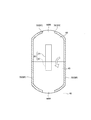
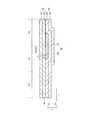
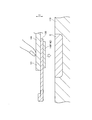
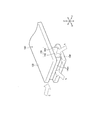
- FIG. 2 is a sectional view taken along line F2-F2 shown in FIG. It is the top view which looked at the absorptive article concerning a 1st embodiment from the skin side.
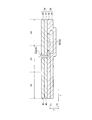
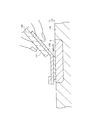
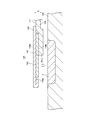
- It is sectional drawing of the absorbent article which concerns on 2nd Embodiment. It is sectional drawing of the absorbent article which concerns on 3rd Embodiment.
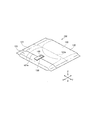
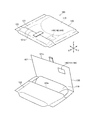
- It is a perspective view of a package concerning a 4th embodiment. It is an expansion perspective view of an inspection part concerning a 4th embodiment.
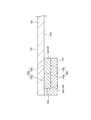
- FIG. 8 is a sectional view taken along line F8-F8 shown in FIG. 7. It is an expansion perspective view of an inspection part concerning a 5th embodiment.
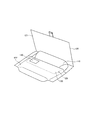
- FIG. 13 is a sectional view taken along line F13-F13 shown in FIG. It is a perspective view of an inspection part concerning an 8th embodiment. It is a perspective view of an inspection part concerning a 9th embodiment. It is a perspective view of the package concerning a 10th embodiment. It is a perspective view of a package concerning an eleventh embodiment.
- An absorbent article is a surface-side member that includes at least a test member for testing a wearer's health condition and a liquid-permeable top sheet, and that is disposed closer to the skin than the test member. And a back-side member that includes at least a liquid-impermeable back sheet and is disposed closer to the skin than the inspection member.
- the inspection member has a contact portion that contacts the excrement that has passed through the surface-side member, and a display portion that displays the wearer's health condition using an indicator according to a target component included in the excrement.
- the front side member covers at least a part of the display unit. The front side member is peelable from the back side member so that the display unit can be visually recognized.
- the inspection member displays the target component contained in the excrement.
- the wearer's health condition is displayed accordingly. Because the front-side member covers at least a part of the display unit, the wearer removes the absorbent article from the body, and then peels off the front-side member from the back-side member to expose the display unit.
- the display unit is easily visible. The wearer can confirm the health condition by visually recognizing the exposed display unit.
- the front-side member is disposed closer to the skin than the inspection member, and covers at least a part of a display unit that displays the health condition of the wearer with an indicator.
- an opening is formed in the front surface member so as to overlap the contact portion in a thickness direction.
- the amount of excrement required for the inspection reaches the contact portion as compared with the case where the excrement passes through the opening. May take some time, or some excrement may not reach the contact area. Therefore, by forming an opening that overlaps with the contact portion on the surface side member, the excrement immediately reaches the contact portion when passing through the opening, so that the amount of excrement required for the inspection easily reaches quickly.
- the excrement required for the examination can reach the contact portion in a short time, and the examination accuracy can be improved while shortening the examination time.
- the front-side member is constituted by a plurality of sheets including the top sheet.
- the opening is formed only in some of the plurality of sheets. Since the remaining sheet covers the opening (and the contact portion) among the plurality of sheets, the inspection member is not exposed. Thus, it is possible to reliably prevent the inspection member from touching the wearer's skin while improving the inspection accuracy.
- the contact section and the display section are arranged at different positions.
- the display unit does not overlap the opening in the thickness direction. Since the display unit containing the indicator reacting according to the target component does not overlap with the opening, the display unit does not directly contact the wearer's skin, so that damage to the skin due to the indicator can be suppressed.
- the front-side member includes a liquid-impermeable sheet disposed on a non-skin side than the top sheet.
- the opening is formed at least in the liquid impermeable sheet. Even if the front side member has the liquid impermeable sheet, the excrement can pass through the liquid impermeable sheet through the opening. Thereby, the excrement can reach the inspection member, and the health condition of the wearer can be displayed on the display unit.
- the indicator contained in the inspection member may be dissolved in the excrement reaching the inspection member. Since the liquid impermeable sheet does not allow excrement to pass through except for the opening, the excrement can be prevented from returning to the top sheet. Therefore, damage to the wearer's skin due to the indicator contained in the excrement can be suppressed.
- the opening is a through-hole that penetrates the surface-side member.
- the excrement reaches the contact portion through the gap between the fibers constituting the surface-side member, compared to when the excrement passes through the opening, the amount of excrement required for the test reaches the contact portion. May take a long time or some excrement may not reach the contact part. Therefore, since the through-hole is formed in the front surface side member, the excrement can pass through the through-hole and immediately reach the contact portion, so that the amount of excrement necessary for the inspection can easily reach quickly. The excrement required for the inspection can reach the contact portion in a short time, and the inspection accuracy can be improved.
- the back side member includes a hydrophilic sheet having a higher hydrophilicity or a higher fiber density than the liquid-permeable sheet included in the front side member.
- the inspection member is disposed on the hydrophilic sheet. Since the liquid-permeable sheet disposed on the back-side member has a higher hydrophilicity or fiber density than the liquid-permeable sheet included in the front-side member, the excrement can be prevented from returning to the top sheet. For this reason, the influence of the indicator contained in the excrement on the wearer's skin can be suppressed.
- a package includes an absorbent article, a packaging sheet for individually packaging the absorbent article, and an inspection unit for inspecting a wearer's health condition.
- the inspection unit displays a health condition of the wearer according to a target component included in the excrement of the wearer.
- the inspection unit is fixed to the packaging sheet or is a part of the packaging sheet.
- the inspection unit is a separate member from the absorbent article, the wearer's skin is not damaged by the indicator when the absorbent article is worn.
- the wearer contacts the excrement and the contact portion by bringing the inspection section (contact portion) into contact with the excrement from the surface of the packaging sheet opposite to the surface on which the contact portion is arranged. Without this, the excrement can be brought into contact with the contact portion. For this reason, a wearer can inspect a health condition hygienically.
- the inspection unit has a contact unit that contacts the excrement to display the health condition.
- the contact portion overlaps the packaging sheet in a thickness direction.
- the wearer contacts the excrement from the surface of the packaging sheet opposite to the surface on which the contact portion is disposed, and contacts the inspection portion (contact portion), so that the excrement and the contact portion are not contacted.
- Excrement can be brought into contact. For this reason, a wearer can inspect a health condition hygienically.
- the inspection unit has a contact unit that contacts the excrement to display the health condition.
- the inspection unit is disposed so as to straddle an edge of the packaging sheet.
- the inspection unit has an extension that extends from the edge to the outside of the packaging sheet when the packaging body is opened.
- the contact part is arranged on the extension part. Since the extension portion extends to the outside of the packaging sheet, the wearer grips the packaging sheet and contacts the contact portion arranged on the extension portion with the excrement, so that the wearer has some Can keep the distance. Therefore, the wearer can make the excrement contact the contact portion without touching the excrement and the contact portion. Therefore, the wearer can inspect the health condition hygienically.
- the inspection section is a lead tape that is peeled off from the packaging sheet to open the packaging body. Since the lead tape is used as the inspection unit, it is not necessary to add a new member to the package as the inspection unit.
- the inspection unit includes a display unit that includes an indicator and displays the health condition of the wearer with the indicator according to a target component included in the excrement. At least a part of the display section is covered with a water-repellent section having water repellency. Even if the wearer touches the display section, the wearer can be prevented from directly touching the indicator by touching the portion covered with the water repellent section having water repellency. Thereby, even if the indicator can damage the skin, the safety of the wearer can be improved.
- coloration by the indicator indicating the health condition can be visually recognized. Even if the display section is covered with the water-repellent section, the wearer can visually recognize the coloring by the indicator. Therefore, the health condition indicated by the display unit can be easily grasped while enhancing the safety of the wearer.
- the inspection unit has a contact unit that contacts the excrement to display the health condition.
- Part of the contact portion is covered with a water-repellent portion having water repellency. Even if the wearer comes into contact with the contact part unintentionally, by touching the part covered with the water-repellent part having water repellency, the target component attached to the wearer's finger etc. Can be prevented from directly touching. Thereby, it is possible to suppress the contact of the symmetric component from the excrement other than the excrement to be inspected with the contact portion, and to improve the inspection accuracy.
- the inspection section has a main body to which the contact section is fixed.
- the second surface is covered with the water-repellent portion, and at least a part of the third surface is exposed from the water-repellent portion. Since the second surface of the contact portion is a surface opposite to the first surface fixed to the main body, it is a portion exposed from the main body. Therefore, the second surface of the contact portion is a portion that the wearer can easily touch. By covering the part which the wearer easily touches with the water-repellent part, the wearer can be prevented from touching the contact part, and the inspection accuracy can be improved.
- the third surface connecting the first surface and the second surface is a portion that is difficult for the wearer to touch.
- the inspection section is a part of the packaging sheet.
- the wrapping sheet has a contact portion for contacting the excrement for displaying the health condition, and a display portion for displaying the health condition of the wearer in accordance with a target component contained in the excretion.
- the contact portion and the display portion are not exposed before opening the package, and are exposed when the package is opened.
- the contact portion and the display portion are not exposed before opening the package, and are exposed by opening the package, so that the contact portion and the display portion can be prevented from contacting other things before the inspection, Inspection accuracy can be improved.
- the absorbent article may be an absorbent article such as a sanitary napkin, panty liner, incontinence pad, stool pad.
- the absorbent article may be an article used by being attached to the inside of a wearing article such as underwear.
- the absorbent article 1 of the present embodiment is a sanitary napkin.
- FIG. 1 is a plan view of the absorbent article according to the first embodiment as viewed from the skin side.
- FIG. 2 is a sectional view taken along line F2-F2 shown in FIG.
- FIG. 3 is a plan view of the absorbent article according to the first embodiment as viewed from the skin surface side.
- the “skin side” corresponds to the side facing the wearer's skin during wearing (during use).
- the “non-skin side” corresponds to the side that is turned away from the wearer's skin during wearing (during use).
- the absorbent article 1 has a front-rear direction L and a width direction W.
- the front-rear direction L is a direction extending from the front side (abdominal side) to the rear side (back side) of the wearer, or a direction extending from the rear side of the wearer to the front side.
- the width direction W is a direction orthogonal to the front-rear direction L.
- the absorbent article has a thickness direction T extending to the skin surface side T1 and the non-skin surface side T2.
- the absorbent article 1 has a central area S3, a front area S1, and a rear area S2.
- the central area S3 is an area having an excretion port contact portion that contacts an excretion port (for example, a vaginal opening) of the wearer.
- the central region S3 is located at the crotch of the underwear. That is, the central region is a region located between the wearer's crotch, that is, between the wearer's feet.
- the front side area S1 is located on the front side of the central area S3.
- the rear area S2 is located behind the central area S3.
- the absorbent article 1 may have, for example, a front side area S1, a rear side area S2, and a central area S3 so as to divide the absorbent article 1 into three equal parts in the front-rear direction L.
- the absorbent article 1 includes the inspection member 20, the front side member 40, and the back side member 60.
- the inspection member 20 is a member for inspecting a wearer's health condition. Details of the inspection member 20 will be described later.
- the surface member 40 is a member that includes at least a liquid-permeable top sheet and is disposed closer to the skin surface T1 than the inspection member 20. Therefore, the front-side member (top sheet) easily comes into direct contact with the wearer's skin, and the inspection member 20 can be prevented from coming into contact with the skin. In the present embodiment, the front surface side member 40 is configured only by the top sheet.
- the surface-side member (top sheet) 40 is made of any sheet-like material having a structure that allows liquid to pass through, such as a nonwoven fabric, a woven fabric, a perforated plastic sheet, or a mesh sheet.
- a nonwoven fabric such as a nonwoven fabric, a woven fabric, a perforated plastic sheet, or a mesh sheet.
- a mesh sheet such as a nonwoven fabric, a woven fabric, a perforated plastic sheet, or a mesh sheet.
- any of natural fibers and chemical fibers can be used.
- the back side member 60 is a member that includes at least a liquid-impermeable back sheet and is disposed on the non-skin side T2 with respect to the inspection member 20.
- the back surface side member 60 is constituted only by the top sheet.
- the back side member (back sheet) 60 may be a laminated non-woven fabric mainly composed of polyethylene sheet, polypropylene, or the like, a breathable resin film, a sheet in which a breathable resin film is bonded to a non-woven fabric such as spun bond or spun lace, or the like. Can be used.
- the inspection member 20 displays the health condition of the wearer with an indicator.
- an immunochromatography method or a test paper method can be used for examining the health condition.
- the immunochromatography method is performed by dropping excrement (for example, blood) on a member (for example, a cellulose membrane) on which labeled particles containing antibodies are spread. If the excrement contains a target component (antigen) to be tested, the target component and the antibody cause an antigen-antibody reaction to form a complex. The formed complex moves on the membrane by capillary action. A different type of antibody (indicator) is linearly arranged at the destination of the complex. The complex binds to another type of antibody and develops a color. The presence or absence of coloration (color change) indicates the health condition of the wearer. The wearer can confirm the health condition by visually determining the presence or absence of coloration.
- a color is formed when the indicator contained in the test member 20 reacts with the target component contained in the excrement.
- the presence or absence of coloration indicates the health condition of the wearer.
- the wearer can visually confirm the coloration (change in the color of the indicator) by the indicator to confirm the health condition.
- Excretions include, for example, blood, urine, stool, and sweat.
- Items indicating health status include, for example, physical condition-related (pH, iron deficiency anemia, renal function, myocardial infarction, inflammation / infection, nutritional status evaluation, etc.), pregnancy-related (physiological cycle prediction, ovulation prediction, etc.), mental-related (Depression, drugs, etc.).
- the target components to be tested include, for example, urine waste (urine specific gravity), leukocytes, hydrogen ions (pH), proteins, glucose, ketone bodies, urobilinogen, bilirubin, urinary occult blood, nitrite, steroids, peptides, and aromatics Compound, FSH (follicle stimulating hormone), BUN (Urea @ nitorogen), AlB (Albumin), LPS (lipopolysaccharide), hCG (human chorionic gonadotropin), LH (luteinizing hormone), U-ALB, CRP (C-reactiv) Protein), myoglobin, CK-MB, troponin I, troponin T, hemoglobin, strep A, HBs antibody, HIV antibody, TP antibody, rotavirus, influenza virus, adenovirus, DNA, O-157, cocaine, marijuana, morphine For example, That.
- FSH follicle stimulating hormone
- BUN Ultra @ nitorogen
- the inspection member 20 has a contact part 22 and a display part 24.
- the contact part 22 is a part for making excrement contact.
- the display unit 24 is a part that displays the health condition of the wearer according to the target component contained in the excrement.
- the contact portion 22 includes at least a region where the labeled particles including the antibody are arranged.
- the target component (antigen) and the antibody contained in the excretion cause an antigen-antibody reaction to form a complex.
- the display unit 24 includes at least a region where an indicator (another type of antibody) that is colored by binding to the complex is arranged. Therefore, when the immunochromatography method is used, the contact part 22 and the display part 24 are arranged at different positions.
- the contact portion 22 includes at least a region where the indicator is arranged. Since the indicator contained in the contact part 22 reacts with the target component to give a color, the contact part 22 and the display part 24 are arranged at the same position. Therefore, in this case, the contact part 22 and the display part 24 are the same.
- the contact portion 22, that is, the display portion 24 includes an indicator for displaying the health condition of the wearer.
- the contact section 22 includes label particles, and the display section 24 includes an indicator for displaying a wearer's health condition.
- the contact part 22 may not include the indicator.
- the indicator is a chemical substance (inorganic or organic) that is colored by reacting with the target component or a component derived from the target component (for example, a complex).
- the inspection member 20 may be any member that can hold the indicator.
- the inspection member 20 can be made of any material such as paper, nonwoven fabric, and woven fabric.
- the rigidity of the inspection member 20 may be equal to or less than the rigidity of the member used for the absorbent article 1. Thereby, even if the absorbent article 1 is provided with the inspection member 20, it becomes easy to suppress deterioration of the touch of the wearer.
- the inspection member 30 may be, for example, a linear plate shape.
- the front side member 40 covers at least a part of the display unit 24. As shown in FIGS. 1 and 2, the front-side member 40 covers the entire display unit 24.
- the indicator contained in the display unit 24 becomes less likely to touch the skin, and damage to the skin by the indicator can be suppressed.
- the excrement of the wearer reaches the inspection member 20 through the surface-side member 40, and is displayed on the inspection member 20 (display unit 24) in accordance with the target component included in the excrement.
- the wearer's health status is displayed.
- the front-side member 40 covers the display unit 24, the wearer cannot visually recognize the display unit 24 in the state of the absorbent article 1 in FIG.
- the front-side member 40 can be peeled off from the rear-side member 60 so that the display unit 24 can be viewed. Accordingly, after the wearer removes the absorbent article 1 from the body, the display unit 24 is exposed by peeling the front-side member 40 from the back-side member 60. Therefore, it becomes easier for the wearer to visually recognize the display unit 24.
- the wearer can check the health of the wearer by visually recognizing the exposed display section 24. In addition, the wearer does not need to carry the inspection member 20 and can easily check it, for example, even when going out.
- An opening 45 is formed in the front side member 40.
- the opening 45 is a through-hole that penetrates the surface-side member 40.
- the opening 45 may have a first opening 451 and a second opening 452.
- the first opening 451 is an opening that overlaps the contact portion 22 in the thickness direction T. Therefore, the first opening 451 overlapping the contact portion 22 in the thickness direction T is formed in the front surface side member 40.
- the first opening 451 may be a through-hole that penetrates the surface-side member 40 in the thickness direction T. Accordingly, even if the excrement is a fixed substance or a semi-solid substance and it is difficult to diffuse the excrement, the excrement easily reaches the contact portion 22. Therefore, the excrement (target component) necessary for the inspection can reach the contact portion 22 and the inspection accuracy can be improved.
- the display section 24 does not have to overlap the opening 45 in the thickness direction T. Since the display unit 24 containing the indicator does not overlap with the opening 45, the display unit 24 does not directly contact the wearer's skin, so that damage to the skin due to the indicator can be suppressed.
- the second opening 452 is an opening that does not overlap with the contact portion 22 in the thickness direction T.
- the second opening 452 may be an opening that does not overlap with the inspection member 20. The excrement that has passed through the second opening 452 reaches the back member 60, then moves on the back member 60, and can reach the contact part 22.
- the opening 45 may be arranged at a position in contact with the excretion opening of the wearer. Therefore, the opening 45 may be arranged in the central area S3. Thereby, the excrement reaches the opening 45 without moving (diffusing) on the front side member 40. Therefore, it is possible to omit the movement of the excrement from the excretion point to the opening 45.
- the excrement required for the examination can reach the contact portion 22 in a short time, and the examination accuracy can be improved while shortening the examination time.
- the inspection member 20 is disposed in at least one of the front side area S1, the rear side area S2, and the center area S3. As shown in FIG. 1, the inspection member 20 may be disposed so as to straddle the rear side area S2 and the central area S3.
- the contact part 22 may be located at least in the central area S3, and the display part 24 may be located at least in the rear area S2 (or the front area S1).
- the display unit 24 by disposing the display unit 24 in the rear area S2 (or the front area S1), the distance from the rear end (or the front end) of the absorbent article 1 in the front-rear direction L to the display unit 24 is reduced. Accordingly, the wearer can immediately expose the display unit 24 by peeling the surface-side member 40 from the rear end (or the front end) of the absorbent article 1, and the wearer can remove the display unit 24. Easy to see.
- the absorbent article 1 is provided with a bonding portion 70 for bonding the front side member 40 and the back side member 60. It may have a joining region BR and a non-joining region NBR where the joining portion 70 is not provided.
- the joining portion 70 may be arranged between the front side member 40 and the back side member 60 in the thickness direction T.
- the bonding region BR (that is, the bonding portion 70) is disposed on the outer peripheral portion of the absorbent article 1 (the front surface member 40 / the rear surface member 60) in a plan view of the absorbent article 1. Good.
- the outer peripheral portion may be configured by an end in the front-rear direction L and an end in the width direction W of the absorbent article 1.
- the joint 70 may be arranged in a region other than the outer peripheral portion.
- the non-bonding region NBR may be arranged at least at a part of the end of the absorbent article 1 in the front-rear direction L. As shown in FIG. 3, the non-bonding region NBR may be arranged at the rear end of the absorbent article 1 in the front-rear direction L.
- the wearer puts a finger in the non-joining region NBR, pinches the skin side T1 and the non-skin side T2 of the front-side member 40, and then pulls the front-side member 40 away from the rear-side member 60, thereby obtaining the front surface.
- the side member 40 and the back side member 60 can be easily separated.
- the non-joining region NBR at the rear end of the absorbent article 1, even if the front side of the absorbent article 1 is soiled with excrement, the wearer does not touch the excrement and the front side member is not used. 40 can be peeled off from the back side member 60.
- the non-bonding region NBR may be arranged at the front end of the absorbent article 1 in the front-rear direction L.
- the wearer when removing the absorbent article 1 from the underwear, the wearer often removes the absorbent article 1 from the front side, which is easily visible.
- the non-bonding region NBR is arranged at the front end of the absorbent article 1 in the front-rear direction L, when removing the absorbent article 1 from the underwear, the front side of the absorbent article 1 is grasped with one hand. The part can be grasped and the finger of the other hand can be put into the non-joining area NBR. Thereby, the wearer can easily perform the operation of peeling the front surface side member 40.
- the non-bonding region NBR may be arranged at at least one of the front end and the rear end of the absorbent article 1 in the front-rear direction L.
- the non-bonding region NBR may be arranged at both the front end and the rear end of the absorbent article 1 in the front-rear direction L.
- the bonding region BR (the bonding portion 70) may be provided by a bonding process such as an emboss seal using an adhesive or pressure or heat.
- the non-joining region NBR may be provided by not performing the joining process.
- the front-side member 40 and the back-side member 60 may be joined by a peelable joint 70 so that the front-side member 40 can be separated from the back-side member 60.
- the peelable joint 70 may be arranged in at least one of the front area S1, the rear area S2, and the central area S3.
- the joint 70 may be arranged only in the region where the display unit 24 is located.
- the joint 70 may be arranged only in the rear area S2, and the non-peelable joint 70 may be arranged in the front area S1 and the central area S3.
- the inspection member 20 is disposed between the front side member 40 and the back side member 60 in the thickness direction T. Therefore, it is arranged on the back side member 60.
- the inspection member 20 does not need to be fixed to both the front side member 40 and the back side member 60 with an adhesive or the like. Thereby, the fibers constituting the front side member 40 and / or the back side member 60 do not adhere to the inspection member 30, and the front side member 40 can be easily separated from the back side member 60. Further, since the fibers do not adhere to the inspection member 30, the display unit 24 is easily visible.
- the inspection member 20 may be joined and fixed to at least one of the front side member 40 and the back side member 60. Accordingly, it is possible to prevent the contact portion 22 from being shifted from the first opening 451 and not overlapping the first opening 451 in the thickness direction T.
- the inspection member 20 may be joined to the back surface side member 60 by, for example, a hot melt adhesive (HMA).
- HMA hot melt adhesive
- At least the contact portion 24 does not need to be joined (fixed) in order to prevent the excrement E from becoming difficult to contact the contact portion 22 due to an adhesive or the like.
- at least the display unit 22 does not need to be joined (fixed) to the front surface member 40 and the back surface member 60.
- the inspection member 30 may have a fixed part configured by at least a part of a part other than the contact part 22 and the display part 44. At least one of the front-side member 40 and the back-side member 60 and the fixed portion of the inspection member 30 may be joined (fixed) by the adhesive applied on the fixed portion. Thereby, it is possible to suppress the displacement of the contact portion 22 without fixing the contact portion 22 and the display portion 44.
- FIG. 4 is a cross-sectional view of the absorbent article 1 according to the second embodiment. The description of the same parts as in the first embodiment is omitted.
- the front side member 40 may include a first front side member 42 and a second front side member 44.
- the first front side member 42 may be made of the same material as the above-described top sheet. Therefore, the front side member 40 may be configured by a plurality of sheets including a top sheet (first front side member 42).
- the second surface-side member 44 is a member arranged on the non-skin side with respect to the first surface-side member 42.
- the second front side member 44 may be a liquid permeable sheet. In this case, the second front side member 44 may be made of the same material as the top sheet.
- the second front side member 44 may be a liquid impermeable sheet. In this case, the second front side member 44 may be made of the same material as the above-described back sheet.
- the first surface-side member 42 and the second surface-side member 44 may be joined to each other by, for example, a hot melt adhesive (HMA).
- HMA hot melt adhesive
- the first surface side member 42 has no opening 45 formed therein.
- a first opening 451 is formed in the second surface side member 44.
- the opening 45 is formed only in some of the sheets constituting the front-side member 40.
- the inspection member 20 is not exposed because the first front side member 42 covers the first opening 451 and the contact portion 22.
- the excrement easily reaches the contact portion 22 by passing through the first opening 451. Therefore, it is possible to further suppress the deterioration of the touch of the wearer and the damage to the skin due to the indicator while shortening the inspection time and improving the inspection accuracy.
- the first openings 451 are formed in the liquid impermeable sheet. Even if the front side member 40 has a liquid impermeable sheet, excrement can pass through the second front side member 44 (liquid impermeable sheet) through the first opening 451. Thus, the excrement can reach the inspection member 20 (the contact portion 22), and the health condition of the wearer can be displayed on the display portion 24. On the other hand, the indicator contained in the inspection member 20 may be dissolved in the excrement reaching the inspection member 20.
- the liquid impermeable sheet which is the second front side member 44, does not allow the excrement to pass through except for the first opening 451, so that the excrement can be prevented from returning to the first front side member 42. Therefore, damage to the wearer's skin due to the indicator contained in the excrement can be suppressed.
- the back side member 60 may include a first back side member 62 and a second back side member 64.
- the first back side member 62 may be a liquid permeable sheet, and may be made of the same material as the above-described top sheet.
- the first back side member 62 may be a sheet (hydrophilic sheet) having a higher hydrophilicity or fiber density than the first front side member 42 which is a liquid permeable sheet included in the front side member 40.
- the inspection member 20 may be disposed on the first back side member 62. Therefore, the inspection member 20 may be in direct contact with the first back side member 62.
- the first back side member 62 is higher in hydrophilicity or fiber density than the first front side member 42, the first back side member 62 has a stronger force to draw in excrement. Therefore, it becomes easier for the excrement (target component) to reach the inspection member 20 in a short time.
- the excrement is drawn in toward the first back side member 62 and becomes difficult to return to the first front side member 42. Even if the indicator is dissolved in the excrement, the excrement can be maintained on the first back side member 62. The effect on the wearer's skin by the indicator contained in the excrement can be suppressed.
- the fiber density can be measured by a known method.
- the fiber density is obtained by cutting out the target site from the absorbent article 1 as a target sample, measuring the mass per unit area of the target sample (g / m2), measuring the thickness (m) of the target sample, and measuring the target sample. It can be calculated by dividing the mass per unit area by the thickness of the target sample (g / m3).
- the mass of the fiber per unit area is determined, for example, by measuring the mass of the target sample with a direct reading balance (for example, an electronic balance HF-300 manufactured by Kensei Kogyo Co., Ltd.), measuring the area of the target sample, and measuring the mass per unit area. The mass may be calculated.
- the thickness of the target sample is determined, for example, by using a dial thickness gauge ID-C1012C manufactured by Mitutoyo Corporation or the equivalent, setting the contact area to 20 cm 2 and the contact pressure to 3 gf / cm 2 to set the target portion.
- the measurement may be performed by applying a pressure, the comparison may be made visually, or the comparison may be made using an image obtained by photographing a cross section of the absorbent article 1 cut in the longitudinal direction.
- the hydrophilicity can be measured by a well-known method. For example, first, five pieces of filter paper are stacked and placed horizontally, and a test piece to be measured is placed on the filter paper. Second, test specimens are marked at 2 cm intervals in each of the longitudinal and transverse directions. One drop (approximately 0.05 g) of artificial urine is dropped at 20 places with a pipette. The artificial urine is dropped at 20 places in 1 minute and 10 seconds. Thirdly, after being left for 30 seconds from the end of dropping at 20 locations, the locations absorbed by the test piece are counted. It is assumed that the more the absorption points of the test piece, the higher the hydrophilicity. (The higher the hydrophilicity, the stronger the liquid absorbing power than the lower hydrophilicity.)
- the second back side member 64 corresponds to the above-described back sheet, and may be made of the same material as the above-described back sheet.
- FIG. 5 is a cross-sectional view of the absorbent article 1 according to the third embodiment. The description of the same parts as those of the first and second embodiments will be omitted.
- the absorbent article 1 may have the second opening 452 that does not overlap with the inspection member 20 in the thickness direction T.
- the second opening 452 may be a through hole that penetrates the front surface side member 40. Thereby, the excrement can reach the first back side member 62 in a shorter time by passing through the second opening 452 as compared with the case where the second opening 452 is not formed.
- the first back side member 62 When the first back side member 62 is a liquid permeable sheet, as shown in FIG. 5, the first back side member 62 can be diffused and reach the inspection member 20 (contact portion 22).
- the inspection member 20 when the absorbent article 1 has only the second opening 452, the inspection member 20 is not exposed when viewed from the skin surface side T1. Therefore, since the inspection member 20 does not directly contact the wearer's skin, deterioration of the wearer's touch can be suppressed, and damage to the skin by the indicator can be suppressed.
- the package may be a package for packaging an absorbent article having no inspection member, which is different from the absorbent articles described in the first to third embodiments.
- FIG. 6 is a perspective view of a package 100 according to the fourth embodiment.
- FIG. 7 is an enlarged perspective view of the inspection unit 130 according to the fourth embodiment.
- FIG. 8 is a cross-sectional view of the inspection unit taken along line F8-F8 shown in FIG. 7, and is a diagram for explaining a use state of the inspection unit.
- the package 100 may have a longitudinal direction X, a width direction Y, and a thickness direction Z that are orthogonal to each other.
- the longitudinal direction X may be a direction that defines the length of the package 100 (a packaging sheet 120 described later).
- the width direction Y may be a direction that defines the width of the package 100 (the packaging sheet 120).
- the thickness direction Z may be a direction that defines the thickness of the package 100 (the packaging sheet 120).
- the package 100 has an absorbent article 110, a packaging sheet 120, and an inspection unit 130.
- the absorbent article 110 is an article that can absorb the excrement of the wearer.
- Absorbent article 110 may be an absorbent article such as a sanitary napkin, panty liner, incontinence pad, stool pad.
- the absorbent article may be an article used by being attached to the inside of a wearing article such as underwear.
- the absorbent article 110 of the present embodiment is a sanitary napkin.
- the packaging sheet 120 is a sheet for individually packaging the absorbent articles 110. By removing the packaging sheet 120 when using the absorbent article 110, the absorbent article 110 is exposed and can be used.
- the packaging sheet 120 may be made of any sheet-like material such as a nonwoven fabric, a woven fabric, a perforated plastic sheet, a mesh sheet, and the like.
- a nonwoven fabric such as a nonwoven fabric, a woven fabric, a perforated plastic sheet, a mesh sheet, and the like.
- the material of the woven or nonwoven fabric any of natural fibers and chemical fibers can be used.
- the packaging sheet 120 may have a first edge 121e and a second edge 122e that are edges in the longitudinal direction X of the packaging sheet 120 (see the lower diagram in FIG. 16).
- the first edge 121e may be an edge located outside the package 100
- the second edge 122e may be located inside the package 100.
- the edge may be The inside of the package 100 is the inside of the package 100 in the thickness direction Z in the package state.
- the packaging sheet 120 has a first sheet portion 121 having a first edge 121e and a second sheet having a second edge 122e in a packaging state in which the absorbent articles 110 are individually packaged. And a portion 122.
- the first sheet portion 121 may be located outside the package 100, and a part of the second sheet portion 122 may be located inside the package 100. Therefore, a part of the second sheet portion 122 may be covered by the first sheet portion 121 in the thickness direction Z.
- the inspection unit 130 is for inspecting the health condition of the wearer.
- the inspection unit 130 displays the health condition of the wearer according to the target component contained in the excrement of the wearer.
- inspection unit 130 is fixed to packaging sheet 120. Therefore, it should be noted that the packaging sheet 120 and the inspection unit 130 are separate bodies.
- the wearer removes the absorbent article 110 from the body after use, and replaces the absorbent article 110.
- the wearer removes the new absorbent article 110 from the packaging sheet 120 and uses it. Since the inspection unit 130 is fixed to the removed packaging sheet 120 with the packaging sheet 120, the inspection unit 130 can be used for excrement attached to the absorbent article 110 removed from the body. Since the wearer does not need to carry the inspection unit 130 separately, the wearer can easily check the health condition.
- the inspection unit 130 displays the health condition of the wearer using an indicator. More specifically, the reaction unit 140 included in the inspection unit 130 displays the health condition of the wearer using an indicator.
- an immunochromatography method or a test paper method can be used for examining the health condition.
- the immunochromatography method is performed by dropping excrement (for example, blood) on a member (for example, a cellulose membrane) on which labeled particles containing antibodies are spread. If the excrement contains a target component (antigen) to be tested, the target component and the antibody cause an antigen-antibody reaction to form a complex. The formed complex moves on the membrane by capillary action. A different type of antibody (indicator) is linearly arranged at the destination of the complex. The complex binds to another type of antibody and develops a color. The presence or absence of coloration (color change) indicates the health condition of the wearer. The wearer can confirm the health condition by visually determining the presence or absence of coloration.
- a color is formed when an indicator contained in the inspection unit 130 reacts with a target component contained in excrement.
- the presence or absence of coloration indicates the health condition of the wearer.
- the wearer can visually confirm the coloration (change in the color of the indicator) by the indicator to confirm the health condition.
- Excretions include, for example, blood, urine, stool, and sweat.
- Items indicating health status include, for example, physical condition-related (pH, iron deficiency anemia, renal function, myocardial infarction, inflammation / infection, nutritional status evaluation, etc.), pregnancy-related (physical cycle prediction, ovulation prediction, etc.), mental-related (Depression, drugs, etc.).
- the target components to be tested include, for example, urine waste (urine specific gravity), leukocytes, hydrogen ions (pH), proteins, glucose, ketone bodies, urobilinogen, bilirubin, urinary occult blood, nitrite, steroids, peptides, and aromatics Compound, FSH (follicle stimulating hormone), BUN (Urea @ nitorogen), AlB (Albumin), LPS (lipopolysaccharide), hCG (human chorionic gonadotropin), LH (luteinizing hormone), U-ALB, CRP (C-reactiv) Protein), myoglobin, CK-MB, troponin I, troponin T, hemoglobin, strep A, HBs antibody, HIV antibody, TP antibody, rotavirus, influenza virus, adenovirus, DNA, O-157, cocaine, marijuana, morphine For example, That.
- FSH follicle stimulating hormone
- BUN Ultra @ nitorogen
- the reaction section 140 (inspection section 130) has a contact section 142.
- the contact part 142 is a part that makes excretions come into contact in order to display a health condition.
- the reaction unit 140 (inspection unit 130) may include a display unit 144, as described later.
- the display part 144 is a part that displays the health condition of the wearer with an indicator according to the target component contained in the excrement.
- the contact portion 142 includes at least a region where the labeled particles including the antibody are arranged.
- the target component (antigen) and the antibody contained in the excretion cause an antigen-antibody reaction to form a complex.
- the display unit 144 includes at least a region where an indicator (another type of antibody) that is colored by binding to the complex is arranged. Therefore, when the immunochromatography method is used, the contact part 142 and the display part 144 are arranged at different positions.
- the contact portion 142 includes at least a region where the indicator is arranged. Since the indicator contained in the contact portion 142 reacts with the target component to give a color, the contact portion 142 and the display portion 144 are arranged at the same position. Therefore, in this case, the contact part 142 and the display part 144 are the same.
- the contact portion 142 when the test strip method is used, the contact portion 142, that is, the display portion 144 includes an indicator for displaying the wearer's health condition.
- the contact section 142 when the immunochromatography method is used, the contact section 142 includes label particles, and the display section 144 includes an indicator for displaying a wearer's health condition.
- the contact part 142 when the contact part 142 is provided only to guide the excrement (target component) to the display part 144, the contact part 142 may not include the indicator.
- the indicator is a chemical substance (inorganic or organic) that is colored by reacting with the target component or a component derived from the target component (for example, a complex).
- the inspection unit 130 may be any member that can hold the indicator.
- inspection unit 130 may be a member that can be fixed to packaging sheet 120.
- the inspection unit 130 may be made of any material such as paper, nonwoven fabric, woven fabric, and resin film.
- the inspection unit 130 may have a main body 132 that supports the reaction unit 140.
- the reaction section 140 may be fixed on the main body 132. That is, the reaction section 140 may be provided on the main body 132.
- the inspection unit 130 may be a lead tape that is peeled off from the packaging sheet to open the package 100. More specifically, the main body 132 has a function as a lead tape. Since the lead tape is used as the inspection unit 130, it is not necessary to add a new member to the package 100 as the inspection unit 130. Accordingly, even if the package 100 has the inspection unit 130, the production efficiency of the package 100 does not need to be reduced.
- inspection section 130 (lead tape) is fixed to the packaging sheet 120 by an adhesive section (not shown).
- the contact portion 142 (the reaction portion 140) may overlap the packaging sheet 120 in the thickness direction Z. More specifically, the inspection unit 130 may be fixed to the packaging sheet 120 in a region where the contact unit 142 overlaps the packaging sheet 120 in the thickness direction Z.
- the wearer causes the inspection unit 130 (contact portion 142) to contact the excrement E from the surface of the packaging sheet 120 opposite to the surface on which the contact portion 142 is arranged. Can be.
- the excrement E can be brought into contact with the contact portion 142 without the finger of the wearer touching the excrement E. For this reason, a wearer can inspect a health condition hygienically.
- the indicator does not react with the target component other than the excrement E (specifically, the target component attached to the finger), and the inspection accuracy can be improved.
- the inspection unit 130 may be arranged so as to straddle the first edge 121e of the packaging sheet 120 (that is, the first sheet portion 121). Therefore, the inspection unit 130 may be disposed so as to straddle the first sheet part 121 and the second sheet part 122.
- the inspection unit 130 (the main body unit 132) extends from the first edge 121e to the outside of the packaging sheet 120 when the packaging body 100 is unsealed and the fixing unit 132a that is secured to the packaging sheet 120.
- An extension 132b may be provided (see FIG. 8).
- the fixing portion 132a may be disposed on the first sheet portion 121, and the extending portion 132b may be disposed on the second sheet portion 122.
- inspection section 130 has reaction section 140 (contact section 142) in fixing section 132a.
- the wearer may hold the extension 132b and open the package 100. Therefore, the presence of the reaction portion 140 in the fixing portion 132a makes it difficult for the wearer's finger to touch the contact portion 142. Since the wearer's finger does not touch the contact part 142, the indicator does not react with the target component other than the excrement E (specifically, the target component attached to the finger), and the inspection accuracy can be improved.
- the main body 132 may have a folded portion 134 in which the end of the main body 132 in the longitudinal direction X is folded. Thereby, the wearer can easily peel the lead tape (inspection unit 130) by gripping the folded back portion 134.
- FIG. 9 is a cross-sectional view of the inspection unit 130 according to the fifth embodiment.
- FIG. 10 is a cross-sectional view for explaining a use state of the inspection unit 130 according to the fifth embodiment. The description of the same parts as those in the above-described embodiment will be omitted.
- the contact part 142 (the reaction part 140) is disposed on the extension part 132b.
- the wearer since the extending portion 132b extends to the outside of the packaging sheet 120, the wearer holds the packaging sheet 120 and holds the contact portion disposed on the extending portion 132b.
- the part 142 can be brought into contact with the excrement E. Thereby, the wearer's finger can keep a certain distance from the excrement E. Therefore, the wearer can bring the excrement E into contact with the contact portion 142 without touching the excrement E and the contact portion 142. Therefore, the wearer can inspect the health condition hygienically.
- FIG. 11 is a diagram for explaining a use state of the inspection unit 130 according to the sixth embodiment. The description of the same parts as those in the above embodiments will be omitted.
- the inspection unit 130 has a display unit 144.
- the display unit 144 is disposed between the main body 132 and the packaging sheet 120 in the thickness direction Z. That is, the first surface 144a, which is one main surface of the display unit 144, is covered with the main body 132, and the second surface 144b, which is the other main surface of the display unit 144, is formed of the packaging sheet 120 (first sheet). Part 121). Therefore, the display unit 144 is not exposed. Thereby, even if the wearer is likely to touch the display unit 144 unintentionally, by touching the part covered by the main body 132 or the packaging sheet 120, the wearer can directly touch the indicator. Can be suppressed. Thereby, even if the indicator can damage the skin, the safety of the wearer can be improved.
- the coloration by the indicator indicating the health condition may be visible.
- the wearer can visually recognize the coloring by the indicator. Therefore, it is possible to easily grasp the health status indicated by the display unit 144 while improving the safety of the wearer.
- the main body 132 may be transparent or semi-permeable, and the wearer may be able to visually recognize the color via the main body 132.
- the main body 132 may be colorless and transparent. This makes it easier to visually recognize the color.
- the packaging sheet 120 may be transparent or semi-permeable, and the wearer may be able to visually recognize the color through the packaging sheet 120.
- the packaging sheet 120 may be colorless and transparent. This makes it easier to visually recognize the color.
- visible refers to a distance of about 30 to 50 cm in a room (approximately: 500 to 750 lx (lux)) brightly illuminated in daylight white (color temperature reference: 4600 to 5400 K (Kelvin)). This means that a subject having good visual acuity (1.0 or more) with both eyes can visually recognize the subject when looking at the subject.
- the first surface 144a is a surface fixed to the main body 132
- the second surface 144b is a surface fixed to the packaging sheet 120.
- the coloration by the indicator may be visible from the first surface 144a side.
- the display 144 on the first surface 144a side may include more indicator than the display 144 on the second surface 144b side. Therefore, the coloration by the indicator may be more easily recognized on the first surface 144a side than on the second surface 144b side.
- the coloring by the indicator may be visible only on the first surface 144a side.
- the wearer can visually recognize the color from the surface on the side opposite to the surface on which the excrement E is applied (the side of the main body 132), so that the obstruction of the visual recognition due to the attachment of the excrement E is suppressed. it can. Thereby, coloration can be confirmed more accurately.
- the coloration by the indicator may be visible from the second surface 144b side.
- the display 144 on the second surface 144b side may include more indicator than the display 144 on the first surface 144a side. Therefore, the coloration by the indicator may be more easily visually recognized on the second surface 144b side than on the first surface 144a side.
- the coloring by the indicator may be visible only on the second surface 144b side. Thus, even if the exposed main body 132 is soiled, the color can be visually recognized from the second surface 144b that is not exposed in the packaged state, so that the color can be confirmed more accurately.
- At least a part of the contact portion 142 may be exposed from the first edge 121e of the packaging sheet 120 in the opened state in order to facilitate contact with the excrement E.
- At least one of the main body 132 and the packaging sheet 120 may have water repellency, similarly to the water repellent part 150 described later.
- FIG. 12 is a perspective view of the inspection unit 130 according to the seventh embodiment.
- FIG. 13 is a sectional view taken along line F13-F13 shown in FIG. The description of the same parts as those in the above embodiments will be omitted.
- the inspection unit 130 has a contact unit 142 and a display unit 144. Part of the contact portion 142 is covered with the water-repellent portion 150.
- the inspection section 130 has the main body 132 to which the reaction section 140 (the contact section 142 and the display section 144) is fixed.
- the contact portion 142 may have a first surface 142a, a second surface 142b, and a third surface 142c.
- the first surface 142a is a surface fixed to the main body 132.
- the second surface 142b is a surface opposite to the first surface 142a.
- the third surface 142c is a surface connecting the first surface 142a and the second surface 142b.
- the second surface 142b is covered by the water-repellent part 150. At least a portion of the third surface 142c is exposed from the water-repellent portion 150.
- the water-repellent portion 150 may be provided by performing a water-repellent process of attaching (applying) a water-repellent agent to a part of the contact portion 142 using a water-repellent spray, a coating device, or the like.
- the member constituting the main body 132 of the inspection unit 130 may be impregnated with a water repellent.
- a portion to which the water repellent is not to be attached (for example, (a part of) the contact portion 142) may be covered with a masking tape or the like.
- the contact section 142 After covering a part of the reaction section 140 (contact section 142) with the water-repellent section 150, the contact section 142 may be exposed by peeling off a masking tape or the like. The second surface 142b may be covered with a water-repellent member.
- the water repellent may be a silicone water repellent or a fluorine water repellent. It is preferable that the water repellent (water repellent portion 150) does not easily discolor.
- the water-repellent agent (water-repellent portion 150) may be permeable or semi-permeable. When the water repellent (the water repellent portion 150) covers the display portion 144, a colorless and transparent material may be used in order to make the coloration easily visible.
- the second surface 142b of the contact portion 142 is a portion exposed from the main body 132 because it is a surface opposite to the first surface 142a fixed to the main body 132. Therefore, the second surface 142b of the contact portion 142 is a portion that the wearer can easily touch. By covering the portion that the wearer easily touches with the water-repellent portion 150, the wearer can be prevented from touching the contact portion 142, and the inspection accuracy can be improved.
- the third surface 142c connecting the first surface 142a and the second surface 142b is a portion that is difficult for the wearer to touch. By exposing a portion that is difficult for the wearer to touch from the water-repellent portion 150, the target component can be brought into contact with the contact portion 142, and an inspection can be performed.
- the exposed surface of the third surface 142c may be located on the outer edge side in the width direction of the main body 132.
- the non-exposed surface in which the third surface 142c is covered with the water-repellent portion 150 may be located on the longitudinal end side of the main body 132.
- the display unit 144 may have a first surface 144a, a second surface 144b, and a third surface 144c, like the contact unit 142. Accordingly, it is possible to suppress the wearer from directly touching the indicator contained in the display unit 144. Thereby, even if the indicator can damage the skin, the safety of the wearer can be improved. Further, in a state where the display unit 144 is covered with the water-repellent unit 150, the coloration by the indicator indicating the health condition may be visible. Thereby, even if the display part 144 is covered with the water-repellent part 150, the wearer can visually recognize the coloring by the indicator. Therefore, it is possible to easily grasp the health status indicated by the display unit 144 while improving the safety of the wearer.
- FIG. 14 is a perspective view of the inspection unit 130 according to the eighth embodiment. The description of the same parts as those in the above embodiments will be omitted.
- the exposed surface of the third surface 142c may be located not only on the outer edge side in the width direction Y of the main body 132 but also on the end side in the longitudinal direction X of the main body 132. This increases the exposed area of the third surface 142c, so that the inspection can be performed in a shorter time.
- the second surface 142b is covered with the water-repellent portion 150, the wearer can be prevented from touching the contact portion 142, and the inspection accuracy can be improved.
- FIG. 15 is a perspective view of the inspection unit 130 according to the ninth embodiment. The description of the same parts as those in the above embodiments will be omitted.
- the exposed surface of the third surface 142c may be located on the end side in the longitudinal direction X of the main body 132.
- the non-exposed surface in which the third surface 142c is covered with the water-repellent portion 150 may be located on the outer edge side in the width direction Y of the main body 132. Accordingly, even if the wearer grips the outer edge in the width direction Y of the inspection section 130 (the main body section 132), the wearer can be prevented from touching the contact section 142, so that the inspection accuracy can be improved.
- the end in the longitudinal direction X of the reaction section 140 located on the center side in the longitudinal direction X of the main body section 132 may or may not be covered by the water-repellent section 150.
- FIG. 16 is a perspective view of a package 100 according to the tenth embodiment. 16 shows a state before the package 100 is opened, and a lower diagram in FIG. 16 shows a state where the package 100 is opened. The description of the same parts as those in the above embodiments will be omitted.
- the inspection unit 130 is fixed to the packaging sheet 120.
- the inspection unit 130 is a part of the packaging sheet 120. Therefore, the packaging sheet 120 has the reaction section 140 (the contact section 142 and the display section 144).
- the reaction section 140 (the contact section 142 and the display section 144) is not exposed before the package 100 is opened. On the other hand, as shown in the lower diagram of FIG. 16, the reaction section 140 is exposed by opening the package 100.
- the reaction section 140 it is possible to prevent the reaction section 140 from contacting other components before the inspection, and to improve the inspection accuracy.
- a reaction section 140 (inspection section 130) may be provided on the packaging sheet 120. Therefore, the inspection unit 130 is a part of the packaging sheet 120. In the present embodiment, the inspection unit 130 may be a part of the first sheet part 121. Before opening (packaged state), the inspection unit 130 may be arranged on a surface of the first sheet portion 121 that is not exposed.
- the reaction section 140 may be arranged so as to be sandwiched between the packaging sheet 120 (that is, the first sheet portion 121 and the second sheet portion 122) before opening. Thereby, the indicator can be prevented from attaching to the absorbent article 110, and the safety of the wearer can be enhanced.
- the inspection unit 130 is a part of the wrapping sheet 120 (the first sheet portion 121 in the present embodiment)
- an indicator for displaying the health condition of the wearer may be applied to the wrapping sheet 120.
- the packaging sheet 120 may be impregnated with a solution constituting the indicator.
- FIG. 17 is a perspective view of a package 100 according to the eleventh embodiment.
- FIG. 17 shows a state where the package 100 is opened. The description of the same parts as those in the above embodiments will be omitted.
- perforations 125 for forming a part of the packaging sheet 120 as the inspection unit 130 may be formed on the packaging sheet 120.
- the wearer may be able to acquire the inspection unit 130 by cutting the perforations 125.
- the reaction section 140 may be arranged so as not to face the absorbent article 110 but to face the packaging sheet 120.
- the inspection unit 130 may be a part of the second sheet part 122. Before opening (packaged state), the inspection unit 130 may be arranged on a surface of the second sheet portion 122 that is not exposed. The inspection unit 130 may be arranged so as to face the unexposed surface of the first sheet portion 121 before opening. Thereby, the indicator can be prevented from attaching to the absorbent article 110, and the safety of the wearer can be enhanced.
- the package 100 has a lead tape, but the package 100 does not have to have a lead tape.
- the end of the first sheet portion 121 in the longitudinal direction X including the first edge 121e may be joined by, for example, an adhesive or heat sealing. Thereby, the opening of the package 100 may be sealed.
- the first back side member 62 may be a sheet (hydrophilic sheet) having a higher hydrophilicity or fiber density than the first front side member 42, but is not limited thereto.
- the first back side member 62 may be higher in hydrophilicity or fiber density than all the liquid permeable sheets of the front side member 40.
- the first back side member 62 is a sheet (hydrophilic sheet) having higher hydrophilicity or fiber density than the first front side member 42, all the sheets constituting the front side member 40 are liquid permeable sheets. It may be. Excretion is more likely to reach the back side member 60 by diffusion than in the case where the front side member 40 includes a liquid impermeable sheet. The excrement that has reached the back side member 60 can diffuse through the first back side member 62 and reach the contact portion 22. Therefore, it is possible to further suppress the deterioration of the touch of the wearer and the damage to the skin due to the indicator while shortening the inspection time and improving the inspection accuracy.
- the front side member 40 may have the second opening 452 penetrating the front side member 40. Thereby, the excrement can be more easily reached the contact portion 22 by the openings 45 (the first opening 451 and the second opening 452) without exposing the inspection member 20.
- the first surface-side member 42 is configured by one or two sheets, but is not limited thereto.
- the first surface side member 42 may be configured by three or more sheets.
- the first front-side member 42 has three layers in which the liquid-impermeable sheet (second front-side member) is sandwiched in the thickness direction T by two liquid-permeable sheets (first and third front-side members). Sheet.
- excrement is diffused in the liquid-permeable sheet (third surface-side member) disposed on the non-skin side with respect to the liquid-impermeable sheet (second surface-side member). The excrement easily comes into contact also from the skin surface side T1 of the inspection member 20.
- the liquid impermeable sheet allows the excrement (target component) required for the examination to reach the contact portion 22 in a short time while suppressing damage to the wearer's skin due to the indicator contained in the excrement.
- the front-side member 40 includes a liquid-impermeable sheet
- at least the liquid-impermeable sheet has an opening for moving excreta to the non-skin side T2 than the liquid-impermeable sheet. Is formed.
- the back side member 60 may be configured by three or more sheets.
- the back side member 60 includes a hydrophilic sheet having a higher hydrophilicity or fiber density than the liquid-permeable sheet included in the front side member, the hydrophilic sheet may not be disposed on the inspection member 20. . That is, the hydrophilic sheet does not need to contact the inspection member 20.
- a liquid permeable sheet may be disposed between the hydrophilic sheet and the inspection member 20 in the thickness direction T. The hydrophilic sheet may make it difficult for the excrement to return to the front side member 40 by drawing the excrement through the liquid permeable sheet.
- the back side member 60 when the front side member 40 is peeled off from the back side member 60, the back side member 60 may be fixed and the front side member 40 may be peeled off from the back side member 60.
- the front side member 40 may be fixed and the back side member 60 may be peeled from the front side member 40.
- the front side member 40 can be separated from the back side member 60.
- the inspection member 20 has a linear plate shape.
- the inspection member 20 may have, for example, one or more folds. Therefore, the inspection member 20 may have, for example, a two-fold or three-fold shape.
- the inspection member 20 may be configured by a member folded into a Z shape. Thereby, the inspection member 20 can be arranged inside the absorbent article 1 in a compact state. Since the area of the inspection member 20 is reduced, deterioration of the touch of the wearer due to the inspection member 20 can be easily suppressed.
- the inspection member 20 may be arranged in a state where the contact portion 22 is folded so as to contact at least one of the front surface member 40 and the rear surface member 60. This makes it easier for the excrement to reach the contact portion 22 even when the inspection member 20 is folded.
- the inspection member 20 may be disposed in a state where the display unit 22 is folded such that the display unit 22 contacts at least one of the front surface member 40 and the rear surface member 60.
- the wearer can visually recognize the display unit 22 as soon as the front-side member 40 is peeled off. Thereby, the wearer can easily check the health condition.
- the inspection member 20 may be configured by a tape member for a post-processing tape having an adhesive portion having the contact portion 22 and the display portion 24.
- the used absorbent article 1 may be fixed in a rounded state so that the skin contact surface is not exposed by the adhesive portion of the inspection member 20 as the tape member for the post-treatment tape.
- the wearer can use the inspection member 20 as a tape member for a post-processing tape after inspecting the health condition, and can effectively utilize the inspection member 20.
- the tape member for the post-processing tape may have a shape folded into a Z shape as described above.
- the wearer may acquire the examination information by sending color information (image information and / or video information) indicating the color of the display unit 24 to the network (management server). For example, after the wearer peels off the front-side member 40 from the back-side member 60, the wearer (user) presents the exposed display unit 24 by, for example, photographing the display unit 24 with a camera built in a communication device owned by the wearer (user). Color information may be acquired. The wearer can send the color information to the management server via the communication device. The wearer may send user information indicating the wearer's information together with the coloration information.
- color information image information and / or video information
- the user information is, for example, at least one of a user identifier, a communication device identifier, information indicating the type of excrement, information indicating the type of the absorbent article 1 (the inspection member 20), information specifying the target component, and the like. is there.
- the wearer may house the absorbent article 1 including the inspection member 20 or the inspection member 20 itself in an accommodation device capable of detecting a color reaction by the indicator.
- the storage device may irradiate the display unit 24 with visible light in order to detect a color reaction.
- the storage device irradiates special light having a special wavelength different from visible light (for example, ultraviolet light having a shorter wavelength than visible light) to the inspection member 20 that can confirm coloration by the indicator by applying the special light.
- Light having a wavelength may be applied to the display unit 24.
- the accommodation device may acquire color information by photographing while irradiating visible light or special light in the accommodation device. As described above, by photographing the display unit 24 while irradiating light in the storage device, it is possible to accurately confirm the coloration without being affected by the surrounding environment.
- the accommodation device may send the color information acquired by photographing the display unit 24 to a network (management server).
- the accommodation device may include the identifier of the accommodation device as the user information.
- the housing device may send the acquired color information to the communication device owned by the wearer.
- the wearer may determine the presence or absence of coloration by displaying the display unit 24 on the communication device. Thereby, the wearer can check the health condition more accurately.
- the wearer may send the color information acquired from the housing device to the network via the communication device, as described above.
- the management server can determine the health condition of the wearer (user) based on the coloration information (and the user information).
- the management server may transmit the information indicating the determination result to the communication device that is the source of the color information.
- the management server may transmit the advice information indicating the advice based on the determination result to the communication device together with the determination information indicating the determination result. Even when the management server receives the color information from the accommodation device, the management server determines the associated communication device based on the identifier (user identifier) of the communication device associated with the accommodation device identifier (ie, The determination information (and the advice information) may be transmitted to a communication device owned by the user.
- the communication device may display the determination result based on the determination information received by the communication device. Thereby, the wearer can grasp the health condition based on the displayed determination result. The wearer can obtain an objective determination result, not based on the wearer's own determination.
- the communication device may display the advice. Thereby, the wearer can grasp the advice.
- the communication device has a program for executing the above-described various processes.
- the communication device has a memory for storing a program and a processor for executing the program stored in the memory.
- the program may be obtainable from a network (for example, a management server).
- the absorbent article 1 is a sanitary napkin, but is not limited thereto.
- the absorbent article 1 may be a tape-type or pants-type disposable diaper, for example.
- the inspection member 20 is disposed so as to straddle the rear side area S2 and the central area S3.
- the inspection member 20 may be arranged only in one of the front area S1, the rear area S2, and the central area S3. Thereby, the deterioration of the touch of the wearer may be suppressed by reducing the region where the inspection member 20 is arranged.
- the central region S3 may be a region where a leg opening is provided around the wearer's leg.
- the leg opening is a portion that is recessed inward in the width direction from the outer edge of the absorbent article toward the inside in the width direction.
- the central region S3 may be a region in which a portion that is recessed inward in the width direction from the outer edge of the absorbent core is provided toward the inside in the width direction.
- the central region S3 may be a region where the middle and high portions, which are regions thicker than the surrounding absorbent cores, are arranged.
- the central area S3 may be an area where the wing is provided.
- reaction part 140 (the contact part 142 and / or the display part 144) is covered with the water-repellent part 150, but is not limited thereto.
- the reaction section 140 may be any member that can suppress the wearer's finger from touching the contact section 142 or the indicator, for example, and may be covered with another member that does not have water repellency. Good.
- the inspection unit 130 has a function as a lead tape, but is not limited to this.
- the inspection unit 130 may be different from a lead tape.
- the inspection unit 130 may be arranged so as not to straddle the first edge 121e of the packaging sheet 120 (that is, the first sheet portion 121).
- the inspection unit 130 may be arranged (fixed) only on the first sheet portion 121 exposed on one side of the packaging sheet 120 in the thickness direction Z. Thereby, the wearer can easily grasp the inspection unit 130 before opening the package 100.
- the inspection unit 130 exposes the first sheet portion 121 in the packaged state, as in the tenth embodiment. It may be placed (fixed) on a surface that does not. As in the eleventh embodiment, in the packaged state, the inspection unit 130 is arranged (fixed) on the unexposed surface of the second sheet portion 122 so as to face the unexposed surface of the first sheet portion 121. May be. This makes it difficult for the indicator to touch other things before the test, and makes it difficult for the indicator to adhere to other things. Therefore, the safety of the wearer can be improved. In addition, the inspection unit 130 is also less likely to be stained, and the inspection accuracy can be improved.
- the inspection unit 130 has a linear plate shape.
- the inspection unit 130 may have, for example, one or more folds. Therefore, the inspection unit 130 may have, for example, a two-fold or three-fold shape.
- the inspection unit 130 may be configured by a member folded in a Z shape. Thereby, the inspection unit 130 can be fixed to the packaging sheet 120 in a compact state.
- the inspection unit 130 may be fixed to the packaging sheet 120 in a state where the inspection unit 130 is folded so that the reaction unit 140 is not exposed. Thereby, it is possible to suppress the thing other than the excrement E from touching the contact portion 142 before use, and it is possible to improve the inspection accuracy.
- the inspection member When the inspection member is folded, the folded inspection member can be extended (spread) before use. Thereby, the inspection unit 130 can be brought into contact with the excrement E while the position where the wearer grips the inspection unit 130 is kept away from the excrement E. The excrement E hardly adheres to the wearer, and the wearer can hygienically inspect the health condition.
- the inspection unit 130 may be configured by a tape member for a post-processing tape having an adhesive unit having the reaction unit 140.
- the used absorbent article may be fixed in a rounded state so that the skin contact surface is not exposed by the adhesive portion of the inspection unit 130 as a tape member for the post-treatment tape.
- the inspection unit 130 By using the inspection unit 130 as the tape member, the absorbent article can be sanitarily disposed. In this manner, the wearer can use the inspection unit 130 as a tape member for a post-processing tape after inspecting the health condition, and the inspection unit 130 can be effectively used.
- the tape member for the post-processing tape may have a shape folded into a Z shape as described above.
- the wearer may acquire the test information by sending color information (image information and / or video information) indicating the color of the display unit 144 to the network (management server).
- the wearer presents the inspection unit 130 (display unit 144) colored by attaching to the excrement E by, for example, photographing with a camera built in a communication device owned by the wearer (user).
- Color information may be acquired.
- the wearer can send the color information to the management server via the communication device.
- the wearer may send user information indicating the wearer's information together with the coloration information.
- the user information is, for example, at least one of an identifier of the user, an identifier of the communication device, information indicating the type of excrement, information indicating the type of the absorbent article 110 (inspection unit 130), information specifying the target component, and the like. is there.
- the wearer may house the inspection unit 130 in a housing device capable of detecting a color reaction by the indicator.
- the storage device may irradiate the display unit 144 with visible light to detect a color reaction.
- the storage device irradiates special light having a special wavelength different from visible light (for example, ultraviolet light having a shorter wavelength than visible light) to the inspection unit 130 that can confirm coloring by the indicator.
- the display 144 may be irradiated with light having a wavelength.
- the accommodation device may acquire color information by photographing while irradiating visible light or special light in the accommodation device. As described above, by photographing the display unit 144 while irradiating light in the storage device, it is possible to accurately confirm coloration without being affected by the surrounding environment.
- the accommodation device may send the color information acquired by photographing the display unit 144 to the network (management server).
- the accommodation device may include the identifier of the accommodation device as the user information.
- the housing device may send the acquired color information to the communication device owned by the wearer.
- the wearer may determine the presence or absence of color by displaying the display unit 144 indicated by the color information on the communication device. Thereby, the wearer can check the health condition more accurately.
- the wearer may send the color information acquired from the housing device to the network via the communication device, as described above.
- the management server can determine the health condition of the wearer (user) based on the coloration information (and the user information).
- the management server may transmit the information indicating the determination result to the communication device that is the source of the color information.
- the management server may transmit the advice information indicating the advice based on the determination result to the communication device together with the determination information indicating the determination result. Even when the management server receives the color information from the accommodation device, the management server determines the associated communication device based on the identifier (user identifier) of the communication device associated with the accommodation device identifier (ie, The determination information (and the advice information) may be transmitted to a communication device owned by the user.
- the communication device may display the determination result based on the determination information received by the communication device. Thereby, the wearer can grasp the health condition based on the displayed determination result. The wearer can obtain an objective determination result, not based on the wearer's own determination.
- the communication device may display the advice. Thereby, the wearer can grasp the advice.
- the communication device has a program for executing the above-described various processes.
- the communication device has a memory for storing a program and a processor for executing the program stored in the memory.
- the program may be obtainable from a network (for example, a management server).
Landscapes
- Health & Medical Sciences (AREA)
- Epidemiology (AREA)
- Engineering & Computer Science (AREA)
- Biomedical Technology (AREA)
- Heart & Thoracic Surgery (AREA)
- Vascular Medicine (AREA)
- Life Sciences & Earth Sciences (AREA)
- Animal Behavior & Ethology (AREA)
- General Health & Medical Sciences (AREA)
- Public Health (AREA)
- Veterinary Medicine (AREA)
- Absorbent Articles And Supports Therefor (AREA)
Abstract
Un article absorbant 1 comprend : un élément d'inspection 20 pour inspecter l'état de santé du porteur; un élément côté surface avant 40 qui comprend au moins une feuille supérieure perméable aux liquides, et qui est disposé plus sur un côté de surface de peau T1 que l'élément d'inspection 20; et un élément côté surface arrière 60 qui comprend au moins une feuille arrière imperméable aux liquides, et qui est disposé plus sur le côté de surface de peau T1 que l'élément d'inspection 20. L'élément d'inspection 20 a une section de contact 22 qui est amenée en contact avec des excréments qui ont traversé l'élément côté surface avant 40, et une section d'affichage 24 qui affiche, par l'intermédiaire d'un indicateur, l'état de santé du porteur conformément à un composant cible contenu dans les excréments. L'élément côté surface avant 40 recouvre au moins une partie de la section d'affichage 24. L'élément côté surface avant 40 peut être détaché de l'élément côté surface arrière 60 de sorte que la section d'affichage 24 soit visuellement reconnaissable.
Priority Applications (1)
| Application Number | Priority Date | Filing Date | Title |
|---|---|---|---|
| CN201980042377.4A CN112334102B (zh) | 2018-06-29 | 2019-06-20 | 吸收性物品和包装体 |
Applications Claiming Priority (4)
| Application Number | Priority Date | Filing Date | Title |
|---|---|---|---|
| JP2018-125605 | 2018-06-29 | ||
| JP2018125605A JP6920252B2 (ja) | 2018-06-29 | 2018-06-29 | 包装体 |
| JP2018-125581 | 2018-06-29 | ||
| JP2018125581A JP6905959B2 (ja) | 2018-06-29 | 2018-06-29 | 吸収性物品 |
Publications (1)
| Publication Number | Publication Date |
|---|---|
| WO2020004218A1 true WO2020004218A1 (fr) | 2020-01-02 |
Family
ID=68987181
Family Applications (1)
| Application Number | Title | Priority Date | Filing Date |
|---|---|---|---|
| PCT/JP2019/024485 Ceased WO2020004218A1 (fr) | 2018-06-29 | 2019-06-20 | Article absorbant et emballage |
Country Status (2)
| Country | Link |
|---|---|
| CN (1) | CN112334102B (fr) |
| WO (1) | WO2020004218A1 (fr) |
Citations (5)
| Publication number | Priority date | Publication date | Assignee | Title |
|---|---|---|---|---|
| JPH0788128A (ja) * | 1993-07-30 | 1995-04-04 | Kobayashi Pharmaceut Co Ltd | 体液吸収用当て材 |
| JP2003501216A (ja) * | 1999-06-11 | 2003-01-14 | エスシーエー・ハイジーン・プロダクツ・アーベー | 活性添加剤を含有する吸収物品及び吸収物品における視覚インディケータの使用 |
| JP2004245818A (ja) * | 2002-07-12 | 2004-09-02 | Sanyo Chem Ind Ltd | 診断用吸収材および吸収性物品 |
| KR20080019264A (ko) * | 2008-02-11 | 2008-03-03 | 이동현 | 암과 성인병의 자가 진단용 생리대 |
| JP2016501613A (ja) * | 2012-12-21 | 2016-01-21 | エスセーアー・ハイジーン・プロダクツ・アーベー | 吸収物品の体液テスト装置 |
Family Cites Families (4)
| Publication number | Priority date | Publication date | Assignee | Title |
|---|---|---|---|---|
| US20090062764A1 (en) * | 2007-08-30 | 2009-03-05 | Kimberly-Clark Worldwide, Inc. | Zoned application of decolorizing composition for use in absorbent articles |
| CN103099711A (zh) * | 2013-01-31 | 2013-05-15 | 陈维京 | 具有检测炎症功能的纸尿裤 |
| CN106983603A (zh) * | 2017-05-14 | 2017-07-28 | 郭宝煊 | 智能卫生巾 |
| CN107028704A (zh) * | 2017-05-18 | 2017-08-11 | 肇庆学院 | 一种智能纸尿片以及使用方法 |
-
2019
- 2019-06-20 WO PCT/JP2019/024485 patent/WO2020004218A1/fr not_active Ceased
- 2019-06-20 CN CN201980042377.4A patent/CN112334102B/zh active Active
Patent Citations (5)
| Publication number | Priority date | Publication date | Assignee | Title |
|---|---|---|---|---|
| JPH0788128A (ja) * | 1993-07-30 | 1995-04-04 | Kobayashi Pharmaceut Co Ltd | 体液吸収用当て材 |
| JP2003501216A (ja) * | 1999-06-11 | 2003-01-14 | エスシーエー・ハイジーン・プロダクツ・アーベー | 活性添加剤を含有する吸収物品及び吸収物品における視覚インディケータの使用 |
| JP2004245818A (ja) * | 2002-07-12 | 2004-09-02 | Sanyo Chem Ind Ltd | 診断用吸収材および吸収性物品 |
| KR20080019264A (ko) * | 2008-02-11 | 2008-03-03 | 이동현 | 암과 성인병의 자가 진단용 생리대 |
| JP2016501613A (ja) * | 2012-12-21 | 2016-01-21 | エスセーアー・ハイジーン・プロダクツ・アーベー | 吸収物品の体液テスト装置 |
Also Published As
| Publication number | Publication date |
|---|---|
| CN112334102A (zh) | 2021-02-05 |
| CN112334102B (zh) | 2022-08-30 |
Similar Documents
| Publication | Publication Date | Title |
|---|---|---|
| JP7499303B2 (ja) | 吸収性物品 | |
| KR101629975B1 (ko) | 분석물 검출용 다층 기기 | |
| AU2009228014A1 (en) | Cotton thread as a low-cost multi-assay diagnostic platform | |
| JP4163600B2 (ja) | 健康インジケーター付きおむつ | |
| NO341514B1 (en) | Passive body fluid screening and analysis device for diapers, methods of realizing same, and methods of using same | |
| CN112512471B (zh) | 吸收性物品 | |
| JP6905959B2 (ja) | 吸収性物品 | |
| TWI558386B (zh) | Dispose of items with disposable dessert | |
| JP7064992B2 (ja) | 吸収性物品 | |
| WO2020004218A1 (fr) | Article absorbant et emballage | |
| JPWO2016158733A1 (ja) | 採血用絆創膏 | |
| JP6920252B2 (ja) | 包装体 | |
| EP4180016B1 (fr) | Article absorbant | |
| JP2024018954A (ja) | 吸収性物品 | |
| JP7595111B1 (ja) | 吸収性物品、及び吸収性物品の収容体 | |
| WO2024084726A1 (fr) | Article absorbant avec bandelette réactive pour décharge vaginale, et bandelette réactive pour décharge vaginale destinée à être utilisée dans un article absorbant | |
| WO2025033339A1 (fr) | Article absorbant | |
| CN121398772A (zh) | 吸收性物品 | |
| WO2024242118A1 (fr) | Article absorbant, contenant pour article absorbant, et feuille pour article absorbant | |
| JP2024167862A (ja) | 吸収性物品、吸収性物品の収容体、及び吸収性物品用シート | |
| WO2024242115A1 (fr) | Article absorbant | |
| KR20250020175A (ko) | 소변 검사 장치와 소변 검사용 기저귀 및 소변 검사 방법 |
Legal Events
| Date | Code | Title | Description |
|---|---|---|---|
| 121 | Ep: the epo has been informed by wipo that ep was designated in this application |
Ref document number: 19827563 Country of ref document: EP Kind code of ref document: A1 |
|
| NENP | Non-entry into the national phase |
Ref country code: DE |
|
| 122 | Ep: pct application non-entry in european phase |
Ref document number: 19827563 Country of ref document: EP Kind code of ref document: A1 |