WO2020004253A1 - Composition d'électrode négative pour batteries secondaires alcalines et électrode négative pour batteries secondaires alcalines - Google Patents
Composition d'électrode négative pour batteries secondaires alcalines et électrode négative pour batteries secondaires alcalines Download PDFInfo
- Publication number
- WO2020004253A1 WO2020004253A1 PCT/JP2019/024677 JP2019024677W WO2020004253A1 WO 2020004253 A1 WO2020004253 A1 WO 2020004253A1 JP 2019024677 W JP2019024677 W JP 2019024677W WO 2020004253 A1 WO2020004253 A1 WO 2020004253A1
- Authority
- WO
- WIPO (PCT)
- Prior art keywords
- negative electrode
- alkaline secondary
- secondary battery
- particle diameter
- active material
- Prior art date
- Legal status (The legal status is an assumption and is not a legal conclusion. Google has not performed a legal analysis and makes no representation as to the accuracy of the status listed.)
- Ceased
Links
Images
Classifications
-
- H—ELECTRICITY
- H01—ELECTRIC ELEMENTS
- H01M—PROCESSES OR MEANS, e.g. BATTERIES, FOR THE DIRECT CONVERSION OF CHEMICAL ENERGY INTO ELECTRICAL ENERGY
- H01M4/00—Electrodes
- H01M4/02—Electrodes composed of, or comprising, active material
- H01M4/24—Electrodes for alkaline accumulators
- H01M4/242—Hydrogen storage electrodes
-
- H—ELECTRICITY
- H01—ELECTRIC ELEMENTS
- H01M—PROCESSES OR MEANS, e.g. BATTERIES, FOR THE DIRECT CONVERSION OF CHEMICAL ENERGY INTO ELECTRICAL ENERGY
- H01M10/00—Secondary cells; Manufacture thereof
- H01M10/24—Alkaline accumulators
-
- H—ELECTRICITY
- H01—ELECTRIC ELEMENTS
- H01M—PROCESSES OR MEANS, e.g. BATTERIES, FOR THE DIRECT CONVERSION OF CHEMICAL ENERGY INTO ELECTRICAL ENERGY
- H01M4/00—Electrodes
- H01M4/02—Electrodes composed of, or comprising, active material
- H01M4/24—Electrodes for alkaline accumulators
-
- H—ELECTRICITY
- H01—ELECTRIC ELEMENTS
- H01M—PROCESSES OR MEANS, e.g. BATTERIES, FOR THE DIRECT CONVERSION OF CHEMICAL ENERGY INTO ELECTRICAL ENERGY
- H01M4/00—Electrodes
- H01M4/02—Electrodes composed of, or comprising, active material
- H01M4/36—Selection of substances as active materials, active masses, active liquids
- H01M4/38—Selection of substances as active materials, active masses, active liquids of elements or alloys
- H01M4/383—Hydrogen absorbing alloys
-
- H—ELECTRICITY
- H01—ELECTRIC ELEMENTS
- H01M—PROCESSES OR MEANS, e.g. BATTERIES, FOR THE DIRECT CONVERSION OF CHEMICAL ENERGY INTO ELECTRICAL ENERGY
- H01M4/00—Electrodes
- H01M4/02—Electrodes composed of, or comprising, active material
- H01M4/62—Selection of inactive substances as ingredients for active masses, e.g. binders, fillers
- H01M4/621—Binders
- H01M4/622—Binders being polymers
-
- H—ELECTRICITY
- H01—ELECTRIC ELEMENTS
- H01M—PROCESSES OR MEANS, e.g. BATTERIES, FOR THE DIRECT CONVERSION OF CHEMICAL ENERGY INTO ELECTRICAL ENERGY
- H01M4/00—Electrodes
- H01M4/02—Electrodes composed of, or comprising, active material
- H01M4/62—Selection of inactive substances as ingredients for active masses, e.g. binders, fillers
- H01M4/624—Electric conductive fillers
- H01M4/625—Carbon or graphite
-
- H—ELECTRICITY
- H01—ELECTRIC ELEMENTS
- H01M—PROCESSES OR MEANS, e.g. BATTERIES, FOR THE DIRECT CONVERSION OF CHEMICAL ENERGY INTO ELECTRICAL ENERGY
- H01M4/00—Electrodes
- H01M4/02—Electrodes composed of, or comprising, active material
- H01M4/64—Carriers or collectors
- H01M4/66—Selection of materials
- H01M4/661—Metal or alloys, e.g. alloy coatings
-
- H—ELECTRICITY
- H01—ELECTRIC ELEMENTS
- H01M—PROCESSES OR MEANS, e.g. BATTERIES, FOR THE DIRECT CONVERSION OF CHEMICAL ENERGY INTO ELECTRICAL ENERGY
- H01M4/00—Electrodes
- H01M4/02—Electrodes composed of, or comprising, active material
- H01M2004/021—Physical characteristics, e.g. porosity, surface area
-
- H—ELECTRICITY
- H01—ELECTRIC ELEMENTS
- H01M—PROCESSES OR MEANS, e.g. BATTERIES, FOR THE DIRECT CONVERSION OF CHEMICAL ENERGY INTO ELECTRICAL ENERGY
- H01M4/00—Electrodes
- H01M4/02—Electrodes composed of, or comprising, active material
- H01M2004/026—Electrodes composed of, or comprising, active material characterised by the polarity
- H01M2004/027—Negative electrodes
-
- Y—GENERAL TAGGING OF NEW TECHNOLOGICAL DEVELOPMENTS; GENERAL TAGGING OF CROSS-SECTIONAL TECHNOLOGIES SPANNING OVER SEVERAL SECTIONS OF THE IPC; TECHNICAL SUBJECTS COVERED BY FORMER USPC CROSS-REFERENCE ART COLLECTIONS [XRACs] AND DIGESTS
- Y02—TECHNOLOGIES OR APPLICATIONS FOR MITIGATION OR ADAPTATION AGAINST CLIMATE CHANGE
- Y02E—REDUCTION OF GREENHOUSE GAS [GHG] EMISSIONS, RELATED TO ENERGY GENERATION, TRANSMISSION OR DISTRIBUTION
- Y02E60/00—Enabling technologies; Technologies with a potential or indirect contribution to GHG emissions mitigation
- Y02E60/10—Energy storage using batteries
Definitions
- the present invention relates to a negative electrode composition for an alkaline secondary battery and a negative electrode for an alkaline secondary battery.
- the present invention has been made in view of the above circumstances, and an object of the present invention is to provide a negative electrode for an alkaline secondary battery, which is capable of realizing a high level of compatibility between output characteristics and cycle life at a high level, and a composition constituting the negative electrode. .
- the negative electrode composition for an alkaline secondary battery of one embodiment of the present invention includes an active material, A binder resin, And a conductive agent containing a conductive carbon material,
- an active material A binder resin
- a conductive agent containing a conductive carbon material a conductive carbon material
- D50 of the cumulative particle size distribution of the active material measured by a laser diffraction type particle size distribution analyzer is defined as an average particle size X
- the value of D20 is defined as a particle size Y
- the average particle diameter X is 10 ⁇ m or less
- the value of the particle diameter Y is in the range of 30% to 70% of the average particle diameter X.
- a negative electrode composition for an alkaline secondary battery is laminated on a sheet-like metal substrate,
- the negative electrode composition for an alkaline secondary battery Active material, A binder resin, And a conductive agent containing a conductive carbon material,
- D50 of the cumulative particle size distribution of the active material measured by a laser diffraction type particle size distribution analyzer is defined as an average particle size X
- D20 is defined as a particle size Y
- the average particle diameter X is 10 ⁇ m or less
- the value of the particle diameter Y is in the range of 30% to 70% of the average particle diameter X.
- a negative electrode for an alkaline secondary battery and a composition constituting the negative electrode which can achieve a high level of both output characteristics and cycle life.
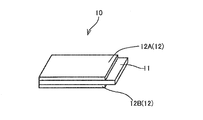
- the negative electrode 10 for an alkaline secondary battery has a base material 11 and negative electrode mixture layers 12A and 12B formed on both surfaces thereof.
- the negative electrode mixture layer 12 may be provided on one side or both sides of the base material 11.
- one side of the base material 11 is formed in the order of the negative electrode mixture layer 12.
- a stacked embodiment may be used. That is, the negative electrode 10 for an alkaline secondary battery is formed by laminating the substrate 11 and the negative electrode mixture layer 12 provided on one or both surfaces of the substrate 11 at least in this order.
- the negative electrode mixture layer 12 is formed by applying a mixture ink containing a conductive agent on the base material 11.
- the base material 11 is a flexible metal plate member.
- the base material 11 is, for example, a base material made of a foil-shaped current collector obtained by thinly casting a metal and having a smooth surface and an end surface. Therefore, the base material 11 does not include a foamed nickel or a material having irregularities due to a porous structure disadvantageous to the formation of the negative electrode mixture layer 12, but a material having a two-dimensional structure and a perforated hole (for example, a punching plate). Including.
- nickel is preferable from the viewpoint of alkali electrolyte resistance. From the viewpoint of cost, it is preferable that the surface of the iron material is nickel-plated to prevent corrosion by the electrolytic solution.
- a flat foil having a smooth surface is used for applying the negative electrode mixture ink.
- the thickness of the substrate 11 is preferably, for example, not less than 4 ⁇ m and not more than 40 ⁇ m.
- the thickness of the substrate 11 is 4 ⁇ m or more, the strength of the substrate 11 itself is further improved, and the electrode is less likely to be damaged during coating and pressing.
- the thickness of the base material 11 is 40 ⁇ m or less, the strength of the base material 11 itself is easily made appropriate, and the winding of the base material 11 at the time of coating becomes easier.
- the thickness of the base material 11 to, for example, 4 ⁇ m or more and 40 ⁇ m or less, when the negative electrode is pressed (for example, a roll gap of 0 and a pressing pressure of 5 t), wrinkles and peeling cannot be visually confirmed. Durability can be imparted.
- the substrate 11 does not break in production depending on its opening density, and wrinkles or peeling cannot be visually confirmed as a surface state. May exceed the upper limit of the above range as long as it has durability.
- the thickness of the nickel plating is preferably 0.1 ⁇ m or more and 5 ⁇ m or less, more preferably 0.2 ⁇ m or more and 3 ⁇ m or less.
- the thickness of the nickel plating is 0.1 ⁇ m or more, corrosion by the electrolytic solution is less likely to occur.
- the thickness of the nickel plating is 5 ⁇ m or less, it is advantageous in terms of cost.
- the negative electrode mixture layer 12 is a layer provided on the base material 11 and includes at least a negative electrode active material, a conductive agent, and a binder resin.
- the negative electrode mixture layer 12 may contain other additives as long as the effects of the present invention are not impaired.
- the negative electrode mixture layer 12 may contain a radical scavenger such as a hindered amine light stabilizer. When the radical scavenger is contained, the content of the radical scavenger with respect to the active material is from 0.01% by weight to 2.0% by weight.
- the negative electrode mixture layer 12 is formed by applying a mixture ink (a negative electrode composition for an alkaline secondary battery) on the base material 11.
- the mixture ink contains at least a negative electrode active material, a conductive agent, and a binder resin, and may contain a radical scavenger as needed.
- the thickness of the negative electrode mixture layer 12 is, for example, not less than 20 ⁇ m and not more than 120 ⁇ m.
- Negative electrode active material those known as negative electrode active materials for alkaline secondary batteries can be used.
- a hydrogen storage alloy, zinc, cadmium, iron and the like can be mentioned.
- the hydrogen storage alloy is not particularly limited as long as it can store electrochemically generated hydrogen in an electrolytic solution and can easily release the stored hydrogen during discharge, and is appropriately selected depending on the purpose. You.
- the average particle diameter of the negative electrode active material is 0.01 ⁇ m or more and 10 ⁇ m or less as a particle diameter D50 according to a volume-based particle size distribution, and the particle diameter D20 according to the volume-based particle size distribution is 30% or more and 70% or less. That is, when the value of D50 of the cumulative particle size distribution of the negative electrode active material measured by a laser diffraction type particle size distribution analyzer is defined as the particle size X, and the value of D20 is defined as the particle size Y, the particle size X is 0.01 ⁇ m or more and 10 ⁇ m or less. And the particle diameter Y is in the range of 30% to 70% of the particle diameter X.
- the particle diameter X is preferably from 0.1 ⁇ m to 10 ⁇ m.
- the term “average particle diameter” refers to a mixture of particles, water and a dispersion, for example, a particle size distribution meter of dynamic light scattering system (“Microtrac MT3100II” manufactured by Microtrac Bell Co., Ltd.) ) Is used to calculate the average particle diameter (median diameter) of 50% when the volume ratio of the particles is integrated from the finer ones in the volume-based particle size distribution as “D50”. , 20% is defined as “D20”.
- the ratio of the active material to the total nonvolatile components of the mixture ink is preferably from 80% by weight to 98% by weight, and more preferably from 85% by weight to 95% by weight.
- the mixture ink contains a conductive agent.
- the conductive agent include nickel powder, cobalt oxide, cobalt hydroxide, carbon, and the like, and two or more of these can be used in combination.
- carbon conductive agents are preferable, and graphite and particulate carbon are also preferable.
- the carbon conductive agent include carbon black, graphite, carbon nanotube, carbon fiber, and fullerenes.
- the carbon black includes, for example, amorphous carbon (amorphous carbon) and particulate carbon.
- the particulate carbon include graphitized carbon, acetylene black, Ketjen black, and furnace black. Among these, amorphous carbon, graphitized carbon, acetylene black and furnace black are preferred.
- the carbon black is furnace black, which is produced by continuously pyrolyzing a gas or liquid raw material in a reaction furnace, particularly Ketjen black using ethylene heavy oil as a raw material.
- Preferred are channel black which is rapidly cooled and deposited, thermal black obtained by periodically repeating combustion and thermal decomposition using gas as a raw material, and particularly acetylene black using acetylene gas as a raw material.
- carbon black that has been subjected to an oxidation treatment and hollow carbon, which are commonly used can also be used. Carbon black can be used alone or in combination of two or more. It should be noted that those obtained by further performing a heat treatment (graphitization treatment) on these carbon blacks are graphitized carbon.
- the average primary particle diameter of the carbon black is preferably from 0.01 ⁇ m to 0.3 ⁇ m.
- the average primary particle diameter is obtained by averaging the numerical values of 10 to 50 particles from an image appropriately enlarged to 10,000 to 100,000 times using a transmission electron microscope (TEM). Further, as the value of the specific surface area of carbon black increases, the number of contact points between carbon black particles increases, which is advantageous in lowering the internal resistance of the electrode.
- specific surface area determined from the adsorption of nitrogen (BET) preferably from 20 m 2 / g or more 1500 m 2 / g or less, more preferably 50 m 2 / g or more 1500m 2 / g, 100m 2 / g It is more preferably at least 1500 m 2 / g. If carbon black having a specific surface area of less than 20 m 2 / g is used, it may be difficult to obtain sufficient conductivity, and carbon black exceeding 1500 m 2 / g is difficult to obtain in the market.
- Examples of commercially available carbon black include, for example, Toka Black # 4300, # 4400, # 4500, # 5500 (furnace black, manufactured by Tokai Carbon Co., Ltd.), Printex L, etc. (furnace black, manufactured by Degussa Co., Ltd.), Raven 7000, 5750, 5250, 5000 ULTRA III, 5000 ULTRA, etc., Conductex SC ULTRA, Conductex 975 ULTRA, etc., PUER BLACK 100, 115, 205, etc.
- the binder resin is used for binding the negative electrode active materials when forming the negative electrode mixture layer 12 and for improving the adhesion to the base material.
- An acrylic resin is preferable as the binder resin, and examples of such a resin include a polymer emulsion.
- the binder resin is, for example, preferably a polymer emulsion having a glass transition temperature of ⁇ 20 ° C. or more and 20 ° C. or less.
- a polymer emulsion for example, 1% by weight or more and 5% by weight or less of a first monomer containing a hydratable functional group and 20% by weight or more and 60% by weight or less of a second monomer containing an aromatic ring And a third monomer containing no hydratable functional group or aromatic ring in an amount of 35% by weight or more and 79% by weight or less, and is preferably an acrylic emulsion synthesized by emulsion polymerization of the monomer mixture.
- the negative electrode mixture layer 12 contains this emulsion, the conductivity of the negative electrode is further improved, and the charge / discharge cycle characteristics (cycle life) are further improved.
- the first monomer is a monomer containing a hydrophilic functional group.
- the amount of the first monomer used is preferably 1% by weight or more and 5% by weight or less, more preferably 2% by weight or more and 4% by weight or less based on all monomers.
- the content is 1% by weight or more, the chemical stability is further improved due to the effect of hydration with water molecules. Further, when the content is 5% by weight or less, the stability at the time of emulsion polymerization is further increased. That is, the fluidity of the emulsion increases, and the emulsion tends to hardly aggregate.
- the second monomer will be described.
- the amount of the second monomer used is preferably 20% by weight or more and 60% by weight or less, more preferably 25% by weight or more and 55% by weight or less based on all the monomers.
- the content is 20% by weight or more, the alkali resistance of the polymer is further improved.
- the adhesion to the base material is further improved.
- the third monomer in the present embodiment is a radical polymerizable monomer other than the first monomer and the second monomer.
- W1 weight% of monomer 1
- Tg1 glass transition temperature (K) of a homopolymer that can be formed from monomer 1 alone
- W2 weight% of monomer 2
- Tg2 glass transition temperature (K) of a homopolymer that can be formed only from monomer 2
- Wn weight% of monomer n
- Tgn glass transition temperature (K) of a homopolymer that can be formed only from monomer n
- a radical-polymerizable unsaturated monomer having a radical-polymerizable unsaturated group is used as an emulsifier when polymerizing the radical-polymerizable unsaturated monomer in an aqueous medium
- the composition of the radical-polymerizable unsaturated monomer and the copolymer are specified.
- the emulsifier having a radically polymerizable unsaturated group is not included in the monomer.
- the binder resin in the present embodiment is copolymerized by emulsion polymerization. At the time of copolymerization, it is preferable to use an emulsifier from the viewpoint of polymerization stability.
- the emulsifier is preferably at least 0.1 part by weight and not more than 5 parts by weight, more preferably at least 1 part by weight and not more than 3 parts by weight, based on 100 parts by weight of the total of monomers used.
- the amount of the emulsifier is 0.1 parts by weight or more, the polymerization stability is further improved. Further, when the amount of the emulsifier is 5 parts by weight or less, the alkali resistance of the secondary battery electrode is further improved.
- an anionic emulsifier or a nonionic emulsifier can be used alone or in combination as an emulsifier.
- the emulsifier may be a reactive emulsifier having a radically polymerizable functional group or a non-reactive emulsifier having no radically polymerizable functional group. Alternatively, both can be used in combination.
- the reactive emulsifier is an anionic or nonionic emulsifier having one or more radically polymerizable unsaturated double bonds in the molecule.
- sulfosuccinates commercially available products include, for example, Latemul S-120P and S-180A manufactured by Kao Corporation, Sanyo Chemical Co., Ltd., Eleminol JS-2), and alkylphenol ethers (commercially available products) Aqualon KH-10 and RN-20 manufactured by Daiichi Kogyo Seiyaku Co., Ltd.).
- examples of the non-reactive emulsifier include an anionic non-reactive emulsifier and a nonionic non-reactive emulsifier.
- anionic non-reactive emulsifier examples include polyoxyethylene alkyl phenyl ether sulfate, polyoxyethylene polycyclic phenyl ether sulfate, polyoxyethylene alkyl ether sulfate, and the like.
- examples of the anionic non-reactive emulsifier include Hytenol NF-08 [the number of repeating ethylene oxide units (hereinafter, referred to as the “number of EO units”: 8)], NF-17 (the number of EO units: 17) [Daiichi Kogyo Seiyaku Co., Ltd.], Eleminol CLS-20 (number of EO units: 10), Eleminol ES-12 (number of EO units: 6), ES-30 (number of EO units: 15), ES- 70 (the number of EO units: 35) [all manufactured by Sanyo Chemical Industries, Ltd.] and the like.
- Hytenol NF-08 the number of repeating ethylene oxide units (hereinafter, referred to as the “number of EO units”: 8)
- NF-17 the number of EO units: 17
- Eleminol CLS-20 number of EO units: 10
- Eleminol ES-12 number of EO units: 6
- nonionic non-reactive emulsifiers include polyoxyethylene alkylphenyl ethers such as polyoxyethylene nonyl phenyl ether and polyoxyethylene octyl phenyl ether; polyoxyethylene lauryl ether, polyoxyethylene stearyl ether, and polyoxyethylene lauryl ether.
- Polyoxyethylene alkyl ethers such as ethylene oleyl ether; polyoxy polycyclic phenyl ethers such as polyoxyethylene distyrenated phenyl ether; and polyoxyethylene sorbitan fatty acid esters.
- examples of the nonionic non-reactive emulsifier include Emulgen 1108 (EO unit number: 8), 1118S-70 (EO unit number: 18), 1135S-70 (EO unit number: 35), and 1150S-70 (EO unit number: 35).
- the number of EO units: 50) (all manufactured by Kao Corporation).
- the above non-reactive emulsifiers may be used alone or in combination of two or more.
- a conventionally known reactive emulsifier can be used among the emulsifiers.
- the radical polymerization initiator that can be used in the present embodiment include persulfates such as potassium persulfate, ammonium persulfate, and sodium persulfate.
- the amount of the polymerization initiator used is preferably 0.1 part by weight or more and 1 part by weight or less, preferably 0.2 part by weight or more and 0.8 part by weight or less based on 100 parts by weight of the total of the monomers used for the emulsion polymerization. More preferably, there is. When the amount is 0.1 part by weight or more, the polymerization stability is further improved. When the content is 1 part by weight or less, the water resistance is further improved.
- a redox initiator obtained by combining a peroxide-based initiator and a reducing agent is preferable.
- the redox initiator a combination of a peroxide initiator and a reducing agent is preferable.
- the peroxide initiator include perbutyl H (tertiary butyl hydroperoxide), perbutyl O (tertiary butyl peroxy-2-ethylhexanoate), cumene hydroperoxide, and p-menthane hydroperoxide.
- reducing agent examples include Erbit N (sodium isoascorbate), L-ascorbic acid (vitamin C), sodium sulfite, sodium bisulfite, sodium pyrosulfite (SMBS), and sodium hyposulfite (hydrosulfite).
- the mixture ink (negative electrode composition for an alkaline secondary battery) preferably contains 0.05 to 20 parts by weight of a binder resin with respect to 100 parts by weight of the active material, and 0.1 to 10 parts by weight. Parts or less is more preferable. If the amount is less than 0.05 parts by weight, the binding force between the active materials is reduced, and as a result, the contact between the active material and the base material 11 is not maintained, and the utilization rate of the positive electrode may be reduced. If the amount exceeds 20 parts by weight, the ratio of the active material in the mixture ink decreases, and the energy density of the electrode tends to decrease. Furthermore, an increase in the proportion of the polymer that is difficult to conduct electricity may increase the electric resistance of the electrode.
- a film-forming aid an antifoaming agent, a leveling agent, a dispersant, a preservative, a pH adjuster, a viscosity adjuster, and the like can be added to the mixture ink.
- the viscosity of the mixture ink can be appropriately selected depending on the coating method, but is preferably from 100 mPa ⁇ s to 30,000 mPa ⁇ s.
- the method for producing a negative electrode for an alkaline secondary battery includes a step of forming a negative electrode mixture layer 12 on a substrate 11.
- a mixture ink (a negative electrode composition for an alkaline secondary battery) containing a binder resin, an active material, and a conductive agent is applied on the base material 11, and dried. It is done.
- the electrode of the negative electrode 10 for an alkaline secondary battery may be subjected to a press treatment using a lithographic press, a calendar roll, or the like. Thereby, the adhesion between the base material 11 and the negative electrode mixture layer 12 is further improved.
- a disperser or a mixer generally used for pigment dispersion or the like can be used.
- mixers such as a disper, a homomixer, or a planetary mixer; homogenizers such as "CLEARMIX" manufactured by M Technique Co., Ltd.
- FILMIX manufactured by PRIMIX
- a paint conditioner manufactured by Red Devil Co., Ltd.
- a ball mill a sand mill (“Dynomill” manufactured by Shinmaru Enterprises Co., Ltd.), an attritor, a pearl mill (“DCP mill” manufactured by Eirich Co., Ltd.), or a co-ball mill
- a wet jet mill (Genus) "Genus PY” manufactured by Sugino Machine Co., Ltd., “Starburst” manufactured by Sugino Machine Co., Ltd., “Nanomizer” manufactured by Nanomizer Co., Ltd.), “Clear SS-5" manufactured by M-Technic Co., Ltd., or Nara Machinery Co., Ltd.
- Medialess dispersing machine such as “MICROS”; or Other roll mill of, but not limited thereto.
- a disperser that has been subjected to a treatment for preventing metal from mixing from the disperser.
- a media type disperser a method in which an agitator and a vessel are made of a ceramic or resin, or a metal agitator and a disperser in which the surface of a vessel is subjected to treatment such as tungsten carbide spraying or resin coating. It is preferable to use And, as the medium, it is preferable to use ceramic beads such as glass beads, zirconia beads, or alumina beads. Also, when a roll mill is used, it is preferable to use a ceramic roll. As the dispersing device, only one type may be used, or a plurality of types of devices may be used in combination.
- An alkaline secondary battery provided with the negative electrode for an alkaline secondary battery of the present embodiment includes the negative electrode for an alkaline secondary battery of the present embodiment, a positive electrode, an electrolytic solution, and a separator.
- the positive electrode comprises a substrate, a primer layer provided on one or both surfaces of the substrate, and a positive electrode mixture layer laminated at least in this order.
- the primer layer is formed by applying a primer composition to one or both surfaces of a substrate, and the positive electrode mixture layer is formed by applying a mixture ink containing a conductive agent on the primer layer. It is formed by being done.
- the shape of the alkaline secondary battery provided with the negative electrode for an alkaline secondary battery of the present embodiment may be various shapes according to the purpose of use, such as a paper type, a cylindrical type, a coin type, a button type, or a stacked type. it can.
- Examples of the electrolyte include an aqueous solution of potassium hydroxide, and a solution obtained by adding sodium hydroxide or lithium hydroxide to an aqueous solution of potassium hydroxide.
- Examples of the separator include, but are not limited to, polyethylene nonwoven fabric, polypropylene nonwoven fabric, polyamide nonwoven fabric, and those obtained by subjecting them to a hydrophilic treatment.
- the alkaline secondary battery provided with the negative electrode for an alkaline secondary battery of the present embodiment can be preferably used for applications such as a substation, a bus, a truck, and a train.
- TOCRYL S-171 manufactured by Toyochem Co., Ltd.
- a negative electrode ink (a negative electrode composition for an alkaline secondary battery) was prepared.
- a negative electrode ink is applied to both sides of a base material made of a Ni-plated steel sheet having a thickness of 15 ⁇ m with an applicator so as to have a basis weight of 200 g / m 2 , respectively.
- the layer was formed, and the negative electrode of Example 1 was produced. That is, in the production of the negative electrode, the negative electrode mixture layer was formed such that the total thickness of the negative electrode mixture layer was 150 ⁇ m and the basis weight of the negative electrode active material in the negative electrode mixture layer was 450 g / m 2 . Therefore, the negative electrode thickness of Example 1, the following Examples 2 to 10, and Comparative Examples 1 to 4 is 215 ⁇ m.
- primer composition As a conductive material, 100 parts of leaf-like graphite (UP-20, manufactured by Nippon Graphite Industry Co., Ltd., average particle diameter 25 ⁇ m, aspect ratio 68) and 5 parts of a dispersant (Joncryl 70J, manufactured by BASF Corporation) are used. Pure water was added so that the residual solid content after the addition and drying became 30%, and the primer composition was adjusted. Thereafter, this primer composition was subjected to a 20-pass dispersion treatment using a bead mill.
- leaf-like graphite UP-20, manufactured by Nippon Graphite Industry Co., Ltd., average particle diameter 25 ⁇ m, aspect ratio 68
- dispersant Joncryl 70J, manufactured by BASF Corporation
- a primer composition was applied to both sides of a substrate made of a 15- ⁇ m-thick Ni-plated steel sheet with an applicator, and then dried to form a primer layer.
- the primer layer was formed with a thickness per side of 1 ⁇ m.
- a positive electrode ink was applied to each of the primer layers with an applicator so as to have a basis weight of 150 g / m 2, and a positive electrode mixture layer was formed so as to have a dry thickness of 100 ⁇ m, respectively, to produce a positive electrode. . That is, in this positive electrode, the positive electrode mixture layer was formed such that the total thickness of the positive electrode mixture layer was 200 ⁇ m and the basis weight of the positive electrode active material in the positive electrode mixture layer was 300 g / m 2 . Therefore, the total thickness of the positive electrodes of Example 1, the following Examples 2 to 11, and Comparative Examples 1 to 4 is 217 ⁇ m.
- a negative electrode, a sulfonated PP nonwoven fabric separator having a thickness of 200 ⁇ m, and a positive electrode were stacked in this order on a coin cell, an alkaline electrolyte was injected, cured for one day, and the electrolyte was infiltrated to produce an alkaline secondary battery of Example 1.
- Example 2 A negative electrode composition for an alkaline secondary battery of Example 2 was produced in the same manner as in Example 1, except that the particle diameter Y of the active material (A) was changed to 5.6 ⁇ m. Thereafter, using the negative electrode composition for an alkaline secondary battery of Example 2, a negative electrode for an alkaline secondary battery of Example 2 was produced in the same manner as in Example 1. Thereafter, using the negative electrode for an alkaline secondary battery of Example 2, an alkaline secondary battery of Example 2 was produced in the same manner as in Example 1.
- Example 3 A negative electrode composition for an alkaline secondary battery of Example 3 was produced in the same manner as in Example 1, except that the particle size Y of the active material (A) was changed to 4.8 ⁇ m. Thereafter, using the negative electrode composition for an alkaline secondary battery of Example 3, a negative electrode for an alkaline secondary battery of Example 3 was produced in the same manner as in Example 1. Thereafter, using the negative electrode for an alkaline secondary battery of Example 3, an alkaline secondary battery of Example 3 was produced in the same manner as in Example 1.
- Example 4 A negative electrode composition for an alkaline secondary battery of Example 4 was prepared in the same manner as in Example 3, except that 10 parts of graphite was added instead of 10 parts of carbon as the conductive agent (C). Thereafter, using the negative electrode composition for an alkaline secondary battery of Example 4, a negative electrode for an alkaline secondary battery of Example 4 was produced in the same manner as in Example 1. Thereafter, using the negative electrode for an alkaline secondary battery of Example 4, an alkaline secondary battery of Example 4 was produced in the same manner as in Example 1.
- Negative electrode composition for alkaline secondary battery of Example 5 in the same manner as in Example 3 except that 9 parts of carbon and 1 part of carbon nanotube (CNT) were added instead of 10 parts of carbon as the conductive agent (C). was prepared. Thereafter, using the negative electrode composition for an alkaline secondary battery of Example 5, a negative electrode for an alkaline secondary battery of Example 5 was produced in the same manner as in Example 1. Thereafter, using the negative electrode for an alkaline secondary battery of Example 5, an alkaline secondary battery of Example 5 was produced in the same manner as in Example 1.
- CNT carbon nanotubes
- Example 7 A negative electrode composition for an alkaline secondary battery of Example 7 was produced in the same manner as in Example 3, except that 10 parts of carbon nanotubes (CNT) were added as the conductive agent (C) instead of 10 parts of carbon. Thereafter, using the negative electrode composition for an alkaline secondary battery of Example 7, a negative electrode for an alkaline secondary battery of Example 7 was produced in the same manner as in Example 1. Thereafter, an alkaline secondary battery of Example 7 was produced in the same manner as in Example 1 using the negative electrode for an alkaline secondary battery of Example 7.
- CNT carbon nanotubes
- Negative electrode composition for an alkaline secondary battery of Example 8 in the same manner as in Example 1 except that the average particle diameter X of the active material (A) was 10 ⁇ m and the particle diameter Y of the active material (A) was 7 ⁇ m. was prepared. Thereafter, using the negative electrode composition for an alkaline secondary battery of Example 8, a negative electrode for an alkaline secondary battery of Example 8 was produced in the same manner as in Example 1. Thereafter, an alkaline secondary battery of Example 8 was produced in the same manner as in Example 1 using the negative electrode for an alkaline secondary battery of Example 8.
- Negative electrode composition for an alkaline secondary battery of Example 9 in the same manner as in Example 1 except that the average particle diameter X of the active material (A) was 10 ⁇ m and the particle diameter Y of the active material (A) was 3 ⁇ m. was prepared. Thereafter, using the negative electrode composition for an alkaline secondary battery of Example 9, a negative electrode for an alkaline secondary battery of Example 9 was produced in the same manner as in Example 1. Thereafter, using the negative electrode for an alkaline secondary battery of Example 9, an alkaline secondary battery of Example 9 was produced in the same manner as in Example 1.
- Negative electrode composition for alkaline secondary battery of Example 10 in the same manner as in Example 1 except that the average particle diameter X of the active material (A) was 10 ⁇ m and the particle diameter Y of the active material (A) was 5 ⁇ m. was prepared. Thereafter, using the negative electrode composition for an alkaline secondary battery of Example 10, a negative electrode for an alkaline secondary battery of Example 10 was produced in the same manner as in Example 1. Thereafter, an alkaline secondary battery of Example 10 was produced in the same manner as in Example 1 using the negative electrode for an alkaline secondary battery of Example 10.
- Example 11 A negative electrode composition for an alkaline secondary battery was produced in the same manner as in Example 10. Thereafter, using the prepared negative electrode composition for an alkaline secondary battery, a negative electrode for an alkaline secondary battery of Example 11 was prepared in the same manner as in Example 10 except that the thickness of the base material was changed to 45 ⁇ m. Thereafter, using the negative electrode for an alkaline secondary battery of Example 11, an alkaline secondary battery of Example 11 was produced in the same manner as in Example 10.
- Comparative Example 1 A negative electrode composition for an alkaline secondary battery of Comparative Example 1 was produced in the same manner as in Example 1, except that the average particle diameter X of the active material (A) was 15 ⁇ m and the particle diameter Y was 6 ⁇ m. Thereafter, using the negative electrode composition for an alkaline secondary battery of Comparative Example 1, a negative electrode for an alkaline secondary battery of Comparative Example 1 was produced in the same manner as in Example 1. Thereafter, an alkaline secondary battery of Comparative Example 1 was produced in the same manner as in Example 1 using the negative electrode for an alkaline secondary battery of Comparative Example 1.
- Comparative Example 2 A negative electrode composition for an alkaline secondary battery of Comparative Example 2 was produced in the same manner as in Example 1, except that the particle size Y of the active material (A) was changed to 6 ⁇ m. Thereafter, using the negative electrode composition for an alkaline secondary battery of Comparative Example 2, a negative electrode for an alkaline secondary battery of Comparative Example 2 was produced in the same manner as in Example 1. Thereafter, an alkaline secondary battery of Comparative Example 2 was produced in the same manner as in Example 1 using the negative electrode for an alkaline secondary battery of Comparative Example 2.
- Comparative Example 3 A negative electrode composition for an alkaline secondary battery of Comparative Example 3 was produced in the same manner as in Example 1, except that the particle diameter Y of the active material (A) was 1.8 ⁇ m. Thereafter, using the negative electrode composition for an alkaline secondary battery of Comparative Example 3, a negative electrode for an alkaline secondary battery of Comparative Example 3 was produced in the same manner as in Example 1. Thereafter, an alkaline secondary battery of Comparative Example 3 was produced in the same manner as in Example 1 using the negative electrode for an alkaline secondary battery of Comparative Example 3.
- Comparative Example 4 A negative electrode composition for an alkaline secondary battery of Comparative Example 4 was prepared in the same manner as in Example 3, except that the conductive agent (C) was not included. Thereafter, using the negative electrode composition for an alkaline secondary battery of Comparative Example 4, a negative electrode for an alkaline secondary battery of Comparative Example 4 was produced in the same manner as in Example 1. Thereafter, an alkaline secondary battery of Comparative Example 4 was produced in the same manner as in Example 1 using the negative electrode for an alkaline secondary battery of Comparative Example 4.
- the comprehensive evaluation is an evaluation obtained by integrating the respective evaluations of “cycle life” and “output characteristics”. Specifically, examples indicated by “ ⁇ ”and“ ⁇ ” indicate that “cycle life” and “output characteristics” are good, and examples indicated by “ ⁇ ” and “XX” indicate “ It shows that the "cycle life” and “output characteristics” are not preferable.
- Examples 1 to 11 in which the hydrogen storage alloy contained fine powder having a predetermined particle size distribution had good cycle life and output characteristics, and had a higher output than Comparative Examples 1 to 4. And improved both input / output performance and durability.
- Comparative Examples 1 to 4 when the amount of fine powder having a predetermined particle size distribution in the hydrogen storage alloy was too large (Comparative Examples 1 and 2), the output characteristics were poor, and as in Comparative Example 3, the amount of fine powder having a predetermined particle size distribution was too small. And the cycle life was not good.
Landscapes
- Chemical & Material Sciences (AREA)
- Chemical Kinetics & Catalysis (AREA)
- Electrochemistry (AREA)
- General Chemical & Material Sciences (AREA)
- Engineering & Computer Science (AREA)
- Manufacturing & Machinery (AREA)
- Materials Engineering (AREA)
- Battery Electrode And Active Subsutance (AREA)
- Cell Electrode Carriers And Collectors (AREA)
Abstract
La présente invention concerne : une électrode négative pour batteries secondaires alcalines, qui est capable d'atteindre un bon équilibre entre les caractéristiques de sortie et la durée de vie de cycle à des niveaux élevés ; et une composition qui constitue cette électrode négative. Une électrode négative (10) pour des batteries secondaires alcalines selon la présente invention comprend un matériau actif, une résine liante et un agent conducteur qui contient un matériau carboné conducteur ; et si la valeur de D50 dans la distribution de taille de particule cumulative du matériau actif telle que déterminée à l'aide d'un instrument de mesure de distribution de taille de particule de diffraction laser est prise en tant que diamètre de particule moyen X et que la valeur de D20 est prise en tant que diamètre de particule Y, le diamètre moyen de particule X est de 10 µm ou moins et la valeur du diamètre de particule Y est de 30 % à 70 % du diamètre moyen de particule X
Priority Applications (3)
| Application Number | Priority Date | Filing Date | Title |
|---|---|---|---|
| CN201980041929.XA CN112368861B (zh) | 2018-06-25 | 2019-06-21 | 碱性二次电池用负极组合物以及碱性二次电池用负极 |
| EP19825776.8A EP3813159A4 (fr) | 2018-06-25 | 2019-06-21 | Composition d'électrode négative pour batteries secondaires alcalines et électrode négative pour batteries secondaires alcalines |
| US17/083,207 US11670758B2 (en) | 2018-06-25 | 2020-10-28 | Negative-electrode composition for alkaline secondary batteries, and alkaline secondary battery negative electrode |
Applications Claiming Priority (2)
| Application Number | Priority Date | Filing Date | Title |
|---|---|---|---|
| JP2018120215A JP7556661B2 (ja) | 2018-06-25 | 2018-06-25 | アルカリ二次電池用負極組成物及びアルカリ二次電池用負極 |
| JP2018-120215 | 2018-06-25 |
Related Child Applications (1)
| Application Number | Title | Priority Date | Filing Date |
|---|---|---|---|
| US17/083,207 Continuation US11670758B2 (en) | 2018-06-25 | 2020-10-28 | Negative-electrode composition for alkaline secondary batteries, and alkaline secondary battery negative electrode |
Publications (1)
| Publication Number | Publication Date |
|---|---|
| WO2020004253A1 true WO2020004253A1 (fr) | 2020-01-02 |
Family
ID=68986879
Family Applications (1)
| Application Number | Title | Priority Date | Filing Date |
|---|---|---|---|
| PCT/JP2019/024677 Ceased WO2020004253A1 (fr) | 2018-06-25 | 2019-06-21 | Composition d'électrode négative pour batteries secondaires alcalines et électrode négative pour batteries secondaires alcalines |
Country Status (5)
| Country | Link |
|---|---|
| US (1) | US11670758B2 (fr) |
| EP (1) | EP3813159A4 (fr) |
| JP (1) | JP7556661B2 (fr) |
| CN (1) | CN112368861B (fr) |
| WO (1) | WO2020004253A1 (fr) |
Citations (6)
| Publication number | Priority date | Publication date | Assignee | Title |
|---|---|---|---|---|
| JP2000038606A (ja) * | 1998-07-22 | 2000-02-08 | Shin Etsu Chem Co Ltd | 水素吸蔵合金粉末、該製造方法及びアルカリ二次電池 |
| JP2000092491A (ja) | 1998-09-10 | 2000-03-31 | Sony Corp | 画像処理装置および方法、並びに提供媒体 |
| JP2000182608A (ja) * | 1998-12-18 | 2000-06-30 | Japan Metals & Chem Co Ltd | 水素吸蔵合金負極 |
| JP2001135311A (ja) | 1999-11-04 | 2001-05-18 | Matsushita Electric Ind Co Ltd | アルカリ蓄電池 |
| JP2003007293A (ja) * | 2001-06-21 | 2003-01-10 | Matsushita Electric Ind Co Ltd | 水素吸蔵合金電極 |
| JP4698291B2 (ja) | 2005-05-31 | 2011-06-08 | 三洋電機株式会社 | アルカリ蓄電池 |
Family Cites Families (20)
| Publication number | Priority date | Publication date | Assignee | Title |
|---|---|---|---|---|
| JPS62222574A (ja) * | 1986-03-25 | 1987-09-30 | Toshiba Corp | 水素二次電池 |
| JPH0812777B2 (ja) * | 1987-04-22 | 1996-02-07 | 松下電器産業株式会社 | 水素吸蔵電極の製造法 |
| JPH0757771A (ja) * | 1994-08-05 | 1995-03-03 | Sanyo Electric Co Ltd | 金属−水素アルカリ蓄電池の製造方法 |
| JP4183292B2 (ja) * | 1996-01-22 | 2008-11-19 | 株式会社東芝 | 二次電池 |
| US5965295A (en) * | 1996-06-14 | 1999-10-12 | Toshiba Battery Co., Ltd. | Alkaline secondary battery, paste type positive electrode for alkaline secondary battery, method for manufacturing alkaline secondary battery |
| JP3246345B2 (ja) * | 1996-08-21 | 2002-01-15 | 松下電器産業株式会社 | アルカリ蓄電池用ニッケル正極とこれを用いたニッケル・水素蓄電池 |
| JPH11354115A (ja) * | 1998-06-05 | 1999-12-24 | Japan Storage Battery Co Ltd | アルカリ蓄電池 |
| JP4776190B2 (ja) * | 2004-08-20 | 2011-09-21 | 株式会社東芝 | 非水電解質二次電池 |
| US20070269717A1 (en) * | 2004-08-26 | 2007-11-22 | Gs Yuasa Corporation | Hydrogen Absorbing Electrode and Nickel Metal-Hydridge Battery |
| JP4967229B2 (ja) * | 2004-11-30 | 2012-07-04 | 株式会社Gsユアサ | アルカリ二次電池用負極板およびその負極板を適用したアルカリ二次電池。 |
| JP5119578B2 (ja) * | 2005-07-04 | 2013-01-16 | 株式会社Gsユアサ | ニッケル水素電池およびその製造方法 |
| CN107021528B (zh) * | 2012-09-28 | 2019-04-02 | 住友金属矿山株式会社 | 镍钴复合氢氧化物的制造方法以及制造装置 |
| EP2940761B1 (fr) * | 2012-12-26 | 2019-12-18 | IUCF-HYU (Industry-University Cooperation Foundation Hanyang University) | Matériau actif de cathode pour batteries secondaires au lithium |
| CN104115312B (zh) * | 2013-01-29 | 2016-11-09 | 松下知识产权经营株式会社 | 电极用合金粉末、采用了该粉末的碱性蓄电池用负极及碱性蓄电池 |
| KR20180052558A (ko) | 2015-09-16 | 2018-05-18 | 니폰 제온 가부시키가이샤 | 전고체 2차 전지 |
| EP3413326B1 (fr) * | 2016-02-04 | 2020-09-23 | Tpr Co., Ltd. | Matériau d'électrode comprenant un composite noyau-enveloppe, procédé de production de celui-ci, catalyseur, électrode, batterie secondaire et condensateur électrique double couche |
| CN107325225B (zh) * | 2016-04-29 | 2019-12-03 | 四川茵地乐科技有限公司 | 锂离子电池负极水性粘合剂及其制备方法 |
| JP2018045820A (ja) * | 2016-09-13 | 2018-03-22 | ライオン・スペシャリティ・ケミカルズ株式会社 | 炭素導電材スラリー |
| CN106784737B (zh) * | 2017-02-10 | 2019-03-19 | 淄博君行电源技术有限公司 | 电容型镍氢动力电池用球形贮氢合金及其制备方法 |
| CN107146878B (zh) * | 2017-05-18 | 2020-01-14 | 深圳市量能科技有限公司 | 一种镍系电池极片、镍系电池及其制备方法 |
-
2018
- 2018-06-25 JP JP2018120215A patent/JP7556661B2/ja active Active
-
2019
- 2019-06-21 EP EP19825776.8A patent/EP3813159A4/fr not_active Withdrawn
- 2019-06-21 CN CN201980041929.XA patent/CN112368861B/zh active Active
- 2019-06-21 WO PCT/JP2019/024677 patent/WO2020004253A1/fr not_active Ceased
-
2020
- 2020-10-28 US US17/083,207 patent/US11670758B2/en active Active
Patent Citations (6)
| Publication number | Priority date | Publication date | Assignee | Title |
|---|---|---|---|---|
| JP2000038606A (ja) * | 1998-07-22 | 2000-02-08 | Shin Etsu Chem Co Ltd | 水素吸蔵合金粉末、該製造方法及びアルカリ二次電池 |
| JP2000092491A (ja) | 1998-09-10 | 2000-03-31 | Sony Corp | 画像処理装置および方法、並びに提供媒体 |
| JP2000182608A (ja) * | 1998-12-18 | 2000-06-30 | Japan Metals & Chem Co Ltd | 水素吸蔵合金負極 |
| JP2001135311A (ja) | 1999-11-04 | 2001-05-18 | Matsushita Electric Ind Co Ltd | アルカリ蓄電池 |
| JP2003007293A (ja) * | 2001-06-21 | 2003-01-10 | Matsushita Electric Ind Co Ltd | 水素吸蔵合金電極 |
| JP4698291B2 (ja) | 2005-05-31 | 2011-06-08 | 三洋電機株式会社 | アルカリ蓄電池 |
Non-Patent Citations (1)
| Title |
|---|
| See also references of EP3813159A4 |
Also Published As
| Publication number | Publication date |
|---|---|
| JP2020004508A (ja) | 2020-01-09 |
| US20210057724A1 (en) | 2021-02-25 |
| US11670758B2 (en) | 2023-06-06 |
| CN112368861B (zh) | 2024-09-20 |
| EP3813159A4 (fr) | 2021-08-18 |
| CN112368861A (zh) | 2021-02-12 |
| EP3813159A1 (fr) | 2021-04-28 |
| JP7556661B2 (ja) | 2024-09-26 |
Similar Documents
| Publication | Publication Date | Title |
|---|---|---|
| JP6109525B2 (ja) | ニッケル水素二次電池電極形成用エマルションバインダーおよびニッケル水素二次電池電極形成用合材インキ | |
| JP5943602B2 (ja) | 電気化学セル用アクリル系水分散体および水性ペースト、それからなる電極・電池の製造方法 | |
| JP6539978B2 (ja) | 導電性組成物、蓄電デバイス用電極、及び蓄電デバイス | |
| CN103597637B (zh) | 二次电池电极形成用组合物、二次电池电极以及二次电池 | |
| JP5891974B2 (ja) | 二次電池電極形成用組成物、二次電池電極、及び二次電池 | |
| JP2015026595A (ja) | 導電性組成物、蓄電デバイス用下地層付き集電体、蓄電デバイス用電極、及び蓄電デバイス | |
| KR102155177B1 (ko) | 도전성 조성물, 축전 디바이스용 하지층 부착 집전체, 축전 디바이스용 전극 및 축전 디바이스 | |
| CN108040504A (zh) | 粘合剂组合物、非水电解质二次电池用电极以及非水电解质二次电池 | |
| JP2015106488A (ja) | 蓄電デバイス負極用スラリーおよび蓄電デバイス負極、蓄電デバイス正極用スラリーおよび蓄電デバイス正極、ならびに蓄電デバイス | |
| CN106463697A (zh) | 非水系二次电池用层叠体及其制造方法、以及非水系二次电池 | |
| JPWO2015146787A1 (ja) | 電気化学素子電極用導電性接着剤組成物及び電気化学素子電極用集電体 | |
| JP2015022956A (ja) | 蓄電デバイス用スラリー、蓄電デバイス電極、セパレーターおよび蓄電デバイス | |
| JP6547630B2 (ja) | リチウムイオン二次電池用電極及びリチウムイオン二次電池 | |
| JP6314491B2 (ja) | 二次電池電極形成用組成物、二次電池用電極および二次電池 | |
| JP6105224B2 (ja) | プライマー組成物、ニッケル水素二次電池正極及びその製造方法 | |
| JP7040966B2 (ja) | アルカリ二次電池用正極及びアルカリ二次電池 | |
| JP7080188B2 (ja) | アルカリ二次電池用正極及びアルカリ二次電池 | |
| CN116137314A (zh) | 电极的制造方法以及电极 | |
| JP7556661B2 (ja) | アルカリ二次電池用負極組成物及びアルカリ二次電池用負極 | |
| JP7021918B2 (ja) | アルカリ二次電池用負極 | |
| JP6014472B2 (ja) | ニッケル水素二次電池箔状集電体正極形成用合材インキ |
Legal Events
| Date | Code | Title | Description |
|---|---|---|---|
| 121 | Ep: the epo has been informed by wipo that ep was designated in this application |
Ref document number: 19825776 Country of ref document: EP Kind code of ref document: A1 |
|
| NENP | Non-entry into the national phase |
Ref country code: DE |
|
| ENP | Entry into the national phase |
Ref document number: 2019825776 Country of ref document: EP Effective date: 20210125 |
|
| WWW | Wipo information: withdrawn in national office |
Ref document number: 2019825776 Country of ref document: EP |