WO2020004282A1 - Climatiseur extérieur - Google Patents
Climatiseur extérieur Download PDFInfo
- Publication number
- WO2020004282A1 WO2020004282A1 PCT/JP2019/024790 JP2019024790W WO2020004282A1 WO 2020004282 A1 WO2020004282 A1 WO 2020004282A1 JP 2019024790 W JP2019024790 W JP 2019024790W WO 2020004282 A1 WO2020004282 A1 WO 2020004282A1
- Authority
- WO
- WIPO (PCT)
- Prior art keywords
- air conditioner
- outdoor air
- heat exchanger
- side heat
- outlet
- Prior art date
- Legal status (The legal status is an assumption and is not a legal conclusion. Google has not performed a legal analysis and makes no representation as to the accuracy of the status listed.)
- Ceased
Links
Images



Classifications
-
- F—MECHANICAL ENGINEERING; LIGHTING; HEATING; WEAPONS; BLASTING
- F24—HEATING; RANGES; VENTILATING
- F24F—AIR-CONDITIONING; AIR-HUMIDIFICATION; VENTILATION; USE OF AIR CURRENTS FOR SCREENING
- F24F1/00—Room units for air-conditioning, e.g. separate or self-contained units or units receiving primary air from a central station
- F24F1/02—Self-contained room units for air-conditioning, i.e. with all apparatus for treatment installed in a common casing
- F24F1/028—Self-contained room units for air-conditioning, i.e. with all apparatus for treatment installed in a common casing characterised by air supply means, e.g. fan casings, internal dampers or ducts
-
- F—MECHANICAL ENGINEERING; LIGHTING; HEATING; WEAPONS; BLASTING
- F24—HEATING; RANGES; VENTILATING
- F24F—AIR-CONDITIONING; AIR-HUMIDIFICATION; VENTILATION; USE OF AIR CURRENTS FOR SCREENING
- F24F1/00—Room units for air-conditioning, e.g. separate or self-contained units or units receiving primary air from a central station
- F24F1/02—Self-contained room units for air-conditioning, i.e. with all apparatus for treatment installed in a common casing
- F24F1/028—Self-contained room units for air-conditioning, i.e. with all apparatus for treatment installed in a common casing characterised by air supply means, e.g. fan casings, internal dampers or ducts
- F24F1/0287—Self-contained room units for air-conditioning, i.e. with all apparatus for treatment installed in a common casing characterised by air supply means, e.g. fan casings, internal dampers or ducts with vertically arranged fan axis
-
- F—MECHANICAL ENGINEERING; LIGHTING; HEATING; WEAPONS; BLASTING
- F24—HEATING; RANGES; VENTILATING
- F24F—AIR-CONDITIONING; AIR-HUMIDIFICATION; VENTILATION; USE OF AIR CURRENTS FOR SCREENING
- F24F1/00—Room units for air-conditioning, e.g. separate or self-contained units or units receiving primary air from a central station
- F24F1/02—Self-contained room units for air-conditioning, i.e. with all apparatus for treatment installed in a common casing
- F24F1/032—Self-contained room units for air-conditioning, i.e. with all apparatus for treatment installed in a common casing characterised by heat exchangers
- F24F1/0323—Self-contained room units for air-conditioning, i.e. with all apparatus for treatment installed in a common casing characterised by heat exchangers by the mounting or arrangement of the heat exchangers
-
- F—MECHANICAL ENGINEERING; LIGHTING; HEATING; WEAPONS; BLASTING
- F24—HEATING; RANGES; VENTILATING
- F24F—AIR-CONDITIONING; AIR-HUMIDIFICATION; VENTILATION; USE OF AIR CURRENTS FOR SCREENING
- F24F13/00—Details common to, or for air-conditioning, air-humidification, ventilation or use of air currents for screening
- F24F13/20—Casings or covers
-
- F—MECHANICAL ENGINEERING; LIGHTING; HEATING; WEAPONS; BLASTING
- F24—HEATING; RANGES; VENTILATING
- F24F—AIR-CONDITIONING; AIR-HUMIDIFICATION; VENTILATION; USE OF AIR CURRENTS FOR SCREENING
- F24F13/00—Details common to, or for air-conditioning, air-humidification, ventilation or use of air currents for screening
- F24F13/30—Arrangement or mounting of heat-exchangers
Definitions
- Patent Document 1 Japanese Patent Application Laid-Open No. 2006-242510 discloses an air conditioner that includes a condenser and an evaporator in a single housing and performs local cooling and dehumidification. I have.
- Patent Literature 1 exhausts the air passing through the condenser backward. However, considering outdoor cooling or heating, such an exhaust method is not always appropriate.
- the outdoor air conditioner of the first aspect is an air conditioner used outdoors.
- the air conditioner includes a compressor, a heat source side heat exchanger, a first fan, a use side heat exchanger, a second fan, and a casing.
- the first fan is for passing air through the heat source side heat exchanger.
- the second fan is for passing air through the use-side heat exchanger.
- the casing houses the compressor, the heat source side heat exchanger, the first fan, the use side heat exchanger, and the second fan.
- the casing has a first outlet and a second outlet.
- the first outlet blows out the air that has passed through the heat source side heat exchanger toward an upper portion outside the casing.
- the second outlet is an outlet arranged below the first outlet.
- the second outlet blows the air that has passed through the use-side heat exchanger in a lateral direction outside the casing.
- the casing has a support, a bottom plate, and a top plate.
- the outdoor air conditioner according to the first aspect can exhaust the air that has passed through the use-side heat exchanger in a direction where the user is present and the air that has passed through the heat source-side heat exchanger upward without the user.
- the outdoor air conditioner of the second aspect is the air conditioner of the first aspect, wherein the first outlet is disposed on the upper surface of the casing.
- the first outlet is provided on the upper surface of the casing, and the air that has passed through the heat source side heat exchanger 6 is blown upward from the first outlet to the outside. It is more difficult for exhaust to reach the user.
- An outdoor air conditioner according to a third aspect is the outdoor air conditioner according to the first aspect or the second aspect, wherein the first outlet has a height of 1.6 m or more and 3 m or less from the installation surface of the outdoor air conditioner. It is arranged in.
- An outdoor air conditioner according to a fourth aspect is the outdoor air conditioner according to any one of the first to third aspects, wherein the second outlet is at least 0.2 m from an installation surface of the outdoor air conditioner. .6 m or less.
- the second outlet is disposed at an appropriate height from the installation surface and is blown out in a lateral direction, the conditioned air can reach a relatively distant position. Can be.
- the outdoor air conditioner according to the fifth aspect is the outdoor air conditioner according to any of the first to fourth aspects, wherein the heat source side heat exchanger is disposed above the use side heat exchanger.
- the outdoor air conditioner of the fifth aspect can shorten the distance between the heat source side heat exchanger and the first outlet.
- An outdoor air conditioner according to a sixth aspect is the outdoor air conditioner according to any one of the first to fourth aspects, wherein the heat source side heat exchanger is disposed below the use side heat exchanger.
- the outdoor air conditioner of the sixth aspect can be realized with a simple configuration when water generated in the use side heat exchanger is used in the heat source side heat exchanger.
- An outdoor air conditioner according to a seventh aspect is the outdoor air conditioner according to any one of the first aspect to the sixth aspect, wherein a wind speed of the wind exiting the second outlet is not less than 12 m / s and not more than 18 m / s. It is.
- the outdoor air conditioner according to the seventh aspect allows the wind that has flowed out of the second outlet to reach far away, thereby achieving air conditioning in a wide area.
- An outdoor air conditioner is the outdoor air conditioner according to any one of the first aspect to the seventh aspect, wherein an air volume of the second outlet is from 25 m 3 / min to 40 m 3 / min.
- the air volume here is the air volume at the time of operation in which there are a plurality of second outlets, which are added together. When the air volume can be changed in a plurality of stages, the air volume is at any one of the stages.
- the outdoor air conditioner according to the ninth aspect is the outdoor air conditioner according to any one of the first to eighth aspects, wherein the second air outlet is plural.
- the outdoor air conditioner of the ninth aspect is capable of air conditioning in a plurality of directions around the air conditioner.
- the outdoor air conditioner according to the tenth aspect is the outdoor air conditioner according to the ninth aspect, wherein the casing has three or more side surfaces, each of which has a second outlet.
- the outdoor air conditioner of the tenth aspect can blow out the wind that has passed through the use side heat exchanger 3 in at least three directions, and air conditioning of a wide area around the outdoor air conditioner 100 is possible.
- the outdoor air conditioner according to the eleventh aspect is the outdoor air conditioner according to any one of the first aspect to the tenth aspect, and further includes a first motor and a second motor.
- the second motor is different from the first motor.
- the first motor drives a first fan.
- the second motor drives a second fan.
- the first fan and the second fan are driven by different motors, so that the first fan and the second fan can be controlled separately, and weather conditions, needs, and devices can be controlled. Efficient air conditioning can be performed according to the condition.
- the outdoor air conditioner according to the twelfth aspect is the outdoor air conditioner according to any one of the first aspect to the eleventh aspect, and can be operated by switching between a cooling operation and a heating operation.
- the outdoor air conditioner of the twelfth aspect can be operated for a long season because it can be operated by switching between the cooling operation and the heating operation.
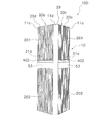
- FIG. 2 is an external perspective view of the outdoor air-conditioning apparatus 100 according to the first embodiment.
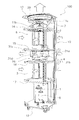
- FIG. 2 is a perspective view showing an internal configuration of the outdoor air-conditioning apparatus 100 according to the first embodiment.
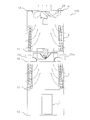
- FIG. 2 is a longitudinal sectional view showing an internal configuration of the outdoor air-conditioning apparatus 100 according to the first embodiment.
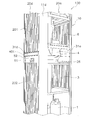
- FIG. 2 is an enlarged perspective view showing the configuration near the outlets 31a and 31d of the outdoor air conditioner 100 according to the first embodiment.
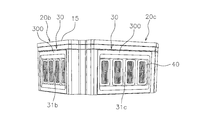
- the external appearance perspective view of the outdoor air conditioner 101 of 2nd Embodiment. A perspective view showing the vicinity of the outlets 31b and 31c of the second embodiment.
- the figure of the flap unit 40 of a 2nd embodiment The figure which shows the frame 25 of 2nd Embodiment.
- the refrigerant circuit of the outdoor air conditioner 100 of the first embodiment is shown in FIG. 1, and an external perspective view is shown in FIG.
- the outdoor air conditioner of the present embodiment is an air conditioner that is arranged outdoors and performs outdoor heating, cooling, dehumidification, and the like using a heat pump.
- the outdoor means a space exposed to the outside air.
- the outdoor air-conditioning apparatus 100 may be a cooling-only machine that performs only cooling or dehumidification.
- the outdoor air conditioner 100 may be a heating-only device that performs only heating.
- the outdoor air conditioner 100 may be an air conditioner that performs heating in addition to cooling and dehumidification.
- the outdoor air conditioner 100 of the present embodiment is an air conditioner including the entire refrigerant circuit as shown in FIG. 1 in one casing.
- the outdoor air conditioner 100 includes a compressor 1, an accumulator 8, a four-way switching valve 2, a use side heat exchanger 3, an expansion valve 5, and a heat source side heat exchanger 6. These devices are connected by piping, and a refrigerant circulates through each device to perform a vapor compression refrigeration cycle.
- the outdoor air conditioner 100 further includes a second fan 4 and a first fan 7 for sending air to the use side heat exchanger 3 and the heat source side heat exchanger 6, respectively. That is, the use side heat exchanger 3 and the heat source side heat exchanger 6 of the present embodiment are both heat exchangers that perform heat exchange with refrigerant and air.
- the use side heat exchanger 3 and the heat source side heat exchanger 6 function as an evaporator and a condenser of a refrigeration cycle, respectively.
- the use side heat exchanger and the heat source side heat exchanger function as a condenser and an evaporator, respectively. Switching between cooling and heating is performed by changing the flow of the refrigerant by switching the four-way switching valve 2.
- the four-way switching valve 2 is unnecessary.
- the four-way switching valve 2 may be provided for the defrost operation.
- the refrigerant used in the outdoor air conditioner 100 is, for example, R32 alone or a mixed refrigerant containing R32.
- Examples of the mixed refrigerant containing R32 are R452B, R410A, and R454B.
- R452B R32 is 67.0 wt%, R125 is 7.0 wt%, and R1234yf is 26.0%.
- R410A R32 is 50 wt% and R125 is 50 wt%.
- R454B has R2.5 of 72.5 wt% and R1234yf of 27.5 wt%.
- FIG. 2 is a perspective view of the exterior of the outdoor air conditioning apparatus 100.
- FIG. 3A and 3B are longitudinal sectional views, and
- FIG. 4 is a detailed perspective view of the vicinity of the outlet 31a.
- the compressor 1, the heat source side heat exchanger 6, the use side heat exchanger 3, the first fan 7, and the second fan 4 are housed in the casing 10.
- the casing 10 has a substantially rectangular parallelepiped shape with a horizontal cross section.
- the horizontal cross section may be polygonal or rectangular. It may be circular.
- the casing 10 has four columns 11a to 11d, a top plate 13 and a bottom plate 12.
- the space inside the casing 10 is partitioned by intermediate plates 14 to 17.
- the intermediate plate also contributes to the reinforcement of the structure of the casing 10.
- the intermediate plates 14 to 17 are arranged in an appropriate number and at an appropriate position according to the design.
- the four columns 11a to 11d are vertically arranged at four corners of a horizontal square as viewed from above.
- the top plate 13, the bottom plate 12, and the plurality of intermediate plates 14, 15, 16, 17 are fixed to four columns 11a to 11d.
- Decorative plates 201 and 202 are attached to the outside of the four side surfaces 20a to 20d of the casing 10.
- the decorative plates 201 and 202 are formed with a plurality of holes, through which air can flow.
- the decorative panel on each side surface 20a to 20d is divided into an upper decorative panel 201 and a lower decorative panel 202.
- the first fan 7, the heat source side heat exchanger 6, the second fan 4, the use side heat exchanger 3, and the compressor 1 are arranged in this order from the top.
- the first fan 7 allows air to flow through the heat source side heat exchanger 6.
- the second fan 4 allows the air to flow through the use-side heat exchanger 3.
- handles 51 are arranged on the four side surfaces 20a to 20d at the lower part of the outlet.
- the handle 51 is attached to the panel 52.
- the panel 52 is attached to the casing 10.
- the handle 51 can be moved by putting a hand into the handle 51 when a person moves the outdoor air conditioner 100.
- the cover 53 is attached to the handle 51 so that the user does not easily reach into the handle 51.
- the first fan 7 is a propeller fan.
- a turbo fan or a sirocco fan may be used.
- the first fan 7 is mounted such that an air outlet 29 is opened at the center of the top plate 13 so that air can be discharged upward from the center of the top plate.
- a mesh-shaped plate is further disposed at the outlet 29 at the center of the top plate 13.
- the heat source side heat exchanger 6 includes a heat transfer tube through which the refrigerant flows, and metal fins that promote heat exchange between the refrigerant and the air.
- the heat source side heat exchanger 6 is disposed on all four side surfaces 20a to 20d of the casing 10.
- the coolant need not pass through all sides 20a-20d.
- the refrigerant may be separated into two parts for every two sides, and the refrigerant may be distributed and circulated. Also. It is not always necessary to arrange the heat source side heat exchanger 6 on all four side surfaces 20a to 20d. You may arrange
- the second fan 4 is a turbo fan. It may be a propeller fan or a sirocco fan.
- the second fan 4 is mounted between the intermediate plates 15 and 16 so as to be hung at the center of the intermediate plate 15.
- the second fan 4 is driven by a motor different from the motor of the first fan 7, and can be controlled independently.
- the use side heat exchanger 3 includes a heat transfer tube that allows the refrigerant to flow while exchanging heat with the air, and metal fins that promote heat exchange between the refrigerant and the air.
- the use-side heat exchangers 3 are arranged on all four side surfaces 20a to 20d of the casing 10.
- the coolant need not pass through all surfaces.
- the refrigerant may be separated into two parts for every two sides, and the refrigerant may be distributed and circulated.
- FIG. 4 is a diagram showing details in the vicinity of the outlets 31a and 31d.
- the air passes through the lower decorative plate 202 from the outside of the outdoor air conditioner 100, from the front side of the use side heat exchanger 3 on the four side surfaces 20a to 20d, and passes through the intermediate plate 16, It is taken into the space between 17.
- the air passes through the use-side heat exchanger 3 and performs heat exchange with the refrigerant in the use-side heat exchanger 3.
- the air heated or cooled by the refrigerant passes through the second fan 4 inside the bell mouth 26 and moves to the space between the intermediate plates 15 and 16.
- the second fan 4 blows air laterally out of the outlets 31a to 31d provided on the four side surfaces 20a to 20d.
- the outlets 31a to 31d are holes formed in the casing 10.
- the outdoor air-conditioning apparatus 100 includes the flap 402, and can blow air in a horizontal direction and at an angle wider than ⁇ 30 ° in the horizontal direction. Flap 402 is attached to panel 52. By changing the direction of the flap, it is possible to completely close the airbag in a certain direction and to seal the air blowing only in a specific direction. Further, it is preferable that the members used for the outlets 31a to 31d, the flap 402, and the like be made of a weather-resistant material or subjected to a weather-resistant treatment on the surface.
- examples of the weather resistant material include an acrylonitrile styrene polymer, but are not limited thereto.
- blowing air velocity is 15.2 m / s or more
- the total blowing air volume is 32 m 3 / min or more, 0 m at the position 3 m away from the outlet and 0.5 m above the floor surface.
- a wind speed of 0.8 m / s or more can be realized.
- the outdoor air conditioner 100 of the present embodiment includes a compressor 1, a heat source side heat exchanger 6, a use side heat exchanger 3, a first fan 7, and a second fan 4 in one casing 10. .
- the casing 10 has a first outlet 29 and second outlets 31a to 31d.
- the first outlet 29 blows out the air that has passed through the heat source side heat exchanger 6 toward an upper portion outside the casing 10.
- the second outlets 31a to 31d are outlets disposed below the first outlet 29.
- the second outlets 31a to 31d blow the air that has passed through the use-side heat exchanger 3 toward the outside of the casing 10 in a lateral direction.
- the outdoor air-conditioning apparatus 100 can exhaust the air that has passed through the use-side heat exchanger 3 in a direction where a user is present and the air that has passed through the heat-source-side heat exchanger 6 upward without any user.
- the casing 10 is formed with the second outlets 31a to 31d for blowing out the air that has passed through the use-side heat exchanger 3.
- air is blown out without passing through another flow path such as an air guide or a duct. Therefore, the air velocity, air volume, temperature, and the like of the air that has passed through the use-side heat exchanger 3 can be blown out without much change. Therefore, the air around the outdoor air conditioner 100 can be efficiently air-conditioned over a wide range.
- the air conditioner 100 of the present embodiment blows air in the lateral direction from the second outlets 31a to 31d. Therefore, the blown air can reach a range relatively far from the air conditioner 100, and air conditioning in a relatively large area is possible.
- the first outlet 29 blows the air that has passed through the heat source side heat exchanger 6 upward and outside the casing 10. Therefore, the blowout direction of the first blowout port is configured not to interfere with the lateral blowout direction of the second blowout ports 31a to 31d. This effect is particularly remarkable when the second outlets 31a to 31d blow out in all directions.
- the warm air that has passed through the heat source side heat exchanger 6 which is a condenser is exhausted to the sky. Since the warm air is relatively light and easily rises, it can be exhausted smoothly.
- the first outlet 29 is arranged on the upper surface of the casing 10.
- the first outlet 29 is provided on the upper surface of the casing 10, and the air that has passed through the heat-source-side heat exchanger 6 from the first outlet 29 to the outside upwards. Because it is blown out, it is more difficult for the exhaust to reach the user.
- the first outlet 29 is disposed at a height of 1.6 m or more and 3 m or less from the installation surface of the outdoor air conditioner 100.
- the second outlets 31a to 31d are arranged at a height of 0.2 m or more and 1.6 m or less from the installation surface of the outdoor air conditioner.
- the second outlets 31a to 31d are arranged at an appropriate height from the installation surface and are blown out in the lateral direction. Can be reached. In addition, if the height is at this level, a cool or warm wind hits near the upper body even when the user is standing or sitting, and comfort can be provided to the user.
- the heat source side heat exchanger 6 is disposed above the use side heat exchanger 3.
- the distance between the heat source side heat exchanger 6 and the first outlet 29 can be shortened. Therefore, there is no need to provide an extra air path in the casing 10. Further, the distance between the use side heat exchanger and the second outlets 31a to 31d can be shortened. A configuration in which the second outlets 31a to 31d are set at an appropriate height can be easily selected.
- the heat source side heat exchanger 6 and the use side heat exchanger 3 are arranged apart from each other. Second outlets 31a to 31d are arranged between the two heat exchangers. Due to such a configuration, the heat insulation between the two heat exchangers is sufficient. Further, a problem that air passing through one heat exchanger further exchanges heat with the other heat exchanger hardly occurs.
- the wind speed of the wind that has exited the second outlets 31a to 31d is not less than 12 m / s and not more than 18 m / s.
- the wind that has flowed out of the second outlets 31a to 31d can reach a distant place, and air conditioning of a wide area can be realized. If the wind speed is less than 12 m / s, the wind cannot reach far away.
- the air volume of the second outlets 31a to 31d is not less than 25 m 3 / min and not more than 40 m 3 / min.
- the outdoor air-conditioning apparatus 100 of the present embodiment has an air volume of 25 m 3 / min or more coming out of the second outlets 31a to 31d, and can achieve air conditioning in a wide area.
- the second outlets 31a to 31d are plural.
- the casing 10 has three or more side surfaces, and the side surfaces include second outlets 31a to 31d, respectively. Of the plurality of second outlets 31a to 31d, it is possible to close and use at least one of the second outlets 31a to 31d.
- the outdoor air conditioner 100 of the present embodiment can blow out the wind that has passed through the use side heat exchanger 3 in at least three directions, and air conditioning of a wide area around the outdoor air conditioner 100 becomes possible.
- the outdoor air conditioner 100 of the present embodiment further includes a first motor and a second motor.
- the second motor is different from the first motor.
- the first motor drives a first fan.
- the second motor drives a second fan.
- the first fan 7 and the second fan 4 are driven by different motors, so that the first fan 7 and the second fan 4 can be controlled separately, Efficient air conditioning can be performed according to conditions, user needs, and device conditions.
- the outdoor air-conditioning apparatus 100 can be operated by switching between a cooling operation and a heating operation.
- the outdoor air-conditioning apparatus 100 can be operated for a long season because it can be operated by switching between the cooling operation and the heating operation.
- the outdoor air-conditioning apparatus 100 according to the first embodiment has a rectangular parallelepiped shape.
- the outdoor air-conditioning apparatus 100 according to Modification 1B has a cylindrical shape.
- Others are basically the same as the first embodiment. That is, the top view of the outdoor air conditioner 100 is substantially circular. In this case, the side surface of the outdoor air conditioner 100 is one curved surface. Two or more second outlets are formed in different directions in a top view. The second outlet may be formed over substantially the entire circumference of the circle.
- the top view of the outdoor air conditioner 100 may be elliptical.
- the outdoor air-conditioning apparatus 100 of Modification 1C can reduce costs by adopting such a configuration.
- the heat exchanger has no useless structure.
- the outdoor air-conditioning apparatus 100 according to Modification 1C is formed on three sides, but the same applies to two sides.
- the use side heat exchanger 3, its outlet, its inlet, the heat source side heat exchanger 6, and its inlet are arranged or formed only on the same three side surfaces.
- the three sides may not be configured. For example, if only the use-side heat exchanger 3 has three sides, the cost can be reduced accordingly.
- FIG. 5 is an external perspective view of the outdoor air conditioner 101 of the present embodiment
- FIG. 6 is a perspective view showing the vicinity of the outlets 31b and 31c of the outdoor air conditioner 101
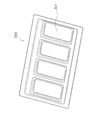
- FIGS. 7A to 7C are the outlets 31a to 31c. It is a figure of the outlet member 30 arrange
- 7A shows the panel 300
- FIG. 7B shows the flap unit 40
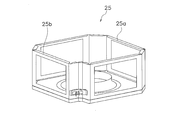
- FIG. 7C shows the frame 25.
- outlets 30 are arranged in the outlets 31a to 31d.
- the outlet member 30 has a frame 25, a panel 300, and a flap unit 40.
- the frame 25 is a metal plate having the shape shown in FIG. 7C.
- the frame 25 is attached to the columns 11a to 11d.
- the frame 25 has four holes corresponding to the four side surfaces 20a to 20d.
- the frame 25 has a first component 25a and a second component 25b that form two holes.
- Four panels 300 are attached to the holes of the frame 25, respectively.
- the panel 300 is made of resin. As shown in FIG. 7A, one panel 300 has four holes 301 formed therein. The flap units 40 are attached to the holes 301, respectively.
- the surface of the panel 300 or the flap unit 40 may be subjected to a weather resistance treatment.
- examples of the weather resistant material include an acrylonitrile styrene polymer, but are not limited thereto.
- the flap unit 40 has a first flap 401, a second flap 402, and a wind direction adjustment knob 403, as shown in FIG. 7B. Air is blown out from a gap between the flaps 401 and 402 of the flap unit 40 or a gap between the flaps 401 and 402 and a frame around the flap.
- the flap unit 40 is made of resin. It may be made of metal.
- the first flap 401 is arranged outside the second flap 402.
- the first flap 401 can change the air blowing direction in the horizontal direction.
- the second flap 402 can change the air blowing direction in the vertical direction.
- the plurality of first flaps 401 belonging to the same flap unit 40 are designed to face in the same direction. The same applies to the second flap 402.
- the inclination of the second flap 402 can be changed, and the wind direction can be changed up and down.
- the inclination of the first flap 401 can be changed, and the wind direction can be changed left and right.
- the outlet can be closed.
- four flap units 40 are arranged on each of the four side surfaces 20a to 20d. Each flap unit 40 can adjust and close the wind direction by independently moving the wind direction adjustment knob 403.
- the orientation of the flaps 401 and 402 may be manually controlled as in the present embodiment, or may be automatically controlled.
- the wind direction adjustment knob 403 needs to be accessible from outside. Therefore, for example, a portion of the decorative plate that is in contact with the front surface of the wind direction adjusting knob 403 may be perforated.
- the decorative panel may be removable or open.
- the automatic control the direction of the wind blown from a certain side surface may be changed according to time. Alternatively, blowing from a blowing port from a certain side may be sealed by a user's switch operation.
- the outdoor air conditioner of the second embodiment also has all the features described in (5-1) to (5-11) of the first embodiment.
Landscapes
- Engineering & Computer Science (AREA)
- Chemical & Material Sciences (AREA)
- Combustion & Propulsion (AREA)
- Mechanical Engineering (AREA)
- General Engineering & Computer Science (AREA)
- Physics & Mathematics (AREA)
- Thermal Sciences (AREA)
- Other Air-Conditioning Systems (AREA)
- Air-Conditioning Room Units, And Self-Contained Units In General (AREA)
- Air Filters, Heat-Exchange Apparatuses, And Housings Of Air-Conditioning Units (AREA)
Abstract
De manière classique, il n'existait pas de climatiseurs extérieurs aptes à refroidir et à chauffer une grande zone extérieure. A cet effet, l'invention concerne un climatiseur extérieur (100), lequel climatiseur renferme, à l'intérieur d'un boîtier (10), un compresseur (1), un échangeur de chaleur côté source de chaleur (6), un premier ventilateur (7), un échangeur de chaleur côté utilisation (3), et un second ventilateur (4). Le boîtier (10) a, formé à l'intérieur de celui-ci : un premier orifice de sortie (29) qui décharge vers le haut de l'air qui a traversé l'échangeur de chaleur côté source de chaleur (6) ; et des seconds orifices de sortie (31a – 31d) qui sont positionnés plus bas que le premier orifice de sortie (29), et qui déchargent, dans la direction horizontale, de l'air qui a traversé l'échangeur de chaleur côté utilisation (3).
Priority Applications (1)
| Application Number | Priority Date | Filing Date | Title |
|---|---|---|---|
| CN201990000827.9U CN214198936U (zh) | 2018-06-29 | 2019-06-21 | 室外空调装置 |
Applications Claiming Priority (2)
| Application Number | Priority Date | Filing Date | Title |
|---|---|---|---|
| JP2018124987A JP2020003179A (ja) | 2018-06-29 | 2018-06-29 | 屋外空気調和装置 |
| JP2018-124987 | 2018-06-29 |
Publications (1)
| Publication Number | Publication Date |
|---|---|
| WO2020004282A1 true WO2020004282A1 (fr) | 2020-01-02 |
Family
ID=68986909
Family Applications (1)
| Application Number | Title | Priority Date | Filing Date |
|---|---|---|---|
| PCT/JP2019/024790 Ceased WO2020004282A1 (fr) | 2018-06-29 | 2019-06-21 | Climatiseur extérieur |
Country Status (3)
| Country | Link |
|---|---|
| JP (1) | JP2020003179A (fr) |
| CN (1) | CN214198936U (fr) |
| WO (1) | WO2020004282A1 (fr) |
Families Citing this family (2)
| Publication number | Priority date | Publication date | Assignee | Title |
|---|---|---|---|---|
| KR102345053B1 (ko) * | 2020-05-29 | 2021-12-31 | 주식회사 웰템 | 일체형 구조를 가지는 냉난방기 |
| KR102345054B1 (ko) * | 2020-05-29 | 2021-12-30 | 주식회사 웰템 | 야간 조명등이 장착된 냉난방기 |
Citations (5)
| Publication number | Priority date | Publication date | Assignee | Title |
|---|---|---|---|---|
| JPS4896745U (fr) * | 1972-02-18 | 1973-11-16 | ||
| JPS5234150U (fr) * | 1975-09-01 | 1977-03-10 | ||
| JPS5296949U (fr) * | 1976-01-20 | 1977-07-20 | ||
| JPH0914691A (ja) * | 1995-06-28 | 1997-01-17 | Mitsubishi Electric Corp | 移動式空気調和装置 |
| JP2017154646A (ja) * | 2016-03-03 | 2017-09-07 | パナソニックIpマネジメント株式会社 | 二輪車用エアコンおよびこれを搭載したエアコン付き二輪車 |
Family Cites Families (8)
| Publication number | Priority date | Publication date | Assignee | Title |
|---|---|---|---|---|
| JPS49127146U (fr) * | 1973-02-26 | 1974-10-31 | ||
| US3898865A (en) * | 1974-04-30 | 1975-08-12 | Westinghouse Electric Corp | Condensate disposal apparatus for an air conditioner |
| JPS5433740Y2 (fr) * | 1975-05-13 | 1979-10-17 | ||
| JPS5431358U (fr) * | 1977-08-05 | 1979-03-01 | ||
| JPH03103916U (fr) * | 1990-02-06 | 1991-10-29 | ||
| JPH0517423U (ja) * | 1991-07-31 | 1993-03-05 | 三菱電機株式会社 | 空気調和機 |
| JP4591158B2 (ja) * | 2005-03-31 | 2010-12-01 | 株式会社トヨトミ | 空気調和機 |
| JP6091861B2 (ja) * | 2012-03-21 | 2017-03-08 | 株式会社鎌倉製作所 | スポットエアコン |
-
2018
- 2018-06-29 JP JP2018124987A patent/JP2020003179A/ja active Pending
-
2019
- 2019-06-21 WO PCT/JP2019/024790 patent/WO2020004282A1/fr not_active Ceased
- 2019-06-21 CN CN201990000827.9U patent/CN214198936U/zh active Active
Patent Citations (5)
| Publication number | Priority date | Publication date | Assignee | Title |
|---|---|---|---|---|
| JPS4896745U (fr) * | 1972-02-18 | 1973-11-16 | ||
| JPS5234150U (fr) * | 1975-09-01 | 1977-03-10 | ||
| JPS5296949U (fr) * | 1976-01-20 | 1977-07-20 | ||
| JPH0914691A (ja) * | 1995-06-28 | 1997-01-17 | Mitsubishi Electric Corp | 移動式空気調和装置 |
| JP2017154646A (ja) * | 2016-03-03 | 2017-09-07 | パナソニックIpマネジメント株式会社 | 二輪車用エアコンおよびこれを搭載したエアコン付き二輪車 |
Also Published As
| Publication number | Publication date |
|---|---|
| CN214198936U (zh) | 2021-09-14 |
| JP2020003179A (ja) | 2020-01-09 |
Similar Documents
| Publication | Publication Date | Title |
|---|---|---|
| JP2004092950A (ja) | 空気調和機の室内機 | |
| TW201411073A (zh) | 可變風門之多功能熱泵式空調機 | |
| JP2004116859A (ja) | 空気調和機 | |
| JP4277456B2 (ja) | 除湿装置 | |
| JP2020008268A (ja) | 屋外空気調和装置 | |
| CN214198936U (zh) | 室外空调装置 | |
| CN218846291U (zh) | 空调室内机 | |
| WO2020004281A1 (fr) | Climatiseur extérieur | |
| JP2022050948A (ja) | 空調換気システム | |
| JP2004218905A (ja) | 分離型空気調和装置 | |
| KR100693989B1 (ko) | 공기 조화기 | |
| CN112424533A (zh) | 室外空调装置 | |
| JP2004177049A (ja) | スリム形エアコン | |
| JP4016988B2 (ja) | 農産業用空気熱源ヒートポンプ式空調機 | |
| JP6990627B2 (ja) | 屋外空気調和装置 | |
| JP2011075168A (ja) | 空気調和機 | |
| KR100529914B1 (ko) | 덕트 연결형 공기조화기의 실내기 | |
| KR100828500B1 (ko) | 공기조화시스템 | |
| JP2020003183A (ja) | 屋外空気調和装置 | |
| KR100918948B1 (ko) | 제트 공조기 토출팬 유닛의 결합구조 | |
| CN224151049U (zh) | 一种天花室内机 | |
| JP7037072B2 (ja) | 空気調和装置 | |
| JP6835044B2 (ja) | 屋外空気調和装置 | |
| JP2020003181A (ja) | 屋外空気調和装置 | |
| JP2020003180A (ja) | 屋外空気調和装置 |
Legal Events
| Date | Code | Title | Description |
|---|---|---|---|
| 121 | Ep: the epo has been informed by wipo that ep was designated in this application |
Ref document number: 19825171 Country of ref document: EP Kind code of ref document: A1 |
|
| NENP | Non-entry into the national phase |
Ref country code: DE |
|
| 122 | Ep: pct application non-entry in european phase |
Ref document number: 19825171 Country of ref document: EP Kind code of ref document: A1 |