WO2020004394A1 - Procédé et appareil pour fabriquer un produit séché de polymère soluble dans l'eau dérivé biologiquement - Google Patents
Procédé et appareil pour fabriquer un produit séché de polymère soluble dans l'eau dérivé biologiquement Download PDFInfo
- Publication number
- WO2020004394A1 WO2020004394A1 PCT/JP2019/025182 JP2019025182W WO2020004394A1 WO 2020004394 A1 WO2020004394 A1 WO 2020004394A1 JP 2019025182 W JP2019025182 W JP 2019025182W WO 2020004394 A1 WO2020004394 A1 WO 2020004394A1
- Authority
- WO
- WIPO (PCT)
- Prior art keywords
- water
- unsaturated solution
- soluble polymer
- dried
- temperature
- Prior art date
- Legal status (The legal status is an assumption and is not a legal conclusion. Google has not performed a legal analysis and makes no representation as to the accuracy of the status listed.)
- Ceased
Links
Images




Classifications
-
- A—HUMAN NECESSITIES
- A23—FOODS OR FOODSTUFFS; TREATMENT THEREOF, NOT COVERED BY OTHER CLASSES
- A23B—PRESERVATION OF FOODS, FOODSTUFFS OR NON-ALCOHOLIC BEVERAGES; CHEMICAL RIPENING OF FRUIT OR VEGETABLES
- A23B2/00—Preservation of foods or foodstuffs, in general
- A23B2/90—Preservation of foods or foodstuffs, in general by drying or kilning; Subsequent reconstitution
- A23B2/97—Preservation of foods or foodstuffs, in general by drying or kilning; Subsequent reconstitution using irradiation or electric treatment, e.g. ultrasonic waves
-
- A—HUMAN NECESSITIES
- A61—MEDICAL OR VETERINARY SCIENCE; HYGIENE
- A61L—METHODS OR APPARATUS FOR STERILISING MATERIALS OR OBJECTS IN GENERAL; DISINFECTION, STERILISATION OR DEODORISATION OF AIR; CHEMICAL ASPECTS OF BANDAGES, DRESSINGS, ABSORBENT PADS OR SURGICAL ARTICLES; MATERIALS FOR BANDAGES, DRESSINGS, ABSORBENT PADS OR SURGICAL ARTICLES
- A61L2/00—Disinfection or sterilisation of materials or objects, in general; Accessories therefor
- A61L2/02—Disinfection or sterilisation of materials or objects, in general; Accessories therefor using physical processes
- A61L2/04—Heat
-
- A—HUMAN NECESSITIES
- A61—MEDICAL OR VETERINARY SCIENCE; HYGIENE
- A61L—METHODS OR APPARATUS FOR STERILISING MATERIALS OR OBJECTS IN GENERAL; DISINFECTION, STERILISATION OR DEODORISATION OF AIR; CHEMICAL ASPECTS OF BANDAGES, DRESSINGS, ABSORBENT PADS OR SURGICAL ARTICLES; MATERIALS FOR BANDAGES, DRESSINGS, ABSORBENT PADS OR SURGICAL ARTICLES
- A61L2/00—Disinfection or sterilisation of materials or objects, in general; Accessories therefor
- A61L2/02—Disinfection or sterilisation of materials or objects, in general; Accessories therefor using physical processes
- A61L2/08—Radiation
- A61L2/12—Microwaves
-
- F—MECHANICAL ENGINEERING; LIGHTING; HEATING; WEAPONS; BLASTING
- F26—DRYING
- F26B—DRYING SOLID MATERIALS OR OBJECTS BY REMOVING LIQUID THEREFROM
- F26B21/00—Arrangements for supplying or controlling air or other gases for drying solid materials or objects
- F26B21/30—Controlling, e.g. regulating, parameters of gas supply
- F26B21/35—Temperature; Pressure
-
- F—MECHANICAL ENGINEERING; LIGHTING; HEATING; WEAPONS; BLASTING
- F26—DRYING
- F26B—DRYING SOLID MATERIALS OR OBJECTS BY REMOVING LIQUID THEREFROM
- F26B3/00—Drying solid materials or objects by processes involving the application of heat
- F26B3/32—Drying solid materials or objects by processes involving the application of heat by development of heat within the materials or objects to be dried, e.g. by fermentation or other microbiological action
- F26B3/34—Drying solid materials or objects by processes involving the application of heat by development of heat within the materials or objects to be dried, e.g. by fermentation or other microbiological action by using electrical effects
- F26B3/347—Electromagnetic heating, e.g. induction heating or heating using microwave energy
-
- F—MECHANICAL ENGINEERING; LIGHTING; HEATING; WEAPONS; BLASTING
- F26—DRYING
- F26B—DRYING SOLID MATERIALS OR OBJECTS BY REMOVING LIQUID THEREFROM
- F26B5/00—Drying solid materials or objects by processes not involving the application of heat
- F26B5/04—Drying solid materials or objects by processes not involving the application of heat by evaporation or sublimation of moisture under reduced pressure, e.g. in a vacuum
-
- A—HUMAN NECESSITIES
- A23—FOODS OR FOODSTUFFS; TREATMENT THEREOF, NOT COVERED BY OTHER CLASSES
- A23L—FOODS, FOODSTUFFS OR NON-ALCOHOLIC BEVERAGES, NOT OTHERWISE PROVIDED FOR; PREPARATION OR TREATMENT THEREOF
- A23L15/00—Egg products; Preparation or treatment thereof
Definitions
- the present invention relates to a method for producing a water-soluble dried polymer derived from a living body and an apparatus for producing the same.
- water-soluble polymers derived from living organisms such as water-soluble proteins and water-soluble polysaccharides (hereinafter simply referred to as water-soluble polymers) have been increasing.
- water-soluble polymers are freeze-dried (hereinafter referred to as “FD”). ) And stored in a dried state.
- FD takes a long time (about 1 to 3 days) for drying accompanied by sublimation of ice, and requires a large amount of energy.
- the water-soluble polymer may be deactivated or aggregated due to a change in the hydration state due to freeze concentration or physical damage from ice crystals or the like.
- a microwave room temperature drying method (hereinafter, also referred to as “MVD”) described in Non-Patent Document 1 has been proposed.
- this MVD is a method of lowering the boiling point of water under reduced pressure conditions to promote the evaporation of water, supplying only latent heat taken off during evaporation by microwaves, and consequently drying at room temperature. It is. This makes it possible to shorten the drying time due to the effect of draining moisture from the inside and to dry at room temperature as compared with the FD, so that physical damage of the water-soluble polymer can be expected to be prevented.
- the drying time of the water-soluble polymer can be shortened by MVD as compared with FD, a further drastic reduction has been required.
- the solubility can be improved by combining MVD and FD.
- FD since FD is used, there is a problem that the drying time of the water-soluble polymer is longer than that of MVD alone.
- the present invention has been made in view of the above circumstances, and provides a method of manufacturing a water-soluble polymer-derived dried product derived from a living body, which can drastically reduce the drying time and has good solubility compared to the related art, and an apparatus for manufacturing the same. With the goal.
- the method for producing a biologically-derived dried water-soluble polymer according to the present invention according to the present invention which irradiates a microwave to an unsaturated solution containing water and a biologically-derived water-soluble polymer under reduced pressure conditions,
- the water in the unsaturated solution is boiled at a temperature lower than the denaturation temperature of the water-soluble polymer, and the unsaturated solution is bubbled by steam generated by the boiling so that the apparent volume becomes 10 times or more the initial volume. Drying is performed to remove water while swelling.
- the pressure and the unsaturated solution are reduced. It is preferred that the temperature of the unsaturated solution is raised above the pressure at which the water contained in the unsaturated solution has decreased to a preset amount and the temperature of the unsaturated solution, and the unsaturated solution is sterilized.
- the dried product obtained by performing the drying treatment is crushed and powdered.
- the drying treatment is preferably performed in a state where the unsaturated solution is contained in a hydrophobic container.
- the apparatus for producing a dried biologically-derived water-soluble polymer according to the present invention includes a chamber in which an unsaturated solution containing water and a biologically-derived water-soluble polymer is disposed, Temperature detection means for detecting the temperature of the unsaturated solution in the chamber, Pressure reducing means for reducing the pressure in the chamber to a reduced pressure state; Microwave heating means for irradiating the unsaturated solution in the chamber with microwaves for heating, Based on the temperature data obtained by the temperature detecting means, the pressure reducing means controls the temperature at which the water in the unsaturated solution boils below the denaturation temperature of the water-soluble polymer and the microwave heating. Means for boiling the water in the unsaturated solution, and controlling the unsaturated solution to foam so that the apparent volume becomes 10 times or more the initial volume by steam generated by the boiling. Having.
- control means reduces the pressure reduction means and the microwave heating means to a predetermined amount of water contained in the unsaturated solution. It is preferable that the temperature of the unsaturated solution is controlled so as to increase to a temperature at which the unsaturated solution can be sterilized.
- the apparatus for producing a dried water-soluble polymer derived from a living body according to the present invention preferably further includes a hydrophobic container that accommodates the unsaturated solution and is disposed in the chamber.
- the water content of the unsaturated solution is less than the denaturation temperature of the water-soluble polymer. Boil, and remove the moisture while swelling the unsaturated solution in a bubble by the steam generated by the boiling, so that the gas-liquid boundary area of the unsaturated solution expands with the boiling, and the evaporation of the moisture is promoted. In comparison, the drying time can be shortened.
- the dried product of the water-soluble polymer derived from a living body obtained in this manner becomes a foamed thin film, so that the area in contact with the liquid (water) is larger than that of a conventional thick film dried by MVD.
- the dissolution rate can be increased, and the dissolution time can be shortened, because the dissolution rate can be increased and the dissolution can be facilitated. Therefore, it is possible to shorten the drying time (less than half) and to provide a dried water-soluble polymer derived from a living body with good solubility as compared with the conventional case.
- a biologically-derived water-soluble polymer dried product (hereinafter simply referred to as “water-soluble polymer-dried product”) manufactured using the manufacturing apparatus 10 for a biologically-derived water-soluble polymer dried product according to one embodiment of the present invention shown in FIG. Molecular dried product or dried product).
- the dried biologically-derived water-soluble polymer is obtained by drying an unsaturated solution containing water and a biologically-derived water-soluble polymer (hereinafter, also simply referred to as a water-soluble polymer).
- the water-soluble polymers derived from living organisms include water-soluble proteins and water-soluble polysaccharides.
- egg white protein and egg yolk protein egg white and egg yolk
- albumin lysozyme
- placenta extract egg white and egg yolk
- collagen egg white and egg yolk
- hyaluronic acid Glucosaminoglycan a mixture of any two or more of these may be used.
- FIG. 2A is a plan view of a dried egg white product (an example of a biologically-derived dried water-soluble polymer) in a beaker immediately after production
- FIG. 2B is a side view of the dried egg white product.
- C shows a dried egg white product in a Teflon (registered trademark, the same applies hereinafter) container immediately after production, and the egg white dried product dropped on a petri dish by inverting the container to give an impact.
- Teflon registered trademark, the same applies hereinafter
- FIG. 2A and 2B is to make it easier to confirm the foaming state of the dried egg white product.
- a Teflon container is used. The reason for this is to make it easy to remove dried egg whites produced from unsaturated solutions having high viscosity from containers.
- a glass beaker and a Teflon container are used when producing a dried egg white product, but the quality of the produced dried product is the same. Since the unsaturated solution has a high viscosity, the dried egg white product immediately after the production is such that the unsaturated solution swells greatly in the form of bubbles in the production process (becomes a foamed state), and as shown in FIGS. 2 (A) and 2 (B). As shown, a large number of large bubbles having a diameter of several centimeters are present, and the apparent volume is several tens times (10 times or more) the volume (initial volume) of the unsaturated solution before drying. And dried.
- the above-mentioned dried foam and the like can be used as they are, but it can also be used in a state where the container is turned upside down and dropped as described above. It can also be used by crushing and pulverizing (eg, storage of dried egg white products may be performed in the state of dry foam etc. as it is, or may be performed in a state where the container is turned upside down and dropped, Further, it may be performed in a powdered state.)
- the dried egg white product A shown in FIG. 2 (C) is a thin foamed piece (the moisture content of the unsaturated solution before drying (initial moisture content) is 1, and the moisture content after drying (final moisture content)). Is 0.05 or less).
- the thickness of the thin film is, for example, about 500 ⁇ m or less (further, 300 ⁇ m or less).
- FIG. 2 is a photograph of a dried egg white product B (Comparative Example) obtained by drying without foaming into a foam using the microwave ambient drying method (MVD) described in Non-Patent Document 1 described above. D).
- the dried egg white product B is a thick film of several mm.
- the form of the dried egg white product A is different from that of the dried egg white product B.
- the manufacturing apparatus 10 includes a decompression container (an example of a chamber) 11, an optical fiber thermometer (an example of a temperature detection unit) 12, a decompression pump (an example of a decompression unit) 13, a microwave heating unit 14, and a control unit 15. ing.
- the decompression container 11 has an unsaturated solution disposed therein, and is closed by reducing the pressure in the decompression container 11.
- a suction pipe 16 for supplying external air into the pressure reducing vessel 11 is connected to the pressure reducing vessel 11, and a flow meter 17 and a flow regulating valve 18 are provided in the suction pipe 16.
- the optical fiber thermometer 12 immerses (contacts) the temperature detecting section in the unsaturated solution, and detects the temperature of the unsaturated solution in the decompression vessel 11.
- the depressurizing pump 13 (for example, a vacuum pump) is connected to the depressurizing container 11 and reduces the pressure in the depressurizing container 11 to a depressurized state.
- an oil / water separator 19 is connected to the pressure reducing pump 13.
- the microwave heating means 14 has a microwave transmitter 20 provided with a magnetron (microwave generating element), and irradiates the unsaturated solution in the depressurized container 11 with, for example, a microwave having a frequency of 2.45 GHz. It is to be heated.
- Microwave is a general term of electromagnetic waves indicating, for example, a wavelength range of 1 to 30 cm and a frequency range of 1 to 30 GHz, and has a property of being reflected by metal but easily absorbed by water and the like.
- the microwave heating means 14 has an isolator 21 and protects the magnetron in the microwave transmitter 20 by absorbing the reflected wave returning from the decompression vessel 11.
- the unsaturated solution heated by the microwave heating means 14 is placed inside a reduced-pressure container 11 in a state of being put in a container (not shown) (the manufacturing apparatus 10 has a container).
- the material of the container is not particularly limited as long as it is not deformed or deteriorated by the use of the microwave heating means 14.
- the glass beaker described above can be used, but in consideration of the releasability (peelability) of the manufactured water-soluble polymer such as egg white from the container, a hydrophobic container, specifically, It is preferable to use the container made of Teflon (polytetrafluoroethylene (PTFE)) described above.
- fluororesins such as tetrafluoroethylene / hexafluoropropylene copolymer (FEP) and tetrafluoroethylene / perfluoroalkylvinyl ether copolymer (PFA), or polyethylene terephthalate (PET) or polypropylene. (PP) and the like.
- FEP tetrafluoroethylene / hexafluoropropylene copolymer
- PFA tetrafluoroethylene / perfluoroalkylvinyl ether copolymer
- PET polyethylene terephthalate
- PP polypropylene.
- a sheet material of the above-described material may be disposed on the inner surface of the glass container.
- the control unit 15 includes a measuring unit 22, an operation unit 23, and a computer 24.
- the temperature data obtained by the optical fiber thermometer 12 and the pressure data obtained by a pressure gauge (pressure sensor) 25 provided in the decompression container 11 are transmitted to the measurement unit 22.
- the operation unit 23 performs each operation (for example, ON / OFF or the like) of the above-described decompression container 11, the decompression pump 13, the microwave heating means 14 (the microwave power source 26 of the microwave transmitter 20 and the isolator 21), and the oil / water separator 19. Output adjustment).
- the computer 24 issues a command to the operation unit 23 based on the temperature data and the pressure data received by the measurement unit 22.
- the control means 15 controls the output of the decompression pump 13 based on the temperature data transmitted from the optical fiber thermometer 12 and the pressure data transmitted from the pressure gauge 25 to adjust the pressure in the decompression container 11 and
- the output of the microwave transmitter 20 of the microwave heating means 14 is controlled to adjust the temperature of the unsaturated solution.
- the output of the decompression pump 13 can be controlled based on the temperature data from the optical fiber thermometer 12. However, the output should be controlled based on the pressure data from the pressure gauge 25 without using this temperature data (optical fiber thermometer 12). You can also. In this case, since the boiling point of water is determined by the atmospheric pressure condition, the relationship between the temperature and the pressure is graphed in advance, and the pressure condition is calculated from this graph so that the boiling point is lower than the denaturation temperature of the water-soluble polymer.
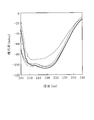
- the output control of the decompression pump 13 reduces the pressure in the decompression container 11 (to a reduced pressure state), and the temperature at which the moisture of the unsaturated solution boils (hereinafter also referred to as the boiling point) becomes lower than the denaturation temperature of the water-soluble polymer. Is done as follows. This is because, when heating the unsaturated solution, if the influence of heat increases (if the temperature exceeds the denaturation temperature), the molecular structure of the water-soluble polymer is broken, and the required function cannot be obtained. It is preferable to confirm the denaturation temperature of the water-soluble polymer by performing a molecular structure analysis (for example, an analysis using a circular dichroism dispersometer) in advance.
- a molecular structure analysis for example, an analysis using a circular dichroism dispersometer
- the output control of the microwave transmitter 20 of the microwave heating means 14 is performed by heating the unsaturated solution in the depressurized container 11 to boil the water of the unsaturated solution, and by using steam (gas) locally generated by the boiling.
- the operation is carried out such that the unsaturated solution swells greatly in a foam so that the apparent volume is 10 times or more the initial volume.
- the temperature at which the unsaturated solution is foamed is lower than the denaturation temperature of the water-soluble polymer, the molecular structure of the water-soluble polymer can be maintained without breaking.
- the unsaturated solution when the unsaturated solution is dried while being foamed, it has a large number of large bubbles having a diameter of several cm, and the apparent volume is at least 10 times the volume of the unsaturated solution before drying.
- the obtained dried water-soluble polymer becomes a thin film (see FIGS. 2A to 2C) without becoming a thick film (see FIG. 2D).
- the drying time can be further shortened by reducing the thickness of the foam by foaming, and the solubility of the obtained water-soluble polymer in a liquid described below is improved by reducing the thickness of the obtained dried water-soluble polymer.
- the apparent volume with respect to the volume of the unsaturated solution before drying is preferably 30 times or more, more preferably 50 times or more.
- the upper limit value is not particularly limited for the above-mentioned reason, but it is, for example, about 500 times since a remarkable increase in the effect cannot be expected with an increase in the apparent volume.
- control means 15 preferably controls the output of the vacuum pump 13 and the microwave transmitter 20 so that the unsaturated solution can be sterilized.
- the output control of the pressure-reducing pump 13 and the microwave transmitter 20 is performed on the condition that the moisture contained in the unsaturated solution (hereinafter, also referred to as moisture content) decreases to a preset amount.
- moisture content the moisture contained in the unsaturated solution
- the preset water content of the unsaturated solution be 60% by mass or less, and more preferably 50% by mass or less, with the initial water content of the unsaturated solution being 100% by mass.
- the water content of the unsaturated solution is preferably 20% by mass, more preferably 30% by mass.
- the output control of the decompression pump 13 is performed so that the pressure in the decompression vessel 11 becomes higher than the current pressure (the pressure at the time when the water content becomes a predetermined amount) (preferably, in a range below the atmospheric pressure). Done. That is, outside air is supplied from the intake pipe 16 into the decompression container 11, and the decompression pump 13 is operated so that the pressure is stabilized.
- the pressure in the depressurized container 11 sets the temperature of the unsaturated solution to the current value (the water content is set in advance). The temperature is adjusted to a temperature at which the unsaturated solution can be sterilized (for example, a denaturation temperature or higher).
- the output of the vacuum pump 13 is again controlled so that the boiling point of the unsaturated solution is lower than the denaturation temperature of the water-soluble polymer, and the microwave transmitter is used.
- the output of 20 is controlled to remove moisture while foaming the unsaturated solution.
- the gas (moisture) generated from the swollen unsaturated solution is discharged to the outside by a gas stream to dry the unsaturated solution. It is preferred to promote. This will be described below.
- the air in the decompression container 11 sucked by the decompression pump 13 and the outside air supplied into the decompression container 11 from the suction pipe 16 are each a pressure regulating valve (not shown). And the flow is adjusted by the flow control valve 18.
- the water in the decompression container 11 evaporated by the microwave irradiation can be discharged to the outside of the decompression container 11 via the decompression pump 13 (a gas discharge port of the decompression container 11 and a decompression pipe). As described above, by removing the water in the decompression container 11, the humidity in the decompression container 11 can be reduced, and the drying can be further promoted.
- the amount of outside air flowing into the decompression container 11 is increased from the amount of air discharged from the decompression container 11 by the decompression pump 13 to increase the pressure in the decompression container 11. be able to.
- the boiling point can be raised to a sterilizable temperature, and the unsaturated solution can be sterilized.
- air can be generally used, but it is preferable to use an inert gas such as nitrogen gas or argon gas (rare gas). Can be prevented from being altered by oxygen contained in the steel.
- an inert gas such as nitrogen gas or argon gas (rare gas).
- the molecular structure of the unsaturated solution to be dried is analyzed to confirm the denaturation temperature of the water-soluble polymer.
- a circular dichroism dispersometer hereinafter, circular dichroism is also referred to as CD
- CD circular dichroism
- the pressure reducing pump 13 is operated by the control means 15 to reduce the pressure in the pressure reducing vessel 11 until the boiling point of the unsaturated solution becomes lower than the denaturation temperature of the water-soluble polymer.
- the pressure in the pressure reducing container 11 can be detected by the pressure gauge 25.
- the pressure in the decompression container 11 is, for example, 20 kPa or less, though it depends on the type of the unsaturated solution. In consideration of the fact that foaming is easily caused by lowering the boiling point of water, the pressure is preferably 10 kPa or less, more preferably 5 kPa or less.
- the lower limit is not specified, but it is not necessary to lower the pressure to a vacuum state in consideration of the capacity of the pressure reducing pump (the time required for pressure reduction) and the like.
- the microwave heating means 14 is operated by the control means 15 to irradiate the unsaturated solution with microwaves, and the unsaturated solution is unsaturated at a temperature lower than the denaturation temperature of the water-soluble polymer. Bring the water of the solution to a boil.
- the output of the microwave transmitter 20 of the microwave heating means 14 is controlled such that the apparent volume is at least 10 times the initial volume by steam generated by boiling (further shortening of the drying time and the solubility in liquids are reduced).
- the lower limit is preferably set to 30 times, and more preferably 50 times, while the upper limit is set to about 500 times since the effect cannot be remarkably increased.
- the drying treatment for removing moisture while foaming the unsaturated solution under reduced pressure conditions is performed by setting the moisture content (initial moisture content) of the unsaturated solution before drying to 1 and then the moisture content after drying (final moisture content). By doing so until the ratio becomes 0.05 or less, a water-soluble polymer dried product that is a thin-film foam piece is obtained.
- a sterilization treatment can be performed on the unsaturated solution.
- the output of the pressure reducing pump 13 and the microwave transmitter 20 is controlled by the control means 15 after reducing the moisture contained in the unsaturated solution to a preset amount.
- the preset water content of the unsaturated solution is, as described above, 60% by mass or less, and further 50% by mass or less (lower limit value, with the initial water content of the unsaturated solution being 100% by mass). Is preferably 20% by mass, more preferably 30% by mass.
- the moisture content of the unsaturated solution in the course of this drying treatment can be estimated, for example, by previously measuring the change in mass of the unsaturated solution over time, but is particularly limited if the moisture content is known. Not something.
- the output control of the decompression pump 13 and the microwave transmitter 20 by the control means 15 increases (pressurizes) the pressure from the current level (the pressure at the time when the water content reaches a predetermined amount), and is unsaturated.
- the temperature of the solution is set to be higher than the current temperature (the temperature at the time when the water content reaches a predetermined amount).
- the pressure in the decompression vessel 11 is, for example, 50 kPa or more, preferably 70 kPa or more, although it depends on the type of the unsaturated solution.
- the upper limit is not particularly limited, but considering that the drying treatment is performed under reduced pressure after the sterilization treatment, For example, the pressure is set to 200 kPa, preferably 100 kPa.
- the boiling point of the unsaturated solution corresponding to the pressure in the pressure reducing vessel 11 is obtained from a conventionally known vapor pressure curve of water, and is 80 ° C. at 50 kPa, 90 ° C. at 70 kPa, 120 ° C. at 200 kPa, and 100 ° C. at 100 kPa. is there.
- the pressure in the decompression vessel 11 may be adjusted so that the boiling point of the unsaturated solution is equal to or higher than the denaturation temperature of the water-soluble polymer.
- the heating time microwave irradiation time
- the sterilization time depends on the type of the unsaturated solution, but may be, for example, about 10 seconds at 90 ° C., about several seconds at 120 ° C., or about 1 second at 150 ° C.
- the drying has progressed to some extent (if the water content of the unsaturated solution is small), it is exposed to a high temperature for a short time (less than a few minutes, preferably about several tens of seconds, more preferably about several seconds).
- the drying treatment is subsequently performed. Specifically, the control of the output of the decompression pump 13 and the microwave transmitter 20 by the control means 15 is performed so that the pressure is reduced (reduced pressure) from the current state (the pressure at the end of the sterilization process) and the unsaturated solution is controlled. The temperature is lowered from the current level (the temperature at the end of the sterilization treatment) so that the water in the unsaturated solution is boiled and foamed at a temperature lower than the denaturation temperature of the water-soluble polymer so that the water can be removed.
- a dried water-soluble polymer that has been subjected to a sterilization treatment (a thin film-like foam having an initial moisture content of 1 and a final moisture content of 0.05 or less) is obtained.
- This water-soluble polymer dried product can store dry foam and the like as it is, but can also be stored in a state where the container is turned upside down and dropped as described above. It can be crushed, powdered and stored.
- the dried water-soluble polymer dried product is dissolved in a liquid such as water or physiological saline (the manufactured water-soluble polymer dried product is directly dissolved in the liquid without storage). You can also.
- the dried egg white dried product B without foaming was used at 98 ° C. as a reference sample showing heat damage.
- Egg white (dotted line) and untreated egg white (thick solid line) which were allowed to stand at 25 ° C. for 20 minutes after heating for 10 minutes were used.
- the waveforms of the dried egg white products A and B are slightly different from the waveforms of the untreated egg white, but there is almost no effect of drying, and the helix structure of albumin, the main component of egg white, is broken. It was found that it could be maintained almost without any problem.
- the egg white heat-treated at 98 ° C.
- the drying time of the egg white (about 1 to 3 days) can be significantly shortened (drying time: about 85 minutes) as compared with the conventional method of FD. It was found that the moisture content was rapidly reduced in a short time by increasing the temperature and maintaining the foaming state, and the drying time could be further shortened. In particular, at an output of 150 W and 200 W, in which egg white was dried while being foamed from the start of drying to the end of drying, the drying time could be reduced to less than 20 minutes (about 15 minutes).
- the effect of the output (50 W, 100 W, 150 W, and 200 W) of the microwave transmitter on the drying process of the egg white will be described in more detail.
- the pressure condition is 20 kPa
- the boiling point is 60 ° C. from the conventionally known vapor pressure curve of water.
- the temperature of the egg white was 40 ° C. or less (the microwave room temperature drying method described in Non-Patent Document 1 described above). (Equivalent to (MVD)).
- the boiling point is 30 ° C. from the conventionally known vapor pressure curve of water.
- the temperature of the egg white was 40 ° C. or less.
- the water in the egg white boils because the boiling point of water (30 ° C.) is low, but the supplied energy is as small as 50 W and large bubbles are generated in the egg white liquid.
- the egg white was gradually dried, and a dry product in the form of a bubble buffer (Air Cap (registered trademark)) having a thickness of about 5 mm was obtained.
- the temperature of the egg white was 40 ° C. or less.
- the water in the egg white boils because the boiling point of water (30 ° C.) is low, but the supplied energy is a little less than 100 W and the egg white foams, but the generation of bubbles does not continue.
- a dried product in which a foamed portion and a foamed film portion were mixed was obtained.
- the temperature of the egg white was 40 ° C. or less.
- the water in the egg white boils due to the low boiling point of water (30 ° C.), and the supplied energy is as high as 150 W, so that the egg white is dried while foaming continues, A large foamy dried product was obtained.
- the pressure condition was 5 kPa and the output of the microwave transmitter was set to 200 W
- the temperature of the egg white was 40 ° C. or less.
- the water in the egg white boils due to the low boiling point of water (30 ° C.), and the supplied energy is as high as 200 W. Therefore, the egg white is dried while foaming continues, A large foam-like dried product was obtained (see FIGS. 2A and 2B).
- FIG. 5 shows changes in the water content until a dried egg white product A (marked by ⁇ ) and a dried egg white product B (marked by ⁇ ) are obtained.
- the egg white is dried while foaming it in a foamy form, so that the drying speed is greatly increased as compared with the dried egg white product B which is dried without foaming the egg white. I knew it could be done.
- the samples were dried egg white product B (Comparative example: ⁇ ), the freeze-dried product dried by the FD ( ⁇ ), and the MVD described above. (Implemented for 1 hour) and a dried product (marked with ⁇ ) dried by combining FD.
- the freeze-dried product was the fastest, and the dried product B of egg white was the slowest. This is thought to be due to the fact that the freeze-dried product is porous, whereas the dried egg white product B is a thick film, and the freeze-dried product is more easily dissolved than the dried egg white product B. .
- the dried product obtained by combining MVD and FD had good solubility, though slightly inferior to the freeze-dried product.
- the dried egg white product A has a higher initial dissolution rate than the dried egg white product B, and its solubility is slightly inferior to that of the freeze-dried product, but is substantially the same as the dried product obtained by combining MVD and FD. Was obtained, and it was found that the solubility was good. This is probably because the dried egg white product A is a thin foam.
- the method and the apparatus for producing a dried biologically-derived water-soluble polymer of the present invention can significantly reduce the drying time and improve the solubility of the biologically-derived water-soluble polymer. It was confirmed that a dried product was obtained.
- the present invention has been described with reference to the embodiments.
- the present invention is not limited to the configurations described in the above-described embodiments, but may fall within the scope of matters described in the claims. It also includes other possible embodiments and modifications.
- a case where a method and an apparatus for producing a dried biologically-derived water-soluble polymer of the present invention by combining a part or all of the respective embodiments and modifications described above is also included in the scope of rights of the present invention. It is.
- the water content of the unsaturated solution is less than the denaturation temperature of the water-soluble polymer. Boil, and remove the moisture while swelling the unsaturated solution in a bubble by the steam generated by the boiling, so that the gas-liquid boundary area of the unsaturated solution expands with the boiling, and the evaporation of the moisture is promoted. In comparison, the drying time can be shortened.
- the dried product of the water-soluble polymer derived from a living body obtained in this way is a thin foamed piece, so that the area in contact with the liquid (water) is larger than that of a conventional thick film dried by MVD.
- the dissolution rate can be increased, and the dissolution time can be shortened, because the dissolution rate can be increased and the dissolution can be facilitated. Therefore, it is possible to shorten the drying time (less than half) than before and provide a water-soluble dried polymer derived from a living body with good solubility, and to provide foods and other substances containing water (such as water-soluble proteins and water-soluble polysaccharides). ) Can be easily dried.
- 10 an apparatus for producing a dried water-soluble polymer derived from a living body
- 11 a reduced pressure vessel (chamber)
- 12 an optical fiber thermometer (temperature detecting means)
- 13 a reduced pressure pump (depressurized means)
- 14 a microwave heating means
- 15 control means
- 16 intake pipe
- 17 flow meter
- 18 flow control valve
- 19 oil / water separator
- 20 microwave transmitter
- 21 isolator
- 22 measuring section
- 23 operating section
- 24 Computer
- 25 Pressure gauge
- 26 Microwave power supply
Landscapes
- Engineering & Computer Science (AREA)
- Life Sciences & Earth Sciences (AREA)
- Health & Medical Sciences (AREA)
- Mechanical Engineering (AREA)
- General Engineering & Computer Science (AREA)
- Epidemiology (AREA)
- Animal Behavior & Ethology (AREA)
- General Health & Medical Sciences (AREA)
- Public Health (AREA)
- Veterinary Medicine (AREA)
- Molecular Biology (AREA)
- Microbiology (AREA)
- Electromagnetism (AREA)
- Biomedical Technology (AREA)
- Biotechnology (AREA)
- Physics & Mathematics (AREA)
- Wood Science & Technology (AREA)
- Zoology (AREA)
- Chemical & Material Sciences (AREA)
- Food Science & Technology (AREA)
- Polymers & Plastics (AREA)
- Drying Of Solid Materials (AREA)
- Freezing, Cooling And Drying Of Foods (AREA)
- Meat, Egg Or Seafood Products (AREA)
- Apparatus For Disinfection Or Sterilisation (AREA)
Abstract
Selon la présente invention, un produit séché d'un polymère soluble dans l'eau dérivé biologiquement est fabriqué à l'aide d'un appareil de fabrication (10) pour effectuer un traitement de séchage. L'appareil de fabrication (10) a : une chambre (11) contenant à l'intérieur de celle-ci une solution insaturée qui contient de l'humidité et un polymère soluble dans l'eau biologiquement dérivé ; un moyen de détection de température (12) pour détecter la température de la solution insaturée ; un moyen de réduction de pression (13) pour réduire la pression à l'intérieur de la chambre (11) ; un moyen de chauffage à micro-ondes (14) pour irradier la solution insaturée avec des micro-ondes et chauffer ainsi la solution insaturée ; et un moyen de commande (15) pour commander le moyen de réduction de pression (13) et le moyen de chauffage à micro-ondes (14) sur la base de données de température acquises par le moyen de détection de température (12). Le traitement de séchage comprend : l'irradiation de la solution insaturée avec les micro-ondes sous une condition de pression réduite ; l'ébullition de l'humidité à une température inférieure à la température de dénaturation du polymère soluble dans l'eau ; et l'élimination de l'humidité tout en utilisant la vapeur générée par l'ébullition pour provoquer une expansion de la solution insaturée sous un état de mousse de telle sorte que le volume apparent de celle-ci est au moins 10 fois supérieur au volume initial.
Applications Claiming Priority (2)
| Application Number | Priority Date | Filing Date | Title |
|---|---|---|---|
| JP2018-124490 | 2018-06-29 | ||
| JP2018124490A JP7138336B2 (ja) | 2018-06-29 | 2018-06-29 | 生体由来の水溶性高分子乾燥品の製造方法及びその製造装置 |
Publications (1)
| Publication Number | Publication Date |
|---|---|
| WO2020004394A1 true WO2020004394A1 (fr) | 2020-01-02 |
Family
ID=68986214
Family Applications (1)
| Application Number | Title | Priority Date | Filing Date |
|---|---|---|---|
| PCT/JP2019/025182 Ceased WO2020004394A1 (fr) | 2018-06-29 | 2019-06-25 | Procédé et appareil pour fabriquer un produit séché de polymère soluble dans l'eau dérivé biologiquement |
Country Status (2)
| Country | Link |
|---|---|
| JP (1) | JP7138336B2 (fr) |
| WO (1) | WO2020004394A1 (fr) |
Families Citing this family (3)
| Publication number | Priority date | Publication date | Assignee | Title |
|---|---|---|---|---|
| JPWO2022234644A1 (fr) * | 2021-05-07 | 2022-11-10 | ||
| KR102850152B1 (ko) * | 2022-07-27 | 2025-08-25 | (주)이니바이오 | 감압건조장치 및 이를 이용한 감압건조방법 |
| JP7822916B2 (ja) * | 2022-11-22 | 2026-03-03 | 株式会社クラレ | エチレン-ビニルアルコール共重合体の製造方法 |
Citations (6)
| Publication number | Priority date | Publication date | Assignee | Title |
|---|---|---|---|---|
| JPS5546332A (en) * | 1978-09-26 | 1980-04-01 | Sakurazawa Hatsuo | Vacuum drier |
| JP2000515856A (ja) * | 1996-07-15 | 2000-11-28 | ユニバーサル プリザーベーション テクノロジーズ,インコーポレイテッド | 泡沫形成による保存 |
| JP2002534654A (ja) * | 1999-01-05 | 2002-10-15 | ユニバーサル プリザーベーション テクノロジーズ インコーポレイテッド | 発泡乾燥装置用の真空制御システム |
| JP2002534079A (ja) * | 1999-01-05 | 2002-10-15 | ユニバーサル プリザーベーション テクノロジーズ インコーポレイテッド | ガラス化による周囲温度での感受性生物学的物質の保存 |
| US20080050793A1 (en) * | 2004-07-30 | 2008-02-28 | Durance Timothy D | Method of drying biological material |
| WO2010013583A1 (fr) * | 2008-07-30 | 2010-02-04 | 国立大学法人九州工業大学 | Procédé de production d'un article sec et appareil pour celui-ci |
-
2018
- 2018-06-29 JP JP2018124490A patent/JP7138336B2/ja active Active
-
2019
- 2019-06-25 WO PCT/JP2019/025182 patent/WO2020004394A1/fr not_active Ceased
Patent Citations (6)
| Publication number | Priority date | Publication date | Assignee | Title |
|---|---|---|---|---|
| JPS5546332A (en) * | 1978-09-26 | 1980-04-01 | Sakurazawa Hatsuo | Vacuum drier |
| JP2000515856A (ja) * | 1996-07-15 | 2000-11-28 | ユニバーサル プリザーベーション テクノロジーズ,インコーポレイテッド | 泡沫形成による保存 |
| JP2002534654A (ja) * | 1999-01-05 | 2002-10-15 | ユニバーサル プリザーベーション テクノロジーズ インコーポレイテッド | 発泡乾燥装置用の真空制御システム |
| JP2002534079A (ja) * | 1999-01-05 | 2002-10-15 | ユニバーサル プリザーベーション テクノロジーズ インコーポレイテッド | ガラス化による周囲温度での感受性生物学的物質の保存 |
| US20080050793A1 (en) * | 2004-07-30 | 2008-02-28 | Durance Timothy D | Method of drying biological material |
| WO2010013583A1 (fr) * | 2008-07-30 | 2010-02-04 | 国立大学法人九州工業大学 | Procédé de production d'un article sec et appareil pour celui-ci |
Also Published As
| Publication number | Publication date |
|---|---|
| JP7138336B2 (ja) | 2022-09-16 |
| JP2020003165A (ja) | 2020-01-09 |
Similar Documents
| Publication | Publication Date | Title |
|---|---|---|
| WO2020004394A1 (fr) | Procédé et appareil pour fabriquer un produit séché de polymère soluble dans l'eau dérivé biologiquement | |
| CN1993411B (zh) | 水状胶体泡沫的制备方法 | |
| US3579631A (en) | Sterilization of materials containing protein | |
| US3368911A (en) | Collagen-carbonic acid surgical sponge | |
| CN102470149A (zh) | 用于处理组织的方法 | |
| CN103565839B (zh) | 一种猪胎盘素的分离提取方法 | |
| AU2018303341B2 (en) | Drying process and apparatus | |
| Perez‐Puyana et al. | Influence of the processing variables on the microstructure and properties of gelatin‐based scaffolds by freeze‐drying | |
| US20220281953A1 (en) | Collagen powder | |
| Jambrak et al. | Application of ultrasonics in food preservation and processing | |
| CN116171367A (zh) | 干燥方法 | |
| US20210153515A1 (en) | Freezing Method, And Method And Device For Drying Food, in Particular Fruits And Vegetables | |
| JP5588465B2 (ja) | キチン由来のスポンジ止血材及びその製造方法 | |
| US20240358047A1 (en) | Apparatus and method for drying plant and animal foodstuffs | |
| WO2022234644A1 (fr) | Dispositif de séchage d'amnios, procédé de séchage d'amnios et amnios sec | |
| CN115403817A (zh) | 一种可耐高温高压灭菌的丝素蛋白冷冻凝胶的制备方法 | |
| Tsuruta et al. | Ambient temperature drying of therapeutic protein solution with use of microwave | |
| CN1186371C (zh) | 多孔性生物可分解高分子的交联方法 | |
| JP6105082B2 (ja) | コラーゲン粉末 | |
| US20180264378A1 (en) | Supercritical carbon dioxide extraction of residual glutaraldehyde from crosslinked collagen | |
| Llavata-Cabrero et al. | Pulsed electric field (PEF) pretreatment impact on the freezing and ultrasound-assisted atmospheric freeze-drying of butternut squash and yellow turnip | |
| CN111298162A (zh) | 病毒灭活方法及生物材料 | |
| JPH0665288B2 (ja) | 食品の発泡処理方法 | |
| JPH04127059A (ja) | 血清分離装置 | |
| JPH04213376A (ja) | 高粘度ゼラチンの製造方法 |
Legal Events
| Date | Code | Title | Description |
|---|---|---|---|
| 121 | Ep: the epo has been informed by wipo that ep was designated in this application |
Ref document number: 19826582 Country of ref document: EP Kind code of ref document: A1 |
|
| NENP | Non-entry into the national phase |
Ref country code: DE |
|
| 122 | Ep: pct application non-entry in european phase |
Ref document number: 19826582 Country of ref document: EP Kind code of ref document: A1 |