WO2020004456A1 - ジアミン誘導体を含む顆粒剤 - Google Patents
ジアミン誘導体を含む顆粒剤 Download PDFInfo
- Publication number
- WO2020004456A1 WO2020004456A1 PCT/JP2019/025363 JP2019025363W WO2020004456A1 WO 2020004456 A1 WO2020004456 A1 WO 2020004456A1 JP 2019025363 W JP2019025363 W JP 2019025363W WO 2020004456 A1 WO2020004456 A1 WO 2020004456A1
- Authority
- WO
- WIPO (PCT)
- Prior art keywords
- granule
- granules
- weight
- preparation
- edoxaban
- Prior art date
- Legal status (The legal status is an assumption and is not a legal conclusion. Google has not performed a legal analysis and makes no representation as to the accuracy of the status listed.)
- Ceased
Links
Images


Classifications
-
- A—HUMAN NECESSITIES
- A61—MEDICAL OR VETERINARY SCIENCE; HYGIENE
- A61K—PREPARATIONS FOR MEDICAL, DENTAL OR TOILETRY PURPOSES
- A61K31/00—Medicinal preparations containing organic active ingredients
- A61K31/33—Heterocyclic compounds
- A61K31/395—Heterocyclic compounds having nitrogen as a ring hetero atom, e.g. guanethidine or rifamycins
- A61K31/435—Heterocyclic compounds having nitrogen as a ring hetero atom, e.g. guanethidine or rifamycins having six-membered rings with one nitrogen as the only ring hetero atom
- A61K31/44—Non condensed pyridines; Hydrogenated derivatives thereof
- A61K31/4427—Non condensed pyridines; Hydrogenated derivatives thereof containing further heterocyclic ring systems
- A61K31/444—Non condensed pyridines; Hydrogenated derivatives thereof containing further heterocyclic ring systems containing a six-membered ring with nitrogen as a ring heteroatom, e.g. amrinone
-
- A—HUMAN NECESSITIES
- A61—MEDICAL OR VETERINARY SCIENCE; HYGIENE
- A61K—PREPARATIONS FOR MEDICAL, DENTAL OR TOILETRY PURPOSES
- A61K9/00—Medicinal preparations characterised by special physical form
- A61K9/0087—Galenical forms not covered by A61K9/02 - A61K9/7023
- A61K9/0095—Drinks; Beverages; Syrups; Compositions for reconstitution thereof, e.g. powders or tablets to be dispersed in a glass of water; Veterinary drenches
-
- A—HUMAN NECESSITIES
- A61—MEDICAL OR VETERINARY SCIENCE; HYGIENE
- A61K—PREPARATIONS FOR MEDICAL, DENTAL OR TOILETRY PURPOSES
- A61K9/00—Medicinal preparations characterised by special physical form
- A61K9/08—Solutions
-
- A—HUMAN NECESSITIES
- A61—MEDICAL OR VETERINARY SCIENCE; HYGIENE
- A61K—PREPARATIONS FOR MEDICAL, DENTAL OR TOILETRY PURPOSES
- A61K9/00—Medicinal preparations characterised by special physical form
- A61K9/10—Dispersions; Emulsions
-
- A—HUMAN NECESSITIES
- A61—MEDICAL OR VETERINARY SCIENCE; HYGIENE
- A61K—PREPARATIONS FOR MEDICAL, DENTAL OR TOILETRY PURPOSES
- A61K9/00—Medicinal preparations characterised by special physical form
- A61K9/14—Particulate form, e.g. powders, Processes for size reducing of pure drugs or the resulting products, Pure drug nanoparticles
- A61K9/16—Agglomerates; Granulates; Microbeadlets ; Microspheres; Pellets; Solid products obtained by spray drying, spray freeze drying, spray congealing,(multiple) emulsion solvent evaporation or extraction
- A61K9/1605—Excipients; Inactive ingredients
- A61K9/1617—Organic compounds, e.g. phospholipids, fats
- A61K9/1623—Sugars or sugar alcohols, e.g. lactose; Derivatives thereof; Homeopathic globules
-
- A—HUMAN NECESSITIES
- A61—MEDICAL OR VETERINARY SCIENCE; HYGIENE
- A61K—PREPARATIONS FOR MEDICAL, DENTAL OR TOILETRY PURPOSES
- A61K9/00—Medicinal preparations characterised by special physical form
- A61K9/14—Particulate form, e.g. powders, Processes for size reducing of pure drugs or the resulting products, Pure drug nanoparticles
- A61K9/16—Agglomerates; Granulates; Microbeadlets ; Microspheres; Pellets; Solid products obtained by spray drying, spray freeze drying, spray congealing,(multiple) emulsion solvent evaporation or extraction
- A61K9/1605—Excipients; Inactive ingredients
- A61K9/1629—Organic macromolecular compounds
- A61K9/1635—Organic macromolecular compounds obtained by reactions only involving carbon-to-carbon unsaturated bonds, e.g. polyvinyl pyrrolidone, poly(meth)acrylates
-
- A—HUMAN NECESSITIES
- A61—MEDICAL OR VETERINARY SCIENCE; HYGIENE
- A61K—PREPARATIONS FOR MEDICAL, DENTAL OR TOILETRY PURPOSES
- A61K9/00—Medicinal preparations characterised by special physical form
- A61K9/14—Particulate form, e.g. powders, Processes for size reducing of pure drugs or the resulting products, Pure drug nanoparticles
- A61K9/16—Agglomerates; Granulates; Microbeadlets ; Microspheres; Pellets; Solid products obtained by spray drying, spray freeze drying, spray congealing,(multiple) emulsion solvent evaporation or extraction
- A61K9/1605—Excipients; Inactive ingredients
- A61K9/1629—Organic macromolecular compounds
- A61K9/1652—Polysaccharides, e.g. alginate, cellulose derivatives; Cyclodextrin
-
- A—HUMAN NECESSITIES
- A61—MEDICAL OR VETERINARY SCIENCE; HYGIENE
- A61K—PREPARATIONS FOR MEDICAL, DENTAL OR TOILETRY PURPOSES
- A61K9/00—Medicinal preparations characterised by special physical form
- A61K9/14—Particulate form, e.g. powders, Processes for size reducing of pure drugs or the resulting products, Pure drug nanoparticles
- A61K9/16—Agglomerates; Granulates; Microbeadlets ; Microspheres; Pellets; Solid products obtained by spray drying, spray freeze drying, spray congealing,(multiple) emulsion solvent evaporation or extraction
- A61K9/1682—Processes
- A61K9/1694—Processes resulting in granules or microspheres of the matrix type containing more than 5% of excipient
-
- A—HUMAN NECESSITIES
- A61—MEDICAL OR VETERINARY SCIENCE; HYGIENE
- A61P—SPECIFIC THERAPEUTIC ACTIVITY OF CHEMICAL COMPOUNDS OR MEDICINAL PREPARATIONS
- A61P43/00—Drugs for specific purposes, not provided for in groups A61P1/00-A61P41/00
-
- A—HUMAN NECESSITIES
- A61—MEDICAL OR VETERINARY SCIENCE; HYGIENE
- A61P—SPECIFIC THERAPEUTIC ACTIVITY OF CHEMICAL COMPOUNDS OR MEDICINAL PREPARATIONS
- A61P7/00—Drugs for disorders of the blood or the extracellular fluid
- A61P7/02—Antithrombotic agents; Anticoagulants; Platelet aggregation inhibitors
-
- A—HUMAN NECESSITIES
- A61—MEDICAL OR VETERINARY SCIENCE; HYGIENE
- A61K—PREPARATIONS FOR MEDICAL, DENTAL OR TOILETRY PURPOSES
- A61K47/00—Medicinal preparations characterised by the non-active ingredients used, e.g. carriers or inert additives; Targeting or modifying agents chemically bound to the active ingredient
- A61K47/06—Organic compounds, e.g. natural or synthetic hydrocarbons, polyolefins, mineral oil, petrolatum or ozokerite
- A61K47/26—Carbohydrates, e.g. sugar alcohols, amino sugars, nucleic acids, mono-, di- or oligo-saccharides; Derivatives thereof, e.g. polysorbates, sorbitan fatty acid esters or glycyrrhizin
-
- A—HUMAN NECESSITIES
- A61—MEDICAL OR VETERINARY SCIENCE; HYGIENE
- A61K—PREPARATIONS FOR MEDICAL, DENTAL OR TOILETRY PURPOSES
- A61K47/00—Medicinal preparations characterised by the non-active ingredients used, e.g. carriers or inert additives; Targeting or modifying agents chemically bound to the active ingredient
- A61K47/30—Macromolecular organic or inorganic compounds, e.g. inorganic polyphosphates
- A61K47/36—Polysaccharides; Derivatives thereof, e.g. gums, starch, alginate, dextrin, hyaluronic acid, chitosan, inulin, agar or pectin
- A61K47/38—Cellulose; Derivatives thereof
Definitions
- the present invention relates to a granule containing edoxaban or a pharmacologically acceptable salt thereof and having a property of being rapidly dissolved or suspended when water is added.
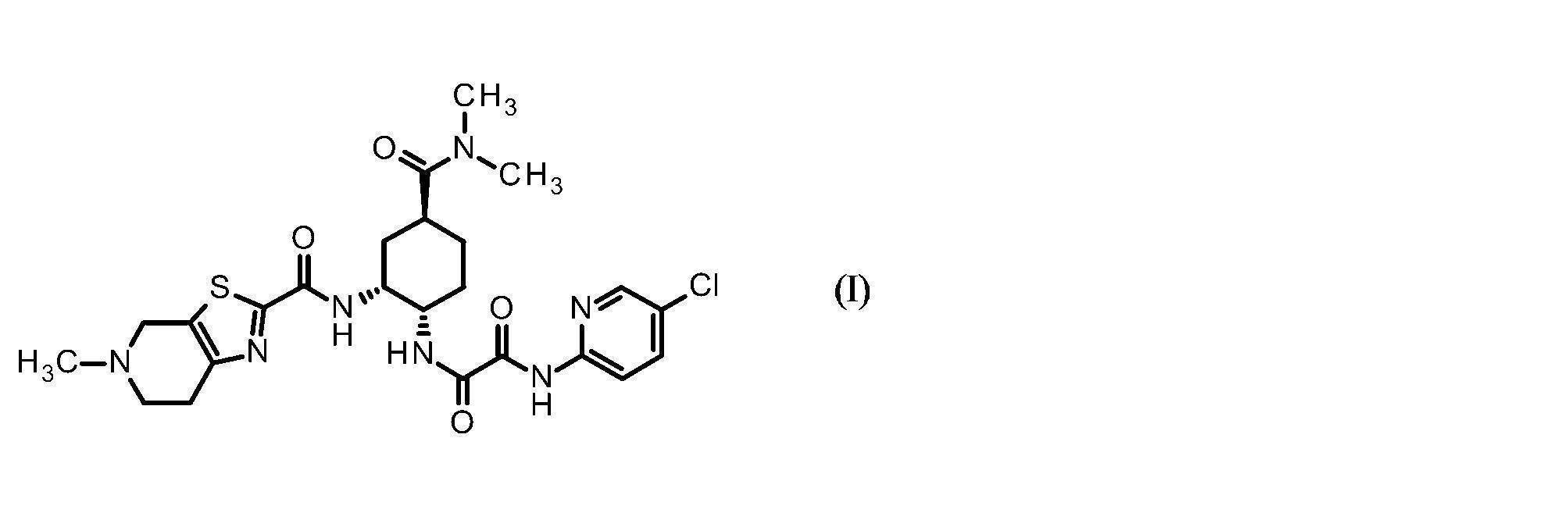
- N 1- (5-chloropyridin-2-yl) -N 2 -((1S, 2R, 4S) -4-[(dimethylamino) carbonyl] -2- ⁇ [(5-methyl-4 , 5,6,7-Tetrahydrothiazolo [5,4-c] pyridin-2-yl) carbonyl] amino ⁇ cyclohexyl) ethanediamide has the common name edoxaban.
- Edoxaban selectively, reversibly and directly activates activated blood coagulation factor X (FXa), which acts in the blood coagulation cascade to generate thrombin from prothrombin and to form a thrombus by promoting fibrin formation. By inhibiting it, a thrombus formation inhibitory effect is exhibited (Patent Document 1).
- dosage form of an oral solid preparation in the field of pharmaceuticals and foods there are many known forms such as tablets, capsules, granules and powders.
- dosage forms such as granules, dry syrups, oral jellies and orally disintegrating tablets have attracted attention as dosage forms that are more easily taken by elderly and pediatric patients who have difficulty swallowing. Collected and actively developed.
- the oral jelly contains a large amount of water and has an appropriate fluidity, so that it can be easily taken by patients with low or reduced swallowing ability, has excellent portability, and can be adjusted in dosage.
- oral jelly preparations have a sweet taste and suppress the bitterness of the drugs, so that they are dosage forms suitable for children.
- oral jelly preparations contain a large amount of water, and it is necessary to dissolve or disperse the drug in water during the manufacturing process. As a result, there is a problem that it is difficult to maintain the stability of the drug for a long period of time.
- Orally disintegrating tablets have the property of rapidly disintegrating in the oral cavity and have sufficient hardness to withstand physical impact during production, transportation and use, like ordinary tablets. For the above reasons, orally disintegrating tablets have received widespread support as preferred dosage forms for patients with reduced swallowing ability. However, many orally disintegrating tablets on the market are commercialized according to standards for adults, and are not suitable for fine dose adjustment as a general property of tablets, so they are suitable for children. Still have challenges.
- Granules are powder or granular preparations, so they are easily portable, and can be easily taken by patients with low or reduced swallowing ability, such as the elderly and children. Adjustments in volume can also be made. For the above reasons, granules contribute to the improvement of drug compliance, and are widely supported as preferred dosage forms for patients with reduced swallowing ability, particularly for children. Further, it is preferable that the granule can be added with sweetness in order to reduce the bitterness of the main drug.
- Granules and dry syrups for oral suspensions are granular preparations that become suspensions or aqueous solutions when water is added, and are usually used after dissolution or suspension at the time of use.
- Granules and dry syrups for oral suspensions are excellent in that, in addition to the portability of the granules, they are rapidly dissolved or suspended when water is added and can be orally administered as a solution or suspension.
- Granules and dry syrups for oral suspensions may be dissolved or suspended and then administered using an oral syringe or the like on a volume basis.
- Patent Document 2 discloses an invention relating to a granule containing a hydrophobic drug, loratadine, a cellulose analog and / or a natural polymer.
- the invention has a feature that, when producing a granule of a hydrophobic drug, a surfactant or an antifoaming agent, which has been conventionally required, is not required.
- a granule containing edoxaban or a pharmacologically acceptable salt thereof described in the present invention and having a property of rapidly dissolving or suspending when water is added.
- Patent Document 3 discloses a granule containing a poorly water-soluble drug and 0.5 (w / w)% or more of hydroxypropylcellulose having a viscosity of a 2 (w / v)% aqueous solution at 20 ° C of less than 3.0 mPa ⁇ s.
- Patent Document 4 contains (a) edoxaban, or a pharmacologically acceptable salt thereof, or a hydrate thereof, (b) one or more selected from sugar alcohols and water-swellable additives.
- the invention relating to a pharmaceutical composition characterized by the above is described.
- Patent Document 5 describes an invention relating to a pharmaceutical composition in which the content of edoxaban or a pharmaceutically acceptable salt thereof is adjusted.
- Patent Document 6 describes an invention relating to a granulated product containing edoxaban or a pharmacologically acceptable salt thereof and granulated while maintaining the maximum moisture value of the granulated product during granulation at 10% or less. .
- Patent Document 7 describes an invention relating to a pharmaceutical composition containing edoxaban or a pharmacologically acceptable salt thereof and an organic acid.
- Patent Documents 4 to 7 do not disclose an invention relating to a granule containing edoxaban or a pharmacologically acceptable salt thereof and having a property of rapidly dissolving or suspending when water is added.
- Patent Document 1 US Patent No. 7,365,205
- Patent Document 2 US Patent Application Publication No. 2008067713
- Patent Document 3 International Patent Publication No. WO 2005/009744
- Patent Document 4 US Patent No. 9149532
- Patent Document 5 Patent Document 6: US Patent Application Publication No. 20130022683
- Patent Document 7 US Patent No. 9402907
- edoxaban exhibits good solubility in a strongly acidic aqueous solution, but decreases in solubility (water solubility) in a neutral aqueous solution (such as a neutral buffer) (Patent Document 4).
- a neutral aqueous solution such as a neutral buffer
- the present inventors have conducted intensive studies to provide granules that have high dissolution properties and are easy to take even in patients with reduced swallowing ability, such as the elderly and children. It has been found that granules containing the same content of xylitol or sorbitol in the same granules have high hygroscopicity of xylitol and sorbitol and poor productivity, so that the content of edoxaban in the manufactured preparation decreases. The inventors have also discovered that edoxaban exhibits a bitter taste in the oral cavity.
- An object of the present invention is to provide a granule containing edoxaban or a pharmacologically acceptable salt thereof, which is rapidly dissolved or suspended when water is added, has excellent dissolution properties, and has a reduced bitterness of the main drug. To provide.
- Another object of the present invention is to provide a granule containing edoxaban or a pharmacologically acceptable salt thereof and a high content of xylitol or sorbitol, which has good productivity and does not reduce the content of the main drug, and a method for producing the same. That is.
- Still another object of the present invention is to provide a drug-containing granule containing edoxaban or a pharmacologically acceptable salt thereof and a drug-free granule not containing the same when mixing two types of granules.
- Another object of the present invention is to provide a granule excellent in uniformity of the preparation without mixing particles being separated (hereinafter, this phenomenon may be referred to as segregation) and a method for producing the same.
- the present inventors have conducted intensive studies in order to solve the above-mentioned problems, and as a result, they contain (A) edoxaban, or a pharmaceutically acceptable salt thereof, (B) a sugar alcohol, and (C) a water-swellable additive.
- the present inventors have found that a granule containing two granules solves the above-mentioned problem, and completed the present invention.
- the present invention relates to the following [1] to [32].
- [1] Edoxaban, or a pharmacologically acceptable salt thereof, (B) a first granule containing a sugar alcohol, and (C) a water-swellable additive, and (D) 0.5 to 10% by weight based on the total weight of the preparation. % Carmellose sodium, and (E) second granules containing 70 to 90% by weight of xylitol or sorbitol, based on the total weight of the formulation.
- a granule containing edoxaban or a pharmacologically acceptable salt thereof which is rapidly dissolved or suspended when water is added, has excellent dissolution properties, and has a reduced bitterness of the main drug.
- edoxaban or a pharmacologically acceptable salt thereof without segregation when mixing two kinds of granules of drug-containing granules and drug-free granules, and granules excellent in uniformity of the formulation, A method for producing the above granule is provided.
- a granule containing edoxaban or a pharmaceutically acceptable salt thereof and a high content of xylitol or sorbitol which has good productivity and does not decrease the content of the main drug after production, and a method for producing the same.
- the granule for oral suspension is a granule that gives a suspension for oral administration when water is added, and is usually a preparation used by suspending at the time of use.
- the granules for oral suspension can be administered after being suspended using an appropriate administration device (for example, an oral syringe or the like).
- an appropriate administration device for example, an oral syringe or the like.
- the definition of granules for oral suspensions is in accordance with the definition described in powders9and ⁇ ⁇ granules for oral solutions and suspensions in the ninth edition of the European Pharmacopoeia.
- a dry syrup is a granular preparation that becomes a solution or suspension when water is added, and is usually a preparation that is dissolved or suspended at the time of use. After the dry syrup is dissolved or suspended, it can be administered using an appropriate administration device (for example, an oral syringe or the like).
- an appropriate administration device for example, an oral syringe or the like.
- the definition of the dry syrup preparation conforms to the definition described in the 17th revised Japanese Pharmacopoeia.
- the total weight of the preparation refers to the total weight of the preparation including the weights of the first granules, the second granules, and other additives.
- X50 in the present invention indicates a cumulative 50% particle diameter measured by a sieving method.
- X50 may be called a median diameter.
- the sweetness of the sweetener in the present invention is a relative value indicating the sweetness of each sweetener when the sweetness of sucrose is set to 1.0. In general, it can be determined by a human sensory test by comparing the concentration of each sweetener exhibiting the same sweetness intensity as that of a sucrose solution having a constant concentration.
- R 2 / R 1 in the present invention indicates the ratio of the median diameter (R 1 ) of the first granules to the median diameter (R 2 ) of the second granules.
- Compound I may be a pharmacologically acceptable salt, and the pharmacologically acceptable salt also includes solvates (including hydrates).
- the salt of the compound I is preferably a compound represented by the following formula (Ia)
- Edoxaban or a pharmacologically acceptable salt thereof activates Blood Coagulation Factor X, which acts to form thrombin from prothrombin in the blood coagulation cascade and to form a thrombus by promoting fibrin formation.
- FXa selectively, reversibly, and directly inhibits thrombus formation.
- Edoxaban or its pharmacologically acceptable salt has been shown in Japanese and foreign clinical trials to be associated with venous thromboembolism in patients undergoing lower limb orthopedic surgery, including total knee replacement, total hip replacement, and hip fracture surgery. It is used to control the onset of disease, and to control the onset of ischemic stroke and systemic embolism in patients with non-valvular atrial fibrillation, and to treat and prevent the recurrence of venous thromboembolism (deep venous thrombosis and pulmonary thromboembolism) ing.
- Edoxaban or its pharmacologically acceptable salts suppresses ischemic stroke and systemic embolism in patients with non-valvular atrial fibrillation and treats venous thromboembolism (deep vein thrombosis and pulmonary thromboembolism)
- venous thromboembolism deep vein thrombosis and pulmonary thromboembolism
- an adult is orally administered 30 mg (when the body weight is 60 kg or less) or 60 mg (when the body weight exceeds 60 kg) once a day as edoxaban.
- the dose can be reduced to 30 mg once a day depending on the renal function and the concomitant drug.
- an adult is orally administered 30 mg of edoxaban once a day.
- the content of edoxaban or a pharmacologically acceptable salt thereof contained in the granules of the present invention is not particularly limited as long as the effects of the present invention are not impaired.
- the content is 10% by weight, more preferably 0.3 to 5% by weight, still more preferably 0.3 to 3% by weight.
- the (B) sugar alcohol in the present invention includes D-mannitol, xylitol, erythritol, maltitol, or sorbitol, and these can be used alone or in combination of two or more.
- the sugar alcohol preferably includes D-mannitol, xylitol, or erythritol, and more preferably D-mannitol.
- D-mannitol one compatible with the pharmacopeias of Japan, Europe and the United States can be usually used.
- the amount of the sugar alcohol (B) is not particularly limited as long as the effect of the present invention is not impaired, but is usually 3 to 15% by weight, preferably 3 to 10% by weight, based on the total weight of the preparation. It is.
- the water-swellable additive (C) in the present invention means a pharmaceutical additive that swells when water is added.
- Examples of the water-swellable additive (C) in the present invention include water-swellable excipients and bases.
- Specific examples of the water-swellable additive include partially pregelatinized starch, pregelatinized starch, crystalline cellulose, sodium carboxymethyl starch, carmellose (carboxymethyl cellulose), carmellose calcium, croscarmellose sodium (cross carboxymethyl cellulose sodium), and soybean. Lecithin, low-substituted hydroxypropylcellulose, tragacanth powder, bentonite and the like can be mentioned, and these can be used alone or in combination of two or more.
- As the water-swellable additive (C) partially pregelatinized starch and / or crystalline cellulose are preferable, and partially pregelatinized starch is more preferable.
- the amount of the water-swellable additive (C) in the present invention is not particularly limited as long as the effect of the present invention is not impaired, but is usually 1 to 10% by weight, preferably 1 to 10% by weight, based on the total weight of the preparation. It is 1 to 5% by weight.
- the mixing ratio of the (C) water-swellable additive to the (B) sugar alcohol in the present invention is not particularly limited as long as the effects of the present invention are not impaired.
- the sugar alcohol is 1 to 10 parts by weight, preferably 1.5 to 4 parts by weight.
- Disintegrators include adipic acid, alginic acid, pregelatinized starch, sodium carboxymethyl starch, carmellose, carmellose calcium, carmellose sodium (hereinafter sometimes referred to as CMC-Na), hydrous silicon dioxide, calcium citrate, Croscarmellose sodium, crospovidone, light anhydrous silicic acid, crystalline cellulose, synthetic aluminum silicate, wheat starch, rice starch, cellulose acetate phthalate, calcium stearate, low-substituted hydroxypropylcellulose, corn starch, tragacanth powder, potato starch , Hydroxyethyl methylcellulose, hydroxypropyl starch, partially pregelatinized starch, monosodium fumarate, povidone, citric anhydride, methylcellulose Calcium dihydrogen phosphoric acid and the like. These may be blended singly or in combination of two or more kinds.
- the disintegrant is preferably crospovidone and / or sodium carboxymethyl starch, more preferably
- the amount of the disintegrant is not particularly limited as long as the effect of the present invention is not impaired, but is preferably 0.1 to 10% by weight, more preferably 0.1 to 5% by weight, based on the total weight of the preparation. Even more preferably, it is 0.3 to 3% by weight.
- binder examples include gum arabic, sodium alginate, carboxyvinyl polymer, gelatin, dextrin, pectin, sodium polyacrylate, pullulan, methylcellulose, hydroxypropylcellulose, hydroxypropylmethylcellulose, polyvinyl alcohol, polyvinylpyrrolidone and macrogol. These may be used alone or in combination of two or more.
- the binder is hydroxypropyl cellulose.
- the amount of the binder is not particularly limited as long as the effects of the present invention are not impaired, but is preferably 0.1 to 5% by weight, more preferably 0.1 to 3% by weight, based on the total weight of the preparation. Even more preferably, it is 0.1 to 1% by weight.
- carmellose sodium contained in the granules of the present invention products compatible with the Japanese, European, or US Pharmacopoeia can be usually used.
- Carmellose sodium exhibits an appropriate viscosity when water is added, and can be expected to play a role in helping to suspend the drug.
- carmellose sodium exhibits an effect of assisting the suspension of the drug together with xylitol or sorbitol.
- the amount of carmellose as the component (D) is not particularly limited as long as the effects of the present invention are not impaired, but is preferably 0.5 to 10% by weight, more preferably 0.5 to 10% by weight, based on the total weight of the preparation. -5% by weight, even more preferably 1-5% by weight.
- xylitol or sorbitol used in the granules of the present invention products compatible with the Japanese, European, or US Pharmacopoeia can be usually used.
- Xylitol or sorbitol not only functions as a sweetener that reduces the bitterness of the main drug due to the sweetness of the compound, but also exhibits an appropriate viscosity when water is added, so that it can be expected to play a role in assisting drug suspension.
- the amount of xylitol or sorbitol as the component (E) is not particularly limited as long as the effects of the present invention are not impaired, but is preferably 70 to 90% by weight, more preferably 80 to 90% by weight based on the total weight of the preparation. %.
- the granules of the present invention may contain various additives generally used in the production of pharmaceutical preparations in addition to the above as long as the effects of the present invention are not hindered.
- additives examples include excipients, binders, lubricants, coating agents, plasticizers, coloring agents, flavoring agents, sweeteners, corrigents, flow agents, foaming agents, surfactants, and the like. be able to.
- Excipients include, for example, organic excipients selected from sugars, sugar alcohols, starches, and celluloses, and inorganic excipients.
- the saccharide include one or a combination of two or more selected from lactose, sucrose, fructooligosaccharide, glucose, palatinose, maltose, reduced maltose, powdered sugar, powdered candy, fructose, isomerized lactose, and honey sugar.
- Sugar alcohols include D-mannitol, xylitol, erythritol, maltitol, sorbitol and the like.
- starches include one or a combination of two or more selected from corn starch, potato starch, rice starch, partially pregelatinized starch and pregelatinized starch.
- celluloses include, in addition to crystalline cellulose, for example, one or a combination of two or more selected from powdered cellulose, hydroxypropyl cellulose, carmellose, carmellose calcium, and croscarmellose sodium.
- the inorganic excipient include one or a combination of two or more selected from synthetic hydrotalcite, precipitated calcium carbonate, hydrated silicon dioxide, light anhydrous silicic acid, magnesium silicate aluminate and magnesium hydroxide. be able to.
- binder examples include gum arabic, sodium alginate, carboxyvinyl polymer, gelatin, dextrin, pectin, sodium polyacrylate, pullulan, methylcellulose, hydroxypropylcellulose, hydroxypropylmethylcellulose, polyvinyl alcohol, polyvinylpyrrolidone and macrogol. One or a combination of two or more.
- Lubricants include one or a combination of two or more selected from magnesium stearate, calcium stearate, sodium stearyl fumarate and talc.
- Examples of the coating agent for coating the surface of the drug in powder form (the surface of the crystal) or the surface of the granulated drug include, for example, cellulose derivatives: hypromellose (hydroxypropylmethylcellulose), hydroxypropylcellulose, ethylcellulose, methylcellulose, etc .; polyvinyl Compounds: polyvinyl alcohol, povidone (polyvinylpyrrolidone), polyvinyl acetal diethylaminoacetate, vinyl acetate resin, etc .; acrylic acid derivatives: aminoalkyl methacrylate copolymer RS, ethyl acrylate / methyl methacrylate copolymer dispersion, etc .; and sugars (including sugar alcohols) ): Sucrose and mannitol used for sugar coating, and one or more combinations selected from the group consisting of:
- plasticizer combined with the coating agent, one or a combination of two or more selected from diethyl sebacate, dibutyl sebacate, triethyl citrate, stearic acid, polyethylene glycol and triacetin can be exemplified.
- the coloring agent is selected from food colors such as Food Yellow No. 5, Food Red No. 2, Food Blue No. 2, etc., food lake colors, yellow iron sesquioxide, iron sesquioxide, titanium oxide, ⁇ -carotene and riboflavin. One or a combination of two or more.
- flavor for example, one or a combination of two or more selected from orange, lemon, strawberry, peppermint, menthol, menthol micron, and various flavors can be exemplified.
- sweetener examples include one or a combination of two or more selected from saccharin sodium, saccharin, aspartame, acesulfame potassium, dipotassium glycyrrhizinate, sucralose, stevia and thaumatin.
- flavoring agent examples include one or a combination of two or more selected from sodium chloride, magnesium chloride, disodium inosinate, sodium L-glutamate and honey.
- the fluidizing agent for example, one or a combination of two or more selected from hydrated silicon dioxide, light anhydrous silicic acid and talc can be exemplified.
- foaming agent examples include tartaric acid and / or citric anhydride.
- surfactant examples include one or a combination of two or more selected from polyoxyl 40 stearate, sorbitan fatty acid ester, polyoxyethylene hydrogenated castor oil, polysorbate, glyceryl monostearate, and sodium lauryl sulfate. it can.
- the granule of the present invention can be produced by the production method described below.
- the (b) two-granulation method described below can be preferably employed.
- A) Method for producing granules by one granulation method (A) Edoxaban or a pharmaceutically acceptable salt thereof, (B) sugar alcohol, (C) water-swellable additive, (D) 0 based on total weight of preparation Wet molding of 5 to 10% by weight of carmellose sodium, (E) 70 to 90% by weight of xylitol based on the total weight of the preparation, and other additives using water or an aqueous solution or dispersion of a binder. Granulate.
- the wet granulation method generally used mixing and stirring granulation method, high-speed stirring granulation method, fluidized bed granulation method, tumbling granulation method and the like can be used, but preferably high-speed stirring and granulation method, or It is a bed granulation method, more preferably a fluidized bed granulation method.
- B Production method of granule by two-granule method Step of producing first granules (drug-containing granules): (A) edoxaban or a pharmaceutically acceptable salt thereof, (B) sugar alcohol, (C) water-swellable additive, and other additives, etc.
- Wet granulation is performed using an aqueous solution or dispersion of a binder.
- a commonly used mixing and stirring granulation method a high-speed stirring granulation method, a fluidized bed granulation method, or a tumbling granulation method can be used, but preferably a high-speed stirring granulation method, or It is a fluidized-bed granulation method, more preferably a fluidized-bed granulation method.
- the obtained first granules may be dried and / or sized if necessary.
- the particle size of the first granules is not particularly limited as long as the effects of the present invention are not impaired, but the median diameter (X50) is preferably 130 ⁇ m to 240 ⁇ m, and more preferably 130 ⁇ m to 220 ⁇ m.
- Xylitol is wet granulated with water.
- wet granulation can also be performed by using a solution in which part or all of (D) sodium carmellose is dissolved or dispersed in water.
- a wet granulation method a commonly used mixing and stirring granulation method, a high-speed stirring granulation method, a fluidized bed granulation method, or a tumbling granulation method can be used, but preferably a high-speed stirring granulation method, or It is a fluidized-bed granulation method, more preferably a fluidized-bed granulation method.
- the obtained second granules may be dried and / or sized if necessary.
- the particle size of the second granule is not particularly limited as long as the effect of the present invention is not impaired, but the median diameter (X50) is preferably 170 ⁇ m to 240 ⁇ m. 3.
- Step of mixing first granules and second granules The granules of the present invention are obtained by mixing the obtained first granules and second granules. When mixing the obtained first granules and the second granules, the ratio of the median diameter (R 1 ) of the first granules to the median diameter (R 2 ) of the second granules so that the two kinds of granules do not segregate.
- the median diameter ratio (R 2 / R 1 ) is preferably from 0.75 to 1.75, and more preferably from 0.85 to 1.70.
- a commonly used stirring mixer or V-type mixer can be used.
- the granules of the present invention obtained through the above-mentioned steps are characterized in that they quickly dissolve or suspend when water is added, and reduce the bitterness of the main drug.
- the granules of the present invention have characteristics that they do not segregate when two types of granules are mixed, and are excellent in uniformity of preparation and dissolution of the main drug.
- the granules of the present invention can be produced using ordinary equipment without requiring complicated operations.
- the dissolution property of the granules of the present invention can be evaluated by a dissolution test method described in, for example, Japanese Pharmacopoeia, United States Pharmacopeia (USP) and European Pharmacopoeia.
- USP United States Pharmacopeia
- European Pharmacopoeia European Pharmacopoeia
- the average dissolution rate of edoxaban in the dissolution test solution at pH 6.0 is determined after the start of the dissolution test. It is at least 70% at 45 minutes, preferably at least 75% at 45 minutes after the start of the dissolution test, more preferably at least 80% at 45 minutes.
- the uniformity of the preparation of the granules of the present invention can be evaluated according to the content uniformity test in the preparation uniformity test method prescribed in the Japanese, US and European Pharmacopoeia. Specifically, for 10 or 30 bottles filled with the granules of the present invention, the content of edoxaban in the preparation was measured by HPLC, and the judgment value (AV) was calculated by the following formula (a), Is 15.0% or less (10 samples) or 25.0% or less (30 samples), it is determined that the content in the preparation is uniform.
- the granules of the present invention can be administered to patients by oral administration (a device such as an oral syringe may be used) by adding water to make an aqueous solution or suspension.
- oral administration a device such as an oral syringe may be used
- the granules of the present invention can provide a preparation that can be easily taken not only by ordinary patients but also by elderly or pediatric patients who have difficulty swallowing.
- HPLC high performance liquid chromatography
- Example 1 Investigation of sweetener and evaluation of suspension stability Sensory tests and suspension stability evaluation were performed using sucralose, xylitol, or sorbitol as a sweetener.
- the content of the sweetener was set so that each preparation had the same degree of sweetness with reference to the degree of sweetness (sucralose: 600, xylitol: 1, sorbitol: 0.8).
- Example 2 Examination of production method The production method of the granule of the present invention by the following one-granulation method and two-granulation method was examined.
- Granules of Comparative Examples 2-1 to 2-5 were produced in the same manner as in Example 1 according to the weight ratios of the formulations shown in Table 2-1.
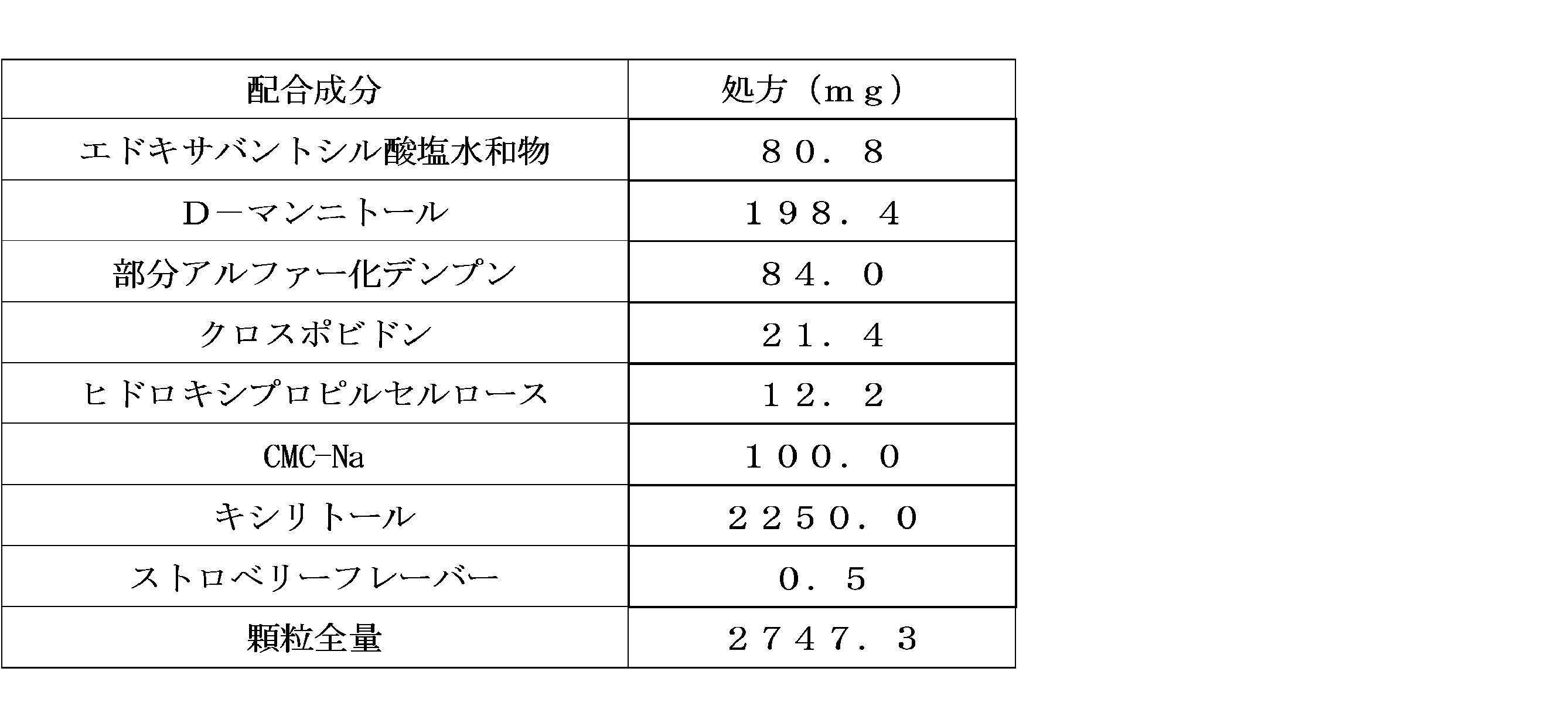
- Second granules (drug-free granules): According to the weight ratio of the formulation shown in Table 2-1, a fluidized bed granulation dryer (S2-B5-F2, Aeromatic Fielder AG) and about 9 parts of xylitol and the total amount A second granule (drug-free granule) was obtained by charging a portion of CMC-Na, spraying a solution obtained by dissolving the remaining CMC-Na and strawberry flavor in purified water, and then drying.
- S2-B5-F2 Aeromatic Fielder AG
- Example 3 Comparison of dissolution performance of granules manufactured by the 1-granule method and 2-granule method The dissolution test was performed on the granules manufactured by the 1-granule method and the 2-granule method, and the dissolution performance of granules manufactured by different methods was determined. Compared.
- (1) Method for producing granules The method for producing granules by the one-granulation method described in (1) of Example 2, the method for producing granules by the two-granulation method described in (2) of Example 2, and Table Granules of Comparative Example 3-1 (1 granule method) and Example 3-1 (2 granule method) were produced according to the weight ratio of the formulation described in 2-1.
- FIG. 1 shows the results of the dissolution tests of the granules of Comparative Example 3-1 produced by the 1-granule method and Example 3-1 produced by the 2-granule method. 1
- the granules produced by the granule method showed high dissolution, but as can be seen from the results of Example 2, the content of edoxaban was reduced, and the dissolution rate did not become 100% (that is, the theoretical content). Did not reach).
- the granules produced by the two-granulation method exhibited high dissolution properties and showed no reduction in edoxaban content, indicating that they were excellent preparations.
- Example 4 Examination of mixing condition of first granule and second granule in two-granulation method The particle size of the first granule and the second granule was examined, and the condition of granules that did not cause segregation was searched.
- the particle size distribution of the first granules and the second granules was measured by a sieving method using a sieving shaker (AS200, manufactured by Retsch GmbH), and the cumulative 50% particle size (X50; median size) was calculated.
- AS200 sieving shaker
- X50 50% particle size
- the granules obtained by the above method are charged into a bottle type mixer (Limitec GmbH) so that the first granules are 14.4% by weight and the second granules are at 85.6% by weight, and the ratio is 6 per minute.
- the granules described in Examples 4-1 to 4-3 were produced by mixing by rotation for 20 minutes.
- Formulation uniformity 2.75 g (theoretical amount of edoxabantosilate hydrate) of the granules produced by the production method described in (1) of Example 4 above using a bottle filling machine (SW703, Collischan GmbH) per bottle. 80.8 mg).
- the ratio (content%) of the actual content to the theoretical content of edoxaban contained in one bottle was measured for ten samples collected in time series during the bottle filling process. The measurement was carried out in the same manner as in (3) of Example 2, and the average content and the content standard deviation were calculated.
- the uniformity of the preparation was evaluated by calculating a judgment value according to the European Pharmacopoeia.
- Example 4-1 is a granule characterized in that the X50 of the first granule is larger than the X50 of the second granule.
- Example 4-2 is a granule characterized in that the X50 of the first granule is approximately the same as the X50 of the second granule.
- Example 4-3 is a granule characterized in that the X50 of the first granule is smaller than the X50 of the second granule.
- Examples 4-1 to 4-3 the values of the standard deviation at 10 minutes, 15 minutes, and 20 minutes varied, but this was due to the variation caused by sampling when the uniformity reached a steady state. Implies that there is.
- the magnitudes of the standard deviation values of the formulation uniformity and the mixing uniformity at the end of mixing (20 minutes after the start of mixing) in Examples 4-1 to 4-3 are the same (Example 4-2 ⁇ Example 4). -3 ⁇ Example 4-1), but comparing the values, the value of the uniformity of the preparation is smaller than the value of the uniformity of the mixture.
Landscapes
- Health & Medical Sciences (AREA)
- Life Sciences & Earth Sciences (AREA)
- Engineering & Computer Science (AREA)
- Bioinformatics & Cheminformatics (AREA)
- Chemical & Material Sciences (AREA)
- Medicinal Chemistry (AREA)
- Pharmacology & Pharmacy (AREA)
- Animal Behavior & Ethology (AREA)
- General Health & Medical Sciences (AREA)
- Public Health (AREA)
- Veterinary Medicine (AREA)
- Epidemiology (AREA)
- Biophysics (AREA)
- Molecular Biology (AREA)
- Chemical Kinetics & Catalysis (AREA)
- General Chemical & Material Sciences (AREA)
- Nuclear Medicine, Radiotherapy & Molecular Imaging (AREA)
- Organic Chemistry (AREA)
- Diabetes (AREA)
- Hematology (AREA)
- Dispersion Chemistry (AREA)
- Medicinal Preparation (AREA)
- Pharmaceuticals Containing Other Organic And Inorganic Compounds (AREA)
Abstract
Description

特許文献2:米国特許出願公開第2008064713号明細書
特許文献3:国際公開第2005/009474号パンフレット
特許文献4:米国特許第9149532号明細書
特許文献5:米国特許第8449896号明細書
特許文献6:米国特許出願公開第20130022683号明細書
特許文献7:米国特許第9402907号明細書
[1]
(A)エドキサバン、またはその薬理上許容される塩
(B)糖アルコール、および
(C)水膨潤性添加剤
を含有する第一顆粒と
(D)製剤総重量に対して0.5~10重量%のカルメロースナトリウム、および
(E)製剤総重量に対して70~90重量%のキシリトール、またはソルビトール
を含有する第二顆粒とを含む顆粒剤。
[2]
第一顆粒のメジアン径(R1)と第二顆粒のメジアン径(R2)の比(R2/R1)が0.75~1.75である[1]に記載の顆粒剤。
[3]
第一顆粒のメジアン径(X50)が130μm~240μmであり、第二顆粒のメジアン径(X50)が170μm~240μmである[1]に記載の顆粒剤。
[4]
製剤総重量に対して0.3~10重量%の(A)エドキサバン、またはその薬理上許容される塩を含む[1]~[3]のいずれか1項に記載の顆粒剤。
[5]
(A)エドキサバンまたはその薬理上許容される塩がエドキサバントシル酸塩一水和物である[1]~[4]のいずれか1項に記載の顆粒剤。
[6]
(B)糖アルコールがD-マンニトール、キシリトール、またはエリスリトールである[1]~[5]のいずれか1項に記載の顆粒剤。
[7]
(B)糖アルコールがD-マンニトールである[6]に記載の顆粒剤。
[8]
製剤総重量に対して3~15重量%の(B)糖アルコールを含む[1]~[7]のいずれか1項に記載の顆粒剤。
[9]
(C)水膨潤性添加剤が部分アルファー化デンプン、および/または結晶セルロースである[1]~[8]のいずれか1項に記載の顆粒剤。
[10]
(C)水膨潤性添加剤が部分アルファー化デンプンである[9]に記載の顆粒剤。
[11]
製剤総重量に対して1~10重量%の(C)水膨潤性添加剤を含む[1]~[10]のいずれか1項に記載の顆粒剤。
[12]
さらに崩壊剤を含む[1]~[11]のいずれか1項に記載の顆粒剤。
[13]
前記崩壊剤が第一顆粒に含まれる[12]に記載の顆粒剤。
[14]
前記崩壊剤がクロスポビドン、および/またはカルボキシメチルスターチナトリウムである[12]または[13]に記載の顆粒剤。
[15]
前記崩壊剤がクロスポビドンである[14]に記載の顆粒剤。
[16]
さらに結合剤を含む[1]~[15]のいずれか1項に記載の顆粒剤。
[17]
前記結合剤が第一顆粒に含まれる[16]に記載の顆粒剤。
[18]
前記結合剤がヒドロキシプロピルセルロースである[16]または[17]に記載の顆粒剤。
[19]
前記顆粒剤が経口懸濁剤用の顆粒剤、またはドライシロップ剤である[1]~[18]のいずれか1項に記載の顆粒剤。
[20]
前記顆粒剤が経口懸濁剤用の顆粒剤である[19]に記載の顆粒剤。
[21]
前記顆粒剤がドライシロップ剤である[19]に記載の顆粒剤。
[22]
水溶液、または水性懸濁液として使用される[1]~[21]のいずれか1項に記載の顆粒剤。
[23]
[1]~[21]のいずれか1項に記載の顆粒剤の水溶液、または水性懸濁液。
[24]
[1]~[21]のいずれか1項に記載の顆粒剤の水溶液、または水性懸濁液としての使用。
[25]
(A)エドキサバン、またはその薬理上許容される塩、
(B)D-マンニトール
(C)部分アルファー化デンプン
(D)クロスポビドン、および
(E)ヒドロキシプロピルセルロース
を水、または(E)ヒドロキシプロピルセルロースの水溶液を用いて湿式造粒することによって第一顆粒を得る工程;
(F)製剤総重量に対して0.5~10重量%のカルメロースナトリウム、および
(G)製剤総重量に対して70~90重量%のキシリトール、またはソルビトール
を水、または(F)カルメロースナトリウムの水溶液を用いて湿式造粒することによって第二顆粒を得る工程;および、
得られた第一顆粒と第二顆粒を混合する工程を含む顆粒剤の製造方法。
[26]
湿式造粒が流動層造粒である[25]に記載の製造方法。
[27]
第一顆粒のメジアン径(R1)と第二顆粒のメジアン径(R2)の比(R2/R1)が0.75~1.75である[25]または[26]に記載の製造方法。
[28]
第一顆粒のメジアン径(X50)が130μm~240μmであり、第二顆粒のメジアン径(X50)が170μm~240μmである[25]または[26]に記載の製造方法。
[29]
前記顆粒剤が経口懸濁剤用の顆粒剤またはドライシロップ剤である[25]~[28]に記載の製造方法。
[30]
前記顆粒剤が経口懸濁剤用の顆粒剤である[29]に記載の製造方法。
[31]
前記顆粒剤がドライシロップ剤である[29]に記載の製造方法。
(A)エドキサバン、またはその薬理上許容される塩
(B)糖アルコール
(C)水膨潤性添加剤
(D)製剤総重量に対して0.5~10重量%のカルメロースナトリウム、および
(E)製剤総重量に対して70~90重量%のキシリトール、またはソルビトール
を含む顆粒剤。

(a)1顆粒法による顆粒剤の製造方法
(A)エドキサバンまたはその薬理上許容される塩、(B)糖アルコール、(C)水膨潤性添加剤、(D)製剤総重量に対して0.5~10重量%のカルメロースナトリウム、(E)製剤総重量に対して70~90重量%のキシリトール、およびその他の添加剤等を水、または結合剤の水溶液もしくは分散液を用いて湿式造粒する。湿式造粒法としては一般に用いられる混合撹拌造粒法、高速撹拌造粒法、流動層造粒法、転動造粒法などを用いることができるが、好ましくは高速撹拌造粒法、または流動層造粒法であり、より好ましくは流動層造粒法である。
(b)2顆粒法による顆粒剤の製造方法
1.第一顆粒(薬物含有顆粒)を製造する工程
(A)エドキサバンまたはその薬理上許容される塩、(B)糖アルコール、(C)水膨潤性添加剤、およびその他の添加剤等を水、または結合剤の水溶液もしくは分散液を用いて湿式造粒する。湿式造粒法としては一般に用いられる混合撹拌造粒法、高速撹拌造粒法、流動層造粒法、または転動造粒法などを用いることができるが、好ましくは高速撹拌造粒法、または流動層造粒法であり、より好ましくは流動層造粒法である。
2.第二顆粒(薬物不含有顆粒)を製造する工程
(D)製剤総重量に対して0.5~10重量%のカルメロースナトリウム、および(E)製剤総重量に対して70~90重量%のキシリトールを、水を用いて湿式造粒する。別の態様として(D)カルメロースナトリウムの一部もしくは全部を水に溶解、または分散した液を利用することによって湿式造粒することもできる。湿式造粒法としては一般に用いられる混合撹拌造粒法、高速撹拌造粒法、流動層造粒法、または転動造粒法などを用いることができるが、好ましくは高速撹拌造粒法、または流動層造粒法であり、より好ましくは流動層造粒法である。
3.第一顆粒と第二顆粒を混合する工程
得られた第一顆粒と第二顆粒を混合することによって本発明の顆粒剤が得られる。得られた第一顆粒および第二顆粒を混合する際、2種類の顆粒が偏析を起こさないように、第一顆粒のメジアン径(R1)と第二顆粒のメジアン径(R2)の比(R2/R1)が選択される。上記、メジアン径の比(R2/R1)は、好ましくは0.75~1.75であり、より好ましくは0.85~1.70である。混合には一般に用いられる撹拌混合機やV型混合機を用いることができる。

カラム:AGILENT Poroshell 120 EC C18(2.7μm,50×4.6mm)
温度:40℃
移動相:A液-pH4.5酢酸緩衝液/アセトニトリル(9/1(v/v))
B液-pH4.5酢酸緩衝液/アセトニトリル(2/8(v/v))
A液:B液=74:26
流速:1mL/min
検出波長:290nm
注入量:5μL(10℃で注入)
甘味剤としてスクラロース、キシリトール、またはソルビトールを用いて官能試験および懸濁液の安定性評価を行った。甘味剤の含量は甘味度(スクラロース:600,キシリトール:1,ソルビトール:0.8)を参考に各製剤が同程度の甘みになるように設定した。
(1)顆粒剤の製造方法
流動層造粒乾燥機(S2-B5-F2,Aeromatic Fielder AG社)に表1-1に記載の処方の重量比に従って、エドキサバントシル酸塩水和物、D-マンニトール、部分アルファー化デンプン、クロスポビドン、甘味剤、およびカルメロースナトリウムを投入し、ヒドロキシプロピルセルロースおよびストロベリーフレーバーを精製水に溶解した液を噴霧することによって造粒した後、乾燥することによって比較例1-1および1-2、ならびに実施例1-1~1-3の顆粒剤を得た。
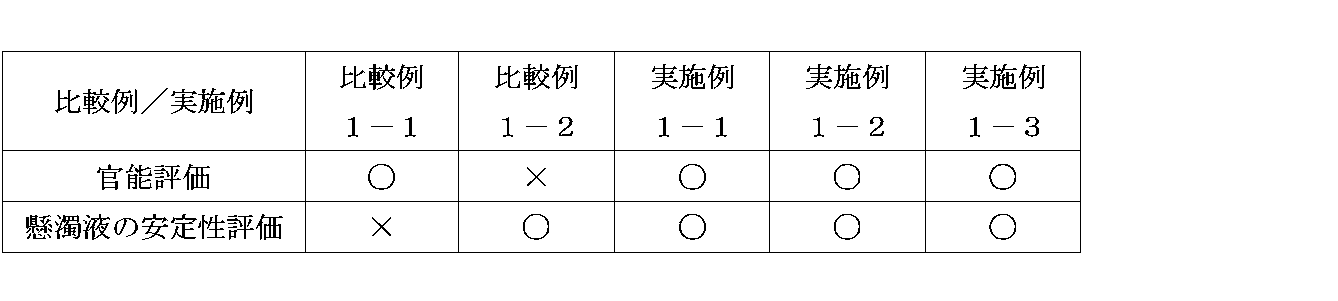
官能評価:上記方法により製造した比較例1-1および1-2、ならびに実施例1-1~1-3の顆粒剤をヒトに投与し、その味、ならびに投与直後および投与から2~5分後の満足度を5段階(1:とても嫌い,2:嫌い,3:わからない,4:好き,5:とても好き)で評価した。評価の結果、その平均値が4点を越えたものに関して○、下回ったものに関して×を表1-2に記載した。
懸濁液の安定性評価:表1-1に記載の処方に従って25mL褐色ガラス瓶(Code:0755,Gerresheimer社)にエドキサバントシル酸塩水和物、D-マンニトール、部分アルファー化デンプン、クロスポビドン、ヒドロキシプロピルセルロース、甘味剤、CMC-Na、およびストロベリーフレーバーを秤量した後に混合した。エドキサバンの理論含量として6mg/mLとなるように水を加えた。混合物を振とうし、懸濁液を調製した後、調製直後、5分後、15分後、30分後に懸濁液の液面から1cmの位置より1mLのサンプルを採取し、エドキサバンの濃度をHPLC(AGILENT 1100,1200,または1260;AGILENT社)により評価した。濃度の経時変化が全評価時点において90%~110%の範囲内であったものに関しては表1-2に○と記載し、経時変化が上記の範囲を超えたものを×と記載した。
官能評価および懸濁液の安定性評価の結果を表1-2に示す。実施例1-1~1-3のように甘味剤としてキシリトールまたはソルビトールを用いた際には官能評価の結果、服用に際して製剤の味が障害とはならないことが分かった。また、実施例1-1~1-3の顆粒剤は懸濁液中のエドキサバンの濃度の変化が90%~110%であることがわかった。すなわち、CMC-Naとキシリトールまたはソルビトールの組み合わせを採用した顆粒剤は懸濁液の安定性が高く、本発明の顆粒剤として適した性能を有することが分かった。

以下に記載する1顆粒法および2顆粒法による本発明の顆粒剤の製造方法を検討した。
(1)1顆粒法による顆粒剤の製造方法
表2-1に記載の処方の重量比に従って、実施例1と同様の方法により、比較例2-1~2-5の顆粒剤を製造した。
第一顆粒(薬物含有顆粒)の製造:表2-1に記載の処方の重量比に従って、流動層造粒乾燥機(S2-B5-F2,Aeromatic Fielder AG社)にエドキサバントシル酸塩水和物、D-マンニトール、部分アルファー化デンプン、およびクロスポビドンを投入し、ヒドロキシプロピルセルロースを精製水に溶解した液を噴霧した後、乾燥することによって第一顆粒(薬物含有顆粒)を得た。
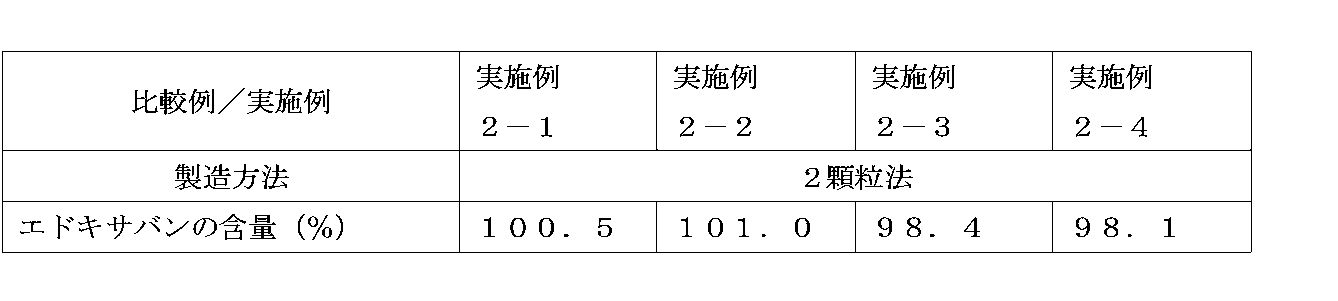
上記方法で得られた比較例2-1~2-5、および実施例2-1~2-4の顆粒剤をメスフラスコに秤量し、アセトニトリルと水の混合溶媒(3:7(v/v))でメスアップし、振とうおよび超音波を当てることにより完全に溶解させた。得られた溶液から一部を採取し、理論量としてエドキサバントシル酸塩水和物を80.8μg/mL含むように希釈することによって評価用溶液を調製した。別途、エドキサバントシル酸塩水和物の標準溶液を調製し、HPLCを用いて評価用溶液中のエドキサバントシル酸塩水和物の含量を測定し、理論含量に対する実含量の割合(含量%)を算出した。
1顆粒法および2顆粒法の製造方法に従って製造した顆粒剤についてエドキサバンの含量を測定した結果を表2-2および表2-3に示した。その結果、1顆粒法で製造した比較例2-1~2-5の顆粒剤においてはエドキサバンの含量が低下することが分かった。この含量低下は、1顆粒法では造粒工程中に原料の大部分を占めるキシリトールが吸湿し、その一部が原薬とともに壁面およびバグフィルターへ付着することに起因する可能性が示唆された。一方、2顆粒法では吸湿性のあるキシリトールと原薬のエドキサバンを別々の顆粒にして製造することにより、原薬の製造機器内部への付着が抑制され、この問題が解決された。すなわち、2顆粒法で製造した実施例2-1~2-4の顆粒剤はエドキサバンの含量が低下しないことが分かった。

前記1顆粒法および2顆粒法で製造した顆粒剤について溶出試験を行って製法の異なる顆粒剤の溶出性能を比較した。
(1)顆粒剤の製造方法
実施例2の(1)に記載の1顆粒法による顆粒剤の製造方法、実施例2の(2)に記載の2顆粒法による顆粒剤の製造方法、および表2-1に記載の処方の重量比に従って、比較例3-1(1顆粒法)および実施例3-1(2顆粒法)の顆粒剤を製造した。
溶出試験法
pH6.0のリン酸緩衝液を用い、欧州薬局方に記載の方法(パドル法:毎分50回転)に従って溶出試験を行った。
1顆粒法によって製造した比較例3-1、および2顆粒法によって製造した実施例3-1の顆粒剤の溶出試験の結果を図1に示す。1顆粒法で製造した顆粒剤は高い溶出性を示したが、実施例2の結果から分かるように、エドキサバンの含量が低下しており、溶出率が100%とはならなかった(すなわち理論含量まで到達しなかった)。一方、2顆粒法で製造した顆粒剤は高い溶出性を示し、またエドキサバンの含量の低下がないことから優れた製剤であることが分かった。
第一顆粒と第二顆粒の粒子径の検討を行い、偏析を起こさない顆粒剤の条件を探索した。
(1)製造方法
実施例2の(2)に記載の2顆粒法による製造方法および表2-1に記載の処方の重量比に従って第一顆粒および第二顆粒を製造した後、整粒機(QC-197s,Quadro Comil,Quadro社)を用いて整粒操作を行うことによって、第一顆粒に関してそのメジアン径(X50)が137、177、もしくは212μmの顆粒を、また、第二顆粒に関してそのメジアン径(X50)が179、181、もしくは234μmの顆粒を得た。上記第一顆粒および第二顆粒の粒度分布はふるい分け振とう機(AS200,Retsch GmbH製)を用いたふるい分け法により測定し、累積50%粒子径(X50;メジアン径)を算出した。
次に顆粒剤の総量が約10kgのスケールで表4-1に記載の第一顆粒および第二顆粒の粒子径の組み合わせに従って第一顆粒と第二顆粒の混合条件の検討実験を行った。第一顆粒が14.4重量%、および第二顆粒が85.6重量%の割合になるように上記方法により得られた顆粒をビン型混合機(Limitec GmbH製)に投入し、毎分6回転で20分間混合することによって実施例4-1~4-3に記載の顆粒剤を製造した。
・混合均一性
上記の実施例4の(1)に記載の製造方法においてビン型混合機で混合を開始してから10分、15分、20分後に、図2の模式図上に示した採取位置A~Jよりサンプルを採取した。得られたサンプルについてエドキサバンの含量を実施例2の(3)と同様の方法で測定し、その平均値と標準偏差を算出することによって混合均一性を評価した。
上記実施例4の(1)に記載の製造方法で製造した顆粒剤をボトル充填機(SW703,Collischan GmbH社)を用いて1ボトル当たり2.75g(エドキサバントシル酸塩水和物の理論量として80.8mg)充填した。ボトル充填工程中に時系列的に採取した10サンプルに関して、1ボトルに含まれるエドキサバンの理論含量に対する実含量の割合(含量%)を測定した。測定は実施例2の(3)と同様の方法で行い、平均含量、含量標準偏差を算出した。また、欧州薬局方に従い判定値を算出することで、製剤均一性を評価した。
第一顆粒と第二顆粒の粒子径の組み合わせをさまざまに変えて製造した実施例4-1~4-3の顆粒剤について、混合均一性および製剤均一性の結果を表4-1に記載した。実施例4-1は第一顆粒のX50が第二顆粒のX50よりも大きいことを特徴とする顆粒剤である。実施例4-2は第一顆粒のX50が第二顆粒のX50と同程度の大きさであることを特徴とする顆粒剤である。実施例4-3は第一顆粒のX50が第二顆粒のX50よりも小さいことを特徴とする顆粒剤である。実施例4-1~4-3において、10分、15分、20分の時点での標準偏差の値にばらつきが見られるが、これは均一性が定常に達した状態においてサンプリングに起因するばらつきが存在することを示唆している。実施例4-1~4-3における製剤均一性と混合終了時(混合開始から20分後)の混合均一性の標準偏差の値の大きさは同じ順序(実施例4-2<実施例4-3<実施例4-1)になっているが、その値を比較すると製剤均一性の値の方が混合均一性の値よりも小さくなっている。実施例4-1~4-3の製剤均一性の判定値は欧州薬局方の基準であるL1(15%)よりも小さくなっており、その基準を満たすことが分かった。
以上より、本発明により約10kgのスケールで各国の規制当局が求める基準を満たす顆粒剤を製造できることが明らかになった。

Claims (31)
- (A)エドキサバン、またはその薬理上許容される塩
(B)糖アルコール、および
(C)水膨潤性添加剤
を含有する第一顆粒と
(D)製剤総重量に対して0.5~10重量%のカルメロースナトリウム、および
(E)製剤総重量に対して70~90重量%のキシリトール、またはソルビトール
を含有する第二顆粒とを含む顆粒剤。 - 第一顆粒のメジアン径(R1)と第二顆粒のメジアン径(R2)の比(R2/R1)が0.75~1.75である請求項1に記載の顆粒剤。
- 第一顆粒のメジアン径(X50)が130μm~240μmであり、第二顆粒のメジアン径(X50)が170μm~240μmである請求項1に記載の顆粒剤。
- 製剤総重量に対して0.3~10重量%の(A)エドキサバン、またはその薬理上許容される塩を含む請求項1~3のいずれか1項に記載の顆粒剤。
- (A)エドキサバンまたはその薬理上許容される塩がエドキサバントシル酸塩一水和物である請求項1~4のいずれか1項に記載の顆粒剤。
- (B)糖アルコールがD-マンニトール、キシリトール、またはエリスリトールである請求項1~5のいずれか1項に記載の顆粒剤。
- (B)糖アルコールがD-マンニトールである請求項6に記載の顆粒剤。
- 製剤総重量に対して3~15重量%の(B)糖アルコールを含む請求項1~7のいずれか1項に記載の顆粒剤。
- (C)水膨潤性添加剤が部分アルファー化デンプン、および/または結晶セルロースである請求項1~8のいずれか1項に記載の顆粒剤。
- (C)水膨潤性添加剤が部分アルファー化デンプンである請求項9に記載の顆粒剤。
- 製剤総重量に対して1~10重量%の(C)水膨潤性添加剤を含む請求項1~10のいずれか1項に記載の顆粒剤。
- さらに崩壊剤を含む請求項1~11のいずれか1項に記載の顆粒剤。
- 前記崩壊剤が第一顆粒に含まれる請求項12に記載の顆粒剤。
- 前記崩壊剤がクロスポビドン、および/またはカルボキシメチルスターチナトリウムである請求項12または13に記載の顆粒剤。
- 前記崩壊剤がクロスポビドンである請求項14に記載の顆粒剤。
- さらに結合剤を含む請求項1~15のいずれか1項に記載の顆粒剤。
- 前記結合剤が第一顆粒に含まれる請求項16に記載の顆粒剤。
- 前記結合剤がヒドロキシプロピルセルロースである請求項16または17に記載の顆粒剤。
- 前記顆粒剤が経口懸濁剤用の顆粒剤、またはドライシロップ剤である請求項1~18のいずれか1項に記載の顆粒剤。
- 前記顆粒剤が経口懸濁剤用の顆粒剤である請求項19に記載の顆粒剤。
- 前記顆粒剤がドライシロップ剤である請求項19に記載の顆粒剤。
- 水溶液、または水性懸濁液として使用される請求項1~21のいずれか1項に記載の顆粒剤。
- 請求項1~21のいずれか1項に記載の顆粒剤の水溶液、または水性懸濁液。
- 請求項1~21のいずれか1項に記載の顆粒剤の水溶液、または水性懸濁液としての使用。
- (A)エドキサバン、またはその薬理上許容される塩、
(B)D-マンニトール
(C)部分アルファー化デンプン
(D)クロスポビドン、および
(E)ヒドロキシプロピルセルロース
を水、または(E)ヒドロキシプロピルセルロースの水溶液を用いて湿式造粒することによって第一顆粒を得る工程;
(F)製剤総重量に対して0.5~10重量%のカルメロースナトリウム、および
(G)製剤総重量に対して70~90重量%のキシリトール、またはソルビトール
を水、または(F)カルメロースナトリウムの水溶液を用いて湿式造粒することによって第二顆粒を得る工程;および、
得られた第一顆粒と第二顆粒を混合する工程を含む顆粒剤の製造方法。 - 湿式造粒が流動層造粒である請求項25に記載の製造方法。
- 第一顆粒のメジアン径(R1)と第二顆粒のメジアン径(R2)の比(R2/R1)が0.75~1.75である請求項25または26に記載の製造方法。
- 第一顆粒のメジアン径(X50)が130μm~240μmであり、第二顆粒のメジアン径(X50)が170μm~240μmである請求項25または26に記載の製造方法。
- 前記顆粒剤が経口懸濁剤用の顆粒剤またはドライシロップ剤である請求項25~28に記載の製造方法。
- 前記顆粒剤が経口懸濁剤用の顆粒剤である請求項29に記載の製造方法。
- 前記顆粒剤がドライシロップ剤である請求項29に記載の製造方法。
Priority Applications (5)
| Application Number | Priority Date | Filing Date | Title |
|---|---|---|---|
| KR1020207037266A KR20210024489A (ko) | 2018-06-27 | 2019-06-26 | 디아민 유도체를 포함하는 과립제 |
| CN201980042548.3A CN112312912B (zh) | 2018-06-27 | 2019-06-26 | 含有二胺衍生物的颗粒 |
| US17/255,721 US11497741B2 (en) | 2018-06-27 | 2019-06-26 | Granules containing diamine derivative |
| EP19825281.9A EP3815686A4 (en) | 2018-06-27 | 2019-06-26 | GRANULAR PREPARATION WITH A DIAMINDERIVE |
| JP2020527572A JP7359764B2 (ja) | 2018-06-27 | 2019-06-26 | ジアミン誘導体を含む顆粒剤 |
Applications Claiming Priority (2)
| Application Number | Priority Date | Filing Date | Title |
|---|---|---|---|
| JP2018-121423 | 2018-06-27 | ||
| JP2018121423 | 2018-06-27 |
Publications (1)
| Publication Number | Publication Date |
|---|---|
| WO2020004456A1 true WO2020004456A1 (ja) | 2020-01-02 |
Family
ID=68984881
Family Applications (1)
| Application Number | Title | Priority Date | Filing Date |
|---|---|---|---|
| PCT/JP2019/025363 Ceased WO2020004456A1 (ja) | 2018-06-27 | 2019-06-26 | ジアミン誘導体を含む顆粒剤 |
Country Status (7)
| Country | Link |
|---|---|
| US (1) | US11497741B2 (ja) |
| EP (1) | EP3815686A4 (ja) |
| JP (1) | JP7359764B2 (ja) |
| KR (1) | KR20210024489A (ja) |
| CN (1) | CN112312912B (ja) |
| TW (1) | TWI826474B (ja) |
| WO (1) | WO2020004456A1 (ja) |
Families Citing this family (3)
| Publication number | Priority date | Publication date | Assignee | Title |
|---|---|---|---|---|
| EP4183390A1 (en) | 2021-11-22 | 2023-05-24 | Intas Pharmaceuticals Limited | An orodispersible pharmaceutical dosage form of edoxaban |
| CA3234371A1 (en) | 2021-11-22 | 2023-05-25 | Intas Pharmaceuticals Ltd. | An orodispersible pharmaceutical dosage form of edoxaban |
| CN115227660B (zh) * | 2022-09-21 | 2022-12-16 | 北京惠之衡生物科技有限公司 | 一种盐酸二甲双胍缓释片及其制备方法 |
Citations (12)
| Publication number | Priority date | Publication date | Assignee | Title |
|---|---|---|---|---|
| WO2005009474A1 (ja) | 2003-07-24 | 2005-02-03 | Shionogi & Co., Ltd. | 難水溶性薬物を含むドライシロップ剤 |
| US20080064713A1 (en) | 2003-08-08 | 2008-03-13 | Schering Corporation | Dry Syrup Containing Loratadine |
| US7365205B2 (en) | 2001-06-20 | 2008-04-29 | Daiichi Sankyo Company, Limited | Diamine derivatives |
| US20080161417A1 (en) * | 2005-05-08 | 2008-07-03 | Li Zhao | Xylitol Granules Capable of Directly Being Compressible Into Tablets and Preparation Process Thereof |
| JP2009544674A (ja) * | 2006-07-28 | 2009-12-17 | ロケット・フルーレ | 粒状化ソルビトールおよびこの製造方法 |
| WO2011115067A1 (ja) * | 2010-03-19 | 2011-09-22 | 第一三共株式会社 | 抗凝固剤の溶出改善方法 |
| JP2012036140A (ja) * | 2010-08-10 | 2012-02-23 | Kyoto Pharmaceutical Industries Ltd | 苦味を抑制した速崩壊錠 |
| US8449896B2 (en) | 2009-06-18 | 2013-05-28 | Daiichi Sankyo Company, Limited | Pharmaceutical composition having improved solubility |
| US9149532B2 (en) | 2007-03-29 | 2015-10-06 | Daiichi Sanykyo Company, Limited | Pharmaceutical composition |
| US9402907B2 (en) | 2011-08-10 | 2016-08-02 | Daiichi Sankyo Company, Limited | Pharmaceutical composition containing diamine derivative |
| JP2017008112A (ja) * | 2012-04-24 | 2017-01-12 | 第一三共株式会社 | 口腔内崩壊錠及びその製造方法 |
| JP2017523149A (ja) * | 2014-08-06 | 2017-08-17 | サンド・アクチエンゲゼルシヤフト | エドキサバンの医薬組成物 |
Family Cites Families (3)
| Publication number | Priority date | Publication date | Assignee | Title |
|---|---|---|---|---|
| TWI547282B (zh) * | 2007-07-02 | 2016-09-01 | 愛戴爾製藥股份有限公司 | 樂命達之口服分解錠劑組合物 |
| US20090137645A1 (en) * | 2007-10-31 | 2009-05-28 | Midlothian Laboratories, Llc | Shelf-Stable Famotidine Granulates for Oral Suspensions |
| EP3346986A1 (en) * | 2015-09-11 | 2018-07-18 | Andrew Guise | An oral particulate composition |
-
2019
- 2019-06-25 TW TW108122169A patent/TWI826474B/zh active
- 2019-06-26 US US17/255,721 patent/US11497741B2/en active Active
- 2019-06-26 CN CN201980042548.3A patent/CN112312912B/zh active Active
- 2019-06-26 WO PCT/JP2019/025363 patent/WO2020004456A1/ja not_active Ceased
- 2019-06-26 JP JP2020527572A patent/JP7359764B2/ja active Active
- 2019-06-26 EP EP19825281.9A patent/EP3815686A4/en active Pending
- 2019-06-26 KR KR1020207037266A patent/KR20210024489A/ko not_active Withdrawn
Patent Citations (13)
| Publication number | Priority date | Publication date | Assignee | Title |
|---|---|---|---|---|
| US7365205B2 (en) | 2001-06-20 | 2008-04-29 | Daiichi Sankyo Company, Limited | Diamine derivatives |
| WO2005009474A1 (ja) | 2003-07-24 | 2005-02-03 | Shionogi & Co., Ltd. | 難水溶性薬物を含むドライシロップ剤 |
| US20080064713A1 (en) | 2003-08-08 | 2008-03-13 | Schering Corporation | Dry Syrup Containing Loratadine |
| US20080161417A1 (en) * | 2005-05-08 | 2008-07-03 | Li Zhao | Xylitol Granules Capable of Directly Being Compressible Into Tablets and Preparation Process Thereof |
| JP2009544674A (ja) * | 2006-07-28 | 2009-12-17 | ロケット・フルーレ | 粒状化ソルビトールおよびこの製造方法 |
| US9149532B2 (en) | 2007-03-29 | 2015-10-06 | Daiichi Sanykyo Company, Limited | Pharmaceutical composition |
| US8449896B2 (en) | 2009-06-18 | 2013-05-28 | Daiichi Sankyo Company, Limited | Pharmaceutical composition having improved solubility |
| US20130022683A1 (en) | 2010-03-19 | 2013-01-24 | Daiichi Sankyo Company, Limited | Method for improving dissolution of anticoagulant agent |
| WO2011115067A1 (ja) * | 2010-03-19 | 2011-09-22 | 第一三共株式会社 | 抗凝固剤の溶出改善方法 |
| JP2012036140A (ja) * | 2010-08-10 | 2012-02-23 | Kyoto Pharmaceutical Industries Ltd | 苦味を抑制した速崩壊錠 |
| US9402907B2 (en) | 2011-08-10 | 2016-08-02 | Daiichi Sankyo Company, Limited | Pharmaceutical composition containing diamine derivative |
| JP2017008112A (ja) * | 2012-04-24 | 2017-01-12 | 第一三共株式会社 | 口腔内崩壊錠及びその製造方法 |
| JP2017523149A (ja) * | 2014-08-06 | 2017-08-17 | サンド・アクチエンゲゼルシヤフト | エドキサバンの医薬組成物 |
Non-Patent Citations (1)
| Title |
|---|
| "Japanese, European and U.S. Pharmacopoeia" |
Also Published As
| Publication number | Publication date |
|---|---|
| JPWO2020004456A1 (ja) | 2021-07-08 |
| TWI826474B (zh) | 2023-12-21 |
| EP3815686A1 (en) | 2021-05-05 |
| EP3815686A4 (en) | 2022-03-23 |
| US20210267954A1 (en) | 2021-09-02 |
| CN112312912B (zh) | 2024-04-26 |
| TW202019418A (zh) | 2020-06-01 |
| CN112312912A (zh) | 2021-02-02 |
| JP7359764B2 (ja) | 2023-10-11 |
| KR20210024489A (ko) | 2021-03-05 |
| US11497741B2 (en) | 2022-11-15 |
Similar Documents
| Publication | Publication Date | Title |
|---|---|---|
| JP5390014B2 (ja) | 抗凝固剤の溶出改善方法 | |
| JP5600747B2 (ja) | 口腔内分散性製剤 | |
| TWI812602B (zh) | 含二胺衍生物之口腔崩散錠及其製造方法 | |
| US20100022577A1 (en) | Dry syrup containing loratadine | |
| WO2015071668A1 (en) | Pharmaceutical compositions | |
| JP2016509990A (ja) | 非晶質トルバプタンを含有する経口投与懸濁剤 | |
| JPWO2010147169A1 (ja) | 溶出性の改善された医薬組成物 | |
| JP7359764B2 (ja) | ジアミン誘導体を含む顆粒剤 | |
| TW202135802A (zh) | 包含吡咯羧醯胺之口腔崩散錠 | |
| JP3899522B2 (ja) | 苦味が低減されたプランルカスト水和物を含有する製剤 | |
| WO2023067620A1 (en) | Orally disintegrating pharmaceutical compositions of rivaroxaban | |
| HK40053232A (en) | Granular preparation containing diamine derivative | |
| JP2022072050A (ja) | エドキサバンを含有する口腔内崩壊錠 | |
| JP6853828B2 (ja) | メマンチンまたはその薬学上許容される塩を含有する医薬組成物 | |
| JP7057286B2 (ja) | 医薬組成物 | |
| HK1180252B (en) | Method for improving dissolvability of anticoagulant | |
| HK1168790A (en) | Pharmaceutical composition having improved solubility | |
| WO2013117793A1 (es) | Composición farmacéutica sólida de cilostazol |
Legal Events
| Date | Code | Title | Description |
|---|---|---|---|
| 121 | Ep: the epo has been informed by wipo that ep was designated in this application |
Ref document number: 19825281 Country of ref document: EP Kind code of ref document: A1 |
|
| ENP | Entry into the national phase |
Ref document number: 2020527572 Country of ref document: JP Kind code of ref document: A |
|
| NENP | Non-entry into the national phase |
Ref country code: DE |
|
| ENP | Entry into the national phase |
Ref document number: 2019825281 Country of ref document: EP Effective date: 20210127 |
|
| WWW | Wipo information: withdrawn in national office |
Ref document number: 2019825281 Country of ref document: EP |