WO2020004473A1 - Méthode de production d'un agent cellulase et méthode de production d'un produit de saccharification/fermentation dans lequel ledit agent cellulase est utilisé - Google Patents
Méthode de production d'un agent cellulase et méthode de production d'un produit de saccharification/fermentation dans lequel ledit agent cellulase est utilisé Download PDFInfo
- Publication number
- WO2020004473A1 WO2020004473A1 PCT/JP2019/025404 JP2019025404W WO2020004473A1 WO 2020004473 A1 WO2020004473 A1 WO 2020004473A1 JP 2019025404 W JP2019025404 W JP 2019025404W WO 2020004473 A1 WO2020004473 A1 WO 2020004473A1
- Authority
- WO
- WIPO (PCT)
- Prior art keywords
- cellulase
- glucosidase
- microorganism
- cellulase agent
- activity
- Prior art date
- Legal status (The legal status is an assumption and is not a legal conclusion. Google has not performed a legal analysis and makes no representation as to the accuracy of the status listed.)
- Ceased
Links
Images



Classifications
-
- C—CHEMISTRY; METALLURGY
- C12—BIOCHEMISTRY; BEER; SPIRITS; WINE; VINEGAR; MICROBIOLOGY; ENZYMOLOGY; MUTATION OR GENETIC ENGINEERING
- C12N—MICROORGANISMS OR ENZYMES; COMPOSITIONS THEREOF; PROPAGATING, PRESERVING, OR MAINTAINING MICROORGANISMS; MUTATION OR GENETIC ENGINEERING; CULTURE MEDIA
- C12N1/00—Microorganisms; Compositions thereof; Processes of propagating, maintaining or preserving microorganisms or compositions thereof; Processes of preparing or isolating a composition containing a microorganism; Culture media therefor
- C12N1/14—Fungi; Culture media therefor
- C12N1/16—Yeasts; Culture media therefor
-
- C—CHEMISTRY; METALLURGY
- C12—BIOCHEMISTRY; BEER; SPIRITS; WINE; VINEGAR; MICROBIOLOGY; ENZYMOLOGY; MUTATION OR GENETIC ENGINEERING
- C12P—FERMENTATION OR ENZYME-USING PROCESSES TO SYNTHESISE A DESIRED CHEMICAL COMPOUND OR COMPOSITION OR TO SEPARATE OPTICAL ISOMERS FROM A RACEMIC MIXTURE
- C12P7/00—Preparation of oxygen-containing organic compounds
- C12P7/02—Preparation of oxygen-containing organic compounds containing a hydroxy group
- C12P7/04—Preparation of oxygen-containing organic compounds containing a hydroxy group acyclic
- C12P7/06—Ethanol, i.e. non-beverage
-
- Y—GENERAL TAGGING OF NEW TECHNOLOGICAL DEVELOPMENTS; GENERAL TAGGING OF CROSS-SECTIONAL TECHNOLOGIES SPANNING OVER SEVERAL SECTIONS OF THE IPC; TECHNICAL SUBJECTS COVERED BY FORMER USPC CROSS-REFERENCE ART COLLECTIONS [XRACs] AND DIGESTS
- Y02—TECHNOLOGIES OR APPLICATIONS FOR MITIGATION OR ADAPTATION AGAINST CLIMATE CHANGE
- Y02E—REDUCTION OF GREENHOUSE GAS [GHG] EMISSIONS, RELATED TO ENERGY GENERATION, TRANSMISSION OR DISTRIBUTION
- Y02E50/00—Technologies for the production of fuel of non-fossil origin
- Y02E50/10—Biofuels, e.g. bio-diesel
Definitions
- the present invention relates to a method for producing a cellulase agent and a method for producing a saccharified fermentation product using the cellulase agent.
- Non-Patent Document 1 In order for a saccharified fermentation product manufacturer to obtain a high-performance enzyme used for enzymatic saccharification from a supplier of the enzyme, it is necessary to transport a large amount of the enzyme, and in some cases, the distance is long and the transportation cost is high. . Further, depending on the manufacturer's production scale, storage of the enzyme is required until use in the production of saccharified fermentation products. For this reason, selection may occur in the location environment and production scale of the manufacturer of the saccharified fermentation product such as ethanol, and this may lead to inhibition of the spread or expansion of the production technology of the saccharified fermentation product.
- Non-Patent Document 2 discloses Celluclastuc1.5L (manufactured by Novozymes: mainly containing endo- and exo-type glucanases; non-improved cellulase preparation) and Novozyme 188 (manufactured by Novozymes: mainly containing ⁇ -glucosidase) And a method used for enzymatic saccharification by blending is described.
- Non-patent Document 3 describes that the ratio of ⁇ -glucosidase (equivalent to Novozyme 188) to Celluclast 1.5 L (based on the mass concentration of the enzyme) is, for example, 0.5 or 1.0 upon hydrolysis of carboxymethyl cellulose. Have been. In this method, ⁇ -glucosidase is replenished to the cellulase in very large amounts.
- Non-Patent Document 4 discloses that ⁇ -glucosidase supplemented to cellulase is reused by immobilization on calcium alginate.
- Non-Patent Document 5 discloses that Trichoderma reesei is often used as a cellulase-producing bacterium, and that Trichoderma reesei RUT-C30 and the like, which have a mutation induced in comparison to the parent strain Trichoderma reesei QM6a, and the like, It is described to show higher cellulase production capacity.
- Non-Patent Document 6 discloses that an equivalent amount of a commercially available cellulase, that is, Cellic ⁇ ⁇ ⁇ CTec2 or Cellic HTec2 (both manufactured by Novozymes: an improved cellulase preparation) and Novozyme 188 are added to a culture solution of Trichoderma reesei RUT-C30. By doing so, it is reported that the activity of decomposing biomass is enhanced, and as a result, the amount of the improved cellulase preparation used can be suppressed.
- a commercially available cellulase that is, Cellic ⁇ ⁇ ⁇ CTec2 or Cellic HTec2 (both manufactured by Novozymes: an improved cellulase preparation) and Novozyme 188 are added to a culture solution of Trichoderma reesei RUT-C30.
- Non-Patent Document 7 discloses that Trichoderma reesei exhibiting low ⁇ -glucosidase activity ( ⁇ -glucosidase activity close to 0 for about 8 FPU / mL) is compared with a filamentous fungus of the genus Aspergillus that produces ⁇ -glucosidase. It is shown that co-culturing can make the ratio of ⁇ -glucosidase activity to cellulase activity (avicelase activity) of the culture solution equivalent to that of a mixture of Celluclast 1.5L and Novozyme 188.
- Patent Document 1 describes a method for saccharifying cellulosic biomass by obtaining a transformant that expresses the ⁇ -glucosidase gene of an Aspergillus microorganism under the control of a Trichoderma microorganism promoter.
- various promoters linked to a gene encoding ⁇ -glucosidase are examined and optimized.
- Non-Patent Document 8 discloses that yeast transformed to secrete and express ⁇ -glucosidase from cellulosic biomass is restricted in Trichoderma reesei because there is a restriction in the selection and optimization of a promoter that expresses the desired ⁇ -glucosidase. It is described that it is used for ethanol production.
- the present invention aims to provide a method for efficiently producing a saccharified and fermented product from cellulosic biomass regardless of the location environment and production scale of the manufacturer.
- the present invention provides a method for producing a cellulase agent, the method comprising: Culturing a microorganism of the genus Trichoderma at a pH of 1 or more and less than 5 in a medium containing a polysaccharide in which at least two glucoses are ⁇ -1,4 linked, and producing a cellulase agent;
- the ratio of ⁇ -glucosidase activity in the cellulase agent to filter paper decomposition activity of the cellulase agent is less than 3.
- the Trichoderma microorganism is Trichoderma reesei.
- the Trichoderma microorganism is a non-genetically modified microorganism for a cellulase agent.
- the cellulase agent comprises cellobiohydrolase and endoglucanase.
- the cellulase agent further comprises xylanase.
- the present invention provides a method for producing a saccharified fermentation product, the method comprising: A step of culturing a ⁇ -glucosidase surface-displaying microorganism using a medium containing a cellulose material treated with a cellulase agent produced by the above method to obtain a saccharified fermentation product.
- the enzyme titer of the ⁇ -glucosidase surface-displaying microorganism is 0.02 to 2.5 as a ratio of the ⁇ -glucosidase activity of the microorganism to the filter paper decomposition activity of the cellulase agent.
- the cellulosic material is cellulosic biomass.
- the saccharified fermentation product is ethanol.
- the ⁇ -glucosidase surface-displaying microorganism is a ⁇ -glucosidase surface-displaying yeast.
- the saccharified fermentation product is lactic acid.
- the ⁇ -glucosidase surface-displaying microorganism is a ⁇ -glucosidase surface-displaying lactic acid bacterium.
- the method for producing a saccharified fermentation product further includes a step of producing the cellulase agent by the method for producing a cellulase agent.
- the present invention further provides a method for producing a saccharified fermentation product, the method comprising: Using a medium containing a material containing a xylose-containing polysaccharide treated with a cellulase agent produced by the above method, culturing a microorganism that metabolizes xylose and displays xylosidase on the surface to obtain a saccharified fermentation product.
- the method for producing a saccharified fermentation product further includes a step of producing the cellulase agent by the method for producing a cellulase agent.
- the present invention further provides a method for culturing a surface-displaying microorganism, the method comprising: A step of treating a material containing a polysaccharide that is decomposed by the cellulase agent with the cellulase agent produced by the above method, and a step of culturing the surface-displaying microorganism in a medium containing the treated material.
- the surface-displaying microorganisms surface-display enzymes that produce sugars that are metabolized by the microorganisms from the processed material.
- a method for producing a cellulase agent useful for producing a saccharified fermentation product from cellulosic biomass According to the present invention, saccharified and fermented products can be efficiently produced from cellulosic biomass regardless of the location environment and production scale of the manufacturer.
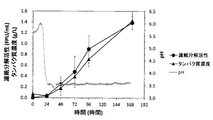
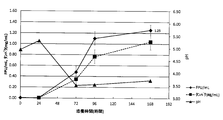
- FIG. 2 is a graph showing changes in pH and changes in cellulase activity (filter paper degrading activity “FPU”) and protein concentration in a culture supernatant of Trichoderma reesei RUT-C30 in Example 1 over the main culture period. Electropherogram showing the results of protein separation and detection (by Coomassie brilliant blue (CBB) staining) of the cellulase agent (5 lots) obtained by the method of Example 1 and a commercially available improved cellulase preparation by SDS-PAGE. It is.
- CBB Coomassie brilliant blue
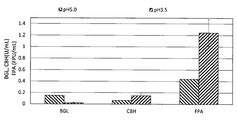
- ⁇ -glucosidase activity BGL in the culture supernatant 171 hours after the start of the main culture was started.
- CBH Cellobiohydrolase activity
- FPA cellulase activity
- concentration b
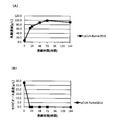
- a culture solution obtained by culturing a lactic acid bacterium (pCUA-Rumal 2816 strain) presenting a ⁇ -glucosidase surface layer at a wet weight of 20 g (per liter of culture solution) using the cellulosic biomass treated with the cellulase agent obtained by the method of Example 1 2 shows the time-dependent changes in lactic acid concentration (A) and cellobiose concentration (B).
- cellulase agent refers to a composition containing at least one enzyme having an ability to degrade plant cell wall components including cellulose and having the ability to degrade plant cell wall components as a whole cellulase agent.
- cell wall components in which the cellulase agent has the ability to degrade include cellulose and hemicellulose, and degradation products thereof, and the “degradation product” is a sugar composed of two or more disaccharides.
- Cellulose is a polymer in which glucose is linearly polymerized by ⁇ -1,4 glycosidic bonds (also referred to as “ ⁇ -1,4 bonds”).
- Hemicellulose is a generic term for insoluble dietary fibers other than cellulose and pectin among plant cell wall components, and is composed of xylan, mannan, galactan and the like.
- Examples of enzymes having the resolution of cell wall components include cellulase and hemicellulase.
- cellulase refers to an enzyme that hydrolyzes the ⁇ -1,4 bond of ⁇ -1,4-glucan (eg, cellulose).
- ⁇ -1,4-glucan eg, cellulose
- cellulase refers to any one of endoglucanase, cellobiohydrolase and ⁇ -glucosidase.
- endoglucanase is an enzyme also referred to as “cellulase” in a narrow sense, cuts cellulose from the inside of the molecule, and removes glucose, cellobiose, and / or cellooligosaccharide (polymerized). Degrees of ⁇ 3, and preferably ⁇ 10, but is not limited to).
- cellobiohydrolase degrades cellulose from either its reducing or non-reducing end, releasing cellobiose.
- ⁇ -glucosidase is an exo-type hydrolase that separates a glucose unit from a non-reducing end in cellulose.
- ⁇ -glucosidase cleaves ⁇ -1,4 bond between aglycone or sugar chain and ⁇ -D-glucose, and hydrolyzes cellobiose or cellooligosaccharide to produce glucose.
- ⁇ -glucosidase is one example of an enzyme that hydrolyzes cellobiose or cellooligosaccharides.
- hemicellulase is a general term for enzymes that degrade hemicellulose.
- Hemicellulases include xylan-degrading enzymes, which include, for example, xylanase and xylosidase.
- xylan is a heterosaccharide having a polymer in which xylose is linearly polymerized by ⁇ -1,4 bonds as a main chain and various sugars in a side chain.
- xylanase ( ⁇ 1,4-xylanase) refers to an enzyme that hydrolyzes the ⁇ -1,4 bond of xylan.
- Xylanase randomly cleaves the backbone portion of xylan from the interior, yielding xylose, xylobiose and / or xylo-oligosaccharides with a degree of polymerization of 3 or more and preferably 10 or less, but not limited thereto.
- xylosidase ⁇ -xylosidase refers to an enzyme that hydrolyzes xylan from its non-reducing end to its ⁇ -1,4 bond to release xylose.
- the “cellulase activity” is an activity of hydrolyzing ⁇ -1,4 bond of cellulose.
- a filter paper decomposing activity (Filter Paper Unit: FPU) is used as an index.
- the filter paper degrading activity can be measured based on the method of Mandels et al. (1976), as described in Industrial Crops and Products 20 (2004) 49-57.
- the filter paper decomposing activity is expressed as one unit (FPU) of an enzyme that releases 1 ⁇ mol of glucose per minute using a filter paper (for example, Advantec No. 1: Toyo Roshi Kaisha, Ltd.) as a substrate.
- ⁇ -glucosidase activity was determined using Berghem and p-nitrophenyl ⁇ -D-glucopyranoside (pNPG) as substrates, as described in Journal of Bioscience and Bioengineering, VOL. 111 No. 2, 121-127, 2011. It can be measured based on Pettersson's method.
- the ⁇ -glucosidase activity is expressed as one unit (U) of the enzyme which releases 1 ⁇ mol of nitrophenol from the substrate p-nitrophenyl ⁇ -D-glucopyranoside (pNPG) in one minute.
- Cellobiohydrolase activity can be measured in the same manner as for ⁇ -glucosidase activity except that p-nitrophenyl- ⁇ -D-cellobiose was used as a substrate.
- the cellobiohydrolase activity is expressed as one unit (U) of the enzyme which releases 1 ⁇ mol of nitrophenol from the substrate p-nitrophenyl- ⁇ -D-cellobiose in one minute.
- the term “Trichoderma microorganism” refers to a microorganism belonging to the genus Trichoderma.
- the “Trichoderma microorganism” is not particularly limited as long as it can produce a cellulase agent.
- the Trichoderma microorganism is Trichoderma reesei, Trichoderma harzianum, Trichoderma longibrachiatum, Trichoderma viride, and the like.
- it is Trichoderma reesei QM6a and its derivative (nonpatent literature 5).
- Trichoderma reesei QM6a is available from, for example, the ATCC (ATCC 13631), and as its derivatives, for example, Trichoderma reesei RUT-C30 (ATCC 56765) and Trichoderma reesei QM9414 (ATCC 26921) are available.
- Trichoderma Risei QM6a NBRC31326), Trichoderma Risei QM9414 (NBRC31329), and the like are also available from the National Institute of Technology and Evaluation (NITE).
- the Trichoderma microorganism is a non-genetically modified strain for a cellulase agent.
- ⁇ Culture the microorganism of the genus Trichoderma to produce a cellulase agent In culturing a microorganism of the genus Trichoderma, a Mandels medium is usually used.
- the Mandels medium can be prepared, for example, according to the method described in M. Mandels and R.E. Andreotti, Problems and Challenges in the Cellulose to Cellulase Fermentation. Process Biochem 13 (1978) 6-13.
- the culture medium of the microorganism of the genus Trichoderma contains a polysaccharide in which at least two glucoses are ⁇ -1,4 linked. Thereby, production of a cellulase agent of a microorganism of the genus Trichoderma can be induced.
- polysaccharide in which at least two glucoses are ⁇ -1,4 bonded examples include cellobiose, cellobiooligosaccharide, cellulose (for example, crystalline cellulose (for example, Avicel (Avicel)), etc. “At least two glucoses are ⁇ .
- the “-1,4 linked polysaccharide” may be a cellulosic biomass as described below, for example, a sugarcane bagasse steamed with steam may be used. It may further contain other components commonly used for culturing microorganisms (for example, peptone).
- the microorganism of the genus Trichoderma is cultured at pH 1 or more and less than 5.
- the pH is 3 or more and less than 5.
- the above-mentioned predetermined pH can be adjusted by adding a salt, and such a salt is a salt (for example, sodium hydroxide) which is usually used for pH adjustment in culturing microorganisms.
- the culture may be performed without adjusting the pH before the culture at the predetermined pH, and the present invention also includes such culture.
- the pH of the culture medium can be 5 or more (for example, around 5 to 6). As the cultivation progresses, the pH may drop below 5 (eg, around 3.5). Thereafter, the microorganism of the genus Trichoderma may be cultured while adjusting to the lowered pH.
- the cellulase having a ratio of ⁇ -glucosidase activity to filter paper decomposition activity of less than 3 can be produced by the microorganism of the genus Trichoderma.
- the produced cellulase has a ratio of ⁇ -glucosidase activity to filter paper degrading activity of less than 1, less than 0.5, less than 0.3, less than 0.2, less than 0.1. Lower, lower than 0.06, lower than 0.04, lower than 0.03 or lower than 0.02.
- the numerical value of the above ratio is a value obtained when the ⁇ -glucosidase activity is measured at 50 ° C. (a temperature that can be usually used for liquefaction). ⁇ -glucosidase activity measured at 50 ° C. tends to show higher activity than that measured at 35 ° C.
- the cellulase agents produced preferably include endoglucanases and cellobiohydrolases. If the pH is less than 1, the growth of the microorganism of the genus Trichoderma may be suppressed.
- the cellulase agent produced further comprises xylanase.
- the cellulase agent produced may also include xylosidase.
- culturing conditions such as temperature, aeration, cell amount and the like during the culturing
- conditions usually used for culturing Trichoderma microorganisms can be used.
- the culturing time depends on the initial cell amount or the final cellulase activity to be recovered, but is, for example, 24 hours to 240 hours, preferably 72 hours to 192 hours.
- preliminary culture may be performed before culture for production and recovery of the cellulase agent (“main culture”).
- TP cellulase agent produced by the above-mentioned method for producing a cellulase agent is also referred to as “TP cellulase agent” in this specification.
- This “TP cellulase agent” can be recovered from a culture of a microorganism of the genus Trichoderma by, for example, solid-liquid separation (eg, centrifugation and filter filtration). After recovery, the “TP cellulase agent” may be concentrated, if necessary, by a method commonly used by those skilled in the art (for example, using an evaporator).
- the "surface-displaying microorganism" used in the present invention will be described below.
- the surface-displaying microorganism refers to a microorganism that presents a target molecule (for example, a protein such as an enzyme) on the surface of the bacterial cell.
- ⁇ -glucosidase surface-displaying microorganism refers to a microorganism that presents ⁇ -glucosidase on the surface of its cells. For example, by transforming a host microorganism using a surface display cassette containing a ⁇ -glucosidase gene, a ⁇ -glucosidase surface-displayed transformed microorganism (also simply referred to as “ ⁇ -glucosidase surface-displayed microorganism”) is produced.
- ⁇ -glucosidase surface-displayed microorganism also simply referred to as “ ⁇ -glucosidase surface-displayed microorganism”
- ⁇ -glucosidase 1 and ⁇ -glucosidase 2 are two types of ⁇ -glucosidase 1 and ⁇ -glucosidase 2, respectively.
- ⁇ -glucosidase examples include ⁇ -glucosidase from Aspergillus acreeatus (especially BGL1) (eg, WO2015 / 33948) and ⁇ -glucosidase gene from Ruminococcus albus (GenBank ⁇ Sequence ⁇ ID: X1545.1), but is not limited thereto.
- a xylosidase surface-displaying microorganism refers to a microorganism that presents xylosidase on the surface of its cells.
- the xylosidase includes, for example, ⁇ -xylosidase (XylA) derived from Aspergillus oryzae.
- Xylosidase surface-displaying microorganisms are created using microorganisms that metabolize xylose.
- a microorganism that is genetically modified to be able to metabolize xylose that metabolizes xylose may be used.
- Saccharomyces cerevisiae which normally metabolizes hexose glucose and cannot metabolize pentose xylose
- Saccharomyces cerevisiae which normally metabolizes hexose glucose and cannot metabolize pentose xylose
- a genetically modified microorganism has a xylose metabolic gene. As described above.
- the xylose assimilating gene includes a xylose metabolic enzyme gene, for example, a xylose reductase (XR) gene (for example, derived from Pichia stipitis: INSD accession number X59465 or A16164), and xylitol dehydrogenase (XDH) Genes (eg, from Pichia stippitis: INSD accession number X55392 or A16166), and xylulokinase (XK) genes (eg, from Saccharomyces cerevisiae: INSD accession number X82408). Saccharomyces cerevisiae genetically modified to express these three genes can be preferably used for producing a xylosidase surface-displaying microorganism.
- XR xylose reductase
- XDH xylitol dehydrogenase
- XK xylulokinase
- the surface-displaying microorganism may be one that displays both ⁇ -glucosidase and xylosidase on the surface.
- Microorganisms displaying both ⁇ -glucosidase and xylosidase on the surface are useful, for example, when the medium in which the microorganisms are cultured contains cellulose and hemicellulose.
- the term “ ⁇ -glucosidase surface-displaying microorganism” also includes microorganisms that further display another protein (eg, xylosidase) on the surface as long as ⁇ -glucosidase is surface-displayed.
- microorganism displaying xylosidase on the surface also includes microorganisms that further display another protein (eg, ⁇ -glucosidase) on the surface as long as xylosidase is displayed on the surface.
- another protein eg, ⁇ -glucosidase
- the host microorganism is not particularly limited, but examples include yeast, lactic acid bacteria, filamentous fungi, coryneform bacteria, Escherichia coli, and Zymonas bacteria. From the viewpoint of utilization in alcohol production, microorganisms having an ability to ferment alcohol (for example, ethanol) are preferable, and such microorganisms include, for example, yeast. From the viewpoint of utilization in lactic acid production, lactic acid bacteria are preferred.
- yeast examples include Saccharomyces, Pichia, Schizosaccharomyces, Kluyveromyces, and Candida.
- yeast belonging to the genus Saccharomyces is preferred, and Saccharomyces cerevisiae is more preferred.
- strains of Saccharomyces cerevisiae include, for example, Saccharomyces cerevisiae NBRC1440 strain (available from National Institute of Technology and Evaluation) and Saccharomyces cerevisiae TJ14 strain (Moukamnerd et al., Appl. @ Microbiol. @ Biotechnol., 2010, No. 88). 87, p.
- yeast examples include the following strains: Pichia pastoris GS115 (manufactured by Invitrogen) and Pichia anomala NBRC10213 strain, Schizosaccharomyces pombe NBRC1628 strain, and Kleu strain NBRC1628.
- Kluyveromyces lactis strain NBRC1267 and Kluyveromyces marxianus NBRC1777 strain (Yanase et al., Appl. Microbiol. Biotechnol, 2010, vol. 88, pp. 381-388), Candida utilis Candida utilis) NBRC 0988 strain (Tomita et al., PLoS One. 2012; 57 (5): e37226) (all NBRC strains are available from National Institute of Technology and Evaluation).
- Lactic acid bacteria is a general term for bacteria that produce lactic acid from sugars by metabolism or fermentation. Lactic acid bacteria can be mainly classified into four types: bifidobacteria, enterococci, lactobacilli, and streptococci. Preferably, Lactobacillus bacteria can be used. As lactic acid bacteria, Streptococcus (Streptococcus), Lactobacillus (Lactobacillus), Bifidobacterium (Bifidobacterium), Lactococcus (Lactococcus), Pediococcus (Pediococcus), or Leuconostoc (Leuconostoc) Belonging bacteria.
- lactic acid bacteria examples include Streptococcus thermophilus (Streptococcus thermophilus), Streptococcus cremoris (Streptococcus cremoris), Streptococcus faecalis (Streptococcus faecalis), Streptococcus lactis bacillus, and Lactobacillus lactis bacillus, Streptococcus lactobacillus Acidophilus (Lactobacillus acidophilus), Lactobacillus casei (Lactobacillus casei), Lactobacillus delbrueckii (Lactobacillus delbrueckii), Lactobacillus arabinose (Lactobacillus arabinosus), Lactobacillus saccharus (Lactobacillus sacylus) ), Lactobacillus ⁇ ⁇ Leishmanni, Lactobacillus muscicus (Lactob) acillus musicus), Lactobacillus thermophilus
- Lactic acid bacteria also include sporulated lactic acid bacteria.
- Spore-forming lactic acid bacteria are a general term for sporic lactic acid bacteria.
- Examples of the sporulated lactic acid bacteria include bacteria belonging to the genus Bacillus.
- the spore-forming lactic acid bacteria belonging to the genus Bacillus may have heat resistance (for example, can grow under high heat such as 45 ° C.), high fermentation rate, and wide saccharide utilization.
- Examples of the bacteria belonging to the genus Bacillus include, for example, Bacillus coagulans (also known as "sporalactic acid bacteria") and Bacillus lincheniformis.
- the lactic acid bacteria may be those that have been genetically modified.
- a recombinant microorganism into which either the L- or D-lactate synthase gene has been incorporated or destroyed can be mentioned.
- genetically modified microorganisms for example, Lactobacillus plantarum ldhL1 :: amyA strain (Okano et al., Appl. Environ. Microbiol. 2009, Vol.75, 462-467), and Lactobacillus plantarum ⁇ ldhL1 :: PxylAB-xpk1: : tkt- ⁇ xpk2 :: PxylAB strain (Yoshida et al., Appl. Microbiol.
- Lactobacillus plantarum ldhL1 amyA strain is a recombinant strain that secretes ⁇ -amylase and produces D-lactic acid from glucose, and is a Lactobacillus plantarum ⁇ ldhL1 :: PxylAB-xpk1 :: tkt- ⁇ xpk2 :: PxylAB strain Is a recombinant strain that produces D-lactic acid from both glucose and xylose.
- Examples of the surface display technology relating to various host microorganisms used for producing the surface display microorganism include, for example, JP-A-11-290078, WO02 / 085935, WO2015 / 033948, and WO2007 / 033948. 2016/017736, Biotechnology for Biofuels, 7 (1): 8 (2014), and K. Onodera et al., Biochemical Engineering Journal 128 (2017) 195-200 (yeast); Journal of Biotechnology, Vol. 89, No. 4, , 154-160 (2011), Abstracts of Research Presentations of the 70th Annual Meeting of the Chemical Engineering Society, Session ID F123 (http://doi.org/10.11491/scej.2005.0.255.0), Appl. Environ.
- the surface display cassette uses a surface display cassette, and the surface display cassette can be used to combine DNA encoding the anchor domain of the anchor protein and DNA encoding the secretion signal together with DNA encoding ⁇ -glucosidase to be displayed on the surface. May be included in any arrangement.
- the surface display cassette may be located between the promoter and the terminator. Anchor domains and secretion signals are also described in the literature.
- anchor domain examples include an anchor domain of a GPI anchor protein (eg, SED1, ⁇ - or a-agglutinin (AG ⁇ 1, AGA1), FLO1, etc.) for yeast, a CA domain of a peptidoglycan binding protein AcmA and a bacillus for lactic acid bacteria.
- GPI anchor protein eg, SED1, ⁇ - or a-agglutinin (AG ⁇ 1, AGA1), FLO1, etc.
- CA domain of a peptidoglycan binding protein AcmA a peptidoglycan binding protein AcmA
- bacillus for lactic acid bacteria.
- -PgsA protein which is a subunit of a poly- ⁇ -glutamic acid biosynthetic enzyme complex (PgsBCA) derived from Baccilus subtilis.
- the surface-displaying microorganism may be fixed on a carrier. This allows for reuse in the method described below.
- the carrier and the method for immobilization those usually used by those skilled in the art are used.
- the fixing method include a carrier binding method, an entrapment method, a crosslinking method, and the like.
- a porous body is preferably used.
- foams or resins such as polyvinyl alcohol, polyurethane foam, polystyrene foam, polyacrylamide, polyvinyl formal resin porous body, and silicone foam are preferable.
- the size of the opening of the porous body can be determined in consideration of the microorganism to be used and the size thereof.
- the size is preferably in the range of 50 to 1000 ⁇ m.
- the shape of the carrier is not limited. In consideration of the strength of the carrier, the culture efficiency, and the like, a spherical or columnar (eg, cubic) shape is preferable. The size may be determined depending on the microorganism to be used. In general, the diameter is preferably 2 to 50 mm in the case of a sphere, and 2 to 50 mm square in the case of a column.
- a material containing a polysaccharide substrate that is decomposed by a TP cellulase agent (“a material containing a TP cellulase agent-decomposed substrate”) is treated with the cellulase agent (“TP cellulase agent”) produced by the above-described cellulase production method.
- TP cellulase agent the cellulase agent
- the enzyme that produces sugars metabolized by the microorganism from the treated product can be used for culturing microorganisms that display on the surface.
- the “TP cellulase agent-decomposing substrate-containing material” includes, for example, a material containing a cellulose material and a xylose-containing polysaccharide, and a mixture thereof.
- a cellulosic material is treated with a TP cellulase agent, and the treated material can be used for culturing a ⁇ -glucosidase surface-displaying microorganism.
- the ⁇ -glucosidase surface-displaying microorganism can produce a saccharified fermentation product by such culture.
- a material containing a xylose-containing polysaccharide is treated with a TP cellulase agent, and the treated product can be used for culturing a microorganism that has xylose metabolism ability and displays xylosidase on the surface ("a microorganism presenting on the surface of xylose-metabolized xylosidase"). it can.
- xylose-containing polysaccharide refers to a polysaccharide containing xylose as a component, and includes at least the disaccharide xylose.
- a xylose-metabolizing xylosidase surface-displaying microorganism can produce a saccharified fermentation product by such culture.
- Cellulose material refers to any material containing cellulose.
- examples of the xylose-containing polysaccharide include xylan and hemicellulose containing xylan. Both cellulose and xylose-containing polysaccharides hydrolyze to lower saccharides (eg, glucose or cellobiose from cellulose, xylose or xylobiose from xylose-containing polysaccharides) (this reaction is also referred to as "saccharification").
- Glucose and / or xylose obtained by the saccharification reaction can be used as a substrate by a fermenting microorganism (eg, yeast, lactic acid bacteria, etc.) to produce a fermentation product (eg, ethanol, lactic acid, etc.) (this reaction is referred to as “fermentation”). Or “fermentation production”).
- Saccharification and fermentation by a microorganism using a sugar obtained by the saccharification as a substrate are also referred to as “saccharification fermentation”.
- saccharification and fermentation The product obtained by saccharification and fermentation is also referred to herein as “saccharification and fermentation product”.
- Cellulose-based biomass is an example of the cellulosic material.
- Cellulosic biomass refers to a material derived from biological resources and containing cellulose. Use of cellulosic biomass is preferred because it does not compete with food.
- Examples of the material containing the xylose-containing polysaccharide include a material containing xylan and a material containing hemicellulose.
- Cellulosic biomass includes plant biomass. Plant biomass includes cellulose and hemicellulose, and thus can be used both as a cellulosic material and as a material containing a xylose-containing polysaccharide.
- Examples of the cellulosic biomass or plant biomass include wastes generated when processing biological materials such as rice, wheat, corn, sugar cane, palm, wood (pulp), and napier grass.
- Examples of the cellulosic biomass or plant biomass include rice straw, wheat straw, palm empty fruit cluster, bagasse (residue after squeezing sugarcane).
- the TP cellulase agent-decomposing substrate-containing material may be pretreated.
- the pretreatment is a treatment performed on a material containing the substrate before the substrate is decomposed by the enzyme, thereby facilitating the action of the enzyme on the substrate contained in the material.
- a material containing the substrate for example, to hydrolyze cellulose to glucose, prior to treatment with cellulose hydrolase, to facilitate the action of the enzyme on cellulose, cellulose is converted from a cellulosic material (eg, biomass) prior to the enzymatic reaction. It refers to the process of separating and exposing.
- the pretreatment method is not particularly limited. For example, hydrothermal decomposition, squeezing, steaming and the like can be mentioned, and these methods may be used in combination.
- hydrothermal decomposition method for example, cellulosic biomass is pulverized, if necessary, mixed with water so as to have a content of, for example, about 20% by mass (dry mass), and the mixture is heat-treated.
- the hydrothermal treatment is performed at 120 to 300 ° C., preferably 150 to 280 ° C., more preferably 180 to 250 ° C. for 15 seconds to 1 hour.
- the processing temperature and time can vary depending on the biomass used, and increasing the processing temperature can shorten the processing time. Note that pressure may be applied during the heat treatment.
- the pressing is not particularly limited, and examples thereof include a method of pressing the cellulosic biomass with a hydraulic pressing machine, a screw press, a meat extractor, a press dehydrator, a centrifuge, or the like.
- the steaming method is not particularly limited, and examples thereof include a method of steaming cellulosic biomass with high-temperature steam.
- the conditions for the steaming are not particularly limited.
- the lignocellulosic biomass is impregnated with 1% by mass to 5% by mass of sulfuric acid, and heated at 180 ° C. to 1.0 Mpa to 1.6 Mpa.
- the conditions for steaming at 200 ° C. for 5 minutes to 30 minutes are mentioned.
- the amount of cellulose and hemicellulose obtained by the pretreatment can be adjusted.
- the plant biomass may be treated with ammonium oxalate to remove pectin after delignification treatment as necessary, and then treated with alkali to obtain hemicellulose.
- a pretreatment method such as an ammonia explosion treatment, a pulverization treatment, or an ionic liquid treatment is used, cellulose and hemicellulose can be obtained from plant biomass.
- Treat the TP cellulase agent-decomposing substrate-containing material with the TP cellulase agent can be performed by mixing the TP cellulase agent and the TP cellulase agent decomposition substrate-containing material, preferably with stirring.
- the treatment conditions are not limited as long as the solid content of the material is liquefied.
- the amount of the TP cellulase agent to the cellulosic material depends on the type of the cellulosic material used, but is, for example, 1 to 50 FPU / g dry material weight, preferably 5 to 20 FPU / g dry material weight.
- the amount of TP cellulase agent to the material containing the xylose-containing polysaccharide depends on the type of material used, but is, for example, 10-2000 g / kg dry material weight, preferably 50-800 g / kg dry material weight.
- the temperature of the treatment is, for example, 25 to 70 ° C, preferably 35 to 55 ° C.
- the ⁇ -glucosidase surface-displaying microorganism is cultured in a medium containing a cellulose material treated with a TP cellulase agent. By such culture, the ⁇ -glucosidase surface-displaying microorganism can produce a saccharified fermentation product.
- the enzyme titer of the ⁇ -glucosidase surface-displaying microorganism is determined based on the filter paper-degrading activity of cellulase (in this method, a TP cellulase agent) added for the treatment of the cellulosic material (from outside the microorganism).
- the ratio of ⁇ -glucosidase activity of the microorganism When expressed as a ratio of ⁇ -glucosidase activity of the microorganism, it is 0.02 to 2.5, preferably 0.1 to 0.7.
- the above numerical values are values obtained when the ⁇ -glucosidase activity of the ⁇ -glucosidase surface-displaying microorganism is measured at 35 ° C. (a temperature that can be generally used for culturing microorganisms for saccharification and fermentation).
- the ratio of the enzyme titer is within such a range, the production of a saccharified fermentation product by the microorganism displaying the ⁇ -glucosidase surface layer can be efficiently performed.
- the enzyme titer of the ⁇ -glucosidase surface-displaying microorganism that is, the ratio of the ⁇ -glucosidase activity of the microorganism to the filter paper-degrading activity of the TP cellulase agent, is determined by the type of the ⁇ -glucosidase surface-displaying microorganism, culture (for example, culture for saccharification and fermentation). )) And the temperature (for example, in the case of ⁇ -glucosidase surface display yeast, it can be set to 35 ° C. or 50 ° C.).
- the ratio of the enzyme titer is determined by using an activity value measured at 50 ° C., which is a temperature usually used for measuring ⁇ -glucosidase activity, and is, for example, a higher value as shown in Examples below. Can be indicated.
- a xylosidase surface-displaying microorganism is treated with a TP cellulase agent and cultured in a medium containing a material containing a xylose-containing polysaccharide. By such culture, the xylosidase surface-displaying microorganism can produce a saccharified fermentation product.
- This culture medium may contain the treated TP cellulase agent-decomposing substrate-containing material and the TP cellulase agent.
- the culture medium may further contain other components commonly used in culturing surface-displaying microorganisms.
- the treatment of the TP cellulase agent-decomposing substrate-containing material with the TP cellulase agent can be performed before the culture of the surface-displaying microorganism. Further, the treatment of the TP cellulase agent-decomposing substrate-containing material with the TP cellulase agent and the culture of the surface-display microorganism may be performed in parallel.
- the culturing conditions for the surface-displayed microorganism depend on the type of the host microorganism, but the growth rate of the microorganism, the amount of saccharified fermentation product produced by the microorganism, and the activity of enzymes ( ⁇ -glucosidase, xylosidase, etc.) displayed on the surface. It can be set appropriately in consideration of the above.
- the culturing conditions will be described below with reference to a case where the ⁇ -glucosidase surface-displaying microorganism is a ⁇ -glucosidase surface-displaying yeast, but is not limited thereto.
- the cell concentration at the start is not particularly limited, and may be, for example, about 2 g to 20 g wet weight / L (1 ⁇ 10 7 cells / mL to 1 ⁇ 10 8 cells / mL).
- the culture conditions are not particularly limited, and may be the conditions for ethanol fermentation using glucose as a substrate.
- the culture temperature is, for example, 30 ° C. to 37 ° C.
- the culture pH is, for example, 4 to 8.
- the culture time is, for example, 2 to 3 days.
- the end of fermentation is determined based on, for example, that the amount of generated carbon dioxide gas is reduced to one tenth or less of the start of fermentation.
- the surface-displaying microorganism may be collected after the completion of the culture and used repeatedly for the next culture.
- the method described in WO 2013/146540 can be used.
- the present invention also provides a method for producing a saccharified fermentation product.
- the microorganism can produce a saccharified fermentation product from a cellulose material.
- the saccharified fermentation product depends on the type of the surface-displaying microorganism to be cultured, and includes, for example, ethanol (for example, by culturing surface-displaying yeast) and lactic acid (for example, by culturing surface-displaying lactic acid bacteria).
- ethanol for example, by culturing surface-displaying yeast
- lactic acid for example, by culturing surface-displaying lactic acid bacteria.
- yeast ethanol can be produced as a saccharified fermentation product, but is not limited thereto.
- the surface display microorganism may be modified (for example, by genetic recombination) other than the surface display technology as described above. Such modifications include, for example, modification of the metabolic system of fermentation for the purpose of changing the produced saccharified fermentation product or improving the production efficiency of the saccharified fermentation product.
- a microorganism that displays multiple proteins eg, a combination of enzymes (eg, ⁇ -glucosidase and xylosidase)
- a microorganism that displays multiple proteins eg, a combination of enzymes (eg, ⁇ -glucosidase and xylosidase)
- the method for producing a saccharified fermentation product further includes the step of producing a cellulase agent by the above-described cellulase agent production method.
- a cellulase agent used for producing a saccharified fermentation product for example, ethanol
- the cellulase agent can be prepared at a site where the saccharified fermentation product is produced.
- the saccharified and fermented product obtained by culturing the surface-displaying microorganism can be collected from the microorganism culture medium by a method commonly used by those skilled in the art, and can be separated and purified as necessary.
- filter paper decomposition activity As the cellulase activity, filter paper decomposition activity (FP activity) was measured according to the method of Mandels et al. (1976) as described in Industrial Crops and Products 20 (2004) 49-57. More specifically, a 1 cm ⁇ 6 cm filter paper (Advantec No. 1: Toyo Filter Paper Co., Ltd.) was used as a substrate, and this was used as a sample solution (0.5 mL of a diluted cellulase solution (culture supernatant) and 1.0 mL of a 0. 1 mL solution). The mixture was added to a 05 M citrate buffer (containing pH 5.0), left at 50 ° C. for 60 minutes, and stopped by adding 3 mL of DNS reagent.
- FP activity filter paper decomposition activity
- the amount of reducing sugars in this mixture was assayed by the DNS method.
- the filter paper decomposing activity was expressed as 1 FPU / mL of an enzyme capable of releasing 1 ⁇ mol of glucose per minute by this method.
- the protein concentration was measured by the Bradford method using Quick Start TM Bradford (Bio-Rad Laboratories, Inc.) (bovine serum albumin (BSA) was used as a calibration curve substrate).
- ⁇ -glucosidase activity was determined using p-nitrophenyl ⁇ -D-glucopyranoside (pNPG) as a substrate, as described in Journal of Bioscience and Bioengineering, VOL. 111 No. 2, 121-127, 2011. , Berghem and Pettersson. More specifically, a reaction solution consisting of 100 ⁇ L of 3 mM @pNPG, 15 ⁇ L of 1 M acetate buffer (pH 5.0), 155 ⁇ L of sterilized water and 30 ⁇ L of enzyme diluent was stirred at 50 ° C. or 35 ° C. for 10 minutes, The reaction was stopped by adding 0.3 mL of 1 M sodium carbonate.
- pNPG p-nitrophenyl ⁇ -D-glucopyranoside
- the released p-nitrophenol was measured at 400 nm using a microplate reader (SH-1000Lab, Hitachi High-Tech Science Corporation).
- ⁇ -glucosidase activity was expressed as the amount of enzyme that releases 1 ⁇ mol of nitrophenol from the substrate per minute as 1 unit (U).
- CBH activity Cellobiohydrolase activity
- EG activity Endoglucanase activity
- CMC p-nitrophenyl- ⁇ -D-carboxymethylcellulose
- xylanase activity 0.1 mL of the diluted sample and 0.1 mL of 2 (w / v)% xylan substrate solution were added to a 1.5 mL tube, and reacted at 50 ° C. for 30 minutes with stirring. The reaction was stopped by adding 0.6 mL of DNS reagent, and the mixture was heated at 100 ° C. for 5 minutes to develop color.
- the 2 (w / v)% xylan substrate solution is obtained by suspending 2% (w / v)% xylan derived from beechwood (manufactured by SIGMA) in a 0.1 M citrate buffer solution (pH 5.0) and heating at 4 ° C.
- the insoluble xylan was collected by centrifugation (10000 ⁇ g, 10 minutes, 4 ° C.) and suspended in 10 mL of the same buffer to prepare a substrate solution for measuring xylanase activity.
- the control value was a color obtained by adding a 2% (w / v) xylan substrate solution to a sample stirred at 50 ° C. for 30 minutes without incubating at 50 ° C.
- the xylanase activity was expressed as the amount of enzyme that produces 1 ⁇ mol of xylose from the substrate in one minute as one unit (U).
- xylosidase activity Xyd activity
- a sample and a synthetic substrate p-nitrophenyl- ⁇ -D-xylopyranoside manufactured by Wako Pure Chemical Industries, Ltd.
- 1 mM acetate buffer pH 5.0
- the reaction was stopped by adding the same amount of a 1 M aqueous sodium carbonate solution, and the color was developed.
- the supernatant after centrifugation (15000 rpm, 5 minutes, 4 ° C.) was measured for absorbance at 440 nm, and the amount of generated p-nitrophenol was converted.
- the control value was a color developed without performing the incubation operation at 50 ° C.
- the xylosidase activity was expressed as 1 unit (U) of the amount of the enzyme that produced 1 ⁇ mol of p-nitrophenol from the substrate in 1 minute.
- the measurement of the enzyme activity of the microbial cells was performed at 50 ° C. or 35 ° C. using a culture supernatant or a cell suspension as an enzyme diluent for the reaction with the substrate.
- the culture supernatant was prepared by collecting 1 mL of the bacterial cell culture solution after the following 72-hour flask culture and centrifuging at 3500 rpm for 5 minutes to obtain a supernatant.
- For the cell suspension 1 mL of the cell culture liquid after flask culture for 72 hours was collected and centrifuged at 3500 rpm for 5 minutes to obtain a precipitate, which was washed with sterile water, and then subjected to wet cell weight. Was measured, and the pellet was prepared by suspending the pellet in 1 mL of sterile water.
- the enzyme activity of the cells was determined as the enzyme activity (U / g) per gram of wet weight of the cells.
- the ethanol concentration and sugar (eg, cellobiose, glucose, xylose, and reducing sugar) concentrations in the liquefied liquid and the saccharified fermentation broth were quantified by HPLC (High-performance liquid chromatography system; Hitachi High-Tech Fielding, LaChrom Elite).
- HPLC High-performance liquid chromatography system; Hitachi High-Tech Fielding, LaChrom Elite.
- ULTRON @ PS-80H (Shinwa Kako Co., Ltd., 300 mm (L) x 8 mm (ID)) was used for the HPLC separation column, and ultrapure water (purified water by Milli-Q manufactured by Nippon Millipore Co., Ltd.) was used for the mobile phase.
- a 3 mM aqueous solution of perchloric acid to which perchloric acid was added was used, and a refractive index detector was used as a detector.
- the HPLC conditions were as follows: liquid sending amount 0.7 mL / min and column temperature 80 ° C.
- the lactic acid concentration in the saccharified fermentation broth was determined by converting calcium lactate to lactic acid with the same amount of 2N hydrochloric acid as the sample, and quantifying this amount by HPLC (High performance liquid chromatography system; Hitachi High-Tech Fielding, LaChrom Elite). .
- HPLC High performance liquid chromatography system; Hitachi High-Tech Fielding, LaChrom Elite.
- GL-C610H-S Hitachi High-Tech Science Co., Ltd., 300 mm (L) x 7.8 mm (ID)
- ultrapure water was used for the mobile phase.
- the number of viable cells after culturing was determined by counting the number of colonies that appeared after spraying a part of the culture solution on a YPD plate and incubating at 30 ° C.
- Example 1 Production of Cellulase by Trichoderma reesei RUT-C30 5 mL of a 7-day mycelial suspension of a strain of Trichoderma reesei RUT-C30 (ATCC56765) was placed in a 500 mL baffled Erlenmeyer flask in a preculture medium (1% (w / v) Avicel (crystalline cellulose in Mandels medium)). ) was added, and 100 mL was inoculated and pre-cultured at 28 ° C. at 175 rpm for 3 days.
- a preculture medium 1% (w / v) Avicel (crystalline cellulose in Mandels medium)
- the Mandels medium was prepared according to the method described in M. Mandels and REAndreotti, Problems and Challenges in the Cellulose to Cellulase Fermentation. Process Biochem 13 (1978) 6-13. That is, (NH 4 ) 2 SO 4 : 2.1 g / L, KH 2 PO 4 : 2.0 g / L, urea: 0.3 g / L, CaCl 2 .2H 2 O: 0.4 g / L, MgSO 4.
- the pH was not controlled for a while after the start of the culture, and after the pH dropped to 3.5, the pH was maintained at 3.5 with NaOH.
- the main culture was continued for 171 hours.
- the cellulase activity of the culture supernatant was determined as the cellulase activity (“FPU”) and the protein concentration. It was measured.
- FIG. 1 is a graph showing changes in pH, changes in cellulase activity (filter paper degrading activity “FPU”) and protein concentration in the culture supernatant over the culture period of the main culture.
- the pH was maintained at 3.5 48 hours after the start of the culture.
- the filter paper decomposition activity and the protein concentration increased almost in conjunction. 171 hours after the start of the culture, the filter paper decomposition activity and the protein concentration reached 1.39 FPU / mL and 1.43 g / L, respectively.
- the culture supernatant after 171 hours was centrifuged at 8000 g for 10 minutes, and the filtrate was collected through a nylon filter (11 ⁇ m). Then, the filtrate was concentrated using an evaporator.
- the obtained concentrate had a filter paper decomposition activity of 22.7 FPU / mL and a protein concentration of 22.3 g / L.
- a concentrated solution having a filter paper decomposition activity of 25.4 FPU / mL and a protein concentration of 27.4 g / L was obtained.
- the concentrate thus obtained was used as a cellulase agent.
- Example 2 Examination of enzyme composition and enzyme activity of cellulase agent and various cellulase preparations of Example 1
- 2-1 Examination of protein composition by SDS-PAGE
- the cellulase agent for 5 lots obtained by the method of Example 1 and a commercially available improved cellulase preparation (Cellulase SS (manufactured by Nagase ChemteX Corporation) and Cellic CTec2 (manufactured by Novozymes, Inc .: simply referred to as "CTec2" )) was subjected to SDS-PAGE to examine the protein composition.
- Cellulase SS manufactured by Nagase ChemteX Corporation
- Cellic CTec2 manufactured by Novozymes, Inc .: simply referred to as "CTec2"
- Example 2 is an electrophoretogram showing the results of protein separation and detection (by Coomassie Brilliant Blue (CBB) staining) by SDS-PAGE (lanes M1 and M2: molecular weight markers, lane 1: cellulase SS, lane 2: CTec2, and lanes 3 to 7: cellulase agents obtained by the method of Example 1 (for 5 lots)).
- CBB Coomassie Brilliant Blue
- the cellulase obtained by the method of Example 1 is a cellulase mainly composed of CBH and EG, since most proteins are contained in the molecular weight marker range of 40 kDa to 66.2 kDa. .
- CBH1 63 kDa
- CBH2 58 kDa
- EG1 55 kDa
- EG2 43 kDa
- the cellulase agent obtained by the method of Example 1 contains the largest amount of CBH1 belonging to family 7 of the major enzyme of Trichoderma cellulase, and also the cellulase agent of Trichoderma cellulase, as seen in lanes 3 to 7 in FIG.
- the bands presumed to be the major enzyme species CBH2, EG1, and EG2 also tended to be relatively large.
- the cellulase agent obtained by the method of Example 1 has a large cellulase group without adjusting the mixing ratio of complicated cellulase protein groups (including minor enzyme species called accessory enzymes). It turned out to be an enzyme that occupies a part.
- the enzyme titer of the cellulase preparation (total titer: filter paper decomposition) was calculated by calculating the ratio “B / A” of ⁇ -glucosidase activity to filter paper decomposition activity in various cellulase preparations and bacterial cellulase production cellulases. (Corresponding to the activity), the relative increase in the ⁇ -glucosidase activity was compared.
- the cellulase agent of Example 1 has a low ⁇ -glucosidase activity / filter paper degrading activity (B / A), similarly to a commercially available unmodified cellulase preparation (such as Celluclast 1.5 L) and a non-recombinant Trichoderma reesei strain. I found out. Compared with the other strains of Trichoderma reesei, the cellulase agent of Example 1 had an increased filter paper degrading activity when evaluated per ⁇ -glucosidase activity.
- CTec2 showed an extremely high B / A of 22 to 39 in the literature, and 3.28 even for the cellulase SS of the improved cellulase preparation having a relatively low B / A. .
- FIG. 3 shows each enzyme activity ( ⁇ -glucosidase activity (BGL: U / mL), cellobiohydrolase activity (CBH: U / mL) and filter paper decomposition activity in the culture supernatant 171 hours after the start of the main culture. (FPA: FPU / mL)).
- BGL U / mL
- CBH U / mL
- FPA FPU / mL
- Example 3 Saccharification and fermentation of cellulosic biomass using the cellulase agent of Example 1
- Sugarcane bagasse is steamed at 200 ° C. for 30 minutes with steam, and the water-insoluble fraction after washing with water is dehydrated using a filter cloth until the water content becomes about 70% by weight. used.
- the cellulase agent obtained by the method of Example 1 was used for saccharification and fermentation of cellulosic biomass. Saccharification and fermentation were performed as follows.
- Steamed bagasse (cellulosic biomass) was placed in a 300 mL glass container equipped with a three-one motor with helical ribbon blades. While keeping the glass container warm at 50 ° C. in a water bath, a cellulase agent was added so as to be 10 FPU / g (dry biomass weight), and the mixture was stirred at 50 rpm for 4 hours to liquefy biomass solids.
- This liquefied liquid contained about 24% by weight of solids and contained about 12 g / L glucose and about 30 g / L cellobiose (sugar liberated from biomass by enzymatic saccharification).
- yeast was inoculated into an Erlenmeyer flask containing 100 mL of YPD medium, cultured at 150 ° C. for 3 days at 30 ° C., and then the cell concentration in the culture solution was adjusted to 200 g (wet weight) / L by centrifugation.
- a yeast solution was prepared as follows.
- a liquefied liquid of the biomass solids is adjusted to pH 5.4, and the yeast liquid is added to the liquefied liquid (in a 100 mL glass container) so as to have a wet weight of 2 g or 20 g (per liter of fermentation liquid).
- the yeast was cultured while keeping the temperature at 35 ° C. in a water bath and stirring with a magnetic stirrer at 200 rpm to start saccharification and fermentation. Under these conditions, the biomass solids in the culture solution (total of the liquefied solution and the yeast solution) was 21.7% by weight, and the glucose component (present as cellulose) was originally 51.8% by weight in the dry solids of the steamed bagasse. %, 57.3 g / L of ethanol would theoretically be produced by yeast fermentation. The ethanol concentration and cellobiose concentration in the culture solution were measured over time.
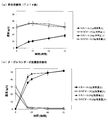
- FIG. 4 shows the concentration of ethanol in the culture solution when 2 g and 20 g (per liter of fermentation liquor) of yeast were cultured using the cellulosic biomass treated with the cellulase agent obtained by the method of Example 1.
- the time course of cellobiose concentration is shown (a: wild-type yeast (TJ14 strain) and b: ⁇ -glucosidase surface display yeast).
- the cellobiose concentration decreased regardless of the initial yeast concentration, and the ethanol concentration in a 72-hour culture reached 52.1 to 52.5 g / L (90% of the theoretical yield). 0.9 to 91.6%).
- the 2 h (wet weight) / L has a slightly lower fermentation rate, so the ethanol concentration in the 24-hour culture is slightly lower, but the same in the 48-hour culture.
- the ethanol concentration reached 49.5 g / L. That is, when the target set value of the ethanol production rate was 1 g / (L ⁇ time), it was found that there was no problem even if the initial yeast concentration was 2 g (wet weight) / L.
- the secretion of the enzyme into the culture supernatant was extremely low. Therefore, instead of the culture supernatant, a yeast suspension was prepared and the ⁇ -glucosidase activity on the cell side was measured (Table 2).
- the activity value was below the detection limit (Not detected), and the yeast transformed so that ⁇ -glucosidase was displayed on the surface showed a significantly higher activity value.
- the ratio of ⁇ -glucosidase activity (U) to filter paper decomposition activity (FPU) was calculated.
- the ratio was estimated as "the ratio of the ⁇ -glucosidase activity of yeast to the filter paper decomposition activity of externally added cellulase".
- the cellulase agent obtained by the method of Example 1 was treated as an externally added cellulase. Since this externally added cellulase reacted at 10 FPU / g (dry biomass) at a cellulose (dry matter) concentration of 24% by weight, it was assumed that 1 L of the culture solution contained 2,400 FPU of filter paper decomposing activity.
- the surface-displaying yeast was used at a wet weight of 2 g / L in the saccharification and fermentation culture, the ⁇ -glucosidase activity contained in 1 L of the culture solution was 409.2 U (at 35 ° C.) and 613.0 U (at 50 ° C.). . Therefore, the ratio of ⁇ -glucosidase activity (U) to filter paper degrading activity (FPU) was 0.17 (evaluated at 35 ° C.) and 0.25 (evaluated at 50 ° C.) using ⁇ -glucosidase surface-displaying yeast. Evaluation). This ratio is not significantly different from the values (B / A) of the non-recombinant strains of Celluclast 1.5L and Trichoderma reesei (T. An unexpected result was shown that the yield was improved.
- Example 4 repeated fermentation of cellulosic biomass with yeast recovery
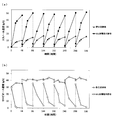
- Example 3 was a one-batch fermentation culture, but in this example, seven batches of repeated fermentation culture involving the recovery of yeast cells were performed. The procedure is the same as that of the third embodiment except that the following points are changed.
- CSL corn steep liquor
- the number of viable bacteria per gram of yeast-containing slurry is 2.8 ⁇ 10 7 to 3.9 ⁇ 10 7.
- the yeast displaying ⁇ -glucosidase on the surface layer also degrades cellobiose and efficiently incorporates sugar into yeast, so that the number of viable bacteria per gram of yeast-containing slurry is 6.9 ⁇ 10 7 to 1.1 ⁇ 10 8 . Reached.
- Example 5 Production of cellulase by Trichoderma reesei RUT-C30 using bagasse
- Preculture and main culture of Trichoderma reesei RUT-C30 were performed in the same manner as in Example 1 except that steamed bagasse prepared as described in Example 3 was used instead of Avicel.
- the main culture was performed for 168 hours.
- 1 (w / v)% of steamed bagasse was added, and in the main culture, 4 (w / v)% of steamed bagasse was added in consideration of the cellulose content in the steamed bagasse.
- FIG. 6 is a graph showing changes in pH and changes in cellulase activity (filter paper decomposition activity (FPU / mL)) and protein concentration (mg / mL) of the culture supernatant over the culture period of the main culture.
- the pH was maintained between 3.5 and 4 hours after the start of the culture.
- the filter paper-degrading activity and the protein concentration increased almost in tandem, and the filter paper-degrading activity was 1.25 FPU / mL, resulting in a culture supernatant. This was concentrated as described in Example 1 and used in the following examples.
- Example 6 Saccharification and fermentation of cellulosic biomass using the cellulase agent of Example 5
- Saccharification and fermentation was carried out in the same manner as in Example 3, except that the cellulase agent obtained by the method of Example 5 was used instead of the cellulase agent obtained by the method of Example 1.
- the initial yeast concentration in the saccharification and fermentation culture was 2 g (wet weight) / L.
- the results are shown in FIG. 7 (a: ethanol concentration and b: cellobiose concentration).
- Example 7 Saccharification and fermentation of cellulosic biomass using the cellulase agent of Example 5
- Laboratory yeast A ⁇ -glucosidase surface-displaying yeast was prepared in the same manner as in Preparation Example 1, except that Saccharomyces cerevisiae BY4741 strain was used as a host. Saccharification and fermentation was performed in the same manner as in Example 6, except that the ⁇ -glucosidase surface-displaying yeast and the wild-type yeast Saccharomyces cerevisiae BY4741 were used.
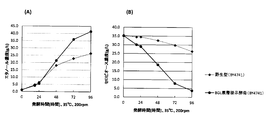
- FIG. 8 A: ethanol concentration and B: cellobiose concentration).
- ⁇ -glucosidase activity of the yeast displaying the surface layer of ⁇ -glucosidase was measured at 35 ° C. in the same manner as in Example 3. As a result, the value of ⁇ -glucosidase activity per 1 L of the culture solution was 63.6 U. Further, the “ratio of ⁇ -glucosidase activity of yeast to filter paper-degrading activity of externally added cellulase” was determined in the same manner as in Example 3. The externally added cellulase contained a filter paper-degrading activity of 2400 FPU in 1 L of culture solution. Therefore, this ratio was 0.02.
- Fig. 8 shows the results of saccharification and fermentation using a ⁇ -glucosidase surface-displaying yeast (BY4741 strain) and a wild-type yeast BY4741 strain (A: ethanol concentration and B: cellobiose concentration).
- A ethanol concentration
- B cellobiose concentration
- SEQ ID NO: 1 SEQ ID NO: 1 and a reverse primer (SEQ ID NO: 2)) and a primer pair for disrupting the leucine biosynthesis gene (Leu2 disruption forward primer (SEQ ID NO: 3) and reverse primer (SEQ ID NO: 4)) to obtain a loxP sequence.
- a fragment of the uracil biosynthesis gene and a part of the leucine biosynthesis gene of yeast are introduced by introducing a PCR fragment obtained by PCR using a pUG6 series plasmid (obtained from EUROSCARF) having a drug resistance marker Prepared. Plasmid pIU-X3 (Appl.
- Microbiol. Containing a xylose metabolism gene (xylose reductase (XR) gene derived from Pichia stippitis, xylitol dehydrogenase (XDH) gene derived from Pichia stippitis, and xylulokinase (XK) gene derived from Saccharomyces cerevisiae).
- XR xylose reductase
- XDH xylitol dehydrogenase
- XK xylulokinase
- TJ14 ⁇ L-X3 xylose-metabolizing yeast: this strain is also referred to as “X3 strain” having xylose metabolic ability was obtained by screening for strains that complemented uracil auxotrophy. Subsequently, the xylosidase gene (xyd) derived from Aspergillus oryzae (XylA gene described in APPLIED AND ENVIRONMENTAL MICROBIOLOGY, Sept. 2004, p.5407-5414) under the control of the GAPDH promoter was ⁇ -agglutinin.
- xyd xylosidase gene derived from Aspergillus oryzae
- Aspergillus oryzae XylA gene described in APPLIED AND ENVIRONMENTAL MICROBIOLOGY, Sept. 2004, p.5407-5414
- the TJ14 ⁇ L-X3 strain was transformed by cutting the surface display type plasmid pRS405-Xyd, which is expressed so as to be fused with HpaI, from pRS405 (containing the leucine synthesis gene) (obtained from Stratagene). Digested with GAPDH promoter (SEQ ID NO: 5), the glucoamylase secretion signal (SS) gene derived from R.
- pRS405-Xyd which is expressed so as to be fused with HpaI, from pRS405 (containing the leucine synthesis gene) (obtained from Stratagene).
- GAPDH promoter SEQ ID NO: 5
- SS glucoamylase secretion signal
- a TJ14-X3-Xyd strain (xylose-metabolizing xylosidase surface-displaying yeast: this strain is also referred to as “X3-Xyd # 1 strain”) having both the ability and the ability to degrade xylo-oligosaccharides was obtained.
- Example 8 Xylan liquefaction fermentation using the cellulase agent of Example 1
- 8-1 Xylan liquefaction fermentation
- a 50 mL Corning tube is charged with 2 mL (2 g) of 5 ⁇ YP medium, 2 g of xylan, 2 mL (2 g) of sterilized water and 3 mL (3 g) of the cellulase agent obtained by the method of Example 1, and rotated with a thermoblock rotator (scale 5). ) At 50 ° C for 4 hours to obtain a liquefied liquid.
- each yeast solution was prepared for the X3 strain and the X3-Xyd ⁇ # 1 strain.
- One loopful of a yeast culture colony of a YPD plate was inoculated into 5 mL of a preculture medium (2% by weight of YP-xylose), and cultured at 30 ° C. for 6 hours at 150 rpm, and then a main culture medium (2% by weight of YP-xylose) 100 mL was inoculated with 5 mL of the preculture, and cultured at 30 ° C. for 3 days at 150 rpm. Thereafter, a yeast solution was prepared by centrifugation so that the cell concentration in the culture became 200 g (wet weight) / L. .
- yeast solution 0.999 mL (0.999 g) of yeast solution was added to 8.98 g of the liquefied liquid in the 50 mL Corning tube, and the Corning tube was capped with a silicone rubber stopper with a needle, and rotated under a thermoblock rotator (scale 5). And fermentation culture was performed at 35 ° C.
- the concentration at the start of liquefaction is 20% by weight of xylan and 30% by weight of the cellulase agent of Example 1 assuming that 5 ⁇ YP medium is 1 ⁇ .
- the concentration at the start of fermentation using the liquefied liquid obtained at this concentration is as follows.
- the yeast solution was 10% by weight (cells 20 g / kg (culture solution)).
- the ethanol concentration in the culture was measured over time.
- FIG. 9 shows the results.
- FIG. 9 shows the results of ethanol production of xylose-metabolizing yeast (strain X3) and xylose-metabolizing xylosidase surface display yeast (X3-XydX # 1 strain) using xylan treated with the cellulase agent obtained by the method of Example 1. Is shown. As is clear from FIG. 9, the combination of the cellulase agent of Example 1 and the xylose-metabolizing xylosidase surface-displaying yeast (X3-Xyd # 1 strain) is higher than that of the xylose-metabolizing yeast (X3 strain) to which only the xylose metabolizing ability is imparted. The ethanol concentration was obtained.
- the cellulase agent of Example 1 By using the cellulase agent of Example 1 in combination with a xylo-oligosaccharide-degrading enzyme (xylosidase) displayed on the surface of yeast, ethanol yield was improved. Therefore, the cellulase agent of Example 1 can be applied to a biomass containing a C5 sugar such as xylan, xylo-oligosaccharide, or xylose, and further used in combination with a yeast displaying a xylo-oligosaccharide-degrading enzyme such as xylosidase on the surface. Thereby, the ethanol yield can be improved.
- a xylo-oligosaccharide-degrading enzyme xylosidase
- X Xyd activity of the yeast solution was measured at 35 ° C. No activity was detected in the yeast solution supernatant for both the X3 strain and the X3-Xyd # 1 strain.
- the X3-Xyd # 1 strain had an Xyd activity of 0.17 U / mL in the cells, whereas the X3 activity was not detected in the X3 strain.
- pCUA-Rumal2816 A plasmid obtained by cloning a ⁇ -glucosidase gene (GenBank Sequence ID: X1545.1) derived from Ruminococcus albus between BamHI and EcoRI of pCUA (pCU plasmid (Okano et al., Appl Microbiol Biotechnol, 2007, No. 75, p.
- a plasmid (pCUA) was prepared in which a PgsA anchor (subunit of poly- ⁇ -glutamic acid biosynthetic enzyme complex PgsBCA derived from Bacillus subtilis) was inserted between NdeI and BamHI.
- PgsA anchor subunit of poly- ⁇ -glutamic acid biosynthetic enzyme complex PgsBCA derived from Bacillus subtilis
- the above ⁇ -glucosidase gene was cloned between BamHI-EcoRI of pCUA).
- the transformed lactic acid bacteria were introduced into the MRS medium containing 5 ⁇ g / mL of erythromycin, and the transformed lactic acid bacteria strain (a lactic acid bacterium displaying ⁇ -glucosidase on the surface: this strain is also referred to as “pCUA-Rumal 2816 strain”)
- the cell ⁇ -glucosidase activity of the transformed lactic acid bacteria strain was 1.41 U / g (wet weight of lactic acid bacteria) at the time of one-day culture.
- Example 9 Lactic acid fermentation using the cellulase agent of Example 1.
- a liquefied bagasse solution was prepared using the cellulase agent obtained in the method of Example 1.
- This liquefied liquid contained about 24% by weight of solids and contained about 21 g / L glucose and about 32 g / L cellobiose (sugar liberated from biomass by enzymatic saccharification).
- the cellulase agent of this lot had a filter paper decomposition activity of 29.2 FPU / mL and a BGL activity of 0.8 U / mL (50 ° C.) or 0.21 U / mL (35 ° C.).
- a lactic acid bacterium solution of pCUA-Rumal 2816 strain was prepared. 20 mL of MRS medium supplemented with 5 ⁇ g / ml of erythromycin was inoculated with 2 mL of the passage solution, allowed to stand at 37 ° C. for 8 hours, and then inoculated with 20 mL of the precultured medium in 400 mL of a new MRS medium (adding 5 ⁇ g / ml of erythromycin). And incubated at 37 ° C. for 1 day to obtain a lactic acid bacterium solution having a cell concentration of 20 g (wet weight) / L in the culture solution.
- An MRS medium (containing no sugar: 10 g of protease peptone No. 3, 10 g of bovine extract, 5 g of yeast extract, 10 g of Tween 80, 2 g of diammonium hydrogen citrate, 5 g of sodium acetate, 5 g of magnesium acetate so that the liquefied liquid is 75% by weight.
- the lactic acid bacteria were cultured while keeping the temperature at 35 ° C.
- the initial pH at the start of the culture was set at about 5, and during the culture, the pH was adjusted to about 5 with calcium carbonate. Lactate concentration and cellobiose concentration in the culture solution were measured over time.
- FIG. 10 shows a case where a cellulosic biomass treated with the cellulase agent obtained by the method of Example 1 was used to culture 20 g (per liter of culture solution) of a lactic acid bacterium (pCUA-Rumal 2816 strain) with a wet weight of 20 g (per liter of culture solution).
- 2 shows the time course of the lactic acid concentration (A) and cellobiose concentration (B) in the culture solution.
- lactic acid fermentation can also be performed by using the cellulase agent of Example 1 in combination with a lactic acid bacterium displayed on the surface of ⁇ -glucosidase.
- the present invention is useful for producing ethanol, lactic acid, and the like, and for producing foods, pharmaceuticals, and various industrial products using ethanol, lactic acid, and the like as raw materials.
Landscapes
- Life Sciences & Earth Sciences (AREA)
- Chemical & Material Sciences (AREA)
- Engineering & Computer Science (AREA)
- Organic Chemistry (AREA)
- Health & Medical Sciences (AREA)
- Wood Science & Technology (AREA)
- Zoology (AREA)
- Biotechnology (AREA)
- Genetics & Genomics (AREA)
- Bioinformatics & Cheminformatics (AREA)
- Microbiology (AREA)
- Mycology (AREA)
- Biochemistry (AREA)
- General Engineering & Computer Science (AREA)
- General Health & Medical Sciences (AREA)
- Botany (AREA)
- Chemical Kinetics & Catalysis (AREA)
- General Chemical & Material Sciences (AREA)
- Medicinal Chemistry (AREA)
- Tropical Medicine & Parasitology (AREA)
- Virology (AREA)
- Biomedical Technology (AREA)
- Preparation Of Compounds By Using Micro-Organisms (AREA)
- Enzymes And Modification Thereof (AREA)
- Micro-Organisms Or Cultivation Processes Thereof (AREA)
Abstract
L'invention porte sur une méthode de production d'un agent cellulase. Cette méthode comprend une étape de culture de micro-organismes du genre Trichoderma à un pH d'au moins 1 et inférieur à 5 dans un milieu contenant un polysaccharide qui a au moins deux glucoses à liaison β-1,4 pour produire un agent cellulase, le rapport de l'activité β-glucosidase dans l'agent cellulase à l'activité de décomposition du papier filtre de l'agent cellulase étant inférieur à 3. L'invention concerne également une méthode de production d'un produit de saccharification/fermentation et une méthode de culture de micro-organismes de présentation de couche de surface à l'aide d'un milieu de culture qui contient un matériau cellulosique traité par un agent cellulase produit par la méthode ci-dessus. Ces méthodes permettent de produire efficacement un produit de saccharification/fermentation à partir d'une biomasse à base de cellulose indépendamment de l'environnement de localisation et de l'échelle de production d'un fabricant.
Priority Applications (3)
| Application Number | Priority Date | Filing Date | Title |
|---|---|---|---|
| JP2020527583A JP7289480B2 (ja) | 2018-06-28 | 2019-06-26 | セルラーゼ剤の製造方法ならびに当該セルラーゼ剤を用いた糖化発酵産物の製造方法 |
| MYPI2020006746A MY206506A (en) | 2018-06-28 | 2019-06-26 | Method for producing cellulase agent, and method for producing saccharification/fermentation product in which said cellulase agent is used |
| PH12020552268A PH12020552268A1 (en) | 2018-06-28 | 2020-12-28 | Method for Producing Cellulase Agent, and Method for Producing Saccharification/Fermentation Product in which said Cellulase Agent is Used |
Applications Claiming Priority (2)
| Application Number | Priority Date | Filing Date | Title |
|---|---|---|---|
| JP2018-122997 | 2018-06-28 | ||
| JP2018122997 | 2018-06-28 |
Publications (1)
| Publication Number | Publication Date |
|---|---|
| WO2020004473A1 true WO2020004473A1 (fr) | 2020-01-02 |
Family
ID=68984862
Family Applications (1)
| Application Number | Title | Priority Date | Filing Date |
|---|---|---|---|
| PCT/JP2019/025404 Ceased WO2020004473A1 (fr) | 2018-06-28 | 2019-06-26 | Méthode de production d'un agent cellulase et méthode de production d'un produit de saccharification/fermentation dans lequel ledit agent cellulase est utilisé |
Country Status (4)
| Country | Link |
|---|---|
| JP (1) | JP7289480B2 (fr) |
| MY (1) | MY206506A (fr) |
| PH (1) | PH12020552268A1 (fr) |
| WO (1) | WO2020004473A1 (fr) |
Cited By (1)
| Publication number | Priority date | Publication date | Assignee | Title |
|---|---|---|---|---|
| CN114540430A (zh) * | 2022-03-23 | 2022-05-27 | 清华大学 | 棕榈空果串的处理方法 |
Citations (6)
| Publication number | Priority date | Publication date | Assignee | Title |
|---|---|---|---|---|
| WO2006011479A1 (fr) * | 2004-07-27 | 2006-02-02 | Asahi Kasei Chemicals Corporation | Procédés de production d’un cello-oligosaccharide |
| JP2006296358A (ja) * | 2005-04-25 | 2006-11-02 | Asahi Kasei Chemicals Corp | セルラーゼの製造方法 |
| JP2010536390A (ja) * | 2007-08-30 | 2010-12-02 | アイオジェン エナジー コーポレイション | セルラーゼを生成するための方法 |
| JP2010536391A (ja) * | 2007-08-30 | 2010-12-02 | アイオジェン エナジー コーポレイション | 補助酵素を使用するリグノセルロース系原料の酵素的加水分解 |
| JP2014521359A (ja) * | 2011-08-19 | 2014-08-28 | イエフペ エネルジ ヌヴェル | 低い酸素移動容量係数KLaを有する、発酵槽に適した糸状菌を用いるセルラーゼの生産方法 |
| WO2015033948A1 (fr) * | 2013-09-04 | 2015-03-12 | 関西化学機械製作株式会社 | Procédé de production d'éthanol |
-
2019
- 2019-06-26 WO PCT/JP2019/025404 patent/WO2020004473A1/fr not_active Ceased
- 2019-06-26 JP JP2020527583A patent/JP7289480B2/ja active Active
- 2019-06-26 MY MYPI2020006746A patent/MY206506A/en unknown
-
2020
- 2020-12-28 PH PH12020552268A patent/PH12020552268A1/en unknown
Patent Citations (6)
| Publication number | Priority date | Publication date | Assignee | Title |
|---|---|---|---|---|
| WO2006011479A1 (fr) * | 2004-07-27 | 2006-02-02 | Asahi Kasei Chemicals Corporation | Procédés de production d’un cello-oligosaccharide |
| JP2006296358A (ja) * | 2005-04-25 | 2006-11-02 | Asahi Kasei Chemicals Corp | セルラーゼの製造方法 |
| JP2010536390A (ja) * | 2007-08-30 | 2010-12-02 | アイオジェン エナジー コーポレイション | セルラーゼを生成するための方法 |
| JP2010536391A (ja) * | 2007-08-30 | 2010-12-02 | アイオジェン エナジー コーポレイション | 補助酵素を使用するリグノセルロース系原料の酵素的加水分解 |
| JP2014521359A (ja) * | 2011-08-19 | 2014-08-28 | イエフペ エネルジ ヌヴェル | 低い酸素移動容量係数KLaを有する、発酵槽に適した糸状菌を用いるセルラーゼの生産方法 |
| WO2015033948A1 (fr) * | 2013-09-04 | 2015-03-12 | 関西化学機械製作株式会社 | Procédé de production d'éthanol |
Non-Patent Citations (6)
Cited By (1)
| Publication number | Priority date | Publication date | Assignee | Title |
|---|---|---|---|---|
| CN114540430A (zh) * | 2022-03-23 | 2022-05-27 | 清华大学 | 棕榈空果串的处理方法 |
Also Published As
| Publication number | Publication date |
|---|---|
| JPWO2020004473A1 (ja) | 2021-08-02 |
| MY206506A (en) | 2024-12-19 |
| JP7289480B2 (ja) | 2023-06-12 |
| PH12020552268A1 (en) | 2021-07-19 |
Similar Documents
| Publication | Publication Date | Title |
|---|---|---|
| EP2706119B1 (fr) | Variants de beta-glucosidase de recombinaison pour la production de sucres solubles à partir de biomasse cellulosique | |
| US8034596B2 (en) | Method for producing cellulase and hemicellulase having high hydrolytic activity | |
| CN114423296A (zh) | 从全酒糟副产物生产高蛋白饲料成分的酶共混物和工艺 | |
| Lima et al. | Comparative biochemical characterization of soluble and chitosan immobilized β-galactosidase from Kluyveromyces lactis NRRL Y1564 | |
| US20110171674A1 (en) | Beta-Glucosidase Variants Having Improved Activity, and Uses Thereof | |
| CN112166197A (zh) | 用于增强酵母生长和生产力的方法 | |
| AU2012298391B2 (en) | Method for the production of cellulases by a filamentous fungus adapted to a fermenter having a low volumetric oxygen transfer coefficient KLa | |
| CN104797708A (zh) | 酵母中用于木质纤维素衍生的寡聚物cbp的酶的表达 | |
| US9816113B2 (en) | Method for producing ethanol | |
| WO2017177289A1 (fr) | Procédé de conversion de biomasse en sucres fermentescibles à enzyme intégrée | |
| KR102088764B1 (ko) | 커피 찌꺼기를 이용한 젖산 생산 방법 | |
| US9109235B2 (en) | Methods and compositions for degrading pectin | |
| JP5752049B2 (ja) | エタノールの製造方法 | |
| Naidoo et al. | Purification and Characterization of an Endoinulinase from Xanthomonas campestris pv. phaseoli KM 24 Mutant | |
| CN102159700B (zh) | 纤维素水解力强化酵母的制作和使用 | |
| JP7289480B2 (ja) | セルラーゼ剤の製造方法ならびに当該セルラーゼ剤を用いた糖化発酵産物の製造方法 | |
| US11306300B2 (en) | Microorganism capable of displaying α-galactosidase on surface layer thereof, and use thereof | |
| Guerfali et al. | Hydrolytic potential of Talaromyces thermophilus β-xylosidase and its use for continuous xylose production | |
| JP2024160866A (ja) | 二糖類およびセルラーゼ剤の製造方法 | |
| JP6849749B2 (ja) | 新規キシラナーゼ | |
| Kameshnee Naidoo et al. | Purification and characterization of an endoinulinase from Xanthomonas campestris pv. phaseoli KM 24 mutant. | |
| FONSECA | DEVELOPMENT OF A (HEMI) CELLULASES PRODUCTION PROCESS UNDER |
Legal Events
| Date | Code | Title | Description |
|---|---|---|---|
| 121 | Ep: the epo has been informed by wipo that ep was designated in this application |
Ref document number: 19827578 Country of ref document: EP Kind code of ref document: A1 |
|
| ENP | Entry into the national phase |
Ref document number: 2020527583 Country of ref document: JP Kind code of ref document: A |
|
| NENP | Non-entry into the national phase |
Ref country code: DE |
|
| 122 | Ep: pct application non-entry in european phase |
Ref document number: 19827578 Country of ref document: EP Kind code of ref document: A1 |