WO2020004484A1 - Dispositif de formation d'image - Google Patents
Dispositif de formation d'image Download PDFInfo
- Publication number
- WO2020004484A1 WO2020004484A1 PCT/JP2019/025427 JP2019025427W WO2020004484A1 WO 2020004484 A1 WO2020004484 A1 WO 2020004484A1 JP 2019025427 W JP2019025427 W JP 2019025427W WO 2020004484 A1 WO2020004484 A1 WO 2020004484A1
- Authority
- WO
- WIPO (PCT)
- Prior art keywords
- light emitting
- emitting element
- element array
- line
- surface light
- Prior art date
- Legal status (The legal status is an assumption and is not a legal conclusion. Google has not performed a legal analysis and makes no representation as to the accuracy of the status listed.)
- Ceased
Links
Images







Classifications
-
- G—PHYSICS
- G03—PHOTOGRAPHY; CINEMATOGRAPHY; ANALOGOUS TECHNIQUES USING WAVES OTHER THAN OPTICAL WAVES; ELECTROGRAPHY; HOLOGRAPHY
- G03G—ELECTROGRAPHY; ELECTROPHOTOGRAPHY; MAGNETOGRAPHY
- G03G15/00—Apparatus for electrographic processes using a charge pattern
- G03G15/04—Apparatus for electrographic processes using a charge pattern for exposing, i.e. imagewise exposure by optically projecting the original image on a photoconductive recording material
- G03G15/04036—Details of illuminating systems, e.g. lamps, reflectors
-
- B—PERFORMING OPERATIONS; TRANSPORTING
- B41—PRINTING; LINING MACHINES; TYPEWRITERS; STAMPS
- B41J—TYPEWRITERS; SELECTIVE PRINTING MECHANISMS, i.e. MECHANISMS PRINTING OTHERWISE THAN FROM A FORME; CORRECTION OF TYPOGRAPHICAL ERRORS
- B41J2/00—Typewriters or selective printing mechanisms characterised by the printing or marking process for which they are designed
- B41J2/435—Typewriters or selective printing mechanisms characterised by the printing or marking process for which they are designed characterised by selective application of radiation to a printing material or impression-transfer material
- B41J2/447—Typewriters or selective printing mechanisms characterised by the printing or marking process for which they are designed characterised by selective application of radiation to a printing material or impression-transfer material using arrays of radiation sources
-
- B—PERFORMING OPERATIONS; TRANSPORTING
- B41—PRINTING; LINING MACHINES; TYPEWRITERS; STAMPS
- B41J—TYPEWRITERS; SELECTIVE PRINTING MECHANISMS, i.e. MECHANISMS PRINTING OTHERWISE THAN FROM A FORME; CORRECTION OF TYPOGRAPHICAL ERRORS
- B41J2/00—Typewriters or selective printing mechanisms characterised by the printing or marking process for which they are designed
- B41J2/435—Typewriters or selective printing mechanisms characterised by the printing or marking process for which they are designed characterised by selective application of radiation to a printing material or impression-transfer material
- B41J2/447—Typewriters or selective printing mechanisms characterised by the printing or marking process for which they are designed characterised by selective application of radiation to a printing material or impression-transfer material using arrays of radiation sources
- B41J2/45—Typewriters or selective printing mechanisms characterised by the printing or marking process for which they are designed characterised by selective application of radiation to a printing material or impression-transfer material using arrays of radiation sources using light-emitting diode [LED] or laser arrays
-
- G—PHYSICS
- G03—PHOTOGRAPHY; CINEMATOGRAPHY; ANALOGOUS TECHNIQUES USING WAVES OTHER THAN OPTICAL WAVES; ELECTROGRAPHY; HOLOGRAPHY
- G03F—PHOTOMECHANICAL PRODUCTION OF TEXTURED OR PATTERNED SURFACES, e.g. FOR PRINTING, FOR PROCESSING OF SEMICONDUCTOR DEVICES; MATERIALS THEREFOR; ORIGINALS THEREFOR; APPARATUS SPECIALLY ADAPTED THEREFOR
- G03F7/00—Photomechanical, e.g. photolithographic, production of textured or patterned surfaces, e.g. printing surfaces; Materials therefor, e.g. comprising photoresists; Apparatus specially adapted therefor
- G03F7/20—Exposure; Apparatus therefor
-
- G—PHYSICS
- G03—PHOTOGRAPHY; CINEMATOGRAPHY; ANALOGOUS TECHNIQUES USING WAVES OTHER THAN OPTICAL WAVES; ELECTROGRAPHY; HOLOGRAPHY
- G03G—ELECTROGRAPHY; ELECTROPHOTOGRAPHY; MAGNETOGRAPHY
- G03G15/00—Apparatus for electrographic processes using a charge pattern
- G03G15/04—Apparatus for electrographic processes using a charge pattern for exposing, i.e. imagewise exposure by optically projecting the original image on a photoconductive recording material
- G03G15/04036—Details of illuminating systems, e.g. lamps, reflectors
- G03G15/04045—Details of illuminating systems, e.g. lamps, reflectors for exposing image information provided otherwise than by directly projecting the original image onto the photoconductive recording material, e.g. digital copiers
- G03G15/04054—Details of illuminating systems, e.g. lamps, reflectors for exposing image information provided otherwise than by directly projecting the original image onto the photoconductive recording material, e.g. digital copiers by LED arrays
-
- G—PHYSICS
- G03—PHOTOGRAPHY; CINEMATOGRAPHY; ANALOGOUS TECHNIQUES USING WAVES OTHER THAN OPTICAL WAVES; ELECTROGRAPHY; HOLOGRAPHY
- G03G—ELECTROGRAPHY; ELECTROPHOTOGRAPHY; MAGNETOGRAPHY
- G03G15/00—Apparatus for electrographic processes using a charge pattern
- G03G15/22—Apparatus for electrographic processes using a charge pattern involving the combination of more than one step according to groups G03G13/02 - G03G13/20
- G03G15/32—Apparatus for electrographic processes using a charge pattern involving the combination of more than one step according to groups G03G13/02 - G03G13/20 in which the charge pattern is formed dotwise, e.g. by a thermal head
- G03G15/326—Apparatus for electrographic processes using a charge pattern involving the combination of more than one step according to groups G03G13/02 - G03G13/20 in which the charge pattern is formed dotwise, e.g. by a thermal head by application of light, e.g. using a LED array
-
- H—ELECTRICITY
- H10—SEMICONDUCTOR DEVICES; ELECTRIC SOLID-STATE DEVICES NOT OTHERWISE PROVIDED FOR
- H10H—INORGANIC LIGHT-EMITTING SEMICONDUCTOR DEVICES HAVING POTENTIAL BARRIERS
- H10H20/00—Individual inorganic light-emitting semiconductor devices having potential barriers, e.g. light-emitting diodes [LED]
- H10H20/80—Constructional details
- H10H20/85—Packages
- H10H20/857—Interconnections, e.g. lead-frames, bond wires or solder balls
-
- G—PHYSICS
- G03—PHOTOGRAPHY; CINEMATOGRAPHY; ANALOGOUS TECHNIQUES USING WAVES OTHER THAN OPTICAL WAVES; ELECTROGRAPHY; HOLOGRAPHY
- G03G—ELECTROGRAPHY; ELECTROPHOTOGRAPHY; MAGNETOGRAPHY
- G03G2215/00—Apparatus for electrophotographic processes
- G03G2215/04—Arrangements for exposing and producing an image
- G03G2215/0402—Exposure devices
- G03G2215/0407—Light-emitting array or panel
- G03G2215/0409—Light-emitting diodes, i.e. LED-array
Definitions
- the present invention relates to an image forming apparatus, and more particularly, to an electrophotographic image forming apparatus.
- a method of exposing a photosensitive drum using an exposure head using an LED (Light Emitting Diode) or an organic EL (Organic Electro Luminescence) to form a latent image is generally used.
- the exposure head includes a light emitting element array arranged in the longitudinal direction of the photosensitive drum, and a rod lens array for forming an image of light from the light emitting element array on the photosensitive drum.
- an LED or an organic EL has a surface emission shape in which a light irradiation direction from a light emission surface is the same as that of a rod lens array.
- the length of the light emitting element row is determined according to the image area width on the photosensitive drum, and the interval between the light emitting elements is determined according to the resolution of the printer. For example, in the case of a 1200 dpi printer, the interval between pixels is 21.16 ⁇ m, which is an interval corresponding to resolution, and therefore, the interval between light emitting elements is also an interval corresponding to 21.16 ⁇ m.
- 14173 light emitting elements are arranged in the longitudinal direction.
- a discrete light emitting element is mounted on a printed circuit board by wire bonding, if the number of light emitting elements is large, the number of wire bondings increases and the mounting cost increases. Therefore, conventionally, a method of reducing the number of wire bondings has been used. Specifically, a plurality of light emitting elements are formed on one semiconductor chip to form a light emitting element array, and terminals of each light emitting element are shared in the semiconductor chip.
- the area width can be secured.
- the number of wire bondings (the number of mountings) can be reduced. Since a printer using such an exposure head uses a smaller number of parts than a laser scanning printer that scans a photosensitive drum with a laser beam deflected by a rotating polygon mirror, the apparatus is downsized. It is easy to reduce the cost. Further, in a printer using an exposure head, the sound generated by the rotation of the rotary polygon mirror is reduced.
- the light emitting element array and the drive circuit element for driving the light emitting element array are integrally arranged on a printed circuit board.
- Each light emitting element array receives a drive signal from a drive circuit by a wiring pattern or wire bonding formed on a printed circuit board, and is controlled to be turned on.
- Patent Literature 1 discloses that wiring is performed as follows in order to reduce the size of a printed circuit board. A plurality of light emitting element arrays are arranged in a staggered manner in the longitudinal direction of the printed circuit board. Then, the drive signal of the light emitting element array arranged on one side with respect to the short side direction of the printed board is wired to one side portion arranged on the printed board. On the other hand, the drive signal of the light emitting element array arranged on the other side in the short direction of the printed board is wired to the other side arranged on the printed board.
- the number of light emitting element arrays arranged on the printed circuit board is an even number (for example, 30) as in the prior art, the number of wiring patterns and the number of wire bondings are evenly arranged in the short direction of the printed circuit board. Therefore, it is possible to make the length of the printed board equal to the light emitting element array arranged on the printed board.
- an odd number of light emitting element arrays for example, 29 light emitting element arrays
- the following is necessary. If the total number of the light emitting element arrays is odd, and if the number of the light emitting element arrays is even, the difference in the number of bonding pads is necessary in order to equalize the width direction of the printed circuit board around the light emitting element arrays.
- the present invention has been made under such a circumstance. Even when an odd number of light emitting element arrays are arranged on a printed circuit board, the size of the printed circuit board is suppressed, and the wiring on the printed circuit board is congested. The purpose is to suppress that.
- an image forming apparatus has the following configuration.
- a rotatable photoreceptor a chip in which a plurality of light emitting elements for exposing the photoreceptor are arranged at an interval corresponding to a first resolution in an intersecting direction intersecting a rotation direction of the photoreceptor, and a plurality of the chips.
- An exposure head comprising: a mounted printed circuit board; and a driving unit mounted on the printed circuit board to drive the light emitting elements of the plurality of chips, wherein the plurality of chips and the driving unit are electrically connected to the printed circuit board.
- An exposure head on which a wiring pattern to be electrically connected is printed, wherein an odd number of the chips are mounted on the printed board, and the odd number is mounted on one side in the cross direction.
- An even number of the chips is arranged, and the other odd number of the odd chips is arranged on the other side in the cross direction.
- the position of the center of the intensity of the amount of light of the light emitting element of the chip in the rotation direction is shifted to the side where the even number of chips are arranged from the center of the position of the printed circuit board in the rotation direction.
- the present invention even when an odd number of light emitting element arrays are arranged on a printed board, it is possible to suppress an increase in the size of the printed board and to suppress congestion of wiring on the printed board.
- FIG. 1 is a schematic cross-sectional view illustrating a configuration of an image forming apparatus according to an embodiment.
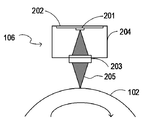
- FIG. 3 is a diagram illustrating a positional relationship between an exposure head and a photosensitive drum according to the embodiment.
- FIG. 3 is a diagram illustrating a configuration of an exposure head.
- FIG. 4 is a schematic view of a surface of the drive substrate of the embodiment on which a surface light emitting element array element group is mounted.
- FIG. 4 is a schematic view of a surface of the driving substrate opposite to a surface on which the surface light emitting element array element group is mounted.
- FIG. 2 illustrates a structure of a surface-emitting element array chip.
- FIG. 3 is a control block diagram of a control substrate and an exposure head according to the embodiment.
- FIG. 4 is a diagram illustrating a circuit of the surface light emitting element array chip according to the embodiment.
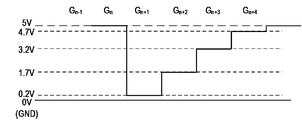
- FIG. 4 is a diagram illustrating a distribution state of a gate potential of the shift thyristor according to the embodiment.
- FIG. 4 is a diagram illustrating a distribution state of a gate potential of the shift thyristor according to the embodiment.
- FIG. 4 is a diagram illustrating a distribution state of a gate potential of the shift thyristor according to the embodiment.
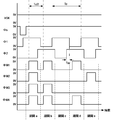
- FIG. 4 is a diagram showing a drive signal waveform of the surface emitting element array chip of the embodiment.
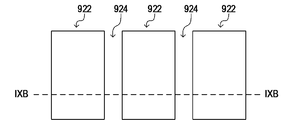
- FIG. 2 is a plan view of a plurality of light emitting elements having a mesa structure according to the embodiment.
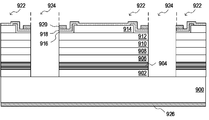
- FIG. 9B is a cross-sectional view of the light-emitting element having a mesa structure, taken along the line IXB-IXB in FIG. 9A.
- FIG. 3 is a detailed view of an ideal rectangular drive substrate with the emission centers offset in the embodiment.
- FIG. 4 is a detailed view of a non-rectangular drive substrate in which light emission centers are offset in the embodiment.
- FIG. 4 is a detailed view of a non-rectangular drive substrate in which light emission centers are offset in the embodiment.
- FIG. 4 is a diagram showing wiring of the surface emitting element array chip of the embodiment.
- FIG. 1 is a schematic sectional view illustrating the configuration of an electrophotographic image forming apparatus 10 according to the present embodiment.
- An image forming apparatus 10 shown in FIG. 1 is a multifunction peripheral (MFP) having a scanner function and a printer function, and controls a scanner unit 100, an image forming unit 103, a fixing unit 104, a feeding / transporting unit 105, and these units. It comprises a printer control unit (not shown).
- the scanner unit 100 illuminates a document placed on a document table, optically reads a document image, converts the read image into an electric signal, and creates image data.
- MFP multifunction peripheral
- the image forming unit 103 is arranged in the order of cyan (C), magenta (M), yellow (Y), and black (K) along the rotation direction (counterclockwise direction) of the endless transport belt 111. It has a series of image forming stations. The four image forming stations have the same configuration, and each image forming station includes a photosensitive drum 102, which is a photosensitive member rotatable in an arrow direction (clockwise direction), an exposure head 106, a charger 107, and a developing unit 108. ing.
- the subscripts a, b, c, and d of the photosensitive drum 102, the exposure head 106, the charger 107, and the developing device 108 are black (K), yellow (Y), magenta (M), and cyan, respectively, of the image forming station. This shows that the configuration corresponds to (C).
- the suffixes of the reference numerals will be omitted except for the case where a specific photosensitive drum or the like is indicated.
- the photosensitive drum 102 is rotated, and the photosensitive drum 102 is charged by the charger 107.
- An exposure head 106 serving as an exposure unit emits light from the arranged LED array according to image data, and condenses light emitted from the chip surface of the LED array onto the photosensitive drum 102 (photosensitive member) by a rod lens array.
- the developing device 108 develops the electrostatic latent image formed on the photosensitive drum 102 with toner.
- the developed toner image is transferred to a recording sheet on a transport belt 111 that transports the recording sheet.
- Such a series of electrophotographic processes is executed in each image forming station.
- each of the magenta (M), yellow (Y), and black (K) image forming stations is sequentially performed. Then, the image forming operation is executed.
- the image forming apparatus 10 illustrated in FIG. 1 includes, as units for feeding recording paper, internal feeding units 109a and 109b included in the feeding / conveying unit 105, an external feeding unit 109c that is a large-capacity feeding unit, And a manual feed unit 109d.
- the recording paper is fed from a feeding unit designated in advance, and the fed recording paper is conveyed to the registration roller 110.
- the registration roller 110 conveys the recording paper to the conveyance belt 111 at the timing when the toner image formed in the image forming unit 103 is transferred onto the recording paper.
- the toner images formed on the photosensitive drums 102 of the respective image forming stations are sequentially transferred onto the recording paper transported by the transport belt 111.
- the recording paper to which the unfixed toner image has been transferred is conveyed to the fixing unit 104.
- the fixing unit 104 has a built-in heat source such as a halogen heater, and fixes the toner image on the recording paper to the recording paper by heating and pressing with two rollers.
- the recording paper on which the toner image has been fixed by the fixing unit 104 is discharged to the outside of the image forming apparatus 10 by the discharge roller 112.
- An optical sensor 113 serving as a detection unit is disposed at a position facing the transport belt 111 downstream of the black (K) image forming station in the recording paper transport direction.
- the optical sensor 113 detects the position of the test image formed on the transport belt 111 to derive the amount of color shift of the toner image between the image forming stations.
- the color shift amount derived by the optical sensor 113 is notified to a control board 415 (see FIG. 4) described later, and the image position of each color is corrected so that a full-color toner image without color shift is transferred onto the recording paper.
- a printer control unit controls the above-described scanner unit 100, image forming unit 103, fixing unit 104, and supply unit in accordance with an instruction from an MFP control unit (not shown) that controls the entire multifunction peripheral (MFP).
- MFP control unit controls the entire multifunction peripheral (MFP).
- the image forming operation is executed while controlling the feeding / conveying unit 105 and the like.
- the image forming apparatus 10 of the type that directly transfers the toner image formed on the photosensitive drum 102 of each image forming station to the recording paper on the transport belt 111 has been described.
- the present invention is not limited to such a printer that directly transfers the toner image on the photosensitive drum 102 to recording paper.
- the present invention is also applicable to an image forming apparatus including a primary transfer unit that transfers the toner image on the photosensitive drum 102 to the intermediate transfer belt and a secondary transfer unit that transfers the toner image on the intermediate transfer belt to recording paper. can do.
- FIG. 2A is a perspective view showing a positional relationship between the exposure head 106 and the photosensitive drum 102.
- FIG. 2B is a perspective view showing the internal configuration of the exposure head 106 and a light beam 205 from the exposure head 106 being formed by the rod lens array 203.
- FIG. 2A the exposure head 106 is mounted on the image forming apparatus 10 by a mounting member (not shown) at a position above the photosensitive drum 102 rotating in the direction of the arrow and facing the photosensitive drum 102 (see FIG. 2A). (Fig. 1).
- the exposure head 106 includes a driving substrate 202 which is a printed substrate, a surface light emitting element array element group 201 mounted on the driving substrate 202, a rod lens array 203, and a housing 204.
- the rod lens array 203 and the drive board 202 are attached to the housing 204.
- the rod lens array 203 focuses the light flux 205 from the surface light emitting element array element group 201 on the photosensitive drum 102. In the factory, the assembling and adjusting work is performed with the exposure head 106 alone, and the focus adjustment and the light amount adjustment of each spot are performed.
- the assembly and adjustment are performed so that the distance between the photosensitive drum 102 and the rod lens array 203 and the distance between the rod lens array 203 and the surface light emitting element array element group 201 are at predetermined intervals.
- the mounting position of the rod lens array 203 is adjusted so that the distance between the rod lens array 203 and the surface light emitting element array element group 201 becomes a predetermined value.
- each light emitting element of the surface light emitting element array element group 201 is sequentially caused to emit light so that the light collected on the photosensitive drum 102 via the rod lens array 203 has a predetermined light quantity. Then, the drive current of each light emitting element is adjusted.
- FIG. 3A is a schematic diagram illustrating the configuration of the surface of the drive substrate 202 on which the surface light emitting element array element group 201 is mounted
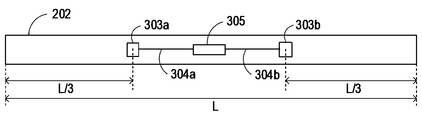
- FIG. 3B is the surface of the drive substrate 202 on which the surface light emitting element array element group 201 is mounted ( It is a schematic diagram which shows the structure of the surface (2nd surface) opposite to (1st surface).
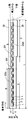
- the surface light emitting element array element group 201 mounted on the driving substrate 202 includes 29 surface light emitting element array chips 1 to 29 in a staggered manner along the longitudinal direction of the driving substrate 202. It has a configuration arranged in rows.
- the vertical direction indicates the sub-scanning direction (the rotation direction of the photosensitive drum 102) which is the first direction
- the horizontal direction indicates the main scanning direction which is the second direction orthogonal to the sub-scanning direction.
- the main scanning direction is also an intersecting direction that intersects the rotation direction of the photosensitive drum 102.
- each element of the surface light emitting element array chip having a total of 516 light emitting points is arranged at a predetermined resolution pitch in the longitudinal direction of the surface light emitting element array chip.
- the pitch of each element of the surface emitting element array chip is about 21.16 ⁇ m ( ⁇ 2.54 cm / 1200 dots), which is the pitch of the first resolution of 1200 dpi.
- the arrangement interval from end to end of the 516 light emitting points in one surface light emitting element array chip is about 10.9 mm ( ⁇ 21.16 ⁇ m ⁇ 516).
- the surface light emitting element array element group 201 is composed of 29 surface light emitting element array chips.
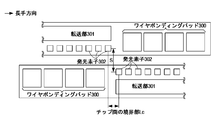
- FIG. 3C is a diagram showing a state of a boundary portion between the surface light emitting element array chips arranged in two rows in the longitudinal direction.
- the horizontal direction is the longitudinal direction of the surface light emitting element array element group 201 in FIG. 3A. is there.
- a wire bonding pad 300 to which a control signal is input is arranged at an end of the surface light emitting element array chip.
- the element 302 is driven.
- the surface light emitting element array chip has a plurality of light emitting elements 302. Also at the boundary Lc between the surface light emitting element array chips, the pitch in the longitudinal direction of the light emitting elements 302 (the distance between the center points of the two light emitting elements) is about 21.16 ⁇ m, which is a pitch of 1200 dpi resolution. ing. Further, in the surface light emitting element array chips arranged in the upper and lower two rows, the distance between the light emitting points of the upper and lower surface light emitting element array chips (indicated by an arrow S in the drawing) is about 84 ⁇ m (4 pixels at 1200 dpi and 8 pixels at 2400 dpi). (A distance of an integral multiple of each minute).
- driving units 303 a and 303 b and a connector 305 are mounted on the surface of the driving substrate 202 opposite to the surface on which the surface light emitting element array element group 201 is mounted.
- the driving units 303a and 303b are driver ICs.
- the driving units 303a and 303b disposed on both sides of the connector 305 drive the surface light emitting element array chips 1 to 15 and the surface light emitting element array chips 16 to 29, respectively.
- the driving units 303a and 303b are connected to the connector 305 via the patterns 304a and 304b, respectively.
- the driving section 303a is disposed at a distance of about 1/3 (approximately one third) from the longitudinal left end of the driving substrate 202 with respect to the longitudinal length L of the driving substrate 202.
- the driving section 303b is arranged at a distance of about 3 from the right end of the driving board 202 in the longitudinal direction with respect to the length L of the driving board 202 in the longitudinal direction.
- the connector 305 is connected to a signal line for controlling the driving units 303a and 303b from a control board 415 (see FIG. 4) described later, a power supply voltage, and a ground, and is connected to the driving units 303a and 303b. Further, from the driving units 303a and 303b, wirings for electrically connecting the surface light emitting element array elements 201 to drive the surface light emitting element array elements 201 respectively pass through the inner layer of the driving substrate 202, and pass through the surface light emitting element array chips 1 to 15 respectively. , Are connected to the surface light emitting element array chips 16 to 29.
- FIG. 4 is a control block diagram of a control substrate 415 that processes image data and outputs the processed data to the exposure head 106, and a drive substrate 202 that exposes the photosensitive drum 102 based on the image data input from the control substrate 415.
- Each of the blocks 401 to 414 described below indicates a module inside the IC.
- the drive substrate 202 surface light emitting element array chips 1 to 15 controlled by the drive unit 303a shown in FIG. 4 will be described.
- the surface emitting element array chips 16 to 29 controlled by the driving unit 303b (not shown in FIG. 4) perform the same operation as the surface emitting element array chips 1 to 15 controlled by the driving unit 303a.
- the control board 415 shown in FIG. 4 has a connector 416 for transmitting a signal for controlling the exposure head 106. From the connector 416, image data, a Line synchronization signal described later, and a control signal from the CPU 400 of the control board 415 are transmitted via transmission cables 417, 418, and 419 connected to the connector 305 of the drive board 202, respectively.
- the control board 415 transmits a signal for controlling the exposure head 106 to the exposure head 106.
- This signal is a signal obtained by parallel-serial conversion of a clock signal, image data, and a line synchronization signal.
- This signal is input to the connector 305 on the exposure head side via the transmission cable 417 for transmitting the signal from the connector 416 on the control board 415 side.
- a communication signal of the CPU 400 is input to the connector 305 on the exposure head 106 side via the transmission cable 418.
- the control board 415 the CPU 400 performs processing of image data and processing of print timing.
- the control board 415 includes functional blocks of an image data generation unit 401, a line data shift unit 402, a chip data conversion unit 403, a chip data shift unit 404, a data transmission unit 405, and a synchronization signal generation unit 406.
- processing in each functional block will be described in the order in which image data is processed in the control board 415.
- An image data generation unit 401 serving as a data generation unit performs dithering processing on image data received from the scanner unit 100 or an external computer connected to the image forming apparatus 10 at a resolution instructed by the CPU 400, and performs print output. Generate image data for In the present embodiment, the image data generation unit 401 performs dithering processing at a resolution of 2400 dpi, which is the second resolution. That is, the image data generated by the image data generation unit 401 is pixel data equivalent to 2400 dpi.
- the pixel data corresponding to 2400 dpi in this embodiment is one bit, but one pixel may be represented by a plurality of bits.
- the pixel data generated by the image data generation unit 401 is line data corresponding to a line corresponding to 2400 dpi in the sub-scanning direction. Note that the image data generation unit 401 is one integrated circuit 401A.
- the CPU 400 determines the main scanning direction (the longitudinal direction of the exposure head 106) and the sub-scanning direction (the rotation direction of the photosensitive drum 102 and the recording paper conveyance direction) based on the color misregistration amount detected by the optical sensor 113. Are determined in units of 2400 dpi.
- the image shift amount is determined by the CPU 400 based on, for example, a relative color shift amount between colors calculated based on a detection result of the color shift detection pattern image by the optical sensor 113. Then, the CPU 400 instructs the line data shift unit 402, which is a correction unit, on the image shift amount.
- the line data shift unit 402 shifts the image data input from the image data generation unit 401 in units of 2400 dpi over the entire image area within one page of the recording paper based on the image shift amount specified by the CPU 400. .
- the line data shift unit 402 may divide the image area in one page of the recording paper into a plurality of areas, and execute the shift process for each of the plurality of divided image areas.
- a synchronization signal generation unit 406 which is a second generation unit, is a signal synchronized with the rotation speed of the photosensitive drum 102, and is a periodic signal (hereinafter, Line) corresponding to one line of the resolution of an output image in the rotation direction of the photosensitive drum 102. Synchronization signal).
- the CPU 400 instructs the synchronization signal generation unit 406 to set the pixel size (approximately 10 pixels) of the surface of the photosensitive drum 102 in the rotation direction (sub-scanning direction) to the cycle of the Line synchronization signal, that is, the predetermined rotation speed of the photosensitive drum 102. .5 ⁇ m) Indicate the time to move.
- the CPU 400 when printing at a speed of 200 mm / sec in the sub-scanning direction, the CPU 400 sets the cycle of the Line synchronization signal (the cycle of one line in the sub-scanning direction) to about 52.9 ⁇ s ( ⁇ (25.4 mm / 2400 dots). ) / 200 mm) to the synchronization signal generation unit 406.
- the image forming apparatus 10 includes a detection unit (for example, an encoder installed on the rotation shaft of the photosensitive drum) that detects the rotation speed of the photosensitive drum 102
- the CPU 400 determines a result of the detection unit (a signal output from the encoder).
- the rotation speed of the photosensitive drum 102 in the sub-scanning direction is calculated based on the generation cycle, and the cycle of the Line synchronization signal is determined based on the calculation result.
- the CPU 400 inputs information on the paper type such as the sheet basis weight (g / m 2 ) and the sheet size input by the user from the operation unit. , The cycle of the Line synchronization signal is determined.
- the chip data conversion unit 403 reads line data from the line data shift unit 402 one line at a time in the sub-scanning direction of the photosensitive drum 102 in synchronization with the Line synchronization signal. Then, the chip data conversion unit 403 executes data processing for dividing the read line data into line data for each chip.
- FIG. 5 is a block diagram showing the configuration of the chip data conversion unit 403.
- the Line synchronization signal output from the synchronization signal generation unit 406 is input to the counter 530.
- the counter 530 includes a frequency modulation circuit that modulates the input Line synchronization signal to generate a CLK signal having a higher frequency than the Line synchronization signal.
- the counter 530 may include an oscillator that generates a clock signal (CLK) having a higher frequency than the Line synchronization signal instead of the frequency modulation circuit.
- CLK clock signal
- a configuration in which the chip data conversion unit 403 reads line data from the line data shift unit 402 will be described as an example, but the embodiment is not limited thereto. That is, the Line data shift unit 402 supplies the Line synchronization signal to the line data shift unit 402 and internally generates the CLK signal, so that the line data shift unit 402 It may be configured to transmit line data.
- the counter 530 When the Line synchronization signal is input, the counter 530 resets the count value to 0, and then increments the counter value in synchronization with the number of pulses of the clock signal (CLK).
- the frequency of the CLK signal generated by the counter 530 includes the capacity (the number of bits) of pixel data that the chip data conversion unit 403 should read within one cycle of the Line synchronization signal, the data processing speed of the chip data conversion unit 403 described later, Is determined at the design stage based on For example, as described above, the surface light emitting element array element group 201 has 14,964 light emitting elements (1200 dpi conversion) that expose one line in the sub-scanning direction.
- the chip data conversion unit 403 reads out one line of image data in the sub-scanning direction and writes it to a line memory 500 described later, and writes image data to memories 501 to 529 described later during the Line synchronization signal. . Therefore, the counter 530 performs a count operation of twice (59, 856) the number of pixels (29, 928) included in one line of line data. A period in which the count value of the counter 530 is from 1 to 29,928 is Tm1, and a period in which the count value is from 29,929 to 59,856 is Tm2.
- the READ control unit 531 reads line data from the line data shift unit 402 according to the count value of the counter 530. That is, the READ control unit 531 stores the line data (29,928 pixels) for one line in the main scanning direction in the line memory 500 during the period Tm1 in which the count value of the counter 530 is 1 to 29,928.
- the WR control unit 532 divides the line data for one line in the sub-scanning direction stored in the line memory 500 into the memories 501 to 529 during the period Tm2 in which the count value of the counter 530 is 29,929 to 59,856. Write.
- the memories 501 to 529 are memories having a smaller storage capacity than the line memory 500, and store line data (divided line data) divided for each chip.
- the memories 501 to 529 are FIFO (First In First First Out) memories provided corresponding to the surface light emitting element array chips 1 to 29. That is, the memory 501 stores line data corresponding to the surface light emitting element array chip 1, the memory 502 stores line data corresponding to the surface light emitting element array chip 2,. Is stored.
- FIFO First In First First Out
- line data for one line in the main scanning direction is sequentially read from the line memory 500, and first, writing to the memory 501 for storing the line data of the surface emitting element array chip 1 is performed. Next, writing to the memory 502 for storing the image data of the surface light emitting element array chip 2 is performed, and thereafter, writing to the memory 529 for storing the image data of the surface light emitting element array chip 29 is sequentially performed. .
- the chip data shift unit 404 at the subsequent stage of the chip data conversion unit 403 data shift processing in the sub-scanning direction is performed for each surface light emitting element array chip. Therefore, it is assumed that the memories 501 to 529 store line data for 10 lines in the sub-scanning direction.
- the line data stored in the memories 501 to 529 includes the line data for one chip corresponding to each surface light emitting element array chip and the pixel data obtained by copying the pixel data at the end of the adjacent surface light emitting element array chip. Data is also stored together.
- the following pixel data is stored in the memory 502. That is, in the memory 502, at both ends of the line data corresponding to the surface light emitting element array chip 2, the pixel data of the end part on the surface light emitting element array chip 2 side of the surface light emitting element array chip 1 and the surface light emitting element array The pixel data at the end of the chip 3 on the surface light emitting element array chip 2 side is added and stored.
- the chip data shift unit 404 which is a correction unit, converts line data from the memories 501 to 529 based on data (2400 dpi units) relating to the image shift amount in the sub-scanning direction for each surface light emitting element array chip specified in advance by the CPU 400. Control relative read timing.
- the image shift processing in the sub-scanning direction performed by the chip data shift unit 404 will be specifically described.
- each even-numbered surface light emitting element array chip in the longitudinal direction of the exposure head.
- the mounting positions of the odd-numbered surface emitting element array chips do not shift.
- the mounting positional relationship between the even-numbered surface light-emitting element array chips and the odd-numbered surface light-emitting element array chips in the sub-scanning direction is equivalent to 2400 dpi and is a predetermined number of pixels (for example, 8 pixels). preferable.
- the arrangement positions of the light emitting element rows in the sub-scanning direction in each surface light emitting element array chip are constant without any individual difference.
- these mounting positions and the arrangement positions of the light emitting element rows include errors, and these errors may cause deterioration in the image quality of the output image.
- the memory 430 (ROM) shown in FIG. 4 has corrections calculated from the relative positional relationship in the sub-scanning direction of each light emitting element array of the surface light emitting element array chips 1 to 15 mounted in a staggered manner on the drive substrate 202. Data is stored. For example, in the memory 430, each light emitting element array of the other surface light emitting element array chips 2 to 15 is arranged in the sub scanning direction with respect to the light emitting element array of the surface light emitting element array chip 1 as a reference for the position in the sub scanning direction. Correction data based on measurement data of how many pixels are shifted on the drive substrate 202 corresponding to 2400 dpi is stored.
- the measurement data is obtained by mounting the surface light emitting element array chips 2 to 15 on the drive substrate 202, lighting the light emitting elements of each surface light emitting element array chip by a measuring device, and measuring the light receiving result.
- CPU 400 sets the correction data read from memory 430 in the internal register of chip data shift unit 404 in response to the power on of image forming apparatus 10 being turned on.
- the chip data shift unit 404 shifts line data for forming the same line stored in the memories 501 to 529 based on the correction data set in the internal register.
- the unit 404 delays the output timing of the line data corresponding to the surface light emitting element array chip 2 forming the same line by eight pixels with respect to the output timing of the line data corresponding to the surface light emitting element array chip 1 to the drive substrate 202. All the line data corresponding to the surface light emitting element array chip 2 is shifted with respect to the line data corresponding to the surface light emitting element array chip 1.
- the data transmission unit 405 transmits, to the drive substrate 202, the line data after performing the data processing on the series of line data described above with respect to the exposure head 106.
- the odd numbered surface light emitting element array chips 1, 3, 5,... 29 are arranged on the upstream side in the sub-scanning direction, and the even numbered surface light emitting elements
- the element array chips 2, 4, 6, ... 28 are arranged on the downstream side in the sub-scanning direction. Writing of image data to the memories 501 and 529 corresponding to the odd-numbered surface light emitting element array chips 1 and 29 is performed during the first Line synchronization signal.
- the data of the first line in the sub-scanning direction is read from the memories 501 and 529 corresponding to the odd-numbered surface light emitting element array chips 1 and 29.
- data of the second line in the sub-scanning direction is read from the memories 501 and 529 corresponding to the odd-numbered surface emitting element array chips 1 and 29.
- the data of the ninth line in the sub-scanning direction is read from the memories 501 and 529 corresponding to the odd-numbered surface emitting element array chips 1 and 29.
- the memory 502 corresponding to the even-numbered surface light emitting element array chip 2 stores the image data from the memory 502 during a period after nine pulses of the Line synchronization signal from the period TL1 during which the image data is written to the memory 502. Is read.
- the data transmission unit 405 transmits the line data processed by the chip data shift unit 404 to the drive substrate 202.
- the counter 530 includes, instead of an oscillator, a frequency modulation circuit that modulates an input Line synchronization signal to generate a CLK signal having a higher frequency than the Line synchronization signal.
- the counter 530 may include an oscillator that generates a clock signal (CLK) having a higher frequency than the Line synchronization signal instead of the frequency modulation circuit.
- the frequency of the clock signal is determined so that the count value becomes 59,856 (two times the number of pixel data in one line) or more within one cycle of the Line synchronization signal.
- reading of data from the memories 501 to 529 is performed within one period of the line synchronizing signal, by the image of one line in the main scanning direction corresponding to each surface light emitting element array chip from the 29 memories 501 to 529. Output data in parallel. Therefore, the reading speed of the image data from the memories 501 to 529 may be lower than the writing speed to the memory. For example, in the present embodiment, it is assumed that image data is read from the memories 501 to 529 at a long cycle that is 58 times longer than the number of pulses at the time of writing image data to the memories 501 to 529.
- the line data shift unit 402, the chip data conversion unit 403, the chip data shift unit 404, the data transmission unit 405, and the synchronization signal generation unit 406 are an integrated circuit 402A different from the integrated circuit 401A.
- the CPU 400 is an integrated circuit different from the integrated circuits 401A and 402A.
- the data receiving unit 407 receives the data transmitted from the data transmitting unit 405 of the control board 415, and separates a clock signal, a line synchronization signal, and image data, respectively.
- the data receiving unit 407 and the data transmitting unit 405 may use generally known parallel-serial conversion.
- the clock signal, the line synchronization signal, and the image data are transmitted to the drive unit 303a by parallel-serial conversion, but may be transmitted in parallel.
- the driving unit 303a operates based on the clock signal received by the data receiving unit 407. This is because it is possible to eliminate the need for a clock oscillator or a crystal oscillator in the driving unit 303a.
- the data receiving unit 407 and the data transmitting unit 405 transmit and receive image data in line units in the sub-scanning direction in synchronization with the Line synchronization signal.
- the chip data conversion unit 403 arranges data for each of the surface emitting element array chips 1 to 29, and the subsequent processing blocks process the data of the surface emitting element array chips 1 to 29 in parallel.
- the PWM signal generation unit 411 generates a pulse width signal (hereinafter, referred to as a PWM signal) corresponding to a light emission time during which the surface light emitting element array chip emits light within one pixel section according to the data value of each pixel.
- the timing of outputting the PWM signal is controlled by the timing control unit 412.
- the timing control unit 412 generates a synchronization signal corresponding to the pixel section of each pixel from the Line synchronization signal generated by the synchronization signal generation unit 406 of the control board 415, and outputs the synchronization signal to the PWM signal generation unit 411.
- the drive voltage generator 414 generates a drive voltage for driving the surface light emitting element array chip in synchronization with the PWM signal.
- the drive voltage generation unit 414 has a configuration in which the CPU 400 can adjust the voltage level of the output signal around 5 V so that a predetermined light amount is obtained.
- each surface light emitting element array chip has a configuration in which four light emitting elements can be simultaneously driven independently.
- Drive signals supplied to each surface light emitting element array chip are ⁇ W1 to ⁇ W4 (see FIG. 6).
- the surface light emitting element array chips are sequentially driven by the operation of a shift thyristor (see FIG. 6) described later.
- the control signal generator 413 generates control signals ⁇ s, ⁇ 1, and ⁇ 2 for transferring the shift thyristor for each pixel from the synchronization signal corresponding to the pixel section generated by the timing controller 412 (see FIG. 6).
- FIG. 6 is an equivalent circuit extracted from a part of a self-scanning light emitting element (Self-Scanning LED: SLED) array chip of the present embodiment.
- Ra and Rg are an anode resistance and a gate resistance, respectively
- Tn is a shift thyristor
- Dn is a transfer diode
- Ln is a light emitting thyristor.
- Gn represents the corresponding shift thyristor Tn and the common gate of the light emitting thyristor Ln connected to the shift thyristor Tn.
- n is an integer of 2 or more.
- ⁇ 1 is a transfer line of the odd-numbered shift thyristor T
- ⁇ 2 is a transfer line of the even-numbered shift thyristor T
- ⁇ W1 to ⁇ W4 are lighting signal lines of the light emitting thyristor L, and are connected to the resistors RW1 to RW4, respectively.
- VGK is a gate line
- ⁇ s is a start pulse line.
- four light emitting thyristors L4n-3 to L4n are connected to one shift thyristor Tn, and four light emitting thyristors L4n-3 to L4n can be turned on at the same time. It has become.
- the common gate Gn of the light emitting thyristor Ln and the common gate Gn + 1 of the light emitting thyristor Ln + 1 are connected by the coupling diode Dn, a potential difference substantially equal to the diffusion potential of the coupling diode Dn occurs.
- the diffusion potential of the coupling diode Dn is about 1.5 V
- the potential after the common gate Gn + 4 of the light emitting thyristor Ln + 4 is 5 V since the voltage of the gate line VGK is 5 V and does not become higher than this.
- the potential of the common gate Gn-1 before the common gate Gn of the light emitting thyristor Ln (on the left side of the common gate Gn in FIG. 6) is such that the coupling diode Dn-1 is in a reverse-biased state.
- the voltage of VGK is applied as it is, and becomes 5V.
- FIG. 7A is a diagram showing the distribution of the gate potential of the common gate Gn of each light emitting thyristor Ln when the above-mentioned shift thyristor Tn is in the ON state.
- the vertical axis in FIG. 7A indicates the gate potential.
- the voltage required to turn on each shift thyristor Tn (hereinafter referred to as a threshold voltage) is obtained by adding a diffusion potential (1.5 V) to the gate potential of the common gate Gn of each light emitting thyristor Ln; The potentials are almost the same.
- the shift thyristor Tn + 2 When the shift thyristor Tn is on, the shift thyristor Tn + 2 has the lowest gate potential of the common gate among the shift thyristors connected to the transfer line ⁇ 2 of the same shift thyristor Tn.
- the shift thyristor Tn since the shift thyristor Tn is on, the potential of the transfer line ⁇ 2 is pulled to about 1.5 V (diffusion potential), and is lower than the threshold voltage of the shift thyristor Tn + 2, so that the shift thyristor Tn + 2 is on. Can not do it.
- the other shift thyristors connected to the same transfer line ⁇ 2 cannot be turned on similarly because the threshold voltage is higher than the shift thyristor Tn + 2, and only the shift thyristor Tn can be kept on.
- shift thyristor Tn and shift thyristor Tn + 1 are simultaneously turned on.
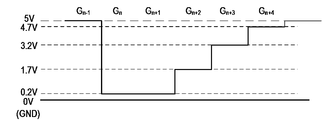
- FIG. 7B is a diagram showing the gate voltage distribution of each of the common gates Gn-1 to Gn + 4 at this time, and the vertical axis indicates the gate potential.
- FIG. 7C is a diagram showing the gate voltage distribution at this time, and the vertical axis shows the gate potential.
- the potential of the common gate Gn + 1 of the shift thyristor Tn + 1 adjacent to the shift thyristor Tn is 1.7 V
- the threshold voltages of the light emitting thyristors L4n-3 to L4n are lower, when a lighting signal is input from the lighting signal lines ⁇ W1 to ⁇ W4, the light emitting thyristors L4n + 1 to L4n + 4 are turned on earlier. Once the light emitting thyristors L4n-3 to L4n are turned on, the connected lighting signal lines ⁇ W1 to ⁇ W4 are lowered to about 1.5V (diffusion potential).
- the potentials of the lighting signal lines ⁇ W1 to ⁇ W4 become lower than the threshold voltages of the light emitting thyristors L4n + 1 to L4n + 4, so that the light emitting thyristors L4n + 1 to L4n + 4 cannot be turned on.
- a plurality of light emitting thyristors L can be simultaneously turned on.
- FIG. 8 is a timing chart of the driving signals of the SLED circuit shown in FIG.
- the voltage waveforms of the drive signals of the gate line VGK, the start pulse line ⁇ s, the transfer lines ⁇ 1 and ⁇ 2 of the odd-numbered and even-numbered shift thyristors, and the lighting signal lines ⁇ W1 to ⁇ W4 of the light emitting thyristor are shown in order from the top.
- Each drive signal has an on-state voltage of 5 V and an off-state voltage of 0 V.
- the horizontal axis in FIG. 8 indicates time.
- 5 V is always supplied to the gate line VGK.
- a clock signal ⁇ 1 for the odd-numbered shift thyristor and a clock signal ⁇ 2 for the even-numbered shift thyristor are input at the same cycle Tc, and 5 V is supplied to the signal ⁇ s of the start pulse line.
- the signal ⁇ s of the start pulse line is dropped to 0V in order to give a potential difference to the gate line VGK.
- the gate potential of the first shift thyristor Tn-1 is pulled down from 5 V to 1.7 V, the threshold voltage becomes 3.2 V, and the shift thyristor Tn-1 is turned on by a signal from the transfer line ⁇ 1.
- 5 V is applied to the transfer line ⁇ 1 and 5 V is supplied to the start pulse line ⁇ s a little after the first shift thyristor Tn-1 transitions to the ON state, and thereafter 5 V is supplied to the start pulse line ⁇ s. to continue.
- the transfer line ⁇ 1 and the transfer line ⁇ 2 have a time Tov in which their ON states (here, 5V) overlap, and are configured to have a substantially complementary relationship.
- the light-emitting thyristor lighting signal lines ⁇ W1 to ⁇ W4 are transmitted at a half cycle of the transfer lines ⁇ 1 and ⁇ 2.
- the corresponding shift thyristor is in the ON state, it is lit when 5V is applied.
- a period a all four light-emitting thyristors connected to the same shift thyristor are in a lighting state, and in a period b, three light-emitting thyristors are simultaneously turned on.
- the number of light-emitting thyristors connected to one shift thyristor is four.
- the number is not limited to four and may be smaller or larger than four depending on the application.
- a circuit in which the cathode of each thyristor is common has been described.
- an anode common circuit can be applied by appropriately inverting the polarity.
- FIG. 9A and FIG. 9B are schematic diagrams of the surface-emitting thyristor unit of the present embodiment.
- FIG. 9A is a plan view (schematic diagram) of a light emitting element array in which a plurality of light emitting elements formed in a mesa (trapezoidal) structure 922 are arranged.
- FIG. 9B is a schematic cross-sectional view when the light emitting element formed in the mesa structure 922 is cut along the line IXB-IXB shown in FIG. 9A.
- the mesa structures 922 on which the light emitting elements are formed are arranged at a predetermined pitch (interval between the light emitting elements) (for example, about 21.16 ⁇ m in the case of a resolution of 1200 dpi). 924 separate from each other.
- reference numeral 900 denotes a compound semiconductor substrate of the first conductivity type
- reference numeral 902 denotes a buffer layer of the same first conductivity type as the substrate 900
- reference numeral 904 denotes distributed Bragg reflection composed of two types of semiconductor layers of the first conductivity type. (DBR) layer.
- 906 is a first first conductivity type semiconductor layer
- 908 is a first second conductivity type semiconductor layer different from the first conductivity type
- 910 is a second first conductivity type semiconductor layer
- 912 is a second first conductivity type semiconductor layer. It is a second conductivity type semiconductor layer. As shown in FIG.
- a pnpn-type (or npnp-type) thyristor structure is formed by alternately stacking semiconductors having different conductivity types of the semiconductor layers 906, 908, 910, and 912.
- an n-type GaAs substrate is used as the substrate 900
- an n-type GaAs or n-type AlGaAs layer and a DBR layer are used as the buffer layer 902
- an n-type high Al composition AlGaAs and a low Al composition are used as 904.
- AlGaAs laminated structure is used.
- the first first conductivity type semiconductor layer 906 on the DBR layer is n-type AlGaAs
- the first second conductivity type semiconductor layer 908 is p-type AlGaAs
- the second first conductivity type semiconductor layer 910 is n-type AlGaAs.
- the p-type AlGaAs is used for the type AlGaAs and the second second conductivity type semiconductor layer 912.
- a p-type GaP layer 914 is formed on a p-type AlGaAs which is a second second conductivity type semiconductor layer 912, and an n-type transparent conductor is further formed thereon.
- An ITO (Indium-Tin Oxide) layer 918 is formed.
- the p-type GaP layer 914 is formed to have a sufficiently high impurity concentration in a portion in contact with the transparent conductor ITO layer 918.
- the p-type GaP layer 914 When a forward bias is applied to the light-emitting thyristor (for example, when the back electrode 926 is grounded and a positive voltage is applied to the front electrode 920), the p-type GaP layer 914 is formed in a portion in contact with the transparent conductor ITO layer 918. Since the impurity concentration is sufficiently high, a tunnel junction is formed. As a result, current flows. With such a structure, the p-type GaP layer 914 concentrates a current at a portion in contact with the n-type transparent conductor ITO layer 918, thereby forming a current confinement mechanism. In this embodiment, an interlayer insulating layer 916 is provided between the ITO layer 918 and the p-type AlGaAs layer 912.
- the attached diode formed by the n-type ITO layer 918 and the p-type AlGaAs layer 912 is reverse-biased with respect to the forward bias of the light emitting thyristor. No current flows through Therefore, if the attached diode formed of the n-type ITO layer 918 and the p-type AlGaAs layer 912 is sufficient for applications requiring a reverse breakdown voltage, it can be omitted.
- the lower part of the semiconductor lamination portion substantially equivalent to the portion where the p-type GaP layer 914 and the n-type transparent conductor ITO layer 918 are in contact emits light, and the DBR layer 904 causes most of the light emission to occur on the substrate. It is reflected on the side opposite to 900.
- the density of light emitting points is determined according to the resolution.
- Each light emitting element in the surface light emitting element array chip is separated into a mesa structure 922 by an element separating groove 924.
- a distance between element centers of adjacent light emitting elements are arranged to be 21.16 ⁇ m.
- FIGS. 10A, 10B, and 10C are diagrams showing the relationship when the surface emitting element array chips 1 to 29 of the present embodiment are arranged on the drive substrate 202.
- FIG. FIG. 10A shows a case where the drive substrate 202 is an ideal rectangle.
- a total of 29 surface light emitting element array chips are arranged in a staggered manner in two rows in the short direction of the drive substrate 202.
- the odd-numbered (1, 3,..., 27, 29) 15 surface emitting element array chips are arranged on the lower side
- the side on which the 14 surface emitting element array chips are arranged is defined as the upper side.
- a total of 14 surface light-emitting element array chips are arranged in approximately one row in the longitudinal direction on the upper side, and a total of 15 surface light-emitting element arrays are arranged in substantially one row in the longitudinal direction on the lower side.
- the upper end of the drive substrate 202 in the lateral direction is referred to as an upper end, and the lower end is referred to as a lower end.
- the center of the drive substrate 202 in the short direction indicated by a dotted line (hereinafter, referred to as the substrate short center) is at the position of V / 2.
- the center of the light intensity of the surface light emitting element array chip in the short direction (hereinafter referred to as the light emission center) represented by the broken line is an even-numbered surface light emission with respect to the center of the drive substrate 202 in the short direction. It is moved (offset) to the array chip side.
- the offset amount is as follows. For example, when the length V in the lateral direction of the drive substrate 202 is about 8.5 mm, the offset amount is about 1 mm or 2 mm, which is sufficiently larger than the design tolerance.
- FIGS. 10B and 10C show examples in which the drive substrate 202 is not rectangular. Due to various restrictions on the arrangement of the drive substrate 202 in the image forming apparatus 10, a case may occur in which the drive substrate 202 cannot be formed into an ideal rectangle as shown in FIG. 10A.
- FIG. 10B shows that the four corners of the drive substrate 202 are partially convex with respect to the lateral direction, the convex shape at one end in the longitudinal direction is a convex portion 202a, and the convex shape at the other end is 202b. I do.
- the definition of the upper end of the driving substrate 202 will be described.
- the length A in the longitudinal direction of the convex portions 202a and 202b of the drive substrate 202 is compared with the length D in the longitudinal direction excluding the convex portions 202a and 202b of the drive substrate 202.
- D L ⁇ 2 ⁇ A.
- the longer total value is defined as the upper end of the drive substrate 202.
- the length D that is not the protrusions 202a and 202b is longer than the total value 2 ⁇ A of the lengths A of the protrusions 202a and 202b (D> 2 ⁇ A).
- a portion that is not the convex portions 202 a and 202 b at both the upper end and the lower end is defined as the upper end or the lower end of the drive substrate 202.
- the upper end or the lower end is defined in FIG. 10C.
- the upper left side of the drive substrate 202 is a convex portion 202c
- the lower right side is a convex portion 202d.
- the length B in the longitudinal direction of the convex portion 202c is compared with the length E in the longitudinal direction of a portion other than the convex portion 202c.
- the length E that is not the convex portion 202c is longer than the length B (E> B)
- a portion that is not the convex portion 202c is defined as the upper end of the drive substrate 202.
- the length C in the longitudinal direction of the convex portion 202d is compared with the length F in the longitudinal direction of a portion other than the convex portion 202c.
- the length F that is not the convex portion 202c is longer than the length C (F> C)
- a portion that is not the convex portion 202d is defined as the lower end of the drive substrate 202.
- the substrate lateral center in the lateral direction of the driving substrate 202 is calculated from the following equation (1) after determining the upper and lower ends of the driving substrate 202 described above.
- Board short center (length from top to bottom) / 2 (1)
- the short-side center of the drive substrate 202 is the center at the upper end and the lower end of the defined drive substrate 202.
- the center of each of the short sides of the substrate is indicated by a dotted line.
- the defined length from the upper end to the lower end of the drive substrate 202 is V, so that the short center of the substrate is at the position of V / 2.
- the light emission center indicated by the broken line is shifted by a predetermined offset amount toward the even-numbered surface light emitting element array chip with respect to the short center of the substrate.
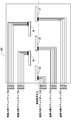
- FIG. 11 is an enlarged view of wiring of the surface emitting element array chips 23 to 27 on the drive substrate 202.
- the start pulse line ⁇ S and the transfer lines ⁇ 1 and ⁇ 2 are wired in common to all the surface light emitting element array chips 1 to 29, and the description is omitted.
- the lighting signal lines ⁇ W1 to ⁇ W4 are connected to the respective surface light emitting element array chips 1 to 29. Therefore, if the number of wirings required for the surface light emitting element array chip 24 and the surface light emitting element array chip 26 is limited to these two, a total of eight wirings are required.
- the number of wirings required for the surface light emitting element array chip 23, the surface light emitting element array chip 25, and the surface light emitting element array chip 27 is a total of 12 if limited to these three. Therefore, the light emission center is moved from the center of the short side of the substrate defined by the upper end and the lower end of the drive substrate 202 to the side where the number of the surface light emitting element array chips is small (that is, the even numbered side). As a result, it is possible to secure more wiring areas on the side where the number of surface emitting element array chips is large (the odd-numbered side).
- an odd number of surface light emitting element array chips are arranged on the drive substrate 202 in a staggered manner, an odd number of surface light emitting element array chips are arranged in the short direction of the drive substrate 202. More wiring area can be secured. This is due to the configuration in which the light emission center is moved from the center of the short side of the substrate defined by the upper and lower ends of the drive substrate 202 to the side having the smaller number of surface light emitting element array chips. Therefore, even when the number of the surface light emitting element array chips is odd, it is possible to arrange the surface light emitting element array chips on the drive substrate 202 without increasing the length of the drive substrate 202 in the lateral direction. Become.
Landscapes
- Physics & Mathematics (AREA)
- General Physics & Mathematics (AREA)
- Health & Medical Sciences (AREA)
- General Health & Medical Sciences (AREA)
- Toxicology (AREA)
- Optics & Photonics (AREA)
- Printers Or Recording Devices Using Electromagnetic And Radiation Means (AREA)
- Exposure Or Original Feeding In Electrophotography (AREA)
- Exposure And Positioning Against Photoresist Photosensitive Materials (AREA)
- Led Device Packages (AREA)
Abstract
L'invention concerne un nombre impair de puces à matrice d'éléments électroluminescents de surface (1 à 29) montées sur une carte de commande (202), un nombre pair des puces à matrice d'éléments électroluminescents de surface (2, 4.., 28) parmi le nombre impair de puces à matrice d'éléments électroluminescents de surface(1 à 29) étant disposées sur un côté dans une direction de croisement, et le nombre impair restant de puces à matrice d'éléments électroluminescents de surface (1, 3.., 29) parmi le nombre impair de puces à matrice d'éléments électroluminescents de surface étant disposées de l'autre côté dans la direction de croisement, et la position d'un centre d'émission de lumière étant davantage décalée du côté d'une carte de circuit imprimé (202) sur laquelle le nombre pair de puces à matrice d'éléments électroluminescents de surface (2, 4.., 28) sont disposées que le centre latéral de la carte. Ainsi, il est possible de supprimer une augmentation de la taille de la carte de circuit imprimé, il est également possible de supprimer l'accumulation de câblage sur la carte de circuit imprimé, même si un nombre impair de matrices d'éléments électroluminescents sont disposées sur la carte de circuit imprimé.
Priority Applications (1)
| Application Number | Priority Date | Filing Date | Title |
|---|---|---|---|
| US17/124,120 US11294297B2 (en) | 2018-06-27 | 2020-12-16 | Image forming apparatus with separate light emitting element arrays |
Applications Claiming Priority (2)
| Application Number | Priority Date | Filing Date | Title |
|---|---|---|---|
| JP2018-121823 | 2018-06-27 | ||
| JP2018121823A JP2020001245A (ja) | 2018-06-27 | 2018-06-27 | 画像形成装置 |
Related Child Applications (1)
| Application Number | Title | Priority Date | Filing Date |
|---|---|---|---|
| US17/124,120 Continuation US11294297B2 (en) | 2018-06-27 | 2020-12-16 | Image forming apparatus with separate light emitting element arrays |
Publications (1)
| Publication Number | Publication Date |
|---|---|
| WO2020004484A1 true WO2020004484A1 (fr) | 2020-01-02 |
Family
ID=68984892
Family Applications (1)
| Application Number | Title | Priority Date | Filing Date |
|---|---|---|---|
| PCT/JP2019/025427 Ceased WO2020004484A1 (fr) | 2018-06-27 | 2019-06-26 | Dispositif de formation d'image |
Country Status (3)
| Country | Link |
|---|---|
| US (1) | US11294297B2 (fr) |
| JP (1) | JP2020001245A (fr) |
| WO (1) | WO2020004484A1 (fr) |
Cited By (1)
| Publication number | Priority date | Publication date | Assignee | Title |
|---|---|---|---|---|
| EP4129703A4 (fr) * | 2020-03-25 | 2024-11-27 | Fujifilm Business Innovation Corp. | Dispositif électroluminescent et dispositif de rendu |
Families Citing this family (3)
| Publication number | Priority date | Publication date | Assignee | Title |
|---|---|---|---|---|
| DE102019106521A1 (de) * | 2019-03-14 | 2020-09-17 | OSRAM Opto Semiconductors Gesellschaft mit beschränkter Haftung | Aufwachsstruktur für ein Strahlung emittierendes Halbleiterbauelement und Strahlung emittierendes Halbleiterbauelement |
| JP7593026B2 (ja) * | 2020-09-24 | 2024-12-03 | 富士フイルムビジネスイノベーション株式会社 | 発光装置および画像形成装置 |
| JP7583775B2 (ja) * | 2022-11-04 | 2024-11-14 | キヤノン株式会社 | 露光制御装置及び画像形成装置 |
Citations (4)
| Publication number | Priority date | Publication date | Assignee | Title |
|---|---|---|---|---|
| JP2001010110A (ja) * | 1999-06-29 | 2001-01-16 | Kyocera Corp | 記録ヘッド |
| JP2009218602A (ja) * | 2009-03-23 | 2009-09-24 | Fuji Xerox Co Ltd | 発光装置、プリントヘッド、画像形成装置および発光装置の製造方法 |
| US20150191011A1 (en) * | 2012-09-25 | 2015-07-09 | Hewlett-Packard Development Company, L.P. | Print head die |
| JP2019098548A (ja) * | 2017-11-29 | 2019-06-24 | キヤノン株式会社 | 画像形成装置、画像形成装置の制御方法及びプログラム |
Family Cites Families (6)
| Publication number | Priority date | Publication date | Assignee | Title |
|---|---|---|---|---|
| KR20010100868A (ko) * | 2000-04-06 | 2001-11-14 | 이주하라 요죠우 | 광기록 헤드와 그 조립 방법 |
| JP2006205682A (ja) * | 2005-01-31 | 2006-08-10 | Kyocera Mita Corp | Ledアレイ露光装置及びこれを使用する画像形成装置 |
| JP5114953B2 (ja) | 2007-01-24 | 2013-01-09 | 富士ゼロックス株式会社 | 露光装置および画像形成装置 |
| US7830406B2 (en) * | 2007-02-20 | 2010-11-09 | Seiko I Infotech Inc. | LED printer and print control method |
| JP5347764B2 (ja) * | 2009-06-30 | 2013-11-20 | 富士ゼロックス株式会社 | 発光基板装置、プリントヘッドおよび画像形成装置 |
| JP7080736B2 (ja) * | 2018-06-12 | 2022-06-06 | キヤノン株式会社 | 露光ヘッド及び画像形成装置 |
-
2018
- 2018-06-27 JP JP2018121823A patent/JP2020001245A/ja not_active Withdrawn
-
2019
- 2019-06-26 WO PCT/JP2019/025427 patent/WO2020004484A1/fr not_active Ceased
-
2020
- 2020-12-16 US US17/124,120 patent/US11294297B2/en active Active
Patent Citations (4)
| Publication number | Priority date | Publication date | Assignee | Title |
|---|---|---|---|---|
| JP2001010110A (ja) * | 1999-06-29 | 2001-01-16 | Kyocera Corp | 記録ヘッド |
| JP2009218602A (ja) * | 2009-03-23 | 2009-09-24 | Fuji Xerox Co Ltd | 発光装置、プリントヘッド、画像形成装置および発光装置の製造方法 |
| US20150191011A1 (en) * | 2012-09-25 | 2015-07-09 | Hewlett-Packard Development Company, L.P. | Print head die |
| JP2019098548A (ja) * | 2017-11-29 | 2019-06-24 | キヤノン株式会社 | 画像形成装置、画像形成装置の制御方法及びプログラム |
Cited By (1)
| Publication number | Priority date | Publication date | Assignee | Title |
|---|---|---|---|---|
| EP4129703A4 (fr) * | 2020-03-25 | 2024-11-27 | Fujifilm Business Innovation Corp. | Dispositif électroluminescent et dispositif de rendu |
Also Published As
| Publication number | Publication date |
|---|---|
| US11294297B2 (en) | 2022-04-05 |
| JP2020001245A (ja) | 2020-01-09 |
| US20210103231A1 (en) | 2021-04-08 |
Similar Documents
| Publication | Publication Date | Title |
|---|---|---|
| JP7106363B2 (ja) | 画像形成装置 | |
| JP7187282B2 (ja) | 画像形成装置 | |
| JP7143185B2 (ja) | 画像形成装置 | |
| US11294297B2 (en) | Image forming apparatus with separate light emitting element arrays | |
| JP7342229B2 (ja) | 画像形成装置 | |
| US11079699B2 (en) | Exposure head and image forming apparatus | |
| WO2020004422A1 (fr) | Dispositif de formation d'image | |
| US20260064032A1 (en) | Image forming apparatus with top emission light emitting device | |
| JP7130469B2 (ja) | 画像形成装置 | |
| JP7062536B2 (ja) | 画像形成装置 | |
| JP7191625B2 (ja) | 画像形成装置 | |
| JP7094800B2 (ja) | 画像形成装置 | |
| JP7130455B2 (ja) | 画像形成装置 | |
| JP7691300B2 (ja) | 画像形成装置 |
Legal Events
| Date | Code | Title | Description |
|---|---|---|---|
| 121 | Ep: the epo has been informed by wipo that ep was designated in this application |
Ref document number: 19826710 Country of ref document: EP Kind code of ref document: A1 |
|
| NENP | Non-entry into the national phase |
Ref country code: DE |
|
| 122 | Ep: pct application non-entry in european phase |
Ref document number: 19826710 Country of ref document: EP Kind code of ref document: A1 |