WO2020004631A1 - Hydrogenated block copolymer - Google Patents
Hydrogenated block copolymer Download PDFInfo
- Publication number
- WO2020004631A1 WO2020004631A1 PCT/JP2019/025862 JP2019025862W WO2020004631A1 WO 2020004631 A1 WO2020004631 A1 WO 2020004631A1 JP 2019025862 W JP2019025862 W JP 2019025862W WO 2020004631 A1 WO2020004631 A1 WO 2020004631A1
- Authority
- WO
- WIPO (PCT)
- Prior art keywords
- block copolymer
- packaging container
- resin composition
- hydrogenated block
- liquid packaging
- Prior art date
- Legal status (The legal status is an assumption and is not a legal conclusion. Google has not performed a legal analysis and makes no representation as to the accuracy of the status listed.)
- Ceased
Links
Classifications
-
- C—CHEMISTRY; METALLURGY
- C08—ORGANIC MACROMOLECULAR COMPOUNDS; THEIR PREPARATION OR CHEMICAL WORKING-UP; COMPOSITIONS BASED THEREON
- C08F—MACROMOLECULAR COMPOUNDS OBTAINED BY REACTIONS ONLY INVOLVING CARBON-TO-CARBON UNSATURATED BONDS
- C08F297/00—Macromolecular compounds obtained by successively polymerising different monomer systems using a catalyst of the ionic or coordination type without deactivating the intermediate polymer
- C08F297/02—Macromolecular compounds obtained by successively polymerising different monomer systems using a catalyst of the ionic or coordination type without deactivating the intermediate polymer using a catalyst of the anionic type
- C08F297/04—Macromolecular compounds obtained by successively polymerising different monomer systems using a catalyst of the ionic or coordination type without deactivating the intermediate polymer using a catalyst of the anionic type polymerising vinyl aromatic monomers and conjugated dienes
-
- A—HUMAN NECESSITIES
- A61—MEDICAL OR VETERINARY SCIENCE; HYGIENE
- A61J—CONTAINERS SPECIALLY ADAPTED FOR MEDICAL OR PHARMACEUTICAL PURPOSES; DEVICES OR METHODS SPECIALLY ADAPTED FOR BRINGING PHARMACEUTICAL PRODUCTS INTO PARTICULAR PHYSICAL OR ADMINISTERING FORMS; DEVICES FOR ADMINISTERING FOOD OR MEDICINES ORALLY; BABY COMFORTERS; DEVICES FOR RECEIVING SPITTLE
- A61J1/00—Containers specially adapted for medical or pharmaceutical purposes
- A61J1/14—Details; Accessories therefor
- A61J1/1468—Containers characterised by specific material properties
-
- C—CHEMISTRY; METALLURGY
- C08—ORGANIC MACROMOLECULAR COMPOUNDS; THEIR PREPARATION OR CHEMICAL WORKING-UP; COMPOSITIONS BASED THEREON
- C08L—COMPOSITIONS OF MACROMOLECULAR COMPOUNDS
- C08L53/00—Compositions of block copolymers containing at least one sequence of a polymer obtained by reactions only involving carbon-to-carbon unsaturated bonds; Compositions of derivatives of such polymers
- C08L53/02—Compositions of block copolymers containing at least one sequence of a polymer obtained by reactions only involving carbon-to-carbon unsaturated bonds; Compositions of derivatives of such polymers of vinyl-aromatic monomers and conjugated dienes
- C08L53/025—Compositions of block copolymers containing at least one sequence of a polymer obtained by reactions only involving carbon-to-carbon unsaturated bonds; Compositions of derivatives of such polymers of vinyl-aromatic monomers and conjugated dienes modified
-
- A—HUMAN NECESSITIES
- A61—MEDICAL OR VETERINARY SCIENCE; HYGIENE
- A61J—CONTAINERS SPECIALLY ADAPTED FOR MEDICAL OR PHARMACEUTICAL PURPOSES; DEVICES OR METHODS SPECIALLY ADAPTED FOR BRINGING PHARMACEUTICAL PRODUCTS INTO PARTICULAR PHYSICAL OR ADMINISTERING FORMS; DEVICES FOR ADMINISTERING FOOD OR MEDICINES ORALLY; BABY COMFORTERS; DEVICES FOR RECEIVING SPITTLE
- A61J1/00—Containers specially adapted for medical or pharmaceutical purposes
- A61J1/05—Containers specially adapted for medical or pharmaceutical purposes for collecting, storing or administering blood, plasma or medical fluids ; Infusion or perfusion containers
- A61J1/10—Bag-type containers
-
- B—PERFORMING OPERATIONS; TRANSPORTING
- B32—LAYERED PRODUCTS
- B32B—LAYERED PRODUCTS, i.e. PRODUCTS BUILT-UP OF STRATA OF FLAT OR NON-FLAT, e.g. CELLULAR OR HONEYCOMB, FORM
- B32B27/00—Layered products comprising a layer of synthetic resin
- B32B27/06—Layered products comprising a layer of synthetic resin as the main or only constituent of a layer, which is next to another layer of the same or of a different material
- B32B27/08—Layered products comprising a layer of synthetic resin as the main or only constituent of a layer, which is next to another layer of the same or of a different material of synthetic resin
-
- B—PERFORMING OPERATIONS; TRANSPORTING
- B32—LAYERED PRODUCTS
- B32B—LAYERED PRODUCTS, i.e. PRODUCTS BUILT-UP OF STRATA OF FLAT OR NON-FLAT, e.g. CELLULAR OR HONEYCOMB, FORM
- B32B27/00—Layered products comprising a layer of synthetic resin
- B32B27/18—Layered products comprising a layer of synthetic resin characterised by the use of special additives
-
- B—PERFORMING OPERATIONS; TRANSPORTING
- B32—LAYERED PRODUCTS
- B32B—LAYERED PRODUCTS, i.e. PRODUCTS BUILT-UP OF STRATA OF FLAT OR NON-FLAT, e.g. CELLULAR OR HONEYCOMB, FORM
- B32B27/00—Layered products comprising a layer of synthetic resin
- B32B27/30—Layered products comprising a layer of synthetic resin comprising vinyl (co)polymers; comprising acrylic (co)polymers
- B32B27/302—Layered products comprising a layer of synthetic resin comprising vinyl (co)polymers; comprising acrylic (co)polymers comprising aromatic vinyl (co)polymers, e.g. styrenic (co)polymers
-
- B—PERFORMING OPERATIONS; TRANSPORTING
- B32—LAYERED PRODUCTS
- B32B—LAYERED PRODUCTS, i.e. PRODUCTS BUILT-UP OF STRATA OF FLAT OR NON-FLAT, e.g. CELLULAR OR HONEYCOMB, FORM
- B32B27/00—Layered products comprising a layer of synthetic resin
- B32B27/32—Layered products comprising a layer of synthetic resin comprising polyolefins
-
- B—PERFORMING OPERATIONS; TRANSPORTING
- B65—CONVEYING; PACKING; STORING; HANDLING THIN OR FILAMENTARY MATERIAL
- B65D—CONTAINERS FOR STORAGE OR TRANSPORT OF ARTICLES OR MATERIALS, e.g. BAGS, BARRELS, BOTTLES, BOXES, CANS, CARTONS, CRATES, DRUMS, JARS, TANKS, HOPPERS, FORWARDING CONTAINERS; ACCESSORIES, CLOSURES, OR FITTINGS THEREFOR; PACKAGING ELEMENTS; PACKAGES
- B65D65/00—Wrappers or flexible covers; Packaging materials of special type or form
- B65D65/38—Packaging materials of special type or form
- B65D65/40—Applications of laminates for particular packaging purposes
-
- C—CHEMISTRY; METALLURGY
- C08—ORGANIC MACROMOLECULAR COMPOUNDS; THEIR PREPARATION OR CHEMICAL WORKING-UP; COMPOSITIONS BASED THEREON
- C08F—MACROMOLECULAR COMPOUNDS OBTAINED BY REACTIONS ONLY INVOLVING CARBON-TO-CARBON UNSATURATED BONDS
- C08F112/00—Homopolymers of compounds having one or more unsaturated aliphatic radicals, each having only one carbon-to-carbon double bond, and at least one being terminated by an aromatic carbocyclic ring
- C08F112/02—Monomers containing only one unsaturated aliphatic radical
- C08F112/04—Monomers containing only one unsaturated aliphatic radical containing one ring
- C08F112/06—Hydrocarbons
- C08F112/08—Styrene
-
- C—CHEMISTRY; METALLURGY
- C08—ORGANIC MACROMOLECULAR COMPOUNDS; THEIR PREPARATION OR CHEMICAL WORKING-UP; COMPOSITIONS BASED THEREON
- C08F—MACROMOLECULAR COMPOUNDS OBTAINED BY REACTIONS ONLY INVOLVING CARBON-TO-CARBON UNSATURATED BONDS
- C08F136/00—Homopolymers of compounds having one or more unsaturated aliphatic radicals, at least one having two or more carbon-to-carbon double bonds
- C08F136/02—Homopolymers of compounds having one or more unsaturated aliphatic radicals, at least one having two or more carbon-to-carbon double bonds the radical having only two carbon-to-carbon double bonds
- C08F136/04—Homopolymers of compounds having one or more unsaturated aliphatic radicals, at least one having two or more carbon-to-carbon double bonds the radical having only two carbon-to-carbon double bonds conjugated
- C08F136/06—Butadiene
-
- C—CHEMISTRY; METALLURGY
- C08—ORGANIC MACROMOLECULAR COMPOUNDS; THEIR PREPARATION OR CHEMICAL WORKING-UP; COMPOSITIONS BASED THEREON
- C08F—MACROMOLECULAR COMPOUNDS OBTAINED BY REACTIONS ONLY INVOLVING CARBON-TO-CARBON UNSATURATED BONDS
- C08F136/00—Homopolymers of compounds having one or more unsaturated aliphatic radicals, at least one having two or more carbon-to-carbon double bonds
- C08F136/02—Homopolymers of compounds having one or more unsaturated aliphatic radicals, at least one having two or more carbon-to-carbon double bonds the radical having only two carbon-to-carbon double bonds
- C08F136/04—Homopolymers of compounds having one or more unsaturated aliphatic radicals, at least one having two or more carbon-to-carbon double bonds the radical having only two carbon-to-carbon double bonds conjugated
- C08F136/08—Isoprene
-
- C—CHEMISTRY; METALLURGY
- C08—ORGANIC MACROMOLECULAR COMPOUNDS; THEIR PREPARATION OR CHEMICAL WORKING-UP; COMPOSITIONS BASED THEREON
- C08F—MACROMOLECULAR COMPOUNDS OBTAINED BY REACTIONS ONLY INVOLVING CARBON-TO-CARBON UNSATURATED BONDS
- C08F297/00—Macromolecular compounds obtained by successively polymerising different monomer systems using a catalyst of the ionic or coordination type without deactivating the intermediate polymer
- C08F297/02—Macromolecular compounds obtained by successively polymerising different monomer systems using a catalyst of the ionic or coordination type without deactivating the intermediate polymer using a catalyst of the anionic type
- C08F297/04—Macromolecular compounds obtained by successively polymerising different monomer systems using a catalyst of the ionic or coordination type without deactivating the intermediate polymer using a catalyst of the anionic type polymerising vinyl aromatic monomers and conjugated dienes
- C08F297/046—Macromolecular compounds obtained by successively polymerising different monomer systems using a catalyst of the ionic or coordination type without deactivating the intermediate polymer using a catalyst of the anionic type polymerising vinyl aromatic monomers and conjugated dienes polymerising vinyl aromatic monomers and isoprene, optionally with other conjugated dienes
-
- C—CHEMISTRY; METALLURGY
- C08—ORGANIC MACROMOLECULAR COMPOUNDS; THEIR PREPARATION OR CHEMICAL WORKING-UP; COMPOSITIONS BASED THEREON
- C08F—MACROMOLECULAR COMPOUNDS OBTAINED BY REACTIONS ONLY INVOLVING CARBON-TO-CARBON UNSATURATED BONDS
- C08F8/00—Chemical modification by after-treatment
- C08F8/04—Reduction, e.g. hydrogenation
-
- C—CHEMISTRY; METALLURGY
- C08—ORGANIC MACROMOLECULAR COMPOUNDS; THEIR PREPARATION OR CHEMICAL WORKING-UP; COMPOSITIONS BASED THEREON
- C08J—WORKING-UP; GENERAL PROCESSES OF COMPOUNDING; AFTER-TREATMENT NOT COVERED BY SUBCLASSES C08B, C08C, C08F, C08G or C08H
- C08J5/00—Manufacture of articles or shaped materials containing macromolecular substances
- C08J5/18—Manufacture of films or sheets
-
- C—CHEMISTRY; METALLURGY
- C08—ORGANIC MACROMOLECULAR COMPOUNDS; THEIR PREPARATION OR CHEMICAL WORKING-UP; COMPOSITIONS BASED THEREON
- C08L—COMPOSITIONS OF MACROMOLECULAR COMPOUNDS
- C08L23/00—Compositions of homopolymers or copolymers of unsaturated aliphatic hydrocarbons having only one carbon-to-carbon double bond; Compositions of derivatives of such polymers
- C08L23/02—Compositions of homopolymers or copolymers of unsaturated aliphatic hydrocarbons having only one carbon-to-carbon double bond; Compositions of derivatives of such polymers not modified by chemical after-treatment
- C08L23/04—Homopolymers or copolymers of ethene
- C08L23/06—Polyethylene
-
- C—CHEMISTRY; METALLURGY
- C08—ORGANIC MACROMOLECULAR COMPOUNDS; THEIR PREPARATION OR CHEMICAL WORKING-UP; COMPOSITIONS BASED THEREON
- C08L—COMPOSITIONS OF MACROMOLECULAR COMPOUNDS
- C08L23/00—Compositions of homopolymers or copolymers of unsaturated aliphatic hydrocarbons having only one carbon-to-carbon double bond; Compositions of derivatives of such polymers
- C08L23/02—Compositions of homopolymers or copolymers of unsaturated aliphatic hydrocarbons having only one carbon-to-carbon double bond; Compositions of derivatives of such polymers not modified by chemical after-treatment
- C08L23/10—Homopolymers or copolymers of propene
-
- C—CHEMISTRY; METALLURGY
- C08—ORGANIC MACROMOLECULAR COMPOUNDS; THEIR PREPARATION OR CHEMICAL WORKING-UP; COMPOSITIONS BASED THEREON
- C08L—COMPOSITIONS OF MACROMOLECULAR COMPOUNDS
- C08L23/00—Compositions of homopolymers or copolymers of unsaturated aliphatic hydrocarbons having only one carbon-to-carbon double bond; Compositions of derivatives of such polymers
- C08L23/02—Compositions of homopolymers or copolymers of unsaturated aliphatic hydrocarbons having only one carbon-to-carbon double bond; Compositions of derivatives of such polymers not modified by chemical after-treatment
- C08L23/10—Homopolymers or copolymers of propene
- C08L23/12—Polypropene
-
- C—CHEMISTRY; METALLURGY
- C08—ORGANIC MACROMOLECULAR COMPOUNDS; THEIR PREPARATION OR CHEMICAL WORKING-UP; COMPOSITIONS BASED THEREON
- C08L—COMPOSITIONS OF MACROMOLECULAR COMPOUNDS
- C08L23/00—Compositions of homopolymers or copolymers of unsaturated aliphatic hydrocarbons having only one carbon-to-carbon double bond; Compositions of derivatives of such polymers
- C08L23/02—Compositions of homopolymers or copolymers of unsaturated aliphatic hydrocarbons having only one carbon-to-carbon double bond; Compositions of derivatives of such polymers not modified by chemical after-treatment
- C08L23/10—Homopolymers or copolymers of propene
- C08L23/14—Copolymers of propene
-
- C—CHEMISTRY; METALLURGY
- C08—ORGANIC MACROMOLECULAR COMPOUNDS; THEIR PREPARATION OR CHEMICAL WORKING-UP; COMPOSITIONS BASED THEREON
- C08L—COMPOSITIONS OF MACROMOLECULAR COMPOUNDS
- C08L23/00—Compositions of homopolymers or copolymers of unsaturated aliphatic hydrocarbons having only one carbon-to-carbon double bond; Compositions of derivatives of such polymers
- C08L23/02—Compositions of homopolymers or copolymers of unsaturated aliphatic hydrocarbons having only one carbon-to-carbon double bond; Compositions of derivatives of such polymers not modified by chemical after-treatment
- C08L23/16—Ethylene-propylene or ethylene-propylene-diene copolymers
-
- C—CHEMISTRY; METALLURGY
- C08—ORGANIC MACROMOLECULAR COMPOUNDS; THEIR PREPARATION OR CHEMICAL WORKING-UP; COMPOSITIONS BASED THEREON
- C08L—COMPOSITIONS OF MACROMOLECULAR COMPOUNDS
- C08L53/00—Compositions of block copolymers containing at least one sequence of a polymer obtained by reactions only involving carbon-to-carbon unsaturated bonds; Compositions of derivatives of such polymers
- C08L53/02—Compositions of block copolymers containing at least one sequence of a polymer obtained by reactions only involving carbon-to-carbon unsaturated bonds; Compositions of derivatives of such polymers of vinyl-aromatic monomers and conjugated dienes
-
- B—PERFORMING OPERATIONS; TRANSPORTING
- B32—LAYERED PRODUCTS
- B32B—LAYERED PRODUCTS, i.e. PRODUCTS BUILT-UP OF STRATA OF FLAT OR NON-FLAT, e.g. CELLULAR OR HONEYCOMB, FORM
- B32B2250/00—Layers arrangement
- B32B2250/02—2 layers
-
- B—PERFORMING OPERATIONS; TRANSPORTING
- B32—LAYERED PRODUCTS
- B32B—LAYERED PRODUCTS, i.e. PRODUCTS BUILT-UP OF STRATA OF FLAT OR NON-FLAT, e.g. CELLULAR OR HONEYCOMB, FORM
- B32B2250/00—Layers arrangement
- B32B2250/03—3 layers
-
- B—PERFORMING OPERATIONS; TRANSPORTING
- B32—LAYERED PRODUCTS
- B32B—LAYERED PRODUCTS, i.e. PRODUCTS BUILT-UP OF STRATA OF FLAT OR NON-FLAT, e.g. CELLULAR OR HONEYCOMB, FORM
- B32B2250/00—Layers arrangement
- B32B2250/24—All layers being polymeric
-
- B—PERFORMING OPERATIONS; TRANSPORTING
- B32—LAYERED PRODUCTS
- B32B—LAYERED PRODUCTS, i.e. PRODUCTS BUILT-UP OF STRATA OF FLAT OR NON-FLAT, e.g. CELLULAR OR HONEYCOMB, FORM
- B32B2250/00—Layers arrangement
- B32B2250/24—All layers being polymeric
- B32B2250/246—All polymers belonging to those covered by groups B32B27/32 and B32B27/30
-
- B—PERFORMING OPERATIONS; TRANSPORTING
- B32—LAYERED PRODUCTS
- B32B—LAYERED PRODUCTS, i.e. PRODUCTS BUILT-UP OF STRATA OF FLAT OR NON-FLAT, e.g. CELLULAR OR HONEYCOMB, FORM
- B32B2307/00—Properties of the layers or laminate
- B32B2307/30—Properties of the layers or laminate having particular thermal properties
- B32B2307/31—Heat sealable
-
- B—PERFORMING OPERATIONS; TRANSPORTING
- B32—LAYERED PRODUCTS
- B32B—LAYERED PRODUCTS, i.e. PRODUCTS BUILT-UP OF STRATA OF FLAT OR NON-FLAT, e.g. CELLULAR OR HONEYCOMB, FORM
- B32B2307/00—Properties of the layers or laminate
- B32B2307/70—Other properties
- B32B2307/732—Dimensional properties
-
- B—PERFORMING OPERATIONS; TRANSPORTING
- B32—LAYERED PRODUCTS
- B32B—LAYERED PRODUCTS, i.e. PRODUCTS BUILT-UP OF STRATA OF FLAT OR NON-FLAT, e.g. CELLULAR OR HONEYCOMB, FORM
- B32B2439/00—Containers; Receptacles
- B32B2439/40—Closed containers
- B32B2439/46—Bags
-
- B—PERFORMING OPERATIONS; TRANSPORTING
- B32—LAYERED PRODUCTS
- B32B—LAYERED PRODUCTS, i.e. PRODUCTS BUILT-UP OF STRATA OF FLAT OR NON-FLAT, e.g. CELLULAR OR HONEYCOMB, FORM
- B32B2439/00—Containers; Receptacles
- B32B2439/70—Food packaging
-
- B—PERFORMING OPERATIONS; TRANSPORTING
- B32—LAYERED PRODUCTS
- B32B—LAYERED PRODUCTS, i.e. PRODUCTS BUILT-UP OF STRATA OF FLAT OR NON-FLAT, e.g. CELLULAR OR HONEYCOMB, FORM
- B32B2439/00—Containers; Receptacles
- B32B2439/80—Medical packaging
-
- B—PERFORMING OPERATIONS; TRANSPORTING
- B32—LAYERED PRODUCTS
- B32B—LAYERED PRODUCTS, i.e. PRODUCTS BUILT-UP OF STRATA OF FLAT OR NON-FLAT, e.g. CELLULAR OR HONEYCOMB, FORM
- B32B2535/00—Medical equipment, e.g. bandage, prostheses or catheter
-
- C—CHEMISTRY; METALLURGY
- C08—ORGANIC MACROMOLECULAR COMPOUNDS; THEIR PREPARATION OR CHEMICAL WORKING-UP; COMPOSITIONS BASED THEREON
- C08L—COMPOSITIONS OF MACROMOLECULAR COMPOUNDS
- C08L2203/00—Applications
- C08L2203/02—Applications for biomedical use
-
- C—CHEMISTRY; METALLURGY
- C08—ORGANIC MACROMOLECULAR COMPOUNDS; THEIR PREPARATION OR CHEMICAL WORKING-UP; COMPOSITIONS BASED THEREON
- C08L—COMPOSITIONS OF MACROMOLECULAR COMPOUNDS
- C08L2203/00—Applications
- C08L2203/16—Applications used for films
- C08L2203/162—Applications used for films sealable films
Definitions
- the present invention relates to a hydrogenated block copolymer, a resin composition, a film for a liquid packaging container, a liquid packaging container, and a medical device.
- an infusion bag a glass container or a plastic container is used. After the drug solution injected into the infusion bag is sealed, it is generally sterilized by a method such as steam sterilization or autoclave sterilization. Glass infusion bags are heavier than plastic ones, and are liable to be damaged by impact or drop during transportation, so plastic infusion bags are widely used.
- plastic infusion bags those made of soft vinyl chloride resin and those made of polyolefin such as polyethylene and polypropylene are used.
- An infusion bag made of a soft vinyl chloride resin contains a large amount of plasticizer to impart flexibility.Therefore, depending on the type of infusion, the plasticizer may be eluted during the infusion, and safety issues are pointed out.
- the infusion bag made of a soft vinyl chloride resin is also incinerated after use, but there is a problem that toxic gas due to the soft vinyl chloride resin is generated.
- Infusion bags made of polyolefins such as polyethylene and polypropylene are preferable in terms of hygiene because they do not contain a plasticizer, but have low flexibility and insufficient impact resistance, so that they are not sufficient in terms of handleability. I can't say.
- Patent Document 1 aims at improving flexibility, sealing properties and blocking resistance, and aims at improving the crystalline polypropylene resin 50 to 98% by mass and the specific ethylene- ⁇ -olefin copolymer 1 to 49% by mass. %, And a medical-use multilayer film using a polypropylene resin composition containing 1 to 49% by mass of a specific hydrogenated block copolymer as a seal layer (inner layer).
- Patent Document 2 discloses a liquid packaging container excellent in flexibility, transparency, high heat sealing strength, bag breaking strength, and the like, as an inner layer, an intermediate layer, and a resin composition (Z) made of a resin composition (Y). ), Wherein the intermediate layer is a liquid packaging container comprising a resin composition (X), wherein each resin composition comprises a specific polypropylene resin and a specific thermoplastic resin.
- a liquid packaging container characterized by containing an elastomer has been proposed.
- an object of the present invention is to provide a hydrogenated block copolymer suitable for a film for a liquid packaging container having high bag breaking strength which is important as a liquid packaging container for medical use.
- Another object of the present invention is to provide a resin composition containing the hydrogenated block copolymer, a film for a liquid packaging container, a liquid packaging container, and a medical device using the resin composition.
- a hydrogenated block copolymer having, in a specific order, a polymer block mainly composed of structural units derived from a kind of conjugated diene compound is a resin composition obtained by mixing the hydrogenated block copolymer with a polyolefin resin. Among them, it was found that the hydrogenated block copolymer formed a phase having a fine dispersion diameter.
- the present invention relates to the following [1] to [15].
- Polymer blocks (A1) and (A2) mainly composed of a structural unit derived from an aromatic vinyl compound and polymer blocks (B) and (C) mainly composed of a structural unit derived from a conjugated diene compound A hydrogenated product of a block copolymer containing at least one of the polymer blocks (B) and (C) between the polymer blocks (A1) and (A2).
- the total content of (A1) and (A2) is 5 to 30% by mass, and the content of 3,4-bonds and 1,2-bonds in the polymer block (B) is 1 to 40% by mol.
- the content of 3,4-bonds and 1,2-bonds in the polymer block (C) is 50 to 100 mol%, and the polymer block (B) and the polymer block (C), Mass ratio of (C) [(C) / (B) + (C) ] Is 26/100 to 63/100.
- (X) forms a sea-island structure serving as a dispersed phase, and the size of the dispersed phase is 0.1 ⁇ m or more and 1.0 ⁇ m or less.
- the mass ratio [(Y) / ⁇ (X) + (Y) ⁇ ] of the polypropylene resin (Y) to the total of the polymer (X) and the polypropylene resin (Y) is from 61/100 to 95/100. Resin composition.
- the ratio of the viscosity ( ⁇ (X) ) of the hydrogenated block copolymer (X) to the viscosity ( ⁇ ( Y) ) of the polypropylene resin (Y) at 230 ° C. and a shear rate of 60 s ⁇ 1 [ ⁇ (X) / ⁇ (Y) ] is 0.6 to 8.0, the resin composition according to [5] or [6].
- a film for a liquid packaging container comprising the resin composition according to any one of [5] to [7].
- a liquid packaging container comprising a liquid packaging container film having at least two or more layers having an inner layer and an outer layer, The inner layer is made of the resin composition (Z), The liquid packaging container according to [9], wherein the outer layer is made of a resin composition (P) containing 60% by mass or more of a polypropylene-based resin (Y ′) having a content of structural units derived from propylene of 60% by mol or more. .
- a liquid packaging container comprising a liquid packaging container film having a structure of three or more layers having at least one intermediate layer between an inner layer and an outer layer, Either or both of the inner layer and the intermediate layer are made of the resin composition (Z),
- the melting point MP in of the resin component constituting the inner layer and the melting point MP mid of the resin component constituting the intermediate layer are represented by the following formula: MP in ⁇ MP mid
- the liquid packaging container according to [11] or [12] which satisfies the following.
- the melting point MP Z of the resin composition (Z) constituting the inner layer and the melting point MP p of the resin composition (P) constituting the outer layer are represented by the following formula (2).
- the present invention it is possible to provide a hydrogenated block copolymer suitable for a film for a liquid packaging container having a high bag breaking strength, which is important as a liquid packaging container for medical use. Further, the present invention can provide a resin composition containing the hydrogenated block copolymer, a film for a liquid packaging container, a liquid packaging container, and a medical device using the resin composition.
- the hydrogenated block copolymer of the present invention comprises a polymer block (A1) or (A2) mainly composed of a structural unit derived from an aromatic vinyl compound and a polymer block mainly composed of a structural unit derived from a conjugated diene compound ( B) and (C), and hydrogenation of a block copolymer in which at least one of the polymer blocks (B) and (C) exists between the polymer blocks (A1) and (A2) Wherein the total content of the polymer blocks (A1) and (A2) is 5 to 30% by mass, and the content of 3,4-bonds and 1,2-bonds in the polymer block (B).
- the hydrogenated block copolymer of the present invention has a block copolymer in which at least one of the polymer blocks (B) and (C) exists between the polymer blocks (A1) and (A2).
- the hydrogenated block copolymer Since the hydrogenated block copolymer is a unified hydrogenated product, the hydrogenated block copolymer forms a phase having a fine dispersion diameter in the resin composition obtained by mixing the hydrogenated block copolymer and the polyolefin-based resin.
- the resin composition has a phase having a fine dispersion diameter, a film using the resin composition is more likely to undergo cohesive failure than interfacial peeling or film breakage, resulting in high bag breaking strength.
- the tensile shear adhesive strength of the heat-sealed portion is an index of the bag breaking strength. May be.
- the tensile shear adhesive strength is determined, for example, according to JIS K 6850 (1999) using a sheet of hydrogenated block copolymer having a width of 25 mm, a length of 10 mm, and a thickness of 0.3 mm from two polypropylene-based resins.
- the value obtained by dividing the maximum load measured by pulling at a pulling speed of 500 mm / min by the bonding area may be used as the tensile shear bonding strength (MPa).
- the tensile shear adhesive strength (MPa) is preferably 4.5 MPa or less, more preferably 1.5 to 4.5 MPa, and even more preferably 2 to 4 MPa.
- the film made of the resin composition containing the hydrogenated block copolymer and the polyolefin-based resin has higher bag breaking strength.
- the polyolefin resin used for the above index may be, for example, a propylene-butene random copolymer having an MFR of 5.8 g / 10 min (230 ° C., 21.6 N), a melting point of 130 ° C. and a propylene content of 90 mol%.
- MFR 5.8 g / 10 min (230 ° C., 21.6 N)
- melting point 130 ° C.
- propylene content 90 mol%.
- the hydrogenated block copolymer of the present invention has polymer blocks (A1) and (A2) mainly composed of a structural unit derived from an aromatic vinyl compound.
- the polymer blocks (A1) and (A2) are mainly composed of structural units derived from an aromatic vinyl compound.
- "mainly" means that each of the polymer blocks (A1) and (A2) contains a structural unit derived from an aromatic vinyl compound in an amount of more than 50% by mass.
- the content of the structural unit derived from the aromatic vinyl compound in the polymer block (A) is determined from the viewpoint of improving the transparency and mechanical properties of the resin composition containing the hydrogenated block copolymer of the present invention.
- the content of each of the polymer blocks (A1) and (A2) is more preferably 70% by mass or more, and even more preferably 90% by mass or more.
- aromatic vinyl compound examples include styrene, o-methylstyrene, m-methylstyrene, p-methylstyrene, ⁇ -methylstyrene, ⁇ -methylstyrene, 2,6-dimethylstyrene, 2,4-dimethylstyrene, ⁇ -methyl-o-methylstyrene, ⁇ -methyl-m-methylstyrene, ⁇ -methyl-p-methylstyrene, ⁇ -methyl-o-methylstyrene, ⁇ -methyl-m-methylstyrene, ⁇ -methyl-p -Methylstyrene, 2,4,6-trimethylstyrene, ⁇ -methyl-2,6-dimethylstyrene, ⁇ -methyl-2,4-dimethylstyrene, ⁇ -methyl-2,6-dimethylstyrene, ⁇ -methyl- 2,4-dimethylstyrene,
- the polymer blocks (A1) and (A2) may contain a structural unit derived from an unsaturated monomer other than the aromatic vinyl compound, as long as the objects and effects of the present invention are not hindered.
- the other unsaturated monomers include butadiene, isoprene, 2,3-dimethyl-1,3-butadiene, 1,3-pentadiene, 1,3-hexadiene, isobutylene, styrene, o-methylstyrene, -Methylstyrene, p-methylstyrene, pt-butylstyrene, 2,4-dimethylstyrene, vinylnaphthalene, vinylanthracene, methyl methacrylate, methyl vinyl ether, N-vinylcarbazole, ⁇ -pinene, 8,9-p -At least one selected from menten, dipentene, methylenenorbornene, 2-methylenete
- the bonding form is not particularly limited, and may be random or tapered.
- the content is determined by the polymer blocks (A1) and (A2). In each, the content is preferably 10% by mass or less.
- the weight average molecular weight of each of the polymer blocks (A1) and (A2) is preferably 2,500 to 100,000, more preferably 2,500 to 50,000, and still more preferably 3,000 to 30,000. 000, more preferably 3,000 to 20,000, even more preferably 3,000 to 15,000, still more preferably 3,000 to 12,000, and still more preferably 3,000 to 10,000. is there. All “weight average molecular weights” described in the present specification and claims are weight average molecular weights in terms of standard polystyrene determined by gel permeation chromatography (GPC) measurement, and more specifically, described in Examples. It is a value measured according to the method.
- GPC gel permeation chromatography
- the polymer block (B) is a polymer block mainly composed of structural units derived from a conjugated diene compound and having a 3,4-bond and 1,2-bond content of 1 to 40 mol%.
- “mainly” means that the polymer block (B) contains a structural unit derived from a conjugated diene compound in an amount of more than 50% by mass.
- the content of the structural unit derived from the conjugated diene compound in the polymer block (B) is more preferably 70% by mass or more in the polymer block (B), and further preferably 90% by mass or more. preferable.
- Examples of the conjugated diene compound constituting the polymer block (B) include at least one selected from butadiene, isoprene, 2,3-dimethyl-1,3-butadiene, 1,3-pentadiene, 1,3-hexadiene, and the like. Seeds. Among them, butadiene, isoprene, and a mixture of butadiene and isoprene are preferable, and isoprene and a mixture of butadiene and isoprene are more preferable.
- the polymer block (B) is composed of structural units derived from two or more types of conjugated diene compounds (for example, butadiene and isoprene), their bonding forms are not particularly limited, and may be random, tapered, or completely. It can consist of alternating, partially block-like, block, or a combination of two or more thereof.
- conjugated diene compounds for example, butadiene and isoprene
- the weight average molecular weight of the polymer block (B) is preferably from 10,000 to 300,000, more preferably from the viewpoint of improving the flexibility of the resin composition containing the hydrogenated block copolymer of the present invention. Is from 20,000 to 270,000, more preferably from 35,000 to 240,000, still more preferably from 60,000 to 240,000, particularly preferably from 61,000 to 220,000, and still more preferably 61,000. To 170,000, more preferably 61,000 to 150,000, still more preferably 61,000 to 120,000, and still more preferably 61,000 to 100,000.
- the content of 3,4-bonds and 1,2-bonds (hereinafter sometimes referred to as “vinyl bond amount”) is 1 to 40 mol%.
- the content of the 3,4-bond and 1,2-bond is preferably 1 to 20 mol%, more preferably 2 to 10 mol%.
- the “content of 3,4-bonds and 1,2-bonds (vinyl bond amount)” refers to the content of 3,4-bonds in the polymer block in the block copolymer before hydrogenation.
- Conjugation incorporated by 3,4-bond and 1,2-bond with respect to the total molar amount of the structural unit derived from the conjugated diene compound incorporated by 1,2-bond and 1,4-bond. It is a ratio of a structural unit derived from a diene compound, and can be calculated by a method described in Examples described later.
- the polymer block (B) may contain a structural unit derived from a polymerizable monomer other than the conjugated diene compound, as long as the object and effects of the present invention are not hindered.
- the other polymerizable monomer include styrene, ⁇ -methylstyrene, o-methylstyrene, m-methylstyrene, p-methylstyrene, pt-butylstyrene, 2,4-dimethylstyrene, vinyl Aromatic vinyl compounds such as naphthalene and vinylanthracene; and at least one selected from methyl methacrylate, methyl vinyl ether, N-vinylcarbazole, ⁇ -pinene, 8,9-p-mentene, dipentene, methylenenorbornene, 2-methylenetetrahydrofuran and the like.
- the bonding form is not particularly limited, and may be random or tapered.
- the content is 30% by mass or less in the polymer block (B). And more preferably 10% by mass or less.
- the polymer block (C) is a polymer block mainly composed of structural units derived from a conjugated diene compound and having a content of 3,4-bond and 1,2-bond of 50 to 100 mol%.
- “mainly” means that the polymer block (C) contains more than 50% by mass of structural units derived from a conjugated diene compound.
- the content of the structural unit derived from the conjugated diene compound in the polymer block (C) is more preferably 70% by mass or more in the polymer block (C), and further preferably 90% by mass or more. preferable.
- Examples of the conjugated diene compound constituting the polymer block (C) include at least one selected from butadiene, isoprene, 2,3-dimethyl-1,3-butadiene, 1,3-pentadiene, 1,3-hexadiene, and the like. Seeds. Among them, butadiene, isoprene, and a mixture of butadiene and isoprene are preferred.
- the polymer block (C) is composed of structural units derived from two or more types of conjugated diene compounds (for example, butadiene and isoprene)
- their bonding forms are not particularly limited, and may be random, tapered, or completely. It can consist of alternating, partially block-like, block, or a combination of two or more thereof.
- the weight average molecular weight of the polymer block (C) is preferably from 5,000 to 240,000, and more preferably from the viewpoint of improving the flexibility of the resin composition containing the hydrogenated block copolymer of the present invention. Is from 10,000 to 220,000, more preferably from 20,000 to 200,000, even more preferably from 27,000 to 180,000, particularly preferably from 28,000 to 140,000, and still more preferably 28,000. 9090,000, even more preferably 28,000-70,000.
- the content of 3,4-linkage and 1,2-linkage is 50 to 100 mol%.
- the compatibility between the polymer block (C) of the present invention and the polypropylene resin becomes high.
- the dispersion diameter of the hydrogenated block copolymer in the resin composition becomes smaller, so that the film made of this resin composition is less likely to undergo interfacial peeling, and as a result, the breaking strength of the liquid packaging container is improved.
- the content of the 3,4-bond and 1,2-bond is preferably from 54 to 90 mol%, more preferably from 57 to 80 mol%.
- the polymer block (C) may contain a structural unit derived from a polymerizable monomer other than the conjugated diene compound, as long as the object and effects of the present invention are not hindered.
- the other polymerizable monomer include styrene, ⁇ -methylstyrene, o-methylstyrene, m-methylstyrene, p-methylstyrene, pt-butylstyrene, 2,4-dimethylstyrene, vinyl Aromatic vinyl compounds such as naphthalene and vinylanthracene; and at least one selected from methyl methacrylate, methyl vinyl ether, N-vinylcarbazole, ⁇ -pinene, 8,9-p-mentene, dipentene, methylenenorbornene, 2-methylenetetrahydrofuran and the like.
- the bonding form is not particularly limited, and may be random or tapered.
- the content is 30% by mass or less in the polymer block (C). And more preferably 10% by mass or less.
- the hydrogenated block copolymer of the present invention has a mass ratio [(C) / (B) + (C)] of the polymer block (C) to the total of the polymer blocks (B) and (C) of 26. / 100 to 63/100.
- the mass ratio is within the above range, the tensile shear adhesive strength between the hydrogenated block copolymer and the polypropylene-based resin is 4.5 MPa or less, and the hydrogenation in the resin composition composed of these is performed.
- the mass ratio of the polymer block (C) is smaller than the lower limit, the dispersion diameter of the hydrogenated block copolymer does not become fine, and when the mass ratio is larger than the upper limit, the tensile shear adhesive strength with the polypropylene resin is reduced. There is a problem that goes up too much. From these viewpoints, the mass ratio [(C) / (B) + (C)] is preferably 26/100 to 60/100, more preferably 26/100 to 56/100, and 27/100 to 52/100.
- the mass ratio [(C) / (B) + (C)] is preferably 26/100 to 60/100, and 26/100 to 56/100. Is more preferably, 27/100 to 52/100 is still more preferable, 27/100 to 45/100 is still more preferable, 27/100 to 40/100 is further more preferable, and 27/100 to 35/100 is still more preferable.
- the mass ratio [(C) / (B) + (C)] is within the above range, the impact resistance of the resin composition (Z) described later is improved, and the bag breaking strength is improved.
- the hydrogenation rate of the polymer blocks (B) and (C) in the hydrogenated block copolymer of the present invention (hereinafter sometimes abbreviated as hydrogenation rate) is from the viewpoint of improving heat resistance and weather resistance. , 80 mol% or more is preferable, 85 mol% or more is more preferable, 90 mol% or more is still more preferable, and 93 mol% or more is still more preferable.
- the upper limit of the hydrogenation rate is not particularly limited, the upper limit may be 99 mol% or 98 mol%.
- the hydrogenation rate of the above polymer block (B) and (C) in the structural unit derived from the conjugated diene compound in the carbon - the content of carbon-carbon double bonds, both before and after the hydrogenation 1 H- It is a value calculated using an NMR spectrum, and more specifically, a value measured according to the method described in Examples.
- the “hydrogenation rate of the polymer blocks (B) and (C)” indicates an average value of the hydrogenation rates of the polymer blocks (B) and (C).
- the total content of the polymer blocks (A1) and (A2) in the hydrogenated block copolymer of the present invention is 5 to 30% by mass.
- the total content of the polymer blocks (A1) and (A2) is less than the lower limit, the rubber elasticity and the viscosity of the hydrogenated block copolymer of the present invention decrease.
- the total content exceeds the upper limit, the flexibility of the layer formed from the resin composition containing the hydrogenated block copolymer and the polypropylene-based resin of the present invention decreases.
- the total content of the polymer blocks (A1) and (A2) is preferably 7 to 30% by mass, more preferably 10 to 28% by mass, and more preferably 15 to 25% by mass. More preferably, it is.
- the total content of the polymer blocks (A1) and (A2) is a value determined by 1 H-NMR spectrum, and more specifically, a value measured according to the method described in Examples.
- the content of the polymer block (B) in the hydrogenated block copolymer of the present invention is preferably 20 to 65% by mass, more preferably 25 to 60% by mass, and still more preferably 30 to 58% by mass. When the content of the polymer block (B) is within the above range, the tensile shear adhesive strength with the polypropylene resin can be kept low. Further, the content of the polymer block (C) in the hydrogenated block copolymer of the present invention is preferably from 10 to 50% by mass, more preferably from 20 to 45% by mass, and still more preferably from 24 to 42% by mass. . When the content of the polymer block (C) is within the above range, the compatibility between the polypropylene resin and the hydrogenated block copolymer is improved.
- the hydrogenated block copolymer of the present invention In the hydrogenated block copolymer of the present invention, at least one of the polymer blocks (B) and (C) exists between the polymer blocks (A1) and (A2). Thereby, the hydrogenated block copolymer of the present invention can improve the dispersibility of the hydrogenated block copolymer while maintaining the pelletizable viscosity and the cohesive force. When the dispersibility is improved, the breaking strength of the liquid packaging container made of the resin composition containing the hydrogenated block copolymer is improved. In the hydrogenated block copolymer of the present invention, if at least one of the polymer blocks (B) and (C) exists between the polymer blocks (A1) and (A2), the bond is formed.
- the type is not limited, and may be linear, branched, radial, or a combination of two or more of these.
- the bonding form of the polymer blocks (A1) and (A2), the polymer blocks (B) and (C) is preferably linear, and as examples, the polymer block (A1) is A1, the polymer is When the block (A2) is represented by A2, the polymer block (B) is represented by B, and the polymer block (C) is represented by C, a tetrablock copolymer represented by A1-B-A2-C, A1-C- Examples thereof include a tetrablock copolymer represented by A2-B, a tetrablock copolymer represented by A1-BCCA2, and among them, A1-B-A2-C is present in this order. Tetrablock copolymers are preferred from the viewpoint of miniaturizing the size of the dispersed phase while keeping the tensile shear adhesive strength between the hydrogenated block copolymer and the polypropylene resin
- the entirety of the bonded polymer blocks is treated as one polymer block. It is. Accordingly, the polymer block that should be strictly described as Y-X-Y (X represents a coupling agent residue), including the above-described examples, needs to be particularly distinguished from the single polymer block Y. Except when there is, there is displayed Y as a whole.
- A1-BXBA-2- A block copolymer to be described as C (X represents a coupling agent residue) is described as A1-B-A2-C, and is treated as an example of a tetrablock copolymer.
- the hydrogenated block copolymer may be any other than the polymer block (A1), the polymer block (A2), the polymer block (B), and the polymer block (C) as long as the object of the present invention is not impaired.
- a polymer block (D) composed of another polymerizable monomer may be present, from the viewpoint of improving the breaking strength of a liquid packaging container using the hydrogenated block copolymer of the present invention.
- a tetrablock copolymer comprising four blocks of the polymer blocks (A1) and (A2) and the polymer blocks (B) and (C).
- the hydrogenated block copolymer may preferably contain, if necessary, an antiblocking agent in the pellet thereof for the purpose of preventing pellet blocking.
- an antiblocking agent include, but are not limited to, calcium stearate, magnesium stearate, zinc stearate, polyethylene, polypropylene, ethylenebisstearylamide, talc, amorphous silica, and the like.
- the weight average molecular weight of the hydrogenated block copolymer of the present invention is preferably from 60,000 to 500,000, more preferably from 70,000 to 400,000, even more preferably from 80,000 to 300,000. More preferably, it is from 90,000 to 200,000, even more preferably from 95,000 to 160,000.
- the molecular weight distribution (Mw / Mn) of the hydrogenated block copolymer of the present invention is not particularly limited, but is preferably from 1.0 to 1.4 from the viewpoint of the mechanical strength of the obtained resin composition. , More preferably from 1.0 to 1.2, further preferably from 1.00 to 1.10, and most preferably from 1.00 to 1.05.
- the molecular weight distribution (Mw / Mn) is a value measured according to the method described in Examples.
- the fluidity of the hydrogenated block copolymer may be such that the melt flow rate measured at 230 ° C. and 21.6 N is 0.1 to 80 g / 10 min from the viewpoint of improving the moldability of the resin composition. It is more preferably 1 to 50 g / 10 minutes, and still more preferably 1.5 to 20 g / 10 minutes.
- the glass transition point (Tg) derived from the polymer block (B) and the polymer block (C) of the hydrogenated block copolymer of the present invention is from the viewpoint of improving flexibility, transparency, and bag breaking strength. It is preferably ⁇ 56 ° C. or higher, more preferably ⁇ 53 ° C. or higher, still more preferably ⁇ 50 ° C. or higher, preferably ⁇ 30 ° C. or lower, more preferably ⁇ 35 ° C. or lower, and still more preferably ⁇ 40 ° C. or lower.
- the hydrogenated block copolymer can be produced by a solution polymerization method, an emulsion polymerization method, a solid phase polymerization method, or the like.
- a solution polymerization method is preferable, and for example, known methods such as an ionic polymerization method such as anionic polymerization and cationic polymerization, and a radical polymerization method can be applied.
- an anionic polymerization method is preferable.
- an anionic polymerization initiator in the presence of a solvent, an anionic polymerization initiator, and, if necessary, a Lewis base, an aromatic vinyl compound and a conjugated diene compound are sequentially added to obtain a block copolymer, and then the block copolymer is obtained.
- a hydrogenated block copolymer By hydrogenation, a hydrogenated block copolymer can be obtained.
- Examples of the organic lithium compound used as a polymerization initiator in the above method include monolithium compounds such as methyllithium, ethyllithium, pentyllithium, n-butyllithium, sec-butyllithium, tert-butyllithium, and tetraethylenedilithium. And the like.
- the solvent is not particularly limited as long as it does not adversely affect the anionic polymerization reaction. Examples thereof include aliphatic hydrocarbons such as cyclohexane, methylcyclohexane, n-hexane, and n-pentane; and aromatic hydrocarbons such as benzene, toluene, and xylene. And the like.
- Lewis bases play a role in controlling the microstructure of structural units derived from conjugated diene compounds.
- Such Lewis bases include, for example, dimethyl ether, diethyl ether, tetrahydrofuran, dioxane, ethylene glycol dimethyl ether, pyridine, N, N, N ', N'-tetramethylethylenediamine, trimethylamine, N-methylmorpholine and the like.
- One Lewis base may be used alone, or two or more Lewis bases may be used in combination.
- an alcohol, a carboxylic acid, an active hydrogen compound such as water is added to stop the polymerization reaction, and in the presence of a hydrogenation catalyst in an inert organic solvent according to a known method. It can be hydrogenated to a hydrogenated product.
- the hydrogenation reaction can be performed in the presence of a hydrogenation catalyst at a reaction temperature of 20 to 100 ° C. and a hydrogen pressure of 0.1 to 10 MPa.
- a hydrogenation catalyst include Raney nickel; a metal such as platinum (Pt), palladium (Pd), ruthenium (Ru), rhodium (Rh), and nickel (Ni) supported on a carrier such as carbon, alumina, and diatomaceous earth.
- Heterogeneous catalyst Ziegler-based catalyst comprising a combination of an organometallic compound comprising a Group 8 metal such as nickel and cobalt and an organoaluminum compound such as triethylaluminum and triisobutylaluminum or an organolithium compound; titanium, zirconium And a metallocene catalyst comprising a combination of a bis (cyclopentadienyl) compound of a transition metal such as hafnium and an organometallic compound such as lithium, sodium, potassium, aluminum, zinc or magnesium.
- an organometallic compound comprising a Group 8 metal such as nickel and cobalt
- an organoaluminum compound such as triethylaluminum and triisobutylaluminum or an organolithium compound
- a metallocene catalyst comprising a combination of a bis (cyclopentadienyl) compound of a transition metal such as hafnium and an organometallic compound
- the hydrogenated block copolymer thus obtained is coagulated by pouring the polymerization reaction solution into methanol or the like, and then heating or drying under reduced pressure, or pouring the polymerization reaction solution into boiling water, and azeotropically evaporating the solvent. After performing so-called steam stripping for removal by heating, it can be obtained by heating or drying under reduced pressure.
- the resin composition of the present invention is a resin composition (Z) containing the hydrogenated block copolymer (X) of the present invention and a polypropylene-based resin (Y), wherein the hydrogenated block copolymer (X) and polypropylene
- the base resin (Y) is a resin composition satisfying the following conditions. ⁇ Condition> When 30 parts by mass of the hydrogenated block copolymer (X) and 70 parts by mass of the polypropylene resin (Y) are kneaded under the conditions of 230 ° C. and a shear rate of 30 to 150 s ⁇ 1 , the hydrogenated block copolymer is kneaded.
- (X) forms a sea-island structure serving as a dispersed phase, and the size of the dispersed phase is 0.1 ⁇ m or more and 1.0 ⁇ m or less.
- the size of the dispersed phase is 1.0 ⁇ m or less, preferably 0.5 ⁇ m or less, and more preferably 0.4 ⁇ m or less.
- the size of the dispersed phase is 0.1 ⁇ m or more, preferably 0.15 ⁇ m or more, and more preferably 0.2 ⁇ m or more.
- the resin composition of the present invention is a resin composition (Z) containing the hydrogenated block copolymer (X) of the present invention and a polypropylene-based resin (Y), and the hydrogenated block copolymer (X) And a polypropylene resin (Y) having a mass ratio [(Y) / ⁇ (X) + (Y) ⁇ ] of 61/100 to 95/100 with respect to the total of the resin composition and the polypropylene resin (Y). .
- the hydrogenated block copolymer (X) used in the resin composition of the present invention are as described above.
- the content of structural units derived from propylene (hereinafter, may be abbreviated as “propylene content”) is at least 60 mol%.
- the content of the structural unit derived from propylene is preferably 80 mol% or more, more preferably 85 to 100 mol%, and still more preferably 90 to 100 mol%.
- Examples of the structural units derived from monomers other than propylene include structural units derived from ethylene, 1-butene, 1-hexene, 1-heptene, 1-octene, 4-methyl-1-pentene, 1-nonene, and In addition to structural units derived from ⁇ -olefins such as 1-decene, structural units derived from a modifier described below and the like can be mentioned.
- polypropylene resin (Y) examples include homopolypropylene, propylene-ethylene random copolymer, propylene-ethylene block copolymer, propylene-butene random copolymer, propylene-ethylene-butene random copolymer, propylene- Penten random copolymer, propylene-hexene random copolymer, propylene-octene random copolymer, propylene-ethylene-pentene random copolymer, propylene-ethylene-hexene random copolymer, and modified products thereof
- the modified product include a product obtained by graft copolymerizing a modifying agent to a polypropylene resin and a product obtained by copolymerizing a modifying agent to the main chain of the polypropylene resin.
- denaturing agent examples include maleic acid, citraconic acid, halogenated maleic acid, itaconic acid, cis-4-cyclohexene-1,2-dicarboxylic acid, endo-cis-bicyclo [2.2.1] -5-.
- Unsaturated dicarboxylic acids such as heptene-2,3-dicarboxylic acid; esters, amides or imides of unsaturated dicarboxylic acids; maleic anhydride, citraconic anhydride, halogenated maleic anhydride, itaconic anhydride, cis-4-cyclohexene anhydride
- Unsaturated dicarboxylic anhydrides such as -1,2-dicarboxylic acid, endo-cis-bicyclo [2.2.1] -5-heptene-2,3-dicarboxylic acid; acrylic acid, methacrylic acid, crotonic acid, etc.
- Unsaturated monocarboxylic acids esters of unsaturated monocarboxylic acids (methyl acrylate, ethyl acrylate, methyl methacrylate, Ethyl acrylic acid, etc.), amide or imide and the like.
- the polypropylene resin (Y) an unmodified resin is preferable.
- homopolypropylene, propylene-ethylene random copolymer, propylene-ethylene block copolymer, propylene-butene random copolymer, and propylene-butene block copolymer are relatively inexpensive and easily available.
- a propylene-ethylene random copolymer, a propylene-butene random copolymer, and a propylene-butene block copolymer are more preferred, and a propylene-butene random copolymer is still more preferred.
- the polypropylene resin (Y) one type may be used alone, or two or more types may be used in combination.
- the melt flow rate (MFR) of the polypropylene resin (Y) measured at 230 ° C. and 21.6 N is from 0.1 to 30 g / 10 min from the viewpoint of moldability of the resin composition (Z). Is preferably 1 to 20 g / 10 min, more preferably 1 to 10 g / 10 min.
- the “melt flow rate” described in the present specification and claims is a value measured according to JIS K7210.
- the melting point of the polypropylene resin (Y) is preferably from 120 to 160 ° C. When the melting point of the polypropylene-based resin (Y) is 120 ° C. or more, the inner layer sticking is easily suppressed. Further, when the melting point of the polypropylene resin (Y) is 160 ° C. or less, the heat sealing property is improved. All “melting points” described in the present specification and claims are measured by the method described in Examples.
- the ratio [ ⁇ (X ) of the viscosity ( ⁇ (X) ) of the hydrogenated block copolymer (X) to the viscosity ( ⁇ ( Y) ) of the polypropylene resin (Y) at 230 ° C. and a shear rate of 60 s ⁇ 1 . ) / ⁇ (Y) ] is preferably from 0.6 to 8.0.
- the viscosity ratio is within the above range, in a resin composition containing a hydrogenated block copolymer and a polypropylene-based resin, the dispersion diameter of the hydrogenated block copolymer is reduced, and as a result, the resin composition of the present invention The breaking strength of the liquid packaging container using the product is improved.
- the ratio [ ⁇ (X) / ⁇ (Y) ] is preferably 0.6 to 7.0, more preferably 0.7 to 6.0, and still more preferably 0.8 to 5.0. .
- the viscosity at 230 ° C. and a shear rate of 60 s ⁇ 1 can be measured by the method described in Examples.
- the viscosity ( ⁇ (X) ) of the hydrogenated block copolymer (X) is preferably from 100 to 10,000 Pa ⁇ s, and more preferably from 300 to 5,000 Pa ⁇ s from the viewpoint of productivity and moldability. Is more preferable, and more preferably 500 to 3,000 Pa ⁇ s.
- the mass ratio of the polypropylene resin (Y) to the total of the hydrogenated block copolymer (X) and the polypropylene resin (Y) [(Y) / ⁇ (X) + (Y) ⁇ ] is 61/100 to 95/100. If the mass ratio is less than the lower limit, the moldability deteriorates. On the other hand, if it exceeds the upper limit, the flexibility and the transparency decrease. From these viewpoints, the mass ratio [(Y) / ⁇ (X) + (Y) ⁇ ] is preferably 63/100 to 90/100, more preferably 65/100 to 85/100, and 67/100 to 80/80. / 100 is more preferred.
- the content of the polypropylene resin (Y) in the resin composition (Z) is preferably 50 to 90% by mass, more preferably 55 to 85% by mass, and still more preferably 60 to 80% by mass.
- content of the polypropylene-based resin (Y) is within the above range, flexibility, transparency, and moldability are improved.
- the content of the hydrogenated block copolymer (X) in the resin composition (Z) is preferably from 10 to 50% by mass, more preferably from 15 to 45% by mass, and still more preferably from 20 to 40% by mass. When the content of the hydrogenated block copolymer (X) is within the above range, flexibility, transparency, and moldability are improved.
- the resin composition (Z) includes an antioxidant, an ultraviolet absorber, a light stabilizer, and the like, as long as the effects of the present invention are not impaired.
- Additives such as colorants and crystal nucleating agents; hydrogenated resins such as hydrogenated coumarone-indene resin, hydrogenated rosin resin, hydrogenated terpene resin, and alicyclic hydrogenated petroleum resin; olefins and diolefins Tackifying resins such as aliphatic resins made of polymers; hydrogenated polyisoprene, hydrogenated polybutadiene, hydrogenated styrene-butadiene random copolymer, hydrogenated styrene-isoprene random copolymer, hydrogenated polystyrene-poly (isoprene / Butadiene) -polystyrene block copolymer, hydrogenated polystyrene-polyisoprene-polystyrene block copolymer, hydrogenated polystyrene-polybutadiene Polystyrene block copolymer, alpha-olefin copolymer, buty
- the total content of the hydrogenated block copolymer (X) and the polypropylene resin (Y) is preferably 50% by mass or more, more preferably from the viewpoint of the effects of the present invention. It is 70% by mass or more, more preferably 80% by mass or more, more preferably 90% by mass or more, and still more preferably 95% by mass or more.
- each component is produced by kneading using a kneader such as a single-screw extruder, a twin-screw extruder, a kneader, a Banbury mixer, or a roll. be able to.
- a kneader such as a single-screw extruder, a twin-screw extruder, a kneader, a Banbury mixer, or a roll.
- a first aspect of the liquid packaging container according to the present invention is a liquid packaging container comprising a liquid packaging container film having at least two or more layers having an inner layer and an outer layer, wherein the inner layer is the resin composition (Z).
- the outer layer comprises a resin composition (P) containing at least 60% by mass of a polypropylene resin (Y ′) having a content of propylene-derived structural units of at least 60 mol%.
- the inner layer of the liquid packaging container used in the present embodiment is made of the resin composition (Z).
- the preferred embodiment of the resin composition (Z) is as described above.
- the outer layer is a layer provided outside the inner layer and is in contact with the outside air, and is made of the resin composition (P).
- the resin composition (P) used in the present invention contains at least 60% by mass of a polypropylene resin (Y ′) having a content of structural units derived from propylene of at least 60 mol%.
- the polypropylene resin (Y ′) is described in the same manner as the description of the polypropylene resin (Y) in the resin composition (Z).
- the content of the structural unit derived from propylene of the polypropylene resin (Y ′) is preferably at least 80 mol%, more preferably 80 to 100 mol%, further preferably 80 to 99 mol%, and particularly preferably 85 to 99 mol%. 98 mol%.
- the melting point of the polypropylene resin (Y ′) is preferably 120 to 180 ° C., more preferably 125 to 175 ° C., and still more preferably 130 to 170 ° C. When the melting point of the polypropylene resin (Y ′) is lower than the lower limit, the heat sealability of the film decreases.
- the polypropylene resin (Y ′) include a propylene-ethylene random copolymer, a propylene-ethylene block copolymer, a propylene-butene random copolymer, a propylene-ethylene-butene random copolymer, and a propylene-pentene random copolymer.
- It may be at least one selected from a copolymer, a propylene-hexene random copolymer, a propylene-octene random copolymer, a propylene-ethylene-pentene random copolymer, and a propylene-ethylene-hexene random copolymer. preferable.
- the resin composition (P) may contain an antioxidant, an ultraviolet absorber, a light stabilizer, a colorant, a crystal nucleating agent, etc. as long as the effects of the present invention are not impaired.
- hydrogenated resins such as hydrogenated coumarone-indene resin, hydrogenated rosin resin, hydrogenated terpene resin, alicyclic hydrogenated petroleum resin; aliphatic resins such as olefin and diolefin polymers Tackifying resin; hydrogenated polyisoprene, hydrogenated polybutadiene, hydrogenated styrene-butadiene random copolymer, hydrogenated styrene-isoprene random copolymer, hydrogenated polystyrene-poly (isoprene / butadiene) -polystyrene block copolymer, Hydrogenated polystyrene-polyisoprene-polystyrene block copolymer, hydrogenated polystyrene-polybutadiene-polystyrene block copolymer, Other polymers such as chill rubber, polyisobutylene, and polybutene may be contained.
- Other polymers such as
- the thicknesses of the inner layer and the outer layer are not particularly limited, and can be appropriately adjusted depending on applications.
- the thickness of the inner layer is preferably 5 to 30 ⁇ m, more preferably 10 to 30 ⁇ m.
- the thickness of the outer layer is preferably 100 to 300 ⁇ m, more preferably 100 to 200 ⁇ m, and further preferably 100 to 180 ⁇ m.
- a second aspect of the liquid packaging container of the present invention is a liquid packaging container comprising a liquid packaging container film having at least one intermediate layer between an inner layer and an outer layer and having a structure of three or more layers, Either or both of the inner layer and the intermediate layer are made of the resin composition (Z),
- the outer layer is made of a resin composition (P) containing 60% by mass or more of a polypropylene-based resin (Y ′) having a content of structural units derived from propylene of 60% by mol or more.
- the resin composition constituting the inner layer and the intermediate layer of the liquid packaging container (II) it is preferable that one of the resin compositions is composed of the resin composition (Z), and both are composed of the resin composition (Z). More preferably, it consists of However, when both the inner layer and the intermediate layer are formed of the resin composition (Z), the inner layer and the intermediate layer use different resin compositions (Z). Preferred embodiments of the resin composition (Z) are as described above.
- the outer layer of the liquid packaging container (II) is made of the resin composition (P), and the preferred embodiment of the resin composition (P) is as described above.
- the melting point MP in of the resin component forming the inner layer and the melting point MP mid of the resin component forming the intermediate layer preferably satisfy the formula: MP in ⁇ MP mid .
- the melting point of MP in is preferably from 120 to 180 ° C., more preferably from 125 to 180 ° C.
- the difference between the melting points of MP in and MP mid is preferably 10 ° C. or more, more preferably 20 ° C. or more, from the viewpoint of improving the heat sealability.
- the heat sealability is improved.
- the lower limit of the formula (2) is preferably 5 or more, more preferably 10 or more, and the upper limit is preferably 40 or less, more preferably 30 or less.
- the thicknesses of the inner layer, intermediate layer, and outer layer are not particularly limited, and can be appropriately adjusted depending on the application.
- the thickness of the inner layer is preferably from 5 to 30 ⁇ m, more preferably from 10 to 30 ⁇ m, from the viewpoint of heat sealing strength and bag breaking strength.
- the thickness of the intermediate layer is preferably from 90 to 300 ⁇ m, more preferably from 100 to 300 ⁇ m, further preferably from 100 to 200 ⁇ m, and still more preferably from 100 to 180 ⁇ m.
- the thickness of the outer layer is preferably 15 to 120 ⁇ m, more preferably 15 to 80 ⁇ m, and still more preferably 15 to 70 ⁇ m.
- the thickness of the intermediate layer is as follows. This is the total thickness of each intermediate layer, that is, the total thickness of each layer between the inner layer and the outer layer.
- other layers may be further provided between the inner layer, the intermediate layer, the outer layer, and the surface of the outer layer.
- Other layers include an adhesive layer, a protective layer, a coating layer, a light reflecting layer, a light absorbing layer, and the like.
- the inner layer and the intermediate layer are preferably in contact, and the intermediate layer and the outer layer are preferably in contact.
- the method for producing the liquid packaging container of the present invention is not particularly limited, and the laminate is formed by using a known laminate production method, followed by heat sealing and then separating (cutting out). In the case of medical use, it is further sterilized.
- the resin composition of each layer is used, the film formability is improved, so that there is an advantage that a film (laminated body) free of fish eyes and foreign matters is easily formed.
- the following method is preferably exemplified.
- each layer is kneaded using a kneader such as a single-screw extruder, a twin-screw extruder, a kneader, a Banbury mixer, or a roll to prepare a resin composition for each layer.
- a kneader such as a single-screw extruder, a twin-screw extruder, a kneader, a Banbury mixer, or a roll to prepare a resin composition for each layer.
- a kneader such as a single-screw extruder, a twin-screw extruder, a kneader, a Banbury mixer, or a roll to prepare a resin composition for each layer.
- Each of the obtained resin compositions is formed into a film shape, a sheet shape, a tube shape, or the like by coextrusion molding using a multilayer T-die, air-cooling or water-cooling inflation molding using
- the cooling temperature at the time of air-cooling or water-cooling inflation molding is preferably 7 to 70 ° C, more preferably 10 to 40 ° C.
- the liquid packaging container is formed into a tube from the viewpoint of ease of production.
- a liquid packaging container can be manufactured by cutting off (cutting out) after heat sealing.
- steam sterilization, autoclave sterilization, or the like is further performed as a sterilization treatment.
- the heating temperature is preferably 100 to 150 ° C, more preferably 110 to 140 ° C.
- a port for injecting a liquid a cap including a rubber stopper for removing the liquid, and the like, it can be effectively used as a medical container such as an infusion bag.
- the present invention also provides a medical container having the liquid packaging container.
- the liquid packaging container of the present invention can be used for various applications including medical devices. In addition to medical tools, it can be effectively used as a food packaging container for packaging retort food, mayonnaise, ketchup, soft drink, ice, and the like.
- ⁇ Melting point (° C)> Using a differential scanning calorimeter “DSC6200” manufactured by Seiko Electronic Industries, the sample was heated from 30 ° C. to 250 ° C. at a heating rate of 10 ° C./min to melt, and then cooled from 250 ° C. to 30 ° C. After cooling at a rate of 10 ° C./min and then heating again from 30 ° C. to 250 ° C. at a rate of 10 ° C./min, the peak top temperature of the main endothermic peak measured was taken as the melting point (° C.). In addition, about the film obtained by scraping each layer about the film of two or more layers, it measured similarly to the above.
- the scanning electron micrograph of the cross section of the (Y) / (X) blend resin is subjected to a binarization process using image processing software Image-Pro PLUS 6.1 (manufactured by Media Cybernetics) to perform hydrogenation.
- the number average diameter of the particles of the block copolymer (X) was determined and defined as the size ( ⁇ m) of the dispersed phase. As the size of the dispersed phase is smaller, the interfacial area between the dispersed phase and the continuous phase increases, and the energy absorption effect due to cohesive failure increases, so that the bag breaking strength increases.
- the size of the dispersed phase is preferably 1.0 ⁇ m or less, more preferably 0.5 ⁇ m or less, and even more preferably 0.4 ⁇ m or less.
- the size of the dispersed phase is preferably 0.1 ⁇ m or more, more preferably 0.15 ⁇ m or more, and even more preferably 0.2 ⁇ m or more.
- a sheet made of the hydrogenated block copolymer (X) (width 25 mm, length 10 mm, thickness 0.3 mm) is replaced with two polypropylene resin (Y) sheets (width 25 mm, length 40 mm, thickness 3 mm).
- the sample which was heat-sealed at 140 ° C. for 5 minutes under non-pressurized condition so that the bonding area becomes 250 mm 2 was bonded by a tensile tester (5566 tester manufactured by INSTRON, load capacity 10 kN).
- the film was pulled in a direction parallel to the surface at a speed of 500 mm / min, and the maximum load (N) was measured.
- the tensile shear adhesive strength (MPa) is preferably about 1.5 to 4.5, and more preferably about 2 to 4, the bag breaking strength tends to increase.
- a reaction liquid containing a polystyrene-polyisoprene-polystyrene-polyisoprene tetrablock copolymer was obtained by charging 313 g of tetrahydrofuran as a Lewis base at 40 ° C., adding 4.2 kg of isoprene (2), and performing polymerization for 2 hours.
- palladium carbon amount of palladium supported: 5% by mass
- a hydrogenation catalyst was added in an amount of 5% by mass based on the block copolymer, and the reaction was carried out at a hydrogen pressure of 2 MPa and 150 ° C.
- a block copolymer (X-1)) was obtained.
- the physical properties of the obtained hydrogenated block copolymer (X-1) were evaluated according to the methods described above.
- Examples 1 to 5, Comparative Examples 1 to 4: Production of laminated film Using the materials described in Table 4, for the material for the inner layer and the material for the outer layer, molding was performed by a 30 mm T die single screw extruder set at 230 ° C. at the compounding ratio shown in Table 4 to obtain a thickness of about A 200 ⁇ m two-layer laminate was formed to obtain a laminate film. The thickness of each layer was adjusted to about 20 ⁇ m for the inner layer and about 180 ⁇ m for the outer layer by changing the screw rotation speed and the winding speed.
- Examples 6 to 10, Comparative Examples 5 to 9 Production of Three-Layer Laminated Film
- Table 5 For the material for the inner layer, the material for the intermediate layer, and the material for the outer layer, using a water-cooled downward inflation molding machine at the mixing ratio shown in Table 5 below, At a temperature of 230 ° C., a cooling water temperature of 20 ° C., and a line speed of 9 m / min, a three-layer laminate (liquid packaging container film) having a thickness of 180 ⁇ m was formed. The thickness of each layer was 20 ⁇ m for the inner layer, 120 ⁇ m for the intermediate layer, and 40 ⁇ m for the outer layer.
- ⁇ Tensile impact value (kJ / m 2 )> The produced laminated film was cut into a strip having a width of 15 mm, the inner layers were superimposed, heat-sealed at 140 ° C. and 0.15 MPa for 1 second, and allowed to stand for 16 hours or more at room temperature and 50% humidity. .
- DG-TB digital impact tester
- the bag breaking strength was evaluated by the following test. That is, the laminated films obtained in Examples 6 to 10 or Comparative Examples 5 to 9 were cut out to a size of 20 cm ⁇ 15.5 cm, and two sheets were stacked so that the inner layers faced each other. Heat sealing was performed under the conditions of a gauge pressure of 0.4 MPa and a heating time of 1 second. Next, about 500 cc of water was injected from one side that was not sealed, and the one side was heat-sealed under the same conditions as described above, thereby producing a liquid packaging container having a content of 500 cc.
- the above test was performed 10 times for each example, and the probability that the bag-breaking height was 90 cm or more was determined and defined as the bag-breaking strength. Table 5 shows the results. When the bag breaking height is 90 cm or more, it is difficult to break the bag during transportation or handling.
- the probability that the bag breaking height is 90 cm or more is preferably 50% or more, more preferably 70% or more, and even more preferably 80% or more.
- the liquid packaging container of the present invention can be used for various uses.
- it can be effectively used as a food packaging container for packaging retort food, mayonnaise, ketchup, soft drink, ice, and the like.
Landscapes
- Chemical & Material Sciences (AREA)
- Health & Medical Sciences (AREA)
- Medicinal Chemistry (AREA)
- Polymers & Plastics (AREA)
- Organic Chemistry (AREA)
- Chemical Kinetics & Catalysis (AREA)
- Engineering & Computer Science (AREA)
- Pharmacology & Pharmacy (AREA)
- Life Sciences & Earth Sciences (AREA)
- Animal Behavior & Ethology (AREA)
- General Health & Medical Sciences (AREA)
- Public Health (AREA)
- Veterinary Medicine (AREA)
- Manufacturing & Machinery (AREA)
- Hematology (AREA)
- Inorganic Chemistry (AREA)
- General Chemical & Material Sciences (AREA)
- Materials Engineering (AREA)
- Mechanical Engineering (AREA)
- Compositions Of Macromolecular Compounds (AREA)
- Wrappers (AREA)
- Laminated Bodies (AREA)
- Graft Or Block Polymers (AREA)
- Saccharide Compounds (AREA)
Abstract
Description
本発明は、水添ブロック共重合体、樹脂組成物、液体包装容器用フィルム、液体包装容器、及び医療用具に関する。 The present invention relates to a hydrogenated block copolymer, a resin composition, a film for a liquid packaging container, a liquid packaging container, and a medical device.
医療用の液体包装容器、例えば輸液バッグとしては、ガラス製のものやプラスチック製のもの等が用いられている。輸液バッグに注入された薬液は、密封された後、一般的には水蒸気滅菌やオートクレーブ滅菌等の方法によって滅菌される。ガラス製のものはプラスチック製のものに比べて重く、且つ輸送時の衝撃や落下等によって破損し易いという問題があるため、プラスチック製の輸液バッグが広く用いられている。
プラスチック製の輸液バッグとしては、軟質塩化ビニル樹脂製のものや、ポリエチレンやポリプロピレン等のポリオレフィン製のものが用いられている。軟質塩化ビニル樹脂製の輸液バッグは、柔軟性を付与するために多量の可塑剤を含有させるため、輸液の種類によっては可塑剤が輸液中に溶出するおそれがあり、安全面での問題が指摘されている。また、医療用具は使い捨てされるため、軟質塩化ビニル樹脂製の輸液バッグも使用後には焼却されるが、軟質塩化ビニル樹脂に起因する有毒ガスが発生するという問題がある。また、ポリエチレンやポリプロピレン等のポリオレフィン製の輸液バッグは可塑剤を含まないために衛生面で好ましいものの、柔軟性が低く、且つ耐衝撃性が不十分であるため、取り扱い性の点で充分とはいえない。
As a medical liquid packaging container, for example, an infusion bag, a glass container or a plastic container is used. After the drug solution injected into the infusion bag is sealed, it is generally sterilized by a method such as steam sterilization or autoclave sterilization. Glass infusion bags are heavier than plastic ones, and are liable to be damaged by impact or drop during transportation, so plastic infusion bags are widely used.
As plastic infusion bags, those made of soft vinyl chloride resin and those made of polyolefin such as polyethylene and polypropylene are used. An infusion bag made of a soft vinyl chloride resin contains a large amount of plasticizer to impart flexibility.Therefore, depending on the type of infusion, the plasticizer may be eluted during the infusion, and safety issues are pointed out. Have been. Further, since the medical device is disposable, the infusion bag made of a soft vinyl chloride resin is also incinerated after use, but there is a problem that toxic gas due to the soft vinyl chloride resin is generated. Infusion bags made of polyolefins such as polyethylene and polypropylene are preferable in terms of hygiene because they do not contain a plasticizer, but have low flexibility and insufficient impact resistance, so that they are not sufficient in terms of handleability. I can't say.
一方、特許文献1には、柔軟性、シール性及び耐ブロッキング性を改善することを課題として、結晶性ポリプロピレン系樹脂50~98質量%、特定のエチレン-α-オレフィン共重合体1~49質量%、及び特定の水添ブロック共重合体1~49質量%を含むポリプロピレン系樹脂組成物をシール層(内層)として用いた医療用多層フィルムが提案されている。 On the other hand, Patent Document 1 aims at improving flexibility, sealing properties and blocking resistance, and aims at improving the crystalline polypropylene resin 50 to 98% by mass and the specific ethylene-α-olefin copolymer 1 to 49% by mass. %, And a medical-use multilayer film using a polypropylene resin composition containing 1 to 49% by mass of a specific hydrogenated block copolymer as a seal layer (inner layer).
また、特許文献2には、柔軟性、透明性、高いヒートシール強度、及び破袋強度等に優れる液体包装容器として、樹脂組成物(Y)からなる内層、中間層、及び樹脂組成物(Z)からなる外層を有する少なくとも3層の積層体からなり、前記中間層が樹脂組成物(X)からなる液体包装容器であって、各樹脂組成物が、特定のポリプロピレン系樹脂と特定の熱可塑性エラストマーを含有することを特徴とする液体包装容器が提案されている。 Patent Document 2 discloses a liquid packaging container excellent in flexibility, transparency, high heat sealing strength, bag breaking strength, and the like, as an inner layer, an intermediate layer, and a resin composition (Z) made of a resin composition (Y). ), Wherein the intermediate layer is a liquid packaging container comprising a resin composition (X), wherein each resin composition comprises a specific polypropylene resin and a specific thermoplastic resin. A liquid packaging container characterized by containing an elastomer has been proposed.
特許文献1~2に記載された多層フィルムや液体包装容器は、柔軟性に優れるものの、破袋強度は更なる改善が望まれていた。
そこで、本発明の課題は、医療用の液体包装容器として重要な高い破袋強度を有する液体包装容器用フィルムに好適な水添ブロック共重合体を提供することにある。また、本発明は、前記水添ブロック共重合体を含有する樹脂組成物、これを用いた液体包装容器用フィルム、液体包装容器、及び医療用具を提供することにある。
The multilayer films and liquid packaging containers described in Patent Documents 1 and 2 are excellent in flexibility, but further improvement in bag breaking strength has been desired.
Therefore, an object of the present invention is to provide a hydrogenated block copolymer suitable for a film for a liquid packaging container having high bag breaking strength which is important as a liquid packaging container for medical use. Another object of the present invention is to provide a resin composition containing the hydrogenated block copolymer, a film for a liquid packaging container, a liquid packaging container, and a medical device using the resin composition.
本発明者らが鋭意検討した結果、芳香族ビニル化合物由来の構造単位を主体とする2つの重合体ブロックと、3,4-結合及び1,2-結合の含有量が特定の範囲にある2種の共役ジエン化合物由来の構造単位を主体とする重合体ブロックとを、特定の順序で有する水添ブロック共重合体は、前記水添ブロック共重合体とポリオレフィン系樹脂とを混合した樹脂組成物中において、水添ブロック共重合体が微細な分散径の相を形成することが判明した。そして、微細な分散径の相を有する場合、この樹脂組成物を用いたフィルムは界面剥離やフィルム破断よりも凝集破壊が生じやすくなる結果、破袋強度が高くなることを見出し、本発明を完成させるに至った。 As a result of extensive studies by the present inventors, it has been found that two polymer blocks mainly composed of structural units derived from an aromatic vinyl compound and the content of 3,4-bonds and 1,2-bonds within a specific range. A hydrogenated block copolymer having, in a specific order, a polymer block mainly composed of structural units derived from a kind of conjugated diene compound is a resin composition obtained by mixing the hydrogenated block copolymer with a polyolefin resin. Among them, it was found that the hydrogenated block copolymer formed a phase having a fine dispersion diameter. And when it has a phase with a fine dispersion diameter, it has been found that a film using this resin composition is more likely to undergo cohesive failure than interfacial peeling or film breakage, resulting in higher bag breaking strength, and completed the present invention. It led to.
本発明は、下記[1]~[15]に関する。
[1] 芳香族ビニル化合物由来の構造単位を主体とする重合体ブロック(A1)及び(A2)と、共役ジエン化合物由来の構造単位を主体とする重合体ブロック(B)及び(C)とを含有し、前記重合体ブロック(A1)と(A2)との間に前記重合体ブロック(B)及び(C)の少なくとも一方が存在するブロック共重合体の水素添加物であり、前記重合体ブロック(A1)及び(A2)の合計含有量が5~30質量%であり、前記重合体ブロック(B)の3,4-結合及び1,2-結合の含有量が1~40モル%であり、前記重合体ブロック(C)の3,4-結合及び1,2-結合の含有量が50~100モル%であり、前記重合体ブロック(B)及び(C)の合計に対する前記重合体ブロック(C)の質量比[(C)/(B)+(C)]が26/100~63/100である、水添ブロック共重合体。
The present invention relates to the following [1] to [15].
[1] Polymer blocks (A1) and (A2) mainly composed of a structural unit derived from an aromatic vinyl compound and polymer blocks (B) and (C) mainly composed of a structural unit derived from a conjugated diene compound A hydrogenated product of a block copolymer containing at least one of the polymer blocks (B) and (C) between the polymer blocks (A1) and (A2). The total content of (A1) and (A2) is 5 to 30% by mass, and the content of 3,4-bonds and 1,2-bonds in the polymer block (B) is 1 to 40% by mol. The content of 3,4-bonds and 1,2-bonds in the polymer block (C) is 50 to 100 mol%, and the polymer block (B) and the polymer block (C), Mass ratio of (C) [(C) / (B) + (C) ] Is 26/100 to 63/100.
[2] 前記重合体ブロック(A1)及び(A2)と、前記重合体ブロック(B)及び(C)との4つのブロックからなる、[1]に記載の水添ブロック共重合体。
[3] 前記重合体ブロック(A1)及び(A2)と、前記重合体ブロック(B)及び(C)とが、(A1)-(B)-(A2)-(C)の順に存在する、[1]又は[2]に記載の水添ブロック共重合体。
[4] 重量平均分子量が60,000~500,000である、[1]~[3]のいずれか1項に記載の水添ブロック共重合体。
[5] [1]~[4]のいずれか1項に記載の水添ブロック共重合体(X)及びポリプロピレン系樹脂(Y)を含有する樹脂組成物(Z)であり、水添ブロック共重合体(X)とポリプロピレン系樹脂(Y)とが、下記条件を満たす樹脂組成物。
<条件>
水添ブロック共重合体(X)30質量部とポリプロピレン系樹脂(Y)70質量部とを、230℃、せん断速度30~150s-1の条件下で混練した際に、水添ブロック共重合体(X)が分散相となる海島構造を形成し、その分散相の大きさが0.1μm以上1.0μm以下である。
[6] [1]~[4]のいずれか1項に記載の水添ブロック共重合体(X)及びポリプロピレン系樹脂(Y)を含有する樹脂組成物(Z)であり、水添ブロック共重合体(X)とポリプロピレン系樹脂(Y)との合計に対するポリプロピレン系樹脂(Y)の質量比[(Y)/{(X)+(Y)}]が61/100~95/100である樹脂組成物。
[2] The hydrogenated block copolymer according to [1], comprising four blocks of the polymer blocks (A1) and (A2) and the polymer blocks (B) and (C).
[3] The polymer blocks (A1) and (A2) and the polymer blocks (B) and (C) are present in the order of (A1)-(B)-(A2)-(C). The hydrogenated block copolymer according to [1] or [2].
[4] The hydrogenated block copolymer according to any one of [1] to [3], having a weight average molecular weight of 60,000 to 500,000.
[5] A resin composition (Z) containing the hydrogenated block copolymer (X) according to any one of [1] to [4] and a polypropylene resin (Y). A resin composition in which the polymer (X) and the polypropylene resin (Y) satisfy the following conditions.
<Condition>
When 30 parts by mass of the hydrogenated block copolymer (X) and 70 parts by mass of the polypropylene resin (Y) are kneaded under the conditions of 230 ° C. and a shear rate of 30 to 150 s −1 , the hydrogenated block copolymer is kneaded. (X) forms a sea-island structure serving as a dispersed phase, and the size of the dispersed phase is 0.1 μm or more and 1.0 μm or less.
[6] A resin composition (Z) containing the hydrogenated block copolymer (X) according to any one of [1] to [4] and a polypropylene resin (Y). The mass ratio [(Y) / {(X) + (Y)}] of the polypropylene resin (Y) to the total of the polymer (X) and the polypropylene resin (Y) is from 61/100 to 95/100. Resin composition.
[7] 230℃、せん断速度60s-1における、前記ポリプロピレン系樹脂(Y)の粘度(η(Y))に対する前記水添ブロック共重合体(X)の粘度(η(X))の比[η(X)/η(Y)]が0.6~8.0である、[5]又は[6]に記載の樹脂組成物。
[8] [5]~[7]のいずれか1項に記載の樹脂組成物からなる、液体包装容器用フィルム。
[9] [8]に記載の液体包装容器用フィルムを用いた液体包装容器。
[10] 内層と外層とを有する少なくとも2層以上の構造の液体包装容器用フィルムからなる液体包装容器であって、
前記内層が前記樹脂組成物(Z)からなり、
前記外層がプロピレン由来の構造単位の含有量が60モル%以上であるポリプロピレン系樹脂(Y’)を60質量%以上含有する樹脂組成物(P)からなる、[9]に記載の液体包装容器。
[7] The ratio of the viscosity (η (X) ) of the hydrogenated block copolymer (X) to the viscosity (η ( Y) ) of the polypropylene resin (Y) at 230 ° C. and a shear rate of 60 s −1 [ η (X) / η (Y) ] is 0.6 to 8.0, the resin composition according to [5] or [6].
[8] A film for a liquid packaging container, comprising the resin composition according to any one of [5] to [7].
[9] A liquid packaging container using the film for a liquid packaging container according to [8].
[10] A liquid packaging container comprising a liquid packaging container film having at least two or more layers having an inner layer and an outer layer,
The inner layer is made of the resin composition (Z),
The liquid packaging container according to [9], wherein the outer layer is made of a resin composition (P) containing 60% by mass or more of a polypropylene-based resin (Y ′) having a content of structural units derived from propylene of 60% by mol or more. .
[11] 内層と外層との間に中間層を少なくとも1層有する、3層以上の構造の液体包装容器用フィルムからなる液体包装容器であって、
前記内層と中間層のいずれか又は両方が前記樹脂組成物(Z)からなり、
前記外層がプロピレン由来の構造単位の含有量が60モル%以上であるポリプロピレン系樹脂(Y’)を60質量%以上含有する樹脂組成物(P)からなる、[9]に記載の液体包装容器。
[11] A liquid packaging container comprising a liquid packaging container film having a structure of three or more layers having at least one intermediate layer between an inner layer and an outer layer,
Either or both of the inner layer and the intermediate layer are made of the resin composition (Z),
The liquid packaging container according to [9], wherein the outer layer is made of a resin composition (P) containing 60% by mass or more of a polypropylene-based resin (Y ′) having a content of structural units derived from propylene of 60% by mol or more. .
[12] 前記内層、中間層及び外層それぞれの厚みが、内層5~30μm、中間層90~300μm、外層15~120μmの範囲である、[11]に記載の液体包装容器。
[13] 前記内層を構成する樹脂成分の融点MPinと、前記中間層を構成する樹脂成分の融点MPmidが、下記式
MPin<MPmid
を満たす、[11]又は[12]に記載の液体包装容器。
[14] 前記内層を構成する樹脂組成物(Z)の融点MPZと、前記外層を構成する樹脂組成物(P)の融点MPpが、下記式(2)
0<MPp-MPZ≦50 式(2)
を満たす、[10]~[13]のいずれか1項に記載の液体包装容器。
[15] [9]~[14]のいずれか1項に記載の液体包装容器からなる医療用具。
[12] The liquid packaging container according to [11], wherein the inner layer, the intermediate layer, and the outer layer each have a thickness of 5 to 30 μm for the inner layer, 90 to 300 μm for the intermediate layer, and 15 to 120 μm for the outer layer.
[13] The melting point MP in of the resin component constituting the inner layer and the melting point MP mid of the resin component constituting the intermediate layer are represented by the following formula: MP in <MP mid
The liquid packaging container according to [11] or [12], which satisfies the following.
[14] The melting point MP Z of the resin composition (Z) constituting the inner layer and the melting point MP p of the resin composition (P) constituting the outer layer are represented by the following formula (2).
0 <MP p −MP Z ≦ 50 Equation (2)
The liquid packaging container according to any one of [10] to [13], which satisfies the following.
[15] A medical device comprising the liquid packaging container according to any one of [9] to [14].
本発明によれば、医療用の液体包装容器として重要な高い破袋強度を有する液体包装容器用フィルムに好適な水添ブロック共重合体を提供できる。また、本発明は、前記水添ブロック共重合体を含有する樹脂組成物、これを用いた液体包装容器用フィルム、液体包装容器、及び医療用具を提供できる。 According to the present invention, it is possible to provide a hydrogenated block copolymer suitable for a film for a liquid packaging container having a high bag breaking strength, which is important as a liquid packaging container for medical use. Further, the present invention can provide a resin composition containing the hydrogenated block copolymer, a film for a liquid packaging container, a liquid packaging container, and a medical device using the resin composition.
本明細書において、好ましいとする規定は任意に選択でき、好ましいとする規定同士の組み合わせはより好ましいといえる。
[水添ブロック共重合体]
本発明の水添ブロック共重合体は、芳香族ビニル化合物由来の構造単位を主体とする重合体ブロック(A1)及び(A2)と、共役ジエン化合物由来の構造単位を主体とする重合体ブロック(B)及び(C)とを含有し、前記重合体ブロック(A1)と(A2)との間に前記重合体ブロック(B)及び(C)の少なくとも一方が存在するブロック共重合体の水素添加物であり、前記重合体ブロック(A1)及び(A2)の合計含有量が5~30質量%であり、前記重合体ブロック(B)の3,4-結合及び1,2-結合の含有量が1~40モル%であり、前記重合体ブロック(C)の3,4-結合及び1,2-結合の含有量が50~100モル%であり、前記重合体ブロック(B)及び(C)の合計に対する前記重合体ブロック(C)の質量比[(C)/(B)+(C)]が26/100~63/100である。
本発明の水添ブロック共重合体は、前述のとおり、前記重合体ブロック(A1)と(A2)との間に前記重合体ブロック(B)及び(C)の少なくとも一方が存在するブロック共重合体の水素添加物であるため、前記水添ブロック共重合体とポリオレフィン系樹脂とを混合した樹脂組成物中において、前記水添ブロック共重合体が微細な分散径の相を形成する。そして、微細な分散径の相を有する場合、この樹脂組成物を用いたフィルムは界面剥離やフィルム破断よりも凝集破壊が生じやすくなる結果、破袋強度が高くなる。
また、本発明の水添ブロック共重合体からなるシートと、ポリオレフィン系樹脂からなるシートとを熱融着した後の、該熱融着部分の引張せん断接着強さが上記破袋強度の指標となる場合がある。引張せん断接着強さは、例えばJIS K 6850(1999年)に準じて、水添ブロック共重合体からなる幅25mm、長さ10mm、厚さ0.3mmのシートを、2枚のポリプロピレン系樹脂からなる幅25mm、長さ40mm、厚さ3mmのシートではさんで、140℃、5分間、非加圧条件で熱融着させて得られるサンプルを、接着面(熱融着面)に対し平行に引張速度500mm/分で引っ張って測定される最大荷重を、接着面積(熱融着面積)で割った値を、引張せん断接着強さ(MPa)としてもよい。上記引張せん断接着強さ(MPa)が4.5MPa以下であることが好ましく、1.5~4.5MPaがより好ましく、2~4MPaが更に好ましい。この場合、水添ブロック共重合体とポリオレフィン系樹脂とを含む樹脂組成物からなるフィルムの破袋強度がより高くなる。
上記指標に用いるポリオレフィン系樹脂としては、例えばMFR5.8g/10分(230℃、21.6N)、融点130℃、プロピレン含有量90モル%のプロピレン-ブテンランダム共重合体であってもよい。
以下、本発明の水添ブロック共重合体が有する各重合体ブロックについて詳細に説明する。
In the present specification, preferable rules can be arbitrarily selected, and a combination of preferable rules is more preferable.
[Hydrogenated block copolymer]
The hydrogenated block copolymer of the present invention comprises a polymer block (A1) or (A2) mainly composed of a structural unit derived from an aromatic vinyl compound and a polymer block mainly composed of a structural unit derived from a conjugated diene compound ( B) and (C), and hydrogenation of a block copolymer in which at least one of the polymer blocks (B) and (C) exists between the polymer blocks (A1) and (A2) Wherein the total content of the polymer blocks (A1) and (A2) is 5 to 30% by mass, and the content of 3,4-bonds and 1,2-bonds in the polymer block (B). Is 1 to 40 mol%, the content of the 3,4-bond and 1,2-bond of the polymer block (C) is 50 to 100 mol%, and the polymer blocks (B) and (C) )) And the mass of the polymer block (C) [(C) / (B) + (C)] is 26 / 100-63 / 100.
As described above, the hydrogenated block copolymer of the present invention has a block copolymer in which at least one of the polymer blocks (B) and (C) exists between the polymer blocks (A1) and (A2). Since the hydrogenated block copolymer is a unified hydrogenated product, the hydrogenated block copolymer forms a phase having a fine dispersion diameter in the resin composition obtained by mixing the hydrogenated block copolymer and the polyolefin-based resin. When the resin composition has a phase having a fine dispersion diameter, a film using the resin composition is more likely to undergo cohesive failure than interfacial peeling or film breakage, resulting in high bag breaking strength.
Further, after heat-sealing the sheet made of the hydrogenated block copolymer of the present invention and the sheet made of the polyolefin-based resin, the tensile shear adhesive strength of the heat-sealed portion is an index of the bag breaking strength. May be. The tensile shear adhesive strength is determined, for example, according to JIS K 6850 (1999) using a sheet of hydrogenated block copolymer having a width of 25 mm, a length of 10 mm, and a thickness of 0.3 mm from two polypropylene-based resins. A sample obtained by sandwiching a sheet having a width of 25 mm, a length of 40 mm, and a thickness of 3 mm under a non-pressurized condition at 140 ° C. for 5 minutes in parallel with an adhesive surface (heat-bonded surface). The value obtained by dividing the maximum load measured by pulling at a pulling speed of 500 mm / min by the bonding area (heat fusion area) may be used as the tensile shear bonding strength (MPa). The tensile shear adhesive strength (MPa) is preferably 4.5 MPa or less, more preferably 1.5 to 4.5 MPa, and even more preferably 2 to 4 MPa. In this case, the film made of the resin composition containing the hydrogenated block copolymer and the polyolefin-based resin has higher bag breaking strength.
The polyolefin resin used for the above index may be, for example, a propylene-butene random copolymer having an MFR of 5.8 g / 10 min (230 ° C., 21.6 N), a melting point of 130 ° C. and a propylene content of 90 mol%.
Hereinafter, each polymer block of the hydrogenated block copolymer of the present invention will be described in detail.
<芳香族ビニル化合物由来の構造単位を主体とする重合体ブロック(A1)及び(A2)>
本発明の水添ブロック共重合体は、芳香族ビニル化合物由来の構造単位を主体とする重合体ブロック(A1)及び(A2)を有する。
<Polymer blocks (A1) and (A2) mainly composed of structural units derived from an aromatic vinyl compound>
The hydrogenated block copolymer of the present invention has polymer blocks (A1) and (A2) mainly composed of a structural unit derived from an aromatic vinyl compound.
重合体ブロック(A1)及び(A2)は、芳香族ビニル化合物由来の構造単位を主体とする。ここで言う「主体とする」とは、重合体ブロック(A1)及び(A2)中に、それぞれ芳香族ビニル化合物由来の構造単位を50質量%超含むことをいう。該重合体ブロック(A)中の芳香族ビニル化合物由来の構造単位の含有量は、本発明の水添ブロック共重合体を含有する樹脂組成物の透明性及び機械的特性を向上させる観点から、重合体ブロック(A1)及び(A2)中に、それぞれ、70質量%以上であることがより好ましく、90質量%以上であることが更に好ましい。 The polymer blocks (A1) and (A2) are mainly composed of structural units derived from an aromatic vinyl compound. Here, "mainly" means that each of the polymer blocks (A1) and (A2) contains a structural unit derived from an aromatic vinyl compound in an amount of more than 50% by mass. The content of the structural unit derived from the aromatic vinyl compound in the polymer block (A) is determined from the viewpoint of improving the transparency and mechanical properties of the resin composition containing the hydrogenated block copolymer of the present invention. The content of each of the polymer blocks (A1) and (A2) is more preferably 70% by mass or more, and even more preferably 90% by mass or more.
上記芳香族ビニル化合物としては、例えばスチレン、o-メチルスチレン、m-メチルスチレン、p-メチルスチレン、α-メチルスチレン、β-メチルスチレン、2,6-ジメチルスチレン、2,4-ジメチルスチレン、α-メチル-o-メチルスチレン、α-メチル-m-メチルスチレン、α-メチル-p-メチルスチレン、β-メチル-o-メチルスチレン、β-メチル-m-メチルスチレン、β-メチル-p-メチルスチレン、2,4,6-トリメチルスチレン、α-メチル-2,6-ジメチルスチレン、α-メチル-2,4-ジメチルスチレン、β-メチル-2,6-ジメチルスチレン、β-メチル-2,4-ジメチルスチレン、o-クロロスチレン、m-クロロスチレン、p-クロロスチレン、2,6-ジクロロスチレン、2,4-ジクロロスチレン、α-クロロ-o-クロロスチレン、α-クロロ-m-クロロスチレン、α-クロロ-p-クロロスチレン、β-クロロ-o-クロロスチレン、β-クロロ-m-クロロスチレン、β-クロロ-p-クロロスチレン、2,4,6-トリクロロスチレン、α-クロロ-2,6-ジクロロスチレン、α-クロロ-2,4-ジクロロスチレン、β-クロロ-2,6-ジクロロスチレン、β-クロロ-2,4-ジクロロスチレン、o-t-ブチルスチレン、m-t-ブチルスチレン、p-t-ブチルスチレン、o-メトキシスチレン、m-メトキシスチレン、p-メトキシスチレン、o-クロロメチルスチレン、m-クロロメチルスチレン、p-クロロメチルスチレン、o-ブロモメチルスチレン、m-ブロモメチルスチレン、p-ブロモメチルスチレン、シリル基で置換されたスチレン誘導体、インデン、ビニルナフタレン等が挙げられる。中でも、製造コストと物性バランスの観点から、スチレン、α-メチルスチレン、及びこれらの混合物が好ましく、スチレンがより好ましい。 Examples of the aromatic vinyl compound include styrene, o-methylstyrene, m-methylstyrene, p-methylstyrene, α-methylstyrene, β-methylstyrene, 2,6-dimethylstyrene, 2,4-dimethylstyrene, α-methyl-o-methylstyrene, α-methyl-m-methylstyrene, α-methyl-p-methylstyrene, β-methyl-o-methylstyrene, β-methyl-m-methylstyrene, β-methyl-p -Methylstyrene, 2,4,6-trimethylstyrene, α-methyl-2,6-dimethylstyrene, α-methyl-2,4-dimethylstyrene, β-methyl-2,6-dimethylstyrene, β-methyl- 2,4-dimethylstyrene, o-chlorostyrene, m-chlorostyrene, p-chlorostyrene, 2,6-dichlorostyrene, 2,4-di Lorostyrene, α-chloro-o-chlorostyrene, α-chloro-m-chlorostyrene, α-chloro-p-chlorostyrene, β-chloro-o-chlorostyrene, β-chloro-m-chlorostyrene, β-chloro -P-chlorostyrene, 2,4,6-trichlorostyrene, α-chloro-2,6-dichlorostyrene, α-chloro-2,4-dichlorostyrene, β-chloro-2,6-dichlorostyrene, β- Chloro-2,4-dichlorostyrene, tert-butylstyrene, mt-butylstyrene, pt-butylstyrene, o-methoxystyrene, m-methoxystyrene, p-methoxystyrene, o-chloromethylstyrene , M-chloromethylstyrene, p-chloromethylstyrene, o-bromomethylstyrene, m-bromomethylstyrene, p-bromomethyl Styrene, a styrene derivative substituted with a silyl group, indene, vinyl naphthalene, and the like. Among them, styrene, α-methylstyrene, and a mixture thereof are preferable, and styrene is more preferable, from the viewpoint of the balance between the production cost and the physical properties.
但し、本発明の目的及び効果の妨げにならない限り、重合体ブロック(A1)及び(A2)は芳香族ビニル化合物以外の他の不飽和単量体由来の構造単位を含有していてもよい。該他の不飽和単量体としては、例えばブタジエン、イソプレン、2,3-ジメチル-1,3-ブタジエン、1,3-ペンタジエン、1,3-ヘキサジエン、イソブチレン、スチレン、o-メチルスチレン、m-メチルスチレン、p-メチルスチレン、p-t-ブチルスチレン、2,4-ジメチルスチレン、ビニルナフタレン、ビニルアントラセン、メタクリル酸メチル、メチルビニルエーテル、N-ビニルカルバゾール、β-ピネン、8,9-p-メンテン、ジペンテン、メチレンノルボルネン、2-メチレンテトラヒドロフラン等から選択される少なくとも1種が挙げられる。重合体ブロック(A1)及び(A2)が該他の不飽和単量体由来の構造単位を含有する場合の結合形態は特に制限はなく、ランダム、テーパー状のいずれでもよい。
重合体ブロック(A1)及び(A2)が芳香族ビニル化合物以外の他の不飽和単量体由来の構造単位を含有している場合、その含有量は、重合体ブロック(A1)及び(A2)中に、それぞれ、10質量%以下であることが好ましい。
However, the polymer blocks (A1) and (A2) may contain a structural unit derived from an unsaturated monomer other than the aromatic vinyl compound, as long as the objects and effects of the present invention are not hindered. Examples of the other unsaturated monomers include butadiene, isoprene, 2,3-dimethyl-1,3-butadiene, 1,3-pentadiene, 1,3-hexadiene, isobutylene, styrene, o-methylstyrene, -Methylstyrene, p-methylstyrene, pt-butylstyrene, 2,4-dimethylstyrene, vinylnaphthalene, vinylanthracene, methyl methacrylate, methyl vinyl ether, N-vinylcarbazole, β-pinene, 8,9-p -At least one selected from menten, dipentene, methylenenorbornene, 2-methylenetetrahydrofuran and the like. When the polymer blocks (A1) and (A2) contain a structural unit derived from the other unsaturated monomer, the bonding form is not particularly limited, and may be random or tapered.
When the polymer blocks (A1) and (A2) contain a structural unit derived from an unsaturated monomer other than the aromatic vinyl compound, the content is determined by the polymer blocks (A1) and (A2). In each, the content is preferably 10% by mass or less.
重合体ブロック(A1)及び(A2)の重量平均分子量は、それぞれ、好ましくは2,500~100,000であり、より好ましくは2,500~50,000、更に好ましくは3,000~30,000、より更に好ましくは3,000~20,000、より更に好ましくは3,000~15,000、より更に好ましくは3,000~12,000、より更に好ましくは3,000~10,000である。なお、本明細書及び請求の範囲に記載の「重量平均分子量」は全て、ゲル浸透クロマトグラフィー(GPC)測定によって求めた標準ポリスチレン換算の重量平均分子量であり、より詳細には実施例に記載の方法に従って測定した値である。 The weight average molecular weight of each of the polymer blocks (A1) and (A2) is preferably 2,500 to 100,000, more preferably 2,500 to 50,000, and still more preferably 3,000 to 30,000. 000, more preferably 3,000 to 20,000, even more preferably 3,000 to 15,000, still more preferably 3,000 to 12,000, and still more preferably 3,000 to 10,000. is there. All “weight average molecular weights” described in the present specification and claims are weight average molecular weights in terms of standard polystyrene determined by gel permeation chromatography (GPC) measurement, and more specifically, described in Examples. It is a value measured according to the method.
<共役ジエン化合物由来の構造単位を主体とする重合体ブロック(B)>
重合体ブロック(B)は、共役ジエン化合物由来の構造単位を主体とし、3,4-結合及び1,2-結合の含有量が1~40モル%である重合体ブロックである。ここで言う「主体とする」とは、重合体ブロック(B)中に、共役ジエン化合物由来の構造単位を50質量%超含むことをいう。該重合体ブロック(B)中の共役ジエン化合物由来の構造単位の含有量は、重合体ブロック(B)中に、70質量%以上であることがより好ましく、90質量%以上であることが更に好ましい。
<Polymer block (B) mainly composed of structural units derived from a conjugated diene compound>
The polymer block (B) is a polymer block mainly composed of structural units derived from a conjugated diene compound and having a 3,4-bond and 1,2-bond content of 1 to 40 mol%. Here, “mainly” means that the polymer block (B) contains a structural unit derived from a conjugated diene compound in an amount of more than 50% by mass. The content of the structural unit derived from the conjugated diene compound in the polymer block (B) is more preferably 70% by mass or more in the polymer block (B), and further preferably 90% by mass or more. preferable.
重合体ブロック(B)を構成する共役ジエン化合物としては、例えばブタジエン、イソプレン、2,3-ジメチル-1,3-ブタジエン、1,3-ペンタジエン、1,3-ヘキサジエン等から選択される少なくとも1種が挙げられる。中でも、ブタジエン、イソプレン、ブタジエンとイソプレンの混合物が好ましく、イソプレン、ブタジエンとイソプレンの混合物が更に好ましい。
また、重合体ブロック(B)が2種以上の共役ジエン化合物(例えば、ブタジエンとイソプレン)由来の構造単位から構成されている場合は、それらの結合形態は特に制限はなく、ランダム、テーパー、完全交互、一部ブロック状、ブロック、又はそれらの2種以上の組合せからなることができる。
Examples of the conjugated diene compound constituting the polymer block (B) include at least one selected from butadiene, isoprene, 2,3-dimethyl-1,3-butadiene, 1,3-pentadiene, 1,3-hexadiene, and the like. Seeds. Among them, butadiene, isoprene, and a mixture of butadiene and isoprene are preferable, and isoprene and a mixture of butadiene and isoprene are more preferable.
When the polymer block (B) is composed of structural units derived from two or more types of conjugated diene compounds (for example, butadiene and isoprene), their bonding forms are not particularly limited, and may be random, tapered, or completely. It can consist of alternating, partially block-like, block, or a combination of two or more thereof.
重合体ブロック(B)の重量平均分子量は、本発明の水添ブロック共重合体を含有する樹脂組成物の柔軟性を向上させる観点から、好ましくは10,000~300,000であり、より好ましくは20,000~270,000、更に好ましくは35,000~240,000、より更に好ましくは60,000~240,000、特に好ましくは61,000~220,000、より更に好ましくは61,000~170,000、より更に好ましくは61,000~150,000、より更に好ましくは61,000~120,000、より更に好ましくは61,000~100,000である。 The weight average molecular weight of the polymer block (B) is preferably from 10,000 to 300,000, more preferably from the viewpoint of improving the flexibility of the resin composition containing the hydrogenated block copolymer of the present invention. Is from 20,000 to 270,000, more preferably from 35,000 to 240,000, still more preferably from 60,000 to 240,000, particularly preferably from 61,000 to 220,000, and still more preferably 61,000. To 170,000, more preferably 61,000 to 150,000, still more preferably 61,000 to 120,000, and still more preferably 61,000 to 100,000.
重合体ブロック(B)においては、3,4-結合及び1,2-結合の含有量(以下、「ビニル結合量」という場合がある)が1~40モル%である。3,4-結合及び1,2-結合の含有量が前記範囲内であると、水添ブロック共重合体と前記ポリプロピレン系樹脂との引張せん断接着強さを低く保つことができる。この観点から、3,4-結合及び1,2-結合の含有量は、1~20モル%が好ましく、2~10モル%がより好ましい。
なお、本発明における「3,4-結合及び1,2-結合の含有量(ビニル結合量)」とは、水素添加前のブロック共重合体中の重合体ブロックにおける、3,4-結合、1,2-結合、及び1,4-結合の結合様式で組み込まれている共役ジエン化合物由来の構造単位の総モル量に対する、3,4-結合及び1,2-結合で組み込まれている共役ジエン化合物由来の構造単位の割合であり、後述する実施例に記載の方法により算出することができる。
In the polymer block (B), the content of 3,4-bonds and 1,2-bonds (hereinafter sometimes referred to as “vinyl bond amount”) is 1 to 40 mol%. When the contents of the 3,4-bond and the 1,2-bond are within the above ranges, the tensile shear adhesive strength between the hydrogenated block copolymer and the polypropylene resin can be kept low. In this respect, the content of the 3,4-bond and 1,2-bond is preferably 1 to 20 mol%, more preferably 2 to 10 mol%.
In the present invention, the “content of 3,4-bonds and 1,2-bonds (vinyl bond amount)” refers to the content of 3,4-bonds in the polymer block in the block copolymer before hydrogenation. Conjugation incorporated by 3,4-bond and 1,2-bond with respect to the total molar amount of the structural unit derived from the conjugated diene compound incorporated by 1,2-bond and 1,4-bond. It is a ratio of a structural unit derived from a diene compound, and can be calculated by a method described in Examples described later.
更に、重合体ブロック(B)は、本発明の目的及び効果の妨げにならない限り、共役ジエン化合物以外の他の重合性の単量体由来の構造単位を含有していてもよい。該他の重合性の単量体としては、例えばスチレン、α-メチルスチレン、o-メチルスチレン、m-メチルスチレン、p-メチルスチレン、p-t-ブチルスチレン、2,4-ジメチルスチレン、ビニルナフタレン及びビニルアントラセン等の芳香族ビニル化合物並びにメタクリル酸メチル、メチルビニルエーテル、N-ビニルカルバゾール、β-ピネン、8,9-p-メンテン、ジペンテン、メチレンノルボルネン、2-メチレンテトラヒドロフラン等から選択される少なくとも1種の化合物が好ましく挙げられる。重合体ブロック(B)が共役ジエン化合物以外の他の重合体の単量体由来の構造単位を含有する場合、その結合形態は特に制限はなく、ランダム、テーパー状のいずれでもよい。
重合体ブロック(B)が共役ジエン化合物以外の他の重合性の単量体由来の構造単位を含有している場合、その含有量は、重合体ブロック(B)中に30質量%以下であることが好ましく、10質量%以下であることがより好ましい。
Further, the polymer block (B) may contain a structural unit derived from a polymerizable monomer other than the conjugated diene compound, as long as the object and effects of the present invention are not hindered. Examples of the other polymerizable monomer include styrene, α-methylstyrene, o-methylstyrene, m-methylstyrene, p-methylstyrene, pt-butylstyrene, 2,4-dimethylstyrene, vinyl Aromatic vinyl compounds such as naphthalene and vinylanthracene; and at least one selected from methyl methacrylate, methyl vinyl ether, N-vinylcarbazole, β-pinene, 8,9-p-mentene, dipentene, methylenenorbornene, 2-methylenetetrahydrofuran and the like. One compound is preferably mentioned. When the polymer block (B) contains a structural unit derived from a monomer of a polymer other than the conjugated diene compound, the bonding form is not particularly limited, and may be random or tapered.
When the polymer block (B) contains a structural unit derived from a polymerizable monomer other than the conjugated diene compound, the content is 30% by mass or less in the polymer block (B). And more preferably 10% by mass or less.
<共役ジエン化合物由来の構造単位を主体とする重合体ブロック(C)>
重合体ブロック(C)は、共役ジエン化合物由来の構造単位を主体とし、3,4-結合及び1,2-結合の含有量が50~100モル%である重合体ブロックである。ここで言う「主体とする」とは、重合体ブロック(C)中に、共役ジエン化合物由来の構造単位を50質量%超含むことをいう。該重合体ブロック(C)中の共役ジエン化合物由来の構造単位の含有量は、重合体ブロック(C)中に、70質量%以上であることがより好ましく、90質量%以上であることが更に好ましい。
<Polymer block (C) mainly composed of structural units derived from a conjugated diene compound>
The polymer block (C) is a polymer block mainly composed of structural units derived from a conjugated diene compound and having a content of 3,4-bond and 1,2-bond of 50 to 100 mol%. Here, “mainly” means that the polymer block (C) contains more than 50% by mass of structural units derived from a conjugated diene compound. The content of the structural unit derived from the conjugated diene compound in the polymer block (C) is more preferably 70% by mass or more in the polymer block (C), and further preferably 90% by mass or more. preferable.
重合体ブロック(C)を構成する共役ジエン化合物としては、例えばブタジエン、イソプレン、2,3-ジメチル-1,3-ブタジエン、1,3-ペンタジエン、1,3-ヘキサジエン等から選択される少なくとも1種が挙げられる。中でも、ブタジエン、イソプレン、ブタジエンとイソプレンの混合物が好ましい。
また、重合体ブロック(C)が2種以上の共役ジエン化合物(例えば、ブタジエンとイソプレン)由来の構造単位から構成されている場合は、それらの結合形態は特に制限はなく、ランダム、テーパー、完全交互、一部ブロック状、ブロック、又はそれらの2種以上の組合せからなることができる。
Examples of the conjugated diene compound constituting the polymer block (C) include at least one selected from butadiene, isoprene, 2,3-dimethyl-1,3-butadiene, 1,3-pentadiene, 1,3-hexadiene, and the like. Seeds. Among them, butadiene, isoprene, and a mixture of butadiene and isoprene are preferred.
When the polymer block (C) is composed of structural units derived from two or more types of conjugated diene compounds (for example, butadiene and isoprene), their bonding forms are not particularly limited, and may be random, tapered, or completely. It can consist of alternating, partially block-like, block, or a combination of two or more thereof.
重合体ブロック(C)の重量平均分子量は、本発明の水添ブロック共重合体を含有する樹脂組成物の柔軟性を向上させる観点から、好ましくは5,000~240,000であり、より好ましくは10,000~220,000、更に好ましくは20,000~200,000、より更に好ましくは27,000~180,000、特に好ましくは28,000~140,000、より更に好ましくは28,000~90,000、より更に好ましくは28,000~70,000である。 The weight average molecular weight of the polymer block (C) is preferably from 5,000 to 240,000, and more preferably from the viewpoint of improving the flexibility of the resin composition containing the hydrogenated block copolymer of the present invention. Is from 10,000 to 220,000, more preferably from 20,000 to 200,000, even more preferably from 27,000 to 180,000, particularly preferably from 28,000 to 140,000, and still more preferably 28,000. 9090,000, even more preferably 28,000-70,000.
重合体ブロック(C)においては、3,4-結合及び1,2-結合の含有量が50~100モル%である。3,4-結合及び1,2-結合の含有量が前記範囲内であると、本発明の重合体ブロック(C)とポリプロピレン系樹脂との相容性が高くなる。これにより、樹脂組成物中の水添ブロック共重合体の分散径が小さくなるため、この樹脂組成物からなるフィルムは界面剥離が生じにくくなり、結果として液体包装容器の破袋強度が向上する。この観点から、3,4-結合及び1,2-結合の含有量は、54~90モル%が好ましく、57~80モル%がより好ましい。 に お い て In the polymer block (C), the content of 3,4-linkage and 1,2-linkage is 50 to 100 mol%. When the contents of the 3,4-bond and the 1,2-bond are within the above ranges, the compatibility between the polymer block (C) of the present invention and the polypropylene resin becomes high. As a result, the dispersion diameter of the hydrogenated block copolymer in the resin composition becomes smaller, so that the film made of this resin composition is less likely to undergo interfacial peeling, and as a result, the breaking strength of the liquid packaging container is improved. In this respect, the content of the 3,4-bond and 1,2-bond is preferably from 54 to 90 mol%, more preferably from 57 to 80 mol%.
更に、重合体ブロック(C)は、本発明の目的及び効果の妨げにならない限り、共役ジエン化合物以外の他の重合性の単量体由来の構造単位を含有していてもよい。該他の重合性の単量体としては、例えばスチレン、α-メチルスチレン、o-メチルスチレン、m-メチルスチレン、p-メチルスチレン、p-t-ブチルスチレン、2,4-ジメチルスチレン、ビニルナフタレン及びビニルアントラセン等の芳香族ビニル化合物並びにメタクリル酸メチル、メチルビニルエーテル、N-ビニルカルバゾール、β-ピネン、8,9-p-メンテン、ジペンテン、メチレンノルボルネン、2-メチレンテトラヒドロフラン等から選択される少なくとも1種の化合物が好ましく挙げられる。重合体ブロック(C)が共役ジエン化合物以外の他の重合体の単量体由来の構造単位を含有する場合、その結合形態は特に制限はなく、ランダム、テーパー状のいずれでもよい。
重合体ブロック(C)が共役ジエン化合物以外の他の重合性の単量体由来の構造単位を含有している場合、その含有量は、重合体ブロック(C)中に30質量%以下であることが好ましく、10質量%以下であることがより好ましい。
Further, the polymer block (C) may contain a structural unit derived from a polymerizable monomer other than the conjugated diene compound, as long as the object and effects of the present invention are not hindered. Examples of the other polymerizable monomer include styrene, α-methylstyrene, o-methylstyrene, m-methylstyrene, p-methylstyrene, pt-butylstyrene, 2,4-dimethylstyrene, vinyl Aromatic vinyl compounds such as naphthalene and vinylanthracene; and at least one selected from methyl methacrylate, methyl vinyl ether, N-vinylcarbazole, β-pinene, 8,9-p-mentene, dipentene, methylenenorbornene, 2-methylenetetrahydrofuran and the like. One compound is preferably mentioned. When the polymer block (C) contains a structural unit derived from a monomer of a polymer other than the conjugated diene compound, the bonding form is not particularly limited, and may be random or tapered.
When the polymer block (C) contains a structural unit derived from a polymerizable monomer other than the conjugated diene compound, the content is 30% by mass or less in the polymer block (C). And more preferably 10% by mass or less.
<重合体ブロック(B)及び(C)の質量比>
本発明の水添ブロック共重合体は、前記重合体ブロック(B)及び(C)の合計に対する前記重合体ブロック(C)の質量比[(C)/(B)+(C)]が26/100~63/100である。前記質量比が前記範囲内であると、上述した水添ブロック共重合体とポリプロピレン系樹脂との引張せん断接着強さが4.5MPa以下であり、且つ、これらからなる樹脂組成物中の水添ブロック共重合体の分散径が微細化するため、この樹脂組成物からなる層を有するフィルムは界面剥離やフィルム破断が生じにくくなり、結果として液体包装容器の破袋強度が向上する。前記重合体ブロック(C)の質量比が前記下限値より少ないと前記水添ブロック共重合体の分散径が微細化せず、前記上限値より多いとポリプロピレン系樹脂との引張せん断接着強さが上がりすぎてしまう問題がある。これらの観点から、質量比[(C)/(B)+(C)]は26/100~60/100が好ましく、26/100~56/100がより好ましく、27/100~52/100が更に好ましく、27/100~45/100がより更に好ましく、27/100~40/100がより更に好ましく、27/100~35/100が更に好ましい。また、特に液体包装容器の破袋強度を向上させる観点から、前記質量比[(C)/(B)+(C)]は26/100~60/100が好ましく、26/100~56/100がより好ましく、27/100~52/100が更に好ましく、27/100~45/100がより更に好ましく、27/100~40/100がより更に好ましく、27/100~35/100が更に好ましい。前記質量比[(C)/(B)+(C)]が前記範囲内であると、後述する樹脂組成物(Z)の耐衝撃性が向上し、破袋強度が向上する。
<Mass ratio of polymer blocks (B) and (C)>
The hydrogenated block copolymer of the present invention has a mass ratio [(C) / (B) + (C)] of the polymer block (C) to the total of the polymer blocks (B) and (C) of 26. / 100 to 63/100. When the mass ratio is within the above range, the tensile shear adhesive strength between the hydrogenated block copolymer and the polypropylene-based resin is 4.5 MPa or less, and the hydrogenation in the resin composition composed of these is performed. Since the dispersion diameter of the block copolymer is reduced, a film having a layer made of the resin composition is less likely to cause interface peeling or film breakage, and as a result, the bag breaking strength of the liquid packaging container is improved. When the mass ratio of the polymer block (C) is smaller than the lower limit, the dispersion diameter of the hydrogenated block copolymer does not become fine, and when the mass ratio is larger than the upper limit, the tensile shear adhesive strength with the polypropylene resin is reduced. There is a problem that goes up too much. From these viewpoints, the mass ratio [(C) / (B) + (C)] is preferably 26/100 to 60/100, more preferably 26/100 to 56/100, and 27/100 to 52/100. It is still more preferably 27/100 to 45/100, further preferably 27/100 to 40/100, and still more preferably 27/100 to 35/100. In addition, from the viewpoint of improving the breaking strength of the liquid packaging container, the mass ratio [(C) / (B) + (C)] is preferably 26/100 to 60/100, and 26/100 to 56/100. Is more preferably, 27/100 to 52/100 is still more preferable, 27/100 to 45/100 is still more preferable, 27/100 to 40/100 is further more preferable, and 27/100 to 35/100 is still more preferable. When the mass ratio [(C) / (B) + (C)] is within the above range, the impact resistance of the resin composition (Z) described later is improved, and the bag breaking strength is improved.
<重合体ブロック(B)及び(C)の水素添加率>
本発明の水添ブロック共重合体における重合体ブロック(B)及び(C)の水素添加率(以下、水添率と略称することがある。)は、耐熱性及び耐候性を向上させる観点から、80モル%以上が好ましく、85モル%以上がより好ましく、90モル%以上が更に好ましく、93モル%以上がより更に好ましい。水素添加率の上限値に特に制限はないが、上限値は99モル%であってもよく、98モル%であってもよい。
なお、上記の水素添加率は、重合体ブロック(B)及び(C)中の共役ジエン化合物由来の構造単位中の炭素-炭素二重結合の含有量を、水素添加の前後において、1H-NMRスペクトルを用いて算出した値であり、より詳細には実施例に記載の方法に従って測定した値である。本明細書において「重合体ブロック(B)及び(C)の水素添加率」は重合体ブロック(B)及び(C)のそれぞれの水素添加率の平均値を指す。
<Hydrogenation rate of polymer blocks (B) and (C)>
The hydrogenation rate of the polymer blocks (B) and (C) in the hydrogenated block copolymer of the present invention (hereinafter sometimes abbreviated as hydrogenation rate) is from the viewpoint of improving heat resistance and weather resistance. , 80 mol% or more is preferable, 85 mol% or more is more preferable, 90 mol% or more is still more preferable, and 93 mol% or more is still more preferable. Although the upper limit of the hydrogenation rate is not particularly limited, the upper limit may be 99 mol% or 98 mol%.
Note that the hydrogenation rate of the above polymer block (B) and (C) in the structural unit derived from the conjugated diene compound in the carbon - the content of carbon-carbon double bonds, both before and after the hydrogenation, 1 H- It is a value calculated using an NMR spectrum, and more specifically, a value measured according to the method described in Examples. In the present specification, the “hydrogenation rate of the polymer blocks (B) and (C)” indicates an average value of the hydrogenation rates of the polymer blocks (B) and (C).
<水添ブロック共重合体中の各重合体ブロックの量>
本発明の水添ブロック共重合体中の重合体ブロック(A1)及び(A2)の合計含有量は5~30質量%である。重合体ブロック(A1)及び(A2)の合計含有量が前記下限値未満であると、本発明の水添ブロック共重合体のゴム弾性及び粘度が低下する。一方、前記合計含有量が前記上限値を超えると、本発明の水添ブロック共重合体とポリプロピレン系樹脂とを含む樹脂組成物から形成される層の柔軟性が低下する。これらの観点から、重合体ブロック(A1)及び(A2)の合計含有量は、7~30質量%であることが好ましく、10~28質量%であることがより好ましく、15~25質量%であることが更に好ましい。なお、重合体ブロック(A1)及び(A2)の合計含有量は、1H-NMRスペクトルにより求めた値であり、より詳細には実施例に記載の方法に従って測定した値である。
<Amount of each polymer block in hydrogenated block copolymer>
The total content of the polymer blocks (A1) and (A2) in the hydrogenated block copolymer of the present invention is 5 to 30% by mass. When the total content of the polymer blocks (A1) and (A2) is less than the lower limit, the rubber elasticity and the viscosity of the hydrogenated block copolymer of the present invention decrease. On the other hand, if the total content exceeds the upper limit, the flexibility of the layer formed from the resin composition containing the hydrogenated block copolymer and the polypropylene-based resin of the present invention decreases. From these viewpoints, the total content of the polymer blocks (A1) and (A2) is preferably 7 to 30% by mass, more preferably 10 to 28% by mass, and more preferably 15 to 25% by mass. More preferably, it is. The total content of the polymer blocks (A1) and (A2) is a value determined by 1 H-NMR spectrum, and more specifically, a value measured according to the method described in Examples.
本発明の水添ブロック共重合体中の前記重合体ブロック(B)の含有量は、20~65質量%が好ましく、25~60質量%がより好ましく、30~58質量%が更に好ましい。前記重合体ブロック(B)の含有量が前記範囲内であると、ポリプロピレン系樹脂との引張せん断接着強さを低く保つことができる。
また、本発明の水添ブロック共重合体中の前記重合体ブロック(C)の含有量は、10~50質量%が好ましく、20~45質量%がより好ましく、24~42質量%が更に好ましい。前記重合体ブロック(C)の含有量が前記範囲内であると、ポリプロピレン系樹脂と水添ブロック共重合体との相容性が向上する。
The content of the polymer block (B) in the hydrogenated block copolymer of the present invention is preferably 20 to 65% by mass, more preferably 25 to 60% by mass, and still more preferably 30 to 58% by mass. When the content of the polymer block (B) is within the above range, the tensile shear adhesive strength with the polypropylene resin can be kept low.
Further, the content of the polymer block (C) in the hydrogenated block copolymer of the present invention is preferably from 10 to 50% by mass, more preferably from 20 to 45% by mass, and still more preferably from 24 to 42% by mass. . When the content of the polymer block (C) is within the above range, the compatibility between the polypropylene resin and the hydrogenated block copolymer is improved.
<重合体ブロックの結合様式>
本発明の水添ブロック共重合体は、前記重合体ブロック(A1)と(A2)との間に前記重合体ブロック(B)及び(C)の少なくとも一方が存在する。これにより、本発明の水添ブロック共重合体は、ペレット化可能な粘度と凝集力とを維持しつつ、水添ブロック共重合体の分散性を向上させることができる。分散性が向上すると、水添ブロック共重合体を含む樹脂組成物からなる液体包装容器の破袋強度が向上する。
なお、本発明の水添ブロック共重合体においては、前記重合体ブロック(A1)と(A2)との間に前記重合体ブロック(B)及び(C)の少なくとも一方が存在すれば、その結合形式は限定されず、直鎖状、分岐状、放射状、又はこれらの2つ以上が組合わさった結合様式のいずれでもよい。
重合体ブロック(A1)、(A2)、重合体ブロック(B)及び(C)の結合形式は直鎖状であることが好ましく、その例としては、重合体ブロック(A1)をA1、重合体ブロック(A2)をA2、重合体ブロック(B)をB、重合体ブロック(C)をCで表したときに、A1-B-A2-Cで示されるテトラブロック共重合体、A1-C-A2-Bで表されるテトラブロック共重合体、A1-B-C-A2で表されるテトラブロック共重合体等が挙げられ、これらの中でも、A1-B-A2-Cがこの順に存在するテトラブロック共重合体が、水添ブロック共重合体とポリプロピレン系樹脂との引張せん断接着強さを低く保ちつつ分散相の大きさを微細化させる観点で好ましい。
<Binding mode of polymer block>
In the hydrogenated block copolymer of the present invention, at least one of the polymer blocks (B) and (C) exists between the polymer blocks (A1) and (A2). Thereby, the hydrogenated block copolymer of the present invention can improve the dispersibility of the hydrogenated block copolymer while maintaining the pelletizable viscosity and the cohesive force. When the dispersibility is improved, the breaking strength of the liquid packaging container made of the resin composition containing the hydrogenated block copolymer is improved.
In the hydrogenated block copolymer of the present invention, if at least one of the polymer blocks (B) and (C) exists between the polymer blocks (A1) and (A2), the bond is formed. The type is not limited, and may be linear, branched, radial, or a combination of two or more of these.
The bonding form of the polymer blocks (A1) and (A2), the polymer blocks (B) and (C) is preferably linear, and as examples, the polymer block (A1) is A1, the polymer is When the block (A2) is represented by A2, the polymer block (B) is represented by B, and the polymer block (C) is represented by C, a tetrablock copolymer represented by A1-B-A2-C, A1-C- Examples thereof include a tetrablock copolymer represented by A2-B, a tetrablock copolymer represented by A1-BCCA2, and among them, A1-B-A2-C is present in this order. Tetrablock copolymers are preferred from the viewpoint of miniaturizing the size of the dispersed phase while keeping the tensile shear adhesive strength between the hydrogenated block copolymer and the polypropylene resin low.
ここで、本明細書においては、同種の重合体ブロックが二官能のカップリング剤等を介して直線状に結合している場合、結合している重合体ブロック全体は一つの重合体ブロックとして取り扱われる。これに従い、上記例示も含め、本来、厳密にはY-X-Y(Xはカップリング剤残基を表す)と表記されるべき重合体ブロックは、特に単独の重合体ブロックYと区別する必要がある場合を除き、全体としてYと表示される。本明細書においては、カップリング剤残基を含むこの種の重合体ブロックを上記のように取り扱うので、例えば、カップリング剤残基を含み、厳密にはA1-B-X-B-A2-C(Xはカップリング剤残基を表す)と表記されるべきブロック共重合体はA1-B-A2-Cと表記され、テトラブロック共重合体の一例として取り扱われる。
また、水添ブロック共重合体には、本発明の目的を損なわない範囲内で、重合体ブロック(A1)、重合体ブロック(A2)、重合体ブロック(B)及び重合体ブロック(C)以外の、他の重合性単量体からなる重合体ブロック(D)が存在していてもよいが、本発明の水添ブロック共重合体を用いた液体包装容器の破袋強度を向上させる観点から、前記重合体ブロック(A1)及び(A2)と、前記重合体ブロック(B)及び(C)との4つのブロックからなるテトラブロック共重合体が好ましい。
Here, in the present specification, when the same type of polymer blocks are linearly bonded via a bifunctional coupling agent or the like, the entirety of the bonded polymer blocks is treated as one polymer block. It is. Accordingly, the polymer block that should be strictly described as Y-X-Y (X represents a coupling agent residue), including the above-described examples, needs to be particularly distinguished from the single polymer block Y. Except when there is, there is displayed Y as a whole. In the present specification, such a polymer block containing a coupling agent residue is handled as described above, and therefore, for example, it contains a coupling agent residue, and strictly speaking, A1-BXBA-2- A block copolymer to be described as C (X represents a coupling agent residue) is described as A1-B-A2-C, and is treated as an example of a tetrablock copolymer.
In addition, the hydrogenated block copolymer may be any other than the polymer block (A1), the polymer block (A2), the polymer block (B), and the polymer block (C) as long as the object of the present invention is not impaired. Although a polymer block (D) composed of another polymerizable monomer may be present, from the viewpoint of improving the breaking strength of a liquid packaging container using the hydrogenated block copolymer of the present invention. And a tetrablock copolymer comprising four blocks of the polymer blocks (A1) and (A2) and the polymer blocks (B) and (C).
水添ブロック共重合体は、必要に応じて好ましくはそのペレットに、ペレットブロッキングの防止を目的としてブロッキング防止剤を配合することができる。ブロッキング防止剤としては、以下に限定されないが、例えば、ステアリン酸カルシウム、ステアリン酸マグネシウム、ステアリン酸亜鉛、ポリエチレン、ポリプロピレン、エチレンビスステアリルアミド、タルク、アモルファスシリカ等が挙げられる。 (4) The hydrogenated block copolymer may preferably contain, if necessary, an antiblocking agent in the pellet thereof for the purpose of preventing pellet blocking. Examples of the antiblocking agent include, but are not limited to, calcium stearate, magnesium stearate, zinc stearate, polyethylene, polypropylene, ethylenebisstearylamide, talc, amorphous silica, and the like.
<水添ブロック共重合体の特性>
本発明の水添ブロック共重合体の重量平均分子量は、好ましくは60,000~500,000であり、より好ましくは70,000~400,000、更に好ましくは80,000~300,000、より更に好ましくは90,000~200,000、より更に好ましくは95,000~160,000である。重量平均分子量が前記範囲内であると、機械強度が向上すると共に、成形加工性が向上する。
また、本発明の水添ブロック共重合体の分子量分布(Mw/Mn)に特に制限はないが、得られる樹脂組成物の機械強度の観点から、1.0~1.4であることが好ましく、1.0~1.2であることがより好ましく、1.00~1.10であることが更に好ましく、1.00~1.05であることが最も好ましい。なお、該分子量分布(Mw/Mn)は実施例に記載の方法に従って測定した値である。
<Characteristics of hydrogenated block copolymer>
The weight average molecular weight of the hydrogenated block copolymer of the present invention is preferably from 60,000 to 500,000, more preferably from 70,000 to 400,000, even more preferably from 80,000 to 300,000. More preferably, it is from 90,000 to 200,000, even more preferably from 95,000 to 160,000. When the weight average molecular weight is within the above range, the mechanical strength is improved and the moldability is improved.
The molecular weight distribution (Mw / Mn) of the hydrogenated block copolymer of the present invention is not particularly limited, but is preferably from 1.0 to 1.4 from the viewpoint of the mechanical strength of the obtained resin composition. , More preferably from 1.0 to 1.2, further preferably from 1.00 to 1.10, and most preferably from 1.00 to 1.05. The molecular weight distribution (Mw / Mn) is a value measured according to the method described in Examples.
前記水添ブロック共重合体の流動性は、樹脂組成物の成形加工性を向上させる観点から、230℃、21.6Nで測定したメルトフローレートが0.1~80g/10分であることが好ましく、1~50g/10分であることがより好ましく、1.5~20g/10分であることが更に好ましい。 The fluidity of the hydrogenated block copolymer may be such that the melt flow rate measured at 230 ° C. and 21.6 N is 0.1 to 80 g / 10 min from the viewpoint of improving the moldability of the resin composition. It is more preferably 1 to 50 g / 10 minutes, and still more preferably 1.5 to 20 g / 10 minutes.
本発明の水添ブロック共重合体の重合体ブロック(B)及び重合体ブロック(C)に由来するガラス転移点(Tg)は、柔軟性、透明性、及び破袋強度を向上させる観点から、-56℃以上が好ましく、-53℃以上がより好ましく、-50℃以上が更に好ましく、-30℃以下が好ましく、-35℃以下がより好ましく、-40℃以下が更に好ましい。 The glass transition point (Tg) derived from the polymer block (B) and the polymer block (C) of the hydrogenated block copolymer of the present invention is from the viewpoint of improving flexibility, transparency, and bag breaking strength. It is preferably −56 ° C. or higher, more preferably −53 ° C. or higher, still more preferably −50 ° C. or higher, preferably −30 ° C. or lower, more preferably −35 ° C. or lower, and still more preferably −40 ° C. or lower.
<水添ブロック共重合体の製造方法>
水添ブロック共重合体は、溶液重合法、乳化重合法又は固相重合法等により製造することができる。中でも溶液重合法が好ましく、例えば、アニオン重合やカチオン重合等のイオン重合法、ラジカル重合法等の公知の方法を適用できる。中でも、アニオン重合法が好ましい。アニオン重合法では、溶媒、アニオン重合開始剤、及び必要に応じてルイス塩基の存在下、芳香族ビニル化合物、共役ジエン化合物を逐次添加して、ブロック共重合体を得、次いでブロック共重合体を水素添加することにより、水添ブロック共重合体を得ることができる。
<Production method of hydrogenated block copolymer>
The hydrogenated block copolymer can be produced by a solution polymerization method, an emulsion polymerization method, a solid phase polymerization method, or the like. Among them, a solution polymerization method is preferable, and for example, known methods such as an ionic polymerization method such as anionic polymerization and cationic polymerization, and a radical polymerization method can be applied. Among them, an anionic polymerization method is preferable. In the anionic polymerization method, in the presence of a solvent, an anionic polymerization initiator, and, if necessary, a Lewis base, an aromatic vinyl compound and a conjugated diene compound are sequentially added to obtain a block copolymer, and then the block copolymer is obtained. By hydrogenation, a hydrogenated block copolymer can be obtained.
上記方法において重合開始剤として用いられる有機リチウム化合物としては、例えば、メチルリチウム、エチルリチウム、ペンチルリチウム、n-ブチルリチウム、sec-ブチルリチウム、tert-ブチルリチウム等のモノリチウム化合物及びテトラエチレンジリチウム等のジリチウム化合物等が挙げられる。
溶媒としては、アニオン重合反応に悪影響を及ぼさなければ特に制限はなく、例えば、シクロヘキサン、メチルシクロヘキサン、n-ヘキサン、n-ペンタン等の脂肪族炭化水素;ベンゼン、トルエン、キシレン等の芳香族炭化水素等が挙げられる。また、重合反応は、通常、0~100℃で0.5~50時間行う。
ルイス塩基は共役ジエン化合物由来の構造単位におけるミクロ構造を制御する役割がある。かかるルイス塩基としては、例えば、ジメチルエーテル、ジエチルエーテル、テトラヒドロフラン、ジオキサン、エチレングリコールジメチルエーテル、ピリジン、N,N,N’,N’-テトラメチルエチレンジアミン、トリメチルアミン、N-メチルモルフォリン等が挙げられる。ルイス塩基は、1種を単独で使用してもよいし、2種以上を併用してもよい。
Examples of the organic lithium compound used as a polymerization initiator in the above method include monolithium compounds such as methyllithium, ethyllithium, pentyllithium, n-butyllithium, sec-butyllithium, tert-butyllithium, and tetraethylenedilithium. And the like.
The solvent is not particularly limited as long as it does not adversely affect the anionic polymerization reaction. Examples thereof include aliphatic hydrocarbons such as cyclohexane, methylcyclohexane, n-hexane, and n-pentane; and aromatic hydrocarbons such as benzene, toluene, and xylene. And the like. The polymerization reaction is usually performed at 0 to 100 ° C. for 0.5 to 50 hours.
Lewis bases play a role in controlling the microstructure of structural units derived from conjugated diene compounds. Such Lewis bases include, for example, dimethyl ether, diethyl ether, tetrahydrofuran, dioxane, ethylene glycol dimethyl ether, pyridine, N, N, N ', N'-tetramethylethylenediamine, trimethylamine, N-methylmorpholine and the like. One Lewis base may be used alone, or two or more Lewis bases may be used in combination.
上記した方法により重合を行なった後、アルコール類、カルボン酸類、水等の活性水素化合物を添加して重合反応を停止させ、公知の方法にしたがって不活性有機溶媒中で水添触媒の存在下に水添して、水素添加物とすることができる。 After conducting the polymerization by the above-mentioned method, an alcohol, a carboxylic acid, an active hydrogen compound such as water is added to stop the polymerization reaction, and in the presence of a hydrogenation catalyst in an inert organic solvent according to a known method. It can be hydrogenated to a hydrogenated product.
水添反応は、水添触媒の存在下に、反応温度20~100℃、水素圧力0.1~10MPaの条件下で行うことができる。
水添触媒としては、例えば、ラネーニッケル;白金(Pt)、パラジウム(Pd)、ルテニウム(Ru)、ロジウム(Rh)、ニッケル(Ni)等の金属をカーボン、アルミナ、硅藻土等の担体に担持させた不均一触媒;ニッケル、コバルト等の第8族の金属からなる有機金属化合物とトリエチルアルミニウム、トリイソブチルアルミニウム等の有機アルミニウム化合物又は有機リチウム化合物等の組み合わせからなるチーグラー系の触媒;チタン、ジルコニウム、ハフニウム等の遷移金属のビス(シクロペンタジエニル)化合物とリチウム、ナトリウム、カリウム、アルミニウム、亜鉛又はマグネシウム等の有機金属化合物の組み合わせからなるメタロセン系触媒等が挙げられる。
The hydrogenation reaction can be performed in the presence of a hydrogenation catalyst at a reaction temperature of 20 to 100 ° C. and a hydrogen pressure of 0.1 to 10 MPa.
Examples of the hydrogenation catalyst include Raney nickel; a metal such as platinum (Pt), palladium (Pd), ruthenium (Ru), rhodium (Rh), and nickel (Ni) supported on a carrier such as carbon, alumina, and diatomaceous earth. Heterogeneous catalyst; Ziegler-based catalyst comprising a combination of an organometallic compound comprising a Group 8 metal such as nickel and cobalt and an organoaluminum compound such as triethylaluminum and triisobutylaluminum or an organolithium compound; titanium, zirconium And a metallocene catalyst comprising a combination of a bis (cyclopentadienyl) compound of a transition metal such as hafnium and an organometallic compound such as lithium, sodium, potassium, aluminum, zinc or magnesium.
このようにして得られた水添ブロック共重合体は、重合反応液をメタノール等に注ぐことにより凝固させた後、加熱又は減圧乾燥させるか、重合反応液を沸騰水中に注ぎ、溶媒を共沸させて除去するいわゆるスチームストリッピングを施した後、加熱又は減圧乾燥することにより得ることができる。 The hydrogenated block copolymer thus obtained is coagulated by pouring the polymerization reaction solution into methanol or the like, and then heating or drying under reduced pressure, or pouring the polymerization reaction solution into boiling water, and azeotropically evaporating the solvent. After performing so-called steam stripping for removal by heating, it can be obtained by heating or drying under reduced pressure.
[樹脂組成物]
本発明の樹脂組成物は、本発明の水添ブロック共重合体(X)及びポリプロピレン系樹脂(Y)を含有する樹脂組成物(Z)であり、水添ブロック共重合体(X)とポリプロピレン系樹脂(Y)とが、下記条件を満たす樹脂組成物である。
<条件>
水添ブロック共重合体(X)30質量部とポリプロピレン系樹脂(Y)70質量部とを、230℃、せん断速度30~150s-1の条件下で混練した際に、水添ブロック共重合体(X)が分散相となる海島構造を形成し、その分散相の大きさが0.1μm以上1.0μm以下である。
[Resin composition]
The resin composition of the present invention is a resin composition (Z) containing the hydrogenated block copolymer (X) of the present invention and a polypropylene-based resin (Y), wherein the hydrogenated block copolymer (X) and polypropylene The base resin (Y) is a resin composition satisfying the following conditions.
<Condition>
When 30 parts by mass of the hydrogenated block copolymer (X) and 70 parts by mass of the polypropylene resin (Y) are kneaded under the conditions of 230 ° C. and a shear rate of 30 to 150 s −1 , the hydrogenated block copolymer is kneaded. (X) forms a sea-island structure serving as a dispersed phase, and the size of the dispersed phase is 0.1 μm or more and 1.0 μm or less.
本発明の樹脂組成物において前記分散相は大きさが小さいほど、分散相と連続相との界面積が増え、凝集破壊によるエネルギー吸収効果が高くなるため、破袋強度が高くなる。この観点から、分散相の大きさは1.0μm以下であり、0.5μm以下であることが好ましく、0.4μm以下であることがより好ましい。一方、分散相の大きさが小さすぎると、ゴム粒子として耐衝撃性を発揮する効果が小さくなる。したがって、分散相の大きさが0.1μm以上であり、0.15μm以上であることが好ましく、0.2μm以上であることがより好ましい。なお、本明細書及び請求の範囲に記載の「分散相の大きさ」は全て、実施例に記載の方法に従って測定した値である。 に お い て In the resin composition of the present invention, as the size of the dispersed phase is smaller, the interfacial area between the dispersed phase and the continuous phase increases, and the energy absorption effect due to cohesive failure increases, so that the bag breaking strength increases. From this viewpoint, the size of the dispersed phase is 1.0 μm or less, preferably 0.5 μm or less, and more preferably 0.4 μm or less. On the other hand, if the size of the dispersed phase is too small, the effect of exhibiting impact resistance as rubber particles is reduced. Therefore, the size of the dispersed phase is 0.1 μm or more, preferably 0.15 μm or more, and more preferably 0.2 μm or more. The “size of the dispersed phase” described in the present specification and claims is a value measured in accordance with the method described in Examples.
また、本発明の樹脂組成物は、本発明の水添ブロック共重合体(X)及びポリプロピレン系樹脂(Y)を含有する樹脂組成物(Z)であり、水添ブロック共重合体(X)とポリプロピレン系樹脂(Y)との合計に対するポリプロピレン系樹脂(Y)の質量比[(Y)/{(X)+(Y)}]が61/100~95/100である樹脂組成物である。 The resin composition of the present invention is a resin composition (Z) containing the hydrogenated block copolymer (X) of the present invention and a polypropylene-based resin (Y), and the hydrogenated block copolymer (X) And a polypropylene resin (Y) having a mass ratio [(Y) / {(X) + (Y)}] of 61/100 to 95/100 with respect to the total of the resin composition and the polypropylene resin (Y). .
以下、樹脂組成物(Z)に用いられる各成分について説明する。本発明の樹脂組成物に用いる水添ブロック共重合体(X)の好適態様は、前述のとおりである。
<ポリプロピレン系樹脂(Y)>
樹脂組成物(Z)で用いるポリプロピレン系樹脂(Y)としては、プロピレン由来の構造単位の含有量(以下、「プロピレン含有量」と略称することがある。)が60モル%以上であれば特に制限はなく、公知のポリプロピレン系樹脂を用いることができる。プロピレン由来の構造単位の含有量は、好ましくは80モル%以上、より好ましくは85~100モル%、更に好ましくは90~100モル%である。
Hereinafter, each component used in the resin composition (Z) will be described. Preferred embodiments of the hydrogenated block copolymer (X) used in the resin composition of the present invention are as described above.
<Polypropylene resin (Y)>
As the polypropylene resin (Y) used in the resin composition (Z), the content of structural units derived from propylene (hereinafter, may be abbreviated as “propylene content”) is at least 60 mol%. There is no limitation, and a known polypropylene resin can be used. The content of the structural unit derived from propylene is preferably 80 mol% or more, more preferably 85 to 100 mol%, and still more preferably 90 to 100 mol%.
プロピレン以外の単量体由来の構造単位としては、例えば、エチレン由来の構造単位、1-ブテン、1-ヘキセン、1-ヘプテン、1-オクテン、4-メチル-1-ペンテン、1-ノネン、及び1-デセン等のα-オレフィン由来の構造単位のほか、後述の変性剤由来の構造単位等も挙げられる。 Examples of the structural units derived from monomers other than propylene include structural units derived from ethylene, 1-butene, 1-hexene, 1-heptene, 1-octene, 4-methyl-1-pentene, 1-nonene, and In addition to structural units derived from α-olefins such as 1-decene, structural units derived from a modifier described below and the like can be mentioned.
ポリプロピレン系樹脂(Y)としては、例えば、ホモポリプロピレン、プロピレン-エチレンランダム共重合体、プロピレン-エチレンブロック共重合体、プロピレン-ブテンランダム共重合体、プロピレン-エチレン-ブテンランダム共重合体、プロピレン-ペンテンランダム共重合体、プロピレン-ヘキセンランダム共重合体、プロピレン-オクテンランダム共重合体、プロピレン-エチレン-ペンテンランダム共重合体、プロピレン-エチレン-ヘキセンランダム共重合体、及びこれらの変性物等が挙げられる。該変性物としては、ポリプロピレン系樹脂に変性剤をグラフト共重合して得られるものや、ポリプロピレン系樹脂の主鎖に変性剤を共重合させて得られるもの等が挙げられる。該変性剤としては、例えば、マレイン酸、シトラコン酸、ハロゲン化マレイン酸、イタコン酸、シス-4-シクロヘキセン-1,2-ジカルボン酸、エンド-シス-ビシクロ[2.2.1]-5-ヘプテン-2,3-ジカルボン酸等の不飽和ジカルボン酸;不飽和ジカルボン酸のエステル、アミド又はイミド;無水マレイン酸、無水シトラコン酸、ハロゲン化無水マレイン酸、無水イタコン酸、無水シス-4-シクロヘキセン-1,2-ジカルボン酸、無水エンド-シス-ビシクロ[2.2.1]-5-ヘプテン-2,3-ジカルボン酸等の不飽和ジカルボン酸無水物;アクリル酸、メタクリル酸、クロトン酸等の不飽和モノカルボン酸;不飽和モノカルボン酸のエステル(アクリル酸メチル、アクリル酸エチル、メタクリル酸メチル、メタクリル酸エチル等)、アミド又はイミド等が挙げられる。ポリプロピレン系樹脂(Y)としては、変性されていないものが好ましい。
中でも、比較的安価、かつ容易に入手できるという観点から、ホモポリプロピレン、プロピレン-エチレンランダム共重合体、プロピレン-エチレンブロック共重合体、プロピレン-ブテンランダム共重合体、及びプロピレン-ブテンブロック共重合体が好ましく、プロピレン-エチレンランダム共重合体、プロピレン-ブテンランダム共重合体、及びプロピレン-ブテンブロック共重合体がより好ましく、プロピレン-ブテンランダム共重合体が更に好ましい。
ポリプロピレン系樹脂(Y)は、1種を単独で使用してもよいし、2種以上を併用してもよい。
Examples of the polypropylene resin (Y) include homopolypropylene, propylene-ethylene random copolymer, propylene-ethylene block copolymer, propylene-butene random copolymer, propylene-ethylene-butene random copolymer, propylene- Penten random copolymer, propylene-hexene random copolymer, propylene-octene random copolymer, propylene-ethylene-pentene random copolymer, propylene-ethylene-hexene random copolymer, and modified products thereof Can be Examples of the modified product include a product obtained by graft copolymerizing a modifying agent to a polypropylene resin and a product obtained by copolymerizing a modifying agent to the main chain of the polypropylene resin. Examples of the denaturing agent include maleic acid, citraconic acid, halogenated maleic acid, itaconic acid, cis-4-cyclohexene-1,2-dicarboxylic acid, endo-cis-bicyclo [2.2.1] -5-. Unsaturated dicarboxylic acids such as heptene-2,3-dicarboxylic acid; esters, amides or imides of unsaturated dicarboxylic acids; maleic anhydride, citraconic anhydride, halogenated maleic anhydride, itaconic anhydride, cis-4-cyclohexene anhydride Unsaturated dicarboxylic anhydrides such as -1,2-dicarboxylic acid, endo-cis-bicyclo [2.2.1] -5-heptene-2,3-dicarboxylic acid; acrylic acid, methacrylic acid, crotonic acid, etc. Unsaturated monocarboxylic acids; esters of unsaturated monocarboxylic acids (methyl acrylate, ethyl acrylate, methyl methacrylate, Ethyl acrylic acid, etc.), amide or imide and the like. As the polypropylene resin (Y), an unmodified resin is preferable.
Among these, homopolypropylene, propylene-ethylene random copolymer, propylene-ethylene block copolymer, propylene-butene random copolymer, and propylene-butene block copolymer are relatively inexpensive and easily available. Are preferred, a propylene-ethylene random copolymer, a propylene-butene random copolymer, and a propylene-butene block copolymer are more preferred, and a propylene-butene random copolymer is still more preferred.
As the polypropylene resin (Y), one type may be used alone, or two or more types may be used in combination.
ポリプロピレン系樹脂(Y)の230℃、21.6Nの条件下で測定されるメルトフローレート(MFR)は、樹脂組成物(Z)の成形加工性の観点から、0.1~30g/10分であることが好ましく、1~20g/10分であることがより好ましく、1~10g/10分であることが更に好ましい。なお、本明細書及び請求の範囲に記載の「メルトフローレート」は全て、JISK 7210に準拠して測定した値である。
また、ポリプロピレン系樹脂(Y)の融点は120~160℃であることが好ましい。ポリプロピレン系樹脂(Y)の融点が120℃以上であることにより、内層膠着が抑制され易い。また、ポリプロピレン系樹脂(Y)の融点が160℃以下であることにより、ヒートシール性が良好となる。なお、本明細書及び請求の範囲に記載の「融点」は全て、実施例に記載の方法で測定したものである。
The melt flow rate (MFR) of the polypropylene resin (Y) measured at 230 ° C. and 21.6 N is from 0.1 to 30 g / 10 min from the viewpoint of moldability of the resin composition (Z). Is preferably 1 to 20 g / 10 min, more preferably 1 to 10 g / 10 min. The “melt flow rate” described in the present specification and claims is a value measured according to JIS K7210.
Further, the melting point of the polypropylene resin (Y) is preferably from 120 to 160 ° C. When the melting point of the polypropylene-based resin (Y) is 120 ° C. or more, the inner layer sticking is easily suppressed. Further, when the melting point of the polypropylene resin (Y) is 160 ° C. or less, the heat sealing property is improved. All “melting points” described in the present specification and claims are measured by the method described in Examples.
<水添ブロック共重合体(X)とポリプロピレン系樹脂(Y)との粘度比>
230℃、せん断速度60s-1における、前記ポリプロピレン系樹脂(Y)の粘度(η(Y))に対する前記水添ブロック共重合体(X)の粘度(η(X))の比[η(X)/η(Y)]が0.6~8.0であることが好ましい。前記粘度比が前記範囲内であると、水添ブロック共重合体とポリプロピレン系樹脂とを含む樹脂組成物における、前記水添ブロック共重合体の分散径が微細化し、結果として本発明の樹脂組成物を用いた液体包装容器の破袋強度が向上する。この観点から、前記比[η(X)/η(Y)]は、0.6~7.0が好ましく、0.7~6.0がより好ましく、0.8~5.0が更に好ましい。本明細書において、230℃、せん断速度60s-1における粘度は、実施例に記載の方法により測定することができる。
また、水添ブロック共重合体(X)の粘度(η(X))は、生産性及び成形性の観点から、100~10,000Pa・sであることが好ましく、300~5,000Pa・sであることがより好ましく、500~3,000Pa・sであることが更に好ましい。
<Viscosity ratio between hydrogenated block copolymer (X) and polypropylene resin (Y)>
The ratio [η (X ) of the viscosity (η (X) ) of the hydrogenated block copolymer (X) to the viscosity (η ( Y) ) of the polypropylene resin (Y) at 230 ° C. and a shear rate of 60 s −1 . ) / Η (Y) ] is preferably from 0.6 to 8.0. When the viscosity ratio is within the above range, in a resin composition containing a hydrogenated block copolymer and a polypropylene-based resin, the dispersion diameter of the hydrogenated block copolymer is reduced, and as a result, the resin composition of the present invention The breaking strength of the liquid packaging container using the product is improved. In this respect, the ratio [η (X) / η (Y) ] is preferably 0.6 to 7.0, more preferably 0.7 to 6.0, and still more preferably 0.8 to 5.0. . In this specification, the viscosity at 230 ° C. and a shear rate of 60 s −1 can be measured by the method described in Examples.
The viscosity (η (X) ) of the hydrogenated block copolymer (X) is preferably from 100 to 10,000 Pa · s, and more preferably from 300 to 5,000 Pa · s from the viewpoint of productivity and moldability. Is more preferable, and more preferably 500 to 3,000 Pa · s.
<各成分の質量比、及び含有量>
本発明で用いる樹脂組成物(Z)において、前記水添ブロック共重合体(X)と前記ポリプロピレン系樹脂(Y)との合計に対する前記ポリプロピレン系樹脂(Y)の質量比[(Y)/{(X)+(Y)}]は61/100~95/100である。前記質量比が前記下限値未満であると、成形加工性が悪化する。一方、前記上限値を超えると柔軟性及び透明性が低下する。これらの観点から、質量比[(Y)/{(X)+(Y)}]は、63/100~90/100が好ましく、65/100~85/100がより好ましく、67/100~80/100が更に好ましい。
<Mass ratio and content of each component>
In the resin composition (Z) used in the present invention, the mass ratio of the polypropylene resin (Y) to the total of the hydrogenated block copolymer (X) and the polypropylene resin (Y) [(Y) / { (X) + (Y)}] is 61/100 to 95/100. If the mass ratio is less than the lower limit, the moldability deteriorates. On the other hand, if it exceeds the upper limit, the flexibility and the transparency decrease. From these viewpoints, the mass ratio [(Y) / {(X) + (Y)}] is preferably 63/100 to 90/100, more preferably 65/100 to 85/100, and 67/100 to 80/80. / 100 is more preferred.
樹脂組成物(Z)中のポリプロピレン系樹脂(Y)の含有量は、50~90質量%であることが好ましく、55~85質量%がより好ましく、60~80質量%が更に好ましい。ポリプロピレン系樹脂(Y)の含有量が前記範囲内であると、柔軟性、透明性、及び成形加工性が向上する。 含有 The content of the polypropylene resin (Y) in the resin composition (Z) is preferably 50 to 90% by mass, more preferably 55 to 85% by mass, and still more preferably 60 to 80% by mass. When the content of the polypropylene-based resin (Y) is within the above range, flexibility, transparency, and moldability are improved.
樹脂組成物(Z)中の前記水添ブロック共重合体(X)の含有量は、10~50質量%が好ましく、15~45質量%がより好ましく、20~40質量%が更に好ましい。水添ブロック共重合体(X)の含有量が前記範囲内であると柔軟性、透明性、及び成形加工性が向上する。 は The content of the hydrogenated block copolymer (X) in the resin composition (Z) is preferably from 10 to 50% by mass, more preferably from 15 to 45% by mass, and still more preferably from 20 to 40% by mass. When the content of the hydrogenated block copolymer (X) is within the above range, flexibility, transparency, and moldability are improved.
<その他の成分>
樹脂組成物(Z)は、水添ブロック共重合体(X)及びポリプロピレン系樹脂(Y)以外に、本発明の効果が損なわれない範囲において、酸化防止剤、紫外線吸収剤、光安定剤、着色剤、及び結晶核剤等の添加剤;水添クマロン・インデン樹脂、水添ロジン系樹脂、水添テルペン樹脂、及び脂環族系水添石油樹脂等の水添系樹脂;オレフィン及びジオレフィン重合体からなる脂肪族系樹脂等の粘着付与樹脂;水添ポリイソプレン、水添ポリブタジエン、水添スチレン-ブタジエンランダム共重合体、水添スチレン-イソプレンランダム共重合体、水添ポリスチレン-ポリ(イソプレン/ブタジエン)-ポリスチレンブロック共重合体、水添ポリスチレン-ポリイソプレン-ポリスチレンブロック共重合体、水添ポリスチレン-ポリブタジエン-ポリスチレンブロック共重合体、α-オレフィン共重合体、ブチルゴム、ポリイソブチレン、及びポリブテン等の他の重合体を含有していてもよい。
なお、樹脂組成物(Z)中、水添ブロック共重合体(X)及びポリプロピレン系樹脂(Y)の合計含有量は、本発明の効果の観点から、好ましくは50質量%以上、より好ましくは70質量%以上、より好ましくは80質量%以上、より好ましくは90質量%以上、更に好ましくは95質量%以上である。
<Other ingredients>
In addition to the hydrogenated block copolymer (X) and the polypropylene resin (Y), the resin composition (Z) includes an antioxidant, an ultraviolet absorber, a light stabilizer, and the like, as long as the effects of the present invention are not impaired. Additives such as colorants and crystal nucleating agents; hydrogenated resins such as hydrogenated coumarone-indene resin, hydrogenated rosin resin, hydrogenated terpene resin, and alicyclic hydrogenated petroleum resin; olefins and diolefins Tackifying resins such as aliphatic resins made of polymers; hydrogenated polyisoprene, hydrogenated polybutadiene, hydrogenated styrene-butadiene random copolymer, hydrogenated styrene-isoprene random copolymer, hydrogenated polystyrene-poly (isoprene / Butadiene) -polystyrene block copolymer, hydrogenated polystyrene-polyisoprene-polystyrene block copolymer, hydrogenated polystyrene-polybutadiene Polystyrene block copolymer, alpha-olefin copolymer, butyl rubber, polyisobutylene, and may contain other polymers such as polybutene.
In addition, in the resin composition (Z), the total content of the hydrogenated block copolymer (X) and the polypropylene resin (Y) is preferably 50% by mass or more, more preferably from the viewpoint of the effects of the present invention. It is 70% by mass or more, more preferably 80% by mass or more, more preferably 90% by mass or more, and still more preferably 95% by mass or more.
<樹脂組成物の製造方法>
本発明の樹脂組成物の製造方法に特に制限はなく、例えば、各成分を、単軸押出機、二軸押出機、ニーダー、バンバリーミキサー、ロール等の混練機を用いて混練することにより製造することができる。
<Production method of resin composition>
There is no particular limitation on the method for producing the resin composition of the present invention. For example, each component is produced by kneading using a kneader such as a single-screw extruder, a twin-screw extruder, a kneader, a Banbury mixer, or a roll. be able to.
[液体包装容器用フィルム、及び液体包装容器]
本発明の液体包装容器用フィルムは本発明の樹脂組成物からなるものであり、本発明の液体包装容器は、本発明の液体包装容器フィルムを用いたものである。
<液体包装容器(I)>
本発明の液体包装容器の第1の態様は、内層と外層とを有する少なくとも2層以上の構造の液体包装容器用フィルムからなる液体包装容器であって、前記内層が前記樹脂組成物(Z)からなり、前記外層がプロピレン由来の構造単位の含有量が60モル%以上であるポリプロピレン系樹脂(Y’)を60質量%以上含有する樹脂組成物(P)からなるものである。以下、各層を構成する材料について説明する。
[Liquid packaging container film and liquid packaging container]
The film for a liquid packaging container of the present invention comprises the resin composition of the present invention, and the liquid packaging container of the present invention uses the liquid packaging container film of the present invention.
<Liquid packaging container (I)>
A first aspect of the liquid packaging container according to the present invention is a liquid packaging container comprising a liquid packaging container film having at least two or more layers having an inner layer and an outer layer, wherein the inner layer is the resin composition (Z). Wherein the outer layer comprises a resin composition (P) containing at least 60% by mass of a polypropylene resin (Y ′) having a content of propylene-derived structural units of at least 60 mol%. Hereinafter, the materials constituting each layer will be described.
〔液体包装容器(I)の内層〕
まず、液体と接する層である内層の材料について説明する。本実施の態様に用いられる液体包装容器の内層は、前記樹脂組成物(Z)からなる。前記樹脂組成物(Z)の好適な態様については、前述のとおりである。
[Inner layer of liquid packaging container (I)]
First, the material of the inner layer which is a layer in contact with the liquid will be described. The inner layer of the liquid packaging container used in the present embodiment is made of the resin composition (Z). The preferred embodiment of the resin composition (Z) is as described above.
〔液体包装容器(I)の外層〕
外層は内層の外側に設けられる層であって、外気と接する層であり、樹脂組成物(P)からなるものである。
(樹脂組成物(P))
本発明に用いる樹脂組成物(P)は、プロピレン由来の構造単位の含有量が60モル%以上であるポリプロピレン系樹脂(Y’)を60質量%以上含有するものである。
[Outer layer of liquid packaging container (I)]
The outer layer is a layer provided outside the inner layer and is in contact with the outside air, and is made of the resin composition (P).
(Resin composition (P))
The resin composition (P) used in the present invention contains at least 60% by mass of a polypropylene resin (Y ′) having a content of structural units derived from propylene of at least 60 mol%.
ポリプロピレン系樹脂(Y’)としては、前記樹脂組成物(Z)中のポリプロピレン系樹脂(Y)の説明と同じように説明される。
中でも、ポリプロピレン系樹脂(Y’)のプロピレン由来の構造単位の含有量は、好ましくは80モル%以上、より好ましくは80~100モル%、更に好ましくは80~99モル%、特に好ましくは85~98モル%である。
The polypropylene resin (Y ′) is described in the same manner as the description of the polypropylene resin (Y) in the resin composition (Z).
Among them, the content of the structural unit derived from propylene of the polypropylene resin (Y ′) is preferably at least 80 mol%, more preferably 80 to 100 mol%, further preferably 80 to 99 mol%, and particularly preferably 85 to 99 mol%. 98 mol%.
また、ポリプロピレン系樹脂(Y’)の融点は、好ましくは120~180℃、より好ましくは125~175℃、更に好ましくは130~170℃である。ポリプロピレン系樹脂(Y’)の融点が前記下限値を下回ると、フィルムのヒートシール性が低下する。
また、ポリプロピレン系樹脂(Y’)としては、プロピレン-エチレンランダム共重合体、プロピレン-エチレンブロック共重合体、プロピレン-ブテンランダム共重合体、プロピレン-エチレン-ブテンランダム共重合体、プロピレン-ペンテンランダム共重合体、プロピレン-ヘキセンランダム共重合体、プロピレン-オクテンランダム共重合体、プロピレン-エチレン-ペンテンランダム共重合体及びプロピレン-エチレン-ヘキセンランダム共重合体から選択される少なくとも1種であることが好ましい。
The melting point of the polypropylene resin (Y ′) is preferably 120 to 180 ° C., more preferably 125 to 175 ° C., and still more preferably 130 to 170 ° C. When the melting point of the polypropylene resin (Y ′) is lower than the lower limit, the heat sealability of the film decreases.
Examples of the polypropylene resin (Y ′) include a propylene-ethylene random copolymer, a propylene-ethylene block copolymer, a propylene-butene random copolymer, a propylene-ethylene-butene random copolymer, and a propylene-pentene random copolymer. It may be at least one selected from a copolymer, a propylene-hexene random copolymer, a propylene-octene random copolymer, a propylene-ethylene-pentene random copolymer, and a propylene-ethylene-hexene random copolymer. preferable.
前記樹脂組成物(P)は、ポリプロピレン系樹脂(Y’)以外に、本発明の効果が損なわれない範囲において、酸化防止剤、紫外線吸収剤、光安定剤、着色剤、結晶核剤等の添加剤;水添クマロン・インデン樹脂、水添ロジン系樹脂、水添テルペン樹脂、脂環族系水添石油樹脂等の水添系樹脂;オレフィン及びジオレフィン重合体からなる脂肪族系樹脂等の粘着付与樹脂;水添ポリイソプレン、水添ポリブタジエン、水添スチレン-ブタジエンランダム共重合体、水添スチレン-イソプレンランダム共重合体、水添ポリスチレン-ポリ(イソプレン/ブタジエン)-ポリスチレンブロック共重合体、水添ポリスチレン-ポリイソプレン-ポリスチレンブロック共重合体、水添ポリスチレン-ポリブタジエン-ポリスチレンブロック共重合体、ブチルゴム、ポリイソブチレン、ポリブテン等の他の重合体を含有していてもよい。
なお、樹脂組成物(P)中、前記ポリプロピレン系樹脂(Y’)の含有量は、本発明の効果の観点から、60質量%以上、好ましくは62質量%以上、より好ましくは64質量%以上である。
In addition to the polypropylene resin (Y ′), the resin composition (P) may contain an antioxidant, an ultraviolet absorber, a light stabilizer, a colorant, a crystal nucleating agent, etc. as long as the effects of the present invention are not impaired. Additives; hydrogenated resins such as hydrogenated coumarone-indene resin, hydrogenated rosin resin, hydrogenated terpene resin, alicyclic hydrogenated petroleum resin; aliphatic resins such as olefin and diolefin polymers Tackifying resin; hydrogenated polyisoprene, hydrogenated polybutadiene, hydrogenated styrene-butadiene random copolymer, hydrogenated styrene-isoprene random copolymer, hydrogenated polystyrene-poly (isoprene / butadiene) -polystyrene block copolymer, Hydrogenated polystyrene-polyisoprene-polystyrene block copolymer, hydrogenated polystyrene-polybutadiene-polystyrene block copolymer, Other polymers such as chill rubber, polyisobutylene, and polybutene may be contained.
In the resin composition (P), the content of the polypropylene resin (Y ′) is at least 60% by mass, preferably at least 62% by mass, more preferably at least 64% by mass from the viewpoint of the effects of the present invention. It is.
〔液体包装容器(I)における、内層及び外層の厚み〕
前記内層及び外層の厚みに特に制限はなく、用途に応じて適宜調整することができる。内層の厚みは5~30μmが好ましく、10~30μmがより好ましい。外層の厚みは100~300μmが好ましく、100~200μmがより好ましく、100~180μmが更に好ましい。
[Thickness of inner layer and outer layer in liquid packaging container (I)]
The thicknesses of the inner layer and the outer layer are not particularly limited, and can be appropriately adjusted depending on applications. The thickness of the inner layer is preferably 5 to 30 μm, more preferably 10 to 30 μm. The thickness of the outer layer is preferably 100 to 300 μm, more preferably 100 to 200 μm, and further preferably 100 to 180 μm.
<液体包装容器(II)>
本発明の液体包装容器の第2の態様は、内層と外層との間に中間層を少なくとも1層有する、3層以上の構造の液体包装容器用フィルムからなる液体包装容器であって、
前記内層と中間層のいずれか又は両方が前記樹脂組成物(Z)からなり、
前記外層がプロピレン由来の構造単位の含有量が60モル%以上であるポリプロピレン系樹脂(Y’)を60質量%以上含有する樹脂組成物(P)からなるものである。
<Liquid packaging container (II)>
A second aspect of the liquid packaging container of the present invention is a liquid packaging container comprising a liquid packaging container film having at least one intermediate layer between an inner layer and an outer layer and having a structure of three or more layers,
Either or both of the inner layer and the intermediate layer are made of the resin composition (Z),
The outer layer is made of a resin composition (P) containing 60% by mass or more of a polypropylene-based resin (Y ′) having a content of structural units derived from propylene of 60% by mol or more.
〔液体包装容器(II)の内層、及び中間層〕
液体包装容器(II)の内層及び中間層を構成する樹脂組成物に特に制限はないが、いずれか一方が前記樹脂組成物(Z)からなることが好ましく、両方が前記樹脂組成物(Z)からなることがより好ましい。ただし、内層及び中間層がいずれも樹脂組成物(Z)からなる場合、内層と中間層とは互いに異なる配合の樹脂組成物(Z)を用いる。樹脂組成物(Z)の好適な態様は前述のとおりである。
[Inner layer and middle layer of liquid packaging container (II)]
Although there is no particular limitation on the resin composition constituting the inner layer and the intermediate layer of the liquid packaging container (II), it is preferable that one of the resin compositions is composed of the resin composition (Z), and both are composed of the resin composition (Z). More preferably, it consists of However, when both the inner layer and the intermediate layer are formed of the resin composition (Z), the inner layer and the intermediate layer use different resin compositions (Z). Preferred embodiments of the resin composition (Z) are as described above.
〔液体包装容器(II)の外層〕
液体包装容器(II)の外層は前記樹脂組成物(P)からなるものであり、樹脂組成物(P)の好適な態様は前述のとおりである。
[Outer layer of liquid packaging container (II)]
The outer layer of the liquid packaging container (II) is made of the resin composition (P), and the preferred embodiment of the resin composition (P) is as described above.
液体包装容器(II)においては、前記内層を構成する樹脂成分の融点MPinと、前記中間層を構成する樹脂成分の融点MPmidとが、式:MPin<MPmidを満たすことが好ましい。融点MPinとMPmidとが前記式を満たすことにより、ヒートシール性が向上する。
前記MPinの融点は120~180℃であることが好ましく、125~180℃であることがより好ましい。また、MPinとMPmidとの融点の差は、ヒートシール性を向上させる観点から、10℃以上あることが好ましく、20℃以上あることがより好ましい。
In the liquid packaging container (II), the melting point MP in of the resin component forming the inner layer and the melting point MP mid of the resin component forming the intermediate layer preferably satisfy the formula: MP in <MP mid . When the melting points MP in and MP mid satisfy the above expression, the heat sealing property is improved.
The melting point of MP in is preferably from 120 to 180 ° C., more preferably from 125 to 180 ° C. Further, the difference between the melting points of MP in and MP mid is preferably 10 ° C. or more, more preferably 20 ° C. or more, from the viewpoint of improving the heat sealability.
本発明の液体包装容器(I)又は(II)において、前記内層を構成する樹脂組成物(Z)の融点MPZと、前記外層を構成する樹脂組成物(P)の融点MPpが下記式(2)
0<MPp-MPZ≦50 式(2)
を満たすことが好ましい。上記式(2)を満たすことにより、ヒートシール性が向上する。前記式(2)の下限値は、ヒートシール性を向上させる観点から、5以上が好ましく10以上がより好ましく、上限値は、40以下が好ましく、30以下がより好ましい。
A liquid packaging container of the present invention (I) or (II), and the melting point MP Z of the resin composition (Z) constituting the inner layer, the melting point MP p of the resin composition (P) constituting the outer layer satisfies the following formula (2)
0 <MP p −MP Z ≦ 50 Equation (2)
It is preferable to satisfy the following. By satisfying the above expression (2), the heat sealability is improved. From the viewpoint of improving the heat sealability, the lower limit of the formula (2) is preferably 5 or more, more preferably 10 or more, and the upper limit is preferably 40 or less, more preferably 30 or less.
〔液体包装容器(II)における、内層、中間層及び外層の厚み〕
前記内層、中間層及び外層の厚みに特に制限はなく、用途に応じて適宜調整することができる。ヒートシール強度や破袋強度の観点から、内層の厚みは5~30μmが好ましく、10~30μmがより好ましい。柔軟性や透明性、経済性の観点から、中間層の厚みは90~300μmが好ましく、100~300μmがより好ましく、100~200μmが更に好ましく、100~180μmがより更に好ましい。バリア性の観点から、外層の厚みは15~120μmが好ましく、15~80μmがより好ましく、15~70μmが更に好ましい。
なお、本発明の液体包装容器(II)が4層以上の構成である場合、すなわち内層、外層及び複数の中間層や後述する他の層などを含む構成の場合、上記中間層の厚みは、各中間層の厚みの合計、つまり内層と外層の間にある各層の厚みの合計である。
[Thickness of inner layer, middle layer and outer layer in liquid packaging container (II)]
The thicknesses of the inner layer, intermediate layer, and outer layer are not particularly limited, and can be appropriately adjusted depending on the application. The thickness of the inner layer is preferably from 5 to 30 μm, more preferably from 10 to 30 μm, from the viewpoint of heat sealing strength and bag breaking strength. From the viewpoints of flexibility, transparency and economy, the thickness of the intermediate layer is preferably from 90 to 300 μm, more preferably from 100 to 300 μm, further preferably from 100 to 200 μm, and still more preferably from 100 to 180 μm. From the viewpoint of barrier properties, the thickness of the outer layer is preferably 15 to 120 μm, more preferably 15 to 80 μm, and still more preferably 15 to 70 μm.
When the liquid packaging container (II) of the present invention has a configuration of four or more layers, that is, a configuration including an inner layer, an outer layer, a plurality of intermediate layers, and other layers described below, the thickness of the intermediate layer is as follows. This is the total thickness of each intermediate layer, that is, the total thickness of each layer between the inner layer and the outer layer.
前記内層、中間層、外層の層間や、外層の表面には、本発明の効果を損なわない限り、更に他の層を有していてもよい。他の層としては、接着層、保護層、コーティング層、光反射層、光吸収層等が挙げられる。
本発明の液体包装容器としては、前記内層と前記中間層とが接していることが好ましく、前記中間層と前記外層とが接していることが好ましい。
As long as the effects of the present invention are not impaired, other layers may be further provided between the inner layer, the intermediate layer, the outer layer, and the surface of the outer layer. Other layers include an adhesive layer, a protective layer, a coating layer, a light reflecting layer, a light absorbing layer, and the like.
In the liquid packaging container of the present invention, the inner layer and the intermediate layer are preferably in contact, and the intermediate layer and the outer layer are preferably in contact.
<液体包装容器の製造方法>
本発明の液体包装容器の製造方法としては特に制限はなく、公知の積層体の製造方法を利用して積層体を形成し、次いでヒートシールを行った後、切り離す(切り出す)ことによって液体包装容器とし、医療用途の場合には更に滅菌処理される。ここで、前記各層の樹脂組成物を用いるとフィルム成形性が良好となるため、フィッシュアイ及び異物等が無いフィルム(積層体)を形成し易いというメリットがある。
積層体の製造方法としては、例えば次の方法が好ましく挙げられる。まず、各層の材料を、単軸押出機、二軸押出機、ニーダー、バンバリーミキサー、ロール等の混練機を用いて混練して各層の樹脂組成物を調製する。得られた各樹脂組成物を、多層Tダイを用いた共押出し成形や、多層円形Tダイを用いた空冷又は水冷インフレーション成形等により、フィルム状、シート状又はチューブ状等に成形する。成形時の樹脂温度は、好ましくは150~300℃、より好ましくは180~250℃、更に好ましくは180~220℃である。空冷又は水冷インフレーション成形時の冷却温度は、好ましくは7~70℃、より好ましくは10~40℃である。また、液体包装容器の製造容易性の観点からは、チューブ状に成形するのが好ましい。チューブ状の成形体であれば、ヒートシールした後、切り離す(切り出す)ことによって、液体包装容器を製造できる。一方、フィルム状又はシート状の成形体の場合には、2枚を重ね合わせてからヒートシールする必要がある。
医療用途の場合には更に滅菌処理として、水蒸気滅菌やオートクレーブ滅菌等がなされる。オートクレーブ滅菌の場合には、加熱温度は、好ましくは100~150℃、より好ましくは110~140℃である。
なお、液体を注入するためのポート、液体を取り出すためのゴム栓を含むキャップ等を有することで、輸液バッグ等の医療容器として有効に利用される。このように、本発明は、前記液体包装容器を有する医療容器をも提供する。
<Production method of liquid packaging container>
The method for producing the liquid packaging container of the present invention is not particularly limited, and the laminate is formed by using a known laminate production method, followed by heat sealing and then separating (cutting out). In the case of medical use, it is further sterilized. Here, when the resin composition of each layer is used, the film formability is improved, so that there is an advantage that a film (laminated body) free of fish eyes and foreign matters is easily formed.
As a method for producing a laminate, for example, the following method is preferably exemplified. First, the material of each layer is kneaded using a kneader such as a single-screw extruder, a twin-screw extruder, a kneader, a Banbury mixer, or a roll to prepare a resin composition for each layer. Each of the obtained resin compositions is formed into a film shape, a sheet shape, a tube shape, or the like by coextrusion molding using a multilayer T-die, air-cooling or water-cooling inflation molding using a multilayer circular T-die. The resin temperature during molding is preferably from 150 to 300 ° C, more preferably from 180 to 250 ° C, and still more preferably from 180 to 220 ° C. The cooling temperature at the time of air-cooling or water-cooling inflation molding is preferably 7 to 70 ° C, more preferably 10 to 40 ° C. In addition, it is preferable that the liquid packaging container is formed into a tube from the viewpoint of ease of production. In the case of a tube-shaped molded body, a liquid packaging container can be manufactured by cutting off (cutting out) after heat sealing. On the other hand, in the case of a film-shaped or sheet-shaped molded body, it is necessary to heat seal after superposing two sheets.
In the case of medical use, steam sterilization, autoclave sterilization, or the like is further performed as a sterilization treatment. In the case of autoclave sterilization, the heating temperature is preferably 100 to 150 ° C, more preferably 110 to 140 ° C.
In addition, by having a port for injecting a liquid, a cap including a rubber stopper for removing the liquid, and the like, it can be effectively used as a medical container such as an infusion bag. Thus, the present invention also provides a medical container having the liquid packaging container.
[医療用具、及び用途]
本発明の液体包装容器は、医療用具をはじめ、種々の用途に使用できる。医療用具の他、例えば、レトルト食品、マヨネーズ、ケチャップ、清涼飲料水、アイス等を包装する食品包装容器等としても有効に利用できる。
[Medical tools and applications]
The liquid packaging container of the present invention can be used for various applications including medical devices. In addition to medical tools, it can be effectively used as a food packaging container for packaging retort food, mayonnaise, ketchup, soft drink, ice, and the like.
以下、本発明を実施例等により具体的に説明するが、本発明はこれらの実施例になんら限定されない。なお、実施例及び比較例中の各物性は、以下の方法により測定又は評価した。 Hereinafter, the present invention will be described specifically with reference to examples and the like, but the present invention is not limited to these examples. In addition, each physical property in an Example and a comparative example was measured or evaluated by the following method.
[測定方法]
<重量平均分子量(Mw)及び分子量分布(Mw/Mn)>
ゲル浸透クロマトグラフィー(GPC)により標準ポリスチレン換算分子量として求めた。
・装置:GPC装置「HLC-8020」(東ソー株式会社製)
・分離カラム:東ソー株式会社製の「TSKgel GMHXL」、「G4000HXL」及び「G5000HXL」を直列に連結した。
・溶離剤:テトラヒドロフラン
・溶離剤流量:1.0mL/分
・カラム温度:40℃
・検出方法:示差屈折率(RI)
[Measuring method]
<Weight average molecular weight (Mw) and molecular weight distribution (Mw / Mn)>
The molecular weight was determined by gel permeation chromatography (GPC) as a standard polystyrene equivalent molecular weight.
-Equipment: GPC equipment "HLC-8020" (manufactured by Tosoh Corporation)
Separation column: "TSKgel GMHXL", "G4000HXL" and "G5000HXL" manufactured by Tosoh Corporation were connected in series.
・ Eluent: tetrahydrofuran ・ Eluent flow rate: 1.0 mL / min ・ Column temperature: 40 ° C.
・ Detection method: Differential refractive index (RI)
<水添ブロック共重合体(X)における、重合体ブロック(A1)、(A2)、(B)、及び(C)の含有量、並びに重合体ブロック(B)及び(C)の水素添加率(モル%)>
1H-NMR測定によって求めた。
・装置:核磁気共鳴装置「Lambda-500」(日本電子株式会社製)
・溶媒:重水素化クロロホルム
<Content of Polymer Blocks (A1), (A2), (B), and (C) in Hydrogenated Block Copolymer (X), and Hydrogenation Rate of Polymer Blocks (B) and (C) (Mol%)>
It was determined by 1 H-NMR measurement.
-Apparatus: Nuclear magnetic resonance apparatus "Lambda-500" (manufactured by JEOL Ltd.)
・ Solvent: deuterated chloroform
<水添前の重合体ブロック(B)及び(C)のビニル結合量(1,2-結合及び3,4-結合の合計含有量)(モル%)>
水素添加前のブロック共重合体の1H-NMR測定を測定し、1,2-結合及び3,4-結合のピーク面積と1,4-結合のピーク面積の合計に対する1,2-結合及び3,4-結合のピーク面積の割合を算出し、ビニル結合量(モル%)とした。
<Amount of vinyl bond (total content of 1,2-bond and 3,4-bond) of polymer blocks (B) and (C) before hydrogenation (mol%)>
1 H-NMR measurement of the block copolymer before hydrogenation was measured, and 1,2-bond and 1,2-bond relative to the sum of the peak area of 1,2-bond and 3,4-bond and the peak area of 1,4-bond were determined. The ratio of the peak area of the 3,4-bond was calculated and defined as the vinyl bond amount (mol%).
<粘度(Pa・s)>
キャピラリーレオメーター「Instron SR20」にて、直径1mm、長さ10mmのキャピラリーダイを用いて、230℃、せん断速度60s-1における見かけの粘度(Pa・s)を製造例1~6の水添ブロック共重合体及びポリプロピレン系樹脂について測定した。
また、得られたポリプロピレン系樹脂の粘度(η(Y))に対する水添ブロック共重合体の粘度(η(X))の比から、粘度比[η(X)/η(Y)]を算出した。
<Viscosity (Pa · s)>
Using a capillary rheometer “Instron SR20”, the apparent viscosity (Pa · s) at 230 ° C. and a shear rate of 60 s −1 was measured using a capillary die having a diameter of 1 mm and a length of 10 mm. The measurement was performed for the copolymer and the polypropylene resin.
Further, the viscosity ratio [η (X) / η (Y) ] is calculated from the ratio of the viscosity (η (X) ) of the hydrogenated block copolymer to the viscosity (η (Y) ) of the obtained polypropylene resin. did.
<融点(℃)>
セイコー電子工業株式会社製、示差走査型熱量計「DSC6200」を用い、サンプルを30℃から250℃まで昇温速度10℃/分で加熱して融解させたのち、250℃から30℃まで降温速度10℃/分で冷却後、昇温速度10℃/分で再度30℃から250℃まで昇温した際に測定されるメイン吸熱ピークのピークトップ温度を融点(℃)とした。なお、2層以上のフィルムについては、各層を削り取って得られるサンプルについて上記と同様に測定した。
<Melting point (° C)>
Using a differential scanning calorimeter “DSC6200” manufactured by Seiko Electronic Industries, the sample was heated from 30 ° C. to 250 ° C. at a heating rate of 10 ° C./min to melt, and then cooled from 250 ° C. to 30 ° C. After cooling at a rate of 10 ° C./min and then heating again from 30 ° C. to 250 ° C. at a rate of 10 ° C./min, the peak top temperature of the main endothermic peak measured was taken as the melting point (° C.). In addition, about the film obtained by scraping each layer about the film of two or more layers, it measured similarly to the above.
[評価方法]
<分散相の大きさ(μm)>
下記(1)~(2)に従って、分散相の大きさの測定を行った。
(1)水添ブロック共重合体(X)とポリプロピレン系樹脂(Y)との溶融混練
水添ブロック共重合体(X)とポリプロピレン系樹脂(Y)とを、230℃、ローター回転数100rpm(せん断速度60s-1相当)、5分間の条件で溶融混練することにより、(Y)/(X)ブレンド樹脂(質量比70/30)を作製した。
[Evaluation method]
<Size of dispersed phase (μm)>
The size of the dispersed phase was measured according to the following (1) and (2).
(1) Melt kneading of hydrogenated block copolymer (X) and polypropylene resin (Y) The hydrogenated block copolymer (X) and the polypropylene resin (Y) were mixed at 230 ° C. and a rotor rotation speed of 100 rpm ( By melt-kneading under the conditions of a shear rate of 60 s -1 and 5 minutes, a (Y) / (X) blend resin (mass ratio 70/30) was produced.
(2)走査型電子顕微鏡による観察
走査型電子顕微鏡(SEM)「JSM-6510」(日本電子株式会社製)を用いて、(Y)/(X)ブレンド断面のモルフォロジーを観察した。液体窒素を用いてサンプルを凍結した状態で破断し、室温のシクロヘキサンに1分間浸漬し、島を形成する水添ブロック共重合体(X)を溶出させた。その後、サンプルの表面に白金を蒸着させたのち、真空条件下で観察を行った。
具体的には、(Y)/(X)ブレンド樹脂断面の走査型電子顕微鏡写真について、画像処理ソフトImage-Pro PLUS6.1(Media Cybernetics社製)を用いて2値化処理することにより水添ブロック共重合体(X)の粒子の数平均直径を求め、分散相の大きさ(μm)とした。
分散相の大きさが小さいほど、分散相と連続相との界面積が増え、凝集破壊によるエネルギー吸収効果が高くなるため、破袋強度が高くなる。具体的には、分散相の大きさが1.0μm以下であることが好ましく、0.5μm以下であることがより好ましく、0.4μm以下であることが更に好ましい。一方、分散相の大きさが小さすぎると、ゴム粒子として耐衝撃性を発揮する効果が小さくなる。したがって、分散相の大きさが0.1μm以上であることが好ましく、0.15μm以上であることがより好ましく、0.2μm以上であることがより好ましい。
(2) Observation by Scanning Electron Microscope The morphology of the cross section of the (Y) / (X) blend was observed using a scanning electron microscope (SEM) “JSM-6510” (manufactured by JEOL Ltd.). The sample was broken in a frozen state using liquid nitrogen, immersed in cyclohexane at room temperature for 1 minute to elute the hydrogenated block copolymer (X) forming the island. After that, platinum was deposited on the surface of the sample, and observation was performed under vacuum conditions.
Specifically, the scanning electron micrograph of the cross section of the (Y) / (X) blend resin is subjected to a binarization process using image processing software Image-Pro PLUS 6.1 (manufactured by Media Cybernetics) to perform hydrogenation. The number average diameter of the particles of the block copolymer (X) was determined and defined as the size (μm) of the dispersed phase.
As the size of the dispersed phase is smaller, the interfacial area between the dispersed phase and the continuous phase increases, and the energy absorption effect due to cohesive failure increases, so that the bag breaking strength increases. Specifically, the size of the dispersed phase is preferably 1.0 μm or less, more preferably 0.5 μm or less, and even more preferably 0.4 μm or less. On the other hand, if the size of the dispersed phase is too small, the effect of exhibiting impact resistance as rubber particles is reduced. Therefore, the size of the dispersed phase is preferably 0.1 μm or more, more preferably 0.15 μm or more, and even more preferably 0.2 μm or more.
<水添ブロック共重合体(X)とポリプロピレン系樹脂(Y)との間の引張せん断接着強さ(MPa)>
水添ブロック共重合体(X)を接着層とし、ポリプロピレン系樹脂(Y)を被着体とし、JIS K 6850(1999年)に準じて引張せん断試験を行い、最大荷重を接着面積で割った値を水添ブロック共重合体(X)とポリプロピレン系樹脂(Y)との間の引張せん断接着強さ(MPa)とした。
引張せん断試験方法を以下に示す。
水添ブロック共重合体(X)製シート(幅25mm、長さ10mm、厚さ0.3mm)を、2枚のポリプロピレン系樹脂(Y)製シート(幅25mm、長さ40mm、厚さ3mm)で挟み、接着面積が250mm2となるように140℃、5分間、非加圧条件で熱融着させたサンプルを、引張試験機(INSTRON社製5566試験機、荷重容量10kN)にて、接着面と平行方向に速度500mm/分で引っ張り、最大荷重(N)を測定した。
引張せん断接着強さ(MPa)は、好ましくは1.5~4.5程度、より好ましくは2~4程度であると破袋強度が高くなる傾向になる。
<Tensile shear adhesive strength (MPa) between hydrogenated block copolymer (X) and polypropylene resin (Y)>
Using a hydrogenated block copolymer (X) as an adhesive layer and a polypropylene resin (Y) as an adherend, a tensile shear test was performed according to JIS K 6850 (1999), and the maximum load was divided by the adhesive area. The value was defined as the tensile shear adhesive strength (MPa) between the hydrogenated block copolymer (X) and the polypropylene resin (Y).
The tensile shear test method is shown below.
A sheet made of the hydrogenated block copolymer (X) (width 25 mm, length 10 mm, thickness 0.3 mm) is replaced with two polypropylene resin (Y) sheets (width 25 mm, length 40 mm, thickness 3 mm). The sample which was heat-sealed at 140 ° C. for 5 minutes under non-pressurized condition so that the bonding area becomes 250 mm 2 was bonded by a tensile tester (5566 tester manufactured by INSTRON, load capacity 10 kN). The film was pulled in a direction parallel to the surface at a speed of 500 mm / min, and the maximum load (N) was measured.
When the tensile shear adhesive strength (MPa) is preferably about 1.5 to 4.5, and more preferably about 2 to 4, the bag breaking strength tends to increase.
[実施例で使用した原料重合体]
以下に、実施例及び比較例で用いた各成分の詳細又は製造方法を示す。
<ポリプロピレン系樹脂(Y)及び(Y’)>
ポリプロピレン系樹脂(Y-1):「SFC-750D」(LOTTE CHEMICAL社製)、プロピレン-ブテンランダム共重合体、MFR5.8g/10分(230℃、21.6N)、融点130℃、プロピレン含有量90モル%
ポリプロピレン系樹脂(Y’-1):「SB-520Y」(LOTTE CHEMICAL社製)、プロピレン-エチレンランダム共重合体、MFR2.4g/10分(230℃、21.6N)、融点154℃、プロピレン含有量97モル%
ポリプロピレン系樹脂(Y’-2):「PT-100」(LCY CHEMICAL社製)、ホモポリプロピレン、MFR1.6g/10分(230℃、21.6N)、融点164℃、プロピレン含有量100モル%
以下の表1にも物性をまとめた。
[Raw material polymer used in Examples]
Hereinafter, details of each component used in Examples and Comparative Examples or production methods are shown.
<Polypropylene resin (Y) and (Y ′)>
Polypropylene resin (Y-1): “SFC-750D” (manufactured by LOTTE CHEMICAL), propylene-butene random copolymer, MFR 5.8 g / 10 min (230 ° C., 21.6 N), melting point 130 ° C., containing propylene 90 mol%
Polypropylene resin (Y'-1): "SB-520Y" (manufactured by LOTTE CHEMICAL), propylene-ethylene random copolymer, MFR 2.4 g / 10 min (230 ° C, 21.6N), melting point 154 ° C, propylene Content 97 mol%
Polypropylene resin (Y′-2): “PT-100” (manufactured by LCY CHEMICAL), homopolypropylene, MFR 1.6 g / 10 min (230 ° C., 21.6 N), melting point 164 ° C., propylene content 100 mol%
Table 1 below also summarizes the physical properties.

〔水添ブロック共重合体(X)及び水添ブロック共重合体(W)の製造〕
実施例及び比較例に使用した水添ブロック共重合体(X-1)、(W-1)~(W-5)の製造例を以下に示す。
また、表2に各製造例に使用した化合物の使用量をまとめた。
[Production of hydrogenated block copolymer (X) and hydrogenated block copolymer (W)]
Production examples of the hydrogenated block copolymers (X-1) and (W-1) to (W-5) used in Examples and Comparative Examples are shown below.
Table 2 summarizes the amounts of the compounds used in each of the production examples.
(製造例1:水添ブロック共重合体(X)の製造)
窒素置換し、乾燥させた耐圧容器に、溶媒としてシクロヘキサン50kg、アニオン重合開始剤としてsec-ブチルリチウム(10.5質量%シクロヘキサン溶液)133g(sec-ブチルリチウム14g相当)を仕込んだ。50℃に昇温した後、スチレン(1)1.75kgを加えて1時間重合させ、引き続いて40℃にてイソプレン(1)9.0kgを加えて2時間重合を行い、更に50℃に昇温した後、スチレン(2)1.75kgを加えて1時間重合させた。40℃にてルイス塩基としてテトラヒドロフラン313gを仕込み、イソプレン(2)4.2kgを加えて2時間重合を行うことにより、ポリスチレン-ポリイソプレン-ポリスチレン-ポリイソプレンテトラブロック共重合体を含む反応液を得た。
この反応液に、水素添加触媒としてパラジウムカーボン(パラジウム担持量:5質量%)を前記ブロック共重合体に対して5質量%添加し、水素圧力2MPa、150℃の条件で10時間反応を行った。
放冷、放圧後、濾過によりパラジウムカーボンを除去し、濾液を濃縮し、更に真空乾燥することにより、ポリスチレン-ポリイソプレン-ポリスチレン-ポリイソプレンテトラブロック共重合体の水素添加物(以下、水添ブロック共重合体(X-1)と称する)を得た。得られた水添ブロック共重合体(X-1)について、物性評価を前記方法に従って行った。なお、水添ブロック共重合体の粘度η(X)とポリプロピレン系樹脂(Y-1)の粘度η(Y-1)との比から粘度比[η(X)/η(Y-1)]を算出した。その結果を表3に示す。
(Production Example 1: Production of hydrogenated block copolymer (X))
50 kg of cyclohexane as a solvent and 133 g of sec-butyllithium (10.5% by mass cyclohexane solution) (corresponding to 14 g of sec-butyllithium) as an anionic polymerization initiator were charged into a pressure-resistant container which had been purged with nitrogen and dried. After the temperature was raised to 50 ° C., 1.75 kg of styrene (1) was added and polymerization was carried out for 1 hour. Subsequently, 9.0 kg of isoprene (1) was added at 40 ° C. and polymerization was carried out for 2 hours. After warming, 1.75 kg of styrene (2) was added and polymerized for 1 hour. A reaction liquid containing a polystyrene-polyisoprene-polystyrene-polyisoprene tetrablock copolymer was obtained by charging 313 g of tetrahydrofuran as a Lewis base at 40 ° C., adding 4.2 kg of isoprene (2), and performing polymerization for 2 hours. Was.
To this reaction solution, palladium carbon (amount of palladium supported: 5% by mass) as a hydrogenation catalyst was added in an amount of 5% by mass based on the block copolymer, and the reaction was carried out at a hydrogen pressure of 2 MPa and 150 ° C. for 10 hours. .
After cooling and pressure release, palladium carbon was removed by filtration, the filtrate was concentrated, and further dried under vacuum to obtain a hydrogenated product of a polystyrene-polyisoprene-polystyrene-polyisoprene tetrablock copolymer (hereinafter, hydrogenated). A block copolymer (X-1)) was obtained. The physical properties of the obtained hydrogenated block copolymer (X-1) were evaluated according to the methods described above. The viscosity η (Y-1) and viscosity ratio from the ratio of the viscosity eta (X) and polypropylene resin hydrogenated block copolymer (Y-1) [η ( X) / η (Y-1)] Was calculated. Table 3 shows the results.
(製造例2~5:水添ブロック共重合体(X)の製造)
表2に記載のとおりに変更したこと以外は、製造例1と同様にして水添ブロック共重合体(X-2)~(X-5)を製造した。得られた水添ブロック共重合体(X-2)~(X-5)について、物性評価を前記方法に従って行った。その結果を表3に示す。
(Production Examples 2 to 5: Production of hydrogenated block copolymer (X))
Hydrogenated block copolymers (X-2) to (X-5) were produced in the same manner as in Production Example 1 except for the changes as described in Table 2. The physical properties of the obtained hydrogenated block copolymers (X-2) to (X-5) were evaluated according to the methods described above. Table 3 shows the results.
(製造例6~8、10:水添ブロック共重合体(W)の製造)
表2に記載のとおりに変更したこと以外は、製造例1と同様にして水添ブロック共重合体(W-1)~(W-3)、(W-5)を製造した。得られた水添ブロック共重合体(W-1)~(W-3)、(W-5)について、物性評価を前記方法に従って行った。その結果を表3に示す。
(Production Examples 6 to 8, 10: Production of hydrogenated block copolymer (W))
Hydrogenated block copolymers (W-1) to (W-3) and (W-5) were produced in the same manner as in Production Example 1 except for the change as shown in Table 2. The physical properties of the obtained hydrogenated block copolymers (W-1) to (W-3) and (W-5) were evaluated according to the methods described above. Table 3 shows the results.
(製造例9:水添ブロック共重合体(W-4)の製造)
窒素置換し、乾燥させた耐圧容器に、溶媒としてシクロヘキサン50kg、アニオン重合開始剤としてsec-ブチルリチウム(10.5質量%シクロヘキサン溶液)76g(sec-ブチルリチウム8.0g相当)、ルイス塩基としてテトラヒドロフラン313gを仕込んだ。50℃に昇温した後、スチレン(1)0.5kgを加えて1時間重合させ、引き続いて40℃にてイソプレン(1)8.2kgとブタジエン(1)6.5kgの混合液を加えて2時間重合を行い、更に50℃に昇温した後、スチレン(2)1.5kgを加えて1時間重合させることにより、ポリスチレン-ポリ(イソプレン/ブタジエン)-ポリスチレンブロック共重合体を含む反応液を得た。
この反応液に、水素添加触媒としてパラジウムカーボン(パラジウム担持量:5質量%)を前記ブロック共重合体に対して5質量%添加し、水素圧力2MPa、150℃の条件で10時間反応を行った。
放冷、放圧後、濾過によりパラジウムカーボンを除去し、濾液を濃縮し、更に真空乾燥することにより、水添ブロック共重合体(W-4)を製造した。得られた水添ブロック共重合体(W-4)について、物性評価を前記方法に従って行った。その結果を表3に示す。
(Production Example 9: Production of hydrogenated block copolymer (W-4))
50 kg of cyclohexane as a solvent, 76 g of sec-butyllithium (10.5 mass% cyclohexane solution) as an anionic polymerization initiator (corresponding to 8.0 g of sec-butyllithium), and tetrahydrofuran as a Lewis base were placed in a pressure-resistant container dried with nitrogen. 313 g were charged. After the temperature was raised to 50 ° C., 0.5 kg of styrene (1) was added and polymerization was carried out for 1 hour. Subsequently, a mixture of 8.2 kg of isoprene (1) and 6.5 kg of butadiene (1) was added at 40 ° C. After performing polymerization for 2 hours, further raising the temperature to 50 ° C., adding 1.5 kg of styrene (2) and polymerizing for 1 hour, a reaction solution containing a polystyrene-poly (isoprene / butadiene) -polystyrene block copolymer. Got.
To this reaction solution, palladium carbon (amount of palladium supported: 5% by mass) as a hydrogenation catalyst was added in an amount of 5% by mass based on the block copolymer, and the reaction was carried out at a hydrogen pressure of 2 MPa and 150 ° C. for 10 hours. .
After allowing to cool and release the pressure, the palladium carbon was removed by filtration, the filtrate was concentrated, and further dried under vacuum to produce a hydrogenated block copolymer (W-4). The physical properties of the obtained hydrogenated block copolymer (W-4) were evaluated according to the methods described above. Table 3 shows the results.
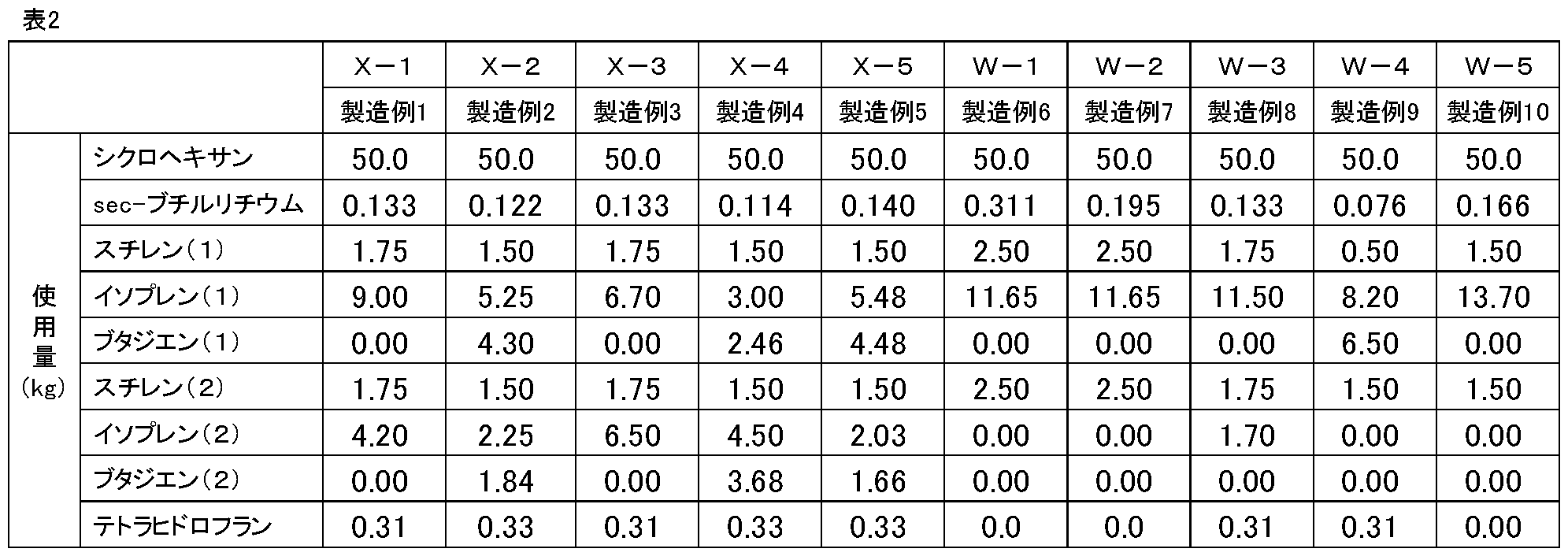
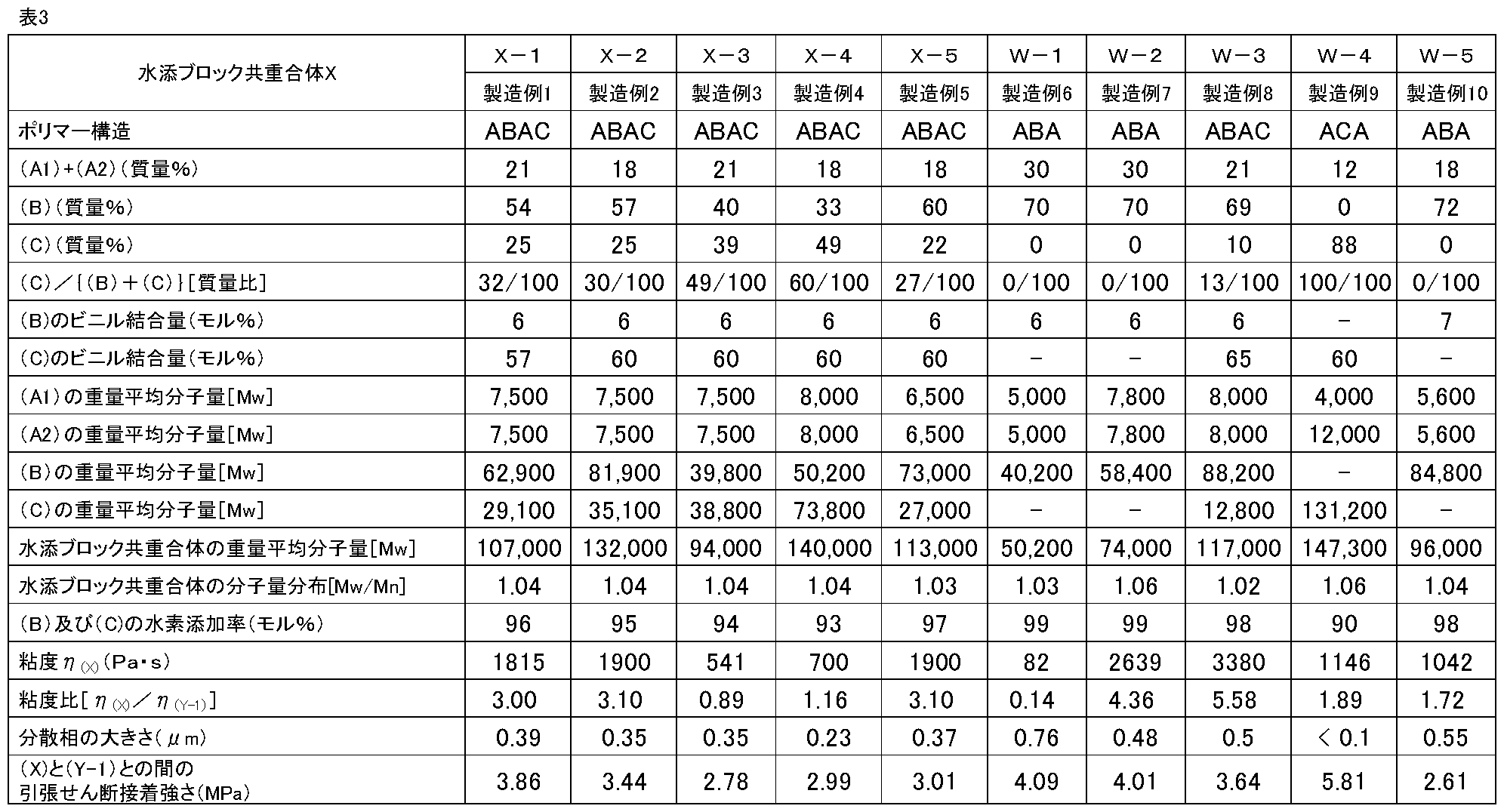
[実施例1~5、比較例1~4:積層フィルムの製造]
表4に記載の材料を用いて、内層用の材料及び外層用の材料それぞれについて、表4に示す配合割合で、230℃に設定された30mmTダイ単軸押出機により成形を行い、厚さ約200μmの2層の積層体を成形し、積層フィルムを得た。各層の厚みは、スクリュー回転数、巻き取り速度を変えることにより内層約20μm、外層約180μmに調整した。
[Examples 1 to 5, Comparative Examples 1 to 4: Production of laminated film]
Using the materials described in Table 4, for the material for the inner layer and the material for the outer layer, molding was performed by a 30 mm T die single screw extruder set at 230 ° C. at the compounding ratio shown in Table 4 to obtain a thickness of about A 200 μm two-layer laminate was formed to obtain a laminate film. The thickness of each layer was adjusted to about 20 μm for the inner layer and about 180 μm for the outer layer by changing the screw rotation speed and the winding speed.
[実施例6~10、比較例5~9:3層の積層フィルムの作製]
表5に記載の材料を用いて、内層用の材料、中間層用の材料、及び外層用の材料それぞれについて、下記表5に示す配合割合で、水冷式下向インフレーション成形機を用いて、樹脂温度230℃、冷却水温度20℃、ライン速度9m/分の条件で、厚さ180μmの3層の積層体(液体包装容器用フィルム)を成形した。前記各層の厚みは、内層20μm、中間層120μm、外層40μmとした。
[Examples 6 to 10, Comparative Examples 5 to 9: Production of Three-Layer Laminated Film]
Using the materials shown in Table 5, for the material for the inner layer, the material for the intermediate layer, and the material for the outer layer, using a water-cooled downward inflation molding machine at the mixing ratio shown in Table 5 below, At a temperature of 230 ° C., a cooling water temperature of 20 ° C., and a line speed of 9 m / min, a three-layer laminate (liquid packaging container film) having a thickness of 180 μm was formed. The thickness of each layer was 20 μm for the inner layer, 120 μm for the intermediate layer, and 40 μm for the outer layer.
各実施例及び比較例で製造した厚さ200μm又は180μmの積層フィルムを用いて、以下の方法に従って、各測定及び評価を行った。 各 Each measurement and evaluation was performed using the laminated film having a thickness of 200 μm or 180 μm manufactured in each of Examples and Comparative Examples according to the following methods.
<引張衝撃値(kJ/m2)>
作製した積層フィルムを15mm幅の短冊状に切り出し、内層同士を重ね合わせて140℃、0.15MPa、1秒間の条件で熱融着させ、室温、湿度50%の条件下で16時間以上放置した。デジタル衝撃試験機(DG-TB、株式会社東洋精機製作所製)に熱融着部を上にして積層フィルムの断面が逆T字型になるようにセットし、熱融着部を剥離する方向に3.8m/sの速度でハンマーで打撃し、熱融着部をハンマーで破損させ、ヒートシール部の引張衝撃値(kJ/m2)を調べた。その結果を表4に示す。引張衝撃値が高いほど、破袋強度に優れていることを示す。
<Tensile impact value (kJ / m 2 )>
The produced laminated film was cut into a strip having a width of 15 mm, the inner layers were superimposed, heat-sealed at 140 ° C. and 0.15 MPa for 1 second, and allowed to stand for 16 hours or more at room temperature and 50% humidity. . Set the laminated film on a digital impact tester (DG-TB, manufactured by Toyo Seiki Seisaku-sho, Ltd.) so that the cross-section of the laminated film has an inverted T-shape with the heat-sealed part facing upward, and set the direction of peeling the heat-sealed part. It was hit with a hammer at a speed of 3.8 m / s, the heat-sealed portion was broken with a hammer, and the tensile impact value (kJ / m 2 ) of the heat-sealed portion was examined. Table 4 shows the results. The higher the tensile impact value, the better the bag breaking strength.
<液体包装容器の破袋強度の評価方法>
破袋強度は、以下に示す試験により評価した。すなわち、実施例6~10又は比較例5~9で得た積層フィルムを20cm×15.5cmの大きさに切り出し、内層同士が向かい合うように2枚重ね、4辺のうち3辺を、140℃、ゲージ圧0.4MPa、加熱時間1秒間の条件下にてヒートシールした。次に、シールしていない一辺から約500ccの水を注入し、該1辺を上記同様の条件にてヒートシールを行うことにより、内容量500ccの液体包装容器を作製した。
得られた液体包装容器を鉄板上に23℃の環境下で静置した後、重さ2.5kgの鉄板を高さ5cmから液体包装容器の上に落とした。液体包装容器からの水漏れがなかった場合、高さを5cmずつ上昇させて鉄板を落とすことを繰り返し、水漏れが発生したときの鉄板の高さを破袋高さとした。各例につき10回前記の試験を行い、破袋高さが90cm以上である確率を求め、破袋強度とした。その結果を表5に示す。
破袋高さが90cm以上であると、輸送時や取扱い時に破袋しにくくなる。破袋高さが90cm以上である確率は、50%以上が好ましく、70%以上がより好ましく、80%以上が更に好ましい。
<Evaluation method for breaking strength of liquid packaging container>
The bag breaking strength was evaluated by the following test. That is, the laminated films obtained in Examples 6 to 10 or Comparative Examples 5 to 9 were cut out to a size of 20 cm × 15.5 cm, and two sheets were stacked so that the inner layers faced each other. Heat sealing was performed under the conditions of a gauge pressure of 0.4 MPa and a heating time of 1 second. Next, about 500 cc of water was injected from one side that was not sealed, and the one side was heat-sealed under the same conditions as described above, thereby producing a liquid packaging container having a content of 500 cc.
After the obtained liquid packaging container was allowed to stand on an iron plate in an environment of 23 ° C., an iron plate weighing 2.5 kg was dropped onto the liquid packaging container from a height of 5 cm. When there was no water leakage from the liquid packaging container, the height was increased by 5 cm and the iron plate was repeatedly dropped, and the height of the iron plate at the time when water leakage occurred was defined as the breakage height. The above test was performed 10 times for each example, and the probability that the bag-breaking height was 90 cm or more was determined and defined as the bag-breaking strength. Table 5 shows the results.
When the bag breaking height is 90 cm or more, it is difficult to break the bag during transportation or handling. The probability that the bag breaking height is 90 cm or more is preferably 50% or more, more preferably 70% or more, and even more preferably 80% or more.
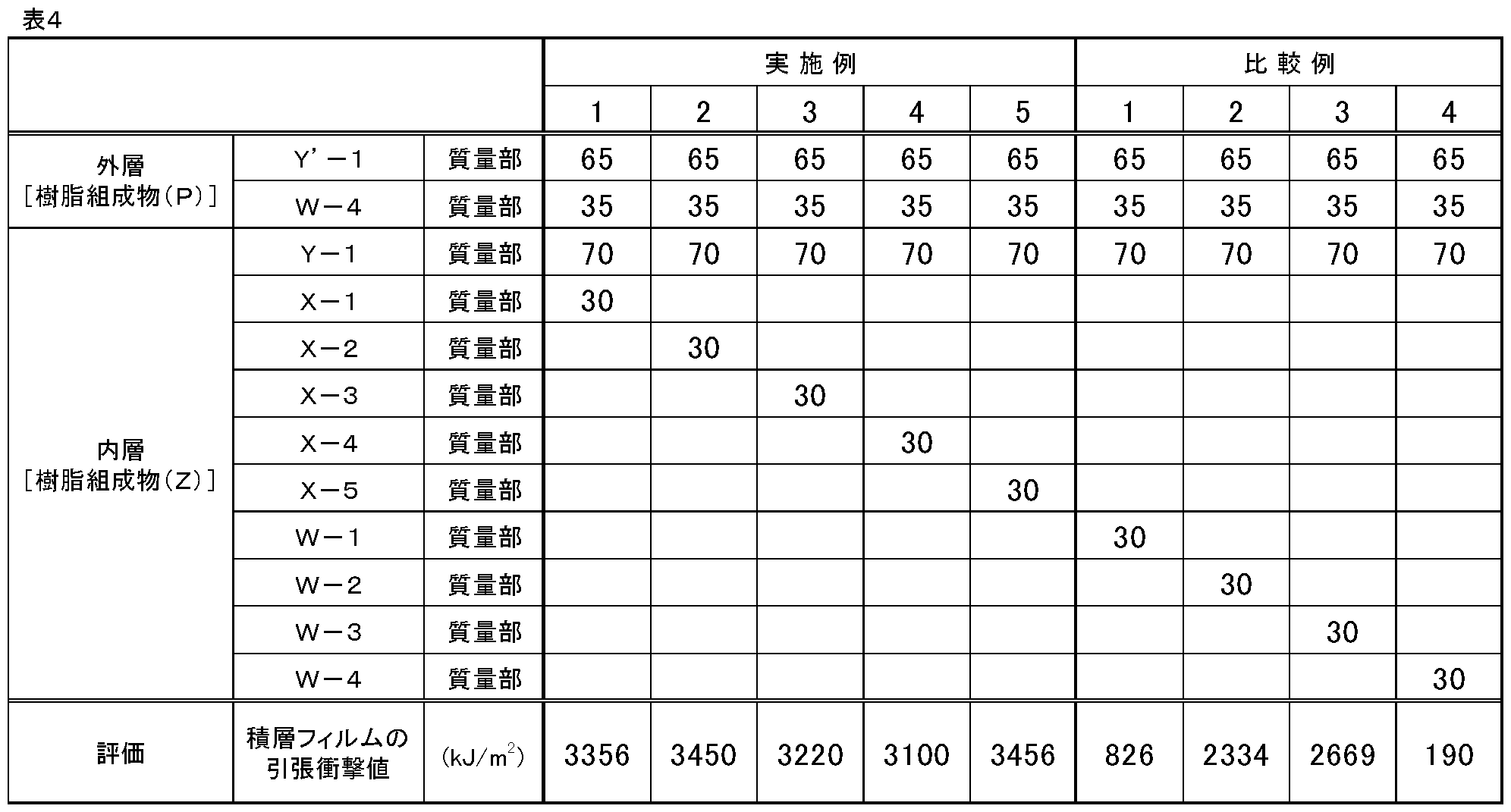

<考察>
実施例1~5の結果より明らかなように、重合体ブロック(A1)と(A2)との間に前記重合体ブロック(B)及び(C)の少なくとも一方が存在し、前記重合体ブロック(B)及び(C)の合計に対する前記重合体ブロック(C)の質量比[(C)/(B)+(C)]が26/100~63/100である水添ブロック共重合体を用いた本発明の液体包装容器は、積層フィルムの引張衝撃値が大きいことから、破袋強度に優れていることが分かる。また、実施例6~10で得られた液体包装容器は破袋強度に優れている。これらは、水添ブロック共重合体(X)とポリプロピレン系樹脂(Y)との引張せん断接着強さが低く、また水添ブロック共重合体(X)からなる分散相の大きさが適切な範囲であるため、凝集破壊によるエネルギー吸収が大きくなったためであると考えられる。
一方、本発明の水添ブロック共重合体を用いない比較例1~4は積層フィルムの引張衝撃値が低く、破袋強度が劣っていることが分かる。また、比較例5~9で得られた液体包装容器は、破袋強度が低い。比較例では、フィルムが破損する際に界面剥離やフィルム破断が起こりやすく、凝集破壊による耐破袋性能向上効果が不足しているためと考えられる。
<Discussion>
As is clear from the results of Examples 1 to 5, at least one of the polymer blocks (B) and (C) exists between the polymer blocks (A1) and (A2), and the polymer block ( A hydrogenated block copolymer having a mass ratio [(C) / (B) + (C)] of the polymer block (C) to the sum of (B) and (C) of 26/100 to 63/100 is used. The liquid packaging container according to the present invention, which has a large tensile impact value of the laminated film, is understood to have excellent bag breaking strength. Further, the liquid packaging containers obtained in Examples 6 to 10 are excellent in bag breaking strength. These have low tensile shear adhesive strength between the hydrogenated block copolymer (X) and the polypropylene resin (Y), and the size of the dispersed phase composed of the hydrogenated block copolymer (X) is within an appropriate range. Therefore, it is considered that energy absorption due to cohesive failure was increased.
On the other hand, in Comparative Examples 1 to 4 in which the hydrogenated block copolymer of the present invention was not used, the tensile impact value of the laminated film was low, and the bag breaking strength was inferior. Further, the liquid packaging containers obtained in Comparative Examples 5 to 9 have low bag breaking strength. In the comparative example, it is considered that interfacial peeling and film breakage are likely to occur when the film breaks, and the effect of improving bag-breaking resistance due to cohesive failure is insufficient.
本発明の液体包装容器は、種々の用途に使用できる。例えば、前述の医療容器のほか、レトルト食品、マヨネーズ、ケチャップ、清涼飲料水、アイス等を包装する食品包装容器等としても有効に利用できる。 液体 The liquid packaging container of the present invention can be used for various uses. For example, in addition to the above-mentioned medical container, it can be effectively used as a food packaging container for packaging retort food, mayonnaise, ketchup, soft drink, ice, and the like.
Claims (15)
<条件>
水添ブロック共重合体(X)30質量部とポリプロピレン系樹脂(Y)70質量部とを、230℃、せん断速度30~150s-1の条件下で混練した際に、水添ブロック共重合体(X)が分散相となる海島構造を形成し、その分散相の大きさが0.1μm以上1.0μm以下である。 A resin composition (Z) containing the hydrogenated block copolymer (X) according to any one of claims 1 to 4 and a polypropylene resin (Y), wherein the hydrogenated block copolymer (X) And a polypropylene resin (Y) that satisfies the following conditions.
<Condition>
When 30 parts by mass of the hydrogenated block copolymer (X) and 70 parts by mass of the polypropylene resin (Y) are kneaded under the conditions of 230 ° C. and a shear rate of 30 to 150 s −1 , the hydrogenated block copolymer is kneaded. (X) forms a sea-island structure serving as a dispersed phase, and the size of the dispersed phase is 0.1 μm or more and 1.0 μm or less.
前記内層が前記樹脂組成物(Z)からなり、
前記外層がプロピレン由来の構造単位の含有量が60モル%以上であるポリプロピレン系樹脂(Y’)を60質量%以上含有する樹脂組成物(P)からなる、請求項9に記載の液体包装容器。 A liquid packaging container comprising a film for a liquid packaging container having a structure of at least two layers having an inner layer and an outer layer,
The inner layer is made of the resin composition (Z),
The liquid packaging container according to claim 9, wherein the outer layer is made of a resin composition (P) containing 60% by mass or more of a polypropylene resin (Y ') having a content of structural units derived from propylene of 60% by mol or more. .
前記内層と中間層のいずれか又は両方が前記樹脂組成物(Z)からなり、
前記外層がプロピレン由来の構造単位の含有量が60モル%以上であるポリプロピレン系樹脂(Y’)を60質量%以上含有する樹脂組成物(P)からなる、請求項9に記載の液体包装容器。 A liquid packaging container comprising a film for a liquid packaging container having at least one intermediate layer between an inner layer and an outer layer and having a structure of three or more layers,
Either or both of the inner layer and the intermediate layer are made of the resin composition (Z),
The liquid packaging container according to claim 9, wherein the outer layer is made of a resin composition (P) containing 60% by mass or more of a polypropylene resin (Y ') having a content of structural units derived from propylene of 60% by mol or more. .
MPin<MPmid
を満たす、請求項11又は12に記載の液体包装容器。 The melting point MP in of the resin component forming the inner layer and the melting point MP mid of the resin component forming the intermediate layer are represented by the following formula: MP in <MP mid
The liquid packaging container according to claim 11, which satisfies the following.
0<MPp-MPZ≦50 式(2)
を満たす、請求項10~13のいずれか1項に記載の液体包装容器。 And the melting point MP Z of the resin composition (Z) constituting the inner layer, the melting point MP p of the resin composition (P) constituting the outer layer is a compound represented by the following formula (2)
0 <MP p −MP Z ≦ 50 Equation (2)
The liquid packaging container according to any one of claims 10 to 13, which satisfies the following.
Priority Applications (6)
| Application Number | Priority Date | Filing Date | Title |
|---|---|---|---|
| JP2019557659A JP6681521B1 (en) | 2018-06-29 | 2019-06-28 | Hydrogenated block copolymer |
| CA3105313A CA3105313A1 (en) | 2018-06-29 | 2019-06-28 | Hydrogenated block copolymer |
| US17/256,513 US11884812B2 (en) | 2018-06-29 | 2019-06-28 | Hydrogenated block copolymer |
| EP19824530.0A EP3816199B1 (en) | 2018-06-29 | 2019-06-28 | Hydrogenated block copolymer |
| CN201980043596.4A CN112292411B (en) | 2018-06-29 | 2019-06-28 | Hydrogenated block copolymers |
| KR1020207037700A KR102636179B1 (en) | 2018-06-29 | 2019-06-28 | Hydrogenated block copolymer |
Applications Claiming Priority (4)
| Application Number | Priority Date | Filing Date | Title |
|---|---|---|---|
| JP2018-125338 | 2018-06-29 | ||
| JP2018125338 | 2018-06-29 | ||
| JP2018-245574 | 2018-12-27 | ||
| JP2018245574 | 2018-12-27 |
Publications (1)
| Publication Number | Publication Date |
|---|---|
| WO2020004631A1 true WO2020004631A1 (en) | 2020-01-02 |
Family
ID=68987209
Family Applications (1)
| Application Number | Title | Priority Date | Filing Date |
|---|---|---|---|
| PCT/JP2019/025862 Ceased WO2020004631A1 (en) | 2018-06-29 | 2019-06-28 | Hydrogenated block copolymer |
Country Status (8)
| Country | Link |
|---|---|
| US (1) | US11884812B2 (en) |
| EP (1) | EP3816199B1 (en) |
| JP (1) | JP6681521B1 (en) |
| KR (1) | KR102636179B1 (en) |
| CN (1) | CN112292411B (en) |
| CA (1) | CA3105313A1 (en) |
| TW (1) | TWI770397B (en) |
| WO (1) | WO2020004631A1 (en) |
Citations (3)
| Publication number | Priority date | Publication date | Assignee | Title |
|---|---|---|---|---|
| JP2009149861A (en) | 2007-11-30 | 2009-07-09 | Sumitomo Chemical Co Ltd | Propylene resin composition and molded body |
| JP2014520928A (en) * | 2011-07-12 | 2014-08-25 | クレイトン・ポリマーズ・ユー・エス・エル・エル・シー | Modified sulfonated block copolymers and their preparation |
| JP2016155604A (en) | 2014-04-09 | 2016-09-01 | 株式会社クラレ | Liquid packaging container |
Family Cites Families (6)
| Publication number | Priority date | Publication date | Assignee | Title |
|---|---|---|---|---|
| JP4114983B2 (en) * | 1997-10-31 | 2008-07-09 | 旭化成ケミカルズ株式会社 | Block copolymer and method for producing the copolymer |
| JP4475367B2 (en) * | 2000-03-01 | 2010-06-09 | Jsr株式会社 | Process for producing conjugated diene block copolymer and hydrogenated product thereof |
| KR100620633B1 (en) | 2002-03-28 | 2006-09-13 | 크레이튼 폴리머즈 리서치 비.브이. | Novel tetrablock copolymers and compositions containing them |
| SG11201408360YA (en) | 2012-06-26 | 2015-01-29 | Asahi Kasei Chemicals Corp | Hydrogenated block copolymer pellet, polyolefin resin composition, and molded product thereof |
| KR101763091B1 (en) * | 2014-09-08 | 2017-07-28 | 주식회사 쿠라레 | Film for liquid packaging containers and liquid packaging container |
| TWI612067B (en) | 2015-08-24 | 2018-01-21 | Asahi Chemical Ind | Hydrogenated block copolymer and polypropylene resin composition using same and molded body thereof |
-
2019
- 2019-06-28 CA CA3105313A patent/CA3105313A1/en active Pending
- 2019-06-28 CN CN201980043596.4A patent/CN112292411B/en active Active
- 2019-06-28 JP JP2019557659A patent/JP6681521B1/en active Active
- 2019-06-28 KR KR1020207037700A patent/KR102636179B1/en active Active
- 2019-06-28 WO PCT/JP2019/025862 patent/WO2020004631A1/en not_active Ceased
- 2019-06-28 EP EP19824530.0A patent/EP3816199B1/en active Active
- 2019-06-28 TW TW108122944A patent/TWI770397B/en active
- 2019-06-28 US US17/256,513 patent/US11884812B2/en active Active
Patent Citations (3)
| Publication number | Priority date | Publication date | Assignee | Title |
|---|---|---|---|---|
| JP2009149861A (en) | 2007-11-30 | 2009-07-09 | Sumitomo Chemical Co Ltd | Propylene resin composition and molded body |
| JP2014520928A (en) * | 2011-07-12 | 2014-08-25 | クレイトン・ポリマーズ・ユー・エス・エル・エル・シー | Modified sulfonated block copolymers and their preparation |
| JP2016155604A (en) | 2014-04-09 | 2016-09-01 | 株式会社クラレ | Liquid packaging container |
Non-Patent Citations (1)
| Title |
|---|
| See also references of EP3816199A4 |
Also Published As
| Publication number | Publication date |
|---|---|
| JPWO2020004631A1 (en) | 2020-07-02 |
| JP6681521B1 (en) | 2020-04-15 |
| KR102636179B1 (en) | 2024-02-13 |
| EP3816199B1 (en) | 2023-07-12 |
| TW202010764A (en) | 2020-03-16 |
| US20210277224A1 (en) | 2021-09-09 |
| US11884812B2 (en) | 2024-01-30 |
| EP3816199A1 (en) | 2021-05-05 |
| CN112292411B (en) | 2023-08-01 |
| KR20210023899A (en) | 2021-03-04 |
| CN112292411A (en) | 2021-01-29 |
| TWI770397B (en) | 2022-07-11 |
| CA3105313A1 (en) | 2020-01-02 |
| EP3816199A4 (en) | 2022-03-30 |
Similar Documents
| Publication | Publication Date | Title |
|---|---|---|
| JP6661467B2 (en) | Liquid packaging container film and liquid packaging container | |
| JP5886486B1 (en) | Liquid packaging container | |
| JP6885657B2 (en) | Resin composition, heat sealant, film for liquid packaging container, liquid packaging container, liquid discharge member and medical container | |
| JP2020001800A (en) | Film for liquid packaging container | |
| JP6681521B1 (en) | Hydrogenated block copolymer |
Legal Events
| Date | Code | Title | Description |
|---|---|---|---|
| ENP | Entry into the national phase |
Ref document number: 2019557659 Country of ref document: JP Kind code of ref document: A |
|
| 121 | Ep: the epo has been informed by wipo that ep was designated in this application |
Ref document number: 19824530 Country of ref document: EP Kind code of ref document: A1 |
|
| ENP | Entry into the national phase |
Ref document number: 3105313 Country of ref document: CA |
|
| NENP | Non-entry into the national phase |
Ref country code: DE |
|
| WWE | Wipo information: entry into national phase |
Ref document number: 2019824530 Country of ref document: EP |