WO2020004648A1 - Feuille perméable aux liquides pour article absorbant - Google Patents
Feuille perméable aux liquides pour article absorbant Download PDFInfo
- Publication number
- WO2020004648A1 WO2020004648A1 PCT/JP2019/025924 JP2019025924W WO2020004648A1 WO 2020004648 A1 WO2020004648 A1 WO 2020004648A1 JP 2019025924 W JP2019025924 W JP 2019025924W WO 2020004648 A1 WO2020004648 A1 WO 2020004648A1
- Authority
- WO
- WIPO (PCT)
- Prior art keywords
- fibers
- liquid
- woven fabric
- fiber web
- fiber
- Prior art date
- Legal status (The legal status is an assumption and is not a legal conclusion. Google has not performed a legal analysis and makes no representation as to the accuracy of the status listed.)
- Ceased
Links
Images






Classifications
-
- A—HUMAN NECESSITIES
- A61—MEDICAL OR VETERINARY SCIENCE; HYGIENE
- A61F—FILTERS IMPLANTABLE INTO BLOOD VESSELS; PROSTHESES; DEVICES PROVIDING PATENCY TO, OR PREVENTING COLLAPSING OF, TUBULAR STRUCTURES OF THE BODY, e.g. STENTS; ORTHOPAEDIC, NURSING OR CONTRACEPTIVE DEVICES; FOMENTATION; TREATMENT OR PROTECTION OF EYES OR EARS; BANDAGES, DRESSINGS OR ABSORBENT PADS; FIRST-AID KITS
- A61F13/00—Bandages or dressings; Absorbent pads
- A61F13/15—Absorbent pads, e.g. sanitary towels, swabs or tampons for external or internal application to the body; Supporting or fastening means therefor; Tampon applicators
- A61F13/51—Absorbent pads, e.g. sanitary towels, swabs or tampons for external or internal application to the body; Supporting or fastening means therefor; Tampon applicators characterised by the outer layers of the pads
- A61F13/511—Topsheet, i.e. the permeable cover or layer facing the skin
- A61F13/51121—Topsheet, i.e. the permeable cover or layer facing the skin characterised by the material
-
- A—HUMAN NECESSITIES
- A61—MEDICAL OR VETERINARY SCIENCE; HYGIENE
- A61F—FILTERS IMPLANTABLE INTO BLOOD VESSELS; PROSTHESES; DEVICES PROVIDING PATENCY TO, OR PREVENTING COLLAPSING OF, TUBULAR STRUCTURES OF THE BODY, e.g. STENTS; ORTHOPAEDIC, NURSING OR CONTRACEPTIVE DEVICES; FOMENTATION; TREATMENT OR PROTECTION OF EYES OR EARS; BANDAGES, DRESSINGS OR ABSORBENT PADS; FIRST-AID KITS
- A61F13/00—Bandages or dressings; Absorbent pads
- A61F13/15—Absorbent pads, e.g. sanitary towels, swabs or tampons for external or internal application to the body; Supporting or fastening means therefor; Tampon applicators
- A61F13/45—Absorbent pads, e.g. sanitary towels, swabs or tampons for external or internal application to the body; Supporting or fastening means therefor; Tampon applicators characterised by the shape
- A61F13/47—Sanitary towels, incontinence pads or napkins
- A61F13/472—Sanitary towels, incontinence pads or napkins specially adapted for female use
-
- A—HUMAN NECESSITIES
- A61—MEDICAL OR VETERINARY SCIENCE; HYGIENE
- A61F—FILTERS IMPLANTABLE INTO BLOOD VESSELS; PROSTHESES; DEVICES PROVIDING PATENCY TO, OR PREVENTING COLLAPSING OF, TUBULAR STRUCTURES OF THE BODY, e.g. STENTS; ORTHOPAEDIC, NURSING OR CONTRACEPTIVE DEVICES; FOMENTATION; TREATMENT OR PROTECTION OF EYES OR EARS; BANDAGES, DRESSINGS OR ABSORBENT PADS; FIRST-AID KITS
- A61F13/00—Bandages or dressings; Absorbent pads
- A61F13/15—Absorbent pads, e.g. sanitary towels, swabs or tampons for external or internal application to the body; Supporting or fastening means therefor; Tampon applicators
- A61F13/51—Absorbent pads, e.g. sanitary towels, swabs or tampons for external or internal application to the body; Supporting or fastening means therefor; Tampon applicators characterised by the outer layers of the pads
- A61F13/511—Topsheet, i.e. the permeable cover or layer facing the skin
-
- A—HUMAN NECESSITIES
- A61—MEDICAL OR VETERINARY SCIENCE; HYGIENE
- A61F—FILTERS IMPLANTABLE INTO BLOOD VESSELS; PROSTHESES; DEVICES PROVIDING PATENCY TO, OR PREVENTING COLLAPSING OF, TUBULAR STRUCTURES OF THE BODY, e.g. STENTS; ORTHOPAEDIC, NURSING OR CONTRACEPTIVE DEVICES; FOMENTATION; TREATMENT OR PROTECTION OF EYES OR EARS; BANDAGES, DRESSINGS OR ABSORBENT PADS; FIRST-AID KITS
- A61F13/00—Bandages or dressings; Absorbent pads
- A61F13/15—Absorbent pads, e.g. sanitary towels, swabs or tampons for external or internal application to the body; Supporting or fastening means therefor; Tampon applicators
- A61F13/51—Absorbent pads, e.g. sanitary towels, swabs or tampons for external or internal application to the body; Supporting or fastening means therefor; Tampon applicators characterised by the outer layers of the pads
- A61F13/511—Topsheet, i.e. the permeable cover or layer facing the skin
- A61F13/5116—Topsheet, i.e. the permeable cover or layer facing the skin being formed of multiple layers
-
- A—HUMAN NECESSITIES
- A61—MEDICAL OR VETERINARY SCIENCE; HYGIENE
- A61F—FILTERS IMPLANTABLE INTO BLOOD VESSELS; PROSTHESES; DEVICES PROVIDING PATENCY TO, OR PREVENTING COLLAPSING OF, TUBULAR STRUCTURES OF THE BODY, e.g. STENTS; ORTHOPAEDIC, NURSING OR CONTRACEPTIVE DEVICES; FOMENTATION; TREATMENT OR PROTECTION OF EYES OR EARS; BANDAGES, DRESSINGS OR ABSORBENT PADS; FIRST-AID KITS
- A61F13/00—Bandages or dressings; Absorbent pads
- A61F13/15—Absorbent pads, e.g. sanitary towels, swabs or tampons for external or internal application to the body; Supporting or fastening means therefor; Tampon applicators
- A61F13/51—Absorbent pads, e.g. sanitary towels, swabs or tampons for external or internal application to the body; Supporting or fastening means therefor; Tampon applicators characterised by the outer layers of the pads
- A61F13/511—Topsheet, i.e. the permeable cover or layer facing the skin
- A61F13/512—Topsheet, i.e. the permeable cover or layer facing the skin characterised by its apertures, e.g. perforations
-
- A—HUMAN NECESSITIES
- A61—MEDICAL OR VETERINARY SCIENCE; HYGIENE
- A61F—FILTERS IMPLANTABLE INTO BLOOD VESSELS; PROSTHESES; DEVICES PROVIDING PATENCY TO, OR PREVENTING COLLAPSING OF, TUBULAR STRUCTURES OF THE BODY, e.g. STENTS; ORTHOPAEDIC, NURSING OR CONTRACEPTIVE DEVICES; FOMENTATION; TREATMENT OR PROTECTION OF EYES OR EARS; BANDAGES, DRESSINGS OR ABSORBENT PADS; FIRST-AID KITS
- A61F13/00—Bandages or dressings; Absorbent pads
- A61F13/15—Absorbent pads, e.g. sanitary towels, swabs or tampons for external or internal application to the body; Supporting or fastening means therefor; Tampon applicators
- A61F13/51—Absorbent pads, e.g. sanitary towels, swabs or tampons for external or internal application to the body; Supporting or fastening means therefor; Tampon applicators characterised by the outer layers of the pads
- A61F13/511—Topsheet, i.e. the permeable cover or layer facing the skin
- A61F13/513—Topsheet, i.e. the permeable cover or layer facing the skin characterised by its function or properties, e.g. stretchability, breathability, rewet, visual effect; having areas of different permeability
-
- D—TEXTILES; PAPER
- D04—BRAIDING; LACE-MAKING; KNITTING; TRIMMINGS; NON-WOVEN FABRICS
- D04H—MAKING TEXTILE FABRICS, e.g. FROM FIBRES OR FILAMENTARY MATERIAL; FABRICS MADE BY SUCH PROCESSES OR APPARATUS, e.g. FELTS, NON-WOVEN FABRICS; COTTON-WOOL; WADDING ; NON-WOVEN FABRICS FROM STAPLE FIBRES, FILAMENTS OR YARNS, BONDED WITH AT LEAST ONE WEB-LIKE MATERIAL DURING THEIR CONSOLIDATION
- D04H1/00—Non-woven fabrics formed wholly or mainly of staple fibres or like relatively short fibres
- D04H1/40—Non-woven fabrics formed wholly or mainly of staple fibres or like relatively short fibres from fleeces or layers composed of fibres without existing or potential cohesive properties
- D04H1/42—Non-woven fabrics formed wholly or mainly of staple fibres or like relatively short fibres from fleeces or layers composed of fibres without existing or potential cohesive properties characterised by the use of certain kinds of fibres insofar as this use has no preponderant influence on the consolidation of the fleece
- D04H1/4374—Non-woven fabrics formed wholly or mainly of staple fibres or like relatively short fibres from fleeces or layers composed of fibres without existing or potential cohesive properties characterised by the use of certain kinds of fibres insofar as this use has no preponderant influence on the consolidation of the fleece using different kinds of webs, e.g. by layering webs
-
- D—TEXTILES; PAPER
- D04—BRAIDING; LACE-MAKING; KNITTING; TRIMMINGS; NON-WOVEN FABRICS
- D04H—MAKING TEXTILE FABRICS, e.g. FROM FIBRES OR FILAMENTARY MATERIAL; FABRICS MADE BY SUCH PROCESSES OR APPARATUS, e.g. FELTS, NON-WOVEN FABRICS; COTTON-WOOL; WADDING ; NON-WOVEN FABRICS FROM STAPLE FIBRES, FILAMENTS OR YARNS, BONDED WITH AT LEAST ONE WEB-LIKE MATERIAL DURING THEIR CONSOLIDATION
- D04H1/00—Non-woven fabrics formed wholly or mainly of staple fibres or like relatively short fibres
- D04H1/40—Non-woven fabrics formed wholly or mainly of staple fibres or like relatively short fibres from fleeces or layers composed of fibres without existing or potential cohesive properties
- D04H1/44—Non-woven fabrics formed wholly or mainly of staple fibres or like relatively short fibres from fleeces or layers composed of fibres without existing or potential cohesive properties the fleeces or layers being consolidated by mechanical means, e.g. by rolling
- D04H1/46—Non-woven fabrics formed wholly or mainly of staple fibres or like relatively short fibres from fleeces or layers composed of fibres without existing or potential cohesive properties the fleeces or layers being consolidated by mechanical means, e.g. by rolling by needling or like operations to cause entanglement of fibres
- D04H1/498—Non-woven fabrics formed wholly or mainly of staple fibres or like relatively short fibres from fleeces or layers composed of fibres without existing or potential cohesive properties the fleeces or layers being consolidated by mechanical means, e.g. by rolling by needling or like operations to cause entanglement of fibres entanglement of layered webs
-
- A—HUMAN NECESSITIES
- A61—MEDICAL OR VETERINARY SCIENCE; HYGIENE
- A61F—FILTERS IMPLANTABLE INTO BLOOD VESSELS; PROSTHESES; DEVICES PROVIDING PATENCY TO, OR PREVENTING COLLAPSING OF, TUBULAR STRUCTURES OF THE BODY, e.g. STENTS; ORTHOPAEDIC, NURSING OR CONTRACEPTIVE DEVICES; FOMENTATION; TREATMENT OR PROTECTION OF EYES OR EARS; BANDAGES, DRESSINGS OR ABSORBENT PADS; FIRST-AID KITS
- A61F13/00—Bandages or dressings; Absorbent pads
- A61F13/15—Absorbent pads, e.g. sanitary towels, swabs or tampons for external or internal application to the body; Supporting or fastening means therefor; Tampon applicators
- A61F13/15577—Apparatus or processes for manufacturing
- A61F2013/15821—Apparatus or processes for manufacturing characterized by the apparatus for manufacturing
- A61F2013/15934—Apparatus or processes for manufacturing characterized by the apparatus for manufacturing for making non-woven
-
- A—HUMAN NECESSITIES
- A61—MEDICAL OR VETERINARY SCIENCE; HYGIENE
- A61F—FILTERS IMPLANTABLE INTO BLOOD VESSELS; PROSTHESES; DEVICES PROVIDING PATENCY TO, OR PREVENTING COLLAPSING OF, TUBULAR STRUCTURES OF THE BODY, e.g. STENTS; ORTHOPAEDIC, NURSING OR CONTRACEPTIVE DEVICES; FOMENTATION; TREATMENT OR PROTECTION OF EYES OR EARS; BANDAGES, DRESSINGS OR ABSORBENT PADS; FIRST-AID KITS
- A61F13/00—Bandages or dressings; Absorbent pads
- A61F13/15—Absorbent pads, e.g. sanitary towels, swabs or tampons for external or internal application to the body; Supporting or fastening means therefor; Tampon applicators
- A61F13/51—Absorbent pads, e.g. sanitary towels, swabs or tampons for external or internal application to the body; Supporting or fastening means therefor; Tampon applicators characterised by the outer layers of the pads
- A61F13/511—Topsheet, i.e. the permeable cover or layer facing the skin
- A61F13/5116—Topsheet, i.e. the permeable cover or layer facing the skin being formed of multiple layers
- A61F2013/51165—Topsheet, i.e. the permeable cover or layer facing the skin being formed of multiple layers with the combination of films and nonwovens
-
- A—HUMAN NECESSITIES
- A61—MEDICAL OR VETERINARY SCIENCE; HYGIENE
- A61F—FILTERS IMPLANTABLE INTO BLOOD VESSELS; PROSTHESES; DEVICES PROVIDING PATENCY TO, OR PREVENTING COLLAPSING OF, TUBULAR STRUCTURES OF THE BODY, e.g. STENTS; ORTHOPAEDIC, NURSING OR CONTRACEPTIVE DEVICES; FOMENTATION; TREATMENT OR PROTECTION OF EYES OR EARS; BANDAGES, DRESSINGS OR ABSORBENT PADS; FIRST-AID KITS
- A61F13/00—Bandages or dressings; Absorbent pads
- A61F13/15—Absorbent pads, e.g. sanitary towels, swabs or tampons for external or internal application to the body; Supporting or fastening means therefor; Tampon applicators
- A61F13/51—Absorbent pads, e.g. sanitary towels, swabs or tampons for external or internal application to the body; Supporting or fastening means therefor; Tampon applicators characterised by the outer layers of the pads
- A61F13/511—Topsheet, i.e. the permeable cover or layer facing the skin
- A61F13/5116—Topsheet, i.e. the permeable cover or layer facing the skin being formed of multiple layers
- A61F2013/51178—Topsheet, i.e. the permeable cover or layer facing the skin being formed of multiple layers with the combination of nonwoven webs
Definitions
- the present invention relates to a liquid-pervious sheet for absorbent articles, and more particularly, to a light incontinence pad, a panty liner, a sanitary napkin, a vaginal absorbent pad, a urine absorbent pad, a disposable diaper for adults and children, and the like.
- the present invention relates to a liquid-permeable sheet for articles.
- Patent Literature 1 discloses an absorbent article provided with a topsheet located on the side facing the absorber. A plurality of openings penetrating in the thickness direction are formed in the topsheet.
- the surface sheet has a relatively low sheet strength due to the formation of the plurality of openings, and there is a possibility that the surface sheet may be distorted or partially broken during wearing. Further, there is a possibility that the bodily fluid absorbed by the absorber may return (rewet back) to the surface side of the topsheet through the opening.
- the first invention is an improvement of the conventional invention, and is a liquid-permeable sheet for an absorbent article having excellent liquid permeability and having a required sheet strength and capable of suppressing rewetting back. Providing is an issue.
- the topsheet of Patent Literature 1 has a relatively low sheet strength due to the formation of the plurality of openings, and may be distorted or partially broken during wearing.
- the hydrophilic fiber absorbs menstrual blood, swells, and further reduces the sheet strength by being formed from the hydrophilic fiber. Therefore, menstrual blood adhering to the skin cannot be scraped off at the opening of the topsheet.
- the topsheet is formed of hydrophobic fibers in order to prevent such disadvantages, the body fluid cannot be sufficiently drawn.
- the sheet strength of the topsheet is relatively low, when the sanitary napkin is taken out of the individually packed bag stored in a folded state, it tends to have a folding habit, and when the sanitary napkin is attached to the underwear. There is a possibility that a part of the skin may be lifted from the underwear, which may cause a side leakage of menstrual blood and a deteriorated feeling of wearing.
- the second invention is an improvement of the conventional invention, and provides a liquid-permeable sheet for an absorbent article which has excellent liquid permeability, has a required sheet strength, and can suppress rewetting. Make it an issue.
- a first invention comprises a woven fabric having a first surface and a second surface opposing each other in a thickness direction, and a fiber web integrated by entanglement with the first surface of the woven fabric. Is formed from cellulosic fibers, and the constituent fibers of the fiber web are substantially flush with the second surface of the woven fabric or extend outwardly in the thickness direction for the absorbent article. It relates to a liquid-permeable sheet.
- a second invention comprises a woven fabric having a first surface and a second surface opposing each other in a thickness direction, and a fiber web integrated by entanglement with the first surface of the woven fabric. Is formed from continuous twisted yarns made of cellulosic fibers, and the fiber web relates to a liquid-permeable sheet for an absorbent article containing hydrophilic fibers and hydrophobic fibers.
- the topsheet has a fabric-like feel, and can realize a favorable body fluid absorption rate and a suppression of the rewetting phenomenon.
- the liquid-permeable sheet for an absorbent article according to the second invention is such that the topsheet has a fabric-like touch, is excellent in excrement scraping properties, is unlikely to have a kinking tendency, and has a side leakage of body fluids and the like. It is possible to suppress a decrease in a feeling of wearing.
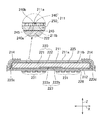
- FIG. 3 is a sectional view taken along the line III-III in FIG. 1. Partial enlarged view of a liquid-permeable sheet (top sheet). The figure which shows the state which separated the liquid permeable sheet into the fiber web and the woven fabric.
- FIG. 6 is a sectional view taken along the line VI-VI in FIG. 4. The enlarged view of the hydrophilic fiber in an example of a hydrophilic fiber.
- FIG. 9 is a sectional view taken along line XX of FIG. 8. Partial enlarged view of a liquid-permeable sheet (top sheet). The figure which shows the state which separated the liquid permeable sheet into the fiber web and the woven fabric.
- FIG. 13 is a sectional view taken along the line XIII-XIII of FIG. 11. The enlarged view of the hydrophilic fiber in an example of a hydrophilic fiber.
- the following embodiments relate to the absorbent articles shown in the accompanying drawings, and include not only the essential constitutions of the invention but also alternative and preferred constitutions.
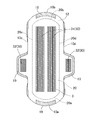
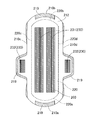
- a sanitary napkin 10 which is an example of an absorbent article according to the present invention will be described with reference to the accompanying drawings.
- the sanitary napkin 10 has a vertical direction Y, a horizontal direction X, and a thickness direction Z.
- the sanitary napkin 10 has a vertical center line P bisecting a dimension in a width direction thereof and a horizontal center line Q bisecting a dimension in a length dimension thereof.
- the convex surface is curved at the center where the facing surface (inner surface) and the non-skin facing surface (outer surface) on the opposite side, the first and second edges 10a and 10b, and the horizontal center line Q are located.
- the topsheet 11 and the absorbent body 20 are joined to each other by a known joining means such as a hot melt adhesive, and the liquid absorbing layer 13 is formed.
- an intermediate sheet made of a relatively bulky fiber nonwoven fabric is disposed between the topsheet (liquid-permeable sheet) 11 and the absorber 20. May be.
- a leak-proof sheet made of a liquid-impermeable fibrous nonwoven fabric or a plastic film having air permeability is arranged. Good.
- the absorber 20 is arranged in the vertical direction Y between the first edge 20a facing the first edge 10a, the second edge 20b facing the second edge 10b, and the first and second edges 20a, 20b.
- First and second side edges 20c and 20d extend.
- the front and back sheets 11 and 12 extend outward from the outer periphery of the absorbent body 20, and a pair of side surfaces extending in the vertical direction Y so as to face each other in the horizontal direction X on the skin facing surface side of the top sheet 11.
- the seat 14 is arranged.
- the pair of side sheets 14 are joined to the top sheet 11 via side joints (not shown) formed by known bonding means or welding means.
- an elastic material extending in the vertical direction Y may be arranged on the side sheet 14 so as to be contractible in an extended state in order to form a leak-proof wall that rises toward the body in a worn state.
- the side joint portion for fixing the side sheet 14 may be a seal line having a design element such as a floral pattern or a geometric pattern and extending in the vertical direction Y.
- the sanitary napkin 10 is formed by a top sheet 11, a back sheet 12, and a side sheet 14, and has both ends extending in the horizontal direction X outside the first and second edges 20a, 20b of the absorber 20 in the vertical direction Y. 16 and both side edge portions 17 extending in the vertical direction Y outside the first and second side edges 20 c and 20 d of the absorber 20 in the horizontal direction X.
- a wing portion 18 formed by a part of both side edge portions 17 protruding outward in the horizontal direction X is located.
- the sheets 11, 12, and 14 stacked together are joined to each other via an outer peripheral seal portion 19 located along the outer peripheral edge of the sanitary napkin 10.
- a plurality of fastening areas 30 are arranged on the back side of the sanitary napkin 10.
- the plurality of fastening areas 30 are for fastening the sanitary napkin 10 to clothing such as underwear, and are formed of a plurality of lines of pressure-sensitive adhesive or pressure-sensitive adhesive extending in the vertical direction Y. Is done.
- the fastening region 30 has a central region 31 extending in the vertical direction Y in a region overlapping with the absorber 20, and a side region 32 located at the wing portion 18.
- the fastening area 30 is covered with a plastic film separator (not shown).
- the topsheet 11 is liquid-permeable, has a skin-facing surface (upper surface) 11a and a non-skin-facing surface (lower surface) 11b located on the opposite side, and is made of a laminate sheet of the woven fabric 40 and the fiber web 50. It is formed.
- the back sheet 12 can be formed from a liquid-impermeable and moisture-permeable plastic film, a liquid-impermeable fibrous nonwoven fabric, a laminate sheet thereof, and the like.
- the outer peripheral seal portion 19 can be singly or in combination of bonding by known bonding means such as bonding with an adhesive, ultrasonic welding, heat welding, laser welding, high-frequency welding, and embossing.
- the sheets 11, 12, and 14 stacked in the thickness direction Z are joined to each other via an adhesive such as a hot melt adhesive.
- an adhesive such as a hot melt adhesive.
- Examples of the method for applying the hot melt adhesive include various known application methods such as spiral coating, coater coating, curtain coater coating, and spray coating.
- the absorbent body 20 is made of a liquid-absorbent core 21 formed by mixing superabsorbent polymer particles (SAP) and cellulosic fibers such as fluff wood pulp and rayon fibers and shaping the mixture into a predetermined shape. And a liquid-permeable core cover sheet 22 that covers the entire liquid-absorbent core 21 in order to improve the shape retention and liquid diffusibility.
- SAP superabsorbent polymer particles
- cellulosic fibers such as fluff wood pulp and rayon fibers
- the core cover sheet 22 has a dimension in the vertical direction Y that is larger than the dimension in the vertical direction Y of the liquid-absorbent core, and both side edges 22 a and 22 b of the core cover sheet 22 cover the entire liquid-absorbent core 21.
- the liquid cores 21 are positioned so as to overlap each other on the bottom surface side in the central portion in the lateral direction X of the liquid core 21.
- a superimposed portion 23 is formed in the center portion of the absorber 20 in the horizontal direction X where the side edges 22a and 22b extending in the vertical direction Y are stacked on each other. Is done.
- the core cover sheet 22 has a first covering portion 25 that covers the skin-facing surface side of the liquid-absorbing core 21 and a second covering portion 26 that covers the non-skin-facing surface side of the liquid-absorbing core 21.
- the core cover sheet 22 is formed from one continuous sheet.
- the first core cover sheet forming the first covering portion 25 is separate from the first core cover sheet.
- a second core cover sheet forming the second covering portion 26 is separate from the first core cover sheet.
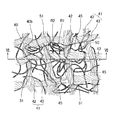
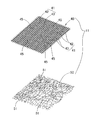
- FIG. 4 is a partially enlarged view of the topsheet 11, and FIG. 5 is an exploded perspective view of the topsheet 11.
- the topsheet 11 includes a woven fabric 40 located on the skin facing surface side and a fiber web 50 located on the non-skin facing surface side.
- the woven fabric 40 has a lower surface (first surface) 40a facing the fiber web 50 and an upper surface (second surface) 40b located on the opposite side of the lower surface 40a.
- the woven fabric 40 and the fiber web 50 are integrated by entanglement with each other.
- the upper surface 40b of the fabric 40 may be located below, and the lower surface 40a may be located above.
- the woven fabric 40 is composed of the constituent yarns 41 woven in a mesh shape.
- the constituent yarn 41 has a plurality of warps 42 and a plurality of wefts 43 crossing each other with the warp 42. When the warps 42 and the wefts 43 cross each other in the thickness direction Z, a plurality of meshes 45 are formed. It is formed.
- the constituent yarn 41 of the woven fabric 40 is a twisted yarn formed by twisting an original yarn made of cotton yarn (cotton fiber).
- cotton fibers such as pulp fibers, regenerated cellulose fibers such as rayon, and cellulosic fibers such as semi-synthetic cellulose fibers such as acetate are preferably used.
- thermoplastic resin fibers such as polyethylene and polypropylene
- cellulosic fibers and mixtures thereof
- the number of the constituent yarns 41 is 60 to 100, and a cotton yarn having a thickness of 10 to 100 cotton can be suitably used as the raw yarn.
- the fiber web 50 is formed by a known manufacturing method such as a spunbond method using long fibers or a dry method of forming webs by arranging short fibers in a fixed direction using a carding machine. It is an aggregate and is formed from constituent fibers 51 including hydrophilic fibers and hydrophobic fibers.
- the hydrophobic fibers include monofilaments such as polyolefin-based thermoplastic fibers including polypropylene (PP) and polyethylene (PE) and polyester-based thermoplastic fibers including polyethylene terephthalate (PET), and core-sheath composite fibers. And various composite fibers such as side-by-side type composite fibers and sea-island type composite fibers.
- hydrophilic fibers examples include natural cellulose fibers such as cotton and ground pulp; regenerated cellulose fibers such as rayon and fibril rayon; semi-synthetic cellulose fibers such as acetate; thermoplastic resin fibers and composite fibers subjected to a hydrophilic treatment; Is mentioned.
- the constituent fibers 51 of the fiber web 50 have 10 to 20 gsm of hydrophobic fibers and 5 to 10 gsm of hydrophilic fibers.
- a known fluid entanglement method can be used.
- the continuous laminate obtained by laminating the continuous fiber web, which is the material of the fiber web 50, on the upper surface of the continuous network structure, which is the material of the fabric 40,
- a high-pressure fluid such as air or water
- the constituent yarns of the continuous network can be entangled and integrated.
- the continuous laminate is conveyed by a conveying means formed of a metal mesh belt, and when a fluid is jetted from a nozzle to the upper surface of the continuous laminate, the fibers of the continuous fiber web and the constituent yarns of the continuous network structure are formed on the upper surface side. Are entangled with each other, and are also entangled by the fluid that repels and strikes the conveying means on the lower surface side facing the conveying means. Since the topsheet 11 is formed by entanglement of the fiber web 50 made of an aggregate of fibers with the woven fabric 40 by a fluid entanglement method, the constituent fibers of the fiber web 50 are compared with a case where the nonwoven fabric sheets are laminated and fluid entangled.
- the surface sheet 11 having desired sheet characteristics such as thickness, mass, absorption speed, sheet strength, and the like can be obtained by appropriately changing the configuration of the mesh belt of the conveying unit. it can.
- the topsheet 11 is formed by integrating the woven fabric 40 located on the skin-facing surface side with the fibrous web 50 located on the non-skin-facing surface side by confounding, the case where the topsheet 11 is formed only of the nonwoven fabric , And can give a crisp texture like cloth.
- the fabric 40 has a mesh structure, the contact area with the skin is reduced, and a light touch can be given.
- the menstrual blood excreted in the topsheet 11 is diffused along the warp yarns 42 and the weft yarns 43 of the woven fabric 40 and is absorbed downward by passing the constituent fibers 51 of the fiber web 50 extending downward from the mesh 45 of the woven fabric 40. Moved to body 20. Also, as compared to the case where the topsheet 11 is formed from a liquid-permeable fibrous nonwoven fabric, even if the sheet mass is the same, a mesh-like configuration made of the constituent yarns 41 having a finer size than the constituent fibers 51 of the fiber web 50.
- the sheet 40 has relatively high sheet rigidity. Thereby, it is possible to effectively prevent the topsheet 11 from being twisted or lifted from the absorber 20.
- the topsheet 11 is formed from a laminate sheet of the woven fabric 40 and the fiber web 50, and it is difficult to spread menstrual blood by tying the constituent yarns of the woven fabric 40. Since it is absorbed, it is possible to suppress the occurrence of skin troubles due to the skin being stained over a wide area.
- FIG. 6 is a cross-sectional view taken along the line VI-VI of FIG. 4 and shows the absorber 20 located below the topsheet 11 by a virtual line.
- the constituent fibers 51 of the fiber web 50 extend outward from the woven fabric 40 in the thickness direction Z.
- the fiber web 50 includes a downwardly extending portion 52 extending downward from the lower surface (first surface) 40a of the woven fabric 40 and an upwardly extending portion (extending upward from the upper surface (second surface) 40b of the woven fabric 40).
- a portion 53 extending from the second surface).
- the downwardly extending portion 52 of the fibrous web 50 is a continuous fibrous web to which fluid is injected at a high pressure, while the upwardly extending portion 53 is formed of a continuous fibrous web.
- a part of the constituent fibers of (1) penetrates the continuous mesh body, which is the material of the fabric 40 located below, and extends toward the mesh belt side as the conveying means.
- the bodily fluid excreted on the topsheet 11 is absorbed and diffused by the hydrophilic fibers contained in the upwardly extending portion 53 of the fiber web 50, and is warped by the warp 42 and the weft 43 of the woven fabric 40 in the vertical direction Y and the horizontal direction. X, and is promptly transferred to the absorber 20.
- a part of the fiber web 50 is located substantially flush with or above the upper surface 40b of the woven fabric 40, it becomes closer to the skin and the absorption area of menstrual blood increases, so that more menstrual blood can be absorbed. Can be withdrawn.
- the woven fabric 40 is composed of a plurality of continuously extending warps 42 and a plurality of continuously extending wefts 43 so as to intersect them in the thickness direction Z, the woven fabric 40 comes into direct contact with the skin and wears while wearing. It can be said that even if pressure is applied or menstrual blood is touched, the strength is not easily reduced, and fluffing and settling are hardly generated.
- the fabric 40 Since the fabric 40 is located on the skin side of the fiber web 50, the menstrual blood attached to the skin can be scraped off by the constituent yarn 41 having a finer size than the constituent fibers 51 of the fiber web 50 and having high rigidity. .
- menstrual blood adheres to the skin so that it sticks to the skin when it is cured over time by contact with air.
- the fabric 40 whose strength is hard to decrease even when pressure is applied or touches menstrual blood, directly or indirectly touches the skin, so that menstrual blood stuck to the skin by the plurality of meshes 45 can be wiped off.
- the constituent yarn 41 of the woven fabric 40 is formed from a twisted yarn, the entire outer peripheral surface is uneven, so that the scraping property is further improved.
- the thickness D3 of the upwardly extending portion 53 of the fiber web 50 extending upward from the upper surface 40b of the fabric 40 may be 1.1 to 4.0 times the thickness D2 of the fabric 40. preferable.
- the thickness D3 has such a relatively large size, it is possible to achieve both the scraping property and the suppression of the rewetting phenomenon. That is, when the thickness D3 is less than 1.1 times the thickness D2, the scraping property can be said to be higher because the fabric 40 is close to the skin. The rewetting phenomenon cannot be effectively suppressed by the thin fiber web 50 containing hydrophobic fibers.
- the thickness D3 exceeds 4.0 times the thickness D2
- the re-wetting phenomenon can be suppressed by the upwardly extending portion 53 of the relatively thick fiber web 50, and the constituent fibers 51 It can be said that bodily fluids can be drawn through the skin, but since the fabric 40 is located away from the skin, it is difficult to scrape menstrual blood adhered to the skin.
- the thickness dimension D2 of the woven fabric 40 can be measured in a material state using a “PEACOCK dial thickness gauge JB manufactured by Ozaki Corporation” having a measuring element with a diameter of 50 mm.
- the thickness dimension D1 of the topsheet 11 is an apparent thickness, and as shown in FIG. 6, the topsheet 11 is preferably cut along the machine direction of the fiber web 50 to enlarge the cut surface. A photograph was taken using a digital microscope VHX-1000 manufactured by KEYENCE CORPORATION, and the maximum thickness dimension of the topsheet 11 was measured based on the enlarged photograph, and the same measurement was performed at five randomly designated places.
- the thickness dimension D1 of the topsheet 11 is the thickness of the upper extending portion 53 of the fiber web 50 (the thickness of the woven fabric 40). (Distance from upper surface 40b to apex 53a of upwardly extending portion 53) D3.
- the measurement is performed in a measurement room under a standard atmosphere (temperature: 20 ⁇ 5 ° C., relative humidity: 65% or less).
- the upwardly extending portion 53 of the fibrous web 50 has a plurality of low bulk portions 54 having a relatively small thickness D3 and a plurality of high bulk portions 55 having a relatively large thickness D3. Since the downwardly extending portion 52 of the fiber web 50 has an uneven shape, menstrual blood adhering to the skin together with the fabric 40 located below can be effectively scraped off.
- the topsheet 11 is formed by the fluid entanglement method
- the volume is lower than that of the part.
- the low bulk portion 56 includes a portion directly hit by the fluid, in which case the low bulk portion 56 has a higher fiber density than the high bulk portion 57. Therefore, the bodily fluid transferred from the fabric 40 to the downwardly extending portion 52 is transferred to the absorbent located further below in the bulky portion 56 having a relatively high fiber density as compared with the bulky portion 57. be able to.
- the fiber webs 50 are integrated with the woven fabric 40 by entanglement without interposition of an adhesive or the like, the fiber webs 50 are superior in flexibility as compared with a case where they are joined to each other via an adhesive or the like.
- the constituent fibers 51 of the fiber web 50 are entangled with the woven fabric 40, in addition to the fact that a part of the constituent fibers 51 are entangled with the warp and the weft of the woven fabric 40 or wound so as to cling together, A part of the constituent fibers 51 may be entangled so as to enter between the original yarns of the warp 42 and the weft 43 formed of a twisted yarn.
- the fiber web 50 is stably integrated with the woven fabric 40 by entanglement of the constituent fibers 51 with the outer surface and the inner surface of the warp yarn 42 and the weft yarn 43.
- the constituent fibers 51 of the fiber web 50 have a fineness of 0.8 to 6.0 dtex, preferably 1.0 to 4.4 dtex, more preferably 1.3 to 3.3 dtex, and a fiber length of 25 to 64 mm, preferably , 32 to 58 mm, more preferably 38 to 51 mm, and the fineness of the constituent yarn 41 composed of twisted yarn is 10 to 100 cotton count, preferably 20 to 60 cotton count, more preferably 30 to 45 cotton count. It is.
- the fiber web 50 Since the constituent fibers 51 of the fiber web 50 are short fibers, the fiber web 50 has a plurality of fiber ends, and the fiber ends enter the twisted gap of the original yarn having a greater fineness, or the constituent yarn
- the fiber web 50 is stably entangled with the woven fabric 40 by being wound so as to cling to the woven fabric 41.
- the fiber length of the short fibers of the fiber web 50 is determined by the distance R1 between the warp yarns 42 adjacent and parallel to each other and the distance R2 between the warp yarns 43 adjacent and parallel to each other. Is larger than at least one of the separation dimensions. In such a case, the short fibers do not fall off from the mesh 45 of the woven fabric 40, and the sheet strength and the liquid diffusibility of the entire topsheet 11 are improved by extending the short fibers so as to straddle the mesh 45. sell.
- the content of hydrophilic fibers in the fiber web 50 is less than 50% by mass, preferably 10 to 49% by mass, and the content of hydrophobic fibers exceeds 50% by mass, preferably 51 to 90% by mass.
- the ratio of the hydrophobic fibers to the fiber web 50 is higher than the ratio of the hydrophilic fibers.
- the content of the hydrophilic fiber is less than 10% by mass, the proportion of the hydrophobic fiber is relatively increased, and the rewetting phenomenon can be suppressed, but the ability to pull in menstrual blood from the skin is reduced.
- the content of the hydrophilic fiber is 50% by mass or more, more menstrual blood can be rapidly absorbed, but the rewetting phenomenon is likely to occur.
- good hydrophilicity and liquid diffusibility and suppression of the rewetting phenomenon are realized by containing hydrophilic fibers and hydrophobic fibers in a well-balanced manner.
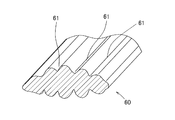
- FIG. 7 is an enlarged view of a modified fiber having an irregular cross section in an example of a hydrophilic fiber.
- the hydrophilic fiber 60 is a thermoplastic resin fiber that has been subjected to a hydrophilic treatment, for example, a hydrophilic PET fiber, and has a plurality of grooves 61 extending in the extending direction. Since the hydrophilic fibers 60 have the plurality of grooves 61 extending in the extending direction, the surface area in contact with menstrual blood is increased as compared with the case where the outer peripheral surface is flat, and the menstrual blood withdrawing property is improved.
- unbleached pulp fibers that have not been completely subjected to delignification treatment can be used as the material of the raw yarn of the fabric 40.
- the unbleached pulp fiber containing a relatively large amount of lignin component has a light brown color derived from a natural material
- the entire topsheet 11 has a light brown natural color.
- the topsheet 11 has a light brown color, it is possible to give a wearer or the like an impression that the product is a natural-friendly and highly natural-friendly product using a natural material.
- menstrual blood which has just started menstruation can be directly visually recognized. Can reduce anxiety about menstruation. Furthermore, since the lignin component has an excellent antibacterial effect, the sanitary napkin 10 can be worn and discarded more hygienically.
- At least one of the first and second coating portions 25 and 26 of the core cover sheet 22 that covers the liquid-absorbent core 21 may include unbleached pulp fibers.
- a natural color can be given a gentle impression to the skin, and it can contribute to menstrual concealing properties and antibacterial properties.
- the embodiment relating to the topsheet 11 disposed on the skin-facing surface side of the absorber 20 as the liquid-permeable sheet for the absorbent article 10 according to the first invention has been described.
- the absorbent article 10 is not limited to a sanitary napkin, but may include, for example, a diaper for adults and children, and a urine absorbing pad, and may be used as a liquid-permeable sheet for passing urine and soft stool.
- a woven fabric having a first surface and a second surface opposing each other in the thickness direction; and a fibrous web integrated with the first surface of the woven fabric by entanglement, wherein constituent yarns of the woven fabric are formed from cellulosic fibers.
- the constituent fibers of the fibrous web extend substantially flush with the second surface of the woven fabric or extend outward in the thickness direction.
- the liquid-permeable sheet for an absorbent article according to the first invention disclosed above includes the following embodiments.
- the thickness dimension of the portion of the fiber web extending from the second surface of the woven fabric is 1.1 to 4.0 times the thickness dimension of the woven fabric.
- Some of the constituent fibers of the fiber web are wound around the constituent yarns of the woven fabric and extend to the second surface side through a plurality of meshes of the woven fabric.
- the constituent fibers of the fiber web include hydrophilic fibers and hydrophobic fibers, and the content of the hydrophobic fibers is higher than the content of the hydrophilic fibers.
- the hydrophilic fiber has a different shape in cross section and has a plurality of grooves extending in the extending direction.
- the fiber web and the woven fabric are entangled and integrated by a fluid entanglement process.
- the fiber web is composed of short fibers, the fiber length of the short fibers is 25 to 64 mm, the fineness is 0.8 to 6.0 dtex, and the constituent yarns of the woven fabric are a plurality of raw yarns. And the fineness of the twisted yarn is 10 to 100 cotton count.
- the absorbent article further includes an absorber, and is arranged on the side of the absorber facing the skin.
- the fiber length of the short fiber is larger than at least one of a separation dimension between the warps that are adjacent and parallel to each other and a separation dimension between the wefts that are adjacent and parallel to each other.
- the following embodiments relate to the absorbent articles shown in the accompanying drawings, and include not only the essential constitutions of the invention but also alternative and preferred constitutions.
- a sanitary napkin 210 which is an example of an absorbent article according to the present invention will be described with reference to the accompanying drawings.
- the sanitary napkin 210 has a vertical direction Y, a horizontal direction X, and a thickness direction Z.
- the sanitary napkin 210 has a vertical center line P bisecting the dimension in the width direction and a horizontal center line Q bisecting the length dimension.
- the convex surface is curved at the central portion where the opposing surface (inner surface) side and the non-skin opposing surface (outer surface) side opposite thereto, the first and second end edges 210a and 210b, and the horizontal center line Q are located.
- the topsheet 211 and the absorber 220 are joined to each other by a known joining means such as a hot melt adhesive or the like, so that the liquid absorbing layer 213 is formed.
- an intermediate sheet made of a relatively bulky fiber nonwoven fabric is disposed between the topsheet (liquid-permeable sheet) 211 and the absorber 220. May be.
- a leak-proof sheet made of a liquid-impermeable fibrous nonwoven fabric or a plastic film, which preferably has air permeability, is preferably arranged to suppress leakage of bodily fluids. Good.
- the absorber 220 has a first edge 220a facing the first edge 210a, a second edge 220b facing the second edge 210b, and a longitudinal direction Y between the first and second edges 220a and 220b. It has first and second side edges 220c, 220d extending.
- the front and back sheets 211 and 212 extend outward from the outer periphery of the absorber 220, and a pair of side surfaces extending in the vertical direction Y so as to face each other in the horizontal direction X on the skin facing surface side of the top sheet 211.
- a sheet 214 is arranged.
- the pair of side sheets 214 is joined to the top sheet 211 via a side joint (not shown) formed by a known bonding means or welding means.
- an elastic material extending in the vertical direction Y may be arranged on the side sheet 214 so as to be contractible in an extended state in order to form a leak-proof wall that rises toward the body in a worn state.
- the side joint portion for fixing the side sheet 214 may be a seal line having a design element such as a floral pattern or a geometric pattern and extending in the vertical direction Y.
- the sanitary napkin 210 is formed by a top sheet 211, a back sheet 212, and a side sheet 214, and has both ends extending in the horizontal direction X outside the first and second edges 220a, 220b of the absorber 220 in the vertical direction Y. 216 and both side edges 217 extending in the vertical direction Y outside the first and second side edges 220c and 220d of the absorber 220 in the horizontal direction X.
- a wing portion 218 formed by a part of both side edge portions 217 protruding outward in the horizontal direction X is located at a central portion in the vertical direction Y of the sanitary napkin 210.
- the sheets 211, 212, and 214 stacked on each other are joined to each other via an outer peripheral seal portion 219 located along the outer peripheral edge of the sanitary napkin 210.
- a plurality of fastening areas 230 are arranged on the back side of the sanitary napkin 210.
- the plurality of fastening areas 230 are for fastening the sanitary napkin 210 to clothing such as underwear, and are formed from a plurality of line-shaped adhesives or pressure-sensitive adhesives extending in the vertical direction Y. Is done.
- the fastening region 230 has a central region 231 extending in the vertical direction Y in a region overlapping with the absorber 220, and a side region 232 located at the wing portion 218.
- the fixing area 230 is covered with a plastic film separator (not shown).
- the top sheet 211 is liquid-permeable, has a skin-facing surface 211a and a non-skin-facing surface 211b located on the opposite side, and is formed from a laminate sheet of the woven fabric 240 and the fiber web 250.
- the back sheet 212 can be formed from a liquid-impermeable and moisture-permeable plastic film, a liquid-impermeable fibrous nonwoven fabric, a laminate sheet thereof, and the like.
- As the side sheet 214 a known nonwoven fabric can be used, but in order to effectively prevent lateral leakage of body fluid, it is preferable to use a sheet material having hydrophobicity or water repellency.
- the outer peripheral seal portion 219 can be singly or in combination of bonding by known bonding means such as bonding with an adhesive, ultrasonic welding, heat welding, laser welding, high-frequency welding, and embossing.
- the sheets 211, 212, and 214 stacked in the thickness direction Z are joined to each other via an adhesive such as a hot melt adhesive.
- an adhesive such as a hot melt adhesive.
- Examples of the method for applying the hot melt adhesive include various known application methods such as spiral coating, coater coating, curtain coater coating, and spray coating.
- an absorbent body 220 is made of a liquid-absorbent core 221 formed by mixing superabsorbent polymer particles (SAP) and cellulosic fibers such as fluff wood pulp and rayon fibers and shaping the mixture into a predetermined shape. And a liquid-permeable core cover sheet 222 that covers the entire liquid-absorbent core 221 in order to improve the shape retention and liquid diffusibility.
- SAP superabsorbent polymer particles
- cellulosic fibers such as fluff wood pulp and rayon fibers
- the core cover sheet 222 has a dimension in the longitudinal direction Y that is larger than the dimension in the longitudinal direction Y of the liquid-absorbent core, and both side edges 222 a and 222 b of the core cover sheet 222 cover the entire liquid-absorbent core 221.
- the liquid cores 221 are located so as to overlap each other on the bottom surface side in the central portion in the lateral direction X of the liquid core 221.
- a superimposed portion 223 formed by laminating the side edges 222a and 222b extending in the vertical direction Y is formed at the central portion in the horizontal direction X of the absorber 220. Is done.
- the core cover sheet 222 has a first covering portion 225 that covers the skin-facing surface side of the liquid-absorbing core 221 and a second covering portion 226 that covers the non-skin-facing surface side of the liquid-absorbing core 221.
- the core cover sheet 222 is formed from one continuous sheet.
- the first core cover sheet forming the first covering portion 225 is separate from the first core cover sheet.
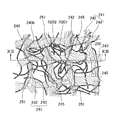
- FIG. 11 is a partially enlarged view of the topsheet 211
- FIG. 12 is an exploded perspective view of the topsheet 211.
- the topsheet 211 includes a woven fabric 240 located on the skin facing surface side and a fiber web 250 located on the non-skin facing surface side.
- the woven fabric 240 has a lower surface (first surface) 240a facing the fiber web 250 and an upper surface (second surface) 240b located on the opposite side of the lower surface 240a.
- the woven fabric 240 and the fiber web 250 are integrated by entanglement with each other.
- the upper surface 240b of the textile 240 may be located below, and the lower surface 240a may be located above.
- the woven fabric 240 is composed of constituent yarns 241 woven into a mesh.
- the constituent yarn 241 has a plurality of warps 242 and a plurality of wefts 243 that intersect with the warp 242. When the warp 242 and the weft 243 cross each other in the thickness direction Z, a plurality of meshes 245 are formed. It is formed.
- the constituent yarn 241 of the woven fabric 240 is a twisted yarn formed by twisting a raw yarn made of cotton yarn (cotton fiber).
- the material of the raw yarn in addition to cotton fibers, natural cellulose fibers such as pulp fibers, regenerated cellulose fibers such as rayon, and cellulosic fibers such as semi-synthetic cellulose fibers such as acetate are preferably used.
- materials such as thermoplastic resin fibers such as polyethylene and polypropylene, cellulosic fibers, and mixtures thereof can be appropriately used as long as the following technical effects of the present invention are exhibited.
- the number of the constituent yarns 241 (the sum of the warp and the weft) is 60 to 100, and a cotton yarn having a thickness of 10 to 100 cotton can be suitably used as the raw yarn.
- the fiber web 250 is formed by a known manufacturing method such as a spunbond method using long fibers or a dry method in which short fibers are arranged in a certain direction by a carding machine to form a web. It is a fiber aggregate, and is formed from constituent fibers 251 including hydrophilic fibers and hydrophobic fibers.
- the hydrophobic fibers include monofilaments such as polyolefin-based thermoplastic fibers including polypropylene (PP) and polyethylene (PE), and polyester-based thermoplastic fibers including polyethylene terephthalate (PET), as well as core-sheath composite fibers. And various composite fibers such as side-by-side type composite fibers and sea-island type composite fibers.
- hydrophilic fibers examples include natural cellulose fibers such as cotton and ground pulp; regenerated cellulose fibers such as rayon and fibril rayon; semi-synthetic cellulose fibers such as acetate; thermoplastic resin fibers and composite fibers subjected to a hydrophilic treatment; Is mentioned.
- the constituent fibers 251 of the fiber web 250 have hydrophobic fibers of 10 to 20 gsm and hydrophilic fibers of 5 to 10 gsm.
- a known fluid entanglement treatment method can be used.
- the continuous laminate obtained by laminating the continuous fiber web, which is the material of the fiber web 250, on the upper surface of the continuous network structure, which is the material of the fabric 240,
- a high-pressure fluid such as air or water
- the constituent yarns of the continuous network can be entangled and integrated.
- the continuous laminate is conveyed by a conveying means formed of a metal mesh belt, and when a fluid is jetted onto the upper surface of the continuous laminate from a nozzle, the fibers of the continuous fiber web and the constituent yarns of the continuous network structure are formed on the upper surface side. Are entangled with each other, and are also entangled by the fluid that repels and strikes the conveying means on the lower surface side facing the conveying means. Since the topsheet 211 is obtained by entanglement of the fiber web 250 made of an aggregate of fibers with the woven fabric 240 by the fluid entanglement method, compared with the case where the nonwoven fabric sheets are laminated and entangled with the fluid, the constituent fibers of the fiber web 250 are formed.
- the topsheet 211 can easily be entangled with the woven fabric 240, and it can be said that the laminated state can be more stably maintained.
- the fluid entanglement method by appropriately changing the configuration of the mesh belt of the conveying means, it is possible to obtain the topsheet 211 having desired sheet characteristics such as thickness, mass, absorption speed, sheet strength, and the like. it can.
- the topsheet 211 is formed by integrating the woven fabric 240 located on the skin-facing surface side with the fiber web 250 located on the non-skin-facing surface side by entanglement, the topsheet 211 is formed only of the nonwoven fabric. , And can give a crisp texture like cloth.
- the fabric 240 has a mesh structure, the contact area with the skin is reduced, and a light touch can be provided.
- the menstrual blood excreted in the topsheet 211 is diffused along the warps 242 and the wefts 243 of the woven fabric 240 and is absorbed downward through the constituent fibers 251 of the fiber web 250 extending downward from the mesh 245 of the woven fabric 240. Moved to body 220. Further, as compared with the case where the topsheet 211 is formed from a liquid-permeable fibrous nonwoven fabric, even if the sheet mass is the same, a mesh-like shape composed of the constituent yarns 241 having a finer size than the constituent fibers 251 of the fiber web 250. , The sheet rigidity becomes relatively high. Thereby, it is possible to effectively prevent the top sheet 211 from being twisted or lifted from the absorber 220.
- the surface sheet used for the sanitary napkin is relatively thin and contains a large amount of hydrophilic fibers, so that the swollen fibers after menstrual blood absorption tend to stick together. Therefore, there is a possibility that a folding habit due to a folding curve formed when the sanitary napkin is stored in the individual package body in a folded state may be formed. If a crooked sanitary napkin is attached to underwear or the like, a part of the sanitary napkin may form a gap between itself and the body, leading to a side leakage of menstrual blood and a feeling of wearing. Decrease.
- the topsheet 211 contains hydrophilic fibers and hydrophobic fibers, and the ratio of the hydrophobic fibers is higher than that of the hydrophilic fibers, the formation of a folding habit due to sticking of the fibers can be suppressed.
- the topsheet 211 is unlikely to have a folding habit because the woven fabric 240 having a higher rigidity than a sheet material such as a nonwoven fabric is located on the skin-facing surface (inner surface) side. Therefore, when the sanitary napkin is taken out of the individual package housed in the folded state, it can be said that it is difficult to form a folding habit along a folding curve, which causes lateral leakage of menstrual blood.
- the topsheet When the topsheet is formed only of nonwoven fabric containing hydrophilic fibers, it is excellent in absorption rate and liquid diffusion, so even if the excretion amount of menstrual blood is small, it is spread and spread quickly and widely. The skin becomes dirty and may cause skin troubles.
- the topsheet 211 is formed from a laminate sheet of the woven fabric 240 and the fiber web 250, and it is difficult for menstrual blood to spread along the constituent yarns of the woven fabric 240, and when the amount of excretion is small, a spot is formed. Since it is absorbed, it is possible to suppress the occurrence of skin troubles due to the skin being stained over a wide area.
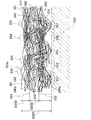
- FIG. 13 is a cross-sectional view taken along the line XIII-XIII in FIG. 11, and shows the absorber 220 located below the topsheet 211 by a virtual line.
- the constituent fibers 251 of the fiber web 250 extend outward from the woven fabric 240 in the thickness direction Z.
- the fiber web 250 has a downwardly extending portion 252 extending downward from the lower surface (first surface) 240a of the woven fabric 240 and an upwardly extending portion (extending upward from the upper surface (second surface) 240b of the woven fabric 240). 253) extending from the second surface.
- a part of the fiber web 250 is positioned flush with or above the upper surface 240b from the woven fabric 240.
- the lower extending portion 252 of the fiber web 250 is a continuous fiber web to which a fluid is injected at a high pressure, while the upper extending portion 253 is formed of a continuous fiber web.
- a part of the constituent fibers is a part extending to the mesh belt side which is a conveying means, penetrating through a continuous mesh body which is a material of the woven fabric 240 located below.
- the bodily fluid excreted on the topsheet 211 is absorbed and diffused by the hydrophilic fibers included in the upwardly extending portion 253 of the fiber web 250, and is further longitudinally and laterally moved by the warp 242 and the weft 243 of the woven fabric 240. X and is quickly transferred to the absorber 220.
- a part of the fiber web 250 is located substantially flush with or above the upper surface 240b of the woven fabric 240, it becomes closer to the skin and the area for absorbing menstrual blood increases, so that more menstrual blood can be absorbed. Can be withdrawn.
- the woven fabric 240 is composed of a plurality of continuously extending warps 242 and a plurality of continuously extending wefts 243 so as to intersect them in the thickness direction Z. It can be said that even if pressure is applied or menstrual blood is touched, the strength is not easily reduced, and fluffing and settling are hardly generated.
- the woven fabric 240 Since the woven fabric 240 is located on the skin side of the fiber web 250, the menstrual blood attached to the skin can be scraped off by the constituent yarn 241 having a higher fineness than the constituent fibers 251 of the fiber web 250 and having high rigidity. .
- menstrual blood adheres to the skin so that it sticks to the skin when it is cured over time by contact with air.
- the fabric 240 whose strength is hardly reduced even when pressure is applied or touches menstrual blood, directly or indirectly touches the skin, so that the menstrual blood stuck to the skin by the plurality of meshes 245 can be wiped off.
- the constituent yarn 241 of the woven fabric 240 is formed from a twisted yarn, the entire outer peripheral surface is uneven, so that the scraping property is further improved.
- the thickness dimension D3 of the upwardly extending portion 253 of the fiber web 250 extending upward from the upper surface 240b of the textile 240 may be 1.1 to 4.0 times the thickness D2 of the textile 240. preferable.
- the thickness D3 has such a relatively large size, it is possible to achieve both the scraping property and the suppression of the rewetting phenomenon.
- the thickness D3 is less than 1.1 times the thickness D2, it can be said that the woven fabric 240 is close to the skin, so that the scraping property is higher.
- the rewetting phenomenon cannot be effectively suppressed by the thin fiber web 250 containing hydrophobic fibers.
- the thickness dimension D3 exceeds 4.0 times the thickness dimension D2
- the re-wetting phenomenon can be suppressed by the upwardly extending portion 253 of the relatively thick fiber web 250, and the constituent fibers 251 can be suppressed. It can be said that the body fluid can be drawn in through the skin, but since the fabric 240 is located away from the skin, it is difficult to scrape menstrual blood adhered to the skin.
- the thickness dimension D2 of the fabric 240 can be measured in the state of the material using a “PEACOCK dial thickness gauge JB manufactured by Ozaki Corporation” having a measuring element having a diameter of 50 mm.
- the thickness dimension D1 of the topsheet 211 is an apparent thickness, and as shown in FIG. 13, the topsheet 211 is preferably cut along the machine direction of the fiber web 250 to enlarge the cut surface. A photograph was taken using a digital microscope VHX-1000 manufactured by KEYENCE CORPORATION, and the maximum thickness of the topsheet 211 was measured based on the enlarged photograph, and the same measurement was performed at five randomly designated places.
- the thickness dimension D1 of the topsheet 211 was used as the thickness dimension D1 of the topsheet 211.
- the value obtained by subtracting the thickness D2 of the fabric 240 and the thickness of the lower extension 252 from the thickness D1 of the topsheet 211 is the thickness of the upper extension 253 of the fiber web 250 (the fabric 240). (Distance from the upper surface 240b to the vertex 253a of the upwardly extending portion 253) D3.
- the measurement is performed in a measurement room under a standard atmosphere (temperature: 20 ⁇ 5 ° C., relative humidity: 65% or less).
- the upwardly extending portion 253 of the fiber web 250 has a plurality of low bulk portions 254 having a relatively small thickness D3 and a plurality of high bulks 255 having a relatively large thickness D3. Since the downwardly extending portion 252 of the fiber web 250 has an uneven shape, menstrual blood adhering to the skin together with the fabric 240 located below can be effectively scraped off.
- a portion of the fiber web 250 directly contacting the fluid ejected from the nozzle is another portion of the fiber web 250 at the lower extension portion 252 directly contacting the fluid ejected at high pressure.
- the volume is lower than that of the part.
- the bulky portion 256 includes a portion that is directly hit by the fluid, in which case the bulky portion 256 has a higher fiber density than the bulky portion 257. Therefore, the bodily fluid transferred from the fabric 240 to the downwardly extending portion 252 is transferred to the absorber located further below the bulky portion 257 in the bulky portion 256 having a relatively high fiber density. be able to.
- the fiber web 250 is integrated with the fabric 240 by entanglement without using an adhesive or the like, the fiber web 250 is excellent in flexibility as compared with a case where the fiber web 250 is joined to each other via an adhesive or the like.
- the constituent fiber 251 of the fiber web 250 is entangled with the woven fabric 240, in addition to the fact that a part of the constituent fiber 251 is entangled with the warp and the weft of the woven fabric 240 or wound so as to cling together, In some cases, the constituent fibers 251 may be entangled so as to enter between the original yarns of the warp 242 and the weft 243 formed of a twisted yarn. In this way, the fiber web 250 is stably integrated with the woven fabric 240 by entanglement of the constituent fibers 251 with the outer surface and the inner surface of the warp 242 and the weft 243.
- the constituent fibers 251 of the fiber web 250 have a fineness of 0.8 to 6.0 dtex, preferably 1.0 to 4.4 dtex, more preferably 1.3 to 3.3 dtex, and a fiber length of 25 to 64 mm, preferably , 32 to 58 mm, more preferably 38 to 51 mm, and the fineness of the constituent yarn 241 made of twisted yarn is 10 to 100 cotton count, preferably 20 to 60 cotton count, more preferably 30 to 45 cotton count. It is.
- the fiber web 250 Since the constituent fibers 251 of the fiber web 250 are staple fibers, the fiber web 250 has a plurality of fiber ends, and the fiber ends enter the twisted gaps of the original yarns having a greater fineness, or the constituent yarns The fiber web 250 is stably entangled with the woven fabric 240 by being wound so as to cling to the woven fabric 241.
- the fiber length of the short fibers of the fiber web 250 is determined by a distance R1 between the warps 242 adjacent and parallel to each other and a distance R2 between the wefts 243 adjacent and parallel to each other. Is larger than at least one of the separation dimensions. In such a case, the short fibers do not fall off from the mesh 245 of the woven fabric 240, and the short fibers extend so as to straddle the mesh 245, thereby improving the sheet strength and liquid diffusibility of the entire topsheet 211. sell.
- the content of hydrophilic fibers in the fiber web 250 is less than 50% by mass, preferably 10 to 49% by mass, and the content of hydrophobic fibers is more than 50% by mass, preferably 51 to 90% by mass.
- the ratio of the hydrophobic fibers to the fiber web 250 is higher than the ratio of the hydrophilic fibers.
- the content of the hydrophilic fiber is less than 10%, the ratio of the hydrophobic fiber is relatively increased, and the rewetting phenomenon can be suppressed, but the ability to draw menstrual blood from the skin is reduced.
- the content of the hydrophilic fiber is 50% or more, more menstrual blood can be rapidly absorbed, but the rewetting phenomenon is likely to occur.
- the topsheet 211 contains a good balance of hydrophilic fibers and hydrophobic fibers to achieve good liquid absorbency and liquid diffusivity and suppression of the rewetting phenomenon.
- a liquid permeable sheet having a thickness of 0.57 mm and a mass of 47 g / m 2 serving as a material of the topsheet 211 was cut into a length 100 mm ⁇ width 50 mm.
- Sample B corresponding to the example was prepared by cutting a cotton sheet (100% cotton) having a thickness of 0.33 mm and a mass of 31 g / m 2 into a length of 100 mm and a width of 15 mm.
- each sample was rubbed with a Gakushin type friction fastness tester under predetermined measurement conditions (abrasion resistance 100 times, load 50 g) to reproduce the state of surface friction between the topsheet and the body during wearing.
- each of the samples A and B is measured under the following measurement conditions using a torque tester (EX-0762) manufactured by Imada.
- Rotation speed 50 rpm
- Check distance 25mm
- Rotation angle (measuring angle) 90 ° (60 °)
- the torque value in the vertical direction Y and the torque value in the horizontal direction of each of the samples A and B were obtained and averaged, and the averaged value was used as the torque value of each sample.
- each of the samples A and B was prepared by measuring both a state where surface friction was applied by a friction fastness tester and a state where surface friction was not applied.
- the torque value of the sample A corresponding to the example without the surface friction was 7.1
- the torque value of the sample A with the surface friction applied was 6.8
- the surface of the sample B corresponding to the comparative example was the same.
- the torque value when no friction was applied was 3.9
- the torque value when surface friction was applied was 2.2.
- the surface sheet 211 of the embodiment there is no large change in the torque value depending on the presence or absence of surface friction, and it can be said that there is no possibility that friction occurs with the body during use.
- the surface sheet 211 has a higher sheet rigidity than the cotton sheet of the comparative example, and is hardly distorted.
- the reason why the torque value of the cotton sheet of the comparative example is 55% or less as compared with that of the topsheet 211 of the embodiment is that, in the case of the cotton sheet, the entanglement of the cotton fibers comes off when surface friction is applied. This is probably because the sheet strength was reduced.
- a sample C was prepared as a sanitary napkin according to the example, and a sample D was prepared as a sanitary napkin according to the comparative example.
- the sample C and the sample D have the same configuration except for the configuration of the surface sheet.
- the surface sheet used for the sample C is the liquid permeable sheet of the sample A used for the torsion evaluation measurement, and the surface used for the sample D.
- the sheet is a liquid-permeable sheet of Sample B.
- the thigh of the doll was continuously moved back and forth for 5 minutes, and then 2 g of artificial menstrual blood was discharged from the opening corresponding to the vaginal opening of the doll. It was dropped on the surface. After that, assuming the sitting position, the doll's thigh was rearranged left and right. These actions were performed 5 times (5 sets) as one set, and the sample was removed from the doll. With respect to the samples C and D detached from the doll, the narrowest dimension (mm) of the absorber at the narrowest portion in contact with the vicinity of the inseam was measured by a measure. Such measurement was performed three times, and the average value was defined as the narrowest dimension of the absorber of each sample.
- the narrowest width of the absorber of Sample C using the topsheet 211 was 30 mm
- the narrowest width of the absorber of Sample D using the cotton sheet was 14 mm.
- the constituent fibers 251 of the fiber web 250 do not adhere to each other, and it can be said that it is difficult to be twisted.
- the cotton sheet used for Sample D it can be said that the width dimension of the absorber is small, and a large deflection occurs.
- the entanglement of the cotton fibers comes off due to surface friction, and further, the fibers that have come off the entanglement in the gathers formed during wearing adhere to each other, so that a large groove extending in the vertical direction is formed. It is thought that there is.
- FIG. 14 is an enlarged view of a modified cross-section fiber having an irregular cross section in an example of the hydrophilic fiber.
- the hydrophilic fiber 260 is a thermoplastic resin fiber that has been subjected to a hydrophilic treatment, for example, a hydrophilic PET fiber, and has a plurality of grooves 261 extending in the extending direction. Since the hydrophilic fiber 260 has the plurality of grooves 261 extending in the extending direction, the surface area in contact with menstrual blood is increased as compared with the case where the outer peripheral surface is flat, and the menstrual blood withdrawing property is improved.
- unbleached pulp fibers that have not been completely delignified can be used as the material of the raw yarn of the fabric 240.
- the unbleached pulp fiber containing a relatively large amount of lignin component has a light brown color derived from a natural material
- the entire topsheet 211 has a light brown natural color.
- the topsheet 211 has a light brown color, it is possible to give a wearer or the like an impression that the product is a natural-friendly product that uses natural materials and is gentle on the skin.
- the redness of menstrual blood absorbed by the absorber 220 is suppressed as compared with the case of using a white sheet that has been bleached, it is possible to directly visually recognize menstrual blood by a minor who has just started menstruation. Can reduce anxiety about menstruation. Furthermore, since the lignin component has an excellent antibacterial action, the sanitary napkin 210 can be worn and discarded more hygienically.
- At least one of the first and second covering portions 225 and 226 of the core cover sheet 222 that covers the liquid-absorbent core 221 may include unbleached pulp fibers.
- a natural color can be given a gentle impression to the skin, and it can contribute to menstrual concealing properties and antibacterial properties.
- the sheet 210 can be used as a sheet, for example, an intermediate sheet located on the inner side of a top sheet, a core cover sheet, or the like.
- the absorbent article 210 is not limited to a sanitary napkin, and may include, for example, a diaper for adults and children and a urine absorbing pad, and may be used as a liquid-permeable sheet for passing urine and soft stool.
- a woven fabric having a first surface and a second surface facing each other in the thickness direction; and a fiber web integrated by entanglement with the first surface of the woven fabric, and a constituent yarn of the woven fabric is made of cellulosic fibers.
- the fiber web is formed from a continuous twisted yarn, and includes a hydrophilic fiber and a hydrophobic fiber.
- the liquid-permeable sheet for an absorbent article disclosed in the second invention includes the following embodiments.
- the constituent yarn composed of the twisted yarn of the woven fabric includes a plurality of continuously extending warps and a plurality of wefts continuously extending so as to intersect the warp with each other in the thickness direction.
- the content of the hydrophobic fiber is higher than the content of the hydrophilic fiber.
- the content of the hydrophobic fiber is 51 to 90% by mass, and the content of the hydrophilic fiber is 10 to 49% by mass.
- the hydrophilic fiber has a different shape in cross section, and has a plurality of grooves extending in the extending direction.
- the fiber web and the woven fabric are entangled and integrated by a hydroentanglement treatment.
- the fiber web is composed of short fibers, the fiber length of the short fibers is 25 to 64 mm, the fineness is 0.8 to 6.0 dtex, and the constituent yarns of the woven fabric are a plurality of raw yarns. And the fineness of the twisted yarn is 10 to 100 cotton count.
- the absorbent article further includes an absorber, and is arranged on the side of the absorber facing the skin.
- the fiber length of the short fiber is larger than at least one of a separation dimension between the warps that are adjacent and parallel to each other and a separation dimension between the wefts that are adjacent and parallel to each other.
Landscapes
- Health & Medical Sciences (AREA)
- Engineering & Computer Science (AREA)
- Epidemiology (AREA)
- Life Sciences & Earth Sciences (AREA)
- Heart & Thoracic Surgery (AREA)
- Vascular Medicine (AREA)
- Biomedical Technology (AREA)
- Animal Behavior & Ethology (AREA)
- General Health & Medical Sciences (AREA)
- Public Health (AREA)
- Veterinary Medicine (AREA)
- Textile Engineering (AREA)
- Mechanical Engineering (AREA)
- Absorbent Articles And Supports Therefor (AREA)
- Laminated Bodies (AREA)
Abstract
La présente invention concerne une feuille perméable aux liquides pour article absorbant qui est fortement perméable aux liquides, présente une résistance requise de feuille, et qui est susceptible de supprimer le re-mouillage. La feuille perméable aux liquides (11) d'un article absorbant (10) est pourvue : d'un textile (40) ayant une première surface (40a) et une seconde surface (40b) opposées l'une à l'autre dans un sens de l'épaisseur (Z) ; et un voile de fibre (50) intégré avec la première surface (40a) du textile (40) par entrelacement. Un fil constitutif (41) du textile (40) est formé de fibres à base de cellulose, et les fibres constitutives (51) du voile de fibre (50) affleurent sensiblement au niveau de la seconde surface (40b) du textile (40) ou s'étendent sur l'extérieur dans le sens de l'épaisseur.
Priority Applications (2)
| Application Number | Priority Date | Filing Date | Title |
|---|---|---|---|
| KR1020207028001A KR102606001B1 (ko) | 2018-06-29 | 2019-06-28 | 흡수성 물품용의 투액성 시트 |
| CN201980043913.2A CN112334110B (zh) | 2018-06-29 | 2019-06-28 | 吸收性物品用的透液性片材 |
Applications Claiming Priority (4)
| Application Number | Priority Date | Filing Date | Title |
|---|---|---|---|
| JP2018-125330 | 2018-06-29 | ||
| JP2018125331A JP2020000720A (ja) | 2018-06-29 | 2018-06-29 | 吸収性物品用の透液性シート |
| JP2018125330A JP7085921B2 (ja) | 2018-06-29 | 2018-06-29 | 吸収性物品用の透液性シート |
| JP2018-125331 | 2018-06-29 |
Publications (1)
| Publication Number | Publication Date |
|---|---|
| WO2020004648A1 true WO2020004648A1 (fr) | 2020-01-02 |
Family
ID=68985942
Family Applications (1)
| Application Number | Title | Priority Date | Filing Date |
|---|---|---|---|
| PCT/JP2019/025924 Ceased WO2020004648A1 (fr) | 2018-06-29 | 2019-06-28 | Feuille perméable aux liquides pour article absorbant |
Country Status (4)
| Country | Link |
|---|---|
| KR (1) | KR102606001B1 (fr) |
| CN (1) | CN112334110B (fr) |
| TW (1) | TWI778276B (fr) |
| WO (1) | WO2020004648A1 (fr) |
Cited By (3)
| Publication number | Priority date | Publication date | Assignee | Title |
|---|---|---|---|---|
| WO2023057075A1 (fr) * | 2021-10-08 | 2023-04-13 | Essity Hygiene And Health Aktiebolag | Article absorbant |
| WO2023057096A1 (fr) * | 2021-10-08 | 2023-04-13 | Essity Hygiene And Health Aktiebolag | Article absorbant |
| WO2023057076A1 (fr) * | 2021-10-08 | 2023-04-13 | Essity Hygiene And Health Aktiebolag | Article absorbant |
Families Citing this family (1)
| Publication number | Priority date | Publication date | Assignee | Title |
|---|---|---|---|---|
| KR102817958B1 (ko) * | 2023-03-30 | 2025-06-12 | 주식회사 에스에스케이 | 홍화 및 익모초 등 식물자원이 함유된 기능성 강화 유기농 생리대 |
Citations (5)
| Publication number | Priority date | Publication date | Assignee | Title |
|---|---|---|---|---|
| JPS642008U (fr) * | 1987-06-24 | 1989-01-09 | ||
| JP3018173U (ja) * | 1994-08-18 | 1995-11-14 | 株式会社タカギ | 失禁用パンツ |
| WO2001045927A1 (fr) * | 1999-12-22 | 2001-06-28 | The Procter & Gamble Company | Stratifie elastique avec gaze elastomere et couche fibreuse liees a celui-ci et procede de fabrication correspondant |
| JP2003136621A (ja) * | 2001-11-01 | 2003-05-14 | Kurabo Ind Ltd | 高吸液性複合材及びおむつ |
| JP2011030940A (ja) * | 2009-08-05 | 2011-02-17 | Unitika Ltd | 吸収性物品の表面シート |
Family Cites Families (6)
| Publication number | Priority date | Publication date | Assignee | Title |
|---|---|---|---|---|
| JP3144533B2 (ja) | 1995-03-10 | 2001-03-12 | 花王株式会社 | 吸収性物品の表面シート |
| US20020090875A1 (en) * | 1999-06-18 | 2002-07-11 | Vincent P. Lasko | Unitized cover and absorbent transfer layer |
| CN100564641C (zh) * | 2002-12-20 | 2009-12-02 | 宝洁公司 | 簇状的层压纤维网 |
| CN102299900A (zh) * | 2010-06-24 | 2011-12-28 | 王江涛 | 基于实时视频流媒体编码的游戏运行方法 |
| CN104540988B (zh) * | 2012-08-08 | 2017-12-15 | 大和纺控股株式会社 | 无纺织物、用于吸收制品的片材和使用其的吸收制品 |
| US10988868B2 (en) * | 2015-03-20 | 2021-04-27 | Sysco Guest Supply, Llc | Textile structures comprising core spun yarns and associated methods for manufacture |
-
2019
- 2019-06-28 KR KR1020207028001A patent/KR102606001B1/ko active Active
- 2019-06-28 TW TW108122896A patent/TWI778276B/zh active
- 2019-06-28 CN CN201980043913.2A patent/CN112334110B/zh active Active
- 2019-06-28 WO PCT/JP2019/025924 patent/WO2020004648A1/fr not_active Ceased
Patent Citations (5)
| Publication number | Priority date | Publication date | Assignee | Title |
|---|---|---|---|---|
| JPS642008U (fr) * | 1987-06-24 | 1989-01-09 | ||
| JP3018173U (ja) * | 1994-08-18 | 1995-11-14 | 株式会社タカギ | 失禁用パンツ |
| WO2001045927A1 (fr) * | 1999-12-22 | 2001-06-28 | The Procter & Gamble Company | Stratifie elastique avec gaze elastomere et couche fibreuse liees a celui-ci et procede de fabrication correspondant |
| JP2003136621A (ja) * | 2001-11-01 | 2003-05-14 | Kurabo Ind Ltd | 高吸液性複合材及びおむつ |
| JP2011030940A (ja) * | 2009-08-05 | 2011-02-17 | Unitika Ltd | 吸収性物品の表面シート |
Cited By (4)
| Publication number | Priority date | Publication date | Assignee | Title |
|---|---|---|---|---|
| WO2023057075A1 (fr) * | 2021-10-08 | 2023-04-13 | Essity Hygiene And Health Aktiebolag | Article absorbant |
| WO2023057096A1 (fr) * | 2021-10-08 | 2023-04-13 | Essity Hygiene And Health Aktiebolag | Article absorbant |
| WO2023057076A1 (fr) * | 2021-10-08 | 2023-04-13 | Essity Hygiene And Health Aktiebolag | Article absorbant |
| AU2021467778B2 (en) * | 2021-10-08 | 2026-03-05 | Essity Hygiene And Health Aktiebolag | Absorbent article |
Also Published As
| Publication number | Publication date |
|---|---|
| CN112334110A (zh) | 2021-02-05 |
| KR20210024440A (ko) | 2021-03-05 |
| CN112334110B (zh) | 2022-07-08 |
| TWI778276B (zh) | 2022-09-21 |
| KR102606001B1 (ko) | 2023-11-23 |
| TW202017543A (zh) | 2020-05-16 |
Similar Documents
| Publication | Publication Date | Title |
|---|---|---|
| JP5868110B2 (ja) | 吸収性物品 | |
| AU779156B2 (en) | Absorbent article | |
| AU2014208105B2 (en) | Absorbent article | |
| JP5258954B2 (ja) | 吸収体の製造方法 | |
| JP6239965B2 (ja) | 吸収性物品 | |
| CN102481215B (zh) | 吸收性物品 | |
| JP4173844B2 (ja) | 吸収性物品 | |
| WO2007049725A1 (fr) | Article absorbant | |
| AU2005339199A1 (en) | Absorbent product | |
| WO2006004017A9 (fr) | Article absorbant l’humeur | |
| US20120296294A1 (en) | Absorbent structure for bodily fluid-absorbent wearing article | |
| KR102606001B1 (ko) | 흡수성 물품용의 투액성 시트 | |
| JP6580171B2 (ja) | 吸収体及びその製造方法並びに吸収性物品 | |
| EP3923890B1 (fr) | Article absorbant | |
| JP7085921B2 (ja) | 吸収性物品用の透液性シート | |
| WO2023009191A1 (fr) | Corps absorbant destiné à être utilisé dans un article absorbant | |
| JP2020000720A (ja) | 吸収性物品用の透液性シート | |
| AU2017428323A1 (en) | Disposable hygiene article with liquid side barriers | |
| CN113518716A (zh) | 吸湿片、一次性穿着物品及其制造方法 | |
| JP4724499B2 (ja) | 吸収性物品 | |
| WO2024062957A1 (fr) | Article absorbant | |
| JP2007061319A5 (fr) |
Legal Events
| Date | Code | Title | Description |
|---|---|---|---|
| 121 | Ep: the epo has been informed by wipo that ep was designated in this application |
Ref document number: 19824893 Country of ref document: EP Kind code of ref document: A1 |
|
| NENP | Non-entry into the national phase |
Ref country code: DE |
|
| 122 | Ep: pct application non-entry in european phase |
Ref document number: 19824893 Country of ref document: EP Kind code of ref document: A1 |