WO2020007339A1 - Procédé et système de commande d'un dispositif électronique - Google Patents
Procédé et système de commande d'un dispositif électronique Download PDFInfo
- Publication number
- WO2020007339A1 WO2020007339A1 PCT/CN2019/094682 CN2019094682W WO2020007339A1 WO 2020007339 A1 WO2020007339 A1 WO 2020007339A1 CN 2019094682 W CN2019094682 W CN 2019094682W WO 2020007339 A1 WO2020007339 A1 WO 2020007339A1
- Authority
- WO
- WIPO (PCT)
- Prior art keywords
- electronic device
- request
- firmware
- private key
- information
- Prior art date
- Legal status (The legal status is an assumption and is not a legal conclusion. Google has not performed a legal analysis and makes no representation as to the accuracy of the status listed.)
- Ceased
Links
Images




Classifications
-
- H—ELECTRICITY
- H04—ELECTRIC COMMUNICATION TECHNIQUE
- H04L—TRANSMISSION OF DIGITAL INFORMATION, e.g. TELEGRAPHIC COMMUNICATION
- H04L63/00—Network architectures or network communication protocols for network security
- H04L63/04—Network architectures or network communication protocols for network security for providing a confidential data exchange among entities communicating through data packet networks
- H04L63/0428—Network architectures or network communication protocols for network security for providing a confidential data exchange among entities communicating through data packet networks wherein the data content is protected, e.g. by encrypting or encapsulating the payload
- H04L63/0442—Network architectures or network communication protocols for network security for providing a confidential data exchange among entities communicating through data packet networks wherein the data content is protected, e.g. by encrypting or encapsulating the payload wherein the sending and receiving network entities apply asymmetric encryption, i.e. different keys for encryption and decryption
-
- H—ELECTRICITY
- H04—ELECTRIC COMMUNICATION TECHNIQUE
- H04L—TRANSMISSION OF DIGITAL INFORMATION, e.g. TELEGRAPHIC COMMUNICATION
- H04L67/00—Network arrangements or protocols for supporting network services or applications
- H04L67/01—Protocols
- H04L67/12—Protocols specially adapted for proprietary or special-purpose networking environments, e.g. medical networks, sensor networks, networks in vehicles or remote metering networks
- H04L67/125—Protocols specially adapted for proprietary or special-purpose networking environments, e.g. medical networks, sensor networks, networks in vehicles or remote metering networks involving control of end-device applications over a network
-
- E—FIXED CONSTRUCTIONS
- E05—LOCKS; KEYS; WINDOW OR DOOR FITTINGS; SAFES
- E05B—LOCKS; ACCESSORIES THEREFOR; HANDCUFFS
- E05B39/00—Locks giving indication of authorised or unauthorised unlocking
- E05B39/007—Indication by a tactile impulse to the user, e.g. vibration of a lock-, handle- or key-part
-
- G—PHYSICS
- G07—CHECKING-DEVICES
- G07C—TIME OR ATTENDANCE REGISTERS; REGISTERING OR INDICATING THE WORKING OF MACHINES; GENERATING RANDOM NUMBERS; VOTING OR LOTTERY APPARATUS; ARRANGEMENTS, SYSTEMS OR APPARATUS FOR CHECKING NOT PROVIDED FOR ELSEWHERE
- G07C9/00—Individual registration on entry or exit
- G07C9/00174—Electronically operated locks; Circuits therefor; Nonmechanical keys therefor, e.g. passive or active electrical keys or other data carriers without mechanical keys
-
- G—PHYSICS
- G07—CHECKING-DEVICES
- G07C—TIME OR ATTENDANCE REGISTERS; REGISTERING OR INDICATING THE WORKING OF MACHINES; GENERATING RANDOM NUMBERS; VOTING OR LOTTERY APPARATUS; ARRANGEMENTS, SYSTEMS OR APPARATUS FOR CHECKING NOT PROVIDED FOR ELSEWHERE
- G07C9/00—Individual registration on entry or exit
- G07C9/00174—Electronically operated locks; Circuits therefor; Nonmechanical keys therefor, e.g. passive or active electrical keys or other data carriers without mechanical keys
- G07C9/00571—Electronically operated locks; Circuits therefor; Nonmechanical keys therefor, e.g. passive or active electrical keys or other data carriers without mechanical keys operated by interacting with a central unit
-
- G—PHYSICS
- G16—INFORMATION AND COMMUNICATION TECHNOLOGY [ICT] SPECIALLY ADAPTED FOR SPECIFIC APPLICATION FIELDS
- G16Y—INFORMATION AND COMMUNICATION TECHNOLOGY SPECIALLY ADAPTED FOR THE INTERNET OF THINGS [IoT]
- G16Y20/00—Information sensed or collected by the things
- G16Y20/10—Information sensed or collected by the things relating to the environment, e.g. temperature; relating to location
-
- G—PHYSICS
- G16—INFORMATION AND COMMUNICATION TECHNOLOGY [ICT] SPECIALLY ADAPTED FOR SPECIFIC APPLICATION FIELDS
- G16Y—INFORMATION AND COMMUNICATION TECHNOLOGY SPECIALLY ADAPTED FOR THE INTERNET OF THINGS [IoT]
- G16Y20/00—Information sensed or collected by the things
- G16Y20/20—Information sensed or collected by the things relating to the thing itself
-
- H—ELECTRICITY
- H04—ELECTRIC COMMUNICATION TECHNIQUE
- H04L—TRANSMISSION OF DIGITAL INFORMATION, e.g. TELEGRAPHIC COMMUNICATION
- H04L41/00—Arrangements for maintenance, administration or management of data switching networks, e.g. of packet switching networks
- H04L41/08—Configuration management of networks or network elements
- H04L41/0803—Configuration setting
- H04L41/0813—Configuration setting characterised by the conditions triggering a change of settings
- H04L41/082—Configuration setting characterised by the conditions triggering a change of settings the condition being updates or upgrades of network functionality
-
- H—ELECTRICITY
- H04—ELECTRIC COMMUNICATION TECHNIQUE
- H04W—WIRELESS COMMUNICATION NETWORKS
- H04W12/00—Security arrangements; Authentication; Protecting privacy or anonymity
- H04W12/10—Integrity
- H04W12/106—Packet or message integrity
-
- H—ELECTRICITY
- H04—ELECTRIC COMMUNICATION TECHNIQUE
- H04W—WIRELESS COMMUNICATION NETWORKS
- H04W88/00—Devices specially adapted for wireless communication networks, e.g. terminals, base stations or access point devices
- H04W88/16—Gateway arrangements
-
- E—FIXED CONSTRUCTIONS
- E05—LOCKS; KEYS; WINDOW OR DOOR FITTINGS; SAFES
- E05B—LOCKS; ACCESSORIES THEREFOR; HANDCUFFS
- E05B45/00—Alarm locks
- E05B45/06—Electric alarm locks
- E05B2045/064—Electric alarm locks by movement of the lock housing or part thereof
-
- G—PHYSICS
- G07—CHECKING-DEVICES
- G07C—TIME OR ATTENDANCE REGISTERS; REGISTERING OR INDICATING THE WORKING OF MACHINES; GENERATING RANDOM NUMBERS; VOTING OR LOTTERY APPARATUS; ARRANGEMENTS, SYSTEMS OR APPARATUS FOR CHECKING NOT PROVIDED FOR ELSEWHERE
- G07C9/00—Individual registration on entry or exit
- G07C9/00174—Electronically operated locks; Circuits therefor; Nonmechanical keys therefor, e.g. passive or active electrical keys or other data carriers without mechanical keys
- G07C9/00817—Electronically operated locks; Circuits therefor; Nonmechanical keys therefor, e.g. passive or active electrical keys or other data carriers without mechanical keys where the code of the lock can be programmed
- G07C2009/00825—Electronically operated locks; Circuits therefor; Nonmechanical keys therefor, e.g. passive or active electrical keys or other data carriers without mechanical keys where the code of the lock can be programmed remotely by lines or wireless communication
Definitions
- a method for operating an electronic device may be implemented on at least one electronic device, each of which has at least one processor and a storage.
- the method may include one or more of the following operations: transmitting at least one request related to an electronic device, wherein the at least one request includes a controlling request, a communication protocol determining request, or a firmware upgrade request; obtaining operating data, wherein the operating data is generated based on the at least one request; and/or operating the electronic device based on the operating data.
- the at least one request includes the controlling request, which includes an access request of a control page of a second electronic device, which sent by a first electronic device, and the operating data includes page data of the control page of the second electronic device, the operating the electronic device based on the operating data may include one or more of the following operations: displaying the control page of the second electronic device by the first electronic device; and/or controlling, based on an operation generated by a user on an operation object of the control page, the second electronic device by performing a preset instruction corresponding to the operation object.
- a method for operating an electronic device may be implemented on at least one computing device, each of which has at least one processor and a storage.
- the method may include one or more of the following operations: obtaining at least one request related to an electronic device, wherein the at least one request includes a controlling request, a communication protocol determining request, or a firmware upgrading request; generating operating data based on the at least one request; and/or transmitting the operating data to the electronic device.
- the at least one request includes the firmware upgrading request
- the operating data includes information of the firmware upgrade package
- the generating operating data based on the at least one request may include one or more of the following operations: determining a firmware to be upgraded; obtaining at least one public-private key pair, wherein the public-private key pair includes a public key stored in the firmware and a private key stored in a server; obtaining a digest of an upgrade version of the firmware to be upgraded; labeling the digest by the private key of the at least one public-private key pair; and/or generating the information of a firmware upgrade package, wherein the information of the firmware upgrade package includes data of the upgrade version of the firmware to be upgraded, the digest, and a label of the digest.
- the transmitting the operating data to the electronic device may include one or more of the following operations: transmitting the information of the firmware upgrade package to the electronic device.
- the sensing data includes noise data of a current surrounding of the electronic device
- the method may further include one or more of the following operations: obtaining a current time; determining a preset volume control rule matched with the current time; determining, based on the preset volume control rule, whether an output volume corresponding to the current time is a fixed preset volume; in response to a determination that the output volume corresponding to the current time is the fixed preset volume, outputting a volume based on the fixed preset volume; and/or in response to a determination that the output volume corresponding to the current time is not the fixed preset volume, outputting a volume based on the noise data.
- the at least one request includes the firmware upgrading request
- the at least one processor is further configured to direct the system to perform one or more of the following operations: obtaining information of the firmware upgrade package, wherein the information of the firmware upgrade package includes data of a upgrade version of a firmware to be upgraded, a digest of the upgrade version of the firmware to be upgraded, the digest being labelled by a private key of at least one public-private key pair, and a label of the digest, and wherein the public-private key pair includes a public key which stored in the firmware, and a private key which stored in a server.
- the at least one processor is further configured to direct the system to perform one or more of the following operations: verifying the upgrade version of the firmware to be upgraded based on the public key of the at least one public-private key pair and the label.
- the at least one request includes the firmware upgrading request
- the operating data includes information of the firmware upgrade package
- the at least one processor is further configured to direct the system to perform one or more of the following operations: determining a firmware to be upgraded; obtaining at least one public-private key pair, wherein the public-private key pair includes a public key stored in the firmware and a private key stored in a server; obtaining a digest of an upgrade version of the firmware to be upgraded; labeling the digest by the private key of the at least one public-private key pair; and/or generating the information of a firmware upgrade package, wherein the information of the firmware upgrade package includes data of the upgrade version of the firmware to be upgraded, the digest, and a label of the digest.
- the at least one processor is further configured to direct the system to perform one or more of the following operations: transmitting the information of the firmware upgrade package to the electronic device.
- the at least one processor is further configured to direct the system to perform one or more of the following operations: obtaining a real-time acceleration of the electronic device from at least one sensor. To determine whether the sensing data satisfy a preset condition, the at least one processor is further configured to direct the system to perform one or more of the following operations: determining whether the electronic device is being pried based on the real-time acceleration. To control the electronic device to execute a preset operation, the at least one processor is further configured to direct the system to perform one or more of the following operations: in response to a determination that the electronic device is being pried, transmitting an alarm signal to an alertor to trigger the alertor to raise an alarm.
- the sensing data includes noise data of a current surrounding of the electronic device
- the at least one processor is further configured to direct the system to perform one or more of the following operations: obtaining a current time; determining a preset volume control rule matched with the current time; determining, based on the preset volume control rule, whether an output volume corresponding to the current time is a fixed preset volume; in response to a determination that the output volume corresponding to the current time is the fixed preset volume, outputting a volume based on the fixed preset volume; and/or in response to a determination that the output volume corresponding to the current time is not the fixed preset volume, outputting a volume based on the noise data.
- the at least one processor is further configured to direct the system to perform one or more of the following operations: determining whether the electronic device is abnormal.
- the at least one processor is further configured to direct the system to perform one or more of the following operations: in response to a determination that the electronic device is abnormal, obtaining at least one target environmental parameter of a current surrounding of the electronic device, wherein the at least one target environmental parameter is related to the abnormality of the electronic device.
- the at least one processor is further configured to direct the system to perform one or more of the following operations; determining whether an abnormality of the electronic device is caused by the at least one target environmental parameter.
- the electronic device includes a gateway
- the communication protocol determining request includes device information of the gateway
- the operating data includes configuration information corresponding to the device information, to generate the operating data based on the at least one request
- the instructions further cause the computing device to direct the system to perform one or more of the following operations: determining the configuration information corresponding to the device information, wherein the configuration information includes information of a first communication protocol to be configured by the gateway and information of a first cloud platform.
- the instructions further cause the computing device to perform one or more of the following operations: transmitting the configuration information to the gateway.
- an anti-pry switch in another aspect of the present disclosure, includes an annular capacitor with a through-hole in the middle; a core rod inserted into the through hole, being divided into a first segment and a second segment having unequal dielectric constants along an axial direction thereof, a capacitance value of the annular capacitor is a first capacitance value after the first segment being inserted into the through-hole, and the capacitance value of the annular capacitor is a second capacitance value after the second segment being inserted into the through-hole, the first capacitance value differs from the second capacitance value; a hold-down assembly, for contacting a first end of the core rod; and/or a spring assembly, for contacting a second end of the core rod, after the first end of the core rod is squeezed with the hold-down assembly, the first segment of the core rod is inserted through the through-hole, and after the hold-down assembly is away from the first end of the core rod, the second segment of the core rod is
- FIG. 4 is a schematic diagram illustrating an exemplary controlling system according to some embodiments of the present disclosure.
- FIG. 6 is a flowchart illustrating another exemplary process for controlling an electronic device according to some embodiments of the present disclosure
- FIG. 9 is a flowchart illustrating another exemplary process for configuring an electronic device according to some embodiments of the present disclosure.
- FIG. 14 is a flowchart illustrating an exemplary process for verifying a firmware version based on one public-private key pair according to some embodiments of the present disclosure
- FIG. 25 is a block diagram illustrating an exemplary firmware verification system 2500 according to some embodiments of the present disclosure.
- FIG. 27 illustrates a state comparison of the intelligent lock before and after prying in prior art
- FIG. 28 is a schematic diagram illustrating an exemplary intelligent lock with an anti-pry device of according to some embodiments of the present disclosure
- FIG. 36 is a flowchart illustrating an exemplary process for a volume adjustment according to some embodiments of the present disclosure
- FIG. 49 illustrates a schematic diagram of the anti-pry switch according to some embodiments of the present disclosure.
- FIG. 1 is a schematic diagram illustrating an exemplary operating system 100 according to some embodiments of the present disclosure.
- the operating system 100 may include a processing device 110, one or more electronic device 120, a storage device 130, and a network 140.
- the components in the operating system 100 may be connected in one or more of various ways.
- the processing device 110 may be connected to the electronic device 120 through the network 140.
- the processing device 110 may be connected to the electronic device 120 directly as indicated by the bi-directional arrow in dotted lines linking the processing device 110 and the electronic device 120.
- the storage device 130 may be connected to the processing device 110 directly or through the network 140.
- one or more electronic device 120 may be connected to the processing device 120 directly (as indicated by the bi-directional arrow in dotted lines linking the electronic device 130 and the processing device 110) or through the network 140.
- the processing device 110 may process data and/or information obtained from the electronic device (s) 120, and/or the storage device 130.
- the data may include or relate to at least one request.
- the processing device 110 may obtain at least one request from one or more electronic devices 120.
- the at least one request may include a controlling request, a communication protocol determining request, or a firmware upgrading request.
- the processing device 110 may generate operating data based on the at least one request.
- the operating data may include, for example, page data of a control page, configuration information, and/or information of a firmware upgrade package.
- the processing device 110 may transmit the operating data to one or more electronic devices.
- the one or more electronic device may be operated based on the operating data.
- the cloud platform may include a private cloud, a public cloud, a hybrid cloud, a community cloud, a distributed cloud, an inter-cloud, a multi-cloud, or the like, or any combination thereof.
- the processing device 110 may be implemented on a mobile device, for example, a smart phone.
- the processing device 110 may be implemented on a computing device 200 having one or more components illustrated in FIG. 2 in the present disclosure.
- the electronic device 120 may transmit data and/or information to the processing device 110, and obtain a processing result from the processing device 110.
- the electronic device 120 may transmit a request such as a controlling request, a communication protocol determining request, a firmware upgrading request, or the like, or any combination thereof.
- the processing result may be operating data determined by the processing device 110 based on the request.
- the processing result may include a control page of another electronic device.
- the electronic device 120 may control another electronic device based on the control page.
- the processing result may include configuration information of the electronic device 120.
- the electronic device 120 may determine a communication protocol based on the configuration information.
- the processing result may include information of a firmware upgrade package.
- the electronic device 120 may upgrade its own firmware after verifying the validity of the firmware upgrade package.
- Exemplary volatile read-and-write memory may include a random access memory (RAM) .
- RAM may include a dynamic RAM (DRAM) , a double date rate synchronous dynamic RAM (DDR SDRAM) , a static RAM (SRAM) , a thyristor RAM (T-RAM) , and a zero-capacitor RAM (Z-RAM) , etc.
- Exemplary ROM may include a mask ROM (MROM) , a programmable ROM (PROM) , an erasable programmable ROM (PEROM) , an electrically erasable programmable ROM (EEPROM) , a compact disk ROM (CD-ROM) , and a digital versatile disk ROM, etc.
- MROM mask ROM
- PROM programmable ROM
- PROM erasable programmable ROM
- EEPROM electrically erasable programmable ROM
- CD-ROM compact disk ROM
- digital versatile disk ROM etc.
- the electronic device 120 may transmit at least one request related to the electronic device, for example, the electronic device 120.
- the electronic device 120 may obtain operating data.
- the information of a firmware upgrade package may include data of a upgrade version of a firmware to be upgraded, a digest of the upgrade version of the firmware to be upgraded, the digest being labelled by a private key of at least one public-private key pair, and a label of the digest.
- the first processing module 330 may be configured to establish a connection with a cloud platform based on the configuration information. For example, the first processing module 330 be configured to determine a first communication protocol component corresponding to the information of the first communication protocol, and connect the first cloud platform using the first communication protocol component.
- the first processing module 330 may be configured to verify the validity of the upgrade version of the firmware based on the information of a firmware upgrade package.
- the first processing module 330 may be configured to verify the upgrade version of the firmware to be upgraded based on the public key of the at least one public-private key pair and the label included in the information of a firmware upgrade package.
- the first electronic device 410 may execute a preset call instruction corresponding to the operation object based on the operation generated by the user on the operation object of the control page.
- the executing the call instruction may invoke at least one control program in a preset controlling program library to control the second electronic device 420.
- the preset controlling program library may be stored in the first electronic device 410.
- the first electronic device 410 may send the control key together with the control message when the interface of the preset controlling program library is invoked.
- the second electronic device 420 may verify the validity of the control key. After determining that the control key is correct, the second electronic device 420 may perform a corresponding processing according to the received control message and send a processing result to the control page via the preset controlling program library.
- the control page in the first electronic device 410 may display the processing result to inform the user of a result of the controlling of the electronic device 420.
- the first electronic device 410 may display the processing result as a text such as “the door is successfully opened” .
- the first electronic device 410 may send an access request to the web server to access the control page of the second electronic device 420.
- the access request may at least include user identification information of the user of the first electronic device 410.
- the user identification information of the user may include an account number, a password, or the like.
- the user identification information may be used by the web server 430 to perform an identity verification on the user to improve security and prevent others from illegally controlling the second electronic device 420.
- the page data obtained by the first electronic device 410 may be transmitted by the web server after the user identification information is approved.
- the first electronic device 410 may display a control page of the second electronic device 420 based on the obtained page data.
- FIG. 7 is a block diagram illustrating an exemplary computing device 700 according to some embodiments of the present disclosure.
- the computing device 700 may be implemented in an electronic device, for example, the first electronic device 410 in FIG. 4.
- the first electronic device 410 may be in communication with a second electronic device 420.
- the computing device 700 may include a page displaying unit 710, and a controlling unit 720.
- control page described in embodiments of the present disclosure may be a webpage conforming to the 5th generation HTML standard specification, that is, an H5 webpage.
- the H5 webpage may be a dynamic webpage being displayed on an electronic device (in particular, a mobile terminal such as a mobile phone or a tablet computer) . Its supporting for touch screen interaction may far exceed the previous generation standard.
- the instruction invoking sub-unit may be configured to execute the preset call instruction corresponding to the operation object based on the operation generated by the user on the operation object of the control page.
- the executing the call instruction may invoke at least one interface of the preset controlling program library to invoke the control program corresponding to the at least one interface to generate a control message.
- the encryption sub-unit may be configured to encrypt the control message using the preset controlling program library, and send the encrypted control message to a second electronic device to control the second electronic device.
- the access request may at least include user identification information of the user of the first electronic device.
- the page data obtained by the first electronic device 410 may be transmitted by the web server after the user identification information is approved.
- the page displaying unit 710 may be configured to display the control page of the second electronic device.
- the present disclosure provides a processing module implemented in an electronic device, e.g., a first electronic device.
- the processing module may display a control page of the second electronic device, and may perform a preset instruction corresponding to an operation object to control the second electronic device based on an operation generated by a user on the operation object of the control page. Since the controlling of the second electronic device may be implemented by the control page, the control page may be configured and modified by the web server. Therefore, it is not necessary for the producer of the first electronic device and/or the publisher of the application in the first electronic device to understand the control flow instruction of the second electronic device, which greatly reduces the burden of development of the publisher of the first electronic device and/or the application of the first electronic device.
- device information of the gateway may be transmitted to a server.
- a first communication protocol component corresponding to the information of the first communication protocol may be determined.
- configuration information transmitted by the server may be obtained.
- the configuration information may include information of a first communication protocol to be configured by the gateway and information of a first cloud platform to be configured by the gateway.
- a first communication protocol component corresponding to the information of the first communication protocol may be determined.
- the data of the upgrade version of the firmware to be upgraded, the digest, and the label of the digest may be obtained, and the upgrade version of the firmware to be upgraded may be verified based on the public key of the at least one public-private key pair and the label.
- the accuracy of the upgrade version of the firmware to be upgraded may be determined whether is greater than or equal to a first threshold using the public keys in two or more public-private key pairs and the label.
- the first threshold may be set as 2/3.
- the ratio of the number of the normal private keys to the total number of private keys may be 2/3. It may be the same as the first threshold.
- the abnormal private key and the public key corresponding to the abnormal private key may be replaced.
- the ratio of the number of the normal private keys to the total number of private keys may be 1/3, which may be less than the first threshold.
- the replacement of the abnormal private keys and the public key corresponding to the abnormal private key may not be performed.
- FIG. 13 is a block diagram illustrating an exemplary computing device 1300 according to some embodiments of the present disclosure.
- the computing device 1300 may be implemented in the electronic device 120 illustrated in FIG. 1.
- the computing device 1300 may include an obtaining unit 1310, and a verification unit 1320.
- the validity of the upgrade version may be verified using the digest.
- process 1200 may be ended.
- the new generated private key may be directly stored on the server to replace the abnormal private key.
- the new generated private key may be stored in the same position as the private key that needs to be replaced.
- the abnormal private key may be transferred to another position to store, and the new generated private key may be stored in the location where the abnormal private key previously stored.
- the private key may be stored in the first location.
- a new public-private key pair may be generated.
- the private key may be transferred from the first position to a second position.
- the new private key included in the new generated public-private key pair may be stored in the first position. Thereby, the private key may be replaced by the new private key.
- the at least one request may include a controlling request, a communication protocol determining request, or a firmware upgrading request.
- the controlling request may include an access request of a control page of another electronic device.
- a first electronic device e.g., a smartphone
- the communication protocol determining request may include device information of the electronic device 120, for example, a gateway.
- the device information may include information related to a product serial number, information related to a version number, information related to a model, or the like.
- the firmware upgrading request may include an upgrade instruction.
- the processing device 110 may transmit the operating data to the electronic device.
- the processor may contain one or more kernels.
- the kernels may invoke the corresponding program unit (s) stored in the memory.
- the second electronic device may be controlled by adjusting parameters of the kernels.
- the configuration information may be transmitted to the gateway to cause the gateway to determine a first communication protocol component corresponding to the information of the first communication protocol, and further connect the first cloud platform using the first communication protocol component.
- the embodiments of the present disclosure provide a gateway configuration method.
- the server may determine the configuration information corresponding to the device information of the gateway after obtaining the device information transmitted by the gateway.
- the configuration information may include information of a communication protocol to be configured by the gateway and information of a cloud platform to be configured by the gateway.
- the server may transmit the configuration information to the gateway to cause the gateway to determine a first communication protocol component corresponding to the information of the first communication protocol, and further connect the first cloud platform using the first communication protocol component.
- the gateway may connect with various cloud platforms via various communication protocols.
- the server may also monitor the number of disconnections between the first communication protocol component and the first cloud platform in a preset time period. If the number of disconnections exceeds a preset threshold, the configuration update information may be transmitted to the gateway to cause the gateway to determine the second communication protocol component corresponding to the information of the second communication protocol, and further connect the second cloud platform using the second communication protocol component.
- the configuration update information may include the information of the second communication protocol to be updated by the gateway and the information of the second cloud platform to be updated by the gateway.
- FIG. 22 is a block diagram illustrating an exemplary computing device 2200 according to some embodiments of the present disclosure.
- the computing device 2200 may be implemented as the processing device 110 illustrated in FIG. 1.
- at least a portion of the computing device 2200 may be implemented in a processing device, for example, a server.
- the computing device 2200 may include an obtaining unit 2210, a configuration information determination unit 2220, and a transmitting unit 2230
- the configuration information determination unit 2220 may be configured to determine the configuration information corresponding to the device information of the gateway.
- the configuration information may include information of a communication protocol to be configured by the gateway and information of a cloud platform to be configured by the gateway.
- the transmitting unit 2230 may be configured to transmit the configuration information to the gateway to cause the gateway determines a first communication protocol component corresponding to the information of the first communication protocol, and further connect the first cloud platform using the first communication protocol component.
- the memory may include a non-persistent memory, a random access memory (RAM) , and/or a non-volatile memory in a computer readable medium.
- RAM random access memory
- ROM read only memory
- flash memory a non-volatile memory in a computer readable medium.
- the memory may include at least one memory chip.
- At least one public-private key pair may be pre-stored in the firmware embedded in the device after the device is produced.
- the public key (e.g., a KEYpub) included in the at least one public-private key pair may be stored in the firmware
- the private key (e.g., a KEYpriv) included in the at least one public-private key pair may be stored on the server.
- the server may include an administrator, a storage device, or the like, or any combination thereof.
- the private key may be stored in the administrator for subsequent use.
- a digest of an upgrade version of the firmware to be upgraded may be obtained.
- the information of the firmware upgrade package may be transmitted to the electronic device, and the electronic device may verify the upgrade version of the firmware to be upgraded based on the public stored in the firmware to be upgraded and the label of the digest.
- the unreliable source of the upgrade version may indicate an abnormality of the private key (s) included in the at least one public-private key pair, for example, leaking and/or losing. It may cause the upgrade version of the firmware to be exploited by a hacker or other lawless person.
- the determination unit 2410 may be configured to determine a firmware to be upgraded, and generate at least one public-private key pair.
- the public-private key pair may include a public key stored in the firmware to be upgraded and a private key stored in a server. Additionally, private keys belong two or more different public-private key pairs may be stored in the server, respectively.
- a signature algorithm for example, ECDSA (Elliptic Curve Digital Signature Algorithm) may be used.
- the ECDSA may include a combination of ECC (Elliptic Curve Cryptography) algorithm and a DSA (Digital Signature Algorithm) .
- the signature verification process of the ECDSA may be similar to a signature verification process of the DSA andthe processing device 110 may use the ECC algorithm to perform the signature verification.
- one private key may be used to label the flash digest to obtain a signature flash sign when there is one public-private key pair.
- each private key in two or more public-private key pairs may successively be used to label the flash digest to obtain two or more signature flash signs, for example, flash sign 1, flash sign 2, ..., flash sign N.
- the digest of the upgrade version of the firmware to be upgraded may be labelled using the private key.
- the upgrade of the firmware may only be performed after the verification is passed. It may avoid a problem that a trusted signature verification is not performed on the firmware in the prior art. Therefore, malicious device upgrade for the device which embedded with the firmware may be prevented.
- the determination unit may be configured to determine a firmware to be upgraded, and generate at least one public-private key pair.
- the obtaining unit may be configured to obtain a digest of an upgrade version of the firmware to be upgraded.
- the obtaining unit may be configured to obtain information of a firmware upgrade package from the server.
- the information of the firmware upgrade package may include data of an upgrade version of a firmware to be upgraded, a digest of the upgrade version of the firmware to be upgraded, the digest being labelled by a private key of at least one public-private key pair, and a label of the digest.
- the public-private key pair may include a public key stored in the firmware to be upgraded and a private key stored in a server. Additionally, private keys belong two or more different public-private key pairs may be stored in the server, respectively.
- the electronic device 120 may determine whether the sensing data satisfy a preset condition.
- the preset condition may include a comparison, for example, a comparison with a threshold.
- the preset condition may include whether the acceleration of the electronic device 120 is greater than a preset acceleration, whether the temperature of the surrounding is greater than or equal to a temperature threshold, whether an output volume is a fixed preset volume, whether an abnormality of the electronic device 120 is caused by at least one environmental parameter, or the like, or any combination thereof. If the sensing data satisfy the preset, process 2600 may proceed to 2630. Otherwise, process 2600 may be ended.
- the electronic device 120 may execute a preset operation.
- the preset operation may include an operation corresponding to the satisfied preset condition. For example, if the acceleration of the electronic device 120 is greater than a preset acceleration, the electronic device 120 may generate an alarm signal and send the alarm signal to an alertor. The alertor may generate an alarm based on the alarm signal to remind the user of the electronic device 120 that the electronic device 120 is being destroyed.
- the electronic device 120 is an intelligent lock, if the temperature of the surrounding is greater than or equal to a temperature threshold, the intelligent lock may be unlocked automatically, allowing people to escape from abnormal indoor environments quickly, such as fire.
- the front assembly 2810 may include an acceleration sensor 2830 configured to collect an acceleration of the front assembly 2810.
- an electronic device installed outside of a room or a house for example, an intelligent lock, a surveillance camera, a visible doorbell, or the like, may be pried
- the acceleration sensor 2830 may collect the acceleration of the front assembly 2810 in real time.
- the first preset time may be a predetermined period, which may be set based on experience or experimental results.
- FIG. 30 illustrates a disconnection of the connecting line between the front assembly and rear assembly of the electronic device after being pried according to some embodiment of the present disclosure.
- a set of lines may be arranged between the front assembly 2810 and the rear assembly 2820.
- the set of lines may include a power line, a connecting line, or the like, or any combination thereof.
- a connection line may be arranged between the processor 2840 and the front assembly 2810.
- a disconnection of the connecting line may be caused by an artificial cutting.
- the processor 2840 may determine that the electronic device is being pried.
- the processor 2840 may detect whether the connecting line is disconnected, and trigger the alertor 2850 to raise an alarm in response to the determination that the connection line is disconnected.
- the electronic device with the anti-pry device may also include a power supply mounted in the rear assembly 2820.
- the power supply may include a battery pack to supply power to the electronic device.
- the power supply may be connected to and power the acceleration sensor 2830, the processor 2840, and the alertor 2850.
- the power supply may be mounted in the rear assembly 2802, which is convenient for battery changing and easy installing. Meanwhile, it may prevent the battery from being stolen to cause the alarm function invalid.
- the processor may activate an acceleration sensor after the electronic device is powered on, and obtain a real-time acceleration of the front assembly captured by the acceleration sensor.
- the processor may activate the acceleration sensor after a first preset time.
- the processor may determine whether the electronic device is being pried according to the real-time acceleration of the front assembly.
- process 3100 may proceed to step 3130.
- the processor may transmit an alarm signal to an alertor to trigger the alertor to raise an alarm.
- the alarm may include a voice alarm, a light flashing alarm, a beep alarm, or the like, or any combination thereof.
- the method may further include one or more of the following operations.
- the disconnection of the connection line between the front assembly and the rear assembly may be caused by an artificial cutting.
- the processor may generate the determination that the electronic device is being pried, and transmit the alarm signal to the alertor to trigger the alertor to raise an alarm.
- the acceleration obtaining unit may be configured to activate an acceleration sensor immediately when the electronic device is powered on, or after detecting that the door is closed, and acquire a real-time acceleration of the front assembly captured by the acceleration sensor.
- the front assembly may be mounted outside of the room.
- the acceleration obtaining unit may activate the acceleration sensor immediately when the electronic device is powered on, or after a first preset time when the door is detected to be closed.
- the processor may determine whether the electronic device is being pried by detecting the acceleration of the front assembly and the connection line arranged between the front assembly and the rear assembly.
- the processor may transmit an alarm signal to an alertor to trigger the alertor to raise an alarm in response to the determination that the intelligent lock is being pried.
- the acceleration sensor may instead of the traditional mechanical switch in the electronic device, which may improve the accuracy of detecting prying.
- the detection of disconnection of the connection line connecting the front assembly and rear assembly may improve the reliability of the electronic device.
- the electronic device 110 may determine whether the indoor temperature is greater than or equal to a temperature threshold.
- MCU microcontroller unit
- the operation 3220 may further include one or more of the following sub-operations 3220-1, and 3220-2.
- electronic device 120 may determine whether the indoor temperature obtained from the temperature sensor within a preset time period is wrong.
- the preset time period may be any suitable time period, e.g., 1 minute, 2 minutes, 3 minutes.
- the indoor temperature obtained by the temperature sensor may be wrong, due to, for example, a fault of the temperature sensor.
- the indoor temperature obtained by a temperature sensor having a fault is 60 degrees, and the temperature threshold is 50 degrees.
- the electronic device 110 may determine that the wrong indoor temperature is greater than the temperature threshold, thereby automatically unlocking the intelligent lock by mistake. Therefore, in order to avoid automatically unlocking the intelligent lock by mistake due to a wrong indoor temperature obtained by the temperature sensor, the electronic device 110 may determine whether the indoor temperature obtained by the temperature sensor within the preset time period is wrong by performing three methods as below.
- the electronic device 120 may further determine the average value of the indoor temperature in the preset time period, and determine whether the average value is greater than or equal to the temperature threshold. In response to a determination that the average value is greater than or equal to the temperature threshold, it may indicate that the indoor temperature is too high, and the abnormal situation such as a fire disaster may occur. In response to a determination that the average value is smaller than the temperature threshold, it may indicate that the indoor temperature is within an acceptable range, and there is no abnormality such as a fire disaster.
- the electronic device 120 may send out alarm information.
- the alarm information may include voice information (e.g., a buzzing sound, a voice broadcast) and/or visible information (e.g., a text, a picture, a stroboscopic light) .
- the alarm information may be sent to the indoor personnel to alert the indoor personnel that the indoor temperature has exceeded the temperature threshold, an abnormal situation (e.g., a fire disaster) may occur, and it is necessary to escape to the outdoor as soon as possible.
- an alarm device may be pre-installed on the surface of the inner assembly of the intelligent lock or a corresponding position on a door on which the intelligent lock is mounted.
- the electronic device 120 may establish a communication with a fire alarm platform in advance.
- the electronic device 120 may communicate with the fire alarm platform, and transmit fire alarm information to the fire alarm platform.
- the fire alarm information may be in the form of a telephone call and/or a short message.
- the electronic device 120 may establish wireless communication with the fire alarm platform in advance through a wireless manner (e.g., a wireless fidelity (Wi-Fi) , a wireless local area network (WLAN) , a cellular network) .
- a wireless manner e.g., a wireless fidelity (Wi-Fi) , a wireless local area network (WLAN) , a cellular network
- the fire alarm information may be sent to the fire alarm platform through the wireless communication established in advance with the fire alarm platform.
- the fire alarm information may be in the form of the telephone call and/or the short message, e.g., 119 calls, or a short message including a detailed address where the abnormal situation (e.g., a fire disaster) occurs.
- the temperature sensor 3440 may be used to obtain the indoor temperature.
- the temperature sensor 3440 may be mounted inside the intelligent lock.
- the temperature sensor 3440 may be mounted on the surface of the inner assembly 3410.
- the indoor temperature obtained by the temperature sensor 3440 may be closer to the actual indoor temperature.
- FIG. 35 is a block diagram illustrating an exemplary door according to some embodiments of the present disclosure.
- the door 3500 may include the intelligent lock 3400.
- the electronic device 120 may determine a preset volume control rule matched with the current time.
- the electronic device 120 may determine that the volume corresponding to the current time is the fixed preset volume, and output the fixed preset volume as the output volume.
- the data collection may be performed at the fixed interval period. If the preset wake-up command is received, the data acquisition may be performed immediately. Thereafter, the data acquisition may be performed at the fixed interval period again.
- the electronic device 120 may determine a greater value of a difference between the maximum value and the minimum value and the average value as the value of the noise data.
- the electronic device 120 may determine a time adjustment parameter corresponding to the current time.
- a time adjustment parameter discrete curve is set.
- the time adjustment parameter discrete curve may indicate the correspondence between the time and the time adjustment parameter.
- the time adjustment parameter discrete curve may include different time adjustment parameters corresponding to different times.
- the time adjustment parameter corresponding to different times may be used as a weighting factor of the value of the noise data.
- the time adjustment parameter may be greater than 1, to ensure that the output volume of the electronic device 120 is greater than the value of the noise data of the current surrounding.
- the time adjustment parameter may be set at an interval of 2 hours.
- the time adjustment parameter from 00: 00 to 02: 00 may be set to 1.8
- the time adjustment parameter from 02: 00 to 04: 00 may be set to 1.7
- the time adjustment parameter from 04: 00 to 06: 00 may be set to 1.8.
- the determined output volume may be output by, for example, a speaker.
- the value of the noise data is determined as the greater value of the difference between the maximum value and the minimum value and the average value, it may indicate that the determined value of the noise data may represent a noise value of the current surrounding.
- the time adjustment parameter may be greater than 1, and the determined initial value of the output volume may be greater than the value of the noise data.
- the output volume of the electronic device 120 may be greater than the value of the noise data, ensuring that the user can hear the sound of the electronic device 120.
- the electronic device 120 may designate the preset volume level as the output volume.
- the plurality of preset volume levels may be set by the user.
- the plurality of preset volume levels may include a mute level, a minimum volume level, a medium volume level, a maximum volume level, and an automatic volume adjustment level.
- one of the preset volume levels that is closest to the initial value of the output volume may be determined as the output volume. Since the preset volume levels are set by the user, the determined output volume may be more aligned with a user's need.
- the initial value of the output volume may be determined as the output volume directly.
- the product of the value of the noise data and the time adjustment parameter may be determined as the initial value of the output volume.
- the preset volume level closest to the initial value of the output volume may be determined from the plurality of preset volume levels, and determined as the output volume. It may meet the user’s need better.
- the processing device 110 may also perform operations as below.
- the electronic device 120 may determine a second effective time corresponding to the fixed preset volume based on the preset volume control rule, and output the fixed preset volume within the second effective time.
- the second effective time may be the same as or different from the first effective time.
- the second effective time may be set according to the user's need.
- FIG. 39 is a block diagram illustrating an exemplary computing device for adjusting output volume according to some embodiments of the present disclosure.
- the computing module 3900 may be implemented in, for example, the electronic device 120 in FIG. 1.
- the computing device 3900 may include a time acquisition module 3910, a rule obtaining module 3920, a volume determination module 3930, a first volume outputting module 3940, and a second volume outputting module 3950.
- the time acquisition module 3910 may be configured to obtain the current time.
- the rule obtaining module 3920 may be configured to determine the preset volume control rule matched with the current time.
- the volume determination module 3930 may be configured to determine whether the output volume corresponding to the current time is the fixed preset volume based on the preset volume control rule.
- the first volume outputting module 3940 may be configured to output the volume output based on the fixed preset volume.
- the second volume outputting module 3950 may be configured to output the volume based on the noise data of the current surrounding.
- the preset volume control rule matched with the current time may be determined. Then, the output volume corresponding to the current time may be determined whether is the fixed preset volume or an adaptively adjusted volume.
- the volume outputting may have several modes, and it may improve the user experience.
- the first determination unit may be configured to determine the maximum value, the minimum value, and the average value among the initial noise values.
- the output volume of the electronic device 120 may be determined based on the value of the noise data and the time adjustment parameter. That is, the output volume of the electronic device 120 may be automatically adjusted based on the surrounding, thereby improving the user experience, and additionally, solving a problem that a loud interaction voice with the electronic device 120 (e.g., a prompt tone for unlocking an intelligent lock) at late night may disturb other people.
- a loud interaction voice with the electronic device 120 e.g., a prompt tone for unlocking an intelligent lock
- the first volume outputting module 3940 may include a second time determination sub-module, and a second volume output sub-module.
- the second time determination sub-module may be configured to determine the second effective time corresponding to the fixed preset volume based on the preset volume control rule.
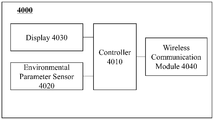
- the environmental parameter sensor 4020 may be configured to collect environmental parameters of a current surrounding of the electronic device 4000, and send the environmental parameters to the controller 4010.
- the environmental parameter sensor 4020 may include a temperature and humidity sensor, an air quality sensor, etc.
- the temperature and humidity sensor may be configured to collect temperature and humidity of the current surrounding of the electronic device 4000
- the air quality sensor may be configured to detect air quality information of the current surrounding of the electronic device 4000.
- the temperature and humidity sensor and the air quality sensor may be integrated inside the electronic device 4000.
- the electronic device 4000 may communicate with a mobile intelligent terminal (e.g., a mobile phone, a tablet computer, etc. ) through a near field wireless communication module such as the Bluetooth module or the ZigBee module.
- a mobile intelligent terminal e.g., a mobile phone, a tablet computer, etc.
- the mobile application terminal may have a corresponding application (APP) , and the application may be bound to an electronic device 4000 that has established communication with application, so that the user may directly obtain the status and the environment parameter of the electronic device 4000 from the server through the application.
- APP application
- the electronic device 120 may determine whether the electronic device is abnormal. If the electronic device is abnormal, the process 4100 may proceed to operation 4120. If the electronic device is not abnormal, the process 4100 may be ended.
- the electronic device 120 may obtain at least one target environmental parameter of a current surrounding of the electronic device.
- the electronic device 120 may further determine whether the target environmental parameter is abnormal. For example, based on whether the environmental parameter value is within an abnormal threshold range. If a value of the target environmental parameter is within an abnormal threshold range, the target environmental parameter may be considered to be abnormal, and the abnormality of the electronic device may be considered to be caused by an abnormality of the target environmental parameter. If the value of the target environmental parameter is not within the abnormal threshold range, the target environmental parameter may be considered to be normal, and the abnormality of the electronic device may not be related to the target environmental parameter.
- the breakdown display of the electronic device is related to the ambient temperature, the user may be reminded that the display does not work properly due to the abnormal ambient temperature.
- the ambient humidity may affect a characteristic of human skin.
- a moistness degree of the human skin may be different, which results in different fingerprint recognition rates.
- the ambient humidity is too low, the skin may be quite dry, which greatly reduces the fingerprint recognition rate.
- the electronic device 120 may obtain the humidity of collected by the temperature and humidity sensor.
- the electronic device 120 may determine whether a difference between the humidity of the current surrounding of the electronic device and the humidity of a surrounding of the electronic device when the fingerprint is entered is greater than a difference threshold. If the difference is greater than the difference threshold, the process 4200 may proceed to operation 4240. If the difference is smaller than or equal to the difference threshold, the process 4200 may be ended.
- the electronic device 120 may determine that the lower fingerprint recognition rate is related to the humidity of the current surrounding of the electronic device. If the difference is less than or equal to the difference threshold, the electronic device 120 may determine that the lower fingerprint recognition rate is not related to the humidity of the current surrounding of the electronic device.
- the user may be reminded that the current surrounding is dry, and the unlocking fingerprint may need to be re-entered.
- the electronic device may include a voice module, which may be configured to broadcast prompt information.
- the voice module may broadcast the prompt information like the weather is dry and the unlocking fingerprint needs to be re-entered.
- the electronic device may include a display (e.g., the display 4030) , and the prompt information may be displayed on the display.
- the display may display the prompt information like the weather is dry and the unlocking fingerprint needs to be re-entered.
- the prompt information may only have a reminding function, if a user wants to re-enter the unlocking fingerprint, the user may need to obtain a permission to enter the fingerprint to ensure the security of the electronic device.
- the humidity of the current surrounding of the electronic device may be used to assist the determination that whether the lower fingerprint recognition rate is caused by a dry weather. If so, the user may be reminded to re-enter the unlocking fingerprint to improve the fingerprint recognition rate of the electronic device, thereby improving the user experience.
- FIG. 43 is a flowchart illustrating an exemplary process for determining an association between the breakdown display of the electronic device and the temperature of the current surrounding according to some embodiments of the present disclosure.
- process 4300 may be executed by the system 100.
- the process 4300 may be implemented as a set of instructions (e.g., an application) stored in a storage device (e.g., the storage device 130) .
- the electronic device 120 may execute the set of instructions and may accordingly be directed to perform the process 4300.
- the electronic device 120 may determine whether the display of the electronic device works normally. If the display of the electronic device works normally, the process 4300 may proceed to operation 4320. If the display of the electronic device does not work normally, the process 4300 may be ended.
- the electronic device 120 may determine whether a communication between the electronic device 120 to the display is normal. If the communication is not normal, the display may be considered not to work normally. If the communication is normal, the display may be considered to work normally.
- the electronic device 120 may obtain the temperature of the current surrounding of the electronic device.
- the display may have an operating temperature range, for example, -10° to 90°. If the temperature of the current surrounding is lower than a minimum value of the operating temperature range, the display may not work normally. Therefore, if the display does not work normally, it may be preferable to check whether a cause for the breakdown display is due to the temperature of the current surrounding being too low.
- the electronic device 120 may obtain the temperature of the current surrounding collected by the temperature and humidity sensor.
- the electronic device 120 may remind the user that the display does not work due to the temperature of the current surrounding of the electronic device.
- the electronic device 120 may also determine whether the display works normally after been determining that the temperature of the current surrounding is abnormal. If the display does not work normally, the electronic device 120 may determine that the display does not work normally due to the abnormal temperature of the current surrounding.
- an appropriate protective measure may be performed.
- a heating module may be mounted on the electronic device to make the display to work normally by heating.
- the temperature of the current surrounding of the electronic device may be obtained from the server through the mobile smart terminal bound to the electronic device. Then, the temperature may be determined whether is abnormal. If the temperature is abnormal, the display may be considered not to work normally due to the abnormal temperature of the current surrounding.
- a sampling frequency, an abnormal temperature threshold range, an abnormal humidity threshold range, or the like may be set for the environmental parameter sensor (e.g., the temperature and humidity sensor) .
- the temperature and humidity sensor may collect the temperature and humidity of the current surrounding according to the set sampling frequency, and transmit the temperature and humidity to the electronic device 120 for further analysis.
- the electronic device 120 may determine whether the environment parameter is abnormal. If the environment parameter is abnormal, the process 4400 may proceed to operation 4440. If the environment parameter is normal, the process 4400 may proceed to operation 4430.
- the electronic device 120 may send the prompt information.
- the electronic device 120 e.g., the controller 4010, the reminding module 4530, the notification module 4640
- the electronic device 120 may send the prompt information.
- the electronic device 120 may display the environmental parameter on a display, and upload the environment parameter to the server.
- the server may send the environment parameter to the mobile intelligent terminal bound with the electronic device for display.
- the obtained temperature and humidity of the current surrounding of the intelligent lock may be displayed directly on the display.
- the user may obtain a real-time temperature and humidity of the current surrounding through the display when the electronic device is being used.
- the electronic device 120 may directly upload the obtained temperature and humidity of the current surrounding to the server through the wireless module.
- the server may send the temperature and humidity to the APP of the mobile intelligent terminal bound to the electronic device for displaying, so that users can obtain the temperature and humidity of the surrounding of the electronic device at any time and any place.
- the environment parameter may be uploaded to the server at the moment that the environment parameter is obtained, or may be uploaded to the server after determining whether the environment parameter is abnormal.
- the environment parameter may be determined whether is normal. If so, the environment parameter may be displayed on a display, so that the user may obtain the environmental parameter of the current environment directly from the display. In addition, the environment parameter may be uploaded to the server, so that the user may obtain the environment parameter directly through a mobile intelligent terminal from the server. In such implementation, the user may obtain the environment parameter of the electronic device at any time and any place.
- FIG. 45 is a block diagram illustrating an exemplary electronic device for determining an association between the electronic device with an environmental parameter according to some embodiments of the present disclosure.
- the electronic device 4500 may be implemented on the electronic device 120 in FIG. 1.
- the electronic device 4500 may include an abnormality detection module 4510, an abnormality determination module 4520, and a reminding module 4530.
- the abnormality detection module 4510 may be configured to determine whether the electronic device is abnormal.
- the abnormality of the electronic device may include a hardware exception of the electronic device, for example, a display (e.g., the display 4003) may not work properly.
- the abnormality of the electronic device may also include an abnormality in a detection process. For example, for an electronic device having a fingerprint recognition function, a fingerprint recognition rate is lower than a certain threshold.
- the electronic device may include a fingerprint recognition component.
- the abnormality of the electronic device may include a low fingerprint recognition rate.
- the abnormality detection module 4510 may be configured to determine whether the fingerprint recognition rate is lower than a fingerprint recognition rate. If the fingerprint recognition rate is lower than the recognition rate threshold, the electronic device may be abnormal. If the fingerprint recognition rate is greater than or equal to the recognition rate threshold, the electronic device may be normal.
- the electronic device may include a display.
- the abnormality of the electronic device may include a breakdown display.
- the abnormality detection module 4510 may be configured to determine whether the display works properly. If the display does not work properly, the electronic device may be abnormal. If the display works properly, the electronic device may be normal.
- the abnormality determining module 4520 may be configured to obtain the target environmental parameter of the surrounding of the electronic device that is abnormal, and determine whether the abnormality of the electronic device is caused by the target environmental parameter.
- the at least one target environmental parameter may refer to an environmental parameter related to the abnormality of the electronic device. After obtaining the at least one target environmental parameter, the target environmental parameter may be determined whether is abnormal. If the target environmental parameter is abnormal, the abnormal of the electronic device may be determined as caused by the target environmental parameter. If the target environmental parameter is normal, the abnormality of the electronic device may be considered to be irrelevant to the target environmental parameter.
- the electronic device may have a lower fingerprint recognition rate, and the corresponding target environmental parameter may be the humidity.
- the abnormality determination module 4520 may be configured to, if the fingerprint recognition rate of the electronic device is lower than a recognition rate threshold, obtain the humidity of the current surrounding of the electronic device.
- the abnormality determination module 4520 may further be configured to determine whether a difference between the humidity of the current surrounding of the electronic device and the humidity of a surrounding of the electronic device when the fingerprint is entered is greater than a difference threshold. if the difference is greater than the difference threshold, the abnormality determination module 4520 may determine that the lower fingerprint recognition rate is related to the humidity of the current surrounding of the electronic device. If the difference is less than or equal to the difference threshold, the abnormality determination module 4520 may determine that the lower fingerprint recognition rate is not related to the humidity of the current surrounding of the electronic device.
- the electronic device may have a breakdown display, and the corresponding target environmental parameter may be the temperature of the current surrounding.
- the abnormality determination module 4520 may be configured to, if the display of the electronic device does not work normally, obtain the temperature of the current surrounding of the electronic device.
- the abnormality determination module 4520 may further be configured to determine whether the temperature of the current surrounding of the electronic device falls outside the operating temperature range of the display. If the temperature of the current surrounding of the electronic device falls outside the operating temperature range of the display, the temperature of the current surrounding may be determined as the cause for the abnormality of the display. Otherwise, the temperature of the current surrounding may not be determined as the cause for the abnormality of the display.
- an electronic device for determining an association between an abnormality of the electronic device and a target environmental parameter may perform a method.
- the electronic device may obtain the target environment parameter of the current surrounding, and determine the abnormality of the electronic device related to the target environmental parameter.
- a function of the electronic device using the environment parameter may be extended and the user experience may be improved.
- FIG. 46 is a block diagram illustrating an exemplary electronic device for determining an association between an intelligent lock with an environmental parameter according to some embodiments of the present disclosure.
- the electronic device 4500 may be implemented on the electronic device 120 in FIG. 1.
- the device 4600 may include an obtaining module 4610, an uploading module 4620, a parameter determination module 4630, and a notification module 4640.
- the obtaining module 4610 may be configured to obtain an environment parameter of the current surrounding of the electronic device.
- a sampling frequency, an abnormal temperature threshold range, an abnormal humidity threshold range, or the like may be set for the environmental parameter sensor (e.g., the temperature and humidity sensor) .
- the temperature and humidity sensor may collect the temperature and humidity of the current surrounding according to the set sampling frequency, and transmit the temperature and humidity to the electronic device 120 for further analysis.
- the uploading module 4620 may be configured to upload the environment parameter to the server.
- the server may send the environment parameter to the mobile intelligent terminal bound with the electronic device for display.
- the environment parameter may be uploaded to the server the at the moment that the environment parameter is obtained, or may be uploaded to the server after determining whether the environment parameter is abnormal.
- the parameter determination module 4630 may be configured to determine whether the environmental parameter is abnormal.
- the parameter determination module 4630 may determine whether the temperature and/or the humidity of the current surrounding is within the abnormal temperature and/or humidity threshold, respectively. If so, the temperature and/or humidity of the current surrounding may be abnormal. If not, the temperature and humidity of the current surrounding may be normal.
- the user may be reminded to take appropriate measures. For example, a message may be sent to, or a call may be made to the mobile smart terminal that is bound to the electronic device.
- the environment parameter e.g., the temperature and/or humidity of the current surrounding
- the electronic device and/or the processing device described in the present disclosure may include a processor and a memory.
- the modules and/or units mentioned in the above embodiments may be stored in the memory as programs.
- the programs stored in the memory may be executed by the processor to implement the corresponding functions described in the present disclosure.
- the processor may contain one or more kernels.
- the kernels may invoke the corresponding program unit (s) stored in the memory.
- the second electronic device may be controlled by adjusting parameters of the kernels.
- the memory may include a non-persistent memory, a random access memory (RAM) , and/or a non-volatile memory in a computer readable medium.
- RAM random access memory
- ROM read only memory
- flash memory a non-volatile memory in a computer readable medium.
- the memory may include at least one memory chip.
- the embodiments of the present disclosure provide an anti-pry switch.
- the anti-pry switch may be a part of the electronic device 120 in FIG. 1, for example, an intelligent lock.
- FIG. 47 illustrates an exploded view of an anti-pry switch according to some embodiments of the present disclosure
- FIG. 48 a section view of an anti-pry switch according to some embodiments of the present disclosure.
- the anti-pry switch may include an annular capacitor, a core rod, a hold-down assembly (not shown) , and a spring assembly.
- the middle of the annular capacitor may be provided with a through-hole 4712.
- the first segment of the core rod is inserted through the through-hole (4712) , and after the hold-down assembly is away from the first end of the core rod, the second segment of the core rod is inserted through the through-hole (4712) .
- the anti-pry switch may be connected to an alarm system, and the alarm system may raise an alarm according to the change of the capacitance value of the anonymous capacitor.
- the core rod may be changed from the first capacitance value to the second capacitance value after a large movement. Specifically, if the first end of the core rod changes from a compressed state to a relaxed state, when the second segment of the core rod inserts into the through-hole 4712, the core rod should have moved at least 6 mm. That is to say, the core rod has moved at least 6 mm after the state of the alarm system changes from normal to alarm. It may effectively prevent the alarm system from generating false alarms due to installation errors or unevenness of the door panel.
- the hold-down assembly may usually be the front assembly of an intelligent lock (such as an intelligent door lock) .
- an intelligent lock such as an intelligent door lock
- the hold-down assembly may be removed first. Once a pressing force provided by the hold-down assembly is lost, the core rod will move under a pushing force provided by the spring assembly. Finally, the second segment of the core rod will be inserted into the through-hole 4712 of the anonymous capacitor. The capacitance value of the annular capacitor will change, and the alarm system alarm will be triggered.
- the anti-pry switch disclosed in the above embodiments may not only effectively prevent the false alarm of the alarm system, but also achieve the effect of timely warning when the intelligent lock is being violently damaged.
- the spring assembly may include a spring tube 4711, a spring 4704, and a spring limiting lid 4705.
- the spring tube 4711 has a cylindrical shape with an open top.
- the spring 4704 is embedded in the inner cavity of the spring tube 4711.
- the spring limiting lid 4705 is provided with a hole for the core rod to pass through.
- the spring limiting lid 4705 is fixedly disposed at the top end of the spring tube 4711 to prevent the spring 4704 from coming out of the spring tube 4711.
- the post is provided one-to-one with the bayonet, and the number and the shape of the post are not limited.
- the spring tube 4711 has two bayonets.
- the two bayonets are symmetrically set.
- the outer wall of the spring limiting lid 4705 is radially provided with two posts corresponding to the bayonet. It should be noted that the number of the posts and the bayonets may be designed to be three, four, or more according to actual needs.
- the core rod may include a rod body made with a metal material (such as copper, steel or iron) and a plastic rod sleeve.
- the plastic rod sleeve may include a sleeve portion 4706 and an end portion 4710.
- the sleeve portion 4706 may have an open end at one end and a closed end at the other end.
- the end portion 4710 may be coupled to the closed end, and the core rod body 4707 may be inserted into the sleeve portion 4706 from the open end.
- the sleeve portion 4706 and the core rod body 4707 which are integrally formed constitute the first segment, and the end portion 4710 may constitute the second segment.
- the end portion 4710 and the core rod body 4707 portions may be radially coincident with each other or may be mutually offset in the radial direction. If the end portion 4710 and the core rod body 4707 are radially offset from each other, the end portion 4710 may only include plastic materials.
- the second segment of the core rod may be inserted into the through-hole 4712 of the annular capacitor.
- the hold-down assembly usually the front assembly of the intelligent lock
- the core rod may move toward the spring assembly.
- the first segment formed by the sleeve portion 4706 and the core rod body 4707 may be inserted into the through-hole 4712 of the annular capacitor.
- the diameter of the sleeve portion 4706 may not be greater than the diameter of through-hole 4712 of the annular capacitor.
- the diameter of the end portion 4710 may be greater than the diameter of the through-hole 4712 of the anonymous capacitor.
- the annular capacitor may be integrated on the PCB board 4702.
- the PCB board 4702 may be mounted in the bottom case 4701, and may be fixed by means of a snap-fit or screw connection.
- the anti-pry switch may be assembled as follows:
- the intelligent lock provided with the above-mentioned anti-pry switch may have the corresponding technical advantages of the anti-pry switch, and those skilled in the art may refer to each other, and no further description is provided herein.
- the embodiments of the present disclosure provide a method for controlling an electronic device.
- the method may be implemented on a first electronic device which is connected to a second electronic device.
- the method may include one or more of the following opertaions.
- the first electronic device may display a control page of the second electronic device, page data of the control page may be transmitted by a web server to the first electronic device.
- the first electronic device may perform a preset instruction corresponding to an operation object to control the second electronic device based on an operation generated by a user on the operation object of the control page.
- the first electronic device performs a preset instruction corresponding to an operation object to control the second electronic device based on an operation generated by a user on the operation object of the control page may include one or more of the following operations.
- the first electronic device may execute a preset call instruction corresponding to the operation object based on the operation generated by the user on the operation object of the control page to invoke at least one control program in a preset controlling program library to control the second electronic device.
- the preset controlling program library may be stored in the first electronic device.
- the method may further include one or more of the following operations.
- the first electronic device may send an access request to the web server to access the control page of the second electronic device.
- the first electronic device may obtain the page data of the control page transmitted by the web server.
- the first electronic device displays the control page of the second electronic device may include one or more of the following operations.
- the first electronic device may display the control page of the second electronic device based on the obtained page data.
- the first electronic device may encrypt at least one type of data transmitted during the controlling process of the second electronic device using the preset controlling program library.
- the the first electronic device executes a preset call instruction corresponding to the operation object based on the operation generated by the user on the operation object of the control page to invoke at least one control program in a preset controlling program library to control the second electronic device may include one or more of the following operations.
- the first electronic device may execute the preset call instruction corresponding to the operation object based on the operation generated by the user on the operation object of the control page to invoke at least one interface of the preset controlling program library to invoke the control program corresponding to the at least one interface to generate a control message.
- the first electronic device may encrypt the control message using the preset controlling program library, and send the encrypted control message to the second electronic device to control the second electronic device.
- the preset instruction corresponding to the operation object may be an electronic device control flow instruction corresponding to the operation object.
- the embodiments of the present disclosure provide an electronic device.
- the electronic device may be designated as the first electronic device.
- the first electronic device may be in communication with a second electronic device.
- the first electronic device may include a page displaying unit, and a controlling unit.
- the displaying unit may be configured to display a control page of a second electronic device, page data of the control page may be transmitted by a web server to the first electronic device.
- the controlling unit may be configured to perform the preset instruction corresponding to the operation object to control the second electronic device based on an operation generated by a user on the operation object of the control page.
- the electronic device may further include a request transmitting unit and a data obtaining unit.
- the request transmitting unit may be configured to send an access request to the web server to access the control page of the second electronic device before the page displaying unit displays the control page of the second electronic device.
- the data obtaining unit may be configured to obtain the page data of the control page transmitted by the web server.
- the embodiments of the present disclosure provide a web server.
- the electronic device may be designated as the first electronic device.
- the web server may be connected with a first electronic device, the first electronic device may be further connected with a second electronic device.
- the web server may include a request obtaining unit, and a data transmitting unit. The may be configured to obtain an access request of a control page of the second electronic device sent by the first electronic device.
- the data transmitting unit may be configured to transmit page data of the control page to the first electronic device to cause the first electronic device to display the control page of the second electronic device, and further cause the first electronic device to execute a control flow instruction corresponding to at least one operation object to control the second electronic device.
- the first electronic device may execute the control flow instruction based on an operation generated by a user on the operation object of the control page.
- the page data may include at least one operation object and at least one electronic device control flow instruction corresponding to the at least one operation object.
- the embodiments of the present disclosure provide a method for configuring an electronic device.
- the method may include one or more of the following operations: transmitting device information of a gateway to a server; obtaining configuration information sent by the server, the configuration information may include information of a first communication protocol to be configured by the gateway and information of a first cloud platform to be configured by the gateway; determining a first communication protocol component corresponding to the first communication protocol information; connecting to the first cloud platform by using the first communication protocol component.
- the embodiments of the present disclosure provide a method for configuring an electronic device.
- the method may include one or more of the following operations: obtaining device information transmitted by the gateway; determining configuration information corresponding to the gateway, the configuration information may include information of a communication protocol to be configured by the gateway and information of a cloud platform to be configured by the gateway; transmitting the configuration information to the gateway to cause the gateway to determine a first communication protocol component corresponding to the information of the first communication protocol, and further connect the first cloud platform using the first communication protocol component.
- the method may further include one or more of the following operations: monitoring the number of disconnections between the first communication protocol component and the first cloud platform in a preset time period; If the number of disconnections exceeds a preset threshold, transmitting the configuration update information to the gateway to cause the gateway to determine the second communication protocol component corresponding to the information of the second communication protocol, and further connect the second cloud platform using the second communication protocol component.
- the configuration update information may include the information of the second communication protocol to be updated by the gateway and the information of the second cloud platform to be updated by the gateway.
- the obtaining device information transmitted by the gateway may include one or more of the following operations: obtaining at least one of information related to a product serial number, information related to a version number, or information related to a model transmitted by the gateway.
- the determining configuration information corresponding to the gateway may include one or more of the following operations: determining the configuration information corresponding to the device information of the gateway based on the information related to the product serial number.
- the embodiments of the present disclosure provide an apparatus for configuring an electronic device.
- the apparatus may include a transmitting unit, an obtaining unit, a component determination unit, and a communication unit.
- the transmitting unit may be configured to transmit device information of a gateway to a server.
- the obtaining unit may be configured to obtain the configuration information transmitted by the server.
- the configuration information may include information of a first communication protocol to be configured by the gateway, and information of a first cloud platform to be configured by the gateway.
- the component determination unit may be configured to determine the first communication protocol component corresponding to the information of the first communication protocol.
- the communication unit may be configured to connect to the first cloud platform using the first communication protocol component.
- the embodiments of the present disclosure provide an apparatus for configuring an electronic device.
- the apparatus may include an obtaining unit, a configuration information determination unit, and a transmitting unit.
- the obtaining unit may be configured to obtain the device information transmitted by the gateway.
- the configuration information determination unit may be configured to determine the configuration information corresponding to the device information of the gateway.
- the configuration information may include information of a communication protocol to be configured by the gateway and information of a cloud platform to be configured by the gateway.
- the transmitting unit may be configured to transmit the configuration information to the gateway to cause the gateway determines a first communication protocol component corresponding to the information of the first communication protocol, and further connect the first cloud platform using the first communication protocol component.
- the embodiments of the present disclosure provide a storage medium which stores one or more programs.
- a method described above for configuring an electronic device may be implemented when the programs are executed by a processor.
- the embodiments of the present disclosure provide an electronic device including a storage for storing program (s) and a processor for executing the program (s) .
- a method described above for configuring an electronic device may be implemented when the programs are executed by a processor.
- the embodiments of the present disclosure provide a method for verifying a firmware version.
- the method may be implemented on a server.
- the method may include one or more of the following operations: determining a firmware to be upgraded and generating at least one public-private key pair, the public-private key pair may include a public key stored in the firmware to be upgraded and a private key stored in the server, private keys belong two or more different public-private key pairs may be stored in the server, respectively; obtaining a digest of an upgrade version of the firmware to be upgraded; labeling the digest successively based on the private key (s) of at least one public-private key pair; transmitting information of a firmware upgrade package to an electronic device to cause the electronic device to verify the upgrade version of the firmware to be upgraded based on the information of the firmware upgrade package and the public key of the at least one public-private key pair, the information of the firmware upgrade package information may include data of the upgrade version of the firmware to be upgraded, the digest, and the label of the digest.
- the method may further include one or more of the following operations: generating at least one new public-private key pair corresponding to the at least one private key being abnormal, the number of the new generated public-private key pairs may be the same as the number of private keys being abnormal; replacing the at least one private key being abnormal stored in the server with a private key included in the generated at least one new public-private key pair, and replacing the at least one public key corresponding to the at least one private key being abnormal with he public key in the new generated at least one new public-private key pair through a firmware upgrade.
- the verifying the upgrade version of the firmware to be upgraded based public key of the at least one public-private key pair and the label may include one or more of the following operations: verifying the upgrade version of the firmware to be upgraded using the public key and the label when there is one public-private key pair; verifying the validity of the digest using the public keys in the public-private key pairs and label when there are two or more public-private key pairs, and verifying the validity of the upgrade version of firmware to be upgraded in response to a determination that the digest is valid.
- the verifying the validity of the digest using the public keys in the public-private key pairs and label when there are two or more public-private key pairs may include one or more of the following operations: verifying two or more public keys in the two or more public-private key pairs, the digest, and two or more labels using an algorithm; determining the digest as validity in response to a determination that the verification is passed.
- the labelling the digest when there are two or more public-private key pairs may include one or more of the following operations: verifying the upgrade version of firmware using all normal private keys and of a predetermined number abnormal private keys when a first ratio of the number of the normal private keys in the two or more public-private key pairs to the total number of the private keys in the two or more public-private key pairs is not less than a second threshold, the second threshold may be less than the first threshold, a ratio of the sum of the predetermined number and the number of normal private keys to the total number of private keys may be the same as the first threshold.
- the embodiments of the present disclosure provide a server.
- the server may include a determining unit, an obtaining unit, a labeling unit, and a transmitting unit.
- the determination unit may be configured to determine a firmware to be upgraded, and generate at least one public-private key pair, the public-private key pair may include a public key stored in the firmware to be upgraded and a private key stored in a server, private keys belong two or more different public-private key pairs may be stored in the server, respectively.
- the obtaining unit may be configured to obtain a digest of an upgrade version of the firmware to be upgraded.
- the labeling unit may be configured to label the digest based on the private key (s) of the at least one public-private key pair.
- the transmitting unit may be configured to transmit information of a firmware upgrade package to an electronic device to cause the electronic device to verify the upgrade version of the firmware to be upgraded based on the information of the firmware upgrade package and the public key of the at least one public-private key pair.
- the server may further include a key updating unit.
- the key updating unit may be configured to generate at least one new public-private key pair corresponding to the at least one private key being abnormal, the number of the new generated public-private key pairs may be the same as the number of private keys being abnormal.
- the key updating unit may further be configured to replace the at least one private key being abnormal stored in the server with a private key included in the generated at least one new public-private key pair, and replace the at least one public key corresponding to the at least one private key being abnormal with he public key in the new generated at least one new public-private key pair through a firmware upgrade.
- the embodiments of the present disclosure provide an electronic device.
- the electronic device may include an obtaining unit, and a verification unit.
- the obtaining unit may be configured to obtain information of a firmware upgrade package from a server, the information of the firmware upgrade package may include data of an upgrade version of a firmware to be upgraded, a digest of the upgrade version of the firmware to be upgraded, the digest being labeled by a private key of at least one public-private key pair, and a label of the digest.
- the public-private key pair may include a public key stored in the firmware to be upgraded and a private key stored in a server, private keys belong two or more different public-private key pairs may be stored in the server, respectively.
- the verification unit may be configured to obtain the data of the upgrade version of the firmware to be upgraded, the digest, and the label of the digest, and verify the upgrade version of the firmware to be upgraded based on the public key of the at least one public-private key pair and the label.
- the verification unit may further be configured to verify the upgrade version of the firmware to be upgraded using the public key and the label when there is one public-private key pair.
- the verification unit may further be configured to verify the validity of the digest using the public keys in the public-private key pairs and label when there are two or more public-private key pairs, and verify the validity of the upgrade version of firmware to be upgraded in response to a determination that the digest is valid.
- the embodiments of the present disclosure provide a system for verifying a firmware version.
- the system may include a server and an electronic device.
- the server may include a determining unit, an obtaining unit, a labeling unit, and a transmitting unit.
- the determination unit may be configured to determine a firmware to be upgraded, and generate at least one public-private key pair, the public-private key pair may include a public key stored in the firmware to be upgraded and a private key stored in a server, private keys belong two or more different public-private key pairs may be stored in the server, respectively.
- the obtaining unit may be configured to obtain a digest of an upgrade version of the firmware to be upgraded.
- the labeling unit may be configured to label the digest based on the private key (s) of the at least one public-private key pair.
- the transmitting unit may be configured to transmit information of a firmware upgrade package to an electronic device to cause the electronic device to verify the upgrade version of the firmware to be upgraded based on the information of the firmware upgrade package and the public key of the at least one public-private key pair.
- the electronic device may include an obtaining unit, and a verification unit.
- the obtaining unit may be configured to obtain information of a firmware upgrade package from a server, the information of the firmware upgrade package may include data of an upgrade version of a firmware to be upgraded, a digest of the upgrade version of the firmware to be upgraded, the digest being labeled by a private key of at least one public-private key pair, and a label of the digest.
- the public-private key pair may include a public key stored in the firmware to be upgraded and a private key stored in a server, private keys belong two or more different public-private key pairs may be stored in the server, respectively.
- the verification unit may be configured to obtain the data of the upgrade version of the firmware to be upgraded, the digest, and the label of the digest, and verify the upgrade version of the firmware to be upgraded based on the public key of the at least one public-private key pair and the label.
- the embodiments of the present disclosure provide an anti-pry device of intelligent lock.
- the anti-pry device may include a front assembly installed on the outside of a door and a rear assembly installed on the inside of the door.
- the front assembly may include an acceleration sensor configured to collect an acceleration of the front assembly after a first preset time since the door is closed.
- the rear assembly may include a processor and an alertor.
- the processor may be connected to the acceleration and the alertor.
- the processor may be configured to determine whether the intelligent lock is being pried according to the acceleration of the front assembly, and trigger the alertor to raise an alarm in response to a determination that the intelligent lock is being pried.
- the anti-pry device may further include a connection line set between the processor and the front assembly.
- the processor may be further configured to detect whether the connecting line is disconnected, and trigger the alertor to raise an alarm in response to the determination that the connection line is disconnected.
- the anti-pry device may further include a damping apparatus mounted between the door and the front assembly.
- the anti-pry device may further include a power supply mounted in the rear assembly.
- the power supply may be connected to the acceleration sensor, the processor, and the alertor.
- the activating an acceleration sensor after detecting that the door is closed may include one or more of the following operations: activating the acceleration sensor after a first preset time after detecting the door is closed.
- the processor may further include a detection unit.
- the detection unit may be configured to detect whether the connection line arranged between the front assembly and the rear assembly is disconnected, and transmit an alarm signal to an alertor to trigger the alertor to raise an alarm in response to a determination that the connection line arranged between the front assembly and the rear assembly is disconnected.
- the determination unit may further be configured to determine whether the real-time acceleration of the front assembly is continuously greater than a preset value in a second preset time, and determine that the intelligent lock is being pried in response to a determination that the real-time acceleration of the front assembly is continuously greater than a preset value in the second preset time.
- the embodiments of the present disclosure provide a method of unlocking an intelligent lock.
- the method may include one or more of the following operations: obtaining an indoor temperature from a temperature sensor, the temperature sensor may be mounted inner side the intelligent lock; determining whether the indoor temperature is greater than or equal to a temperature threshold; in response to a determination that the indoor temperature is greater than or equal to the temperature threshold, automatically unlocking the intelligent lock.
- the determining whether the indoor temperature is greater than or equal to a temperature threshold may include one or more of the following operations: determining whether the indoor temperature obtained from the temperature sensor within a preset time period is wrong; in response to a determination that the indoor temperature obtained by the temperature sensor within a preset time period is correct, determining whether an average value of the indoor temperature obtained by the temperature sensor in the preset time period is greater than or equal to the temperature threshold.
- the method may further include: establishing a communication with a user terminal in advance; and transmitting a first notification that the intelligent lock has sent out fire alarm information to the user terminal.
- the embodiments of the present disclosure provide a door.
- the door may include an intelligent lock described above.
- the embodiments of the present disclosure provide a method of adjusting a volume.
- the method may include one or more of the following operations: obtaining a current time; determining a preset volume control rule matched with the current time; determining whether the output volume corresponding to the current time is the fixed preset volume; in response to a determination that the output volume corresponding to the current time is the fixed preset volume, outputting a volume based on the fixed preset volume; in response to a determination that the output volume corresponding to the current time is not the fixed preset volume, outputting a volume based on the noise data of the current surrounding.
- the determining a value of the noise data if a preset data collection condition is satisfied may include one or more of the following operations: obtaining a plurality of initial noise values in a manner of data acquisition at a fixed interval, or after receiving a preset wake-up command; determining a maximum value, a minimum value, and an average value among the initial noise values; and determining a greater value of a difference between the maximum value and the minimum value and the average value as the value of the noise data.
- the outputting a volume based on the fixed preset volume may include one or more of the following operations: determining a second effective time corresponding to the fixed preset volume based on the preset volume control rule; and outputting the fixed preset volume within the second effective time.
- the embodiments of the present disclosure provide a storage medium which stores one or more programs.
- a method described above for adjusting a volume may be implemented when the programs are executed.
- the embodiments of the present disclosure provide a method of determining an association between an abnormality of the intelligent lock and a target environmental parameter.
- the method may include one or more of the following operations: determining whether the intelligent lock is abnormal; in response to a determination that the intelligent lock is abnormal, obtaining at least one target environmental parameter of a current surrounding of the intelligent lock, and determining whether the abnormality of the intelligent lock is caused by the at least one target environmental parameter; in response to a determination that the abnormality of the intelligent lock is caused by the at least one target environmental parameter, reminding a user that the abnormality of the intelligent lock is caused by the at least one target environmental parameter.
- the intelligent lock may include a fingerprint recognition component.
- the determining whether the intelligent lock is abnormal may include one or more of the following operations: determining whether a fingerprint recognition rate of the intelligent lock is lower than a fingerprint recognition rate; in response to a determination that the fingerprint recognition rate is lower than the recognition rate threshold, determining that the intelligent lock is abnormal; in response to a determination that the fingerprint recognition rate is greater than or equal to the recognition rate threshold, determining that the intelligent lock is normal.
- the obtaining at least one target environmental parameter of a current surrounding of the intelligent lock, and determining whether the abnormality of the intelligent lock is caused by the at least one target environmental parameter may include one or more of the following operations: in response to a determination that the fingerprint recognition rate is lower than the recognition rate threshold, obtaining humidity of the current surrounding of the intelligent lock; determining whether a difference between the humidity of the current surrounding of the intelligent lock and the humidity of a surrounding of the intelligent lock when the fingerprint is entered is greater than a difference threshold; in response to a determination that the difference is greater than the difference threshold, determining that the humidity of the current surrounding of the intelligent lock casues the abnormality that the fingerprint recognition rate is lower than the recognition rate threshold; in response to a determination that the difference is not greater than the difference threshold, determining that the abnormality that the fingerprint recognition rate is lower than the recognition rate threshold is not caused by the humidity of the current surrounding of the intelligent lock.
- the intelligent lock may include a display.
- the determining whether the intelligent lock is abnormal may include one or more of the following operations: determining whether the display works properly; in response to a determination that the display works properly, determining that the intelligent lock is normal; in response to a determination that the display does not work properly, determining that the intelligent lock is abnormal.
- the obtaining at least one target environmental parameter of a current surrounding of the intelligent lock, and determining whether the abnormality of the intelligent lock is caused by the at least one target environmental parameter may include one or more of the following operations: in response to a determination that the display does not work properly, obtaining a temperature of the current surrounding of the intelligent lock; determining whether the temperature of the current surrounding of the intelligent lock falls outside the operating temperature range of the display; in response to a determination that the temperature of the current surrounding of the intelligent lock falls outside the operating temperature range of the display, determining that the temperature of the current surrounding of the intelligent lock casues the abnormality that the display do not work properly; recognition rate is lower than the recognition rate threshold; in response to a determination that the temperature of the current surrounding of the intelligent lock falls into the operating temperature range of the display, determining that the abnormality that the display do not work properly is not caused by the temperature of the current surrounding of the intelligent lock.
- the method may further include one or more of the following operations: obtaining at least one environmental parameter of a current surrounding of the intelligent lock, and uploading the at least one environmental parameter to a server to cause a mobile intelligent terminal bound to the intelligent lock to obtain and display the at least one environmental parameter; determining whether the environment parameter is abnormal; in response to a determination that the environment parameter is abnormal, reminding the user that the environment parameter is abnormal.
- the embodiments of the present disclosure provide an apparatus for determining an association between an abnormality of the intelligent lock and a target environmental parameter.
- the apparatus may include an abnormality detection module, an abnormality determination module, and a reminding module.
- the abnormality detection module may be configured to determine whether the intelligent lock is abnormal.
- the abnormality determining module may be configured to obtain the target environmental parameter of the surrounding of the intelligent lock that is abnormal, and determine whether the abnormality of the intelligent lock is caused by the target environmental parameter.
- the reminding module may be configured to remind the user that the abnormality of the intelligent lock is related to the target environmental parameter after determining the abnormality of the intelligent lock is caused by the target environmental parameter.
- the apparatus may further include an obtaining module, an uploading module, a parameter determination module, and a notification module.
- the obtaining module may be configured to obtain an environment parameter of the current surrounding of the intelligent lock.
- the uploading module may be configured to upload the environment parameter to the server to cause a mobile intelligent terminal bound to the intelligent lock to obtain and display the at least one environmental parameter.
- the parameter determination module may be configured to determine whether the environmental parameter is abnormal.
- the notification module may be configured to remind the user that the environment parameter of the current surrounding of the intelligent lock is abnormal.
- the embodiments of the present disclosure provide an anti-pry switch.
- the anti-switch may include one or more of the following components: an annular capacitor with a through-hole in the middle; a core rod inserted into the through hole, being divided into a first segment and a second segment having unequal dielectric constants along an axial direction thereof, a capacitance value of the annular capacitor is a first capacitance value after the first segment being inserted into the through-hole, and the capacitance value of the annular capacitor is a second capacitance value after the second segment being inserted into the through-hole, the first capacitance value differs from the second capacitance value; a hold-down assembly, for contacting a first end of the core rod; and a spring assembly, for contacting a second end of the core rod, after the first end of the core rod is squeezed with the hold-down assembly, the first segment of the core rod is inserted through the through-hole, and after the hold-down assembly is away from the first end of the core rod, the
- the spring assembly may include a spring tube, a spring, and a spring limiting lid.
- the spring tube has a cylindrical shape with an open top.
- the spring is embedded in the inner cavity of the spring tube.
- the spring limiting lid is provided with a hole for the core rod to pass through.
- the spring limiting lid is fixedly disposed at the top end of the spring tube to prevent the spring from coming out of the spring tube.
- the top end of the side wall of the spring tube has a flared portion.
- the top end of the side wall of the spring tube is provided with a bayonet.
- the spring limiting lid is provided with a post corresponding to the bayonet, and the spring limiting lid is embedded in the flared portion and is connected to the bayonet by the post.
- the spring tube has two bayonets.
- the two bayonets are symmetrically set.
- the outer wall of the spring limiting lid is radially provided with two posts corresponding to the bayonet.
- the core rod may include a rod body made with a metal material and a plastic rod sleeve.
- the plastic rod sleeve may include a sleeve portion and an end portion.
- the sleeve portion may have an open end at one end and a closed end at the other end.
- the end portion may be coupled to the closed end, and the core rod body may be inserted into the sleeve portion 4706 from the open end.
- the sleeve portion and the core rod body which are integrally formed constitute the first segment, and the end portion may constitute the second segment.
- the diameter of the sleeve portion may not be greater than the diameter of through-hole of the annular capacitor.
- the diameter of the end portion may be greater than the diameter of the through-hole of the anonymous capacitor.
- the end portion may constitute the second end of the core rod.
- the anti-pry switch may include a bottom case and a top cover.
- the bottom end of the spring tube may be fixedly disposed in the bottom case.
- the top cover may be fixedly disposed at the top end of the bottom case.
- the top cover may be provided with a hole. The first end of the core rod may traverse the top cover through the hole.
- the annular capacitor may be an annular capacitor integrated on the PCB board.
- the core rod may have moved at least 6 mm.
- the embodiments of the present disclosure provide an intelligent lock.
- the intelligent lock may include an anti-prying switch described above.
- aspects of the present disclosure may be illustrated and described herein in any of a number of patentable classes or context including any new and useful process, machine, manufacture, or composition of matter, or any new and useful improvement thereof. Accordingly, aspects of the present disclosure may be implemented entirely hardware, entirely software (including firmware, resident software, micro-code, etc. ) or combining software and hardware implementation that may all generally be referred to herein as a “unit, ” “module, ” or “system. ” Furthermore, aspects of the present disclosure may take the form of a computer program product embodied in one or more computer readable media having computer readable program code embodied thereon.
- a computer readable signal medium may include a propagated data signal with computer readable program code embodied therein, for example, in baseband or as part of a carrier wave. Such a propagated signal may take any of a variety of forms, including electro-magnetic, optical, or the like, or any suitable combination thereof.
- a computer readable signal medium may be any computer readable medium that may be not a computer readable storage medium and that may communicate, propagate, or transport a program for use by or in connection with an instruction execution system, apparatus, or device.
- Program code embodied on a computer readable signal medium may be transmitted using any appropriate medium, including wireless, wireline, optical fiber cable, RF, or the like, or any suitable combination of the foregoing.
- the remote computer may be connected to the user’s computer through any type of network, including a local part network (LAN) or a wide part network (WAN) , or the connection may be made to an external computer (for example, through the Internet using an Internet Service Provider) or in a cloud computing environment or offered as a service such as a Software as a Service (SaaS) .
- LAN local part network
- WAN wide part network
- SaaS Software as a Service
- the numbers expressing quantities or properties used to describe and claim certain embodiments of the application are to be understood as being modified in some instances by the term “about, ” “approximate, ” or “substantially. ”
- “about, ” “approximate, ” or “substantially” may indicate ⁇ 20%variation of the value it describes, unless otherwise stated.
- the numerical parameters set forth in the written description and attached claims are approximations that may vary depending upon the desired properties sought to be obtained by a particular embodiment.
- the numerical parameters should be construed in light of the number of reported significant digits and by applying ordinary rounding techniques. Notwithstanding that the numerical ranges and parameters setting forth the broad scope of some embodiments of the application are approximations, the numerical values set forth in the specific examples are reported as precisely as practicable.
Landscapes
- Engineering & Computer Science (AREA)
- Computer Networks & Wireless Communication (AREA)
- Signal Processing (AREA)
- Computer Security & Cryptography (AREA)
- Computing Systems (AREA)
- General Health & Medical Sciences (AREA)
- Health & Medical Sciences (AREA)
- General Physics & Mathematics (AREA)
- Physics & Mathematics (AREA)
- Medical Informatics (AREA)
- Toxicology (AREA)
- Environmental & Geological Engineering (AREA)
- Computer Hardware Design (AREA)
- General Engineering & Computer Science (AREA)
- Stored Programmes (AREA)
- Telephone Function (AREA)
Abstract
L'invention concerne un procédé et un système de commande d'un dispositif électronique. Le procédé peut comprendre une ou plusieurs des opérations suivantes. Au moins une demande relative à un dispositif électronique peut être transmise. La ou les demandes comprennent une demande de commande, une demande de détermination de protocole de communication, ou une demande de mise à niveau de micrologiciel. Des données de commande générées sur la base de la ou des demandes peuvent être obtenues. Le dispositif électronique peut être commandé sur la base des données de commande.
Priority Applications (1)
| Application Number | Priority Date | Filing Date | Title |
|---|---|---|---|
| US17/141,189 US11743336B2 (en) | 2018-07-04 | 2021-01-04 | Method and system for operating an electronic device |
Applications Claiming Priority (16)
| Application Number | Priority Date | Filing Date | Title |
|---|---|---|---|
| CN201810723796.1 | 2018-07-04 | ||
| CN201810723796.1A CN110685501B (zh) | 2018-07-04 | 2018-07-04 | 一种智能门锁防撬报警装置、方法及处理器 |
| CN201810876628.6A CN108833191B (zh) | 2018-08-03 | 2018-08-03 | 网关设备配置方法及装置 |
| CN201810876628.6 | 2018-08-03 | ||
| CN201811452255.6 | 2018-11-30 | ||
| CN201811452255.6A CN111262890A (zh) | 2018-11-30 | 2018-11-30 | 电子设备控制方法、电子设备及网页服务器 |
| CN201811534620.8A CN111324328B (zh) | 2018-12-14 | 2018-12-14 | 音量调节方法及装置 |
| CN201811534620.8 | 2018-12-14 | ||
| CN201811533840.9A CN111321942A (zh) | 2018-12-14 | 2018-12-14 | 一种智能门锁的自动解锁方法和智能门锁以及门 |
| CN201811533840.9 | 2018-12-14 | ||
| CN201811641072.9A CN111402454A (zh) | 2018-12-29 | 2018-12-29 | 智能锁与环境参数关联的方法及装置 |
| CN201811641072.9 | 2018-12-29 | ||
| CN201910062844.1A CN111472617B (zh) | 2019-01-23 | 2019-01-23 | 一种防撬开关及智能锁 |
| CN201910062844.1 | 2019-01-23 | ||
| CN201910097384.6A CN109829294B (zh) | 2019-01-31 | 2019-01-31 | 一种固件验证方法、系统、服务器及电子设备 |
| CN201910097384.6 | 2019-01-31 |
Related Child Applications (1)
| Application Number | Title | Priority Date | Filing Date |
|---|---|---|---|
| US17/141,189 Continuation US11743336B2 (en) | 2018-07-04 | 2021-01-04 | Method and system for operating an electronic device |
Publications (1)
| Publication Number | Publication Date |
|---|---|
| WO2020007339A1 true WO2020007339A1 (fr) | 2020-01-09 |
Family
ID=69060605
Family Applications (1)
| Application Number | Title | Priority Date | Filing Date |
|---|---|---|---|
| PCT/CN2019/094682 Ceased WO2020007339A1 (fr) | 2018-07-04 | 2019-07-04 | Procédé et système de commande d'un dispositif électronique |
Country Status (2)
| Country | Link |
|---|---|
| US (1) | US11743336B2 (fr) |
| WO (1) | WO2020007339A1 (fr) |
Cited By (1)
| Publication number | Priority date | Publication date | Assignee | Title |
|---|---|---|---|---|
| TWI881685B (zh) * | 2024-01-26 | 2025-04-21 | 琺博工業有限公司 | 電子門鎖控制系統及方法 |
Families Citing this family (5)
| Publication number | Priority date | Publication date | Assignee | Title |
|---|---|---|---|---|
| US11514764B2 (en) * | 2019-11-21 | 2022-11-29 | Alarm.Com Incorporated | Smartlock system for improved fire safety |
| EP4338081B1 (fr) * | 2021-05-11 | 2025-09-10 | Assa Abloy Ab | Verrou électronique comprenant un module de logiciel de noyau de verrouillage |
| CN113327352B (zh) * | 2021-05-27 | 2023-01-24 | 珠海格力电器股份有限公司 | 智能门锁的解锁方法、装置、存储介质及智能门锁 |
| CN114971409B (zh) * | 2022-06-28 | 2024-06-21 | 成都秦川物联网科技股份有限公司 | 一种基于物联网的智慧城市火灾监控预警方法及系统 |
| CN117873540A (zh) * | 2024-03-13 | 2024-04-12 | 成都星联芯通科技有限公司 | 前面板升级流程优化方法 |
Citations (5)
| Publication number | Priority date | Publication date | Assignee | Title |
|---|---|---|---|---|
| CN101080104A (zh) * | 2006-05-25 | 2007-11-28 | 株式会社日立制作所 | 控制装置、控制方法及控制程序 |
| WO2008060060A1 (fr) * | 2006-11-15 | 2008-05-22 | Jung-Hoon Kim | Vibrateur linéaire subminiature |
| CN101510475A (zh) * | 2009-03-18 | 2009-08-19 | 东南大学 | 高压开关超快速操动机构 |
| CN102547691A (zh) * | 2010-12-22 | 2012-07-04 | 国民技术股份有限公司 | 一种基于2.4g rfid智能卡系统的安全电子控制系统和方法 |
| CN104167040A (zh) * | 2014-09-02 | 2014-11-26 | 深圳攀多物联科技有限公司 | 一种电子锁的远程控制方法及系统 |
Family Cites Families (57)
| Publication number | Priority date | Publication date | Assignee | Title |
|---|---|---|---|---|
| US7430670B1 (en) | 1999-07-29 | 2008-09-30 | Intertrust Technologies Corp. | Software self-defense systems and methods |
| CN100393093C (zh) | 2000-12-25 | 2008-06-04 | 广东科龙电器股份有限公司 | 基于无线应用协议通讯的智能家居控制方法 |
| CN2494867Y (zh) | 2001-08-01 | 2002-06-12 | 何国雄 | 一种高灵敏防盗防火锁 |
| CA2425010C (fr) | 2002-04-17 | 2013-11-19 | Microsoft Corporation | Enregistrement et recuperation de donnees cryptees par cle publique |
| CN1313693C (zh) | 2003-06-16 | 2007-05-02 | 上海奥达光电子科技有限公司 | 消防安全门智能锁 |
| KR20070045041A (ko) | 2005-10-26 | 2007-05-02 | 트루윈테크놀로지 주식회사 | 화재 감지 기능을 구비한 전자식 도어록 |
| CN101005588A (zh) | 2006-12-15 | 2007-07-25 | 华为技术有限公司 | 自动调节设备音量的方法及设备 |
| CN101436141B (zh) | 2008-11-21 | 2012-07-18 | 深圳创维数字技术股份有限公司 | 基于数字签名的固件升级、固件封装方法与装置 |
| CN201605911U (zh) | 2009-11-23 | 2010-10-13 | 王子麟 | 多功能智能门控制系统 |
| CN101917656A (zh) | 2010-08-30 | 2010-12-15 | 鸿富锦精密工业(深圳)有限公司 | 音量自动调节装置及自动调节音量的方法 |
| CN202000860U (zh) | 2011-01-14 | 2011-10-05 | 浙江大学 | 具有报警功能的防火门 |
| CN201991329U (zh) | 2011-01-18 | 2011-09-28 | 高贺 | 消防感温自动开锁装置 |
| KR20140004368A (ko) | 2012-07-02 | 2014-01-13 | 이정명 | 시각 장애인용 음향 신호기 |
| US9479890B2 (en) | 2012-07-31 | 2016-10-25 | Michael Lu | Open wireless architecture (OWA) mobile cloud infrastructure and method |
| CN102811187B (zh) | 2012-08-01 | 2019-03-08 | 陈为人 | 一种基于Web网站的家庭网关系统及其设置方法 |
| CN102857566B (zh) | 2012-09-06 | 2018-07-06 | 上海计算机软件技术开发中心 | 一种可软件定制的物联网智能网关 |
| CN203008705U (zh) | 2012-11-18 | 2013-06-19 | 徐德胜 | 一种隐藏式开门的安全门 |
| KR101249811B1 (ko) | 2012-11-26 | 2013-04-05 | 김선욱 | 원격으로 개폐 제어가 가능한 홈 도어락 시스템 및 그 방법 |
| CN103117857A (zh) | 2013-01-16 | 2013-05-22 | 深圳市怡化电脑有限公司 | 基于硬件加密算法的atm机信息安全检测方法及系统 |
| CN104144149A (zh) | 2013-05-10 | 2014-11-12 | 中国电信股份有限公司 | 传感物联网数据的传输处理方法、系统和网关 |
| CN103297524A (zh) | 2013-05-31 | 2013-09-11 | 杭州晟元芯片技术有限公司 | 一种实现远程智能家居控制的装置及其控制方法 |
| US10467926B2 (en) * | 2013-10-07 | 2019-11-05 | Mc10, Inc. | Conformal sensor systems for sensing and analysis |
| CN104125208B (zh) | 2013-10-15 | 2015-08-12 | 腾讯科技(深圳)有限公司 | 数据传输方法及装置 |
| CN104656585A (zh) | 2013-11-20 | 2015-05-27 | 西安大昱光电科技有限公司 | 一种新型基于物联网智能家居控制系统 |
| CN103744306A (zh) | 2013-12-25 | 2014-04-23 | 广西科技大学 | 一种智能家居监控系统 |
| CN104915591A (zh) | 2014-03-10 | 2015-09-16 | 联想(北京)有限公司 | 一种数据处理方法及电子设备 |
| CN204046642U (zh) | 2014-03-26 | 2014-12-24 | 太原罗克佳华工业有限公司 | 一种支持多协议的通信网关 |
| CN103927849B (zh) | 2014-04-28 | 2017-01-18 | 吉林航盛电子有限公司 | 一种新能源汽车的音量可调的行人声音提醒装置 |
| US9851705B2 (en) * | 2014-06-30 | 2017-12-26 | Lenovo (Beijing) Co., Ltd. | Terminal apparatus and method for controlling terminal apparatus |
| CN104166565B (zh) | 2014-08-11 | 2017-10-17 | 成都瑞博慧窗信息技术有限公司 | 一种智能显示终端固件升级方法 |
| CN104574771B (zh) | 2015-01-20 | 2017-11-14 | 江苏中实电子有限公司 | 一种复合式线型感温火灾探测器及其报警方法 |
| CN104570755A (zh) | 2015-01-21 | 2015-04-29 | 苏州奥莱维信息技术有限公司 | 一种基于手机的智能家居控制方法 |
| CN105184912A (zh) | 2015-07-15 | 2015-12-23 | 深圳市物联锁科技有限公司 | 基于物联网的智能锁监控系统及智能锁 |
| CN105471982B (zh) | 2015-11-20 | 2019-02-12 | 中国石油天然气股份有限公司华北油田分公司 | 物联网网关与云平台的交互方法及系统 |
| CN105701372B (zh) | 2015-12-18 | 2019-04-09 | 布比(北京)网络技术有限公司 | 一种区块链身份构建及验证方法 |
| CN105608832A (zh) | 2016-03-31 | 2016-05-25 | 西门子瑞士有限公司 | 光学烟感探测器及其方法 |
| CN205563764U (zh) | 2016-04-07 | 2016-09-07 | 安徽理工大学 | 一种智能门禁系统 |
| CN105975241A (zh) | 2016-04-22 | 2016-09-28 | 北京小米移动软件有限公司 | 音量调节方法及装置 |
| CN205827133U (zh) | 2016-07-06 | 2016-12-21 | 智慧云谷智能科技(深圳)有限公司 | 一种新型智能家居控制系统 |
| CN106484471A (zh) | 2016-09-30 | 2017-03-08 | 宁波方太厨具有限公司 | 一种通讯模块内固化程序的加载方法 |
| CN106548526A (zh) | 2016-10-18 | 2017-03-29 | 成都尚智恒达科技有限公司 | 一种可通话、可待机的指纹打卡设备 |
| CN106599675A (zh) | 2016-11-18 | 2017-04-26 | 上海斐讯数据通信技术有限公司 | 一种屏幕解锁方法和装置 |
| CN106412121A (zh) | 2016-11-21 | 2017-02-15 | 四川长虹电器股份有限公司 | 应用于智能冰箱上的系统安全升级方法 |
| CN206282375U (zh) | 2016-12-28 | 2017-06-27 | 刘亮平 | 一种家用无线联网锁 |
| CN106850361A (zh) | 2017-01-13 | 2017-06-13 | 武汉亚讯环保科技有限公司 | 一种控制智能家居设备的装置和方法 |
| CN106846756A (zh) | 2017-03-28 | 2017-06-13 | 冷明 | 一种基于LoRa物联网传输技术的门状态监测与报警装置 |
| CN107015879A (zh) | 2017-04-12 | 2017-08-04 | 上海与德科技有限公司 | 指纹解锁方法及装置 |
| CN107172039B (zh) | 2017-05-11 | 2020-07-28 | 广东美的制冷设备有限公司 | 协议键值的获取方法、装置和系统 |
| CN107231473B (zh) | 2017-05-23 | 2020-02-18 | 盐城睿泰数字科技有限公司 | 一种音频输出调控方法、设备及计算机可读存储介质 |
| CN107301030A (zh) | 2017-06-21 | 2017-10-27 | 深圳天珑无线科技有限公司 | 一种音量控制方法、装置以及一种终端 |
| CN107343160B (zh) | 2017-08-30 | 2018-04-24 | 胡佳威 | 夜间摩托车警示系统 |
| CN107741841A (zh) | 2017-09-26 | 2018-02-27 | 深圳市丰巢科技有限公司 | 一种根据环境声音自动调节快递柜音量的方法及系统 |
| CN107748633B (zh) | 2017-09-28 | 2022-04-22 | 努比亚技术有限公司 | 终端冻屏的解决方法、终端和计算机可读存储介质 |
| CN107508919A (zh) | 2017-09-29 | 2017-12-22 | 珠海市领创智能物联网研究院有限公司 | 一种基于智能手机的家电智能控制方法 |
| CN108092884A (zh) | 2017-11-23 | 2018-05-29 | 南京邮电大学 | 一种无线接入网关系统及应用方法 |
| CN208014035U (zh) | 2018-02-06 | 2018-10-26 | 江苏鑫智诚科技有限公司 | 智能门禁系统 |
| CN109083503A (zh) | 2018-08-17 | 2018-12-25 | 成都欧远信电子科技有限公司 | 电子元器件分类收纳装置 |
-
2019
- 2019-07-04 WO PCT/CN2019/094682 patent/WO2020007339A1/fr not_active Ceased
-
2021
- 2021-01-04 US US17/141,189 patent/US11743336B2/en active Active
Patent Citations (5)
| Publication number | Priority date | Publication date | Assignee | Title |
|---|---|---|---|---|
| CN101080104A (zh) * | 2006-05-25 | 2007-11-28 | 株式会社日立制作所 | 控制装置、控制方法及控制程序 |
| WO2008060060A1 (fr) * | 2006-11-15 | 2008-05-22 | Jung-Hoon Kim | Vibrateur linéaire subminiature |
| CN101510475A (zh) * | 2009-03-18 | 2009-08-19 | 东南大学 | 高压开关超快速操动机构 |
| CN102547691A (zh) * | 2010-12-22 | 2012-07-04 | 国民技术股份有限公司 | 一种基于2.4g rfid智能卡系统的安全电子控制系统和方法 |
| CN104167040A (zh) * | 2014-09-02 | 2014-11-26 | 深圳攀多物联科技有限公司 | 一种电子锁的远程控制方法及系统 |
Cited By (1)
| Publication number | Priority date | Publication date | Assignee | Title |
|---|---|---|---|---|
| TWI881685B (zh) * | 2024-01-26 | 2025-04-21 | 琺博工業有限公司 | 電子門鎖控制系統及方法 |
Also Published As
| Publication number | Publication date |
|---|---|
| US20210126976A1 (en) | 2021-04-29 |
| US11743336B2 (en) | 2023-08-29 |
Similar Documents
| Publication | Publication Date | Title |
|---|---|---|
| US11743336B2 (en) | Method and system for operating an electronic device | |
| US10210745B2 (en) | Portable security device | |
| US10089842B2 (en) | Smart-home security system with keypad device resistant to anomalous treatment | |
| KR102598613B1 (ko) | 개인 인증 및 차량 인증 기반으로 차량 정보를 제공하는 시스템 및 방법 | |
| US20150160935A1 (en) | Managing device configuration information | |
| KR102294118B1 (ko) | 보안 연결 장치 및 방법 | |
| US9952029B2 (en) | Guided installation feedback for an opening sensor | |
| KR102577407B1 (ko) | 위치 정보에 기초하여 공기 상태를 제어하는 전자 장치와 이의 동작 방법 | |
| KR102498364B1 (ko) | 전자 장치 및 전자 장치에서의 정보 제공 방법 | |
| US20180213848A1 (en) | Password control method for electronic cigarette, apparatus and system, and electronic cigarette | |
| KR102573383B1 (ko) | 전자 장치 및 전자 장치 제어 방법 | |
| KR102465249B1 (ko) | 생체 정보를 이용하여 인증을 수행하기 위한 전자 장치 및 그의 동작 방법 | |
| US20170330439A1 (en) | Alarm method and device, control device and sensing device | |
| US20170098356A1 (en) | Opening Sensor with Magnetic Field Detection | |
| US20150355609A1 (en) | Crowdsourcing automation rules | |
| KR102337990B1 (ko) | 권한 설정 토큰을 이용하는 전자 장치 | |
| KR20180023330A (ko) | 위치 인식 방법 및 이를 지원하는 전자 장치 | |
| KR102684523B1 (ko) | 생체 센서를 제어하는 방법 및 전자 장치 | |
| KR20210125468A (ko) | 조건부 액션에 대한 정보를 공유하기 위한 방법 및 그 전자 장치 | |
| KR102610058B1 (ko) | 프로세스의 권한 상승을 검출하는 전자 장치 및 저장 매체 | |
| US20180182233A1 (en) | System and method for configuring a security system usung near-field communication | |
| US20250227074A1 (en) | Role-based access control system for managing access to resources | |
| CN108139811A (zh) | 记录执行屏幕的方法和处理该方法的电子设备 | |
| US20250080540A1 (en) | Managing access to resources using serialized tokens | |
| CN113875204B (zh) | 安全系统的虚拟分区 |
Legal Events
| Date | Code | Title | Description |
|---|---|---|---|
| 121 | Ep: the epo has been informed by wipo that ep was designated in this application |
Ref document number: 19831288 Country of ref document: EP Kind code of ref document: A1 |
|
| NENP | Non-entry into the national phase |
Ref country code: DE |
|
| 122 | Ep: pct application non-entry in european phase |
Ref document number: 19831288 Country of ref document: EP Kind code of ref document: A1 |