WO2020007828A1 - Relargage progressif de chaînes polymères en milieu liquide - Google Patents
Relargage progressif de chaînes polymères en milieu liquide Download PDFInfo
- Publication number
- WO2020007828A1 WO2020007828A1 PCT/EP2019/067683 EP2019067683W WO2020007828A1 WO 2020007828 A1 WO2020007828 A1 WO 2020007828A1 EP 2019067683 W EP2019067683 W EP 2019067683W WO 2020007828 A1 WO2020007828 A1 WO 2020007828A1
- Authority
- WO
- WIPO (PCT)
- Prior art keywords
- monomers
- hydrophobic
- medium
- polymer chains
- acid
- Prior art date
- Legal status (The legal status is an assumption and is not a legal conclusion. Google has not performed a legal analysis and makes no representation as to the accuracy of the status listed.)
- Ceased
Links
Classifications
-
- C—CHEMISTRY; METALLURGY
- C08—ORGANIC MACROMOLECULAR COMPOUNDS; THEIR PREPARATION OR CHEMICAL WORKING-UP; COMPOSITIONS BASED THEREON
- C08F—MACROMOLECULAR COMPOUNDS OBTAINED BY REACTIONS ONLY INVOLVING CARBON-TO-CARBON UNSATURATED BONDS
- C08F2/00—Processes of polymerisation
- C08F2/12—Polymerisation in non-solvents
- C08F2/16—Aqueous medium
- C08F2/22—Emulsion polymerisation
-
- C—CHEMISTRY; METALLURGY
- C08—ORGANIC MACROMOLECULAR COMPOUNDS; THEIR PREPARATION OR CHEMICAL WORKING-UP; COMPOSITIONS BASED THEREON
- C08F—MACROMOLECULAR COMPOUNDS OBTAINED BY REACTIONS ONLY INVOLVING CARBON-TO-CARBON UNSATURATED BONDS
- C08F2/00—Processes of polymerisation
- C08F2/38—Polymerisation using regulators, e.g. chain terminating agents, e.g. telomerisation
-
- C—CHEMISTRY; METALLURGY
- C08—ORGANIC MACROMOLECULAR COMPOUNDS; THEIR PREPARATION OR CHEMICAL WORKING-UP; COMPOSITIONS BASED THEREON
- C08F—MACROMOLECULAR COMPOUNDS OBTAINED BY REACTIONS ONLY INVOLVING CARBON-TO-CARBON UNSATURATED BONDS
- C08F293/00—Macromolecular compounds obtained by polymerisation on to a macromolecule having groups capable of inducing the formation of new polymer chains bound exclusively at one or both ends of the starting macromolecule
- C08F293/005—Macromolecular compounds obtained by polymerisation on to a macromolecule having groups capable of inducing the formation of new polymer chains bound exclusively at one or both ends of the starting macromolecule using free radical "living" or "controlled" polymerisation, e.g. using a complexing agent
-
- C—CHEMISTRY; METALLURGY
- C09—DYES; PAINTS; POLISHES; NATURAL RESINS; ADHESIVES; COMPOSITIONS NOT OTHERWISE PROVIDED FOR; APPLICATIONS OF MATERIALS NOT OTHERWISE PROVIDED FOR
- C09K—MATERIALS FOR MISCELLANEOUS APPLICATIONS, NOT PROVIDED FOR ELSEWHERE
- C09K8/00—Compositions for drilling of boreholes or wells; Compositions for treating boreholes or wells, e.g. for completion or for remedial operations
- C09K8/52—Compositions for preventing, limiting or eliminating depositions, e.g. for cleaning
- C09K8/528—Compositions for preventing, limiting or eliminating depositions, e.g. for cleaning inorganic depositions, e.g. sulfates or carbonates
-
- C—CHEMISTRY; METALLURGY
- C09—DYES; PAINTS; POLISHES; NATURAL RESINS; ADHESIVES; COMPOSITIONS NOT OTHERWISE PROVIDED FOR; APPLICATIONS OF MATERIALS NOT OTHERWISE PROVIDED FOR
- C09K—MATERIALS FOR MISCELLANEOUS APPLICATIONS, NOT PROVIDED FOR ELSEWHERE
- C09K8/00—Compositions for drilling of boreholes or wells; Compositions for treating boreholes or wells, e.g. for completion or for remedial operations
- C09K8/54—Compositions for in situ inhibition of corrosion in boreholes or wells
-
- C—CHEMISTRY; METALLURGY
- C09—DYES; PAINTS; POLISHES; NATURAL RESINS; ADHESIVES; COMPOSITIONS NOT OTHERWISE PROVIDED FOR; APPLICATIONS OF MATERIALS NOT OTHERWISE PROVIDED FOR
- C09K—MATERIALS FOR MISCELLANEOUS APPLICATIONS, NOT PROVIDED FOR ELSEWHERE
- C09K8/00—Compositions for drilling of boreholes or wells; Compositions for treating boreholes or wells, e.g. for completion or for remedial operations
- C09K8/60—Compositions for stimulating production by acting on the underground formation
- C09K8/84—Compositions based on water or polar solvents
- C09K8/86—Compositions based on water or polar solvents containing organic compounds
- C09K8/88—Compositions based on water or polar solvents containing organic compounds macromolecular compounds
- C09K8/882—Compositions based on water or polar solvents containing organic compounds macromolecular compounds obtained by reactions only involving carbon-to-carbon unsaturated bonds
-
- C—CHEMISTRY; METALLURGY
- C08—ORGANIC MACROMOLECULAR COMPOUNDS; THEIR PREPARATION OR CHEMICAL WORKING-UP; COMPOSITIONS BASED THEREON
- C08F—MACROMOLECULAR COMPOUNDS OBTAINED BY REACTIONS ONLY INVOLVING CARBON-TO-CARBON UNSATURATED BONDS
- C08F220/00—Copolymers of compounds having one or more unsaturated aliphatic radicals, each having only one carbon-to-carbon double bond, and only one being terminated by only one carboxyl radical or a salt, anhydride ester, amide, imide or nitrile thereof
- C08F220/02—Monocarboxylic acids having less than ten carbon atoms; Derivatives thereof
- C08F220/10—Esters
- C08F220/12—Esters of monohydric alcohols or phenols
- C08F220/16—Esters of monohydric alcohols or phenols of phenols or of alcohols containing two or more carbon atoms
- C08F220/18—Esters of monohydric alcohols or phenols of phenols or of alcohols containing two or more carbon atoms with acrylic or methacrylic acids
- C08F220/1812—C12-(meth)acrylate, e.g. lauryl (meth)acrylate
-
- C—CHEMISTRY; METALLURGY
- C08—ORGANIC MACROMOLECULAR COMPOUNDS; THEIR PREPARATION OR CHEMICAL WORKING-UP; COMPOSITIONS BASED THEREON
- C08F—MACROMOLECULAR COMPOUNDS OBTAINED BY REACTIONS ONLY INVOLVING CARBON-TO-CARBON UNSATURATED BONDS
- C08F2438/00—Living radical polymerisation
- C08F2438/03—Use of a di- or tri-thiocarbonylthio compound, e.g. di- or tri-thioester, di- or tri-thiocarbamate, or a xanthate as chain transfer agent, e.g . Reversible Addition Fragmentation chain Transfer [RAFT] or Macromolecular Design via Interchange of Xanthates [MADIX]
-
- C—CHEMISTRY; METALLURGY
- C09—DYES; PAINTS; POLISHES; NATURAL RESINS; ADHESIVES; COMPOSITIONS NOT OTHERWISE PROVIDED FOR; APPLICATIONS OF MATERIALS NOT OTHERWISE PROVIDED FOR
- C09K—MATERIALS FOR MISCELLANEOUS APPLICATIONS, NOT PROVIDED FOR ELSEWHERE
- C09K2208/00—Aspects relating to compositions of drilling or well treatment fluids
- C09K2208/22—Hydrates inhibition by using well treatment fluids containing inhibitors of hydrate formers
-
- C—CHEMISTRY; METALLURGY
- C09—DYES; PAINTS; POLISHES; NATURAL RESINS; ADHESIVES; COMPOSITIONS NOT OTHERWISE PROVIDED FOR; APPLICATIONS OF MATERIALS NOT OTHERWISE PROVIDED FOR
- C09K—MATERIALS FOR MISCELLANEOUS APPLICATIONS, NOT PROVIDED FOR ELSEWHERE
- C09K2208/00—Aspects relating to compositions of drilling or well treatment fluids
- C09K2208/32—Anticorrosion additives
Definitions
- the present invention relates to a method for ensuring a gradual release of polymer chains, such as chains useful as inhibitors of formation of inorganic or organic deposits (scale inhibitors) in a liquid medium, typically in liquid media used in petroleum extraction, namely liquid media, in particular of natural origin, encountered during petroleum extraction operations.
- polymer chains such as chains useful as inhibitors of formation of inorganic or organic deposits (scale inhibitors) in a liquid medium, typically in liquid media used in petroleum extraction, namely liquid media, in particular of natural origin, encountered during petroleum extraction operations.
- hydrocarbon reservoir oil reservoir such as a rock formation, consolidated or not, or sand, for example
- various factors can induce the appearance of deposits, of which it is important to '' inhibit formation, to avoid phenomena of obstruction of the underground formation (rock and / or well), which lead to a slowing down, or even a stoppage of production.
- Different types of deposits can form within a hydrocarbon reservoir, such as tartars (essentially inorganic deposits based on calcium carbonate, barium sulfate, strontium sulfate, calcium sulfate and / or calcium fluoride).
- inhibitors which are either injected continuously into the wells but do not protect the underground formation close to the well, or placed under pressure in the underground formation according to a step so-called “squeeze” step and then protect the tank area.
- this method does not make it possible to protect the well and the formation over time, and the inhibitors must be renewed often (the inhibitors can, during squeeze operations, form in situ kinds of release systems in the reservoir rock and lead to a gradual release (on this subject, one can in particular refer to GB2298440, US 2006124301, US7196040, US7244693, or US20050028976), but the speed and the intensity are difficult to control, with in particular a time of salting in general short, typically of the order of a few days to a few weeks).
- the need to renew the inhibitors penalizes productivity since the well is stopped during the placement step ("squeeze").
- the petroleum industry is therefore seeking to replace these squeeze operations, in particular in productions resulting from hydraulic fracturing operations where granular materials (proppants, gravel packs) are put in place in order to optimize the circulation of fluids.
- the present invention provides a new method for ensuring progressive release of polymer chains such as inhibitors of the aforementioned type.
- the method of the invention implements objects, typically of the granular type, comprising a multitude of chains to be released which are initially crosslinked together and which will be gradually released over time. It also relates to the compositions of crosslinked polymer chains used in this context.
- the subject of the present invention is a method of gradual salting out of polymer chains within a liquid salting out medium (MLR), said method comprising a step (E) in which said medium is brought into contact (MLR) with solid objects formed by polymer chains soluble in the medium (MLR) and carrying hydrophobic side groups ensuring physical hydrophobic-hydrophobic crosslinking between said polymer chains within said solid objects.
- MLR liquid salting out medium
- the gradual release takes place from solid objects to the MLR release medium.
- physical crosslinking means, as opposed to chemical crosslinking, a reversible non-covalent association between two groups.
- step (E) of the present invention due to the reversible nature of the physical crosslinking, the polymer chains are gradually released from solid objects to the medium (MLR).
- MLR medium
- hydrophobic lateral groups ensuring physical crosslinking one can easily modulate the speed and the intensity of the salting out.
- the use of hydrophobic groups ensuring physical crosslinking generally makes it possible to obtain relatively long release kinetics, but with sufficient intensity at the temperatures used in the context of petroleum extraction operations.
- the subject of the present invention is the original compositions based on crosslinked polymers constituting the objects used in the context of step (E), namely the compositions comprising water-soluble polymer chains and carrying hydrophobic side groups ensuring a hydrophobic-hydrophobic physical crosslinking between said polymer chains.
- the polymer chains released during step (E) have a number average molecular weight of between 500 and 100,000 g / mol, preferably between 1,000 and 25,000 g / mol.
- the molecular mass can be measured by techniques known to those skilled in the art, for example by GPC MAALS.
- the method of the invention is not limited to a particular medium
- the medium (MLR) where the polymer chains are released during step (E) is typically an aqueous medium, in which case the polymer chains released are water-soluble.
- the soluble polymer chains constituting the solid objects used in step (E) come from a step (E0) of micellar radical polymerization in which one puts in contact, within a medium aqueous (M):
- - ethylenically unsaturated monomers (m1) solubilized or dispersed in said aqueous medium (M), called “hydrophilic monomers”
- - ethylenically unsaturated monomers (m2) in the form of a micellar solution, called “hydrophobic monomers”, namely containing, in the dispersed state within the medium (M), micelles comprising these hydrophobic monomers, said monomers ( m2) being, in whole or in part, carriers of hydrophobic chains capable of ensuring the hydrophobic-hydrophobic physical crosslinking sought in the solid objects used in step (E);
- At least one radical polymerization initiator preferably water-soluble or water-dispersible
- At least one radical polymerization control agent Preferably, at least one radical polymerization control agent.
- the molar ratio (m2) / (m1) which corresponds to the amount of hydrophobic monomers (m2) relative to the amount of hydrophilic monomers (m1), is less than 10%.
- this molar ratio is between 0.1% and 5%, for example between 0.2 and 3%. According to an interesting mode, this ratio is between 0.4% and 2%
- a step (E1) is generally carried out after step (EO), where the polymers obtained at the end of step (EO) are extruded and dried (and ground if necessary), whereby the polymers are obtained in the form of granular solid objects.
- the polymers obtained are typically in the form of particles of dimensions less than 4 mm, more preferably less than 3 mm and typically greater than 50 ⁇ m and more preferably greater than 100 ⁇ m.
- the size of the particles obtained can be measured, for example, by particle size by sieving.
- the aqueous medium (M) used in step (E0) is a medium comprising water, preferably at least 50% by mass, or even at least 80%, for example at least 90%, even at least 95% by mass.
- This aqueous medium can optionally include solvents other than water, for example a water-miscible alcohol.
- the medium (M) may for example be a hydro-alcoholic mixture.
- the medium (M) can comprise other solvents, preferably in a concentration where said solvent is miscible with water, which can in particular make it possible to reduce the amount of stabilizing surfactants employed.
- the medium (M) can comprise pentanol, or any other additive making it possible to modulate the number of aggregation of surfactants.
- the medium (M) is a continuous phase of water and consists of one or more solvents and / or additives miscible with each other and with water in the concentrations where they are used.
- Another advantage of the solid objects of the present invention is that they are easy to prepare and easy to handle in the final application.
- the monomers used in step (E0) contain monomers (mR) comprising at least two ethylenic unsaturations separated by at least one cleavable group (called “cleavable chemical crosslinkers”).
- cleavable chemical crosslinkers proves to be particularly advantageous for facilitating the shaping of the polymer compositions at the end of step (E0).
- the presence of these cleavable chemical crosslinkers makes it possible in particular to obtain a structured gel (also designated below by the term "macrogel") at the end of step (E0), which can then be shaped for example in the form of granular solid objects according to the above-mentioned step (E1).
- the molar ratio (mR) / (m1) which corresponds to the amount of crosslinking monomers (mR) relative to the total amount of hydrophilic monomers is greater than 0.5%, by example greater than 1%, or even 2%. This ratio is greater than 3%, or even 5% when looking for particularly significant crosslinking.
- a molar ratio (mR) / (m1) of between 2% and 10% thus constitutes, in general, a satisfactory compromise.
- cleavable group is meant, within the meaning of the present description, an at least divalent group, present within a chain, which is stable at least under certain pH and temperature conditions, but which is lysed, in inducing a chain cut, when it is subjected to a temperature higher than a limit temperature (thermal cleavage) and / or when it is placed under specific pH conditions (cleavage induced by pH).
- the lysis of the cleavable group (s) present on the chain is preferably carried out irreversibly and without lysing the rest of the chain.
- the cleavable groups present on the polymer chains are generally identical to those present on the monomers (mR) and they are typically divalent -ester groups; - amide -; - ether -; - ether phosphate -; or else - ether sulfate, or carbonate or carbamate. According to an interesting embodiment, these are ester or amide groups, in particular an ester function.
- the polymer compositions are synthesized under pH and temperature conditions where said cleavable groups are stable.
- the monomers m1 do not carry cleavable groups
- these m2 monomers carry cleavable groups.
- the monomers m2 do not carry cleavable groups, in particular cleavable groups of the aforementioned type.
- the cleavable groups are present in the solid objects of the invention, these groups are as many "brittleness" which induce a progressive loss of crosslinking when the solid objects are subjected to temperature and / or pH conditions inducing cleavage .
- the required temperature conditions are typically obtained when the solid objects of the invention are injected into the medium (MLR) and the pH conditions can be obtained at any time, if necessary by injection of a base or an acid. to get the cleavage pH.
- the method of the invention makes it possible, depending on the temperature and pH conditions prevailing within the underground formation where the use of solid objects is envisaged, to adapt the polymer composition used, so as to obtain the release profile. wish.
- the release speed can be adjusted by playing on: - the nature of the hydrophobic groups (the weaker the hydrophobic-hydrophobic association, the faster the salting out) and;
- the release rate can be further adapted by varying:
- the salting out method of the invention can be used to effect a gradual salting out of various types of polymer chains, the method proves above all to be particularly suitable for salting out polymer chains which are polymer chains useful as an agent anti-tartar, anti-clathrate, and / or anti-corrosion.
- the polymer chains released in step (E) are based on monomers capable of providing an anti-tartar, anti-clathrate, and / or anti-corrosion effect.
- step (E) it is particularly advantageous to carry out step (E) to release polymer chains based on polyacrylic acid.
- step (E) is very particularly suitable for the field of petroleum extraction and an advantageous medium (MLR) for step (E) is therefore a liquid medium (typically salty) encountered during extraction. of oil in a hydrocarbon tank.
- MLR advantageous medium
- step (E) is preferably carried out at a temperature greater than or equal to 50 ° C, generally less than or equal to 150 ° C, for example between 60 ° C and 120 ° C.
- aqueous dispersing medium typically water or a water / alcohol mixture
- the micelles used in micellar polymerization are formed in the aqueous medium by a surfactant forming these micelles, which is introduced into said medium at a concentration greater than its critical micellar concentration (cmc) in the presence of the hydrophilic monomers in the medium (M).
- cmc critical micellar concentration
- the hydrophobic monomers present within micelles used in micellar polymerization can be monomers which, in themselves have the property of forming micelles, without having to do this need to add additional surfactants (these monomers are said to be “automicellisables” in the remainder of the description).
- the surfactant used to form the micelles can be the self-micellizable hydrophobic monomer itself used without any other surfactant, but the presence of an additional surfactant is not however excluded when self-monomers are used. micellisables.
- hydrophobic monomers present within micelles formed by surfactants, where said surfactants are distinct from hydrophobic monomers; and or
- the above-mentioned modes 1 and 2 are compatible and can coexist (hydrophobic monomers which are not self-micellizable within micelles formed by another monomer self-micellizable for example; or alternatively micelles comprising a combination of surfactants and self-micellizable monomers).
- micellar solution In micellar polymerization, the hydrophobic monomers contained in the micelles are called "micellar solution".
- the micellar solution to which reference is made is a micro-heterogeneous system which is generally isotropic, optically transparent and thermodynamically stable.
- micellar solution of the type used in micellar polymerization is to be distinguished from a microemulsion.
- a micellar solution is formed at any concentration exceeding the critical micellar concentration of the surfactant used, with the sole condition that the hydrophobic monomer is soluble at least to a certain extent within the internal space of the micelles. .
- a micellar solution also differs from an emulsion by the absence of a homogeneous internal phase: the micelles contain a very small number of molecules (typically less than 1000, generally less than 500 and typically from 1 to 100, with the more often 1 to 50 monomers and at most a few hundred molecules of surfactant when a surfactant is present) and the micellar solution generally has physical properties similar to those of micelles of surfactant without monomers. Furthermore most often, a micellar solution is transparent vis-à-vis visible light, given the small size of the micelles which does not lead to refraction phenomena, unlike the drops of an emulsion, which refract the light and gives it its characteristic cloudy or white appearance.
- micellar polymerization technique leads to characteristic block polymers which each contain several hydrophobic blocks substantially of the same size and where this size can be controlled. Indeed, taking into account the confinement of hydrophobic monomers within the micelles, each of the hydrophobic blocks formed and of controlled size and substantially contains a defined number n H of hydrophobic monomers, this number n H can be calculated as follows (Macromolecular Chem. Physics , 202, 8, 1384-1397, 2001):
- n H N agg . [M h ] / ([surfactant] - cmc)
- N agg is the aggregation number (aggregation number) of the surfactant, which reflects the number of surfactant present in each micelle
- [M h ] is the molar concentration of hydrophobic monomer in the medium and [surfactant] is the molar concentration of surfactant in the medium
- cmc is the critical micellar (molar) concentration
- micellar polymerization technique thus allows interesting control of the hydrophobic units introduced into the polymers formed, namely:
- micellar polymerization are amphiphilic block polymers which have a specific controlled structure, namely, schematically, based on a skeleton formed of hydrophilic units (water-soluble or water-dispersible) interrupted in different places by small hydrophobic sequences, these hydrophobic sequences ("hydrophobic blocks”) all being of number of substantially identical monomer units.
- the polymer chains obtained according to the invention are also crosslinked.
- the polymer compositions obtained in step (E0) are therefore in the form of a chemically crosslinked gel.
- the polymer compositions according to the invention are polymers as obtained according to a step (E0) of micellar radical polymerization which is specifically a radical polymerization of controlled type, namely carried out in the presence of a free radical polymerization control agent.
- radical polymerization control agent more simply “control agent” is meant, within the meaning of the present description, a compound capable of lengthening the life of the polymer chains growing in a polymerization reaction and, preferably, to give the polymerization a living or controlled character.
- this mass can be controlled by the quantity control agent used (for a given quantity of hydrophilic monomers, the mass generally decreases as this quantity increases).
- the polymer compositions at the end of the step (E0) have a controlled average molar mass.
- step (E0) the mass ratio (control agent) / (m1 + m2) calculated by the ratio of the mass of control agent compared to the total mass of monomers dictates the mass molecular obtained for the synthesized polymer.
- This ratio is advantageously between 0.2% and 42% by mass in step (E0), for example between 1% and 25% by mass, in particular between 5% and 20% by mass.
- the initial concentration of control agent in the medium is chosen such that the average molecular weight of the synthesized polymer is Mn less than or equal to 100,000 g / mol, preferably between 500 and 50,000 g / mol, for example between 1,000 and 25,000 g / mol.
- step (EO) a control agent which is a radical polymerization control agent of irreversible type, typically chosen from mercaptans such as mercaptopropionic acid, thioglycolic acid, mercaptoethanol, primary or secondary alcohols such as ethanol or isopropanol, or alternatively formic acid and its salts.
- a control agent which is a radical polymerization control agent of irreversible type, typically chosen from mercaptans such as mercaptopropionic acid, thioglycolic acid, mercaptoethanol, primary or secondary alcohols such as ethanol or isopropanol, or alternatively formic acid and its salts.
- control agent used in step (E0) is a reversible transfer agent as used in controlled radical polymerizations designated under the terminology RAFT or MADIX, which typically using a reversible addition-fragmentation transfer method, such as those described for example in WO96 / 30421, WO 98/01478, WO 99/35178, WO 98/58974, WO 00/75207, WO 01/42312, WO 99 / 35177, WO 99/31 144, FR2794464 or WO 02/26836.
- RAFT RAFT
- MADIX a reversible addition-fragmentation transfer method
- the polymers as obtained at the end of step (E0) have, in addition to the advantages linked to the implementation of the micellar polymerization (to know the control of the molar fraction of hydrophobic units in polymers; and a control of the number of hydrophobic units in each hydrophobic sequence): a control of the average molecular mass (which can be finely controlled by the quantity of control agent used: for a given quantity of hydrophilic monomers, the mass decreases as this quantity increases); and
- the radical polymerization control agent used is a compound soluble or dispersible in the aqueous medium (M) used in step (E0), and / or when this control agent is not able to penetrate into the micelles of the micellar solution. This effect can also be observed in the case where the control agent is not soluble / dispersible in the medium (M) or when the control agent is able to penetrate into the micelles.
- the macrogels at the end of step (E0) have, in addition a molar mass finely controlled medium, homogeneity of the distribution of crosslinking points.
- the control agent used in step (E0) can be a polymer chain resulting from a controlled radical polymerization and carrying a group capable of controlling a radical polymerization (polymer chain called “living” type ", Of a type well known in itself).
- control agent employed in controlled radical polymerization can be envisaged (for example of the type of those employed in CMP, in ATRP, or in NMP).
- step (E0) of this type makes it possible to finely control the size of the polymer chains and the molecular mass and in the case where the monomers mR are used the rate of crosslinking, which makes it possible to modulate in a very fine and very precise manner the properties of the polymer composition. It also induces homogeneity in the synthesized polymer composition, which makes it possible to obtain, at the end of step (E1), particles which all have substantially the same compositions and properties.
- This polymer capable of acting both as a polymerization control agent and as a monomer in step (E0), is also designated by "pre-polymer" in the following description.
- step (E0 °) mentioned above prior to step (E0) allows, schematically, to hydrophilize a large number of control agents carrying thiocarbonylthio functions (for example xanthate, which are rather hydrophobic by nature), by converting them from soluble or dispersible pre-polymers in the medium (M) of step (E0).
- a prepolymer synthesized in step (E0 °) has a short polymer chain, for example comprising a chain of less than 50, or even less than 25 monomer units, for example between 2 and 15.
- a very large number of hydrophilic monomers can be used in the step (EO) described above.
- the monomers can comprise monomers chosen from:
- AA acrylic acid
- sipomer Beta CEA sold by Solvay
- ethacrylic acid l a-chloro-acrylic acid
- crotonic acid maleic acid, maleic anhydride, itaconic acid, citraconic acid, mesaconic acid, glutaconic acid, aconitic acid, fumaric acid, monoesters of monoethylenically unsaturated dicarboxylic acids containing 1 to 3, preferably 1 to 2, carbon atoms, for example, monomethyl maleate, vinylsulfonic acid, (meth) allylsulfonic acid, acrylate sulfoethyl, sulfoethyl methacrylate, sulfopropyl acrylate, sulfopropyl methacrylate, 2-hydroxy-3-acryl
- esters of a, b-ethylenically unsaturated mono- and di-carboxylic acids with C2-C3-alkanediols for example, 2-hydroxyethyl acrylate, 2-hydroxyethyl methacrylate, 2-hydroxypropyl acrylate , 2-hydroxypropyl methacrylate, 3-hydroxypropyl acrylate, 3-hydroxypropyl methacrylate and polyalkylene glycol (meth) acrylates; and the corresponding alkylated amides;
- - amides of ⁇ , b-ethylenically unsaturated mono-carboxylic acids and their N-alkyl and N, N-dialkyl derivatives such as acrylamide, methacrylamide, N-methyl (meth) acrylamide, N-ethyl ( meth) acrylamide, N-propyl (meth) acrylamide, N, N-dimethyl (meth) acrylamide, N, N- diethyl (meth) acrylamide, morpholinyl (meth) acrylamide, and metholyl acrylamide (acrylamide) and N, N-dimethyl (meth) acrylamide are found particularly interesting), and the corresponding alkylated quaternary ammoniums;
- N-vinyllactames and its derivatives for example, N-vinylpryolidone, N-vinylpiperidone;
- N-vinylamide compounds with open chains for example, N-vinylformamide, N-vinyl-N-methylformamide, N-vinylacetamide, N-vinyl- N-methylacetamide, N-vinyl-N-ethylacetamide, N-vinylpropionamide, N-vinyl-N-methylpropionamide and N-vinylbutyramide;
- esters of mono- and di-carboxylic acids a, b-ethylenically unsaturated with amino alcohols for example, N (meth) acrylate, N, dimethylaminomethyl, N (meth) acrylate, N-dimethylaminoethyl, l N, N-diethylaminoethyl acrylate, and N, N-dimethylaminopropyl (meth) acrylate;
- amides of a, b-ethylenically unsaturated mono- and di-carboxylic acids with diamines comprising at least one primary or secondary amino group such as N- [2- (dimethylamino) ethyl] acrylamide, N [2- (dimethylamino) ethyl] methacrylamide, N- [3- (dimethylamino) propyl] acrylamide, N- [3- (dimethylamino) propyl] methacrylamide, N- [4- (dimethylamino) butyl] acrylamide and N- [4-
- N-diallylamines N, N-diallyl-N-alkylamines, their acid addition salts and their quaternization products, the alkyl used here being preferably C1 -C3-alkyl;
- N-vinylimidazole N-vinyl-2-methylimidazole
- substituted heteroaromatic compounds of vinyl and allyl for example, 2- and 4-vinylpyridine , 2- and 4- allylpyridine, and their salts;
- these monomers can in particular comprise acrylic acid (AA).
- AA acrylic acid
- the monomers are all acrylic acids, but it is also possible to envisage use as monomers a mixture comprising, inter alia, acrylic acid, in admixture with other hydrophilic monomers.
- the monomers containing acid groups can be used for polymerization in the form of the free acid or in the partially or fully neutralized form.
- neutralization one can use, for example, KOH, NaOH, ammonia or other base.
- the monomers used in the process of the invention are in particular acrylic acid, methacrylic acid, and / or their salts, and / or their mixtures.
- the monomers (m1) of step (E0) can be used at relatively high concentrations, typically at concentrations which would be sufficient to ensure the formation of a gel if step ( E0) was conducted in the absence of a screening officer.
- the inventors have now demonstrated that, surprisingly, the polymerization of step (E) can, if necessary be carried out under conditions which correspond to that of the so-called gel polymerization, with high contents of monomers, without necessarily lead to gelling of the reaction medium during the polymerization when it is carried out in the presence of a control agent. Whether gelling of the medium is observed or not, step (E) above all makes it possible, surprisingly, to maintain a polymerization of controlled type despite the high concentration of monomers.
- the initial concentration of monomers in the reaction medium of step (E) can range up to 40% by mass, or even up to 50% by mass, this concentration generally remaining less than 30% by mass relative to to the total mass of the reaction medium.
- the initial concentration of monomers in the reaction medium of step (E) is between 0.5% and 35%, especially between 1 and 20% by mass relative to the total mass of the reaction medium.
- the hydrophilic monomers used in step (E0) are thermosensitive macromonomers, insoluble in water above a certain temperature (cloud point or "cloud point” in English), but soluble at lower temperature, step (E0) being carried out at least partially at a temperature below the temperature of the cloud point.
- Macromonomers of this type typically exhibit a polymerizable function of the acrylamido type, and a side chain composed of sequences of ethylene oxide or propylene oxide (random or block), or else based on N-isopropylacrylamide, or N-vinylcaprolactam.
- any monomer of which the polymer obtained is known to induce an effect of inhibiting the formation of inorganic deposits can be used as the monomer (m1) according to the invention. and / or organic such as tartar.
- the monomers m1 can typically be acrylic acid monomers, which lead to the formation of poly (acrylic acid), well known as an inhibitor of the formation of tartar of barium sulphate.
- acids and their derivatives in particular anhydrides, esters and chlorinated derivatives such as acid chlorides
- these acids and derivatives useful as monomers m1 according to the invention being typically chosen from:
- bromoacrylic acid bromomethylacrylic acid, a-cyano acrylic acid, b-methyl acrylic acid, a-phenylacrylic acid, b-acryloxy propionic acid, b-carboxyethyl acrylic acid ( oligomerized acrylic acid such as that sold under the name of Sipomer B-CEA), sorbic acid, a-chlorosorbic acid, angelic acid, cinnamic acid, p-chloro cinnamic acid, acid b-styrylacrylic, aitaconic acid, vinyl benzoic acid, propyl acrylic acid, acetamido acrylic acid, maleimido propyl carboxylic acid;
- monoethylenically unsaturated dicarboxylic acid preferably comprises from 1 to 4 carbon atoms, for example 1, 2 or 3;
- Compounds of interest as monomers m1 are acrylic acid, methacrylic acid, b-carboxyethyl acrylic acid (oligomerized acrylic acid, and in particular of the Sipomer B-CEA type mentioned above), itaconic acid, l maleic acid, glutaconic acid, aconitic acid, fumaric acid, vinylbenzoic acid, propyl acrylic acid, maleimido propyl carboxylic acid; and mixtures of these compounds.
- the monomers m1 contain acid groups, they can be used during their polymerization in the form of free acid (for example -COOH) or else in a partially or completely neutralized form (carboxylate groups or mixture of carboxylates and -COOH, for example).
- esters of a, b-ethylenically unsaturated mono- or dicarboxylic acid and of alkanediol such as, for example, 2-hydroxyethyl acrylate, 2-hydroxyethyl methacrylate, 2-hydroxyethyl ethacrylate, 2 hydroxypropyl acrylate, 2-hydroxypropyl methacrylate, 3-hydroxypropyl acrylate, 3-hydroxypropyl methacrylate, 3-hydroxypropyl methacrylate, 3-hydroxybutyl acrylate, 3-hydroxybutyl methacrylate, and mixtures thereof.
- N-vinyllactams or derivatives of N-vinyllactames typically chosen from N-vinylpyrrolidone, vinylpiperidone, vinylcaprolactam, and mixtures thereof;
- - vinylamide compounds with chain opening such as for example vinylformamide, vinyl-N-methylformamide, N-vinylacetamide, N-vinyl-N-methylacetamide, N-vinyl-N-ethylacetamide, N-vinylpropionamide, N-vinyl-N-methylpropionamide, vinylbutyramide, and mixtures thereof;
- amides of a, b ethylenically unsaturated mono- or di-carboxylic acid amides with diamines having at least one primary or secondary amine group such as, for example, N- [2- (dimethylamino) ethyl] acrylamide, N [2- (dimethylamino) ethyl] methacrylamide, N- [3- (dimethylamino) propyl] acrylamide, N- [3- (dimethylamino) propyl] methacrylamide, N- [4-
- - amides or their derivatives including in particular hydroxyl ethyl acrylamide, diacetone acrylamide, N-morpholine acrylamide, acrylamide propyl trimethyl ammonium chloride, diethyl acrylamide, N-isopropyl acryalmide, propyl Acrylamide, and their mixtures;
- N, N-diallylamines and / or N, N-diallyl-alkylamines (where the alkyl is preferably an alkyl comprising from 1 to 4 carbon atoms) and / or their acid addition salts and their quaternized products , for example N, N-diallyl-N-methylamine and / or and the compounds (in particular chlorides and bromides) of N, N-diallyl-N, N-dimethylammonium;
- heteroaromatic vinyl- and / or allyl- substituted compounds such as for example 2- and 4-vinylpyridine, 2- and 4-allylpyridine, and their salts;
- M1 monomers well suited for anti-tartar application according to the invention there may be mentioned in particular acrylic acid, sodium vinyl sulfonate, styrenesulfonic acids and / or vinylphosphonic acid.
- the initial concentration of monomers in the reaction medium of step (E0) can range up to 40% by mass, or even up to 50% by mass, this concentration generally remaining less than 35% by mass relative to to the total mass of the reaction medium.
- the initial concentration of monomers in the reaction medium of step (E0) is between 5% and 35%, especially between 10 and 30% by mass relative to the total mass of the reaction medium.
- step (E0) all the hydrophilic monomers are dissolved and / or dispersed within the aqueous medium (M).
- step (E0) in the form of a micellar solution, namely containing, in the dispersed state within the medium (M), micelles comprising these hydrophobic monomers.
- M the medium
- any monomer of hydrophobic nature can be considered in step (E0).
- hydrophobic monomer which can be used according to the invention, there may be mentioned in particular:
- styrene alpha methylstyrene, parachloromethylstyrene, vinyltoluene, 2-methylstyrene, 4-methylstyrene, 2- (n-butyl) styrene, or 4- (n-decyl) styrene (styrene is particularly interesting);
- each of R b and R c independently represents:
- alkyl group preferably chlorinated and / or fluorinated, more advantageously perchlorinated or perfluorinated;
- esters of mono-, di-carboxylic acid a, b ethylenically unsaturated with C2-C30-alkanols for example, methyl ethacrylate, ethyl (meth) acrylate, ethyl ethacrylate, ( meth) n-propyl acrylate, isopropyl (meth) acrylate, n-butyl (meth) acrylate, sec-butyl (meth) acrylate, tert- (meth) acrylate butyl, tert-butyl ethacrylate, n-hexyl (meth) acrylate, n-heptyl (meth) acrylate, n-octyl (meth) acrylate, 1, 1 (meth) acrylate, 3,3-tetramethylbutyl, ethylhexyl (meth) acrylate, n-nonyl (meth) acrylate
- esters of vinyl or allyl alcohol with C1 - C30 monocarboxylic acids for example, vinyl acetate, vinyl propionate, vinyl butyrate, vinyl laurate, vinyl stearate, vinyl propionate, vinyl versatate and their mixtures; esters of ethylenically unsaturated mono- and di-carboxylic acids a, b with C4-C30 alkanediols, for example, 3-hydroxybutyl acrylate, 3-hydroxybutyl methacrylate, 4-hydroxybutyl acrylate , 4-hydroxybutyl methacrylate, 6-hydroxyhexyl acrylate, 6-hydroxyhexyl methacrylate, 3-hydroxy-2-ethylhexyl acrylate and 3-hydroxy-2-ethylhexyl methacrylate;
- N-alkyl and N, N-dialkyl such as N-propyl (meth) acrylamide, N- (n-butyl) (meth) acrylamide, N- (tert-butyl) (meth) acrylamide, N- (n-octyl) (meth) acrylamide, N- (1, 1, 3,3- tetramethylbutyl) (meth) acrylamide, N-ethylhexyl (meth) acrylamide, N- (n-nonyl) (meth) acrylamide, N- (n-decyl) (meth) acrylamide, N- (n- undecyl) (meth) acrylamide, N -tridecyl (meth) acrylamide, N- myristyl (meth) acrylamide, N-pentadecyl (meth) acrylamide, N-propyl (meth) acrylamide, N- (n-butyl) (meth)
- esters of ethylenically unsaturated mono- and dicarboxylic acids ⁇ , b with amino alcohols for example, N, N-dimethylaminocyclohexyl (meth) acrylate; amides of ethylenically unsaturated mono- and di-carboxylic acids a, b with diamines comprising at least one primary or secondary amino group, for example N- [4- (dimethylamino) butyl] acrylamide, N- [4- (dimethylamino) butyl] methacrylamide, N- [2- (diethylamino) ethyl] acrylamide, N- [4- (dimethylamino) cyclohexyl] acrylamide, N- [4- (dimethylamino) cyclohexyl] methacrylamide.
- amino alcohols for example, N, N-dimethylaminocyclohexyl (meth) acrylate
- hydrophobic monomers used according to the invention can be chosen from:
- the hydrophobic monomers used according to the invention are monomers of the self-micellizable type.
- the hydrophobic monomers used according to the invention can in particular be chosen from: - the SIPOMER BEM
- X is an anion, in particular a chloride anion
- R is a C10 to C22 alkyl group, for example between C12 and C18.
- the micelles of the micellar solution of step (E0) do not contain monomers of hydrophilic or water-dispersible nature. Furthermore, preferably, all of the hydrophobic monomers used in step (EO) are contained in micelles of the micellar solution.
- They are typically monomers carrying two ethylenically unsaturated groups, separated by a spacer group including at least one cleavable group of the aforementioned type.
- A denotes a divalent hydrocarbon chain, saturated or unsaturated, linear or branched and optionally cyclized in whole or in part, for example an alkylene or alkenylene chain, said chain including a cleavable group.
- Suitable crosslinking monomers include in particular acrylic esters, methacrylic esters, diallyl ethers and divinyl ether of alcohols bearing at least two hydroxy groups (hereinafter referred to as "dihydric" alcohols, this term does not mean not here to designate only the alcohols carrying exactly two -OH groups, but more broadly any alcohol carrying at least two OH groups, the OH groups of these alcohols can be wholly or partly etherified or esterified).
- Suitable mR monomers thus include, for example, acrylic esters, methacrylic esters, diallyl ethers and divinyl ether of the following dihydric alcohols: - Ie1, 2-ethanediol; Ie1, 2-propanediol; 1,3-propanediol; 1, 2-butanediol,; 1, 3-butanediol; 2,3-butanediol; 1,4-butanediol; but-2-ene-1, 4-diol; Ie1, 2-pentanediol, 1,5-pentanediol, diethylene glycol, triethylene glycol, tetraethylene glycol; dipropylene glycol; tripropylene glycol; tetrapropylene glycol, 3-thiapentane-1,5-diol;
- polyethylene glycols and / or polypropylene glycols and polytetrahydrofurans, these polyols having a molecular weight preferably between 200 to 10,000;
- polyethylene glycols and / or polypropylene glycols is understood here to mean the group consisting of homopolymers of ethylene oxide (polyethylene glycols), homopolymers of propylene oxide (polypropylene glycols), and copolymers with based on ethylene oxide and propylene oxide, in particular the block copolymers comprising at least one block of polyethylene oxide and at least one block of propylene poloxide.
- Dihydric alcohols well suited in the aforementioned esters and ethers trimethylolpropane, glycerol, pentaethrytol, 1,2,5-pentane triol, 1,2,6-hexane triol, sorbitan, or even sugars, such that, among others, sucrose, glucose or mannose.
- dihydric alcohols can advantageously be used in the form of ethoxylates or propoxylates, namely respectively after reaction with ethylene oxide or propylene oxide.
- glycidyl ethers can be used, which are obtained by reacting polyhydric alcohols with epichlorohydrin.
- Amines of this type include in particular 1,3-diaminopropane or 1,4-diaminobutane;
- allylamines formed from these allylamines comprising at least two amine functions with unsaturated carboxylic acids, such as acrylic acid, methacrylic acid itaconic acid or maleic acid.
- unsaturated carboxylic acids such as acrylic acid, methacrylic acid itaconic acid or maleic acid.
- mR monomers according to the invention used in the examples given below, are diethyleneglycol diAcrylate (called “DiEGDA”) and N, N'-methylenebisacrylamide (called "MBA”)
- acrylamido or methacrylamido compounds in particular N, N’-methylenebisacrylamide, N, N’-methylenebismethacrylamide, glyoxal bisacrylamide, or diacrylamido acetic acid, can be used as mR monomers.
- control agent can carry several thiocarbonylthio groups. It may possibly be a polymer chain carrying such a group.
- control agent can for example respond to formula (A) below:
- a carbon ring or a heterocycle saturated or not, optionally substituted aromatic, or
- the Ri or Z groups when they are substituted, can be substituted by optionally substituted phenyl groups, optionally substituted aromatic groups, saturated or unsaturated carbon rings, saturated or unsaturated heterocycles, or groups: alkoxycarbonyl or aryloxycarbonyl ( -COOR), carboxy (-COOH), acyloxy (-O2CR), carbamoyl (-CONR2), cyano (-CN), alkylcarbonyl, alkylarylcarbonyl, arylcarbonyl, arylalkylcarbonyl, phthalimido, maleimido, succinimido, amidino, guanidimo, hydroxy (- OH ), amino (-NR2), halogen, perfluoroalkyl C n F 2n + i , allyl, epoxy, alkoxy (-OR), S- alkyl, S-aryl, groups having a hydrophilic or ionic character such as the alkali salts d carboxylic acids,
- the R1 group can alternatively be amphiphilic, namely presenting both a hydrophilic and a lipophilic character. It is preferable that R1 is not hydrophobic.
- R 1 can typically be a substituted or unsubstituted alkyl group, preferably substituted.
- a control agent of formula (A) used in step (E0 °) may nevertheless include other types of groups R 1; in particular a cycle or a polymer chain
- the optionally substituted alkyl, acyl, aryl, aralkyl or alkyne groups generally have 1 to 20 carbon atoms, preferably 1 to 12, and more preferably 1 to 9 carbon atoms. They can be linear or branched. They can also be substituted by oxygen atoms, in the form in particular of esters, sulfur or nitrogen atoms.
- alkyl radicals mention may in particular be made of the methyl, ethyl, propyl, butyl, pentyl, isopropyl, tert-butyl, pentyl, hexyl, octyl, decyl or dodecyl radical.
- the alkyne groups are radicals generally of 2 to 10 carbon atoms, they exhibit at least one acetylenic unsaturation, such as the acetylenyl radical.
- the acyl group is a radical generally having from 1 to 20 carbon atoms with a carbonyl group.
- aryl radicals mention may in particular be made of the phenyl radical, optionally substituted in particular by a nitro or hydroxyl function.
- aralkyl radicals mention may in particular be made of the benzyl or phenethyl radical, optionally substituted in particular by a nitro or hydroxyl function.
- R 1 or Z is a polymer chain
- this polymer chain can result from radical or ionic polymerization or result from polycondensation.
- step (E0 °) it is particularly advantageous to use as control agents in this step a compound chosen from xanthates, trithiocarbonates, dithiocarbamates, or dithiocarbazates.
- step (E0 °) using the abovementioned control agents prove to be particularly advantageous for the conduct of step (E0).
- the initiator of the radical polymerization is preferably water-soluble or water-dispersible. Apart from this preferential condition, it is possible to use in step (E0) and step (E0 °) of the process of the invention any initiator of radical polymerization (source of free radicals) known per se and suitable for the conditions chosen for these steps.
- radical polymerization initiator (initiator) used according to the invention can for example be chosen from the initiators conventionally used in radical polymerization. It can for example be one of the following initiators:
- - hydrogen peroxides such as: tertiary butyl hydroperoxide, cumene hydroperoxide, t-butyl-peroxyacetate, t-butyl-peroxybenzoate, t-butylperoxyoctoate, t-butylperoxyneodecanoate, t-butylperoxyisobutarate , lauroyl peroxide, t-amylperoxypivalte, t-butylperoxypivalate, dicumyl peroxide, benzoyl peroxide, potassium persulfate, ammonium persulfate,
- - azo compounds such as: 2-2'-azobis (isobutyronitrile), 2,2'-azobis (2-butanenitrile), 4,4'-azobis (4-pentanoic acid), 1, 1 ' -azobis (cyclohexane-carbonitrile), 2- (t-butylazo) -2-cyanopropane, 2,2'-azobis [2-methyl-N- (1, 1) - bis (hydroxymethyl) -2-hydroxyethyl] propionamide, 2,2'-azobis (2-methyl-N- hydroxyethyl] -propionamide, 2,2'-azobis dichloride (N, N'-dimethyleneisobutyramidine), 2,2'-azobis dichloride (2 -amidinopropane), 2,2'-azobis (N, N'-dimethyleneisobutyramide), 2,2'-azobis (2-methyl-N- [1, 1 -bis (hydroxymethyl) -2-hydroxyethyl] propionamide), 2,2'
- alkali metal or ammonium persulfates, perborate or perchlorate in combination with an alkali metal bisulfite, such as sodium metabisulfite, and reducing sugars, and
- the amount of initiator to be used is preferably determined so that the amount of radicals generated is at most 50% by mole, preferably at most 20% by mole, relative to the amount of '' control or transfer agent.
- step (E0) it generally turns out to be advantageous to use a radical initiator of the redox type, which has, among other things, the advantage of not requiring heating of the reaction medium (no thermal initiation ) and which the inventors have now also discovered that it turns out to be suitable for the micellar polymerization of step (E0).
- the radical polymerization initiator employed in step (E0) can typically be a redox initiator, typically not requiring heating for their thermal initiation. It is typically a mixture of at least one oxidizing agent with at least one reducing agent.
- the oxidizing agent present in this redox system is preferably a water-soluble agent.
- This oxidizing agent can for example be chosen from peroxides, such as: hydrogen peroxide, tertiary butyl hydroperoxide, cumene hydroperoxide, t-butyl-peroxyacetate, t-butyl-peroxybenzoate, t -butylperoxyoctoate, t- butylperoxyneodecanoate, t-butylperoxyisobutarate, lauroyl peroxide, t- amylperoxypivalte, t-butylperoxypivalate, dicumyl peroxide, peroxide benzoyl; sodium persulfate, potassium persulfate, ammonium persulfate, or even potassium bromate.
- peroxides such as: hydrogen peroxide, tertiary butyl hydroperoxide, cumene hydroperoxide, t
- the reducing agent present in the redox system is also preferably a water-soluble agent.
- This reducing agent can typically be chosen from sodium formaldehyde sulfoxylate (especially in its dihydrate form, known as Rongalit or in the form of an anhydride), ascorbic acid, erythorbic acid, sulfites, bisulfites or metasulfites (sulfites, bisulfites or metasulfites of alkali metals in particular), nitrilotrispropionamides, and tertiary amines and ethanolamines (preferably water-soluble).
- Possible redox systems include combinations such as:
- alkali metal or ammonium persulfates, perborate or perchlorate in combination with an alkali metal bisulfite, such as sodium metabisulfite, and reducing sugars, and
- An interesting redox system comprises (and preferably consists of) the combination of ammonium persulfate and sodium formaldehyde sulfoxylate.
- reaction medium of stage (E0) In general, and in particular in the case of the use of a redox system of the ammonium persulphate / sodium formaldehyde sulphoxylate type, it turns out to be preferable for the reaction medium of stage (E0) to be free of copper. In the presence of copper, it is generally desirable to add a copper complexing agent, such as EDTA, in an amount suitable for masking its presence.
- a copper complexing agent such as EDTA
- the radical polymerization of step (E0 °) can be carried out in any suitable physical form, for example in solution in water or in a solvent for example an alcohol or THF , as an emulsion in water (so-called "latex" process), in bulk, if necessary by controlling the temperature and / or the pH in order to make species liquid and / or soluble or insoluble.
- step (E0) After implementation of step (E0), taking into account the specific implementation of a control agent, polymers functionalized with transfer groups are obtained (living polymers). This living nature makes it possible, if desired, to use these polymers in a subsequent polymerization reaction, according to a technique well known per se. Alternatively, if necessary, it is possible to deactivate or destroy the transfer groups, for example by hydrolysis, ozonolysis, or reaction with amines, according to means known per se.
- the method of the invention can comprise, after step (E0), a step (E1) of hydrolysis, ozonolysis or of reaction with amines, suitable for deactivating and / or destroy all or part of the transfer groups present on the polymer prepared in step (E0).
- any suitable surfactant can be used, without limitation, it is possible, for example, to use the surfactants chosen from the following list:
- the anionic surfactants can be chosen from:
- alkyl esters sulfonates for example of formula R-CH (S0 3 M) -CH2C00R ', or alkyl esters sulfates, for example of formula R-CH (OSO 3 M) -CH2C00R', where R represents a C 8 alkyl radical -C 20 , preferably C 10 -C 16 , R 'an alkyl radical in CrC 6 , preferably in CC 3 and M an alkaline earth cation, for example sodium, or the ammonium cation.
- methyl ester sulfonates whose radical R is C 14 -C 16 ; alkylbenzenesulfonates, more particularly C 9 -C 20 alkyls, primary or secondary, especially C 8 -C 22 alkylsulfonates, alkylglycerol sulfonates; alkyl sulphates, for example of formula ROS0 3 M, where R represents a C 1 0 -C 24 alkyl or hydroxyalkyl radical, preferably C 12 -C 20 ; M a cation of the same definition as above;
- alkylamides sulfates for example of formula RC0NHR'0S0 3 M where R represents an alkyl radical in C 2 -C 22 , preferably in C 6 -C 20 , R 'an alkyl radical in C 2 -C 3 , M representing a cation with the same definition as above, as well as their polyalkoxylated derivatives (ethoxylated and / or propoxylated) (alkylamidoether sulfates;
- salts of saturated or unsaturated fatty acids for example such as those of C 8 -C 24 , preferably of C 14 -C 20 and of an alkaline earth cation, N-acyl N-alkyltaurates, alkylisethionates, alkylsuccinamates and alkylsulfo succinates, alkyl glutamates, monoesters or diesters of sulfosuccinates, N-acyl sarcosinates, polyethoxycarboxylates;
- the nonionic surfactants can be chosen from:
- alkoxylated fatty alcohols for example laureth-2, laureth-4, laureth-7, oleth- 20, alkoxylated triglycerides, alkoxylated fatty acids, alkoxylated sorbitan esters, alkoxylated fatty amines, alkoxylated di (phenyl-ethyl) phenols, alkoxylated tri (1-phenylethyl) phenols, alkoxylated alkyl phenols, products resulting from the condensation of ethylene oxide with a hydrophobic compound resulting from the condensation of propylene oxide with propylene glycol, such as Pluronic marketed by BASF; the products resulting from the condensation of ethylene oxide the compound resulting from the condensation of propylene oxide with ethylenediamine, such as the Tetronic sold by BASF; alkylpolyglycosides such as those described in US 4565647 or alkylglucosides; fatty acid amides for example in in particular mono
- amphoteric surfactants true amphoterics comprising an ionic group and a potentially ionic group of opposite charge, or zwitterionic comprising simultaneously two opposite charges
- amphoteric surfactants can be:
- betaines in general, in particular carboxybetaines, for example lauryl betaine (Mirataine BB from the company Rhodia) or octylbetaine or cocobetaine (Mirataine BB-FLA from Rhodia); amidoalkylbetaines, such as cocamidopropyl betaine (CAPB) (Mirataine BDJ from Rhodia or Mirataine BET C-30 from Rhodia), Mackam CET (Rhodia);
- carboxybetaines for example lauryl betaine (Mirataine BB from the company Rhodia) or octylbetaine or cocobetaine (Mirataine BB-FLA from Rhodia); amidoalkylbetaines, such as cocamidopropyl betaine (CAPB) (Mirataine BDJ from Rhodia or Mirataine BET C-30 from Rhodia), Mackam CET (Rhodia);
- CAPB cocamidopropyl betaine
- Rhodia Mackam CET
- sulfo-betaines or sultaines such as cocamidopropyl hydroxy sultaine (Mirataine CBS from the company Rhodia);
- alkylamphoacetates and alkylamphodiacetates such as for example comprising a coconut, lauryl chain (Miranol C2M Conc NP, C32, L32 in particular, from the company Rhodia);
- alkylamphopropionates or alkylamphodipropionates (Miranol C2M SF); alkyl amphohydroxypropyl sultaines (Miranol CS),
- alkyl amine oxides for example lauramine oxide (INCI);
- the cationic surfactants can be the salts of primary, secondary or tertiary fatty amines, optionally polyethoxylated, quaternary ammonium salts such as chlorides or bromides of tetraalkylammonium, alkylamidoalkylammonium, trialkylbenzylammonium,
- trialkylhydroxyalkylammonium, or alkylpyridinium, imidazoline derivatives, cationic amine oxides is cetrimonium chloride or bromide (INCI);
- the surfactants used according to the present invention can be block copolymers containing at least one hydrophilic block and at least one hydrophobic block distinct from the hydrophilic block, advantageously obtained according to a polymerization process where:
- Polymers of the triblock type, or comprising more blocks may optionally be obtained by using, after step (a ⁇ , a step (a 2 ) in which the polymer obtained is brought into contact after the step (a1) with at least one monomer distinct from the monomer used in step (a ⁇ and at least one source of free radicals; and more generally, by implementing (n + 1) steps of the type of steps (ai ) and (a 2 ) above and n is an integer typically ranging from 1 to 3, where in each step (a n ), with n> 1: the polymer obtained is brought into contact at the end of step ( a n -i) with at least one monomer distinct from the monomer used in step (a n - 1) and at least one source of free radicals. It is possible, for example, according to the invention to use copolymers of the type described in WO03068827, WO03068848 and W02005 / 021612.
- the hydrophobic monomers present within the micelles of surfactants used in micellar polymerization can be monomers which, in themselves have the property of forming micelles without the need to add additional surfactants (so-called “auto monomers”). -micellisables "in the following description).
- the surfactant used can be the self-micellizable hydrophobic monomer itself, used without any other surfactant, although the presence of such an additional surfactant is not excluded.
- hydrophobic monomers within micelles of surfactants this concept includes both (i) hydrophobic monomers present within micelles of surfactant other than these monomers as (ii ) monomers comprising at least part or a hydrophobic block and forming by themselves the micelles in an aqueous medium.
- the two modes (i) and (ii) above are compatible and can coexist (hydrophobic monomers within micelles formed by another self-micellizable monomer for example, or alternatively micelles comprising a combination of surfactants and self-micellizable monomers) .
- Various aspects and advantages of the invention will be further illustrated by the examples below in which polymers have been prepared according to the process of the invention.
- the polymer P1 (poly AA / MBA / LMA / Xa) containing 0.4% mol of Lauryl Methacrylate (LMA) and 10% mol of N, N methylene bisacrylamide (MBA), was prepared under the following conditions:
- Stepanol WA Extra 49.60 g of Stepanol WA Extra were introduced into a 200 ml HDPE bottle at room temperature (20 ° C); 2.54g of LMA and 19.25g of demineralized water. It was left to stir with a magnetic bar for 30 min until the solution was clear. (Solution A)
- Solution A is added to Solution B. After 15 min of stirring the solution remains cloudy.
- This new solution is loaded into a Dewar (3000 ml) equipped with a cover which allows an airtightness of the atmosphere, a stirring anchor, a temperature probe and a nitrogen supply, at room temperature (20 ° C) .
- the mixture was degassed by bubbling nitrogen for 60 minutes. 0.75 g of sodium formaldehyde sulfoxylate was added to the medium at once, in the form of a 10% by mass aqueous solution and 0.75 g of sodium persulfate (10% by mass aqueous solution). The mixture was degassed beforehand by bubbling nitrogen for 15 minutes. The polymerization reaction was then allowed to proceed with stirring for 16 hours.
- Example 2 At the end of the synthesis, the product is recovered in the form of a gel which will subsequently be shaped (extrusion / drying / grinding) in order to finally obtain a manipulable granular material.
- Example 2
- the polymer P2 (poly AA / MBA / LMA / Xa) containing 0.8% mol of Lauryl Methacrylate (LMA) and 10% mol of N, N methylene bisacrylamide (MBA), was prepared under the following conditions:
- Stepanol WA Extra 97.81 g of Stepanol WA Extra were introduced into a 200 ml HDPE bottle at room temperature (20 ° C); 5.00g of LMA and 37.88g of demineralized water. It was left to stir with a magnetic bar for 30 min until the solution was clear. (Solution A)
- Solution A is added to Solution B. After 15 min of stirring the solution remains cloudy.
- This new solution is loaded into a Dewar (3000 ml) equipped with a cover which allows an airtightness of the atmosphere, a stirring anchor, a temperature probe and a nitrogen supply, at room temperature (20 ° C) .
- the mixture was degassed by bubbling nitrogen for 60 minutes. 0.75 g of sodium formaldehyde sulfoxylate was added to the medium at once, in the form of an aqueous solution at 10% by mass and 0.75 g of sodium persulfate (aqueous solution at 10% by mass). The mixture was degassed beforehand by bubbling nitrogen for 15 minutes. The polymerization reaction was then allowed to proceed with stirring for 16 hours.
- the product is recovered in the form of a gel which will subsequently be shaped (extrusion / drying / grinding) in order to finally obtain a manipulable granular material.
- the polymer P3 (poly AA / MBA / Xa) containing 10 mol% of N, N methylene bisacrylamide (MBA), was prepared under the following conditions:
- the mixture was degassed by bubbling nitrogen for 60 minutes. 1.80 g of sodium formaldehyde sulfoxylate, in the form of a 5% by mass aqueous solution and 2.25 g of sodium persulfate (4% by mass aqueous solution) were added to the medium at once. The mixture was degassed beforehand by bubbling nitrogen for 15 minutes. The polymerization reaction was then allowed to proceed with stirring for 16 hours.
- the product is recovered in the form of a gel which will subsequently be shaped (extrusion / drying / grinding) in order to finally obtain a manipulable granular material.
- the polymer P4 (poly AA / MBA / Xa) containing 15% mol of N, N methylene bisacrylamide (MBA), was prepared under the following conditions:
- the solution is loaded into a Dewar (3000 ml) equipped with a lid which allows an airtightness of the atmosphere, a stirring anchor, a temperature probe and a nitrogen supply, at room temperature (20 ° C).
- the mixture was degassed by bubbling nitrogen for 60 minutes.
- To the medium was added, at once, 0.90 g of sodium formaldehyde sulfoxylate, in the form of an aqueous solution at 10% by mass and 0.90 g of sodium persulfate (aqueous solution at 10% by mass).
- the mixture was degassed beforehand by bubbling nitrogen for 15 minutes. The polymerization reaction was then allowed to proceed with stirring for 16 hours.
- the product is recovered in the form of a gel which will subsequently be shaped (extrusion / drying / grinding) in order to finally obtain a manipulable granular material.
- Example 5 shaping by extrusion then drying of the gels from
- gels P1 and P2 resulting from the syntheses described in examples 1 and 2 and containing approximately 75% of water are then extruded and then dried at 105 ° C. on a fluid bed.
- the laboratory extruder consists of a BOSH Pro power chopper fitted with grids of variable diameters: the grids with perforations of 3 mm and 8 mm were used.
- the products after extrusion are then dried on a laboratory fluid bed (RETSCH) at 105 ° C for 20 minutes.
- RETSCH laboratory fluid bed
- a non-sticky powder is obtained directly, the particle size distribution of which has been determined by means of sieves (meshes from 2 mm to 0.4 mm).
- This example illustrates the capacity of the polymeric materials previously synthesized to release scale inhibiting polymeric units when they are subjected to a temperature increase in a salty aqueous medium, here sea water.
- a salty aqueous medium here sea water.
- the profile and the release time will be different for a given temperature.
- the polymeric materials from examples 1 to 4 are dried at 105 ° C for 2 hours and then slightly ground manually (grain size between 0.5 mm and a few mm). For each of the products from examples 1 to 4, approximately 0.5-0.6 g of dried product is introduced into a 60 ml glass bottle containing 50 g of salt water (sea water), the composition of which is described below. .
- salt water salt water
- the pH of the solutions is then between 3 and 6.
- the water in the bottles is renewed hot (at conditioning temperature).
- the fraction of water replaced is kept in order to be analyzed for Total Organic Carbon on a TOC meter (TOC-L) from Shimadzu, suitable for salty environments.
- TOC-L TOC meter
- the measurement of Total Organic Carbon allows us to go back to the rates of released polymers.
- a multiplying factor of 2 (corresponding to 50% of carbon present in a polyacrylic acid) was applied to the measured organic carbon level in order to express the results as a percentage of released polymer.
- This example illustrates the capacity of polymeric materials previously synthesized to release scale inhibiting polymeric units when they are subjected to an increase in temperature in a salty aqueous medium.
- the profile and the release time will be different for a given temperature.
- the polymeric materials from examples 1 to 4 are dried at 105 ° C for 2 hours and then slightly ground manually (grain size between 0.5 mm and a few mm). For each of the products from examples 1 to 4, approximately 0.5-0.6 g of dried product is introduced into a 60 ml glass vial containing 50 g of salt water (Forties formation water), the composition of which is described below. below.
- the pH of the solutions is between 3 and 6.
- the water in the bottles is renewed hot (at packaging temperature).
- the fraction of water replaced is kept in order to be analyzed for Total Organic Carbon on a TOC meter (TOC-L) from Shimadzu, suitable for salty environments.
- TOC-L TOC meter
- the measurement of Total Organic Carbon allows us to go back to the rates of released polymers.
- a multiplying factor of 2 (corresponding to 50% of carbon present in a polyacrylic acid) was applied to the measured organic carbon level in order to express the results as a percentage of released polymer.
- Example 8 Evaluation in static condition of the anti-limescale performance of the released polymer species:
- the anti-scale performance evaluation procedure is derived from the NACE standard TM0374-2016 (“Laboratory Screening Tests to Determine the ability of Scale Inhibitors to Prevent the Precipitation of Calcium Sulfate and Calcium Carbonate from Solution (for Oil and Gas Production Systems) ").
- This procedure makes it possible to measure the inhibitory performances of CaC03 under static conditions. It consists in measuring the rate of Calcium precipitating after mixing in a flask of two incompatible waters, then evolution of the mixture without stirring for a given time, and measurement of the Calcium concentration by a volumetric method or a spectroscopic method (ICP-AES) soluble cations.
- the experiments include a control test without inhibitor and tests in the presence of inhibitors.
- This evaluation is carried out at 71 ° C. after mixing two brines, one of which contains cations including calcium and the other of anions including carbonate. These brines are previously saturated with carbon dioxide.
- the inhibitor is placed in the anion water.
- the inhibitor concentration generally varies between 1 to 2 ppm and 10 ppm.
- the inhibitor originating from the water fractions collected at regular intervals a volume of the water fraction containing the released polymer is introduced (cf. sample taken in Example 5) such that the final level of scale-resistant polymer in the test is between 4 ppm and 10 ppm in active ingredient.
- compositions of the brines are as follows:
- the waters are then saturated with C02 by bubbling through the sintered nozzle for approximately 1 hour under a flow of C02.
- the contents of the “anion water” bottle are poured into the bottle containing the cations. It is stirred manually and the mixture is returned to the oven at 71 ° C for 24 hours.
- Max white this is a test without carbonate and without inhibitor, the anion water is replaced by purified water, the calcium ion content will be maximum, because there is no precipitation.
Landscapes
- Chemical & Material Sciences (AREA)
- Organic Chemistry (AREA)
- Chemical Kinetics & Catalysis (AREA)
- General Life Sciences & Earth Sciences (AREA)
- Life Sciences & Earth Sciences (AREA)
- Polymers & Plastics (AREA)
- Health & Medical Sciences (AREA)
- Medicinal Chemistry (AREA)
- Materials Engineering (AREA)
- Engineering & Computer Science (AREA)
- Inorganic Chemistry (AREA)
- Addition Polymer Or Copolymer, Post-Treatments, Or Chemical Modifications (AREA)
- Polymerisation Methods In General (AREA)
Abstract
La présente invention a trait à une méthode permettant d'assurer un relargage progressif de chaînes polymères, au sein d'un milieu liquide, ladite méthode comprenant la mise en contact dudit milieu liquide avec des objets solides particuliers, formés par des chaînes polymères solubles dans le milieu et porteuses de groupements latéraux hydrophobes assurant une réticulation physique entre lesdites chaînes polymères au sein desdits objets solides. Les chaînes relarguées peuvent notamment être utilisées à titre d'inhibiteurs de formation de dépôts inorganiques ou organiques (inhibiteurs de tartre) au sein d'un milieu liquide, typiquement dans le domaine de l'extraction pétrolière.
Description
Relargage progressif de chaînes polymères en milieu liquide
La présente invention a trait à une méthode permettant d’assurer un relargage progressif de chaînes polymères, telles que des chaînes utiles à titre d’inhibiteurs de formation de dépôts inorganiques ou organiques (inhibiteurs de tartre) au sein d’un milieu liquide, typiquement au sein des milieux liquides employés dans l’extraction pétrolière, à savoir les milieu liquides, notamment d’origine naturelle, rencontrés lors d’opérations d’extraction pétrolières.
Lors de l’extraction du pétrole hors d’un réservoir hydrocarboné (réservoir pétrolifère telle qu’une formation rocheuse, consolidée ou non, ou un sable, par exemple), différents facteurs peuvent induire l’apparition de dépôts, dont il est important d’inhiber la formation, pour éviter des phénomènes d’obstruction de la formation souterraine (roche et/ou puits), qui conduisent à un ralentissement, voire à un arrêt de la production. Différents types de dépôts peuvent se former au sein d’un réservoir hydrocarboné, comme des tartres (dépôts essentiellement inorganiques à base de carbonate de calcium, sulfate de baryum, sulfate de strontium, sulfate de calcium et/ou fluorure de calcium).
Afin d’éviter la formation de ces dépôts, il a été préconisé d’employer des inhibiteurs qui sont soit injectés en continu dans les puits mais ne protège pas la formation souterraine proche du puits, soit placés sous pression dans la formation souterraine selon une étape dite étape de « squeeze » et permettent alors de protéger la zone réservoir.
Cependant, en règle générale, cette méthode ne permet pas de protéger le puits et la formation sur la durée, et les inhibiteurs doivent être renouvelés souvent (les inhibiteurs peuvent, lors des opérations de squeeze, former in situ des sortes de systèmes de relargage dans la roche réservoir et conduire à un relargage progressif (à ce sujet, on pourra notamment se reporter à GB2298440, US 2006124301 , US7196040, US7244693, ou US20050028976), mais la vitesse et l’intensité en sont difficilement contrôlables, avec notamment un temps de relargage en général court, typiquement de l’ordre de quelques jours à quelques semaines). La nécessité du renouvellement des inhibiteurs pénalise la productivité étant donné que le puits est mis à l’arrêt pendant l’étape de placement (« squeeze »).
L’industrie pétrolière cherche de ce fait à remplacer ces opérations de squeeze, en particulier dans les productions issues d’opérations de fracturations hydrauliques où des matériaux granulaires (proppants, gravel packs) sont mis en place afin d’optimiser la circulation de fluides.
A cet effet, on cherche notamment à développer des systèmes permettant un relargage progressif d’inhibiteurs au cours du temps, avec comme objectif de relarguer les inhibiteurs sur une période couvrant la vie du puits (à savoir plusieurs années) et à une concentration supérieure à leur MIC (pour l’anglais « Minimum Inhibition Concentration » désignant la concentration minimum assurant l’inhibition dans les conditions d’un puits donné).
Il a été proposé d’employer des matériaux polymères réticulés à base de chaînes polymères anti-tartres (polyacrylates notamment) préformées, puis réticulées entre elles par des ponts réticulants hydrolysables de type ester ou amide, typiquement par réaction des fonctions carboxylates des chaînes avec un polyol ou une polyamine (US5060728, US7332459, US7473672 notamment) ou des composés organométalliques (US 2015/0060062).
La présente invention propose une nouvelle méthode permettant d’assurer un relargage progressif de chaînes polymères telles que des inhibiteurs du type précité. La méthode de l’invention met en oeuvre des objets, typiquement de type granulaires, comprenant une multitude de chaînes à relarguer qui sont initialement réticulées entre elles et qui vont être progressivement relarguées au cours du temps. Elle concerne également les compositions de chaînes polymères réticulées employées dans ce cadre.
Plus précisément, selon un premier aspect, la présente invention a pour objet une méthode de relargage progressif de chaînes polymères au sein d’un milieu liquide de relargage (MLR), ladite méthode comprenant une étape (E) où on met en contact ledit milieu (MLR) avec des objets solides formés par des chaînes polymères solubles dans le milieu (MLR) et porteuses de groupements latéraux hydrophobes assurant une réticulation physique hydrophobe-hydrophobe entre lesdites chaînes polymères au sein desdits objets solides. Le relarguage progressif a lieu depuis les objets solides vers le milieu de relarguage MLR.
Au sens de la présente description, on entend par «réticulation physique », par opposition à une réticulation chimique, une association réversible non covalente entre deux groupements.
Lors de l’étape (E) de la présente invention, du fait du caractère réversible de la réticulation physique, les chaînes polymères sont progressivement relarguées depuis les objets solides vers le milieu (MLR). Notamment en jouant sur la nature et le nombre des groupements latéraux hydrophobes assurant la réticulation physique, on peut aisément moduler la vitesse et l’intensité du relargage. L’emploi de groupe hydrophobes assurant une réticulation physique permet en général d’obtenir des cinétiques de relargage relativement longue, mais avec une intensité suffisante aux températures employées dans le cadre d’opération d’extraction pétrolière.
Selon un autre aspect, la présente invention a pour objet les compositions originales à base de polymères réticulés constitutives des objets utilisés dans le cadre de l’étape (E), à savoir les compositions comprenant des chaînes polymères hydrosolubles et porteuses de groupements latéraux hydrophobes assurant une réticulation physique hydrophobe-hydrophobe entre lesdites chaînes polymères.
Typiquement, et en particulier lorsqu’elles sont destinées à assurer un rôle d’inhibiteur, les chaînes polymères relarguées lors de l’étape (E) ont une masse moléculaire moyenne en nombre comprise entre 500 et 100 000 g/mol, de préférence entre 1 000 et 25 000 g/mol.
La masse moléculaire peut être mesurée par les techniques connues de l’homme de métier, exemple par GPC MAALS.
Par ailleurs, bien que la méthode de l’invention ne soit pas limitée à un milieu particulier, le milieu (MLR) où les chaînes polymère sont relarguées lors de l’étape (E) est typiquement un milieu aqueux, auquel cas les chaînes polymères relarguées sont hydrosolubles.
Selon un mode de réalisation particulièrement intéressant, les chaînes polymères solubles constituant les objets solides employés dans l’étape (E) sont issues d’une étape (E0) de polymérisation radicalaire micellaire dans laquelle on met en contact, au sein d’un milieu aqueux (M) :
- des monomères (m1 ) éthyléniquement insaturés, solubilisés ou dispersés dans ledit milieu aqueux (M), dits « monomères hydrophiles » ;
- des monomères (m2) éthyléniquement insaturés, sous la forme d’une solution micellaire, dits « monomères hydrophobes » à savoir contenant, à l’état dispersé au sein du milieu (M), des micelles comprenant ces monomères hydrophobes, lesdits monomères (m2) étant, en tout ou partie, porteurs de chaînes hydrophobes propres à assurer la réticulation physique hydrophobe-hydrophobe recherchée dans les objets solides employés dans l’étape (E);
- au moins un amorceur de polymérisation radicalaire, de préférence hydrosoluble ou hydrodispersible ; et
- de préférence, au moins un agent de contrôle de polymérisation radicalaire.
En général, le rapport molaire (m2)/(m1 ), qui correspond à la quantité de monomères hydrophobes (m2) rapportée à la quantité de monomères hydrophiles (m1 ), est inférieur à 10%. Typiquement, ce rapport molaire est compris entre 0,1 % et 5%, par exemple entre 0,2 et 3%. Selon un mode intéressant, ce rapport est compris entre 0,4% et 2%
Dans la cadre de la présente invention, une étape (E1 ) est généralement conduite après l’étape (EO), où les polymères obtenus à l’issue de l’étape (EO) sont extrudés et séchés (et broyés si besoin), ce par quoi on obtient les polymères sous forme de objets solides granulaires.
Selon un mode de réalisation, les polymères obtenus sont typiquement sous la forme de particules de dimensions inférieures à 4 mm, plus préférentiellement inférieures à 3 mm et typiquement supérieures à 50 pm et plus préférentiellement supérieures à 100 pm. La taille des particules obtenus peut être mesurée par exemple par la granulométrie par tamisage.
On peut utiliser les moyens d’extrusion, broyages et séchages traditionnels connus de l’homme de métier. A titre d’exemple, on peut citer, les techniques d’extrusion à vis, le séchage en lit fluide et le broyage par broyeurs à broches, broyeurs à marteaux, broyeur à boulet, broyage par jet d’air. Ces techniques peuvent optionnellement être mises en œuvre selon le mode cryo-broyage.
Le milieu aqueux (M) employé dans l’étape (E0) est un milieu comprenant de l’eau, de préférence à hauteur d’au moins 50% en masse, voire au moins 80%, par exemple au moins 90%, voire au moins 95% en masse. Ce milieu aqueux peut
éventuellement comprendre d’autres solvants que l’eau, par exemple un alcool miscible à l’eau. Ainsi, le milieu (M) peut être par exemple un mélange hydro-alcoolique.
Selon une variante possible, le milieu (M) peut comprendre d’autres solvants, de préférence en une concentration où ledit solvant est miscible à l’eau, ce qui peut notamment permettre de réduire la quantité de tensioactifs stabilisants employés. Ainsi, par exemple, le milieu (M) peut comprendre du pentanol, ou tout autre additif permettant de moduler le nombre d’agrégation des tensioactifs. De façon générale, il est préférable que le milieu (M) soit une phase continue d’eau et constituée d’un ou plusieurs solvants et/ou additifs miscibles entre eux et dans l’eau dans les concentrations où ils sont employés.
Un autre avantage des objets solides de la présente invention est qu’ils sont faciles à préparer et faciles à manipuler dans l’application finale.
Selon une variante de l’invention particulièrement intéressante, les monomères employés dans l’étape (E0) contiennent des monomères (mR) comprenant au moins deux insaturations éthyléniques séparées par au moins un groupement clivable (dits « réticulants chimiques clivables »).
L’emploi de réticulants chimiques clivables s’avère tout particulièrement intéressant pour faciliter la mise en forme des compositions polymères à l’issue de l’étape (E0). La présence de ces réticulants chimiques clivables permet notamment d’obtenir un gel structuré (désigné également ci-après par le terme de « macrogel ») à l’issue de l’étape (E0), qui peut ensuite être mis en forme par exemple sous forme d’objets solides granulaires selon l’étape (E1 ) précitée.
Typiquement, notamment de façon à obtenir une réticulation suffisante, le rapport molaire (mR)/(m1), qui correspond à la quantité de monomères réticulants (mR) rapportée à la quantité totale de monomères hydrophiles est supérieur à 0,5%, par exemple supérieur à 1%, voire à 2%. Ce rapport est supérieur à 3%, voire à 5% lorsqu’on cherche une réticulation particulièrement importante. Néanmoins, notamment compte tenu de problèmatique de coûts, il est en général préférable que le rapport molaire (mR)/(m1 ) reste inférieur ou égal à 30%, préférentiellement inférieur ou égal à 20%, voire inférieur ou égal à 10%. Un rapport molaire (mR)/(m1 ) compris entre 2% et 10% constitue ainsi, en général, un compromis satisfaisant.
Par « groupement clivable », on entend, au sens de la présente description, un groupement au moins divalent, présent au sein d'une chaîne, qui est stable au moins dans certaines conditions de pH et de température, mais qui est lysé, en induisant une coupure de chaîne, lorsqu'il est soumis à une température supérieure à une température limite (clivage thermique) et/ou lorsqu'il est placé dans des conditions spécifiques de pH (clivage induit par pH). La lyse du (ou des) groupe(s) clivable(s) présent(s) sur la chaîne s'effectue de préférence de façon irréversible et sans lyser le reste de la chaîne.
Les groupes clivables présents sur les chaînes polymères sont en général identiques à ceux présents sur les monomères (mR) et il s'agit typiquement de groupes divalents -ester - ; - amide - ; - éther - ; - éther phosphate - ; ou bien encore - éther sulfate, ou bien carbonate ou carbamate. Selon un mode de réalisation intéressant, il s'agit de groupes ester ou amide, notamment d'une fonction ester. En général, les compositions polymères sont synthétisées dans des conditions de pH et de température où lesdits groupements clivables sont stables.
On préfère en général que les monomères m1 ne soient pas porteurs de groupements clivables,
Concernant les monomères m2, selon un mode de réalisation possible, ces monomères m2 sont porteurs de groupements clivables. Cependant, selon un autre mode envisageable, les monomères m2 ne sont pas porteurs de groupements clivable, en particulier des groupements clivables du type précité.
Lorsque les groupes clivables sont présents dans les objets solides de l’invention, ces groupes sont autant de « fragilités » qui induisent une perte progressive de la réticulation lorsque les objets solides sont soumis à des conditions de température et/ou de pH induisant le clivage. Les conditions de température requises sont typiquement obtenues lorsque les objets solides de l'invention sont injectés au sein du milieu (MLR) et les conditions de pH peuvent être obtenues à tout moment, au besoin par injection d'une base ou d'un acide pour obtenir le pH de clivage.
La méthode de l'invention permet, en fonction des conditions de température et de pH régnant au sein de la formation souterraine où l'utilisation des objets solides est envisagée, d'adapter la composition polymère employée, de façon à obtenir le profil de relargage souhaité. La vitesse de libération peut être adaptée en jouant sur :
- la nature des groupements hydrophobes (plus l’association hydrophobe- hydrophobe sera faible, plus rapide sera le relargage) et ;
- le nombre des groupements latéraux hydrophobes ainsi que leur enchaînement dans la chaîne polymérique (nombre d’unités par bloc d’hydrophobe) (la vitesse de relargage sera d'autant plus faible que ces groupements latéraux seront nombreux).
Dans la variante de l’invention où les monomères (mR) sont employés, la vitesse de libération peut être en plus adaptée en jouant sur :
- la nature du groupe clivable sur les monomères réticulants chimiques (plus le groupe sera fragile, plus rapide sera le relargage) et ;
sur le nombre de monomères réticulants chimiques dans la chaîne polymère (la vitesse de relargage sera d'autant plus faible que ces monomères réticulants seront nombreux).
Bien que la méthode de relargage de l’invention puisse être employée pour effectuer un relargage progressif de divers types de chaînes polymères, le procédé s’avère avant tout particulièrement adapté au relargage de chaînes polymères qui sont des chaînes polymères utiles à titre d’agent anti-tartre, anti-clathrate, et/ou anti-corrosion.
Ainsi, selon un mode intéressant, que les chaînes polymères relarguées dans l’étape (E) soient à base de monomères capables de fournir un effet anti-tartre, anti- clathrate, et/ou anti-corrosion.
En particulier, il est tout particulièrement intéressant de conduire l’étape (E) pour relarguer des chaînes polymères à base d’acide polyacrylique.
Par ailleurs, la méthode de l’invention est tout particulièrement adaptée au domaine de l’extraction pétrolière et un milieu (MLR) avantageux pour l’étape (E) est par conséquent un milieu liquide (typiquement salé) rencontré lors de l’extraction de pétrole au sein d’un réservoir hydrocarboné.
La méthode de l’invention est tout particulièrement adaptée à des températures correspondant à celles employées dans des opérations pétrolières. Ainsi, l’étape (E) est de préférence conduite à une température supérieure ou égale à 50 °C, généralement inférieure à ou égale à 150°C, par exemple entre 60°C et 120°C.
Polymérisation radicalaire micellaire
Par "polymérisation radicalaire micellaire", on entend au sens de la présente description une polymérisation qui sera aussi désignée par "polymérisation micellaire" à des fins de concision dans la suite de la description, dans laquelle on synthétise des polymères séquencés de type multiblocs par copolymérisation de monomères hydrophiles et de monomères hydrophobes au sein d’un milieu dispersant aqueux (typiquement de l’eau ou un mélange eau/alcool) qui comprend :
- les monomères hydrophiles à l’état solubilisé ou dispersé dans ledit milieu ;
et
- les monomères hydrophobes présents au sein de micelles.
Les micelles employées en polymérisation micellaire sont formées dans le milieu aqueux par un tensioactif formant ces micelles, qui est introduit dans ledit milieu à une concentration supérieure à sa concentration micellaire critique (cmc) en présence des monomères hydrophiles dans le milieu (M).
Selon un mode particulier, les monomères hydrophobes présents au sein de micelles employés en polymérisation micellaire peuvent être des monomères qui, en eux- mêmes ont la propriété de former des micelles, sans avoir pour ce faire besoin d’ajouter des agents tensioactifs additionnels (ces monomères sont dits «automicellisables» dans la suite de la description). Selon ce mode particulier, le tensioactif employé pour former les micelles peut être le monomère hydrophobe auto-micellisable lui-même employé sans autre tensioactif, mais la présence d’un tensioactif additionnel n’est cependant pas exclue lorsqu’on emploie des monomères auto-micellisables.
Ainsi, au sens de la présente description, lorsqu’il est fait mention de « monomères hydrophobes au sein de micelles», cette notion englobe notamment :
- mode 1 : des monomères hydrophobes présents au sein de micelles formées par des agents tensioactifs, où lesdits agents tensioactifs sont distincts des monomères hydrophobes ; et /ou
- mode 2 : des monomères auto-micellisables formant par eux-mêmes des micelles en milieu aqueux, avec des micelles qui peuvent alors être formées en tout ou partie par lesdits monomères auto-micellisables.
Les modes 1 et 2 précités sont compatibles et peuvent coexister (monomères hydrophobes non auto-micellisables au sein de micelles formées par un autre monomère
auto-micellisable par exemple ; ou bien encore micelles comprenant une association d’agents tensioactifs et de monomères auto-micellisables).
En polymérisation micellaire, les monomères hydrophobes contenus dans les micelles sont dits en "solution micellaire". La solution micellaire à laquelle il est fait référence est un système micro-hétérogène qui est généralement isotrope, optiquement transparent et thermodynamiquement stable.
A noter qu’une solution micellaire du type de celle employée en polymérisation micellaire est à distinguer d’une microémulsion. En particulier, contrairement à une microémulsion, une solution micellaire se forme à toute concentration dépassant la concentration micellaire critique du tensioactif employé, avec comme seule condition que le monomère hydrophobe soit soluble au moins en une certaine mesure au sein de l’espace interne des micelles. Une solution micellaire se différencie par ailleurs d’une émulsion de par l’absence de phase homogène interne : les micelles contiennent un très faible nombre de molécules (moins de 1000 typiquement, en général moins de 500 et typiquement de 1 à 100, avec le plus souvent 1 à 50 monomères et au plus quelques centaine de molécules de tensioactif lorsqu’un tensioactif est présent) et la solution micellaire a en général des propriétés physiques similaires à celles des micelles de tensioactif sans monomères. Par ailleurs le plus souvent, une solution micellaire est transparente vis-à-vis de la lumière visible, compte tenu de la faible taille des micelles qui ne conduit pas à des phénomènes de réfraction, contrairement aux gouttes d’une émulsion, qui réfractent la lumière et lui confère son aspect trouble ou blanc caractéristique.
La technique de polymérisation micellaire conduit à des polymères séquencés caractéristiques qui contiennent chacun plusieurs blocs hydrophobes sensiblement de même taille et où cette taille peut être contrôlée. En effet, compte tenu du cantonnement des monomères hydrophobes au sein des micelles, chacun des blocs hydrophobes formés et de taille contrôlé et contient sensiblement un nombre nH défini de monomères hydrophobe, ce nombre nH pouvant être calculé comme suit (Macromolecular Chem. Physics, 202, 8, 1384-1397, 2001 ) :
nH = N agg . [Mh] / ( [tensioactif] - cmc)
où :
Nagg est le numéro d’agrégation (nombre d’agrégation) du tensioactif, qui reflète le nombre de tensioactif présent dans chaque micelle
[Mh] est la concentration molaire en monomère hydrophobe dans le milieu et
[tensioactif] est la concentration molaire en tensioactif dans le milieu
cmc est la concentration (molaire) micellaire critique
La technique de polymérisation micellaire permet ainsi un contrôle intéressant des motifs hydrophobes introduit dans les polymères formés, à savoir :
- un contrôle global de la fraction molaire d’unités hydrophobes dans le polymère (en modulant le rapport des concentrations des deux monomères); et
- un contrôle plus spécifique du nombre d’unités hydrophobes présentes dans chacun des blocs hydrophobes (en modifiant les paramètres influençant le nH défini ci- dessus).
Les polymères obtenus en polymérisation micellaire sont des polymères séquencés amphiphiles qui possèdent une structure maîtrisée spécifique, à savoir, schématiquement, à base d’un squelette formé d’unités hydrophiles (hydrosolubles ou hydrodispersdibles) interrompu en différents endroits par des petites séquences hydrophobes, ces séquences hydrophobes ("blocs hydrophobes") étant toutes de nombre d’unités monomères sensiblement identiques.
Selon la variante où les monomères particuliers (mR) sont employés dans l’étape (E0), les chaînes polymères obtenus selon l’invention sont en outre réticulées. Les compositions de polymères obtenus à l’étape (E0) se présentent de ce fait sous forme d’un gel réticulé chimiquement.
Selon un mode de réalisation préféré, les compositions de polymères selon l’invention sont des polymères tels qu’obtenus selon une étape (E0) de polymérisation radicalaire micellaire qui est spécifiquement une polymérisation radicalaire de type contrôlée, à savoir conduite en présence d’un agent de contrôle de la polymérisation radicalaire. Par "agent de contrôle de polymérisation radicalaire" fou plus simplement "agent de contrôle'), on entend, au sens de la présente description, un composé capable de rallonger le temps de vie des chaînes polymères en croissance dans une réaction de polymérisation et, de préférence, de conférer à la polymérisation un caractère vivant ou contrôlé.
Lorsqu’un agent de contrôle de polymérisation radicalaire du type précité est employé, en plus des avantages liés à la mise en œuvre de la polymérisation micellaire, il s’avère possible de contrôler la masse moléculaire moyenne des polymères tels qu’obtenus à l’issue de l’étape (E0) : cette masse peut être contrôlée par la quantité
d’agent de contrôle utilisée (pour une quantité donnée de monomères hydrophiles, la masse diminue généralement à mesure que cette quantité augmente).
Ainsi, dans le cas où l’étape met en oeuvre d’un agent de contrôle de polymérisation radicalaire, les compositions polymères à l’issue de l’étape (E0) présentent une masse molaire moyenne contrôlée.
De façon connue en soi, dans l’étape (E0), le rapport massique (agent de contrôle)/(m1 +m2) calculé par le rapport de la masse d’agent de contrôle rapportée à la masse totale de monomères dicte la masse moléculaire obtenue pour le polymère synthétisé. Ce rapport est avantageusement compris entre 0,2% et 42% en masse dans l’étape (E0), par exemple entre 1% et 25% en masse, notamment entre 5% et 20% en masse.
Selon un mode de réalisation intéressant de l’invention, dans l’étape (EO), la concentration initiale en agent de contrôle dans le milieu est choisie telle que la masse moléculaire moyenne du polymère synthétisé est Mn inférieure ou égale à 100 000 g/mol, préférablement entre 500 et 50 000 g/mol, par exemple entre 1 000 et 25 000 g/mol.
Selon un mode de réalisation possible, on peut utiliser dans l’étape (EO) un agent de contrôle qui est un agent de contrôle de polymérisation radicalaire de type irréversible, typiquement choisi parmi les mercaptans comme l’acide mercaptopropionique, l’acide thioglycolique, le mercaptoethanol, les alcools primaires ou secondaires comme l’éthanol ou l’isopropanol, ou bien encore l’acide formique et ses sels.
Alternativement, selon un mode de réalisation particulièrement intéressant, l’agent de contrôle employé dans l’étape (E0) est un agent de transfert réversible tel que mis en oeuvre dans les polymérisations radicalaires contrôlées désignés sous la terminologie RAFT ou MADIX, qui mettent typiquement en oeuvre un procédé de transfert réversible par addition-fragmentation, comme ceux décrits par exemple dans WO96/30421 , WO 98/01478, WO 99/35178, WO 98/58974, WO 00/75207, WO 01/42312, WO 99/35177, WO 99/31 144, FR2794464 ou WO 02/26836.
Lorsqu’un agent de contrôle de polymérisation radicalaire de type réversible est employé, les polymères tels qu’obtenus à l’issue de l’étape (E0) présentent, en plus des avantages liés à la mise en oeuvre de la polymérisation micellaire (à savoir le contrôle de la fraction molaire d’unités hydrophobe dans les polymères ; et un contrôle du nombre d’unités hydrophobes dans chaque séquence hydrophobe) :
- un contrôle de la masse moléculaire moyenne (qui peut être finement contrôlée par la quantité d’agent de contrôle utilisé : pour une quantité donnée de monomères hydrophiles, la masse diminue à mesure que cette quantité augmente) ; et
un contrôle de la distribution des blocs hydrophobes au sein des différentes chaînes
l’obtention de chaînes polymères à caractère vivant, offrant la possibilité de préparer des polymères complexes à architecture contrôlée.
Ces avantages sont tout particulièrement marqués lorsque l’agent de contrôle de polymérisation radicalaire employé est un composé soluble ou dispersible dans le milieu aqueux (M) employé dans l’étape (E0), et/ou lorsque cet agent de contrôle n’est pas propre à pénétrer dans les micelles de la solution micellaire. Cet effet peut également être observé dans le cas où l’agent de contrôle n’est pas soluble/dispersible dans le milieu (M) ou lorsque l’agent de contrôle est propre à pénétrer dans les micelles.
Ainsi, selon la variante où les monomères particuliers (mR) et un agent de contrôle du type réversible sont employés dans l’étape (E0), les macrogels à l’issue de l’étape (E0) présentent, en plus une masse molaire moyenne finement contrôlée, une homogénéité de la répartition de points de réticulation.
Selon un mode particulier, l’agent de contrôle employé dans l’étape (E0) peut être une chaîne polymère issue d’une polymérisation radicalaire contrôlée et porteuse d’un groupement propre à contrôler une polymérisation radicalaire (chaîne polymère dite de type « vivante », de type bien connu en soi). Ainsi, par exemple, l’agent de contrôle peut être une chaîne polymère (de préférence hydrophile ou hydrodispersible) fonctionnalisée en bout de chaîne par un d’une par un groupe xanthate ou plus généralement comprenant un groupe -SC=S-, par exemple obtenu selon la technologie RAFT/MADIX.
Alternativement, l’agent de contrôle employé dans l’étape (E0) est un composé non polymère porteur d’un groupement assurant le contrôle de la polymérisation radicalaire, notamment un groupe thiocarbonylthio -S(C=S)-.
Selon un mode de réalisation intéressant, l’agent de contrôle de polymérisation radicalaire employé dans l’étape (E0) est un composé qui comprend un groupe thiocarbonylthio -S(C=S)-. Ainsi, par exemple, il peut s’agir d’un composé qui comprend un groupe xanthate (porteur de fonctions -SC=S-0-), par exemple un xanthate. D’autres
types d’agent de contrôle employés en polymérisation radicalaire contrôlée peuvent être envisagés (par exemple du type de ceux employés en CMP, en ATRP, ou en NMP).
La mise en œuvre d'un agent de contrôle de l’étape (E0) de ce type dans la réaction de polymérisation permet de maîtriser finement la taille des chaînes polymères et la masse moléculaire et dans le cas où les monomères mR sont employés le taux de réticulation, ce qui permet de moduler de façon très fine et très précise les propriétés de la composition polymère. Elle induit en outre une homogénéité dans la composition polymère synthétisé, ce qui permet d’obtenir à l’issue de l’étape (E1 ) des particules qui présentent toutes sensiblement les mêmes compositions et propriétés.
Selon une variante particulière, l’agent de contrôle de polymérisation radicalaire employé dans l’étape (E0) est un polymère, avantageusement un oligomère, à caractère hydrosoluble ou hydrodispersible et porteur d’un groupe thiocarbonylthio -S(C=S)-, par exemple d’un groupe xanthate -SC=S-0-). Ce polymère, propre à agir à la fois comme agent de contrôle de la polymérisation et comme monomère dans l’étape (E0), est également désigné par « pré-polymère » dans la suite de la description. Typiquement, ce pré-polymère est obtenu par polymérisation radicalaire de monomères hydrophiles en présence d’un agent de contrôle porteur d’un groupe thiocarbonylthio -S(C=S)-, par exemple un xanthate. Ainsi, par exemple, selon un mode de réalisation intéressant qui est illustré à la fin de la présente description, l’agent de contrôle employé dans l’étape (E0) peut avantageusement être un pré-polymère porteur d’un groupe thiocarbonylthio - S(C=S)-, par exemple d’un groupe xanthate -SC=S-0-, obtenu à l’issue d’une étape (E0°) de polymérisation radicalaire contrôlée préalable à l’étape (E0). Dans cette étape (E0°), on peut typiquement mettre en contact des monomères hydrophiles, avantageusement identiques à ceux mis en œuvre dans l’étape (E0) ; un amorceur de polymérisation radicalaire ; et un agent de contrôle porteur d’un groupe thiocarbonylthio -S(C=S)-, par exemple un xanthate.
La mise en œuvre de l’étape (E0°) précité préalablement à l’étape (E0) permet, schématiquement, d’hydrophiliser un grand nombre d’agent de contrôle porteurs de fonctions thiocarbonylthio (par exemple des xanthate, qui sont plutôt hydrophobes par nature), en les convertissant des pré-polymères solubles ou dispersibles dans le milieu (M) de l’étape (E0). De préférence, un pré-polymère synthétisé dans l’étape (E0°) possède une chaîne polymère courte, par exemple comprenant un enchaînement de moins de 50, voire moins de 25 unités monomères, par exemple entre 2 et 15.
Différentes caractéristiques et modes de réalisation de l’invention vont maintenant être décrits encore plus en détails.
Les monomères hydrophiles (m1)
Un très grand nombre de monomères hydrophiles peut être employé dans l’étape (EO) décrit ci-dessus.
Typiquement, les monomères peuvent comprendre des monomères choisis parmi :
- les acides carboxyliques éthyléniquement insaturés, les acides sulfoniques et les acides phosphoniques, et/ou ses dérivés tels que l’acide acrylique (AA), l’acide méthacrylique, le sipomer Beta CEA (vendu par Solvay) l’acide éthacrylique, l’acide a-chloro-acrylique, l’acide crotonique, l’acide maléique, l’anhydride maléique, l’acide itaconique, l’acide citraconique, l’acide mésaconique, l’acide glutaconique, l’acide aconitique, l’acide fumarique, les monoesters d’acides dicarboxyliques monoéthyléniquement insaturés comportant 1 à 3, de préférence 1 à 2, atomes de carbone, par exemple, le maléate de monométhyl, l’acide vinylsulfonique, l’acide (meth)allylsulfonique, l’acrylate de sulfoéthyl, le méthacrylate de sulfoéthyl, l’acrylate de sulfopropyl, le méthacrylate de sulfopropyl, l’acide 2-hydroxy-3-acryloyloxypropylsulfonique, l’acide 2-hydroxy-3-methacryloyloxypropylsulfonique, les acides styrenesulfoniques, l’acide 2-acrylamido-2-methylpropanesulfonique, l’acide vinylphosphonique, l’acide a-methyl vinylphosphonique et l’acide allylphosphonique ;
- les esters d’acides mono- et di-carboxyliques a,b-éthyléniquement insaturés avec C2-C3-alcanediols, par exemple, l’acrylate de 2-hydroxyethyl, le méthacrylate de 2-hydroxyethyl, l’acrylate de 2-hydroxypropyl, le méthacrylate de 2-hydroxypropyl, l’acrylate de 3-hydroxypropyl, le méthacrylate de 3- hydroxypropyl et les (meth)acrylates de polyalkylène glycol ; et les amides alkylés correspondants ;
- les amides d’acides mono-carboxyliques a,b-éthyléniquement insaturés et leurs dérivés N-alkyl et N,N-dialkyl tels que l’acrylamide, le méthacrylamide, le N-méthyl(meth)acrylamide, le N-ethyl(meth)acrylamide, le N- propyl(meth)acrylamide, le N,N-dimethyl(meth)acrylamide, le N,N- diethyl(meth)acrylamide, le morpholinyl(meth)acrylamide, et le metholyl acrylamide (l’acrylamide et le N,N-dimethyl(meth)acrylamide s’avèrent
notamment intéressant) , et les ammonium quaternaires alkylés correspondants ;
le N-vinyllactames et ses dérivés, par exemple, le N-vinylpryolidone, le N- vinylpiperidone ;
- les composés N-vinylamide à chaînes ouvertes, par exemple, le N- vinylformamide, le N-vinyl-N-methylformamide, le N-vinylacetamide, le N-vinyl- N-methylacetamide, le N-vinyl-N-ethylacetamide, le N-vinylpropionamide, le N- vinyl-N-methylpropionamide et le N-vinylbutyramide ;
- les esters d’acides mono- et di-carboxyliques a,b-éthyléniquement insaturés avec les aminoalcools, par exemple, le (meth)acrylate de N,N- diméthylaminométhyl, le (meth)acrylate de N,N-dimethylaminoethyl, l’acrylate de N,N-diéthylaminoéthyl, et le (meth)acrylate de N,N-dimethylaminopropyl;
- les amides d’acides mono- et di-carboxyliques a,b-éthyléniquement insaturés avec les diamines comprenant au moins un groupe d’amino primaire ou secondaire, tels que le N-[2-(dimethylamino)ethyl]acrylamide, le N[2- (dimethylamino)ethyl]methacrylamide, le N-[3- (dimethylamino)propyl]acrylamide, le N-[3- (dimethylamino)propyl]methacrylamide, le N-[4- (dimethylamino)butyl]acrylamide et le N-[4-
(dimethylamino)butyl]methacrylamide ; leurs produits d’alkylation (ammonium quaternaires)
- les N-diallylamines, les N,N-diallyl-N-alkylamines, leurs sels d’additions d’acide et leurs produits de quaternisation, l’alkyl employé ici étant préférentiellement C1 -C3-alkyle ;
les composés du N,N-diallyl-N-methylamine et du N,N-diallyl-N,N- dimethylammonium, par exemple, les chlorures et les bromures ;
- les hétérocycles azotés substitutés de vinyle et d’allyle, par exemple, le N- vinylimidazole, le N-vinyl-2-methylimidazole, les composés hétéroaromatiques substitués de vinyle et d’allyle, par exemple, le 2- et 4-vinylpyridine, le 2- et 4- allylpyridine, et leurs sels ;
- les monomères portant des groupements sulphobétaines ; et
- les mélanges et association de deux ou plusieurs des monomères précités.
Selon un mode de réalisation particulier, ces monomères peuvent notamment comprendre de l’acide acrylique (AA). Selon un mode de réalisation possible, les monomères sont tous des acides acryliques, mais il est également envisageable de
mettre en œuvre à titre de monomères un mélange comprenant, entre autres, de l’acide acrylique, en mélange avec d’autres monomères hydrophiles.
Les monomères contenant des groupes acides peuvent être utilisés pour la polymérisation sous la forme de l’acide libre ou sous la forme partiellement ou totalement neutralisée. Pour la neutralisation, on peut utiliser, par exemple, KOH, NaOH, l’ammoniaque ou autre base.
Selon un autre mode de réalisation particulier, les monomères employés dans le procédé de l’invention sont notamment l’acide acrylique, l’acide méthacrylique, et/ou leurs sels, et/ou leurs mélanges.
Quelle que soit leur nature exacte, les monomères (m1 ) de l’étape (E0) peuvent être mis en œuvre à des concentrations relativement élevées, typiquement à des concentrations qui seraient suffisantes pour assurer la formation d’un gel si l’étape (E0) était conduite en l’absence d’agent de contrôle. Les inventeurs ont maintenant mis en évidence que, de façon surprenante, la polymérisation de l’étape (E) peut, au besoin être conduite dans des conditions qui correspondent à celle de la polymérisation dite en gel, avec des teneurs élevées en monomères, sans nécessairement conduire à une gélification du milieu réactionnel lors de la polymérisation lorsqu’elle est effectuée en présence d’un agent de contrôle. Qu’une gélification du milieu soit observée ou non, l’étape (E) permet surtout, de façon surprenante, de maintenir une polymérisation de type contrôlée malgré la forte concentration en monomères.
Typiquement, la concentration initiale en monomères dans le milieu réactionnel de l’étape (E) peut aller jusqu’à 40% en masse, voire jusqu’à 50% en masse, cette concentration restant en général inférieure à 30% en masse par rapport à la masse totale du milieu réactionnel. Par exemple, la concentration initiale en monomères dans le milieu réactionnel de l’étape (E) est comprise entre 0,5 % et 35%, notamment entre 1 et 20% en masse par rapport à la masse totale du milieu réactionnel.
Selon un mode de réalisation spécifique, les monomères hydrophiles employés dans l’étape (E0) sont des macromonomères thermosensibles, insolubles dans l’eau au- delà d’une certaine température (point de trouble ou "cloud point" en anglais), mais solubles à plus faible température, l’étape (E0) étant conduite au moins partiellement à une température inférieure à la température du point de trouble. Les macromonomères de ce type présentent typiquement une fonction polymérisable de type acrylamido, et une
chaîne latérale composée d’enchaînements oxyde d’éthylène ou oxyde de propylène (statistique ou à blocs), ou bien à base de N-isopropylacrylamide, ou de N- vinylcaprolactame.
Lorsque les chaînes polymères sont utilisées à titre d’agent anti-tartre, on peut employer à titre de monomère (m1 ) selon l’invention tout monomère dont le polymère résultant est connu comme induisant un effet d’inhibition de la formation de dépôts inorganiques et/ou organiques tels que des tartres.
En particulier, selon un mode de réalisation intéressant, les monomères m1 peuvent typiquement être des monomères acide acrylique, qui conduisent à la formation de poly(acide acrylique), bien connu comme inhibiteur de la formation de tartre de sulfate de baryum.
Plus généralement, on peut utiliser à titre de monomères hydrophiles m1 selon l’invention des acides et leurs dérivés (notamment des anhydrides, esters et des dérivés chlorés comme les chlorures d’acides), ces acides et dérivés utiles à titre de monomères m1 selon l’invention étant typiquement choisis parmi :
- l’acide acrylique, l’acide méthacrylique et l’acide éthacrylique ;
- l’acide a-chloroacrylique, l’acide crotonique, l’acide maléique, l’anhydride maléique, l’acide itaconique, l’acide citraconique, l’acide mésaconique, l’acide glutaconique, l’acide aconitique, l’acide fumarique ;
- l’acide bromoacrylique, l’acide bromométhylacrylique, l’acide a-cyano acrylique, l’acide b-méthyl acrylique, l’acide a-phénylacrylique, l’acide b-acryloxy propionique, l’acide b-carboxyethyl acrylique (acide acrylique oligomerisé tel que celui commercialisé sous le nom de Sipomer B-CEA), l’acide sorbique, l’acide a-chlorosorbique, l’acide angélique, l’acide cinnamique, l’acide p-chloro cinnamique, l’acide b-styrylacrylique, l’acide aitaconique, l’acide vinyl benzoique, l’acide propyl acrylique, l’acide acétamido acrylique, l’acide maléimido propyl carboxylique ;
- les monoesters d’acide dicarboxylique monoéthyleniquement insaturé, où l’acide dicarboxylique monoéthyléniquement insaturé comprend de préférence de 1 à 4 atomes de carbone, par exemple de 1 , 2 ou 3 ;
- l’acide maléique monométhylé ;
- l’acide vinylsulfonique, l’acide allylsulfonique, l’acrylate de sulfoéthyle, le méthacrylate de sulfoéthyle, l’acrylate de sulfopropyle, le méthacrylate de sulfopropyle, l’acide 2-hydroxy-3-acryloyloxypropylsulfonique, l’acide 2-hydroxy-3-methacryloyloxy
propylsulfonique, les acides styrènesulfoniques, l’acide 2-acrylamido-2-méthyl propanesulfonique, l’acide vinylphosphonique, l’acide isopropénylphosphonique;
- les acides allylphosphosphoniques, l’acide diallylaminométhylenephosphonique ;
- les mélanges de deux ou plusieurs de ces acides ou dérivés d’acide
-leurs sels.
Des composés intéressants à titre de monomères m1 sont l’acide acrylique, l’acide méthacrylique, l’acide b-carboxyethyl acrylique acid (acide acrylique oligomerisé, et notamment du type du Sipomer B-CEA précité), l’acide itaconique, l’acide maléique, l’acide glutaconique, l’acide aconitique, l’acide fumarique, l’acide vinylbenzoique, l’acide propyl acrylique, l’acide maleimido propyl carboxylique ; et les mélanges de ces composés.
Lorsque les monomères m1 contiennent des groupes acides, ils peuvent être mis en œuvre lors de leur polymérisation sous la forme d’acide libre (-COOH par exemple) ou bien sous une forme neutralisée en tout ou partie (groupes carboxylates ou mélange cde carboxylates et de -COOH, par exemple).
A titre de monomères m1 on peut aussi employer (seuls ou éventuellement en mélange avec les composés précités) :
- des esters d’acide mono- ou di-carboxylique a,b-éthyléniquement insaturé et d’alcanediol, comme par exemple l’acrylate de 2-hydroxyéthyle, le méthacrylate de 2-hydroxyéthyle, l'ethacrylate de 2-hydroxyéthyle, 2-hydroxypropyl acrylate, le méthacrylate de 2-hydroxypropyle, l’acrylate de 3-hydroxypropyle, le méthacrylate de 3-hydroxypropyle, l’acrylate de 3-hydroxybutyle, le méthacrylate de 3- hydroxybutyle, et leurs mélanges.
- des N-vinyllactames ou des dérivés de N-vinyllactames, typiquement choisis parmi la N-vinylpyrrolidone, la vinylpipéridone, la vinylcaprolactame, et leurs mélanges ;
- des composés vinylamide à ouverture de chaîne, comme par exemple le vinylformamide, le vinyl-N-méthylformamide, le N-vinylacétamide, le N-vinyl-N- méthylacétamide, le N-vinyl-N-ethylacetamide, le N-vinylpropionamide, le N-vinyl- N-méthylpropionamide, le vinylbutyramide, et leurs mélanges ;
- des esters de mono- ou di- acides carboxylique a,b ethyléniquement unsaturés, avec des amino alcools, choisis notamment parmi les acrylate et méthacrylates de N, N dimethylaminométhyle, de N,N-dimethylaminoéthyle, de N, N- diéthylaminoethyle, de N,N-dimethylaminopropyle, de N, N-diethylaminopropyle et de N, N dimethylaminocyclohexyl, et les mélanges de ces esters ;
- des amides d’acides mono- ou di- acides carboxylique a,b ethyléniquement unsaturés avec des diamines ayant au moins un groupe amine primaire ou secondaire, comme, par exemple, le N-[2-(diméthylamino)éthyl]acrylamide, le N[2- (dimethylamino)éthyl]méthacrylamide, le N-[3-(diméthylamino)propyl]acrylamide, le N-[3-(diméthylamino)propyl]méthacrylamide, le N-[4-
(diméthylamino)butyl]acrylamide, le N-[4-(diméthylamino)butyl]méthacrylamide, ou bien encore le N-N-(diéthylamino)éthyl acrylamide, et leurs mélanges, et les ammonium quaternaires alkylés correspondants ;
- des amides ou leurs dérivés, incluant en particulier l’hydroxyl éthyl acrylamide, le diacétone acrylamide, le N-morpholine acrylamide, le chlorure d’acrylamido propyl trimethyl ammonium, le diethyl acrylamide, le N- isopropyl acryalmide, le propyl Acrylamide, et leurs mélanges ;
- des N,N-diallylamines et/ou des N,N-diallyl-alkylamines (où l’alkyle est de prérence un alkyle comprenant de 1 à 4 atomes de carbone) et/ou leurs sels d’addition acide et leurs produits quaternisés, par exemple la N, N-diallyl-N- methylamine et/ou and les composés (notamment chlorures et bromures) de N, N- diallyl-N, N-dimethylammonium ;
- des hétérocycles azotes vinyl- et/ou allyl- substitués, tels que les vinylimidazole et vinyl -2-méthylimidazole,
- des composes hétéroaromatiques vinyl- et/ou allyl- substitués, comme par exemple les 2- et 4-vinylpyridine, les 2- et 4-allylpyridine, et leurs sels ;
- les amides d’esters de sulfobetaines tels que ceux décrits, par exemple dans la demande US 2010/0093874.
Des monomères m1 bien adaptés pour application anti-tartre selon l’invention, on peut notamment citer l’acide acrylique, le vinyl sulfonate de sodium, acides styrènesulfoniques et/ou l’acide vinylphosphonique.
Typiquement, la concentration initiale en monomères dans le milieu réactionnel de l’étape (E0) peut aller jusqu’à 40% en masse, voire jusqu’à 50% en masse, cette concentration restant en général inférieure à 35% en masse par rapport à la masse totale
du milieu réactionnel. Par exemple, la concentration initiale en monomères dans le milieu réactionnel de l’étape (E0) est comprise entre 5 % et 35%, notamment entre 10et 30% en masse par rapport à la masse totale du milieu réactionnel.
De préférence, dans l’étape (E0), tous les monomères hydrophiles sont dissous et/ou dispersés au sein du milieu aqueux (M).
Les monomères hydrophobes (m2)
Ces monomères, mis en oeuvre dans l’étape (E0) sous la forme d’une solution micellaire, à savoir contenant, à l’état dispersé au sein du milieu (M), des micelles comprenant ces monomères hydrophobes. Sous réserve qu’ils puissent être intégrés dans des micelles de ce type, tout monomère de nature hydrophobe peut être envisagé dans l’étape (E0).
A titre d’exemple non limitatif de monomère hydrophobe utilisable selon l’invention, on peut notamment citer :
- les monomères vinylaromatiques tels que le styrène, l’alpha methylstyrène, le parachlorométhylstyrène, le vinyltoluène, le 2-methylstyrene, le 4-methylstyrene, le 2-(n-butyl)styrene, ou le 4-(n-decyl)styrene (le styrène s’avère notamment intéressant) ;
- les composés vinyliques halogénés, tels que halogénures de vinyle ou de
vinylidène, comme des chlorures ou fluorure de vinyle ou de vinylidene, répondant à la formule RbRcC=CX1X2,
où : X1 = F ou Cl
X2 = H, F ou Cl
chacun de Rb et Rc représente, indépendamment :
- H, Cl, F ; ou
- un groupe alkyle, de préférence chloré et /ou fluoré, plus avantageusement perchloré ou perfluoré ;
les esters d’acide mono-, di-carboxylique a,b éthyléniquement insaturés avec C2- C30-alcanols, par exemple, l’ethacrylate de methyl, le (meth)acrylate d’ethyl, 1‘ethacrylate d’ethyl, le (meth)acrylate de n-propyl, le (meth)acrylate d’isopropyl, le (meth)acrylate de n-butyl, le (meth)acrylate de sec-butyl, le (meth)acrylate de tert-
butyl, l’ethacrylate de tert-butyl, le (meth)acrylate de n-hexyl, le (meth)acrylate de n-heptyl, le (meth)acrylate de n-octyl, le (meth)acrylate de 1 ,1 ,3,3-tetramethylbutyl, le (meth)acrylate d’ethylhexyl, le (meth)acrylate de n-nonyl, le (meth)acrylate de n- decyl, le (meth)acrylate de n-undecyl, le (meth)acrylate de tridecyl, le (meth)acrylate de myristyl, le (meth)acrylate de pentadecyl, le (meth)acrylate de palmityl, le (meth)acrylate de heptadecyl, le (meth)acrylate de nonadecyl, le (meth)acrylate d’arachinyl, le (meth)acrylate de behenyl, le (meth)acrylate de lignoceryl, le (meth)acrylate de cerotinyl, le (meth)acrylate de melissinyl, le (meth)acrylate de palmitoleoyl, le (meth)acrylate d’oleyl, le (meth)acrylate de linolyl, le (meth)acrylate de linolenyl, le (meth)acrylate de stearyl, le (meth)acrylate de lauryl et leurs mélanges ;
les esters d’alcool de vinyl ou d’allyl avec les acides monocarboxyliques en C1 - C30, par exemple, le vinyl acetate, le vinyl propionate, le vinyl butyrate, le vinyl laurate, le vinyl stéarate, le vinyl propionate, le vinyl versatate et leurs mélanges ; les esters d’acides mono- et di-carboxyliques a,b éthyléniquement insaturés avec l’alcanediols en C4-C30, par exemple, l’acrylate de 3-hydroxybutyl, le méthacrylate de 3-hydroxybutyl, l’acrylate de 4-hydroxybutyl, le méthacrylate de 4-hydroxybutyl, l’acrylate de 6-hydroxyhexyl, le méthacrylate de 6-hydroxyhexyl, l’acrylate 3- hydroxy-2-ethylhexyl et le méthacrylate de 3-hydroxy-2-ethylhexyl ;
les amides primaires d’acides mono- et di-carboxyliques a,b éthyléniquement insaturés et les dérivés de N-alkyl et N,N-dialkyl, tels que le N- propyl(meth)acrylamide, le N-(n-butyl)(meth)acrylamide, le N-(tert- butyl)(meth)acrylamide, le N-(n-octyl)(meth)acrylamide, le N-(1 , 1 ,3,3- tetramethylbutyl)(meth)acrylamide, le N-ethylhexyl(meth)acrylamide, le N-(n- nonyl)(meth)acrylamide, le N-(n-decyl)(meth)acrylamide, le N-(n- undecyl)(meth)acrylamide, le N-tridecyl(meth)acrylamide, le N- myristyl(meth)acrylamide, le N-pentadecyl(meth)acrylamide, le N- palmityl(meth)acrylamide, le N-heptadecyl(meth)acrylamide, le N- nonadecyl(meth)acrylamide, le N-arachinyl(meth)acrylamide, le N- behenyl(meth)acrylamide, le N-lignoceryl(meth)acrylamide, le N- cerotinyl(meth)acrylamide, le N-melissinyl(meth)acrylamide, le N- palmitoleoyl(meth)acrylamide, le N-oleyl(meth)acrylamide, le N- linolyl(meth)acrylamide, le N-linolenyl(meth)acrylamide, le N- stearyl(meth)acrylamide et le N-lauryl(meth)acrylamide ;
les N-vinyllactams et ses dérivées tels que, le N-vinyl-5-ethyl-2-pyrrolidone, le N- vinyl-6-methyl-2-piperidone, le N-vinyl-6-ethyl-2-piperidone, le N-vinyl-7-methyl-2- caprolactam et le N-vinyl-7-ethyl-2-caprolactam ;
les esters d’acides mono- et di-carboxyliques a,b éthyléniquement insaturés avec aminoalcools, par exemple, le (meth)acrylate de N,N-dimethylaminocyclohexyl; les amides d’acides mono- et di-carboxyliques a,b éthyléniquement insaturés avec diamines comprenant au moins un groupe amino primaire ou secondaire, par exemple, le N-[4-(dimethylamino)butyl]acrylamide, le N-[4- (dimethylamino)butyl]methacrylamide, le N-[2-(diethylamino)ethyl]acrylamide, le N- [4-(dimethylamino)cyclohexyl]acrylamide, le N-[4- (dimethylamino)cyclohexyl]methacrylamide .
Selon un mode de réalisation préférentiel, les monomères hydrophobes employés selon l’invention, peuvent être choisis parmi :
- les esters alpha-bêta insaturés d’alkyle en C1 -C30 alkyle, de préférence d’alkyle en C4-C22, en particulier les acrylates et méthacrylate d’alkyle, comme les acrylates et méthacrylate de ethyle, butyle, 2-étylhexyl, isoactyle, lauryle, isodécyle ou stéaryle, oleyl ou behenyl (le méthacrylate de lauryle en particulier s’avère notamment intéressant) ;
- les amides alpha-bêta insaturés d’alkyle en C1 -C30 alkyle, de préférence d’alkyle en C4-C22, en particulier les acrylamide et méthacrylamide d’alkyle, comme lethyle, butyle, 2-étylhexyl, isoactyle, lauryle, isodécyle ou stéaryle oleyl ou behenyl acrylamide et methacrylamide (le lauryle methacrylamide en particulier s’avère notamment intéressant) ;
- les esters de vinyle ou d’alcool allylique d’acide carboxyliques saturés tels que les acétate, propionate, versatate, ou stéarate de vinyle ou d’allyle ;
- les mélanges et association de deux ou plusieurs des monomères précités.
Selon un mode particulier, les monomères hydrophobes employés selon l’invention sont des monomères de type auto-micellisables. Entre autres exemples illustratifs possibles, les monomères hydrophobes employés selon l’invention peuvent notamment être choisis parmi :
- le SIPOMER BEM
un monomère ou un mélange de monomères répondant à la formule suivante :
CH2=CH-CH2-N+(-CH3)-R ; X
où :
X est un anion, noatmment un anion chlorure ;
R est un groupe alkyle en C10 à C22, par exemple entre C12 et C18.
De préférence, les micelles de la solution micellaire de l’étape (E0) ne contiennent pas de monomères à caractère hydrophile ou hydrodispersible. Par ailleurs, de préférence, tous les monomères hydrophobes employés dans l’étape (EO) sont renfermés dans des micelles de la solution micellaire.
Les monomères réticulants chimiques clivables (mR)
Ce sont typiquement des monomères porteurs de deux groupes éthyléniquement insaturés, séparés par un groupe espaceur incluant au moins un groupement clivable du type précité.
Il peut typiquement s’agir de monomères de formule H2C=C-A-C=CH2, où A désigne une chaîne hydrocarbonée divalente, saturée ou insaturée, linéaire ou ramifiée et éventuellement cyclisée en tout ou partie, par exemple une chaîne alkylène ou alkénylène, ladite chaîne incluant un groupe clivable.
Des monomères réticulants adaptés incluent notamment les esters acryliques, les esters méthacryliques, les éthers de diallyl et les éther de divinyl d’alcools porteurs d’au moins deux groupes hydroxy (désignés ci-après par alcools « dihydrique », ce terme n’entendant pas désigner ici uniquement les alcools porteurs d’exactement deux groupes -OH, mais plus largement tout alcool porteur d’au minimum deux groupe OH, les groupes OH de ces alcools pouvant être en tout ou partie éthérifiés ou estérifiés).
Des monomères mR adaptés incluent ainsi par exemple les esters acryliques, les esters méthacryliques, les éthers de diallyle et les éther de divinyle des alcools dihydriques suivant :
- Ie1 ,2-éthanediol ; Ie1 ,2-propanediol ; le 1 ,3-propanediol ; le 1 ,2-butanediol, ; le 1 ,3- butanediol ; le 2,3-butanediol ; le 1 ,4-butanediol ; le but-2-ène-1 , 4-diol ; Ie1 ,2- pentanediol, le 1 ,5-pentanediol, le diethylène glycol, le triethylène glycol, le tetraéthylene glycol ; le dipropylène glycol ; le tripropylène glycol ; le tetrapropylène glycol, le 3-thiapentane-1 , 5-diol ;
- les polyéthylène glycols et/ou polypropylène glycols ; et les polytétrahydrofuranes, ces polyols ayant une masse moléculaire de préférence comprise entre 200 to 10 000 ;
- les mélange de deux ou plusieurs de ces alcools.
Par l’expression“polyéthylène glycols et/ou polypropylène glycols”, on entend ici le groupe consistant en les homopolymères d’oxyde d’éthylène (polyethylene glycols), les homopolymères d’oxyde de propylène (polypropylène glycols), et les copolymers à base d’oxyde d’éthylène et d’oxyde de propylène, notamment les copolymères séqencés comprenant au moins un bloc de polyoxyde d’éthylene et au moins un bloc de poloxyde de propylène.
Des alcools dihydriques bien adaptés dans les esters et ethers précités le triméthylolpropane, le glycérol, le pentaéthrytol, le 1 ,2,5-pentane triol, le 1 ,2,6-hexane triol, le sorbitane , ou bien encore les sucres, tels que, entre autres, le sucrose, le glucose ou le mannose.
Ces alcools dihydriques peuvent avantageusement être employés sous forme d’éthoxylates ou propoxylates, à savoir respectivement après réaction avec de l’oxyde d’éthylène ou de l’oxyde de propylène.
Alternativement, on peut employer des ethers de glycydile, qu’on obtient par réaction des alcohols polyhydriques avec de l’épichlorohydrine.
A titre de monomères mR adaptés, on peut également citer :
- les N-allylamines comprenant au moins deux fonctions amines. Des amines de ce type incluent notamment le 1 ,3-diaminopropane ou le 1 ,4-diaminobutane ;
- les amides formés à partir de ces allylamines comprenant au moins deux fonctions amines avec des acides carboxyliques insaturés, tels que l’acide acrylique, l’acide méthacrylique l’acide itaconique ou l’acide maléique.
Des monomères mR bien adaptés selon l’invention, utilisés dans les exemples données ci-après, sont le diéthyleneglycol diAcrylate (dit « DiEGDA ») et le N,N’- méthylènebisacrylamide (dit « MBA »)
Plus généralement, on peut employer à titre de monomères mR les composés acrylamido ou methacrylamido, notamment le N,N’-méthylènebisacrylamide, le N,N’- méthylènebismethacrylamide, le glyoxal bisacrylamide, ou le diacrylamido acide acétique.
L’agent de contrôle de polymérisation radicalaire
L’agent de contrôle mis en œuvre dans l’étape (E0) ou, le cas échéant, dans l’étape (E0°) du procédé de l’invention est avantageusement un composé porteur d’un groupe thiocarbonylthio -S(C=S)-. Selon un mode de réalisation particulier, l’agent de contrôle peut être porteur de plusieurs groupes thiocarbonylthio. Il peut éventuellement s’agir d’une chaîne polymère porteuse d’un tel groupe.
Ainsi, cet agent de contrôle peut par exemple répondre à la formule (A) ci- dessous :

dans laquelle :
- Z représente :
. un atome d’hydrogène,
. un atome de Chlore,
. un radical alkyl éventuellement substitué, aryl éventuellement substitué, . un hétérocycle éventuellement substitué,
. un radical alkylthio éventuellement substitué,
. un radical arylthio éventuellement substitué,
. un radical alkoxy éventuellement substitué,
. un radical aryloxy éventuellement substitué,
. un radical amino éventuellement substitué,
. un radical hydrazine éventuellement substitué,
. un radical alkoxycarbonyl éventuellement substitué,
. un radical aryloxycarbonyl éventuellement substitué,
. un radical carboxy, acyloxy éventuellement substitué,
. un radical aroyloxy éventuellement substitué,
. un radical carbamoyle éventuellement substitué,
. un radical cyano,
. un radical dialkyl- ou diaryl-phosphonato,
. un radical dialkyl-phosphinato ou diaryl-phosphinato, ou
. une chaîne polymère,
et
- Ri représente :
. un groupe alkyle, acyle, aryle, aralkyle, alcène ou alcyne éventuellement substitué,
. un cycle carboné ou un hétérocycle, saturé ou non, aromatique éventuellement substitué, ou
. une chaîne polymère, de préférence hydrophile ou hydrodispersible lorsque l’agent est mis en oeuvre dans l’étape (E0).
Les groupes Ri ou Z, lorsqu'ils sont substitués, peuvent l’être par des groupes phényles éventuellement substitués, des groupes aromatiques éventuellement substitués, des cycles carbonés saturés ou non, des hétérocycles saturé ou non, ou des groupes : alkoxycarbonyle ou aryloxycarbonyle (-COOR), carboxy (-COOH), acyloxy (-O2CR), carbamoyle (-CONR2), cyano (-CN), alkylcarbonyle, alkylarylcarbonyle, arylcarbonyle, arylalkylcarbonyle, phtalimido, maleïmido, succinimido, amidino, guanidimo, hydroxy (- OH), amino (-NR2), halogène, perfluoroalkyle CnF2n+i, allyle, époxy, alkoxy (-OR), S- alkyle, S-aryle, des groupes présentant un caractère hydrophile ou ionique tels que les sels alcalins d'acides carboxyliques, les sels alcalins d'acide sulfonique, les chaînes polyoxyde d'alkylène (PEO, POP), les substituants cationiques (sels d'ammonium quaternaires), R représentant un groupe alkyle ou aryle, ou une chaîne polymère.
Pour les agents de contrôle de formule (A) mis en oeuvre dans l’étape (E0), on préfère en général que le groupe R1 soit de nature hydrophile. Avantageusement, il s’agit d’une chaîne polymère hydrosoluble ou hydrodispersible.
Le groupe R1 peut alternativement être amphiphile, à savoir présenter à la fois un caractère hydrophile et lipophile. Il est préférable que R1 ne soit pas hydrophobe.
Concernant les agents de contrôle de formule (A) mis en oeuvre dans l’étape (E0°), Ri peut typiquement être un groupe alkyle substitué ou non, de préférence substitué. Un agent de contrôle de formule (A) mis en oeuvre dans l’étape (E0°) peut néanmoins comprendre d’autres types de groupes R1 ; notamment un cycle ou une chaîne polymère
Les groupes alkyle, acyle, aryle, aralkyle ou alcyne éventuellement substitués présentent généralement 1 à 20 atomes de carbone, de préférence 1 à 12, et plus préférentiellement 1 à 9 atomes de carbone. Ils peuvent être linéaires ou ramifiés. Ils peuvent être également substitués par des atomes d'oxygène, sous forme notamment d'esters, des atomes de soufre ou d'azote.
Parmi les radicaux alkyle, on peut notamment citer le radical méthyle, éthyle, propyle, butyle, pentyle, isopropyle, tert-butyle, pentyle, hexyle, octyle, decyle ou dodécyle.
Les groupes alcynes sont des radicaux généralement de 2 à 10 atomes de carbone, ils présentent au moins une insaturation acétylénique, tel que le radical acétylenyle.
Le groupe acyle est un radical présentant généralement de 1 à 20 atomes de carbone avec un groupement carbonyle.
Parmi les radicaux aryle, on peut notamment citer le radical phényle, éventuellement substitué notamment par une fonction nitro ou hydroxyle.
Parmi les radicaux aralkyle, on peut notamment citer le radical benzyle ou phénéthyle, éventuellement substitué notamment par une fonction nitro ou hydroxyle.
Lorsque Ri ou Z est une chaîne polymère, cette chaîne polymère peut être issue d'une polymérisation radicalaire ou ionique ou issue d'une polycondensation.
Avantageusement, on utilise comme agent de contrôle pour l’étape (E0), ainsi que pour l’étape (E0°) le cas échéant, des composés porteurs d’une fonction xanthate -S(C=S)0-, trithiocarbonate, des dithiocarbamate, ou dithiocarbazate, par exemple porteurs d’une fonction O-ethyl xanthate de formule -S(C=S)OCH2CH3 .
Lorsque l’étape (E0°) est conduite, il est notamment intéressant d’employer à titre d’agents de contrôle dans cette étape un composé choisi parmi les xanthates, les trithiocarbonates, les dithiocarbamates, ou les dithiocarbazates. Les xanthates se révèlent tout particulièrement intéressants, notamment ceux porteur d’une fonction O-ethyl xanthate -S(C=S)OCH2CH3, comme le 0-ethyl-S-(1 -methoxycarbonyl ethyl) xanthate (CH3CH(C02CH3))S(C=S)0Et. Un autre agent de contrôle possible dans l’étape (E0°) est le dibenzyltrithiocarbonate de formule PhCH2S(C=S)SCH2Ph (où Ph=phényle).
Les pré-polymères vivants obtenus dans l’étape (E0°) en utilisant les agents de contrôle précités s’avèrent particulièrement intéressants pour la conduite de l’étape (E0).
Amorçage et conduite des polymérisations radicalaires des étapes (E0) et (E0°)
Lorsqu’il est mis en œuvre dans l‘étape (E0) l’amorceur de la polymérisation radicalaire est de préférence hydrosoluble ou hydrodispersible. Hormis cette condition préférentielle, on peut employer dans l’étape (E0) et l’étape (E0°) du procédé de l’invention tout amorceur de polymérisation radicalaire (source de radicaux libres) connu en soi et adapté aux conditions choisies pour ces étapes.
Ainsi, l'amorceur (initiateur) de polymérisation radicalaire employé selon l’invention peut par exemple être choisi parmi les initiateurs classiquement utilisés en polymérisation radicalaire. Il peut s'agir par exemple d'un des initiateurs suivants :
- les peroxydes d'hydrogène tels que : l'hydroperoxyde de butyle tertiaire, l'hydroperoxyde de cumène, le t-butyl-peroxyacétate, le t-butyl-peroxybenzoate, le t- butylperoxyoctoate, le t-butylperoxynéodécanoate, le t-butylperoxyisobutarate, le peroxyde de lauroyle, le t-amylperoxypivalte, le t-butylperoxypivalate, le peroxyde de dicumyl, le peroxyde de benzoyle, le persulfate de potassium, le persulfate d'ammonium,
- les composés azoïques tels que : le 2-2'-azobis(isobutyronitrile), le 2,2'-azobis(2- butanenitrile), le 4,4'-azobis(4-acide pentanoïque), le 1 ,1 '-azobis(cyclohexane- carbonitrile), le 2-(t-butylazo)-2-cyanopropane, le 2,2'-azobis[2-méthyl-N-(1 ,1 )- bis(hydroxyméthyl)-2-hydroxyéthyl] propionamide, le 2,2'-azobis(2-méthyl-N- hydroxyéthyl]-propionamide, le dichlorure de 2,2'-azobis(N,N'- diméthylèneisobutyramidine), le dichlorure de 2,2'-azobis (2-amidinopropane), le 2,2'- azobis (N,N'-diméthylèneisobutyramide), le 2,2'-azobis(2-méthyl-N-[1 ,1 -bis
(hydroxyméthyl)-2-hydroxyéthyl] propionamide), le 2,2'-azobis(2-méthyl-N-[1 ,1 -bis (hydroxyméthyl)éthyl] propionamide), le 2,2'-azobis[2-méthyl-N-(2-hydroxyéthyl) propionamide], le 2,2'-azobis(isobutyramide) dihydrate,
- les systèmes redox comportant des combinaisons telles que :
- les mélanges de peroxyde d'hydrogène, d'alkyle, peresters, percarbonates et similaires et de n'importe lequel des sels de fer, de sels titaneux, formaldéhyde sulfoxylate de zinc ou formaldéhyde sulfoxylate de sodium, et des sucres réducteurs,
- les persulfates, perborate ou perchlorate de métaux alcalins ou d'ammonium en association avec un bisulfite de métal alcalin, tel que le métabisulfite de sodium, et des sucres réducteurs, et
- les persulfates de métal alcalin en association avec un acide arylphosphinique, tel que l'acide benzène phosphonique et autres similaires, et des sucres réducteurs.
Typiquement, la quantité d'initiateur à utiliser est déterminée de préférence de manière à ce que la quantité de radicaux générés soit d'au plus 50 % en mole, de préférence d'au plus 20% en mole, par rapport à la quantité d'agent de contrôle ou de transfert.
Tout particulièrement dans l’étape (E0), il s’avère généralement intéressant d’utiliser un amorceur radicalaire de type redox, qui présente, entre autres, l’avantage de ne pas nécessiter un chauffage du milieu réactionnel (pas d’amorçage thermique) et dont les inventeurs ont en outre maintenant découvert qu’il se révèle adapté à la polymérisation micellaire de l’étape (E0).
Ainsi, l’amorceur de polymérisation radicalaire employé l’étape (E0) peut typiquement être un amorceur redox, typiquement ne nécessitant pas de chauffage pour leur amorçage thermique. Il s’agit typiquement d’un mélange d’au moins un agent oxydant avec au moins un agent réducteur.
L’agent oxydant présent dans ce système redox est de préférence un agent hydrosoluble. Cet agent oxydant peut par exemple être choisi parmi les peroxydes, tels que : le peroxyde d’hydrogène, l'hydroperoxyde de butyle tertiaire, l'hydroperoxyde de cumène, le t-butyl-peroxyacétate, le t-butyl-peroxybenzoate, le t-butylperoxyoctoate, le t- butylperoxynéodécanoate, le t-butylperoxyisobutarate, le peroxyde de lauroyle, le t- amylperoxypivalte, le t-butylperoxypivalate, le peroxyde de dicumyl, le peroxyde de
benzoyle ; le persulfate de sodium, le persulfate de potassium, le persulfate d'ammonium, ou bien encore le bromate de potassium.
L’agent réducteur présent dans le système redox est également, de préférence, un agent hydrosoluble. Cet agent réducteur peut typiquement être choisi parmi le formaldéhyde sulfoxylate de sodium (notamment sous sa forme de dihydrate, connue sous le nom de Rongalit ou sous la forme d’un anhydride), l’acide ascorbique, l’acide érythorbique, les sulfites, bisulfites ou métasulfites (sulfites, bisulfites ou métasulfites de métaux alcalins en particulier), les nitrilotrispropionamides, et les amines et ethanolamines tertiaires (de préférence hydrosolubles).
Des systèmes redox possibles comportent des combinaisons telles que :
- les mélanges de persulfates hydrosolubles avec des amines tertiaires hydrosolubles,
- les mélanges de bromates hydrosolubles (bromate de métaux alcalins par exemple) avec des sulfites hydrosolubles (sulfites de métaux alcalins par exemple),
- les mélanges de peroxyde d'hydrogène, d'alkyle, peresters, percarbonates et similaires et de n'importe lequel des sels de fer, de sels titaneux, formaldéhyde sulfoxylate de zinc ou formaldéhyde sulfoxylate de sodium, et des sucres réducteurs,
- les persulfates, perborate ou perchlorate de métaux alcalins ou d'ammonium en association avec un bisulfite de métal alcalin, tel que le métabisulfite de sodium, et des sucres réducteurs, et
- les persulfates de métal alcalin en association avec un acide arylphosphinique, tel que l'acide benzène phosphonique et autres similaires, et des sucres réducteurs.
Un système redox intéressant comprend (et de préférence consiste en) l’association de persulfate d’ammonium et de formaldéhyde sulfoxylate de sodium.
De façon générale, et en particulier dans le cas de l’utilisation d’un système redox du type persulfate d’ammonium/formaldéhyde sulfoxylate de sodium, il s’avère préférable que le milieu réactionnel de l’étape (E0) soit exempt de cuivre. En cas de présence de
cuivre, il est en général souhaitable d’ajouter un complexant du cuivre, tel que de l’EDTA, en une quantité propre à masquer sa présence.
Quelle que soit la nature de l’amorceur employé, la polymérisation radicalaire de l’étape (E0°) peut être effectuées sous toute forme physique appropriée, par exemple en solution dans l'eau ou dans un solvant par exemple un alcool ou le THF, en émulsion dans l'eau (procédé dit "latex"), en masse, le cas échéant en contrôlant la température et/ou le pH afin de rendre des espèces liquides et/ou solubles ou insolubles.
Après mise en oeuvre de l’étape (E0), compte tenu de la mise en oeuvre spécifique d’un agent de contrôle, on obtient des polymères fonctionnalisés par des groupes de transfert (polymères vivants). Ce caractère vivant permet si on le souhaite, d’employer ces polymères dans une réaction de polymérisation ultérieure, selon une technique bien connue en soi. Alternativement, au besoin, il est possible de désactiver ou de détruire les groupes de transfert, par exemple par hydrolyse, ozonolyse, ou réaction avec des amines, selon des moyens connus en soi. Ainsi, selon un mode de réalisation particulier, le procédé de l’invention peut comprendre, après l’étape (E0), une étape (E1 ) d’hydrolyse, d’ozonolyse ou de réaction avec des amines, propre à désactiver et/ou détruire tout ou partie des groupes de transfert présents sur le polymère préparé dans l’étape (E0).
Tensioactifs
Pour réaliser la solution micellaire des monomères hydrophobes employés dans l’étape (E0), on peut employer tout tensioactif adapté, à titre non limitatif, on peut par exemple, employer les tensioactifs choisis dans la liste suivante :
- Les tensioactifs anioniques peuvent être choisis parmi:
les alkylesters sulfonates, par exemple de formule R-CH(S03M)-CH2C00R', ou les alkylesters sulfates, par exemple de formule R-CH(0S03M)-CH2C00R', où R représente un radical alkyle en C8-C20, de préférence en C10-C16, R' un radical alkyle en CrC6, de préférence en C C3 et M un cation alcalino-terreux, par exemple sodium, ou le cation ammonium. On peut citer tout particulièrement les méthyl ester sulfonates dont le radical R est en C14-C16;
les alkylbenzènesulfonates, plus particulièrement en C9-C20, les alkylsulfonates primaires ou secondaires, notamment en C8-C22, les alkylglycérol sulfonates ; les alkylsulfates par exemple de formule ROS03M, où R représente un radical alkyle ou hydroxyalkyle en C1 0-C24, de préférence en C12-C20 ; M un cation de même définition que ci-dessus ;
les alkyléthersulfates par exemple de formule RO(OA)nS03M où R représente un radical alkyle ou hydroxyalkyle en C10-C24, de préférence en C12-C20 ; OA représentant un groupement éthoxylé et/ou propoxylé ; M représentant un cation de même définition que ci-dessus, n variant généralement de 1 à 4, comme par exemple le lauryléthersulfate avec n = 2 ;
les alkylamides sulfates, par exemple de formule RC0NHR'0S03M où R représente un radical alkyle en C2-C22, de préférence en C6-C20, R' un radical alkyle en C2-C3, M représentant un cation de même définition que ci-dessus, ainsi que leurs dérivés polyalcoxylés (éthoxylés et/ou propoxylés) (alkylamidoether sulfates ;
les sels d'acides gras saturés ou insaturés, par exemple comme ceux en C8-C24, de préférence en C14-C20 et d'un cation alcalino-terreux, les N-acyl N-alkyltaurates, les alkyliséthionates, les alkylsuccinamates et alkylsulfo succinates, les alkyl glutamates, les monoesters ou diesters de sulfosuccinates, les N-acyl sarcosinates, les polyéthoxycarboxylates ;
les mono et di esters phosphates, par exemple de formule suivante : (RO)x- P(=0)(OM)x ou R représente un radical alkyle, alkylaryle, arylalkyle, aryle, éventuellement polyalcoxylés, x et x' étant égaux à 1 ou 2, à la condition que la somme de x et x' soit égale à 3, M représentant un cation alcalino-terreux ;
- Les tensioactifs non ioniques peuvent être choisis parmi:
les alcools gras alcoxylés ; par exemple les laureth-2, laureth-4, laureth-7, oleth- 20, les triglycérides alcoxylés, les acides gras alcoxylés, les esters de sorbitan alcoxylés, les amines grasses alcoxylées, les di(phényl-1 éthyl) phénols alcoxylés, les tri(phényl-1 éthyl) phénols alcoxylés, les alkyls phénols alcoxylés, les produits résultant de la condensation de l'oxyde d'éthylène avec un composé hydrophobe résultant de la condensation de l'oxyde de propylène avec le propylène glycol, tels les Pluronic commercialisés par BASF ; les produits résultant de la condensation de l'oxyde d'éthylène le composé résultant de la condensation de l'oxyde de propylène avec l'éthylènediamine, tels les Tetronic commercialisés par BASF ; les alkylpolyglycosides comme ceux décrits dans US 4565647 ou les alkylglucosides;
les amides d'acides gras par exemple en
 notamment les monoalkanolamides d'acides gras, par exemple la cocamide MEA ou la cocamide MIPA ;
- Les tensioactifs amphotères (amphotères vrais comprenant un groupe ioniques et un groupe potentiellement ionique de charge opposée, ou zwitterioniques comprenant simultanément deux charges opposées) peuvent être:
les bétaïnes de manière générale, notamment carboxybétaïnes de par exemple la lauryl bétaïne (Mirataine BB de la société Rhodia) ou l’octylbétaïne ou la cocobétaïne (Mirataine BB-FLA de Rhodia); les amidoalkylbétaïnes, comme la cocamidopropyl bétaïne (CAPB) (Mirataine BDJ de la société Rhodia ou Mirataine BET C-30 de Rhodia), le Mackam CET (Rhodia) ;
les sulfo-bétaïnes ou sultaines comme la cocamidopropyl hydroxy sultaïne (Mirataine CBS de la société Rhodia) ;
les alkylamphoacétates et alkylamphodiacétates, comme par exemple comprenant une chaîne coco, lauryle (Miranol C2M Conc NP, C32, L32 notamment, de la société Rhodia) ;
les alkylamphopropionates ou les alkylamphodipropionates, (Miranol C2M SF) ; les alkyl amphohydroxypropyl sultaïnes (Miranol CS),
les oxide d'alkyl amines, par exemple lauramine oxide (INCI) ;
- Les tensioactifs cationiques peuvent être les sels d’amines grasses primaires, secondaires ou tertiaires, éventuellement polyethoxylées, les sels d’ammonium quaternaires tels que les chlorures ou les bromures de tetraalkylammonium, d’alkylamidoalkylammonium, de trialkylbenzylammonium, de
trialkylhydroxyalkylammonium, ou d’alkylpyridinium, les dérivés d’imidazoline, les oxydes d’amines à caractère cationique. Un exemple de tensioactif cationique est le cetrimonium chloride ou bromide (INCI) ;
Les tensioactifs employés selon la présente invention peuvent être des copolymères à blocs contenant au moins un bloc hydrophile et au moins un bloc hydrophobe distinct du bloc hydrophile, avantageusement obtenus selon un procédé de polymérisation où :
(a0) on met en présence au sein d’une phase aqueuse au moins un monomère hydrophile (respectivement hydrophobe), au moins une source de radicaux libres et au moins un agent de contrôle de polymérisation radicalaire du type -S(C=S)- ;
(a^ on met en contact le polymère obtenu à l’issu de l’étape (a0) avec au moins un monomère hydrophobe (respectivement hydrophile) distinct du monomère employé dans l’étape (a0) et au moins une source de radicaux libres; ce par quoi on obtient un copolymère dibloc.
Des polymères du type tribloc, ou comprenant davantage des blocs, peuvent éventuellement être obtenus en mettant en oeuvre après l’étape (a^, une étape (a2) dans laquelle, on met en contact le polymère obtenu à l’issu de l’étape (a1 ) avec au moins un monomère distinct du monomère employé dans l’étape (a^ et au moins une source de radicaux libres ; et plus généralement, en mettant en oeuvre (n+1 ) étapes du type des étapes (ai) et (a2) précitées et n est un nombre entier allant typiquement de 1 à 3, où dans chaque étape (an), avec n>1 : on met en contact le polymère obtenu à l’issu de l’étape (an-i) avec au moins un monomère distinct du monomère employé dans l’étape (an- 1 ) et au moins une source de radicaux libres. On peut par exemple employer selon l’invention des copolymères du type décrits dans WO03068827, WO03068848 et W02005/021612.
Selon un mode particulier, les monomères hydrophobes présents au sein de micelles de tensioactifs employés en polymérisation micellaire peuvent être des monomères qui, en eux-mêmes ont la propriété de former des micelles sans avoir besoin d’ajouter des tensioactifs additionnels (monomères dits «auto-micellisables» dans la suite de la description). Selon ce mode particulier, le tensioactif employé peut être le monomère hydrophobe auto-micellisable lui-même, employé sans autre tensioactif, bien que la présence d’un tel tensioactif additionnel ne soit pas exclue. Ainsi, au sens de la présente description, lorsqu’il est fait mention de monomères hydrophobes au sein de micelles de tensioactifs, cette notion englobe aussi bien (i) des monomères hydrophobes présent au sein de micelles de tensioactif autre que ces monomères que (ii) des monomères comprenant au moins une partie ou un bloc hydrophobe et formant par eux- mêmes les micelles en milieu aqueux. Les deux modes (i) et (ii) précités sont compatibles et peuvent coexister (monomères hydrophobes au sein de micelles formées par un autre monomère auto-micellisables par exemple, ou bien encore micelles comprenant une association de tensioactifs et de monomères auto-micellisables).
Différents aspects et avantages de l’invention seront encore illustrés par les exemples ci-après dans lesquels des polymères ont été préparés selon le procédé de l’invention.
EXEMPLES
Exemple 1 :
Le polymère P1 (poly AA/MBA/LMA/Xa) contenant 0,4% mol de Lauryl Méthacrylate (LMA) et 10%mol de N, N methylene bisacrylamide (MBA) , a été préparé dans les conditions suivantes :
Dans un flacon en PEHD de 200ml on a introduit, à température ambiante (20°C), 49,60g de Stepanol WA Extra ; 2,54g de LMA et 19,25g d’eau déminéralisée. On a laissé agiter à l’aide d’un barreau aimanté pendant 30 min jusqu’à ce que la solution soit limpide. (Solution A)
Dans un bêcher de 2000mL, on a pesé 7,554g de Rhodixan A1 , 131 ,24g d’ethanol et 33,61g de MBA. On ajoute ensuite 157,1 1g d’acide acrylique (AA), et 526,33g d’eau déminéralisée. Après agitation la solution est homogène et limpide. (Solution B)
On ajoute la Solution A dans la Solution B. Après 15 min d’agitation la solution reste trouble.
On charge cette nouvelle solution dans un Dewar (3000 ml) équipé d’un couvercle qui permet une étanchéité d’atmosphère, une ancre d’agitation, une sonde de température et une arrivée d’azote, à température ambiante (20°C).
Le mélange a été dégazé par bullage d’azote pendant 60 minutes. On a ajouté au milieu, en une fois, 0.75g du formaldéhyde sulfoxylate de sodium, sous forme de solution aqueuse à 10% en masse et 0.75g de persulfate de sodium (solution aqueuse à 10% en masse). Le mélange a été préalablement dégazé par bullage d’azote pendant 15 minutes. On a alors laissé la réaction de polymérisation se dérouler sous agitation pendant 16 heures.
En fin de synthèse, on récupère le produit sous forme d’un gel qui sera ultérieurement mis en forme (extrusion/séchage/broyage) afin d’obtenir en final un matériau granulaire manipulable.
Exemple 2 :
Le polymère P2 (poly AA/MBA/LMA/Xa) contenant 0,8% mol de Lauryl Méthacrylate (LMA) et 10%mol de N, N methylene bisacrylamide (MBA) , a été préparé dans les conditions suivantes :
Dans un flacon en PEHD de 200ml on a introduit, à température ambiante (20°C), 97,81g de Stepanol WA Extra ; 5,00g de LMA et 37,88g d’eau déminéralisée. On a laissé agiter à l’aide d’un barreau aimanté pendant 30 min jusqu’à ce que la solution soit limpide. (Solution A)
Dans un bêcher de 2000mL, on a pesé 7,45g de Rhodixan A1 , 104,04g d’ethanol et 33,22g de MBA. On ajoute ensuite 154,98g d’acide acrylique (AA), et 417,54g d’eau déminéralisée. Après agitation la solution est homogène et limpide. (Solution B)
On ajoute la Solution A dans la Solution B. Après 15 min d’agitation la solution reste trouble.
On charge cette nouvelle solution dans un Dewar (3000 ml) équipé d’un couvercle qui permet une étanchéité d’atmosphère, une ancre d’agitation, une sonde de température et une arrivée d’azote, à température ambiante (20°C).
Le mélange a été dégazé par bullage d’azote pendant 60 minutes. On a ajouté au milieu, en une fois, 0,75g du formaldéhyde sulfoxylate de sodium, sous forme de solution aqueuse à 10% en masse et 0.75g de persulfate de sodium (solution aqueuse à 10% en masse). Le mélange a été préalablement dégazé par bullage d’azote pendant 15 minutes. On a alors laissé la réaction de polymérisation se dérouler sous agitation pendant 16 heures.
En fin de synthèse, on récupère le produit sous forme d’un gel qui sera ultérieurement mis en forme (extrusion/séchage/broyage) afin d’obtenir en final un matériau granulaire manipulable.
Exemple 3 (Contre-exemple) :
Le polymère P3 (poly AA/MBA /Xa) contenant 10%mol de N, N methylene bisacrylamide (MBA) , a été préparé dans les conditions suivantes :
Dans un bêcher de 2000mL, on a pesé 9,09g de Rhodixan A1 , 191 ,10g d’ethanol, 189,13g d’acide acrylique (AA) et 40.45g de MBA. Après agitation le MBA n’est pas dissout.
On a ajouté 768,21g d’eau déminéralisée, après agitation la solution devient limpide. On mesure le pH de la solution à l’aide d’une sonde pH, le pH mesuré est de 2.1 .
On charge la solution dans un Dewar (3000 ml) équipé d’un couvercle qui permet une étanchéité d’atmosphère, une ancre d’agitation, une sonde de température et une arrivée d’azote, à température ambiante (20°C).
Le mélange a été dégazé par bullage d’azote pendant 60 minutes. On a ajouté au milieu, en une fois, 1 ,80g du formaldéhyde sulfoxylate de sodium, sous forme de solution aqueuse à 5% en masse et 2.25g de persulfate de sodium (solution aqueuse à 4% en masse). Le mélange a été préalablement dégazé par bullage d’azote pendant 15 minutes. On a alors laissé la réaction de polymérisation se dérouler sous agitation pendant 16 heures.
En fin de synthèse, on récupère le produit sous forme d’un gel qui sera ultérieurement mis en forme (extrusion/séchage/broyage) afin d’obtenir en final un matériau granulaire manipulable.
Exemple 4 (Contre-exemple) :
Le polymère P4 (poly AA/MBA /Xa) contenant 15%mol de N, N methylene bisacrylamide (MBA) , a été préparé dans les conditions suivantes :
Dans un bêcher de 2000mL, on a pesé 8,41g de Rhodixan A1 , 191 ,52g d’ethanol, 170,70g d’acide acrylique (AA) et 56,1 1 g de MBA. Après agitation le MBA n’est pas dissout.
On a ajouté 767,55g d’eau déminéralisée, après agitation la solution devient limpide. On mesure le pH de la solution à l’aide d’une sonde pH, le pH mesuré est de 2,2.
On charge la solution dans un Dewar (3000 ml) équipé d’un couvercle qui permet une étanchéité d’atmosphère, une ancre d’agitation, une sonde de température et une arrivée d’azote, à température ambiante (20°C).
Le mélange a été dégazé par bullage d’azote pendant 60 minutes. On a ajouté au milieu, en une fois, 0,90g du formaldéhyde sulfoxylate de sodium, sous forme de solution aqueuse à 10% en masse et 0,90g de persulfate de sodium (solution aqueuse à 10% en masse). Le mélange a été préalablement dégazé par bullage d’azote pendant 15 minutes. On a alors laissé la réaction de polymérisation se dérouler sous agitation pendant 16 heures.
En fin de synthèse, on récupère le produit sous forme d’un gel qui sera ultérieurement mis en forme (extrusion/séchage/broyage) afin d’obtenir en final un matériau granulaire manipulable.
Exemple 5 : mise en forme par extrusion puis séchage des gels issus des
synthèses P1 et P2
Les gels P1 et P2 issus des synthèses décrites dans les exemples 1 et 2 et contenant environ 75% d’eau sont alors extrudés puis séchés à 105°C sur un lit fluide.
L’extrudeuse de laboratoire consiste en un hachoir Pro power BOSH muni de grilles de diamètres variables : les grilles ayant des perforations de 3 mm et 8 mm ont été utilisées. Les produits après extrusion sont alors séchés sur un lit fluide de laboratoire (RETSCH) à 105°C pendant 20 minutes. On obtient directement une poudre non collante dont la distribution granulométrique a été déterminée au moyen de tamis (mailles de 2 mm à 0.4 mm).
Les tableaux ci-dessus présentent les distributions granulométriques des poudres obtenues à partir de P1 et P2.


Exemple 6 :
évaluation de la capacité de relaraaae des matériaux en milieu Eau de Mer et en température

Cet exemple illustre la capacité des matériaux polymériques synthétisés précédemment à relarguer des unités polymériques inhibitrices de tartre lorsqu’ils sont soumis à une
augmentation de température en milieu aqueux salé, ici l’eau de Mer. En fonction de la sensibilité aux conditions de relargage des agents de réticulation présents dans le matériau, le profil et la durée de relargage seront pour une température donnée, différents.
Les matériaux polymériques issus des exemples 1 à 4 sont séchés à 105°C pendant 2 heures puis légèrement broyés manuellement (taille des grains comprise entre 0.5 mm et quelques mm). Pour chacun des produits issus des exemples 1 à 4, environ 0.5-0.6 g de produit séché est introduit dans un flacon de 60 ml en verre contenant 50 g d’une eau salée (eau de Mer) dont la composition est décrite ci-dessous.
Eau de Mer

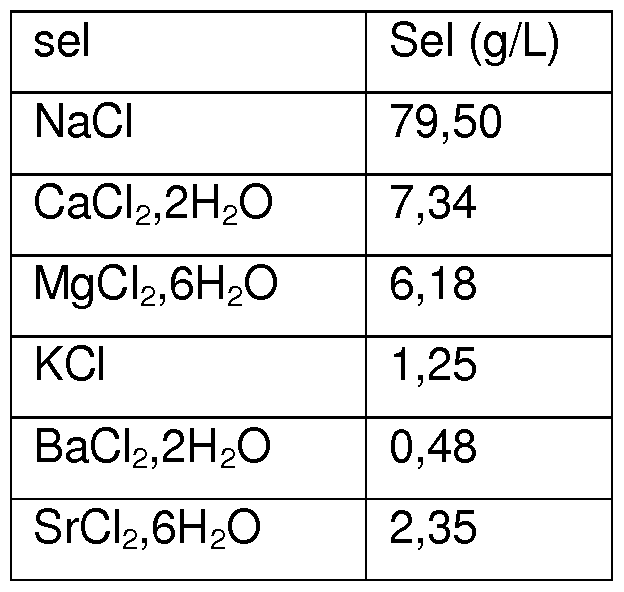
Après fermeture des flacons, ceux-ci sont placés dans des étuves à 85°C.
Le pH des solutions est alors compris entre 3 et 6.
A intervalle de temps régulier (quelques jours), l’eau des flacons est renouvelée à chaud (à température de conditionnement). La fraction d’eau remplacée est conservée afin d’être analysée en taux de Carbone Organique Total sur un TOC meter (TOC-L) de Shimadzu, adapté aux milieux salés. La mesure de Carbone Organique Total permet de remonter aux taux de polymères relargués . Un facteur multiplicatif de 2 (correspondant au 50% de carbone présent dans un acide polyacrylique) a été appliqué au taux de carbone organique mesuré afin d’exprimer les résultats en pourcentage de polymère relargué.
Les tableaux ci-dessous regroupent les taux de carbone et taux de polymères en cumulatifs mesurés sur les 4 produits issus des exemples 1 à 4, mis en contact avec de l’eau de Mer à 85°C.


Exemple 7 : évaluation de la capacité de relaraaae des matériaux en milieu
fortement salin et en température (60°C et 85°C)
Cet exemple illustre la capacité des matériaux polymériques synthétisés précédemment à relarguer des unités polymériques inhibitrices de tartre lorsqu’ils sont soumis à une augmentation de température en milieu aqueux salé. En fonction de la sensibilité aux conditions de relargage des agents de réticulation présents dans le matériau, le profil et la durée de relargage seront pour une température donnée, différents.
Les matériaux polymériques issus des exemples 1 à 4 sont séchés à 105°C pendant 2 heures puis légèrement broyés manuellement (taille des grains comprise entre 0.5 mm et quelques mm). Pour chacun des produits issus des exemples 1 à 4, environ 0.5-0.6 g de produit séché est introduit dans un flacon de 60 ml en verre contenant 50 g d’une eau salée (eau de formation Forties) dont la composition est décrite ci-dessous.
Eau de FORTIES


Après fermeture des flacons, ceux-ci sont placés dans des étuves, l’une à 60°C et l’autre à 85°C. Le pH des solutions est compris entre 3 et 6.
A intervalle de temps régulier, quelques jours dans les 2 premiers mois jusqu’à quelques semaines à partir du troisième mois, l’eau des flacons est renouvelée à chaud (à température de conditionnement). La fraction d’eau remplacée est conservée afin d’être analysée en taux de Carbone Organique Total sur un TOC meter (TOC-L) de Shimadzu, adapté aux milieux salés. La mesure de Carbone Organique Total permet de remonter aux taux de polymères relargués . Un facteur multiplicatif de 2 (correspondant au 50% de carbone présent dans un acide polyacrylique) a été appliqué au taux de carbone organique mesuré afin d’exprimer les résultats en pourcentage de polymère relargué.
Les tableaux ci-après regroupent les taux de carbone et taux de polymères en cumulatifs mesurés sur les 4 produits issus des exemples 1 à 4, à 60°C et à 85°C.


Exemple 8 : évaluation en condition statique des performances anti-Calcaire des espèces polymériques relarquées :
La procédure d’évaluation des performances anti-tartre est dérivée du standard NACE TM0374-2016 (“Laboratory Screening Tests to Détermine the Ability of Scale Inhibitors to Prevent the Précipitation of Calcium Sulfate and Calcium Carbonate from Solution (for Oil and Gas Production Systems)”).
Cette procédure, appelée « Jar test » ou « Bottle Test », permet de mesurer les performances inhibitrices de CaC03 en conditions statiques. Elle consiste à mesurer le taux de Calcium précipitant après mélange dans un flacon de deux eaux incompatibles, puis évolution du mélange sans agitation pendant un temps donné, et mesure de la concentration en Calcium par une méthode volumétrique ou une méthode spectroscopique (ICP-AES) des cations solubles. Les expérimentations comprennent un essai témoin sans inhibiteur et des tests en présence d'inhibiteurs.
Cette évaluation est effectuée à 71 °C après mélange de deux saumures dont l’une contient des cations dont le calcium et l’autre des anions dont le carbonate. Ces saumures sont préalablement saturées en dioxyde de carbone. L’inhibiteur est placé dans l’eau des anions. La concentration en inhibiteur varie en général entre 1 à 2 ppm et 10 ppm.
Dans cet exemple, l’inhibiteur provenant des fractions d’eau recueillies à intervalle régulier on introduit un volume de la fraction d’eau contenant le polymère relargué (cf.
prélèvement faits dans l’exemple 5) tel que le taux final de polymère anti-tartre dans l’essai soit compris entre 4 ppm et 10 ppm en actif.
Les compositions des saumures sont les suivantes :
Eau des cations

Eau des anions

Les eaux sont ensuite saturées en C02 par bullage à travers l’embout fritté pendant 1 h environ sous un débit de C02.
50 ml de chacune de ces eaux sont conditionnés dans des flacons de polyéthylène.
Après avoir équilibré la température des saumures à 71 °C dans une étuve, on verse le contenu du flacon « eau des anions » dans le flacon contenant les cations. On agite manuellement puis le mélange est remis à l’étuve à 71 °C pendant 24h.
Pour chaque série d’essais, deux essais de contrôle sont réalisés :
blanc min : il s’agit d’un essai sans inhibiteur, la teneur en ion calcium sera minimum (précipitation maximum du CaC03).
blanc Max : il s’agit d’un essai sans carbonate et sans inhibiteur, l’eau des anions est remplacée par de l’eau épurée, la teneur en ion calcium sera maximum, car il n’y a pas de précipitation.
Après 24 heures de test, les flacons sont sortis de l’étuve, et laissaient à refroidir. Puis un prélèvement de 1 ml est effectué, puis dilué dans 20 ml d’eau pemutée. On effectue un dosage de Calcium sur ces prélèvements et on en déduit l’efficacité d’inhibition exprimée selon la formule ci-dessous.

% efficacité = 100

Les tableaux ci-dessous regroupent les performances inhibitrices des prélèvements décrits dans l’exemple 5 précédent et contenant les espèces polymériques relarguées.
Tableau : conditionnement à 85°C


Claims
1. Méthode de relargage progressif de chaînes polymères au sein d’un milieu liquide de relargage (MLR), ladite méthode comprenant une étape (E) où on met en contact ledit milieu (MLR) avec des objets solides, typiquement granulaires, formés par des chaînes polymères solubles dans le milieu (MLR) et porteuses de groupements latéraux hydrophobes assurant une réticulation physique hydrophobe-hydrophobe entre lesdites chaînes polymères au sein desdits objets solides.
2. Méthode selon la revendication 1 , où les chaînes polymères relarguées ont une masse moléculaire moyenne en nombre comprise entre 500 et 100 000 g/mol.
3. Méthode selon la revendication 1 ou 2, où le milieu (MLR) est un milieu aqueux, et où les chaînes polymères relarguées sont hydrosolubles.
4. Méthode selon l’une des revendications 1 à 3, où les objets solides employés dans l’étape (E) sont issus d’une étape (E0) de polymérisation radicalaire micellaire dans laquelle on met en contact, au sein d’un milieu aqueux (M) :
- des monomères (m1 ) éthyléniquement insaturés, solubilisés ou dispersés dans ledit milieu aqueux (M) ;
- des monomères (m2) éthyléniquement insaturés, sous la forme d’une solution micellaire, à savoir contenant, à l’état dispersé au sein du milieu (M), des micelles comprenant ces monomères hydrophobes, lesdits monomères (m2) étant, en tout ou partie, des monomères porteurs de chaînes hydrophobes propres à assurer la réticulation physique hydrophobe-hydrophobe recherchée dans les objets solides employés dans l’étape (E);
- au moins un amorceur de polymérisation radicalaire, de préférence hydrosoluble ou hydrodispersible ; et
- de préférence, au moins un agent de contrôle de polymérisation radicalaire.
5. Méthode selon la revendication 4, où l’agent de contrôle de polymérisation radicalaire est un composé qui comprend un groupe thiocarbonylthio -S(C=S), par exemple un xanthate.
6. Méthode selon la revendication 4 ou 5, où les monomères employés dans l’étape (E0) contiennent des monomères (mR) comprenant au moins deux insaturations éthyléniques séparées par au moins un groupement clivable.
7. Méthode selon la revendication 6, où le rapport molaire (mR)/(m1 ), qui correspond à la quantité de monomères réticulants (mR) rapportée à la quantité totale de monomères hydrophiles est supérieur à 0,5%, par exemple supérieur à 1 %, voire à 2%.
8. Méthode selon la revendication 6 ou 7, où le rapport molaire (mR)/(m1 ), qui correspond à la quantité de monomères réticulants (mR) rapportée à la quantité totale de monomères hydrophiles est inférieur ou égal à 30%, préférentiellement inférieur ou égal à 20%, voire inférieur ou égal à 10%.
9. Méthode selon l’une des revendications 1 à 8, où les chaînes polymères relarguées sont des chaînes polymères utiles à titre d’agent anti-tartre, anti-clathrate, et/ou anti corrosion.
10. Méthode selon la revendication 9, où le milieu (MLR) de l’étape (E) est un milieu liquide rencontré lors de l’extraction de pétrole au sein d’un réservoir hydrocarboné.
1 1. Méthode selon l’une des revendications 1 à 10, où l’étape (E) est conduite à une température supérieure ou égale à 50 °C, généralement inférieure à ou égale à 150°C, par exemple entre 60°C et 120°C.
12. Composition utile pour la mise en oeuvre de la méthode de l’une des revendications 1 à 1 1 , comprenant des chaînes polymères hydrosolubles et porteuses de groupements latéraux hydrophobes assurant une réticulation physique hydrophobe- hydrophobe entre lesdites chaînes polymères.
Priority Applications (3)
| Application Number | Priority Date | Filing Date | Title |
|---|---|---|---|
| EP19733536.7A EP3818129B1 (fr) | 2018-07-02 | 2019-07-02 | Relargage progressif de chaînes polymères en milieu liquide |
| US17/257,839 US11608391B2 (en) | 2018-07-02 | 2019-07-02 | Progressive salting-out of polymer chains in a liquid medium |
| CA3103271A CA3103271A1 (fr) | 2018-07-02 | 2019-07-02 | Relargage progressif de chaines polymeres en milieu liquide |
Applications Claiming Priority (2)
| Application Number | Priority Date | Filing Date | Title |
|---|---|---|---|
| FR1856076A FR3083238A1 (fr) | 2018-07-02 | 2018-07-02 | Relargage progressif de chaines polymeres en milieu liquide |
| FR1856076 | 2018-07-02 |
Publications (1)
| Publication Number | Publication Date |
|---|---|
| WO2020007828A1 true WO2020007828A1 (fr) | 2020-01-09 |
Family
ID=64049340
Family Applications (1)
| Application Number | Title | Priority Date | Filing Date |
|---|---|---|---|
| PCT/EP2019/067683 Ceased WO2020007828A1 (fr) | 2018-07-02 | 2019-07-02 | Relargage progressif de chaînes polymères en milieu liquide |
Country Status (5)
| Country | Link |
|---|---|
| US (1) | US11608391B2 (fr) |
| EP (1) | EP3818129B1 (fr) |
| CA (1) | CA3103271A1 (fr) |
| FR (1) | FR3083238A1 (fr) |
| WO (1) | WO2020007828A1 (fr) |
Families Citing this family (1)
| Publication number | Priority date | Publication date | Assignee | Title |
|---|---|---|---|---|
| US12448560B2 (en) * | 2023-07-13 | 2025-10-21 | Halliburton Energy Services, Inc. | Use of zirconium salts as scale inhibitor squeeze enhancers |
Citations (27)
| Publication number | Priority date | Publication date | Assignee | Title |
|---|---|---|---|---|
| US4565647A (en) | 1982-04-26 | 1986-01-21 | The Procter & Gamble Company | Foaming surfactant compositions |
| US5060728A (en) | 1988-10-12 | 1991-10-29 | Mobil Oil Corporation | Process for preventing scale formation in oil wells |
| GB2298440A (en) | 1995-02-28 | 1996-09-04 | Atomic Energy Authority Uk | Well treatment |
| WO1996030421A1 (fr) | 1995-03-31 | 1996-10-03 | Krzysztof Matyjaszewski | Nouveaux copolymeres et un nouveau procede de polymerisation base sur une polymerisation radicalaire par transfert d'atome (ou de groupe) |
| WO1998001478A1 (fr) | 1996-07-10 | 1998-01-15 | E.I. Du Pont De Nemours And Company | Polymerisation presentant des caracteristiques vivantes |
| WO1998058974A1 (fr) | 1997-06-23 | 1998-12-30 | Rhodia Chimie | Procede de synthese de polymeres a blocs par polymerisation radicalaire controlee |
| WO1999031144A1 (fr) | 1997-12-18 | 1999-06-24 | E.I. Du Pont De Nemours And Company | Procede de polymerisation presentant des caracteristiques vivantes et polymeres obtenus par ce procede |
| WO1999035177A1 (fr) | 1997-12-31 | 1999-07-15 | Rhodia Chimie | Procede de synthese de polymeres a blocs par polymerisation radicalaire controlee a partir de composes dithiocarbamates |
| WO1999035178A1 (fr) | 1997-12-31 | 1999-07-15 | Rhodia Chimie | Procede de synthese de polymeres a blocs par polymerisation radicalaire controlee a partir de composes dithioesters |
| FR2794464A1 (fr) | 1999-06-04 | 2000-12-08 | Rhodia Chimie Sa | Procede de synthese de polymeres a blocs par polymerisation radicalaire controlee a l'aide de thioether-thiones |
| WO2000075207A1 (fr) | 1999-06-04 | 2000-12-14 | Rhodia Chimie | Procede de synthese de polymeres par polymerisation radicalaire controlee a l'aide de xanthates halogenes |
| WO2001042312A1 (fr) | 1999-12-09 | 2001-06-14 | Rhodia Chimie | Procede de synthese de polymeres par polymerisation radicalaire controlee a l'aide de xanthates |
| WO2002026836A2 (fr) | 2000-09-28 | 2002-04-04 | Symyx Technologies, Inc. | Agents regulateurs de la polymerisation radicalaire de type 'vivante', procedes de polymerisation, emulsions et polymeres associes |
| WO2003068827A1 (fr) | 2002-02-11 | 2003-08-21 | Rhodia Chimie | Procede de regulation de la stabilite d'emulsions et emulsions stabilisees |
| WO2003068848A2 (fr) | 2002-02-11 | 2003-08-21 | Rhodia Chimie | Procede pour reguler la stabilite ou la taille des gouttelettes de simples emulsions eau dans l'huile, et simples emulsions eau dans l'huile stabilisees |
| US20050028976A1 (en) | 2003-08-05 | 2005-02-10 | Nguyen Philip D. | Compositions and methods for controlling the release of chemicals placed on particulates |
| WO2005021612A1 (fr) | 2003-09-03 | 2005-03-10 | Rhodia Inc | Nouveau copolymere a structure controlee et utilisation de celui-ci |
| US20060124301A1 (en) | 2004-12-15 | 2006-06-15 | Bj Services Company | Slow release scale inhibitor composites and methods of using the same |
| US7196040B2 (en) | 2000-06-06 | 2007-03-27 | T R Oil Services Limited | Microcapsule well treatment |
| US7244693B2 (en) | 2000-11-20 | 2007-07-17 | Statoil Asa | Well treatment |
| US7332459B2 (en) | 2002-06-13 | 2008-02-19 | Bp Exploration Operating Company Limited | Method for scale inhibition in oil wells |
| US7473672B2 (en) | 2000-11-20 | 2009-01-06 | Statoilhydro Asa | Well treatment process |
| US20100093874A1 (en) | 2007-04-05 | 2010-04-15 | Rhodia Operations | Copolymer including betaine units and hydrophobic and/or amphiphilic units, method for preparing same and uses thereof |
| EP2457973A1 (fr) * | 2010-11-24 | 2012-05-30 | Basf Se | Utilisation d'un copolymère hydrosoluble à association hydrophobe comme additif dans des applications spécifiques de champs pétroliers |
| WO2013060741A1 (fr) * | 2011-10-24 | 2013-05-02 | Rhodia Operations | Preparation de polymeres sequences amphiphiles par polymerisation radicalaire micellaire a caractere controle |
| JP2014162912A (ja) * | 2013-02-27 | 2014-09-08 | Nippon Shokubai Co Ltd | 水中摩擦抵抗低減用樹脂粒子 |
| US20150060062A1 (en) | 2013-08-30 | 2015-03-05 | Baker Hughes Incorporated | Method for enhancing productivity of hydrocarbon formations using fluid containing organometallic crosslinking agent and scale inhibitor |
Family Cites Families (4)
| Publication number | Priority date | Publication date | Assignee | Title |
|---|---|---|---|---|
| GB298440A (en) | 1928-02-27 | 1928-10-11 | Max Pinkert | Sheet-metal-seal |
| FR2917415B1 (fr) * | 2007-06-14 | 2012-10-12 | Rhodia Recherches Et Tech | Microgel polymerique comprenant des unites cationiques |
| JP5746223B2 (ja) * | 2010-02-12 | 2015-07-08 | ロディア オペレーションズRhodia Operations | レオロジー改良剤ポリマー |
| CN106349115B (zh) * | 2015-07-16 | 2018-02-09 | 中国石油化工股份有限公司 | 一种双苯基疏水单体以及基于该单体的堵漏凝胶 |
-
2018
- 2018-07-02 FR FR1856076A patent/FR3083238A1/fr not_active Ceased
-
2019
- 2019-07-02 US US17/257,839 patent/US11608391B2/en active Active
- 2019-07-02 CA CA3103271A patent/CA3103271A1/fr active Pending
- 2019-07-02 WO PCT/EP2019/067683 patent/WO2020007828A1/fr not_active Ceased
- 2019-07-02 EP EP19733536.7A patent/EP3818129B1/fr active Active
Patent Citations (28)
| Publication number | Priority date | Publication date | Assignee | Title |
|---|---|---|---|---|
| US4565647A (en) | 1982-04-26 | 1986-01-21 | The Procter & Gamble Company | Foaming surfactant compositions |
| US4565647B1 (en) | 1982-04-26 | 1994-04-05 | Procter & Gamble | Foaming surfactant compositions |
| US5060728A (en) | 1988-10-12 | 1991-10-29 | Mobil Oil Corporation | Process for preventing scale formation in oil wells |
| GB2298440A (en) | 1995-02-28 | 1996-09-04 | Atomic Energy Authority Uk | Well treatment |
| WO1996030421A1 (fr) | 1995-03-31 | 1996-10-03 | Krzysztof Matyjaszewski | Nouveaux copolymeres et un nouveau procede de polymerisation base sur une polymerisation radicalaire par transfert d'atome (ou de groupe) |
| WO1998001478A1 (fr) | 1996-07-10 | 1998-01-15 | E.I. Du Pont De Nemours And Company | Polymerisation presentant des caracteristiques vivantes |
| WO1998058974A1 (fr) | 1997-06-23 | 1998-12-30 | Rhodia Chimie | Procede de synthese de polymeres a blocs par polymerisation radicalaire controlee |
| WO1999031144A1 (fr) | 1997-12-18 | 1999-06-24 | E.I. Du Pont De Nemours And Company | Procede de polymerisation presentant des caracteristiques vivantes et polymeres obtenus par ce procede |
| WO1999035177A1 (fr) | 1997-12-31 | 1999-07-15 | Rhodia Chimie | Procede de synthese de polymeres a blocs par polymerisation radicalaire controlee a partir de composes dithiocarbamates |
| WO1999035178A1 (fr) | 1997-12-31 | 1999-07-15 | Rhodia Chimie | Procede de synthese de polymeres a blocs par polymerisation radicalaire controlee a partir de composes dithioesters |
| FR2794464A1 (fr) | 1999-06-04 | 2000-12-08 | Rhodia Chimie Sa | Procede de synthese de polymeres a blocs par polymerisation radicalaire controlee a l'aide de thioether-thiones |
| WO2000075207A1 (fr) | 1999-06-04 | 2000-12-14 | Rhodia Chimie | Procede de synthese de polymeres par polymerisation radicalaire controlee a l'aide de xanthates halogenes |
| WO2001042312A1 (fr) | 1999-12-09 | 2001-06-14 | Rhodia Chimie | Procede de synthese de polymeres par polymerisation radicalaire controlee a l'aide de xanthates |
| US7196040B2 (en) | 2000-06-06 | 2007-03-27 | T R Oil Services Limited | Microcapsule well treatment |
| WO2002026836A2 (fr) | 2000-09-28 | 2002-04-04 | Symyx Technologies, Inc. | Agents regulateurs de la polymerisation radicalaire de type 'vivante', procedes de polymerisation, emulsions et polymeres associes |
| US7473672B2 (en) | 2000-11-20 | 2009-01-06 | Statoilhydro Asa | Well treatment process |
| US7244693B2 (en) | 2000-11-20 | 2007-07-17 | Statoil Asa | Well treatment |
| WO2003068827A1 (fr) | 2002-02-11 | 2003-08-21 | Rhodia Chimie | Procede de regulation de la stabilite d'emulsions et emulsions stabilisees |
| WO2003068848A2 (fr) | 2002-02-11 | 2003-08-21 | Rhodia Chimie | Procede pour reguler la stabilite ou la taille des gouttelettes de simples emulsions eau dans l'huile, et simples emulsions eau dans l'huile stabilisees |
| US7332459B2 (en) | 2002-06-13 | 2008-02-19 | Bp Exploration Operating Company Limited | Method for scale inhibition in oil wells |
| US20050028976A1 (en) | 2003-08-05 | 2005-02-10 | Nguyen Philip D. | Compositions and methods for controlling the release of chemicals placed on particulates |
| WO2005021612A1 (fr) | 2003-09-03 | 2005-03-10 | Rhodia Inc | Nouveau copolymere a structure controlee et utilisation de celui-ci |
| US20060124301A1 (en) | 2004-12-15 | 2006-06-15 | Bj Services Company | Slow release scale inhibitor composites and methods of using the same |
| US20100093874A1 (en) | 2007-04-05 | 2010-04-15 | Rhodia Operations | Copolymer including betaine units and hydrophobic and/or amphiphilic units, method for preparing same and uses thereof |
| EP2457973A1 (fr) * | 2010-11-24 | 2012-05-30 | Basf Se | Utilisation d'un copolymère hydrosoluble à association hydrophobe comme additif dans des applications spécifiques de champs pétroliers |
| WO2013060741A1 (fr) * | 2011-10-24 | 2013-05-02 | Rhodia Operations | Preparation de polymeres sequences amphiphiles par polymerisation radicalaire micellaire a caractere controle |
| JP2014162912A (ja) * | 2013-02-27 | 2014-09-08 | Nippon Shokubai Co Ltd | 水中摩擦抵抗低減用樹脂粒子 |
| US20150060062A1 (en) | 2013-08-30 | 2015-03-05 | Baker Hughes Incorporated | Method for enhancing productivity of hydrocarbon formations using fluid containing organometallic crosslinking agent and scale inhibitor |
Non-Patent Citations (2)
| Title |
|---|
| MACROMOLECULAR CHEM. PHYSICS, vol. 202, no. 8, 2001, pages 1384 - 1397 |
| See also references of EP3818129A1 |
Also Published As
| Publication number | Publication date |
|---|---|
| US20210230471A1 (en) | 2021-07-29 |
| CA3103271A1 (fr) | 2020-01-09 |
| EP3818129B1 (fr) | 2024-12-18 |
| US11608391B2 (en) | 2023-03-21 |
| EP3818129A1 (fr) | 2021-05-12 |
| FR3083238A1 (fr) | 2020-01-03 |
Similar Documents
| Publication | Publication Date | Title |
|---|---|---|
| EP2780383B1 (fr) | Preparation de polymeres sequences amphiphiles par polymerisation radicalaire micellaire a caractere controle | |
| FR3037074A1 (fr) | Agents de suspension obtenus par polymerisation micellaire | |
| FR3043083A1 (fr) | Polymeres sequences amphiphiles solubles en milieu fortement salin | |
| EP3303506B1 (fr) | Polymeres amphiphiles pour le controle du filtrat | |
| WO2020178294A1 (fr) | Suspension de polymeres associatifs pour le traitement de formations souterraines | |
| EP3280777B1 (fr) | Polymères séquencés pour le contrôle du filtrat | |
| FR3025520A1 (fr) | Hydratation amelioree de polymeres associatifs | |
| EP3774958B1 (fr) | Composition aqueuse gélifiée pour l'extraction pétrolière | |
| EP2877505B1 (fr) | Composition de polymères pour l'inhibition de la formation de dépôts inorganiques et/ou organiques au sein de formations souterraines | |
| EP3280750B1 (fr) | Polymères séquencés pour le contrôle du filtrat | |
| EP3728512B1 (fr) | Formulations aqueuses de tensioactifs et polymeres associatifs pour la recuperation assistee du petrole | |
| EP3818129B1 (fr) | Relargage progressif de chaînes polymères en milieu liquide | |
| CA3002163C (fr) | Polymeres sequences amphiphiles solubles en milieu fortement salin | |
| CA2986453C (fr) | Agents de suspension obtenus par polymérisation micellaire |
Legal Events
| Date | Code | Title | Description |
|---|---|---|---|
| 121 | Ep: the epo has been informed by wipo that ep was designated in this application |
Ref document number: 19733536 Country of ref document: EP Kind code of ref document: A1 |
|
| ENP | Entry into the national phase |
Ref document number: 3103271 Country of ref document: CA |
|
| NENP | Non-entry into the national phase |
Ref country code: DE |
|
| ENP | Entry into the national phase |
Ref document number: 2019733536 Country of ref document: EP Effective date: 20210202 |