WO2020008262A2 - Uses for calcium channel modulators - Google Patents
Uses for calcium channel modulators Download PDFInfo
- Publication number
- WO2020008262A2 WO2020008262A2 PCT/IB2019/000834 IB2019000834W WO2020008262A2 WO 2020008262 A2 WO2020008262 A2 WO 2020008262A2 IB 2019000834 W IB2019000834 W IB 2019000834W WO 2020008262 A2 WO2020008262 A2 WO 2020008262A2
- Authority
- WO
- WIPO (PCT)
- Prior art keywords
- agent
- cancer
- effective amount
- therapeutically effective
- subject
- Prior art date
- Legal status (The legal status is an assumption and is not a legal conclusion. Google has not performed a legal analysis and makes no representation as to the accuracy of the status listed.)
- Ceased
Links
Classifications
-
- A—HUMAN NECESSITIES
- A61—MEDICAL OR VETERINARY SCIENCE; HYGIENE
- A61K—PREPARATIONS FOR MEDICAL, DENTAL OR TOILETRY PURPOSES
- A61K45/00—Medicinal preparations containing active ingredients not provided for in groups A61K31/00 - A61K41/00
- A61K45/06—Mixtures of active ingredients without chemical characterisation, e.g. antiphlogistics and cardiaca
-
- A—HUMAN NECESSITIES
- A61—MEDICAL OR VETERINARY SCIENCE; HYGIENE
- A61K—PREPARATIONS FOR MEDICAL, DENTAL OR TOILETRY PURPOSES
- A61K31/00—Medicinal preparations containing organic active ingredients
- A61K31/275—Nitriles; Isonitriles
- A61K31/277—Nitriles; Isonitriles having a ring, e.g. verapamil
-
- A—HUMAN NECESSITIES
- A61—MEDICAL OR VETERINARY SCIENCE; HYGIENE
- A61K—PREPARATIONS FOR MEDICAL, DENTAL OR TOILETRY PURPOSES
- A61K31/00—Medicinal preparations containing organic active ingredients
- A61K31/33—Heterocyclic compounds
- A61K31/395—Heterocyclic compounds having nitrogen as a ring hetero atom, e.g. guanethidine or rifamycins
- A61K31/40—Heterocyclic compounds having nitrogen as a ring hetero atom, e.g. guanethidine or rifamycins having five-membered rings with one nitrogen as the only ring hetero atom, e.g. sulpiride, succinimide, tolmetin, buflomedil
- A61K31/403—Heterocyclic compounds having nitrogen as a ring hetero atom, e.g. guanethidine or rifamycins having five-membered rings with one nitrogen as the only ring hetero atom, e.g. sulpiride, succinimide, tolmetin, buflomedil condensed with carbocyclic rings, e.g. carbazole
- A61K31/404—Indoles, e.g. pindolol
-
- A—HUMAN NECESSITIES
- A61—MEDICAL OR VETERINARY SCIENCE; HYGIENE
- A61K—PREPARATIONS FOR MEDICAL, DENTAL OR TOILETRY PURPOSES
- A61K31/00—Medicinal preparations containing organic active ingredients
- A61K31/33—Heterocyclic compounds
- A61K31/395—Heterocyclic compounds having nitrogen as a ring hetero atom, e.g. guanethidine or rifamycins
- A61K31/435—Heterocyclic compounds having nitrogen as a ring hetero atom, e.g. guanethidine or rifamycins having six-membered rings with one nitrogen as the only ring hetero atom
- A61K31/44—Non condensed pyridines; Hydrogenated derivatives thereof
- A61K31/4422—1,4-Dihydropyridines, e.g. nifedipine, nicardipine
-
- A—HUMAN NECESSITIES
- A61—MEDICAL OR VETERINARY SCIENCE; HYGIENE
- A61K—PREPARATIONS FOR MEDICAL, DENTAL OR TOILETRY PURPOSES
- A61K31/00—Medicinal preparations containing organic active ingredients
- A61K31/33—Heterocyclic compounds
- A61K31/395—Heterocyclic compounds having nitrogen as a ring hetero atom, e.g. guanethidine or rifamycins
- A61K31/435—Heterocyclic compounds having nitrogen as a ring hetero atom, e.g. guanethidine or rifamycins having six-membered rings with one nitrogen as the only ring hetero atom
- A61K31/44—Non condensed pyridines; Hydrogenated derivatives thereof
- A61K31/4427—Non condensed pyridines; Hydrogenated derivatives thereof containing further heterocyclic ring systems
-
- A—HUMAN NECESSITIES
- A61—MEDICAL OR VETERINARY SCIENCE; HYGIENE
- A61K—PREPARATIONS FOR MEDICAL, DENTAL OR TOILETRY PURPOSES
- A61K31/00—Medicinal preparations containing organic active ingredients
- A61K31/33—Heterocyclic compounds
- A61K31/395—Heterocyclic compounds having nitrogen as a ring hetero atom, e.g. guanethidine or rifamycins
- A61K31/435—Heterocyclic compounds having nitrogen as a ring hetero atom, e.g. guanethidine or rifamycins having six-membered rings with one nitrogen as the only ring hetero atom
- A61K31/44—Non condensed pyridines; Hydrogenated derivatives thereof
- A61K31/445—Non condensed piperidines, e.g. piperocaine
-
- A—HUMAN NECESSITIES
- A61—MEDICAL OR VETERINARY SCIENCE; HYGIENE
- A61K—PREPARATIONS FOR MEDICAL, DENTAL OR TOILETRY PURPOSES
- A61K31/00—Medicinal preparations containing organic active ingredients
- A61K31/33—Heterocyclic compounds
- A61K31/395—Heterocyclic compounds having nitrogen as a ring hetero atom, e.g. guanethidine or rifamycins
- A61K31/435—Heterocyclic compounds having nitrogen as a ring hetero atom, e.g. guanethidine or rifamycins having six-membered rings with one nitrogen as the only ring hetero atom
- A61K31/44—Non condensed pyridines; Hydrogenated derivatives thereof
- A61K31/445—Non condensed piperidines, e.g. piperocaine
- A61K31/451—Non condensed piperidines, e.g. piperocaine having a carbocyclic group directly attached to the heterocyclic ring, e.g. glutethimide, meperidine, loperamide, phencyclidine, piminodine
-
- A—HUMAN NECESSITIES
- A61—MEDICAL OR VETERINARY SCIENCE; HYGIENE
- A61K—PREPARATIONS FOR MEDICAL, DENTAL OR TOILETRY PURPOSES
- A61K31/00—Medicinal preparations containing organic active ingredients
- A61K31/33—Heterocyclic compounds
- A61K31/395—Heterocyclic compounds having nitrogen as a ring hetero atom, e.g. guanethidine or rifamycins
- A61K31/435—Heterocyclic compounds having nitrogen as a ring hetero atom, e.g. guanethidine or rifamycins having six-membered rings with one nitrogen as the only ring hetero atom
- A61K31/44—Non condensed pyridines; Hydrogenated derivatives thereof
- A61K31/445—Non condensed piperidines, e.g. piperocaine
- A61K31/4523—Non condensed piperidines, e.g. piperocaine containing further heterocyclic ring systems
- A61K31/4545—Non condensed piperidines, e.g. piperocaine containing further heterocyclic ring systems containing a six-membered ring with nitrogen as a ring hetero atom, e.g. pipamperone, anabasine
-
- A—HUMAN NECESSITIES
- A61—MEDICAL OR VETERINARY SCIENCE; HYGIENE
- A61K—PREPARATIONS FOR MEDICAL, DENTAL OR TOILETRY PURPOSES
- A61K31/00—Medicinal preparations containing organic active ingredients
- A61K31/33—Heterocyclic compounds
- A61K31/395—Heterocyclic compounds having nitrogen as a ring hetero atom, e.g. guanethidine or rifamycins
- A61K31/495—Heterocyclic compounds having nitrogen as a ring hetero atom, e.g. guanethidine or rifamycins having six-membered rings with two or more nitrogen atoms as the only ring heteroatoms, e.g. piperazine or tetrazines
- A61K31/496—Non-condensed piperazines containing further heterocyclic rings, e.g. rifampin, thiothixene or sparfloxacin
-
- A—HUMAN NECESSITIES
- A61—MEDICAL OR VETERINARY SCIENCE; HYGIENE
- A61P—SPECIFIC THERAPEUTIC ACTIVITY OF CHEMICAL COMPOUNDS OR MEDICINAL PREPARATIONS
- A61P35/00—Antineoplastic agents
Definitions
- the present disclosure relates to calcium channel modulators and combinatorial use thereof for treating cancer.
- the cancer expresses a variant isoform of a Ca v l.3 channel and relates to using combinations of calcium channel modulators that act synergistically to treat cancer.
- Calcium signaling is a common mechanism involved in the majority of cellular functions. Ca 2+ homeostasis is tightly modulated by multiple channel mechanisms in all excitable cells and non-excitable cells. Calcium channels include various voltage-dependent channels, also referred to as voltage-gated channels (hereafter“Ca v ”), and ligand-gated (receptor-operated) channels. Among the cellular functions involving Ca 2+ signaling are many processes that mediate or regulate the development of pathologies, including cardiovascular disorders and hypertension.
- Ca v channels include several subsets that may be activated at depolarized membrane potentials.
- Ca v channels are heteromultimers composed of a pore forming al subunit, b regulatory subunit, a2 subunit, g subunit, and d subunit.
- the topology of the al pore forming subunit is predicted to have four repeated motifs (I-IV), each of which are hexahelical.
- the S4 transmembrane segments in each motif contain conserved positively charged amino acids that are voltage-sensors and that move outwards upon membrane depolarization, thereby opening the channel.
- Cav al subunits may be classified into three subsets having specific functions in different cell types: Ca v l (L-type), Ca v 2 (N-, P/Q- and R-type), and Ca v 3 (T-type).
- L-type al proteins There are four L-type al proteins: alS (Ca v l. l), alC (Ca v l.2), alD (Ca v l.3), and alF (Ca v l.4).
- aspects described herein relate to a method for reducing cancer cell proliferation, reducing cancer burden, and/or treating cancer comprising identifying the cancer in a subject and administering various therapeutically effective amounts of combinations of agents that bind to calcium channels, wherein the agents act synergistically to reduce cancer cell proliferation, reduce cancer burden, and/or treat the cancer.
- the method is performed to reduce cancer cell proliferation, reduce cancer burden, and/or treat a cancer in a subject, wherein the subject has a cancer that expresses a variant isoform of the Ca v l.3 channel.
- Methods and compositions described herein relate to combinations of agents that act synergistically to reduce cancer cell proliferation, reduce cancer burden, and/or treat the cancer.
- a method for reducing cancer burden in a subject in need thereof comprising administering a therapeutically effective amount of a first agent and a therapeutically effective amount of a second agent, wherein at least one of the first and second agent binds to the variant isoform of the Ca v l.3 channel; or a pharmaceutical composition comprising a therapeutically effective amount of the first agent and a therapeutically effective amount of the second agent and a pharmaceutically acceptable excipient to the subject, thereby reducing the cancer burden in the subject.
- a method for reducing proliferation of cancer cells in a subject in need thereof comprising administering a therapeutically effective amount of a first agent that binds to a first site of the variant isoform of the Ca v l.3 channel and a therapeutically effective amount of a second agent that binds to a second site of the variant isoform of the Cavl.3 channel, wherein the first and second sites are different; or a pharmaceutical composition comprising a therapeutically effective amount of the first agent and a therapeutically effective amount of the second agent and a pharmaceutically acceptable excipient to the subject, thereby reducing the proliferation of cancer cells in the subject.
- a method for treating cancer in a subject in need thereof comprising administering a therapeutically effective amount of a first agent that binds to a first site of the variant isoform of the Ca v l.3 channel and a therapeutically effective amount of a second agent that binds to a second site of the variant isoform of the Ca v l.3 channel, wherein the first and second sites are different; or a pharmaceutical composition comprising a therapeutically effective amount of the first agent and a therapeutically effective amount of the second agent and a pharmaceutically acceptable excipient to the subject, thereby treating the cancer in the subject.
- the above methods may include one or more of the following features individually or in combination: wherein the first agent is at least one dihydropyridine and the second agent is ebastine; wherein the at least one dihydropyridine comprises at least one dihydropyridine comprising four benzene rings or three benzene rings; wherein the at least one dihydropyridine comprising four benzene rings is at least one of azelni dipine, lercani dipine, nigul dipine or mani dipine; wherein the at least one dihydropyridine comprising three benzene rings is at least one of nicardipine, beni dipine, or cilni dipine; wherein the first agent is SR33805 and the second agent is verapamil, ebastine, at least one dihydropyridine comprising four benzene rings (e.g., azelnidipine), or loperamide; wherein the variant isoform of the Ca v l.
- a method for reducing proliferation of cancer cells in a subject in need thereof comprising administering a therapeutically effective amount of at least one dihydropyridine and a therapeutically effective amount of ebastine; or a pharmaceutical composition comprising a therapeutically effective amount of at least one dihydropyridine and a therapeutically effective amount of ebastine and a pharmaceutically acceptable excipient to the subject, thereby reducing the proliferation of cancer cells in the subject.
- a method for reducing cancer burden in a subject in need thereof comprising administering a therapeutically effective amount of at least one dihydropyridine and a therapeutically effective amount of ebastine; or a pharmaceutical composition comprising a therapeutically effective amount of at least one dihydropyridine and a therapeutically effective amount of ebastinene and a pharmaceutically acceptable excipient to the subject, thereby reducing the cancer burden in the subject.
- a method for treating cancer in a subject in need thereof comprising administering a therapeutically effective amount of at least one dihydropyridine and a therapeutically effective amount of ebastine; or a pharmaceutical composition comprising a therapeutically effective amount of at least one dihydropyridine and a therapeutically effective amount of ebastine and a pharmaceutically acceptable excipient to the subject, thereby treating the cancer in the subject.
- a method for reducing cancer burden in a subject in need thereof comprising administering a therapeutically effective amount of SR33805 and a therapeutically effective amount of verapamil, ebastine, at least one dihydropyridine comprising four benzene rings (e.g., azelnidipine), or loperamide; or a pharmaceutical composition comprising a therapeutically effective amount of SR33805 and a therapeutically effective amount of verapamil, ebastine, at least one dihydropyridine comprising four benzene rings (e.g., azelnidipine), or loperamide and a pharmaceutically acceptable excipient to the subject, thereby reducing the cancer burden in the subject.
- a method for reducing proliferation of cancer cells in a subject in need thereof comprising administering a therapeutically effective amount of SR33805 and a therapeutically effective amount of verapamil, ebastine, at least one dihydropyridine comprising four benzene rings (e.g., azelnidipine), or loperamide; or a pharmaceutical composition comprising a therapeutically effective amount of SR33805 and a therapeutically effective amount of verapamil, ebastine, at least one dihydropyridine comprising four benzene rings (e.g., azelnidipine), or loperamide, thereby reducing the proliferation of cancer cells in the subject.
- a method for treating cancer in a subject in need thereof comprising administering a therapeutically effective amount of SR33805 and a therapeutically effective amount of verapamil, ebastine, at least one dihydropyridine comprising four benzene rings (e.g., azelnidipine), or loperamide; or a pharmaceutical composition comprising a therapeutically effective amount of SR33805 and a therapeutically effective amount of verapamil, ebastine, at least one dihydropyridine comprising four benzene rings (e.g., azelnidipine), or loperamide and a pharmaceutically acceptable excipient to the subject, thereby treating the cancer in the subject.
- the above methods may include one or more of the following features individually or in combination: wherein the variant isoform of the Ca v l.3 channel is encoded by a nucleic acid sequence that hybridizes specifically to a probe comprising a fragment of the complementary strand of the nucleic acid sequence comprising SEQ ID NO: 1; wherein the variant isoform of the Cavl.3 channel is encoded by a nucleic acid sequence comprising SEQ ID NO: 1 or comprises the amino acid sequence of SEQ ID NO: 2; wherein the cancer is a carcinoma; wherein the cancer is a lung cancer; wherein the cancer is a non-small cell lung cancer; wherein the first agent or pharmaceutical composition thereof and the second agent or pharmaceutical composition thereof are administered concurrently (at the same time) or sequentially; wherein at least one of first agent or pharmaceutical composition thereof or the second agent or pharmaceutical composition thereof is administered orally; wherein the therapeutically effective amount ranges from about 0.1 mg/day to about 100 mg/day; wherein at least one of the pharmaceutical compositions is
- the embodiments also relate to a pharmaceutical composition for the treatment of cancer comprising therapeutically effective amounts of combinations of agents that bind to calcium channels, wherein the agents bind to different sites in the calcium channels and act synergistically to reduce cancer cell proliferation, reduce cancer burden, and/or treat the cancer, wherein the cancer is a variant isoform of a Ca v l.3 channel, and wherein the pharmaceutical composition is prepared for treatment via oral administration, intravenous administration, topical administration, subcutaneous administration, intradermal administration, intramusclualr administration, intranasal administration, buccal administration, intratumoral administration, pulmonary administration, or any combination thereof.
- a pharmaceutical composition comprising therapeutically effective amounts of combinations of agents that bind to calcium channels, wherein the agents bind to different sites in the calcium channels and act synergistically for use in reducing cancer cell proliferation, reducing cancer burden, and/or treating a cancer.
- therapeutically effective amounts of combinations of agents that bind to calcium channels, wherein the agents bind to different sites in the calcium channels and act synergistically are used for the preparation of a medicament for reducing cancer cell proliferation, reducing cancer burden, and/or treating a cancer.
- compositions for the treatment of cancer comprising a therapeutically effective amount of a first and a second agent and a pharmaceutically acceptable excipient, wherein the first agent is at least one dihydropyridine and the second agent is ebastine.
- a therapeutically effective amount of a first agent or a composition thereof and a therapeutically effective amount of a second agent or a composition thereof for use in reducing cancer cell proliferation, reducing cancer burden, and/or treating a cancer is envisioned, wherein the first agent is at least one dihydropyridine and the second agent is ebastine.
- the first agent or composition thereof and the second agent or composition thereof are used concurrently (at the same time) or sequentially.
- the first agent and the second agent are present in the same composition.
- the first agent and the second agent are present in the different compositions.
- the pharmaceutical composition/s may include one or more of the following features individually or in combination: wherein the pharmaceutical composition/s is prepared for treatment via oral administration, intravenous administration, topical administration, subcutaneous administration, intradermal administration, intramusclualr administration, intranasal administration, buccal administration, intratumoral administration, pulmonary administration, or any combination thereof; wherein the at least one dihydropyridine comprises at least one dihydropyridine comprising four benzene rings or three benzene rings; wherein the at least one dihydropyridine comprising four benzene rings is at least one of azelni dipine, lercani dipine, nigul dipine or mani dipine; wherein the at least one dihydropyridine comprising three benzene rings is at least one of nicardipine, beni dipine, or cilni dipine; wherein the pharmaceutical composition is formulated to be administered orally; wherein the therapeutically effective amount ranges from about 0.1 to about 100 mg; wherein
- Embodiments also encompass a pharmaceutical composition for the treatment of cancer, the pharmaceutical composition comprising a therapeutically effective amount of a first and a second agent and a pharmaceutically acceptable excipient, wherein the first agent is SR33805 and the second agent is verapamil, ebastine, azelnidipine, or loperamide.
- a therapeutically effective amount of a first agent or a composition thereof and a therapeutically effective amount of a second agent or a composition thereof for use in reducing cancer cell proliferation, reducing cancer burden, and/or treating a cancer is envisioned, wherein the first agent is SR33805 and the second agent is verapamil, ebastine, or at least one dihydropyridine comprising four benzene rings (e.g., azelnidipine), or loperamide.
- the first agent or composition thereof and the second agent or composition thereof are used concurrently (at the same time) or sequentially.
- the first agent and the second agent are present in the same composition.
- the pharmaceutical composition/s may include one or more of the following features individually or in combination: wherein the pharmaceutical composition/s is prepared for treatment via oral administration, intravenous administration, topical administration, intratumoral administration, pulmonary administration, or any combination thereof; wherein the pharmaceutical composition is configured to be administered orally; wherein the therapeutically effective amount ranges from about 0.1 to about 100 mg; wherein the pharmaceutical composition is configured to be administered intravenously, subcutaneously, intratumorally, topically, or via inhalation; and/or the therapeutically effective amount ranges from about 5 mM to about 50 pM.
- FIG. 1 shows that Ebastine synergizes with Lercanidipine.
- A549 lung cancer cells were plated at 2000 cells per well. Drugs were added at the various concentrations at time zero and replaced every 24 hours. XTT assay (Invitrogen) was performed at 72hrs. Combinations of drugs were added at 1 : 1 ratios at all concentrations.
- FIG. 2 shows that Ebastine synergizes with Lercanktipina.
- A549 lung cancer cells were plated at 2000 cells per well. Drugs were added at the various concentrations at time zero and replaced every 24 hours. XTT assay (Invitrogen) was performed at 72hrs. Combinations of drugs were added at 1 : 1 ratios at all concentrations.
- FIG. 3 shows that Ebastine exhibits synergy- with SR33805.
- A549 lung cancer cells were plated at 2000 cells per well. Drugs were added at the various concentrations at time zero and replaced every 24 hours. XTT assay (Invitrogen) was performed at 72hrs. Combinations of drugs were added at 1: 1 ratios at all concentrations.
- FIG. 4 shows that SR33805 synergizes with verapamil. It is noteworthy that verapamil alone exhibits no activity with respect to killing cancer cells.
- FIG. 5 shows that SR33805 (sr) synergizes with verapamil (ver) to kill A549 lung cancer cells.
- Verapamil synergizes with SR33805 and Itraconazole (itra).
- A549 cells were plated at day 0; drugs were added at the indicated dosages; verapamil was added at a fixed dose of 5 mM; the duration of the assay was 72 hours.
- FIG. 6 shows that SR33805 (SR) synergizes with ebastine (Ebastin; EBA) and loperamide (LOP) to kill A549 lung cancer cells.
- FIG. 8 depicts cellular proliferation (% proliferation) of A549 lung cancer cells after treatment with a single agent or a combination of agents as indicated in accordance with embodiments described herein. A549 cells were plated at day 0; drugs were added at the indicated dosages at a ratio of 1 : 1 ; drugs were replaced daily; the duration of the assay was 72 hours.
- FIG. 7 shows that SR33805 synergizes with loperamide to kill A549 lung cancer cells.
- FIG. 9 depicts cellular proliferation (% proliferation) of A549 lung cancer cells after treatment with a single agent or a combination of agents as indicated in accordance with embodiments described herein.
- A549 cells were plated at day 0; drugs were added at the indicated dosages at a ratio of 1: 1; drugs were replaced daily; the duration of the assay was 72 hours.
- FIG. 8 shows that Ebastme synergizes with lercamdipme.
- FIG. 1 1 depicts cellular proliferation (% proliferation) of A549 lung cancer cells after treatment with a single agent or a combination of agents as indicated in accordance with embodiments described herein. A549 cells were plated at day 0; drugs were added at the indicated dosages at a ratio of 1 : 1; drugs were replaced daily; the duration of the assay was 72 hours.
- FIG. 9 shows that SR33805 (SR) synergizes with azelni dipine (A Z; a 4 ring member of the dhp family) to kill MCF7 breast cancer cells.
- FIG. 12 depicts cellular proliferation (% proliferation) of MCF7 breast cancer cells after treatment with a single agent (SR or A Z) or a combination of agents as indicated (AZLOP) in accordance with embodiments described herein. MCF7 cells were plated at day 0; drugs were added at the indicated dosages at a ratio of 1 : 1 ; drugs were replaced daily; the duration of the assay was 72 hours.
- the illustrated figures are exemplary only and are not intended to assert or imply any limitation with regard to the environment, structure, form, design, or process in which different examples may be implemented.
- Ca v channel expression has been detected in certain cancer cell lines, including common carcinomas such as prostate cancer, endometrial cancer, colon cancer, breast cancer, and lung cancer. The significance of the expression pattern remains unknown.
- the present disclosure relates to a method for reducing cancer cell proliferation, reducing cancer burden, and/or treating cancer comprising identifying the cancer in a subject and administering various therapeutically effective amounts of combinations of agents that bind to calcium channels, wherein the agents bind to different sites in the calcium channels and act synergistically to reduce cancer cell proliferation, reduce cancer burden, and/or treat the cancer.
- the method is performed to reduce cancer cell proliferation, reduce cancer burden, and/or treat a cancer in a subject, wherein the subject has a cancer that expresses a variant isoform of the Ca v l.3 channel.
- compositions described herein relate to combinations of agents that bind to calcium channels, wherein the agents bind to different sites in the calcium channels and act synergistically to reduce cancer cell proliferation, reduce cancer burden, and/or treat the cancer.
- the present disclosure relates to the preparation of pharmaceutical compositions comprising said dihydropyridines, as well as the administration of said dihydropyridines as a therapy for the treatment of cancer.
- a dihydropyridine or at least one dihydropyridine may be formulated into a pharmaceutical composition, where the dihydropyridine is present, in amounts ranging from about 0.01% (w/w) to about 100% (w/w), from about 0.1% (w/w) to about 80% (w/w), from about 1% (w/w) to about 70% (w/w), from about 10% (w/w) to about 60% (w/w), or from about 0.1% (w/w) to about 20% (w/w).
- a dihydropyridine or at least one dihydropyridine may be included in a composition described herein as a first agent that acts synergistically with a second agent to kill cancer cells.
- Exemplary dihydropyridines that act synergistically as first agents with second agents include dihydropyridines comprising four benzene rings or three benzene rings. Exemplary dihydropyridines comprising four benzene rings include azelnidipine, lercanidipine, niguldipine and manidipine. Exemplary dihydropyridines comprising three benzene rings include nicardipine, benidipine, and cilnidipine. Exemplary second agents that act synergistically with dihydropyridines include Ebastine (also referred to herein as Ebastin or Eba).
- Ebastine also referred to herein as Ebastin or Eba
- Ebastine may be formulated into a pharmaceutical composition, where the Ebastine is present, in amounts ranging from about 0.01% (w/w) to about 100% (w/w), from about 0.1% (w/w) to about 80% (w/w), from about 1% (w/w) to about 70% (w/w), from about 10% (w/w) to about 60% (w/w), or from about 0.1% (w/w) to about 20% (w/w).
- first and second agents include: lercanidipine (or any other four benzene ring dhp, e.g., azelni dipine, niguldipine or mani dipine or a combination thereof) and ebastine; ebastine and SR33805; SR33805 and verapamil; SR33805 and at least one dihydropyridine comprising four benzene rings (e.g., azelnidipine); SR33805 and loperamide; itraconazole and loperamide; fenretinide and loperamide; and fenretinide and ebastine.
- lercanidipine or any other four benzene ring dhp, e.g., azelni dipine, niguldipine or mani dipine or a combination thereof
- ebastine e.g., azelni dipine, niguldipine or mani dipine or a
- Each synergistic combination comprises a first agent and a second agent, wherein at least one of the first agent or the second agent binds to a calcium channel.
- exemplary synergistic combinations of first and second agents include: lercanidipine (or any other four benzene ring dhp, e.g., azelnidipine, niguldipine or manidipine or a combination thereof) and ebastine; ebastine and SR33805; SR33805 and at least one dihydropyridine comprising four benzene rings (e.g., azelnidipine); SR33805 and verapamil; and SR33805 and loperamide.
- a first agent and a second agent therein are present in the above percent amounts such that addition of the percent of the first and second agent does not exceed a total of 100% (w/w).
- exemplary pharmaceutical compositions may, for example, comprise amounts ranging from about 0.01% (w/w) to about 100% (w/w) of a first agent and in complementary fashion, about 100% (w/w) to about 0.01% (w/w) of a second agent; from about 0.1% (w/w) to about 80% (w/w) of a first agent and in complementary fashion, about 80% (w/w) to about 0.1% (w/w) of a second agent; from about 1% (w/w) to about 70% (w/w) of a first agent and in complementary fashion, about 70% (w/w) to about 1% (w/w) of a second agent; from about 10% (w/w) to about 60% (w/w) of a first agent and in complementary fashion, about 60% (w/w) to about
- the first agent and second agent may be administered in a range of different ratios, including: 20: 1 first agent to second agent; 10:1 first agent to second agent; 5 : 1 first agent to second agent; 2: 1 first agent to second agent; 1 : 1 first agent to second agent; 20: 1 second agent to first agent; 10: 1 second agent to first agent; 5: 1 second agent to first agent; or 2: 1 second to first agent; and increments thereof (e.g., 19: 1; 18: 1; 17: 1; 16: 1; 15: 1; 14: 1; 13: 1; 12: 1; 11 : 1; 10: 1; 9: 1; 8: 1; 7: 1; 6: 1; 5: 1; 4: 1; 3: 1; 2: 1).
- the ratio is determined based on molar ratio of the first and second agent.
- compositions described herein may be administered alone, or may be co-administered together with radiation or another agent (e.g., a chemotherapeutic agent), to treat a disease such as a cancer. Treatments may be sequential, with a therapeutically effective amount of an agent or a pharmaceutical composition described herein being administered before or after the administration of other agents.
- a pharmaceutical composition may be used to sensitize a cancer patient to radiation or chemotherapy.
- agents may be administered concurrently (i.e., at the same time).
- the route of administration may vary, and can include, inhalation, intranasal, oral, transdermal, intravenous, subcutaneous or intramuscular injection.
- the present disclosure also provides for a method of treating a disease such as cancer, comprising the step of delivering to a patient a therapeutically effective amount of a pharmaceutical composition described herein.
- a dihydropyridine may be provided.
- the present composition may contain one or more types of dihydropyridine.
- an effective amount of the dihydropyridine (e.g., a four benzene ring dhp) and a second agent (e.g., ebastine) with which it synergizes or a composition comprising same may be administered to a mammal (e.g., a human) to reduce cancer burden, reduce cancer cell proliferation, and/or treat cancer.
- a mammal e.g., a human
- a dihydropyridine is a pyridine derivative and a starting material for a class of molecules that have been semi-saturated with two substituents replacing a double bond.
- Some examples are known in pharmacology as L-type calcium channel blockers, and have been used in the treatment of hypertension.
- L-type calcium channel blockers e.g., phenylalkylamines
- dihydropyridines are relatively vascular selective in their mechanism of action in lowering blood pressure.
- dihydropyridines may include, but are not limited to, amlodipine, aranidipine, bamidipine, benidipine, cilnidipine, clevidipine, cronidipine, darodipine, dexniguldipine, efonidipine, elgodipine, elnadipine, felodipine, flordipine, fumi dipine, igani dipine, laci dipine, lemildipine, lercanidipine, levamlodipine, levniguldipine, manidipine, nicardipine, nifedipine, niguldipine, niludipine, nilvadipine, nimodipine, nisoldipine, nitrendipine, olradipine, oxodipine, palonidipine, pranidipine, ryodipine, sagandipine, somidipine, tel
- SR 33805 may, for example, be administered in a range of 5-200 mg orally once per day.
- the skeletal structure of Itraconazole (PCM-0085956) is illustrated in Formula II below:
- Itraconazole may, for example, be administered in a range of 5-200 mg orally once per day. In another embodiment, Itraconazole is administered at a loading dose of 200 mg orally 3 times a day for the first 3 days of therapy; followed by a maintenance dose of 200 mg orally once or twice a day.
- SCH 79797 may, for example, be administered in a range of 5-200 mg orally once per day.
- PCM-0065285 The skeletal structure of Fenretinide (PCM-0065285) is illustrated in Formula IV below:
- Fenretinide may, for example, be administered in a range of 5-200 mg orally once per day.
- azelnidipine may, for example, be administered in a range of 5-200 mg orally once per day.
- nicardipine is provided as the dihydropyridine.
- the skeletal structure of nicardipine (IUPAC name: 2-[benzyl(methyl)amino]ethylmethyl-2,6- dimethyl-4-(3-nitrophenyl)-l,4-dihydropyridine-3,5-dicarboxylate) is illustrated in Formula VI below:
- Nicardipine may be used for the treatment of angina, hypertension and Raynaud’s phenomenon.
- nicardipine is a dihydropyridine calcium channel blocker. After ingestion, nicardipine is absorbed by the gut and metabolized by the liver before it goes into the systemic circulation and reaches the cells of the smooth muscles and cardiac muscle cells. Nicardipine inhibits the movement of calcium ions into smooth muscle cells and cardiac muscle cells. The contractile processes of cardiac muscle and smooth muscle are dependent upon the movement of extracellular calcium ions into these cells through specific Ca v channels. Calcium channel blockers interfere with this movement. The effect of this interference is to relax blood vessels, widening them in turn. This may lower blood pressure and reduce stress on the heart.
- nicardipine may, for example, be administered in a range of 5-200 mg orally once per day.
- lercanidipine is provided as the dihydropyridine.
- Th e skeletal structure of lercanidipine (IUPAC name: 3- ⁇ l-[(3,3-diphenylpropyi)(methyl)amino ]-2-methylpropan-2-yl ⁇ 5-methyl 2,6-dimeihyl-4-(3-mtrophenyl)-l,4-dihydropyridme-3,5-dic arboxylate) is illustrated in Formula VII below:
- the lercani dipine molecule comprises one asymmetric carbon. While the S -enantiomer is more effective than the R-enantiomer, marketed formulations typically contain a 1 : 1 mixture of each enantiomer (i.e., the racemate). Lercani dipine is commercially available and sold under the trade name ZANADIPTM, among others.
- Lercani dipine is an antihypertensive drug. It is a four ring dihydropyridine that has been characterized as a calcium channel blocker. More specifically, lercanidipine blocks L-type calcium channels in smooth muscle cells of blood vessels, thereby relaxing and opening blood vessels. This, in turn, facilitates blood circulation and lowers blood pressure, thereby easing stress on the heart. Lercanidipine acts more slowly than older dihydropyridines. In contrast to the non-dihydropyridine calcium channel blockers (e.g., verapamil), lercanidipine does not significantly act on calcium channels in the atrioventricular node, and therefore does not decrease heart rate, in usual therapeutic doses. Lercanidipine is typically used in the form of a hydrochloride.
- lercanidipine may, for example, be administered in a range of 5-200 mg orally once per day.
- niguldipine is provided as the dihydropyridine.
- the skeletal structure of niguldipine (IUPAC name: 5-0-[3-(4,4-diphenylpiperidin-l-yl)propyl] 3- O-methy] 2,6-dimethyl-4-(3-nitrophenyl)-l ,4-dihydropyridine-3,5-dicarboxy3ate) is illustrated in Formula VIII below:
- Niguldipine is a calcium channel blocker and an alphal -adrenergic receptor antagonist. It is commercially available from a variety of vendors, including Sigma Aldrich, MolCore, ChemTik, and Ambinter).
- niguldipine may, for example, be administered in a range of 5-200 mg orally once per day.
- manidipine is provided as the dihydropyridine.
- the skeletal structure of manidipine (IUPAC name: 5-0-[2-(4-benzhydrylpiperazin-i-yl)ethyl] 3- O-methyl 2,6-dimethyl-4-(3-nitrophenyl)-l,4-dihydropyridine-3,5-dicarboxylate) is illustrated in Formula IX below:
- Manidipine is a dihydropyridine calcium antagonist, which causes systemic vasodilation by inhibiting the voltage-dependent calcium inward currents in smooth muscle cells. Manidipine has shown antihypertensive efficacy and appears to be well tolerated in adult and elderly patients with mild or moderate essential hypertension. It is commercially available and sold under the trade name MANYPERTM, among others.
- manidipine may, for example, be administered in a range of 5-200 mg orally once per day.
- benidipine is provided as the dihydropyridine.
- the skeletal structure of benidipine (IUPAC name: 5-0-[(3i?)-l -benzylpiperidin-3-yl] 3-0-methyl (4/i)-2,6-dimethyl-4-(3-mtrophenyl)-l,4-dihydropyridine-3,5-dicarboxylate) is illustrated in Formula X below:
- Beni dipine is a dihydropyrid e calcium channel blocker for the treatment of high blood pressure (hypertension). It is a triple l,-, T-, and N-type calcium channel blocker. It is reno- and cardioprotective.
- benidipine may, for example, be administered in a range of 2-200 mg orally once per day or 5-200 mg orally once per day. In a particular embodiment, benidipine is dosed at 2-8 mg once daily.
- cilnidipine is provided as the dihydropyridine.
- the skeletal structure of cilnidipine (IUPAC name: 3-0-(2-methoxyethyl) 5-0-[(E)-3- phenylprop-2-enyl] 2,6-dimethyl-4-(3 ⁇ nitrophenyl) ⁇ l,4-dihydropyridine-3,5-dicarboxyIate) is illustrated in Formula XI below:
- Cilnidipine is a diesterified l,4-dihydropyridine-3,5-dicarboxylic acid.
- Cilnidipine is a calcium channel blocker, which is used as an antihypertensive. It is used as a calcium channel blocker, an antihypertensive agent, and a cardiovascular drug. It is a dihydropyridine, a 2- methoxy ethyl ester, and a C-nitro compound.
- Cilnidipine may, for example, be administered in a range of 5-200 mg orally once per day. In a particular embodiment, Cilnidipine is typically administered daily in 5 mg.
- a dihydropyridine in conjunction with a second agent with which it synergizes to reduce cancer burden, reduce cancer cell proliferation, or treat some types of cancer.
- some types of cancer cells express isoforms of the Ca v l.3 channel. These cancer-specific isoforms may possess a gating mechanism different than the Cavl.3 channel of normal cells.
- the interaction of traditional Ca v l.3 channel agonists/antagonists with the isoform Ca v l.3 channels may be different than expected.
- a traditional dihydropyridine calcium channel blocker may instead lethally flood a cancer cell comprising the isoform Ca v l.3 channels with calcium.
- the dihydropyridine calcium channel blocker may inhibit the isoform Ca v l.3 channel to such an extent that the cancer cell cannot initiate or successfully finish cytokinesis, and this may result in cell death.
- the present inventors have discovered that combinations of first and second agents, at least one of which binds to a calcium channel can act synergistically to effectuate cancer cell death. This unexpected result may be due in part to the interaction of the dihydropyridine with isoforms of the Ca v channels (e.g., isoforms of the Ca v l.3 channels) that are expressed in cancer cells. In some embodiments, these isoforms may not be expressed in the corresponding non-cancerous cells. Without limitation by theory, and as noted above, the structural differences in the isoform voltage channels may allow the dihydropyridine to interact with the subject cell in a different manner than it does with the traditional voltage channel.
- a calcium channel blocker as described herein may instead open the isoform voltage channel and lethally flood the cell with extracellular calcium.
- a calcium channel blocker as described herein may block the isoform voltage channel to such a degree that the cell is deprived of sufficient calcium and cannot initiate or successfully finish cytokinesis resulting in cell death.
- some embodiments comprise the administration of a pharmaceutical composition comprising a dihydropyridine, or salt or derivative thereof, and a second agent with which it exhibits synergy for the treatment of cancer.
- the treatment may be administration of a pharmaceutical composition comprising a dihydropyridine (or salt or derivative thereof) and a second agent with which it exhibits synergy, without chemotherapeutic agents.
- the treatment may be administration of a pharmaceutical composition comprising a dihydropyridine (or salt or derivative thereof) and a second agent with which it exhibits synergy, in combination with other treatment(s)/ agent(s) .
- the present method for treating cancer may comprise the step of administering to a subject a dihydropyridine (or salt or derivative thereof) in combination with a second agent with which it exhibits synergy (e.g., ebastine).
- the present method for treating cancer cells may comprise the step of administering to the cancer cells a dihydropyridine (or salt or derivative thereof) in combination with a second agent with which it exhibits synergy (e.g., ebastine).
- Loperamide s most common use is for the treatment of diarrhea.
- loperamide functions as an opioid-receptor agonist that acts on the m-opioid receptors in the myenteric plexus of the large intestine.
- Loperamide decreases the activity of the myenteric plexus, which decreases the tone of the longitudinal and circular smooth muscles of the intestinal wall. This in turn increases the time any material may reside in the intestine, allowing more water to be absorbed from the fecal matter.
- Loperamide also decreases colonic mass movements and suppresses the gastrocolic reflex.
- Loperamide is extremely well tolerated even though it is an opioid because it has functionally extremely low absorption into the gut (i.e., it does not substantially circulate in the bloodstream) and does not cross the blood-brain barrier. Loperamide's circulation in the bloodstream is limited in two ways. Efflux by P- gly coprotein in the intestinal wall reduces passage of loperamide, and any fractional amount of drug crossing may be further reduced through first pass metabolism by the liver, where loperamide is metabolized into other compounds.
- Loperamide may, for example, be administered in a range of 2-4 mg orally at least once per day, with a maximum dose of 16 mg per day. In a particular embodiment, Loperamide is administered in the range of 4-8 mg daily.
- verapamil IUPAC name: 2-(3,4-dimethoxyphenyl)-5-[2-(3,4- dimethoxyphenyl)e1hy!-methylamino]-2-propan-2-ylpentanenitrile
- Formula XIII The skeletal structure of verapamil (IUPAC name: 2-(3,4-dimethoxyphenyl)-5-[2-(3,4- dimethoxyphenyl)e1hy!-methylamino]-2-propan-2-ylpentanenitrile) is illustrated in Formula XIII below:
- Verapamil is a phenylalkylamine calcium channel blocking agent, which inhibits transmembrane influx of extracellular calcium ions into myocardial and vascular smooth muscle cells, thereby causing dilatation of the main coronary and systemic arteries and decreasing myocardial contractility.
- V erapamil dosing- initial dose 200 rng orally once a day at bedtime; in rare cases, initial doses of 100 mg orally once a day at bedtime may be warranted in patients who have an increased response to verapamil (e.g., low-weight patients); Maintenance dose: Upward titration should be based on therapeutic efficacy and safety evaluated about 24 hours after dosing. If adequate response is not obtained with the initial dose, it may be titrated upward to a maximum dose of 400 mg/day.
- Ebastine is a non-sedating Hl antihistamine, which does not penetrate the blood-brain barrier and thus blocks the Hl receptor in peripheral tissue without central side effects (e.g., sedation and drowsiness).
- Ebastine is often provided in micronized form, due to poor water solubility.
- Ebastine may, for example, be administered in a range of 5-200 mg orally once per day Ebastine doses typically range from 5 mg-20 mg per day, more particularly 5 mg, 10 mg, or 20 mg per day.
- the combination therapy may be achieved by administering a pharmaceutical composition that includes both agents (a dihydropyridine (or salt or derivative thereof) and with a second agent with which it exhibits synergy (e.g., ebastine), or by administering two pharmaceutical compositions, at the same time or within a short time period, wherein one composition comprises a dihydropyridine (or salt or derivative thereof), and the other composition includes a second agent with which it exhibits synergy (e.g., ebastine).
- a pharmaceutical composition that includes both agents (a dihydropyridine (or salt or derivative thereof) and with a second agent with which it exhibits synergy (e.g., ebastine)
- agents a dihydropyridine (or salt or derivative thereof)
- a second agent with which it exhibits synergy e.g., ebastine
- the present disclosure provides methods to reduce cancer cell growth, proliferation, and/or metastasis, as measured according to routine techniques in the diagnostic art.
- Specific examples of relevant responses include reduced size, mass, or volume of a tumor, or reduction in cancer cell number.
- compositions and methods can have one or more of the following effects on cancer cells or the subject: cell death; decreased cell proliferation; decreased numbers of cells; inhibition of cell growth; apoptosis; necrosis; mitotic catastrophe; cell cycle arrest; decreased cell size; decreased cell division; decreased cell survival; decreased cell metabolism; markers of cell damage or cytotoxicity; indirect indicators of cell damage or cytotoxicity such as tumor shrinkage; improved survival of a subject; preventing, inhibiting or ameliorating the cancer in the subject, such as slowing progression of the cancer, reducing or ameliorating a sign or symptom of the cancer; reducing the rate of tumor growth in a patient; preventing the continued growth of a tumor, reducing the size of a tumor; and/or disappearance of markers associated with undesirable, unwanted, or aberrant cell proliferation. See, e.g., U.S. Patent Publication No. 20080275057, which is incorporated herein by reference in its entirety.
- Methods and compositions of the present invention are useful for amelioration of signs and/or symptoms of cancer.
- the term“synergy” means that the effect achieved with the methods and combinations of this disclosure is greater than the sum of the effects that result from using the individual agents alone, e.g., using the dihydropyridine (or salt or derivative thereof) alone and the second agent (e.g., ebastine) alone.
- the effect e.g., apoptosis of cells, a decrease in cell viability, cytotoxicity, a decrease in cell proliferation, a decrease in cell survival, inhibition of tumor growth, a reduction in tumor volume, and/or tumor stasis, etc.
- a dihydropyridine (or salt or derivative thereof) and the second agent e.g., ebastine
- the second agent e.g., ebastine
- a dihydropyridine or salt or derivative thereof
- the second agent e.g., ebastine
- Synergistic effects of the combination may also be evidenced by additional, novel effects that do not occur when either agent is administered alone, or by reduction of adverse side effects when either agent is administered alone.
- Methods for determining proliferation of cells include assays for measuring cytotoxic effects of agents/compositions described herein. Cytotoxicity effects can be determined by any suitable assay, including, but not limited to, assessing cell membrane integrity (using, e.g., dyes such as trypan blue or propidium iodide, or using lactate dehydrogenase (LDH) assay), measuring enzyme activity, measuring cell adherence, measuring ATP production, measuring co-enzyme production, measuring nucleotide uptake activity, crystal violet method, Tritium-labeled Thymidine uptake method, measuring lactate dehydrogenase (LDH) activity, 3-(4, 5-Dimethyl-2-thiazolyl)-2, 5-diphenyl-2H-tetrazolium bromide (MTT) or MTS assay, sulforhodamine B (SRB) assay, WST assay, clonogenic assay, cell number count, monitoring cell growth, apoptosis
- LDH lactate dehydr
- Apoptosis of cells may be assayed by any suitable method, including, but not limited to, TUNEL (terminal deoxynucleotidyl transferase dUTP nick end labeling) assay, assaying levels of cytochrome C release, assaying levels of cleaved/activated caspases, assaying 5- bromo-2'-deoxyuridine labeled fragmented DNA, assaying levels of surviving, etc.
- TUNEL terminal deoxynucleotidyl transferase dUTP nick end labeling
- compositions and combinations include, but are not limited to, clonogenic assay (colony formation assay) to show decrease in cell survival and/or proliferation, studying tumor volume reduction in animal models (such as in mice, etc.).
- a reduction in cancer burden may be determined using methods known in the art, including, without limitation, use of calipers to measure tumor size and various methods for visualizing tumor size in situ, including computer assisted tomography (CAT) scans, positron emission tomography (PET) scans, 3 dimensional sonography, x-ray, ultrasound; each of may be performed with or without contrast agents.
- CAT computer assisted tomography
- PET positron emission tomography
- 3 dimensional sonography 3 dimensional sonography
- x-ray x-ray
- ultrasound 3 dimensional sonography
- such synergy provides greater efficacy at the same doses, lower side effects, and/or prevents or delays the build-up of multi-drug resistance.
- a first agent (or salt or derivative thereof) and a second agent may be administered simultaneously, separately or sequentially.
- the first agent is a dihydropyridine (or salt or derivative thereof) and the second agent (e.g., ebastine) may be administered simultaneously, separately or sequentially. They may exert an advantageously combined effect (e.g., additive or synergistic effects).
- compositions and methods may be administered/performed at a frequency of once, twice, or thrice per day, every other day, twice per week, once per week, once every other week, or once a month.
- the frequency of administration may be determined based, for example, on the condition being treated, the severity of the condition, the mode of administration, and the patient’s health status.
- the treatment regimen may be maintained for a duration of at least a week, at least a month, or for two, three, four, five, six, seven, eight, nine, ten, eleven, or 12 months. Duration of treatment may be determined based, for example, on the condition being treated, the severity of the condition, the mode of administration, and the patient’s health status. In a particular embodiment, the treatment is intermittent. Intermittent treatment involves treatment regimens that intersperse periods of rest (no treatment) with periods wherein the subject is administered agents/compositions described herein.
- a first agent e.g., dihydropyridine or salt or derivative thereof
- the second agent e.g., ebastine
- administration of a first agent can precede administration of a second agent by seconds, minutes, hours, days, or weeks.
- the time difference in non-simultaneous administrations may be greater than 1 minute, and can be, for example, precisely, at least, up to, or less than 5 minutes, 10 minutes, 15 minutes, 30 minutes, 45 minutes, 60 minutes, 2 hours, 3 hours, 6 hours, 9 hours, 12 hours, 24 hours, 36 hours, or 48 hours, or more than 48 hours.
- the two or more agents can be administered within minutes of each other or within about 0.5, about 1, about 2, about 3, about 4, about 6, about 9, about 12, about 15, about 18, about 24, or about 36 hours of each other or within about 1, 2, 3, 4, 5, 6, 7, 8, 9, 10, 12, 14 days of each other or within about 2, 3, 4, 5, 6, 7, 8, 9, or 10 weeks of each other. In some cases, longer intervals are possible.
- the present disclosure also provides for a pharmaceutical composition
- a pharmaceutical composition comprising (i) a first agent; and (ii) a second agent as described herein.
- the pharmaceutical composition comprises (i) a dihydropyridine (or salt or derivative thereof); and (ii) a second agent (e.g., ebastine).
- compositions may be administered alone, or in combination with radiation, surgery or chemotherapeutic agents.
- present compositions may be administered before, during or after the administration of radiation, surgery or chemotherapeutic agents.
- the present disclosure also provides for methods of using a first agent and a second agent as described herein to treat a disease, such as cancer.
- methods of using a dihydropyridine as the first agent and a second agent (e.g., ebastine) to treat a disease, such as cancer are presented.
- a dihydropyridine may be administered with the second agent (e.g., ebastine), or in combination with radiation, surgery or chemotherapeutic agents.
- a dihydropyridine and a second agent e.g., ebastine
- a dihydropyridine and a second agent may also be co-administered with antiviral agents, anti-inflammatory agents or antibiotics.
- the agents may be administered concurrently or sequentially.
- a dihydropyridine and a second agent (e.g., ebastine) can be administered before, during or after the administration of the other active agent(s).
- the dihydropyridine and the second agent may be used in combination with radiation therapy.
- the present disclosure provides for a method of treating tumor cells or cancer with radiation, where the cells are treated with an effective amount of a dihydropyridine and a second agent (e.g., ebastine), and then exposed to radiation.
- Dihydropyridine and the second agent (e.g., ebastine) treatment may be before, during and/or after radiation.
- the dihydropyridine and the second agent e.g., ebastine
- the dihydropyridine and the second agent may be administered continuously beginning one week prior to the initiation of radiotherapy and continued for two weeks after the completion of radiotherapy.
- the present invention provides for a method of treating tumor cells or cancer with chemotherapy, where the cells are treated with an effective amount of a dihydropyridine and the second agent (e.g., ebastine), and then exposed to chemotherapy.
- Dihydropyridine and the second agent (e.g., ebastine) treatment may be before, during and/or after chemotherapy.
- the present agent/composition may be used in combination with a cytotoxic agent.
- the combination of the present agents/composition and the cytotoxic agent may produce a synergistic effect on the cancer or cancer cells compared to the effect of the present agents/composition alone or the effect of the cytotoxic agent alone.
- the synergistic effects are discussed herein.
- the cytotoxic agent may be any chemotherapeutic agents including, but not limited to, alkylating agents, anti-metabolites, anti-microtubule agents, topoisomerase inhibitors, cytotoxic antibiotics, endoplasmic reticulum stress inducing agents, platinum compounds, vincalkaloids, taxanes, epothilones, enzyme inhibitors, receptor antagonists, tyrosine kinase inhibitors, boron radiosensitizers (i.e. velcade), and chemotherapeutic combination therapies.
- chemotherapeutic agents including, but not limited to, alkylating agents, anti-metabolites, anti-microtubule agents, topoisomerase inhibitors, cytotoxic antibiotics, endoplasmic reticulum stress inducing agents, platinum compounds, vincalkaloids, taxanes, epothilones, enzyme inhibitors, receptor antagonists, tyrosine kinase inhibitors, boron radiosensitizers (i.e
- Non-limiting examples of DNA alkylating agents are nitrogen mustards, such as Cyclophosphamide (Ifosfamide, Trofosfamide), Chlorambucil (Melphalan, Prednimustine), Bendamustine, Uramustine and Estramustine; nitrosoureas, such as Carmustine (BCNU), Lomustine (Semustine), Fotemustine, Nimustine, Ranimustine and Streptozocin; alkyl sulfonates, such as Busulfan (Mannosulfan, Treosulfan); Aziridines, such as Carboquone, Triaziquone, Triethylenemelamine; Hydrazines (Procarbazine); Triazenes such as dacarbazine and Temozolomide (TMZ); Altretamine and Mitobronitol.
- nitrogen mustards such as Cyclophosphamide (Ifosfamide, Trofosfamide), Chlorambucil (Me
- Topoisomerase I inhibitors include Campothecin derivatives including SN-38, APC, NPC, campothecin, topotecan, exatecan mesylate, 9- nitrocamptothecin, 9-aminocamptothecin, lurtotecan, rubitecan, silatecan, gimatecan, diflomotecan, extatecan, BN-80927, DX-895H, and MAG-CPT as decribed in Pommier Y. (2006) Nat. Rev. Cancer 6(l0):789-802 and U.S. Patent Publication No.
- Topoisomerase II inhibitors include, but are not limited to Etoposide and Teniposide.
- Dual topoisomerase I and II inhibitors include, but are not limited to, Saintopin and other Naphthecenediones, DACA and other Acridine-4- Carboxamindes, Intopbcine and other Benzopyridoindoles, TAS-I03 and other 7H-indeno[2,l- c]Quinobne-7-ones, Pyrazoloacridine, XR 11576 and other Benzophenazines, XR 5944 and other Dimeric compounds, 7-oxo-7H-dibenz[f,ij]Isoquinobnes and 7-oxo-7H- benzo[e]pyrimidines, and Anthracenyl-amino Acid Conjugates as described in Denny and Baguley (2003) Curr Top Med.
- Chem 3(3):339-353 Some agents inhibit Topoisomerase II and have DNA intercalation activity such as, but not limited to, Anthracy dines (Aclarubicin, Daunorubicin, Doxorubicin, Epirubicin, Idarubicin, Amrubicin, Pirarubicin, Valrubicin, Zorubicin) and Antracenediones (Mitoxantrone and Pixantrone).
- Anthracy dines Aclarubicin, Daunorubicin, Doxorubicin, Epirubicin, Idarubicin, Amrubicin, Pirarubicin, Valrubicin, Zorubicin
- Antracenediones Mitoxantrone and Pixantrone
- endoplasmic reticulum stress inducing agents include, but are not limited to, dimethyl-celecoxib (DMC), nelfmavir, celecoxib, and boron radiosensitizers (i.e. velcade (Bortezomib)).
- DMC dimethyl-celecoxib
- nelfmavir nelfmavir
- celecoxib nelfmavir
- boron radiosensitizers i.e. velcade (Bortezomib)
- Platinum based compounds are a subclass of DNA alkylating agents.
- Non-limiting examples of such agents include Cisplatin, Nedaplatin, Oxaliplatin, Triplatin tetranitrate, Satraplatin, Aroplatin, Lobaplatin, and JM-216. (See McKeage et al. (1997) J Clin. Oncol. 201 : 1232-1237 and in general, CHEMOTHERAPY FOR GYNECOLOGICAL NEOPLASM, CURRENT THERAPY AND NOVEL APPROACHES, in the Series Basic and Clinical Oncology, Angioli et al. Eds., 2004).
- Non-limiting examples of antimetabolite agents include folic acid based, i.e. dihydrofolate reductase inhibitors, such as Aminopterin, Methotrexate and Pemetrexed; thymidylate synthase inhibitors, such as Raltitrexed, Pemetrexed; Purine based, i.e.
- an adenosine deaminase inhibitor such as Pentostatin, a thiopurine, such as Thioguanine and Mercaptopurine, a halogenated/ribonucleotide reductase inhibitor, such as Cladribine, Clofarabine, Fludarabine, or a guanine/guanosine: thiopurine, such as Thioguanine; or Pyrimidine based, i.e.
- cytosine/cytidine hypomethylating agent, such as Azacitidine and Decitabine, a DNA polymerase inhibitor, such as Cytarabine, a ribonucleotide reductase inhibitor, such as Gemcitabine, or a thymine/thymidine: thymidylate synthase inhibitor, such as a Fluorouracil (5-FU).
- hypomethylating agent such as Azacitidine and Decitabine
- a DNA polymerase inhibitor such as Cytarabine
- a ribonucleotide reductase inhibitor such as Gemcitabine
- thymine/thymidine thymidylate synthase inhibitor, such as a Fluorouracil (5-FU).
- 5-FU Equivalents to 5-FU include prodrugs, analogs and derivative thereof such as 5' -deoxy-5-fluorouridine (doxifluroidine), l-tetrahydrofuranyl-5-fluorouracil (ftorafur), Capecitabine (Xeloda), S-I (MBMS-247616, consisting of tegafur and two modulators, a 5-chloro-2,4-dihydroxypyridine and potassium oxonate), ralititrexed (tomudex), nolatrexed (Thymitaq, AG337), LY231514 and ZD9331, as described for example in Papamicheal (1999) The Oncologist 4:478-487.
- 5' -deoxy-5-fluorouridine doxifluroidine
- ftorafur l-tetrahydrofuranyl-5-fluorouracil
- Capecitabine Xeloda
- S-I MBMS-247616, consisting
- vincalkaloids examples include, but are not limited to Vinblastine, Vincristine, Vinflunine, Vindesine and Vinorelbine.
- taxanes examples include, but are not limited to docetaxel, Larotaxel, Ortataxel, Paclitaxel and Tesetaxel.
- An example of an epothilone is iabepilone.
- enzyme inhibitors include, but are not limited to famesyltransferase inhibitors (e.g., Tipifamib); CDK inhibitors (e.g., Alvocidib, Seliciclib); proteasome inhibitors (e.g., Bortezomib); phosphodiesterase inhibitors (e.g., Anagrelide; rolipram); IMP dehydrogenase inhibitors (e.g., Tiazofurine); and lipoxygenase inhibitors (e.g., Masoprocol).
- famesyltransferase inhibitors e.g., Tipifamib
- CDK inhibitors e.g., Alvocidib, Seliciclib
- proteasome inhibitors e.g., Bortezomib
- phosphodiesterase inhibitors e.g., Anagrelide; rolipram
- IMP dehydrogenase inhibitors e.g., Tiazofurine
- Chemotherapeutic agents may also include amsacrine, Trabectedin, retinoids (Alitretinoin, Tretinoin), Arsenic trioxide, asparagine depleter Asparaginase/ Pegaspargase), Celecoxib, Demecolcine, Elesclomol, Elsamitrucin, Etoglucid, Lonidamine, Lucanthone, Mitoguazone, Mitotane, Oblimersen, Temsirobmus, and Vorinostat.
- Cancers treated using methods and compositions described herein are characterized by abnormal cell proliferation including, but not limited to, pre-neoplastic hyperprobferation, cancer in-situ, neoplasms and metastasis.
- Cancers that can be treated by the present compositions and methods include, but are not limited to, lung cancer (e.g., non-small cell lung cancer), melanoma, breast cancer, colorectal cancer, pancreatic cancer, cervical cancer, thyroid cancer, bladder cancer, liver cancer, prostate cancer, muscle cancer, hematological malignancies, endometrial cancer, lymphomas, sarcomas and carcinomas, e.g., fibrosarcoma, myxosarcoma, bposarcoma, chondrosarcoma, osteogenic sarcoma, chordoma, angiosarcoma, endothebosarcoma, lymphangiosarcoma, synovioma, mesothelioma, lymphangioendothebosarcoma, Ewing's tumor, leiomyosarcoma, rhabdomyosarcoma, colon carcinoma, ovarian cancer, gastric cancer, esophageal cancer, squam
- the present disclosure provides a pharmaceutical composition (or pharmaceutical formulation) comprising a dihydropyridine and the second agent (e.g., ebastine), or a pharmaceutically acceptable salt thereof, and one or more excipients (also referred to as carriers and/or diluents in the pharmaceutical arts).
- compositions comprising, e.g., a dihydropyridine (or salt or derivative thereof) as a first agent and a second agent (e.g., ebastine).
- a dihydropyridine or salt or derivative thereof
- a second agent e.g., ebastine
- two or more individual pharmaceutical compositions may be prepared.
- the individual pharmaceutical compositions comprise the second agent (e.g., ebastine) or the dihydropyridine, or pharmaceutically acceptable salts thereof, and one or more excipients.
- the two or more individual pharmaceutical compositions may then be delivered to the desired subject (e.g., a human, tissue, etc.) or cells in combination.
- the synergistic effect is especially pronounced at lower concentrations of, e.g., a dihydropyridine (or salt or derivative thereof) and/or the second agent (e.g., ebastine).
- excipients are acceptable in the sense of being compatible with the other ingredients of the formulation and not deleterious to the recipient thereof (i.e., the patient). Further embodiments provide the administration of an effective amount or a therapeutically effective amount of the dihydropyridine and the second agent (e.g., ebastine) or a pharmaceutical composition of the dihydropyridine and the second agent (e.g., ebastine).
- an effective amount or a therapeutically effective amount of the dihydropyridine and the second agent e.g., ebastine
- a pharmaceutical composition of the dihydropyridine and the second agent e.g., ebastine
- a pharmaceutical composition is to facilitate administration of the dihydropyridine and the second agent (e.g., ebastine) to a subject (e.g., a human).
- the pharmaceutical compositions may be formulated by one having ordinary skill in the art. Suitable pharmaceutical carriers include, but are not limited to, fillers, disintegrants, lubricants, glidants, and soluble and insoluble polymers, examples of which are described in Remington's Pharmaceutical Sciences, A. Osol, a standard reference text in this field, which is incorporated herein in its entirety by reference.
- the pharmaceutical compositions of the invention are suitable for administration systemically or in a local manner, for example, via injection of the pharmaceutical composition directly into a tissue region of a patient (e.g., intralesional injection).
- the present agent may refer to a combination of a dihydropyridine (or salt or derivative thereof) and the second agent (e.g., ebastine), or a combination of any agents described herein.
- the present composition may refer to a pharmaceutical composition comprising the present combinations of synergistic agents.
- Some embodiments further provide a process for the preparation of a pharmaceutical composition comprising combining, reacting, mixing (or admixing), etc. the dihydropyridine, or salt thereof, and the second agent (e.g., ebastine) with at least one excipient.
- the second agent e.g., ebastine
- the salts of the present invention are pharmaceutically acceptable salts.
- Salts encompassed within the term“pharmaceutically acceptable salts” refer to non-toxic salts of a dihydropyridine and/or the second agent (e.g., ebastine). Salts of the dihydropyridine may comprise acid addition salts. In general, the salts are formed from pharmaceutically acceptable inorganic and organic acids.
- suitable acid salts include maleic, hydrochloric, hydrobromic, sulphuric, phosphoric, nitric, perchloric, fumic, acetic, propionic, succinic, glycolic, formic, lactic, aleic, tartaric, citric, palmoic, malonic, hydroxymaleic, phenylacetic, glutamic, benzoic, salicylic, fumaric, toluenesulfonic, methansulfonic (mesylate), naphthalene-2-sulfonic, benzenesulfonic, hydroxynaphthoic, hydroiodic, malic, teroic, tannic, and the like.
- Other representative salts may include acetate, benzenesulfonate, benzoate, bicarbonate, bisulfate, bitartrate, borate, calcium edetate, camsylate, carbonate, clavulanate, citrate, dihydrochloride, edisylate, estolate, esylate, fumarate, gluceptate, gluconate, glutamate, glycollylarsanilate, hexylresorcinate, hydrobromide, hydrochloride, hydroxynaphthoate, iodide, isethionate, lactate, lactobionate, laurate, malate, maleate, mandelate, mesylate, methylsulfate, monopotassium maleate, mucate, napsylate, nitrate, oxalate, pamoate (embonate), palmitate, pantothenate, phosphate/diphosphate, polygalacturonate, salicylate
- salts which may not be pharmaceutically acceptable, may still be useful in the preparation of pharmaceutical compositions of, e.g., the dihydropyridine, and these should be considered to form a further aspect of the embodiments.
- These salts such as oxalic or trifluoroacetate, while not in themselves pharmaceutically acceptable, may be useful in the preparation of salts used as intermediates in obtaining, e.g., a dihydropyridine and/or its pharmaceutically acceptable salt.
- compositions may be in unit dose form containing a predetermined amount of active ingredient per unit dose.
- a unit may contain a therapeutically effective amount of, for example, a dihydropyridine.
- a fraction of a therapeutically effective dose may be used, such that multiple unit dosage forms might be administered at a given time to achieve the desired therapeutically effective dose.
- such pharmaceutical compositions may be prepared by any of the methods well known in the pharmacy art.
- compositions may be adapted for administration by any appropriate route, including for example, by oral (including buccal or sublingual), rectal, nasal, topical (including buccal, sublingual, or transdermal), vaginal, or parenteral (including subcutaneous, intramuscular, intravenous, or intradermal) routes.
- oral including buccal or sublingual
- rectal nasal
- topical including buccal, sublingual, or transdermal
- vaginal or parenteral (including subcutaneous, intramuscular, intravenous, or intradermal) routes.
- parenteral including subcutaneous, intramuscular, intravenous, or intradermal
- the active ingredients of the pharmaceutical composition may be formulated in aqueous solutions, preferably in physiologically compatible buffers such as Hank’s solution, Ringer’s solution, or physiological salt buffer.
- Pharmaceutical compositions for parenteral administration include aqueous solutions of the active preparation in water- soluble form.
- suspensions of the active ingredients may be prepared as oily or water-based injection suspensions.
- Suitable lipophilic solvents or vehicles include fatty oils such as sesame oil, or synthetic fatty acid esters such as ethyl oleate, triglycerides, or liposomes.
- Aqueous injection suspensions may contain substances that increase the viscosity of the suspension, such as sodium carboxymethyl cellulose, sorbitol, or dextran.
- the suspension may also contain suitable stabilizers or agents that increase the solubility of the active ingredients, to allow for the preparation of highly concentrated solutions.
- the active ingredient may be in powder form for constitution with a suitable vehicle, such as, for example, a sterile, pyrogen-free, water-based solution, before use.
- the pharmaceutical composition may be formulated readily by combining, e.g., the dihydropyridine and the second agent (e.g., ebastine) with pharmaceutically acceptable carriers well known in the art.
- Such carriers enable the pharmaceutical composition to be formulated as tablets, pills, dragees, capsules, liquids, gels, syrups, slurries, suspensions, and the like, for oral ingestion by a patient.
- Pharmacological preparations for oral use may be made using a solid excipient, optionally grinding the resulting mixture, and processing the mixture of granules, after adding suitable auxiliaries as desired, to obtain tablets or dragee cores.
- Suitable excipients include fillers such as sugars, including lactose, sucrose, mannitol, or sorbitol; cellulose preparations such as, for example, maize starch, wheat starch, rice starch, potato starch, gelatin, gum tragacanth, methyl cellulose, hydroxypropylmethyl-cellulose, and sodium carbomethylcellulose; and/or physiologically acceptable polymers such as polyvinylpyrrolidone, hereafter“PVP.”
- disintegrating agents such as cross-linked polyvinyl pyrrolidone, agar, or alginic acid or a salt thereof, such as sodium alginate, may be added.
- compositions that may be used orally include push-fit capsules made of gelatin, as well as soft, sealed capsules made of gelatin and a plasticizer, such as glycerol or sorbitol.
- the push-fit capsules may contain, e.g., the dihydropyridine and the second agent (e.g., ebastine) in admixture with a filler such as lactose, binders such as starches, lubricants such as talc or magnesium stearate, and, optionally, stabilizers.
- the dihydropyridine and the second agent may be dissolved or suspended in suitable liquids, such as fatty oils, liquid paraffin, or liquid polyethylene glycols.
- suitable liquids such as fatty oils, liquid paraffin, or liquid polyethylene glycols.
- stabilizers may be added in some optional embodiments. All formulations for oral administration should be in dosages suitable for the chosen route of administration.
- compositions of the invention are also useful for topical and intralesional application.
- topical means pertaining to a particular surface area, and the topical agent applied to a certain area of said surface will affect only the area to which it is applied.
- Topical pharmaceutical compositions may comprise, without limitation, non-washable (water-in-oil) creams or washable (oil-in-water) creams, ointments, lotions, gels, suspensions, aqueous or cosolvent solutions, salves, emulsions, coated bandages or other polymer coverings, benzene rings, sprays, aerosols, liposomes and any other pharmaceutically acceptable carrier suitable for administration of the, e.g., dihydropyridine and the second agent (e.g., ebastine) topically.
- the second agent e.g., ebastine
- the physico-chemical characteristics of the carrier may be manipulated by addition of a variety of excipients, including, but not limited to, thickeners, gelling agents, wetting agents, flocculating agents, suspending agents and the like. These optional excipients will determine the physical characteristics of the resultant formulations such that the application may be more pleasant or convenient. It will be recognized by the skilled artisan that the excipients selected should preferably enhance, and in any case must not interfere with, the storage stability of the formulations.
- the pharmaceutical composition may be formulated for pulmonary administration.
- the pharmaceutical composition of, e.g., the dihydropyridine and the second agent (e.g ebastine) is formulated for administration as an aerosol or mist.
- said pharmaceutical composition is formulated for use with a nebulizer or inhaler.
- the dihydropyridine and the second agent (e.g., ebastine) may be administered by inhalation in different ways, such as in pressurized metered-dosage inhalers, in dry powder inhalers, in a liquid solution delivered by nebulizer or small volume liquid inhaler, or in a vaporized formulation suitable for inhalation or nasal aspiration.
- Pressurized metered dose inhalers containing, e.g., the dihydropyridine and the second agent (e.g., ebastine) in combination with propellants
- pMDIs may be formulated to contain the dihydropyridine and the second agent (e.g., ebastine) in solution or in dispersion in a propellant, such as HFA l34a or HFA227, alone or in combination with excipients to modify aerosol performance, such as co-solvents (e.g., ethanol, glycerol, polyethylene glycols, propylene glycol), surfactants (e.g., oleic acid) or other excipients such as stabilizers and pH modifiers (e.g., ascorbic acid, sodium edetate, hydrochloric acid).
- co-solvents e.g., ethanol, glycerol, polyethylene glycols, propylene glycol
- surfactants e.g., o
- dihydropyridine and the second agent are presented as a dispersion in pMDIs
- appropriate physical and/or chemical methods may be used to ensure that the aerodynamic particle size upon aerosolization is appropriate for delivery to the respiratory airways, typically less than 10 pm and preferably less than 5 pm.
- Dry powder inhalers containing, e.g., the dihydropyridine and the second agent (e.g., ebastine) may be formulated to contain dihydropyridine and the second agent (e.g., ebastine) as small particles, either alone or in combination with a carrier particle such as lactose or sucrose, to aid aerosolization.
- a carrier particle such as lactose or sucrose
- Appropriate physical and/or chemical methods may be used to ensure that the aerodynamic particle size upon aerosolization from DPIs is appropriate for delivery to the respiratory airways, typically less than 10 pm and preferably less than 5 pm.
- co- solvents e.g., ethanol, glycerol, polyethylene glycols, propylene glycol
- surfactants e.g., oleic acid
- pH modifiers e.g., ascorbic acid, sodium edetate, hydrochloric
- dihydropyridine and the second agent are, e.g., presented as a dispersion in nebulizers and small volume liquid inhalers, then appropriate physical and/or chemical methods may be used to ensure that the aerodynamic particle size upon aerosolization is appropriate for delivery to the respiratory airways, typically less than 10 pm and preferably less than 5 pm.
- Vaporized formulations of the dihydropyridine and the second agent (e.g., ebastine), suitable for inhalation, for example, may be formulated by heating the dihydropyridine and the second agent (e.g., ebastine) to a high temperature for a short time period, typically less than 1 second, alone or in combination with excipients to modify aerosol performance (e.g., propylene glycol, ethanol).
- the methods used may ensure that the aerodynamic particle size upon aerosolization is appropriate for delivery to the respiratory airways, typically less than 10 pm and preferably less than 5 pm.
- any reference to the preparation of or use of any of the dihydropyridines and the second agent necessarily also encompasses any preparation of or use of the salts of any of these agents as well as the pharmaceutical compositions comprising same, whether prepared alone or in combination with other therapeutics.
- treatment refers to alleviating the specified condition, eliminating or reducing one or more symptoms of the condition, and/or slowing or eliminating the progression of the condition in a patient or subject.
- the term “effective amount” means that amount of a drug or pharmaceutical agent that will elicit the biological or medical response of a tissue, system, animal, or human that is being sought, for instance, by a researcher or clinician.
- therapeutically effective amount means any amount which, as compared to a corresponding subject who has not received such amount, results in improved treatment, healing, or amelioration of a disease, disorder, or side effect, or a decrease in the rate of advancement of a disease or disorder.
- therapeutically effective amounts of, e.g., a dihydropyridine and a second agent (e.g., ebastine), as well as any salts thereof, may be administered as the raw chemicals. Additionally, the dihydropyridine and the second agent (e.g., ebastine) may be presented as a pharmaceutical composition.
- a method of treatment for a human suffering from disease conditions targeted, e.g., by the dihydropyridine and the second agent (e.g., ebastine).
- Such treatment comprises the step of administering to a subject an effective amount and/or therapeutically effective amount of the dihydropyridine and the second agent (e.g., ebastine).
- a method for treating a subject comprising administering to the subject therapeutically effective amount of the present agents/composition, as described herein.
- the cancer comprising the isoform of the Ca v l.3 channel is identified prior to administration of the present agents/composition.
- the method may comprise identifying a subject amenable for treatment with the present agent/composition by determining whether a biological sample of the subject expresses an isoform of the Ca v l.3 channel amenable for treatment with the present agents/composition.
- the present agents/composition may then be administered locally to the tissue, organ, etc. of the subject expressing the Ca v l .3 isoform channel or may be administered systemically to the subject.
- the sample may include, without limitation, a cell sample, a tissue sample, or a fluid sample.
- the sample is a tumor sample (e.g., a tumor biopsy).
- a variety of immunoassays may be used (e.g., enzyme-linked immunosorbent assay, ELISA) and/or other molecular biology assays (e.g., reverse transcription polymerase chain reaction, RT-PCR).
- the kit may comprise one or more antibodies, PCR primers, or other reagents that may be employed in various immunoassays and other molecular biology assays known in the art.
- SEQ ID NO: 1 An exemplary nucleic acid sequence comprising an isoform of the Ca v l.3 channel is designated SEQ ID NO: 1, the sequence for which is as follows:
- GGT C ATT GGC AT GC AGAT GTTT GGGA A AGTT GC CAT GAGAGAT A AC A AC C AGAT
- GGAGC A AGCT A AT GA AGA AC TT C GGGCT GT GAT A A AGA AA ATTT GGA AGA A A AC
- SEQ ID NO: 2 An exemplary amino acid sequence comprising the isoform of the Ca v l .3 channel, which is encoded by SEQ ID NO: 1, is designated SEQ ID NO: 2, the sequence for which is as follows:
- the cancer to be treated comprises a tumor.
- the tumor is a solid tumor (e.g., a lung tumor or a breast tumor).
- the tumor may be a solid tumor derived from non-excitable cells, including, but not limited to, tumors of epithelial or fibroblast origin.
- the tumor may be derived from excitable cells such as neurons.
- said tumor is a carcinoma.
- said tumor is a lung carcinoma.
- said tumor is a non-small cell lung cancer tumor, hereafter“NSCLC.”
- said tumor is a breast ductal carcinoma.
- the methods described herein may be used for treating an established tumor in said subject with an effective amount and/or therapeutically effective amount (e.g., by reducing tumor size and/or volume), wherein each possibility represents a separate embodiment.
- treating said subject comprises reducing tumor size and/or volume in said subject.
- the present agents/composition may be administered orally. In another embodiment, the present agents/composition is administered by topical, intratumoral, of pulmonary administration. In a specific embodiment, the present agents/composition is administered topically.
- the tumor is derived from a tissue or organ lacking Ca v l.3 expression. In yet another embodiment, the tumor is derived from a tissue or organ expressing neuronal type Cavl.3. In another embodiment, the tumor is derived from a tissue or organ expressing Ca v l .3. In a still further embodiment, the tumor expresses an isoform of Ca v l.3.
- the present agents/composition is formulated for pulmonary administration. In a further embodiment, the present agents/composition is formulated for administration as an aerosol or mist. In a still further embodiment, said present agents/composition is formulated for use with a nebulizer or inhaler.
- the precise effective amount or therapeutically effective amount of the present agents/composition will depend on a number of factors, including, but not limited to, the age and weight of the subject (patient) being treated, the precise disorder requiring treatment and its severity, the nature of the pharmaceutical formulation/composition, the route of administration, etc.
- the precise effective amount or therapeutically effective amount of the present agents/composition will ultimately be at the discretion of the attending physician.
- the precise effective amount or therapeutically effective amount of, e.g., the dihydropyridine or the second agent (e.g., ebastine) may be administered in daily oral dosages of from about 0.1 to about 1000 mg/day, and preferably from about 0.1 to about 100 mg/day. In one embodiment, the concentration is calculated as a function of the subject weight.
- the daily oral dosage may range from about 0.05 mg/kg/day to about 0.5 mg/kg/day.
- the effective amount or therapeutically effective amount of, e.g., a dihydropyridine may range from concentrations of 5-50 mM in vitro and range from daily doses of 2-10 mg/kg in a murine model in vivo.
- exemplary doses for pharmaceutical compositions described herein may be about 5 pM to about 50 pM for local (e.g., topical, intratumoral/intralesional or pulmonary) administration. These amounts may be given in a single dose per day or in a number (such as two, three, four, five, or more) of sub-doses per day such that the total daily dose is the same. Similar dosages should be appropriate for treatment of the other conditions referred herein for treatment. In general, determination of appropriate dosing can be readily arrived at by one skilled in medicine or the pharmacy art.
- the present agent/composition can be administered to a mammal, preferably a human.
- Mammals include, but are not limited to, mice, rats, rabbit, simians, bovines, ovine, porcine, canines, feline, farm animals, sport animals, pets, equine, and primates.
- the present disclosure also provides a method for inhibiting the growth of a cell in vitro, ex vivo or in vivo, where a cell, such as a cancer cell, is contacted with an effective amount of the present agents/composition as described herein.
- Pathological cells or tissue such as hyperproliferative cells or tissue may be treated by contacting the cells or tissue with an effective amount of the present agents/composition.
- the cells such as cancer cells, can be primary cancer cells or can be cultured cells available from tissue banks such as the American Type Culture Collection (ATCC).
- the pathological cells can be cells of a cancer as described herein, or a metastasis from a cancer as described herein (e.g., lung cancer, breast cancer, hematopoietic cancer or ovarian cancer).
- the cells can be from a vertebrate, preferably a mammal, more preferably a human.
- the cytotoxicity of the present agents/composition may be studied by MTT [3-(4,5-dimethylthiazol-2-yl)-2, 5-diphenyl tetrazolium bromide] cytotoxicity assay.
- MTT assay is based on the principle of uptake of MTT, a tetrazolium salt, by metabolically active cells where it is metabolized into a blue colored formazon product, which can be read spectrometrically. J of Immunological Methods 65: 55 63, 1983.
- the cytotoxicity of the present agent/composition may be studied by colony formation assay.
- Functional assays for inhibition of VEGF secretion and IL-8 secretion may be performed via ELISA.
- Cell cycle block by the present agent/composition may be studied by standard propidium iodide (PI) staining and flow cytometry.
- Invasion inhibition may be studied by Boy den chambers.
- PI propidium iodide
- Boy den chambers In this assay a layer of reconstituted basement membrane, Matrigel, is coated onto chemotaxis filters and acts as a barrier to the migration of cells in the Boy den chambers. Only cells with invasive capacity can cross the Matrigel barrier.
- Other assays include, but are not limited to cell viability assays, apoptosis assays, and morphological assays.
- Example 1 relates to percent proliferation of A549 lung cancer cells after treatment with ebastme, iercanidipine, or a combination of ebastme and lercamdipme (1 : 1 ratio) as a function of time.
- Example 2 relates to percent proliferation of A549 lung cancer cells after treatment with ebastine, SR33805, or a combination of ebastme and SR33805 (1 : i ratio) as a function of time.
- Example 3 relates to ICsos determined for the indicated first agent (e.g., SR33805 or a dihydropyridine) alone or in combination with a second agent, wherein the second agent is either loperamide or ebastin.
- Table 1 presents the average from multiple experiments summarizing the ICso of calcium blockers and the change in ICso reflective of synergism of combinations of agents.
- A549 lung cancer cells were plated at 2000 cells per well. Drugs were added at the various concentrations at time zero and replaced every 24 hours. XTT assays (Invitrogen) were performed at 72hrs. Combinations of drugs were added at 1 : 1 ratios at all concentrations. ICso values were calculated using prism.
- Example 4 relates to percent proliferation of A549 lung cancer cells after treatment with SR33805 or a combination of SR33805 and verapamil (1: 1 ratio) as a function of time.
- Example 5 relates to percent proliferation of A549 lung cancer cells after treatment with SR33805 (sr), Itraconazole (itra), a combination of Itraconazole (itra) and verapamil (ver), or a combination of SR33805 and verapamil (1 : 1 ratio) as a function of time.
- Example 6 relates to percent proliferation of A549 lung cancer cells after treatment with ebastin (EBA), SR33805 (SR), loperamide (LOP), a combination of SR and EBA, or a combination of SR33805 and LOP (1 : 1 ratios for each combination) as a function of time.
- EBA ebastin
- SR SR33805
- LOP loperamide
- Example 7 relates to percent proliferation of A549 lung cancer cells after treatment with
- SR33805 loperamide, or a combination of SR33805 and loperamide (1 : 1 ratio) as a function of time.
- Example 8 relates to percent proliferation of A549 lung cancer cells after treatment with flunarazine (Flu), lercanidipine (Lerc), ebastine (Eba), or a combination of Lerc and Flu (1: 1 ratio) or a combination of Lerc and Eba (1: 1 ratio) as a function of time.
- Example 9 relates to percent proliferation of MCF7 breast cancer cells after treatment with SR33805 (SR), azelnidipine (A Z), or a combination of SR and A Z (AZLOP; 1 : 1 ratio) as a function of time.
- SR SR33805
- a Z azelnidipine
- AZLOP AZLOP; 1 : 1 ratio
Landscapes
- Health & Medical Sciences (AREA)
- Veterinary Medicine (AREA)
- Chemical & Material Sciences (AREA)
- Medicinal Chemistry (AREA)
- Pharmacology & Pharmacy (AREA)
- Life Sciences & Earth Sciences (AREA)
- Animal Behavior & Ethology (AREA)
- General Health & Medical Sciences (AREA)
- Public Health (AREA)
- Epidemiology (AREA)
- Chemical Kinetics & Catalysis (AREA)
- General Chemical & Material Sciences (AREA)
- Nuclear Medicine, Radiotherapy & Molecular Imaging (AREA)
- Organic Chemistry (AREA)
- Pharmaceuticals Containing Other Organic And Inorganic Compounds (AREA)
- Medicines That Contain Protein Lipid Enzymes And Other Medicines (AREA)
- Acyclic And Carbocyclic Compounds In Medicinal Compositions (AREA)
Abstract
Provided are methods and compositions for reducing cancer cell proliferation, reducing cancer burden, and/or treating cancer. In a particular embodiment, the method is performed to reduce cancer cell proliferation, reduce cancer burden, and/or treat a cancer in a subject, wherein the subject has a cancer that expresses a variant isoform of the Caν1.3 channel. Methods and compositions described herein relate to combinations of agents, at least one of which binds to calcium channels, that act synergistically to reduce cancer cell proliferation, reduce cancer burden, and/or treat the cancer.
Description
USES FOR CALCIUM CHANNEL MODULATORS
Related Applications
This application claims priority of U.S. Provisional Application No.
62/693,568 filed July 3, 2018, the entirety of which is incorporated herein by reference for all purposes.
Technical Field
The present disclosure relates to calcium channel modulators and combinatorial use thereof for treating cancer. In a particular aspect, the cancer expresses a variant isoform of a Cavl.3 channel and relates to using combinations of calcium channel modulators that act synergistically to treat cancer.
Background
Calcium signaling is a common mechanism involved in the majority of cellular functions. Ca2+ homeostasis is tightly modulated by multiple channel mechanisms in all excitable cells and non-excitable cells. Calcium channels include various voltage-dependent channels, also referred to as voltage-gated channels (hereafter“Cav”), and ligand-gated (receptor-operated) channels. Among the cellular functions involving Ca2+ signaling are many processes that mediate or regulate the development of pathologies, including cardiovascular disorders and hypertension.
Cav channels include several subsets that may be activated at depolarized membrane potentials. Cav channels are heteromultimers composed of a pore forming al subunit, b regulatory subunit, a2 subunit, g subunit, and d subunit. The topology of the al pore forming subunit is predicted to have four repeated motifs (I-IV), each of which are hexahelical. The S4 transmembrane segments in each motif contain conserved positively charged amino acids that are voltage-sensors and that move outwards upon membrane depolarization, thereby opening the channel. Cav al subunits may be classified into three subsets having specific functions in different cell types: Cavl (L-type), Cav2 (N-, P/Q- and R-type), and Cav3 (T-type). There are four L-type al proteins: alS (Cavl. l), alC (Cavl.2), alD (Cavl.3), and alF (Cavl.4).
Summary
Aspects described herein relate to a method for reducing cancer cell proliferation, reducing cancer burden, and/or treating cancer comprising identifying the cancer in a subject
and administering various therapeutically effective amounts of combinations of agents that bind to calcium channels, wherein the agents act synergistically to reduce cancer cell proliferation, reduce cancer burden, and/or treat the cancer. In a particular embodiment, the method is performed to reduce cancer cell proliferation, reduce cancer burden, and/or treat a cancer in a subject, wherein the subject has a cancer that expresses a variant isoform of the Cavl.3 channel. Methods and compositions described herein relate to combinations of agents that act synergistically to reduce cancer cell proliferation, reduce cancer burden, and/or treat the cancer.
In an aspect, a method for reducing cancer burden in a subject in need thereof is presented, wherein the subject is afflicted with a cancer having a variant isoform of a Cavl.3 channel, comprising administering a therapeutically effective amount of a first agent and a therapeutically effective amount of a second agent, wherein at least one of the first and second agent binds to the variant isoform of the Cavl.3 channel; or a pharmaceutical composition comprising a therapeutically effective amount of the first agent and a therapeutically effective amount of the second agent and a pharmaceutically acceptable excipient to the subject, thereby reducing the cancer burden in the subject.
In another aspect, a method for reducing proliferation of cancer cells in a subject in need thereof is presented, wherein the subject is afflicted with a cancer having a variant isoform of a Cavl.3 channel, comprising administering a therapeutically effective amount of a first agent that binds to a first site of the variant isoform of the Cavl.3 channel and a therapeutically effective amount of a second agent that binds to a second site of the variant isoform of the Cavl.3 channel, wherein the first and second sites are different; or a pharmaceutical composition comprising a therapeutically effective amount of the first agent and a therapeutically effective amount of the second agent and a pharmaceutically acceptable excipient to the subject, thereby reducing the proliferation of cancer cells in the subject.
In another aspect, a method for treating cancer in a subject in need thereof is presented, wherein the subject is afflicted with a cancer having a variant isoform of a Cavl.3 channel, comprising administering a therapeutically effective amount of a first agent that binds to a first site of the variant isoform of the Cavl.3 channel and a therapeutically effective amount of a second agent that binds to a second site of the variant isoform of the Cavl.3 channel, wherein the first and second sites are different; or a pharmaceutical composition comprising a therapeutically effective amount of the first agent and a therapeutically effective amount of the second agent and a pharmaceutically acceptable excipient to the subject, thereby treating the cancer in the subject.
Additionally or alternatively, the above methods may include one or more of the following features individually or in combination: wherein the first agent is at least one dihydropyridine and the second agent is ebastine; wherein the at least one dihydropyridine comprises at least one dihydropyridine comprising four benzene rings or three benzene rings; wherein the at least one dihydropyridine comprising four benzene rings is at least one of azelni dipine, lercani dipine, nigul dipine or mani dipine; wherein the at least one dihydropyridine comprising three benzene rings is at least one of nicardipine, beni dipine, or cilni dipine; wherein the first agent is SR33805 and the second agent is verapamil, ebastine, at least one dihydropyridine comprising four benzene rings (e.g., azelnidipine), or loperamide; wherein the variant isoform of the Cavl.3 channel is encoded by a nucleic acid sequence that hybridizes specifically to a probe comprising a fragment of the complementary strand of the nucleic acid sequence comprising SEQ ID NO: 1; wherein the variant isoform of the Cavl.3 channel is encoded by a nucleic acid sequence comprising SEQ ID NO: 1 or comprises the amino acid sequence of SEQ ID NO: 2; wherein the cancer is a carcinoma; wherein the cancer is a lung cancer; wherein the cancer is a non-small cell lung cancer; and/or wherein the first agent or composition thereof and the second agent or composition thereof are administered concurrently or sequentially.
In yet another aspect, a method for reducing proliferation of cancer cells in a subject in need thereof is presented, wherein the subject is afflicted with a cancer having a variant isoform of a Cavl.3 channel, comprising administering a therapeutically effective amount of at least one dihydropyridine and a therapeutically effective amount of ebastine; or a pharmaceutical composition comprising a therapeutically effective amount of at least one dihydropyridine and a therapeutically effective amount of ebastine and a pharmaceutically acceptable excipient to the subject, thereby reducing the proliferation of cancer cells in the subject.
In a further aspect, a method for reducing cancer burden in a subject in need thereof is presented, wherein the subject is afflicted with a cancer having a variant isoform of a Cavl.3 channel, comprising administering a therapeutically effective amount of at least one dihydropyridine and a therapeutically effective amount of ebastine; or a pharmaceutical composition comprising a therapeutically effective amount of at least one dihydropyridine and a therapeutically effective amount of ebastinene and a pharmaceutically acceptable excipient to the subject, thereby reducing the cancer burden in the subject.
In a still further aspect, a method for treating cancer in a subject in need thereof is presented, wherein the subject is afflicted with a cancer having a variant isoform of a Cavl.3 channel, comprising administering a therapeutically effective amount of at least one
dihydropyridine and a therapeutically effective amount of ebastine; or a pharmaceutical composition comprising a therapeutically effective amount of at least one dihydropyridine and a therapeutically effective amount of ebastine and a pharmaceutically acceptable excipient to the subject, thereby treating the cancer in the subject.
In another aspect, a method for reducing cancer burden in a subject in need thereof is presented, wherein the subject is afflicted with a cancer having a variant isoform of a Cavl.3 channel, comprising administering a therapeutically effective amount of SR33805 and a therapeutically effective amount of verapamil, ebastine, at least one dihydropyridine comprising four benzene rings (e.g., azelnidipine), or loperamide; or a pharmaceutical composition comprising a therapeutically effective amount of SR33805 and a therapeutically effective amount of verapamil, ebastine, at least one dihydropyridine comprising four benzene rings (e.g., azelnidipine), or loperamide and a pharmaceutically acceptable excipient to the subject, thereby reducing the cancer burden in the subject.
In yet another aspect, a method for reducing proliferation of cancer cells in a subject in need thereof is presented, wherein the subject is afflicted with a cancer having a variant isoform of a Cavl.3 channel, comprising administering a therapeutically effective amount of SR33805 and a therapeutically effective amount of verapamil, ebastine, at least one dihydropyridine comprising four benzene rings (e.g., azelnidipine), or loperamide; or a pharmaceutical composition comprising a therapeutically effective amount of SR33805 and a therapeutically effective amount of verapamil, ebastine, at least one dihydropyridine comprising four benzene rings (e.g., azelnidipine), or loperamide, thereby reducing the proliferation of cancer cells in the subject.
In a further aspect, a method for treating cancer in a subject in need thereof is presented, wherein the subject is afflicted with a cancer having a variant isoform of a Cavl.3 channel, comprising administering a therapeutically effective amount of SR33805 and a therapeutically effective amount of verapamil, ebastine, at least one dihydropyridine comprising four benzene rings (e.g., azelnidipine), or loperamide; or a pharmaceutical composition comprising a therapeutically effective amount of SR33805 and a therapeutically effective amount of verapamil, ebastine, at least one dihydropyridine comprising four benzene rings (e.g., azelnidipine), or loperamide and a pharmaceutically acceptable excipient to the subject, thereby treating the cancer in the subject.
Additionally or alternatively, the above methods may include one or more of the following features individually or in combination: wherein the variant isoform of the Cavl.3 channel is encoded by a nucleic acid sequence that hybridizes specifically to a probe
comprising a fragment of the complementary strand of the nucleic acid sequence comprising SEQ ID NO: 1; wherein the variant isoform of the Cavl.3 channel is encoded by a nucleic acid sequence comprising SEQ ID NO: 1 or comprises the amino acid sequence of SEQ ID NO: 2; wherein the cancer is a carcinoma; wherein the cancer is a lung cancer; wherein the cancer is a non-small cell lung cancer; wherein the first agent or pharmaceutical composition thereof and the second agent or pharmaceutical composition thereof are administered concurrently (at the same time) or sequentially; wherein at least one of first agent or pharmaceutical composition thereof or the second agent or pharmaceutical composition thereof is administered orally; wherein the therapeutically effective amount ranges from about 0.1 mg/day to about 100 mg/day; wherein at least one of the pharmaceutical compositions is administered intravenously, subcutaneously, intratumorally, topically, or via inhalation; and/or wherein the therapeutically effective amount ranges from about 5 mM to about 50 mM.
The embodiments also relate to a pharmaceutical composition for the treatment of cancer comprising therapeutically effective amounts of combinations of agents that bind to calcium channels, wherein the agents bind to different sites in the calcium channels and act synergistically to reduce cancer cell proliferation, reduce cancer burden, and/or treat the cancer, wherein the cancer is a variant isoform of a Cavl.3 channel, and wherein the pharmaceutical composition is prepared for treatment via oral administration, intravenous administration, topical administration, subcutaneous administration, intradermal administration, intramusclualr administration, intranasal administration, buccal administration, intratumoral administration, pulmonary administration, or any combination thereof. Also encompassed herein is a pharmaceutical composition comprising therapeutically effective amounts of combinations of agents that bind to calcium channels, wherein the agents bind to different sites in the calcium channels and act synergistically for use in reducing cancer cell proliferation, reducing cancer burden, and/or treating a cancer. In a further embodiment, therapeutically effective amounts of combinations of agents that bind to calcium channels, wherein the agents bind to different sites in the calcium channels and act synergistically are used for the preparation of a medicament for reducing cancer cell proliferation, reducing cancer burden, and/or treating a cancer.
Also encompassed herein is a pharmaceutical composition for the treatment of cancer, the pharmaceutical composition comprising a therapeutically effective amount of a first and a second agent and a pharmaceutically acceptable excipient, wherein the first agent is at least one dihydropyridine and the second agent is ebastine.
In a further aspect, a therapeutically effective amount of a first agent or a composition thereof and a therapeutically effective amount of a second agent or a composition thereof for
use in reducing cancer cell proliferation, reducing cancer burden, and/or treating a cancer is envisioned, wherein the first agent is at least one dihydropyridine and the second agent is ebastine. In a particular embodiment the first agent or composition thereof and the second agent or composition thereof are used concurrently (at the same time) or sequentially. In a particular embodiment thereof, the first agent and the second agent are present in the same composition. In a particular embodiment thereof, the first agent and the second agent are present in the different compositions. Use of these first and second agents in the preparation of a medicament for reducing cancer cell proliferation, reducing cancer burden, and/or treating a cancer is also envisioned.
Additionally or alternatively, the pharmaceutical composition/s may include one or more of the following features individually or in combination: wherein the pharmaceutical composition/s is prepared for treatment via oral administration, intravenous administration, topical administration, subcutaneous administration, intradermal administration, intramusclualr administration, intranasal administration, buccal administration, intratumoral administration, pulmonary administration, or any combination thereof; wherein the at least one dihydropyridine comprises at least one dihydropyridine comprising four benzene rings or three benzene rings; wherein the at least one dihydropyridine comprising four benzene rings is at least one of azelni dipine, lercani dipine, nigul dipine or mani dipine; wherein the at least one dihydropyridine comprising three benzene rings is at least one of nicardipine, beni dipine, or cilni dipine; wherein the pharmaceutical composition is formulated to be administered orally; wherein the therapeutically effective amount ranges from about 0.1 to about 100 mg; wherein the pharmaceutical composition is formulated to be administered intravenously, subcutaneously, intratumorally, topically, or via inhalation; and/or the therapeutically effective amount ranges from about 0.1 mM to about 100 mM or 5 pM to about 50 pM.
Embodiments also encompass a pharmaceutical composition for the treatment of cancer, the pharmaceutical composition comprising a therapeutically effective amount of a first and a second agent and a pharmaceutically acceptable excipient, wherein the first agent is SR33805 and the second agent is verapamil, ebastine, azelnidipine, or loperamide.
In a further aspect, a therapeutically effective amount of a first agent or a composition thereof and a therapeutically effective amount of a second agent or a composition thereof for use in reducing cancer cell proliferation, reducing cancer burden, and/or treating a cancer is envisioned, wherein the first agent is SR33805 and the second agent is verapamil, ebastine, or at least one dihydropyridine comprising four benzene rings (e.g., azelnidipine), or loperamide. In a particular embodiment the first agent or composition thereof and the second agent or
composition thereof are used concurrently (at the same time) or sequentially. In a particular embodiment thereof, the first agent and the second agent are present in the same composition. Use of these first and second agents in the preparation of a medicament for reducing cancer cell proliferation, reducing cancer burden, and/or treating a cancer is also envisioned.
Additionally or alternatively, the pharmaceutical composition/s may include one or more of the following features individually or in combination: wherein the pharmaceutical composition/s is prepared for treatment via oral administration, intravenous administration, topical administration, intratumoral administration, pulmonary administration, or any combination thereof; wherein the pharmaceutical composition is configured to be administered orally; wherein the therapeutically effective amount ranges from about 0.1 to about 100 mg; wherein the pharmaceutical composition is configured to be administered intravenously, subcutaneously, intratumorally, topically, or via inhalation; and/or the therapeutically effective amount ranges from about 5 mM to about 50 pM.
Brief Description of the Drawings
Illustrative examples of the present disclosure are described in detail below with reference to the attached drawing figures, which are incorporated by reference herein, and wherein:
FIG. 1 shows that Ebastine synergizes with Lercanidipine. A549 lung cancer cells were plated at 2000 cells per well. Drugs were added at the various concentrations at time zero and replaced every 24 hours. XTT assay (Invitrogen) was performed at 72hrs. Combinations of drugs were added at 1 : 1 ratios at all concentrations.
FIG. 2 shows that Ebastine synergizes with Lercanktipina. A549 lung cancer cells were plated at 2000 cells per well. Drugs were added at the various concentrations at time zero and replaced every 24 hours. XTT assay (Invitrogen) was performed at 72hrs. Combinations of drugs were added at 1 : 1 ratios at all concentrations.
FIG. 3 shows that Ebastine exhibits synergy- with SR33805. A549 lung cancer cells were plated at 2000 cells per well. Drugs were added at the various concentrations at time zero and replaced every 24 hours. XTT assay (Invitrogen) was performed at 72hrs. Combinations of drugs were added at 1: 1 ratios at all concentrations.
FIG. 4 shows that SR33805 synergizes with verapamil. It is noteworthy that verapamil alone exhibits no activity with respect to killing cancer cells.
FIG. 5 shows that SR33805 (sr) synergizes with verapamil (ver) to kill A549 lung cancer cells. Verapamil synergizes with SR33805 and Itraconazole (itra). A549 cells were plated at day 0; drugs were added at the indicated dosages; verapamil was added at a fixed dose of 5 mM; the duration of the assay was 72 hours.
FIG. 6 shows that SR33805 (SR) synergizes with ebastine (Ebastin; EBA) and loperamide (LOP) to kill A549 lung cancer cells. FIG. 8 depicts cellular proliferation (% proliferation) of A549 lung cancer cells after treatment with a single agent or a combination of agents as indicated in accordance with embodiments described herein. A549 cells were plated at day 0; drugs were added at the indicated dosages at a ratio of 1 : 1 ; drugs were replaced daily; the duration of the assay was 72 hours.
FIG. 7 shows that SR33805 synergizes with loperamide to kill A549 lung cancer cells. FIG. 9 depicts cellular proliferation (% proliferation) of A549 lung cancer cells after treatment with a single agent or a combination of agents as indicated in accordance with embodiments described herein. A549 cells were plated at day 0; drugs were added at the indicated dosages at a ratio of 1: 1; drugs were replaced daily; the duration of the assay was 72 hours.
FIG. 8 shows that Ebastme synergizes with lercamdipme. FIG. 1 1 depicts cellular proliferation (% proliferation) of A549 lung cancer cells after treatment with a single agent or a combination of agents as indicated in accordance with embodiments described herein. A549 cells were plated at day 0; drugs were added at the indicated dosages at a ratio of 1 : 1; drugs were replaced daily; the duration of the assay was 72 hours.
FIG. 9 shows that SR33805 (SR) synergizes with azelni dipine (A Z; a 4 ring member of the dhp family) to kill MCF7 breast cancer cells. FIG. 12 depicts cellular proliferation (% proliferation) of MCF7 breast cancer cells after treatment with a single agent (SR or A Z) or a combination of agents as indicated (AZLOP) in accordance with embodiments described herein. MCF7 cells were plated at day 0; drugs were added at the indicated dosages at a ratio of 1 : 1 ; drugs were replaced daily; the duration of the assay was 72 hours.
The illustrated figures are exemplary only and are not intended to assert or imply any limitation with regard to the environment, structure, form, design, or process in which different examples may be implemented.
Detailed Description
Cav channel expression has been detected in certain cancer cell lines, including common carcinomas such as prostate cancer, endometrial cancer, colon cancer, breast cancer, and lung cancer. The significance of the expression pattern remains unknown.
The present disclosure relates to a method for reducing cancer cell proliferation, reducing cancer burden, and/or treating cancer comprising identifying the cancer in a subject and administering various therapeutically effective amounts of combinations of agents that bind to calcium channels, wherein the agents bind to different sites in the calcium channels and act synergistically to reduce cancer cell proliferation, reduce cancer burden, and/or treat the cancer. In a particular embodiment, the method is performed to reduce cancer cell proliferation, reduce cancer burden, and/or treat a cancer in a subject, wherein the subject has a cancer that expresses a variant isoform of the Cavl.3 channel. Methods and compositions described herein relate to combinations of agents that bind to calcium channels, wherein the agents bind to different sites in the calcium channels and act synergistically to reduce cancer cell proliferation, reduce cancer burden, and/or treat the cancer. The present disclosure relates to the preparation of pharmaceutical compositions comprising said dihydropyridines, as well as the administration of said dihydropyridines as a therapy for the treatment of cancer.
A dihydropyridine or at least one dihydropyridine may be formulated into a pharmaceutical composition, where the dihydropyridine is present, in amounts ranging from about 0.01% (w/w) to about 100% (w/w), from about 0.1% (w/w) to about 80% (w/w), from about 1% (w/w) to about 70% (w/w), from about 10% (w/w) to about 60% (w/w), or from about 0.1% (w/w) to about 20% (w/w). As described herein, a dihydropyridine or at least one dihydropyridine may be included in a composition described herein as a first agent that acts synergistically with a second agent to kill cancer cells.
Exemplary dihydropyridines that act synergistically as first agents with second agents include dihydropyridines comprising four benzene rings or three benzene rings. Exemplary dihydropyridines comprising four benzene rings include azelnidipine, lercanidipine, niguldipine and manidipine. Exemplary dihydropyridines comprising three benzene rings include nicardipine, benidipine, and cilnidipine.
Exemplary second agents that act synergistically with dihydropyridines include Ebastine (also referred to herein as Ebastin or Eba). Ebastine may be formulated into a pharmaceutical composition, where the Ebastine is present, in amounts ranging from about 0.01% (w/w) to about 100% (w/w), from about 0.1% (w/w) to about 80% (w/w), from about 1% (w/w) to about 70% (w/w), from about 10% (w/w) to about 60% (w/w), or from about 0.1% (w/w) to about 20% (w/w).
Exemplary synergistic combinations of first and second agents include: lercanidipine (or any other four benzene ring dhp, e.g., azelni dipine, niguldipine or mani dipine or a combination thereof) and ebastine; ebastine and SR33805; SR33805 and verapamil; SR33805 and at least one dihydropyridine comprising four benzene rings (e.g., azelnidipine); SR33805 and loperamide; itraconazole and loperamide; fenretinide and loperamide; and fenretinide and ebastine. Each synergistic combination comprises a first agent and a second agent, wherein at least one of the first agent or the second agent binds to a calcium channel. In a particular embodiment thereof, exemplary synergistic combinations of first and second agents include: lercanidipine (or any other four benzene ring dhp, e.g., azelnidipine, niguldipine or manidipine or a combination thereof) and ebastine; ebastine and SR33805; SR33805 and at least one dihydropyridine comprising four benzene rings (e.g., azelnidipine); SR33805 and verapamil; and SR33805 and loperamide.
It is understood that when present in a pharmaceutical composition, a first agent and a second agent therein are present in the above percent amounts such that addition of the percent of the first and second agent does not exceed a total of 100% (w/w). Exemplary pharmaceutical compositions may, for example, comprise amounts ranging from about 0.01% (w/w) to about 100% (w/w) of a first agent and in complementary fashion, about 100% (w/w) to about 0.01% (w/w) of a second agent; from about 0.1% (w/w) to about 80% (w/w) of a first agent and in complementary fashion, about 80% (w/w) to about 0.1% (w/w) of a second agent; from about 1% (w/w) to about 70% (w/w) of a first agent and in complementary fashion, about 70% (w/w) to about 1% (w/w) of a second agent; from about 10% (w/w) to about 60% (w/w) of a first agent and in complementary fashion, about 60% (w/w) to about 10% (w/w) of a second agent; or from about 0.1% (w/w) to about 20% (w/w) of a first agent and in complementary fashion, about 20% (w/w) to about 0.1% (w/w) of a second agent.
It is further understood that when administered in conjunction or sequentially, the first agent and second agent may be administered in a range of different ratios, including: 20: 1 first agent to second agent; 10:1 first agent to second agent; 5 : 1 first agent to second agent; 2: 1 first
agent to second agent; 1 : 1 first agent to second agent; 20: 1 second agent to first agent; 10: 1 second agent to first agent; 5: 1 second agent to first agent; or 2: 1 second to first agent; and increments thereof (e.g., 19: 1; 18: 1; 17: 1; 16: 1; 15: 1; 14: 1; 13: 1; 12: 1; 11 : 1; 10: 1; 9: 1; 8: 1; 7: 1; 6: 1; 5: 1; 4: 1; 3: 1; 2: 1). In a particular embodiment thereof, the ratio is determined based on molar ratio of the first and second agent.
Pharmaceutical compositions described herein may be administered alone, or may be co-administered together with radiation or another agent (e.g., a chemotherapeutic agent), to treat a disease such as a cancer. Treatments may be sequential, with a therapeutically effective amount of an agent or a pharmaceutical composition described herein being administered before or after the administration of other agents. For example, a pharmaceutical composition may be used to sensitize a cancer patient to radiation or chemotherapy. Alternatively, agents may be administered concurrently (i.e., at the same time). The route of administration may vary, and can include, inhalation, intranasal, oral, transdermal, intravenous, subcutaneous or intramuscular injection. The present disclosure also provides for a method of treating a disease such as cancer, comprising the step of delivering to a patient a therapeutically effective amount of a pharmaceutical composition described herein.
Unless otherwise indicated, all numbers expressing quantities of ingredients, properties such as molecular weight, reaction conditions, and so forth used in the present specification and associated claims are to be understood as being modified in all instances by the term “about.” Accordingly, unless indicated to the contrary, the numerical parameters set forth in the following specification, including the attached claims are approximations that may vary depending upon the desired properties sought to be obtained by the examples of the present invention. At the very least, and not as an attempt to limit the application of the doctrine of equivalents to the scope of the claim, each numerical parameter should at least be construed in light of the number of reported significant digits and by applying ordinary rounding techniques. It should be noted that when“about” is at the beginning of a numerical list,“about” modifies each number of the numerical list. Further, in some numerical listings of ranges some lower limits listed may be greater than some upper limits listed. One skilled in the art will recognize that the selected subset will require the selection of an upper limit in excess of the selected lower limit. The term“about” in reference to a numeric value refers to ±10% of the stated numeric value. In other words, the numeric value can be in a range of 90% of the stated value to 110% of the stated value.
In some embodiments, a dihydropyridine may be provided. In further embodiments, the present composition may contain one or more types of dihydropyridine. In further embodiments, an effective amount of the dihydropyridine (e.g., a four benzene ring dhp) and a second agent (e.g., ebastine) with which it synergizes or a composition comprising same may be administered to a mammal (e.g., a human) to reduce cancer burden, reduce cancer cell proliferation, and/or treat cancer.
A dihydropyridine is a pyridine derivative and a starting material for a class of molecules that have been semi-saturated with two substituents replacing a double bond. Some examples are known in pharmacology as L-type calcium channel blockers, and have been used in the treatment of hypertension. Compared with certain other L-type calcium channel blockers (e.g., phenylalkylamines), dihydropyridines are relatively vascular selective in their mechanism of action in lowering blood pressure. Examples of dihydropyridines may include, but are not limited to, amlodipine, aranidipine, bamidipine, benidipine, cilnidipine, clevidipine, cronidipine, darodipine, dexniguldipine, efonidipine, elgodipine, elnadipine, felodipine, flordipine, fumi dipine, igani dipine, laci dipine, lemildipine, lercanidipine, levamlodipine, levniguldipine, manidipine, nicardipine, nifedipine, niguldipine, niludipine, nilvadipine, nimodipine, nisoldipine, nitrendipine, olradipine, oxodipine, palonidipine, pranidipine, ryodipine, sagandipine, somidipine, teludipine, tiamdipine, trombodipine, vatanidipine, isomers thereof, derivatives thereof, or any combination thereof.
The skeletal structure of SR 33805 (PCM-0095696) is illustrated in Formula I below:

SR 33805 may, for example, be administered in a range of 5-200 mg orally once per day.
The skeletal structure of Itraconazole (PCM-0085956) is illustrated in Formula II below:

In one embodiment, Itraconazole may, for example, be administered in a range of 5-200 mg orally once per day. In another embodiment, Itraconazole is administered at a loading dose of 200 mg orally 3 times a day for the first 3 days of therapy; followed by a maintenance dose of 200 mg orally once or twice a day.
The skeletal structure of SCH 79797 (PCM-0095680) is illustrated in Formula III below:

SCH 79797 may, for example, be administered in a range of 5-200 mg orally once per day.
The skeletal structure of Fenretinide (PCM-0065285) is illustrated in Formula IV below:

Experimental results in A549 cells (using the Cell tier glow reagent) that measure cell viability have demonstrated that Fenretinide synergizes with each of loperamide and ebastine. This is reflected in the IC50 values for Fenretinide alone (5.75 mM) or in combination with either loperamide (2.66 pM) or Ebastine (3.54 pM).
Clinical trials with Fenretinide demonstrate that adults at the 2,400 and 3,400 mg/m2/day dose levels achieved fenretinide plasma levels of 9 to 10 pM, and children achieved plasma levels of 3 to 8 pM at the 600 mg/m2 dose level.
In an embodiment, Fenretinide may, for example, be administered in a range of 5-200 mg orally once per day.
The skeletal structure of azelni dipine (PubChem CID 65948) is illustrated in Formula V below:

In an embodiment, azelnidipine may, for example, be administered in a range of 5-200 mg orally once per day.
In some exemplary embodiments, nicardipine is provided as the dihydropyridine. The skeletal structure of nicardipine (IUPAC name: 2-[benzyl(methyl)amino]ethylmethyl-2,6- dimethyl-4-(3-nitrophenyl)-l,4-dihydropyridine-3,5-dicarboxylate) is illustrated in Formula VI below:
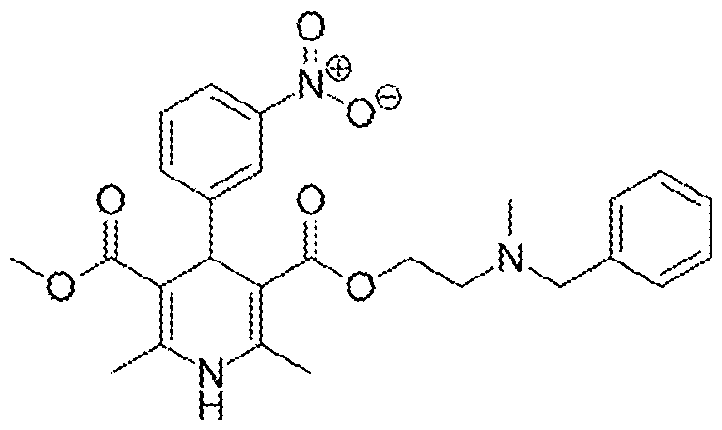
Nicardipine may be used for the treatment of angina, hypertension and Raynaud’s phenomenon. As noted above, nicardipine is a dihydropyridine calcium channel blocker. After ingestion, nicardipine is absorbed by the gut and metabolized by the liver before it goes into the systemic circulation and reaches the cells of the smooth muscles and cardiac muscle cells. Nicardipine inhibits the movement of calcium ions into smooth muscle cells and cardiac muscle cells. The contractile processes of cardiac muscle and smooth muscle are dependent upon the movement of extracellular calcium ions into these cells through specific Cav channels. Calcium channel blockers interfere with this movement. The effect of this interference is to relax blood vessels, widening them in turn. This may lower blood pressure and reduce stress on the heart.
In an embodiment, nicardipine may, for example, be administered in a range of 5-200 mg orally once per day.
In some exemplary embodiments, lercanidipine is provided as the dihydropyridine. Th e skeletal structure of lercanidipine (IUPAC name: 3-{l-[(3,3-diphenylpropyi)(methyl)amino ]-2-methylpropan-2-yl} 5-methyl 2,6-dimeihyl-4-(3-mtrophenyl)-l,4-dihydropyridme-3,5-dic arboxylate) is illustrated in Formula VII below:

The lercani dipine molecule comprises one asymmetric carbon. While the S -enantiomer is more effective than the R-enantiomer, marketed formulations typically contain a 1 : 1 mixture
of each enantiomer (i.e., the racemate). Lercani dipine is commercially available and sold under the trade name ZANADIP™, among others.
Lercani dipine is an antihypertensive drug. It is a four ring dihydropyridine that has been characterized as a calcium channel blocker. More specifically, lercanidipine blocks L-type calcium channels in smooth muscle cells of blood vessels, thereby relaxing and opening blood vessels. This, in turn, facilitates blood circulation and lowers blood pressure, thereby easing stress on the heart. Lercanidipine acts more slowly than older dihydropyridines. In contrast to the non-dihydropyridine calcium channel blockers (e.g., verapamil), lercanidipine does not significantly act on calcium channels in the atrioventricular node, and therefore does not decrease heart rate, in usual therapeutic doses. Lercanidipine is typically used in the form of a hydrochloride.
In an embodiment, lercanidipine may, for example, be administered in a range of 5-200 mg orally once per day.
In some exemplary embodiments, niguldipine is provided as the dihydropyridine. The skeletal structure of niguldipine (IUPAC name: 5-0-[3-(4,4-diphenylpiperidin-l-yl)propyl] 3- O-methy] 2,6-dimethyl-4-(3-nitrophenyl)-l ,4-dihydropyridine-3,5-dicarboxy3ate) is illustrated in Formula VIII below:

Niguldipine is a calcium channel blocker and an alphal -adrenergic receptor antagonist. It is commercially available from a variety of vendors, including Sigma Aldrich, MolCore, ChemTik, and Ambinter).
In an embodiment, niguldipine may, for example, be administered in a range of 5-200 mg orally once per day.
In some exemplary embodiments, manidipine is provided as the dihydropyridine. The skeletal structure of manidipine (IUPAC name: 5-0-[2-(4-benzhydrylpiperazin-i-yl)ethyl] 3- O-methyl 2,6-dimethyl-4-(3-nitrophenyl)-l,4-dihydropyridine-3,5-dicarboxylate) is illustrated in Formula IX below:

Manidipine is a dihydropyridine calcium antagonist, which causes systemic vasodilation by inhibiting the voltage-dependent calcium inward currents in smooth muscle cells. Manidipine has shown antihypertensive efficacy and appears to be well tolerated in adult and elderly patients with mild or moderate essential hypertension. It is commercially available and sold under the trade name MANYPER™, among others.
In an embodiment, manidipine may, for example, be administered in a range of 5-200 mg orally once per day.
In some exemplary embodiments, benidipine is provided as the dihydropyridine. The skeletal structure of benidipine (IUPAC name: 5-0-[(3i?)-l -benzylpiperidin-3-yl] 3-0-methyl (4/i)-2,6-dimethyl-4-(3-mtrophenyl)-l,4-dihydropyridine-3,5-dicarboxylate) is illustrated in Formula X below:

In an embodiment, benidipine may, for example, be administered in a range of 2-200 mg orally once per day or 5-200 mg orally once per day. In a particular embodiment, benidipine is dosed at 2-8 mg once daily.
In some exemplary embodiments, cilnidipine is provided as the dihydropyridine. The skeletal structure of cilnidipine (IUPAC name: 3-0-(2-methoxyethyl) 5-0-[(E)-3- phenylprop-2-enyl] 2,6-dimethyl-4-(3~nitrophenyl)~l,4-dihydropyridine-3,5-dicarboxyIate) is illustrated in Formula XI below:

Cilnidipine is a diesterified l,4-dihydropyridine-3,5-dicarboxylic acid. Cilnidipine is a calcium channel blocker, which is used as an antihypertensive. It is used as a calcium channel blocker, an antihypertensive agent, and a cardiovascular drug. It is a dihydropyridine, a 2- methoxy ethyl ester, and a C-nitro compound.
In an embodiment, Cilnidipine may, for example, be administered in a range of 5-200 mg orally once per day. In a particular embodiment, Cilnidipine is typically administered daily in 5 mg.
An effective amount of, e.g., a dihydropyridine in conjunction with a second agent with which it synergizes to reduce cancer burden, reduce cancer cell proliferation, or treat some types of cancer. Without limitation by theory, it is theorized that some types of cancer cells express isoforms of the Cavl.3 channel. These cancer-specific isoforms may possess a gating mechanism different than the Cavl.3 channel of normal cells. As such, the interaction of traditional Cavl.3 channel agonists/antagonists with the isoform Cavl.3 channels may be different than expected. For example, a traditional dihydropyridine calcium channel blocker, may instead lethally flood a cancer cell comprising the isoform Cavl.3 channels with calcium. Alternatively, the dihydropyridine calcium channel blocker may inhibit the isoform Cavl.3
channel to such an extent that the cancer cell cannot initiate or successfully finish cytokinesis, and this may result in cell death.
Without limitation by theory, the present inventors have discovered that combinations of first and second agents, at least one of which binds to a calcium channel can act synergistically to effectuate cancer cell death. This unexpected result may be due in part to the interaction of the dihydropyridine with isoforms of the Cav channels (e.g., isoforms of the Cavl.3 channels) that are expressed in cancer cells. In some embodiments, these isoforms may not be expressed in the corresponding non-cancerous cells. Without limitation by theory, and as noted above, the structural differences in the isoform voltage channels may allow the dihydropyridine to interact with the subject cell in a different manner than it does with the traditional voltage channel. As such, a calcium channel blocker as described herein may instead open the isoform voltage channel and lethally flood the cell with extracellular calcium. Alternatively, a calcium channel blocker as described herein may block the isoform voltage channel to such a degree that the cell is deprived of sufficient calcium and cannot initiate or successfully finish cytokinesis resulting in cell death.
In accordance with results presented herein, some embodiments comprise the administration of a pharmaceutical composition comprising a dihydropyridine, or salt or derivative thereof, and a second agent with which it exhibits synergy for the treatment of cancer. The treatment may be administration of a pharmaceutical composition comprising a dihydropyridine (or salt or derivative thereof) and a second agent with which it exhibits synergy, without chemotherapeutic agents. Alternatively, the treatment may be administration of a pharmaceutical composition comprising a dihydropyridine (or salt or derivative thereof) and a second agent with which it exhibits synergy, in combination with other treatment(s)/ agent(s) .
In certain embodiments, the present method for treating cancer may comprise the step of administering to a subject a dihydropyridine (or salt or derivative thereof) in combination with a second agent with which it exhibits synergy (e.g., ebastine). In certain embodiments, the present method for treating cancer cells may comprise the step of administering to the cancer cells a dihydropyridine (or salt or derivative thereof) in combination with a second agent with which it exhibits synergy (e.g., ebastine).
The skeletal structure of loperamide (IUPAC name: 4-[4-(4-Chlorophenyl)-4- hydroxypiperidin-l-yl]-N,N-dimethyl-2,2-diphenylbutanamide) is illustrated in Formula XII below:

Loperamide’s most common use is for the treatment of diarrhea. As a diarrhea medication, loperamide functions as an opioid-receptor agonist that acts on the m-opioid receptors in the myenteric plexus of the large intestine. Loperamide decreases the activity of the myenteric plexus, which decreases the tone of the longitudinal and circular smooth muscles of the intestinal wall. This in turn increases the time any material may reside in the intestine, allowing more water to be absorbed from the fecal matter. Loperamide also decreases colonic mass movements and suppresses the gastrocolic reflex. Loperamide is extremely well tolerated even though it is an opioid because it has functionally extremely low absorption into the gut (i.e., it does not substantially circulate in the bloodstream) and does not cross the blood-brain barrier. Loperamide's circulation in the bloodstream is limited in two ways. Efflux by P- gly coprotein in the intestinal wall reduces passage of loperamide, and any fractional amount of drug crossing may be further reduced through first pass metabolism by the liver, where loperamide is metabolized into other compounds.
In an embodiment, Loperamide may, for example, be administered in a range of 2-4 mg orally at least once per day, with a maximum dose of 16 mg per day. In a particular embodiment, Loperamide is administered in the range of 4-8 mg daily.
The skeletal structure of verapamil (IUPAC name: 2-(3,4-dimethoxyphenyl)-5-[2-(3,4- dimethoxyphenyl)e1hy!-methylamino]-2-propan-2-ylpentanenitrile) is illustrated in Formula XIII below:

V erapamil dosing- initial dose: 200 rng orally once a day at bedtime; in rare cases, initial doses of 100 mg orally once a day at bedtime may be warranted in patients who have an increased response to verapamil (e.g., low-weight patients); Maintenance dose: Upward titration should be based on therapeutic efficacy and safety evaluated about 24 hours after dosing. If adequate response is not obtained with the initial dose, it may be titrated upward to a maximum dose of 400 mg/day.
The skeletal structure of ebastine (IUPAC name: 4-(4-benzhydryloxypiperidin-l-yl)-l- (4-feT/-buty3phenyl)butan-l-one) is illustrated in Formula XIV below:

Ebastine is a non-sedating Hl antihistamine, which does not penetrate the blood-brain barrier and thus blocks the Hl receptor in peripheral tissue without central side effects (e.g., sedation and drowsiness).
Ebastine is often provided in micronized form, due to poor water solubility. In an embodiment, Ebastine may, for example, be administered in a range of 5-200 mg orally once per day Ebastine doses typically range from 5 mg-20 mg per day, more particularly 5 mg, 10 mg, or 20 mg per day.
The combination therapy may be achieved by administering a pharmaceutical composition that includes both agents (a dihydropyridine (or salt or derivative thereof) and with a second agent with which it exhibits synergy (e.g., ebastine), or by administering two pharmaceutical compositions, at the same time or within a short time period, wherein one composition comprises a dihydropyridine (or salt or derivative thereof), and the other composition includes a second agent with which it exhibits synergy (e.g., ebastine).
The present disclosure provides methods to reduce cancer cell growth, proliferation, and/or metastasis, as measured according to routine techniques in the diagnostic art. Specific examples of relevant responses include reduced size, mass, or volume of a tumor, or reduction in cancer cell number.
The present compositions and methods can have one or more of the following effects on cancer cells or the subject: cell death; decreased cell proliferation; decreased numbers of cells; inhibition of cell growth; apoptosis; necrosis; mitotic catastrophe; cell cycle arrest; decreased cell size; decreased cell division; decreased cell survival; decreased cell metabolism; markers of cell damage or cytotoxicity; indirect indicators of cell damage or cytotoxicity such as tumor shrinkage; improved survival of a subject; preventing, inhibiting or ameliorating the cancer in the subject, such as slowing progression of the cancer, reducing or ameliorating a sign or symptom of the cancer; reducing the rate of tumor growth in a patient; preventing the continued growth of a tumor, reducing the size of a tumor; and/or disappearance of markers associated with undesirable, unwanted, or aberrant cell proliferation. See, e.g., U.S. Patent Publication No. 20080275057, which is incorporated herein by reference in its entirety.
Methods and compositions of the present invention are useful for amelioration of signs and/or symptoms of cancer.
As used herein, the term“synergy” (or "synergistic") means that the effect achieved with the methods and combinations of this disclosure is greater than the sum of the effects that result from using the individual agents alone, e.g., using the dihydropyridine (or salt or derivative thereof) alone and the second agent (e.g., ebastine) alone. For example, the effect (e.g., apoptosis of cells, a decrease in cell viability, cytotoxicity, a decrease in cell proliferation, a decrease in cell survival, inhibition of tumor growth, a reduction in tumor volume, and/or tumor stasis, etc. as described herein) achieved with the combination of a dihydropyridine (or salt or derivative thereof) and the second agent (e.g., ebastine) is about 1.1 fold, about 1.2 fold, about 1.3 fold, about 1.4 fold, about 1.5 fold, about 1.6 fold, about 1.7 fold, about 1.8 fold, about 1.9 fold, about 2 fold, about 2.5 fold, about 3 fold, about 3.5 fold, about 4 fold, about 4.5 fold, about 5 fold, about 5.5 fold, about 6 fold, about 6.5 fold, about 7 fold, about 8 fold, about
9 fold, about 10 fold, about 12 fold, about 15 fold, about 20 fold, about 25 fold, about 30 fold, about 50 fold, about 100 fold, at least about 1.2 fold, at least about 1.5 fold, at least about 2 fold, at least about 2.5 fold, at least about 3 fold, at least about 3.5 fold, at least about 4 fold, at least about 4.5 fold, at least about 5 fold, at least about 5.5 fold, at least about 6 fold, at least about 6.5 fold, at least about 7 fold, at least about 8 fold, at least about 9 fold, at least about 10 fold, of the sum of the effects that result from using the dihydropyridine (or salt or derivative thereof) alone or the second agent (e.g., ebastine) alone.
Synergistic effects of the combination may also be evidenced by additional, novel effects that do not occur when either agent is administered alone, or by reduction of adverse side effects when either agent is administered alone.
Methods for determining proliferation of cells (e.g., reduced proliferation) include assays for measuring cytotoxic effects of agents/compositions described herein. Cytotoxicity effects can be determined by any suitable assay, including, but not limited to, assessing cell membrane integrity (using, e.g., dyes such as trypan blue or propidium iodide, or using lactate dehydrogenase (LDH) assay), measuring enzyme activity, measuring cell adherence, measuring ATP production, measuring co-enzyme production, measuring nucleotide uptake activity, crystal violet method, Tritium-labeled Thymidine uptake method, measuring lactate dehydrogenase (LDH) activity, 3-(4, 5-Dimethyl-2-thiazolyl)-2, 5-diphenyl-2H-tetrazolium bromide (MTT) or MTS assay, sulforhodamine B (SRB) assay, WST assay, clonogenic assay, cell number count, monitoring cell growth, apoptosis, etc.
Apoptosis of cells may be assayed by any suitable method, including, but not limited to, TUNEL (terminal deoxynucleotidyl transferase dUTP nick end labeling) assay, assaying levels of cytochrome C release, assaying levels of cleaved/activated caspases, assaying 5- bromo-2'-deoxyuridine labeled fragmented DNA, assaying levels of surviving, etc.
Other methods that can be used to show the synergistic effects of the present methods, pharmaceutical compositions and combinations include, but are not limited to, clonogenic assay (colony formation assay) to show decrease in cell survival and/or proliferation, studying tumor volume reduction in animal models (such as in mice, etc.).
A reduction in cancer burden may be determined using methods known in the art, including, without limitation, use of calipers to measure tumor size and various methods for visualizing tumor size in situ, including computer assisted tomography (CAT) scans, positron emission tomography (PET) scans, 3 dimensional sonography, x-ray, ultrasound; each of may be performed with or without contrast agents.
In one embodiment, advantageously, such synergy provides greater efficacy at the same doses, lower side effects, and/or prevents or delays the build-up of multi-drug resistance.
A first agent (or salt or derivative thereof) and a second agent may be administered simultaneously, separately or sequentially. In an embodiment, the first agent is a dihydropyridine (or salt or derivative thereof) and the second agent (e.g., ebastine) may be administered simultaneously, separately or sequentially. They may exert an advantageously combined effect (e.g., additive or synergistic effects).
Pharmaceutical compositions and methods may be administered/performed at a frequency of once, twice, or thrice per day, every other day, twice per week, once per week, once every other week, or once a month. The frequency of administration may be determined based, for example, on the condition being treated, the severity of the condition, the mode of administration, and the patient’s health status.
The treatment regimen may be maintained for a duration of at least a week, at least a month, or for two, three, four, five, six, seven, eight, nine, ten, eleven, or 12 months. Duration of treatment may be determined based, for example, on the condition being treated, the severity of the condition, the mode of administration, and the patient’s health status. In a particular embodiment, the treatment is intermittent. Intermittent treatment involves treatment regimens that intersperse periods of rest (no treatment) with periods wherein the subject is administered agents/compositions described herein.
For sequential administration, either a first agent (e.g., dihydropyridine or salt or derivative thereof) is administered first and then the second agent (e.g., ebastine), or the second agent (e.g., ebastine) is administered first and then the first agent (e.g., a dihydropyridine or salt or derivative thereof). In embodiments where a dihydropyridine (or salt or derivative thereof) and the second agent (e.g., ebastine) are administered separately, administration of a first agent can precede administration of a second agent by seconds, minutes, hours, days, or weeks. The time difference in non-simultaneous administrations may be greater than 1 minute, and can be, for example, precisely, at least, up to, or less than 5 minutes, 10 minutes, 15 minutes, 30 minutes, 45 minutes, 60 minutes, 2 hours, 3 hours, 6 hours, 9 hours, 12 hours, 24 hours, 36 hours, or 48 hours, or more than 48 hours. The two or more agents can be administered within minutes of each other or within about 0.5, about 1, about 2, about 3, about 4, about 6, about 9, about 12, about 15, about 18, about 24, or about 36 hours of each other or within about 1, 2, 3, 4, 5, 6, 7, 8, 9, 10, 12, 14 days of each other or within about 2, 3, 4, 5, 6, 7, 8, 9, or 10 weeks of each other. In some cases, longer intervals are possible.
The present disclosure also provides for a pharmaceutical composition comprising (i) a
first agent; and (ii) a second agent as described herein. In a particular embodiment, the pharmaceutical composition comprises (i) a dihydropyridine (or salt or derivative thereof); and (ii) a second agent (e.g., ebastine).
The present compositions may be administered alone, or in combination with radiation, surgery or chemotherapeutic agents. The present compositions may be administered before, during or after the administration of radiation, surgery or chemotherapeutic agents.
The present disclosure also provides for methods of using a first agent and a second agent as described herein to treat a disease, such as cancer. In a particular embodiment, methods of using a dihydropyridine as the first agent and a second agent (e.g., ebastine) to treat a disease, such as cancer, are presented. A dihydropyridine may be administered with the second agent (e.g., ebastine), or in combination with radiation, surgery or chemotherapeutic agents. A dihydropyridine and a second agent (e.g., ebastine) may also be co-administered with antiviral agents, anti-inflammatory agents or antibiotics. The agents may be administered concurrently or sequentially. A dihydropyridine and a second agent (e.g., ebastine) can be administered before, during or after the administration of the other active agent(s).
The dihydropyridine and the second agent (e.g., ebastine), for example, may be used in combination with radiation therapy. In one embodiment, the present disclosure provides for a method of treating tumor cells or cancer with radiation, where the cells are treated with an effective amount of a dihydropyridine and a second agent (e.g., ebastine), and then exposed to radiation. Dihydropyridine and the second agent (e.g., ebastine) treatment may be before, during and/or after radiation. For example, the dihydropyridine and the second agent (e.g., ebastine) may be administered continuously beginning one week prior to the initiation of radiotherapy and continued for two weeks after the completion of radiotherapy.
In one embodiment, the present invention provides for a method of treating tumor cells or cancer with chemotherapy, where the cells are treated with an effective amount of a dihydropyridine and the second agent (e.g., ebastine), and then exposed to chemotherapy. Dihydropyridine and the second agent (e.g., ebastine) treatment may be before, during and/or after chemotherapy.
The present agent/composition may be used in combination with a cytotoxic agent. The combination of the present agents/composition and the cytotoxic agent may produce a synergistic effect on the cancer or cancer cells compared to the effect of the present agents/composition alone or the effect of the cytotoxic agent alone. The synergistic effects are discussed herein.
The cytotoxic agent may be any chemotherapeutic agents including, but not limited to, alkylating agents, anti-metabolites, anti-microtubule agents, topoisomerase inhibitors, cytotoxic antibiotics, endoplasmic reticulum stress inducing agents, platinum compounds, vincalkaloids, taxanes, epothilones, enzyme inhibitors, receptor antagonists, tyrosine kinase inhibitors, boron radiosensitizers (i.e. velcade), and chemotherapeutic combination therapies.
Non-limiting examples of DNA alkylating agents are nitrogen mustards, such as Cyclophosphamide (Ifosfamide, Trofosfamide), Chlorambucil (Melphalan, Prednimustine), Bendamustine, Uramustine and Estramustine; nitrosoureas, such as Carmustine (BCNU), Lomustine (Semustine), Fotemustine, Nimustine, Ranimustine and Streptozocin; alkyl sulfonates, such as Busulfan (Mannosulfan, Treosulfan); Aziridines, such as Carboquone, Triaziquone, Triethylenemelamine; Hydrazines (Procarbazine); Triazenes such as Dacarbazine and Temozolomide (TMZ); Altretamine and Mitobronitol.
Non-limiting examples of Topoisomerase I inhibitors include Campothecin derivatives including SN-38, APC, NPC, campothecin, topotecan, exatecan mesylate, 9- nitrocamptothecin, 9-aminocamptothecin, lurtotecan, rubitecan, silatecan, gimatecan, diflomotecan, extatecan, BN-80927, DX-895H, and MAG-CPT as decribed in Pommier Y. (2006) Nat. Rev. Cancer 6(l0):789-802 and U.S. Patent Publication No. 200510250854; Protoberberine alkaloids and derivatives thereof including berberrubine and coralyne as described in Li et al. (2000) Biochemistry 39(24):7107-7116 and Gatto et al. (1996) Cancer Res. 15(12):2795-2800; Phenanthrobne derivatives including Benzo[i]phenanthridine, Nitidine, and fagaronine as described in Makhey et al. (2003) Bioorg Med. Chem. 11 (8): 1809-1820; Terbenzimidazole and derivatives thereof as described in Xu (1998) Biochemistry 37(l0):3558-3566; and Anthracycbne derivatives including Doxorubicin, Daunorubicin, and Mitoxantrone as described in Foglesong et al. (1992) Cancer Chemother Pharmacol. 30(2): 123-125, Crow et al. (1994) J Med. Chem 37(19):31913194, and Crespi et al. (1986) Biochem Bionhvs. Res. Commun. l36(2):52l-8. Topoisomerase II inhibitors include, but are not limited to Etoposide and Teniposide. Dual topoisomerase I and II inhibitors include, but are not limited to, Saintopin and other Naphthecenediones, DACA and other Acridine-4- Carboxamindes, Intopbcine and other Benzopyridoindoles, TAS-I03 and other 7H-indeno[2,l- c]Quinobne-7-ones, Pyrazoloacridine, XR 11576 and other Benzophenazines, XR 5944 and other Dimeric compounds, 7-oxo-7H-dibenz[f,ij]Isoquinobnes and 7-oxo-7H- benzo[e]pyrimidines, and Anthracenyl-amino Acid Conjugates as described in Denny and Baguley (2003) Curr Top Med. Chem 3(3):339-353. Some agents inhibit Topoisomerase II and have DNA intercalation activity such as, but not limited to, Anthracy dines (Aclarubicin,
Daunorubicin, Doxorubicin, Epirubicin, Idarubicin, Amrubicin, Pirarubicin, Valrubicin, Zorubicin) and Antracenediones (Mitoxantrone and Pixantrone).
Examples of endoplasmic reticulum stress inducing agents include, but are not limited to, dimethyl-celecoxib (DMC), nelfmavir, celecoxib, and boron radiosensitizers (i.e. velcade (Bortezomib)).
Platinum based compounds are a subclass of DNA alkylating agents. Non-limiting examples of such agents include Cisplatin, Nedaplatin, Oxaliplatin, Triplatin tetranitrate, Satraplatin, Aroplatin, Lobaplatin, and JM-216. (See McKeage et al. (1997) J Clin. Oncol. 201 : 1232-1237 and in general, CHEMOTHERAPY FOR GYNECOLOGICAL NEOPLASM, CURRENT THERAPY AND NOVEL APPROACHES, in the Series Basic and Clinical Oncology, Angioli et al. Eds., 2004).
Non-limiting examples of antimetabolite agents include folic acid based, i.e. dihydrofolate reductase inhibitors, such as Aminopterin, Methotrexate and Pemetrexed; thymidylate synthase inhibitors, such as Raltitrexed, Pemetrexed; Purine based, i.e. an adenosine deaminase inhibitor, such as Pentostatin, a thiopurine, such as Thioguanine and Mercaptopurine, a halogenated/ribonucleotide reductase inhibitor, such as Cladribine, Clofarabine, Fludarabine, or a guanine/guanosine: thiopurine, such as Thioguanine; or Pyrimidine based, i.e. cytosine/cytidine: hypomethylating agent, such as Azacitidine and Decitabine, a DNA polymerase inhibitor, such as Cytarabine, a ribonucleotide reductase inhibitor, such as Gemcitabine, or a thymine/thymidine: thymidylate synthase inhibitor, such as a Fluorouracil (5-FU). Equivalents to 5-FU include prodrugs, analogs and derivative thereof such as 5' -deoxy-5-fluorouridine (doxifluroidine), l-tetrahydrofuranyl-5-fluorouracil (ftorafur), Capecitabine (Xeloda), S-I (MBMS-247616, consisting of tegafur and two modulators, a 5-chloro-2,4-dihydroxypyridine and potassium oxonate), ralititrexed (tomudex), nolatrexed (Thymitaq, AG337), LY231514 and ZD9331, as described for example in Papamicheal (1999) The Oncologist 4:478-487.
Examples of vincalkaloids, include, but are not limited to Vinblastine, Vincristine, Vinflunine, Vindesine and Vinorelbine.
Examples of taxanes include, but are not limited to docetaxel, Larotaxel, Ortataxel, Paclitaxel and Tesetaxel. An example of an epothilone is iabepilone.
Examples of enzyme inhibitors include, but are not limited to famesyltransferase inhibitors (e.g., Tipifamib); CDK inhibitors (e.g., Alvocidib, Seliciclib); proteasome inhibitors (e.g., Bortezomib); phosphodiesterase inhibitors (e.g., Anagrelide; rolipram); IMP dehydrogenase inhibitors (e.g., Tiazofurine); and lipoxygenase inhibitors (e.g., Masoprocol).
Chemotherapeutic agents may also include amsacrine, Trabectedin, retinoids (Alitretinoin, Tretinoin), Arsenic trioxide, asparagine depleter Asparaginase/ Pegaspargase), Celecoxib, Demecolcine, Elesclomol, Elsamitrucin, Etoglucid, Lonidamine, Lucanthone, Mitoguazone, Mitotane, Oblimersen, Temsirobmus, and Vorinostat.
Cancers treated using methods and compositions described herein are characterized by abnormal cell proliferation including, but not limited to, pre-neoplastic hyperprobferation, cancer in-situ, neoplasms and metastasis.
Cancers that can be treated by the present compositions and methods include, but are not limited to, lung cancer (e.g., non-small cell lung cancer), melanoma, breast cancer, colorectal cancer, pancreatic cancer, cervical cancer, thyroid cancer, bladder cancer, liver cancer, prostate cancer, muscle cancer, hematological malignancies, endometrial cancer, lymphomas, sarcomas and carcinomas, e.g., fibrosarcoma, myxosarcoma, bposarcoma, chondrosarcoma, osteogenic sarcoma, chordoma, angiosarcoma, endothebosarcoma, lymphangiosarcoma, synovioma, mesothelioma, lymphangioendothebosarcoma, Ewing's tumor, leiomyosarcoma, rhabdomyosarcoma, colon carcinoma, ovarian cancer, gastric cancer, esophageal cancer, squamous cell carcinoma, basal cell carcinoma, adenocarcinoma, sweat gland carcinoma, sebaceous gland carcinoma, papillary carcinoma, papillary adenocarcinomas, cystadenocarcinoma, medullary carcinoma, bronchogenic carcinoma, renal cell carcinoma, hepatoma, bile duct carcinoma, choriocarcinoma, seminoma, embryonal carcinoma, Wilms' tumor, cervical cancer, testicular tumor, lung carcinoma, non-small cell lung carcinoma, small cell lung carcinoma, bladder carcinoma, epithelial carcinoma, glioma, astrocytoma, medulloblastoma, craniopharyngioma, ependymoma, pinealoma, hemangioblastoma, acoustic neuroma, oligodendroglioma, meningioma, melanoma, neuroblastoma, retinoblastoma; leukemias, e.g., acute lymphocytic leukemia and acute myelocytic leukemia (myeloblastic, promyelocytic, myelomonocytic, monocytic and erythroleukemia); chronic leukemia (chronic myelocytic (granulocytic) leukemia and chronic lymphocytic leukemia); and polycythemia vera, lymphoma (Hodgkin's disease and non-Hodgkin's disease), multiple myeloma, ear, nose and throat cancer, hematopoietic cancer, biliary tract cancer; bladder cancer; bone cancer; choriocarcinoma; connective tissue cancer; cancer of the digestive system; esophageal cancer; eye cancer; cancer of the head and neck; gastric cancer; intra-epithelial neoplasm; kidney cancer; larynx cancer; leukemia including acute myeloid leukemia, acute lymphoid leukemia, chronic myeloid leukemia, chronic lymphoid leukemia; lymphoma including Hodgkin's and Non-Hodgkin's lymphoma; myeloma; fibroma, oral cavity cancer (e.g., lip, tongue, mouth, and pharynx); prostate cancer; retinoblastoma; rhabdomyosarcoma; rectal cancer; renal cancer;
cancer of the respiratory system; skin cancer; stomach cancer; testicular cancer; uterine cancer; cancer of the urinary system, as well as other carcinomas and sarcomas. In a particular embodiment, the cancer expresses an isoform of the Cavl.3 channel.
The present disclosure provides a pharmaceutical composition (or pharmaceutical formulation) comprising a dihydropyridine and the second agent (e.g., ebastine), or a pharmaceutically acceptable salt thereof, and one or more excipients (also referred to as carriers and/or diluents in the pharmaceutical arts).
Also encompassed by the present disclosure is a pharmaceutical composition comprising, e.g., a dihydropyridine (or salt or derivative thereof) as a first agent and a second agent (e.g., ebastine).
In alternative embodiments, two or more individual pharmaceutical compositions may be prepared. The individual pharmaceutical compositions comprise the second agent (e.g., ebastine) or the dihydropyridine, or pharmaceutically acceptable salts thereof, and one or more excipients. The two or more individual pharmaceutical compositions may then be delivered to the desired subject (e.g., a human, tissue, etc.) or cells in combination.
In one embodiment, the synergistic effect is especially pronounced at lower concentrations of, e.g., a dihydropyridine (or salt or derivative thereof) and/or the second agent (e.g., ebastine).
The excipients are acceptable in the sense of being compatible with the other ingredients of the formulation and not deleterious to the recipient thereof (i.e., the patient). Further embodiments provide the administration of an effective amount or a therapeutically effective amount of the dihydropyridine and the second agent (e.g., ebastine) or a pharmaceutical composition of the dihydropyridine and the second agent (e.g., ebastine).
The purpose of a pharmaceutical composition is to facilitate administration of the dihydropyridine and the second agent (e.g., ebastine) to a subject (e.g., a human). The pharmaceutical compositions may be formulated by one having ordinary skill in the art. Suitable pharmaceutical carriers include, but are not limited to, fillers, disintegrants, lubricants, glidants, and soluble and insoluble polymers, examples of which are described in Remington's Pharmaceutical Sciences, A. Osol, a standard reference text in this field, which is incorporated herein in its entirety by reference. The pharmaceutical compositions of the invention are suitable for administration systemically or in a local manner, for example, via injection of the pharmaceutical composition directly into a tissue region of a patient (e.g., intralesional injection).
The present agent may refer to a combination of a dihydropyridine (or salt or derivative thereof) and the second agent (e.g., ebastine), or a combination of any agents described herein. The present composition may refer to a pharmaceutical composition comprising the present combinations of synergistic agents.
Some embodiments further provide a process for the preparation of a pharmaceutical composition comprising combining, reacting, mixing (or admixing), etc. the dihydropyridine, or salt thereof, and the second agent (e.g., ebastine) with at least one excipient.
Typically, but not absolutely, the salts of the present invention are pharmaceutically acceptable salts. Salts encompassed within the term“pharmaceutically acceptable salts” refer to non-toxic salts of a dihydropyridine and/or the second agent (e.g., ebastine). Salts of the dihydropyridine may comprise acid addition salts. In general, the salts are formed from pharmaceutically acceptable inorganic and organic acids. More specific examples of suitable acid salts include maleic, hydrochloric, hydrobromic, sulphuric, phosphoric, nitric, perchloric, fumic, acetic, propionic, succinic, glycolic, formic, lactic, aleic, tartaric, citric, palmoic, malonic, hydroxymaleic, phenylacetic, glutamic, benzoic, salicylic, fumaric, toluenesulfonic, methansulfonic (mesylate), naphthalene-2-sulfonic, benzenesulfonic, hydroxynaphthoic, hydroiodic, malic, teroic, tannic, and the like.
Other representative salts may include acetate, benzenesulfonate, benzoate, bicarbonate, bisulfate, bitartrate, borate, calcium edetate, camsylate, carbonate, clavulanate, citrate, dihydrochloride, edisylate, estolate, esylate, fumarate, gluceptate, gluconate, glutamate, glycollylarsanilate, hexylresorcinate, hydrobromide, hydrochloride, hydroxynaphthoate, iodide, isethionate, lactate, lactobionate, laurate, malate, maleate, mandelate, mesylate, methylsulfate, monopotassium maleate, mucate, napsylate, nitrate, oxalate, pamoate (embonate), palmitate, pantothenate, phosphate/diphosphate, polygalacturonate, salicylate, stearate, subacetate, succinate, sulfate, tannate, tartrate, teoclate, tosylate, triethiodide, and valerate salts.
Other salts, which may not be pharmaceutically acceptable, may still be useful in the preparation of pharmaceutical compositions of, e.g., the dihydropyridine, and these should be considered to form a further aspect of the embodiments. These salts, such as oxalic or trifluoroacetate, while not in themselves pharmaceutically acceptable, may be useful in the preparation of salts used as intermediates in obtaining, e.g., a dihydropyridine and/or its pharmaceutically acceptable salt.
Pharmaceutical compositions may be in unit dose form containing a predetermined amount of active ingredient per unit dose. Such a unit may contain a therapeutically effective
amount of, for example, a dihydropyridine. In some embodiments, a fraction of a therapeutically effective dose may be used, such that multiple unit dosage forms might be administered at a given time to achieve the desired therapeutically effective dose. Furthermore, such pharmaceutical compositions may be prepared by any of the methods well known in the pharmacy art.
Pharmaceutical compositions may be adapted for administration by any appropriate route, including for example, by oral (including buccal or sublingual), rectal, nasal, topical (including buccal, sublingual, or transdermal), vaginal, or parenteral (including subcutaneous, intramuscular, intravenous, or intradermal) routes. Such compositions may be prepared by any method known in the art of pharmacy, for example, by bringing into association the active ingredient with the excipient(s).
For injection, the active ingredients of the pharmaceutical composition may be formulated in aqueous solutions, preferably in physiologically compatible buffers such as Hank’s solution, Ringer’s solution, or physiological salt buffer. Pharmaceutical compositions for parenteral administration include aqueous solutions of the active preparation in water- soluble form. Additionally, suspensions of the active ingredients may be prepared as oily or water-based injection suspensions. Suitable lipophilic solvents or vehicles include fatty oils such as sesame oil, or synthetic fatty acid esters such as ethyl oleate, triglycerides, or liposomes. Aqueous injection suspensions may contain substances that increase the viscosity of the suspension, such as sodium carboxymethyl cellulose, sorbitol, or dextran. Optionally, the suspension may also contain suitable stabilizers or agents that increase the solubility of the active ingredients, to allow for the preparation of highly concentrated solutions. Alternatively, the active ingredient may be in powder form for constitution with a suitable vehicle, such as, for example, a sterile, pyrogen-free, water-based solution, before use.
For oral administration, the pharmaceutical composition may be formulated readily by combining, e.g., the dihydropyridine and the second agent (e.g., ebastine) with pharmaceutically acceptable carriers well known in the art. Such carriers enable the pharmaceutical composition to be formulated as tablets, pills, dragees, capsules, liquids, gels, syrups, slurries, suspensions, and the like, for oral ingestion by a patient. Pharmacological preparations for oral use may be made using a solid excipient, optionally grinding the resulting mixture, and processing the mixture of granules, after adding suitable auxiliaries as desired, to obtain tablets or dragee cores. Suitable excipients include fillers such as sugars, including lactose, sucrose, mannitol, or sorbitol; cellulose preparations such as, for example, maize starch, wheat starch, rice starch, potato starch, gelatin, gum tragacanth, methyl cellulose,
hydroxypropylmethyl-cellulose, and sodium carbomethylcellulose; and/or physiologically acceptable polymers such as polyvinylpyrrolidone, hereafter“PVP.” If desired, disintegrating agents, such as cross-linked polyvinyl pyrrolidone, agar, or alginic acid or a salt thereof, such as sodium alginate, may be added.
Pharmaceutical compositions that may be used orally include push-fit capsules made of gelatin, as well as soft, sealed capsules made of gelatin and a plasticizer, such as glycerol or sorbitol. The push-fit capsules may contain, e.g., the dihydropyridine and the second agent (e.g., ebastine) in admixture with a filler such as lactose, binders such as starches, lubricants such as talc or magnesium stearate, and, optionally, stabilizers. In soft capsules, the dihydropyridine and the second agent (e.g., ebastine) may be dissolved or suspended in suitable liquids, such as fatty oils, liquid paraffin, or liquid polyethylene glycols. In addition, stabilizers may be added in some optional embodiments. All formulations for oral administration should be in dosages suitable for the chosen route of administration.
The pharmaceutical compositions of the invention are also useful for topical and intralesional application. As used herein, the term“topical” means pertaining to a particular surface area, and the topical agent applied to a certain area of said surface will affect only the area to which it is applied.
Topical pharmaceutical compositions may comprise, without limitation, non-washable (water-in-oil) creams or washable (oil-in-water) creams, ointments, lotions, gels, suspensions, aqueous or cosolvent solutions, salves, emulsions, coated bandages or other polymer coverings, benzene rings, sprays, aerosols, liposomes and any other pharmaceutically acceptable carrier suitable for administration of the, e.g., dihydropyridine and the second agent (e.g., ebastine) topically.
As is well known in the art, the physico-chemical characteristics of the carrier may be manipulated by addition of a variety of excipients, including, but not limited to, thickeners, gelling agents, wetting agents, flocculating agents, suspending agents and the like. These optional excipients will determine the physical characteristics of the resultant formulations such that the application may be more pleasant or convenient. It will be recognized by the skilled artisan that the excipients selected should preferably enhance, and in any case must not interfere with, the storage stability of the formulations.
In some embodiments, the pharmaceutical composition may be formulated for pulmonary administration. In another embodiment, the pharmaceutical composition of, e.g., the dihydropyridine and the second agent (e.g ebastine) is formulated for administration as an aerosol or mist. In another embodiment, said pharmaceutical composition is formulated for use
with a nebulizer or inhaler. The dihydropyridine and the second agent (e.g., ebastine) may be administered by inhalation in different ways, such as in pressurized metered-dosage inhalers, in dry powder inhalers, in a liquid solution delivered by nebulizer or small volume liquid inhaler, or in a vaporized formulation suitable for inhalation or nasal aspiration. Pressurized metered dose inhalers (hereafter“pMDIs”) containing, e.g., the dihydropyridine and the second agent (e.g., ebastine) in combination with propellants, for example, may be formulated to contain the dihydropyridine and the second agent (e.g., ebastine) in solution or in dispersion in a propellant, such as HFA l34a or HFA227, alone or in combination with excipients to modify aerosol performance, such as co-solvents (e.g., ethanol, glycerol, polyethylene glycols, propylene glycol), surfactants (e.g., oleic acid) or other excipients such as stabilizers and pH modifiers (e.g., ascorbic acid, sodium edetate, hydrochloric acid). Where the dihydropyridine and the second agent (e.g., ebastine) are presented as a dispersion in pMDIs, then appropriate physical and/or chemical methods may be used to ensure that the aerodynamic particle size upon aerosolization is appropriate for delivery to the respiratory airways, typically less than 10 pm and preferably less than 5 pm.
Dry powder inhalers (hereafter“DPIs”) containing, e.g., the dihydropyridine and the second agent (e.g., ebastine) may be formulated to contain dihydropyridine and the second agent (e.g., ebastine) as small particles, either alone or in combination with a carrier particle such as lactose or sucrose, to aid aerosolization. Appropriate physical and/or chemical methods may be used to ensure that the aerodynamic particle size upon aerosolization from DPIs is appropriate for delivery to the respiratory airways, typically less than 10 pm and preferably less than 5 pm.
Nebulizers and small volume liquid inhaler preparations of the dihydropyridine and the second agent (e.g., ebastine), for example, may be formulated to contain the dihydropyridine and the second agent (e.g., ebastine) in solution or in dispersion in an aqueous medium, alone or in combination with excipients to modify aerosol performance, such as co- solvents (e.g., ethanol, glycerol, polyethylene glycols, propylene glycol), surfactants (e.g., oleic acid), or other excipients such as stabilizers and pH modifiers (e.g., ascorbic acid, sodium edetate, hydrochloric acid). Where the dihydropyridine and the second agent (e.g., ebastine) are, e.g., presented as a dispersion in nebulizers and small volume liquid inhalers, then appropriate physical and/or chemical methods may be used to ensure that the aerodynamic particle size upon aerosolization is appropriate for delivery to the respiratory airways, typically less than 10 pm and preferably less than 5 pm.
Vaporized formulations of the dihydropyridine and the second agent (e.g., ebastine), suitable for inhalation, for example, may be formulated by heating the dihydropyridine and the second agent (e.g., ebastine) to a high temperature for a short time period, typically less than 1 second, alone or in combination with excipients to modify aerosol performance (e.g., propylene glycol, ethanol). The methods used may ensure that the aerodynamic particle size upon aerosolization is appropriate for delivery to the respiratory airways, typically less than 10 pm and preferably less than 5 pm.
It is to be understood that any reference to the preparation of or use of any of the dihydropyridines and the second agent (e.g., ebastine) necessarily also encompasses any preparation of or use of the salts of any of these agents as well as the pharmaceutical compositions comprising same, whether prepared alone or in combination with other therapeutics.
As used herein, the term“treatment” refers to alleviating the specified condition, eliminating or reducing one or more symptoms of the condition, and/or slowing or eliminating the progression of the condition in a patient or subject.
As used herein, the term “effective amount” means that amount of a drug or pharmaceutical agent that will elicit the biological or medical response of a tissue, system, animal, or human that is being sought, for instance, by a researcher or clinician.
The term“therapeutically effective amount” means any amount which, as compared to a corresponding subject who has not received such amount, results in improved treatment, healing, or amelioration of a disease, disorder, or side effect, or a decrease in the rate of advancement of a disease or disorder. The term also includes within its scope amounts effective to enhance normal physiological function. For use in therapy, therapeutically effective amounts of, e.g., a dihydropyridine and a second agent (e.g., ebastine), as well as any salts thereof, may be administered as the raw chemicals. Additionally, the dihydropyridine and the second agent (e.g., ebastine) may be presented as a pharmaceutical composition.
In some embodiments, a method of treatment is provided for a human suffering from disease conditions targeted, e.g., by the dihydropyridine and the second agent (e.g., ebastine). Such treatment comprises the step of administering to a subject an effective amount and/or therapeutically effective amount of the dihydropyridine and the second agent (e.g., ebastine).
In one specific embodiment, a method is provided for treating a subject (e.g., a human) having a cancer expressing an isoform of the Cavl.3 channel comprising administering to the subject therapeutically effective amount of the present agents/composition, as described herein. In a further embodiment, the cancer comprising the isoform of the Cavl.3 channel is identified
prior to administration of the present agents/composition. For example, the method may comprise identifying a subject amenable for treatment with the present agent/composition by determining whether a biological sample of the subject expresses an isoform of the Cavl.3 channel amenable for treatment with the present agents/composition. In further embodiments, the present agents/composition may then be administered locally to the tissue, organ, etc. of the subject expressing the Cavl .3 isoform channel or may be administered systemically to the subject.
In various embodiments of diagnostic methods disclosed herein, the sample may include, without limitation, a cell sample, a tissue sample, or a fluid sample. In a particular embodiment, the sample is a tumor sample (e.g., a tumor biopsy). In other embodiments, a variety of immunoassays may be used (e.g., enzyme-linked immunosorbent assay, ELISA) and/or other molecular biology assays (e.g., reverse transcription polymerase chain reaction, RT-PCR). In another embodiment, there is provided a kit for determining whether a subject is amenable for treatment with, e.g., the dihydropyridine and the second agent (e.g., ebastine). For example, without limitation, the kit may comprise one or more antibodies, PCR primers, or other reagents that may be employed in various immunoassays and other molecular biology assays known in the art.
An exemplary nucleic acid sequence comprising an isoform of the Cavl.3 channel is designated SEQ ID NO: 1, the sequence for which is as follows:
AGCACCTCTGCACCCCCACCTGTAGGATCTCTCTCCCAAAGAAAACGTCAGCAAT
ACGCCAAGAGCAAAAAACAGGGTAACTCGTCCAACAGCCGACCTGCCCGCGCCC
TTTTCTGTTTATCACTCAATAACCCCATCCGAAGAGCCTGCATTAGTATAGTGGA
ATGGAAACCATTTGACATATTTATATTATTGGCTATTTTTGCCAATTGTGTGGCCT
TAGCTATTTACATCCCATTCCCTGAAGATGATTCTAATTCAACAAATCATAACTTG
GAAAAAGTAGAATATGCCTTCCTGATTATTTTTACAGTCGAGACATTTTTGAAGA
TTATAGCGTATGGATTATTGCTACATCCTAATGCTTATGTTAGGAATGGATGGAA
TTT ACT GGATTTT GTT AT AGT A AT AGT AGGATT GTTT AGT GT A ATTTT GGA AC A AT
TAAC C AAAGAAAC AGAAGGCGGGAACC ACT C AAGC GGC AAAT CT GGAGGCTTT G
ATGTCAAAGCCCTCCGTGCCTTTCGAGTGTTGCGACCACTTCGACTAGTGTCAGG
AGTGCCCAGTTTACAAGTTGTCCTGAACTCCATTATAAAAGCCATGGTTCCCCTC
CTTCACAT AGCCCTTTTGGT ATT ATTTGTAATCATAATCTATGCTATT AT AGGATT
GGAACTTTTT ATT GGAAAAATGC AC AAAAC AT GTTTTTTT GCT GACT C AGAT AT C
GTAGCTGAAGAGGACCCAGCTCCATGTGCGTTCTCAGGGAATGGACGCCAGTGT
ACTGCCAATGGCACGGAATGTAGGAGTGGCTGGGTTGGCCCGAACGGAGGCATC
ACCAACTTTGATAACTTTGCCTTTGCCATGCTTACTGTGTTTCAGTGCATCACCAT
GGAGGGCTGGACAGATGTGCTCTACTGGGTAAATGATGCGATAGGATGGGAATG
GCCATGGGTGTATTTTGTTAGTCTGATCATCCTTGGCTCATTTTTCGTCCTTAACC
T GGTT CTT GGT GTC C TT AGT GGAGA ATT CT C A A AGGA A AGAGAGA AGGC A A A AG
CACGGGGAGATTTCCAGAAGCTCCGGGAGAAGCAGCAGCTGGAGGAGGATCTAA
AGGGCTACTTGGATTGGATCACCCAAGCTGAGGACATCGATCCGGAGAATGAGG
AAGAAGGAGGAGAGGAAGGCAAACGAAATACTAGCATGCCCACCAGCGAGACT
GAGTCTGTGAACACAGAGAACGTCAGCGGTGAAGGCGAGAACCGAGGCTGCTGT
GGAAGTCTCTGTCAAGCCATCTCAAAATCCAAACTCAGCCGACGCTGGCGTCGCT
GGAACCGATTCAATCGCAGAAGATGTAGGGCCGCCGTGAAGTCTGTCACGTTTTA
CTGGCTGGTTATCGTCCTGGTGTTTCTGAACACCTTAACCATTTCCTCTGAGCACT
ACAATCAGCCAGATTGGTTGACACAGATTCAAGATATTGCCAACAAAGTCCTCTT
GGCTCTGTTCACCTGCGAGATGCTGGTAAAAATGTACAGCTTGGGCCTCCAAGCA
TATTTCGTCTCTCTTTTCAACCGGTTTGATTGCTTCGTGGTGTGTGGTGGAATCAC
TGAGACGATCTTGGTGGAACTGGAAATCATGTCTCCCCTGGGGATCTCTGTGTTT
CGGTGTGTGCGCCTCTTAAGAATCTTCAAAGTGACCAGGCACTGGACTTCCCTGA
GCAACTTAGTGGCATCCTTATTAAACTCCATGAAGTCCATCGCTTCGCTGTTGCTT
CTGCTTTTTCTCTTCATTATCATCTTTTCCTTGCTTGGGATGCAGCTGTTTGGCGGC
AAGTTTAATTTTGATGAAACGCAAACCAAGCGGAGCACCTTTGACAATTTCCCTC
AAGCACTTCTCACAGTGTTCCAGATCCTGACAGGCGAAGACTGGAATGCTGTGAT
GTACGATGGCATCATGGCTTACGGGGGCCCATCCTCTTCAGGAATGATCGTCTGC
ATCTACTTCATCATCCTCTTCATTTGTGGTAACTATATTCTACTGAATGTCTTCTTG
GCCATCGCTGTAGACAATTTGGCTGATGCTGAAAGTCTGAACACTGCTCAGAAAG
AAGAAGCGGAAGAAAAGGAGAGGAAAAAGATT GC C AGAAAAGAGAGC CT AGA
AAATAAAAAGAACAACAAACCAGAAGTCAACCAGATAGCCAACAGTGACAACA
AGGTT AC AATT GAT GACT AT AGAGAAGAGGAT GAAGAC AAGGACCC CT ATCC GC
CTT GC GAT GT GC C AGT AGGGGA AGAGGA AGAGGA AGAGGAGGAGGAT GA AC CT
GAGGTTCCTGCCGGACCCCGTCCTCGAAGGATCTCGGAGTTGAACATGAAGGAA
AAAATTGCCCCCATCCCTGAAGGGAGCGCTTTCTTCATTCTTAGCAAGACCAACC
CGATCCGCGTAGGCTGCCACAAGCTCATCAACCACCACATCTTCACCAACCTCAT
CCTTGTCTTCATCATGCTGAGCAGCGCTGCCCTGGCCGCAGAGGACCCCATCCGC
AGCCACTCCTTCCGGAACACGATACTGGGTTACTTTGACTATGCCTTCACAGCCA
TCTTTACTGTTGAGATCCTGTTGAAGATGACAACTTTTGGAGCTTTCCTCCACAAA
GGGGCCTT CT GC AGGAACT ACTT C AATTT GCT GGAT AT GCT GGT GGTT GGGGTGT
CTCTGGTGTCATTTGGGATTCAATCCAGTGCCATCTCCGTTGTGAAGATTCTGAG
GGTCTTAAGGGTCCTGCGTCCCCTCAGGGCCATCAACAGAGCAAAAGGACTTAA
GCACGTGGTCCAGTGCGTCTTCGTGGCCATCCGGACCATCGGCAACATCATGATC
GTCACCACCCTCCTGCAGTTCATGTTTGCCTGTATCGGGGTCCAGTTGTTCAAGG
GGAAGTT CT ATC GCT GT ACGGATGAAGC C AAAAGT AACC CTGAAGAAT GC AGGG
GACTTTTCATCCTCTACAAGGATGGGGATGTTGACAGTCCTGTGGTCCGTGAACG
GATCTGGCAAAACAGTGATTTCAACTTCGACAACGTCCTCTCTGCTATGATGGCG
CTCTTCACAGTCTCCACGTTTGAGGGCTGGCCTGCGTTGCTGTATAAAGCCATCG
ACTCGAATGGAGAGAACATCGGCCCAATCTACAACCACCGCGTGGAGATCTCCA
TCTTCTTCATCATCTACATCATCATTGTAGCTTTCTTCATGATGAACATCTTTGTG
GGCTTTGTCATCGTTACATTTCAGGAACAAGGAGAAAAAGAGTATAAGAACTGT
GAGCTGGACAAAAATCAGCGTCAGTGTGTTGAATACGCCTTGAAAGCACGTCCC
TTGCGGAGATACATCCCCAAAAACCCCTACCAGTACAAGTTCTGGTACGTGGTGA
ACTCTTCGCCTTTCGAATACATGATGTTTGTCCTCATCATGCTCAACACACTCTGC
TTGGCCATGCAGCACTACGAGCAGTCCAAGATGTTCAATGATGCCATGGACATTC
TGAACATGGTCTTCACCGGGGTGTTCACCGTCGAGATGGTTTTGAAAGTCATCGC
ATTTAAGCCTAAGGGGTATTTTAGTGACGCCTGGAACACGTTTGACTCCCTCATC
GTAATCGGCAGCATTATAGACGTGGCCCTCAGCGAAGCAGACAACTCTGAAGAG
AGCAATAGAATCTCCATCACCTTTTTCCGTCTTTTCCGAGTGATGCGATTGGTGAA
GCTTCTCAGCAGGGGGGAAGGCATCCGGACATTGCTGTGGACTTTTATTAAGTCC
TTTCAGGCGCTCCCGTATGTGGCCCTCCTCATAGCCATGCTGTTCTTCATCTATGC
GGT C ATT GGC AT GC AGAT GTTT GGGA A AGTT GC CAT GAGAGAT A AC A AC C AGAT
CAATAGGAACAATAACTTCCAGACGTTTCCCCAGGCGGTGCTGCTGCTCTTCAGG
TGTGCAACAGGTGAGGCCTGGCAGGAGATCATGCTGGCCTGTCTCCCAGGGAAG
CTCTGTGACCCTGAGTCAGATTACAACCCCGGGGAGGAGTATACATGTGGGAGC
AACTTTGCCATTGTCTATTTCATCAGTTTTTACATGCTCTGTGCATTTCTGATCATC
AATCTGTTTGTGGCTGTCATCATGGATAATTTCGACTATCTGACCCGGGACTGGT
CTATTTTGGGGCCTCACCATTTAGATGAATTCAAAAGAATATGGTCAGAATATGA
CCCTGAGGCAAAGGGAAGGATAAAACACCTTGATGTGGTCACTCTGCTTCGACG
CATCCAGCCTCCCCTGGGGTTTGGGAAGTTATGTCCACACAGGGTAGCGTGCAAG
AGATTAGTTGCCATGAACATGCCTCTCAACAGTGACGGGACAGTCATGTTTAATG
CAACCCTGTTTGCTTTGGTTCGAACGGCTCTTAAGATCAAGACCGAAGGGAACCT
GGAGC A AGCT A AT GA AGA AC TT C GGGCT GT GAT A A AGA AA ATTT GGA AGA A A AC
CAGCATGAAATTACTTGACCAAGTTGTCCCTCCAGCTGGTGATGATGAGGTAACC
GTGGGGAAGTTCTATGCCACTTTCCTGATACAGGACTACTTTAGGAAATTCAAGA
AACGGAAAGAACAAGGACTGGTGGGAAAGTACCCTGCGAAGAACACCACAATT
GCCCTACAGGCGGGATTAAGGACACTGCATGACATTGGGCCAGAAATCCGGCGT
GCTATATCGTGTGATTTGCAAGATGACGAGCCTGAGGAAACAAAACGAGAAGAA
GAAGATGATGTGTTCAAAAGAAATGGTGCCCTGCTTGGAAACCATGTCAATCAT
GTTAATAGTGATAGGAGAGATTCCCTTCAGCAGACCAATACCACCCACCGTCCCC
TGCATGTCCAAAGGCCTTCAATTCCACCTGCAAGTGATACTGAGAAACCGCTGTT
TCCTCCAGCAGGAAATTCGGTGTGTCATAACCATCATAACCATAATTCCATAGGA
AAGCAAGTTCCCACCTCAACAAATGCCAATCTCAATAATGCCAATATGTCCAAAG
CTGCCCATGGAAAGCGGCCCAGCATTGGGAACCTTGAGCATGTGTCTGAAAATG
GGCATCATTCTTCCCACAAGCATGACCGGGAGCCTCAGAGAAGGTCCAGTGTGA
AAAGAACCCGCTATTATGAAACTTACATTAGGTCCGACTCAGGAGATGAACAGC
TCCCAACTATTTGCCGGGAAGACCCAGAGATACATGGCTATTTCAGGGACCCCCA
CTGCTTGGGGGAGCAGGAGTATTTCAGTAGTGAGGAATGCTACGAGGATGACAG
CTCGCCCACCTGGAGCAGGCAAAACTATGGCTACTACAGCAGATACCCAGGCAG
AAACATCGACTCTGAGAGGCCCCGAGGCTACCATCATCCCCAAGGATTCTTGGA
GGACGATGACTCGCCCGTTTGCTATGATTCACGGAGATCTCCAAGGAGACGCCTA
CTACCTCCCACCCCAGCATCCCACCGGAGATCCTCCTTCAACTTTGAGTGCCTGC
GCCGGCAGAGCAGCCAGGAAGAGGTCCCGTCGTCTCCCATCTTCCCCCATCGCAC
GGCCCTGCCTCTGCATCTAATGCAGCAACAGATCATGGCAGTTGCCGGCCTAGAT
TCAAGTAAAGCCCAGAAGTACTCACCGAGTCACTCGACCCGGTCGTGGGCCACC
CCTCCAGCAACCCCTCCCTACCGGGACTGGACACCGTGCTACACCCCCCTGATCC
AAGTGGAGCAGTCAGAGGCCCTGGACCAGGTGAACGGCAGCCTGCCGTCCCTGC
ACCGCAGCTCCTGGTACACAGACGAGCCCGACATCTCCTACCGGACTTTCACACC
AGCCAGCCTGACTGTCCCCAGCAGCTTCCGGAACAAAAACAGCGACAAGCAGAG
GAGTGCGGACAGCTTGGTGGAGGCAGTCCTGATATCCGAAGGCTTGGGACGCTA
TGCAAGGGACCCAAAATTTGTGTCAGCAACAAAACACGAAATCGCTGATGCCTG
TGACCTCACCATCGACGAGATGGAGAGTGCAGCCAGCACCCTGCTTAATGGGAA
CGTGCGTCCCCGAGCCAACGGGGATGTGGGCCCCCTCTCACACCGGCAGGACTA
TGAGCTACAGGACTTTGGTCCTGGCTACAGCGACGAAGAGCCAGACCCTGGGAG
GGATGAGGAGGACCTGGCGGATGAAATGATATGCATCACCACCTTGTAGCCCCC
AGCGAGGGGC AGACT GGCTCTGGC CT C AGGT GGGGCGC AGGAGAGC C AGGGGA
AAAGTGCCTCATAGTTAGGAAAGTTTAGGCACTAGTTGGGAGTAATATTCAATTA
ATTAGACTTTTGTATAAGAGATGTCATGCCTCAAGAAAGCCATAAACCTGGTAGG
AACAGGTCCCAAGCGGTTGAGCCTGGCAGAGTACCATGCGCTCGGCCCCAGCTG
CAGGAAACAGCAGGCCCCGCCCTCTCACAGAGGATGGGTGAGGAGGCCAGACCT
GCCCTGCCCCATTGTCCAGATGGGCACTGCTGTGGAGTCTGCTTCTCCCATGTAC
CAGGGCACCAGGCCCACCCAACTGAAGGCATGGCGGCGGGGTGCAGGGGAAAG
TTAAAGGTGATGACGATCATCACACCTGTGTCGTTACCTCAGCCATCGGTCTAGC
ATATCAGTCACTGGGCCCAACATATCCATTTTTAAACCCTTTCCCCCAAATACACT
GCGTCCTGGTTCCTGTTTAGCTGTTCTGAAATACGGTGTGTAAGTAAGTCAGAAC
CCAGCTACCAGTGATTATTGCGAGGGCAATGGGACCTCATAAATAAGGTTTTCTG
TGATGTGACGCCAGTTTACATAAGAGAATATCACTCCGATGGTCGGTTTCTGACT
GTCACGCTAAGGGCAACTGTAAACTGGAATAATAATGCACTCGCAACCAGGTAA
ACTTAGATACACTAGTTTGTTTAAAATTATAGATTTACTGTACATGACTTGTAATA
TACTATAATTTGTATTTGTAAAGAGATGGTCTATATTTTGTAATTACTGTATTGTA
TTTGAACTGCAGCAATATCCATGGGTCCTAATAATTGTAGTTCCCCACTAAAATC
TAGAAATTATTAGTATTTTTACTCGGGCTATCCAGAAGTAGAAGAAATAGAGCCA
ATT CT C ATTT ATT C AGCGAAAATC CT CT GGGGTTAAAATTTT AAGTTT GAAAGAA
CTTGAC ACT AC AGAAATTTTT CT AAAATATTTT GAGT C ACT AT AAACCT AT CAT CT
TTCCACAAGATAAAA (SEQ ID NO: 1)
An exemplary amino acid sequence comprising the isoform of the Cavl .3 channel, which is encoded by SEQ ID NO: 1, is designated SEQ ID NO: 2, the sequence for which is as follows:
STSAPPPVGSLSQRKRQQYAKSKKQGNSSNSRPARALFCLSLNNPIRRACISIVEWKPF
DIFILLAIFANCVALAIYIPFPEDDSNSTNHNLEKVEYAFLIIFTVETFLKIIAYGLLLHPN
AYVRNGWNLLDFVIVIVGLFSVILEQLTKETEGGNHSSGKSGGFDVKALRAFRVLRP
LRLVSGVPSLQVVLNSIIKAMVPLLHIALLVLFVIIIYAIIGLELFIGKMHKTCFFADSDI
VAEEDPAPCAFSGNGRQCTANGTECRSGWVGPNGGITNFDNFAFAMLTVFQCITME
GWTDVLYWVNDAIGWEWPWVYFVSLIILGSFFVLNLVLGVLSGEFSKEREKAKARG
DFQKLREKQQLEEDLKGYLDWITQAEDIDPENEEEGGEEGKRNTSMPTSETESVNTE
NVSGEGENRGCCGSLCQAISKSKLSRRWRRWNRFNRRRCRAAVKSVTFYWLVIVLV
FLNTLTISSEHYNQPDWLTQIQDIANKVLLALFTCEMLVKMYSLGLQAYFVSLFNRF
DCFVVCGGITETILVELEIMSPLGISVFRCVRLLRIFKVTRHWTSLSNLVASLLNSMKSI
ASLLLLLFLFIIIFSLLGMQLFGGKFNFDETQTKRSTFDNFPQALLTVFQILTGEDWNA
VMYDGIMAYGGPSSSGMIVCIYFIILFICGNYILLNVFLAIAVDNLADAESLNTAQKEE
AEEKERKKIARKESLENKKNNKPEVNQIANSDNKVTIDDYREEDEDKDPYPPCDVPV
GEEEEEEEEDEPEVPAGPRPRRISELNMKEKIAPIPEGSAFFILSKTNPIRVGCHKLINH
HIFTNLILVFIMLSSAALAAEDPIRSHSFRNTILGYFDYAFTAIFTVEILLKMTTFGAFLH
KGAF CRNYFNLLDMLVV GV SLV SFGIQS S AIS VVKILRVLRVLRPLRAINRAKGLKH
VVQCVFVAIRTIGNIMIVTTLLQFMFACIGVQLFKGKFYRCTDEAKSNPEECRGLFILY
KDGDVDSPVVRERIWQNSDFNFDNVLSAMMALFTVSTFEGWPALLYKAIDSNGENI
GPIYNHRVEISIFFIIYIIIVAFFMMNIFVGFVIVTFQEQGEKEYKNCELDKNQRQCVEY
ALKARPLRRYIPKNPYQYKFWYVVNSSPFEYMMFVLIMLNTLCLAMQHYEQSKMF
NDAMDILNMVFTGVFTVEMVLKVIAFKPKGYFSDAWNTFDSLIVIGSIIDVALSEADN
SEESNRISITFFRLFRVMRLVKLLSRGEGIRTLLWTFIKSFQALPYVALLIAMLFFIYAV
IGMQMF GKV AMRDNN QINRNNNF QTFP Q AVLLLFRC AT GEAW QEIML ACLPGKLC
DPESDYNPGEEYTCGSNFAIVYFISFYMLCAFLIINLFVAVIMDNFDYLTRDWSILGPH
HLDEFKRIWSEYDPEAKGRIKHLDVVTLLRRIQPPLGFGKLCPHRVACKRLVAMNMP
LNSDGTVMFNATLFALVRTALKIKTEGNLEQANEELRAVIKKIWKKTSMKLLDQVV
PPAGDDEVTVGKFYATFLIQDYFRKFKKRKEQGLVGKYPAKNTTIALQAGLRTLHDI
GPEIRRAISCDLQDDEPEETKREEEDDVFKRNGALLGNHVNHVNSDRRDSLQQTNTT
HRPLHVQRPSIPPASDTEKPLFPPAGNSVCHNHHNHNSIGKQVPTSTNANLNNANMS
KAAHGKRPSIGNLEHVSENGHHSSHKHDREPQRRSSVKRTRYYETYIRSDSGDEQLP
TICREDPEIHGYFRDPHCLGEQEYFSSEECYEDDSSPTWSRQNYGYYSRYPGRNIDSE
RPRGYHHPQGFLEDDDSPVCYDSRRSPRRRLLPPTPASHRRSSFNFECLRRQSSQEEV
PSSPIFPHRTALPLHLMQQQIMAVAGLDSSKAQKYSPSHSTRSWATPPATPPYRDWTP
CYTPLIQVEQSEALDQVNGSLPSLHRSSWYTDEPDISYRTFTPASLTVPSSFRNKNSDK
QRSADSLVEAVLISEGLGRYARDPKFVSATKHEIADACDLTIDEMESAASTLLNGNV
RPRANGDVGPLSHRQDYELQDFGPGYSDEEPDPGRDEEDLADEMICITTL* (SEQ ID
NO: 2)
As noted above, in some embodiments, the cancer to be treated comprises a tumor. In further embodiments, the tumor is a solid tumor (e.g., a lung tumor or a breast tumor). In some examples, the tumor may be a solid tumor derived from non-excitable cells, including, but not limited to, tumors of epithelial or fibroblast origin. In another embodiment, the tumor may be derived from excitable cells such as neurons. In another embodiment, said tumor is a carcinoma. In a particular embodiment, said tumor is a lung carcinoma. In a further particular embodiment, said tumor is a non-small cell lung cancer tumor, hereafter“NSCLC.” In another embodiment, said tumor is a breast ductal carcinoma. According to some other embodiments, the methods described herein may be used for treating an established tumor in said subject with
an effective amount and/or therapeutically effective amount (e.g., by reducing tumor size and/or volume), wherein each possibility represents a separate embodiment. Thus, in another embodiment, treating said subject comprises reducing tumor size and/or volume in said subject.
In some embodiments, the present agents/composition may be administered orally. In another embodiment, the present agents/composition is administered by topical, intratumoral, of pulmonary administration. In a specific embodiment, the present agents/composition is administered topically. In another embodiment, the tumor is derived from a tissue or organ lacking Cavl.3 expression. In yet another embodiment, the tumor is derived from a tissue or organ expressing neuronal type Cavl.3. In another embodiment, the tumor is derived from a tissue or organ expressing Cavl .3. In a still further embodiment, the tumor expresses an isoform of Cavl.3.
In a specific embodiment, the present agents/composition is formulated for pulmonary administration. In a further embodiment, the present agents/composition is formulated for administration as an aerosol or mist. In a still further embodiment, said present agents/composition is formulated for use with a nebulizer or inhaler.
The precise effective amount or therapeutically effective amount of the present agents/composition will depend on a number of factors, including, but not limited to, the age and weight of the subject (patient) being treated, the precise disorder requiring treatment and its severity, the nature of the pharmaceutical formulation/composition, the route of administration, etc. The precise effective amount or therapeutically effective amount of the present agents/composition will ultimately be at the discretion of the attending physician. Typically, the precise effective amount or therapeutically effective amount of, e.g., the dihydropyridine or the second agent (e.g., ebastine) may be administered in daily oral dosages of from about 0.1 to about 1000 mg/day, and preferably from about 0.1 to about 100 mg/day. In one embodiment, the concentration is calculated as a function of the subject weight. In said embodiment, the daily oral dosage may range from about 0.05 mg/kg/day to about 0.5 mg/kg/day. In an embodiment, the effective amount or therapeutically effective amount of, e.g., a dihydropyridine may range from concentrations of 5-50 mM in vitro and range from daily doses of 2-10 mg/kg in a murine model in vivo. Accordingly, exemplary doses for pharmaceutical compositions described herein may be about 5 pM to about 50 pM for local (e.g., topical, intratumoral/intralesional or pulmonary) administration. These amounts may be given in a single dose per day or in a number (such as two, three, four, five, or more) of sub-doses per day such that the total daily dose is the same. Similar dosages should be appropriate for treatment of the
other conditions referred herein for treatment. In general, determination of appropriate dosing can be readily arrived at by one skilled in medicine or the pharmacy art.
The present agent/composition can be administered to a mammal, preferably a human. Mammals include, but are not limited to, mice, rats, rabbit, simians, bovines, ovine, porcine, canines, feline, farm animals, sport animals, pets, equine, and primates.
The present disclosure also provides a method for inhibiting the growth of a cell in vitro, ex vivo or in vivo, where a cell, such as a cancer cell, is contacted with an effective amount of the present agents/composition as described herein.
Pathological cells or tissue such as hyperproliferative cells or tissue may be treated by contacting the cells or tissue with an effective amount of the present agents/composition. The cells, such as cancer cells, can be primary cancer cells or can be cultured cells available from tissue banks such as the American Type Culture Collection (ATCC). The pathological cells can be cells of a cancer as described herein, or a metastasis from a cancer as described herein (e.g., lung cancer, breast cancer, hematopoietic cancer or ovarian cancer). The cells can be from a vertebrate, preferably a mammal, more preferably a human. U.S. Patent Publication No. 2004/0087651. Balassiano et al. (2002) Intern J Mol Med. 10:785-788. Thome, et al. (2004) Neuroscience 127:481-496. Fernandes, et al. (2005) Oncology Reports 13:943-947. Da Fonseca, et al. (2008) Surgical Neurology 70:259267. Da Fonseca, et al. (2008) Arch Immunol. Ther Exp 56:267-276. Hashizume, et al. (2008) Neur oncology 10: 112-120.
In vitro efficacy of the present composition can be determined using methods well known in the art. For example, the cytotoxicity of the present agents/composition may be studied by MTT [3-(4,5-dimethylthiazol-2-yl)-2, 5-diphenyl tetrazolium bromide] cytotoxicity assay. MTT assay is based on the principle of uptake of MTT, a tetrazolium salt, by metabolically active cells where it is metabolized into a blue colored formazon product, which can be read spectrometrically. J of Immunological Methods 65: 55 63, 1983. The cytotoxicity of the present agent/composition may be studied by colony formation assay. Functional assays for inhibition of VEGF secretion and IL-8 secretion may be performed via ELISA. Cell cycle block by the present agent/composition may be studied by standard propidium iodide (PI) staining and flow cytometry. Invasion inhibition may be studied by Boy den chambers. In this assay a layer of reconstituted basement membrane, Matrigel, is coated onto chemotaxis filters and acts as a barrier to the migration of cells in the Boy den chambers. Only cells with invasive capacity can cross the Matrigel barrier. Other assays include, but are not limited to cell viability assays, apoptosis assays, and morphological assays.
EXAMPLES
The present disclosure can be better understood by reference to the following examples which are offered by way of illustration. The present disclosure is not limited to the examples given herein.
EXAMPLE 1
Example 1 relates to percent proliferation of A549 lung cancer cells after treatment with ebastme, iercanidipine, or a combination of ebastme and lercamdipme (1 : 1 ratio) as a function of time.
An XTT assay (Invitrogen) was performed 72 hours after the addition of the indicated first and second agents at increasing concentrations. The cell proliferation was then calculated. Results are presented in FIG. 1 and 2. As illustrated, the percentage of cell growth decreases as the concentration of either of ebastme or Iercanidipine is increased. Combinations of ebastme and lercamdipme synergize as reflected by the surprising degree to which ebastine potentiates the cancer cell killing properties of Iercanidipine.
EXAMPLE 2
Example 2 relates to percent proliferation of A549 lung cancer cells after treatment with ebastine, SR33805, or a combination of ebastme and SR33805 (1 : i ratio) as a function of time.
An XTT assay (Invitrogen) was performed 72 hours after the addition of the indicated first and second agents at increasing concentrations. The cell proliferation was then calculated. Results are presented in FIG. 3. As illustrated, the percentage of cell growth decreases as the concentration of either of ebastme or SR33805 is increased. Combinations of ebastme and SR33805 exhibit synergy in this assay of cellular proliferation.
EXAMPLE 3
Example 3 relates to ICsos determined for the indicated first agent (e.g., SR33805 or a dihydropyridine) alone or in combination with a second agent, wherein the second agent is either loperamide or ebastin. Table 1 presents the average
 from multiple experiments summarizing the ICso of calcium blockers and the change in ICso reflective of synergism of combinations of agents. A549 lung cancer cells were plated at 2000 cells per well. Drugs were added at the various concentrations at time zero and replaced every 24 hours. XTT assays (Invitrogen) were performed at 72hrs. Combinations of drugs were added at 1 : 1 ratios at all concentrations. ICso values were calculated using prism. Average ICso values were calculated
based on a plurality of experiments. Table I reveals that the IC50 of SR33805 is reduced when in combination with ebastin and the IC50 of lercanidipine, e.g., is reduced dramatically when in combination with ebastin.
from multiple experiments summarizing the ICso of calcium blockers and the change in ICso reflective of synergism of combinations of agents. A549 lung cancer cells were plated at 2000 cells per well. Drugs were added at the various concentrations at time zero and replaced every 24 hours. XTT assays (Invitrogen) were performed at 72hrs. Combinations of drugs were added at 1 : 1 ratios at all concentrations. ICso values were calculated using prism. Average ICso values were calculated
based on a plurality of experiments. Table I reveals that the IC50 of SR33805 is reduced when in combination with ebastin and the IC50 of lercanidipine, e.g., is reduced dramatically when in combination with ebastin.
Table 1

EXAMPLE 4
Example 4 relates to percent proliferation of A549 lung cancer cells after treatment with SR33805 or a combination of SR33805 and verapamil (1: 1 ratio) as a function of time.
An XTT assay (Invitrogen) was performed 72 hours after the addition of the indicated first and second agents at increasing concentrations. The cell proliferation was then calculated. Results are presented in FIG. 4. As illustrated, the percentage of cell growth decreases as the concentration of SR33805 is increased. It is noteworthy that verapamil alone exhibits no activity with respect to killing cancer cells. Combinations of SR33805 and verapamil synergize as reflected by the surprising degree to which verapamil potentiates the cancer cell killing properties of SR33805.
EXAMPLE 5
Example 5 relates to percent proliferation of A549 lung cancer cells after treatment with SR33805 (sr), Itraconazole (itra), a combination of Itraconazole (itra) and verapamil (ver), or a combination of SR33805 and verapamil (1 : 1 ratio) as a function of time.
An XTT assay (Invitrogen) was performed 72 hours after the addition of the indicated first and second agents at increasing concentrations. The cell proliferation was then calculated. Results are presented in FIG. 5. As illustrated, the percentage of cell growth decreases as the concentration of SR33805 or itra is increased. Combinations of SR33805 and verapamil and
combinations of itra and verapamil synergize as reflected by the surprising degree to which verapamil potentiates the cancer cell killing properties of either of SR33805 or itra.
EXAMPLE 6
Example 6 relates to percent proliferation of A549 lung cancer cells after treatment with ebastin (EBA), SR33805 (SR), loperamide (LOP), a combination of SR and EBA, or a combination of SR33805 and LOP (1 : 1 ratios for each combination) as a function of time.
An XTT assay (Invitrogen) was performed 72 hours after the addition of the indicated first and second agents at increasing concentrations. The cell proliferation was then calculated. Results are presented in FIG. 6. As illustrated, the percentage of cell growth decreases as the concentration of EBA or SR33805 is increased. Combinations of SR33805 and ebastin and combinations of SR33805 and loperamide synergize as reflected by the surprising degree to which SR33805 potentiates the cancer cell killing properties of either of ebastin or loperamide.
EXAMPLE 7
Example 7 relates to percent proliferation of A549 lung cancer cells after treatment with
SR33805, loperamide, or a combination of SR33805 and loperamide (1 : 1 ratio) as a function of time.
An XTT assay (Invitrogen) was performed 72 hours after the addition of the indicated first and second agents at increasing concentrations. The cell proliferation was then calculated. Results are presented in FIG. 7. As illustrated, the percentage of cell growth decreases as the concentration of SR33805 or loperamide is increased. As shown therein, combinations of SR3380.5 and loperamide synergize as reflected by the surprising degree to which SR33805 potentiates the cancer cell killing properties of loperamide.
EXAMPLE 8
Example 8 relates to percent proliferation of A549 lung cancer cells after treatment with flunarazine (Flu), lercanidipine (Lerc), ebastine (Eba), or a combination of Lerc and Flu (1: 1 ratio) or a combination of Lerc and Eba (1: 1 ratio) as a function of time.
An XTT assay (Invitrogen) was performed 72 hours after the addition of the indicated first and second agents at increasing concentrations. The cell proliferation was then calculated. Results are presented in FIG. 8. As illustrated, the percentage of cell growth decreases as the concentration of lercanidipine or ebastine is increased. As shown therein, combinations of
lercanidipine and ebastine synergize as reflected by the surprising degree to which ebastine potentiates the cancer cell killing properties of lercan dipine.
EXAMPLE 9
Example 9 relates to percent proliferation of MCF7 breast cancer cells after treatment with SR33805 (SR), azelnidipine (A Z), or a combination of SR and A Z (AZLOP; 1 : 1 ratio) as a function of time.
An XTT assay (Invitrogen) was performed 72 hours after the addition of the indicated first and second agents at increasing concentrations. The cell proliferation was then calculated. Results are presented in FIG. 9. As illustrated, the percentage of cell growth decreases as the concentration of SR33805 or azelnidipine is increased. As shown therein, combinations of SR33805 and azelnidipine synergize as reflected by the surprising degree to which SR33805 potentiates the cancer cell killing properties of azelnidipine.
One or more illustrative examples incorporating the examples disclosed herein are presented. Not all features of a physical implementation are described or shown in this application for the sake of clarity. Therefore, the disclosed systems and methods are well adapted to attain the ends and advantages mentioned, as well as those that are inherent therein. The particular examples disclosed above are illustrative only, as the teachings of the present disclosure may be modified and practiced in different but equivalent manners apparent to those skilled in the art having the benefit of the teachings herein. Furthermore, no limitations are intended to the details of construction or design herein shown other than as described in the claims below. It is therefore evident that the particular illustrative examples disclosed above may be altered, combined, or modified, and all such variations are considered within the scope of the present disclosure. The systems and methods illustratively disclosed herein may suitably be practiced in the absence of any element that is not specifically disclosed herein and/or any optional element disclosed herein.
Although the present disclosure and its advantages have been described in detail, it should be understood that various changes, substitutions and alterations can be made herein without departing from the spirit and scope of the disclosure as defined by the following claims.
Claims
1. A method for reducing cancer burden in a subject in need thereof, wherein the subject is afflicted with a cancer having a variant isoform of a Cavl.3 channel, comprising administering
a therapeutically effective amount of at least one first agent and a therapeutically effective amount of at least one second agent, wherein at least one of the at least one first agent or the at least one second agent binds to the variant isoform of the Cavl.3 channel; or
a pharmaceutical composition comprising a therapeutically effective amount of the at least one first agent and a therapeutically effective amount of the at least one second agent and a pharmaceutically acceptable excipient to the subject, thereby reducing the cancer burden in the subject.
2. A method for reducing proliferation of cancer cells in a subj ect in need thereof, wherein the subject is afflicted with a cancer having a variant isoform of a Cavl.3 channel, comprising administering
a therapeutically effective amount of at least one first agent and a therapeutically effective amount of at least one second agent, wherein at least one of the at least one first agent or the at least one second agent binds to the variant isoform of the Cavl.3 channel; or
a pharmaceutical composition comprising a therapeutically effective amount of the at least one first agent and a therapeutically effective amount of the at least one second agent and a pharmaceutically acceptable excipient to the subject, thereby reducing the proliferation of cancer cells in the subject.
3. A method for treating cancer in a subj ect in need thereof, wherein the subj ect is afflicted with a cancer having a variant isoform of a Cavl.3 channel, comprising administering
a therapeutically effective amount of at least one first agent and a therapeutically effective amount of at least one second agent, wherein at least one of the at least one first agent or the at least one second agent binds to the variant isoform of the Cavl.3 channel; or
a pharmaceutical composition comprising a therapeutically effective amount of the at least one first agent and a therapeutically effective amount of the at least one second agent and a pharmaceutically acceptable excipient to the subject, thereby treating the cancer in the subject.
4. The method of any one of claims 1-3, wherein the first agent is at least one dihydropyridine and the second agent is ebastine.
5. The method of 4, wherein the at least one dihydropyridine comprises at least one dihydropyridine comprising four benzene rings or three benzene rings.
6. The method of 5, wherein the at least one dihydropyridine comprising four benzene rings is at least one of azelnidipine, lercanidipine, niguldipine or manidipine.
7. The method of 5, wherein the at least one dihydropyridine comprising three benzene rings is at least one of nicardipine, benidipine, or cilnidipine.
8. The method of any one of claims 1-3, wherein the first agent is lercanidipine and the second agent is ebastine.
9. The method of any one of claims 1-3, wherein the first agent is azelnidipine and the second agent is ebastine.
10. The method of any one of claims 1 -3, wherein the first agent is SR33805 and the second agent is at least one of verapamil, ebastine, azelnidipine, or loperamide.
11. The method of any one of the preceding claims, wherein the variant isoform of the Cavl.3 channel is encoded by a probe that binds specifically to a nucleic acid sequence comprising SEQ ID NO: 1.
12. The method of any one of the preceding claims, wherein the variant isoform of the
Cavl.3 channel is encoded by a nucleic acid sequence comprising SEQ ID NO: 1 or comprises the amino acid sequence of SEQ ID NO: 2.
13. The method of any one of the preceding claims, wherein the cancer is a carcinoma.
14. The method of any one of the preceding claims, wherein the cancer is a lung cancer or a breast cancer.
15. The method of any one of the preceding claims, wherein the cancer is a non-small cell lung cancer.
16. The method of any one of the preceding claims, wherein the first agent or the pharmaceutical composition comprising the first agent and the second agent or the pharmaceutical composition comprising the second agent are administered concurrently or sequentially.
17. A method for reducing proliferation of cancer cells in a subject in need thereof, wherein the subject is afflicted with a cancer having a variant isoform of a Cavl.3 channel, comprising administering
a therapeutically effective amount of at least one dihydropyridine and a therapeutically effective amount of a second agent, wherein the second agent is ebastine; or
a pharmaceutical composition comprising a therapeutically effective amount of at least one dihydropyridine and a therapeutically effective amount of a second agent, wherein the second agent is ebastine, and a pharmaceutically acceptable excipient to the subject, thereby reducing the proliferation of cancer cells in the subject.
18. A method for reducing cancer burden in a subject in need thereof, wherein the subject is afflicted with a cancer having a variant isoform of a Cavl.3 channel, comprising administering
a therapeutically effective amount of at least one dihydropyridine and a therapeutically effective amount of a second agent, wherein the second agent is ebastine; or
a pharmaceutical composition comprising a therapeutically effective amount of at least one dihydropyridine and a therapeutically effective amount of a second agent, wherein the second agent is ebastine, and a pharmaceutically acceptable excipient to the subject, thereby reducing the cancer burden in the subject.
19. A method for treating cancer in a subj ect in need thereof, wherein the subj ect is afflicted with a cancer having a variant isoform of a Cavl.3 channel, comprising administering
a therapeutically effective amount of at least one dihydropyridine and a therapeutically effective amount of a second agent, wherein the second agent is ebastine; or
a pharmaceutical composition comprising a therapeutically effective amount of at least one dihydropyridine and a therapeutically effective amount of a second agent, wherein the
second agent is ebastine and a pharmaceutically acceptable excipient to the subject, thereby treating the cancer in the subject.
20. The method of any one of claims 17-19, wherein the at least one dihydropyridine is lercanidipine, azelnidipine, niguldipine, or manidipine.
21. The method of any one of claims 17-20, wherein the at least one dihydropyridine is lercanidipine or azelnidipine.
22. A method for reducing cancer burden in a subject in need thereof, wherein the subject is afflicted with a cancer having a variant isoform of a Cavl.3 channel, comprising administering
a therapeutically effective amount of SR33805 and a therapeutically effective amount of a second agent, wherein the second agent is at least one of verapamil, ebastine, azelnidipine, or loperamide; or
a pharmaceutical composition comprising a therapeutically effective amount of SR33805 and a therapeutically effective amount of a second agent, wherein the second agent is at least one of verapamil, ebastine, azelnidipine, or loperamide and a pharmaceutically acceptable excipient to the subject, thereby reducing the cancer burden in the subject.
23. A method for reducing proliferation of cancer cells in a subj ect in need thereof, wherein the subject is afflicted with a cancer having a variant isoform of a Cavl.3 channel, comprising administering
a therapeutically effective amount of SR33805 and a therapeutically effective amount of a second agent, wherein the second agent is at least one of verapamil, ebastine, azelnidipine, or loperamide; or
a pharmaceutical composition comprising a therapeutically effective amount of SR33805 and a therapeutically effective amount of a second agent, wherein the second agent is at least one of verapamil, ebastine, azelnidipine, or loperamide, thereby reducing the proliferation of cancer cells in the subject.
24. A method for treating cancer in a subj ect in need thereof, wherein the subj ect is afflicted with a cancer having a variant isoform of a Cavl.3 channel, comprising administering
a therapeutically effective amount of SR33805 and a therapeutically effective amount of a second agent, wherein the second agent is at least one of verapamil, ebastine, azelnidipine, or loperamide; or
a pharmaceutical composition comprising a therapeutically effective amount of SR33805 and a therapeutically effective amount of a second agent, wherein the second agent is at least one of verapamil, ebastine, azelnidipine, or loperamide and a pharmaceutically acceptable excipient to the subject, thereby treating the cancer in the subject.
25. The method of any one of claims 17-24, wherein the variant isoform of the Cavl.3 channel is encoded by a probe that binds specifically to a nucleic acid sequence comprising SEQ ID NO: 1.
26. The method of any one of claims 17-25, wherein the variant isoform of the Cavl.3 channel is encoded by a nucleic acid sequence comprising SEQ ID NO: 1 or comprises the amino acid sequence of SEQ ID NO: 2.
27. The method of any one of claims 17-26, wherein the cancer is a carcinoma.
28. The method of any one of claims 17-27, wherein the cancer is a lung cancer or a breast cancer.
29. The method of any one of claims 17-28, wherein the cancer is a non-small cell lung cancer.
30. The method of any one of claims 17-29, wherein the SR33805 or the pharmaceutical composition comprising a therapeutically effective amount of SR33805 and the at least one second agent or the pharmaceutical composition comprising the at least one second agent are administered concurrently or sequentially.
31. The method of any one of the preceding claims, wherein the at least one of the first agent or the pharmaceutical composition thereof or the second agent or the pharmaceutical composition thereof is administered orally.
32. The method of any one of the preceding claims, wherein the therapeutically effective amount ranges from about 0.1 mg/day to about 100 mg/day.
33. The method of any one of claims 1-32, wherein at least one of the pharmaceutical compositions is administered intravenously, subcutaneously, intratumorally, topically, or via inhalation.
34. The method of claim 33, wherein the therapeutically effective amount ranges from about 5 mM to about 50 mM.
35. A pharmaceutical composition for the treatment of cancer, the pharmaceutical composition comprising a therapeutically effective amount of a first and a second agent and a pharmaceutically acceptable excipient, wherein the first agent is at least one dihydropyridine and the second agent is at least one of ebastine.
36. The pharmaceutical composition of claim 35, wherein the at least one dihydropyridine comprises at least one dihydropyridine comprising four benzene rings or three benzene rings.
37. The pharmaceutical composition of claim 36, wherein the at least one dihydropyridine comprising four benzene rings is at least one of azelnidipine, lercanidipine, niguldipine or manidipine.
38. The pharmaceutical composition of claim 36, wherein the at least one dihydropyridine comprising three benzene rings is at least one of nicardipine, benidipine, or cilnidipine
39. A pharmaceutical composition for the treatment of cancer, the pharmaceutical composition comprising a therapeutically effective amount of a first and a second agent and a pharmaceutically acceptable excipient, wherein the first agent is SR33805 and the second agent is verapamil, ebastine, azelnidipine, or loperamide.
40. The pharmaceutical composition of any one of claims 35-39, wherein the pharmaceutical composition is configured to be administered orally.
41. The pharmaceutical composition of claim 40, wherein the therapeutically effective amount ranges from about 0.1 to about 500 mg.
42. The pharmaceutical composition of any one of claims 35-39, wherein the pharmaceutical composition is formulated to be administered intravenously, subcutaneously, intratumorally, topically, or via inhalation.
43. The pharmaceutical composition of claim 42, wherein the therapeutically effective amount ranges from about 5 mM to about 50 pM.
Applications Claiming Priority (2)
| Application Number | Priority Date | Filing Date | Title |
|---|---|---|---|
| US201862693568P | 2018-07-03 | 2018-07-03 | |
| US62/693,568 | 2018-07-03 |
Publications (2)
| Publication Number | Publication Date |
|---|---|
| WO2020008262A2 true WO2020008262A2 (en) | 2020-01-09 |
| WO2020008262A3 WO2020008262A3 (en) | 2020-03-19 |
Family
ID=69060112
Family Applications (1)
| Application Number | Title | Priority Date | Filing Date |
|---|---|---|---|
| PCT/IB2019/000834 Ceased WO2020008262A2 (en) | 2018-07-03 | 2019-07-02 | Uses for calcium channel modulators |
Country Status (1)
| Country | Link |
|---|---|
| WO (1) | WO2020008262A2 (en) |
Cited By (1)
| Publication number | Priority date | Publication date | Assignee | Title |
|---|---|---|---|---|
| CN112716954A (en) * | 2021-02-02 | 2021-04-30 | 广东省第二人民医院(广东省卫生应急医院) | A new medicinal use of anaphylline chloride |
Family Cites Families (3)
| Publication number | Priority date | Publication date | Assignee | Title |
|---|---|---|---|---|
| CN102600146B (en) * | 2012-04-11 | 2014-10-08 | 兆科药业(合肥)有限公司 | Lercanidipine hydrochloride and losartan potassium compound preparation and preparation method thereof |
| US20150141404A1 (en) * | 2012-05-17 | 2015-05-21 | Contract Pharmaceuticals Limited | Non-ionic vesicle formulations of calcium channel blockers |
| EP3256491B1 (en) * | 2015-02-13 | 2024-08-21 | The University Of British Columbia | Antibodies to l-type voltage gated channels and related methods |
-
2019
- 2019-07-02 WO PCT/IB2019/000834 patent/WO2020008262A2/en not_active Ceased
Cited By (2)
| Publication number | Priority date | Publication date | Assignee | Title |
|---|---|---|---|---|
| CN112716954A (en) * | 2021-02-02 | 2021-04-30 | 广东省第二人民医院(广东省卫生应急医院) | A new medicinal use of anaphylline chloride |
| CN112716954B (en) * | 2021-02-02 | 2022-03-15 | 广东省第二人民医院(广东省卫生应急医院) | New medicinal application of nitidine chloride |
Also Published As
| Publication number | Publication date |
|---|---|
| WO2020008262A3 (en) | 2020-03-19 |
Similar Documents
| Publication | Publication Date | Title |
|---|---|---|
| Ehsanian et al. | Beyond DNA binding-a review of the potential mechanisms mediating quinacrine's therapeutic activities in parasitic infections, inflammation, and cancers | |
| JP7327802B2 (en) | Fused hetero-heterobicyclic compounds and methods of use thereof | |
| RU2338537C2 (en) | AGENT FOR TREATMENT OF SCHIZOPHRENIA ON BASIS OF HYDROGENATED PYDIDO (4,3-b) INDOLES (VERSIONS), PHARMACOLOGICAL AGENT ON ITS BASIS AND METHOD OF ITS APPLICATION | |
| JP4938905B2 (en) | Administration method of selective S1P1 receptor agonist | |
| ES2547916T3 (en) | MTOR / JAK inhibitor combination therapy | |
| JP2022088616A (en) | Method for preparing a drug for use in the treatment of malignant tumor selected from the group consisting of recurrent glioma and advanced secondary brain tumor. | |
| BRPI0616344A2 (en) | Method for the treatment of chemical and behavioral dependence | |
| RU2660354C2 (en) | Combined products containing tyrosine kinase inhibitors and their use | |
| JP7150740B2 (en) | Treatment of central nervous system disorders with sGC stimulants | |
| JP2010538000A (en) | Antiviral drugs for treating arenavirus infections | |
| JP2016519684A (en) | Methods and compositions for improving the efficacy of suboptimally administered medication and / or reducing side effects | |
| JP5073651B2 (en) | A pharmaceutical composition comprising an antiviral agent, an antitumor agent or an antiparasitic agent and an active agent selected from carveol, thymol, eugenol, borneol and carvacrol | |
| US20200129492A1 (en) | Treatment of cancer with dihydropyridines | |
| JP2009504737A (en) | Use of PAR-1 / PAR-4 inhibitors for the treatment or prevention of vascular diseases | |
| WO2008125004A1 (en) | Use of 21 (s) argatroban for treating thrombosis and inhibiting platelet aggregation | |
| WO2006101745A2 (en) | Alpha7 neuronal nicotinic receptor ligand and antipsychotic compositions | |
| CN107207510B (en) | Conjoint therapy | |
| HUP0003410A2 (en) | A pharmaceutical compositions containing azapolycylic compounds for the prevention and treatment of nicotine addition in a mammal | |
| EP2694074B1 (en) | Use of a2b adenosine receptor antagonists for treating heart failure and arrhythmia in post-myocardial infarction patients | |
| WO2020008262A2 (en) | Uses for calcium channel modulators | |
| TW201834649A (en) | Cancer therapy | |
| US6403645B2 (en) | Antidepressant effect of norepinephrine uptake 2 inhibitors and combined medications including them | |
| US9233109B2 (en) | Compositions, methods of use, and methods of treatment | |
| CN120919330A (en) | Pharmaceutical composition for preventing and/or treating heart system diseases of mammals | |
| US20160143867A1 (en) | Methods and pharmaceutical compositions for treating cancer |
Legal Events
| Date | Code | Title | Description |
|---|---|---|---|
| 121 | Ep: the epo has been informed by wipo that ep was designated in this application |
Ref document number: 19830591 Country of ref document: EP Kind code of ref document: A2 |
|
| NENP | Non-entry into the national phase |
Ref country code: DE |
|
| 122 | Ep: pct application non-entry in european phase |
Ref document number: 19830591 Country of ref document: EP Kind code of ref document: A2 |