WO2020008739A1 - 人材育成支援システムおよび記録媒体 - Google Patents
人材育成支援システムおよび記録媒体 Download PDFInfo
- Publication number
- WO2020008739A1 WO2020008739A1 PCT/JP2019/019965 JP2019019965W WO2020008739A1 WO 2020008739 A1 WO2020008739 A1 WO 2020008739A1 JP 2019019965 W JP2019019965 W JP 2019019965W WO 2020008739 A1 WO2020008739 A1 WO 2020008739A1
- Authority
- WO
- WIPO (PCT)
- Prior art keywords
- grade
- training
- serviceman
- support system
- human resource
- Prior art date
- Legal status (The legal status is an assumption and is not a legal conclusion. Google has not performed a legal analysis and makes no representation as to the accuracy of the status listed.)
- Ceased
Links
Images








Classifications
-
- G—PHYSICS
- G06—COMPUTING OR CALCULATING; COUNTING
- G06Q—INFORMATION AND COMMUNICATION TECHNOLOGY [ICT] SPECIALLY ADAPTED FOR ADMINISTRATIVE, COMMERCIAL, FINANCIAL, MANAGERIAL OR SUPERVISORY PURPOSES; SYSTEMS OR METHODS SPECIALLY ADAPTED FOR ADMINISTRATIVE, COMMERCIAL, FINANCIAL, MANAGERIAL OR SUPERVISORY PURPOSES, NOT OTHERWISE PROVIDED FOR
- G06Q10/00—Administration; Management
- G06Q10/06—Resources, workflows, human or project management; Enterprise or organisation planning; Enterprise or organisation modelling
-
- G—PHYSICS
- G06—COMPUTING OR CALCULATING; COUNTING
- G06Q—INFORMATION AND COMMUNICATION TECHNOLOGY [ICT] SPECIALLY ADAPTED FOR ADMINISTRATIVE, COMMERCIAL, FINANCIAL, MANAGERIAL OR SUPERVISORY PURPOSES; SYSTEMS OR METHODS SPECIALLY ADAPTED FOR ADMINISTRATIVE, COMMERCIAL, FINANCIAL, MANAGERIAL OR SUPERVISORY PURPOSES, NOT OTHERWISE PROVIDED FOR
- G06Q10/00—Administration; Management
- G06Q10/10—Office automation; Time management
-
- Y—GENERAL TAGGING OF NEW TECHNOLOGICAL DEVELOPMENTS; GENERAL TAGGING OF CROSS-SECTIONAL TECHNOLOGIES SPANNING OVER SEVERAL SECTIONS OF THE IPC; TECHNICAL SUBJECTS COVERED BY FORMER USPC CROSS-REFERENCE ART COLLECTIONS [XRACs] AND DIGESTS
- Y02—TECHNOLOGIES OR APPLICATIONS FOR MITIGATION OR ADAPTATION AGAINST CLIMATE CHANGE
- Y02E—REDUCTION OF GREENHOUSE GAS [GHG] EMISSIONS, RELATED TO ENERGY GENERATION, TRANSMISSION OR DISTRIBUTION
- Y02E40/00—Technologies for an efficient electrical power generation, transmission or distribution
- Y02E40/40—Arrangements for reducing harmonics
Definitions
- the present invention relates to a human resource development support system and a recording medium on which the program is recorded.
- Patent Document 1 discloses a sales support system that can select an appropriate customer in order to support sales activities of construction machinery.
- a database that stores customer information is provided, and customer information that matches a customer search condition input by an information recipient is extracted from the database. Thereafter, when at least two evaluation items related to the graphic display are input by the information recipient, the analysis and evaluation of the extracted customer information is executed based on the combination of the evaluation items.
- the information receiver can select an appropriate customer as a business target.
- the present invention has been made in view of the above problems, and a main object of the present invention is to provide a human resource development support system capable of adjusting the promotion of a serviceman's grade and a recording medium recording the program. It is in.
- the human resource development support system and the program stored in the recording medium determine whether or not the serviceman has completed the training corresponding to the grade based on the serviceman's training history information. Then, it is determined whether or not a predetermined upgrade condition different from the training attendance history is satisfied, and the service person has completed the training of the training associated with the grade, and has satisfied the predetermined upgrade condition. In this case, the grade of the service person is promoted. ADVANTAGE OF THE INVENTION According to this invention, it becomes possible to adjust the promotion of a serviceman's grade.
- FIG. 1 is a diagram illustrating a configuration of a human resource development support system according to an embodiment as an example.
- FIG. 3 is a diagram illustrating an example of a database (DB) in the human resource development support system.
- FIG. 3 is a diagram illustrating an example of an area information management DB in the database. It is a figure showing the example of the agency information management DB according to area in the database. It is a figure showing the example of the service person information management DB for every agency in the database. It is a figure showing the example of the teaching material information management DB in the database. It is a figure showing the example of the chapter teaching material information management DB in the above-mentioned database. It is a figure showing the example of the training information management DB in the database.
- FIG. DB database
- FIG. 3 is a diagram illustrating an example of an area information management DB in the database. It is a figure showing the example of the agency information management DB according to area in the database. It is a figure showing the example of the
- FIG. 4 is a diagram illustrating an example of a grade-based curriculum information management DB in the database. It is a figure showing the example of the training attendance information management DB classified by serviceman in the database. It is a figure showing the example of the teaching material learning history information management DB classified by serviceman in the database. It is a figure which shows the example of the grade retention period information management DB classified by serviceman in the said database. It is a figure showing the example of composition of the trainer information management DB in the above-mentioned database. It is a figure showing the example of a display of a training list screen. It is a figure showing the example of a display of a training screen. It is a figure showing the example of a display of a chapter screen. It is a flowchart which shows the example of a procedure of a grade promotion management process. It is a flowchart following FIG. It is a flowchart which shows the example of a procedure of a grade promotion management process.
- FIG. 1 is a diagram illustrating, as an example, a configuration of a human resource development support system 1 according to the embodiment in the embodiment.
- the human resource development support system 1 includes a management server 10 and terminals 3 and 4.
- the management server 10 and the terminals 3 and 4 are connected to a network (wide area network) and can communicate with each other.
- the network is a transmission path such as a telephone network, a digital communication network, and a wireless communication network, and data is transmitted using a predetermined communication protocol.
- the network includes, for example, a communication protocol such as HTTP (Hyper Text Transfer Protocol), FTP (File Transfer Protocol), SMTP (Simple Mail Transfer Protocol), POP3 (Post Office Protocol Version 3), and TCP / IP (Transmission Control Protocol / Internet).
- HTTP Hyper Text Transfer Protocol
- FTP File Transfer Protocol
- SMTP Simple Mail Transfer Protocol
- POP3 Post Office Protocol Version 3
- TCP / IP Transmission Control Protocol / Internet
- the Internet is configured using an Internet protocol such as the Internet Protocol.
- the terminal 3 is a terminal arranged at the global training headquarters, and the terminal 4 is a terminal arranged at an agency or an education center in each area.
- the terminals 3 and 4 are personal computers such as a notebook computer and a desktop computer, for example.
- the management server 10 is a server computer including a CPU (Central Processing Unit), a RAM (Random Access Memory), a ROM (Read Only Memory), a rewritable nonvolatile memory, an input / output interface, and the like.
- the CPU executes information processing according to a program loaded from the ROM to the RAM.
- the program may be supplied via an information recording medium such as an optical disk (CD-ROM, DVD-ROM, CD-R, DVD-RW, etc.), an information storage medium such as a memory card, or the like. It may be supplied via a network.
- the management server 10 can access the database (database server) 2.
- the database 2 may be provided inside the management server 10 or may be provided outside the management server 10.
- the management server 10 activates, for example, an HTTP daemon, and upon receiving a processing request (HTTP request) transmitted from the terminals 3 and 4 via a browser, the management server 10 transmits a processing result (HTTP response) corresponding to the processing request to the terminal 3. Reply to 4.
- HTTP request a processing request
- HTTP response a processing result
- the management server 10 transmits the page data described in the web page description language to the terminals 3 and 4 as a processing result, and the terminals 3 and 4 transmit the page image representing the page data received from the management server 10 to the own server. Is output to the display unit.
- the human resource development support system 1 is a system that provides online training (so-called e-learning) for training service personnel engaged in maintenance services for industrial machines.
- industrial machines various construction machines and factories such as reciprocating compressors, screw compressors, turbo compressors, vacuum film forming apparatuses, tire testing machines, continuous kneading machines and rubber kneading machines, etc.
- Various devices are assumed, such as devices (equipment) installed in a production facility of the company. Since industrial machines are used for a long period of time, maintenance services such as repair, inspection, replacement of parts, and technical guidance are essential.
- Such maintenance services are provided by agents in each area to which industrial machine manufacturers cooperate. The service technicians who belong to the agents in each area have a role to carry out sales activities for customers and to encourage the customers to receive maintenance services appropriately.
- the human resource development support system 1 prepares training materials for the maintenance technology of its own industrial machines in the languages of each country, and then expands the education worldwide. At the same time, it is also possible to develop individual education according to the individual's course progress and proficiency level based on the past learning records of each serviceman (the contents of the courses taken, training courses taken, and test results at that time). .
- the training by the human resource development support system 1 is implemented in combination with online training as well as group-based face-to-face training using actual machines at training facilities in each area.
- the Global Training Headquarters which develops and supplies education content and curriculum common to the whole world, and the area-specific education center that provides actual education to service personnel in each area using the education content, has been established.
- the trainer of the center combines online training and face-to-face training, and provides guidance so that each service person can understand the contents of the training and be able to execute it in business.
- the education implementation method / education method (teaching method, etc.) in each area using the education content prepared and supplied by the Global Training Headquarters depends on the country's economic development level, climate, cultural characteristics, and business It needs to be adjusted according to the environment (eg, the power relationship between the manufacturer and the agency outsourcing the after-sales service), and as a result depends on or is limited to the experience and competence of the trainer in the area-specific education center.
- the introduction of universal teaching materials and IT education tools such as e-learning has made it possible to efficiently raise the technical level of individual service personnel.
- the level of skill acquisition expected by the training headquarters and the time required to reach that level vary from area to area.
- the Global Training Headquarters prepares globally common teaching materials and supplies them to the education centers by area. It will be possible to develop education using the same teaching method, and it will be possible to globalize the maintenance skills of servicemen globally.
- educational materials textbooks and proficiency assessment tests
- the service personnel to be educated are divided into a plurality of grades according to years of work experience and the level of ability to perform work, and then the contents and curriculum are prepared for each grade, and education is conducted.
- Area-based education centers shall, at the discretion of the trainer, plan and implement education using the teaching materials supplied by the Global Training Headquarters.
- the grade promotion conditions and criteria for global education are set for the upper grade, and the grade promotion conditions and criteria for the serviceman for other grades (lower grades) can be set in each area.
- the human resource development support system 1 can plan and conduct online training and face-to-face training according to the actual situation of each area using the teaching materials supplied from the Global Training Headquarters in each area. Have been. At least one face-to-face training for each grade (face-to-face training by trainers at training center facilities equipped with practical training equipment, etc.) or online training (e-learning-style training without training by face-to-face training by trainers) However, it is defined as the educational content that the serviceman of the grade should learn, and it is possible to manage the data as an educational curriculum for each grade.
- the test results when the proficiency confirmation test is imposed in online training and the evaluation results for each trainee by face-to-face training in the face-to-face training can be managed as the training attendance results, and the completion of each training based on the data Presence or absence can be determined.
- Ability to perform grade-specific education for service technicians according to the grade-specific education curriculum and automatically or manually upgrade the service technician's grade when all training defined in the grade-specific education curriculum is completed Is manageable. In the case of higher-grade education, practical skills and paper tests common to all over the world are imposed and evaluated. Based on the evaluation results, it is possible to automatically or manually manage the grade upgrade of service personnel.
- FIG. 2 is a diagram showing an example of the database 2 in the human resource development support system.
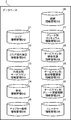
- the database 2 includes an area information management DB21, an area-based agency information management DB22, an agency-based serviceman information management DB23, a teaching material information management DB24, a chapter teaching material information management DB25, a training information management DB26, a grade-based curriculum information management DB27, and a service. It includes a training-management information management DB 28 for each serviceman, a learning material learning history information management DB29 for each serviceman, a grade stay period information management DB30 for each serviceman, and a trainer information management DB31.
- the area information management DB 21 is a database for managing information about the area, and is an “area ID” that is an identifier for identifying and identifying the area, and an “area name” that represents the name of the area. , And “area characteristic type” representing a type corresponding to the characteristic of the area.
- the area-specific agency information management DB 22 is a database for managing information on the agency by area, and includes an “area ID” and an identifier “agent” for identifying and identifying the agency. Store ID "and” Agent Name "representing the name of the agency.
- the agency-specific serviceman information management DB 23 is a database for managing information about servicemen for each agency, and specifies and identifies “area ID”, “agent ID”, and serviceman.
- “Serviceman ID” which is an identifier for performing the service
- "login password” indicating password information for the serviceman to log in to the system
- serviceman personal information indicating personal information such as the name of the serviceman, and the service.
- “current serviceman rank” which indicates the rank (grade) according to the number of years of work experience of the man and the level of work performance.
- the teaching material information management DB 24 is a database for managing information on the teaching materials used for the training, and includes a “teaching material type” indicating whether the material is a text material or a test material, “Area ID”, “Teaching Material ID” which is an identifier for identifying and identifying the teaching material, “Teaching Material Title” indicating the title of the teaching material, “Teaching Material Summary Information” indicating the outline of the teaching material content, and the storage location of the teaching material data is URL. "Text material storage location information” represented by etc., "text material / total number of pages” representing the total number of pages of text material, "text material learning completion condition", “text material learning completion condition / detail conditions", and “ Completion conditions for test material learning ”.
- “Text learning material learning completion condition” indicates whether the learning completion condition is “minimum browsing time” or “all page browsing” when the “learning material type” is “text learning material”.
- the “text teaching material learning completion condition / detailed condition” is specified by a positive value as the minimum viewing time (for example, minutes) of the text learning material when the “text learning material learning completion condition” is “minimum viewing time”.
- the “test teaching material learning completion condition” is specified as a learning completion condition by a positive value of a percentage conversion correct answer rate (0 to 100%) at the lowest pass point when the “teaching material type” is “test teaching material”.
- the chapter teaching material information management DB 25 is a database for managing information related to the chapter teaching materials.
- the chapter teaching material corresponds to a higher rank of the teaching material (text teaching material or test teaching material), and includes one or a plurality of teaching materials.
- the chapter teaching material information management DB 25 stores “area ID”, “chapter teaching material ID” which is an identifier for identifying and identifying the chapter teaching material, “chapter teaching material title” indicating the title of the chapter teaching material, and “summarizing the contents of the chapter teaching material”.
- the training information management DB 26 is a database for managing information related to training.
- the training corresponds to the top of the chapter teaching materials and is composed of one or a plurality of chapter teaching materials.
- the training information management DB 26 stores “area ID”, “training ID” as an identifier for identifying and identifying the training, “training name” indicating the name of the training, and “training type” (online training or face-to-face training).
- “Training type” "Training summary information” indicating the outline of the training contents, “Training completion conditions", "Number of chapters (N)” indicating the total number of chapter teaching materials constituting the training, and the ID of the chapter teaching materials set as Chapter n "Chapter n teaching material ID of chapter n".
- the “area ID” is 0, it indicates that the training is common to the whole world.
- “Training Completion Condition” is “Online Training”
- the training shall be completed once all of the chapter materials for the training have been studied, and if the “Training Type” is “Online Training”, and If the chapter teaching materials for the training include test teaching materials, students must complete the test if the learning results of all test materials satisfy the requirements for completing the test teaching materials, and if the “training type” is “face-to-face training” If the result of the evaluation by the trainer is a pass, the student shall complete.
- the grade-specific curriculum information management DB 27 is a database for managing information on the curriculum for each grade, and includes “area ID”, “grade ID” that is an identifier for identifying and identifying the grade, "Grade basic information” indicating basic information such as grade name, "Serviceman grade” indicating serviceman rank corresponding to grade, "Grade promotion mode”, “Grade renewal”, “Grade promotion condition”, “Grade” “Update interval”, “grade update count”, “number of training (N)” indicating the total number of trainings to be taken by the serviceman of the grade, and “training n ID” indicating the training ID set as training n And so on.
- any one of “automatic”, “manual”, and “with promotion condition” is specified.
- “Automatic” is a mode in which the upgrade is automatically performed when all the training groups to be taken in the grade are completed.
- the “manual” mode is a mode in which all the training groups to be taken in the grade are completed, and the grade is upgraded when the trainer makes a grade determination.
- “Upgrade conditions exist” is a mode in which, after completing all the training groups to be taken in the grade, if a predetermined grade-specific upgrade condition is satisfied, the mode is upgraded.
- the minimum residence time of the grade is specified by, for example, the number of years. That is, from the viewpoint of accumulating work experience, the minimum staying years after being promoted to the grade are specified in order to perform the work in the grade for a certain period of time. If the “grade promotion condition” is 0, no designation is made.
- grade update interval when “grade update presence / absence” is “grade update present”, the period until the next grade update is specified, for example, in years.
- grade update count when “grade update presence / absence” is “grade updated”, the minimum grade update count as a grade promotion condition is designated.
- the serviceman-specific training attendance information management DB 28 is a database for managing information on serviceman training attendance, and includes “area ID”, “serviceman ID”, and serviceman applying for training.
- “Training ID” which is an identifier for identifying and identifying training
- "Training start date” which indicates the date when the training was started
- "Training,” which indicates the date when the training was completed “Date of attendance” and "Judgment of completion of training”.
- “Training completion judgment” indicates the completion judgment of the training for which the serviceman has applied for the course, and one of “under study”, “completed”, “not completed”, and “retaken” is designated.
- the service-manual teaching material learning history information management DB 29 is a database for managing information related to the serviceman's learning material learning history, and includes a “serviceman ID” and a teaching material that the serviceman has applied for.
- “Teaching material ID” which is an identifier for identifying and identifying
- "Teaching material learning start date” indicating the date when learning of the teaching material was started
- "Teaching material learning completion year” indicating the date when learning of the teaching material was completed
- “Test Material Learning Completion Judgment” which indicates whether the test material learning has been completed or not completed
- “Test Material Score” which shows the test result of the test material as a percentage of correct answers
- text material learning learning "Text teaching material learning completion judgment” indicating whether the content is completed or completed
- “Text teaching material viewing time” indicating the reading time of the text teaching material as an integrated value (for example, minutes)
- the total number of pages of text materials which represents the total number of pages of, including a page n
- the information stored in the service person-specific training attendance information management DB 28 and the service person-specific learning material learning history information management DB 29 is an example of the training attendance history information.
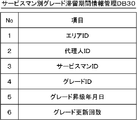
- the service person-specific grade stay period information management DB 30 is a database for managing information on the grade stay period for each service person, and includes “area ID”, “agent ID”, “serviceman ID”. , "Grade ID”, “Grade promotion date” indicating the date of promotion to the grade of the grade ID, "Grade update count” indicating the number of times the grade of the grade ID is updated, and the like. “Grade promotion date” is an example of grade stay period information, and “grade update count” is an example of grade update count information.
- the trainer information management DB 31 is a database for managing information about the trainer, and includes “area ID”, “trainer ID” that is an identifier for identifying and identifying the trainer, and “Password” representing password information for logging in, and "Trainer personal information etc.” representing personal information such as the name of the trainer are included.
- FIGS. 14 to 16 are diagrams showing display examples of the screen displayed on the display unit of the terminal 4 used by the service person who takes the training.
- FIG. 14 is a diagram illustrating a display example of the training list screen 41
- FIG. 15 is a diagram illustrating a display example of the training screen 43
- FIG. 16 is a diagram illustrating a display example of the chapter screen 45.
- Online training and face-to-face training are made up of one or more chapter materials, and the chapter materials are made up of one or more learning items.
- the chapter teaching material is the minimum unit of the training content, and one learning material is linked to each learning item.
- the Global Training Headquarters prepares text materials and test materials translated in the local language of each area and supplies them in the form of chapter materials.
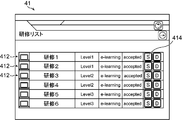
- the training list screen 41 includes a plurality of training items 412. These training items 412 are created based on information stored in the training information management DB 26 (see FIG. 8). Specifically, among the trainings managed by the training information management DB 26, those having the same “area ID” as the area to which the serviceman belongs are extracted and displayed as training items 412. In the illustrated example, a case where all the training items 412 are online training (e-learning) is illustrated. A training application button 414 is provided for each training item 412. When the training application button 414 is selected, the training list screen 41 is switched to a training screen 43 shown in FIG.
- the training screen 43 includes a plurality of chapter icons 432. These chapter icons 432 are created based on information stored in the training information management DB 26 (see FIG. 8) and the chapter teaching material information management DB 25 (see FIG. 7). More specifically, the chapter learning materials having the “chapter learning material IDs” of the chapters 1 to N corresponding to the training item 412 selected on the training list screen 41 shown in FIG. It is extracted and displayed as a chapter icon 432. When the chapter icon 432 is selected, the training screen 43 is switched to a chapter screen 45 shown in FIG.
- the chapter screen 45 includes a text icon 452 and a test icon 454.
- These text icons 452 and test icons 454 are created based on information stored in the chapter teaching material information management DB 25 (see FIG. 7) and the teaching material information management DB 24 (see FIG. 6). Specifically, a learning material having a “chapter learning material ID” corresponding to the chapter icon 432 selected on the training screen 43 shown in FIG. 15 is extracted from the learning material information management DB 24 and displayed as a text icon 452 and a test icon 454. .
- the text icon 452 or the test icon 454 is selected, the corresponding teaching material data is read, a teaching material screen (not shown) is displayed, and the user can take a course.
- Training management in each area using the human resource development support system 1 is performed, for example, as follows.
- Trainers in each area create online training and face-to-face training for their own area based on the chapter materials supplied by the Global Training Headquarters, and create them for each grade. Register in the system as a training curriculum on a training basis.
- the rank of the serviceman in all areas is defined by, for example, five grades.
- ⁇ ⁇ ⁇ Trainers in each area register information on servicemen in their area for each agency in the system. At this time, the current serviceman rank (grade) is set for the serviceman. The trainer in each area notifies the service person of the login information (ID and password) registered in the system.
- the service person logs in to the system using the login information (ID and password) notified by the trainer.
- a curriculum for each grade corresponding to the serviceman rank (grade) set for the serviceman is displayed as a training list to be taken.
- the service person applies for the training that he / she wants to take in this training list and starts taking the training.
- the training for which the service person has applied for the training is an online training, you will be able to browse and study the chapter materials linked to the training immediately after applying for the training. Specifically, the service person applies for training on the training list screen 41 (see FIG. 14) and starts training. When the learning of all the chapter materials included in the training is completed, the training is completed.
- the trainer in the area to which the service person belongs confirms the face-to-face training application and, if permitted, takes the course. Approve the application. In the training where the trainer has accepted the application, the service person can perform pre-learning with chapter materials. On the day of the face-to-face training at the training center, the service person goes to the training center and participates in face-to-face training. The trainer confirms whether or not the applicant for the face-to-face training is participating in the training, and if so, registers the training completion determination result in the system.
- Upgrading a grade is to determine whether or not to upgrade the serviceman's rank from the current grade to a higher grade when all the training groups set for each grade have been completed.
- the timing is once a year, and the “grade promotion mode” in the grade-specific curriculum information management DB 27 (see FIG. 9) is set for each area and for each grade.
- FIGS. 17 to 19 are flowcharts showing an example of the procedure of the grade promotion management process executed by the management server 10.
- the CPU of the management server 10 functions as a first determination unit, a second determination unit, a grade management unit, and a reset unit by executing the processing shown in these figures.
- FIG. 17 shows a process in the case of the non-update system grade (“grade update presence / absence” is “no grade update”), and FIG. In the case of "grade update”).
- the CPU executes a process for attending training in accordance with the curriculum for each grade according to the grade of the serviceman (S11).
- the serviceman's grade is acquired from “current serviceman rank” in the serviceman information management DB 23 for each agency (see FIG. 5).
- the training to be taken is trainings 1 to N associated with the same grade as the serviceman's grade in the grade-specific curriculum information management DB 27 (see FIG. 9).
- the screens 41 to 43 shown in FIGS. 14 to 16 and the teaching material screen of the text teaching material or the test teaching material are generated and transmitted to the terminal 4.
- the CPU judges the completion of the training for the training that has started, based on the completion conditions described in the teaching material information management DB 24 (see FIG. 6) (S12). Specifically, when the serviceman starts attending the training, the CPU determines, for each teaching material included in the training, the viewing time and the number of viewed pages of the text teaching material in the learning material learning history information management DB 29 for each serviceman (see FIG. 11). In the case where the information on the attendance such as the correct answer rate of the test teaching material is updated, and the information on the attendance satisfies the completion condition described in the educational material information management DB 24 (see FIG. 6), the “completion judgment” is made. Is updated from incomplete to completed.
- the CPU determines whether or not all the training groups of the grade have been taken (S13, processing as first determination means). Specifically, the CPU determines whether or not all the trainings 1 to N associated with the same grade as the serviceman in the grade-based curriculum information management DB 27 (see FIG. 9) have been completed. The determination is made by referring to the separate training attendance information management DB 28 (see FIG. 10) and the service person-specific teaching material learning history information management DB 29 (see FIG. 11).
- the CPU refers to the grade-specific curriculum information management DB 27 (see FIG. 9) and determines whether the grade raise mode of the grade is "automatic”. It is determined whether or not it is (S14).
- the CPU raises the grade of the serviceman (S15) and ends the process.
- the CPU updates the “current serviceman rank” in the agency-specific serviceman information management DB 23 (see FIG. 5) to the grade after the promotion.
- the CPU determines whether the grade increase mode of the grade is “manual” (S16 in FIG. 18).
- the CPU obtains a determination result of determining whether or not to upgrade the grade of the serviceman by the trainer in the area (S17, 2 Example of processing as determination means). Specifically, the CPU obtains, from the terminal 4 used by the trainer, promotion enable / disable information, which is input by the trainer and indicates whether or not the promotion of the serviceman is permitted, as the determination result.
- promotion enable / disable information which is input by the trainer and indicates whether or not the promotion of the serviceman is permitted, as the determination result.
- the recognition of promotion by the trainer is an example of the “predetermined promotion condition”.
- the CPU raises the serviceman's grade (S15) and ends the process.
- the CPU determines the grade of the serviceman in the serviceman-specific teaching material learning history information management DB 29 (see FIG. 11).
- the training attendance history is cleared (S19), and the process ends. As a result, the service person is required to retake the course.
- the CPU determines whether the grade increasing condition is satisfied. (S20, an example of a process as a second determination unit). In the present embodiment, it is determined whether or not the grade stay period in which the serviceman stays in the grade exceeds the threshold as an example of the “predetermined grade promotion condition”.
- the grade stay period is an elapsed period from the “training start date” in the service person-specific training attendance information management DB 28 (see FIG. 10).
- the threshold value is the minimum grade residence time stored in the “grade upgrade condition” of the grade-specific curriculum information management DB 27 (see FIG. 9).
- FIG. 19 shows the processing in the case of the update system grade (when “grade update presence / absence” is “grade update present”). Steps that are the same as those in FIGS. 17 and 18 are given the same step numbers, and detailed descriptions thereof are omitted.
- the CPU determines whether it is time to update the grade (S21). Whether or not it is the update timing is determined based on the “grade update interval” of the grade-specific curriculum information management DB 27 (see FIG. 9). That is, it is determined whether or not the period of the “grade update interval” has elapsed since the latest promotion or update.
- the CPU determines whether the current update is less than the grade update count of the grade (S22). The number of updates this time is obtained from “grade update count” in the service person-specific grade stay period information management DB 30 (see FIG. 12). The grade update count as the threshold is obtained from “grade update count” in the grade-specific curriculum information management DB 27 (see FIG. 9).
- the CPU stores the training attendance history of the grade for the service person in the teaching material learning history information management DB 29 for each service person (see FIG. 11). Clear or reset (S19, processing as reset means), and terminate the processing. As a result, the service person is required to retake the course.
- the CPU proceeds to the above-mentioned S14 to S20 determination of whether or not the grade can be upgraded according to the grade raising mode.
- the “grade upgrade mode”, “grade upgrade presence / absence”, “grade upgrade condition”, “grade update interval”, and “grade update count” in the grade-specific curriculum information management DB 27 (see FIG. 9).
- Etc. it is possible to adjust the upgrade of the serviceman's grade.
- the level of technical acquisition related to the contents of globally common education between areas which occurs due to differences in the teaching experience and competence of the trainers at the area-specific education centers, and the level of that level It is possible to improve the level of competence and equalize the level of servicemen around the world while compensating for variations in the time required to reach.
- a human resource development support system is a human resource development support system that manages the grade of a service person of an industrial machine, wherein the service person is associated with the grade based on training attendance history information of the service person.
- First judgment means for judging whether or not the attendance of the training which has been completed is completed;
- second judgment means for judging whether or not a predetermined grade elevation condition different from the training attendance history is satisfied;
- a grade management unit for upgrading the grade of the serviceman when completing the training associated with the serviceman and satisfying the predetermined upgrade condition.
- a computer of a human resource development support system for managing the grade of a service person of an industrial machine is provided based on the training attendance history information of the service person.
- First determining means for determining whether or not the man has completed the training attended to the grade second determining means for determining whether or not a predetermined elevation condition different from the training attendance history is satisfied, And when the serviceman completes the training associated with the grade and satisfies the predetermined upgrade condition, to function as grade management means for upgrading the grade of the serviceman. Is recorded.
- the second determination unit determines that a period during which the serviceman stays in the grade exceeds a threshold based on the grade stay period information of the serviceman. It is determined as to whether or not the condition has been raised.
- Such a human resource development support system and its program can suitably consider the grade stay period of service personnel.
- the second determination unit determines whether or not the promotion has been recognized by the trainer based on the promotion availability information input by the trainer. Is determined as the condition for the promotion.
- Such a human resource development support system and its program can suitably consider whether or not a trainer can upgrade.
- the second determination unit determines that the number of times the service person has updated the grade exceeds a threshold value based on the grade update number information of the service person. It is determined as to whether or not the condition has been raised.
- the second determination unit determines whether or not the number of times the serviceman has updated the grade exceeds a threshold value when a predetermined update period has elapsed. judge.
- the above-described human resource development support system and the recording medium further include a reset unit that resets the training attendance history information when the number of times the service technician updates the grade does not exceed a threshold value.
- the predetermined promotion condition is determined for each area to which the serviceman belongs.
Landscapes
- Engineering & Computer Science (AREA)
- Business, Economics & Management (AREA)
- Human Resources & Organizations (AREA)
- Strategic Management (AREA)
- Entrepreneurship & Innovation (AREA)
- Economics (AREA)
- Operations Research (AREA)
- Theoretical Computer Science (AREA)
- General Physics & Mathematics (AREA)
- Marketing (AREA)
- General Business, Economics & Management (AREA)
- Quality & Reliability (AREA)
- Tourism & Hospitality (AREA)
- Physics & Mathematics (AREA)
- Development Economics (AREA)
- Educational Administration (AREA)
- Game Theory and Decision Science (AREA)
- Data Mining & Analysis (AREA)
- Management, Administration, Business Operations System, And Electronic Commerce (AREA)
- Electrically Operated Instructional Devices (AREA)
Abstract
本発明の人材育成支援システムは、サービスマンの研修受講履歴情報に基づき、前記サービスマンがグレードに対応付けられた研修の受講を完了したか否かを判定し、研修受講履歴とは別の所定の昇級条件を満たしたか否かを判定し、前記サービスマンが前記グレードに対応付けられた研修の受講を完了し、かつ、前記所定の昇級条件を満たした場合に、前記サービスマンの前記グレードを昇級させる。
Description
本発明は、人材育成支援システムおよびそのプログラムを記録した記録媒体に関する。
特許文献1には、建設機械の営業活動を支援するために、適切な顧客を選定することができる営業支援システムが開示されている。この営業支援システムでは、顧客情報を記憶するデータベースが設けられており、情報受給者によって入力された顧客検索条件に合致する顧客情報が当該データベースから抽出される。その後に、情報受給者によって図象化表示に関する評価項目が少なくとも2つ入力された場合、それらの組み合わせに基づいて、抽出された顧客情報の分析評価が実行される。この分析評価の結果を参照することによって、情報受給者は、営業対象先として適切な顧客を選定することが可能になる。
上記の営業支援システムの場合、営業対象先として適切な顧客を容易に選定することができるため、営業活動の効率化を図ることはできる。しかしながら、その選定した顧客が満足するレベルのサービスを提供することができなければ、受注に至ることは、困難である。そのため、サービス提供力の強化を行うことが必要となる。特に、産業用機械の場合、顧客が製品を購入した後も保守点検、修理、技術情報の提供等の保守サービスが実施されることが多く、各代理店は、このような質の高い保守サービスを提供できる体制を築くべきである。
本発明は、上記課題に鑑みてなされた発明であり、その主な目的は、サービスマンのグレードの昇級を調整することが可能な人材育成支援システムおよびそのプログラムを記録した記録媒体を提供することにある。
本発明にかかる人材育成支援システムおよび記録媒体に記憶されたそのプログラムは、サービスマンの研修受講履歴情報に基づき、前記サービスマンがグレードに対応付けられた研修の受講を完了したか否かを判定し、研修受講履歴とは別の所定の昇級条件を満たしたか否かを判定し、前記サービスマンが前記グレードに対応付けられた研修の受講を完了し、かつ、前記所定の昇級条件を満たした場合に、前記サービスマンの前記グレードを昇級させる。本発明によれば、サービスマンのグレードの昇級を調整することが可能となる。
上記並びにその他の本発明の目的、特徴および利点は、以下の詳細な記載と添付図面から明らかになるであろう。
以下、本発明にかかる実施の一形態を図面に基づいて説明する。なお、各図において同一の符号を付した構成は、同一の構成であることを示し、適宜、その説明を省略する。なお、本明細書において、総称する場合には添え字を省略した参照符号で示し、個別の構成を指す場合には添え字を付した参照符号で示す。
[システム概要]
図1は、一例として、実施形態における実施形態に係る人材育成支援システム1の構成を示す図である。人材育成支援システム1は、管理サーバ10と、端末3、4とを備える。管理サーバ10と端末3、4とは、ネットワーク(ワイドエリアネットワーク)に接続されており、相互に通信が可能である。前記ネットワークは、例えば、電話網、ディジタル通信網および無線通信網等の伝送路であり、所定の通信プロトコルを用いてデータが伝送される。前記ネットワークは、例えば、通信プロトコルにHTTP(Hyper Text Transfer Protocol)、FTP(File Transfer Protocol)、SMTP(Simple Mail Transfer Protocol)、POP3(Post Office Protocol Version 3)およびTCP/IP(Transmission Control Protocol/Internet Protocol)等のインターネットプロトコルが用いられてインターネットを構成する。端末3は、グローバル研修本部に配置された端末であり、端末4は、各エリアの代理店や教育センター等に配置された端末である。端末3、4は、例えばノート型コンピュータおよびデスクトップ型コンピュータ等のパーソナルコンピュータである。
図1は、一例として、実施形態における実施形態に係る人材育成支援システム1の構成を示す図である。人材育成支援システム1は、管理サーバ10と、端末3、4とを備える。管理サーバ10と端末3、4とは、ネットワーク(ワイドエリアネットワーク)に接続されており、相互に通信が可能である。前記ネットワークは、例えば、電話網、ディジタル通信網および無線通信網等の伝送路であり、所定の通信プロトコルを用いてデータが伝送される。前記ネットワークは、例えば、通信プロトコルにHTTP(Hyper Text Transfer Protocol)、FTP(File Transfer Protocol)、SMTP(Simple Mail Transfer Protocol)、POP3(Post Office Protocol Version 3)およびTCP/IP(Transmission Control Protocol/Internet Protocol)等のインターネットプロトコルが用いられてインターネットを構成する。端末3は、グローバル研修本部に配置された端末であり、端末4は、各エリアの代理店や教育センター等に配置された端末である。端末3、4は、例えばノート型コンピュータおよびデスクトップ型コンピュータ等のパーソナルコンピュータである。
管理サーバ10は、CPU(Central Processing Unit)、RAM(Random Access Memory)、ROM(Read Only Memory)、書き換え可能な不揮発性メモリおよび入出力インターフェース等を含むサーバコンピュータである。CPUは、ROMからRAMにロードされたプログラムに従って情報処理を実行する。プログラムは、例えば光ディスク(CD-ROM、DVD-ROM、CD-R、DVD-RW等)等の情報記録媒体やメモリカード等の情報記憶媒体等を介して供給されてもよいし、また例えば通信ネットワークを介して供給されてもよい。
管理サーバ10は、データベース(データベースサーバ)2にアクセス可能である。データベース2は、管理サーバ10の内部に設けられても良いし、管理サーバ10の外部に設けられてもよい。
管理サーバ10は、例えばHTTPデーモンを起動しており、端末3、4からブラウザを介して送信された処理要求(HTTPリクエスト)を受け付けると、処理要求に応じた処理結果(HTTPレスポンス)を端末3、4に返答する。例えば、管理サーバ10は、ウェブページ記述言語で記述されたページデータを処理結果として端末3、4に送信し、端末3、4は、管理サーバ10から受信したページデータを表すページ画像を自機の表示部に出力する。
人材育成支援システム1は、産業用機械の保守サービスに携わるサービスマンを育成するためのオンライン研修(所謂、eラーニング)を提供するシステムである。ここで、産業用機械としては、各種の建設機械、ならびに、レシプロ圧縮機、スクリュー圧縮機、ターボ圧縮機、真空成膜装置、タイヤ試験機、連続混練機およびゴム混練機等のように工場等の生産施設に設置される装置(機器)等、様々な装置が想定される。産業用機械は、長期間に亘って使用されるため、修理、点検、部品の交換、技術指導等の保守サービスが必須である。かかる保守サービスは、産業用機械の製造メーカーが提携する各エリアの代理店によって提供される。各エリアの代理店に所属するサービスマンは、顧客に対して営業活動を行い、顧客が保守サービスを適切に受けるように促す役割を有している。
人材育成支援システム1では、自社の産業用機械の整備技術等に関する研修の教材を各国の言語で作成した上で、全世界規模で教育展開する。併せて、サービスマン1人1人の過去の学習記録(履修した教育内容や受講研修やその時のテスト結果等)から、個々人の履修進捗状況や習熟度合に応じた個別の教育展開も可能である。
人材育成支援システム1による研修は、オンライン研修だけでなく、各エリアのトレーニング施設での実機を用いた集合形式の対面研修(Face-to-Face研修)と組み合わせながら実施される。全世界共通の教育内容やカリキュラムを開発して供給するグローバル研修本部と、その教育内容を使って各エリアのサービスマンに対して実際に教育を行うエリア別教育センターとが設けられ、エリア別教育センターのトレーナーは、オンライン研修と対面研修とを組み合わせて、サービスマン1人1人が研修内容を理解し、実務にて実行できるようになるための指導を行う。
ところで、グローバル研修本部が作成して供給する教育内容を用いた各エリアでの教育実施の進め方/教育手法(教え方等)は、その国の経済発展レベルや風土や文化的特性、さらにはビジネス環境(例えばメーカーとアフターサービス業務を委託する代理店との力関係等)により調整される必要があり、その結果、エリア別教育センターにおけるトレーナーの経験および力量に依存するまたは制約を受ける。全世界共通教材とeラーニング等のIT教育ツールの導入により、サービスマン個々の技術レベルを効率的に高めることは可能となったが、全世界規模での一斉教育を実施および展開する場合、グローバル研修本部が期待する技術習得レベルや、そのレベルまで到達するのに要する時間に対し、エリア毎にバラツキが発生するという課題がある。
そこで、人材育成支援システム1では、グローバル研修本部が全世界共通教材を作成し、エリア別教育センターに供給することによって、グローバルに一定教育を展開する際に、各エリアにおいて、エリアの特性に応じた教育手法にて教育展開することが可能となり、それにより、サービスマンの保全技術力をグローバルに平準化することが可能となる。
ここでは、教育用の教材(テキストおよび習熟度評価テスト)は、グローバル研修本部にて作成し供給するものとする。教育対象のサービスマンは、業務経験年数や業務遂行能力レベルにより複数のグレードに分けられ、その上で、グレード別に教育内容およびカリキュラムが準備され、教育が行われるものとする。エリア別教育センターでは、トレーナーの裁量により、グローバル研修本部から供給された教材を使っての教育が企画されて実施されるものとする。例えば、上位グレードに対し、全世界教育のグレード昇級条件や基準が設けられ、それ以外のグレード(下位グレード)に対し、サービスマンのグレード昇級条件や判断基準は、各エリアで設定可能とする。
具体的には、人材育成支援システム1では、各エリアでグローバル研修本部から供給された教材を使って、各エリアの実態に応じたオンライン研修および対面研修を企画し、教育展開することが可能とされている。グレード毎に1つ以上の対面研修(実技訓練設備等を備えた研修センター施設にて行われる、トレーナーによる対面形式研修)またはオンライン研修(eラーニング形式研修で、トレーナーによる対面形式研修がない研修)が、当該グレードのサービスマンが学ぶべき教育内容として定義され、それをグレード別教育カリキュラムとしてデータ管理することが可能とされている。
オンライン研修で習熟度確認テストを課した場合のテスト結果や、対面研修でのトレーナーによる受講者1人1人に対する評価結果が、研修受講結果としてデータ管理でき、かつそのデータにより各研修の受講修了有無が、判断可能とされている。グレード別教育カリキュラムに沿って、サービスマンに対してグレード別の教育が、実行でき、かつグレード別教育カリキュラムで定義された全研修を受講修了した場合に、自動または手動にてサービスマンのグレード昇級が、管理可能とされている。なお、上位グレードの教育実施の場合には、全世界共通の実技およびペーパー試験が課されて評価され、その評価結果から自動または手動にてサービスマンのグレード昇級が、管理可能とされている。
このような人材育成支援システム1を利用することにより、エリア別教育センターのトレーナーの指導経験や力量の差により発生する、エリア間での、世界共通教育内容に関する技術習得レベルや、そのレベルに到達するのに要する時間のバラツキを補正しながら、全世界のサービスマンの力量底上げと平準化とが、実現される。
[データベース]
図2は、前記人材育成支援システムにおけるデータベース2の例を示す図である。データベース2は、エリア情報管理DB21、エリア別代理店情報管理DB22、代理店別サービスマン情報管理DB23、教材情報管理DB24、チャプター教材情報管理DB25、研修情報管理DB26、グレード別カリキュラム情報管理DB27、サービスマン別研修受講情報管理DB28、サービスマン別教材学習履歴情報管理DB29、サービスマン別グレード滞留期間情報管理DB30、およびトレーナー情報管理DB31を含む。
図2は、前記人材育成支援システムにおけるデータベース2の例を示す図である。データベース2は、エリア情報管理DB21、エリア別代理店情報管理DB22、代理店別サービスマン情報管理DB23、教材情報管理DB24、チャプター教材情報管理DB25、研修情報管理DB26、グレード別カリキュラム情報管理DB27、サービスマン別研修受講情報管理DB28、サービスマン別教材学習履歴情報管理DB29、サービスマン別グレード滞留期間情報管理DB30、およびトレーナー情報管理DB31を含む。
図3に示すように、エリア情報管理DB21は、エリアに関する情報を管理するためのデータベースであり、エリアを特定し識別するための識別子である「エリアID」、エリアの名称を表す「エリア名称」、および、エリアの特性に応じたタイプを表す「エリア特性タイプ」等を含む。
図4に示すように、エリア別代理店情報管理DB22は、代理店に関する情報をエリア別に管理するためのデータベースであり、「エリアID」、代理店を特定し識別するための識別子である「代理店ID」、および、代理店の名称を表す「代理店名称」等を含む。
図5に示すように、代理店別サービスマン情報管理DB23は、代理店別にサービスマンに関する情報を管理するためのデータベースであり、「エリアID」、「代理店ID」、サービスマンを特定し識別するための識別子である「サービスマンID」、サービスマンがシステムにログインするためのパスワード情報を表す「ログインパスワード」、サービスマンの氏名等の個人情報を表す「サービスマン個人情報」、および、サービスマンの業務経験年数や業務遂行能力レベルに応じたランク(グレード)を表す「現在サービスマンランク」等を含む。
図6に示すように、教材情報管理DB24は、研修に用いられる教材に関する情報を管理するためのデータベースであり、テキスト教材であるか、テスト教材であるか、の別を表す「教材タイプ」、「エリアID」、教材を特定し識別するための識別子である「教材ID」、教材のタイトルを表す「教材タイトル」、教材内容の概要を表す「教材概要情報」、教材データの格納先をURL等で表す「教材データ格納先情報」、テキスト教材の総ページ数を表す「テキスト教材・総ページ数」、「テキスト教材学習修了条件」、「テキスト教材学習修了条件・詳細条件」、および、「テスト教材学習修了条件」等を含む。
「テキスト教材学習修了条件」は、「教材タイプ」が「テキスト教材」である場合に、学習修了条件を「最低閲覧時間」とするか「全ページ閲覧」とするかを表す。「テキスト教材学習修了条件・詳細条件」は、「テキスト教材学習修了条件」が「最低閲覧時間」である場合に、テキスト教材の最低閲覧時間(例えば分)で正数値によって指定される。「テスト教材学習修了条件」は、「教材タイプ」が「テスト教材」である場合に、学習修了条件として合格最低点で百分率換算正答率(0~100%)の正数値によって指定される。
図7に示すように、チャプター教材情報管理DB25は、チャプター教材に関する情報を管理するためのデータベースである。チャプター教材は、教材(テキスト教材またはテスト教材)の上位に相当し、1または複数の教材で構成される。チャプター教材情報管理DB25は、「エリアID」、チャプター教材を特定し識別するための識別子である「チャプター教材ID」、チャプター教材のタイトルを表す「チャプター教材タイトル」、チャプター教材内容の概要を表す「チャプター教材概要情報」、チャプター教材を構成する学習項目(教材)の総数を表す「学習項目数(N)」、各学習項目の名称等を表す「学習項目nの基本情報」、各学習項目に対応する教材の教材IDを表す「学習項目nの学習教材ID」等を含む。
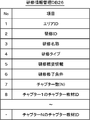
図8に示すように、研修情報管理DB26は、研修に関する情報を管理するためのデータベースである。研修は、チャプター教材の上位に相当し、1または複数のチャプター教材で構成される。研修情報管理DB26は、「エリアID」、研修を特定し識別するための識別子である「研修ID」、研修の名称を表す「研修名称」、研修のタイプ(オンライン研修または対面研修)を表す「研修タイプ」、研修内容の概要を表す「研修概要情報」、「研修修了条件」、研修を構成するチャプター教材の総数を表す「チャプター数(N)」、チャプターnとして設定されたチャプター教材のIDを表す「チャプターnのチャプター教材ID」等を含む。なお、「エリアID」が0である場合は、全世界共通の研修であることを表す。
「研修修了条件」は、「研修タイプ」が「オンライン研修」である場合には、当該研修のチャプター教材を全て学習したら修了するものとし、「研修タイプ」が「オンライン研修」である場合、かつ、当該研修のチャプター教材にテスト教材が含まれる場合には、全テスト教材の学習結果がテスト教材履修修了条件を満たしたら修了するものとし、そして、「研修タイプ」が「対面研修」である場合には、トレーナーによる評価結果が合格判定であったら修了するものとする。
図9に示すように、グレード別カリキュラム情報管理DB27は、グレード別にカリキュラムに関する情報を管理するためのデータベースであり、「エリアID」、グレードを特定し識別するための識別子である「グレードID」、グレードの名称等の基本情報を表す「グレード基本情報」、グレードに対応するサービスマンランクを表す「サービスマングレード」、「グレード昇級モード」、「グレード更新有無」、「グレード昇級条件」、「グレード更新間隔」、「グレード更新回数」、当該グレードのサービスマンが履修すべき研修の総数を表す「研修数(N)」、および、研修nとして設定された研修のIDを表す「研修nのID」等を含む。
「グレード昇級モード」には、「自動」、「手動」および「昇級条件有」の何れかが指定される。「自動」は、当該グレードで履修すべき研修群を全て修了した場合に自動的にグレードアップするモードである。「手動」は、当該グレードで履修すべき研修群を全て修了し、かつ、トレーナーが昇級判定を行った場合にグレードアップするモードである。「昇級条件有」は、当該グレードで履修すべき研修群を全て修了した後、所定のグレード別昇級条件を満たした場合にグレードアップするモードである。
「グレード更新有無」には、「グレード更新なし」または「グレード更新あり」が指定される。
「グレード昇級条件」には、例えばグレード最低滞留期間が例えば年数で指定される。すなわち、業務経験を積ませる等の観点から、当該グレードにて一定期間業務遂行させるために、当該グレードに昇級した後の最低滞留年数が指定される。なお、「グレード昇級条件」が0である場合は、指定なしとなる。
「グレード更新間隔」には、「グレード更新有無」が「グレード更新あり」である場合において、次回のグレード更新までの期間が例えば年数で指定される。「グレード更新回数」は、「グレード更新有無」が「グレード更新あり」である場合において、グレード昇級条件としての最低グレード更新回数が指定される。
図10に示すように、サービスマン別研修受講情報管理DB28は、サービスマンの研修受講に関する情報を管理するためのデータベースであり、「エリアID」、「サービスマンID」、サービスマンが受講を申し込んだ研修を特定し識別するための識別子である「研修ID」、研修の受講を開始した年月日を表す「研修受講開始年月日」、研修の受講を終了した年月日を表す「研修受講終了年月日」、および、「研修修了判定」等を含む。「研修修了判定」は、サービスマンが受講を申し込んだ研修の修了判定を表し、「受講中」、「修了」、「未修了」および「再受講中」の何れかが指定される。
図11に示すように、サービスマン別教材学習履歴情報管理DB29は、サービスマンの教材学習履歴に関する情報を管理するためのデータベースであり、「サービスマンID」、サービスマンが受講を申し込んだ教材を特定し識別するための識別子である「教材ID」、教材の学習を開始した年月日を表す「教材学習開始年月日」、教材の学習を終了した年月日を表す「教材学習修了年月日」、テスト教材学習が修了であるか未修了であるかを表す「テスト教材学習修了判定」、テスト教材のテスト結果を百分率換算正答率で表す「テスト教材得点」、テキスト教材学習の学習中であるか修了済であるかを表す「テキスト教材学習修了判定」、テキスト教材の閲覧時間を積算値(例えば分)で表す「テキスト教材閲覧時間」、テキスト教材の総ページ数を表す「テキスト教材の総ページ数」、テキスト教材の頁nが閲覧済であるか未閲覧であるかを表す「テキスト教材・頁n閲覧有無」等を含む。
サービスマン別研修受講情報管理DB28およびサービスマン別教材学習履歴情報管理DB29に格納された情報は、研修受講履歴情報の一例である。
図12に示すように、サービスマン別グレード滞留期間情報管理DB30は、サービスマン別にグレード滞留期間に関する情報を管理するためのデータベースであり、「エリアID」、「代理店ID」、「サービスマンID」、「グレードID」、グレードIDのグレードに昇級した年月日を表す「グレード昇級年月日」、および、グレードIDのグレードを更新した回数を表す「グレード更新回数」等を含む。「グレード昇級年月日」は、グレード滞在期間情報の一例であり、「グレード更新回数」は、グレード更新回数情報の一例である。
図13に示すように、トレーナー情報管理DB31は、トレーナーに関する情報を管理するためのデータベースであり、「エリアID」、トレーナーを特定し識別するための識別子である「トレーナーID」、トレーナーがシステムにログインするためのパスワード情報を表す「パスワード」、および、トレーナーの氏名等の個人情報を表す「トレーナー個人情報等」を含む。
[画面表示例]
図14~図16は、研修を受講するサービスマンが使用する端末4の表示部に表示される画面の表示例を示す図である。図14は、研修リスト画面41の表示例を示す図であり、図15は、研修画面43の表示例を示す図であり、図16は、チャプター画面45の表示例を示す図である。
図14~図16は、研修を受講するサービスマンが使用する端末4の表示部に表示される画面の表示例を示す図である。図14は、研修リスト画面41の表示例を示す図であり、図15は、研修画面43の表示例を示す図であり、図16は、チャプター画面45の表示例を示す図である。
オンライン研修および対面研修は、1つ以上のチャプター教材により構成され、チャプター教材は、1つ以上の学習項目により構成される。チャプター教材は、研修内容の最小単位であり、各学習項目には学習用教材が1つ紐付けられる。学習教材には、テキスト教材とテスト教材の2種類のタイプが設けられ、学習教材毎に学習修了条件が設定される。研修にも、研修毎に研修修了条件が設定される。グローバル研修本部は、各エリアの現地語で翻訳したテキスト教材およびテスト教材を作成し、チャプター教材の形式で供給する。
図14に示すように、研修リスト画面41には、複数の研修項目412が含まれる。これらの研修項目412は、研修情報管理DB26(図8参照)に格納された情報に基づいて作成される。具体的には、研修情報管理DB26で管理される研修のうち、サービスマンが属するエリアと同じ「エリアID」を持つものが抽出され、研修項目412として表示される。図示の例では、全研修項目412がオンライン研修(eラーニング)である場合が図示されている。各研修項目412には受講申込ボタン414が設けられており、受講申込ボタン414が選択されると、研修リスト画面41は、図15に示す研修画面43に切り換えられる。
図15に示すように、研修画面43には、複数のチャプターアイコン432が含まれる。これらのチャプターアイコン432は、研修情報管理DB26(図8参照)およびチャプター教材情報管理DB25(図7参照)に格納された情報に基づいて作成される。具体的には、図14に示す研修リスト画面41で選択された研修項目412に対応する「研修ID」に属するチャプター1~Nの「チャプター教材ID」を持つチャプター教材がチャプター教材情報管理DB25から抽出され、チャプターアイコン432として表示される。チャプターアイコン432が選択されると、研修画面43は、図16に示すチャプター画面45に切り換えられる。
図16に示すように、チャプター画面45には、テキストアイコン452およびテストアイコン454が含まれている。これらのテキストアイコン452およびテストアイコン454は、チャプター教材情報管理DB25(図7参照)および教材情報管理DB24(図6参照)に格納された情報に基づいて作成される。具体的には、図15に示す研修画面43で選択されたチャプターアイコン432に対応する「チャプター教材ID」を持つ教材が教材情報管理DB24から抽出され、テキストアイコン452およびテストアイコン454として表示される。テキストアイコン452またはテストアイコン454が選択されると、それぞれに対応する教材データが読み出され、教材画面(不図示)が表示され、受講が可能となる。
[研修運営]
人材育成支援システム1を利用した各エリアでの研修運営は、例えば次のように行われる。
人材育成支援システム1を利用した各エリアでの研修運営は、例えば次のように行われる。
各エリアのトレーナーは、グローバル研修本部から供給されたチャプター教材に基づいて、自エリア用のオンライン研修および対面研修をグレード毎に定義して作成し、それを当該グレードのサービスマンが学ぶべきグレード別教育カリキュラムとして研修単位でシステムに登録する。全エリアにおいて、サービスマンのランクは、本実施形態では、例えば、5段階のグレードで定義される。
各エリアのトレーナーは、自エリアのサービスマンに関する情報を代理店別にシステムに登録する。その際、サービスマンには、現在のサービスマンランク(グレード)が設定される。各エリアのトレーナーは、システムに登録したログイン情報(IDおよびパスワード)をサービスマンに連絡する。
サービスマンは、トレーナーから連絡されたログイン情報(IDおよびパスワード)を利用してシステムにログインする。サービスマンが使用する端末4には、サービスマンに設定されているサービスマンランク(グレード)に対応したグレード別カリキュラムが、受講すべき研修一覧として表示される。サービスマンは、本研修一覧にて受講したい研修の受講を申し込み、受講を開始する。
サービスマンが受講を申し込んだ研修が、オンライン研修である場合には、受講の申込後直ちに、当該研修に紐付けられているチャプター教材の閲覧および学習が可能となる。具体的には、サービスマンは、研修リスト画面41(図14参照)で研修の受講を申し込み、研修の受講を開始する。当該研修に含まれる全チャプター教材の学習が終了すると、研修の受講が終了となる。
サービスマンが受講を申し込んだ研修が、対面研修である場合も、受講の申込後直ちに、当該研修に紐付けられているチャプター教材の閲覧および学習が可能となるとともに、サービスマンは、チャプター教材による事前学習後、実技訓練の設備等を備えた研修センター施設で行われるトレーナーによる対面研修に参加する。対面研修終了後、トレーナーが受講結果をシステムに登録する。
具体的には、サービスマンが研修リスト画面41(図14参照)で対面研修の受講を申し込むと、サービスマンが属するエリアのトレーナーが、対面研修の受講申込を確認し、許可可能な場合に受講申込を承認する。トレーナーが受講申込を許可した研修では、サービスマンは、チャプター教材による事前学習が可能となる。サービスマンは、研修センターでの対面研修開催日となったら、研修センターに赴き、対面研修に参加する。トレーナーは、対面研修の受講申込者が研修に参加しているか否かを確認した上で、参加している場合には研修修了判定結果をシステムに登録する。
[グレード昇級運営処理]
以下、人材育成支援システム1を利用した、サービスマンのグレードの昇級の管理について説明する。グレードの昇級とは、各グレードで設定された研修群を全て修了した場合に、現在のグレードから上位のグレードに、サービスマンのランクをランクアップさせるか否かを判断することである。本実施形態では、例えば、そのタイミングが年に1回であり、グレード別カリキュラム情報管理DB27(図9参照)の「グレード昇級モード」がエリア毎かつグレード毎に設定される。
以下、人材育成支援システム1を利用した、サービスマンのグレードの昇級の管理について説明する。グレードの昇級とは、各グレードで設定された研修群を全て修了した場合に、現在のグレードから上位のグレードに、サービスマンのランクをランクアップさせるか否かを判断することである。本実施形態では、例えば、そのタイミングが年に1回であり、グレード別カリキュラム情報管理DB27(図9参照)の「グレード昇級モード」がエリア毎かつグレード毎に設定される。
図17~図19は、管理サーバ10が実行するグレード昇級運営処理の手順例を示すフローチャートである。管理サーバ10のCPUは、これらの図に示す処理を実行することにより、第1判定手段、第2判定手段、グレード管理手段およびリセット手段として機能する。ここで、図17は、非更新制グレードの場合(「グレード更新有無」が「グレード更新なし」の場合)の処理を示し、図19は、更新制グレードの場合(「グレード更新有無」が「グレード更新あり」の場合)の処理を示している。
図17に示すように、まず、CPUは、サービスマンのグレードに応じたグレード別カリキュラムに沿った研修受講のための処理を実行する(S11)。サービスマンのグレードは、代理店別サービスマン情報管理DB23(図5参照)の「現在サービスマンランク」から取得される。受講の対象となる研修は、グレード別カリキュラム情報管理DB27(図9参照)においてサービスマンのグレードと同じグレードに対応付けられた研修1~Nである。本処理では、例えば図14~図16に示した各画面41~43や、テキスト教材またはテスト教材の教材画面などの生成、および、端末4への送信などが行われる。
次に、CPUは、受講を開始した研修について、教材情報管理DB24(図6参照)に記述された修了条件に基づき、当該研修の受講の終了を判断する(S12)。具体的には、CPUは、サービスマンが研修の受講を開始すると、研修に含まれる各教材について、サービスマン別教材学習履歴情報管理DB29(図11参照)のテキスト教材の閲覧時間や閲覧頁数、テスト教材の正答率などの受講に係る情報を更新していき、これらの受講に係る情報が教材情報管理DB24(図6参照)に記述された修了条件を満たした場合に、「修了判定」を未終了から修了に更新する。
次に、CPUは、当該グレードの研修群を全て受講終了したか否かを判定する(S13、第1判定手段としての処理)。具体的には、CPUは、グレード別カリキュラム情報管理DB27(図9参照)においてサービスマンのグレードと同じグレードに対応付けられた全ての研修1~Nの受講を完了したか否かを、サービスマン別研修受講情報管理DB28(図10参照)およびサービスマン別教材学習履歴情報管理DB29(図11参照)を参照することにより判定する。
当該グレードの研修群全ての受講を終了した場合(S13:YES)、CPUは、グレード別カリキュラム情報管理DB27(図9参照)を参照して、当該グレードのグレード昇給モードが「自動」であるか否かを判定する(S14)。
当該グレードのグレード昇給モードが「自動」である場合(S14:YES)、CPUは、サービスマンのグレードを昇級させ(S15)、処理を終了する。CPUは、代理店別サービスマン情報管理DB23(図5参照)の「現在サービスマンランク」を昇級後のグレードに更新する。
一方、当該グレードのグレード昇給モードが「自動」でない場合(S14:NO)、CPUは、当該グレードのグレード昇給モードが「手動」であるか否かを判定する(図18のS16)。
当該グレードのグレード昇給モードが「手動」である場合(S16:YES)、CPUは、当該エリアのトレーナーにてサービスマンのグレードを昇級させるか否かを判断した判断結果を取得する(S17、第2判定手段としての処理の一例)。具体的には、CPUは、トレーナーが使用する端末4から、トレーナーにより入力されたサービスマンの昇格を認めるか否かを表す昇格可否情報を判断結果として取得する。ここでは、トレーナーにより昇格が認められることが、「所定の昇級条件」の一例となる。
トレーナーにてサービスマンのグレードを昇級させると判断された場合(S18:YES)、CPUは、サービスマンのグレードを昇級させ(S15)、処理を終了する。
一方、トレーナーにてサービスマンのグレードを昇級させると判断されなかった場合(S18:NO)、CPUは、サービスマン別教材学習履歴情報管理DB29(図11参照)における、当該サービスマンの当該グレードの研修受講履歴をクリアし(S19)、処理を終了する。これにより、サービスマンには再受講が課される。
上記S16において、当該グレードのグレード昇給モードが「手動」でない場合、すなわち当該グレードのグレード昇給モードが「昇級条件有」である場合(S16:NO)、CPUは、グレード昇級条件を満たしているか否かを判定する(S20、第2判定手段としての処理の一例)。本実施形態では、サービスマンがグレードに滞在しているグレード滞在期間が閾値を超えたか否かが、「所定の昇級条件」の一例として判定される。ここで、グレード滞在期間は、サービスマン別研修受講情報管理DB28(図10参照)の「研修受講開始年月日」からの経過期間である。閾値は、グレード別カリキュラム情報管理DB27(図9参照)の「グレード昇級条件」に記憶されたグレード最低滞留期間である。
グレード昇級条件を満たしている場合(S20:YES)、CPUは、サービスマンのグレードを昇級させ(S15)、処理を終了する。
一方、グレード昇級条件を満たしていない場合(S20:NO)、CPUは、サービスマンのグレードを昇級させずに、そのまま処理を終了する。
図19は、更新制グレードの場合(「グレード更新有無」が「グレード更新あり」の場合)の処理を示している。図17および図18と重複するステップについては、同ステップ番号を付すことで詳細な説明を省略する。
S13において、当該グレードの研修群全ての受講を終了したと判定された場合(S13:YES)、CPUは、当該グレードの更新タイミングであるか否かを判定する(S21)。更新タイミングであるか否かは、グレード別カリキュラム情報管理DB27(図9参照)の「グレード更新間隔」に基づいて判定される。すなわち、直近の昇級または更新から「グレード更新間隔」の期間が経過したか否かが判定される。
当該グレードの更新タイミングである場合(S21:YES)、CPUは、今回の更新が当該グレードのグレード更新回数未満か否かを判定する(S22)。今回の更新回数は、サービスマン別グレード滞留期間情報管理DB30(図12参照)の「グレード更新回数」から取得される。閾値としてのグレード更新回数は、グレード別カリキュラム情報管理DB27(図9参照)の「グレード更新回数」から取得される。
今回の更新が当該グレードのグレード更新回数未満である場合(S22:YES)、CPUは、サービスマン別教材学習履歴情報管理DB29(図11参照)における、当該サービスマンの当該グレードの研修受講履歴をクリアないしリセットし(S19、リセット手段としての処理)、処理を終了する。これにより、サービスマンには再受講が課される。
一方、今回の更新が当該グレードのグレード更新回数未満でない場合(S22:NO)、CPUは、上記S14~S20に係るグレード昇給モードに応じた昇級可否判定に移行する。
以上に説明した実施形態によれば、グレード別カリキュラム情報管理DB27(図9参照)の「グレード昇級モード」、「グレード更新有無」、「グレード昇級条件」、「グレード更新間隔」および「グレード更新回数」等を適宜設定することにより、サービスマンのグレードの昇級を調整することが可能となる。
特に、これらのパラメータは、エリア毎に定めることができるので、エリア別教育センターのトレーナーの指導経験や力量の差により発生する、エリア間での、世界共通教育内容に関する技術習得レベルや、そのレベルに到達するのに要する時間のバラツキを補正しながら、全世界のサービスマンの力量底上げと平準化を実現することが可能となる。
本明細書は、上記のように様々な態様の技術を開示しているが、そのうち主な技術を以下に纏める。
一態様にかかる人材育成支援システムは、産業用機械のサービスマンのグレードを管理する人材育成支援システムであって、前記サービスマンの研修受講履歴情報に基づき、前記サービスマンが前記グレードに対応付けられた研修の受講を完了したか否かを判定する第1判定手段と、研修受講履歴とは別の所定の昇級条件を満たしたか否かを判定する第2判定手段と、前記サービスマンが前記グレードに対応付けられた研修の受講を完了し、かつ、前記所定の昇級条件を満たした場合に、前記サービスマンの前記グレードを昇級させるグレード管理手段と、を備える。他の一態様にかかる人材育成支援プログラムを記録した記録媒体には、産業用機械のサービスマンのグレードを管理する人材育成支援システムのコンピュータを、前記サービスマンの研修受講履歴情報に基づき、前記サービスマンが前記グレードに対応付けられた研修の受講を完了したか否かを判定する第1判定手段、研修受講履歴とは別の所定の昇級条件を満たしたか否かを判定する第2判定手段、および、前記サービスマンが前記グレードに対応付けられた研修の受講を完了し、かつ、前記所定の昇級条件を満たした場合に、 前記サービスマンの前記グレードを昇級させるグレード管理手段、として機能させるためのプログラムが記録される。
このような人材育成支援システムおよびそのプログラムは、研修の受講状況および昇級条件の充足状況を考慮するので、サービスマンのグレードの昇級を調整することが可能となる。
他の一態様では、これら上述の人材育成支援システムおよび記録媒体において、前記第2判定手段は、前記サービスマンのグレード滞在期間情報に基づき、前記サービスマンが前記グレードに滞在した期間が閾値を超えたか否かを、前記所定の昇級条件として判定する。
このような人材育成支援システムおよびそのプログラムは、サービスマンのグレード滞在期間を好適に考慮できる。
他の一態様では、これら上述の人材育成支援システムおよび記録媒体において、前記第2判定手段は、トレーナーにより入力された昇格可否情報に基づき、前記トレーナーにより昇格が認められたか否かを、前記所定の昇級条件として判定する。
このような人材育成支援システムおよびそのプログラムは、トレーナによる昇級可否判定を好適に考慮できる。
他の一態様では、これら上述の人材育成支援システムおよび記録媒体において、前記第2判定手段は、前記サービスマンのグレード更新回数情報に基づき、前記サービスマンが前記グレードを更新した回数が閾値を超えたか否かを、前記所定の昇級条件として判定する。好ましくは、これら上述の人材育成支援システムおよび記録媒体において、前記第2判定手段は、所定の更新期間が経過した場合に、前記サービスマンが前記グレードを更新した回数が閾値を超えたか否かを判定する。
このような人材育成支援システムおよびそのプログラムは、サービスマンのグレード更新回数を好適に考慮できる。
他の一態様では、これら上述の人材育成支援システムおよび記録媒体において、前記サービスマンが前記グレードを更新した回数が閾値を超えていない場合に、前記研修受講履歴情報をリセットするリセット手段をさらに備える。
このような人材育成支援システムおよびそのプログラムは、再受講が可能となる。
他の一態様では、これら上述の人材育成支援システムおよび記録媒体において、前記所定の昇級条件は、前記サービスマンが属するエリア毎に定められる。
このような人材育成支援システムおよびそのプログラムは、エリアの特性を考慮してサービスマンのグレードの昇級を調整することが可能となる。
この出願は、2018年7月2日に出願された日本国特許出願特願2018-125949を基礎とするものであり、その内容は、本願に含まれるものである。
本発明を表現するために、上述において図面を参照しながら実施形態を通して本発明を適切且つ十分に説明したが、当業者であれば上述の実施形態を変更および/または改良することは容易に為し得ることであると認識すべきである。したがって、当業者が実施する変更形態または改良形態が、請求の範囲に記載された請求項の権利範囲を離脱するレベルのものでない限り、当該変更形態または当該改良形態は、当該請求項の権利範囲に包括されると解釈される。
本発明によれば、人材育成支援システムおよびそのプログラムを記録した記録媒体が提供できる。
Claims (8)
- 産業用機械のサービスマンのグレードを管理する人材育成支援システムであって、
前記サービスマンの研修受講履歴情報に基づき、前記サービスマンが前記グレードに対応付けられた研修の受講を完了したか否かを判定する第1判定手段と、
研修受講履歴とは別の所定の昇級条件を満たしたか否かを判定する第2判定手段と、前記サービスマンが前記グレードに対応付けられた研修の受講を完了し、かつ、前記所定の昇級条件を満たした場合に、前記サービスマンの前記グレードを昇級させるグレード管理手段と、を備える、
人材育成支援システム。 - 前記第2判定手段は、前記サービスマンのグレード滞在期間情報に基づき、前記サービスマンが前記グレードに滞在した期間が閾値を超えたか否かを、前記所定の昇級条件として判定する、
請求項1に記載の人材育成支援システム。 - 前記第2判定手段は、トレーナーにより入力された昇格可否情報に基づき、前記トレーナーにより昇格が認められたか否かを、前記所定の昇級条件として判定する、
請求項1または請求項2に記載の人材育成支援システム。 - 前記第2判定手段は、前記サービスマンのグレード更新回数情報に基づき、前記サービスマンが前記グレードを更新した回数が閾値を超えたか否かを、前記所定の昇級条件として判定する、
請求項1または請求項2に記載の人材育成支援システム。 - 前記第2判定手段は、所定の更新期間が経過した場合に、前記サービスマンが前記グレードを更新した回数が閾値を超えたか否かを判定する、
請求項4に記載の人材育成支援システム。 - 前記サービスマンが前記グレードを更新した回数が閾値を超えていない場合に、前記研修受講履歴情報をリセットするリセット手段をさらに備える、
請求項4に記載の人材育成支援システム。 - 前記所定の昇級条件は、前記サービスマンが属するエリア毎に定められる、
請求項1または請求項2に記載の人材育成支援システム。 - 産業用機械のサービスマンのグレードを管理する人材育成支援システムのコンピュータを、前記サービスマンの研修受講履歴情報に基づき、前記サービスマンが前記グレードに対応付けられた研修の受講を完了したか否かを判定する第1判定手段、研修受講履歴とは別の所定の昇級条件を満たしたか否かを判定する第2判定手段、および、前記サービスマンが前記グレードに対応付けられた研修の受講を完了し、かつ、前記所定の昇級条件を満たした場合に、 前記サービスマンの前記グレードを昇級させるグレード管理手段、として機能させるためのプログラムを記録した記録媒体。
Priority Applications (1)
| Application Number | Priority Date | Filing Date | Title |
|---|---|---|---|
| CN201980039773.1A CN112272834A (zh) | 2018-07-02 | 2019-05-20 | 人才培训支援系统以及存储介质 |
Applications Claiming Priority (2)
| Application Number | Priority Date | Filing Date | Title |
|---|---|---|---|
| JP2018125949A JP7059134B2 (ja) | 2018-07-02 | 2018-07-02 | 人材育成支援システム及びプログラム |
| JP2018-125949 | 2018-07-02 |
Publications (1)
| Publication Number | Publication Date |
|---|---|
| WO2020008739A1 true WO2020008739A1 (ja) | 2020-01-09 |
Family
ID=69059939
Family Applications (1)
| Application Number | Title | Priority Date | Filing Date |
|---|---|---|---|
| PCT/JP2019/019965 Ceased WO2020008739A1 (ja) | 2018-07-02 | 2019-05-20 | 人材育成支援システムおよび記録媒体 |
Country Status (3)
| Country | Link |
|---|---|
| JP (1) | JP7059134B2 (ja) |
| CN (1) | CN112272834A (ja) |
| WO (1) | WO2020008739A1 (ja) |
Cited By (1)
| Publication number | Priority date | Publication date | Assignee | Title |
|---|---|---|---|---|
| JP7261522B1 (ja) | 2022-12-21 | 2023-04-20 | 丈男 岡本 | 施術スタッフ育成システム |
Families Citing this family (2)
| Publication number | Priority date | Publication date | Assignee | Title |
|---|---|---|---|---|
| JP7624705B2 (ja) * | 2021-03-02 | 2025-01-31 | アステッキホールディングス株式会社 | 資格更新管理システム |
| CN113362205B (zh) * | 2021-06-18 | 2023-01-17 | 广州工商学院 | 一种师资队伍培养管理系统 |
Citations (4)
| Publication number | Priority date | Publication date | Assignee | Title |
|---|---|---|---|---|
| JPH1063716A (ja) * | 1996-08-22 | 1998-03-06 | Fujitsu Ltd | キャリア開発システム |
| JP2003122882A (ja) * | 2001-10-10 | 2003-04-25 | Casio Comput Co Ltd | データ処理装置およびプログラム |
| JP2010170273A (ja) * | 2009-01-21 | 2010-08-05 | Tokyo Harmonics:Kk | ストレスケア提供システム |
| JP2018018433A (ja) * | 2016-07-29 | 2018-02-01 | 株式会社オービック | スキル情報管理装置、スキル情報管理方法およびスキル情報管理プログラム |
Family Cites Families (7)
| Publication number | Priority date | Publication date | Assignee | Title |
|---|---|---|---|---|
| JP2788405B2 (ja) * | 1994-03-11 | 1998-08-20 | 株式会社国際電気通信基礎技術研究所 | 外国語の聴き取りのための学習システムの制御方法及び制御装置 |
| JP2004133860A (ja) * | 2002-10-15 | 2004-04-30 | Ntt Comware Corp | 技術者認定システム、チーム編成システム及びその方法並びにそのプログラム |
| JP2005190341A (ja) * | 2003-12-26 | 2005-07-14 | Takuo Munesawa | 人材派遣業におけるマネジメントシステム |
| US20110208666A1 (en) * | 2009-09-04 | 2011-08-25 | Schlumberger Technology Corporation | Business driven training and qualifications system |
| JP5758706B2 (ja) * | 2011-06-10 | 2015-08-05 | Ghキャピタル−1合同会社 | 自動就活システム |
| KR101339318B1 (ko) * | 2011-06-22 | 2013-12-09 | (주)넥스트앱스 | 암기학습방법 및 이러한 방법을 수행하는 암기학습시스템 |
| JP5602296B1 (ja) * | 2013-11-12 | 2014-10-08 | インフィニトーク株式会社 | 評価システム及びプログラム |
-
2018
- 2018-07-02 JP JP2018125949A patent/JP7059134B2/ja active Active
-
2019
- 2019-05-20 CN CN201980039773.1A patent/CN112272834A/zh active Pending
- 2019-05-20 WO PCT/JP2019/019965 patent/WO2020008739A1/ja not_active Ceased
Patent Citations (4)
| Publication number | Priority date | Publication date | Assignee | Title |
|---|---|---|---|---|
| JPH1063716A (ja) * | 1996-08-22 | 1998-03-06 | Fujitsu Ltd | キャリア開発システム |
| JP2003122882A (ja) * | 2001-10-10 | 2003-04-25 | Casio Comput Co Ltd | データ処理装置およびプログラム |
| JP2010170273A (ja) * | 2009-01-21 | 2010-08-05 | Tokyo Harmonics:Kk | ストレスケア提供システム |
| JP2018018433A (ja) * | 2016-07-29 | 2018-02-01 | 株式会社オービック | スキル情報管理装置、スキル情報管理方法およびスキル情報管理プログラム |
Cited By (2)
| Publication number | Priority date | Publication date | Assignee | Title |
|---|---|---|---|---|
| JP7261522B1 (ja) | 2022-12-21 | 2023-04-20 | 丈男 岡本 | 施術スタッフ育成システム |
| JP2024089354A (ja) * | 2022-12-21 | 2024-07-03 | 丈男 岡本 | 施術スタッフ育成システム |
Also Published As
| Publication number | Publication date |
|---|---|
| CN112272834A (zh) | 2021-01-26 |
| JP7059134B2 (ja) | 2022-04-25 |
| JP2020004326A (ja) | 2020-01-09 |
Similar Documents
| Publication | Publication Date | Title |
|---|---|---|
| US11429683B1 (en) | Recommending educational application programs and assessing student progress in meeting education standards correlated to the applications | |
| US20200090127A1 (en) | Learning management system | |
| US20170371458A1 (en) | Educator Effectiveness | |
| US20050181338A1 (en) | Management system for education and training, computer for management of training, terminal device for trainee, terminal device for manager, and method for management of education and training | |
| US20130273516A1 (en) | Automatic Determination of User Alignments and Recommendations for Electronic Resources | |
| AU2007242042B2 (en) | A method and system for measuring organisational culture | |
| US20210357872A1 (en) | Job opening and candidate matching system | |
| Kaushik et al. | Sequential innovation in mobile app development | |
| CA2925069A1 (en) | Platform for generating personalized career pathways | |
| WO2020008739A1 (ja) | 人材育成支援システムおよび記録媒体 | |
| US20100003645A1 (en) | Education method and tool | |
| JP4187682B2 (ja) | 学習項目提案方法及びコンピュータ | |
| WO2013040111A1 (en) | Ability banks in a modular learning system | |
| Wanjiku Ndungu et al. | Strategic marketing of electronic resources in academic libraries in Kenya | |
| JP6123260B2 (ja) | 抽出方法、抽出装置および抽出プログラム | |
| WO2020008740A1 (ja) | 人材育成支援システムおよび記録媒体 | |
| JP2005108025A (ja) | 能力開発支援システム、その方法及びプログラム | |
| KR20070114869A (ko) | 웹을 이용한 맞춤 학습 관리 서비스 방법 및 시스템 | |
| US20200020242A1 (en) | Student Assessment and Reporting | |
| KR102862450B1 (ko) | 수학 문제 은행 관리 서비스 및 회원 관리 서비스를 제공하는 방법 및 서버 | |
| JP5758706B2 (ja) | 自動就活システム | |
| WO2014025422A1 (en) | Educator effectiveness | |
| JP7775770B2 (ja) | 情報処理装置及びプログラム | |
| KR20200054542A (ko) | 입사지원 모바일 애플리케이션을 이용한 채용 방법 | |
| JP2012128023A (ja) | 学習支援方法、端末装置用プログラム、支援サーバ用プログラム、記憶媒体、及び端末装置 |
Legal Events
| Date | Code | Title | Description |
|---|---|---|---|
| 121 | Ep: the epo has been informed by wipo that ep was designated in this application |
Ref document number: 19830986 Country of ref document: EP Kind code of ref document: A1 |
|
| WWE | Wipo information: entry into national phase |
Ref document number: 202047056599 Country of ref document: IN |
|
| NENP | Non-entry into the national phase |
Ref country code: DE |
|
| 122 | Ep: pct application non-entry in european phase |
Ref document number: 19830986 Country of ref document: EP Kind code of ref document: A1 |