WO2020008849A1 - Compresseur à spirale - Google Patents
Compresseur à spirale Download PDFInfo
- Publication number
- WO2020008849A1 WO2020008849A1 PCT/JP2019/023897 JP2019023897W WO2020008849A1 WO 2020008849 A1 WO2020008849 A1 WO 2020008849A1 JP 2019023897 W JP2019023897 W JP 2019023897W WO 2020008849 A1 WO2020008849 A1 WO 2020008849A1
- Authority
- WO
- WIPO (PCT)
- Prior art keywords
- suction
- suction pipe
- valve body
- scroll compressor
- pressing force
- Prior art date
- Legal status (The legal status is an assumption and is not a legal conclusion. Google has not performed a legal analysis and makes no representation as to the accuracy of the status listed.)
- Ceased
Links
Images



Classifications
-
- F—MECHANICAL ENGINEERING; LIGHTING; HEATING; WEAPONS; BLASTING
- F04—POSITIVE - DISPLACEMENT MACHINES FOR LIQUIDS; PUMPS FOR LIQUIDS OR ELASTIC FLUIDS
- F04C—ROTARY-PISTON, OR OSCILLATING-PISTON, POSITIVE-DISPLACEMENT MACHINES FOR LIQUIDS; ROTARY-PISTON, OR OSCILLATING-PISTON, POSITIVE-DISPLACEMENT PUMPS
- F04C18/00—Rotary-piston pumps specially adapted for elastic fluids
- F04C18/02—Rotary-piston pumps specially adapted for elastic fluids of arcuate-engagement type, i.e. with circular translatory movement of co-operating members, each member having the same number of teeth or tooth-equivalents
-
- F—MECHANICAL ENGINEERING; LIGHTING; HEATING; WEAPONS; BLASTING
- F04—POSITIVE - DISPLACEMENT MACHINES FOR LIQUIDS; PUMPS FOR LIQUIDS OR ELASTIC FLUIDS
- F04C—ROTARY-PISTON, OR OSCILLATING-PISTON, POSITIVE-DISPLACEMENT MACHINES FOR LIQUIDS; ROTARY-PISTON, OR OSCILLATING-PISTON, POSITIVE-DISPLACEMENT PUMPS
- F04C29/00—Component parts, details or accessories of pumps or pumping installations, not provided for in groups F04C18/00 - F04C28/00
-
- F—MECHANICAL ENGINEERING; LIGHTING; HEATING; WEAPONS; BLASTING
- F04—POSITIVE - DISPLACEMENT MACHINES FOR LIQUIDS; PUMPS FOR LIQUIDS OR ELASTIC FLUIDS
- F04C—ROTARY-PISTON, OR OSCILLATING-PISTON, POSITIVE-DISPLACEMENT MACHINES FOR LIQUIDS; ROTARY-PISTON, OR OSCILLATING-PISTON, POSITIVE-DISPLACEMENT PUMPS
- F04C29/00—Component parts, details or accessories of pumps or pumping installations, not provided for in groups F04C18/00 - F04C28/00
- F04C29/12—Arrangements for admission or discharge of the working fluid, e.g. constructional features of the inlet or outlet
Definitions
- the present disclosure relates to a scroll compressor.
- the suction check valve has a valve body for closing an opening end face of a suction pipe inserted into a suction passage of the compression mechanism, and a valve body facing the opening end face of the suction pipe. And a biasing compression spring.
- the compression spring contracts, the valve body separates from the opening end face, and the refrigerant is sucked into the compression chamber.
- the contracted compression spring expands and presses the valve body against the opening end surface of the suction pipe to close the suction pipe.
- An object of the present disclosure is to reduce a suction pressure loss during operation in a scroll compressor provided with a suction check valve.
- a compression chamber (C) for compressing a fluid is formed between a movable scroll (35) and the movable scroll (35), and the fluid is guided to the compression chamber (C).
- Scroll (31) having a suction passage (39) formed therein, a suction pipe (27) having one end inserted into the suction passage (39), and the suction passage (39) provided in the suction passage (39).
- a suction check valve (90) for opening and closing an open end (27a) of the pipe (27), wherein the suction check valve (90) is an open end of the suction pipe (27).
- the pressing mechanism (92) is configured such that the rate of change of the pressing force is such that the valve element (91) is connected to the opening of the suction pipe (27). It is configured to have nonlinear characteristics that become smaller as it approaches the end (27a).
- valve element (91) is easily opened in the low opening degree range of the valve element (91), suction pressure loss during operation is reduced in the scroll compressor provided with the suction check valve. can do.
- the pressing mechanism (92) is a coil spring (94) configured to have the nonlinear characteristic.
- the pressing mechanism (92) having the above-described non-linear characteristics can be easily configured.
- the pressing mechanism (92) includes a first permanent magnet (95a) fixed to the valve body (91) and the suction passage (39).
- the first permanent magnet (95a) and a second permanent magnet (95b) provided to repel the first permanent magnet (95a) at a position apart from the open end (27a) of the suction pipe (27). .
- the pressing mechanism (92) having the above-described non-linear characteristics can be easily configured.
- FIG. 1 is a vertical sectional view of the scroll compressor according to the first embodiment.
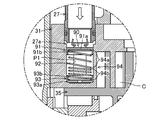
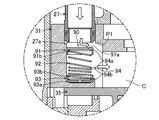
- FIG. 2 is an enlarged view of the suction passage portion of FIG.
- FIG. 3 is an enlarged view of a suction passage portion viewed from an angle different from FIG.
- FIG. 4 is a correlation diagram between the amount of deflection of the coil spring and the spring load.
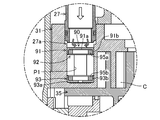
- FIG. 5 is an enlarged longitudinal sectional view showing a suction passage portion of the scroll compressor according to the second embodiment.
- FIG. 6 is an enlarged view of a suction passage portion viewed from an angle different from FIG.
- Embodiment 1 ⁇ Embodiment 1 of the present disclosure will be described.
- the scroll compressor (10) of the first embodiment is connected to a refrigerant circuit (not shown) for performing a vapor compression refrigeration cycle, such as an air conditioner.
- a refrigerant circuit for performing a vapor compression refrigeration cycle, such as an air conditioner.
- the refrigerant (fluid) compressed and discharged by the scroll compressor (10) releases heat in the condenser (radiator), is decompressed by the decompression mechanism, and then evaporates in the evaporator. It is sucked into the scroll compressor (10) and compressed.
- a refrigeration cycle is repeated.
- the scroll compressor (10) includes a casing (20), which is a vertically long cylindrical hermetic container, a compression mechanism (30), a drive shaft (40), a housing (50), An electric motor (60), a lower bearing member (70), and an oil pump (80) are provided.
- a compression mechanism (30), a housing (50), an electric motor (60), a lower bearing member (70), and an oil pump (80) are arranged in this order from above to below.
- the casing (20) is constituted by a vertically long cylindrical closed container. Specifically, the casing (20) has a trunk (21), a first end plate (22), a second end plate (23), and a leg (24).
- the body (21) is formed in a cylindrical shape whose both ends in the axial direction are open.
- the first end plate part (22) closes one end (the upper end in FIG. 1) of the body part (21) in the axial direction.
- the second end plate (23) closes the other end (the lower end in FIG. 1) of the body (21) in the axial direction.
- the leg (24) is provided below the second end plate (23), and supports the casing (20).
- a suction pipe (27) and a discharge pipe (not shown) are connected to the casing (20).
- the suction pipe (27) penetrates the first end plate (22) of the casing (20) in the axial direction, and has one end (lower end in FIG. 1) in a suction passage (39) of the compression mechanism (30) which will be described later. Is press-fitted.
- the discharge pipe not shown, penetrates the body (21) of the casing (20) in the radial direction and opens to a lower space (25) between the housing (50) and the electric motor (60).
- An oil reservoir (26) is provided at the bottom of the casing (20).
- the oil reservoir (26) stores lubricating oil for lubricating each sliding portion inside the scroll compressor (10).
- the compression mechanism (30) is provided in the casing (20) and compresses a fluid (for example, a refrigerant or the like).
- the compression mechanism (30) includes a fixed scroll (31) and a movable scroll (35) that meshes with the fixed scroll (31).
- the fixed scroll (31) has a fixed-side end plate (32), a fixed-side wrap (33), and an outer peripheral wall (34).
- the fixed side end plate (32) is formed in a disk shape.
- the fixed-side wrap (33) is formed in a spiral wall shape that draws an involute curve, and protrudes from the front surface (the lower surface in FIG. 1) of the fixed-side end plate portion (32).
- the outer peripheral wall (34) is formed so as to surround the outer peripheral side of the fixed wrap (33), and is substantially flush with the distal end surface of the fixed wrap (33).
- the movable scroll (35) has a movable-side end plate (36), a movable-side wrap (37), and a boss (38).
- the movable end plate (36) is formed in a disk shape.
- the movable side wrap (37) is formed in a spiral wall shape drawing an involute curve, and protrudes from the front surface (the upper surface in FIG. 1) of the movable side end plate portion (36).
- the boss (38) is formed in a cylindrical shape, and is arranged at the center of the rear surface (the lower surface in FIG. 1) of the movable end plate (36).
- a sliding bearing (38a) is fitted on the inner peripheral side of the boss (38), and an eccentric part (42) of a drive shaft (40) described later is fitted on the inner peripheral side.
- the movable scroll (35) and the fixed scroll (31) face each other on the front surfaces of the fixed end plate (32) and the movable end plate (36), and the movable wrap (37)
- the fixed side wrap (33) is provided so as to mesh with the fixed side wrap (33).
- the fixed side wrap (33) and the movable side wrap (37) are surrounded between the fixed side end plate (32) and the movable side end plate (36).
- a compression chamber (C) for compressing the fluid is formed.
- a suction passage (39) for guiding the fluid to the compression chamber (C) is formed in the fixed side end plate (32).
- the suction passage (39) is formed in the outer peripheral wall portion (34) on the outer peripheral side of the fixed side end plate portion (32) so as to extend in the axial direction of the drive shaft (40) (vertical direction in FIG. 1).
- One end (the upper end in FIG. 1) of the suction passage (39) is an open end that opens on the upper surface of the fixed end plate (32), and the other end (the lower end in FIG. 1) is the lower end of the fixed end plate (32). It is configured at the closed end closed by. As shown in FIGS.
- a suction port (P1) is provided in a portion of the fixed side end plate (32) which constitutes a side wall of the suction passage (39) near the drive shaft (40),
- the suction passage (39) communicates with the compression chamber (C) via the suction port (P1).
- One end (the lower end in FIG. 1) of the above-described suction pipe (27) is press-fitted into one end (the upper end in FIG. 1) of the suction passage (39).
- the opening end (27a) of the suction pipe (27) is closed in the suction passage (39) to move the fluid in the compression chamber (C) toward the suction pipe (27).
- a suction check valve (90) for preventing backflow of the air is provided. The details of the suction check valve (90) will be described later.
- a discharge port (P2) and a discharge chamber (S) are formed in the fixed end plate (32).
- the discharge port (P2) penetrates the center of the fixed side end plate (32) in the axial direction and communicates with the compression chamber (C).
- the discharge chamber (S) is formed on the back surface (the upper surface in FIG. 1) of the fixed end plate (32), and communicates with the discharge port (P2).
- the discharge chamber (S) communicates with the space (25) below the housing (50) through a discharge passage (not shown) formed in the fixed scroll (31) and the housing (50). That is, the space (25) below the housing (50) forms a high-pressure space filled with a high-pressure fluid (for example, high-pressure discharge refrigerant).
- a high-pressure fluid for example, high-pressure discharge refrigerant
- the drive shaft (40) extends vertically inside the casing (20). Specifically, the drive shaft (40) extends in the axial direction of the casing (20) from the upper end of the body (21) of the casing (20) to the oil reservoir (26) serving as the bottom of the casing (20). (Vertically in FIG. 1).
- the drive shaft (40) has a main shaft portion (41) and an eccentric portion (42).
- the main shaft portion (41) extends in the axial direction of the casing (20) (the vertical direction in FIG. 1).
- the eccentric part (42) is provided at the upper end of the main shaft part (41).
- the eccentric portion (42) is formed to have an outer diameter smaller than the outer diameter of the main shaft portion (41), and the axis is eccentric by a predetermined distance from the axis of the main shaft portion (41).
- the drive shaft (40) has an eccentric portion (42) constituting the upper end thereof slidably connected to the boss (38) of the movable scroll (35).
- the eccentric portion (42) is rotatably supported by the boss portion (38) of the movable scroll (35) via a slide bearing (38a).
- the entire periphery of the housing (50) is joined to the inner surface of the body (21) of the casing (20).
- the housing (50) includes an upper part (51) and a lower part (52).
- the upper part (51) and the lower part (52) are formed continuously from top to bottom.
- the upper part (51) is formed in a substantially cylindrical shape, and a concave part that forms a crank chamber that houses the boss (38) of the orbiting scroll (35) is formed in the center of the upper surface.
- the lower part (52) is formed in a substantially cylindrical shape having a smaller diameter than the upper part (51), and protrudes downward from the lower surface of the upper part (51).
- a sliding bearing (52a) is fitted on the inner peripheral side, and the main shaft part (41) of the drive shaft (40) is inserted through the inner peripheral side to rotate the main shaft part (41). It constitutes a main bearing part that supports freely.
- An Oldham coupling (not shown) is provided on the upper surface of the housing (50) to prevent the movable scroll (35) from rotating.
- the Oldham coupling is slidably fitted between the movable end plate (36) of the movable scroll (35) and the housing (50).
- the electric motor (60) is provided below the housing (50) in the casing (20).
- the electric motor (60) has a stator (61) and a rotor (62).
- the stator (61) is formed in a cylindrical shape, and is fixed to the body (21) of the casing (20).
- the rotor (62) is formed in a cylindrical shape, and is provided on the inner peripheral side of the stator (61).
- the drive shaft (40) is inserted into the rotor (62), and the rotor (62) rotationally drives the drive shaft (40).
- the lower bearing member (70) is formed in a cylindrical shape extending in the axial direction (the vertical direction in FIG. 1) of the casing (20), and the electric motor (60) and the oil serving as the bottom of the casing (20) in the casing (20). It is provided between the storage part (26).
- the lower bearing member (70) has an upper part (71) and a lower part (72).
- the upper part (71) of the lower bearing member (70) has a part of the outer peripheral surface protruding radially outward and fixed to the inner peripheral surface of the trunk (21) of the casing (20).
- a sliding bearing (71a) is fitted on the inner peripheral side of the upper part (71) of the lower bearing member (70), and the upper part (71) is connected to the drive shaft (40) via the sliding bearing (71a). ) Is rotatably supported.
- the lower end of the main shaft (41) of the drive shaft (40) is housed on the inner peripheral side of the lower part (72) of the lower bearing member (70).
- the oil pump (80) is provided at the lower end of the drive shaft (40), and is attached to the lower surface of the lower bearing member (70) so as to close the lower end of the lower portion (72) of the lower bearing member (70). ing.
- the oil pump (80) transports the lubricating oil from the oil reservoir (26) to an oil supply passage (43) formed inside the drive shaft (40), and supplies the lubricating oil to the drive shaft (40) in the same manner as the oil supply passage.
- the lubricating oil is configured to be conveyed from an oil drainage passage (44) formed therein to an oil reservoir (26).
- the suction check valve (90) includes a valve body (91) for closing the open end (27a) of the suction pipe (27) and a suction valve (91).
- a pressing mechanism (92) for applying a pressing force to the valve body (91) to press the opening end (27a) of the pipe (27), and pressing the pressing mechanism (92) at a predetermined position in the suction passage (39).
- a supporting member (93) for supporting.
- the valve element (91) has a disk-shaped main body (91a) and a cylindrical cylindrical wall (91b) continuous with the outer peripheral edge of the main body (91a).
- the main body (91a) is formed to have a size that can close the open end (27a) of the suction pipe (27), that is, a diameter larger than the inner diameter of the open end (27a) of the suction pipe (27). Further, the main body (91a) has a size within the suction passage (39) capable of reciprocating in the direction in which the suction passage (39) extends in a direction substantially perpendicular to the direction in which the suction passage (39) extends (vertical direction in FIG. 2). , Formed with a smaller diameter than the inner diameter of the suction passage (39).
- the surface (the upper surface in FIG. 2) of the main body portion (91a) on the side of the suction pipe (27) comes into contact with the open end (27a) of the suction pipe (27) and serves as a closed surface for closing the open end (27a). .
- the cylindrical wall portion (91b) is formed so as to protrude from the outer peripheral edge of the surface (the lower surface in FIG. 2) of the main body portion (91a) on the side opposite to the suction pipe (27).
- the cylindrical wall portion (91b) has a size capable of reciprocating in the extension direction of the suction passage (39) together with the main body portion (91a) in the suction passage (39) in the extending direction (vertical direction in FIG. 1), that is, the outer diameter thereof.
- the diameter is formed smaller than the inner diameter of the suction passage (39).
- the cylindrical wall (91b) extends along the inner wall of the suction passage (39).
- Such a cylindrical wall portion (91b) along the inner wall of the suction passage (39) makes it difficult for the body portion (91a) reciprocating in the suction passage (39) to tilt, and the extending direction of the suction passage (39). A substantially vertical posture is maintained.
- the cylindrical wall portion (91b) is large enough to accommodate one end of a coil spring (94) constituting a pressing mechanism (92) described later, that is, the inner diameter is larger than the outer diameter of the coil spring (94). The diameter is formed.
- the pressing mechanism (92) is constituted by a coil spring (94) provided between the valve body (91) and the support member (93).
- the coil spring (94) is always in a contracted state so as to apply a pressing force to the valve body (91) to press the valve body (91) against the open end (27a) of the suction pipe (27). (91) and the supporting member (93). That is, the coil spring (94) is configured to apply a pressing force to the valve body (91) even when the valve body (91) is fully closed when the valve body (91) is pressed against the open end (27a) of the suction pipe (27). ing.
- the spring load (restoring force) of the coil spring (94) increases as the amount of deflection (contraction) of the coil spring (94) increases. It is configured to have a non-linear characteristic in which the rate of change (increase rate) of the spring load increases as the rate increases.
- the coil spring (94) is formed by an unequal-pitch coil spring in which the coil diameter and the coil wire diameter are equal from one end to the other end in the expansion and contraction direction, but the pitch changes. Have been.
- the coil spring (94) includes a first coil part (94a) and a second coil part (94b) having a smaller pitch than the first coil part (94a).
- the first coil portion (94a) has a spring constant twice (2K) the spring constant K of a linear spring used as a conventional pressing mechanism (92) indicated by a broken line in FIG.
- the second coil portion (94b) is configured such that the spring constant is 2/3 times (2K / 3) the spring constant K of the conventional linear spring.
- the force (downward force in FIG. 1) acting on the valve body (91) for separating from the open end (27a) of the suction pipe (27) is applied to the coil spring (94).
- the coil spring (94) contracts, and the valve body (91) moves away from the open end (27a) of the suction pipe (27) to open the suction pipe (27).
- the first coil part (94a) and the second coil part (94b) also contract, but the second coil part (94b) having a small spring constant.
- the opening of the valve element (91) exceeds a predetermined opening, the second coil portion (94b) does not function as a coil spring, and the spring load of the coil spring (94) is reduced. Change rate (increase rate) becomes large.
- the coil spring (94) the amount of deflection from X 0 fully closed until the entire second coil portion (94b) is X 1 which can not shrink more in contact between the lines, the first coil The portion (94a) and the second coil portion (94b) function as a coil spring having a spring constant K / 2 and connected in series. Then, the amount of deflection becomes the X 1 or more, the second coil portion (94b) is no longer functional, only the first coil spring of spring constant 2K (94a) is to function. Therefore, in the coil spring (94), as the amount of deflection of the coil spring (94) increases, the spring load increases and the rate of change (increase rate) of the spring load increases. In other words, in the coil spring (94), as the amount of deflection of the coil spring (94) decreases, the spring load decreases and the rate of change (decrease rate) of the spring load decreases.
- the pressing mechanism (92) is configured such that the valve element (91) has the open end (27a) of the suction pipe (27). ), That is, as the opening of the valve element (91) decreases, the pressing force for pressing the valve element (91) against the open end (27a) of the suction pipe (27) decreases, and the rate of change of the pressing force decreases. It is configured to have a non-linear characteristic in which the (decrease rate) decreases.
- the opening degree of the valve element (91) refers to the position of the valve element (91) with respect to the open end (27a) of the suction pipe (27), and the valve element (91) is connected to the open end of the suction pipe (27).
- the time when the valve 27a) is fully closed is 0%, and the time when the valve element (91) is in the fully open state where the valve body (91) contacts the support member (93) is 100%.
- the support member (93) is provided at a position in the suction passage (39) away from the opening end (27a) of the suction pipe (27). Specifically, the support member (93) is opposite to the open end (the upper end in FIG. 1) into which one end (the lower end in FIG. 1) of the suction pipe (27) of the suction passage (39) is press-fitted. It is provided at the closed end (the lower end in FIG. 1).
- the support member (93) is formed in a shape corresponding to the valve element (91), and has a disk-shaped main body (93a) and a cylindrical cylindrical wall (continuous to the outer peripheral edge of the main body (93a)). 93b).
- the main body (93a) is formed smaller in diameter than the inner diameter of the suction passage (39), similarly to the main body (91a) of the valve body (91).
- the main body (93a) is provided along the closed end face (the lower end face in FIG. 1) of the suction passage (39).
- the cylindrical wall portion (93b) is formed so as to protrude from the outer peripheral edge of the surface (the upper surface in FIG. 1) of the main body portion (93a) on the side opposite to the closed end of the suction passage (39).
- the cylindrical wall (93b) has an outer diameter smaller than the inner diameter of the suction passage (39), and extends along the inner wall of the suction passage (39).
- the cylindrical wall portion (93b) is large enough to accommodate the other end (the lower end in FIG. 1) of the coil spring (94) constituting the pressing mechanism (92), that is, the inner diameter is the coil spring (94). Is formed to have a larger diameter than the outer diameter.
- the suction check valve (90) includes the coil spring (94) configured to have the above-described non-linear characteristic between the valve body (91) and the support member (93). Accordingly, in the low opening range where the opening of the valve element (91) is small, the pressing force applied to the valve element (91) by the coil spring (94) is relatively small, so that the fluid flow rate (refrigerant circulation amount) is small.
- the valve body (91) can be easily opened even in an operation state or an operation state in which the pressure of the suction fluid (low-pressure gas refrigerant) is low.
- the pressing force applied to the valve body (91) by the coil spring (94) is significantly larger than in the low opening degree area. Therefore, even when the operation is stopped from the fully opened operation state of the valve element (91), a large pressing force is applied to the valve element (91), and the open end (27a) of the suction pipe (27) is applied. ) Is quickly blocked.
- the drive shaft (40) rotates and the movable scroll (35) of the compression mechanism (30) is driven.
- the orbiting scroll (35) revolves around the axis of the drive shaft (40) in a state where rotation is restricted by an Oldham coupling (not shown). Due to the revolution of the movable scroll (35), the volume of the compression chamber (C) periodically increases and decreases, and the low-pressure fluid (from the suction pipe (27) to the compression chamber (C) through the suction passage (39) of the compression mechanism (30). For example, a low-pressure gas refrigerant is sucked and compressed.
- the low pressure fluid acts on the valve body (91) of the suction check valve (90) in a direction opposite to the pressing force by the pressing mechanism (92) (downward in FIG. 1), that is, the fluid drag. (1/2 ⁇ drag coefficient ⁇ fluid density ⁇ square of fluid velocity ⁇ valve flow path area) acts.
- gravity acts on the valve element (91) in a direction opposite to the pressing force. Therefore, the opposite force acting on the valve element (91) obtained by adding the above-mentioned fluid drag and gravity is generated by the pressing force (in the present embodiment, the restoring force of the coil spring (94)) of the pressing mechanism (92).
- valve body (91) When the valve body (91) also becomes large, the valve body (91) closing the open end (27a) of the suction pipe (27) moves away from the open end (27a), so that the suction pipe (27) is opened. Thereby, the suction pipe (27) communicates with the suction passage (39), and the low-pressure fluid in the suction pipe (27) is sucked into the compression chamber (C) via the suction passage (39).
- the low-pressure fluid sucked into the compression chamber (C) is compressed as the volume of the compression chamber (C) decreases.
- the fluid (that is, the high-pressure fluid) compressed in the compression chamber (C) is discharged to the discharge chamber (S) through the discharge port (P2) of the fixed scroll (31).
- the high-pressure fluid (for example, high-pressure gas refrigerant) flowing into the discharge chamber (S) flows out to a space (25) below the housing (50) through a discharge passage (not shown) formed in the fixed scroll (31) and the housing (50). I do.
- the high-pressure fluid flowing into the lower space (25) is discharged to the outside of the casing (20) (for example, a condenser of a refrigerant circuit) through a discharge pipe (not shown).
- the pressing mechanism (92) moves the valve body (91) toward the suction pipe (27).
- the coil spring (94) has a non-linear characteristic in which the pressing force for pressing the opening end (27a) of the 27) decreases and the rate of change (decrease rate) of the pressing force decreases.
- the pressing force applied by the pressing mechanism (92) to the valve element (91) is a relatively large pressing force equivalent to that of a conventional linear spring. Therefore, when the operation of the scroll compressor (10) is stopped, the opening end (27a) of the suction pipe (27) is quickly closed as in the related art.
- the spring constant of the coil spring (94) is smaller than that of the conventional linear spring, so that the pressing mechanism (92) is attached to the valve element (91). The pressing force to be applied is smaller than that of the conventional linear spring.
- valve element (91) is easily opened as compared with the related art, and the suction pressure loss is lower than in the related art. Further, when a linear spring having a high spring constant is used as in a conventional scroll compressor, the valve element (91) can be easily closed in an operation state where the fluid flow rate is small or an operation state where the pressure of the suction fluid is low. Although the valve element (91) may come into contact with the open end (27a) of the suction pipe (27) to generate so-called chattering noise, the above-described configuration allows the valve element (91) to open compared to the related art. Since the degree is relatively large, chattering noise is less likely to occur.
- the scroll compressor (10) of the first embodiment includes a movable scroll (35), a compression chamber (C) for compressing a fluid between the movable scroll (35), and the compression chamber (C).
- a fixed scroll (31) formed with a suction passage (39) for guiding a fluid to the suction passage, a suction pipe (27) having one end inserted into the suction passage (39), and provided in the suction passage (39).
- a suction check valve (90) for opening and closing the open end (27a) of the suction pipe (27).
- the suction check valve (90) includes a valve body (91) that closes an open end (27a) of the suction pipe (27), and a valve body (91) that closes the open end (27a) of the suction pipe (27). ) And a pressing mechanism (92) for applying a pressing force to the valve body (91).
- the pressing mechanism (92) is configured such that the closer the valve body (91) is to the opening end (27a) of the suction pipe (27), the smaller the pressing force and the rate of change (decrease rate) of the pressing force. Is configured to have a non-linear characteristic in which is reduced.
- the pressing mechanism (92) for pressing the valve body (91) of the suction check valve (90) against the open end (27a) of the suction pipe (27) includes a valve body (92).
- (91) approaches the opening end (27a) of the suction pipe (27) that is, as the opening of the valve element (91) decreases, the pressing force decreases and the rate of change (decrease rate) of the pressing force decreases.
- a stop valve (90) can be provided.
- the valve body (91) can be opened even in an operation state in which the fluid flow rate is low or an operation state in which the pressure of the suction fluid is low.
- the degree is relatively large. Therefore, the suction pressure loss during operation can be reduced as compared with a conventional scroll compressor, and a decrease in compressor efficiency can be suppressed.
- the pressing mechanism (92) increases. Accordingly, the pressing force acting on the valve element (91) increases, and the rate of change (rate of increase) increases. Therefore, when the valve element (91) is fully opened, a high pressing force is applied to the valve element (91) by the pressing mechanism (92), similarly to the conventional scroll compressor in which the linear element presses the valve element (91). be able to. Therefore, similarly to the conventional scroll compressor, even when the operation is stopped in an operation state in which the opening degree of the valve element (91) is large, the opening end of the suction pipe (27) is opened by the valve element (91). 27a) can be closed quickly.
- valve element (91) when the valve element (91) is fully opened in contact with the support member (93), the valve element (91) and the support member (93) are in close contact with each other due to the oil film of the lubricating oil, but are difficult to separate. Even when the operation is stopped when the valve (91) is fully opened, a high pressing force is applied to the valve (91) by the pressing mechanism (92), so that the valve (91) is moved from the support member (93). The opening end (27a) of the suction pipe (27) cannot be closed. That is, according to the scroll compressor (10) of the first embodiment, as described above, even if the pressing mechanism (92) is configured so that the valve element (91) is easily opened, the compression chamber when the operation is stopped is stopped. The ability to prevent the fluid in (C) from flowing back to the suction pipe (27) side is not reduced.
- valve element (91) when a linear spring having a high spring constant is used as in a conventional scroll compressor, the valve element (91) is easily closed in an operation state in which the fluid flow rate is low or an operation state in which the pressure of the suction fluid is low, The valve body (91) may come into contact with the open end (27a) of the suction pipe (27) to generate so-called chattering noise.
- the valve element (91) is easily opened, and the operation state in which the fluid flow rate is small or the operation state in which the pressure of the suction fluid is low are low. Also, since the opening of the valve element (91) is relatively large, occurrence of chattering noise can be suppressed.
- the pressing mechanism (92) reduces the pressing force as the valve body (91) approaches the open end (27a) of the suction pipe (27), and reduces the pressing force.
- the coil spring (94) is configured to have a non-linear characteristic in which the rate of change (decrease rate) of the pressing force is reduced.
- a coil spring (94) an unequal-pitch coil spring whose pitch changes while the coil diameter and the coil wire diameter are equal from one end to the other end in the expansion and contraction direction is used. I have.
- the valve body (91) is constituted by a coil spring (94) having a pitch changed from one end to the other end in the expansion and contraction direction as the pressing mechanism (92). ) Is closer to the opening end (27a) of the suction pipe (27), the pressing force is reduced, and the rate of change (decrease rate) of the pressing force is reduced, so that a pressing mechanism (92) having a non-linear characteristic is easily configured. be able to.
- suction check valve (90) in which the pressing force applied to the valve element (91) is smaller than that of the conventional scroll compressor, and is easy to open. Therefore, according to the scroll compressor provided with such a suction check valve (90), as in the conventional scroll compressor, the operation is stopped in the operation state in which the opening of the valve element (91) is large. Even in this case, the opening end (27a) of the suction pipe (27) can be quickly closed by the valve body (91), but the suction pressure loss during operation is reduced as compared with the conventional scroll compressor. be able to.
- the ability to prevent the backflow of the fluid in the compression chamber (C) to the suction pipe (27) side when the operation is stopped is higher than that of the conventional scroll compressor.
- the compressor efficiency can be improved as compared with the conventional scroll compressor without lowering the pressure.
- Embodiment 2 ⁇ Embodiment 2 >> Embodiment 2 will be described.
- the scroll compressor (10) of the second embodiment is obtained by partially changing the configuration of the suction check valve (90) in the scroll compressor (10) of the first embodiment.
- the difference between the scroll compressor (10) of the present embodiment and the scroll compressor (10) of the first embodiment will be described.
- the suction check valve (90) includes a valve element (91) for closing the open end (27a) of the suction pipe (27), and the valve element (91) is connected to the suction pipe (27).
- the valve element (91) and the support member (93) are configured in the same manner as the first embodiment, and only the pressing mechanism (92) is different from the first embodiment.
- the pressing mechanism (92) includes first and second permanent magnets (95 a) provided on the valve body (91) and the support member (93), respectively. , 95b).
- the first and second permanent magnets (95a, 95b) are formed in an annular shape.
- the first permanent magnet (95a) is fitted and fixed inside the cylindrical wall (91b) of the valve body (91).
- the second permanent magnet (95b) is fitted and fixed inside the cylindrical wall (93b) of the support member (93).
- the first permanent magnet (95a) and the second permanent magnet (95b) are provided such that magnetic poles of the same type face each other. For this reason, a repulsive force is generated between the first permanent magnet (95a) and the second permanent magnet (95b), and the repulsive force becomes smaller as the distance between the first permanent magnet (95a) and the second permanent magnet (95b) increases. Rate) decreases as the distance between each other increases.
- the repulsive force acting on the first permanent magnet (95a) is reduced to a valve body.
- (91) is a pressing force for pressing the opening end (27a) of the suction pipe (27).
- the pressing mechanism (92) is configured such that as the valve body (91) approaches the opening end (27a) of the suction pipe (27), that is, as the opening of the valve body (91) decreases,
- the valve body (91) is configured to have a non-linear characteristic in which the pressing force for pressing the valve body (91) against the opening end (27a) of the suction pipe (27) decreases and the rate of change (decrease rate) of the pressing force decreases.
- the pressing mechanism (92) is connected to the first permanent magnet (95a) fixed to the valve body (91) and the suction passage (39).
- a second permanent magnet (95b) fixed so as to repel the first permanent magnet (95a) is provided on a support member (93) provided at a position away from the open end (27a) of the pipe (27). It is constituted so that it may have.
- the valve body (91) is provided with the suction pipe (91) by a repulsive force acting between the first permanent magnet (95a) and the second permanent magnet (95b). It is pressed against the open end (27a) of 27). Further, the repulsive force acting between the first permanent magnet (95a) and the second permanent magnet (95b) increases as the first permanent magnet (95a) moves away from the second permanent magnet (95b). That is, as the valve element (91) approaches the opening end (27a) of the suction pipe (27) and the degree of opening of the valve element (91) decreases, the degree of change (decrease rate) decreases as well.
- the pressing mechanism (92) moves the valve body (91) closer to the open end (27a) of the suction pipe (27), that is, the valve body (91).
- a pair of permanent magnets provided so that magnetic poles of the same type face each other generate a repulsive force therebetween, and the repulsive force becomes smaller as the distance between them increases, and the rate of change ( (Decrease rate) decreases as the distance between each other increases.
- the pressing mechanism (92) As the pressing mechanism (92), the first and the second magnetic poles of the same type are provided between the valve body (91) and the support member (93) so as to face each other. As the valve element (91) approaches the opening end (27a) of the suction pipe (27), the pressing force decreases and the rate of change (decrease) of the pressing force decreases.
- the pressing mechanism (92) having the non-linear characteristic of decreasing the rate can be easily configured.
- the pressing force decreases and the rate of change (decrease rate) of the pressing force decreases.
- the coil spring (94) configured as described above, an unequal-pitch coil spring in which the pitch changes while the coil diameter and the coil wire diameter are equal from one end to the other end in the expansion and contraction direction has been used.
- the coil spring (94) is not limited to the unequal-pitch coil spring. While the coil wire diameter and the pitch are equal from one end to the other end in the expansion and contraction direction, a conical coil spring whose coil diameter changes may be used, and the coil diameter and the pitch are equal from one end to the other end in the expansion and contraction direction.
- a tapered coil spring whose coil wire diameter changes may be used.
- the coil spring (94) is formed of a conical coil spring or a tapered coil spring as described above, the spring load (restoring force) of the coil spring (94) increases as the amount of deflection (amount of contraction) increases.
- the spring has a non-linear characteristic in which the change rate (increase rate) of the spring load becomes large, so that the same effect as that of the first embodiment can be obtained.
- the suction check valve (90) includes the support member (93) for supporting the pressing mechanism (92) at a predetermined position in the suction passage (39).
- the support member (93) may be omitted.
- the support member (93) is omitted, and the other end (the lower end in FIG. 1) of the coil spring (94) constituting the pressing mechanism (92) is connected to the suction passage (39). It may be fixed to the closed end.
- the support member (93) may be omitted, and the second permanent magnet (95b) constituting the pressing mechanism (92) may be fixed to the closed end of the suction passage (39).
- the present disclosure is useful for a scroll compressor.
Landscapes
- Engineering & Computer Science (AREA)
- Mechanical Engineering (AREA)
- General Engineering & Computer Science (AREA)
- Rotary Pumps (AREA)
- Applications Or Details Of Rotary Compressors (AREA)
Abstract
Compresseur à spirale (10) comprenant un clapet de non-retour d'admission (90) qui ouvre et ferme une extrémité ouverte (27a) d'un tube d'admission (27), dans lequel : le clapet de non-retour d'admission (90) est conçu de façon à avoir un corps (91) de clapet qui ferme l'extrémité ouverte (27a) du tube d'admission (27), et un mécanisme de pressage (92) qui communique au corps (91) de clapet une force de pressage pour presser le corps (91) de clapet dans l'extrémité ouverte (27a) du tube d'admission (27) ; et le mécanisme de pressage (92) est conçu de façon à avoir des caractéristiques non linéaires telles que, lorsque le corps (91) de clapet s'approche de l'extrémité ouverte (27a) du tube d'admission (27), la force de pression diminue et le taux de variation de la force de pressage diminue.
Applications Claiming Priority (2)
| Application Number | Priority Date | Filing Date | Title |
|---|---|---|---|
| JP2018-128539 | 2018-07-05 | ||
| JP2018128539A JP2020007945A (ja) | 2018-07-05 | 2018-07-05 | スクロール圧縮機 |
Publications (1)
| Publication Number | Publication Date |
|---|---|
| WO2020008849A1 true WO2020008849A1 (fr) | 2020-01-09 |
Family
ID=69060197
Family Applications (1)
| Application Number | Title | Priority Date | Filing Date |
|---|---|---|---|
| PCT/JP2019/023897 Ceased WO2020008849A1 (fr) | 2018-07-05 | 2019-06-17 | Compresseur à spirale |
Country Status (2)
| Country | Link |
|---|---|
| JP (1) | JP2020007945A (fr) |
| WO (1) | WO2020008849A1 (fr) |
Cited By (1)
| Publication number | Priority date | Publication date | Assignee | Title |
|---|---|---|---|---|
| US12297830B2 (en) * | 2021-10-28 | 2025-05-13 | Daikin Industries, Ltd. | Scroll compressor and refrigeration apparatus |
Citations (5)
| Publication number | Priority date | Publication date | Assignee | Title |
|---|---|---|---|---|
| JPS5914325U (ja) * | 1982-07-16 | 1984-01-28 | 株式会社東芝 | 整流器用変圧器 |
| JPH01180068U (fr) * | 1988-06-08 | 1989-12-25 | ||
| JP2001323881A (ja) * | 2000-05-16 | 2001-11-22 | Hitachi Ltd | 圧縮機 |
| JP2004353591A (ja) * | 2003-05-30 | 2004-12-16 | Calsonic Compressor Inc | 気体圧縮機およびその吸入逆止弁 |
| JP2014206060A (ja) * | 2013-04-11 | 2014-10-30 | 日立アプライアンス株式会社 | スクロール圧縮機 |
-
2018
- 2018-07-05 JP JP2018128539A patent/JP2020007945A/ja active Pending
-
2019
- 2019-06-17 WO PCT/JP2019/023897 patent/WO2020008849A1/fr not_active Ceased
Patent Citations (5)
| Publication number | Priority date | Publication date | Assignee | Title |
|---|---|---|---|---|
| JPS5914325U (ja) * | 1982-07-16 | 1984-01-28 | 株式会社東芝 | 整流器用変圧器 |
| JPH01180068U (fr) * | 1988-06-08 | 1989-12-25 | ||
| JP2001323881A (ja) * | 2000-05-16 | 2001-11-22 | Hitachi Ltd | 圧縮機 |
| JP2004353591A (ja) * | 2003-05-30 | 2004-12-16 | Calsonic Compressor Inc | 気体圧縮機およびその吸入逆止弁 |
| JP2014206060A (ja) * | 2013-04-11 | 2014-10-30 | 日立アプライアンス株式会社 | スクロール圧縮機 |
Cited By (1)
| Publication number | Priority date | Publication date | Assignee | Title |
|---|---|---|---|---|
| US12297830B2 (en) * | 2021-10-28 | 2025-05-13 | Daikin Industries, Ltd. | Scroll compressor and refrigeration apparatus |
Also Published As
| Publication number | Publication date |
|---|---|
| JP2020007945A (ja) | 2020-01-16 |
Similar Documents
| Publication | Publication Date | Title |
|---|---|---|
| CN102472273B (zh) | 涡旋压缩机 | |
| US9850904B2 (en) | Scroll compressor | |
| JP6291533B2 (ja) | 高圧圧縮機及びそれを備えた冷凍サイクル装置 | |
| JP4911260B1 (ja) | スクリュー圧縮機 | |
| CN112088250A (zh) | 涡旋式压缩机 | |
| US11268511B2 (en) | Motor driven compressor apparatus including swing pin | |
| US7381037B2 (en) | Apparatus for varying capacity of scroll compressor | |
| CN109113995B (zh) | 具有两个缸的旋转式压缩机 | |
| CN105697371B (zh) | 压缩机 | |
| CN208564972U (zh) | 旋转式压缩机及制冷设备 | |
| US20140356210A1 (en) | Scroll compressor | |
| CN100540906C (zh) | 可变容量回转式压缩机及其驱动方法 | |
| JP2016017438A (ja) | シングルスクリュー圧縮機 | |
| JP2018048649A (ja) | スクロール圧縮機 | |
| JP2020007945A (ja) | スクロール圧縮機 | |
| CN203670216U (zh) | 回转式压缩机 | |
| JP4638762B2 (ja) | スクロール圧縮機 | |
| JPH04121474A (ja) | スクロール型圧縮機 | |
| JP2016020651A (ja) | スクリュー圧縮機 | |
| CN101889143A (zh) | 单螺杆压缩机 | |
| JP4930022B2 (ja) | 流体機械 | |
| JP2005180317A (ja) | 回転式圧縮機 | |
| JP5660151B2 (ja) | スクロール圧縮機 | |
| JP2013177868A (ja) | スクリュー圧縮機 | |
| JP2013231356A (ja) | コンプレッサ |
Legal Events
| Date | Code | Title | Description |
|---|---|---|---|
| 121 | Ep: the epo has been informed by wipo that ep was designated in this application |
Ref document number: 19829856 Country of ref document: EP Kind code of ref document: A1 |
|
| NENP | Non-entry into the national phase |
Ref country code: DE |
|
| 122 | Ep: pct application non-entry in european phase |
Ref document number: 19829856 Country of ref document: EP Kind code of ref document: A1 |