WO2020009041A1 - pH測定用試薬組成物 - Google Patents
pH測定用試薬組成物 Download PDFInfo
- Publication number
- WO2020009041A1 WO2020009041A1 PCT/JP2019/025948 JP2019025948W WO2020009041A1 WO 2020009041 A1 WO2020009041 A1 WO 2020009041A1 JP 2019025948 W JP2019025948 W JP 2019025948W WO 2020009041 A1 WO2020009041 A1 WO 2020009041A1
- Authority
- WO
- WIPO (PCT)
- Prior art keywords
- reagent
- pka
- color
- absorbance
- acid dissociation
- Prior art date
- Legal status (The legal status is an assumption and is not a legal conclusion. Google has not performed a legal analysis and makes no representation as to the accuracy of the status listed.)
- Ceased
Links
Images




Classifications
-
- G—PHYSICS
- G01—MEASURING; TESTING
- G01N—INVESTIGATING OR ANALYSING MATERIALS BY DETERMINING THEIR CHEMICAL OR PHYSICAL PROPERTIES
- G01N31/00—Investigating or analysing non-biological materials by the use of the chemical methods specified in the subgroup; Apparatus specially adapted for such methods
- G01N31/22—Investigating or analysing non-biological materials by the use of the chemical methods specified in the subgroup; Apparatus specially adapted for such methods using chemical indicators
- G01N31/221—Investigating or analysing non-biological materials by the use of the chemical methods specified in the subgroup; Apparatus specially adapted for such methods using chemical indicators for investigating pH value
-
- G—PHYSICS
- G01—MEASURING; TESTING
- G01N—INVESTIGATING OR ANALYSING MATERIALS BY DETERMINING THEIR CHEMICAL OR PHYSICAL PROPERTIES
- G01N21/00—Investigating or analysing materials by the use of optical means, i.e. using sub-millimetre waves, infrared, visible or ultraviolet light
- G01N21/75—Systems in which material is subjected to a chemical reaction, the progress or the result of the reaction being investigated
- G01N21/77—Systems in which material is subjected to a chemical reaction, the progress or the result of the reaction being investigated by observing the effect on a chemical indicator
- G01N21/78—Systems in which material is subjected to a chemical reaction, the progress or the result of the reaction being investigated by observing the effect on a chemical indicator producing a change of colour
- G01N21/80—Indicating pH value
-
- G—PHYSICS
- G01—MEASURING; TESTING
- G01N—INVESTIGATING OR ANALYSING MATERIALS BY DETERMINING THEIR CHEMICAL OR PHYSICAL PROPERTIES
- G01N21/00—Investigating or analysing materials by the use of optical means, i.e. using sub-millimetre waves, infrared, visible or ultraviolet light
- G01N21/75—Systems in which material is subjected to a chemical reaction, the progress or the result of the reaction being investigated
- G01N21/77—Systems in which material is subjected to a chemical reaction, the progress or the result of the reaction being investigated by observing the effect on a chemical indicator
-
- G—PHYSICS
- G01—MEASURING; TESTING
- G01N—INVESTIGATING OR ANALYSING MATERIALS BY DETERMINING THEIR CHEMICAL OR PHYSICAL PROPERTIES
- G01N21/00—Investigating or analysing materials by the use of optical means, i.e. using sub-millimetre waves, infrared, visible or ultraviolet light
- G01N21/75—Systems in which material is subjected to a chemical reaction, the progress or the result of the reaction being investigated
- G01N21/77—Systems in which material is subjected to a chemical reaction, the progress or the result of the reaction being investigated by observing the effect on a chemical indicator
- G01N21/78—Systems in which material is subjected to a chemical reaction, the progress or the result of the reaction being investigated by observing the effect on a chemical indicator producing a change of colour
-
- G—PHYSICS
- G01—MEASURING; TESTING
- G01N—INVESTIGATING OR ANALYSING MATERIALS BY DETERMINING THEIR CHEMICAL OR PHYSICAL PROPERTIES
- G01N31/00—Investigating or analysing non-biological materials by the use of the chemical methods specified in the subgroup; Apparatus specially adapted for such methods
- G01N31/22—Investigating or analysing non-biological materials by the use of the chemical methods specified in the subgroup; Apparatus specially adapted for such methods using chemical indicators
Definitions
- the present invention relates to a reagent composition for measuring pH, particularly to a reagent composition for measuring the pH of a sample in a predetermined range.
- a reagent composition for measuring pH particularly to a reagent composition for measuring the pH of a sample in a predetermined range.
- the pH (hydrogen ion index) of various types of water may be adjusted by adding a chemical.
- Patent Document 1 discloses a titration method and a measurement method using a glass electrode.
- a precipitate may be generated as the titration proceeds, and the influence of the precipitate is avoided.
- the method using a glass electrode has a wide pH measurement range, it does not have a self-diagnosis function for the measured value, and thus requires frequent inspection and calibration to ensure the reliability of the measured value.
- Patent Literature 1 discloses that a pH indicator is added to a test sample and the hydrogen ion concentration of the sample is determined from a change in absorbance due to the discoloration of the test sample as an alternative method capable of removing the disadvantages of the titration method and the measurement method using a glass electrode. A method for measuring is disclosed.
- the pH change range of the pH indicator is limited to a certain range, the range of pH that can be measured by the above-mentioned alternative method is at most about 1 to 2, and is narrow.
- the present invention uses a coloring reagent whose absorbance can fluctuate due to fluctuations in pH, and enables the pH of a sample to be measured in a relatively wide range.
- the present invention relates to a reagent composition for measuring the pH of a sample in a predetermined range.
- This reagent composition comprises a first color forming reagent capable of fluctuating the absorbance in the ultraviolet-visible region by acid dissociation in one step due to a change in pH in the predetermined range, and an acid in one step due to a change in pH in the predetermined range.
- Each of the reagent and the third coloring reagent has an absorbance in the ultraviolet-visible region in the above-mentioned predetermined range exceeding 0.
- One embodiment of the reagent composition according to the present invention has a first color forming reagent selected from those having an acid dissociation constant (pKa) in the range of 4.1 to 6.0, and an acid dissociation constant (pKa) of 6.5 to 6.0.
- a second color-forming reagent selected from those having a range of 8.5; and one type of third color-forming reagent selected from those having an acid dissociation constant (pKa) of 5.5 to 7.5.
- the first chromogenic reagent selected from those having an acid dissociation constant (pKa) in the range of 4.1 to 6.0 has an acid dissociation constant (pKa) of 8.
- a second chromogenic reagent selected from those in the range of 5 to 11.5, a first chromogenic reagent selected from those having an acid dissociation constant (pKa) of 5.5 to 7.5, and an acid dissociation constant (PKa) is selected from the range of 7.0 to 9.5 and the acid dissociation constant (pKa) is larger than the first color developing reagent.
- the reagent composition of the present invention may further contain an amino acid.
- the reagent composition of the present invention may further contain a strong inorganic base.
- the reagent composition of the present invention contains at least three kinds of color-forming reagents having acid dissociation constants (pKa) different from each other, in which acid dissociation can be performed in one step due to a change in pH and absorbance in an ultraviolet-visible region can be changed.
- pKa acid dissociation constants
- FIG. 4 is a graph showing a color change pH range of each color forming reagent contained in the reagent composition according to the specific example of the first embodiment.
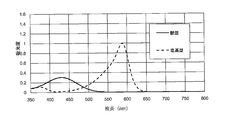
- FIG. Absorption spectrum of bromophenol blue. Alizarin yellow absorption spectrum.
- FIG. 7 is a graph showing a color change pH range of each color forming reagent contained in a reagent composition according to a specific example of the second embodiment.
- FIG. 6 is a schematic graph showing a relationship between a change in the amount of the reagent composition added to the test sample and the pH of the test sample when Steps 1 to 3 of the pH measurement method using the reagent composition of the present invention are repeated. The graph for pH judgment created in the Example.
- the reagent composition of the present invention adjusts the pH of test water collected from various kinds of water and various aqueous solutions such as water supply to a boiler and circulating cooling water of a cooling tower to a certain limited range (referred to as “predetermined range”). ), And includes a first coloring reagent, a second coloring reagent, and a third coloring reagent.
- Each coloring reagent contained in the reagent composition has a degree of acid dissociation depending on the pH of its existing environment, that is, a difference between a base form (HIn) that has not been dissociated and a acid form (In-) that has been dissociated.
- the abundance ratio changes, thereby changing the absorbance of the environment in the ultraviolet and visible regions.
- pKa is a value at 25 ° C.
- Each of the coloring reagents used in the reagent composition is capable of dissociating the acid in one step due to a change in the pH within a predetermined range, thereby changing the absorbance in the ultraviolet-visible region, and within the predetermined range. Absorbance in the ultraviolet-visible region exceeds 0, that is, absorption in the ultraviolet-visible region does not disappear within a predetermined range.
- the color reagent has a different pH range in which acid can be dissociated depending on its pKa. Therefore, in order to secure a certain range as the predetermined range of the measurable pH, the first coloring reagent, the second coloring reagent, and the third coloring reagent used in the reagent composition are different from each other in pKa. That is, as the second coloring reagent, a reagent having a higher pKa than that of the first coloring reagent is selected. As the third coloring reagent, a reagent having a pKa between the first coloring reagent and the second coloring reagent is selected.
- the third color reagent may be composed of only one type of color reagent, or may be composed of two or more types of color reagents.
- the color reagent preferably has a pKa substantially at the median between the pKa of the first color reagent and the pKa of the second color reagent.
- the color reagents having different pKa from each other are selected.
- each of the coloring reagents in the third coloring reagent has a substantially equal interval between the pKa of the first coloring reagent and the pKa of the second coloring reagent.
- Examples of the embodiment of the reagent composition include the following first embodiment and second embodiment.
- the reagent adjusted so that the concentration of the coloring reagent becomes 1.00 g / kg is diluted 150 times with dilution water (for example, distilled water).
- the measured solution (hereinafter, the concentration of the coloring reagent in the solution thus prepared is sometimes referred to as “unit coloring reagent concentration”).
- a spectrophotometer (model number: U-2910) manufactured by Hitachi High-Tech Science Corporation was used, and the measurement wavelength range was set to 350 nm to 800 nm using a cell having an optical path length of 10 mm.
- the base form means the state before acid dissociation
- the acid form means the state after acid dissociation.
- the strong acid form of phenol red means the state after the second-stage acid dissociation described later.
- the pH of the sample is measured in the range of about 4 to 9 (this range includes the entire pH range of the buffer of carbonic acid), and includes the following coloring reagents.
- First color-forming reagent It is one selected from color-forming reagents having a pKa in the range of 4.1 to 6.0. For example, it can be selected from the group of methyl red (pKa: 5.1), bromophenol blue (pKa: 4.2) and bromocresol green (pKa: 4.7).
- Second chromogenic reagent Selected from color developing reagents having a pKa in the range of 6.5 to 8.5. For example, one may select from the group of phenol red (pKa: 1.2 and 7.7), neutral red (pKa: 6.7 and 7.4) and cresol red (pKa: 1.0 and 8.0). it can.
- a reagent composition containing the following coloring reagents can be given.
- First color forming reagent methyl red pKa 5.1 Absorption spectrum: Fig. 1 ⁇ Second color forming reagent Phenol Red pKa: 1.2 and 7.7 Absorption spectrum: FIG. ⁇ Third color forming reagent bromocresol purple pKa: 6.3 Absorption spectrum: FIG.
- FIG. 4 shows the discoloration pH range obtained from pKa based on the above-mentioned Henderson-Hasselbarch equation for each coloring reagent contained in the reagent composition of the above specific example.
- the first color-forming reagent methyl red
- the second color-forming reagent phenol red
- the third color-forming reagent bromocresol purple.
- the reagent composition of the above specific example is suitable for measuring the pH of a test sample in a predetermined range of about 4 to 9, since it can discolor in a pH range of about 5.5 to 7. I have.
- Phenol red has two pKas because acid dissociation occurs in two steps depending on the pH of its existing environment.
- One of the pKas (7.7) is the pKa of methyl red used as the first coloring reagent.
- (5.1) and bromocresol purple used as the third chromogenic reagent are larger than pKa (6.3), and acid dissociation in a predetermined range of pH 4 to 9 is one step.
- First color-forming reagent It is one selected from color-forming reagents having a pKa in the range of 4.1 to 6.0. For example, it can be selected from the group of methyl red (pKa: 5.1), bromophenol blue (pKa: 4.2) and bromocresol green (pKa: 4.7).
- Second chromogenic reagent Selected from the chromogenic reagents having a pKa in the range of 8.5 to 11.5. For example, it can be selected from the group of alizarin yellow (pKa: 11.06) and thymol blue (pKa: 1.7 and 8.9).
- a coloring reagent B having a higher pKa than that of the coloring reagent A is selected.
- the coloring reagent A can be selected, for example, from the group of bromocresol purple (pKa: 6.3) and bromothymol blue (pKa: 7.1).
- the coloring reagent B includes, for example, phenol red (pKa: 1.2 and 7.7), neutral red (pKa: 6.7 and 7.4) and cresol red (pKa: 1.0 and 8.0). Can be selected from the group.
- a reagent composition containing the following coloring reagents can be given.
- FIG. 7 shows the discoloration pH range obtained from pKa based on the above-mentioned Henderson-Hasselbarch equation for each coloring reagent contained in the reagent composition of the above specific example.
- the first chromogenic reagent bromophenol blue
- the second chromogenic reagent alizarin yellow
- the three color reagents bromocresol purple, which is color reagent A, is capable of discoloring when the pH is approximately in the range of 5 to 7
- phenol red which is color reagent B
- the reagent composition of the above specific example is suitable for measuring the pH of a sample in a predetermined range of about 4 to 12.
- phenol red has two pKas as described above, one of the pKas (7.7) is larger than the pKa (3.85) of bromophenol blue used as the first color forming reagent.
- the acid dissociation of the third coloring reagent is Can be used as one.
- other coloring reagents having two pKas for example, thymol blue, neutral red and cresol red
- one of the pKas satisfies the conditions as the first coloring reagent, the second coloring reagent or the third coloring reagent. If so, it can be used as a required coloring reagent.
- the mixing ratio of each coloring reagent is basically set to be equimolar. However, it is necessary to increase the number of coloring reagents having a pKa close to pH at which resolution (judgment accuracy) is to be improved. You can also.
- the reagent composition is usually one in which a required coloring reagent is dissolved in a solvent.
- a solvent various solvents can be used as long as the solvent itself does not easily affect the absorbance of the coloring reagent when added to the test water.
- purified water such as distilled water or pure water
- diols such as ethylene glycol, propylene glycol, and propanediol can be used.
- the reagent composition may contain various additives such as a surfactant, an amino acid, and an inorganic strong base.
- the surfactant is used to suppress dirt adhering to the cell for measuring the absorbance used when measuring the pH using the reagent composition, and includes various kinds of cationic, anionic or nonionic. Can be used, but a nonionic one is preferred.
- Amino acids are used to enhance the buffering capacity of the coloring reagent in the reagent composition, as will be described in detail later, and various kinds of amino acids can be used, but glycine, proline or alanine, which are usually inexpensive and easily available, can be used.
- the strong inorganic base is for adjusting the pH of the reagent composition to near neutrality, and for example, an alkali metal hydroxide such as sodium hydroxide or potassium hydroxide can be used.
- the pH of the reagent composition is low because it contains a color reagent that dissociates in test water, but the color reagent is unstable under acidic conditions. Decomposition is easy to proceed.
- the pH of the reagent composition is adjusted to around neutrality by the addition of a strong inorganic base, the decomposition of the coloring reagent is suppressed, and the reliability of the pH measurement result of the test water can be increased.
- the method for measuring the pH of a test water using the reagent composition of the present invention includes the following steps 1 to 3.
- Step 1 In this step, the reagent composition of the present invention is added to the sample. It is preferable that the test water to which the reagent composition is added is appropriately stirred so that the added reagent composition is uniformly dispersed.
- the amount of the reagent composition added to the test water is set to a predetermined amount. This predetermined amount is based on the total amount of each color-forming reagent, and may be hereinafter referred to as “reference addition amount”.
- Step 2 the absorbance of a specific wavelength arbitrarily selected from the ultraviolet and visible regions (hereinafter, may be referred to as “specific wavelength”) is measured for the test sample to which the reagent composition has been added in step 1.
- specific wavelength a specific wavelength arbitrarily selected from the ultraviolet and visible regions
- light of a specific wavelength is irradiated to the test water, and the light transmitted through the test water is received to measure a required absorbance.
- an easily available light source for measuring the absorbance can be used.
- an LED that emits light of a specific wavelength can be selected from a group of various light emitting diodes (LEDs) having different emission colors.
- the absorption spectrum is measured by irradiating the water sample with light having a wavelength in the ultraviolet and visible light range, usually from 100 nm to 800 nm, using a spectrophotometer. Wavelength absorbance can also be determined.
- the specific wavelength is not particularly limited, but the absorption by the measurement target is strong, but the absorption is stable even if the wavelength is slightly shifted. If the change in the absorbance of the measurement target is too large, the measurement range of the pH is increased. Considering that the change is too small while the change is too small, the measurement accuracy of pH is likely to be reduced, and it is preferable that the wavelength is set so that the change in absorbance can be easily observed.
- the absorbance at one specific wavelength may be measured, or the absorbances at a plurality of different specific wavelengths may be measured.
- Step 3 In this step, the pH of the sample is determined based on the absorbance of the specific wavelength measured in step 2.
- the absorbance at a specific wavelength for the test water to which the reagent composition was added in step 1 theoretically appears as the sum of the absorbances at the specific wavelength for each of the coloring reagents contained in the reagent composition added to the test water in step 1. . That is, the absorbance at a specific wavelength for the test water to which the reagent composition has been added is the value obtained by integrating the absorbance at the specific wavelength for each of the base type and acid type of each color forming reagent contained in the reagent composition for each concentration.
- the absorbance at a specific wavelength of a test water to which the reagent composition has been added can be calculated by the following relational expression.
- the meaning of each symbol in the relational expression is as described in Tables 1 and 2.
- Each absorbance in Table 1 is obtained by the relationship between the absorbance at a specific wavelength for the solution of the corresponding color reagent adjusted to the unit color reagent concentration and the compounding ratio of the corresponding color reagent in the reagent composition (absorbance x compound ratio). It is determined.
- the proportion of the base type of each coloring reagent varies depending on the pH of the test water, so the reference injection amount of the reagent composition for which the mixing ratio of each coloring reagent is known is relative to the test water.
- the absorbance at a specific wavelength in the test water when injected by injection can be predicted for each pH of the test water based on the above relational expression. Therefore, if the absorbance at a specific wavelength at each pH of the test water is predicted in accordance with the reagent composition used in step 1, the prediction result is compared with the absorbance at the specific wavelength actually measured in step 2 to determine the absorbance.
- the pH of the sample can be determined.
- the correlation between the pH of the test water to which the reagent composition is added and the absorbance at each specific wavelength is determined by the above-mentioned relational expression and Henderson. If the analysis is carried out in advance in light of Hasselbarch's equation, the pH of the sample can be determined with higher accuracy in this step.
- the reagent composition according to the first embodiment contains three types of color reagents, that is, a first color reagent, a second color reagent, and a third color reagent consisting of one type of color reagent, and the mixing ratio of each color reagent Is used, the absorbance at three specific wavelengths for the test water to which the reagent composition is added, that is, three specific wavelengths of ⁇ 1, ⁇ 2 and ⁇ 3 (where ⁇ 1 ⁇ 2 ⁇
- the absorbance of ⁇ 3. is expressed by the following formulas (1), (2) and (3) between the ratios of the base type and the acid type of each coloring reagent in the sample water in light of the above relational expression. Three types of relational expressions hold. The meaning of each symbol in the formulas (1) to (3) is as described in Tables 3 and 4.
- the respective absorbances in Table 3 represent the relationship between the absorbance of the corresponding specific wavelength for the solution of the corresponding color reagent adjusted to the unit color reagent concentration and the mixing ratio of the corresponding color reagent in the reagent composition (absorbance ⁇ mixing ratio). ).
- the absorbance at one specific wavelength is used as the denominator, and the absorbance at each of the other specific wavelengths is separately calculated as the numerator.
- the pH of the test water can be determined according to the correlation analysis result obtained in advance using the absorbance ratio and the pH of the test water as variables. In this case, even if the amount of the reagent composition added to the test water in Step 1 varies from the reference addition amount, a highly reliable determination result of the pH of the test water can be obtained in this step.
- the pH of the test water is provisionally determined from the measurement result of the absorbance in step 2 according to the correlation analysis result obtained in advance using each of the absorbance ratio and the pH of the test water as variables.
- Step 3 is stopped because there is a possibility that an abnormality has occurred.
- the absorbance ratio A and the pH of the test water are used as variables, and the pH of the test water is provisionally determined from the measurement results of the absorbance in Step 2 according to the correlation analysis result obtained in advance using the absorbance ratio B and the absorbance ratio B as the variables.
- the pH of the test water is provisionally determined from the absorbance measurement result in step 2 according to the correlation analysis result obtained in advance using the pH of the test water as a variable, and the pH of the test water provisionally determined based on the absorbance ratio A and the absorbance ratio If the difference from the pH of the test water temporarily determined based on B exceeds a predetermined value (for example, 0.5), the step 3 is stopped.
- the predetermined value of the pH difference can be set arbitrarily according to the expected measurement accuracy.
- the absorbance at each specific wavelength is measured according to the above example.
- the process can be performed according to the analysis results.
- the pH of the test water can be determined based on the measurement results of the absorbance at each wavelength in Step 2.
- the pH of the sample can be determined using the absorbance ratio according to the above example. Further, when it is determined whether or not to stop the step 3 by using the absorbance ratio, since three or more types of absorbance ratios can be obtained, for example, arbitrarily selecting two types of absorbance ratios from these absorbance ratios If the difference in the pH of the test water temporarily determined based on each of them exceeds a predetermined value, the step 3 is stopped.
- pH measurement method may further include the following step 4.
- Step 4 Since the pH measurement method involves adding the reagent composition of the present invention to a test sample, it cannot measure the pH of the test sample itself. Will be measured. Since each coloring reagent contained in the reagent composition is colored by acid dissociation, it acts to fluctuate the pH of the test sample in a downward direction by protons released into the test sample, and the original pH value of the test sample May fluctuate.
- the degree of the effect of the reagent composition on the pH of the sample varies depending on the buffer capacity of the sample. That is, in the sample test, when the buffer capacity is high (typically, when a buffer component such as carbonate is contained), the pH is hardly fluctuated due to the influence of the reagent composition. The pH tends to fluctuate due to the influence of the composition. Therefore, in the pH measurement method, it is preferable to correct the measurement result so as to remove the fluctuation in pH due to the influence of the reagent composition.
- a series of operations from step 1 to step 3 is repeated at least once (that is, a series of operations from step 1 to step 3 is repeated twice or more). Is determined. Since the reagent composition of the present invention added in each step 1 acts in the direction of lowering the pH of the test water as described above, the pH of the test water determined in step 3 of each repeated operation is The substance gradually decreases as the substance is added stepwise. For example, as schematically shown in FIG. 8, when the amount of the reagent composition to be added is set to a in step 1, the pH of the test water is the second time than the value V1 determined in the first step 3. The value V2 determined in the step 3 becomes lower, and the value V3 determined in the third step 3 becomes even lower than the value V2.
- the buffer capacity of the test water can be evaluated in the above-mentioned correction operation in light of the pH change state of the water test determined in step 3 during each repetitive operation.
- the reagent composition of the present invention preferably contains an amino acid. Amino acids can increase the buffering capacity of the chromogenic reagent in the reagent composition, thereby helping to change the pH of the test water to which the reagent composition has been added.
- the amino acid changes to -NH3 + when a proton (hydrogen ion) coordinates to its amino group (-NH2). It becomes easy to raise the pH of the test water to which the composition was added in the neutral direction.
- the pH of the test sample is on the alkaline side (the pH is high)
- the pH of the test sample to which the reagent composition has been added is set at a medium level because the amino acids are protons (hydrogen ions) released from the carboxyl group (—COOH). It tends to lower in the sex direction.
- test sample when the test sample has a low pH due to the inclusion of carbonic acid (H2CO3), a part of the hydrogen ions dissociated from the carbonic acid is coordinated to the amino group of the amino acid. Ascends and tends to change in the neutral direction.
- test water has a high pH due to the inclusion of ammonia (NH3), a part of the hydroxyl ion (OH-) generated by the ionization of ammonia in the test water is released from protons (hydrogen ions) released from the carboxyl group of the amino acid. ) Is neutralized, so that the pH of the test sample decreases as the reagent composition is added, and the pH of the test sample tends to change toward neutral.
- the absorbance of visible light of each wavelength predicted in that case is calculated using the above-described equation. Calculated in light of (1), equations (2) and (3) and Henderson-Hasselbarch's equation. Here, the absorbance of the visible light of each of the above wavelengths was calculated for the test water having different pHs in the range of 1 to 10 in increments of 0.1.
- Verification water adjusted to the pH value shown in Table 7 was prepared.
- the pH of each test water was confirmed using a glass electrode (model number: 9625-10D) manufactured by Horiba, Ltd. After 0.75 g of the reagent composition was added to each 100 mL of the test water and stirred, the absorbance of visible light having a wavelength of 420 nm, 525 nm, and 590 nm was measured. Then, the absorbance ratio (525 nm / 420 nm) and the absorbance ratio (590 nm / 420 nm) of each test water were determined, and the pH was determined by applying each absorbance ratio to the graph of FIG. 9. Table 7 shows the results.
Landscapes
- Life Sciences & Earth Sciences (AREA)
- Chemical & Material Sciences (AREA)
- Physics & Mathematics (AREA)
- Health & Medical Sciences (AREA)
- Pathology (AREA)
- Analytical Chemistry (AREA)
- Biochemistry (AREA)
- General Health & Medical Sciences (AREA)
- General Physics & Mathematics (AREA)
- Immunology (AREA)
- Plasma & Fusion (AREA)
- Chemical Kinetics & Catalysis (AREA)
- Engineering & Computer Science (AREA)
- Biophysics (AREA)
- Molecular Biology (AREA)
- Investigating Or Analyzing Non-Biological Materials By The Use Of Chemical Means (AREA)
- Investigating Or Analysing Materials By The Use Of Chemical Reactions (AREA)
Abstract
検水のpHを測定するための試薬組成物は、酸解離定数(pKa)が5.1のメチルレッド、pKaがメチルレッドより大きい7.7のフェノールレッドおよびpKaがメチルレッドおよびフェノールレッドのそれらの間である6.3のブロモクレゾールパープルをそれぞれ所定割合でエチレングリコール等のジオール類に溶解したものである。この試薬組成物を添加した検水について410~430nmの範囲から選択した波長、515~535nmの範囲から選択した波長および580~600nmの範囲から選択した波長の三種類の波長の吸光度を測定し、これらの吸光度に基づいて検水のpHを判定する。これによると、検水のpHを4~9の範囲で測定することができる。
Description
本発明は、pH測定用の試薬組成物、特に、検水のpHを所定範囲において測定するための試薬組成物に関する。本願は2018年7月3日に日本に出願された特願2018-126905号に基づき優先権を主張し、その内容をここに援用する。
ボイラへの給水や冷却塔の循環冷却水などの各種の用水は、薬剤の添加によりpH(水素イオン指数)を調整することがある。この場合、薬剤を添加した後の用水のpHを測定し、用水のpHが目標範囲に調整されていることの確認が必要である。
用水や溶液のpHを測定するための一般的な方法として、特許文献1は、滴定法およびガラス電極を用いる測定法を掲げている。しかし、滴定法は、特許文献1に記載のように、試料、すなわち検水が多量の金属分を含む場合に滴定が進むにつれて沈でん物の生成することがあり、当該沈でん物の影響を回避するための処理をすると滴定終点の検出が困難なうえに操作が複雑となり、しかも多量の試料を必要とするという問題がある。また、ガラス電極を用いる方法は、pHの測定範囲が広いものの、測定値に対する自己診断機能を有していないことから測定値の信頼性を担保するために頻繁な点検および校正が必要になる。
そこで、特許文献1は、滴定法およびガラス電極を用いる測定法の欠点を除去可能な代替法として、検水にpH指示薬を添加し、検水の変色に伴う吸光度の変化から試料の水素イオン濃度を測定する方法を開示している。しかし、pH指示薬は変色域が一定範囲に限られていることから、上記代替法により測定可能なpHの幅は、せいぜい1~2程度であり、狭小である。
本発明は、pHの変動により吸光度が変動し得る発色試薬を用い、検水のpHを比較的に広範囲で測定できるようにするものである。
本発明は、検水のpHを所定範囲において測定するための試薬組成物に関するものである。この試薬組成物は、前記所定範囲でのpHの変動により一段階で酸解離して紫外可視領域の吸光度が変動し得る第1発色試薬と、前記所定範囲でのpHの変動により一段階で酸解離して紫外可視領域の吸光度が変動し得る、第1発色試薬よりも酸解離定数(pKa)が大きい第2発色試薬と、前記所定範囲でのpHの変動により一段階で酸解離して紫外可視領域の吸光度が変動し得る、酸解離定数(pKa)が第1発色試薬と第2発色試薬との間にある少なくとも一種類の第3発色試薬とを含み、第1発色試薬、第2発色試薬および第3発色試薬は、いずれも、前記所定範囲での紫外可視領域の吸光度が0を超えるものである。
本発明に係る試薬組成物の一形態は、酸解離定数(pKa)が4.1~6.0の範囲のものから選ばれた第1発色試薬、酸解離定数(pKa)が6.5~8.5の範囲のものから選ばれた第2発色試薬、酸解離定数(pKa)が5.5~7.5の範囲のものから選ばれた一種類の第3発色試薬を含む。
本発明に係る試薬組成物の他の一形態は、酸解離定数(pKa)が4.1~6.0の範囲のものから選ばれた第1発色試薬、酸解離定数(pKa)が8.5~11.5の範囲のものから選ばれた第2発色試薬、酸解離定数(pKa)が5.5~7.5の範囲のものから選ばれた第1種の発色試薬および酸解離定数(pKa)が7.0~9.5の範囲のものから選ばれかつ酸解離定数(pKa)が第1種の発色試薬よりも大きい第2種の発色試薬の合計二種類の第3発色試薬を含む。
本発明の試薬組成物は、アミノ酸をさらに含んでいてもよい。
本発明の試薬組成物は、無機強塩基をさらに含んでいてもよい。
本発明の試薬組成物は、pHの変動により一段階で酸解離して紫外可視領域の吸光度が変動し得る、酸解離定数(pKa)が互いに異なる少なくとも三種類の発色試薬を含むものであることから、それを検水に添加して紫外可視領域の任意の波長の吸光度を測定すると、その吸光度に基づいて検水のpHを比較的広範囲において判定することができる。
本発明の試薬組成物は、ボイラへの給水や冷却塔の循環冷却水などの種々の用水や種々の水溶液から採取した検水について、そのpHをある程度の限定的な範囲(「所定範囲」ということがある。)において測定するために用いられるものであり、第1発色試薬、第2発色試薬および第3発色試薬を含む。
試薬組成物に含まれる各発色試薬は、その存在環境のpHによって酸解離の度合い、すなわち、酸解離していない塩基型(HIn)のものと酸解離した酸型(In-)のものとの存在割合が変化し、それによって存在環境についての紫外可視領域の吸光度を変化させるものである。この種の発色試薬を検水に添加すると、当該検水のpHが発色試薬の酸解離し得るpH範囲にある場合、検水について紫外可視領域の任意の波長の吸光度を測定することで検水中における発色試薬の塩基型(HIn)に対する酸型(In-)の存在割合を求めることができ、当該存在割合と発色試薬の酸解離定数(pKa)とから次のヘンダーソン・ハッセルバルヒの式に基づいて検水のpHを計算することができる。ここで、pKaは、25℃での値である。

試薬組成物において用いられる各発色試薬は、いずれも、所定範囲内でのpHの変動により一段階で酸解離して紫外可視領域の吸光度が変動し得るものであり、かつ、所定範囲内での紫外可視領域の吸光度が0を超えるもの、すなわち、所定範囲において紫外可視領域の吸収がなくならないものである。
発色試薬は、上記ヘンダーソン・ハッセルバルヒの式に照らすと明らかなように、そのpKaによって酸解離し得るpH領域が異なる。そこで、測定可能なpHの所定範囲としてある程度の幅を確保するために、試薬組成物において用いる第1発色試薬、第2発色試薬および第3発色試薬として、pKaが互いに異なるものを用いる。すなわち、第2発色試薬としては、第1発色試薬よりもpKaが大きいものを選択する。また、第3発色試薬としては、pKaが第1発色試薬と第2発色試薬との間にあるものを選択する。第3発色試薬は、一種類のみの発色試薬からなるものであってもよいし、二種類以上の発色試薬からなるものであってもよい。第3発色試薬として一種類の発色試薬を用いる場合、その発色試薬は、pKaが第1発色試薬のpKaと第2発色試薬のpKaとの略中央値にあるものが好ましい。第3発色試薬として二種類以上の発色試薬を用いる場合、その各発色試薬は、pKaが互いに異なるものを選択する。この場合、第3発色試薬における各発色試薬は、それぞれのpKaが第1発色試薬のpKaと第2発色試薬のpKaとの間において、略均等間隔の値になるものが好ましい。
試薬組成物の形態例として、下記の第1形態例および第2形態例を挙げることができる。
各形態例の具体例において選択された発色試薬の個々の吸収スペクトルは、発色試薬の濃度が1.00g/kgになるよう調整した試薬を希釈用水(例えば、蒸留水。)で150倍に希釈した溶液(以下、このように調製した溶液における発色試薬の濃度を「単位発色試薬濃度」ということがある。)について測定したものである。吸収スペクトルの測定では、日立ハイテクサイエンス株式会社の分光光度計(型番:U-2910型)を用い、光路長10mmのセルを使用して測定波長範囲を350nm~800nmに設定した。各発色試薬について、塩基型は酸解離前の状態のものを意味し、酸型は酸解離後の状態のものを意味する。フェノールレッドの強酸型は、後記する二段階目の酸解離後の状態のものを意味する。
各形態例の具体例において選択された発色試薬の個々の吸収スペクトルは、発色試薬の濃度が1.00g/kgになるよう調整した試薬を希釈用水(例えば、蒸留水。)で150倍に希釈した溶液(以下、このように調製した溶液における発色試薬の濃度を「単位発色試薬濃度」ということがある。)について測定したものである。吸収スペクトルの測定では、日立ハイテクサイエンス株式会社の分光光度計(型番:U-2910型)を用い、光路長10mmのセルを使用して測定波長範囲を350nm~800nmに設定した。各発色試薬について、塩基型は酸解離前の状態のものを意味し、酸型は酸解離後の状態のものを意味する。フェノールレッドの強酸型は、後記する二段階目の酸解離後の状態のものを意味する。
下記の第1形態例および第2形態例並びにそれぞれの具体例は、本発明を限定するものではない。
<第1形態例>
本形態例は、検水のpHを概ね4~9の範囲(この範囲は炭酸の緩衝pH領域の全体を含む。)において測定することを想定したものであり、次の発色試薬を含む。
本形態例は、検水のpHを概ね4~9の範囲(この範囲は炭酸の緩衝pH領域の全体を含む。)において測定することを想定したものであり、次の発色試薬を含む。
◎第1発色試薬
pKaが4.1~6.0の範囲にある発色試薬から選択したものである。例えば、メチルレッド(pKa:5.1)、ブロモフェノールブルー(pKa:4.2)およびブロモクレゾールグリーン(pKa:4.7)の群から選択することができる。
◎第2発色試薬
pKaが6.5~8.5の範囲にある発色試薬から選択したものである。例えば、フェノールレッド(pKa:1.2および7.7)、ニュートラルレッド(pKa:6.7および7.4)およびクレゾールレッド(pKa:1.0および8.0)の群から選択することができる。
◎第3発色試薬
pKaが5.5~7.5の範囲にある発色試薬から選択したものである。例えば、ブロモクレゾールパープル(pKa:6.3)およびブロモチモールブルー(pKa:7.1)の群から選択することができる。
pKaが4.1~6.0の範囲にある発色試薬から選択したものである。例えば、メチルレッド(pKa:5.1)、ブロモフェノールブルー(pKa:4.2)およびブロモクレゾールグリーン(pKa:4.7)の群から選択することができる。
◎第2発色試薬
pKaが6.5~8.5の範囲にある発色試薬から選択したものである。例えば、フェノールレッド(pKa:1.2および7.7)、ニュートラルレッド(pKa:6.7および7.4)およびクレゾールレッド(pKa:1.0および8.0)の群から選択することができる。
◎第3発色試薬
pKaが5.5~7.5の範囲にある発色試薬から選択したものである。例えば、ブロモクレゾールパープル(pKa:6.3)およびブロモチモールブルー(pKa:7.1)の群から選択することができる。
本形態例の具体例として、次の各発色試薬を含む試薬組成物を挙げることができる。
◎第1発色試薬
メチルレッド
pKa:5.1
吸収スペクトル:図1
◎第2発色試薬
フェノールレッド
pKa:1.2および7.7
吸収スペクトル:図2
◎第3発色試薬
ブロモクレゾールパープル
pKa:6.3
吸収スペクトル:図3
◎第1発色試薬
メチルレッド
pKa:5.1
吸収スペクトル:図1
◎第2発色試薬
フェノールレッド
pKa:1.2および7.7
吸収スペクトル:図2
◎第3発色試薬
ブロモクレゾールパープル
pKa:6.3
吸収スペクトル:図3
上記具体例の試薬組成物に含まれる各発色試薬について、上記ヘンダーソン・ハッセルバルヒの式に基づいてpKaから求めた変色pH領域を図4に示す。図4によると、第1発色試薬であるメチルレッドはpHが概ね4~6の範囲、第2発色試薬であるフェノールレッドはpHが概ね7~9の範囲、第3発色試薬であるブロモクレゾールパープルはpHが概ね5.5~7の範囲でそれぞれ変色し得るものであることから、上記具体例の試薬組成物は、検水のpHを概ね4~9の所定範囲で測定する場合に適している。
なお、フェノールレッドは、その存在環境のpHにより二段階で酸解離することから二つのpKaを有するものであるが、一方のpKa(7.7)が第1発色試薬として用いられるメチルレッドのpKa(5.1)および第3発色試薬として用いられるブロモクレゾールパープルのpKa(6.3)よりも大きいものであり、pHが4~9の所定範囲内での酸解離は一段階であることから、第2発色試薬として用いることができる。
<第2形態例>
本形態例は、検水のpHを概ね4~12の範囲(この範囲も炭酸の緩衝pH領域の全体を含む。)において測定することを想定したものであり、次の発色試薬を含む。
本形態例は、検水のpHを概ね4~12の範囲(この範囲も炭酸の緩衝pH領域の全体を含む。)において測定することを想定したものであり、次の発色試薬を含む。
◎第1発色試薬
pKaが4.1~6.0の範囲にある発色試薬から選択したものである。例えば、メチルレッド(pKa:5.1)、ブロモフェノールブルー(pKa:4.2)およびブロモクレゾールグリーン(pKa:4.7)の群から選択することができる。
◎第2発色試薬
pKaが8.5~11.5の範囲にある発色試薬から選択したものである。例えば、アリザリンイエロー(pKa:11.06)およびチモールブルー(pKa:1.7および8.9)の群から選択することができる。
◎第3発色試薬
pKaが5.5~7.5の範囲にある発色試薬から選択した発色試薬Aと、pKaが7.0~9.5の範囲にある発色試薬から選択した発色試薬Bとの二種類である。但し、発色試薬Bは、発色試薬AよりもpKaが大きいものを選択する。発色試薬Aは、例えば、ブロモクレゾールパープル(pKa:6.3)およびブロモチモールブルー(pKa:7.1)の群から選択することができる。また、発色試薬Bは、例えば、フェノールレッド(pKa:1.2および7.7)、ニュートラルレッド(pKa:6.7および7.4)およびクレゾールレッド(pKa:1.0および8.0)の群から選択することができる。
pKaが4.1~6.0の範囲にある発色試薬から選択したものである。例えば、メチルレッド(pKa:5.1)、ブロモフェノールブルー(pKa:4.2)およびブロモクレゾールグリーン(pKa:4.7)の群から選択することができる。
◎第2発色試薬
pKaが8.5~11.5の範囲にある発色試薬から選択したものである。例えば、アリザリンイエロー(pKa:11.06)およびチモールブルー(pKa:1.7および8.9)の群から選択することができる。
◎第3発色試薬
pKaが5.5~7.5の範囲にある発色試薬から選択した発色試薬Aと、pKaが7.0~9.5の範囲にある発色試薬から選択した発色試薬Bとの二種類である。但し、発色試薬Bは、発色試薬AよりもpKaが大きいものを選択する。発色試薬Aは、例えば、ブロモクレゾールパープル(pKa:6.3)およびブロモチモールブルー(pKa:7.1)の群から選択することができる。また、発色試薬Bは、例えば、フェノールレッド(pKa:1.2および7.7)、ニュートラルレッド(pKa:6.7および7.4)およびクレゾールレッド(pKa:1.0および8.0)の群から選択することができる。
本形態例の具体例として、次の各発色試薬を含む試薬組成物を挙げることができる。
◎第1発色試薬
ブロモフェノールブルー
pKa:4.2
吸収スペクトル:図5
◎第2発色試薬
アリザリンイエロー
pKa:11.06
吸収スペクトル:図6
◎第3発色試薬:次の発色試薬Aおよび発色試薬Bの二種類
発色試薬A
ブロモクレゾールパープル
pKa:6.3
吸収スペクトル:図3
発色試薬B
フェノールレッド
pKa:1.2および7.7
吸収スペクトル:図2
◎第1発色試薬
ブロモフェノールブルー
pKa:4.2
吸収スペクトル:図5
◎第2発色試薬
アリザリンイエロー
pKa:11.06
吸収スペクトル:図6
◎第3発色試薬:次の発色試薬Aおよび発色試薬Bの二種類
発色試薬A
ブロモクレゾールパープル
pKa:6.3
吸収スペクトル:図3
発色試薬B
フェノールレッド
pKa:1.2および7.7
吸収スペクトル:図2
上記具体例の試薬組成物に含まれる各発色試薬について、上記ヘンダーソン・ハッセルバルヒの式に基づいてpKaから求めた変色pH領域を図7に示す。図7によると、第1発色試薬であるブロモフェノールブルーはpHが概ね3~5の範囲、第2発色試薬であるアリザリンイエローはpHが概ね9~12の範囲でそれぞれ変色し得、また、第3発色試薬のうち発色試薬AであるブロモクレゾールパープルはpHが概ね5~7の範囲、発色試薬BであるフェノールレッドはpHが概ね7~9の範囲でそれぞれ変色し得るものであることから、上記具体例の試薬組成物は、検水のpHを概ね4~12の所定範囲で測定する場合に適している。
なお、フェノールレッドは、既述のように二つのpKaを有するものであるが、一方のpKa(7.7)が第1発色試薬として用いられるブロモフェノールブルーのpKa(3.85)よりも大きくかつ第2発色試薬として用いられるアリザリンイエローのpKa(11.06)よりも小さいものであり、pHが4~12の所定範囲内での酸解離は一段階であることから、第3発色試薬の一つとして用いることができる。pKaを二つ有する他の発色試薬(例えば、チモールブルー、ニュートラルレッドおよびクレゾールレッド。)についても、一方のpKaが第1発色試薬、第2発色試薬または第3発色試薬としての条件を充足するものであれば、所要の発色試薬として用いることができる。
試薬組成物において、各発色試薬の配合割合は、基本的に等モルになるように設定するのが好ましいが、分解能(判定精度)を高めたいpHに近いpKaの発色試薬を多めに設定することもできる。
試薬組成物は、通常、溶媒に所要の発色試薬を溶解したものである。溶媒としては、検水に添加したときにそれ自体が発色試薬の吸光度に影響しにくいものであれば種々のものを用いることができる。例えば、蒸留水や純水などの精製水、エチレングリコール、プロピレングリコールおよびプロパンジオールなどのジオール類を用いることができる。
試薬組成物は、界面活性剤、アミノ酸、無機強塩基などの各種の添加剤を含んでいてもよい。ここで、界面活性剤は、試薬組成物を用いたpHの測定時において用いる吸光度測定用のセルに付着する汚れを抑えるためのものであり、陽イオン性、陰イオン性または非イオン性の各種のものを用いることができるが、非イオン性のものが好ましい。アミノ酸は、後に詳述するように試薬組成物中の発色試薬の緩衝能を高めるためのものであって各種のものを用いることができるが、通常は安価で入手が容易なグリシン、プロリンまたはアラニンを用いるのが好ましい。無機強塩基は、試薬組成物のpHを中性付近に調整するためのものであり、例えば、水酸化ナトリウムや水酸化カリウム等のアルカリ金属水酸化物を用いることができる。試薬組成物は検水中で酸解離する発色試薬を含むものであることからpHが低いものであるが、発色試薬は酸性下において不安定であることから、試薬組成物の保存・保管中に発色試薬の分解が進行しやすい。試薬組成物は、無機強塩基の添加によりpHが中性付近に調整されると発色試薬の分解が抑えられ、検水のpHの測定結果の信頼性を高めることができる。
本発明の試薬組成物を用いた検水のpHの測定方法は、以下の工程1から3を含む。
工程1:
本工程では、検水に対して本発明の試薬組成物を添加する。試薬組成物を添加した検水は、添加した試薬組成物が均質に分散するよう適宜攪拌するのが好ましい。検水に対する試薬組成物の添加量は、予め定めた所定量に設定する。この所定量は、各発色試薬の合計量を基準とするものであり、以下、「基準添加量」ということがある。
本工程では、検水に対して本発明の試薬組成物を添加する。試薬組成物を添加した検水は、添加した試薬組成物が均質に分散するよう適宜攪拌するのが好ましい。検水に対する試薬組成物の添加量は、予め定めた所定量に設定する。この所定量は、各発色試薬の合計量を基準とするものであり、以下、「基準添加量」ということがある。
工程2:
本工程では、工程1において試薬組成物が添加された検水について、紫外可視領域から任意に選択した特定の波長(以下、「特定波長」ということがある。)の吸光度を測定する。ここでは、特定波長の光を検水に対して照射し、検水を透過した当該光を受光することで所要の吸光度を測定する。この場合、吸光度を測定するための光源として入手が容易なものを用いることができる。例えば、発光色が異なる種々の発光ダイオード(LED)の群から特定波長の光を発色するLEDを選択して用いることができる。また、吸光度の測定では、分光光度計を用いて検水に対して紫外可視光領域の波長、通常は100nm~800nmの波長の光を照射することで吸収スペクトルを測定し、この吸収スペクトルから特定波長の吸光度を求めることもできる。
本工程では、工程1において試薬組成物が添加された検水について、紫外可視領域から任意に選択した特定の波長(以下、「特定波長」ということがある。)の吸光度を測定する。ここでは、特定波長の光を検水に対して照射し、検水を透過した当該光を受光することで所要の吸光度を測定する。この場合、吸光度を測定するための光源として入手が容易なものを用いることができる。例えば、発光色が異なる種々の発光ダイオード(LED)の群から特定波長の光を発色するLEDを選択して用いることができる。また、吸光度の測定では、分光光度計を用いて検水に対して紫外可視光領域の波長、通常は100nm~800nmの波長の光を照射することで吸収スペクトルを測定し、この吸収スペクトルから特定波長の吸光度を求めることもできる。
特定波長は、特に限定されるものではないが、測定対象による吸収が強い一方で波長が多少ずれても吸収が安定していること、測定対象の吸光度の変化が大きすぎるとpHの測定レンジが狭くなりやすい一方で当該変化が小さすぎるとpHの測定精度が低下しやすいことを考慮し、吸光度の変化を観測しやすい波長とするのが好ましい。
本工程では、一つの特定波長の吸光度を測定してもよいし、複数の互いに異なる特定波長の吸光度を測定してもよい。
工程3:
本工程では、工程2において測定した特定波長の吸光度に基づき、検水のpHを判定する。
本工程では、工程2において測定した特定波長の吸光度に基づき、検水のpHを判定する。
工程1で試薬組成物を添加した検水についての特定波長の吸光度は、理論上、工程1で検水に添加した試薬組成物に含まれる各発色試薬について特定波長の吸光度を合算したものとして現われる。すなわち、試薬組成物を添加した検水についての特定波長の吸光度は、試薬組成物に含まれる各発色試薬の塩基型および酸型のそれぞれの特定波長の吸光度を濃度毎に積算したものになる。したがって、第1発色試薬、第2発色試薬および一種類の発色試薬からなる第3発色試薬の三種類の発色試薬を含み、各発色試薬の配合割合が判明している試薬組成物を用いると、理論上、当該試薬組成物を添加した検水についての特定波長における吸光度は、次の関係式により計算することができる。関係式における各記号の意味は表1、2に記載のとおりである。


表1の各吸光度は、単位発色試薬濃度に調整された該当する発色試薬の溶液についての特定波長の吸光度と試薬組成物中の該当する発色試薬の配合割合との関係(吸光度×配合割合)により定まるものである。

ヘンダーソン・ハッセルバルヒの式によると各発色試薬の塩基型の存在割合は検水のpHにより変動することから、各発色試薬の配合割合が判明している試薬組成物の基準注入量を検水に対して注入したときの当該検水における特定波長の吸光度は、上記関係式に基づいて検水のpH毎に予測することができる。そこで、工程1で用いる試薬組成物に応じて検水のpH毎における特定波長の吸光度を予測しておくと、その予測結果と工程2において実際に測定した特定波長の吸光度とを照合することで、検水のpHを判定することができる。
工程2において複数の互いに異なる特定波長、例えば、二種類から五種類の吸光度を測定した場合、試薬組成物を添加した検水のpHと各特定波長の吸光度との相関関係を上記関係式およびヘンダーソン・ハッセルバルヒの式に照らして予め分析しておくと、本工程において検水のpHをより高精度に判定することができる。例えば、第1形態例に係る試薬組成物、すなわち、第1発色試薬、第2発色試薬および一種類の発色試薬からなる第3発色試薬の三種類の発色試薬を含み、各発色試薬の配合割合が判明している試薬組成物を用いる場合、当該試薬組成物を添加した検水についての三種類の特定波長の吸光度、すなわちλ1、λ2およびλ3の三種類の特定波長(但し、λ1<λ2<λ3。)の吸光度は、先の関係式に照らし、検水中における各発色試薬の塩基型および酸型の存在割合との間に次の式(1)、式(2)および式(3)の三種類の関係式が成立する。式(1)~(3)における各記号の意味は表3、4に記載のとおりである。


表3の各吸光度は、単位発色試薬濃度に調整された該当する発色試薬の溶液についての該当する特定波長の吸光度と試薬組成物中の該当する発色試薬の配合割合との関係(吸光度×配合割合)により定まるものである。

この例では、式(1)、(2)および(3)並びにヘンダーソン・ハッセルバルヒの式に照らしてλ1、λ2およびλ3の三種類の特定波長と試薬組成物を添加した検水のpHとの相関関係を予め分析しておくと、その分析結果に従い、工程2におけるλ1、λ2およびλ3の三種類の波長の吸光度の測定結果に基づいて検水のpHを判定することができる。
特に、この例のように三種類以上の複数種類の特定波長の吸光度を測定する場合においては、一つの特定波長の吸光度を分母とするとともに他の特定波長のそれぞれについての吸光度を個別に分子とする吸光度比を求め、これらの吸光度比と検水のpHとを変数として予め求めた相関分析結果に従って検水のpHを判定することができる。この場合、工程1での検水に対する試薬組成物の添加量が基準添加量から変動しても、本工程において検水のpHについての信頼性の高い判定結果を得ることができる。
例えば、上記例のように三種類の特定波長λ1、λ2およびλ3の吸光度を測定する場合、特定波長λ1、λ2およびλ3のうち検水のpHの変動によって吸光度が最も変化しにくい特定波長(仮にλ1とする。)の吸光度を分母とするとともに他の特定波長(仮にλ2およびλ3とする。)のそれぞれについての吸光度を個別に分子とする吸光度比、すなわち、Aλ2/Aλ1(吸光度比Aという)およびAλ3/Aλ1(吸光度比Bという)と検水のpHとを変数として予め求めた相関分析結果に従って検水のpHを判定する。
上述のような吸光度比を採用した相関分析結果に従って検水のpHを判定する場合、判定結果の信頼性をさらに高めることもできる。ここでは、吸光度比のそれぞれと検水のpHとを変数として予め求めた相関分析結果に従って工程2での吸光度の測定結果から検水のpHを仮判定する。そして、各吸光度比に基づいて仮判定した検水のpHを比較し、吸光度比の一つに基づいて仮判定した検水のpHと他の吸光度比に基づいて仮判定した検水のpHとの差が所定値を超える場合、工程1で検水に添加した試薬組成物に調合上の不具合若しくは試薬組成物に劣化変敗が生じている可能性または試薬組成物による検水の発色に何らかの異常が生じている可能性があることから、工程3を中止する。例えば、上述の例においては、吸光度比Aと検水のpHとを変数として予め求めた相関分析結果に従って工程2での吸光度の測定結果から検水のpHを仮判定するとともに、吸光度比Bと検水のpHとを変数として予め求めた相関分析結果に従って工程2での吸光度の測定結果から検水のpHを仮判定し、吸光度比Aに基づいて仮判定した検水のpHと、吸光度比Bに基づいて仮判定した検水のpHとの差が所定値(例えば0.5)を超える場合は工程3を中止する。なお、pHの差の上記所定値は、期待する測定精度に応じて任意に設定可能である。
工程1において検水に添加する本発明の試薬組成物が四種類以上の発色試薬を含み、工程2において複数の特定波長の吸光度を測定する場合、上記例に倣い、各特定波長の吸光度に関わる複数の関係式とヘンダーソン・ハッセルバルヒの式とに照らして複数種類の特定波長の吸光度と試薬組成物を添加した検水のpHとの相関関係を予め分析しておくと、その分析結果に従い、工程2における各波長の吸光度の測定結果に基づいて検水のpHを判定することができる。
この場合、上記例に倣って吸光度比を用いて検水のpHを判定することもできる。また、吸光度比を利用することで工程3の中止の要否を判断する場合、吸光度比として三種類以上が得られることから、例えば、これらの吸光度比から二種類の吸光度比を任意に選択し、そのそれぞれに基づいて仮判定した検水のpHの差が所定値を超える場合において工程3を中止する。
本発明の試薬組成物を用いた上述のpH測定方法(以下、「pH測定方法」ということがある。)は、次の工程4をさらに含むものであってもよい。
工程4:
pH測定方法は、検水に対して本発明の試薬組成物を添加するものであることから、検水そのもののpHを測定できるものではなく、添加された試薬組成物を含む検水のpHを測定することになる。試薬組成物に含まれる各発色試薬は、酸解離により発色するものであることから、検水中へ放出するプロトンにより検水のpHを低下方向へ変動させるよう作用し、検水の本来のpH値を変動させる可能性がある。検水のpHに対する試薬組成物の影響の程度は、検水の緩衝能により変動する。すなわち、検水は、緩衝能が高い場合(典型的には炭酸塩のような緩衝成分を含む場合。)は試薬組成物の影響によるpHの変動が生じにくいが、緩衝能が低い場合は試薬組成物の影響によりpHが変動しやすい。そこで、pH測定方法においては、試薬組成物の影響によるpHの変動を取り除くよう測定結果を補正するのが好ましい。
pH測定方法は、検水に対して本発明の試薬組成物を添加するものであることから、検水そのもののpHを測定できるものではなく、添加された試薬組成物を含む検水のpHを測定することになる。試薬組成物に含まれる各発色試薬は、酸解離により発色するものであることから、検水中へ放出するプロトンにより検水のpHを低下方向へ変動させるよう作用し、検水の本来のpH値を変動させる可能性がある。検水のpHに対する試薬組成物の影響の程度は、検水の緩衝能により変動する。すなわち、検水は、緩衝能が高い場合(典型的には炭酸塩のような緩衝成分を含む場合。)は試薬組成物の影響によるpHの変動が生じにくいが、緩衝能が低い場合は試薬組成物の影響によりpHが変動しやすい。そこで、pH測定方法においては、試薬組成物の影響によるpHの変動を取り除くよう測定結果を補正するのが好ましい。
測定結果の補正では、工程1から工程3までの一連の操作を少なくとも1回繰返し(すなわち、工程1から工程3までの一連の操作を2回以上繰り返し)、各繰返し操作の工程3において検水のpHを判定する。各工程1において添加する本発明の試薬組成物は、上述のように検水のpHを低下させる方向に作用することから、各繰返し操作の工程3において判定される検水のpHは、試薬組成物が段階的に添加されることで段階的に低下する。例えば、図8に模式的に示すように、検水のpHは、工程1において試薬組成物の添加量をaに設定したとき、最初の工程3において判定される値V1よりも第2回目の工程3において判定される値V2が低くなり、第3回目の工程3において判定される値V3は値V2よりもさらに低くなる。
そこで、各繰返し操作の工程3において判定した検水のpH(y)と、その判定時における検水に対する試薬組成物の累積添加量(x)とを変数とする関数(y=Fx)を設定し、当該関数(y=Fx)において添加量(x)が0のときのpH(y)を前記検水のpHとして終局的に判定する。例えば、関数(y=Fx)が図8に点線で示すような線形である場合、添加量(x)が0のときのpH値であるVcを検水そのもののpH値と判定する。
検水の緩衝能は、上記補正操作において、各繰返し操作時の工程3で判定した検水のpHの変化状況に照らして評価することができる。この変化状況は、上記関数(y=Fx)に照らして定量的に判定可能である。ここで、検水の緩衝能が小さいと判断される場合、検水のpHは工程3毎の変動が比較的顕著であることから、上記関数(y=Fx)による補正が容易であるが、検水の緩衝能が大きいと判断される場合、検水のpHは工程3毎の変動が隠微であることから、上記関数(y=Fx)による適正な補正が困難になる可能性がある。
検水の緩衝能が大きいと判断される場合、特に、上記関数(y=Fx)に照らして判断される緩衝能が任意に設定した所定値よりも大きい場合、工程1において検水に添加する本発明の試薬組成物は、アミノ酸を含むものが好ましい。アミノ酸は、試薬組成物中の発色試薬の緩衝能を高め、それによって試薬組成物を添加した検水のpH変化を助長することができる。
具体的には、検水のpHが酸性側(pHが低い)の場合、アミノ酸はそのアミノ基(-NH2)にプロトン(水素イオン)が配位することで-NH3+に変化することから、試薬組成物を添加した検水のpHを中性方向へ高めやすくなる。一方、検水のpHがアルカリ性側(pHが高い)の場合、アミノ酸はカルボキシル基(-COOH)から放出されるプロトン(水素イオン)のために、試薬組成物を添加した検水のpHを中性方向へ低下させやすくなる。例えば、検水が炭酸(H2CO3)の含有により低pHの場合、炭酸から解離発生する水素イオンの一部がアミノ酸のアミノ基に配位することから、試薬組成物の添加に従って検水のpHは上昇して中性方向へ変化しやすくなる。また、検水がアンモニア(NH3)の含有により高pHの場合、アンモニアが検水中で電離することで発生する水酸基イオン(OH―)の一部をアミノ酸のカルボキシル基から放出されるプロトン(水素イオン)が中和することから、試薬組成物の添加に従って検水のpHは低下して中性方向へ変化しやすくなる。
表5に示す組成の試薬組成物を500g調製した。この試薬組成物は、第1形態例の試薬組成物の具体例として挙げたものに相当する。

試薬組成物0.75gを添加した検水100mLに対して420nm、525nmおよび590nmの波長の可視光を照射した場合を想定し、その場合に予測される各波長の可視光の吸光度を先述の式(1)、式(2)および式(3)並びにヘンダーソン・ハッセルバルヒの式に照らして算出した。ここでは、0.1刻みで1~10の範囲においてpHが異なる検水について、上記各波長の可視光の吸光度を算出した。
算出した各波長の吸光度から、検水のpH値と吸光度比(525nm/420nm)と関係、および、検水のpH値と吸光度比(590nm/420nm)との関係を求めた。結果を表6-1~表6-4に示す。また、両吸光度比と検水のpH値との関係をプロットすることで検水のpH判定用グラフを作成した。結果を図9に示す。
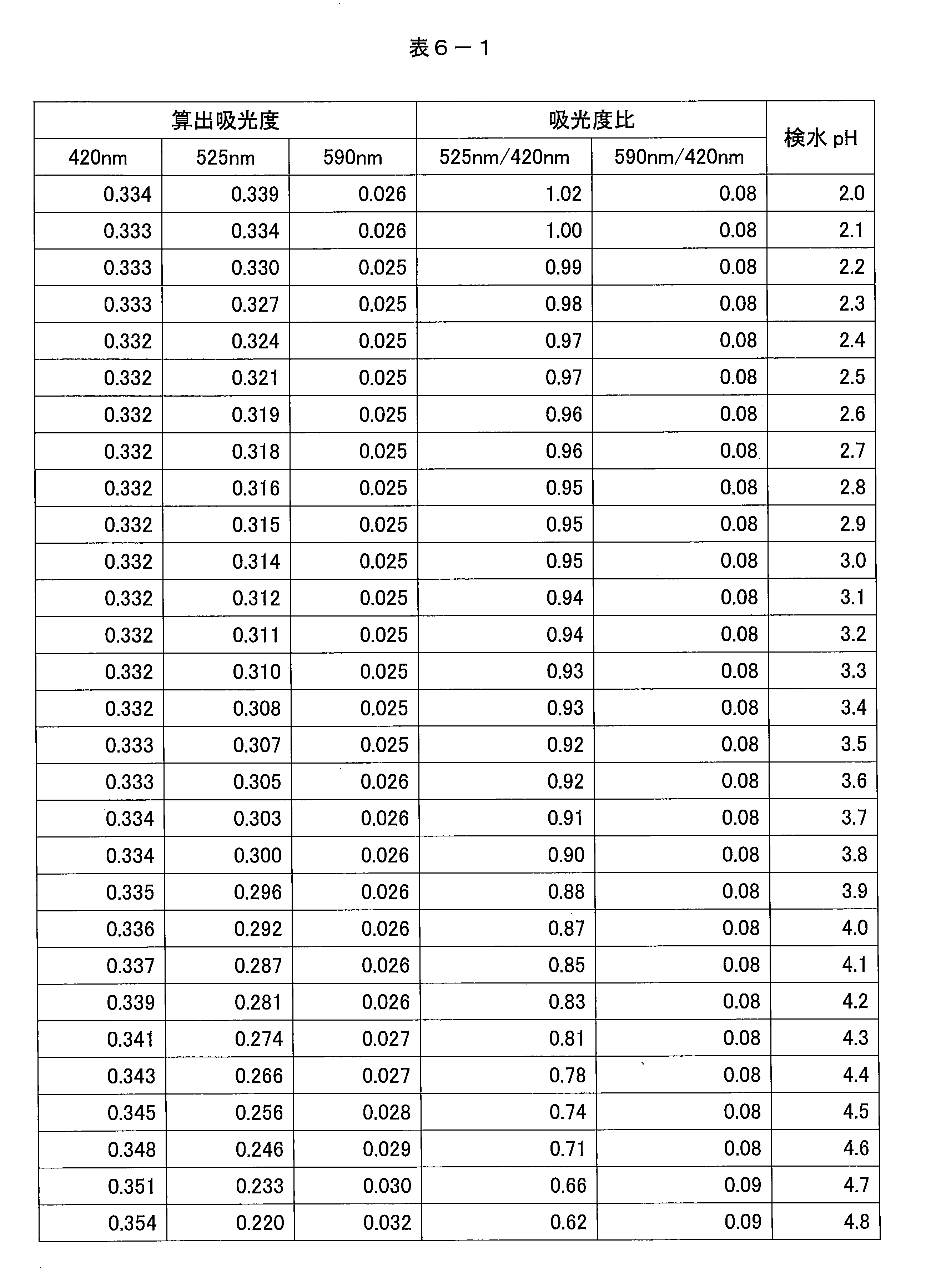


表7に示すpH値に調整された検証用水を調製した。各検証用水のpHは、株式会社堀場製作所製のガラス電極(型番:9625-10D)を用いて確認したものである。各検証用水100mLのそれぞれについて、試薬組成物0.75gを添加して攪拌した後、420nm、525nmおよび590nmの波長の可視光の吸光度を測定した。そして、各検証用水について、吸光度比(525nm/420nm)および吸光度比(590nm/420nm)を求め、各吸光度比を図9のグラフに適用することでpHを判定した。結果を表7に示す。

Claims (5)
- 検水のpHを所定範囲において測定するための試薬組成物であって、
前記所定範囲でのpHの変動により一段階で酸解離して紫外可視領域の吸光度が変動し得る第1発色試薬と、
前記所定範囲でのpHの変動により一段階で酸解離して紫外可視領域の吸光度が変動し得る、第1発色試薬よりも酸解離定数(pKa)が大きい第2発色試薬と、
前記所定範囲でのpHの変動により一段階で酸解離して紫外可視領域の吸光度が変動し得る、酸解離定数(pKa)が第1発色試薬と第2発色試薬との間にある少なくとも一種類の第3発色試薬とを含み、
第1発色試薬、第2発色試薬および第3発色試薬は、いずれも、前記所定範囲での紫外可視領域の吸光度が0を超えるものである、
pH測定用試薬組成物。 - 酸解離定数(pKa)が4.1~6.0の範囲のものから選ばれた第1発色試薬、酸解離定数(pKa)が6.5~8.5の範囲のものから選ばれた第2発色試薬、酸解離定数(pKa)が5.5~7.5の範囲のものから選ばれた一種類の第3発色試薬を含む、請求項1に記載のpH測定用試薬組成物。
- 酸解離定数(pKa)が4.1~6.0の範囲のものから選ばれた第1発色試薬、酸解離定数(pKa)が8.5~11.5の範囲のものから選ばれた第2発色試薬、酸解離定数(pKa)が5.5~7.5の範囲のものから選ばれた第1種の発色試薬および酸解離定数(pKa)が7.0~9.5の範囲のものから選ばれかつ酸解離定数(pKa)が第1種の発色試薬よりも大きい第2種の発色試薬の合計二種類の第3発色試薬を含む、請求項1に記載のpH測定用試薬組成物。
- アミノ酸をさらに含む、請求項1から3のいずれかに記載のpH測定用試薬組成物。
- 無機強塩基をさらに含む、請求項1から4のいずれかに記載のpH測定用試薬組成物。
Priority Applications (3)
| Application Number | Priority Date | Filing Date | Title |
|---|---|---|---|
| CN201980027893.XA CN111989563A (zh) | 2018-07-03 | 2019-06-28 | pH测定用试剂组合物 |
| KR1020207027059A KR20210027240A (ko) | 2018-07-03 | 2019-06-28 | pH 측정용 시약 조성물 |
| US17/042,621 US20210123868A1 (en) | 2018-07-03 | 2019-06-28 | Reagent composition for ph measurement |
Applications Claiming Priority (2)
| Application Number | Priority Date | Filing Date | Title |
|---|---|---|---|
| JP2018126905A JP2020008321A (ja) | 2018-07-03 | 2018-07-03 | pH測定用試薬組成物 |
| JP2018-126905 | 2018-07-03 |
Publications (1)
| Publication Number | Publication Date |
|---|---|
| WO2020009041A1 true WO2020009041A1 (ja) | 2020-01-09 |
Family
ID=69059714
Family Applications (1)
| Application Number | Title | Priority Date | Filing Date |
|---|---|---|---|
| PCT/JP2019/025948 Ceased WO2020009041A1 (ja) | 2018-07-03 | 2019-06-28 | pH測定用試薬組成物 |
Country Status (6)
| Country | Link |
|---|---|
| US (1) | US20210123868A1 (ja) |
| JP (1) | JP2020008321A (ja) |
| KR (1) | KR20210027240A (ja) |
| CN (1) | CN111989563A (ja) |
| TW (1) | TW202006343A (ja) |
| WO (1) | WO2020009041A1 (ja) |
Citations (6)
| Publication number | Priority date | Publication date | Assignee | Title |
|---|---|---|---|---|
| JPS513694A (ja) * | 1974-06-28 | 1976-01-13 | Hitachi Ltd | Suisoionnodosokuteihoho |
| JPH05172822A (ja) * | 1991-05-17 | 1993-07-13 | Behringwerke Ag | 水性液体のイオン強度及び/又は比重量の測定用試薬及び測定方法 |
| JP2004024254A (ja) * | 2002-04-30 | 2004-01-29 | Masao Umemoto | ミオイノシトールの簡易測定法 |
| WO2005032608A1 (ja) * | 2003-10-02 | 2005-04-14 | Osaka Gas Chemicals Co., Ltd. | ガス吸着フィルター |
| JP2009543076A (ja) * | 2006-07-11 | 2009-12-03 | ナイジェル ブロックウェル,ポール | 検体濃度を測定する指示計システム |
| US20120329676A1 (en) * | 2011-06-23 | 2012-12-27 | Samsung Electronics Co., Ltd. | High throughput screening method of acid-producing microorganism |
Family Cites Families (5)
| Publication number | Priority date | Publication date | Assignee | Title |
|---|---|---|---|---|
| JPS5315673B2 (ja) * | 1974-05-21 | 1978-05-26 | ||
| JPS58204343A (ja) | 1982-05-24 | 1983-11-29 | Toshiba Corp | 水素イオン濃度測定装置 |
| US5801060A (en) * | 1990-10-10 | 1998-09-01 | Chimera Research & Chemical, Inc. | Method of using automated analyzer testing of urine for presence of a pH abnormality with single reagent indicator |
| JP3326831B2 (ja) * | 1991-10-21 | 2002-09-24 | 和光純薬工業株式会社 | 水性液体試料のイオン強度又は比重測定用試薬組成物 |
| JP5949822B2 (ja) * | 2014-03-28 | 2016-07-13 | 栗田工業株式会社 | 硬度測定用組成物、硬度測定用試薬キット、硬度測定方法、及び硬度測定装置における汚れ防止方法 |
-
2018
- 2018-07-03 JP JP2018126905A patent/JP2020008321A/ja active Pending
-
2019
- 2019-06-05 TW TW108119526A patent/TW202006343A/zh unknown
- 2019-06-28 WO PCT/JP2019/025948 patent/WO2020009041A1/ja not_active Ceased
- 2019-06-28 KR KR1020207027059A patent/KR20210027240A/ko not_active Withdrawn
- 2019-06-28 CN CN201980027893.XA patent/CN111989563A/zh active Pending
- 2019-06-28 US US17/042,621 patent/US20210123868A1/en not_active Abandoned
Patent Citations (6)
| Publication number | Priority date | Publication date | Assignee | Title |
|---|---|---|---|---|
| JPS513694A (ja) * | 1974-06-28 | 1976-01-13 | Hitachi Ltd | Suisoionnodosokuteihoho |
| JPH05172822A (ja) * | 1991-05-17 | 1993-07-13 | Behringwerke Ag | 水性液体のイオン強度及び/又は比重量の測定用試薬及び測定方法 |
| JP2004024254A (ja) * | 2002-04-30 | 2004-01-29 | Masao Umemoto | ミオイノシトールの簡易測定法 |
| WO2005032608A1 (ja) * | 2003-10-02 | 2005-04-14 | Osaka Gas Chemicals Co., Ltd. | ガス吸着フィルター |
| JP2009543076A (ja) * | 2006-07-11 | 2009-12-03 | ナイジェル ブロックウェル,ポール | 検体濃度を測定する指示計システム |
| US20120329676A1 (en) * | 2011-06-23 | 2012-12-27 | Samsung Electronics Co., Ltd. | High throughput screening method of acid-producing microorganism |
Non-Patent Citations (2)
| Title |
|---|
| DONG, SAYING ET AL.: "Broad range pH sensor based on sol-gel entrapped indicators on fibre optic", SENSORS AND ACTUATORS B, vol. 129, 29 January 2008 (2008-01-29), pages 94 - 98, XP022424850, DOI: 10.1016/j.snb.2007.07.078 * |
| LIN, J. ET AL.: "An optical pH sensor with a linear response over a broad range", ANALYTICA CHIMICA ACTA, vol. 408, 9 March 2000 (2000-03-09), pages 49 - 55 * |
Also Published As
| Publication number | Publication date |
|---|---|
| JP2020008321A (ja) | 2020-01-16 |
| TW202006343A (zh) | 2020-02-01 |
| US20210123868A1 (en) | 2021-04-29 |
| KR20210027240A (ko) | 2021-03-10 |
| CN111989563A (zh) | 2020-11-24 |
Similar Documents
| Publication | Publication Date | Title |
|---|---|---|
| Sarazin et al. | A rapid and accurate spectroscopic method for alkalinity measurements in sea water samples | |
| US20160084809A1 (en) | Simultaneous determination of multiple analytes in industrial water system | |
| US11041800B2 (en) | Method for detecting content of fluoride ions in microsamples | |
| EP2233917A1 (en) | System for measuring carbon dioxide concentration in water and method thereof | |
| US11193883B2 (en) | Kits for detecting content of fluoride ions in microsamples | |
| WO2020009040A1 (ja) | 検水のpH測定方法 | |
| Simon et al. | An optimized method for PFAS analysis using HR–CS–GFMAS via GaF detection | |
| WO2020009041A1 (ja) | pH測定用試薬組成物 | |
| EP0614085A1 (en) | A method for directly monitoring the concentrations of water treatment compositions in steam generating systems | |
| JP2016188824A (ja) | 水中のリン酸性リン濃度の測定方法 | |
| US9658103B2 (en) | Measuring apparatus for measuring the optical properties of a medium using a light source and light receiver as well as a dispersing element | |
| KR102613289B1 (ko) | 아세테이트 착물 및 아세테이트 정량화 방법 | |
| US20220136965A1 (en) | Methods for detecting and quantifying tetrakis(hydroxymethyl)phosphonium sulfate (thps) in biocide products | |
| Masadome | Determination of cationic polyelectrolytes using a photometric titration with crystal violet as a color indicator | |
| Birghila et al. | Spectrophotometric method for the determination of total proteins in egg white samples | |
| JP2011013053A (ja) | 硝酸性窒素の測定方法 | |
| JP2021067430A (ja) | ボイラ水のpH調整方法 | |
| JP2024132299A (ja) | アンモニア濃度計及びアンモニア濃度測定方法 | |
| RU2714836C1 (ru) | Способ идентификации веществ в растворе и контроля концентрации растворов | |
| CN104380086A (zh) | 氧化物质定量方法以及氧化物质定量装置 | |
| Connors | Advances in chemical and colorimetric methods | |
| Quang et al. | Rapid determination of magnesium and calcium ions in saline and seawater | |
| Sorouraddin et al. | A new chemiluminescence method for determination of EDTA in ophthalmic drugs | |
| KR101728321B1 (ko) | 연료전지의 인산 유출 분석 방법 | |
| Patrick et al. | Spectrophotometric and potentiometric study of the acid—base equilibria of indophenols in aqueous media |
Legal Events
| Date | Code | Title | Description |
|---|---|---|---|
| 121 | Ep: the epo has been informed by wipo that ep was designated in this application |
Ref document number: 19831126 Country of ref document: EP Kind code of ref document: A1 |
|
| ENP | Entry into the national phase |
Ref document number: 20207027059 Country of ref document: KR Kind code of ref document: A |
|
| NENP | Non-entry into the national phase |
Ref country code: DE |
|
| 122 | Ep: pct application non-entry in european phase |
Ref document number: 19831126 Country of ref document: EP Kind code of ref document: A1 |