WO2020009073A1 - Procédé de modification de réservoir d'aquaculture et procédé d'aquaculture - Google Patents
Procédé de modification de réservoir d'aquaculture et procédé d'aquaculture Download PDFInfo
- Publication number
- WO2020009073A1 WO2020009073A1 PCT/JP2019/026168 JP2019026168W WO2020009073A1 WO 2020009073 A1 WO2020009073 A1 WO 2020009073A1 JP 2019026168 W JP2019026168 W JP 2019026168W WO 2020009073 A1 WO2020009073 A1 WO 2020009073A1
- Authority
- WO
- WIPO (PCT)
- Prior art keywords
- aquaculture
- sediment
- fulvic acid
- modifying
- aquatic products
- Prior art date
- Legal status (The legal status is an assumption and is not a legal conclusion. Google has not performed a legal analysis and makes no representation as to the accuracy of the status listed.)
- Ceased
Links
Images





Classifications
-
- A—HUMAN NECESSITIES
- A01—AGRICULTURE; FORESTRY; ANIMAL HUSBANDRY; HUNTING; TRAPPING; FISHING
- A01K—ANIMAL HUSBANDRY; AVICULTURE; APICULTURE; PISCICULTURE; FISHING; REARING OR BREEDING ANIMALS, NOT OTHERWISE PROVIDED FOR; NEW BREEDS OF ANIMALS
- A01K61/00—Culture of aquatic animals
- A01K61/50—Culture of aquatic animals of shellfish
- A01K61/59—Culture of aquatic animals of shellfish of crustaceans, e.g. lobsters or shrimps
-
- A—HUMAN NECESSITIES
- A01—AGRICULTURE; FORESTRY; ANIMAL HUSBANDRY; HUNTING; TRAPPING; FISHING
- A01K—ANIMAL HUSBANDRY; AVICULTURE; APICULTURE; PISCICULTURE; FISHING; REARING OR BREEDING ANIMALS, NOT OTHERWISE PROVIDED FOR; NEW BREEDS OF ANIMALS
- A01K63/00—Receptacles for live fish, e.g. aquaria; Terraria
- A01K63/04—Arrangements for treating water specially adapted to receptacles for live fish
Definitions
- the present invention relates to a method for modifying a culture tank and a method for modifying a culture tank.
- Patent Literature 1 and the like are disclosed as a technique for culturing shrimp and the like, which is a typical marine product to be cultivated.
- Patent Literature 1 discloses that an aquarium into which prawns are put is covered with a light-shielding house so that the illuminance on the water surface of the aquarium is 100 lux or less, and beneficial bacteria that grow regardless of illuminance dominantly proliferate in the aquarium.
- a method for cultivating a prawn which comprises maintaining the prawn and cultivating the prawn in the water tank.
- Patent Literature 2 discloses a fish and shellfish cultivation apparatus characterized in that a plurality of cultured fish beds are vertically provided in a breeding aquarium at intervals, and vibration means are attached to the cultured fish beds.
- Patent Literature 3 is a culture method for purifying and adjusting water in a process of circulating water in a culture tank for culturing fish and shellfish through a circulation path as appropriate, wherein a denitrification apparatus and an activated carbon adsorption apparatus are provided in the circulation path.
- the present invention discloses a water circulation type aquaculture method, wherein denitrification of circulating water and removal of organic hardly decomposable substances are performed through at least a part of the circulating water through the apparatus.
- Patent Document 4 discloses a method of implanting or magnetically adsorbing microorganisms that have absorbed iron ions to a strain of a granular iron-type artificial zeolite carrying ferromagnetic iron powder, and eluted organic substances, oxidatively decomposed microorganisms, and antibacterial and antiviral microorganisms. It discloses a biofilter characterized in that the groups can coexist.
- Patent Document 5 discloses that a nanofiber sheet having an antibacterial function is spread on the ground surface, a super-water-repellent nanofiber sheet is spread thereon, and further, breeding water is poured into a culture pond formed by stacking slag thereon.
- the present invention discloses a method for purifying a closed-circulation onshore aquaculture farm, wherein aquacultured fish and shellfish such as shrimp are cultured.
- aquaculture is repeatedly performed in a certain place from the viewpoint of securing a place for aquaculture and production controllability. Also, during aquaculture, aquatic products grow at a higher density than the natural environment. Therefore, every time aquaculture is carried out, organic matter such as excretion of fishery products, carcasses, and remains of food is produced, and the effects are produced and accumulated in the place where the fish are cultured.
- An object of the present invention is to provide a method for purifying and reforming organic substances and nitrogen components in such repeatedly used culture tanks. Another object of the present invention is to stably cultivate aquatic products in a modified culture tank.
- the present inventors have conducted intensive studies to solve the above-mentioned problems, and as a result, have found that the following inventions meet the above-mentioned objects, and have reached the present invention. That is, the present invention relates to the following inventions.
- a method for modifying a culture tank for aquatic products including a mixing step of modifying a sediment by mixing a modifier containing a humic substance and a silicate compound with the sediment of the culture tank.
- Tank reforming method ⁇ 2> The method for reforming a culture tank according to ⁇ 1>, further including a tilling step of tilling the sediment mixed with the modifying agent after the mixing step.
- ⁇ 4> A method for culturing aquatic products using a culture tank modified by the modification method according to any one of the above ⁇ 1> to ⁇ 3>, wherein breeding water is supplied to the modified culture tank.
- ⁇ 6> A method for cultivating aquatic products, comprising a reforming step of mixing a modifying agent containing humic substances and a silicate compound into breeding water supplied to the aquaculture tank.
- ⁇ 7> By having an oxygen supply means to the breeding water and controlling the amount of oxygen by the oxygen supply means, A low oxygen period for controlling the dissolved oxygen concentration of the breeding water to a low concentration, The method for cultivating aquatic products according to any of the above ⁇ 4> to ⁇ 6>, further comprising a dissolved oxygen concentration control step having a high oxygen period in which the dissolved oxygen concentration of the breeding water is controlled to a high concentration.
- ⁇ 8> The culture method according to any one of ⁇ 4> to ⁇ 7>, wherein the aquatic product is a crustacean.
- a method for modifying a culture tank for aquatic products wherein the bottom substance of the culture tank contains humic substances and silicate compounds containing fulvic acid, which is a hydrophobic-like substance, according to the method of the International Society for Humic Substances (IHSS).
- a mixing step of modifying the sediment by mixing a modifying agent wherein the amount of the sediment mixed with the sediment in the mixing step is 100 mg / 1000 m 2 or more as the humic substance equivalent to 5, 000 mg / 1000 m 2 or less, and the silicate compound is 1 kg / 1000 m 2 or more and 100 kg / 1000 m 2 or less.
- ⁇ A2> The method according to ⁇ A1>, wherein the humic substance is a fulvic acid solution having a fulvic acid concentration of 10 mg / L to 2,500 mg / L.
- ⁇ A3> The method for modifying a culture tank according to ⁇ A1> or ⁇ A2>, wherein the silicate compound is a silicate compound containing aluminum oxide in an amount of 10% by mass or more and 30% by mass or less.
- ⁇ A4> A method for modifying an aquaculture tank for aquatic products, comprising a humic substance containing fulvic acid, which is a hydrophobic-like substance, according to the method of the International Humic Society (IHSS) in the bottom of the aquaculture tank.
- IHSS International Humic Society
- the mixing amount of the humic substances in the mixing step is 100 mg / 1000 m 2 or more as fulvic acid equivalent to 5,000 mg / 1000 m. 2 or less, the method of reforming the culture tank.
- ⁇ A7> A method of cultivating aquatic products using a culture tank modified by the modification method of any one of ⁇ A1> to ⁇ A6>, wherein breeding water is supplied to the modified culture tank.
- a fulvic acid solution having a fulvic acid concentration of 10 mg / L to 2,500 mg / L, which is a hydrophobic-like substance, according to the method of the International Humic Society (IHSS) was added to breeding water supplied to a culture tank for aquatic products.
- a method for cultivating aquatic products comprising a modifying step of mixing a modifying agent containing a silicate compound containing 10% by mass or more and 30% by mass or less of aluminum oxide.
- ⁇ A10> Having an oxygen supply means to the breeding water and controlling the amount of oxygen by the oxygen supply means, the dissolved oxygen concentration of the breeding water is continuously reduced to a low concentration of 0.5 ppm or more and 3.5 ppm or less.
- ⁇ A11> The aquaculture method according to any one of ⁇ A7> to ⁇ A10>, wherein the aquatic product is a crustacean.
- the present invention it is possible to purify and reform organic substances and nitrogen components in the culture tank, and to stably grow aquatic products in the modified culture tank.
- the method for modifying a culture tank according to the present invention is a method for modifying a culture tank for aquatic products, and the method for modifying the bottom substance by mixing a modifier containing humic substances into the bottom substance of the culture tank. Having a process.
- the modifier preferably contains a silicate compound. In this way, by mixing the modifying agent with the bottom material of the culture tank, the bottom material is improved, and the organic substance removing function and the like as the culture tank are improved.
- the present invention assumes the following mechanism of action.
- an aquaculture environment for marine products although marine products are bred at a high density as an economic act, the purification function of the natural world is not exhibited. This is thought to be due to the fact that soil microorganisms living in artificial structures such as aquaculture tanks and breeding water are not aware that the purification ability has been lost by abandoning the metabolic function acquired in the natural environment. .
- the present inventors have obtained such knowledge from empirical rules.
- Soil microorganisms are a general term for microorganisms mainly composed of soil bacteria.However, microorganisms with metabolic functions that function on organic substances and microorganisms with metabolic functions that function on nitrogen components coexist. . For example, when raising aquatic products in a closed aquaculture tank, the most problem is how to deal with organic matter and nitrogen components contained in residual foods and excrement.
- the present invention purifies these.
- organic matter organic matter that cannot be decomposed into carbon dioxide and water by only soil microorganisms in an environment of an artificial structure will rot.
- the microorganisms are induced to activate the metabolism of soil microorganisms in the natural environment, are activated, suppress rot, and promote humification.
- Nitrogen bacteria and denitrifying bacteria have also abandoned their metabolic functions in the natural environment, just as soil microorganisms in the environment of man-made structures have abandoned the metabolic functions of nitrogen components. This is because the nitrification reaction does not occur in the organic nitrogen and the ammonia nitrogen, and the nitrogen remains as it is.
- nitrifying bacteria and denitrifying bacteria which are soil microorganisms inhabiting the aquaculture cultivation, are induced to natural metabolic functions and activated by intentionally utilizing humic substances generated by the soil microorganisms themselves.
- organic nitrogen and ammonia nitrogen are transformed into nitrite nitrogen / nitrate nitrogen, and nitrite nitrogen / nitrate nitrogen reacts with a hydrogen donor to denitrify.
- the hydrogen donor organic matter contained in the residual food and excrement is utilized. As a result, it is possible to simultaneously remove the organic matter and the nitrogen component, which are the two major factors that worsen the habitat environment in the culture.
- including a silicate compound is also useful for generating phytoplankton and algae because iron fulvicate functions.
- excessive consumption of carbon dioxide due to the photosynthesis reaction and provision of natural oxygen in water also occur, and phytoplankton and algae themselves can also feed on aquatic products.
- the marine product is a fish, a marine mammal, a marine invertebrate, a seaweed, or the like, which is used for food or life.
- the present invention can improve the cultivation environment of cultivated aquatic products, and the aquatic products to be cultivated can be widely targeted such as freshwater fish, saltwater fish, shellfish, and crustaceans.
- Aquaculture techniques include pond aquaculture, paddy aquaculture, inland water aquaculture such as aquaculture in tidal flats and rivers, onshore aquaculture ponds and salt ponds aquaculture, compartmental aquaculture divided by dikes and nets, hanging aquaculture, and geodistribution.
- Various aquatic products cultivated in marine aquaculture such as aquaculture can be targeted.
- cultured aquatic products include carp, rainbow trout, sweetfish, dace, eel, goldfish, tropical fish, turtle, bullfrog, loach, mullet, crucian carp, sea bream, prawn, yellowtail, red sea bream, tiger puffer, oyster, oyster, sea squirt , Seaweed, seaweed, clams, clams, scallops and the like.
- the present invention is for modifying a culture tank.
- the aquaculture tank is a place used when artificially breeding and rearing aquatic products in a relatively narrow water area. For example, aquaculture ponds and paddy fields, partitioned tidal flats, rivers, seas, and onshore facilities.
- the method for modifying a culture tank of the present invention is particularly directed to a culture tank having bottom sediment in order to fix the effect of the modification.
- the term “sediment” refers to soil, sand, gravel, stone, sand mud, and the like provided mainly on the bottom of the culture tank. These sediments contribute to the food chain for breeding aquatic products, contribute to the growth of phytoplankton, etc., which feed on aquatic products, and contribute to the purification of residual food and dead bodies of aquatic products. I do. For this reason, sediment is provided at the bottom of the culture tank or the like in various culture techniques.
- the reforming method of the present invention has a mixing step of modifying the bottom by mixing a modifier containing humic substances into the bottom of the culture tank.
- the modifier may include a silicate compound.
- This mixing is a state in which the modifying agent is dispersed on the sediment, mixed with stirring or plowing to disperse and contact the sediment.
- the sediment is reformed by the mixing step.
- This reforming in particular, purifies the organic matter and the like accumulated in the sediment, promotes humification, and purifies the humus, making the environment of the aquaculture tank suitable for aquaculture of aquatic products.
- fulvic acid derived from humic substances and iron (iron ions) derived from silicate compounds are supplied to the sediment.
- iron fulvicate is produced and supplied from the sediment to the culture tank.
- algae such as cyanobacteria and diatoms, phytoplankton, and the like also easily proliferate, and phytoplankton and the like, which are food for aquatic products, are easily supplied in the culture tank.
- iron contained in silicate compounds is oxidized in seawater to become granular iron and precipitates on sediment, but when it comes into contact with fulvic acid, the antioxidant power of fulvic acid changes it from ferrous iron to ferrous iron.
- Ferrous iron is reduced to fulvic acid to form colloidal iron fulvic acid, which is used for phytoplankton and the like.
- These phytoplanktons also contribute to photosynthesis and have the effect of supplying oxygen into the culture tank.
- humic substances are supplied in the mixing step, thereby activating nitrifying bacteria and denitrifying bacteria resident in the culture tank.
- denitrifying bacteria which particularly require anaerobic conditions, have abandoned their metabolic functions under the natural environment due to oxygen supply for growing aquatic products in the aquaculture tank, and have lost their functions.
- the decrease in the activity of the denitrifying bacterium is overlooked in the conventional aquaculture, and the aquaculture efficiency is reduced, and the operation management is complicated though an additional device is provided for the denitrification.
- such a denitrifying bacterium which originally existed in a culture tank or the like, is activated by humic substances so that the denitrifying bacterium or the like readily acts.
- the modifier one containing humic substances is used.
- the modifier may include a silicate compound.
- the modifier may further include a pH adjuster, a viscosity adjuster, a salt for adjusting a salt concentration, and the like, as appropriate.
- Humic substances are said to be a generic term for "organic substances whose chemical structures are not specified (non-living organic substances)" in which biological organisms are destroyed by microbial or chemical action after the death of the organism. It has been empirically known that some humic substances show functionality and others do not.This is because the organic matter, which is an organic substance in the natural world, tries to return to the soil. It is considered that the influence of whether or not an intermediate product is contained is large. Humid substances containing this intermediate product, that is, functional humic substances, are sometimes referred to as humic precursors.
- humin, fulvic acid, humic acid, and the like are contained in the humic precursor or humic substance (humus) as the humification degree (polycondensation reaction degree) of the component.
- the weight ratio of fulvic acid to humic acid is about 2: 8.
- the humic substances of the present invention contain fulvic acid.
- Fulvic acid itself is humic acid because of its solubility in acids and alkalis among humic substances (particularly humic precursors) produced by reacting metabolites containing phenol and / or compounds having a phenol-exposed group with organic substances and the like. , But a mixture of organic substances having various structures.
- a fulvic acid solution contains fulvic acid at a higher ratio than general humus, and has a lower content of humic acid and the like.
- fulvic acid solution fulvic acid iron is generated more efficiently.
- a lead-up by T & G Corporation can be used.
- fulvic acid and humic acid in the present application are based on the classification of the International Society of Humic Substances to which the Japanese Society of Humic Substances belongs, and the chemical structure of biological organisms that are disrupted by microbial and chemical actions has not been identified.
- classification is based on solubility in alkalis and acids. That is, fulvic acid is a component that is soluble in alkali and soluble in acid.
- humic acid is a component that is soluble in alkali but insoluble in acid.
- Humin is a component that is insoluble in alkali and insoluble in acid.
- a hydrophobic-like substance is separated and purified from the fulvic acid extract in accordance with the method of the International Society of Humic Substances (IHSS), and this substance is physically and chemically similar to the standard fulvic acid distributed by the Japan Humic Society (JHSS). It has been confirmed that it has characteristics (absorption, FTIR, 3D fluorescence spectrum, solid-state NMR, etc.).
- the concentration of the fulvic acid can be determined by using a 3D fluorescence spectrum as an index for the degree of the fulvic acid activity.
- the 3D fluorescence spectrum is determined based on the wavelength of the excitation light-fluorescence and the distribution of the intensity thereof using light in the range from UV to visible light. It is confirmed whether the tendency of the distribution is that of fulvic acid, and if a characteristic peak is observed near 310 nm to 410 nm (excitation light wavelength-fluorescence wavelength), it is determined that the fulvic acid activity is high (the fulvic acid concentration is high). Is determined.
- the fulvic acid concentration can be simply calculated as an estimated concentration by creating a calibration curve based on the fluorescence wavelength at the peak near 410 nm.
- the estimated concentration of the fulvic acid solution is about 10 mg / L to 2,500 mg / L, depending on the organic substance used as a raw material and the production conditions. It is preferable to use a fulvic acid solution having a fulvic acid concentration of 20 mg / L or more, 30 mg / L or more, 100 mg / L or more, and 500 mg / L or more. These can be used as stock solutions with appropriate dilution.
- the fulvic acid content of a currently sold fulvic solution (trade name “Lead Up” (T & G)) is estimated to be about 1000 ppm.
- the fulvic acid activity is simply expressed as a ratio of the fluorescence intensity at the wavelength that becomes the peak of the 3D fluorescence spectrum to the absorbance at the wavelength of the excitation light, the fluorescence intensity peak value around 410 nm / the excitation light around 310 nm. From the intensity peak value (fluorescence intensity (If) at the fluorescence wavelength / absorbance (Abs) at the excitation light wavelength), it can be determined as “fulvic acid-fluorescence spectrum ratio”. For example, in the case of a fulvic acid solution, the fulvic acid-fluorescence spectrum ratio shows a value of about 5,000 to 30,000.
- the fulvic acid activity may be arbitrarily determined, as long as fulvic acid is sufficiently supplied. It is possible to expect a reforming effect such as an effect obtained by the above, an effect obtained for a long time, and an excellent organic substance purifying function. For this reason, the fulvic acid-fluorescence spectrum ratio of the humic substances used in the mixing step may have a lower limit such as 100 or more, 500 or more, 1000 or more, 2000 or more, 3000 or more, 5000 or more, and 8000 or more. On the other hand, there is no particular upper limit, but for example, an upper limit of 100,000 or less, 80000 or less, 50000 or less, or 30000 or less may be provided.
- the fulvic acid-fluorescence spectrum ratio is almost a value close to zero. Note that this ratio is not a value indicating the concentration but an index of the quality or activity of fulvic acid, and greatly increases or decreases due to a reaction caused by contact with an organic substance.
- the content of humic acid can be determined based on the concentration of humic acid by performing purification or analysis for specifying humic acid.
- the wavelength of the excitation light-fluorescence and the distribution of the intensity thereof are determined by using the light in the range from UV to visible light using the 3D fluorescence spectrum when performing the above-described measurement of fulvic acid. It can be determined based on this.
- humic acid is present, a peak is observed around 450 nm / 530 nm (excitation light / fluorescence).
- the blackness of the solution increases, and in the above-mentioned fulvic acid-fluorescence spectrum ratio, the absorbance (Abs) of the excitation light wavelength around 310 nm increases, and the fluorescence intensity (If) of the fluorescence wavelength around 410 nm decreases.
- the fulvic acid-fluorescence spectrum ratio is hardly in a preferable range for a fulvic acid solution. Therefore, the fulvic acid solution of the present invention does not show a double peak similar to that of a humic acid solution of fulvic acid: humic acid equivalent to 2: 8, which is a normal humic substance, or has a peak corresponding to humic acid.
- An index lower than a general double peak value can be used as an index.
- the fulvic acid-fluorescence spectrum ratio may be used as an index.
- the fulvic acid and fulvic acid solution used in the present invention can be used with reference to the technology disclosed in Japanese Patent No. 6026631.
- the present invention can be used by mixing a silicate compound for modifying bottom sediment or supplying the silicate compound to breeding water in a culture tank.
- the silicate compound used in the present invention refers to a compound in which activated silicic acid derived from diatomaceous earth or the like contains aluminum or iron.
- activated silicic acid derived from diatomaceous earth or the like contains aluminum or iron.
- those derived from andesitic or rhyolite rocks can be suitably used.
- a mixture of active silicic acid, which is an artificial product, and a metal such as iron or aluminum in a ratio equal to or higher than that of a natural product may be used.
- the amount of aluminum contained in the silicate compound is preferably at least 5% by mass as aluminum oxide (Al 2 O 3 ).
- the amount of aluminum oxide is more preferably 10% by mass or more, and may be 11% by mass or more and 12% by mass or more.
- the upper limit of the amount of aluminum oxide may not be limited within a range that sufficiently contains activated silicic acid and iron, but may be 30% by mass or less, 25% by mass or less, or 20% by mass or less.
- the amount of iron contained in the silicate compound is preferably 3% by mass or more as iron oxide (total amount of ferrous oxide and ferric oxide).
- the amount of iron oxide is more preferably 4% by mass or more, and may be 4.5% by mass or more and 5.0% by mass or more.
- the upper limit of the amount of iron oxide may not be limited within a range that sufficiently includes active silicic acid and aluminum oxide, but may be 30% by mass or less, 25% by mass or less, 20% by mass or less, or 15% by mass or less.
- the silicate compound also contains components that become mineral components such as iron and aluminum, and the silicate compound is a growth environment for soil microorganisms, mainly soil bacteria that inhabit the sediment and breeding water in the culture tank. It is effective as a stabilizer. In addition, it functions as a catalyst for promoting humification of organic matter contained in the bottom material of the aquaculture tank and breeding water. It is also effective as a nutrient for photosynthetic organisms such as phytoplankton and algae that inhabit the bottom of culture tanks and breeding water. It is also useful as a raw material for producing iron fulvicate in a state contributing to these.
- silicate compound when aluminum or iron is contained as the silicate compound, these aluminum or iron are supported on the silicate of diatomaceous earth and are easily stabilized. At the same time, it is considered that such a silicate compound is also useful as a place for carrying bacteria contributing to purification of a culture tank such as denitrifying bacteria activated with humic substances.
- the amount of these modified substances should be set as appropriate in consideration of the type of the culture tank, the breeding period of the aquatic products, the conditions of use of the culture tank, etc., as long as the bottom material of the culture tank can be modified. Can be.
- the mixing amount can be set based on the size of the bottom surface of the culture tank in which the sediment is disposed. By setting the content in these preferable ranges, it is possible to exert effects of activating denitrifying bacteria and the like and improving effects such as growth of phytoplankton.
- the mixing amount of the humic substance is preferably 50 mg / 1000 m 2 or more as the fulvic acid equivalent contained in the humic substance.
- 1 L 50 mg fulvic acid equivalent
- 1 L 50 mg fulvic acid equivalent
- Mixing amount of humic substances as fulvic acid equivalent weight 80 mg / 1000 m 2 or more and, 100 mg / 1000 m 2 or more and, more preferably to higher concentrations and 150 mg / 1000 m 2 or more.
- An upper limit may not be set because there is no adverse effect of increasing the concentration of humic substances. However, an upper limit may be set in consideration of the amount of raw materials, the application time, etc., and 10,000 mg / 1000 m 2 or less, It may be 5,000 mg / 1000 m 2 or less.
- the mixing amount of the silicate compound is preferably 1 kg / 1000 m 2 or more.
- the mixing amount of the silicate compound is more preferably set to a higher concentration of 3 kg / 1000 m 2 or more, 5 kg / 1000 m 2 or more, or 10 kg / 1000 m 2 or more. Since there is no adverse effect of increasing the concentration of the silicate compound, there is no need to set the upper limit. However, the upper limit may be set in consideration of the limitation of the amount of the raw material, the spraying time, etc., and 100 kg / 1000 m 2 or less, 50 kg / It may be 1000 m 2 or less.
- the reforming method of the present invention is preferably performed at the time of refilling the breeding water in the aquaculture tank in order to reform the sediment.
- the breeding water in the aquaculture tank is such that after the aquatic products have sufficiently grown and the aquatic products in the tank have been collected and shipped, the used breeding water is discharged and replaced with new breeding water.
- Aquaculture ponds, paddy fields, shore facilities, etc. which are particularly easy to make artificial adjustments, discharge almost all breeding water when switching. It is preferable to spray and mix the modifier on the sediment of the culture tank from which the breeding water has been discharged. Since the breeding water is discharged, the concentration of the modifier directly mixed with the sediment is improved, and an excellent reforming effect is easily obtained. Even when the breeding water is discharged, the sediment may be in a wet state or may have an extremely shallow water level. The bottom sediment may be appropriately sun-dried or plowed as described below.
- the reforming method of the present invention preferably includes a tilling step of tilling the sediment mixed with the modifying agent after the mixing step.
- the modifier is more uniformly mixed with the sediment.
- This tilling digs the bottom of the culture tank and swells it softly.
- This tilling may be performed on the sediment in a state where the breeding water is stretched, or may be performed on the sediment in a state where the breeding water is discharged. It is preferable to perform the cultivation in a state where the breeding water is discharged so as to reduce the influence of water resistance and weight at the time of tilling work and to efficiently cultivate a deeper range.
- By cultivating it is possible to supply oxygen to the inside of the bottom sediment to more efficiently purify the deposited organic matter, etc., and to maintain the state where iron fluvic acid etc. contained in the modifier is maintained more widely. it can.
- the reforming method of the present invention has a ripening step of ripening the tilled sediment in a drainage state after the tilling step.
- the ripening is to allow the marine products to be cultured to stand without being charged, or to stir appropriately.
- the aging step may be performed using wet bottom sediment. It is preferable to carry out the process without being filled with water. Aging is for the purpose of solving problems that cannot be solved by solar disinfection of sediment, for example, to prevent decay due to a humification reaction of residual organic substances and to control various bacteria such as spoilage bacteria.
- the breeding water is aged, it can be made to conform to the aging of the sediment.
- This aging step can be performed by appropriately setting the time according to the state of the culture tank and the like. For example, it is preferably performed for 6 hours or more.
- the aging time may be 10 hours or longer, 20 hours or longer, 40 hours or longer, 60 hours or longer. There is no adverse effect of performing aging for a long time, but since the function of mixing humic substances and silicate compounds may be reduced, such as within 60 days, within 45 days, within 30 days, within 20 days, within 10 days An upper limit of the aging time may be set.
- the culture method of the present invention includes a culture step of supplying breeding water to a culture tank modified by the modification method of the present invention and culturing.
- the equipment in the bottom of the culture tank has been sufficiently purified, so contamination is unlikely to occur, and the fluctuation of dissolved oxygen concentration due to the purification of organic matter in the bottom, etc. Can be suppressed.
- phytoplankton such as algae also breed, and contribute to purification of residual food and excrement of aquatic products cultured in the culture tank. Therefore, aquaculture efficiency of aquatic products is improved. For example, the survival rate of aquatic products is improved, higher-density breeding than before is possible, the growing period is shortened, and the aquatic products with excellent palatability in which the astringency of the aquatic products is suppressed are obtained. be able to.
- Aquaculture techniques include pond aquaculture, paddy aquaculture, inland water aquaculture such as aquaculture in tidal flats and rivers, onshore aquaculture ponds and salt ponds aquaculture, compartmental aquaculture divided by dikes and nets, hanging aquaculture, and geodistribution.
- sea surface culture such as in aquaculture
- a culture method for culturing various aquatic products can be employed.
- the breeding water is seawater or freshwater suitable for breeding aquatic products to be cultured, or water whose salt content is appropriately adjusted.
- the breeding water is supplied to the culture tank so as to have a capacity corresponding to the stage of the culture.
- the reforming method of the present invention is preferably carried out in a state where breeding water is discharged in order to reform the sediment. After completion, when used, cultivation is performed with breeding water supplied.
- the method may have a reforming step of mixing a humic substance and a modifier containing a silicate compound with the breeding water supplied to the aquaculture tank for aquatic products.
- This is a culture tank modified by the method for modifying a culture tank of the present invention, that is, a modified culture water containing humic substances and a silicate compound, which is used in combination with one having a modified sediment. It may have a reforming step of mixing agents.
- breeding water is provided with the same water purification function as when the sediment is modified according to the present invention, and cultivation is performed.
- the mixing amount and the like can be the same conditions as the mixing when performing the above-described bottom sediment reforming.
- the water depth is set according to the specifications of the aquaculture tank, the type of aquatic product to be cultured, the timing of the aquaculture, and the like. For example, the water depth is appropriately set from about 1 to 5 m or about 2 to 4 m. This water depth is not always constant within a range in which aquatic products can be cultured, and fluctuates depending on the weather, time zone, culture time, and the like. For this reason, the mixture amount of humic substances and silicate compounds can be set and managed by using the size of the cultivation tank as an index instead of the amount of breeding water.
- the mixing of the modifying agent into the breeding water may be performed a plurality of times with a predetermined period after the start of aquaculture.
- the period after the start of aquaculture or after the mixing of the modifier may be additionally mixed after a period of 3 days or more, 1 week or more, 2 weeks or more, 3 weeks or more.
- the upper limit of this period may be additionally mixed within a range such as within 3 months, within 2 months, or within 6 weeks as appropriate.
- the stirring means a submersible pump, submersible paddle, blower or the like can be used.
- the stirring time can be set within a range of about 72 hours or less before the introduction of the marine product in consideration of aging.
- the agitation time may be determined by the activity of aquatic products during aquaculture or by normal agitation of the aquaculture tank. In consideration of aging and the like, the time for actively maintaining the stirring state may be determined as 1 hour or more, 6 hours or more, 12 hours or more, 24 hours or more.
- the upper limit of the aging time may be set within 48 hours or 36 hours.
- the cultivation method of the present invention has an oxygen supply means for the breeding water, and controls the amount of oxygen by the oxygen supply means, thereby controlling a dissolved oxygen concentration of the breeding water to a low concentration, and a low oxygen period. It is preferable to have a dissolved oxygen concentration control step having a high oxygen period for controlling the dissolved oxygen concentration of the breeding water to a high concentration.
- nitrifying bacteria and denitrifying bacteria can be activated. Thereby, it is possible to perform advanced treatment for sufficiently reducing nitrogen-containing organic matter in the culture tank. In addition, since both aerobic and anaerobic treatments can be performed in the culture tank, the entire organic matter can be sufficiently removed in the culture tank.
- nitrification is performed, dissolved oxygen is required, so that the breeding water has a high oxygen period in which the dissolved oxygen concentration is controlled to a high concentration.
- the high oxygen period is a period in which the oxygen concentration is equal to or higher than a predetermined dissolved oxygen concentration.
- the lower limit of the dissolved oxygen concentration which is an index of the high oxygen period is preferably 4.5 ppm or more, more preferably 5 ppm or more, and particularly preferably 6 ppm or more.
- the upper limit of the dissolved oxygen is not particularly limited, but may be high by supplying oxygen itself or a gas having a high oxygen concentration.If the effect of excessively supplying oxygen is limited, the apparatus load or the low oxygen period may be reduced.
- the upper limit may be 14 ppm or less, 12 ppm or less, or 10 ppm or less in consideration of the switching efficiency or the like.
- the high oxygen period during which the oxygen concentration is equal to or higher than the predetermined dissolved oxygen concentration is preferably set to 1 hour or more / day. More preferably, it is at least 2 hours / day or at least 3 hours / day.
- the high oxygen period can be achieved by installing a pump or the like that supplies air or oxygen to the breeding water in the aquaculture tank and supplying air or oxygen using them to increase the dissolved oxygen concentration.
- the dissolved oxygen concentration can be controlled by, for example, setting the number of operations while measuring the dissolved oxygen concentration by attaching a plurality of air supply means.
- the low oxygen period is a period in which the oxygen concentration is equal to or lower than a predetermined dissolved oxygen concentration.
- the upper limit of the dissolved oxygen concentration which is an index of the low oxygen period is preferably less than 4.5 ppm, more preferably 4 ppm or less, and particularly preferably 3.5 ppm or less.
- the lower limit of the dissolved oxygen concentration in the low oxygen period may not be particularly defined. However, if it is too low, the activity of the marine product may decrease or the survival rate may decrease. Therefore, the lower limit of the dissolved oxygen concentration during the low oxygen period may be set, and may be set to 0.5 ppm or more, 1.0 ppm or more, or 1.5 ppm or more.
- the low oxygen period during which the oxygen concentration is equal to or lower than the predetermined dissolved oxygen concentration is preferably 1 hour or more / day. More preferably, it is at least 2 hours / day or at least 3 hours / day.
- Aquaculture tanks generally breed aquatic products at a higher density than the natural environment. For this reason, in many cases, the dissolved oxygen concentration tends to decrease due to the use of dissolved oxygen accompanying the growth activity of aquatic products or the aerobic purification of organic substances in the culture tank.
- the low oxygen period can be achieved by stopping the supply of oxygen (air) to the breeding water in the aquaculture tank, thereby lowering the dissolved oxygen concentration.
- the concentration of dissolved oxygen may be positively reduced by supplying an inert gas such as nitrogen gas to the breeding water in the culture tank.
- the cycle of performing the high oxygen period and the low oxygen period can be performed at a cycle of about 0.5 cycle / day (that is, one cycle for two days) to about three cycles / day.
- This cycle can be appropriately set according to the type of the culture tank, the type of the marine product, the breeding time, and the like.
- Aquatic products are roughly classified into nocturnal and nocturnal products. Oxygen is required during periods of active activity, and less likely during periods of low activity. From this characteristic, when breeding nocturnal aquatic products, it is preferable to have a high oxygen period during the night and a low oxygen period during the day. In breeding daytime aquatic products, it is preferable to have a high oxygen period during the day and a low oxygen period at night.
- the nitric acid reaction and the denitrification reaction are repeatedly performed in these dissolved oxygen concentration control steps to highly treat organic substances and nitrogen components.
- the humic substance fulvic acid is supported on the sediment. Residual food, dead bodies, etc. settle and accumulate on the sediment. In purifying these organic substances, the bottom sediment greatly influences the maintenance of the environment of the culture tank.
- the sediment is in a state in which fulvic acid is carried, and furthermore, with a certain periodicity, there is an aerobic environment and an anaerobic environment, and in the sediment, humic acid in which fulvic acid dominates is also present. It is thought to proceed.
- Such humic acid superiority in fulvic acid improves the purification function and the breeding effect of aquatic products.
- the dissolved oxygen concentration can be measured by a dissolved oxygen concentration meter. Based on the measured dissolved oxygen concentration, the number and output of the operated oxygen supply means may be set, or may be controlled automatically.
- water temperature, pH, salt concentration, transparency, and the like can be further operated as management items.
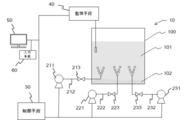
- FIG. 1 is a view for explaining a first embodiment according to the culture tank of the present invention.
- the aquaculture tank 10 has a water storage tank 100 including breeding water 101 and bottom sediment 102.
- the cultivation of the present invention can be carried out by appropriately mixing humic substances and silicate compounds in the breeding water 101.
- a humic substance or a silicate compound is mixed with the sediment 102, aged appropriately, and the breeding water 101 is supplied to form the aquaculture tank 10, and the aquatic products to be cultured are released into the breeding water 101 to start aquaculture. be able to.
- the culture tank 10 is provided with air supply pumps 211, 221, and 231 and air supply means by the air supply pipes 212, 222, and 232.
- the switching valves 213, 223, and 233 can be used to switch the presence or absence of air supply to the culture tank.
- the air supply pumps 211, 221, and 231 are also connected to the control unit 30, and can control the presence / absence of air supply and the amount of air supply.
- the control by the control means 30 may be such that the operation according to the time zone is programmed in advance, the control may be performed based on monitoring by the monitoring means 40 as described later in part, or the control may be based on input information from the input means 60. Can be.
- Monitoring means 40 is attached to the culture tank 10 so that the condition of the breeding water 101 can be monitored. Items to be monitored include water temperature, pH, DO, various indicators such as organic substances and nitrogen (TC, TOC, COD, BOD, TN, NH 4 + , NO 2 , NO 3 ), etc. it can.
- the monitoring means 40 is connected to the control means 30, and the control means 30 can control the operation of the air supply pumps 211, 221, and 231 based on the items of the monitoring means, the operation time, and the like.
- the control status of the control unit 30 and various parameters monitored by the monitoring unit 40 can be displayed on the display unit 50.
- control of the control means 30 and the items to be monitored by the monitoring means 40 and the display on the display means 50 can be processed based on the signal input from the input means 60, and can be selected or changed.
- a storage means (not shown) is also provided to store various parameters and appropriately call and confirm them, or to store data of control conditions of the control means in the storage means, and to use the data to control the control means 30. Control may be performed.
- a culture tank 10 is a culture device suitable for the culture method of the present invention.
- the green tough fine powder contains 13.7% by mass of aluminum oxide, 1.0% by mass of iron oxide (ferrous), and 5.0% by mass of iron oxide (ferric).
- the green tough fine powder was sprayed evenly over the culture pond (5070 m 2 ).
- the reform start date is February 1. [2.2 Plowing and ripening]
- the above-mentioned lead-up and green tough were sprayed and mixed, and then plowed with a cultivator. Then, it left still for 5 days as a ripening period. As a result, a culture pond with modified sediment was obtained.
- Table 1 shows the measurement results of the management index after the start of the aquaculture.
- Culture was carried out using river water as breeding water, and feeding was carried out in accordance with the usual method of shrimp culture.
- the aquaculture tank is equipped with three air pumps to control the concentration of dissolved oxygen in the breeding water to a low level based on the breeding conditions, weather, shrimp size, and DO measurements. During the low oxygen period, only one air pump should be operated, and during the high oxygen period during which the dissolved oxygen concentration in the breeding water is controlled to a high level, three air pumps should be operated at the same time. Aquaculture was performed as an indicator.
- the management index indicates that the night time (PM 6:00 to AM 6:00) is a high oxygen period and DO is 5 to 6 mg / L.
- the daytime AM 6:00 to PM 6:00
- aquaculture was performed using the low oxygen period during the day and a DO of 3 to 4 mg / L as a management index because the amount of activity decreased and oxygen consumption was small.
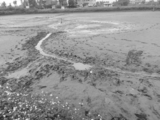
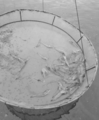
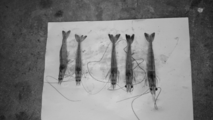
- FIGS. 2 to 9 are photographs for explaining the cultivation state and the like.
- FIG. 2 is a photograph showing river water used for breeding water.
- FIG. 3 shows the sediment before the reforming of the sediment. In the sediment, repeated use of the cultivation pond shows decay and sludge.
- FIG. 4 shows a period in which a sheet is stretched on the sediment after the mixing of the modifying agent so as to ensure a daily minimum water temperature of 20 ° C. or higher in preparation for breeding.
- FIG. 5 shows a state in which the culture pond is filled with water after the ripening period is completed.
- FIG. 6 shows the state of shrimp 30 days after the start of the culture.
- FIG. 7 shows the state of shrimp 45 days after the start of the culture.
- 8 and 9 show the state of shrimp 63 days after the start of aquaculture.
- FIG. 8 shows five shrimp harvested on the 63rd day of breeding start, which is the harvest date, and it was confirmed that the body length was 13 cm to 15 cm.
- the present invention can be used for aquaculture of aquatic products, and contributes to the improvement of the quantity and quality of aquatic products to be cultured by reforming aquaculture tanks and managing during aquaculture, and is industrially useful.
Landscapes
- Life Sciences & Earth Sciences (AREA)
- Environmental Sciences (AREA)
- Marine Sciences & Fisheries (AREA)
- Animal Husbandry (AREA)
- Biodiversity & Conservation Biology (AREA)
- Zoology (AREA)
- Farming Of Fish And Shellfish (AREA)
Abstract
L'invention concerne un procédé de purification de matières organiques et de composants azotés dans un réservoir d'aquaculture qui est utilisé de manière répétée, et de modification du réservoir d'aquaculture. L'invention concerne également un procédé de réalisation d'aquaculture de vie aquatique de manière stable en utilisant un réservoir d'aquaculture modifié. Un procédé de modification d'un réservoir d'aquaculture pour de la vie aquatique comprend une étape de mélange consistant à mélanger un modificateur contenant une substance humique et un composé de silicate dans le matériau de fond du réservoir d'aquaculture, et ainsi modifier le matériau de fond. L'invention concerne également un procédé permettant de réaliser l'aquaculture de vie aquatique en utilisant un réservoir d'aquaculture modifié, le procédé comprenant une étape d'aquaculture consistant à fournir de l'eau d'élevage dans le réservoir d'aquaculture modifié et réaliser l'aquaculture.
Applications Claiming Priority (2)
| Application Number | Priority Date | Filing Date | Title |
|---|---|---|---|
| JP2018-127706 | 2018-07-04 | ||
| JP2018127706A JP6512467B1 (ja) | 2018-07-04 | 2018-07-04 | 養殖槽の改質方法、および養殖方法 |
Publications (1)
| Publication Number | Publication Date |
|---|---|
| WO2020009073A1 true WO2020009073A1 (fr) | 2020-01-09 |
Family
ID=66530740
Family Applications (1)
| Application Number | Title | Priority Date | Filing Date |
|---|---|---|---|
| PCT/JP2019/026168 Ceased WO2020009073A1 (fr) | 2018-07-04 | 2019-07-01 | Procédé de modification de réservoir d'aquaculture et procédé d'aquaculture |
Country Status (2)
| Country | Link |
|---|---|
| JP (1) | JP6512467B1 (fr) |
| WO (1) | WO2020009073A1 (fr) |
Cited By (2)
| Publication number | Priority date | Publication date | Assignee | Title |
|---|---|---|---|---|
| WO2021182547A1 (fr) * | 2020-03-12 | 2021-09-16 | 株式会社林養魚場 | Système de régulation d'oxygène pour cuve de culture de poissons et de crustacés |
| CN113994906A (zh) * | 2020-12-31 | 2022-02-01 | 汇泰渤海水产有限责任公司 | 一种轮放轮捕养殖盐田虾的方法 |
Families Citing this family (2)
| Publication number | Priority date | Publication date | Assignee | Title |
|---|---|---|---|---|
| KR102606741B1 (ko) * | 2021-04-19 | 2023-11-29 | 주식회사 아이택트 | 해양생물의 폐사율 저감을 위한 수조환경 관리 시스템 |
| JP2023047847A (ja) * | 2021-09-27 | 2023-04-06 | 日本電信電話株式会社 | 二酸化炭素固定化システム及び二酸化炭素固定化方法 |
Citations (6)
| Publication number | Priority date | Publication date | Assignee | Title |
|---|---|---|---|---|
| JP2013000104A (ja) * | 2011-06-21 | 2013-01-07 | Yoshitaka Yamagishi | 魚介類の養殖方法及びそれに用いる飼育水の浄化活性剤 |
| CN102863086A (zh) * | 2012-10-23 | 2013-01-09 | 水霸皇保健科技发展有限公司 | 一种水产养殖用活性剂及其制备方法 |
| WO2014038596A1 (fr) * | 2012-09-04 | 2014-03-13 | コヨウ株式会社 | Procédé de fabrication de matière de fulvate de fer contenant de la silice soluble |
| JP2016049043A (ja) * | 2014-08-29 | 2016-04-11 | 太平洋セメント株式会社 | 床土 |
| CN106259080A (zh) * | 2016-08-09 | 2017-01-04 | 中国水产科学研究院南海水产研究所 | 一种基于硝化菌团调控水质的南美白对虾高密度零换水养殖方法 |
| JP2018051458A (ja) * | 2016-09-28 | 2018-04-05 | 太平洋セメント株式会社 | 底質改善材および底質の改善方法 |
-
2018
- 2018-07-04 JP JP2018127706A patent/JP6512467B1/ja active Active
-
2019
- 2019-07-01 WO PCT/JP2019/026168 patent/WO2020009073A1/fr not_active Ceased
Patent Citations (6)
| Publication number | Priority date | Publication date | Assignee | Title |
|---|---|---|---|---|
| JP2013000104A (ja) * | 2011-06-21 | 2013-01-07 | Yoshitaka Yamagishi | 魚介類の養殖方法及びそれに用いる飼育水の浄化活性剤 |
| WO2014038596A1 (fr) * | 2012-09-04 | 2014-03-13 | コヨウ株式会社 | Procédé de fabrication de matière de fulvate de fer contenant de la silice soluble |
| CN102863086A (zh) * | 2012-10-23 | 2013-01-09 | 水霸皇保健科技发展有限公司 | 一种水产养殖用活性剂及其制备方法 |
| JP2016049043A (ja) * | 2014-08-29 | 2016-04-11 | 太平洋セメント株式会社 | 床土 |
| CN106259080A (zh) * | 2016-08-09 | 2017-01-04 | 中国水产科学研究院南海水产研究所 | 一种基于硝化菌团调控水质的南美白对虾高密度零换水养殖方法 |
| JP2018051458A (ja) * | 2016-09-28 | 2018-04-05 | 太平洋セメント株式会社 | 底質改善材および底質の改善方法 |
Cited By (2)
| Publication number | Priority date | Publication date | Assignee | Title |
|---|---|---|---|---|
| WO2021182547A1 (fr) * | 2020-03-12 | 2021-09-16 | 株式会社林養魚場 | Système de régulation d'oxygène pour cuve de culture de poissons et de crustacés |
| CN113994906A (zh) * | 2020-12-31 | 2022-02-01 | 汇泰渤海水产有限责任公司 | 一种轮放轮捕养殖盐田虾的方法 |
Also Published As
| Publication number | Publication date |
|---|---|
| JP2020005523A (ja) | 2020-01-16 |
| JP6512467B1 (ja) | 2019-05-15 |
Similar Documents
| Publication | Publication Date | Title |
|---|---|---|
| Gichana et al. | Waste management in recirculating aquaculture system through bacteria dissimilation and plant assimilation | |
| Swann | A fish farmer's guide to understanding water quality | |
| US8133391B2 (en) | Method of ecological restoration of water bodies containing excess nutrient | |
| Pungrasmi et al. | Nitrogen removal from a recirculating aquaculture system using a pumice bottom substrate nitrification-denitrification tank | |
| Zhang et al. | Influence of eco-substrate addition on organic carbon, nitrogen and phosphorus budgets of intensive aquaculture ponds of the Pearl River, China | |
| Pérez-Rostro et al. | Biofloc, a technical alternative for culturing Malaysian prawn Macrobrachium rosenbergii | |
| Chen et al. | Nitrogen budget in recirculating aquaculture and water exchange systems for culturing Litopenaeus vannamei | |
| KR102799540B1 (ko) | 폴리우레탄 바이오필름 및 흰다리새우의 고밀도 육묘 및 양식 방법 | |
| Honda et al. | Nitrogen budget of polychaete Perinereis nuntia vallata fed on the feces of Japanese flounder | |
| KR102103668B1 (ko) | 내염성 호기성 그래뉼 슬러지 기반 친환경 순환여과 양식시스템 | |
| WO2020009073A1 (fr) | Procédé de modification de réservoir d'aquaculture et procédé d'aquaculture | |
| Ngo et al. | Aerobic treatment of effluents from the aquaculture industry | |
| Datta | Management of water quality in intensive aquaculture | |
| Suantika et al. | Performance of Zero Water Discharge (ZWD) system with nitrifying bacteria and microalgae Chaetoceros calcitrans components in super intensive white shrimp (Litopenaeus vannamei) culture. | |
| JP2002010723A (ja) | 魚介類養殖装置 | |
| Saraswathy et al. | Water quality management in fish hatchery and grow-out systems | |
| Huang et al. | Assessment of AquaMats for removing ammonia in intensive commercial Pacific white shrimp Litopenaeus vannamei aquaculture systems | |
| Begum et al. | Impact of water quality parameters on monosex tilapia (Oreochromis niloticus) production under pond condition | |
| Balami | Recirculation aquaculture systems: components, advantages, and drawbacks | |
| Zein et al. | Biofloc-based catfish cultivation and its effect on the dynamics of water quality | |
| Attasat et al. | Design of integrated aquaculture of the Pacific white shrimp, tilapia and green seaweed | |
| Cheng et al. | Effect of copper on the growth of shrimps Litopenaeus vannamei: water parameters and copper budget in a recirculating system | |
| Durai et al. | Importance of water quality management in whiteleg shrimp (Penaeus vannamei) farming | |
| Rasyidah et al. | Physico-Chemical Dynamics of Vanname Shrimp (Litopenaeus vannamei) Cultivation Pond Water Quality with A Recirculation System | |
| Do | Application of floating aquatic macrophytes in treating wastewater from the recirculating aquaculture system of catfish, Clarias macrocephalus |
Legal Events
| Date | Code | Title | Description |
|---|---|---|---|
| 121 | Ep: the epo has been informed by wipo that ep was designated in this application |
Ref document number: 19829755 Country of ref document: EP Kind code of ref document: A1 |
|
| NENP | Non-entry into the national phase |
Ref country code: DE |
|
| 122 | Ep: pct application non-entry in european phase |
Ref document number: 19829755 Country of ref document: EP Kind code of ref document: A1 |