WO2020009124A1 - Systèmes et procédés de signalisation de syntaxe de haut niveau dans un codage vidéo - Google Patents
Systèmes et procédés de signalisation de syntaxe de haut niveau dans un codage vidéo Download PDFInfo
- Publication number
- WO2020009124A1 WO2020009124A1 PCT/JP2019/026364 JP2019026364W WO2020009124A1 WO 2020009124 A1 WO2020009124 A1 WO 2020009124A1 JP 2019026364 W JP2019026364 W JP 2019026364W WO 2020009124 A1 WO2020009124 A1 WO 2020009124A1
- Authority
- WO
- WIPO (PCT)
- Prior art keywords
- syntax
- video
- data
- coding
- itu
- Prior art date
- Legal status (The legal status is an assumption and is not a legal conclusion. Google has not performed a legal analysis and makes no representation as to the accuracy of the status listed.)
- Ceased
Links
Images

Classifications
-
- H—ELECTRICITY
- H04—ELECTRIC COMMUNICATION TECHNIQUE
- H04N—PICTORIAL COMMUNICATION, e.g. TELEVISION
- H04N19/00—Methods or arrangements for coding, decoding, compressing or decompressing digital video signals
- H04N19/70—Methods or arrangements for coding, decoding, compressing or decompressing digital video signals characterised by syntax aspects related to video coding, e.g. related to compression standards
Definitions
- This disclosure relates to video coding and more particularly to techniques for signaling of signal high-level syntax for coded video.
- Digital video capabilities can be incorporated into a wide range of devices, including digital televisions, laptop or desktop computers, tablet computers, digital recording devices, digital media players, video gaming devices, cellular telephones, including so-called smartphones, medical imaging devices, and the like.
- Digital video may be coded according to a video coding standard.
- Video coding standards may incorporate video compression techniques. Examples of video coding standards include ISO/IEC MPEG-4 Visual and ITU-T H.264 (also known as ISO/IEC MPEG-4 AVC) and High-Efficiency Video Coding (HEVC).
- HEVC is described in High Efficiency Video Coding (HEVC), Rec. ITU-T H.265, December 2016, which is incorporated by reference, and referred to herein as ITU-T H.265.
- ITU-T H.265 Extensions and improvements for ITU-T H.265 are currently being considered for the development of next generation video coding standards.
- ITU-T Video Coding Experts Group (VCEG) and ISO/IEC (Moving Picture Experts Group (MPEG) are studying the potential need for standardization of future video coding technology with a compression capability that significantly exceeds that of the current HEVC standard.
- JVET Joint Video Exploration Team
- JEM 7 Joint Exploration Model 7
- JEM 7 Algorithm Description of Joint Exploration Test Model 7
- JEM 7 is implemented in JEM reference software.
- JEM may collectively refer to algorithms included in JEM 7 and implementations of JEM reference software.
- Video compression techniques reduce data requirements for storing and transmitting video data by exploiting the inherent redundancies in a video sequence.
- Video compression techniques may sub-divide a video sequence into successively smaller portions (i.e., groups of frames within a video sequence, a frame within a group of frames, slices within a frame, coding tree units (e.g., macroblocks) within a slice, coding blocks within a coding tree unit, etc.).
- Intra prediction coding techniques e.g., intra-picture (spatial)
- inter prediction techniques i.e., inter-picture (temporal)
- the difference values may be referred to as residual data.
- Residual data may be coded as quantized transform coefficients. Syntax elements may relate residual data and a reference coding unit (e.g., intra-prediction mode indices, motion vectors, and block vectors). Residual data and syntax elements may be entropy coded. Entropy encoded residual data and syntax elements may be included in a compliant bitstream. Compliant bitstreams and associated metadata may be formatted according to data structures.
- a method of signaling picture type information comprises signaling a value for a syntax element in a network abstraction layer unit indicating a number of syntax structures included in the network abstraction layer unit, and for each the number of syntax structures, signaling a value of a syntax element indicating a syntax structure type.
- a method of decoding video data comprises parsing a value for a syntax element in a network abstraction layer unit indicating a number of syntax structures included in the network abstraction layer unit, for each the number of syntax structures parsing a value for syntax element indicating a syntax structure type, and generating video data based on values of the parsed syntax elements.
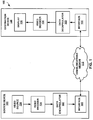
- FIG. 1 is a block diagram illustrating an example of a system that may be configured to encode and decode video data according to one or more techniques of this disclosure.
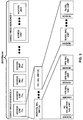
- FIG. 2 is a conceptual diagram illustrating coded video data and corresponding data structures according to one or more techniques of this disclosure.
- FIG. 3 is a conceptual diagram illustrating a data structure encapsulating coded video data and corresponding metadata according to one or more techniques of this disclosure.
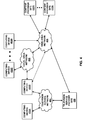
- FIG. 4 is a conceptual drawing illustrating an example of components that may be included in an implementation of a system that may be configured to encode and decode video data according to one or more techniques of this disclosure.
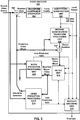
- FIG. 5 is a block diagram illustrating an example of a video encoder that may be configured to encode video data according to one or more techniques of this disclosure.
- FIG. 6 is a block diagram illustrating an example of a video decoder that may be configured to decode video data according to one or more techniques of this disclosure.
- this disclosure describes various techniques for coding video data.
- this disclosure describes techniques for signaling high-level syntax for coded video. Signaling of high-level syntax according to the techniques described herein may be particularly useful for improving video distribution system performance by lowering transmission bandwidth and/or facilitating parallelization of a video encoder and/or decoder.
- signals of high-level syntax may be particularly useful for improving video distribution system performance by lowering transmission bandwidth and/or facilitating parallelization of a video encoder and/or decoder.
- the coding techniques described herein may be incorporated into video coding systems, (including video coding systems based on future video coding standards) including block structures, intra prediction techniques, inter prediction techniques, transform techniques, filtering techniques, and/or entropy coding techniques other than those included in ITU-T H.265.
- video coding systems including video coding systems based on future video coding standards
- intra prediction techniques including video coding systems based on future video coding standards
- inter prediction techniques transform techniques, filtering techniques, and/or entropy coding techniques other than those included in ITU-T H.265.
- JVET-J1001 JVET-J1001
- a device comprises one or more processors configured to signal a value for a syntax element in a network abstraction layer unit indicating a number of syntax structures included in the network abstraction layer unit, and for each the number of syntax structures, signaling a value for a syntax element indicating a syntax structure type.
- a non-transitory computer-readable storage medium comprises instructions stored thereon that, when executed, cause one or more processors of a device to signal a value for a syntax element in a network abstraction layer unit indicating a number of syntax structures included in the network abstraction layer unit, and for each the number of syntax structures, signaling a value for a syntax element indicating a syntax structure type.
- an apparatus comprises means for signaling a value for a syntax element in a network abstraction layer unit indicating a number of syntax structures included in the network abstraction layer unit, and means for signaling a value of a syntax element indicating a syntax structure type for each the number of syntax structures.
- a device comprises one or more processors configured to parse a value for a syntax element in a network abstraction layer unit indicating a number of syntax structures included in the network abstraction layer unit, and for each the number of syntax structures parse a value for syntax element indicating a syntax structure type, and generate video data based on values of the parsed syntax elements.
- a non-transitory computer-readable storage medium comprises instructions stored thereon that, when executed, cause one or more processors of a device to parse a value for a syntax element in a network abstraction layer unit indicating a number of syntax structures included in the network abstraction layer unit, and for each the number of syntax structures parse a value for syntax element indicating a syntax structure type, and generate video data based on values of the parsed syntax elements.
- an apparatus comprises means for parsing a value for a syntax element in a network abstraction layer unit indicating a number of syntax structures included in the network abstraction layer unit, means for parsing a value for syntax element indicating a syntax structure type for each the number of syntax structures, and means for generating video data based on values of the parsed syntax elements.
- Video content typically includes video sequences comprised of a series of frames.
- a series of frames may also be referred to as a group of pictures (GOP).
- Each video frame or picture may include a one or more slices, where a slice includes a plurality of video blocks.
- a video block includes an array of pixel values (also referred to as samples) that may be predictively coded.
- Video blocks may be ordered according to a scan pattern (e.g., a raster scan).
- a video encoder performs predictive encoding on video blocks and sub-divisions thereof.
- ITU-T H.264 specifies a macroblock including 16 x 16 luma samples.
- ITU-T H.265 specifies an analogous Coding Tree Unit (CTU) structure (which may be referred to as a Largest Coding Unit (LCU)) where a picture may be split into CTUs of equal size and each CTU may include Coding Tree Blocks (CTB) having 16 x 16, 32 x 32, or 64 x 64 luma samples.
- CTU Coding Tree Block
- the term video block may generally refer to an area of a picture or may more specifically refer to the largest array of pixel values that may be predictively coded, sub-divisions thereof, and/or corresponding structures.
- each video frame or picture may be partitioned to include one or more tiles, where a tile is a sequence of coding tree units corresponding to a rectangular area of a picture.
- a CTU is composed of respective CTBs for each component of video data (e.g., luma (Y) and chroma (Cb and Cr)). Further, in ITU-T H.265, a CTU may be partitioned according to a quadtree (QT) partitioning structure, which results in the CTBs of the CTU being partitioned into Coding Blocks (CB). That is, in ITU-T H.265, a CTU may be partitioned into quadtree leaf nodes. According to ITU-T H.265, one luma CB together with two corresponding chroma CBs and associated syntax elements are referred to as a coding unit (CU).
- CU coding unit
- ITU-T H.265 a minimum allowed size of a CB may be signaled.
- the smallest minimum allowed size of a luma CB is 8x8 luma samples.
- the decision to code a picture area using intra prediction or inter prediction is made at the CU level.
- ITU-T H.265 a CU is associated with a prediction unit (PU) structure having its root at the CU.
- PU structures allow luma and chroma CBs to be split for purposes of generating corresponding reference samples. That is, in ITU-T H.265, luma and chroma CBs may be split into respect luma and chroma prediction blocks (PBs), where a PB includes a block of sample values for which the same prediction is applied.
- PBs chroma prediction blocks
- a CB may be partitioned into 1, 2, or 4 PBs.
- ITU-T H.265 supports PB sizes from 64x64 samples down to 4x4 samples.
- ITU-T H.265 square PBs are supported for intra prediction, where a CB may form the PB or the CB may be split into four square PBs (i.e., intra prediction PB sizes type include MxM or M/2xM/2, where M is the height and width of the square CB).
- intra prediction PB sizes type include MxM or M/2xM/2, where M is the height and width of the square CB.
- rectangular PBs are supported for inter prediction, where a CB may by halved vertically or horizontally to form PBs (i.e., inter prediction PB types include MxM, M/2xM/2, M/2xM, or MxM/2).
- ITU-T H.265 for inter prediction, four asymmetric PB partitions are supported, where the CB is partitioned into two PBs at one quarter of the height (at the top or the bottom) or width (at the left or the right) of the CB (i.e., asymmetric partitions include M/4xM left, M/4xM right, MxM/4 top, and MxM/4 bottom).
- Intra prediction data e.g., intra prediction mode syntax elements
- inter prediction data e.g., motion data syntax elements
- JEM specifies a CTU having a maximum size of 256x256 luma samples.
- JEM specifies a quadtree plus binary tree (QTBT) block structure.
- the QTBT structure enables quadtree leaf nodes to be further partitioned by a binary tree (BT) structure. That is, in JEM, the binary tree structure enables quadtree leaf nodes to be recursively divided vertically or horizontally.
- BT binary tree
- the binary tree structure in JEM enables square and rectangular leaf nodes, where each leaf node includes a CB.
- a picture included in a GOP may include slices, where each slice includes a sequence of CTUs and each CTU may be partitioned according to a QTBT structure.
- JEM CBs are used for prediction without any further partitioning. That is, in JEM, a CB may be a block of sample values on which the same prediction is applied.
- a JEM QTBT leaf node may be analogous a PB in ITU-T H.265.
- Intra prediction data e.g., intra prediction mode syntax elements
- inter prediction data e.g., motion data syntax elements
- Residual data may include respective arrays of difference values corresponding to each component of video data (e.g., luma (Y) and chroma (Cb and Cr)). Residual data may be in the pixel domain.
- a transform such as, a discrete cosine transform (DCT), a discrete sine transform (DST), an integer transform, a wavelet transform, or a conceptually similar transform, may be applied to pixel difference values to generate transform coefficients.
- DCT discrete cosine transform
- DST discrete sine transform
- an integer transform e.g., a wavelet transform, or a conceptually similar transform
- CUs may be further sub-divided into Transform Units (TUs). That is, an array of pixel difference values may be sub-divided for purposes of generating transform coefficients (e.g., four 8 x 8 transforms may be applied to a 16 x 16 array of residual values corresponding to a 16 x16 luma CB), such sub-divisions may be referred to as Transform Blocks (TBs). Transform coefficients may be quantized according to a quantization parameter (QP).
- QP quantization parameter
- Quantized transform coefficients may be entropy coded according to an entropy encoding technique (e.g., content adaptive variable length coding (CAVLC), context adaptive binary arithmetic coding (CABAC), probability interval partitioning entropy coding (PIPE), etc.).
- an entropy encoding technique e.g., content adaptive variable length coding (CAVLC), context adaptive binary arithmetic coding (CABAC), probability interval partitioning entropy coding (PIPE), etc.
- syntax elements such as, a syntax element indicating a prediction mode, may also be entropy coded.
- Entropy encoded quantized transform coefficients and corresponding entropy encoded syntax elements may form a compliant bitstream that can be used to reproduce video data.
- a binarization process may be performed on syntax elements as part of an entropy coding process.
- Binarization refers to the process of converting a syntax value into a series of one or more bits. These bits may be referred to as “bins.”
- intra prediction data or inter prediction data is used to produce reference sample values for a block of sample values. The difference between sample values included in a current PB, or another type of picture area structure, and associated reference samples (e.g., those generated using a prediction) may be referred to as residual data.
- intra prediction data or inter prediction data may associate an area of a picture (e.g., a PB or a CB) with corresponding reference samples.
- an intra prediction mode may specify the location of reference samples within a picture.
- defined possible intra prediction modes include a planar (i.e., surface fitting) prediction mode (predMode: 0), a DC (i.e., flat overall averaging) prediction mode (predMode: 1), and 33 angular prediction modes (predMode: 2-34).
- defined possible intra-prediction modes include a planar prediction mode (predMode: 0), a DC prediction mode (predMode: 1), and 65 angular prediction modes (predMode: 2-66). It should be noted that planar and DC prediction modes may be referred to as non-directional prediction modes and that angular prediction modes may be referred to as directional prediction modes. It should be noted that the techniques described herein may be generally applicable regardless of the number of defined possible prediction modes.
- a motion vector For inter prediction coding, a motion vector (MV) identifies reference samples in a picture other than the picture of a video block to be coded and thereby exploits temporal redundancy in video. For example, a current video block may be predicted from reference block(s) located in previously coded frame(s) and a motion vector may be used to indicate the location of the reference block.
- a motion vector and associated data may describe, for example, a horizontal component of the motion vector, a vertical component of the motion vector, a resolution for the motion vector (e.g., one-quarter pixel precision, one-half pixel precision, one-pixel precision, two-pixel precision, four-pixel precision), a prediction direction and/or a reference picture index value.
- a coding standard such as, for example ITU-T H.265, may support motion vector prediction.
- Motion vector prediction enables a motion vector to be specified using motion vectors of neighboring blocks.
- Examples of motion vector prediction include advanced motion vector prediction (AMVP), temporal motion vector prediction (TMVP), so-called “merge” mode, and “skip” and “direct” motion inference.
- JEM supports advanced temporal motion vector prediction (ATMVP), Spatial-temporal motion vector prediction (STMVP), Pattern matched motion vector derivation (PMMVD) mode, which is a special merge mode based on Frame-Rate Up Conversion (FRUC) techniques, and affine transform motion compensation prediction.
- ATMVP advanced temporal motion vector prediction
- STMVP Spatial-temporal motion vector prediction
- PMMVD Pattern matched motion vector derivation
- FRUC Frame-Rate Up Conversion
- Residual data may include respective arrays of difference values corresponding to each component of video data. Residual data may be in the pixel domain.
- a transform such as, a discrete cosine transform (DCT), a discrete sine transform (DST), an integer transform, a wavelet transform, or a conceptually similar transform, may be applied to an array of difference values to generate transform coefficients.
- DCT discrete cosine transform
- DST discrete sine transform
- an integer transform e.g., a wavelet transform, or a conceptually similar transform
- ITU-T H.265 a CU is associated with a transform unit (TU) structure having its root at the CU level. That is, in ITU-T H.265, as described above, an array of difference values may be sub-divided for purposes of generating transform coefficients (e.g., four 8x8 transforms may be applied to a 16x16 array of residual values). It should be noted that in ITU-T H.265, TBs are not
- JEM residual values corresponding to a CB are used to generate transform coefficients without further partitioning. That is, in JEM a QTBT leaf node may be analogous to both a PB and a TB in ITU-T H.265. It should be noted that in JEM, a core transform and a subsequent secondary transforms may be applied (in the video encoder) to generate transform coefficients. For a video decoder, the order of transforms is reversed. Further, in JEM, whether a secondary transform is applied to generate transform coefficients may be dependent on a prediction mode.
- a quantization process may be performed on transform coefficients. Quantization approximates transform coefficients by amplitudes restricted to a set of specified values. Quantization may be used in order to vary the amount of data required to represent a group of transform coefficients. Quantization may be realized through division of transform coefficients by a scaling factor and any associated rounding functions (e.g., rounding to the nearest integer). Quantized transform coefficients may be referred to as coefficient level values. Inverse quantization (or “dequantization”) may include multiplication of coefficient level values by the scaling factor. It should be noted that as used herein the term quantization process in some instances may refer to division by a scaling factor to generate level values or multiplication by a scaling factor to recover transform coefficients in some instances. That is, a quantization process may refer to quantization in some cases and inverse quantization in some cases.
- each video frame or picture may be partitioned to include one or more slices and further partitioned to include one or more tiles.
- FIG. 2 is a conceptual diagram illustrating an example of a group of pictures including slices. In the example illustrated in FIG.
- Pic4 is illustrated as including two slices (i.e., Slice1 and Slice2) where each slice includes a sequence of CTUs (e.g., in raster scan order).
- a slice is a sequence of one or more slice segments starting with an independent slice segment and containing all subsequent dependent slice segments (if any) that precede the next independent slice segment (if any) within the same access unit.
- a slice segment like a slice, is a sequence of coding tree units. In the examples described herein, in some cases the terms slice and slice segment may be used interchangeably to indicate a sequence of coding tree units.
- a tile may consist of coding tree units contained in more than one slice and a slice may consist of coding tree units contained in more than one tile.
- ITU-T H.265 provides that one or both of the following conditions shall be fulfilled: (1) All coding tree units in a slice belong to the same tile; and (2) All coding tree units in a tile belong to the same slice.
- Tile sets may be used to define boundaries for coding dependencies (e.g., intra-prediction dependencies, entropy encoding dependencies, etc.,) and as such, may enable parallelism in coding.
- a coded video sequence may be encapsulated (or structured) as a sequence of access units, where each access unit includes video data structured as network abstraction layer (NAL) units.
- NAL network abstraction layer
- a bitstream is described as including a sequence of NAL units forming one or more CVSs.
- ITU-T H.265 supports multi-layer extensions, including format range extensions (RExt), scalability (SHVC), multi-view (MV-HEVC), and 3-D (3D-HEVC). Multi-layer extensions enable a video presentation to include a base layer and one or more additional enhancement layers.
- a base layer may enable a video presentation having a basic level of quality (e.g., High Definition rendering) to be presented and an enhancement layer may enable a video presentation having an enhanced level of quality (e.g., an Ultra High Definition rendering) to be presented.
- an enhancement layer may be coded by referencing a base layer. That is, for example, a picture in an enhancement layer may be coded (e.g., using inter prediction techniques) by referencing one or more pictures (including scaled versions thereof) in a base layer.
- each NAL unit may include an identifier indicating a layer of video data the NAL unit is associated with.
- sub-bitstream extraction may refer to a process where a device receiving a compliant bitstream forms a new compliant bitstream by discarding and/or modifying data in the received bitstream.
- sub-bitstream extraction may be used to form a new compliant bitstream corresponding to a particular representation of video (e.g., a high quality representation).
- each slice of video data included in Pic4 (i.e., Slice1 and Slice2) is illustrated as being encapsulated in a NAL unit.
- each of a video sequence, a GOP, a picture, a slice, and CTU may be associated with metadata that describes video coding properties.
- ITU-T H.265 defines parameters sets that may be used to describe video data and/or video coding properties.
- parameter sets may be encapsulated as a special type of NAL unit or may be signaled as a message.
- NAL units including coded video data may be referred to as VCL (Video Coding Layer) NAL units and NAL units including metadata (e.g., parameter sets) may be referred to as non-VCL NAL units.
- VCL Video Coding Layer
- non-VCL NAL units NAL units including metadata (e.g., parameter sets)
- ITU-T H.265 enables supplemental enhancement information (SEI) messages to be signaled.
- SEI messages assist in processes related to decoding, display or other purposes, however, SEI messages may not be required for constructing the luma or chroma samples by the decoding process.
- SEI messages may be signaled in a bitstream using non-VCL NAL units. Further, SEI messages may be conveyed by some means other than by being present in the bitstream (i.e., signaled out-of-band).
- FIG. 3 illustrates an example of a bitstream including multiple CVSs, where a CVS is represented by NAL units included in a respective access unit.
- non-VCL NAL units include respective parameter set units (i.e., Video Parameter Sets (VPS), Sequence Parameter Sets (SPS), and Picture Parameter Set (PPS) units) and an access unit delimiter NAL unit.
- VPS Video Parameter Sets
- SPS Sequence Parameter Sets
- PPS Picture Parameter Set
- ITU-T H.265 defines NAL unit header semantics that specify the type of Raw Byte Sequence Payload (RBSP) data structure included in the NAL unit.
- RBSP Raw Byte Sequence Payload
- Table 1 illustrates the general NAL unit syntax provided in ITU-T H.265 and which is additionally used in JVET-J1001.
- Table 2 illustrates the NAL unit header syntax provided in ITU-T H.265.
- JVET-J1001 is a draft text of a video coding specification.
- Table 4 illustrates the syntax of the NAL unit header in JVET-J1001.
- JVET-J1001 further provides a basic picture parameter set syntax.
- Table 6 illustrates the syntax of the picture parameter set in JVET-J1001.
- JVET-J1001 further provides an access unit delimiter syntax.
- Table 7 illustrates the syntax of the access unit delimiter in JVET-J1001.
- a B slice refers to a slice where bi-prediction inter prediction, uni-prediction inter prediction, and intra predication are allowed;
- a P slice refers to a slice where uni-prediction inter prediction, and intra predication are allowed; and an I slice refers where only intra predication is allowed.
- B and P slices are collectively referred to as inter slices.
- JVET-J1001 further provides an end of sequence syntax, an end of bitstream syntax, and a filler data syntax.
- Table 9 illustrates the end of sequence syntax provided in JVET-J1001
- Table 10 illustrates the end of bitstream syntax provided in JVET-J1001
- Table 11 illustrates the end of bitstream syntax provided in JVET-J1001.
- JVET-J1001 further provides a slice layer syntax including a slice header.
- Table 12 illustrates the slice layer syntax provided in JVET-J1001
- Table 13 illustrates the slice header provided in JVET-J1001.
- This disclosure describes a high-level syntax and semantics that enable the grouping of related syntax elements in syntax structure groups; enable the ability to skip past one or more groups of syntax structures without parsing them, because, for example, a syntax structure is not used due to one or more related lower level coding tools not being used by a given profile, and enable the ability for a decoder to quickly access only relevant syntax elements without having to parse all the previous syntax elements which appear before the syntax element of interest, which may be especially applicable to signaling of various indicators and signaling in video usability information.
- high-level syntax may refer to syntax occurring prior to slice_data().
- FIG. 1 is a block diagram illustrating an example of a system that may be configured to code (i.e., encode and/or decode) video data according to one or more techniques of this disclosure.
- System 100 represents an example of a system that may encapsulate video data according to one or more techniques of this disclosure.
- system 100 includes source device 102, communications medium 110, and destination device 120.
- source device 102 may include any device configured to encode video data and transmit encoded video data to communications medium 110.
- Destination device 120 may include any device configured to receive encoded video data via communications medium 110 and to decode encoded video data.
- Source device 102 and/or destination device 120 may include computing devices equipped for wired and/or wireless communications and may include, for example, set top boxes, digital video recorders, televisions, desktop, laptop or tablet computers, gaming consoles, medical imagining devices, and mobile devices, including, for example, smartphones, cellular telephones, personal gaming devices.
- Communications medium 110 may include any combination of wireless and wired communication media, and/or storage devices.
- Communications medium 110 may include coaxial cables, fiber optic cables, twisted pair cables, wireless transmitters and receivers, routers, switches, repeaters, base stations, or any other equipment that may be useful to facilitate communications between various devices and sites.
- Communications medium 110 may include one or more networks.
- communications medium 110 may include a network configured to enable access to the World Wide Web, for example, the Internet.
- a network may operate according to a combination of one or more telecommunication protocols. Telecommunications protocols may include proprietary aspects and/or may include standardized telecommunication protocols.
- Examples of standardized telecommunications protocols include Digital Video Broadcasting (DVB) standards, Advanced Television Systems Committee (ATSC) standards, Integrated Services Digital Broadcasting (ISDB) standards, Data Over Cable Service Interface Specification (DOCSIS) standards, Global System Mobile Communications (GSM) standards, code division multiple access (CDMA) standards, 3rd Generation Partnership Project (3GPP) standards, European Telecommunications Standards Institute (ETSI) standards, Internet Protocol (IP) standards, Wireless Application Protocol (WAP) standards, and Institute of Electrical and Electronics Engineers (IEEE) standards.
- DVD Digital Video Broadcasting
- ATSC Advanced Television Systems Committee
- ISDB Integrated Services Digital Broadcasting
- DOCSIS Data Over Cable Service Interface Specification
- GSM Global System Mobile Communications
- CDMA code division multiple access
- 3GPP 3rd Generation Partnership Project
- ETSI European Telecommunications Standards Institute
- IP Internet Protocol
- WAP Wireless Application Protocol
- IEEE Institute of Electrical and Electronics Engineers
- Storage devices may include any type of device or storage medium capable of storing data.
- a storage medium may include a tangible or non-transitory computer-readable media.
- a computer readable medium may include optical discs, flash memory, magnetic memory, or any other suitable digital storage media.
- a memory device or portions thereof may be described as non-volatile memory and in other examples portions of memory devices may be described as volatile memory.
- Examples of volatile memories may include random access memories (RAM), dynamic random access memories (DRAM), and static random access memories (SRAM).
- Examples of non-volatile memories may include magnetic hard discs, optical discs, floppy discs, flash memories, or forms of electrically programmable memories (EPROM) or electrically erasable and programmable (EEPROM) memories.
- Storage device(s) may include memory cards (e.g., a Secure Digital (SD) memory card), internal/external hard disk drives, and/or internal/external solid state drives. Data may be stored on a storage device according to a defined file format
- FIG. 4 is a conceptual drawing illustrating an example of components that may be included in an implementation of system 100.
- system 100 includes one or more computing devices 402A-402N, television service network 404, television service provider site 406, wide area network 408, local area network 410, and one or more content provider sites 412A-412N.
- the implementation illustrated in FIG. 4 represents an example of a system that may be configured to allow digital media content, such as, for example, a movie, a live sporting event, etc., and data and applications and media presentations associated therewith to be distributed to and accessed by a plurality of computing devices, such as computing devices 402A-402N.
- digital media content such as, for example, a movie, a live sporting event, etc.
- computing devices 402A-402N such as computing devices 402A-402N.
- computing devices 402A-402N may include any device configured to receive data from one or more of television service network 404, wide area network 408, and/or local area network 410.
- computing devices 402A-402N may be equipped for wired and/or wireless communications and may be configured to receive services through one or more data channels and may include televisions, including so-called smart televisions, set top boxes, and digital video recorders.
- computing devices 402A-402N may include desktop, laptop, or tablet computers, gaming consoles, mobile devices, including, for example, “smart” phones, cellular telephones, and personal gaming devices.
- Television service network 404 is an example of a network configured to enable digital media content, which may include television services, to be distributed.
- television service network 404 may include public over-the-air television networks, public or subscription-based satellite television service provider networks, and public or subscription-based cable television provider networks and/or over the top or Internet service providers.
- television service network 404 may primarily be used to enable television services to be provided, television service network 404 may also enable other types of data and services to be provided according to any combination of the telecommunication protocols described herein.
- television service network 404 may enable two-way communications between television service provider site 406 and one or more of computing devices 402A-402N.
- Television service network 404 may comprise any combination of wireless and/or wired communication media.
- Television service network 404 may include coaxial cables, fiber optic cables, twisted pair cables, wireless transmitters and receivers, routers, switches, repeaters, base stations, or any other equipment that may be useful to facilitate communications between various devices and sites.
- Television service network 404 may operate according to a combination of one or more telecommunication protocols.
- Telecommunications protocols may include proprietary aspects and/or may include standardized telecommunication protocols. Examples of standardized telecommunications protocols include DVB standards, ATSC standards, ISDB standards, DTMB standards, DMB standards, Data Over Cable Service Interface Specification (DOCSIS) standards, HbbTV standards, W3C standards, and UPnP standards.
- DOCSIS Data Over Cable Service Interface Specification
- television service provider site 406 may be configured to distribute television service via television service network 404.
- television service provider site 406 may include one or more broadcast stations, a cable television provider, or a satellite television provider, or an Internet-based television provider.
- television service provider site 406 may be configured to receive a transmission including television programming through a satellite uplink/downlink.
- television service provider site 406 may be in communication with wide area network 408 and may be configured to receive data from content provider sites 412A-412N. It should be noted that in some examples, television service provider site 406 may include a television studio and content may originate therefrom.
- Wide area network 408 may include a packet based network and operate according to a combination of one or more telecommunication protocols.
- Telecommunications protocols may include proprietary aspects and/or may include standardized telecommunication protocols. Examples of standardized telecommunications protocols include Global System Mobile Communications (GSM) standards, code division multiple access (CDMA) standards, 3rd Generation Partnership Project (3GPP) standards, European Telecommunications Standards Institute (ETSI) standards, European standards (EN), IP standards, Wireless Application Protocol (WAP) standards, and Institute of Electrical and Electronics Engineers (IEEE) standards, such as, for example, one or more of the IEEE 802 standards (e.g., Wi-Fi).
- GSM Global System Mobile Communications
- CDMA code division multiple access
- 3GPP 3rd Generation Partnership Project
- ETSI European Telecommunications Standards Institute
- EN European standards
- IP standards European standards
- WAP Wireless Application Protocol
- IEEE Institute of Electrical and Electronics Engineers
- Wide area network 408 may comprise any combination of wireless and/or wired communication media.
- Wide area network 408 may include coaxial cables, fiber optic cables, twisted pair cables, Ethernet cables, wireless transmitters and receivers, routers, switches, repeaters, base stations, or any other equipment that may be useful to facilitate communications between various devices and sites.
- wide area network 408 may include the Internet.
- Local area network 410 may include a packet based network and operate according to a combination of one or more telecommunication protocols. Local area network 410 may be distinguished from wide area network 408 based on levels of access and/or physical infrastructure. For example, local area network 410 may include a secure home network.
- content provider sites 412A-412N represent examples of sites that may provide multimedia content to television service provider site 406 and/or computing devices 402A-402N.
- a content provider site may include a studio having one or more studio content servers configured to provide multimedia files and/or streams to television service provider site 406.
- content provider sites 412A-412N may be configured to provide multimedia content using the IP suite.
- a content provider site may be configured to provide multimedia content to a receiver device according to Real Time Streaming Protocol (RTSP), HTTP, or the like.
- RTSP Real Time Streaming Protocol
- source device 102 includes video source 104, video encoder 106, data encapsulator 107, and interface 108.
- Video source 104 may include any device configured to capture and/or store video data.
- video source 104 may include a video camera and a storage device operably coupled thereto.
- Video encoder 106 may include any device configured to receive video data and generate a compliant bitstream representing the video data.
- a compliant bitstream may refer to a bitstream that a video decoder can receive and reproduce video data therefrom. Aspects of a compliant bitstream may be defined according to a video coding standard. When generating a compliant bitstream video encoder 106 may compress video data.
- FIG. 5 is a block diagram illustrating an example of video encoder 500 that may implement the techniques for encoding video data described herein. It should be noted that although example video encoder 500 is illustrated as having distinct functional blocks, such an illustration is for descriptive purposes and does not limit video encoder 500 and/or sub-components thereof to a particular hardware or software architecture. Functions of video encoder 500 may be realized using any combination of hardware, firmware, and/or software implementations.
- Video encoder 500 may perform intra prediction coding and inter prediction coding of picture areas, and, as such, may be referred to as a hybrid video encoder.
- video encoder 500 receives source video blocks.
- source video blocks may include areas of picture that has been divided according to a coding structure.
- source video data may include macroblocks, CTUs, CBs, sub-divisions thereof, and/or another equivalent coding unit.
- video encoder 500 may be configured to perform additional sub-divisions of source video blocks. It should be noted that the techniques described herein are generally applicable to video coding, regardless of how source video data is partitioned prior to and/or during encoding. In the example illustrated in FIG.
- video encoder 500 includes summer 502, transform coefficient generator 504, coefficient quantization unit 506, inverse quantization and transform coefficient processing unit 508, summer 510, intra prediction processing unit 512, inter prediction processing unit 514, filter unit 516, and entropy encoding unit 518. As illustrated in FIG. 5, video encoder 500 receives source video blocks and outputs a bitstream.
- video encoder 500 may generate residual data by subtracting a predictive video block from a source video block. The selection of a predictive video block is described in detail below.
- Summer 502 represents a component configured to perform this subtraction operation. In one example, the subtraction of video blocks occurs in the pixel domain.
- Transform coefficient generator 504 applies a transform, such as a discrete cosine transform (DCT), a discrete sine transform (DST), or a conceptually similar transform, to the residual block or sub-divisions thereof (e.g., four 8 x 8 transforms may be applied to a 16 x 16 array of residual values) to produce a set of residual transform coefficients.
- DCT discrete cosine transform
- DST discrete sine transform
- a conceptually similar transform to the residual block or sub-divisions thereof (e.g., four 8 x 8 transforms may be applied to a 16 x 16 array of residual values) to produce a set of residual transform coefficients.
- Transform coefficient generator 504 may be configured to perform any and all combinations of the transforms included in the family of discrete trigonometric transforms, including approximations thereof. Transform coefficient generator 504 may output transform coefficients to coefficient quantization unit 506. Coefficient quantization unit 506 may be configured to perform quantization of the transform coefficients. The quantization process may reduce the bit depth associated with some or all of the coefficients. The degree of quantization may alter the rate-distortion (i.e., bit-rate vs. quality of video) of encoded video data. The degree of quantization may be modified by adjusting a quantization parameter (QP). A quantization parameter may be determined based on slice level values and/or CU level values (e.g., CU delta QP values).
- QP data may include any data used to determine a QP for quantizing a particular set of transform coefficients.
- quantized transform coefficients (which may be referred to as level values) are output to inverse quantization and transform coefficient processing unit 508.
- Inverse quantization and transform coefficient processing unit 508 may be configured to apply an inverse quantization and an inverse transformation to generate reconstructed residual data.
- reconstructed residual data may be added to a predictive video block. In this manner, an encoded video block may be reconstructed and the resulting reconstructed video block may be used to evaluate the encoding quality for a given prediction, transformation, and/or quantization.
- Video encoder 500 may be configured to perform multiple coding passes (e.g., perform encoding while varying one or more of a prediction, transformation parameters, and quantization parameters).
- the rate-distortion of a bitstream or other system parameters may be optimized based on evaluation of reconstructed video blocks. Further, reconstructed video blocks may be stored and used as reference for predicting subsequent blocks.
- intra prediction processing unit 512 may be configured to select an intra prediction mode for a video block to be coded.
- Intra prediction processing unit 512 may be configured to evaluate a frame and determine an intra prediction mode to use to encode a current block.
- possible intra prediction modes may include planar prediction modes, DC prediction modes, and angular prediction modes.
- a prediction mode for a chroma component may be inferred from a prediction mode for a luma prediction mode.
- Intra prediction processing unit 512 may select an intra prediction mode after performing one or more coding passes. Further, in one example, intra prediction processing unit 512 may select a prediction mode based on a rate-distortion analysis. As illustrated in FIG.
- intra prediction processing unit 512 outputs intra prediction data (e.g., syntax elements) to entropy encoding unit 518 and transform coefficient generator 504.
- intra prediction data e.g., syntax elements
- a transform performed on residual data may be mode dependent (e.g., a secondary transform matrix may be determined based on a predication mode).
- inter prediction processing unit 514 may be configured to perform inter prediction coding for a current video block.
- Inter prediction processing unit 514 may be configured to receive source video blocks and calculate a motion vector for PUs of a video block.
- a motion vector may indicate the displacement of a PU of a video block within a current video frame relative to a predictive block within a reference frame.
- Inter prediction coding may use one or more reference pictures. Further, motion prediction may be uni-predictive (use one motion vector) or bi-predictive (use two motion vectors).
- Inter prediction processing unit 514 may be configured to select a predictive block by calculating a pixel difference determined by, for example, sum of absolute difference (SAD), sum of square difference (SSD), or other difference metrics.
- SAD sum of absolute difference
- SSD sum of square difference
- Inter prediction processing unit 514 may be configured to perform motion vector prediction, as described above.
- Inter prediction processing unit 514 may be configured to generate a predictive block using the motion prediction data. For example, inter prediction processing unit 514 may locate a predictive video block within a frame buffer (not shown in FIG. 5). It should be noted that inter prediction processing unit 514 may further be configured to apply one or more interpolation filters to a reconstructed residual block to calculate sub-integer pixel values for use in motion estimation.
- Inter prediction processing unit 514 may output motion prediction data for a calculated motion vector to entropy encoding unit 518.
- filter unit 516 receives reconstructed video blocks and coding parameters and outputs modified reconstructed video data.
- Filter unit 516 may be configured to perform deblocking and/or Sample Adaptive Offset (SAO) filtering.
- SAO filtering is a non-linear amplitude mapping that may be used to improve reconstruction by adding an offset to reconstructed video data.
- intra prediction processing unit 512 and inter prediction processing unit 514 may receive modified reconstructed video block via filter unit 216.
- Entropy encoding unit 518 receives quantized transform coefficients and predictive syntax data (i.e., intra prediction data and motion prediction data).
- coefficient quantization unit 506 may perform a scan of a matrix including quantized transform coefficients before the coefficients are output to entropy encoding unit 518.
- entropy encoding unit 518 may perform a scan.
- Entropy encoding unit 518 may be configured to perform entropy encoding according to one or more of the techniques described herein. In this manner, video encoder 500 represents an example of a device configured to generate encoded video data according to one or more techniques of this disclose.
- data encapsulator 107 may receive encoded video data and generate a compliant bitstream, e.g., a sequence of NAL units according to a defined data structure.
- a device receiving a compliant bitstream can reproduce video data therefrom.
- sub-bitstream extraction may refer to a process where a device receiving a ITU-T H.265 compliant bitstream forms a new ITU-T H.265 compliant bitstream by discarding and/or modifying data in the received bitstream.
- conforming bitstream may be used in place of the term compliant bitstream.
- data encapsulator 107 may be configured to generate high-level syntax according to one or more techniques described herein. It should be noted that data encapsulator 107 need not necessary be located in the same physical device as video encoder 106. For example, functions described as being performed by video encoder 106 and data encapsulator 107 may be distributed among devices illustrated in FIG. 4.
- Table 1 illustrates the general NAL unit syntax provided in JVET-J1001.
- data encapsulator 107 may be configured to signal a general syntax structure for signaling seq_parameter_set_rbsp( ), pic_parameter_set_rbsp( ), end_of_seq_rbsp( ), and/or end_of_bitstream_rbsp( ).
- Table 15 provides an example of a general syntax structure.
- data encapsulator 107 may be configured to signal an end of sequence syntax and an end of bitstream syntax according to Tables 21 and 22.
- data encapsulator 107 may be configured to signal a slice_header() in conjunction with the general syntax structure provided above according to the example illustrated in Table 23. It should be noted that in Table 23 commonly named syntax elements as those described above may have similar respective definitions to those described above.
- syntax for an access unit delimiter and filler data may not be provided.
- multiple syntax structures of various types may be present in a NAL unit.
- various types of parameter sets and subsets thereof may be included in a NAL unit.
- data encapsulator 107 may be configured to signal a general syntax structure for signaling seq_parameter_set_rbsp( ), pic_parameter_set_rbsp( ), end_of_seq_rbsp( ), and/or end_of_bitstream_rbsp( ) according to the example a general syntax structures illustrated in Table 25 and 26.
- data encapsulator 107 may be configured to signal a general syntax structure for signaling seq_parameter_set_rbsp( ), pic_parameter_set_rbsp( ), end_of_seq_rbsp( ), and/or end_of_bitstream_rbsp( ) according to the example a general syntax structures illustrated in Table 31. It should be noted that in Table 31 commonly named syntax elements as those described above may have similar respective definitions to those described above.
- data encapsulator 107 may be configured to signal a general syntax structure for signaling seq_parameter_set_rbsp( ), pic_parameter_set_rbsp( ), end_of_seq_rbsp( ), and/or end_of_bitstream_rbsp( ) according to the example a general syntax structures illustrated in Table 32. It should be noted that in Table 32 commonly named syntax elements as those described above may have similar respective definitions to those described above.
- one or more of the syntax elements related_tool_id[i][j] may be optionally signaled. The optional signaling be controlled by a presence flag surrounding these syntax elements.
- the values of the syntax elements related_tool_id[i][j] may be inferred when not signaled.
- the value of syntax elements related_tool_id[i][j] may be inferred based on the syntax_struct_type[i].
- the value of related_tool_id[i][j] may be statically known, hard-coded, and/or signaled via a look-up table.
- data encapsulator 107 may be configured to signal a general syntax structure for signaling seq_parameter_set_rbsp( ), pic_parameter_set_rbsp( ), end_of_seq_rbsp( ), and/or end_of_bitstream_rbsp( ) according to the example a general syntax structures illustrated in Table 33. It should be noted that in Table 33 commonly named syntax elements as those described above may have similar respective definitions to those described above.
- one or more of the syntax elements required_syntax_struct_flag[i] and independent_syntax_struct_flag[i] may be optionally signaled. This may be controlled by a presence flag surrounding these syntax elements.
- the values of the syntax elements required_syntax_struct_flag[i], independent_syntax_struct_flag[i] may be inferred when not signaled.
- the value of syntax elements required_syntax_struct_flag[i], independent_syntax_struct_flag[i] may be inferred based on the syntax_struct_type[i].
- the value of required_syntax_struct_flag[i], independent_syntax_struct_flag[i] may be statically known, hard-coded, and/or signalled via a look-up table.
- data encapsulator 107 may be configured to signal a general syntax structure for signaling seq_parameter_set_rbsp( ), pic_parameter_set_rbsp( ), end_of_seq_rbsp( ), and/or end_of_bitstream_rbsp( ) according to the example a general syntax structures illustrated in Table 34.
- Table 34 commonly named syntax elements as those described above may have similar respective definitions to those described above.
- the last syntax structure is kept variable length (based on NAL unit size) and its length is not explicitly signaled.
- syntax_struct_type[num_fixedlen_syntax_structures] may not be signaled for the last variable length syntax structure.
- u(16) some other fixed length or variable length signaling may be used instead.
- one or more u(16) may be changed to u(8) or u(12) or u(v) or ue(v).
- the number of bits used for u(v) coding may be signaled via another syntax element which may be ue(v) coded.
- a coding such as the following may be applied for one or more syntax elements:
- a coding such as the following may be applied for one or more syntax elements:
- the syntax structure RBSP instead of syntax_struct_rbsp(syntax_struct_type[i], syntax_struct_length[i]), the syntax structure RBSP may be indicated as syntax_struct_rbsp(syntax_struct_length[i]).
- the above example syntax is shown for any NAL unit type, in some examples, the above syntax structure may only be applied to certain types of NAL units. For example, the above syntax structure may only be applied to Parameter Set NAL units. In another example, the above syntax structure may only be applied to VCL NAL units. In another example, the above syntax structure may only be applied to Non-VCL NAL units.
- syntax_struct_type[i] may be kept reserved for future extensibility and/or certain values of syntax_struct_type[i] may be allocated for application dependent and/or private signaling.
- the flexible syntax described herein may be used to enable features (or tools) in the bitstream.
- features may be disabled by default, and may be enabled when a corresponding syntax_struct_rbsp() is encoded in the bitstream.
- a syntax_struct_rbsp() may have zero length.
- such a syntax_struct_rbsp() may contain one or more flags that explicitly enable/disable features. The benefit of this approach is that no parsing associated with a given feature is required when the feature is not used.
- source device 102 represents an example of a device configured to signal a value for a syntax element in a network abstraction layer unit indicating a number of syntax structures included in the network abstraction layer unit, and for each the number of syntax structures, signaling a value for a syntax element indicating a syntax structure type.
- interface 108 may include any device configured to receive data generated by data encapsulator 107 and transmit and/or store the data to a communications medium.
- Interface 108 may include a network interface card, such as an Ethernet card, and may include an optical transceiver, a radio frequency transceiver, or any other type of device that can send and/or receive information.
- interface 108 may include a computer system interface that may enable a file to be stored on a storage device.
- interface 108 may include a chipset supporting Peripheral Component Interconnect (PCI) and Peripheral Component Interconnect Express (PCIe) bus protocols, proprietary bus protocols, Universal Serial Bus (USB) protocols, I2C, or any other logical and physical structure that may be used to interconnect peer devices.
- PCI Peripheral Component Interconnect
- PCIe Peripheral Component Interconnect Express
- destination device 120 includes interface 122, data decapsulator 123, video decoder 124, and display 126.
- Interface 122 may include any device configured to receive data from a communications medium.
- Interface 122 may include a network interface card, such as an Ethernet card, and may include an optical transceiver, a radio frequency transceiver, or any other type of device that can receive and/or send information.
- interface 122 may include a computer system interface enabling a compliant video bitstream to be retrieved from a storage device.
- interface 122 may include a chipset supporting PCI and PCIe bus protocols, proprietary bus protocols, USB protocols, I2C, or any other logical and physical structure that may be used to interconnect peer devices.
- Data decapsulator 123 may be configured to receive and parse any of the example syntax structures described herein.
- Video decoder 124 may include any device configured to receive a bitstream (e.g., a MCTS sub-bitstream extraction) and/or acceptable variations thereof and reproduce video data therefrom.
- Display 126 may include any device configured to display video data.
- Display 126 may comprise one of a variety of display devices such as a liquid crystal display (LCD), a plasma display, an organic light emitting diode (OLED) display, or another type of display.
- Display 126 may include a High Definition display or an Ultra High Definition display. It should be noted that although in the example illustrated in FIG. 1, video decoder 124 is described as outputting data to display 126, video decoder 124 may be configured to output video data to various types of devices and/or sub-components thereof. For example, video decoder 124 may be configured to output video data to any communication medium, as described herein.
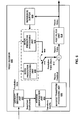
- FIG. 6 is a block diagram illustrating an example of a video decoder that may be configured to decode video data according to one or more techniques of this disclosure.
- video decoder 600 may be configured to decode transform data and reconstruct residual data from transform coefficients based on decoded transform data.
- Video decoder 600 may be configured to perform intra prediction decoding and inter prediction decoding and, as such, may be referred to as a hybrid decoder.
- Video decoder 600 may be configured to parse any combination of the syntax elements described above in Tables 1-24.
- Video decoder 600 may perform video decoding based on the values of parsed syntax elements. For example, different video decoding techniques may be performed based on whether a picture is of a particular type.
- video decoder 600 includes an entropy decoding unit 602, inverse quantization unit and transform coefficient processing unit 604, intra prediction processing unit 606, inter prediction processing unit 608, summer 610, post filter unit 612, and reference buffer 614.
- Video decoder 600 may be configured to decode video data in a manner consistent with a video coding system. It should be noted that although example video decoder 600 is illustrated as having distinct functional blocks, such an illustration is for descriptive purposes and does not limit video decoder 600 and/or sub-components thereof to a particular hardware or software architecture. Functions of video decoder 600 may be realized using any combination of hardware, firmware, and/or software implementations.
- entropy decoding unit 602 receives an entropy encoded bitstream.
- Entropy decoding unit 602 may be configured to decode syntax elements and quantized coefficients from the bitstream according to a process reciprocal to an entropy encoding process.
- Entropy decoding unit 602 may be configured to perform entropy decoding according any of the entropy coding techniques described above.
- Entropy decoding unit 602 may determine values for syntax elements in an encoded bitstream in a manner consistent with a video coding standard.
- entropy decoding unit 602 may determine a quantization parameter, quantized coefficient values, transform data, and predication data from a bitstream.
- inverse quantization unit and transform coefficient processing unit 604 receives a quantization parameter, quantized coefficient values, transform data, and predication data from entropy decoding unit 602 and outputs reconstructed residual data.
- reconstructed residual data may be provided to summer 610
- Summer 610 may add reconstructed residual data to a predictive video block and generate reconstructed video data.
- a predictive video block may be determined according to a predictive video technique (i.e., intra prediction and inter frame prediction).
- Intra prediction processing unit 606 may be configured to receive intra prediction syntax elements and retrieve a predictive video block from reference buffer 614.
- Reference buffer 614 may include a memory device configured to store one or more frames of video data.
- Intra prediction syntax elements may identify an intra prediction mode, such as the intra prediction modes described above.
- Inter prediction processing unit 608 may receive inter prediction syntax elements and generate motion vectors to identify a prediction block in one or more reference frames stored in reference buffer 616.
- Inter prediction processing unit 608 may produce motion compensated blocks, possibly performing interpolation based on interpolation filters. Identifiers for interpolation filters to be used for motion estimation with sub-pixel precision may be included in the syntax elements. Inter prediction processing unit 608 may use interpolation filters to calculate interpolated values for sub-integer pixels of a reference block.
- Post filter unit 614 may be configured to perform filtering on reconstructed video data. For example, post filter unit 614 may be configured to perform deblocking and/or Sample Adaptive Offset (SAO) filtering, e.g., based on parameters specified in a bitstream.
- SAO Sample Adaptive Offset
- post filter unit 614 may be configured to perform proprietary discretionary filtering (e.g., visual enhancements, such as, mosquito noise reduction).
- a reconstructed video block may be output by video decoder 600.
- video decoder 600 represents an example of a device configured to parse a value for a syntax element in a network abstraction layer unit indicating a number of syntax structures included in the network abstraction layer unit, and for each the number of syntax structures parse a value for syntax element indicating a syntax structure type, and generate video data based on values of the parsed syntax elements.
- Computer-readable media may include computer-readable storage media, which corresponds to a tangible medium such as data storage media, or communication media including any medium that facilitates transfer of a computer program from one place to another, e.g., according to a communication protocol.
- Computer-readable media generally may correspond to (1) tangible computer-readable storage media which is non-transitory or (2) a communication medium such as a signal or carrier wave.
- Data storage media may be any available media that can be accessed by one or more computers or one or more processors to retrieve instructions, code and/or data structures for implementation of the techniques described in this disclosure.
- a computer program product may include a computer-readable medium.
- such computer-readable storage media can comprise RAM, ROM, EEPROM, CD-ROM or other optical disk storage, magnetic disk storage, or other magnetic storage devices, flash memory, or any other medium that can be used to store desired program code in the form of instructions or data structures and that can be accessed by a computer.
- any connection is properly termed a computer-readable medium.
- a computer-readable medium For example, if instructions are transmitted from a website, server, or other remote source using a coaxial cable, fiber optic cable, twisted pair, digital subscriber line (DSL), or wireless technologies such as infrared, radio, and microwave, then the coaxial cable, fiber optic cable, twisted pair, DSL, or wireless technologies such as infrared, radio, and microwave are included in the definition of medium.
- DSL digital subscriber line
- Disk and disc includes compact disc (CD), laser disc, optical disc, digital versatile disc (DVD), floppy disk and Blu-ray disc where disks usually reproduce data magnetically, while discs reproduce data optically with lasers. Combinations of the above should also be included within the scope of computer-readable media.
- processors such as one or more digital signal processors (DSPs), general purpose microprocessors, application specific integrated circuits (ASICs), field programmable logic arrays (FPGAs), or other equivalent integrated or discrete logic circuitry.
- DSPs digital signal processors
- ASICs application specific integrated circuits
- FPGAs field programmable logic arrays
- processors may refer to any of the foregoing structure or any other structure suitable for implementation of the techniques described herein.
- the functionality described herein may be provided within dedicated hardware and/or software modules configured for encoding and decoding, or incorporated in a combined codec. Also, the techniques could be fully implemented in one or more circuits or logic elements.
- the techniques of this disclosure may be implemented in a wide variety of devices or apparatuses, including a wireless handset, an integrated circuit (IC) or a set of ICs (e.g., a chip set).
- IC integrated circuit
- a set of ICs e.g., a chip set.
- Various components, modules, or units are described in this disclosure to emphasize functional aspects of devices configured to perform the disclosed techniques, but do not necessarily require realization by different hardware units. Rather, as described above, various units may be combined in a codec hardware unit or provided by a collection of interoperative hardware units, including one or more processors as described above, in conjunction with suitable software and/or firmware.
- each functional block or various features of the base station device and the terminal device used in each of the aforementioned embodiments may be implemented or executed by a circuitry, which is typically an integrated circuit or a plurality of integrated circuits.
- the circuitry designed to execute the functions described in the present specification may comprise a general-purpose processor, a digital signal processor (DSP), an application specific or general application integrated circuit (ASIC), a field programmable gate array (FPGA), or other programmable logic devices, discrete gates or transistor logic, or a discrete hardware component, or a combination thereof.
- the general-purpose processor may be a microprocessor, or alternatively, the processor may be a conventional processor, a controller, a microcontroller or a state machine.
- the general-purpose processor or each circuit described above may be configured by a digital circuit or may be configured by an analogue circuit. Further, when a technology of making into an integrated circuit superseding integrated circuits at the present time appears due to advancement of a semiconductor technology, the integrated circuit by this technology is also able to be used.
Landscapes
- Engineering & Computer Science (AREA)
- Multimedia (AREA)
- Signal Processing (AREA)
- Compression Or Coding Systems Of Tv Signals (AREA)
Abstract
La présente invention concerne le codage vidéo et, plus particulièrement, des techniques de signalisation de syntaxe de haut niveau pour une vidéo codée. Selon un aspect de l'invention, une valeur d'un élément de syntaxe dans une unité de couche d'abstraction de réseau indiquant un nombre de structures de syntaxe est signalée, et pour chaque structure de syntaxe, une valeur d'un élément de syntaxe indiquant un type de structure de syntaxe est signalée.
Applications Claiming Priority (4)
| Application Number | Priority Date | Filing Date | Title |
|---|---|---|---|
| US201862693898P | 2018-07-03 | 2018-07-03 | |
| US62/693,898 | 2018-07-03 | ||
| US201862697257P | 2018-07-12 | 2018-07-12 | |
| US62/697,257 | 2018-07-12 |
Publications (1)
| Publication Number | Publication Date |
|---|---|
| WO2020009124A1 true WO2020009124A1 (fr) | 2020-01-09 |
Family
ID=69060978
Family Applications (1)
| Application Number | Title | Priority Date | Filing Date |
|---|---|---|---|
| PCT/JP2019/026364 Ceased WO2020009124A1 (fr) | 2018-07-03 | 2019-07-02 | Systèmes et procédés de signalisation de syntaxe de haut niveau dans un codage vidéo |
Country Status (1)
| Country | Link |
|---|---|
| WO (1) | WO2020009124A1 (fr) |
-
2019
- 2019-07-02 WO PCT/JP2019/026364 patent/WO2020009124A1/fr not_active Ceased
Non-Patent Citations (2)
| Title |
|---|
| ITU-T RECOMMENDATION H.222.0, pages 44 - 46,59-60 * |
| RECOMMENDATION ITU-T H.265, October 2014 (2014-10-01), pages 43 - 44,452 * |
Similar Documents
| Publication | Publication Date | Title |
|---|---|---|
| JP7699699B2 (ja) | 符号化されたビデオのピクチャ用のタイル構造をシグナリングするシステム及び方法 | |
| WO2020059688A1 (fr) | Systèmes et procédés de signalisation de paramètres en codage vidéo | |
| WO2021033749A1 (fr) | Systèmes et procédés de signalisation d'informations d'images en codage vidéo | |
| WO2021049551A1 (fr) | Systèmes et procédés pour la signalisation d'informations de sous-images dans le codage vidéo | |
| WO2021045128A1 (fr) | Systèmes et procédés de signalisation d'information de sous-couche temporelle en codage vidéo | |
| WO2021033774A1 (fr) | Systèmes et procédés de signalisation d'informations de période de mise en mémoire tampon en codage vidéo | |
| WO2021137295A1 (fr) | Systèmes et procédés de signalisation d'informations de sous-images dans le codage vidéo | |
| WO2020241653A1 (fr) | Systèmes et procédés pour signaler des paramètres de décodeur de référence hypothétique dans un codage vidéo | |
| US11849135B2 (en) | Systems and methods for signaling picture order count values for pictures included in coded video | |
| WO2020122062A1 (fr) | Systèmes et procédés permettant de signaler des images de référence dans un codage vidéo | |
| WO2020171230A1 (fr) | Systèmes et procédés de signalisation de types d'images et d'informations associées dans un codage vidéo | |
| US12160598B2 (en) | Systems and methods for signaling picture types of pictures included in coded video | |
| US12375729B2 (en) | Systems and methods for signaling level information in video coding | |
| WO2020256136A1 (fr) | Systèmes et procédés de signalisation d'informations de tampon d'image décodées dans un codage vidéo | |
| WO2021112036A1 (fr) | Systèmes et procédés pour signaler des informations d'unité de rythme et de décodage d'image en codage vidéo | |
| WO2020059687A1 (fr) | Systèmes et procédés de signalisation d'images de référence en codage vidéo | |
| WO2021100863A1 (fr) | Systèmes et procédés de signalisation de pavés et tranches dans un codage vidéo | |
| WO2019103126A1 (fr) | Systèmes et procédés de signalisation de structures de pavé d'images de vidéo codée | |
| WO2020255896A1 (fr) | Systèmes et procédés permettant de signaler des informations d'unité de couche d'abstraction de réseau dans un codage vidéo | |
| WO2019189890A1 (fr) | Systèmes et procédés de signalisation de structures de pavé pour des images de vidéo codée | |
| WO2020235552A1 (fr) | Systèmes et procédés de signalisation d'informations de propriétés d'images en codage vidéo | |
| WO2019124226A1 (fr) | Systèmes et procédés pour appliquer des filtres de dégroupage à des données vidéo reconstituées à des frontières de partitionnement d'images | |
| WO2023234133A1 (fr) | Systèmes et procédés de signalisation d'informations d'entrée de liste d'images de référence dans un codage vidéo | |
| WO2020009124A1 (fr) | Systèmes et procédés de signalisation de syntaxe de haut niveau dans un codage vidéo |
Legal Events
| Date | Code | Title | Description |
|---|---|---|---|
| 121 | Ep: the epo has been informed by wipo that ep was designated in this application |
Ref document number: 19829879 Country of ref document: EP Kind code of ref document: A1 |
|
| NENP | Non-entry into the national phase |
Ref country code: DE |
|
| 122 | Ep: pct application non-entry in european phase |
Ref document number: 19829879 Country of ref document: EP Kind code of ref document: A1 |