WO2020009211A1 - Dispositif et programme de recherche - Google Patents
Dispositif et programme de recherche Download PDFInfo
- Publication number
- WO2020009211A1 WO2020009211A1 PCT/JP2019/026772 JP2019026772W WO2020009211A1 WO 2020009211 A1 WO2020009211 A1 WO 2020009211A1 JP 2019026772 W JP2019026772 W JP 2019026772W WO 2020009211 A1 WO2020009211 A1 WO 2020009211A1
- Authority
- WO
- WIPO (PCT)
- Prior art keywords
- chatbot
- answer
- question
- unit
- data
- Prior art date
- Legal status (The legal status is an assumption and is not a legal conclusion. Google has not performed a legal analysis and makes no representation as to the accuracy of the status listed.)
- Ceased
Links
Images




Classifications
-
- G—PHYSICS
- G06—COMPUTING OR CALCULATING; COUNTING
- G06F—ELECTRIC DIGITAL DATA PROCESSING
- G06F16/00—Information retrieval; Database structures therefor; File system structures therefor
- G06F16/30—Information retrieval; Database structures therefor; File system structures therefor of unstructured textual data
- G06F16/33—Querying
- G06F16/332—Query formulation
- G06F16/3329—Natural language query formulation
-
- G—PHYSICS
- G06—COMPUTING OR CALCULATING; COUNTING
- G06F—ELECTRIC DIGITAL DATA PROCESSING
- G06F16/00—Information retrieval; Database structures therefor; File system structures therefor
- G06F16/20—Information retrieval; Database structures therefor; File system structures therefor of structured data, e.g. relational data
- G06F16/24—Querying
- G06F16/242—Query formulation
- G06F16/243—Natural language query formulation
-
- G—PHYSICS
- G06—COMPUTING OR CALCULATING; COUNTING
- G06F—ELECTRIC DIGITAL DATA PROCESSING
- G06F16/00—Information retrieval; Database structures therefor; File system structures therefor
- G06F16/90—Details of database functions independent of the retrieved data types
- G06F16/95—Retrieval from the web
- G06F16/953—Querying, e.g. by the use of web search engines
- G06F16/9538—Presentation of query results
-
- G—PHYSICS
- G06—COMPUTING OR CALCULATING; COUNTING
- G06F—ELECTRIC DIGITAL DATA PROCESSING
- G06F40/00—Handling natural language data
- G06F40/20—Natural language analysis
- G06F40/279—Recognition of textual entities
-
- G—PHYSICS
- G06—COMPUTING OR CALCULATING; COUNTING
- G06F—ELECTRIC DIGITAL DATA PROCESSING
- G06F40/00—Handling natural language data
- G06F40/30—Semantic analysis
-
- H—ELECTRICITY
- H04—ELECTRIC COMMUNICATION TECHNIQUE
- H04L—TRANSMISSION OF DIGITAL INFORMATION, e.g. TELEGRAPHIC COMMUNICATION
- H04L51/00—User-to-user messaging in packet-switching networks, transmitted according to store-and-forward or real-time protocols, e.g. e-mail
- H04L51/02—User-to-user messaging in packet-switching networks, transmitted according to store-and-forward or real-time protocols, e.g. e-mail using automatic reactions or user delegation, e.g. automatic replies or chatbot-generated messages
-
- G—PHYSICS
- G06—COMPUTING OR CALCULATING; COUNTING
- G06F—ELECTRIC DIGITAL DATA PROCESSING
- G06F40/00—Handling natural language data
- G06F40/20—Natural language analysis
- G06F40/205—Parsing
- G06F40/211—Syntactic parsing, e.g. based on context-free grammar [CFG] or unification grammars
Definitions
- the present invention relates to a search device and a program.
- Priority is claimed on Japanese Patent Application No. 2018-129224 filed on July 6, 2018, the content of which is incorporated herein by reference.
- the chat system is a system for communicating with a user or the like by exchanging texts. Further, by applying artificial intelligence technology, it is expected that a chat system that automatically responds to a question or the like from a user without human intervention will be widely used.
- Patent Document 1 learns a pattern that is a relationship between an input text and a response text, and uses a learned model. As a result, the generation system of Patent Document 1 automatically generates a response corresponding to a new input text.
- chatbot The function of the server device that automatically responds without human intervention by using a technology such as artificial intelligence as described above is hereinafter referred to as a "chatbot" for convenience.
- chatbot By using a chatbot, it is possible to automatically accumulate necessary knowledge for the user. In addition, it is possible to perform machine learning so that a more appropriate and refined response text can be generated for an input text sent from a user.
- chatbots become more widespread, new challenges arise. The challenge is to easily find the chatbot that can best respond to the user's concerns in a situation where many chatbot services are provided on the Internet.
- search engines automatically collect, index, and provide a vast amount of web page information to the public.
- conventional search engines cannot always efficiently collect chatbot information and provide the information in an appropriate manner. This is because there is a great difference in the way of providing information between a general web page and a chatbot.
- chatbots it is strongly desired that not only general web pages other than chatbots but also chatbots can be searched for appropriate services according to the user's interests. Further, by enabling the user to easily find an appropriate chatbot, it is expected that the usefulness of the entire service using the chatbot will be further enhanced.
- the present invention has been made based on the above problem recognition.
- the problem to be solved is to enable a search device to specify an appropriate chatbot service in response to a question or the like from a user and output the result as a search result.
- a search device provides answer data, which is data of the answer output by the chatbot server device, from a chatbot server device that generates and outputs an answer to an input text.
- An answer extraction unit that obtains the answer data; an answer data storage unit that stores the answer data obtained by the answer extraction unit in association with chatbot identification information for identifying the chatbot server device from which the answer is obtained;
- An answer analysis unit that analyzes characteristics of the answer data stored in the storage unit and writes the chatbot feature data, which is the analysis result, to the answer data storage unit in association with the chatbot identification information; and the answer data storage unit.
- chatbot feature data In the situation where the chatbot feature data is held in the A question analysis unit that analyzes the characteristics of the queried question and outputs question characteristic data that is the result of the analysis, a matching evaluation unit that determines the degree of matching between the chatbot characteristic data and the question characteristic data, and the matching evaluation And a result output unit that outputs information of the chatbot server device that matches the question based on the degree of matching obtained by the unit.
- the chatbot feature data is a set of pairs of an attribute name and an attribute value of an object represented by the answer data
- the question feature data is Is a set of pairs of attribute names and attribute values of the thing represented by.
- the degree of matching is a degree of matching of the attribute values of the same attribute name between the chatbot feature data and the question feature data. It is based on.
- the answer extraction unit transmits the content of a representative input text to the chatbot server device, and responds to the representative input text. To obtain the answer data output by the chatbot server device.
- the result output unit outputs information of the chatbot server device, including access information for accessing the chatbot server device. It is.
- One aspect of the present invention is a reply extracting unit that obtains, from a chatbot server apparatus that generates and outputs a reply to an input text, reply data that is the reply data output by the chatbot server apparatus.
- An answer data storage unit that stores the answer data acquired by the answer extraction unit in association with chatbot identification information for identifying the chatbot server device from which the answer data is obtained, and an answer data storage unit that is stored in the answer data storage unit.
- An answer analysis unit that analyzes the characteristics of the answer data, and writes the chatbot feature data, which is the result of the analysis, to the answer data storage unit in association with the chatbot identification information; and the chatbot features in the answer data storage unit.
- a question analysis unit that analyzes and outputs question feature data that is the result of the analysis, a matching evaluation unit that determines the degree of matching between the chatbot feature data and the question feature data, and the matching evaluation unit that determines the And a result output unit that outputs information of the chatbot server device suitable for the question based on the relevance, and a program for causing the device to function as a search device.
- Another embodiment of the present invention is a computer-readable recording medium on which the above-described computer is recorded.
- the search engine can be realized in a form suitable for the content of the chatbot service. That is, it becomes possible to output information on the chatbot service in response to a question from a user or the like in a manner that was impossible with the conventional method.
- FIG. 1 is a block diagram illustrating a schematic functional configuration of a chatbot search device according to an embodiment of the present invention.
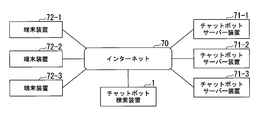
- FIG. 2 is a block diagram illustrating a schematic configuration of an entire system as an environment in which the chatbot search device according to the embodiment operates.
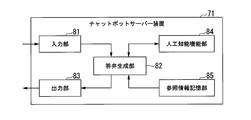
- FIG. 3 is a block diagram illustrating a schematic functional configuration of a chatbot server device to be processed by the embodiment.
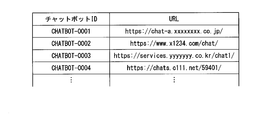
- FIG. 4 is a schematic diagram illustrating a data configuration of a chatbot table stored in a management information storage unit according to the embodiment. It is a schematic diagram showing the data composition of the answer table memorized by the answer database by the embodiment. It is the schematic which shows the data structure of the answer analysis result table which the answer database by the embodiment stores.
- the chatbot search device outputs, for example, information of a chatbot server device suitable for the question in response to a question (query) input by a user.
- a chatbot server device suitable for the question in response to a question (query) input by a user.
- the user can access the chatbot server device suitable for his / her own purpose and use the chat service.
- the features of the chatbot service device and the information provided by the service are expressed and utilized in the form of a pair of an entity ID and an entity component.
- the entity ID is an attribute name.
- the entity component is an attribute value. That is, in the present embodiment, a set of pairs of entity IDs and entity components is stored as information indicating the characteristics of the chatbot server device and its service.
- information indicating characteristics of a question (query) from a user is also expressed as a set of pairs of an entity ID and an entity component related to the question. Then, by matching the set of both pairs, a chatbot service apparatus having a high degree of matching with the question and a service thereof are obtained and output.
- FIG. 1 is a block diagram showing a schematic functional configuration of the chatbot search device according to the present embodiment.
- the chatbot search device 1 includes a service unit 10, a question analysis unit 20, a search unit 30, an answer database 41, a management information storage unit 42, an answer extraction unit 50, and an answer analysis unit 60.
- each functional unit is realized using, for example, an electronic circuit. Further, each functional unit may include a storage unit such as a semiconductor memory or a magnetic hard disk device as needed. Further, each function may be realized by a computer and a program.
- the service unit 10 provides an interface (for example, a human interface) to the search request source device. Specifically, a query for a search is received from an external device by communication or the like, and data of a search result corresponding to the query is returned to the external device.
- an interface for example, a human interface
- the question analysis unit 20 extracts question feature data by analyzing the question (also referred to as search data, search word, query, etc.) received by the service unit 10. That is, the question analysis unit 20 analyzes the characteristics of the question received from the outside, and outputs question characteristic data as the analysis result.
- the question feature data represents the feature of the question.
- the question feature data is a set of pairs of an attribute name (also referred to as “entity ID”) and an attribute value (also referred to as “entity component”) of the thing represented by the question.
- the question feature data may be expressed in another format.
- the question analysis unit 20 includes a question entity classification unit 21 and a question element extraction unit 22.
- the question entity classifying unit 21 classifies and outputs the entity ID included in the question.
- the question element extraction unit 22 extracts and outputs entity constituent elements in association with the entity ID output by the question entity classification unit 21.
- the question analysis unit 20 analyzes the question sentence by using, for example, a technique of semantic analysis of the sentence. For this purpose, the question analysis unit 20 analyzes the syntax of the sentence to be analyzed, and generates a syntax tree. In addition, the question analysis unit 20 previously holds a set of concepts that can be an entity ID as dictionary data.
- the dictionary holds, for example, items such as “position”, “menu”, “price”, “opening time”, and “closing time” as concepts that can be entity IDs.
- the concept that can be the entity ID exemplified here relates to a restaurant, but the question analysis unit 20 holds similar dictionary data in advance for other types of business. Further, the dictionary data held by the question analysis unit 20 includes data representing relationships between concepts.
- the concept of “Shibuya station square” is an example (lower concept) of the concept of “position”.
- the concept of “udon” is an example (lower concept) of the concept of “menu”.
- the question analysis unit 20 determines the entity component (in the above example, “Shibuya Station” or “Udon”) and the entity ID corresponding to the entity component from the question sentence to be analyzed. Is extracted.
- the entity ID corresponding to the entity component “Shibuya station square” is “position”.
- the entity ID corresponding to the entity component “udon” is “menu”.
- the search unit 30 searches for chatbot feature data having a high degree of matching with the question feature data based on the question feature data obtained as a result of the analysis processing by the question analysis unit 20.
- the search unit 30 outputs the information of the chatbot server device 71 as the information of the search result in the descending order of the relevance.
- the search unit 30 passes the information of the search result to the service unit 10.
- the search unit 30 includes a matching evaluation unit 31 and a result output unit 32.
- the matching evaluation unit 31 performs matching between the question feature data and the chatbot feature data, and calculates a numerical value of the degree of matching. In other words, the matching evaluation unit 31 obtains the degree of matching between the chatbot feature data and the question feature data.
- the result output unit 32 sorts (in descending order) the chatbot IDs based on the matching degree calculated by the matching evaluation unit 31 (this is referred to as a matching degree), and outputs the sorted chatbot IDs. That is, the result output unit 32 outputs the information of the chatbot server device 71 that is originally adapted to the question received from the outside based on the degree of matching obtained by the matching evaluation unit 31. Further, the result output unit 32 reads the URL associated with the chatbot ID from the management information storage unit 42 and outputs the URL together. For example, the result output unit 32 outputs the URL read from the management information storage unit 42 using an HTML (hypertext markup language) hyperlink format. That is, the result output unit 32 outputs the information of the chatbot server 71 so as to include the access information for accessing the chatbot server 71.
- HTML hypertext markup language
- the answer database 41 stores data (answer data) of an example of the answer of the chatbot server device 71 and data (chatbot characteristic data) of the analysis result of the answer data. That is, the answer database 41 stores the answer data acquired by the answer extracting unit 50 in association with chatbot identification information for identifying the chatbot server device 71 from which the answer data is acquired. Note that the answer database 41 is also referred to as an “answer data storage unit”.
- the management information storage unit 42 stores information for management.
- the data stored in the management information storage unit 42 includes access information (specifically, URL) for each chatbot server device 71.
- the answer extraction unit 50 extracts answer data from the chatbot server device 71 and writes the extracted answer data in a table in the answer database 41. That is, the answer extraction unit 50 acquires the answer data from the chatbot server device 71 that generates the answer to the input text. Specifically, the answer extraction unit 50 asks a predetermined question to the chatbot server device 71 and receives a response text corresponding to the question. The answer extracting unit 50 may transmit a plurality of questions to the chatbot server device 71. These questions are called “representative questions”. The content (text data) of the representative question is prepared in advance. The answer extracting unit 50 writes answer data in the answer database 41 in the form of a pair of the representative question and the answer. That is, the answer extraction unit 50 transmits a representative input text (representative question) to the chatbot server device 71 as one method. Then, the answer extraction unit 50 acquires the answer data output by the chatbot server device 71 corresponding to the input text.
- the answer extracting unit 50 may acquire the answer data from the chatbot server device 71 by a batch data transmission method.
- the chatbot server device 71 holds in advance data of a set of pairs of the text of the representative question and the text of the corresponding answer.
- the chatbot server device 71 transmits the data based on a request from the answer extraction unit 50.
- the chatbot server device 71 has a special interface for batch transmission of answer data in addition to an interface of a normal chat service.
- the data of the set of pairs of the representative question and the answer is, for example, learning data used by the chatbot server device 71 in the later-described machine learning process.
- the answer database 41 can hold a set of pairs of the representative question (input text) and the answer (answer text) for each chatbot server device 71.
- the answer analysis unit 60 analyzes the answer data held in the answer database 41 and writes the analysis result in the answer database 41. More specifically, the answer analysis unit 60 analyzes the features of the answer data stored in the answer database 41 and writes the chatbot feature data, which is the analysis result, to the answer database 41 in association with the chatbot identification information. .
- the chatbot feature data represents the features of each chatbot server device 71 or the service contents thereof. In the present embodiment, the chatbot feature data is a set of pairs of the attribute name and the attribute value of the thing represented by the answer data. However, the chatbot feature data may be expressed in another format.
- the answer analysis unit 60 includes an answer entity classification unit 61 and an answer element extraction unit 62.
- the answering entity classifying unit 61 classifies the entity based on the pair of the representative question and the answer, and outputs an entity ID related to the pair of the representative question and the answer.
- the entity ID is, in other words, an attribute name.
- the answer element extracting unit 62 extracts and outputs entity constituent elements based on the pair of the representative question and the answer.
- the entity component is an attribute value corresponding to the above-mentioned entity ID.
- the answer analysis unit 60 obtains and outputs a set of pairs of entity IDs and entity components based on a set of pairs of representative questions and answers as a whole. Specifically, the answer analysis unit 60 writes the set of pairs of the entity ID and the entity component into the answer analysis result table included in the answer database 41.
- the answer analysis unit 60 analyzes the representative question and the answer sentence using, for example, a sentence semantic analysis method, similarly to the question analysis unit 20 described above.
- FIG. 2 is a block diagram showing a schematic configuration of the entire system as an environment in which the chatbot search device operates.
- this system includes a chatbot search device 1, chatbot server devices 71-1, 71-2, 71-3,..., And terminal devices 72-1, 72-2, 72-3. , ... are included.
- Each of these devices is interconnected by the Internet 70.
- the chatbot server devices 71-1, 71-2, 71-3,... May be simply referred to as the chatbot server device 71.
- one chatbot search device 1, three chatbot server devices 71, and three terminal devices 72 are shown. However, the number of each device is arbitrary.
- the functions of the chatbot search device 1 are as described with reference to FIG.
- the chatbot search device 1 stores and analyzes information about the chatbot server device 71 in advance. According to the text of the question transmitted from the terminal device 72, the chatbot search device 1 returns to the terminal device 72 information of one or more appropriate chatbot server devices 71 corresponding to the question.
- the chatbot search device 1 can communicate with other devices via the Internet 70.
- the chatbot server device 71 provides a chatbot service to the terminal device 72. That is, the chatbot server device 71 returns an appropriate response text corresponding to the input text to the terminal device 72 in response to the input text transmitted from the terminal device 72. Further, the chatbot server device 71 passes information on the chat contents of the chatbot search device 1 to the chatbot search device 1 in response to a request from the chatbot search device 1, for example.
- the chatbot server device 71 can communicate with other devices via the Internet 70.
- the chatbot server device 71 is realized using, for example, a server-type computer.
- the chatbot server device 71 does not return a text input by a human as a response text, but returns a text generated as a result of processing by a computer to the terminal device 72 as a response text.
- the outline of the functional configuration inside the chatbot server device 71 will be described later with reference to another drawing.
- the terminal device 72 transmits the text to the chatbot server device 71. Then, a response text transmitted from the chatbot server 71 is received as a response to the text. The terminal device 72 may repeat the transmission and reception of the text with the chatbot server device 71 a plurality of times. Thereby, a dialog is established between the terminal device 72 and the chatbot server device 71.
- the terminal device 72 is operated by a user, for example.
- the text transmitted from the terminal device 72 to the chatbot server device 71 may be input by the user using a keyboard, a touch panel, a voice recognition unit, or the like.
- the terminal device 72 can communicate with another device via the Internet 70.
- the terminal device 72 is realized using, for example, a desktop PC (personal computer), a notebook PC, a tablet terminal, a smartphone, a wristwatch-type terminal device, a wearable terminal device, and other information devices.
- the terminal device 72 also transmits the text of the question to the chatbot search device 1.
- the question text may have been entered by the user.
- the terminal device 72 receives information of one or more chatbot server devices 71 from the chatbot search device 1 as a response to the text of the question.
- the information that the terminal device 72 receives from the chatbot search device 1 includes access information (for example, a URL (uniform resource locator)) for accessing the corresponding chatbot server device 71.
- the terminal device 72 can access the corresponding chatbot server device 71 using the access information. That is, the terminal device 72 receives the information of the chatbot server device 71 corresponding to the text of the question transmitted to the chatbot search device 1. Thereby, the terminal device 72 can easily access the chatbot server device 71.
- FIG. 3 is a block diagram showing a schematic functional configuration of the chatbot server device.
- the chatbot server device 71 includes an input unit 81, an answer generation unit 82, an output unit 83, an artificial intelligence function unit 84, and a reference information storage unit 85.
- the input unit 81 receives an input text from an external device (such as the terminal device 72).
- the input unit 81 passes the input text to the answer generation unit 82.
- the answer generation unit 82 generates an answer according to the input text passed from the input unit 81. Specifically, the answer generation unit 82 passes the input text to the artificial intelligence function unit 84. The answer generation unit 82 generates a text output from the artificial intelligence function unit 84 as an answer. Further, the answer generation unit 82 may add the information read from the reference information storage unit 85 to the text output from the artificial intelligence function unit 84. The answer generation unit 82 outputs the answer generated in this way as a response text. The answer generation unit 82 passes the response text to the output unit 83.
- the output unit 83 returns the response text passed from the response generation unit 82 to the original external device (the terminal device 72 or the like).
- the artificial intelligence function unit 84 receives the input text passed from the answer generation unit 82 and outputs a response text (answer) corresponding to the input text.
- the artificial intelligence function unit 84 stores a model relating to the input / output relationship.
- the artificial intelligence function unit 84 performs machine learning processing on this model in advance. That is, the artificial intelligence function unit 84 performs a machine learning process in advance using, for example, a pair of the input text and the response text as learning data (both positive and negative examples may be used), and Holding a model. Since the model has been learned in this way, the artificial intelligence function unit 84 can output an appropriate answer (response text) corresponding to the input text.
- the artificial intelligence function unit 84 may perform machine learning using an arbitrary method.
- the artificial intelligence function unit 84 uses, for example, a neural network technique.
- the artificial intelligence function unit 84 calculates a weight coefficient (a weight value for calculating a weighted sum (weighed) sum) based on a plurality of output values from a preceding node) at a node in the neural network. It is stored as a learning result.
- a back propagation error back propagation method
- existing techniques can be used for artificial intelligence and machine learning, such as neural networks.
- the reference information storage unit 85 stores information to be added to the answer (response text) output by the artificial intelligence function unit 84.
- the reference information storage unit 85 is a database system that holds balance information for each account in a bank.
- the artificial intelligence function unit 84 outputs a response with a variable, for example, “The balance is X yen” to the input text inquiring the balance of the account.
- X is a variable to be replaced with numerical data. That is, the reference information storage unit 85 stores the numerical value of the balance for each account.
- the balance (numerical value) of the specific account stored in the reference information storage unit 85 can be referred to replace the variable X.
- the reference information storage unit 85 stores the balance information of the bank account has been described as an example, but the type of information stored in the reference information storage unit 85 is not limited to this and is arbitrary. That is, the reference information storage unit 85 stores information to be added to the response text output by the artificial intelligence function unit 84.
- the chatbot server device 71 can return an appropriate response text (answer) corresponding to the input text.
- FIG. 4 is a schematic diagram showing the data configuration of the chatbot table stored in the management information storage unit 42.
- this table is tabular data, and has items of chatbot ID and URL.
- the chatbot ID is identification information given to the chatbot server device 71.
- the URL is information indicating the location of the chatbot server device 71.
- Each row of this table corresponds to one chatbot. By referring to this chatbot table, it is possible to obtain information of a URL corresponding to a specific chatbot ID.
- chatbot ID “CHATBOT-0001”.
- the URL corresponding to the chatbot ID “CHATBOT-0001” is “https://chat-a.xxxxxxxxx.co.jp/”.
- the chatbot table also holds data on other chatbot IDs.
- FIG. 5 is a schematic diagram showing the data configuration of the answer table stored in the answer database 41. As shown in the figure, this table is tabular data, and has respective items of chatbot ID, representative question, and answer.
- the chatbot ID is information for identifying the chatbot server 71 as described above.
- the representative question is data of a representative question used when the answer extraction unit 50 acquires answer data from the chatbot server device 71.
- the answer is an answer (response text) output by the chatbot server device 71 in response to the representative question.
- the answer table data is acquired from the chatbot server 71 by the answer extracting unit 50 and written by the answer extracting unit 50.
- the data of the answer table is referred to by the answer analyzer 60 when analyzing the answer.
- FIG. 6 is a schematic diagram showing the data configuration of the answer analysis result table stored in the answer database 41.
- this table is tabular data and has items of a chatbot ID, an entity ID, and an entity component.
- the chatbot ID is information for identifying the chatbot server 71 as described above.
- the entity ID is obtained as a result of the analysis by the answering entity classification unit 61 based on the answering data.
- the entity constituent element here is obtained as a result of extraction by the answer element extracting unit 62 based on the answer data.
- the entity component “Shibuya station square” is stored in correspondence with the entity ID “position”. This pair is obtained by analyzing the pair of the representative question "Where is the store?" And the answer "I'm in front of Shibuya Station” shown in FIG. In addition, an entity component “udon” is held corresponding to the entity ID “menu”. This pair is obtained by analyzing the pair of the representative question “What kind of food do you sell?” And the answer “This shop is a udon specialty store” shown in FIG. It is. Also, the entity component “8:00 am” is held corresponding to the entity ID “opening time”. This pair is obtained by the answer analysis unit 60 analyzing the pair shown in FIG. 5, the representative question “What time is business open?” And the answer “From 8 am”.
- the answer analysis result table may hold a pair of another entity ID and an entity component with respect to the chatbot ID “CHATBOT-0001”. Similarly, the answer analysis result table holds data of a set of pairs of entity IDs and entity constituent elements for other chatbot IDs.
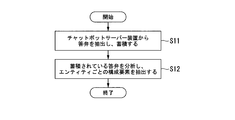
- FIG. 7 is a flowchart showing a procedure of processing for the chatbot search device 1 to write the answer data obtained by extracting the answer data from the chatbot server device 71 into the answer database 41.
- step S11 of the flowchart the answer extracting unit 50 extracts answer data from the chatbot server device 71.
- the answer extraction unit 50 writes the obtained answer data in the answer table of the answer database 41.
- step S12 the answer analysis unit 60 analyzes the data held in the answer table of the answer database 41, and obtains a set of pairs of entity IDs and entity components for each chatbot ID. This is the data of the answer analysis results. Then, the answer analysis unit 60 writes the data of the answer analysis result in the answer analysis result table.
- FIG. 8 shows a procedure of a process for obtaining a search result in response to a question transmitted from the terminal device 72 in a situation where the answer database 41 holds data of a result of analysis of a large number of chatbot server devices 71. It is a flowchart shown.
- step S21 of the flowchart the service unit 10 receives a question from an external device (the terminal device 72 or the like).
- the question is represented, for example, as text (character string).
- the service unit 10 passes the received question to the question analysis unit 20.
- step S22 the question analysis unit 20 analyzes the passed question and extracts question feature data representing the feature of the question.
- the question feature data is extracted from the question.
- the question feature data is a set of pairs of entity IDs and entity components, and includes the following three pairs. First, a pair of an entity ID “position” and an entity component “Shibuya station square”. Second, a pair of an entity ID “menu” and an entity component “udon, soba”. Third, a pair of an entity ID “store opening time” and an entity component “8:00 am”.
- step S23 the matching evaluation unit 31 of the search unit 30 performs matching evaluation between the question and the chatbot. Specifically, the matching evaluation unit 31 performs matching between the question feature data extracted in step S22 and the chatbot feature data stored in the answer analysis result table (FIG. 6) of the answer database 41. Thereby, the matching evaluation unit 31 calculates the degree of matching between the two. For example, the matching evaluation unit 31 matches the above-mentioned question feature data with the chatbot feature data of the chatbot server device 71 of the chatbot ID “CHATBOT-0001” shown in FIG. 6 as follows. That is, the matching rate between the above-mentioned entities with respect to the entity ID “position” is 100%.
- the matching rate for the entity ID “menu” is 50% (only one of the two items included in the question feature data is included in the chatbot feature data).
- the matching rate for the entity ID “opening time” is 100%.
- the matching evaluation unit 31 calculates the average value of the matching rates of these three entity IDs, and calculates the overall matching rate as 84% (however, the fractional part is rounded up).
- the matching evaluation unit 31 also obtains a matching rate with the question for other chatbot IDs.
- the matching evaluation unit 31 calculates the degree of relevance, and the degree of relevance is the same attribute name (entity ID) between the chatbot feature data and the question feature data. ) Are based on the degree to which attribute values (entity constituent elements) match each other. However, the matching evaluation unit may determine the degree of matching between the chatbot feature data and the question feature data by another method (calculation formula or the like).
- step S24 the result output unit 32 of the search unit 30 uses the overall matching rate (which is referred to as an evaluation score) for each chatbot ID calculated by the matching evaluation unit 31 as a key to sort the chatbot ID in descending order. Perform sorting.
- an evaluation score which is referred to as an evaluation score
- step S25 the result output unit 32 outputs the information of the chatbot server device 71 sorted in step S24 as a search result.
- the search result is passed from the result output unit 32 to the service unit 10 and further transmitted to an external device (such as the terminal device 72) that is the query source.
- the result output unit 32 reads the access information (URL) corresponding to the chatbot ID from the management information storage unit 42 (FIG. 4), and outputs the read access information (URL) in addition to the search result information.
- information representing characteristics of each chatbot server device 71 can be stored in the answer database 41 in advance. Then, when a question is received from the external terminal device 72 or the like, by matching the question feature data with the chatbot feature data, the information of the chatbot server device 71 having a high degree of matching with the received question can be appropriately transmitted. , Can be provided to the device of the question source.
- the chatbot search device can be realized by a computer.
- a program for realizing this function may be recorded on a computer-readable recording medium, and the program recorded on this recording medium may be read into a computer system and executed.
- the “computer system” includes an OS and hardware such as peripheral devices.
- the “computer-readable recording medium” is a portable medium such as a flexible disk, a magneto-optical disk, a ROM, a CD-ROM, a DVD-ROM, a USB memory, or a storage device such as a hard disk built in a computer system. That means.
- a "computer-readable recording medium” is a medium that temporarily and dynamically holds a program, such as a communication line for transmitting a program through a network such as the Internet or a communication line such as a telephone line.
- a program holding a program for a certain period of time such as a volatile memory in a computer system serving as a server or a client, may be included.
- the above-mentioned program may be for realizing a part of the above-mentioned functions, or may be for realizing the above-mentioned functions in combination with a program already recorded in a computer system.
- the present invention can be used in, for example, a business that provides a so-called search engine, a service business using search technology, and the like.
- search engine a service business using search technology
- scope of use of the present invention is not limited to those exemplified here.
Landscapes
- Engineering & Computer Science (AREA)
- Physics & Mathematics (AREA)
- Theoretical Computer Science (AREA)
- Mathematical Physics (AREA)
- Databases & Information Systems (AREA)
- General Engineering & Computer Science (AREA)
- General Physics & Mathematics (AREA)
- Artificial Intelligence (AREA)
- Computational Linguistics (AREA)
- Data Mining & Analysis (AREA)
- Computer Networks & Wireless Communication (AREA)
- Signal Processing (AREA)
- Human Computer Interaction (AREA)
- Health & Medical Sciences (AREA)
- Audiology, Speech & Language Pathology (AREA)
- General Health & Medical Sciences (AREA)
- Information Retrieval, Db Structures And Fs Structures Therefor (AREA)
- Information Transfer Between Computers (AREA)
Abstract
L'invention concerne un dispositif de recherche (1) comprenant une partie d'extraction de réponse (50), une partie d'analyse de réponse (60), une partie d'analyse de question (20) et une partie de sortie de résultat (32). La partie d'extraction de réponse (50) acquiert des données de réponse à partir d'un dispositif serveur de robot conversationnel pour générer et délivrer en sortie une réponse à une entrée de texte. La partie d'analyse de réponse (60) analyse des caractéristiques des données de réponse stockées dans une partie de stockage de données de réponse (41) et écrit des données caractéristiques de robot conversationnel, étant le résultat de ladite analyse, à la partie de stockage de données de réponse (41) en association avec des informations d'identification de robot conversationnel. La partie d'analyse de question (20) analyse les caractéristiques d'une question acceptée depuis l'extérieur dans une situation dans laquelle les données caractéristiques de robot conversationnel sont conservées dans la partie de stockage de données de réponse (41), et délivre des données de caractéristique de question qui sont le résultat de ladite analyse. Une partie d'évaluation de correspondance (31) dérive un degré de conformité entre les données de caractéristique de robot conversationnel et les données de caractéristique de question. La partie de sortie de résultat (32) délivre des informations du dispositif serveur de robot conversationnel qui correspondent à la question sur la base du degré de conformité déduit par la partie d'évaluation de correspondance (31).
Priority Applications (5)
| Application Number | Priority Date | Filing Date | Title |
|---|---|---|---|
| CN201980037630.7A CN112219198A (zh) | 2018-07-06 | 2019-07-05 | 检索装置及程序 |
| EP19830895.9A EP3819784A4 (fr) | 2018-07-06 | 2019-07-05 | Dispositif et programme de recherche |
| AU2019298610A AU2019298610B2 (en) | 2018-07-06 | 2019-07-05 | Search device and program |
| CA3102069A CA3102069A1 (fr) | 2018-07-06 | 2019-07-05 | Dispositif et programme de recherche |
| US15/734,330 US20210224303A1 (en) | 2018-07-06 | 2019-07-05 | Searching device and searching program |
Applications Claiming Priority (2)
| Application Number | Priority Date | Filing Date | Title |
|---|---|---|---|
| JP2018-129224 | 2018-07-06 | ||
| JP2018129224A JP6537211B1 (ja) | 2018-07-06 | 2018-07-06 | 検索装置およびプログラム |
Publications (1)
| Publication Number | Publication Date |
|---|---|
| WO2020009211A1 true WO2020009211A1 (fr) | 2020-01-09 |
Family
ID=67144681
Family Applications (1)
| Application Number | Title | Priority Date | Filing Date |
|---|---|---|---|
| PCT/JP2019/026772 Ceased WO2020009211A1 (fr) | 2018-07-06 | 2019-07-05 | Dispositif et programme de recherche |
Country Status (9)
| Country | Link |
|---|---|
| US (1) | US20210224303A1 (fr) |
| EP (1) | EP3819784A4 (fr) |
| JP (1) | JP6537211B1 (fr) |
| KR (1) | KR102063242B1 (fr) |
| CN (1) | CN112219198A (fr) |
| AU (1) | AU2019298610B2 (fr) |
| CA (1) | CA3102069A1 (fr) |
| TW (1) | TW202016760A (fr) |
| WO (1) | WO2020009211A1 (fr) |
Families Citing this family (3)
| Publication number | Priority date | Publication date | Assignee | Title |
|---|---|---|---|---|
| JP6670916B1 (ja) * | 2018-12-03 | 2020-03-25 | 楽天株式会社 | 情報処理装置、情報処理方法 |
| CN111858875B (zh) * | 2020-05-09 | 2024-06-07 | 北京嘀嘀无限科技发展有限公司 | 智能交互方法、装置、设备及存储介质 |
| JP6886738B1 (ja) * | 2020-05-11 | 2021-06-16 | Jeインターナショナル株式会社 | オペレーション支援装置、オペレーション支援方法、およびプログラム |
Citations (4)
| Publication number | Priority date | Publication date | Assignee | Title |
|---|---|---|---|---|
| JPS6218057B2 (fr) | 1982-01-14 | 1987-04-21 | Nippon Electric Co | |
| JP2011103018A (ja) * | 2009-11-10 | 2011-05-26 | Nippon Telegr & Teleph Corp <Ntt> | 質問応答装置、質問応答方法、質問応答プログラム |
| JP2016212541A (ja) * | 2015-05-01 | 2016-12-15 | 株式会社ATR−Trek | 対話装置、対話方法、及びそのコンピュータプログラム |
| JP2018129224A (ja) | 2017-02-09 | 2018-08-16 | 東京エレクトロン株式会社 | プラズマ処理装置 |
Family Cites Families (8)
| Publication number | Priority date | Publication date | Assignee | Title |
|---|---|---|---|---|
| JPS6218057A (ja) | 1985-07-17 | 1987-01-27 | Sumitomo Electric Ind Ltd | リ−ドフレ−ム加工方法 |
| JP2007249899A (ja) * | 2006-03-20 | 2007-09-27 | Fujitsu Ltd | 検索処理プログラム |
| KR102094934B1 (ko) * | 2014-11-19 | 2020-03-31 | 한국전자통신연구원 | 자연어 질의 응답 시스템 및 방법 |
| US11516153B2 (en) * | 2016-01-25 | 2022-11-29 | Expensify, Inc. | Computer system providing a chat engine |
| US10528632B2 (en) * | 2016-07-19 | 2020-01-07 | Microsoft Technology Licensing, Llc | Systems and methods for responding to an online user query |
| US20180052842A1 (en) * | 2016-08-16 | 2018-02-22 | Ebay Inc. | Intelligent online personal assistant with natural language understanding |
| US10437841B2 (en) * | 2016-10-10 | 2019-10-08 | Microsoft Technology Licensing, Llc | Digital assistant extension automatic ranking and selection |
| CN106815321A (zh) * | 2016-12-27 | 2017-06-09 | 深圳前海勇艺达机器人有限公司 | 基于智能聊天机器人的聊天方法及装置 |
-
2018
- 2018-07-06 JP JP2018129224A patent/JP6537211B1/ja active Active
-
2019
- 2019-07-03 TW TW108123426A patent/TW202016760A/zh unknown
- 2019-07-04 KR KR1020190080919A patent/KR102063242B1/ko active Active
- 2019-07-05 EP EP19830895.9A patent/EP3819784A4/fr not_active Withdrawn
- 2019-07-05 CA CA3102069A patent/CA3102069A1/fr not_active Abandoned
- 2019-07-05 AU AU2019298610A patent/AU2019298610B2/en not_active Ceased
- 2019-07-05 CN CN201980037630.7A patent/CN112219198A/zh active Pending
- 2019-07-05 US US15/734,330 patent/US20210224303A1/en not_active Abandoned
- 2019-07-05 WO PCT/JP2019/026772 patent/WO2020009211A1/fr not_active Ceased
Patent Citations (4)
| Publication number | Priority date | Publication date | Assignee | Title |
|---|---|---|---|---|
| JPS6218057B2 (fr) | 1982-01-14 | 1987-04-21 | Nippon Electric Co | |
| JP2011103018A (ja) * | 2009-11-10 | 2011-05-26 | Nippon Telegr & Teleph Corp <Ntt> | 質問応答装置、質問応答方法、質問応答プログラム |
| JP2016212541A (ja) * | 2015-05-01 | 2016-12-15 | 株式会社ATR−Trek | 対話装置、対話方法、及びそのコンピュータプログラム |
| JP2018129224A (ja) | 2017-02-09 | 2018-08-16 | 東京エレクトロン株式会社 | プラズマ処理装置 |
Non-Patent Citations (1)
| Title |
|---|
| See also references of EP3819784A4 |
Also Published As
| Publication number | Publication date |
|---|---|
| JP6537211B1 (ja) | 2019-07-03 |
| JP2020009117A (ja) | 2020-01-16 |
| EP3819784A4 (fr) | 2022-03-30 |
| TW202016760A (zh) | 2020-05-01 |
| US20210224303A1 (en) | 2021-07-22 |
| KR102063242B1 (ko) | 2020-01-08 |
| CN112219198A (zh) | 2021-01-12 |
| AU2019298610B2 (en) | 2022-08-04 |
| EP3819784A1 (fr) | 2021-05-12 |
| CA3102069A1 (fr) | 2020-01-09 |
| AU2019298610A1 (en) | 2020-11-26 |
Similar Documents
| Publication | Publication Date | Title |
|---|---|---|
| CN107368515B (zh) | 应用程序页面推荐方法及系统 | |
| JP6007088B2 (ja) | 大量のコメント文章を用いた質問回答プログラム、サーバ及び方法 | |
| JP4920023B2 (ja) | オブジェクト間競合指標計算方法およびシステム | |
| EP3654211A1 (fr) | Dispositif serveur de réponse automatisée, dispositif terminal, système de réponse, procédé de réponse et programme | |
| CN110795542B (zh) | 对话方法及相关装置、设备 | |
| CN113342958A (zh) | 问答匹配方法、文本匹配模型的训练方法和相关设备 | |
| US9710829B1 (en) | Methods, systems, and articles of manufacture for analyzing social media with trained intelligent systems to enhance direct marketing opportunities | |
| KR102571350B1 (ko) | 딥러닝 모델 기반 태깅 기술을 활용한 맞춤형 분석보고서 제공방법 및 그 장치 | |
| CN114116997A (zh) | 知识问答方法、装置、电子设备及存储介质 | |
| AU2019298610B2 (en) | Search device and program | |
| CN103262079B (zh) | 检索装置及检索方法 | |
| CN116361431A (zh) | 模型训练方法、对话生成方法、电子设备和相关装置 | |
| CN111882224A (zh) | 对消费场景进行分类的方法和装置 | |
| CN112000813A (zh) | 知识库构建方法及装置 | |
| CN113254788B (zh) | 一种基于大数据的推荐方法、系统及可读存储介质 | |
| CN111737607B (zh) | 数据处理方法、装置、电子设备以及存储介质 | |
| KR102722913B1 (ko) | 대규모 언어모델 기반의 의료용 텍스트 생성 시스템 및 방법 | |
| JP2021131576A (ja) | 事例カタログ管理装置及び事例カタログ構築方法 | |
| WO2025098226A1 (fr) | Procédé et appareil de récupération, support de stockage et dispositif électronique | |
| KR102607516B1 (ko) | 딥러닝 모델 기반 입력문서의 텍스트 시퀀스 처리장치 및 그 방법 | |
| JP2021157363A (ja) | ニーズマッチング装置およびプログラム | |
| JP2010282403A (ja) | 文書検索方法 | |
| CN116431912A (zh) | 用户画像推送方法及装置 | |
| JP2023162940A (ja) | サーバ | |
| CN106126561A (zh) | 搜索结果摘要的生成方法及装置 |
Legal Events
| Date | Code | Title | Description |
|---|---|---|---|
| 121 | Ep: the epo has been informed by wipo that ep was designated in this application |
Ref document number: 19830895 Country of ref document: EP Kind code of ref document: A1 |
|
| ENP | Entry into the national phase |
Ref document number: 2019298610 Country of ref document: AU Date of ref document: 20190705 Kind code of ref document: A |
|
| ENP | Entry into the national phase |
Ref document number: 3102069 Country of ref document: CA |
|
| NENP | Non-entry into the national phase |
Ref country code: DE |