WO2020009228A1 - 水性塗料用表面調整剤、水性塗料組成物、塗膜及び複層塗膜 - Google Patents
水性塗料用表面調整剤、水性塗料組成物、塗膜及び複層塗膜 Download PDFInfo
- Publication number
- WO2020009228A1 WO2020009228A1 PCT/JP2019/026839 JP2019026839W WO2020009228A1 WO 2020009228 A1 WO2020009228 A1 WO 2020009228A1 JP 2019026839 W JP2019026839 W JP 2019026839W WO 2020009228 A1 WO2020009228 A1 WO 2020009228A1
- Authority
- WO
- WIPO (PCT)
- Prior art keywords
- parts
- group
- unsaturated monomer
- surface conditioner
- mass
- Prior art date
- Legal status (The legal status is an assumption and is not a legal conclusion. Google has not performed a legal analysis and makes no representation as to the accuracy of the status listed.)
- Ceased
Links
Classifications
-
- C—CHEMISTRY; METALLURGY
- C09—DYES; PAINTS; POLISHES; NATURAL RESINS; ADHESIVES; COMPOSITIONS NOT OTHERWISE PROVIDED FOR; APPLICATIONS OF MATERIALS NOT OTHERWISE PROVIDED FOR
- C09D—COATING COMPOSITIONS, e.g. PAINTS, VARNISHES OR LACQUERS; FILLING PASTES; CHEMICAL PAINT OR INK REMOVERS; INKS; CORRECTING FLUIDS; WOODSTAINS; PASTES OR SOLIDS FOR COLOURING OR PRINTING; USE OF MATERIALS THEREFOR
- C09D5/00—Coating compositions, e.g. paints, varnishes or lacquers, characterised by their physical nature or the effects produced; Filling pastes
- C09D5/002—Priming paints
-
- B—PERFORMING OPERATIONS; TRANSPORTING
- B05—SPRAYING OR ATOMISING IN GENERAL; APPLYING FLUENT MATERIALS TO SURFACES, IN GENERAL
- B05D—PROCESSES FOR APPLYING FLUENT MATERIALS TO SURFACES, IN GENERAL
- B05D1/00—Processes for applying liquids or other fluent materials
- B05D1/26—Processes for applying liquids or other fluent materials performed by applying the liquid or other fluent material from an outlet device in contact with, or almost in contact with, the surface
-
- B—PERFORMING OPERATIONS; TRANSPORTING
- B05—SPRAYING OR ATOMISING IN GENERAL; APPLYING FLUENT MATERIALS TO SURFACES, IN GENERAL
- B05D—PROCESSES FOR APPLYING FLUENT MATERIALS TO SURFACES, IN GENERAL
- B05D5/00—Processes for applying liquids or other fluent materials to surfaces to obtain special surface effects, finishes or structures
- B05D5/08—Processes for applying liquids or other fluent materials to surfaces to obtain special surface effects, finishes or structures to obtain an anti-friction or anti-adhesive surface
-
- B—PERFORMING OPERATIONS; TRANSPORTING
- B05—SPRAYING OR ATOMISING IN GENERAL; APPLYING FLUENT MATERIALS TO SURFACES, IN GENERAL
- B05D—PROCESSES FOR APPLYING FLUENT MATERIALS TO SURFACES, IN GENERAL
- B05D7/00—Processes, other than flocking, specially adapted for applying liquids or other fluent materials to particular surfaces or for applying particular liquids or other fluent materials
- B05D7/50—Multilayers
- B05D7/52—Two layers
- B05D7/53—Base coat plus clear coat type
- B05D7/532—Base coat plus clear coat type the two layers being cured or baked together, i.e. wet on wet
-
- C—CHEMISTRY; METALLURGY
- C08—ORGANIC MACROMOLECULAR COMPOUNDS; THEIR PREPARATION OR CHEMICAL WORKING-UP; COMPOSITIONS BASED THEREON
- C08F—MACROMOLECULAR COMPOUNDS OBTAINED BY REACTIONS ONLY INVOLVING CARBON-TO-CARBON UNSATURATED BONDS
- C08F222/00—Copolymers of compounds having one or more unsaturated aliphatic radicals, each having only one carbon-to-carbon double bond, and at least one being terminated by a carboxyl radical and containing at least one other carboxyl radical in the molecule; Salts, anhydrides, esters, amides, imides, or nitriles thereof
- C08F222/10—Esters
- C08F222/12—Esters of phenols or saturated alcohols
- C08F222/16—Esters having free carboxylic acid groups, e.g. monoalkyl maleates or fumarates
-
- C—CHEMISTRY; METALLURGY
- C09—DYES; PAINTS; POLISHES; NATURAL RESINS; ADHESIVES; COMPOSITIONS NOT OTHERWISE PROVIDED FOR; APPLICATIONS OF MATERIALS NOT OTHERWISE PROVIDED FOR
- C09D—COATING COMPOSITIONS, e.g. PAINTS, VARNISHES OR LACQUERS; FILLING PASTES; CHEMICAL PAINT OR INK REMOVERS; INKS; CORRECTING FLUIDS; WOODSTAINS; PASTES OR SOLIDS FOR COLOURING OR PRINTING; USE OF MATERIALS THEREFOR
- C09D133/00—Coating compositions based on homopolymers or copolymers of compounds having one or more unsaturated aliphatic radicals, each having only one carbon-to-carbon double bond, and at least one being terminated by only one carboxyl radical, or of salts, anhydrides, esters, amides, imides, or nitriles thereof; Coating compositions based on derivatives of such polymers
- C09D133/04—Homopolymers or copolymers of esters
- C09D133/06—Homopolymers or copolymers of esters of esters containing only carbon, hydrogen and oxygen, the oxygen atom being present only as part of the carboxyl radical
- C09D133/08—Homopolymers or copolymers of acrylic acid esters
-
- C—CHEMISTRY; METALLURGY
- C09—DYES; PAINTS; POLISHES; NATURAL RESINS; ADHESIVES; COMPOSITIONS NOT OTHERWISE PROVIDED FOR; APPLICATIONS OF MATERIALS NOT OTHERWISE PROVIDED FOR
- C09D—COATING COMPOSITIONS, e.g. PAINTS, VARNISHES OR LACQUERS; FILLING PASTES; CHEMICAL PAINT OR INK REMOVERS; INKS; CORRECTING FLUIDS; WOODSTAINS; PASTES OR SOLIDS FOR COLOURING OR PRINTING; USE OF MATERIALS THEREFOR
- C09D135/00—Coating compositions based on homopolymers or copolymers of compounds having one or more unsaturated aliphatic radicals, each having only one carbon-to-carbon double bond, and at least one being terminated by a carboxyl radical, and containing at least another carboxyl radical in the molecule, or of salts, anhydrides, esters, amides, imides or nitriles thereof; Coating compositions based on derivatives of such polymers
- C09D135/02—Homopolymers or copolymers of esters
-
- C—CHEMISTRY; METALLURGY
- C09—DYES; PAINTS; POLISHES; NATURAL RESINS; ADHESIVES; COMPOSITIONS NOT OTHERWISE PROVIDED FOR; APPLICATIONS OF MATERIALS NOT OTHERWISE PROVIDED FOR
- C09D—COATING COMPOSITIONS, e.g. PAINTS, VARNISHES OR LACQUERS; FILLING PASTES; CHEMICAL PAINT OR INK REMOVERS; INKS; CORRECTING FLUIDS; WOODSTAINS; PASTES OR SOLIDS FOR COLOURING OR PRINTING; USE OF MATERIALS THEREFOR
- C09D5/00—Coating compositions, e.g. paints, varnishes or lacquers, characterised by their physical nature or the effects produced; Filling pastes
-
- C—CHEMISTRY; METALLURGY
- C09—DYES; PAINTS; POLISHES; NATURAL RESINS; ADHESIVES; COMPOSITIONS NOT OTHERWISE PROVIDED FOR; APPLICATIONS OF MATERIALS NOT OTHERWISE PROVIDED FOR
- C09D—COATING COMPOSITIONS, e.g. PAINTS, VARNISHES OR LACQUERS; FILLING PASTES; CHEMICAL PAINT OR INK REMOVERS; INKS; CORRECTING FLUIDS; WOODSTAINS; PASTES OR SOLIDS FOR COLOURING OR PRINTING; USE OF MATERIALS THEREFOR
- C09D7/00—Features of coating compositions, not provided for in group C09D5/00; Processes for incorporating ingredients in coating compositions
- C09D7/40—Additives
- C09D7/47—Levelling agents
-
- C—CHEMISTRY; METALLURGY
- C09—DYES; PAINTS; POLISHES; NATURAL RESINS; ADHESIVES; COMPOSITIONS NOT OTHERWISE PROVIDED FOR; APPLICATIONS OF MATERIALS NOT OTHERWISE PROVIDED FOR
- C09D—COATING COMPOSITIONS, e.g. PAINTS, VARNISHES OR LACQUERS; FILLING PASTES; CHEMICAL PAINT OR INK REMOVERS; INKS; CORRECTING FLUIDS; WOODSTAINS; PASTES OR SOLIDS FOR COLOURING OR PRINTING; USE OF MATERIALS THEREFOR
- C09D7/00—Features of coating compositions, not provided for in group C09D5/00; Processes for incorporating ingredients in coating compositions
- C09D7/40—Additives
- C09D7/65—Additives macromolecular
-
- B—PERFORMING OPERATIONS; TRANSPORTING
- B05—SPRAYING OR ATOMISING IN GENERAL; APPLYING FLUENT MATERIALS TO SURFACES, IN GENERAL
- B05D—PROCESSES FOR APPLYING FLUENT MATERIALS TO SURFACES, IN GENERAL
- B05D2202/00—Metallic substrate
-
- B—PERFORMING OPERATIONS; TRANSPORTING
- B05—SPRAYING OR ATOMISING IN GENERAL; APPLYING FLUENT MATERIALS TO SURFACES, IN GENERAL
- B05D—PROCESSES FOR APPLYING FLUENT MATERIALS TO SURFACES, IN GENERAL
- B05D2320/00—Organic additives
-
- B—PERFORMING OPERATIONS; TRANSPORTING
- B05—SPRAYING OR ATOMISING IN GENERAL; APPLYING FLUENT MATERIALS TO SURFACES, IN GENERAL
- B05D—PROCESSES FOR APPLYING FLUENT MATERIALS TO SURFACES, IN GENERAL
- B05D2401/00—Form of the coating product, e.g. solution, water dispersion, powders or the like
- B05D2401/20—Aqueous dispersion or solution
-
- B—PERFORMING OPERATIONS; TRANSPORTING
- B05—SPRAYING OR ATOMISING IN GENERAL; APPLYING FLUENT MATERIALS TO SURFACES, IN GENERAL
- B05D—PROCESSES FOR APPLYING FLUENT MATERIALS TO SURFACES, IN GENERAL
- B05D3/00—Pretreatment of surfaces to which liquids or other fluent materials are to be applied; After-treatment of applied coatings, e.g. intermediate treating of an applied coating preparatory to subsequent applications of liquids or other fluent materials
- B05D3/02—Pretreatment of surfaces to which liquids or other fluent materials are to be applied; After-treatment of applied coatings, e.g. intermediate treating of an applied coating preparatory to subsequent applications of liquids or other fluent materials by baking
- B05D3/0254—After-treatment
-
- B—PERFORMING OPERATIONS; TRANSPORTING
- B05—SPRAYING OR ATOMISING IN GENERAL; APPLYING FLUENT MATERIALS TO SURFACES, IN GENERAL
- B05D—PROCESSES FOR APPLYING FLUENT MATERIALS TO SURFACES, IN GENERAL
- B05D7/00—Processes, other than flocking, specially adapted for applying liquids or other fluent materials to particular surfaces or for applying particular liquids or other fluent materials
- B05D7/50—Multilayers
- B05D7/52—Two layers
- B05D7/54—No clear coat specified
-
- C—CHEMISTRY; METALLURGY
- C08—ORGANIC MACROMOLECULAR COMPOUNDS; THEIR PREPARATION OR CHEMICAL WORKING-UP; COMPOSITIONS BASED THEREON
- C08F—MACROMOLECULAR COMPOUNDS OBTAINED BY REACTIONS ONLY INVOLVING CARBON-TO-CARBON UNSATURATED BONDS
- C08F220/00—Copolymers of compounds having one or more unsaturated aliphatic radicals, each having only one carbon-to-carbon double bond, and only one being terminated by only one carboxyl radical or a salt, anhydride ester, amide, imide or nitrile thereof
- C08F220/02—Monocarboxylic acids having less than ten carbon atoms; Derivatives thereof
- C08F220/10—Esters
- C08F220/12—Esters of monohydric alcohols or phenols
- C08F220/16—Esters of monohydric alcohols or phenols of phenols or of alcohols containing two or more carbon atoms
- C08F220/18—Esters of monohydric alcohols or phenols of phenols or of alcohols containing two or more carbon atoms with acrylic or methacrylic acids
- C08F220/1802—C2-(meth)acrylate, e.g. ethyl (meth)acrylate
-
- C—CHEMISTRY; METALLURGY
- C08—ORGANIC MACROMOLECULAR COMPOUNDS; THEIR PREPARATION OR CHEMICAL WORKING-UP; COMPOSITIONS BASED THEREON
- C08F—MACROMOLECULAR COMPOUNDS OBTAINED BY REACTIONS ONLY INVOLVING CARBON-TO-CARBON UNSATURATED BONDS
- C08F220/00—Copolymers of compounds having one or more unsaturated aliphatic radicals, each having only one carbon-to-carbon double bond, and only one being terminated by only one carboxyl radical or a salt, anhydride ester, amide, imide or nitrile thereof
- C08F220/02—Monocarboxylic acids having less than ten carbon atoms; Derivatives thereof
- C08F220/10—Esters
- C08F220/26—Esters containing oxygen in addition to the carboxy oxygen
- C08F220/28—Esters containing oxygen in addition to the carboxy oxygen containing no aromatic rings in the alcohol moiety
- C08F220/285—Esters containing oxygen in addition to the carboxy oxygen containing no aromatic rings in the alcohol moiety and containing a polyether chain in the alcohol moiety
- C08F220/286—Esters containing oxygen in addition to the carboxy oxygen containing no aromatic rings in the alcohol moiety and containing a polyether chain in the alcohol moiety and containing polyethylene oxide in the alcohol moiety, e.g. methoxy polyethylene glycol (meth)acrylate
-
- C—CHEMISTRY; METALLURGY
- C08—ORGANIC MACROMOLECULAR COMPOUNDS; THEIR PREPARATION OR CHEMICAL WORKING-UP; COMPOSITIONS BASED THEREON
- C08F—MACROMOLECULAR COMPOUNDS OBTAINED BY REACTIONS ONLY INVOLVING CARBON-TO-CARBON UNSATURATED BONDS
- C08F222/00—Copolymers of compounds having one or more unsaturated aliphatic radicals, each having only one carbon-to-carbon double bond, and at least one being terminated by a carboxyl radical and containing at least one other carboxyl radical in the molecule; Salts, anhydrides, esters, amides, imides, or nitriles thereof
- C08F222/10—Esters
- C08F222/1006—Esters of polyhydric alcohols or polyhydric phenols
- C08F222/102—Esters of polyhydric alcohols or polyhydric phenols of dialcohols, e.g. ethylene glycol di(meth)acrylate or 1,4-butanediol dimethacrylate
-
- C—CHEMISTRY; METALLURGY
- C08—ORGANIC MACROMOLECULAR COMPOUNDS; THEIR PREPARATION OR CHEMICAL WORKING-UP; COMPOSITIONS BASED THEREON
- C08F—MACROMOLECULAR COMPOUNDS OBTAINED BY REACTIONS ONLY INVOLVING CARBON-TO-CARBON UNSATURATED BONDS
- C08F222/00—Copolymers of compounds having one or more unsaturated aliphatic radicals, each having only one carbon-to-carbon double bond, and at least one being terminated by a carboxyl radical and containing at least one other carboxyl radical in the molecule; Salts, anhydrides, esters, amides, imides, or nitriles thereof
- C08F222/10—Esters
- C08F222/12—Esters of phenols or saturated alcohols
- C08F222/14—Esters having no free carboxylic acid groups, e.g. dialkyl maleates or fumarates
-
- C—CHEMISTRY; METALLURGY
- C08—ORGANIC MACROMOLECULAR COMPOUNDS; THEIR PREPARATION OR CHEMICAL WORKING-UP; COMPOSITIONS BASED THEREON
- C08F—MACROMOLECULAR COMPOUNDS OBTAINED BY REACTIONS ONLY INVOLVING CARBON-TO-CARBON UNSATURATED BONDS
- C08F222/00—Copolymers of compounds having one or more unsaturated aliphatic radicals, each having only one carbon-to-carbon double bond, and at least one being terminated by a carboxyl radical and containing at least one other carboxyl radical in the molecule; Salts, anhydrides, esters, amides, imides, or nitriles thereof
- C08F222/10—Esters
- C08F222/12—Esters of phenols or saturated alcohols
- C08F222/14—Esters having no free carboxylic acid groups, e.g. dialkyl maleates or fumarates
- C08F222/145—Esters having no free carboxylic acid groups, e.g. dialkyl maleates or fumarates the ester chains containing seven or more carbon atoms
-
- Y—GENERAL TAGGING OF NEW TECHNOLOGICAL DEVELOPMENTS; GENERAL TAGGING OF CROSS-SECTIONAL TECHNOLOGIES SPANNING OVER SEVERAL SECTIONS OF THE IPC; TECHNICAL SUBJECTS COVERED BY FORMER USPC CROSS-REFERENCE ART COLLECTIONS [XRACs] AND DIGESTS
- Y02—TECHNOLOGIES OR APPLICATIONS FOR MITIGATION OR ADAPTATION AGAINST CLIMATE CHANGE
- Y02E—REDUCTION OF GREENHOUSE GAS [GHG] EMISSIONS, RELATED TO ENERGY GENERATION, TRANSMISSION OR DISTRIBUTION
- Y02E60/00—Enabling technologies; Technologies with a potential or indirect contribution to GHG emissions mitigation
- Y02E60/10—Energy storage using batteries
Definitions
- the present invention relates to a water-based paint surface conditioner, a water-based paint composition, a coating film, and a multilayer coating film.
- Various coated objects such as automotive materials, high-end furniture, home appliances, etc. have not only anti-corrosion performance but also a highly finished appearance with excellent aesthetic appearance, that is, smooth appearance without repelling, craters, fish eyes, fogging etc. It is required that a coated film be formed. Therefore, a coating process using an air spray, a roll coater, or the like is performed in a coating line for the object to be coated as described above. In these coating treatments, contaminants such as lubricating oil used in a compressor, a roll coater or the like or mist of the paint itself may adhere to the surface of the object to be coated.
- Aqueous paints have the following problems due to the physical properties of water as a solvent. For example, when a water-based paint is applied to an object to be coated, there is a problem that the surface tension of water is high, so that the wettability between the water-based paint and the object to be coated is insufficient and repelling occurs. Further, since the surface tension of the water-based paint is not uniform, there is also a problem that a dent is formed on the surface of the coating film after the water-based paint applied to the object to be coated is dried and cured.
- surface modifiers such as a leveling agent, a wetting agent, a slip agent, and an anti-cissing agent have been used as additives for water-based paints.
- Patent Literature 1 discloses a specific ether group-containing alkyl (meth) acrylate monomer in order to improve the adhesion of a top coat in an aqueous paint containing a silicone-based surface conditioner, It is disclosed that a wettability improver containing a copolymer with a specific alkyl (meth) acrylate monomer is used as a surface conditioner for an aqueous paint.
- the wettability improver for water-based paint described in Patent Document 1 is required to have an extremely high degree of appearance and overcoating properties of automobile materials, high-end furniture, home appliances, and the like. In some applications, there is a problem that sufficient repelling prevention (performance for preventing generation of repelling and craters) cannot be obtained. In addition, it has an adverse effect on the overcoating property (interlayer adhesion between the coating film obtained by drying and curing the water-based paint and the overcoating film), roughens the surface of the overcoating film, and separates the wettability improver itself from the paint components. Or adverse effects.
- An object of the present invention is to provide a surface conditioner.
- the present inventors have conducted intensive studies in order to solve the above-mentioned problems, and as a result, by adding the following copolymer (P) to the surface conditioner for water-based paint, an extremely high level appearance and overcoating property can be obtained. Even when used for required applications, they have found that it is possible to provide a surface conditioner for water-based paints having a high level of repellency and overcoating properties, and based on this finding, completed the present invention. Was.
- the copolymer (P) comprises at least a dibasic acid ester having a polymerizable unsaturated double bond (A) and an ether group-containing polymerizable unsaturated monomer having a specific polymerizable unsaturated double bond (B) By polymerizing a mixed monomer obtained by mixing at a specific ratio.
- the copolymer (P) has a weight average molecular weight in a specific range.
- the present invention provides, as a copolymer (P), A dibasic acid ester having a polymerizable unsaturated double bond (A) in an amount of 10% by mass or more and 99% by mass or less;
- R 1 represents a (meth) acryl group, a vinyl ether group or an allyl group
- R 2 represents a hydrogen atom, a (meth) acryl group, a vinyl ether group, an allyl group or a group having 1 to 22 carbon atoms.
- n 2 to 100.
- a polymerizable unsaturated monomer (B) containing an ether group represented by Is contained as a constituent monomer (P1) 1% by mass or more and 90% by mass or less of a polymerizable unsaturated monomer (B) containing an ether group represented by Is contained as a constituent monomer (P1),
- a weight average molecular weight of the copolymer (P) is 1,000 or more and 100,000 or less.
- the copolymer (P) comprises the dibasic ester (A), the polymerizable unsaturated monomer (B), the dibasic ester (A) and the polymerizable unsaturated monomer (B).
- a copolymer (P2) containing, as a constituent monomer, 400 parts by mass or less of a copolymerizable unsaturated monomer (C) with respect to 100 parts by mass in total with the saturated monomer (B);
- the saturated monomer (C) may be a different monomer from the dibasic acid ester (A) and the polymerizable unsaturated monomer (B).
- the dibasic acid ester (A) is maleic acid diester, maleic acid monoester, fumaric acid diester, fumaric acid monoester, itaconic acid diester, itaconic acid monoester, citraconic acid monoester, It is preferably at least one monomer selected from the group consisting of citraconic diester, mesaconic monoester and mesaconic diester.
- R 2 is preferably a (meth) acryl group, a vinyl ether group, or an allyl group.
- the copolymerizable unsaturated monomer (C) has a (meth) acrylate, a polymerizable unsaturated monomer having a hydroxyl group, a polymerizable unsaturated monomer having an amide group, and a glycol group. At least one selected from the group consisting of a polymerizable unsaturated monomer, a polymerizable unsaturated monomer having a glycidyl group, a polymerizable unsaturated monomer having a carboxyl group, a polyfunctional unsaturated monomer, and a reactive silicone having a methacryloyloxy group; Is preferable.
- the present invention is also an aqueous coating composition containing the above-mentioned surface conditioner for aqueous coating composition in an amount of 0.1% by mass or more and 10% by mass or less based on 100% by mass of the total resin solids.
- the present invention is also a coating film obtained by curing the above-mentioned aqueous coating composition.
- the present invention is also a multilayer coating film including the above-mentioned coating film and an overcoating film laminated on all or a part of the surface of the coating film.
- the surface conditioner contains the specific polymer described above, even when used for an application requiring a very high degree of appearance and overcoating properties, cissing prevention and overcoating properties are required. It is possible to provide a surface conditioner for a water-based paint which also has the following.
- (meth) acrylic acid means at least one of “acrylic acid” and “methacrylic acid”
- “(meth) acrylate” is selected from “acrylate” and “methacrylate”.
- (Di) mono means "di" or "mono”.
- the surface conditioner for water-based paint contains a copolymer (P1) of a dibasic acid ester (A) and a polymerizable unsaturated monomer (B).
- the dibasic acid ester (A) has a polymerizable unsaturated double bond.
- the polymerizable unsaturated monomer (B) is a monomer containing an ether group represented by the following general formula (1).
- R 1 represents a (meth) acrylic group, a vinyl ether group or an allyl group
- R 2 represents a hydrogen atom, a (meth) acrylic group, a vinyl ether group, an allyl group or a group having 1 to 22 carbon atoms.
- m is 2 to 4 and n is 2 to 100.
- the molecular skeleton of the copolymer (P1) is, for example, a hydrophobic trunk polymer derived from a dibasic acid ester (A) and a hydrophilic branch polymer derived from a polymerizable unsaturated monomer (B) (this hydrophilic branch polymer is , Containing an ether group).
- the skeleton of the copolymer (P1) is not limited to a graft copolymer, and a random copolymer in which a dibasic acid ester (A) and a polymerizable unsaturated monomer (B) are randomly copolymerized, or And a block copolymer of a dibasic acid ester (A) and a polymerizable unsaturated monomer (B).
- the copolymer contained in the surface conditioner for water-based paint according to the present invention includes a dibasic acid ester (A), a polymerizable unsaturated monomer (B), and a copolymerizable unsaturated monomer (described later).
- the copolymer (P2) with C) may be used.
- the molecular skeleton of the copolymer (P2) is not particularly limited, and may be any of a graft copolymer, a random copolymer, and a block copolymer.
- the molecular weight of the polymer contained in the surface conditioner is relatively small (for example, the weight average molecular weight is 100,000 or less, preferably 35,000 or less, more preferably Is preferably 10,000 or less).
- the surface conditioner is easily oriented on the surface of the coating film, so that occurrence of repelling and dents can be prevented.
- the surface conditioner oriented on the surface of the coating film has a relatively small molecular weight of the polymer, its resolubility in the topcoat paint at the time of topcoating is improved. As a result, a coating film having good interlayer adhesion is obtained.
- the polymer contained in the surface conditioner of the present invention has a dibasic acid ester (A) as a constituent monomer.
- dibasic acid esters do not easily react in ordinary radical polymerization, so that the molecular weight of the polymer does not easily increase. Therefore, by using the dibasic acid ester (A) as one of the constituent monomers, it becomes possible to synthesize a polymer having a relatively small molecular weight. On the other hand, it is difficult to increase the degree of polymerization with the dibasic acid ester alone.
- a dibasic acid ester (A) is copolymerized with a specific polymerizable unsaturated monomer (B) at a specific monomer ratio, so that a surface conditioner having both excellent anti-cissing property and overcoating property.
- a polymer having a suitable molecular weight range for example, the weight average molecular weight is less than 1000.
- the dibasic acid ester (A) has at most two ester bond portions in each monomer unit.
- the hydrocarbon chain in this ester bond exhibits a surface conditioning effect (particularly, a repelling prevention effect). Therefore, the surface conditioner of the present invention containing a polymer using the dibasic acid ester (A) as a constituent monomer is extremely excellent in the surface condition effect.
- the dibasic acid ester (A) used for the monomers of the copolymer (P1) and the copolymer (P2) is not particularly limited as long as it is a dibasic acid ester having a polymerizable unsaturated bond.
- Acid diester, maleic acid monoester, fumaric acid diester, fumaric acid monoester, itaconic acid diester, itaconic acid monoester, citraconic acid monoester, citraconic acid diester, mesaconic acid monoester and mesaconic acid diester At least one monomer is included.
- dibasic acid ester (A) for example, maleic acid di (mono) methyl ester, maleic acid di (mono) ethyl ester, maleic acid di (mono) normal propyl ester, maleic acid di ( Mono) isopropyl ester, maleic acid di (mono) normal butyl ester, maleic acid di (mono) isobutyl ester, maleic acid di (mono) normal octyl ester, maleic acid di (mono) 2-ethylhexyl ester, maleic acid di (mono) ) Isononyl ester, di (mono) lauryl maleate, di (mono) stearyl maleate, di (mono) benzyl maleate, di (mono) methyl fumarate, di (mono) ethyl fumarate, Fumaric acid di (mono) normal propyl ester, fumaric acid Di (mono) isopropyl o
- the dibasic acid ester (A) in order to increase the effect of lowering the surface tension of the paint component (vehicle) compared with the contaminant causing repellency (the effect of lowering the surface tension), the dibasic acid ester (A) must be made of maleic acid.
- At least one monomer selected from the group consisting of acid diesters, maleic acid monoesters, fumaric acid diesters and fumaric acid monoesters is preferred, and more preferably at least one of maleic acid diesters and fumaric acid diesters.
- the dibasic acid ester (A) is 10% by mass or more and 99% by mass or less when the total amount of the monomer mixture of the dibasic acid ester (A) and the polymerizable unsaturated monomer (B) is 100% by mass. Used in proportion.
- the copolymer (P1) and the copolymer (P2) lack a hydrophobic group (non-polar group) derived from an ester bond. The effect of lowering the surface tension is low, and sufficient repelling prevention cannot be obtained.
- the dibasic acid ester (A) exceeds 99% by mass, in the copolymer (P1) and the copolymer (P2), the hydrophobic group (non-polar group) derived from the ester bond becomes excessive. As a result, the dispersibility in the water-based coating composition is reduced, and the appearance of the coating film is adversely affected. As a result, the overcoating property is deteriorated.
- the dibasic acid ester (A) is preferably used in a proportion of 20% by mass or more.
- the dibasic acid ester (A) is preferably used in a proportion of 80% by mass or less, more preferably in a proportion of 60% by mass or less.
- Polymerizable unsaturated monomer (B) As the polymerizable unsaturated monomer (B) used for the monomers of the copolymer (P1) and the copolymer (P2), a monomer containing an ether group represented by the above general formula (1) is particularly preferable.
- polyethylene glycol mono (meth) acrylate poly (ethylene-propylene) glycol mono (meth) acrylate, polypropylene glycol mono (meth) acrylate, polytetramethylene glycol mono (meth) acrylate, methoxy polyethylene glycol (meth) ) Acrylate, methoxy polypropylene glycol (meth) acrylate, methoxy poly (ethylene-propylene) glycol (meth) acrylate, methoxy poly (ethylene-tetramethylene glycol (meth) acrylate, butoxy poly (ethylene) -Propylene glycol) (meth) acrylate, octoxy polyethylene glycol (meth) acrylate, lauroxy polyethylene glycol (meth) acrylate, stearoxy polyethylene glycol (meth) acrylate, beniloxy polyethylene glycol (meth) acrylate, phenoxy polyethylene Glycol (meth) acrylate, nonylphen
- R 2 in the general formula (1) is a (meth) acryl group, a vinyl ether group or an allyl group.
- n in the general formula (1) is 2 to 100.
- n in the general formula (1) is preferably from 4 to 50.
- the polymerizable unsaturated monomer (B) is 1% by mass or more and 90% by mass or less. Used in the ratio of When the amount of the polymerizable unsaturated monomer (B) is less than 1% by mass, the copolymer (P1) and the copolymer (P2) lack a hydrophilic group (polar group) derived from an ether bond. As a result, the dispersibility in the water-based coating composition is reduced and the appearance of the coating film is adversely affected, resulting in deterioration of the overcoating property.
- the polymerizable unsaturated monomer (B) exceeds 90% by mass, in the copolymer (P1) and the copolymer (P2), the hydrophilic group (polar group) derived from the ether bond is excessively large. Therefore, the effect of lowering the surface tension is low, and sufficient repelling prevention cannot be obtained.
- the polymerizable unsaturated monomer (B) is preferably used in a proportion of 50% by mass or less, more preferably 30% by mass or less. Further, in order to enhance the effect of improving the overcoating property, the polymerizable unsaturated monomer (B) is preferably used in a proportion of 2% by mass or more, more preferably in a proportion of 5% by mass or more.
- Copolymerizable unsaturated monomer (C) In addition to the above-mentioned dibasic acid ester (A) and polymerizable unsaturated monomer (B), by copolymerizing a copolymerizable unsaturated monomer (C), the dispersibility of the surface modifier in the aqueous coating composition is improved. And the stability can be improved, and the surface modifier can be made reactive with the coating resin component.
- the copolymerizable unsaturated monomer (C) used for the monomer of the copolymer (P2) is not particularly limited as long as it is different from the dibasic acid ester (A) and the polymerizable unsaturated monomer (B).
- alkyl (meth) acrylate a polymerizable unsaturated monomer having a hydroxyl group, a polymerizable unsaturated monomer having an amide group, a polymerizable unsaturated monomer having a glycol group, a polymerizable unsaturated monomer having a glycidyl group
- at least one monomer selected from the group consisting of a polymerizable unsaturated monomer having a carboxyl group, a polyfunctional unsaturated monomer, and a reactive silicone having a methacryloyloxy group at least one monomer selected from the group consisting of a polymerizable unsaturated monomer having a carboxyl group, a polyfunctional unsaturated monomer, and a reactive silicone having a methacryloyloxy group.
- examples of the copolymerizable unsaturated monomer (C) include (meth) acrylic acid methyl ester, (meth) acrylic acid ethyl ester, (meth) acrylic acid normal propyl ester, and (meth) acrylic acid Isopropyl ester, normal butyl (meth) acrylate, isobutyl (meth) acrylate, tertiary butyl (meth) acrylate, normal octyl (meth) acrylate, 2-ethylhexyl (meth) acrylate, ( Alkyl (meth) acrylates such as isononyl (meth) acrylate, lauryl (meth) acrylate, stearyl (meth) acrylate, cyclohexyl (meth) acrylate, and isobonyl (meth) acrylate ; -Hydroxyethyl (meth) acrylate, 2-hydroxypropyl (meth)
- the copolymerizable unsaturated monomer (C) is used in a ratio of more than 0 parts by mass and 400 parts by mass or less based on 100 parts by mass of the dibasic acid ester (A) and the polymerizable unsaturated monomer (B) in total. Is preferably used in a proportion of 200 parts by mass or less, more preferably 100 parts by mass or less.
- the amount is preferably 10 parts by mass or more, and more preferably 20 parts by mass. Parts or more is more preferable.
- the weight average molecular weights of the copolymer (P1) and the copolymer (P2) are each 1,000 or more and 100,000 or less.
- the weight average molecular weight of the copolymer (P1) and the copolymer (P2) is less than 1000, the copolymer (P1) and the copolymer (P2) blended in the water-based paint are oriented on the paint surface at the time of coating. Due to insufficient capacity, sufficient repelling prevention cannot be obtained.
- the weight average molecular weight of the copolymer (P1) and the copolymer (P2) exceeds 100,000, the resolubility of the copolymer (P1) and the copolymer (P2) in the overcoat paint decreases. And the overcoating property is deteriorated.
- the weight average molecular weights of the copolymer (P1) and the copolymer (P2) are each 3000 or more.
- the weight average molecular weights of the copolymer (P1) and the copolymer (P2) are each preferably 35,000 or less, more preferably 10,000 or less.
- the weight average molecular weight is a value calculated from a chromatogram measured by gel permeation chromatography (GPC) based on the molecular weight of standard polystyrene.
- GPC gel permeation chromatography
- TSKgel @ G-2000HxL both manufactured by Tosoh Corporation, trade name
- RI differential refractometer
- Examples of a method for synthesizing the copolymer (P) contained in the surface conditioner of the present invention, that is, the above-mentioned copolymer (P1) and copolymer (P2) include, for example, an emulsion polymerization method and a suspension polymerization method. There are a legal method, a solution polymerization method and a bulk polymerization method. As the polymerization initiator, a commonly used azo polymerization initiator, peroxide and the like are used. Since the method for synthesizing the copolymer does not necessarily affect the function and performance of the surface conditioner, the method for synthesizing the copolymer is not particularly limited.
- the surface conditioner of the present invention may contain water or an organic solvent, if necessary, in order to facilitate dispersion of the copolymer (P) in the aqueous paint.
- organic solvent used for the surface conditioner include aliphatic hydrocarbons, alicyclic hydrocarbons, aromatic hydrocarbons, ketones, esters, alcohols, ethers, and the like, and are used in general aqueous coating materials. Preferred organic solvents are preferred.
- organic solvents examples include methyl alcohol, ethyl alcohol, propyl alcohol, isopropyl alcohol, butyl alcohol, isobutyl alcohol, pentyl alcohol, hexyl alcohol, heptyl alcohol, octyl alcohol, 2-ethylhexyl alcohol, ethylene glycol monomethyl Ether, diethylene glycol monomethyl ether, triethylene glycol monomethyl ether, ethylene glycol monoisopropyl ether, ethylene glycol monobutyl ether, diethylene glycol monobutyl ether, triethylene glycol monobutyl ether, ethylene glycol monoisobutyl ether, ethylene glycol monohexyl ether, ethylene glycol mono 2- Ethylhexyl Ether, propylene glycol monomethyl ether, propylene glycol monomethyl ether acetate, dipropylene glycol monomethyl ether, propylene glycol monopropyl ether, propylene glycol monobutyl ether.
- the surface conditioner of the present invention may contain other substances, for example, a surfactant, a film thickening aid, a dryer, a stain inhibitor, a thickener, and an oxidizing agent, as long as the properties and the object of the present invention are not impaired.
- Suitable applications of the surface conditioner for water-based paints of the present invention are water-based paints that require extremely high appearance and top coatability, such as paints for automotive materials, paints for high-end furniture, and paints for home appliances.
- water-based paint examples include a water-based base paint for automobiles, a water-based intermediate paint for automobiles, a water-based primer paint for automobiles, a water-based paint for luxury furniture, and the like.
- the water-based coating composition of the present invention contains the above-mentioned surface conditioner for water-based coating.
- the content of the surface conditioner for a water-based paint of the present invention varies depending on the type of the resin as a paint component in the water-based paint, the compounding composition of the pigment, and the like, but is usually 100% by mass of the total resin solid content in the water-based paint. On the other hand, it is not less than 0.1% by mass and not more than 10% by mass.
- the content of the surface conditioner of the present invention is a solid content ratio (% by mass) in the surface conditioner when the total resin solid content in the water-based paint is 100% by mass.
- the content of the surface conditioner When the content of the surface conditioner is less than 0.1% by mass, the water-based coating composition does not have sufficient repelling prevention. On the other hand, when the content of the surface modifier is more than 10% by mass, the overcoating property of the aqueous coating composition is impaired.
- the content of the surface conditioner in the aqueous coating composition is preferably 0.5% by mass or more, more preferably 1% by mass or more. Further, in order to further enhance the overcoating property, the content of the surface conditioner in the aqueous coating composition is preferably 5% by mass or less.
- the coating components contained in the aqueous coating composition of the present invention are not particularly limited.
- a resin for forming a coating film a curing agent for the resin, a pigment and a dye, a diluting solvent, a surfactant, and a modified resin.
- Various additives such as a release agent and a coupling agent may be contained as a paint component.
- Examples of the resin contained in the water-based coating composition include an acrylic resin, an alkyd resin, a polyester resin, a urethane resin, an epoxy resin, and an amino resin. These resins may be used in the presence or absence of a catalyst, such as, for example, heat-curable, ultraviolet-curable, electron beam-curable, oxidative-curable, photocationically-curable, peroxide-curable, and acid / epoxy-curable resins.
- the resin may be cured with a chemical reaction in the presence thereof, or may be a resin having a high glass transition point, which does not involve a chemical reaction and forms a film only by evaporating the diluting solvent.
- Examples of the curing agent include an amino resin, a melamine resin, an isocyanate compound, a blocked isocyanate compound, and an epoxy compound.
- Pigments and dyes include, for example, titanium dioxide, carbon black, graphite, cadmium yellow, ocher, titanium yellow, zinc chromate, red iron oxide, aluminosilicate, quinacridone pigments, phthalocyanine pigments, anthroquinone pigments, diketo Colored pigments such as pyrrolopyrrole-based pigments, benzimidazolone-based pigments and isoindolinone-based pigments; metallic pigments such as aluminum flakes, copper flakes, mica-like iron oxide, mica, and flaky powders obtained by coating mica with a metal oxide And extenders such as calcium carbonate, barium sulfate, silicon dioxide, aluminum hydroxide, talc, organic fibers, and glass powder.
- the aqueous coating composition of the present invention may contain other substances such as a surfactant, a thickener, a dryer, a stain inhibitor, a thickener, and an antioxidant, as long as the properties and the object of the present invention are not impaired.
- Agents UV absorbers, water-proofing agents, antiseptic / antifungal agents, defoamers, leveling agents, dispersants, flame retardants, adhesion improvers, coloring agents, antistatic agents, release agents, coupling agents, deodorants, Other additives such as fragrances and dyes can be included.
- the above-described aqueous coating composition of the present invention is produced by, for example, kneading a compound such as a vehicle and a pigment using a kneader or a roll, and dissolving or dispersing the mixture in water using a sand grind mill or a disper. You.
- the surface conditioner for water-based paint of the present invention can be added to the water-based paint composition at an arbitrary timing.For example, at the time of synthesizing a resin for forming a coating film, a process of kneading a vehicle and a pigment, or It can be added at a timing such as the final stage of the production of the coating composition.
- the use of the water-based coating composition of the present invention is not particularly limited.
- it is suitable for coating applications requiring extremely high appearance and overcoating properties, such as coating for automotive materials, coating for luxury furniture, and coating for home appliances. is there.
- the coating film of the present invention is obtained by curing the above-mentioned aqueous coating composition of the present invention. Since the aqueous coating composition containing the surface conditioner of the present invention is excellent in repelling resistance, even when the aqueous coating composition is used for an application requiring an extremely high appearance and overcoating property, the resulting coating composition is obtained. Repelling and craters can be prevented from being generated on the film.
- the coating film of the present invention is formed by a method of applying the aqueous coating composition of the present invention to a substrate as an object to be coated, followed by drying and curing.
- the object to be coated is not particularly limited, and examples thereof include substrates made of metal, plastic, wood, rubber, glass, stone, cement, mortar, paper, nonwoven fabric, cloth, ceramics, and the like.
- the method for applying the aqueous coating composition is not particularly limited, and examples thereof include spray coating, roll coating, brush coating, curtain coating, bar coating, doctor blade, slit coating, dip coating, and flow coating.
- the method for curing the aqueous coating composition is not particularly limited, and includes, for example, room temperature curing, heat curing, ultraviolet curing, and the like, with heat curing being particularly preferred.
- the multilayer coating film of the present invention includes the above-mentioned coating film and a topcoat coating film laminated on all or a part of the surface of the coating film. Since the aqueous coating composition containing the surface conditioner of the present invention has excellent overcoating properties, even when the aqueous coating composition is used for an application requiring a very high degree of appearance and overcoating properties, the aqueous coating composition And excellent interlayer adhesion between the coating film obtained by the above method and the overcoating film.
- the multilayer coating film of the present invention is formed, for example, by coating the entire or a part of the surface of the coating film obtained by curing the undercoat water-based paint to which the surface conditioner of the present invention is added, with a topcoat paint.
- the top coat paint may be wet-on-wet applied without curing the undercoat water-based paint to which the surface conditioner of the present invention has been added.
- an unnecessary solvent After removing volatile components such as water and organic solvents), apply a top coat.
- preheating drying is particularly preferable.
- the method for applying and curing the top coat is not particularly limited, and the same method as the method for applying and curing the aqueous coating composition of the present invention can be used.
- the present invention provides a dibasic acid ester having a polymerizable unsaturated double bond (A) in an amount of 10% by mass to 99% by mass and a general formula (1): R 1- (C m H 2m O) n -R 2 (1)
- R 1 represents a (meth) acryl group, a vinyl ether group or an allyl group
- R 2 represents a hydrogen atom, a (meth) acryl group, a vinyl ether group, an allyl group or a group having 1 to 22 carbon atoms.
- the copolymer may be a dibasic acid ester (A), the polymerizable unsaturated monomer (B), and the dibasic acid ester ( A copolymer containing, as a constituent monomer, 400 parts by mass or less of a copolymerizable unsaturated monomer (C) based on 100 parts by mass of the total of A) and the polymerizable unsaturated monomer (B).
- the unsaturated monomer (C) may be a different monomer from the dibasic acid ester (A) and the polymerizable unsaturated monomer (B).
- the dibasic acid ester (A) may be a maleic acid diester, a maleic acid monoester, a fumaric acid diester, a fumaric acid monoester, an itaconic acid diester, an itacone. It may be at least one monomer selected from the group consisting of acid monoester, citraconic acid monoester, citraconic acid diester, mesaconic acid monoester and mesaconic acid diester.
- R 2 may be a (meth) acryl group, a vinyl ether group, or an allyl group.
- the copolymerizable unsaturated monomer (C) may be an alkyl (meth) acrylate, a polymerizable unsaturated monomer having a hydroxyl group, or a polymer having an amide group.
- the present invention relates to the use of the polymer in an aqueous coating composition containing the surface conditioner for aqueous coating in an amount of 0.1% by mass or more and 10% by mass or less based on 100% by mass of the total resin solid content. Is also good.
- the present invention may also be a use of the polymer in a coating film obtained by curing the above-mentioned aqueous coating composition.
- the present invention may also be applied to the use of the polymer in a multilayer coating film including the above-mentioned coating film and a top coating film laminated on all or a part of the surface of the coating film.
- the dropping solution (b-1) 120 parts of diisobutyl fumarate, 15 parts of methoxypolyethylene glycol acrylate (trade name: Blenmer AME-400: manufactured by NOF CORPORATION), and polyethylene glycol diacrylate (trade name: Miramar M280: manufactured by MIWON) 15 And a 9% solution of tert-amyl peroxy-2-ethylhexanoate in a 50% solution.
- the dropping solution (b-1) was uniformly dropped into the solvent (a-1) over 60 minutes while maintaining the internal temperature of the reaction vessel at 120 ° C. After completion of the dropwise addition, the reaction temperature was maintained at 120 ° C. for 60 minutes, and then the reaction temperature was adjusted to 100 ° C.
- the weight average molecular weight is a value calculated from the chromatogram measured by GPC based on the molecular weight of standard polystyrene (surface modifiers [2] to [31] and comparative additive [H1] to The same applies to [H3].)
- a surface conditioner [26] was obtained in the same manner as in Production Example 1, except that a mixed solution obtained by mixing 30 parts of butyl and 30 parts of a 50% solution of tertiary-amyl peroxy-2-ethylhexanoate was used. .
- the weight average molecular weight of the synthesized copolymer was 3,700.
- the above-mentioned dropping solution was uniformly dropped into the above-mentioned solvent over 60 minutes.
- the reaction temperature was maintained at 120 ° C. for 60 minutes, and then the reaction temperature was adjusted to 100 ° C.
- 3 parts of a 50% solution of tertiary-amyl peroxy-2-ethylhexanoate was added, and the reaction temperature was maintained at 100 ° C. for 120 minutes to carry out the polymerization reaction. was done.
- the solid content was adjusted to 40% using propylene glycol 1-monomethyl ether 2-acetate as a solvent to obtain a comparative additive [H1].
- the weight average molecular weight of the synthesized copolymer was 5,500.
- a dropping solution 198 parts of dodecyl methacrylate, 85 parts of methoxypolyethylene glycol methacrylate (trade name: NK ester M-90G: manufactured by Shin-Nakamura Chemical Co., Ltd.) and a 40% tertiary-butyl peroxy-2-ethylhexanoate solution A mixed solution was prepared by mixing 5.1 parts. Next, while maintaining the internal temperature of the reaction vessel at 100 ° C., the dropping solution was uniformly dropped into the solvent over 90 minutes. After the completion of the dropwise addition, the reaction temperature was maintained at 100 ° C. for 60 minutes.
- a dropping solution 280 parts of dodecyl methacrylate, 120 parts of methoxypolyethylene glycol methacrylate (trade name: NK ester M-90G: manufactured by Shin-Nakamura Chemical Co., Ltd.), 43 parts of propylene glycol 1-monomethyl ether 2-acetate, and diisononanoyl A mixed solution was prepared by mixing 8 parts of a 25% peroxide solution. Next, while maintaining the internal temperature of the reaction vessel at 90 ° C., the above-mentioned dropping solution was uniformly dropped into the above-mentioned solvent over 90 minutes. After the completion of the dropwise addition, the reaction temperature was maintained at 90 ° C. for 60 minutes.
- Comparative Production Example 4 As a comparative additive [H4], a modified silicone (trade name: DISPARON LS-430 manufactured by Kusumoto Chemicals Co., Ltd.) was used.
- Table 1 shows the monomer ratio (% by mass) and the weight average molecular weight (Mw) of the copolymers synthesized in Production Examples 1 to 31 and Comparative Production Examples 1 to 3, and the surface modifier used in Comparative Production Example 4.
- a performance evaluation paint (I) was produced as a water-based paint containing the surface conditioner and the comparative additive obtained in Production Examples 1 to 31 and Comparative Production Examples 1 to 4, respectively.
- a paint (II) for evaluating adhesion between layers was produced as a top coat used for evaluating the adhesion between layers of the paint (I) for performance evaluation.
- a method for producing each paint will be described in detail.
- Examples 1 to 35, Comparative Examples 1 to 4 Production of Performance Evaluation Paint (I)
- Each of the raw materials described in Table 2 was sequentially added, and mixed using a lab disper to prepare a paint (I) for performance evaluation.
- the surface conditioners [1] to [31] obtained in Production Examples 1 to 31 and the comparative additives [H1] to [H4] obtained in Comparative Production Examples 1 to 4 were added to the performance evaluation paint (I).
- the ratio of the solid content in the surface conditioner [% by mass] when the resin solid content in the water-based paint is 100% by mass and dispersed by a lab disper.
- the aqueous coating compositions of Examples 1 to 35 and Comparative Examples 1 to 4 were obtained.
- the repellency was evaluated by visually observing the occurrence of repellency due to repellent contaminants and evaluated as follows. A: No repelling was observed, and the coating film smoothness of the repellent contaminant-applied portion was not deteriorated. :: No repelling was observed, but the smoothness of the coating film in the area where the repellent contaminants were applied was deteriorated. ⁇ : Repelling is observed in a part of the repelling contaminant application portion. ⁇ : Repelling is observed in the entire repelling contaminant application area.
- the aqueous coating compositions of Examples 1 to 35 and Comparative Examples 1 to 4 were applied to a cationic electrodeposition plate (substrate) so that the dry film thickness became 40 ⁇ m.
- a wire coater was used for coating the aqueous coating composition.
- the coated aqueous coating composition was allowed to stand at room temperature for 5 minutes, preheated at 80 ° C. for 7 minutes, and baked at 140 ° C. for 30 minutes to give Examples 1-35 and Comparative Examples 1-4 for evaluation of appearance.
- the appearance of the coating film was evaluated as follows by visually observing the appearance, smoothness and dents of the surface of the coating film. A: Deterioration of smoothness and dents are not observed.
- the aqueous coating compositions of Examples 1 to 35 and Comparative Examples 1 to 4 were applied as a first layer to a cationic electrodeposition plate (substrate) so as to have a dry film thickness of 40 ⁇ m.
- a cationic electrodeposition plate substrate
- Each of the coated aqueous coating compositions was allowed to stand at room temperature for 5 minutes, preheated at 80 ° C. for 7 minutes, and then baked at 140 ° C. for 30 minutes to obtain coating compositions of Examples 1 to 35 and Comparative Examples 1 to 4.
- a film was formed.
- a coating (II) for evaluating interlayer adhesion was applied as a second layer on these coating films so that the dry film thickness was 30 ⁇ m.
- a wire coater was used for coating the aqueous coating composition and the coating (II) for evaluating interlayer adhesion.
- the coated paint (II) was allowed to stand at room temperature for 5 minutes, preheated at 80 ° C. for 7 minutes, and baked at 130 ° C. for 30 minutes to obtain a multilayer of Examples 1 to 35 and Comparative Examples 1 to 4.
- a coating was formed.
- the adhesiveness cross-cut method described in JIS K5600-5-6, a square grid pattern of equal width at 2 mm intervals is cut into a 20 mm ⁇ 20 mm square in these multilayer coating films to obtain a grid pattern of 100. I made one. Thereafter, a transparent pressure-sensitive adhesive tape was stuck on the grid and peeled off. A sample in which no peeling was observed between the first and second layers was defined as 100, the remaining lattice corners were counted, and the interlayer adhesion was evaluated based on the number.
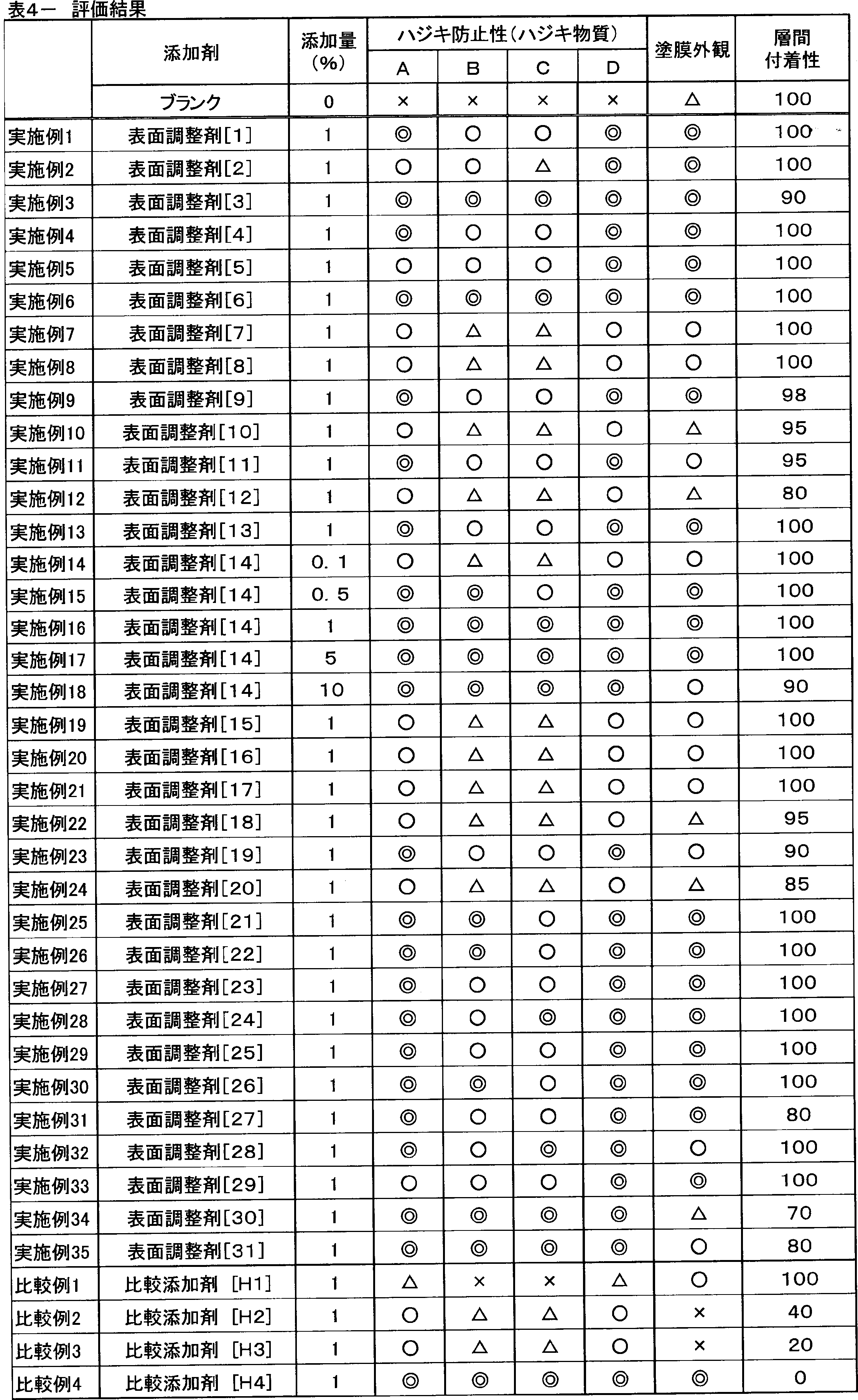
- Table 4 shows the evaluation results of the repellency, the appearance of the coating film, and the interlayer adhesion evaluated as described above.
- the coating films and the multi-layer coating films obtained using the aqueous coating compositions of Examples 1 to 35 were all excellent in repellency, coating film appearance and interlayer adhesion. . Accordingly, it can be said that the aqueous coating compositions of Examples 1 to 35 have both the repellency and the overcoating property.
- the coating film obtained by using the aqueous coating composition of Comparative Example 1 in which the monomer ratio of the dibasic acid ester (A) was out of the range of the present invention was inferior in cissing prevention.
- the coating film and the multilayer coating film obtained using the aqueous coating composition of Comparative Example 4 containing a silicone-based surface conditioner as an additive are required to have an extremely high overcoat property (interlayer adhesion). When used for applications, the interlayer adhesion was very poor compared to Examples 1-35.
Landscapes
- Chemical & Material Sciences (AREA)
- Organic Chemistry (AREA)
- Life Sciences & Earth Sciences (AREA)
- Engineering & Computer Science (AREA)
- Wood Science & Technology (AREA)
- Materials Engineering (AREA)
- Health & Medical Sciences (AREA)
- Chemical Kinetics & Catalysis (AREA)
- Medicinal Chemistry (AREA)
- Polymers & Plastics (AREA)
- Paints Or Removers (AREA)
- Addition Polymer Or Copolymer, Post-Treatments, Or Chemical Modifications (AREA)
Abstract
Description
重合性不飽和二重結合を有する二塩基酸エステル(A) 10質量%以上99質量%以下と、
一般式(1):
R1-(CmH2mO)n-R2 ・・・(1)
(一般式(1)中、R1は、(メタ)アクリル基、ビニルエーテル基又はアリル基を表し、R2は、水素原子、(メタ)アクリル基、ビニルエーテル基、アリル基又は炭素数1~22のアルキル基を表し、mは2~4であり、nは2~100である。)
で表されるエーテル基を含有する重合性不飽和モノマー(B) 1質量%以上90質量%以下と、
を構成モノマーとして含む共重合体(P1)を含有しており、
前記共重合体(P)の重量平均分子量が1000以上100000以下である、水性塗料用表面調整剤である。
本発明に係る水性塗料用表面調整剤は、二塩基酸エステル(A)と、重合性不飽和モノマー(B)との共重合体(P1)を含有する。二塩基酸エステル(A)は、重合性不飽和二重結合を有する。また、重合性不飽和モノマー(B)は、以下の一般式(1)で表されるエーテル基を含有するモノマーである。
R1-(CmH2mO)n-R2 ・・・(1)
共重合体(P1)及び共重合体(P2)のモノマーに用いられる二塩基酸エステル(A)としては、重合性不飽和結合を有する二塩基酸エステルであれば特に制限されないが、例えば、マレイン酸ジエステル、マレイン酸モノエステル、フマル酸ジエステル、フマル酸モノエステル、イタコン酸ジエステル、イタコン酸モノエステル、シトラコン酸モノエステル、シトラコン酸ジエステル、メサコン酸モノエステル及びメサコン酸ジエステルからなる群より選択される少なくとも1種のモノマーが挙げられる。
共重合体(P1)及び共重合体(P2)のモノマーに用いられる重合性不飽和モノマー(B)としては、上述した一般式(1)で表されるエーテル基を含有するモノマーであれば特に制限されないが、例えば、ポリエチレングリコールモノ(メタ)アクリレート、ポリ(エチレン-プロピレン)グリコールモノ(メタ)アクリレート、ポリプロピレングリコールモノ(メタ)アクリレート、ポリテトラメチレングリコールモノ(メタ)アクリレート、メトキシポリエチレングリコール(メタ)アクリレート、メトキシポリプロピレングリコール(メタ)アクリレート、メトキシポリ(エチレン-プロピレン)グリコール(メタ)アクリレート、メトキシポリ(エチレン-テトラメチレングリコール(メタ)アクリレート、ブトキシポリ(エチレン-プロピレングリコール)(メタ)アクリレート、オクトキシポリエチレングリコール(メタ)アクリレート、ラウロキシポリエチレングリコール(メタ)アクリレート、ステアロキシポリエチレングリコール(メタ)アクリレート、べへニロキシポリエチレングリコール(メタ)アクリレート、フェノキシポリエチレングリコール(メタ)アクリレート、ノニルフェノキシポリエチレングリコール(メタ)アクリレート、ポリエチレングリコールジ(メタ)アクリレート、ポリプロピレングリコールジ(メタ)アクリレート、エトキシレートポリプロピレングリコールジ(メタ)アクリレート、ポリテトラメチレングリコールジ(メタ)アクリレート等の(メタ)アクリレート類;ポリエチレングリコールモノアリルエーテル、ポリプロピレングリコールモノアリルエーテル、メトキシポリエチレングリコールアリルエーテル、ポリエチレングリコールポリプロピレングリコールモノアリルエーテル、ブトキシポリエチレングリコールポリプロピレングリコールモノアリルエーテル、ポリエチレングリコールジアリルエーテル、ポリプロピレングリコールジアリルエーテル等のアリルエーテル類;ポリエチレングリコールモノビニルエーテル、ポリプロピレングリコールモノビニルエーテル等のビニルエーテル類などが挙げられる。これらのモノマーは、1種を単独で用いてもよく、又は、2種以上を併用してもよい。
上述した二塩基酸エステル(A)及び重合性不飽和モノマー(B)に加え、共重合性不飽和モノマー(C)を共重合させることにより、水性塗料組成物中での表面調整剤の分散性及び安定性を向上させ、かつ、表面調整剤に塗料樹脂成分との反応性を付与することができる。
共重合体(P1)及び共重合体(P2)の重量平均分子量は、それぞれ、1000以上100000以下である。共重合体(P1)及び共重合体(P2)の重量平均分子量が1000未満の場合、水性塗料に配合した共重合体(P1)及び共重合体(P2)が、塗装時に塗料表面に配向する能力が十分ではないため、十分なハジキ防止性を得ることができない。一方、共重合体(P1)及び共重合体(P2)の重量平均分子量が100000を超える場合は、共重合体(P1)及び共重合体(P2)の上塗り塗料への再溶解性が低下し、上塗り性が悪化する。ハジキ防止性を高めるためには、共重合体(P1)及び共重合体(P2)の重量平均分子量は、それぞれ、3000以上であることが好ましい。また、上塗り性をさらに高めるためには、共重合体(P1)及び共重合体(P2)の重量平均分子量は、それぞれ、35000以下であることが好ましく、10000以下であることがより好ましい。
本発明の表面調整剤に含有される共重合体(P)、すなわち、上述した共重合体(P1)及び共重合体(P2)を合成する方法としては、例えば、乳化重合法、懸濁重合法、溶液重合法、塊状重合法などがある。また、重合開始剤としては、一般に用いられるアゾ重合開始剤、過酸化物などが用いられる。共重合体の合成方法により、表面調整剤の機能及び性能に影響があるわけではないため、共重合体の合成方法は、特に制限されない。
本発明の表面調整剤は、共重合体(P)の水性塗料への分散を容易にするため、必要に応じて水、又は有機溶剤を含有してもよい。表面調整剤に用いられる有機溶剤としては、脂肪族炭化水素、脂環式炭化水素、芳香族炭化水素、又はケトン、エステル、アルコール、エーテル等を挙げることができるが、一般の水系コーティング材で用いられている有機溶剤が好ましい。そのような有機溶剤の例としては、メチルアルコール、エチルアルコール、プロピルアルコール、イソプロピルアルコール、ブチルアルコール、イソブチルアルコール、ペンチルアルコール、ヘキシルアルコール、ヘプチルアルコール、オクチルアルコール、2-エチルへキシルアルコール、エチレングリコールモノメチルエーテル、ジエチレングリコールモノメチルエーテル、トリエチレングリコールモノメチルエーテル、エチレングリコールモノイソプロピルエーテル、エチレングリコールモノブチルエーテル、ジエチレングリコールモノブチルエーテル、トリエチレングリコールモノブチルエーテル、エチレングリコールモノイソブチルエーテル、エチレングリコールモノヘキシルエーテル、エチレングリコールモノ2-エチルへキシルエーテル、プロピレングリコールモノメチルエーテル、プロピレングリコールモノメチルエーテルアセテート、ジプロピレングリコールモノメチルエーテル、プロピレングリコールモノプロピルエーテル、プロピレングリコールモノブチルエーテル等が挙げられる。これらの有機溶剤は、単独で用いてもよく、2種以上を組み合わせて用いてもよい。
本発明の水性塗料用表面調整剤が適する用途は、自動車材料用塗料、高級家具用塗料、家電用塗料等の極めて高度な外観及び上塗り性が要求される水性塗料である。このような水性塗料としては、例えば、自動車用水性ベース塗料、自動車用水性中塗り塗料、自動車用水性プライマー塗料、高級家具用水性塗料等があり、これらの水性塗料に本発明の表面調整剤を添加することにより、水性塗料に、十分なハジキ防止性を付与するとともに、良好な上塗り性も付与することができる。
本発明の水性塗料組成物は、上述した水性塗料用表面調整剤を含有する。本発明の水性塗料用表面調整剤の含有量は、水性塗料中の塗料成分である樹脂の種類、顔料の配合組成などにより異なるが、通常は、水性塗料中の全樹脂固形分100質量%に対して0.1質量%以上10質量%以下である。なお、本発明の表面調整剤の含有量は、水性塗料中の全樹脂固形分を100質量%とした場合の表面調整剤中の固形分割合(質量%)である。表面調整剤の含有量が0.1質量%未満であると、水性塗料組成物に十分なハジキ防止性が付与されない。一方、表面調整剤の含有量が10質量%超であると、水性塗料組成物の上塗り性を阻害する。ハジキ防止性をさらに高めるためには、水性塗料組成物中の表面調整剤の含有量が、0.5質量%以上であることが好ましく、1質量%以上であることがより好ましい。また、上塗り性をさらに高めるためには、水性塗料組成物中の表面調整剤の含有量が、5質量%以下であることが好ましい。
本発明の水性塗料組成物に含有されている塗料成分としては、特に制限されないが、例えば、塗膜形成用の樹脂、当該樹脂の硬化剤、顔料及び染料、希釈溶媒、界面活性剤、並びに改質剤等が挙げられる。また、必要に応じて、硬化触媒、増感剤、消泡剤、粘性調整剤、分散剤、レベリング剤、難燃剤、接着向上剤、着色剤、帯電防止剤、酸化防止剤、光安定剤、剥離剤、及びカップリング剤等の各種添加剤が塗料成分として含有されていてもよい。
上述した本発明の水性塗料組成物は、例えば、ビヒクル及び顔料等の配合物をニーダー又はロールなどを用いて混練し、サンドグラインドミル又はディスパー等を用いて水に溶解又は分散させる方法により製造される。
本発明の水性塗料組成物の用途は、特に限定されないが、例えば、自動車材料用の塗装、高級家具の塗装、家電の塗装等の極めて高度な外観及び上塗り性が要求される塗装用途に好適である。
本発明の塗膜は、上述した本発明の水性塗料組成物を硬化させたものである。本発明の表面調整剤を含有する水性塗料組成物はハジキ防止性に優れるため、極めて高度な外観及び上塗り性が要求される用途に水性塗料組成物を用いた場合であっても、得られる塗膜にハジキやクレーターが発生することを防止できる。
本発明の塗膜は、被塗物としての基材に本発明の水性塗料組成物を塗装した後に、乾燥及び硬化させる方法により形成される。被塗物としては、特に制限されないが、例えば、金属、プラスチック、木材、ゴム、ガラス、石材、セメント、モルタル剤、紙、不織布、布及びセラミックスなどでできた基材が挙げられる。水性塗料組成物の塗装方法としては、特に制限されず、例えば、スプレーコート、ロールコート、刷毛塗り塗装、カーテンコート、バーコート、ドクターブレード、スリットコート、ディップコート、フローコートなどが挙げられる。水性塗料組成物の硬化方法としては、特に制限されず、例えば、常温硬化、加熱硬化、紫外線硬化などが挙げられるが、特に加熱硬化が好適である。
本発明の複層塗膜は、上述した塗膜と、当該塗膜の表面の全部又は一部に積層された上塗り塗膜とを含む。本発明の表面調整剤を含有する水性塗料組成物は上塗り性に優れるため、極めて高度な外観及び上塗り性が要求される用途に水性塗料組成物を用いた場合であっても、水性塗料組成物により得られる塗膜と上塗り塗膜との層間付着性に優れる。
本発明の複層塗膜は、例えば、本発明の表面調整剤が添加された下塗り水性塗料を硬化させて得られた塗膜の表面の全部又は一部を上塗り塗料により塗装することにより形成される。あるいは、本発明の表面調整剤が添加された下塗り水性塗料を硬化させることなく、上塗り塗料をウェットオンウェット塗装してもよい。その際、好ましくは、本発明の表面調整剤が添加された下塗り水性塗料を塗装後、必要に応じて自然乾燥又は予熱乾燥を施すことで、下塗り水性塗料を硬化させることなく、不要な溶媒(水や有機溶剤などの揮発分)を除去した後、上塗り塗料を塗装する。下塗り水性塗料の乾燥方法としては、特に、予熱乾燥が好適である。
R1-(CmH2mO)n-R2 ・・・(1)
(一般式(1)中、R1は、(メタ)アクリル基、ビニルエーテル基又はアリル基を表し、R2は、水素原子、(メタ)アクリル基、ビニルエーテル基、アリル基又は炭素数1~22のアルキル基を表し、mは2~4であり、nは2~100である。)
で表されるエーテル基を含有する重合性不飽和モノマー(B) 1質量%以上90質量%以下と、を構成モノマーとして含み、重量平均分子量が1000以上100000以下である共重合体の、水性塗料用表面調整剤としての使用であってもよい。
まず、以下の製造例1~31及び比較製造例1~4のようにして表面調整剤[1]~[31]及び比較添加剤[H1]~[H4]を得た。
撹拌装置、還流冷却器、滴下ポンプ、温度計及び窒素導入管を備えた500mlの反応容器に、溶剤(a-1)としてエチレングリコールモノブチルエーテル100部を仕込んだ。その後、窒素ガス気流下で撹拌しながら反応容器の内温を120℃まで昇温した。滴下溶液(b-1)として、フマル酸ジイソブチル120部、メトキシポリエチレングリコールアクリレート(商品名 ブレンマーAME-400:日油株式会社 製)15部、ポリエチレングリコールジアクリレート(商品名 ミラマーM280:MIWON 製)15部及びターシャリー-アミルパーオキシ-2-エチルヘキサノエイト50%溶液 9部を混合した混合溶液を調製した。次に、反応容器の内温を120℃に維持しながら、上記溶剤(a-1)に上記滴下溶液(b-1)を60分間かけて均一に滴下した。滴下終了後、反応温度を120℃とした状態で60分間維持した後、反応温度を100℃に調整した。反応容器の内温が100℃になった時点でターシャリー-アミルパーオキシ-2-エチルヘキサノエイト50%溶液 3部を加え、反応温度を100℃とした状態で120分間維持し、重合反応を行った。重合反応終了後、溶剤としてエチレングリコールモノブチルエーテルを用いて固形分を40%に調整し、表面調整剤[1]を得た。合成した共重合体の重量平均分子量は2000であった。重量平均分子量は、上述したように、GPCで測定したクロマトグラムから標準ポリスチレンの分子量を基準にして算出された値である(表面調整剤[2]~[31]及び比較添加剤[H1]~[H3]についても同様である)。
製造例1の溶剤(a-1)の代わりに溶剤(a-2)としてプロピレングリコール1-モノメチルエーテル2-アセタート100部を用い、滴下溶液(b-1)の代わりに滴下溶液(b-2)としてイタコン酸ジブチル90部、メトキシポリエチレングリコールメタクリレート(商品名 NKエステルM-90G:新中村化学工業株式会社 製)60部及びターシャリー-アミルパーオキシ-2-エチルヘキサノエイト50%溶液 9部を混合した混合溶液を用いた以外は、製造例1と同様の手法により表面調整剤[2]を得た。合成した共重合体の重量平均分子量は4200であった。
製造例1の溶剤(a-1)の代わりに溶剤(a-2)としてプロピレングリコール1-モノメチルエーテル2-アセタート100部を用い、滴下溶液(b-1)の代わりに滴下溶液(b-3)としてフマル酸ジブチル45部、フマル酸ジ2-エチルヘキシル45部、メトキシポリエチレングリコールメタクリレート(商品名 NKエステルM-40G:新中村化学工業株式会社 製)30部、ポリエチレングリコールジアクリレート(商品名 ミラマーM280:MIWON 製)30部及びターシャリー-アミルパーオキシ-2-エチルヘキサノエイト50%溶液 9部を混合した混合溶液を用いた以外は、製造例1と同様の手法により表面調整剤[3]を得た。合成した共重合体の重量平均分子量は35000であった。
製造例1の溶剤(a-1)の代わりに溶剤(a-2)としてプロピレングリコール1-モノメチルエーテル2-アセタート100部を用い、滴下溶液(b-1)の代わりに滴下溶液(b-4)としてフマル酸ジブチル45部、フマル酸ジ2-エチルヘキシル45部、メトキシポリエチレングリコールメタクリレート(商品名 NKエステルM-40G:新中村化学工業株式会社 製)60部及びターシャリー-アミルパーオキシ-2-エチルヘキサノエイト50%溶液 9部を混合した混合溶液を用いた以外は、製造例1と同様の手法により表面調整剤[4]を得た。合成した共重合体の重量平均分子量は4200であった。
製造例1の溶剤(a-1)の代わりに溶剤(a-2)としてプロピレングリコール1-モノメチルエーテル2-アセタート100部を用い、滴下溶液(b-1)の代わりに滴下溶液(b-5)としてマレイン酸モノ2-エチルヘキシル30部、フマル酸ジイソブチル117部、メトキシポリエチレングリコールアクリレート(商品名 ブレンマーAME-400:日油株式会社 製)3部及びターシャリー-アミルパーオキシ-2-エチルヘキサノエイト50%溶液 9部を混合した混合溶液を用いた以外は、製造例1と同様の手法により表面調整剤[5]を得た。合成した共重合体の重量平均分子量は1200であった。
製造例1の溶剤(a-1)の代わりに溶剤(a-2)としてプロピレングリコール1-モノメチルエーテル2-アセタート100部を用い、滴下溶液(b-1)の代わりに滴下溶液(b-6)としてマレイン酸モノ2-エチルヘキシル15部、フマル酸ジ2-エチルヘキシル105部、ポリプロピレングリコールジメタクリレート(商品名 ブレンマーPDP-400N:日油株式会社 製)30部及びターシャリー-アミルパーオキシ-2-エチルヘキサノエイト50%溶液 9部を混合した混合溶液を用いた以外は、製造例1と同様の手法により表面調整剤[6]を得た。合成した共重合体の重量平均分子量は4800であった。
製造例1の溶剤(a-1)の代わりに溶剤(a-2)としてプロピレングリコール1-モノメチルエーテル2-アセタート100部を用い、滴下溶液(b-1)の代わりに滴下溶液(b-7)としてイタコン酸ジブチル120部、ポリプロピレングリコールジメタクリレート(商品名 ブレンマーPDP-400N:日油株式会社 製)30部及びターシャリー-アミルパーオキシ-2-エチルヘキサノエイト50%溶液 18部を混合した混合溶液を用いた以外は、製造例1と同様の手法により表面調整剤[7]を得た。合成した共重合体の重量平均分子量は8000であった。
製造例1の溶剤(a-1)の代わりに溶剤(a-2)としてプロピレングリコール1-モノメチルエーテル2-アセタート100部を用い、滴下溶液(b-1)の代わりに滴下溶液(b-8)としてフマル酸ジエチル105部、メトキシポリエチレングリコールメタクリレート(商品名 NKエステルM-40G:新中村化学工業株式会社 製)45部及びターシャリー-アミルパーオキシ-2-エチルヘキサノエイト50%溶液 9部を混合した混合溶液を用いた以外は、製造例1と同様の手法により表面調整剤[8]を得た。合成した共重合体の重量平均分子量は3200であった。
製造例1の溶剤(a-1)の代わりに溶剤(a-2)としてプロピレングリコール1-モノメチルエーテル2-アセタート100部を用い、滴下溶液(b-1)の代わりに滴下溶液(b-9)としてフマル酸ジイソブチル97.5部、ポリエチレングリコールジアクリレート(商品名 ミラマーM280:MIWON 製)52.5部及びターシャリー-アミルパーオキシ-2-エチルヘキサノエイト50%溶液 27部を混合した混合溶液を用いた以外は、製造例1と同様の手法により表面調整剤[9]を得た。合成した共重合体の重量平均分子量は7400であった。
製造例1の溶剤(a-1)の代わりに溶剤(a-2)としてプロピレングリコール1-モノメチルエーテル2-アセタート150部を用い、滴下溶液(b-1)の代わりに滴下溶液(b-10)としてフマル酸ジブチル22.5部、ポリプロピレングリコールジメタクリレート(商品名 ブレンマーPDP-400N:日油株式会社 製)127.5部及び2,2-ジ(ターシャリー-アミルパーオキシ)ブタン 55%溶液 85部を混合した混合溶液を用い、反応温度を140℃に設定した以外は、製造例1と同様の手法により表面調整剤[10]を得た。合成した共重合体の重量平均分子量は8800であった。
製造例1の溶剤(a-1)の代わりに溶剤(a-2)としてプロピレングリコール1-モノメチルエーテル2-アセタート100部を用い、滴下溶液(b-1)の代わりに滴下溶液(b-11)としてフマル酸ジイソブチル120部、ポリエチレングリコールジアクリレート(商品名 ミラマーM280:MIWON 製)30部及びターシャリー-アミルパーオキシ-2-エチルヘキサノエイト50%溶液 4部を混合した混合溶液を用いた以外は、製造例1と同様の手法により表面調整剤[11]を得た。合成した共重合体の重量平均分子量は11000であった。
製造例1の溶剤(a-1)の代わりに溶剤(a-2)としてプロピレングリコール1-モノメチルエーテル2-アセタート100部を用い、滴下溶液(b-1)の代わりに滴下溶液(b-12)としてフマル酸ジイソブチル120部、ポリエチレングリコールジアクリレート(商品名 ミラマーM280:MIWON 製)30部及びターシャリー-ブチルパーオキシ-2-エチルヘキサノエイト40%溶液 3部を混合した混合溶液を用い、反応温度を100℃に設定した以外は、製造例1と同様の手法により表面調整剤[12]を得た。合成した共重合体の重量平均分子量は66000であった。
製造例1の溶剤(a-1)の代わりに溶剤(a-2)としてプロピレングリコール1-モノメチルエーテル2-アセタート100部を用い、滴下溶液(b-1)の代わりに滴下溶液(b-13)としてフマル酸ジ2-エチルヘキシル30部、メトキシポリエチレングリコールアクリレート(商品名 NKエステルAM-230G:新中村化学工業株式会社 製)30部、ポリプロピレングリコールジメタクリレート(商品名 ブレンマーPDP-400N:日油株式会社 製)90部、プロピレングリコール1-モノメチルエーテル2-アセタート50部及びターシャリー-アミルパーオキシ-2-エチルヘキサノエイト50%溶液 60部を混合した混合溶液を用いた以外は、製造例1と同様の手法により表面調整剤[13]を得た。合成した共重合体の重量平均分子量は23000であった。
製造例1の溶剤(a-1)の代わりに溶剤(a-2)としてプロピレングリコール1-モノメチルエーテル2-アセタート175部を用い、滴下溶液(b-1)の代わりに滴下溶液(b-14)としてフマル酸ジブチル45部、ポリエチレングリコールジアクリレート(商品名 ミラマーM280:MIWON 製)30部、メタクリル酸2-エチルヘキシル75部及びターシャリー-アミルパーオキシ-2-エチルヘキサノエイト50%溶液 25.5部を混合した混合溶液を用いた以外は、製造例1と同様の手法により表面調整剤[14]を得た。合成した共重合体の重量平均分子量は10000であった。
製造例1の溶剤(a-1)の代わりに溶剤(a-2)としてプロピレングリコール1-モノメチルエーテル2-アセタート100部を用い、滴下溶液(b-1)の代わりに滴下溶液(b-15)としてイタコン酸ジブチル60部、ポリエチレングリコールジアクリレート(商品名 ミラマーM280:MIWON 製)40部、アクリル酸エチル50部及びターシャリー-アミルパーオキシ-2-エチルヘキサノエイト50%溶液 30部を混合した混合溶液を用いた以外は、製造例1と同様の手法により表面調整剤[15]を得た。合成した共重合体の重量平均分子量は6500であった。
製造例1の溶剤(a-1)の代わりに溶剤(a-2)としてプロピレングリコール1-モノメチルエーテル2-アセタート100部を用い、滴下溶液(b-1)の代わりに滴下溶液(b-16)としてフマル酸ジエチル97部、ポリエチレングリコールジアクリレート(商品名 ミラマーM280:MIWON 製)3部、アクリル酸エチル50部及びターシャリー-アミルパーオキシ-2-エチルヘキサノエイト50%溶液 4部を混合した混合溶液を用い、反応温度を110℃に設定した以外は、製造例1と同様の手法により表面調整剤[16]を得た。合成した共重合体の重量平均分子量は8000であった。
製造例1の溶剤(a-1)の代わりに溶剤(a-2)としてプロピレングリコール1-モノメチルエーテル2-アセタート100部を用い、滴下溶液(b-1)の代わりに滴下溶液(b-17)としてフマル酸ジエチル76.3部、メトキシポリエチレングリコールアクリレート(商品名 ブレンマーAME-400:日油株式会社 製)50.8部、アクリル酸エチル22.9部及びターシャリー-アミルパーオキシ-2-エチルヘキサノエイト50%溶液 6部を混合した混合溶液を用い、反応温度を110℃に設定した以外は、製造例1と同様の手法により表面調整剤[17]を得た。合成した共重合体の重量平均分子量は7200であった。
製造例1の溶剤(a-1)の代わりに溶剤(a-2)としてプロピレングリコール1-モノメチルエーテル2-アセタート100部を用い、滴下溶液(b-1)の代わりに滴下溶液(b-18)としてマレイン酸ジメチル27部、ポリエチレングリコールジアクリレート(商品名 ミラマーM280:MIWON 製)52.5部、アクリル酸エチル70.5部及びターシャリー-アミルパーオキシ-2-エチルヘキサノエイト50%溶液 47部を混合した混合溶液を用いた以外は、製造例1と同様の手法により表面調整剤[18]を得た。合成した共重合体の重量平均分子量は8700であった。
製造例1の溶剤(a-1)の代わりに溶剤(a-2)としてプロピレングリコール1-モノメチルエーテル2-アセタート150部を用い、滴下溶液(b-1)の代わりに滴下溶液(b-19)としてフマル酸ジブチル45部、ポリエチレングリコールジアクリレート(商品名 ミラマーM280:MIWON 製)30部、メタクリル酸2-エチルヘキシル75部及びターシャリー-アミルパーオキシ-2-エチルヘキサノエイト50%溶液 30部を混合した混合溶液を用いた以外は、製造例1と同様の手法により表面調整剤[19]を得た。合成した共重合体の重量平均分子量は28000であった。
製造例1の溶剤(a-1)の代わりに溶剤(a-2)としてプロピレングリコール1-モノメチルエーテル2-アセタート150部を用い、滴下溶液(b-1)の代わりに滴下溶液(b-20)としてフマル酸ジエチル45部、ポリプロピレングリコールジメタクリレート(商品名 ブレンマーPDP-400N:日油株式会社 製)45部、メタクリル酸エチル60部及びターシャリー-アミルパーオキシ-2-エチルヘキサノエイト50%溶液 20部を混合した混合溶液を用いた以外は、製造例1と同様の手法により表面調整剤[20]を得た。合成した共重合体の重量平均分子量は62000であった。
製造例1の溶剤(a-1)の代わりに溶剤(a-2)としてプロピレングリコール1-モノメチルエーテル2-アセタート100部を用い、滴下溶液(b-1)の代わりに滴下溶液(b-21)としてマレイン酸ジブチル78部、メトキシポリエチレングリコールメタクリレート(商品名 NKエステルM-90G:新中村化学工業株式会社 製)45部、アクリル酸2-エチルヘキシル27部及びターシャリー-アミルパーオキシ-2-エチルヘキサノエイト50%溶液 9部を混合した混合溶液を用いた以外は、製造例1と同様の手法により表面調整剤[21]を得た。合成した共重合体の重量平均分子量は11000であった。
製造例1の溶剤(a-1)としてエチレングリコールモノブチルエーテル100部を用い、滴下溶液(b-1)の代わりに滴下溶液(b-22)としてフマル酸ジブチル114部、メトキシポリエチレングリコールアクリレート(商品名 ブレンマーAME-400:日油株式会社 製)7.5部、アクリル酸エチル28.5部及びターシャリー-アミルパーオキシ-2-エチルヘキサノエイト50%溶液 9部を用いた以外は、製造例1と同様の手法により表面調整剤[22]を得た。合成した共重合物の重量平均分子量は1900であった。
滴下溶液(b-1)の代わりに滴下溶液(b-23)としてマレイン酸ジ2-エチルヘキシル78部、メトキシポリエチレングリコールアクリレート(商品名 ブレンマーAME-400:日油株式会社 製)45部、アクリル酸イソブチル15部、2-メタクリル酸エチル12部及びターシャリー-アミルパーオキシ-2-エチルヘキサノエイト50%溶液 9部を混合した混合溶液を用いた以外は、製造例1と同様の手法により表面調整剤[23]を得た。合成した共重合体の重量平均分子量は4400であった。
製造例1の溶剤(a-1)の代わりに溶剤(a-2)としてプロピレングリコール1-モノメチルエーテル2-アセタート100部を用い、滴下溶液(b-1)の代わりに滴下溶液(b-24)としてイタコン酸ジブチル52.5部、イタコン酸ジ2-エチルヘキシル30部、メトキシポリエチレングリコールアクリレート(商品名 ブレンマーAME-400:日油株式会社 製)45部、メタクリル酸ブチル22.5部及びターシャリー-アミルパーオキシ-2-エチルヘキサノエイト50%溶液 9部を混合した混合溶液を用いた以外は、製造例1と同様の手法により表面調整剤[24]を得た。合成した共重合体の重量平均分子量は2900であった。
滴下溶液(b-1)の代わりに滴下溶液(b-25)としてイタコン酸ジブチル78部、メトキシポリエチレングリコールアクリレート(商品名 NKエステルAM-230G:新中村化学工業株式会社 製)30部、ポリエチレングリコールモノアリルエーテル(商品名 ユニオックス PKA-5003:日油株式会社 製)15部、メタクリル酸ブチル27部、エチレングリコールモノブチルエーテル47部及びターシャリー-アミルパーオキシ-2-エチルヘキサノエイト50%溶液 9部を混合した混合溶液を用いた以外は、製造例1と同様の手法により表面調整剤[25]を得た。合成した共重合体の重量平均分子量は3400であった。
製造例1の溶剤(a-1)の代わりに溶剤(a-2)としてプロピレングリコール1-モノメチルエーテル2-アセタート150部を用い、滴下溶液(b-1)の代わりに滴下溶液(b-26)としてフマル酸ジエチル15部、フマル酸ジ2-エチルヘキシル15部、イタコン酸ジ2-エチルヘキシル45部、ポリエチレングリコールジアクリレート(商品名 ミラマーM280:MIWON 製)15部、アクリル酸エチル30部、アクリル酸ブチル30部及びターシャリー-アミルパーオキシ-2-エチルヘキサノエイト50%溶液 30部を混合した混合溶液を用いた以外は、製造例1と同様の手法により表面調整剤[26]を得た。合成した共重合体の重量平均分子量は3700であった。
製造例1の溶剤(a-1)の代わりに溶剤(a-2)としてプロピレングリコール1-モノメチルエーテル2-アセタート120部を用い、滴下溶液(b-1)の代わりに滴下溶液(b-27)としてフマル酸ジブチル45部、フマル酸モノブチル15部、メトキシポリエチレングリコールアクリレート(商品名 ブレンマーAME-400:日油株式会社 製)4.5部、アクリル酸ブチル70.5部、メタクリル酸2-ヒドロキシエチル7.5部、アクリル酸7.5部及びターシャリー-アミルパーオキシ-2-エチルヘキサノエイト50%溶液 9部を混合した混合溶液を用いた以外は、製造例1と同様の手法により表面調整剤[27]を得た。合成した共重合体の重量平均分子量は4800であった。
製造例1の溶剤(a-1)の代わりに溶剤(a-2)としてプロピレングリコール1-モノメチルエーテル2-アセタート150部を用い、滴下溶液(b-1)の代わりに滴下溶液(b-28)としてフマル酸ジ2-エチルヘキシル15部、ポリエチレングリコールジアクリレート(商品名 ミラマーM280:MIWON 製)15部、ポリプロピレングリコールジメタクリレート(商品名 ブレンマーPDP-400N:日油株式会社 製)7.5部、アクリル酸エチル60部、アクリル酸2-エチルヘキシル52.5部及びターシャリー-アミルパーオキシ-2-エチルヘキサノエイト50%溶液 27部を混合した混合溶液を用いた以外は、製造例1と同様の手法により表面調整剤[28]を得た。合成した共重合体の重量平均分子量は7000であった。
製造例1の溶剤(a-1)の代わりに溶剤(a-2)としてプロピレングリコール1-モノメチルエーテル2-アセタート120部を用い、滴下溶液(b-1)の代わりに滴下溶液(b-29)としてフマル酸ジブチル45部、メトキシポリエチレングリコールアクリレート(商品名 ブレンマーAME-400:日油株式会社 製)6部、ポリエチレングリコールジアクリレート(商品名 ミラマーM280:MIWON 製)7.5部、アクリル酸エチル91.5部及びターシャリー-アミルパーオキシ-2-エチルヘキサノエイト50%溶液 15部を混合した混合溶液を用いた以外は、製造例1と同様の手法により表面調整剤[29]を得た。合成した共重合体の重量平均分子量は8300であった。
製造例1の溶剤(a-1)の代わりに溶剤(a-2)としてプロピレングリコール1-モノメチルエーテル2-アセタート150部を用い、滴下溶液(b-1)の代わりに滴下溶液(b-30)としてマレイン酸ジメチル15部、フマル酸ジイソプロピル24部、メトキシポリエチレングリコールメタクリレート(商品名 NKエステルM-90G:新中村化学工業株式会社 製)6部、ポリエチレングリコールジアクリレート(商品名 ミラマーM280:MIWON 製)45部、メタクリル酸2-エチルヘキシル60部及びターシャリー-アミルパーオキシ-2-エチルヘキサノエイト50%溶液 22.5部を混合した混合溶液を用いた以外は、製造例1と同様の手法により表面調整剤[30]を得た。合成した共重合体の重量平均分子量は110000であった。
製造例1の溶剤(a-1)の代わりに溶剤(a-2)としてプロピレングリコール1-モノメチルエーテル2-アセタート150部を用い、滴下溶液(b-1)の代わりに滴下溶液(b-31)としてフマル酸ジブチル45部、ポリエチレングリコールジアクリレート(商品名 ミラマーM280:MIWON 製)30部、メタクリル酸2-エチルヘキシル75部及びターシャリー-アミルパーオキシ-2-エチルヘキサノエイト50%溶液 15部を混合した混合溶液を用いた以外は、製造例1と同様の手法により表面調整剤[31]を得た。合成した共重合体の重量平均分子量は59000であった。
撹拌装置、還流冷却器、滴下ポンプ、温度計及び窒素導入管を備えた500mlの反応容器に、溶剤としてプロピレングリコール1-モノメチルエーテル2-アセタート120部を仕込んだ。その後、窒素ガス気流下で撹拌しながら反応容器の内温を120℃まで昇温した。滴下溶液として、フマル酸ジブチル7.5部、メトキシポリエチレングリコールアクリレート(商品名 ブレンマーAME-400:日油株式会社 製)142.5部及びターシャリー-アミルパーオキシ-2-エチルヘキサノエイト50%溶液 9部を混合した混合溶液を調製した。次に、反応容器の内温を120℃に維持しながら、上記溶剤に上記滴下溶液を60分間かけて均一に滴下した。滴下終了後、反応温度を120℃とした状態で60分間維持した後、反応温度を100℃に調整した。反応容器の内温が100℃になった時点でターシャリー-アミルパーオキシ-2-エチルヘキサノエイト50%溶液 3部を加え、反応温度を100℃とした状態で120分間維持し、重合反応を行った。重合反応終了後、溶剤としてプロピレングリコール1-モノメチルエーテル2-アセタートを用いて固形分を40%に調整し、比較添加剤[H1]を得た。合成した共重合体の重量平均分子量は5500であった。
撹拌装置、還流冷却器、滴下ポンプ、温度計及び窒素導入管を備えた500mlの反応容器に、溶剤としてプロピレングリコール1-モノメチルエーテル2-アセタート160部を仕込んだ。その後、窒素ガス気流下で撹拌しながら反応容器の内温を100℃まで昇温した。滴下溶液として、メタクリル酸ドデシル198部、メトキシポリエチレングリコールメタクリレート(商品名 NKエステルM-90G:新中村化学工業株式会社 製)85部及びターシャリー-ブチルパーオキシ-2-エチルヘキサノエイト40%溶液 5.1部を混合した混合溶液を調製した。次に、反応容器の内温を100℃に維持しながら、上記溶剤に上記滴下溶液を90分間かけて均一に滴下した。滴下終了後、反応温度を100℃とした状態で60分間維持した。その後、ターシャリー-ブチルパーオキシ-2-エチルヘキサノエイト40%溶液 1.8部を加え、反応温度を100℃とした状態で90分間維持し、重合反応を行った。重合反応終了後、溶剤としてプロピレングリコール1-モノメチルエーテル2-アセタートを用いて固形分を40%に調整し、比較添加剤[H2]を得た。合成した共重合体の重量平均分子量は75000であった。
撹拌装置、還流冷却器、滴下ポンプ、温度計及び窒素導入管を備えた500mlの反応容器に、溶剤としてプロピレングリコール1-モノメチルエーテル2-アセタート170部を仕込んだ。その後、窒素ガス気流下で撹拌しながら反応容器の内温を90℃まで昇温した。滴下溶液として、メタクリル酸ドデシル280部、メトキシポリエチレングリコールメタクリレート(商品名 NKエステルM-90G:新中村化学工業株式会社 製)120部、プロピレングリコール1-モノメチルエーテル2-アセタート43部及びジイソノナノイルパーオキサイド25%溶液 8部を混合した混合溶液を調製した。次に、反応容器の内温を90℃に維持しながら、上記溶剤に上記滴下溶液を90分間かけて均一に滴下した。滴下終了後、反応温度を90℃とした状態で60分間維持した。その後、ジイソノナノイルパーオキサイド25%溶液 2.4部を加え、反応温度90℃とした状態で90分間維持し、重合反応を行った。重合反応終了後、溶剤としてプロピレングリコール1-モノメチルエーテル2-アセタートを用いて固形分を40%に調整し、比較添加剤[H3]を得た。合成した共重合体の重量平均分子量は170000であった。
比較添加剤[H4]として、変性シリコーン(商品名 ディスパロンLS-430 楠本化成株式会社 製)を用いた。
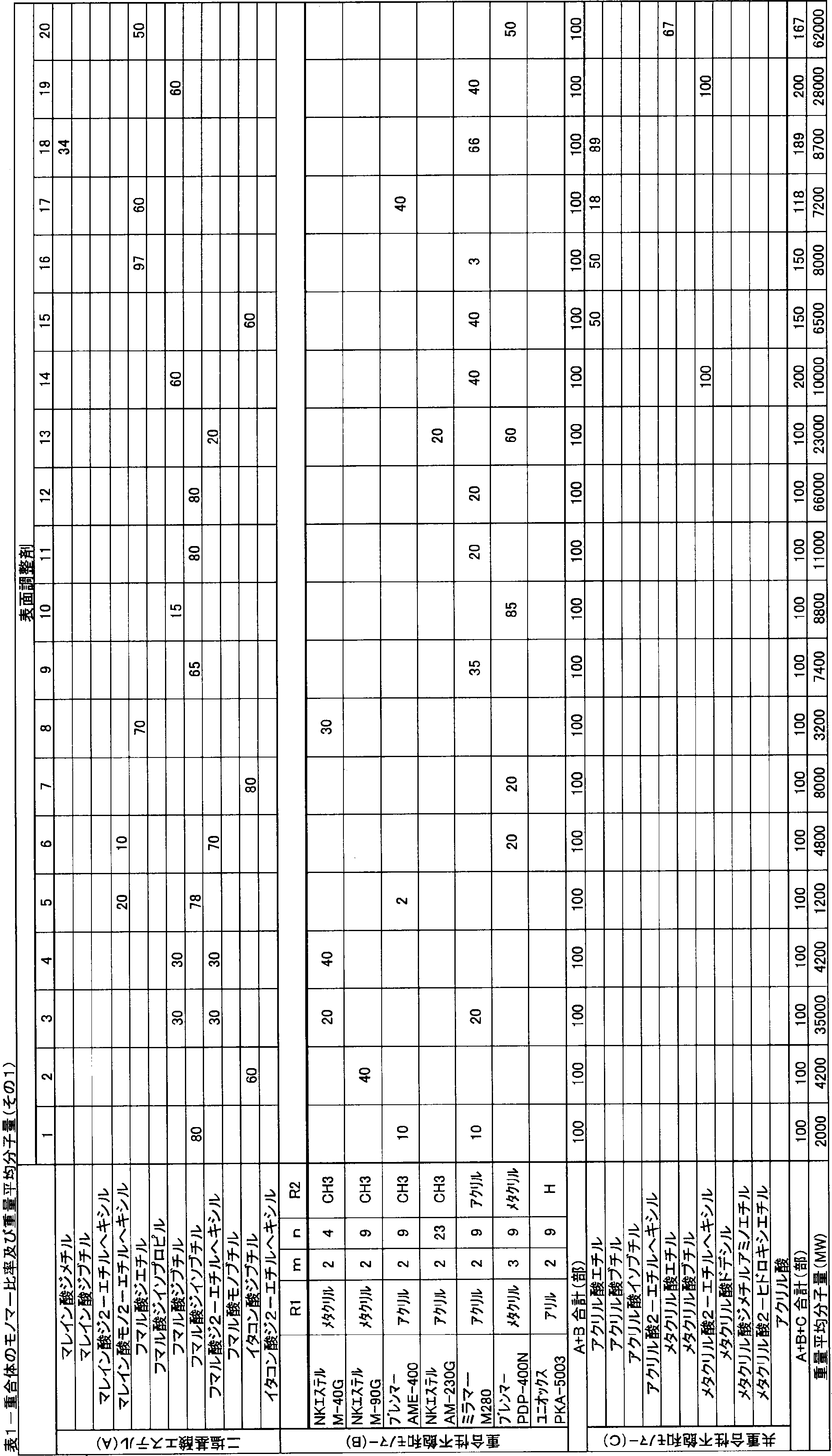
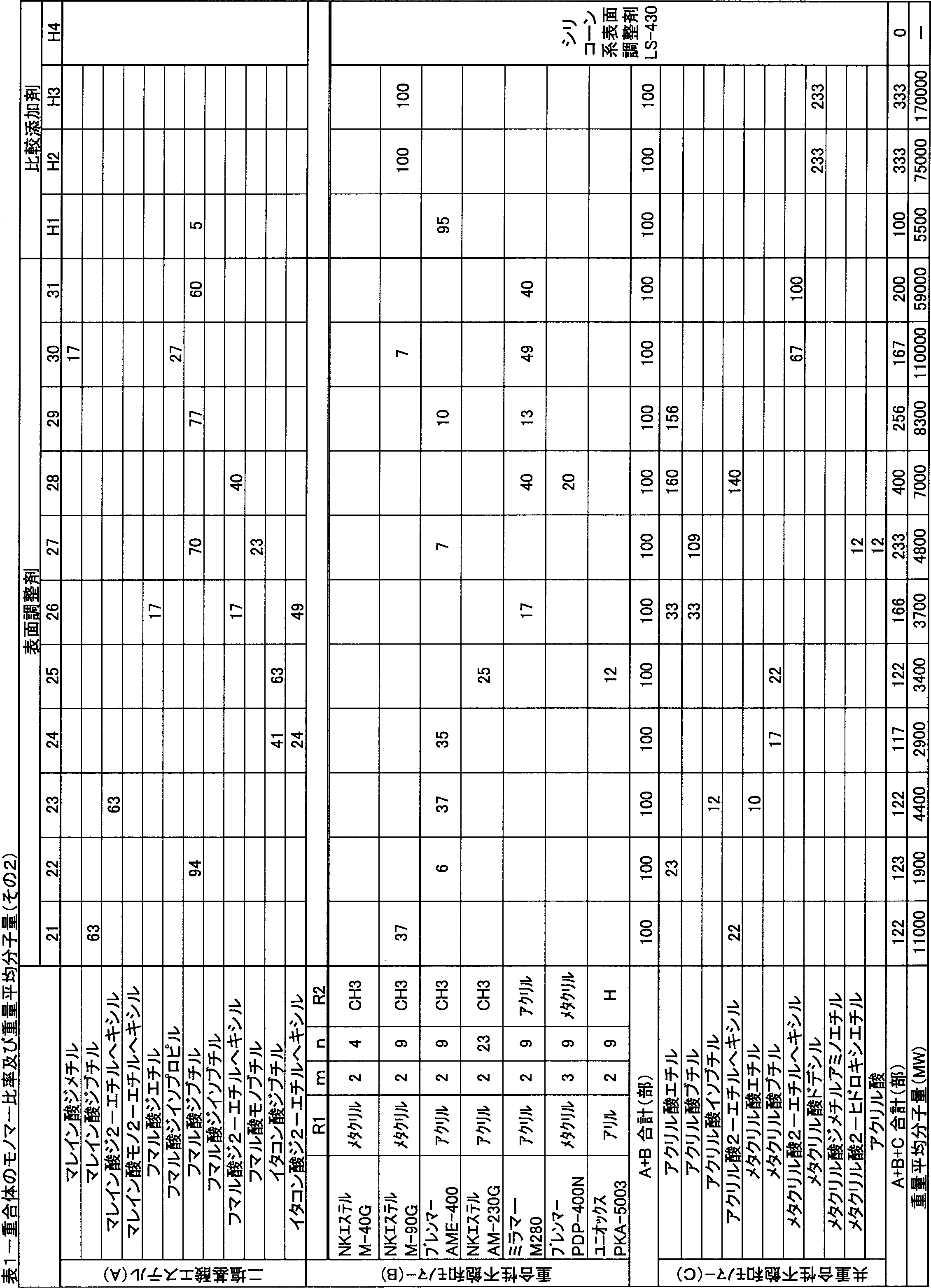
上記製造例1~31及び比較製造例1~4で得られた表面調整剤及び比較添加剤をそれぞれ含有させる水性塗料として、性能評価用塗料(I)を作製した。また、性能評価用塗料(I)の層間付着性を評価する際に用いる上塗り塗料として、層間付着性評価用塗料(II)を作製した。以下、各塗料の作製法を詳述する。
表2に記載の各原料を順次加え、ラボディスパーを用いて混合することにより性能評価用塗料(I)を作製した。この性能評価用塗料(I)に、製造例1~31で得られた表面調整剤[1]~[31]及び比較製造例1~4で得られた比較添加剤[H1]~[H4]を表4に示した添加量(水性塗料中の樹脂固形分を100質量%とした場合の表面調整剤中の固形分の割合[質量%])で添加し、ラボディスパーにて分散することにより、実施例1~35及び比較例1~4の水性塗料組成物を得た。
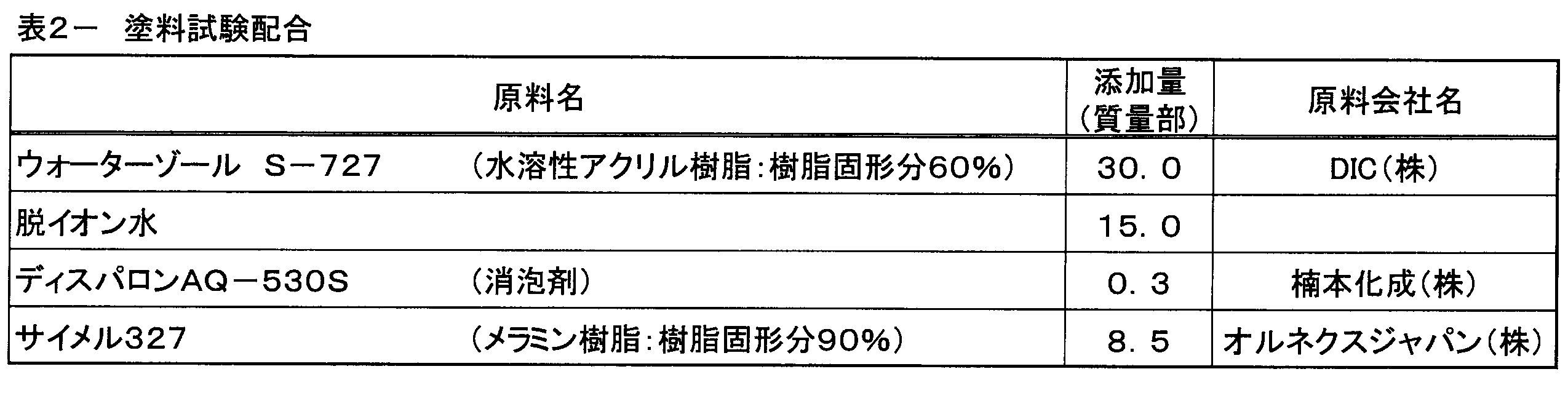
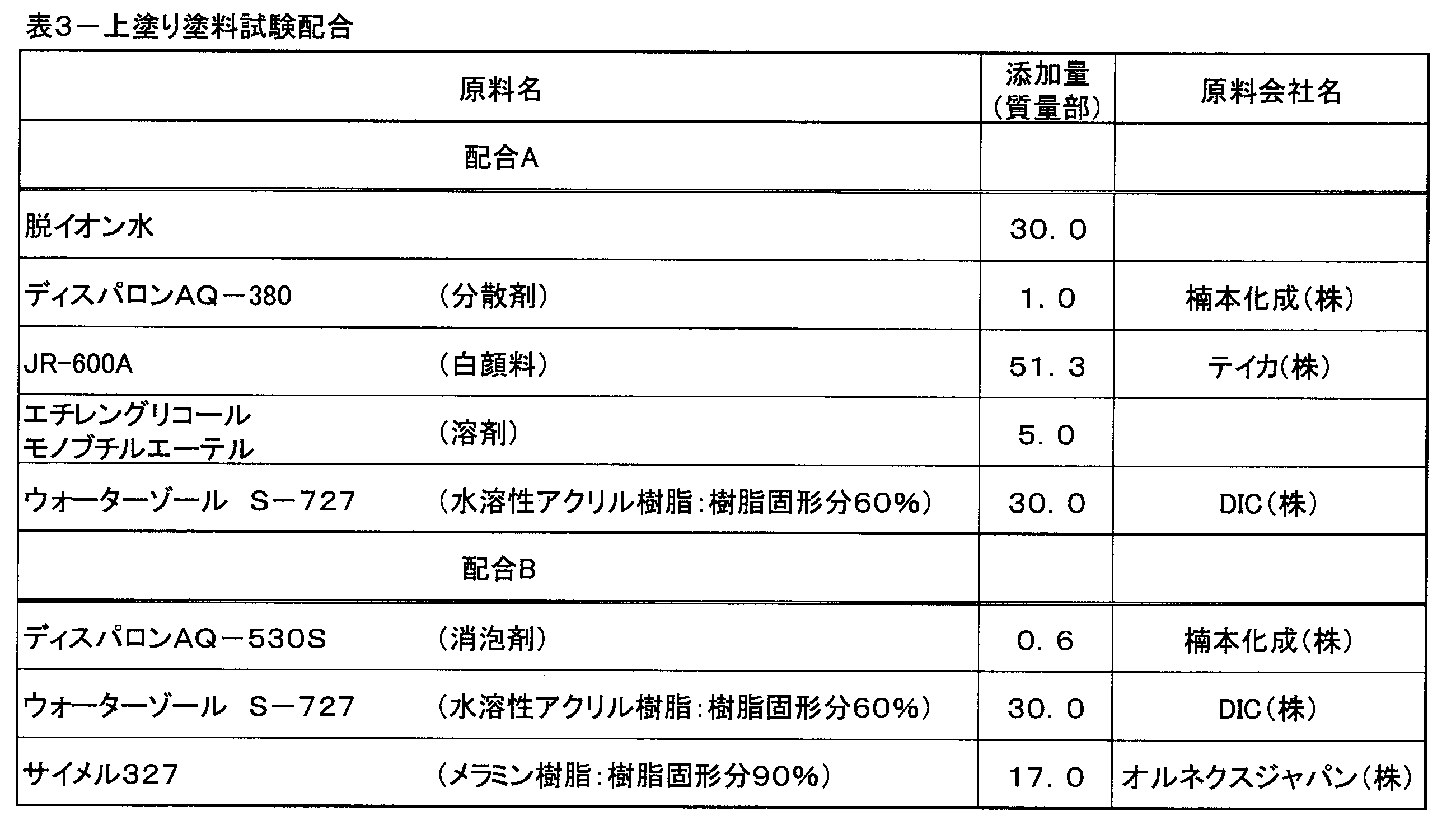
表3に記載の配合Aの組成物にガラスビーズを加えサンドミルを用いて分散した。分散後、配合Aの組成物に配合Bの組成物を順次加え、ラボディスパーを用いて混合することにより、水性白塗料組成物を得た。この水性白塗料組成物を層間付着性評価用塗料(II)として用いた。
上述したようにして得られた実施例1~35及び比較例1~4の水性塗料組成物をそれぞれ基材に塗装し、塗装された水性塗料組成物を乾燥及び硬化させることにより、実施例1~35及び比較例1~4の塗膜を形成した。このようにして得られた塗膜について、以下のようにして、ハジキ防止性及び塗膜外観を評価した。また、実施例1~35及び比較例1~4の塗膜に、さらに上塗り塗料として上記層間付着性評価用塗料(II)を塗装後に乾燥及び硬化させることにより、実施例1~35及び比較例1~4の複層塗膜を得た。これらの複層塗膜について、層間付着性を評価した。
ブリキ板に、ハジキ汚染物質として、A:ハンドクリーム、B:真空ポンプ油、C:可塑剤(フタル酸ジイソノニル)、D:皮脂の4種類を付着させた。次いで、ハジキ汚染物質を付着させたブリキ板(基材)に、実施例1~35及び比較例1~4の水性塗料組成物を、乾燥膜厚が40μmとなるように塗装した。水性塗料組成物の塗装には、ワイヤーコーターを用いた。塗装された水性塗料組成物を室温で5分間静置し、80℃にて7分間プレヒートした後、140℃にて30分間焼き付けることでハジキ防止性評価用の実施例1~35及び比較例1~4の塗膜を作製した。
◎:ハジキが見られず、ハジキ汚染物質塗布部の塗膜平滑性も悪化していない。
○:ハジキは見られないが、ハジキ汚染物質塗布部の塗膜平滑性が悪化している。
△:ハジキ汚染物質塗布部の一部にハジキが見られる。
×:ハジキ汚染物質塗布部の全体にハジキが見られる。
カチオン電着板(基材)に、実施例1~35及び比較例1~4の水性塗料組成物を、乾燥膜厚が40μmとなるように塗装した。水性塗料組成物の塗装には、ワイヤーコーターを用いた。塗装された水性塗料組成物を室温で5分間静置し、80℃にて7分間プレヒートした後、140℃にて30分間焼き付けることで外観評価用の実施例1~35及び比較例1~4の塗膜を作製した。塗膜外観は、塗膜の表面の外観、平滑性、凹みを目視により観察し、次のように評価した。
◎:平滑性の悪化及び凹みが見られない。
○:塗膜の一部に平滑性の悪化又は凹みが見られる。
△:塗膜の一部に平滑性の悪化及び凹みが見られる。
×:塗膜の全体に平滑性の悪化及び凹みが見られる。
カチオン電着板(基材)に、1層目として実施例1~35及び比較例1~4の水性塗料組成物を、乾燥膜厚が40μmとなるように塗装した。塗装された各水性塗料組成物を室温で5分間静置し、80℃にて7分間プレヒートした後、140℃にて30分間焼き付けることで、実施例1~35及び比較例1~4の塗膜を形成した。これらの塗膜上に2層目として層間付着性評価用塗料(II)を、乾燥膜厚が30μmとなるように塗装した。水性塗料組成物及び層間付着性評価用塗料(II)の塗装には、ワイヤーコーターを用いた。塗装された塗料(II)を室温で5分間静置し、80℃にて7分間プレヒートした後、130℃にて30分間焼き付けることで、実施例1~35及び比較例1~4の複層塗膜を形成した。これらの複層塗膜に、JIS K5600-5-6に記載された付着性(クロスカット法)に従い、20mm×20mm角内に等幅の2mm間隔の直角格子パターンを切り込むことで碁盤目を100個作った。その後、碁盤目上に透明感圧付着テープを貼付して引き剥がした。1層目と2層目の層間で剥離が全く見られないものを100とし、残存した格子角部分を数え、その数により層間付着性を評価した。
上述したようにして評価したハジキ防止性、塗膜外観及び層間付着性の評価結果を表4に示した。
Claims (8)
- 重合性不飽和二重結合を有する二塩基酸エステル(A) 10質量%以上99質量%以下と、
一般式(1):
R1-(CmH2mO)n-R2 ・・・(1)
(一般式(1)中、R1は、(メタ)アクリル基、ビニルエーテル基又はアリル基を表し、R2は、水素原子、(メタ)アクリル基、ビニルエーテル基、アリル基又は炭素数1~22のアルキル基を表し、mは2~4であり、nは2~100である。)
で表されるエーテル基を含有する重合性不飽和モノマー(B) 1質量%以上90質量%以下と、
を構成モノマーとして含む共重合体を含有しており、
前記共重合体の重量平均分子量が1000以上100000以下である、水性塗料用表面調整剤。 - 前記共重合体が、前記二塩基酸エステル(A)と、前記重合性不飽和モノマー(B)と、前記二塩基酸エステル(A)と前記重合性不飽和モノマー(B)との合計100質量部に対して400質量部以下の共重合性不飽和モノマー(C)とを構成モノマーとして含む共重合体であり、
前記共重合性不飽和モノマー(C)が、前記二塩基酸エステル(A)及び前記重合性不飽和モノマー(B)と異種のモノマーである、請求項1に記載の水性塗料用表面調整剤。 - 前記共重合性不飽和モノマー(C)が、(メタ)アクリル酸アルキル、水酸基を有する重合性不飽和モノマー、アミド基を有する重合性不飽和モノマー、グリコール基を有する重合性不飽和モノマー、グリシジル基を有する重合性不飽和モノマー、カルボキシル基を有する重合性不飽和モノマー、多官能性不飽和モノマー及びメタクリロイルオキシ基を有する反応性シリコーンからなる群より選ばれる少なくとも1種のモノマーである、請求項2に記載の水性塗料用表面調整剤。
- 前記二塩基酸エステル(A)が、マレイン酸ジエステル、マレイン酸モノエステル、フマル酸ジエステル、フマル酸モノエステル、イタコン酸ジエステル、イタコン酸モノエステル、シトラコン酸モノエステル、シトラコン酸ジエステル、メサコン酸モノエステル及びメサコン酸ジエステルからなる群より選択される少なくとも1種のモノマーである、請求項1~3のいずれか一項に記載の水性塗料用表面調整剤。
- 前記一般式(1)で、R2が、(メタ)アクリル基、ビニルエーテル基又はアリル基である、請求項1~4のいずれか一項に記載の水性塗料用表面調整剤。
- 請求項1~5のいずれか一項に記載の水性塗料用表面調整剤を全樹脂固形分100質量%に対して0.1質量%以上10質量%以下含有する、水性塗料組成物。
- 請求項6に記載の水性塗料組成物を硬化した、塗膜。
- 請求項7に記載の塗膜と、前記塗膜の表面の全部又は一部に積層された上塗り塗膜とを含む、複層塗膜。
Priority Applications (5)
| Application Number | Priority Date | Filing Date | Title |
|---|---|---|---|
| CN201980038550.3A CN112262189B (zh) | 2018-07-06 | 2019-07-05 | 水性涂料用表面调整剂、水性涂料组合物、涂膜以及多层涂膜 |
| US17/257,872 US11655376B2 (en) | 2018-07-06 | 2019-07-05 | Surface control agent for water-based coating, water-based coating composition, coating film, and multilayer coating film |
| JP2020529067A JP7077406B2 (ja) | 2018-07-06 | 2019-07-05 | 水性塗料用表面調整剤、水性塗料組成物、塗膜及び複層塗膜 |
| EP19830904.9A EP3808827B1 (en) | 2018-07-06 | 2019-07-05 | Surface conditioner for aqueous coating material, aqueous coating composition, coating film, and multilayer coating film |
| KR1020207036095A KR102543410B1 (ko) | 2018-07-06 | 2019-07-05 | 수성 도료용 표면 조정제, 수성 도료 조성물, 도막 및 복층도막 |
Applications Claiming Priority (2)
| Application Number | Priority Date | Filing Date | Title |
|---|---|---|---|
| JP2018-129496 | 2018-07-06 | ||
| JP2018129496 | 2018-07-06 |
Publications (1)
| Publication Number | Publication Date |
|---|---|
| WO2020009228A1 true WO2020009228A1 (ja) | 2020-01-09 |
Family
ID=69059246
Family Applications (1)
| Application Number | Title | Priority Date | Filing Date |
|---|---|---|---|
| PCT/JP2019/026839 Ceased WO2020009228A1 (ja) | 2018-07-06 | 2019-07-05 | 水性塗料用表面調整剤、水性塗料組成物、塗膜及び複層塗膜 |
Country Status (6)
| Country | Link |
|---|---|
| US (1) | US11655376B2 (ja) |
| EP (1) | EP3808827B1 (ja) |
| JP (1) | JP7077406B2 (ja) |
| KR (1) | KR102543410B1 (ja) |
| CN (1) | CN112262189B (ja) |
| WO (1) | WO2020009228A1 (ja) |
Cited By (1)
| Publication number | Priority date | Publication date | Assignee | Title |
|---|---|---|---|---|
| KR20250057231A (ko) * | 2023-10-19 | 2025-04-29 | 주식회사 리한 | 크랙 저항성이 우수한 콘크리트 크랙 단면의 복구 방법 |
Families Citing this family (4)
| Publication number | Priority date | Publication date | Assignee | Title |
|---|---|---|---|---|
| CN113004728A (zh) * | 2021-02-01 | 2021-06-22 | 中南林业科技大学 | 一种具有亲水自清洁能力的涂料及其制备方法 |
| KR102500331B1 (ko) * | 2021-03-02 | 2023-02-15 | 주식회사 켐코 | 안료 분산성이 우수한 점착제 조성물 및 이를 이용한 점착시트 |
| KR102500333B1 (ko) * | 2021-03-02 | 2023-02-15 | 주식회사 켐코 | 안료 분산성이 우수한 점착제 조성물 및 이를 이용한 점착시트 |
| CN119591770B (zh) * | 2023-09-08 | 2026-01-23 | 中国石油天然气股份有限公司 | 一种有机聚合物载体、z-n催化剂及其制备方法与应用 |
Citations (6)
| Publication number | Priority date | Publication date | Assignee | Title |
|---|---|---|---|---|
| JPH01234478A (ja) * | 1988-03-15 | 1989-09-19 | Kusumoto Kasei Kk | 非水系塗料の外的因子によるハジキの防止剤 |
| JP2003176439A (ja) * | 2001-12-12 | 2003-06-24 | Nippon Shokubai Co Ltd | 無機顔料用分散剤及び紙塗工顔料分散液 |
| JP2009114348A (ja) * | 2007-11-07 | 2009-05-28 | San Nopco Ltd | 粘性改良剤 |
| JP2009114351A (ja) * | 2007-11-07 | 2009-05-28 | San Nopco Ltd | 粘性改良剤 |
| JP2010528120A (ja) * | 2007-05-10 | 2010-08-19 | クラリアント・ファイナンス・(ビーブイアイ)・リミテッド | 水をベースとする顔料調合物 |
| JP2011105786A (ja) | 2009-11-12 | 2011-06-02 | Kyoeisha Chem Co Ltd | 水性塗料用の濡れ性向上剤 |
Family Cites Families (9)
| Publication number | Priority date | Publication date | Assignee | Title |
|---|---|---|---|---|
| JP4802375B2 (ja) | 2001-03-09 | 2011-10-26 | Dic株式会社 | 塗膜の形成方法および塗装物 |
| JP4761095B2 (ja) | 2001-03-09 | 2011-08-31 | Dic株式会社 | 塗膜の形成方法及びその塗装物 |
| JP2002363504A (ja) * | 2001-06-01 | 2002-12-18 | Dainippon Ink & Chem Inc | 水性塗料組成物および塗膜の形成方法および当該塗料組成物が塗装された塗装物 |
| JP4619062B2 (ja) | 2004-08-18 | 2011-01-26 | 楠本化成株式会社 | 粉体塗料用平滑剤 |
| JP4619063B2 (ja) | 2004-08-18 | 2011-01-26 | 楠本化成株式会社 | 紫外線硬化塗料用平滑剤 |
| JP5498002B2 (ja) | 2007-09-19 | 2014-05-21 | 関西ペイント株式会社 | 自動車用水系塗料 |
| JP2016062835A (ja) | 2014-09-19 | 2016-04-25 | 株式会社クレハ | 水性ラテックス、セパレータ/中間層積層体、及び非水電解質二次電池用構造体 |
| JP6456741B2 (ja) | 2015-03-25 | 2019-01-23 | 株式会社クレハ | セパレータ/中間層積層体、非水電解質二次電池用構造体、及び水性ラテックス |
| JP6929130B2 (ja) * | 2016-08-09 | 2021-09-01 | 楠本化成株式会社 | 混層制御剤 |
-
2019
- 2019-07-05 WO PCT/JP2019/026839 patent/WO2020009228A1/ja not_active Ceased
- 2019-07-05 EP EP19830904.9A patent/EP3808827B1/en active Active
- 2019-07-05 KR KR1020207036095A patent/KR102543410B1/ko active Active
- 2019-07-05 JP JP2020529067A patent/JP7077406B2/ja active Active
- 2019-07-05 CN CN201980038550.3A patent/CN112262189B/zh active Active
- 2019-07-05 US US17/257,872 patent/US11655376B2/en active Active
Patent Citations (6)
| Publication number | Priority date | Publication date | Assignee | Title |
|---|---|---|---|---|
| JPH01234478A (ja) * | 1988-03-15 | 1989-09-19 | Kusumoto Kasei Kk | 非水系塗料の外的因子によるハジキの防止剤 |
| JP2003176439A (ja) * | 2001-12-12 | 2003-06-24 | Nippon Shokubai Co Ltd | 無機顔料用分散剤及び紙塗工顔料分散液 |
| JP2010528120A (ja) * | 2007-05-10 | 2010-08-19 | クラリアント・ファイナンス・(ビーブイアイ)・リミテッド | 水をベースとする顔料調合物 |
| JP2009114348A (ja) * | 2007-11-07 | 2009-05-28 | San Nopco Ltd | 粘性改良剤 |
| JP2009114351A (ja) * | 2007-11-07 | 2009-05-28 | San Nopco Ltd | 粘性改良剤 |
| JP2011105786A (ja) | 2009-11-12 | 2011-06-02 | Kyoeisha Chem Co Ltd | 水性塗料用の濡れ性向上剤 |
Non-Patent Citations (1)
| Title |
|---|
| See also references of EP3808827A4 |
Cited By (2)
| Publication number | Priority date | Publication date | Assignee | Title |
|---|---|---|---|---|
| KR20250057231A (ko) * | 2023-10-19 | 2025-04-29 | 주식회사 리한 | 크랙 저항성이 우수한 콘크리트 크랙 단면의 복구 방법 |
| KR102817351B1 (ko) * | 2023-10-19 | 2025-06-11 | 주식회사 리한 | 크랙 저항성이 우수한 콘크리트 크랙 단면의 복구 방법 |
Also Published As
| Publication number | Publication date |
|---|---|
| US20210301148A1 (en) | 2021-09-30 |
| US11655376B2 (en) | 2023-05-23 |
| CN112262189B (zh) | 2022-05-03 |
| KR20210010539A (ko) | 2021-01-27 |
| CN112262189A (zh) | 2021-01-22 |
| EP3808827A4 (en) | 2021-08-18 |
| EP3808827B1 (en) | 2023-01-18 |
| EP3808827A1 (en) | 2021-04-21 |
| JP7077406B2 (ja) | 2022-05-30 |
| JPWO2020009228A1 (ja) | 2021-08-12 |
| KR102543410B1 (ko) | 2023-06-14 |
Similar Documents
| Publication | Publication Date | Title |
|---|---|---|
| JP7077406B2 (ja) | 水性塗料用表面調整剤、水性塗料組成物、塗膜及び複層塗膜 | |
| EP2986681B1 (en) | An aqueous coating composition | |
| JP6866007B2 (ja) | 水性2液型クリヤ塗料組成物及びこれを用いた塗装体の補修塗装方法。 | |
| JP5635766B2 (ja) | エマルション樹脂系塗料 | |
| JPWO1996034063A1 (ja) | 塗料組成物、塗料組成物の製造方法及び無機酸化物ゾルの分散体の製造方法 | |
| CN102197056A (zh) | 水性涂料组合物 | |
| TW201720878A (zh) | 低光澤塗料用輻射硬化性組成物 | |
| CN108299937B (zh) | 混层控制剂 | |
| KR102705728B1 (ko) | 내스커핑성 및 내치핑성 건축용 조성물 | |
| JP6399548B2 (ja) | 水性着色ベース塗料組成物及びそれを用いた補修塗装方法 | |
| JP5414493B2 (ja) | リコート時の付着性を損なわない塗料用レベリング剤 | |
| JP6497700B2 (ja) | 水性着色ベース塗料組成物 | |
| EP3191536B1 (en) | Curable film-forming compositions and method of mitigating dirt build-up on a substrate | |
| KR101853557B1 (ko) | 수성 도료 조성물 | |
| JP2018024764A (ja) | 塗料用衝撃吸収剤 | |
| JP6876393B2 (ja) | 複層塗膜形成方法 | |
| EP3556817B1 (en) | Functionalized polymer compositions for low voc coalescence of water based emulsions | |
| KR102912802B1 (ko) | 사다리형 공중합체 | |
| JP2025151083A (ja) | 水系塗料組成物及び複層塗膜形成方法 | |
| JP2024146708A (ja) | 水系塗料組成物及び複層塗膜形成方法 | |
| WO2024204719A1 (ja) | 水系塗料組成物及び複層塗膜形成方法 | |
| JP2024086158A (ja) | 塗料用樹脂エマルション | |
| JP2010138328A (ja) | メタリック塗料用重合体、メタリック塗料組成物および塗装物 |
Legal Events
| Date | Code | Title | Description |
|---|---|---|---|
| 121 | Ep: the epo has been informed by wipo that ep was designated in this application |
Ref document number: 19830904 Country of ref document: EP Kind code of ref document: A1 |
|
| ENP | Entry into the national phase |
Ref document number: 2020529067 Country of ref document: JP Kind code of ref document: A |
|
| ENP | Entry into the national phase |
Ref document number: 20207036095 Country of ref document: KR Kind code of ref document: A |
|
| NENP | Non-entry into the national phase |
Ref country code: DE |
|
| ENP | Entry into the national phase |
Ref document number: 2019830904 Country of ref document: EP Effective date: 20210113 |