WO2020013266A1 - 複合体 - Google Patents
複合体 Download PDFInfo
- Publication number
- WO2020013266A1 WO2020013266A1 PCT/JP2019/027464 JP2019027464W WO2020013266A1 WO 2020013266 A1 WO2020013266 A1 WO 2020013266A1 JP 2019027464 W JP2019027464 W JP 2019027464W WO 2020013266 A1 WO2020013266 A1 WO 2020013266A1
- Authority
- WO
- WIPO (PCT)
- Prior art keywords
- lithium tantalate
- composite
- crystal phase
- eucryptite
- thermal expansion
- Prior art date
- Legal status (The legal status is an assumption and is not a legal conclusion. Google has not performed a legal analysis and makes no representation as to the accuracy of the status listed.)
- Ceased
Links
Images
Classifications
-
- C—CHEMISTRY; METALLURGY
- C04—CEMENTS; CONCRETE; ARTIFICIAL STONE; CERAMICS; REFRACTORIES
- C04B—LIME, MAGNESIA; SLAG; CEMENTS; COMPOSITIONS THEREOF, e.g. MORTARS, CONCRETE OR LIKE BUILDING MATERIALS; ARTIFICIAL STONE; CERAMICS; REFRACTORIES; TREATMENT OF NATURAL STONE
- C04B35/00—Shaped ceramic products characterised by their composition; Ceramics compositions; Processing powders of inorganic compounds preparatory to the manufacturing of ceramic products
- C04B35/01—Shaped ceramic products characterised by their composition; Ceramics compositions; Processing powders of inorganic compounds preparatory to the manufacturing of ceramic products based on oxide ceramics
- C04B35/16—Shaped ceramic products characterised by their composition; Ceramics compositions; Processing powders of inorganic compounds preparatory to the manufacturing of ceramic products based on oxide ceramics based on silicates other than clay
- C04B35/18—Shaped ceramic products characterised by their composition; Ceramics compositions; Processing powders of inorganic compounds preparatory to the manufacturing of ceramic products based on oxide ceramics based on silicates other than clay rich in aluminium oxide
- C04B35/19—Alkali metal aluminosilicates, e.g. spodumene
-
- C—CHEMISTRY; METALLURGY
- C04—CEMENTS; CONCRETE; ARTIFICIAL STONE; CERAMICS; REFRACTORIES
- C04B—LIME, MAGNESIA; SLAG; CEMENTS; COMPOSITIONS THEREOF, e.g. MORTARS, CONCRETE OR LIKE BUILDING MATERIALS; ARTIFICIAL STONE; CERAMICS; REFRACTORIES; TREATMENT OF NATURAL STONE
- C04B35/00—Shaped ceramic products characterised by their composition; Ceramics compositions; Processing powders of inorganic compounds preparatory to the manufacturing of ceramic products
- C04B35/622—Forming processes; Processing powders of inorganic compounds preparatory to the manufacturing of ceramic products
- C04B35/626—Preparing or treating the powders individually or as batches ; preparing or treating macroscopic reinforcing agents for ceramic products, e.g. fibres; mechanical aspects section B
- C04B35/62605—Treating the starting powders individually or as mixtures
- C04B35/6261—Milling
- C04B35/6262—Milling of calcined, sintered clinker or ceramics
-
- C—CHEMISTRY; METALLURGY
- C04—CEMENTS; CONCRETE; ARTIFICIAL STONE; CERAMICS; REFRACTORIES
- C04B—LIME, MAGNESIA; SLAG; CEMENTS; COMPOSITIONS THEREOF, e.g. MORTARS, CONCRETE OR LIKE BUILDING MATERIALS; ARTIFICIAL STONE; CERAMICS; REFRACTORIES; TREATMENT OF NATURAL STONE
- C04B35/00—Shaped ceramic products characterised by their composition; Ceramics compositions; Processing powders of inorganic compounds preparatory to the manufacturing of ceramic products
- C04B35/622—Forming processes; Processing powders of inorganic compounds preparatory to the manufacturing of ceramic products
- C04B35/626—Preparing or treating the powders individually or as batches ; preparing or treating macroscopic reinforcing agents for ceramic products, e.g. fibres; mechanical aspects section B
- C04B35/62605—Treating the starting powders individually or as mixtures
- C04B35/62645—Thermal treatment of powders or mixtures thereof other than sintering
- C04B35/62665—Flame, plasma or melting treatment
-
- C—CHEMISTRY; METALLURGY
- C04—CEMENTS; CONCRETE; ARTIFICIAL STONE; CERAMICS; REFRACTORIES
- C04B—LIME, MAGNESIA; SLAG; CEMENTS; COMPOSITIONS THEREOF, e.g. MORTARS, CONCRETE OR LIKE BUILDING MATERIALS; ARTIFICIAL STONE; CERAMICS; REFRACTORIES; TREATMENT OF NATURAL STONE
- C04B35/00—Shaped ceramic products characterised by their composition; Ceramics compositions; Processing powders of inorganic compounds preparatory to the manufacturing of ceramic products
- C04B35/622—Forming processes; Processing powders of inorganic compounds preparatory to the manufacturing of ceramic products
- C04B35/626—Preparing or treating the powders individually or as batches ; preparing or treating macroscopic reinforcing agents for ceramic products, e.g. fibres; mechanical aspects section B
- C04B35/62605—Treating the starting powders individually or as mixtures
- C04B35/62645—Thermal treatment of powders or mixtures thereof other than sintering
- C04B35/62675—Thermal treatment of powders or mixtures thereof other than sintering characterised by the treatment temperature
-
- C—CHEMISTRY; METALLURGY
- C04—CEMENTS; CONCRETE; ARTIFICIAL STONE; CERAMICS; REFRACTORIES
- C04B—LIME, MAGNESIA; SLAG; CEMENTS; COMPOSITIONS THEREOF, e.g. MORTARS, CONCRETE OR LIKE BUILDING MATERIALS; ARTIFICIAL STONE; CERAMICS; REFRACTORIES; TREATMENT OF NATURAL STONE
- C04B35/00—Shaped ceramic products characterised by their composition; Ceramics compositions; Processing powders of inorganic compounds preparatory to the manufacturing of ceramic products
- C04B35/622—Forming processes; Processing powders of inorganic compounds preparatory to the manufacturing of ceramic products
- C04B35/64—Burning or sintering processes
-
- C—CHEMISTRY; METALLURGY
- C30—CRYSTAL GROWTH
- C30B—SINGLE-CRYSTAL GROWTH; UNIDIRECTIONAL SOLIDIFICATION OF EUTECTIC MATERIAL OR UNIDIRECTIONAL DEMIXING OF EUTECTOID MATERIAL; REFINING BY ZONE-MELTING OF MATERIAL; PRODUCTION OF A HOMOGENEOUS POLYCRYSTALLINE MATERIAL WITH DEFINED STRUCTURE; SINGLE CRYSTALS OR HOMOGENEOUS POLYCRYSTALLINE MATERIAL WITH DEFINED STRUCTURE; AFTER-TREATMENT OF SINGLE CRYSTALS OR A HOMOGENEOUS POLYCRYSTALLINE MATERIAL WITH DEFINED STRUCTURE; APPARATUS THEREFOR
- C30B29/00—Single crystals or homogeneous polycrystalline material with defined structure characterised by the material or by their shape
- C30B29/10—Inorganic compounds or compositions
- C30B29/16—Oxides
- C30B29/22—Complex oxides
- C30B29/30—Niobates; Vanadates; Tantalates
-
- C—CHEMISTRY; METALLURGY
- C04—CEMENTS; CONCRETE; ARTIFICIAL STONE; CERAMICS; REFRACTORIES
- C04B—LIME, MAGNESIA; SLAG; CEMENTS; COMPOSITIONS THEREOF, e.g. MORTARS, CONCRETE OR LIKE BUILDING MATERIALS; ARTIFICIAL STONE; CERAMICS; REFRACTORIES; TREATMENT OF NATURAL STONE
- C04B2235/00—Aspects relating to ceramic starting mixtures or sintered ceramic products
- C04B2235/02—Composition of constituents of the starting material or of secondary phases of the final product
- C04B2235/30—Constituents and secondary phases not being of a fibrous nature
- C04B2235/32—Metal oxides, mixed metal oxides, or oxide-forming salts thereof, e.g. carbonates, nitrates, (oxy)hydroxides, chlorides
- C04B2235/3201—Alkali metal oxides or oxide-forming salts thereof
- C04B2235/3203—Lithium oxide or oxide-forming salts thereof
-
- C—CHEMISTRY; METALLURGY
- C04—CEMENTS; CONCRETE; ARTIFICIAL STONE; CERAMICS; REFRACTORIES
- C04B—LIME, MAGNESIA; SLAG; CEMENTS; COMPOSITIONS THEREOF, e.g. MORTARS, CONCRETE OR LIKE BUILDING MATERIALS; ARTIFICIAL STONE; CERAMICS; REFRACTORIES; TREATMENT OF NATURAL STONE
- C04B2235/00—Aspects relating to ceramic starting mixtures or sintered ceramic products
- C04B2235/02—Composition of constituents of the starting material or of secondary phases of the final product
- C04B2235/30—Constituents and secondary phases not being of a fibrous nature
- C04B2235/32—Metal oxides, mixed metal oxides, or oxide-forming salts thereof, e.g. carbonates, nitrates, (oxy)hydroxides, chlorides
- C04B2235/3205—Alkaline earth oxides or oxide forming salts thereof, e.g. beryllium oxide
- C04B2235/3208—Calcium oxide or oxide-forming salts thereof, e.g. lime
-
- C—CHEMISTRY; METALLURGY
- C04—CEMENTS; CONCRETE; ARTIFICIAL STONE; CERAMICS; REFRACTORIES
- C04B—LIME, MAGNESIA; SLAG; CEMENTS; COMPOSITIONS THEREOF, e.g. MORTARS, CONCRETE OR LIKE BUILDING MATERIALS; ARTIFICIAL STONE; CERAMICS; REFRACTORIES; TREATMENT OF NATURAL STONE
- C04B2235/00—Aspects relating to ceramic starting mixtures or sintered ceramic products
- C04B2235/02—Composition of constituents of the starting material or of secondary phases of the final product
- C04B2235/30—Constituents and secondary phases not being of a fibrous nature
- C04B2235/32—Metal oxides, mixed metal oxides, or oxide-forming salts thereof, e.g. carbonates, nitrates, (oxy)hydroxides, chlorides
- C04B2235/3231—Refractory metal oxides, their mixed metal oxides, or oxide-forming salts thereof
- C04B2235/3251—Niobium oxides, niobates, tantalum oxides, tantalates, or oxide-forming salts thereof
- C04B2235/3255—Niobates or tantalates, e.g. silver niobate
-
- C—CHEMISTRY; METALLURGY
- C04—CEMENTS; CONCRETE; ARTIFICIAL STONE; CERAMICS; REFRACTORIES
- C04B—LIME, MAGNESIA; SLAG; CEMENTS; COMPOSITIONS THEREOF, e.g. MORTARS, CONCRETE OR LIKE BUILDING MATERIALS; ARTIFICIAL STONE; CERAMICS; REFRACTORIES; TREATMENT OF NATURAL STONE
- C04B2235/00—Aspects relating to ceramic starting mixtures or sintered ceramic products
- C04B2235/02—Composition of constituents of the starting material or of secondary phases of the final product
- C04B2235/30—Constituents and secondary phases not being of a fibrous nature
- C04B2235/34—Non-metal oxides, non-metal mixed oxides, or salts thereof that form the non-metal oxides upon heating, e.g. carbonates, nitrates, (oxy)hydroxides, chlorides
- C04B2235/3427—Silicates other than clay, e.g. water glass
- C04B2235/3463—Alumino-silicates other than clay, e.g. mullite
- C04B2235/3472—Alkali metal alumino-silicates other than clay, e.g. spodumene, alkali feldspars such as albite or orthoclase, micas such as muscovite, zeolites such as natrolite
-
- C—CHEMISTRY; METALLURGY
- C04—CEMENTS; CONCRETE; ARTIFICIAL STONE; CERAMICS; REFRACTORIES
- C04B—LIME, MAGNESIA; SLAG; CEMENTS; COMPOSITIONS THEREOF, e.g. MORTARS, CONCRETE OR LIKE BUILDING MATERIALS; ARTIFICIAL STONE; CERAMICS; REFRACTORIES; TREATMENT OF NATURAL STONE
- C04B2235/00—Aspects relating to ceramic starting mixtures or sintered ceramic products
- C04B2235/02—Composition of constituents of the starting material or of secondary phases of the final product
- C04B2235/50—Constituents or additives of the starting mixture chosen for their shape or used because of their shape or their physical appearance
- C04B2235/54—Particle size related information
- C04B2235/5418—Particle size related information expressed by the size of the particles or aggregates thereof
- C04B2235/5436—Particle size related information expressed by the size of the particles or aggregates thereof micrometer sized, i.e. from 1 to 100 micron
-
- C—CHEMISTRY; METALLURGY
- C04—CEMENTS; CONCRETE; ARTIFICIAL STONE; CERAMICS; REFRACTORIES
- C04B—LIME, MAGNESIA; SLAG; CEMENTS; COMPOSITIONS THEREOF, e.g. MORTARS, CONCRETE OR LIKE BUILDING MATERIALS; ARTIFICIAL STONE; CERAMICS; REFRACTORIES; TREATMENT OF NATURAL STONE
- C04B2235/00—Aspects relating to ceramic starting mixtures or sintered ceramic products
- C04B2235/02—Composition of constituents of the starting material or of secondary phases of the final product
- C04B2235/50—Constituents or additives of the starting mixture chosen for their shape or used because of their shape or their physical appearance
- C04B2235/54—Particle size related information
- C04B2235/5418—Particle size related information expressed by the size of the particles or aggregates thereof
- C04B2235/5445—Particle size related information expressed by the size of the particles or aggregates thereof submicron sized, i.e. from 0,1 to 1 micron
-
- C—CHEMISTRY; METALLURGY
- C04—CEMENTS; CONCRETE; ARTIFICIAL STONE; CERAMICS; REFRACTORIES
- C04B—LIME, MAGNESIA; SLAG; CEMENTS; COMPOSITIONS THEREOF, e.g. MORTARS, CONCRETE OR LIKE BUILDING MATERIALS; ARTIFICIAL STONE; CERAMICS; REFRACTORIES; TREATMENT OF NATURAL STONE
- C04B2235/00—Aspects relating to ceramic starting mixtures or sintered ceramic products
- C04B2235/65—Aspects relating to heat treatments of ceramic bodies such as green ceramics or pre-sintered ceramics, e.g. burning, sintering or melting processes
- C04B2235/656—Aspects relating to heat treatments of ceramic bodies such as green ceramics or pre-sintered ceramics, e.g. burning, sintering or melting processes characterised by specific heating conditions during heat treatment
- C04B2235/6567—Treatment time
-
- C—CHEMISTRY; METALLURGY
- C04—CEMENTS; CONCRETE; ARTIFICIAL STONE; CERAMICS; REFRACTORIES
- C04B—LIME, MAGNESIA; SLAG; CEMENTS; COMPOSITIONS THEREOF, e.g. MORTARS, CONCRETE OR LIKE BUILDING MATERIALS; ARTIFICIAL STONE; CERAMICS; REFRACTORIES; TREATMENT OF NATURAL STONE
- C04B2235/00—Aspects relating to ceramic starting mixtures or sintered ceramic products
- C04B2235/70—Aspects relating to sintered or melt-casted ceramic products
- C04B2235/74—Physical characteristics
- C04B2235/76—Crystal structural characteristics, e.g. symmetry
-
- C—CHEMISTRY; METALLURGY
- C04—CEMENTS; CONCRETE; ARTIFICIAL STONE; CERAMICS; REFRACTORIES
- C04B—LIME, MAGNESIA; SLAG; CEMENTS; COMPOSITIONS THEREOF, e.g. MORTARS, CONCRETE OR LIKE BUILDING MATERIALS; ARTIFICIAL STONE; CERAMICS; REFRACTORIES; TREATMENT OF NATURAL STONE
- C04B2235/00—Aspects relating to ceramic starting mixtures or sintered ceramic products
- C04B2235/70—Aspects relating to sintered or melt-casted ceramic products
- C04B2235/74—Physical characteristics
- C04B2235/77—Density
-
- C—CHEMISTRY; METALLURGY
- C04—CEMENTS; CONCRETE; ARTIFICIAL STONE; CERAMICS; REFRACTORIES
- C04B—LIME, MAGNESIA; SLAG; CEMENTS; COMPOSITIONS THEREOF, e.g. MORTARS, CONCRETE OR LIKE BUILDING MATERIALS; ARTIFICIAL STONE; CERAMICS; REFRACTORIES; TREATMENT OF NATURAL STONE
- C04B2235/00—Aspects relating to ceramic starting mixtures or sintered ceramic products
- C04B2235/70—Aspects relating to sintered or melt-casted ceramic products
- C04B2235/74—Physical characteristics
- C04B2235/78—Grain sizes and shapes, product microstructures, e.g. acicular grains, equiaxed grains, platelet-structures
- C04B2235/785—Submicron sized grains, i.e. from 0,1 to 1 micron
-
- C—CHEMISTRY; METALLURGY
- C04—CEMENTS; CONCRETE; ARTIFICIAL STONE; CERAMICS; REFRACTORIES
- C04B—LIME, MAGNESIA; SLAG; CEMENTS; COMPOSITIONS THEREOF, e.g. MORTARS, CONCRETE OR LIKE BUILDING MATERIALS; ARTIFICIAL STONE; CERAMICS; REFRACTORIES; TREATMENT OF NATURAL STONE
- C04B2235/00—Aspects relating to ceramic starting mixtures or sintered ceramic products
- C04B2235/70—Aspects relating to sintered or melt-casted ceramic products
- C04B2235/74—Physical characteristics
- C04B2235/78—Grain sizes and shapes, product microstructures, e.g. acicular grains, equiaxed grains, platelet-structures
- C04B2235/786—Micrometer sized grains, i.e. from 1 to 100 micron
-
- C—CHEMISTRY; METALLURGY
- C04—CEMENTS; CONCRETE; ARTIFICIAL STONE; CERAMICS; REFRACTORIES
- C04B—LIME, MAGNESIA; SLAG; CEMENTS; COMPOSITIONS THEREOF, e.g. MORTARS, CONCRETE OR LIKE BUILDING MATERIALS; ARTIFICIAL STONE; CERAMICS; REFRACTORIES; TREATMENT OF NATURAL STONE
- C04B2235/00—Aspects relating to ceramic starting mixtures or sintered ceramic products
- C04B2235/70—Aspects relating to sintered or melt-casted ceramic products
- C04B2235/80—Phases present in the sintered or melt-cast ceramic products other than the main phase
-
- C—CHEMISTRY; METALLURGY
- C04—CEMENTS; CONCRETE; ARTIFICIAL STONE; CERAMICS; REFRACTORIES
- C04B—LIME, MAGNESIA; SLAG; CEMENTS; COMPOSITIONS THEREOF, e.g. MORTARS, CONCRETE OR LIKE BUILDING MATERIALS; ARTIFICIAL STONE; CERAMICS; REFRACTORIES; TREATMENT OF NATURAL STONE
- C04B2235/00—Aspects relating to ceramic starting mixtures or sintered ceramic products
- C04B2235/70—Aspects relating to sintered or melt-casted ceramic products
- C04B2235/96—Properties of ceramic products, e.g. mechanical properties such as strength, toughness, wear resistance
-
- C—CHEMISTRY; METALLURGY
- C04—CEMENTS; CONCRETE; ARTIFICIAL STONE; CERAMICS; REFRACTORIES
- C04B—LIME, MAGNESIA; SLAG; CEMENTS; COMPOSITIONS THEREOF, e.g. MORTARS, CONCRETE OR LIKE BUILDING MATERIALS; ARTIFICIAL STONE; CERAMICS; REFRACTORIES; TREATMENT OF NATURAL STONE
- C04B2235/00—Aspects relating to ceramic starting mixtures or sintered ceramic products
- C04B2235/70—Aspects relating to sintered or melt-casted ceramic products
- C04B2235/96—Properties of ceramic products, e.g. mechanical properties such as strength, toughness, wear resistance
- C04B2235/9607—Thermal properties, e.g. thermal expansion coefficient
-
- G—PHYSICS
- G02—OPTICS
- G02B—OPTICAL ELEMENTS, SYSTEMS OR APPARATUS
- G02B5/00—Optical elements other than lenses
- G02B5/08—Mirrors
- G02B5/0808—Mirrors having a single reflecting layer
Definitions
- This disclosure relates to composites and lithium tantalate.
- a low thermal expansion glass which is a composite of ⁇ -eucryptite and glass is known (for example, see Patent Document 1).
- the composite of the present disclosure includes a ⁇ -eucryptite crystal phase and a lithium tantalate crystal phase.
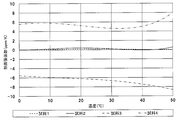
- FIG. 1 is a graph showing a measurement result of a coefficient of thermal expansion in an example.
- the composite of the present embodiment includes a crystal phase of ⁇ -eucryptite (LiAlSiO 4 ) and a crystal phase of lithium tantalate (LiTaO 3 ).
- the composite contains the respective crystal phases of ⁇ -eucryptite and lithium tantalate exhibiting such a thermal expansion behavior, the composite can exhibit low thermal expansion characteristics.
- the crystal phase of ⁇ -eucryptite and the crystal phase of lithium tantalate may be contained in a total of 90% by volume or more, and further 99% by volume or more.
- ⁇ -eucryptite and lithium tantalate each maintain the crystal state before the composite, and in the composite, another product other than the respective crystal phases of ⁇ -eucryptite and lithium tantalate (Crystal phase or glass phase) is not substantially generated, so that there is no influence on the thermal expansion behavior of another product, and the thermal expansion behavior of the entire composite can be accurately controlled. Therefore, the composite of the present embodiment can exhibit low thermal expansion characteristics over a wide temperature range.
- the composite may include other compositions that do not react with ⁇ -eucryptite and lithium tantalate.
- the composite can also exhibit high rigidity due to the crystal phase of lithium tantalate.
- the composite of the present embodiment does not include a crystal phase and a glass phase other than the ⁇ -eucryptite crystal phase and the lithium tantalate crystal phase.
- the crystal phases of ⁇ -eucryptite and lithium tantalate can be confirmed, for example, by X-ray diffraction (hereinafter sometimes referred to as “XRD”). It can also be confirmed by XRD that the composite does not contain any crystal phase and glass phase other than the crystal phase of ⁇ -eucryptite and lithium tantalate.
- XRD X-ray diffraction
- Low thermal expansion characteristics mean that thermal expansion is close to zero and deformation due to temperature change is small.
- the temperature range in which the composite can exhibit low thermal expansion characteristics is, for example, 0 to 50 ° C.
- the (linear) coefficient of thermal expansion calculated for each 1 ° C. may be within 0 ⁇ 1 ppm / K.
- the thermal expansion coefficient is a value measured in accordance with, for example, JIS R 1618: 1994.
- the (linear) coefficient of thermal expansion calculated every 1 ° C. in the temperature range of 0 to 50 ° C. means the (linear) coefficient of thermal expansion of 0 to 1 ° C., the (linear) coefficient of thermal expansion of 1 to 2 ° C., It means that the (linear) coefficient of thermal expansion of 49 to 50 ° C. was calculated.
- the unit of the thermal expansion coefficient is expressed as ppm / K or ppb / K, where 1 ppm / K is 1 ⁇ 10 ⁇ 6 / K and 1 ppb / K is 1 ⁇ 10 ⁇ 9 / K.
- the low thermal expansion material containing cordierite as a main component shows a negative thermal expansion behavior below a certain temperature, and shows a positive thermal expansion behavior above a certain temperature. That is, the coefficient of thermal expansion can be brought close to 0 only in a very narrow temperature range.
- the bulk density of the composite may be up to 3 g / cm 3 .
- the bulk density of the composite may further be less than or equal to 2.55 g / cm 3 .
- the lower limit of the bulk density may be 2.34 g / cm 3 .
- the bulk density is a value measured in accordance with, for example, JIS R 1634-1998.
- the bulk density of general low thermal expansion glass is about 2.53 g / cm 3 .
- Such a composite contains 12% by volume lithium tantalate and 88% by volume ⁇ -eucryptite and exhibits low thermal expansion properties with a (linear) coefficient of thermal expansion of 30 ppm / K.
- the members used for the optical components be lightweight.
- the members mounted on an object to be launched from the ground to space, such as an artificial satellite be lighter than the limitation of the mass that can be launched and the reduction of the launch cost. Therefore, a material having a low material density and a high rigidity can be reduced in weight.
- the composition ratio of ⁇ -eucryptite is large because the density can be reduced.
- Such a composite contains 12% by volume lithium tantalate and 88% by volume ⁇ -eucryptite and exhibits low thermal expansion properties with a (linear) coefficient of thermal expansion of 30 ppm / K.
- Composites containing 10% by volume lithium tantalate and 90% by volume ⁇ -eucryptite exhibit low thermal expansion properties with a (linear) coefficient of thermal expansion of 30 ppm / K.
- the (linear) coefficient of thermal expansion at 22 ° C. can be made as low as about 50 ppm / K, and the bulk density can be made as low as about 2.43 g / cm 3 .
- the composite may have a Young's modulus of 100 GPa or more. When such a configuration is satisfied, the rigidity of the composite increases. Dispersion of lithium tantalate fine particles having a higher hardness than ⁇ -eucryptite in the sintered body improves the Young's modulus. In the absence of lithium tantalate, a glass phase is formed at the grain boundary, and the Young's modulus decreases. The upper limit of the Young's modulus may be 123 GPa or 120 GPa. The Young's modulus is a value measured using, for example, a nanoindenter method. The general Young's modulus of low thermal expansion glass is about 90 GPa.
- the specific rigidity of the composite may be, for example, 33 or more.
- the specific rigidity of the composite may be 39 or more. When such a configuration is satisfied, the rigidity of the composite increases.
- the upper limit of the specific rigidity may be 51.
- the specific rigidity is, for example, a value calculated from the equation: Young's modulus / bulk density.
- the specific rigidity of general low thermal expansion glass is about 36.
- the thermal conductivity of the composite may be, for example, 2 W / mK or more. When such a configuration is satisfied, the thermal conductivity of the composite is increased, and thus the composite is suitable as a fixing member for applications requiring heat radiation, such as a primary mirror of an astronomical telescope.
- the upper limit of the thermal conductivity may be 3.5 W / mK.
- the thermal conductivity is a value measured in accordance with, for example, JIS R 1611: 2010.
- the thermal conductivity of general low thermal expansion glass is about 1.5 W / mK.
- the average particle diameter of the crystal phase of lithium tantalate may be larger than the average particle diameter of the crystal phase of ⁇ -eucryptite. When such a configuration is satisfied, the bending strength of the composite can be improved.
- the average particle diameter of the crystal phase of lithium tantalate may be 4 ⁇ m or less, or 3 ⁇ m or less.
- the lower limit of the average particle size of the crystal phase of lithium tantalate may be 0.7 ⁇ m or 1 ⁇ m.
- the particle size is related to the bending strength of the composite, and a smaller particle size has an effect of improving the bending strength. Therefore, it is preferable that the crystal phase has a smaller particle size.
- the average particle size of the ⁇ -eucryptite crystal phase may be 5 ⁇ m or less, or 2 ⁇ m or less.
- the lower limit of the average particle size of the crystal phase of ⁇ -eucryptite may be 0.7 ⁇ m or 1 ⁇ m.
- the average particle diameter is a value obtained by, for example, observing a cross section of the composite using a scanning electron microscope (Scanning Electron Microscope: hereinafter sometimes referred to as “SEM”).
- the average particle diameter of the combined crystal phase of ⁇ -eucryptite and lithium tantalate may be 2 ⁇ m or less.
- the lower limit of the average particle size of the crystal phase may be 1 ⁇ m.
- the particle size is related to the bending strength of the composite, and a smaller particle size has an effect of improving the bending strength. Therefore, it is preferable that the crystal phase has a smaller particle size.
- the volume% of the crystal phase of ⁇ -eucryptite may be larger than the volume% of the crystal phase of lithium tantalate.
- the volume ratio (volume ratio) between the crystal phase of ⁇ -eucryptite and the crystal phase of lithium tantalate may be from 90:10 to 99: 1, and from 90:10 to 99.5: 0.5. There may be.
- the volume ratio (% by volume) is a value obtained by, for example, observing a cross section of the composite using an SEM. When the volume ratio is as described above, the value of the coefficient of thermal expansion of the composite can be approached to zero.
- the (linear) coefficient of thermal expansion at 22 ° C. can be in the range of ⁇ 500 ppb / K to 1000 ppb / K. Further, by setting the volume ratio to 95: 5 to 99: 1, the (linear) coefficient of thermal expansion at 22 ° C. can be in the range of ⁇ 50 ppb / K to 50 ppb / K.
- the relative magnetic permeability of the composite may be 1.001 or less, or 1 or less. When such a configuration is satisfied, the composite becomes substantially non-magnetic, and thus is suitable as a member for applications requiring non-magnetism.
- the lower limit of the relative magnetic permeability may be 0.999.
- the relative magnetic permeability is a value measured using, for example, a vibrating sample magnetometer.
- the preferred range of the relative magnetic permeability is within 1 ⁇ 0.001. This is preferably non-magnetic when applied to a member that can move in a strong magnetic field (for example, a component of a satellite) or a member used in an apparatus that uses an electron beam. Rarely, in such a case, the relative magnetic permeability is required to be 1.001 or less. It has been found that, when the relative magnetic permeability is higher than 1.001, the effect on the electron beam is greatly affected, and it is preferable that the relative permeability is 1.001 or less. The relative magnetic permeability is smaller than 1 in the case of a substance having diamagnetism, and is calculated to be smaller than 1.
- the relative magnetic permeability of ⁇ -eucryptite is about 0.9999. If lithium tantalate having an appropriate relative magnetic permeability is used as the composite, the relative magnetic permeability of the composite can be set within the above range. As a result of evaluating the relative magnetic permeability of a commercially available general lithium tantalate, the relative magnetic permeability is 1.2, and when the composite is formed, the relative magnetic permeability may be 1.001 or more. It is not preferable as a member in an apparatus using an electron beam.
- the above-described lithium tantalate powder confirmed that the sample was eccentric in the container, and a strong influence on the magnetic field was confirmed.
- the relative magnetic permeability of lithium tantalate powder produced by performing a heating / melting reaction treatment using lithium carbonate and tantalum pentoxide having a purity of 99.9% or more is 1.001 or less, and the relative permeability is 1.001 or less. Even when a composite is made with ⁇ -eucryptite, the relative permeability of the composite can be reduced to 1.001 or less.
- Such a lithium tantalate powder did not show any eccentricity even when rotated at a high speed (8000 Hz) in the above-mentioned 9.4 Tesla magnetic field, and was not affected by the magnetic field.
- a composite of lithium tantalate crystal phase: ⁇ -eucryptite crystal phase 0.12: 0.88 (volume ratio) was prepared using lithium tantalate having a relative magnetic permeability of 1.009. And the relative magnetic permeability was 1.001.
- the flexural strength of the composite may be, for example, 70 MPa or more, 110 MPa or more, or 150 MPa or more. When satisfying such a configuration, the rigidity of the composite is high.
- the upper limit of the transverse rupture strength may be 170 MPa.
- the transverse rupture strength is a value measured in accordance with, for example, JIS R 1601: 2008.
- the water absorption of the composite may be, for example, 0.1% or less. When such a structure is satisfied, the composite can be densified.
- the water absorption is a value measured using, for example, the Archimedes method.
- the composite may be for an optical member.
- Specific examples include a fixed member such as a primary mirror of an astronomical telescope or a mirror mounted on an artificial satellite.
- the use of the composite is not limited to the use for an optical member.
- each crystal of ⁇ -eucryptite and lithium tantalate is mixed to obtain a mixture.
- the respective crystals may be mixed in such a ratio that the respective crystal phases of ⁇ -eucryptite and lithium tantalate are 70:30 to 99: 1 in mass ratio.
- ⁇ -eucryptite LiAlSiO 4
- a commercially available powder may be used, or lithium carbonate, Al 2 O 3 , and SiO 2 may be mixed at a predetermined ratio and synthesized by heating.
- the firing conditions may be set, for example, as follows.
- the firing temperature may be between 1050 ° C. and 1150 ° C.
- the sintering temperature is 1150 ° C. or lower, the particles can be densified while controlling the particle diameter. Keep time may be 1 to 10 hours.
- the relative magnetic permeability of the lithium tantalate of the present embodiment is 1.009 or less.
- Such lithium tantalate is suitable as a raw material for the above-described composite.
- the relative magnetic permeability of the composite is set to 1.001 or less, the lithium tantalate of the present embodiment may be used.
- the lower limit of the relative magnetic permeability may be 0.993.
- the lithium tantalate having the above relative magnetic permeability can be used for other purposes.
- single crystal lithium tantalate having the above-described relative magnetic permeability can be used for a surface acoustic wave device.
- Such a surface acoustic wave device can reduce fluctuations in characteristics in a magnetic field.
- those having a relative magnetic permeability of 1.1 or less can be used as such lithium tantalate.
- the lower limit of the relative magnetic permeability of such lithium tantalate may be 0.9.
- the transition metal element to be combined with KHCO 3 is not particularly limited, but Ti and Fe are preferable, and Ti and Fe may be used.
- the amounts of the potassium hydrogen carbonate and the transition metal element are, for example, 5 to 15 parts by mass of potassium hydrogen carbonate with respect to 100 parts by mass of lithium tantalate, and the transition metal element is 1 to 10 parts by mass with respect to 100 parts by mass of potassium hydrogen carbonate. Mix in the proportions
- the conventional lithium tantalate without the above-mentioned treatment has a relative magnetic permeability of 1.2, and this relative magnetic permeability is considered to be exhibited by the presence of lithium vacancies.
- the lithium vacancies are reduced due to the solid solution of K in the lithium vacancies existing in the conventional lithium tantalate, and the relative permeability is reduced. 1 or less, and 1.009 or less.
- a composite according to another embodiment includes a crystal phase of ⁇ -eucryptite (LiAlSiO 4 ) and a crystal phase of lithium tantalate (LiTaO 3 ), and contains calcium (Ca) in the crystal phase of lithium tantalate. ing.
- the temperature dependence of the thermal expansion coefficient of lithium tantalate can be reduced, and accordingly, the temperature dependence of the thermal expansion coefficient of the composite can be reduced. Can also be reduced. As a result, the range in which the coefficient of thermal expansion of the composite changes with temperature changes can be narrowed, and the value of the coefficient of thermal expansion can also approach zero. And together with these effects, the composite can exhibit low thermal expansion characteristics over a wide temperature range. In addition, the composite can exhibit high rigidity due to the crystal phase of lithium tantalate.
- lithium tantalate is represented by a composition formula (Li 1-x C ax / 2 ) TaO 3
- 0 ⁇ x ⁇ 0.2 may be satisfied.
- x indicates a calcium replacement amount.
- the temperature dependency tends to be slightly larger when x increases from 0.1 to 0.2, but becomes smaller than when x is 0.
- x By setting x to be 0.05 or more, the temperature dependence of the coefficient of thermal expansion can be further reduced.
- the composition of lithium tantalate represented by the above composition formula can be measured, for example, by ICP (Inductively Coupled Plasma) emission spectroscopy.
- 2 ⁇ of the diffraction peak on the (006) plane in the crystal phase of lithium tantalate may be 39.25 ° or more.
- the diffraction peak of the (006) plane is shifted to a higher angle side by calcium substitution. This indicates that the c-axis lattice constant is contracted due to the solid solution of calcium.
- 2 ⁇ ⁇ 39.25 ° corresponds to x ⁇ 0.05 in the above composition formula.
- 2 ⁇ may be equal to or less than 39.33 °.
- 2 ⁇ is, for example, a value obtained by measuring with XRD.
- the change width of the (linear) coefficient of thermal expansion calculated for each 1 ° C in a temperature range of 15 ° C to 40 ° C may be 50 ppb / K or less.
- the variation width of the (linear) coefficient of thermal expansion calculated for each 1 ° C. may be 100 ppb / K or less.
- the (linear) coefficient of thermal expansion at 22 ° C. may be from ⁇ 500 ppb / K to 1000 ppb / K.
- the coefficient of thermal expansion is a value measured in accordance with, for example, JIS @ R # 1618: 1994. In the temperature range of 15 ° C.
- the variation width of the thermal expansion coefficient calculated for each 1 ° C. is the thermal expansion coefficient of 15 ° C. to 16 ° C., the thermal expansion coefficient of 16 ° C. to 17 ° C.,.
- a coefficient of thermal expansion between -40 ° C. and 40 ° C. is calculated, a maximum value and a minimum value are selected from the calculated coefficients of thermal expansion, and these values are calculated by applying the formula: maximum value ⁇ minimum value. The same applies to the change width of the coefficient of thermal expansion calculated for each 1 ° C. in the temperature range of 0 ° C. to 50 ° C.
- ⁇ -eucryptite crystals and lithium tantalate crystals as raw materials are prepared.
- ⁇ -eucryptite crystals commercially available powders may be used, or lithium carbonate, Al 2 O 3, and SiO 2 may be mixed at a predetermined ratio and synthesized by heating. .
- the crystal of lithium tantalate one obtained by replacing lithium with calcium is used.
- a crystal of lithium tantalate for example, a crystal obtained by mixing calcium carbonate with lithium carbonate and tantalum pentoxide at a predetermined ratio and heating and synthesizing the same may be used. This point will be described in detail in a method for producing lithium tantalate described later.
- the respective crystals of ⁇ -eucryptite and lithium tantalate are mixed to obtain a mixture.
- the respective crystals may be mixed in such a ratio that the respective crystal phases of ⁇ -eucryptite and lithium tantalate are 70:30 to 99: 1 in mass ratio. .
- the firing conditions may be set, for example, as follows.
- the firing temperature may be from 1050 ° C to 1250 ° C, or from 1050 ° C to 1150 ° C.
- Keep time may be 1 to 10 hours.
- Lithium tantalate according to another embodiment satisfies 0 ⁇ x ⁇ 0.2 when represented by a composition formula (Li 1-x C ax / 2 ) TaO 3 .
- Such lithium tantalate is suitable as a raw material for the above-described composite. When used with single crystal lithium tantalate, it may be used at 0 ⁇ x ⁇ 0.1 where the above-mentioned extra calcium component is not generated.
- the relative permeability of lithium tantalate may be 1.009 or less. Such lithium tantalate is suitable as a raw material when the relative magnetic permeability of the composite is set to 1.001 or less. Note that the lower limit of the relative magnetic permeability may be 0.993.
- the lithium tantalate represented by the above composition formula can be used for other purposes.
- single crystal lithium tantalate represented by the above composition formula can be used for a surface acoustic wave device.
- Such a surface acoustic wave device can reduce fluctuations in characteristics in a magnetic field.
- those having a relative magnetic permeability of 1.1 or less can be used as such lithium tantalate.
- the lower limit of the relative magnetic permeability of such lithium tantalate may be 0.9.
- Lithium tantalate can be synthesized.
- the ratio of calcium carbonate may be such that 0 ⁇ x ⁇ 0.2 in the above composition formula. Specifically, calcium carbonate may be set to 1 mol or less with respect to 4 mol of lithium carbonate.
- the obtained lithium tantalate is coexisted with potassium hydrogen carbonate (KHCO 3 ) or a mixture of potassium hydrogen carbonate and at least one powder of transition metal elements such as Ti, Fe, Al, Ni and Zn.
- KHCO 3 potassium hydrogen carbonate
- the heat treatment may be performed in a nitrogen atmosphere at a temperature in the range of 550 ° C. to the Curie temperature of lithium tantalate or lower.
- the heat treatment time may be set to 1 to 10 hours.
- the transition metal element to be combined with KHCO 3 is not particularly limited, but Ti and Fe are preferable, and Ti and Fe may be used.
- the amounts of the potassium hydrogen carbonate and the transition metal element are, for example, 5 to 15 parts by mass of potassium hydrogen carbonate with respect to 100 parts by mass of lithium tantalate, and the transition metal element is 1 to 10 parts by mass with respect to 100 parts by mass of potassium hydrogen carbonate. It may be.
- Lithium tantalate not subjected to the above-described heat treatment has a relative magnetic permeability of 1.2, and it is considered that this relative magnetic permeability is expressed by the existence of lithium vacancies.
- the lithium vacancies are reduced due to the solid solution of K in the lithium vacancies present in the lithium tantalate, and the relative permeability is reduced to 1.1 or less. 009 or less.
- the obtained lithium tantalate is heat-treated at 550 ° C. for 3 hours in a nitrogen atmosphere in the presence of a mixture of potassium hydrogen carbonate and powders of Ti and Fe as transition metal elements, so that tantalum having a relative magnetic permeability of 1.00001 is obtained.
- Lithium oxide was obtained.
- the amounts of potassium hydrogen carbonate and the transition metal element were such that potassium hydrogen carbonate was mixed at 10 parts by mass with respect to 100 parts by mass of lithium tantalate, and the transition metal element was mixed at a ratio of 5 parts by mass with respect to 100 parts by mass of potassium hydrogen carbonate. .
- a composite was produced using the lithium tantalate crystals obtained as described above. Specifically, each crystal of ⁇ -eucryptite and lithium tantalate having an average particle diameter (D 50 ) of 0.9 ⁇ m was mixed to obtain a mixture. At this time, the respective crystals were mixed in such a ratio that the respective crystal phases of ⁇ -eucryptite and lithium tantalate had the mass ratios shown in Table 1 in the obtained composite.
- the obtained composite was measured by XRD.
- a crystal phase other than the two crystal phases is defined as containing no diffraction phase other than lithium tantalate and ⁇ -eucryptite when the diffraction peak having a peak intensity slightly more than three times the background intensity of XRD is taken as a dominant peak. It means that there is no peak.
- the absence of a glass phase other than the two crystal phases means that there is no halo peak slightly more than three times the background intensity as in the above case.
- the cross section of the composite was mirror-finished, and the cross section was observed at a magnification of 250 using a backscattered electron image using an SEM. At this time, since lithium tantalate and ⁇ -eucryptite are observed with different contrasts, both can be distinguished. Then, the cross-sectional observation photograph was image-analyzed, and each area with respect to the area of the analysis range was obtained, and the obtained area was defined as volume%.
- the cross section of the composite was mirror-finished, observed with a reflected electron image, and the average particle diameter was determined by image analysis of the observed image.
- the cross section of the mirror-finished composite was subjected to continuous rigid measurement (CSM) using a nano indenter XP manufactured by MTS Co., Ltd. to measure 10 points at an indentation depth of 2000 nm, and the average value was used as the Young's modulus.
- CSM continuous rigid measurement
- the obtained lithium tantalate is heat-treated at 550 ° C. for 3 hours in a nitrogen atmosphere in the presence of a mixture of potassium hydrogen carbonate and powders of Ti and Fe as transition metal elements, and the relative permeability is 1.00001. Got.
- the amounts of potassium hydrogen carbonate and the transition metal element were such that potassium hydrogen carbonate was mixed at 10 parts by mass with respect to 100 parts by mass of lithium tantalate, and the transition metal element was mixed at a ratio of 5 parts by mass with respect to 100 parts by mass of potassium hydrogen carbonate. .
- a composite was produced using the lithium tantalate crystals obtained as described above. Specifically, each crystal of ⁇ -eucryptite and lithium tantalate having an average particle diameter (D 50 ) of 0.9 ⁇ m was mixed to obtain a mixture. At this time, the respective crystals were mixed at such a ratio that the respective crystal phases of ⁇ -eucryptite and lithium tantalate in the obtained composite became the volume% shown in Table 2. Specifically, each crystal was mixed at a blending ratio (mass ratio) shown in Table 2.
- the firing conditions are as follows. Under such firing conditions, each crystal of ⁇ -eucryptite and lithium tantalate grows to an average particle diameter described later.
- the sample No. shown in Table 2 was used.
- the sample to which the same amount of glass (borosilicate glass) was added instead of lithium tantalate in 7 had a Young's modulus of 90 GPa and a specific rigidity of 36. Firing temperature: 1150 ° C Keeping time: 3 hours
- the obtained composite was measured by XRD.
- a crystal phase other than the two crystal phases is defined as containing no diffraction phase other than lithium tantalate and ⁇ -eucryptite when the diffraction peak having a peak intensity slightly more than three times the background intensity of XRD is taken as a dominant peak. It means that there is no peak.
- the absence of a glass phase other than the two crystal phases means that there is no halo peak slightly more than three times the background intensity as in the above case.
- volume ratio of ⁇ -eucryptite crystal phase and lithium tantalate crystal phase The cross section of the composite is mirror-finished, and the cross section is observed at a magnification of ⁇ 250 using a backscattered electron image using an SEM. Was. At this time, since lithium tantalate and ⁇ -eucryptite are observed with different contrasts, both can be distinguished. Then, the cross-sectional observation photograph was image-analyzed, and each area with respect to the area of the analysis range was obtained, and the obtained area was defined as volume%. Since the above-mentioned extra calcium component is very small (0.1 vol% or less), in Table 2, the total value of the ⁇ -eucryptite crystal phase and the lithium tantalate crystal phase is 100 vol%. ing.
- Average particle diameter of crystal phase The cross section of the composite is mirror-finished, observed with a backscattered electron image, and the average particle diameter of each crystal phase of ⁇ -eucryptite and lithium tantalate is determined by image analysis of the observed image. I asked. Further, the average particle diameter of the whole was determined without distinguishing those crystal phases. In each of the samples, the average particle diameter of the crystal phase of ⁇ -eucryptite was 2 ⁇ m, the average particle diameter of the crystal phase of lithium tantalate was 4 ⁇ m, and the average particle diameter of these crystal phases was 2 ⁇ m.
- sample No. Measurement by XRD was performed in the same manner as in Nos. 1 to 43.
- each crystal phase of ⁇ -eucryptite and lithium tantalate was confirmed in the obtained composite. It was also confirmed that the composite did not contain any crystal phase or glass phase other than the ⁇ -eucryptite crystal phase and lithium tantalate crystal phase.
Landscapes
- Chemical & Material Sciences (AREA)
- Engineering & Computer Science (AREA)
- Ceramic Engineering (AREA)
- Manufacturing & Machinery (AREA)
- Materials Engineering (AREA)
- Organic Chemistry (AREA)
- Inorganic Chemistry (AREA)
- Structural Engineering (AREA)
- Physics & Mathematics (AREA)
- Metallurgy (AREA)
- Crystallography & Structural Chemistry (AREA)
- Thermal Sciences (AREA)
- Plasma & Fusion (AREA)
- Crystals, And After-Treatments Of Crystals (AREA)
- Inorganic Compounds Of Heavy Metals (AREA)
Abstract
本開示の複合体は、β-ユークリプタイトの結晶相と、タンタル酸リチウムの結晶相とを含む。0~50℃の温度範囲において、1℃毎に算出した熱膨張係数が、0±1ppm/K以内である。タンタル酸リチウムの結晶相にカルシウムを含有している。β-ユークリプタイトの結晶相とタンタル酸リチウムの結晶相との体積比が、90:10~99.5:0.5である。
Description
本開示は、複合体およびタンタル酸リチウムに関する。
低熱膨張特性に優れる部材として、β-ユークリプタイト(eucryptite)とガラスとの複合体である低熱膨張ガラスが知られている(例えば、特許文献1参照)。
本開示の複合体は、β-ユークリプタイトの結晶相と、タンタル酸リチウムの結晶相とを含んでいる。
<複合体>
以下、本開示の一実施形態に係る複合体について詳細に説明する。
以下、本開示の一実施形態に係る複合体について詳細に説明する。
本実施形態の複合体は、β-ユークリプタイト(LiAlSiO4)の結晶相と、タンタル酸リチウム(LiTaO3)の結晶相とを含んでいる。
β-ユークリプタイトは、負の熱膨張挙動を示し、タンタル酸リチウムは、正の熱膨張挙動を示す。複合体は、このような熱膨張挙動を示すβ-ユークリプタイトおよびタンタル酸リチウムのそれぞれの結晶相を含んでいることから、低熱膨張特性を発揮することができる。また、上述した構成の複合体に、β-ユークリプタイトの結晶相およびタンタル酸リチウムの結晶相は、合計で90体積%以上、さらに99体積%以上含まれていてもよい。複合体において、β-ユークリプタイトおよびタンタル酸リチウムが複合化前の結晶状態をそれぞれ維持しており、複合化においてβ-ユークリプタイトおよびタンタル酸リチウムのそれぞれの結晶相以外の別の生成物(結晶相やガラス相)が実質的に生成されないことから、別の生成物による熱膨張挙動への影響がなく、複合体全体の熱膨張挙動を正確に制御することができる。それゆえ、本実施形態の複合体は、広い温度範囲にわたって低熱膨張特性を発揮することができる。複合体は、β-ユークリプタイトおよびタンタル酸リチウムと反応しない他の組成を含んでもよい。
また、複合体は、タンタル酸リチウムの結晶相に起因して高い剛性を発揮することもできる。なお、本実施形態の複合体は、β-ユークリプタイトの結晶相およびタンタル酸リチウムの結晶相以外の結晶相およびガラス相を含まないと言い換えることができる。
β-ユークリプタイトおよびタンタル酸リチウムのそれぞれの結晶相は、例えば、X線回折(X-ray Diffraction:以下、「XRD」ということがある。)によって確認することができる。複合体がβ-ユークリプタイトの結晶相およびタンタル酸リチウムの結晶相以外の結晶相およびガラス相を含まないこともXRDによって確認することができる。
なお、β-ユークリプタイトと複合化させる原料としては、正の熱膨張挙動を示す他の原料も考えられるが、複合化させる際に、原料以外の結晶相あるいはガラス相の副生成物が生じてしまう。例えば、β-ユークリプタイトとアルミナやジルコニアとを複合化させて、低熱膨張の複合体を作製する場合、β-ユークリプタイトとそれらの原料の質量比率は1:1程度、もしくは、さらにそれらの原料を多くする必要がある。そのような複合体のかさ密度は、3g/cm3を大きく超えてしまう。また、そのような複合体は、製造工程のばらつきなどにより、副生成物の生成量や生成状態が変わることがあるため、安定した特性のものを製造するのが難しい。
低熱膨張特性とは、熱膨張がゼロに近く、温度変化による変形が少ないことを意味する。複合体が低熱膨張特性を発揮できる温度範囲は、例えば、0~50℃である。
0~50℃の温度範囲において、1℃毎に算出した(線)熱膨張係数が、0±1ppm/K以内であってもよい。このような構成を満たすときは、複合体が広い温度範囲にわたって低熱膨張特性を発揮することができる。熱膨張係数は、例えば、JIS R 1618:1994に準拠して測定される値である。なお、0~50℃の温度範囲において1℃毎に算出した(線)熱膨張係数とは、0~1℃の(線)熱膨張係数、1~2℃の(線)熱膨張係数、・・・49~50℃の(線)熱膨張係数を算出したということである。以下、熱膨張係数の単位をppm/Kまたはppb/Kと表しているが、1ppm/Kは1×10-6/K、1ppb/Kは1×10-9/Kである。
なお、コーディエライトを主成分とした低熱膨張材料は、ある温度以下では負の熱膨張挙動を示し、その温度よりも高い温度では正の熱膨張挙動を示す。つまり、ごく狭い温度範囲でしか熱膨張係数を0に近づけることができない。文献によっては、所定温度範囲の熱膨張係数を小さくできたと書かれていることがあるが、その所定温度範囲の最低温度と最高温度との2つの温度の差から算出した熱膨張係数が小さいだけであって、その所定温度範囲において1℃毎に算出した熱膨張係数が小さいとは考え難い。特に、0~50℃の温度範囲において、1℃毎に算出した(線)熱膨張係数を、0±1ppm/K以内、さらに0±0.5ppm/K以内とするのは難しいと考えられる。
複合体のかさ密度は、3g/cm3以下であってもよい。複合体のかさ密度は、さらに2.55g/cm3以下であってもよい。このような構成を満たすときは、複合体の軽量化が図れる。かさ密度の下限値は、2.34g/cm3であってもよい。かさ密度は、例えば、JIS R 1634-1998に準拠して測定される値である。なお、一般的な低熱膨張ガラスのかさ密度は、2.53g/cm3程度である。
かさ密度が3g/cm3の複合体は、例えば、質量比でタンタル酸リチウム:β-ユークリプタイト=28.6:71.4の原料で作製することができる。そのような複合体は、12体積%のタンタル酸リチウムおよび88体積%のβ-ユークリプタイトを含んでおり、(線)熱膨張係数30ppm/Kの低熱膨張特性を示す。光学部品に用いられる部材は軽量であることが望ましい。特に人口衛星など、地上から宇宙へ打ち上げるものに搭載される部材は、打ち上げ可能な質量の制限および打ち上げコストの低減より、軽量であることが望まれる。よって、材質の密度が低く、高剛性な材料は軽量化することができる。β-ユークリプタイトの構成比率が大きいことは密度の低減を可能とするため好適である。
さらに、かさ密度が2.55g/cm3の複合体は、例えば、質量比でタンタル酸リチウム:β-ユークリプタイト=28.6:71.4の原料で作製することができる。そのような複合体は、12体積%のタンタル酸リチウムおよび88体積%のβ-ユークリプタイトを含んでおり、(線)熱膨張係数30ppm/Kの低熱膨張特性を示す。10体積%のタンタル酸リチウムおよび90体積%のβ-ユークリプタイトを含む複合体は、(線)熱膨張係数30ppm/Kの低熱膨張特性を示す。22℃における(線)熱膨張係数を50ppm/K程度と、より低熱膨張にでき、かさ密度も2.43g/cm3程度とより低くできる。
複合体のヤング率は、100GPa以上であってもよい。このような構成を満たすときは、複合体の剛性が高まる。β-ユークリプタイトに対して硬度が高いタンタル酸リチウムの微粒子が焼結体内に分散することでヤング率が向上する。タンタル酸リチウムがない場合には、粒界にガラス相が形成されており、ヤング率が低下する。ヤング率の上限値は、123GPaであってもよく、120GPaであってもよい。ヤング率は、例えば、ナノインデンタ法を用いて測定される値である。なお、一般的な低熱膨張ガラスのヤング率は、90GPa程度である。
複合体の比剛性は、例えば、33以上であってもよい。複合体の比剛性は、さらに39以上であってもよい。このような構成を満たすときは、複合体の剛性が高まる。比剛性の上限値は、51であってもよい。比剛性は、例えば、式:ヤング率/かさ密度から算出される値である。なお、一般的な低熱膨張ガラスの比剛性は、36程度である。
複合体の熱伝導率は、例えば、2W/mK以上であってもよい。このような構成を満たすときは、複合体の熱伝導性が高まることから、例えば、天体望遠鏡の主鏡のように放熱性が求められる用途の固定部材として好適である。熱伝導率の上限値は、3.5W/mKであってもよい。熱伝導率は、例えば、JIS R 1611:2010に準拠して測定される値である。なお、一般的な低熱膨張ガラスの熱伝導率は、1.5W/mK程度である。
タンタル酸リチウムの結晶相の平均粒子径は、β-ユークリプタイトの結晶相の平均粒子径よりも大きくてもよい。このような構成を満たすときは、複合体の抗折強度を向上させることができる。
タンタル酸リチウムの結晶相の平均粒子径は、4μm以下であってもよく、3μm以下であってもよい。タンタル酸リチウムの結晶相の平均粒子径の下限値は、0.7μmであってもよく、1μmであってもよい。粒子径は複合体の抗折強度に関係し、粒子径が小さいと抗折強度が向上する効果があるため、結晶相の粒径が小さい方が好適である。
同様の理由から、β-ユークリプタイトの結晶相の平均粒子径は、5μm以下であってもよく、2μm以下であってもよい。β-ユークリプタイトの結晶相の平均粒子径の下限値は、0.7μmであってもよく、1μmであってもよい。平均粒子径は、例えば、走査型電子顕微鏡(Scanning Electron Microscope:以下、「SEM」ということがある。)を使用して複合体を断面観察して得られる値である。
β-ユークリプタイトの結晶相およびタンタル酸リチウムの結晶相を合わせた結晶相の平均粒子径は、2μm以下であってもよい。その結晶相の平均粒子径の下限値は、1μmであってもよい。粒子径は複合体の抗折強度に関係し、粒子径が小さいと抗折強度が向上する効果があるため、結晶相の粒径が小さい方が好適である。
β-ユークリプタイトの結晶相の体積%が、タンタル酸リチウムの結晶相の体積%よりも大きくてもよい。このような構成を満たすときは、タンタル酸リチウムよりも軽量であるβ-ユークリプタイトの割合が相対的に多くなることから、複合体の軽量化が図れる。β-ユークリプタイトの結晶相とタンタル酸リチウムの結晶相との体積比(体積割合)は、90:10~99:1であってもよく、90:10~99.5:0.5であってもよい。体積比(体積%)は、例えば、SEMを使用して複合体を断面観察して得られる値である。体積比が上記のような場合、複合体の熱膨張係数の値を0に近づけることができる。具体的には、22℃における(線)熱膨張係数を、-500ppb/K~1000ppb/Kの範囲内にすることができる。さらに、上述の体積比を95:5~99:1にすることで、22℃における(線)熱膨張係数を、-50ppb/K~50ppb/Kの範囲内にすることができる。
複合体の比透磁率は、1.001以下であってもよく、1以下であってもよい。このような構成を満たすときは、複合体が実質的に無磁性になることから、無磁性が求められる用途の部材として好適である。なお、比透磁率の下限値は、0.999であってもよい。比透磁率は、例えば、振動試料型磁力計を使用して測定される値である。
比透磁率の好適範囲は1±0.001以内である。これは、例えば強磁場内で可動する可能性があるような部材(例えば人工衛星の構成部材)や、電子ビームを使用する装置内で使用する部材に適用させるには無磁性であることが望まれ、そのような場合、比透磁率は1.001以下であることが求められる。電子ビームへの影響は、比透磁率が1.001より上回ると悪影響が大きく出てしまい、1.001以下であることが望ましいことが分っている。比透磁率が1より小さい数値となるのは、反磁性を有する物質の場合であり、計算上1より小さい数値となる。
β-ユークリプタイトの比透磁率は、0.9999程度であることが分っている。複合化するタンタル酸リチウムとして、適切な比透磁率のものを用いれば、複合体の比透磁率を上述の範囲内にできる。市販の一般的なタンタル酸リチウムの比透磁率を評価した結果、1.2であり、複合体とした際に比透磁率が1.001以上となる場合があり強磁場内で稼働する部材や電子ビームを使用する装置内の部材としては好ましくない。9.4テスラの磁場中で高速回転(8000Hz)させるといった試験を行った場合、上述のタンタル酸リチウム粉末では容器内で試料が偏芯する挙動が確認され、磁場に対する強い影響が確認された。一方、例えば、99.9%以上の純度の炭酸リチウム、五酸化タンタルを用いて加熱・溶融反応処理を行って作製したタンタル酸リチウム粉末の比透磁率は1.001以下となり、上述した比率でβ-ユークリプタイトと複合体を作製しても複合体の比透磁率を1.001以下とすることが可能となる。このようなタンタル酸リチウム粉末は、上述の9.4テスラの磁場中で高速回転(8000Hz)させても偏芯が見られず、磁場の影響を受けないことが分った。なお、比透磁率が1.009のタンタル酸リチウムを用いてタンタル酸リチウムの結晶相:β-ユークリプタイトの結晶相=0.12:0.88(体積比)の複合体を作製したところ、比透磁率は1.001であった。
複合体の抗折強度は、例えば、70MPa以上であってもよく、また、110MPa以上であってもよく、150MPa以上であってもよい。このような構成を満たすときは、複合体の剛性が高い。抗折強度の上限値は、170MPaであってもよい。抗折強度は、例えば、JIS R 1601:2008に準拠して測定される値である。
複合体の吸水率は、例えば、0.1%以下であってもよい。このような構成を満たすときは、複合体を緻密化させることができる。吸水率は、例えば、アルキメデス法を用いて測定される値である。
複合体は、光学部材用であってもよい。具体例を挙げると、例えば、天体望遠鏡の主鏡または人工衛星に搭載されるミラーなどの固定部材などが挙げられる。なお、複合体の用途は、光学部材用に限定されない。
<複合体の製造方法>
次に、本開示の一実施形態に係る複合体の製造方法について説明する。
次に、本開示の一実施形態に係る複合体の製造方法について説明する。
本実施形態では、まず、β-ユークリプタイトおよびタンタル酸リチウムのそれぞれの結晶を混合して混合物を得る。このとき、得られる複合体において、β-ユークリプタイトおよびタンタル酸リチウムのそれぞれの結晶相が質量比で70:30~99:1となるような割合で、それぞれの結晶を混合してもよい。β-ユークリプタイト(LiAlSiO4)は市販の粉末を用いても良いし、炭酸リチウム、Al2O3、SiO2を所定の比率で混合して加熱合成しても良い。
次に、混合物を焼成して複合体を得る。焼成条件は、例えば、次のように設定してもよい。焼成温度は、1050℃~1150℃であってもよい。焼成温度を1150℃以下にすると、粒子径を制御しつつ緻密化させることができる。キープ時間は、1~10時間であってもよい。
<タンタル酸リチウム>
次に、本開示の一実施形態に係るタンタル酸リチウムについて説明する。
次に、本開示の一実施形態に係るタンタル酸リチウムについて説明する。
本実施形態のタンタル酸リチウムは、比透磁率が1.009以下である。このようなタンタル酸リチウムは、上述した複合体の原料として好適である。複合体の比透磁率を1.001以下にするときに本実施形態のタンタル酸リチウムを使用してもよい。なお、比透磁率の下限値は、0.993であってもよい。
また、上述の比透磁率のタンタル酸リチウムは、他の用途にも用いることができる。例えば、上述の比透磁率の単結晶のタンタル酸リチウムは、表面弾性波素子に用いることができる。そのような表面弾性波素子は、磁場中における特性の変動を小さくできる。また、そのようなタンタル酸リチウムとしては、比透磁率が1.1以下のものを用いることができる。なお、そのようなタンタル酸リチウムの比透磁率の下限値は、0.9であってもよい。
<タンタル酸リチウムの製造方法>
次に、本開示の一実施形態に係るタンタル酸リチウムの製造方法について説明する。
次に、本開示の一実施形態に係るタンタル酸リチウムの製造方法について説明する。
まず、99.9質量%以上の純度の炭酸リチウム、五酸化タンタルを用いて乾式混合・粉砕を行い、ルツボ中で1000℃以上で加熱・溶融処理してタンタル酸リチウムを合成する。
その後、炭酸水素カリウム(KHCO3)もしくは炭酸水素カリウムとTi、Fe、Al、Ni、Znなどの遷移金属元素の内、少なくとも1種以上の粉末との混合物と共存下で窒素雰囲気下550℃からタンタル酸リチウムのキュリー温度以下の温度範囲にて熱処理して本実施形態のタンタル酸リチウムを得る。
KHCO3と組み合わせる遷移金属元素は、特に限定されないが、Ti、Feが好適であり、TiおよびFeであってもよい。
炭酸水素カリウムおよび遷移金属元素の量は、例えば、タンタル酸リチウム100質量部に対して炭酸水素カリウムを5~15質量部、遷移金属元素は炭酸水素カリウム100質量部に対して1~10質量部になる割合で混合する。
上述した処理を行わない従来のタンタル酸リチウムは、比透磁率が1.2であり、この比透磁率は、リチウム空孔が存在することにより発現していると考えられる。上述した処理を行う本実施形態のタンタル酸リチウムは、従来のタンタル酸リチウム中に存在するリチウム空孔にKが固溶することでリチウム空孔が減少し、比透磁率が低減して1.1以下、さらに1.009以下になる。
次に、本開示の別の実施形態に係る複合体について詳細に説明する。別の実施形態に係る複合体は、β-ユークリプタイト(LiAlSiO4)の結晶相およびタンタル酸リチウム(LiTaO3)の結晶相を含み、タンタル酸リチウムの結晶相にカルシウム(Ca)を含有している。
タンタル酸リチウムの結晶相にカルシウムが含まれると、複合体の熱膨張係数が温度変化によって変わる範囲を狭くすることができる。その結果、熱膨張係数の値も0(ゼロ)に近づけることができる。この理由としては、以下の理由が推察される。
複合体の熱膨張係数の温度依存性(熱膨張係数が15℃~40℃の温度変化によって変わる範囲)に与える影響について、β-ユークリプタイトとタンタル酸リチウムとを比較すると、タンタル酸リチウムの影響がβ-ユークリプタイトの影響よりも大きい。そのため、タンタル酸リチウムの熱膨張係数の温度依存性を小さくすれば、複合体の熱膨張係数の温度依存性も小さくすることができる。そして、タンタル酸リチウムの結晶相にカルシウムを含有していると、タンタル酸リチウムにおけるリチウムがカルシウムで置換されることに起因して、タンタル酸リチウムの熱膨張係数の温度依存性を小さくすることができる。それゆえ、タンタル酸リチウムの結晶相にカルシウムを含有していると、タンタル酸リチウムの熱膨張係数の温度依存性を小さくすることができ、これに伴って複合体の熱膨張係数の温度依存性も小さくすることができる。その結果、複合体の熱膨張係数が温度変化によって変わる範囲を狭くすることができ、熱膨張係数の値も0に近づけることができる。そして、これらの効果が相まって、複合体は、広い温度範囲にわたって低熱膨張特性を発揮することができる。また、複合体は、タンタル酸リチウムの結晶相に起因して高い剛性を発揮することもできる。
タンタル酸リチウムを組成式(Li1-xCax/2)TaO3で表したとき、0<x≦0.2であってもよい。組成式において、xはカルシウムの置換量を示す。xが0から0.1に増えるにしたがって、熱膨張係数の温度依存性(15℃~40℃)を小さくすることができる。また、温度依存性は、xが0.1から0.2に増えると若干大きくなる傾向にあるものの、xが0の場合よりは小さくなる。xを0.05以上とすることにより、熱膨張係数の温度依存性を、より小さくすることができる。上述した組成式で表されるタンタル酸リチウムの組成は、例えば、ICP(Inductively Coupled Plasma)発光分光分析法によって測定することができる。
なお、タンタル酸リチウムの結晶相には、x=0.1程度までのカルシウムが固溶する。x=0~0.1のタンタル酸リチウムは、実質的にタンタル酸リチウムの結晶相のみで構成される。xが0.1よりも大きいタンタル酸リチウムは、x=0.1程度のタンタル酸リチウムの結晶相と、余分のカルシウム成分とから構成されると推察される。したがって、本実施形態のタンタル酸リチウムは、余分のカルシウム成分を含む場合があり、本実施形態のタンタル酸リチウムの結晶相は、余分のカルシウム成分を含まないといえる。なお、余分のカルシウム成分は、結晶相の外に存在すると考えられるが、直接観察はされない。
別の実施形態に係る複合体において、タンタル酸リチウムの結晶相における(006)面の回折ピークの2θは、39.25°以上であってもよい。(006)面の回折ピークは、カルシウム置換により高角度側へシフトする。これは、カルシウム固溶によりc軸の格子定数が収縮していることを示す。なお、2θ≧39.25°は、上述した組成式において、x≧0.05に相当する。また、2θ=39.18°は、x=0に相当する。したがって、2θの値は、タンタル酸リチウムの結晶相におけるカルシウムの含有量を示す。2θは、39.33°以下であってもよい。2θは、例えば、XRDで測定して得られる値である。
別の実施形態に係る複合体において、15℃~40℃の温度範囲における1℃毎に算出した(線)熱膨張係数の変化幅は、50ppb/K以下であってもよい。また、0℃~50℃の温度範囲において、1℃毎に算出した(線)熱膨張係数の変化幅は、100ppb/K以下であってもよい。22℃の(線)熱膨張係数は、-500ppb/K~1000ppb/Kであってもよい。(線)熱膨張係数は、例えば、JIS R 1618:1994に準拠して測定される値である。なお、15℃~40℃の温度範囲において1℃毎に算出した熱膨張係数の変化幅は、15℃~16℃の熱膨張係数、16℃~17℃の熱膨張係数、・・・、39℃~40℃の熱膨張係数をそれぞれ算出し、算出された各熱膨張係数から最大値および最小値を選択し、それらを式:最大値-最小値に当てはめて算出される値である。この点は、0℃~50℃の温度範囲において1℃毎に算出した熱膨張係数の変化幅においても同様である。
<複合体の製造方法>
次に、本開示の別の実施形態に係る複合体の製造方法について説明する。
次に、本開示の別の実施形態に係る複合体の製造方法について説明する。
まず、原料であるβ-ユークリプタイトの結晶およびタンタル酸リチウムの結晶を準備する。β-ユークリプタイトの結晶は、上述と同様、市販の粉末を用いてもよいし、炭酸リチウム、Al2O3およびSiO2を所定の比率で混合して加熱合成したものを用いてもよい。
タンタル酸リチウムの結晶は、リチウムがカルシウムで置換されたものを用いる。このようなタンタル酸リチウムの結晶としては、例えば、炭酸リチウムおよび五酸化タンタルに炭酸カルシウムを所定の比率で混合して加熱合成したものを用いてもよい。この点については、後述するタンタル酸リチウムの製造方法において詳細に説明する。
次に、β-ユークリプタイトおよびタンタル酸リチウムのそれぞれの結晶を混合して混合物を得る。このとき、得られる複合体において、β-ユークリプタイトおよびタンタル酸リチウムのそれぞれの結晶相が質量比で70:30~99:1となるような割合で、それぞれの結晶を混合してもよい。
そして、上述した混合物を焼成して複合体を得る。焼成条件は、例えば、次のように設定してもよい。焼成温度は、1050℃~1250℃であってもよく、また、1050℃~1150℃であってもよい。キープ時間は、1~10時間であってもよい。
<タンタル酸リチウム>
次に、本開示の別の実施形態に係るタンタル酸リチウムについて説明する。
次に、本開示の別の実施形態に係るタンタル酸リチウムについて説明する。
別の実施形態に係るタンタル酸リチウムは、組成式(Li1-xCax/2)TaO3で表したとき、0<x≦0.2である。このようなタンタル酸リチウムは、上述した複合体の原料として好適である。単結晶のタンタル酸リチウムで使用するときは、上述した余分のカルシウム成分が生成されない0<x≦0.1で使用してもよい。
タンタル酸リチウムの比透磁率は、1.009以下であってもよい。このようなタンタル酸リチウムは、複合体の比透磁率を1.001以下にするときの原料として好適である。なお、比透磁率の下限値は、0.993であってもよい。
また、上述した組成式で表されるタンタル酸リチウムは、他の用途にも用いることができる。例えば、上述した組成式で表される単結晶のタンタル酸リチウムは、表面弾性波素子に用いることができる。そのような表面弾性波素子は、磁場中における特性の変動を小さくできる。また、そのようなタンタル酸リチウムとしては、比透磁率が1.1以下のものを用いることができる。なお、そのようなタンタル酸リチウムの比透磁率の下限値は、0.9であってもよい。
<タンタル酸リチウムの製造方法>
次に、本開示の別の実施形態に係るタンタル酸リチウムの製造方法について説明する。
次に、本開示の別の実施形態に係るタンタル酸リチウムの製造方法について説明する。
例えば、99.9質量%以上の純度の炭酸リチウム、五酸化タンタルおよび炭酸カルシウムを用いて乾式混合・粉砕を行い、ルツボ中で1000℃以上で加熱・溶融処理すると、上述した組成式で表されるタンタル酸リチウムを合成することができる。
炭酸カルシウムの比率は、上述した組成式において、0<x≦0.2となるような比率にすればよい。具体的には、炭酸リチウム4モルに対して炭酸カルシウムを1モル以下にすればよい。
得られたタンタル酸リチウムは、炭酸水素カリウム(KHCO3)もしくは炭酸水素カリウムとTi、Fe、Al、Ni、Znなどの遷移金属元素の内、少なくとも1種以上の粉末との混合物と共存下で窒素雰囲気下550℃からタンタル酸リチウムのキュリー温度以下の温度範囲にて熱処理してもよい。熱処理時間は、1~10時間に設定してもよい。KHCO3と組み合わせる遷移金属元素は、特に限定されないが、Ti、Feが好適であり、TiおよびFeであってもよい。
炭酸水素カリウムおよび遷移金属元素の量は、例えば、タンタル酸リチウム100質量部に対して炭酸水素カリウムを5~15質量部、遷移金属元素は炭酸水素カリウム100質量部に対して1~10質量部にしてもよい。
上述した熱処理を行わないタンタル酸リチウムは、比透磁率が1.2であり、この比透磁率は、リチウム空孔が存在することにより発現していると考えられる。上述した熱処理を行うタンタル酸リチウムは、タンタル酸リチウム中に存在するリチウム空孔にKが固溶することでリチウム空孔が減少し、比透磁率が低減して1.1以下、さらに1.009以下になる。
以下、実施例を挙げて本開示を詳細に説明するが、本開示は以下の実施例に限定されるものではない。
[試料1および試料2]
<複合体の作製>
比透磁率が1.00001のタンタル酸リチウムの結晶を作製した。具体的には、まず、99.9質量%以上の純度の炭酸リチウム、五酸化タンタルを用いて乾式混合・粉砕を行い、イリジウムルツボ中で1670℃で加熱・溶融処理してタンタル酸リチウムを合成した。その後、粉砕して平均粒径(D50)1.5μmのタンタル酸リチウムの結晶粉末を得た。
<複合体の作製>
比透磁率が1.00001のタンタル酸リチウムの結晶を作製した。具体的には、まず、99.9質量%以上の純度の炭酸リチウム、五酸化タンタルを用いて乾式混合・粉砕を行い、イリジウムルツボ中で1670℃で加熱・溶融処理してタンタル酸リチウムを合成した。その後、粉砕して平均粒径(D50)1.5μmのタンタル酸リチウムの結晶粉末を得た。
その後、得られたタンタル酸リチウムを、炭酸水素カリウムと遷移金属元素としてTiおよびFeの粉末との混合物と共存下で窒素雰囲気下550℃で3時間熱処理して比透磁率が1.00001のタンタル酸リチウムを得た。炭酸水素カリウムおよび遷移金属元素の量は、タンタル酸リチウム100質量部に対して炭酸水素カリウムを10質量部、遷移金属元素は炭酸水素カリウム100質量部に対して5質量部になる割合で混合した。
上述のようにして得たタンタル酸リチウムの結晶を使用して複合体を作製した。具体的には、平均粒径(D50)0.9μmのβ-ユークリプタイトおよびタンタル酸リチウムのそれぞれの結晶を混合して混合物を得た。このとき、得られる複合体においてβ-ユークリプタイトおよびタンタル酸リチウムのそれぞれの結晶相が表1に示す質量比となるような割合で、それぞれの結晶を混合した。
そして、混合物を焼成し、表1に示す試料1および試料2の複合体を得た。焼成条件は、以下のとおりである。このような焼成条件にすることにより、β-ユークリプタイトおよびタンタル酸リチウムの、それぞれの結晶は、後に示す平均粒子径まで粒成長する。
焼成温度:1150℃
キープ時間:3時間
焼成温度:1150℃
キープ時間:3時間
得られた複合体について、XRDによる測定を行った。XRDの測定条件は、以下のとおりである。
分析装置:PANalytical社製の「X’ Pert PRO-MRD」
管球:CuKα
スリット幅:0.5°
測定範囲:2θ=10~80°
分析装置:PANalytical社製の「X’ Pert PRO-MRD」
管球:CuKα
スリット幅:0.5°
測定範囲:2θ=10~80°
XRDによる測定結果から、得られた複合体においてβ-ユークリプタイトおよびタンタル酸リチウムのそれぞれの結晶相が確認された。また、複合体が、β-ユークリプタイトの結晶相およびタンタル酸リチウムの結晶相以外の結晶相およびガラス相を含まないことも確認された。上記2相の結晶相以外の結晶相を含まないとは、XRDのバックグランド強度の3倍強のピーク強度の回折ピークを優位なピークとした際にタンタル酸リチウムとβ-ユークリプタイト以外のピークがないことを意味する。また、ガラスなどの非晶質相が存在すると、XRDの2θ=20°付近にハローピークが確認される。上記2相の結晶相以外のガラス相を含まないとは、上記と同様にバックグランド強度の3倍強のハローピークがないことを意味する。
<評価>
試料1および試料2について、β-ユークリプタイトの結晶相とタンタル酸リチウムの結晶相との体積割合(体積%)、β-ユークリプタイトおよびタンタル酸リチウムのそれぞれの結晶相の平均粒子径、かさ密度、ヤング率、比剛性、熱伝導率、比透磁率および熱膨張係数を測定した。測定方法を以下に示すとともに、熱膨張係数の測定結果を図1に示し、それ以外の測定結果を表1に示す。なお、以下の測定において、複合体の断面の鏡面加工は、0.5μmのダイヤモンドペーストを用いて研磨加工を行った。
試料1および試料2について、β-ユークリプタイトの結晶相とタンタル酸リチウムの結晶相との体積割合(体積%)、β-ユークリプタイトおよびタンタル酸リチウムのそれぞれの結晶相の平均粒子径、かさ密度、ヤング率、比剛性、熱伝導率、比透磁率および熱膨張係数を測定した。測定方法を以下に示すとともに、熱膨張係数の測定結果を図1に示し、それ以外の測定結果を表1に示す。なお、以下の測定において、複合体の断面の鏡面加工は、0.5μmのダイヤモンドペーストを用いて研磨加工を行った。
(体積割合)
複合体の断面を鏡面加工して、SEMを使用して反射電子像にて倍率×250で断面観察を行った。この際、タンタル酸リチウムとβ-ユークリプタイトはコントラストが異なって観察されるため、両者を区別できる。そして、断面観察写真を画像解析して、解析範囲の面積に対するそれぞれの面積を求め、それを体積%とした。
複合体の断面を鏡面加工して、SEMを使用して反射電子像にて倍率×250で断面観察を行った。この際、タンタル酸リチウムとβ-ユークリプタイトはコントラストが異なって観察されるため、両者を区別できる。そして、断面観察写真を画像解析して、解析範囲の面積に対するそれぞれの面積を求め、それを体積%とした。
(平均粒子径)
複合体の断面を鏡面加工し、反射電子像にて観察し、観察画像の画像解析により平均粒子径を求めた。
複合体の断面を鏡面加工し、反射電子像にて観察し、観察画像の画像解析により平均粒子径を求めた。
(かさ密度)
JIS R 1634-1998に準拠して測定した。
JIS R 1634-1998に準拠して測定した。
(ヤング率)
鏡面加工した複合体の断面に、MTS社製のナノインデンターXPを用いて連続剛体測定(CSM)にて、押込み深さ2000nmで10点測定し、その平均値をヤング率とした。
鏡面加工した複合体の断面に、MTS社製のナノインデンターXPを用いて連続剛体測定(CSM)にて、押込み深さ2000nmで10点測定し、その平均値をヤング率とした。
(比剛性)
かさ密度およびヤング率のそれぞれの測定結果を、式:ヤング率/かさ密度に当てはめ、比剛性を算出した。
かさ密度およびヤング率のそれぞれの測定結果を、式:ヤング率/かさ密度に当てはめ、比剛性を算出した。
(熱伝導率)
JIS R 1611:2010に準拠して測定した。
JIS R 1611:2010に準拠して測定した。
(比透磁率)
試料サイズ:9mm×9mm×1.5mm
分析装置:東英工業社製の振動試料型磁力計「VSM-5型」
測定温度:室温(22℃)
磁界印加方向:面に平行
磁化レンジ:0.005emu
磁界レンジ:10kOe
磁界掃引:1.4kOe/min
時定数:0.3sec
試料サイズ:9mm×9mm×1.5mm
分析装置:東英工業社製の振動試料型磁力計「VSM-5型」
測定温度:室温(22℃)
磁界印加方向:面に平行
磁化レンジ:0.005emu
磁界レンジ:10kOe
磁界掃引:1.4kOe/min
時定数:0.3sec
(熱膨張係数)
JIS R 1618:1994に準拠して測定した。なお、比較のために試料3としてβ-ユークリプタイトおよび試料4としてタンタル酸リチウムのそれぞれの熱膨張係数も測定した。
JIS R 1618:1994に準拠して測定した。なお、比較のために試料3としてβ-ユークリプタイトおよび試料4としてタンタル酸リチウムのそれぞれの熱膨張係数も測定した。

[試料No.1~43]
<複合体の作製>
試料1~4とは異なる複合体を作製した。組成式(Li1-xCax/2)TaO3で表したとき、xが表2に示す値になるタンタル酸リチウムの結晶を作製した。具体的には、まず、99.9質量%以上の純度の炭酸リチウム、五酸化タンタルおよび炭酸カルシウムを用いて乾式混合・粉砕を行い、イリジウムルツボ中で1670℃で加熱・溶融処理してタンタル酸リチウムを合成した。その後、粉砕して平均粒径(D50)1.5μmのタンタル酸リチウムの結晶粉末を得た。なお、炭酸カルシウムは、xが表2に示す値となるような比率にした。表2中のxは、得られたタンタル酸リチウムの結晶粉末をICP発光分光分析法によって測定した値である。
<複合体の作製>
試料1~4とは異なる複合体を作製した。組成式(Li1-xCax/2)TaO3で表したとき、xが表2に示す値になるタンタル酸リチウムの結晶を作製した。具体的には、まず、99.9質量%以上の純度の炭酸リチウム、五酸化タンタルおよび炭酸カルシウムを用いて乾式混合・粉砕を行い、イリジウムルツボ中で1670℃で加熱・溶融処理してタンタル酸リチウムを合成した。その後、粉砕して平均粒径(D50)1.5μmのタンタル酸リチウムの結晶粉末を得た。なお、炭酸カルシウムは、xが表2に示す値となるような比率にした。表2中のxは、得られたタンタル酸リチウムの結晶粉末をICP発光分光分析法によって測定した値である。
得られたタンタル酸リチウムを、炭酸水素カリウムと遷移金属元素としてTiおよびFeの粉末との混合物と共存下で窒素雰囲気下550℃で3時間熱処理して比透磁率が1.00001のタンタル酸リチウムを得た。炭酸水素カリウムおよび遷移金属元素の量は、タンタル酸リチウム100質量部に対して炭酸水素カリウムを10質量部、遷移金属元素は炭酸水素カリウム100質量部に対して5質量部になる割合で混合した。
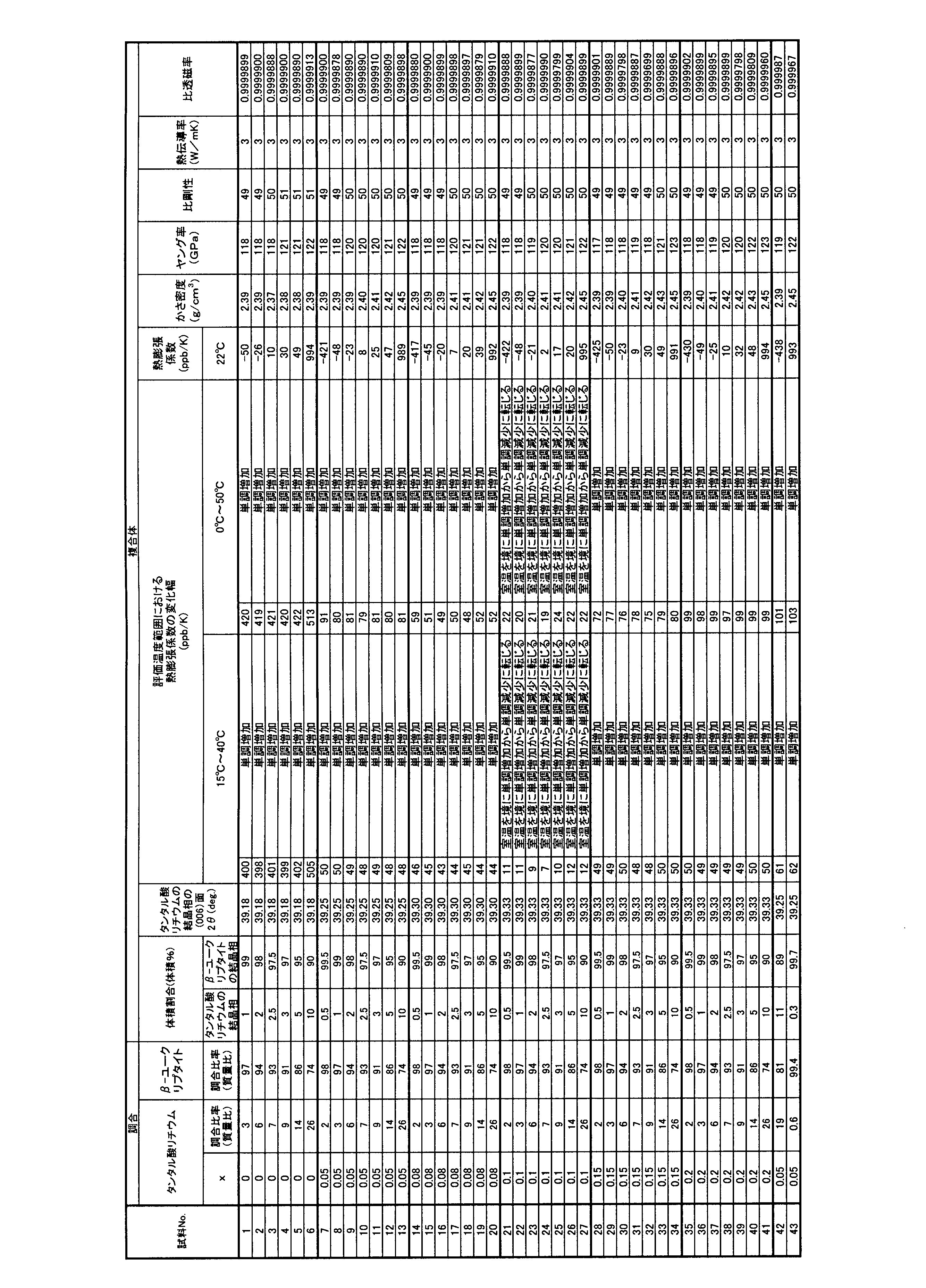
上述のようにして得たタンタル酸リチウムの結晶を使用して複合体を作製した。具体的には、平均粒径(D50)0.9μmのβ-ユークリプタイトおよびタンタル酸リチウムのそれぞれの結晶を混合して混合物を得た。このとき、得られる複合体においてβ-ユークリプタイトおよびタンタル酸リチウムのそれぞれの結晶相が表2に示す体積%となるような割合で、それぞれの結晶を混合した。具体的には、表2に示す調合比率(質量比)で各結晶を混合した。
そして、混合物を焼成し、表2に示す試料No.1~43の複合体を得た。焼成条件は、以下のとおりである。このような焼成条件にすることにより、β-ユークリプタイトおよびタンタル酸リチウムのそれぞれの結晶は、後に示す平均粒子径まで粒成長する。ここで、表2に示した試料No.7におけるタンタル酸リチウムの代わりにガラス(ほうケイ酸ガラス)を同量添加した試料は、ヤング率が90GPa、比剛性が36であった。
焼成温度:1150℃
キープ時間:3時間
焼成温度:1150℃
キープ時間:3時間
得られた複合体について、XRDによる測定を行った。XRDの測定条件は、以下のとおりである。
分析装置:PANalytical社製の「X’ Pert PRO-MRD」
管球:CuKα
スリット幅:0.5°
測定範囲:2θ=10~80°
分析装置:PANalytical社製の「X’ Pert PRO-MRD」
管球:CuKα
スリット幅:0.5°
測定範囲:2θ=10~80°
XRDによる測定結果から、得られた複合体においてβ-ユークリプタイトおよびタンタル酸リチウムのそれぞれの結晶相が確認された。また、複合体が、β-ユークリプタイトの結晶相およびタンタル酸リチウムの結晶相以外の結晶相およびガラス相を含まないことも確認された。上記2相の結晶相以外の結晶相を含まないとは、XRDのバックグランド強度の3倍強のピーク強度の回折ピークを優位なピークとした際にタンタル酸リチウムとβ-ユークリプタイト以外のピークがないことを意味する。また、ガラスなどの非晶質相が存在すると、XRDの2θ=20°付近にハローピークが確認される。上記2相の結晶相以外のガラス相を含まないとは、上記と同様にバックグランド強度の3倍強のハローピークがないことを意味する。
<評価>
試料No.1~43について、以下の(1)~(10)の評価を行った。
(1)β-ユークリプタイトの結晶相とタンタル酸リチウムの結晶相との体積割合
(2)タンタル酸リチウムの結晶相における(006)面の回折ピークの2θ
(3)結晶相の平均粒子径
(4)評価温度範囲における1℃毎に算出した熱膨張係数の変化幅
(5)22℃の熱膨張係数
(6)かさ密度
(7)ヤング率
(8)比剛性
(9)熱伝導率
(10)比透磁率
試料No.1~43について、以下の(1)~(10)の評価を行った。
(1)β-ユークリプタイトの結晶相とタンタル酸リチウムの結晶相との体積割合
(2)タンタル酸リチウムの結晶相における(006)面の回折ピークの2θ
(3)結晶相の平均粒子径
(4)評価温度範囲における1℃毎に算出した熱膨張係数の変化幅
(5)22℃の熱膨張係数
(6)かさ密度
(7)ヤング率
(8)比剛性
(9)熱伝導率
(10)比透磁率
各測定方法を以下に示すとともに、(3)以外の測定結果を表2に示す。なお、以下の測定において、複合体の断面の鏡面加工は、平均粒子径が0.5μmのダイヤモンドペーストを用いた研磨加工により行った。
(1)β-ユークリプタイトの結晶相とタンタル酸リチウムの結晶相との体積割合
複合体の断面を鏡面加工して、SEMを使用して反射電子像にて倍率×250で断面観察を行った。この際、タンタル酸リチウムとβ-ユークリプタイトはコントラストが異なって観察されるため、両者を区別できる。そして、断面観察写真を画像解析して、解析範囲の面積に対するそれぞれの面積を求め、それを体積%とした。なお、上述した余分のカルシウム成分は微量(0.1体積%以下)なため、表2では、β-ユークリプタイトの結晶相とタンタル酸リチウムの結晶相との合計値が100体積%になっている。
複合体の断面を鏡面加工して、SEMを使用して反射電子像にて倍率×250で断面観察を行った。この際、タンタル酸リチウムとβ-ユークリプタイトはコントラストが異なって観察されるため、両者を区別できる。そして、断面観察写真を画像解析して、解析範囲の面積に対するそれぞれの面積を求め、それを体積%とした。なお、上述した余分のカルシウム成分は微量(0.1体積%以下)なため、表2では、β-ユークリプタイトの結晶相とタンタル酸リチウムの結晶相との合計値が100体積%になっている。
(2)タンタル酸リチウムの結晶相における(006)面の回折ピークの2θ
上述したXRDによる測定結果から求めた。
上述したXRDによる測定結果から求めた。
(3)結晶相の平均粒子径
複合体の断面を鏡面加工し、反射電子像にて観察し、観察画像の画像解析によりβ-ユークリプタイトおよびタンタル酸リチウムのそれぞれの結晶相の平均粒子径を求めた。また、それらの結晶相を区別せずに、全体の平均粒子径を求めた。いずれの試料においても、β-ユークリプタイトの結晶相の平均粒子径は2μm、タンタル酸リチウムの結晶相の平均粒子径は4μm、それら結晶相を合わせた平均粒子径は2μmであった。
複合体の断面を鏡面加工し、反射電子像にて観察し、観察画像の画像解析によりβ-ユークリプタイトおよびタンタル酸リチウムのそれぞれの結晶相の平均粒子径を求めた。また、それらの結晶相を区別せずに、全体の平均粒子径を求めた。いずれの試料においても、β-ユークリプタイトの結晶相の平均粒子径は2μm、タンタル酸リチウムの結晶相の平均粒子径は4μm、それら結晶相を合わせた平均粒子径は2μmであった。
(4)評価温度範囲における1℃毎に算出した熱膨張係数の変化幅
0℃~50℃における1℃毎の熱膨張係数をJIS R 1618:1994に準拠して測定した。そして、15℃~40℃および0℃~50℃の各評価温度範囲における熱膨張係数の最大値および最小値を、式:最大値-最小値に当てはめ、熱膨張係数の変化幅を算出した。また、熱膨張係数の温度に対する変化を記載した。単調増加とは、対象の温度範囲において、温度が高くなるのにともなって、熱膨張係数も大きくなることを表す。単調減少は、その逆である。なお、熱膨張係数の温度依存性が低い場合は、測定誤差などの要因で、狭い温度範囲で逆の挙動を示す場合もある。
0℃~50℃における1℃毎の熱膨張係数をJIS R 1618:1994に準拠して測定した。そして、15℃~40℃および0℃~50℃の各評価温度範囲における熱膨張係数の最大値および最小値を、式:最大値-最小値に当てはめ、熱膨張係数の変化幅を算出した。また、熱膨張係数の温度に対する変化を記載した。単調増加とは、対象の温度範囲において、温度が高くなるのにともなって、熱膨張係数も大きくなることを表す。単調減少は、その逆である。なお、熱膨張係数の温度依存性が低い場合は、測定誤差などの要因で、狭い温度範囲で逆の挙動を示す場合もある。
(5)22℃の熱膨張係数
JIS R 1618:1994に準拠して21.5~22.5℃の熱膨張係数を測定した。
JIS R 1618:1994に準拠して21.5~22.5℃の熱膨張係数を測定した。
(6)かさ密度
JIS R 1634:1998に準拠して測定した。
JIS R 1634:1998に準拠して測定した。
(7)ヤング率
鏡面加工した複合体の断面に、MTS社製のナノインデンタXPを用いて連続剛体測定(CSM)にて、押込み深さ2000nmで10点測定し、その平均値をヤング率とした。
鏡面加工した複合体の断面に、MTS社製のナノインデンタXPを用いて連続剛体測定(CSM)にて、押込み深さ2000nmで10点測定し、その平均値をヤング率とした。
(8)比剛性
かさ密度およびヤング率のそれぞれの測定結果を、式:ヤング率/かさ密度に当てはめ、比剛性を算出した。
かさ密度およびヤング率のそれぞれの測定結果を、式:ヤング率/かさ密度に当てはめ、比剛性を算出した。
(9)熱伝導率
JIS R 1611:2010に準拠して測定した。
JIS R 1611:2010に準拠して測定した。
(10)比透磁率
試料サイズ:9mm×9mm×1.5mm
分析装置:東英工業社製の振動試料型磁力計「VSM-5型」
測定温度:室温(22℃)
磁界印加方向:面に平行
磁化レンジ:0.005emu
磁界レンジ:10kOe
磁界掃引:1.4kOe/min
時定数:0.3sec
試料サイズ:9mm×9mm×1.5mm
分析装置:東英工業社製の振動試料型磁力計「VSM-5型」
測定温度:室温(22℃)
磁界印加方向:面に平行
磁化レンジ:0.005emu
磁界レンジ:10kOe
磁界掃引:1.4kOe/min
時定数:0.3sec
[試料No.44および45]
<複合体の作製>
まず、組成式(Li1-xCax/2)TaO3で表したとき、xが表3に示す値になるタンタル酸リチウムの結晶を、試料No.1~43と同様にして作製した。次に、調合比率(質量比)を表3に示す比率にした以外は、試料No.1~43と同様にして、β-ユークリプタイトおよびタンタル酸リチウムのそれぞれの結晶を混合して混合物を得た。そして、焼成温度を表3に示す条件にした以外は、試料No.1~43と同様にして混合物を焼成し、表3に示す試料No.44および45の複合体を得た。
<複合体の作製>
まず、組成式(Li1-xCax/2)TaO3で表したとき、xが表3に示す値になるタンタル酸リチウムの結晶を、試料No.1~43と同様にして作製した。次に、調合比率(質量比)を表3に示す比率にした以外は、試料No.1~43と同様にして、β-ユークリプタイトおよびタンタル酸リチウムのそれぞれの結晶を混合して混合物を得た。そして、焼成温度を表3に示す条件にした以外は、試料No.1~43と同様にして混合物を焼成し、表3に示す試料No.44および45の複合体を得た。
得られた複合体について、試料No.1~43と同様にしてXRDによる測定を行った。その結果、得られた複合体においてβ-ユークリプタイトおよびタンタル酸リチウムのそれぞれの結晶相が確認された。また、複合体が、β-ユークリプタイトの結晶相およびタンタル酸リチウムの結晶相以外の結晶相およびガラス相を含まないことも確認された。
<評価>
試料No.44および45について、以下の(1)、(3)、(11)および(12)の評価を行った。
(1)β-ユークリプタイトの結晶相とタンタル酸リチウムの結晶相との体積割合
(3)結晶相の平均粒子径
(11)抗折強度
(12)吸水率
試料No.44および45について、以下の(1)、(3)、(11)および(12)の評価を行った。
(1)β-ユークリプタイトの結晶相とタンタル酸リチウムの結晶相との体積割合
(3)結晶相の平均粒子径
(11)抗折強度
(12)吸水率
(1)および(3)の測定方法は、試料No.1~43と同様である。(11)および(12)の測定方法を以下に示すとともに、測定結果を表3に示す。なお、比較のために試料No.10、38についても(11)および(12)の評価を行った。その結果を表3に併せて示す。
(11)抗折強度
JIS 1601に準拠して測定した。
JIS 1601に準拠して測定した。
(12)吸水率
アルキメデス法により測定した。
アルキメデス法により測定した。

Claims (17)
- β-ユークリプタイトの結晶相と、
タンタル酸リチウムの結晶相とを含むことを特徴とする複合体。 - 0~50℃の温度範囲において、1℃毎に算出した熱膨張係数が、0±1ppm/K以内である請求項1に記載の複合体。
- 前記タンタル酸リチウムの結晶相にカルシウムを含有していることを特徴とする請求項1または2に記載の複合体。
- 前記β-ユークリプタイトの結晶相と前記タンタル酸リチウムの結晶相との体積比が、90:10~99.5:0.5である請求項1~3のいずれかに記載の複合体。
- 前記タンタル酸リチウムの結晶相における(006)面の回折ピークの2θが、39.25°以上である請求項1~4のいずれかに記載の複合体。
- 15℃~40℃の温度範囲において、1℃毎に算出した熱膨張係数の変化幅が、50ppb/K以下である請求項1~5のいずれかに記載の複合体。
- 0℃~50℃の温度範囲において、1℃毎に算出した熱膨張係数の変化幅が、100ppb/K以下である請求項6に記載の複合体。
- 前記β-ユークリプタイトの結晶相および前記タンタル酸リチウムの結晶相を合わせた結晶相の平均粒子径が、2μm以下である請求項1~7のいずれかに記載の複合体。
- 比透磁率が、1以下である請求項1~8のいずれかに記載の複合体。
- 光学部材用である請求項1~9のいずれかに記載の複合体。
- かさ密度が、3g/cm3以下である請求項1~10のいずれかに記載の複合体。
- ヤング率が、100GPa以上である請求項1~11のいずれかに記載の複合体。
- 前記β-ユークリプタイトの結晶相の体積%が、前記タンタル酸リチウムの結晶相の体積%よりも大きい請求項1~12のいずれかに記載の複合体。
- 前記β-ユークリプタイトの結晶相と前記タンタル酸リチウムの結晶相との体積比が、90:10~99:1である請求項1~13のいずれかに記載の複合体。
- 光学部材用である請求項1~14のいずれかに記載の複合体。
- 比透磁率が、1.001以下である請求項1~15のいずれかに記載の複合体。
- 前記タンタル酸リチウムを組成式(Li1-xCax/2)TaO3で表したとき、0<x≦0.2であることを特徴とする請求項1~16のいずれかに記載の複合体。
Priority Applications (5)
| Application Number | Priority Date | Filing Date | Title |
|---|---|---|---|
| JP2020530252A JP6999813B2 (ja) | 2018-07-12 | 2019-07-11 | 複合体 |
| US17/258,983 US11858851B2 (en) | 2018-07-12 | 2019-07-11 | Complex |
| CN201980045107.9A CN112368431B (zh) | 2018-07-12 | 2019-07-11 | 复合体 |
| EP19834423.6A EP3822397A4 (en) | 2018-07-12 | 2019-07-11 | COMPLEX |
| KR1020217000305A KR102545364B1 (ko) | 2018-07-12 | 2019-07-11 | 복합체 |
Applications Claiming Priority (4)
| Application Number | Priority Date | Filing Date | Title |
|---|---|---|---|
| JP2018-132557 | 2018-07-12 | ||
| JP2018132557 | 2018-07-12 | ||
| JP2019-013179 | 2019-01-29 | ||
| JP2019013179 | 2019-01-29 |
Publications (1)
| Publication Number | Publication Date |
|---|---|
| WO2020013266A1 true WO2020013266A1 (ja) | 2020-01-16 |
Family
ID=69142673
Family Applications (1)
| Application Number | Title | Priority Date | Filing Date |
|---|---|---|---|
| PCT/JP2019/027464 Ceased WO2020013266A1 (ja) | 2018-07-12 | 2019-07-11 | 複合体 |
Country Status (6)
| Country | Link |
|---|---|
| US (1) | US11858851B2 (ja) |
| EP (1) | EP3822397A4 (ja) |
| JP (1) | JP6999813B2 (ja) |
| KR (1) | KR102545364B1 (ja) |
| CN (1) | CN112368431B (ja) |
| WO (1) | WO2020013266A1 (ja) |
Citations (5)
| Publication number | Priority date | Publication date | Assignee | Title |
|---|---|---|---|---|
| JPH03290352A (ja) * | 1990-04-05 | 1991-12-20 | Gifu Pref Gov | 高強度・低熱膨張セラミック及びその製造方法 |
| JP2000281454A (ja) * | 1999-03-31 | 2000-10-10 | Kyocera Corp | 低熱膨張高剛性セラミックス |
| JP2003267789A (ja) | 2001-12-21 | 2003-09-25 | Carl Zeiss:Fa | Cte−t曲線の可変調整可能なゼロ交叉を有するガラスセラミック製品 |
| JP2004269272A (ja) * | 2003-03-05 | 2004-09-30 | Taiheiyo Cement Corp | 高剛性低熱膨張セラミックス部材 |
| JP2014065635A (ja) * | 2012-09-26 | 2014-04-17 | Taiheiyo Cement Corp | 低熱膨張セラミックスおよびその製造方法 |
Family Cites Families (6)
| Publication number | Priority date | Publication date | Assignee | Title |
|---|---|---|---|---|
| JP4476529B2 (ja) * | 2001-12-19 | 2010-06-09 | 株式会社オハラ | ガラスセラミックス及び温度補償部材 |
| FR2959506B1 (fr) * | 2010-04-30 | 2014-01-03 | Thales Sa | Materiau composite ceramique a base de beta-eucryptite et d'un oxyde et procede de fabrication dudit materiau. |
| FR2959507B1 (fr) * | 2010-04-30 | 2014-01-03 | Thales Sa | Procede de fabrication d'un materiau composite ceramique a base de nitrure de silicium et de beta-eucryptite. |
| CN104988437B (zh) * | 2015-05-29 | 2016-09-28 | 哈尔滨工业大学 | 纤维增强金属基复合材料的三维各向同性化的方法 |
| WO2017183490A1 (ja) * | 2016-04-21 | 2017-10-26 | 日本電気硝子株式会社 | セラミック粉末、複合粉末材料及び封着材料 |
| JP6966724B2 (ja) * | 2016-07-06 | 2021-11-17 | 日本電気硝子株式会社 | 複合セラミック粉末、封着材料及び複合セラミック粉末の製造方法 |
-
2019
- 2019-07-11 US US17/258,983 patent/US11858851B2/en active Active
- 2019-07-11 JP JP2020530252A patent/JP6999813B2/ja active Active
- 2019-07-11 WO PCT/JP2019/027464 patent/WO2020013266A1/ja not_active Ceased
- 2019-07-11 CN CN201980045107.9A patent/CN112368431B/zh active Active
- 2019-07-11 KR KR1020217000305A patent/KR102545364B1/ko active Active
- 2019-07-11 EP EP19834423.6A patent/EP3822397A4/en active Pending
Patent Citations (5)
| Publication number | Priority date | Publication date | Assignee | Title |
|---|---|---|---|---|
| JPH03290352A (ja) * | 1990-04-05 | 1991-12-20 | Gifu Pref Gov | 高強度・低熱膨張セラミック及びその製造方法 |
| JP2000281454A (ja) * | 1999-03-31 | 2000-10-10 | Kyocera Corp | 低熱膨張高剛性セラミックス |
| JP2003267789A (ja) | 2001-12-21 | 2003-09-25 | Carl Zeiss:Fa | Cte−t曲線の可変調整可能なゼロ交叉を有するガラスセラミック製品 |
| JP2004269272A (ja) * | 2003-03-05 | 2004-09-30 | Taiheiyo Cement Corp | 高剛性低熱膨張セラミックス部材 |
| JP2014065635A (ja) * | 2012-09-26 | 2014-04-17 | Taiheiyo Cement Corp | 低熱膨張セラミックスおよびその製造方法 |
Non-Patent Citations (1)
| Title |
|---|
| See also references of EP3822397A4 |
Also Published As
| Publication number | Publication date |
|---|---|
| KR20210016040A (ko) | 2021-02-10 |
| CN112368431B (zh) | 2022-09-16 |
| JPWO2020013266A1 (ja) | 2021-07-15 |
| EP3822397A1 (en) | 2021-05-19 |
| KR102545364B1 (ko) | 2023-06-20 |
| CN112368431A (zh) | 2021-02-12 |
| EP3822397A4 (en) | 2022-04-20 |
| US11858851B2 (en) | 2024-01-02 |
| US20210309576A1 (en) | 2021-10-07 |
| JP6999813B2 (ja) | 2022-01-19 |
Similar Documents
| Publication | Publication Date | Title |
|---|---|---|
| JP7638234B2 (ja) | ジルコニア焼結体及びその製造方法 | |
| JP6724266B2 (ja) | ニオブ酸カリウムナトリウムスパッタリングターゲット及びその製造方法 | |
| Lee et al. | Low-temperature sintering of MnO2-doped PZT–PZN Piezoelectric ceramics | |
| Haoming et al. | Thermophysical performances of novel high entropy (La0. 25 RE0. 25Yb0. 25 Y0. 25) 2Ce2O7 (RE= Nd and Dy) oxides | |
| Yao et al. | Microwave dielectric properties of CaV2O6 ceramics with low dielectric loss | |
| Pratapa et al. | Synthesis and characterization of high-density B2O3-added forsterite ceramics | |
| CN112119038B (zh) | 负热膨胀材料及其制造方法 | |
| Kozakov et al. | Phase transitions, dielectric properties and valence of magnetic ions in PbFe0. 5− x Cr x Nb0. 5O3 multiferroic ceramics | |
| Pelletant et al. | Thermal expansion of β-eucryptite in oxide-based ceramic composites | |
| Muhammad et al. | Structure–property relationship in NaCa4B5O17 (B= Nb, Ta) perovskites | |
| Zhou et al. | Low permittivity MgO–x B2O3–y BaCu (B2O5) microwave dielectric ceramics for low temperature co-fired ceramics technology | |
| JP6999813B2 (ja) | 複合体 | |
| CN103080041A (zh) | 介质烧结体及其制造方法以及介质谐振器 | |
| JP2004182554A (ja) | ジルコニア粉末 | |
| Yuan et al. | Effect of Li2CO3–Bi2O3 doping on the low-temperature sintering, structure, and dielectric and mechanical properties of MgO–TiO2 (w) ceramics | |
| Ruan et al. | Microwave dielectric properties of ZnO–Nb2O5–x TiO2 ceramics prepared by reaction-sintering process | |
| Gul et al. | Influence of particle size and sintering temperatures on electrical properties of 0.94 Na0. 5Bi0. 5TiO3-0.06 BaTiO3 lead free ceramics | |
| Rudnicki et al. | Spray pyrolysis of yttria-stabilized zirconia nanoparticles and their densification into bulk transparent windows | |
| CN117986004B (zh) | 一种尖晶石型高熵透明陶瓷及其制备方法和应用 | |
| RU2665734C1 (ru) | Керамический материал с низкой температурой спекания на основе диоксида циркония тетрагональной модификации | |
| Li et al. | Correlation between crystal structure and enhanced microwave dielectric characteristics of wolframite-structure Mg0. 5Zr0. 5NbO4 ceramics | |
| Pei et al. | Structural phase transformation and microwave dielectric properties of polymorphic Li3Mg2SbO6− xF2x oxyfluoride nanoceramics | |
| Ma et al. | Low temperature firing and microwave dielectric properties of Bi4− xGe3O12− 1.5 x ceramics | |
| Peng et al. | Influence of Ca2+ substitution for Ba2+ on the crystal structure and microwave dielectric properties of Ba1− x Ca x (Mg1/3Ta2/3) O3 ceramics | |
| Duangsupa et al. | Structure and mechanical properties of ZrO 2 (MgO)—CaSiO 3 composites |
Legal Events
| Date | Code | Title | Description |
|---|---|---|---|
| 121 | Ep: the epo has been informed by wipo that ep was designated in this application |
Ref document number: 19834423 Country of ref document: EP Kind code of ref document: A1 |
|
| ENP | Entry into the national phase |
Ref document number: 2020530252 Country of ref document: JP Kind code of ref document: A Ref document number: 20217000305 Country of ref document: KR Kind code of ref document: A |
|
| NENP | Non-entry into the national phase |
Ref country code: DE |