WO2020031339A1 - Substrat de verre cristallisé - Google Patents
Substrat de verre cristallisé Download PDFInfo
- Publication number
- WO2020031339A1 WO2020031339A1 PCT/JP2018/029966 JP2018029966W WO2020031339A1 WO 2020031339 A1 WO2020031339 A1 WO 2020031339A1 JP 2018029966 W JP2018029966 W JP 2018029966W WO 2020031339 A1 WO2020031339 A1 WO 2020031339A1
- Authority
- WO
- WIPO (PCT)
- Prior art keywords
- component
- crystallized glass
- glass substrate
- compressive stress
- mpa
- Prior art date
- Legal status (The legal status is an assumption and is not a legal conclusion. Google has not performed a legal analysis and makes no representation as to the accuracy of the status listed.)
- Ceased
Links
Images
Classifications
-
- C—CHEMISTRY; METALLURGY
- C03—GLASS; MINERAL OR SLAG WOOL
- C03C—CHEMICAL COMPOSITION OF GLASSES, GLAZES OR VITREOUS ENAMELS; SURFACE TREATMENT OF GLASS; SURFACE TREATMENT OF FIBRES OR FILAMENTS MADE FROM GLASS, MINERALS OR SLAGS; JOINING GLASS TO GLASS OR OTHER MATERIALS
- C03C3/00—Glass compositions
- C03C3/04—Glass compositions containing silica
- C03C3/076—Glass compositions containing silica with 40% to 90% silica, by weight
- C03C3/083—Glass compositions containing silica with 40% to 90% silica, by weight containing aluminium oxide or an iron compound
- C03C3/085—Glass compositions containing silica with 40% to 90% silica, by weight containing aluminium oxide or an iron compound containing an oxide of a divalent metal
-
- C—CHEMISTRY; METALLURGY
- C03—GLASS; MINERAL OR SLAG WOOL
- C03C—CHEMICAL COMPOSITION OF GLASSES, GLAZES OR VITREOUS ENAMELS; SURFACE TREATMENT OF GLASS; SURFACE TREATMENT OF FIBRES OR FILAMENTS MADE FROM GLASS, MINERALS OR SLAGS; JOINING GLASS TO GLASS OR OTHER MATERIALS
- C03C10/00—Devitrified glass ceramics, i.e. glass ceramics having a crystalline phase dispersed in a glassy phase and constituting at least 50% by weight of the total composition
- C03C10/0018—Devitrified glass ceramics, i.e. glass ceramics having a crystalline phase dispersed in a glassy phase and constituting at least 50% by weight of the total composition containing SiO2, Al2O3 and monovalent metal oxide as main constituents
-
- C—CHEMISTRY; METALLURGY
- C03—GLASS; MINERAL OR SLAG WOOL
- C03C—CHEMICAL COMPOSITION OF GLASSES, GLAZES OR VITREOUS ENAMELS; SURFACE TREATMENT OF GLASS; SURFACE TREATMENT OF FIBRES OR FILAMENTS MADE FROM GLASS, MINERALS OR SLAGS; JOINING GLASS TO GLASS OR OTHER MATERIALS
- C03C10/00—Devitrified glass ceramics, i.e. glass ceramics having a crystalline phase dispersed in a glassy phase and constituting at least 50% by weight of the total composition
- C03C10/0036—Devitrified glass ceramics, i.e. glass ceramics having a crystalline phase dispersed in a glassy phase and constituting at least 50% by weight of the total composition containing SiO2, Al2O3 and a divalent metal oxide as main constituents
- C03C10/0045—Devitrified glass ceramics, i.e. glass ceramics having a crystalline phase dispersed in a glassy phase and constituting at least 50% by weight of the total composition containing SiO2, Al2O3 and a divalent metal oxide as main constituents containing SiO2, Al2O3 and MgO as main constituents
-
- C—CHEMISTRY; METALLURGY
- C03—GLASS; MINERAL OR SLAG WOOL
- C03C—CHEMICAL COMPOSITION OF GLASSES, GLAZES OR VITREOUS ENAMELS; SURFACE TREATMENT OF GLASS; SURFACE TREATMENT OF FIBRES OR FILAMENTS MADE FROM GLASS, MINERALS OR SLAGS; JOINING GLASS TO GLASS OR OTHER MATERIALS
- C03C21/00—Treatment of glass, not in the form of fibres or filaments, by diffusing ions or metals in the surface
-
- C—CHEMISTRY; METALLURGY
- C03—GLASS; MINERAL OR SLAG WOOL
- C03C—CHEMICAL COMPOSITION OF GLASSES, GLAZES OR VITREOUS ENAMELS; SURFACE TREATMENT OF GLASS; SURFACE TREATMENT OF FIBRES OR FILAMENTS MADE FROM GLASS, MINERALS OR SLAGS; JOINING GLASS TO GLASS OR OTHER MATERIALS
- C03C21/00—Treatment of glass, not in the form of fibres or filaments, by diffusing ions or metals in the surface
- C03C21/001—Treatment of glass, not in the form of fibres or filaments, by diffusing ions or metals in the surface in liquid phase, e.g. molten salts, solutions
- C03C21/002—Treatment of glass, not in the form of fibres or filaments, by diffusing ions or metals in the surface in liquid phase, e.g. molten salts, solutions to perform ion-exchange between alkali ions
-
- C—CHEMISTRY; METALLURGY
- C03—GLASS; MINERAL OR SLAG WOOL
- C03C—CHEMICAL COMPOSITION OF GLASSES, GLAZES OR VITREOUS ENAMELS; SURFACE TREATMENT OF GLASS; SURFACE TREATMENT OF FIBRES OR FILAMENTS MADE FROM GLASS, MINERALS OR SLAGS; JOINING GLASS TO GLASS OR OTHER MATERIALS
- C03C3/00—Glass compositions
- C03C3/04—Glass compositions containing silica
- C03C3/076—Glass compositions containing silica with 40% to 90% silica, by weight
- C03C3/083—Glass compositions containing silica with 40% to 90% silica, by weight containing aluminium oxide or an iron compound
- C03C3/085—Glass compositions containing silica with 40% to 90% silica, by weight containing aluminium oxide or an iron compound containing an oxide of a divalent metal
- C03C3/087—Glass compositions containing silica with 40% to 90% silica, by weight containing aluminium oxide or an iron compound containing an oxide of a divalent metal containing calcium oxide, e.g. common sheet or container glass
-
- C—CHEMISTRY; METALLURGY
- C03—GLASS; MINERAL OR SLAG WOOL
- C03C—CHEMICAL COMPOSITION OF GLASSES, GLAZES OR VITREOUS ENAMELS; SURFACE TREATMENT OF GLASS; SURFACE TREATMENT OF FIBRES OR FILAMENTS MADE FROM GLASS, MINERALS OR SLAGS; JOINING GLASS TO GLASS OR OTHER MATERIALS
- C03C4/00—Compositions for glass with special properties
- C03C4/18—Compositions for glass with special properties for ion-sensitive glass
-
- C—CHEMISTRY; METALLURGY
- C03—GLASS; MINERAL OR SLAG WOOL
- C03C—CHEMICAL COMPOSITION OF GLASSES, GLAZES OR VITREOUS ENAMELS; SURFACE TREATMENT OF GLASS; SURFACE TREATMENT OF FIBRES OR FILAMENTS MADE FROM GLASS, MINERALS OR SLAGS; JOINING GLASS TO GLASS OR OTHER MATERIALS
- C03C2204/00—Glasses, glazes or enamels with special properties
-
- C—CHEMISTRY; METALLURGY
- C03—GLASS; MINERAL OR SLAG WOOL
- C03C—CHEMICAL COMPOSITION OF GLASSES, GLAZES OR VITREOUS ENAMELS; SURFACE TREATMENT OF GLASS; SURFACE TREATMENT OF FIBRES OR FILAMENTS MADE FROM GLASS, MINERALS OR SLAGS; JOINING GLASS TO GLASS OR OTHER MATERIALS
- C03C3/00—Glass compositions
- C03C3/04—Glass compositions containing silica
- C03C3/076—Glass compositions containing silica with 40% to 90% silica, by weight
- C03C3/089—Glass compositions containing silica with 40% to 90% silica, by weight containing boron
- C03C3/091—Glass compositions containing silica with 40% to 90% silica, by weight containing boron containing aluminium
- C03C3/093—Glass compositions containing silica with 40% to 90% silica, by weight containing boron containing aluminium containing zinc or zirconium
Definitions
- the present invention relates to a crystallized glass substrate having a compressive stress layer on the surface.
- Portable electronic devices such as smartphones and tablet PCs use a cover glass to protect the display.
- protectors for protecting lenses are also used in optical devices for vehicles.
- hard and hard-to-break materials so that these devices can withstand more severe use.
- Patent Document 1 discloses a crystallized glass substrate for an information recording medium. When a crystallized glass substrate was subjected to chemical strengthening, a sufficient compressive stress value could not be obtained.
- An object of the present invention is to obtain a crystallized glass substrate that is hard and hard to break.
- the present inventors have conducted intensive studies in order to solve the above problems, and as a result, have found that a crystallized glass substrate having high impact resistance and having difficulty in breaking can be obtained if the surface has a predetermined compressive stress layer.
- the present invention provides the following.
- (Configuration 1) A crystallized glass substrate having a compressive stress layer on the surface, When the compressive stress of the compressive stress layer is 0 MPa, the stress depth DOL zero is 45 to 200 ⁇ m; A compressive stress CS of the outermost surface of the compressive stress layer is 400 to 1400 MPa; A crystallized glass substrate wherein CS ⁇ DOL zero, which is a product of the compressive stress CS on the outermost surface and the stress depth DOL zero ( ⁇ m), is 4.8 ⁇ 10 4 or more.
- Configuration 2 The crystallized glass substrate according to Configuration 1, wherein a sum 2 ⁇ DOL zero of the stress depths from both surfaces of the crystallized glass substrate is 10 to 80% of a thickness T of the crystallized glass substrate.
- (Configuration 3) In terms of weight% in terms of oxide, 40.0% to 70.0% of SiO 2 component, Al 2 O 3 component from 11.0% to 25.0%, Na 2 O component from 5.0% to 19.0%, 0% to 9.0% of K 2 O component, 1.0% to 18.0% of at least one selected from a MgO component and a ZnO component, 0% to 3.0% of CaO component, 0.5% to 12.0% of TiO 2 component, 3.
- the crystallized glass substrate according to configuration 1 or 2 which comprises: (Configuration 4) 4. The crystallized glass substrate according to any one of the constitutions 1 to 3, wherein the thickness T of the crystallized glass substrate is 0.1 to 1.0 mm. (Configuration 5) 5.
- (Configuration 6) 6.
- the stress depth DOL zero is 70 to 110 ⁇ m;
- the compressive stress CS of the outermost surface is 550 to 890 MPa,
- the central stress CT is 100 to 250 MPa, 7.
- the stress depth DOL zero is 65 to 85 ⁇ m;
- the outermost surface has a compressive stress CS of 700 to 860 MPa;
- the central stress CT is 120 to 240 MPa, 7.
- a crystallized glass substrate that is hard and hard to break can be obtained.
- the crystallized glass substrate of the present invention can be used for a cover glass of a display or a lens of an electronic device, an outer frame member or a housing, an optical lens material, and other various members.
- the crystallized glass substrate of the present invention uses crystallized glass as a base material (also referred to as a crystallized glass base material) and has a compressive stress layer on the surface.
- the compressive stress layer can be formed by subjecting the crystallized glass base material to an ion exchange treatment.
- the compressive stress layer is formed at a predetermined thickness inward from the outermost surface of the substrate, and the compressive stress is highest at the outermost surface, decreases toward the inside, and becomes zero.
- the compressive stress (also referred to as the outermost surface compressive stress) CS of the outermost surface of the compressive stress layer is 400 to 1400 MPa, for example, 550 to 1300 MPa, 600 to 1200 MPa, 650 to 1000 MPa, 700 to 890 MPa, 700 to 880 MPa, or 750. To 860 MPa.
- the depth DOL zero (also referred to as stress depth) when the compressive stress of the compressive stress layer is 0 MPa is 45 to 200 ⁇ m, for example, 50 to 140 ⁇ m, 55 to 120 ⁇ m, 65 to 110 ⁇ m, 70 to 100 ⁇ m, or 75 to 200 ⁇ m. It can be 85 ⁇ m.
- the sum of the stress depths from both sides of the crystallized glass substrate may be 10 to 80%, 12 to 60%, 15 to 50%, or 20 to 40% of the thickness of the compressive stress layer. .
- the center stress CT may be 55 to 300 MPa, for example, 60 to 250 MPa, 65 to 240 MPa, 80 to 230 MPa, 100 to 200 MPa, 105 to 180 MPa, or 120 to 150 MPa.
- the central stress CT is obtained by curve analysis.
- the sum of the outermost surface compressive stress CS and the central stress CT may be 600 to 1400 MPa, and may be 700 to 1200 MPa, 750 to 1100 MPa, or 800 to 1000 MPa.
- CS ⁇ DOL zero is 4.8 ⁇ 10 4 or more.
- CS ⁇ DOL zero is 4.8 ⁇ 10 4 or more.
- 4.8 ⁇ 10 4 to 9.0 ⁇ 10 4 5.0 ⁇ 10 4 to 8.0 ⁇ 10 4 , 5.3 ⁇ 10 4 to 7.2 ⁇ 10 4 , 5.5 ⁇ 10 4 ⁇ 7.0 ⁇ 10 4 or 5.7 ⁇ 10 4 to 6.9 ⁇ 10 4 .
- Compressive stress layer the above stress depth DOL zero, the outermost surface compressive stress CS and central stress CT, especially with the above-mentioned stress depth and the outermost surface compressive stress, the substrate is hardly broken.
- the stress depth, the outermost surface compressive stress, and the central stress can be adjusted by adjusting the composition, the thickness of the substrate, and the chemical strengthening conditions.
- the lower limit of the thickness of the crystallized glass substrate is preferably 0.15 mm or more, more preferably 0.30 mm or more, more preferably 0.40 mm or more, and still more preferably 0.50 mm or more.
- the upper limit of the thickness is preferably 1.00 mm or less, more preferably 0.90 mm or less, more preferably 0.70 mm or less, and still more preferably 0.6 mm or less.
- EE / ⁇ which is the ratio between the Young's modulus E (GPa) of the crystallized glass substrate and the specific gravity ⁇ , is preferably 31 or more, more preferably 32 or more, and even more preferably 33 or more.
- Crystallized glass is a material having a crystalline phase and a glass phase, and is distinguished from an amorphous solid. Generally, the crystal phase of the crystallized glass is determined using the angle of a peak appearing in an X-ray diffraction pattern of X-ray diffraction analysis and, if necessary, TEMEDX.
- the crystallized glass is, for example, MgAl 2 O 4 , MgTi 2 O 4 , MgTi 2 O 5 , Mg 2 TiO 4 , Mg 2 SiO 4 , MgAl 2 Si 2 O 8 , Mg 2 Al 4 Si 5 O 18 as a crystal phase. , Mg 2 TiO 5 , MgSiO 3 , NaAlSiO 4 , FeAl 2 O 4 and a solid solution thereof.
- the average crystal diameter of the crystallized glass is, for example, 4 to 15 nm, and can be 5 to 13 nm or 6 to 10 nm.
- the surface roughness Ra after polishing can be easily processed to a level of several ⁇ . Also, the transmittance increases.
- each component constituting the crystallized glass is described below.
- the content of each component is expressed in terms of% by weight in terms of oxide, unless otherwise specified.
- oxide conversion means that, when it is assumed that all the constituent components of the crystallized glass are decomposed and changed to an oxide, the total weight of the oxide is 100% by weight in the crystallized glass.
- the amount of the oxide of each component contained is expressed in terms of% by weight.
- the crystallized glass serving as a base material is preferably in a weight% in terms of oxide, 40.0% to 70.0% of SiO 2 component, Al 2 O 3 component from 11.0% to 25.0%, Na 2 O component from 5.0% to 19.0%, 0% to 9.0% of K 2 O component, 1.0% to 18.0% of at least one selected from a MgO component and a ZnO component, 0% to 3.0% of CaO component, 0.5% to 12.0% of TiO 2 component, It contains.
- the SiO 2 component is more preferably contained in a content of 45.0% to 65.0%, further preferably 50.0% to 60.0%.
- the Al 2 O 3 component is more preferably contained from 13.0% to 23.0%.
- the Na 2 O component is more preferably contained from 8.0% to 16.0%. It may be 9.0% or more or 10.5% or more.
- the K 2 O component is more preferably contained from 0.1% to 7.0%, and still more preferably from 1.0% to 5.0%.
- One or more selected from the MgO component and the ZnO component is more preferably 2.0% to 15.0%, further preferably 3.0% to 13.0%, and particularly preferably 5.0% to 11.0%. %included.
- One or more selected from the MgO component and the ZnO component may be the MgO component alone, the ZnO component alone or both, but preferably the MgO component alone.
- the CaO component is more preferably contained from 0.01% to 3.0%, and still more preferably from 0.1% to 2.0%.
- the TiO 2 component is more preferably contained in an amount of 1.0% to 10.0%, and further preferably 2.0% to 8.0%.
- the crystallized glass contains 0.01% to 3.0% (preferably 0.1% to 2.0%, more preferably 1% or more selected from Sb 2 O 3 component, SnO 2 component and CeO 2 component). 0.1% to 1.0%). The above blending amounts can be appropriately combined.
- the crystallized glass may or may not contain a ZrO 2 component as long as the effects of the present invention are not impaired.
- the amount can be 0 to 5.0%, 0 to 3.0% or 0 to 2.0%.
- the crystallized glass may be a B 2 O 3 component, a P 2 O 5 component, a BaO component, a FeO component, a SnO 2 component, a Li 2 O component, a SrO component, or a La 2 O component as long as the effects of the present invention are not impaired.
- 3 component, Y 2 O 3 component, Nb 2 O 5 component, Ta 2 O 5 component, WO 3 components, TeO 2 component may each contain Bi 2 O 3 component may not include.
- the compounding amount can be 0 to 2.0%, 0 or more and less than 2.0%, or 0 to 1.0%, respectively.
- the crystallized glass of the present invention comprises, as a fining agent, a Sb 2 O 3 component, a SnO 2 component, a CeO 2 component, an As 2 O 3 component, and one selected from the group consisting of F, Cl, NOx, and SOx. Two or more types may be included or may not be included. However, the content of the fining agent is preferably 5.0% or less, more preferably 2.0% or less, and most preferably 1.0% or less.
- the crystallized glass serving as the base material is preferably in terms of mole% in terms of oxide, 43.0 mol% to 73.0 mol% of the SiO 2 component, 4.0 mol% to 18.0 mol% of the Al 2 O 3 component, Na 2 O component of 5.0 mol% to 19.0 mol%, 0 to 9.0 mol% of K 2 O component, 2.0 mol% to 22.0 mol% of at least one selected from MgO component and ZnO component, 0 to 3.0 mol% of CaO component, 0.5 mol% to 11.0 mol% of the TiO 2 component, It contains.
- the crystallized glass (and substrate) of the present invention may be colorless and transparent, but the glass can be colored within a range that does not impair the properties of the crystallized glass.
- the crystallized glass substrate of the present invention preferably has a breaking height of 60 cm or more, 70 cm or more, 80 cm or more, 90 cm or more, 100 cm or more, or 110 cm or more in the drop test measured in the examples.
- the crystallized glass substrate of the present invention can be manufactured by the following method. That is, raw materials are uniformly mixed and melt-molded to produce raw glass. Next, the raw glass is crystallized to produce a crystallized glass base material. Further, the crystallized glass base material is chemically strengthened.
- the raw glass is heat-treated to precipitate crystals inside the glass.
- This heat treatment may be performed in one stage or two stages.
- a nucleus forming step is first performed by performing a heat treatment at a first temperature, and after this nucleus forming step, a crystal growth step is performed by performing a heat treatment at a second temperature higher than the nucleus forming step.
- the nucleation step and the crystal growth step are continuously performed at one step temperature.
- the temperature is raised to a predetermined heat treatment temperature, the temperature is maintained for a certain time after reaching the heat treatment temperature, and then the temperature is lowered.
- the first temperature of the two-step heat treatment is preferably from 600 ° C. to 750 ° C.
- the holding time at the first temperature is preferably 30 minutes to 2000 minutes, more preferably 180 minutes to 1440 minutes.
- the second temperature of the two-step heat treatment is preferably from 650 ° C. to 850 ° C.
- the holding time at the second temperature is preferably 30 minutes to 600 minutes, more preferably 60 minutes to 300 minutes.
- the heat treatment temperature is preferably from 600 ° C to 800 ° C, more preferably from 630 ° C to 770 ° C.
- the holding time at the heat treatment temperature is preferably 30 minutes to 500 minutes, more preferably 60 minutes to 300 minutes.
- a thin plate-shaped crystallized glass base material can be produced, for example, by means of grinding and polishing.
- a compressive stress layer is formed on the crystallized glass base material by ion exchange using a chemical strengthening method.
- the crystallized glass substrate of the present invention is characterized in that the crystallized glass base material is not a mixed molten salt of a potassium salt and a sodium salt (mixed bath), but a potassium salt (one or more potassium salts, for example, potassium nitrate (KNO 3) ), Potassium carbonate (K 2 CO 3 ), potassium sulfate (K 2 SO 4 )) and a molten salt (individual bath) at a predetermined temperature and for a predetermined time by chemical strengthening. For example, contacting or immersing a molten salt heated to 450 to 580 ° C.
- a potassium salt one or more potassium salts, for example, potassium nitrate (KNO 3)
- K 2 CO 3 Potassium carbonate
- K 2 SO 4 potassium sulfate
- corresponding materials such as oxides, hydroxides, carbonates, nitrates, fluorides, chlorides, and metaphosphate compounds were selected as the raw materials for the components of the crystallized glass.
- the mixed raw materials were put into a platinum crucible and melted. Thereafter, the molten glass was stirred and homogenized, then cast into a mold, and gradually cooled to produce an original glass.
- the obtained raw glass was subjected to a one-step heat treatment (650 to 730 ° C., 5 hours) for nucleation and crystallization to produce a crystallized glass as a base material.
- the obtained crystallized glass was analyzed by a 200 kV field emission transmission electron microscope FE-TEM (JEM2100F manufactured by JEOL Ltd.). As a result, precipitated crystals having an average crystal diameter of 6 to 9 nm were observed. Further, lattice image confirmation by electron diffraction image and analysis by EDX were performed, and crystal phases of MgAl 2 O 4 and MgTi 2 O 4 were confirmed.
- the average crystal diameter was determined by using a transmission electron microscope to determine the crystal diameter of crystal particles in the range of 180 ⁇ 180 nm 2 and calculating the average value.
- the produced crystallized glass base material was cut and ground so as to have a shape of 150 mm in length, 70 mm in width, and more than 1.0 mm in thickness, and was further polished face-to-face.
- the crystallized glass base material was colorless and transparent.
- the crystallized glass base material polished face-to-face parallel to the thickness shown in Table 1 was chemically strengthened to obtain a crystallized glass substrate having a compressive stress layer on the surface. Specifically, it was immersed in a molten salt of KNO 3 at a salt bath temperature and an immersion time shown in Table 1.
- Comparative Example 1 a general chemically strengthened glass substrate having the following composition was used. It is considered that the substrate was immersed in a mixed bath of KNO 3 and NaNO 3 and then immersed in a single bath of KNO 3 . (Weight% in oxide) The SiO 2 component 54%, 13% of Al 2 O 3 component, 5% Na 2 O component, 17% of K 2 O component, the MgO component 5.5%, 0.5% CaO component, B 2 3% O 3 %, 2 % ZrO 2%
- the compressive stress value (CS) (MPa) and the stress depth (DOL zero ) ( ⁇ m) of the outermost surface of the crystallized glass substrate were measured using a glass surface stress meter FSM-6000LE manufactured by Orihara Seisakusho.
- the refractive index of the sample was calculated at 1.54 and the optical elastic constant was 29.658 [(nm / cm) / MPa].
- the central stress value (CT) (MPa) was determined by curve analysis.
- Table 1 shows the thickness (T) (mm) of the substrate, CS ⁇ DOL zero , and the ratio of DOL zero (sum of DOL zero from both sides of the substrate) in the thickness (T) of the substrate (2DOL zero / 1000T ⁇ 100), the sum of the outermost surface compressive stress value and the central stress value (CS + CT) (MPa) is also described.
- the crystallized glass substrate was subjected to a steel ball drop test by the following method.
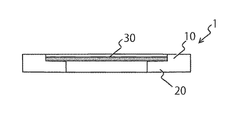
- An acrylic frame 1 having a cross section shown in FIG. 1 was used.
- the frame 1 includes a rectangular outer frame 10 and an inner frame 20 lower than the outer frame.
- the outer frame and the inner frame form a step, and the inside of the inner frame is empty.
- the inner size of the outer frame 10 is 151 mm ⁇ 71 mm
- the inner size of the inner frame 20 is 141 mm ⁇ 61 mm.
- the crystallized glass substrate 30 was placed inside the outer frame and on the inner frame.
- a 130 g stainless steel ball was dropped from a height of 10 cm from the crystallized glass substrate. After the drop, if the substrate did not break, the height was increased by 10 cm and the same test was continued until the break. Table 1 shows the broken height. Table 1 shows that the substrates of the examples are hard to break.
Landscapes
- Chemical & Material Sciences (AREA)
- Engineering & Computer Science (AREA)
- Materials Engineering (AREA)
- Life Sciences & Earth Sciences (AREA)
- Chemical Kinetics & Catalysis (AREA)
- General Chemical & Material Sciences (AREA)
- Geochemistry & Mineralogy (AREA)
- Organic Chemistry (AREA)
- Crystallography & Structural Chemistry (AREA)
- Dispersion Chemistry (AREA)
- Ceramic Engineering (AREA)
- Glass Compositions (AREA)
- Surface Treatment Of Glass (AREA)
Abstract
Priority Applications (8)
| Application Number | Priority Date | Filing Date | Title |
|---|---|---|---|
| KR1020217003310A KR20210040964A (ko) | 2018-08-09 | 2018-08-09 | 결정화 유리 기판 |
| CN201880095948.6A CN112512984B (zh) | 2018-08-09 | 2018-08-09 | 结晶化玻璃基板 |
| US17/266,634 US11584685B2 (en) | 2018-08-09 | 2018-08-09 | Crystallized glass substrate |
| PCT/JP2018/029966 WO2020031339A1 (fr) | 2018-08-09 | 2018-08-09 | Substrat de verre cristallisé |
| KR1020247022194A KR20240113584A (ko) | 2018-08-09 | 2018-08-09 | 결정화 유리 기판 |
| JP2020535435A JP6896358B2 (ja) | 2018-08-09 | 2018-08-09 | 結晶化ガラス基板 |
| TW107129294A TWI759531B (zh) | 2018-08-09 | 2018-08-22 | 結晶化玻璃基板 |
| US18/154,042 US11926559B2 (en) | 2018-08-09 | 2023-01-13 | Crystallized glass substrate |
Applications Claiming Priority (1)
| Application Number | Priority Date | Filing Date | Title |
|---|---|---|---|
| PCT/JP2018/029966 WO2020031339A1 (fr) | 2018-08-09 | 2018-08-09 | Substrat de verre cristallisé |
Related Child Applications (2)
| Application Number | Title | Priority Date | Filing Date |
|---|---|---|---|
| US17/266,634 A-371-Of-International US11584685B2 (en) | 2018-08-09 | 2018-08-09 | Crystallized glass substrate |
| US18/154,042 Continuation US11926559B2 (en) | 2018-08-09 | 2023-01-13 | Crystallized glass substrate |
Publications (1)
| Publication Number | Publication Date |
|---|---|
| WO2020031339A1 true WO2020031339A1 (fr) | 2020-02-13 |
Family
ID=69413455
Family Applications (1)
| Application Number | Title | Priority Date | Filing Date |
|---|---|---|---|
| PCT/JP2018/029966 Ceased WO2020031339A1 (fr) | 2018-08-09 | 2018-08-09 | Substrat de verre cristallisé |
Country Status (6)
| Country | Link |
|---|---|
| US (2) | US11584685B2 (fr) |
| JP (1) | JP6896358B2 (fr) |
| KR (2) | KR20210040964A (fr) |
| CN (1) | CN112512984B (fr) |
| TW (1) | TWI759531B (fr) |
| WO (1) | WO2020031339A1 (fr) |
Cited By (1)
| Publication number | Priority date | Publication date | Assignee | Title |
|---|---|---|---|---|
| JP2025502907A (ja) * | 2022-12-23 | 2025-01-30 | 重慶▲シン▼景特種玻璃有限公司 | 高耐スクラッチ傷性を有する強化結晶化ガラス |
Families Citing this family (3)
| Publication number | Priority date | Publication date | Assignee | Title |
|---|---|---|---|---|
| JPWO2022050105A1 (fr) * | 2020-09-04 | 2022-03-10 | ||
| CN118215642A (zh) * | 2021-11-26 | 2024-06-18 | 株式会社小原 | 无机组成物产品 |
| CN118184152B (zh) * | 2022-12-30 | 2025-04-01 | 重庆鑫景特种玻璃有限公司 | 具有高抗跌落性能的强化微晶玻璃及制备方法和应用 |
Citations (8)
| Publication number | Priority date | Publication date | Assignee | Title |
|---|---|---|---|---|
| JPS4749299B1 (fr) * | 1965-05-04 | 1972-12-11 | ||
| JPS5911615A (ja) * | 1982-07-12 | 1984-01-21 | 岡谷電機産業株式会社 | ケ−ス外装形電子部品 |
| JPH0570174A (ja) * | 1991-09-10 | 1993-03-23 | Nippon Electric Glass Co Ltd | 結晶化ガラス及びその製造方法 |
| JPH08151228A (ja) * | 1994-11-25 | 1996-06-11 | Asahi Glass Co Ltd | 表面結晶化高強度ガラス、その製法及びその用途 |
| JP2014001094A (ja) * | 2012-06-18 | 2014-01-09 | Nippon Electric Glass Co Ltd | 非接触給電用支持部材 |
| JP2014114200A (ja) * | 2012-11-16 | 2014-06-26 | Ohara Inc | 結晶化ガラスおよび情報記録媒体用結晶化ガラス基板 |
| US20160102010A1 (en) * | 2014-10-08 | 2016-04-14 | Corning Incorporated | High strength glass-ceramics having petalite and lithium silicate structures |
| JP2017001937A (ja) * | 2015-06-04 | 2017-01-05 | 株式会社オハラ | 結晶化ガラス及び結晶化ガラス基板 |
Family Cites Families (17)
| Publication number | Priority date | Publication date | Assignee | Title |
|---|---|---|---|---|
| DE2227133C3 (de) | 1972-06-03 | 1981-04-30 | Hehl, Karl, 7298 Loßburg | Einspritzeinheit für eine Kunststoff-Spritzgußmaschine |
| US4455160A (en) | 1982-12-20 | 1984-06-19 | Corning Glass Works | Transparent glass-ceramics especially suitable for use as stove windows |
| JP4749299B2 (ja) | 2006-09-28 | 2011-08-17 | 株式会社日立ハイテクノロジーズ | 露光装置、露光方法、及び表示用パネル基板の製造方法 |
| JP2008141094A (ja) | 2006-12-05 | 2008-06-19 | Victor Co Of Japan Ltd | 半導体素子及び半導体素子の製造方法 |
| JP2008171937A (ja) | 2007-01-10 | 2008-07-24 | Hitachi High-Tech Control Systems Corp | 風量管理を具備したミニエン |
| JP5070006B2 (ja) * | 2007-11-02 | 2012-11-07 | 株式会社オハラ | 結晶化ガラス |
| JP5829447B2 (ja) * | 2011-07-22 | 2015-12-09 | 株式会社オハラ | 結晶化ガラスおよび情報記録媒体用結晶化ガラス基板 |
| JP2014208570A (ja) * | 2013-03-25 | 2014-11-06 | 日本電気硝子株式会社 | 強化ガラス基板及びその製造方法 |
| JP6394110B2 (ja) * | 2013-07-08 | 2018-09-26 | 日本電気硝子株式会社 | 強化ガラスの製造方法 |
| JP6761344B2 (ja) | 2013-08-30 | 2020-09-23 | コーニング インコーポレイテッド | イオン交換可能なガラス、ガラスセラミック、およびその製造方法 |
| US10579106B2 (en) * | 2015-07-21 | 2020-03-03 | Corning Incorporated | Glass articles exhibiting improved fracture performance |
| JP6685597B2 (ja) | 2016-04-14 | 2020-04-22 | 株式会社オハラ | 曲面形状を有する結晶化ガラス部材の製造方法 |
| CN121135134A (zh) | 2016-05-31 | 2025-12-16 | 康宁股份有限公司 | 展现出改进的破裂性能的玻璃制品 |
| US11104607B2 (en) * | 2017-02-24 | 2021-08-31 | Ohara Inc. | Crystallized glass |
| WO2019022033A1 (fr) | 2017-07-26 | 2019-01-31 | Agc株式会社 | Verre pour trempe chimique, verre trempé chimiquement, boîtier d'appareil électronique |
| KR102900054B1 (ko) * | 2018-08-09 | 2025-12-12 | 가부시키가이샤 오하라 | 결정화 유리 기판 |
| KR20210040965A (ko) * | 2018-08-09 | 2021-04-14 | 가부시키가이샤 오하라 | 결정화 유리 기판 |
-
2018
- 2018-08-09 WO PCT/JP2018/029966 patent/WO2020031339A1/fr not_active Ceased
- 2018-08-09 KR KR1020217003310A patent/KR20210040964A/ko not_active Ceased
- 2018-08-09 US US17/266,634 patent/US11584685B2/en active Active
- 2018-08-09 CN CN201880095948.6A patent/CN112512984B/zh active Active
- 2018-08-09 JP JP2020535435A patent/JP6896358B2/ja active Active
- 2018-08-09 KR KR1020247022194A patent/KR20240113584A/ko active Pending
- 2018-08-22 TW TW107129294A patent/TWI759531B/zh active
-
2023
- 2023-01-13 US US18/154,042 patent/US11926559B2/en active Active
Patent Citations (8)
| Publication number | Priority date | Publication date | Assignee | Title |
|---|---|---|---|---|
| JPS4749299B1 (fr) * | 1965-05-04 | 1972-12-11 | ||
| JPS5911615A (ja) * | 1982-07-12 | 1984-01-21 | 岡谷電機産業株式会社 | ケ−ス外装形電子部品 |
| JPH0570174A (ja) * | 1991-09-10 | 1993-03-23 | Nippon Electric Glass Co Ltd | 結晶化ガラス及びその製造方法 |
| JPH08151228A (ja) * | 1994-11-25 | 1996-06-11 | Asahi Glass Co Ltd | 表面結晶化高強度ガラス、その製法及びその用途 |
| JP2014001094A (ja) * | 2012-06-18 | 2014-01-09 | Nippon Electric Glass Co Ltd | 非接触給電用支持部材 |
| JP2014114200A (ja) * | 2012-11-16 | 2014-06-26 | Ohara Inc | 結晶化ガラスおよび情報記録媒体用結晶化ガラス基板 |
| US20160102010A1 (en) * | 2014-10-08 | 2016-04-14 | Corning Incorporated | High strength glass-ceramics having petalite and lithium silicate structures |
| JP2017001937A (ja) * | 2015-06-04 | 2017-01-05 | 株式会社オハラ | 結晶化ガラス及び結晶化ガラス基板 |
Cited By (2)
| Publication number | Priority date | Publication date | Assignee | Title |
|---|---|---|---|---|
| JP2025502907A (ja) * | 2022-12-23 | 2025-01-30 | 重慶▲シン▼景特種玻璃有限公司 | 高耐スクラッチ傷性を有する強化結晶化ガラス |
| JP7745076B2 (ja) | 2022-12-23 | 2025-09-26 | 重慶▲シン▼景特種玻璃有限公司 | 高耐スクラッチ傷性を有する強化結晶化ガラスおよびその製造方法、化学強化用結晶化ガラス、ガラス器具および電子デバイス |
Also Published As
| Publication number | Publication date |
|---|---|
| JP6896358B2 (ja) | 2021-06-30 |
| CN112512984B (zh) | 2022-11-15 |
| US20230159384A1 (en) | 2023-05-25 |
| CN112512984A (zh) | 2021-03-16 |
| US11584685B2 (en) | 2023-02-21 |
| TW202009227A (zh) | 2020-03-01 |
| TWI759531B (zh) | 2022-04-01 |
| US11926559B2 (en) | 2024-03-12 |
| KR20240113584A (ko) | 2024-07-22 |
| KR20210040964A (ko) | 2021-04-14 |
| US20210300818A1 (en) | 2021-09-30 |
| JPWO2020031339A1 (ja) | 2021-05-13 |
Similar Documents
| Publication | Publication Date | Title |
|---|---|---|
| JP6953101B2 (ja) | 結晶化ガラス | |
| US11926554B2 (en) | Crystallized glass substrate | |
| US11926559B2 (en) | Crystallized glass substrate | |
| WO2019003565A1 (fr) | Substrat de verre cristallisé | |
| JP7183275B2 (ja) | 結晶化ガラス基板 | |
| JP7386790B2 (ja) | 結晶化ガラス基板 | |
| JP7034738B2 (ja) | 結晶化ガラス基板 | |
| JP2021075463A (ja) | 結晶化ガラス基板 | |
| JP7174788B2 (ja) | 結晶化ガラス基板 | |
| JP6936553B2 (ja) | 結晶化ガラス基板 |
Legal Events
| Date | Code | Title | Description |
|---|---|---|---|
| 121 | Ep: the epo has been informed by wipo that ep was designated in this application |
Ref document number: 18929146 Country of ref document: EP Kind code of ref document: A1 |
|
| ENP | Entry into the national phase |
Ref document number: 2020535435 Country of ref document: JP Kind code of ref document: A |
|
| ENP | Entry into the national phase |
Ref document number: 20217003310 Country of ref document: KR Kind code of ref document: A |
|
| NENP | Non-entry into the national phase |
Ref country code: DE |
|
| 122 | Ep: pct application non-entry in european phase |
Ref document number: 18929146 Country of ref document: EP Kind code of ref document: A1 |