WO2020032012A1 - Film de protection de surface - Google Patents
Film de protection de surface Download PDFInfo
- Publication number
- WO2020032012A1 WO2020032012A1 PCT/JP2019/030867 JP2019030867W WO2020032012A1 WO 2020032012 A1 WO2020032012 A1 WO 2020032012A1 JP 2019030867 W JP2019030867 W JP 2019030867W WO 2020032012 A1 WO2020032012 A1 WO 2020032012A1
- Authority
- WO
- WIPO (PCT)
- Prior art keywords
- hard coat
- coat layer
- protective film
- surface protective
- film
- Prior art date
- Legal status (The legal status is an assumption and is not a legal conclusion. Google has not performed a legal analysis and makes no representation as to the accuracy of the status listed.)
- Ceased
Links
Images

Classifications
-
- B—PERFORMING OPERATIONS; TRANSPORTING
- B32—LAYERED PRODUCTS
- B32B—LAYERED PRODUCTS, i.e. PRODUCTS BUILT-UP OF STRATA OF FLAT OR NON-FLAT, e.g. CELLULAR OR HONEYCOMB, FORM
- B32B27/00—Layered products comprising a layer of synthetic resin
- B32B27/06—Layered products comprising a layer of synthetic resin as the main or only constituent of a layer, which is next to another layer of the same or of a different material
-
- B—PERFORMING OPERATIONS; TRANSPORTING
- B32—LAYERED PRODUCTS
- B32B—LAYERED PRODUCTS, i.e. PRODUCTS BUILT-UP OF STRATA OF FLAT OR NON-FLAT, e.g. CELLULAR OR HONEYCOMB, FORM
- B32B15/00—Layered products comprising a layer of metal
- B32B15/04—Layered products comprising a layer of metal comprising metal as the main or only constituent of a layer, which is next to another layer of the same or of a different material
- B32B15/08—Layered products comprising a layer of metal comprising metal as the main or only constituent of a layer, which is next to another layer of the same or of a different material of synthetic resin
-
- B—PERFORMING OPERATIONS; TRANSPORTING
- B32—LAYERED PRODUCTS
- B32B—LAYERED PRODUCTS, i.e. PRODUCTS BUILT-UP OF STRATA OF FLAT OR NON-FLAT, e.g. CELLULAR OR HONEYCOMB, FORM
- B32B15/00—Layered products comprising a layer of metal
- B32B15/04—Layered products comprising a layer of metal comprising metal as the main or only constituent of a layer, which is next to another layer of the same or of a different material
- B32B15/08—Layered products comprising a layer of metal comprising metal as the main or only constituent of a layer, which is next to another layer of the same or of a different material of synthetic resin
- B32B15/09—Layered products comprising a layer of metal comprising metal as the main or only constituent of a layer, which is next to another layer of the same or of a different material of synthetic resin comprising polyesters
-
- B—PERFORMING OPERATIONS; TRANSPORTING
- B32—LAYERED PRODUCTS
- B32B—LAYERED PRODUCTS, i.e. PRODUCTS BUILT-UP OF STRATA OF FLAT OR NON-FLAT, e.g. CELLULAR OR HONEYCOMB, FORM
- B32B15/00—Layered products comprising a layer of metal
- B32B15/04—Layered products comprising a layer of metal comprising metal as the main or only constituent of a layer, which is next to another layer of the same or of a different material
- B32B15/08—Layered products comprising a layer of metal comprising metal as the main or only constituent of a layer, which is next to another layer of the same or of a different material of synthetic resin
- B32B15/095—Layered products comprising a layer of metal comprising metal as the main or only constituent of a layer, which is next to another layer of the same or of a different material of synthetic resin comprising polyurethanes
-
- B—PERFORMING OPERATIONS; TRANSPORTING
- B32—LAYERED PRODUCTS
- B32B—LAYERED PRODUCTS, i.e. PRODUCTS BUILT-UP OF STRATA OF FLAT OR NON-FLAT, e.g. CELLULAR OR HONEYCOMB, FORM
- B32B15/00—Layered products comprising a layer of metal
- B32B15/04—Layered products comprising a layer of metal comprising metal as the main or only constituent of a layer, which is next to another layer of the same or of a different material
- B32B15/08—Layered products comprising a layer of metal comprising metal as the main or only constituent of a layer, which is next to another layer of the same or of a different material of synthetic resin
- B32B15/098—Layered products comprising a layer of metal comprising metal as the main or only constituent of a layer, which is next to another layer of the same or of a different material of synthetic resin comprising condensation resins of aldehydes, e.g. with phenols, ureas or melamines
-
- B—PERFORMING OPERATIONS; TRANSPORTING
- B32—LAYERED PRODUCTS
- B32B—LAYERED PRODUCTS, i.e. PRODUCTS BUILT-UP OF STRATA OF FLAT OR NON-FLAT, e.g. CELLULAR OR HONEYCOMB, FORM
- B32B15/00—Layered products comprising a layer of metal
- B32B15/20—Layered products comprising a layer of metal comprising aluminium or copper
-
- B—PERFORMING OPERATIONS; TRANSPORTING
- B32—LAYERED PRODUCTS
- B32B—LAYERED PRODUCTS, i.e. PRODUCTS BUILT-UP OF STRATA OF FLAT OR NON-FLAT, e.g. CELLULAR OR HONEYCOMB, FORM
- B32B27/00—Layered products comprising a layer of synthetic resin
- B32B27/06—Layered products comprising a layer of synthetic resin as the main or only constituent of a layer, which is next to another layer of the same or of a different material
- B32B27/08—Layered products comprising a layer of synthetic resin as the main or only constituent of a layer, which is next to another layer of the same or of a different material of synthetic resin
-
- B—PERFORMING OPERATIONS; TRANSPORTING
- B32—LAYERED PRODUCTS
- B32B—LAYERED PRODUCTS, i.e. PRODUCTS BUILT-UP OF STRATA OF FLAT OR NON-FLAT, e.g. CELLULAR OR HONEYCOMB, FORM
- B32B27/00—Layered products comprising a layer of synthetic resin
- B32B27/16—Layered products comprising a layer of synthetic resin specially treated, e.g. irradiated
-
- B—PERFORMING OPERATIONS; TRANSPORTING
- B32—LAYERED PRODUCTS
- B32B—LAYERED PRODUCTS, i.e. PRODUCTS BUILT-UP OF STRATA OF FLAT OR NON-FLAT, e.g. CELLULAR OR HONEYCOMB, FORM
- B32B27/00—Layered products comprising a layer of synthetic resin
- B32B27/18—Layered products comprising a layer of synthetic resin characterised by the use of special additives
-
- B—PERFORMING OPERATIONS; TRANSPORTING
- B32—LAYERED PRODUCTS
- B32B—LAYERED PRODUCTS, i.e. PRODUCTS BUILT-UP OF STRATA OF FLAT OR NON-FLAT, e.g. CELLULAR OR HONEYCOMB, FORM
- B32B27/00—Layered products comprising a layer of synthetic resin
- B32B27/18—Layered products comprising a layer of synthetic resin characterised by the use of special additives
- B32B27/26—Layered products comprising a layer of synthetic resin characterised by the use of special additives using curing agents
-
- B—PERFORMING OPERATIONS; TRANSPORTING
- B32—LAYERED PRODUCTS
- B32B—LAYERED PRODUCTS, i.e. PRODUCTS BUILT-UP OF STRATA OF FLAT OR NON-FLAT, e.g. CELLULAR OR HONEYCOMB, FORM
- B32B27/00—Layered products comprising a layer of synthetic resin
- B32B27/28—Layered products comprising a layer of synthetic resin comprising synthetic resins not wholly covered by any one of the sub-groups B32B27/30 - B32B27/42
-
- B—PERFORMING OPERATIONS; TRANSPORTING
- B32—LAYERED PRODUCTS
- B32B—LAYERED PRODUCTS, i.e. PRODUCTS BUILT-UP OF STRATA OF FLAT OR NON-FLAT, e.g. CELLULAR OR HONEYCOMB, FORM
- B32B27/00—Layered products comprising a layer of synthetic resin
- B32B27/28—Layered products comprising a layer of synthetic resin comprising synthetic resins not wholly covered by any one of the sub-groups B32B27/30 - B32B27/42
- B32B27/281—Layered products comprising a layer of synthetic resin comprising synthetic resins not wholly covered by any one of the sub-groups B32B27/30 - B32B27/42 comprising polyimides
-
- B—PERFORMING OPERATIONS; TRANSPORTING
- B32—LAYERED PRODUCTS
- B32B—LAYERED PRODUCTS, i.e. PRODUCTS BUILT-UP OF STRATA OF FLAT OR NON-FLAT, e.g. CELLULAR OR HONEYCOMB, FORM
- B32B27/00—Layered products comprising a layer of synthetic resin
- B32B27/28—Layered products comprising a layer of synthetic resin comprising synthetic resins not wholly covered by any one of the sub-groups B32B27/30 - B32B27/42
- B32B27/285—Layered products comprising a layer of synthetic resin comprising synthetic resins not wholly covered by any one of the sub-groups B32B27/30 - B32B27/42 comprising polyethers
-
- B—PERFORMING OPERATIONS; TRANSPORTING
- B32—LAYERED PRODUCTS
- B32B—LAYERED PRODUCTS, i.e. PRODUCTS BUILT-UP OF STRATA OF FLAT OR NON-FLAT, e.g. CELLULAR OR HONEYCOMB, FORM
- B32B27/00—Layered products comprising a layer of synthetic resin
- B32B27/32—Layered products comprising a layer of synthetic resin comprising polyolefins
- B32B27/325—Layered products comprising a layer of synthetic resin comprising polyolefins comprising polycycloolefins
-
- B—PERFORMING OPERATIONS; TRANSPORTING
- B32—LAYERED PRODUCTS
- B32B—LAYERED PRODUCTS, i.e. PRODUCTS BUILT-UP OF STRATA OF FLAT OR NON-FLAT, e.g. CELLULAR OR HONEYCOMB, FORM
- B32B27/00—Layered products comprising a layer of synthetic resin
- B32B27/36—Layered products comprising a layer of synthetic resin comprising polyesters
-
- B—PERFORMING OPERATIONS; TRANSPORTING
- B32—LAYERED PRODUCTS
- B32B—LAYERED PRODUCTS, i.e. PRODUCTS BUILT-UP OF STRATA OF FLAT OR NON-FLAT, e.g. CELLULAR OR HONEYCOMB, FORM
- B32B27/00—Layered products comprising a layer of synthetic resin
- B32B27/36—Layered products comprising a layer of synthetic resin comprising polyesters
- B32B27/365—Layered products comprising a layer of synthetic resin comprising polyesters comprising polycarbonates
-
- B—PERFORMING OPERATIONS; TRANSPORTING
- B32—LAYERED PRODUCTS
- B32B—LAYERED PRODUCTS, i.e. PRODUCTS BUILT-UP OF STRATA OF FLAT OR NON-FLAT, e.g. CELLULAR OR HONEYCOMB, FORM
- B32B27/00—Layered products comprising a layer of synthetic resin
- B32B27/40—Layered products comprising a layer of synthetic resin comprising polyurethanes
-
- B—PERFORMING OPERATIONS; TRANSPORTING
- B32—LAYERED PRODUCTS
- B32B—LAYERED PRODUCTS, i.e. PRODUCTS BUILT-UP OF STRATA OF FLAT OR NON-FLAT, e.g. CELLULAR OR HONEYCOMB, FORM
- B32B27/00—Layered products comprising a layer of synthetic resin
- B32B27/42—Layered products comprising a layer of synthetic resin comprising condensation resins of aldehydes, e.g. with phenols, ureas or melamines
-
- B—PERFORMING OPERATIONS; TRANSPORTING
- B32—LAYERED PRODUCTS
- B32B—LAYERED PRODUCTS, i.e. PRODUCTS BUILT-UP OF STRATA OF FLAT OR NON-FLAT, e.g. CELLULAR OR HONEYCOMB, FORM
- B32B7/00—Layered products characterised by the relation between layers; Layered products characterised by the relative orientation of features between layers, or by the relative values of a measurable parameter between layers, i.e. products comprising layers having different physical, chemical or physicochemical properties; Layered products characterised by the interconnection of layers
- B32B7/02—Physical, chemical or physicochemical properties
- B32B7/027—Thermal properties
-
- B—PERFORMING OPERATIONS; TRANSPORTING
- B32—LAYERED PRODUCTS
- B32B—LAYERED PRODUCTS, i.e. PRODUCTS BUILT-UP OF STRATA OF FLAT OR NON-FLAT, e.g. CELLULAR OR HONEYCOMB, FORM
- B32B7/00—Layered products characterised by the relation between layers; Layered products characterised by the relative orientation of features between layers, or by the relative values of a measurable parameter between layers, i.e. products comprising layers having different physical, chemical or physicochemical properties; Layered products characterised by the interconnection of layers
- B32B7/04—Interconnection of layers
- B32B7/06—Interconnection of layers permitting easy separation
-
- B—PERFORMING OPERATIONS; TRANSPORTING
- B32—LAYERED PRODUCTS
- B32B—LAYERED PRODUCTS, i.e. PRODUCTS BUILT-UP OF STRATA OF FLAT OR NON-FLAT, e.g. CELLULAR OR HONEYCOMB, FORM
- B32B7/00—Layered products characterised by the relation between layers; Layered products characterised by the relative orientation of features between layers, or by the relative values of a measurable parameter between layers, i.e. products comprising layers having different physical, chemical or physicochemical properties; Layered products characterised by the interconnection of layers
- B32B7/04—Interconnection of layers
- B32B7/12—Interconnection of layers using interposed adhesives or interposed materials with bonding properties
-
- B—PERFORMING OPERATIONS; TRANSPORTING
- B32—LAYERED PRODUCTS
- B32B—LAYERED PRODUCTS, i.e. PRODUCTS BUILT-UP OF STRATA OF FLAT OR NON-FLAT, e.g. CELLULAR OR HONEYCOMB, FORM
- B32B2250/00—Layers arrangement
- B32B2250/04—4 layers
-
- B—PERFORMING OPERATIONS; TRANSPORTING
- B32—LAYERED PRODUCTS
- B32B—LAYERED PRODUCTS, i.e. PRODUCTS BUILT-UP OF STRATA OF FLAT OR NON-FLAT, e.g. CELLULAR OR HONEYCOMB, FORM
- B32B2255/00—Coating on the layer surface
- B32B2255/10—Coating on the layer surface on synthetic resin layer or on natural or synthetic rubber layer
-
- B—PERFORMING OPERATIONS; TRANSPORTING
- B32—LAYERED PRODUCTS
- B32B—LAYERED PRODUCTS, i.e. PRODUCTS BUILT-UP OF STRATA OF FLAT OR NON-FLAT, e.g. CELLULAR OR HONEYCOMB, FORM
- B32B2255/00—Coating on the layer surface
- B32B2255/26—Polymeric coating
-
- B—PERFORMING OPERATIONS; TRANSPORTING
- B32—LAYERED PRODUCTS
- B32B—LAYERED PRODUCTS, i.e. PRODUCTS BUILT-UP OF STRATA OF FLAT OR NON-FLAT, e.g. CELLULAR OR HONEYCOMB, FORM
- B32B2270/00—Resin or rubber layer containing a blend of at least two different polymers
-
- B—PERFORMING OPERATIONS; TRANSPORTING
- B32—LAYERED PRODUCTS
- B32B—LAYERED PRODUCTS, i.e. PRODUCTS BUILT-UP OF STRATA OF FLAT OR NON-FLAT, e.g. CELLULAR OR HONEYCOMB, FORM
- B32B2307/00—Properties of the layers or laminate
- B32B2307/40—Properties of the layers or laminate having particular optical properties
- B32B2307/412—Transparent
-
- B—PERFORMING OPERATIONS; TRANSPORTING
- B32—LAYERED PRODUCTS
- B32B—LAYERED PRODUCTS, i.e. PRODUCTS BUILT-UP OF STRATA OF FLAT OR NON-FLAT, e.g. CELLULAR OR HONEYCOMB, FORM
- B32B2307/00—Properties of the layers or laminate
- B32B2307/40—Properties of the layers or laminate having particular optical properties
- B32B2307/42—Polarizing, birefringent, filtering
-
- B—PERFORMING OPERATIONS; TRANSPORTING
- B32—LAYERED PRODUCTS
- B32B—LAYERED PRODUCTS, i.e. PRODUCTS BUILT-UP OF STRATA OF FLAT OR NON-FLAT, e.g. CELLULAR OR HONEYCOMB, FORM
- B32B2307/00—Properties of the layers or laminate
- B32B2307/50—Properties of the layers or laminate having particular mechanical properties
- B32B2307/538—Roughness
-
- B—PERFORMING OPERATIONS; TRANSPORTING
- B32—LAYERED PRODUCTS
- B32B—LAYERED PRODUCTS, i.e. PRODUCTS BUILT-UP OF STRATA OF FLAT OR NON-FLAT, e.g. CELLULAR OR HONEYCOMB, FORM
- B32B2307/00—Properties of the layers or laminate
- B32B2307/50—Properties of the layers or laminate having particular mechanical properties
- B32B2307/546—Flexural strength; Flexion stiffness
-
- B—PERFORMING OPERATIONS; TRANSPORTING
- B32—LAYERED PRODUCTS
- B32B—LAYERED PRODUCTS, i.e. PRODUCTS BUILT-UP OF STRATA OF FLAT OR NON-FLAT, e.g. CELLULAR OR HONEYCOMB, FORM
- B32B2307/00—Properties of the layers or laminate
- B32B2307/50—Properties of the layers or laminate having particular mechanical properties
- B32B2307/584—Scratch resistance
-
- B—PERFORMING OPERATIONS; TRANSPORTING
- B32—LAYERED PRODUCTS
- B32B—LAYERED PRODUCTS, i.e. PRODUCTS BUILT-UP OF STRATA OF FLAT OR NON-FLAT, e.g. CELLULAR OR HONEYCOMB, FORM
- B32B2307/00—Properties of the layers or laminate
- B32B2307/70—Other properties
- B32B2307/712—Weather resistant
-
- B—PERFORMING OPERATIONS; TRANSPORTING
- B32—LAYERED PRODUCTS
- B32B—LAYERED PRODUCTS, i.e. PRODUCTS BUILT-UP OF STRATA OF FLAT OR NON-FLAT, e.g. CELLULAR OR HONEYCOMB, FORM
- B32B2307/00—Properties of the layers or laminate
- B32B2307/70—Other properties
- B32B2307/726—Permeability to liquids, absorption
- B32B2307/7265—Non-permeable
-
- B—PERFORMING OPERATIONS; TRANSPORTING
- B32—LAYERED PRODUCTS
- B32B—LAYERED PRODUCTS, i.e. PRODUCTS BUILT-UP OF STRATA OF FLAT OR NON-FLAT, e.g. CELLULAR OR HONEYCOMB, FORM
- B32B2307/00—Properties of the layers or laminate
- B32B2307/70—Other properties
- B32B2307/732—Dimensional properties
-
- B—PERFORMING OPERATIONS; TRANSPORTING
- B32—LAYERED PRODUCTS
- B32B—LAYERED PRODUCTS, i.e. PRODUCTS BUILT-UP OF STRATA OF FLAT OR NON-FLAT, e.g. CELLULAR OR HONEYCOMB, FORM
- B32B2307/00—Properties of the layers or laminate
- B32B2307/70—Other properties
- B32B2307/746—Slipping, anti-blocking, low friction
-
- B—PERFORMING OPERATIONS; TRANSPORTING
- B32—LAYERED PRODUCTS
- B32B—LAYERED PRODUCTS, i.e. PRODUCTS BUILT-UP OF STRATA OF FLAT OR NON-FLAT, e.g. CELLULAR OR HONEYCOMB, FORM
- B32B2307/00—Properties of the layers or laminate
- B32B2307/70—Other properties
- B32B2307/748—Releasability
-
- B—PERFORMING OPERATIONS; TRANSPORTING
- B32—LAYERED PRODUCTS
- B32B—LAYERED PRODUCTS, i.e. PRODUCTS BUILT-UP OF STRATA OF FLAT OR NON-FLAT, e.g. CELLULAR OR HONEYCOMB, FORM
- B32B2457/00—Electrical equipment
- B32B2457/20—Displays, e.g. liquid crystal displays, plasma displays
-
- B—PERFORMING OPERATIONS; TRANSPORTING
- B32—LAYERED PRODUCTS
- B32B—LAYERED PRODUCTS, i.e. PRODUCTS BUILT-UP OF STRATA OF FLAT OR NON-FLAT, e.g. CELLULAR OR HONEYCOMB, FORM
- B32B2457/00—Electrical equipment
- B32B2457/20—Displays, e.g. liquid crystal displays, plasma displays
- B32B2457/208—Touch screens
-
- B—PERFORMING OPERATIONS; TRANSPORTING
- B32—LAYERED PRODUCTS
- B32B—LAYERED PRODUCTS, i.e. PRODUCTS BUILT-UP OF STRATA OF FLAT OR NON-FLAT, e.g. CELLULAR OR HONEYCOMB, FORM
- B32B2571/00—Protective equipment
Definitions
- the present invention relates to a surface protective film for protecting a transparent substrate on a display surface.
- a surface protective film may be attached to protect the transparent substrate on the display surface.
- the surface protective film is required to have light transmittance, non-coloring property, weather resistance, plasticizer resistance, stain resistance, and the like.
- these electronic devices are generally operated by a capacitive touch panel, and the writing quality, operability, abrasion resistance, and the film pushed in with the tip of the touch pen are gradually changed over time. Returning self-healing properties are required.
- Patent Document 1 a protective layer made of a thermosetting polyurethane which is a cured product of a polyether polyol, an aliphatic isocyanate, an alcohol-based curing agent, and a non-amine catalyst, A surface protection film in which three layers of a transparent substrate film and an adhesive layer are laminated in this order
- Patent Document 2 discloses that a protective layer made of polycarbonate-based polyurethane, a transparent substrate film, and an adhesive layer are three layers. A surface protective film laminated in this order is proposed.
- the surface protection film is operated by a finger, various oils such as sebum, edible oil, cosmetics, and hand cream adhere from the finger.
- the oil adhered to the surface film may remain on the surface film for a long time without being wiped off. Therefore, the surface protection film is required to have high oil resistance.
- An object of the present invention is to provide a surface protective film having excellent antiglare properties, scratch resistance, and oil resistance.
- the configuration of the present invention for solving the above problems is as follows.
- Protective layer made of polyurethane, flat on both sides, A hard coat layer formed on one surface of the protective layer, A surface protective film, wherein the arithmetic average roughness Ra of the hard coat layer is 0.1 ⁇ m or more and 0.8 ⁇ m or less.
- the thickness of the protective layer is 50 ⁇ m or more and 300 ⁇ m or less.
- the surface protective film according to 1. The thickness of the hard coat layer is 0.5 ⁇ m or more and 5 ⁇ m or less. Or 2.
- the hard coat layer is made of a cured product of an ionizing radiation-curable resin composition containing a fluorine-containing compound. ⁇ 3.
- the polyurethane is a polycarbonate-based or polyester-based polyurethane. ⁇ 4.
- the surface protective film according to any one of the above. 6. A transparent substrate film made of a resin other than polyurethane is provided on the other surface of the protective layer. ⁇ 5.
- Protective layer made of polyurethane, flat on both sides, A hard coat layer formed on one surface of the protective layer, A method for producing a surface protective film, wherein the arithmetic average roughness Ra of the hard coat layer is 0.1 ⁇ m or more and 0.8 ⁇ m or less,
- the ionizing radiation-curable resin composition half-cured to form a first gap maintaining member having a semi-cured hard coat layer, The first gap maintaining member and the second gap maintaining member, in a state where the semi-cured hard coat layer faces the second gap maintaining member, continuously by a pair of rolls spaced apart from each other.
- the material composition Feeding, flowing the material composition into the gap between the first gap maintaining member and the second gap maintaining member, The material composition is thermally cured in a state held between the first and second gap maintaining members to form the protective layer, A method for producing a surface protective film, wherein the semi-cured hard coat layer is fully cured to form the hard coat layer. 9. 7.
- the ionizing radiation-curable resin composition contains a fluorine-containing compound. 3. The method for producing a surface protective film according to item 1.
- the surface protective film of the present invention includes a hard coat layer having an arithmetic average roughness Ra of 0.1 ⁇ m or more and 0.8 ⁇ m or less, and is excellent in antiglare properties, scratch resistance, and oil resistance.
- the surface protective film of the present invention can further improve oil resistance by forming a hard coat layer from an ionizing radiation-curable resin composition containing a fluorine-containing compound, and can further improve sebum, edible oil, cosmetics, hand cream, and the like. Swelling and discoloration hardly occur even if the oil component adheres for a long time.
- the surface protective film of the present invention in which the protective layer has a thickness of 50 ⁇ m or more and 300 ⁇ m or less, satisfies the optical characteristics usable as a surface protective film, and is excellent in self-healing properties and writing feeling with a touch pen.
- the surface protective film of the present invention in which the hard coat layer has a thickness of 0.5 ⁇ m or more and 5 ⁇ m or less, has excellent adhesion between the hard coat layer and the protective layer, hardly causes delamination, and has excellent scratch resistance.
- the protective layer made of polycarbonate-based polyurethane has excellent plasticizer resistance
- the protective layer made of polyester-based polyurethane has excellent plasticizer resistance and oil resistance. Therefore, a protective film using a protective layer made of these polyurethanes is more excellent in oil resistance.
- the surface protective film laminate obtained by laminating the release film and the release film on the surface protective film of the present invention has the hard coat layer and the pressure-sensitive adhesive layer protected, and is excellent in handleability.
- a protective film having excellent anti-glare properties and excellent adhesion between the protective layer and the hard coat layer can be continuously produced. Further, a protective layer having a thickness of 50 ⁇ m or more and 300 ⁇ m or less, which is difficult to produce by a wet coating method, can be produced without deteriorating optical characteristics.
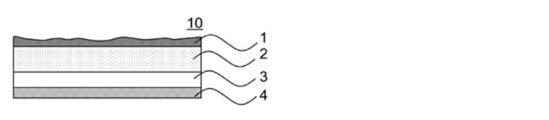
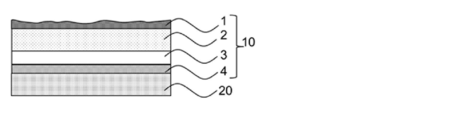
- FIG. 1 is a view showing a state in which a surface protective film according to an embodiment of the present invention is attached to a transparent substrate on a display surface.
- the surface protective film 10 includes a hard coat layer 1, a protective layer 2, a transparent substrate film 3, and a pressure-sensitive adhesive layer 4, which are laminated in this order.
- the surface protection film 10 according to one embodiment is bonded on the transparent substrate 20 via the adhesive layer 4.
- the surface protective film of the present invention is attached to the surface of the transparent substrate, thereby preventing the transparent substrate from being damaged, cracked, stained, and the like.
- the protective layer is made of polyurethane.
- Polyurethane is obtained by reacting a material composition containing at least a polyol, an isocyanate, and an alcohol-based curing agent.
- Polyols include polyoxyalkylene glycols such as polyethylene glycol, polypropylene glycol and polyoxytetramethylene glycol, or polyether-based polyols such as bisphenol A and alkylene oxide adducts such as ethylene oxide and propylene oxide of glycerin; adipic acid Reaction of dibasic acid such as phthalic anhydride, isophthalic acid, maleic acid and fumaric acid with glycols such as ethylene glycol, propylene glycol, 1,4-butanediol, 1,6-hexanediol and trimethylolpropane
- Polycaprolactone-based polyols such as polycaprolactone glycol, polycaprolactone triol, and polycaprolactone tetraol
- polycarbonate-based polyols such as polycarbonate glycol, polycarbonate triol, and polycarbonate tetraol; and derivatives and modified products obtained by introducing introducing a
- the polycarbonate polyurethane obtained from the polycarbonate polyol is excellent in plasticizer resistance and can prevent the plasticizer from migrating to the surface protection film due to contact with a rubber product or the like and swelling.
- the polyester-based polyurethane obtained from the polyester-based polyol is excellent in plasticizer resistance and oil resistance, and can prevent various oil components such as plasticizer and sebum from migrating to the surface protective film and swelling.
- Polycarbonate-based polyol examples include a reaction product of a dialkyl carbonate and a diol.
- polycarbonate-based polyol for example, polycarbonate glycol, polycarbonate triol, polycarbonate tetraol, derivatives or modified products obtained by introducing a side chain or a branched structure into these, and mixtures thereof can also be used.
- dialkyl carbonate examples include dialkyl carbonates such as dimethyl carbonate and diethyl carbonate, diaryl carbonates such as diphenyl carbonate, and alkylene carbonates such as ethylene carbonate. These may be used alone or in combination of two or more.
- diol examples include ethylene glycol, diethylene glycol, 1,4-butanediol, 1,5-pentanediol, 1,6-hexanediol, 1,7-heptanediol, 1,8-octanediol, 2-methyl -1,8-octanediol, 1,9-nonanediol, 1,10-dodecanediol, 2-ethyl-1,6-hexanediol, 3-methyl-1,5-pentanediol, 2,4-dimethyl- 1,5-pentanediol, neopentyl glycol, 1,3-cyclohexanediol, 1,4-cyclohexanediol, 1,4-cyclohexanedimethanol, 2,2′-bis (4-hydroxycyclohexyl) -propane and the like.
- the diol is preferably an aliphatic diol having 4 to 9 carbon atoms or an alicyclic diol.
- Polyester polyols include, for example, succinic acid, adipic acid, phthalic anhydride, isophthalic acid, maleic acid, dibasic acids such as fumaric acid and ethylene glycol, propylene glycol, 1,4-butanediol, Examples include polyester polyols obtained by a polymerization reaction with glycols such as 6-hexanediol and trimethylolpropane. Of these, succinic ester polyurethanes using succinic acid as the dibasic acid are preferred because they are particularly excellent in plasticizer resistance and oil resistance.
- the number average molecular weight of the polyol is preferably 200 or more and 10,000 or less, more preferably 500 or more and 5,000 or less, and even more preferably 800 or more and 3,000 or less.
- the number average molecular weight is less than 200, the reaction is too fast and the handleability is poor, and the molded article may lose flexibility and become brittle.
- the number average molecular weight is more than 10,000, the viscosity becomes too high, and the handleability is poor, and the molded product may be crystallized and become cloudy.
- the number average molecular weight means a molecular weight calculated from a hydroxyl value of a polyol measured according to JIS K1557. However, even if the value is out of the above numerical range, the value is not excluded unless it departs from the gist of the present invention.
- Isocyanate As the isocyanate, those having two or more isocyanate groups in the molecule can be used without particular limitation. For example, tolylene diisocyanate, tolidine diisocyanate, diphenylmethane diisocyanate, polymethylene polyphenyl polyisocyanate, carbodiimidated diphenylmethane polyisocyanate, crude diphenylmethane diisocyanate, xylylene diisocyanate, 1,5-naphthalene diisocyanate, tetramethyl xylene diisocyanate, isophorone Diisocyanate, hydrogenated diphenylmethane diisocyanate, hydrogenated xylylene diisocyanate, hexamethylene diisocyanate, dimer acid diisocyanate, norbornene diisocyanate, and the like can be used. Two or more of these may be used in combination.
- an aliphatic isocyanate having no aromatic ring as the isocyanate component for the polyurethane forming the protective layer.
- the polyurethane obtained from the aliphatic isocyanate is hardly yellowed, and can prevent the polyurethane from being discolored by the light or heat from a light source, a sun ray or the like, and lowering the transparency.
- Alcohol-based curing agent The polyurethane for forming the protective layer of the present invention uses an alcohol-based curing agent as a curing agent. Alcohol-based curing agents have less adverse effects on human bodies and the environment than amine-based curing agents.
- those having two or more hydroxy groups in the molecule can be used without any particular limitation.
- 1,4-butanediol is preferable from the viewpoint of handleability and mechanical properties, and from the viewpoint of prevention of white turbidity, cyclohexane dimethanol, hydrogenated bisphenol A, etc.
- Polyhydric alcohols are preferred.
- trihydric alcohol trimethylolpropane is preferable from the viewpoint of handling properties and mechanical properties.
- a dihydric alcohol When a dihydric alcohol is used alone as an alcohol-based curing agent, the molded body may crystallize and become cloudy, and when a trihydric alcohol is used as a main component, the strength may decrease. It is preferable to use a dihydric alcohol and a trihydric alcohol in combination. Specifically, it is preferably used in the range of 50 to 100 parts by weight of a dihydric alcohol and 50 to 0 parts by weight of a trihydric alcohol, and preferably in the range of 60 to 80 parts by weight of a dihydric alcohol and 40 to 20 parts by weight of a trihydric alcohol. It is more preferred to use.
- 1,4-butanediol becomes cloudy when 1,4-butanediol is used as the dihydric alcohol
- a part or all of 1,4-butanediol may be replaced with a dihydric alcohol having a cyclic structure.
- the polyurethane forming the protective layer of the present invention is thermally cured in the presence of a non-amine catalyst.
- a non-amine catalyst By using a non-amine catalyst, a polyurethane excellent in non-coloring property, transparency and weather resistance can be obtained.
- polyurethane thermoset with an amine catalyst the emitted light becomes yellow, and the appearance may be colored with time.
- non-amine catalyst examples include organic tin compounds such as di-n-butyltin dilaurate, dimethyltin dilaurate, dibutyltin oxide, and octanetin; organic titanium compounds; organic zirconium compounds; tin carboxylate; Bismuth salts and the like can be mentioned.
- organic tin compounds such as di-n-butyltin dilaurate, dimethyltin dilaurate, dibutyltin oxide, and octanetin
- organic titanium compounds organic zirconium compounds
- tin carboxylate examples of the like
- Bismuth salts and the like can be mentioned.
- an organotin compound is preferable because the reaction rate can be easily adjusted.
- ⁇ Non-amine based catalysts can be obtained from a. ⁇ C. Is preferably added so as to be 0.0005% by weight or more and 3.0% by weight or less based on the total amount of If the amount is less than 0.0005% by weight, the reaction rate may not be sufficiently high, and a molded article may not be obtained efficiently. If the content is more than 3.0% by weight, the reaction rate becomes too high, so that a molded article having a uniform thickness cannot be obtained, heat resistance and weather resistance of the molded article are reduced, light transmittance is reduced, and molding is performed. Problems such as coloring of the body may occur. However, even if the value is out of the above numerical range, the value is not excluded unless it departs from the gist of the present invention.
- the polyurethane forming the protective layer contains various additives such as a coloring agent, a light stabilizer, a heat stabilizer, an antioxidant, a fungicide, and a flame retardant, as long as the required properties are not impaired. can do.
- the protective layer is a molded product made of polyurethane obtained by curing a material composition containing at least a polyol, an isocyanate, and an alcohol-based curing agent with a catalyst.
- the molding method includes a one-shot method, a prepolymer method, and a pseudo-prepolymer. Any of the methods may be used.
- a molded article of polyurethane can be produced by collectively charging and curing a polyol, an isocyanate, an alcohol-based curing agent, an optional additive, and a catalyst.
- a polyol is reacted with a stoichiometrically excess amount of isocyanate to prepare a prepolymer having an isocyanate group at a terminal in advance, and a predetermined amount of an alcohol-based curing agent and optional additives are added thereto.
- a catalyst and curing the prepolymer By mixing a catalyst and curing the prepolymer, a polyurethane molded body can be produced.
- a polyurethane molded article can be produced by mixing and curing a mixture with an optional additive and catalyst.
- the ratio of the number of moles of the hydroxyl group (—OH) contained in the alcohol-based curing agent to the number of moles of the isocyanate group (—NCO) of the isocyanate or prepolymer in the material composition before the thermosetting of the polyurethane ( -OH / -NCO: hereinafter referred to as ⁇ ratio) is more preferably 0.80 or more and 1.50 or less, more preferably 0.90 or more and 1.45 or less, and 1.02 or more and 1.4 or less. Is more preferred. If it is less than 0.80, the mechanical properties become unstable, and if it is more than 1.50, the surface tackiness increases and good writing taste is impaired.
- the polyurethane does not contain an acrylic skeleton (acryl skeleton or methacryl skeleton). That is, the polyurethane forming the protective layer of the present invention preferably does not contain an acrylic-modified polyurethane.
- Polyurethane having an acrylic skeleton may impair the flexibility of the polyurethane and reduce its mechanical strength such as abrasion resistance and tear strength, and may also include an acrylic skeleton or a residue of a catalyst used to introduce the acrylic skeleton. As a result, the emitted light may be colored.
- both surfaces of the protective layer are flat. This will be described in detail in the following manufacturing method, because the material composition is thermally cured in a state sandwiched between the gap maintaining members having a flat surface to form a protective layer.
- that the protective layer is flat means that the arithmetic average roughness Ra is 0.05 ⁇ m or less.
- the thickness of the protective layer is preferably from 50 ⁇ m to 300 ⁇ m, more preferably from 100 ⁇ m to 200 ⁇ m.
- the protective layer has a thickness of not less than 50 ⁇ m and not more than 300 ⁇ m, the writing quality and the sliding property of the touch pen are very good, and the operability and the self-healing property are also excellent.
- the thickness of the protective layer is less than 50 ⁇ m, the writing taste and the self-healing property are reduced. If the thickness of the protective layer is greater than 300 ⁇ m, the writing taste, slipperiness, operability, and self-healing properties are reduced, and it is difficult to form the protective layer with a uniform thickness. When it is 50 ⁇ m or more and 300 ⁇ m or less, the performance required for the surface protective film is exhibited in a well-balanced manner, and the production is easy.
- the hard coat layer is provided on one surface of the protective layer, and has an arithmetic average roughness Ra of 0.1 ⁇ m or more and 0.8 ⁇ m or less.
- the hard coat layer can be formed by irradiating the ionizing radiation-curable resin composition with an ultraviolet ray, an electron beam, or the like, and polymerizing and curing the composition.
- the ionizing radiation-curable resin composition for forming the hard coat layer hereinafter, also referred to as a resin composition
- known ones can be used as the ionizing radiation-curable resin composition for forming the hard coat layer.
- the resin composition include a polyfunctional polymerizable monomer having two or more ionizing radiation-polymerizable functional groups such as a group in one molecule as a main component, and a photopolymerization initiator, a leveling agent, and the like.
- polyfunctional polymerizable monomer examples include pentaerythritol triacrylate, pentaerythritol tetraacrylate, dipentaerythritol hexaacrylate, neopentyl glycol diacrylate, triethylene glycol diacrylate, bis (acryloxyethoxy) bisphenol A, and trimethylolpropane. Triacrylate and the like.
- the polyfunctional polymerizable monomers may be used alone or in combination of two or more.
- the resin composition forming the hard coat layer preferably contains a fluorine-containing compound.
- a fluorine-containing compound is not particularly limited, and a fluorine-based leveling agent, a fluorine-containing monomer, a silane coupling agent containing a fluorine atom, or the like can be used, but a covalent bond with a polyfunctional polymerizable monomer may be formed. It is preferable to use a fluorine-containing monomer which can be used.
- fluorine-containing monomer examples include a fluorocarbon group such as a fluoroalkyl group, a fluorooxyalkyl group, and a fluoroalkenyl group; and an ionizing radiation-polymerizable functional group such as a (meth) acryl group, a vinyl group, an allyl group, and a styryl group.
- a fluorocarbon group such as a fluoroalkyl group, a fluorooxyalkyl group, and a fluoroalkenyl group
- an ionizing radiation-polymerizable functional group such as a (meth) acryl group, a vinyl group, an allyl group, and a styryl group.
- a compound having the following formula Commercially available products include trifluoroethyl methacrylate (light ester M-3F) manufactured by Kyoeisha Chemical Co., Ltd., an ultra-hard hardness coating agent (HX-RPH), an ultra-scratch resistant hard coating agent (HX-RSC), Examples include a fingerprint adhesion inhibitor (Optool DAC) manufactured by Daikin Industries, Ltd., and a UV-reactive surface modifier (MegaFac RS # series) manufactured by DIC Corporation.
- UV-reactive surface modifier MegaFac RS # series
- the hard coat layer has an arithmetic average roughness Ra of 0.1 ⁇ m or more and 0.8 ⁇ m or less.
- the surface protective film can be provided with an antiglare property. Further, the surface protective film having antiglare properties is hardly conspicuous even if the surface is damaged.
- the arithmetic average roughness Ra is more preferably 0.3 ⁇ m or more and 0.7 ⁇ m or less, and even more preferably 0.4 ⁇ m or more and 0.6 ⁇ m or less.
- the thickness of the hard coat layer is preferably 0.5 ⁇ m or more and 5 ⁇ m or less.
- the surface protective film of the present invention has excellent oil resistance and scratch resistance. If the thickness of the hard coat layer is less than 0.5 ⁇ m, oil resistance may be reduced. On the other hand, if the thickness of the hard coat layer is larger than 5 ⁇ m, the rigid hard coat layer cannot follow the movement of the flexible protective layer, and peeling between the hard coat layer and the protective layer and cracking of the hard coat layer may occur. May occur.
- the thickness of the hard coat layer is more preferably 1 ⁇ m or more and 3 ⁇ m or less. In the present specification, the thickness of the hard coat layer means a weighted average of thicknesses measured at arbitrary 10 or more points in an image of a cross section in the thickness direction of the surface protective film taken by an electron microscope or the like.
- Transparent substrate film The transparent substrate film holds the protective layer.
- the material constituting the transparent substrate film can be used without any particular limitation as long as it is excellent in transparency, flexibility and mechanical strength.
- Polyethylene terephthalate (PET), polyethylene naphthalate (PEN), polycarbonate (PC), cyclic olefin-based resin (COP), polyimide (PI) and the like can be suitably used.
- the thickness of the transparent substrate film is preferably 50 ⁇ m or more and 500 ⁇ m or less.
- the thickness of the transparent base film is less than 50 ⁇ m.
- the transparent substrate film cannot withstand the shrinkage of the protective layer at low temperatures, and the surface protective film may come off from the transparent substrate.
- the thickness of the transparent substrate film is larger than 500 ⁇ m, the surface protection film becomes bulky and the cost increases. In addition, the operability at the time of bonding to the surface of a touch panel display is reduced.
- the protective layer can be directly formed on the transparent substrate film, as will be described in detail in the following “Method for producing surface protective film”.
- the transparent substrate film is preferably thicker in order to prevent deformation during heating when the material composition is cured by heat to form a protective layer.
- the value is not excluded unless it departs from the gist of the present invention.
- the pressure-sensitive adhesive layer is for bonding a surface protective film to a transparent substrate on the display surface.
- the type of the pressure-sensitive adhesive is not particularly limited, and an acrylic resin, an epoxy resin, a urethane resin, a silicon resin, or the like can be used.
- the acrylic resin can be stuck even on a transparent substrate that has been subjected to a surface treatment such as an antifouling treatment and a low reflection treatment.
- the silicon-based resin is excellent in wettability, hardly generates bubbles at the time of sticking to a transparent substrate, has good re-peelability, and hardly remains adhesive when peeled.
- the thickness of the pressure-sensitive adhesive layer is usually in the range of 5 ⁇ m or more and 60 ⁇ m or less, but can be appropriately adjusted according to required specifications.
- the surface protective film 10 includes a hard coat layer 1, a protective layer 2 made of polyurethane, a transparent substrate film 3, and a pressure-sensitive adhesive layer 4, which are laminated in this order.
- the surface protective film of the present invention may include another layer, for example, a blue light cut layer that cuts blue light.
- the total light transmittance of the surface protective film is preferably 90% or more from the viewpoint of visibility. However, in the case where a blue light cutting ability for cutting visible light in a blue region is provided, the total light transmittance is preferably 60% or more.
- the haze value of the surface protective film is preferably 5% or more and 40% or less from the viewpoint of antiglare properties. The haze value of the surface protective film is more preferably 10% or more and 30% or less, and even more preferably 15% or more and 25% or less.
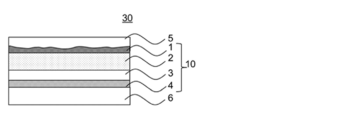
- FIG. 3 shows a surface protection film laminate 30 in which a release film 5 and a release film 6 are adhered to a surface protection film 10 according to one embodiment.
- the thickness of each layer does not mean the actual thickness.
- the release film prevents the hard coat layer located on the outermost surface from being stained, adhered to dust, and damaged.
- the release film is an uneven transfer film that transfers unevenness having an arithmetic average roughness Ra of 0.1 ⁇ m to 0.8 ⁇ m on the surface of the hard coat layer.
- the release film subjected to the release treatment is peeled from the hard coat layer, the release agent contained in the release film is transferred to the surface of the hard coat layer, and the hard coat layer immediately after the release film is released. Slipperiness can be imparted to the surface, and a touch operation can be performed without discomfort immediately after the start of use.
- the release film prevents the adhesive layer from being stained, adhering to dust, and reducing the adhesive strength.
- the release film is not particularly limited, and a film having a release treatment applied to the surface on the side to be bonded to the pressure-sensitive adhesive layer can be suitably used.
- FIG. 4 shows a schematic view of a method for producing a surface protective film.
- An ionizing radiation-curable resin composition is applied on the surface of the uneven transfer film 425 having irregularities in advance, and the ionized radiation-curable resin composition is half-cured to form a semi-cured hard coat layer 421.
- a first gap maintaining member 42a on which a semi-cured hard coat layer 421 is laminated is prepared.
- the first gap maintaining member 42a and the second gap maintaining member 42b are arranged such that the semi-cured hard coat layer 421 faces the second gap maintaining member 42b, and a pair of rolls arranged apart from each other.
- the material composition 40a is continuously fed out by 43a, 43b, and flows into the gaps of the first and second gap maintaining members 42a, 42b via the casting machine 41.
- the first and second gap maintaining members 42a and 42b are guided into the heating device 46 while holding the material composition 40a therebetween.
- the material composition 40a is thermally cured while being held between the first and second gap maintaining members 42a and 42b, and becomes the polyurethane sheet-like material 40.
- Opposite surfaces of the first and second gap maintaining members are flat, and the flat polyurethane sheet-like material 40 can be manufactured by thermosetting while being held between the flat surfaces. it can.
- the semi-cured hard coat layer 421 is irradiated with ultraviolet rays by the ultraviolet ray irradiating device 48 to perform full curing.
- reference numeral 44 denotes a transport roll for sending out the first and second gap maintaining members 42a and 42b
- 45 denotes an auxiliary roll
- 47 denotes a first and a second holding the material composition 40a therebetween.
- I a conveyor belt for conveying the gap maintaining members 42a and 42b within the heating device 46.
- the uneven transfer film 425 and the second gap maintaining member 42b in the first gap maintaining member 42a can be used without any particular limitation as long as they are not thermally deformed when the material composition is thermally cured.
- a long film made of a polymer material such as polyethylene terephthalate (PET), polyethylene naphthalate (PEN), polycarbonate (PC), cyclic olefin resin (COP), and polyimide (PI) can be used.
- PET polyethylene terephthalate
- PEN polyethylene naphthalate
- PC polycarbonate
- COP cyclic olefin resin
- PI polyimide
- a long film made of a polymer material is used as the second gap maintaining member 42b, but an endless belt made of such a polymer material or a metal material such as aluminum is used. Can also.
- the gap can be maintained at a constant size.
- the material composition 40a is sandwiched between the first and second gap maintaining members 42a and 42b, and is cured while maintaining a constant thickness, thereby forming the polyurethane sheet 40 having excellent thickness accuracy.
- the semi-cured hard coat layer 421 is half-cured to lose its fluidity, and the material composition 40a is thermally cured while being sandwiched between flat surfaces, so that a polyurethane sheet having both surfaces flat is formed. 40 are obtained.
- the sheet-like material 40 having a thickness of 50 ⁇ m or more, which is difficult to apply, and having practical optical characteristics as a protective layer of the surface protective film can be continuously formed.
- the position of the head 41a of the casting machine 41 is closer to one of the transport rolls than the center of the transport rolls 43a and 43b (the center of the gap formed by the first and second gap maintaining members 42a and 42b).
- the uneven distribution distance is preferably equal to or less than the radius of the transport roll. That is, it is preferable that the portion immediately below the head portion 41a of the casting machine 41 be located between the central portion of the pair of transport rolls 43a and 43b and the central axis of one transport roll.
- the shortest distance between the tip of the head 41a and the surface of the transport roll is preferably 5 cm or less.
- the thickness accuracy of the polyurethane sheet-like material 40 is further improved, and the uncured non-cured material flowing into the gaps between the first and second gap maintaining members 42a and 42b is provided. Air bubbles are less likely to be mixed into the material composition 40a, and the mixed air bubbles are easily removed.
- the transport rolls 43a and 43b may have only a transport function, but are preferably heating rolls.
- the transport roll is a heating roll
- the material composition 40a can start curing immediately after being held in the gap between the first and second gap maintaining members 42a, 42b, and the material composition 40a is heated.
- the thickness can be maintained more uniform before being introduced into the device 46, and the polyurethane sheet 40 having more excellent thickness accuracy can be formed.
- the transport surface temperature when heating the transport rolls 43a and 43b be set to 10 ° C. or more and 60 ° C. or less.
- the temperature is lower than 10 ° C., the viscosity of the material composition 40a is increased to make it difficult for air bubbles to escape, and at the same time, the curing reaction is delayed and the thickness accuracy of the sheet-like material 40 is reduced. If the temperature is higher than 60 ° C., the material composition 40 a may be cured on the transport roll, or bubbles may enter the sheet-like material 40.
- the heating device 46 is a heating furnace provided with a heater, and may be any device that can raise the temperature in the furnace to the curing temperature of the material composition 40a.
- the heating conditions (curing conditions) in the heating device 46 are not particularly limited, and may be appropriately set according to the composition of the material composition 40a. For example, 40 ° C or more and 160 ° C or less, and 1 minute or more and 180 minutes or less. It may be performed under the following conditions. From the heating device 46, a long laminated body including the first gap maintaining member 42a, the polyurethane sheet 40, and the second gap maintaining member 42b is carried out.
- the ultraviolet irradiation device 48 irradiates ultraviolet rays to the long laminated body carried out from the heating device 46 to fully cure the semi-cured hard coat layer 421.
- the ultraviolet light source include an ultraviolet fluorescent lamp, a low-pressure mercury lamp, a high-pressure mercury lamp, an ultra-high-pressure mercury lamp, and a xenon lamp.
- the ultraviolet rays need only be able to reach the semi-cured hard coat layer, and may be irradiated from either side of the first gap maintaining member 42a or the second gap maintaining member 42b, or may be emitted from both sides.
- the first gap maintaining member 42a has the uneven transfer film 425, and by peeling the uneven transfer film 425, the hard coat layer 1 having the unevenness on the surface can be manufactured.
- the second gap maintaining member 42b can be the transparent base film 3 of the surface protection film, and the uneven transfer film 425 can be the release film 5 of the surface protection film laminate.
- the pressure-sensitive adhesive layer 4 is formed on the surface of the second gap maintaining member 42b by coating or the like, and the release film 6 is stuck on the pressure-sensitive adhesive 4 layer to form the long surface protection film laminate 30. Obtainable.
- the method for manufacturing the surface protective film laminate described above is an example, and for example, a laminate formed by laminating a transparent substrate film / an adhesive layer / a release film in this order is used as the second gap maintaining member 42b. You can also.
- the surface protective film laminate 30 can be continuously manufactured by a so-called roll-to-roll. Since the manufactured surface protective film laminate 30 includes the release film 5 and the release film 6 on both sides, it is possible to prevent the surface protective film from being scratched, contaminated, and the like, and is excellent in handleability. . As described above, the surface protective film laminate can be manufactured by roll-to-roll throughout, but the pressure-sensitive adhesive layer can also be formed after cutting.
- the surface protective film laminate may be wound in a roll and shipped, or cut into sheets and shipped. Further, it is shipped as a long laminated body composed of the first gap maintaining member 42a, the polyurethane sheet 40, and the second gap maintaining member 42b, or as a sheet laminated body obtained by cutting this long laminated body.
- the pressure-sensitive adhesive layer can be formed in a display factory or the like.
- a 125 ⁇ m-thick PET film having irregularities on a silicon-treated surface is used as an irregularity transfer film, and a UV-curable urethane acrylate containing a fluorine-containing monomer is applied to the irregular surface so as to have a thickness of 2.3 ⁇ m.
- ultraviolet rays were irradiated at 150 mJ / cm 2 and half-cured to obtain a semi-cured hard coat layer.
- the material composition is sandwiched between PET having a thickness of 100 ⁇ m to be a transparent substrate film and PET having a thickness of 125 ⁇ m including a semi-cured hard coat layer, and the material composition is thermally cured by heating at 80 ° C. for 12 hours.
- the semi-cured hard coat layer was fully cured by irradiating it with 800 mJ / cm 2 of ultraviolet light to produce a laminate of an uneven transfer film / hard coat layer / protective layer (150 ⁇ m thickness) / transparent substrate film.
- Example 2 A laminate was manufactured in the same manner as in Example 1 except that the thickness of the hard coat layer was changed to 1.7 ⁇ m.
- Example 3 A laminate was manufactured in the same manner as in Example 1 except that the thickness of the hard coat layer was changed to 1.4 ⁇ m.
- Example 1 The same material composition as in Example 1 was sandwiched between 125 ⁇ m-thick PET having irregularities on the surface of a silicon-treated surface as a concavo-convex transfer film and 100 ⁇ m-thick PET as a transparent substrate film at 80 ° C. for 12 hours. Heating and thermosetting were carried out to produce a laminate of an uneven transfer film / protective layer (150 ⁇ m thickness) / transparent substrate film. From this laminate, the uneven transfer film was peeled off, and the UV-curable urethane acrylate containing the fluorine-containing monomer used in Example 1 was applied to the exposed surface of the protective layer so as to have a thickness of 2.3 ⁇ m. After the heat treatment for 1 min, ultraviolet rays were irradiated at 800 mJ / cm 2 to perform full curing to produce a laminate of a hard coat layer / protective layer (150 ⁇ m thickness) / transparent substrate film.
- Comparative Example 2 A laminate was manufactured in the same manner as in Comparative Example 1, except that the thickness of the hard coat layer was changed to 1.7 ⁇ m.
- Comparative Example 3 A laminate was manufactured in the same manner as in Comparative Example 1 except that the thickness of the hard coat layer was changed to 1.4 ⁇ m.
- Comparative Example 4" A laminate was manufactured in the same manner as in Example 1 except that the thickness of the hard coat layer was changed to 16 ⁇ m.
- Comparative Example 5" A laminate was manufactured in the same manner as in Comparative Example 4, except that a concavo-convex transfer film having a smaller Ra was used.
- the light of the fluorescent lamp in the room is reflected on the surface on the hard coat layer side, and the degree of blurring of the fluorescent lamp is evaluated on a five-point scale.
- the surface protective films of Examples 1 to 3 of the present invention had good antiglare properties because the surface of the hard coat layer had irregularities. Also, the hard coat layer was excellent in oil resistance and could follow the movement of the protective layer. On the other hand, in the surface protective films of Comparative Examples 1 to 3 in which the hard coat layer was applied on the protective layer having surface irregularities, the hard coat layer filled the irregularities on the surface of the protective layer. And the antiglare property was reduced. The surface protective films of Comparative Examples 4 and 5 had cracks because the hard coat layer was too thick to follow the movement of the protective layer.
Landscapes
- Physics & Mathematics (AREA)
- Thermal Sciences (AREA)
- Laminated Bodies (AREA)
Abstract
La présente invention aborde le problème de la fourniture d'un film de protection de surface qui est excellent en termes de propriété antireflet, de résistance aux rayures et de résistance à l'huile. Un moyen pour résoudre le problème est un film de protection de surface qui comprend une couche de protection constituée d'un polyuréthane, les deux surfaces de la couche de protection étant plates, et une couche de revêtement dur formée sur l'une des surfaces de la couche de protection, la couche de revêtement dur ayant une rugosité moyenne arithmétique Ra de 0,1 à 0,8 µm.
Priority Applications (3)
| Application Number | Priority Date | Filing Date | Title |
|---|---|---|---|
| CN201980052530.1A CN112566784B (zh) | 2018-08-10 | 2019-08-06 | 表面保护膜、表面保护膜层叠体及表面保护膜的制造方法 |
| JP2019542745A JP6671556B1 (ja) | 2018-08-10 | 2019-08-06 | 表面保護フィルム |
| US17/266,101 US11975515B2 (en) | 2018-08-10 | 2019-08-06 | Surface-protective film |
Applications Claiming Priority (2)
| Application Number | Priority Date | Filing Date | Title |
|---|---|---|---|
| JP2018151014 | 2018-08-10 | ||
| JP2018-151014 | 2018-08-10 |
Publications (1)
| Publication Number | Publication Date |
|---|---|
| WO2020032012A1 true WO2020032012A1 (fr) | 2020-02-13 |
Family
ID=69413532
Family Applications (1)
| Application Number | Title | Priority Date | Filing Date |
|---|---|---|---|
| PCT/JP2019/030867 Ceased WO2020032012A1 (fr) | 2018-08-10 | 2019-08-06 | Film de protection de surface |
Country Status (4)
| Country | Link |
|---|---|
| US (1) | US11975515B2 (fr) |
| JP (1) | JP6671556B1 (fr) |
| CN (1) | CN112566784B (fr) |
| WO (1) | WO2020032012A1 (fr) |
Cited By (1)
| Publication number | Priority date | Publication date | Assignee | Title |
|---|---|---|---|---|
| CN114379180A (zh) * | 2021-12-29 | 2022-04-22 | 和盛包装科技(海宁)股份有限公司 | 一种具有细菌阻隔防护功能的复合包装膜及其制备方法 |
Families Citing this family (2)
| Publication number | Priority date | Publication date | Assignee | Title |
|---|---|---|---|---|
| KR102302668B1 (ko) * | 2021-02-18 | 2021-09-16 | 남상진 | 디스플레이패널 보호필름 제조용 우레탄필름 제조장치 |
| KR102302666B1 (ko) * | 2021-02-18 | 2021-09-16 | 최현준 | 디스플레이패널 보호필름 제조용 우레탄필름 제조방법 |
Citations (4)
| Publication number | Priority date | Publication date | Assignee | Title |
|---|---|---|---|---|
| JP2015052100A (ja) * | 2013-08-05 | 2015-03-19 | 日東電工株式会社 | 粘着シート |
| WO2016159023A1 (fr) * | 2015-03-31 | 2016-10-06 | Jnc株式会社 | Agent de revêtement, film de revêtement, stratifié, et article à surface protégée |
| JP2017148991A (ja) * | 2016-02-23 | 2017-08-31 | 株式会社きもと | 保護フィルム |
| WO2018038069A1 (fr) * | 2016-08-24 | 2018-03-01 | バンドー化学株式会社 | Film de protection de surface |
Family Cites Families (4)
| Publication number | Priority date | Publication date | Assignee | Title |
|---|---|---|---|---|
| JP2009294445A (ja) * | 2008-06-05 | 2009-12-17 | Yamamoto Kogaku Co Ltd | 偏光性積層体とその製造方法 |
| JP5565618B2 (ja) * | 2010-05-11 | 2014-08-06 | Dic株式会社 | 光学用二液型熱硬化性ウレタン樹脂組成物及びそれを用いて得られた光学用成形体 |
| JP6936152B2 (ja) * | 2015-11-30 | 2021-09-15 | バンドー化学株式会社 | 表面保護フィルム |
| JP6352575B1 (ja) * | 2016-10-07 | 2018-07-04 | 日本ペイント・オートモーティブコーティングス株式会社 | 光学積層部材 |
-
2019
- 2019-08-06 JP JP2019542745A patent/JP6671556B1/ja active Active
- 2019-08-06 CN CN201980052530.1A patent/CN112566784B/zh active Active
- 2019-08-06 WO PCT/JP2019/030867 patent/WO2020032012A1/fr not_active Ceased
- 2019-08-06 US US17/266,101 patent/US11975515B2/en active Active
Patent Citations (4)
| Publication number | Priority date | Publication date | Assignee | Title |
|---|---|---|---|---|
| JP2015052100A (ja) * | 2013-08-05 | 2015-03-19 | 日東電工株式会社 | 粘着シート |
| WO2016159023A1 (fr) * | 2015-03-31 | 2016-10-06 | Jnc株式会社 | Agent de revêtement, film de revêtement, stratifié, et article à surface protégée |
| JP2017148991A (ja) * | 2016-02-23 | 2017-08-31 | 株式会社きもと | 保護フィルム |
| WO2018038069A1 (fr) * | 2016-08-24 | 2018-03-01 | バンドー化学株式会社 | Film de protection de surface |
Cited By (1)
| Publication number | Priority date | Publication date | Assignee | Title |
|---|---|---|---|---|
| CN114379180A (zh) * | 2021-12-29 | 2022-04-22 | 和盛包装科技(海宁)股份有限公司 | 一种具有细菌阻隔防护功能的复合包装膜及其制备方法 |
Also Published As
| Publication number | Publication date |
|---|---|
| US11975515B2 (en) | 2024-05-07 |
| JP6671556B1 (ja) | 2020-03-25 |
| CN112566784B (zh) | 2023-11-14 |
| US20210323292A1 (en) | 2021-10-21 |
| CN112566784A (zh) | 2021-03-26 |
| JPWO2020032012A1 (ja) | 2020-08-20 |
Similar Documents
| Publication | Publication Date | Title |
|---|---|---|
| JP6936152B2 (ja) | 表面保護フィルム | |
| JP6487132B1 (ja) | 表面保護フィルム | |
| JP6944457B2 (ja) | 表面保護フィルム | |
| JP6671556B1 (ja) | 表面保護フィルム | |
| JP6738508B1 (ja) | フレキシブルディスプレイ用表面保護フィルム | |
| JP6992063B2 (ja) | 表面保護フィルム | |
| JP7064864B2 (ja) | 表面保護フィルム | |
| JP6628937B1 (ja) | 表面保護フィルム | |
| WO2020116335A1 (fr) | Film de protection de surface pour écran flexible | |
| US11204448B2 (en) | Surface protective film | |
| JP7319918B2 (ja) | 表面保護フィルム | |
| JP6684039B1 (ja) | フレキシブルディスプレイ用表面保護フィルム |
Legal Events
| Date | Code | Title | Description |
|---|---|---|---|
| ENP | Entry into the national phase |
Ref document number: 2019542745 Country of ref document: JP Kind code of ref document: A |
|
| 121 | Ep: the epo has been informed by wipo that ep was designated in this application |
Ref document number: 19846177 Country of ref document: EP Kind code of ref document: A1 |
|
| NENP | Non-entry into the national phase |
Ref country code: DE |
|
| 122 | Ep: pct application non-entry in european phase |
Ref document number: 19846177 Country of ref document: EP Kind code of ref document: A1 |