WO2020032185A1 - カチオン性脂質を用いた心筋細胞へのトランスフェクション方法 - Google Patents
カチオン性脂質を用いた心筋細胞へのトランスフェクション方法 Download PDFInfo
- Publication number
- WO2020032185A1 WO2020032185A1 PCT/JP2019/031418 JP2019031418W WO2020032185A1 WO 2020032185 A1 WO2020032185 A1 WO 2020032185A1 JP 2019031418 W JP2019031418 W JP 2019031418W WO 2020032185 A1 WO2020032185 A1 WO 2020032185A1
- Authority
- WO
- WIPO (PCT)
- Prior art keywords
- linear
- alkyl group
- mrna
- integer
- cells
- Prior art date
- Legal status (The legal status is an assumption and is not a legal conclusion. Google has not performed a legal analysis and makes no representation as to the accuracy of the status listed.)
- Ceased
Links
Images

Classifications
-
- C—CHEMISTRY; METALLURGY
- C12—BIOCHEMISTRY; BEER; SPIRITS; WINE; VINEGAR; MICROBIOLOGY; ENZYMOLOGY; MUTATION OR GENETIC ENGINEERING
- C12N—MICROORGANISMS OR ENZYMES; COMPOSITIONS THEREOF; PROPAGATING, PRESERVING, OR MAINTAINING MICROORGANISMS; MUTATION OR GENETIC ENGINEERING; CULTURE MEDIA
- C12N15/00—Mutation or genetic engineering; DNA or RNA concerning genetic engineering, vectors, e.g. plasmids, or their isolation, preparation or purification; Use of hosts therefor
- C12N15/09—Recombinant DNA-technology
- C12N15/87—Introduction of foreign genetic material using processes not otherwise provided for, e.g. co-transformation
-
- C—CHEMISTRY; METALLURGY
- C12—BIOCHEMISTRY; BEER; SPIRITS; WINE; VINEGAR; MICROBIOLOGY; ENZYMOLOGY; MUTATION OR GENETIC ENGINEERING
- C12N—MICROORGANISMS OR ENZYMES; COMPOSITIONS THEREOF; PROPAGATING, PRESERVING, OR MAINTAINING MICROORGANISMS; MUTATION OR GENETIC ENGINEERING; CULTURE MEDIA
- C12N5/00—Undifferentiated human, animal or plant cells, e.g. cell lines; Tissues; Cultivation or maintenance thereof; Culture media therefor
- C12N5/06—Animal cells or tissues; Human cells or tissues
- C12N5/0602—Vertebrate cells
- C12N5/0652—Cells of skeletal and connective tissues; Mesenchyme
- C12N5/0657—Cardiomyocytes; Heart cells
-
- C—CHEMISTRY; METALLURGY
- C12—BIOCHEMISTRY; BEER; SPIRITS; WINE; VINEGAR; MICROBIOLOGY; ENZYMOLOGY; MUTATION OR GENETIC ENGINEERING
- C12N—MICROORGANISMS OR ENZYMES; COMPOSITIONS THEREOF; PROPAGATING, PRESERVING, OR MAINTAINING MICROORGANISMS; MUTATION OR GENETIC ENGINEERING; CULTURE MEDIA
- C12N2501/00—Active agents used in cell culture processes, e.g. differentation
- C12N2501/999—Small molecules not provided for elsewhere
-
- C—CHEMISTRY; METALLURGY
- C12—BIOCHEMISTRY; BEER; SPIRITS; WINE; VINEGAR; MICROBIOLOGY; ENZYMOLOGY; MUTATION OR GENETIC ENGINEERING
- C12N—MICROORGANISMS OR ENZYMES; COMPOSITIONS THEREOF; PROPAGATING, PRESERVING, OR MAINTAINING MICROORGANISMS; MUTATION OR GENETIC ENGINEERING; CULTURE MEDIA
- C12N2506/00—Differentiation of animal cells from one lineage to another; Differentiation of pluripotent cells
- C12N2506/45—Differentiation of animal cells from one lineage to another; Differentiation of pluripotent cells from artificially induced pluripotent stem cells
-
- C—CHEMISTRY; METALLURGY
- C12—BIOCHEMISTRY; BEER; SPIRITS; WINE; VINEGAR; MICROBIOLOGY; ENZYMOLOGY; MUTATION OR GENETIC ENGINEERING
- C12N—MICROORGANISMS OR ENZYMES; COMPOSITIONS THEREOF; PROPAGATING, PRESERVING, OR MAINTAINING MICROORGANISMS; MUTATION OR GENETIC ENGINEERING; CULTURE MEDIA
- C12N2510/00—Genetically modified cells
-
- C—CHEMISTRY; METALLURGY
- C12—BIOCHEMISTRY; BEER; SPIRITS; WINE; VINEGAR; MICROBIOLOGY; ENZYMOLOGY; MUTATION OR GENETIC ENGINEERING
- C12N—MICROORGANISMS OR ENZYMES; COMPOSITIONS THEREOF; PROPAGATING, PRESERVING, OR MAINTAINING MICROORGANISMS; MUTATION OR GENETIC ENGINEERING; CULTURE MEDIA
- C12N2513/00—3D culture
Definitions
- the present invention relates to a composition that enables introduction of a nucleic acid into a cardiomyocyte. Furthermore, the present invention relates to a method for transfecting nucleic acid into cardiomyocytes, and a method for purifying and producing cardiomyocytes using such a composition.
- ES cells embryonic stem cells
- iPS cells induced pluripotent stem cells
- cardiomyocytes As a method for selecting cardiomyocytes, a method for selecting cardiomyocytes using a surface marker for cardiomyocytes or cardiomyocyte progenitors is often used. It is described that cardiomyocytes contained in a cell population induced to differentiate from pluripotent stem cells or the like can be purified using “miRNA-responsive off-switch mRNA” corresponding to the mRNA being used.
- Non-Patent Document 2 discloses L ⁇ -Phosphatidylcholine (PC), 1,2- Dipalmitoyl-sn-Glycero-3-Phopshoethanolamine (DPPE ) And Cholesterol (CHOL) ⁇ ⁇ L L L (LNP) FI ⁇ ⁇ L L L L L L ⁇ ⁇ ⁇ ⁇ ⁇ ⁇ ⁇ ⁇ Have been.
- An object of the present invention is to provide a means, particularly a transfection method, which can be used to carry out the method described in Patent Document 4, for example, and which has excellent nucleic acid introduction efficiency into cardiomyocytes. .
- an object of the present invention is to provide a method for purifying and producing a cardiomyocyte utilizing such means.
- n1 is an integer of 2 to 6
- n2 is an integer of 0 to 2
- n3 is an integer of 0 to 2
- L represents —C (O) O— or —NHC (O) O—
- Ra represents a linear C 5-13 alkyl group, a linear C 13-17 alkenyl group or a linear C 17 alkadenyl group
- Rb represents a linear C 2-9 alkyl group
- Rc represents a hydrogen atom or a linear C 2-9 alkyl group
- Rd represents a hydrogen atom or a linear C 2-9 alkyl group
- Re represents a linear C 2-9 alkyl group
- Rf represents a linear C 2-9 alkyl group.
- a compound represented by or a salt thereof A method for transfecting a cardiomyocyte with a nucleic acid, comprising a step of contacting a cell population containing a cardiomyocyte with a composition containing 2) a structural lipid and 3) a nucleic acid.
- Item 2 The method according to Item 1, wherein the nucleic acid is mRNA.
- the mRNA is (I) a cardiomyocyte-specific miRNA-responsive mRNA comprising a nucleotide sequence specifically recognized by a miRNA specifically expressed in a cardiomyocyte, and a nucleotide sequence encoding a functional gene; and / or (Ii) mRNA containing a base sequence encoding a functional gene Item 3.
- the method according to Item 2 comprising: [4]
- the mRNA is (I) a ventricular myocyte-specific miRNA-responsive mRNA comprising a base sequence specifically recognized by a miRNA specifically expressed in ventricular myocytes, and a base sequence encoding a functional gene; and And / or (ii) mRNA containing a base sequence encoding a functional gene Item 3.
- the method according to Item 2, comprising: [5] One or more genes selected from the group consisting of a drug resistance gene, a gene encoding a fluorescent protein, an apoptosis inducing gene and a suicide gene, wherein the functional genes (i) and (ii) are each independently Item 5.
- the cell population containing cardiomyocytes is a cell population containing cardiomyocytes differentiated from induced pluripotent stem cells, embryonic stem cells or other stem cells.
- n1 is an integer of 2 to 6
- n2 is an integer of 0 to 2
- n3 is an integer of 0 to 2
- L represents —C (O) O— or —NHC (O) O—
- Ra represents a linear C 5-13 alkyl group, a linear C 13-17 alkenyl group or a linear C 17 alkadenyl group
- Rb represents a linear C 2-9 alkyl group
- Rc represents a hydrogen atom or a linear C 2-9 alkyl group
- Rd represents a hydrogen atom or a linear C 2-9 alkyl group
- Re represents a linear C 2-9 alkyl group
- Rf represents a linear C 2-9 alkyl group.
- a method for purifying cardiomyocytes comprising the step of contacting a composition comprising the following with a cell population containing cardiomyocytes, wherein the mRNA is (I) a cardiomyocyte-specific miRNA-responsive mRNA comprising a nucleotide sequence specifically recognized by a miRNA specifically expressed in a cardiomyocyte, and a nucleotide sequence encoding a functional gene; and / or (Ii) mRNA containing a base sequence encoding a functional gene
- a method for purifying cardiomyocytes comprising: [8] 1) Formula (I): [In the formula, n1 is an integer of 2 to 6, n2 is an integer of 0 to 2, n3 is an integer of 0 to 2, L represents —C (O) O— or —NHC (O) O— Ra represents a linear C 5-13 alkyl group, a linear C 13-17 alkenyl group or
- a method for purifying ventricular myocytes comprising the step of contacting a composition comprising: (I) a ventricular myocyte-specific miRNA-responsive mRNA comprising a base sequence specifically recognized by a miRNA specifically expressed in ventricular myocytes, and a base sequence encoding a functional gene; and And / or (ii) mRNA containing a base sequence encoding a functional gene
- a method for purifying ventricular myocytes comprising: [9] 1) Formula (I): [In the formula, n1 is an integer of 2 to 6, n2 is an integer of 0 to 2, n3 is an integer of 0 to 2, L represents —C (O) O— or —NHC (O) O— Ra represents a linear C 5-13 alkyl group, a linear C 13-17 alkenyl group or a linear C 17 alkadenyl group; Rb represents a linear C 2-9 alkyl
- a method for producing cardiomyocytes comprising the step of contacting a composition comprising: and a cell population comprising cardiomyocytes, wherein the mRNA comprises (I) a cardiomyocyte-specific miRNA-responsive mRNA comprising a nucleotide sequence specifically recognized by a miRNA specifically expressed in a cardiomyocyte, and a nucleotide sequence encoding a functional gene; and / or (Ii) mRNA containing a base sequence encoding a functional gene
- a method for producing a cardiomyocyte comprising: [10] 1) Formula (I): [In the formula, n1 is an integer of 2 to 6, n2 is an integer of 0 to 2, n3 is an integer of 0 to 2, L represents —C (O) O— or —NHC (O) O— Ra represents a linear C 5-13 alkyl group, a linear C 13-17 alkenyl group or a
- a compound represented by or a salt thereof, 2) structural lipids, and 3) mRNA A method for producing ventricular myocytes, comprising the step of contacting a composition comprising: and a cell population comprising ventricular myocytes, wherein the mRNA comprises: (I) a ventricular myocyte-specific miRNA-responsive mRNA comprising a base sequence specifically recognized by a miRNA specifically expressed in ventricular myocytes, and a base sequence encoding a functional gene; and And / or (ii) mRNA containing a base sequence encoding a functional gene
- a method for producing ventricular myocytes comprising: [11] 1) Formula (I): [In the formula, n1 is an integer of 2 to 6, n2 is an integer of 0 to 2, n3 is an integer of 0 to 2, L represents —C (O) O— or —NHC (O) O— Ra represents a linear C 5-13 alkyl group, a linear C 13-17 alkenyl group or a linear C 17
- a compound represented by or a salt thereof A composition for transfection of a cardiomyocyte with 2) a structural lipid, and 3) a nucleic acid.
- a compound represented by or a salt thereof A kit for transfection of cardiomyocytes with 2) structural lipids and
- the “compound represented by the formula (I)” may be referred to as “compound (I)” in some cases.
- the “compound represented by the formula (I) or a salt thereof” may be referred to as a “compound of the present invention”.
- the “lipid particles containing the compound represented by the formula (I) or a salt thereof (the compound of the present invention)” may be referred to as “lipid particles of the present invention”.
- a composition for transfection of a nucleic acid into a cardiomyocyte containing the compound of the present invention, the structural lipid, and the nucleic acid may be referred to as a “composition of the present invention”.
- a kit for transfection of a nucleic acid into a cardiomyocyte containing a compound of the present invention, a structural lipid, and a nucleic acid may be referred to as a “kit of the present invention”.
- the transfection method of the present invention enables various nucleic acids to be introduced into cardiomyocytes with excellent transfection efficiency.
- a cardiomyocyte-specific miRNA-responsive mRNA is used as a nucleic acid to efficiently purify cardiomyocytes in a cell population, in other words, to efficiently purify cardiomyocytes. It is possible to produce a purified product of a cell population containing
- a specific cardiomyocyte subtype eg, ventricular myocyte
- a specific cardiomyocyte in a cell population can be efficiently used. Only subtypes can be purified.
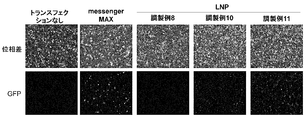
- FIG. 1 shows that, in the examples, lipid nanoparticles (LNP) containing green fluorescent protein (GFP) mRNA prepared using “Messenger MAX” and LNP containing GFPL mRNA prepared using the compound of the present invention (preparation).
- LNP lipid nanoparticles
- GFP green fluorescent protein
- FIG. 2 shows that in Examples, GFP @ mRNA-containing LNP prepared using "Messenger @ MAX” and GFP @ mRNA-containing LNP prepared using the compound of the present invention (Preparation Examples 8, 10, and 11) were converted into iPSCs.
- FIG. 9 shows the results of flow cytometry analysis on the day after transfection into a cell population containing cardiomyocytes of origin.
- transfection means introducing an arbitrary substance into a cell.
- the inside of the cell includes at least the cytoplasm and the nucleus.
- nucleic acid eg, “mRNA”
- the amount of the nucleic acid used may vary depending on the conditions and purpose of transfection.
- the amount of the mRNA used is 1 ng to 100 ⁇ g, preferably 100 ng to 5000 ng per 1 ⁇ 10 6 cells.
- “Culture” or “culturing” refers to maintaining, growing, and / or differentiating cells outside a tissue or body, for example, in a dish, petri dish, flask, or culture tank (tank). Means
- “Pluripotency” refers to the ability to differentiate into tissues and cells with a variety of different morphologies and functions and to differentiate into cells of any lineage of the three germ layers.
- a “pluripotency” is a “totipotency” that can differentiate into any tissue of the organism, including the scutellum, in that it cannot differentiate into the scutellum and thus has no ability to form an individual. ".
- Multipotency means the ability to differentiate into a plurality of a limited number of lineage cells. For example, mesenchymal stem cells, hematopoietic stem cells, and neural stem cells are multipotent, but not pluripotent.
- Stetem cells include, for example, pluripotent stem cells.
- “Pluripotent stem cells” that can be used in the present invention can be differentiated into tissues and cells having various different morphologies and functions of a living body, and can be divided into three germ layers (endoderm, mesoderm, ectoderm) Refers to stem cells that have the ability to differentiate into cells of any lineage. Examples thereof include, but are not limited to, embryonic stem cells (ESC), embryonic stem cells derived from cloned embryos obtained by nuclear transfer, sperm stem cells, embryonic germ cells, induced pluripotent stem cells (in the present specification, “iPSC ”).
- ESC embryonic stem cells
- iPSC induced pluripotent stem cells
- the“ multipotent stem cell ”(multipotent stem cell) that can be used in the present invention refers to a stem cell capable of differentiating into a plurality of cells of a limited number of lineages.
- the “multipotent stem cells” that can be used in the present invention include dental pulp stem cells, oral mucosal stem cells, hair follicle stem cells, cultured fibroblasts, and somatic stem cells derived from bone marrow stem cells.
- Preferred pluripotent stem cells are ESCs and iPSCs.
- iPSCs Induced pluripotent stem cells
- Nanog expression was selected as an index and established Nanog-iPS cells (Okita, K., Ichisaka, T., and Yamanaka, S. (2007). Nature 448, 313-317.), IPS cells prepared by a method without c-Myc (Nakagawa M, Yamanaka S., et al. Nature Biotechnology, (2008) 26, 101) -106), iPS cells (Okita K ⁇ ⁇ ⁇ ⁇ et al. Nat. Methods 2011 May; 8 (5): 409-12, Okita K et al. Stem Cells. 31 3): 458-66.) Can be.
- induced pluripotent stem cells Yu J., Thomson JA. Et al., Science (2007) 318: 318: established by introducing four factors of OCT3 / 4, SOX2, NANOG, and LIN28 produced by Thomson et al. 1917-1920.
- Induced pluripotent stem cells produced by Daley et al. Park IH, Daley GQ. Et al., Nature (2007) 451: 141-146
- induced pluripotent stem cells produced by Sakurada et al. Japanese Patent Application Laid-Open No. 2008-307007
- iPSC strains established by NIH, RIKEN (RIKEN), Kyoto University, etc. can be used.
- RIKEN RIKEN
- RIKEN RIKEN
- Kyoto University etc.
- human iPSC strain RIKEN HiPS-RIKEN-1A strain
- HiPS-RIKEN-2A strain HiPS-RIKEN-12A strain
- Nips-B2 strain Kyoto University 253G1, 201B7, 409B2 strain
- 454E2 Strains 606A1, 610B1 and 648A1 strains.
- clinical grade cell lines provided by Kyoto University and Cellular @ Dynamics @ International, etc., and research and clinical cell lines produced using these cell lines may be used.
- ESC embryonic stem cells
- RIKEN RIKEN
- NIH Various human ESC strains established by RIKEN, Kyoto University and Cellartis are available.
- human ESC strains include NIH CHB-1 to CHB-12 strains, RUES1, RUES2 strains, HUES1 to HUES28 strains, WisCell Research H1 strains, H9 strains, RIKEN KhES-1 strains, and KhES-2 strains. Strains, KhES-3, KhES-4, KhES-5, SSES1, SSES2, SSES3 and the like can be used.
- clinical grade cell lines and research and clinical cell lines produced using those cell lines may be used.
- cardiomyocytes include one or more subtypes such as ventricular myocytes, atrial myocytes, and pacemaker cells, unless otherwise specified.
- the term "cell population containing cardiomyocytes” means a cell population containing one or more types of cells other than cardiomyocytes and cardiomyocytes, both in vivo (in vivo) and ex vivo (exvivo). Or cultured (invitro).
- the cell population containing cardiomyocytes is, for example, in vivo or collected by any method and ex vivo, peripheral blood, heart, bone marrow tissue, adipose tissue, skeletal muscle tissue, amniotic tissue, placental tissue, umbilical cord Cells that can be induced to differentiate into cardiomyocytes (eg, stem cells, pluripotent stem cells, ESC, iPSCs) can be cell populations contained in blood, etc. It may be a cell population (including embryoid bodies) obtained by culturing under conditions.
- cells other than cardiomyocytes are not particularly limited, and include, for example, living tissue from which “cell population containing cardiomyocytes” is derived, and cells other than cardiomyocytes contained in culture.
- the “cell population containing cardiomyocytes” is a cell population containing cells other than cardiomyocytes such as cardiomyocytes (including one or more subtypes) derived from iPSCs and undifferentiated iPSCs. is there.
- the “cell population containing ventricular myocytes” is a cell population containing ventricular myocytes and one or more types of cells other than ventricular myocytes.
- cells other than ventricular muscle cells is not particularly limited.
- subcellular types of cardiomyocytes other than ventricular muscle cells eg, atrial muscle cells, pacemaker cells
- the “cardiomyocytes”, “ventricular myocytes”, “cells other than myocardial cells” and “cells other than ventricular myocytes” in the present invention may be human-derived cells or non-human mammals (non-human (Mammals).
- Non-human mammals include, for example, mice, rats, hamsters, guinea pigs, rabbits, dogs, cats, pigs, cows, horses, sheep, monkeys.
- target cell means a cardiomyocyte or a specific subtype thereof (eg, a ventricular muscle cell, an atrial muscle cell, a pacemaker cell, etc.) to be transfected according to the present invention.
- miRNA refers to a short-chain (usually 20 to 25 bases) non-coding RNA present in a cell and involved in the regulation of gene expression through inhibition of translation of mRNA into protein and degradation of mRNA. It is.
- This miRNA is transcribed from the DNA as a single-stranded pri-miRNA capable of taking a hairpin loop structure containing the miRNA and its complementary strand, and partially cut by an enzyme called Drosha in the nucleus to cut the pre-miRNA. After being transported out of the nucleus, it is further cut by Dicer to function.
- “Comprise (s) or comprising” indicates the inclusion of, but is not limited to, the element following the phrase. Thus, inclusion of an element that follows the phrase is suggested, but not exclusion of any other element.
- Consist (s) of or consistent of means including and limited to any element that follows the phrase. Thus, the phrase “consisting of” indicates that the listed elements are required or required, and that no other elements are substantially present.
- consisting essentially of is meant to include any element that follows the phrase and to be limited to that element that does not affect the activity or action identified in this disclosure for that element. . Thus, the phrase “consisting essentially of” requires or requires the listed elements, while other elements are optional and may affect the activity or action of the listed elements. , Depending on whether or not it is caused, there is a case where it does not exist.
- linear C 5-13 alkyl group examples include pentyl, hexyl, heptyl, octyl, nonyl, decanyl, undecanyl, dodecanyl, and tridecanyl.
- the “linear C 13-17 alkenyl group” includes, for example, 1-tridecenyl, 2-tridecenyl, 3-tridecenyl, 4-tridecenyl, 5-tridecenyl, 6-tridecenyl, 7-tridecenyl, 8 -Tridecenyl, 9-tridecenyl, 10-tridecenyl, 11-tridecenyl, 12-tridecenyl; 1-tetradecenyl, 2-tetradecenyl, 3-tetradecenyl, 4-tetradecenyl, 5-tetradecenyl, 6-tetradecenyl, 7-tetradecenyl, 8-tetradecenyl 9-tetradecenyl, 10-tetradecenyl, 11-tetradecenyl, 12-tetradecenyl, 13-tetradecenyl; 1-pentadecenyl,
- the “linear C 17 alkadienyl group” includes, for example, 1,3-heptadecadienyl, 1,4-heptadecadienyl, 1,5-heptadecadienyl, 1,6- Heptadecadienyl, 1,7-heptadecadienyl, 1,8-heptadecadienyl, 1,9-heptadecadienyl, 1,10-heptadecadienyl, 1,11-heptadecadienyl, 1,12-heptadecadienyl, 1,13-heptadecadienyl, 1,14-heptadecadienyl, 1,15-heptadecadienyl, 1,16-heptadecadienyl, 2,4-hepta Decadienyl, 2,5-heptadecadienyl, 2,6-heptadecadienyl, 2,7-heptadecadieny
- linear C 2-9 alkyl group examples include ethyl, butyl, propyl, pentyl, hexyl, heptyl, octyl, and nonyl.
- n1 is preferably an integer of 3 to 5.
- n2 is preferably an integer of 0 to 2.
- n3 is preferably an integer of 0 to 2.
- L is preferably -C (O) O-.
- Ra is preferably a straight-chain C 5-9 alkyl group, a straight-chain C 13-17 alkenyl group or a straight-chain C 17 alkadienyl group.
- Rb is preferably a linear C 4-8 alkyl group.
- Rc is preferably a hydrogen atom or a linear C 4-7 alkyl group.
- Rd is preferably a hydrogen atom or a linear C 3-6 alkyl group.
- Re is preferably a linear C 3-6 alkyl group.
- Rf is preferably a linear C 3-7 alkyl group.
- n1 is an integer of 3 to 5
- L is -C (O) O-
- Ra is linear A C 5-9 alkyl group
- Rb is a linear C 4-8 alkyl group
- Rc is a hydrogen atom
- Rd is a hydrogen atom
- Re is a linear C 3-6 alkyl group.
- Rf is a linear C 3-7 alkyl group.
- n1 is an integer of 3 to 5, n2 is 0 or 1, n3 is 0 or 1, L is —C (O) O—, and Ra is linear A C 5-9 alkyl group, Rb is a linear C 4-8 alkyl group, Rc is a linear C 5-7 alkyl group, Rd is a hydrogen atom, and Re is a linear C 4-8 alkyl group.
- a compound wherein the compound is a 3-6 alkyl group and Rf is a linear C 3-7 alkyl group.
- n1 is an integer of 3 to 5, n2 is 0 or 1, n3 is an integer of 0 to 2, L is -C (O) O-, and Ra is A linear C 5-9 alkyl group, Rb is a linear C 4-8 alkyl group, Rc is a hydrogen atom, Rd is a linear C 3-6 alkyl group, and Re is a linear C 5-9 alkyl group; A compound having a linear C 3-6 alkyl group and Rf being a linear C 3-7 alkyl group.
- n1 is an integer of 3 to 5
- n2 is 0 or 1
- n3 is an integer of 0 to 2
- L is -C (O) O-
- Ra is A linear C 13-17 alkenyl group or a linear C 17 alkadienyl group
- Rb is a linear C 3-6 alkyl group
- Rc is a linear C 3-6 alkyl group
- Rd is Compounds which are a hydrogen atom
- Re is a linear C 2-6 alkyl group
- Rf is a linear C 2-7 alkyl group.
- n1 is 3 or 4
- n2 is 0, n3 is 0 or 2
- L is —C (O) O—
- Ra is a linear C 7 alkyl group.
- Rb is a straight-chain C 6 alkyl group
- Rc is a hydrogen atom
- Rd is a hydrogen atom
- Re is a straight-chain C 5-6 alkyl group
- Rf is a straight-chain C 6-7
- n1 is an integer of 3 to 5, n2 is 0 or 1, n3 is 0 or 1, L is —C (O) O—, and Ra is linear C 6 a -7 alkyl group, Rb is a straight chain C 5-6 alkyl group, Rc is a linear C 5-6 alkyl group, Rd is a hydrogen atom, Re is a linear C 4- A compound having 5 alkyl groups and Rf being a linear C 5-6 alkyl group.
- n1 is an integer of 3 ⁇ 5, n2 is 0, n3 is 2, L is -C (O) O-, Ra is linear C 5-9 alkyl group Rb is a linear C 3-8 alkyl group, Rc is a hydrogen atom, Rd is a linear C 3-5 alkyl group, and Re is a linear C 3-5 alkyl group. And Rf is a linear C 3-5 alkyl group.
- n1 is an integer of 3 to 5
- n2 is 0 or 1
- n3 is an integer of 0 to 2
- L is -C (O) O-
- Ra is linear A C 13-17 alkenyl group or a linear C 17 alkadienyl group
- Rb is a linear C 3-5 alkyl group
- Rc is a linear C 3-5 alkyl group
- Rd is a hydrogen atom
- Re is a linear C 3-6 alkyl group and Rf is a linear C 3-7 alkyl group.
- the salt of compound (I) is preferably a pharmacologically acceptable salt, for example, a salt with an inorganic base, a salt with an organic base, a salt with an inorganic acid, a salt with an organic acid, a basic or acidic salt And salts with amino acids.
- the salt with an inorganic base include an alkali metal salt such as a sodium salt and a potassium salt; an alkaline earth metal salt such as a calcium salt and a magnesium salt; an aluminum salt and an ammonium salt.
- alkali metal salt such as a sodium salt and a potassium salt
- alkaline earth metal salt such as a calcium salt and a magnesium salt
- aluminum salt and an ammonium salt Preferred are sodium, potassium, calcium, and magnesium salts, and more preferred are sodium and potassium salts.
- salts with organic bases include trimethylamine, triethylamine, pyridine, picoline, ethanolamine, diethanolamine, triethanolamine, tromethamine [tris (hydroxymethyl) methylamine], tert-butylamine, cyclohexylamine, benzylamine, And salts with dicyclohexylamine and N, N-dibenzylethylenediamine.
- salts with inorganic acids include salts with hydrofluoric acid, hydrochloric acid, hydrobromic acid, hydroiodic acid, nitric acid, sulfuric acid, and phosphoric acid. Preferred are salts with hydrochloric acid and salts with phosphoric acid.
- salts with organic acids include formic acid, acetic acid, trifluoroacetic acid, phthalic acid, fumaric acid, oxalic acid, tartaric acid, maleic acid, citric acid, succinic acid, malic acid, methanesulfonic acid, benzenesulfonic acid , P-toluenesulfonic acid.
- salts with basic amino acids include salts with arginine, lysine and ornithine.
- salts with acidic amino acids include salts with aspartic acid and glutamic acid.
- cardiomyocytes containing 1) a compound represented by the formula (I) or a salt thereof (the compound of the present invention), 2) a structural lipid, and 3) a nucleic acid.
- a predetermined nucleic acid is introduced into cardiomyocytes using the nucleic acid transfection composition of the present invention, that is, the composition of the present invention.
- the compound of the present invention and the structural lipid contained in the composition of the present invention form a lipid particle, and the nucleic acid is encapsulated in the lipid particle.
- the “structural lipid” is not particularly limited as long as it can form lipid particles after mixing with the compound of the present invention to prepare a mixed lipid component.
- Such structural lipids include, for example, Sterols (eg, cholesterol, cholesterol ester, cholesterol hemisuccinic acid, etc.); Phospholipids (eg, phosphatidylcholine (eg, dipalmitoyl phosphatidylcholine, distearoyl phosphatidylcholine, lysophosphatidylcholine, dioleoylphosphatidylcholine, palmitoyloleoylphosphatidylcholine, dipalmitoylphosphatidylcholine, dilinolenoylphosphatidylcholine, MC-1010 (NOFCORPOR)) (NOF CORPORATION), MC-4040 (NOF CORPORATION), MC-6060 (NOF CORPORATION), MC-8080 (NOF CO
- sterols particularly, cholesterol
- phospholipids particularly, phosphatidylcholine
- polyethylene glycol lipids as structural lipids.
- the ratio of the compound of the present invention to the structural lipid in the composition of the present invention can be appropriately adjusted depending on the purpose.
- the structural lipid when a lipid particle is formed by the mixed lipid component containing the compound of the present invention and the structural lipid, the structural lipid is usually 0.008 to 1 mol per mole of the compound of the present invention.
- the ratio is 4 mol, preferably 0.4 to 1.5 mol.
- the compound of the present invention is usually 1 to 4 mol
- sterols is usually 0 to 3 mol
- phospholipid is usually 0 to 2 mol
- polyethylene glycol lipid is usually in the mixed lipid component. It is a ratio of 0 to 1 mol.
- a more preferred embodiment when the compound of the present invention is used in combination with another lipid component is 1 to 1.5 mol of the compound of the present invention, 0 to 1.25 mol of sterols, 0 to 0.5 mol of phospholipid. And 0 to 0.125 mol of polyethylene glycol lipid.
- nucleic acid may be any molecule as long as it is a polymer of a nucleotide and a molecule having a function equivalent to the nucleotide, such as RNA that is a polymer of ribonucleotide, DNA that is a polymer of deoxyribonucleotide, Examples thereof include a polymer in which nucleotides and deoxyribonucleotides are mixed, and a nucleotide polymer including a nucleotide analog, and further a nucleotide polymer including a nucleic acid derivative.
- the nucleic acid may be a single-stranded nucleic acid or a double-stranded nucleic acid.
- the double-stranded nucleic acid also includes a double-stranded nucleic acid in which one strand hybridizes to another strand under stringent conditions.
- Nucleotide analogs include, as compared to RNA or DNA, ribonucleases for improving or stabilizing nuclease resistance, increasing affinity with complementary strand nucleic acids, increasing cell permeability, or visualizing. Any molecule may be used as long as it is a modified molecule of nucleotide, deoxyribonucleotide, RNA or DNA.
- the nucleotide analog may be a naturally occurring molecule or a non-natural molecule, such as a sugar-modified nucleotide analog or a phosphodiester bond-modified nucleotide analog.
- the sugar moiety-modified nucleotide analog may be any analog as long as an arbitrary chemical structural substance is added or substituted to part or all of the chemical structure of the nucleotide sugar, and specific examples thereof include 2 ′ Nucleotide analogue substituted with -O-methylribose, nucleotide analogue substituted with 2'-O-propylribose, nucleotide analogue substituted with 2'-methoxyethoxyribose, 2'-O-methoxyethylribose Nucleotide analogue substituted with 2'-O- [2- (guanidium) ethyl] ribose, nucleotide analogue substituted with 2'-fluororibose, sugar moiety substituted with morpholino ring Nucleic acid analog (morpholino nucleic acid) has two cyclic structures by introducing a cross-linking structure into the sugar moiety Artificial nucleic acid (Bridge
- any or all of the chemical structure of the nucleotide phosphodiester bond may be added or substituted with any chemical substance, and specific examples thereof include Can be exemplified by nucleotide analogs substituted by phosphorothioate bonds, nucleotide analogs substituted by N3'-P5 'phosphoramidate bonds [Cell Engineering, ⁇ 16, ⁇ 1463-1473 ⁇ (1997)] [RNAi method And the antisense method, Kodansha (2005)].
- nucleic acid derivative compared to nucleic acids, in order to improve nuclease resistance, stabilize, increase affinity with complementary strand nucleic acid, increase cell permeability, or visualize the nucleic acid with another chemical compound.
- Any molecule may be used as long as it is a molecule to which a substance is added. Specific examples thereof include 5′-polyamine addition derivatives, cholesterol addition derivatives, steroid addition derivatives, bile acid addition derivatives, vitamin addition derivatives, Cy5 addition derivatives, and Cy3 addition derivatives. , 6-FAM addition derivatives, and biotin addition derivatives.
- the nucleic acid according to the present invention is not particularly limited as long as it is capable of purifying or producing a target cell, or other intended purpose by contacting with a cell population containing the target cell and transfecting the target cell. Not limited.
- the nucleic acid is mRNA.
- MRNA means RNA containing a base sequence that can be translated into a protein.
- the mRNA in the present invention is not particularly limited as long as it can express a desired protein in a cell.
- the mRNA has a nucleotide sequence encoding a functional gene, which may be further bound to a nucleotide sequence specifically recognized by the miRNA specifically expressed in the target cell. MRNA.
- the mRNA comprises the following (i) and / or (ii): (I) a cardiomyocyte (or cardiomyocyte) comprising a nucleotide sequence specifically recognized by a miRNA specifically expressed in the cardiomyocyte (or cardiomyocyte subtype) and a nucleotide sequence encoding a functional gene Subtype) specific miRNA-responsive mRNA; (Ii) mRNA containing a base sequence encoding a functional gene.
- the “cardiomyocyte (or cardiomyocyte subtype) -specific miRNA-responsive mRNA” in the embodiment (i) is “specifically expressed by a miRNA specifically expressed in a cardiomyocyte (or cardiomyocyte subtype)”.
- cardiomyocyte or cardiomyocyte subtype
- a “miRNA specifically expressed in a cardiomyocyte (or cardiomyocyte subtype)” is present, “functional” Translation of the “gene” into a protein is suppressed, and the expression level (abundance) of the protein in cardiomyocytes (or cardiomyocyte subtypes) decreases.
- a cardiomyocyte or a cardiomyocyte subtype in which “a miRNA specifically expressed in a cardiomyocyte (or a cardiomyocyte subtype)” exists, and a cardiomyocyte (a cardiomyocyte in which such a miRNA does not exist) ( Or a non-cardiomyocyte subtype), resulting in a difference in the expression level of the “functional gene” between the cells and the other cells, so that the myocardial cell (or myocardial cell subtype) can be distinguished from other cells .
- RNA specifically expressed in cardiomyocytes refers to cells other than cardiomyocytes, more specifically, those other than cardiomyocytes in a cell population containing cardiomyocytes.
- the miRNA is not particularly limited as long as it is a miRNA that is more highly expressed in cardiomyocytes as compared to the cells of the above.
- the expression level of cardiomyocyte-specific miRNA in cardiomyocytes is 10% or more, 20% or more, 30% or more, 40% or more, 50% or more, compared to the expression level in cells other than cardiomyocytes. % Or more, 70% or more, 80% or more, or 90% or more miRNA.
- miRNAs are registered in information of a database (for example, http://www.mirbase.org/ or http://www.microrna.org/), and / or are described in the database. It can be appropriately selected from miRNAs described in literature information.
- miRNAs specifically expressed in cardiomyocytes include hsa-miR-1, hsa-miR-22-5p, hsa-miR-133a, hsa-miR-133b, hsa-miR-143-3p, hsa-miR-145-3p, hsa-miR-208a-3p, hsa-miR-208b-3p, hsa-miR-490-3p, hsa-miR-490-5p, hsa-miR-499a-5p, hsa- miR-1271-5p, hsa-miR-3907, hsa-miR-4324, and hs
- cardiomyocyte-specific miRNA examples include hsa-miR-1, hsa-miR-208a-3p, hsa-miR-208b-3p and hsa-miR-499a-5p.
- a base sequence specifically recognized by a miRNA specifically expressed by a miRNA specifically expressed by a cardiomyocyte subtype in the above (i), and a base sequence encoding a functional gene As a specific embodiment of a cardiomyocyte subtype-specific miRNA-responsive mRNA, a nucleotide sequence specifically recognized by a miRNA specifically expressed in ventricular myocytes, and a nucleotide sequence encoding a functional gene
- a ventricular myocyte-specific miRNA-responsive mRNA including: "Ventricular myocyte-specific miRNA-responsive mRNA" is a "controllable” of "base sequences specifically recognized by miRNAs specifically expressed in ventricular myocytes" and "functional genes”. "Linked" nucleic acids.
- the expression of the “functional gene” is controlled by the “base sequence specifically recognized by the miRNA specifically expressed in ventricular myocytes”,
- a present miRNA When "a present miRNA” is present, the translation of the "functional gene” into a protein is regulated according to its abundance.
- a ventricular myocyte in which a “miRNA specifically expressed in a ventricular myocyte” is present translation of a “functional gene” into a protein is suppressed depending on its abundance.
- the expression level (abundance) of the protein in ventricular myocytes decreases.
- a “functional gene” is identified between a ventricular myocyte in which "a miRNA specifically expressed in ventricular myocyte” exists and a cell other than a ventricular myocyte in which such a miRNA is not present.
- the ventricular myocytes can be distinguished from other cells.
- ventricular myocyte-specific miRNA refers to cells other than ventricular myocytes, more specifically, a cell population containing ventricular myocytes.
- the miRNA is not particularly limited as long as it is a miRNA expressed at a higher level in ventricular myocytes as compared with cells other than ventricular myocytes.
- the expression level in ventricular myocytes is 10% or more, 20% or more, 30% or more, 40% or more, 50% as compared with the expression level in cells other than ventricular myocytes.
- the miRNA may be 60% or more, 70% or more, 80% or more, or 90% or more miRNA.
- Such miRNAs are registered in information of a database (for example, http://www.mirbase.org/ or http://www.microrna.org/), and / or are described in the database. It can be appropriately selected from miRNAs described in literature information.
- preferred specific examples of the ventricular myocyte-specific miRNA include hsa-miR-208b-3p.
- the “base sequence specifically recognized by miRNA specifically expressed in cardiomyocytes” (hereinafter referred to as “cardiomyocyte-specific miRNA recognition sequence”) interacts with a plurality of predetermined proteins to cause RISC (RNA-induced silencing complex) is a base sequence that is specifically recognized by a cardiomyocyte-specific miRNA in a state of forming.
- the cardiomyocyte-specific miRNA recognition sequence may be any sequence as long as the cardiomyocyte-specific miRNA can be recognized and hybridized as RISC, and may be a completely complementary sequence or a sequence having a mismatch (mismatch). You may.
- the cardiomyocyte-specific miRNA recognition sequence is 1% or less, 5% or less, 10% or less, 20% or less, 30% or less, 40% or less based on a sequence completely complementary to the cardiomyocyte-specific miRNA.
- it may have a mismatch of 50% or less, or a mismatch of 1 base, 2 bases, 3 bases, 4 bases, 5 bases, 6 bases, 7 bases, 8 bases, 9 bases or 10 bases.
- the base length of the cardiomyocyte-specific miRNA recognition sequence is not particularly limited, and may be an appropriate base length corresponding to the cardiomyocyte-specific miRNA (including RISC). Are preferred, and 20 or 21 bases are more preferred.
- ventricular myocyte-specific miRNA recognition sequence “base sequence specifically recognized by miRNA specifically expressed in ventricular muscle cells” (hereinafter referred to as “ventricular myocyte-specific miRNA recognition sequence”). Is a base sequence that is specifically recognized by ventricular myocyte-specific miRNA in a state of interacting with a plurality of predetermined proteins to form a RISC (RNA-induced silencing complex).
- the ventricular myocyte-specific miRNA recognition sequence may be any sequence as long as it is recognized by the ventricular myocyte-specific miRNA and hybridizable as RISC, and may be a completely complementary sequence or a sequence having a mismatch (mismatch). It may be.
- the ventricular myocyte-specific miRNA recognition sequence is 1% or less, 5% or less, 10% or less, 20% or less, 30% or less, 40% or less based on a sequence completely complementary to the ventricular myocyte-specific miRNA. % Or 50% or less, or 1 base, 2 bases, 3 bases, 4 bases, 5 bases, 6 bases, 7 bases, 8 bases, 9 bases or 10 bases.
- the base length of the ventricular myocyte-specific miRNA recognition sequence is not particularly limited, and may be an appropriate base length corresponding to the ventricular myocyte-specific miRNA (including RISC). Bases or less are preferred, and 20 or 21 bases are more preferred.
- Table 2 shows standard cardiomyocyte-specific miRNA recognition sequences (completely complementary nucleotide sequences) corresponding to each of the cardiomyocyte-specific miRNA base sequences exemplified above.
- the “functional gene” in the embodiment (i) can be used for the purification of cardiomyocytes in a cell population containing cardiomyocytes or for the purification of ventricular myocytes in a cell population containing ventricular myocytes.
- Gene more generally, various genes that can be used to select a specific cell from a cell population, and are not particularly limited.
- Such "functional genes” include, for example, drug resistance genes, genes encoding fluorescent proteins, apoptosis-inducing genes, and suicide genes.
- the “functional genes” are each independently a drug resistance gene, a gene encoding a fluorescent protein, It can be selected from an apoptosis-inducing gene and a suicide gene, and may be the same or different.
- Examples of the “drug resistance gene” include a kanamycin resistance gene, an ampicillin resistance gene, and a puromycin resistance gene. One of these genes may be used, or two or more of them may be used.
- Examples of the "gene encoding a fluorescent protein” include, for example, blue fluorescent proteins such as Sirius, BFP and EBFP; cyan fluorescent proteins such as mTurquoise, TagCFP, AmCyan, mTFP1, MidoriishiCyan and CFP; TurboGFP, AcGFP, TagGFP, Azami-Green (E.g., hmAG1), green fluorescent proteins such as ZsGreen, EmGFP, EGFP, GFP2, HyPer; yellow fluorescent proteins such as TagYFP, EYFP, Venus, YFP, PhiYFP, PhiYFP-m, TurboYFP, ZsYellow, mBanana; KusabiraOrange (for example, hmKO2), orange fluorescent protein such as mOrange; red fluorescent protein such as TurboRFP, DsRed-Express, DsRed2, TagRFP, DsRed-Monomer, AsRed2, mStrawberry; TurboFP602, mRFP1, J
- ⁇ apoptosis-inducing gene '' for example, I ⁇ B, Smac / DIABLO, ICE, HtrA2 / OMI, AIF, endonucleasecleG, Bax, Bak, Noxa, Hrk (harakiri), Mtd, Bim, Bad, Bid, PUMA, activated ⁇ caspase -3, Fas and Tk.
- I ⁇ B I ⁇ B
- Smac / DIABLO ICE
- HtrA2 / OMI AIF
- endonucleasecleG Bax
- Bak Noxa
- Hrk Yamakiri
- Mtd Bim
- Bad Bad
- Bid PUMA
- Fas and Tk Fas and Tk.
- One of these genes may be used, or two or more of them may be used.
- suicide gene examples include diphtheria A toxin, herpes simplex thymidine kinase gene (HSV-TK), carboxypeptidase G2 (CPG2), carboxylesterase (CA), cytosine deaminase (CD), and cytochrome P450 (cyt-450).
- HSV-TK herpes simplex thymidine kinase gene
- CPG2 carboxypeptidase G2
- CA carboxylesterase
- CD cytosine deaminase
- cyt-450 cytochrome P450
- dCK deoxycytidine kinase
- NR nitroreductase
- PNP purine nucleoside phosphorylase
- TP thymidine phosphorylase
- VZV-TK varicella-zoster virus thymidine kinase
- XGPRT xanthine-guanine phosphoribosyltransferase
- Cardiomyocyte-specific miRNA-responsive mRNA and “ventricular myocyte-specific miRNA-responsive mRNA” that can be used in the present invention, including a target cell-specific miRNA recognition sequence and a base sequence encoding a functional gene "(Target cell-specific miRNA-responsive mRNA) can be designed and prepared by a person skilled in the art. If necessary, specific examples of the full-length nucleotide sequences of these target cell-specific miRNA-responsive mRNAs can be referred to, for example, Patent Document 4 mentioned above.
- the target cell-specific miRNA-responsive mRNA includes a base sequence (target cell-specific miRNA recognition sequence) specifically recognized by a miRNA specifically expressed in the target cell, if necessary, and a “functional gene”. May be included.
- the target cell-specific miRNA-responsive mRNA may include a gene encoding a localization signal.
- a gene encoding a localization signal may be linked to the gene.
- the phrase “controllably linked” between the target cell-specific miRNA recognition sequence and the “functional gene” means that the “functional gene” has an open reading frame ( At least one subject cell in the 5 'untranslated region (UTR) of the ORF (including the start codon), in the 3' UTR, or in at least one of the ORFs (3 'to the start codon). It means that a specific miRNA recognition sequence is included.
- the number of target cell-specific miRNA recognition sequences may be one, two, three, four, five, six, seven, eight or more, and the recognition sequences are 5 ' It may be included in one or more of the UTR, 3'UTR or ORF.
- the target cell-specific miRNA-responsive mRNA encodes a Cap structure (7-methylguanosine 5′-phosphate), “functional gene” in the direction from the 5 ′ end to the 3 ′ end. And a polyA tail and at least one target cell-specific miRNA recognition sequence in the 5′UTR, 3′UTR, and / or ORF.
- the target cell-specific miRNA recognition sequence and the “functional gene” are arranged in this order from the 5 ′ end to the 3 ′ end. It is therefore preferred that at least one cell-specific miRNA recognition sequence of interest is contained within the 5'UTR.
- the number of bases and the type of bases between the cap structure and the target cell-specific miRNA recognition sequence may be arbitrary as long as they do not constitute a stem structure or a three-dimensional structure.
- the number of bases between the cap structure and the target cell-specific miRNA recognition sequence can be 0 to 50 bases, preferably 10 to 30 bases.
- the number of bases and the type of base between the target cell-specific miRNA recognition sequence and the start codon of a functional gene are arbitrary as long as they do not constitute a stem structure or a three-dimensional structure. May be.
- the number of bases between the target cell-specific miRNA recognition sequence and the start codon of a functional gene can be 0 to 50 bases, preferably 10 to 30 bases.
- the target cell-specific miRNA recognition sequence does not include a base sequence serving as an initiation codon.
- the recognition sequence may be incompatible with a functional gene linked to the 3 ′ side.
- it is designed to be a frame.
- the target cell-specific miRNA recognition sequence contains AUG as an initiation codon, the AUG can be used after being converted to a GUG that is not an initiation codon.
- the location of the recognition sequence in the 5'UTR can be appropriately adjusted.
- the number of bases between the cap structure and the start codon (AUG) in the target cell-specific miRNA recognition sequence is 0-60 bases, for example, 0-15 bases, 10-20 bases, 20-30 bases, 30 bases.
- the base may be designed to have 40 to 40 bases, 40 to 50 bases, and 50 to 60 bases.
- a target cell-specific miRNA-responsive mRNA can be obtained by a genetic engineering method known to those skilled in the art, generally a template containing a promoter sequence, if the elements (sequences) to be contained therein are determined as described above. It can be synthesized by an in vitro synthesis method using DNA as a template.
- the target cell-specific miRNA-responsive mRNA may have been verified for its effectiveness in selecting target cells in a cell population. That is, the transfection method, the purification method, and the production method of the present invention use the target cell-specific miRNA-responsive mRNA in advance to carry out the selection of the target cells in the cell population as necessary before performing each method. (And a step of selecting a target cell-specific miRNA-responsive mRNA based on the result of the step) may be performed. Specifically, a plurality of candidate target cell-specific miRNA-responsive mRNAs having 5′ ⁇ UTR as exemplified above are prepared, and each of them is converted into a cell population containing target cells of known purity. After transfection, it can be determined that the target cells are highly effective in sorting.
- the target cell-specific miRNA-responsive mRNA may be used alone or in combination of two or more. When two or more target cell-specific miRNA-responsive mRNAs are used, target cell-specific miRNA recognition sequences and functional genes contained in those miRNA-responsive mRNAs are different from each other between the miRNA-responsive mRNs. Is preferred. When two or more target cell-specific miRNA-responsive mRNAs are used, the number of target cell-specific miRNA recognition sequences contained in those miRNA-responsive mRNAs, the distance from the 5 ′ end, and other structural features The characteristics may be the same or different in each miRNA-responsive mRNA.
- two or more target cell-specific miRNA-responsive mRNAs having the same target cell-specific miRNA recognition sequence but different functional genes can also be used.
- the “functional gene” contained in the mRNA of the embodiment (ii) may be the same as the “functional gene” contained in the mRNA of the embodiment (i), such as a drug resistance gene and a fluorescent protein.
- the gene which codes is mentioned.
- the “functional gene” contained in the mRNA of the embodiment (ii) is a gene other than a drug resistance gene and a gene encoding a fluorescent protein, which is a gene indicating that a nucleic acid has been introduced into a cell, a so-called reporter gene.
- reporter genes include, for example, proteins other than fluorescent proteins that assist in luminescence or coloration, and membrane-localized proteins that are localized and expressed on cell membranes and can bind to antibodies that use them as antigens.
- the target cell-specific miRNA-responsive mRNA of (i) and the mRNA of (ii) can be used in combination. That is, both the miRNA-responsive mRNA of (i) and the mRNA of (ii) can be brought into contact with a cell population containing a target cell and introduced into the cell (particularly a cardiomyocyte).
- the mRNA of (ii) can be referred to as a "control mRNA.”
- control mRNA By using control mRNA in combination, the selection of target cells can be made more efficient. For example, when a drug resistance gene is used as the “control mRNA” and an apoptosis-inducing gene or a suicide gene is used as the “functional gene”, by selecting a cell population that is drug-resistant and has not induced cell death. In addition, the accuracy of sorting target cells can be improved. More specifically, cells with low transfection nucleic acid transfection efficiency, that is, target cells and other cells with low transfection efficiency of target cell-specific miRNA-responsive mRNA, are identified based on their drug resistance.
- the selection of target cells can be made more efficient by the presence or absence of the expression of “functional genes” contained in the target cell-specific miRNA-responsive mRNA. This is because, in a target cell, “functional cardiomyocyte-specific miRNA” or “ventricular myocyte-specific miRNA” existing in the target cell hybridizes to a predetermined base sequence of miRNA-responsive mRNA, and thus “functional”.
- the expression of the "functional gene” is suppressed because the expression of the "gene” is suppressed in the cells other than the target cells, whereas the "cardiomyocyte-specific miRNA” or the "ventricular myocyte-specific miRNA” is not present in the cells. By not being suppressed.
- the selection of a cell population exhibiting drug resistance can be performed by a known method.
- the control mRNA when a gene encoding a fluorescent protein is used as the “control mRNA” and the “functional gene”, by selecting a cell population having lower fluorescence intensity, it is possible to improve the accuracy of selecting target cells. More specifically, cells with high transfection nucleic acid transduction efficiency are identified based on fluorescence, and a cell population having a lower fluorescence intensity is selected from the cell population, thereby selecting target cells. Can be made more efficient. This indicates that the amount of the fluorescent protein contained in the control mRNA introduced into the target cells and other cells is the same as the amount of the target cell-specific miRNA-responsive mRNA that is simultaneously transfected into the target cells and other cells. This is because it is proportional.
- the selection of cells based on the fluorescence intensity can be performed, for example, by selectively separating cells that emit fluorescence above a certain standard using a cell sorter (for example, “FACS” manufactured by Bexon Dickinson).
- the transfection method of the present invention includes at least a step of bringing the composition of the present invention into contact with a cell population containing a target cell (referred to as a “composition contacting step” in this specification), and if necessary. Further, other steps related to introducing (transfecting) nucleic acid into cardiomyocytes may be included.
- the transfection method of the present invention uses the composition of the present invention as a reagent, but the other technical items are basically the same as those of a general transfection method, for example, using a lipid nanoparticle (LNP) or a liposome.
- LNP lipid nanoparticle
- the transfection (lipofection) method can be used.
- the transfection method of the present invention can be performed under conditions that allow transfection of a nucleic acid-containing LNP into a cell population containing target cells (conditions that can induce transfection).
- composition of the present invention When the composition of the present invention is brought into contact with a cell population containing a target cell in a living body, a target to which an effective amount of the nucleic acid is targeted relative to an administration target (eg, a human or non-human mammal, preferably a human).
- an administration target eg, a human or non-human mammal, preferably a human.
- the composition may be administered so as to be delivered to the cells.
- the composition of the present invention can be used stably, with low toxicity and safely.
- composition of the present invention when used in vivo, for example, it is preferable to use an injection such as intravenous injection, intraarterial injection, intramuscular injection, subcutaneous injection, intraperitoneal injection, etc. If an effective amount can be delivered to a target cell, a dosage form adapted to it can be prepared.
- the cell population containing the target cells is differentiated into target cells such as induced pluripotent stem cells (iPS cells), embryonic stem cells (ES cells), or other stem cells, progenitor cells, and the like.
- target cells such as induced pluripotent stem cells (iPS cells), embryonic stem cells (ES cells), or other stem cells, progenitor cells, and the like.
- iPS cells induced pluripotent stem cells
- ES cells embryonic stem cells
- An in vitro cell population prepared by culturing inducible cells under conditions suitable for inducing differentiation into target cells, wherein the stem cells and the like are mixed with target cells.
- the composition of the present invention is added to the embryoid body on day 10 to 40, preferably day 14 to 20, or around the day when the embryoid body containing the target cell was formed from the iPS cells. Can be contacted.
- mRNA containing a base sequence encoding a functional gene can be used as "nucleic acid”.
- a “drug resistance gene”, a “gene encoding a fluorescent protein”, and other positive or negative selection marker genes may be used.
- an agent eg, puromycin
- puromycin resistance gene corresponding to the drug resistance gene (eg, puromycin resistance gene) is added to the medium at an appropriate concentration.
- a step of culturing cells in the medium a step of selecting cells into which the drug resistance gene has been introduced by the culturing, and the like.
- a step of irradiating light of an excitation wavelength corresponding to the fluorescent protein, a fluorescence emitted by the irradiation is a fluorescence microscope, a cell sorter, etc.
- the step of selecting cells having predetermined characteristics of the emission of fluorescence by the fluorescent protein by the detection is a fluorescence microscope, a cell sorter, etc.
- nucleic acid refers to “cardiomyocyte-specific miRNA responsiveness including a nucleotide sequence specifically recognized by a miRNA specifically expressed in cardiomyocytes and a nucleotide sequence encoding a functional gene” "mRNA” or "a ventricular myocyte-specific miRNA-responsive mRNA containing a nucleotide sequence specifically recognized by a miRNA specifically expressed in ventricular myocytes, and a nucleotide sequence encoding a functional gene” Can also be used.
- the “functional gene” is obtained by hybridizing a miRNA specifically expressed in the target cell present in the target cell to a predetermined base sequence of the miRNA-responsive mRNA.
- the miRNA specifically expressed in the target cell is not present in the cell, so that the expression of the “functional gene” is not suppressed. Therefore, when a miRNA-responsive mRNA containing, for example, an “apoptosis-inducing gene” or a “suicide gene” that kills a cell in which it is expressed is used as the “functional gene”, after the composition contacting step, these genes are used.
- a step for enriching, isolating, or detecting target cells in a cell population in which cells other than the target cells are mixed can be performed depending on the presence or absence of the expression of.
- the “transfection method” of the present invention in such an embodiment includes the “cardiomyocyte purification method”, “cardiomyocyte production method”, and “ventricular myocyte purification method” of the present invention, as described later. And “Method for producing ventricular myocytes”, and the description of the technical items related to “Transfection method” is appropriately described as “Method for purifying cardiomyocytes”, “Method for producing cardiomyocytes”, “Purification of ventricular myocytes” Method “and” a method for producing ventricular myocytes ".
- the transfection method of the present invention is carried out as a method comprising the following step 1, and optionally further comprising the following step 2:
- Step 1 a step of forming an aggregate of a cell population containing a target cell in a non-cell-adherent container under conditions that allow transfection of the composition of the present invention into a cell population containing the target cell (hereinafter, “ Agglomerate forming step ”).
- Step 2 a step of selecting a target cell from a cell population transfected with the composition based on the function of the nucleic acid contained in the composition in the cell (hereinafter, referred to as a “selection step”) Sometimes.).
- Step 1 may more specifically include any of the following steps 1-1 or 1-2: Step 1-1: A cell population containing a target cell is cultured in a cell non-adhesive container in the presence of the composition of the present invention and a microcarrier, and cells into which the nucleic acid contained in the composition of the present invention has been introduced.
- a step of forming an aggregate composed of the microcarriers and the microcarriers (hereinafter, also referred to as an “aggregate formation step first embodiment”); Step 1-2: A cell population containing a target cell is cultured in a cell non-adhesive container in the presence of the composition of the present invention, and a coagulation consisting of cells into which the nucleic acid contained in the composition of the present invention has been introduced.
- a step of forming an aggregate hereinafter, also referred to as an “aggregate forming step second embodiment”).
- Step A a step of inducing differentiation of pluripotent stem cells (population) into target cells
- Step B a step of dispersing the cells (population) after the differentiation induction in Step A.
- the cell population containing the target cells in the aggregate formation step is preferably an adhesive cell population.
- adhesive cells (population) means cells (population) that can be optimally maintained or proliferated in a state of adhesion to a solid phase surface serving as a scaffold.
- the “cell population containing target cells” in Step 1-1 is a population containing cells that have an agglutinating ability and can form an aggregate when cultured in a cell non-adhesive container.
- the “cell population containing target cells” in step 1-2 includes cells that have an adhesive ability to a microcarrier and can adhere to the microcarrier when cultured with the microcarrier in a cell non-adhesive container. It is a group.
- the “cell population containing target cells” may be prepared in any manner.
- a step for inducing differentiation of a pluripotent stem cell into a target cell may be performed, if necessary (as Step A performed before Step 1).
- the method for inducing differentiation from various pluripotent stem cells into target cells as described above is not particularly limited, and various known methods can be used. Examples of a method for inducing differentiation of pluripotent stem cells into target cells include a method reported by Laflamme MA and others (Laflamme MA & Murry CE, Nature 2011, Review).
- a method for producing cardiomyocytes by forming a cell mass (embryoid body) by suspension culture of induced pluripotent stem cells (iPS cells), and a method for producing cardiomyocytes in the presence of a substance that inhibits BMP signaling (WO2005 / 033298), a method for producing cardiomyocytes by sequentially adding Activin A and BMP (WO2007 / 002136), and a method for producing cardiomyocytes in the presence of a substance that promotes activation of the canonical Wnt signal pathway (WO2007 / 126077), a method of isolating Flk / KDR-positive cells from induced pluripotent stem cells and producing cardiomyocytes in the presence of cyclosporin A (WO2009 / 118928).
- the target cells for which differentiation has been induced are cells expressing at least cardiac troponin (cTnT) or ⁇ MHC.
- cTnT cardiac troponin
- ⁇ MHC ⁇ MHC
- the dispersed cell population is subjected to culture. That is, in the transfection method of the present invention, if necessary, a cell population containing a target cell, preferably a pluripotency (as the step B performed before the step 1) may be previously prepared in the step prior to the aggregate forming step.
- a step for dispersion treatment of the cell population after the differentiation induction from the germ stem cells to the target cells may be performed.
- the dispersion treatment can be performed by a known method, and a chemical treatment with an enzyme or the like, a physical treatment with pipetting or the like, and a combination thereof can be adopted.
- Commercially available reagents eg, Liberase TM Research Grade, Roche; StemPro Accutase Cell Dissociation Reagent, Gibco; TrypLE Select CTS, Gibco, etc.
- the “cell non-adhesive container” used for culturing the cell population in the aggregate formation step includes (a) an artificially treated surface (eg, extracellular matrix, etc.) for the purpose of improving the adhesion of the container to cells. (B) the surface of the container is artificially treated (for example, a coating treatment with a hydrophobic molecule) for the purpose of reducing the adhesion to cells. can do.
- an artificially treated surface eg, extracellular matrix, etc.
- the surface of the container is artificially treated (for example, a coating treatment with a hydrophobic molecule) for the purpose of reducing the adhesion to cells. can do.
- cell non-adhesive means that the adherent cells do not adhere or hardly adhere, for example, less than 20%, preferably less than 10%, more preferably less than 1%, based on the total number of cells seeded in a container. It means that less than% of cells are attached to the container.
- Examples of the material of the cell non-adhesive container include polycarbonate, polyethylene, polypropylene, Teflon (registered trademark), polyethylene terephthalate, polymethyl methacrylate, nylon 6,6, polyvinyl alcohol, cellulose, silicon, polystyrene, glass, polyacrylamide, Polydimethylacrylamide, and stainless steel.
- Examples of the form of the cell non-adhesive container include a microplate, a Petri dish (dish), a cell culture flask (such as a spinner flask and a shaker flask), a cell culture bag, a roller bottle, a bioreactor, and a culture tank (tank). .
- the size of the cell non-adhesive container can also be appropriately selected according to the production scale (for example, in the range of 1 mL to 2000 L). In the present invention, particularly, a large volume (for example, 100 mL to 2000 L) of the cell non-adhesive Sex containers are preferred.
- the composition of the present invention and a microcarrier are added to a cell population containing target cells that are adhesive cell populations in a cell non-adhesive container.
- the cell population is statically cultured in the presence thereof.
- the cell population containing the target cell adheres to the microcarrier to form an aggregate, and in the process, the nucleic acid contained in the composition of the present invention is introduced into the cells constituting the cell population.
- the “aggregate” in the first embodiment means an aggregate including at least one cell and one microcarrier.
- the size of the aggregate depends on the size of the microcarrier used and is not particularly limited.
- the number of cells adhering to one microcarrier is not particularly limited, but is, for example, 2 to 500, preferably 50 to 300.
- Aggregate Formation Step The cell population cultured in the first embodiment includes cells that form aggregates (aggregate-forming cells) and cells that do not form aggregates (non-aggregate-forming cells).
- the ratio of the aggregate-forming cells to the total number thereof is not particularly limited, but for example, 10% or more, 20% or more, 30% or more, 40% or more, 50% or more, 60% or more, 70% or more , 80% or more, 90% or more, or 100%.
- the “microcarrier” used in the first embodiment means a carrier capable of adhering a cell population containing target cells to the surface.
- the microcarrier can be suspended in a liquid medium in a state where the cell population containing the target cell is adhered, and it is sufficient that the microcarrier can play a role in culturing the adhered cell population, and its material, shape, and size are sufficient. There is no particular limitation on the degree.
- microcarrier examples include dextran, gelatin, collagen, polystyrene, polyethylene, polyacrylamide, glass, and cellulose.
- Examples of the shape of the microcarrier include a sphere (beads) and a disk shape.
- the size of the spherical microcarrier is, for example, 2 to 1000 ⁇ m in diameter, preferably 100 to 300 ⁇ m.
- the microcarrier may be porous.
- the number of microcarriers used for culturing cells is not particularly limited, but is, for example, one microcarrier per 10 cells.
- the amount of microcarriers used for culturing of cells is not particularly limited, for example, cells 1 ⁇ 10 microcarriers 0.1g against six 5 ⁇ 10 7, preferably 3 ⁇ 10 from 2 ⁇ 10 7 cells cells 0.1 g of microcarriers per 7 microcarriers.
- the microcarriers may be commercially available, for example, high-concentration Synthemax II microcarriers (Corning) can be used.
- the composition of the present invention is added to a cell population containing a target cell that is an adhesive cell population in a cell non-adhesive container, This is performed by statically culturing the cell population in the presence.
- a step in the cell population containing the target cells, aggregates are formed between the cells even when microcarriers are not present, and in the process, the nucleic acid contained in the composition of the present invention constitutes the cell population. Is introduced into the cell.
- aggregate in the second embodiment means an aggregate including at least two cells. Most of the aggregates are occupied by a large number of adhered cells.
- the number of cells forming one aggregate is not particularly limited, but is, for example, 2 to 500, preferably 50 to 300.
- Aggregate Formation Step The cell population cultured in the second embodiment includes cells that form aggregates (aggregate-forming cells) and cells that do not form aggregates (non-aggregate-forming cells).
- the ratio of the aggregate-forming cells to the total number thereof is not particularly limited, but for example, 10% or more, 20% or more, 30% or more, 40% or more, 50% or more, 60% or more, 70% or more , 80% or more, 90% or more, or 100%.
- the stationary culture in the aggregate formation step may be performed for a period sufficient for the formation of the aggregate and the completion of the transfection.
- the period of the stationary culture is not particularly limited, but is, for example, about 2 to 10 hours, preferably about 3 to 6 hours, and more preferably 4 to 5 hours.
- the conditions for static culture are not particularly limited, either.
- the culture can be performed at about 37 ° C. in the presence of 5% CO 2 .
- stirring culture may be performed in order to maintain the formed aggregate.
- the period of stirring culture is not particularly limited, but is, for example, about 12 to 48 hours, and preferably about 24 hours.
- Stirring culture conditions is not particularly limited, for example, about 37 ° C., can be set to the presence of 5% CO 2.
- the stirring speed and time are appropriately set according to the cell density and the size of the culture vessel. Typically, the mixture is left still for 4 to 6 hours and then stirred at 25 rpm for 12 hours or more. Excessive agitation or shaking can put physical stress on the cells and can hinder the maintenance of aggregates. Therefore, it is desirable to control the stirring speed so that the medium components and the oxygen concentration in the medium can be made uniform and the maintenance of the aggregates is not hindered.
- a conventionally known medium suitable for culturing a cell population containing the target cell can be used.
- BME medium BME medium, BGJb medium, CMRL-1066 medium, Glasgow MEM medium, Improved MEM (IMEM) medium, Improved MDM (IMDM) medium, Medium 199 medium, Eagle MEM medium, ⁇ MEM medium, DMEM medium (High glucose, Low glucose) , DMEM / F12 medium, ham medium, RPMIRP1640 medium, Fischer's medium, and a mixed medium thereof.
- IMEM Improved MEM
- IMDM Improve
- the medium may contain, if necessary, amino acids, L-glutamine, GlutaMAX (product name), non-essential amino acids, vitamins, antibiotics (eg, penicillin, streptomycin, or a mixture thereof), antibacterial agents (eg, amphotericin B) And additives such as antioxidants, pyruvic acid, buffers, inorganic salts and the like. Those skilled in the art can appropriately set the type and amount of the additive depending on the cells and the culture conditions.
- the transfection method including the aggregate forming step as described above, there is a limitation due to the area of the container surface as in the conventional method in which cells are adhered and cultured on the surface of a container (dish, dish, etc.).
- a large amount of cardiomyocytes (including cell populations) into which a desired nucleic acid has been introduced can be obtained at a commercial level.
- the method for purifying a target cell of the present invention includes at least a step of bringing the composition of the present invention into contact with a cell population containing the target cell (composition contacting step), and further purifying the target cell as necessary. Other steps related to the above may be included.
- the method for purifying a target cell of the present invention comprises purifying a target cell in a cell population, in other words, increasing a ratio of the target cell in the cell population (enriching the target cell) with a specific nucleic acid.
- the composition of the present invention is used, other technical matters can basically be based on a known method for purifying cardiomyocytes.
- the target cell-specific miRNA-responsive mRNA of (i) and / or the mRNA of (ii) are used as the “nucleic acid”.
- the composition of the present invention containing such a specific nucleic acid is brought into contact with a cell population containing a target cell and the predetermined nucleic acid is introduced into the target cell and other cells, the target In a cell, a target cell-specific miRNA-responsive mRNA contains a "base sequence specifically recognized by a miRNA specifically expressed in a cardiomyocyte" (cardiomyocyte-specific miRNA recognition sequence) or a "ventricular myocyte”
- the expression level of a "functional gene” is suppressed by the "base sequence specifically recognized by the miRNA specifically expressed in E.
- coli a ventricular muscle cell-specific miRNA recognition sequence
- the expression level of the “functional gene” is not suppressed and becomes relatively high.
- a step for selecting the target cells which includes a treatment corresponding to the “functional gene” (this specification) In this document, this is referred to as a “target cell selection step”).
- the target cell selection step uses a predetermined detection device to detect a signal (fluorescence emission) emitted from the fluorescent protein. It is appropriate to include processing.
- the detection device therefor include a flow cytometer, an imaging cytometer, a fluorescence microscope, an emission microscope, and a CCD camera. Such a detection device can be adjusted to an embodiment (device configuration, measurement conditions, etc.) suitable for the absorption wavelength and emission wavelength of the fluorescent protein.
- the expression level of the fluorescent protein can be reduced by using a fluorescence microscope or by using a culture dish coated with photoresponsive cell culture equipment (cells that have not been irradiated with light can be detached from the culture dish). It is also possible to select and exclude cells other than the high (high fluorescence intensity) target cells.
- the cell population obtained by the method for purifying target cells of the present invention can increase the purity of target cells to a certain level.
- the purity of the target cells in such a cell population may be higher than the purity of the target cells in the cell population obtained without applying the target cell purification method of the present invention, and the degree is not particularly limited. Absent.
- the purity of the target cells in the cell population obtained by the method for purifying the target cells of the present invention is 60% or more, 70% or more, 80% or more, 81% or more, 82% or more, 83% or more, 84% or more, 85% or more, 86% or more, 87% or more, 88% or more, 89% or more, 90% or more, 91% or more, 92% or more, 93% or more, 94% or more, 95% or more, 96%
- the above may be 97% or more, 98% or more, 99% or more, and 100% (substantially no cells other than the target cell can be detected).
- purification method can be appropriately replaced with “production method”. That is, the "purification method of cardiomyocytes” of the present invention (a method of increasing the purity or ratio of cardiomyocytes in a cell population) and the “purification method of ventricular myocytes” (increase the purity or ratio of ventricular myocytes in a cell population)
- the description of the invention relating to (method) is “Method for producing cardiomyocytes” (method for producing a cell population with increased purity or ratio of cardiomyocytes, or method for producing cardiomyocytes contained in such a cell population).
- Method for producing ventricular myocytes (Method for producing cell population with increased purity or ratio of ventricular myocytes, or method for producing ventricular myocytes contained in such cell population) Can be.
- the method for purifying and producing the target cells of the present invention correspond to the embodiment for purifying and producing the target cells in the above-described transfection method of the present invention, respectively. Can be applied to each other.
- the raw materials and reagents used in each step in the following production methods, and the obtained compounds may form salts.
- Such salts include, for example, those similar to the salts of the compounds of the present invention described above.
- the compound obtained in each step can be used in the next reaction after being obtained as a reaction solution or as a crude product, or the compound obtained in each step can be concentrated from the reaction mixture according to a conventional method. It can be isolated and / or purified by separation means such as crystallization, recrystallization, distillation, solvent extraction, fractionation, chromatography and the like.
- the reaction time may vary depending on the reagent or solvent used, but is usually 1 minute to 48 hours, preferably 10 minutes to 8 hours unless otherwise specified.
- the reaction temperature may vary depending on the reagents and solvents used, but is usually -78 ° C to 300 ° C, preferably -78 ° C to 150 ° C, unless otherwise specified.
- the pressure may vary depending on the reagent and solvent used, but unless otherwise specified, it is usually 1 to 20 atm, preferably 1 to 3 atm.
- a Microwave synthesizer such as Initiator manufactured by Biotage may be used.
- the reaction temperature may vary depending on the reagents and solvents used, but is usually from room temperature to 300 ° C, preferably from room temperature to 250 ° C, more preferably from 50 ° C to 250 ° C, unless otherwise specified.
- the reaction time may vary depending on the reagent and solvent used, but is usually 1 minute to 48 hours, preferably 1 minute to 8 hours unless otherwise specified.
- the reagent is used in an amount of 0.5 to 20 equivalents, preferably 0.8 to 5 equivalents to the substrate, unless otherwise specified.
- the reagent is used in an amount of 0.001 to 1 equivalent, preferably 0.01 to 0.2 equivalent based on the substrate.
- the reagent also serves as the reaction solvent, the reagent is used in the amount of the solvent.
- Alcohols methanol, ethanol, isopropanol, isobutanol, tert-butyl alcohol, 2-methoxyethanol and the like; Ethers: diethyl ether, diisopropyl ether, diphenyl ether, tetrahydrofuran, 1,2-dimethoxyethane, cyclopentyl methyl ether, and the like; Aromatic hydrocarbons: chlorobenzene, toluene, xylene, etc .; Saturated hydrocarbons: cyclohexane, hexane, heptane, etc .; Amides: N, N-dimethylformamide, N-methylpyrrolidone and the like; Halogenated hydrocarbons: dichloromethane, carbon tetrachloride, etc .; Nitriles: acetonitrile and the like; Sulfoxides: dimethyl sulfoxide and the like; Aromatic organic bases: pyridine and the like; Acid
- Inorganic bases sodium hydroxide, potassium hydroxide, magnesium hydroxide and the like
- Basic salts sodium carbonate, calcium carbonate, sodium hydrogen carbonate, etc .
- Organic bases triethylamine, diethylamine, N, N-diisopropylethylamine, pyridine, 4-dimethylaminopyridine, N, N-dimethylaniline, 1,4-diazabicyclo [2.2.2] octane, 1,8-diazabicyclo [ 5.4.0] -7-undecene, imidazole, piperidine and the like
- Metal alkoxides sodium ethoxide, potassium tert-butoxide, sodium tert-butoxide and the like
- Alkali metal hydrides sodium hydride and the like
- Metal amides sodium amide, lithium diisopropylamide, lithium hexamethyldisilazide, and the like
- Organic lithiums n-butyllithium, sec-
- Inorganic acids hydrochloric acid, sulfuric acid, nitric acid, hydrobromic acid, phosphoric acid, etc .
- Organic acids acetic acid, trifluoroacetic acid, citric acid, p-toluenesulfonic acid, 10-camphorsulfonic acid and the like
- Lewis acid boron trifluoride diethyl ether complex, zinc iodide, anhydrous aluminum chloride, anhydrous zinc chloride, anhydrous iron chloride and the like.
- the protection or deprotection reaction of the functional group is performed by a known method, for example, “Protective Groups, in Organic, Synthesis, 4th Ed.”, Wiley-Interscience, 2007 (4th Ed., Theodora, W., Peter, Germany)
- the method is described in, for example, "Protecting Groups 3rd Ed.” (Published by PJ Kocienski), published by Thieme, 2004, or the method described in Examples.
- Examples of the protecting group for a hydroxyl group such as alcohol and a phenolic hydroxyl group include ether-type protecting groups such as methoxymethyl ether, benzyl ether, p-methoxybenzyl ether, t-butyldimethylsilyl ether, t-butyldiphenylsilyl ether and tetrahydropyranyl ether.
- ether-type protecting groups such as methoxymethyl ether, benzyl ether, p-methoxybenzyl ether, t-butyldimethylsilyl ether, t-butyldiphenylsilyl ether and tetrahydropyranyl ether.
- Protective groups; carboxylic acid ester-type protecting groups such as acetate
- sulfonic acid ester-type protecting groups such as methanesulfonic acid ester
- carbonate-type protecting groups such as t-butyl carbonate.
- Examples of the protecting group for the carbonyl group of the aldehyde include an acetal-type protecting group such as dimethyl acetal; and a cyclic acetal-type protecting group such as cyclic 1,3-dioxane.
- the protecting group for the carbonyl group of the ketone includes, for example, a ketal-type protecting group such as dimethyl ketal; a cyclic ketal-type protecting group such as cyclic 1,3-dioxane; an oxime-type protecting group such as O-methyloxime; And hydrazone-type protecting groups such as dimethylhydrazone.
- a ketal-type protecting group such as dimethyl ketal
- a cyclic ketal-type protecting group such as cyclic 1,3-dioxane
- an oxime-type protecting group such as O-methyloxime
- hydrazone-type protecting groups such as dimethylhydrazone.
- carboxyl-protecting group examples include ester-type protecting groups such as methyl ester; and amide-type protecting groups such as N, N-dimethylamide.
- thiol protecting group examples include ether-type protecting groups such as benzyl thioether; and ester-type protecting groups such as thioacetate, thiocarbonate and thiocarbamate.
- Examples of the protecting group for an amino group or an aromatic heterocycle such as imidazole, pyrrole, and indole include, for example, carbamate-type protecting group such as benzyl carbamate; amide-type protecting group such as acetamide; alkylamine such as N-triphenylmethylamine And a sulfonamide-type protecting group such as methanesulfonamide.
- Removal of the protecting group can be performed by a known method, for example, acid, base, ultraviolet light, hydrazine, phenylhydrazine, sodium N-methyldithiocarbamate, tetrabutylammonium fluoride, palladium acetate, trialkylsilyl halide (eg, trimethylsilyl iodide) , Trimethylsilyl bromide) or a reduction method.
- a known method for example, acid, base, ultraviolet light, hydrazine, phenylhydrazine, sodium N-methyldithiocarbamate, tetrabutylammonium fluoride, palladium acetate, trialkylsilyl halide (eg, trimethylsilyl iodide) , Trimethylsilyl bromide) or a reduction method.
- the reducing agent used includes lithium aluminum hydride, sodium triacetoxyborohydride, sodium cyanoborohydride, diisobutylaluminum hydride (DIBAL-H), and sodium borohydride.
- Metal hydrides such as triacetoxyboron tetramethylammonium hydride; borane such as borane tetrahydrofuran complex; Raney nickel; Raney cobalt; hydrogen; and formic acid.
- Raney nickel or Raney cobalt can be used in the presence of hydrogen or formic acid.
- oxidizing agents used include peracids such as m-chloroperbenzoic acid (MCPBA), hydrogen peroxide, t-butyl hydroperoxide; and tetrabutylammonium perchlorate.
- MCPBA m-chloroperbenzoic acid
- hydrogen peroxide hydrogen peroxide
- t-butyl hydroperoxide t-butyl hydroperoxide
- tetrabutylammonium perchlorate tetrabutylammonium perchlorate
- Chlorates such as sodium chlorite; chlorites such as sodium chlorite; periodic acids such as sodium periodate; high-valent iodine reagents such as iodosylbenzene; manganese dioxide; A reagent having manganese such as potassium manganate; a lead such as lead tetraacetate; a reagent having chromium such as pyridinium chlorochromate (PCC), pyridinium dichromate (PDC) and Jones reagent; N-bromosuccinimide (NBS) Halogen compounds such as oxygen; ozone; sulfur trioxide / pyridine complex; male tetroxide Um; dioxide Zeren; 2,3-dichloro-5,6-dicyano-1,4-benzoquinone (DDQ) and the like.
- PCC pyridinium chlorochromate
- PDC pyridinium dichromate
- NBS N-bromosuccinimide
- the radical initiator used may be an azo compound such as azobisisobutyronitrile (AIBN); 4-4′-azobis-4-cyanopentanoic acid (ACPA) Water-soluble radical initiators; triethylboron in the presence of air or oxygen; benzoyl peroxide, and the like.
- the radical reaction reagent used include tributylstannane, tristrimethylsilylsilane, 1,1,2,2-tetraphenyldisilane, diphenylsilane, and samarium iodide.
- Examples of the Wittig reagent to be used include alkylidene phosphoranes.
- Alkylidenephosphoranes can be prepared by known methods, for example, by reacting a phosphonium salt with a strong base.
- the reagents used include phosphonoacetic esters such as methyl dimethylphosphonoacetate and ethyl diethylphosphonoacetate; bases such as alkali metal hydrides and organic lithiums. No.
- examples of the reagent used include a Lewis acid and an acid chloride or an alkylating agent (eg, alkyl halides, alcohols, olefins, etc.).
- an organic acid or an inorganic acid can be used instead of the Lewis acid, and an acid anhydride such as acetic anhydride can be used instead of the acid chloride.
- a nucleophile eg, amines, imidazole, etc.
- a base eg, basic salts, organic bases, etc.
- a base used for generating a carbanion examples include organic lithiums, metal alkoxides, inorganic bases, organic bases, and the like.
- examples of the Grignard reagent include arylmagnesium halides such as phenylmagnesium bromide; and alkylmagnesium halides such as methylmagnesium bromide and isopropylmagnesium bromide.
- the Grignard reagent can be prepared by a known method, for example, by reacting an alkyl halide or an aryl halide with metal magnesium using ether or tetrahydrofuran as a solvent.
- the active methylene compound eg, malonic acid, diethyl malonate, malononitrile, etc.
- a base eg, organic bases, Metal alkoxides, inorganic bases.
- examples of the azidating agent used include diphenylphosphoryl azide (DPPA), trimethylsilyl azide, and sodium azide.
- DPPA diphenylphosphoryl azide
- examples of the azidating agent used include diphenylphosphoryl azide (DPPA), trimethylsilyl azide, and sodium azide.
- DPPA diphenylphosphoryl azide
- DBU 1,8-diazabicyclo [5,4,0] undec-7-ene
- examples of the reducing agent used include sodium triacetoxyborohydride, sodium cyanoborohydride, hydrogen, and formic acid.
- examples of the carbonyl compound to be used include aldehydes such as acetaldehyde and ketones such as cyclohexanone, in addition to paraformaldehyde.
- the amines used include primary amines such as ammonia and methylamine; and secondary amines such as dimethylamine.
- azodicarboxylic acid esters eg, diethyl azodicarboxylate (DEAD), diisopropyl azodicarboxylate (DIAD), etc.
- triphenylphosphine eg, triphenylphosphine
- the reagents used include acyl halides such as acid chloride and acid bromide; acid anhydrides, active esters, and sulfates Activated carboxylic acids.
- carboxylic acid activator examples include carbodiimide-based condensing agents such as 1-ethyl-3- (3-dimethylaminopropyl) carbodiimide hydrochloride (WSCD); 4- (4,6-dimethoxy-1,3,5- Triazine-based condensing agents such as triazin-2-yl) -4-methylmorpholinium chloride-n-hydrate (DMT-MM); carbonate-based condensing agents such as 1,1-carbonyldiimidazole (CDI); diphenyl Phosphate azide (DPPA); benzotriazol-1-yloxy-trisdimethylaminophosphonium salt (BOP reagent); 2-chloro-1-methyl-pyridinium iodide (Mukoyama reagent); thionyl chloride; haloformic acid such as ethyl chloroformate Lower alkyl; O- (7-azabenzotriazol-1-yl) -
- an additive such as 1-hydroxybenzotriazole (HOBt), N-hydroxysuccinimide (HOSu), or dimethylaminopyridine (DMAP) may be further added to the reaction.
- HOBt 1-hydroxybenzotriazole
- HOSu N-hydroxysuccinimide
- DMAP dimethylaminopyridine
- the metal catalyst to be used includes palladium (II) acetate, tetrakis (triphenylphosphine) palladium (0), dichlorobis (triphenylphosphine) palladium (II), dichlorobis (triethyl) Palladium compounds such as phosphine) palladium (II), tris (dibenzylideneacetone) dipalladium (0), 1,1′-bis (diphenylphosphino) ferrocenepalladium (II) chloride, palladium (II) acetate; tetrakis (tri) Nickel compounds such as phenylphosphine) nickel (0); rhodium compounds such as tris (triphenylphosphine) rhodium (III); cobalt compounds; copper compounds such as copper oxide and copper (I) iodide; platinum compounds; Can be Further, a base may be added to the
- diphosphorus pentasulfide When performing a thiocarbonylation reaction in each step, diphosphorus pentasulfide is typically used as a thiocarbonylating agent.
- 2,4-bis (4-methoxyphenyl) ) Reagents having a 1,3,2,4-dithiadiphosphetane-2,4-disulfide structure such as -1,3,2,4-dithiadiphosphetane-2,4-disulfide (Lowesson's reagent) May be used.
- halogenating agent examples include N-iodosuccinimide, N-bromosuccinimide (NBS), N-chlorosuccinimide (NCS), bromine, sulfuryl chloride and the like. Is mentioned. Further, the reaction can be accelerated by adding a radical initiator such as heat, light, benzoyl peroxide, or azobisisobutyronitrile to the reaction.
- a radical initiator such as heat, light, benzoyl peroxide, or azobisisobutyronitrile
- an acid halide of a hydrohalic acid and an inorganic acid specifically, in chlorination, hydrochloric acid, thionyl chloride, oxy
- bromination such as phosphorus chloride, 48% hydrobromic acid and the like
- a method of obtaining an alkyl halide from an alcohol by the action of triphenylphosphine and carbon tetrachloride or carbon tetrabromide may be used.
- an alkyl halide is synthesized through a two-step reaction in which an alcohol is converted into a sulfonic acid ester and then reacted with lithium bromide, lithium chloride or sodium iodide.
- examples of the reagent used include alkyl halides such as ethyl bromoacetate; and phosphites such as triethyl phosphite and tri (isopropyl) phosphite.
- the sulfonating agent used includes methanesulfonyl chloride, p-toluenesulfonyl chloride, methanesulfonic anhydride, p-toluenesulfonic anhydride, trifluoromethanesulfonic anhydride. Things.
- examples of the dehydrating agent used include sulfuric acid, phosphorus pentoxide, phosphorus oxychloride, N, N'-dicyclohexylcarbodiimide, alumina, and polyphosphoric acid.
- Compound (I) can be produced, for example, by the following production method.
- the salt of compound (I) can be obtained by appropriate mixing with an inorganic base, an organic base, an organic acid, a basic or acidic amino acid.
- the lipid particles of the present invention can be produced by mixing the compound of the present invention as a cationic lipid with other lipid components (for example, structural lipids) and then preparing the lipid particles from the lipid components by a known method.
- a lipid particle dispersion can be produced by dissolving the above mixed lipid component in an organic solvent, and mixing the resulting organic solvent solution with water or a buffer solution (for example, an emulsification method).
- the mixing can be performed using a microfluidic mixing system (for example, NanoAssemblr apparatus (Precision, NanoSystems)).
- the resulting lipid particles may be subjected to desalting or dialysis and sterile filtration. Further, pH adjustment and osmotic pressure adjustment may be performed as necessary.
- Compound (I) can have multiple structures depending on the combination of definitions of n1, n2, n3, L, Ra, Rb, Rc, Rd, Re, and Rf in formula (I).
- one type of compound having a specific structure may be used alone or as a mixture of a plurality of types of compounds having different structures as compound (I).
- Structural lipids include those described above, for example, sterols, phospholipids, and polyethylene glycol lipids.
- the “structural lipid” is used, for example, in an amount of 0.008 to 4 mol per 1 mol of the compound of the present invention.
- the compound of the present invention is particularly preferably used as a mixture with cholesterol as a sterol, phosphatidylcholine as a phospholipid, and polyethylene glycol lipid.
- the preferred mixing ratio is 1 to 4 mol of the compound of the present invention, 0 to 3 mol of sterols, 0 to 2 mol of phospholipid and 0 to 1 mol of polyethylene glycol lipid.
- the more preferable mixing ratio is 1 to 1.5 mol of the compound of the present invention, 0 to 1.25 mol of sterols, 0 to 0.5 mol of phospholipid and 0 to 0 mol of polyethylene glycol lipid. .125 mol.
- the concentration of the compound of the present invention or the mixture of the compound of the present invention and other lipid components in the above-mentioned organic solvent solution is preferably 0.5 to 100 mg / mL.
- organic solvent examples include methanol, ethanol, 1-propanol, 2-propanol, 1-butanol, tert-butanol, acetone, acetonitrile, N, N-dimethylformamide, dimethylsulfoxide, and a mixture thereof.
- Organic solvents may contain 0-20% water or buffer.
- buffer examples include acidic buffers (eg, acetate buffer, citrate buffer, 2-morpholinoethanesulfonic acid (MES) buffer, phosphate buffer) and neutral buffers (eg, 4- (2 -Hydroxyethyl) -1-piperazineethanesulfonic acid (HEPES) buffer, tris (hydroxymethyl) aminomethane (Tris) buffer, phosphate buffer, phosphate buffered saline (PBS).
- acidic buffers eg, acetate buffer, citrate buffer, 2-morpholinoethanesulfonic acid (MES) buffer, phosphate buffer
- neutral buffers eg, 4- (2 -Hydroxyethyl) -1-piperazineethanesulfonic acid (HEPES) buffer, tris (hydroxymethyl) aminomethane (Tris) buffer, phosphate buffer, phosphate buffered saline (PBS).
- Tris hydroxymethyl aminomethane
- the flow rate of the mixture is, for example, 0.01 to 20 mL / min, preferably 0.1 to 10 mL / min.
- the temperature is 5 to 60 ° C, preferably 15 to 45 ° C.
- the composition of the present invention can be produced as a lipid particle dispersion containing a nucleic acid by adding a nucleic acid to water or a buffer when producing a lipid particle or a lipid particle dispersion.
- the nucleic acid is preferably added so that the concentration of the nucleic acid in water or a buffer is, for example, 0.01 to 20 mg / mL, preferably 0.05 to 2.0 mg / mL.
- the composition of the present invention can also be produced as a lipid particle dispersion containing nucleic acids by mixing a lipid particle or a lipid particle dispersion with a nucleic acid or an aqueous solution thereof by a known method.
- the lipid particle dispersion can be prepared by dispersing lipid particles in an appropriate dispersion medium.
- an aqueous solution of a nucleic acid can be prepared by dissolving the nucleic acid in an appropriate solvent.
- the content of the compound of the present invention in the composition of the present invention excluding the dispersion medium and the solvent is usually 10 to 70% by weight, preferably 40 to 70% by weight.
- the content of the nucleic acid in the composition of the present invention excluding the dispersion medium and the solvent is usually 0.1 to 25% by weight, preferably 1 to 20% by weight.
- the dispersion medium of the lipid particle dispersion or the dispersion containing the composition can be replaced with water or a buffer by dialysis. Dialysis is performed at 4 ° C. to room temperature using an ultrafiltration membrane having a molecular weight cutoff of 10 to 20K. Repeated dialysis may be performed. For replacement of the dispersion medium, tangential flow filtration (TFF) may be used. After the replacement of the dispersion medium, pH adjustment and osmotic pressure adjustment may be performed as necessary. Examples of the pH adjuster include sodium hydroxide, citric acid, acetic acid, triethanolamine, sodium hydrogen phosphate, sodium dihydrogen phosphate, potassium dihydrogen phosphate and the like.
- the osmotic pressure adjusting agent examples include inorganic salts such as sodium chloride, potassium chloride, sodium hydrogen phosphate, potassium hydrogen phosphate, sodium dihydrogen phosphate, and potassium dihydrogen phosphate; and polyols such as glycerol, mannitol, and sorbitol. And sugars such as glucose, fructose, lactose and sucrose.
- the pH is usually adjusted to 6.5 to 8.0, preferably 7.0 to 7.8.
- the osmotic pressure is preferably adjusted to 250-350 Osm / kg.
- composition of the present invention may contain components other than lipid particles and nucleic acids, if necessary.
- Such components include, for example, appropriate amounts of stabilizers and antioxidants.
- Stabilizers are not particularly limited, and include, for example, saccharides such as glycerol, mannitol, sorbitol, lactose, and sucrose.
- antioxidants examples include ascorbic acid, uric acid, cysteine, tocopherol homologs (vitamin E, four isomers of tocopherol ⁇ , ⁇ , ⁇ , and ⁇ , etc.), EDTA, cysteine, and the like.
- the particle size of the lipid particles (in the composition) can be measured by known means.
- the Z-average particle diameter can be calculated by cumulant analysis of an autocorrelation function using a particle diameter measuring device based on dynamic light scattering measurement technology, Zetasizer Nano Nano ZS (Malvern Instruments).
- the particle size (average particle size) of the lipid particles (in the composition) is, for example, 10 to 200 nm, preferably 60 to 150 nm.
- the concentration of nucleic acids (for example, siRNA and mRNA) and the encapsulation rate in the composition of the present invention can be measured by known means.
- the concentration and encapsulation rate can be determined by fluorescently labeling the nucleic acid using Quant-iT TM RiboGreen (registered trademark) (Invitrogen) and measuring the fluorescence intensity.
- the concentration of the nucleic acid in the composition can be calculated using a standard curve prepared from an aqueous solution of a nucleic acid having a known concentration, and the encapsulation rate is determined by Triton-X100 (a surfactant for disintegrating lipid particles). Can be calculated based on the difference in fluorescence intensity depending on the presence or absence of addition of.
- the concentration of the nucleic acid in the composition refers to the total concentration of the nucleic acid encapsulated in the lipid particles and the unencapsulated nucleic acid. Refers to the percentage of sealed items.
- the kit of the present invention comprises 1) a compound represented by the formula (I) or a salt thereof (the compound of the present invention), 2) a structural lipid, and 3) a nucleic acid.
- the compound, structural lipid and nucleic acid of the present invention in the kit of the present invention are the same as the compound, structural lipid and nucleic acid of the present invention contained in the composition of the present invention.
- Root temperature in the following examples usually indicates about 10 ° C to about 35 ° C.
- the ratios shown for the mixed solvents are volume ratios unless otherwise specified. % Indicates% by weight unless otherwise specified.
- 1 H NMR was measured by Fourier transform type NMR.
- ACD / SpecManager (trade name) software and the like were used for 1 H NMR analysis.
- a peak having a very gentle proton peak such as a hydroxyl group or an amino group may not be described.
- MS was measured by LC / MS and MALDI / TOFMS.
- the ionization method the ESI method, the APCI method, or the MALDI method was used.
- CHCA was used as the matrix.
- the data described are the actual values (found).
- a molecular ion peak is observed, but it may be observed as a fragment ion.
- a molecular ion peak, a cationic species, an anionic species or a fragment ion peak of a free form is generally observed.
- MS mass spectrum M: molar concentration N: normality CDCl 3 : deuterated chloroform DMSO-d 6 : deuterated dimethyl sulfoxide 1 H NMR: proton nuclear magnetic resonance LC / MS: liquid chromatography mass spectrometer ESI: electrospray ionization, electrospray ionization APCI: atmospheric pressure chemical ionization, atmospheric pressure chemical ionization MALDI: Matrix-assisted laser desorption / ionization, matrix Laser assisted desorption ionization TOFMS: Time-of-flight mass spectrometry, time-of-flight mass spectrometry CHCA: ⁇ -cyano-4-hydroxycinnamic acid DMF: N, N-dimethylformamide THF: Tetrahydrofuran DMAP: 4-dimethylaminoviridine TBAF: tetrabutylammonium fluoride DIBAL-H: diiso
- reaction mixture was neutralized with 6N hydrochloric acid, diluted with ethyl acetate, washed twice with a saturated saline solution, dried over anhydrous sodium sulfate, and the solvent was distilled off under reduced pressure.
- the residue was dissolved in DMSO (75 mL), water (0.68 mL) and lithium chloride (3.21 g) were added, and the temperature was raised to 165 ° C. After stirring at the same temperature for 16 hours, water was added, and the mixture was diluted with ethyl acetate. After washing twice with a saturated saline solution, it was dried over anhydrous sodium sulfate, and the solvent was distilled off under reduced pressure.
- nonan-5-one (10.0 g) was added and the temperature was raised to room temperature. After stirring for a while, the temperature was raised to 50 ° C. After stirring for 10 hours, the reaction mixture was cooled to 5 ° C. or lower, water was added, diluted with ethyl acetate, washed twice with saturated saline, dried over anhydrous sodium sulfate, and the solvent was distilled off under reduced pressure. The residue was purified by silica gel column chromatography (ethyl acetate / hexane) to obtain the title compound (4.47 g).
- Ethyl 4,5-dibutylnon-2-enoate A suspension of 60% sodium hydride (containing mineral oil) (1.0 g) in dehydrated THF (41 mL) was stirred for 10 minutes under a stream of nitrogen and ice cooling. Thereafter, ethyl (diethoxyphosphoryl) acetate (6.10 g) was added dropwise at 10 ° C or lower. After stirring at the same temperature for 10 minutes, a solution of 2,3-dibutylheptanal (4.10 g) in dehydrated THF (8 mL) was added dropwise, and the temperature was raised to room temperature. After stirring for a while, the temperature was raised to 50 ° C.
- the residue was diluted with ethyl acetate, washed once with a saturated aqueous sodium hydrogen carbonate solution and once with a saturated saline solution, dried over anhydrous sodium sulfate, and the solvent was distilled off under reduced pressure.
- the residue was purified by silica gel column chromatography (ethyl acetate / hexane) to give the title compound (680 mg).
- the obtained lipid solution and nucleic acid solution were mixed at room temperature with a Nanoassemblr apparatus (Precision Nanosystems) at a flow rate ratio of 3 ml / min: 6 ml / min to obtain a dispersion containing the composition.
- the resulting dispersion was dialyzed against water for 1 hour at room temperature and against PBS for 48 hours at 4 ° C. using Slyde-A-Lyzer (fraction molecular weight of 20 k, Thermo scientific). Subsequently, the mixture was filtered using a 0.2 ⁇ m syringe filter (Iwaki) and stored at 4 ° C.
- the analysis results of the obtained GFP mRNA-containing LNP are shown in the table below.
- the particle diameter of the lipid particles in the composition was calculated as a Z-average particle diameter by cumulant analysis of an autocorrelation function using a particle diameter measuring apparatus based on dynamic light scattering measurement technology, Zetasizer Nano ZS (Malvern Instruments). .
- Preparation Example 10 Preparation of LNP containing GFP mRNA using compound of Synthesis Example 10 LNP was prepared in the same manner as in Preparation Example 8 except that the compound of Synthesis Example 10 was used instead of the compound of Synthesis Example 8. .
- the analysis results of the obtained GFP mRNA-containing LNP are shown in the table below.
- Preparation Example 11 Preparation of LNP containing GFP mRNA using compound of Synthesis Example 11 LNP was prepared in the same manner as in Preparation Example 8 except that the compound of Synthesis Example 11 was used instead of the compound of Synthesis Example 8. .
- the analysis results of the obtained GFP mRNA-containing LNP are shown in the table below.
- Example 1 LNP to differentiated cells derived from iPSCs (containing cardiomyocytes) transfection
- LNPs containing EGFP mRNA were added to cells induced to differentiate from iPSCs, and the transfection efficiency was confirmed.
- iPSCs Ff-I14s04, obtained from Kyoto University iPS Cell Research Institute maintained and cultured in StemFit AK03N (AJINOMOTO) were obtained from Stemtro Accutase. (Thermo Fisher Scientific) for about 5 minutes, and then dissociated into single cells by pipetting. The medium was removed by centrifugation (1,000 rpm, 5 min), and the obtained cells were seeded at 1 ⁇ 10 7 cells per 30 mL bioreactor (ABLE), and a medium (AJINOMOTO) was prepared by removing the C solution from StemFit AK03N.
- the obtained embryoid bodies were collected in a 50 mL centrifuge tube and subjected to centrifugation (200 g, 1 min) .After that, the medium was removed, and the C solution was removed from StemFit AK03N.
- the bioreactor was allowed to stand to sediment the embryoid bodies, and after removing 80 to 90% of the medium, 1% L-glutamine, transferrin 150 ⁇ g / mL, and ascorbic acid 50 ⁇ g / mL (sigma), a medium obtained by removing solution C from StemFit AK03N to which 4 ⁇ 10 ⁇ 4 M of monothioglycerol and 5 ng / mL VEGF had been added (total 500 mL of 400 mL of solution A and 100 mL of solution B of AJINOMOTO AK03N).
- a medium 400 mL of AJINOMOTO AK03N solution A and 100 mL of solution B, 500 mL in total
- the medium was removed by centrifugation (1,000 rpm, 5 min), and the obtained cells were adjusted to 1 ⁇ 10 6 cells / ml with 1% L-glutamine, transferrin 150 ⁇ g / mL, ascorbic acid 50 ⁇ g / mL (sigma),
- a suspension was prepared in StemFit AK03N supplemented with 4 ⁇ 10 -4 M monothioglycerol and 5 ng / mL VEGF, excluding solution C (400 mL of AJINOMOTO AK03N A solution and 100 mL of B solution, 500 mL in total).
- the cell suspension was seeded at 1 ml / well in a 12-well plate coated with fibronectin (Sigma).
- Lipofectamine registered trademark
- Lipofectamine Messenger MAX Reagent Lipofectamine Messenger MAX Reagent
- GFP mRNA TriLink
- mRNA (TriLink) prepared using the compound (cationic lipid) of Synthesis Example 8, Synthesis Example 10, or Synthesis Example 11, respectively.
- LNP containing was added to the above cell suspension of the 12-well plate, mixed, and cultured in an incubator at 37 ° C. under normoxic conditions for 1 day.
- the transfection method using the composition containing the specific compound (the compound of the present invention), the structural lipid and the nucleic acid according to the present invention enables nucleic acid to be efficiently introduced into cardiomyocytes.
- Such a transfection method of the present invention can be applied to, for example, a method for purifying cardiomyocytes in a cell population containing cardiomyocytes, in other words, a method for producing a cell population having high cardiomyocyte purity. it can.
- the high-purity cell population of cardiomyocytes obtained by these methods includes, for example, heart failure, ischemic heart disease, myocardial infarction, cardiomyopathy, myocarditis, hypertrophic cardiomyopathy, dilated phase hypertrophic cardiomyopathy, dilated cardiomyopathy It can be used for the treatment of heart diseases such as.
- SEQ ID NO: 16 Standard cardiomyocyte-specific miRNA recognition sequence corresponding to has-miR-1 represented by SEQ ID NO: 1.
- SEQ ID NO: 17 Standard cardiomyocyte-specific miRNA recognition sequence corresponding to has-miR-22-5p represented by SEQ ID NO: 2.
- SEQ ID NO: 18 Standard cardiomyocyte-specific miRNA recognition sequence corresponding to has-miR-133a represented by SEQ ID NO: 3.
- SEQ ID NO: 19 Standard cardiomyocyte-specific miRNA recognition sequence corresponding to has-miR-133b represented by SEQ ID NO: 4.
- SEQ ID NO: 20 Standard cardiomyocyte-specific miRNA recognition sequence corresponding to has-miR-143-3p represented by SEQ ID NO: 5.
- SEQ ID NO: 21 Standard cardiomyocyte-specific miRNA recognition sequence corresponding to has-miR-145-3p represented by SEQ ID NO: 6.
- SEQ ID NO: 22 Standard cardiomyocyte-specific miRNA recognition sequence corresponding to has-miR-208a-3p represented by SEQ ID NO: 7.
- SEQ ID NO: 23 Standard cardiomyocyte-specific miRNA recognition sequence corresponding to has-miR-208b-3p represented by SEQ ID NO: 8.
- SEQ ID NO: 24 Standard cardiomyocyte-specific miRNA recognition sequence corresponding to has-miR-490-3p represented by SEQ ID NO: 9.
- SEQ ID NO: 25 Standard cardiomyocyte-specific miRNA recognition sequence corresponding to has-miR-490-5p represented by SEQ ID NO: 10.
- SEQ ID NO: 26 Standard cardiomyocyte-specific miRNA recognition sequence corresponding to has-miR-499a-5p represented by SEQ ID NO: 11.
- SEQ ID NO: 27 Standard cardiomyocyte-specific miRNA recognition sequence corresponding to has-miR-1271-5p represented by SEQ ID NO: 12.
- SEQ ID NO: 28 Standard cardiomyocyte-specific miRNA recognition sequence corresponding to has-miR-3907 represented by SEQ ID NO: 13.
- SEQ ID NO: 29 Standard cardiomyocyte-specific miRNA recognition sequence corresponding to has-miR-4324 represented by SEQ ID NO: 14.
- SEQ ID NO: 30 Standard cardiomyocyte-specific miRNA recognition sequence corresponding to has-let-7e-5p represented by SEQ ID NO: 15.
Landscapes
- Health & Medical Sciences (AREA)
- Engineering & Computer Science (AREA)
- Genetics & Genomics (AREA)
- Life Sciences & Earth Sciences (AREA)
- Biomedical Technology (AREA)
- Organic Chemistry (AREA)
- Chemical & Material Sciences (AREA)
- Biotechnology (AREA)
- Zoology (AREA)
- Wood Science & Technology (AREA)
- Bioinformatics & Cheminformatics (AREA)
- General Engineering & Computer Science (AREA)
- Microbiology (AREA)
- Biochemistry (AREA)
- General Health & Medical Sciences (AREA)
- Plant Pathology (AREA)
- Molecular Biology (AREA)
- Biophysics (AREA)
- Physics & Mathematics (AREA)
- Cardiology (AREA)
- Rheumatology (AREA)
- Cell Biology (AREA)
- Micro-Organisms Or Cultivation Processes Thereof (AREA)
- Medicines That Contain Protein Lipid Enzymes And Other Medicines (AREA)
- Pharmaceuticals Containing Other Organic And Inorganic Compounds (AREA)
Abstract
Description
心筋細胞は出生と同時にその分裂能を喪失し、再生が困難である。したがって、近年、心筋梗塞、心筋炎または老化等を原因とする傷害心組織に対して、胚性幹細胞(ES細胞)や人工多能性幹細胞(iPS細胞)など多能性を有する細胞を分化誘導して得られる心筋細胞を移植する補充療法が注目されている。これら多能性幹細胞からの心筋細胞への分化誘導法が多数報告されている(特許文献1、特許文献2、特許文献3および非特許文献1)。しかし、移植用細胞として用いるためには、ソーティング等により心筋細胞の純度を高める必要がある。
[1]
1)式(I):

Lは、-C(O)O-または-NHC(O)O-を、
Raは、直鎖状C5-13アルキル基、直鎖状C13-17アルケニル基または直鎖状C17アルカジエニル基を、
Rbは、直鎖状C2-9アルキル基を、
Rcは、水素原子または直鎖状C2-9アルキル基を、
Rdは、水素原子または直鎖状C2-9アルキル基を、
Reは、直鎖状C2-9アルキル基を、
Rfは、直鎖状C2-9アルキル基を示す。]
で表される化合物又はその塩、
2)構造脂質、および
3)核酸
を含む組成物と、心筋細胞を含む細胞集団とを接触させる工程を含む、心筋細胞への核酸のトランスフェクション方法。
[2]
前記核酸が、mRNAである、項1記載の方法。
[3]
前記mRNAが、
(i)心筋細胞で特異的に発現しているmiRNAによって特異的に認識される塩基配列、および機能的な遺伝子をコードする塩基配列を含む、心筋細胞特異的なmiRNA応答性mRNA、および/または
(ii)機能的な遺伝子をコードする塩基配列を含むmRNA
を含む、項2記載の方法。
[4]
前記mRNAが、
(i)心室筋細胞で特異的に発現しているmiRNAによって特異的に認識される塩基配列、および機能的な遺伝子をコードする塩基配列を含む、心室筋細胞特異的なmiRNA応答性mRNA、および/または
(ii)機能的な遺伝子をコードする塩基配列を含むmRNA
を含む、項2記載の方法。
[5]
前記(i)および(ii)の機能的な遺伝子が、それぞれ独立して、薬剤耐性遺伝子、蛍光タンパク質をコードする遺伝子、アポトーシス誘導遺伝子および自殺遺伝子からなる群から選択される1またはそれ以上の遺伝子である、項3または4記載の方法。
[6]
心筋細胞を含む細胞集団が、人工多能性幹細胞、胚性幹細胞またはその他の幹細胞から分化誘導された心筋細胞を含む細胞集団である、項1記載の方法。
[7]
1)式(I):

Lは、-C(O)O-または-NHC(O)O-を、
Raは、直鎖状C5-13アルキル基、直鎖状C13-17アルケニル基または直鎖状C17アルカジエニル基を、
Rbは、直鎖状C2-9アルキル基を、
Rcは、水素原子または直鎖状C2-9アルキル基を、
Rdは、水素原子または直鎖状C2-9アルキル基を、
Reは、直鎖状C2-9アルキル基を、
Rfは、直鎖状C2-9アルキル基を示す。]
で表される化合物又はその塩、
2)構造脂質、および
3)mRNA
を含む組成物と、心筋細胞を含む細胞集団とを接触させる工程を含む、心筋細胞の精製方法であって、ここで該mRNAが、
(i)心筋細胞で特異的に発現しているmiRNAによって特異的に認識される塩基配列、および機能的な遺伝子をコードする塩基配列を含む、心筋細胞特異的なmiRNA応答性mRNA、および/または
(ii)機能的な遺伝子をコードする塩基配列を含むmRNA
を含む、心筋細胞の精製方法。
[8]
1)式(I):
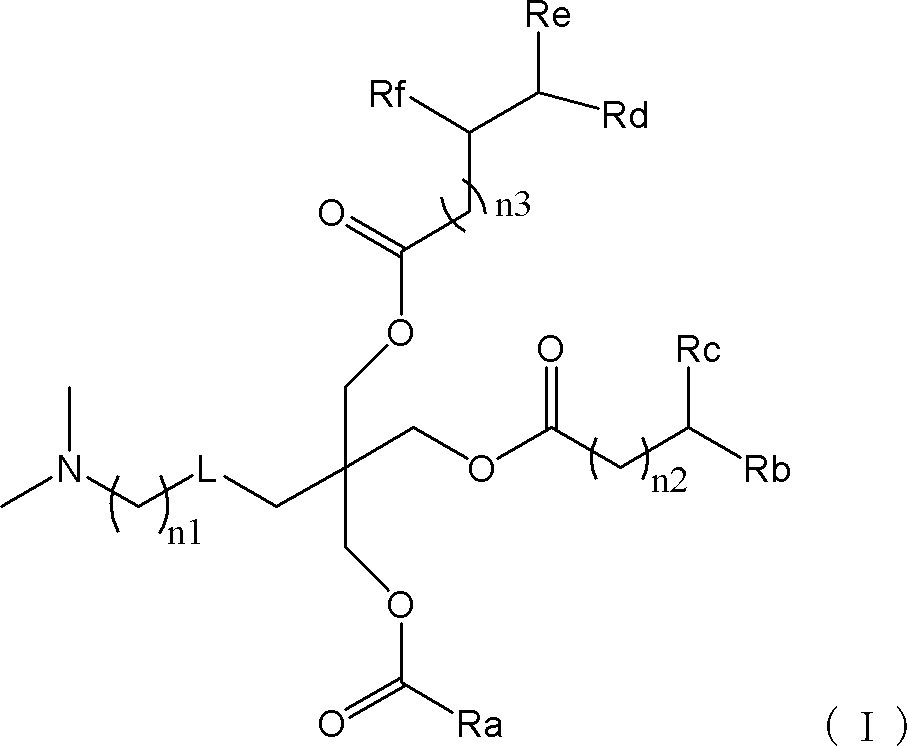
Lは、-C(O)O-または-NHC(O)O-を、
Raは、直鎖状C5-13アルキル基、直鎖状C13-17アルケニル基または直鎖状C17アルカジエニル基を、
Rbは、直鎖状C2-9アルキル基を、
Rcは、水素原子または直鎖状C2-9アルキル基を、
Rdは、水素原子または直鎖状C2-9アルキル基を、
Reは、直鎖状C2-9アルキル基を、
Rfは、直鎖状C2-9アルキル基を示す。]
で表される化合物又はその塩、
2)構造脂質、および
3)mRNA
を含む組成物と、心室筋細胞を含む細胞集団とを接触させる工程を含む、心室筋細胞の精製方法であって、ここで該mRNAが、
(i)心室筋細胞で特異的に発現しているmiRNAによって特異的に認識される塩基配列、および機能的な遺伝子をコードする塩基配列を含む、心室筋細胞特異的なmiRNA応答性mRNA、および/または
(ii)機能的な遺伝子をコードする塩基配列を含むmRNA
を含む、心室筋細胞の精製方法。
[9]
1)式(I):
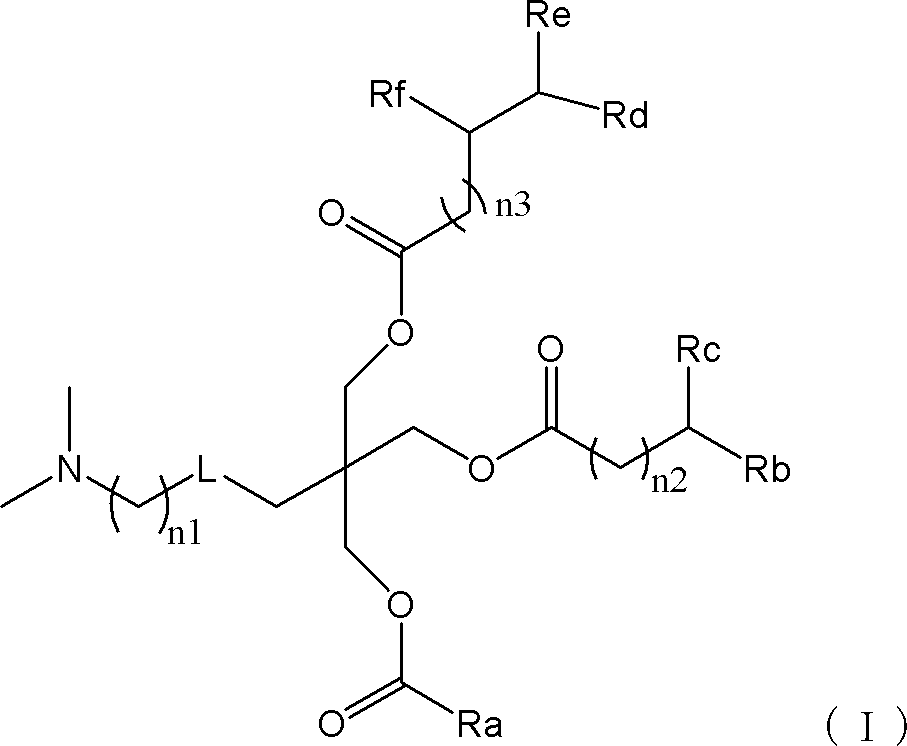
Lは、-C(O)O-または-NHC(O)O-を、
Raは、直鎖状C5-13アルキル基、直鎖状C13-17アルケニル基または直鎖状C17アルカジエニル基を、
Rbは、直鎖状C2-9アルキル基を、
Rcは、水素原子または直鎖状C2-9アルキル基を、
Rdは、水素原子または直鎖状C2-9アルキル基を、
Reは、直鎖状C2-9アルキル基を、
Rfは、直鎖状C2-9アルキル基を示す。]
で表される化合物又はその塩、
2)構造脂質、および
3)mRNA
を含む組成物と、心筋細胞を含む細胞集団とを接触させる工程を含む、心筋細胞の製造方法であって、ここで該mRNAが、
(i)心筋細胞で特異的に発現しているmiRNAによって特異的に認識される塩基配列、および機能的な遺伝子をコードする塩基配列を含む、心筋細胞特異的なmiRNA応答性mRNA、および/または
(ii)機能的な遺伝子をコードする塩基配列を含むmRNA
を含む、心筋細胞の製造方法。
[10]
1)式(I):
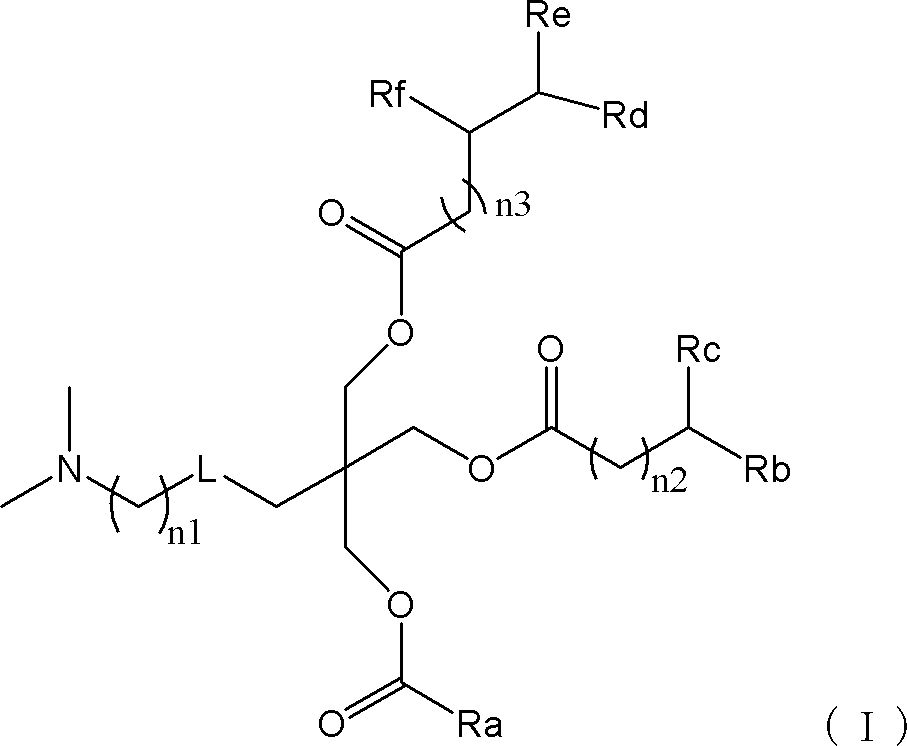
Lは、-C(O)O-または-NHC(O)O-を、
Raは、直鎖状C5-13アルキル基、直鎖状C13-17アルケニル基または直鎖状C17アルカジエニル基を、
Rbは、直鎖状C2-9アルキル基を、
Rcは、水素原子または直鎖状C2-9アルキル基を、
Rdは、水素原子または直鎖状C2-9アルキル基を、
Reは、直鎖状C2-9アルキル基を、
Rfは、直鎖状C2-9アルキル基を示す。]
で表される化合物又はその塩、
2)構造脂質、および
3)mRNA
を含む組成物と、心室筋細胞を含む細胞集団とを接触させる工程を含む、心室筋細胞の製造方法であって、ここで該mRNAが、
(i)心室筋細胞で特異的に発現しているmiRNAによって特異的に認識される塩基配列、および機能的な遺伝子をコードする塩基配列を含む、心室筋細胞特異的なmiRNA応答性mRNA、および/または
(ii)機能的な遺伝子をコードする塩基配列を含むmRNA
を含む、心室筋細胞の製造方法。
[11]
1)式(I):
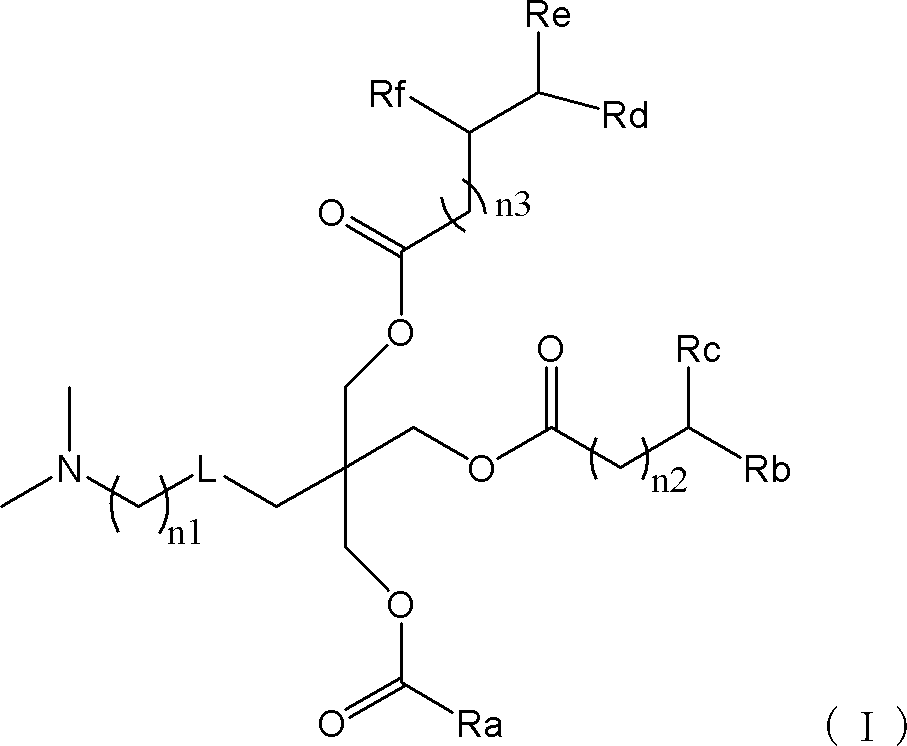
Lは、-C(O)O-または-NHC(O)O-を、
Raは、直鎖状C5-13アルキル基、直鎖状C13-17アルケニル基または直鎖状C17アルカジエニル基を、
Rbは、直鎖状C2-9アルキル基を、
Rcは、水素原子または直鎖状C2-9アルキル基を、
Rdは、水素原子または直鎖状C2-9アルキル基を、
Reは、直鎖状C2-9アルキル基を、
Rfは、直鎖状C2-9アルキル基を示す。]
で表される化合物又はその塩、
2)構造脂質、および
3)核酸
を含む、心筋細胞への核酸のトランスフェクション用組成物。
[12]
1)式(I):
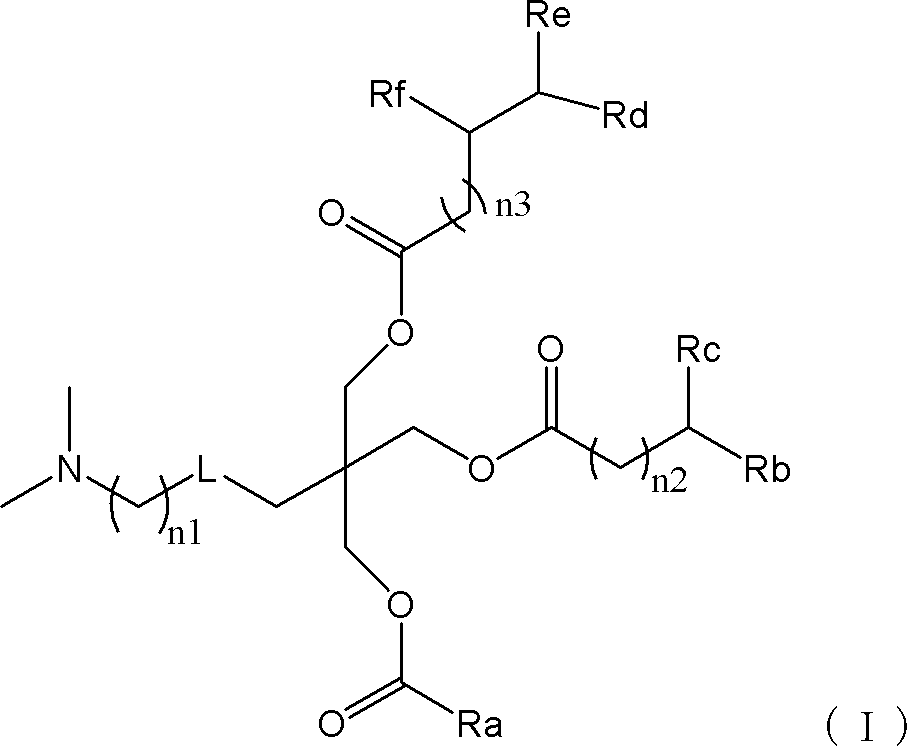
Lは、-C(O)O-または-NHC(O)O-を、
Raは、直鎖状C5-13アルキル基、直鎖状C13-17アルケニル基または直鎖状C17アルカジエニル基を、
Rbは、直鎖状C2-9アルキル基を、
Rcは、水素原子または直鎖状C2-9アルキル基を、
Rdは、水素原子または直鎖状C2-9アルキル基を、
Reは、直鎖状C2-9アルキル基を、
Rfは、直鎖状C2-9アルキル基を示す。]
で表される化合物又はその塩、
2)構造脂質、および
3)核酸
を含む、心筋細胞への核酸のトランスフェクション用キット。
本明細書において、「トランスフェクション」とは、任意の物質を細胞の内部に導入することを意味する。細胞の内部には、少なくとも、細胞質内及び核内が包含される。
「~からなる(consist(s) of又はconsisting of)」とは、その語句に続くあらゆる要素を包含し、かつ、これに限定されることを意味する。したがって、「~からなる」という語句は、列挙された要素が要求されるか又は必須であり、他の要素は実質的に存在しないことを示す。「~から本質的になる」とは、その語句に続く任意の要素を包含し、かつ、その要素について本開示で特定された活性又は作用に影響しない他の要素に限定されることを意味する。したがって、「~から本質的になる」という語句は、列挙された要素が要求されるか又は必須であるが、他の要素は任意選択であり、それらが列挙された要素の活性又は作用に影響を及ぼすかどうかに応じて、存在させる場合もあり、存在させない場合もあることを示す。
n1は、好ましくは3~5の整数である。
n2は、好ましくは0~2の整数である。
n3は、好ましくは0~2の整数である。
Lは、好ましくは-C(O)O-である。
Raは、好ましくは直鎖状C5-9アルキル基、直鎖状C13-17アルケニル基または直鎖状C17アルカジエニル基である。
Rbは、好ましくは直鎖状C4-8アルキル基である。
Rcは、好ましくは水素原子または直鎖状C4-7アルキル基である。
Rdは、好ましくは水素原子または直鎖状C3-6アルキル基である。
Reは、好ましくは直鎖状C3-6アルキル基である。
Rfは、好ましくは直鎖状C3-7アルキル基である。
化合物(I-A):n1が3~5の整数であり、n2が0であり、n3が0~2の整数であり、Lが-C(O)O-であり、Raが直鎖状C5-9アルキル基であり、Rbが直鎖状C4-8アルキル基であり、Rcが水素原子であり、Rdが水素原子であり、Reが直鎖状C3-6アルキル基であり、Rfが直鎖状C3-7アルキル基である化合物。
化合物(I-B):n1が3~5の整数であり、n2が0または1であり、n3が0または1であり、Lが-C(O)O-であり、Raが直鎖状C5-9アルキル基であり、Rbが直鎖状C4-8アルキル基であり、Rcが直鎖状C5-7アルキル基であり、Rdが水素原子であり、Reが直鎖状C3-6アルキル基であり、Rfが直鎖状C3-7アルキル基である化合物。
化合物(I-C):n1が3~5の整数であり、n2が0または1であり、n3が0~2の整数であり、Lが-C(O)O-であり、Raが直鎖状C5-9アルキル基であり、Rbが直鎖状C4-8アルキル基であり、Rcが水素原子であり、Rdが直鎖状C3-6アルキル基であり、Reが直鎖状C3-6アルキル基であり、Rfが直鎖状C3-7アルキル基である化合物。
化合物(I-D):n1が3~5の整数であり、n2が0または1であり、n3が0~2の整数であり、Lが-C(O)O-であり、Raが、直鎖状C13-17アルケニル基または直鎖状C17アルカジエニル基であり、Rbが直鎖状C3-6アルキル基であり、Rcが直鎖状C3-6アルキル基であり、Rdが水素原子であり、Reが直鎖状C2-6アルキル基であり、Rfが直鎖状C2-7アルキル基である化合物。
化合物(a):n1が3または4であり、n2が0であり、n3が0または2であり、Lが-C(O)O-であり、Raが直鎖状C7アルキル基であり、Rbが直鎖状C6アルキル基であり、Rcが水素原子であり、Rdが水素原子であり、Reが直鎖状C5-6アルキル基であり、Rfが直鎖状C6-7アルキル基である化合物。
化合物(b):n1が3~5の整数であり、n2が0または1であり、n3が0または1であり、Lが-C(O)O-であり、Raが直鎖状C6-7アルキル基であり、Rbが直鎖状C5-6アルキル基であり、Rcが直鎖状C5-6アルキル基であり、Rdが水素原子であり、Reが直鎖状C4-5アルキル基であり、Rfが直鎖状C5-6アルキル基である化合物。
化合物(c):n1が3~5の整数であり、n2が0であり、n3が2であり、Lが―C(O)O-であり、Raが直鎖状C5-9アルキル基であり、Rbが直鎖状C4-8アルキル基であり、Rcが水素原子であり、Rdが直鎖状C3-5アルキル基であり、Reが直鎖状C3-5アルキル基であり、Rfが直鎖状C3-5アルキル基である化合物。
化合物(d):n1が3~5の整数であり、n2が0または1であり、n3が0~2の整数であり、Lが-C(O)O-であり、Raが、直鎖状C13-17アルケニル基または直鎖状C17アルカジエニル基であり、Rbが直鎖状C3-5アルキル基であり、Rcが直鎖状C3-5アルキル基であり、Rdが水素原子であり、Reが直鎖状C3-6アルキル基であり、Rfが直鎖状C3-7アルキル基である化合物。
ステロール類(例えば、コレステロール、コレステロールエステル、コレステロールヘミコハク酸など);
リン脂質(例えば、ホスファチジルコリン(例えば、ジパルミトイルホスファチジルコリン、ジステアロイルホスファチジルコリン、リソホスファチジルコリン、ジオレオイルホスファチジルコリン、パルミトイルオレオイルホスファチジルコリン、ジパルミトイルホスファチジルコリン、ジリノレノイルホスファチジルコリン、MC-1010(NOF CORPORATION)、MC-2020(NOF CORPORATION)、MC-4040(NOF CORPORATION)、MC-6060(NOF CORPORATION)、MC-8080(NOF CORPORATION)など)、ホスファチジルセリン(例えば、ジパルミトイルホスファチジルセリン、ジステアロイルホスファチジルセリン、ジオレオイルホスファチジルセリン、パルミトイルオレオイルホスファチジルセリンなど)、ホスファチジルエタノールアミン(例えば、ジパルミトイルホスファチジルエタノールアミン、ジステアロイルホスファチジルエタノールアミン、ジオレオイルホスファチジルエタノールアミン、パルミトイルオレオイルホスファチジルエタノールアミン、リソホスファチジルエタノールアミンなど)、ホスファチジルイノシトール、ホスファチジン酸など);および
ポリエチレングリコール脂質(PEG脂質)(例えば、PEG-DAA、PEG-DAG、PEG-phospholipid cunjugate、PEG-Cer、PEG-cholesterol、PEG-C-DOMG、2KPEG-CMG、GM-020(NOF CORPORATION)、GS-020(NOF CORPORATION)、GS-050(NOF CORPORATION)など)
からなる群より選ばれる少なくとも1種を用いることができる。本発明では、構造脂質として、ステロール類(特に、コレステロール)、リン脂質(特に、ホスファチジルコリン)およびポリエチレングリコール脂質の3種全てを用いることが好ましい。
(i)心筋細胞(または心筋細胞サブタイプ)で特異的に発現しているmiRNAによって特異的に認識される塩基配列、および機能的な遺伝子をコードする塩基配列を含む、心筋細胞(または心筋細胞サブタイプ)特異的なmiRNA応答性mRNA;
(ii)機能的な遺伝子をコードする塩基配列を含むmRNA。


工程1:細胞非接着性容器内において、対象細胞を含む細胞集団への本発明の組成物のトランスフェクションが可能な条件下で、対象細胞を含む細胞集団の凝集体を形成する工程(以下「凝集体形成工程」と呼ぶこともある。);
工程2:前記組成物がトランスフェクションされた細胞集団の中から、前記組成物に含まれている核酸の細胞内での機能に基づいて、対象細胞を選別する工程(以下「選別工程」と呼ぶこともある。)。
工程1-1:細胞非接着性容器内において、本発明の組成物およびマイクロキャリアの存在下で、対象細胞を含む細胞集団を培養し、本発明の組成物に含まれる核酸が導入された細胞と前記マイクロキャリアとからなる凝集体を形成する工程(以下「凝集体形成工程第1実施形態」と呼ぶこともある。);
工程1-2:細胞非接着性容器内において、本発明の組成物の存在下で、対象細胞を含む細胞集団を培養し、本発明の組成物に含まれる核酸が導入された細胞からなる凝集体を形成する工程(以下「凝集体形成工程第2実施形態」と呼ぶこともある。)。
工程A:多能性幹細胞(集団)の対象細胞への分化を誘導する工程;
工程B:工程Aによる分化誘導後の細胞(集団)を分散させる工程。
エーテル類:ジエチルエーテル、ジイソプロピルエーテル、ジフェニルエーテル、テトラヒドロフラン、1,2-ジメトキシエタン、シクロペンチルメチルエーテルなど;
芳香族炭化水素類:クロロベンゼン、トルエン、キシレンなど;
飽和炭化水素類:シクロヘキサン、ヘキサン、ヘプタンなど;
アミド類:N,N-ジメチルホルムアミド、N-メチルピロリドンなど;
ハロゲン化炭化水素類:ジクロロメタン、四塩化炭素など;
ニトリル類:アセトニトリルなど;
スルホキシド類:ジメチルスルホキシドなど;
芳香族有機塩基類:ピリジンなど;
酸無水物類:無水酢酸など;
有機酸類:ギ酸、酢酸、トリフルオロ酢酸など;
無機酸類:塩酸、硫酸など;
エステル類:酢酸エチル、酢酸イソプロピルエステルなど;
ケトン類:アセトン、メチルエチルケトンなど;
水。
上記溶媒は、二種以上を適宜の割合で混合して用いてもよい。
塩基性塩類:炭酸ナトリウム、炭酸カルシウム、炭酸水素ナトリウムなど;
有機塩基類:トリエチルアミン、ジエチルアミン、N,N-ジイソプロピルエチルアミン、ピリジン、4-ジメチルアミノピリジン、N,N-ジメチルアニリン、1,4-ジアザビシクロ[2.2.2]オクタン、1,8-ジアザビシクロ[5.4.0]-7-ウンデセン、イミダゾール、ピペリジンなど;
金属アルコキシド類:ナトリウムエトキシド、カリウムtert-ブトキシド、ナトリウムtert-ブトキシドなど;
アルカリ金属水素化物類:水素化ナトリウムなど;
金属アミド類:ナトリウムアミド、リチウムジイソプロピルアミド、リチウムヘキサメチルジシラジドなど;
有機リチウム類:n-ブチルリチウム、sec-ブチルリチウムなど。
有機酸類:酢酸、トリフルオロ酢酸、クエン酸、p-トルエンスルホン酸、10-カンファースルホン酸など;
ルイス酸:三フッ化ホウ素ジエチルエーテル錯体、ヨウ化亜鉛、無水塩化アルミニウム、無水塩化亜鉛、無水塩化鉄など。
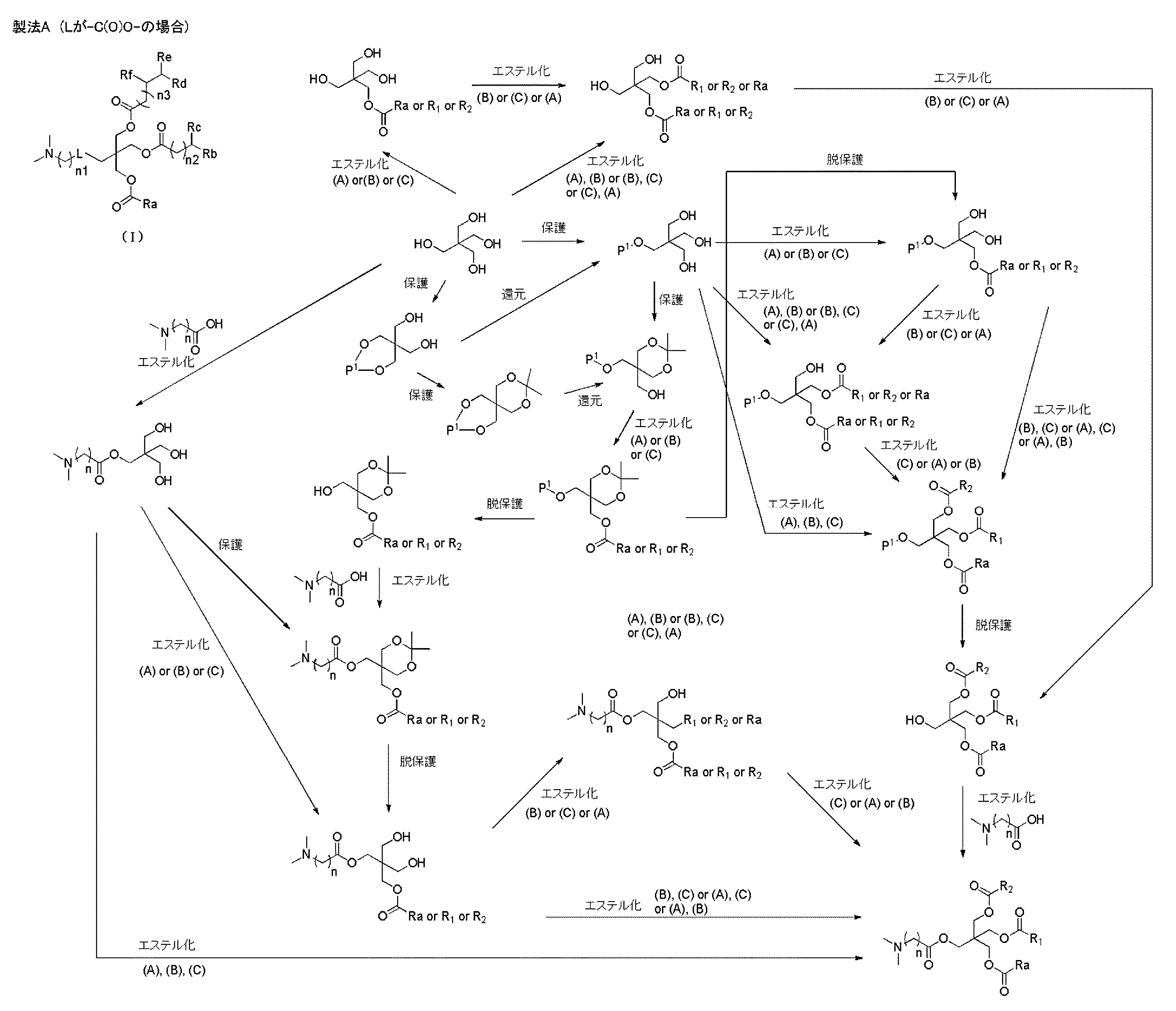
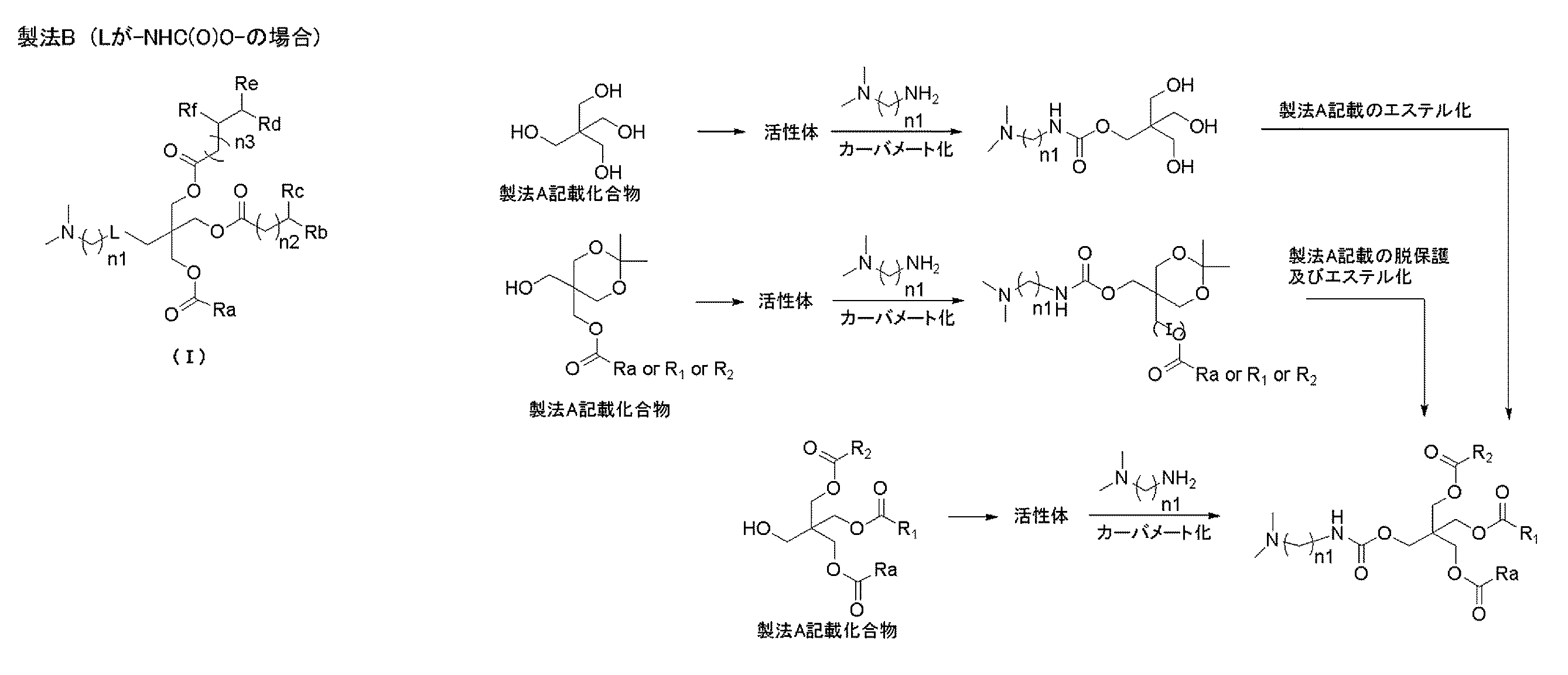


MS:マススペクトル
M:モル濃度
N:規定度
CDCl3:重クロロホルム
DMSO-d6:重ジメチルスルホキシド
1H NMR:プロトン核磁気共鳴
LC/MS:液体クロマトグラフ質量分析計
ESI:electrospray ionization、エレクトロスプレーイオン化
APCI:atmospheric pressure chemical ionization、大気圧化学イオン化
MALDI:Matrix-assisted laser desorption/ionization、マ卜リックス支援レーザー脱離イオン化
TOFMS:Time-of-flight mass spectrometry、飛行時間型質量分析
CHCA:α-シアノ-4-ヒドロキシケイ皮酸
DMF:N,N-ジメチルホルムアミド
THF:テトラヒドロフラン
DMAP:4-ジメチルアミノビリジン
TBAF:テトラブチルアンモニウムフルオリド
DIBAL-H:水素化ジイソブチルアルミニウム
DBU:1,8-ジアザビシクロ[5,4,0]ウンデカ-7-エン
A) 2-ヘプチルノナン酸メチルエステル
窒素気流氷冷下、60% 水素化ナトリウム(ミネラルオイル含有)(3.78 g)の脱水DMF(100 mL)懸濁液を10分間撹拌した。その後、マロン酸ジメチル(5.0 g)を10℃以下で滴下した。同温度で10分間撹拌した後、1-ヨードヘプタン(18.3 mL)を滴下し、室温まで昇温した。4時間後、反応混合物に6N 塩酸で中和した後、酢酸エチルで希釈し、飽和食塩水で2回洗浄後、無水硫酸ナトリウムで乾燥し、溶媒を減圧下留去した。残渣をDMSO (75 mL)に溶解し、水(0.68 mL)、塩化リチウム(3.21 g)添加し、165℃に昇温した。同温度で16時間撹拌した後、水を加え、酢酸エチルで希釈した。飽和食塩水で2回洗浄後、無水硫酸ナトリウムで乾燥し、溶媒を減圧下留去した。シリカゲルカラムクロマトグラフィー (酢酸エチル/ヘキサン) で精製して標題化合物(8.14 g) を得た。
1H NMR (500 MHz, CDCl3) δ ppm 0.84 - 0.90 (6 H, m), 1.20 - 1.32 (20 H, m), 1.36 - 1.47 (2 H, m), 1.54 - 1.62 (2 H, m), 2.33 (1 H, tt, J = 9.0, 5.4 Hz), 3.67 (3 H, s)
窒素気流氷冷下、水素化アルミニウムリチウム(2.15 g)の脱水THF(92 mL)懸濁液に、2-ヘプチルノナン酸メチルエステル(7.67 g)の脱水THF(50 mL)溶液を滴下し、10℃以下で1時間撹拌した。その後室温に昇温し、3時間撹拌した。再度10℃以下に冷却した後、硫酸ナトリウム・10水和物を少しずつ添加した。酢酸エチルで希釈した後、不溶物をセライトろ過し、溶媒を減圧留去して、標題化合物(6.91 g)を得た。
1H NMR (500 MHz, CDCl3) δ ppm 0.86 - 0.91 (6 H, m), 1.16 - 1.34 (25 H, m), 1.41 - 1.49 (1 H, m), 3.54 (2 H, t, J = 5.2 Hz)
窒素気流下、塩化オキザリル(4.9 mL)のジクロロメタン(30 mL)溶液を-70℃に冷却し、ジメチルスルホキシド(6.1 mL)のジクロロメタン(30 mL) 溶液を-60℃以下を保持しながら滴下した。-70℃で15分撹拌後、2-ヘプチルノナン-1-オール(6.9 g)のジクロロメタン(25 mL)溶液を-60℃以下を保持しながら滴下した。-70℃で2時間撹拌後、トリエチルアミン(23.8 mL)を加え室温まで昇温した。飽和塩化アンモニウム水溶液を加えて分液操作を行った後、無水硫酸ナトリウムで乾燥後、溶媒を減圧下留去した。残渣をシリカゲルカラムクロマトグラフィー(酢酸エチル/ヘキサン)で精製して標題化合物(6.06 g)を得た。
1H NMR (500 MHz, CDCl3) δ ppm 0.85 - 0.92 (6 H, m), 1.19 - 1.33 (20 H, m), 1.37 - 1.47 (2 H, m), 1.56 - 1.65 (2 H, m), 2.18 - 2.25 (1 H, m), 9.55 (1 H, d, J = 3.2 Hz)
窒素気流氷冷下、60% 水素化ナトリウム(ミネラルオイル含有)(1.4 g)の脱水THF(70mL)懸濁液を10分間撹拌した。その後、エチル(ジエトキシフォスフォリル)アセタート(16.8 g)を10℃以下で滴下した。同温度で10分間撹拌した後、2-ヘプチルノナナール(6.0 g)の脱水THF(60 mL)溶液を滴下し、室温まで昇温した。しばらく撹拌した後、50℃に昇温した。6時間撹拌後、反応混合物を5℃以下にして水を添加した後、酢酸エチルで希釈し、飽和食塩水で2回洗浄後、無水硫酸ナトリウムで乾燥し、溶媒を減圧下留去した。残渣をシリカゲルカラムクロマトグラフィー(酢酸エチル/ヘキサン)で精製して標題化合物(5.4 g)を得た。
1H NMR (500 MHz, CDCl3) δ ppm 0.87 (6 H, t, J=6.0 Hz), 1.16 - 1.34 (25 H, m), 1.37 - 1.45 (2 H, m) 2.07 - 2.15 (1 H, m), 4.19 (2 H, q, J = 7.5 Hz), 5.75 (1 H, d, J = 16.0 Hz), 6.75 (1 H, dd, J=16.0, 10.0 Hz)
エチル-4-ヘプチルウンデカ-2-エノアート(5.40 g)のエタノール(100 mL)溶液に、10%Pd炭素(1.08 g)を室温で加え、水素雰囲気下、20時間撹拌した。反応後、Pd炭素をろ過除去した後、溶媒を減圧下留去した。得られた残渣に8N 水酸化ナトリウム水溶液(6.38 mL)のエタノール(20 mL)溶液を加え、60℃で5時間撹拌した。溶媒を減圧下留去した後、6N塩酸で酸性にした。残渣をヘキサンで希釈し、飽和食塩水で1回洗浄後、無水硫酸ナトリウムで乾燥した。溶媒を減圧下留去して標題化合物(4.73 g)を得た。
1H NMR (500 MHz, CDCl3) δ ppm 0.88 (6 H, t, J = 7.5 Hz), 1.17 - 1.41 (25 H, m), 1.16 - 1.34 (2 H, m), 2.22 - 2.34 (2 H, m)
2, 2-ビス(ヒドロキシメチル)プロパン-1,3-ジオ一ル(5.0 g)、1H-イミダゾ一ル(2.5 g)およびDMF(200 mL)の混合物に、tert-ブチルクロロジフェニルシラン(5.1 g)のDMF(10 mL)溶液を室温で加えた。18時間撹拌後、反応混合物を減圧下濃縮した。残渣を酢酸エチルで希釈し、水で3回、飽和食塩水で1回洗浄後、無水硫酸ナトリウムで乾燥し、溶媒を減圧下留去した。残渣をシリカゲルカラムクロマトグラフィー(酢酸エチル/ヘキサン)で精製して標題化合物(6.4 g)を得た。
1H NMR (500 MHz, CDCl3) δ ppm 1.07 (9 H, s), 2.34 (3 H, t, J = 5.5 Hz), 3.67 (2H,s), 3.74 (6 H, d, J = 5.7 Hz), 7.39 - 7.48 (6 H, m), 7.63 - 7.67 (4 H, m)
2-(((tert-ブチル(ジフェニル)シリル)オキシ)メチル)-2-(ヒドロキシメチル)プロパン-1,3-ジオール(3.5 g)、2,2-ジメトキシプロパン(1.5 g)のアセトン(35 mL)溶液に、p-トルエンスルホン酸一水和物(89 mg)を室温で加えた。2時間撹拌後、反応混合物に希アンモニア水を加え中和した後、溶媒を減圧下留去した。残渣をシリカゲルカラムクロマトグラフィー(酢酸エチル/ヘキサン)で精製して標題化合物(2.7 g)を得た。
1H NMR (500 MHz, CDCl3) δ ppm 1.07 (9 H, s), 1.27 (3 H, s), 1.41 (3 H, s), 2.12 - 2.18 (1 H, m), 3.69 - 3.78 (8 H, m), 7.38 - 7.47 (6 H, m), 7.65 - 7.69 (4 H, m)
(5-(((tert-ブチル(ジフェニル)シリル)オキシ)メチル)-2,2-ジメチル-1,3-ジオキサン-5-イル)メタノール(3.56 g)、DMAP(1.37 g)および4-ヘプチルウンデカン酸(3.18 g)のDMF(30 mL)溶液に、1-エチル-3-(3-ジメチルアミノプロピル)カルボジイミド塩酸塩(2.47 g)を50℃で加えた。6時間撹拌後、反応混合物に酢酸エチルを加え、水で1回、飽和食塩水で1回洗浄後、無水硫酸ナトリウムで乾燥後、溶媒を減圧下留去した。得られた残渣(6.15 g)のTHF(20mL)溶液に、TBAFのTHF溶液(1M, 10.3 mL)を室温で加えた。4時間撹拌後、反応混合物を減圧下濃縮した。残渣を酢酸エチルで希釈し、水で1回、飽和食塩水で1回洗浄後、無水硫酸ナトリウムで乾燥し、溶媒を減圧下留去した。残渣をシリカゲルカラムクロマトグラフィー(酢酸エチル/ヘキサン)で精製して標題化合物(2.34 g)を得た。
1H NMR (500 MHz, CDCl3) δ ppm 0.88 (6 H, t, J = 6.9 Hz), 1.22 - 1.32 (25 H, m), 1.42 (6 H, s), 1.57 - 1.62 (2 H, m), 2.30 - 2.35 (2 H, m), 3.48 (2 H, d, J = 6.6 Hz), 3.71 - 3.73 (4 H, m), 4.25 (2 H, s)
(5-(ヒドロキシメチル)-2,2-ジメチル-1,3-ジオキサン-5-イル)メチル 4-ヘプチルウンデカノアート(1.2 g)、DMAP(0.94 g)および5-(ジメチルアミノ)ペンタン酸塩酸塩(0.74 g)のDMF(30 mL)溶液に、1-エチル-3-(3-ジメチルアミノプロピル)カルボジイミド塩酸塩(0.94 g)を40℃で加えた。4時間撹拌後、反応混合物に酢酸エチルを加え、水で1回、飽和食塩水で1回洗浄後、無水硫酸ナトリウムで乾燥後、溶媒を減圧下留去した。残渣をシリカゲルカラムクロマトグラフィー(NH、酢酸エチル/ヘキサン)で精製して標題化合物(1.37 g)を得た。
1H NMR (500 MHz, CDCl3) δ ppm 0.88 (6 H, t, J = 6.9 Hz), 1.20 - 1.32 (25 H, m), 1.42 (6 H, s), 1.45 - 1.52 (2 H, m), 1.54 - 1.67 (4 H, m), 2.21 (6 H, s), 2.23 - 2.31 (4 H, m), 2.35 (2 H, t, J = 7.5 Hz), 3.75 (4 H, s), 4.11 (2 H, s), 4.12 (2 H, s)
(5-(((5-ジメチルアミノ)ペンタノイル)オキシ)メチル)-2,2-ジメチル-1,3-ジオキサン-5-イル)メチル 4-ヘプチルウンデカノアート(1.37 g)に酢酸(6.85 mL)、水(3.43 mL)を加えて、70℃で2時間撹拌後、溶媒を減圧下留去した。残渣に酢酸エチル、飽和炭酸水素ナトリウム水溶液を加えて、2時間撹拌した。水で2回洗浄後、無水硫酸ナトリウムで乾燥後、溶媒を減圧下留去した。得られた残渣(400 mg)に、DMAP(478 mg)およびオクタン酸(327 mg)のDMF(4 mL)溶液を加えた後、1-エチル-3-(3-ジメチルアミノプロピル)カルボジイミド塩酸塩(478 mg)を50℃で加えた。4時間撹拌後、反応混合物に酢酸エチルを加え、飽和炭酸ナトリウム水溶液で2回、飽和食塩水で1回洗浄後、無水硫酸ナトリウムで乾燥後、溶媒を減圧下留去した。残渣をシリカゲルカラムクロマトグラフィー(NH、酢酸エチル/ヘキサン)で精製して標題化合物(300 mg)を得た。
1H NMR (500 MHz, CDCl3) δ ppm 0.86 - 0.91 (12 H, m), 1.15 - 1.34 (45 H, m), 1.45 - 1.52 (2 H, m), 1.53 - 1.66 (4 H, m), 2.20 (6 H, s), 2.23 - 2.36 (10 H, m), 4.11 (8 H, s)
A) 2-ヘキシルオクタン酸
窒素気流氷冷下、60% 水素化ナトリウム(ミネラルオイル含有)(3.78 g)の脱水DMF(90 mL)懸濁液を10分間撹拌した。その後、マロン酸ジメチル(5.0 g)を10℃以下で滴下した。同温度で10分間撹拌した後、1-ヨードヘキサン(16.8 mL)を滴下し、室温まで昇温した。8時間後、反応混合物に酢酸(1 mL)添加した後、酢酸エチルで希釈し、水で2回、飽和食塩水で1回洗浄後、無水硫酸ナトリウムで乾燥し、溶媒を減圧下留去した。残渣をEtOH (80 mL)に溶解し、8N 水酸化ナトリウム水溶液(25 mL)加えて、60℃で6時間撹拌した。6N 塩酸で中和した後、酢酸エチルで希釈し、飽和食塩水で洗浄後、無水硫酸ナトリウムで乾燥し、溶媒を減圧下留去した。残渣を160℃で1.5時間加熱し、室温に冷却後、シリカゲルカラムクロマトグラフィー(酢酸エチル/ヘキサン)で精製して標題化合物(7.45 g)を得た。
1H NMR (500 MHz, CDCl3) δ ppm 0.83 - 0.92 (6 H, m), 1.22 - 1.35 (16 H, m), 1.38 - 1.52 (2 H, m), 1.56 - 1.67 (2 H, m), 2.34 (1 H, ddd, J=8.7, 5.4, 3.3 Hz)
2, 2-ビス(ヒドロキシメチル)プロパン-1,3-ジオ一ル(506 g)の水(2.0 L)溶液を50℃で撹拌した。濃塩酸(18 mL)を加え、p-メトキシベンズアルデヒド(474 mL)を30℃付近で3時間かけて滴下した。その後、反応液を25℃にし、5時間撹拌した。2N水酸化ナトリウム水溶液(120 mL)を加え、1時間撹拌した。結晶をろ過し、水で洗浄した後、酢酸エチル/ヘキサンで再結晶して標題化合物(769 g)を得た。
1H NMR (500 MHz, DMSO-d6) δ ppm 3.24 (2 H, d, J = 5.0 Hz), 3.67 (2 H, d, J = 5.4 Hz), 3.74 (3 H, s), 3.77 (2 H, d, J = 11.3 Hz), 3.88 (2 H, t, J = 11.3 Hz), 4.53 (1 H, t, J = 5.4 Hz), 4.62 (1 H, t, J = 5.0 Hz), 5.34 (1 H, s), 6.90 (2 H, d, J = 8.9 Hz), 7.33 (2 H, d, J = 8.9 Hz)
(2-(4-メトキシフェニル)-1,3-ジオキサン-5,5-ジイル)ジメタノール(2.00 g)、2,2-ジメトキシプロパン(2.46 g)のDMF(8 mL)溶液に、ピリジニウム p-トルエンスルホナート(20 mg)を室温で加えた。4時間撹拌後、反応混合物を酢酸エチルで希釈し、飽和炭酸水素ナトリウム水溶液で2回、飽和食塩水で2回洗浄後、無水硫酸マウネシウムで乾燥後、溶媒を減圧下留去した。残渣を酢酸エチル/ヘキサンで再結晶して標題化合物(1.62 g)を得た。
1H NMR (500 MHz, DMSO-d6) δ ppm 1.34 (6 H, s), 3.33 (2 H, s), 3.63 (2 H, d, J = 11.7 Hz), 3.74 (3 H, s), 3.99 (2 H, s), 4.12 (2 H, d, J = 11.7 Hz), 5.37 (1 H, s), 6.90 (2 H, d, J = 8.8 Hz), 7.34 (2 H, d, J = 8.8 Hz)
9-(4-メトキシフェニル)-3,3-ジメチル-2,4,8,10-テトラオキサスピロ[5.5]ウンデカン(22.0 g)のトルエン(200 mL)懸濁溶液に1.5M DIBAL-H溶液(60 mL)を5~20℃で滴下し、15℃で3時間撹拌した。メタノール(22 mL)を添加した後、2N 水酸化ナトリウム水溶液(100 mL)、4N 水酸化ナトリウム水溶液(200 mL)を順に滴下した。1.5時間攪拌した後、トルエン層を分取し、5%食塩水で洗浄した。溶媒を減圧下留去した。残渣をシリカゲルカラムクロマトグラフィー(酢酸エチル/ヘキサン)で精製して標題化合物(14.7 g)を得た。
1H NMR (500 MHz, DMSO-d6) δ ppm 1.29 (3 H, s), 1.29 (3 H, s), 3.35 (2 H, s), 3.39 (2 H, d, J = 5.1 Hz), 3.61 (4 H, s), 3.74 (3 H, s), 4.38 (2 H, s), 4.59 (1 H, t, J = 5.1 Hz), 6.90 (2 H, d like, J = 7.5 Hz), 7.24 (2 H, d like, J = 7.5 Hz)
(5-(((4-メトキシベンジル)オキシ)メチル)-2,2-ジメチル-1,3-ジオキサン-5-イル)メタノール(2.00 g)、DMAP(412 mg)およびオクタン酸(1.27 g)のDMF(20 mL)溶液に、1-エチル-3-(3-ジメチルアミノプロピル)カルボジイミド塩酸塩(1.94 g)を50℃で加えた。4時間撹拌後、反応混合物に酢酸エチルを加え、水で2回、飽和食塩水で1回洗浄後、無水硫酸ナトリウムで乾燥後、溶媒を減圧下留去した。残渣をシリカゲルカラムクロマトグラフィー(酢酸エチル/ヘキサン)で精製して標題化合物(2.78 g)を得た。
1H NMR (500 MHz, CDCl3) δ ppm 0.84 - 0.91 (3 H, m), 1.22 - 1.33 (8 H, m), 1.40 (6 H, s), 1.53 - 1.61 (2 H, m), 2.26 (2 H, t, J = 7.6 Hz), 3.39 (2 H, s), 3.68 - 3.74 (2 H, m), 3.76 - 3.80 (2 H, m), 3.80 (3 H, s), 4.15 (2 H, s), 4.42 (2 H, s), 6.87 (2 H, d, J = 7.8 Hz), 7.20 - 7.24 (2 H, m)
(5-(((4-メトキシベンジル)オキシ)メチル)-2,2-ジメチル-1,3-ジオキサン-5-イル)メチルオクタノアート(754 mg)のTHF(6 mL)溶液に1N 塩酸(6 mL)を加え、室温で6時間撹拌した。飽和炭酸水素ナトリウム水溶液または2N 水酸化ナトリウム水溶液(4 mL)加えた後、酢酸エチルで抽出し、水および飽和食塩水で洗浄した。この一連の操作を、脱保護が完了するまで4回繰り返した。反応完結後、溶媒を減圧下留去し、標題化合物(608 mg)を得た。
1H NMR (500 MHz, DMSO-d6) δ ppm 0.85 (3 H, t, J = 7.3 Hz), 1.15 - 1.30 (9 H, m), 1.40 - 1.50 (2 H, m), 2.22 (2 H, t, J = 7.5 Hz), 3.31 (2 H, s), 3.39 (4 H, d, J = 5.4 Hz), 3.76 (3 H, s), 3.95 (2 H, s), 4.35 (2 H, s), 4.43 (2 H, t, J = 5.4 Hz), 6.89 (2 H, d, J = 6.6 Hz), 7.21 (2 H, d, J = 6.6 Hz)
3-ヒドロキシ-2-(ヒドロキシメチル)-2-(((4-メトキシベンジル)オキシ)メチル)プロピル オクタノアート(2.0 g)、DMAP(0.64 g)および2-ヘキシルオクタン酸(2.63 g)のDMF(20 mL)溶液に、1-エチル-3-(3-ジメチルアミノプロピル)カルボジイミド塩酸塩(2.41 g)を室温で加えた。室温で15時間撹拌した後、反応混合物に酢酸エチルを加え、水で2回、飽和食塩水で1回洗浄後、無水硫酸ナトリウムで乾燥後、溶媒を減圧下留去した。シリカゲルカラムクロマトグラフィー(酢酸エチル/ヘキサン)で精製して標題化合物(3.48 g)を得た。
1H NMR (500 MHz, CDCl3) δ ppm 0.83 - 0.91 (15 H, m), 1.19 - 1.33 (42 H, m), 1.37 - 1.47 (4 H, m), 1.51 - 1.61 (4 H, m), 2.24 (2 H, t, J = 7.6 Hz), 2.32 (2 H, br t, J = 5.4 Hz), 3.41 (2 H, s), 3.80 (3 H, s), 4.08 - 4.16 (6 H, m), 4.39 (2 H, s), 6.86 (2 H, d, J = 7.6 Hz), 7.19 (2 H, d, J = 8.8 Hz)
2-(((4-メトキシベンジル)オキシ)メチル)-2-((オクタノイルオキシ)メチル)プロパン-1,3-ジイル ビス(2-ヘキシルオクタノアート)(3.48 g)のエタノール(30 mL)溶液に、10%Pd炭素(280 mg)を室温で加え、水素雰囲気下で7時間撹拌した。反応後、Pd炭素をろ過除去した後、溶媒を減圧下留去した。シリカゲルカラムクロマトグラフィー(酢酸エチル/ヘキサン)で精製して標題化合物(1.68 g)を得た。
1H NMR (500 MHz, CDCl3) δ ppm 0.84 - 0.91 (15 H, m), 1.19 - 1.33 (42 H, m), 1.41 - 1.51 (4 H, m), 1.54 - 1.63 (4 H, m), 2.30 - 2.38 (4 H, m), 2.61 - 2.64 (1 H, m), 3.48 (2 H, d, J = 7.3 Hz), 4.08 - 4.14 (6 H, m)
2-(ヒドロキシメチル)-2-((オクタノイルオキシ)メチル)プロパン-1,3-ジイル ビス(2-ヘキシルオクタノアート)(600 mg)、DMAP(54 mg)および6-(ジメチルアミノ)ヘキサン酸(280 mg)のDMF(6 mL)溶液に、1-エチル-3-(3-ジメチルアミノプロピル)カルボジイミド塩酸塩(303 mg)を室温で加えた。40℃で15時間撹拌した後、反応混合物に酢酸エチルを加え、水で2回、飽和食塩水で1回洗浄後、無水硫酸ナトリウムで乾燥後、溶媒を減圧下留去した。シリカゲルカラムクロマトグラフィー(NH, 酢酸エチル/ヘキサン)で精製して標題化合物(513 mg)を得た。
1H NMR (500 MHz, CDCl3) δ ppm 0.83 - 0.92 (15 H, m), 1.19 - 1.34 (42 H, m), 1.39 - 1.50 (6 H, m), 1.52 - 1.73 (8 H, m), 2.21 (6 H, s), 2.21 - 2.35 (8 H, m), 4.10 (8 H, s)
A) エチル 3-ブチルヘプタ-2-エノアート
窒素気流氷冷下、60% 水素化ナトリウム(ミネラルオイル含有)(3.94 g)の脱水THF (100 mL)懸濁液を10分間撹拌した。その後、エチル(ジエトキシフォスフォリル)アセタート(23.7 g)を10℃以下で滴下した。同温度で10分間撹拌した後、ノナン-5-オン(10.0 g)を添加し室温まで昇温した。しばらく撹拌した後、50℃に昇温した。10時間撹拌後、反応混合物を5℃以下にして水を添加した後、酢酸エチルで希釈し、飽和食塩水で2回洗浄後、無水硫酸ナトリウムで乾燥し、溶媒を減圧下留去した。残渣をシリカゲルカラムクロマトグラフィー(酢酸エチル/ヘキサン)で精製して標題化合物(4.47 g)を得た。
1H NMR (500 MHz, CDCl3) δ ppm 0.92 (6 H, td, J = 7.3, 3.2 Hz), 1.25 - 1.47 (11 H, m), 2.14 (2 H, td, J = 7.6, 1.1 Hz), 2.57 - 2.62 (2 H, m), 4.14 (2 H, q, J = 7.1 Hz), 5.62 (1 H, s)
エチル 3-ブチルヘプタ-2-エノアート(5.80 g)のエタノール(25 mL)溶液に、10%Pd炭素(1.50 g)を室温で加え、水素雰囲気下、5時間撹拌した。反応後、Pd炭素をろ過除去した後、溶媒を減圧下留去し標題化合物(5.49 g)を得た。
1H NMR (500 MHz, CDCl3) δ ppm 0.84 - 0.93 (6 H, m), 1.21 - 1.33 (15 H, m), 1.80 - 1.88 (1 H, m), 2.22 (2 H, d, J = 6.9 Hz), 4.12 (2 H, q, J = 7.1 Hz)
窒素気流下、ジイソプロピルアミン(11.8 mL)の脱水THF(59 mL)溶液を-10℃に冷却し、1.6M n-BuLiヘキサン溶液(35.2 mL)をゆっくり滴下した。滴下終了後、反応液を0℃にして10分間撹拌した。再度-10℃に冷却し、エチル 3-ブチルヘプタノアート(5.49 g)の脱水THF(16 mL)溶液を滴下し、-5℃付近で30分間撹拌する。その後、1-ヨードブタン(9.43 g)を滴下し、しばらく撹拌した後室温にした。3時間撹拌後、6N塩酸で中和した後、酢酸エチルで希釈し、10%チオ硫酸ナトリウム水溶液で2回、飽和食塩水で1回洗浄後、無水硫酸ナトリウムで乾燥し、溶媒を減圧下留去した。残渣をシリカゲルカラムクロマトグラフィー(酢酸エチル/ヘキサン)で精製して標題化合物(5.57 g)を得た。
1H NMR (500 MHz, CDCl3) δ ppm 0.84 - 0.93 (9 H, m), 1.17 - 1.41 (20 H, m), 1.51 - 1.65 (2 H, m), 2.34 (1 H, ddd, J = 10.6, 6.5, 3.8 Hz), 4.07 - 4.19 (2 H, m)
窒素気流氷冷下、水素化リチウムアルミニウム(1.54 g)の脱水THF(66 mL)懸濁液に、エチル 2,3-ジブチルヘプタノアート(5.50 g)の脱水THF(10 mL)溶液を滴下した。滴下終了後、10分撹拌し室温に戻した。2時間撹拌後、5℃以下に冷却し、硫酸ナトリウム・10水和物を少量ずつ添加した。発泡が見られなくなった後、酢酸エチルで希釈して不溶物をセライトろ過した。溶媒を減圧下留去して標題化合物(4.67 g) を得た。
1H NMR (500 MHz, CDCl3) δ ppm 0.86 - 0.93 (9 H, m), 1.12 - 1.34 (19 H, m), 1.37 - 1.46 (1 H, m), 1.47 - 1.61 (1 H, m), 3.49 - 3.62 (2 H, m)
窒素気流下、2,3-ジブチルヘプタン-1-オール(4.60 g)およびDBU(6.02 mL)のジクロロメタン(46 mL)溶液を-10℃に冷却し、N-tert-ブチルベンゼンスルフィンイミドイル クロリド(6.52 g)のジクロロメタン(20 mL)溶液を-5℃以下を保持しながら滴下した。-10℃で3時間撹拌後、1N塩酸で酸性にした。分液操作を行った後、溶媒を減圧下留去した。残渣を酢酸エチルで希釈し、飽和食塩水で1回洗浄後、無水硫酸ナトリウムで乾燥し、溶媒を減圧下留去した。残渣をシリカゲルカラムクロマトグラフィー(酢酸エチル/ヘキサン)で精製して標題化合物 (4.11 g) を得た。
1H NMR (500 MHz, CDCl3) δ ppm 0.83 - 0.96 (9 H, m), 1.15 - 1.39 (16 H, m), 1.52 - 1.60 (1 H, m), 1.62 - 1.74 (2 H, m), 2.22 - 2.27 (1 H, m), 9.64 (1 H, d, J = 2.8 Hz)
窒素気流氷冷下、60% 水素化ナトリウム(ミネラルオイル含有)(1.0 g)の脱水THF(41 mL)懸濁液を10分間撹拌した。その後、エチル(ジエトキシフォスフォリル)アセタート(6.10 g)を10℃以下で滴下した。同温度で10分間撹拌した後、2,3-ジブチルヘプタナール(4.10 g)の脱水THF(8 mL)溶液を滴下し、室温まで昇温した。しばらく撹拌した後、50℃に昇温した。5時間撹拌後、反応混合物を5℃以下にして水を添加した後、酢酸エチルで希釈し、飽和食塩水で2回洗浄後、無水硫酸ナトリウムで乾燥し、溶媒を減圧下留去した。残渣をシリカゲルカラムクロマトグラフィー(酢酸エチル/ヘキサン)で精製して標題化合物(4.14 g)を得た。
1H NMR (500 MHz, CDCl3) δ ppm 0.83 - 0.97 (9 H, m), 1.14 - 1.38 (22 H, m), 2.16 - 2.30 (1 H, m), 4.10 - 4.22 (2 H, m), 5.72 - 5.78 (1 H, m), 6.80 (1 H, dd, J = 15.6, 9.6 Hz)
エチル 4,5-ジブチルノン-2-エノアート(4.10 g)および8N 水酸化ナトリウム水溶液(6.1 mL)のエタノール(30 mL)溶液を60℃で2時間撹拌した。溶媒を減圧下留去し、1N塩酸で酸性にした。残渣を酢酸エチルで希釈し、水で2回、飽和食塩水で1回洗浄後、無水硫酸ナトリウムで乾燥し、溶媒を減圧下留去した。残渣をシリカゲルカラムクロマトグラフィー(酢酸エチル/ヘキサン)で精製して標題化合物(2.80 g)を得た。
1H NMR (500 MHz, CDCl3) δ ppm 0.81 - 0.93 (9 H, m), 1.06 - 1.47 (19 H, m), 2.16 - 2.33 (1 H, m), 5.75 - 5.80 (1 H, m), 6.92 (1 H, dd, J = 15.8, 9.8 Hz)
(5-(((4-メトキシベンジル)オキシ)メチル)-2,2-ジメチル-1,3-ジオキサン-5-イル)メタノール(600 mg)、DMAP(240 mg)および4,5-ジブチルノン-2-エノン酸(706 mg)のDMF(4 mL)溶液に、1-エチル-3-(3-ジメチルアミノプロピル)カルボジイミド塩酸塩(582 mg)を室温で加えた。一晩撹拌後、反応混合物に酢酸エチルを加え、水で2回、飽和食塩水で1回洗浄後、無水硫酸ナトリウムで乾燥後、溶媒を減圧下留去した。得られた残渣をTHF(12 mL)に溶解させた後、1N塩酸(6 mL)を加えて3日間撹拌した。反応混合物に酢酸エチルを加え、5%炭酸水素ナトリウム水溶液で2回、飽和食塩水で1回洗浄後、無水硫酸ナトリウムで乾燥後、溶媒を減圧下留去した。シリカゲルカラムクロマトグラフィー (酢酸エチル/ヘキサン)で精製して標題化合物(870 mg)を得た。
1H NMR (500 MHz, CDCl3) δ ppm 0.84 - 0.93 (9 H, m), 1.13 - 1.36 (18 H, m), 1.40 - 1.47 (1 H, m), 2.21 (1 H, dt, J = 9.3, 4.8 Hz), 2.69 (2 H, td, J = 6.6, 2.5 Hz), 3.48 (2 H, s), 3.55 - 3.67 (4 H, m), 3.80 - 3.82 (3 H, m), 4.23 - 4.32 (2 H, m), 4.45 (2 H, s), 5.74 - 5.79 (1 H, m), 6.82 - 6.91 (3 H, m), 7.21 - 7.25 (2 H, m)
3-ヒドロキシ-2-(ヒドロキシメチル)-2-(((4-メトキシベンジル)オキシ)メチル)プロピル-4,5-ジブチルノン-2-エノアート(870 mg)、DMAP(210 mg)およびオクタン酸(545 mg)のDMF(6 mL)溶液に、1-エチル-3-(3-ジメチルアミノプロピル)カルボジイミド塩酸塩(757 mg)を室温で加えた。60℃で4時間撹拌した後、反応混合物に酢酸エチルを加え、水で2回、飽和食塩水で1回洗浄後、無水硫酸ナトリウムで乾燥後、溶媒を減圧下留去した。シリカゲルカラムクロマトグラフィー(酢酸エチル/ヘキサン)で精製して標題化合物(1.26 g)を得た。
1H NMR (500 MHz, CDCl3) δ ppm 0.83 - 0.93 (15 H, m), 1.13 - 1.45 (35 H, m), 1.52 - 1.61 (4 H, m), 2.17 - 2.31 (5 H, m), 3.43 (2 H, s), 3.80 (3 H, s), 4.10 - 4.22 (6 H, m), 4.40 (2 H, s), 5.73 (1 H, d, J = 15.4 Hz), 6.78 - 6.90 (3 H, m), 7.19 (2 H, d, J = 7.9 Hz)
3-((4-メトキシベンジル)オキシ)-2,2-ビス((オクタノイルオキシ)メチル)プロピル -4,5-ジブチルノン-2-エノアート(1.26 g)のエタノール(10 mL)と酢酸エチル(10 mL)の混合溶液に、10%Pd炭素(110 mg)を室温で加え、水素雰囲気下で一晩撹拌した。反応後、Pd炭素をろ過除去した後、溶媒を減圧下留去した。残渣(500 mg)、DMAP(95 mg)および5-(ジメチルアミノ)ペンタン酸塩酸塩(170 mg)のDMF(4 mL)溶液に、1-エチル-3-(3-ジメチルアミノプロピル)カルボジイミド塩酸塩(194 mg)を室温で加えた。50℃で7時間撹拌後、反応混合物に酢酸エチルを加え、水で2回、飽和食塩水で1回洗浄後、無水硫酸ナトリウムで乾燥後、溶媒を減圧下留去した。残渣をシリカゲルカラムクロマトグラフィー(NH、酢酸エチル/ヘキサン)で精製して標題化合物(250 mg)を得た。
1H NMR (500 MHz, CDCl3) δ ppm 0.84 - 0.91 (15 H, m), 1.09 - 1.31 (37 H, m), 1.42 - 1.52 (2 H, m), 1.54 - 1.66 (6 H, m), 1.76 - 1.97 (1 H, m), 2.21 (6 H, s), 2.24 - 2.35 (10 H, m), 4.07 - 4.13 (8 H, m)
A) エチル 4,5-ジブチルノナノアート
エチル 4,5-ジブチルノン-2-エノアート(2,50 g)のエタノール(20 mL)溶液に、10%Pd炭素(0.54 g)を室温で加え、水素雰囲気下、5時間撹拌した。反応後、Pd炭素をろ過除去した後、溶媒を減圧下留去し標題化合物(2.49 g)を得た。
1H NMR (500 MHz, CDCl3) δ ppm 0.82 - 1.00 (9 H, m), 1.10 - 1.33 (23 H, m), 1.46 - 1.63 (2 H, m), 2.19 - 2.36 (2 H, m), 4.06 - 4.19 (2 H, m)
エチル 4,5-ジブチルノナノアート(2.49 g)および8N 水酸化ナトリウム水溶液(3.55 mL)のエタノール(12.5 mL)溶液を60℃で7時間撹拌した。溶媒を減圧下留去し、1N塩酸で酸性にした。残渣を酢酸エチルで希釈し、水で2回、飽和食塩水で1回洗浄後、無水硫酸ナトリウムで乾燥した。溶媒を減圧下留去して標題化合物(2.36 g)を得た。
1H NMR (500 MHz, CDCl3) δ ppm 0.83 - 0.94 (9 H, m), 0.95 - 1.33 (20 H, m), 1.49 (1 H, ddt, J = 13.7, 9.3, 6.8, 6.8 Hz), 1.56 - 1.74 (1 H, m), 2.26 - 2.42 (2 H, m)
(5-(((tert-ブチル(ジフェニル)シリル)オキシ)メチル)-2,2-ジメチル-1,3-ジオキサン-5-イル)メタノール(800 mg)、DMAP(306 mg)および4,5-ジブチルノナノン酸(678 mg)のDMF(8 mL)溶液に、1-エチル-3-(3-ジメチルアミノプロピル)カルボジイミド塩酸塩(555 mg)を室温で加えた。50℃で8時間撹拌後、反応混合物に酢酸エチルを加え、水で2回、飽和食塩水で1回洗浄後、無水硫酸ナトリウムで乾燥後、溶媒を減圧下留去した。残渣をシリカゲルカラムクロマトグラフィー(酢酸エチル/ヘキサン)で精製した。この化合物のTHF(4 mL)溶液に、TBAFのTHF溶液(1M, 2.32 mL)を室温で加えた。室温で一晩撹拌後、反応混合物を減圧下濃縮した。残渣を酢酸エチルで希釈し、飽和炭酸水素ナトリウム水溶液で1回、飽和食塩水で1回洗浄後、無水硫酸ナトリウムで乾燥し、溶媒を減圧下留去した。残渣をシリカゲルカラムクロマトグラフィー(酢酸エチル/ヘキサン)で精製して標題化合物(680 mg)を得た。
1H NMR (500 MHz, CDCl3) δ ppm 0.89 (9 H, t, J = 6.8 Hz), 1.09 - 1.31 (20 H, m), 1.42 (6 H, s), 1.45 - 1.54 (1 H, m), 1.57 - 1.62 (1 H, m), 2.29 - 2.37 (3 H, m), 3.48 (2 H, d, J = 6.6 Hz), 3.70 - 3.75 (4 H, m), 4.25 (2 H, d, J = 1.9 Hz)
(5-(ヒドロキシメチル)-2,2-ジメチル-1,3-ジオキサン-5-イル)メチル 4,5-ジブチルノナノアート(680 mg)、DMAP(388 mg)および5-(ジメチルアミノ)ペンタン酸塩酸塩(576 mg)のDMF(7 mL)溶液に、1-エチル-3-(3-ジメチルアミノプロピル)カルボジイミド塩酸塩(669 mg)を室温で加えた。50℃で7時間撹拌後、反応混合物に酢酸エチルを加え、水で2回、飽和食塩水で1回洗浄後、無水硫酸ナトリウムで乾燥後、溶媒を減圧下留去した。残渣をシリカゲルカラムクロマトグラフィー(酢酸エチル/ヘキサン)で精製して標題化合物(740 mg)を得た。
1H NMR (500 MHz, CDCl3) δ ppm 0.89 (9 H, t, J = 6.9 Hz), 1.09 - 1.31 (21 H, m), 1.42 (6 H, s), 1.48 (3 H, dt, J = 15.1, 7.6 Hz), 1.60 - 1.66 (2 H, m), 2.21 (6 H, s), 2.22 - 2.32 (4 H, m), 2.35 (2 H, t, J = 7.6 Hz), 3.75 (4 H, s), 4.09 - 4.13 (4 H, m)
(5-(((5-(ジメチルアミノ)ペンタノイル)オキシ)メチル)-2,2-ジメチル-1,3-ジオキサン-5-イル)メチル 4,5-ジブチルノナノアート(1.68 g)に酢酸(8.4mL)と水(4.2 mL)を加え75℃で2時間撹拌した。溶媒を減圧留去し、酢酸エチルと飽和水酸化ナトリウム水溶液を加えて2時間撹拌した。有機層を飽和水酸化ナトリウム水溶液、飽和食塩水で洗浄後、無水硫酸ナトリウムで乾燥後、溶媒を減圧下留去した。残渣(700 mg)、DMAP(497 mg)およびデカン酸(701 mg)のDMF(7 mL)溶液に、1-エチル-3-(3-ジメチルアミノプロピル)カルボジイミド塩酸塩(859 mg)を室温で加えた。50℃で7時間撹拌後、反応混合物に酢酸エチルを加え、水で2回、飽和食塩水で1回洗浄後、無水硫酸ナトリウムで乾燥後、溶媒を減圧下留去した。残渣をシリカゲルカラムクロマトグラフィー(酢酸エチル/ヘキサン、酢酸エチル/メタノール及びNH, 酢酸エチル/ヘキサン)で精製して標題化合物(405 mg)を得た。
1H NMR (500 MHz, CDCl3) δ ppm 0.84 - 0.93 (15 H, m), 1.10 - 1.32 (44 H, m), 1.40 - 1.54 (3 H, m), 1.54 - 1.66 (7 H, m), 2.21 (6 H, s), 2.23 - 2.35 (10 H, m), 4.11 (8 H, s)
(5-(ヒドロキシメチル)-2,2-ジメチル-1,3-ジオキサン-5-イル)メチル 4,5-ジブチルノナノアート(0.50 g)のテトラヒドロフラン溶液(7.5 mL)に1,1-カルボニルジイミダゾール(0.28 g)を室温で加えた。1時間撹拌後、反応混合物を減圧下濃縮した。残渣をヘキサンで希釈し、不溶物を除いた後、ろ液を減圧下濃縮した。残渣にテトラヒドロフラン(10 mL)、(4-アミノブチル)ジメチルアミン(0.20 g)、トリエチルアミン(0.24 mL)を室温で加えた。20時間攪拌後、酢酸エチルで希釈し、水、塩化アンモニウム水溶液、炭酸水素ナトリウム水溶液で順次洗浄し、溶媒を減圧下留去した。残渣に酢酸(3.3 mL)、水(1.7 mL)を加え、65℃で5時間攪拌した。室温に冷却後、溶媒を減圧下留去した。残渣を酢酸エチルで希釈し、炭酸水素ナトリウム水溶液、水で順次洗浄し、溶媒を減圧下留去した。残渣に、N, N-ジメチルホルムアミド(4 mL)、DMAP(61 mg)、1-エチル-3-(3-ジメチルアミノプロピル)カルボジイミド塩酸塩(288 mg)、オクタン酸(0.19 mL)を加えた。60℃で3時間撹拌後、反応混合物に酢酸エチルを加え、水、食塩水で順次洗浄後、溶媒を減圧下留去した。残渣をシリカゲルカラムクロマトグラフィー(NH、酢酸エチル/ヘキサン)で精製して標題化合物(215 mg)を得た。
1H NMR (500 MHz, CDCl3) δ ppm 0.88 (15 H, t, J = 7.09 Hz) 1.10 - 1.33 (32 H, m) 1.40 - 1.62 (14 H, m) 2.21 (6 H, s) 2.25 - 2.32 (8 H, m) 3.16 (2 H, m) 4.10 (8 H, s) 5.84 (1 H, m)
A) (5-(((tert-ブチル(ジフェニル)シリル)オキシ)メチル)-2,2-ジメチル-1,3-ジオキサン-5-イル)メチル (9Z)-ヘキサデカ-9-エノアート
窒素雰囲気下、(5-(((tert-ブチル(ジフェニル)シリル)オキシ)メチル)-2,2-ジメチル-1,3-ジオキサン-5-イル)メタノール(1.50 g)、DMAP(0.49 g)およびパルミトレイン酸(1.01 g)のDMF(15 mL)溶液に、1-エチル-3-(3-ジメチルアミノプロピル)カルボジイミド塩酸塩(0.83 g)を50℃で加えた。21時間撹拌後、反応混合物に酢酸エチルを加え、水で1回、飽和食塩水で1回洗浄後、無水硫酸ナトリウムで乾燥後、溶媒を減圧下留去した。残渣をシリカゲルカラムクロマトグラフィー(酢酸エチル/ヘキサン)で精製して標題化合物(2.11 g)を得た。
1H NMR (300 MHz, CDCl3) δ ppm 0.85 - 0.94 (3 H, m), 1.01 - 1.10 (9 H, m), 1.24 - 1.35 (16 H, m), 1.40 (6 H, d, J = 10.3 Hz), 1.52 - 1.61 (2 H, m), 1.97 - 2.07 (4 H, m), 2.25 (2 H, t, J = 7.6 Hz), 3.66 (2 H, s), 3.77 (4 H, q, J = 11.8 Hz), 4.18 (2 H, s), 5.35 (2 H, ddd, J = 5.8, 3.4, 2.7 Hz), 7.36 - 7.47 (6 H, m), 7.65 - 7.69 (4 H, m)
窒素雰囲気下、(5-(((tert-ブチル(ジフェニル)シリル)オキシ)メチル)-2,2-ジメチル-1,3-ジオキサン-5-イル)メチル (9Z)-ヘキサデカ-9-エノアート(2.11 g)に酢酸(10.6 mL)、水(5.3 mL)を加え、75℃で8時間攪拌した。室温に冷却後、溶媒を減圧下留去した。残渣を酢酸エチルで希釈し、飽和炭酸水素ナトリウム水溶液、水で順次洗浄し、無水硫酸ナトリウムで乾燥後、溶媒を減圧下留去し、残渣(1.95 g)を得た。窒素雰囲気下、残査(0.95 g)を秤量し、DMF(9.5 mL)溶液に溶解した後、DMAP(0.42 g)および3-ブチルヘプタン酸(0.64 g)を添加してしばらく撹拌した。その後、1-エチル-3-(3-ジメチルアミノプロピル)カルボジイミド塩酸塩(0.69 g)を50℃で加えた。6時間撹拌後、反応混合物に酢酸エチルを加え、水で1回、飽和食塩水で1回洗浄後、無水硫酸ナトリウムで乾燥後、溶媒を減圧下留去した。残渣をシリカゲルカラムクロマトグラフィー(酢酸エチル/ヘキサン)で精製して標題化合物(0.71 g)を得た。
1H NMR (300 MHz, CDCl3) δ ppm 0.84 - 0.93 (15 H, m), 1.05 (9 H, s), 1.18 - 1.37 (40 H, m), 1.51 - 1.60 (2 H, m), 1.78 (2 H, br d, J = 5.2 Hz), 1.97 - 2.07 (4 H, m), 2.17 - 2.26 (6 H, m), 3.63 (2 H, s), 4.10 - 4.17 (6 H, m), 5.35 (2 H, ddd, J = 5.6, 3.5, 2.2 Hz), 7.35 - 7.48 (6 H, m), 7.60 - 7.65 (4 H, m)
3-((tert-ブチル(ジフェニル)シリル)オキシ)-2,2-ビス(((3-ブチルヘプタノイル)オキシ)メチル)プロピル (9Z)-ヘキサデカ-9-エノアート(0.71 g)のTHF(2.1 mL)溶液に、TBAFのTHF溶液(1M, 0.9 mL)を室温で加えた。室温で一晩撹拌後、反応混合物を減圧下濃縮した。残渣を酢酸エチルで希釈し、飽和炭酸水素ナトリウム水溶液で1回、飽和食塩水で1回洗浄後、無水硫酸ナトリウムで乾燥し、溶媒を減圧下留去した。残査をDMF(5.3 mL)溶液に溶解した後、DMAP(0.14 g)および4-(ジメチルアミノ)ブタン酸塩酸塩(0.19 g)を添加してしばらく撹拌した。その後、1-エチル-3-(3-ジメチルアミノプロピル)カルボジイミド塩酸塩(0.24 g)を50℃で加えた。8時間撹拌後、反応混合物に酢酸エチルを加え、水で1回、飽和食塩水で1回洗浄後、無水硫酸ナトリウムで乾燥後、溶媒を減圧下留去した。残渣をシリカゲルカラムクロマトグラフィー(NH, 酢酸エチル/ヘキサン)で精製して標題化合物(0.31 g)を得た。
1H NMR (300 MHz, CDCl3) d ppm 0.85 - 0.94 (15 H, m), 1.20 - 1.37 (40 H, m), 1.55 - 1.66 (2 H, m), 1.66 - 1.86 (4 H, m), 1.97 - 2.08 (4 H, m), 2.21 (6 H, s), 2.22 - 2.39 (10 H, m), 4.08 - 4.17 (8 H, m), 5.35 (2 H, ddd, J = 5.6, 3.5, 2.1 Hz)


脂質混合物(各カチオン性脂質:DPPC:Cholesterol:GM-020 = 60:10.6:28:1.4, モル比)を、90% EtOH、10% 水に溶解して、8.5 mg/mlの脂質溶液を得た。GFP mRNA(TriLink)は10mM 2-モルホリノエタンスルホン酸 (MES) 緩衝液pH4.0に溶解して0.22 mg/ mlの核酸溶液を得た。得られた脂質溶液および核酸溶液を、室温で、Nanoassemblr装置 (Precision Nanosystems)によって、流速比 3 ml/min : 6 ml/minで混合し、組成物を含む分散液を得た。得られた分散液は、Slyde-A-Lyzer (20kの分画分子量、Thermo scientific) を用いて水に対して室温で1時間、PBSに対して4℃で48時間透析を行った。続いて、0.2 μmのsyringe filter (Iwaki) を用いてろ過を行い、4℃に保存した。得られたGFP mRNA含有LNPの分析結果を下表に示した。以下、組成物中の脂質粒子の粒子径は、動的光散乱測定技術に基づく粒子径測定装置、Zetasizer Nano ZS(Malvern Instruments)を用い、自己相関関数のキュムラント解析によりZ平均粒子径として算出した。

合成例8の化合物を用いる代わりに合成例10の化合物を用いたこと以外は調製例8と同様にしてLNPを調製した。得られたGFP mRNA含有LNPの分析結果を下表に示した。

合成例8の化合物を用いる代わりに合成例11の化合物を用いたこと以外は調製例8と同様にしてLNPを調製した。得られたGFP mRNA含有LNPの分析結果を下表に示した。

transfection
本実施例では、iPSCから分化誘導した細胞に、EGFP mRNAを含有したLNPを添加してその導入効率を確認した。
iMatrix-511(Nippi)でコートした10cmディッシュを用い、StemFit AK03N(AJINOMOTO)で維持培養したiPSC(Ff-I14s04、京都大学iPS細胞研究所から入手)をStempro Accutase(Thermo Fisher Scientific)で5分程度処理後、ピペッティングによりシングルセルへと解離した。遠心分離(1,000 rpm, 5 min)により培地を除去し、得られた細胞を、30mLバイオリアクター1本(ABLE)あたり1×10⁷ cells播種して、StemFit AK03NからC液を除いた培地(AJINOMOTO AK03NのA液400 mLおよびB液100 mLの計500 mL)に1% L-グルタミン、トランスフェリン150 μg/mL、アスコルビン酸50 μg/mL(sigma)、モノチオグリセロール4×10-4 M、10 μM Rock inhibitor(Y-27632)、2 ng/mL BMP4(R&D)および0.5% Matrigel(Growth Factor Reduced)を添加し、37℃、5%酸素条件下にて培養(55 rpm、浮遊撹拌培養法)して、胚様体を形成させた(0日目)。翌日(1日目)、10 μg/mLのアクチビンAを45 μL(最終濃度15 ng/mL)、10 μg/mLのbFGFを15 μL(最終濃度5 ng/mL)および10 μg/mLのBMP4を54μL(最終濃度20 ng/mL)をバイオリアクター中へ添加し、37℃、5%酸素条件にてさらに2日間培養した。続いて(3日目)、得られた胚様体を50 mL遠沈管に回収して遠心分離に供した(200 g、1 min)後、培地を除去し、StemFit AK03NからC液を除いた培地(AJINOMOTO AK03NのA液400 mLおよびB液100 mLの計500 mL)に1% L-グルタミン、トランスフェリン150 μg/mL、アスコルビン酸50 μg/mL(sigma)、モノチオグリセロール4×10-4 M、10 ng/mL VEGF、1μM IWP-3、0.6 μM Dorsomorphinおよび5.4 μM SB431542を添加した培地中で、37℃、5%酸素条件下(55 rpm、浮遊撹拌培養法)で、3日間培養した。
分化誘導開始から15日目の胚様体を、100 μg/ml Liberase (ROCHE)で1時間処理し、D-PBS(-)溶液(Wako社)でwash後、TrypLE select (Thermo Fisher Scientific)で10分間処理した。その後、1%L-グルタミン、トランスフェリン150 μg/mL、アスコルビン酸50 μg/mL(sigma)、モノチオグリセロール4×10-4 Mおよび5 ng/mL VEGFを添加したStemFit AK03NからC液を除いた培地(AJINOMOTO AK03NのA液400 mLおよびB液100 mLの計500 mL)を等量加え、ピペッティングによりシングルセルへと解離した。遠心分離(1,000 rpm, 5 min)により培地を除去し、得られた細胞を1x10⁶ cells/mlになるよう1%L-グルタミン、トランスフェリン150 μg/mL、アスコルビン酸50 μg/mL(sigma)、モノチオグリセロール4×10-4 Mおよび5 ng/mL VEGFを添加したStemFit AK03NからC液を除いた培地(AJINOMOTO AK03NのA液400 mLおよびB液100 mLの計500 mL)に懸濁し調整した。細胞懸濁液をフィブロネクチン(Sigma)コートした12 well plateに1 ml/wellで播種した。
トランスフェクション翌日、顕微鏡(Keyence, BZ-X710)にてGFP発現の観察を行った(図1)。続いて導入効率を解析するために、細胞をトリプシン/EDTA(Thermo Fisher Scientific)で3~4分処理し、50% FBS(Thermo Fisher Scientific)入りIMDM(Thermo Fisher Scientific)溶液を等量加えて、軽くピペッティングした後、15 mL遠沈管に回収して遠心分離した(1,000 rpm, 5 min)。上清を除去後、2% FBS(Thermo Fisher Scientific)入りD-PBS(-)溶液(Wako社)に懸濁し、フローサイトメトリー(BD, FACS Aria Fusion)を用いてGFP陽性細胞の割合を確認した(図2)。
配列番号17:配列番号2で表されるhas-miR-22-5pに対応する、標準的な心筋細胞特異的miRNA認識配列である。
配列番号18:配列番号3で表されるhas-miR-133aに対応する、標準的な心筋細胞特異的miRNA認識配列である。
配列番号19:配列番号4で表されるhas-miR-133bに対応する、標準的な心筋細胞特異的miRNA認識配列である。
配列番号20:配列番号5で表されるhas-miR-143-3pに対応する、標準的な心筋細胞特異的miRNA認識配列である。
配列番号21:配列番号6で表されるhas-miR-145-3pに対応する、標準的な心筋細胞特異的miRNA認識配列である。
配列番号22:配列番号7で表されるhas-miR-208a-3pに対応する、標準的な心筋細胞特異的miRNA認識配列である。
配列番号23:配列番号8で表されるhas-miR-208b-3pに対応する、標準的な心筋細胞特異的miRNA認識配列である。
配列番号24:配列番号9で表されるhas-miR-490-3pに対応する、標準的な心筋細胞特異的miRNA認識配列である。
配列番号25:配列番号10で表されるhas-miR-490-5pに対応する、標準的な心筋細胞特異的miRNA認識配列である。
配列番号26:配列番号11で表されるhas-miR-499a-5pに対応する、標準的な心筋細胞特異的miRNA認識配列である。
配列番号27:配列番号12で表されるhas-miR-1271-5pに対応する、標準的な心筋細胞特異的miRNA認識配列である。
配列番号28:配列番号13で表されるhas-miR-3907に対応する、標準的な心筋細胞特異的miRNA認識配列である。
配列番号29:配列番号14で表されるhas-miR-4324に対応する、標準的な心筋細胞特異的miRNA認識配列である。
配列番号30:配列番号15で表されるhas-let-7e-5pに対応する、標準的な心筋細胞特異的miRNA認識配列である。
Claims (12)
- 1)式(I):

Lは、-C(O)O-または-NHC(O)O-を、
Raは、直鎖状C5-13アルキル基、直鎖状C13-17アルケニル基または直鎖状C17アルカジエニル基を、
Rbは、直鎖状C2-9アルキル基を、
Rcは、水素原子または直鎖状C2-9アルキル基を、
Rdは、水素原子または直鎖状C2-9アルキル基を、
Reは、直鎖状C2-9アルキル基を、
Rfは、直鎖状C2-9アルキル基を示す。]
で表される化合物又はその塩、
2)構造脂質、および
3)核酸
を含む組成物と、心筋細胞を含む細胞集団とを接触させる工程を含む、心筋細胞への核酸のトランスフェクション方法。 - 前記核酸が、mRNAである、請求項1記載の方法。
- 前記mRNAが、
(i)心筋細胞で特異的に発現しているmiRNAによって特異的に認識される塩基配列、および機能的な遺伝子をコードする塩基配列を含む、心筋細胞特異的なmiRNA応答性mRNA、および/または
(ii)機能的な遺伝子をコードする塩基配列を含むmRNA
を含む、請求項2記載の方法。 - 前記mRNAが、
(i)心室筋細胞で特異的に発現しているmiRNAによって特異的に認識される塩基配列、および機能的な遺伝子をコードする塩基配列を含む、心室筋細胞特異的なmiRNA応答性mRNA、および/または
(ii)機能的な遺伝子をコードする塩基配列を含むmRNA
を含む、請求項2記載の方法。 - 前記(i)および(ii)の機能的な遺伝子が、それぞれ独立して、薬剤耐性遺伝子、蛍光タンパク質をコードする遺伝子、アポトーシス誘導遺伝子および自殺遺伝子からなる群から選択される1またはそれ以上の遺伝子である、請求項3または4記載の方法。
- 心筋細胞を含む細胞集団が、人工多能性幹細胞、胚性幹細胞またはその他の幹細胞から分化誘導された心筋細胞を含む細胞集団である、請求項1記載の方法。
- 1)式(I):
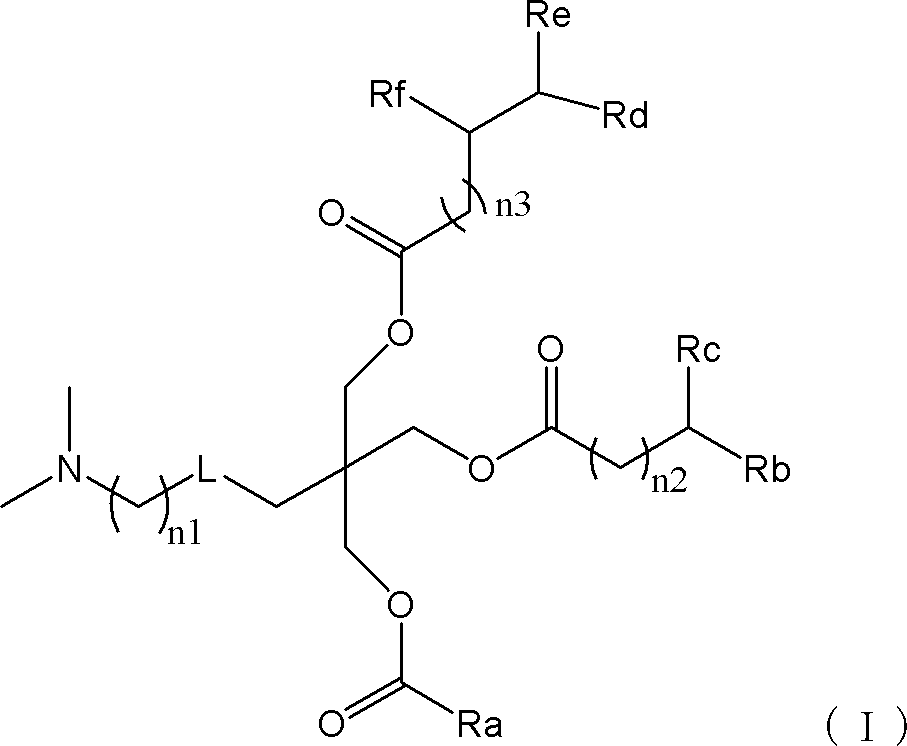
Lは、-C(O)O-または-NHC(O)O-を、
Raは、直鎖状C5-13アルキル基、直鎖状C13-17アルケニル基または直鎖状C17アルカジエニル基を、
Rbは、直鎖状C2-9アルキル基を、
Rcは、水素原子または直鎖状C2-9アルキル基を、
Rdは、水素原子または直鎖状C2-9アルキル基を、
Reは、直鎖状C2-9アルキル基を、
Rfは、直鎖状C2-9アルキル基を示す。]
で表される化合物又はその塩、
2)構造脂質、および
3)mRNA
を含む組成物と、心筋細胞を含む細胞集団とを接触させる工程を含む、心筋細胞の精製方法であって、ここで該mRNAが、
(i)心筋細胞で特異的に発現しているmiRNAによって特異的に認識される塩基配列、および機能的な遺伝子をコードする塩基配列を含む、心筋細胞特異的なmiRNA応答性mRNA、および/または
(ii)機能的な遺伝子をコードする塩基配列を含むmRNA
を含む、心筋細胞の精製方法。 - 1)式(I):
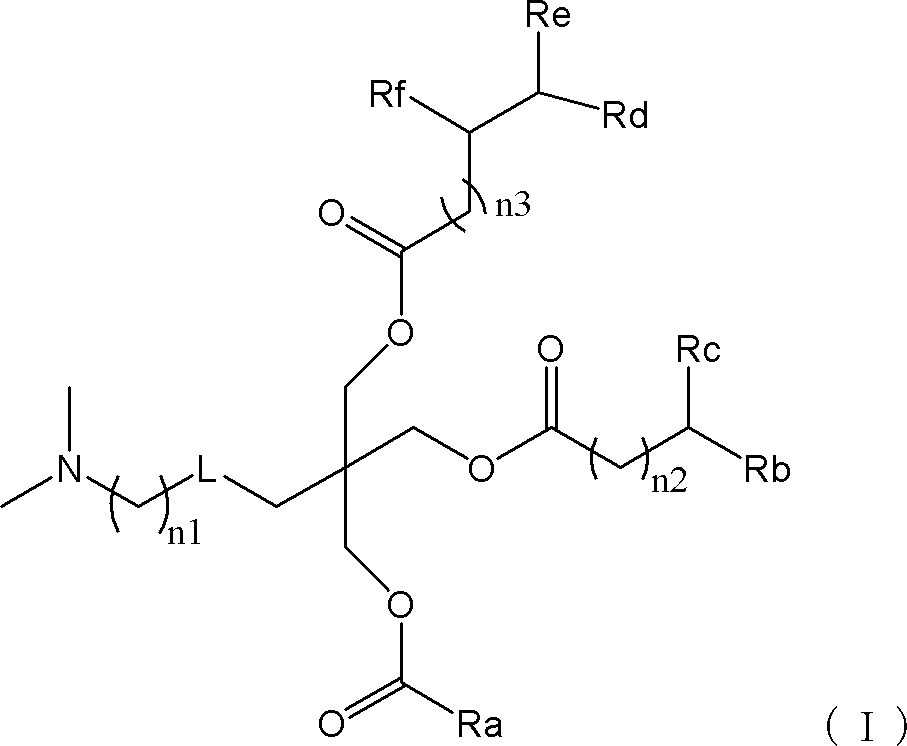
Lは、-C(O)O-または-NHC(O)O-を、
Raは、直鎖状C5-13アルキル基、直鎖状C13-17アルケニル基または直鎖状C17アルカジエニル基を、
Rbは、直鎖状C2-9アルキル基を、
Rcは、水素原子または直鎖状C2-9アルキル基を、
Rdは、水素原子または直鎖状C2-9アルキル基を、
Reは、直鎖状C2-9アルキル基を、
Rfは、直鎖状C2-9アルキル基を示す。]
で表される化合物又はその塩、
2)構造脂質、および
3)mRNA
を含む組成物と、心室筋細胞を含む細胞集団とを接触させる工程を含む、心室筋細胞の精製方法であって、ここで該mRNAが、
(i)心室筋細胞で特異的に発現しているmiRNAによって特異的に認識される塩基配列、および機能的な遺伝子をコードする塩基配列を含む、心室筋細胞特異的なmiRNA応答性mRNA、および/または
(ii)機能的な遺伝子をコードする塩基配列を含むmRNA
を含む、心室筋細胞の精製方法。 - 1)式(I):

Lは、-C(O)O-または-NHC(O)O-を、
Raは、直鎖状C5-13アルキル基、直鎖状C13-17アルケニル基または直鎖状C17アルカジエニル基を、
Rbは、直鎖状C2-9アルキル基を、
Rcは、水素原子または直鎖状C2-9アルキル基を、
Rdは、水素原子または直鎖状C2-9アルキル基を、
Reは、直鎖状C2-9アルキル基を、
Rfは、直鎖状C2-9アルキル基を示す。]
で表される化合物又はその塩、
2)構造脂質、および
3)mRNA
を含む組成物と、心筋細胞を含む細胞集団とを接触させる工程を含む、心筋細胞の製造方法であって、ここで該mRNAが、
(i)心筋細胞で特異的に発現しているmiRNAによって特異的に認識される塩基配列、および機能的な遺伝子をコードする塩基配列を含む、心筋細胞特異的なmiRNA応答性mRNA、および/または
(ii)機能的な遺伝子をコードする塩基配列を含むmRNA
を含む、心筋細胞の製造方法。 - 1)式(I):
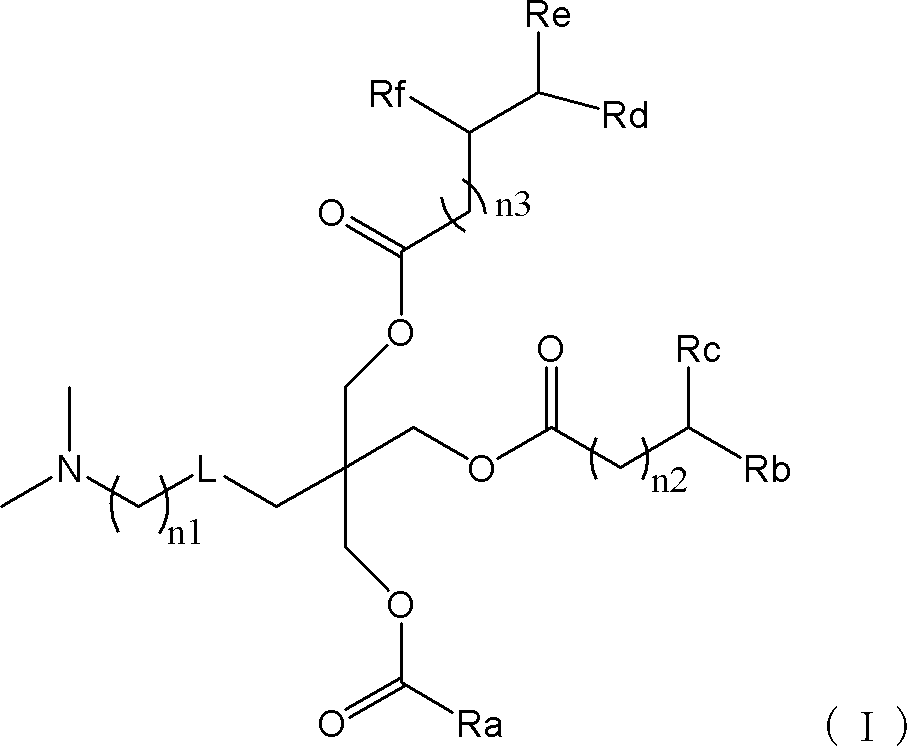
Lは、-C(O)O-または-NHC(O)O-を、
Raは、直鎖状C5-13アルキル基、直鎖状C13-17アルケニル基または直鎖状C17アルカジエニル基を、
Rbは、直鎖状C2-9アルキル基を、
Rcは、水素原子または直鎖状C2-9アルキル基を、
Rdは、水素原子または直鎖状C2-9アルキル基を、
Reは、直鎖状C2-9アルキル基を、
Rfは、直鎖状C2-9アルキル基を示す。]
で表される化合物又はその塩、
2)構造脂質、および
3)mRNA
を含む組成物と、心室筋細胞を含む細胞集団とを接触させる工程を含む、心室筋細胞の製造方法であって、ここで該mRNAが、
(i)心室筋細胞で特異的に発現しているmiRNAによって特異的に認識される塩基配列、および機能的な遺伝子をコードする塩基配列を含む、心室筋細胞特異的なmiRNA応答性mRNA、および/または
(ii)機能的な遺伝子をコードする塩基配列を含むmRNA
を含む、心室筋細胞の製造方法。 - 1)式(I):

Lは、-C(O)O-または-NHC(O)O-を、
Raは、直鎖状C5-13アルキル基、直鎖状C13-17アルケニル基または直鎖状C17アルカジエニル基を、
Rbは、直鎖状C2-9アルキル基を、
Rcは、水素原子または直鎖状C2-9アルキル基を、
Rdは、水素原子または直鎖状C2-9アルキル基を、
Reは、直鎖状C2-9アルキル基を、
Rfは、直鎖状C2-9アルキル基を示す。]
で表される化合物又はその塩、
2)構造脂質、および
3)核酸
を含む、心筋細胞への核酸のトランスフェクション用組成物。 - 1)式(I):
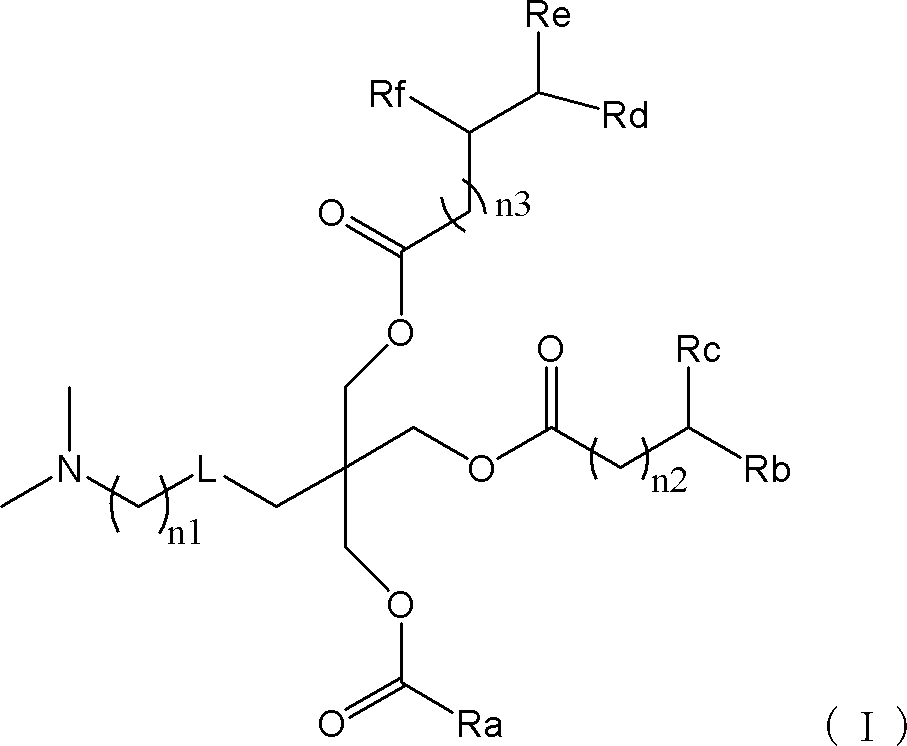
Lは、-C(O)O-または-NHC(O)O-を、
Raは、直鎖状C5-13アルキル基、直鎖状C13-17アルケニル基または直鎖状C17アルカジエニル基を、
Rbは、直鎖状C2-9アルキル基を、
Rcは、水素原子または直鎖状C2-9アルキル基を、
Rdは、水素原子または直鎖状C2-9アルキル基を、
Reは、直鎖状C2-9アルキル基を、
Rfは、直鎖状C2-9アルキル基を示す。]
で表される化合物又はその塩、
2)構造脂質、および
3)核酸
を含む、心筋細胞への核酸のトランスフェクション用キット。
Priority Applications (4)
| Application Number | Priority Date | Filing Date | Title |
|---|---|---|---|
| JP2020535883A JP7436990B2 (ja) | 2018-08-10 | 2019-08-08 | カチオン性脂質を用いた心筋細胞へのトランスフェクション方法 |
| EP19846186.5A EP3842538A4 (en) | 2018-08-10 | 2019-08-08 | METHOD OF TRANSFECTION INTO CARDIOMYOCYTES USING CATIONIC LIPID |
| CN201980052837.1A CN112639111B (zh) | 2018-08-10 | 2019-08-08 | 使用阳离子性脂质的转染心肌细胞的方法 |
| US17/267,602 US12545931B2 (en) | 2018-08-10 | 2019-08-08 | Method for transfection into cardiomyocytes using cationic lipid |
Applications Claiming Priority (2)
| Application Number | Priority Date | Filing Date | Title |
|---|---|---|---|
| JP2018151637 | 2018-08-10 | ||
| JP2018-151637 | 2018-08-10 |
Publications (1)
| Publication Number | Publication Date |
|---|---|
| WO2020032185A1 true WO2020032185A1 (ja) | 2020-02-13 |
Family
ID=69414818
Family Applications (1)
| Application Number | Title | Priority Date | Filing Date |
|---|---|---|---|
| PCT/JP2019/031418 Ceased WO2020032185A1 (ja) | 2018-08-10 | 2019-08-08 | カチオン性脂質を用いた心筋細胞へのトランスフェクション方法 |
Country Status (6)
| Country | Link |
|---|---|
| US (1) | US12545931B2 (ja) |
| EP (1) | EP3842538A4 (ja) |
| JP (1) | JP7436990B2 (ja) |
| CN (1) | CN112639111B (ja) |
| TW (1) | TWI851592B (ja) |
| WO (1) | WO2020032185A1 (ja) |
Cited By (1)
| Publication number | Priority date | Publication date | Assignee | Title |
|---|---|---|---|---|
| CN117715886A (zh) * | 2021-05-06 | 2024-03-15 | 阿克丘勒斯治疗公司 | 用于rna递送的可电离阳离子脂质 |
Families Citing this family (8)
| Publication number | Priority date | Publication date | Assignee | Title |
|---|---|---|---|---|
| FI3835287T3 (fi) | 2018-08-10 | 2024-12-03 | Takeda Pharmaceuticals Co | Kationinen lipidi |
| JP7600208B2 (ja) | 2019-07-29 | 2024-12-16 | ジョージア テック リサーチ コーポレイション | 拘束された脂質を含むナノ材料およびその使用 |
| WO2021141969A1 (en) | 2020-01-09 | 2021-07-15 | Guide Therapeutics, Inc. | Nanomaterials |
| MX2023008328A (es) | 2021-01-20 | 2023-08-15 | Beam Therapeutics Inc | Nanomateriales que comprenden una caracteristica biodegradable. |
| CA3241503A1 (en) * | 2021-12-20 | 2023-06-29 | Beam Therapeutics Inc. | Nanomaterials comprising tetravalent lipid compounds |
| CN116354836A (zh) * | 2022-03-25 | 2023-06-30 | 深圳市新合生物医疗科技有限公司 | 阳离子脂质化合物及其制备方法和应用、以及mRNA递送系统 |
| AU2023311822A1 (en) | 2022-07-20 | 2025-01-09 | Beam Therapeutics Inc. | Nanomaterials comprising triols |
| CN116553595B (zh) * | 2023-07-10 | 2023-09-05 | 北京奇点势能科技有限公司 | 一种钐-氧/羟基团簇化合物及其制备方法和应用 |
Citations (18)
| Publication number | Priority date | Publication date | Assignee | Title |
|---|---|---|---|---|
| WO2003102150A2 (en) * | 2002-05-31 | 2003-12-11 | Genteric, Inc. | Multi-functional polyamines for delivery of biologically-active polynucleotides |
| WO2005033298A1 (ja) | 2003-10-03 | 2005-04-14 | Keiichi Fukuda | 幹細胞から心筋細胞を分化誘導する方法 |
| WO2007002136A2 (en) | 2005-06-22 | 2007-01-04 | Geron Corporation | Differentiation of primate pluripotent stem cells to cardiomyocyte-lineage cells |
| WO2007069666A1 (ja) | 2005-12-13 | 2007-06-21 | Kyoto University | 核初期化因子 |
| WO2007126077A1 (ja) | 2006-04-28 | 2007-11-08 | Asubio Pharma Co., Ltd. | 多能性幹細胞から心筋細胞を分化誘導する方法 |
| WO2008118220A2 (en) | 2006-11-28 | 2008-10-02 | Veritainer Corporation | Radiation detection unit for mounting a radiation sensor to a container crane |
| US20080236610A1 (en) | 2004-04-10 | 2008-10-02 | Holger Bartels | Hair Rollers |
| WO2008124133A1 (en) | 2007-04-07 | 2008-10-16 | Whitehead Institute For Biomedical Research | Reprogramming of somatic cells |
| WO2008151058A2 (en) | 2007-05-30 | 2008-12-11 | The General Hospital Corporation | Methods of generating pluripotent cells from somatic cells |
| JP2008307007A (ja) | 2007-06-15 | 2008-12-25 | Bayer Schering Pharma Ag | 出生後のヒト組織由来未分化幹細胞から誘導したヒト多能性幹細胞 |
| US20090047263A1 (en) | 2005-12-13 | 2009-02-19 | Kyoto University | Nuclear reprogramming factor and induced pluripotent stem cells |
| WO2009118928A1 (en) | 2008-03-26 | 2009-10-01 | Kyoto University | Efficient production and use of highly cardiogenic progenitors and cardiomyocytes from embryonic and induced pluripotent stem cells |
| JP2010158206A (ja) | 2009-01-08 | 2010-07-22 | National Institute Of Advanced Industrial Science & Technology | ヒト心筋前駆細胞の選別方法 |
| WO2015141827A1 (ja) | 2014-03-20 | 2015-09-24 | 国立大学法人京都大学 | 心筋細胞の選別方法 |
| WO2016021683A1 (ja) * | 2014-08-07 | 2016-02-11 | 武田薬品工業株式会社 | カチオン性脂質 |
| WO2018062413A1 (ja) * | 2016-09-28 | 2018-04-05 | 協和発酵キリン株式会社 | 核酸含有脂質ナノ粒子 |
| WO2019131829A1 (ja) * | 2017-12-28 | 2019-07-04 | 国立大学法人京都大学 | 標的遺伝子改変用組成物 |
| WO2019131839A1 (ja) * | 2017-12-28 | 2019-07-04 | 武田薬品工業株式会社 | カチオン性脂質 |
Family Cites Families (26)
| Publication number | Priority date | Publication date | Assignee | Title |
|---|---|---|---|---|
| US5334761A (en) | 1992-08-28 | 1994-08-02 | Life Technologies, Inc. | Cationic lipids |
| DE4418965A1 (de) | 1994-05-31 | 1995-12-07 | Boehringer Ingelheim Int | Verfahren zum Einbringen von Nukleinsäure in höhere eukaryotische Zellen |
| US5981501A (en) * | 1995-06-07 | 1999-11-09 | Inex Pharmaceuticals Corp. | Methods for encapsulating plasmids in lipid bilayers |
| US6235310B1 (en) | 1997-04-04 | 2001-05-22 | Valentis, Inc. | Methods of delivery using cationic lipids and helper lipids |
| US7223887B2 (en) | 2001-12-18 | 2007-05-29 | The University Of British Columbia | Multivalent cationic lipids and methods of using same in the production of lipid particles |
| EP1519714B1 (en) * | 2002-06-28 | 2010-10-20 | Protiva Biotherapeutics Inc. | Method and apparatus for producing liposomes |
| ATE536418T1 (de) | 2004-06-07 | 2011-12-15 | Protiva Biotherapeutics Inc | Lipidverkapselte interferenz-rna |
| US20080145413A1 (en) | 2006-12-19 | 2008-06-19 | Steffen Panzner | Lipids and lipid assemblies comprising transfection enhancer elements |
| KR100807060B1 (ko) | 2007-08-28 | 2008-02-25 | 고려대학교 산학협력단 | 신규한 양이온성 지질, 그의 제조 방법 및 그를 포함하는전달체 |
| NZ584048A (en) * | 2007-10-02 | 2012-08-31 | Marina Biotech Inc | Lipopeptides for delivery of nucleic acids |
| KR101198715B1 (ko) * | 2010-05-14 | 2012-11-13 | 한국생명공학연구원 | 핵산 및 친수성 음이온 화합물의 고효율 포획을 위한 비대칭 리포솜 및 이의 제조방법 |
| KR101187064B1 (ko) | 2010-07-18 | 2012-09-28 | 주식회사 바이오폴리메드 | 양이온성 지질, 이의 제조 방법 및 이를 포함하는 세포내 이행성을 갖는 전달체 |
| JP2014511694A (ja) | 2011-04-03 | 2014-05-19 | ザ ジェネラル ホスピタル コーポレーション ドゥーイング ビジネス アズ マサチューセッツ ジェネラル ホスピタル | 修飾型rna(mod−rna)を使用する効率的なインビボタンパク質発現 |
| US9463247B2 (en) | 2011-12-07 | 2016-10-11 | Alnylam Pharmaceuticals, Inc. | Branched alkyl and cycloalkyl terminated biodegradable lipids for the delivery of active agents |
| DK2817287T3 (da) | 2012-02-24 | 2019-01-02 | Arbutus Biopharma Corp | Trialkyl kationisk lipid og metoder til anvendelse deraf |
| TW201726599A (zh) | 2012-07-06 | 2017-08-01 | 協和醱酵麒麟有限公司 | 陽離子性脂質 |
| WO2014071072A2 (en) | 2012-11-02 | 2014-05-08 | Pungente Michael D | Novel cationic carotenoid-based lipids for cellular nucleic acid uptake |
| NZ720174A (en) | 2013-11-18 | 2018-11-30 | Arcturus Therapeutics Inc | Ionizable cationic lipid for rna delivery |
| PT3083556T (pt) | 2013-12-19 | 2020-03-05 | Novartis Ag | Lípidos e composições lipídicas para a entrega de agentes ativos |
| US10385030B2 (en) | 2015-01-30 | 2019-08-20 | Nof Corporation | Cationic lipid |
| JP6719352B2 (ja) | 2016-09-23 | 2020-07-08 | 株式会社総合車両製作所 | 車両用内装パネルとその製造方法 |
| EP3551169A4 (en) | 2016-12-09 | 2020-09-09 | Sangamo Therapeutics, Inc. | TARGET-SPECIFIC NUCLEASES ADMINISTRATION |
| MX2020006843A (es) | 2017-12-27 | 2020-09-03 | Takeda Pharmaceuticals Co | Nanoparticula de lipido que contiene acido nucleico y uso de la misma. |
| FI3835287T3 (fi) | 2018-08-10 | 2024-12-03 | Takeda Pharmaceuticals Co | Kationinen lipidi |
| CN115850104B (zh) | 2022-04-29 | 2023-07-18 | 北京剂泰医药科技有限公司 | 可电离脂质化合物 |
| CN116969851A (zh) | 2022-04-29 | 2023-10-31 | 北京剂泰医药科技有限公司 | 可电离脂质化合物 |
-
2019
- 2019-08-08 EP EP19846186.5A patent/EP3842538A4/en not_active Withdrawn
- 2019-08-08 TW TW108128297A patent/TWI851592B/zh active
- 2019-08-08 US US17/267,602 patent/US12545931B2/en active Active
- 2019-08-08 WO PCT/JP2019/031418 patent/WO2020032185A1/ja not_active Ceased
- 2019-08-08 JP JP2020535883A patent/JP7436990B2/ja active Active
- 2019-08-08 CN CN201980052837.1A patent/CN112639111B/zh active Active
Patent Citations (22)
| Publication number | Priority date | Publication date | Assignee | Title |
|---|---|---|---|---|
| WO2003102150A2 (en) * | 2002-05-31 | 2003-12-11 | Genteric, Inc. | Multi-functional polyamines for delivery of biologically-active polynucleotides |
| WO2005033298A1 (ja) | 2003-10-03 | 2005-04-14 | Keiichi Fukuda | 幹細胞から心筋細胞を分化誘導する方法 |
| US20080236610A1 (en) | 2004-04-10 | 2008-10-02 | Holger Bartels | Hair Rollers |
| WO2007002136A2 (en) | 2005-06-22 | 2007-01-04 | Geron Corporation | Differentiation of primate pluripotent stem cells to cardiomyocyte-lineage cells |
| US20090047263A1 (en) | 2005-12-13 | 2009-02-19 | Kyoto University | Nuclear reprogramming factor and induced pluripotent stem cells |
| WO2007069666A1 (ja) | 2005-12-13 | 2007-06-21 | Kyoto University | 核初期化因子 |
| JP2008283972A (ja) | 2005-12-13 | 2008-11-27 | Kyoto Univ | 誘導多能性幹細胞の製造方法 |
| WO2007126077A1 (ja) | 2006-04-28 | 2007-11-08 | Asubio Pharma Co., Ltd. | 多能性幹細胞から心筋細胞を分化誘導する方法 |
| WO2008118220A2 (en) | 2006-11-28 | 2008-10-02 | Veritainer Corporation | Radiation detection unit for mounting a radiation sensor to a container crane |
| WO2008124133A1 (en) | 2007-04-07 | 2008-10-16 | Whitehead Institute For Biomedical Research | Reprogramming of somatic cells |
| WO2008151058A2 (en) | 2007-05-30 | 2008-12-11 | The General Hospital Corporation | Methods of generating pluripotent cells from somatic cells |
| JP2008307007A (ja) | 2007-06-15 | 2008-12-25 | Bayer Schering Pharma Ag | 出生後のヒト組織由来未分化幹細胞から誘導したヒト多能性幹細胞 |
| WO2009006930A1 (en) | 2007-06-15 | 2009-01-15 | Izumi Bio, Inc. | Human pluripotent stem cells induced from undifferentiated stem cells derived from a human postnatal tissue |
| WO2009007852A2 (en) | 2007-06-15 | 2009-01-15 | Izumi Bio, Inc | Multipotent/pluripotent cells and methods |
| WO2009006997A1 (en) | 2007-06-15 | 2009-01-15 | Izumi Bio, Inc. | Human pluripotent stem cells and their medical use |
| WO2009118928A1 (en) | 2008-03-26 | 2009-10-01 | Kyoto University | Efficient production and use of highly cardiogenic progenitors and cardiomyocytes from embryonic and induced pluripotent stem cells |
| JP2010158206A (ja) | 2009-01-08 | 2010-07-22 | National Institute Of Advanced Industrial Science & Technology | ヒト心筋前駆細胞の選別方法 |
| WO2015141827A1 (ja) | 2014-03-20 | 2015-09-24 | 国立大学法人京都大学 | 心筋細胞の選別方法 |
| WO2016021683A1 (ja) * | 2014-08-07 | 2016-02-11 | 武田薬品工業株式会社 | カチオン性脂質 |
| WO2018062413A1 (ja) * | 2016-09-28 | 2018-04-05 | 協和発酵キリン株式会社 | 核酸含有脂質ナノ粒子 |
| WO2019131829A1 (ja) * | 2017-12-28 | 2019-07-04 | 国立大学法人京都大学 | 標的遺伝子改変用組成物 |
| WO2019131839A1 (ja) * | 2017-12-28 | 2019-07-04 | 武田薬品工業株式会社 | カチオン性脂質 |
Non-Patent Citations (22)
| Title |
|---|
| "RNAi Method and Antisense Method", 2005, KODANSHA LTD. |
| ACC. CHEM. RES., vol. 32, 1999, pages 624 |
| CELL ENGINEERING, vol. 16, 1997, pages 1463 - 1473 |
| HUANGFU D.MELTON, DA. ET AL., NATURE BIOTECHNOLOGY, vol. 26, no. 7, 2008, pages 795 - 797 |
| J. AM. CHEM. SOC., vol. 122, 2000, pages 6900 |
| J. AM. CHEM. SOC., vol. 123, 2001, pages 4653 |
| KIM JB.SCHOLER HR. ET AL., NATURE, vol. 454, 2008, pages 646 - 650 |
| KIYOSHI TOMIOKA: "Modern Organic Synthesis in the Laboratory: A Collection of Standard Experimental Procedures", vol. I-VII, 1989, KAGAKU-DOJIN PUBLISHING COMPANY, INC. |
| L. F. TIETZETH. EICHER: "Shin Jikken Kagaku Koza (in Japanese, translated title: New Experimental Chemistry", vol. 14-15, NANKODO CO., LTD., article "Reaktionen und Synthesen im organisch-chemischen Praktikum und Forschungslaboratorium) Revised" |
| LAFLAMME MAMURRY CE, NATURE 2011, REVIEW, 2011 |
| NUCLEIC ACID RESEARCH, vol. 32, 2004, pages e175 |
| OKITA K ET AL., NAT. METHODS, vol. 8, no. 5, May 2011 (2011-05-01), pages 409 - 12 |
| OKITA K ET AL., STEM CELLS, vol. 31, no. 3, pages 458 - 66 |
| OKITA, K.ICHISAKA, T.YAMANAKA, S., NATURE, vol. 451, 2007, pages 141 - 146 |
| P.J. KOCIENSKI: "Protecting Groups", 2004, THIEME MEDICAL PUBLISHERS |
| See also references of EP3842538A4 |
| SHI Y.DING S. ET AL., CELL STEM CELL, vol. 3, no. 5, 2008, pages 568 - 574 |
| TAKAHASHI KYAMANAKA S. ET AL., CELL, vol. 131, 2007, pages 861 - 872 |
| TAKAHASHI KYAMANAKA S., CELL, vol. 126, 2006, pages 663 - 676 |
| THEODORA W. GREENEPETER G. M. WUTS: "Protective Groups in Organic Synthesis", 2007, WILEY-INTERSCIENCE |
| YAN P ET AL., BIOCHEM BIOPHYS RES COMMUN., vol. 379, 2009, pages 115 - 20 |
| YU J.THOMSON JA. ET AL., SCIENCE, vol. 318, 2007, pages 1917 - 1920 |
Cited By (1)
| Publication number | Priority date | Publication date | Assignee | Title |
|---|---|---|---|---|
| CN117715886A (zh) * | 2021-05-06 | 2024-03-15 | 阿克丘勒斯治疗公司 | 用于rna递送的可电离阳离子脂质 |
Also Published As
| Publication number | Publication date |
|---|---|
| CN112639111A (zh) | 2021-04-09 |
| TWI851592B (zh) | 2024-08-11 |
| CN112639111B (zh) | 2023-07-21 |
| JP7436990B2 (ja) | 2024-02-22 |
| JPWO2020032185A1 (ja) | 2021-08-26 |
| TW202035697A (zh) | 2020-10-01 |
| US20220145329A1 (en) | 2022-05-12 |
| EP3842538A1 (en) | 2021-06-30 |
| US12545931B2 (en) | 2026-02-10 |
| EP3842538A4 (en) | 2022-06-08 |
Similar Documents
| Publication | Publication Date | Title |
|---|---|---|
| JP7436990B2 (ja) | カチオン性脂質を用いた心筋細胞へのトランスフェクション方法 | |
| KR100860087B1 (ko) | 인간 배아줄기세포에서 분리된 신규 miRNA | |
| KR101774206B1 (ko) | 유도된 다능성 줄기 세포의 효율적인 확립 방법 | |
| JP5840119B2 (ja) | 誘導多能性幹細胞の製造方法 | |
| TWI868080B (zh) | T細胞之活性化/增殖方法 | |
| JP2018075017A (ja) | 神経幹細胞および運動ニューロンの生成 | |
| JP2018529340A (ja) | 核酸のエキソソームパッケージング | |
| CN104334718A (zh) | 通过三维培养重新编程细胞 | |
| ITRM20110685A1 (it) | Microrna per la rigenerazione cardiaca attraverso l induzione della proliferazione dei miociti cardiaci | |
| CN107002031B (zh) | 选择分化细胞的方法 | |
| US20230287408A1 (en) | Nucleic acid constructs for delivering polynucleotides into exosomes | |
| CN105229159A (zh) | 重组多肽生产 | |
| JP2016532445A (ja) | 組換えタンパク質の生産のための哺乳動物生産細胞の生成のための手段及び方法 | |
| JP2017060498A (ja) | 3次元培養による細胞の再プログラミング | |
| WO2018203553A1 (ja) | 分化細胞の品質改善方法 | |
| JP7432929B2 (ja) | マイクロrnaの非正規標的を抑制するrna干渉誘導核酸およびその用途 | |
| WO2026083330A1 (en) | Compositions and methods for reprogramming of cells | |
| WO2026074556A1 (en) | Methods for rejuvenating human cells with micro rnas | |
| Jung et al. | Pluripotency and Early Cell Fate Decisions are Orchestrated by microRNAs | |
| Chang et al. | MicroRNAs in Development, Stem Cell Differentiation, and Regenerative Medicine | |
| Chang et al. | Zhong Liu, Cheng Zhang, 3 Maria Skamagki, 2 Alireza Khodadadi-Jamayran, Wei Zhang, Dexin Kong | |
| Ghasemi | The Role of MicroRNA-302 in Regulation of Human Bone Marrow Mesenchymal Stem Cell Fate Determination | |
| Horvath et al. | A Functional RNAi-Based Knockdown System: A Tool to Investigate HPV Entry? |
Legal Events
| Date | Code | Title | Description |
|---|---|---|---|
| 121 | Ep: the epo has been informed by wipo that ep was designated in this application |
Ref document number: 19846186 Country of ref document: EP Kind code of ref document: A1 |
|
| ENP | Entry into the national phase |
Ref document number: 2020535883 Country of ref document: JP Kind code of ref document: A |
|
| NENP | Non-entry into the national phase |
Ref country code: DE |
|
| ENP | Entry into the national phase |
Ref document number: 2019846186 Country of ref document: EP Effective date: 20210310 |
|
| WWW | Wipo information: withdrawn in national office |
Ref document number: 2019846186 Country of ref document: EP |
|
| WWG | Wipo information: grant in national office |
Ref document number: 17267602 Country of ref document: US |