WO2020032210A1 - 添加剤組成物、これを含有する難燃性合成樹脂組成物、およびその成形体 - Google Patents
添加剤組成物、これを含有する難燃性合成樹脂組成物、およびその成形体 Download PDFInfo
- Publication number
- WO2020032210A1 WO2020032210A1 PCT/JP2019/031493 JP2019031493W WO2020032210A1 WO 2020032210 A1 WO2020032210 A1 WO 2020032210A1 JP 2019031493 W JP2019031493 W JP 2019031493W WO 2020032210 A1 WO2020032210 A1 WO 2020032210A1
- Authority
- WO
- WIPO (PCT)
- Prior art keywords
- synthetic resin
- manufactured
- group
- additive composition
- flame
- Prior art date
- Legal status (The legal status is an assumption and is not a legal conclusion. Google has not performed a legal analysis and makes no representation as to the accuracy of the status listed.)
- Ceased
Links
- 0 CC(C)(C)c1cc(*c2c(*)c(*c(cc3C(C)(C)C)cc(C(C)(C)C)c3O)c(*)c(*c(cc3C(C)(C)C)cc(C(C)(C)C)c3O)c2*)cc(C(C)(C)C)c1O Chemical compound CC(C)(C)c1cc(*c2c(*)c(*c(cc3C(C)(C)C)cc(C(C)(C)C)c3O)c(*)c(*c(cc3C(C)(C)C)cc(C(C)(C)C)c3O)c2*)cc(C(C)(C)C)c1O 0.000 description 1
Classifications
-
- C—CHEMISTRY; METALLURGY
- C08—ORGANIC MACROMOLECULAR COMPOUNDS; THEIR PREPARATION OR CHEMICAL WORKING-UP; COMPOSITIONS BASED THEREON
- C08K—Use of inorganic or non-macromolecular organic substances as compounding ingredients
- C08K3/00—Use of inorganic substances as compounding ingredients
- C08K3/32—Phosphorus-containing compounds
-
- C—CHEMISTRY; METALLURGY
- C08—ORGANIC MACROMOLECULAR COMPOUNDS; THEIR PREPARATION OR CHEMICAL WORKING-UP; COMPOSITIONS BASED THEREON
- C08K—Use of inorganic or non-macromolecular organic substances as compounding ingredients
- C08K3/00—Use of inorganic substances as compounding ingredients
- C08K3/10—Metal compounds
- C08K3/12—Hydrides
-
- C—CHEMISTRY; METALLURGY
- C08—ORGANIC MACROMOLECULAR COMPOUNDS; THEIR PREPARATION OR CHEMICAL WORKING-UP; COMPOSITIONS BASED THEREON
- C08K—Use of inorganic or non-macromolecular organic substances as compounding ingredients
- C08K13/00—Use of mixtures of ingredients not covered by one single of the preceding main groups, each of these compounds being essential
- C08K13/02—Organic and inorganic ingredients
-
- C—CHEMISTRY; METALLURGY
- C08—ORGANIC MACROMOLECULAR COMPOUNDS; THEIR PREPARATION OR CHEMICAL WORKING-UP; COMPOSITIONS BASED THEREON
- C08K—Use of inorganic or non-macromolecular organic substances as compounding ingredients
- C08K5/00—Use of organic ingredients
- C08K5/04—Oxygen-containing compounds
- C08K5/13—Phenols; Phenolates
-
- C—CHEMISTRY; METALLURGY
- C08—ORGANIC MACROMOLECULAR COMPOUNDS; THEIR PREPARATION OR CHEMICAL WORKING-UP; COMPOSITIONS BASED THEREON
- C08K—Use of inorganic or non-macromolecular organic substances as compounding ingredients
- C08K5/00—Use of organic ingredients
- C08K5/16—Nitrogen-containing compounds
- C08K5/34—Heterocyclic compounds having nitrogen in the ring
- C08K5/3467—Heterocyclic compounds having nitrogen in the ring having more than two nitrogen atoms in the ring
- C08K5/3477—Six-membered rings
- C08K5/3492—Triazines
- C08K5/34922—Melamine; Derivatives thereof
-
- C—CHEMISTRY; METALLURGY
- C08—ORGANIC MACROMOLECULAR COMPOUNDS; THEIR PREPARATION OR CHEMICAL WORKING-UP; COMPOSITIONS BASED THEREON
- C08K—Use of inorganic or non-macromolecular organic substances as compounding ingredients
- C08K5/00—Use of organic ingredients
- C08K5/16—Nitrogen-containing compounds
- C08K5/34—Heterocyclic compounds having nitrogen in the ring
- C08K5/3467—Heterocyclic compounds having nitrogen in the ring having more than two nitrogen atoms in the ring
- C08K5/3477—Six-membered rings
- C08K5/3492—Triazines
- C08K5/34926—Triazines also containing heterocyclic groups other than triazine groups
-
- C—CHEMISTRY; METALLURGY
- C08—ORGANIC MACROMOLECULAR COMPOUNDS; THEIR PREPARATION OR CHEMICAL WORKING-UP; COMPOSITIONS BASED THEREON
- C08L—COMPOSITIONS OF MACROMOLECULAR COMPOUNDS
- C08L101/00—Compositions of unspecified macromolecular compounds
-
- C—CHEMISTRY; METALLURGY
- C08—ORGANIC MACROMOLECULAR COMPOUNDS; THEIR PREPARATION OR CHEMICAL WORKING-UP; COMPOSITIONS BASED THEREON
- C08L—COMPOSITIONS OF MACROMOLECULAR COMPOUNDS
- C08L23/00—Compositions of homopolymers or copolymers of unsaturated aliphatic hydrocarbons having only one carbon-to-carbon double bond; Compositions of derivatives of such polymers
-
- C—CHEMISTRY; METALLURGY
- C09—DYES; PAINTS; POLISHES; NATURAL RESINS; ADHESIVES; COMPOSITIONS NOT OTHERWISE PROVIDED FOR; APPLICATIONS OF MATERIALS NOT OTHERWISE PROVIDED FOR
- C09K—MATERIALS FOR MISCELLANEOUS APPLICATIONS, NOT PROVIDED FOR ELSEWHERE
- C09K21/00—Fireproofing materials
- C09K21/02—Inorganic materials
- C09K21/04—Inorganic materials containing phosphorus
-
- C—CHEMISTRY; METALLURGY
- C09—DYES; PAINTS; POLISHES; NATURAL RESINS; ADHESIVES; COMPOSITIONS NOT OTHERWISE PROVIDED FOR; APPLICATIONS OF MATERIALS NOT OTHERWISE PROVIDED FOR
- C09K—MATERIALS FOR MISCELLANEOUS APPLICATIONS, NOT PROVIDED FOR ELSEWHERE
- C09K21/00—Fireproofing materials
- C09K21/06—Organic materials
- C09K21/10—Organic materials containing nitrogen
-
- C—CHEMISTRY; METALLURGY
- C09—DYES; PAINTS; POLISHES; NATURAL RESINS; ADHESIVES; COMPOSITIONS NOT OTHERWISE PROVIDED FOR; APPLICATIONS OF MATERIALS NOT OTHERWISE PROVIDED FOR
- C09K—MATERIALS FOR MISCELLANEOUS APPLICATIONS, NOT PROVIDED FOR ELSEWHERE
- C09K21/00—Fireproofing materials
- C09K21/06—Organic materials
- C09K21/12—Organic materials containing phosphorus
-
- C—CHEMISTRY; METALLURGY
- C08—ORGANIC MACROMOLECULAR COMPOUNDS; THEIR PREPARATION OR CHEMICAL WORKING-UP; COMPOSITIONS BASED THEREON
- C08K—Use of inorganic or non-macromolecular organic substances as compounding ingredients
- C08K3/00—Use of inorganic substances as compounding ingredients
- C08K3/32—Phosphorus-containing compounds
- C08K2003/321—Phosphates
- C08K2003/322—Ammonium phosphate
- C08K2003/323—Ammonium polyphosphate
-
- C—CHEMISTRY; METALLURGY
- C08—ORGANIC MACROMOLECULAR COMPOUNDS; THEIR PREPARATION OR CHEMICAL WORKING-UP; COMPOSITIONS BASED THEREON
- C08K—Use of inorganic or non-macromolecular organic substances as compounding ingredients
- C08K2201/00—Specific properties of additives
- C08K2201/014—Additives containing two or more different additives of the same subgroup in C08K
-
- C—CHEMISTRY; METALLURGY
- C08—ORGANIC MACROMOLECULAR COMPOUNDS; THEIR PREPARATION OR CHEMICAL WORKING-UP; COMPOSITIONS BASED THEREON
- C08K—Use of inorganic or non-macromolecular organic substances as compounding ingredients
- C08K5/00—Use of organic ingredients
- C08K5/16—Nitrogen-containing compounds
- C08K5/34—Heterocyclic compounds having nitrogen in the ring
- C08K5/3467—Heterocyclic compounds having nitrogen in the ring having more than two nitrogen atoms in the ring
- C08K5/3477—Six-membered rings
- C08K5/3492—Triazines
-
- C—CHEMISTRY; METALLURGY
- C08—ORGANIC MACROMOLECULAR COMPOUNDS; THEIR PREPARATION OR CHEMICAL WORKING-UP; COMPOSITIONS BASED THEREON
- C08K—Use of inorganic or non-macromolecular organic substances as compounding ingredients
- C08K5/00—Use of organic ingredients
- C08K5/16—Nitrogen-containing compounds
- C08K5/34—Heterocyclic compounds having nitrogen in the ring
- C08K5/3467—Heterocyclic compounds having nitrogen in the ring having more than two nitrogen atoms in the ring
- C08K5/3477—Six-membered rings
- C08K5/3492—Triazines
- C08K5/34924—Triazines containing cyanurate groups; Tautomers thereof
Definitions
- the present invention relates to an additive composition, a flame-retardant synthetic resin composition containing the same (hereinafter, also simply referred to as “synthetic resin composition”), and a molded product thereof.
- synthetic resin composition a flame-retardant synthetic resin composition containing the same
- molded article a molded article thereof.
- Synthetic resins are excellent in moldability, heat resistance, mechanical properties, etc. and have the advantages of low specific gravity and light weight, and are widely used in various molded articles such as films, sheets and structural parts. . Many attempts have been made to blend a synthetic resin with another polymer to impart new physical properties such as impact resistance and elasticity.
- an object of the present invention is to provide an additive composition capable of imparting excellent heat resistance and flame retardancy to a synthetic resin, a flame-retardant synthetic resin composition containing the same, and a molded article thereof. It is in.
- the present inventors have conducted intensive studies to solve the above problems, and as a result, have found that the above problems can be solved by using ammonium polyphosphate and a compound having a specific structure. Was completed.
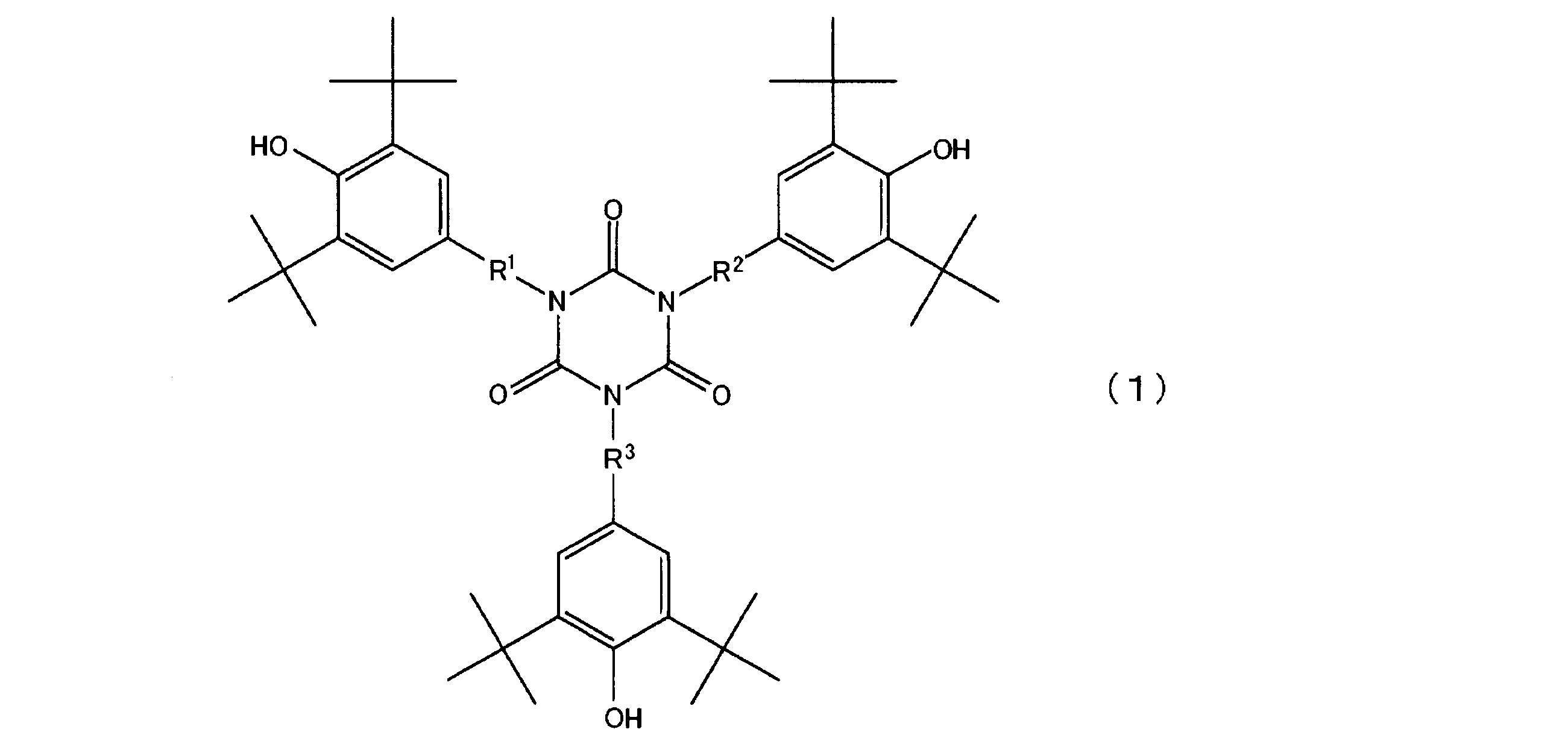
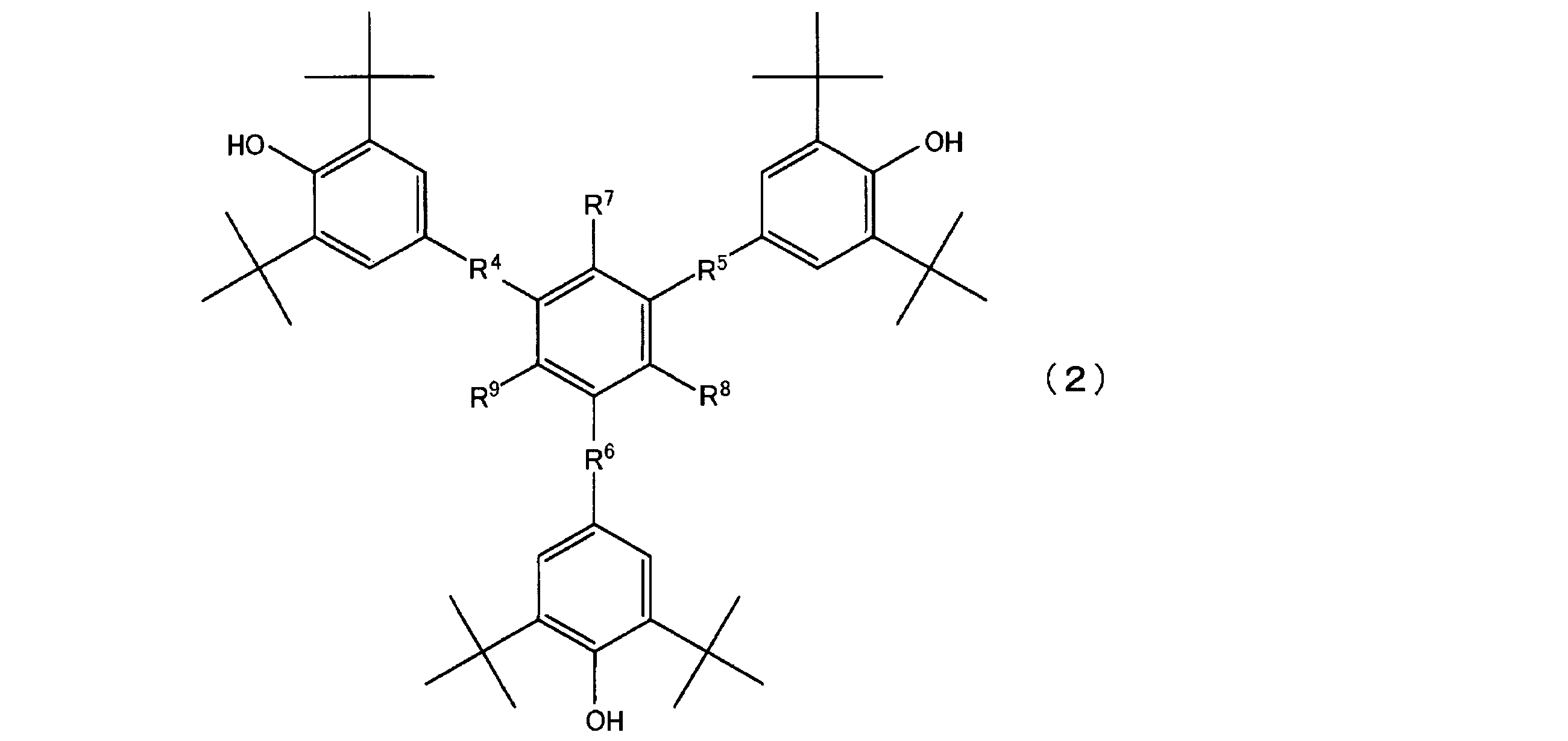
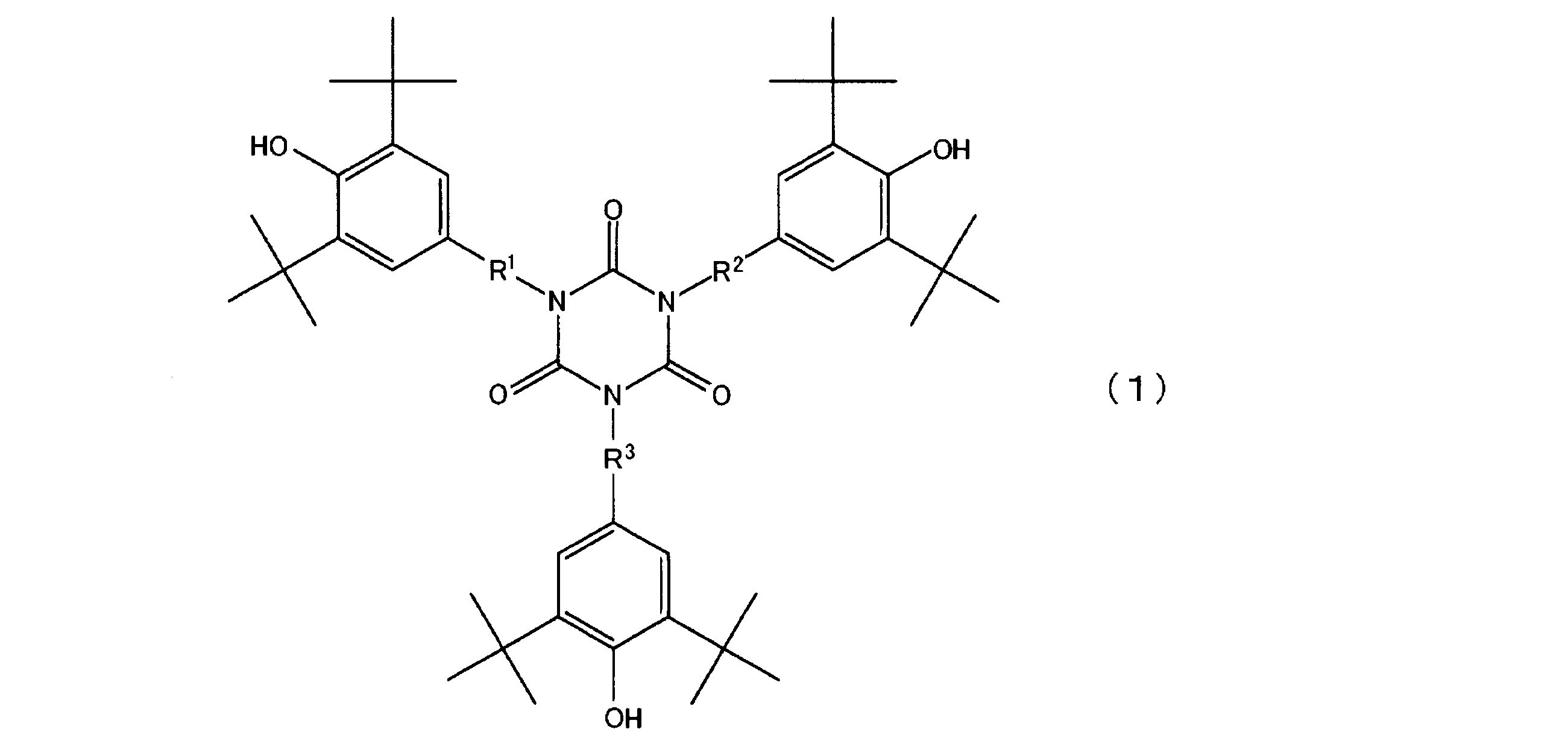
- the additive composition of the present invention comprises at least one kind of ammonium polyphosphate as the component (A) and the following general formula (1) as the component (B): And a compound represented by the following general formula (2): And at least one member selected from the group consisting of compounds represented by the following formulas:
- R 1 , R 2 and R 3 each independently represent a divalent hydrocarbon group having 1 to 3 carbon atoms
- R 4 , R 5 and R 6 each independently represent a divalent hydrocarbon group having 1 to 3 carbon atoms
- R 7 , R 8 and R 9 each independently represent a hydrogen atom or 1 to 4 carbon atoms. Represents a monovalent hydrocarbon group.
- the additive composition of the present invention preferably further contains, as the component (C), one or more nitrogen-containing organic compounds other than the compound represented by the general formula (1).
- the nitrogen organic compound is preferably at least one of triazine derivatives.
- the flame-retardant synthetic resin composition of the present invention is characterized in that the additive composition of the present invention is blended with a synthetic resin.
- the synthetic resin is preferably a polyolefin resin.
- the molded article of the present invention is obtained from the flame-retardant synthetic resin composition of the present invention.
- an additive composition capable of imparting excellent heat resistance and flame retardancy to a synthetic resin, a flame-retardant synthetic resin composition containing the same, and a molded article thereof.
- the additive composition of the present invention comprises, as a component (A), at least one type of ammonium polyphosphate, and as a component (B), a compound represented by the following general formula (1): And a compound represented by the following general formula (2): And at least one member selected from the group consisting of compounds represented by the formula:
- the component (A) is at least one kind of ammonium polyphosphate.
- This ammonium polyphosphate functions as a component that imparts flame retardancy to the synthetic resin.
- the component (A) according to the present invention is at least one kind of ammonium polyphosphate.
- ammonium polyphosphate includes ammonium orthophosphate, ammonium pyrophosphate, ammonium metaphosphate, and ammonium polyphosphate, all of which are contained in ammonium polyphosphate.
- the component (A) may be one type or a mixture of two or more types.
- the degree of condensation of ammonium polyphosphate with polyphosphoric acid is 3 to 1000.
- Ammonium polyphosphate may be a normal salt, an acidic salt, or a basic salt.
- Phosphorus-containing compounds such as phosphoric acid, polyphosphoric acid, urea phosphate, melamine phosphate, monoammonium phosphate, diammonium phosphate or triammonium phosphate and a condensing agent such as urea or phosphorus pentoxide and an ammoniating agent such as ammonia It can be obtained by reacting a gas, ammonium carbonate, ammonium bicarbonate, biuret or the like as a raw material at a temperature of 170 to 350 ° C. for a sufficient time.
- ammonium polyphosphate can also be used.
- examples of commercially available products include Exolit-422 (trade name, manufactured by Hoechst), Exolit-700 (trade name, manufactured by Hoechst), Phos-chek-P / 30 (trade name, manufactured by Monsanto), Phos-chek (Phos-check) -P / 40 (trade name, manufactured by Monsanto), Sumisafe-P (trade name, manufactured by Sumitomo Chemical Co., Ltd.) ), TERRAJU (registered trademark, manufactured by Chisso Corporation) -S10, and TERRAJU (registered trademark, manufactured by Chisso Corporation) -S20.
- ammonium polyphosphate since ammonium polyphosphate alone is susceptible to hydrolysis, ammonium polyphosphate is coated with a thermosetting resin or microencapsulated, or ammonium polyphosphate particles are coated with a melamine monomer or another nitrogen-containing organic compound.
- a surfactant those treated with a surfactant, a silicon compound such as a silane coupling agent or silicone oil, those which have been rendered insoluble by adding melamine or the like in the process of producing ammonium polyphosphate, etc. Can also be used.
- a resin such as an epoxy resin, urethane resin, acrylic resin, phenol resin, alkyd resin, urea resin, melamine resin, silicone resin, etc.
- a known method such as an interfacial polymerization method, an in-situ polymerization method, a liquid curing method, a phase separation method, a liquid drying method, a melt dispersion cooling method, a spray drying method, and a powder bed method. It can be obtained by encapsulation.
- an ammonium polyphosphate coated with a melamine monomer for example, a predetermined amount of a melamine monomer is added to ammonium polyphosphate previously heated to 250 ° C. to 300 ° C. in a device capable of heating and stirring, and further added at the same temperature.
- a sublimation coating method of adding and / or attaching melamine sublimated to ammonium polyphosphate by continuing heating, and a so-called hybridization method of forming a mixture of ammonium polyphosphate and melamine monomer into a film in a powerful agitator. can be mentioned.
- ammonium polyphosphate coated with a silicone resin for example, as disclosed in JP-A-3-131508, ammonium polyphosphate is suspended in an organic solvent to form a curable silicone resin.
- a method of curing and coating a silicone resin with stirring of a curing accelerator and water can be mentioned.
- ammonium polyphosphate compounds having reduced ammonium polyphosphate hydrolyzability include Exolit-462 (trade name, manufactured by Hoechst) and Sumisafe-PM (trade name, manufactured by Sumitomo Chemical Co., Ltd.) ), TERRAJU (registered trademark, manufactured by Chisso Corporation) -C60, TERRAJU (registered trademark, manufactured by Chisso Corporation) -C70, TERAGE (TERRAJU) (registered trademark, manufactured by Chisso Corporation) -C80, TERRAJU (registered trademark, manufactured by Chisso Corporation) -M30, and TERAGE (TERRAJU) (registered trademark, manufactured by Chisso Corporation) -M40 can be used, and commercially available products thereof can also be suitably used.
- Exolit-462 trade name, manufactured by Hoechst
- Sumisafe-PM trade name, manufactured by Sumitomo Chemical Co., Ltd.
- TERRAJU registered
- the component (B) according to the additive composition of the present invention is at least one or more selected from the group consisting of a compound represented by the following general formula (1) and a compound represented by the following general formula (2). .
- the compounds represented by the following general formulas (1) and (2) function as components that impart heat resistance to the synthetic resin.
- R 1 , R 2 and R 3 each independently represent a divalent hydrocarbon group having 1 to 3 carbon atoms.
- R 4 , R 5 and R 6 each independently represent a divalent hydrocarbon group having 1 to 3 carbon atoms
- R 7 , R 8 and R 9 each independently represent Represents a hydrogen atom or a monovalent hydrocarbon group having 1 to 4 carbon atoms.
- examples of the divalent hydrocarbon group having 1 to 3 carbon atoms represented by R 1 , R 2 and R 3 include a linear or branched alkylene group and a linear or branched alkenylene group. Alkynylene group.
- Examples of the linear alkylene group include — (CH 2 ) n — (n is an integer of 1 to 3), and examples of the branched alkylene group include —CH (CH 3 ) — and —CH 2 (CH 2 CH 3 ) —, —CH (CH 3 ) CH 2 —, and —CH 2 CH (CH 3 ) —.
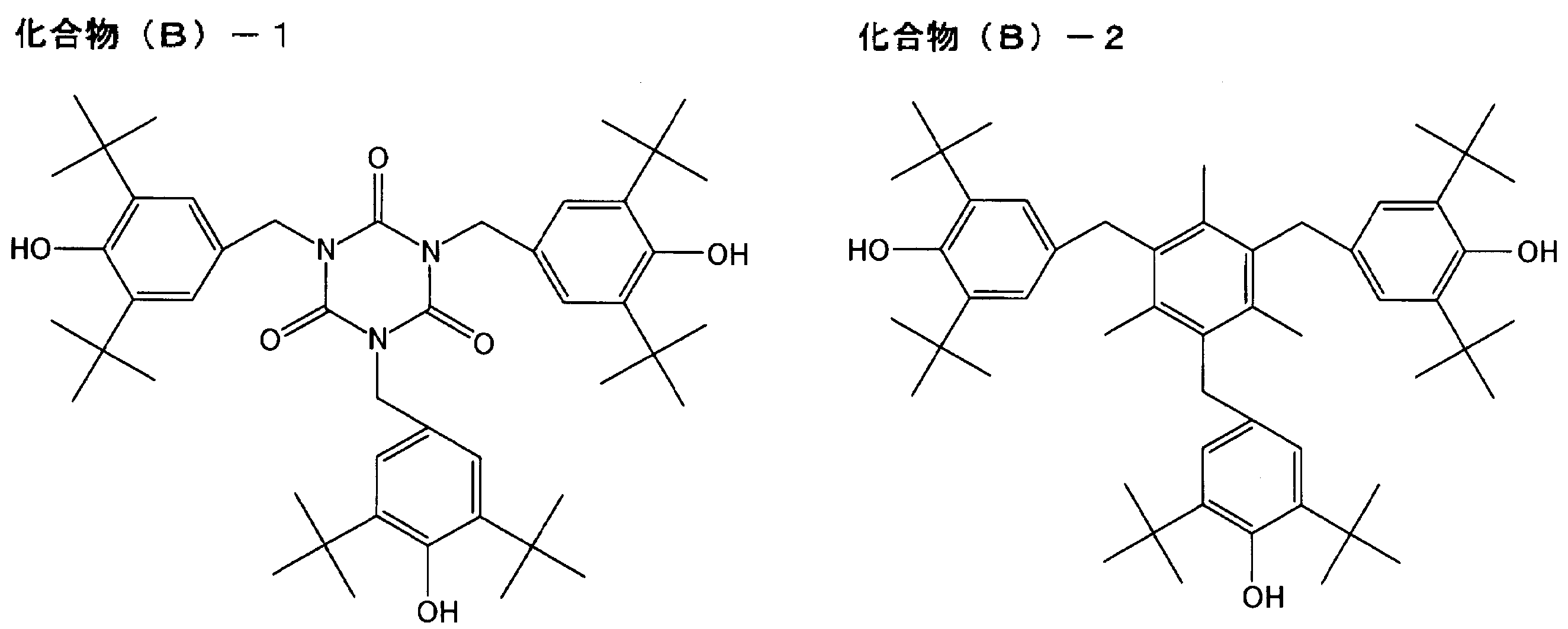
- Examples of the compound represented by the general formula (1) include 1,3,5-tris (3,5-di-tert-butyl-4-hydroxylbenzyl) isocyanurate and 1,3,5-tris (3 5-di-tert-butyl-4-hydroxyphenylethyl) isocyanurate, 1,3,5-tris (3,5-di-tert-butyl-4-hydroxyphenylpropyl) isocyanurate and the like, These may be used alone or in combination of two or more. Among these, 1,3,5-tris (3,5-di-tert-butyl-4-hydroxylbenzyl) isocyanurate is preferred.
- the divalent hydrocarbon group having 1 to 3 carbon atoms represented by R 4 , R 5 and R 6 includes divalent hydrocarbon groups represented by R 1 , R 2 and R 3 . Examples include the same groups as the hydrocarbon groups having 1 to 3 carbon atoms.
- Examples of the monovalent hydrocarbon group having 1 to 4 carbon atoms represented by R 7 , R 8 and R 9 include a linear or branched alkyl group, a linear or branched alkenyl group, and a linear or branched alkynyl. Groups.
- linear alkyl group examples include CH 3 —, CH 3 CH 2 —, CH 3 CH 2 CH 2 —, and CH 3 CH 2 CH 2 CH 2 —
- the branched alkyl group includes CH 3 (CH 3 3 ) CH—, CH 3 (CH 3 ) CH 2 CH 2 —, CH 3 CH 2 (CH 3 ) CH—, (CH 3 ) 3 C—
- examples of the alkynyl group include , CH ⁇ C-, CH ⁇ CCH -
- Examples of the compound represented by the general formula (2) include 1,3,5-tris (3,5-ditert-butyl-4-hydroxybenzyl) -2,4,6-trimethylbenzene and 1,3 , 5-Tris (3,5-di-tert-butyl-4-hydroxyphenylethyl) -2,4,6-trimethylbenzene, 1,3,5-tris (3,5-di-tert-butyl-4-hydroxy) Phenylpropyl) -2,4,6-trimethylbenzene, 1,3,5-tris (3,5-ditert-butyl-4-hydroxybenzyl) -2,4,6-triethylbenzene, 1,3,5 -Tris (3,5-di-tert-butyl-4-hydroxybenzyl) -2,4,6-tripropylbenzene, 1,3,5-tris (3,5-di-tert-butyl-4-hydroxybenzyl) -2,4,6-tributylbenzene, 1,3
- the compound represented by the general formula (1) and the compound represented by the general formula (2) may be used alone or in combination of two or more. Good.
- the content ratio (A) / (B) of the component (A) and the component (B) is expressed by a mass ratio of (A) / (B) from the viewpoint of heat resistance and flame retardancy.
- the additive composition of the present invention can be obtained by mixing the component (A) and the component (B), but when it is mixed with a synthetic resin, it may be mixed in advance and then mixed. When blended in the synthetic resin, each component may be blended in the synthetic resin. Moreover, you may mix
- mixers When mixing the components (A) and (B), or when mixing the components (C) and other optional components described later, various mixers can be used.
- the mixer that can be used include a tumbler mixer, a Henschel mixer, a ribbon blender, a V-type mixer, a W-type mixer, a super mixer, a Nauta mixer, and the like.
- the additive composition of the present invention may further contain, as component (C), one or more nitrogen-containing organic compounds other than the compound represented by the general formula (1) in terms of heat resistance and flame retardancy. Is preferred.
- the component (C) is at least one nitrogen-containing organic compound other than the compound represented by the general formula (1).
- the nitrogen-containing organic compound as the component (C) functions as a component that imparts flame retardancy to the synthetic resin together with the ammonium polyphosphate as the component (A).
- the nitrogen-containing organic compound as the component (C) is a compound that generates a non-flammable gas by heat due to ignition, ignition, or contact with a flame, and also forms or promotes the formation of a carbonaceous residue.
- the following (1) to (4) are exemplified.
- examples of the group of X 1 in the general formula (3) include a monomethylamino group, a dimethylamino group, a methylethylamino group, a methylethylamino group, a monoethylamino group, a diethylamino group, a monopropylamino group, Dipropylamino group, methylpropylamino group, ethylpropylamino group, diisopropylamino group, mono-n-butylamino group, di-n-propylamino group, methyl-n-butylamino group, ethyl-n-butylamino group Propyl-n-butylamino group, isopropyl-n-butylamino group, monoisobutylamino group
- Examples of the group of Y in the general formula (3) include ethylenediamine residue, N, N′-dimethylethylenediamine residue, NN′-diethylethylenediamine residue, 1,3-diaminopropane residue, Examples thereof include a tetramethylenediamine residue, a pentamethylenediamine residue, a hexamethylenediamine residue, a piperazine residue, and a trans-2,5-dimethylpiperazine residue.
- both X 1 and Y are groups bonded to a triazine ring via a nitrogen atom
- X 1 is represented by —NHR 10 or —NR 11 R 12
- R 10 , R 11 and R 12 are each a hydrogen atom or a straight-chain or branched alkyl group containing 1 to 6 carbon atoms (R 11 and R 11 12 be the same group, a hydroxyalkyl amino group different may be a group) or to each other, or in which X 1 is represented by -NHR 13 or -NR 14 R 15, R 13, R 14 and also R 15 is a straight-chain or branched hydroxyalkyl group containing 2 to 6 both carbon atoms (R 14 and R 15 are the same group, at different groups It may be I).
- Y is a divalent group of piperazine, a divalent group represented by the formula —HN (CH 2 ) m NH— (where m is a number of 2 to 6), or —NR 16 (CH 2 ) p R 17 N-, wherein R 16 and R 17 are linear or branched alkyl groups or hydroxyalkyl groups containing 1 to 6 carbon atoms).
- poly- [2,4- (piperazin-1,4-yl) -6- (morpholino-4-yl) -1,3,5-triazine] (CAS No. 93058-67-) 4, CAS number 1078142-02-5).
- Piperazine derivatives piperazine, piperazine phosphate, piperazine orthophosphate, piperazine pyrophosphate, piperazine polyphosphate, and piperazine metaphosphate.
- a commercially available product may be used as the nitrogen-containing organic compound as the component (C).
- triazine derivatives are preferred from the viewpoint of heat resistance and flame retardancy, and melamine cyanurate and poly- [2,4- (piperazin-1,4-yl) -6 are preferred.
- -(Morpholino-4-yl) -1,3,5-triazine] (CAS number 93058-67-4, CAS number 1078142-02-5) is more preferable, and poly- [2,4- (piperazine-1, 4-yl) -6- (morpholino-4-yl) -1,3,5-triazine] (CAS number 93058-67-4, CAS number 1078142-02-5) is even more preferred.
- the component (C) may be previously added to the additive composition of the present invention, or may be added to the synthetic resin when it is added to the synthetic resin.
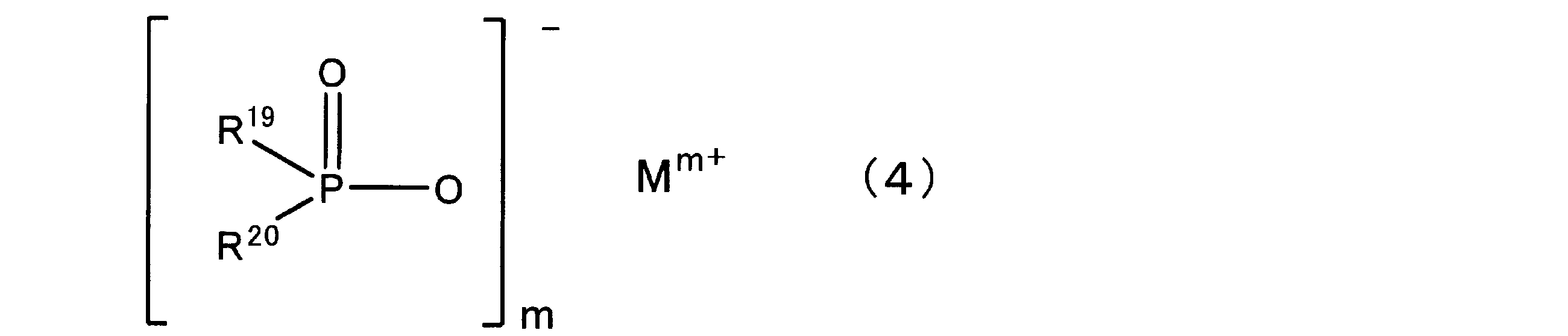
- the additive composition of the present invention preferably further contains one or more dialkylphosphinic acids or salts thereof from the viewpoint of heat resistance and flame retardancy.
- the dialkylphosphinic acid or a salt thereof is preferably a dialkylphosphinic acid or a salt thereof represented by the following general formula (4) from the viewpoint of heat resistance and flame retardancy.
- R 19 and R 20 are the same or different and are a linear or branched alkyl group having 1 to 6 carbon atoms
- M is Mg, Ca, Al, Sb , Sn, Ge, Ti, Fe, Zr, Zn, Ce, Bi, Sr, Mn, Li, Na, K, H, and / or a protonated nitrogen base
- m represents 1-4.
- Examples of the alkyl group having 1 to 6 carbon atoms for R 19 and R 20 include methyl, ethyl, n-propyl, isopropyl, n-butyl, isobutyl, sec-butyl, tert-butyl, n-pentyl, isopentyl, Neopentyl, tert-amyl, 1,2-dimethylpropyl, n-hexyl, 1,3-dimethylbutyl, 1-isopropylpropyl, 1,2-dimethylbutyl, cyclopropyl, cyclobutyl, cyclopentyl, cyclopropyl.
- R 19 and R 20 are preferably an alkyl group having 1 to 4 carbon atoms, and most preferably an ethyl group, from the viewpoint of heat resistance and flame retardancy.
- M is preferably zinc or aluminum, and more preferably aluminum, from the viewpoint of heat resistance and flame retardancy.
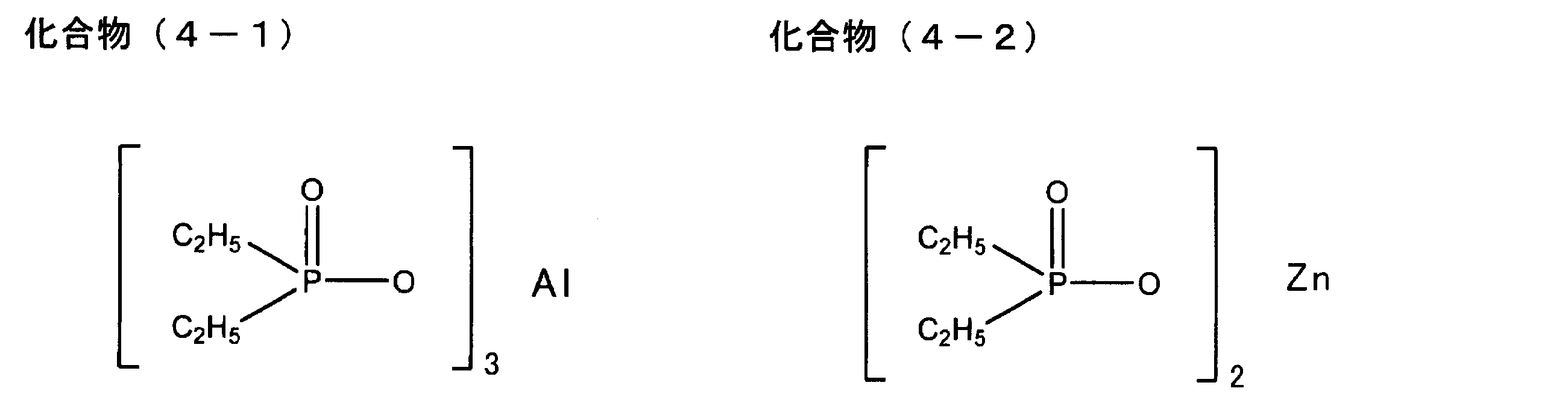
- the dialkylphosphinic acid or a salt thereof is preferably a compound (4-1) or a compound (4-2) of the following structural formula, and more preferably a compound (4-1), from the viewpoint of heat resistance and flame retardancy.
- dialkylphosphinic acid or a salt thereof may be previously blended with the additive composition of the present invention, or may be blended with the synthetic resin when blended with the synthetic resin.
- the amount of the dialkylphosphinic acid or salt thereof, when mixed with the synthetic resin is preferably 1 to 100 parts by mass, more preferably 5 to 60 parts by mass, and preferably 10 to 40 parts by mass, per 100 parts by mass of the synthetic resin. More preferred.
- the additive composition of the present invention may optionally contain a metal oxide as a flame retardant aid as long as the effects of the present invention are not impaired.
- a metal oxide examples include zinc oxide, titanium oxide, magnesium oxide, silicon oxide, and the like, and among them, zinc oxide is preferable.
- the metal oxide may be surface-treated. Commercially available zinc oxide can be used.
- zinc oxide 1 manufactured by Mitsui Kinzoku Mining Co., Ltd.
- partially coated zinc oxide manufactured by Mitsui Kinzoku Mining Co., Ltd.
- Nanofine 50 average particle size 0.02 ⁇ m ultrafine zinc oxide: manufactured by Sakai Chemical Industry Co., Ltd .
- Nanofine K 0.02 ⁇ m average particle size zinc silicate coated ultrafine zinc oxide: manufactured by Sakai Chemical Industry Co., Ltd.
- the content is preferably from 0.1 to 100 parts by mass of the total amount of the components (A) and (C) contained in the additive composition from the viewpoint of flame retardancy. It is preferably from 0.01 to 10 parts by mass, more preferably from 0.5 to 10 parts by mass, and still more preferably from 1.0 to 7.5 parts by mass. If the amount is less than 0.01 part by mass, the effect of the flame retardant aid is not sufficient, and if it exceeds 10 parts by mass, the properties of the resin may be deteriorated.
- the metal oxide may be previously blended with the additive composition of the present invention, or may be blended with the synthetic resin when blended with the synthetic resin.
- an anti-drip agent may be added to the additive composition of the present invention, if necessary, as long as the effects of the present invention are not impaired.
- the anti-drip agent include fluorine-based anti-drip agents, silicone rubbers, and layered silicates.
- the layered silicate examples include smectite-based clay minerals such as montmorillonite, saponite, hectorite, beidellite, stevensite, and nontronite, vermiculite, halloysite, swellable mica, talc, and the like.
- smectite-based clay minerals such as montmorillonite, saponite, hectorite, beidellite, stevensite, and nontronite, vermiculite, halloysite, swellable mica, talc, and the like.
- a quaternary ammonium cation and a phosphonium cation may be intercalated.
- the anti-drip agent is particularly preferably a fluorine-based anti-drip agent.
- fluorine-based anti-drip agent include, for example, fluorine-based resins such as polytetrafluoroethylene, polyvinylidene fluoride, and polyhexafluoropropylene, and perfluoromethane.
- Perfluoro such as sodium sulfonate, potassium perfluoro-n-butanesulfonate, potassium perfluoro-t-butanesulfonate, sodium perfluorooctanesulfonate and calcium perfluoro-2-ethylhexanesulfonate
- Alkanesulfonic acid alkali metal salt compounds or perfluoroalkanesulfonic acid alkaline earth metal salts are exemplified.
- polytetrafluoroethylene is most preferable from the viewpoint of anti-drip properties.
- the content of the anti-drip agent is 0.005 to 5 parts by mass based on 100 parts by mass of the total amount of the components (A) and (C) contained in the additive composition. Is preferably 0.01 to 5 parts by mass, more preferably 0.05 to 3 parts by mass, and still more preferably 0.1 to 1 part by mass. If the amount is less than 0.005 parts by mass, the drip prevention effect is not sufficient, and if it exceeds 5 parts by mass, the properties of the resin may be deteriorated.
- the anti-drip agent may be previously blended with the additive composition of the present invention, or may be blended with the synthetic resin when blended with the synthetic resin.
- silicone oil may be blended to suppress secondary aggregation and improve water resistance during blending.
- examples of the silicone oil include dimethyl silicone oil in which the side chains of polysiloxane and all terminals are methyl groups, methylphenyl silicone oil in which part of the side chains of polysiloxane are phenyl groups, and part of the side chains of polysiloxane And hydrogenated methyl hydrogen silicone oils, and copolymers thereof.
- an organic group is introduced into a part of a side chain and / or a terminal thereof, and is amine-modified, epoxy-modified, alicyclic epoxy-modified, Modified silicone oil modified by carboxyl, carbinol, mercapto, polyether, long chain alkyl, fluoroalkyl, higher fatty acid ester, higher fatty acid amide, silanol, diol, phenol and / or aralkyl May be used.
- silicone oil examples include KF-96 (manufactured by Shin-Etsu Chemical Co., Ltd.), KF-965 (manufactured by Shin-Etsu Chemical Co., Ltd.) and KF-968 (Shin-Etsu Chemical Co., Ltd.) as dimethyl silicone oil. And KF-99 (manufactured by Shin-Etsu Chemical Co., Ltd.) and KF-9901 (manufactured by Shin-Etsu Chemical Co., Ltd.) as methyl hydrogen silicone oil or silicone oil having a methyl hydrogen polysiloxane structure.
- HMS-151 (manufactured by Gelest), HMS-071 (manufactured by Gelest), HMS-301 (manufactured by Gelest), DMS-H21 (manufactured by Gelest), and the like.
- methylphenyl silicone oil examples include: KF-50 (manufactured by Shin-Etsu Chemical Co., Ltd.), KF-53 (manufactured by Shin-Etsu Chemical Co., Ltd.), KF-54 (manufactured by Shin-Etsu Chemical Co., Ltd.) And KF-56 (Shin-Etsu Chemical Co., Ltd.).
- Epoxy-modified products include, for example, X-22-343 (Shin-Etsu Chemical Co., Ltd.) and X 22-2000 (Shin-Etsu Chemical Co., Ltd.), KF-101 (Shin-Etsu Chemical Co., Ltd.), KF-102 (Shin-Etsu Chemical Co., Ltd.), KF-1001 (Shin-Etsu Chemical Co., Ltd.) And carboxyl-modified products such as X-22-3701E (Shin-Etsu Chemical Co., Ltd.), and carbinol-modified products such as X-22-4039 (Shin-Etsu Chemical Co., Ltd.), Examples of X-22-4015 (manufactured by Shin-Etsu Chemical Co., Ltd.) and amine-modified products include KF-393 (manufactured by Shin-Etsu Chemical Co., Ltd.).
- the content of the silicone oil is 0.01 to 10 parts by mass based on 100 parts by mass of the total amount of the components (A) and (C) contained in the additive composition. It is preferably 0.1 to 5 parts by mass, more preferably 0.5 to 3 parts by mass. If the amount is less than 0.01 part by mass, the suppression of secondary aggregation and the water resistance may not be sufficient. If the amount exceeds 10 parts by mass, the properties of the resin may be reduced.
- the silicone oil may be previously blended with the additive composition of the present invention, or may be blended with the synthetic resin when blended with the synthetic resin.
- the additive composition of the present invention as long as the effect of the present invention is not impaired, if necessary, to prevent the aggregation of the additive powder, and to improve storage stability, water resistance, and heat resistance. May be blended with a silane coupling agent.
- silane coupling agent examples include silane coupling agents having an alkenyl group, such as vinyltrimethoxysilane, vinyltriethoxysilane, vinyltriacetoxysilane, vinyltris (2-methoxyethoxy) silane, vinylmethyldimethoxysilane, and octenyl. Examples include trimethoxysilane, allyltrimethoxysilane, p-styryltrimethoxysilane, and the like. Examples of silane coupling agents having an acrylic group include 3-acryloxypropyltrimethoxysilane, 3-acryloxypropyltriethoxysilane, and the like.
- Silane coupling agents having a methacryl group such as 3-methacryloxypropylmethyldimethoxysilane, 3-methacryloxypropyltrimethoxysilane, and 3-methacryloxypropylmethyldisilane.
- examples of the silane coupling agent having an epoxy group include 2- (3,4-epoxycyclohexyl) ethyltrimethoxysilane and 3-glycan, such as toxicoxysilane, 3-methacryloxypropyltriethoxysilane, and methacryloxyoctyltrimethoxysilane.
- silane coupling agents having an amino group examples include N-2- (aminoethyl) -3-aminopropylmethyldimethoxysilane, N-2- (aminoethyl) -3-aminopropyltrimethoxysilane, and 3-aminopropyltrimethoxysilane.
- Silane 3-aminopropyltriethoxysilane, 3-triethoxysilyl-N- (1,3-dimethyl-butylidene) propylamine, N-phenyl-3-aminopropyltrimethoxysilane, N, N'-bis [3 -(Trimethoxysilyl) propyl] ethylenediamine, hydrochloride of N- (vinylbenzyl) -2-aminoethyl-3-aminopropyltrimethoxysilane, and the like.
- silane coupling agent having an isocyanurate group tris- (Trimethoxysilylpropyl) isocyanurate.
- silane coupling agent having a mercapto group examples include 3-mercaptopropylmethyldimethoxysilane, 3-mercaptopropyltrimethoxysilane, and 3-mercaptopropyltriethoxysilane.
- Ureido group examples of the silane coupling agent include 3-ureidopropyltrimethoxysilane and 3-ureidopropyltriethoxysilane.
- Examples of the silane coupling agent having a sulfide group examples include bis (triethoxysilylpropyl) tetrasulfide.
- Examples of the silane coupling agent having a thioester group include 3-octanoylthio-1-propyltriethoxysilane, and examples of the silane coupling agent having an isocyanate group include 3-isocyanatopropyltriethoxysilane and 3-isocyanatopropyltrimethoxysilane. Is mentioned.
- silane coupling agents having an epoxy group are preferred from the viewpoint of preventing aggregation of the additive powder, improving storage stability, water resistance and heat resistance.
- silane coupling agents can be used, and examples thereof include vinyltrimethoxysilane, KBM-1003 manufactured by Shin-Etsu Chemical Co., Ltd., and AMB manufactured by Montive Performance Materials Japan GK. -171, Dow Corning Toray Co., Ltd., Z-6300 manufactured by Dow Corning Co., Ltd., GENIOSIL @ XL10 manufactured by Asahi Kasei Wacker Silicone Co., Ltd., Sila Ace S210 manufactured by Himi Shoji Co., Ltd., and the like.
- vinylmethyldimethoxysilane examples include A-2171 manufactured by Montive Performance Materials Japan GK, GENIOSIL @ XL12 manufactured by Asahi Kasei Wacker Silicone Co., Ltd., and octenyltrimethoxysilane includes Shin-Etsu Chemical Co., Ltd.
- KBM-1083 Allyltrimethoxysilane; Toray Dow Corning Co., Ltd .; Z-6825; p-styryltrimethoxysilane, Shin-Etsu Chemical KBM-1403 manufactured by Kogyo Co., Ltd .; KBM-5103 as 3-acryloxypropyltrimethoxysilane; 3-methacryloxypropylmethyldimethoxysilane manufactured by Shin-Etsu Chemical Co., Ltd. Examples include KBM-502 and Z-6033 manufactured by Dow Corning Toray Co., Ltd. Examples of 3-methacryloxypropyltrimethoxysilane include KBM-503 manufactured by Shin-Etsu Chemical Co., Ltd.
- methacryloxyoctyltrimethoxysilane includes KBM-5803 manufactured by Shin-Etsu Chemical Co., Ltd.
- 2- (3,4-epoxycyclohexyl) ethyltrimethoxysilane includes Shin-Etsu Chemical Co., Ltd. KBM-303, manufactured by Montive Performance Materials Japan GK, Z-6043, manufactured by Dow Corning Toray Co., Ltd., and Sila Ace S530, manufactured by Himi Shoji Co., Ltd.
- 3-glycidoxypropylmethyldimethoxysilane include Shin-Etsu Chemical Examples include KBM-402 manufactured by Dow Corning Toray Co., Ltd., Z-6044 manufactured by Dow Corning Toray Co., Ltd., and Sila Ace S520 manufactured by Himi Shoji Co., Ltd., and 3-glycidoxypropyltrimethoxysilane includes Shin-Etsu Chemical KBM-403 manufactured by Kogyo Co., Ltd., A-187 manufactured by Montive Performance Materials Japan GK, Z-6040 manufactured by Dow Corning Toray Co., Ltd., GENIOSIL @ GF80 manufactured by Asahi Kasei Wacker Silicone Co., Ltd., Shiraace S510 manufactured by Himi Shoji Co., Ltd .; and KBE-402 manufactured by Shin-Etsu Chemical Co., Ltd.
- 3-glycidoxypropylmethyldiethoxysilane 3-glycidoxypropyl triethoxy.
- silane KBE-403 manufactured by Shin-Etsu Chemical Co., Ltd., Montive Performer A-1871 manufactured by S. Materials Japan GK, GENIOSIL @ GF82 manufactured by Asahi Kasei Wacker Silicone Co., Ltd., and the like.
- glycidoxyoctyltrimethoxysilane include KBM-4803 manufactured by Shin-Etsu Chemical Co., Ltd.
- N-2- (aminoethyl) -3-aminopropylmethyldimethoxysilane examples include KBM-602 manufactured by Shin-Etsu Chemical Co., Ltd.
- aminopropyltriethoxysilane, KBE-903, Montive- Examples include A-1100 manufactured by Performance Materials Japan GK, Z-6011 manufactured by Dow Corning Toray Co., Ltd., Sila Ace S330 manufactured by Himi Shoji Co., Ltd., and 3-triethoxysilyl-N-.
- Examples of (1,3-dimethyl-butylidene) propylamine include KBE-9103, Silaace S340 manufactured by Nimi Shoji Co., Ltd., and examples of N-phenyl-3-aminopropyltrimethoxysilane include Shin-Etsu Chemical Co., Ltd. KBM-573, manufactured by Montive Performance Materials Japan GK, Z-6883 manufactured by Dow Corning Toray Co., Ltd., and the like, and N, N'-bis [3- (Trimethoxysilyl) propyl] ethylenediamine is available from Shiraace XS10 manufactured by Himi Shoji Co., Ltd.
- N- (vinylbenzyl) -2-aminoethyl-3-aminopropyltrimethoxysilane hydrochloride includes KBM-575 manufactured by Shin-Etsu Chemical Co., Ltd. and Dow Corning Toray Co., Ltd. Z-6032 of Nippon Kayaku Co., Ltd.
- 3-mercaptopropyltriethoxysilane examples include A-1891 manufactured by Montive Performance Materials Japan GK. And Z-6911 manufactured by Dow Corning Toray Co., Ltd .; and 3-ureidopropyltriethoxysilane includes A-1160 manufactured by Montive Performance Materials Japan GK.
- trialkoxysilanes examples include KBE-585 manufactured by Shin-Etsu Chemical Co., Ltd.
- bis (triethoxysilylpropyl) tetrasulfide examples include KBE-846 manufactured by Shin-Etsu Chemical Co., Ltd.
- Octanoylthio-1-propyltriethoxysilane Examples include A-LINK 599 manufactured by Montive Performance Materials Japan GK.
- Examples of 3-isocyanatopropyltriethoxysilane include KBE-9007 manufactured by Shin-Etsu Chemical Co., Ltd. and Montive Performance Materials Japan.
- Examples include A-1310 manufactured by Japan GK, and examples of 3-isocyanatopropyltrimethoxysilane include Y-5187 manufactured by Montive Performance Materials Japan GK and GENIOSIL @ GF40 manufactured by Asahi Kasei Wacker Silicone Co., Ltd. Is mentioned.
- the content is based on the total amount of the component (A) and the component (C) contained in the additive composition, relative to 100 parts by mass.
- the amount is preferably 0.01 to 5.0 parts by mass, more preferably 0.05 to 3.0 parts by mass, and even more preferably 0.1 to 2.0 parts by mass.
- the silane coupling agent may be previously blended with the additive composition of the present invention, or may be blended with the synthetic resin when blended with the synthetic resin.
- a hydrotalcite compound may be added.
- the hydrotalcite compound refers to a double carbonate compound of magnesium and / or zinc and aluminum.
- the hydrotalcite-based compound may be a natural product or a synthetic product. Examples of the method for synthesizing the synthetic product include known methods described in JP-B-46-2280, JP-B-50-30039, JP-B-51-29129, and JP-A-61-174270. be able to.
- the hydrotalcite-based compound can be used without being limited by the crystal structure of the hydrotalcite-based compound, the presence or absence of crystal particle water or crystallization water, and the amount thereof.
- the hydrotalcite compound can be treated with perchloric acid, and the surface thereof can be treated with a higher fatty acid such as stearic acid, a higher fatty acid metal salt such as an alkali metal oleate, or an alkali metal salt dodecylbenzenesulfonic acid.
- a higher fatty acid such as stearic acid
- a higher fatty acid metal salt such as an alkali metal oleate, or an alkali metal salt dodecylbenzenesulfonic acid.
- Organic sulfonic acid metal salts, higher fatty acid amides, higher fatty acid esters or those coated with wax or the like can also be used.
- hydrotalcite compound a compound represented by the following general formula (5) is preferable.
- x1 and x2 each represent a number satisfying a condition represented by the following equation, and m represents a real number. 0 ⁇ x2 / x1 ⁇ 10, 2 ⁇ x1 + x2 ⁇ 20
- hydrotalcite-based compound commercially available products can be used.
- DHT-4 hydrotalcite: manufactured by Kyowa Chemical Industry Co., Ltd.
- DHT-4A hydrotalcite: manufactured by Kyowa Chemical Industry Co., Ltd.
- Magcela-1 hydrotalcite: Kyowa Chemical Industry Co., Ltd.
- Alkamizer 1 hydrotalcite: Kyowa Chemical Industry Co., Ltd.
- Alkamizer 2 hydrotalcite: Kyowa Chemical Industry Co., Ltd.
- Alkamizer 4 Alkamizer P-93)
- Alkamizer 7 Zinc-modified hydrotalcite: Kyowa Chemical Industry Co., Ltd.
- Alkamizer 5 Perchloric acid-treated hydrotalcite: manufactured by Kyowa Chemical Industry Co., Ltd.
- DHT-4A hydrotalcite: Kyowa Chemical Industry Co., Ltd.
- the content is preferably 0.01 to 5 parts by mass based on 100 parts by mass of the total amount of the components (A) and (C) contained in the additive composition. It is more preferably from 0.05 to 4 parts by mass, and even more preferably from 0.1 to 2 parts by mass from the viewpoints of heat resistance, reduction of corrosion risk of a processing machine, and weather resistance.
- the hydrotalcite compound may be previously blended with the additive composition of the present invention, or may be blended with the synthetic resin when blended with the synthetic resin.
- the additive composition of the present invention may contain a flame retardant auxiliary other than the above-mentioned metal oxides, if necessary, as long as the effects of the present invention are not impaired.
- a flame retardant aid include polyhydric alcohol compounds.
- a polyhydric alcohol compound is a compound in which a plurality of hydroxyl groups are bonded, and may overlap with the above-mentioned polyhydric alcohol compound, but is a compound added as a flame retardant aid for improving flame retardancy.
- the polyhydric alcohol compound of the flame retardant aid include pentaerythritol, dipentaerythritol, tripentaerythritol, polypentaerythritol, neopentyl glycol, trimethylolpropane, ditrimethylolpropane, 1,3,5-tris (2 -Hydroxyethyl) isocyanurate, polyethylene glycol, glycerin, diglycerin, mannitol, maltitol, lactitol, sorbitol, erythritol, xylitol, xylose, sucrose (sucrose), trehalose, inositol, fructose
- pentaerythritol or a condensate of pentaerythritol such as pentaerythritol, dipentaerythritol, tripentaerythritol, and polypentaerythritol
- pentaerythritol or a condensate of pentaerythritol are preferable, a condensate of pentaerythritol is more preferable, and dipentaerythritol is particularly preferable.
- 1,3,5-tris (2-hydroxyethyl) isocyanurate and sorbitol can be suitably used.
- the pentaerythritol condensate may be a mixture of pentaerythritol and pentaerythritol condensate.
- a polyhydric alcohol compound When a polyhydric alcohol compound is contained, the content thereof is determined based on the flame retardancy with respect to 100 parts by mass of the total amount of the component (A) and the component (C) contained in the additive composition. Preferably it is 0.5 to 15 parts by mass, more preferably 2 to 12 parts by mass, further preferably 5 to 10 parts by mass.
- the polyhydric alcohol compound may be previously blended with the additive composition of the present invention, or may be blended with the synthetic resin when blended with the synthetic resin.
- a lubricant may be added to the additive composition of the present invention, if necessary, as long as the effects of the present invention are not impaired.
- a lubricant include pure hydrocarbon lubricants such as liquid paraffin, natural paraffin, microwax, synthetic paraffin, low molecular weight polyethylene and polyethylene wax; halogenated hydrocarbon lubricants; fatty acid lubricants such as higher fatty acids and oxy fatty acids.
- Fatty acid amide-based lubricants such as fatty acid amides and bis-fatty acid amides; ester-based lubricants such as lower alcohol esters of fatty acids, polyhydric alcohol esters of fatty acids such as glycerides, polyglycol esters of fatty acids, and fatty alcohol esters of fatty acids (ester wax).
- ester-based lubricants such as lower alcohol esters of fatty acids, polyhydric alcohol esters of fatty acids such as glycerides, polyglycol esters of fatty acids, and fatty alcohol esters of fatty acids (ester wax).
- the content is preferably 0.05 to 10 parts by mass based on 100 parts by mass of the total amount of the components (A) and (C) contained in the additive composition. , More preferably 0.1 to 5 mass.
- the lubricant may be previously blended with the additive composition of the present invention, or may be blended with the synthetic resin when blended with the synthetic resin.
- one or more organic or inorganic flame retardants or flame retardant auxiliaries can be used, if necessary, as long as the effects of the present invention are not impaired.
- These flame retardants and flame retardant assistants include metal hydroxides, phosphate ester flame retardants, condensed phosphate ester flame retardants, inorganic phosphorus flame retardants, silicone flame retardants, metal oxides, boric acid compounds, Expandable graphite, other inorganic flame retardant aids, other organic flame retardants, and the like.
- These flame retardants or flame retardant auxiliaries may be previously blended with the additive composition of the present invention, or may be blended with the synthetic resin when blended with the synthetic resin.
- metal hydroxide examples include magnesium hydroxide, aluminum hydroxide, calcium hydroxide, barium hydroxide, zinc hydroxide, Kismer 5A (trademark of magnesium hydroxide manufactured by Kyowa Chemical Industry Co., Ltd.) and the like.
- phosphate ester-based flame retardants examples include trimethyl phosphate, triethyl phosphate, tributyl phosphate, tributoxyethyl phosphate, trischloroethyl phosphate, trisdichloropropyl phosphate, triphenyl phosphate, tricresyl phosphate, cresyl diphenyl phosphate, and trikilic phosphate.
- condensed phosphate ester flame retardants include 1,3-phenylenebis (diphenylphosphate), 1,3-phenylenebis (dixylenylphosphate), bisphenol A bis (diphenylphosphate), and naphthalene-2,5- Diyl-tetraphenyl ⁇ bis (phosphate), [1,1′-biphenyl] -4,4′-diyl-tetraphenyl ⁇ bis (phosphate), [1,1′-biphenyl] -4,4′-diyl-tetrakis ( 2,6-dimethylphenyl) bis (phosphate), tetraphenyl (thiobis (4,1-phenylene)) bis (phosphate), tetraphenyl (sulfonylbis (4,1-phenylene)) bis (phosphate) and the like. .
- Red phosphorus is mentioned as an inorganic phosphorus-based flame retardant.
- inorganic flame retardant aids include, for example, inorganic compounds such as titanium oxide, aluminum oxide, magnesium oxide and hydrotalcite, and surface-treated products thereof. Specific examples thereof include, for example, TIPAQUE @ R-680 (trademark of titanium oxide manufactured by Ishihara Sangyo Co., Ltd.), Kyowa Mag 150 (trademark of magnesium oxide manufactured by Kyowa Chemical Industry Co., Ltd.), and DHT-4A (hydrotalcite: Kyowa)
- TIPAQUE @ R-680 trademark of titanium oxide manufactured by Ishihara Sangyo Co., Ltd.
- Kyowa Mag 150 trademark of magnesium oxide manufactured by Kyowa Chemical Industry Co., Ltd.
- DHT-4A hydrotalcite: Kyowa
- Various commercially available products such as Chemical Industry Co., Ltd., and Alkamizer 4 (trademark of zinc-modified hydrotalcite manufactured by Kyowa Chemical Industry Co., Ltd.) can be used.
- the additive composition of the present invention may optionally contain a phosphorus-based antioxidant, a thioether-based antioxidant, an ultraviolet absorber, a hindered amine light stabilizer, an antioxidant, and the like. These components may be previously blended with the additive composition of the present invention, or may be blended with the synthetic resin when blended with the synthetic resin. It is preferable to stabilize the synthetic resin by blending them.
- Examples of the phosphorus-based antioxidant include trisnonylphenyl phosphite, tris [2-tert-butyl-4- (3-tert-butyl-4-hydroxy-5-methylphenylthio) -5-methylphenyl] phos Phytite, tridecyl phosphite, octyl diphenyl phosphite, di (decyl) monophenyl phosphite, di (tridecyl) pentaerythritol diphosphite, di (nonylphenyl) pentaerythritol diphosphite, bis (2,4-di Tributylphenyl) pentaerythritol diphosphite, bis (2,6-di-tert-butyl-4-methylphenyl) pentaerythritol diphosphite, bis (2,4,6-tri-tert-butylphenyl)
- thioether antioxidants include dialkylthiodipropionates such as dilauryl thiodipropionate, dimyristyl thiodipropionate, distearyl thiodipropionate, and pentaerythritol tetra ( ⁇ -alkylthiopropionate) ester And the like.
- the compounding amount of these thioether-based antioxidants is preferably from 0.001 to 10 parts by mass, more preferably from 0.05 to 5 parts by mass, based on 100 parts by mass of the synthetic resin when mixed with the synthetic resin.
- ultraviolet absorbers examples include 2,4-dihydroxybenzophenone, 2-hydroxy-4-methoxybenzophenone, 2-hydroxy-4-octoxybenzophenone, and 5,5′-methylenebis (2-hydroxy-4-methoxybenzophenone) 2- (2'-hydroxy-5'-methylphenyl) benzotriazole, 2- (2'-hydroxy-3 ', 5'-di-tert-butylphenyl) -5-chlorobenzo Triazole, 2- (2'-hydroxy-3'-tert-butyl-5'-methylphenyl) -5-chlorobenzotriazole, 2- (2'-hydroxy-5'-tert-octyl Phenyl) benzotriazole, 2- (2′-hydroxy-3 ′, 5′-dicumylphenyl) benzotriazole, 2,2 2- (2 'such as -methylenebis (4-tert-octyl-6- (benzotriazolyl) phenol) and 2- (2'-hydroxy-3'-tert-but
- hindered amine light stabilizers include, for example, 2,2,6,6-tetramethyl-4-piperidyl stearate, 1,2,2,6,6-pentamethyl-4-piperidyl stearate, 2,2,6 6,6-tetramethyl-4-piperidyl benzoate, bis (2,2,6,6-tetramethyl-4-piperidyl) sebacate, bis (1,2,2,6,6-pentamethyl-4-piperidyl) sebacate, Bis (1-octoxy-2,2,6,6-tetramethyl-4-piperidyl) sebacate, tetrakis (2,2,6,6-tetramethyl-4-piperidyl) -1,2,3,4-butane Tetracarboxylate, tetrakis (1,2,2,6,6-pentamethyl-4-piperidyl) -1,2,3,4-butanetetracarboxylate, bis (2,2,2 , 6-Tetramethyl-4-piperidyl) bis (tridec
- antioxidants examples include naphthylamine, diphenylamine, p-phenyldiamine, quinoline, hydroquinone derivatives, monophenol, thiobisphenol, hindered phenol, phosphite, and the like.
- the compounding amount of these antioxidants is preferably from 0.001 to 10 parts by mass, more preferably from 0.05 to 5 parts by mass, based on 100 parts by mass of the synthetic resin when compounded in the synthetic resin. .
- the additive composition of the present invention can contain a phenolic antioxidant other than the component (B), but the phenolic antioxidant has excellent heat resistance and flame retardancy other than the component (B). Can not demonstrate its ability. Of course, it can be used in combination with the component (B).
- phenolic antioxidants other than the component (B) include, for example, 2,6-ditert-butyl-p-cresol, 2,6-diphenyl-4-octadecyloxyphenol, distearyl (3,5-di- Tert-butyl-4-hydroxybenzyl) phosphonate, 1,6-hexamethylenebis [(3,5-di-tert-butyl-4-hydroxyphenyl) propionamide], 4,4′-thiobis (6-tert-butyl Butyl-m-cresol), 2,2′-methylenebis (4-methyl-6-tert-butylphenol), 2,2′-methylenebis (4-ethyl-6-tert-butylphenol), 4,4′-butylidenebis ( 6-tert-butyl-m-cresol), 2,2'-ethylidenebis (4,6-di-tert-butylphenol), 2,2'-ethylidenebis (4-tert-butyl-6
- the additive composition of the present invention may contain a reinforcing material as an optional component as long as the effects of the present invention are not impaired. These components may be added to the synthetic resin when the additive composition of the present invention is added to the synthetic resin.
- a reinforcing material a fibrous, plate-like, granular, or powdery material that is generally used for reinforcing a synthetic resin can be used.
- These reinforcing materials may be coated or bundled with a thermoplastic resin such as an ethylene / vinyl acetate copolymer or a thermosetting resin such as an epoxy resin, and may be coated with a coupling agent such as aminosilane or epoxysilane. It may have been processed.
- a thermoplastic resin such as an ethylene / vinyl acetate copolymer or a thermosetting resin such as an epoxy resin
- a coupling agent such as aminosilane or epoxysilane. It may have been processed.
- the additive composition of the present invention may further contain a crystal nucleating agent as an optional component as long as the effects of the present invention are not impaired.
- a crystal nucleating agent those generally used as a polymer nucleating agent can be appropriately used.
- both inorganic crystal nucleating agents and organic crystal nucleating agents can be used. These components may be added to the synthetic resin when the additive composition of the present invention is added to the synthetic resin.
- the inorganic crystal nucleating agent examples include kaolinite, synthetic mica, clay, zeolite, silica, graphite, carbon black, magnesium oxide, titanium oxide, calcium sulfide, boron nitride, calcium carbonate, barium sulfate, aluminum oxide, oxide Metal salts such as neodymium and phenylphosphonate can be mentioned.
- These inorganic crystal nucleating agents may be modified with an organic substance in order to enhance dispersibility in the composition.
- organic crystal nucleating agent examples include sodium benzoate, potassium benzoate, lithium benzoate, calcium benzoate, magnesium benzoate, barium benzoate, lithium terephthalate, sodium terephthalate, potassium terephthalate, and calcium oxalate.
- a known neutralizing agent may be added to the additive composition of the present invention as an optional component to neutralize the residual catalyst in the synthetic resin within a range that does not impair the effects of the present invention.
- the neutralizing agent include fatty acid metal salts such as calcium stearate, lithium stearate, and sodium stearate; and fatty acid amides such as ethylene bis (stearamide), ethylene bis (12-hydroxystearamide) and stearamide. Compounds, and these neutralizing agents may be used as a mixture.
- the additive composition of the present invention may further contain an acrylic processing aid as an optional component as long as the effects of the present invention are not impaired.
- an acrylic processing aid one obtained by polymerizing one type of (meth) acrylate or copolymerizing two or more types can be used. These components may be added to the synthetic resin when the flame retardant composition of the present invention is added to the synthetic resin.
- Examples of (meth) acrylates to be polymerized or copolymerized include methyl acrylate, methyl methacrylate, ethyl acrylate, ethyl methacrylate, n-propyl acrylate, isopropyl acrylate, n-propyl methacrylate, isopropyl methacrylate, n-butyl acrylate, isobutyl
- Examples include (meth) acrylates such as acrylate, t-butyl methacrylate, n-hexyl acrylate, n-hexyl methacrylate, 2-ethylhexyl acrylate, 2-ethylhexyl methacrylate, dodecyl methacrylate, and tridecyl methacrylate.
- (meth) acrylic acid and (meth) acrylic acid ester containing a hydroxy group are also exemplified.
- the additive composition of the present invention may contain a plasticizer as an optional component as long as the effects of the present invention are not impaired.
- a plasticizer those generally used as polymer plasticizers can be appropriately used.
- polyester plasticizers, glycerin plasticizers, polycarboxylic acid ester plasticizers, polyalkylene glycol plasticizers, ether esters Plasticizers and epoxy plasticizers These components may be added to the synthetic resin when the additive composition of the present invention is added to the synthetic resin.
- the additive composition of the present invention includes, as necessary, additives usually used in synthetic resins, for example, a crosslinking agent, an antistatic agent, a metal soap, a filling agent, an antifogging agent, and a plate-out preventing agent.
- a crosslinking agent for example, an antistatic agent, a metal soap, a filling agent, an antifogging agent, and a plate-out preventing agent.
- additives usually used in synthetic resins for example, a crosslinking agent, an antistatic agent, a metal soap, a filling agent, an antifogging agent, and a plate-out preventing agent.
- various mixers can be used for mixing. During mixing, heating may be performed.
- the mixer that can be used include a tumbler mixer, a Henschel mixer, a ribbon blender, a V-type mixer, a W-type mixer, a super mixer, a Nauta mixer, and the like.
- the additive composition of the present invention can impart excellent heat resistance and flame retardancy to a synthetic resin, it is preferably used as a flame-retardant synthetic resin composition having excellent heat resistance when blended into a synthetic resin.
- a flame-retardant synthetic resin composition having excellent heat resistance when blended into a synthetic resin can be The flame-retardant synthetic resin composition of the present invention can provide a molded article having excellent heat resistance and flame retardancy.
- the flame-retardant synthetic resin composition of the present invention is obtained by mixing the additive composition of the present invention with a synthetic resin.
- the synthetic resin flame-retarded by the additive composition of the present invention include polypropylene, high-density polyethylene, low-density polyethylene, linear low-density polyethylene, cross-linked polyethylene, ultra-high-molecular-weight polyethylene, polybutene-1, ⁇ -olefin polymers such as poly-3-methylpentene, or polyolefins such as ethylene-vinyl acetate copolymer, ethylene-ethyl acrylate copolymer, ethylene-propylene copolymer and copolymers thereof, polyvinyl chloride, Polyvinylidene chloride, chlorinated polyethylene, chlorinated polypropylene, polyvinylidene fluoride, rubber, vinyl chloride-vinyl acetate copolymer, vinyl chloride-ethylene copolymer, vinyl chloride-vinylidene chloride copolymer, vinyl chloride-vinylidene chloride -Vinyl acetate terpol
- isoprene rubber butadiene rubber, acrylonitrile-butadiene copolymer rubber, styrene-butadiene copolymer rubber, fluorine rubber, silicone rubber and the like.
- synthetic resins to be made flame-retardant include olefin-based thermoplastic elastomers, styrene-based thermoplastic elastomers, polyester-based thermoplastic elastomers, nitrile-based thermoplastic elastomers, nylon-based thermoplastic elastomers, and vinyl chloride-based thermoplastic elastomers. , A polyamide-based thermoplastic elastomer, a polyurethane-based thermoplastic elastomer, and the like. One or two or more of these synthetic resins may be used. The synthetic resin may be alloyed.
- the synthetic resin used in the synthetic resin composition of the present invention has a molecular weight, a degree of polymerization, a density, a softening point, a proportion of an insoluble component in a solvent, a degree of stereoregularity, the presence or absence of a catalyst residue, and the type of a monomer as a raw material. It can be used regardless of the compounding ratio, the type of polymerization catalyst (for example, Ziegler catalyst, metallocene catalyst, etc.). Among these synthetic resins, polyolefin-based resins are preferred because they can impart excellent flame retardancy.
- polyolefin resins include, for example, polyethylene, low-density polyethylene, linear low-density polyethylene, high-density polyethylene, polypropylene, homopolypropylene, random copolymer polypropylene, block copolymer polypropylene, impact copolymer polypropylene, high impact copolymer polypropylene, Isotactic polypropylene, syndiotactic polypropylene, hemiisotactic polypropylene, maleic anhydride-modified polypropylene, polybutene, cycloolefin polymer, stereoblock polypropylene, poly-3-methyl-1-butene, poly-3-methyl-1- ⁇ -olefin polymers such as pentene and poly-4-methyl-1-pentene, ethylene / propylene block Dam copolymer, ethylene - methyl methacrylate copolymer, ethylene - alpha-olefin copolymer such as vinyl ethylene
- the total amount of the component (A) and the component (C) contained in the additive composition is 10% by mass in the synthetic resin composition from the viewpoint of heat resistance and flame retardancy. It is preferably at least 70 mass%, more preferably at least 15 mass% and less than 60 mass%, even more preferably at least 20 mass% and less than 50 mass%. If it is less than 10% by mass, sufficient flame retardancy may not be exhibited, and if it is more than 70% by mass, the intrinsic physical properties of the resin may be impaired.
- the molded article of the present invention is obtained from the flame-retardant synthetic resin composition of the present invention.
- the molding method is not particularly limited, and examples thereof include extrusion, calendering, injection molding, roll, compression molding, and blow molding, and molded articles of various shapes such as resin plates, sheets, films, and irregularly shaped articles. Can be manufactured.
- the synthetic resin composition of the present invention and a molded article thereof can be used for housings (frames, housings, covers, exteriors) and parts of electric vehicles, machines, electric / electronic devices, OA devices, etc., interior and exterior materials for automobiles, and the like.
- the synthetic resin composition of the present invention and a molded article thereof are used for electric / electronic / communication, agriculture, forestry and fisheries, mining, construction, food, textile, clothing, medical care, coal, petroleum, rubber, leather, automobile, precision equipment, wood, and building materials. It can be used in a wide range of industrial fields such as civil engineering, furniture, printing, musical instruments, etc. More specifically, printers, personal computers, word processors, keyboards, PDAs (small information terminals), telephones, copiers, facsimile machines, ECRs (electronic cash registers), calculators, electronic notebooks, cards, holders, stationery, etc.
- the synthetic resin composition of the present invention and a molded article thereof include a seat (filling, dress material, etc.), a belt, a ceiling covering, a compatible top, an armrest, a door trim, a rear package tray, a carpet, a mat, a sun visor, a foil cover, and a mattress.
- Automobiles hybrid cars, electric vehicles, vehicles, ships, aircraft, buildings, housing and construction materials, civil engineering materials, clothing, curtains, sheets, plywood, plywood, carpets, doorways Door, seat, bucket, hose, container, glasses, bags, cases, goggles, skis, rackets, tents, household goods of the musical instrument or the like, and is used in sporting goods, various applications and the like.
- Additive compositions-1 to 12 of the present invention were produced at the compounding ratios (parts by mass) shown in Tables 1 and 2 below.
- Comparative additive compositions-1 to 12 were produced at the compounding ratios (parts by mass) shown in Tables 3 and 4 below. In comparative additive compositions 1 to 12, comparative phenolic antioxidants-1 to 3 were used instead of component (B).
- Additive compositions-1 to 12 were added to a polypropylene resin composition obtained by blending 0.1 part by mass of phyt (phosphorus-based antioxidant) and 0.3 part by mass of glycerin monostearate (lubricant).
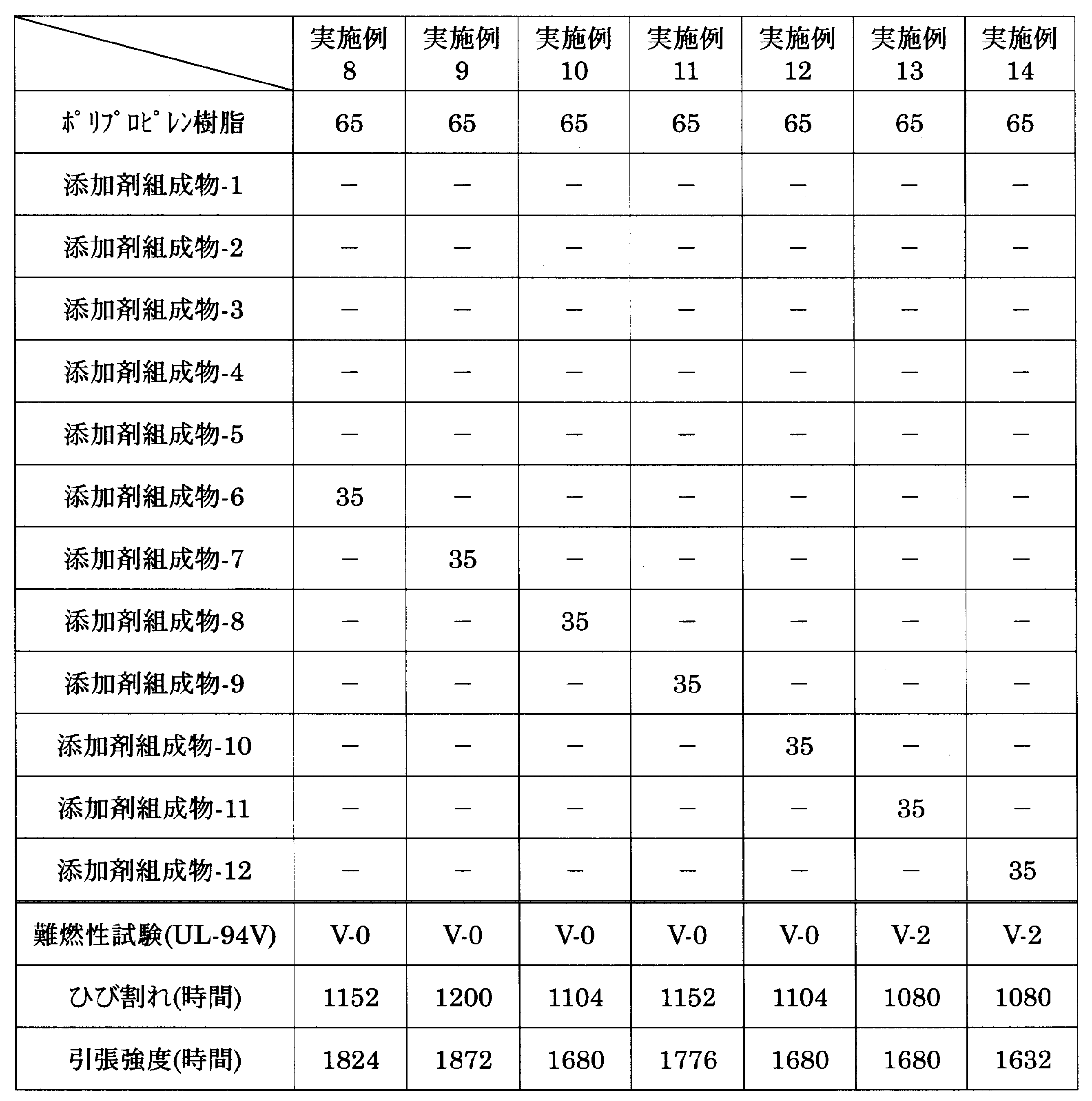
- the synthetic resin compositions of Examples 1 to 14 were obtained by adding them in the amounts (parts by mass) shown in Tables 5 and 6.
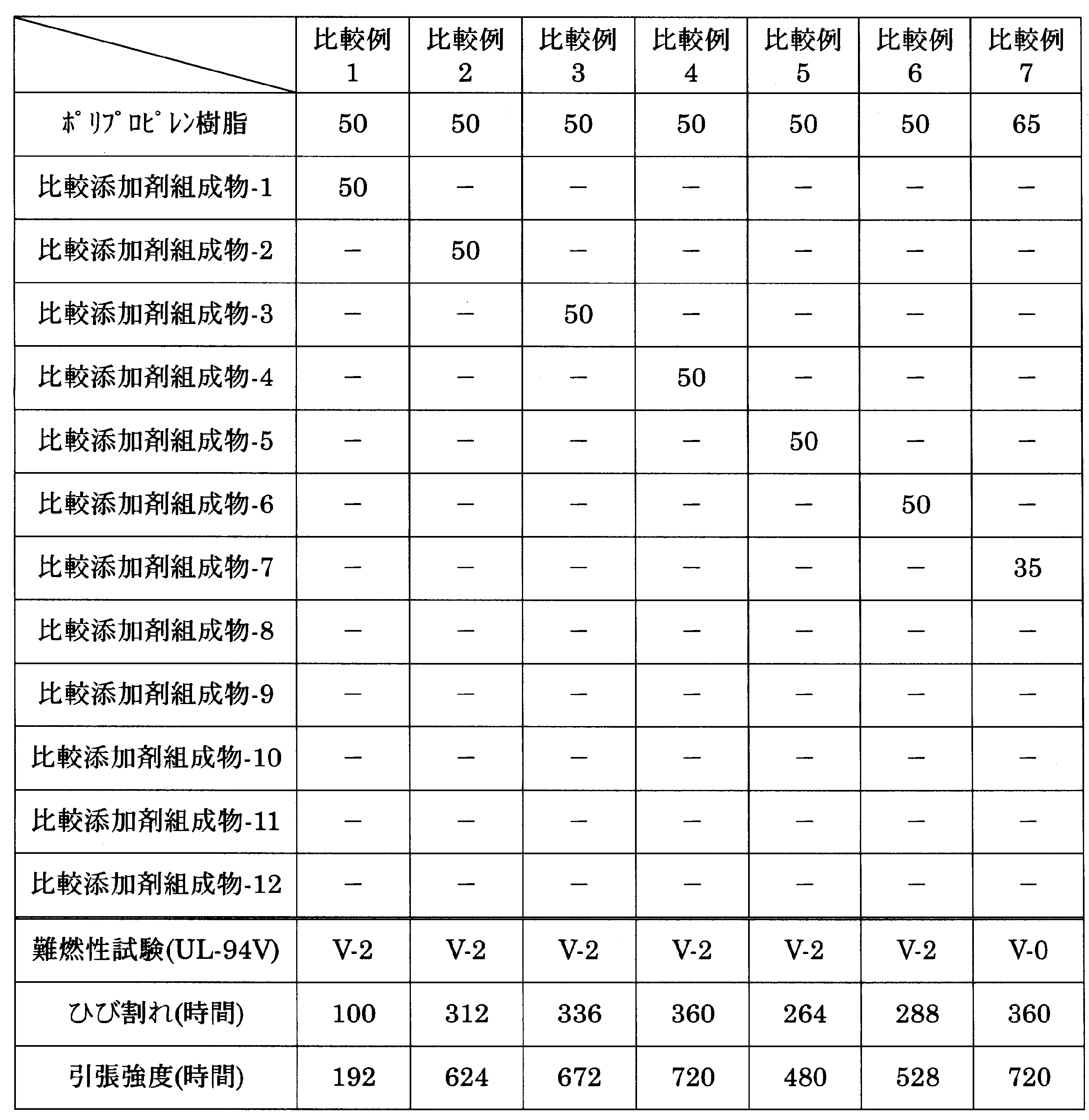
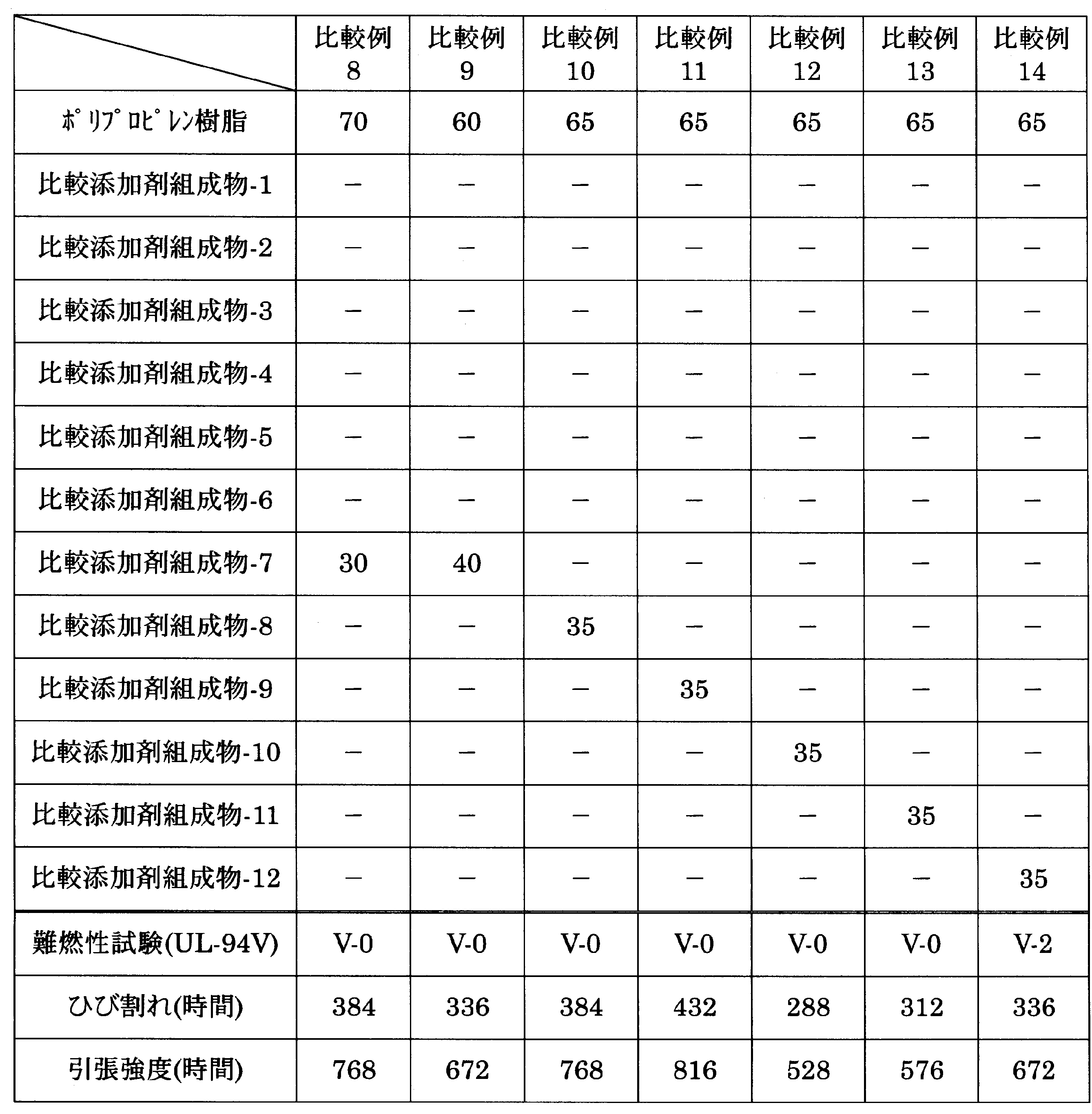
- Comparative additive compositions-1 to 12 were added in the amounts (parts by mass) shown in Tables 7 and 8 to obtain synthetic resin compositions of Comparative Examples 1 to 14. In the same manner, test pieces were obtained and the following various tests were performed. The results are shown in Tables 7 and 8.
- ⁇ Flame retardant UL-94V test method> A test piece of 127 ⁇ 12.7 ⁇ 1.6 mm was held vertically, and a burner fire was indirectly flamed at the lower end for 10 seconds. Then, the flame was removed and the time required for the fire igniting the test piece to be extinguished was measured. Next, at the same time when the fire was extinguished, a second flame contact was performed for 10 seconds, and the time for extinguishing the fire was measured in the same manner as in the first time. In addition, whether the cotton under the test piece ignited due to the falling fire type was also evaluated at the same time.
- the combustion rank was assigned according to the UL-94V standard based on the first and second combustion times, the presence or absence of cotton ignition, and the like.
- the combustion rank is highest at V-0, and the flame retardancy decreases as V-1 and V-2.
- those which do not correspond to any of the ranks of V-0 to V-2 are NR. In the present invention, those having V-2 or less cannot be put to practical use.
- ⁇ Crack> A test piece of 60 ⁇ 30 ⁇ 2 mm was placed in an oven at 150 ° C., and every 24 hours, the presence or absence of cracks was visually checked. The time until cracks occurred was measured. The longer the time until cracking occurs, the better the heat resistance, and the shorter the time until cracking, the poorer the heat resistance. In the present invention, a material having a duration of less than 800 hours cannot withstand actual use.
- ⁇ Tensile strength> The test was performed according to ISO527. That is, the test piece for tensile strength was placed in an oven at 150 ° C., and the tensile strength was measured every 48 hours. The time required until the value of the tensile strength became 70% or less of the initial value before being put into the oven was measured. The longer the time until the value becomes 70% or less, the better the heat resistance, and the shorter the time until the value becomes 70% or less, the poorer the heat resistance.
Landscapes
- Chemical & Material Sciences (AREA)
- Organic Chemistry (AREA)
- Health & Medical Sciences (AREA)
- Chemical Kinetics & Catalysis (AREA)
- Medicinal Chemistry (AREA)
- Polymers & Plastics (AREA)
- Engineering & Computer Science (AREA)
- Materials Engineering (AREA)
- Inorganic Chemistry (AREA)
- Compositions Of Macromolecular Compounds (AREA)
- Fireproofing Substances (AREA)
Abstract
Description


本発明の添加剤組成物に係る(A)成分は、ポリリン酸アンモニウムの1種以上である。このポリリン酸アンモニウムは、合成樹脂に難燃性を付与する成分として機能する。
本発明の添加剤組成物に係る(B)成分は、下記一般式(1)で表される化合物および下記一般式(2)で表される化合物からなる群より選ばれる少なくとも1種以上である。下記一般式(1)、下記一般式(2)で表される化合物は合成樹脂に耐熱性を付与する成分として機能する。

本発明の添加剤組成物に係る(C)成分は、一般式(1)で表される化合物以外の含窒素有機化合物の1種以上である。(C)成分の含窒素有機化合物は、(A)成分のポリリン酸アンモニウムとともに、合成樹脂に難燃性を付与する成分として機能する。(C)成分の含窒素有機化合物は、発火もしくは着火または炎の接触等による熱によって非引火性のガスを発生すると共に、炭素質残渣を生成もしくは生成の促進をする化合物のことであり、具体的には下記(1)~(4)で例示される。

本発明の難燃性合成樹脂組成物は、合成樹脂に対し、本発明の添加剤組成物が配合されてなるものである。
本発明の成形体は、本発明の難燃性合成樹脂組成物から得られるものである。本発明の合成樹脂組成物は成形することにより、耐熱性と難燃性に優れた成形品を得ることができる。成形方法は、特に限定されるものではなく、押し出し加工、カレンダー加工、射出成形、ロール、圧縮成形、ブロー成形等が挙げられ、樹脂板、シート、フィルム、異形品等の種々の形状の成形品が製造できる。
下記の表1、2の配合比(質量部)で、本発明の添加剤組成物-1~12を製造した。(B)成分は下記化合物B-1および化合物B-2を使用した。
下記の表3、4記載の配合比(質量部)で、比較添加剤組成物-1~12を製造した。比較添加剤組成物1~12では、(B)成分の替わりに、比較フェノール系酸化防止剤-1~3を使用した。
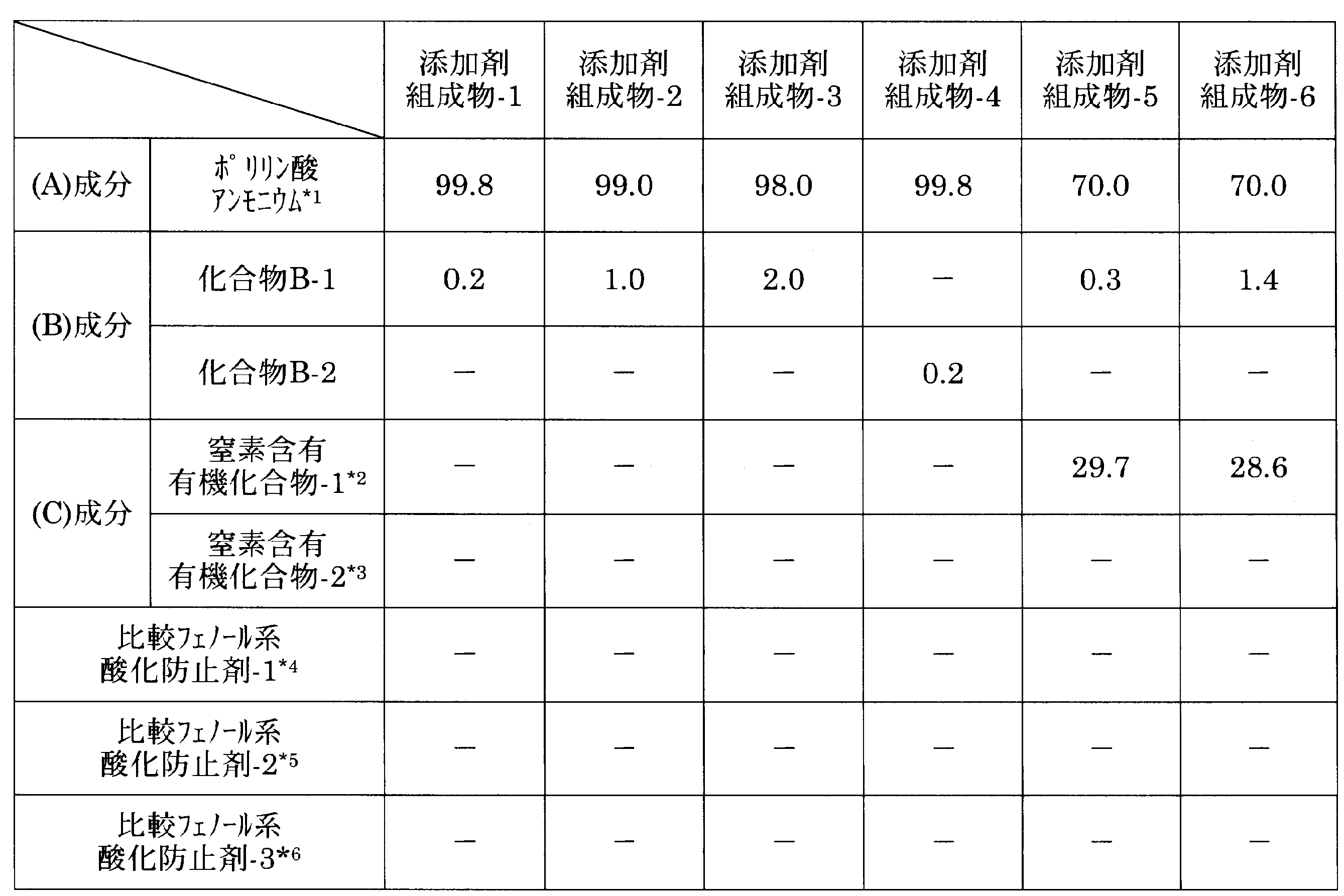
*2:ポリ-[2,4-(ピペラジン-1,4-イル)-6-(モルホリノ-4-イル)-1,3,5-トリアジン]
*3:メラミンシアヌレート
*4:テトラキス[3-(3,5-ジ第三ブチル-4-ヒドロキシフェニル)プロピオン酸メチル]メタン
*5:1,1,3-トリス(2-メチル-4-ヒドロキシ-5-第三ブチルフェニル)ブタン
*6:3,9-ビス〔1,1-ジメチル-2-{(3-第三ブチル-4-ヒドロキシ-5-メチルフェニル)プロピオニルオキシ}エチル〕-2,4,8,10-テトラオキサスピロ〔5,5〕ウンデカン


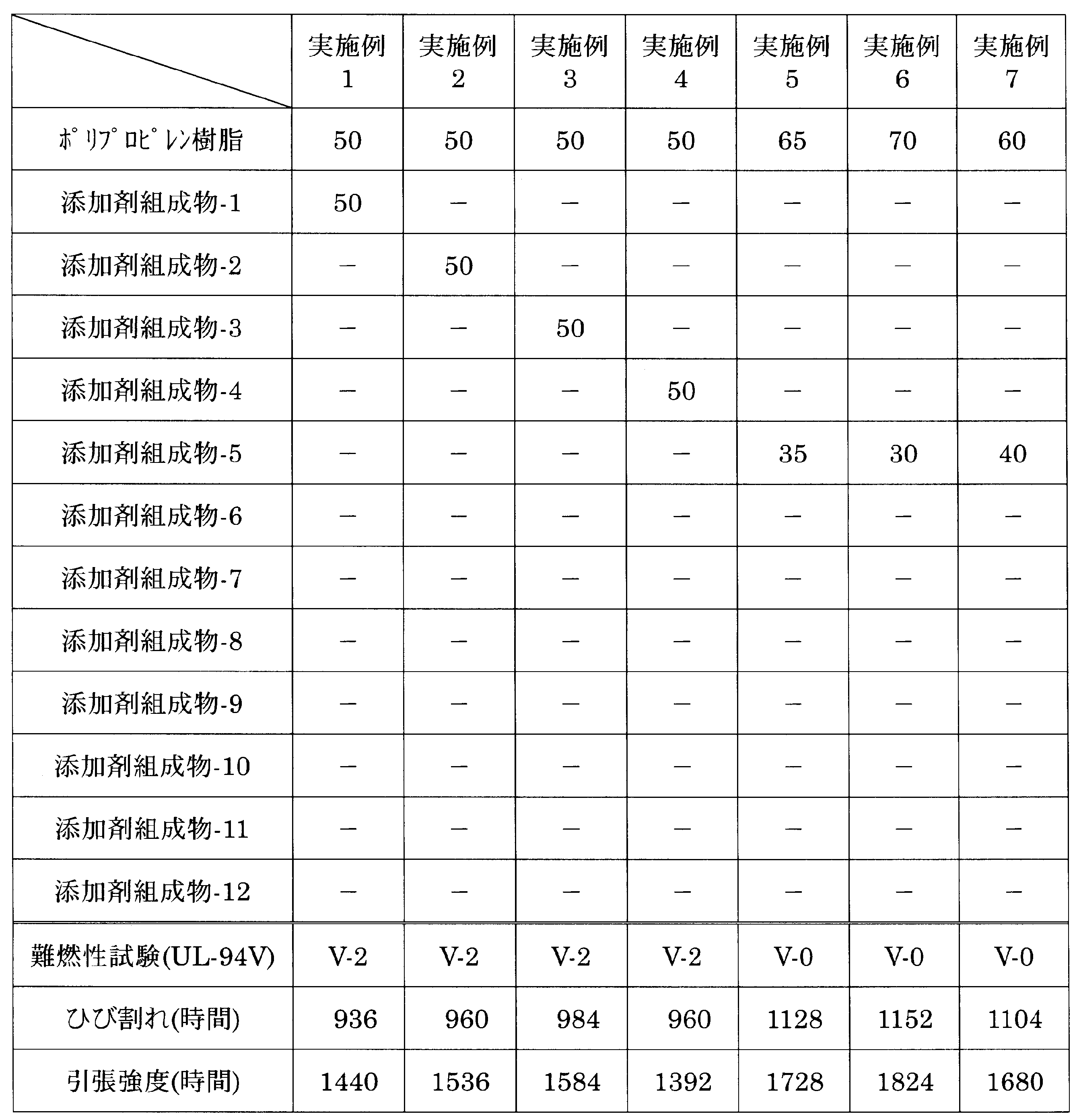
ポリプロピレン(メルトフローレート=14g/10min)の表5、6記載の配合量(質量部)に、ステアリン酸カルシウム(滑剤)0.1質量部、トリス(2,4-ジ-第三ブチルフェニル)ホスファイト(リン系酸化防止剤)0.1質量部、グリセリンモノステアレート(滑剤)0.3質量部を配合して得られたポリプロピレン樹脂組成物に対して、添加剤組成物-1~12を表5、6記載の配合量(質量部)で添加して、実施例1~14の合成樹脂組成物を得た。これを、200~220℃で押し出してペレットを製造し、次いでこれを使用して200~220℃で射出成形を行い、60×30×2mmと127×12.7×1.6mmの2種類の試験片および引張強度測定用試験片を得た。これらの試験片を用いて下記各種試験を行った。結果を表5、6に併記する。
127×12.7×1.6mmの試験片を垂直に保ち、下端にバーナーの火を10秒間接炎させた後、炎を取り除き、試験片に着火した火が消える時間を測定した。次に、火が消えると同時に2回目の接炎を10秒間行ない、1回目と同様にして着火した火が消える時間を測定した。また、落下する火種により試験片の下の綿が着火するか否かについても同時に評価した。1回目と2回目の燃焼時間、綿着火の有無等からUL-94V規格にしたがって燃焼ランクをつけた。燃焼ランクはV-0が最高のものであり、V-1、V-2となるにしたがって難燃性は低下する。但し、V-0~V-2のランクの何れにも該当しないものはNRとする。本発明ではV-2以下のものは実使用に耐えられない。
60×30×2mmの試験片を150℃のオーブンに入れ、24時間毎に目視にてびび割れの有無を確認した。ひび割れが発生するまでの時間を計測した。ひび割れが発生するまでの時間が長いほど耐熱性が良好であり、ひび割れが発生するまでの時間が短いほど耐熱性が不良である。本発明においては800時間未満のものは実使用に耐えられない。
ISO527に準拠して試験を行った。すなわち、引張強度用の試験片を150℃のオーブンに入れ、48時間毎に引張強度を測定した。引張強度の値がオーブンに入れる前の初期値に対して、70%以下の数値になるまでの時間を計測した。70%以下の数値になるまでの時間が長いほど耐熱性が良好であり、70%以下の数値になるまでの時間が短いほど耐熱性が不良である。
Claims (6)
- (A)成分としてポリリン酸アンモニウムの1種以上と、(B)成分として下記一般式(1)で表される化合物および下記一般式(2)で表される化合物からなる群より選ばれる少なくとも1種以上と、を含有することを特徴とする添加剤組成物。
一般式(1)において、R1、R2およびR3は、それぞれ独立して炭素原子数1~3の2価の炭化水素基を表す。
一般式(2)において、R4、R5およびR6は、それぞれ独立して炭素原子数1~3の2価の炭化水素基を表し、R7、R8およびR9は、それぞれ独立して水素原子または炭素原子数1~4の1価の炭化水素基を表す。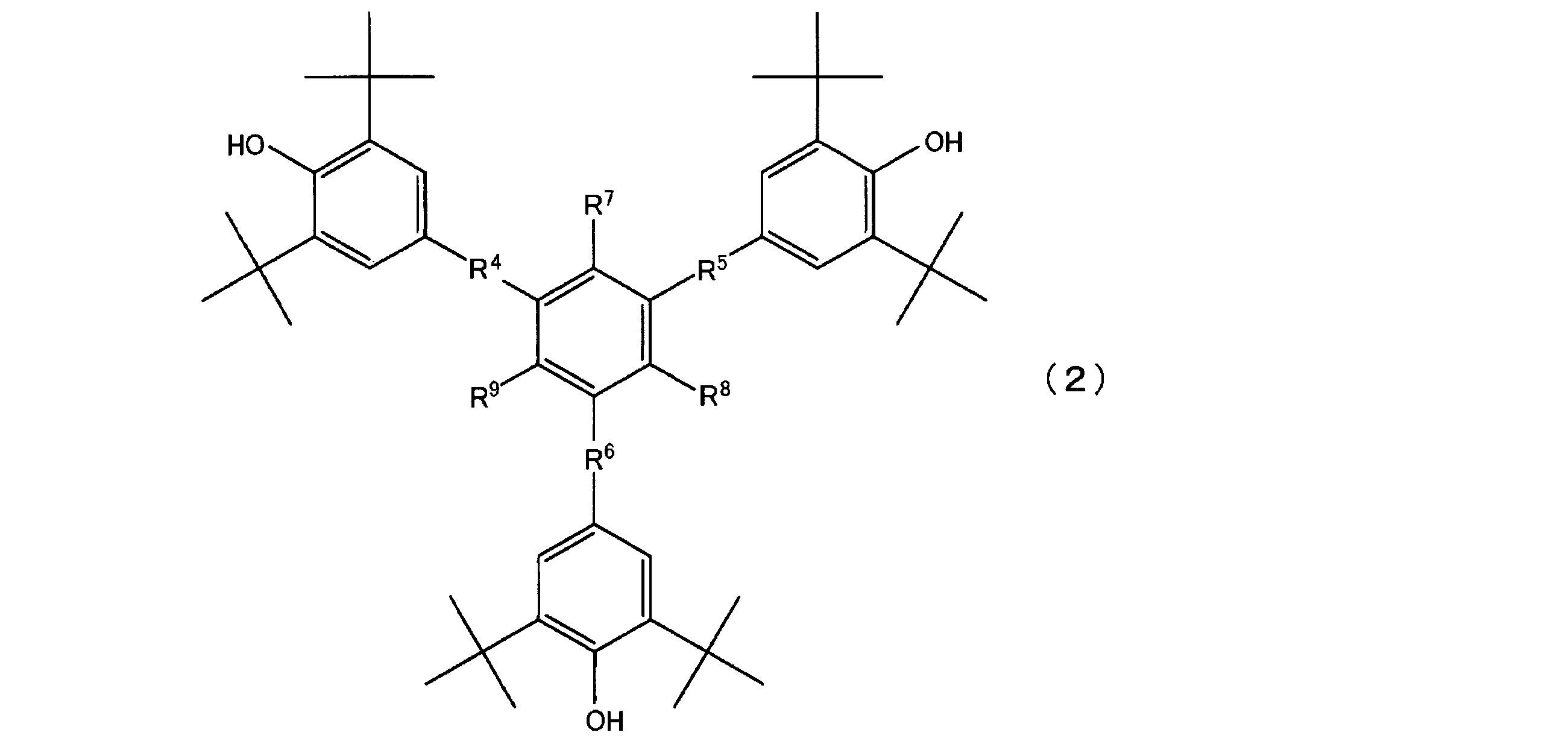
- さらに(C)成分として、一般式(1)で表される化合物以外の含窒素有機化合物の1種以上を含有する請求項1記載の添加剤組成物。
- (C)成分の含窒素有機化合物が、トリアジン誘導体の少なくとも1種以上である請求項2記載の添加剤組成物。
- 合成樹脂に対し、請求項1~3のうちいずれか1項記載の添加剤組成物が配合されてなることを特徴とする難燃性合成樹脂組成物。
- 前記合成樹脂が、ポリオレフィン系樹脂である請求項4記載の難燃性合成樹脂組成物。
- 請求項4または5記載の難燃性合成樹脂組成物から得られることを特徴とする成形体。
Priority Applications (5)
| Application Number | Priority Date | Filing Date | Title |
|---|---|---|---|
| EP19848556.7A EP3835367A4 (en) | 2018-08-10 | 2019-08-08 | ADDITIVE COMPOSITION, FLAME RETARDANT RESIN COMPOSITION THEREOF AND MOLDING ARTICLES THEREOF |
| US17/267,334 US20220064409A1 (en) | 2018-08-10 | 2019-08-08 | Additive composition, flame-retardant synthetic resin composition containing same, and molded article thereof |
| CN201980043854.9A CN112368339A (zh) | 2018-08-10 | 2019-08-08 | 添加剂组合物、含有其的阻燃性合成树脂组合物和其成型体 |
| JP2020535889A JP7811086B2 (ja) | 2018-08-10 | 2019-08-08 | 添加剤組成物、これを含有する難燃性合成樹脂組成物、およびその成形体 |
| KR1020217004884A KR20210042111A (ko) | 2018-08-10 | 2019-08-08 | 첨가제 조성물, 이것을 함유하는 난연성 합성 수지 조성물, 및 그의 성형체 |
Applications Claiming Priority (2)
| Application Number | Priority Date | Filing Date | Title |
|---|---|---|---|
| JP2018152059 | 2018-08-10 | ||
| JP2018-152059 | 2018-08-10 |
Publications (1)
| Publication Number | Publication Date |
|---|---|
| WO2020032210A1 true WO2020032210A1 (ja) | 2020-02-13 |
Family
ID=69414823
Family Applications (1)
| Application Number | Title | Priority Date | Filing Date |
|---|---|---|---|
| PCT/JP2019/031493 Ceased WO2020032210A1 (ja) | 2018-08-10 | 2019-08-08 | 添加剤組成物、これを含有する難燃性合成樹脂組成物、およびその成形体 |
Country Status (7)
| Country | Link |
|---|---|
| US (1) | US20220064409A1 (ja) |
| EP (1) | EP3835367A4 (ja) |
| JP (1) | JP7811086B2 (ja) |
| KR (1) | KR20210042111A (ja) |
| CN (1) | CN112368339A (ja) |
| TW (1) | TW202016191A (ja) |
| WO (1) | WO2020032210A1 (ja) |
Cited By (1)
| Publication number | Priority date | Publication date | Assignee | Title |
|---|---|---|---|---|
| US20230118686A1 (en) * | 2020-03-27 | 2023-04-20 | Yupo Corporation | Aqueous flame-retardant coating composition and flame-retardant thermoplastic resin film |
Families Citing this family (1)
| Publication number | Priority date | Publication date | Assignee | Title |
|---|---|---|---|---|
| CN115584503B (zh) * | 2022-10-19 | 2024-05-17 | 安徽万磁电子有限公司 | 降低基材腐蚀的烧结钕铁硼镍铜镍镀层退镀工艺 |
Citations (8)
| Publication number | Priority date | Publication date | Assignee | Title |
|---|---|---|---|---|
| JPH03131508A (ja) | 1989-10-14 | 1991-06-05 | Chisso Corp | コーティングポリ燐酸アンモニウム |
| JPH11236472A (ja) | 1997-12-18 | 1999-08-31 | Chisso Corp | 難燃性熱可塑性樹脂組成物 |
| JP2005027574A (ja) | 2003-07-07 | 2005-02-03 | Otsuka Pharmaceut Factory Inc | ヒト肝細胞用組成物 |
| CN101597395A (zh) * | 2009-06-24 | 2009-12-09 | 上海至正道化高分子材料有限公司 | 一种低烟无卤阻燃电缆料及其制备方法 |
| CN103173884A (zh) * | 2011-12-21 | 2013-06-26 | 上海杰事杰新材料(集团)股份有限公司 | 一种无卤阻燃聚丙烯纤维及其制备方法 |
| CN103756136A (zh) * | 2013-12-30 | 2014-04-30 | 浙江普利特新材料有限公司 | 一种无卤阻燃聚丙烯组合物及其制备方法 |
| JP2015529263A (ja) * | 2012-09-06 | 2015-10-05 | イー・アイ・デュポン・ドウ・ヌムール・アンド・カンパニーE.I.Du Pont De Nemours And Company | 難燃性コポリエーテルエステル組成物、及びこれを含む物品 |
| CN105542305A (zh) * | 2016-01-25 | 2016-05-04 | 上海捷棉新材料科技有限公司 | 高氧指数的无卤耐高温阻燃材料及其制备方法和应用 |
Family Cites Families (7)
| Publication number | Priority date | Publication date | Assignee | Title |
|---|---|---|---|---|
| JP2003003017A (ja) * | 2001-06-19 | 2003-01-08 | Chisso Corp | 難燃性樹脂組成物およびそれを用いたシート |
| CN101792602A (zh) | 2010-03-11 | 2010-08-04 | 四川大学 | 无卤膨胀型阻燃热塑性树脂组合物 |
| CN101845205B (zh) * | 2010-06-08 | 2012-05-23 | 从化市聚赛龙工程塑料有限公司 | 以废弃pet瓶片为原料的无卤阻燃工程塑料及制备方法 |
| CN102134352B (zh) | 2011-05-09 | 2013-06-12 | 中山大学 | 一种膨胀型阻燃聚丙烯复合材料及其制备方法 |
| CN103073776A (zh) * | 2013-02-05 | 2013-05-01 | 上海化工研究院 | 一种无卤膨胀阻燃电线电缆绝缘料组合物 |
| US20190040245A1 (en) * | 2016-04-13 | 2019-02-07 | Adeka Corporation | Flame-retardant polyolefin-based resin composition |
| CN107987344A (zh) * | 2017-11-06 | 2018-05-04 | 青岛科技大学 | 选择性激光烧结快速成形hdpe复合材料及制备方法 |
-
2019
- 2019-08-08 WO PCT/JP2019/031493 patent/WO2020032210A1/ja not_active Ceased
- 2019-08-08 EP EP19848556.7A patent/EP3835367A4/en not_active Withdrawn
- 2019-08-08 US US17/267,334 patent/US20220064409A1/en not_active Abandoned
- 2019-08-08 JP JP2020535889A patent/JP7811086B2/ja active Active
- 2019-08-08 KR KR1020217004884A patent/KR20210042111A/ko not_active Ceased
- 2019-08-08 CN CN201980043854.9A patent/CN112368339A/zh active Pending
- 2019-08-12 TW TW108128529A patent/TW202016191A/zh unknown
Patent Citations (8)
| Publication number | Priority date | Publication date | Assignee | Title |
|---|---|---|---|---|
| JPH03131508A (ja) | 1989-10-14 | 1991-06-05 | Chisso Corp | コーティングポリ燐酸アンモニウム |
| JPH11236472A (ja) | 1997-12-18 | 1999-08-31 | Chisso Corp | 難燃性熱可塑性樹脂組成物 |
| JP2005027574A (ja) | 2003-07-07 | 2005-02-03 | Otsuka Pharmaceut Factory Inc | ヒト肝細胞用組成物 |
| CN101597395A (zh) * | 2009-06-24 | 2009-12-09 | 上海至正道化高分子材料有限公司 | 一种低烟无卤阻燃电缆料及其制备方法 |
| CN103173884A (zh) * | 2011-12-21 | 2013-06-26 | 上海杰事杰新材料(集团)股份有限公司 | 一种无卤阻燃聚丙烯纤维及其制备方法 |
| JP2015529263A (ja) * | 2012-09-06 | 2015-10-05 | イー・アイ・デュポン・ドウ・ヌムール・アンド・カンパニーE.I.Du Pont De Nemours And Company | 難燃性コポリエーテルエステル組成物、及びこれを含む物品 |
| CN103756136A (zh) * | 2013-12-30 | 2014-04-30 | 浙江普利特新材料有限公司 | 一种无卤阻燃聚丙烯组合物及其制备方法 |
| CN105542305A (zh) * | 2016-01-25 | 2016-05-04 | 上海捷棉新材料科技有限公司 | 高氧指数的无卤耐高温阻燃材料及其制备方法和应用 |
Non-Patent Citations (2)
| Title |
|---|
| CAS, no. 1078142-02-5 |
| See also references of EP3835367A4 |
Cited By (2)
| Publication number | Priority date | Publication date | Assignee | Title |
|---|---|---|---|---|
| US20230118686A1 (en) * | 2020-03-27 | 2023-04-20 | Yupo Corporation | Aqueous flame-retardant coating composition and flame-retardant thermoplastic resin film |
| US12559633B2 (en) * | 2020-03-27 | 2026-02-24 | Yupo Corporation | Aqueous flame-retardant coating composition and flame-retardant thermoplastic resin film |
Also Published As
| Publication number | Publication date |
|---|---|
| KR20210042111A (ko) | 2021-04-16 |
| EP3835367A4 (en) | 2022-06-01 |
| JPWO2020032210A1 (ja) | 2021-08-12 |
| CN112368339A (zh) | 2021-02-12 |
| US20220064409A1 (en) | 2022-03-03 |
| JP7811086B2 (ja) | 2026-02-04 |
| EP3835367A1 (en) | 2021-06-16 |
| TW202016191A (zh) | 2020-05-01 |
Similar Documents
| Publication | Publication Date | Title |
|---|---|---|
| EP3243890B1 (en) | Flame retardant agent composition and flame-retardant synthetic resin composition | |
| JP7345463B2 (ja) | ポリリン酸アミン塩組成物、ポリリン酸アミン塩難燃剤組成物、これを含有する難燃性合成樹脂組成物およびその成形体 | |
| JP6675331B2 (ja) | 難燃性ポリプロピレン組成物 | |
| US10508194B2 (en) | Flame-retardant polyolefin resin composition | |
| EP3255121B1 (en) | Flame-retardant composition and flame-retardant synthetic resin composition | |
| JP7316273B2 (ja) | リン酸アミン塩難燃剤組成物、これを含有する難燃性合成樹脂組成物およびその成形体 | |
| JP7811086B2 (ja) | 添加剤組成物、これを含有する難燃性合成樹脂組成物、およびその成形体 |
Legal Events
| Date | Code | Title | Description |
|---|---|---|---|
| 121 | Ep: the epo has been informed by wipo that ep was designated in this application |
Ref document number: 19848556 Country of ref document: EP Kind code of ref document: A1 |
|
| ENP | Entry into the national phase |
Ref document number: 2020535889 Country of ref document: JP Kind code of ref document: A |
|
| NENP | Non-entry into the national phase |
Ref country code: DE |
|
| ENP | Entry into the national phase |
Ref document number: 20217004884 Country of ref document: KR Kind code of ref document: A |
|
| ENP | Entry into the national phase |
Ref document number: 2019848556 Country of ref document: EP Effective date: 20210310 |
|
| WWW | Wipo information: withdrawn in national office |
Ref document number: 2019848556 Country of ref document: EP |