WO2020039963A1 - Procédé de détection d'humidité et système de détection d'humidité - Google Patents
Procédé de détection d'humidité et système de détection d'humidité Download PDFInfo
- Publication number
- WO2020039963A1 WO2020039963A1 PCT/JP2019/031388 JP2019031388W WO2020039963A1 WO 2020039963 A1 WO2020039963 A1 WO 2020039963A1 JP 2019031388 W JP2019031388 W JP 2019031388W WO 2020039963 A1 WO2020039963 A1 WO 2020039963A1
- Authority
- WO
- WIPO (PCT)
- Prior art keywords
- detection system
- moisture detection
- hydrogen peroxide
- moisture
- water
- Prior art date
- Legal status (The legal status is an assumption and is not a legal conclusion. Google has not performed a legal analysis and makes no representation as to the accuracy of the status listed.)
- Ceased
Links
Images

Classifications
-
- G—PHYSICS
- G01—MEASURING; TESTING
- G01N—INVESTIGATING OR ANALYSING MATERIALS BY DETERMINING THEIR CHEMICAL OR PHYSICAL PROPERTIES
- G01N21/00—Investigating or analysing materials by the use of optical means, i.e. using sub-millimetre waves, infrared, visible or ultraviolet light
- G01N21/75—Systems in which material is subjected to a chemical reaction, the progress or the result of the reaction being investigated
- G01N21/77—Systems in which material is subjected to a chemical reaction, the progress or the result of the reaction being investigated by observing the effect on a chemical indicator
-
- C—CHEMISTRY; METALLURGY
- C09—DYES; PAINTS; POLISHES; NATURAL RESINS; ADHESIVES; COMPOSITIONS NOT OTHERWISE PROVIDED FOR; APPLICATIONS OF MATERIALS NOT OTHERWISE PROVIDED FOR
- C09K—MATERIALS FOR MISCELLANEOUS APPLICATIONS, NOT PROVIDED FOR ELSEWHERE
- C09K11/00—Luminescent materials, e.g. electroluminescent or chemiluminescent
- C09K11/06—Luminescent materials, e.g. electroluminescent or chemiluminescent containing organic luminescent materials
- C09K11/07—Luminescent materials, e.g. electroluminescent or chemiluminescent containing organic luminescent materials having chemically-interreactive components, e.g. reactive chemiluminescent compositions
-
- G—PHYSICS
- G01—MEASURING; TESTING
- G01N—INVESTIGATING OR ANALYSING MATERIALS BY DETERMINING THEIR CHEMICAL OR PHYSICAL PROPERTIES
- G01N15/00—Investigating characteristics of particles; Investigating permeability, pore-volume or surface-area of porous materials
- G01N15/08—Investigating permeability, pore-volume, or surface area of porous materials
-
- G—PHYSICS
- G01—MEASURING; TESTING
- G01N—INVESTIGATING OR ANALYSING MATERIALS BY DETERMINING THEIR CHEMICAL OR PHYSICAL PROPERTIES
- G01N21/00—Investigating or analysing materials by the use of optical means, i.e. using sub-millimetre waves, infrared, visible or ultraviolet light
- G01N21/75—Systems in which material is subjected to a chemical reaction, the progress or the result of the reaction being investigated
- G01N21/77—Systems in which material is subjected to a chemical reaction, the progress or the result of the reaction being investigated by observing the effect on a chemical indicator
- G01N21/78—Systems in which material is subjected to a chemical reaction, the progress or the result of the reaction being investigated by observing the effect on a chemical indicator producing a change of colour
- G01N21/81—Indicating humidity
-
- G—PHYSICS
- G01—MEASURING; TESTING
- G01N—INVESTIGATING OR ANALYSING MATERIALS BY DETERMINING THEIR CHEMICAL OR PHYSICAL PROPERTIES
- G01N31/00—Investigating or analysing non-biological materials by the use of the chemical methods specified in the subgroup; Apparatus specially adapted for such methods
- G01N31/22—Investigating or analysing non-biological materials by the use of the chemical methods specified in the subgroup; Apparatus specially adapted for such methods using chemical indicators
- G01N31/222—Investigating or analysing non-biological materials by the use of the chemical methods specified in the subgroup; Apparatus specially adapted for such methods using chemical indicators for investigating moisture content
-
- C—CHEMISTRY; METALLURGY
- C09—DYES; PAINTS; POLISHES; NATURAL RESINS; ADHESIVES; COMPOSITIONS NOT OTHERWISE PROVIDED FOR; APPLICATIONS OF MATERIALS NOT OTHERWISE PROVIDED FOR
- C09K—MATERIALS FOR MISCELLANEOUS APPLICATIONS, NOT PROVIDED FOR ELSEWHERE
- C09K11/00—Luminescent materials, e.g. electroluminescent or chemiluminescent
- C09K11/06—Luminescent materials, e.g. electroluminescent or chemiluminescent containing organic luminescent materials
-
- G—PHYSICS
- G01—MEASURING; TESTING
- G01N—INVESTIGATING OR ANALYSING MATERIALS BY DETERMINING THEIR CHEMICAL OR PHYSICAL PROPERTIES
- G01N15/00—Investigating characteristics of particles; Investigating permeability, pore-volume or surface-area of porous materials
- G01N15/08—Investigating permeability, pore-volume, or surface area of porous materials
- G01N2015/0846—Investigating permeability, pore-volume, or surface area of porous materials by use of radiation, e.g. transmitted or reflected light
-
- G—PHYSICS
- G01—MEASURING; TESTING
- G01N—INVESTIGATING OR ANALYSING MATERIALS BY DETERMINING THEIR CHEMICAL OR PHYSICAL PROPERTIES
- G01N15/00—Investigating characteristics of particles; Investigating permeability, pore-volume or surface-area of porous materials
- G01N15/08—Investigating permeability, pore-volume, or surface area of porous materials
- G01N2015/086—Investigating permeability, pore-volume, or surface area of porous materials of films, membranes or pellicules
-
- G—PHYSICS
- G01—MEASURING; TESTING
- G01N—INVESTIGATING OR ANALYSING MATERIALS BY DETERMINING THEIR CHEMICAL OR PHYSICAL PROPERTIES
- G01N21/00—Investigating or analysing materials by the use of optical means, i.e. using sub-millimetre waves, infrared, visible or ultraviolet light
- G01N21/75—Systems in which material is subjected to a chemical reaction, the progress or the result of the reaction being investigated
- G01N21/77—Systems in which material is subjected to a chemical reaction, the progress or the result of the reaction being investigated by observing the effect on a chemical indicator
- G01N2021/7769—Measurement method of reaction-produced change in sensor
- G01N2021/7786—Fluorescence
-
- H—ELECTRICITY
- H10—SEMICONDUCTOR DEVICES; ELECTRIC SOLID-STATE DEVICES NOT OTHERWISE PROVIDED FOR
- H10K—ORGANIC ELECTRIC SOLID-STATE DEVICES
- H10K71/00—Manufacture or treatment specially adapted for the organic devices covered by this subclass
- H10K71/70—Testing, e.g. accelerated lifetime tests
Definitions
- the present invention relates to a moisture detection system used for moisture detection and a moisture detection method using the same.
- a barrier film for a film device such as an organic EL display is required to have a water vapor permeability of about 10 ⁇ 6 g / m 2 / day, and a moisture detection technology capable of integrating and detecting a trace amount of moisture is required. ing.
- a very small amount of a transmitted component from a film to be measured such as a barrier film (also referred to as a “barrier film”) for a film device such as an organic EL display
- a permeability processing method a permeability evaluation method for evaluating a permeation component of a film to be measured is known (see Patent Document 1).
- This method includes a sampling step for collecting a component to be evaluated that has passed through a film to be measured, an adsorption and fixing step of adsorbing and fixing the collected component to be evaluated to an adsorption / desorption substrate, and an analysis step of analyzing the component to be evaluated.
- the sampling step two sealed spaces are formed at positions facing each other across the film to be measured in the chamber, and one sealed space is evaluated so that both sealed spaces have the same pressure.
- the target component is supplied with an inert gas to the other sealed space, and the inert gas that has passed through the film to be measured is supplied by the difference in partial pressure between the components to be evaluated in both the sealed spaces.
- the component to be evaluated is adsorbed by being cooled, and the component to be evaluated is desorbed by being cooled or stopped or heated.
- the component to be evaluated collected above is moved to the adsorption and desorption substrate by diffusion or gas circulation to adsorb and fix the component to be evaluated to the adsorption and desorption substrate, and the adsorption and desorption substrate is cooled. After evacuating, in the analysis step, the analysis of the component to be evaluated is desorbed by stopping the cooling of the adsorption / desorption substrate or heating the substrate to conduct analysis.
- Patent Document 1 can evaluate the permeability of a small amount of water vapor with high sensitivity by employing mass spectrometry, it is difficult to use a mass spectrometer or a double wall structure. The structure is complicated, and there is room for improvement in terms of easily detecting moisture. Furthermore, in the conventional method, the position where the water molecule exists in the subject cannot be specified.
- an object of the present invention is to provide a moisture detection method and a moisture detection system used in the moisture detection method, which can easily detect moisture.
- a further object of the present invention is to provide a moisture detection method capable of specifying the location of water molecules in a subject.
- Moisture detection method in order to solve the above problems, by detecting light emission from the moisture detection system, a method of detecting moisture,
- the moisture detection system (A) a substance that generates hydrogen peroxide by reacting with water; and (B) It is characterized by containing a fluorescent substance which emits light by being indirectly excited by hydrogen peroxide.
- the moisture detection method according to an embodiment of the present invention, the moisture detection system, (C) A substance that reacts with hydrogen peroxide and causes the reaction product with the hydrogen peroxide to excite the fluorescent substance (B) to cause the fluorescent substance (B) to emit light may be further included.
- the moisture detection system may include a resin.
- the moisture detection system may include an organic solvent.
- the moisture detection system comprises: (A) a substance that reacts with water to generate hydrogen peroxide; and (B) It is characterized by containing a fluorescent substance which emits light by being indirectly excited by hydrogen peroxide.
- a substance which reacts with hydrogen peroxide, and the reaction product with the hydrogen peroxide may further contain a substance that excites the fluorescent substance (B) and emits the fluorescent substance (B). .
- the present invention moisture can be easily detected.
- the moisture detection system comes into contact with moisture, the moisture detection system emits light, so that not only the presence or absence of moisture in the subject can be confirmed, but also the location of the moisture can be specified. Therefore, the present invention can be suitably used in a moisture permeation test of a barrier film for a film device such as an organic EL display and the like.
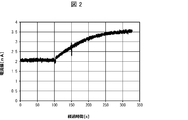
- FIG. 19 is a schematic diagram showing a light emission detection device used in Example 14. 31 is a graph illustrating a change in a current value observed by the light emission detection device used in Example 14.
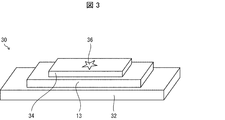
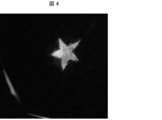
- FIG. 19 is a schematic view showing a test body used in Example 15. 16 is an image of a light emitting portion on a test body observed in Example 15.
- water includes water and steam.
- X to Y representing a numerical range means “X or more and Y or less”.
- the moisture detection system comprises: (A) a substance that reacts with water to generate hydrogen peroxide (referred to as “component (A)”); and (B) hydrogen peroxide indirectly. It is characterized by containing a fluorescent substance that emits light when excited (referred to as “component (B)”).
- component (B) a fluorescent substance that emits light when excited
- the moisture detection system is characterized in that (C) a substance that reacts with hydrogen peroxide, and a reaction product with the hydrogen peroxide excites the fluorescent substance (B) to cause the fluorescent substance (B) to emit light (“component (C) ").
- the component (A) is a substance that generates hydrogen peroxide by reacting with water, and for example, sodium percarbonate, urea hydrogen peroxide, sodium peroxide, or the like can be used. Of these, sodium percarbonate (Na 2 CO 3 .1.5H 2 O 2 ) and urea hydrogen peroxide are preferred. In other words, the component (A) is a substance that releases hydrogen peroxide by replacing hydrogen peroxide contained in the component (A) with water.
- the component (A) is not limited to one of the above-listed substances, and may be a combination of two or more substances.
- the component (B) is a fluorescent substance, preferably a substance that emits light when excited indirectly by hydrogen peroxide.
- the fluorescent substance indirectly excited by hydrogen peroxide is intended to mean a fluorescent substance that emits light when excited through another substance such as the component (C) described below.
- the component (B) conventionally known fluorescent substances such as naphthalene, naphthoquinone, anthracene, anthraquinone, phenanthrene, tetracene, naphthacenedione, pyridine, quinoline, isoquinoline, indole, isoindole, pyrrole, imidazole, pyrazole, Substances containing a skeleton of pyrazine, benzimidazole, benzofuran, dibenzofuran, carbazole, acridine, acridone, phenanthridine, xanthine, xanthone, flavone, coumarin, etc .; metal complexes such as ruthenium trisbipyridine complex; rare earth compounds such as europium ATBTA complex; Manganese activated zinc silicate or the like can be used.
- the component (B) is not limited to one of the above-listed substances, and may be
- the component (C) is a compound that reacts with hydrogen peroxide, and is a substance that emits the component (B) by exciting the component (B) by a reaction product with the hydrogen peroxide.
- the component (C) is not limited to one kind of substance, and may be composed of two or more kinds of substances.
- the reaction product with hydrogen peroxide is preferably 1,2-dioxetanedione.
- Compounds that form 1,2-dioxetanedione by reaction with hydrogen peroxide include bis (2,4-dichlorophenyl) oxalate, bis (2,4,5-trichlorophenyl) oxalate, and bis (2 , 4,6-Trichlorophenyl), bis (pentachlorophenyl) oxalate, bis (2,4,5-trichloro-6-carbopentoxyphenyl) oxalate, bis (2,4,5-trichloro-6) oxalate -Carboisopentoxyphenyl), bis (2,4,5-trichloro-6-carbobenzoxyphenyl) oxalate, bis (2,4,5-tribromophenyl) oxalate, bis (2,4 , 6-Tribromophenyl), bis (2,4-dibromophenyl) oxalate, bis (pentabromophenyl) oxalate, bis (2,4 5-t
- Component (A) is preferably sodium percarbonate.
- the component (B) is preferably a substance that emits light when excited by 1,2-dioxetanedione or the like, more preferably a compound having a tetracene skeleton, that is, a tetracene derivative, and particularly preferably rubrene.
- the content ratio of the component (A) is preferably 5 to 50 parts by mass, more preferably 10 to 25 parts by mass, when the content of the component (B) is 1 part by mass.
- the content ratio of the component (C) is preferably 1 to 50 parts by mass, more preferably 2 to 20 parts by mass, when the content of the component (B) is 1 part by mass.
- the water detection system contains a catalyst.
- the catalyst include a carboxylate.
- the catalyst contained in the moisture detection system may be only one kind or two or more kinds.
- the content is preferably 0.01 to 5 parts by mass, when the content of the component (B) is 1 part by mass, More preferably, it is 0.02 to 1 part by mass.
- the carboxylate is preferably of the general formula: R-COOM or (R-COO) 2 M, wherein R is a hydroxy group or a hydrocarbon group optionally containing a halogen atom, and M is monovalent or divalent. Which is a valence metal atom).
- carboxylate examples include salicylates such as sodium salicylate, potassium salicylate, lithium salicylate, magnesium salicylate and ammonium salicylate; sodium 3-chlorosalicylate, sodium 5-chlorosalicylate, lithium 3-chlorosalicylate, lithium 5-chlorosalicylate, Chlorosalicylates such as magnesium chlorosalicylate; dichlorosalicylates such as lithium 3,5-dichlorosalicylate and magnesium 3,5-dichlorosalicylate; lithium 3,5,6-trichlorosalicylate, magnesium 3,5,6-trichlorosalicylate Bromosalicylate such as sodium 5-bromosalicylate; lithium 5-tert-butylsalicylate, 5-tert-butylsalicyl Alkyl salicylates such as magnesium; benzoates; chlorobenzoates such as lithium 2-chlorobenzoate; trichlorobenzoates; acetates; trifluoroacetates such as sodium trifluor
- the water detection system may optionally include a water-free organic solvent, a binder (resin or a precursor thereof), a monomer, a polymerization initiator, and a curing aid, depending on properties or applications.
- a binder resin or a precursor thereof
- a monomer e.g., polyethylene glycol dimethacrylate
- a polymerization initiator e.g., polyethylene glycol dimethacrylate
- a curing aid e.g., a polymerization initiator, polymerization initiator, and a curing aid, depending on properties or applications.
- Crosslinking agent e.g., a dispersant, a carrier and the like can be further contained.
- the form of the moisture detection system according to one embodiment of the present invention is not particularly limited, and may be a mixture of the components or a non-mixture in which the components are not mixed.
- the moisture detection system When the moisture detection system is a mixture, it may be a solid mixture or a liquid mixture. Further, the moisture detection system may be a composite in which a layer of a solid mixture or a liquid mixture is disposed on at least a part of the surface of a substrate.
- the solid mixture may be a mixture (mixed powder or the like) composed of each component, or may be a molded product having a predetermined shape. In the latter case, it may be obtained by solidification of a liquid mixture.
- the water detection system according to one embodiment of the present invention can be a solid mixture or a liquid mixture, but it is preferable that each of them is a mixture in which the main components and the like are uniformly mixed.
- the preferred embodiment is a mixture composed of solid main components and the like. When other components are contained, the other components are preferably solid.
- a moisture detection system composed of a molded product for example, a molded product such as a plate obtained by subjecting the mixed powder to press working or the like, a resin or a precursor thereof (a monomer composed of a polymerizable unsaturated compound) , A curable compound, etc.).
- a molded product such as a film may be joined to the surface of the substrate to form a composite (a substrate with a film described later).
- the solid mixture may contain a resin.
- the resin may be either a thermoplastic resin (including a thermoplastic elastomer) or a cured resin.
- the thermoplastic resin include olefin resin, acrylic resin, styrene resin (rubber reinforced vinyl resin, hydrogenated styrene thermoplastic elastomer, etc.), ethylene / vinyl acetate copolymer, polyester, polyamide, polycarbonate and the like.
- the cured resin can be composed of a cross-linked resin derived from a polyfunctional (meth) acrylate, unsaturated polyester, epoxy resin, or the like.
- the main component is preferably present in the vicinity of the surface of the molded product, and is particularly preferably exposed on the surface. .
- the main components and the like are dispersed in a medium. Note that some of the main components and the like may be dissolved in the medium.
- the medium is not particularly limited, and may be a single component or a plurality of components.
- a preferred medium is an organic solvent, but may be a liquid monomer composed of a polymerizable unsaturated compound; a curable compound such as a polyfunctional (meth) acrylate, an unsaturated polyester, or an epoxy resin. Further, a medium composed of an organic solvent and a monomer, or a medium composed of an organic solvent and a curable compound can be used.
- organic solvent hydrocarbon, alcohol, ester, ether, ketone, carboxylic acid and the like can be used.
- the liquid mixture may be a mixture containing a resin or a precursor thereof, an auxiliary agent, and the like.
- the resin may preferably be a thermoplastic resin (including a thermoplastic elastomer) exemplified above.
- the resin precursor is preferably a simple one comprising a polymerizable unsaturated compound such as an aromatic vinyl compound, a vinyl cyanide compound, an unsaturated acid, a (meth) acrylate compound, and a polymerizable unsaturated compound having an amino group.
- a curable compound such as a polyfunctional (meth) acrylate, unsaturated polyester, or epoxy resin.
- the assistant include a polymerization initiator, a curing assistant (crosslinking agent), and a dispersant.
- a main component which means “component (A) and component (B)” or “component (A), component (B) and component (C)” in the present specification
- a catalyst and an organic compound.
- Liquid mixture containing a solvent Liquid mixture containing a main component, a catalyst, and a curable compound (3) Liquid mixture containing a main component, a catalyst, a thermoplastic resin, and an organic solvent ( 4)
- the liquid mixture of the above (1) can be used as a liquid containing a main component and a catalyst. Further, after applying the liquid mixture to the substrate, the organic solvent is evaporated by drying or the like, so that the liquid mixture is used for forming an article in which the mixture of the main component and the catalyst is attached to the surface of the substrate. Can also.
- the liquid mixture of the above (2) is preferably a composition further containing a polymerization initiator or a curing assistant (crosslinking agent) in order to form a molded product such as a film (film).
- a liquid mixture can be applied to a substrate, for example, and the coating film can be cured (room temperature curing, heat curing, light curing, etc.). This makes it possible to obtain a base material (composite) with a film in which the main component and the catalyst are uniformly dispersed and contained in a matrix composed of a cured resin formed by crosslinking of the curable compound.
- Such a liquid mixture for example, filled into a mold having a cavity of a predetermined shape, by heating, the matrix of a cured resin formed by crosslinking of the curable compound, the main components And a molded product in which the catalyst is contained while being uniformly dispersed.
- thermoplastic resin is preferably dissolved in an organic solvent to form a molded product such as a film (film), and the main component and the catalyst are dispersed in this solution. It is a composition.
- a substrate for example, and the coating film is dried, a substrate with a film (composite material) in which a main component and a catalyst are contained in a matrix made of a thermoplastic resin while being uniformly dispersed. Thing) can be obtained.
- the liquid mixture of the above (4) is preferably a composition further containing a polymerization initiator.
- a liquid mixture is applied to a substrate, for example, and the coating film is dried, the main components and the catalyst are uniformly dispersed in a matrix composed of a polymer formed by polymerization of monomers.
- a substrate (composite) with a film included therein can be obtained.
- the constituent material of the substrate used in each of the above embodiments may be either an organic material or an inorganic material, or may be both.
- the base material may be in the form of a film, a plate, a container, a tube, an irregular shape, or the like. At least a part of the base has air permeability from one surface to the other. Is also good.
- the moisture detection system can be solid or liquid, and in any case, for example, only a minute water droplet comes into contact with the moisture detection system, and emits fluorescence. be able to.
- the fluorescence can be confirmed visually, preferably under light-shielded conditions, or by using a photodetector such as a photodiode, a photomultiplier, or a high-sensitivity camera.
- a photodetector such as a photodiode, a photomultiplier, or a high-sensitivity camera.
- a current detection device can be used in combination.
- a preferred configuration of the moisture detection system includes, for example, a moisture detection system containing sodium percarbonate, a tetracene derivative, and an oxalic acid diester.
- a moisture detection system containing sodium percarbonate, a tetracene derivative, and an oxalic acid diester.
- 1,2-dioxetanedione is in an excited state, and this excitation energy excites the tetracene derivative as the component (B), and emits light when the excited tetracene derivative returns to the ground state.
- the emission color depends on the type of the component (B), but when the tetracene derivative is rubrene, the emission color is yellow.
- Moisture detection method In the moisture detection method according to one embodiment of the present invention, [1. Moisture Detection System] is a method for detecting moisture by detecting light emission from the moisture detection system using the moisture detection system described in the section of [1. For a description of the moisture detection system, see [1. Moisture detection system], and the description is omitted in this section.
- the moisture detection system since the moisture detection system emits light when it comes into contact with moisture, it is possible to detect whether or not the subject contains moisture by detecting this emission. it can. Further, since the light emitting site on the subject can be specified, it is possible to specify which site on the subject contains water.
- the moisture detection system may be used in a mixed state of a solid mixture, a liquid mixture, and a composite (components (A), (B), etc.) depending on the type or structure of the subject.
- a composite components (A), (B), etc.
- the subject is not particularly limited, and may be an article that is known in advance to contain water or an article that does not know whether it contains water.
- the moisture detection method according to one embodiment of the present invention can be used, for example, for evaluation of a barrier film product. Specifically, in the prepared barrier film, the presence or absence of a portion (opening portion, crack portion) through which gas (water vapor) permeates from one surface side to the other surface side can be confirmed.
- the moisture detection system placed or applied on or above the barrier film, if there is an opening or crack in the barrier film, the water vapor that has passed therethrough It comes into contact with the main components contained in the moisture detection system. Thereby, the moisture detection system existing on the opening or the crack emits light, so that the position of the opening or the crack in the barrier film can be specified.
- the moisture detection method according to one embodiment of the present invention can also be used for detecting a moisture leak portion of a sealing material after device assembly, in addition to product evaluation of a barrier film.
- the main components used in the preparation of the moisture detection system in this example are the following components (A), (B) and (C).
- Sodium percarbonate was used as the component (A)
- rubrene was used as the component (B)
- bis (2,4,6-trichlorophenyl) oxalate was used as the component (C).
- Examples 6 to 8> The above main components, a catalyst (sodium salicylate), and an ultraviolet curable resin, an acrylate resin “IRR 214-K” (manufactured by Daicel Ornex) (main component: tricyclodecane dimethanol diacrylate), manufactured by Daicel Ornex Acrylate resin "EBECRYL 110" (main component: ethoxylated phenyl acrylate) or Shin Nakamura Chemical Co., Ltd.
- a catalyst sodium salicylate
- an ultraviolet curable resin an acrylate resin “IRR 214-K” (manufactured by Daicel Ornex) (main component: tricyclodecane dimethanol diacrylate), manufactured by Daicel Ornex Acrylate resin "EBECRYL 110" (main component: ethoxylated phenyl acrylate) or Shin Nakamura Chemical Co., Ltd.
- NK ester DCP main component: tricyclodecane dimethanol dimethacrylate
- BASF cationic photopolymerization The initiator "IRGACURE 184A” was mixed at a mass ratio shown in Table 2 to prepare a liquid moisture detection system.
- the components (A), (B) and (C) and the catalyst were weighed in advance to a predetermined amount, and then mixed and pulverized.
- this moisture detection system is applied to the surface of the release film, and the coating film is irradiated with ultraviolet rays using a metal halide lamp to form a cured film.
- the cured film is separated from the release film and cured to a thickness of about 50 ⁇ m.
- a film moisture detection system
- Example 9 Methyl methacrylate / butyl acrylate copolymer “LA2140” manufactured by Kuraray, which is a thermoplastic resin, was dissolved in toluene to prepare a polymer solution. Thereafter, the polymer solution, the above main components, and a catalyst (sodium salicylate) were mixed to prepare a liquid moisture detection system (see Table 3). The components (A), (B) and (C) and the catalyst were weighed in advance to a predetermined amount, and then mixed and pulverized.
- this moisture detection system is applied to the surface of the release film, dried to form a thermoplastic resin film, and peeled off from the release film to obtain a thermoplastic resin film having a thickness of about 50 ⁇ m (water detection system).
- a thermoplastic resin film having a thickness of about 50 ⁇ m water detection system
- thermoplastic resin film (water detection system) was prepared in the same manner as in Example 9 except that a styrene / ethylene propylene copolymer “Septon 2002” manufactured by Kuraray Co., Ltd. was used instead of the methyl methacrylate / butyl acrylate copolymer. Produced.
- thermoplastic resin film moisture detection system
- Example 11 Thermoplastic resin film (moisture detection system) in the same manner as in Example 9 except that instead of the methyl methacrylate / butyl acrylate copolymer, an ethylene / vinyl acetate copolymer “Ultracene 760” manufactured by Tosoh Corporation was used. Was prepared.
- thermoplastic resin film moisture detection system
- thermoplastic resin film was prepared in the same manner as in Example 9 except that a styrene / ethylene butylene copolymer grafted with maleic anhydride “Kraton FG1924G” manufactured by Kraton Polymer Co., Ltd. was used instead of the methyl methacrylate / butyl acrylate copolymer. (Moisture detection system) was prepared.
- thermoplastic resin film moisture detection system
- thermoplastic resin film (water detection system) was produced in the same manner as in Example 9, except that polylactic acid “Vercet A-1000” manufactured by Nature Works was used instead of the methyl methacrylate / butyl acrylate copolymer. .
- thermoplastic resin film moisture detection system
- this moisture detection system is applied to the surface of a release film, dried to form a thermoplastic resin film, the release film is peeled off, and a thermoplastic resin film having a thickness of about 50 ⁇ m (water detection system) Was prepared.
- thermoplastic resin film moisture detection system
- FIG. 1 is a schematic view of the light emission detection device 20.
- the moisture detection system 11 made of a thermoplastic resin film was placed on the sample stage 21 inside a light-shielded container (in the figure, no reference numeral).
- water 3 parts by mass
- the value of the current generated in the photodiode 25 having a sensitivity wavelength of 320 to 1100 nm was observed, and light emission was detected based on the change.
- the distance between the moisture detection system 11 and the photodiode 25 was about 25 mm.
- thermoplastic resin film moisture detection system
- Example 15 Methyl methacrylate / butyl acrylate copolymer “LA2140” manufactured by Kuraray, which is a thermoplastic resin, was dissolved in toluene to prepare a polymer solution. Thereafter, this polymer solution was applied to the surface of a release film, dried to form a thermoplastic resin film, and peeled off from the release film to produce a thermoplastic resin film having a thickness of about 50 ⁇ m.
- the above main components, the catalyst (sodium salicylate), and dimethyl phthalate were mixed in the amounts shown in Table 6 to prepare a dispersion.
- the components (A), (B) and (C) and the catalyst were weighed in advance to a predetermined amount, and then mixed and pulverized.
- thermoplastic resin film was dried (removal of dimethyl phthalate) to obtain a composite film (water detection system).
- a test body 30 shown in FIG. 3 was produced. That is, after the composite film (moisture detection system) 13 is placed on the substrate 32 made of glass, a star shape is formed on the surface of the composite film (moisture detection system) 13 to which the main components and the catalyst are attached.
- the test piece 30 was prepared by placing the transparent PET film 34 having the opening 36 having the same. Immediately after the test specimen 30 was allowed to stand still under the condition of 80% humidity, it was observed whether or not the exposed portion of the attached surface emitted light through the opening in the dark room. As a result, light emission in a star shape was confirmed as shown in FIG.
- the water detection system and the water detection method using the same according to the present invention can not only easily detect water in a subject, but also specify a site containing water on the subject. For this reason, the present invention can be used for a moisture permeation test of a product such as a barrier film.
Landscapes
- Chemical & Material Sciences (AREA)
- Physics & Mathematics (AREA)
- Life Sciences & Earth Sciences (AREA)
- Health & Medical Sciences (AREA)
- Immunology (AREA)
- Pathology (AREA)
- Analytical Chemistry (AREA)
- Biochemistry (AREA)
- General Health & Medical Sciences (AREA)
- General Physics & Mathematics (AREA)
- Chemical Kinetics & Catalysis (AREA)
- Engineering & Computer Science (AREA)
- Plasma & Fusion (AREA)
- General Chemical & Material Sciences (AREA)
- Materials Engineering (AREA)
- Organic Chemistry (AREA)
- Biophysics (AREA)
- Molecular Biology (AREA)
- Dispersion Chemistry (AREA)
- Investigating Or Analysing Materials By The Use Of Chemical Reactions (AREA)
- Examining Or Testing Airtightness (AREA)
Abstract
L'invention concerne un procédé de détection d'humidité et un système de détection d'humidité qui sont capables de détecter facilement l'humidité. Un procédé de détection d'humidité selon la présente invention utilise un système de détection d'humidité qui contient : une substance (A) qui réagit avec l'eau pour générer du peroxyde d'hydrogène ; et une substance fluorescente (B) qui est excitée indirectement par le peroxyde d'hydrogène pour émettre de la lumière. Ledit système de détection d'humidité peut en outre comprendre une substance (C) qui réagit avec le peroxyde d'hydrogène et dans laquelle un produit de réaction avec le peroxyde d'hydrogène excite la substance fluorescente (B) pour amener la substance fluorescente (B) à émettre de la lumière.
Priority Applications (3)
| Application Number | Priority Date | Filing Date | Title |
|---|---|---|---|
| US17/266,524 US20210302320A1 (en) | 2018-08-24 | 2019-08-08 | Moisture detection method and moisture detection system |
| JP2020538307A JPWO2020039963A1 (ja) | 2018-08-24 | 2019-08-08 | 水分検出方法および水分検出系 |
| CN201980048505.6A CN112437878A (zh) | 2018-08-24 | 2019-08-08 | 水分检测方法及水分检测系统 |
Applications Claiming Priority (2)
| Application Number | Priority Date | Filing Date | Title |
|---|---|---|---|
| JP2018-157810 | 2018-08-24 | ||
| JP2018157810 | 2018-08-24 |
Publications (1)
| Publication Number | Publication Date |
|---|---|
| WO2020039963A1 true WO2020039963A1 (fr) | 2020-02-27 |
Family
ID=69593201
Family Applications (1)
| Application Number | Title | Priority Date | Filing Date |
|---|---|---|---|
| PCT/JP2019/031388 Ceased WO2020039963A1 (fr) | 2018-08-24 | 2019-08-08 | Procédé de détection d'humidité et système de détection d'humidité |
Country Status (5)
| Country | Link |
|---|---|
| US (1) | US20210302320A1 (fr) |
| JP (1) | JPWO2020039963A1 (fr) |
| CN (1) | CN112437878A (fr) |
| TW (1) | TWI714206B (fr) |
| WO (1) | WO2020039963A1 (fr) |
Cited By (1)
| Publication number | Priority date | Publication date | Assignee | Title |
|---|---|---|---|---|
| JP2024080587A (ja) * | 2022-12-01 | 2024-06-13 | オートセンサーコリア カンパニー,リミテッド | 漏油検出センサー用カードリッジ |
Citations (6)
| Publication number | Priority date | Publication date | Assignee | Title |
|---|---|---|---|---|
| JPH0798279A (ja) * | 1993-09-28 | 1995-04-11 | Toppan Printing Co Ltd | 水濡れ判定シート |
| JPH08327547A (ja) * | 1995-06-01 | 1996-12-13 | Osaka Gas Co Ltd | 水探知方法及び水探知装置及び水探知用カプセル |
| JP2006520465A (ja) * | 2003-02-20 | 2006-09-07 | ルミゲン インク | 過酸化水素検出方法に用いるシグナリング化合物 |
| JP2007316058A (ja) * | 2006-04-26 | 2007-12-06 | Kyodo Printing Co Ltd | 湿度インジケータ用塗料とその製造方法、該塗料を用いてなる湿度インジケータ |
| JP2010215633A (ja) * | 1998-08-11 | 2010-09-30 | Bayer Corp | 近赤外化学発光性アクリジニウム化合物およびその使用。 |
| JP2018087728A (ja) * | 2016-11-29 | 2018-06-07 | パイロットインキ株式会社 | 水変色性インジケーター |
Family Cites Families (3)
| Publication number | Priority date | Publication date | Assignee | Title |
|---|---|---|---|---|
| JP2002138278A (ja) * | 2000-11-06 | 2002-05-14 | Omniglow Japan Co Ltd | 化学発光システム |
| US20080157039A1 (en) * | 2006-12-30 | 2008-07-03 | Matthew Mark Zuckerman | Nano-polymeric encapsulation of a key reactant to control chemo-fluorescent active reaction period for chemiluminescent paint |
| KR101660282B1 (ko) * | 2014-12-30 | 2016-09-27 | 한국세라믹기술원 | 수분검출 센서, 결함검출 센서 및 이를 이용한 센서 어레이 |
-
2019
- 2019-08-08 WO PCT/JP2019/031388 patent/WO2020039963A1/fr not_active Ceased
- 2019-08-08 US US17/266,524 patent/US20210302320A1/en not_active Abandoned
- 2019-08-08 CN CN201980048505.6A patent/CN112437878A/zh active Pending
- 2019-08-08 JP JP2020538307A patent/JPWO2020039963A1/ja active Pending
- 2019-08-12 TW TW108128619A patent/TWI714206B/zh not_active IP Right Cessation
Patent Citations (6)
| Publication number | Priority date | Publication date | Assignee | Title |
|---|---|---|---|---|
| JPH0798279A (ja) * | 1993-09-28 | 1995-04-11 | Toppan Printing Co Ltd | 水濡れ判定シート |
| JPH08327547A (ja) * | 1995-06-01 | 1996-12-13 | Osaka Gas Co Ltd | 水探知方法及び水探知装置及び水探知用カプセル |
| JP2010215633A (ja) * | 1998-08-11 | 2010-09-30 | Bayer Corp | 近赤外化学発光性アクリジニウム化合物およびその使用。 |
| JP2006520465A (ja) * | 2003-02-20 | 2006-09-07 | ルミゲン インク | 過酸化水素検出方法に用いるシグナリング化合物 |
| JP2007316058A (ja) * | 2006-04-26 | 2007-12-06 | Kyodo Printing Co Ltd | 湿度インジケータ用塗料とその製造方法、該塗料を用いてなる湿度インジケータ |
| JP2018087728A (ja) * | 2016-11-29 | 2018-06-07 | パイロットインキ株式会社 | 水変色性インジケーター |
Cited By (1)
| Publication number | Priority date | Publication date | Assignee | Title |
|---|---|---|---|---|
| JP2024080587A (ja) * | 2022-12-01 | 2024-06-13 | オートセンサーコリア カンパニー,リミテッド | 漏油検出センサー用カードリッジ |
Also Published As
| Publication number | Publication date |
|---|---|
| TW202022350A (zh) | 2020-06-16 |
| US20210302320A1 (en) | 2021-09-30 |
| TWI714206B (zh) | 2020-12-21 |
| CN112437878A (zh) | 2021-03-02 |
| JPWO2020039963A1 (ja) | 2021-08-10 |
Similar Documents
| Publication | Publication Date | Title |
|---|---|---|
| US9994569B2 (en) | Chromophores for the detection of volatile organic compounds | |
| CN103502817B (zh) | 包括药物的分析物的检测方法 | |
| US4657736A (en) | Sensor element for determining the oxygen content and a method of preparing the same | |
| Kotch et al. | Luminescence rigidochromism of fac-tricarbonylchloro (4, 7-diphenyl-1, 10-phenanthroline) rhenium as a spectroscopic probe in monitoring polymerization of photosensitive thin films | |
| US10520435B2 (en) | Optical sensor and sensing system for oxygen monitoring in fluids using molybdenum cluster phosphorescence | |
| CN109073561B (zh) | 有机化学物的检测 | |
| JPH0532701B2 (fr) | ||
| US20190292449A1 (en) | Metal organic framework, phosphor film, and molecule detecting device | |
| JP6652248B2 (ja) | 空気中、溶液中および拭き取り試料からのNOxベースの爆発物を検出するための蛍光染料フィルム、検出試薬、方法、分析物感知層の生成方法、分析物感知層、及び、使用 | |
| CN101899021A (zh) | 一类荧光化合物及其在检测痕量甲基苯丙胺中的应用 | |
| CN109490267A (zh) | 包裹有罗丹明6G的UiO-66在荧光检测铁离子中的应用 | |
| CN108291874A (zh) | 聚集诱导发光应用于掺杂型聚合物:玻璃化转变温度的检测和相分离形貌可视化 | |
| US20030003587A1 (en) | Molecularly imprinted polymer based sensors for the detection of narcotics | |
| WO2020039963A1 (fr) | Procédé de détection d'humidité et système de détection d'humidité | |
| US20070111321A1 (en) | Detection of explosives and other species | |
| JP2006297380A (ja) | 乾燥剤及びこれを用いた電界発光素子。 | |
| CN117024642A (zh) | 一种具有锶-90的分离、检测双功能的闪烁树脂及其制备方法和应用 | |
| CN108484816B (zh) | 一种吩噻嗪类药物族特异性的分子印迹聚合物和化学发光试剂盒及检测方法 | |
| GB2474224A (en) | Devices and methods using fluorescent polymers in solid phase extraction | |
| EP3980769B1 (fr) | Procédé et capteur pour détecter le triperoxyde de triacetone (tatp), le diperoxyde de diacetone (dadp), la diamine de triperoxyde d'hexamethylene (hmtd) et le peroxyde d'hydrogene | |
| RU2812665C1 (ru) | Хемосенсор для определения аммиака, метиламина и диметиламина в атмосфере воздуха | |
| Gupta et al. | Alkyl‐π Liquids as Condensed‐State Singlet Oxygen Photosensitizers | |
| KR101533141B1 (ko) | 2-클로로-3,5-디니트로벤조트리플루오라이드 및 카바졸을 포함하는 에틸아민계 화합물 검출용 조성물, 상기 화합물 및 카바졸을 포함하는 에틸아민계 화합물 검출용 고분자 필름 및 에틸아민계 화합물 검출 방법 | |
| JP7240653B2 (ja) | 発光色調の制御方法 | |
| RU2734499C9 (ru) | Хемосенсоры на основе карбоксилатодибензоилметанатов европия(iii) для определения аммиака и аминов |
Legal Events
| Date | Code | Title | Description |
|---|---|---|---|
| 121 | Ep: the epo has been informed by wipo that ep was designated in this application |
Ref document number: 19850885 Country of ref document: EP Kind code of ref document: A1 |
|
| ENP | Entry into the national phase |
Ref document number: 2020538307 Country of ref document: JP Kind code of ref document: A |
|
| NENP | Non-entry into the national phase |
Ref country code: DE |
|
| 122 | Ep: pct application non-entry in european phase |
Ref document number: 19850885 Country of ref document: EP Kind code of ref document: A1 |