WO2020044578A1 - ストーカ炉 - Google Patents
ストーカ炉 Download PDFInfo
- Publication number
- WO2020044578A1 WO2020044578A1 PCT/JP2018/039873 JP2018039873W WO2020044578A1 WO 2020044578 A1 WO2020044578 A1 WO 2020044578A1 JP 2018039873 W JP2018039873 W JP 2018039873W WO 2020044578 A1 WO2020044578 A1 WO 2020044578A1
- Authority
- WO
- WIPO (PCT)
- Prior art keywords
- stage
- combustion
- combustion stage
- post
- stoker
- Prior art date
- Legal status (The legal status is an assumption and is not a legal conclusion. Google has not performed a legal analysis and makes no representation as to the accuracy of the status listed.)
- Ceased
Links
Images

Classifications
-
- F—MECHANICAL ENGINEERING; LIGHTING; HEATING; WEAPONS; BLASTING
- F23—COMBUSTION APPARATUS; COMBUSTION PROCESSES
- F23G—CREMATION FURNACES; CONSUMING WASTE PRODUCTS BY COMBUSTION
- F23G5/00—Incineration of waste; Incinerator constructions; Details, accessories or control therefor
- F23G5/002—Incineration of waste; Incinerator constructions; Details, accessories or control therefor characterised by their grates
-
- F—MECHANICAL ENGINEERING; LIGHTING; HEATING; WEAPONS; BLASTING
- F23—COMBUSTION APPARATUS; COMBUSTION PROCESSES
- F23G—CREMATION FURNACES; CONSUMING WASTE PRODUCTS BY COMBUSTION
- F23G5/00—Incineration of waste; Incinerator constructions; Details, accessories or control therefor
- F23G5/44—Details; Accessories
-
- F—MECHANICAL ENGINEERING; LIGHTING; HEATING; WEAPONS; BLASTING
- F23—COMBUSTION APPARATUS; COMBUSTION PROCESSES
- F23G—CREMATION FURNACES; CONSUMING WASTE PRODUCTS BY COMBUSTION
- F23G5/00—Incineration of waste; Incinerator constructions; Details, accessories or control therefor
-
- F—MECHANICAL ENGINEERING; LIGHTING; HEATING; WEAPONS; BLASTING
- F23—COMBUSTION APPARATUS; COMBUSTION PROCESSES
- F23G—CREMATION FURNACES; CONSUMING WASTE PRODUCTS BY COMBUSTION
- F23G5/00—Incineration of waste; Incinerator constructions; Details, accessories or control therefor
- F23G5/02—Incineration of waste; Incinerator constructions; Details, accessories or control therefor with pretreatment
- F23G5/04—Incineration of waste; Incinerator constructions; Details, accessories or control therefor with pretreatment drying
- F23G5/05—Incineration of waste; Incinerator constructions; Details, accessories or control therefor with pretreatment drying using drying grates
-
- F—MECHANICAL ENGINEERING; LIGHTING; HEATING; WEAPONS; BLASTING
- F23—COMBUSTION APPARATUS; COMBUSTION PROCESSES
- F23G—CREMATION FURNACES; CONSUMING WASTE PRODUCTS BY COMBUSTION
- F23G5/00—Incineration of waste; Incinerator constructions; Details, accessories or control therefor
- F23G5/50—Control or safety arrangements
-
- F—MECHANICAL ENGINEERING; LIGHTING; HEATING; WEAPONS; BLASTING
- F23—COMBUSTION APPARATUS; COMBUSTION PROCESSES
- F23H—GRATES; CLEANING OR RAKING GRATES
- F23H7/00—Inclined or stepped grates
- F23H7/06—Inclined or stepped grates with movable bars disposed parallel to direction of fuel feeding
- F23H7/08—Inclined or stepped grates with movable bars disposed parallel to direction of fuel feeding reciprocating along their axes
Definitions
- the present invention relates to a stoker furnace.
- Priority is claimed on Japanese Patent Application No. 2018-161818, filed on August 30, 2018, the content of which is incorporated herein by reference.
- a stoker furnace that can efficiently incinerate a large amount of incinerated materials without sorting them.
- a stoker furnace there is known a stoker furnace in which a stoker is configured in a stepwise manner and provided with a drying stage, a combustion stage, and a post-combustion stage so as to perform drying, combustion, and post-combustion functions.
- the inclination of the stoker is being studied.
- the inclination angle of the stalker is such that the downstream side in the transport direction of the installation surface of all of the drying stage, the combustion stage, and the post-combustion stage faces downward. Something you are doing.
- the drying stage is simply referred to as downward (the same applies to the combustion stage and the post-combustion stage).
- a drying stage is inclined downward, and a combustion stage and a post-combustion stage are horizontally arranged.
- the combustion stage is inclined downward and the downstream side of the installation surface of the post-combustion stage is inclined upward in the transport direction, all stages as described in Patent Document 5 are inclined upward. There is something.
- the combustion stage is simply referred to as upward (the same applies to the drying stage and the post-combustion stage).
- incinerated materials having various properties material, shape, and moisture content
- the incinerated material having a slippery material or a spherical shape such as a spherical shape, or a material having a high moisture content (moisture content).
- moisture content moisture content
- Patent Literature 1 In the stoker furnaces described in Patent Literature 1, Patent Literature 2, Patent Literature 3, and Patent Literature 4, the drying stage is inclined downward and the combustion stage is inclined downward or horizontal.
- the incinerated material having a slippery material or a shape that easily rolls is conveyed to the post-combustion stage earlier than other incinerated materials, so that the incinerated material is discharged without being incinerated sufficiently.
- the drying efficiency of moisture in the incinerated material and the combustion efficiency of the incinerated material depend on how the radiant heat of the flame generated by the combustion of the incinerated material hits the incinerated material. In the stoker furnace described, no consideration was given to how radiant heat was hit, and combustion and incineration of the stoker as a whole was inefficient.
- the present invention provides a stoker furnace capable of continuously charging incinerated materials regardless of the properties of the incinerated materials, efficiently performing combustion and incineration of the entire stoker, and eliminating unburned residues of the incinerated materials.
- the purpose is to provide.
- the stoker furnace supplies the incineration material from the feeder, and includes a plurality of fixed grate and a plurality of moving grate in the drying stage, the combustion stage, and the post-combustion stage, and the incineration material is provided.
- a stoker furnace that sequentially carries out drying, combustion, and post-combustion, and discharges the incinerated material after the post-combustion from a discharge chute connected to the post-combustion stage, the drying is performed from above the feeder.
- the drying stage is arranged to be inclined such that the downstream side in the transport direction is downward, so as to face the main combustion section to be performed, and the combustion stage is connected to the drying stage, and the downstream side in the transport direction is upward.
- the post-combustion stage is connected to the combustion stage, and is arranged so that the downstream side in the transport direction faces upward.
- the drying stage since all of the drying stage, the combustion stage, and the post-combustion stage are inclined so that their main surfaces face the main combustion portion, the radiant heat of the main combustion portion is effectively received. be able to. Therefore, in the drying stage, the drying efficiency can be improved, and in the combustion stage, the combustion efficiency can be improved. Even in the post-combustion stage, incineration can be effectively performed. That is, in the stoker furnace of the present invention, the incineration material can be continuously introduced regardless of the properties of the incineration material, and the stoker as a whole is efficiently burned and incinerated to eliminate the unburned residue of the incineration material. Can be.
- a center line of the square tubular furnace wall may be on the combustion stage.
- the position of the main combustion section is located on the combustion stage, and radiant heat can be efficiently applied to the drying stage, the combustion stage, and the post-combustion stage.
- downstream end of the post-combustion stage in the transport direction is located at the same position in the vertical direction as the downstream end of the combustion stage in the transport direction, or from the end of the combustion stage. May also be located above.
- the incinerated material can be prevented from being discharged from the post-combustion stage without being sufficiently burned.
- the fixed grate and the moving grate are arranged so as to be inclined such that the downstream side in the transport direction faces upward with respect to an installation surface of the drying stage, the combustion stage, and the post-combustion stage. May be.
- the moving grate can be operated so as to send the incinerated material on the fixed grate to the downstream side in the transport direction while stirring.
- the combustion stage and the post-combustion stage may be continuously connected without any level difference.
- the incinerated material can be incinerated more continuously.
- the incinerated material can be continuously charged regardless of the property of the incinerated material, and the unburned material of the incinerated material can be eliminated.
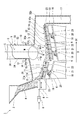
- the stoker furnace of the present embodiment is a stoker furnace for burning incinerators such as refuse, and as shown in FIG. 1, a hopper 2 for temporarily storing incinerators B and an incinerator for burning the incinerators B.
- the feeder 4 continuously extrudes the incinerated material B supplied onto the feed table 7 via the hopper 2 into the incinerator 3.
- the feeder 4 reciprocates on the feed table 7 with a predetermined stroke by the feeder driving device 8.
- the wind box 6 supplies primary air from a blower (not shown) to each part of the stoker 5.
- the incinerator 3 is provided above the stoker 5 and has a combustion chamber 9 composed of a primary combustion chamber and a secondary combustion chamber.
- the incinerator 3 has a secondary air supply nozzle 10 that supplies secondary air to the combustion chamber 9.
- the stalker 5 is a combustion device in which grate 15 and 16 are arranged in a stepwise manner.
- the incineration material B burns on the stoker 5.
- the direction in which the incinerated material B is transported is referred to as a transport direction D.
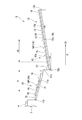
- the incinerated material B is transported on the stoker 5 in the transport direction D. 1, 2 and 3, the right side is the downstream side D1 in the transport direction.
- the surface on which the grate 15 or 16 is attached is referred to as an installation surface, and is installed on a horizontal plane with the upstream end (11b, 12b, 13b) of the drying stage 11, the combustion stage 12, or the post-combustion stage 13 as a center.
- the angle formed on the side in the transport direction D formed by the surface is referred to as a stalker inclination angle (installation angle). If the downstream side of the installation surface in the transport direction is upward from the horizontal plane, the stoker inclination angle is a positive value. .
- the stoker 5 includes a drying stage 11 for drying the incinerated material B, a combustion stage 12 for incinerating the incinerated material B, and a complete incineration of unburned matter (post-combustion) from the upstream side in the conveying direction of the incinerated material B. )), And a post-combustion stage 13.
- the stoker 5 performs drying, combustion, and post-combustion in the drying stage 11, the combustion stage 12, and the post-combustion stage 13 while sequentially transporting the incinerated material B.
- Each step 11, 12, 13 has a plurality of fixed grate 15 and a plurality of moving grate 16.
- the fixed grate 15 and the moving grate 16 are alternately arranged in the transport direction D.
- the moving grate 16 reciprocates in the transport direction D of the incinerated material B.
- the object B on the stoker 5 is transported and agitated by the reciprocating motion of the moving grate 16. That is, the lower part of the incinerated material B is moved and replaced with the upper part of the incinerated material B.
- the drying stage 11 receives the incinerated material B pushed out by the feeder 4 and dropped into the incinerator 3, evaporates the moisture of the incinerated material B, and partially decomposes it.
- the combustion stage 12 ignites the incinerated material B dried in the drying stage 11 with the primary air supplied from the lower wind box 6, and burns volatiles and fixed carbon.
- the post-combustion stage 13 burns unburned components such as fixed carbon which have passed through without being burned in the combustion stage 12 until they become completely ash.
- a discharge chute 17 is provided at the outlet of the post-combustion stage 13. The ash is discharged from the incinerator 3 through the discharge chute 17.
- the stoker furnace 1 has a front arch 31 extending from above the feeder 4 to at least above the drying stage 11, and a rear arch 32 extending from above the discharge chute 17 to at least above the post-combustion stage 13. I have. That is, the end 31 b of the downstream side D ⁇ b> 1 of the front arch 31 in the transport direction is located above the drying stage 11 or the combustion stage 12. Further, an end 32 a of the rear arch 32 on the upstream side in the transport direction is located above the combustion stage 12 or the post-combustion stage 13.
- the front arch 31 and the rear arch 32 are connected to a furnace wall 33 of the incinerator 3.
- the furnace wall 33 has a square tubular shape and guides exhaust gas generated by combustion of the incineration material B.
- the furnace wall 33 has a front wall 34 and a rear wall 35 facing the transport direction D, and a pair of side walls 36 along the transport direction D.
- the distance between the front wall 34 and the rear wall 35 and the distance between the pair of side walls 36 are, for example, 3 m to 4 m. Note that the front wall 34 is disposed upstream of the rear wall 35 in the transport direction D.
- the center line C of the square cylindrical furnace wall 33 is on the combustion stage 12. That is, a center line C passing through the center of the furnace wall 33 along the front wall 34, the rear wall 35, and the side wall 36 intersects with the combustion stage 12.
- the secondary air supply nozzle 10 is disposed on the front wall 34 and the rear wall 35.
- the secondary air supply nozzle 10 is directed to inject secondary air from the front wall 34 and the rear wall 35 toward the center of the furnace wall 33.
- the secondary air supply nozzle 10 is disposed on the front wall 34 and the rear wall 35, but may be disposed on the front arch 31 and the rear arch 32.
- the front arch 31 and the rear arch 32 are portions that form the ceiling (upper wall) of the stoker 5.
- the upstream end 31 a of the front arch 31 in the transport direction is located above the feeder 4.
- the vertical space between the end 31a of the front arch 31 on the upstream side in the transport direction and the feeder 4 is about 1 m.
- the front arch 31 is inclined such that an end 31b on the downstream side D1 in the transport direction is higher than an end 31a on the upstream side in the transport direction. That is, the front arch 31 is inclined so that the space in the stoker 5 becomes wider toward the downstream side D1 in the transport direction.
- the vertical distance between the end 32b of the rear arch 32 on the downstream side D1 in the transport direction and the end of the post-combustion stage 13 on the downstream side D1 in the transport direction is about 1 m.
- the end 32 b of the rear arch 32 on the downstream side D ⁇ b> 1 in the transport direction is located above the discharge chute 17.
- the rear arch 32 is inclined such that the end 32b on the downstream side D1 in the transport direction is lower than the end 32a on the upstream side in the transport direction. That is, the rear arch 32 is inclined so that the space in the stoker 5 becomes narrower toward the downstream side D1 in the transport direction.
- Each of the drying stage 11, the combustion stage 12, and the post-combustion stage 13 has a drive mechanism 18 for driving the moving grate 16. That is, the drying stage 11, the combustion stage 12, and the post-combustion stage 13 each have a drive mechanism 18 for driving a plurality of moving grate 16 separately.
- the drive mechanism 18 is attached to a beam 19 provided on the stalker 5.
- the drive mechanism 18 has a hydraulic cylinder 20 attached to the beam 19, an arm 21 operated by the hydraulic cylinder 20, and a beam 22 connected to a tip of the arm 21.
- the beam 22 and the moving grate 16 are connected via a bracket 23.
- the arm 21 operates by the expansion and contraction of the rod of the hydraulic cylinder 20.
- the beam 22 configured to move along the installation surface 11a of the drying stage 11, the installation surface 12a of the combustion stage 12, and the installation surface 13a of the post-combustion stage 13 moves. Is driven by the moving grate 16 connected to the grate.
- the drive mechanism 18 of the present embodiment uses the hydraulic cylinder 20, but is not limited to this, and may employ, for example, a hydraulic motor, an electric cylinder, a conductive linear motor, or the like.
- the form of the drive mechanism 18 is not limited to the above-described form, and may be any form as long as the movable grate 16 can be reciprocated.
- the beam 22 and the hydraulic cylinder 20 may be directly connected and driven without disposing the arm 21.
- the driving speed of the moving grate 16 in the drying stage 11, the combustion stage 12, and the post-combustion stage 13 is set to the same speed or the drying stage 11, the combustion stage 12, and the post-combustion stage 13. Can be at different speeds at least in part.
- the driving speed of the moving grate 16 in the combustion stage 12 is reduced, and the incineration object on the combustion stage 12 is reduced.
- the transport speed of B can be reduced to allow sufficient combustion.
- the fixed grate 15 and the moving grate 16 are located downstream of the installation surfaces 11 a, 12 a, and 13 a of the drying stage 11, the combustion stage 12, and the post-combustion stage 13 in the transport direction. It is arranged so that the side faces upward.
- a part of the moving grate 16 of the drying stage 11 is a grate 16P with projections (the others are normal grate described later).
- the moving grate 16 in the range R1 of 50% to 80% from the downstream side in the transport direction is a grate 16P with projections.
- the stirring power can be improved.
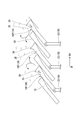
- the grate with projection 16 ⁇ / b> P has a plate-shaped grate main body 25 and a triangular protrusion 26 provided at the tip of the grate main body 25. The protrusion 26 protrudes upward from the upper surface of the grate main body 25.
- the shape of the projection 26 is not limited to this, and may be, for example, a trapezoidal shape or a round shape.
- the fixed grate 15 in FIG. 3 is a grate having no protrusion on the top surface of the tip, and this shape is called a normal grate.
- the moving grate 16 is a grate with projections 16P.
- the present invention is not limited to this, and both the moving grate 16 and the fixed grate 15 may be grate with projections.
- the range in which the grate with projections 16P is provided is not limited to the above-described range.
- all grate in the drying stage 11 may be the grate with projections 16P.
- all grate (fixed grate and moving grate) in the drying stage may be a normal grate.
- a part of the moving grate 16 in the combustion stage 12 is a grate 16P with projections.
- the moving grate 16 in the range R2 of 50% to 80% from the downstream side in the transport direction is the grate 16P with projections.
- the other moving grate 16 of the combustion stage 12 is a normal grate.
- both the moving grate 16 and the fixed grate 15 may be grate with projections, or all grate (fixed grate and moving grate) depending on the property and type of the incinerated material B. May be a normal grate.
- the moving grate 16 and the fixed grate 15 are both shown as normal grate in FIG. May be adopted.
- the drying stage 11, the combustion stage 12, and the post-combustion stage 13 are inclined so that their main surfaces face the main combustion part M.
- the main combustion portion M is near the lower end of the square tubular furnace wall 33 (in other words, near the end 31b of the front arch 31 and the end 32a of the rear arch 32) due to the burning of the incineration material B. This is a portion generated near the center line C of the furnace wall 33 and above the incineration object B. Radiant heat H from the flame of the main combustion part M is emitted radially around the main combustion part M.
- the drying stage 11 of the stoker 5 of the present embodiment is arranged downward. That is, the installation surface 11a of the drying stage 11 is inclined so that the downstream side D1 in the transport direction becomes lower.
- the stoker inclination angle ⁇ 1 of the drying stage 11 which is an angle between the horizontal plane centered on the upstream end 11b of the drying stage 11 and the transport direction side of the installation surface 11a is ⁇ 15 ° ( ⁇ 15 °). The angle is between ⁇ 25 ° (minus 25 °).
- the main surface (installation surface 11a) of the drying stage 11 faces the main combustion section M and receives the radiant heat H efficiently.
- the combustion stage 12 of the stoker 5 of the present embodiment is arranged upward. That is, the installation surface 12a of the combustion stage 12 is inclined such that the downstream side D1 in the transport direction is higher.
- the stoker inclination angle ⁇ 2 of the combustion stage 12 which is the angle between the horizontal plane centered on the upstream end 12b of the combustion stage 12 and the transport direction side of the installation surface 12a is from + 5 ° (+ 5 °).
- the angle is between + 15 ° (plus 15 degrees), preferably between + 8 ° (plus 5 degrees) and + 12 ° (plus 15 degrees).
- the main surface (installation surface 12a) of the combustion stage 12 faces the main combustion part M and receives the radiant heat H efficiently.
- the post-combustion stage 13 of the stoker 5 of the present embodiment is arranged upward. That is, the installation surface 13a of the post-combustion stage 13 is inclined such that the downstream side D1 in the transport direction becomes higher.
- the stoker inclination angle ⁇ 3 of the post-combustion stage 13 which is the angle between the horizontal plane around the upstream end 13b of the post-combustion stage 13 and the transport direction side of the installation surface 13a is the same as the stoker inclination angle ⁇ 2 of the combustion stage 12. is there.
- the stoker inclination angle ⁇ 3 of the post-combustion stage 13 which is the angle between the horizontal plane centered on the upstream end 13b of the post-combustion stage 13 and the transport direction side of the installation surface 13a is + 5 ° (+5 degrees).
- the main surface (installation surface 13a) of the post-combustion stage 13 faces the main combustion portion M and receives the radiant heat H efficiently.
- a step (fall wall) 27 is formed between the drying stage 11 and the combustion stage 12.
- the downstream end 11c of the drying stage 11 in the transport direction is formed to be vertically higher than the upstream end 12b of the combustion stage 12 in the transport direction.
- the combustion stage 12 and the post-combustion stage 13 are positioned such that the downstream end 12c of the combustion stage 12 in the transport direction and the upstream end 13b of the post-combustion stage 13 in the transport direction are at the same height. Is formed.
- the end 13c of the post-combustion stage 13 is disposed above the end 12c of the combustion stage 12.
- the function of the drying stage 11 is to efficiently dry the moisture in the incinerator B by the radiant heat H from the main combustion section M above the incinerator B and the sensible heat of the primary air from below the grate.
- the radiant heat H from the flame of the main combustion part M contributes more to the drying than the sensible heat of the primary air, and the upper layer of the incinerated material B tends to dry.
- the drying speed is improved by moving the lower part of the incineration object B upward by the stirring operation by the grate and replacing it with the upper part.
- the stirring operation it is necessary to ensure a sufficient length in the drying stage 11 to sufficiently evaporate water. The longer the length, the larger the device and the higher the cost, so the stalker length is required to be as short as possible.
- the absolute value of the stoker inclination angle is larger than the angle of repose of the incinerated material B, it collapses under its own weight, and a layer of the incinerated material B is not formed.
- the absolute value of the stoker inclination angle is made smaller than the angle of repose of the incineration object B, the stoker is realized, but the movement of the incineration object B by gravity (movement by its own weight) decreases.
- gravity acts in a direction to push the incinerated material B back from the transport direction. If the transport amount of the incinerated material B by the stalker 5 is smaller than the amount of the incinerated material B, the transport limit is reached and the processing becomes impossible.
- the optimum stoker inclination angle differs depending on the amount of the incinerator B to be charged and the water content of the incinerator B.
- description will be made assuming that the amount of the incinerator B to be charged is large and the moisture content is high (the amount of water is large), and the case where the load of the incinerator to be charged is large. Conversely, when the amount of the incinerator B to be charged is small and the moisture content is low, the load of the incinerator to be charged is small.
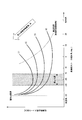
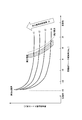
- the horizontal axis represents the stoker inclination angle of the drying stage 11
- the vertical axis represents the required stoker length of the drying stage 11
- the input incinerator load is the smallest in order from (1) when the input incinerator load is the highest.
- the required stoker length is a distance at which 95% of the moisture of the to-be-incinerated material B is dried.
- the “angle of repose” on the horizontal axis indicates the angle of repose of the incinerated material B.
- the stoker inclination angle of ⁇ 30 ° is the limit for forming the layer of the incineration material B.
- the required stoker length decreases as the stoker inclination angle decreases, but when the stoker inclination angle turns to a positive value, the required stoker length gradually increases. This is because, when the stoker inclination angle becomes a positive value, the installation surface becomes upward, and the transport speed becomes slow. As a result, the layer of the incinerator B becomes thicker, and the incinerator B in the lower layer hardly dries. Because it becomes.
- the incinerated material B is in any property and quantity.
- the optimum stoker inclination angle of the drying stage 11 that can properly process the stoker and minimize the stoker length is ⁇ 15 ° ( ⁇ 15 °) corresponding to the stoker length near the lowest point of the curve of (1). ) To ⁇ 25 ° (minus 25 °) is within an appropriate range. Then, the optimum value is ⁇ 20 ° ( ⁇ 20 °).
- the stoker inclination angle of the drying stage 11 is in the appropriate range as described above, the stoker inclination angle of the combustion stage 12 is between + 8 ° (plus 8 degrees) to + 12 ° (plus 12 degrees). The reason why the angle is suitable will be described.
- the function of the combustion stage 12 is to maintain the temperature of the layer of the incinerated material B by radiant heat H from the flame of the main combustion section M and self-combustion heat, to promote generation of combustible gas by pyrolysis of volatile matter, and to remain after pyrolysis. It burns fixed carbon.
- the required stoker length of the combustion stage 12 is determined by the time required for burning the fixed carbon.
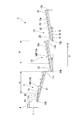
- FIG. 5 shows that when the stoker inclination angle of the drying stage 11 is within the appropriate range as described above, the horizontal axis is the stoker inclination angle of the combustion stage, the vertical axis is the required stoker length of the combustion stage, and The relationship between the stoker inclination angle of the combustion stage and the required stoker length of the combustion stage is plotted in order from the case where the load is the largest (1) to the case where the load of the incineration material is the smallest (4).
- the required stoker length of the combustion stage is a distance at which 95% of the combustible component volatilizes or burns.
- the stoker inclination angle of ⁇ 30 ° is the limit for forming the layer of the incineration material B.
- the required stoker length decreases as the angle becomes gentler.
- the appropriate range of the stoker inclination angle can be a range surrounded by a dashed line shown in FIG.
- the stoker inclination angle in the drying stage 11 is within an appropriate range, so that the reduction of the moisture content and the volume of the waste are promoted. For this reason, for example, even if the load in the drying stage 11 corresponds to (1), the load changes in the combustion stage 12 to those corresponding to (3) and (4). Stalker inclination angle can be adopted. That is, since the combustion stage can be directed upward, the residence time required for burning the fixed carbon can be secured, and the stoker length can be further reduced.
- FIG. 6 shows the case where the horizontal axis represents the stoker inclination angle of the combustion stage 12 and the vertical axis represents the stoker length required for both the drying stage 11 and the combustion stage 12, and the load of the incineration material B to be introduced is the largest (1)
- the plot of the relationship between the stoker inclination angle of the combustion stage 12 and the stoker length required in both the drying stage 11 and the combustion stage 12 until the load on the incinerator B to be introduced is the smallest (4). It is.
- the stoker inclination angle of the drying stage 11 is set to an optimum value of ⁇ 20 ° ( ⁇ 20 °).
- the appropriate range of the stoker inclination angle of the combustion stage 12 is approximately an angle between + 5 ° (+5 degrees) to + 15 ° (+15 degrees), more specifically, It can be seen that the angle is between + 8 ° (plus 8 degrees) and + 12 ° (plus 12 degrees).
- the stoker inclination angle of the drying stage 11 is the optimum value of ⁇ 20 ° ( ⁇ 20 degrees)
- the optimum value of the stoker inclination angle of the combustion stage 12 is + 10 ° (+10 degrees).
- the required stoker lengths of the drying stage 11 and the combustion stage 12 can be as short as possible by setting the respective stoker inclination angles within an appropriate range, particularly an optimum value.
- the radiant heat H of the main combustion portion M can be effectively received. Therefore, in the drying stage 11, the drying efficiency can be improved, and in the combustion stage 12, the combustion efficiency can be improved. Also in the post-combustion stage 13, the incinerated material B can be effectively ashed.
- the drying stage 11 is inclined downward, the incineration object B of any property can be transported to the combustion stage 12 without any delay, and the combustion stage 12 and the post-combustion stage 13 By being inclined upward, the incinerated material B is sufficiently burned and conveyed without easily sliding down or rolling down downstream of the combustion stage 12.
- the incinerated material B having a slippery material or a shape that easily rolls the material is conveyed to the combustion stage 12 early by rolling on the drying stage 11, so that the drying stage 11 may not be sufficiently dried.
- the combustion stage 12 and the post-combustion stage 13 are inclined upward, the incineration material B that has rolled down the drying stage 11 does not further roll down the combustion stage 12 and the post-combustion stage 13.
- always dry and incinerated since the incinerated material B having a high moisture content is conveyed to the combustion stage 12 while being dried without staying in the drying stage 11, it is also necessarily sufficiently incinerated in the combustion stage 12. Thereby, the incinerated material B can be continuously charged irrespective of the properties of the incinerated material B, and the unburned material of the incinerated material B can be eliminated.
- the end 13C of the post-combustion stage 13 on the downstream side in the conveyance direction is transported by the combustion stage 12. Since it is located vertically above the end portion 12C on the downstream side in the direction, it stops at least in the post-combustion stage 13 and is not discharged from the post-combustion stage 13. Since the post-combustion stage 13 and the combustion stage 12 are continuously connected without any level difference, even if the incinerated material B that is not sufficiently burned to the post-combustion stage 13 rolls and advances, for example, the self-weight is reduced. To return to the combustion stage 12 to perform combustion. That is, it is possible to minimize the discharge of the incompletely burned incinerator B.
- a stoker furnace according to a second embodiment of the present invention will be described in detail with reference to the drawings.
- differences from the above-described first embodiment will be mainly described, and the description of the same parts will be omitted.
- a step (fall wall) 28 is formed between the combustion stage 12 and the post-combustion stage 13 of the stoker 5 of the present embodiment.
- the downstream end 12c of the combustion stage 12 in the transport direction and the downstream end 13c of the post-combustion stage 13 in the transport direction are at the same position in the vertical direction, or the end 13c of the post-combustion stage 13 is Is disposed above the end 12c.
- the stoker furnace 1 of this embodiment is an example in which the downstream end 12c of the combustion stage 12 in the transport direction and the downstream end 13c of the post-combustion stage 13 in the transport direction have the same position in the vertical direction.
- the embodiments of the present invention have been described in detail with reference to the drawings.
- the specific configuration is not limited to the embodiments, and includes a design change or the like without departing from the gist of the present invention.
- tip of the grate 15,16 is arrange
- tip of the grate 15,16 of the drying stage 11 May be arranged to face the upstream side in the transport direction.
Landscapes
- Engineering & Computer Science (AREA)
- Mechanical Engineering (AREA)
- General Engineering & Computer Science (AREA)
- Chemical & Material Sciences (AREA)
- Combustion & Propulsion (AREA)
- Incineration Of Waste (AREA)
Abstract
Description
本願は、2018年8月30日に日本に出願された特願2018-161818号について優先権を主張し、その内容をここに援用する。
このため、乾燥段では、乾燥効率を向上させ、燃焼段では燃焼効率を向上させることができる。後燃焼段においても、効果的に灰化することができる。
すなわち、本発明のストーカ炉では、被焼却物の性状によらず被焼却物を連続投入でき、かつ、ストーカ全体として燃焼・灰化を効率的に行い、被焼却物の燃え残りを無くすることができる。
以下、本発明の第一実施形態のストーカ炉について図面を参照して詳細に説明する。
本実施形態のストーカ炉は、ごみ等の被焼却物燃焼用ストーカ炉であり、図1に示すように、被焼却物Bを一時的に貯留するホッパ2と、被焼却物Bを燃焼させる焼却炉3と、焼却炉3に被焼却物Bを供給するフィーダ4と、焼却炉3の底部側に設けられたストーカ5(乾燥段11、燃焼段12、及び後燃焼段13の火格子15、16を含む)と、ストーカ5の下方に設けられた風箱6と、を備えている。
風箱6は、送風機(図示せず)からの一次空気をストーカ5の各部に供給する。
焼却炉3は、ストーカ5の上方に設けられ、一次燃焼室と二次燃焼室からなる燃焼室9を有している。焼却炉3は、燃焼室9に二次空気を供給する二次空気供給ノズル10を有している。
以下、被焼却物Bが搬送される方向を搬送方向Dと呼ぶ。被焼却物Bは、ストーカ5上を搬送方向Dに搬送される。図1、図2、及び図3において、右側が搬送方向下流側D1である。また、火格子15、16が取り付けられる面を据付面と呼び、乾燥段11、燃焼段12、又は後燃焼段13の上流側の端部(11b、12b、13b)を中心として、水平面と据付面とによって形成される搬送方向D側の角度をストーカ傾斜角(据付角度)と呼ぶ。据付面の搬送方向下流側が水平面より上向きの場合は、ストーカ傾斜角は正の値とし、据付面の搬送方向下流側が水平面より下向きの場合は、ストーカ傾斜角は負の値として、ここでは説明する。
固定火格子15と移動火格子16とは、搬送方向Dで交互に配置されている。移動火格子16は、被焼却物Bの搬送方向Dに往復運動する。移動火格子16の往復運動によってストーカ5上の被焼却物Bが搬送されるとともに攪拌される。即ち、被焼却物Bの下層部が動かされ、被焼却物Bの上層部と入れ替えられる。
後燃焼段13の出口には、排出シュート17が設けられている。灰は、排出シュート17を通じて焼却炉3から排出される。
フロントアーチ31及びリアアーチ32は、焼却炉3の炉壁33に接続されている。炉壁33は、四角筒状をなし、被焼却物Bの燃焼により発生する排ガスを導出する。炉壁33は、搬送方向Dを向く前壁34及び後壁35と、搬送方向Dに沿う一対の側壁36と、を有している。前壁34と後壁35との間隔、及び一対の側壁36同士の間隔は、例えば、3m~4mである。なお、前壁34は後壁35より搬送方向Dの上流側に配置される。
二次空気供給ノズル10は、前壁34及び後壁35に配置されている。二次空気供給ノズル10は、前壁34及び後壁35から炉壁33の中心に向かって二次空気を噴射するように指向されている。
なお、本実施形態では二次空気供給ノズル10を前壁34及び後壁35に配置したが、フロントアーチ31及びリアアーチ32に配置してもよい。
フロントアーチ31は、搬送方向下流側D1の端部31bが搬送方向上流側の端部31aよりも高くなるように傾斜している。即ち、フロントアーチ31は、ストーカ5内の空間が搬送方向下流側D1に向かうに従って広くなるように傾斜している。
リアアーチ32の搬送方向下流側D1の端部32bは、排出シュート17の上方に位置している。リアアーチ32は、搬送方向下流側D1の端部32bが搬送方向上流側の端部32aよりも低くなるように傾斜している。即ち、リアアーチ32は、ストーカ5内の空間が搬送方向下流側D1に向かうに従って狭くなるように傾斜している。
例えば、燃焼段12で十分に燃焼させることが求められる被焼却物Bが投入された場合に、燃焼段12の移動火格子16の駆動の速度を遅くして、燃焼段12上の被焼却物Bの搬送速度を遅くし、十分に燃焼させることができる。
図3に示すように突起付火格子16Pは、板状の火格子本体25と、火格子本体25の先端に設けられた三角形状の突起26とを有している。突起26は、火格子本体25の上面から上方に突出している。突起26の形状は、これに限ることはなく、例えば、台形状や、丸形状とすることもできる。
ここで、図3の固定火格子15は、先端の上面に突起のない火格子であり、この形状をノーマル火格子という。
また、突起付火格子16Pを設ける範囲も上述した範囲に限ることはなく、例えば、乾燥段11の全ての火格子を突起付火格子16Pとしてもよい。
さらに、被焼却物Bの性状や種類によっては、乾燥段におけるすべての火格子(固定火格子及び移動火格子)をノーマル火格子としてもよい。
後燃焼段13の火格子は、図2では移動火格子16及び固定火格子15はいずれも全てノーマル火格子として示しているが、乾燥段11及び燃焼段12と同様に、突起付火格子を採用してもよい。
乾燥段11、燃焼段12、及び後燃焼段13は、その主面が主燃焼部Mに向くように傾斜している。ここで、主燃焼部Mは、被焼却物Bの燃焼により、四角筒状の炉壁33の下端近傍(言い換えれば、フロントアーチ31の端部31b及びリアアーチ32の端部32aの近傍)であって、炉壁33の中心線C近傍且つ被焼却物Bの上方に発生する部位である。主燃焼部Mの火炎からの輻射熱Hは、主燃焼部Mを中心に放射状に発せられる。
これにより、乾燥段11の主面(据付面11a)は、主燃焼部Mに向き、輻射熱Hを効率よく受ける。
これにより、燃焼段12の主面(据付面12a)は、主燃焼部Mに向き、輻射熱Hを効率よく受ける。
後燃焼段13の上流側の端部13bを中心とした水平面と据付面13aの搬送方向側の角度である後燃焼段13のストーカ傾斜角θ3は、燃焼段12のストーカ傾斜角θ2と同じである。具体的には、後燃焼段13の上流側の端部13bを中心とした水平面と据付面13aの搬送方向側の角度である後燃焼段13のストーカ傾斜角θ3は、+5°(プラス5度)から+15°(プラス15度)の間の角度、望ましくは+8°(プラス8度)から+12°(プラス12度)の間の角度である。
これにより、後燃焼段13の主面(据付面13a)は、主燃焼部Mに向き、輻射熱Hを効率よく受ける。
なお、後燃焼段13のストーカ傾斜角θ3は、θ2≠θ3としてもよく、また、θ2=θ3でもよい。
燃焼段12と後燃焼段13との間には段差(落差壁)がない。即ち、燃焼段12と後燃焼段13とは、連続的に接続されている。換言すれば、燃焼段12と後燃焼段13とは、燃焼段12の搬送方向下流側の端部12cと後燃焼段13の搬送方向上流側の端部13bとが同じ高さになるように形成されている。
これにより、後燃焼段13の端部13cが燃焼段12の端部12cよりも上方に配置される。
乾燥段11の機能は、被焼却物Bの上方にある主燃焼部Mからの輻射熱H及び火格子下からの一次空気の顕熱により効率良く被焼却物B中の水分を乾燥させることである。
ここで、主燃焼部Mの火炎からの輻射熱Hの方が、一次空気の顕熱に比べて乾燥への寄与度が高く、被焼却物Bの上層部の乾燥が進行しやすい。
このため、火格子による撹拌動作によって、被焼却物Bの下層部を上方へ動かし、上層部と入れ替えることで乾燥速度を向上させている。
しかし、撹拌動作を行っても、乾燥段11において、水分蒸発が十分に進むだけの長さの確保は必要となる。長さが長くなればなるほど装置が大型化しコストもかかるので、ストーカ長を可能な限り短くすることが求められる。
ストーカ5による被焼却物Bの搬送量が投入された被焼却物Bの量を下回ると、搬送限界となり処理不能となる。
ここで、必要ストーカ長とは、投入される被焼却物Bの水分の95%が乾燥する距離である。横軸の「安息角」は、被焼却物Bの安息角を示すものである。
投入される被焼却物Bの負荷が最も大きい場合(1)から投入される被焼却物Bの負荷が最も小さい場合(4)までの4つのケースから、被焼却物Bがいかなる性状、量であっても適正に処理でき、かつ、ストーカ長を最も短くできる最適な乾燥段11のストーカ傾斜角は、(1)の曲線の最下点近傍のストーカ長に対応する-15°(マイナス15度)から-25°(マイナス25度)の間の角度が適正範囲であることが分かる。そして、最適値は-20°(マイナス20度)となる。
燃焼段12の機能は、主燃焼部Mの火炎からの輻射熱H、自己燃焼熱により被焼却物Bの層の温度を維持し、揮発分の熱分解による可燃ガスの発生促進、熱分解後に残った固定炭素の燃焼を行うものである。
乾燥段11と燃焼段12の必要ストーカ長は、各々のストーカ傾斜角を適正範囲、特に最適値とすることで可能な限り短いストーカ長とすることができるので、後燃焼段13まで含めても、比較的小さなサイズかつ低コストなストーカ炉とすることができる。
なお、後燃焼段13のストーカ傾斜角θ3は、上述の燃焼段12のストーカ傾斜角θ2と同一の角度範囲内でθ2≠θ3としてもよく、また、θ2=θ3でもよい。
これにより、被焼却物Bの性状によらず被焼却物Bを連続投入でき、かつ、被焼却物Bの燃え残りを無くすることができる。
以下、本発明の第二実施形態のストーカ炉について図面を参照して詳細に説明する。なお、本実施形態では、上述した第一実施形態との相違点を中心に述べ、同様の部分についてはその説明を省略する。
図7に示すように、本実施形態のストーカ5の燃焼段12と後燃焼段13との間には段差(落差壁)28が形成されている。
なお、上記実施形態では、火格子15、16の先端が搬送方向下流側D1を向くように配置されているが、これに限ることはなく、例えば、乾燥段11の火格子15、16の先端が搬送方向上流側を向くように配置されてもよい。
2 ホッパ
3 焼却炉
4 フィーダ
5 ストーカ
6 風箱
7 フィードテーブル
8 フィーダ駆動装置
9 燃焼室
10 二次空気供給ノズル
11 乾燥段
11a 乾燥段の据付面
12 燃焼段
12a 燃焼段の据付面
13 後燃焼段
13a 後燃焼段の据付面
15 固定火格子
16 移動火格子
16P 突起付火格子
17 排出シュート
18 駆動機構
19 梁
20 油圧シリンダ
21 アーム
22 ビーム
23 ブラケット
25 火格子本体
26 突起
27、28 段差(落差壁)
31 フロントアーチ
32 リアアーチ
33 炉壁
34 前壁
35 後壁
36 側壁
B 被焼却物
C 中心線
D 搬送方向
D1 搬送方向下流側
H 輻射熱
M 主燃焼部
θ1、θ2、θ3 ストーカ傾斜角
Claims (5)
- フィーダから被焼却物を供給し、複数の固定火格子と複数の移動火格子を備えた乾燥段、燃焼段、及び後燃焼段で、前記被焼却物を順次搬送しつつ、それぞれ乾燥、燃焼、及び後燃焼を行い、前記後燃焼段に接続された排出シュートから前記後燃焼後の前記被焼却物を排出するストーカ炉において、
前記フィーダの上方から前記乾燥段または前記燃焼段の上方まで延在するフロントアーチと、
前記排出シュートの上方から前記後燃焼段または前記燃焼段の上方まで延在するリアアーチと、
前記フロントアーチと前記リアアーチに接続され、前記被焼却物の燃焼により発生する排ガスを導出する四角筒状の炉壁と、を有し、
前記乾燥段、前記燃焼段、及び前記後燃焼段の各々の主面が、前記燃焼段の上方に生成される主燃焼部に向くよう、前記乾燥段は、前記搬送方向下流側が下向きとなるように傾斜して配置され、前記燃焼段は、前記乾燥段に接続され、前記搬送方向下流側が上向きとなるように傾斜して配置され、
前記後燃焼段は、前記燃焼段に接続され、前記搬送方向下流側が上向きとなるように傾斜して配置されることを特徴とするストーカ炉。 - 前記四角筒状の炉壁の中心線は、前記燃焼段上にあることを特徴とする請求項1に記載のストーカ炉。
- 前記後燃焼段の前記搬送方向下流側の端部は、鉛直方向において、前記燃焼段の前記搬送方向下流側の端部と同位置、または、前記燃焼段の前記端部よりも上方に配置されていることを特徴とする請求項2に記載のストーカ炉。
- 前記固定火格子及び前記移動火格子は、前記乾燥段、前記燃焼段、及び前記後燃焼段の据付面に対して前記搬送方向下流側が上向きとなるように傾斜して配置されていること
を特徴とする請求項3に記載のストーカ炉。 - 前記燃焼段と前記後燃焼段は、段差なく連続的に接続されていることを特徴とする請求項1から請求項4のいずれか一項に記載のストーカ炉。
Priority Applications (10)
| Application Number | Priority Date | Filing Date | Title |
|---|---|---|---|
| EP18931298.6A EP3845805B1 (en) | 2018-08-30 | 2018-10-26 | Stoker furnace |
| KR1020217008988A KR102318471B1 (ko) | 2018-08-30 | 2018-10-26 | 스토커로 |
| MYPI2020001784A MY199055A (en) | 2018-08-30 | 2018-10-26 | Stoker furnace |
| SG11202003072YA SG11202003072YA (en) | 2018-08-30 | 2018-10-26 | Stoker furnace |
| RU2020114370A RU2751531C1 (ru) | 2018-08-30 | 2018-10-26 | Механическая слоевая топка |
| PL18931298.6T PL3845805T3 (pl) | 2018-08-30 | 2018-10-26 | Piec z rusztem mechanicznym |
| BR112020007994-4A BR112020007994B1 (pt) | 2018-08-30 | 2018-10-26 | forno com carregador mecânico |
| DK18931298.6T DK3845805T3 (da) | 2018-08-30 | 2018-10-26 | Stoker-ovn |
| CN201880008523.7A CN111133252A (zh) | 2018-08-30 | 2018-10-26 | 炉排炉 |
| PH12020550233A PH12020550233A1 (en) | 2018-08-30 | 2020-04-07 | Stoker furnace |
Applications Claiming Priority (2)
| Application Number | Priority Date | Filing Date | Title |
|---|---|---|---|
| JP2018-161818 | 2018-08-30 | ||
| JP2018161818A JP6484874B1 (ja) | 2018-08-30 | 2018-08-30 | ストーカ炉 |
Publications (1)
| Publication Number | Publication Date |
|---|---|
| WO2020044578A1 true WO2020044578A1 (ja) | 2020-03-05 |
Family
ID=65802247
Family Applications (1)
| Application Number | Title | Priority Date | Filing Date |
|---|---|---|---|
| PCT/JP2018/039873 Ceased WO2020044578A1 (ja) | 2018-08-30 | 2018-10-26 | ストーカ炉 |
Country Status (13)
| Country | Link |
|---|---|
| EP (1) | EP3845805B1 (ja) |
| JP (1) | JP6484874B1 (ja) |
| KR (1) | KR102318471B1 (ja) |
| CN (1) | CN111133252A (ja) |
| BR (1) | BR112020007994B1 (ja) |
| DK (1) | DK3845805T3 (ja) |
| MY (1) | MY199055A (ja) |
| PH (1) | PH12020550233A1 (ja) |
| PL (1) | PL3845805T3 (ja) |
| RU (1) | RU2751531C1 (ja) |
| SG (1) | SG11202003072YA (ja) |
| TW (1) | TWI706112B (ja) |
| WO (1) | WO2020044578A1 (ja) |
Cited By (1)
| Publication number | Priority date | Publication date | Assignee | Title |
|---|---|---|---|---|
| CN111853794A (zh) * | 2020-07-28 | 2020-10-30 | 广州市顺创科技有限公司 | 一种生活垃圾固体废物处理用焚烧装置 |
Families Citing this family (1)
| Publication number | Priority date | Publication date | Assignee | Title |
|---|---|---|---|---|
| CN118582751A (zh) * | 2024-06-24 | 2024-09-03 | 光大绿色环保技术服务(江苏)有限公司 | 一种用于低热值整捆秸秆气化耦合的燃烧锅炉 |
Citations (8)
| Publication number | Priority date | Publication date | Assignee | Title |
|---|---|---|---|---|
| JPS5712053A (en) | 1980-06-25 | 1982-01-21 | Dainippon Toryo Co Ltd | Corrosion-resisting lining composition |
| JPS57127129A (en) | 1981-01-30 | 1982-08-07 | Atsugi Motor Parts Co Ltd | Fluid coupler |
| JPS5986814A (ja) | 1982-11-10 | 1984-05-19 | Sanki Eng Co Ltd | ごみ焼却炉における自動燃焼制御方法 |
| JPH0684140A (ja) | 1992-09-07 | 1994-03-25 | Fujitsu Ltd | 接触型薄膜磁気ヘッド |
| JPH06265125A (ja) | 1993-03-15 | 1994-09-20 | Unitika Ltd | ごみ焼却炉の火格子 |
| JPH09280520A (ja) * | 1996-04-10 | 1997-10-31 | Mitsubishi Heavy Ind Ltd | ごみ等の被焼却物燃焼用ストーカ炉 |
| JP2009121747A (ja) * | 2007-11-15 | 2009-06-04 | Hitachi Zosen Corp | 二次燃焼室における二次燃焼空気の吹き込み方法 |
| JP2018161818A (ja) | 2017-03-27 | 2018-10-18 | セイコーエプソン株式会社 | 収容ユニットおよび収容ユニットの液体量管理方法 |
Family Cites Families (11)
| Publication number | Priority date | Publication date | Assignee | Title |
|---|---|---|---|---|
| DE2338370C3 (de) * | 1973-07-28 | 1978-09-21 | Johannes Josef Dr.-Ing. Martin | Feuerung mit drei stufenförmig hintereinander angeordneten Einzelrosten |
| CH567230A5 (ja) * | 1973-10-08 | 1975-09-30 | Kuenstler Hans | |
| RU2088850C1 (ru) * | 1994-04-05 | 1997-08-27 | Научно-производственное предприятие "ЭНЭКО" | Механическая топка |
| RU94038626A (ru) * | 1994-10-14 | 1996-09-10 | Чамин В.А. | Способ сжигания высоковлажных отходов и коры |
| CN1285857C (zh) * | 2003-04-22 | 2006-11-22 | 株式会社田熊 | 用于机动炉排燃烧装置中的炉篦和用于炉篦形成的炉篦体 |
| JP5712053B2 (ja) | 2010-07-15 | 2015-05-07 | 株式会社キッツエスシーティー | バルブ用アクチュエータ |
| KR101438578B1 (ko) * | 2014-05-22 | 2014-09-12 | 지이큐솔루션 주식회사 | 화격자 및 이를 구비한 스토커와 소각로 |
| CN205261569U (zh) * | 2015-12-29 | 2016-05-25 | 重庆科技学院 | 双层机械炉排式垃圾气化焚烧系统 |
| CN205979803U (zh) * | 2016-07-29 | 2017-02-22 | 北京航天动力研究所 | 交替运动式炉排垃圾焚烧炉 |
| JP6397107B1 (ja) * | 2017-10-17 | 2018-09-26 | 三菱重工環境・化学エンジニアリング株式会社 | ごみ等の被焼却物燃焼用ストーカ炉 |
| JP6393822B1 (ja) * | 2017-12-28 | 2018-09-19 | 三菱重工環境・化学エンジニアリング株式会社 | ストーカ炉用シール装置及びストーカ炉 |
-
2018
- 2018-08-30 JP JP2018161818A patent/JP6484874B1/ja active Active
- 2018-10-26 SG SG11202003072YA patent/SG11202003072YA/en unknown
- 2018-10-26 MY MYPI2020001784A patent/MY199055A/en unknown
- 2018-10-26 DK DK18931298.6T patent/DK3845805T3/da active
- 2018-10-26 WO PCT/JP2018/039873 patent/WO2020044578A1/ja not_active Ceased
- 2018-10-26 KR KR1020217008988A patent/KR102318471B1/ko active Active
- 2018-10-26 BR BR112020007994-4A patent/BR112020007994B1/pt active IP Right Grant
- 2018-10-26 EP EP18931298.6A patent/EP3845805B1/en active Active
- 2018-10-26 RU RU2020114370A patent/RU2751531C1/ru active
- 2018-10-26 PL PL18931298.6T patent/PL3845805T3/pl unknown
- 2018-10-26 CN CN201880008523.7A patent/CN111133252A/zh active Pending
-
2019
- 2019-07-25 TW TW108126295A patent/TWI706112B/zh active
-
2020
- 2020-04-07 PH PH12020550233A patent/PH12020550233A1/en unknown
Patent Citations (8)
| Publication number | Priority date | Publication date | Assignee | Title |
|---|---|---|---|---|
| JPS5712053A (en) | 1980-06-25 | 1982-01-21 | Dainippon Toryo Co Ltd | Corrosion-resisting lining composition |
| JPS57127129A (en) | 1981-01-30 | 1982-08-07 | Atsugi Motor Parts Co Ltd | Fluid coupler |
| JPS5986814A (ja) | 1982-11-10 | 1984-05-19 | Sanki Eng Co Ltd | ごみ焼却炉における自動燃焼制御方法 |
| JPH0684140A (ja) | 1992-09-07 | 1994-03-25 | Fujitsu Ltd | 接触型薄膜磁気ヘッド |
| JPH06265125A (ja) | 1993-03-15 | 1994-09-20 | Unitika Ltd | ごみ焼却炉の火格子 |
| JPH09280520A (ja) * | 1996-04-10 | 1997-10-31 | Mitsubishi Heavy Ind Ltd | ごみ等の被焼却物燃焼用ストーカ炉 |
| JP2009121747A (ja) * | 2007-11-15 | 2009-06-04 | Hitachi Zosen Corp | 二次燃焼室における二次燃焼空気の吹き込み方法 |
| JP2018161818A (ja) | 2017-03-27 | 2018-10-18 | セイコーエプソン株式会社 | 収容ユニットおよび収容ユニットの液体量管理方法 |
Non-Patent Citations (1)
| Title |
|---|
| See also references of EP3845805A4 |
Cited By (1)
| Publication number | Priority date | Publication date | Assignee | Title |
|---|---|---|---|---|
| CN111853794A (zh) * | 2020-07-28 | 2020-10-30 | 广州市顺创科技有限公司 | 一种生活垃圾固体废物处理用焚烧装置 |
Also Published As
| Publication number | Publication date |
|---|---|
| SG11202003072YA (en) | 2020-05-28 |
| RU2751531C1 (ru) | 2021-07-14 |
| MY199055A (en) | 2023-10-11 |
| KR20210040160A (ko) | 2021-04-12 |
| CN111133252A (zh) | 2020-05-08 |
| TW202012847A (zh) | 2020-04-01 |
| BR112020007994A2 (pt) | 2020-06-23 |
| PH12020550233A1 (en) | 2021-02-08 |
| EP3845805A1 (en) | 2021-07-07 |
| KR102318471B1 (ko) | 2021-10-27 |
| DK3845805T3 (da) | 2024-09-23 |
| EP3845805A4 (en) | 2022-08-17 |
| TWI706112B (zh) | 2020-10-01 |
| BR112020007994B1 (pt) | 2020-12-01 |
| EP3845805B1 (en) | 2024-07-10 |
| JP6484874B1 (ja) | 2019-03-20 |
| JP2020034233A (ja) | 2020-03-05 |
| PL3845805T3 (pl) | 2024-11-18 |
Similar Documents
| Publication | Publication Date | Title |
|---|---|---|
| JP6450987B1 (ja) | ストーカ炉 | |
| EP3699490B1 (en) | Stoker furnace for burning material to be incinerated | |
| WO2020044578A1 (ja) | ストーカ炉 | |
| JP6393822B1 (ja) | ストーカ炉用シール装置及びストーカ炉 | |
| JP3219379U (ja) | ストーカ炉 | |
| JP6481231B1 (ja) | ストーカ炉 | |
| JP2019199991A (ja) | 廃棄物焼却炉及び廃棄物焼却方法 |
Legal Events
| Date | Code | Title | Description |
|---|---|---|---|
| 121 | Ep: the epo has been informed by wipo that ep was designated in this application |
Ref document number: 18931298 Country of ref document: EP Kind code of ref document: A1 |
|
| REG | Reference to national code |
Ref country code: BR Ref legal event code: B01A Ref document number: 112020007994 Country of ref document: BR |
|
| ENP | Entry into the national phase |
Ref document number: 112020007994 Country of ref document: BR Kind code of ref document: A2 Effective date: 20200422 |
|
| NENP | Non-entry into the national phase |
Ref country code: DE |
|
| ENP | Entry into the national phase |
Ref document number: 2018931298 Country of ref document: EP Effective date: 20210330 |