WO2020049792A1 - Matériau actif d'électrode positive et batterie le comprenant - Google Patents
Matériau actif d'électrode positive et batterie le comprenant Download PDFInfo
- Publication number
- WO2020049792A1 WO2020049792A1 PCT/JP2019/017894 JP2019017894W WO2020049792A1 WO 2020049792 A1 WO2020049792 A1 WO 2020049792A1 JP 2019017894 W JP2019017894 W JP 2019017894W WO 2020049792 A1 WO2020049792 A1 WO 2020049792A1
- Authority
- WO
- WIPO (PCT)
- Prior art keywords
- positive electrode
- electrode active
- active material
- battery
- composite oxide
- Prior art date
- Legal status (The legal status is an assumption and is not a legal conclusion. Google has not performed a legal analysis and makes no representation as to the accuracy of the status listed.)
- Ceased
Links
Images
Classifications
-
- C—CHEMISTRY; METALLURGY
- C01—INORGANIC CHEMISTRY
- C01D—COMPOUNDS OF ALKALI METALS, i.e. LITHIUM, SODIUM, POTASSIUM, RUBIDIUM, CAESIUM, OR FRANCIUM
- C01D15/00—Lithium compounds
-
- C—CHEMISTRY; METALLURGY
- C01—INORGANIC CHEMISTRY
- C01G—COMPOUNDS CONTAINING METALS NOT COVERED BY SUBCLASSES C01D OR C01F
- C01G45/00—Compounds of manganese
-
- H—ELECTRICITY
- H01—ELECTRIC ELEMENTS
- H01M—PROCESSES OR MEANS, e.g. BATTERIES, FOR THE DIRECT CONVERSION OF CHEMICAL ENERGY INTO ELECTRICAL ENERGY
- H01M10/00—Secondary cells; Manufacture thereof
- H01M10/05—Accumulators with non-aqueous electrolyte
- H01M10/052—Li-accumulators
-
- H—ELECTRICITY
- H01—ELECTRIC ELEMENTS
- H01M—PROCESSES OR MEANS, e.g. BATTERIES, FOR THE DIRECT CONVERSION OF CHEMICAL ENERGY INTO ELECTRICAL ENERGY
- H01M10/00—Secondary cells; Manufacture thereof
- H01M10/05—Accumulators with non-aqueous electrolyte
- H01M10/056—Accumulators with non-aqueous electrolyte characterised by the materials used as electrolytes, e.g. mixed inorganic/organic electrolytes
- H01M10/0561—Accumulators with non-aqueous electrolyte characterised by the materials used as electrolytes, e.g. mixed inorganic/organic electrolytes the electrolyte being constituted of inorganic materials only
- H01M10/0562—Solid materials
-
- H—ELECTRICITY
- H01—ELECTRIC ELEMENTS
- H01M—PROCESSES OR MEANS, e.g. BATTERIES, FOR THE DIRECT CONVERSION OF CHEMICAL ENERGY INTO ELECTRICAL ENERGY
- H01M10/00—Secondary cells; Manufacture thereof
- H01M10/05—Accumulators with non-aqueous electrolyte
- H01M10/056—Accumulators with non-aqueous electrolyte characterised by the materials used as electrolytes, e.g. mixed inorganic/organic electrolytes
- H01M10/0564—Accumulators with non-aqueous electrolyte characterised by the materials used as electrolytes, e.g. mixed inorganic/organic electrolytes the electrolyte being constituted of organic materials only
- H01M10/0565—Polymeric materials, e.g. gel-type or solid-type
-
- H—ELECTRICITY
- H01—ELECTRIC ELEMENTS
- H01M—PROCESSES OR MEANS, e.g. BATTERIES, FOR THE DIRECT CONVERSION OF CHEMICAL ENERGY INTO ELECTRICAL ENERGY
- H01M10/00—Secondary cells; Manufacture thereof
- H01M10/05—Accumulators with non-aqueous electrolyte
- H01M10/056—Accumulators with non-aqueous electrolyte characterised by the materials used as electrolytes, e.g. mixed inorganic/organic electrolytes
- H01M10/0564—Accumulators with non-aqueous electrolyte characterised by the materials used as electrolytes, e.g. mixed inorganic/organic electrolytes the electrolyte being constituted of organic materials only
- H01M10/0566—Liquid materials
-
- H—ELECTRICITY
- H01—ELECTRIC ELEMENTS
- H01M—PROCESSES OR MEANS, e.g. BATTERIES, FOR THE DIRECT CONVERSION OF CHEMICAL ENERGY INTO ELECTRICAL ENERGY
- H01M4/00—Electrodes
- H01M4/02—Electrodes composed of, or comprising, active material
- H01M4/36—Selection of substances as active materials, active masses, active liquids
- H01M4/48—Selection of substances as active materials, active masses, active liquids of inorganic oxides or hydroxides
- H01M4/485—Selection of substances as active materials, active masses, active liquids of inorganic oxides or hydroxides of mixed oxides or hydroxides for inserting or intercalating light metals, e.g. LiTi2O4 or LiTi2OxFy
-
- H—ELECTRICITY
- H01—ELECTRIC ELEMENTS
- H01M—PROCESSES OR MEANS, e.g. BATTERIES, FOR THE DIRECT CONVERSION OF CHEMICAL ENERGY INTO ELECTRICAL ENERGY
- H01M4/00—Electrodes
- H01M4/02—Electrodes composed of, or comprising, active material
- H01M4/36—Selection of substances as active materials, active masses, active liquids
- H01M4/48—Selection of substances as active materials, active masses, active liquids of inorganic oxides or hydroxides
- H01M4/50—Selection of substances as active materials, active masses, active liquids of inorganic oxides or hydroxides of manganese
- H01M4/505—Selection of substances as active materials, active masses, active liquids of inorganic oxides or hydroxides of manganese of mixed oxides or hydroxides containing manganese for inserting or intercalating light metals, e.g. LiMn2O4 or LiMn2OxFy
-
- H—ELECTRICITY
- H01—ELECTRIC ELEMENTS
- H01M—PROCESSES OR MEANS, e.g. BATTERIES, FOR THE DIRECT CONVERSION OF CHEMICAL ENERGY INTO ELECTRICAL ENERGY
- H01M4/00—Electrodes
- H01M4/02—Electrodes composed of, or comprising, active material
- H01M4/36—Selection of substances as active materials, active masses, active liquids
- H01M4/48—Selection of substances as active materials, active masses, active liquids of inorganic oxides or hydroxides
- H01M4/52—Selection of substances as active materials, active masses, active liquids of inorganic oxides or hydroxides of nickel, cobalt or iron
- H01M4/525—Selection of substances as active materials, active masses, active liquids of inorganic oxides or hydroxides of nickel, cobalt or iron of mixed oxides or hydroxides containing iron, cobalt or nickel for inserting or intercalating light metals, e.g. LiNiO2, LiCoO2 or LiCoOxFy
-
- Y—GENERAL TAGGING OF NEW TECHNOLOGICAL DEVELOPMENTS; GENERAL TAGGING OF CROSS-SECTIONAL TECHNOLOGIES SPANNING OVER SEVERAL SECTIONS OF THE IPC; TECHNICAL SUBJECTS COVERED BY FORMER USPC CROSS-REFERENCE ART COLLECTIONS [XRACs] AND DIGESTS
- Y02—TECHNOLOGIES OR APPLICATIONS FOR MITIGATION OR ADAPTATION AGAINST CLIMATE CHANGE
- Y02E—REDUCTION OF GREENHOUSE GAS [GHG] EMISSIONS, RELATED TO ENERGY GENERATION, TRANSMISSION OR DISTRIBUTION
- Y02E60/00—Enabling technologies; Technologies with a potential or indirect contribution to GHG emissions mitigation
- Y02E60/10—Energy storage using batteries
Definitions
- the present disclosure relates to a positive electrode active material and a battery including the same.
- Patent Literature 1 discloses a lithium composite transition metal oxide having a chemical composition represented by a general formula Li a MO x (where M is an element containing at least one selected from Ni element, Co element, and Mn element). It has been disclosed.
- the ratio (I 020 / I 003 ) of the integrated intensity (I 020 ) of the peak of the (020) plane, which belongs to (0), is 0.02 to 0.3.
- An object of the present disclosure is to provide a positive electrode active material used for a battery having a high capacity.
- Positive electrode active material Including lithium composite oxide, The lithium composite oxide, A first phase having a crystal structure belonging to monoclinic, A second phase having a hexagonal crystal structure, and a third phase having a cubic crystal structure, And the following formula (I) is satisfied: 0.05 ⁇ integrated intensity ratio I (18 ° -20 °) / I (43 ° -46 °) ⁇ 0.99 (I).
- the integrated intensity ratio I (18 ° -20 °) / I (43 ° -46 °) is equal to the ratio of the integrated intensity I (18 ° -20 °) to the integrated intensity I (43 ° -46 °)
- the integrated intensity I (43 ° -46 °) is the integrated intensity of the first peak, which is the maximum peak in the diffraction angle 2 ⁇ range of 43 ° to 46 ° in the X-ray diffraction pattern of the lithium composite oxide.
- the integrated intensity I (18 ° -20 °) is the maximum peak in the range of the diffraction angle 2 ⁇ between 18 ° and 20 ° in the X-ray diffraction pattern of the lithium composite oxide. This is the integrated intensity of the peak.
- the present disclosure provides a positive electrode active material for realizing a high-capacity battery.
- the present disclosure also provides a battery including a positive electrode including the positive electrode active material, a negative electrode, and an electrolyte.
- the battery has a high capacity.
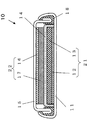
- FIG. 1 shows a cross-sectional view of a battery 10 according to the second embodiment.
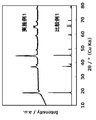
- FIG. 2 is a graph showing X-ray diffraction patterns of the positive electrode active materials of Example 1 and Comparative Example 1.
- the positive electrode active material in Embodiment 1 includes a lithium composite oxide.
- the lithium composite oxide has a multiphase including a first phase having a monoclinic crystal structure, a second phase having a hexagonal crystal structure, and a third phase having a cubic crystal structure. It is a mixture. Further, the following expression (I) is satisfied. 0.05 ⁇ integrated intensity ratio I (18 ° -20 °) / I (43 ° -46 °) ⁇ 0.99 (I).
- the integrated intensity ratio I (18 ° -20 °) / I (43 ° -46 °) is equal to the ratio of the integrated intensity I (18 ° -20 °) to the integrated intensity I (43 ° -46 °)
- the integrated intensity I (43 ° -46 °) is the integrated intensity of the first peak, which is the maximum peak in the diffraction angle 2 ⁇ range of 43 ° to 46 ° in the X-ray diffraction pattern of the lithium composite oxide.
- the integrated intensity I (18 ° -20 °) is the maximum peak in the range of the diffraction angle 2 ⁇ between 18 ° and 20 ° in the X-ray diffraction pattern of the lithium composite oxide. This is the integrated intensity of the peak.
- the positive electrode active material according to the first embodiment is used for improving the capacity of a battery.
- the lithium ion battery including the positive electrode active material in Embodiment 1 has an oxidation-reduction potential of about 3.4 V (Li / Li + reference).
- the lithium ion battery generally has a capacity of 260 mAh / g or more.
- the crystal structure belonging to a monoclinic has a structure in which Li layers and transition metal layers are alternately stacked.
- the transition metal layer may contain not only a transition metal but also Li. Therefore, in the crystal structure belonging to the monoclinic, a larger amount of Li is occluded in the crystal structure than in LiCoO 2 which is a generally used conventional material.
- LiCoO 2 which is a generally used conventional material.
- rearrangement of atoms occurs with movement of Li in the transition metal layer. It is believed that the rearrangement of the atoms deteriorates the cycle characteristics of the battery.
- the crystal structure belonging to a hexagonal crystal has a structure in which Li layers and transition metal layers are alternately stacked.
- a crystal structure belonging to a hexagonal system since Li is desorbed and inserted at the time of charge and discharge in a two-dimensional plane of the Li layer, Li has high diffusivity. Therefore, it is considered that a battery having excellent rate characteristics can be realized.
- the amount of Li in the transition metal layer included in the crystal structure belonging to the hexagonal system is smaller than that in the crystal structure belonging to the monoclinic system. Therefore, when only the crystal structure belonging to the hexagonal system is used, it is considered that the capacity of the battery is reduced.
- a change in the crystal structure due to desorption and insertion of Li during charge and discharge is small.
- the crystal structure belonging to the cubic system is strong. Therefore, the crystal structure belonging to the cubic system has excellent cycle characteristics.
- the amount of Li that can be contained in the crystal structure is reduced, so that the battery capacity is considered to be reduced.
- the lithium composite oxide according to Embodiment 1 has a first phase having a crystal structure belonging to monoclinic, a second phase having a crystal structure belonging to hexagonal, and a third phase having a crystal structure belonging to cubic.
- the inclusion of the phases improves the capacity of the battery due to the synergistic effect of these three crystal structure features.
- the monoclinic may have a space group C2 / m.
- the lithium composite oxide whose monoclinic is in the space group C2 / m further improves the capacity of the battery.
- the hexagonal crystal may have a space group of R-3m.
- the lithium composite oxide whose hexagonal crystal belongs to the space group R-3m further improves the capacity of the battery.
- the cubic crystal may be at least one selected from the group consisting of space group Fm-3m and space group Fd-3m. That is, the third phase may have a crystal structure belonging to the space group Fm-3m or the space group Fd-3m. The third phase may have both a crystal structure belonging to the space group Fm-3m and a crystal structure belonging to the space group Fd-3m.
- the lithium composite oxide in which the cubic crystal is at least one of the space group Fm-3m and the space group Fd-3m further improves the capacity of the battery.
- the integrated intensity ratio I (18 ° -20 °) / I (43 ° -46 °) is 0.05 or more and 0.99 or less.
- the integrated intensity ratio I (18 ° -20 °) / I (43 ° -46 °) is calculated based on the total amount of the first phase and the second phase, and It is a parameter that can be used as an indicator of the abundance with the phase. It is considered that as the abundance ratio of the total amount of the first phase and the second phase increases, the integrated intensity ratio I (18 ° -20 °) / I (43 ° -46 °) increases. On the other hand, when the abundance ratio of the third phase increases, the integrated intensity ratio I (18 ° -20 °) / I (43 ° -46 °) is considered to decrease.
- the integrated intensity ratio I (18 ° -20 °) / I (43 ° -46 °) is a parameter that can serve as an index of cation mixing in the lithium composite oxide of the first embodiment.
- “Cation mixing” in the present disclosure indicates a state in which a lithium ion and a cation of a transition metal are substituted with each other in a crystal structure of a lithium composite oxide.
- the integrated intensity ratio I (18 ° -20 °) / I (43 ° -46 °) increases.
- the integrated intensity ratio I (18 ° -20 °) / I (43 ° -46 °) decreases.
- the integrated intensity ratio I (18 ° -20 °) / I (43 ° -46 °) is less than 0.05, the abundance ratio of the total amount of the first phase and the second phase becomes small, so that Li The diffusivity decreases, and the amount of Li inserted and desorbed during charge and discharge decreases. As a result, the capacity of the battery is considered to decrease.
- Patent Literature 1 discloses a lithium composite transition metal oxide.
- the lithium composite transition metal oxide disclosed in Patent Document 1 is: Having both space groups R-3m and C2 / m,
- the chemical composition is represented by a general formula LiaMOx (where M is an element containing at least one selected from Ni element, Co element and Mn element).
- Patent Document 1 discloses a lithium composite oxide according to the first embodiment, that is, a first phase having a monoclinic crystal structure and a second phase having a hexagonal crystal structure. , And a third phase having a crystal structure belonging to a cubic system, and having an integrated intensity ratio I (18 ° -20 °) / I (43 ° -46 °) of 0.05 or more and 0.99 or less. It does not disclose or suggest lithium composite oxides.
- the lithium composite oxide in Embodiment 1 suppresses rearrangement of atoms at the time of Li elimination. Thereby, it is possible to insert and remove a large amount of Li while keeping the diffusivity of Li high, and the stability of the crystal structure is high. That is, the lithium composite oxide in the first embodiment has the following two items (i) and (ii) that cannot be easily conceived from the prior art. (I) the lithium composite oxide has first to third phases, and (ii) the integrated intensity ratio I (18 ° -20 °) / I (43 ° -46 °) is 0.05 or more and 0 .99 or less. Such a lithium composite oxide is used to obtain a high-capacity battery.
- the integrated intensity ratio I (18 ° -20 °) / I (43 ° -46 °) may be 0.11 or more and 0.95 or less.
- the integrated intensity ratio I (18 ° -20 °) / I (43 ° -46 °) may be 0.35 or more and 0.95 or less.
- the following equation (II) may be satisfied. 0.08 ⁇ Integrated intensity ratio I (20 ° -23 °) / I (18 ° -20 °) ⁇ 0.25 (II)
- the integrated intensity ratio I (20 ° -23 °) / I (18 ° -20 °) is equal to the integrated intensity I (20 ° -23 °) with respect to the integrated intensity I (18 ° -20 °)
- the integrated intensity I (20 ° to 23 °) is the integrated intensity of the third peak, which is the maximum peak in the range of the diffraction angle 2 ⁇ from 20 ° to 23 ° in the X-ray diffraction pattern of the lithium composite oxide. It is.
- the integrated intensity ratio I (20 ° -23 °) / I (18 ° -20 °) is an index of the abundance ratio between the first phase and the second phase in the lithium composite oxide of Embodiment 1. Is a parameter that can be used as It is considered that as the abundance ratio of the first phase increases, the integrated intensity ratio I (20 ° -23 °) / I (18 ° -20 °) increases. On the other hand, it is considered that when the abundance ratio of the second phase increases, the integrated intensity ratio I (20 ° -23 °) / I (18 ° -20 °) decreases.
- the integrated intensity ratio I (20 ° -23 °) / I (18 ° -20 °) is 0.08 or more, the ratio of the first phase becomes large, so that the amount of Li inserted and discharged during charge / discharge. It is considered that the separation amount increases and the capacity of the battery improves.
- the integrated intensity of the X-ray diffraction peak can be calculated using, for example, software attached to the X-ray diffractometer (for example, software having a trade name PDXL attached to the powder X-ray diffractometer manufactured by Rigaku Corporation). it can.
- the integrated intensity of the X-ray diffraction peak can be obtained, for example, by calculating the area from the height and the half width of the X-ray diffraction peak.
- the maximum peak having a diffraction angle 2 ⁇ in the range of 18 ° or more and 20 ° or less has a (001) plane. Reflects.
- the maximum peak in the range where the diffraction angle 2 ⁇ is 20 ° or more and 23 ° or less reflects the (020) plane.
- the maximum peak in the range where the diffraction angle 2 ⁇ is 43 ° or more and 46 ° or less reflects the (114) plane.
- the maximum peak having a diffraction angle 2 ⁇ in the range of 18 ° or more and 20 ° or less has a (003) plane. Reflects. No diffraction peak exists when the diffraction angle 2 ⁇ is in the range from 20 ° to 23 °. The maximum peak in the range where the diffraction angle 2 ⁇ is 43 ° or more and 46 ° or less reflects the (104) plane.
- the maximum peak having a diffraction angle 2 ⁇ in the range of 18 ° to 20 ° is The (111) plane is reflected. No diffraction peak exists when the diffraction angle 2 ⁇ is in the range from 20 ° to 23 °.
- the maximum peak in the range where the diffraction angle 2 ⁇ is 43 ° or more and 46 ° or less reflects the (400) plane.
- the lithium composite oxide according to the first embodiment includes a first phase having a crystal structure belonging to space group C2 / m, a second phase having a crystal structure belonging to space group R-3m, and a space group Fm -3m or a third phase having a crystal structure belonging to Fd-3m.
- the lithium composite oxide of Embodiment 1 Since the lithium composite oxide of Embodiment 1 has three phases, in the lithium composite oxide of Embodiment 1, the maximum peak and the diffraction angle 2 ⁇ whose diffraction angle 2 ⁇ is in the range of 18 ° to 20 ° are smaller. There is a problem that it is not always easy to completely specify the space group and the plane index that are reflected by the maximum peaks in the range of 43 ° to 46 °, respectively.
- the lithium composite oxide according to Embodiment 1 has a first phase having a monoclinic crystal structure, a second phase having a hexagonal crystal structure, and a cubic crystal structure Can be confirmed to have a third phase.
- the plurality of regions including the first phase, the plurality of regions including the second phase, and the plurality of regions including the third phase are three-dimensionally random. May be arranged.
- the lithium composite oxide in Embodiment 1 is a multiphase mixture.
- a layer structure including a bulk layer and a coat layer covering the bulk layer does not correspond to the multiphase mixture in the present disclosure.
- a multiphase mixture refers to a material that contains multiple phases. A plurality of materials corresponding to the phases may be mixed during the production of the lithium composite oxide.
- the lithium composite oxide is a multiphase mixture can be determined by an X-ray diffraction measurement method and an electron diffraction measurement method, as described later. Specifically, if the spectrum of the lithium composite oxide obtained by the X-ray diffraction measurement method and the electron diffraction measurement method contains peaks showing characteristics of a plurality of phases, the lithium composite oxide is a multiphase mixture. Is determined.
- the lithium composite oxide in the first embodiment may be a three-phase mixture composed of a first phase, a second phase, and a third phase.
- Three-phase mixture improves battery capacity.
- the lithium composite oxide in Embodiment 1 includes not only lithium atoms but also atoms other than lithium atoms.
- atoms other than lithium atoms include Mn, Co, Ni, Fe, Cu, V, Nb, Mo, Ti, Cr, Zr, Zn, Na, K, Ca, Mg, Pt, Au, Ag, Ru, W , B, Si, P, or Al.
- the lithium composite oxide according to Embodiment 1 may include an atom other than one kind of lithium atom. Instead, the lithium composite oxide according to Embodiment 1 may include two or more types of atoms other than lithium atoms.
- the lithium composite oxide in the first embodiment may include at least one 3d transition metal element selected from the group consisting of Mn, Co, Ni, Fe, Cu, V, Ti, Cr, and Zn.
- a lithium composite oxide containing atoms other than lithium atoms further improves the capacity of the battery.
- atoms other than lithium atoms may be selected from the group consisting of Mn, Co, Ni, Mg, and Al.
- Atoms other than lithium atoms can be selected from the group consisting of Mn, Co, and Ni.
- the lithium composite oxide containing an atom selected from the group consisting of Mn, Co, and Ni further improves the capacity of the battery.
- the lithium composite oxide in Embodiment 1 may contain Mn.
- the crystal structure is further stabilized in the crystal structure having the first phase, the second phase, and the third phase. For this reason, it is considered that more Li can be inserted and desorbed. For this reason, the capacity of the battery can be improved.
- the lithium composite oxide in the first embodiment may include not only Mn but also Co and Ni.
- Mn easily forms hybrid orbitals with oxygen. Co stabilizes the crystal structure. Ni promotes the elimination of Li. The crystal structure is further stabilized by these three effects, and the capacity of the battery can be improved.
- the lithium composite oxide in the first embodiment may include at least one element selected from the group consisting of F, Cl, N, and S.
- the crystal structure of the lithium composite oxide is stabilized by the at least one element.
- a part of the oxygen atoms of the lithium composite oxide may be replaced by an electrochemically inactive anion.
- a part of the oxygen atoms may be replaced by at least one anion selected from the group consisting of F, Cl, N, and S. It is considered that the substitution further stabilizes the crystal structure of the lithium composite oxide in Embodiment 1. It is considered that by replacing a part of oxygen with an anion having an ionic radius larger than the radius of the oxygen anion, the crystal lattice is expanded and the diffusivity of Li is improved.
- An example of the anion having an ionic radius larger than the radius of the oxygen anion is at least one anion selected from the group consisting of F, Cl, N, and S.
- the crystal structure is further stabilized in the crystal structure having the first phase, the second phase, and the third phase. For this reason, it is considered that more Li can be inserted and desorbed. In this way, the capacity of the battery is improved.
- the lithium composite oxide in the first embodiment may contain F.
- the average composition of the lithium composite oxide in the first embodiment may be represented by the following composition formula (I).
- Q is at least one selected from the group consisting of F, Cl, N, and S.
- the following formula can be satisfied. 1.05 ⁇ x ⁇ 1.5, 0.6 ⁇ y ⁇ 1.0, 1.2 ⁇ ⁇ ⁇ 2.0 and 0 ⁇ ⁇ ⁇ 0.8.
- the above lithium composite oxide improves the capacity of the battery.
- ⁇ The“ average composition ”of the lithium composite oxide in Embodiment 1 is a composition obtained by analyzing the elements of the lithium composite oxide without considering the difference in the composition of each phase of the lithium composite oxide. Typically, it means a composition obtained by performing an elemental analysis using a sample of the same size as or larger than the primary particles of the lithium composite oxide.
- the first phase, the second phase, and the third phase may have the same chemical composition as one another. Alternatively, the first phase, the second phase, and the third phase may have different compositions from each other.
- the above average composition can be determined by inductively coupled plasma emission spectroscopy, inert gas melting-infrared absorption method, ion chromatography, or a combination of these analysis methods.
- Me is at least one 3d transition metal selected from the group consisting of Mn, Co, Ni, Fe, Cu, V, Ti, Cr, and Zn to increase the capacity of the battery. It may contain an element.
- Me may include at least one metal element selected from the group consisting of Mn, Co, Ni, Mg, and Al to increase the capacity of the battery.
- Me may include at least one selected from the group consisting of Mn, Co, and Ni.
- Me may include Mn. That is, Me may be Mn.
- Me is not only Mn, but also Co, Ni, Fe, Cu, V, Nb, Mo, Ti, Cr, Zr, Zn, Na, K, Ca, Mg, Pt, Au, Ag, Ru, W, It may include at least one selected from the group consisting of B, Si, P, and Al.
- the hybrid orbital of Mn and oxygen is easily formed, so that the desorption of oxygen during charging is suppressed.
- the crystal structure is further stabilized in the crystal structure having the first phase, the second phase, and the third phase. For this reason, it is considered that more Li can be inserted and desorbed. For this reason, the capacity of the battery can be improved.
- the molar ratio of Mn to Me may be 60% or more. That is, the molar ratio of Mn (that is, the molar ratio of Mn / Me) to the whole Me including Mn may be 0.6 or more and 1.0 or less.
- the hybrid orbital of Mn and oxygen is easily formed, so that the desorption of oxygen during charging is suppressed.
- the crystal structure is further stabilized in the crystal structure having the first phase, the second phase, and the third phase. For this reason, it is considered that more Li can be inserted and desorbed. For this reason, the capacity of the battery can be improved.
- Me may include not only Mn but also Co and Ni.
- Mn easily forms hybrid orbitals with oxygen. Co stabilizes the crystal structure. Ni promotes the elimination of Li. The crystal structure is further stabilized by these three effects. For this reason, the capacity of the battery can be improved.
- Me represents at least one element selected from the group consisting of B, Si, P, and Al such that the molar ratio of the at least one element to Me is 20% or less. May be included.
- the lithium composite oxide represented by the composition formula (I) may include Q (that is, at least one selected from the group consisting of F, Cl, N, and S).
- Q that is, at least one selected from the group consisting of F, Cl, N, and S.
- the crystal structure of the lithium composite oxide is stabilized by the at least one element.
- a part of the oxygen atoms of the lithium composite oxide may be replaced by an electrochemically inactive anion.
- a part of the oxygen atoms may be replaced by at least one anion selected from the group consisting of F, Cl, N, and S. It is thought that the substitution further stabilizes the crystal structure of the lithium composite oxide represented by the composition formula (I). It is considered that by replacing a part of oxygen with an anion having an ionic radius larger than the radius of the oxygen anion, the crystal lattice is expanded and the diffusivity of Li is improved. As described above, the crystal structure is further stabilized in the crystal structure having the first phase, the second phase, and the third phase. For this reason, it is considered that more Li can be inserted and desorbed. In this way, the capacity of the battery is improved.
- Q may include F.
- Q may be F.
- Or Q may include not only F but also at least one element selected from the group consisting of Cl, N, and S.
- the molar ratio of Li to Me is represented by a mathematical formula (x / y).
- the molar ratio (x / y) may be 1.4 or more and 2.0 or less.
- a molar ratio (x / y) of not less than 1.4 and not more than 2.0 further improves the capacity of the battery.
- the Li atom number in the lithium composite oxide according to the first embodiment is higher than the Li atom number ratio in the conventional positive electrode active material represented by the composition formula LiMnO 2. High ratio of numbers. For this reason, it becomes possible to insert and remove more Li.
- the molar ratio (x / y) is 1.4 or more, a large amount of Li can be used, so that a Li diffusion path is appropriately formed. Therefore, when the molar ratio (x / y) is 1.4 or more, the capacity of the battery is further improved.
- the molar ratio (x / y) may be 1.4 or more and 1.5 or less.
- the molar ratio of O to Q is represented by the equation ( ⁇ / ⁇ ).
- the molar ratio ( ⁇ / ⁇ ) may be 2 or more and 19 or less.
- the molar ratio ( ⁇ / ⁇ ) is 2 or more, it is possible to prevent a decrease in the amount of charge compensation due to redox of oxygen. Further, since the influence of electrochemically inactive Q can be reduced, the electron conductivity is improved. For this reason, the capacity of the battery is further improved.
- the lithium composite oxide in Embodiment 1 may have an average composition represented by the composition formula Li x Me y O ⁇ Q ⁇ . Therefore, the lithium composite oxide according to the first embodiment includes a cation portion and an anion portion.
- the cation moiety is composed of Li and Me.
- the anion moiety is composed of O and Q.
- the molar ratio of the cation moiety composed of Li and Me to the anion moiety composed of O and Q is represented by the formula ((x + y) / ( ⁇ + ⁇ )).
- the molar ratio ((x + y) / ( ⁇ + ⁇ )) may be 0.75 or more and 1.2 or less.
- the molar ratio ((x + y) / ( ⁇ + ⁇ )) of not less than 0.75 and not more than 1.2 further improves the capacity of the battery.
- the molar ratio ((x + y) / ( ⁇ + ⁇ )) is 0.75 or more, generation of a large amount of impurities during synthesis of the lithium composite oxide can be prevented, and the capacity of the battery can be further improved.
- the molar ratio ((x + y) / ( ⁇ + ⁇ )) may be 1.0 or more and 1.2 or less.
- a molar ratio of (1.0 to 1.2) ((x + y) / ( ⁇ + ⁇ )) further improves the capacity of the battery.
- part of Li may be replaced with an alkali metal such as Na or K.
- the positive electrode active material in the first embodiment may include the above-described lithium composite oxide as a main component.
- the positive electrode active material in the first embodiment may include the above-described lithium composite oxide such that the mass ratio of the above-described lithium composite oxide to the entire positive electrode active material is 50% or more.
- Such a positive electrode active material further improves the capacity of the battery.
- the mass ratio may be 70% or more.
- the mass ratio may be 90% or more.
- the positive electrode active material in the first embodiment may contain not only the above-described lithium composite oxide but also unavoidable impurities.
- the positive electrode active material in the first embodiment may include the starting material as an unreacted material.
- the positive electrode active material in the first embodiment may include a by-product generated during the synthesis of the lithium composite oxide.
- the positive electrode active material in the first embodiment may include a decomposition product generated by decomposition of a lithium composite oxide.
- the positive electrode active material according to the first embodiment may include only the above-described lithium composite oxide except for inevitable impurities.
- the positive electrode active material containing only the lithium composite oxide further improves the capacity of the battery.
- the lithium composite oxide according to Embodiment 1 is produced, for example, by the following method.
- a raw material containing Li, a raw material containing Me, and a raw material containing Q are prepared.
- Examples of the raw material containing Li include a lithium oxide such as Li 2 O or Li 2 O 2 , a lithium salt such as LiF, Li 2 CO 3 , or LiOH, or a lithium salt such as LiMeO 2 or LiMe 2 O 4 . And a lithium composite oxide.
- a metal oxide such as Me 2 O 3
- a metal salt such as MeCO 3 or MeNO 3
- a metal hydroxide such as Me (OH) 2 or MeOOH
- LiMeO 2 LiMeO 2
- a lithium composite oxide such as LiMe 2 O 4
- MnO 2 or Mn 2 O 3 manganese oxide
- manganese salt such as MnCO 3 or MnNO 3
- Mn (OH) 2 or MnOOH manganese composite oxide
- LiMnO 2 or LiMn 2 O 4 lithium manganese composite oxide
- Examples of the raw material containing Q include lithium halide, transition metal halide, transition metal sulfide, and transition metal nitride.
- the raw material containing F includes, for example, LiF or a transition metal fluoride.
- the weight of these raw materials is measured, for example, so that the molar ratio of Li ions to cations of transition metals is 0.5 or more and 2.0 or less.
- the first precursor is obtained by mixing the raw materials by, for example, a dry method or a wet method, and then reacting each other mechanochemically in a mixing apparatus such as a planetary ball mill for 30 hours or more.
- a second precursor having a composition ratio different from that of the first precursor is obtained.
- the second precursor is obtained by mixing the raw materials by, for example, a dry method or a wet method, and then reacting each other mechanochemically for 30 hours or more in a mixing device such as a planetary ball mill. .
- first precursor and the second precursor are prepared so as to have a composition ratio represented by the composition formula (I) and mixed.
- the mixed first precursor and second precursor are mixed by, for example, a dry method or a wet method, and then reacted with each other mechanochemically in a mixing device such as a planetary ball mill for 1 hour or more to obtain a final product.
- a precursor is obtained.
- the method for obtaining the final precursor is not limited to the above-described manufacturing method.
- the method may further include obtaining a third precursor having a different molar ratio than the first precursor and the second precursor.
- the first precursor, the second precursor, and the third precursor prepared to have the molar ratio shown in the composition formula (I) are mixed by a dry method or a wet method, and
- the final precursor may be obtained by reacting mechanochemically for more than an hour.
- composition formula (I) the values of x, y, ⁇ , and ⁇ can be changed within the range shown in composition formula (I).
- the final precursor is heat treated.
- the conditions of the heat treatment are set as appropriate so as to obtain the lithium composite oxide in Embodiment 1.
- the optimal conditions for the heat treatment differ depending on other manufacturing conditions and the target composition, but the present inventors consider, for example, that the lower the temperature of the heat treatment or the shorter the time required for the heat treatment, the higher the integrated intensity ratio. It has been found that the value of I (18 ° -20 °) / I (43 ° -46 °) tends to decrease. The manufacturer can use this tendency as a guide to determine heat treatment conditions.
- the temperature and time of the heat treatment may be selected from, for example, a range of 200 to 900 ° C. and a range of 1 minute to 20 hours.
- Examples of the atmosphere for the heat treatment are an air atmosphere, an oxygen atmosphere, or an inert atmosphere (for example, a nitrogen atmosphere or an argon atmosphere).
- the lithium composite oxide in Embodiment 1 can be obtained by adjusting the raw materials, the mixing conditions of the raw materials, and the heat treatment conditions.
- the space group of the crystal structure of the obtained lithium composite oxide can be specified by, for example, X-ray diffraction measurement or electron diffraction measurement.
- the obtained lithium composite oxide has, for example, a first phase having a crystal structure belonging to monoclinic, a second phase having a crystal structure belonging to hexagonal, and a crystal structure belonging to cubic. It can be confirmed that it contains the third phase.
- the average composition of the obtained lithium composite oxide can be determined by, for example, ICP emission spectroscopy, inert gas melting-infrared absorption method, ion chromatography, or a combination of these analysis methods.
- the raw material may be a mixed raw material, and in the mixed raw material, the ratio of Li to Me may be 1.4 or more and 2.0 or less.
- the lithium compound used as a raw material may be produced by a known method.
- step (b) reacting the raw material mechanochemically using a ball mill may be repeated twice or three times.
- a raw material eg, LiF, Li 2 O, a transition metal oxide, or a lithium composite transition metal
- the precursor may be obtained by mixing by a mechanochemical reaction, and then the obtained precursor may be heat-treated.
- Embodiment 2 Hereinafter, Embodiment 2 will be described. Items described in the first embodiment may be omitted as appropriate.
- the battery according to the second embodiment includes the positive electrode including the positive electrode active material according to the first embodiment, a negative electrode, and an electrolyte.
- the battery according to the second embodiment has a high capacity.
- the positive electrode may include a positive electrode active material layer.
- the positive electrode active material layer may include the positive electrode active material in Embodiment 1 as a main component. That is, the mass ratio of the positive electrode active material to the entire positive electrode active material layer is 50% or more.
- Such a positive electrode active material layer further improves the capacity of the battery.
- the mass ratio may be 70% or more.
- Such a positive electrode active material layer further improves the capacity of the battery.
- the mass ratio may be 90% or more.
- Such a positive electrode active material layer further improves the capacity of the battery.
- the battery in the second embodiment is, for example, a lithium ion secondary battery, a non-aqueous electrolyte secondary battery, or an all-solid battery.
- the negative electrode may contain a negative electrode active material capable of inserting and extracting lithium ions.
- the negative electrode may include a material which is a material in which lithium metal dissolves in the electrolyte from the material during discharging and the lithium metal precipitates in the material during charging.
- the electrolyte may be a non-aqueous electrolyte (for example, a non-aqueous electrolyte).
- the electrolyte may be a solid electrolyte.
- FIG. 1 shows a cross-sectional view of a battery 10 according to the second embodiment.
- the battery 10 includes a positive electrode 21, a negative electrode 22, a separator 14, a case 11, a sealing plate 15, and a gasket 18.
- the separator 14 is disposed between the positive electrode 21 and the negative electrode 22.
- the positive electrode 21, the negative electrode 22, and the separator 14 are impregnated with, for example, a non-aqueous electrolyte (for example, a non-aqueous electrolyte).
- a non-aqueous electrolyte for example, a non-aqueous electrolyte
- An electrode group is formed by the positive electrode 21, the negative electrode 22, and the separator 14.
- the electrode group is housed in the case 11.
- the positive electrode 21 includes the positive electrode current collector 12 and the positive electrode active material layer 13 disposed on the positive electrode current collector 12.
- the positive electrode current collector 12 is made of, for example, a metal material (for example, at least one selected from the group consisting of aluminum, stainless steel, nickel, iron, titanium, copper, palladium, gold, and platinum) or an alloy thereof. I have.
- the positive electrode current collector 12 may not be provided.
- the case 11 is used as a positive electrode current collector.
- Positive electrode active material layer 13 contains the positive electrode active material in the first embodiment.
- the positive electrode active material layer 13 may contain an additive (a conductive agent, an ion conduction auxiliary agent, or a binder) as necessary.
- the negative electrode 22 includes the negative electrode current collector 16 and the negative electrode active material layer 17 disposed on the negative electrode current collector 16.
- the negative electrode current collector 16 is made of, for example, a metal material (for example, at least one selected from the group consisting of aluminum, stainless steel, nickel, iron, titanium, copper, palladium, gold, and platinum) or an alloy thereof. ing.
- a metal material for example, at least one selected from the group consisting of aluminum, stainless steel, nickel, iron, titanium, copper, palladium, gold, and platinum
- the negative electrode current collector 16 may not be provided.
- the sealing plate 15 is used as a negative electrode current collector.
- the negative electrode active material layer 17 contains the negative electrode active material.
- the negative electrode active material layer 17 may contain an additive (a conductive agent, an ion conduction auxiliary agent, or a binder) as necessary.
- Examples of the material of the negative electrode active material include a metal material, a carbon material, an oxide, a nitride, a tin compound, and a silicon compound.
- the metal material may be a single metal.
- the metal material may be an alloy.
- metal materials include lithium metal or lithium alloy.
- Examples of carbon materials include natural graphite, coke, graphitizing carbon, carbon fiber, spherical carbon, artificial graphite, and amorphous carbon.
- silicon that is, Si
- tin that is, Sn
- a silicon compound that is, Sn
- a silicon compound or a tin compound
- the silicon compound and the tin compound may be an alloy or a solid solution.
- silicon compound is SiO x (where 0.05 ⁇ x ⁇ 1.95).
- Compounds obtained by substituting some silicon atoms of SiO x with other elements can also be used.
- the compound is an alloy or a solid solution.
- Other elements include boron, magnesium, nickel, titanium, molybdenum, cobalt, calcium, chromium, copper, iron, manganese, niobium, tantalum, vanadium, At least one element selected from the group consisting of tungsten, zinc, carbon, nitrogen, and tin.
- tin compounds include Ni 2 Sn 4 , Mg 2 Sn, SnO x (where 0 ⁇ x ⁇ 2), SnO 2 , or SnSiO 3 .
- One tin compound selected from these may be used alone. Alternatively, a combination of two or more tin compounds selected from these may be used.
- the shape of the negative electrode active material is not limited.
- a negative electrode active material having a known shape for example, a particle shape or a fibrous shape
- a known shape for example, a particle shape or a fibrous shape
- the method for supplementing (ie, storing) lithium into the negative electrode active material layer 17 is not limited. Examples of this method include, specifically, (a) a method in which lithium is deposited on the negative electrode active material layer 17 by a vapor phase method such as a vacuum evaporation method, or (b) a method in which lithium metal foil and the negative electrode active material layer 17 are combined. Are brought into contact with each other to heat them. In either method, lithium diffuses into the negative electrode active material layer 17 by heat.
- a method of electrochemically storing lithium in the negative electrode active material layer 17 can also be used. Specifically, a battery is assembled using the negative electrode 22 having no lithium and a lithium metal foil (negative electrode). Thereafter, the battery is charged such that lithium is stored in the negative electrode 22.
- binder for the positive electrode 21 and the negative electrode 22 examples include polyvinylidene fluoride, polytetrafluoroethylene, polyethylene, polypropylene, aramid resin, polyamide, polyimide, polyamideimide, polyacrylonitrile, polyacrylic acid, polyacrylic acid methyl ester, Polyacrylic acid ethyl ester, polyacrylic acid hexyl ester, polymethacrylic acid, polymethacrylic acid methyl ester, polymethacrylic acid ethyl ester, polymethacrylic acid hexyl ester, polyvinyl acetate, polyvinylpyrrolidone, polyether, polyether sulfone, hexa It is fluoropolypropylene, styrene butadiene rubber, or carboxymethyl cellulose.
- binder examples include tetrafluoroethylene, hexafluoroethane, hexafluoropropylene, perfluoroalkyl vinyl ether, vinylidene fluoride, chlorotrifluoroethylene, ethylene, propylene, pentafluoropropylene, fluoromethyl vinyl ether, acrylic acid, It is a copolymer of two or more materials selected from the group consisting of hexadiene. A mixture of two or more binders selected from the above-mentioned materials may be used.
- Examples of the conductive agent of the positive electrode 21 and the negative electrode 22 are graphite, carbon black, conductive fiber, graphite fluoride, metal powder, conductive whisker, conductive metal oxide, or organic conductive material.
- Examples of graphite include natural graphite or artificial graphite.
- carbon black examples include acetylene black, Ketjen black, channel black, furnace black, lamp black, and thermal black.
- metal powder examples include aluminum powder.
- Examples of the conductive whiskers include zinc oxide whiskers and potassium titanate whiskers.
- Examples of the conductive metal oxide include titanium oxide.
- organic conductive material examples include a phenylene derivative.
- At least a part of the surface of the binder may be coated with a conductive agent.
- the surface of the binder may be coated with carbon black. Thereby, the capacity of the battery can be improved.
- the material of the separator 14 is a material having high ion permeability and sufficient mechanical strength.
- Examples of the material of the separator 14 include a microporous thin film, a woven fabric, and a nonwoven fabric.
- the separator 14 is desirably made of a polyolefin such as polypropylene or polyethylene.
- the separator 14 made of polyolefin has not only excellent durability but also can exhibit a shutdown function when excessively heated.
- the thickness of the separator 14 is, for example, in the range of 10 to 300 ⁇ m (or 10 to 40 ⁇ m).
- the separator 14 may be a single-layer film made of one kind of material.
- the separator 14 may be a composite film (or a multilayer film) composed of two or more materials.
- the porosity of the separator 14 is, for example, in the range of 30 to 70% (or 35 to 60%).
- porosity means the ratio of the volume of the pores to the entire volume of the separator 14. The porosity is measured, for example, by a mercury intrusion method.
- the non-aqueous electrolyte contains a non-aqueous solvent and a lithium salt dissolved in the non-aqueous solvent.
- non-aqueous solvent examples include a cyclic carbonate solvent, a chain carbonate solvent, a cyclic ether solvent, a chain ether solvent, a cyclic ester solvent, a chain ester solvent, and a fluorine solvent.
- cyclic carbonate solvents are ethylene carbonate, propylene carbonate, or butylene carbonate.
- chain carbonate solvent examples include dimethyl carbonate, ethyl methyl carbonate, or diethyl carbonate.
- cyclic ether solvents examples include tetrahydrofuran, 1,4-dioxane, or 1,3-dioxolane.
- chain ether solvent examples include 1,2-dimethoxyethane and 1,2-diethoxyethane.
- An example of a cyclic ester solvent is ⁇ -butyrolactone.
- chain ester solvent is methyl acetate.
- fluorine solvent examples include fluoroethylene carbonate, methyl fluoropropionate, fluorobenzene, fluoroethylmethyl carbonate, and fluorodimethylene carbonate.
- non-aqueous solvent one kind of non-aqueous solvent selected from these may be used alone. Alternatively, a combination of two or more non-aqueous solvents selected from these may be used as the non-aqueous solvent.
- the non-aqueous electrolyte may contain at least one fluorine solvent selected from the group consisting of fluoroethylene carbonate, methyl fluoropropionate, fluorobenzene, fluoroethyl methyl carbonate, and fluorodimethylene carbonate.
- the oxidation resistance of the non-aqueous electrolyte is improved.
- the battery 10 can be operated stably.
- the electrolyte may be a solid electrolyte.
- solid electrolytes examples include organic polymer solid electrolytes, oxide solid electrolytes, or sulfide solid electrolytes.
- organic polymer solid electrolyte is a compound of a polymer compound and a lithium salt.
- An example of such a compound is lithium polystyrene sulfonate.
- the polymer compound may have an ethylene oxide structure.
- a large amount of a lithium salt can be contained. As a result, the ionic conductivity can be further increased.
- oxide solid electrolytes are: (I) a NASICON solid electrolyte such as LiTi 2 (PO 4 ) 3 or a substitute thereof, (Ii) a perovskite solid electrolyte such as (LaLi) TiO 3 , (Iii) a LIICON solid electrolyte such as Li 14 ZnGe 4 O 16 , Li 4 SiO 4 , LiGeO 4 , or a substitute thereof, (Iv) a garnet solid electrolyte, such as Li 7 La 3 Zr 2 O 12 or a substitute thereof, (V) Li 3 N or an H-substituted product thereof, or (vi) Li 3 PO 4 or an N-substituted product thereof.
- NASICON solid electrolyte such as LiTi 2 (PO 4 ) 3 or a substitute thereof
- a perovskite solid electrolyte such as (LaLi) TiO 3
- LIICON solid electrolyte such as Li 14 ZnGe
- Examples of the sulfide solid electrolyte include Li 2 S—P 2 S 5 , Li 2 S—SiS 2 , Li 2 S—B 2 S 3 , Li 2 S—GeS 2 , and Li 3.25 Ge 0.25 P 0 .75 S 4 , or Li 10 GeP 2 S 12 .
- the sulfide solid electrolyte is rich in moldability and has high ion conductivity. For this reason, the energy density of the battery can be further improved by using a sulfide solid electrolyte as the solid electrolyte.
- Li 2 SP 2 S 5 has high electrochemical stability and high ionic conductivity. Therefore, when Li 2 SP 2 S 5 is used as the solid electrolyte, the energy density of the battery can be further improved.
- the solid electrolyte layer containing the solid electrolyte may further contain the above-mentioned non-aqueous electrolyte.
- the solid electrolyte layer contains a non-aqueous electrolyte, lithium ions can easily move between the active material and the solid electrolyte. As a result, the energy density of the battery can be further improved.
- the solid electrolyte layer may include a gel electrolyte or an ionic liquid.
- a gel electrolyte is a polymer material impregnated with a non-aqueous electrolyte.
- polymeric materials are polyethylene oxide, polyacrylonitrile, polyvinylidene fluoride, or polymethyl methacrylate.
- Another example of a polymeric material is a polymer having ethylene oxide linkages.
- Examples of cations contained in the ionic liquid are (I) a cation of an aliphatic chain quaternary ammonium salt such as a tetraalkylammonium, (Ii) a cation of an aliphatic chain quaternary phosphonium salt such as a tetraalkylphosphonium, (Iii) an aliphatic cyclic ammonium such as pyrrolidinium, morpholinium, imidazolinium, tetrahydropyrimidinium, piperazinium or piperidinium, or (iv) a nitrogen-containing heterocyclic aromatic cation such as pyridinium or imidazolium.
- an aliphatic chain quaternary ammonium salt such as a tetraalkylammonium
- a cation of an aliphatic chain quaternary phosphonium salt such as a tetraalkylphosphonium
- the anions constituting the ionic liquid are PF 6 ⁇ , BF 4 ⁇ , SbF 6 ⁇ , AsF 6 ⁇ , SO 3 CF 3 ⁇ , N (SO 2 CF 3 ) 2 ⁇ , N (SO 2 C 2 F 5 ) 2 — , N (SO 2 CF 3 ) (SO 2 C 4 F 9 ) — , or C (SO 2 CF 3 ) 3 — .
- the ionic liquid may contain a lithium salt.
- lithium salt LiPF 6, LiBF 4, LiSbF 6, LiAsF 6, LiSO 3 CF 3, LiN (SO 2 CF 3) 2, LiN (SO 2 C 2 F 5) 2, LiN (SO 2 CF 3) (SO 2 C 4 F 9 ) and LiC (SO 2 CF 3 ) 3 .
- the lithium salt one lithium salt selected from these can be used alone.
- the lithium salt a mixture of two or more lithium salts selected from these can be used.
- the concentration of the lithium salt is, for example, in the range of 0.5 to 2 mol / liter.
- the battery is a coin battery, a cylindrical battery, a square battery, a sheet battery, a button battery (that is, a button cell), a flat battery, or a stacked battery. .
- Example 1 [Preparation of positive electrode active material] LiF, LiMnO 2 , LiCoO 2 , and so on to have a Li / Mn / Co / Ni / O / F molar ratio of 1.25 / 0.56 / 0.12 / 0.12 / 1.9 / 0.1. And LiNiO 2 were obtained.
- the mixture was placed in a container having a volume of 45 ml together with an appropriate amount of zirconia balls having a diameter of 3 mm and sealed in an argon glove box.
- the container was made of zirconia.
- the container was taken out of the argon glove box.
- the mixture contained in the container was treated with a planetary ball mill at 600 rpm for 30 hours under an argon atmosphere to prepare a first precursor.
- Powder X-ray diffraction measurement was performed on the first precursor.
- the space group of the first precursor was identified as Fm-3m.
- LiF, LiMnO 2 , MnO 2 , and so on have a Li / Mn / Ni / O / F molar ratio of 1.0 / 1.5 / 0.5 / 3.8 / 0.2.
- a mixture of NiO was obtained.
- the mixture was placed in a container having a volume of 45 ml together with an appropriate amount of zirconia balls having a diameter of 3 mm and sealed in an argon glove box.
- the container was made of zirconia.
- the container was taken out of the argon glove box.
- the mixture contained in the container was treated in an argon atmosphere with a planetary ball mill at 600 rpm for 5 hours to produce a second precursor.
- Powder X-ray diffraction measurement was performed on the second precursor.
- the space group of the second precursor was identified as Fm-3m.
- LiF so as to have a Li / Mn / Co / Ni / O / F molar ratio of 1.0 / 0.15 / 0.5 / 0.35 / 1.9 / 0.1.
- the mixture was placed in a container having a volume of 45 ml together with an appropriate amount of zirconia balls having a diameter of 3 mm and sealed in an argon glove box.
- the container was made of zirconia.
- the container was taken out of the argon glove box.
- the mixture contained in the container was subjected to a planetary ball mill at 600 rpm for 5 hours under an argon atmosphere to prepare a third precursor.
- Powder X-ray diffraction measurement was performed on the third precursor.
- the space group of the third precursor was identified as Fm-3m.
- the first precursor and the second precursor have a Li / Mn / Co / Ni / O / F molar ratio of 1.2 / 0.54 / 0.13 / 0.13 / 1.9 / 0.1. And a mixture of the third precursor was obtained.
- the mixture was placed in a container having a volume of 45 ml together with an appropriate amount of zirconia balls having a diameter of 3 mm and sealed in an argon glove box.
- the container was made of zirconia.
- the container was taken out of the argon glove box.
- the mixture contained in the container was treated with a planetary ball mill at 450 rpm for 5 hours under an argon atmosphere to prepare a final precursor.
- the final precursor was heat treated at 700 degrees Celsius for 1 hour in air atmosphere.
- a positive electrode active material according to Example 1 was obtained.
- FIG. 2 shows the results of powder X-ray diffraction measurement.
- the positive electrode active material according to Example 1 was determined to be a three-phase mixture including a phase belonging to the space group C2 / m, a phase belonging to the space group R-3m, and a phase belonging to the space group Fm-3m. .
- the integrated intensity of the X-ray diffraction peak can be determined by software (trade name) attached to the X-ray diffractometer. : PDXL).
- the positive electrode active material according to Example 1 had an integrated intensity ratio I (18 ° -20 °) / I (43 ° -46 °) of 0.91.
- a positive electrode mixture slurry was applied to one surface of a positive electrode current collector formed of an aluminum foil having a thickness of # 20 micrometers.
- a positive electrode plate having a positive electrode active material layer and a thickness of 60 micrometers was obtained by drying and rolling the positive electrode mixture slurry.
- the obtained positive electrode plate was punched out to obtain a circular positive electrode having a diameter of 12.5 mm.
- a lithium metal foil having a thickness of about 300 micrometers was punched out to obtain a circular negative electrode having a diameter of 14 mm.
- FEC fluoroethylene carbonate
- EC ethylene carbonate
- EMC ethyl methyl carbonate
- LiPF 6 was dissolved in this non-aqueous solvent at a concentration of 1.0 mol / liter to obtain a non-aqueous electrolyte.
- the obtained non-aqueous electrolyte was impregnated into a separator.
- the separator was a product of Celgard (product number 2320, thickness 25 micrometers).
- the separator was a three-layer separator formed of a polypropylene layer, a polyethylene layer, and a polypropylene layer.
- a coin-type battery having a diameter of 20 mm and a thickness of 3.2 mm was produced in a dry box in which the dew point was maintained at minus 50 degrees Celsius. .
- Example 2 to 10 positive electrode active materials were obtained in the same manner as in Example 1 except for the following items (i) and (ii).
- the mixture ratio of the mixture that is, the mixture ratio of Li / Me / O / F
- the heating conditions were changed within the range of 500 to 900 ° C. and 10 minutes to 5 hours.
- Table 1 shows the average compositions of the positive electrode active materials of Examples 2 to 10.
- the positive electrode active materials according to Examples 2 to 10 were determined to be a three-phase mixture including a phase belonging to the space group C2 / m, a phase belonging to the space group R-3m, and a phase belonging to the space group Fm-3m.
- Comparative Example 1 a cathode active material having a composition represented by the chemical formula LiCoO 2 (that is, lithium cobalt oxide) was obtained by using a known method.
- the obtained positive electrode active material was subjected to powder X-ray diffraction measurement.
- the integrated intensity ratio I (18 ° -20 °) / I (43 ° -46 °) of the positive electrode active material according to Comparative Example 1 was 1.27.
- a coin-type battery of Comparative Example 1 was produced in the same manner as in Example 1 using the positive electrode active material of Comparative Example 1.
- Example 1 Thereafter, the battery of Example 1 was discharged at a current density of 0.5 mA / cm 2 until a voltage of 2.5 V was reached.
- the initial discharge capacity of the battery of Example 1 was 284 mAh / g.
- the battery of Comparative Example 1 was charged at a current density of 0.5 mA / cm 2 until a voltage of 4.3 V was reached.
- the initial discharge capacity of the battery of Comparative Example 1 was 150 mAh / g.
- the batteries of Examples 1 to 10 have an initial discharge capacity of 260 to 284 mAh / g.
- the initial discharge capacity of the batteries of Examples 1 to 10 is larger than the initial discharge capacity of the battery of Comparative Example 1.
- the lithium composite oxide in the positive electrode active material has a first phase having a monoclinic crystal structure and a second phase having a hexagonal crystal structure.
- Integrated intensity ratio I (18 ° -20 °) / I (43 ° -46 °) comprising a phase and a third phase having a crystal structure belonging to a cubic system, and not less than 0.05 and not more than 0.99 . It is conceivable to have Therefore, it is considered that a large amount of Li can be inserted and removed, and that the Li diffusivity and the crystal structure stability are high. Therefore, it is considered that the initial discharge capacity was greatly improved.
- Comparative Example 1 the integrated intensity ratio I (18 ° -20 °) / I (43 ° -46 °) is larger than 0.99, and the crystal structure is a single phase of the space group R-3m. Therefore, it is considered that the insertion amount and the desorption amount of Li at the time of charge and discharge decreased, and the stability of the crystal structure also decreased. Further, in Comparative Example 1, the value of (x / y) is equal to 1. The value of (x / y) is comparatively small. For this reason, it is considered that the amount of Li that can participate in the reaction decreased, and the diffusivity of Li ions decreased. For these reasons, it is considered that the initial discharge capacity was greatly reduced.
- the initial discharge capacity of the batteries of Examples 2 and 3 is smaller than the initial discharge capacity of the battery of Example 1.
- Example 2 and Example 3 have a smaller integrated intensity ratio I (18 ° -20 °) / I (43 ° -46 °) than the battery of Example 1. Can be For this reason, it is considered that the diffusion amount of Li during charge / discharge was reduced by increasing the amount of cation mixing. For this reason, it is considered that the initial discharge capacity decreased.
- the initial discharge capacity of the batteries of Examples 4 and 5 is smaller than the initial discharge capacity of the battery of Example 1.
- the initial discharge capacity of the battery of Example 6 is smaller than the initial discharge capacity of the battery of Example 1.
- Example 7 it is considered that the electron conductivity is lower than that in Example 1. Furthermore, the diffusivity of Li bonded to F in the crystal structure may have been reduced. For this reason, it is considered that the initial discharge capacity decreased.
- the initial discharge capacity of the batteries of Examples 7 and 8 is smaller than the initial discharge capacity of the battery of Example 1.
- Example 9 the initial discharge capacity of the batteries of Example 9 and Example 10 was smaller than the initial discharge capacity of the battery of Example 1.
- the batteries of Examples 9 and 10 have smaller (x / y) values than the batteries of Example 1. Therefore, it is considered that the crystal structure after Li elimination was destabilized. Further, as another reason, it is conceivable that the batteries of Example 9 and Example 10 have a higher F content (that is, a smaller value of ( ⁇ / ⁇ )) than the battery of Example 1. . Therefore, it is considered that the electron conductivity was reduced. It is possible that the diffusivity of Li bonded to F in the crystal structure has decreased. For this reason, it is considered that the initial discharge capacity decreased.
- the positive electrode active material of the present disclosure can be used for batteries such as secondary batteries.
Landscapes
- Chemical & Material Sciences (AREA)
- Inorganic Chemistry (AREA)
- General Chemical & Material Sciences (AREA)
- Chemical Kinetics & Catalysis (AREA)
- Electrochemistry (AREA)
- Engineering & Computer Science (AREA)
- Manufacturing & Machinery (AREA)
- Organic Chemistry (AREA)
- General Physics & Mathematics (AREA)
- Condensed Matter Physics & Semiconductors (AREA)
- Physics & Mathematics (AREA)
- Materials Engineering (AREA)
- Dispersion Chemistry (AREA)
- Battery Electrode And Active Subsutance (AREA)
- Secondary Cells (AREA)
Abstract
Le matériau actif d'électrode positive selon la présente invention comprend un oxyde composite à base de lithium. L'oxyde composite à base de lithium est un mélange polyphasique qui comprend une première phase ayant une structure cristalline qui appartient à un cristal monoclinique, une deuxième phase ayant une structure cristalline qui appartient à un cristal hexagonal et une troisième phase ayant une structure cristalline qui appartient à un cristal cubique, le rapport d'intensité intégré I(18°-20°)/I(43°-46°) associé étant de 0,08 à 0,25.
Applications Claiming Priority (2)
| Application Number | Priority Date | Filing Date | Title |
|---|---|---|---|
| JP2018-165568 | 2018-09-05 | ||
| JP2018165568 | 2018-09-05 |
Publications (1)
| Publication Number | Publication Date |
|---|---|
| WO2020049792A1 true WO2020049792A1 (fr) | 2020-03-12 |
Family
ID=69721526
Family Applications (1)
| Application Number | Title | Priority Date | Filing Date |
|---|---|---|---|
| PCT/JP2019/017894 Ceased WO2020049792A1 (fr) | 2018-09-05 | 2019-04-26 | Matériau actif d'électrode positive et batterie le comprenant |
Country Status (1)
| Country | Link |
|---|---|
| WO (1) | WO2020049792A1 (fr) |
Cited By (2)
| Publication number | Priority date | Publication date | Assignee | Title |
|---|---|---|---|---|
| WO2022137758A1 (fr) * | 2020-12-25 | 2022-06-30 | パナソニックIpマネジメント株式会社 | Matériau d'électrolyte solide et batterie |
| WO2023188766A1 (fr) * | 2022-03-31 | 2023-10-05 | パナソニックIpマネジメント株式会社 | Matériau actif d'électrode positive pour batteries secondaires à électrolyte non aqueux |
Citations (4)
| Publication number | Priority date | Publication date | Assignee | Title |
|---|---|---|---|---|
| JP2008063211A (ja) * | 2006-03-20 | 2008-03-21 | National Institute Of Advanced Industrial & Technology | リチウムマンガン系複合酸化物およびその製造方法 |
| JP2009274940A (ja) * | 2008-05-19 | 2009-11-26 | National Institute Of Advanced Industrial & Technology | 陽イオン規則構造を有する単斜晶系リチウムマンガン系複合酸化物およびその製造方法 |
| JP2013018660A (ja) * | 2011-07-07 | 2013-01-31 | Sharp Corp | 複無機化合物系およびその利用、並びに、複無機化合物系の製造方法 |
| JP2017027881A (ja) * | 2015-07-27 | 2017-02-02 | 株式会社Gsユアサ | 非水電解質電池用正極活物質 |
-
2019
- 2019-04-26 WO PCT/JP2019/017894 patent/WO2020049792A1/fr not_active Ceased
Patent Citations (4)
| Publication number | Priority date | Publication date | Assignee | Title |
|---|---|---|---|---|
| JP2008063211A (ja) * | 2006-03-20 | 2008-03-21 | National Institute Of Advanced Industrial & Technology | リチウムマンガン系複合酸化物およびその製造方法 |
| JP2009274940A (ja) * | 2008-05-19 | 2009-11-26 | National Institute Of Advanced Industrial & Technology | 陽イオン規則構造を有する単斜晶系リチウムマンガン系複合酸化物およびその製造方法 |
| JP2013018660A (ja) * | 2011-07-07 | 2013-01-31 | Sharp Corp | 複無機化合物系およびその利用、並びに、複無機化合物系の製造方法 |
| JP2017027881A (ja) * | 2015-07-27 | 2017-02-02 | 株式会社Gsユアサ | 非水電解質電池用正極活物質 |
Cited By (2)
| Publication number | Priority date | Publication date | Assignee | Title |
|---|---|---|---|---|
| WO2022137758A1 (fr) * | 2020-12-25 | 2022-06-30 | パナソニックIpマネジメント株式会社 | Matériau d'électrolyte solide et batterie |
| WO2023188766A1 (fr) * | 2022-03-31 | 2023-10-05 | パナソニックIpマネジメント株式会社 | Matériau actif d'électrode positive pour batteries secondaires à électrolyte non aqueux |
Similar Documents
| Publication | Publication Date | Title |
|---|---|---|
| US11271200B2 (en) | Positive-electrode active material containing lithium composite oxide, and battery including the same | |
| US11605814B2 (en) | Positive-electrode active material containing lithium composite oxide, and battery including the same | |
| JPWO2018100792A1 (ja) | 正極活物質、および、正極活物質を用いた電池 | |
| US11233237B2 (en) | Positive electrode active material containing lithium composite oxide and battery including the same | |
| CN112088454B (zh) | 正极活性物质和具备该正极活性物质的电池 | |
| JPWO2018092359A1 (ja) | 電池用正極活物質、および、電池 | |
| WO2020044653A1 (fr) | Matériau actif d'électrode positive et batterie comprenant ce dernier | |
| JPWO2018198410A1 (ja) | 正極活物質、および、電池 | |
| JPWO2018163518A1 (ja) | 正極活物質、および、電池 | |
| WO2020049794A1 (fr) | Matériau actif d'électrode positive et batterie le comprenant | |
| WO2020049803A1 (fr) | Matériau actif d'électrode positive et batterie comprenant ce dernier | |
| US11955622B2 (en) | Positive electrode active material and battery comprising the same | |
| WO2020044652A1 (fr) | Matériau actif d'électrode positive et batterie comprenant ce dernier | |
| US12080872B2 (en) | Positive electrode active material and battery comprising the same | |
| JP2020043052A (ja) | 正極活物質およびそれを備えた電池 | |
| JP7142302B2 (ja) | 正極活物質およびそれを備えた電池 | |
| WO2020049792A1 (fr) | Matériau actif d'électrode positive et batterie le comprenant | |
| WO2020012739A1 (fr) | Matériau actif d'électrode positive et cellule le comprenant |
Legal Events
| Date | Code | Title | Description |
|---|---|---|---|
| 121 | Ep: the epo has been informed by wipo that ep was designated in this application |
Ref document number: 19856883 Country of ref document: EP Kind code of ref document: A1 |
|
| NENP | Non-entry into the national phase |
Ref country code: DE |
|
| 122 | Ep: pct application non-entry in european phase |
Ref document number: 19856883 Country of ref document: EP Kind code of ref document: A1 |
|
| NENP | Non-entry into the national phase |
Ref country code: JP |