WO2020050241A1 - 4環性化合物の製造方法 - Google Patents
4環性化合物の製造方法 Download PDFInfo
- Publication number
- WO2020050241A1 WO2020050241A1 PCT/JP2019/034543 JP2019034543W WO2020050241A1 WO 2020050241 A1 WO2020050241 A1 WO 2020050241A1 JP 2019034543 W JP2019034543 W JP 2019034543W WO 2020050241 A1 WO2020050241 A1 WO 2020050241A1
- Authority
- WO
- WIPO (PCT)
- Prior art keywords
- compound
- formula
- group
- reaction
- solvent
- Prior art date
- Legal status (The legal status is an assumption and is not a legal conclusion. Google has not performed a legal analysis and makes no representation as to the accuracy of the status listed.)
- Ceased
Links
- 0 CC(C)(c([n]c1c2)c3c1ccc2C#N)c(cc(*)c(*)c1)c1C3=O Chemical compound CC(C)(c([n]c1c2)c3c1ccc2C#N)c(cc(*)c(*)c1)c1C3=O 0.000 description 4
- DBQVDCFPPMVBDH-UHFFFAOYSA-N CCc1cc(C(c(c2c3)c(C4(C)C)[nH]c2cc(C#N)c3S(O)(=O)=O)=O)c4cc1N(CC1)CCC1N1CCOCC1 Chemical compound CCc1cc(C(c(c2c3)c(C4(C)C)[nH]c2cc(C#N)c3S(O)(=O)=O)=O)c4cc1N(CC1)CCC1N1CCOCC1 DBQVDCFPPMVBDH-UHFFFAOYSA-N 0.000 description 1
- KDGFLJKFZUIJMX-UHFFFAOYSA-N CCc1cc(C(c2c(C3(C)C)[nH]c4c2ccc(C#N)c4)=O)c3cc1N(CC1)CCC1N1CCOCC1 Chemical compound CCc1cc(C(c2c(C3(C)C)[nH]c4c2ccc(C#N)c4)=O)c3cc1N(CC1)CCC1N1CCOCC1 KDGFLJKFZUIJMX-UHFFFAOYSA-N 0.000 description 1
- ULNYFVQKXJYKEQ-UHFFFAOYSA-N CCc1ccc(C(C)(C)c([nH]c2c3)c(C(OC(C)(C)C)=O)c2ccc3C#N)cc1N(CC1)CCC1N1CCOCC1 Chemical compound CCc1ccc(C(C)(C)c([nH]c2c3)c(C(OC(C)(C)C)=O)c2ccc3C#N)cc1N(CC1)CCC1N1CCOCC1 ULNYFVQKXJYKEQ-UHFFFAOYSA-N 0.000 description 1
Images




Classifications
-
- C—CHEMISTRY; METALLURGY
- C07—ORGANIC CHEMISTRY
- C07D—HETEROCYCLIC COMPOUNDS
- C07D401/00—Heterocyclic compounds containing two or more hetero rings, having nitrogen atoms as the only ring hetero atoms, at least one ring being a six-membered ring with only one nitrogen atom
- C07D401/02—Heterocyclic compounds containing two or more hetero rings, having nitrogen atoms as the only ring hetero atoms, at least one ring being a six-membered ring with only one nitrogen atom containing two hetero rings
- C07D401/04—Heterocyclic compounds containing two or more hetero rings, having nitrogen atoms as the only ring hetero atoms, at least one ring being a six-membered ring with only one nitrogen atom containing two hetero rings directly linked by a ring-member-to-ring-member bond
-
- C—CHEMISTRY; METALLURGY
- C07—ORGANIC CHEMISTRY
- C07D—HETEROCYCLIC COMPOUNDS
- C07D413/00—Heterocyclic compounds containing two or more hetero rings, at least one ring having nitrogen and oxygen atoms as the only ring hetero atoms
- C07D413/02—Heterocyclic compounds containing two or more hetero rings, at least one ring having nitrogen and oxygen atoms as the only ring hetero atoms containing two hetero rings
- C07D413/04—Heterocyclic compounds containing two or more hetero rings, at least one ring having nitrogen and oxygen atoms as the only ring hetero atoms containing two hetero rings directly linked by a ring-member-to-ring-member bond
-
- A—HUMAN NECESSITIES
- A61—MEDICAL OR VETERINARY SCIENCE; HYGIENE
- A61K—PREPARATIONS FOR MEDICAL, DENTAL OR TOILETRY PURPOSES
- A61K31/00—Medicinal preparations containing organic active ingredients
- A61K31/33—Heterocyclic compounds
- A61K31/395—Heterocyclic compounds having nitrogen as a ring hetero atom, e.g. guanethidine or rifamycins
- A61K31/535—Heterocyclic compounds having nitrogen as a ring hetero atom, e.g. guanethidine or rifamycins having six-membered rings with at least one nitrogen and one oxygen as the ring hetero atoms, e.g. 1,2-oxazines
- A61K31/5375—1,4-Oxazines, e.g. morpholine
- A61K31/5377—1,4-Oxazines, e.g. morpholine not condensed and containing further heterocyclic rings, e.g. timolol
-
- C—CHEMISTRY; METALLURGY
- C07—ORGANIC CHEMISTRY
- C07B—GENERAL METHODS OF ORGANIC CHEMISTRY; APPARATUS THEREFOR
- C07B61/00—Other general methods
Definitions
- the present invention relates to a method for producing a tetracyclic compound.
- Anaplastic Lymphoma Kinase is one of the receptor tyrosine kinases belonging to the insulin receptor family (Non-Patent Documents 1 and 2), and is a disease associated with ALK abnormality such as cancer and cancer metastasis.
- Non-patent Document 1 Patent Document 1
- depression depression
- cognitive dysfunction Non-patent Document 2
- ALK inhibitors are useful as therapeutic and preventive agents for those diseases.
- Patent Document 1 As a compound having ALK inhibitory activity, compound (1) (9-ethyl-6,6-dimethyl-8- [4- (morpholin-4-yl) piperidin-1-yl] -11-oxo-6,11- Dihydro-5H-benzo [b] carbazole-3-carbonitrile) is known, and the compound (1) or a pharmaceutically acceptable salt thereof is effective for treating diseases associated with ALK abnormality, and It is known that it is useful as a prophylactic agent (Patent Document 1, Patent Document 2, Patent Document 3, Patent Document 4). As a method for producing the compound (1), for example, a method shown in Production Method III of Patent Document 1 is known. However, the production method of Patent Document 1 has various problems such as the influence of the solvent used on the environment, safety, and the generation of by-products and positional isomers, and further improved production methods have been desired.
- An object of the present invention is to provide an industrially preferable production method which enables the desired product to be obtained more safely and easily in a higher yield than conventional methods.
- Compound (1) In a method for producing a compound represented by the formula, a pharmaceutically acceptable salt thereof, or a solvate thereof, The method comprises reacting a compound of formula VIIIb [R 1a represents a leaving group or an optionally substituted 6-membered saturated cyclic amino group, and R 2 represents a C 1 -C 6 alkyl group.
- the formula VIIIb is a compound of the formula 6-cyano-2- [1- [4-ethyl-3- (4-morpholino-1-piperidyl) phenyl] -1-methyl-ethyl] -1H-indole-3-carboxylic acid
- the compound of formula IXa is 9-ethyl-6,6-dimethyl-8- [4- (morpholin-4-yl) piperidin-1-yl] -11-oxo-6,11-dihydro-5H-benzo [ b]
- the method according to [1] which is carbazole-3-carbonitrile.
- Step 1a Formula I: [In the formula, R 1a represents a leaving group or an optionally substituted 6-membered saturated cyclic amino group, and R 2 represents a C 1 -C 6 alkyl group. ] Is reacted in the presence of an acid to give a compound of formula II: [Wherein, R 1a and R 2 are as defined above, and R A represents a C 1 -C 6 alkyl group.
- Step 1b The compound of formula II is reacted with a base and AcOR B to form a compound of formula III: [Wherein, R 1a , R 2 and R A have the same meanings as described above, and R B represents a C 1 -C 6 alkyl group. ]
- Step 2a Compounds of formula III are represented by formula IV: [In the formula, X represents a leaving group. ] By reacting a compound represented by the formula with a base, Wherein, R 1a, R 2 and R B are as defined above.
- Step 2bc The compound of formula V is reacted with a reducing agent to form a compound of formula VI: Wherein, R 1a, R 2 and R B are as defined above.
- Step 3 The compound of the formula VI is reacted with an optionally substituted 6-membered saturated cyclic amine in the presence of a palladium catalyst to give a compound of the formula VII: [In the formula, R 1 represents a optionally substituted 6-membered saturated cyclic amino group, R 2 and R B are as defined above.
- Step 4 The compound of formula VII is reacted with an acid to give a compound of general formula VIII: [Wherein, R 1 and R 2 are as defined above. ] Producing a compound represented by the formula: The method according to [1], further comprising: [2-1] In the above method, Formula I is 2- (4-ethyl-3-iodo-phenyl) -2-methyl-propanoic acid and Formula II is methyl 2- (4-ethyl-3-iodo-phenyl) -2-methyl-propanoate.
- Formula III is tert-butyl 4- (4-ethyl-3-iodo-phenyl) -4-methyl-3-oxo-pentanoate and Formula IV is 4-fluoro-3-nitrobenzonitrile
- formula V is tert-butyl 6-cyano-2- [1- (4-ethyl-3-iodo-phenyl) -1-methyl-ethyl] -1H-indole-3-carboxylate
- formula VI is tert-butyl -Butyl 6-cyano-2- [1- (4-ethyl-3-iodo-phenyl) -1-methyl-ethyl] -1H-indole-3-carboxylate
- the formula VII is tert-butyl 6-cyano -2 [1- [4-ethyl-3- (4-morpholino-1-piperidyl) phenyl] -1-methyl-ethyl] -1H-indole-3-carbox
- the palladium catalyst in (5) may be a combination of diallyl palladium chloride dimer and 2 ′, 6′-dimethoxy-2- (dicyclohexylphosphino) biphenyl (S-Phos), PEPPSI-IPent, or S-Phos-Pd (Crotyl) Cl, The method according to [2], wherein the reaction of the step 3 is performed in a mixed solvent of tetrahydrofuran and 1,3-dimethyl-2-imidazolidinone.
- the optionally substituted 6-membered saturated cyclic amine in (5) is represented by the formula: Wherein R 1a is an iodo group or a bromo group.
- a simple, efficient and highly robust production method suitable for industrial production of compound (1) and a pharmaceutically acceptable salt, solvate, or salt solvate thereof is provided.
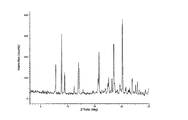
- 7 is a graph showing the results of powder X-ray diffraction measurement of compound (VIa).
- 7 is a graph showing the results of powder X-ray diffraction measurement of compound (VIIa).
- 7 is a graph showing the results of powder X-ray diffraction measurement of compound (VIIa).
- 7 is a graph showing the results of powder X-ray diffraction measurement of compound (VIIa).
- 7 is a graph showing the results of powder X-ray diffraction measurement of compound (VIIa). It is a graph of the measurement result of the powder X-ray diffraction of compound (VIIIa). It is a graph of the measurement result of the powder X-ray diffraction of compound (VIIIa). It is a graph of the measurement result of the powder X-ray diffraction of compound (VIIIa).
- 4 is a graph showing the results of powder X-ray diffraction measurement of compound (1).
- 4 is a graph showing the results of powder X-ray diffraction measurement of compound (1).
- 4 is a graph showing the results of powder X-ray diffraction measurement of compound (1).
- 4 is a graph showing the results of powder X-ray diffraction measurement of compound (1).
- 4 is a graph showing the results of powder X-ray diffraction measurement of compound (1).
- the “pharmaceutically acceptable salt” of the compound (1) includes, for example, hydrochloride, hydrobromide, hydroiodide, phosphate, phosphonate, sulfate, or Sulfonates such as methanesulfonate, p-toluenesulfonate; carboxylate such as acetate, citrate, malate, tartrate, succinate, salicylate; sodium salt, potassium salt, etc.
- Alkaline earth metal salts such as magnesium salts and calcium salts; and ammonium salts such as ammonium salts, alkyl ammonium salts, dialkyl ammonium salts, trialkyl ammonium salts, and tetraalkyl ammonium salts.
- the solvate of the compound (1) or the salt of the compound (1) may be a hydrate or a non-hydrate. , Ethanol, n-propanol), dimethylformamide and the like.
- the “C 1 -C 6 alkyl group” is a monovalent group derived by removing one arbitrary hydrogen atom from a linear or branched aliphatic hydrocarbon having 1 to 6 carbon atoms. .
- it is a C 1 -C 4 alkyl group.
- a condensing agent or a mixed acid anhydride agent used for peptide synthesis can be used.
- condensing agent used for peptide synthesis carbonyldiimidazole (CDI), N, N'-diisopropylcarbodiimide (DIC), propylphosphonic anhydride (T3P), and mixed acid anhydride agents include dialkyl chlorophosphates such as diethyl chlorophosphate.
- the condensing agent is preferably DIC or diethyl chlorophosphate.
- Leaving group refers to a group that is eliminated in a substitution reaction and is replaced by another functional group, such as a halogen group such as a fluoro group, a chloro group, a bromo group or an iodo group, and a triflate group, a mesyl group, or a tosyl group. And the like. Preferably, it is a fluoro, chloro, bromo or iodo group.
- the "6-membered saturated cyclic amino group” is specifically a 6-membered saturated cyclic group bonded via a nitrogen atom such as a piperidyl group, a piperazinyl group, a morpholino group, a thiomorpholino group, and a piperidyl group is preferable.
- a nitrogen atom such as a piperidyl group, a piperazinyl group, a morpholino group, a thiomorpholino group, and a piperidyl group is preferable.
- substituent of the “6-membered saturated cyclic amino group” include a 4- to 10-membered heterocycloalkyl group.
- the 4- to 10-membered heterocycloalkyl group means a 4- to 10-membered saturated ring having 1 to 3 nitrogen, oxygen, and sulfur atoms as a hetero atom, and includes a pyrrolidinyl group, an imidazolidinyl group, a tetrahydrofuranyl group, a piperidyl group, and a piperazinyl group.
- it is a morpholino group.
- the 4- to 10-membered heterocycloalkyl group may further have one or more substituents, and the substituent may be a halogen atom, a C 1 -C 6 alkyl group, an oxo group, a hydroxyl group, or a deuterium.
- the substituent of the “6-membered saturated cyclic amino group” may be a ketal group, such as an acyclic ketal group such as a dimethyl ketal group, or a cyclic ketal group such as a 1,3-dioxolanyl group or a 1,3-dioxanyl group. Groups.
- the "six-membered saturated cyclic amine” specifically includes a six-membered saturated cyclic amine bonded via a nitrogen atom such as piperidine, piperazine, morpholine, and thiomorpholine, with piperidine being preferred.
- a nitrogen atom such as piperidine, piperazine, morpholine, and thiomorpholine, with piperidine being preferred.
- substituent of the “6-membered saturated cyclic amine” include a 4- to 10-membered heterocycloalkyl group.
- the 4- to 10-membered heterocycloalkyl group means a 4- to 10-membered saturated ring having 1 to 3 nitrogen, oxygen, and sulfur atoms as a hetero atom, and includes a pyrrolidinyl group, an imidazolidinyl group, a tetrahydrofuranyl group, a piperidyl group, and a piperazinyl group.
- it is a morpholino group.
- the 4- to 10-membered heterocycloalkyl group may further have one or more substituents, and the substituent may be a halogen atom, a C 1 -C 6 alkyl group, an oxo group, a hydroxyl group, or a deuterium.
- the substituent of the “six-membered saturated cyclic amine” may be a ketal group, such as an acyclic ketal group such as a dimethyl ketal group, or a cyclic ketal group such as a 1,3-dioxolanyl group or a 1,3-dioxanyl group. Is mentioned.
- Examples of the “acid” include acetyl chloride, formic acid, acetic acid, methanesulfonic acid, p-toluenesulfonic acid, benzenesulfonic acid, TFA, hydrochloric acid, sulfuric acid, pyridinium p-toluenesulfonate, TMSCl, and the like. Acetyl or TMSCl.
- base examples include sodium hydroxide, potassium hydroxide, lithium hydroxide, sodium phosphate, potassium phosphate, sodium carbonate, potassium carbonate, cesium carbonate, sodium hydride, LiHMDS, NaHMDS, LDA, lithium dicyclohexylamide, lithium 2,2,6,6-tetramethylpyrrolidide, KHMDS, t-BuOK, t-BuONa, etc.
- a strong base reagent such as LiHMDS, NaHMDS, t-BuOK, DBU, or sodium hydroxide
- Inorganic salt reagents such as potassium phosphate, potassium carbonate or cesium carbonate are preferred.
- iron, zinc, titanium (III) chloride, tin (II) chloride, or sodium hydrosulfite can be used, and sodium hydrosulfite is preferable.
- the “palladium catalyst” include palladium acetate, Pd 2 (dba) 3 , ⁇ monoallyl palladium chloride dimer, PdCl 2 (CH 3 CN) 2 , PdCl 2 (PPh 3 ) 2 , trialkylproazaphosphatran, P (t-Bu) 3 PdBr ⁇ 2 , PPh 3 , P (o-tol) 3 , BINAP, DPPF, P (t-Bu) 3, Dave Phos, John Phos, c-Hexyl John Phos, S-Phos, X-Phos, t-Butyl X-Phos, PEPPSI-IPent, Xantphos, 4,5-bis [bis (3,5-bistrifluoromethylphenyl) phosphanyl
- One embodiment of the present invention is an industrial method for producing the compound (1), which can avoid the use of a substance of very high concern, improve the selectivity of the reaction, and suppress the generation of by-products (impurities).
- R 1a represents an optionally substituted 6-membered saturated cyclic amino group
- R 2 represents a C 1 -C 6 alkyl group.
- the present invention is a method comprising a step of cyclizing compound (VIIIb) to compound (IXa) by a Friedel-Crafts type reaction.
- the carboxyl group in the compound (VIIIb) is treated with a condensing agent such as a mixed acid anhydride (eg, dialkyl chlorophosphate) or a condensing agent (eg, CDI, DIC, T3P) used for peptide synthesis.
- a condensing agent such as a mixed acid anhydride (eg, dialkyl chlorophosphate) or a condensing agent (eg, CDI, DIC, T3P) used for peptide synthesis.
- a condensing agent such as a mixed acid anhydride (eg, dialkyl chlorophosphate) or a condensing agent (eg, CDI, DIC, T3P) used for peptide synthesis.
- the mixed acid anhydride agent can be used in an amount of 1 to 10 equivalents, preferably 1 to 5 equivalents, based on the substrate.
- the condensing agent can be used in an amount of 1 to 10 equivalents, preferably 1
- a preferred mixed anhydride or condensing agent is diethyl chlorophosphate or DIC, and 1 to 5 equivalents based on the substrate can be used.
- an organic base such as TEA, DIPEA and pyridine may be used, and DIPEA is preferable.
- the organic base can be used in an amount of 1 to 10 equivalents, preferably 1 to 8 equivalents, relative to compound (VIIIb) as a substrate. This reaction can be performed without a solvent or in a solvent.
- the solvent used here is toluene, xylene, diethyl ether, THF, CPME, 2-methyltetrahydrofuran, MTBE, DMSO, sulfolane, 1,4-dioxane, acetone, acetonitrile, dichloromethane, 2-butanone, ethyl acetate, or acetic acid.
- Solvents that do not correspond to substances of very high concern, such as isopropyl, and mixtures thereof, and the like, are preferably THF, acetone, or acetonitrile, and mixtures thereof. This reaction can be carried out at a reaction temperature from 0 ° C. to around the boiling point of the solvent, preferably from 40 ° C.
- the reaction can be carried out by stirring the reaction mixture for a certain period of time (for example, 0.1 to 24 hours, preferably 1 to 6 hours).
- a certain period of time for example, 0.1 to 24 hours, preferably 1 to 6 hours.
- the compound (IXa) can be obtained by cyclization using an acid such as polyphosphoric acid, or cyclization by heating from 25 ° C. to near the boiling point of the solvent in a solvent without an additional reagent.
- This reaction can be performed by stirring the reaction mixture for a certain period of time (for example, 0.1 to 24 hours) within a temperature range from 0 ° C. to a temperature near the boiling point of the solvent.
- R 1a is a 4-oxo-1-piperidyl group
- morpholine can be reduced in the presence of a reducing agent according to the method of Borch et al. (J. Am. Chem. Soc., 1971, 93, 2897).
- Compound (1) can be produced by subjecting it to the conditions for the amination reaction.
- the pharmaceutically acceptable salt of the compound (1) is brought into contact with a free form of the compound (1) and an acid or a base that can be used for the production of a medicament corresponding to the pharmaceutically acceptable salt. It can be manufactured by the following.
- a solvate of the compound (1) or a pharmaceutically acceptable salt of the compound (1) can be produced by crystallization using a desired solvent.
- a further aspect of the present invention relates to an industrial production method for producing the compound (1) including a series of steps, wherein the method does not require a great deal of labor for controlling the residual solvent, and further increases the yield of the compound.
- (1) and its synthetic intermediate can be obtained.
- An outline of a series of production methods from the compound (I) to the compound (IX) is shown in Scheme 2, and each step is described below. These are merely examples, and the present invention uses a part of the steps 1 to 5, and may use a known method for the other steps. May be used within a range in which can be achieved.
- a commercially available one may be used, or if necessary, a conventional method may be used for production.
- a commercially available reagent may be used, or if necessary, may be used after being prepared by a conventional method.
- the solvent used in the production may be a commercially available dehydrated solvent or degassed solvent, particularly when handling a compound unstable to moisture, oxygen or carbon dioxide, etc. May be used.
- the solvent may be used by mixing a plurality of solvents as necessary. When handling compounds that are unstable to moisture, oxygen or carbon dioxide, etc.
- the target chemical reaction can be efficiently advanced.
- Preferred inert gases include nitrogen or argon.
- the production method of the present invention may be carried out by changing the temperature of the reaction system depending on the properties and reactivity of the compound.
- the optimal temperature for the reaction is in the range from around ⁇ 100 ° C. cooled with liquid nitrogen to around the boiling point of the solvent.
- X represents a leaving group
- R 1a represents a leaving group or an optionally substituted 6-membered saturated cyclic amino group
- R 1 represents an optionally substituted 6-membered saturated cyclic amino group.
- R 2 represents a C 1 -C 6 alkyl group
- R A and R B each represent a C 1 -C 6 alkyl group.
- Steps 1a and 1b This step is a step of converting carboxylic acid (I) to ⁇ -keto ester (III).
- the carboxylic acid (I) as a raw material compound is obtained by activating an activated carboxylic acid such as an acid chloride, an active ester, or an alkyl ester in a solvent at a reaction temperature of 0 ° C. to a temperature close to the boiling point of the solvent in the presence of an activating agent. (II) can be converted. Thereafter, the activated carboxylic acid (II) is condensed with the enolate of AcOR B at a reaction temperature from ⁇ 20 ° C. to a temperature near the boiling point of the solvent to give ⁇ -keto ester (III).
- the activator can be used in an amount of 1 to 10 equivalents based on the substrate.
- a solvent used for this reaction toluene, xylene, THF, CPME, MTBE, DMSO, sulfolane, 1,4-dioxane, and the like, and a mixture thereof can be used.
- This reaction can be carried out at a reaction temperature from ⁇ 20 ° C. to around the boiling point of the solvent, and can be carried out by stirring the reaction mixture for a fixed time (for example, 0.1 to 24 hours).
- the activator can be used in an amount of 1 to 10 equivalents based on the substrate.
- a solvent used for this reaction toluene, xylene, THF, CPME, MTBE, DMSO, sulfolane, 1,4-dioxane, and the like, and a mixture thereof can be used.
- This reaction can be carried out at a reaction temperature from ⁇ 20 ° C. to around the boiling point of the solvent, and can be carried out by stirring the reaction mixture for a fixed time (for example, 0.1 to 24 hours).
- a condensing agent can be used for the production of the active ester, and the active ester corresponding to the condensing agent obtained here can be similarly used for the production of the ⁇ -ketoester (III).
- the amount of hydrogen chloride gas or acetyl chloride used in this reaction can be 0.1 to 10 equivalents, preferably 2 to 5 equivalents, based on the substrate.
- the solvent used in this reaction may be an alcohol (R A OH).
- This reaction can be carried out at a reaction temperature of ⁇ 20 ° C. to around the boiling point of the solvent, preferably 0 ° C. to 50 ° C. This reaction can be performed by stirring the reaction mixture for a certain period of time (for example, 0.1 to 24 hours, preferably 1 to 4 hours).
- the activated carboxylic acid (II) may be subjected to isolation and purification or may be used continuously for the next reaction without isolation and purification.
- Enolate of conversion reaction from activated carboxylic acid (II) beta-to-ketoester (III) Acor B used in (Step 1b) (R B represents a linear or branched alkyl group of C 1 -C 6) Can be used in an amount of 1 to 5 equivalents, preferably 1 to 2 equivalents, based on the activated carboxylic acid (II) as a substrate.
- a strong base reagent such as LiHMDS, NaHMDS, t-BuOK, or DBU can be used.
- These strong base reagents can be used in an amount of 2 to 5 equivalents, preferably 2 to 4 equivalents, based on the activated carboxylic acid (II) as a substrate.
- the solvent used for this reaction include toluene, xylene, THF, CPME, MTBE, DMSO, sulfolane, 1,4-dioxane and the like, and a mixture thereof, and preferably THF.
- AcOR B is preferably tert-butyl acetate. This reaction can be carried out at ⁇ 40 ° C. to around the boiling point of the solvent, preferably at ⁇ 10 ° C. to 25 ° C. This reaction can be carried out by stirring the reaction mixture for a certain period of time, for example, 0.1 to 24 hours, preferably 0.1 to 2 hours.
- Step 2a aromatic nucleophilic substitution is performed by reacting a ⁇ -ketoester (III) with an aromatic nitro compound (IV) having a leaving group (X) in the presence of a base at a reaction temperature from ⁇ 10 ° C. to a solvent boiling point.
- a method of converting to a compound represented by formula V by a reaction eg, Journal of Heterocyclic Chemistry, 2009, 46 (2), 172-177, or Organic Process Research & Development, 2014, 18 (1), 89-102
- Bases used in this reaction include sodium hydroxide, potassium hydroxide, lithium hydroxide, sodium phosphate, potassium phosphate, sodium carbonate, potassium carbonate, cesium carbonate, sodium hydride, LiHMDS, NaHMDS, LDA, lithium dicyclohexylamide, Lithium 2,2,6,6-tetramethylpyrrolidide, KHMDS, t-BuOK, t-BuONa and the like can be used, preferably sodium hydroxide, t-BuOK, t-BuONa, potassium phosphate, phosphorus Sodium acid, potassium carbonate, or cesium carbonate.
- a solution dissolved in an appropriate solvent may be used as the base.
- the base can be used in an amount of 1 to 10 equivalents, preferably 2 to 7 equivalents, relative to the ⁇ -ketoester (III) of the substrate.
- Solvents used in this reaction include toluene, xylene, MeCN, THF, 2-methyltetrahydrofuran, CPME, MTBE, DMSO, sulfolane, 1,4-dioxane, acetone, 2-butanone, or water, and combinations thereof. , Preferably THF, water and combinations thereof.
- This reaction can be carried out at a reaction temperature from -10 ° C to the boiling point of the solvent, preferably from 0 ° C to 25 ° C.
- This reaction can be carried out by stirring the reaction mixture for a certain period of time (for example, 0.1 to 24 hours, preferably 2 to 8 hours).
- a halogen group such as a fluoro group, a chloro group, a bromo group or an iodo group, a triflate group, a mesyl group, a tosyl group, and the like can be used. It is a fluoro group or a chloro group.
- One to three equivalents of the aromatic nitro compound (IV) can be used based on the ⁇ -ketoester (III) of the substrate.
- phase transfer catalyst When the reaction is performed in a combination of solvents in which the compound is not dissolved, a phase transfer catalyst can be used, and tetramethylammonium chloride, tetramethylammonium bromide, tetramethylammonium hydroxide, tetraethylammonium chloride, tetraethylammonium bromide, and tetraethylammonium can be used.
- Ammonium hydroxide, tetrabutylammonium chloride, tetrabutylammonium bromide, tetrabutylammonium hydroxide and the like can be used.
- the phase transfer catalyst can be used in an amount of 0.01 equivalent to 0.99 equivalent, preferably 0.1 equivalent to 0.4 equivalent based on the substrate.
- Step 2bc This step is a reductive cyclization step in which an indole ring is formed after the reduction of the nitro group.
- This reaction can be carried out by reacting a compound represented by the formula V with a reducing agent at a reaction temperature from 0 ° C. to a temperature around the boiling point of the solvent to reduce the nitro group.
- the reducing agent used in the reaction is iron (Synthesis, 2008, (18), 2943-2952), zinc (Tetrahedron, 2008, 64 (40), 9607-9618), titanium (III) chloride (Organic & Biomolecular Chemistry, 2005, 3).
- the reducing agent may be used in an amount of 1 to 20 equivalents, preferably 2 to 6 equivalents, based on the compound represented by the formula V as a substrate.
- the solvent used in this reaction is a short-chain alkyl alcohol such as methanol or ethanol, THF, water, or a combination thereof, and the mixing ratio of the organic solvent and water is 1: 5 to 1: 0.2.
- This reaction can be carried out at a reaction temperature of 0 ° C. to around the boiling point of the solvent, preferably 10 ° C. to 35 ° C. This reaction can be carried out by stirring the reaction mixture for a certain period of time (for example, 0.1 to 24 hours, preferably 1 to 5 hours). Further, conditions used for reduction of a nitro group by a catalytic reduction reaction or the like (Synlett, 2008, (17), 2689-2691) can be used.
- Step 3 is an aryl-nitrogen atom bonding reaction using a compound represented by the formula VI having a leaving group (R 1a ).
- a compound represented by the formula VI having a leaving group (R 1a ) For example, the method of Buchwald et al. (Organic synthesis, 78, 23; Coll. Vol. 10: 423).
- the reaction is carried out at 0 ° C. in a suitable solvent inert to the compounds of the formula VI and the reagents in the presence of a optionally substituted 6-membered saturated cyclic amine corresponding to R 1 and a base.
- the reaction can be carried out at a reaction temperature near the boiling point of the solvent, preferably from 5 ° C to 55 ° C.
- the reaction for converting the leaving group (R 1a ) to R 1 may be carried out in Step 1, Step 2, Step 4, Step 5 or the compound (IXa) having a leaving group (R 1a ) in addition to Step 3.
- the reaction may be performed within a range that does not adversely affect the reaction.
- a halogen group, a triflate group or the like can be used, and a bromo group or an iodo group is preferable.
- t-BuONa t-BuOK
- LiHMDS LiHMDS
- NaHMDS NaHMDS
- KHMDS potassium phosphate
- sodium carbonate potassium carbonate
- cesium carbonate cesium carbonate
- the base can be used in an amount of 1 to 5 equivalents based on the substrate.
- a solution dissolved in an appropriate solvent may be used.
- a solvent used in this reaction for example, toluene, n-hexane, EtOAc, DMI, DMSO, THF, 1,4-dioxane, and the like, and a mixture thereof can be used.
- This step can be carried out using a catalyst and a ligand.
- the catalyst and the ligand are, for example, palladium acetate, Pd 2 (dba) 3 , Allyl palladium chloride dimer, PdCl 2 (CH 3 CN) 2 , PdCl 2 (PPh 3 ) 2 , trialkylproazaphosphatran, ⁇ P (t-Bu) 3 PdBr ⁇ 2 , PPh 3 , P (o-tol) ) 3 , BINAP, DPPF, P (t-Bu) 3, Dave Phos, John Phos, c-Hexyl John Phos, S-Phos, X-Phos, t-Butyl X-Phos, Xantphos, 4,5-bis [ Bis (3,5-bistrifluoromethylphenyl) phosphanyl] -9,9-dimethyl-9H-xanthene, 1,3-diali Rudihydroimidazolium salts and the like can be used.
- the catalyst and the ligand can be used in an amount of 0.001 equivalent to 0.99 equivalent based on the substrate, preferably 0.003 equivalent to 0.1 equivalent, more preferably 0.003 equivalent to 0.1 equivalent. 05 equivalents.
- the leaving group (R 1a ) is preferably a halogen group, more preferably a bromo group or an iodo group.
- the optionally substituted 6-membered saturated cyclic amine used in this reaction is preferably 4- (4-piperidyl) morpholine, piperidin-4-one, or a ketal form of piperidin-4-one.
- the optionally substituted 6-membered saturated cyclic amine can be used in an amount of 1 equivalent to 5 equivalents, more preferably 1 equivalent to 3 equivalents, based on the substrate.
- This reaction can be carried out at a reaction temperature of 0 ° C. to around the boiling point of the solvent, preferably 5 ° C. to 40 ° C.
- This reaction can be carried out by stirring the reaction mixture for a certain period of time (for example, 0.1 to 24 hours, preferably 0.5 to 2 hours) within the above-mentioned temperature range.
- a salt of the compound represented by the formula VII is preferably used.
- the salt of the compound represented by the formula VII is obtained by converting the free form of the compound represented by the formula VII into a predetermined salt, preferably an acid or base which can be used for production of a medicament corresponding to a pharmaceutically acceptable salt.
- a predetermined salt preferably an acid or base which can be used for production of a medicament corresponding to a pharmaceutically acceptable salt.
- Can be produced by contacting Preferred is the hydrochloride of the compound of formula VII.
- Step 4 the deprotection step of the ester protecting group of the compound represented by the formula VII (R B), a reaction that converts to a compound of the formula VIII, R B is as defined above.
- the ester protecting group (R B ) for example, a C 1 -C 6 alkyl group or the like can be used, but a tert-butyl group is preferable.
- Such deprotection can be carried out, for example, by the method described in “Greene and Wuts,“ Protective Groups in Organic Synthesis ”(5th edition, John Wiley & Sons 2014)”. It may be used.
- ester protecting group (R B ) is a tert-butyl group
- TMSI, TMSCl, BF 3 OEt 2 and the like can be used as the deprotecting reagent.
- the deprotection reagent can be used in an amount of 1 to 10 equivalents, preferably 1.5 to 3 equivalents, based on the substrate.
- the solvent used in this reaction include toluene, xylene, diethyl ether, THF, CPME, MTBE, DMSO, sulfolane, 1,4-dioxane, 2,2,2-trifluoroethanol and the like, and mixtures thereof.
- Preferred is THF, or 2,2,2-trifluoroethanol, and mixtures thereof.
- This reaction can be carried out at a reaction temperature from ⁇ 20 ° C. to around the boiling point of the solvent, preferably from 0 ° C. to 35 ° C. This reaction can be carried out by stirring the reaction mixture for a certain period of time (for example, 0.1 to 24 hours, preferably 1 to 8 hours) within the above-mentioned temperature range.
- Step 5 is a step of scheme 1 described above.
- the hydrochloride of compound (1) can be produced by contacting compound (1) with hydrogen chloride. Compound (1) is dissolved in an appropriate solvent, and hydrogen chloride is added to prepare a solution of the hydrochloride of compound (1).
- a hydrochloride of the compound (1) can be precipitated to produce a hydrochloride of the compound (1).
- a solvent suitable for dissolving the compound (1) acetone, 2-butanone, tetrahydrofuran, dimethylformamide, dimethylacetamide, N-methylpyrrolidone, dimethylsulfoxide, acetic acid, water, or a mixed solvent selected therefrom is used.
- acetone, 2-butanone, tetrahydrofuran, dimethylformamide, dimethylacetamide, N-methylpyrrolidone, dimethylsulfoxide, acetic acid, water, or a mixed solvent selected therefrom is used.
- Preferred is a mixed solvent of 2-butanone, acetic acid, and water.
- Examples of the method of adding hydrogen chloride include a method of adding hydrogen chloride gas and a method of adding a hydrochloric acid solution in which hydrogen chloride is dissolved.
- Examples of the hydrochloric acid solution in which hydrogen chloride is dissolved include a hydrochloric acid aqueous solution, a methanol solution of hydrochloric acid, an ethanol solution of hydrochloric acid, an ethyl acetate solution of hydrochloric acid, and a tetrahydrofuran solution of hydrochloric acid.
- it is a hydrochloric acid ethanol solution.
- Hexane, heptane, petroleum ether, ethanol, water and the like are exemplified as the poor solvent to be added for crystallizing the hydrochloride of the compound (1).
- a hydrochloric acid solution in which hydrogen chloride is dissolved is added to a solution in which compound (1) is dissolved to produce a hydrochloride of compound (1), or compound (1) is added to a hydrochloric acid solution in which hydrogen chloride is dissolved.
- the compound can be used for producing a hydrochloride of the compound (1).
- the hydrochloride of the compound (1) may be an anhydride or may form a solvate such as a hydrate.
- the term ⁇ solvation '' as used herein refers to a phenomenon in which a solute molecule or ion strongly attracts a molecule in the vicinity of the solute molecule in a solution to form one molecular population.For example, if the solvent is water, it is called hydration. The substance obtained by hydration is called a hydrate.
- the solvate may be a hydrate or a non-hydrate.
- the non-hydrate includes a solvate containing an alcohol (eg, methanol, ethanol, n-propanol, 2-propanol), tetrahydrofuran, dimethyl sulfoxide and the like. More specific production methods are described in Japanese Patent No. 4588121, Japanese Patent No. 4918630, and JP-A-2012-126711.
- an alcohol eg, methanol, ethanol, n-propanol, 2-propanol
- tetrahydrofuran dimethyl sulfoxide and the like.
- the production method of the present invention is particularly useful in the following points.
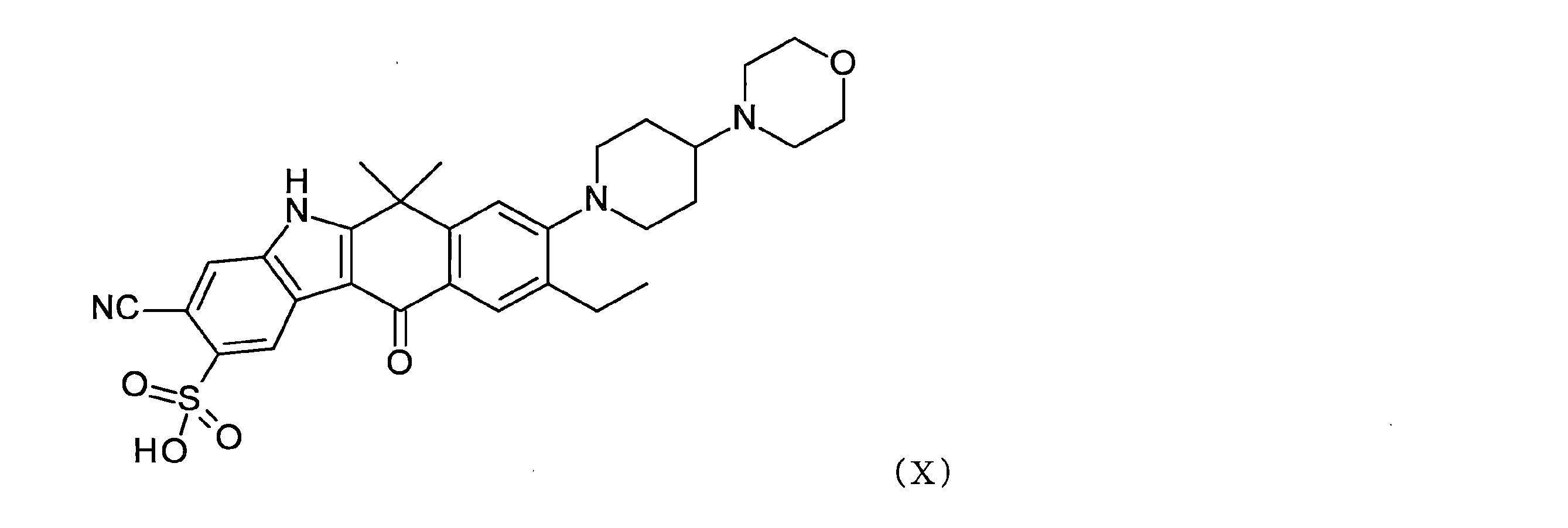
- impurity (X) which is a by-product remaining up to the drug substance, is simultaneously formed. Therefore, control of the remaining amount is indispensable for securing the safety of the drug substance, and a great deal of labor is required.
- the impurity (X) is a compound represented by the compound (1), a pharmaceutically acceptable salt thereof, a solvate thereof, or a pharmaceutically acceptable impurity thereof in a pharmaceutical composition thereof.
- the maximum allowable amount is 0.15% based on the weight of the compound (1) salt or solvate. In the production method of the present invention, it is usually about 0.08% or less, specifically, in the range of 0.001% to about 0.08%, preferably in the range of about 0.001% to about 0.08%, preferably The amount can range from about 0.001% to about 0.05%.
- the compound (X) does not affect the pharmacological properties of the pharmaceutical composition within the specified ratio. Further, the impurity (X) can be a distinctive characteristic (fingerprint) indicating that the compound (1) was produced by the production method of the present invention.
- Amide solvents such as DME, DMF, and DMA which are described as preferred solvents in Patent Document 1, have been reported in recent years to have carcinogenicity, teratogenicity, and the like. It is defined as a substance of very concern (SVHC) in the REACH regulation, which is a substance regulation rule, and its handling may be restricted. Furthermore, in ICHQ3C (Guideline for Residual Solvents of Pharmaceuticals), the allowable amount of amide solvents such as DME, DMF, and DMA in the drug substance is strictly regulated. In actual production technology, great effort is required to control the residual solvent to keep the amount of the residual solvent below the regulated amount.
- SVHC substance of very concern
- ICHQ3C Guardline for Residual Solvents of Pharmaceuticals
- the production method of the present invention does not use a substance of very high concern (SVHC), and the control of the residual solvent is easier.
- SVHC substance of very high concern
- the content of water or alcohol contained in the reaction system greatly affects the reactivity. In order to maintain the reproducibility of the reaction, great effort was required to control the content of water or alcohol contained in the reaction system.
- the production method of the present invention is a catalytic reaction that is hardly affected by the content of water or alcohol contained in the reaction system, and is a highly reproducible catalytic reaction, that is, a highly robust reaction.
- the HPLC purity was analyzed using a Waters H-Class system, Alliance system or Shimadzu LC-10 system.
- a commonly used column such as Waters X-Bridge (BEH 4.6 mm ID ⁇ 150 mm or BEH 4.6 mm ID ⁇ 50 mm) or Sunfire (4.6 mm ID ⁇ 150 mm or 4.6 mm ID ⁇ 50 mm) is used. It was measured. Although the detection of each compound was performed using a photodiode array detector, other methods such as a mass spectrometer and evaporative light scattering detection may be used.
- the residual solvent was analyzed by an internal standard method using GC2010 manufactured by Shimadzu Corporation.
- the water content was measured by a Karl Fischer method (electrolysis method) using a water measurement device (CA-200) manufactured by Mitsubishi Chemical Analytech.
- NMR was measured using a nuclear magnetic resonance apparatus JNM-ECP-500 (manufactured by JEOL).
- the powder X-ray diffraction analysis was measured using an X-ray diffraction device Empyrean (manufactured by PANalytical). The products of each step were analyzed and evaluated by the following analytical methods.
- the powder X-ray diffraction analysis was obtained under the following conditions.
- Counter cathode Cu
- Tube voltage 45 kV
- Tube current 40 mA
- Scanning method continuous
- step width 0.0262606 °
- Scan axis 2 ⁇
- sampling time per step 5.100 seconds
- the internal temperature of the reaction solution was cooled to ⁇ 3 ° C., and acetyl chloride (79 g, 1.01 mol) was added to the reaction solution so that the internal temperature of the reaction solution did not exceed 20 ° C. After the addition was completed, the reaction solution was heated to an internal temperature of 40 ° C. and stirred for 2 hours.
- the obtained solution was concentrated to 160 ml, MTBE (400 ml) and brine (10 wt%, 320 ml) were added, and the organic layer was separated. The obtained organic layer was further washed with a sodium hydrogen carbonate aqueous solution (5 wt%, 320 ml).
- Ethanol 1000 ml was added to the obtained concentrated mixture, and dissolved by raising the internal temperature of the reaction solution to 60 ° C., water (115 ml) was added over 15 minutes, and then the production method described in WO2010143664.
- the obtained compound VIa 524 mg was added as a seed crystal. Crystal precipitation was confirmed, and the mixture was stirred at the same temperature for 1 hour.
- water 230 ml was added dropwise to the slurry over 2 hours, and the internal temperature of the reaction solution was cooled to 20 ° C. over 4 hours.
- the mixture was cooled to an internal temperature of 0 ° C., and NaHMDS (40% THF solution, 280 ml, 545 mmol) was added so that the internal temperature of the reaction solution did not exceed 20 ° C.
- the internal temperature of the reaction solution was set to 25 ° C., and the mixture was stirred for 1 hour.
- Isopropyl acetate (340 ml) and aqueous ammonium chloride solution (15%, 255 g) were added, and the reaction mixture was heated to 50 ° C. and stirred at the same temperature for 1 hour.
- the aqueous layer was drained, and the obtained organic layer was concentrated under reduced pressure at an external temperature of 50 ° C.
- Example 2 Comparison of reaction selectivity and reaction rate depending on reagent and solvent type
- the method described in Example 1 was carried out using a combination of a solvent and a catalyst shown in Table 1, and the yield of the target compound (compound VIIa) and impurity (Z) was obtained.
- Table 1 shows a comparison of reaction selectivity and reaction rate depending on the type of reagent and solvent.
- the impurity (Z) is a compound shown below in which an iodine group which is a leaving group is replaced by a hydrogen atom.
- the intended product can be obtained with a selectivity equal to or higher than that of DME by using THF alone or a mixed solvent with DMI and a predetermined catalyst instead of DME which is a substance of high concern.
- Example 3 (1) 6-cyano-2- [1- [4-ethyl-3- (4-morpholino-1-piperidyl) phenyl] -1-methyl-ethyl] -1H-indole-3-carboxylic acid (VIIIa) Manufacturing [Step 4] A.
- the internal temperature of the reaction solution was cooled to 8 ° C, and acetone (320 ml) was added so that the internal temperature of the reaction solution did not exceed 12 ° C.
- a 1 mol / L aqueous sodium hydroxide solution (241 ml) was added to the obtained solution so that the internal temperature of the reaction solution did not exceed 8 ° C., and after the crystallization, a 10% aqueous solution of dipotassium hydrogen phosphate (80 g) was added to the reaction solution. ) And stirred at the same temperature for 1.5 hours.
- the internal temperature of the reaction solution was cooled to 8 ° C., and acetone (80 ml) was added so that the internal temperature of the reaction solution did not exceed 12 ° C.
- a 1 mol / L aqueous sodium hydroxide solution (61 ml) was added to the obtained solution so that the internal temperature of the reaction solution did not exceed 12 ° C., and after crystal deposition, a 10% aqueous solution of dipotassium hydrogen phosphate (20 g) was added to the reaction solution. ) And stirred at the same temperature for 1.5 hours.
- the wet powder was washed with water (80 ml) and further washed with acetone (80 ml).
- the reaction solution was stirred at the same temperature for 2 hours, the internal temperature of the reaction solution was cooled to 40 ° C, methanol (7.5 ml) was added, and then the internal temperature of the reaction solution was cooled to 35 ° C. Water (12.5 ml) was added to the obtained suspension over 1 hour, and the mixture was stirred at an internal temperature of 30 ° C. for 1 hour.
- the reaction solution was stirred at the same temperature for 6 hours, the internal temperature of the reaction solution was cooled to 40 ° C, methanol (4.5 ml) was added, and then the internal temperature of the reaction solution was cooled to 35 ° C. Water (4.5 ml) was added to the obtained suspension over 0.5 hours, and the mixture was stirred at an internal temperature of 10 ° C. or lower for 1 hour.
- Example 4 Comparison of Selectivity and Yield of Cyclization Reaction Depending on Reagent and Solvent Type
- the method described in Example 3 was carried out using a combination of the reagent and the solvent shown in Table 2, and the target product (compound (1)) and impurities
- the production ratio of (Y) was measured.
- the production ratio (selectivity of the cyclization reaction) between the target compound (compound (1)) and the impurity (Y) was determined by HPLC of the reaction mixture using a Sunfire (4.6 mm ID ⁇ 50 mm) column using an LC-10 system manufactured by Shimadzu Corporation. It was calculated based on the peak area of the analysis.
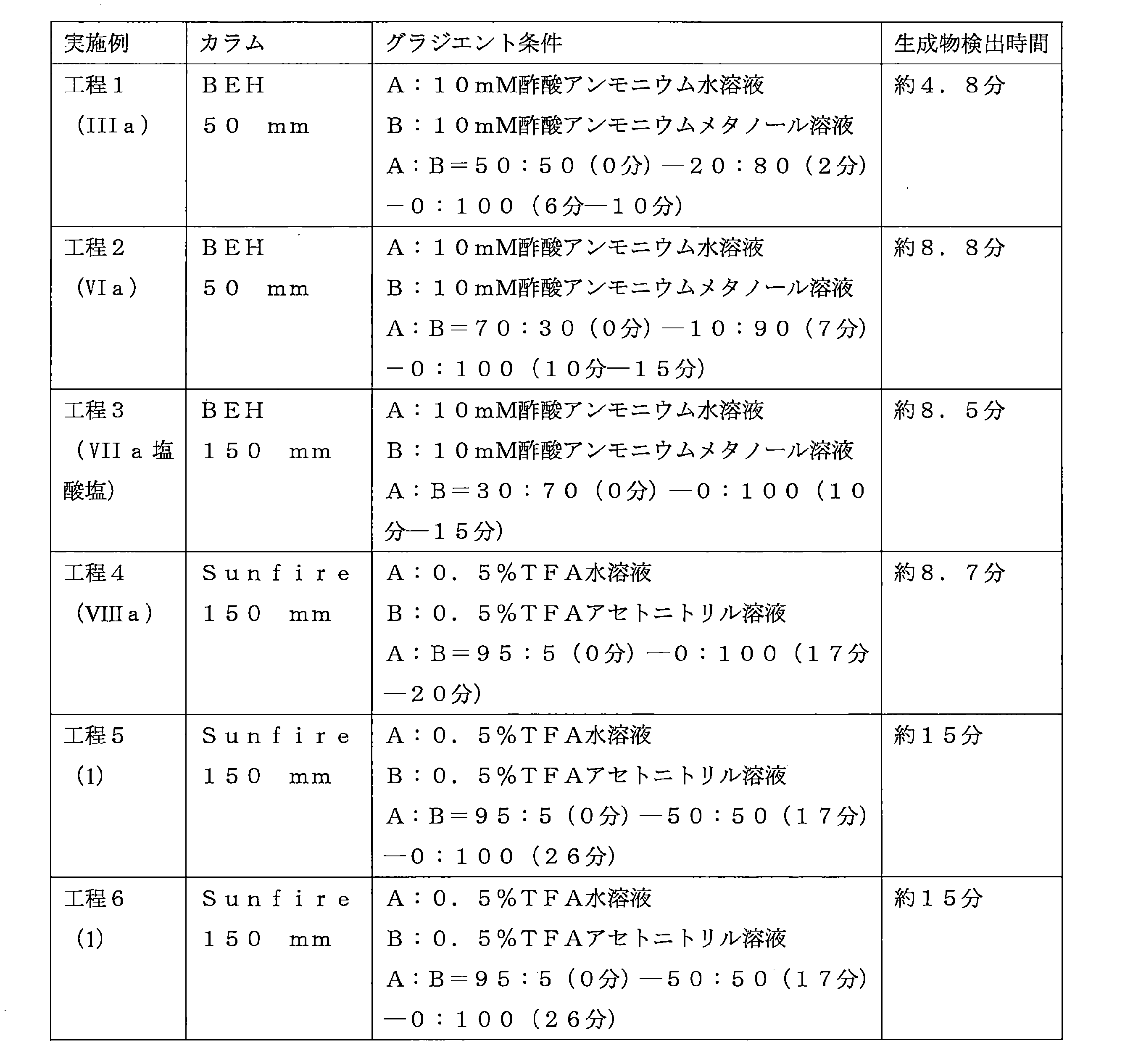
- HPLC analysis was performed using a linear gradient method (Table 3, flow rate 1 ml / min) using a 0.05% trifluoroacetic acid aqueous solution (A) and a 0.05% trifluoroacetic acid in acetonitrile solution (B), and was performed at 230 nm. Calculated using the absorption peak area at The retention time of each compound was about 6.8 minutes for the target compound (compound (1)) and about 3.8 minutes for the impurity (Y). Table 2 shows a comparison of selectivity and yield of the cyclization reaction depending on the type of reagent and solvent.
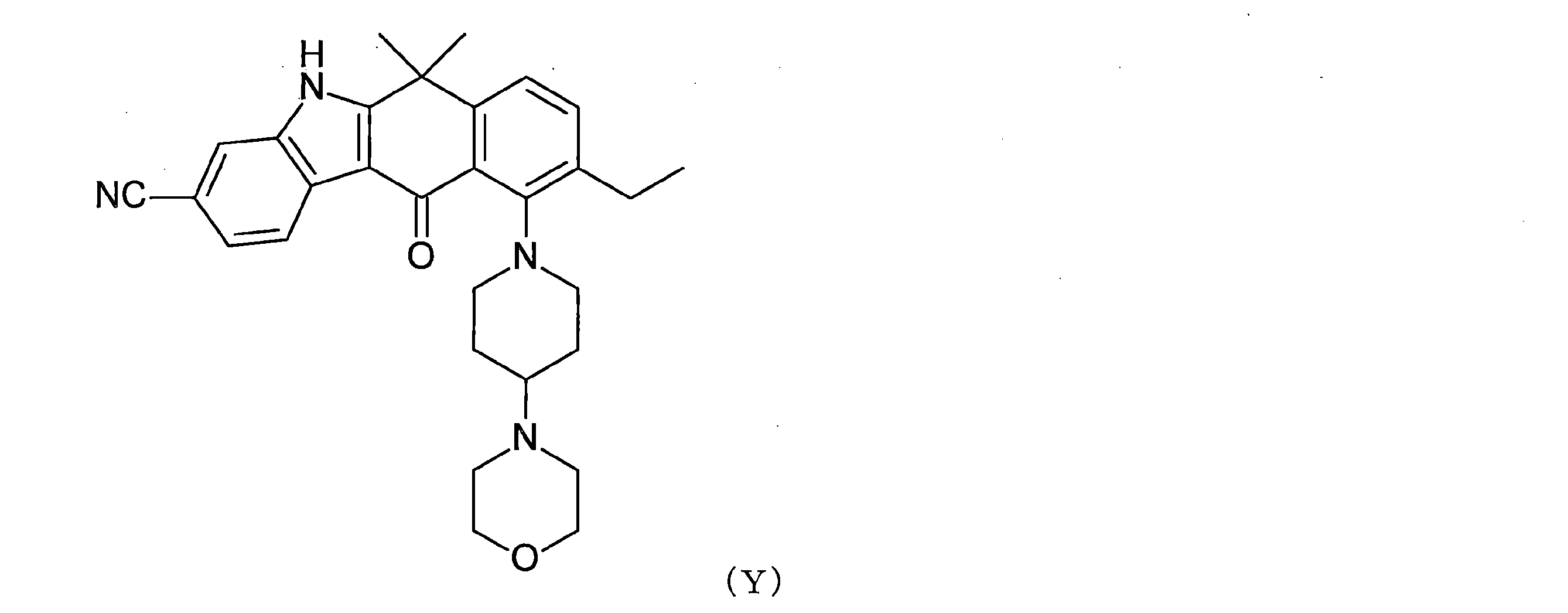
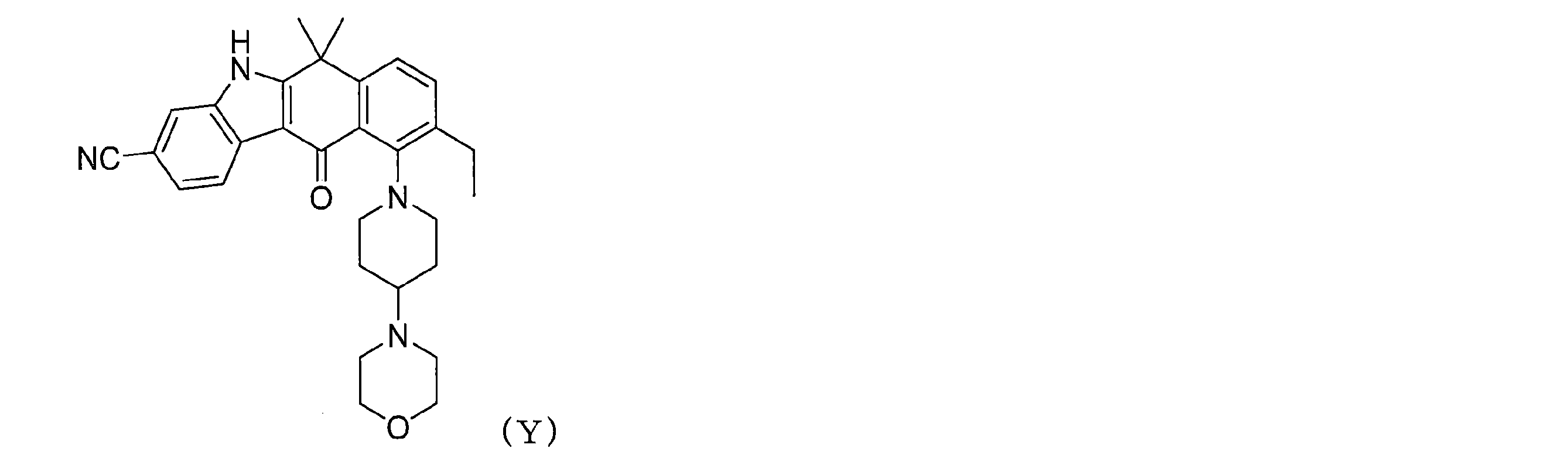
- the impurity (Y) is the following compound cyclized by a Friedel-Crafts type reaction at a substitution position different from that of the target compound (compound (1)).
- ratio ratio to total flow rate of 0.05% trifluoroacetic acid aqueous solution
- ratio ratio to total flow rate of 0.05% trifluoroacetic acid solution in acetonitrile
- Example 5 9-ethyl-6,6-dimethyl-8- [4- (morpholin-4-yl) piperidin-1-yl] -11-oxo-6,11-dihydro-5H-benzo [b] carbazole-3-carbo Production of nitrile hydrochloride (hydrochloride of compound (1)) [Step 6] Under a nitrogen atmosphere, 9-ethyl-6,6-dimethyl-8- [4- (morpholin-4-yl) piperidin-1-yl] -11-oxo-6,11-dihydro-5H-benzo [b] carbazole To -3-carbonitrile (compound (1), 35 g, 72.5 mmol), 2-butanone (350 ml), water (122.5 ml), and acetic acid (105 ml) were added and dissolved at an external temperature of 35 ° C.
- This solution was added dropwise to a mixture of 2 mol / L hydrochloric acid (70 ml) and ethanol (350 ml) heated to an internal temperature of 60 ° C. while maintaining the temperature of the mixture at 60 ° C. Further, a mixed solvent of 2-butanone (70 ml), water (24.5 ml), and acetic acid (21 ml) was added dropwise while maintaining the temperature of the mixed solution at 60 ° C. After stirring the reaction solution at the same temperature for 1 hour, the reaction solution was cooled to the internal temperature of 20 ° C. over 2 hours. After stirring the reaction solution for 30 minutes, the resulting solid was collected by filtration, and the obtained wet powder was washed with ethanol (350 ml).
- Impurity (X) generated in the process of producing compound (1) hydrochloride from compound Ia 3-cyano-9-ethyl-6,6-dimethyl-8- (4-morpholino-1-piperidyl) -11-oxo-5H-benzo [b] carbazole-2-sulfonic acid
- the present invention it is possible to configure a more robust and sustainable process in the production of pharmaceuticals without using a solvent having a concern for environmental load and worker's health and by facilitating the control of impurities. Further, a method for producing the compound (1) with high yield is provided.
Landscapes
- Chemical & Material Sciences (AREA)
- Organic Chemistry (AREA)
- Health & Medical Sciences (AREA)
- General Health & Medical Sciences (AREA)
- Pharmacology & Pharmacy (AREA)
- Epidemiology (AREA)
- Life Sciences & Earth Sciences (AREA)
- Animal Behavior & Ethology (AREA)
- Medicinal Chemistry (AREA)
- Public Health (AREA)
- Veterinary Medicine (AREA)
- Pharmaceuticals Containing Other Organic And Inorganic Compounds (AREA)
- Plural Heterocyclic Compounds (AREA)
- Low-Molecular Organic Synthesis Reactions Using Catalysts (AREA)
- Nitrogen Condensed Heterocyclic Rings (AREA)
- Heterocyclic Carbon Compounds Containing A Hetero Ring Having Oxygen Or Sulfur (AREA)
Abstract
Description
ALK阻害作用を有する化合物として、化合物(1)(9-エチル-6,6-ジメチル-8-[4-(モルホリン-4-イル)ピペリジン-1-イル]-11-オキソ-6,11-ジヒドロ-5H-ベンゾ[b]カルバゾール-3-カルボニトリル)が知られており、当該化合物(1)または、その薬学的に許容される塩等は、ALK異常を伴う疾患に有効な治療、および予防薬として有用であることが知られている(特許文献1、特許文献2、特許文献3、特許文献4)。

しかしながら、特許文献1の製造方法には、用いる溶媒の環境に対する影響、安全性、副生成物や位置異性体の生成等の種々の問題があり、さらなる改良製法が望まれていた。
すなわち、本発明は次の通りである。
[1]化合物(1):

前記方法は、式VIIIb
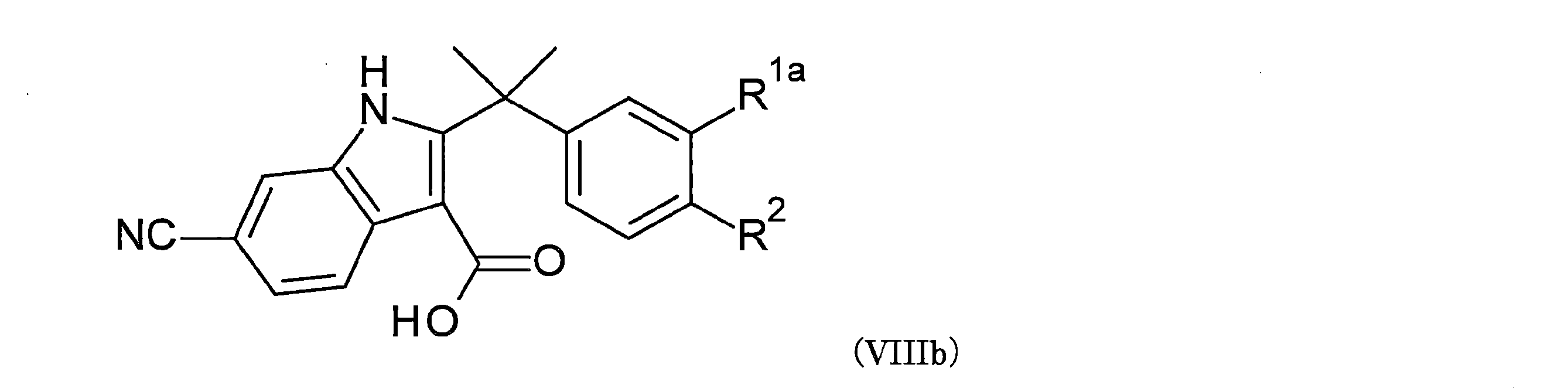
で表される化合物を、ジクロロメタン、1,4-ジオキサン、2-メチルテトラヒドロフラン、2-ブタノン、tert-ブチルメチルエーテル、酢酸エチル、酢酸イソプロピル、ジメチルスルホキシド、テトラヒドロフラン、アセトン、またはアセトニトリルから選択される溶媒中、縮合剤で処理し、
式IXa:

を含む、方法。
[1-2]
前記方法において、式VIIIbが、6-シアノ-2-[1-[4-エチル-3-(4-モルホリノ-1-ピペリジル)フェニル]-1-メチル-エチル]-1H-インドール-3-カルボン酸であり、式IXaが9-エチル-6,6-ジメチル-8-[4-(モルホリン-4-イル)ピペリジン-1-イル]-11-オキソ-6,11-ジヒドロ-5H-ベンゾ[b]カルバゾール-3-カルボニトリルである、[1]に記載の方法。
[2]
前記方法が、
(1)工程1a:
式I:

で表される化合物を酸の存在下で反応させて、式II:

で表される化合物を製造する工程;
(2)工程1b:
式IIで表される化合物を塩基およびAcORBと反応させて、式III:

で表される化合物を製造する工程;
(3)工程2a:
式IIIで表される化合物を式IV:

で表される化合物と塩基とを反応させて、式V:

で表される化合物を製造する工程;
(4)工程2b-c:
式Vで表される化合物を還元剤と反応させて、式VI:
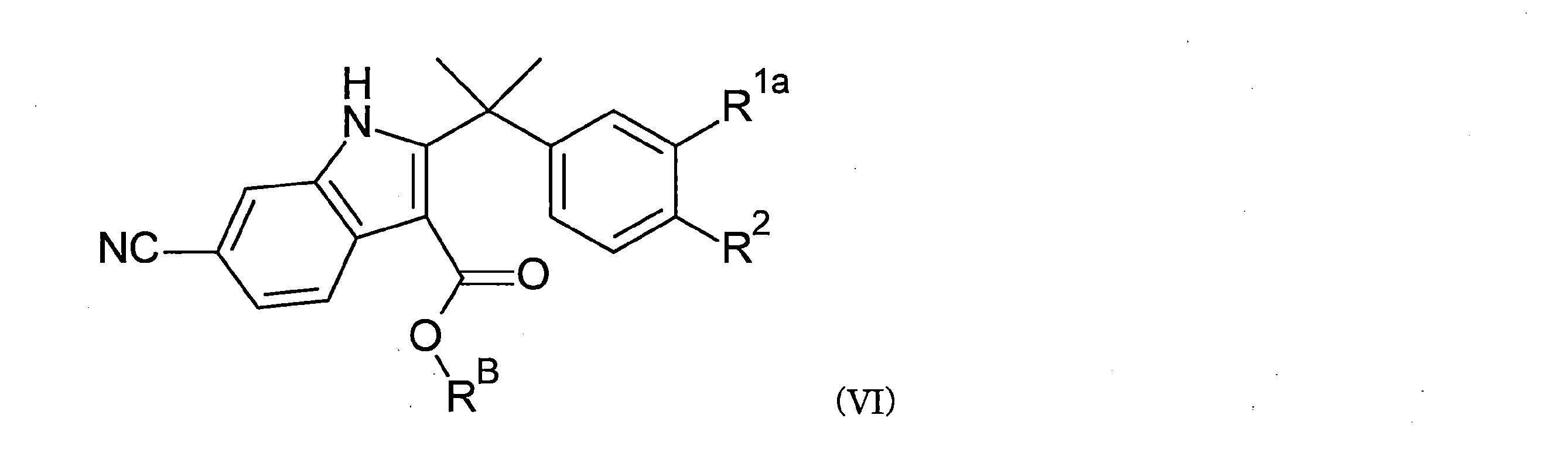
で表される化合物を製造する工程;
(5)工程3:
式VIで表される化合物をパラジウム触媒存在下、置換されていても良い6員飽和環状アミンと反応させて、式VII:

で表される化合物、もしくはその薬学的に許容される塩、またはそれらいずれかの溶媒和物を製造する工程;または、
(6)工程4:
式VIIで表される化合物を酸と反応させて、一般式VIII:

で表される化合物を製造する工程;
のいずれかをさらに含む[1]に記載の方法。
[2-1]
前記方法において、
式Iが2-(4-エチル-3-ヨード-フェニル)-2-メチル-プロパン酸であり、式IIがメチル 2-(4-エチル-3-ヨード-フェニル)-2-メチル-プロパノアートであり、式IIIがtert-ブチル 4-(4-エチル-3-ヨード-フェニル)-4-メチル-3-オキソ-ペンタノアートであり、式IVが4-フルオロ-3-ニトロベンゾニトリルであり、式Vがtert-ブチル 6-シアノ-2-[1-(4-エチル-3-ヨード-フェニル)-1-メチル-エチル]-1H-インドール-3-カルボキシラートであり、式VIがtert-ブチル 6-シアノ-2-[1-(4-エチル-3-ヨード-フェニル)-1-メチル-エチル]-1H-インドール-3-カルボキシラートであり、式VIIがtert-ブチル 6-シアノ-2-[1-[4-エチル-3-(4-モルホリノ-1-ピペリジル)フェニル]-1-メチル-エチル]-1H-インドール-3-カルボキシラートであり、式VIIIが6-シアノ-2-[1-[4-エチル-3-(4-モルホリノ-1-ピペリジル)フェニル]-1-メチル-エチル]-1H-インドール-3-カルボン酸である、[2]に記載の方法。
[3]
前記縮合剤がN,N’-ジイソプロピルカルボジイミドまたはクロロリン酸ジエチルである[1]に記載の方法。
[4]
前記溶媒が、テトラヒドロフラン、アセトン、またはアセトニトリルから選択される、[1]に記載の方法。
[5]
(1)における前記酸が、塩化アセチルである、[2]に記載の方法。
[6]
(2)における前記塩基が、リチウムヘキサメチルジシラジドまたはナトリウムヘキサメチルジシラジドである、[2]に記載の方法。
[7]
(2)における前記RBが、tert-ブチル基である[2]に記載の方法。
[8]
(3)における前記脱離基が、フルオロ基またはクロロ基である、[2]に記載の方法。
[9]
(3)における前記塩基が、水酸化ナトリウム、リン酸カリウム、炭酸カリウム、または炭酸セシウムであり、反応溶媒がテトラヒドロフランである、[2]に記載の方法。
[10]
(4)における前記還元剤が、ハイドロサルファイトナトリウムである、[2]に記載の方法。
[11]
(5)における前記パラジウム触媒が、Π一アリルパラジウムクロリドダイマーと2’,6’-ジメトキシ-2-(ジシクロヘキシルホスフィノ)ビフェニル(S-Phos)の組み合わせ、PEPPSI-IPent、またはS-Phos-Pd(Crotyl)Clであり、前記工程3の反応をテトラヒドロフランと1,3-ジメチル-2-イミダゾリジノンの混合溶媒中で行う、[2]に記載の方法。
[12]
(5)における置換されていても良い6員飽和環状アミンが式:

[13]
(6)の前記酸が、トリメチルシリルクロリドおよび2,2,2-トリフルオロエタノールである、[2]に記載の方法。
[14]
化合物(1)が塩酸塩である、[1]~[13]のいずれかに記載の方法。
[15]
化合物(1)が塩酸塩であり、前記化合物(1)のほかに、式X:

各製造工程および実施例において汎用される略号、化学式に対応する試薬や溶媒の名称を以下に記す。
AcCl:塩化アセチル
AcOH:酢酸
BINAP:2,2’-ビス(ジフェニルホスフィノ)-1,1’-ビナフチル
t-BuOK:tert-ブトキシカリウム
t-BuONa:tert-ブトキシナトリウム
t-Bu基:tert-ブチル基
t-Butyl X-Phos:2-ジ-tert-ブチルホスフィノ-2’,4’,6’-トリイソプロピルビフェニル
CDI:カルボニルジイミダゾール
CPME:c-ペンチルメチルエーテル
CX-21:アリル[1,3-ビス(2,6-ジイソプロピルフェニル)イミダゾール-2-イリデン]クロロパラジウム(II)
Dave Phos:2-ジシクロヘキシルホスフィノ-2’-(N,N-ジメチルアミノ)ビフェニル
DBU:1,8-ジアザビシクロ[5.4.0]-7-ウンデセン
DIC:N,N’-ジイソプロピルカルボジイミド
DIPEA:N,N-ジイソプロピルエチルアミン
DMA:N,N-ジメチルアセトアミド
DME:1,2-ジメトキシエタン
DMF:N,N-ジメチルホルムアミド
DMI:1,3-ジメチル-2-イミダゾリジノン
DMSO:ジメチルスルホキシド
DPPF:1,1’-ビス(ジフェニルホスフィノ)フェロセン
EtOAc:酢酸エチル
EtOH:エタノール
c-Hexyl John Phos:(2-ビフェニル)ジシクロヘキシルホスフィン
John Phos:(2-ビフェニル)ジ-t-ブチルホスフィン
KHMDS:カリウムヘキサメチルジシラジド
LDA:リチウムジイソプロピルアミド
LiHMDS:リチウムヘキサメチルジシラジド
MeCN:アセトニトリル
MEK:2-ブタノン
MeOH:メタノール
2-MeTHF:2-メチルテトラヒドロフラン
MTBE:tert-ブチルメチルエーテル
NaHMDS:ナトリウムヘキサメチルジシラジド
NMP:N-メチルピロリドン
Pd2(dba)3:トリス(ジベンジリデンアセトン)ジパラジウム(0)
PEPPSI-IPent:ジクロロ[1,3-ビス(2,6-ジ-3-ペンチルフェニル)イミダゾール-2-イリデン](3-クロロピリジル)パラジウム(II)
S-Phos:2’,6’-ジメトキシ-2-(ジシクロヘキシルホスフィノ)ビフェニル
S-Phos-Pd(Crotyl)Cl:クロロ(クロチル)(2-ジシクロヘキシルホスフィノ-2’,6’-ジメトキシビフェニル)パラジウム(II)
T3P:プロピルホスホン酸無水物
TEA:トリエチルアミン
TFA:トリフルオロ酢酸
TFE:2,2,2-トリフルオロエタノール
THF:テトラヒドロフラン
TMSCl:トリメチルシリルクロリド
TMSI:トリメチルシリルヨージド
Xantophos :4,5’-ビス(ジフェニルホスフィノ)-9,9’-ジメチルキサンテン
X-Phos:2-ジシクロヘキシルホスフィノ-2’,4’,6’-トリイソプロピルビフェニル
化合物(1)の溶媒和物、または化合物(1)の塩の溶媒和物は、水和物、非水和物のいずれであってもよく、非水和物としては、アルコール(例えば、メタノール、エタノール、n-プロパノール)、ジメチルホルムアミドなどとの溶媒和物が挙げられる。
「C1-C6アルキル基」とは、炭素数1~6の直鎖状および分枝鎖状の脂肪族炭化水素から任意の水素原子を1個除いて誘導される1価の基である。具体的にはメチル基、エチル基、イソプロピル基、ブチル基、n-ブチル基、イソブチル基、sec-ブチル基、tert-ブチル基、ペンチル基、イソペンチル基、ヘキシル基などが挙げられる。好ましくはC1-C4アルキル基である。
本発明において用いられる「縮合剤」としては、ペプチド合成に使用される縮合剤や混合酸無水物化剤を用いることができ、ペプチド合成に使用される縮合剤としては、カルボニルジイミダゾール(CDI)、N,N’-ジイソプロピルカルボジイミド(DIC)、プロピルホスホン酸無水物(T3P)、混合酸無水物化剤としては、クロロリン酸ジエチル等のクロロリン酸ジアルキルなどが挙げられる。縮合剤は、DICやクロロリン酸ジエチルが好ましい。
「脱離基」とは置換反応において脱離して他の官能基に置き換わる基のことを指し、フルオロ基、クロロ基、ブロモ基またはヨード基などのハロゲン基、およびトリフラート基、メシル基、トシル基等があげられる。好ましくは、フルオロ基、クロロ基、ブロモ基またはヨード基である。
「6員飽和環状アミノ基」とは、具体的にはピペリジル基、ピペラジニル基、モルホリノ基、チオモルホリノ基等の窒素原子を介して結合する6員の飽和環状基が挙げられ、ピペリジル基が好ましい。
「6員飽和環状アミノ基」の置換基としては、4~10員ヘテロシクロアルキル基が挙げられる。4~10員ヘテロシクロアルキル基は、ヘテロ原子として窒素、酸素、硫黄原子を1~3個有する4~10員の飽和環を意味し、ピロリジニル基、イミダゾリジニル基、テトラヒドロフラニル基、ピペリジル基、ピペラジニル基、モルホリノ基、チオモルホリノ基等の一価基を意味する。好ましくはモルホリノ基である。また、4~10員ヘテロシクロアルキル基は、1以上の置換基をさらに有していても良く、当該置換基は、ハロゲン原子、C1-C6アルキル基、オキソ基、水酸基、または重水素などが挙げられる。また,「6員飽和環状アミノ基」の置換基は、ケタール基でもよく、ジメチルケタール基のような非環状ケタール基や、1,3-ジオキソラニル基や1,3-ジオキサニル基のような環状ケタール基が挙げられる。
「6員飽和環状アミン」とは、具体的にはピペリジン、ピペラジン、モルホリン、チオモルホリン等の窒素原子を介して結合する6員の飽和環状アミンが挙げられ、ピペリジンが好ましい。
「6員飽和環状アミン」の置換基としては、4~10員ヘテロシクロアルキル基が挙げられる。4~10員ヘテロシクロアルキル基は、ヘテロ原子として窒素、酸素、硫黄原子を1~3個有する4~10員の飽和環を意味し、ピロリジニル基、イミダゾリジニル基、テトラヒドロフラニル基、ピペリジル基、ピペラジニル基、モルホリノ基、チオモルホリノ基等の一価基を意味する。好ましくはモルホリノ基である。また、4~10員ヘテロシクロアルキル基は、1以上の置換基をさらに有していても良く、当該置換基は、ハロゲン原子、C1-C6アルキル基、オキソ基、水酸基、または重水素などが挙げられる。また,「6員飽和環状アミン」の置換基は、ケタール基でもよく、ジメチルケタール基のような非環状ケタール基や、1,3-ジオキソラニル基や1,3-ジオキサニル基のような環状ケタール基が挙げられる。
「酸」としては、塩化アセチル、蟻酸、酢酸、メタンスルホン酸、p-トルエンスルホン酸、ベンゼンスルホン酸、TFA、塩酸、硫酸、ピリジニウムp-トルエンスルホネート、TMSClなどを挙げることができ、好ましくは塩化アセチルまたはTMSClである。
「塩基」としては、水酸化ナトリウム、水酸化カリウム、水酸化リチウム、リン酸ナトリウム、リン酸カリウム、炭酸ナトリウム、炭酸カリウム、炭酸セシウム、水素化ナトリウム、LiHMDS、NaHMDS、LDA、リチウムジシクロヘキシルアミド、リチウム2,2,6,6-テトラメチルピロリジド、KHMDS、t-BuOK、t-BuONaなどを使用することができ、LiHMDSやNaHMDS、t-BuOK、DBUなどの強塩基試薬、もしくは水酸化ナトリウム、リン酸カリウム、炭酸カリウムまたは炭酸セシウムなどの無機塩試薬が好ましい。
「還元剤」としては、鉄、亜鉛、塩化チタン(III)、塩化スズ(II)、またはハイドロサルファイトナトリウムを用いることができ、好ましくはハイドロサルファイトナトリウムである。
「パラジウム触媒」としては、酢酸パラジウム、Pd2(dba)3、Π一アリルパラジウムクロリドダイマー、PdCl2(CH3CN)2、PdCl2(PPh3)2、トリアルキルプロアザホスファトラン、{P(t-Bu)3PdBr}2、PPh3、P(o-tol)3、BINAP、DPPF、P(t-Bu)3、Dave Phos、John Phos、c-Hexyl John Phos、S-Phos、X-Phos、t-Butyl X-Phos、PEPPSI-IPent、Xantphos、4,5-ビス[ビス(3,5-ビストリフルオロメチルフェニル)ホスファニル]-9,9-ジメチル-9H-キサンテン、1,3-ジアリルジヒドロイミダゾリウム塩、S-Phos-Pd(Crotyl)Clなどから選ばれるパラジウム源と配位子の組み合わせ、あるいはパラジウム-リガンド複合体が市販品であり入手が容易であり品質のばらつきが少ないので好ましく、さらに好ましくはΠ一アリルパラジウムクロリドダイマーとS-Phos、PEPPSI-IPentまたはS-Phos-Pd(Crotyl)Clである。

本発明は、化合物(VIIIb)のフリーデル・クラフツ型反応による、化合物(IXa)への環化工程を含む方法である。
上記反応は、化合物(VIIIb)中のカルボキシル基を、混合酸無水物化剤(クロロリン酸ジアルキルなど)やペプチド合成に使用される縮合剤(CDI、DIC、T3Pなど)などの縮合剤で処理することで対応する混合酸無水物、または活性エステルに変換してカルボキシル基を活性化することで行うことができる。混合酸無水物化剤は、基質に対して1当量から10当量を用いることができ、好ましくは、1当量から5当量である。縮合剤は、基質に対して1当量から10当量を用いることができ、好ましくは、1当量から5当量である。好ましい混合酸無水物化剤または縮合剤はクロロリン酸ジエチルまたはDICであり、基質に対して1当量から5当量を用いることができる。また、TEA、DIPEA、ピリジンなどの有機塩基を使用してもよく、好ましくはDIPEAである。有機塩基は、基質である化合物(VIIIb)に対して1当量から10当量を用いることができ、好ましくは、1当量から8当量である。この反応は無溶媒、または溶媒中行うことができる。ここで用いられる溶媒は、トルエン、キシレン、ジエチルエーテル、THF、CPME、2-メチルテトラヒドロフラン、MTBE、DMSO、スルホラン、1、4-ジオキサン、アセトン、アセトニトリル、ジクロロメタン、2-ブタノン、酢酸エチル、または酢酸イソプロピルなどの高懸念物質に該当しない溶媒、およびこれらの混合物などを挙げることができ、好ましくはTHF、アセトン、またはアセトニトリル、およびこれらの混合物である。この反応は、0℃から溶媒沸点付近の反応温度で行うことができ、好ましくは、40℃から溶媒の沸点付近である。この反応は、一定時間(例えば0.1時間から24時間、好ましくは1時間から6時間)、反応混合物を攪拌することによって行うことができる。
式(VIIIb)で表されるカルボン酸の活性化反応の後に、Mouaddibらの方法(Heterocycles, 1999, 51, 2127)などに記載の条件、例えば、溶媒中0℃から溶媒沸点付近の反応温度でポリリン酸等の酸を用いる環化、もしくは、追加試薬なしで溶媒中、25℃から溶媒の沸点付近へ加熱することによる環化を行うことで、化合物(IXa)を得ることができる。この反応は、0℃から溶媒沸点付近の温度の範囲内で一定時間(例えば0.1時間から24時間)、反応混合物を攪拌することによって行うことができる。
さらに、R1aが、4-オキソ-1-ピペリジル基の場合、Borchらの方法(J. Am. Chem. Soc., 1971, 93, 2897)に準じ、モルホリンを還元剤の存在下、還元的アミノ化反応の条件に付すことで、化合物(1)を製造することができる。
なお、化合物(1)の薬学的に許容される塩は、化合物(1)のフリー体と、薬学的に許容される塩に対応する医薬品の製造に使用可能である酸または塩基とを接触させることにより製造することができる。
化合物(1)の溶媒和物、または、化合物(1)の薬学的に許容される塩の溶媒和物は、所望の溶媒を用いて結晶化することにより製造することができる。
化合物(I)から化合物(IX)に至る一連の製法の概要をスキーム2に示し、各工程ごとに以下に説明する。なお、これらは例示であり、本発明は、工程1~5のうちの一部を用い、それ以外は公知の方法を用いてもよく、明示された試薬や条件だけでなく、本発明の目的を達成可能な範囲で使用可能なものを用いてもよい。また、化合物(1)およびその合成中間体の合成に用いる原料は、市販されているものを用いても、必要に応じて常法により製造して用いても良い。製造に用いる試薬は、市販されているものを用いても、必要に応じて常法により用時調製して用いてもよい。製造に用いる溶媒は、特に水分、酸素または二酸化炭素などに対して不安定な化合物を扱う場合には、市販されている脱水溶媒や、脱気溶媒を用いてもよく、必要に応じて常法により脱水、脱気処理を行った溶媒を用いてもよい。溶媒は必要に応じて、複数の溶媒を混合して用いてもよい。化合物の製造に際して、水分、酸素または二酸化炭素などに対して不安定な化合物を扱う場合は、反応系内を不活性な雰囲気、具体的にはよく乾燥した不活性ガスで置換した反応系で製造を行うことで、効率よく目的の化学反応を進行させることができる。好ましい不活性ガスは窒素またはアルゴンが挙げられる。本発明の製法は、化合物の性質や反応性により、反応系の温度を変えて行ってもよい。反応の最適な温度は、液体窒素で冷却させた-100℃付近から溶媒の沸点付近の範囲内である。

本工程は、カルボン酸(I)よりβ-ケトエステル(III)への変換の工程である。本工程において、原料化合物のカルボン酸(I)は溶媒中、0℃から溶媒沸点付近の反応温度で、活性化剤存在下、酸クロリド、活性エステル、またはアルキルエステルなどの活性化されたカルボン酸(II)に変換することができる。その後、活性化されたカルボン酸(II)は、AcORBのエノレートと-20℃から溶媒沸点付近の反応温度で縮合させることで、β-ケトエステル(III)を与えることができる。
カルボン酸(I)から酸クロリド(II、A=Cl)への変換反応(工程1a)は、活性化剤としてチオニルクロリド、オキサリルクロリド、またはオキシ塩化りんなどを用い、カルボン酸(I)に対応する酸クロリド(II、A=Cl)に変換する方法を用いることができる。この場合の活性化剤は基質に対して1当量から10当量を用いることができる。この反応に用いる溶媒は、トルエン、キシレン、THF、CPME、MTBE、DMSO、スルホラン、1,4-ジオキサンなどおよびそれらの混合物を用いることができる。この反応は-20℃から溶媒沸点付近の反応温度で行うことができ、一定時間(例えば0.1時間から24時間)、反応混合物を攪拌することによって行うことができる。
また、カルボン酸(I)から活性エステル(II、A=イミダゾリル基)への変換反応(工程1a)は、活性化剤としてCDIなどを用いて、カルボン酸(I)に対応する活性エステル(II、A=イミダゾリル基)に変換する方法を用いることができる。この場合の活性化剤は基質に対して1当量から10当量を用いることができる。この反応に用いる溶媒は、トルエン、キシレン、THF、CPME、MTBE、DMSO、スルホラン、1,4-ジオキサンなどおよびそれらの混合物を用いることができる。この反応は、-20℃から溶媒沸点付近の反応温度で行うことができ、一定時間(例えば0.1時間から24時間)、反応混合物を攪拌することによって行うことができる。活性エステルの製造にはCDI以外に縮合剤を用いることができ、ここで得られた縮合剤に対応する活性エステルは、同様にβ-ケトエステル(III)の製造に用いることができる。
また、カルボン酸(I)からアルキルエステル(II、A=ORA、RAはC1-C6の直鎖または分岐アルキル基をあらわす)への変換反応(工程1a)は、塩化水素ガス、または塩化アセチルとアルコール(RAOH)の組み合わせを用いて、カルボン酸(I)に対応するアルキルエステル(II、A=ORA)に変換する方法を用いてもよい。この反応に用いる塩化水素ガス、または塩化アセチルは、基質に対して0.1当量から10当量を用いることができ、好ましくは2当量から5当量である。この反応に用いる溶媒は、アルコール(RAOH)を用いることができる。この反応は、-20℃から溶媒沸点付近の反応温度で行うことができ、好ましくは0℃から50℃である。この反応は、一定時間(例えば0.1時間から24時間、好ましくは1時間から4時間)、反応混合物を攪拌することによって行うことができる。
カルボン酸(I)から活性化されたカルボン酸(II)への変換反応は、好ましくはチオニルクロリドによって得られる酸クロリド(II、A=Cl)を用いる方法、CDIによって得られる活性エステル(II、A=イミダゾリル基)を用いる方法、または塩化アセチルとアルコールの組み合わせによって得られるアルキルエステル(II、A=ORA)を用いる方法である。
活性化されたカルボン酸(II)は単離精製を行っても、単離精製を行わずに連続的に次の反応に用いても良い。
活性化されたカルボン酸(II)からβ-ケトエステル(III)への変換反応(工程1b)に用いるAcORB(RBは、C1-C6の直鎖または分岐アルキル基をあらわす)のエノレートは、基質である活性化されたカルボン酸(II)に対して1当量から5当量を用いることができ、好ましくは1当量から2当量である。AcORBのエノレートの生成方法としてはLiHMDSやNaHMDS、t-BuOK、DBUなどの強塩基試薬を用いることが出来る。これら強塩基試薬は、基質である活性化されたカルボン酸(II)に対して2当量から5当量を用いることができ、好ましくは、2当量から4当量である。この反応に用いる溶媒はトルエン、キシレン、THF、CPME、MTBE、DMSO、スルホラン、1,4-ジオキサンなどおよびそれらの混合物を挙げることができ、好ましくはTHFである。AcORBは、好ましくは酢酸tert-ブチルである。この反応は、-40℃から溶媒沸点付近でおこなうことがで、好ましくは-10℃から25℃である。この反応は、一定時間、例えば0.1時間から24時間、好ましくは0.1時間から2時間、反応混合物を攪拌することによって行うことができる。
本工程は、脱離基(X)を持つ芳香族ニトロ化合物(IV)にβ-ケトエステル(III)を、塩基の存在下-10℃から溶媒沸点付近の反応温度で作用させる芳香族求核置換反応によって、式Vで表される化合物に変換する方法(例えばJournal of Heterocyclic Chemistry, 2009, 46(2), 172―177, またはOrganic Process Research & Development, 2014, 18(1), 89―102)である。
この反応に用いる塩基は、水酸化ナトリウム、水酸化カリウム、水酸化リチウム、リン酸ナトリウム、リン酸カリウム、炭酸ナトリウム、炭酸カリウム、炭酸セシウム、水素化ナトリウム、LiHMDS、NaHMDS、LDA、リチウムジシクロヘキシルアミド、リチウム2,2,6,6-テトラメチルピロリジド、KHMDS、t-BuOK、t-BuONaなどを使用することができ、好ましくは水酸化ナトリウム、t-BuOK、t-BuONa、リン酸カリウム、リン酸ナトリウム、炭酸カリウム、または炭酸セシウムである。塩基は適当な溶媒に溶解した溶液を用いてもよい。塩基は基質のβ-ケトエステル(III)に対して1当量から10当量を用いることができ、好ましくは2当量から7当量である。
この反応に用いる溶媒は、トルエン、キシレン、MeCN、THF、2-メチルテトラヒドロフラン、CPME、MTBE、DMSO、スルホラン、1,4-ジオキサン、アセトン、2-ブタノン、または水などおよびそれらの組み合わせを挙げることができ、好ましくはTHF、水およびそれらの組み合わせである。この反応は、-10℃から溶媒沸点付近の反応温度で行うことができ、好ましくは、0℃から25℃である。この反応は、一定時間(例えば0.1時間から24時間、好ましくは2時間から8時間)、反応混合物を攪拌することによって行うことができる。芳香族ニトロ化合物(IV)の脱離基(X)としてはフルオロ基、クロロ基、ブロモ基またはヨード基などのハロゲン基、およびトリフラート基、メシル基、トシル基等を用いることができ、好ましくはフルオロ基、またはクロロ基である。芳香族ニトロ化合物(IV)は、基質のβ-ケトエステル(III)に対して1当量から3当量を用いることができる。
また、化合物が溶解しない溶媒の組み合わせで反応を行う場合、相間移動触媒を使用することもでき、テトラメチルアンモニウムクロリド、テトラメチルアンモニウムブロミド、テトラメチルアンモニウムヒドロキシド、テトラエチルアンモニウムクロリド、テトラエチルアンモニウムブロミド、テトラエチルアンモニウムヒドロキシド、テトラブチルアンモニウムクロリド、テトラブチルアンモニウムブロミド、テトラブチルアンモニウムヒドロキシド等を用いることができる。相間移動触媒は、基質に対して0.01当量から0.99当量用いることができ、好ましくは0.1当量から0.4当量である。
本工程は、ニトロ基の還元に次いでインドール環の形成をおこなう還元的環化工程である。本反応は式Vで表される化合物に、還元剤を0℃から溶媒沸点付近の反応温度で作用させてニトロ基の還元を行うことで実施可能である。反応に用いる還元剤は、鉄(Synthesis, 2008, (18), 2943-2952)、亜鉛(Tetrahedron, 2008, 64(40), 9607-9618)、塩化チタン(III)(Organic&Biomolecular Chemistry, 2005, 3(2), 213-215)、塩化スズ(II)(Journal of Organic Chemistry, 1993, 58(19), 5209-5220)、ハイドロサルファイトナトリウム(Gazzetta Chimica Italiana, 1991, 121(11), 499-504)などが挙げられ、最も好ましい還元剤は、ハイドロサルファイトナトリウムである。還元剤は、基質である式Vで表される化合物に対して1当量から20当量を用いることができ、好ましくは2当量から6当量である。この反応に用いる溶媒は、メタノールやエタノールなどの短鎖アルキルアルコール、THF、または水などおよびそれらの組み合わせであり、これら有機溶媒と水の混合比率は1:5から1:0.2である。この反応は0℃から溶媒沸点付近の反応温度で行うことができ、好ましくは10℃から35℃である。この反応は、一定時間(例えば0.1時間から24時間、好ましくは1時間から5時間)、反応混合物を攪拌することによって行うことができる。
また、接触還元反応などによるニトロ基の還元に用いられる条件(Synlett, 2008, (17), 2689-2691)を使用することができる。
本工程は、脱離基(R1a)を有する式VIで表される化合物を用いたアリール-窒素原子結合反応であり、例えば、Buchwaldらの方法(Organic synthesis,78,23; Coll. Vol.10:423)に準じて行うことができる。この反応は式VIで表される化合物や試薬類に対して不活性である適当な溶媒中、R1に相当する置換されていても良い6員飽和環状アミンと塩基の存在下、0℃から溶媒沸点付近の反応温度で行うことができ、好ましくは、5℃から55℃である。なお、脱離基(R1a)をR1に変換する反応は、当該工程3のほか、工程1、工程2、工程4、工程5あるいは、脱離基(R1a)を有する化合物(IXa)から化合物(1)に至る最終段階で、反応に悪影響を与えない範囲で行ってもよい。式VIで表される化合物中の脱離基(R1a)は、ハロゲン基、またはトリフラート基などが使用可能であり、好ましくはブロモ基またはヨード基である。この反応に用いられる塩基は、例えばt-BuONa、t-BuOK、LiHMDS、NaHMDS、KHMDS、DBU、リン酸カリウム、炭酸ナトリウム、炭酸カリウム、炭酸セシウムなどを用いることができる。塩基は、基質に対して1当量から5当量を用いることができる。塩基は適当な溶媒に溶解した溶液を用いてもよい。この反応に用いられる溶媒は、例えばトルエン、n-ヘキサン、EtOAc、DMI、DMSO、THF、1,4-ジオキサンなどおよびそれらの混合物を用いることができる。本工程は触媒および配位子を用いて行うことも可能であり、触媒および配位子(あるいは触媒と配位子の複合体)は、例えば、酢酸パラジウム、Pd2(dba)3、Π一アリルパラジウムクロリドダイマー、PdCl2(CH3CN)2、PdCl2(PPh3)2、トリアルキルプロアザホスファトラン、{P(t-Bu)3PdBr}2、PPh3、P(o-tol)3、BINAP、DPPF、P(t-Bu)3、Dave Phos、John Phos、c-Hexyl John Phos、S-Phos、X-Phos、t-Butyl X-Phos、Xantphos、4,5-ビス[ビス(3,5-ビストリフルオロメチルフェニル)ホスファニル]-9,9-ジメチル-9H-キサンテン、1,3-ジアリルジヒドロイミダゾリウム塩などを用いることができる。触媒および配位子は、基質に対して0.001当量から0.99当量を用いることができ、好ましくは、0.003当量から0.1当量、さらに好ましくは、0.003当量から0.05当量である。脱離基(R1a)は、ハロゲン基が好ましく、さらに好ましくはブロモ基またはヨード基である。この反応で用いる置換されていても良い6員飽和環状アミンは、好ましくは4-(4-ピペリジル)モルホリン、ピペリジン-4-オン、またはピペリジン-4-オンのケタール体である。置換されていても良い6員飽和環状アミンは、基質に対して1当量から5当量、さらに好ましくは1当量から3当量用いることができる。この反応は、0℃から溶媒沸点付近の反応温度で行うことができ、好ましくは、5℃から40℃である。この反応は、上記に示した温度の範囲内で一定時間(例えば0.1時間から24時間、好ましくは0.5時間から2時間)、反応混合物を攪拌することによって行うことができる。
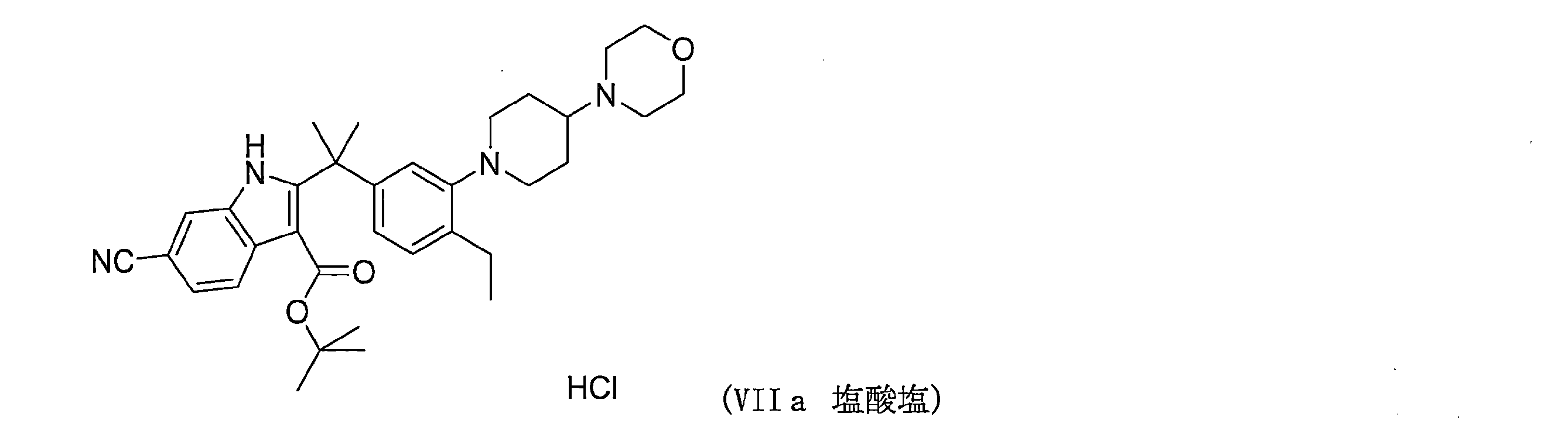
なお、本工程においては、式VIIで表される化合物の塩とするのが好ましい。式VIIで表される化合物の塩は、式VIIで表される化合物のフリー体を、所定の塩、好ましくは、薬学的に許容される塩に対応する医薬品の製造に使用可能な酸または塩基とを接触させることにより製造することができる。好ましくは式VIIで表される化合物の塩酸塩である。
本工程は、式VIIで表される化合物のエステル保護基(RB)の脱保護工程により、式VIIIで表される化合物へ変換させる反応で、RBは前述と同義である。エステル保護基(RB)は、例えばC1-C6アルキル基などを用いることができるが、好ましくはtert-ブチル基である。これらの脱保護は例えば、「Greene and Wuts, “Protective Groups in Organic Sythesis”(第5版、John Wiley & Sons 2014年)」に記載の方法を挙げることができ、これらを反応条件に応じて適宜用いればよい。エステル保護基(RB)がtert-ブチル基の場合、脱保護試薬は、例えばTMSI、TMSCl、BF3・OEt2などを用いることができる。脱保護試薬は、基質に対して1当量から10当量を用いることができ、好ましくは、1.5当量から3当量である。この反応で用いる溶媒は、トルエン、キシレン、ジエチルエーテル、THF、CPME、MTBE、DMSO、スルホラン、1,4-ジオキサン、2,2,2-トリフルオロエタノールなどおよびこれらの混合物を挙げることができ、好ましくはTHF、または2,2,2-トリフルオロエタノール、およびこれらの混合物である。この反応は、-20℃から溶媒沸点付近の反応温度で行うことができ、好ましくは、0℃から35℃である。この反応は、上記に示した温度の範囲内で一定時間(例えば0.1時間から24時間、好ましくは1時間から8時間)、反応混合物を攪拌することによって行うことができる。
工程5は、先に説明したスキーム1の工程である。
化合物(1)の塩酸塩は、化合物(1)と塩化水素を接触させることにより製造できる。
化合物(1)を適当な溶媒に溶解させ、塩化水素を添加して化合物(1)の塩酸塩の溶液を調整する。ついで、必要に応じてこの溶液に別の貧溶媒を加えることで、化合物(1)の塩酸塩を晶析させて、化合物(1)の塩酸塩を製造することができる。また、化合物(1)の溶液と塩化水素を混合することで、化合物(1)の塩酸塩を析出させて、化合物(1)の塩酸塩を製造することができる。
化合物(1)を溶解させるのに適した溶媒として、アセトン、2-ブタノン、テトラヒドロフラン、ジメチルホルムアミド、ジメチルアセトアミド、N-メチルピロリドン、ジメチルスルホキシド、酢酸、水、あるいはこれらから選ばれる混合溶媒を用いることができる。好ましくは2-ブタノン、酢酸、および水の混合溶媒である。
塩化水素の添加方法として、塩化水素ガスを添加する方法、塩化水素を溶解させた塩酸溶液を添加する方法が挙げられる。塩化水素を溶解させた塩酸溶液として、塩酸水溶液、塩酸メタノール溶液、塩酸エタノール溶液、塩酸酢酸エチル溶液、および塩酸テトラヒドロフラン溶液などが挙げられる。好ましくは、塩酸エタノール溶液である。
化合物(1)の塩酸塩を晶析させるために添加する貧溶媒として、ヘキサン、ヘプタン、石油エーテル、エタノール、水などが例示される。
また、化合物(1)を溶解させた溶液に塩化水素を溶解させた塩酸溶液を添加することにより化合物(1)の塩酸塩を製造することや、塩化水素を溶解させた塩酸溶液に化合物(1)を溶解させた溶液を添加することにより化合物(1)の塩酸塩を製造することもできる。さらに、化合物(1)を溶解させた溶液中の不溶物を除去後、化合物(1)の塩酸塩の製造に用いることもできる。不溶物の除去方法は、濾過、または遠心分離が挙げられるがこれらの方法に限定されない。
化合物(1)の塩酸塩は、無水物であってもよく、水和物などの溶媒和物を形成していてもよい。ここでいう「溶媒和」とは、溶液中で溶質分子あるいはイオンがそれに近接している分子を強く引き付け、一つの分子集団をつくる現象をいい、例えば溶媒が水であれば水和といい、水和により得られた物質を水和物という。溶媒和物は水和物、非水和物のいずれであってもよい。非水和物としては、アルコール(例えば、メタノール、エタノール、n-プロパノール、2-プロパノール)、テトラヒドロフラン、ジメチルスルホキシドなどが含まれた溶媒和物が存在する。
より具体的な製造法は、特許4588121号、特許4918630号、特開2012-126711に記載されている。
具体的には、以下の点において、本願発明の製法は特に有用である。
(1)特許文献1において好ましい還元剤として記載されているハイドロサルファイトナトリウム(工程2b-c)を用いた還元反応では、原薬まで残存する副生成物である不純物(X)が同時に生成するため、原薬の安全性担保の必要上、残存量のコントロールが必須であり、多大な労力が必要であった。
不純物(X)は、化合物(1)で表される化合物、その薬学的に許容される塩、またはそれらの溶媒和物、またはそれらの医薬組成物に薬学的に許容可能な不純物として、化合物(1)(塩または溶媒和物である場合には、化合物(1)の塩または溶媒和物)の重量に対して最大0.15%まで許容されることが規定されているが、これに対し、本願発明の製法では、通常約0.08%以下、具体的には0.001%から約0.08%の範囲、好ましくは約0.001%から約0.08%の範囲、好ましくは約0.001%から約0.05%の範囲の量に抑えることができる。なお、化合物(X)は、規定される割合の範囲内において医薬組成物としての薬理学的な特性に影響を与えるものではない。また、不純物(X)は、本願発明の製法により化合物(1)が製造されたことを示す明確な特徴(フィンガープリント)となりうる。
(3)特許文献1において好ましい溶媒として記載されているDMEや、DMF、DMA等のアミド系溶媒は、近年になって発がん性、催奇形性等の懸念があることが報告され、欧州の化学物質規制規則であるREACH規則において、高懸念物質(Substance of very concern:SVHC)として定義され、その取扱いについて制限をうける可能性がある。
さらに、ICHQ3C(医薬品の残留溶媒ガイドライン)では、DMEや、DMF、DMA等のアミド系溶媒の原薬への残留許容量が厳しく規制されている。実生産技術では、残留溶媒量を規制量以下に収めるための残留溶媒の制御に多大な労力を要している。
これに対し、本願発明の製法は、高懸念物質(SVHC)を用いない製法であり、残留溶媒の制御がより容易である。
(4)特許文献1において好ましい触媒系として記載されているPd-カルベン錯体を用いた触媒反応(工程3)では、反応系に含まれる水分またはアルコール含量が反応性に大きく悪影響を及ぼす。反応の再現性を保つために、反応系に含まれる水分またはアルコールの含有量コントロールに多大な労力を必要としていた。これに対し、本願発明の製法は、反応系に含まれる水分またはアルコール含量の影響を受けにくい触媒反応であり、再現性の高い触媒反応、すなわち、堅牢性の高い反応である。
HPLC純度は、Waters製H-Classシステム、Allianceシステムあるいは島津製作所製LC-10システムを使用して分析を行った。カラムについては、Waters製 X-Bridge(BEH 4.6mmID×150mmもしくはBEH 4.6mmID×50mm)、Sunfire(4.6mmID×150mmもしくは4.6mmID×50mm)などの汎用されているカラムを使用して測定した。各化合物の検出は、フォトダイオードアレイ検出器を用いて実施したが、質量分析計、蒸発光散乱検出等の他の手法を用いてもよい。残留溶媒は、島津製作所製GC2010を使用して内部標準法で分析を行った。水分量は、三菱ケミカルアナリテック製水分測定装置(CA-200)を用いて、カールフィッシャー法(電解法)を用いて測定した。NMRは、核磁気共鳴装置 JNM-ECP-500(JEOL製)を用いて測定した。粉末X線回折分析は、X線回析装置Empyrean(PANalytical製)を用いて測定した。
各工程の生成物は以下の分析法で分析し、評価した。
対陰極:Cu、 管電圧:45kV、 管電流:40mA
走査方式:連続、 ステップ幅:0.0262606°
走査軸:2θ、 ステップあたりのサンプリング時間:5.100秒
走査範囲:3~25°
tert-ブチル 4-(4-エチル-3-ヨード-フェニル)-4-メチル-3-オキソ-ペンタノアート(IIIa)の合成方法
(1)tert-ブチル 4-(4-エチル-3-ヨード-フェニル)-4-メチル-3-オキソ-ペンタノアート(IIIa)の合成[工程1]

得られた濃縮物にTHF(80ml)を添加し、反応液の内温を-6℃まで冷却した。LiHMDS(THF溶液、1.3mol/L、464ml)を反応液の内温が5℃を超えないように添加し、続いて反応液を-3℃に昇温した。この溶液に酢酸tert-ブチル(32g、277mmol)を反応液の内温が15℃を超えないように添加し、同温で1時間撹拌した。
得られた反応液に6mol/L塩酸(210ml、1.3mol)を、反応液の内温が20℃を超えないように添加し、30分撹拌後、静置し水層を排出した。得られた有機層をさらに炭酸水素ナトリウム水溶液(5wt%、160ml)で洗浄し、160mlまで濃縮した。得られた濃縮物にTHF(400ml)を添加し、160mlまで濃縮し、IIIaの粗生成物の濃縮物を得た。得られた濃縮物をそのまま次の工程に用いた。
HPLC純度:99.13%

HPLC純度:99.52%
粉末X線回折分析:化合物(VIa)は、図1に示されるようなパターンを示した。
HPLC純度:99.13%
アセトン含量:7.8%
粉末X線回折分析:化合物(VIIa)は図2、図3、図4に示されるようなパターンを示す。
試薬・溶媒種による反応選択性・反応率の比較
表1に示す溶媒および触媒の組合せを用いて、実施例1に記載した方法を実施し、目的物(化合物VIIa)と不純物(Z)の収量を測定した。
試薬・溶媒種による反応選択性・反応率の比較を表1に示す。
なお、不純物(Z)は、脱離基であるヨード基が水素原子で置き換わった以下に示す化合物である。


(1)6-シアノ-2-[1-[4-エチル-3-(4-モルホリノ-1-ピペリジル)フェニル]-1-メチル-エチル]-1H-インドール-3-カルボン酸(VIIIa)の製造[工程4]
A.結晶洗浄法としてアセトンと水の混合物を使用する合成法

HPLC純度;99.71%
TFE含量:1.7%
アセトン含量:1.3%
水分量:0.4%
B.結晶洗浄法として水とアセトンを使用する合成法
窒素雰囲気下、tert-ブチル 6-シアノ-2-[1-[4-エチル-3-(4-モルホリノ-1-ピペリジル)フェニル]-1-メチル-エチル]-1H-インドール-3-カルボキシラート 塩酸塩(VIIa、20g、34mmol)をTFE(100ml)に懸濁させ、反応液を内温25℃にて撹拌した。トリメチルシリルクロライド(6.2g、57mmol)を、反応液の内温が30℃を超えないように添加し、同温で3時間撹拌した。反応液の内温を8℃に冷却し、アセトン(80ml)を、反応液の内温が12℃を超えないように添加した。得られた溶液に1mol/L水酸化ナトリウム水溶液(61ml)を、反応液の内温が12℃を超えないように添加し、結晶析出後、反応液に10%リン酸水素二カリウム水溶液(20g)を追加し、同温で一時間半撹拌した。得られた固体を濾過により湿性末として取得後、湿性末を水(80ml)で洗浄し、さらにアセトン(80ml)で洗浄した。湿性末を減圧下外温50℃で乾燥を行い、6-シアノ-2-[1-[4-エチル-3-(4-モルホリノ-1-ピペリジル)フェニル]-1-メチル-エチル]-1H-インドール-3-カルボン酸(VIIIa、15.8g)を得た(収率93%)
HPLC純度;99.76%
TFE含量:1.6%
アセトン含量:2.3%
水分量:0.4%
粉末X線回折分析:化合物(VIIIa)は、図5、図6、図7に示されるようなパターンを示す。
A.N,N’-ジイソプロピルカルボジイミドを用いた製造方法

HPLC純度:99.85%
水分量:3.7%
粉末X線回折分析:上記手法にて得られる化合物(1)は、図12に示されるようなパターンを示す。
窒素雰囲気下、6-シアノ-2-[1-[4-エチル-3-(4-モルホリノ-1-ピペリジル)フェニル]-1-メチル-エチル]-1H-インドール-3-カルボン酸(VIIIa、1.0g、2.0mmol)をTHF(20ml)に懸濁し、クロロリン酸ジエチル(1.155ml、8.0mmol)、ジイソプロピルエチルアミン(2.4ml、14.0mmol)を加え、反応液の内温を68℃に昇温した。同温で反応液を2時間撹拌し、反応液の内温を40℃に冷却した。得られた反応液にメタノール(7.5ml)を添加後、反応液の内温を35℃に冷却した。水(12.5ml)を1時間かけて懸濁液へ添加し、反応液の内温を30℃にて1時間撹拌を行った・得られた固体を濾過により湿性末として取得後、メタノール、水の混合溶液(メタノール:水=5:8.7、計13.7ml)で洗浄した。湿性末を減圧下50℃で乾燥を行い、9-エチル-6,6-ジメチル-8-[4-(モルホリン-4-イル)ピペリジン-1-イル]-11-オキソ-6,11-ジヒドロ-5H-ベンゾ[b]カルバゾール-3-カルボニトリル(化合物(1)、0.7225g)を得た。(収率:75%)
HPLC純度:99.87%
水分量:3.8%
窒素雰囲気下、6-シアノ-2-[1-[4-エチル-3-(4-モルホリノ-1-ピペリジル)フェニル]-1-メチル-エチル]-1H-インドール-3-カルボン酸(VIIIa、1.0g、2.0mmol)をアセトニトリル(20ml)に懸濁し、クロロリン酸ジエチル(1.15ml、8.0mmol)、ジイソプロピルエチルアミン(2.4ml、14.0mmol)を加え、反応液の内温を69℃に昇温した。反応液を同温で2時間撹拌し、反応液の内温を40℃に冷却後、メタノール(7.5ml)を添加後、反応液の内温を35℃に冷却した。得られた懸濁液に、水(12.5ml)を1時間かけて添加し、内温30℃にて1時間撹拌した。得られた固体を濾過により湿性末として取得後、メタノール、水の混合溶液(メタノール:水=5:8.7、計13.7ml)で洗浄した。湿性末を減圧下50℃で乾燥を行い、9-エチル-6,6-ジメチル-8-[4-(モルホリン-4-イル)ピペリジン-1-イル]-11-オキソ-6,11-ジヒドロ-5H-ベンゾ[b]カルバゾール-3-カルボニトリル(化合物(1)、0.8107g)を得た。(収率:84%)
HPLC純度:99.5%
水分量:3.8%
D.無水酢酸を用いた製法(1)
窒素雰囲気下、6-シアノ-2-[1-[4-エチル-3-(4-モルホリノ-1-ピペリジル)フェニル]-1-メチル-エチル]-1H-インドール-3-カルボン酸(VIIIa、1.0g、2.0mmol)を2―メチルテトラヒドロフラン(15ml)に懸濁し、無水酢酸(0.75ml、8.0mmol)、ジイソプロピルエチルアミン(2.4ml、14.0mmol)を加え、反応液の内温を80℃に昇温した。反応液を同温で6時間撹拌し、反応液の内温を40℃に冷却後、メタノール(4.5ml)を添加後、反応液の内温を35℃に冷却した。得られた懸濁液に、水(4.5ml)を0.5時間かけて添加し、内温10℃以下にて1時間撹拌した。得られた固体を濾過により湿性末として取得後、メタノール、水の混合溶液(メタノール:水=5:8.7,計13.7ml)で洗浄した。湿性末を減圧下40℃で乾燥を行い、9-エチル-6,6-ジメチル-8-[4-(モルホリン-4-イル)ピペリジン-1-イル]-11-オキソ-6,11-ジヒドロ-5H-ベンゾ[b]カルバゾール-3-カルボニトリル(化合物(1)、0.673g)を得た。(収率:70%)
HPLC純度:99.77%
E.無水酢酸を用いた製法(2)
Dで用いた2-メチルテトラヒドロフランに替えて,溶媒としてN,N-ジメチルアセトアミドを用い,同様の操作を行い,化合物(1)を得た。(収率:85%)
HPLC純度:99.8%
試薬・溶媒種による環化反応の選択性・収率の比較
表2に示す試薬および溶媒の組合せを用いて、実施例3に記載した方法を実施し、目的物(化合物(1))と不純物(Y)の生成比を測定した。目的物(化合物(1))と不純物(Y)の生成比(環化反応の選択性)は、島津製作所製LC-10システムを用い、Sunfire(4.6mmID×50mm)カラムによる反応混合物のHPLC分析のピーク面積をもとに算出した。HPLC分析は0.05%トリフルオロ酢酸水溶液(A)と0.05%トリフルオロ酢酸のアセトニトリル溶液(B)を用いた直線的グラジエント法(表3,流速1ml/分)を用いて行い、230nmでの吸収ピーク面積を使用して計算した。各化合物の保持時間は目的物(化合物(1))が約6.8分、不純物(Y)が約3.8分であった。
試薬・溶媒種による環化反応の選択性・収率の比較を表2に示す。
なお、不純物(Y)は、目的物(化合物(1))とは異なる置換位置でフリーデル・クラフツ型反応により環化した下記化合物である。


B率:0.05%トリフルオロ酢酸のアセトニトリル溶液の総流量に対する割合
9-エチル-6,6-ジメチル-8-[4-(モルホリン-4-イル)ピペリジン-1-イル]-11-オキソ-6,11-ジヒドロ-5H-ベンゾ[b]カルバゾール-3-カルボニトリル 塩酸塩(化合物(1)の塩酸塩)の製造[工程6]
窒素雰囲気下、9-エチル-6,6-ジメチル-8-[4-(モルホリン-4-イル)ピペリジン-1-イル]-11-オキソ-6,11-ジヒドロ-5H-ベンゾ[b]カルバゾール-3-カルボニトリル(化合物(1)、35g、72.5mmol)に、2-ブタノン(350ml)、水(122.5ml)、および酢酸(105ml)を加え、外温35℃にて溶解した。この溶液を、内温60℃に加熱した2mol/L塩酸(70ml)とエタノール(350ml)の混合液へ、混合液温度を60℃に保ちながら滴下した。さらに、2-ブタノン(70ml)、水(24.5ml)、および酢酸(21ml)の混合溶媒を、混合液温度を60℃に保ちながら滴下した。反応液を同温で1時間撹拌した後、反応液の内温20℃まで2時間かけて冷却した。反応液を30分撹拌後、生じた固体を濾取し、得られた湿性末をエタノール(350ml)で洗浄した。湿性末を減圧下外温40℃で乾燥を行い、9-エチル-6,6-ジメチル-8-[4-(モルホリン-4-イル)ピペリジン-1-イル]-11-オキソ-6,11-ジヒドロ-5H-ベンゾ[b]カルバゾール-3-カルボニトリル 塩酸塩(化合物(1)塩酸塩、31.15g)を得た(収率:82.8%)。
HPLC純度:99.95%
3-シアノ-9-エチル-6,6-ジメチル-8-(4-モルホリノ-1-ピペリジル)-11-オキソ-5H-ベンゾ[b]カルバゾール-2-スルホン酸

Claims (15)
- 化合物(1):

前記方法は、式VIIIb
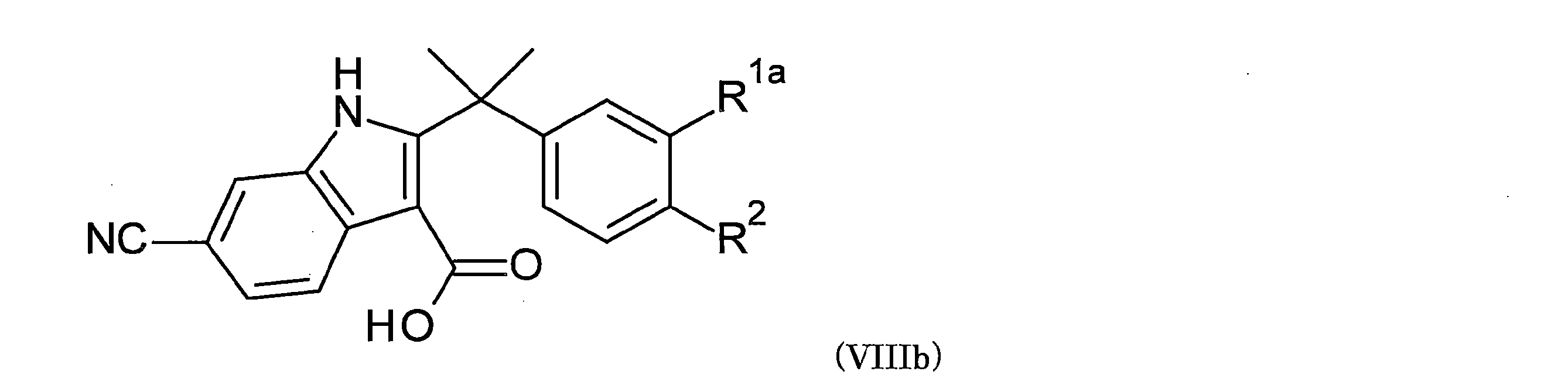
で表される化合物を、ジクロロメタン、1,4-ジオキサン、2-メチルテトラヒドロフラン、2-ブタノン、tert-ブチルメチルエーテル、酢酸エチル、酢酸イソプロピル、ジメチルスルホキシド、テトラヒドロフラン、アセトン、またはアセトニトリルから選択される溶媒中、縮合剤で処理し、
式IXa:

を含む、方法。 - 前記方法が、
(1)工程1a:
式I:

で表される化合物を酸の存在下で反応させて、式II:

で表される化合物を製造する工程;
(2)工程1b:
式IIで表される化合物を塩基およびAcORBと反応させて、式III:

で表される化合物を製造する工程;
(3)工程2a:
式IIIで表される化合物を式IV:
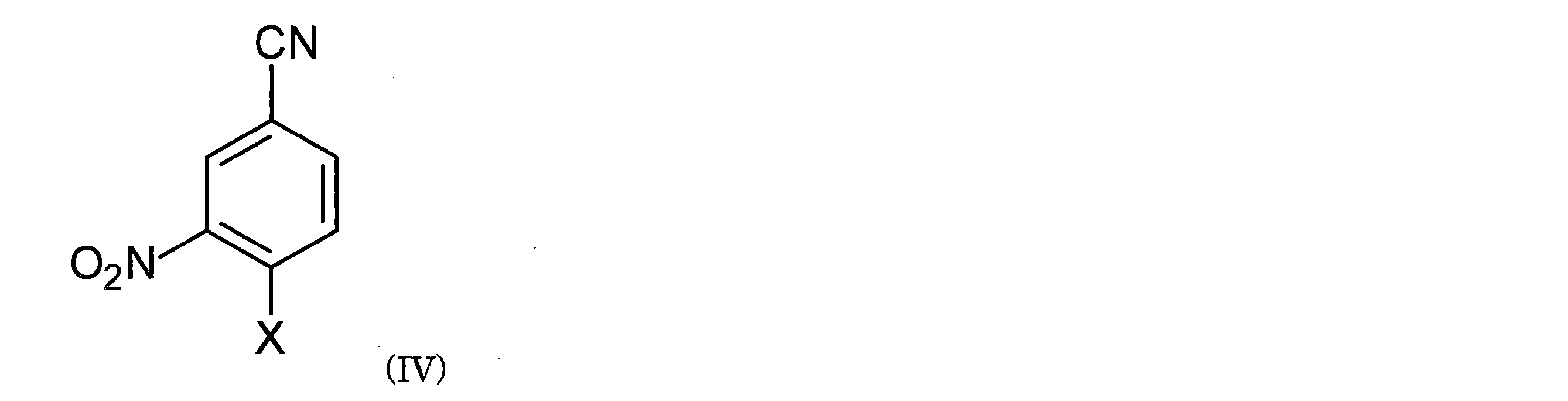
で表される化合物と塩基とを反応させて、式V:

で表される化合物を製造する工程;
(4)工程2b-c:
式Vで表される化合物を還元剤と反応させて、式VI:

で表される化合物を製造する工程;
(5)工程3:
式VIで表される化合物をパラジウム触媒存在下、置換されていても良い6員飽和環状アミンと反応させて、式VII:

で表される化合物、もしくはその薬学的に許容される塩、またはそれらいずれかの溶媒和物を製造する工程;または、
(6)工程4:
式VIIで表される化合物を酸と反応させて、一般式VIII:
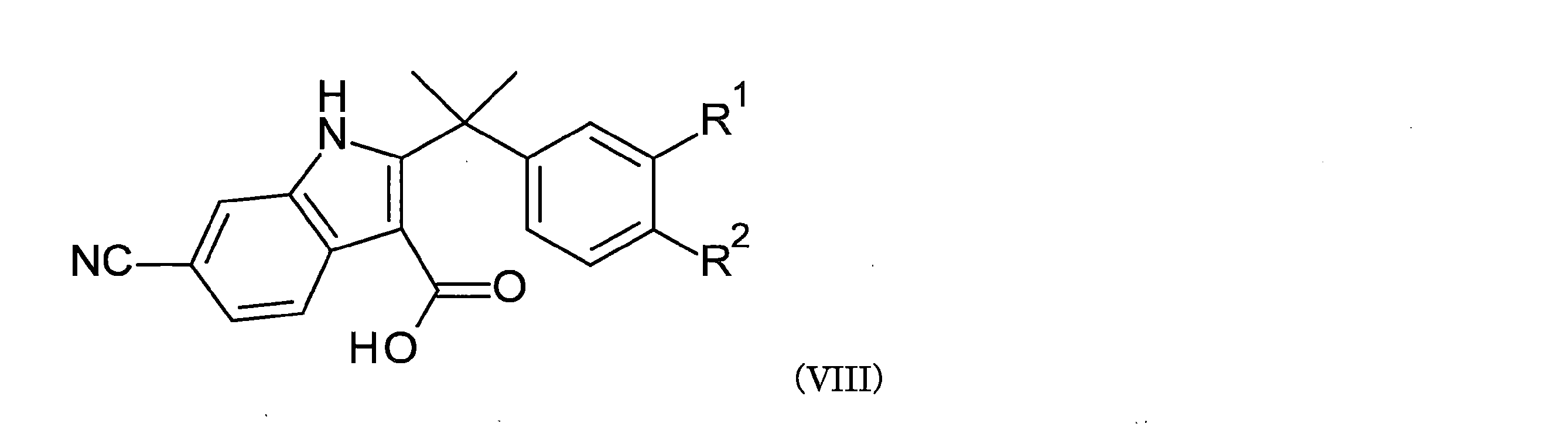
で表される化合物を製造する工程;
のいずれかをさらに含む請求項1に記載の方法。 - 前記縮合剤がN,N’-ジイソプロピルカルボジイミドまたはクロロリン酸ジエチルである請求項1に記載の方法。
- 前記溶媒が、テトラヒドロフラン、アセトン、またはアセトニトリルから選択される、請求項1に記載の方法。
- (1)における前記酸が、塩化アセチルである、請求項2に記載の方法。
- (2)における前記塩基が、リチウムヘキサメチルジシラジドまたはナトリウムヘキサメチルジシラジドである、請求項2に記載の方法。
- (2)における前記RBが、tert-ブチル基である請求項2に記載の方法。
- (3)における前記脱離基が、フルオロ基またはクロロ基である、請求項2に記載の方法。
- (3)における前記塩基が、水酸化ナトリウム、リン酸カリウム、炭酸カリウム、または炭酸セシウムであり、反応溶媒がテトラヒドロフランである、請求項2に記載の方法。
- (4)における前記還元剤が、ハイドロサルファイトナトリウムである、請求項2に記載の方法。
- (5)における前記パラジウム触媒が、Π一アリルパラジウムクロリドダイマーと2’,6’-ジメトキシ-2-(ジシクロヘキシルホスフィノ)ビフェニル(S-Phos)の組み合わせ、PEPPSI-IPent、またはS-Phos-Pd(Crotyl)Clであり、前記工程3の反応をテトラヒドロフランと1,3-ジメチル-2-イミダゾリジノンの混合溶媒中で行う、請求項2に記載の方法。
- (5)における置換されていても良い6員飽和環状アミンが式:

- (6)の前記酸が、トリメチルシリルクロリドおよび2,2,2-トリフルオロエタノールである、請求項2に記載の方法。
- 化合物(1)が塩酸塩である、請求項1~13のいずれか一項に記載の方法。
- 化合物(1)が塩酸塩であり、前記化合物(1)のほかに、式X:

Priority Applications (14)
| Application Number | Priority Date | Filing Date | Title |
|---|---|---|---|
| AU2019337018A AU2019337018B2 (en) | 2018-09-04 | 2019-09-03 | Method of producing tetracyclic compound |
| HRP20250284TT HRP20250284T1 (hr) | 2018-09-04 | 2019-09-03 | Postupak dobivanja tetracikličkog spoja |
| IL281079A IL281079B2 (en) | 2018-09-04 | 2019-09-03 | Method of producing a tetracyclic compound |
| CN201980056366.1A CN112585126B (zh) | 2018-09-04 | 2019-09-03 | 四环化合物的制备方法 |
| PL19856540.0T PL3848361T3 (pl) | 2018-09-04 | 2019-09-03 | Sposób wytwarzania związku tetracyklicznego |
| EP19856540.0A EP3848361B1 (en) | 2018-09-04 | 2019-09-03 | Method of producing tetracyclic compound |
| MX2021002311A MX2021002311A (es) | 2018-09-04 | 2019-09-03 | Metodo para producir un compuesto tetraciclico. |
| SG11202100983XA SG11202100983XA (en) | 2018-09-04 | 2019-09-03 | Method of producing tetracyclic compound |
| CA3107270A CA3107270A1 (en) | 2018-09-04 | 2019-09-03 | Method for producing tetracyclic compound |
| US17/271,437 US11939322B2 (en) | 2018-09-04 | 2019-09-03 | Method for producing tetracyclic compound |
| KR1020217005965A KR102635225B1 (ko) | 2018-09-04 | 2019-09-03 | 4환성 화합물의 제조방법 |
| BR112021001145-5A BR112021001145A2 (pt) | 2018-09-04 | 2019-09-03 | método para a produção de composto tetracíclico |
| JP2020541220A JP7167171B2 (ja) | 2018-09-04 | 2019-09-03 | 4環性化合物の製造方法 |
| ES19856540T ES3010145T3 (en) | 2018-09-04 | 2019-09-03 | Method of producing tetracyclic compound |
Applications Claiming Priority (2)
| Application Number | Priority Date | Filing Date | Title |
|---|---|---|---|
| JP2018165313 | 2018-09-04 | ||
| JP2018-165313 | 2018-09-04 |
Publications (1)
| Publication Number | Publication Date |
|---|---|
| WO2020050241A1 true WO2020050241A1 (ja) | 2020-03-12 |
Family
ID=69722303
Family Applications (1)
| Application Number | Title | Priority Date | Filing Date |
|---|---|---|---|
| PCT/JP2019/034543 Ceased WO2020050241A1 (ja) | 2018-09-04 | 2019-09-03 | 4環性化合物の製造方法 |
Country Status (18)
| Country | Link |
|---|---|
| US (1) | US11939322B2 (ja) |
| EP (1) | EP3848361B1 (ja) |
| JP (1) | JP7167171B2 (ja) |
| KR (1) | KR102635225B1 (ja) |
| CN (1) | CN112585126B (ja) |
| AR (1) | AR116113A1 (ja) |
| AU (1) | AU2019337018B2 (ja) |
| BR (1) | BR112021001145A2 (ja) |
| CA (1) | CA3107270A1 (ja) |
| ES (1) | ES3010145T3 (ja) |
| HR (1) | HRP20250284T1 (ja) |
| HU (1) | HUE070227T2 (ja) |
| IL (1) | IL281079B2 (ja) |
| MX (1) | MX2021002311A (ja) |
| PL (1) | PL3848361T3 (ja) |
| SG (1) | SG11202100983XA (ja) |
| TW (1) | TWI825163B (ja) |
| WO (1) | WO2020050241A1 (ja) |
Cited By (1)
| Publication number | Priority date | Publication date | Assignee | Title |
|---|---|---|---|---|
| WO2022163794A1 (ja) | 2021-01-29 | 2022-08-04 | 中外製薬株式会社 | 小児がん治療用医薬組成物 |
Families Citing this family (3)
| Publication number | Priority date | Publication date | Assignee | Title |
|---|---|---|---|---|
| CN117024410A (zh) * | 2023-08-15 | 2023-11-10 | 上海药坦药物研究开发有限公司 | 一种艾乐替尼中间体及其制备方法 |
| WO2025067412A1 (zh) * | 2023-09-28 | 2025-04-03 | 重庆博腾制药科技股份有限公司 | 一种抗肿瘤药物中间体的制备方法 |
| CN120081779A (zh) * | 2025-02-19 | 2025-06-03 | 江苏天士力帝益药业有限公司 | 一种阿来替尼杂质01a及其控制方法 |
Citations (8)
| Publication number | Priority date | Publication date | Assignee | Title |
|---|---|---|---|---|
| JPS4918630B1 (ja) | 1970-07-29 | 1974-05-11 | ||
| JPS506987B1 (ja) | 1970-02-17 | 1975-03-19 | ||
| JP4588121B1 (ja) | 2009-06-10 | 2010-11-24 | 中外製薬株式会社 | 4環性化合物 |
| JP2012126711A (ja) | 2010-11-22 | 2012-07-05 | Chugai Pharmaceut Co Ltd | 4環性化合物を含む医薬 |
| JP5859712B1 (ja) | 2014-04-25 | 2016-02-10 | 中外製薬株式会社 | 4環性化合物を高用量含有する製剤 |
| WO2017073706A1 (ja) * | 2015-10-30 | 2017-05-04 | 中外製薬株式会社 | ジヒドロナフト[2,3-b]ベンゾフラン誘導体 |
| CN107033124A (zh) * | 2017-04-21 | 2017-08-11 | 湖南博奥德生物医药技术开发有限公司 | 一种艾乐替尼的制备方法 |
| US20170247352A1 (en) * | 2014-11-12 | 2017-08-31 | Suzhou Miracpharma Technolpgy Co., Ltd. | Method for preparing alectinib |
Family Cites Families (42)
| Publication number | Priority date | Publication date | Assignee | Title |
|---|---|---|---|---|
| JPS5859712U (ja) | 1981-10-16 | 1983-04-22 | ニチバン株式会社 | ラベル貼付機 |
| JPH0892090A (ja) | 1994-07-26 | 1996-04-09 | Tanabe Seiyaku Co Ltd | 医薬組成物 |
| ES2123873T3 (es) | 1994-08-04 | 1999-01-16 | Hoffmann La Roche | Pirrolocarbazol. |
| EA001450B1 (ru) | 1996-05-01 | 2001-04-23 | Эли Лилли Энд Компани | Галогензамещенные ингибиторы протеинкиназы с |
| EP1142879B1 (en) | 1998-12-24 | 2007-10-10 | Astellas Pharma Inc. | Imidazole compounds and medicinal use thereof |
| EP1178988B1 (en) | 1999-05-14 | 2007-02-28 | The Australian National University | Compounds and therapeutic methods |
| GB0030417D0 (en) | 2000-12-13 | 2001-01-24 | Pharma Mar Sa | An anticancer lead compound isolated from a New Zealand ascidian |
| FR2841138B1 (fr) | 2002-06-25 | 2005-02-25 | Cll Pharma | Composition pharmaceutique solide contenant un principe actif lipophile, son procede de preparation |
| KR20050118169A (ko) | 2003-02-28 | 2005-12-15 | 이노텍 파마슈티컬스 코포레이션 | 사환식 벤즈아미드 유도체 및 이것의 사용 방법 |
| PT1454992E (pt) | 2003-03-07 | 2006-09-29 | Ist Naz Stud Cura Dei Tumori | Ensaio de quinase do linfoma anaplastico, reagentes e composicoes |
| GB0305929D0 (en) | 2003-03-14 | 2003-04-23 | Novartis Ag | Organic compounds |
| AU2004259012C1 (en) | 2003-07-23 | 2012-08-02 | Exelixis, Inc. | Anaplastic lymphoma kinase modulators and methods of use |
| US7378414B2 (en) | 2003-08-25 | 2008-05-27 | Abbott Laboratories | Anti-infective agents |
| JP2007511575A (ja) | 2003-11-21 | 2007-05-10 | ノバルティス アクチエンゲゼルシャフト | タンパク質キナーゼ阻害剤としての1h−イミダゾキノリン誘導体 |
| CA2548600A1 (en) | 2003-12-12 | 2005-06-23 | Merck Frosst Canada & Co. | Cathepsin cysteine protease inhibitors |
| US20090155903A1 (en) | 2004-03-19 | 2009-06-18 | Myriad Genetics, Incorporated | Pharmaceutical composition and method |
| CA2560195A1 (en) | 2004-03-19 | 2005-09-29 | Speedel Experimenta Ag | Organic compounds |
| US7973061B2 (en) | 2004-03-31 | 2011-07-05 | Exelixis, Inc. | Anaplastic lymphoma kinase modulators and methods of use |
| CN1976903A (zh) | 2004-06-02 | 2007-06-06 | 法莫西克立克斯公司 | 因子VⅡa抑制剂 |
| GEP20104906B (en) | 2004-08-26 | 2010-02-25 | Pfizer | Enantiomerically pure aminoheteroaryl compounds as protein kinase inhibitors |
| US7091202B2 (en) | 2004-09-15 | 2006-08-15 | Bristol-Myers Squibb Company | 4-arylspirocycloalkyl-2-aminopyrimidine carboxamide KCNQ potassium channel modulators |
| GB0517329D0 (en) | 2005-08-25 | 2005-10-05 | Merck Sharp & Dohme | Stimulation of neurogenesis |
| CN101304993A (zh) | 2005-11-07 | 2008-11-12 | Irm责任有限公司 | 作为ppar调节剂的化合物和组合物 |
| US7601716B2 (en) | 2006-05-01 | 2009-10-13 | Cephalon, Inc. | Pyridopyrazines and derivatives thereof as ALK and c-Met inhibitors |
| US8063225B2 (en) | 2006-08-14 | 2011-11-22 | Chembridge Corporation | Tricyclic compound derivatives useful in the treatment of neoplastic diseases, inflammatory disorders and immunomodulatory disorders |
| ES2555803T3 (es) | 2006-10-23 | 2016-01-08 | Cephalon, Inc. | Fusión de derivados bicíclicos 2,4-diaminopirimidina como utilizar inhibidores ALK y c-Met |
| WO2008130951A1 (en) | 2007-04-17 | 2008-10-30 | Bristol-Myers Squibb Company | Fused heterocyclic 11-beta-hydroxysteroid dehydrogenase type i inhibitors |
| TWI389893B (zh) | 2007-07-06 | 2013-03-21 | Astellas Pharma Inc | 二(芳胺基)芳基化合物 |
| US8299057B2 (en) | 2007-07-20 | 2012-10-30 | Nerviano Medical Sciences S.R.L. | Substituted indazole derivatives active as kinase inhibitors |
| CN101932325B (zh) | 2007-11-30 | 2014-05-28 | 新联基因公司 | Ido抑制剂 |
| ES2510866T3 (es) | 2008-03-13 | 2014-10-21 | Daiichi Sankyo Company, Limited | Mejora de la solubilidad de una preparación que contiene olmesartán medoxomilo |
| AU2010244218B2 (en) | 2009-05-07 | 2012-07-19 | Astrazeneca Ab | Substituted 1-cyanoethylheterocyclylcarboxamide compounds 750 |
| GB0910046D0 (en) | 2009-06-10 | 2009-07-22 | Glaxosmithkline Biolog Sa | Novel compositions |
| US8609097B2 (en) | 2009-06-10 | 2013-12-17 | Hoffmann-La Roche Inc. | Use of an anti-Tau pS422 antibody for the treatment of brain diseases |
| MX355836B (es) | 2010-08-20 | 2018-05-02 | Chugai Pharmaceutical Co Ltd | Composicion que comprende compuestos tetraciclicos. |
| US10668075B2 (en) | 2012-09-25 | 2020-06-02 | Chugai Seiyaku Kabushiki Kaisha | RET inhibitor |
| EP3135671B1 (en) | 2014-04-25 | 2019-09-18 | Chugai Seiyaku Kabushiki Kaisha | Novel crystal of tetracyclic compound |
| CN106456556A (zh) | 2014-06-18 | 2017-02-22 | 豪夫迈·罗氏有限公司 | 包含非离子性表面活性剂的新型药物组合物 |
| TWI831347B (zh) | 2014-08-08 | 2024-02-01 | 日商中外製藥股份有限公司 | 包含4環性化合物的非晶質體之固體分散體及製劑 |
| US9573932B2 (en) * | 2015-03-02 | 2017-02-21 | Yong Xu | Synthesis of intermediates in the preparation of ALK inhibitor |
| CN106928184B (zh) | 2017-04-21 | 2019-09-20 | 湖南博奥德药业有限公司 | 一种艾乐替尼的制备方法 |
| CN106928185B (zh) | 2017-04-21 | 2019-09-20 | 湖南博奥德药业有限公司 | 一种艾乐替尼的制备方法 |
-
2019
- 2019-09-03 WO PCT/JP2019/034543 patent/WO2020050241A1/ja not_active Ceased
- 2019-09-03 HR HRP20250284TT patent/HRP20250284T1/hr unknown
- 2019-09-03 HU HUE19856540A patent/HUE070227T2/hu unknown
- 2019-09-03 IL IL281079A patent/IL281079B2/en unknown
- 2019-09-03 PL PL19856540.0T patent/PL3848361T3/pl unknown
- 2019-09-03 US US17/271,437 patent/US11939322B2/en active Active
- 2019-09-03 EP EP19856540.0A patent/EP3848361B1/en active Active
- 2019-09-03 AR ARP190102518A patent/AR116113A1/es unknown
- 2019-09-03 CA CA3107270A patent/CA3107270A1/en active Pending
- 2019-09-03 KR KR1020217005965A patent/KR102635225B1/ko active Active
- 2019-09-03 CN CN201980056366.1A patent/CN112585126B/zh active Active
- 2019-09-03 TW TW108131697A patent/TWI825163B/zh active
- 2019-09-03 AU AU2019337018A patent/AU2019337018B2/en active Active
- 2019-09-03 MX MX2021002311A patent/MX2021002311A/es unknown
- 2019-09-03 JP JP2020541220A patent/JP7167171B2/ja active Active
- 2019-09-03 SG SG11202100983XA patent/SG11202100983XA/en unknown
- 2019-09-03 ES ES19856540T patent/ES3010145T3/es active Active
- 2019-09-03 BR BR112021001145-5A patent/BR112021001145A2/pt unknown
Patent Citations (9)
| Publication number | Priority date | Publication date | Assignee | Title |
|---|---|---|---|---|
| JPS506987B1 (ja) | 1970-02-17 | 1975-03-19 | ||
| JPS4918630B1 (ja) | 1970-07-29 | 1974-05-11 | ||
| JP4588121B1 (ja) | 2009-06-10 | 2010-11-24 | 中外製薬株式会社 | 4環性化合物 |
| WO2010143664A1 (ja) | 2009-06-10 | 2010-12-16 | 中外製薬株式会社 | 4環性化合物 |
| JP2012126711A (ja) | 2010-11-22 | 2012-07-05 | Chugai Pharmaceut Co Ltd | 4環性化合物を含む医薬 |
| JP5859712B1 (ja) | 2014-04-25 | 2016-02-10 | 中外製薬株式会社 | 4環性化合物を高用量含有する製剤 |
| US20170247352A1 (en) * | 2014-11-12 | 2017-08-31 | Suzhou Miracpharma Technolpgy Co., Ltd. | Method for preparing alectinib |
| WO2017073706A1 (ja) * | 2015-10-30 | 2017-05-04 | 中外製薬株式会社 | ジヒドロナフト[2,3-b]ベンゾフラン誘導体 |
| CN107033124A (zh) * | 2017-04-21 | 2017-08-11 | 湖南博奥德生物医药技术开发有限公司 | 一种艾乐替尼的制备方法 |
Non-Patent Citations (16)
| Title |
|---|
| BORCH ET AL., J. AM. CHEM. SOC., vol. 93, 1971, pages 2897 |
| BUCHWALD ET AL., ORGANIC SYNTHESIS, vol. 78, pages 23 |
| COLL., vol. 10, pages 423 |
| GAZZETTA CHIMICA ITALIANA, vol. 121, no. 11, 1991, pages 499 - 504 |
| GREENEWUTS: "Protective Groups in Organic Synthesis", 2014, JOHN WILEY & SONS |
| JOURNAL OF HETEROCYCLIC CHEMISTRY, vol. 46, no. 2, 2009, pages 172 - 177 |
| JOURNAL OF ORGANIC CHEMISTRY, vol. 58, no. 19, 1993, pages 5209 - 5220 |
| MOUADDIB ET AL., HETEROCYCLES, vol. 51, 1999, pages 2127 |
| NATURE, vol. 448, 2007, pages 561 - 566 |
| NEUROPSYCHOPHARMACOLOGY, vol. 33, 2008, pages 685 - 700 |
| ORGANIC & BIOMOLECULAR CHEMISTRY, vol. 3, no. 2, 2005, pages 213 - 215 |
| ORGANIC PROCESS RESEARCH & DEVELOPMENT, vol. 18, no. 1, 2014, pages 89 - 102 |
| See also references of EP3848361A4 |
| SYNLETT, vol. 17, 2008, pages 2689 - 2691 |
| SYNTHESIS, vol. 18, 2008, pages 2943 - 2952 |
| TETRAHEDRON, vol. 64, no. 40, 2008, pages 9607 - 9618 |
Cited By (1)
| Publication number | Priority date | Publication date | Assignee | Title |
|---|---|---|---|---|
| WO2022163794A1 (ja) | 2021-01-29 | 2022-08-04 | 中外製薬株式会社 | 小児がん治療用医薬組成物 |
Also Published As
| Publication number | Publication date |
|---|---|
| EP3848361A4 (en) | 2022-06-15 |
| HUE070227T2 (hu) | 2025-05-28 |
| JPWO2020050241A1 (ja) | 2021-08-30 |
| CN112585126B (zh) | 2024-05-07 |
| SG11202100983XA (en) | 2021-03-30 |
| AR116113A1 (es) | 2021-03-31 |
| TWI825163B (zh) | 2023-12-11 |
| KR20210053890A (ko) | 2021-05-12 |
| JP7167171B2 (ja) | 2022-11-08 |
| BR112021001145A2 (pt) | 2021-04-20 |
| KR102635225B1 (ko) | 2024-02-07 |
| US11939322B2 (en) | 2024-03-26 |
| AU2019337018A1 (en) | 2021-03-18 |
| US20220372025A1 (en) | 2022-11-24 |
| ES3010145T3 (en) | 2025-04-01 |
| HRP20250284T1 (hr) | 2025-04-25 |
| EP3848361A1 (en) | 2021-07-14 |
| CA3107270A1 (en) | 2020-03-12 |
| EP3848361C0 (en) | 2025-01-22 |
| IL281079B1 (en) | 2024-08-01 |
| EP3848361B1 (en) | 2025-01-22 |
| CN112585126A (zh) | 2021-03-30 |
| TW202024050A (zh) | 2020-07-01 |
| IL281079B2 (en) | 2024-12-01 |
| AU2019337018B2 (en) | 2024-03-07 |
| IL281079A (en) | 2021-04-29 |
| MX2021002311A (es) | 2021-04-28 |
| PL3848361T3 (pl) | 2025-07-07 |
Similar Documents
| Publication | Publication Date | Title |
|---|---|---|
| JP6392436B2 (ja) | 置換された5−フルオロ−1h−ピラゾロピリジン類を製造するための方法 | |
| KR102635225B1 (ko) | 4환성 화합물의 제조방법 | |
| RS64654B1 (sr) | Proces za pripremu n-(5-((4-(4-((dimetilamino)metil)-3-fenil-1h-pirazol-1-il)pirimidin-2-il)amino)-4-metoksi-2- morfolinofenil)akrilamida reakcijom odgovarajućeg amina sa 3-halo-propionil hloridom | |
| TW201738236A (zh) | 一種製備酪胺酸激酶抑制劑及其衍生物的方法 | |
| JP2019069958A (ja) | 3−(5−アミノ−2−メチル−4−オキソキナゾリン−3(4h)−イル)ピペリジン−2,6−ジオンの合成 | |
| AU2017364725A1 (en) | Method for producing triazolopyridine compound | |
| BRPI0708560A2 (pt) | processo para a preparação de um composto, e, composto | |
| JP7532420B2 (ja) | 4-フェニル-5-アルコキシカルボニル-2-チアゾール-2-イル-1,4-ジヒドロピリミジン-6-イル]メチル]-3-オキソ-5,6,8,8a-テトラヒドロ-1H-イミダゾ[1,5-a]ピラジン-2-イル]-カルボン酸を調製するための代替方法 | |
| HK40051429A (en) | Method of producing tetracyclic compound | |
| HK40051429B (zh) | 四环化合物的制备方法 | |
| JP5282029B2 (ja) | キノロンカルボン酸誘導体の製法 | |
| WO2008097483A2 (en) | Methods for preparing aryl-substituted ketophosphonates | |
| KR101865868B1 (ko) | 1-이소프로필-3-[5-[1-(3-메톡시프로필) 피페리딘-4-일]-[1,3,4]옥사디아졸-2-일]-1h-인다졸 옥살레이트의 대규모 제조공정 | |
| JP6997769B2 (ja) | 2-(6-ニトロピリジン-3-イル)-9H-ジピリド[2,3-b;3’,4’-d]ピロールの製造方法 | |
| JP2023033201A (ja) | オラパリブの製造方法 | |
| RU2282632C1 (ru) | Способ получения производных 3,5-дигидро-1,11-диметилфуро[2`,3`:3,4]циклогепта[c]изохинолин-5-она | |
| WO2012005312A1 (ja) | 三置換インダゾールアクリル酸アミド誘導体の製造方法 | |
| BR112021011084A2 (pt) | Processo para preparar 1-[(3r,4s)-4-cianotetrahidropiran-3-il]-3-[(2-fluoro-6-metoxi-4-piridil)amino]pirazol-4-carboxamida | |
| HK40032181A (en) | Process for preparing aminopyrimidine derivatives | |
| JP2018070607A (ja) | アミノ基で置換されたオキサジアゾール誘導体の製造方法 | |
| HK1167136B (en) | A process for the preparation of 6-(7-((1-aminocyclopropyl)methoxy)-6-methoxyquinolin-4-yloxy)-n-methyl-1-naphthamide and synthetic intermediates thereof | |
| HK1167136A1 (en) | A process for the preparation of 6-(7-((1-aminocyclopropyl)methoxy)-6-methoxyquinolin-4-yloxy)-n-methyl-1-naphthamide and synthetic intermediates thereof |
Legal Events
| Date | Code | Title | Description |
|---|---|---|---|
| 121 | Ep: the epo has been informed by wipo that ep was designated in this application |
Ref document number: 19856540 Country of ref document: EP Kind code of ref document: A1 |
|
| ENP | Entry into the national phase |
Ref document number: 2020541220 Country of ref document: JP Kind code of ref document: A |
|
| ENP | Entry into the national phase |
Ref document number: 3107270 Country of ref document: CA |
|
| REG | Reference to national code |
Ref country code: BR Ref legal event code: B01A Ref document number: 112021001145 Country of ref document: BR |
|
| ENP | Entry into the national phase |
Ref document number: 20217005965 Country of ref document: KR Kind code of ref document: A |
|
| NENP | Non-entry into the national phase |
Ref country code: DE |
|
| ENP | Entry into the national phase |
Ref document number: 2019337018 Country of ref document: AU Date of ref document: 20190903 Kind code of ref document: A |
|
| ENP | Entry into the national phase |
Ref document number: 2019856540 Country of ref document: EP Effective date: 20210406 |
|
| ENP | Entry into the national phase |
Ref document number: 112021001145 Country of ref document: BR Kind code of ref document: A2 Effective date: 20210121 |