WO2020059650A1 - 紫外線硬化性シリコーン組成物及びその硬化物 - Google Patents
紫外線硬化性シリコーン組成物及びその硬化物 Download PDFInfo
- Publication number
- WO2020059650A1 WO2020059650A1 PCT/JP2019/036044 JP2019036044W WO2020059650A1 WO 2020059650 A1 WO2020059650 A1 WO 2020059650A1 JP 2019036044 W JP2019036044 W JP 2019036044W WO 2020059650 A1 WO2020059650 A1 WO 2020059650A1
- Authority
- WO
- WIPO (PCT)
- Prior art keywords
- group
- curable silicone
- silicone composition
- formula
- ultraviolet
- Prior art date
- Legal status (The legal status is an assumption and is not a legal conclusion. Google has not performed a legal analysis and makes no representation as to the accuracy of the status listed.)
- Ceased
Links
Classifications
-
- C—CHEMISTRY; METALLURGY
- C08—ORGANIC MACROMOLECULAR COMPOUNDS; THEIR PREPARATION OR CHEMICAL WORKING-UP; COMPOSITIONS BASED THEREON
- C08F—MACROMOLECULAR COMPOUNDS OBTAINED BY REACTIONS ONLY INVOLVING CARBON-TO-CARBON UNSATURATED BONDS
- C08F290/00—Macromolecular compounds obtained by polymerising monomers on to polymers modified by introduction of aliphatic unsaturated end or side groups
- C08F290/02—Macromolecular compounds obtained by polymerising monomers on to polymers modified by introduction of aliphatic unsaturated end or side groups on to polymers modified by introduction of unsaturated end groups
- C08F290/06—Polymers provided for in subclass C08G
- C08F290/068—Polysiloxanes
-
- C—CHEMISTRY; METALLURGY
- C08—ORGANIC MACROMOLECULAR COMPOUNDS; THEIR PREPARATION OR CHEMICAL WORKING-UP; COMPOSITIONS BASED THEREON
- C08F—MACROMOLECULAR COMPOUNDS OBTAINED BY REACTIONS ONLY INVOLVING CARBON-TO-CARBON UNSATURATED BONDS
- C08F283/00—Macromolecular compounds obtained by polymerising monomers on to polymers provided for in subclass C08G
- C08F283/12—Macromolecular compounds obtained by polymerising monomers on to polymers provided for in subclass C08G on to polysiloxanes
- C08F283/124—Macromolecular compounds obtained by polymerising monomers on to polymers provided for in subclass C08G on to polysiloxanes on to polysiloxanes having carbon-to-carbon double bonds
-
- C—CHEMISTRY; METALLURGY
- C08—ORGANIC MACROMOLECULAR COMPOUNDS; THEIR PREPARATION OR CHEMICAL WORKING-UP; COMPOSITIONS BASED THEREON
- C08L—COMPOSITIONS OF MACROMOLECULAR COMPOUNDS
- C08L83/00—Compositions of macromolecular compounds obtained by reactions forming in the main chain of the macromolecule a linkage containing silicon with or without sulfur, nitrogen, oxygen or carbon only; Compositions of derivatives of such polymers
- C08L83/04—Polysiloxanes
-
- B—PERFORMING OPERATIONS; TRANSPORTING
- B33—ADDITIVE MANUFACTURING TECHNOLOGY
- B33Y—ADDITIVE MANUFACTURING, i.e. MANUFACTURING OF THREE-DIMENSIONAL [3D] OBJECTS BY ADDITIVE DEPOSITION, ADDITIVE AGGLOMERATION OR ADDITIVE LAYERING, e.g. BY 3D PRINTING, STEREOLITHOGRAPHY OR SELECTIVE LASER SINTERING
- B33Y70/00—Materials specially adapted for additive manufacturing
-
- C—CHEMISTRY; METALLURGY
- C08—ORGANIC MACROMOLECULAR COMPOUNDS; THEIR PREPARATION OR CHEMICAL WORKING-UP; COMPOSITIONS BASED THEREON
- C08G—MACROMOLECULAR COMPOUNDS OBTAINED OTHERWISE THAN BY REACTIONS ONLY INVOLVING UNSATURATED CARBON-TO-CARBON BONDS
- C08G77/00—Macromolecular compounds obtained by reactions forming a linkage containing silicon with or without sulfur, nitrogen, oxygen or carbon in the main chain of the macromolecule
- C08G77/04—Polysiloxanes
- C08G77/20—Polysiloxanes containing silicon bound to unsaturated aliphatic groups
-
- C—CHEMISTRY; METALLURGY
- C08—ORGANIC MACROMOLECULAR COMPOUNDS; THEIR PREPARATION OR CHEMICAL WORKING-UP; COMPOSITIONS BASED THEREON
- C08G—MACROMOLECULAR COMPOUNDS OBTAINED OTHERWISE THAN BY REACTIONS ONLY INVOLVING UNSATURATED CARBON-TO-CARBON BONDS
- C08G77/00—Macromolecular compounds obtained by reactions forming a linkage containing silicon with or without sulfur, nitrogen, oxygen or carbon in the main chain of the macromolecule
- C08G77/04—Polysiloxanes
- C08G77/38—Polysiloxanes modified by chemical after-treatment
-
- C—CHEMISTRY; METALLURGY
- C08—ORGANIC MACROMOLECULAR COMPOUNDS; THEIR PREPARATION OR CHEMICAL WORKING-UP; COMPOSITIONS BASED THEREON
- C08G—MACROMOLECULAR COMPOUNDS OBTAINED OTHERWISE THAN BY REACTIONS ONLY INVOLVING UNSATURATED CARBON-TO-CARBON BONDS
- C08G77/00—Macromolecular compounds obtained by reactions forming a linkage containing silicon with or without sulfur, nitrogen, oxygen or carbon in the main chain of the macromolecule
- C08G77/48—Macromolecular compounds obtained by reactions forming a linkage containing silicon with or without sulfur, nitrogen, oxygen or carbon in the main chain of the macromolecule in which at least two but not all the silicon atoms are connected by linkages other than oxygen atoms
- C08G77/50—Macromolecular compounds obtained by reactions forming a linkage containing silicon with or without sulfur, nitrogen, oxygen or carbon in the main chain of the macromolecule in which at least two but not all the silicon atoms are connected by linkages other than oxygen atoms by carbon linkages
-
- C—CHEMISTRY; METALLURGY
- C08—ORGANIC MACROMOLECULAR COMPOUNDS; THEIR PREPARATION OR CHEMICAL WORKING-UP; COMPOSITIONS BASED THEREON
- C08G—MACROMOLECULAR COMPOUNDS OBTAINED OTHERWISE THAN BY REACTIONS ONLY INVOLVING UNSATURATED CARBON-TO-CARBON BONDS
- C08G77/00—Macromolecular compounds obtained by reactions forming a linkage containing silicon with or without sulfur, nitrogen, oxygen or carbon in the main chain of the macromolecule
- C08G77/48—Macromolecular compounds obtained by reactions forming a linkage containing silicon with or without sulfur, nitrogen, oxygen or carbon in the main chain of the macromolecule in which at least two but not all the silicon atoms are connected by linkages other than oxygen atoms
- C08G77/50—Macromolecular compounds obtained by reactions forming a linkage containing silicon with or without sulfur, nitrogen, oxygen or carbon in the main chain of the macromolecule in which at least two but not all the silicon atoms are connected by linkages other than oxygen atoms by carbon linkages
- C08G77/52—Macromolecular compounds obtained by reactions forming a linkage containing silicon with or without sulfur, nitrogen, oxygen or carbon in the main chain of the macromolecule in which at least two but not all the silicon atoms are connected by linkages other than oxygen atoms by carbon linkages containing aromatic rings
Definitions
- the present invention relates to an ultraviolet-curable silicone composition and a cured product thereof.
- a composition containing an alkenyl group-containing organopolysiloxane, a mercapto group-containing organopolysiloxane, and MQ resin has already been disclosed (Patent Document 2).
- a silicone mixture containing a platinum catalyst activated by ultraviolet light for dispensing technology Patent Document 3
- a photocurable low-viscosity silicone material has been disclosed for a 3D printer using an inkjet method (Patent Document 4), but a cured product of this composition is said to have poor heat resistance as compared with a normal silicone material.
- JP 2012-111226 A Patent No. 4788863 Japanese Patent No. 5384656 International Publication No. WO2018 / 003381
- the present invention has been made in view of the above circumstances, and an object of the present invention is to provide a low-viscosity ultraviolet-curable silicone composition that can be used in a molding method such as a surface exposure method or a lifting method, and a cured product having excellent heat resistance.
- the present invention provides the following ultraviolet-curable silicone composition and a cured product thereof.
- Ar is an aromatic group
- R 1 is independently a monovalent hydrocarbon group having 1 to 20 carbon atoms
- A is a group represented by the following formula (2).
- p is a number satisfying 0 ⁇ p ⁇ 10
- a is a number satisfying 1 ⁇ a ⁇ 3
- R 1 is independently a monovalent hydrocarbon having 1 to 20 carbon atoms.
- R 2 is an oxygen atom or an alkylene group
- R 3 is an acryloyloxyalkyl group, a methacryloyloxyalkyl group, an acryloyloxyalkyloxy group, or a methacryloyloxyalkyloxy group.
- the ultraviolet curable silicone composition of the present invention has such a low viscosity that it can be used in a molding method such as a surface exposure method or a lifting method, it is expected as a new molding material used in a 3D printer. Further, since the ultraviolet-curable silicone composition of the present invention is a cured product having excellent heat resistance, it is expected to be used as a molding material for an inkjet 3D printer exhibiting excellent mechanical strength.
- the component (A) is an organopolysiloxane represented by the following general formula (1).
- examples of the aromatic group represented by Ar include an aromatic hydrocarbon group such as a phenyl group, a biphenyl group and a naphthyl group, and an aromatic group containing a hetero atom (O, S, N) such as a furanyl group. And the aromatic group may further have a substituent such as a halogen atom (for example, a chlorine atom, a bromine atom or a fluorine atom).
- Ar is preferably an unsubstituted aromatic hydrocarbon group, particularly preferably a phenyl group.
- N n in the formula (1) is 1 ⁇ n ⁇ 1,000, preferably 1 ⁇ n ⁇ 500, and more preferably 1 ⁇ n ⁇ 400.
- n is less than 1, volatilization is easy, and when n is more than 1,000, the viscosity of the composition becomes high, and the handleability is poor.
- M in the formula (1) is 1 ⁇ m ⁇ 1,000, preferably 1 ⁇ m ⁇ 500, more preferably 1 ⁇ m ⁇ 400.
- N + m in the formula (1) is 2 ⁇ n + m ⁇ 2,000, preferably 2 ⁇ n + m ⁇ 1,000, more preferably 2 ⁇ n + m ⁇ 800.
- n + m is less than 2
- volatilization is easy.
- n + m is more than 2,000, the viscosity of the composition becomes high, and it becomes difficult to form by a lifting method.
- a in the formula (1) is a group represented by the following formula (2).
- R 1 is independently a monovalent hydrocarbon group having 1 to 20 carbon atoms, preferably 1 to 10 carbon atoms excluding an aliphatic unsaturated group; More preferably, it represents a monovalent hydrocarbon group of 1 to 8.
- the monovalent hydrocarbon group having 1 to 20 carbon atoms of R 1 may be linear, branched or cyclic, and specific examples thereof include methyl, ethyl and n.
- Alkyl groups such as -propyl, isopropyl, n-butyl, isobutyl, tert-butyl, n-hexyl, cyclohexyl, n-octyl, 2-ethylhexyl, n-decyl group; vinyl, allyl (2-propenyl), 1-propenyl And alkenyl groups such as isopropenyl and butenyl groups; aryl groups such as phenyl, tolyl, xylyl and naphthyl groups; and aralkyl groups such as benzyl, phenylethyl and phenylpropyl groups.
- R 1 is preferably an alkyl group having 1 to 5 carbon atoms and a phenyl group, and more preferably a methyl group, an ethyl group and a phenyl group.
- R 2 represents an oxygen atom or an alkylene group having 1 to 20, preferably 1 to 10, and more preferably 1 to 5 carbon atoms.
- the alkylene group having 1 to 20 carbon atoms of R 2 may be linear, branched or cyclic, and specific examples thereof include methylene, ethylene, propylene, trimethylene, tetramethylene, isobutylene, Pentamethylene, hexamethylene, heptamethylene, octamethylene, nonamethylene, decylene group and the like can be mentioned.
- R 2 is preferably an oxygen atom, methylene, ethylene and trimethylene group, more preferably an oxygen atom or ethylene group.
- R 3 independently represents an acryloyloxyalkyl group, a methacryloyloxyalkyl group, an acryloyloxyalkyloxy group, or a methacryloyloxyalkyloxy group.
- the number of carbon atoms of the alkyl (alkylene) group in the acryloyloxyalkyl group, methacryloyloxyalkyl group, acryloyloxyalkyloxy group, or methacryloyloxyalkyloxy group of R 3 is not particularly limited. However, 1 to 10 is preferable, and 1 to 5 is more preferable. Specific examples of these alkyl groups include those having 1 to 10 carbon atoms among the groups exemplified for R 1 above.
- R 3 include those represented by the following formulas, but are not limited thereto. (In the formula, b represents a number satisfying 1 ⁇ b ⁇ 4, and R 4 represents an alkylene group having 1 to 10 carbon atoms.)
- P represents a number satisfying 0 ⁇ p ⁇ 10, preferably 0 or 1
- a represents a number satisfying 1 ⁇ a ⁇ 3, preferably 1 or 2.
- organopolysiloxane represented by the above formula (1) examples include, for example, the following compounds.
- R 1 , R 2 , R 4 , Ar, n, m and b represent the same meaning as described above, and the arrangement order of the siloxane units to which n and m are added is arbitrary.
- organopolysiloxane can be produced by a known method.
- the organopolysiloxane represented by the above formula (3) may be, for example, a dimethylvinylsiloxy group-blocked dimethylsiloxane-diphenylsiloxane copolymer at both ends and 3- (1,1,3,3-tetramethyldisiloxanyl) Obtained as a hydrosilylation product with propyl methacrylate (CAS No. 96474-12-3).
- the organopolysiloxane represented by the above formula (4) can be obtained, for example, by reacting 2-hydroxyethyl acrylate with a hydrosilylation reaction product of a dimethyl siloxane / diphenyl siloxane copolymer capped with dimethylvinylsiloxy groups at both ends and dichloromethylsilane. Can be obtained.
- Photopolymerization initiator As the photopolymerization initiator (B), known ones can be used. Examples thereof include 2,2-diethoxyacetophenone and 2,2-dimethoxy-1,2-diphenyl. Ethane-1-one (Irgacure 651 from BASF), 1-hydroxy-cyclohexyl-phenyl-ketone (Irgacure 184 from BASF), 2-hydroxy-2-methyl-1-phenyl-propan-1-one (Irgacure 1173 from BASF) ), 2-hydroxy-1- ⁇ 4- [4- (2-hydroxy-2-methyl-propionyl) -benzyl] -phenyl ⁇ -2-methyl-propan-1-one (Irgacure 127 manufactured by BASF), phenylglycol Oxylic acid methyl ester (Irgacure MBF manufactured by BASF), 2- Tyl-1- [4- (methylthio) phenyl] -2-morpholinopropan-1-one (Irg
- component (B) preferred from the viewpoint of compatibility with the component (A) are 2,2-diethoxyacetophenone, 2-hydroxy-2-methyl-1-phenyl-propan-1-one ( BASF's Irgacure 1173), bis (2,4,6-trimethylbenzoyl) -phenylphosphine oxide (BASF's Irgacure 819), and 2,4,6-trimethylbenzoyl-diphenyl-phosphine oxide (BASF's Irgacure @ TPO) is there.
- BASF's Irgacure 1173 2-hydroxy-2-methyl-1-phenyl-propan-1-one
- BASF's Irgacure 819 bis (2,4,6-trimethylbenzoyl) -phenylphosphine oxide
- BASF's Irgacure @ TPO 2,4,6-trimethylbenzoyl-diphenyl-phosphine oxide
- the addition amount of the photopolymerization initiator is 0.1 to 10 parts by mass based on 100 parts by mass of the component (A). If the amount of the photopolymerization initiator is less than 0.1 part by mass, the curability of the cured product is insufficient, and if the amount exceeds 10 parts by mass, the deep curability of the cured product is deteriorated.
- (C) Monofunctional (meth) acrylate compound containing no siloxane structure examples include isoamyl acrylate, lauryl acrylate, stearyl acrylate, ethoxy-diethylene glycol acrylate, and methoxy-triacrylate. Examples include ethylene glycol acrylate, 2-ethylhexyl-diglycol acrylate, phenoxyethyl acrylate, phenoxydiethylene glycol acrylate, tetrahydrofurfuryl acrylate, isobornyl acrylate, and mixtures thereof, with isobornyl acrylate being particularly preferred.
- polyfunctional (meth) acrylate compound containing no siloxane structure examples include triethylene glycol diacrylate, polytetramethylene glycol diacrylate, and neopentyl. Glycol diacrylate, 1,6-hexanediol diacrylate, dimethylol-tricyclodecane diacrylate, trimethylolpropane triacrylate, pentaerythritol tetraacrylate, and mixtures thereof, and the like, with dimethylol-tricyclodecane diacrylate being particularly preferred .
- the (meth) acrylate compound of the component (C) and the component (D) is preferably contained in a range of 1 to 400 parts by mass, preferably 1 to 200 parts by mass, based on 100 parts by mass of the component (A). Is more preferred. If the total added amount of the component (C) and the component (D) exceeds 400 parts by mass with respect to 100 parts by mass of the component (A), the hardness of the cured product becomes unnecessarily high, and desired rubber properties cannot be obtained. There are cases.
- a silane coupling agent a polymerization inhibitor, an antioxidant, an ultraviolet absorber which is a light fastness stabilizer, a light stabilizer, and the like are further added as long as the effects of the present invention are not impaired.
- An agent can be compounded. Further, the composition of the present invention can be used by being appropriately mixed with another resin composition.
- the ultraviolet-curable silicone composition of the present invention is obtained by stirring and mixing the above components (A), (B), (C) and / or (D), and other components. Is obtained by The apparatus used for the operation such as stirring is not particularly limited, but a planetary mixer, a separable flask or the like can be used.
- the viscosity of the composition is preferably 10 mPa ⁇ s or more and 10,000 mPa ⁇ s or less, and is preferably 100 mPa ⁇ s or more and 8,000 mPa or less. S is more preferable.
- the viscosity is a value measured at 25 ° C. using a rotational viscometer.
- the ultraviolet-curable silicone composition of the present invention is quickly cured by irradiating ultraviolet rays.
- the light source of ultraviolet light for irradiating the ultraviolet curable silicone composition of the present invention include a UV LED lamp, a high pressure mercury lamp, an ultra high pressure mercury lamp, a metal halide lamp, a carbon arc lamp, a xenon lamp and the like.
- the irradiation amount (integrated light amount) of ultraviolet rays is, for example, preferably 1 to 10,000 mJ / cm 2 , more preferably 10 to 10,000 mJ / cm 2 for a sheet formed by molding the composition of the present invention to a thickness of about 2.0 mm. It is 5,000 mJ / cm 2 . That is, when ultraviolet light (365 nm) having an illuminance of 100 mW / cm 2 is used, the ultraviolet light may be applied for about 0.01 to 100 seconds.
- the hardness after curing is in the range of 5 to 80 (Type A), preferably 10 to 70 (Type A). Range.
- the tensile strength after curing is preferably 0.6 MPa or more, and more preferably 0.8 MPa or more.
- the elongation at break after curing is preferably at least 40%, more preferably at least 50%. Note that these values are values measured according to JIS-K6249.
- the rubber properties of the cured product can be adjusted by increasing or decreasing the amounts of the components (C) and (D).
- Examples 1 to 4, Comparative Example 1 The following components were mixed at the composition ratios shown in Table 1 (the numerical values represent parts by mass) to obtain an ultraviolet-curable silicone composition.
- the viscosity of the composition obtained in each example is a value measured at 25 ° C. using a rotational viscometer.
- each composition was poured into each frame, and was cured under a UV irradiation condition of 2,000 mJ / cm 2 under a nitrogen atmosphere using a lamp H (M) 06-L-61 manufactured by Eye Graphics Co., Ltd. Each cured sheet having a thickness of 2.0 mm was obtained.
- the hardness, tensile strength, and elongation at break of the cured sheet before and after the heat test were measured according to JIS-K6249, and the results are shown in Table 1.
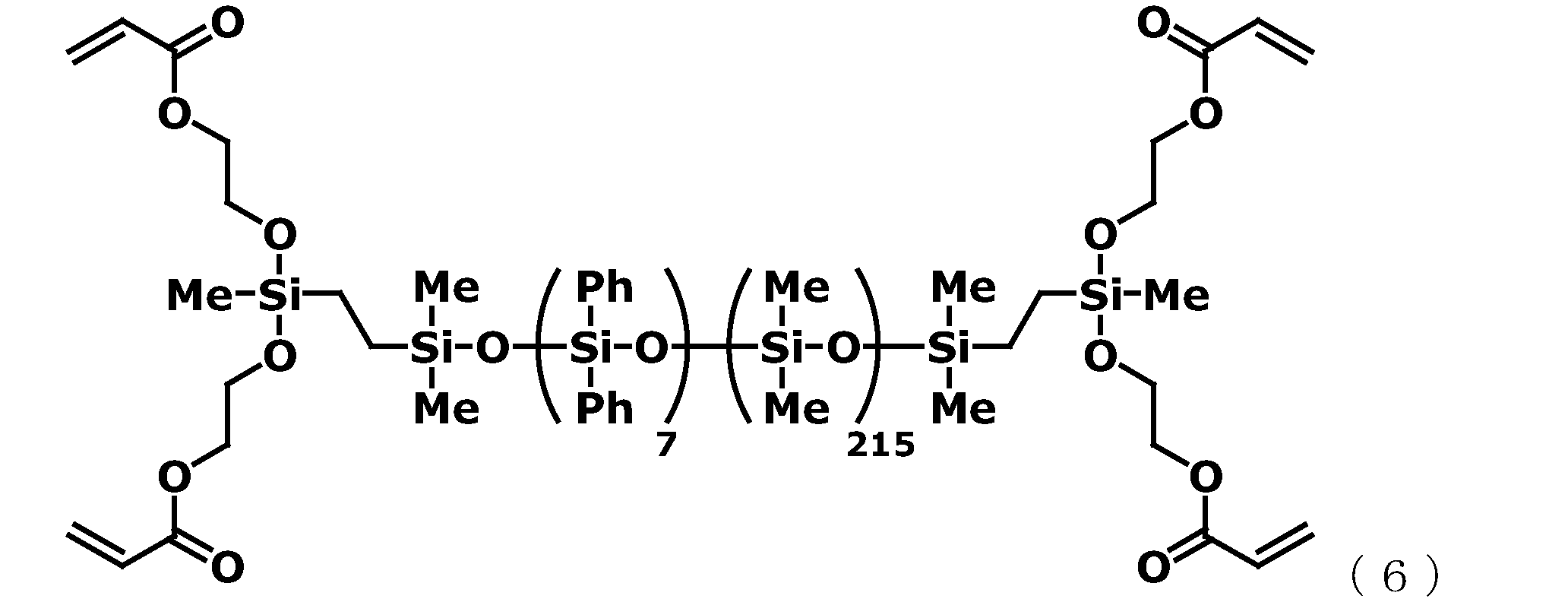
- (A-2) an organopolysiloxane represented by the following formula (6) produced by the method described above. (In the formula, the arrangement order of the siloxane units in parentheses is arbitrary.)
- Component (B) (B-1): 2-hydroxy-2-methyl-1-phenyl-propan-1-one (Irgacure 1173 manufactured by BASF)
- B-2) 2,4,6-trimethylbenzoyl-diphenyl-phosphine oxide (Irgacure TPO manufactured by BASF)
- the UV-curable silicone composition of the present invention has a sufficiently low viscosity, exhibits excellent rubber properties and heat resistance after curing, and uses a molding method such as a surface exposure method or a lifting method. Useful as silicone material for 3D printers.
- the cured sheet was inferior in rubber properties after the heat resistance test.
Landscapes
- Chemical & Material Sciences (AREA)
- Health & Medical Sciences (AREA)
- Chemical Kinetics & Catalysis (AREA)
- Medicinal Chemistry (AREA)
- Polymers & Plastics (AREA)
- Organic Chemistry (AREA)
- Macromonomer-Based Addition Polymer (AREA)
- Polymerisation Methods In General (AREA)
- Ink Jet Recording Methods And Recording Media Thereof (AREA)
- Addition Polymer Or Copolymer, Post-Treatments, Or Chemical Modifications (AREA)
Abstract
Description
用途に応じて柔らかい材料が必要になることも多くなってきており、造形方式に合せた材料が既に開発されている。例えば、光造形方式(SLA)向けの材料として、アルケニル基含有オルガノポリシロキサン、メルカプト基含有オルガノポリシロキサン及びMQレジンを含有した組成物が既に開示されている(特許文献2)。また、ディスペンス技術向けに紫外線によって活性化される白金触媒を含有したシリコーン混合物も開示されている(特許文献3)。さらに、インクジェット方式を用いる3Dプリンタ向けに光硬化性の低粘度シリコーン材料が開示されている(特許文献4)が、この組成物の硬化物は、通常のシリコーン材料と比較すると耐熱性に乏しいという課題がある。近年急激に増加している面露光方式や吊上げ方式と呼ばれる造形方式にも対応可能でありながら更に耐熱性にも優れた材料の開発が強く望まれていた。
[1]
(A)下記一般式(1)で示されるオルガノポリシロキサン:100質量部、


及び
(B)光重合開始剤:0.1~10質量部、並びに
(C)シロキサン構造を含まない単官能(メタ)アクリレート化合物及び(D)シロキサン構造を含まない多官能(メタ)アクリレート化合物の何れか一方又は両方:1~400質量部
を含有することを特徴とする紫外線硬化性シリコーン組成物。
一般式(1)におけるR1が炭素原子数1~10のアルキル基である[1]に記載の紫外線硬化性シリコーン組成物。
25℃での粘度が10,000mPa・s以下であることを特徴とする[1]又は[2]に記載の紫外線硬化性シリコーン組成物。
[1]~[3]のいずれかに記載の紫外線硬化性シリコーン組成物の硬化物。
3Dプリンタインク用である[1]~[3]のいずれかに記載の紫外線硬化性シリコーン組成物。
(A)オルガノポリシロキサン
(A)成分は、下記一般式(1)で示されるオルガノポリシロキサンである。

式(1)中のn+mは2≦n+m≦2,000であり、好ましくは2≦n+m≦1,000、より好ましくは2≦n+m≦800である。n+mが2より小さいと揮発し易く、n+mが2,000より大きいと組成物の粘度が高くなり、吊り上げ方式による造形が困難になる。

また、これら一価炭化水素基の炭素原子に結合した水素原子の一部または全部は、その他の置換基で置換されていてもよく、その具体例としては、クロロメチル、ブロモエチル、トリフルオロプロピル、シアノエチル基等のハロゲン置換炭化水素基や、シアノ置換炭化水素基などが挙げられる。
これらの中でも、R1としては、炭素原子数1~5のアルキル基及びフェニル基が好ましく、メチル基、エチル基及びフェニル基がより好ましい。
これらの中でも、R2としては、酸素原子、メチレン、エチレン及びトリメチレン基が好ましく、酸素原子またはエチレン基がより好ましい。

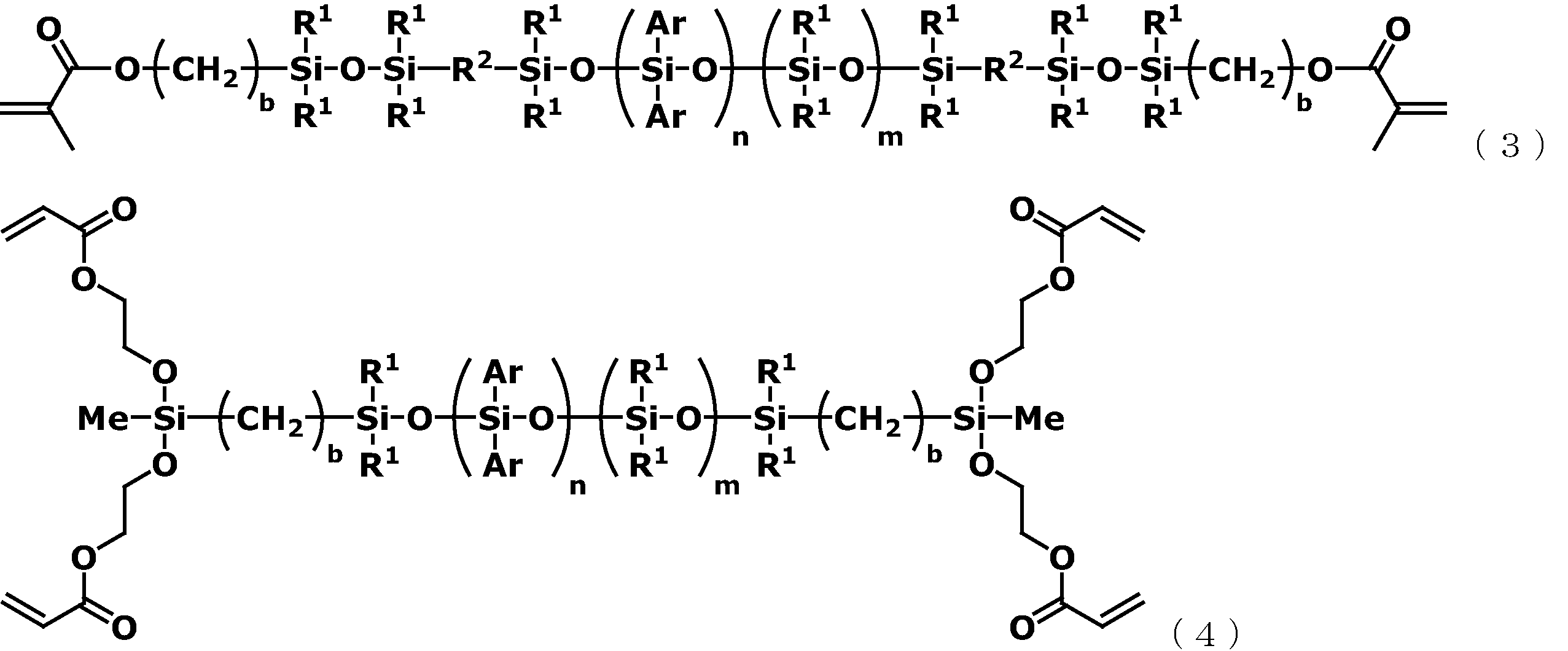
上記式(4)で表されるオルガノポリシロキサンは、例えば、両末端ジメチルビニルシロキシ基封鎖ジメチルシロキサン・ジフェニルシロキサン共重合体とジクロロメチルシランとのヒドロシリル化反応物に2-ヒドロキシエチルアクリレートを反応させて得ることができる。
光重合開始剤(B)としては、公知のものを用いることができ、これには例えば、2,2-ジエトキシアセトフェノン、2,2-ジメトキシ-1,2-ジフェニルエタン-1-オン(BASF製Irgacure 651)、1-ヒドロキシ-シクロヘキシル-フェニル-ケトン(BASF製Irgacure 184)、2-ヒドロキシ-2-メチル-1-フェニル-プロパン-1-オン(BASF製Irgacure 1173)、2-ヒドロキシ-1-{4-[4-(2-ヒドロキシ-2-メチループロピオニル)-ベンジル]-フェニル}-2-メチル-プロパン-1-オン(BASF製Irgacure 127)、フェニルグリオキシリックアシッドメチルエステル(BASF製Irgacure MBF)、2-メチル-1-[4-(メチルチオ)フェニル]-2-モルフォリノプロパン-1-オン(BASF製Irgacure 907)、2-ベンジル-2-ジメチルアミノ-1-(4-モルフォリノフェニル)-1-ブタノン(BASF製Irgacure 369)、ビス(2,4,6-トリメチルベンゾイル)-フェニルフォスフィンオキサイド(BASF製Irgacure 819)、2,4,6-トリメチルベンゾイル-ジフェニル-フォスフィンオキサイド(BASF製Irgacure TPO)及びこれら化合物の混合物等が挙げられる。
シロキサン構造を含まない単官能(メタ)アクリレート化合物(C)としては、イソアミルアクリレート、ラウリルアクリレート、ステアリルアクリレート、エトキシ-ジエチレングリコールアクリレート、メトキシ-トリエチレングルコールアクリレート、2-エチルヘキシル-ジグルコールアクリレート、フェノキシエチルアクリレート、フェノキシジエチレングリコールアクリレート、テトラヒドロフルフリルアクリレート、イソボルニルアクリレート及びこれらの混合物等が挙げられ、特にイソボルニルアクリレートが好ましい。
シロキサン構造を含まない多官能(メタ)アクリレート化合物(D)としては、トリエチレングルコールジアクリレート、ポリテトラメチレングルコールジアクリレート、ネオペンチルグリコールジアクリレート、1,6-ヘキサンジオールジアクリレート、ジメチロール-トリシクロデカンジアクリレート、トリメチロールプロパントリアクリレート、ペンタエリスリトールテトラアクリレート及びこれらの混合物等が挙げられ、特にジメチロール-トリシクロデカンジアクリレートが好ましい。
本発明の紫外線硬化性シリコーン組成物は、上記(A)成分、(B)成分、(C)成分及び/又は(D)成分、その他の成分を攪拌及び混合等することにより得られる。攪拌等の操作に用いる装置は特に限定されないが、プラネタリーミキサーやセパラブルフラスコ等を用いることができる。
下記の各成分を表1に示す組成比(数値は質量部を表す)で混合して紫外線硬化性シリコーン組成物を得た。
なお、各例で得られた組成物の粘度は、回転粘度計を用いて25℃で測定した値である。
また、各組成物を各枠に流し、アイグラフィックス株式会社製のランプH(M)06-L-61を用いて、窒素雰囲気下、2,000mJ/cm2の紫外線照射条件で硬化させ、厚さ2.0mmの各硬化シートを得た。得られた各硬化シートについて、耐熱試験(200℃で20時間放置)前後の硬度、引張強さ及び切断時伸びをJIS-K6249に準じて測定した結果を表1に示す。
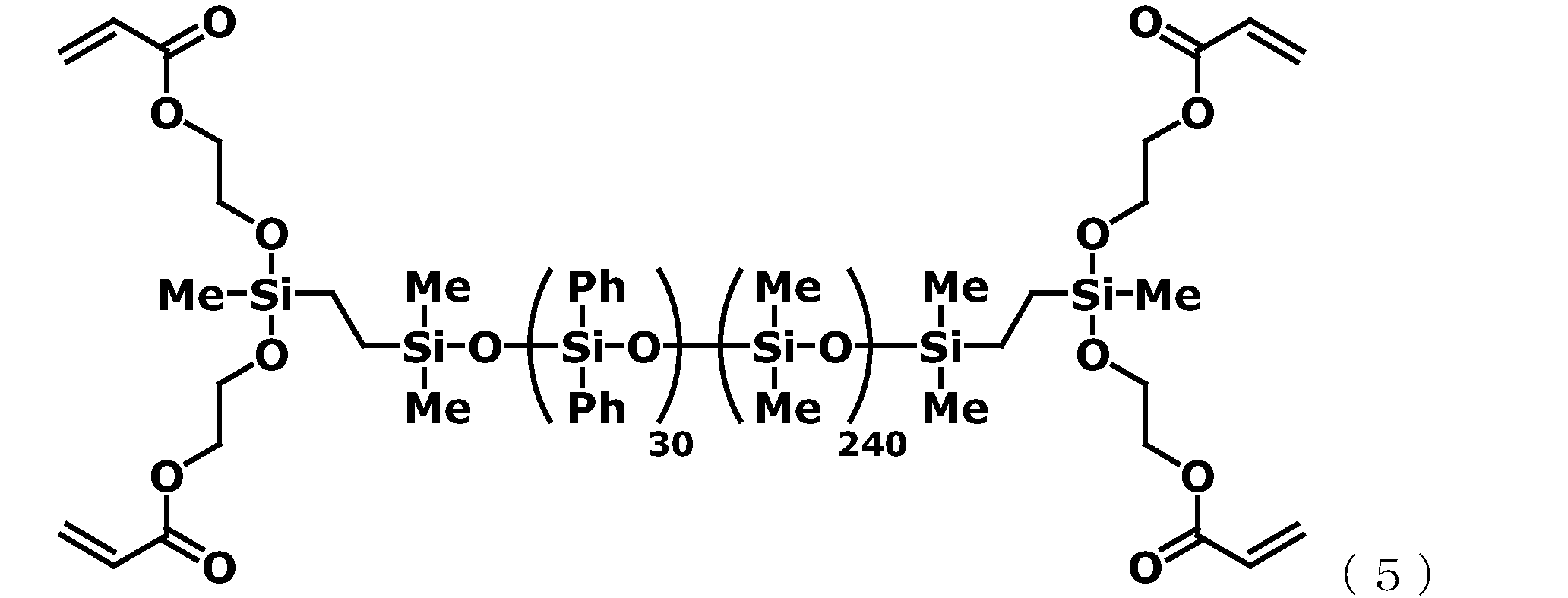
(A-1):上述した方法により製造した下記式(5)で表されるオルガノポリシロキサン
(A-3):下記式(7)で表されるオルガノポリシロキサン


(B-1):2-ヒドロキシ-2-メチル-1-フェニル-プロパン-1-オン (BASF社製Irgacure 1173)
(B-2):2,4,6-トリメチルベンゾイル-ジフェニル-フォスフィンオキサイド (BASF社製Irgacure TPO)
イソボルニルアクリレート(共栄社化学(株)製ライトアクリレートIB-XA)
ジメチロール-トリシクロデカンジアクリレート(共栄社化学(株)製ライトアクリレートDCP-A)

Claims (5)
- (A)下記一般式(1)で示されるオルガノポリシロキサン:100質量部、


及び
(B)光重合開始剤:0.1~10質量部、並びに
(C)シロキサン構造を含まない単官能(メタ)アクリレート化合物及び(D)シロキサン構造を含まない多官能(メタ)アクリレート化合物の何れか一方又は両方:1~400質量部
を含有することを特徴とする紫外線硬化性シリコーン組成物。 - 一般式(1)におけるR1が炭素原子数1~10のアルキル基である請求項1に記載の紫外線硬化性シリコーン組成物。
- 25℃での粘度が10,000mPa・s以下であることを特徴とする請求項1又は2に記載の紫外線硬化性シリコーン組成物。
- 請求項1~3のいずれか1項に記載の紫外線硬化性シリコーン組成物の硬化物。
- 3Dプリンタインク用である請求項1~3のいずれか1項に記載の紫外線硬化性シリコーン組成物。
Priority Applications (5)
| Application Number | Priority Date | Filing Date | Title |
|---|---|---|---|
| JP2020548457A JP7180684B2 (ja) | 2018-09-20 | 2019-09-13 | 紫外線硬化性シリコーン組成物及びその硬化物 |
| CN201980060708.7A CN112714772B (zh) | 2018-09-20 | 2019-09-13 | 紫外线固化性硅酮组合物及其固化物 |
| US17/273,450 US20210332175A1 (en) | 2018-09-20 | 2019-09-13 | Ultraviolet curable silicone composition and cured product thereof |
| EP19863022.0A EP3854828B1 (en) | 2018-09-20 | 2019-09-13 | Use of an uv curable silicone composition as a 3d printer ink |
| US18/399,857 US12180320B2 (en) | 2018-09-20 | 2023-12-29 | Ultraviolet curable silicone composition and cured product thereof |
Applications Claiming Priority (2)
| Application Number | Priority Date | Filing Date | Title |
|---|---|---|---|
| JP2018-176159 | 2018-09-20 | ||
| JP2018176159 | 2018-09-20 |
Related Child Applications (2)
| Application Number | Title | Priority Date | Filing Date |
|---|---|---|---|
| US17/273,450 A-371-Of-International US20210332175A1 (en) | 2018-09-20 | 2019-09-13 | Ultraviolet curable silicone composition and cured product thereof |
| US18/399,857 Continuation US12180320B2 (en) | 2018-09-20 | 2023-12-29 | Ultraviolet curable silicone composition and cured product thereof |
Publications (1)
| Publication Number | Publication Date |
|---|---|
| WO2020059650A1 true WO2020059650A1 (ja) | 2020-03-26 |
Family
ID=69888454
Family Applications (1)
| Application Number | Title | Priority Date | Filing Date |
|---|---|---|---|
| PCT/JP2019/036044 Ceased WO2020059650A1 (ja) | 2018-09-20 | 2019-09-13 | 紫外線硬化性シリコーン組成物及びその硬化物 |
Country Status (6)
| Country | Link |
|---|---|
| US (2) | US20210332175A1 (ja) |
| EP (1) | EP3854828B1 (ja) |
| JP (1) | JP7180684B2 (ja) |
| CN (1) | CN112714772B (ja) |
| TW (1) | TWI798489B (ja) |
| WO (1) | WO2020059650A1 (ja) |
Cited By (1)
| Publication number | Priority date | Publication date | Assignee | Title |
|---|---|---|---|---|
| EP4108726A1 (en) * | 2021-06-24 | 2022-12-28 | Henkel AG & Co. KGaA | Silicone formulation with high temperature stability and clarity |
Families Citing this family (4)
| Publication number | Priority date | Publication date | Assignee | Title |
|---|---|---|---|---|
| US11939415B1 (en) * | 2020-02-07 | 2024-03-26 | Triad National Security, Llc | Polysiloxane-based objects and 3-dimensional printing method for making the same |
| WO2022202499A1 (ja) * | 2021-03-26 | 2022-09-29 | ダウ・東レ株式会社 | 紫外線硬化性組成物およびその用途 |
| US20240254367A1 (en) * | 2021-05-07 | 2024-08-01 | Dow Toray Co., Ltd. | Ultraviolet radiation-curable silicone composition, cured product thereof, layered body, optical device, and optical display |
| IL325083A (en) * | 2024-04-26 | 2026-02-01 | Shinetsu Chemical Co | UV curable silicone composition for stereolithography, cured product and curing method |
Citations (7)
| Publication number | Priority date | Publication date | Assignee | Title |
|---|---|---|---|---|
| JPS57209914A (en) * | 1981-02-26 | 1982-12-23 | Bausch & Lomb | Biomedical formed article consisting polysiloxane polymer containing polycyclic modifier |
| JPH11287971A (ja) * | 1998-04-02 | 1999-10-19 | Kuraray Co Ltd | 眼用レンズ材料 |
| JP2006002087A (ja) * | 2004-06-18 | 2006-01-05 | Cmet Inc | 光学的立体造形用樹脂組成物 |
| JP2012111226A (ja) | 2010-11-01 | 2012-06-14 | Keyence Corp | インクジェット光造形法における、光造形品形成用モデル材、光造形品の光造形時の形状支持用サポート材および光造形品の製造方法 |
| JP5384656B2 (ja) | 2008-10-30 | 2014-01-08 | ワッカー ケミー アクチエンゲゼルシャフト | 光によって架橋可能なシリコーン混合物からのシリコーン成形体の製造法 |
| WO2016134972A1 (en) * | 2015-02-23 | 2016-09-01 | Philips Lighting Holding B.V. | Silicone mixture containing acrylates for inkjet and dispenser 3d printing |
| WO2018003381A1 (ja) | 2016-06-30 | 2018-01-04 | 信越化学工業株式会社 | 紫外線硬化性シリコーン組成物及びその硬化物 |
Family Cites Families (8)
| Publication number | Priority date | Publication date | Assignee | Title |
|---|---|---|---|---|
| CN1371484A (zh) | 1999-09-29 | 2002-09-25 | 可乐丽股份有限公司 | 眼用透镜材料 |
| EP2924085B1 (en) * | 2014-03-28 | 2019-05-08 | Samsung SDI Co., Ltd. | Composition for encapsulation of organic light emitting diode and organic light emitting diode display manufactured using the same |
| KR101802574B1 (ko) | 2014-03-28 | 2017-12-01 | 삼성에스디아이 주식회사 | 유기발광소자 봉지용 조성물 및 이로부터 제조된 유기발광소자 표시장치 |
| JP6481647B2 (ja) * | 2016-03-22 | 2019-03-13 | 信越化学工業株式会社 | 紫外線硬化性シリコーン組成物、その硬化物、及び該組成物からなる光学素子封止材、並びに該光学素子封止材により封止された光学素子 |
| CN105748179A (zh) * | 2016-04-27 | 2016-07-13 | 常州大学 | 一种个性化气道支架的制备技术 |
| JP6962290B2 (ja) * | 2018-08-02 | 2021-11-05 | 信越化学工業株式会社 | 光造形用紫外線硬化型シリコーン組成物およびその硬化物 |
| KR102696626B1 (ko) * | 2018-12-07 | 2024-08-21 | 신에쓰 가가꾸 고교 가부시끼가이샤 | 자외선 경화형 실리콘 점착제 조성물 및 그 경화물 |
| JP7591863B2 (ja) * | 2019-03-19 | 2024-11-29 | 信越化学工業株式会社 | オルガノポリシロキサン、紫外線硬化性シリコーン組成物及び硬化物 |
-
2019
- 2019-09-13 WO PCT/JP2019/036044 patent/WO2020059650A1/ja not_active Ceased
- 2019-09-13 JP JP2020548457A patent/JP7180684B2/ja active Active
- 2019-09-13 CN CN201980060708.7A patent/CN112714772B/zh active Active
- 2019-09-13 EP EP19863022.0A patent/EP3854828B1/en active Active
- 2019-09-13 US US17/273,450 patent/US20210332175A1/en not_active Abandoned
- 2019-09-17 TW TW108133364A patent/TWI798489B/zh active
-
2023
- 2023-12-29 US US18/399,857 patent/US12180320B2/en active Active
Patent Citations (8)
| Publication number | Priority date | Publication date | Assignee | Title |
|---|---|---|---|---|
| JPS57209914A (en) * | 1981-02-26 | 1982-12-23 | Bausch & Lomb | Biomedical formed article consisting polysiloxane polymer containing polycyclic modifier |
| JPH11287971A (ja) * | 1998-04-02 | 1999-10-19 | Kuraray Co Ltd | 眼用レンズ材料 |
| JP2006002087A (ja) * | 2004-06-18 | 2006-01-05 | Cmet Inc | 光学的立体造形用樹脂組成物 |
| JP4788863B2 (ja) | 2004-06-18 | 2011-10-05 | シーメット株式会社 | 光学的立体造形用樹脂組成物及び光学的立体造形方法 |
| JP5384656B2 (ja) | 2008-10-30 | 2014-01-08 | ワッカー ケミー アクチエンゲゼルシャフト | 光によって架橋可能なシリコーン混合物からのシリコーン成形体の製造法 |
| JP2012111226A (ja) | 2010-11-01 | 2012-06-14 | Keyence Corp | インクジェット光造形法における、光造形品形成用モデル材、光造形品の光造形時の形状支持用サポート材および光造形品の製造方法 |
| WO2016134972A1 (en) * | 2015-02-23 | 2016-09-01 | Philips Lighting Holding B.V. | Silicone mixture containing acrylates for inkjet and dispenser 3d printing |
| WO2018003381A1 (ja) | 2016-06-30 | 2018-01-04 | 信越化学工業株式会社 | 紫外線硬化性シリコーン組成物及びその硬化物 |
Non-Patent Citations (2)
| Title |
|---|
| CAS , no. 96474-12-3 |
| See also references of EP3854828A4 |
Cited By (1)
| Publication number | Priority date | Publication date | Assignee | Title |
|---|---|---|---|---|
| EP4108726A1 (en) * | 2021-06-24 | 2022-12-28 | Henkel AG & Co. KGaA | Silicone formulation with high temperature stability and clarity |
Also Published As
| Publication number | Publication date |
|---|---|
| CN112714772A (zh) | 2021-04-27 |
| EP3854828A1 (en) | 2021-07-28 |
| US20240132648A1 (en) | 2024-04-25 |
| TWI798489B (zh) | 2023-04-11 |
| US12180320B2 (en) | 2024-12-31 |
| TW202022000A (zh) | 2020-06-16 |
| JP7180684B2 (ja) | 2022-11-30 |
| US20240228687A9 (en) | 2024-07-11 |
| EP3854828B1 (en) | 2025-05-14 |
| JPWO2020059650A1 (ja) | 2021-09-16 |
| EP3854828A4 (en) | 2022-06-08 |
| CN112714772B (zh) | 2024-08-16 |
| US20210332175A1 (en) | 2021-10-28 |
Similar Documents
| Publication | Publication Date | Title |
|---|---|---|
| JP6687111B2 (ja) | 紫外線硬化性シリコーン組成物及びその硬化物 | |
| JP6481647B2 (ja) | 紫外線硬化性シリコーン組成物、その硬化物、及び該組成物からなる光学素子封止材、並びに該光学素子封止材により封止された光学素子 | |
| EP3636723B1 (en) | Ultraviolet-curable pressure-sensitive silicone adhesive composition and cured object obtained therefrom | |
| JP7180684B2 (ja) | 紫外線硬化性シリコーン組成物及びその硬化物 | |
| KR102836352B1 (ko) | 오르가노폴리실록산, 자외선 경화성 실리콘 조성물 및 경화물 | |
| TWI825135B (zh) | 光造形用紫外線硬化型聚矽氧組成物及其硬化物 | |
| TWI910338B (zh) | 光造形用紫外線硬化性聚矽氧組成物、其硬化物,及硬化物之製造方法 | |
| EP4166585B1 (en) | Ultraviolet ray-curable silicone composition and cured product thereof | |
| JPWO2020080011A1 (ja) | 紫外線硬化性シリコーン組成物及びその硬化物 | |
| JP2021088613A (ja) | 紫外線硬化型シリコーン組成物およびその硬化物 | |
| WO2025057574A1 (ja) | 紫外線硬化型シリコーン組成物およびその硬化物 |
Legal Events
| Date | Code | Title | Description |
|---|---|---|---|
| 121 | Ep: the epo has been informed by wipo that ep was designated in this application |
Ref document number: 19863022 Country of ref document: EP Kind code of ref document: A1 |
|
| ENP | Entry into the national phase |
Ref document number: 2020548457 Country of ref document: JP Kind code of ref document: A |
|
| NENP | Non-entry into the national phase |
Ref country code: DE |
|
| ENP | Entry into the national phase |
Ref document number: 2019863022 Country of ref document: EP Effective date: 20210420 |
|
| WWG | Wipo information: grant in national office |
Ref document number: 2019863022 Country of ref document: EP |