WO2020063111A1 - Procédé et appareil de détection d'empreinte, procédé et appareil de compensation d'image d'empreinte, et appareil électronique - Google Patents
Procédé et appareil de détection d'empreinte, procédé et appareil de compensation d'image d'empreinte, et appareil électronique Download PDFInfo
- Publication number
- WO2020063111A1 WO2020063111A1 PCT/CN2019/099254 CN2019099254W WO2020063111A1 WO 2020063111 A1 WO2020063111 A1 WO 2020063111A1 CN 2019099254 W CN2019099254 W CN 2019099254W WO 2020063111 A1 WO2020063111 A1 WO 2020063111A1
- Authority
- WO
- WIPO (PCT)
- Prior art keywords
- image
- texture
- fingerprint
- foreign object
- detection
- Prior art date
- Legal status (The legal status is an assumption and is not a legal conclusion. Google has not performed a legal analysis and makes no representation as to the accuracy of the status listed.)
- Ceased
Links
Images




Classifications
-
- G—PHYSICS
- G06—COMPUTING OR CALCULATING; COUNTING
- G06V—IMAGE OR VIDEO RECOGNITION OR UNDERSTANDING
- G06V40/00—Recognition of biometric, human-related or animal-related patterns in image or video data
- G06V40/10—Human or animal bodies, e.g. vehicle occupants or pedestrians; Body parts, e.g. hands
- G06V40/12—Fingerprints or palmprints
- G06V40/1347—Preprocessing; Feature extraction
-
- G—PHYSICS
- G06—COMPUTING OR CALCULATING; COUNTING
- G06T—IMAGE DATA PROCESSING OR GENERATION, IN GENERAL
- G06T5/00—Image enhancement or restoration
- G06T5/20—Image enhancement or restoration using local operators
-
- G—PHYSICS
- G06—COMPUTING OR CALCULATING; COUNTING
- G06T—IMAGE DATA PROCESSING OR GENERATION, IN GENERAL
- G06T5/00—Image enhancement or restoration
- G06T5/77—Retouching; Inpainting; Scratch removal
-
- G—PHYSICS
- G06—COMPUTING OR CALCULATING; COUNTING
- G06T—IMAGE DATA PROCESSING OR GENERATION, IN GENERAL
- G06T7/00—Image analysis
- G06T7/40—Analysis of texture
-
- G—PHYSICS
- G06—COMPUTING OR CALCULATING; COUNTING
- G06T—IMAGE DATA PROCESSING OR GENERATION, IN GENERAL
- G06T7/00—Image analysis
- G06T7/90—Determination of colour characteristics
-
- G—PHYSICS
- G06—COMPUTING OR CALCULATING; COUNTING
- G06V—IMAGE OR VIDEO RECOGNITION OR UNDERSTANDING
- G06V10/00—Arrangements for image or video recognition or understanding
- G06V10/70—Arrangements for image or video recognition or understanding using pattern recognition or machine learning
- G06V10/74—Image or video pattern matching; Proximity measures in feature spaces
- G06V10/75—Organisation of the matching processes, e.g. simultaneous or sequential comparisons of image or video features; Coarse-fine approaches, e.g. multi-scale approaches; using context analysis; Selection of dictionaries
- G06V10/751—Comparing pixel values or logical combinations thereof, or feature values having positional relevance, e.g. template matching
- G06V10/7515—Shifting the patterns to accommodate for positional errors
-
- G—PHYSICS
- G06—COMPUTING OR CALCULATING; COUNTING
- G06V—IMAGE OR VIDEO RECOGNITION OR UNDERSTANDING
- G06V40/00—Recognition of biometric, human-related or animal-related patterns in image or video data
- G06V40/10—Human or animal bodies, e.g. vehicle occupants or pedestrians; Body parts, e.g. hands
- G06V40/12—Fingerprints or palmprints
- G06V40/13—Sensors therefor
- G06V40/1318—Sensors therefor using electro-optical elements or layers, e.g. electroluminescent sensing
-
- G—PHYSICS
- G06—COMPUTING OR CALCULATING; COUNTING
- G06V—IMAGE OR VIDEO RECOGNITION OR UNDERSTANDING
- G06V10/00—Arrangements for image or video recognition or understanding
- G06V10/70—Arrangements for image or video recognition or understanding using pattern recognition or machine learning
- G06V10/74—Image or video pattern matching; Proximity measures in feature spaces
- G06V10/75—Organisation of the matching processes, e.g. simultaneous or sequential comparisons of image or video features; Coarse-fine approaches, e.g. multi-scale approaches; using context analysis; Selection of dictionaries
- G06V10/759—Region-based matching
Definitions
- Embodiments of the present disclosure relate to a texture detection method and device, a texture image compensation method and device, and an electronic device.
- texture detection Due to the uniqueness of skin textures such as fingerprint patterns or palm print patterns, texture detection has become an important verification method for electronic devices.
- the texture detection device is provided independently, for example, it is disposed on one side of a display area of a mobile terminal or a tablet computer.
- this setting method is not conducive to reducing the volume of the mobile terminal or tablet computer or achieving a narrow bezel design. Therefore, the industry now proposes more and more under-screen texture detection solutions for mobile terminals or tablet computers.
- the commonly used under-screen texture detection method is under-screen texture detection based on optical detection.
- At least one embodiment of the present disclosure provides a texture image compensation method, including: performing an image difference operation on a first fingerprint image obtained by a fingerprint detection device and a foreign object correction image obtained by the fingerprint detection device, to The foreign object information in a texture image is compensated to obtain a second texture image.
- performing an image difference operation between the first texture image and the foreign object correction image includes: performing grayscale processing on the first texture image. Performing the image difference operation on the first texture image and the foreign object correction image after the grayscale processing.
- performing the image difference operation on the grayscale-processed first texture image and the foreign object correction image includes: The gray level difference operation is performed on the first texture image after the degree processing and the foreign object correction image.
- the method for acquiring a foreign body correction image includes: when no texture is entered, collecting an initial image of a texture entry area; and obtaining the initial image from the initial image.
- acquiring the foreign object correction image from the initial image includes: performing grayscale processing on the initial image to acquire the foreign object correction image.
- the method further includes: storing the foreign object correction image.
- the foreign object information includes scratch information.
- the texture image includes a fingerprint image.
- At least one embodiment of the present disclosure provides a texture detection method, including: obtaining the second texture image using any of the above-mentioned texture image compensation methods; and performing texture detection using the second texture image.
- performing texture detection using the second texture image includes: performing feature extraction on the second texture image to obtain a texture template, and combining the texture template with The pre-stored texture templates in the texture library are compared to determine whether to pass the texture detection.
- a texture detection method provided by an embodiment of the present disclosure further includes: after passing the texture detection, allowing a preset operation to be performed.
- At least one embodiment of the present disclosure provides a method for acquiring a foreign object correction image for a fingerprint detection device.
- the fingerprint detection device includes a fingerprint sensor, and the method includes: when no fingerprint is entered, the fingerprint sensor collects a fingerprint entry. An initial image of the region; the foreign object correction image is obtained from the initial image, wherein the foreign object correction image includes foreign object correction information of the fingerprint entry region.
- acquiring the foreign object correction image from the initial image includes: performing grayscale processing on the initial image to acquire The foreign matter corrects the image.
- an embodiment of the present disclosure provides a method for acquiring a foreign object correction image for a fingerprint detection device. After acquiring the foreign object correction image from the initial image, the method further includes: storing the foreign object correction image.
- At least one embodiment of the present disclosure provides a texture detection device, including: a texture sensor for collecting a texture image; and an acquisition module for combining a first texture image obtained by the texture sensor and a foreign object correction image obtained by the texture sensor. An image difference operation is performed to compensate the foreign object information in the first texture image to obtain a second texture image.
- At least one embodiment of the present disclosure provides a texture detection device, further including: a detection module configured to use the second texture image to perform texture detection.
- At least one embodiment of the present disclosure provides a texture detection device, including: a texture sensor for collecting a texture image; a processor; a memory storing computer-executable instructions, wherein the computer-executable instructions are loaded by the processor When executed, the above-mentioned texture image compensation method, or the above-mentioned texture detection method, or the above-mentioned method of acquiring a foreign object correction image for a fingerprint detection device is performed.
- the memory further stores a foreign object correction image.
- At least one embodiment of the present disclosure provides an electronic device including a texture detection device provided by an embodiment of the present disclosure and a texture detection device provided by an embodiment of the present disclosure.
- the electronic device is a display device and includes a display panel.
- the texture sensor is disposed on a non-display side of the display panel and is perpendicular to the texture detection area. The directions of the display panels overlap.
- FIG. 1 is a schematic diagram of an under-screen fingerprint detection based on optical detection
- 2A is a schematic diagram of an OLED display panel with an under-screen fingerprint detection function
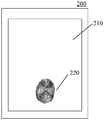
- 2B is a schematic plan view of an OLED display panel having an under-screen fingerprint detection function
- FIG. 3 is a schematic flowchart of a fingerprint detection method according to an embodiment of the present disclosure.
- FIG. 4 is a schematic diagram of a fingerprint detection method according to an embodiment of the present disclosure.
- FIG. 5 is a schematic diagram of a fingerprint detection method according to another example of an embodiment of the present disclosure.
- FIG. 6 is a schematic flowchart of a method for acquiring a foreign body corrected image according to another embodiment of the present disclosure
- FIG. 7 is a schematic structural diagram of a fingerprint detection device according to another embodiment of the present disclosure.
- FIG. 8 is a schematic structural diagram of another fingerprint detection device according to another embodiment of the present disclosure.
- the texture includes fingerprints, palm prints, and the like.
- the technical solutions of the embodiments of the present disclosure are described in detail by taking fingerprints as an example.
- the operating body with a texture can be a hand, and the corresponding recognized texture is a skin texture, such as a fingerprint, a palm print, etc.
- the operating body with a texture can also be a non-living body with a certain texture, such as resin Objects made of other materials with a certain texture are not specifically limited in the embodiments of the present disclosure.
- FIG. 1 is a schematic diagram of an under-screen fingerprint detection based on optical detection.
- the optical substrate 20 is provided with a light source 10 and a transmission lens 40 on the same side, and the fingerprint sensor 50 is disposed on the imaging side of the transmission lens 40.
- the user's finger 30 is placed on the surface of the optical substrate, and incident light 101 from the light source 10 illuminates the surface of the finger to generate reflected light 102, which is then incident on the fingerprint sensor 50 through the optical lens 40
- the fingerprint sensor 50 collects the fingerprint image of the finger by receiving the reflected light 102 and outputs a data signal of the fingerprint image to the fingerprint detection processor, so that the fingerprint detection processor performs fingerprint detection.
- the optical lens 40 may not be provided as required, and the fingerprint sensor 50 may directly receive the reflected light 102 to image the fingerprint.
- the fingerprint sensor 50 is an optical fingerprint sensor.
- the above light source emits visible light or infrared light for fingerprint detection, and accordingly, the optical fingerprint sensor may be a visible light or infrared light image sensor, such as a charge-coupled device (CCD) type or a complementary metal oxide semiconductor (CMOS) type image.
- CCD charge-coupled device
- CMOS complementary metal oxide semiconductor
- the current under-screen fingerprint detection scheme usually uses the display panel itself as the light source for display operations, and uses the screen surface of the display panel as the optical substrate.
- the fingerprint sensor is usually set on the display panel.
- the back side may be integrated into the functional layer of the display panel, thereby realizing the under-screen fingerprint detection function.
- the under-screen fingerprint detection method can be applied to an organic light-emitting diode (OLED) display panel, such as a flexible OLED display panel, or a quantum dot light-emitting diode (QLED) display panel.
- OLEDs have self-luminous characteristics, and their light emission can also be controlled or modulated as needed, which can facilitate the collection of fingerprint images and help improve the integration of electronic devices.
- FIG. 2A is a schematic diagram of an OLED display panel with an under-screen fingerprint detection function.
- the OLED display panel 200 includes a top film 201, a thin film package 202, a pixel unit array 203, a flexible substrate 204, and a bottom film 205.
- the underlayer film 205 provides protection and support functions for other structural and functional layers located on it, such as a plastic substrate or a glass substrate with stronger strength.
- the flexible substrate 204 is used to provide a buffer, such as a flexible substrate made of materials such as polyimide (PI), polypropylene (PP), and polycarbonate (PC).
- the pixel unit array 203 is formed on the flexible substrate 204 and includes a plurality of pixel units arranged in a predetermined array and signal lines (including gate lines, data, etc.) for providing electrical signals (including scanning signals, data signals, detection signals, etc.). Lines, detection lines, etc.), each pixel unit includes an OLED and a pixel driving circuit for driving the OLED to emit light.
- the light 101 emitted by the pixel unit is used for display and as incident light for fingerprint detection under the screen.
- the thin film package 202 covers the pixel unit array 203 to prevent external moisture from entering the pixel unit array 203 and causing aging or deterioration.
- the thin film package 202 may be a multilayer thin film package, for example, including a laminated inorganic insulating layer and an organic insulating layer.
- the top film 201 may be a cover plate, such as a substrate or a thick film made of glass or plastic, and is used to provide support and protection, for example, for a user to perform touch operations.
- a fingerprint sensor 206 that collects a fingerprint image is disposed on (for example, attached by optically clear adhesive (COA)) the side of the underlying film 205 away from the pixel unit array 203 (ie, the lower side in the figure), and is used to detect the distance from the top film 201 Light 102 for fingerprint detection reflected on one side of the surface.
- the fingerprint sensor 206 has a certain area and includes a plurality of pixel units arranged in a predetermined array.
- the fingerprint sensor 206 is coupled to a fingerprint detection processor (such as an integrated circuit chip) through a lead wire, so that the collected fingerprint image can be transmitted to the fingerprint detection processor as a data signal.
- the fingerprint sensor 206 may be various suitable types of fingerprint sensors such as a charge coupled device (CCD) type or a complementary metal oxide semiconductor (CMOS) type image sensor.
- CCD charge coupled device
- CMOS complementary metal oxide semiconductor
- the OLED display panel 200 may further include other structures or functional layers.
- the OLED display panel 200 may include a touch structure for implementing a touch function.
- the touch structure may be built in the pixel unit array 203, or formed on a top film, for example, a capacitive type, a resistive type, or the like.
- the above-mentioned top film 201, thin film package 202, flexible substrate 204, and bottom film 205 are at least partially transparent, and a small hole 2032 is formed in the pixel unit array 203 and an adjacent pixel unit. So that light reflected from the fingerprint on the surface of the top film 201 can be incident on the fingerprint sensor 206 and imaged through a small hole to obtain a fingerprint image.
- the OLED display panel 200 may include a micro-lens array (not shown in the figure).
- the micro-lens array is formed, for example, corresponding to the above-mentioned small hole 2032. Straighten or collimate the light 102 after passing through the small hole 2032, and the collimated light 102 is incident on the fingerprint sensor 206.
- the microlens array corresponds to the transmission lens 40 in FIG. 1.
- the OLED display panel 200 includes a display area 210 including a fingerprint identification area 220.
- the periphery of the display area 210 is a peripheral area, such as a border area of a display panel.
- the fingerprint recognition area 220 is at least a part of a predetermined area in the display area 210, and the above-mentioned fingerprint sensor 206 is disposed at a position corresponding to the area.
- the user places his finger in the fingerprint detection area 220, and the pixel unit in the display area is in the display (or light-emitting) state at this time.
- a fingerprint detection function is thereby implemented.
- the fingerprint detection result is easily affected by the structure of the display panel or the foreign matter on the functional layer.
- These foreign objects are, for example, scratches on the bottom surface of the underlayer film 205 (that is, the surface away from the pixel unit array layer 203 in the figure), adhered particles, and impurities appearing in the functional layer. (I.e., light reflected from the surface of a finger) on the transmission path, which adversely affects the fingerprint image collected by the fingerprint sensor 206 and affects the accuracy and precision of fingerprint detection.
- the process of preparing an OLED display panel includes the following operations: first, an underlying film is formed on a support substrate and a flexible substrate is deposited; a pixel unit array is prepared by a semiconductor process (including thin film deposition, patterning, etc.) on the flexible substrate, and then Forming a thin film package, a top film, etc .; secondly, peeling the above-mentioned structure and functional layer including the bottom film from the supporting substrate by a laser peeling process; and then, setting a fingerprint sensor on the bottom surface of the bottom film.
- At least one embodiment of the present disclosure provides a method for fingerprint detection, including performing an image difference operation on a first fingerprint image obtained by a fingerprint detection device and a foreign object correction image obtained by the fingerprint detection device, and The foreign object information is compensated to obtain a second fingerprint image; the second fingerprint image is used for fingerprint detection.
- At least one embodiment of the present disclosure also provides a method for acquiring a foreign object correction image for a fingerprint detection device, a fingerprint detection device, a storage medium, an electronic device, and a fingerprint image compensation method.
- An embodiment of the present disclosure provides a method for fingerprint recognition that can be used for fingerprint detection on an electronic device with an under-screen fingerprint detection function, which overcomes the noise and interference brought by fingerprint detection due to the collection of images containing foreign objects, thereby improving fingerprints. The accuracy and validity of the test.
- An embodiment of the present disclosure provides a method for fingerprint detection.
- the method is applicable to an electronic device having a fingerprint detection function.
- the electronic device is a specific example of a fingerprint detection device.
- the electronic device is, for example, as shown in FIGS. 2A and 2B.
- OLED display panel with under-screen fingerprint detection function is shown in FIG. 3 and includes the following steps S301 to S302:
- step S301 an image difference calculation is performed between the first fingerprint image and a foreign object correction image acquired in advance, and the foreign object information in the first fingerprint image is compensated to obtain a second fingerprint image.
- Step S302 Use the second fingerprint image to perform fingerprint detection.
- the first fingerprint image refers to a fingerprint image collected by a fingerprint sensor of a fingerprint detection device that performs fingerprint detection in an electronic device during a fingerprint detection process, which may be acquired by the fingerprint sensor.
- the original image data may also be image data obtained by further processing the original image data.
- the fingerprint image includes not only image information of a user's finger fingerprint, but also correspondingly image information (ie, foreign object information) of a foreign object caused by various reasons in the electronic device during transmission of light forming the fingerprint image of the finger.
- these foreign objects are, for example, scratches on the bottom surface of the display panel, adhered particles, impurities appearing in the functional layer, and foreign objects appearing in any layer or interface on the light transmission path.
- the detected incident light (that is, light reflected from the surface of the finger) is on the transmission path, thereby adversely affecting the fingerprint image collected by the fingerprint sensor.
- this embodiment compensates this part of the foreign object information by means of image difference calculation. After performing the compensation operation, a second fingerprint image is obtained from the first fingerprint image.
- the second fingerprint image can be used for fingerprint detection. Since the second fingerprint image no longer includes or weakens foreign object information, using the second fingerprint image for fingerprint detection can ensure the validity and accuracy of fingerprint detection and detection.
- a reference image or a reference image for a fingerprint detection area of the electronic device that is obtained in advance is used, which is also referred to as a foreign object correction image in this embodiment.
- the foreign object correction image is acquired by a fingerprint sensor of the same fingerprint detection device, and thus also includes image information (ie, foreign object information) of the foreign object appearing during the fingerprint detection process of the electronic device.
- the foreign object correction image may perform an image difference calculation with the first fingerprint image, thereby compensating the foreign object information included in the first fingerprint image.
- the foreign object information included in the first fingerprint image obtained during the detection process and the foreign object information included in the foreign object correction image are consistent with each other, so that the foreign object correction image can be used for image difference calculation. To compensate the foreign object information in the first fingerprint image.
- image B represents a first fingerprint image
- image A represents a foreign object correction image
- the foreign object is a scratch on the bottom surface of the underlying film 205 of the display panel as shown in FIG. 2A
- the foreign object information in the image is information related to the scratch.
- the foreign object correction image represented by image A shows an arc-shaped scratch F
- the first fingerprint image represented by image B also includes the scratch F.
- Image C represents a second fingerprint image, which is obtained after performing an image difference operation between image A and image B.
- the second fingerprint image still includes the fingerprint information in image B, but the image is no longer available Scratches F in B.
- the fingerprint sensor can also collect images of these foreign objects in advance as a foreign object correction image, and then use the foreign object correction image to perform a compensation operation on the first fingerprint image obtained in the subsequent fingerprint detection process.
- the compensated second fingerprint image is used, and the second fingerprint image is used for subsequent fingerprint recognition and other operations.
- the fingerprint detection method provided by the embodiments of the present disclosure can overcome the interference caused by fingerprint detection due to the collection of images containing foreign objects, thereby improving the accuracy and effectiveness of fingerprint detection.
- the first fingerprint image is first an original fingerprint image collected by a fingerprint sensor, and then image-processed.
- the fingerprint sensor collects an original image (for example, an RGB color image) with certain color information.
- the above image processing includes performing grayscale processing on the first fingerprint image, and then obtaining the processed first fingerprint image, that is, processing.
- the subsequent first fingerprint image is a grayscale image (see image B in FIG. 4).
- the color of each pixel in an RGB color image is determined by three components: R, G, and B.
- the value of each component can be 0 to 255, so a pixel can have more than 16 million (255 * 255 * 255). The range of color changes.
- a grayscale image is a special color image with the same three components of R, G, and B. Correspondingly, the variation range of one pixel is 255 types. Therefore, converting a color image into a grayscale image can reduce the amount of calculation for subsequent image processing.
- the grayscale image still reflects the distribution and characteristics of the overall and local chroma and brightness levels of the entire image. For example, graying processing can be implemented by the following two methods.
- the first method is to find the average of the three components of each pixel, R, G, and B, and then assign this average to the three components of this pixel at the same time.
- the foreign matter correction image is also a grayscale image after the grayscale processing is performed (see, for example, image A in FIG. 4). Accordingly, in order to obtain the foreign object corrected image, the fingerprint sensor acquires the original image without touching the finger, and then performs gray processing on the original image to obtain a foreign object corrected image that is also a gray image.
- the grayscale difference operation can be performed on the first fingerprint image and the foreign body correction image, that is, the grayscale of each pixel of the first fingerprint image is used.
- the gray value of each pixel corresponding to the foreign object correction image is subtracted from the degree value, thereby eliminating the foreign object information from the first fingerprint image and realizing compensation for the foreign object information in the first fingerprint image.
- the difference calculation is, for example, arithmetic subtraction of the gray value data of each pixel of the first fingerprint image and the gray value data of each pixel corresponding to the foreign object correction image.
- image processing may be performed in other manners to obtain the first fingerprint image and the foreign object correction image.
- a Fourier transform or a wavelet transform is adopted, and other calculation methods may also be used to perform an image between two images.
- image calculation as long as the second fingerprint image obtained after the two operations includes reduced foreign body information or no longer includes foreign body information relative to the first fingerprint image, a second fingerprint image after compensating the foreign body information may be obtained.
- performing image processing on the first fingerprint image may further include performing binarization processing on the first fingerprint image that has been processed as a grayscale image.
- the binarized image is obtained after the grayscale image is binarized, so that the image data no longer involves the multi-level value of the pixel grayscale, which makes subsequent processing simpler and further reduces the amount of data processing and compression.
- a threshold value for example, 100
- a pixel whose gray value is greater than or equal to a threshold value can be replaced with a gray value of 255 to represent fingerprint information, otherwise its gray value can be replaced with 0 to represent background information, thereby comparing the Weak background information culling.
- the foreign object correction image is also a grayscale image after the grayscale processing is performed, so that the grayscale value of each pixel of the first fingerprint image and the grayscale value of each pixel corresponding to the foreign object correction image can be performed.
- the difference operation removes foreign object information from the first fingerprint image to obtain a second fingerprint image.
- the second fingerprint image may be further used for fingerprint detection.
- feature extraction is performed on a second fingerprint image to obtain a fingerprint template, and the fingerprint template is compared with a fingerprint template pre-stored in a fingerprint database to determine whether the fingerprint detection is passed.
- the fingerprint image corresponding to the fingerprint template pre-stored in the fingerprint database can also be obtained by the fingerprint detection method of this embodiment, thereby also compensating for foreign object information.
- some invariant features of the fingerprint such as details, fingerprint type, etc.
- these features are further encoded into a standard template for storage, and then obtained Fingerprint template.
- the fingerprint template corresponding to the second fingerprint image is compared with the pre-stored fingerprint template.
- the fingerprint comparison process includes first comparing the details in the two fingerprint templates, and then calculating the similarity of the two fingerprint templates. , Thereby determining whether the second fingerprint image passes the fingerprint detection.
- fingerprint detection may be implemented by a method such as a neural network.
- the fingerprint database is stored in a predetermined storage space of the electronic device itself, for example, in an encrypted manner, or a storage server (such as a local area network server, an Internet server, or a cloud server), establishes a connection with the server when necessary, and performs data transmission.
- the device can perform a preset operation.
- the mobile phone displays the main interface or launches the application after the fingerprint detection; the access control system is turned on after the fingerprint detection and allows the user to pass; the car starting device with the fingerprint detection function is started after passing the fingerprint detection, and the like.
- a fingerprint detection method as shown in FIG. 5 is provided. Based on the above fingerprint detection method, this example provides a complete process for fingerprint detection, including steps S501 to S507:
- step S501 a fingerprint image of a user is collected.
- step S502 an image difference operation is performed on the collected user fingerprint image and a pre-stored foreign object correction image to obtain a detected fingerprint image.
- Step S503 Feature extraction is performed on the detected fingerprint image to obtain a fingerprint template.
- step S504 the obtained fingerprint template is compared with a pre-stored fingerprint template.
- step S505 it is determined whether or not the fingerprint detection is passed. If yes, go to step S506, otherwise, go to step S507.
- Step S506 performing a preset operation.
- step S507 it is prompted that the fingerprint detection fails, and the process goes to step S501, and waits for the next fingerprint detection operation.
- a fingerprint image (a first fingerprint image) of a finger used in a user's operation process is collected through a fingerprint sensor of the electronic device shown in FIGS. 2A and 2B, for example.
- the initial image collected by the fingerprint sensor can be pre-processed to remove or reduce noise in the initial image, enhance fingerprint information accordingly, and obtain a pre-processed user fingerprint image.
- the pre-processing may include methods such as median filtering, sharpening filtering, etc. to achieve contrast enhancement.
- an image difference calculation is performed on the user's fingerprint image and a pre-stored foreign object correction image to obtain a detected fingerprint image (second fingerprint image) that compensates for foreign objects in the electronic device.
- the user's fingerprint image may be first processed with grayscale, and then processed with a foreign object correction image that has been processed with the same grayscale, or grayscale processing and binarization may be performed. After the processing, a calculation is performed with the foreign object correction image that has been subjected to the same grayscale processing and binarization processing to obtain a compensated detection fingerprint image.
- the detected fingerprint image may be used for feature extraction to extract features that are not changed in the fingerprint, such as detail points, fingerprint types, and the like.
- the extracted detail points are a set of points, each of which has a local ridge line direction corresponding to them.
- These features can be further encoded into a standard template file for storage.
- Fingerprint feature template standards can be ISO / IEC19794-2 standards, ANSI / NIST-ITL1 standards, or other standards, as long as the fingerprint template standards for subsequent comparisons are consistent with it.
- the detailed point pairing is performed, that is, the correspondence between the detected fingerprint template and the detailed point of the pre-stored fingerprint template is found.
- the detail point may include the abrupt position of the fingerprint ridge, for example, it may include an end point, a bifurcation point, a ring point, an isolated point, a short line, and the like.
- the end points, bifurcation points, or composite features (trifurcations or intersections) of the ridge line can also be selected as the details of the fingerprint.
- Fingerprint detail point pairing is the core part of fingerprint recognition. After the detail point pairing is performed, the similarity between the two fingerprint templates is calculated according to the correspondence between the detail points. If the similarity exceeds a preset threshold, the two fingerprints are considered to be the same, otherwise the two fingerprints are considered to be different.
- the user Based on the result of the fingerprint comparison, it is judged whether the user's fingerprint detection is passed. If it passes, the corresponding operation is performed. If it fails, the fingerprint detection fails. For example, the user may be prompted to perform fingerprint detection again at this time.
- the prompt mode may be directly displayed by a display device (such as an OLED display screen), or the result may be notified through a voice output device (such as a speaker), or the result may be prompted by a vibration method.
- the above-mentioned example fingerprint detection method may further include, for example, a living body detection step and the like.
- an infrared image sensor can be used for detection.
- the infrared image sensor can also be used for temperature detection.
- a detection target that is, a finger
- the infrared image sensor can also be used for temperature detection.
- a fingerprint image compensation method (or fingerprint image acquisition method), which includes: first fingerprint image acquired by a fingerprint detection device and a foreign object correction image acquired by the fingerprint detection device An image difference operation is performed to compensate the foreign object information in the first fingerprint image to obtain a second fingerprint image.
- the fingerprint image compensation method can be used for fingerprint entry or for fingerprint detection.
- the obtained second fingerprint image can be stored in the fingerprint database for future comparison during fingerprint detection; for the fingerprint detection process, the obtained second fingerprint image is used for storage with the fingerprint database.
- the fingerprint images are compared to confirm the authentication.
- Another embodiment of the present disclosure provides a method of acquiring a foreign object correction image for the above-mentioned fingerprint detection method. This method can be applied to the case of the electronic device shown in FIG. 2A and FIG. 2B.
- the fingerprint detection device of the electronic device includes a fingerprint sensor.
- the schematic flow chart of the method is shown in FIG. 6 and includes steps S601 to S603:
- step S601 when there is no fingerprint entry, an initial image of the fingerprint entry area is collected by the fingerprint sensor.
- Step S602 Obtain a foreign object correction image from the initial image.
- step S603 a foreign object correction image is stored.
- a foreign object correction image is obtained in advance, so that during the fingerprint detection process, the foreign object information appearing in the electronic device during the fingerprint detection process is compensated to improve the accuracy of the fingerprint detection.
- the fingerprint sensor collects, for example, an initial image formed by the reflected light on the surface of the display panel, and the initial image includes no foreign body information but includes fingerprint information, or Some other background information may also be included.
- a reflective film may be attached to the surface of the display panel to increase the reflected light on the surface of the display panel.
- the reflective film can simulate the reflection characteristics of human skin (such as reflectance, color, texture, etc.), so that the environment of the foreign object correction image obtained is closer to the environment where the fingerprint image is actually acquired afterwards, and a better foreign object information compensation effect is obtained. .
- the image may also be pre-processed.
- This pre-processing can remove or reduce the noise in the original image and enhance the foreign body information accordingly.
- the pre-processing may include methods such as median filtering, sharpening filtering, etc. to achieve contrast enhancement.
- corresponding grayscale processing and binarization processing can also be performed on the foreign object corrected image, so that it can be used with fingerprint detection.
- the first fingerprint image obtained in the process is subjected to image difference calculation.
- the foreign object correction image is stored, so as to be conveniently called in subsequent fingerprint detection.
- the method of this embodiment may be used in different electronic devices including a memory and a processor, such as a mobile phone, a computer, etc. Therefore, the foreign object correction image may be stored in a designated storage device or a predetermined area of the storage device, such as a ROM of a mobile phone ( (Read Only Memory), a hard disk of a computer, etc., which are not specifically limited in this embodiment.
- the method for acquiring a foreign object correction image used in a fingerprint detection device may obtain a foreign object correction image in advance, and may store the foreign object correction image for later use in fingerprint detection.
- the method for correcting a foreign object image of a fingerprint detection device may be performed when the product is shipped from the factory, or may be selected and operated during use of the product, so that the foreign object correction image may be adjusted according to the actual situation during the use of the product.
- FIG. 7 A schematic structural diagram of a fingerprint detection device 700 in this embodiment is shown in FIG. 7.
- the fingerprint detection device 700 includes: a fingerprint sensor 710 for collecting a fingerprint image; and an obtaining module 720 for performing an image difference calculation between a first fingerprint image obtained by the fingerprint sensor 710 and a foreign object correction image obtained by the fingerprint sensor 710, The foreign object information in a fingerprint image is compensated to obtain a second fingerprint image; a detection module 730 is coupled to the acquisition module 720 and is used for fingerprint detection using the second fingerprint image.
- step S301 may be implemented by using an acquisition module 720, and the acquisition module 720 may be implemented by hardware, software, or the like, for example, by a circuit or a computer program.
- step S302 may be implemented by using a detection module 730.
- the detection module 730 may be implemented by hardware, software, or the like, for example, by a circuit or a computer program.
- the fingerprint detection device of this embodiment may further include an execution module 740, which is coupled to the detection module 730, and is configured to perform a preset operation after passing the fingerprint detection.
- the execution module 740 may be implemented by hardware, software, or the like, for example, by a circuit or a computer program.
- the fingerprint detection device provided in the embodiment of the present disclosure can overcome the interference caused by fingerprint detection due to the collection of an image containing a foreign object, thereby ensuring the accuracy and effectiveness of fingerprint detection.
- each module may be included, and the connection relationship between the modules is not limited, and may be determined according to actual needs.
- the specific configuration of each module is not limited, and it can be composed of analog devices, digital devices, or other applicable methods according to the module principle.
- FIG. 8 Another embodiment of the present disclosure also provides a fingerprint detection device.
- the structure diagram of the device is shown in FIG. 8 and includes a fingerprint sensor 840, a processor 810, a memory 820, and a bus system 830.
- the fingerprint sensor 840 is used to collect a fingerprint image and is connected to the processor 810; the processor 810 and the memory 820 are connected through a bus system 830.
- one or more computer program modules 821 may be stored in the memory 820.
- one or more computer program modules 821 include instructions for performing a fingerprint detection method provided by any embodiment of the present disclosure. When loaded and executed by the processor 810, the fingerprint image containing foreign object information is effectively and accurately implemented. Fingerprint detection.
- the one or more computer program modules 821 may further include instructions for executing a method for acquiring a foreign object correction image for a fingerprint detection device method provided by any embodiment of the present disclosure, and when loaded and executed by the processor 810, Achieve foreign object correction images before fingerprint detection.
- the memory 820 may further store the acquired foreign object correction image.
- bus system 830 may be a commonly used serial or parallel communication bus, and the embodiments of the present disclosure are not limited thereto.
- any processor may be implemented by an application-specific integrated circuit chip.
- the application-specific integrated circuit chip may be provided on a motherboard, for example, a memory and a power circuit may be provided on the motherboard;
- the device may also be implemented by a circuit or by using software, hardware (circuit), firmware, or any combination thereof.
- the processor may include various computing structures, such as a complex instruction set computer (CISC) structure, a reduced instruction set computer (RISC) structure, or a structure implementing a combination of multiple instruction sets.
- the processor may also be a microprocessor, such as an X86 processor or an ARM processor, or may be a digital processor (DSP) or the like.
- the memory may be provided on the above motherboard, for example, and the memory may store instructions and / or data executed by the processor.
- the memory may include one or more computer program products, which may include various forms of computer-readable memory, such as volatile memory and / or non-volatile memory.
- the volatile memory may include, for example, a random access memory (RAM) and / or a cache memory.
- the non-volatile memory may include, for example, a read-only memory (ROM), a hard disk, a flash memory, and the like.
- One or more computer program instructions may be stored on the computer-readable memory, and the processor may run the program instructions to implement a desired function (implemented by the processor) in the embodiments of the present disclosure.
- An embodiment of the present disclosure further provides a storage medium for storing computer-executable instructions.
- the fingerprint image compensation method provided by any embodiment of the present disclosure may be executed, and the present disclosure may be executed.
- the fingerprint detection method provided by any embodiment may further be used to execute the method provided by any embodiment of the present disclosure for acquiring a foreign object correction image for a fingerprint detection device.
- the storage medium may be any combination of one or more computer-readable storage media.
- a computer-readable storage medium includes a computer-readable program for performing an image difference operation between a first fingerprint image and a foreign object correction image.
- Code another computer-readable storage medium contains computer-readable program code for fingerprint detection using a second fingerprint image.
- the computer may execute the program code stored in the computer storage medium to perform, for example, a method for fingerprint detection provided by any embodiment of the present disclosure.
- the storage medium may include a memory card of a smart phone, a storage part of a tablet computer, a hard disk of a personal computer, a random access memory (RAM), a read-only memory (ROM), an erasable programmable read-only memory (EPROM), The portable compact disc read-only memory (CD-ROM), flash memory, or any combination of the foregoing storage media may also be other applicable storage media.
- An embodiment of the present disclosure also provides an electronic device with a fingerprint detection function, including the fingerprint detection device in the above embodiment, to obtain a fingerprint image that compensates for foreign object information, to achieve more effective and accurate fingerprint detection, or Obtain a foreign object correction image before fingerprint detection.
- the electronic device in this embodiment may be a display device, and the display device may include a display panel and a fingerprint sensor.
- the display panel can be an OLED display panel (such as a flexible OLED display panel); the display panel can also be other types of display panels, such as a liquid crystal display panel, an electronic paper display panel, etc.
- a display panel can be added to implement fingerprint detection Light source.
- the fingerprint sensor may be a different kind of optical fingerprint sensor, or it may be another suitable type of fingerprint sensor.
- the display panel includes a display area, and the display area includes a fingerprint detection area.
- the fingerprint sensor is disposed on the non-display side of the display panel and overlaps with the fingerprint detection area in a direction perpendicular to the display panel. For this, refer to FIG. 2A and FIG. 2B. situation.
Landscapes
- Engineering & Computer Science (AREA)
- Theoretical Computer Science (AREA)
- Physics & Mathematics (AREA)
- General Physics & Mathematics (AREA)
- Computer Vision & Pattern Recognition (AREA)
- Multimedia (AREA)
- Human Computer Interaction (AREA)
- Artificial Intelligence (AREA)
- Health & Medical Sciences (AREA)
- Computing Systems (AREA)
- Databases & Information Systems (AREA)
- Evolutionary Computation (AREA)
- General Health & Medical Sciences (AREA)
- Medical Informatics (AREA)
- Software Systems (AREA)
- Image Input (AREA)
- Collating Specific Patterns (AREA)
- Measurement Of The Respiration, Hearing Ability, Form, And Blood Characteristics Of Living Organisms (AREA)
Abstract
Priority Applications (1)
| Application Number | Priority Date | Filing Date | Title |
|---|---|---|---|
| US16/632,975 US11232546B2 (en) | 2018-09-29 | 2019-08-05 | Texture detection method, texture image compensation method and device, and electronic device |
Applications Claiming Priority (2)
| Application Number | Priority Date | Filing Date | Title |
|---|---|---|---|
| CN201811148568.2A CN109389071A (zh) | 2018-09-29 | 2018-09-29 | 指纹检测方法与指纹图像补偿方法及装置、电子装置 |
| CN201811148568.2 | 2018-09-29 |
Publications (1)
| Publication Number | Publication Date |
|---|---|
| WO2020063111A1 true WO2020063111A1 (fr) | 2020-04-02 |
Family
ID=65418994
Family Applications (1)
| Application Number | Title | Priority Date | Filing Date |
|---|---|---|---|
| PCT/CN2019/099254 Ceased WO2020063111A1 (fr) | 2018-09-29 | 2019-08-05 | Procédé et appareil de détection d'empreinte, procédé et appareil de compensation d'image d'empreinte, et appareil électronique |
Country Status (3)
| Country | Link |
|---|---|
| US (1) | US11232546B2 (fr) |
| CN (1) | CN109389071A (fr) |
| WO (1) | WO2020063111A1 (fr) |
Cited By (3)
| Publication number | Priority date | Publication date | Assignee | Title |
|---|---|---|---|---|
| CN113496172A (zh) * | 2020-04-03 | 2021-10-12 | 深圳爱根斯通科技有限公司 | 指纹异物检测的方法、装置、电子设备及存储介质 |
| US11281885B2 (en) * | 2019-04-01 | 2022-03-22 | Guangdong Oppo Mobile Telecommunications Corp., Ltd. | Method for fingerprint recognition, electronic device, and non-transitory computer-readable storage medium |
| CN115330611A (zh) * | 2022-08-01 | 2022-11-11 | 南昌轨道交通集团有限公司运营分公司 | 改进msr的地铁轮对踏面图像增强方法、设备及存储介质 |
Families Citing this family (15)
| Publication number | Priority date | Publication date | Assignee | Title |
|---|---|---|---|---|
| US10572749B1 (en) * | 2018-03-14 | 2020-02-25 | Synaptics Incorporated | Systems and methods for detecting and managing fingerprint sensor artifacts |
| CN109389071A (zh) | 2018-09-29 | 2019-02-26 | 京东方科技集团股份有限公司 | 指纹检测方法与指纹图像补偿方法及装置、电子装置 |
| CN109948491B (zh) * | 2019-03-11 | 2021-04-02 | Oppo广东移动通信有限公司 | 指纹校准的判断方法及相关装置 |
| CN109976615B (zh) * | 2019-03-28 | 2021-03-12 | Oppo广东移动通信有限公司 | 指纹图像处理方法及相关装置 |
| CN110084170A (zh) * | 2019-04-22 | 2019-08-02 | Oppo广东移动通信有限公司 | 图像处理方法及相关装置 |
| CN110189367B (zh) * | 2019-05-29 | 2021-06-01 | Oppo广东移动通信有限公司 | 校准方法及相关设备 |
| CN110287908B (zh) * | 2019-06-28 | 2021-06-04 | Oppo广东移动通信有限公司 | 校准方法、电子设备及非易失性计算机可读存储介质 |
| KR20210061572A (ko) * | 2019-11-20 | 2021-05-28 | 삼성전자주식회사 | 광학적 객체 인식을 위한 참조 영상 획득 방법, 이를 이용한 광학적 객체 인식 방법 및 이를 수행하는 전자 장치 |
| CN111414810B (zh) * | 2020-03-02 | 2023-11-24 | Oppo广东移动通信有限公司 | 指纹采集方法、电子装置和存储介质 |
| KR20210132372A (ko) * | 2020-04-27 | 2021-11-04 | 삼성전자주식회사 | 광학적 객체 인식을 위한 참조 영상 획득 방법 및 이를 이용한 광학적 객체 인식 방법 |
| CN111415611A (zh) * | 2020-04-29 | 2020-07-14 | 京东方科技集团股份有限公司 | 亮度补偿方法、亮度补偿装置及显示装置 |
| CN113740356A (zh) * | 2020-05-29 | 2021-12-03 | 同方威视技术股份有限公司 | 图像采集方法、装置和非易失性计算机可读存储介质 |
| CN114359984B (zh) * | 2020-09-30 | 2026-02-03 | 比亚迪半导体股份有限公司 | 指纹模组偏差消除系统、方法和指纹模组图像调整方法 |
| US11790690B1 (en) * | 2022-11-21 | 2023-10-17 | Novatek Microelectronics Corp. | Fingerprint recognition device, fingerprint recognition method and method of generating moire pattern image |
| CN119359826B (zh) * | 2024-12-23 | 2025-04-15 | 中南林业科技大学 | 一种比色传感阵列颜色特征自动获取方法及系统 |
Citations (5)
| Publication number | Priority date | Publication date | Assignee | Title |
|---|---|---|---|---|
| US20140071295A1 (en) * | 2012-09-07 | 2014-03-13 | Lockheed Martin Corporation | System and method for optically lifting latent fingerprints from a non-polished and/or non-fluorescing surface |
| CN106485237A (zh) * | 2016-10-24 | 2017-03-08 | 深圳市万普拉斯科技有限公司 | 指纹图像采集方法、系统及指纹采集设备 |
| CN106548129A (zh) * | 2016-09-30 | 2017-03-29 | 无锡小天鹅股份有限公司 | 指纹识别方法、装置和家用电器 |
| CN108288050A (zh) * | 2018-02-13 | 2018-07-17 | 北京小米移动软件有限公司 | 更新指纹模板的方法、装置、电子设备 |
| CN109389071A (zh) * | 2018-09-29 | 2019-02-26 | 京东方科技集团股份有限公司 | 指纹检测方法与指纹图像补偿方法及装置、电子装置 |
Family Cites Families (2)
| Publication number | Priority date | Publication date | Assignee | Title |
|---|---|---|---|---|
| CN100364480C (zh) * | 2002-09-17 | 2008-01-30 | 富士通株式会社 | 生物特征信息获取设备和使用生物特征信息的认证设备 |
| WO2019100329A1 (fr) * | 2017-11-24 | 2019-05-31 | 深圳市汇顶科技股份有限公司 | Procédé d'élimination d'arrière-plan, module d'image et système d'identification d'empreinte digitale optique |
-
2018
- 2018-09-29 CN CN201811148568.2A patent/CN109389071A/zh active Pending
-
2019
- 2019-08-05 US US16/632,975 patent/US11232546B2/en not_active Expired - Fee Related
- 2019-08-05 WO PCT/CN2019/099254 patent/WO2020063111A1/fr not_active Ceased
Patent Citations (5)
| Publication number | Priority date | Publication date | Assignee | Title |
|---|---|---|---|---|
| US20140071295A1 (en) * | 2012-09-07 | 2014-03-13 | Lockheed Martin Corporation | System and method for optically lifting latent fingerprints from a non-polished and/or non-fluorescing surface |
| CN106548129A (zh) * | 2016-09-30 | 2017-03-29 | 无锡小天鹅股份有限公司 | 指纹识别方法、装置和家用电器 |
| CN106485237A (zh) * | 2016-10-24 | 2017-03-08 | 深圳市万普拉斯科技有限公司 | 指纹图像采集方法、系统及指纹采集设备 |
| CN108288050A (zh) * | 2018-02-13 | 2018-07-17 | 北京小米移动软件有限公司 | 更新指纹模板的方法、装置、电子设备 |
| CN109389071A (zh) * | 2018-09-29 | 2019-02-26 | 京东方科技集团股份有限公司 | 指纹检测方法与指纹图像补偿方法及装置、电子装置 |
Cited By (3)
| Publication number | Priority date | Publication date | Assignee | Title |
|---|---|---|---|---|
| US11281885B2 (en) * | 2019-04-01 | 2022-03-22 | Guangdong Oppo Mobile Telecommunications Corp., Ltd. | Method for fingerprint recognition, electronic device, and non-transitory computer-readable storage medium |
| CN113496172A (zh) * | 2020-04-03 | 2021-10-12 | 深圳爱根斯通科技有限公司 | 指纹异物检测的方法、装置、电子设备及存储介质 |
| CN115330611A (zh) * | 2022-08-01 | 2022-11-11 | 南昌轨道交通集团有限公司运营分公司 | 改进msr的地铁轮对踏面图像增强方法、设备及存储介质 |
Also Published As
| Publication number | Publication date |
|---|---|
| CN109389071A (zh) | 2019-02-26 |
| US11232546B2 (en) | 2022-01-25 |
| US20210264575A1 (en) | 2021-08-26 |
Similar Documents
| Publication | Publication Date | Title |
|---|---|---|
| WO2020063111A1 (fr) | Procédé et appareil de détection d'empreinte, procédé et appareil de compensation d'image d'empreinte, et appareil électronique | |
| US8824792B2 (en) | Image element brightness adjustment | |
| CN108701221B (zh) | 超声波指纹传感器的活性和冒充物检测 | |
| CN108064386B (zh) | 背景去除方法、影像模块及光学指纹辨识系统 | |
| CN113016027B (zh) | 电子设备和基于电子设备上的显示信息的照度感测方法 | |
| JP6089872B2 (ja) | 画像補正装置、画像補正方法及び生体認証装置 | |
| WO2020200182A1 (fr) | Procédé de reconnaissance d'empreinte digitale, dispositif électronique, et support de stockage non temporaire lisible par ordinateur | |
| CN108513667A (zh) | 图像处理方法、装置和电子设备 | |
| CN109614958B (zh) | 一种液晶显示装置、纹路识别方法及电子设备 | |
| US11810393B2 (en) | Fingerprint authentication device, display device including the same, and method of authenticating fingerprint of display device | |
| CN110998599B (zh) | 具有散射光图像检测的光学指纹传感器 | |
| CN111586311A (zh) | 图像采集的方法 | |
| CN112825130B (zh) | 用于参考成像和光学对象识别的方法和设备 | |
| JP7228509B2 (ja) | 識別装置及び電子機器 | |
| CN110895667B (zh) | 一种光学图像处理方法及存储介质 | |
| US12154369B2 (en) | Display device and driving method thereof | |
| US20210334495A1 (en) | Display device including a fingerprint sensor and a method of driving the same | |
| CN110287861B (zh) | 指纹识别方法、装置、存储介质及电子设备 | |
| WO2018185992A1 (fr) | Dispositif et procédé d'authentification biométrique | |
| CN111611881B (zh) | 生物特征采集装置和电子设备 | |
| KR102958304B1 (ko) | 생체 인식을 위한 전자 장치 및 그 방법 | |
| US20200184180A1 (en) | Method, storage media and device for biometric identification driving | |
| HK1207725B (en) | Image element brightness adjustment |
Legal Events
| Date | Code | Title | Description |
|---|---|---|---|
| 121 | Ep: the epo has been informed by wipo that ep was designated in this application |
Ref document number: 19865115 Country of ref document: EP Kind code of ref document: A1 |
|
| NENP | Non-entry into the national phase |
Ref country code: DE |
|
| 122 | Ep: pct application non-entry in european phase |
Ref document number: 19865115 Country of ref document: EP Kind code of ref document: A1 |
|
| 32PN | Ep: public notification in the ep bulletin as address of the adressee cannot be established |
Free format text: NOTING OF LOSS OF RIGHTS PURSUANT TO RULE 112(1) EPC (EPO FORM 1205A DATED 31/08/2021) |
|
| 122 | Ep: pct application non-entry in european phase |
Ref document number: 19865115 Country of ref document: EP Kind code of ref document: A1 |