WO2020065751A1 - 受注管理システム、受注管理方法、及びプログラム - Google Patents
受注管理システム、受注管理方法、及びプログラム Download PDFInfo
- Publication number
- WO2020065751A1 WO2020065751A1 PCT/JP2018/035605 JP2018035605W WO2020065751A1 WO 2020065751 A1 WO2020065751 A1 WO 2020065751A1 JP 2018035605 W JP2018035605 W JP 2018035605W WO 2020065751 A1 WO2020065751 A1 WO 2020065751A1
- Authority
- WO
- WIPO (PCT)
- Prior art keywords
- delivery
- unit
- order management
- article
- container
- Prior art date
- Legal status (The legal status is an assumption and is not a legal conclusion. Google has not performed a legal analysis and makes no representation as to the accuracy of the status listed.)
- Ceased
Links
Images






Classifications
-
- G—PHYSICS
- G06—COMPUTING OR CALCULATING; COUNTING
- G06Q—INFORMATION AND COMMUNICATION TECHNOLOGY [ICT] SPECIALLY ADAPTED FOR ADMINISTRATIVE, COMMERCIAL, FINANCIAL, MANAGERIAL OR SUPERVISORY PURPOSES; SYSTEMS OR METHODS SPECIALLY ADAPTED FOR ADMINISTRATIVE, COMMERCIAL, FINANCIAL, MANAGERIAL OR SUPERVISORY PURPOSES, NOT OTHERWISE PROVIDED FOR
- G06Q30/00—Commerce
- G06Q30/06—Buying, selling or leasing transactions
- G06Q30/0645—Rental transactions; Leasing transactions
-
- G—PHYSICS
- G06—COMPUTING OR CALCULATING; COUNTING
- G06Q—INFORMATION AND COMMUNICATION TECHNOLOGY [ICT] SPECIALLY ADAPTED FOR ADMINISTRATIVE, COMMERCIAL, FINANCIAL, MANAGERIAL OR SUPERVISORY PURPOSES; SYSTEMS OR METHODS SPECIALLY ADAPTED FOR ADMINISTRATIVE, COMMERCIAL, FINANCIAL, MANAGERIAL OR SUPERVISORY PURPOSES, NOT OTHERWISE PROVIDED FOR
- G06Q10/00—Administration; Management
- G06Q10/06—Resources, workflows, human or project management; Enterprise or organisation planning; Enterprise or organisation modelling
- G06Q10/063—Operations research, analysis or management
- G06Q10/0631—Resource planning, allocation, distributing or scheduling for enterprises or organisations
- G06Q10/06314—Calendaring for a resource
-
- G—PHYSICS
- G06—COMPUTING OR CALCULATING; COUNTING
- G06Q—INFORMATION AND COMMUNICATION TECHNOLOGY [ICT] SPECIALLY ADAPTED FOR ADMINISTRATIVE, COMMERCIAL, FINANCIAL, MANAGERIAL OR SUPERVISORY PURPOSES; SYSTEMS OR METHODS SPECIALLY ADAPTED FOR ADMINISTRATIVE, COMMERCIAL, FINANCIAL, MANAGERIAL OR SUPERVISORY PURPOSES, NOT OTHERWISE PROVIDED FOR
- G06Q10/00—Administration; Management
- G06Q10/06—Resources, workflows, human or project management; Enterprise or organisation planning; Enterprise or organisation modelling
- G06Q10/063—Operations research, analysis or management
- G06Q10/0631—Resource planning, allocation, distributing or scheduling for enterprises or organisations
- G06Q10/06315—Needs-based resource requirements planning or analysis
-
- G—PHYSICS
- G06—COMPUTING OR CALCULATING; COUNTING
- G06Q—INFORMATION AND COMMUNICATION TECHNOLOGY [ICT] SPECIALLY ADAPTED FOR ADMINISTRATIVE, COMMERCIAL, FINANCIAL, MANAGERIAL OR SUPERVISORY PURPOSES; SYSTEMS OR METHODS SPECIALLY ADAPTED FOR ADMINISTRATIVE, COMMERCIAL, FINANCIAL, MANAGERIAL OR SUPERVISORY PURPOSES, NOT OTHERWISE PROVIDED FOR
- G06Q10/00—Administration; Management
- G06Q10/08—Logistics, e.g. warehousing, loading or distribution; Inventory or stock management
-
- G—PHYSICS
- G06—COMPUTING OR CALCULATING; COUNTING
- G06Q—INFORMATION AND COMMUNICATION TECHNOLOGY [ICT] SPECIALLY ADAPTED FOR ADMINISTRATIVE, COMMERCIAL, FINANCIAL, MANAGERIAL OR SUPERVISORY PURPOSES; SYSTEMS OR METHODS SPECIALLY ADAPTED FOR ADMINISTRATIVE, COMMERCIAL, FINANCIAL, MANAGERIAL OR SUPERVISORY PURPOSES, NOT OTHERWISE PROVIDED FOR
- G06Q10/00—Administration; Management
- G06Q10/08—Logistics, e.g. warehousing, loading or distribution; Inventory or stock management
- G06Q10/083—Shipping
- G06Q10/0832—Special goods or special handling procedures, e.g. handling of hazardous or fragile goods
-
- G—PHYSICS
- G06—COMPUTING OR CALCULATING; COUNTING
- G06Q—INFORMATION AND COMMUNICATION TECHNOLOGY [ICT] SPECIALLY ADAPTED FOR ADMINISTRATIVE, COMMERCIAL, FINANCIAL, MANAGERIAL OR SUPERVISORY PURPOSES; SYSTEMS OR METHODS SPECIALLY ADAPTED FOR ADMINISTRATIVE, COMMERCIAL, FINANCIAL, MANAGERIAL OR SUPERVISORY PURPOSES, NOT OTHERWISE PROVIDED FOR
- G06Q10/00—Administration; Management
- G06Q10/08—Logistics, e.g. warehousing, loading or distribution; Inventory or stock management
- G06Q10/087—Inventory or stock management, e.g. order filling, procurement or balancing against orders
-
- G—PHYSICS
- G06—COMPUTING OR CALCULATING; COUNTING
- G06Q—INFORMATION AND COMMUNICATION TECHNOLOGY [ICT] SPECIALLY ADAPTED FOR ADMINISTRATIVE, COMMERCIAL, FINANCIAL, MANAGERIAL OR SUPERVISORY PURPOSES; SYSTEMS OR METHODS SPECIALLY ADAPTED FOR ADMINISTRATIVE, COMMERCIAL, FINANCIAL, MANAGERIAL OR SUPERVISORY PURPOSES, NOT OTHERWISE PROVIDED FOR
- G06Q10/00—Administration; Management
- G06Q10/08—Logistics, e.g. warehousing, loading or distribution; Inventory or stock management
- G06Q10/087—Inventory or stock management, e.g. order filling, procurement or balancing against orders
- G06Q10/0872—Inventory or stock management, e.g. order filling, procurement or balancing against orders using inventory planning
- G06Q10/08726—Inventory or stock management, e.g. order filling, procurement or balancing against orders using inventory planning for replenishment processing, procedures, or recommendations using forecasting or optimisation
-
- G—PHYSICS
- G06—COMPUTING OR CALCULATING; COUNTING
- G06Q—INFORMATION AND COMMUNICATION TECHNOLOGY [ICT] SPECIALLY ADAPTED FOR ADMINISTRATIVE, COMMERCIAL, FINANCIAL, MANAGERIAL OR SUPERVISORY PURPOSES; SYSTEMS OR METHODS SPECIALLY ADAPTED FOR ADMINISTRATIVE, COMMERCIAL, FINANCIAL, MANAGERIAL OR SUPERVISORY PURPOSES, NOT OTHERWISE PROVIDED FOR
- G06Q10/00—Administration; Management
- G06Q10/10—Office automation; Time management
- G06Q10/109—Time management, e.g. calendars, reminders, meetings or time accounting
- G06Q10/1093—Calendar-based scheduling for persons or groups
-
- G—PHYSICS
- G06—COMPUTING OR CALCULATING; COUNTING
- G06Q—INFORMATION AND COMMUNICATION TECHNOLOGY [ICT] SPECIALLY ADAPTED FOR ADMINISTRATIVE, COMMERCIAL, FINANCIAL, MANAGERIAL OR SUPERVISORY PURPOSES; SYSTEMS OR METHODS SPECIALLY ADAPTED FOR ADMINISTRATIVE, COMMERCIAL, FINANCIAL, MANAGERIAL OR SUPERVISORY PURPOSES, NOT OTHERWISE PROVIDED FOR
- G06Q30/00—Commerce
- G06Q30/02—Marketing; Price estimation or determination; Fundraising
- G06Q30/0207—Discounts or incentives, e.g. coupons or rebates
- G06Q30/0222—During e-commerce, i.e. online transactions
-
- G—PHYSICS
- G06—COMPUTING OR CALCULATING; COUNTING
- G06Q—INFORMATION AND COMMUNICATION TECHNOLOGY [ICT] SPECIALLY ADAPTED FOR ADMINISTRATIVE, COMMERCIAL, FINANCIAL, MANAGERIAL OR SUPERVISORY PURPOSES; SYSTEMS OR METHODS SPECIALLY ADAPTED FOR ADMINISTRATIVE, COMMERCIAL, FINANCIAL, MANAGERIAL OR SUPERVISORY PURPOSES, NOT OTHERWISE PROVIDED FOR
- G06Q30/00—Commerce
- G06Q30/02—Marketing; Price estimation or determination; Fundraising
- G06Q30/0283—Price estimation or determination
- G06Q30/0284—Time or distance, e.g. usage of parking meters or taximeters
-
- G—PHYSICS
- G06—COMPUTING OR CALCULATING; COUNTING
- G06Q—INFORMATION AND COMMUNICATION TECHNOLOGY [ICT] SPECIALLY ADAPTED FOR ADMINISTRATIVE, COMMERCIAL, FINANCIAL, MANAGERIAL OR SUPERVISORY PURPOSES; SYSTEMS OR METHODS SPECIALLY ADAPTED FOR ADMINISTRATIVE, COMMERCIAL, FINANCIAL, MANAGERIAL OR SUPERVISORY PURPOSES, NOT OTHERWISE PROVIDED FOR
- G06Q50/00—Information and communication technology [ICT] specially adapted for implementation of business processes of specific business sectors, e.g. utilities or tourism
- G06Q50/06—Energy or water supply
-
- G—PHYSICS
- G16—INFORMATION AND COMMUNICATION TECHNOLOGY [ICT] SPECIALLY ADAPTED FOR SPECIFIC APPLICATION FIELDS
- G16H—HEALTHCARE INFORMATICS, i.e. INFORMATION AND COMMUNICATION TECHNOLOGY [ICT] SPECIALLY ADAPTED FOR THE HANDLING OR PROCESSING OF MEDICAL OR HEALTHCARE DATA
- G16H40/00—ICT specially adapted for the management or administration of healthcare resources or facilities; ICT specially adapted for the management or operation of medical equipment or devices
- G16H40/20—ICT specially adapted for the management or administration of healthcare resources or facilities; ICT specially adapted for the management or operation of medical equipment or devices for the management or administration of healthcare resources or facilities, e.g. managing hospital staff or surgery rooms
-
- F—MECHANICAL ENGINEERING; LIGHTING; HEATING; WEAPONS; BLASTING
- F25—REFRIGERATION OR COOLING; COMBINED HEATING AND REFRIGERATION SYSTEMS; HEAT PUMP SYSTEMS; MANUFACTURE OR STORAGE OF ICE; LIQUEFACTION SOLIDIFICATION OF GASES
- F25D—REFRIGERATORS; COLD ROOMS; ICE-BOXES; COOLING OR FREEZING APPARATUS NOT OTHERWISE PROVIDED FOR
- F25D2700/00—Means for sensing or measuring; Sensors therefor
-
- F—MECHANICAL ENGINEERING; LIGHTING; HEATING; WEAPONS; BLASTING
- F25—REFRIGERATION OR COOLING; COMBINED HEATING AND REFRIGERATION SYSTEMS; HEAT PUMP SYSTEMS; MANUFACTURE OR STORAGE OF ICE; LIQUEFACTION SOLIDIFICATION OF GASES
- F25D—REFRIGERATORS; COLD ROOMS; ICE-BOXES; COOLING OR FREEZING APPARATUS NOT OTHERWISE PROVIDED FOR
- F25D29/00—Arrangement or mounting of control or safety devices
- F25D29/001—Arrangement or mounting of control or safety devices for cryogenic fluid systems
Definitions
- the present invention relates to an order management system, an order management method, and a program suitable for calculating a lending fee for an optimal container capable of guaranteeing the quality of an article.
- Patent Literature 1 is known as an example of such a conventional lending and collection management system.
- Patent Literature 1 discloses that, for users of returnable containers such as small and medium-sized farmers, users of returnable containers can easily rent a returnable container, and the rental fee can be charged and receipt work can be performed easily.
- lenders entrust storage of reusable returnable containers used for distribution of goods to the center, etc., lend the containers from the center, etc. to the producer of the goods, and the producer sells the goods to the center.
- a technique of returning the container to a center at times is disclosed.
- data input means / reception means including at least the number of returned containers and the display of the return source, and storage.
- charging and return management of the returnable container can be performed at the same time.
- container rental to the distribution system of the product is further promoted, and waste is reduced compared to the conventional distribution using a returnable container (such as a cardboard box) which is assumed to be disposed. This has the effect of realizing streamlining of distribution.
- Patent Literature 1 the main purpose is to rent a returnable container prepared in advance to a user, and to easily perform a rental fee billing and receipt operation.
- the best return container For example, if an article to be conveyed needs to be cooled at a low temperature of about -170 ° C., the user who is the delivery destination must prepare an expensive low-temperature storage container, which requires a large amount of cost to the user. It was burdensome. Therefore, there has been a demand for a service form in which a user who is a delivery destination rents a storage container only during a period in which the stored articles need to be stored without making a large capital investment related to the low-temperature storage container.
- One embodiment of the present invention has been made in view of the above, and its purpose is to select an optimum container that can guarantee the quality of an article from a plurality of containers according to the type of the article.
- the object of the present invention is to calculate a lending unit price for one container commonly used at the time of delivery of an article and storage of the article at a delivery destination, and to calculate a lending fee for the container.
- the invention according to claim 1 includes an order management server that generates order data, and a delivery unit for delivering a container containing articles, wherein the order management server;
- An order management system that connects delivery units to each other via a communication network and manages delivery of the delivery units and collection of the delivery units, wherein the delivery units are arranged in accordance with types of articles.
- a specific type of container can be loaded from the prepared plural types of containers, and the order management server distributes the item based on the item code received from the user terminal on the user side and the use date data.
- Selecting means for selecting a container of a type corresponding to the article from among the unit price, and a unit price related to the selected container during a lending period calculated based on a delivery completion notification received from the delivery unit and a collection completion notification.
- a charge amount calculating means for calculating a charge amount by multiplying by.
- the present invention it is possible to calculate a rental fee for one container used when delivering an article and storing the article at a delivery destination, according to the type of the article. In addition, it is possible to calculate a rental fee for a container that can be used for delivery while ensuring the quality of the article and that can also be used for storing the article at the delivery destination.
- FIG. 2 is a diagram illustrating a hardware configuration of a delivery unit according to the first embodiment of the present invention.
- FIG. 2 is a functional block diagram of an order management server according to the first embodiment of the present invention.
- FIG. 4 is a calendar screen generation sequence diagram according to the first embodiment of the present invention. It is a figure showing the screen of the personal calendar in the state where there is a use day in the client terminal concerning a 1st embodiment of the present invention.
- FIG. 4 is an ER diagram showing file associations processed by an order management server according to the first embodiment of the present invention.
- FIG. 4 is a sequence diagram showing a flow of refilling a lent container according to the first embodiment of the present invention.
- 5 is a flowchart of a collection determination according to the first embodiment of the present invention. It is a figure showing composition of lending information in a flow chart of a recovery judgment concerning a 1st embodiment of the present invention. 5 is a flowchart of a billing calculation according to the first embodiment of the present invention.
- (A) is a diagram showing the structure of the lending information
- (b) is a diagram showing the unit information
- (c) is a unit structure, which is referred to in the flowchart of the billing calculation according to the first embodiment of the present invention.
- the present invention calculates a rental fee for one container to be used at the time of delivery of an article and storage of the article at a delivery destination according to the type of the article, or delivery while ensuring the quality of the article.
- the order management system of the present invention includes an order management server that generates order data, and a delivery unit for delivering containers that store articles.
- the order management server and the delivery unit are connected to each other via a communication network.
- An order management system that manages the delivery of the delivery unit and the collection of the delivery unit by connecting via a plurality of types of containers prepared according to the type of the article.
- a specific type of container can be mounted, and the order management server, based on the article code and the use date data received from the user terminal on the user side, delivery date data related to the delivery of the article, and the delivery unit Means for calculating the collection date data relating to the collection of, and a container of a type corresponding to the article from a plurality of types of containers based on the article code.
- a charging unit that calculates a charging amount by multiplying a lending period calculated based on the selection unit to be selected, the delivery completion notification received from the delivery unit, and the collection completion notification by a unit price relating to the selected container.
- Calculation means it is possible to calculate the rental fee for one container used when delivering the article and when storing the article at the delivery destination, according to the type of the article. In addition, it is possible to calculate a rental fee for a container that can be used for delivery while ensuring the quality of the article and that can also be used for storing the article at the delivery destination.
- FIG. 1 is a block diagram showing the configuration of an order management system according to the first embodiment of the present invention.
- the order management system 1 includes a client terminal 3, communication networks 5 and 15, an order management device 7, a delivery unit 17, and a distribution management server (delivery person) 13.
- the order management device 7 includes a front-end server 9 and an order management server 11.
- the client terminal 3, the delivery unit 17, and the distribution management server 13 are composed of a plurality, but may be singular. Further, although the communication networks are separated from 5 and 15, they may be configured by the same network.
- the front-end server 9 has a function of receiving data from the client terminal 3 via the network 5 and performing a service for directly accessing the client terminal 3 or changing a display format.
- the client terminal 3 is a terminal whose delivery destination can be operated.
- the order management server 11 receives the data of the delivery units 17 via the communication network 15 and manages the state of each delivery unit 17.
- the order management server 11 includes a ROM (Read Only Memory), a RAM (Random Access Memory), a CPU (Central Processing Unit), and a HDD (Hard Disk Drive), and reads the operating system OS from the HDD and stores the RAM in the RAM.
- the OS is expanded and started, and under the OS management, a program (a program shown in various flowcharts described later) is read from the HDD and various processes are executed.
- the distribution management server 13 is arranged for each warehouse that stores each article, or is arranged for each warehouse that stores a plurality of articles, and upon receiving a request from the order management server 11, ships the corresponding article to the client. To perform the control.
- the GPS receiver 37 receives each GPS signal from a plurality of GPS satellites, calculates position data based on each GPS signal, and adds a unique device code to the position data.
- the information is transmitted to the order management server 11 via the communication network 15.
- the unique device code of the GPS receiver 37 may be, for example, a MAC address (Media Access Control address) of the GPS receiver 37 or a predetermined unique management number.
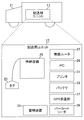
- FIG. 2 is a diagram showing a vehicle equipped with the delivery unit according to the first embodiment of the present invention.
- the vehicle 21 has the delivery unit 17 mounted on a carrier.
- the delivery unit 17 includes a storage container 25, a wireless router 27, a personal computer (hereinafter, referred to as a PC) 29, a printer 31, a battery 33, an alarm device 35, a GPS receiver 37, and a barcode reader 39.
- a plurality of sensors to be described later are housed or attached to the storage container 25, and a part of a tag string tied to each article stored in the storage container 25 is output to the outside, and a tag is attached to the tip thereof. 23 are tied.
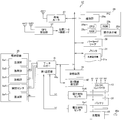
- FIG. 3 is a diagram illustrating a hardware configuration of the delivery unit according to the first embodiment of the present invention.
- the delivery unit 17 includes a storage container 25, a wireless router 27, a PC 29, a printer 31, a battery 33, an alarm device 35, a GPS receiver 37, a bar code reader 39, a data logger 41, a DC / DC converter 43, a charger 45, A first threshold setting unit 47 is provided.
- the delivery unit 17 includes a plurality of devices (various sensors Se1 to Se5) to be described later, and the use state / unused state of each device can be set from outside.
- the delivery unit 17 can mount a specific type of container from a plurality of types of containers prepared according to the type of the article.
- the type of the article means different from each other depending on the characteristics of the article, the use, the storage temperature, the storage humidity, and the like.
- the type of container means a container having a different storage temperature, storage humidity, and the like, corresponding to the type of article.
- the storage container 25 can store a plurality of articles inside, and includes various sensors Se1 to Se5 attached inside or outside.
- the thermometer Se1 is provided in the storage container 25, measures the ambient temperature in the storage container 25, and outputs temperature data (T1) to the data logger 41.
- the fuel gauge Se2 is provided in the storage container 25, measures the remaining amount of the liquefied refrigerant such as liquid nitrogen, and outputs the remaining amount data (W1) to the data logger 41.
- the vibration meter Se3 is provided outside the storage container 25, measures the vibration applied to the storage container 25, and outputs vibration data (F1) to the data logger 41.
- the opening / closing sensor Se4 is provided in the storage container 25, detects whether the lid of the storage container 25 is open or closed, and outputs opening / closing data (C1) to the data logger 41.
- the hygrometer Se5 is provided in the storage container 25, measures the atmospheric humidity in the storage container 25, and outputs humidity data (R1) to the data logger 41.
- the voltage detection sensor Se6 measures the voltage of the DC power supplied from the battery 33 to the DC / DC converter 43, and outputs voltage data (V1) to the data logger 41.
- the voltage detection sensor Se7 measures the voltage of the DC power supplied from the charger 45 to the battery 33, and outputs voltage data (V2) to the data logger 41.
- the wireless router 27 accesses a plurality of 3G / 4G lines arranged on a road on which the vehicle 21 travels, connects to the PC 29, and interconnects the PC 29 and the order management server 11.
- the PC 29 includes a CPU 29a, a ROM 29b, a RAM 29c, an operation display unit 29d, and a communication unit 29e.
- the CPU 29a controls the entire operation of the delivery unit 17 using the RAM 29c as a work memory according to a program stored in the ROM 29b in advance.
- the ROM 29b is a read-only non-volatile storage medium, and stores firmware and various data.
- the RAM 29c is a volatile storage medium that can read and write information at high speed, and can be used as a work memory.
- the operation display unit 29d includes a screen for displaying a menu for performing various settings and mode selection, key buttons, and the like, and receives various operation requests from the user. For example, the use state / unused state of a plurality of devices (various sensors Se1 to Se5) described later can be set from the operation display unit 29d.
- the communication unit 29e has a USB interface, and transmits and receives data to and from the order management server 11 via the wireless router 27 and the communication network 15.
- the printer 31 prints the quality certificate 31a on a recording medium such as paper according to the print job received from the PC 29.
- the charger 45 When the charger 45 is connected (ON) to each electrode, the battery 33 charges the DC power supplied from the charger 45, and the connection between the charger 45 and each electrode is opened (OFF). In this case, the DC power is discharged and supplied to the DC / DC converter 43.
- the alarm device 35 is activated when the data exceeds the threshold value and issues an alarm, and turns on a warning lamp to notify the person in charge.
- the GPS receiving unit 37 receives radio signals from a plurality of GPS satellites via the antenna ANT2, calculates position information of the delivery unit 17, and transmits the calculated position information via the antenna ANT3 and / or the network 15 It is transmitted to the order management server 11. Although the GPS receiver 37 is not connected to the PC 29 in FIG. 3, the GPS receiver 37 may be connected to the PC 29 and the position information calculated by the GPS receiver 37 may be output to the PC 29.
- the barcode reader 39 reads the barcode and outputs data to the PC 29.
- the data logger 41 collects measurement data measured by each sensor, stores various data, and outputs the stored various data to the PC 29 in response to reading of the PC 29.
- the data logger 41 includes a first storage unit 41a that stores temperature data measured by the thermometer Se1 and data measured by other sensors in a time series.
- the DC / DC converter 43 converts the DC power supplied from the battery 33 into DC power of, for example, four types of voltage levels (5 V, 12 V, 15 V, and 24 V), and supplies the DC power to each unit in the delivery unit 17.
- the charger 45 is connected to, for example, an AC power supply provided in the vehicle 21 or an AC power supply provided in a distribution center via a plug 45a as necessary, and converts AC power supplied from the AC power supply into DC power.
- the DC power is connected to each electrode of the battery 33, and the battery 33 is charged.
- the first threshold setting unit 47 sets thresholds for each of the temperature data, the remaining amount data, the vibration data, the humidity data, and the opening / closing frequency data.
- FIG. 4 is a functional block diagram of the order management server according to the first embodiment of the present invention.
- the schedule calculation unit 11a calculates the delivery date data related to the delivery of the article and the collection date data related to the collection of the delivery unit based on the article code and the use date data received from the client terminal 3 on the user side. calculate.
- the selection unit 11b selects a container of a type corresponding to the article from a plurality of types of containers based on the article code.
- the charge amount calculation unit 11c performs a collection operation according to a delivery completion notification received from the delivery unit 17 indicating that the delivery unit 17 has arrived at the user side, and a collection operation performed on a collection date calculated at the time of ordering. Is calculated by multiplying the lending period calculated on the basis of the collection completion notification indicating that the collection is completed by the unit price for the selected container.
- the generation unit 11d includes an area for specifying an article code, an area for specifying personal identification data, an area for specifying delivery destination data of an article, and a plurality of Is generated, and individual calendar screen data is generated so as to include an individual (patient) calendar area that can be set for each patient assigned by a user (eg, a doctor) who designates use date data. Then, the personal calendar screen is transmitted to the client terminal 3.
- the registration unit 11e receives the use date data from the client terminal 3, and registers the use date data.
- the transmission unit 11h considers that an additional order for cooling gas has been received, and An addition request is transmitted to the client terminal 3 on the delivery side.
- the replenishment fee adding unit 11j considers that replenishment of the cooling gas has occurred, and performs replenishment. The charge is added to the billing information and transmitted to the client terminal 3 on the delivery side.
- the order management server 11 calculates the delivery date data and the collection date data based on the article code and the use date data received from the user terminal 3 on the user side, and based on the article code. Then, a container type optimal for delivering the article is selected from a plurality of types of containers, and a delivery completion notification indicating that the delivery unit 17 has arrived at the user side from the delivery unit 17, The collection completion notice indicating that the collection work is completed according to the collection work performed on the calculated collection date is received, and the unit period is multiplied by the lending period related to the delivery unit 17 from the delivery date to the collection date. The billing amount can be calculated.
- the order management server 11 arranges an article code, personal identification data, article delivery destination data, and a date area according to a user request, and includes an individual calendar area for specifying use date data. By generating the separate calendar screen data, the user can register the use date data on the calendar screen.
- the order receiving management server 11 refers to the storage unit 11f that stores a plurality of types of article codes and a plurality of types of container types in association with each other, so that the order management server 11 can deliver the articles using the article codes as keys.
- the most suitable container can be selected. Therefore, it is possible to easily and quickly select an optimal container according to the article.
- the delivery date data is calculated as the date obtained by subtracting the delivery date lead time corresponding to the delivery destination data of the article from the usage date data received from the user terminal 3 on the user side, and the collection date data is used as the usage date of using the article.
- the delivery date and the collection date can be accurately calculated. Therefore, the user can be notified of the exact schedule.
- the guideline for selecting the container type becomes clear. Therefore, it is possible to accurately know the total price of delivering the articles in advance.
- the total value of the unit prices corresponding to the device is set as the fixed unit price. It can be calculated finely. Therefore, it is possible to calculate an accurate total value of unit prices corresponding to the articles. Since the unit price is multiplied according to the amount of monitoring data during the lending period, it is possible to eliminate a useless unit price for a period during which monitoring is not performed. For this reason, it is possible to obtain a unit price only for the period actually monitored during the lending period.
- the delivery unit 17 can externally set the use state / unused state of each device, and the order management server 11 uses the total value of the device unit prices of each device in the use state as the unit price. The total value of the unit prices can be calculated finely for each article. Therefore, it is possible to calculate an accurate total value of unit prices corresponding to the articles.
- the discount rate is stored in association with each ordering source to be discounted, the discount rate is obtained for each user code, and the discount rate is multiplied by the billing amount.
- Service to the person can be performed in detail. Therefore, there is an effect that the user who has a high repeat rate is further encouraged to repeat.
- a personal calendar screen that can be set for each patient in charge of a user (eg, a doctor) is displayed with a plurality of date areas arranged for each month, the user can display the calendar screen on a monthly basis. Can be used to indicate usage date data. Therefore, the convenience of the user can be improved.
- the use state / unused state of each device included in the delivery unit 17 can be set from the outside, so there is no need to change the hardware configuration of the delivery unit 17.
- the delivery unit 17 having the same configuration can be used for containers for various articles.
- a threshold is set for the data of the thermometer Se1 in the delivery unit 17, and when this threshold reaches a dangerous value, an alarm can be generated. For this reason, not only can the threshold value be individually set according to the type or importance of the article, but also it is possible to immediately recognize that the article has reached an abnormal state at the delivery destination or the delivery destination.
- a threshold value is set for the data of the fuel gauge Se2 in the delivery unit 17, and when the data becomes equal to or less than the first threshold value, it is determined that an additional order for cooling gas has been received, and an additional request is transmitted, and the second threshold value is transmitted. When returning to the above, it is considered that the cooling gas has been replenished, and a refilling fee is charged. For this reason, it is possible to automatically recognize the excess or deficiency of the cooling gas and automatically charge the fee.
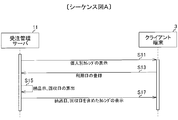
- FIG. 5 is a calendar screen generation sequence diagram according to the first embodiment of the present invention.
- the order management server 11 transmits data for displaying the individual calendar (see FIG. 6) to the client terminal 3.
- the client terminal 3 displays the received individual calendar on the monitor and registers the use date 125 selected by the user in the order management server 11. That is, the client terminal 3 transmits the article code and the use date data to the order management server 11.
- the order management server 11 calculates a delivery date 123 and a collection date 127 based on the use date 125.
- the schedule calculation unit 11a converts the delivery date data related to the delivery of the article and the collection date data related to the collection of the delivery unit based on the article code and the use date data received from the client terminal 3 on the user side. calculate.
- the order management server 11 transmits, to the client terminal 3, data indicating the delivery date 123 and the collection date 127 calculated by the order management server 11 at the client terminal 3.
- FIG. 6 is a diagram illustrating a screen of the individual calendar in a state where there is a use date on the client terminal according to the first embodiment of the present invention.
- the article name is “article A”
- the hospital name is “XX hospital”
- the patient name is “00000070”.
- a screen without the mark data denoted by reference numerals 123, 125, and 127 in the individual calendar 101 shown in FIG. 6 is displayed.
- XX hospital is displayed in the hospital name box 109 (area for specifying the delivery destination data) under the hospital name, and the contents of the box 109 can be selected by the pull-down button 111.
- “00000070” is displayed in the frame 113 of the patient name (area for specifying personal identification data), and the contents of the frame 113 can be selected by the pull-down button 117.
- calendar area 119 in the area below them. In this example, the calendar for October 2016 is displayed.
- the delivery date 123 is displayed on October 12
- the use date 125 is displayed on October 13
- the collection date 127 is displayed on October 14.
- the order management server 11 arranges the item code, the personal identification data, the delivery destination data of the item, and the date area according to the user's request, and stores the individual calendar area for specifying the use date data.
- the user can register the use date data on the calendar screen. Therefore, the user can easily specify the use date of the storage container from the user terminal, and the convenience can be improved.
- FIG. 7 is an ER diagram showing file associations processed by the order management server according to the first embodiment of the present invention.
- the order management server 11 stores the order source code, the article code, and the unit number in the order source order file 151 corresponding to the order number.
- the order management server 11 specifies a unit number based on which unit is assigned to the order.
- the order management server 11 extracts the order number from the order receiving order file 151 using the unit number as a key, extracts the lending number from the lending container management file 153, and stores the extracted number in the unit maintenance file 157 corresponding to the unit number and sequence.
- the unit type, unit status, order number, and loan number are stored.
- the order management server 11 stores the device type (1), the number (1), the device type (2), the number (2), the device type (3), and the number (3) in the unit type configuration file 159 corresponding to the unit type. .
- the order management server 11 stores the device number (1) and the device number (2) in the unit configuration file 163 corresponding to the unit number and the unit type.
- the order management server 11 stores the device status in the device detail file 167 corresponding to the device number and the device type.
- the order management server 11 stores the charging amount, the device number (1), the charging amount (1), the device number (2), and the charging amount (2) in the charging file 155 corresponding to the lending number, the start date, and the end date. .
- the order management server 11 stores the order source code, the charging type, the discount rate, the unit number, the collection flag, and the order number in the lending container management file 153 corresponding to the lending number.
- the order management server 11 stores the price in the unit price master 161 corresponding to the device type and the charging type.
- the order management server 11 stores the monitoring data in the trace file 165 corresponding to the unit number and the date and time by the update processing as needed. Similarly, the order management server 11 stores the device status in the device detail file 167 corresponding to the device number and the device type by performing the update process as needed.
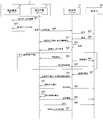
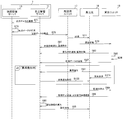
- FIG. 8 is a business sequence diagram showing a container rental procedure according to the first embodiment of the present invention.
- the order management server 11 performs cooperation of the order data (including the article code), and transmits the result to the distribution management server 13.
- the cooperation of the order data indicates generation of delivery data.
- the order management server 11 uses the selection unit 11b to select an optimal container type for delivering the article from a plurality of types of containers based on the article code.
- the distribution management server 13 creates delivery data based on the cooperation of the order data.
- the distribution management server 13 transfers the delivery data to the delivery unit 17, and performs a cut-out operation on the date of delivery (the shipping item is stored in the delivery unit 17).
- the delivery unit 17 delivers the output partition to the order source 16.
- step S29 the order source 16 delivers the article based on the partition sheet.
- step S31 after the delivery is completed, the delivery unit 17 transmits a delivery completion status (start of a lending period) to the order management server 11.
- step S33 the delivery unit 17 performs a monitoring operation of the unit for maintaining the quality even during the lending period.
- step S35 the delivery unit 17 transmits the measurement data obtained by the monitoring work to the order management server 11.
- step S37 when the ordering source 16 determines that the monitoring work may be ended, the ordering source 16 instructs the delivery unit 17 to stop monitoring.
- step S39 upon receiving the monitoring stop instruction, the delivery unit 17 transmits a monitoring completion notification to the order management server 11, or transmits a status indicating that communication has been interrupted.
- the order management server 11 calculates a collection date.
- the order management server 11 sends the collection notice data of the calculated collection date to the order source 16.
- step 45 the order management server 11 calculates billing information based on the calculated collection date.
- step 47 the order management server 11 creates billing information based on the calculated billing information and sends it to the order source 16.
- the delivery member goes to the ordering source on the collection date calculated at the time of ordering and collects the lent containers.
- step 51 the vehicle 21 collects the delivery unit 17. If an abnormality has occurred in the measured value (within a rectangular frame), the delivery unit 17 transmits an abnormality notification to the order management server 11 in step S53.
- step S55 the delivery unit 17 displays an abnormal state.
- step S57 the order management server 11 issues an abnormality notification notifying the orderer 16 of the details of the abnormality.
- the order management server 11 calculates the delivery date data and the collection date data based on the article code and the use date data received from the user terminal 3 on the user side.
- a container type optimal for delivering the article is selected from the types of containers, and a delivery completion notification indicating that the delivery unit 17 has arrived at the user side from the delivery unit 17 is calculated at the time of ordering.
- an optimal container type can be selected according to the type of the article, and the billing amount can be accurately calculated based on the lending period of the container.
- FIG. 9 is a sequence diagram showing a flow of refilling the lent container according to the first embodiment of the present invention.
- the order management server 11 links the order data, and transmits the result to the distribution management server 13.
- the distribution management server 13 creates delivery data based on the cooperation of the order data.
- the physical distribution management server 13 transfers the delivery data to the delivery unit 17 and performs a cutout operation on the delivery date (the shipping item is stored in the delivery unit 17).
- the delivery unit 17 delivers the output partition to the order source 16.
- the delivery unit 17 moves the article to the lending unit 18.
- the lending unit represents the delivery unit 17 lent to the orderer.
- step 81 the delivery unit 17 transmits a notification that the article has been moved and a request to stop monitoring to the order management server 11.
- step 83 the lending unit 18 sends the article storage notification and a message to start monitoring the article to the order management server 11.
- step 85 the lending unit 18 starts monitoring the article.
- step S89 when the ordering source 16 determines that the monitoring work may be ended, the ordering source 16 instructs the lending unit 18 to stop monitoring.
- step S91 the lending unit 18 receives the monitoring stop instruction and notifies the order management server 11 of the completion of monitoring or interrupts the continuation of communication.
- step 93 the order management server 11 calculates billing information based on the calculated collection date.
- step 95 the order management server 11 creates billing information based on the calculated billing information and transmits it to the order source 16. If an error occurs in the measured value (within a rectangular frame), the lending unit 18 transmits an abnormality notification to the order management server 11 in step S97.
- step S101 the lending unit 18 displays an abnormal state on the ordering source 16.
- step S103 the order management server 11 issues an abnormality notification to inform the orderer 16 of the details of the abnormality.
- the order management server 11 calculates the delivery date data and the collection date data based on the article code and the use date data received from the user terminal 3 on the user side.
- the charge amount can be calculated by multiplying the lending period calculated based on the collection completion notification indicating that the collection work has been completed according to the calculated collection work performed on the collection date by the unit price, and by the unit price. For this reason, an optimal container type can be selected according to the type of the article, and the billing amount can be accurately calculated based on the lending period of the container.
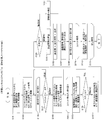
- FIG. 10 is a flowchart of the collection determination according to the first embodiment of the present invention.
- the order management server 11 acquires the lending information (lending number, unit number, collection flag, see FIG. 11) shown in FIG. 11 from the lending container management file 153.
- the order management server 11 determines whether the lent container is a collection target. That is, the collection flag included in the lending information is “0”, and if the collection target is not a collection target, the process ends. If the collection flag is “1” and the collection target, the process proceeds to step S115.
- step S117 the schedule calculation unit 11a calculates the business day immediately before the collection date as a loop.
- step S119 the schedule calculation unit 11a determines a Saturday, Sunday, and a holiday on the collection day. If the collection date is a “weekday”, the process ends. On the other hand, if the collection date is a weekend or a holiday in step S119, the schedule calculation unit 11a proceeds to step S121.
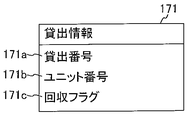
- FIG. 11 is a diagram illustrating a configuration of the lending information in the flowchart of the collection determination according to the first embodiment of the present invention.
- the lending information 171 includes a lending number 171a, a unit number 171b, and a collection flag 171c.
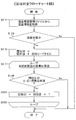
- FIG. 12 is a flowchart of the accounting calculation according to the first embodiment of the present invention.
- the charge amount calculation unit 11c acquires the lending information 171 from the lending container management file 153.
- the charging amount calculation unit 11c acquires unit information from the unit maintenance file 157. That is, the charge amount calculation unit 11c extracts unit information from the unit maintenance file 157 using the lending number and the unit number as keys.
- the charge amount calculation unit 11c repeatedly calculates the amount corresponding to the loan information.
- the billing amount calculation unit 11c proceeds to step S145 when the unit status stops, and repeats the processing.
- the charging amount calculation unit 11c acquires unit configuration information from the unit configuration file 159. That is, the billing amount calculation unit 11c extracts unit configuration information from the unit configuration file 159 using the unit number as a key.
- step S151 the charge amount calculation unit 11c repeatedly performs the calculation for the unit configuration.
- step S153 the charging amount calculation unit 11c acquires the device type and the device status from the device detail file 167. That is, the billing amount calculation unit 11c extracts the device type and the device status from the device detail file 167 using the device number as a key.
- step S155 when the status stops, the charge amount calculation unit 11c proceeds to step S151 and repeats.
- step S157 the charging amount calculation unit 11c acquires the amount from the unit price master 161 using the device type and the charging type as keys.
- step S159 the billing amount calculation unit 11c determines whether the billing type is a "pay-as-you-go" system in which billing is performed according to the lending period, or a fixed amount "fixed system".
- Step S161 is a case where the charging type is “pay-as-you-go”, and the charging amount calculation unit 11c calculates a lending period.
- step S167 the billing amount calculator 11c outputs the billing amount and the device number calculated in either step S163 or step S165 to the billing file 155.
- step S171 the charge amount calculation unit 11c repeatedly calculates the charge amount for the unit configuration.
- step S175 the charge amount calculation unit 11c outputs the information as lending information.
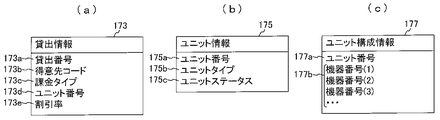
- FIG. 13 is a diagram showing the configurations of (a) lending information, (b) unit information, and (c) unit configuration information which are referred to in the flowchart of the accounting calculation according to the first embodiment of the present invention shown in FIG. .
- the lending information 173 includes a lending number 173a, an orderer code 173b, a charging type 173c, a unit number 173d, and a discount rate 173e.
- the unit information 175 includes a unit number 175a, a unit type 175b, and a unit status 175c.
- the unit configuration information 177 includes a unit number 177a and device numbers (1) to (n) 177b.
- FIG. 14 is a diagram illustrating a total amount of money for each unit type according to the first embodiment of the present invention.
- a unit type, a device, a billing type, a discount rate, and a total amount are arranged in the horizontal direction.
- types, carts, capacities, PCs, printers, barcode readers, data loggers, temperature sensors, vibration sensors, fuel gauges, GPS sensors, open / close sensors, hygrometers, and small terminals are arranged.
- Containers include blade shippers, deep breathers, and dry shippers.
- Unit types include an ultra-low temperature unit, a dry shipper, and a blood transport type. There are fixed and metered charging types. As shown in FIG. 14, the charge amount calculation unit 11c calculates the total amount of equipment required for each unit type. At this time, the charge type for each device is calculated, and the discount rate is subtracted to calculate the total amount. In addition, since there are fixed and pay-as-you-go charging types, it can be changed for each ordering source. The discount rate can be set for each order source. As described above, it is possible to select the most suitable container type according to the type of the article and accurately calculate the charge amount based on the lending period of the container. In addition, it is possible to calculate a rental fee for a container that can be used for delivery while ensuring the quality of the article and that can also be used for storing the article at the delivery destination.
- FIG. 15 is a diagram showing a monitoring / status display screen displayed on the PC of the delivery unit according to the first embodiment of the present invention.
- a unit number, a type, an update time, and a temperature inside the storage container 25 (temperature inside the shipper) 200b are displayed as unit information 200a and as monitoring information.
- a status operation button B1 a phase, a place, an order, and contents are displayed, and an execution button B3 is displayed.
- the status operation button B1 is pressed, the location, order, and contents of the work can be changed.
- a monitoring details button B5 When the execution button B3 is pressed, the latest location is sent from the PC 29 of the delivery unit 17 to the order management server 11. , The order and the contents of the work are transmitted. Further, below the monitoring / status display screen 200, a monitoring details button B5, an article details button B7, a temperature trace table print button B9, and a business initialization button B11 are displayed.
- FIG. 16 is a diagram showing an operation screen used when ending monitoring of the delivery unit according to the first embodiment of the present invention.
- an article name, a use place, a shipper temperature, a measurement date and time, a patient and the number of uses are displayed, and further, a tag code, an extraction date and time, a use patient, a lot, and a use term , The serial number is displayed.
- the article is not present in the container and monitoring is unnecessary. At this time, the status of the delivery unit becomes unused, and monitoring is stopped.
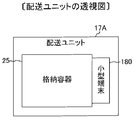
- FIG. 17 is a perspective view showing a modification of the delivery unit according to the second embodiment of the present invention.
- the delivery unit 17 shown in FIG. 3 is used as the delivery unit, but in the second embodiment, the delivery unit 17A shown in FIG. 18 is used as the delivery unit.
- the delivery unit 17A as a modified example includes a storage container 25A and a small terminal 180 that transmits and receives information to and from the order management server 11 via the communication network 15.
- the delivery unit 17A is a form in which the configuration of the delivery unit 17 shown in FIG. 2 is simplified, and a small terminal 181 is provided with a PC function, a GPS receiver 181e, and a 10-axis sensor 181g.
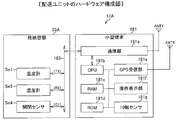
- FIG. 18 is a diagram illustrating a hardware configuration of a modified example of the delivery unit according to the second embodiment of the present invention.
- the storage container 25 can store a plurality of articles inside, and includes various sensors Se1, Se4, and Se5 attached inside or outside, and is connected to the small terminal 181 via the bus 183.
- the thermometer Se1 is provided in the storage container 25A, measures the ambient temperature in the storage container 25, and outputs temperature data (T1) to the communication unit 181a.
- the opening / closing sensor Se4 is provided in the storage container 25A, detects whether the lid of the storage container 25 is open or closed, and outputs the opening / closing data (C1) to the communication unit 181a.
- the hygrometer Se5 is provided in the storage container 25A, measures the atmospheric humidity in the storage container 25, and outputs humidity data (R1) to the communication unit 181a.
- the small terminal 181 includes a communication unit 181a, a CPU 181b, a RAM 181c, a ROM 181d, a GPS receiving unit 181e, an operation display unit 181f, and a 10-axis sensor 181g.
- the communication unit 181a includes the ANT 4 and transmits and receives data to and from the order management server 11 via the communication network 15.
- the CPU 181b controls the overall operation of the delivery unit 17A using the RAM 181c as a work memory according to a program stored in the ROM 181d in advance.
- the RAM 181c is a volatile storage medium that can read and write information at high speed, and can be used as a work memory.
- the ROM 181d is a read-only nonvolatile storage medium, and stores firmware and various data.
- the GPS receiver 181e receives radio signals from a plurality of GPS satellites via the antenna ANT5, calculates position information of the delivery unit 17A, and transmits the calculated position information to the order management server 11 via the communication network 15. I do.
- the operation display unit 181f includes a screen for displaying a menu for performing various settings and mode selection, key buttons, and the like, and receives various operation requests from the user.
- the 10-axis sensor 181g is an inertial measurement unit corresponding to 10-axis measurement, and is a composite sensor in which a 3-axis angular velocity sensor (gyro sensor), a 3-axis acceleration sensor, a 3-axis magnetic sensor, and a pressure sensor are sealed in one package. And is disposed in the small terminal so as to contact the side surface of the storage container 25.
- the order management system 1 includes an order management server 11 that generates order data, and a delivery unit 17 for delivering a container containing articles, and includes the order management server 11 and the delivery unit 17.
- An order management system 1 that is connected to each other via communication networks 5 and 15 to manage the delivery of the delivery unit 17 and the collection of the delivery unit 17.
- a specific type of container can be loaded from the prepared plurality of types of containers, and the order management server 11 delivers the item based on the item code and the use date data received from the user terminal 3 on the user side.
- a schedule calculation unit 11a for calculating the delivery date data related to the collection of the delivery unit and the collection date data related to the collection of the delivery unit.
- the unit price of the selected container is determined.
- a charge amount calculation unit 11c for calculating a charge amount by multiplication.
- the order management server 11 calculates the delivery date data and the collection date data based on the article code and the use date data received from the user terminal 3 on the user side, and based on the article code.
- a container type optimal for delivering the article is selected from a plurality of types of containers, and a delivery completion notification indicating that the delivery unit 17 has arrived at the user side from the delivery unit 17 is calculated at the time of ordering.
- a collection completion notification indicating that the collection work has been completed is received in accordance with the collection work performed on the collected collection date, and the lending period related to the delivery unit 17 from the delivery date to the collection date is multiplied by the unit price to be charged. The amount can be calculated. For this reason, an optimal container type can be selected according to the type of the article, and the billing amount can be accurately calculated based on the lending period of the container.
- the order management server 11 In response to a request received from the user terminal 3 on the user side, the order management server 11 according to the present embodiment includes an area for specifying an article code, an area for specifying personal identification data, an area for specifying delivery destination data of an article, and A generation unit that generates individual calendar screen data so that a plurality of date areas are arranged for each month and includes individual calendar areas that specify use date data, and transmits the individual calendar screen to the user terminal 3 11d, and a registration unit 11e that receives usage date data from the user terminal 3 and registers the usage date data.
- the order management server 11 arranges the article code, the personal identification data, the delivery destination data of the article, and the date area in accordance with the request of the user, and designates the individual calendar for specifying the use date data.
- the individual calendar screen data so as to include the area, the user can register the use date data on the calendar screen. For this reason, the user (for example, a doctor) can easily specify the use date of the storage container from the user terminal, and the convenience can be improved.
- the selection unit 11b includes a storage unit 11f that stores a plurality of types of article codes and a plurality of types of container types in association with each other, and uses the article code as a key to select a container that is optimal for delivering the article from the storage unit 11f.
- the order receiving management server 11 refers to the storage unit 11f that stores a plurality of types of article codes and a plurality of types of container types in association with each other, so that the order management server 11 can optimally distribute the articles by using the article codes as keys. Can be selected. Therefore, it is possible to easily and quickly select an optimal container according to the article.
- the schedule calculation unit 11a calculates a date obtained by subtracting the delivery date lead time corresponding to the delivery destination data of the article from the usage date data received from the user terminal 3 on the user side, as a delivery date indicating the schedule for delivering the article.
- the data is calculated as data
- a date obtained by adding the collection date lead time corresponding to the delivery destination data of the article to the use date data of using the article is calculated as collection date data representing a schedule for collecting the containers.
- the delivery date data is calculated as the date obtained by subtracting the delivery date lead time corresponding to the delivery destination data of the article from the usage date data received from the user terminal 3 on the user side
- the collection date data is calculated.
- the delivery date and the collection date can be accurately calculated by calculating as a date obtained by adding the collection date lead time corresponding to the delivery destination data of the item to the use date data of using the item. Therefore, the user can be notified of the exact schedule.
- the charging amount calculation unit 11c of this aspect is characterized in that the charging amount is calculated from a fixed unit price corresponding to the type of the container. According to this aspect, the guideline for selecting the container type becomes clear by calculating the charging amount from the fixed unit price corresponding to the type of the container. Therefore, it is possible to accurately know the total price of delivering the articles in advance.
- the fixed unit price used in the billing amount calculation unit 11a according to the present embodiment is characterized in that it is the total value of the unit prices corresponding to the devices in use among the devices included in the container. According to this aspect, which device in the container is used depending on the type of the article, and the total value of the unit prices corresponding to the device is set as the fixed unit price, so that the total value of the unit price is finely divided for each article. Can be calculated. Therefore, it is possible to calculate an accurate total value of unit prices corresponding to the articles.
- the charging amount calculation unit 11a is characterized in that the charging amount is calculated by multiplying the monitoring data amount during the lending period by the unit price. According to this aspect, since the unit price is multiplied according to the monitoring data amount during the lending period, it is possible to eliminate a useless unit price for a non-monitoring period. For this reason, it is possible to obtain a unit price only for the period actually monitored during the lending period.
- the delivery unit 17 of this embodiment includes a plurality of devices, and the use state / unused state of each device can be set from the outside.
- the charge amount calculation unit 11c of the order management server 11 includes It is characterized in that the total value of the unit prices of each device when the device is in use is set as the unit price.
- the delivery unit 17 can externally set the use state / unused state of each device, and the order management server 11 sets the total value of the unit prices of the devices in the used state. Is used as the unit price, so that the total value of the unit prices can be finely calculated for each article. Therefore, it is possible to calculate an accurate total value of unit prices corresponding to the articles.
- the charge amount calculation unit 11c of this embodiment includes a storage unit 11g that stores a discount rate corresponding to the user code, and acquires the discount rate corresponding to the user code received from the user terminal on the user side from the storage unit 11g. Then, the discount rate is multiplied by the billing amount.
- the discount rate is stored in association with each user code to be discounted, the discount rate is obtained for each user code, and the discount rate is multiplied by the charged amount. Service to the person can be performed in detail. Therefore, there is an effect that the user who has a high repeat rate is further encouraged to repeat.
- the generation unit 11d of the order management server 11 of the present embodiment is characterized in that it generates individual calendar screen data in which a plurality of date areas are arranged for each month.
- the individual calendar screen assigned to the user is displayed with a plurality of date areas arranged for each month, so that the user can use the date data on the calendar screen for each month. Can be indicated. Therefore, the convenience of the user can be improved.
- the delivery unit 17 of this aspect includes a plurality of devices, and the use state / unused state of each device can be set from the outside. According to this aspect, the use state / unused state of each device included in the delivery unit 17 can be set from the outside, so that there is no need to change the hardware configuration of the delivery unit 17. Therefore, the delivery unit 17 having the same configuration can be used for containers for various articles.
- the storage container 25 of the delivery unit 17 of the present embodiment includes the thermometer Se1 for detecting the temperature in the storage container 25, and the temperature in the storage container 25 deviates from the threshold during the lending period of the storage container 25. In this case, an alert notification is transmitted to the order management server 11.
- a threshold is set for the data of the thermometer Se1 in the delivery unit 17, and when this threshold reaches a dangerous value, an alarm can be generated. For this reason, not only can the threshold value be individually set according to the type or importance of the article, but also it is possible to immediately recognize that the article has reached an abnormal state at the delivery destination or the delivery destination.
- the delivery unit 17 of the present embodiment transmits the remaining amount data Se2 to the order management server 11 and the remaining amount meter Se2 for measuring the remaining amount data relating to the remaining amount of the cooling gas sealed in the storage container 25 containing the articles. And a data logger 41 that performs the ordering.
- the order management server 11 receives an additional order for the cooling gas.
- a transmitting unit 11h for transmitting a request for additional cooling gas to the terminal on the delivery side, and the second remaining amount data received from the delivery unit 17 is not less than a second threshold value which is a reference at the time of replenishment.
- a threshold value is set for the data of the fuel gauge Se2 in the delivery unit 17, and when the data falls below the first threshold value, it is considered that an additional order for cooling gas has been received, and an additional request is issued.
- the transmission is returned to the second threshold or more, it is considered that the cooling gas has been refilled, and a refill fee is charged. For this reason, it is possible to automatically recognize the excess or deficiency of the cooling gas and automatically charge the fee.
- the order management method includes an order management server 11 that generates order data, and a delivery unit 17 for delivering containers that store articles.
- the order management server 11 and the delivery unit 17 are mutually connected.
- a storage container 25 of a specific type can be mounted from a plurality of types of storage containers 25 prepared in advance, and the order management server 11 performs the processing based on the article code and the use date data received from the user terminal 3 on the user side.
- the order management server 11 calculates the delivery date data and the collection date data based on the article code and the use date data received from the user terminal 3 on the user side, and based on the article code.
- a container type optimal for delivering the article is selected from a plurality of types of containers, and a delivery completion notification indicating that the delivery unit 17 has arrived at the user side from the delivery unit 17 is calculated at the time of ordering.
- a collection completion notification indicating that the collection work has been completed is received in accordance with the collection work performed on the collected collection day, and the lending period related to the delivery unit 17 from the delivery date to the collection date is multiplied by the unit price to be charged.
- a program according to this aspect causes a processor to execute each step in the delivery management method described in the fourteenth aspect. According to this aspect, each step can be executed by the processor. For this reason, it is possible to calculate a rental fee for a container that can be used for delivery while ensuring the quality of the article and that can also be used for storing the article at the delivery destination.
- SYMBOLS 1 ... Order management system, 3 ... Client terminal, 5, 15 ... Communication network, 7 ... Order management device, 9 ... Front-end server, 11 ... Order management server, 13 ... Distribution management server, 17 ... Delivery unit, 21 ... Vehicle, 23 tag, 25 container, 27 wireless router, 29 PC, 31 printer, 33 battery, 35 alarm device, 37 GPS receiver, 39 bar code reader, Se1 thermometer, Se2: fuel gauge, Se3: vibrometer, Se4: open / close sensor, Se5: hygrometer, Se6: voltage detection sensor, Se7: voltage detection sensor
Landscapes
- Business, Economics & Management (AREA)
- Engineering & Computer Science (AREA)
- Economics (AREA)
- Human Resources & Organizations (AREA)
- Strategic Management (AREA)
- General Business, Economics & Management (AREA)
- Development Economics (AREA)
- Entrepreneurship & Innovation (AREA)
- Physics & Mathematics (AREA)
- Marketing (AREA)
- Theoretical Computer Science (AREA)
- General Physics & Mathematics (AREA)
- Accounting & Taxation (AREA)
- Finance (AREA)
- Tourism & Hospitality (AREA)
- Quality & Reliability (AREA)
- Operations Research (AREA)
- Game Theory and Decision Science (AREA)
- Health & Medical Sciences (AREA)
- Educational Administration (AREA)
- General Health & Medical Sciences (AREA)
- Primary Health Care (AREA)
- Public Health (AREA)
- Water Supply & Treatment (AREA)
- Data Mining & Analysis (AREA)
- Medical Informatics (AREA)
- Epidemiology (AREA)
- Biomedical Technology (AREA)
- Management, Administration, Business Operations System, And Electronic Commerce (AREA)
Abstract
Description
特許文献1には、中小農家等を含めた個々の生産者等の通い容器の利用者に対し、簡便に通い容器をレンタルし、且つそのレンタル料の請求、及び領収作業を簡便に行うことを目的として、物品の流通に用いる再利用可能な通い容器を、貸出者からセンタ等に保管委託し、センタ等から物品の生産者に該容器の貸出を行い、生産者がセンタに物品を販売する時に当該容器をセンタに返却する技術が開示されている。
特許文献1によれば、生産物の流通システムへの容器レンタルが更に促進されることとなり、従来の破棄を前提とした通い容器(段ボール箱等)を使用した流通に比べて、廃棄物の削減、物流の合理化を実現できるという効果がある。
例えば、搬送する物品が、-170℃程度の低温状態で冷却しておく必要がある場合、配送先である利用者は高価な低温保管容器を用意しなければならず、利用者に多額な費用負担を強いていた。
そこで、配送先である利用者が低温保管容器に係わる多額な設備投資を行うことなく、配送された物品の保管が必要な期間にのみ保管容器を貸し出すというサービス形態が望まれていた。
本発明の一実施形態は、上記に鑑みてなされたもので、その目的としては、物品の種類に応じて、複数の容器の中から物品の品質を保証することが可能な最適な容器を選択することができ、物品の配送時と、配送先における当該物品の保管時に共通して用いる1つの容器に係る貸出単価を算出するとともに、当該容器に係わる貸出料金を算出することにある。
また、物品の品質を担保して配送する際に用いることができ、且つ配送先において当該物品を保管する際にも用いることができる容器に係る貸出料金を算出することができる。
本発明は、物品の種類に応じて、物品の配送時と、配送先における当該物品の保管時に用いる1つの容器に係る貸出料金を算出するために、又は、物品の品質を担保して配送する際に用いることができ、且つ配送先において当該物品を保管する際にも用いることができる容器に係る貸出料金を算出するために以下の構成を有する。
すなわち、本発明の受注管理システムは、受注データを生成する受注管理サーバと、物品を収容した容器を配送する為の配送用ユニットと、を備え、受注管理サーバ、及び配送用ユニットを互いに通信ネットワークを介して接続して、配送用ユニットの配送、及び配送用ユニットの回収を管理する受注管理システムであって、配送用ユニットは、物品の種類に応じて準備された複数種類の容器の中から特定種類の容器を搭載可能であり、受注管理サーバは、利用者側のユーザ端末から受信した物品コード、及び利用日データに基づいて、前記物品の配送に係わる納品日データ、及び前記配送用ユニットの回収に係わる回収日データを算出する日程算出手段と、物品コードに基づいて、複数種類の容器の中から当該物品に対応する種類の容器を選択する選択手段と、配送用ユニットから受信した納品完了通知、及び回収完了通知に基づいて算出される貸出期間に、前記選択された容器に係わる単価を乗算することにより課金額を算出する課金額算出手段と、を備えたことを特徴とする。
以上の構成を備えることにより、物品の種類に応じて、物品の配送時と、配送先における当該物品の保管時に用いる1つの容器に係る貸出料金を算出することができる。
また、物品の品質を担保して配送する際に用いることができ、且つ配送先において当該物品を保管する際にも用いることができる容器に係る貸出料金を算出することができる。
上記記載の本発明の特徴について、以下の図面を用いて詳細に解説する。但し、この実施形態に記載される構成要素、種類、組み合わせ、形状、その相対配置などは特定的な記載がない限り、この発明の範囲をそれのみに限定する主旨ではなく単なる説明例に過ぎない。
上記の本発明の特徴に関して、以下、図面を用いて詳細に説明する。
<受注管理システム>
図1は、本発明の第1実施形態に係わる受注管理システムの構成を示すブロック図である。
以下、同じ構成要件には同じ符号を付して説明する。
受注管理システム1は、クライアント端末3、通信ネットワーク5、15、受注管理装置7、配送用ユニット17、物流管理サーバ(配送者)13を備えている。
なお、本実施形態ではクライアント端末3、配送用ユニット17、及び物流管理サーバ13が複数で構成されているが、単数でもよい。また、通信ネットワークが5、15と別れているが同一のネットワークで構成してもよい。
クライアント端末3は、配送先が操作可能な端末である。
なお、受注管理サーバ11は、内部にROM(Read Only Memory)、RAM(Random Access Memory)、CPU(Central Processing Unit)、HDD(Hard Disk Drive)を有し、HDDからオペレーティングシステムOSを読み出してRAM上に展開してOSを起動し、OS管理下において、HDDからプログラム(後述する各種フローチャートで示されるプログラム)を読み出し、各種処理を実行する。
なお、GPS受信部37が有する固有の機器コードは、例えば、GPS受信部37のMACアドレス(Media Access Control address)や、予め定められた固有の管理番号であればよい。
図2は、本発明の第1実施形態に係わる配送用ユニットを搭載した車両を示す図である。
車両21は、荷台に配送用ユニット17を搭載している。さらに、配送用ユニット17は、格納容器25、無線ルータ27、パーソナルコンピュータ(以下、PCと記す)29、プリンタ31、バッテリ33、警報装置35、GPS受信部37、バーコードリーダ39を備えている。
格納容器25には、後述する複数のセンサを収容、または取り付けられており、格納容器25内に収容されている各物品に結び付けられたタグひもの一部が外部に出され、その先端にタグ23が結び付けられている。
図3は、本発明の第1実施形態に係わる配送用ユニットのハードウェア構成を示す図である。
配送用ユニット17は、格納容器25、無線ルータ27、PC29、プリンタ31、バッテリ33、警報装置35、GPS受信部37、バーコードリーダ39、データロガー41、DC/DCコンバータ43、充電器45、第1閾値設定部47を備えている。なお、配送用ユニット17は、後述する複数の機器(各種センサSe1~Se5)を備え、各機器の使用状態/未使用状態を外部から設定可能である。
配送用ユニット17は、物品の種類に応じて準備された複数種類の容器の中から特定種類の容器を搭載可能である。
ここで、物品の種類とは、物品である物品の特性、用途、保管温度、保管湿度などにより互いに異なるものを意味する。また、容器の種類とは、物品の種類に対応して、保管温度、保管湿度などが互いに異なるものを意味する。
温度計Se1は、格納容器25内に設けられ、格納容器25内の雰囲気温度を計測して、温度データ(T1)をデータロガー41に出力する。
残量計Se2は、格納容器25内に設けられ、例えば液体窒素のように液化した冷媒の残量を計測して、残量データ(W1)をデータロガー41に出力する。
振動計Se3は、格納容器25外に設けられ、格納容器25に加わる振動を計測して、振動データ(F1)をデータロガー41に出力する。
湿度計Se5は、格納容器25内に設けられ、格納容器25内の雰囲気湿度を計測して、湿度データ(R1)をデータロガー41に出力する。
電圧検知センサSe6は、バッテリ33からDC/DCコンバータ43に供給される直流電力の電圧を計測して、電圧データ(V1)をデータロガー41に出力する。
電圧検知センサSe7は、充電器45からバッテリ33に供給される直流電力の電圧を計測して、電圧データ(V2)をデータロガー41に出力する。
PC29は、CPU29a、ROM29b、RAM29c、操作表示部29d、通信部29eを備えている。
CPU29aは、ROM29bに予め記憶されるプログラムに従い、RAM29cをワークメモリとして用いて、配送用ユニット17の全体の動作を制御する。
ROM29bは、読み出し専用の不揮発性記憶媒体であり、ファームウェア、及び各種データが格納されている。
RAM29cは、情報の高速な読み書きが可能な揮発性の記憶媒体であり、ワークメモリとして利用可能である。
通信部29eは、USBインターフェースを有し、無線ルータ27、通信ネットワーク15を介して受注管理サーバ11との間でデータを送受信する。
バッテリ33は、充電器45が各電極に接続(ON)された場合に、充電器45から供給された直流電力を充電するとともに、充電器45と各電極との接続が開放(OFF)された場合に、直流電力を放電してDC/DCコンバータ43に供給する。
警報装置35は、データが閾値を超えると起動して発報するとともに、警告灯を点灯して担当者に報知する。
データロガー41は、各センサにより計測された計測データを収集して、各種データを保存するとともに、PC29の読み出しに応じて、保存した各種データをPC29に出力する。なお、データロガー41内には、温度計Se1で測定された温度データや、他センサにより測定されたデータを時系列に沿って記憶する第1記憶部41aがある。
充電器45は、必要に応じて、例えば車両21に設けられた交流電源、又は配送センタに設けられた交流電源にプラグ45aを介して接続して、交流電源から供給される交流電力を直流電力に変換して、直流電力をバッテリ33の各電極に接続し、バッテリ33を充電する。
第1閾値設定部47は、温度データ、残量データ、振動データ、湿度データ、開閉回数データのそれぞれに係わる閾値を設定する。
図4は、本発明の第1実施形態に係わる受注管理サーバの機能ブロック図である。
日程算出部11aは、利用者側のクライアント端末3から受信した物品コード、及び利用日データに基づいて、前記物品の配送に係わる納品日データ、及び前記配送用ユニットの回収に係わる回収日データを算出する。
選択部11bは、物品コードに基づいて、複数種類の容器の中から当該物品に対応する種類の容器を選択する。
課金額算出部11cは、配送用ユニット17から受信した、配送用ユニット17が利用者側に到着したことを表す納品完了通知、発注時に算出された回収日に行われる回収作業に応じて回収作業が完了したことを表す回収完了通知に基づいて算出される貸出期間に、選択された容器に係わるに単価を乗算することにより課金額を算出する。
登録部11eは、クライアント端末3から利用日データを受信して、利用日データを登録する。
送信部11hは、配送用ユニット17から受信した第1残量データが減少時の基準となる第1閾値以下になった場合に、冷却ガスの追加受注があったことと見なして、冷却ガスの追加要求を配送者側のクライアント端末3に送信する。
補充料金付加部11jは、配送用ユニット17から受信した第2残量データが補充時の基準となる第2閾値以上に戻った場合に、冷却ガスの補充があったことと見なして、補充に係る料金を請求情報に付加して配送者側のクライアント端末3に送信する。
容器タイプに対応した固定の単価より課金額を算出することにより、容器タイプを選択する際の指針が明確となる。このため、予め物品を配送するトータルの価格を正確に知ることができる。
貸出期間中の監視データ量に応じて単価を乗算するので、監視していない期間に対する無駄な単価を除くことができる。このため、貸出期間中の実際に監視している期間だけの単価を得ることができる。
配送用ユニット17は、各機器の使用状態/未使用状態を外部から設定可能であり、受注管理サーバ11は、使用状態にある場合の各機器に係わる機器単価の合計値を単価とするので、単価の合計値を物品ごとにきめ細かく算出することができる。このため、物品に対応した正確な単価の合計値を算出することができる。
利用者(例えば、医師)が担当している患者毎に設定可能な個人別カレンダ画面は、月毎に複数の日付領域が配置されて表示されるので、利用者は、月毎にカレンダ画面上で利用日データを指示することができる。このため、利用者の利便性を高めることができる。
配送用ユニット17に備える各機器の使用状態/未使用状態を、外部から設定可能であるので配送用ユニット17のハードウェア構成を変更する必要がない。このため、同じ構成の配送用ユニット17で各種の物品の容器に使用が可能となる。
配送用ユニット17内の温度計Se1のデータに閾値を設定して、この閾値が危険値に達すると、警報を発生することができる。このため、物品の種類或いは重要度に応じて閾値を個別に設定可能となるばかりでなく、配送先或いは納品先で物品が異常状態に達したことを即座に認識することができる。
配送用ユニット17内の残量計Se2のデータに閾値を設定して、第1閾値以下になった場合に、冷却ガスの追加受注があったことと見なして追加要求を送信し、第2閾値以上に戻った場合に、冷却ガスの補充があったことと見なして補充料金を請求する。このため、冷却ガスの過不足を自動的に認知でき、且つその料金を自動的に請求することができる。
図5は、本発明の第1実施形態に係わるカレンダ画面生成シーケンス図である。
ステップS11では、受注管理サーバ11は、個人別カレンダ(図6参照)を表示するデータをクライアント端末3に送信する。
ステップS13では、クライアント端末3は、受信した個人別カレンダをモニタに表示して、ユーザが選択した利用日125を受注管理サーバ11に登録する。すなわち、クライアント端末3は、物品コード、及び利用日データを受注管理サーバ11に送信する。
ステップS15では、受注管理サーバ11は、利用日125に基づいて納品日123と回収日127を算出する。すなわち、日程算出部11aは、利用者側のクライアント端末3から受信した物品コード、及び利用日データに基づいて、物品の配送に係わる納品日データ、及び配送用ユニットの回収に係わる回収日データを算出する。
ステップS17では、受注管理サーバ11は、クライアント端末3にて、受注管理サーバ11より算出された納品日123と回収日127を表示するデータをクライアント端末3に送信する。
図6は、本発明の第1実施形態に係るクライアント端末での利用日がある状態の個人別カレンダの画面を表す図である。
説明の前提条件として、例えば、物品名を「物品A」、病院名を「XX病院」、患者名を「00000070」とする。クライアント端末3の初期画面には図6に示す個人別カレンダ101のうち、符号123、125、127、に示すマークデータがない画面が表示される。
この例では、画面が個人別カレンダであることを示す表題103があり、物品名の枠内105(物品を指定する領域)に「物品A」が表示され、プルダウンボタン107により枠内105の内容を選択することができる。
更に、それらの下側の領域にカレンダ領域119がある。この例では、2016年10月のカレンダが表示されている。
この例では、10月12日に納品日123が表示され、10月13日に利用日125が表示され、10月14日に回収日127が表示されている。
このように、受注管理サーバ11は、利用者の要求に応じて、物品コード、個人識別データ、物品の配送先データ、及び日付領域が配置され、利用日データを指定する個人別のカレンダ領域を含むように個人別カレンダ画面データ生成することにより、利用者はカレンダ画面上で利用日データを登録することができる。
このため、利用者はユーザ端末から容易に格納容器の利用日を指定することができ、利便性を向上させることができる。
図7は、本発明の第1実施形態に係わる受注管理サーバにより処理されるファイルの関連付けを示すER図である。
受注管理サーバ11は、クライアント端末3から発注元コード、物品コードを受信した場合に、受注番号に対応する発注元受注ファイル151に発注元コード、物品コード、ユニット番号を記憶する。なお、受注管理サーバ11は、どのユニットを当該受注に割り当てたかによりユニット番号が特定される。
受注管理サーバ11は、ユニット番号をキーとして、発注元受注ファイル151から受注番号を抽出し、貸出容器管理ファイル153から貸出番号を抽出しておき、ユニット番号、シーケンスに対応するユニットメンテファイル157にユニットタイプ、ユニットステータス、受注番号、貸出番号を記憶する。
受注管理サーバ11は、ユニット番号、ユニットタイプに対応するユニット構成ファイル163に機器番号(1)、機器番号(2)を記憶する。
受注管理サーバ11は、機器番号、機器種別に対応する機器詳細ファイル167に機器ステータスを記憶する。
受注管理サーバ11は、貸出番号、開始日、終了日に対応する課金ファイル155に課金額、機器番号(1)、課金額(1)、機器番号(2)、課金額(2)を記憶する。
受注管理サーバ11は、機器種別、課金タイプに対応する単価マスタ161に金額を記憶する。
同様に、受注管理サーバ11は、随時更新処理により、機器番号、機器種別に対応する機器詳細ファイル167に機器ステータスを記憶する。
図8は、本発明の第1実施形態に係わる容器レンタルの手順を表す業務シーケンス図である。
本実施形態では、新規配送―納品―回収までの流れについて説明する。
ステップS21では、受注管理サーバ11は、受注データ(物品コードを含む)の連携が行われ、その結果を物流管理サーバ13に送信する。ここで、受注データの連携とは、配送データを生成することを表す。
受注管理サーバ11は、選択部11bにおいて、物品コードに基づいて、複数種類の容器の中から当該物品を配送するのに最適な容器タイプを選択する。
ステップS23では、物流管理サーバ13は、受注データの連携に基づいて配送データを作成する。
ステップS25では、物流管理サーバ13は、配送データを配送用ユニット17に転送し、納品日に切出し作業(出荷物品を配送用ユニット17に格納)を行う。
ステップS27では、配送用ユニット17は、出力された仕切り書を発注元16へ配送する。
ステップS31では、配送用ユニット17は、納品完了後、納品完了ステータス(貸出期間開始)を受注管理サーバ11へ送信する。
ステップS33では、配送用ユニット17は、貸出期間中についても、品質保持のためのユニットの監視作業は行う。
ステップS35では、配送用ユニット17は、監視作業により得た計測データを受注管理サーバ11に送信する。
ステップS37では、発注元16は、監視作業を終了してもよいと判断すると、配送用ユニット17に監視の停止を指示する。
ステップ41では、受注管理サーバ11は、回収日の算出をする。
ステップ43では、受注管理サーバ11は、算出した回収日の回収通知データを発注元16に送信する。
ステップ47では、受注管理サーバ11は、算出した課金情報に基づいて請求情報を作成して発注元16に送信する。
ステップ49では、発注時に算出された回収日に配送員が発注元に出向いて、貸出した容器を回収する。
ステップ51では、車両21は、配送用ユニット17の回収を行う。
なお、計測値に異常が発生した場合は(四角い枠内)、ステップS53では、配送用ユニット17は、受注管理サーバ11に異常通知を送信する。
ステップS55では、配送用ユニット17は、異常状態を表示する。
ステップS57では、受注管理サーバ11は、発注元16に対して異常内容を知らせる異常通知を発報する。
このため、物品の種類に応じて最適な容器タイプを選択して、当該容器の貸出期間に基づいて課金額を正確に算出することができる。また、物品の品質を担保して配送する際に用いることができ、且つ配送先において当該物品を保管する際にも用いることができる容器に係る貸出料金を算出することができる。
図9は、本発明の第1実施形態に係わる貸出済み容器への補充の流れを示すシーケンス図である。
本実施形態では、追加配送―納品―容器入替までの流れについて説明する。
ステップS71では、受注管理サーバ11は、受注データの連携が行われ、その結果を物流管理サーバ13に送信する。
ステップS73では、物流管理サーバ13は、受注データの連携に基づいて配送データを作成する。
ステップS75では、物流管理サーバ13は、配送データを配送用ユニット17に転送し、納品日に切出し作業(出荷物品を配送用ユニット17に格納)を行う。
ステップS77では、配送用ユニット17は、出力された仕切り書を発注元16へ配送する。
ステップS79では、配送用ユニット17は、物品を貸出ユニット18に移動する。
ここで、貸出ユニットとは、発注元に貸し出している配送用ユニット17を表す。
ステップ83では、貸出ユニット18は、物品格納通知と物品の監視を開始する旨を受注管理サーバ11へ送信する。
ステップ85では、貸出ユニット18は、物品の監視を開始する。
ステップS89では、発注元16は、監視作業を終了してもよいと判断すると、貸出ユニット18に監視の停止を指示する。
ステップS91では、貸出ユニット18は、監視の停止指示を受けて、受注管理サーバ11に対して監視完了通知、又は通信の継続を遮断する。
ステップ95では、受注管理サーバ11は、算出した課金情報に基づいて請求情報を作成して発注元16に送信する。
なお、計測値にエラーが発生した場合は(四角い枠内)、ステップS97では、貸出ユニット18は、受注管理サーバ11に異常通知を送信する。
ステップS101では、貸出ユニット18は、発注元16に異常状態を表示する。
ステップS103では、受注管理サーバ11は、発注元16に対して異常内容を知らせる異常通知を発報する。
このため、物品の種類に応じて最適な容器タイプを選択して、当該容器の貸出期間に基づいて課金額を正確に算出することができる。また、物品の品質を担保して配送する際に用いることができ、且つ配送先において当該物品を保管する際にも用いることができる容器に係る貸出料金を算出することができる。
図10は、本発明の第1実施形態に係わる回収判定のフローチャートである。
ステップS111では、受注管理サーバ11は、貸出容器管理ファイル153から、図11に示す貸出情報(貸出番号、ユニット番号、回収フラグ、図11参照)を取得する。
ステップS113では、受注管理サーバ11は、貸出容器が回収対象か否かを判断する。すなわち、貸出情報に含まれる回収フラグが「0」であり、回収対象でなければ終了する。回収フラグが「1」であり、回収対象であれば、ステップS115に進む。
ステップS117では、日程算出部11aは、ループとして回収日直近の営業日を算出する。
ステップS119では、日程算出部11aは、回収日の土日、祝祭日の判定を行う。回収日が「平日」であれば終了する。一方、日程算出部11aは、ステップS119で回収日が土日、祝祭日であれば、ステップS121に進む。
ステップS121では、日程算出部11aは、「回収日」=「回収日」+1の計算を実行し、ステップS123のループを終了するまで繰り返す。
図11は、本発明の第1実施形態に係わる回収判定のフローチャート中の貸出情報の構成を示す図である。
貸出情報171は、貸出番号171a、ユニット番号171b、回収フラグ171cで構成されている。
図12は、本発明の第1実施形態に係わる課金計算のフローチャートである。
ステップS141では、課金額算出部11cは、貸出容器管理ファイル153から貸出情報171を取得する。
ステップS143では、課金額算出部11cは、ユニットメンテファイル157からユニット情報を取得する。すなわち、課金額算出部11cは、貸出番号とユニット番号をキーとして、ユニットメンテファイル157からユニット情報を抽出する。
ステップS145では、課金額算出部11cは、貸出情報分だけ繰り返して計算する。
ステップS147では、課金額算出部11cは、ユニットステータスが停止するとステップS145に進んで処理を繰り返し、一方、ユニットステータスが稼働中になると、ステップ149に進む。
ステップS149では、課金額算出部11cは、ユニット構成ファイル159からユニット構成情報を取得する。すなわち、課金額算出部11cは、ユニット番号をキーとして、ユニット構成ファイル159からユニット構成情報を抽出する。
ステップS153では、課金額算出部11cは、機器詳細ファイル167から機器種別と機器ステータスを取得する。すなわち、課金額算出部11cは、機器番号をキーとして、機器詳細ファイル167から機器種別と機器ステータスを抽出する。
ステップS155では、課金額算出部11cは、ステータスが停止するとステップS151に進んで繰り返し、ステータスが稼働中になると、ステップ157に進む。
ステップS157では、課金額算出部11cは、機器種別と課金タイプをキーとして、単価マスタ161から金額を取得する。
ステップS159では、課金額算出部11cは、課金のタイプを貸出期間に応じた課金とする「従量制」とするか、一定額の「固定制」とするかを判断する。
ステップS163では、課金額算出部11cは、課金額を「課金額=貸出期間×金額」として算出する。
一方、ステップS165では、課金タイプが「固定制」の場合であり、課金額算出部11cは、課金額を「課金額=金額」として算出する。
ステップS167では、課金額算出部11cは、ステップS163とステップS165の何れかで算出した課金額と機器番号を課金ファイル155に出力する。
ステップS169では、課金額算出部11cは、課金累計を「課金累計=課金累計+課金額」として算出する。
ステップS173では、課金額算出部11cは、課金額合計を「課金額合計=課金累計-(課金累計×割引率)」として計算する。
ステップS175では、課金額算出部11cは、貸出情報として出力する。
図13は、図12に示す本発明の第1実施形態に係わる課金計算のフローチャートにおいて参照される(a)貸出情報、(b)ユニット情報、(c)ユニット構成情報の構成を示す図である。
図13(a)に示すように、貸出情報173は、貸出番号173a、発注元コード173b、課金タイプ173c、ユニット番号173d、割引率173eで構成されている。
図13(b)に示すように、ユニット情報175は、ユニット番号175a、ユニットタイプ175b、ユニットステータス175cで構成されている。
図13(c)に示すように、ユニット構成情報177は、ユニット番号177a、機器番号(1)~(n)177bで構成されている。
図14は、本発明の第1実施形態に係わるユニットタイプ毎の合計金額を表す図である。
図14に示すように、横方向にユニットタイプ、機器、課金タイプ、割引率、合計金額が配置されている。機器の内訳として、種類、台車、容量、PC、プリンタ、バーコードリーダ、データロガー、温度センサ、振動センサ、残量計、GPSセンサ、開閉センサ、湿度計、小型端末が配置されている。機器の種類としては固定単価、従量単価がある。また容器には、ブレードシッパー、ディープブリーザー、ドライシッパーがある。
ユニットタイプには、超低温ユニット、ドライシッパー、血液輸送タイプがある。課金タイプには、固定、従量がある。
図14に示すように、課金額算出部11cは、ユニットタイプ毎に必要な機器の合計金額を算出する。この際に、機器毎の課金タイプを算出し、割引率を引いて合計金額を算出する。
なお、課金タイプとしては、固定、従量があるため、発注元毎に変更可能なものとなる。
割引率については、発注元毎に設定することが可能になる。
このように、物品の種類に応じて最適な容器タイプを選択して、当該容器の貸出期間に基づいて課金額を正確に算出することができる。また、物品の品質を担保して配送する際に用いることができ、且つ配送先において当該物品を保管する際にも用いることができる容器に係る貸出料金を算出することができる。
図15は、本発明の第1実施形態に係わる配送用ユニットのPC上に表示される監視・ステータス表示画面を示す図である。
監視・ステータス表示画面200には、ユニット情報200aとして、ユニット番号、タイプ、更新時間、監視情報として格納容器25内温度(シッパー内温度)200bが表示されている。
監視・ステータス表示画面200には、ステータス操作ボタンB1、フェーズ、場所、順序、内容が表示され、さらに実行ボタンB3が表示されている。ステータス操作ボタンB1が押された場合に、場所、順序、業務の内容を変更することができ、実行ボタンB3が押された場合に、配送用ユニット17のPC29から受注管理サーバ11に最新の場所、順序、業務の内容が送信される。
さらに監視・ステータス表示画面200の下方には、監視詳細ボタンB5、物品詳細ボタンB7、温度トレース表印刷ボタンB9、業務初期化ボタンB11が表示されている。
図16は、本発明の第1実施形態に係わる配送用ユニットの監視を終了する際に用いる操作画面を示す図である。
図16に示すように、操作画面には、物品名、使用場所、シッパー温度、計測日時、利用患者、利用数が表示されており、さらに、タグコード、取出し日時、利用患者、ロット、使用期限、シリアル番号が表示されている。
配送用ユニットの容器内に収容されている物品を全て患者に利用した際には、物品が容器内に存在していない状態となり、監視不要となる。
この際、配送用ユニットのステータスが未使用となり、監視を止める。
<配送用ユニットの変形例>
図17は、本発明の第2実施形態に係わる配送用ユニットの変形例を示す透視図である。
第1実施形態では、配送用ユニットとして、図3に示す配送用ユニット17を用いたが、第2実施形態では、配送用ユニットとして、図18に示す配送用ユニット17Aを用いることとする。
変形例である配送用ユニット17Aは、格納容器25Aと、通信ネットワーク15を介して受注管理サーバ11と情報の送受信を行う小型端末180とを備えている。
配送用ユニット17Aは、図2に示す配送用ユニット17の構成を簡略化して、小型端末181内にPCの機能と、GPS受信部181e、及び10軸センサ181gを備えた形態である。
図18は、本発明の第2実施形態に係わる配送用ユニットの変形例のハードウェア構成を示す図である。
格納容器25は、内部に複数の物品を収容可能であり、且つ内部又は外部に取り付けられた各種センサSe1、Se4、Se5を備え、バス183を介して小型端末181と接続されている。
湿度計Se5は、格納容器25A内に設けられ、格納容器25内の雰囲気湿度を計測して、湿度データ(R1)を通信部181aに出力する。
通信部181aは、ANT4を有し、通信ネットワーク15を介して受注管理サーバ11との間でデータを送受信する。
CPU181bは、ROM181dに予め記憶されるプログラムに従い、RAM181cをワークメモリとして用いて、配送用ユニット17Aの全体の動作を制御する。
RAM181cは、情報の高速な読み書きが可能な揮発性の記憶媒体であり、ワークメモリとして利用可能である。
ROM181dは、読み出し専用の不揮発性記憶媒体であり、ファームウェア、及び各種データが格納されている。
操作表示部181fは、各種設定やモード選択を行うためのメニューを表示させる画面やキーボタンなどを備え、ユーザからの種々の操作要求を受け付ける。
10軸センサ181gは、10軸測定に対応した慣性測定ユニットであり、3軸角速度センサ(ジャイロ・センサ)と3軸加速度センサ、3軸磁気センサ、圧力センサを一つのパッケージに封止した複合センサであり、格納容器25の側面に接触するように小型端末内に配置されている。
<第1態様>
本態様の受注管理システム1は、受注データを生成する受注管理サーバ11と、物品を収容した容器を配送する為の配送用ユニット17と、を備え、受注管理サーバ11、及び配送用ユニット17を互いに通信ネットワーク5、15を介して接続して、配送用ユニット17の配送、及び配送用ユニット17の回収を管理する受注管理システム1であって、配送用ユニット17は、物品の種類に応じて準備された複数種類の容器の中から特定種類の容器を搭載可能であり、受注管理サーバ11は、利用者側のユーザ端末3から受信した物品コード、及び利用日データに基づいて、物品の配送に係わる納品日データ、及び配送用ユニットの回収に係わる回収日データを算出する日程算出部11aと、物品コードに基づいて、複数種類の容器の中から当該物品に対応する種類の容器を選択する選択部11bと、配送用ユニット17から受信した納品完了通知、及び回収完了通知に基づいて算出される貸出期間に、前記選択された容器に係わる単価を乗算することにより課金額を算出する課金額算出部11cと、を備えたことを特徴とする。
本態様によれば、受注管理サーバ11は、利用者側のユーザ端末3から受信した物品コード、及び利用日データに基づいて、納品日データ、及び回収日データを算出し、物品コードに基づいて、複数種類の容器の中から当該物品を配送するのに最適な容器タイプを選択し、配送用ユニット17から、配送用ユニット17が利用者側に到着したことを表す納品完了通知、発注時に算出された回収日に行われる回収作業に応じて回収作業が完了したことを表す回収完了通知を受信して、納品日から回収日までの配送用ユニット17に係わる貸出期間に単価を乗算して課金額を算出することができる。
このため、物品の種類に応じて最適な容器タイプを選択して、当該容器の貸出期間に基づいて課金額を正確に算出することができる。また、物品の品質を担保して配送する際に用いることができ、且つ配送先において当該物品を保管する際にも用いることができる容器に係る貸出料金を算出することができる。
本態様の受注管理サーバ11は、利用者側のユーザ端末3から受信した要求に応じて、物品コードを指定する領域、個人識別データを指定する領域、物品の配送先データを指定する領域、及び月毎に複数の日付領域が配置され、利用日データを指定する個人別のカレンダ領域を含むように個人別カレンダ画面データを生成して、当該個人別カレンダ画面をユーザ端末3に送信する生成部11dと、ユーザ端末3から利用日データを受信して、利用日データを登録する登録部11eと、を備えることを特徴とする。
本態様によれば、受注管理サーバ11は、利用者の要求に応じて、物品コード、個人識別データ、物品の配送先データ、及び日付領域が配置され、利用日データを指定する個人別のカレンダ領域を含むように個人別カレンダ画面データ生成することにより、利用者はカレンダ画面上で利用日データを登録することができる。
このため、利用者(例えば、医師)はユーザ端末から容易に格納容器の利用日を指定することができ、利便性を向上させることができる。
本態様の選択部11bは、複数種類の物品コードと複数種類の容器タイプを関連付けて記憶する記憶手段11fを備え、物品コードをキーとして、記憶手段11fから当該物品を配送するのに最適な容器を選択する。
本態様によれば、受注管理サーバ11は、複数種類の物品コードと複数種類の容器タイプを関連付けて記憶した記憶手段11fを参照することにより、物品コードをキーとして当該物品を配送するのに最適な容器を選択することができる。
このため、物品に応じた最適な容器を簡便に、且つ迅速に選択することができる。
本態様の日程算出部11aは、利用者側のユーザ端末3から受信した利用日データから物品の配送先データに対応した納品日リードタイムを引いた日を、物品を納品する日程を表す納品日データとして算出するとともに、物品を利用する利用日データに物品の配送先データに対応した回収日リードタイムを加算した日を、容器を回収する日程を表す回収日データとして算出することを特徴とする。
本態様によれば、納品日データを、利用者側のユーザ端末3から受信した利用日データから物品の配送先データに対応した納品日リードタイムを引いた日として算出し、回収日データを、物品を利用する利用日データに物品の配送先データに対応した回収日リードタイムを加算した日として算出することにより、納品日と回収日を正確に算出することができる。
このため、利用者に対して正確な日程を連絡することができる。
本態様の課金額算出部11cは、容器の種類に対応した固定の単価より課金額を算出することを特徴とする。
本態様によれば、容器の種類に対応した固定の単価より課金額を算出することにより、容器タイプを選択する際の指針が明確となる。
このため、予め物品を配送するトータルの価格を正確に知ることができる。
本態様の課金額算出部11aに用いられる固定の単価は、容器内に含まれる各機器のうち、使用中の機器に対応した単価の合計値であることを特徴とする。
本態様によれば、物品の種類により容器内のどの機器を使用するかを選択して、その機器に対応した単価の合計値を固定の単価とするので、単価の合計値を物品ごとにきめ細かく算出することができる。
このため、物品に対応した正確な単価の合計値を算出することができる。
本態様の課金額算出部11aは、貸出期間中の監視データ量に単価を乗算することにより課金額を算出することを特徴とする。
本態様によれば、貸出期間中の監視データ量に応じて単価を乗算するので、監視していない期間に対する無駄な単価を除くことができる。
このため、貸出期間中の実際に監視している期間だけの単価を得ることができる。
本態様の配送用ユニット17は、複数の機器を備え、各機器の使用状態/未使用状態を外部から設定可能であり、受注管理サーバ11の課金額算出部11cは、容器に設けられた各機器が使用状態にある場合の各機器に係わる機器単価の合計値を単価とすることを特徴とする。
本態様によれば、配送用ユニット17は、各機器の使用状態/未使用状態を外部から設定可能であり、受注管理サーバ11は、使用状態にある場合の各機器に係わる機器単価の合計値を単価とするので、単価の合計値を物品ごとにきめ細かく算出することができる。
このため、物品に対応した正確な単価の合計値を算出することができる。
本態様の課金額算出部11cは、利用者コードに対応する割引率を記憶する記憶部11gを備え、利用者側のユーザ端末から受信した利用者コードに対応する割引率を記憶部11gから取得して、割引率を課金額に乗算することを特徴とする。
本態様によれば、割引の対象である利用者コードごとに割引率を対応させて記憶しておき、利用者コードごとに割引率を取得して、割引率を課金額に乗算するので、利用者に対するサービスをきめ細かく行うことができる。
このため、リピート率が多い利用者に対して更にリピートを促す効果がある。
本態様の受注管理サーバ11の生成部11dは、月毎に複数の日付領域が配置された個人別のカレンダ画面データを生成することを特徴とする。
本態様によれば、利用者が担当している個人別のカレンダ画面は、月毎に複数の日付領域が配置されて表示されるので、利用者は、月毎にカレンダ画面上で利用日データを指示することができる。
このため、利用者の利便性を高めることができる。
本態様の配送用ユニット17は、複数の機器を備え、各機器の使用状態/未使用状態を外部から設定可能であることを特徴とする。
本態様によれば、配送用ユニット17に備える各機器の使用状態/未使用状態を、外部から設定可能であるので配送用ユニット17のハードウェア構成を変更する必要がない。
このため、同じ構成の配送用ユニット17で各種の物品の容器に使用が可能となる。
本態様の配送用ユニット17の格納容器25は、当該格納容器25内の温度を検知する温度計Se1を備え、格納容器25の貸出期間中に、当該格納容器25内の温度が閾値から外れた場合に、警報通知を受注管理サーバ11に送信することを特徴とする。
本態様によれば、配送用ユニット17内の温度計Se1のデータに閾値を設定して、この閾値が危険値に達すると、警報を発生することができる。
このため、物品の種類或いは重要度に応じて閾値を個別に設定可能となるばかりでなく、配送先或いは納品先で物品が異常状態に達したことを即座に認識することができる。
本態様の配送用ユニット17は、物品を収容する格納容器25内に封入された冷却ガスの残量に係る残量データを測定する残量計Se2と、残量データを受注管理サーバ11に送信するデータロガー41と、を備え、受注管理サーバ11は、配送用ユニット17から受信した第1残量データが減少時の基準となる第1閾値以下になった場合に、冷却ガスの追加受注があったことと見なして、冷却ガスの追加要求を配送者側の端末に送信する送信部11hと、配送用ユニット17から受信した第2残量データが補充時の基準となる第2閾値以上に戻った場合に、冷却ガスの補充があったことと見なして、補充に係る料金を請求情報に付加する補充料金付加部11jと、を備えることを特徴とする。
本態様によれば、配送用ユニット17内の残量計Se2のデータに閾値を設定して、第1閾値以下になった場合に、冷却ガスの追加受注があったことと見なして追加要求を送信し、第2閾値以上に戻った場合に、冷却ガスの補充があったことと見なして補充料金を請求する。
このため、冷却ガスの過不足を自動的に認知でき、且つその料金を自動的に請求することができる。
本態様の受注管理方法は、受注データを生成する受注管理サーバ11と、物品を収容した容器を配送する為の配送用ユニット17と、を備え、受注管理サーバ11、及び配送用ユニット17を互いに通信ネットワーク5、15を介して接続して、配送用ユニットの配送、及び配送用ユニット17の回収を管理する受注管理システム1による受注管理方法であって、配送用ユニット17は、物品種類に応じて準備された複数種類の格納容器25の中から特定種類の格納容器25を搭載可能であり、受注管理サーバ11は、利用者側のユーザ端末3から受信した物品コード、及び利用日データに基づいて、物品の配送に係わる納品日データ、及び配送用ユニットの回収に係わる回収日データを算出する日程算出ステップと、物品コードに基づいて、複数種類の格納容器25の中から当該物品に対応する種類の容器を選択する選択ステップと、配送用ユニット17から受信した納品完了通知、及び回収完了通知に基づいて算出される貸出期間に、前記選択された容器に係わる単価を乗算することにより課金額を算出する課金額算出ステップと、を実行することを特徴とする。
本態様によれば、受注管理サーバ11は、利用者側のユーザ端末3から受信した物品コード、及び利用日データに基づいて、納品日データ、及び回収日データを算出し、物品コードに基づいて、複数種類の容器の中から当該物品を配送するのに最適な容器タイプを選択し、配送用ユニット17から、配送用ユニット17が利用者側に到着したことを表す納品完了通知、発注時に算出された回収日に行われる回収作業に応じて回収作業が完了したことを表す回収完了通知を受信して、納品日から回収日までの配送用ユニット17に係わる貸出期間に単価を乗算して課金額を算出することにより、物品の種類に応じて最適な容器タイプを選択して、当該容器の貸出期間に基づいて課金額を正確に算出することができる。
このため、物品の品質を担保して配送する際に用いることができ、且つ配送先において当該物品を保管する際にも用いることができる容器に係る貸出料金を算出することができる。
本態様のプログラムは、第14態様に記載された配送管理方法における各ステップをプロセッサに実行させることを特徴とする。
本態様によれば、各ステップをプロセッサに実行させることができる。
このため、物品の品質を担保して配送する際に用いることができ、且つ配送先において当該物品を保管する際にも用いることができる容器に係る貸出料金を算出することができる。
Claims (15)
- 受注データを生成する受注管理サーバと、
物品を収容した容器を配送する為の配送用ユニットと、を備え、
前記受注管理サーバ、及び前記配送用ユニットを互いに通信ネットワークを介して接続して、前記配送用ユニットの配送、及び前記配送用ユニットの回収を管理する受注管理システムであって、
前記配送用ユニットは、
物品の種類に応じて準備された複数種類の容器の中から特定種類の容器を搭載可能であり、
前記受注管理サーバは、
利用者側のユーザ端末から受信した物品コード、及び利用日データに基づいて、前記物品の配送に係わる納品日データ、及び前記配送用ユニットの回収に係わる回収日データを算出する日程算出手段と、
前記物品コードに基づいて、複数種類の容器の中から当該物品に対応する種類の容器を選択する選択手段と、
前記配送用ユニットから受信した納品完了通知、及び回収完了通知に基づいて算出される貸出期間に、前記選択された容器に係わる単価を乗算することにより課金額を算出する課金額算出手段と、を備えたことを特徴とする受注管理システム。 - 前記受注管理サーバは、
利用者側のユーザ端末から受信した要求に応じて、物品コードを指定する領域、個人識別データを指定する領域、物品の配送先データを指定する領域、及び月毎に複数の日付領域が配置され、利用日データを指定する個人別のカレンダ領域を含むように個人別カレンダ画面データを生成して、当該個人別カレンダ画面を前記ユーザ端末に送信する生成手段と、
前記ユーザ端末から利用日データを受信して、利用日データを登録する登録手段と、を備えることを特徴とする請求項1記載の受注管理システム。 - 前記選択手段は、
複数種類の物品コードと複数種類の容器タイプを関連付けて記憶する記憶手段を備え、
前記受注管理サーバから受信した物品コードをキーとして、前記記憶手段から当該物品を配送するのに最適な容器を選択することを特徴とする請求項1記載の受注管理システム。 - 前記日程算出手段は、
前記利用者側のユーザ端末から受信した利用日データから前記物品の配送先データに対応した納品日リードタイムを引いた日を、前記物品を納品する日程を表す納品日データとして算出するとともに、前記物品を利用する利用日データに前記物品の配送先データに対応した回収日リードタイムを加算した日を、前記容器を回収する日程を表す回収日データとして算出することを特徴とする請求項1記載の受注管理システム。 - 前記課金額算出手段は、
前記容器の種類に対応した固定の単価より課金額を算出することを特徴とする請求項1記載の受注管理システム。 - 前記課金額算出手段に用いられる前記固定の単価は、
前記容器内に含まれる各機器のうち、使用中の機器に対応した単価の合計値であることを特徴とする請求項5記載の受注管理システム。 - 前記課金額算出手段は、
前記貸出期間の間の監視データ量に単価を乗算することにより課金額を算出することを特徴とする請求項1記載の受注管理システム。 - 前記配送用ユニットは、
複数の機器を備え、前記各機器の使用状態/未使用状態を外部から設定可能であり、
前記受注管理サーバの前記課金額算出手段は、
前記容器に設けられた前記各機器が使用状態にある場合の前記各機器に係わる機器単価の合計値を前記単価とすることを特徴とする請求項1乃至3の何れか一項に記載の受注管理システム。 - 前記課金額算出手段は、
前記利用者コードに対応する割引率を記憶する記憶手段を備え、
前記利用者側のユーザ端末から受信した利用者コードに対応する割引率を前記記憶手段から取得して、前記割引率を前記課金額に乗算することを特徴とする請求項1記載の受注管理システム。 - 前記受注管理サーバの前記生成手段は、
月毎に複数の日付領域が配置された個人別のカレンダ画面データを生成することを特徴とする請求項2記載の受注管理システム。 - 前記配送用ユニットは、
複数の機器を備え、前記各機器の使用状態/未使用状態を外部から設定可能であることを特徴とする請求項7記載の受注管理システム。 - 前記配送用ユニットの容器は、当該容器内の温度を検知する温度検知手段を備え、
前記容器の貸出期間中に、当該容器内の温度が閾値から外れた場合に、警報通知を前記受注管理サーバに送信することを特徴とする請求項1記載の受注管理システム。 - 前記配送用ユニットは、
物品を収容する容器内に封入された冷却ガスの残量に係る残量データを測定する残量検出手段と、
前記残量データを前記受注管理サーバに送信する送信手段と、を備え、
前記受注管理サーバは、
前記配送用ユニットから受信した第1残量データが減少時の基準となる第1閾値以下になった場合に、前記冷却ガスの追加受注があったことと見なして、冷却ガスの追加要求を配送者側の端末に送信する送信手段と、
前記配送用ユニットから受信した第2残量データが補充時の基準となる第2閾値以上に戻った場合に、前記冷却ガスの補充があったことと見なして、前記補充に係る料金を前記請求情報に付加する補充料金付加手段と、を備えることを特徴とする請求項1記載の受注管理システム。 - 受注データを生成する受注管理サーバと、
物品を収容した容器を配送する為の配送用ユニットと、を備え、
前記受注管理サーバ、及び前記配送用ユニットを互いに通信ネットワークを介して接続して、前記配送用ユニットの配送、及び前記配送用ユニットの回収を管理する受注管理システムによる受注管理方法であって、
前記配送用ユニットは、
物品の種類に応じて準備された複数種類の容器の中から特定種類の容器を搭載可能であり、
前記受注管理サーバは、
利用者側のユーザ端末から受信した物品コード、及び利用日データに基づいて、前記物品の配送に係わる納品日データ、及び前記配送用ユニットの回収に係わる回収日データを算出する日程算出ステップと、
前記物品コードに基づいて、複数種類の容器の中から当該物品に対応する種類の容器を選択する選択ステップと、
前記配送用ユニットから受信した納品完了通知、及び回収完了通知に基づいて算出される貸出期間に、前記選択された容器に係わる単価を乗算することにより課金額を算出する課金額算出ステップと、を実行することを特徴とする受注管理方法。 - 請求項14に記載された受注管理方法における各ステップをプロセッサに実行させることを特徴とするプログラム。
Priority Applications (7)
| Application Number | Priority Date | Filing Date | Title |
|---|---|---|---|
| CN201880097233.4A CN112703521B (zh) | 2018-09-26 | 2018-09-26 | 订单管理系统、订单管理方法以及程序 |
| US17/272,605 US20210383462A1 (en) | 2018-09-26 | 2018-09-26 | Received-order management system, received-order management method, and program |
| EP18934616.6A EP3859624B1 (en) | 2018-09-26 | 2018-09-26 | Received order management system, received order management method, and program |
| BR112021001706-2A BR112021001706A2 (pt) | 2018-09-26 | 2018-09-26 | sistema e método de gerenciamento de pedidos recebidos, e, programa. |
| ES18934616T ES3068323T3 (en) | 2018-09-26 | 2018-09-26 | Received order management system, received order management method, and program |
| JP2019503365A JP6510740B1 (ja) | 2018-09-26 | 2018-09-26 | 受注管理システム、受注管理方法、及びプログラム |
| PCT/JP2018/035605 WO2020065751A1 (ja) | 2018-09-26 | 2018-09-26 | 受注管理システム、受注管理方法、及びプログラム |
Applications Claiming Priority (1)
| Application Number | Priority Date | Filing Date | Title |
|---|---|---|---|
| PCT/JP2018/035605 WO2020065751A1 (ja) | 2018-09-26 | 2018-09-26 | 受注管理システム、受注管理方法、及びプログラム |
Publications (1)
| Publication Number | Publication Date |
|---|---|
| WO2020065751A1 true WO2020065751A1 (ja) | 2020-04-02 |
Family
ID=66429946
Family Applications (1)
| Application Number | Title | Priority Date | Filing Date |
|---|---|---|---|
| PCT/JP2018/035605 Ceased WO2020065751A1 (ja) | 2018-09-26 | 2018-09-26 | 受注管理システム、受注管理方法、及びプログラム |
Country Status (7)
| Country | Link |
|---|---|
| US (1) | US20210383462A1 (ja) |
| EP (1) | EP3859624B1 (ja) |
| JP (1) | JP6510740B1 (ja) |
| CN (1) | CN112703521B (ja) |
| BR (1) | BR112021001706A2 (ja) |
| ES (1) | ES3068323T3 (ja) |
| WO (1) | WO2020065751A1 (ja) |
Cited By (3)
| Publication number | Priority date | Publication date | Assignee | Title |
|---|---|---|---|---|
| JP2021085459A (ja) * | 2019-11-27 | 2021-06-03 | 昭和電工株式会社 | 閉鎖具、高圧ガス容器、制御システム、制御装置、制御方法およびプログラム |
| WO2022040261A1 (en) * | 2020-08-21 | 2022-02-24 | Planet Positive Packaging PBC, LLC | Methods and systems for product order fulfillment, processing, and management with reusable product and shipping containers |
| WO2023105989A1 (ja) * | 2021-12-10 | 2023-06-15 | 太平洋工業株式会社 | 位置推定装置、荷物管理機器及び荷物監視システム |
Families Citing this family (6)
| Publication number | Priority date | Publication date | Assignee | Title |
|---|---|---|---|---|
| JP7189743B2 (ja) * | 2018-11-21 | 2022-12-14 | 株式会社アドバンテスト | 測定結果受信装置および測定装置ならびにこれらの方法、プログラムおよび記録媒体 |
| CN111846093B (zh) * | 2019-05-14 | 2022-06-21 | 北京骑胜科技有限公司 | 一种助力车控制设备、控制方法及助力车 |
| CN114329197B (zh) * | 2021-12-27 | 2025-11-28 | 北京百度网讯科技有限公司 | 向用户终端反馈目标数据的方法、电子设备和程序产品 |
| WO2024174038A1 (en) * | 2023-02-24 | 2024-08-29 | Circular Solutions Inc. | Methods, apparatus and systems for reusable assets |
| CN116957449B (zh) * | 2023-09-18 | 2023-12-05 | 青岛冠成软件有限公司 | 一种基于人工智能的生鲜供应链应急调度系统 |
| JP2026109658A (ja) * | 2024-12-20 | 2026-07-02 | セイコーエプソン株式会社 | 洗浄システム |
Citations (7)
| Publication number | Priority date | Publication date | Assignee | Title |
|---|---|---|---|---|
| JP2002123594A (ja) * | 2000-10-16 | 2002-04-26 | Sumitrans (Japan) Corp | 搬送容器レンタル管理装置及び管理方法 |
| JP2004164548A (ja) * | 2002-09-20 | 2004-06-10 | Palenet Co Ltd | データキャリアの集中管理システム |
| JP2005135155A (ja) | 2003-10-30 | 2005-05-26 | Mitsubishi Chem Mkv Co | 通い容器の貸出回収管理システム |
| JP2009110254A (ja) * | 2007-10-30 | 2009-05-21 | Mitsubishi Electric Information Systems Corp | 容器回収支援用の携帯端末、容器回収支援システム、およびプログラム |
| US20140258165A1 (en) * | 2013-03-07 | 2014-09-11 | Thermo Fisher Scientific Inc. | Inventory Tracking System |
| JP2017182599A (ja) * | 2016-03-31 | 2017-10-05 | 富士フイルムRiファーマ株式会社 | 薬剤の受発注管理システム、放射性薬剤の受発注管理システム及び放射性薬剤の受注管理システム |
| JP2018136631A (ja) * | 2017-02-20 | 2018-08-30 | 株式会社メディパルホールディングス | 受注管理装置、受注管理システム、受注管理方法及びプログラム |
Family Cites Families (18)
| Publication number | Priority date | Publication date | Assignee | Title |
|---|---|---|---|---|
| US5884957A (en) * | 1996-08-14 | 1999-03-23 | U-Haul International, Inc. | Moving vehicle equipped with vending device |
| US7177825B1 (en) * | 1999-05-11 | 2007-02-13 | Borders Louis H | Integrated system for ordering, fulfillment, and delivery of consumer products using a data network |
| JPWO2002099713A1 (ja) * | 2001-06-01 | 2004-09-24 | オムロン株式会社 | 留置き依頼管理システム |
| CN1643534A (zh) * | 2002-03-28 | 2005-07-20 | 佐川急便株式会社 | 配送管理服务器、配送管理方法及客户管理程序 |
| US7406402B1 (en) * | 2003-02-06 | 2008-07-29 | Mgm Services, Inc. | Systems and methods for material management |
| CN101813703A (zh) * | 2003-05-15 | 2010-08-25 | 全套海运安全公司 | 利用多传感器监视集装箱安全性、内容物和状态的方法及系统 |
| JP2006330918A (ja) * | 2005-05-24 | 2006-12-07 | Taiyo Nippon Sanso Corp | 容器賃貸者サーバ |
| EP1916492A1 (fr) * | 2006-10-25 | 2008-04-30 | Air Liquide Sanità Service S.p.A. | Système de contrôle d'une installation de cryoconservation |
| US20110047010A1 (en) * | 2009-08-21 | 2011-02-24 | Redbox Automated Retail, Llc | Article vending machine and method for receiving restricted discount codes |
| US20110173023A1 (en) * | 2010-01-12 | 2011-07-14 | Gryphes Inc. | Method and System for Managing Organ Transplant Transporation |
| JP5335954B2 (ja) * | 2012-03-26 | 2013-11-06 | Necインフロンティア株式会社 | 納品検品システム、受注側ハンディーターミナル、発注側ハンディーターミナル、およびコンテナ |
| US9373099B2 (en) * | 2013-03-12 | 2016-06-21 | Tcp Reliable, Inc. | Network of participants in a shipment cold-chain |
| WO2014145074A1 (en) * | 2013-03-15 | 2014-09-18 | Makefield Llc | Functional desiccants |
| GB201413205D0 (en) * | 2014-07-25 | 2014-09-10 | Whiteside Andrew D | System,method and apparatus for facilitating same-day order fulfilment,including delivery |
| US20180055042A1 (en) * | 2015-09-24 | 2018-03-01 | Alberto Jose Sarmentero Ortiz | Portable, insulated capsules for cryopreservation of biological materials |
| GB201621645D0 (en) * | 2016-12-19 | 2017-02-01 | Asymptote Ltd | Shipping container |
| JP7003595B2 (ja) * | 2017-11-21 | 2022-01-20 | トヨタ自動車株式会社 | 賃貸料金設定装置、賃貸料金設定方法および賃貸料金設定システム |
| US20200034790A1 (en) * | 2018-01-05 | 2020-01-30 | Walmart Apollo, Llc | Systems and methods for dynamically re-allocating storage containers |
-
2018
- 2018-09-26 WO PCT/JP2018/035605 patent/WO2020065751A1/ja not_active Ceased
- 2018-09-26 US US17/272,605 patent/US20210383462A1/en not_active Abandoned
- 2018-09-26 JP JP2019503365A patent/JP6510740B1/ja active Active
- 2018-09-26 EP EP18934616.6A patent/EP3859624B1/en active Active
- 2018-09-26 BR BR112021001706-2A patent/BR112021001706A2/pt active Search and Examination
- 2018-09-26 CN CN201880097233.4A patent/CN112703521B/zh active Active
- 2018-09-26 ES ES18934616T patent/ES3068323T3/es active Active
Patent Citations (7)
| Publication number | Priority date | Publication date | Assignee | Title |
|---|---|---|---|---|
| JP2002123594A (ja) * | 2000-10-16 | 2002-04-26 | Sumitrans (Japan) Corp | 搬送容器レンタル管理装置及び管理方法 |
| JP2004164548A (ja) * | 2002-09-20 | 2004-06-10 | Palenet Co Ltd | データキャリアの集中管理システム |
| JP2005135155A (ja) | 2003-10-30 | 2005-05-26 | Mitsubishi Chem Mkv Co | 通い容器の貸出回収管理システム |
| JP2009110254A (ja) * | 2007-10-30 | 2009-05-21 | Mitsubishi Electric Information Systems Corp | 容器回収支援用の携帯端末、容器回収支援システム、およびプログラム |
| US20140258165A1 (en) * | 2013-03-07 | 2014-09-11 | Thermo Fisher Scientific Inc. | Inventory Tracking System |
| JP2017182599A (ja) * | 2016-03-31 | 2017-10-05 | 富士フイルムRiファーマ株式会社 | 薬剤の受発注管理システム、放射性薬剤の受発注管理システム及び放射性薬剤の受注管理システム |
| JP2018136631A (ja) * | 2017-02-20 | 2018-08-30 | 株式会社メディパルホールディングス | 受注管理装置、受注管理システム、受注管理方法及びプログラム |
Non-Patent Citations (1)
| Title |
|---|
| See also references of EP3859624A4 |
Cited By (6)
| Publication number | Priority date | Publication date | Assignee | Title |
|---|---|---|---|---|
| JP2021085459A (ja) * | 2019-11-27 | 2021-06-03 | 昭和電工株式会社 | 閉鎖具、高圧ガス容器、制御システム、制御装置、制御方法およびプログラム |
| JP7314780B2 (ja) | 2019-11-27 | 2023-07-26 | 株式会社レゾナック | 閉鎖具、高圧ガス容器、制御システム、制御装置、制御方法およびプログラム |
| WO2022040261A1 (en) * | 2020-08-21 | 2022-02-24 | Planet Positive Packaging PBC, LLC | Methods and systems for product order fulfillment, processing, and management with reusable product and shipping containers |
| WO2023105989A1 (ja) * | 2021-12-10 | 2023-06-15 | 太平洋工業株式会社 | 位置推定装置、荷物管理機器及び荷物監視システム |
| JP2023086553A (ja) * | 2021-12-10 | 2023-06-22 | 太平洋工業株式会社 | 位置推定装置、荷物管理機器及び荷物監視システム |
| JP7374976B2 (ja) | 2021-12-10 | 2023-11-07 | 太平洋工業株式会社 | 位置推定装置、荷物管理機器及び荷物監視システム |
Also Published As
| Publication number | Publication date |
|---|---|
| EP3859624A4 (en) | 2022-04-13 |
| JP6510740B1 (ja) | 2019-05-08 |
| JPWO2020065751A1 (ja) | 2021-01-07 |
| US20210383462A1 (en) | 2021-12-09 |
| CN112703521B (zh) | 2024-06-25 |
| EP3859624C0 (en) | 2026-03-04 |
| EP3859624B1 (en) | 2026-03-04 |
| ES3068323T3 (en) | 2026-05-29 |
| EP3859624A1 (en) | 2021-08-04 |
| BR112021001706A2 (pt) | 2021-05-04 |
| CN112703521A (zh) | 2021-04-23 |
Similar Documents
| Publication | Publication Date | Title |
|---|---|---|
| JP6510740B1 (ja) | 受注管理システム、受注管理方法、及びプログラム | |
| US6798995B2 (en) | Machine managing method, machine managed by such method, machine managing device, machine managing system, and machine managing program | |
| JP6954684B2 (ja) | ガスボンベ交換システム、その物流及びクラウド管理システム | |
| JP2019185600A (ja) | 輸配送管理システム | |
| US12112291B2 (en) | Delivery management system, delivery management method, and program | |
| JP2005112499A5 (ja) | ||
| JP7697835B2 (ja) | 輸送管理方法 | |
| CN104205108B (zh) | 可更换燃料盒的远程认证 | |
| JP2004083274A (ja) | 搬送車運行管理支援システム及びこれに用いられる通信端末装置 | |
| JP2006033000A (ja) | 消耗品調達サーバ、消耗品調達システム、消耗品調達プログラム、記録媒体、及び、消耗品調達方法 | |
| HK40044803A (en) | Received order management system, received order management method, and program | |
| JP2002099594A (ja) | サービス管理方法およびそれに用いられる流通物、サービス管理装置、サービス管理ネットワークシステム、サービス管理方法を実行するプログラムを記録したコンピュータ読み取り可能な記録媒体、並びにサービス管理プログラム | |
| JP2023145048A (ja) | 容器管理装置、容器管理プログラム、容器管理方法 | |
| US7766232B2 (en) | Record management system and method to trace chemicals | |
| JP4871853B2 (ja) | 部品ロット管理システム及び部品ロット管理方法 | |
| HK40040920A (en) | Delivery management system, delivery management method, and program | |
| US20220300895A1 (en) | Device management apparatus, device management method and device management system | |
| JP2002318867A (ja) | 在庫管理方法およびそれに用いられる流通物、機器、在庫管理装置、在庫管理ネットワークシステム、並びに在庫管理プログラム | |
| JP2003150229A (ja) | 消費材管理装置、消費材管理システム、消費材管理方法、消費材管理プログラム、消費材管理プログラムを記録したコンピュータ読み取り可能な記録媒体 | |
| BR112020024927B1 (pt) | Sistema e método de gerenciamento de distribuição, e, meio de armazenamento legível por computador | |
| JP2006139419A (ja) | 宅配受付システム、宅配受付端末、及び宅配受付プログラム | |
| JP2024175340A (ja) | 情報処理システム、情報処理方法及び情報処理プログラム | |
| JP2003036106A (ja) | 製造管理方法および製造管理装置、流通物、並びに製造管理プログラム | |
| CN104346685A (zh) | 再利用管理系统、再利用管理方法及程序 | |
| HK40084560A (zh) | 配送单元和配送系统 |
Legal Events
| Date | Code | Title | Description |
|---|---|---|---|
| ENP | Entry into the national phase |
Ref document number: 2019503365 Country of ref document: JP Kind code of ref document: A |
|
| 121 | Ep: the epo has been informed by wipo that ep was designated in this application |
Ref document number: 18934616 Country of ref document: EP Kind code of ref document: A1 |
|
| REG | Reference to national code |
Ref country code: BR Ref legal event code: B01A Ref document number: 112021001706 Country of ref document: BR |
|
| NENP | Non-entry into the national phase |
Ref country code: DE |
|
| ENP | Entry into the national phase |
Ref document number: 2018934616 Country of ref document: EP Effective date: 20210426 |
|
| ENP | Entry into the national phase |
Ref document number: 112021001706 Country of ref document: BR Kind code of ref document: A2 Effective date: 20210129 |
|
| WWG | Wipo information: grant in national office |
Ref document number: 2018934616 Country of ref document: EP |