WO2020071008A1 - Système d'authentification biométrique, procédé d'authentification biométrique et programme - Google Patents
Système d'authentification biométrique, procédé d'authentification biométrique et programmeInfo
- Publication number
- WO2020071008A1 WO2020071008A1 PCT/JP2019/033352 JP2019033352W WO2020071008A1 WO 2020071008 A1 WO2020071008 A1 WO 2020071008A1 JP 2019033352 W JP2019033352 W JP 2019033352W WO 2020071008 A1 WO2020071008 A1 WO 2020071008A1
- Authority
- WO
- WIPO (PCT)
- Prior art keywords
- biometric
- image
- authentication
- authentication system
- region
- Prior art date
- Legal status (The legal status is an assumption and is not a legal conclusion. Google has not performed a legal analysis and makes no representation as to the accuracy of the status listed.)
- Ceased
Links
Images





Classifications
-
- G—PHYSICS
- G06—COMPUTING OR CALCULATING; COUNTING
- G06F—ELECTRIC DIGITAL DATA PROCESSING
- G06F21/00—Security arrangements for protecting computers, components thereof, programs or data against unauthorised activity
- G06F21/30—Authentication, i.e. establishing the identity or authorisation of security principals
- G06F21/31—User authentication
- G06F21/32—User authentication using biometric data, e.g. fingerprints, iris scans or voiceprints
-
- G—PHYSICS
- G06—COMPUTING OR CALCULATING; COUNTING
- G06F—ELECTRIC DIGITAL DATA PROCESSING
- G06F18/00—Pattern recognition
- G06F18/20—Analysing
- G06F18/21—Design or setup of recognition systems or techniques; Extraction of features in feature space; Blind source separation
- G06F18/213—Feature extraction, e.g. by transforming the feature space; Summarisation; Mappings, e.g. subspace methods
- G06F18/2134—Feature extraction, e.g. by transforming the feature space; Summarisation; Mappings, e.g. subspace methods based on separation criteria, e.g. independent component analysis
- G06F18/21342—Feature extraction, e.g. by transforming the feature space; Summarisation; Mappings, e.g. subspace methods based on separation criteria, e.g. independent component analysis using statistical independence, i.e. minimising mutual information or maximising non-gaussianity
-
- G—PHYSICS
- G06—COMPUTING OR CALCULATING; COUNTING
- G06F—ELECTRIC DIGITAL DATA PROCESSING
- G06F18/00—Pattern recognition
- G06F18/20—Analysing
- G06F18/25—Fusion techniques
- G06F18/254—Fusion techniques of classification results, e.g. of results related to same input data
- G06F18/256—Fusion techniques of classification results, e.g. of results related to same input data of results relating to different input data, e.g. multimodal recognition
-
- G—PHYSICS
- G06—COMPUTING OR CALCULATING; COUNTING
- G06F—ELECTRIC DIGITAL DATA PROCESSING
- G06F21/00—Security arrangements for protecting computers, components thereof, programs or data against unauthorised activity
- G06F21/30—Authentication, i.e. establishing the identity or authorisation of security principals
- G06F21/45—Structures or tools for the administration of authentication
-
- G—PHYSICS
- G06—COMPUTING OR CALCULATING; COUNTING
- G06N—COMPUTING ARRANGEMENTS BASED ON SPECIFIC COMPUTATIONAL MODELS
- G06N20/00—Machine learning
- G06N20/10—Machine learning using kernel methods, e.g. support vector machines [SVM]
-
- G—PHYSICS
- G06—COMPUTING OR CALCULATING; COUNTING
- G06N—COMPUTING ARRANGEMENTS BASED ON SPECIFIC COMPUTATIONAL MODELS
- G06N3/00—Computing arrangements based on biological models
- G06N3/02—Neural networks
- G06N3/04—Architecture, e.g. interconnection topology
- G06N3/0464—Convolutional networks [CNN, ConvNet]
-
- G—PHYSICS
- G06—COMPUTING OR CALCULATING; COUNTING
- G06N—COMPUTING ARRANGEMENTS BASED ON SPECIFIC COMPUTATIONAL MODELS
- G06N3/00—Computing arrangements based on biological models
- G06N3/02—Neural networks
- G06N3/08—Learning methods
-
- G—PHYSICS
- G06—COMPUTING OR CALCULATING; COUNTING
- G06N—COMPUTING ARRANGEMENTS BASED ON SPECIFIC COMPUTATIONAL MODELS
- G06N3/00—Computing arrangements based on biological models
- G06N3/02—Neural networks
- G06N3/08—Learning methods
- G06N3/09—Supervised learning
-
- G—PHYSICS
- G06—COMPUTING OR CALCULATING; COUNTING
- G06T—IMAGE DATA PROCESSING OR GENERATION, IN GENERAL
- G06T7/00—Image analysis
-
- G—PHYSICS
- G06—COMPUTING OR CALCULATING; COUNTING
- G06V—IMAGE OR VIDEO RECOGNITION OR UNDERSTANDING
- G06V10/00—Arrangements for image or video recognition or understanding
- G06V10/40—Extraction of image or video features
- G06V10/44—Local feature extraction by analysis of parts of the pattern, e.g. by detecting edges, contours, loops, corners, strokes or intersections; Connectivity analysis, e.g. of connected components
- G06V10/443—Local feature extraction by analysis of parts of the pattern, e.g. by detecting edges, contours, loops, corners, strokes or intersections; Connectivity analysis, e.g. of connected components by matching or filtering
- G06V10/449—Biologically inspired filters, e.g. difference of Gaussians [DoG] or Gabor filters
- G06V10/451—Biologically inspired filters, e.g. difference of Gaussians [DoG] or Gabor filters with interaction between the filter responses, e.g. cortical complex cells
- G06V10/454—Integrating the filters into a hierarchical structure, e.g. convolutional neural networks [CNN]
-
- G—PHYSICS
- G06—COMPUTING OR CALCULATING; COUNTING
- G06V—IMAGE OR VIDEO RECOGNITION OR UNDERSTANDING
- G06V10/00—Arrangements for image or video recognition or understanding
- G06V10/70—Arrangements for image or video recognition or understanding using pattern recognition or machine learning
- G06V10/82—Arrangements for image or video recognition or understanding using pattern recognition or machine learning using neural networks
-
- G—PHYSICS
- G06—COMPUTING OR CALCULATING; COUNTING
- G06V—IMAGE OR VIDEO RECOGNITION OR UNDERSTANDING
- G06V40/00—Recognition of biometric, human-related or animal-related patterns in image or video data
- G06V40/10—Human or animal bodies, e.g. vehicle occupants or pedestrians; Body parts, e.g. hands
- G06V40/12—Fingerprints or palmprints
-
- G—PHYSICS
- G06—COMPUTING OR CALCULATING; COUNTING
- G06V—IMAGE OR VIDEO RECOGNITION OR UNDERSTANDING
- G06V40/00—Recognition of biometric, human-related or animal-related patterns in image or video data
- G06V40/10—Human or animal bodies, e.g. vehicle occupants or pedestrians; Body parts, e.g. hands
- G06V40/12—Fingerprints or palmprints
- G06V40/1365—Matching; Classification
-
- G—PHYSICS
- G06—COMPUTING OR CALCULATING; COUNTING
- G06V—IMAGE OR VIDEO RECOGNITION OR UNDERSTANDING
- G06V40/00—Recognition of biometric, human-related or animal-related patterns in image or video data
- G06V40/10—Human or animal bodies, e.g. vehicle occupants or pedestrians; Body parts, e.g. hands
- G06V40/12—Fingerprints or palmprints
- G06V40/1382—Detecting the live character of the finger, i.e. distinguishing from a fake or cadaver finger
- G06V40/1388—Detecting the live character of the finger, i.e. distinguishing from a fake or cadaver finger using image processing
-
- G—PHYSICS
- G06—COMPUTING OR CALCULATING; COUNTING
- G06V—IMAGE OR VIDEO RECOGNITION OR UNDERSTANDING
- G06V40/00—Recognition of biometric, human-related or animal-related patterns in image or video data
- G06V40/10—Human or animal bodies, e.g. vehicle occupants or pedestrians; Body parts, e.g. hands
- G06V40/16—Human faces, e.g. facial parts, sketches or expressions
-
- G—PHYSICS
- G06—COMPUTING OR CALCULATING; COUNTING
- G06V—IMAGE OR VIDEO RECOGNITION OR UNDERSTANDING
- G06V40/00—Recognition of biometric, human-related or animal-related patterns in image or video data
- G06V40/10—Human or animal bodies, e.g. vehicle occupants or pedestrians; Body parts, e.g. hands
- G06V40/16—Human faces, e.g. facial parts, sketches or expressions
- G06V40/172—Classification, e.g. identification
-
- G—PHYSICS
- G06—COMPUTING OR CALCULATING; COUNTING
- G06V—IMAGE OR VIDEO RECOGNITION OR UNDERSTANDING
- G06V40/00—Recognition of biometric, human-related or animal-related patterns in image or video data
- G06V40/40—Spoof detection, e.g. liveness detection
- G06V40/45—Detection of the body part being alive
-
- G—PHYSICS
- G06—COMPUTING OR CALCULATING; COUNTING
- G06V—IMAGE OR VIDEO RECOGNITION OR UNDERSTANDING
- G06V40/00—Recognition of biometric, human-related or animal-related patterns in image or video data
- G06V40/50—Maintenance of biometric data or enrolment thereof
-
- G—PHYSICS
- G06—COMPUTING OR CALCULATING; COUNTING
- G06V—IMAGE OR VIDEO RECOGNITION OR UNDERSTANDING
- G06V40/00—Recognition of biometric, human-related or animal-related patterns in image or video data
- G06V40/60—Static or dynamic means for assisting the user to position a body part for biometric acquisition
- G06V40/67—Static or dynamic means for assisting the user to position a body part for biometric acquisition by interactive indications to the user
-
- G—PHYSICS
- G06—COMPUTING OR CALCULATING; COUNTING
- G06V—IMAGE OR VIDEO RECOGNITION OR UNDERSTANDING
- G06V40/00—Recognition of biometric, human-related or animal-related patterns in image or video data
- G06V40/70—Multimodal biometrics, e.g. combining information from different biometric modalities
Definitions
- the present invention relates to a technology for authenticating an individual using a living body.
- biometric authentication used by all people such as mobile terminals
- authentication may be difficult due to biological changes such as wearing glasses and masks, rough skin, poor blood circulation, and the like. Therefore, it is required to be able to perform authentication using a plurality of non-overlapping living bodies, such as using fingerprint authentication instead of face authentication when wearing a mask, and using face authentication when skin is rough.
- a single general-purpose sensor such as a visible light camera can simultaneously extract the biological characteristics of a plurality of tissues without increasing the number of required sensors according to the living body to be used.
- it is important to suppress a decrease in authentication accuracy due to a change in the position or posture of the living body that occurs each time the authentication device is used, or to suppress a change in the position or posture itself.
- Patent Literature 1 discloses a technique of extracting a plurality of feature amounts to be superimposed from an image obtained by photographing a finger and robustly authenticating a change in the position or posture of a living body.
- Patent Literature 2 discloses a technique for extracting and authenticating a feature amount from a captured image while guiding a finger to an optimal presentation position / posture to suppress the fluctuation.
- biometric authentication device In order to realize a user-friendly and high-accuracy biometric authentication device, it is important that a plurality of non-overlapping biometric features can be extracted from sensor data and used for authentication.
- Patent Literature 1 a finger is illuminated with a light source, and a feature amount is extracted from an image obtained by photographing the reflected light from information on a distribution of dye densities related to a plurality of biological features to be superimposed inside the finger.
- Techniques for highly accurate authentication have been proposed. However, there is no description about the problem that it is difficult to extract a plurality of biological features from a captured image due to the limitations of a light source and a sensor.
- Patent Literature 2 discloses a technology in which a plurality of light sources having different wavelengths are illuminated on a finger while guiding the finger to an optimal presentation position, and a feature amount is extracted from an image obtained by photographing the reflected light to perform authentication. Proposed. However, there is no description about a method of guiding not only a finger but also a plurality of non-overlapping living bodies such as a face to an optimum presentation position without blocking each other and photographing.
- the present invention guides a plurality of non-overlapping living bodies to an optimal presentation position without shielding each other, takes a picture, obtains a plurality of biometric features from the captured image, and performs collation, thereby stably and accurately. It is an object of the present invention to provide a technology for realizing a biometric authentication device that can perform authentication.
- one embodiment of the present invention provides an image input unit that acquires an image of a living body and registration information about a plurality of biometric features obtained from a living body region of an image of each person.
- a biometric authentication system comprising: a storage unit that stores the data, and an authentication processing unit that processes the biometric region of the image acquired by the image input unit and performs biometric authentication based on the registration information.
- the plurality of biometric features obtained from the biometric region are a plurality of biometric features having a low pattern correlation with each other, and the authentication processing unit has a plurality of biometric features having a low pattern correlation with each other obtained by processing the image. And performing the biometric authentication.
- authentication in a biometric authentication system, authentication can be performed stably and with high accuracy by extracting and collating a plurality of biometric features having low correlation with each other from an image obtained by a single photographing operation. .
- FIG. 3 is a functional block diagram of an authentication processing unit according to the first embodiment.
- FIG. 4 is a diagram illustrating an example of a state of authentication using the biometric authentication system according to the first embodiment.
- 5 is a flowchart illustrating processing at the time of registration by the biometric authentication system according to the first embodiment.
- 5 is a flowchart illustrating a process at the time of authentication by the biometric authentication system according to the first embodiment.
- FIG. 4 is a diagram illustrating an example of a guide image displayed by the biometric authentication system according to the first embodiment.
- FIG. 4 is a diagram illustrating an example of a guide image displayed by the biometric authentication system according to the first embodiment.
- FIG. 4 is a diagram illustrating a state of a process of detecting a biological region using a display of the biometric authentication system according to the present embodiment as a light source.
- 5 is a flowchart illustrating a process of detecting a biological region using a display of the biometric authentication system according to the present embodiment as a light source.
- 6 is a flowchart illustrating an example of a detailed process of calculating a similarity with registered data by the biometric authentication system according to the present embodiment.
- 5 is a flowchart illustrating an example of a detailed process of calculating a similarity by the biometric authentication system according to the present embodiment.
- FIG. 5 is a flowchart illustrating a process of extracting a plurality of feature amounts having low correlation by the biometric authentication system according to the present embodiment.
- 5 is a flowchart illustrating a process of extracting a plurality of feature amounts having low correlation by the biometric authentication system according to the present embodiment.
- FIG. 5 is a diagram illustrating an example of a feature amount extraction process performed by the biometric authentication system according to the present embodiment.
- FIG. 1A is a block diagram showing the overall configuration of a biometric authentication system using a finger and a face according to the first embodiment.
- the present invention may be configured not only as a system but also as a device in which all or some of the components shown in FIG. 1A are mounted on a housing.
- the device of the present invention may be a personal authentication device including an authentication process.
- the authentication processing may be performed outside the apparatus, and the apparatus of the present invention may be a biological image acquiring apparatus specialized in acquiring a biological image.
- the authentication system includes an image input unit 1, an authentication processing unit 2, a storage unit 3, a display unit 4, and an input unit 5.
- the image input unit 1 is, for example, a color camera, and acquires an image including a biometric feature from a living body of a person to be authenticated, and inputs the acquired image to the authentication processing unit 2.
- the image input unit 1 may be referred to as a camera 1 in some cases.
- the authentication processing unit 2 performs image processing on the image input from the image input unit 1 and executes an authentication process.
- the image processing unit includes the image input unit 1 in the image processing function of the authentication processing unit 2.
- the authentication processing unit 2 has an image processing function.
- FIG. 1A further shows a configuration diagram of the authentication processing unit 2.
- the authentication processing unit 2 includes a central processing unit (CPU: Central Processing @ Unit) 6, a memory 7, and various interfaces 8 (IFs: Interfaces).
- CPU Central Processing @ Unit
- IFs Interfaces
- the CPU 6 performs various processes by executing a program stored in the memory 7. As will be described later, the processing executed by the biometric authentication system of the present embodiment by the function of the authentication unit 9 or the registration unit 10 (FIG. 1B) is actually executed by the CPU 6 according to a program stored in the memory 7.
- the memory 7 stores a program executed by the CPU 6. Further, the memory 7 temporarily stores the image input from the image input unit 1.
- the interface 8 connects the authentication processing unit 2 to an external device. Specifically, the interface 8 is connected to the image input unit 1, the storage unit 3, the display unit 4, the input unit 5, and the like.
- FIG. 1B is a functional block diagram of the authentication processing unit 2 according to the first embodiment.
- the authentication processing unit 2 includes an authentication unit 9 and a registration unit 10.
- the authentication unit 9 collates the input data input from the image input unit 1 with the registered data registered in the storage unit 3 to authenticate the user.
- the registration unit 10 creates registration data from the image acquired by the image input unit 1, and stores the registration data in the storage unit 3.
- the registration unit 10 executes the processing of FIG. 3 described below and the authentication unit 9 executes the processing of FIG. 4 by controlling the image input unit 1, the storage unit 3, the display unit 4, and the input unit 5 as necessary. Is also good.
- the storage unit 3 stores user registration data in advance.
- the registration data is information for collating users, and is, for example, an image of a finger vein pattern or the like.
- the image of the finger vein pattern is an image obtained by imaging a blood vessel (finger vein) mainly distributed under the skin on the palm side of the finger as a dark shadow pattern.
- the display unit 4 is, for example, a display device, and is an output device that displays information received from the authentication processing unit 2.
- the display unit 4 may be referred to as the display 4.
- the input unit 5 is, for example, a keyboard, and transmits information input by a user to the authentication processing unit 2.
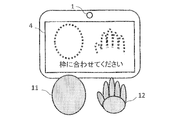
- FIG. 2 is a diagram for explaining an example of the state of authentication using the biometric authentication system according to the first embodiment.
- FIG. 2 shows a state of authentication using a tablet PC equipped with a biometric authentication system.
- the person to be authenticated that is, the user
- presents a living body such as the face 11 and the hand 12.
- the state is photographed by the image input unit 1 such as the in-camera of the tablet PC, and the authentication process is performed.
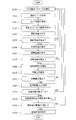
- FIG. 3 is a flowchart showing a process at the time of registration by the biometric authentication system of the first embodiment.
- the system sets parameters (camera control parameters) for controlling the image input unit 1, such as focus, white balance, exposure, and gain, in order to obtain an image of appropriate quality (S100).
- parameters such as focus, white balance, exposure, and gain
- a predetermined fixed value may be used, a value that was optimal at the time of previous shooting may be used, or if a moving image is being shot, the previous frame may be used. May be used based on the acquired image and camera control parameters.
- the system takes an image of a living body such as a finger and a face with a camera and acquires an image (S101).
- the system generates a guide image in the shape of a living body as a sample of the presentation and a guide message that teaches a method of presenting the living body, in order for the subject to present the living body at an appropriate position and posture ( S102).
- the guide image may show a part or all of the outer shape of the living body.
- the presented living body may be detected, and the outline of the living body or a figure such as a rectangle including the living body may be displayed as a guide image.
- FIG. 2 illustrates an example of displaying a guide image of a dotted line indicating the contours of the head and the finger and a message “Match with the frame” in order to present the face and the finger as the living body.
- the subject can recognize the difference between the presenting method of the living body and the appropriate presenting method, and more appropriately present the living body. Will be able to
- the authentication processing unit 2 calculates a quality value of photographing from an image obtained by photographing, camera control parameters, and the like (S104).
- the quality value is a value calculated from at least one of a focus control value, an exposure control value, a luminance value of an acquired image, and the like, according to some rule.
- the contrast of luminance in an area at the same position as the guide image in the acquired image and an area where a living body is detected from the acquired image may be used as the focus quality value.
- the amount of change between the exposure control value in the previous frame and the exposure control value in the current frame may be used as the exposure quality value.
- an average value of the luminance of an area at the same position as the guide image in the acquired image or an area where a living body is detected from the acquired image may be used as the quality value related to the luminance of the acquired image.
- the authentication processing unit 2 evaluates the appropriateness of the quality value from the difference between the above-described quality value and the appropriate value corresponding to the quality value (S105). If the quality value is not appropriate, the process proceeds to setting of camera control parameters (S100). If the quality value is appropriate, the authentication processing unit 2 detects a living body region from the acquired image (S106).
- the detection of the living body region is performed, for example, by applying the Semantec Segmentation method of classifying each pixel of the acquired image into a living body region or another region, and extracting a region to which a feature amount extraction such as a face and a finger is applied from the detected living body region. It may be performed by extracting. Alternatively, an Object @ Localization technique for extracting a rectangular region including the living body region from the acquired image may be applied. Further, the living body region may be extracted by another method.
- the authentication processing unit 2 calculates, for example, posture information such as the length, width, and angle of the detected finger from the extracted biological region, and calculates a difference from the appropriate value as a quality value (S107).
- the authentication processing unit 2 determines whether the calculated quality value of the posture is appropriate (S108). If the quality value of the posture is not appropriate, the process proceeds to setting of camera control parameters (S100). When the quality value of the posture is appropriate, the authentication processing unit 2 normalizes the posture of the living body (S109).
- Posture normalization means that, for example, a part of a finger area detected to have a constant finger length is cut or shortened by interpolation or extended by interpolation, or a finger area detected to have a constant finger width. Enlarging or reducing, or rotating the detected finger area so that the angle of the finger becomes constant.
- the authentication processing unit 2 extracts a feature amount for collation from the biometric region whose posture has been normalized (S110).
- the feature amount extraction may be performed by, for example, extracting a fingerprint or a face feature point, a vein line pattern, or the like from a biological region.
- feature extraction from a biological region may be automatically designed by a machine learning technique such as a deep convolutional neural network (CNN: Convolutional @ Neural @ Network).
- CNN Convolutional @ Neural @ Network
- the authentication processing unit 2 determines whether the extracted feature amount is appropriate (S111). For example, the authentication processing unit 2 uses a machine learning method such as Random @ Forest or SVM (Support @ Vector @ Machine) to extract the extracted feature amount from a genuine living body or a fake living body such as a photograph or printed matter. May be determined.
- a machine learning method such as Random @ Forest or SVM (Support @ Vector @ Machine) to extract the extracted feature amount from a genuine living body or a fake living body such as a photograph or printed matter. May be determined.
- the authentication processing unit 2 temporarily holds the extracted feature amount as a registration candidate (S112).
- the authentication processing unit 2 compares the number of saved registration candidates with a preset number (S113). If the number of stored registration candidates is less than the preset number, the number of stored registration candidates is not sufficient, and the process proceeds to camera control parameters (S100). When the number of stored registration candidates satisfies a preset number, the number of stored registration candidates is sufficient, and the authentication processing unit 2 calculates the similarity between the feature amounts to be registered candidates. (S114).
- the authentication processing unit 2 compares the calculated similarity with a preset threshold (S115). When the calculated similarity is lower than the threshold value set in advance, the authentication processing unit 2 determines that the registration is rejected, deletes the registration candidate data stored in the memory 7, and sets the camera control parameters (S100). Move to When the calculated similarity exceeds the threshold, the authentication processing unit 2 determines that the registration is permitted (S116), and stores the registration candidate data in the memory 7. The registration of the biological information is completed by the above processing.
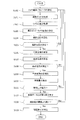
- FIG. 4 is a flowchart showing a process at the time of authentication by the biometric authentication system according to the first embodiment.
- setting of camera control parameters (S100), generation of a shooting guide (S101), acquisition of a camera image (S102), display of a shooting guide / camera image (S103), shooting Calculation of quality (S104), determination of appropriateness of imaging quality (S105), detection of living body region (S106), calculation of posture quality (S107), determination of appropriateness of posture quality (S108), normalization of living body posture (S109) ), Extraction of the feature amount (S110), and determination of the appropriateness of the feature amount (S111) are the same as the processing flow at the time of registration.
- the authentication processing unit 2 calculates the similarity between the feature amount extracted in S110 and the biometric feature amount data registered in advance (S117). Next, the authentication processing unit 2 compares the calculated similarity with a preset threshold (S118). When the calculated similarity exceeds the threshold value set in advance, it is determined that the authentication is permitted (S119), and the authentication process ends. If the calculated similarity exceeds the threshold, it is determined that the authentication is rejected, and the process proceeds to setting of camera control parameters (S100).
- a photographing guide such as an image imitating the shape of the face and the hand and a message prompting the presentation of the face and the hand
- the displayed camera image is simultaneously displayed on the display.
- the face and hand guide images are displayed side by side, whereby it is possible to guide the person to be authenticated to present the face and hands side by side with each other without difficulty.
- the face and the hand can be projected on the camera image without blocking each other, and the image of the face and the hand can be acquired from a single camera.
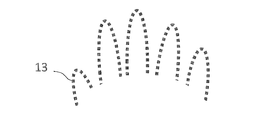
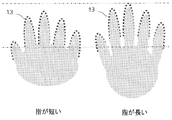
- FIGS. 5A and 5B are diagrams illustrating an example of a guide image displayed by the biometric authentication system according to the first embodiment.
- a guide image 13 having a contour shape with the hand opened as shown in FIG. 5A is displayed, and the presented hand is displayed accordingly.
- the distortion of living tissue such as finger fingerprints, veins, and surface wrinkles due to contact between adjacent fingers is avoided, and errors in normalization of living body posture (S109) and extraction of feature amounts (S110), etc. Can be reduced.
- the guide image 13 by displaying the guide image 13 in which the contour of the crotch portion of the finger is removed from the contour of the hand, even if the subject has a longer or shorter finger than the hand of the guide image 13, the guide image is displayed. 13 makes it easier to fit their own hands, which leads to improved convenience.
- the camera 1 captures the reflected light of the light emitted from the light source reflected on the living body surface such as the face 11 and the hand 12. It can be said that.
- the distance from the display 4 to the wall of the room, which is the background is generally longer than the distance from the display 4 to the face 11 and the hand 12, which are the foreground.
- the light intensity attenuates in proportion to the square of the distance, the amount of light that can be obtained by the camera 1 when light emitted from the display 4 as a light source is reflected by the background is reflected by the foreground. Much smaller than.
- the brightness or color changes only in the foreground biological region, and in the other background region. Brightness or color does not change significantly.
- FIG. 6 is a diagram showing a state of a process of detecting a biological region (S106) using the display 4 of the biometric authentication system according to the present embodiment as a light source.
- FIG. 7 is a flowchart showing the processing.
- the system performs N times of photographing to separate the background, which is not a living body region, from the camera image (S10601), and corrects the position between the acquired images to absorb camera shake and movement of the subject (S10605). ) To calculate the color difference of each pixel between the acquired images after the position correction (S10606).
- the system In the ⁇ ⁇ N shootings (S10601), the system generates (S10602) and displays an image to be displayed on the display 4 as illumination (S10603), and acquires a camera image (S10604).
- N 2
- the system shoots an object using the color camera 1 arranged on the same surface as the display 4 while displaying an image to be illuminated using the display 4, for example.
- the subject may be separated into the foreground and the background with reference to the two obtained images.
- the color camera 1 has, for example, three types of light receiving elements having sensitivity to blue (B), green (G), and red (R), respectively, and these are arranged in a grid for each pixel.
- the spectral sensitivity of each light receiving element has a sensitivity peak at, for example, around 480 nm for blue, around 550 nm for green, and around 620 nm for red.
- the display 4 includes, for example, a backlight serving as a light source, a deflection filter for controlling luminance, and a color filter for controlling color.
- the color filter has three types of filters that transmit blue (B), green (G), and red (R), respectively, and these are arranged in a grid pattern for each pixel, and have a luminance of 256 from 0 to 255. It can be controlled by gradation.
- the product of the sensitivities of the blue (B) and red (R) light receiving elements of the color camera is substantially zero (that is, the other element has no sensitivity at a wavelength at which one element has sensitivity), and It is assumed that the wavelength at which the spectral sensitivity of each of the RGB light receiving elements of the camera becomes zero and the wavelength at which the transmittance of the RGB color filter of the display becomes zero are substantially the same.
- Each pixel of the color difference image 16 is substantially equal to 0 in a background pixel that is not close to the display, but in a foreground pixel such as a living body region that is close to the display, depending on the brightness or color of the display image displayed as illumination. Change.
- the authentication processing unit 2 controls the display (that is, the display unit 4) so as to change the luminance of blue (B) and red (R), and thereby the blue (B) and red
- the intensity of (R) is changed, but this is an example, and the light source may be controlled so that the intensity of at least one color is changed. Further, a light source other than the display may be used.
- the above is an example of a calculation method for maximizing the luminance difference between the foreground and the background in the color difference image 16 in the foreground / background separation using the display display as illumination.
- the luminance difference between the foreground and the background is maximized accordingly. What is necessary is just to apply the display display and the calculation method of a color difference image.
- the authentication processing unit 2 may extract, for example, a pattern such as a finger vein, an epidermis or a dermis, or an end point or a branch point of a ridge of a fingerprint as a feature amount.
- a pattern such as a finger vein, an epidermis or a dermis, or an end point or a branch point of a ridge of a fingerprint
- the end points of the eyebrows and eyes of the face and the outlines around the nose and mouth may be extracted as the feature amounts.
- the feature amount may be automatically designed and extracted from the captured image using a machine learning technique such as CNN.
- Fingerprints on the surface of a finger and veins inside the finger are generally known as unique features, and different persons have related patterns.
- finger variations existing in the real world are overwhelmingly large compared to finger image data variations that can be actually prepared for CNN training for extracting feature values from finger images. Therefore, in a normal CNN in which the convolution process and the pooling process are alternately repeated, and the entire joining process of joining all the pixels in the image is performed on the output layer, over-learning is likely to occur.
- FCN full-layer convolutional neural network
- the image structure of the input image is held up to the output image, and overlearning hardly occurs even with learning using a small amount of data.
- a method of robustly authenticating to position / posture fluctuation using the feature amount extracted by FCN a method of gradually lowering the resolution of each layer in FCN for each layer and extracting a low-frequency feature amount is used.
- the above method cannot extract a high-frequency feature amount that can be originally used for personal identification.
- a method of simultaneously extracting low-frequency features and high-frequency features a method is known in which the resolution of each layer in the FCN is gradually lowered for each layer, and then the layers are combined at a later stage. Have been. In this case, it is necessary to use a high-frequency feature amount and a method of calculating the similarity with the registered data which is hardly affected by the displacement.
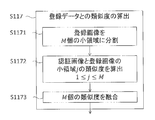
- FIG. 8 is a flowchart showing an example of a detailed process of calculating the similarity with the registration data (S117) by the biometric authentication system of the present embodiment.
- FIG. 8 shows a processing flow for calculating the degree of similarity with the registered data (S117) and reducing the influence of the displacement while using a high-frequency feature amount.
- the authentication processing unit 2 divides the registered image into M small areas (S1171).
- the feature amount may be divided into three regions bounded by the first joint and the second joint.
- the authentication processing unit 2 calculates the similarity between the small area of the authentication image and the small area of the registered image (S1172). For example, the Manhattan distance or the Euclidean distance may be used as the similarity measure. In the calculation of the similarity, the authentication processing unit 2 calculates the similarity with each small area of the registered image while scanning a certain area on the authentication image, and adopts the highest similarity among the scanned areas. .
- the authentication processing unit 2 fuses the calculated M similarities to obtain a final similarity (S1173).
- a fusion method for example, a method using an average value of M similarities may be adopted.
- ⁇ Furthermore in the calculation of the degree of similarity with the registered data (S117), consider the case where the registered data and the authentication data are derived from different persons (other person verification). At this time, it is desirable that the calculated similarity be low.
- the registered data is a plurality of images and the correlation of each pattern is low, for example, a living tissue to be superimposed, the similarity of the other feature at the position where the similarity of the one feature is maximum is used for authentication. By using this, it is possible to avoid using the similarity that maximizes the similarity with the registered data in the third person verification for authentication.
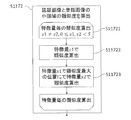
- FIG. 9 is a flowchart illustrating an example of a detailed process of calculating a similarity by the biometric authentication system according to the present embodiment.
- the authentication processing unit 2 first calculates the similarity of each feature amount (S11721). For example, first, the similarity to the registered image is calculated using the feature s1 (S11722), and then the similarity is calculated using the feature s2 at the position where the similarity is maximum at the feature s1 (S11723). The similarity of the feature amount is calculated. At this time, the feature amounts s1 and s2 are different from each other and are included in the S feature amounts extracted by the processing (see FIG. 10 and the like) described later. This method is applicable, for example, to the epidermis, dermis or vein pattern in a finger.
- FIGS. 10 and 11 are flowcharts illustrating a process of extracting a plurality of feature values having low correlation by the biometric authentication system according to the present embodiment.
- FIG. 10 and FIG. 11 show a plurality of low-correlation pluralities for calculating the similarity with the registered data (S117) in order to reduce the influence of the positional deviation and to reduce the similarity at the time of the other person verification.
- 2 shows a process of extracting a feature amount.
- This processing optimizes a machine learning model such that a feature amount extraction model (hereinafter, referred to as a machine learning model) generated by machine learning such as CNN generates a plurality of low-correlation feature amounts from an input image.
- the process is divided into a process (FIG. 10) and a process of extracting a feature using a machine learning model at the time of registration and authentication (FIG. 11).
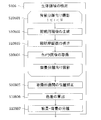
- the authentication processing unit 2 first reads a plurality of images used for the optimization processing (S120), subsequently detects a biological region (S106), and normalizes the biological posture. (S109), extraction of S features (S110), calculation of the similarity of the features between the read S images (S121), and calculation of the loss value of the machine learning model based on the calculated similarity (S122). ) And updating the parameters of the machine learning model based on the loss value (S123). Lastly, the authentication processing unit 2 determines whether the number of parameter updates satisfies the specified number of times (S124), terminates the process if the number is satisfied, and shifts to image reading (S120) if not. .
- the image read by the image reading (S120) is basically an image obtained by photographing a living body, and is obtained by performing detection of a living body region (S106) and normalization of a living body posture (S109) from the photographed image. It may be an image of a living body region.
- the feature amount may be directly extracted by the machine learning model (S110).
- the extraction of the feature amount (S110) is performed as in the processing flow shown in FIG.
- the calculation of the similarity of the feature amounts between the images (S121) is the same as the processing flow shown in FIGS.
- a loss value such as Contrast Loss or Triplet Loss may be calculated.
- the model parameter update (S123) based on the above loss values, for example, when CNN is used as a machine learning model, the error backpropagation method is applied to update the kernel value of each layer of the CNN.
- the loss value is calculated such that the higher the similarity of the biometric features of different persons is, the higher the loss value is, and the higher the similarity of the biometric features of the same person is, the lower the loss value is. Good.
- the model parameters are updated so that the loss value becomes smaller. As a result, a feature amount extraction model for extracting a plurality of biometric features having a low pattern correlation from one biometric image is learned.
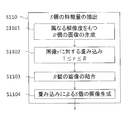
- the authentication processing unit 2 first generates R images having different resolutions from the input image (S1101), and subsequently performs a convolution process on each of the generated images (S1102). They are combined (S1103). Finally, the authentication processing unit 2 performs a convolution process on the combined image (S1104), and generates an image of S feature amounts.
- the authentication processing unit 2 may, for example, reduce or enlarge the input image, or generate a low-resolution image from the input image by a convolution process.
- the authentication processing unit 2 may perform the convolution process a plurality of times instead of once, or may perform a process of normalizing the brightness of the image after each convolution process. Good.
- the authentication processing unit 2 combines the respective image data in the channel direction to generate image data.
- the authentication processing unit 2 performs a convolution process so as to reduce the number of channels of the combined image data to S.
- S feature amounts represented by the density image can be obtained.
- the processing of the model optimizing unit is executed by the CPU 6 according to the program stored in the memory 7, similarly to the processing of the registration unit 10 and the authentication unit 9.
- the process of the model optimizing unit is executed before the registration and authentication processes shown in FIGS.
- FIG. 12 is a diagram illustrating an example of a feature amount extraction process performed by the biometric authentication system according to the present embodiment.
- a feature extraction image 18 and a feature extraction image 19 are obtained for the input finger image 17, and the correlation between the S feature amounts (two in the example of FIG. 12) of the pattern is low.
- the registered data and the authentication data are derived from the same person, that is, at the time of identity verification, even if the pattern correlation between the feature amounts is low, those feature amounts are generated from the same input image.
- the registered data and the collation position at which the degree of similarity is the maximum in the feature amount substantially match.
- the biometric authentication system includes an image input unit (for example, the image input unit 1) for acquiring an image of a living body and a biometric region of an image of each person.
- a storage unit for example, the storage unit 3) for storing registration information on a plurality of obtained biometric features
- an authentication processing unit for example, for processing a biometric region of an image acquired by the image input unit and performing biometric authentication based on the registration information
- Authentication processing unit 2 Authentication processing unit 2).
- the plurality of biometric features obtained from the biometric region of each person are a plurality of biometric features having a low pattern correlation with each other.
- the authentication processing unit performs the biometric authentication by combining a plurality of biometric features obtained by processing the image and having a low pattern correlation with each other.
- the plurality of biometric features having a low pattern correlation with each other may be, for example, biometric features of a face and a finger obtained by the method shown in FIG. 2 or obtained by the methods shown in FIGS. 10 and 11. Alternatively, there may be S feature amounts.
- the living body captured by the image input unit may include a finger.
- the plurality of biometric features include a first biometric feature and a second biometric feature
- the authentication processing unit determines the first biometric feature obtained from the biometric region of the image acquired by the image input unit and the second biometric feature in the registration information.
- the similarity between the second biometric feature obtained from the biometric region of the image acquired by the image input unit and the first biometric feature of the registration information may be calculated based on the similarity with the one biometric feature.
- the registration information image and the image captured by the camera are aligned so that the similarity of s1, which is one of the S feature amounts obtained by the methods illustrated in FIGS. 10 and 11, is maximized. Then, at that position, a feature amount s2 different from s1 may be collated. Since the correlation between s1 and s2 is low according to FIGS. 10 and 11, it is expected that the similarity of the feature quantity s2 will be sufficiently low in the case of the authentication of the other person, thereby improving the accuracy of the authentication.
- the image input unit captures the same living body a plurality of times
- the authentication processing unit changes the intensity of at least one color of light emitted to the living body when the plurality of times of shooting is performed.
- the light irradiated to the living body may be controlled, and the living body region may be extracted from the images based on the magnitude of the change in the intensity of at least one of the colors in the plurality of images acquired by the plurality of imagings. This can be performed, for example, by the method shown in FIG.
- the living body region can be easily extracted.
- the biometric authentication system may further include a display unit (for example, the display unit 4) that displays an image captured by the image input unit and a guide indicating a desired position of the living body.
- the authentication processing unit may control the light emitted to the living body by changing the intensity of at least one color output from the display unit. This can be done, for example, by the method shown in FIG.
- the plurality of biometric features may be extracted from the same portion of the biometric region of each image. This can be performed, for example, by the method shown in FIGS.
- the authentication processing unit extracts a plurality of biometric features from each of the plurality of person images using the feature amount extraction model (for example, S110 in FIG. 10 and FIG. 11), and extracts the plurality of biometric features from the plurality of person images.
- the loss value of the feature amount extraction model is calculated (for example, S122 in FIG. 10), and the parameters of the feature amount extraction model may be learned so as to reduce the loss value. (For example, S123 in FIG. 10).
- the authentication processing unit generates a plurality of images having different resolutions (for example, R images shown in FIG. 11) from the biological region of the image of each person, and convolves the plurality of images having different resolutions.
- a feature amount extraction model to a plurality of images generated by convolution (for example, S images shown in FIGS. 10 and 11) to extract a plurality of biometric features. You may.
- the plurality of biometric features may be extracted from different portions of the biometric region of each image.
- different portions of the biological region of each image may be a person's face portion and a finger portion included in each image (see, for example, FIG. 2 or FIG. 6).
- the above-described configurations, functions, processing units, processing means, and the like may be partially or entirely realized by hardware, for example, by designing an integrated circuit.
- the above-described configurations, functions, and the like may be implemented by software by a processor interpreting and executing a program that implements each function.
- Information such as a program, a table, and a file for realizing each function is stored in a non-volatile semiconductor memory, a hard disk drive, a storage device such as an SSD (Solid State Drive), or a computer-readable non-volatile device such as an IC card, an SD card, or a DVD. It can be stored on a temporary data storage medium.
- control lines and information lines are shown to be necessary for the description, and do not necessarily indicate all control lines and information lines on the product. In fact, almost all components may be considered to be interconnected.
Landscapes
- Engineering & Computer Science (AREA)
- Theoretical Computer Science (AREA)
- Physics & Mathematics (AREA)
- General Physics & Mathematics (AREA)
- Multimedia (AREA)
- Human Computer Interaction (AREA)
- Evolutionary Computation (AREA)
- Computer Vision & Pattern Recognition (AREA)
- Artificial Intelligence (AREA)
- Software Systems (AREA)
- General Engineering & Computer Science (AREA)
- Health & Medical Sciences (AREA)
- General Health & Medical Sciences (AREA)
- Data Mining & Analysis (AREA)
- Life Sciences & Earth Sciences (AREA)
- Computer Security & Cryptography (AREA)
- Computing Systems (AREA)
- Biomedical Technology (AREA)
- Molecular Biology (AREA)
- Computer Hardware Design (AREA)
- Mathematical Physics (AREA)
- Computational Linguistics (AREA)
- Biophysics (AREA)
- Oral & Maxillofacial Surgery (AREA)
- Medical Informatics (AREA)
- Bioinformatics & Computational Biology (AREA)
- Evolutionary Biology (AREA)
- Bioinformatics & Cheminformatics (AREA)
- Biodiversity & Conservation Biology (AREA)
- Databases & Information Systems (AREA)
- Collating Specific Patterns (AREA)
- Measurement Of The Respiration, Hearing Ability, Form, And Blood Characteristics Of Living Organisms (AREA)
Abstract
L'invention concerne un système d'authentification biométrique comprenant : une unité d'entrée d'image pour acquérir une image prise d'un corps vivant ; une unité de stockage pour stocker des informations d'enregistrement relatives à une pluralité de caractéristiques biologiques acquises à partir d'une zone biologique d'une image de chaque personne ; et une unité de traitement d'authentification pour effectuer une authentification biométrique sur la base des informations d'enregistrement par traitement de la zone biologique de l'image acquise par l'unité d'entrée d'image. La pluralité de caractéristiques biologiques acquises à partir de la zone biologique de chaque personne sont une pluralité de caractéristiques biologiques ayant une faible corrélation de motif les unes avec les autres. L'unité de traitement d'authentification préforme l'authentification biométrique en combinant la pluralité de caractéristiques biologiques ayant la corrélation de motif faible les unes avec les autres, qui sont acquises par traitement de l'image.
Priority Applications (4)
| Application Number | Priority Date | Filing Date | Title |
|---|---|---|---|
| CN201980057116.XA CN112639871B (zh) | 2018-10-03 | 2019-08-26 | 生物体认证系统、生物体认证方法及记录介质 |
| KR1020217005979A KR102538405B1 (ko) | 2018-10-03 | 2019-08-26 | 생체 인증 시스템, 생체 인증 방법 및 프로그램 |
| US17/275,250 US12067095B2 (en) | 2018-10-03 | 2019-08-26 | Biometric authentication system, biometric authentication method, and storage medium |
| EP19869851.6A EP3862968A4 (fr) | 2018-10-03 | 2019-08-26 | Système d'authentification biométrique, procédé d'authentification biométrique et programme |
Applications Claiming Priority (2)
| Application Number | Priority Date | Filing Date | Title |
|---|---|---|---|
| JP2018-188420 | 2018-10-03 | ||
| JP2018188420A JP7269711B2 (ja) | 2018-10-03 | 2018-10-03 | 生体認証システム、生体認証方法およびプログラム |
Publications (1)
| Publication Number | Publication Date |
|---|---|
| WO2020071008A1 true WO2020071008A1 (fr) | 2020-04-09 |
Family
ID=70055768
Family Applications (1)
| Application Number | Title | Priority Date | Filing Date |
|---|---|---|---|
| PCT/JP2019/033352 Ceased WO2020071008A1 (fr) | 2018-10-03 | 2019-08-26 | Système d'authentification biométrique, procédé d'authentification biométrique et programme |
Country Status (6)
| Country | Link |
|---|---|
| US (1) | US12067095B2 (fr) |
| EP (1) | EP3862968A4 (fr) |
| JP (1) | JP7269711B2 (fr) |
| KR (1) | KR102538405B1 (fr) |
| CN (1) | CN112639871B (fr) |
| WO (1) | WO2020071008A1 (fr) |
Cited By (4)
| Publication number | Priority date | Publication date | Assignee | Title |
|---|---|---|---|---|
| US20220027660A1 (en) * | 2020-07-22 | 2022-01-27 | Nokia Technologies Oy | Apparatus, method and computer program for authenticating images |
| JP2022021537A (ja) * | 2020-07-22 | 2022-02-03 | 株式会社日立製作所 | 生体認証装置および生体認証方法 |
| CN115516634A (zh) * | 2020-06-25 | 2022-12-23 | 索尼半导体解决方案公司 | 电子设备 |
| WO2025088746A1 (fr) * | 2023-10-26 | 2025-05-01 | 富士通株式会社 | Programme de traitement d'authentification biométrique, dispositif de traitement d'authentification biométrique et procédé de traitement d'authentification biométrique |
Families Citing this family (11)
| Publication number | Priority date | Publication date | Assignee | Title |
|---|---|---|---|---|
| US11227155B2 (en) | 2019-01-23 | 2022-01-18 | Alclear, Llc | Remote biometric identification and lighting |
| US11978284B2 (en) * | 2019-04-26 | 2024-05-07 | Nec Corporation | Authentication data generation device, authentication device, authentication data generation method, and recording medium |
| JP7367857B2 (ja) | 2020-03-30 | 2023-10-24 | 日本電気株式会社 | モデル生成装置、モデル生成方法、画像処理装置、画像処理方法、及び、プログラム |
| KR102502631B1 (ko) * | 2020-11-16 | 2023-02-23 | 고큐바테크놀로지 주식회사 | 사용자를 인증하기 위한 기법 |
| JP7758367B2 (ja) * | 2021-02-18 | 2025-10-22 | 日本電気株式会社 | 生体認証システム、生体認証方法、及び記録媒体 |
| JP7428675B2 (ja) * | 2021-02-24 | 2024-02-06 | 株式会社日立製作所 | 生体認証システム、認証端末、および認証方法 |
| CN113723167B (zh) * | 2021-04-02 | 2024-07-02 | 荣耀终端有限公司 | 一种指纹识别方法及电子设备 |
| JP7674149B2 (ja) * | 2021-05-18 | 2025-05-09 | 株式会社日立製作所 | 生体の認証システムおよび認証方法 |
| JP7718502B2 (ja) * | 2021-11-02 | 2025-08-05 | 日本電気株式会社 | 生体認証装置、生体認証方法、及び、記録媒体 |
| KR102520513B1 (ko) * | 2021-11-16 | 2023-04-11 | 주식회사 딥이티 | 사용자 단말을 이용한 안면 인식 장치 및 방법 |
| CN117292440A (zh) * | 2022-06-13 | 2023-12-26 | 马上消费金融股份有限公司 | 图像活体检测方法及装置 |
Citations (7)
| Publication number | Priority date | Publication date | Assignee | Title |
|---|---|---|---|---|
| JPH07141506A (ja) * | 1993-11-17 | 1995-06-02 | Canon Inc | 情報処理装置 |
| JP2009211357A (ja) * | 2008-03-04 | 2009-09-17 | Fujitsu Ltd | バイオメトリクス認証情報登録方法および装置ならびにバイオメトリクス認証方法および装置 |
| JP2013200673A (ja) * | 2012-03-23 | 2013-10-03 | Fujitsu Ltd | 生体情報処理装置、生体情報処理方法、および生体情報処理プログラム |
| JP2016096987A (ja) | 2014-11-20 | 2016-05-30 | 株式会社日立製作所 | 生体認証装置 |
| JP2016538656A (ja) * | 2013-11-30 | 2016-12-08 | ペキン センスタイム テクノロジー ディベロップメント カンパニー リミテッド | 顔画像認識のための方法とシステム |
| JP2017091186A (ja) | 2015-11-10 | 2017-05-25 | 株式会社日立製作所 | 生体情報を用いた認証装置及び認証方法 |
| JP2018188420A (ja) | 2017-04-28 | 2018-11-29 | 日東電工株式会社 | 経皮吸収型製剤 |
Family Cites Families (21)
| Publication number | Priority date | Publication date | Assignee | Title |
|---|---|---|---|---|
| KR100974815B1 (ko) * | 2003-03-20 | 2010-08-10 | 주식회사 비즈모델라인 | 이중 생체 인증 시스템 |
| US8189096B2 (en) * | 2005-06-16 | 2012-05-29 | Sensible Vision, Inc. | Video light system and method for improving facial recognition using a video camera |
| JP2007241371A (ja) * | 2006-03-06 | 2007-09-20 | Konica Minolta Business Technologies Inc | 認証システム |
| JP2007249585A (ja) | 2006-03-15 | 2007-09-27 | Omron Corp | 認証装置およびその制御方法、認証装置を備えた電子機器、認証装置制御プログラム、ならびに該プログラムを記録した記録媒体 |
| JP5690556B2 (ja) | 2010-11-12 | 2015-03-25 | 株式会社 日立産業制御ソリューションズ | 個人認証装置 |
| CN102332093B (zh) * | 2011-09-19 | 2014-01-15 | 汉王科技股份有限公司 | 一种掌纹和人脸融合识别的身份认证方法及装置 |
| KR101446143B1 (ko) | 2013-01-07 | 2014-10-06 | 한남대학교 산학협력단 | Cctv 환경에서의 얼굴 인식 기반 보안 관리 시스템 및 방법 |
| KR102180226B1 (ko) | 2013-10-30 | 2020-11-18 | 삼성전자주식회사 | 복합 생체 정보를 이용한 보안을 제공하는 전자 장치 및 방법 |
| JP6312485B2 (ja) * | 2014-03-25 | 2018-04-18 | キヤノン株式会社 | 情報処理装置、認証装置およびそれらの方法 |
| JP6404011B2 (ja) | 2014-06-25 | 2018-10-10 | 株式会社日立製作所 | 生体情報を利用する認証システム |
| CN104615993B (zh) * | 2015-02-12 | 2016-08-24 | 张丽琴 | 一种手指静脉识别与面部静脉识别相结合的认证装置及方法 |
| KR101710478B1 (ko) * | 2015-06-23 | 2017-02-27 | 주식회사 아이온커뮤니케이션즈 | 다중 생체 인증을 통한 모바일 전자 문서 시스템 |
| JP6754619B2 (ja) | 2015-06-24 | 2020-09-16 | 三星電子株式会社Samsung Electronics Co.,Ltd. | 顔認識方法及び装置 |
| KR20170000748A (ko) * | 2015-06-24 | 2017-01-03 | 삼성전자주식회사 | 얼굴 인식 방법 및 장치 |
| KR102477190B1 (ko) * | 2015-08-10 | 2022-12-13 | 삼성전자주식회사 | 얼굴 인식 방법 및 장치 |
| CN105139546A (zh) * | 2015-09-08 | 2015-12-09 | 昆山古鳌电子机械有限公司 | 一种具有生物体认证功能的自动交易装置 |
| CN105389703A (zh) | 2015-11-10 | 2016-03-09 | 陈雷 | 多模式生物识别混合认证支付系统 |
| CN105718874A (zh) * | 2016-01-18 | 2016-06-29 | 北京天诚盛业科技有限公司 | 活体检测及认证的方法和装置 |
| KR102570180B1 (ko) * | 2016-11-28 | 2023-08-25 | 엘지디스플레이 주식회사 | 지문 센서 일체형 전계 발광 표시장치 |
| JP6924031B2 (ja) * | 2016-12-28 | 2021-08-25 | 日本放送協会 | オブジェクト検出装置及びこれらのプログラム |
| KR102288302B1 (ko) * | 2017-07-03 | 2021-08-10 | 삼성전자주식회사 | 적외선 영상을 이용한 사용자 인증 방법 및 장치 |
-
2018
- 2018-10-03 JP JP2018188420A patent/JP7269711B2/ja active Active
-
2019
- 2019-08-26 US US17/275,250 patent/US12067095B2/en active Active
- 2019-08-26 WO PCT/JP2019/033352 patent/WO2020071008A1/fr not_active Ceased
- 2019-08-26 EP EP19869851.6A patent/EP3862968A4/fr active Pending
- 2019-08-26 CN CN201980057116.XA patent/CN112639871B/zh active Active
- 2019-08-26 KR KR1020217005979A patent/KR102538405B1/ko active Active
Patent Citations (7)
| Publication number | Priority date | Publication date | Assignee | Title |
|---|---|---|---|---|
| JPH07141506A (ja) * | 1993-11-17 | 1995-06-02 | Canon Inc | 情報処理装置 |
| JP2009211357A (ja) * | 2008-03-04 | 2009-09-17 | Fujitsu Ltd | バイオメトリクス認証情報登録方法および装置ならびにバイオメトリクス認証方法および装置 |
| JP2013200673A (ja) * | 2012-03-23 | 2013-10-03 | Fujitsu Ltd | 生体情報処理装置、生体情報処理方法、および生体情報処理プログラム |
| JP2016538656A (ja) * | 2013-11-30 | 2016-12-08 | ペキン センスタイム テクノロジー ディベロップメント カンパニー リミテッド | 顔画像認識のための方法とシステム |
| JP2016096987A (ja) | 2014-11-20 | 2016-05-30 | 株式会社日立製作所 | 生体認証装置 |
| JP2017091186A (ja) | 2015-11-10 | 2017-05-25 | 株式会社日立製作所 | 生体情報を用いた認証装置及び認証方法 |
| JP2018188420A (ja) | 2017-04-28 | 2018-11-29 | 日東電工株式会社 | 経皮吸収型製剤 |
Cited By (7)
| Publication number | Priority date | Publication date | Assignee | Title |
|---|---|---|---|---|
| CN115516634A (zh) * | 2020-06-25 | 2022-12-23 | 索尼半导体解决方案公司 | 电子设备 |
| US20220027660A1 (en) * | 2020-07-22 | 2022-01-27 | Nokia Technologies Oy | Apparatus, method and computer program for authenticating images |
| JP2022021537A (ja) * | 2020-07-22 | 2022-02-03 | 株式会社日立製作所 | 生体認証装置および生体認証方法 |
| GB2598016A (en) * | 2020-07-22 | 2022-02-16 | Hitachi Ltd | Biometric authentication apparatus and biometric authentication method |
| US11798260B2 (en) * | 2020-07-22 | 2023-10-24 | Nokia Technologies Oy | Apparatus, method and computer program for authenticating images |
| JP7513451B2 (ja) | 2020-07-22 | 2024-07-09 | 株式会社日立製作所 | 生体認証装置および生体認証方法 |
| WO2025088746A1 (fr) * | 2023-10-26 | 2025-05-01 | 富士通株式会社 | Programme de traitement d'authentification biométrique, dispositif de traitement d'authentification biométrique et procédé de traitement d'authentification biométrique |
Also Published As
| Publication number | Publication date |
|---|---|
| EP3862968A1 (fr) | 2021-08-11 |
| CN112639871A (zh) | 2021-04-09 |
| KR102538405B1 (ko) | 2023-06-01 |
| JP7269711B2 (ja) | 2023-05-09 |
| KR20210038644A (ko) | 2021-04-07 |
| US20220043895A1 (en) | 2022-02-10 |
| US12067095B2 (en) | 2024-08-20 |
| CN112639871B (zh) | 2024-08-09 |
| EP3862968A4 (fr) | 2022-12-28 |
| JP2020057275A (ja) | 2020-04-09 |
Similar Documents
| Publication | Publication Date | Title |
|---|---|---|
| KR102538405B1 (ko) | 생체 인증 시스템, 생체 인증 방법 및 프로그램 | |
| KR102561723B1 (ko) | 모바일 디바이스를 사용하여 캡처된 화상을 사용하여 지문 기반 사용자 인증을 수행하기 위한 시스템 및 방법 | |
| CN114120375B (zh) | 执行指纹识别的方法和系统 | |
| US11263432B2 (en) | Systems and methods for performing fingerprint based user authentication using imagery captured using mobile devices | |
| EP4343689A1 (fr) | Système et procédé d'authentification de parties du corps | |
| CN113614731A (zh) | 使用软生物特征的认证验证 | |
| JP7002348B2 (ja) | 生体認証装置 | |
| KR20210050649A (ko) | 모바일 기기의 페이스 인증 방법 | |
| JP7690999B2 (ja) | 生体判定装置、生体判定方法、及び、記録媒体 | |
| CN114067383B (zh) | 基于宏观结构和微观结构图像尺寸的被动三维面部成像 | |
| HK40069201A (en) | Methods and systems for performing fingerprint identification | |
| HK40069201B (zh) | 执行指纹识别的方法和系统 | |
| BR112019011205B1 (pt) | Sistemas e métodos para realizar a autenticação de usuário baseada em impressão digital usando imagens capturadas com o uso de dispositivos móveis | |
| HK1246928B (en) | Systems and methods for performing fingerprint based user authentication using imagery captured using mobile devices |
Legal Events
| Date | Code | Title | Description |
|---|---|---|---|
| 121 | Ep: the epo has been informed by wipo that ep was designated in this application |
Ref document number: 19869851 Country of ref document: EP Kind code of ref document: A1 |
|
| ENP | Entry into the national phase |
Ref document number: 20217005979 Country of ref document: KR Kind code of ref document: A |
|
| NENP | Non-entry into the national phase |
Ref country code: DE |
|
| ENP | Entry into the national phase |
Ref document number: 2019869851 Country of ref document: EP Effective date: 20210503 |