WO2020071085A1 - Matériau superélastique et son utilisation - Google Patents
Matériau superélastique et son utilisationInfo
- Publication number
- WO2020071085A1 WO2020071085A1 PCT/JP2019/035897 JP2019035897W WO2020071085A1 WO 2020071085 A1 WO2020071085 A1 WO 2020071085A1 JP 2019035897 W JP2019035897 W JP 2019035897W WO 2020071085 A1 WO2020071085 A1 WO 2020071085A1
- Authority
- WO
- WIPO (PCT)
- Prior art keywords
- oligomer
- superelastic
- material according
- superelastic material
- crystal
- Prior art date
- Legal status (The legal status is an assumption and is not a legal conclusion. Google has not performed a legal analysis and makes no representation as to the accuracy of the status listed.)
- Ceased
Links
Images






Classifications
-
- F—MECHANICAL ENGINEERING; LIGHTING; HEATING; WEAPONS; BLASTING
- F03—MACHINES OR ENGINES FOR LIQUIDS; WIND, SPRING, OR WEIGHT MOTORS; PRODUCING MECHANICAL POWER OR A REACTIVE PROPULSIVE THRUST, NOT OTHERWISE PROVIDED FOR
- F03G—SPRING, WEIGHT, INERTIA OR LIKE MOTORS; MECHANICAL-POWER PRODUCING DEVICES OR MECHANISMS, NOT OTHERWISE PROVIDED FOR OR USING ENERGY SOURCES NOT OTHERWISE PROVIDED FOR
- F03G7/00—Mechanical-power-producing mechanisms, not otherwise provided for or using energy sources not otherwise provided for
- F03G7/06—Mechanical-power-producing mechanisms, not otherwise provided for or using energy sources not otherwise provided for using expansion or contraction of bodies due to heating, cooling, moistening, drying or the like
- F03G7/061—Mechanical-power-producing mechanisms, not otherwise provided for or using energy sources not otherwise provided for using expansion or contraction of bodies due to heating, cooling, moistening, drying or the like characterised by the actuating element
- F03G7/0612—Mechanical-power-producing mechanisms, not otherwise provided for or using energy sources not otherwise provided for using expansion or contraction of bodies due to heating, cooling, moistening, drying or the like characterised by the actuating element using polymers
-
- C—CHEMISTRY; METALLURGY
- C07—ORGANIC CHEMISTRY
- C07C—ACYCLIC OR CARBOCYCLIC COMPOUNDS
- C07C53/00—Saturated compounds having only one carboxyl group bound to an acyclic carbon atom or hydrogen
- C07C53/126—Acids containing more than four carbon atoms
Definitions
- the present invention relates to a superelastic material and its use, and more particularly to a superelastic material having oligomer crystals and its use.
- the present invention also relates to an energy storage material, an energy absorbing material, an elastic material, an actuator, and a shape memory material including the above superelastic material.
- Solid deformation can be classified into elastic deformation and plastic deformation.
- elastic deformation an object spontaneously recovers its solid shape when the force is removed, and the elastic strength increases as the material hardness increases. It is common sense that in plastic deformation, where permanent strain remains, the object returns its shape with the help of force in the opposite direction (strong elasticity) or by self-restoration with spontaneous generation of restoring force (superelasticity) be able to.
- superelasticity Such spontaneous shape recovery, referred to as superelasticity, is primarily known in connection with certain types of metal alloys and was first reported for Au-Cd alloys in 1932 (Non-Patent Document 1). , 2).
- Superelastic deformation called "martensite transformation” in the field of physical science is derived from thermal instability of a stress-induced phase with respect to a stable parent phase. Hyperelastic deformation, in contrast to elastic deformation, proceeds under a constant force with a relatively wide range of strain.
- Ti-Ni alloys have been applied to in-vivo materials such as orthodontic wires and stents based on their superelastic deformability (Non-Patent Document 3).
- SME shape memory effect
- SMAs shape memory alloys
- SME shape memory effect
- SMAs shape memory alloys
- Non Patent Literature 4 Patent Literature 1
- van der Waals solids of 3-5-difluorobenzoic acid Non Patent Literature 5, Patent Literature 1
- copper II benzoate pyrazine
- SMA type SME was discovered in an organic superelastic ionic crystal of tetrabutyl-n-phosphonium tetraphenylborate (expressed as PBu 4 BPh 4 ) (Non-Patent Document 7, Patent Document 1).
- An object of the present invention is to find a further material exhibiting superelasticity and to provide a superelastic material containing the same.
- the present inventors have conducted studies to solve the above problems, and as a result, surprisingly found that oligomer crystals can exhibit superelasticity, and have completed the present invention.
- the present invention is as follows.
- a superelastic material comprising a crystal of an oligomer.
- the superelastic material according to [4], wherein the oligomer has an ethylene unit which may have a substituent as a repeating unit.
- the superelastic material according to [5], wherein the oligomer is a compound represented by the following general formula (1).
- X 1 to X 4 are each independently hydrogen, halogen or methyl, provided that X 2 and X 4 are bonded to each other in the same or adjacent repeating unit without a substituent, and are one or more double bonds.
- X 5 is hydrogen, halogen, a monovalent associative functional group, or a substituent represented by the following formula (2)
- Z 1 is hydrogen, halogen or a monovalent associative functional group, and Z 2 and Z 3 are each independently hydrogen or halogen
- Y is a monovalent associative functional group
- m is an integer of 5 to 50.
- An actuator including the superelastic material according to any one of [1] to [11].
- a shape memory material including the superelastic material according to any one of [1] to [11].
- a superelastic material containing oligomer crystals there is provided a superelastic material containing oligomer crystals. Further, according to the present invention, there are provided an energy storage material, an energy absorbing material, an elastic material, an actuator, and a shape memory material using the above superelastic material.
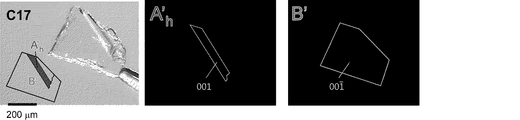
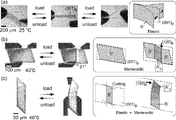
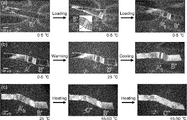
- the thickness of the crystals was about 5 ⁇ m for (a) and about 20 ⁇ m for (b) and (c).
- the crystals for (c) were cut into parallelograms to facilitate proper observation. Square boxes indicate stress-induced phases. Stress-strain curve for uniaxial compression of C15 crystal at 25 ° C. Compression along the top direction of the crystal (001) B ' normal direction (a) and the A' h / B 'phase interface (127) B' normal direction (b). Young's modulus was estimated from each additional dashed initial slope. (The maximum Young's modulus can be estimated just before the yield point.
- the superelastic material according to one embodiment of the present invention includes a crystal of an oligomer.
- Superelasticity means that when the applied external force is reduced, reverse transformation occurs autonomously, and with this reverse transformation, the energy stored during the transformation is released, Refers to the phenomenon of recovery to a state almost identical to the state before the transformation occurs.
- Superelastic material means a material that can exhibit superelasticity in a predetermined temperature range.
- the appearance of superelasticity can be confirmed by the load transformation process and the unloading reverse transformation process.
- the "load transformation process” means that when an external force is applied to the superelastic material according to one embodiment of the present invention, the transformation occurs due to the application of the external force, and the transformation is caused by the applied external force. Means a process that proceeds.
- the "unloading reverse transformation process” means that the reverse transformation occurs when the external force applied to the superelastic material in the state where the load transformation process has progressed is reduced, and the external force It means a process in which the reverse transformation progresses due to the decrease.
- the lattice deformation is a phenomenon in which the crystal lattice is deformed without atomic diffusion, and the lattice deformation includes martensitic transformation and twinning deformation. Due to such lattice deformation, the oligomer crystals are transformed into a new phase (stress-induced phase) having another crystal lattice (corresponding to the above-mentioned load transformation process).
- the stress-induced phase can be said to be in a thermally unstable state, and the oligomer crystals Stores energy by metamorphosis.
- the applied external force is reduced, the stored energy is released, so that the reverse transformation that returns to the original crystal lattice occurs autonomously due to the reduction of the external force, and before the transformation finally occurs, To the same state (corresponding to the unloading reverse transformation process).
- the reverse transformation hardly occurs because the stress-induced phase can be stably present. Therefore, when the superelastic material undergoes thermoelastic martensitic transformation, when an external force is applied in a temperature range equal to or lower than the reverse transformation start temperature, the oligomer crystal is transformed into a stress-induced phase, but even if the external force is reduced. However, autonomous reverse transformation is unlikely to occur, and the strain caused by external force remains (martensite ferroelasticity). In this case, the material in which the strain remains remains is heated to a temperature equal to or higher than the reverse transformation end temperature, thereby causing the reverse transformation to recover the strain. As described above, when the superelastic material according to the present embodiment causes the thermoelastic martensitic transformation, the shape memory effect of the superelastic material can be observed.
- the temperature range in which the superelastic material according to the present embodiment easily undergoes reverse transformation is not particularly limited.
- the super-elastic material according to the present embodiment can easily cause reverse transformation at room temperature (23 ° C.) by appropriately selecting the crystal of the oligomer, and does not easily cause reverse transformation at room temperature. It is also possible to do so.
- the shape memory effect in a shape memory polymer is due to rubber elasticity.
- a shape memory polymer is easily deformed when an external force is applied at a predetermined temperature or higher after being molded into a predetermined shape. Chain motion is constrained and deformation is maintained. Thereafter, when the deformed shape memory polymer is heated again, the constraint is released, and the shape is restored to the original shape by rubber elasticity.
- the shape memory effect of the shape memory polymer is caused by rubber elasticity. At the time of shape recovery, the movement of the polymer molecular chain is activated, and the distance between atoms greatly varies.
- shape memory polymers cannot exhibit superelasticity.
- the superelasticity and shape memory effect exhibited by the superelastic material of the present embodiment are caused by lattice deformation without atomic diffusion, and are completely different from the shape memory effect exhibited by the shape memory polymer. It is.
- oligomer refers to a molecule having a structure in which 5 to 50 repeating units are continuously bonded.
- the oligomer may be a homo-oligomer having one type of repeating unit or a co-oligomer having two or more types of repeating units. The presence or absence of charge is not limited as long as the oligomer has the above structure.
- the oligomer may be an ion having a structure in which 5 to 50 repeating units are continuously bonded.
- oligomer examples include a chain oligomer, a ladder oligomer, a cage oligomer, and a network oligomer. From the viewpoint of easy formation of crystals, a chain oligomer, a ladder oligomer, or a cage oligomer is used. It is preferably a chain oligomer, and particularly preferably a chain oligomer.
- the chain oligomer refers to one having a divalent repeating unit and a structure in which the repeating unit is linked in a chain.
- the unit of “valence” represents the number of repeating units or free valences (also referred to as “bonds”) of a functional group, unless otherwise specified.
- the chain oligomer can be relatively densely packed to easily form a crystal, and when the crystal is subjected to an external force, lattice deformation can be caused only by changing the orientation of some oligomer molecules. Therefore, chain oligomers are particularly suitable because they easily form crystals exhibiting superelasticity.
- the oligomers can be classified into organic oligomers and inorganic oligomers based on the structure of the skeleton.
- the “oligomer skeleton” includes atoms bonded to adjacent repeating units, atoms connecting the bonded atoms, and bonds between these atoms.
- the skeleton includes a cyclic structure, the cyclic structure and atoms constituting the cyclic structure are included in the “skeleton”.
- the “organic oligomer” refers to an oligomer having at least carbon atoms in the skeleton of the oligomer and containing no atoms other than oxygen, nitrogen, sulfur, and phosphorus atoms in the skeleton of the oligomer.
- the “inorganic oligomer” means an oligomer other than the above-mentioned organic oligomer, and specifically has no carbon atom in the skeleton of the oligomer, or has an oxygen atom, a nitrogen atom, a sulfur atom in the skeleton of the oligomer. It means those containing atoms other than atoms and phosphorus atoms.
- the oligomer used in the present embodiment is not particularly limited, and may be an organic oligomer or an inorganic oligomer, but is preferably an organic oligomer.
- the organic oligomer may be, for example, an oligomer having no cyclic structure in the skeleton such as an olefin oligomer, or an oligomer having a cyclic structure in the skeleton such as an alicyclic structure, an aromatic ring, or a heterocyclic ring.
- the bond constituting the skeleton may include an ether bond, a thioether bond, an ester bond, an amide bond, a urethane bond, a urea bond, and the like.
- the organic oligomer may have a substituent such as an alkyl group, a halogen, or an associative functional group described below outside the skeleton.
- Examples of the oligomer having no cyclic structure in the skeleton include olefin-based oligomers such as ethylene oligomer and propylene oligomer, and examples of the oligomer having a cyclic structure in the skeleton include norbornene oligomer, phenylene oligomer, and thiophene. Oligomers are exemplified. Examples of the oligomer having an ether bond or a thioether bond in the skeleton include an oxymethylene oligomer, an oxyethylene oligomer, and a phenylene sulfide oligomer. Examples of the oligomer having an ester bond or the like in the skeleton include an ester oligomer, an amide oligomer, a urethane oligomer, and a urea oligomer.
- an oligomer having a skeleton formed by atoms of the same element other than carbon As the inorganic oligomer, an oligomer having a skeleton formed by atoms of the same element other than carbon; an oligomer having a skeleton formed by atoms of a plurality of elements other than carbon; an oxygen atom having a carbon atom in the skeleton and an oxygen atom And an oligomer having atoms other than a nitrogen atom, a sulfur atom and a phosphorus atom.
- Oligomers in which one type of atom other than carbon forms a skeleton is a skeleton formed by atoms capable of catenation, such as sulfur, silicon, sulfur, boron, phosphorus, tellurium, selenium, germanium, tin, and iodine. Oligomers.
- these oligomers include oligomers having a substituent containing a carbon atom outside the skeleton, such as alkylsilane oligomers and alkylgermane oligomers, and the same applies to other inorganic oligomers.
- examples of the oligomer in which a plurality of types of atoms other than carbon form a skeleton include oligomers having a silicon atom in the skeleton, such as siloxane oligomers, silsesquioxane oligomers, and silazane oligomers; phosphoric acid oligomers, phosphazene oligomers, and the like.
- Oligomers having a phosphorus atom in the skeleton may be an oligomer of an oxide such as aluminum oxide, titanium oxide, or vanadium oxide.
- oligomer having a carbon atom in the skeleton and also having an atom other than an oxygen atom, a nitrogen atom, a sulfur atom and a phosphorus atom for example, a carbosilane oligomer and the like can be mentioned.
- the oligomer used in the present embodiment preferably has an associative functional group in the molecule.
- the term “associative functional group” as used herein means a functional group that can associate with each other via intermolecular force.
- the intermolecular force for associating includes at least one of a hydrogen bond, an ionic bond, a halogen bond, a ⁇ - ⁇ interaction, an ion-dipole interaction, and a van der Waals force.
- the intermolecular force for association includes at least one of a hydrogen bond and an ionic bond.
- the associative functional group may be associated via an ion not included in the oligomer, such as a metal ion such as a sodium ion, a magnesium ion, and a zinc ion.
- the oligomer When the oligomer has an associative functional group, it can associate with another oligomer molecule adjacent to the oligomer molecule via the associative functional group. Therefore, such an oligomer easily forms a crystal.
- the associative functional group can interact with an adjacent associative functional group in addition to an adjacent associative functional group with which the associating functional group is associated.
- the crystal receives an external force and undergoes lattice deformation to change the orientation of the oligomer molecules, the associative functional group cancels the interaction with the other associative functional groups in the vicinity, or the other associative functional group in the vicinity. New interactions can be formed with the associative functional groups.
- the oligomer used in the present embodiment is particularly preferably a chain oligomer having an associative functional group.
- the mechanism of the development of the superelasticity in the present embodiment is not limited to these descriptions.
- the associative functional group may be a monovalent functional group or a divalent or higher functional group.
- a monovalent associative functional group is a functional group that can be present on a substituent or terminal of an oligomer.
- Specific monovalent associative functional groups include, for example, carboxyl group, hydroxyl group, amino group, carbamoyl group (carboxamide group), cyano group, nitro group, ureido group (carbamide group), sulfo group, phosphate group, And a silanol group.
- the divalent or higher valent associative functional group may be present in the oligomer molecule as a bond constituting the skeleton of the oligomer, and does not form the skeleton of the oligomer (along with other functional groups) but is present as a substituent or terminal. May be.
- a carboxyl group, a hydroxyl group, an amino group, a carbamoyl group, and a sulfo group are preferable, and a carboxyl group is particularly preferable.
- an oligomer having an ethylene unit which may have a substituent as a repeating unit is preferable.
- an ethylene unit which may have a substituent means that one or more hydrogen atoms in an ethylene unit (—CH 2 —CH 2 —) may be substituted with a substituent.
- the repeating unit of the oligomer is an ethylene unit which may have a substituent
- the oligomer has a relatively linear molecular shape. Therefore, such oligomers are relatively densely packed to easily form crystals, and when the crystal is subjected to an external force, some oligomer molecules only change their orientation around their linear directions, resulting in lattice deformation. Can be caused. Furthermore, the portion where the ethylene units are continuous becomes relatively rich in flexibility, which also contributes to the above-mentioned lattice deformation.
- the repeating unit of the oligomer is an ethylene unit which may have a substituent, it easily forms crystals and easily undergoes lattice deformation, and thus is suitably used as the superelastic material according to the present embodiment. can do.
- the substituent is preferably halogen or methyl.
- the oligomer having the ethylene unit as a repeating unit may have one or more double bonds in the molecule.
- the lower limit of the number of repeating units is 5 or more, may be 6 or more, and may be 7 or more.
- the upper limit of the number of repetitions is 50 or less, may be 30 or less, and may be 15 or less.
- the terminal of the oligomer is not particularly limited, but at least one terminal is preferably an associative functional group.
- the oligomer is particularly preferably a compound represented by the following general formula (1).
- X 1 to X 4 are each independently hydrogen, halogen or methyl, provided that X 2 and X 4 are bonded to each other in the same or adjacent repeating unit without a substituent, and are one or more double bonds.
- X 5 is hydrogen, halogen, a monovalent associative functional group, or a substituent represented by the following formula (2) Wherein Z 1 is hydrogen, halogen or a monovalent associative functional group, and Z 2 and Z 3 are each independently hydrogen or halogen; Y is a monovalent associative functional group; m is an integer of 5 to 50.
- a monovalent associative functional groups in Y, and monovalent associating functional group X 5 may have, may be the same or may be different.
- Particularly preferred associative functional groups in the formula (1) include a carboxyl group, a hydroxyl group, an amino group, a carbamoyl group, a sulfo group and the like, and a carboxyl group is particularly preferred.
- X 1 to X 4 are each independently hydrogen, halogen or methyl, preferably hydrogen or halogen, and particularly preferably hydrogen.
- X 2 and X 4 may be bonded to each other in the same or adjacent repeating units without a substituent to form one or more double bonds.
- the number of double bonds is preferably 3 or less, more preferably 2 or less, and preferably 1.
- the double structure is preferably a trans type.
- X 5 is hydrogen, halogen, monovalent associating functional group or a substituent represented by the above formula (2), hydrogen, halogen, more preferably a hydrogen is particularly preferred.
- m is an integer of 5 to 50.
- the lower limit of m may be 6 or more, and may be 7 or more.
- the upper limit of m may be 30 or less, and may be 15 or less.
- the oligomer represented by the above formula (1) has a small steric hindrance at the repeating portion. Therefore, the molecular shape of the oligomer becomes more linear, and crystals are easily formed. Further, when the crystal is subjected to an external force, lattice deformation due to a change in the orientation of the oligomer molecule is likely to occur, and the oligomer molecule becomes more flexible. Further, the oligomer represented by the above formula (1) associates via an associative functional group at a molecular terminal, and is likely to be dimerized (or multimerized).
- the oligomer dimer refers to a state in which oligomer molecules are associated in two molecules (or a plurality of molecules) via an associative functional group.
- the dimer (or multimer) also has a linear shape in combination with the fact that the oligomer molecule has a linear shape. It becomes easy to cause lattice deformation, and also becomes flexible.
- the associative functional group can interact with an adjacent associative functional group that is a dimerization (or multimerization) partner, as well as other nearby associative functional groups.
- the associative functional group cancels the interaction with other nearby associative functional groups, or a new one. Interactions can be formed. It is considered that such elimination and formation of the interaction contributes to the thermal stability of the stress-induced phase generated by receiving an external force, and facilitates the development of superelasticity and the shape memory effect.
- the oligomer used in the present embodiment is preferably a linear saturated fatty acid.
- Straight-chain saturated fatty acids are compounds consisting of a straight-chain alkyl group and one carboxyl group.
- X 1 to X 4 are all hydrogen
- X 5 is hydrogen or methyl (that is, all of Z 1 to Z 3 in the substituent of the formula (2). Hydrogen)
- Y becomes a carboxyl group.
- the number n of carbon atoms of straight-chain saturated fatty acids, in the above formula (1), 2m + 1 (if X 5 is hydrogen), or 2m + 2 is represented by (X 5 be a methyl).
- X 5 is preferably hydrogen, that is, the number of carbon atoms n of the linear saturated fatty acid is preferably an odd number (2m + 1 in the above formula (1)).
- the steric hindrance of the straight-chain portion is extremely small, and dimerization occurs via the terminal carboxyl group, so that crystals are easily formed, and the orientation changes when the crystals are subjected to an external force.
- the molecule is highly flexible.
- the terminal carboxyl group can form an interaction with a nearby carboxyl group other than the carboxyl group of the dimerization partner.
- Such a straight-chain saturated fatty acid crystal can easily dissolve the interaction between the carboxyl groups and form a new one when the orientation of the fatty acid molecule changes due to an external force.
- linear saturated fatty acids are highly safe for living organisms. Therefore, a material containing a crystal of a linear saturated fatty acid is particularly suitable as a material that is soft and can exhibit superelasticity.
- the oligomer described above can exhibit superelasticity by being made into a crystal.
- the crystal of the oligomer includes not only a crystal composed of the oligomer, but also a crystal composed of a salt of the oligomer and a cation and / or an anion.
- the salts include complex salts.
- the crystal of the oligomer may be a single crystal or a polycrystal.
- the concept of the term “single crystal” includes a mosaic crystal and a crystal having lattice defects, a crystal having a low crystallinity, and a crystal having a low purity.
- the term "polycrystalline" refers to an aggregate of crystals as compared to a single crystal.
- the superelastic material according to the present embodiment contains crystals of the oligomer, and at least a part of the crystals of the oligomer contained in the material exhibits superelasticity, so that the material as a whole is superelastic. Can be expressed.
- the superelastic material according to the present embodiment can be composed of oligomer crystals.
- the superelastic material according to the present embodiment can be a mixture containing oligomer crystals.
- a specific example of such a mixture is a case where the mixture contains oligomer crystals and a matrix material.
- the mechanical properties of the oligomer crystal are governed by the mechanical properties of the oligomer crystals, for example, having a structure in which oligomer crystals are dispersed in a matrix material, and the super elasticity of the entire mixture is increased. Can be expressed.
- the matrix material is not particularly limited as long as it is a material that can be deformed following external force applied to the superelastic material or reverse transformation of the oligomer crystal.
- the relationship between the matrix material and the oligomer crystals included in the mixture is not limited.
- the content ratio of the oligomer crystals in the mixture is not particularly limited as long as the mixture can exhibit superelasticity.
- the matrix material may be larger in volume than the oligomer crystals, And the crystals of the oligomer may have the same volume, or the matrix material may be smaller in volume than the crystals of the oligomer.
- the volume ratio of the oligomer crystals in the mixture may be about 1% by volume or about 5% by volume.
- the volume ratio may be, for example, 40% by volume or more, 50% by volume or more, 70% by volume or more, or 90% by volume. Or more, and may be 95% by volume or more.
- the degree of interaction between the matrix material and the crystal of the oligomer is not limited.
- the substance constituting the matrix material and the substance constituting the crystal of the oligomer may be associated or chemically bonded to each other, and the two may be substantially integrated.
- An example of such a case is when the mixture has a crosslinked structure between the matrix material and the oligomer crystals.
- the energy storage density (unit: Jm ⁇ 3 ) can be obtained from a force-displacement curve. Specifically, the work performed by the superelastic material when the displacement is reduced is the maximum displacement. Of the transformed part of the superelastic material in the collapsed state by the volume before transformation.
- the Ti—Ni alloy is a typical example of the metal-based superelastic material according to the related art, and the energy storage density of the Ti—Ni alloy is 14 MJm ⁇ 3, which is on the order of 10 MJm ⁇ 3 .
- the energy storage density of the superelastic material according to the present embodiment is 1 MJm ⁇ 3 or less in a preferred example, 0.5 MJm ⁇ 3 or less in another preferred example, and in another preferred example. Is 0.2 MJm -3 or less.
- the chemical stress (unit: Pa) can be determined from the force-displacement curves of the load transformation process and the unloading transformation process. More specifically, based on the force-displacement curve in the load transformation process, the stress calculated from the external force applied in a state where the transformation has progressed and the apparent numerical fluctuation of the external force has been reduced ( ⁇ in the embodiment described later) f-trans ), and from the force-displacement curve of the unloading reverse transformation process, the recovery force generated in a state where the reverse transformation has progressed and the apparent recovery of the numerical value of the recovery force has decreased (see the embodiment described later). ⁇ r-trans ) at.
- the chemical stress is an average value of these ⁇ f-trans and ⁇ r-trans .
- the chemical stress in the Ti—Ni alloy is 558 MPa, which is on the order of 100 MPa to 1 GPa.
- the chemical stress of the superelastic material according to the present embodiment is 10 MPa or less in a preferred example, and 1 MPa or less in another preferred example. The lower the chemical stress is, the lower the external force required to develop superelasticity tends to be, which results in a superelastic material that can be easily applied to a microstructure.
- the superelasticity index (unit: kJm ⁇ 3 Pa ⁇ 1 ) is a value obtained by dividing the energy storage density by the chemical stress.
- the superelastic index of the Ti—Ni alloy is about 0.025, and is less than 0.05.
- the superelastic index of the superelastic material according to the present embodiment is 0.1 or more in a preferred example, and 0.3 or more in another preferred example. It can be said that the higher the superelastic index is, the more efficient the superelastic material, that is, the superelastic material in which a large amount of energy is stored by applying a small external force. Therefore, it can be said that the superelastic material according to the present embodiment is a material that is more easily applied to a fine structure than the superelastic material according to the related art.
- the superelastic material according to the present embodiment preferably has excellent flexibility.
- An index indicating such flexibility includes the Young's modulus.
- the superelastic material according to this embodiment preferably has a Young's modulus of 200 MPa or less, more preferably 100 MPa or less, and particularly preferably 50 MPa or less.
- the lower limit of the Young's modulus is not particularly limited, but may be 0.5 MPa or more, 1 MPa or more, or 2 MPa or more.
- the Young's modulus in the present embodiment is a value calculated from the initial gradient of the stress-strain curve obtained by the uniaxial compression test, and the details of the measurement method are as shown in Examples described later.
- the superelastic material according to the above-described embodiment can exhibit superelasticity by including an oligomer crystal.
- the superelastic material according to the above embodiment can generate a transformation accompanied by a large displacement by a small energy input. In other words, it can be said that a small output can be uniformly performed with a large reverse transformation. Therefore, for example, it can be suitably used for the following applications.
- the use of the material according to one embodiment of the present invention comprises the following steps: (1a) applying an external force to a material containing oligomer crystals to deform the material; and (1b) unloading the external force to recover the deformation.
- the stress-induced phase can exist stably in the temperature range equal to or lower than the reverse transformation start temperature. Therefore, when an external force is applied in such a temperature range, distortion remains even after the external force is reduced. Thereafter, if the superelastic material in which the strain remains is heated to a temperature equal to or higher than the reverse transformation end temperature, the strain is recovered by the reverse transformation. Therefore, the shape memory effect of the superelastic material can be exhibited by using such a property and using the material having the oligomer crystals as described below.
- the use of the material according to another embodiment of the present invention includes the following steps: (2a) applying an external force to a material containing oligomer crystals to deform the material; (2b) unloading the external force; and (2c) heating the material from which the external force has been unloaded to recover the deformation.
- Stress-strain test The stress test was performed using a general-purpose tester (Tensilon RTG-1210, manufactured by A & D). In the stress-strain test by uniaxial compression, a test piece was prepared by cutting a C15 crystal into about 1 ⁇ 1 ⁇ 0.2 mm, and at 25 ° C., the normal direction of the top face (001) B ′ and A ′ at 25 ° C. h / B ′ phase interface (127) A uniaxial compression of 50 ⁇ m / min was performed along the normal direction of B ′ . The Young's modulus of the C15 crystal was calculated from the initial gradient in the obtained stress-strain curve.
- the maximum Young's modulus was calculated from the gradient immediately before the yield point.
- the stress-strain test by shear stress was performed under the conditions shown in Table 1 by applying a shear stress parallel to the effective shear along [1-20] B ' in the temperature range of 21 to 43 ° C. Performed in 1 ° C. increments.
- the DSC measurement was performed using a thermal analyzer (DSC-60, manufactured by Shimadzu Corporation) at a heating / cooling rate of 5 ° C./min.
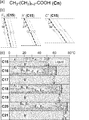
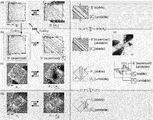
- Pentadecanoic acid (C 15 H 30 O 2: C15), hexadecanoic acid (palmitic acid, C 16 H 32 O 2, C16), heptadecanoic acid (C 17 H 34 O 2: C17), octadecanoic acid (stearic acid, C 18 H 36 O 2: C18), nonadecanoic (C 19 H 38 O 2: C19), eicosanoic acid (arachidic acid, C 20 H 40 O 2: C20), and heneicosanoic acid (C 21 H 42 O 2: C21) Are typical straight-chain saturated fatty acids (FIG.
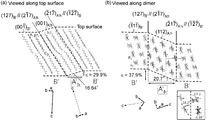
- Crystal packing of fatty acids has been classified into three types of polymorphs according to the packing molecular orientation since the 1930s.
- the three polymorphs are referred to as A, B, and C in order of decreasing molecular bilayer thickness, the thickness of which is determined by the increasing tilt angle of the alkyl chains relative to the plane corresponding to the top surface of the crystal. (FIG. 1b).
- odd chain fatty acids are conventionally referred to as A ', B', and C '(or C ").
- A, B, and C (or A', B ', and C'(C")) Are almost the same regardless of the chain length.
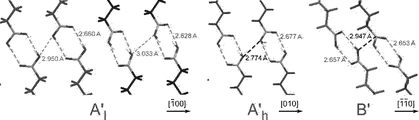
- the crystal structure consists of nine species for even members called A 1 , A 2 , A 3 , A super , Bo , B m , E o , Em , and C, and A ′ l , A ′ h , B ′, C ′, C ′′, and D ′, have been subdivided into six species for odd members (Table 2), and these structures have specific evaporation rates and temperatures.
- E has an all-trans conformation like C, and has a tilt angle of B (about 28 °) and C and C ′ (or C ′′) crystals generally melt by heating (52-75 ° C.), with melting points of even and odd members, each of which results in alkyl chain elongation. It increases with this (FIG. 1c).
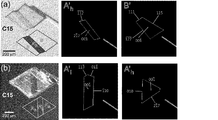
- the interface was oriented parallel to the molecular chains and the B′-phase orthorhombic subcell and A ′ A phase boundary was formed between the h phase and the triclinic subcell.
- S is the cross-sectional area of the unit cell on the interface.
- C15 Fatty acid crystals are very soft and flexible in nature, and from a common sense point of view, mechanical manipulation appears to be difficult. Since various phases A ′ l , A ′ h , B ′, C ′′, and D ′ have already been observed in the C15 crystal (see FIG. 1c), pentadecanoic acid (C15) is a detailed fatty acid polymorph. A good candidate for a simple study: C15 sheet crystals (approximately 5 ⁇ m thick) bend elastically in a direction normal to the large plane (FIG. 8a), the curvature being inversely proportional to the Young's modulus.
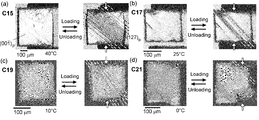
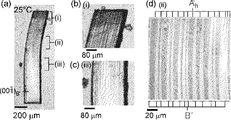
- the superelasticity of the C15 single crystal is limited in certain anisotropic martensitic transformations due to the low symmetry of the triclinic lattice, while applying force along the shear component of [1-20] B ' , resulting cooperation deformation with bending martensite transformation and elastic, transformation a 'to generate a plurality of stripes of h daughter crystal domains in curvature, spontaneously shape and removing the force of the matrix phase single crystal The original shape was restored (FIGS. 8c and 10). Fatty acid crystals have both elastic softness and superelastic shape recovery, resulting in undisclosed flexibility.
- martensite ferroelasticity which includes a phase transition but differs from “twin ferroelasticity” which occurs without a phase transition.
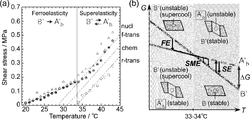
- martensitic ferroelasticity transitions to superelastic ferroelasticity when the temperature is raised above 34 ° C., and the ferroelastically deformed crystals form within the B ′ host crystal of the shear-induced A ′ h domain. Incorporation completely recovered the original linear crystal (FIG. 11b ⁇ a).
- the DSC measurements show that the B 'phase remains in a supercooled state even at ⁇ 30 ° C. (see FIG. 13), a superelastic process (stable B ′ mother to metastable A ′ h daughter) and strong A martensitic transformation between A ' h and B' was shown for both elastic processes (supercooled B 'mother to stable A' h daughter).
- the shape memory effect in a shape memory alloy is caused by a thermal phase transition from a twin phase to a superelastic phase due to heating, but the observed shape memory effect is caused by irreversible transformation from a supercooled state to a stable phase. It is caused by a thermal phase transition from the twin phase to the superelastic phase.
- the shape memory effect in the fatty acid crystal is similar in principle to the shape memory alloy, and is a novel mechanism not seen in the shape memory polymer material. Since the C15 crystal exhibited the shape memory effect, it is considered that the C19 and C21 crystals have the capability of the shape memory effect at a lower temperature.
- a ′ h and A ′ l second and third superelastic behaviors of C15 at lower temperatures were found.
- a ′ h crystals were mechanically generated from supercooled B ′ near room temperature, and then A ′ l crystals were generated from the A ′ l crystals by cooling the A ′ h crystals to 11 ° C.
- the temperature bipolarity in the hyperelastic transformation between A ′ h and A ′ l was confirmed by the exchange of a stable matrix and a metastable shear-induced phase (FIGS. 11c, d).
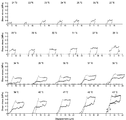
- a ′ l may have been generated by mechanically loading supercooled B ′ under further cooling to approximately 0-5 ° C. (FIGS. 12, 13, Table 6).
- the shape memory effect from martensite ferroelasticity to martensite hyperelasticity showed the same qualitative thermal enhancement of the resilience as that observed with shape memory alloys and PBu 4 BPh 4 (see Non-Patent Document 7).
- the stress-strain test was performed in 1 ° C. increments over the temperature range of 21-43 ° C. by applying a shear stress parallel to the effective shear along [1-20] B ′ . Residual A ′ h domains in ferroelastic deformation were manually eliminated by applying a load along the opposite direction at each temperature (Table 1, FIG. 16a).
- the measured values correspond approximately to the strength of pulling a 3 kg weight during the recovery of the shape of a 1 cm 2 cross section sample.
- Young's modulus (E) of C15 under compression perpendicular to B ′ was 5 to 50 MPa (FIG. 9). This is 1/30 to 1/100 smaller than the corresponding value (E: 1430 MPa) of the PBu 4 BPh 4 crystal near room temperature.
- E Young's modulus
- the shape recovery strength and the softness of the material are individually controlled by ⁇ G (FIG. 18b) for superelastic shape recovery and by designing the appropriate molecular structure for the softness of the material, respectively. be able to. This is not possible with simple elastic materials.
- the slope of C15 at a temperature exceeding 34 ° C. is about 5 of the value of PBu 4 BPh 4 (d ⁇ / dT: 0.135 MPa ° ⁇ 1 at a temperature exceeding 123.5 ° C.) (see Non-Patent Document 7). Met.
- the temperature gradient of the shape recovery stress in the shape memory effect increases as ⁇ S increases.
- the C15 single crystal is relatively gentle with respect to the thermal increase in critical shear stress.
- the C15 crystal had a large superelastic index (SEI: ⁇ ⁇ ⁇ ) of more than 0.4 kJm -3 Pa -1 at 35 to 39 ° C. near body temperature. This value is reported for other organic superelastic compounds (0.05 to 0.25 kJm ⁇ 3 Pa ⁇ 1 ) (see Non-Patent Documents 4, 5, and 7) and for shape memory alloys. Significantly ( ⁇ 0.05 kJm ⁇ 3 Pa ⁇ 1 ) (FIGS. 19, 20, Table 7).
- the superelastic deformation is realized by the property of the oligomer crystal, whereby the rearrangement of the component molecules becomes possible, and the crystal exhibits extremely high utility in terms of superelastic index value.
- fatty acids are associated with biological metabolites and synthetic macromolecules with alkyl chains, the surprising finding of deformability in combination with the elastic, superelastic, ferroelastic, and shape memory effects of fatty acid crystals is: It has the potential to contribute to a new design for shape recovery using oligomer crystals.
Landscapes
- Chemical & Material Sciences (AREA)
- Engineering & Computer Science (AREA)
- Combustion & Propulsion (AREA)
- Organic Chemistry (AREA)
- Mechanical Engineering (AREA)
- General Engineering & Computer Science (AREA)
- Organic Low-Molecular-Weight Compounds And Preparation Thereof (AREA)
- Materials For Medical Uses (AREA)
Abstract
La présente invention concerne un matériau superélastique caractérisé en ce qu'il contient un cristal d'un oligomère. En ce qui concerne le matériau superélastique, il est préférable que l'oligomère soit un oligomère à chaîne; et il est également préférable que l'oligomère ait un groupe fonctionnel associatif. La présente invention concerne également un matériau de stockage d'énergie, un matériau d'absorption d'énergie, un matériau élastique, un actionneur et un matériau à mémoire de forme, chacun contenant le matériau superélastique selon l'invention.
Priority Applications (1)
| Application Number | Priority Date | Filing Date | Title |
|---|---|---|---|
| JP2020550251A JP7412690B2 (ja) | 2018-10-04 | 2019-09-12 | 超弾性材料およびその使用 |
Applications Claiming Priority (2)
| Application Number | Priority Date | Filing Date | Title |
|---|---|---|---|
| JP2018-189482 | 2018-10-04 | ||
| JP2018189482 | 2018-10-04 |
Publications (1)
| Publication Number | Publication Date |
|---|---|
| WO2020071085A1 true WO2020071085A1 (fr) | 2020-04-09 |
Family
ID=70055913
Family Applications (1)
| Application Number | Title | Priority Date | Filing Date |
|---|---|---|---|
| PCT/JP2019/035897 Ceased WO2020071085A1 (fr) | 2018-10-04 | 2019-09-12 | Matériau superélastique et son utilisation |
Country Status (2)
| Country | Link |
|---|---|
| JP (1) | JP7412690B2 (fr) |
| WO (1) | WO2020071085A1 (fr) |
Citations (1)
| Publication number | Priority date | Publication date | Assignee | Title |
|---|---|---|---|---|
| WO2015068712A1 (fr) * | 2013-11-05 | 2015-05-14 | 公立大学法人横浜市立大学 | Matériau superélastique et matériau de stockage d'énergie, matériau à absorption d'énergie, matériau élastique, actionneur, et matériau à mémoire de forme utilisant ledit matériau superélastique |
-
2019
- 2019-09-12 WO PCT/JP2019/035897 patent/WO2020071085A1/fr not_active Ceased
- 2019-09-12 JP JP2020550251A patent/JP7412690B2/ja active Active
Patent Citations (1)
| Publication number | Priority date | Publication date | Assignee | Title |
|---|---|---|---|---|
| WO2015068712A1 (fr) * | 2013-11-05 | 2015-05-14 | 公立大学法人横浜市立大学 | Matériau superélastique et matériau de stockage d'énergie, matériau à absorption d'énergie, matériau élastique, actionneur, et matériau à mémoire de forme utilisant ledit matériau superélastique |
Non-Patent Citations (2)
| Title |
|---|
| IKEDA, TOMIKI ET AL.: "A superelastic organic crystal", NATURE, vol. 511, no. 7509, 2014, pages 300 - 301, XP055342238, ISSN: 0028-0836, DOI: 10.1038/511300a * |
| TAKAMIZAWA, SATOSHI ET AL.: "Versatile Shape Recoverability of Odd-Numbered Saturated Long-Chain Fatty Acid Crystals", CRYSTAL GROWTH & DESIGN, vol. 19, no. 3, 18 January 2019 (2019-01-18), pages 1912 - 1920, XP055699303, ISSN: 1528-7483 * |
Also Published As
| Publication number | Publication date |
|---|---|
| JPWO2020071085A1 (ja) | 2021-09-09 |
| JP7412690B2 (ja) | 2024-01-15 |
Similar Documents
| Publication | Publication Date | Title |
|---|---|---|
| Takamizawa et al. | Shape-memory effect in an organosuperelastic crystal | |
| Hu et al. | Twistable pharmaceutical crystal exhibiting exceptional plasticity and tabletability | |
| Zhou et al. | Selective electron beam melting of NiTi: Microstructure, phase transformation and mechanical properties | |
| Kireeva et al. | Effect of oriented γ′ precipitates on shape memory effect and superelasticity in Co–Ni–Ga single crystals | |
| Evirgen et al. | Effect of precipitation on the microstructure and the shape memory response of the Ni50. 3Ti29. 7Zr20 high temperature shape memory alloy | |
| Takamizawa et al. | Versatile shape recoverability of odd-numbered saturated long-chain fatty acid crystals | |
| Karagoz et al. | Relationship between transformation temperatures and alloying elements in Cu–Al–Ni shape memory alloys | |
| Saghaian et al. | Effects of Ni content on the shape memory properties and microstructure of Ni-rich NiTi-20Hf alloys | |
| JP2011080152A (ja) | 高弾性限を有する非晶質合金の成形品を形成する方法 | |
| Ma et al. | Selective growth of Ni4Ti3 precipitate variants induced by complicated cyclic stress during laser additive manufacturing of NiTi-based composites | |
| Edahiro et al. | Mechanical properties and hardening mechanism of Fe–Al–Ni single crystals containing NiAl precipitates | |
| Yang et al. | ZrW2O8 with negative thermal expansion fabricated at ultralow temperature: an energy-efficient strategy for metastable material fabrication | |
| Canbay et al. | Effects of annealing temperature on thermomechanical properties of Cu–Al–Ni shape memory alloys | |
| Yang et al. | ZrW2O8/ZrO2 composites with low/near-zero coefficients of thermal expansion fabricated at ultralow temperature: An Integration of hydrothermal assembly and a cold sintering process | |
| Zhou et al. | First-principles calculations and thermodynamic modeling of the Sn− Sr and Mg− Sn− Sr systems | |
| JP7412690B2 (ja) | 超弾性材料およびその使用 | |
| Nó et al. | Quantitative analysis of stress-induced martensites by in situ transmission electron microscopy superelastic tests in Cu–Al–Ni shape memory alloys | |
| Zýka et al. | Structure and mechanical properties of TaNbHfZrTi high entropy alloy | |
| Chovan et al. | First principles simulations of elastic properties of radiopaque NiTiPt | |
| Ibarra et al. | “In situ” and “Post-mortem” TEM study of the super-elastic effect in Cu–Al–Ni shape memory alloys | |
| Duggin et al. | A martensitic transformation in a gold-copper-zinc alloy | |
| Fornasini et al. | New structures formed by R3Au4Sn3, R5Au8Sn5 and R3Au6Sn5 compounds (R= rare earths) | |
| Liu et al. | The effect of high temperature plastic deformation on the thermal stability and microstructure of Zr55Cu30Ni5Al10 bulk metallic glass | |
| Zangwill et al. | Origin of martensitic pseudoelasticity | |
| JP6083659B2 (ja) | 超弾性材料、ならびに当該超弾性材料を用いた、エネルギー貯蔵材料、エネルギー吸収材料、弾性材料、アクチュエータおよび形状記憶材料 |
Legal Events
| Date | Code | Title | Description |
|---|---|---|---|
| 121 | Ep: the epo has been informed by wipo that ep was designated in this application |
Ref document number: 19869201 Country of ref document: EP Kind code of ref document: A1 |
|
| ENP | Entry into the national phase |
Ref document number: 2020550251 Country of ref document: JP Kind code of ref document: A |
|
| NENP | Non-entry into the national phase |
Ref country code: DE |
|
| 122 | Ep: pct application non-entry in european phase |
Ref document number: 19869201 Country of ref document: EP Kind code of ref document: A1 |