WO2020080148A1 - 準不燃性フェノール樹脂組成物及びそれから得られた準不燃材料 - Google Patents
準不燃性フェノール樹脂組成物及びそれから得られた準不燃材料 Download PDFInfo
- Publication number
- WO2020080148A1 WO2020080148A1 PCT/JP2019/039325 JP2019039325W WO2020080148A1 WO 2020080148 A1 WO2020080148 A1 WO 2020080148A1 JP 2019039325 W JP2019039325 W JP 2019039325W WO 2020080148 A1 WO2020080148 A1 WO 2020080148A1
- Authority
- WO
- WIPO (PCT)
- Prior art keywords
- phenol resin
- resin composition
- flame retardant
- incombustible
- semi
- Prior art date
- Legal status (The legal status is an assumption and is not a legal conclusion. Google has not performed a legal analysis and makes no representation as to the accuracy of the status listed.)
- Ceased
Links
Classifications
-
- C—CHEMISTRY; METALLURGY
- C08—ORGANIC MACROMOLECULAR COMPOUNDS; THEIR PREPARATION OR CHEMICAL WORKING-UP; COMPOSITIONS BASED THEREON
- C08K—Use of inorganic or non-macromolecular organic substances as compounding ingredients
- C08K3/00—Use of inorganic substances as compounding ingredients
- C08K3/01—Use of inorganic substances as compounding ingredients characterized by their specific function
- C08K3/016—Flame-proofing or flame-retarding additives
-
- C—CHEMISTRY; METALLURGY
- C08—ORGANIC MACROMOLECULAR COMPOUNDS; THEIR PREPARATION OR CHEMICAL WORKING-UP; COMPOSITIONS BASED THEREON
- C08J—WORKING-UP; GENERAL PROCESSES OF COMPOUNDING; AFTER-TREATMENT NOT COVERED BY SUBCLASSES C08B, C08C, C08F, C08G or C08H
- C08J9/00—Working-up of macromolecular substances to porous or cellular articles or materials; After-treatment thereof
- C08J9/0066—Use of inorganic compounding ingredients
-
- C—CHEMISTRY; METALLURGY
- C08—ORGANIC MACROMOLECULAR COMPOUNDS; THEIR PREPARATION OR CHEMICAL WORKING-UP; COMPOSITIONS BASED THEREON
- C08J—WORKING-UP; GENERAL PROCESSES OF COMPOUNDING; AFTER-TREATMENT NOT COVERED BY SUBCLASSES C08B, C08C, C08F, C08G or C08H
- C08J9/00—Working-up of macromolecular substances to porous or cellular articles or materials; After-treatment thereof
- C08J9/009—Use of pretreated compounding ingredients
-
- C—CHEMISTRY; METALLURGY
- C08—ORGANIC MACROMOLECULAR COMPOUNDS; THEIR PREPARATION OR CHEMICAL WORKING-UP; COMPOSITIONS BASED THEREON
- C08J—WORKING-UP; GENERAL PROCESSES OF COMPOUNDING; AFTER-TREATMENT NOT COVERED BY SUBCLASSES C08B, C08C, C08F, C08G or C08H
- C08J9/00—Working-up of macromolecular substances to porous or cellular articles or materials; After-treatment thereof
- C08J9/0095—Mixtures of at least two compounding ingredients belonging to different one-dot groups
-
- C—CHEMISTRY; METALLURGY
- C08—ORGANIC MACROMOLECULAR COMPOUNDS; THEIR PREPARATION OR CHEMICAL WORKING-UP; COMPOSITIONS BASED THEREON
- C08J—WORKING-UP; GENERAL PROCESSES OF COMPOUNDING; AFTER-TREATMENT NOT COVERED BY SUBCLASSES C08B, C08C, C08F, C08G or C08H
- C08J9/00—Working-up of macromolecular substances to porous or cellular articles or materials; After-treatment thereof
- C08J9/04—Working-up of macromolecular substances to porous or cellular articles or materials; After-treatment thereof using blowing gases generated by a previously added blowing agent
- C08J9/12—Working-up of macromolecular substances to porous or cellular articles or materials; After-treatment thereof using blowing gases generated by a previously added blowing agent by a physical blowing agent
- C08J9/14—Working-up of macromolecular substances to porous or cellular articles or materials; After-treatment thereof using blowing gases generated by a previously added blowing agent by a physical blowing agent organic
- C08J9/141—Hydrocarbons
-
- C—CHEMISTRY; METALLURGY
- C08—ORGANIC MACROMOLECULAR COMPOUNDS; THEIR PREPARATION OR CHEMICAL WORKING-UP; COMPOSITIONS BASED THEREON
- C08J—WORKING-UP; GENERAL PROCESSES OF COMPOUNDING; AFTER-TREATMENT NOT COVERED BY SUBCLASSES C08B, C08C, C08F, C08G or C08H
- C08J9/00—Working-up of macromolecular substances to porous or cellular articles or materials; After-treatment thereof
- C08J9/04—Working-up of macromolecular substances to porous or cellular articles or materials; After-treatment thereof using blowing gases generated by a previously added blowing agent
- C08J9/12—Working-up of macromolecular substances to porous or cellular articles or materials; After-treatment thereof using blowing gases generated by a previously added blowing agent by a physical blowing agent
- C08J9/14—Working-up of macromolecular substances to porous or cellular articles or materials; After-treatment thereof using blowing gases generated by a previously added blowing agent by a physical blowing agent organic
- C08J9/143—Halogen containing compounds
- C08J9/144—Halogen containing compounds containing carbon, halogen and hydrogen only
- C08J9/145—Halogen containing compounds containing carbon, halogen and hydrogen only only chlorine as halogen atoms
-
- C—CHEMISTRY; METALLURGY
- C08—ORGANIC MACROMOLECULAR COMPOUNDS; THEIR PREPARATION OR CHEMICAL WORKING-UP; COMPOSITIONS BASED THEREON
- C08J—WORKING-UP; GENERAL PROCESSES OF COMPOUNDING; AFTER-TREATMENT NOT COVERED BY SUBCLASSES C08B, C08C, C08F, C08G or C08H
- C08J9/00—Working-up of macromolecular substances to porous or cellular articles or materials; After-treatment thereof
- C08J9/04—Working-up of macromolecular substances to porous or cellular articles or materials; After-treatment thereof using blowing gases generated by a previously added blowing agent
- C08J9/12—Working-up of macromolecular substances to porous or cellular articles or materials; After-treatment thereof using blowing gases generated by a previously added blowing agent by a physical blowing agent
- C08J9/14—Working-up of macromolecular substances to porous or cellular articles or materials; After-treatment thereof using blowing gases generated by a previously added blowing agent by a physical blowing agent organic
- C08J9/143—Halogen containing compounds
- C08J9/144—Halogen containing compounds containing carbon, halogen and hydrogen only
- C08J9/146—Halogen containing compounds containing carbon, halogen and hydrogen only only fluorine as halogen atoms
-
- C—CHEMISTRY; METALLURGY
- C08—ORGANIC MACROMOLECULAR COMPOUNDS; THEIR PREPARATION OR CHEMICAL WORKING-UP; COMPOSITIONS BASED THEREON
- C08J—WORKING-UP; GENERAL PROCESSES OF COMPOUNDING; AFTER-TREATMENT NOT COVERED BY SUBCLASSES C08B, C08C, C08F, C08G or C08H
- C08J9/00—Working-up of macromolecular substances to porous or cellular articles or materials; After-treatment thereof
- C08J9/04—Working-up of macromolecular substances to porous or cellular articles or materials; After-treatment thereof using blowing gases generated by a previously added blowing agent
- C08J9/12—Working-up of macromolecular substances to porous or cellular articles or materials; After-treatment thereof using blowing gases generated by a previously added blowing agent by a physical blowing agent
- C08J9/14—Working-up of macromolecular substances to porous or cellular articles or materials; After-treatment thereof using blowing gases generated by a previously added blowing agent by a physical blowing agent organic
- C08J9/149—Mixtures of blowing agents covered by more than one of the groups C08J9/141 - C08J9/143
-
- C—CHEMISTRY; METALLURGY
- C08—ORGANIC MACROMOLECULAR COMPOUNDS; THEIR PREPARATION OR CHEMICAL WORKING-UP; COMPOSITIONS BASED THEREON
- C08K—Use of inorganic or non-macromolecular organic substances as compounding ingredients
- C08K3/00—Use of inorganic substances as compounding ingredients
- C08K3/02—Elements
-
- C—CHEMISTRY; METALLURGY
- C08—ORGANIC MACROMOLECULAR COMPOUNDS; THEIR PREPARATION OR CHEMICAL WORKING-UP; COMPOSITIONS BASED THEREON
- C08K—Use of inorganic or non-macromolecular organic substances as compounding ingredients
- C08K3/00—Use of inorganic substances as compounding ingredients
- C08K3/02—Elements
- C08K3/04—Carbon
-
- C—CHEMISTRY; METALLURGY
- C08—ORGANIC MACROMOLECULAR COMPOUNDS; THEIR PREPARATION OR CHEMICAL WORKING-UP; COMPOSITIONS BASED THEREON
- C08K—Use of inorganic or non-macromolecular organic substances as compounding ingredients
- C08K3/00—Use of inorganic substances as compounding ingredients
- C08K3/18—Oxygen-containing compounds, e.g. metal carbonyls
- C08K3/20—Oxides; Hydroxides
- C08K3/22—Oxides; Hydroxides of metals
-
- C—CHEMISTRY; METALLURGY
- C08—ORGANIC MACROMOLECULAR COMPOUNDS; THEIR PREPARATION OR CHEMICAL WORKING-UP; COMPOSITIONS BASED THEREON
- C08K—Use of inorganic or non-macromolecular organic substances as compounding ingredients
- C08K3/00—Use of inorganic substances as compounding ingredients
- C08K3/32—Phosphorus-containing compounds
-
- C—CHEMISTRY; METALLURGY
- C08—ORGANIC MACROMOLECULAR COMPOUNDS; THEIR PREPARATION OR CHEMICAL WORKING-UP; COMPOSITIONS BASED THEREON
- C08K—Use of inorganic or non-macromolecular organic substances as compounding ingredients
- C08K9/00—Use of pretreated ingredients
- C08K9/02—Ingredients treated with inorganic substances
-
- C—CHEMISTRY; METALLURGY
- C08—ORGANIC MACROMOLECULAR COMPOUNDS; THEIR PREPARATION OR CHEMICAL WORKING-UP; COMPOSITIONS BASED THEREON
- C08K—Use of inorganic or non-macromolecular organic substances as compounding ingredients
- C08K9/00—Use of pretreated ingredients
- C08K9/08—Ingredients agglomerated by treatment with a binding agent
-
- C—CHEMISTRY; METALLURGY
- C08—ORGANIC MACROMOLECULAR COMPOUNDS; THEIR PREPARATION OR CHEMICAL WORKING-UP; COMPOSITIONS BASED THEREON
- C08L—COMPOSITIONS OF MACROMOLECULAR COMPOUNDS
- C08L61/00—Compositions of condensation polymers of aldehydes or ketones; Compositions of derivatives of such polymers
- C08L61/04—Condensation polymers of aldehydes or ketones with phenols only
- C08L61/06—Condensation polymers of aldehydes or ketones with phenols only of aldehydes with phenols
- C08L61/12—Condensation polymers of aldehydes or ketones with phenols only of aldehydes with phenols with polyhydric phenols
-
- C—CHEMISTRY; METALLURGY
- C08—ORGANIC MACROMOLECULAR COMPOUNDS; THEIR PREPARATION OR CHEMICAL WORKING-UP; COMPOSITIONS BASED THEREON
- C08J—WORKING-UP; GENERAL PROCESSES OF COMPOUNDING; AFTER-TREATMENT NOT COVERED BY SUBCLASSES C08B, C08C, C08F, C08G or C08H
- C08J2201/00—Foams characterised by the foaming process
- C08J2201/02—Foams characterised by the foaming process characterised by mechanical pre- or post-treatments
- C08J2201/026—Crosslinking before of after foaming
-
- C—CHEMISTRY; METALLURGY
- C08—ORGANIC MACROMOLECULAR COMPOUNDS; THEIR PREPARATION OR CHEMICAL WORKING-UP; COMPOSITIONS BASED THEREON
- C08J—WORKING-UP; GENERAL PROCESSES OF COMPOUNDING; AFTER-TREATMENT NOT COVERED BY SUBCLASSES C08B, C08C, C08F, C08G or C08H
- C08J2203/00—Foams characterized by the expanding agent
- C08J2203/14—Saturated hydrocarbons, e.g. butane; Unspecified hydrocarbons
-
- C—CHEMISTRY; METALLURGY
- C08—ORGANIC MACROMOLECULAR COMPOUNDS; THEIR PREPARATION OR CHEMICAL WORKING-UP; COMPOSITIONS BASED THEREON
- C08J—WORKING-UP; GENERAL PROCESSES OF COMPOUNDING; AFTER-TREATMENT NOT COVERED BY SUBCLASSES C08B, C08C, C08F, C08G or C08H
- C08J2203/00—Foams characterized by the expanding agent
- C08J2203/14—Saturated hydrocarbons, e.g. butane; Unspecified hydrocarbons
- C08J2203/142—Halogenated saturated hydrocarbons, e.g. H3C-CF3
-
- C—CHEMISTRY; METALLURGY
- C08—ORGANIC MACROMOLECULAR COMPOUNDS; THEIR PREPARATION OR CHEMICAL WORKING-UP; COMPOSITIONS BASED THEREON
- C08J—WORKING-UP; GENERAL PROCESSES OF COMPOUNDING; AFTER-TREATMENT NOT COVERED BY SUBCLASSES C08B, C08C, C08F, C08G or C08H
- C08J2203/00—Foams characterized by the expanding agent
- C08J2203/16—Unsaturated hydrocarbons
- C08J2203/162—Halogenated unsaturated hydrocarbons, e.g. H2C=CF2
-
- C—CHEMISTRY; METALLURGY
- C08—ORGANIC MACROMOLECULAR COMPOUNDS; THEIR PREPARATION OR CHEMICAL WORKING-UP; COMPOSITIONS BASED THEREON
- C08J—WORKING-UP; GENERAL PROCESSES OF COMPOUNDING; AFTER-TREATMENT NOT COVERED BY SUBCLASSES C08B, C08C, C08F, C08G or C08H
- C08J2203/00—Foams characterized by the expanding agent
- C08J2203/18—Binary blends of expanding agents
- C08J2203/182—Binary blends of expanding agents of physical blowing agents, e.g. acetone and butane
-
- C—CHEMISTRY; METALLURGY
- C08—ORGANIC MACROMOLECULAR COMPOUNDS; THEIR PREPARATION OR CHEMICAL WORKING-UP; COMPOSITIONS BASED THEREON
- C08J—WORKING-UP; GENERAL PROCESSES OF COMPOUNDING; AFTER-TREATMENT NOT COVERED BY SUBCLASSES C08B, C08C, C08F, C08G or C08H
- C08J2205/00—Foams characterised by their properties
- C08J2205/04—Foams characterised by their properties characterised by the foam pores
- C08J2205/052—Closed cells, i.e. more than 50% of the pores are closed
-
- C—CHEMISTRY; METALLURGY
- C08—ORGANIC MACROMOLECULAR COMPOUNDS; THEIR PREPARATION OR CHEMICAL WORKING-UP; COMPOSITIONS BASED THEREON
- C08J—WORKING-UP; GENERAL PROCESSES OF COMPOUNDING; AFTER-TREATMENT NOT COVERED BY SUBCLASSES C08B, C08C, C08F, C08G or C08H
- C08J2361/00—Characterised by the use of condensation polymers of aldehydes or ketones; Derivatives of such polymers
- C08J2361/04—Condensation polymers of aldehydes or ketones with phenols only
- C08J2361/06—Condensation polymers of aldehydes or ketones with phenols only of aldehydes with phenols
- C08J2361/08—Condensation polymers of aldehydes or ketones with phenols only of aldehydes with phenols with monohydric phenols
- C08J2361/10—Phenol-formaldehyde condensates
-
- C—CHEMISTRY; METALLURGY
- C08—ORGANIC MACROMOLECULAR COMPOUNDS; THEIR PREPARATION OR CHEMICAL WORKING-UP; COMPOSITIONS BASED THEREON
- C08J—WORKING-UP; GENERAL PROCESSES OF COMPOUNDING; AFTER-TREATMENT NOT COVERED BY SUBCLASSES C08B, C08C, C08F, C08G or C08H
- C08J2361/00—Characterised by the use of condensation polymers of aldehydes or ketones; Derivatives of such polymers
- C08J2361/04—Condensation polymers of aldehydes or ketones with phenols only
- C08J2361/06—Condensation polymers of aldehydes or ketones with phenols only of aldehydes with phenols
- C08J2361/12—Condensation polymers of aldehydes or ketones with phenols only of aldehydes with phenols with polyhydric phenols
-
- C—CHEMISTRY; METALLURGY
- C08—ORGANIC MACROMOLECULAR COMPOUNDS; THEIR PREPARATION OR CHEMICAL WORKING-UP; COMPOSITIONS BASED THEREON
- C08J—WORKING-UP; GENERAL PROCESSES OF COMPOUNDING; AFTER-TREATMENT NOT COVERED BY SUBCLASSES C08B, C08C, C08F, C08G or C08H
- C08J2427/00—Characterised by the use of homopolymers or copolymers of compounds having one or more unsaturated aliphatic radicals, each having only one carbon-to-carbon double bond, and at least one being terminated by a halogen; Derivatives of such polymers
- C08J2427/02—Characterised by the use of homopolymers or copolymers of compounds having one or more unsaturated aliphatic radicals, each having only one carbon-to-carbon double bond, and at least one being terminated by a halogen; Derivatives of such polymers not modified by chemical after-treatment
- C08J2427/04—Characterised by the use of homopolymers or copolymers of compounds having one or more unsaturated aliphatic radicals, each having only one carbon-to-carbon double bond, and at least one being terminated by a halogen; Derivatives of such polymers not modified by chemical after-treatment containing chlorine atoms
- C08J2427/06—Homopolymers or copolymers of vinyl chloride
-
- C—CHEMISTRY; METALLURGY
- C08—ORGANIC MACROMOLECULAR COMPOUNDS; THEIR PREPARATION OR CHEMICAL WORKING-UP; COMPOSITIONS BASED THEREON
- C08K—Use of inorganic or non-macromolecular organic substances as compounding ingredients
- C08K3/00—Use of inorganic substances as compounding ingredients
- C08K3/02—Elements
- C08K2003/026—Phosphorus
-
- C—CHEMISTRY; METALLURGY
- C08—ORGANIC MACROMOLECULAR COMPOUNDS; THEIR PREPARATION OR CHEMICAL WORKING-UP; COMPOSITIONS BASED THEREON
- C08K—Use of inorganic or non-macromolecular organic substances as compounding ingredients
- C08K3/00—Use of inorganic substances as compounding ingredients
- C08K3/32—Phosphorus-containing compounds
- C08K2003/321—Phosphates
- C08K2003/322—Ammonium phosphate
- C08K2003/323—Ammonium polyphosphate
Definitions
- the present invention relates to a quasi-incombustible phenolic resin composition and a quasi-incombustible material obtained therefrom, and in particular, a quasi-incombustible phenolic resin composition capable of advantageously forming a phenolic resin foam useful as a quasi-incombustible material (phenolic foam). And a semi-incombustible material obtained from such a phenolic resin composition.
- a phenol resin foam obtained by foaming and curing a phenol resin composition containing a predetermined foaming agent has been recognized as having relatively high flame retardance, but as it is, ,
- the building code of Japan which does not fully meet the safety standards required in the fields of construction, civil engineering, electrical products, electric and electronic parts, automobile parts, etc., and is evaluated by a heat generation test with a cone calorimeter. It did not give a material having the quasi-non-combustible property specified in 1.
- a predetermined flame retardant is mixed with the phenol resin composition and cured to obtain the desired phenol resin foam.
- the flammability has been improved.
- a useful flame retardant is obtained by using a phosphorus compound, a sulfur compound or a boron compound as a flame retardant and blending them with a resin composition for producing a phenol resin foam. It has been shown that it is possible to produce a functional phenolic resin foam.
- JP 2007-161810 A, JP 2007-70511 A, etc. aluminum hydroxide and water are used as inorganic fillers that are usually added to a resin composition for producing a phenol resin foam.
- Hydroxides of metals such as magnesium oxide; oxides of metals such as calcium oxide and aluminum oxide; metal powders such as zinc dust; obtained by foaming by using carbonates of metals such as calcium carbonate and magnesium carbonate
- carbonates of metals such as calcium carbonate and magnesium carbonate
- JP-A-60-170636 and JP-A-8-176343 red phosphorus and ammonium polyphosphate are blended as a non-halogen flame retardant capable of imparting a high degree of flame retardancy to a resin. It has been clarified that a phenol resin foam excellent in flame retardancy can be obtained by preparing a phenol resin composition, and foaming and curing it.
- the compounding amount of the above-mentioned known flame retardant is increased with respect to the phenol resin composition in order to obtain a quasi-incombustible property of not more than 1 / m 2 , the curing reaction of the phenol resin composition is hindered, and the purpose Therefore, it becomes impossible to obtain a phenol resin foam to be obtained, and problems such as deterioration of physical or mechanical properties such as thermal conductivity of the obtained phenol resin foam are caused. is there.
- the semi-incombustible material satisfies the above total calorific value, and the maximum heat generation rate continuously exceeds 10 seconds. It is said that it does not exceed 200 kW / m 2 and that there are no cracks or holes penetrating to the back surface that are harmful to flame prevention.
- the body material has not been able to fully meet the demand for such quasi-noncombustible performance while ensuring useful physical or mechanical properties as a phenol resin.
- the present inventor uses a resol-type phenol resin, which is one of the phenol resins, and forms it by foaming and curing a foamable phenol resin composition that is formed by combining an acid curing agent, a foaming agent, and the like.
- a resol-type phenol resin which is one of the phenol resins
- the red phosphorus powder as a flame retardant was used as the first component, and a predetermined flame retardant was added thereto.
- the problem to be solved by the present invention is to effectively secure the low thermal conductivity characteristics of the foam obtained from the expandable phenol resin composition containing the resol-type phenol resin as an essential component, while maintaining the flame retardant performance.
- a quasi-incombustible phenolic resin composition capable of advantageously forming a quasi-incombustible material defined by the Building Standards Law of Japan by synergistically improving fireproof performance, and also By using such a semi-incombustible phenolic resin composition, it is advantageous to obtain a material having a semi-incombustible property defined by the Building Standard Law.
- a flame retardant in order to solve such a problem, together with a resol-type phenol resin, a foaming agent and an acid curing agent, as a flame retardant, a first component consisting of red phosphorus powder, and other than red phosphorus.
- Semi-incombustibility characterized by containing a second component consisting of at least one selected from the group consisting of phosphorus-based flame retardants, inorganic flame retardants, halogen-based flame retardants and graphite-based flame retardants.
- the gist of the invention is a phenolic resin composition.
- the flame retardant is 100 mass% of the resol-type phenolic resin in the total amount of the first component and the second component. 2 to 35 parts by mass relative to 100 parts by mass, and the first component and the second component constituting such a flame retardant are each 100 parts of the resol-type phenol resin. It is contained at a ratio of 1 to 30 parts by mass and 1 to 10 parts by mass with respect to parts by mass.
- the red phosphorus powder is a surface formed of a metal oxide or hydroxide and / or a thermosetting resin. It has a coating layer, which allows a phenolic resin foam according to the invention with excellent properties to be advantageously formed.
- ammonium polyphosphate powder having a surface coating layer is preferably used, and thus the phenol resin composition
- the flame retardant performance or fireproof performance according to the present invention can be exhibited even more advantageously.
- the surface coating layer of the ammonium polyphosphate powder is formed of a sparingly soluble thermosetting resin.
- a sparingly soluble thermosetting resin a phenol resin, a melamine resin, or the like is used, and among them, a melamine resin is preferably used.
- halogenated alkenes, or chlorinated aliphatic hydrocarbons and / or aliphatic hydrocarbons are preferably used, and among them, a mixture of isopentane and isopropyl chloride, It can be used advantageously.
- the resol-type phenol resin used in the present invention is adjusted to have a viscosity of 2000 mPa ⁇ s or more at 25 ° C.
- the present invention also includes a semi-incombustible material made of a foam obtained by foaming and curing the semi-incombustible phenol resin composition as described above.
- the above-mentioned foam is generally heated at a radiant heat intensity of 50 kW / m 2 in accordance with the exothermic test method specified in ISO-5660. It has a characteristic that the total calorific value for 10 minutes after the start is 8.0 MJ / m 2 or less.
- the first component consisting of red phosphorus powder, a phosphorus-based flame retardant other than red phosphorus, an inorganic flame retardant, a halogen-based flame retardant.
- the second component consisting of at least one selected from the group consisting of the flame retardant and the graphite-based flame retardant is used in combination, the synergistic action of these two components causes such semi-incombustibility.
- the flame-retardant performance and / or fire-prevention performance of the foam material obtained by foaming and curing the water-soluble phenolic resin composition can be effectively improved, and furthermore, a low thermal conductivity useful as a phenolic resin foam. Such characteristics can be advantageously provided.
- a phenolic resin foam material as a quasi-incombustible material stipulated by the Building Standards Law of Japan can be easily and advantageously realized. It was decided.
- the resol type phenolic resin used in the present invention as described above advantageously contains aldehydes in a ratio of about 1.0 to 3.0 mol, preferably 1.5 mol, relative to 1 mol of phenol. Used in a proportion of about 2.5 mol, reacted in the presence of an alkaline reaction catalyst, for example, at a temperature in the range of 50 ° C. to reflux temperature, then subjected to neutralization treatment, and then depressurized. Dehydration and concentration are performed under the following conditions so that a predetermined characteristic value, for example, a viscosity at 25 ° C. is 2000 mPa ⁇ s or more and a water content is 3 to 20% by mass, preferably 5 to 18% by mass. Thereafter, if necessary, it is desirable to add predetermined additives in the same manner as in the prior art to manufacture.
- the thus obtained resol-type phenol resin has a viscosity at 25 ° C. of 2000 mPa ⁇ s or more, preferably 2000 to 100000 mPa ⁇ s, more preferably 3000 to 80000 mPa ⁇ s, and further preferably 4000 to 30000 mPa ⁇ s.
- the viscosity of the resol-type phenol resin is less than 2000 mPa ⁇ s, the red phosphorus powder will be remarkably precipitated and its localization will be caused, resulting in unevenness in the formed phenol resin foam, which is sufficient. Flame resistance and low thermal conductivity cannot be obtained, and conversely, if the viscosity becomes too high, for example, to exceed 100,000 mPa ⁇ s, it will be difficult to obtain the desired phenol resin foam. Cause.
- phenols which are one of the raw materials of the resol type phenol resin used in the present invention phenol, o-cresol, m-cresol, p-cresol, p-tert-butylphenol, m-xylenol, bisphenol F
- examples thereof include bisphenol A
- examples of the other raw material aldehyde used in combination with the phenols include formaldehyde, paraformaldehyde, trioxane, polyoxymethylene, and glyoxal.
- examples of the reaction catalyst include potassium hydroxide, sodium hydroxide, barium hydroxide, calcium hydroxide, potassium carbonate, ammonia and the like.
- any of these phenols, aldehydes and reaction catalysts is by no means limited to the above examples, and various known ones can be appropriately used, and they are respectively They can be used alone or in combination of two or more.
- a predetermined foaming agent is appropriately selected from various conventionally known foaming agents together with the resol-type phenolic resin as described above, and used, whereby a phenol resin foam is obtained.
- a phenolic resin composition for production is to be constituted, and as such a foaming agent, a chlorinated aliphatic hydrocarbon and / or an aliphatic carbonization having a low global warming potential is advantageously used. Hydrogen and halogenated alkenes will be used.
- chlorinated aliphatic hydrocarbon as a foaming agent, generally, a chlorinated product of a linear or branched aliphatic hydrocarbon having about 2 to 5 carbon atoms is preferably used.
- the number of bonded atoms is generally about 1 to 4.
- Specific examples of such chlorinated aliphatic hydrocarbons include dichloroethane, propyl chloride, isopropyl chloride, butyl chloride, isobutyl chloride, pentyl chloride, isopentyl chloride and the like. These may be used alone or in combination of two or more. Among them, chloropropanes such as propyl chloride and isopropyl chloride are preferable, and isopropyl chloride is particularly preferably used. .
- aliphatic hydrocarbon as the foaming agent, a conventionally known hydrocarbon-based foaming agent having about 3 to 7 carbon atoms can be appropriately selected and used.
- a conventionally known hydrocarbon-based foaming agent having about 3 to 7 carbon atoms can be appropriately selected and used.
- Propane, butane, pentane, isopentane, hexane, isohexane, neohexane, heptane, isoheptane, cyclopentane and the like can be mentioned, and from these, one kind or a combination of two or more kinds is used.
- a mixed foaming agent obtained by combining the above-mentioned chlorinated aliphatic hydrocarbon and aliphatic hydrocarbon is also suitably used, and the mixing ratio thereof is, in terms of mass ratio, aliphatic hydrocarbon.
- Chlorinated aliphatic hydrocarbon 25: 75 to 5:95, which is advantageously adopted.
- a combination of such two kinds of foaming agents a combination of isopentane and isopropyl chloride is recommended, whereby the object of the present invention can be achieved even more advantageously.
- a halogenated alkene is also advantageously used as a foaming agent, whereby the properties of the resulting phenol resin foam, particularly flame retardant properties or fire protection properties and low thermal conductivity, are improved. It can contribute to further improvement.
- Halogenated alkenes exhibiting such properties include those called halogenated olefins and halogenated hydroolefins, and generally have chlorine or fluorine bonded and contained as halogens and have 2 carbon atoms.
- a tetrahydrocarbon derivative having about 6 to about 6 unsaturated hydrocarbon derivatives for example, propene, butene, pentene and hexene having 3 to 6 fluorine substituents, substituted with halogen such as fluorine or chlorine
- hydrofluoroolefin which is one of such halogenated alkenes (halogenated olefins)
- halogenated olefins for example, pentafluoro such as 1,2,3,3,3-pentafluoropropene (HFO1225ye) is used.
- Tetrafluoro such as propene, 1,3,3,3-tetrafluoropropene (HFO1234ze), 2,3,3,3-tetrafluoropropene (HFO1234yf), 1,2,3,3-tetrafluoropropene (HFO1234ye)
- Propene trifluoropropene such as 3,3,3-trifluoropropene (HFO1243zf), tetrafluorobutene isomer (HFO1354), pentafluorobutene isomer (HFO1345), 1,1,1,4,4,4 4-hexafluoro-2-butene (HFO 336mzz) and other hexafluorobutene isomers (HFO1336), heptafluorobutene isomers (HFO1327), heptafluoropentene isomers (HFO1447), octafluoropentene isomers (HFO1438), nonafluoropen
- hydrochlorofluoroolefin HCFO
- 1-chloro-3,3,3-trifluoropropene HCFO-1233zd
- 2-chloro-3,3,3-trifluoropropene HCFO-1233xf
- Dichlorotrifluoropropene HCFO1223
- 1-chloro-2,3,3-trifluoropropene HCFO-1233yd
- 1-chloro-1,3,3-trifluoropropene HCFO-1233zb
- 2-chloro- 1,3,3-trifluoropropene HCFO-1233xe
- 2-chloro-2,2,3-trifluoropropene HCFO-1233xc
- 3-chloro-1,2,3-trifluoropropene HCFO- 1233ye
- 3-chloro-1,1,2-trifluoropropene HCF
- the foaming agent contained in the phenolic resin composition according to the present invention that is, each foaming agent as described above, generally has a total amount of 1 to 30 parts by mass, preferably 100 parts by mass with respect to 100 parts by mass of the resol type phenolic resin. Will be used in the proportion of 5 to 25 parts by mass.
- the blowing agent used in the present invention contains a chlorinated aliphatic hydrocarbon and / or an aliphatic hydrocarbon as described above, or a halogenated alkene, but is not limited thereto.
- fluorinated hydrocarbons alternative CFCs
- salts such as fluoroethane, fluorinated hydrocarbons, water, ether compounds such as isopropyl ether, gases such as nitrogen, argon, carbon dioxide, and air may be contained in appropriate proportions.
- the acid curing agent used in the present invention is a component (curing catalyst) for accelerating the curing reaction of the resol type phenolic resin as described above, and a conventionally known acid curing agent is appropriately selected. , Will be used.
- an acid curing agent include aromatic sulfonic acids such as benzenesulfonic acid, phenolsulfonic acid, cresolsulfonic acid, toluenesulfonic acid, xylenesulfonic acid and naphthalenesulfonic acid; methanesulfonic acid and trifluoromethanesulfonic acid.
- inorganic acids such as sulfuric acid, phosphoric acid, polyphosphoric acid, borofluoric acid, etc., which may be used alone, or may be used in combination of two or more kinds.
- inorganic acids such as sulfuric acid, phosphoric acid, polyphosphoric acid, borofluoric acid, etc.
- phenol sulfonic acid, toluene sulfonic acid, and aromatic sulfonic acid such as naphthalene sulfonic acid can achieve an appropriate curing rate in the production of the phenol resin foam. Therefore, the balance between the curing of the resol-type phenol resin and the foaming by the foaming agent is further improved, and a desirable foamed structure can be realized, and therefore, it is particularly preferably used.
- the combined use of para-toluene sulfonic acid and xylene sulfonic acid is recommended, as the usage ratio thereof, on a mass basis, the amount of para-toluene sulfonic acid used is the amount of xylene sulfonic acid used. It is desirable that the amount is larger, and specifically, in terms of mass ratio, paratoluenesulfonic acid: xylenesulfonic acid is advantageously used within the range of 51:49 to 95: 5.
- the amount of such an acid curing agent to be used is appropriately set depending on the type and temperature conditions during mixing with the resol-type phenol resin, but in the present invention, the resol-type phenol is used. It is desirable that the amount is generally 1 to 50 parts by mass, preferably 5 to 30 parts by mass, and particularly preferably 7 to 25 parts by mass, relative to 100 parts by mass of the resin. If the amount used is less than 1 part by mass, the progress of curing will be slow, and if it exceeds 50 parts by mass, the curing speed will be too fast and it will be difficult to obtain the desired phenol resin foam advantageously. Cause problems.
- the phenol resin composition for producing a phenol resin foam obtained by adding and containing the above-mentioned essential components, a phenol resin foam formed from the phenol resin composition, quasi non-combustible flame retardant properties
- the first component composed of red phosphorus powder as a flame retardant so as to suppress or prevent an increase in the thermal conductivity while effectively imparting the Together with a phosphorus-based flame retardant other than red phosphorus, an inorganic flame retardant, a halogen-based flame retardant and a second component consisting of at least one selected from the group consisting of graphite-based flame retardants are combined and blended,
- the flame retardant composed of two components was dispersed and contained in the phenol resin composition.
- red phosphorus powder that is the first component of the flame retardant used here any known ones are publicly known and are usually selected appropriately from commercially available products. .
- those sold under the names "NOVARED”, “NOVAEXCEL” manufactured by Rin Kagaku Kogyo Co., Ltd., “HISHIGUARD” manufactured by Nippon Kagaku Kogyo Co., Ltd., “EXOLIT” manufactured by Clariant Co., Ltd. may be mentioned.
- red phosphorus powder improves the handleability or workability, enhances the dispersibility in the resin composition, and advantageously improves the addition effect thereof, and a coating layer is formed on the surface thereof.
- the metal hydroxides include aluminum hydroxide, magnesium hydroxide, zinc hydroxide and titanium hydroxide, and aluminum oxide, magnesium oxide, zinc oxide and titanium oxide.
- the red phosphorus powder obtained by forming a coating layer on the surface of the particles with an inorganic compound consisting of the metal oxide and / or a thermosetting resin such as phenol resin, furan resin, xylene / formaldehyde resin is preferably used. Becomes The coating layer is generally formed in a proportion of about 1 to 30 parts by mass with respect to 100 parts by mass of red phosphorus.
- the amount of the red phosphorus powder used is generally 1 to 30 parts by mass, preferably 1 to 25 parts by mass, and more preferably 2 to 20 parts by mass with respect to 100 parts by mass of the resol-type phenol resin. It is decided within the range. This is because if the amount of the red phosphorus powder used is too small, it becomes difficult to sufficiently exert the effect of imparting flame retardancy or fire protection to the phenol resin foam, and if the amount used is too large, the warping Therefore, it becomes easier to burn, reduces flame retardant performance or fire prevention performance, deteriorates thermal conductivity, increases the viscosity of the composition to which it is added, and causes problems such as poor stirring. In addition to the above, problems such as difficulty in maintaining low thermal conductivity in the medium to long term are caused.
- the average particle size of the red phosphorus powder is generally about 1 to 100 ⁇ m, preferably about 5 to 50 ⁇ m. If the particle size of this red phosphorus powder becomes too small, it causes problems such as difficulty in handling and uniform dispersion in the resin composition, and even if the particle size becomes too large, the resin composition It is difficult to obtain a uniform dispersion effect in the medium, which causes a problem that the object of the present invention cannot be sufficiently achieved.
- any of the known And phosphorus-based flame retardants other than red phosphorus include, for example, various phosphoric acids and salts thereof, phenylphosphonic acid, phenylphosphinic acid, guanidine phosphate derivatives, carbamate phosphate derivatives, and aromatic phosphorus.
- Acid esters, condensed aromatic phosphate esters, halogenated phosphate esters, ammonium phosphate, ammonium polyphosphate, ammonium polyphosphate having a surface coating layer, and the like can be used.
- the ammonium polyphosphate powder generally inhibits the curing reaction of the phenol resin composition when the amount used is more than a few parts by mass relative to 100 parts by mass of the resol-type phenol resin, so that it is generally 1 It is necessary to keep the ratio to about 3 parts by mass, but by using the one in which a predetermined coating layer is formed on the surface of the ammonium polyphosphate powder, such a problem is advantageously solved.
- it is possible to form a phenol resin foam which can effectively exhibit excellent flame retardant properties, compression strength, heat insulation performance and other properties while effectively promoting the curing reaction of the phenol resin composition.
- ammonium polyphosphate powder having such a surface coating layer those obtained by coating or microencapsulating particles of ammonium polyphosphate with a thermosetting resin, melamine monomer, other nitrogen-containing organic compounds, etc.
- examples thereof include those obtained by coating the surface of ammonium polyphosphate particles, those treated with a surfactant or silicon, etc., and they are usually selected appropriately from commercial products.
- Exolit AP462 available from Clariant Chemicals Co., Ltd.
- FR CROS486, FR CROS487 available from CBC
- Terrage C30, Terrage C60, Terrage C70, Terrage C80, etc. can be mentioned.
- the surface coating layer in such ammonium polyphosphate powder is preferably sparingly soluble in the liquid phenol resin composition, particularly, sparingly soluble in water.
- the curable resin a phenol resin, a melamine resin or the like is used, and among them, the melamine resin is preferably used.
- an easily soluble thermosetting resin can be advantageously used by advancing the curing reaction of the surface coating layer formed thereon to form a hardly soluble surface coating layer.
- a surface coating layer made of such a sparingly soluble thermosetting resin it is possible to advantageously obtain a phenol resin foam having excellent properties such as compressive strength and heat insulation performance. is there.
- inorganic flame retardants include metal hydroxides such as aluminum hydroxide and magnesium hydroxide; metal carbonates such as calcium carbonate, magnesium carbonate and barium carbonate; calcium oxide, magnesium oxide, aluminum oxide and zinc oxide.
- Metal oxides such as; zinc salts of inorganic acids such as zinc borate, zinc stannate, zinc carbonate; antimony compounds such as antimony trioxide, antimony pentoxide; metal powders such as zinc dust; borax, boric acid, ammonium sulfate
- zinc salts such as zinc borate and zinc stannate can be advantageously used.
- halogen-based flame retardant vinyl chloride resin powder, polyvinyl bromide powder, powder of tetrachlorobisphenol A, tetrabromobisphenol A, decabromodiphenyl ether, etc. are advantageously used, and as the graphite-based flame retardant, Various natural and artificial graphites, and among them, expansive graphite powder is preferably used.
- the second component of the flame retardant is constituted, and the total amount of the second component is 1 to 10 parts by mass with respect to 100 parts by mass of the resol-type phenol resin. In addition, it is preferably contained in a proportion of preferably 8 parts by mass or less. If the content of the second component is too small, it may be difficult to sufficiently achieve the synergistic improvement effect of the flame retardant performance or the fire preventive performance by the combined use with the first component (red phosphorus powder). If the content is too large, problems such as deterioration of the properties of the finally obtained phenol resin foam and inhibition of the foaming and curing reaction of the phenol resin composition are caused.
- the total amount of the second component is 1 to 10 parts by mass with respect to 100 parts by mass of the resol-type phenol resin. In addition, it is preferably contained in a proportion of preferably 8 parts by mass or less. If the content of the second component is too small, it may be difficult to sufficiently achieve the synergistic improvement effect of the flame retardant performance or the fire prevent
- the total amount of the first component and the second component constituting the flame retardant contained in the phenol resin composition according to the present invention is the phenol resin foam obtained by foaming and curing such a phenol resin composition.
- the flame-retardant property or fire-preventive property required by the present invention is appropriately selected. Generally, it is about 2 to 35 parts by mass, preferably 3 to 30 parts by mass with respect to 100 parts by mass of the resol-type phenol resin. It will be appropriately determined within the range of about 5 parts by mass, more preferably about 5 to 20 parts by mass. Incidentally, if the total content of the first component and the second component is too small, it is difficult to achieve sufficient flame retardant properties or the effect of improving the fire protection properties, and the content is too large. Then, problems such as inhibiting the foaming and curing reaction of the phenol resin composition and lowering the properties such as low thermal conductivity of the obtained phenol resin foam are caused.
- the quasi-incombustible phenol resin composition according to the present invention, a combination of a specific first component and a second component as a foaming agent and an acid curing agent, and as a flame retardant together with the resole type phenol resin as described above.
- a specific first component and a second component as a foaming agent and an acid curing agent, and as a flame retardant together with the resole type phenol resin as described above.
- it is added as an essential component, and is compounded, but if necessary, conventionally known foam stabilizers, plasticizers, urea, and further, the first component and the first component defined in the present invention. It is also possible to contain a flame retardant other than the two components.
- the foam stabilizer among the additives to be added and contained as necessary, is used for assisting the mixing and emulsification of the mixed components in the phenol resin composition, dispersing the generated gas, stabilizing the foam cell membrane, and the like. It is mixed for the purpose.
- various foam stabilizers conventionally used in the technical field will be selected and used, among them, poly Nonionic surfactants such as siloxane compounds, polyoxyethylene sorbitan fatty acid esters, alkylphenol ethylene oxide adducts, and castor oil ethylene oxide adducts are particularly preferably used. These foam stabilizers may be used alone or in combination of two or more.
- the amount used is also not particularly limited, but it is generally used within a range of 0.5 to 10 parts by mass with respect to 100 parts by mass of the resol-type phenol resin.
- the plasticizer is added advantageously in order to impart flexibility to the cell wall of the phenol resin foam and suppress deterioration of the heat insulating performance with time, and is the first component as a flame retardant. And, like the adoption of the second component, it can advantageously contribute to the realization of the object of the present invention.
- the plasticizer is not particularly limited, and known plasticizers conventionally used in the production of phenol resin foams, such as triphenyl phosphate, dimethyl terephthalate, and dimethyl isophthalate, can be used. Further, the use of polyester polyol is also effective.
- the polyester polyol since the polyester polyol has a structure containing an ester bond and a hydroxyl group, which are hydrophilic and have excellent surface activity, it has good compatibility with the hydrophilic phenol resin solution and should be mixed uniformly with the phenol resin. Can be done. Further, by using this polyester polyol, uneven distribution of air bubbles is avoided, the air bubbles are uniformly distributed throughout the foam, and a phenol resin foam (phenol foam) which is homogeneous in terms of quality is easily produced, which is preferable plasticization. It can be called an agent.
- phenol resin foam phenol foam
- the amount of such a plasticizer is usually 0.1 to 20 parts by mass, preferably 0.5 to 15 parts by mass, and more preferably 1 to 12 parts by mass with respect to 100 parts by mass of the resol-type phenol resin. It is used in the range, whereby the effect of imparting flexibility to the cell wall is exhibited well without impairing the other properties of the resulting phenol resin foam, and the object of the present invention is achieved even better. You will get it.
- urea will be suitably added and contained in the quasi-incombustible phenol resin composition constituted according to the present invention.
- the initial thermal conductivity of the obtained phenol resin foam can be effectively reduced, and further, the phenol resin foam having strength, particularly low brittleness, can be obtained. It also advantageously contributes to maintaining a low thermal conductivity over a long period of time, which makes it easy to obtain a phenolic resin foam having excellent thermal insulation performance over a long period of time.
- the quasi-noncombustible phenol resin composition according to the present invention is, for example, the above-mentioned resol-type phenol resin, the specific first component and the second component as the flame retardant described above.
- the mixture is mixed and mixed, and if necessary, the above-mentioned foam stabilizer, further a plasticizer, urea and the like are added and mixed, and the obtained mixture is added as a foaming agent, for example, the above-mentioned chlorinated aliphatic compound. It is possible to prepare by adding a hydrocarbon and / or an aliphatic hydrocarbon, or a halogenated alkene, and then feeding this together with an acid curing agent to a mixer and stirring.
- a method for forming a desired phenol resin foam using the phenol resin composition thus prepared various conventionally known methods can be adopted. For example, (1) an endless conveyor Molding method in which the resin composition is allowed to flow out onto the belt and is foamed and cured, (2) Spot-filled and partially foamed and cured, and (3) Filled in a mold and foamed under pressure. A method of curing, (4) a method of forming a foam block by filling a predetermined large space, foaming and curing, and (5) a method of filling and foaming while press-fitting into a cavity. I can.
- the phenol resin composition as described above is discharged onto a carrier that moves continuously, and the discharged material foams via a heating zone.
- a method is employed in which it is pressed and molded to produce the desired phenolic resin foam.
- the phenolic resin composition is discharged onto a face material on a conveyor belt, then the face material is placed on the upper surface of the resin material on the conveyor belt, and moved to a curing furnace, and a curing furnace.
- press the other conveyor belt from above to adjust the resin material to a predetermined thickness, foam and cure it under the conditions of 60 to 100 ° C. for 2 to 15 minutes, and then cure it.
- a phenol resin foam having a desired shape is produced.
- the face material used here is not particularly limited, and generally, natural fibers, synthetic fibers such as polyester fibers and polyethylene fibers, non-woven fabrics such as inorganic fibers such as glass fibers, papers, aluminum Foil-clad non-woven fabrics, metal plates, metal foils and the like are used, but usually glass fiber non-woven fabrics, spunbonded non-woven fabrics, aluminum foil-clad non-woven fabrics, metal plates, metal foils, plywood, structural panels, particle boards, hard boards.
- Wood cement board flexible board, perlite board, calcium silicate board, magnesium carbonate board, pulp cement board, seeding board, medium density fiberboard, gypsum board, lath sheet, volcanic vitreous composite board, natural stone, brick, tile , Glass molding, lightweight cellular concrete molding, cement mortar Body, molded bodies of water-curable cement hydrate glass fiber-reinforced cement moldings such as a binder component, and thus preferably used.
- This face material may be provided on one side of the phenolic resin foam or on both sides without any problem. Further, when provided on both sides, the face materials may be the same or different. Further, it does not matter even if it is formed by laminating the face materials by using an adhesive later.
- the phenol resin foam thus obtained has, as a flame retardant, a first component consisting of red phosphorus powder, a phosphorus flame retardant other than red phosphorus, an inorganic flame retardant, a halogen flame retardant and graphite. Since the second component consisting of at least one selected from the group consisting of flame retardants is dispersed and contained together, the flame retardant property or fireproof property of the foam as a whole is synergistic. Therefore, in a heat generation test using a corn calorimeter, it is advantageous in that it has the characteristics as a quasi-incombustible material defined by the Building Standards Law of Japan.
- such phenolic resin foam materials are advantageously generally 0.0230 W / m ⁇ K (20 ° C.) or less, preferably 0.0200 W / m ⁇ K (20 ° C.) or less, more preferably 0. It has a low thermal conductivity of 0195 W / m ⁇ K (20 ° C.) or less, and can be easily produced. Further, the closed cell ratio thereof is generally 85% or more, preferably 90% or more. As a result, it is manufactured so as to advantageously exhibit excellent quasi-non-combustible properties and foam properties such as excellent low thermal conductivity properties.
- the phenol resin foam obtained according to the present invention its density is 10 to 150 kg / m 3 , preferably 15 to 100 kg / m 3 , more preferably 15 to 70 kg / m 3 , and further preferably It is 20 to 50 kg / m 3 , and most preferably 20 to 40 kg / m 3 .
- a phenol resin foam having a density lower than 10 kg / m 3 has low strength, and the foam (foam) may be damaged during transportation or construction. If the density is low, the bubble film tends to be thin.
- the foaming agent in the foam is easily replaced with air, and the foam film is easily broken during foaming, which makes it difficult to obtain a high closed cell structure, and thus long-term Insulation performance tends to decrease.
- the density exceeds 150 kg / m 3 , the thermal conductivity of the solid derived from the solid component such as the phenol resin is increased, so that the heat insulation performance of the phenol resin foam tends to be deteriorated.
- Example 1 In a three-neck reaction flask equipped with a reflux condenser, a thermometer and a stirrer, 1600 parts of phenol, 2282 parts of 47% formalin and 41.6 parts of 50% sodium hydroxide aqueous solution were charged, and the temperature was 80 ° C. for 70 minutes. It was made to react. Then, after cooling to 40 ° C., it was neutralized with a 50% paratoluenesulfonic acid aqueous solution, and then dehydrated and concentrated to a water content of 10% under reduced pressure and heating to obtain a liquid resol-type phenol resin. .
- the obtained phenol resin had the following properties: viscosity: 10000 mPa ⁇ s / 25 ° C., number average molecular weight: 380, free phenol content: 4.0%.
- the foamable phenolic resin composition prepared in this way was preheated to 70 to 75 ° C. and placed in a mold having a length of 300 mm, a width of 300 mm and a thickness of 50 mm. After pouring, the mold was placed in a dryer at 70 to 75 ° C., foamed and cured for 10 minutes, and further heated at 70 ° C. for 12 hours in a heating furnace to be post-cured to obtain a phenol. A resin foam (phenol foam) was produced.
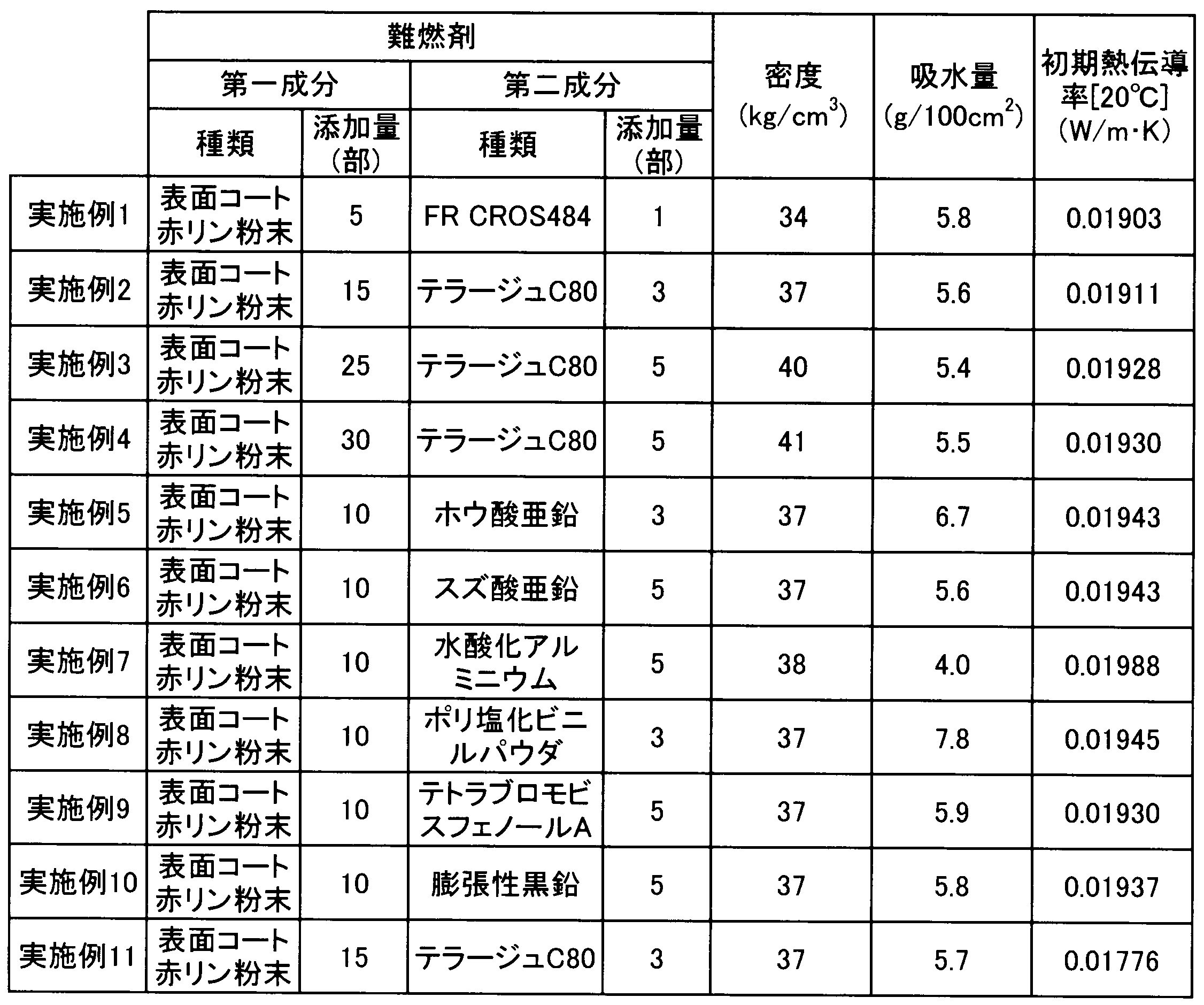
- Example 2 a surface-coated red phosphorus powder which is the first component of the flame retardant and a surface-coated ammonium polyphosphate ammonium (Terage C80 sold by CBC Co., average particle size: 19 ⁇ m) which is the second component are respectively described below.
- Various phenol resin foams were produced in the same manner as in Example 1 except that the addition amounts shown in Table 1 were used.
- Example 1 the addition amount of the surface-coated red phosphorus powder, which is the first component in the flame retardant, and the second component, zinc borate, zinc stannate, aluminum hydroxide, polyvinyl chloride powder, tetrabromobisphenol A, or Various phenol resin foams were produced in the same manner as in Example 1 except that the amount of expandable graphite added was changed to the ratio shown in Table 1 below.
- Example 11 In Example 2, the blowing agent was changed to hydrofluoroolefin (1,1,1,4,4,4-hexafluoro-2-butene: HFO-1336mzz, a product of Chemours), and the addition amount was 17.
- a phenol resin foam was produced in the same manner as in Example 2 except that the amount was 5 parts.
- Example 1 A phenol resin foam was obtained in the same manner as in Example 1 except that the first and second components as flame retardants were not added.
- Example 1 As a flame retardant, FR CROS484 as a second component, Terarge C80, zinc borate, zinc stannate, aluminum hydroxide, polychlorinated without adding the surface-coated red phosphorus powder as the first component.
- Various phenol resin foams were obtained in the same manner as in Example 1 except that only vinyl powder, tetrabromobisphenol A, or expandable graphite was used and the addition amount was changed to the ratios shown in Tables 2 and 3 below. I tried to make. However, in Comparative Examples 6, 8, 10 and 12, the curing reaction of the phenol resin composition did not proceed sufficiently, and a foam whose physical properties could be measured could not be obtained.
- the phenol resin foams formed in Examples 1 to 11 all had a total calorific value of 8 MJ / m 2 or less in the combustion test (10 minutes). It was confirmed that it is useful as a quasi-incombustible material specified by the Building Standards Law of Japan because it has a maximum heat generation rate of less than the specified value. Moreover, the phenolic resin foams obtained in these examples have low initial thermal conductivity and sufficient compressive strength, and have a heat insulating property as well as physical or mechanical properties. Also in, it was confirmed that it was excellent.
- Comparative Example 1 was the case where no flame retardant was added, and Comparative Examples 2 to 20 increased the amount of the first component alone or the amount of the second component alone used as the flame retardant.
- All of the phenol resin foams obtained there have a total calorific value of more than 8 MJ / m 2 and are standards for quasi-incombustible materials specified by the Building Standards Law of Japan. It was found that the above was not satisfied.
- Comparative Examples 6, 8, 10 and 12 the curing reaction of the phenol resin composition did not proceed smoothly because the amount of the second component used as the flame retardant was too large, and therefore the physical properties were measured. It was revealed that it was not possible to obtain a foam capable of
Landscapes
- Chemical & Material Sciences (AREA)
- Health & Medical Sciences (AREA)
- Chemical Kinetics & Catalysis (AREA)
- Medicinal Chemistry (AREA)
- Polymers & Plastics (AREA)
- Organic Chemistry (AREA)
- Engineering & Computer Science (AREA)
- Materials Engineering (AREA)
- Inorganic Chemistry (AREA)
- Manufacture Of Porous Articles, And Recovery And Treatment Of Waste Products (AREA)
- Compositions Of Macromolecular Compounds (AREA)
Abstract
Description
還流器、温度計及び撹拌機を備えた三つ口反応フラスコ内に、フェノール1600部、47%ホルマリン2282部及び50%水酸化ナトリウム水溶液41.6部を仕込み、80℃の温度下において70分間反応させた。次いで、40℃に冷却した後、50%パラトルエンスルホン酸水溶液で中和せしめ、その後、減圧・加熱下において、水分率:10%まで脱水濃縮することにより、液状のレゾール型フェノール樹脂を得た。この得られたフェノール樹脂は、粘度:10000mPa・s/25℃、数平均分子量:380、遊離フェノール含有量:4.0%の特性を有するものであった。
実施例1において、難燃剤の第一成分である表面コート赤リン粉末と、第二成分である表面コートポリリン酸アンモニウム(CBC株式会社販売のテラージュC80、平均粒径:19μm)とを、それぞれ下記表1に示される添加量としたこと以外は、実施例1と同様にして、各種のフェノール樹脂発泡体を、それぞれ、作製した。
実施例1において、難燃剤における第一成分である表面コート赤リン粉末の添加量と、第二成分であるホウ酸亜鉛、スズ酸亜鉛、水酸化アルミニウム、ポリ塩化ビニルパウダ、テトラブロモビスフェノールA、又は膨張性黒鉛の添加量とを、下記表1に示す割合としたこと以外は、実施例1と同様にして、各種のフェノール樹脂発泡体を、それぞれ作製した。
実施例2において、発泡剤を、ハイドロフルオロオレフィン(1,1,1,4,4,4-ヘキサフルオロ-2-ブテン:HFO-1336mzz、Chemours社製品)に変更し、その添加量を17.5部としたこと以外は、実施例2と同様にして、フェノール樹脂発泡体を作製した。
実施例1において、難燃剤としての第一成分及び第二成分を全く添加しなかったこと以外は、実施例1と同様にして、フェノール樹脂発泡体を得た。
実施例1において、難燃剤として、表面コート赤リン粉末のみを用いると共に、その添加量を下記表2に示される割合としたこと以外は、実施例1と同様にして、各種のフェノール樹脂発泡体を、それぞれ作製した。
実施例1において、難燃剤として、第一成分である表面コート赤リン粉末を添加することなく、第二成分であるFR CROS484、テラージュC80、ホウ酸亜鉛、スズ酸亜鉛、水酸化アルミニウム、ポリ塩化ビニルパウダ、テトラブロモビスフェノールA、又は膨張性黒鉛のみを用い、その添加量を、下記表2及び表3に示される割合としたこと以外は、実施例1と同様にして、各種のフェノール樹脂発泡体の作製を試みた。しかしながら、比較例6、8、10及び12においては、フェノール樹脂組成物の硬化反応が充分に進行せず、物性測定が可能な発泡体を得ることが出来なかった。
JIS-A-9511(2003)における「5.6密度」の記載に従って、それぞれの発泡体の密度を測定した。
JIS A9511:2006Rにおける「5.14(測定方法A)」に従い、測定した。
300mm角のフェノール樹脂発泡体サンプルを用い、それを200mm角にカット(厚みは50mm)した後、低温板温度:10℃、高温板温度:30℃に設定して、JIS-A-1412-2(1999)に規定の「熱流計法」に従い、熱伝導率測定装置:HC-074 304(英弘精機株式会社製)を使用して、測定する。なお、ここでは、フェノール樹脂発泡体サンプルを、70℃の雰囲気下で4日間放置した後の熱伝導率を、初期熱伝導率として、測定した。
ASTM-D2856の規定に従って、フェノール樹脂発泡体サンプルの独立気泡率を測定した。
JIS-A-9511(2003)における「5.9圧縮強さ」の記載に従って、フェノール樹脂発泡体サンプルの圧縮強さを測定した。
各フェノール樹脂発泡体から、縦×横のサイズがそれぞれ99±1mmとなるように、試験体を切り出して、それぞれの試験体を準備した。なお、かかる試験体の厚みは50mmとした。次いで、それら試験体について、コーンカロリーメーター(株式会社東洋精機製作所製CONE III)を用いて、ISO-5660の規定に準拠した、(財)日本建築総合試験所編「防耐火性能試験・評価業務方法書 4.12.1発熱性試験・評価方法」に従って、加熱時間:10分における総発熱量及び最大発熱速度を、それぞれ測定した。測定結果としては、それぞれの発泡体から切り出した試験体の3個について測定を行い、その得られた測定値の平均値を採用した。また、評価試験後の試験体について観察して、裏面まで貫通する亀裂や穴の有無を調べた。


実施例1と同様にして得られたレゾール型フェノール樹脂を用い、これに、水を適宜添加して、下記表7に示される粘度を有する各種のレゾール型フェノール樹脂を作製した。ここで、各レゾール型フェノール樹脂の粘度は、JIS-K-7117-1に従い、ブルックフィールド形回転粘度計を用いて、試験温度:25℃で測定した。次いで、それらレゾール型フェノール樹脂の各々の100部と、実施例で用いた難燃剤である赤リン粉末の5部及びホウ酸亜鉛の5部とを混合せしめた後、容量110ml、胴径40mmのガラス製スクリュー管瓶に収容して、1週間室温で静置し、かかるスクリュー管瓶に生じる沈殿物の有無及び沈殿層の高さを評価した。なお、その評価に際しては、沈殿物を観察できない場合を○、沈殿層の高さが5mm以下の場合を△、沈殿層の高さが5mmを超えた場合を×とし、その結果を、下記表7に示した。

Claims (11)
- レゾール型フェノール樹脂、発泡剤及び酸硬化剤と共に、難燃剤として、赤リン粉末からなる第一成分と、赤リン以外のリン系難燃剤、無機系難燃剤、ハロゲン系難燃剤及び黒鉛系難燃剤からなる群れより選ばれた少なくとも一つからなる第二成分とを組み合わせて、含有せしめたことを特徴とする準不燃性フェノール樹脂組成物。
- 前記難燃剤が、前記第一成分と前記第二成分の合計量において、前記レゾール型フェノール樹脂の100質量部に対して、2~35質量部の割合となるように含有せしめられている請求項1に記載の準不燃性フェノール樹脂組成物。
- 前記難燃剤を構成する前記第一成分及び前記第二成分が、それぞれ、前記レゾール型フェノール樹脂の100質量部に対して、1~30質量部及び1~10質量部の割合となるように含有せしめられている請求項1又は請求項2に記載の準不燃性フェノール樹脂組成物。
- 前記赤リン粉末が、金属の酸化物乃至は水酸化物及び/又は熱硬化性樹脂により形成されている表面コーティング層を有していることを特徴とする請求項1乃至請求項3の何れか1項に記載の準不燃性フェノール樹脂組成物。
- 前記赤リン以外のリン系難燃剤が、表面コーティング層の形成されてなるポリリン酸アンモニウム粉末である請求項1乃至請求項4の何れか1項に記載の準不燃性フェノール樹脂組成物。
- 前記ポリリン酸アンモニウム粉末の表面コーティング層が、難溶性熱硬化性樹脂にて形成されている請求項5に記載の準不燃性フェノール樹脂組成物。
- 前記発泡剤として、ハロゲン化アルケン、或は塩素化脂肪族炭化水素及び/又は脂肪族炭化水素が、含有せしめられている請求項1乃至請求項6の何れか1項に記載の準不燃性フェノール樹脂組成物。
- 前記発泡剤が、イソペンタンとイソプロピルクロリドとの混合物である請求項1乃至請求項6の何れか1項に記載の準不燃性フェノール樹脂組成物。
- 前記レゾール型フェノール樹脂が、25℃において、2000mPa・s以上の粘度を有するように調整されていることを特徴とする請求項1乃至請求項8の何れか1項に記載の準不燃性フェノール樹脂組成物。
- 請求項1乃至請求項9の何れか1項に記載の準不燃性フェノール樹脂組成物を発泡、硬化させて得られる発泡体からなる準不燃材料。
- 前記発泡体が、ISO-5660に規定される発熱性試験方法に準拠して、放射熱強度:50kW/m2 にて加熱したときに、加熱開始から10分間の総発熱量が8.0MJ/m2 以下であることを特徴とする請求項10に記載の準不燃材料。
Priority Applications (5)
| Application Number | Priority Date | Filing Date | Title |
|---|---|---|---|
| JP2020553068A JP7531398B2 (ja) | 2018-10-16 | 2019-10-04 | 準不燃性フェノール樹脂組成物及びそれから得られた準不燃材料 |
| CN201980060939.8A CN112703225B (zh) | 2018-10-16 | 2019-10-04 | 准不燃性酚醛树脂组合物及由其得到的准不燃材料 |
| KR1020227025043A KR102605769B1 (ko) | 2018-10-16 | 2019-10-04 | 준불연성 페놀 수지 조성물 및 그것으로부터 얻어진 준불연 재료 |
| KR1020217007485A KR102469128B1 (ko) | 2018-10-16 | 2019-10-04 | 준불연성 페놀 수지 조성물 및 그것으로부터 얻어진 준불연 재료 |
| EP19874001.1A EP3868826A4 (en) | 2018-10-16 | 2019-10-04 | SEMI-NON-FLAMMABLE PHENOLIC RESIN COMPOSITION AND SEMI-NON-FLAMMABLE MATERIAL MADE THEREOF |
Applications Claiming Priority (2)
| Application Number | Priority Date | Filing Date | Title |
|---|---|---|---|
| JP2018-194842 | 2018-10-16 | ||
| JP2018194842 | 2018-10-16 |
Publications (1)
| Publication Number | Publication Date |
|---|---|
| WO2020080148A1 true WO2020080148A1 (ja) | 2020-04-23 |
Family
ID=70284330
Family Applications (1)
| Application Number | Title | Priority Date | Filing Date |
|---|---|---|---|
| PCT/JP2019/039325 Ceased WO2020080148A1 (ja) | 2018-10-16 | 2019-10-04 | 準不燃性フェノール樹脂組成物及びそれから得られた準不燃材料 |
Country Status (5)
| Country | Link |
|---|---|
| EP (1) | EP3868826A4 (ja) |
| JP (1) | JP7531398B2 (ja) |
| KR (2) | KR102605769B1 (ja) |
| CN (1) | CN112703225B (ja) |
| WO (1) | WO2020080148A1 (ja) |
Cited By (4)
| Publication number | Priority date | Publication date | Assignee | Title |
|---|---|---|---|---|
| WO2021186072A1 (en) * | 2020-03-19 | 2021-09-23 | Kingspan Holdings (Irl) Limited | Phenolic foam and method of manufacture thereof |
| JPWO2022230956A1 (ja) * | 2021-04-30 | 2022-11-03 | ||
| WO2022255292A1 (ja) * | 2021-05-31 | 2022-12-08 | 旭有機材株式会社 | フェノールフォーム用樹脂組成物及び発泡体 |
| CN119751975A (zh) * | 2024-11-22 | 2025-04-04 | 哈尔滨工业大学 | 一种铁-硅改性生物炭阻燃剂的制备方法及其改性酚醛泡沫的制备方法 |
Families Citing this family (5)
| Publication number | Priority date | Publication date | Assignee | Title |
|---|---|---|---|---|
| WO2021162528A1 (ko) * | 2020-02-11 | 2021-08-19 | (주)엘지하우시스 | 열경화성 발포체 및 이의 제조방법 |
| KR102383660B1 (ko) * | 2021-07-12 | 2022-04-11 | 명일폼테크주식회사 | 준불연 페놀 발포폼 조성물 |
| KR102644149B1 (ko) | 2022-01-24 | 2024-03-06 | (주)유시스템 | 압력 제어 시스템에서의 비례압력제어 밸브 제어 기준 값 설정 방법 및 그를 이용한 압력제어 시스템 |
| KR102534859B1 (ko) * | 2022-07-06 | 2023-05-26 | 명일폼테크주식회사 | 준불연 페놀 발포폼 |
| KR102716430B1 (ko) * | 2023-08-22 | 2024-10-15 | (주)상아글로벌 | 난연성 페놀 수지 조성물 |
Citations (9)
| Publication number | Priority date | Publication date | Assignee | Title |
|---|---|---|---|---|
| JPS60170636A (ja) | 1984-02-14 | 1985-09-04 | Matsushita Electric Works Ltd | フエノ−ル樹脂発泡体 |
| JPH0249037A (ja) | 1988-08-11 | 1990-02-19 | Toyo Tire & Rubber Co Ltd | 難燃性フエノール樹脂発泡体の製造方法 |
| JPH07330995A (ja) * | 1994-06-10 | 1995-12-19 | Nippon Steel Chem Co Ltd | スチレン系難燃性樹脂組成物 |
| JPH08176343A (ja) | 1994-12-22 | 1996-07-09 | Mitsui Toatsu Chem Inc | 難燃性樹脂組成物 |
| JPH09169887A (ja) * | 1995-12-21 | 1997-06-30 | Sumitomo Bakelite Co Ltd | フェノール樹脂組成物 |
| JP2004307602A (ja) * | 2003-04-04 | 2004-11-04 | Kanegafuchi Chem Ind Co Ltd | 熱可塑性樹脂発泡体及びその製造方法 |
| WO2006043435A1 (ja) * | 2004-10-22 | 2006-04-27 | Takashi Fujimori | 発泡体の製造方法 |
| JP2007070511A (ja) | 2005-09-08 | 2007-03-22 | Nitto Boseki Co Ltd | フェノール樹脂発泡体 |
| JP2007161810A (ja) | 2005-12-12 | 2007-06-28 | Asahi Organic Chem Ind Co Ltd | フェノール樹脂発泡体 |
Family Cites Families (18)
| Publication number | Priority date | Publication date | Assignee | Title |
|---|---|---|---|---|
| JPH09157428A (ja) * | 1995-12-01 | 1997-06-17 | Sekisui Chem Co Ltd | 難燃性ポリオレフィン系樹脂発泡体 |
| WO1998058993A1 (en) * | 1997-06-23 | 1998-12-30 | The Furukawa Electric Co., Ltd. | Non-halogenated, flame-retardant resin foam |
| DE19856759A1 (de) | 1998-12-09 | 2000-06-15 | Basf Ag | Flammgeschützte Polystyrolschaumstoffe |
| US6753363B1 (en) * | 1999-07-16 | 2004-06-22 | Polyplastics Co., Ltd. | Polyacetal resin composition and process for production thereof |
| EP1616924A1 (en) * | 2004-07-13 | 2006-01-18 | Huntsman Advanced Materials (Switzerland) GmbH | Fire retardant composition |
| CN101305035B (zh) | 2005-09-08 | 2012-11-21 | 金斯潘控股有限公司 | 一种酚醛泡沫体 |
| JP2007070504A (ja) | 2005-09-08 | 2007-03-22 | Nitto Boseki Co Ltd | フェノール樹脂発泡体 |
| JP5400485B2 (ja) * | 2009-06-10 | 2014-01-29 | 旭有機材工業株式会社 | 発泡性レゾール型フェノール樹脂成形材料及びそれを用いてなるフェノール樹脂発泡体 |
| TW201439287A (zh) | 2013-01-20 | 2014-10-16 | Sekisui Chemical Co Ltd | 阻燃性胺甲酸乙酯樹脂組成物 |
| JP5877913B1 (ja) * | 2014-08-20 | 2016-03-08 | 旭化成建材株式会社 | フェノール樹脂発泡体積層板及びその製造方法 |
| KR102156004B1 (ko) * | 2014-09-26 | 2020-09-15 | 세키스이가가쿠 고교가부시키가이샤 | 난연성 우레탄 수지 조성물 |
| AU2016237124B2 (en) * | 2015-03-24 | 2020-07-23 | Sekisui Chemical Co., Ltd. | Phenolic resin foam and method for producing phenolic resin foam |
| JP6744044B2 (ja) | 2016-07-04 | 2020-08-19 | 株式会社ブリヂストン | ゴム発泡体用ゴム組成物、それを発泡させてなるゴム発泡体及びシール材 |
| KR101792186B1 (ko) * | 2017-05-24 | 2017-10-31 | 한국건설기술연구원 | 준불연성 수지 조성물을 이용한 건축용 외단열재 및 그 제조방법 |
| CN107746544A (zh) * | 2017-11-21 | 2018-03-02 | 南宁可煜能源科技有限公司 | 一种酚醛泡沫复合保温材料及其制备方法 |
| CN107915953A (zh) * | 2017-11-21 | 2018-04-17 | 南宁可煜能源科技有限公司 | 一种平板集热器复合保温材料及其制备方法 |
| CN107778766A (zh) * | 2017-11-21 | 2018-03-09 | 南宁可煜能源科技有限公司 | 一种用于平板太阳能集热器的酚醛泡沫保温材料 |
| KR20180054540A (ko) * | 2018-05-11 | 2018-05-24 | 한국건설기술연구원 | 레졸형 페놀수지 조성물, 그의 제조방법 및 그를 사용하여 제조된 레졸형 페놀수지 발포체 |
-
2019
- 2019-10-04 CN CN201980060939.8A patent/CN112703225B/zh active Active
- 2019-10-04 JP JP2020553068A patent/JP7531398B2/ja active Active
- 2019-10-04 WO PCT/JP2019/039325 patent/WO2020080148A1/ja not_active Ceased
- 2019-10-04 EP EP19874001.1A patent/EP3868826A4/en active Pending
- 2019-10-04 KR KR1020227025043A patent/KR102605769B1/ko active Active
- 2019-10-04 KR KR1020217007485A patent/KR102469128B1/ko active Active
Patent Citations (9)
| Publication number | Priority date | Publication date | Assignee | Title |
|---|---|---|---|---|
| JPS60170636A (ja) | 1984-02-14 | 1985-09-04 | Matsushita Electric Works Ltd | フエノ−ル樹脂発泡体 |
| JPH0249037A (ja) | 1988-08-11 | 1990-02-19 | Toyo Tire & Rubber Co Ltd | 難燃性フエノール樹脂発泡体の製造方法 |
| JPH07330995A (ja) * | 1994-06-10 | 1995-12-19 | Nippon Steel Chem Co Ltd | スチレン系難燃性樹脂組成物 |
| JPH08176343A (ja) | 1994-12-22 | 1996-07-09 | Mitsui Toatsu Chem Inc | 難燃性樹脂組成物 |
| JPH09169887A (ja) * | 1995-12-21 | 1997-06-30 | Sumitomo Bakelite Co Ltd | フェノール樹脂組成物 |
| JP2004307602A (ja) * | 2003-04-04 | 2004-11-04 | Kanegafuchi Chem Ind Co Ltd | 熱可塑性樹脂発泡体及びその製造方法 |
| WO2006043435A1 (ja) * | 2004-10-22 | 2006-04-27 | Takashi Fujimori | 発泡体の製造方法 |
| JP2007070511A (ja) | 2005-09-08 | 2007-03-22 | Nitto Boseki Co Ltd | フェノール樹脂発泡体 |
| JP2007161810A (ja) | 2005-12-12 | 2007-06-28 | Asahi Organic Chem Ind Co Ltd | フェノール樹脂発泡体 |
Non-Patent Citations (1)
| Title |
|---|
| See also references of EP3868826A4 |
Cited By (10)
| Publication number | Priority date | Publication date | Assignee | Title |
|---|---|---|---|---|
| WO2021186072A1 (en) * | 2020-03-19 | 2021-09-23 | Kingspan Holdings (Irl) Limited | Phenolic foam and method of manufacture thereof |
| JP2023520639A (ja) * | 2020-03-19 | 2023-05-18 | キングスパン・ホールディングス・(アイアールエル)・リミテッド | フェノールフォーム及びその製造方法 |
| JP7837874B2 (ja) | 2020-03-19 | 2026-03-31 | キングスパン・ホールディングス・(アイアールエル)・リミテッド | フェノールフォーム及びその製造方法 |
| JPWO2022230956A1 (ja) * | 2021-04-30 | 2022-11-03 | ||
| WO2022230956A1 (ja) * | 2021-04-30 | 2022-11-03 | 株式会社カネカ | 難燃性物品 |
| US20240059886A1 (en) * | 2021-04-30 | 2024-02-22 | Kaneka Corporation | Fire-resistant article |
| WO2022255292A1 (ja) * | 2021-05-31 | 2022-12-08 | 旭有機材株式会社 | フェノールフォーム用樹脂組成物及び発泡体 |
| JPWO2022255292A1 (ja) * | 2021-05-31 | 2022-12-08 | ||
| JP7849357B2 (ja) | 2021-05-31 | 2026-04-21 | 旭有機材株式会社 | フェノールフォーム用樹脂組成物及び発泡体 |
| CN119751975A (zh) * | 2024-11-22 | 2025-04-04 | 哈尔滨工业大学 | 一种铁-硅改性生物炭阻燃剂的制备方法及其改性酚醛泡沫的制备方法 |
Also Published As
| Publication number | Publication date |
|---|---|
| KR102469128B1 (ko) | 2022-11-21 |
| JPWO2020080148A1 (ja) | 2021-09-16 |
| EP3868826A1 (en) | 2021-08-25 |
| EP3868826A4 (en) | 2022-06-22 |
| JP7531398B2 (ja) | 2024-08-09 |
| KR20210076898A (ko) | 2021-06-24 |
| CN112703225B (zh) | 2024-05-07 |
| KR20220108829A (ko) | 2022-08-03 |
| CN112703225A (zh) | 2021-04-23 |
| KR102605769B1 (ko) | 2023-11-24 |
Similar Documents
| Publication | Publication Date | Title |
|---|---|---|
| JP7531398B2 (ja) | 準不燃性フェノール樹脂組成物及びそれから得られた準不燃材料 | |
| JP7141983B2 (ja) | フェノールフォーム製造用樹脂組成物並びにフェノールフォーム及びその製造方法 | |
| JP7289302B2 (ja) | フェノールフォーム製造用樹脂組成物 | |
| JP4756683B2 (ja) | 発泡性レゾール型フェノール樹脂成形材料およびフェノール樹脂発泡体 | |
| KR20110117076A (ko) | 발포성 레졸형 페놀 수지 성형 재료 및 그 제조 방법 그리고 페놀 수지 발포체 | |
| JP5036021B2 (ja) | フェノール樹脂発泡体 | |
| CA3166680C (en) | PHENOLIC RESIN FOAM LAMINATE | |
| JP7473476B2 (ja) | 難燃性フェノール樹脂組成物及びそれから得られた難燃材料 | |
| KR101866422B1 (ko) | 화재에 안전한 발열패널 | |
| GB1604657A (en) | Phenolic resins and products prepared therefrom | |
| JP2514879B2 (ja) | 防火性フェノ―ル樹脂発泡性組成物及び発泡体の製造方法 | |
| JP2018123292A (ja) | フェノール樹脂発泡体積層板及びその製造方法 |
Legal Events
| Date | Code | Title | Description |
|---|---|---|---|
| 121 | Ep: the epo has been informed by wipo that ep was designated in this application |
Ref document number: 19874001 Country of ref document: EP Kind code of ref document: A1 |
|
| ENP | Entry into the national phase |
Ref document number: 2020553068 Country of ref document: JP Kind code of ref document: A |
|
| ENP | Entry into the national phase |
Ref document number: 20217007485 Country of ref document: KR Kind code of ref document: A |
|
| NENP | Non-entry into the national phase |
Ref country code: DE |
|
| ENP | Entry into the national phase |
Ref document number: 2019874001 Country of ref document: EP Effective date: 20210517 |