WO2020085456A1 - Acide ribonucléique double brin inhibant l'expression du complément c5 - Google Patents
Acide ribonucléique double brin inhibant l'expression du complément c5 Download PDFInfo
- Publication number
- WO2020085456A1 WO2020085456A1 PCT/JP2019/041783 JP2019041783W WO2020085456A1 WO 2020085456 A1 WO2020085456 A1 WO 2020085456A1 JP 2019041783 W JP2019041783 W JP 2019041783W WO 2020085456 A1 WO2020085456 A1 WO 2020085456A1
- Authority
- WO
- WIPO (PCT)
- Prior art keywords
- seq
- double
- ribonucleic acid
- stranded ribonucleic
- lipid
- Prior art date
- Legal status (The legal status is an assumption and is not a legal conclusion. Google has not performed a legal analysis and makes no representation as to the accuracy of the status listed.)
- Ceased
Links
Images



Classifications
-
- A—HUMAN NECESSITIES
- A61—MEDICAL OR VETERINARY SCIENCE; HYGIENE
- A61P—SPECIFIC THERAPEUTIC ACTIVITY OF CHEMICAL COMPOUNDS OR MEDICINAL PREPARATIONS
- A61P7/00—Drugs for disorders of the blood or the extracellular fluid
-
- C—CHEMISTRY; METALLURGY
- C12—BIOCHEMISTRY; BEER; SPIRITS; WINE; VINEGAR; MICROBIOLOGY; ENZYMOLOGY; MUTATION OR GENETIC ENGINEERING
- C12N—MICROORGANISMS OR ENZYMES; COMPOSITIONS THEREOF; PROPAGATING, PRESERVING, OR MAINTAINING MICROORGANISMS; MUTATION OR GENETIC ENGINEERING; CULTURE MEDIA
- C12N15/00—Mutation or genetic engineering; DNA or RNA concerning genetic engineering, vectors, e.g. plasmids, or their isolation, preparation or purification; Use of hosts therefor
- C12N15/09—Recombinant DNA-technology
- C12N15/11—DNA or RNA fragments; Modified forms thereof; Non-coding nucleic acids having a biological activity
- C12N15/113—Non-coding nucleic acids modulating the expression of genes, e.g. antisense oligonucleotides; Antisense DNA or RNA; Triplex- forming oligonucleotides; Catalytic nucleic acids, e.g. ribozymes; Nucleic acids used in co-suppression or gene silencing
-
- A—HUMAN NECESSITIES
- A61—MEDICAL OR VETERINARY SCIENCE; HYGIENE
- A61K—PREPARATIONS FOR MEDICAL, DENTAL OR TOILETRY PURPOSES
- A61K31/00—Medicinal preparations containing organic active ingredients
- A61K31/70—Carbohydrates; Sugars; Derivatives thereof
- A61K31/7088—Compounds having three or more nucleosides or nucleotides
- A61K31/713—Double-stranded nucleic acids or oligonucleotides
-
- A—HUMAN NECESSITIES
- A61—MEDICAL OR VETERINARY SCIENCE; HYGIENE
- A61K—PREPARATIONS FOR MEDICAL, DENTAL OR TOILETRY PURPOSES
- A61K9/00—Medicinal preparations characterised by special physical form
- A61K9/10—Dispersions; Emulsions
- A61K9/127—Synthetic bilayered vehicles, e.g. liposomes or liposomes with cholesterol as the only non-phosphatidyl surfactant
-
- A—HUMAN NECESSITIES
- A61—MEDICAL OR VETERINARY SCIENCE; HYGIENE
- A61K—PREPARATIONS FOR MEDICAL, DENTAL OR TOILETRY PURPOSES
- A61K9/00—Medicinal preparations characterised by special physical form
- A61K9/48—Preparations in capsules, e.g. of gelatin, of chocolate
- A61K9/50—Microcapsules having a gas, liquid or semi-solid filling; Solid microparticles or pellets surrounded by a distinct coating layer, e.g. coated microspheres, coated drug crystals
- A61K9/5005—Wall or coating material
- A61K9/5015—Organic compounds, e.g. fats, sugars
-
- A—HUMAN NECESSITIES
- A61—MEDICAL OR VETERINARY SCIENCE; HYGIENE
- A61P—SPECIFIC THERAPEUTIC ACTIVITY OF CHEMICAL COMPOUNDS OR MEDICINAL PREPARATIONS
- A61P13/00—Drugs for disorders of the urinary system
- A61P13/10—Drugs for disorders of the urinary system of the bladder
-
- C—CHEMISTRY; METALLURGY
- C12—BIOCHEMISTRY; BEER; SPIRITS; WINE; VINEGAR; MICROBIOLOGY; ENZYMOLOGY; MUTATION OR GENETIC ENGINEERING
- C12N—MICROORGANISMS OR ENZYMES; COMPOSITIONS THEREOF; PROPAGATING, PRESERVING, OR MAINTAINING MICROORGANISMS; MUTATION OR GENETIC ENGINEERING; CULTURE MEDIA
- C12N2310/00—Structure or type of the nucleic acid
- C12N2310/10—Type of nucleic acid
- C12N2310/11—Antisense
-
- C—CHEMISTRY; METALLURGY
- C12—BIOCHEMISTRY; BEER; SPIRITS; WINE; VINEGAR; MICROBIOLOGY; ENZYMOLOGY; MUTATION OR GENETIC ENGINEERING
- C12N—MICROORGANISMS OR ENZYMES; COMPOSITIONS THEREOF; PROPAGATING, PRESERVING, OR MAINTAINING MICROORGANISMS; MUTATION OR GENETIC ENGINEERING; CULTURE MEDIA
- C12N2310/00—Structure or type of the nucleic acid
- C12N2310/10—Type of nucleic acid
- C12N2310/11—Antisense
- C12N2310/111—Antisense spanning the whole gene, or a large part of it
-
- C—CHEMISTRY; METALLURGY
- C12—BIOCHEMISTRY; BEER; SPIRITS; WINE; VINEGAR; MICROBIOLOGY; ENZYMOLOGY; MUTATION OR GENETIC ENGINEERING
- C12N—MICROORGANISMS OR ENZYMES; COMPOSITIONS THEREOF; PROPAGATING, PRESERVING, OR MAINTAINING MICROORGANISMS; MUTATION OR GENETIC ENGINEERING; CULTURE MEDIA
- C12N2310/00—Structure or type of the nucleic acid
- C12N2310/10—Type of nucleic acid
- C12N2310/14—Type of nucleic acid interfering nucleic acids [NA]
-
- C—CHEMISTRY; METALLURGY
- C12—BIOCHEMISTRY; BEER; SPIRITS; WINE; VINEGAR; MICROBIOLOGY; ENZYMOLOGY; MUTATION OR GENETIC ENGINEERING
- C12N—MICROORGANISMS OR ENZYMES; COMPOSITIONS THEREOF; PROPAGATING, PRESERVING, OR MAINTAINING MICROORGANISMS; MUTATION OR GENETIC ENGINEERING; CULTURE MEDIA
- C12N2310/00—Structure or type of the nucleic acid
- C12N2310/30—Chemical structure
- C12N2310/31—Chemical structure of the backbone
- C12N2310/315—Phosphorothioates
-
- C—CHEMISTRY; METALLURGY
- C12—BIOCHEMISTRY; BEER; SPIRITS; WINE; VINEGAR; MICROBIOLOGY; ENZYMOLOGY; MUTATION OR GENETIC ENGINEERING
- C12N—MICROORGANISMS OR ENZYMES; COMPOSITIONS THEREOF; PROPAGATING, PRESERVING, OR MAINTAINING MICROORGANISMS; MUTATION OR GENETIC ENGINEERING; CULTURE MEDIA
- C12N2310/00—Structure or type of the nucleic acid
- C12N2310/30—Chemical structure
- C12N2310/31—Chemical structure of the backbone
- C12N2310/317—Chemical structure of the backbone with an inverted bond, e.g. a cap structure
-
- C—CHEMISTRY; METALLURGY
- C12—BIOCHEMISTRY; BEER; SPIRITS; WINE; VINEGAR; MICROBIOLOGY; ENZYMOLOGY; MUTATION OR GENETIC ENGINEERING
- C12N—MICROORGANISMS OR ENZYMES; COMPOSITIONS THEREOF; PROPAGATING, PRESERVING, OR MAINTAINING MICROORGANISMS; MUTATION OR GENETIC ENGINEERING; CULTURE MEDIA
- C12N2310/00—Structure or type of the nucleic acid
- C12N2310/30—Chemical structure
- C12N2310/32—Chemical structure of the sugar
- C12N2310/321—2'-O-R Modification
-
- C—CHEMISTRY; METALLURGY
- C12—BIOCHEMISTRY; BEER; SPIRITS; WINE; VINEGAR; MICROBIOLOGY; ENZYMOLOGY; MUTATION OR GENETIC ENGINEERING
- C12N—MICROORGANISMS OR ENZYMES; COMPOSITIONS THEREOF; PROPAGATING, PRESERVING, OR MAINTAINING MICROORGANISMS; MUTATION OR GENETIC ENGINEERING; CULTURE MEDIA
- C12N2310/00—Structure or type of the nucleic acid
- C12N2310/30—Chemical structure
- C12N2310/35—Nature of the modification
- C12N2310/351—Conjugate
- C12N2310/3515—Lipophilic moiety, e.g. cholesterol
-
- C—CHEMISTRY; METALLURGY
- C12—BIOCHEMISTRY; BEER; SPIRITS; WINE; VINEGAR; MICROBIOLOGY; ENZYMOLOGY; MUTATION OR GENETIC ENGINEERING
- C12N—MICROORGANISMS OR ENZYMES; COMPOSITIONS THEREOF; PROPAGATING, PRESERVING, OR MAINTAINING MICROORGANISMS; MUTATION OR GENETIC ENGINEERING; CULTURE MEDIA
- C12N2310/00—Structure or type of the nucleic acid
- C12N2310/30—Chemical structure
- C12N2310/35—Nature of the modification
- C12N2310/352—Nature of the modification linked to the nucleic acid via a carbon atom
- C12N2310/3521—Methyl
-
- C—CHEMISTRY; METALLURGY
- C12—BIOCHEMISTRY; BEER; SPIRITS; WINE; VINEGAR; MICROBIOLOGY; ENZYMOLOGY; MUTATION OR GENETIC ENGINEERING
- C12N—MICROORGANISMS OR ENZYMES; COMPOSITIONS THEREOF; PROPAGATING, PRESERVING, OR MAINTAINING MICROORGANISMS; MUTATION OR GENETIC ENGINEERING; CULTURE MEDIA
- C12N2320/00—Applications; Uses
- C12N2320/10—Applications; Uses in screening processes
- C12N2320/11—Applications; Uses in screening processes for the determination of target sites, i.e. of active nucleic acids
-
- C—CHEMISTRY; METALLURGY
- C12—BIOCHEMISTRY; BEER; SPIRITS; WINE; VINEGAR; MICROBIOLOGY; ENZYMOLOGY; MUTATION OR GENETIC ENGINEERING
- C12N—MICROORGANISMS OR ENZYMES; COMPOSITIONS THEREOF; PROPAGATING, PRESERVING, OR MAINTAINING MICROORGANISMS; MUTATION OR GENETIC ENGINEERING; CULTURE MEDIA
- C12N2320/00—Applications; Uses
- C12N2320/30—Special therapeutic applications
- C12N2320/32—Special delivery means, e.g. tissue-specific
Definitions
- the present invention relates to a double-stranded ribonucleic acid (dsRNA) that suppresses the expression of complement C5.
- dsRNA double-stranded ribonucleic acid
- the present invention particularly relates to a double-stranded ribonucleic acid, a lipid complex encapsulating the same, and a complement C5 inhibitor and a pharmaceutical composition containing the double-stranded ribonucleic acid or the lipid complex.
- the group of proteins called complement includes proteins represented by C1 to C9, and these proteins are activated in a chain by three different pathways (classical pathway, lectin pathway, second pathway), An immune response is triggered.
- C5 which is the fifth component of complement, is decomposed into C5a and C5b by C5 convertase.
- the resulting C5a is called anaphylatoxin, and it induces an inflammatory reaction in various cells via C5aR (CD88) and C5L2 (GPR77).
- the generated C5b sequentially reacts with C6-C9 to become a final product, a membrane attack complex (MAC), which causes lysis and cell lysis of the pathogen.
- MAC membrane attack complex
- the complement system can exert a powerful damaging effect on host cells if it is not properly regulated or if it is over-activated.
- complement C5 was found to be paroxysmal nocturnal hemoglobinuria (PNH), atypical hemolytic uremic syndrome (aHUS), myasthenia gravis (MG), neuromyelitis optica (NMO), antibody-related renal disease.
- PNH paroxysmal nocturnal hemoglobinuria
- aHUS atypical hemolytic uremic syndrome
- MG myasthenia gravis
- NMO neuromyelitis optica
- Non-Patent Document 1 paroxysmal nocturnal hemoglobinuria
- Non-Patent Document 2 atypical hemolytic uremic syndrome
- Non-Patent Document 3 myasthenia gravis
- Non-Patent Document 4 optic neuromyelitis
- Non-Patent Document 5 Regarding antibody-related renal transplant rejection
- Eculizumab (Sorilis (registered trademark)), which is an anti-C5 monoclonal antibody, has a high affinity for complement C5 and inhibits the cleavage of C5 to C5a / C5b and the formation of a complex membrane attack complex. Suppresses excessive activation of the body.
- eculizumab has an inhibitory effect on hemolysis and is known as a therapeutic agent for paroxysmal nocturnal hemoglobinuria and atypical hemolytic uremic syndrome.
- Eculizumab is also known as a therapeutic agent for generalized myasthenia gravis (gMG).
- gMG generalized myasthenia gravis
- RNA interference RNA interference
- dsRNA double-stranded ribonucleic acid
- RISC RNA-induced silencing complex
- the object of the present invention is to provide a novel double-stranded ribonucleic acid for suppressing the expression of complement C5.
- a double-stranded ribonucleic acid having a combination of a sense strand and an antisense strand A combination of sense and antisense strands SEQ ID NO: 159 and SEQ ID NO: 160, SEQ ID NO: 141 and SEQ ID NO: 142, SEQ ID NO: 143 and SEQ ID NO: 144, SEQ ID NO: 145 and SEQ ID NO: 146, SEQ ID NO: 147 and SEQ ID NO: 148, and SEQ ID NO: 153 and SEQ ID NO: 154
- a double-stranded ribonucleic acid having a combination of a sense strand and an antisense strand A combination of sense and antisense strands Two selected from the group consisting of SEQ ID NO: 141 and SEQ ID NO: 142, SEQ ID NO: 143 and SEQ ID NO: 144, SEQ ID NO: 145 and SEQ ID NO: 146, SEQ ID NO: 147 and SEQ ID NO: 148, and SEQ ID NO: 153 and SEQ ID NO: 154.
- Strand ribonucleic acid [5] A double-stranded ribonucleic acid having a sense strand of SEQ ID NO: 141 and an antisense strand of SEQ ID NO: 142.
- a pharmaceutical composition comprising the double-stranded ribonucleic acid according to any one of [1] to [10].
- the pharmaceutical composition according to [12] further comprising a pharmaceutically acceptable carrier.
- [16] A lipid complex in which the double-stranded ribonucleic acid according to any one of [1] to [10] is encapsulated.
- [17] A cationic lipid, The lipid complex according to [16], which comprises a neutral lipid, a polyethylene glycol-modified lipid, and at least one lipid selected from the group consisting of sterols.
- a complement C5 inhibitor comprising the lipid complex according to any one of [16] to [21].
- a pharmaceutical composition comprising the lipid complex according to any one of [16] to [21].
- the pharmaceutical composition according to [23] further comprising a pharmaceutically acceptable carrier.
- the pharmaceutical composition according to [23] or [24] which is used for treating paroxysmal nocturnal hemoglobinuria.
- a method for treating paroxysmal nocturnal hemoglobinuria which comprises administering the double-stranded ribonucleic acid according to any one of [1] to [10] to a patient in need thereof.
- a method for treating atypical hemolytic uremic syndrome which comprises administering the double-stranded ribonucleic acid according to any one of [1] to [10] to a patient in need thereof.
- a method for treating paroxysmal nocturnal hemoglobinuria which comprises administering the lipid complex according to any of [16] to [21] to a patient in need thereof.
- a method for treating atypical hemolytic uremic syndrome which comprises administering the lipid complex according to any of [16] to [21] to a patient in need thereof.
- the lipid complex according to any of [16] to [21] for use in the treatment of paroxysmal nocturnal hemoglobinuria.
- the lipid complex according to any of [16] to [21] for use in the treatment of atypical hemolytic uremic syndrome.
- a novel double-stranded ribonucleic acid that suppresses the expression of complement C5, a lipid complex encapsulating the nucleic acid, a complement C5 inhibitor containing the nucleic acid or the lipid complex, and a pharmaceutical composition
- the double-stranded ribonucleic acid according to the present invention suppresses the expression of complement C5 and has an effect of suppressing hemolysis, so that it can be used for paroxysmal nocturnal hemoglobinuria (PNH) and atypical hemolytic uremic syndrome (aHUS). It has potential as a therapeutic agent.
- PNH paroxysmal nocturnal hemoglobinuria
- aHUS atypical hemolytic uremic syndrome
- FIG. 8 is a diagram showing the results of the C5 mRNA residual rate in the liver after administration of siRNA-008 and the C5 mRNA residual rate in the liver after administration of siRNA-008-34 in Example 5.
- FIG. 5 is a diagram showing the results of the C5 residual rate in plasma after administration of siRNA-008 and the C5 residual rate in plasma after administration of siRNA-008-34 in Example 5.
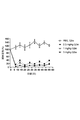
- FIG. 9 shows the results of complement activity after administration of siRNA-008-34 in Example 8.
- FIG. 8 shows the result of complement activity after administration of siRNA-008-34 in Example 9.
- FIG. 8 shows the results of complement activity after administration of siRNA-008-34 in Example 10.
- FIG. 8 shows the results of complement activity after administration of siRNA-008-34 in Example 11.
- Examples of the gene encoding complement C5 targeted by the double-stranded ribonucleic acid according to the present embodiment include, but are not limited to, C5 derived from human, mouse and monkey. Sequence information of C5 gene can be obtained from public databases in which sequence information is registered such as GenBank provided by National Center for Biotechnology Information (NCBI) in the United States, and C5 nucleotide sequence information of closely related animal species. It can be obtained by designing a primer based on the above and cloning from RNA extracted from a desired animal species. As the sequence of the mRNA transcript corresponding to the target gene human C5, for example, GenBank Accession No. The sequence of human C5 mRNA transcript of NM_001735.2 (GI: 38016946) can be mentioned. In the present specification, the C5 gene does not mean a gene having a specific sequence, but also includes, for example, a C5 gene having a naturally occurring single nucleotide polymorphism.
- the combination of the sense strand and the antisense strand is SEQ ID NO: 13 and SEQ ID NO: 14, SEQ ID NO: 159 and SEQ ID NO: 160, SEQ ID NO: 115, and Sequence number 116, sequence number 117 and sequence number 118, sequence number 119 and sequence number 120, sequence number 121 and sequence number 122, sequence number 123 and sequence number 124, sequence number 125 and sequence number 126, sequence number 127 and sequence number 128, sequence number 129 and sequence number 130, sequence number 131 and sequence number 132, sequence number 133 and sequence number 134, sequence number 137 and sequence number 138, sequence number 139 and sequence number 140, sequence number 141 and sequence number 142, SEQ ID NO: 143, SEQ ID NO: 144, SEQ ID NO: 145 Fine SEQ ID NO: 146, SEQ ID NO: 147 and SEQ ID NO: 148, SEQ ID NO: 13 and SEQ ID NO: 14, SEQ ID NO: 159 and SEQ ID NO: 160, SEQ ID NO
- the sense strand and antisense strand of any combination of the following (1) to (21) are paired.
- (1) the sense strand of SEQ ID NO: 13, and the antisense strand of SEQ ID NO: 14 (2) the sense strand of SEQ ID NO: 159, and the antisense strand of SEQ ID NO: 160 (3) the sense strand of SEQ ID NO: 115, and SEQ ID NO: 116
- Antisense strand (4) SEQ ID NO: 117 sense strand, and SEQ ID NO: 118 antisense strand (5) SEQ ID NO: 119 sense strand, and SEQ ID NO: 120 antisense strand (6) SEQ ID NO: 121 sense strand,
- the antisense strand of SEQ ID NO: 122 (7) the sense strand of SEQ ID NO: 123, and the antisense strand of SEQ ID NO: 124 (8) the sense strand of SEQ ID NO: 125, and the antisense
- the combination of the sense strand and the antisense strand of the above (1) to (21) includes regions complementary to each other.
- the double-stranded ribonucleic acid having the above (1) which is a combination of the sense strand of SEQ ID NO: 13 and the antisense strand of SEQ ID NO: 14, includes the following complementary strands (each dT ⁇ dT at the 3'end is Except for details, see Table 1). 5'-uGGuAuAuGuGuuGcuGAu-3 '(SEQ ID NO: 13) 3'-AcCAuAuAcAcAcAcAcGAcUA-5 '(SEQ ID NO: 14)
- a combination of the sense strand and the antisense strand is SEQ ID NO: 159 and SEQ ID NO: 160, SEQ ID NO: 139 and SEQ ID NO: 140, SEQ ID NO: 141, and It is selected from the group consisting of SEQ ID NO: 142, SEQ ID NO: 143 and SEQ ID NO: 144, SEQ ID NO: 145 and SEQ ID NO: 146, SEQ ID NO: 147 and SEQ ID NO: 148, and SEQ ID NO: 153 and SEQ ID NO: 154.
- siRNA-008-01 siRNA-008-31, siRNA-008-32, siRNA-008-33, siRNA-008-34, siRNA-008-35, and siRNA-008-in the present specification. 38 sequences, respectively.
- the combination of the sense strand and the antisense strand is SEQ ID NO: 159 and SEQ ID NO: 160, SEQ ID NO: 141 and SEQ ID NO: 142, SEQ ID NO: 143, and SEQ ID NO: 144, SEQ ID NO: 145 and SEQ ID NO: 146, SEQ ID NO: 147 and SEQ ID NO: 148, and SEQ ID NO: 153 and SEQ ID NO: 154.
- siRNA-008-01 corresponds to the sequences of siRNA-008-01, siRNA-008-32, siRNA-008-33, siRNA-008-34, siRNA-008-35, and siRNA-008-38, respectively, in the present specification. To do.
- the combination of the sense strand and the antisense strand is SEQ ID NO: 141 and SEQ ID NO: 142, SEQ ID NO: 143 and SEQ ID NO: 144, SEQ ID NO: 145 and It is selected from the group consisting of SEQ ID NO: 146, SEQ ID NO: 147 and SEQ ID NO: 148, and SEQ ID NO: 153 and SEQ ID NO: 154.
- the above combinations correspond to the sequences of siRNA-008-32, siRNA-008-33, siRNA-008-34, siRNA-008-35, and siRNA-008-38, respectively, in the present specification.
- the double-stranded ribonucleic acid having a sense strand and an antisense strand has a sense strand of SEQ ID NO: 159 and an antisense strand of SEQ ID NO: 160.
- the above combination corresponds to the sequence of siRNA-008-01 herein.
- the double-stranded ribonucleic acid having a sense strand and an antisense strand has a sense strand of SEQ ID NO: 141 and an antisense strand of SEQ ID NO: 142.
- the above combination corresponds to the sequence of siRNA-008-32 herein.
- the double-stranded ribonucleic acid having a sense strand and an antisense strand has a sense strand of SEQ ID NO: 143 and an antisense strand of SEQ ID NO: 144.
- the above combination corresponds to the sequence of siRNA-008-33 herein.
- the double-stranded ribonucleic acid having a sense strand and an antisense strand has a sense strand of SEQ ID NO: 145 and an antisense strand of SEQ ID NO: 146.
- the above combination corresponds to the sequence of siRNA-008-34 herein.
- the double-stranded ribonucleic acid having a sense strand and an antisense strand has a sense strand of SEQ ID NO: 147 and an antisense strand of SEQ ID NO: 148.
- the above combination corresponds to the sequence of siRNA-008-35 herein.
- the double-stranded ribonucleic acid having a sense strand and an antisense strand has a sense strand of SEQ ID NO: 153 and an antisense strand of SEQ ID NO: 154.
- the above combination corresponds to the sequence of siRNA-008-38 herein.
- the antisense strand according to this embodiment is substantially complementary to at least a part of the mRNA transcript of the C5 gene.
- substantially complementary means not only the case of being completely complementary to the mRNA transcript of the C5 gene, but also the case of containing an allowable 1 to several mismatches.
- the sense strand according to this embodiment is substantially complementary to at least a part of the base sequence of the antisense strand.
- substantially complementary means not only the case of being completely complementary to the base sequence of the antisense strand, but also the case of containing an allowable 1 to several mismatches.
- the double-stranded ribonucleic acid according to this embodiment also contains modified nucleotides (see also Table 1), as described below. Therefore, in the present specification, the term “nucleotide” includes not only guanosine-3′-phosphate, cytidine-3′-phosphate, adenosine-3′-phosphate and uridine-3′-phosphate, but also various modified nucleotides. It is used to include.
- double-stranded ribonucleic acid refers to a ribonucleic acid (RNA) molecule having a double-stranded structure containing two antiparallel and substantially complementary oligonucleotides or a molecule thereof. Refers to a complex.
- examples of the double-stranded ribonucleic acid include siRNA (small interfering RNA), but are not particularly limited thereto.
- the double-stranded ribonucleic acid according to this embodiment has a sense strand and an antisense strand.
- RNAi using the double-stranded ribonucleic acid according to this embodiment decomposes the mRNA of the C5 gene as a target mRNA molecule in the RISC complex, and as a result, the expression of C5 is suppressed. For example, it suppresses the expression of C5 in the cells of the subject.
- the double-stranded ribonucleic acid according to the present embodiment can be obtained by a method using chemical synthesis known in the art (for example, described in Nucleic Acid Research, 35 (10), 3287-96 (2007)), enzymatic transcription method, etc. Can be synthesized by.
- the double-stranded ribonucleic acid according to this embodiment includes various modifications.
- the modification can be performed by a method known in the art.
- Examples of the modification include sugar modification.
- the sugar modification is, for example, modification of the ribose moiety constituting the ribonucleoside and includes substitution or addition at the 2'-position hydroxy group, and specifically, for example, when the hydroxy group is replaced with a methoxy group, 2 '-O-methyl modified nucleotides.
- the lower case nucleotides represented by a, u, g and c represent 2′-O-methyl modified nucleotides
- the sense strand and antisense strand of the double-stranded ribonucleic acid according to this embodiment are: Includes 2'-O-methyl modified nucleotides.
- the double-stranded ribonucleic acid is modified by inserting an additional nucleotide or nucleotide derivative called overhang on the 3'side or 5'side of the region where the sense strand and the antisense strand form a double strand.
- the double-stranded ribonucleic acid according to the present embodiment has a deoxy-thymidine (dT) at the 3'end of the sense strand and the antisense strand, as shown in SEQ ID NO: 13 and SEQ ID NO: 14, and as shown in SEQ ID NO: 129. , With reverse-bound deoxy-thymidine (idT).
- the double-stranded ribonucleic acid according to the present embodiment has U and A added as an overhang sequence, for example, UUUU is added to the 3'end of the antisense strand as in SEQ ID NOs: 140 and 142. Including those that have been done.
- the backbone of the double-stranded ribonucleic acid can be modified by modifying or substituting the phosphodiester bond.
- Examples of the modification or substitution of the phosphodiester bond include a phosphorothioate bond.
- the double-stranded ribonucleic acid according to the present embodiment also includes, for example, SEQ ID NO: 13, SEQ ID NO: 14, and SEQ ID NO: 121 in which adjacent nucleotides are present via a phosphorothioate bond.
- the double-stranded ribonucleic acid according to this embodiment may be a chemical method (for example, transfection), a physical method (for example, electroporation, microinjection), or a biological method (for example, known in the art).
- a viral vector can be introduced into the cells of interest.
- nucleic acid is bound to a positively charged substance (such as liposome and polymer) to form a complex, and the complex is attracted to the negatively charged cell surface, and endocytosed to the cell.
- a positively charged substance such as liposome and polymer
- It is a method of incorporating. It can also be carried out by a known method, and can also be easily carried out by using a commercially available transfection reagent (for example, TransIT (registered trademark) series of Takara Bio Inc. or Lipofectamine (registered trademark) series of Invitrogen). .
- DDS Drug Delivery System
- the present invention relates to at least one selected from the group consisting of (I) the above double-stranded ribonucleic acid, (II) a cationic lipid, (III) a neutral lipid, a polyethylene glycol modified lipid (PEG lipid) and a sterol. And a lipid complex containing the lipid.
- examples of the lipid complex include LNP (lipid nanoparticles), but are not particularly limited thereto.
- Examples of the form of a complex formed by a lipid containing a cationic lipid and a double-stranded ribonucleic acid include, for example, a complex of a double-stranded ribonucleic acid and a lipid single-layer (single molecule) membrane (reverse micelle). Body, a complex of double-stranded ribonucleic acid and liposome, a complex of double-stranded ribonucleic acid and micelle, and the like.
- the double-stranded ribonucleic acid is encapsulated in the microparticles composed of the lipid containing the cationic lipid.
- the lipid complex of the present embodiment contains, for example, 0.01 to 50% by weight, 0.1 to 30% by weight, or 1 to 10% by weight of the above double-stranded ribonucleic acid based on the total weight of the lipid complex. To do.
- a cationic lipid is an amphipathic molecule having a lipophilic region containing one or more hydrocarbon groups and a hydrophilic region containing a polar group that is protonated at a specific pH.
- the cationic lipid according to the present embodiment is not particularly limited, but for example, cations described in International Publication No. 2015/105131, International Publication No. 2016/104580, and International Publication No. 2017/222016.
- a cationic lipid described in International Publication No. 2016/104580 or International Publication No. 2017/222016 with improved biodegradability can be used.
- Examples of the cationic lipid according to one embodiment include 1-oxo-1- (undecane-5-yloxy) nonadecan-10-yl-1-methylpiperidine-4-carboxylate, 1-((2-butyloctyl ) Oxy) -1-oxononadecan-10-yl-1-methylpiperidine-4-carboxylate, 1-oxo-1- (undecane-5-yloxy) heptadecane-8-yl-1-methylpiperidine 4-carboxylate, 21-oxo-21- (undecan-5-yloxy) henicosan-10-yl-1-methylpiperidine 4-carboxylate, 21- (octane-3-yloxy) -21-oxohenicosan-10-yl-1 -Methylpiperidine-4-carboxylate, 1-((2-butyloctyl) oxy) -1 Oxoicosane-10-yl-1-methylpiperidin-4-carboxylate
- the lipid complex of this embodiment contains, for example, 10 to 100 mol%, 20 to 90 mol%, or 40 to 70 mol% of the above-mentioned cationic lipid based on the total lipid contained in the lipid complex.
- the cationic lipids may be used alone or in combination of two or more.
- the lipid complex of the present embodiment comprises (I) the above-mentioned cationic lipid and (II) at least one lipid selected from the group consisting of a neutral lipid, a polyethylene glycol-modified lipid, and a sterol as a lipid component. contains.
- the lipid complex of the present embodiment contains the lipid component in an amount of, for example, 50 to 99.99% by weight, 70 to 99.9% by weight or 90 to 99% by weight based on the total weight of the lipid complex.
- Neutral lipid means a lipid present at physiological pH in either uncharged or neutral zwitterionic form.
- Examples of the neutral lipid according to the present embodiment include dioleoylphosphatidylethanolamine (DOPE), palmitoyloleoylphosphatidylcholine (POPC), egg phosphatidylcholine (EPC), dimyristoylphosphatidylcholine (DMPC), dipalmitoylphosphatidylcholine (DPPC).
- DOPE dioleoylphosphatidylethanolamine
- POPC palmitoyloleoylphosphatidylcholine
- EPC egg phosphatidylcholine
- DMPC dimyristoylphosphatidylcholine
- DPPC dipalmitoylphosphatidylcholine
- DSPC Distearoylphosphatidylcholine
- DAPC diarachidoylphosphatidylcholine
- DBPC dibehenoylphosphatidylcholine
- DOPC dilignocelloylphosphatidylcholine
- DOPC dioleoylphosphatidylcholine
- sphingomyelin ceramide
- dioleoylphosphatidyl Glycerol DOPG
- DPPG Dipalmitoylphosphatidylglycerol
- POPE Palmito Le oleoyl phosphatidylethanolamine
- POPE dioleoyl - phosphatidylethanolamine 4-(N-maleimidomethyl) - cyclohexane-1-carboxylate
- DOPE distearoylphosphatidylcholine
- the neutral lipids may be used alone or in combination of two or more.
- the lipid complex of the present embodiment contains, for example, 0 to 50 mol%, 0 to 40 mol%, 0 to 30 mol% or 0 to 20 mol of a neutral lipid based on the total lipid contained in the lipid complex. % May be contained.
- Examples of the polyethylene glycol-modified lipid (PEG lipid) according to the present embodiment include PEG2000-DMG (PEG2000-dimyristylglycerol), MPEG2000-DMG (MPEG2000-dimyristylglycerol), PEG2000-DPG (PEG2000-dipalmitoylglycerol).
- PEG2000-DSG PEG2000-Distearoylglycerol
- PEG5000-DMG PEG5000-Dimyristylglycerol
- PEG5000-DPG PEG5000-Dipalmitoylglycerol
- PEG5000-DSG PEG5000-Distearoylglycerol
- PEG-cDMA N -[(Methoxypoly (ethylene glycol) 2000) carbamyl] -1,2-dimmyl Tyloxylpropyl-3-amine
- PEG-C-DOMG R-3-[( ⁇ -methoxy-poly (ethylene glycol) 2000) carbamoyl)]-1,2-dimyristyloxylpropyl-3-amine
- Examples thereof include polyethylene glycol (PEG) -diacylglycerol (DAG), PEG-dialkyloxypropyl (DAA), PEG-phospholipid, PEG-ceramide (Cer) and the like.
- PEG-dialkyloxypropyl examples include PEG-dilauryloxypropyl, PEG-dimyristyloxypropyl, PEG-dipalmityloxypropyl, PEG-distearyloxypropyl and the like.
- the polyethylene glycol modified lipid is MPEG2000-DMG (MPEG2000-Dimyristylglycerol).
- the polyethylene glycol-modified lipid can be used alone or in combination of two or more.
- the lipid complex of the present embodiment contains, for example, 0 to 30 mol%, 0 to 20 mol%, 0 to 10 mol%, or 0.5 to 10 mol% of polyethylene glycol-modified lipid based on the total lipid contained in the lipid complex. It may be contained in an amount of up to 2 mol%.
- Sterol is an alcohol with a steroid skeleton.
- examples of the sterol according to the present embodiment include cholesterol, dihydrocholesterol, lanosterol, ⁇ -sitosterol, campesterol, stigmasterol, brassicasterol, ergocasterol, fucosterol, 3 ⁇ - [N- (N ′, N ′. -Dimethylaminoethyl) carbamoyl] cholesterol (DC-Chol) and the like.
- the sterol is cholesterol.
- the sterols may be used alone or in combination of two or more.
- the lipid complex of the present embodiment may contain, for example, 0 to 90 mol%, 10 to 80 mol% or 20 to 40 mol% of sterol, based on the total lipid contained in the lipid complex.
- the combination of the lipid components in the lipid complex of the present embodiment is not particularly limited, and for example, a combination of the above-mentioned cationic lipid, neutral lipid and sterol, the above-mentioned cationic lipid, neutral lipid, polyethylene glycol modified lipid and Examples thereof include a combination of sterols.
- the lipid complex encapsulating the double-stranded ribonucleic acid of the present invention is composed of cationic lipid / neutral lipid / polyethylene glycol modified lipid / sterol as a lipid component, and the molar ratio of the lipid is , For example 10 to 99/0 to 50/0 to 10/0 to 50, or 40 to 70/0 to 20 / 0.5 to 2/20 to 40.
- the “average particle size” of the lipid complex particles encapsulating the double-stranded ribonucleic acid according to the present invention means the Z-average particle size.
- the average particle size (Z-average) of the lipid complex encapsulating the double-stranded ribonucleic acid according to one embodiment is not particularly limited when measured with a particle size measuring device (Malvern, Zetasizer Nano ZS). However, it may be, for example, 10 to 1000 nm, 30 to 500 nm or 30 to 200 nm.
- the encapsulation rate of the siRNA in the lipid complex encapsulating the double-stranded ribonucleic acid according to one embodiment was measured by, for example, Quant-iT RiboGreen RNA Reagent (Invitrogen, Cat # R11491) diluted with RNase Free Water.
- the encapsulation rate can be calculated using the siRNA concentration as the siRNA existing in the LNP external solution and the measured siRNA concentration as the total siRNA concentration in the formulation diluted with 1% Triton X-100 (Kewal K. Jain, Drug Delivery System). , Methods in Molecular Biology, Vol. 1141: 109-120).
- the encapsulation rate calculated by the above method is preferably higher than 80%, 85% or 90%, for example.
- the encapsulation rate of siRNA in the lipid complex encapsulating the double-stranded ribonucleic acid according to one embodiment is preferably higher than 90%.
- lipid complex encapsulating an effective molecule in a lipid complex examples include a reverse phase evaporation method, a Zwitterion (NaCl) hydration method, a cationic core hydration method, and a method using ethanol and calcium (Biomembr., 1468, 239). -252 (see also 2000)) and the like.
- the lipid complex encapsulating the double-stranded ribonucleic acid according to one embodiment can be prepared by a method known in the art as described above.
- the lipid complex encapsulating the double-stranded ribonucleic acid is, for example, a lipid containing a cationic lipid and at least one lipid selected from the group consisting of a neutral lipid, a polyethylene glycol-modified lipid, and a sterol. It can be prepared by mixing the solution with an acidic buffer containing double-stranded ribonucleic acid. By such a method, a lipid complex whose inside is filled with the double-stranded ribonucleic acid and the core of the lipid can be obtained.
- a lipid complex encapsulating a double-stranded ribonucleic acid comprises a cationic lipid and at least one lipid selected from the group consisting of a neutral lipid, a polyethylene glycol-modified lipid and a sterol. Good.
- the lipid complex encapsulating the double-stranded ribonucleic acid is, for example, at least one selected from the group consisting of (I) a cationic lipid, (II) a neutral lipid, a polyethylene glycol-modified lipid, and a sterol.
- a lipid complex in which double-stranded ribonucleic acid is encapsulated in fine particles composed of lipids by electrostatic interaction between water-soluble double-stranded ribonucleic acid and cationic lipid and hydrophobic interaction between lipids can be formed.
- a lipid complex can be formed by changing the solubility of the lipid component containing and in the aqueous solution containing the polar organic solvent.
- polar organic solvents include alcohols such as ethanol.
- a polar organic solvent-containing solution obtained by dissolving (I) a cationic lipid and (II) at least one lipid selected from the group consisting of a neutral lipid, a polyethylene glycol-modified lipid and a sterol.
- the aqueous solution and the aqueous solution containing (III) double-stranded ribonucleic acid are mixed to obtain a mixed solution.
- the concentration of the polar organic solvent in the polar organic solvent-containing aqueous solution is not particularly limited as long as it satisfies the condition that the lipid molecule is dissolved even after mixing with the aqueous solution containing the double-stranded ribonucleic acid.
- the concentration of the polar organic solvent in the aqueous solution containing the polar organic solvent in step (a) may be 0 to 60% by weight.
- the aqueous solution containing the double-stranded ribonucleic acid (III) can be obtained, for example, by dissolving the double-stranded ribonucleic acid in an acidic buffer.
- step (b) the content of the polar organic solvent is reduced by adding water or the like to the above mixed solution. Thereby, a lipid complex can be formed.
- the concentration of the polar organic solvent in the final aqueous solution containing the polar organic solvent in step (b) may be 0 to 5% by weight.
- the polar organic solvent may be removed from the mixed solution obtained in step (a) by dialysis, and the solvent may be replaced with a pharmaceutically acceptable medium. Since the content of the polar organic solvent in the solution is reduced during the dialysis process, the lipid complex can be formed.
- the method for producing the composition of the present embodiment it is possible to obtain a lipid complex in which double-stranded ribonucleic acid is efficiently encapsulated inside the fine particles.
- Examples of the acidic buffer that dissolves the double-stranded ribonucleic acid include sulfate buffer, phosphate buffer, phthalate buffer, tartaric acid buffer, citrate buffer, formate buffer, oxalate buffer, and acetate buffer.
- the solvent for dissolving the lipid includes a polar organic solvent such as alcohol, and may be, for example, ethanol, isopropanol, chloroform or t-butanol.
- complement C5 inhibitor and pharmaceutical composition As described above, by using the double-stranded ribonucleic acid according to this embodiment, the expression of complement C5 can be inhibited by RNAi. Therefore, a complement C5 inhibitor and a pharmaceutical composition comprising the double-stranded ribonucleic acid according to one embodiment or the lipid complex encapsulating the double-stranded ribonucleic acid of the present invention can be provided.
- the complement C5 inhibitor and the pharmaceutical composition include a pharmaceutically acceptable carrier in addition to the double-stranded ribonucleic acid according to one embodiment or the lipid complex encapsulating the double-stranded ribonucleic acid of the present invention. You can
- Examples of the pharmaceutically acceptable carrier include liquid or solid fillers, diluents, excipients, manufacturing aids and solvent encapsulating materials.
- the pharmaceutical composition according to the present embodiment may be in a powder state obtained by removing the solvent by freeze-drying or the like, or in a liquid state.
- the pharmaceutical composition of one embodiment of the present invention is a powder composition containing the lipid complex of the above-mentioned embodiment.
- the powder composition may be prepared by removing the solvent from the liquid composition (dispersion liquid) by, for example, filtration or centrifugation, or may be prepared by freeze-drying the dispersion liquid.
- the pharmaceutical composition is in powder form, it can be used as an injection by suspending or dissolving it in a pharmaceutically acceptable medium before use.
- the pharmaceutical composition of one embodiment of the present invention is a liquid composition comprising the lipid complex of the above-described embodiment and a pharmaceutically acceptable medium. When the pharmaceutical composition is in a liquid state, it can be used as an injection as it is or by suspending or dissolving it in a pharmaceutically acceptable medium.
- RNAi By administering the complement C5 inhibitor or the pharmaceutical composition according to one embodiment to a subject in need thereof, RNAi can inhibit the expression of complement C5 in the subject.
- the subject in need is a subject who has developed a disease or disorder associated with the expression or activity of the C5 gene, and a subject determined to have a high risk of developing the disease or disorder.
- the double-stranded ribonucleic acid of the present invention can suppress the expression of complement C5, and thus the double-stranded ribonucleic acid of the present invention or a lipid encapsulating the double-stranded ribonucleic acid of the present invention.
- Complement C5 inhibitors or pharmaceutical compositions comprising the complex may be useful in the treatment of paroxysmal nocturnal hemoglobinuria (PNH) and atypical hemolytic uremic syndrome (aHUS).
- the present invention provides, in another embodiment, a paroxysmal nocturnal hemoglobinuria or atypical disease comprising the step of administering to a subject a therapeutically effective amount of a complement C5 inhibitor or pharmaceutical composition according to one embodiment.
- Methods of treating hemolytic uremic syndrome are included.
- the present invention in another embodiment, for producing a therapeutic agent for paroxysmal nocturnal hemoglobinuria or atypical hemolytic uremic syndrome, the double-stranded ribonucleic acid or the present embodiment according to the present embodiment The use of a lipid complex encapsulating such a double-stranded ribonucleic acid is included.
- the invention provides a double-stranded ribonucleic acid according to this embodiment or a double-stranded ribonucleic acid according to this embodiment for use in a method of treating paroxysmal nocturnal hemoglobinuria or atypical hemolytic uremic syndrome. It includes a lipid complex encapsulating a single-stranded ribonucleic acid.
- the double-stranded ribonucleic acid according to the present embodiment or the lipid complex encapsulating the double-stranded ribonucleic acid according to the present embodiment can be used alone or in combination with other drugs or compositions in a therapeutic method.
- the double-stranded ribonucleic acid according to this embodiment or the lipid complex encapsulating the double-stranded ribonucleic acid according to this embodiment may be administered simultaneously or at different times with another drug.
- Such combination therapy includes combination administration (two or more agents in the same or separate formulations) and separate administration (eg, simultaneously or sequentially).
- the administration of the double-stranded ribonucleic acid according to the present embodiment or the lipid complex encapsulating the double-stranded ribonucleic acid according to the present embodiment precedes the accompanying therapeutic method, or Alternatively, it may be performed subsequently.
- the subject to which the complement C5 inhibitor or the pharmaceutical composition containing the double-stranded ribonucleic acid according to this embodiment or the lipid complex encapsulating the double-stranded ribonucleic acid according to this embodiment is administered is not limited, and examples thereof include humans.
- the present invention can be used for non-human mammals (monkey, mouse, rat, rabbit, cow, horse, goat, etc.).
- Method of administering a complement C5 inhibitor or a pharmaceutical composition containing the double-stranded ribonucleic acid according to the present embodiment or the lipid complex encapsulating the double-stranded ribonucleic acid according to the present embodiment to a subject (administration route, dose)
- the number of administrations per day, the timing of administration, etc.) is not limited, and can be appropriately determined by those skilled in the art (for example, a doctor) depending on the health condition of the subject, the degree of disease, the type of drug used in combination, etc. it can.
- the mode of administration of the complement C5 inhibitor and the pharmaceutical composition according to one embodiment is not particularly limited, and may be parenteral administration, for example, intravenous administration, intramuscular administration, subcutaneous administration, intradermal administration and pith. Intracavitary administration and the like are mentioned.
- the complement C5 inhibitor and the pharmaceutical composition according to one embodiment may be administered in an amount sufficient to inhibit complement C5, depending on the mode of administration.
- the dosage of the complement C5 inhibitor and the pharmaceutical composition according to one embodiment may be, for example, 0.01 mg to 100 mg, 1 mg to 50 mg, 0.3 mg to 100 mg per kg body weight of the subject. It may be 10 mg.
- the term “comprise”, unless the context clearly dictates otherwise, is intended to mean that the stated matter (member, step, element or number, etc.) is present. This does not exclude the existence of other matters (members, steps, elements, numbers, etc.).
- the term “consisting of” encompasses embodiments described by the terms “consisting of” and / or “consisting essentially of”.
- first, second, etc. are used to describe various elements, it is understood that these elements should not be limited by these terms themselves. These terms are only used to distinguish one element from another; for example, the first element may be referred to as the second element, and likewise the second element may be the first element. Can be made without departing from the scope of the invention.
- Example 1 Single-dose in vitro screening (1)
- the sense strand and antisense strand shown in Table 2 were synthesized by the phosphoramidite method, and then double-stranded nucleic acid was synthesized by annealing them (GeneDesign). Abbreviations in each sequence are as shown in Table 1 below.
- the synthesized double-stranded nucleic acid has a hydroxy group instead of a phosphate group at the 3'end.
- RNAiMax (manufactured by Invitrogen, catalog number: 13778150) were diluted with Opti-MEM medium (manufactured by Gibco, catalog number: 31985062) to give a final concentration of 3 nM.
- Opti-MEM medium manufactured by Gibco, catalog number: 31985062
- siRNA / RNAiMax mixed solution was prepared so that the single-stranded nucleic acid and 0.3% RNAiMax were obtained.
- siRNA / RNAiMax mixture 20 ⁇ L of siRNA / RNAiMax mixture was dispensed into a 96-well culture plate, and Hep3B cells (obtained from ATCC), a human liver cancer-derived cell line, were added to each well at 20,000 cells / 80 ⁇ L / well. The seeds were sown as described above and cultured overnight at 37 ° C. under 5% CO 2 . Takara Bio Co., Ltd. using CellAmp (registered trademark) Direct RNA Prep Kit for PT-PCR (Real Time) (manufactured by Takara Bio Inc., catalog number: 3732) and Proteinase K (manufactured by Takara Bio Inc., catalog number: 9034).
- CellAmp registered trademark
- Direct RNA Prep Kit for PT-PCR Real Time
- Proteinase K manufactured by Takara Bio Inc., catalog number: 9034
- a template lysate for real-time PCR was prepared from the cultured cells according to the protocol provided by the company. Then, using PrimeScript (registered trademark) RT Master Mix (Perfect Real Time) (manufactured by Takara Bio Inc., catalog number: RR036A), cDNA was prepared according to the protocol provided by Takara Bio Inc. Further, Eagletac Universal Master Mix (ROX) (manufactured by Roche Diagnostics, catalog number: 07260296190) and a TaqMan probe (manufactured by Applied Biosystems, provided by C5: Hs00156197_m1; GPDH: Hs0275991msBys, pAi) are used, and Aq.
- PrimeScript registered trademark
- RT Master Mix Perfect Real Time
- cDNA was prepared according to the protocol provided by Takara Bio Inc.
- Eagletac Universal Master Mix (ROX) manufactured by Roche Diagnostics, catalog number: 07260296190
- a TaqMan probe manufactured by
- the Ct values of the target gene human C5 and the endogenous control gene human GAPDH were measured by a real-time PCR system (manufactured by Applied Biosystems).
- the C5 mRNA expression level when treating Hep3B cells with only the transfection reagent without adding siRNA (Lipofection only) was set as 100%, and the residual rate (relative value) of C5 mRNA when each siRNA was introduced was determined by the standard curve method. It was calculated by As a negative control, Mock that does not intersect with any human gene was used.
- Example 2 Single-dose in vitro screening (2)
- the sense strand and antisense strand shown in Table 4 were synthesized by the phosphoramidite method, and then double-stranded nucleic acid was synthesized by annealing them (GeneDesign).
- Example 2 In vitro screening The test was performed in the same manner as in Example 1 except that the siRNA / RNAiMax mixed solution was prepared so that the final concentration was 1 nM double-stranded nucleic acid and 0.3% RNAiMax, and the target gene human C5 and the endogenous gene in Hep3B cultured cells were prepared. The Ct value of the sex control gene human GAPDH was measured. As in Example 1, the expression level of C5 mRNA in Lipofection only was set to 100%, and the residual rate (relative value) of C5 mRNA when each siRNA was introduced was calculated.
- Example 3 In vivo screening (sequence finding)] (Preparation of siRNA-LNP)
- the siRNA shown in Table 6 was dissolved in 10 mM sodium citrate (pH 4.0) to prepare a siRNA diluted solution.
- 2- ⁇ 9-oxo-9-[(3-pentyloctyl) oxy] nonyl ⁇ dodecyl 1-methylpiperidine-4-carboxylate, DSPC (Nippon Seika), Cholesterol (Nippon Seika), MPEG2000-DMG (Japanese) (Oil) was dissolved in ethanol at a molar ratio of 60 / 10.5 / 28 / 1.5 to obtain a lipid solution.
- Lipid Nanoparticles was obtained by mixing siRNA and lipid at a weight ratio of 0.1 and mixing the siRNA diluent and the lipid solution at a flow rate of 3 mL / min and 1 mL / min, respectively.
- the obtained LNP aqueous solution was dialyzed with Float-A-Lyzer G2 (SPECTRUM, 100K MWCO) to replace the external solution with PBS (pH 7.4). After dialysis, concentration and sterilization by filtration were performed and used for various experiments.
- the siRNA concentration and the encapsulation rate were measured using Quant-iT RiboGreen RNA Reagent (Invitrogen, Cat # R11491) (diluted with RNase Free Water, and the measured siRNA concentration was taken as siRNA existing in the LNP external solution, and 1% Triton X).
- the encapsulation rate was calculated using the siRNA concentration measured by dilution with -100 as the total siRNA concentration in the formulation).
- the average particle diameter (Z-average) was measured with a particle diameter measuring device (Malvern, Zetasizer Nano ZS). Table 7 shows the results of evaluating the formulation quality of the prepared LNP.
- Mouse C5 in plasma was quantified by the ELISA method. Specifically, mouse anti-C5 antibody BB5.1 (Hycult, Cat # HM1073-FS) was immobilized as an immobilized antibody on an assay plate (Nunc, Cat # 442404) so that the final concentration was 2 ⁇ g / mL. It was diluted with (Wako, # 045-29795), added, and incubated overnight at 4 ° C.
- a goat anti-human C5 antibody (Quidel, Cat # A306) was diluted 4000-fold with a blocking solution, and the mixture was incubated at room temperature for 1 hour. After discarding the above antibody, washing was performed 5 times with a washing solution, and HRP-labeled donkey anti-goat IgG (H + L) (Jackson Immunoresearch, Cat # 805-035-180) was diluted 40000 times with the blocking solution and added at room temperature for 1 hour. Incubated. After discarding the above antibody, washing was performed 5 times with a washing solution.
- TMB 3,3 ′, 5,5′-tetramethylbenzidine
- KPL Peroxidase Substrate
- KPL Peroxidase Substrate Solution B
- H2SO4 Wi-Fi Protected Access 4
- Table 9 shows the relative values of each sample when the concentration of C5 contained in plasma 5 days after the administration in the PBS administration group was 100%.
- Example 4 In vitro screening
- the sense strand and antisense strand shown in Table 10 were synthesized by the phosphoramidite method, and then double-stranded nucleic acid was synthesized by annealing them (GeneDesign).
- Target gene in Hep3B cultured cells was tested in the same manner as in Example 1 except that the siRNA / RNAiMax mixed solution was prepared so that the final concentration was 0.003 to 10 nM double-stranded nucleic acid and 0.3% RNAiMax.
- the Ct values of human C5 and the endogenous control gene human GAPDH were measured.
- the expression level of C5 mRNA in Lipofection only was set to 100%, and the residual rate (relative value) of C5 mRNA when each siRNA was introduced was calculated. The results are shown in Table 11.
- Example 5 In vivo screening (overhang modification)] (Preparation of siRNA-LNP) Lipid nanoparticles (LNP) encapsulating siRNA were prepared in the same manner as in Example 3 except that the siRNAs listed in Table 12 were used. Table 13 shows the results of evaluating the formulation quality of the prepared LNP.
- Mouse C5 in plasma was quantified by the ELISA method. Specifically, mouse anti-C5 antibody BB5.1 (Hycult, Cat # HM1073-FS) was immobilized as an immobilized antibody on an assay plate (Nunc, Cat # 442404) so that the final concentration was 2 ⁇ g / mL. (Wako, # 045-29795) diluted and added and incubated overnight at 4 ° C.
- a goat anti-human C5 antibody (Quidel, Cat # A306) was diluted 4000-fold with a blocking solution, and the mixture was incubated at room temperature for 1 hour.
- washing was carried out 5 times with a washing solution, and HRP-labeled donkey anti-goat IgG (H + L) (Jackson Immunoresearch, Cat # 805-035-180) was diluted 40000 times with the blocking solution and added at room temperature for 1 hour. Incubated. After discarding the above antibody, washing was performed 5 times with a washing solution.
- TMB (3,3 ', 5,5'-tetramethylbenzylzine) Peroxidase Substrate (KPL, Cat # 50-76-01) and Peroxidase Substrate Solution B (KPL, Cat # 50-65-00) are used as detection reagents. After mixing a certain amount, it was added to develop a color. After adding H2SO4 (Wako, Cat # 198-09595) as a stop solution, the absorbance at 450 nm and 650 nm was measured. Table 15 shows the relative values of each sample when the C5 concentration in the plasma of the PBS administration group on the day before administration was 100%.
- Residual amount of C5 mRNA in the liver and plasma C5 concentration were quantified 5 days, 14 days, and 21 days after administration, and a statistical analysis (unpaired T-test) of the siRNA-008-34 administration group with respect to the siRNA-008 administration group was determined for each. went.
- the respective results are shown in FIGS. 1 and 2.
- a group with a P value of 0.05 or less is marked with * (asterisk), and a group with a P value of 0.01 or less is marked with **.
- Example 6 In vitro analysis (sequence walk)]
- the sense strand and antisense strand shown in Table 16 were synthesized by the phosphoramidite method, and then double-stranded nucleic acid was synthesized by annealing them (GeneDesign).
- the expression level of C5 mRNA in Lipofection only was set to 100%, and the residual rate (relative value) of C5 mRNA when each siRNA was introduced was calculated. The results are shown in Table 17.
- Example 7 Pharmacological test (hemolysis suppressing effect)] (Preparation of siRNA-LNP) LNP encapsulating siRNA was prepared in the same manner as in Example 3 except that the siRNA shown in Table 18 was used. The results of evaluating the formulation quality of the prepared LNP are shown in Table 19.
- sheep red blood cells were prepared at 1.5 ⁇ 10 8 cells / mL according to the manufacturer's protocol.
- zymosan (Wako, Cat # 263-01491) was prepared at a concentration of 20 ⁇ g / mL using a diluent included in the serum complement value CH50 kit.
- the sample serum was diluted 40-fold using the same diluent. 50 ⁇ L of each of the above sheep red blood cells, zymosan and diluted serum samples were mixed and incubated at 37 ° C. overnight.
- Table 20 shows the value of each sample when the complement activity contained in the serum of each individual on the day before the administration is 100%.
- Example 8 Pharmacological test (hemolysis suppressing effect by single administration)]
- (Preparation of siRNA-LNP) LNP encapsulating siRNA was prepared in the same manner as in Example 3 except that the siRNA shown in Table 21 was used.
- Table 22 shows the results of evaluating the formulation quality of the prepared LNP.
- sheep red blood cells were prepared at 1.5 ⁇ 10 8 cells / mL according to the manufacturer's protocol.
- zymosan (Wako, Cat # 263-01491) was prepared at a concentration of 20 ⁇ g / mL using a diluent included in the serum complement value CH50 kit.
- the sample serum was diluted 40-fold using the same diluent. 50 ⁇ L of each of the above sheep red blood cells, zymosan and diluted serum samples were mixed and incubated at 37 ° C. overnight.
- Table 23 shows the value of each sample when the complement activity contained in the serum of each individual on the day before the administration is 100%.
- the complement activity of one mouse in the 1 mg / kg administration group was excluded because it is considered to be an abnormal value. Therefore, the value of the 1 mg / kg administration group in Table 23 is the average value of 3 mice.
- the PBS administration group, 0.3 mg / kg administration group, and 3 mg / kg administration group in Table 23 are the average values of 4 mice. The results are also shown in FIG.
- Example 9 Pharmacological test (hemolysis suppressing effect by biweekly administration)] (Preparation of siRNA-LNP) LNP encapsulating siRNA was prepared in the same manner as in Example 8.
- IBL blood separation agent-containing tube
- the complement activity in serum was quantified by the following method. Specifically, using a serum complement value CH50 kit (Denka Seiken Co., Ltd., Cat # 400017), sheep red blood cells were prepared at 1.5 ⁇ 10 8 cells / mL according to the manufacturer's protocol. After that, zymosan (Wako, Cat # 263-01491) was prepared at a concentration of 20 ⁇ g / mL using a diluent included in the serum complement value CH50 kit. The sample serum was diluted 40-fold using the same diluent. 50 ⁇ L of each of the above sheep red blood cells, zymosan and diluted serum samples were mixed and incubated at 37 ° C. overnight.
- Table 24 shows the value of each sample when the complement activity contained in the serum of each individual on the day before the administration is defined as 100%. The results are also shown in FIG.
- Example 10 Pharmacological test (hemolysis suppressing effect by biweekly administration)] (Preparation of siRNA-LNP) LNP encapsulating siRNA was prepared in the same manner as in Example 8.
- the blood collected on each sampling day was placed in a blood separation agent-containing tube (IBL, Cat # 31203) containing a coagulation promoter, centrifuged at 3000 rpm for 15 minutes, and serum in the supernatant was collected and stored at -80 ° C. .
- the complement activity in serum was quantified by the following method. Specifically, using a serum complement value CH50 kit (Denka Seiken Co., Ltd., Cat # 400017), sheep red blood cells were prepared at 1.5 ⁇ 10 8 cells / mL according to the manufacturer's protocol.
- zymosan (Wako, Cat # 263-01491) was prepared at a concentration of 20 ⁇ g / mL using a diluent included in the serum complement value CH50 kit.
- the sample serum was diluted 40-fold using the same diluent.
- 50 ⁇ L of each of the above sheep red blood cells, zymosan and diluted serum samples were mixed and incubated at 37 ° C. overnight.
- the assay plate was centrifuged at 2000 rpm for 10 minutes at room temperature, and then the absorbance at 405 nm of the supernatant was measured.
- Table 25 shows the value of each sample when the complement activity contained in the serum of each individual on the day before the administration is defined as 100%. The results are also shown in FIG.
- Example 11 Pharmacological test (hemolysis suppressing effect by administration every 3 weeks)] (Preparation of siRNA-LNP) LNP encapsulating siRNA was prepared in the same manner as in Example 8.
- the blood collected on each sampling day was placed in a blood separation agent-containing tube (IBL, Cat # 31203) containing a coagulation promoter, centrifuged at 3000 rpm for 15 minutes, and serum in the supernatant was collected and stored at -80 ° C. .
- the complement activity in serum was quantified by the following method. Specifically, using a serum complement value CH50 kit (Denka Seiken Co., Ltd., Cat # 400017), sheep red blood cells were prepared at 1.5 ⁇ 10 8 cells / mL according to the manufacturer's protocol.
- zymosan (Wako, Cat # 263-01491) was prepared at a concentration of 20 ⁇ g / mL using a diluent included in the serum complement value CH50 kit.
- the sample serum was diluted 40-fold using the same diluent.
- 50 ⁇ L of each of the above sheep red blood cells, zymosan and diluted serum samples were mixed and incubated at 37 ° C. overnight.
- the assay plate was centrifuged at 2000 rpm for 10 minutes at room temperature, and then the absorbance at 405 nm of the supernatant was measured.
- Table 26 shows the value of each sample when the complement activity contained in the serum of each individual on the day before the administration is defined as 100%. The results are also shown in FIG.
Landscapes
- Health & Medical Sciences (AREA)
- Life Sciences & Earth Sciences (AREA)
- Engineering & Computer Science (AREA)
- Chemical & Material Sciences (AREA)
- Bioinformatics & Cheminformatics (AREA)
- Genetics & Genomics (AREA)
- General Health & Medical Sciences (AREA)
- Organic Chemistry (AREA)
- Biomedical Technology (AREA)
- Veterinary Medicine (AREA)
- Pharmacology & Pharmacy (AREA)
- Medicinal Chemistry (AREA)
- Animal Behavior & Ethology (AREA)
- Public Health (AREA)
- Molecular Biology (AREA)
- General Engineering & Computer Science (AREA)
- Zoology (AREA)
- Wood Science & Technology (AREA)
- Biotechnology (AREA)
- General Chemical & Material Sciences (AREA)
- Nuclear Medicine, Radiotherapy & Molecular Imaging (AREA)
- Epidemiology (AREA)
- Chemical Kinetics & Catalysis (AREA)
- Biochemistry (AREA)
- Diabetes (AREA)
- Hematology (AREA)
- Microbiology (AREA)
- Biophysics (AREA)
- Physics & Mathematics (AREA)
- Plant Pathology (AREA)
- Dispersion Chemistry (AREA)
- Urology & Nephrology (AREA)
- Pharmaceuticals Containing Other Organic And Inorganic Compounds (AREA)
- Medicines That Contain Protein Lipid Enzymes And Other Medicines (AREA)
- Cosmetics (AREA)
- Anti-Oxidant Or Stabilizer Compositions (AREA)
- Dc Digital Transmission (AREA)
- Medicinal Preparation (AREA)
- Saccharide Compounds (AREA)
Abstract
Priority Applications (15)
| Application Number | Priority Date | Filing Date | Title |
|---|---|---|---|
| CN201980063326.XA CN112771163B (zh) | 2018-10-26 | 2019-10-24 | 能够遏制补体c5的表达的双链核糖核酸 |
| BR112021006520A BR112021006520A2 (pt) | 2018-10-26 | 2019-10-24 | ácido ribonucleico de fita dupla que inibe a expressão de c5 complementar |
| MX2021003910A MX2021003910A (es) | 2018-10-26 | 2019-10-24 | Acido ribonucleico bicatenario que inhibe la expresion de c5 de complemento. |
| CA3115249A CA3115249A1 (fr) | 2018-10-26 | 2019-10-24 | Acide ribonucleique double brin inhibant l'expression du complement c5 |
| KR1020217009379A KR20210086608A (ko) | 2018-10-26 | 2019-10-24 | 보체 c5의 발현을 억제하는 이중 가닥 리보핵산 |
| IL281902A IL281902B (en) | 2018-10-26 | 2019-10-24 | Double-stranded ribonucleic acid inhibiting expression of complement c5 |
| PE2021000444A PE20210811A1 (es) | 2018-10-26 | 2019-10-24 | Acido ribonucleico bicatenario capaz de suprimir la expresion de c5 de complemento |
| SG11202102881PA SG11202102881PA (en) | 2018-10-26 | 2019-10-24 | Double-stranded ribonucleic acid inhibiting expression of complement c5 |
| EP19876529.9A EP3871680B1 (fr) | 2018-10-26 | 2019-10-24 | Acide ribonucléique double brin inhibant l'expression du complément c5 |
| JP2020500919A JP6725776B1 (ja) | 2018-10-26 | 2019-10-24 | 補体c5の発現を抑制する二本鎖リボ核酸 |
| AU2019367536A AU2019367536A1 (en) | 2018-10-26 | 2019-10-24 | Double-stranded ribonucleic acid inhibiting expression of complement C5 |
| ZA2021/02104A ZA202102104B (en) | 2018-10-26 | 2021-03-29 | Double-stranded ribonucleic acid inhibiting expression of complement c5 |
| CONC2021/0004029A CO2021004029A2 (es) | 2018-10-26 | 2021-03-30 | Ácido ribonucleico bicatenario capaz de suprimir la expresión de c5 de complemento |
| PH12021550736A PH12021550736A1 (en) | 2018-10-26 | 2021-04-02 | Double-stranded ribonucleic acid inhibiting expression of complement c5 |
| JOP/2021/0066A JOP20210066A1 (ar) | 2018-10-26 | 2021-04-06 | حمض ريبي نووي مزدوج الجديلة قادر على كبت التعبير الوراثي عن c5 مُكمّل |
Applications Claiming Priority (4)
| Application Number | Priority Date | Filing Date | Title |
|---|---|---|---|
| JP2018201777 | 2018-10-26 | ||
| JP2018-201777 | 2018-10-26 | ||
| US16/354,916 | 2019-03-15 | ||
| US16/354,916 US10526603B1 (en) | 2018-10-26 | 2019-03-15 | Double-stranded ribonucleic acid capable of suppressing expression of complement C5 |
Publications (1)
| Publication Number | Publication Date |
|---|---|
| WO2020085456A1 true WO2020085456A1 (fr) | 2020-04-30 |
Family
ID=69058781
Family Applications (1)
| Application Number | Title | Priority Date | Filing Date |
|---|---|---|---|
| PCT/JP2019/041783 Ceased WO2020085456A1 (fr) | 2018-10-26 | 2019-10-24 | Acide ribonucléique double brin inhibant l'expression du complément c5 |
Country Status (20)
| Country | Link |
|---|---|
| US (1) | US10526603B1 (fr) |
| EP (1) | EP3871680B1 (fr) |
| JP (1) | JP6725776B1 (fr) |
| KR (1) | KR20210086608A (fr) |
| CN (1) | CN112771163B (fr) |
| AR (1) | AR116832A1 (fr) |
| AU (1) | AU2019367536A1 (fr) |
| BR (1) | BR112021006520A2 (fr) |
| CA (1) | CA3115249A1 (fr) |
| CL (2) | CL2021000826A1 (fr) |
| CO (1) | CO2021004029A2 (fr) |
| IL (1) | IL281902B (fr) |
| JO (1) | JOP20210066A1 (fr) |
| MX (1) | MX2021003910A (fr) |
| PE (1) | PE20210811A1 (fr) |
| PH (1) | PH12021550736A1 (fr) |
| SG (1) | SG11202102881PA (fr) |
| TW (2) | TWI818225B (fr) |
| WO (1) | WO2020085456A1 (fr) |
| ZA (1) | ZA202102104B (fr) |
Cited By (1)
| Publication number | Priority date | Publication date | Assignee | Title |
|---|---|---|---|---|
| WO2021132462A1 (fr) * | 2019-12-26 | 2021-07-01 | エーザイ・アール・アンド・ディー・マネジメント株式会社 | Composition pharmaceutique contenant de l'acide ribonucléique double brin inhibant l'expression du complément c5 |
Families Citing this family (5)
| Publication number | Priority date | Publication date | Assignee | Title |
|---|---|---|---|---|
| JP6918197B2 (ja) * | 2019-12-26 | 2021-08-11 | エーザイ・アール・アンド・ディー・マネジメント株式会社 | 脂質複合体を含む医薬組成物及び脂質ナノ粒子を含む医薬組成物 |
| WO2021154941A1 (fr) * | 2020-01-31 | 2021-08-05 | Alnylam Pharmaceuticals, Inc. | Compositions d'arni du composant c5 du complément destinées à être utilisées dans le traitement de la sclérose latérale amyotrophique (sla) |
| WO2023245126A2 (fr) * | 2022-06-15 | 2023-12-21 | Sirnaomics, Inc. | Produits et compositions |
| WO2024169908A1 (fr) * | 2023-02-17 | 2024-08-22 | 苏州时安生物技术有限公司 | Arnsi pour la régulation de l'expression du complément c5, conjugué, composition pharmaceutique et utilisation associée |
| WO2024255747A1 (fr) * | 2023-06-16 | 2024-12-19 | 施能康医药科技(苏州)有限公司 | Acide nucléique ciblant le composant 5 du complément et son utilisation |
Citations (8)
| Publication number | Priority date | Publication date | Assignee | Title |
|---|---|---|---|---|
| WO2014160129A2 (fr) | 2013-03-14 | 2014-10-02 | Alnylam Pharmaceuticals, Inc. | Compositions d'arni du constituant c5 du complément et leurs procédés d'utilisation |
| WO2015105131A1 (fr) | 2014-01-09 | 2015-07-16 | エーザイ・アール・アンド・ディー・マネジメント株式会社 | Lipide cationique |
| WO2016044419A1 (fr) * | 2014-09-16 | 2016-03-24 | Alnylam Pharmaceuticals, Inc. | Compositions d'arni de composant du complément c5 et leurs procédés d'utilisation |
| WO2016104580A1 (fr) | 2014-12-26 | 2016-06-30 | エーザイ・アール・アンド・ディー・マネジメント株式会社 | Lipide cationique |
| US20160237438A1 (en) * | 2015-02-17 | 2016-08-18 | Dicerna Pharmaceuticals, Inc. | Methods and compositions for the specific inhibition of complement component 5(c5) by double-stranded rna |
| WO2016201301A1 (fr) * | 2015-06-12 | 2016-12-15 | Alnylam Pharmaceuticals, Inc. | Compositions d'arni de composant du complément c5 et leurs procédés d'utilisation |
| WO2017214518A1 (fr) * | 2016-06-10 | 2017-12-14 | Alnylam Pharmaceuticals, Inc. | Compositions d'arni du composant c5 du complément et leurs méthodes d'utilisation pour traiter l'hémoglobinurie paroxystique nocturne (hpn) |
| WO2017222016A1 (fr) | 2016-06-24 | 2017-12-28 | エーザイ・アール・アンド・ディー・マネジメント株式会社 | Lipide cationique |
-
2019
- 2019-03-15 US US16/354,916 patent/US10526603B1/en active Active
- 2019-10-24 SG SG11202102881PA patent/SG11202102881PA/en unknown
- 2019-10-24 TW TW110101897A patent/TWI818225B/zh not_active IP Right Cessation
- 2019-10-24 IL IL281902A patent/IL281902B/en unknown
- 2019-10-24 MX MX2021003910A patent/MX2021003910A/es unknown
- 2019-10-24 TW TW108138380A patent/TWI718717B/zh not_active IP Right Cessation
- 2019-10-24 CA CA3115249A patent/CA3115249A1/fr active Pending
- 2019-10-24 AU AU2019367536A patent/AU2019367536A1/en not_active Withdrawn
- 2019-10-24 AR ARP190103059A patent/AR116832A1/es not_active Application Discontinuation
- 2019-10-24 EP EP19876529.9A patent/EP3871680B1/fr active Active
- 2019-10-24 BR BR112021006520A patent/BR112021006520A2/pt not_active IP Right Cessation
- 2019-10-24 KR KR1020217009379A patent/KR20210086608A/ko not_active Withdrawn
- 2019-10-24 JP JP2020500919A patent/JP6725776B1/ja active Active
- 2019-10-24 WO PCT/JP2019/041783 patent/WO2020085456A1/fr not_active Ceased
- 2019-10-24 PE PE2021000444A patent/PE20210811A1/es unknown
- 2019-10-24 CN CN201980063326.XA patent/CN112771163B/zh active Active
-
2021
- 2021-03-29 ZA ZA2021/02104A patent/ZA202102104B/en unknown
- 2021-03-30 CO CONC2021/0004029A patent/CO2021004029A2/es unknown
- 2021-03-31 CL CL2021000826A patent/CL2021000826A1/es unknown
- 2021-04-02 PH PH12021550736A patent/PH12021550736A1/en unknown
- 2021-04-06 JO JOP/2021/0066A patent/JOP20210066A1/ar unknown
-
2023
- 2023-07-03 CL CL2023001965A patent/CL2023001965A1/es unknown
Patent Citations (9)
| Publication number | Priority date | Publication date | Assignee | Title |
|---|---|---|---|---|
| WO2014160129A2 (fr) | 2013-03-14 | 2014-10-02 | Alnylam Pharmaceuticals, Inc. | Compositions d'arni du constituant c5 du complément et leurs procédés d'utilisation |
| JP2016518331A (ja) * | 2013-03-14 | 2016-06-23 | アルナイラム ファーマシューティカルズ, インコーポレイテッドAlnylam Pharmaceuticals, Inc. | 補体成分C5iRNA組成物及びその使用方法 |
| WO2015105131A1 (fr) | 2014-01-09 | 2015-07-16 | エーザイ・アール・アンド・ディー・マネジメント株式会社 | Lipide cationique |
| WO2016044419A1 (fr) * | 2014-09-16 | 2016-03-24 | Alnylam Pharmaceuticals, Inc. | Compositions d'arni de composant du complément c5 et leurs procédés d'utilisation |
| WO2016104580A1 (fr) | 2014-12-26 | 2016-06-30 | エーザイ・アール・アンド・ディー・マネジメント株式会社 | Lipide cationique |
| US20160237438A1 (en) * | 2015-02-17 | 2016-08-18 | Dicerna Pharmaceuticals, Inc. | Methods and compositions for the specific inhibition of complement component 5(c5) by double-stranded rna |
| WO2016201301A1 (fr) * | 2015-06-12 | 2016-12-15 | Alnylam Pharmaceuticals, Inc. | Compositions d'arni de composant du complément c5 et leurs procédés d'utilisation |
| WO2017214518A1 (fr) * | 2016-06-10 | 2017-12-14 | Alnylam Pharmaceuticals, Inc. | Compositions d'arni du composant c5 du complément et leurs méthodes d'utilisation pour traiter l'hémoglobinurie paroxystique nocturne (hpn) |
| WO2017222016A1 (fr) | 2016-06-24 | 2017-12-28 | エーザイ・アール・アンド・ディー・マネジメント株式会社 | Lipide cationique |
Non-Patent Citations (9)
| Title |
|---|
| BIOMEMBR., vol. 1468, 2000, pages 239 - 252 |
| HOWARD JF JR ET AL., MUSCLE NERVE, vol. 48, no. 1, July 2013 (2013-07-01), pages 76 - 84 |
| KEWAL K. JAIN, DRUG DELIVERY SYSTEM, METHODS IN MOLECULAR BIOLOGY, vol. 1141, pages 109 - 120 |
| LEGENDRE CM ET AL., THE NEW ENGLAND JOURNAL OF MEDICINE, vol. 368, no. 23, 6 June 2013 (2013-06-06), pages 2169 - 2181 |
| NUCLEIC ACID RESEARCH, vol. 35, no. 10, 2007, pages 3287 - 96 |
| PETER HILLMEN ET AL., THE NEW ENGLAND JOURNAL OF MEDICINE, vol. 350, no. 6, 5 February 2004 (2004-02-05), pages 552 - 559 |
| PITTOCK SJ ET AL., THE LANCET NEUROLOGY, vol. 12, no. 6, June 2013 (2013-06-01), pages 554 - 562 |
| See also references of EP3871680A4 |
| STEGALL MD ET AL., AMERICAN JOURNAL OF TRANSPLANTATION, vol. 11, no. 11, November 2011 (2011-11-01), pages 2405 - 2413 |
Cited By (2)
| Publication number | Priority date | Publication date | Assignee | Title |
|---|---|---|---|---|
| WO2021132462A1 (fr) * | 2019-12-26 | 2021-07-01 | エーザイ・アール・アンド・ディー・マネジメント株式会社 | Composition pharmaceutique contenant de l'acide ribonucléique double brin inhibant l'expression du complément c5 |
| US12447173B2 (en) | 2019-12-26 | 2025-10-21 | Eisai R&D Management Co., Ltd. | Pharmaceutical composition containing double-stranded ribonucleic acid inhibiting expression of complement C5 |
Also Published As
| Publication number | Publication date |
|---|---|
| CO2021004029A2 (es) | 2021-04-30 |
| PE20210811A1 (es) | 2021-04-28 |
| CL2023001965A1 (es) | 2023-12-15 |
| CN112771163A (zh) | 2021-05-07 |
| US10526603B1 (en) | 2020-01-07 |
| SG11202102881PA (en) | 2021-04-29 |
| JPWO2020085456A1 (ja) | 2021-02-15 |
| TW202135833A (zh) | 2021-10-01 |
| MX2021003910A (es) | 2021-06-04 |
| IL281902B (en) | 2022-09-01 |
| EP3871680A4 (fr) | 2022-09-21 |
| CN112771163B (zh) | 2024-07-12 |
| JOP20210066A1 (ar) | 2021-04-06 |
| ZA202102104B (en) | 2022-08-31 |
| AR116832A1 (es) | 2021-06-16 |
| KR20210086608A (ko) | 2021-07-08 |
| CL2021000826A1 (es) | 2021-09-10 |
| TW202031269A (zh) | 2020-09-01 |
| JP6725776B1 (ja) | 2020-07-22 |
| TWI718717B (zh) | 2021-02-11 |
| EP3871680B1 (fr) | 2024-03-20 |
| AU2019367536A1 (en) | 2021-04-29 |
| PH12021550736A1 (en) | 2021-10-25 |
| CA3115249A1 (fr) | 2020-04-30 |
| TWI818225B (zh) | 2023-10-11 |
| IL281902A (en) | 2021-05-31 |
| EP3871680A1 (fr) | 2021-09-01 |
| BR112021006520A2 (pt) | 2021-07-06 |
Similar Documents
| Publication | Publication Date | Title |
|---|---|---|
| JP6725776B1 (ja) | 補体c5の発現を抑制する二本鎖リボ核酸 | |
| EP4520349A1 (fr) | Arn interférent pour inhiber l'expression du gène b7-h3 et son utilisation | |
| JP2012072181A (ja) | 標的遺伝子の発現を抑制する組成物 | |
| WO2018117253A1 (fr) | Acide nucléique inhibant l'expression du facteur b du complément | |
| WO2017135397A1 (fr) | Oligonucléotide antisens destiné à supprimer l'expression du facteur du complément b | |
| JP6918197B2 (ja) | 脂質複合体を含む医薬組成物及び脂質ナノ粒子を含む医薬組成物 | |
| US12447173B2 (en) | Pharmaceutical composition containing double-stranded ribonucleic acid inhibiting expression of complement C5 | |
| TW201903149A (zh) | 抑制apcs之表現的核酸 | |
| RU2781954C1 (ru) | Двухцепочечная рибонуклеиновая кислота, ингибирующая экспрессию компонента комплемента c5 | |
| RU2833504C1 (ru) | Фармацевтическая композиция, содержащая двухнитевую рибонуклеиновую кислоту, подавляющую экспрессию компонента комплемента c5 | |
| WO2024129826A2 (fr) | Compositions et méthodes de modulation de l'activité de hsp70 | |
| HK40045225A (en) | Double-stranded ribonucleic acid inhibiting expression of complement c5 | |
| WO2010110314A1 (fr) | Agent thérapeutique pour hypertension pulmonaire comprenant un acide nucléique | |
| WO2026060527A1 (fr) | Méthodes d'inhibition de l'adénylate cyclase de type 9 (ac9) et leurs utilisations | |
| JP2024540170A (ja) | インテグリンベータ-6をコードするポリヌクレオチド及びその使用方法 | |
| CN104805085A (zh) | 串联表达的siRNA及其在治疗慢性淋巴细胞白血病中的应用 |
Legal Events
| Date | Code | Title | Description |
|---|---|---|---|
| ENP | Entry into the national phase |
Ref document number: 2020500919 Country of ref document: JP Kind code of ref document: A |
|
| 121 | Ep: the epo has been informed by wipo that ep was designated in this application |
Ref document number: 19876529 Country of ref document: EP Kind code of ref document: A1 |
|
| ENP | Entry into the national phase |
Ref document number: 20217009379 Country of ref document: KR Kind code of ref document: A |
|
| WWE | Wipo information: entry into national phase |
Ref document number: NC2021/0004029 Country of ref document: CO |
|
| ENP | Entry into the national phase |
Ref document number: 3115249 Country of ref document: CA |
|
| WWE | Wipo information: entry into national phase |
Ref document number: LK/P/1/21701 Country of ref document: LK |
|
| WWE | Wipo information: entry into national phase |
Ref document number: 2101001979 Country of ref document: TH |
|
| REG | Reference to national code |
Ref country code: BR Ref legal event code: B01A Ref document number: 112021006520 Country of ref document: BR |
|
| NENP | Non-entry into the national phase |
Ref country code: DE |
|
| ENP | Entry into the national phase |
Ref document number: 2019367536 Country of ref document: AU Date of ref document: 20191024 Kind code of ref document: A |
|
| WWP | Wipo information: published in national office |
Ref document number: NC2021/0004029 Country of ref document: CO |
|
| WWE | Wipo information: entry into national phase |
Ref document number: 2021108956 Country of ref document: RU |
|
| ENP | Entry into the national phase |
Ref document number: 2019876529 Country of ref document: EP Effective date: 20210526 |
|
| ENP | Entry into the national phase |
Ref document number: 112021006520 Country of ref document: BR Kind code of ref document: A2 Effective date: 20210405 |
|
| WWG | Wipo information: grant in national office |
Ref document number: NC2021/0004029 Country of ref document: CO |
|
| WWW | Wipo information: withdrawn in national office |
Ref document number: NC2021/0004029 Country of ref document: CO Ref document number: 774422 Country of ref document: NZ |