WO2020095518A1 - Procédé de production d'un matériau à dilatation thermique négative - Google Patents
Procédé de production d'un matériau à dilatation thermique négative Download PDFInfo
- Publication number
- WO2020095518A1 WO2020095518A1 PCT/JP2019/033963 JP2019033963W WO2020095518A1 WO 2020095518 A1 WO2020095518 A1 WO 2020095518A1 JP 2019033963 W JP2019033963 W JP 2019033963W WO 2020095518 A1 WO2020095518 A1 WO 2020095518A1
- Authority
- WO
- WIPO (PCT)
- Prior art keywords
- thermal expansion
- negative thermal
- expansion material
- organic acid
- producing
- Prior art date
- Legal status (The legal status is an assumption and is not a legal conclusion. Google has not performed a legal analysis and makes no representation as to the accuracy of the status listed.)
- Ceased
Links
Images





Classifications
-
- C—CHEMISTRY; METALLURGY
- C01—INORGANIC CHEMISTRY
- C01G—COMPOUNDS CONTAINING METALS NOT COVERED BY SUBCLASSES C01D OR C01F
- C01G31/00—Compounds of vanadium
-
- C—CHEMISTRY; METALLURGY
- C04—CEMENTS; CONCRETE; ARTIFICIAL STONE; CERAMICS; REFRACTORIES
- C04B—LIME, MAGNESIA; SLAG; CEMENTS; COMPOSITIONS THEREOF, e.g. MORTARS, CONCRETE OR LIKE BUILDING MATERIALS; ARTIFICIAL STONE; CERAMICS; REFRACTORIES; TREATMENT OF NATURAL STONE
- C04B35/00—Shaped ceramic products characterised by their composition; Ceramics compositions; Processing powders of inorganic compounds preparatory to the manufacturing of ceramic products
- C04B35/01—Shaped ceramic products characterised by their composition; Ceramics compositions; Processing powders of inorganic compounds preparatory to the manufacturing of ceramic products based on oxide ceramics
- C04B35/495—Shaped ceramic products characterised by their composition; Ceramics compositions; Processing powders of inorganic compounds preparatory to the manufacturing of ceramic products based on oxide ceramics based on vanadium, niobium, tantalum, molybdenum or tungsten oxides or solid solutions thereof with other oxides, e.g. vanadates, niobates, tantalates, molybdates or tungstates
-
- C—CHEMISTRY; METALLURGY
- C04—CEMENTS; CONCRETE; ARTIFICIAL STONE; CERAMICS; REFRACTORIES
- C04B—LIME, MAGNESIA; SLAG; CEMENTS; COMPOSITIONS THEREOF, e.g. MORTARS, CONCRETE OR LIKE BUILDING MATERIALS; ARTIFICIAL STONE; CERAMICS; REFRACTORIES; TREATMENT OF NATURAL STONE
- C04B35/00—Shaped ceramic products characterised by their composition; Ceramics compositions; Processing powders of inorganic compounds preparatory to the manufacturing of ceramic products
- C04B35/622—Forming processes; Processing powders of inorganic compounds preparatory to the manufacturing of ceramic products
- C04B35/626—Preparing or treating the powders individually or as batches ; preparing or treating macroscopic reinforcing agents for ceramic products, e.g. fibres; mechanical aspects section B
Definitions
- the present invention relates to a negative thermal expansion material.
- Non-Patent Document 1 a negative thermal expansion material whose lattice volume decreases (has a negative coefficient of thermal expansion) with an increase in temperature.
- a composite material that suppresses thermal expansion by mixing ⁇ -Cu 2 V 2 O 7 having a negative coefficient of thermal expansion with Al having a positive coefficient of thermal expansion is known (Non-Patent Document 1). .. Further, ⁇ -Cu 1.8 Zn 0.2 V 2 O 7 in which a part of Cu in Cu 2 V 2 O 7 is replaced with Zn is known to have a larger negative thermal expansion coefficient (Non-Patent Document 1). 2).
- ⁇ -Cu 2 V 2 O 7 exhibits a negative thermal expansion of ⁇ 5 to ⁇ 6 ppm / ° C. as a linear expansion coefficient in a temperature range of room temperature to 200 ° C.
- ⁇ -Cu 1.8 Zn 0.2 V 2 O 7 exhibits negative thermal expansion of -14.4 ppm / ° C in linear expansion coefficient in a wide temperature range of -173 ° C to 427 ° C. Has been.
- the negative thermal expansion material powder having a small particle size can be used as a resin material for injection molding, can be compounded with other materials, and can be applied to minute members, and thus has extremely high utility value.
- the above-mentioned negative thermal expansion of ⁇ -Cu 1.8 Zn 0.2 V 2 O 7 is considered to be derived from the material structure effect peculiar to ceramic particles, and if it is simply pulverized, negative thermal expansion will occur. The organization that you do will break. Therefore, it is not easy to produce fine particles exhibiting negative thermal expansion, and the method has not been examined in the above-mentioned prior documents.
- the present disclosure has been made in view of such circumstances, and one of the aims thereof is to provide a new method for producing a negative thermal expansion material.
- a method for producing a negative thermal expansion material provides a method represented by the general formula (1): Cu 2 ⁇ x R x V 2 O 7 (R is Zn, Ga, Fe, Sn, Mn). At least one element selected from) and a step of preparing an aqueous solution containing a raw material of a compound represented by the formula and an organic acid.
- FIG. 3 is a diagram showing thermal expansion characteristics of an oxide sintered body represented by ⁇ -Cu 1.8 Zn 0.2 V 2 O 7 manufactured by various methods / conditions.
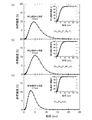
- FIG. 8A is a diagram showing the relationship between the particle size and the volume frequency of the negative thermal expansion material according to Example 3, and FIG. 8B is the particle size and volume of the negative thermal expansion material according to Example 4.
- FIG. 8C is a diagram showing the relationship with the frequency, and FIG.
- FIG. 8C is a diagram showing the relationship between the particle size and the volume frequency of the negative thermal expansion material according to Example 1.
- FIG. 9 is a diagram showing X-ray diffraction patterns of the negative thermal expansion materials according to Example 3, Example 4, and Example 1.
- 10A is a diagram schematically showing crystal grains in an SEM photograph
- FIG. 10B is a diagram showing internal structures of crystal grains
- FIG. 10C is a mechanism of negative thermal expansion. It is a figure for explaining.
- the present inventors have focused on the Cu 2 V 2 O 7 system as a candidate for a substance exhibiting negative thermal expansion.
- ⁇ -Cu 2 V 2 O 7 having a rectangular crystal structure is of interest as a multiferroic substance in which ferroelectricity and weak paramagnetism coexist, but it has a relatively wide temperature range including room temperature and higher temperatures. In the region, anisotropic thermal deformation of the crystal lattice, which is probably due to dielectric instability, is observed. As a result, negative thermal expansion occurs in which the unit cell volume contracts with increasing temperature in a wide temperature range.
- Cu 2 V 2 O 7 can assume a monoclinic ⁇ phase and a triclinic ⁇ phase in addition to the orthorhombic ⁇ phase. Therefore, the inventors of the present invention should develop negative thermal expansion characteristics that cannot be realized by the conventional ⁇ -Cu 2 V 2 O 7 system, when a part of the Cu site or V site is replaced with another element. The inventors have devised a negative thermal expansion material and a method for producing the same, which are exemplified below.
- one embodiment of the present disclosure is to provide at least one element selected from the general formula (1): Cu 2 ⁇ x R x V 2 O 7 (R is Zn, Ga, Fe, Sn, Mn). , 0 ⁇ x ⁇ 2), and a method for producing a negative thermal expansion material, including a step of preparing an aqueous solution containing a raw material of a compound represented by 0 ⁇ x ⁇ 2) and an organic acid.
- a negative thermal expansion material having a negative linear expansion coefficient whose absolute value is larger than that of ⁇ -Cu 2 V 2 O 7 in which Cu is not substituted by R is easy to handle at low temperature.
- Cu 2 ⁇ x R x V 2 ⁇ y My O 7 (R is at least one element selected from Zn, Ga, Fe, Sn, and Mn, M is at least one element selected from Mg, Si, Al, Ti, Cr, Mn, Fe, Co, Ni and Sn, and a raw material of a compound represented by 0 ⁇ x ⁇ 2, 0 ⁇ y ⁇ 2) It is a manufacturing method of a negative thermal expansion material including a step of preparing an aqueous solution containing an organic acid.
- a negative linear expansion coefficient whose absolute value is larger than that of ⁇ -Cu 2 V 2 O 7 in which Cu is not replaced by R and V is not replaced by M is negative.
- the thermal expansion material can be manufactured relatively inexpensively by using the form of an aqueous solution which is easy to handle at low temperature.
- the above-mentioned manufacturing method may include a step of forming a powder of an organic acid salt by granulating by a spray dry method using an aqueous solution. Further, the above-described manufacturing method may include a step of granulating an organic acid salt powder by a freeze drying method using an aqueous solution. This makes it possible to produce the organic acid salt powder without requiring excessive energy such as granulation or pulverization at high temperature or an expensive device.
- the above-mentioned manufacturing method may include a step of heating the powder of the organic acid salt to decompose the organic acid, and a step of firing the powder in which the organic acid is decomposed to generate an oxide sintered body.
- the above-mentioned production method may include a step of adding polyethylene glycol to the aqueous solution to form a gel. This enables the generation of finer crystal grains.
- the above-described manufacturing method may include a step of heating the gel to decompose the organic acid, and a step of firing the powder generated by decomposing the organic acid of the gel to produce an oxide fired body.
- the organic acid may be citric acid or acetic acid. Further, other substances such as nitric acid may be used as long as they are organic acids in which the raw material of the compound is easily dispersed as an aqueous solution.
- R may be Zn.
- M may be Si or Mn. This gives a stable ⁇ -phase (monoclinic) crystal structure at room temperature.
- X in the general formula (1) may be 0.15 to 1.
- x may be 0.15-0.5, more preferably 0.15-0.3.
- y in the general formula (2) may be 0.05 to 0.5.
- y may be 0.07 to 0.3, more preferably 0.08 to 0.2.
- the oxide sintered body may have a monoclinic ⁇ phase.
- the negative thermal expansion material produced by the above method may have a linear expansion coefficient of -7 ppm / K or less in the temperature range of 300 to 500K.
- Reference Example 1 a polycrystalline sintered body (ceramics) sample of ⁇ -Cu 2 V 2 O 7 and ⁇ -Cu 1.8 Zn 0.2 V 2 O 7 was prepared by using the solid-phase reaction method. Specifically, CuO, ZnO, and V 2 O 5 powders weighed in a stoichiometric ratio were mixed in a mortar and heated in the air at a temperature of 873 to 953K for 10 hours. The obtained powder was sintered using a spark plasma sintering (SPS) furnace (manufactured by SPS Syntex Co., Ltd.) to obtain an oxide sintered body. Sintering was performed under vacuum ( ⁇ 10 ⁇ 1 Pa) using a graphite die at 723 K for 5 minutes.
- SPS spark plasma sintering
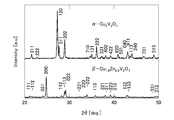
- FIG. 1 is a diagram showing X-ray diffraction patterns of Cu 2 V 2 O 7 containing no Zn and Cu 1.8 Zn 0.2 V 2 O 7 containing Zn.
- Cu 2 V 2 O 7 in which Cu is not substituted by Zn has an ⁇ -phase (orthorhombic) crystal structure
- Cu 1.8 Zn in which Cu is partially substituted by Zn 0.2 V 2 O 7 has a ⁇ phase (monoclinic) crystal structure.
- the ⁇ phase that does not exist stably in the composition of Cu 2 V 2 O 7 is not stable unless it is at a high temperature (977 K or higher). It can exist stably at room temperature.
- FIG. 2 is a diagram showing the thermal expansion characteristics of ⁇ -Cu 2 V 2 O 7 and ⁇ -Cu 1.8 Zn 0.2 V 2 O 7 .
- the vertical axis represents the volume change ⁇ V / V based on the volume V of 100K.
- the volume change is calculated using the linear expansion coefficient ⁇ calculated using a laser thermal expansion system (LIX-2: manufactured by ULVAC, Inc.) (measurement temperature range 100 to 700K).
- Table 1 shows the respective crystal structures of ⁇ -Cu 2 V 2 O 7 and ⁇ -Cu 1.8 Zn 0.2 V 2 O 7 , the coefficient of body expansion ⁇ , the range of negative thermal expansion ⁇ T (K), and the volume. Each value of the total change amount ⁇ V / V (%) is described.
- the total volume change ⁇ V / V of ⁇ -Cu 1.8 Zn 0.2 V 2 O 7 is 2.6%, which is three times or more the total volume change of ⁇ -Cu 2 V 2 O 7 . It can be seen that the material has a large negative thermal expansion.
- the absolute value of the linear expansion coefficient starts to decrease from around 600K, but in ⁇ -Cu 1.8 Zn 0.2 V 2 O 7 , it reaches 700K. The coefficient of linear expansion is almost constant.
- FIG. 3 is a view showing a scanning electron microscope (SEM) photograph of ⁇ -Cu 1.8 Zn 0.2 V 2 O 7 produced by using the solid phase reaction method.
- FIG. 4 is a diagram showing thermal expansion characteristics of an oxide sintered body represented by ⁇ -Cu 1.8 Zn 0.2 V 2 O 7 manufactured by various methods / conditions.
- ⁇ -Cu 1.8 Zn 0.2 V 2 O 7 according to Reference Example 1 is a negative thermal expansion material in which crystal grains having a size of about 8 to 20 ⁇ m are aggregated. Further, the negative thermal expansion material made of ⁇ -Cu 1.8 Zn 0.2 V 2 O 7 manufactured by using the solid-phase reaction method has a temperature range of 100 to 500 K, as shown by a line L1 in FIG. The linear expansion coefficient is about -14.4 ppm / K.
- Example 1 a ⁇ -Cu 1.8 Zn 0.2 V 2 O 7 polycrystalline sintered body (ceramics) sample was prepared by using a spray dry method. Specifically, powders of CuO, ZnO, and V 2 O 5 (all having a purity of 99.9%) weighed in a stoichiometric ratio were mixed in a mortar, and baked in the air at a temperature of 943K for 10 hours. The obtained powder is ground in a mortar and dissolved in pure water together with citric acid. At that time, 3 g of anhydrous citric acid and about 100 ml of pure water were added to 1 g of the sample powder, and the mixture was stirred with a magnetic stirrer until all the sample powder was dissolved. Note that V 2 O 3 may be used in addition to or instead of V 2 O 5 .
- the obtained aqueous solution is dried with a spray dryer and granulated to obtain a citrate powder.
- This powder is put into an alumina crucible and heated in the atmosphere at 673 K for 5 hours to decompose citric acid.
- the obtained product is well crushed in a mortar, molded into pellets, placed in an alumina crucible, and fired in an atmosphere of 853 to 943K in the atmosphere for 2 to 10 hours.
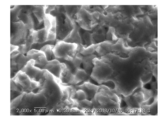
- FIG. 5 is a view showing a scanning electron microscope (SEM) photograph of ⁇ -Cu 1.8 Zn 0.2 V 2 O 7 manufactured by using the spray dry method.
- SEM scanning electron microscope
- ⁇ -Cu 1.8 Zn 0.2 V 2 O 7 according to Example 1 is a negative thermal expansion material in which crystal grains with a size of about 3 to 5 ⁇ m are aggregated (note that As described later, according to the accurate particle size distribution using the laser diffraction / scattering type particle size distribution evaluation method, the volume frequency central particle size is 2.7 ⁇ m.).
- the negative thermal expansion material composed of ⁇ -Cu 1.8 Zn 0.2 V 2 O 7 manufactured by using the spray dry method is line L2 (firing condition 893K / 5h) and line L3 (firing condition in FIG. 4). 853K / 4h) and line L4 (firing condition 893K / 2h), the coefficient of linear expansion is about -7 to -14 ppm / K in the temperature range of 300 to 500K.
- spray drying ⁇ -Cu 1.8 Zn 0.2 V 2 O 7 prepared using, by optimizing the sintering condition was prepared using a solid-phase reaction method beta-Cu 1 It is possible to obtain a large linear expansion coefficient equivalent to that of 0.8 Zn 0.2 V 2 O 7 and at least a linear expansion coefficient equal to or higher than that of conventionally known ⁇ -Cu 2 V 2 O 7. it can.
- the aqueous solution containing the raw material of the compound represented by the general formula (1) Cu 2 ⁇ x Zn x V 2 O 7 and the organic acid is prepared.
- a negative thermal expansion material having a negative linear expansion coefficient whose absolute value is larger than that of ⁇ -Cu 2 V 2 O 7 in which Cu is not substituted by Zn is easy to handle at low temperature.
- the above-mentioned manufacturing method includes a step of drying and granulating with an aqueous solution by a spray drying method to produce a powder of an organic acid salt. This makes it possible to produce the organic acid salt powder without requiring excessive energy such as granulation or pulverization at high temperature or an expensive device.
- the above-mentioned manufacturing method includes a step of heating the powder of the organic acid salt to decompose the organic acid, and a step of firing the powder in which the organic acid is decomposed to generate an oxide sintered body. There is. As a result, an oxide sintered body having a desired shape can be produced with relatively low energy.
- substitution amount x of the substitution element Zn of Cu 2 ⁇ x Zn x V 2 O 7 is 0.15 to 1, at least in the temperature range of 100 to 500 K, it is more preferable than ⁇ -Cu 2 V 2 O 7 A large negative thermal expansion is seen.
- Zn, Ga, Fe, Sn, and Mn are suitable as the R substituting element in the compound represented by the general formula Cu 2-x R x V 2 O 7 , and Cu 2-x Zn x V It is considered that a linear expansion coefficient equivalent to that of 2 O 7 can be obtained.
- the substitution elements Zn, Ga, Fe, Sn, and Mn may be substituted not only at the Cu site but also at the V site.
- Reference Example 2 a polycrystalline sintered body (ceramics) sample of ⁇ -Cu 2 V 2 O 7 was prepared by using the sol-gel method. Specifically, Cu (NO 3 ) 2 3H 2 O is dissolved in pure water, V 2 O 5 is dissolved in citric acid, and these two solutions are mixed and stirred at room temperature for 2 hours. The stirred mixed liquid and polyethylene glycol (polymerization degree: 500,000) are added to a beaker at a mass ratio of 95: 5, and the periphery of the beaker is dissolved while being immersed in water at 80 ° C. (1.5 h). Then, when all of the polyethylene glycol is melted, the periphery of the beaker is immersed in ice water and rapidly cooled to form a gel. Note that V 2 O 3 may be used in addition to or instead of V 2 O 5 .
- the obtained powder was taken out of the electric furnace and mixed with an agate mortar and pestle for about 30 minutes.
- the mixed powder was formed into pellets, placed in an alumina crucible, and sintered at 873 to 923K (600 to 650 ° C) for 5 hours.
- FIG. 6 is a view showing a scanning electron microscope (SEM) photograph of ⁇ -Cu 2 V 2 O 7 manufactured by using the sol-gel method.
- SEM scanning electron microscope
- Example 2 a ⁇ -Cu 1.8 Zn 0.2 V 2 O 7 polycrystalline sintered body (ceramics) sample was prepared by using the same sol-gel method as in Reference Example 2.
- the main difference in Example 2 is that a compound containing zinc (for example, ZnO) is used as a raw material. Therefore, the specific manufacturing method is as described in Reference Example 1, and the specific description is omitted.
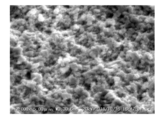
- FIG. 7 is a view showing a scanning electron microscope (SEM) photograph of ⁇ -Cu 1.8 Zn 0.2 V 2 O 7 produced by using the sol-gel method.
- SEM scanning electron microscope
- the manufacturing method using the sol-gel method includes the step of adding a polyethylene glycol to an aqueous solution to generate a gel. This makes it possible to generate finer crystal grains than those produced by the spray dry method.
- Example 3 a polycrystalline sintered body (ceramics) sample of ⁇ -Cu 1.8 Zn 0.2 V 1.9 Si 0.1 O 7 was prepared by using a spray dry method. Specifically, powders of CuO, ZnO, SiO 2 and V 2 O 5 (each having a purity of 99.9%) weighed in a stoichiometric ratio were mixed in a mortar and baked in the atmosphere at a temperature of 943K for 10 hours. .. The obtained powder is ground in a mortar and dissolved in pure water together with citric acid.
- Example 4 a polycrystalline sintered body (ceramics) sample of ⁇ -Cu 1.8 Zn 0.2 V 1.9 Mn 0.1 O 7 was prepared by using the spray dry method. Specifically, powders of CuO, ZnO, Mn 2 O 3 and V 2 O 5 (each having a purity of 99.9%) weighed in a stoichiometric ratio are mixed in a mortar, and the mixture is mixed in the atmosphere at a temperature of 943K for 10 hours. Baked. The obtained powder is ground in a mortar and dissolved in pure water together with citric acid.
- Crystal grains in negative thermal expansion material Next, the size of the crystal grains forming the negative thermal expansion material according to the example will be described.
- the particle size distribution was measured by a laser diffraction / scattering particle size distribution evaluation method.
- FIG. 8A is a diagram showing the relationship between the particle size and the volume frequency of the negative thermal expansion material according to Example 3, and FIG. 8B is the particle size and volume of the negative thermal expansion material according to Example 4.
- FIG. 8C is a diagram showing the relationship with the frequency
- FIG. 8C is a diagram showing the relationship between the particle size and the volume frequency of the negative thermal expansion material according to Example 1.
- FIG. 9 is a diagram showing X-ray diffraction patterns of the negative thermal expansion materials according to Example 3, Example 4, and Example 1. As shown in FIG. 9, it can be seen that the negative thermal expansion materials according to Example 3 and Example 4 are monoclinic ⁇ -phase, like the negative thermal expansion materials according to Example 1.
- ⁇ -Cu 1.8 Zn 0.2 V 1.9 Si 0.1 O 7 according to Example 3 has a volume frequency central particle diameter of about 4.0 ⁇ m. It is a negative thermal expansion material in which a large number of crystal grains are aggregated.
- ⁇ -Cu 1.8 Zn 0.2 V 1.9 Mn 0.1 O 7 according to Example 4 has a volume frequency central particle diameter of about 4.1 ⁇ m. It is a negative thermal expansion material in which a large number of crystal grains are aggregated.
- FIG. 8C in ⁇ -Cu 1.8 Zn 0.2 V 2 O 7 according to Example 1, a large number of crystal grains having a volume frequency center particle diameter of about 2.7 ⁇ m aggregated. It is a negative thermal expansion material.
- the above-described manufacturing method includes a step of heating the gel to decompose the organic acid, and a step of firing the powder generated by decomposing the organic acid of the gel to produce an oxide fired body. There is. As a result, an oxide sintered body having a desired shape can be produced with relatively low energy.
- organic acid used in each example may be acetic acid instead of citric acid.
- other substances such as nitric acid may be used as long as they are organic acids in which the raw material of the compound is easily dispersed as an aqueous solution.
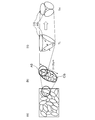
- FIG. 10A is a diagram schematically showing crystal grains in an SEM photograph
- FIG. 10B is a diagram showing internal structures of crystal grains
- FIG. 10C is a mechanism of negative thermal expansion. It is a figure for explaining.
- the oxide polycrystalline sintered body is formed by stacking a plurality of agglomerates having a diameter of several ⁇ m to several tens of ⁇ m. Further, as shown in FIG. 10B, the agglomerate is an aggregate of a plurality of crystal grains CG, and voids AS are formed between the crystal grains CG.
- the negative thermal expansion of the crystal does not necessarily change isotropically in magnitude.
- ⁇ -Cu 1.8 Zn 0.2 V 2 O 7 when the temperature rises from low temperature TL to high temperature TH (> TL), it shrinks in the a-axis and c-axis directions of the unit cell of the crystal, It extends in the direction of the b-axis. Therefore, if there is a void in the b-axis direction, it is considered that the void absorbs the extension of the crystal in the b-axis direction, so that the negative thermal expansion of the sintered body as a whole becomes large.
- the negative thermal expansion material manufactured by the manufacturing method according to the embodiment of the present disclosure has a substantially constant linear expansion coefficient with respect to temperature change in a wide temperature range of about 100 to 500K, Material functional design is easy. Further, there are industrial merits such as being mainly composed of inexpensive elements such as Cu, Zn, and V, being an oxide, having a low synthesis temperature, being easy to manufacture, and being able to obtain fine particles. Further, a manufacturing method such as a spray dry method or a sol-gel method according to the present embodiment is different from the pulverization method, and a new negative thermal expansion material having a desired shape can be manufactured without destroying a tissue expressing negative thermal expansion. That's the method.
- precision optical parts and mechanical parts that do not want to change shape and dimensions due to temperature, process equipment and tools, temperature compensating materials for fiber gratings, printed circuit boards, sealing materials for electronic parts, thermal switches, refrigerator parts. It can be used for artificial satellite parts.
- a composite material in which a negative thermal expansion material is dispersed in a matrix phase of a resin having a large positive coefficient of thermal expansion it is possible to suppress and control the thermal expansion of the resin material as well, so that various applications can be achieved. Can be used in.
- the particle size is small, it is possible to control the thermal expansion of the local region of the micrometer level, and for example, it can be used for the thermal expansion control inside the electronic device.
- the negative thermal expansion material having a small particle size can be widely used in industry.
Landscapes
- Chemical & Material Sciences (AREA)
- Engineering & Computer Science (AREA)
- Ceramic Engineering (AREA)
- Organic Chemistry (AREA)
- Manufacturing & Machinery (AREA)
- Inorganic Chemistry (AREA)
- Materials Engineering (AREA)
- Structural Engineering (AREA)
- Inorganic Compounds Of Heavy Metals (AREA)
- Silicates, Zeolites, And Molecular Sieves (AREA)
- Compositions Of Oxide Ceramics (AREA)
Abstract
L'invention concerne un procédé de production d'un matériau à dilatation thermique négative. Un mode de réalisation comprend une étape de préparation d'une solution aqueuse contenant un acide organique et les matières premières pour un composé représenté par la formule générale (1) Cu2-xRxV2O7 (où : R représente au moins un élément choisi parmi Zn, Ga, Fe, Sn et Mn ; et 0 ≤ x < 2).
Priority Applications (1)
| Application Number | Priority Date | Filing Date | Title |
|---|---|---|---|
| JP2020556623A JP7441522B2 (ja) | 2018-11-09 | 2019-08-29 | 負熱膨張材料の製造方法 |
Applications Claiming Priority (2)
| Application Number | Priority Date | Filing Date | Title |
|---|---|---|---|
| JP2018-211619 | 2018-11-09 | ||
| JP2018211619 | 2018-11-09 |
Publications (1)
| Publication Number | Publication Date |
|---|---|
| WO2020095518A1 true WO2020095518A1 (fr) | 2020-05-14 |
Family
ID=70611915
Family Applications (1)
| Application Number | Title | Priority Date | Filing Date |
|---|---|---|---|
| PCT/JP2019/033963 Ceased WO2020095518A1 (fr) | 2018-11-09 | 2019-08-29 | Procédé de production d'un matériau à dilatation thermique négative |
Country Status (2)
| Country | Link |
|---|---|
| JP (1) | JP7441522B2 (fr) |
| WO (1) | WO2020095518A1 (fr) |
Cited By (11)
| Publication number | Priority date | Publication date | Assignee | Title |
|---|---|---|---|---|
| JPWO2020148886A1 (fr) * | 2019-01-18 | 2020-07-23 | ||
| JP2021062995A (ja) * | 2019-10-16 | 2021-04-22 | 日本化学工業株式会社 | バナジウム化合物の製造方法 |
| JPWO2022114004A1 (fr) * | 2020-11-30 | 2022-06-02 | ||
| JP2023013300A (ja) * | 2021-07-15 | 2023-01-26 | 国立大学法人東海国立大学機構 | アクチュエータ材料、アクチュエータ素子および酸化物 |
| CN116529199A (zh) * | 2020-11-30 | 2023-08-01 | 国立大学法人东海国立大学机构 | 负热膨胀材料、复合材料、负热膨胀材料的制备方法和部件 |
| JP2023123327A (ja) * | 2022-02-24 | 2023-09-05 | 日本化学工業株式会社 | 負熱膨張材および複合材料 |
| WO2023181781A1 (fr) | 2022-03-23 | 2023-09-28 | 日本化学工業株式会社 | Matériau à expansion thermique négative, son procédé de fabrication et matériau composite |
| JP2023143635A (ja) * | 2022-03-23 | 2023-10-06 | 日本化学工業株式会社 | 負熱膨張材、その製造方法及び複合材料 |
| CN118221157A (zh) * | 2024-03-18 | 2024-06-21 | 西安交通大学 | 一种超声喷雾热解制备的负热膨胀电子封装材料Cu2V2O7及其制备方法 |
| CN119263828A (zh) * | 2024-11-22 | 2025-01-07 | 哈尔滨工业大学 | 降低复合材料热膨胀系数的焦钒酸铜基增强体及其制备方法 |
| WO2026083950A1 (fr) * | 2024-10-15 | 2026-04-23 | 国立大学法人東海国立大学機構 | Poudre, procédé de production de matériau à dilatation thermique négative, procédé de production de matériau composite et matériau composite |
Citations (1)
| Publication number | Priority date | Publication date | Assignee | Title |
|---|---|---|---|---|
| CN105648248A (zh) * | 2016-01-06 | 2016-06-08 | 郑州大学 | 可控热膨胀复合导电陶瓷材料α-Cu2V2O7-Al |
-
2019
- 2019-08-29 WO PCT/JP2019/033963 patent/WO2020095518A1/fr not_active Ceased
- 2019-08-29 JP JP2020556623A patent/JP7441522B2/ja active Active
Patent Citations (1)
| Publication number | Priority date | Publication date | Assignee | Title |
|---|---|---|---|---|
| CN105648248A (zh) * | 2016-01-06 | 2016-06-08 | 郑州大学 | 可控热膨胀复合导电陶瓷材料α-Cu2V2O7-Al |
Non-Patent Citations (2)
| Title |
|---|
| CHATTOPADHYAY, BIDISA ET AL.: "Magnetic ordering induced ferroelectricity in alpha-Cu2V2O7 studied through non-magnetic Zn doping", JOURNAL OF APPLIED PHYSICS, vol. 121, 2017, pages 094103 - 1-094103-7, XP012216806 * |
| LIU, HUILIAN ET AL.: "Properties of Cu and V co- doped ZnO nanoparticles annealed in different atmospheres", SUPERLATTICES AND MICROSTRUCTURES, vol. 52, 2012, pages 1171 - 1177, XP028516172, DOI: 10.1016/j.spmi.2012.09.001 * |
Cited By (22)
| Publication number | Priority date | Publication date | Assignee | Title |
|---|---|---|---|---|
| JPWO2020148886A1 (fr) * | 2019-01-18 | 2020-07-23 | ||
| JP7338881B2 (ja) | 2019-01-18 | 2023-09-05 | 国立大学法人東海国立大学機構 | 負熱膨張材料微粒子群、複合材料及びその製造方法 |
| JP2021062995A (ja) * | 2019-10-16 | 2021-04-22 | 日本化学工業株式会社 | バナジウム化合物の製造方法 |
| JP7383446B2 (ja) | 2019-10-16 | 2023-11-20 | 日本化学工業株式会社 | バナジウム化合物の製造方法 |
| CN116529199A (zh) * | 2020-11-30 | 2023-08-01 | 国立大学法人东海国立大学机构 | 负热膨胀材料、复合材料、负热膨胀材料的制备方法和部件 |
| JP2025126189A (ja) * | 2020-11-30 | 2025-08-28 | 国立大学法人東海国立大学機構 | 負熱膨張材料および部品 |
| WO2022114004A1 (fr) * | 2020-11-30 | 2022-06-02 | 国立大学法人東海国立大学機構 | Matériau à dilatation thermique négative, matériau composite, et procédé de production de matériau à dilatation thermique négative |
| JP7838865B2 (ja) | 2020-11-30 | 2026-04-01 | 国立大学法人東海国立大学機構 | 負熱膨張材料 |
| JPWO2022114004A1 (fr) * | 2020-11-30 | 2022-06-02 | ||
| JP7838823B2 (ja) | 2020-11-30 | 2026-04-01 | 国立大学法人東海国立大学機構 | 負熱膨張材料及び負熱膨張材料の製造方法 |
| JP2026026111A (ja) * | 2020-11-30 | 2026-02-16 | 国立大学法人東海国立大学機構 | 複合材料及び部品 |
| JP2023013300A (ja) * | 2021-07-15 | 2023-01-26 | 国立大学法人東海国立大学機構 | アクチュエータ材料、アクチュエータ素子および酸化物 |
| JP2023123327A (ja) * | 2022-02-24 | 2023-09-05 | 日本化学工業株式会社 | 負熱膨張材および複合材料 |
| JP2023143635A (ja) * | 2022-03-23 | 2023-10-06 | 日本化学工業株式会社 | 負熱膨張材、その製造方法及び複合材料 |
| US12297123B2 (en) | 2022-03-23 | 2025-05-13 | Nippon Chemical Industrial Co., Ltd. | Negative thermal expansion material, method for producing the same, and composite material |
| KR20240167431A (ko) | 2022-03-23 | 2024-11-26 | 니폰 가가쿠 고교 가부시키가이샤 | 부열팽창재, 그 제조 방법 및 복합 재료 |
| JP7410249B2 (ja) | 2022-03-23 | 2024-01-09 | 日本化学工業株式会社 | 負熱膨張材、その製造方法及び複合材料 |
| WO2023181781A1 (fr) | 2022-03-23 | 2023-09-28 | 日本化学工業株式会社 | Matériau à expansion thermique négative, son procédé de fabrication et matériau composite |
| EP4497728A4 (fr) * | 2022-03-23 | 2026-04-15 | Nippon Chemical Ind | Matériau à expansion thermique négative, son procédé de fabrication et matériau composite |
| CN118221157A (zh) * | 2024-03-18 | 2024-06-21 | 西安交通大学 | 一种超声喷雾热解制备的负热膨胀电子封装材料Cu2V2O7及其制备方法 |
| WO2026083950A1 (fr) * | 2024-10-15 | 2026-04-23 | 国立大学法人東海国立大学機構 | Poudre, procédé de production de matériau à dilatation thermique négative, procédé de production de matériau composite et matériau composite |
| CN119263828A (zh) * | 2024-11-22 | 2025-01-07 | 哈尔滨工业大学 | 降低复合材料热膨胀系数的焦钒酸铜基增强体及其制备方法 |
Also Published As
| Publication number | Publication date |
|---|---|
| JP7441522B2 (ja) | 2024-03-01 |
| JPWO2020095518A1 (ja) | 2021-09-30 |
Similar Documents
| Publication | Publication Date | Title |
|---|---|---|
| JP7441522B2 (ja) | 負熱膨張材料の製造方法 | |
| Tang et al. | Relationship between Rattling Mg2+ ions and anomalous microwave dielectric behavior in Ca3-xMg1+ xLiV3O12 ceramics with garnet structure | |
| Teo et al. | Development of magneto-dielectric materials based on Li-ferrite ceramics: I. Densification behavior and microstructure development | |
| JP7838865B2 (ja) | 負熱膨張材料 | |
| JP7076134B2 (ja) | 負熱膨張材料および複合材料 | |
| Bhupaijit et al. | Structural, microstructure and electrical properties of La2O3-doped Bi0. 5 (Na0. 68K0. 22Li0. 1) 0.5 TiO3 lead-free piezoelectric ceramics synthesized by the combustion technique | |
| Kimura et al. | Fabrication of grain‐oriented Bi2WO6 ceramics | |
| Bafrooei et al. | High-performance ZnTiNb2O8 microwave dielectric ceramics produced from ZnNb2O6–TiO2 nano powders | |
| JP7338881B2 (ja) | 負熱膨張材料微粒子群、複合材料及びその製造方法 | |
| Verma et al. | Structural, dielectric and ferroelectric studies of thermally stable and efficient energy storage ceramic materials:(Na0. 5-xKxBi0. 5-xLax) TiO3 | |
| James | Effect of oxygen assisted sintering on piezoelectric properties of SrBi4Ti4O15 ceramics prepared via high energy mechanochemical processing | |
| JP2023175402A (ja) | 複合材料および部品 | |
| Anas et al. | Influence of zirconium (Zr4+) substitution on the crystal structure and optical and dielectric properties of Sr0. 8Mg0. 2 (Sn1–x Zr x) O3 ceramics | |
| Nazir et al. | Tuning of the structural, morphological, dielectric, and magnetoresistance properties of Gd2NiMnO6 double perovskite by Ca doping | |
| Reddy et al. | Nanocrystalline barium zirconate titanate synthesized at low temperature by an aqueous co-precipitation technique | |
| Badole et al. | The role of salts selection on phase formation and electrical properties of K0. 5Bi0. 5TiO3 ceramics fabricated via molten salt synthesis | |
| Su et al. | Microwave dielectric properties, chemical bonds and infrared reflection spectra of LiMg6AlO8 ceramics with rock salt structures | |
| Wang et al. | Properties of spark plasma sintered pseudocubic BiFeO3–BaTiO3 ceramics | |
| JP2000211971A (ja) | 熱電素子材料及びその製造方法 | |
| JPH08231223A (ja) | 熱電変換材料 | |
| Kumar et al. | Phase change and ferroelectric nature of microwave heated lead cobalt titanate nanoparticles prepared by sol-gel method | |
| CN116535210B (zh) | 一种铌酸钠基反铁电陶瓷材料及其制备方法与应用 | |
| CN107840659B (zh) | 一种钨青铜纯相室温多铁性陶瓷及其制备方法 | |
| Jha et al. | New perovskite-related oxides having high dielectric constant: Ln2Ba2CaZn2Ti3O14 (Ln= La and Pr) | |
| Dhuria et al. | Evolution of conduction mechanism in Ca-doped YFe0. 5Co0. 5O3 compound by complex impedance spectroscopy |
Legal Events
| Date | Code | Title | Description |
|---|---|---|---|
| 121 | Ep: the epo has been informed by wipo that ep was designated in this application |
Ref document number: 19881122 Country of ref document: EP Kind code of ref document: A1 |
|
| ENP | Entry into the national phase |
Ref document number: 2020556623 Country of ref document: JP Kind code of ref document: A |
|
| NENP | Non-entry into the national phase |
Ref country code: DE |
|
| 122 | Ep: pct application non-entry in european phase |
Ref document number: 19881122 Country of ref document: EP Kind code of ref document: A1 |