WO2020095546A1 - Dispositif de traitement d'informations, système de traitement d'informations, procédé de traitement d'informations, et programme - Google Patents
Dispositif de traitement d'informations, système de traitement d'informations, procédé de traitement d'informations, et programme Download PDFInfo
- Publication number
- WO2020095546A1 WO2020095546A1 PCT/JP2019/036737 JP2019036737W WO2020095546A1 WO 2020095546 A1 WO2020095546 A1 WO 2020095546A1 JP 2019036737 W JP2019036737 W JP 2019036737W WO 2020095546 A1 WO2020095546 A1 WO 2020095546A1
- Authority
- WO
- WIPO (PCT)
- Prior art keywords
- user
- information
- display
- list
- attention
- Prior art date
- Legal status (The legal status is an assumption and is not a legal conclusion. Google has not performed a legal analysis and makes no representation as to the accuracy of the status listed.)
- Ceased
Links
Images




Classifications
-
- G—PHYSICS
- G06—COMPUTING OR CALCULATING; COUNTING
- G06F—ELECTRIC DIGITAL DATA PROCESSING
- G06F3/00—Input arrangements for transferring data to be processed into a form capable of being handled by the computer; Output arrangements for transferring data from processing unit to output unit, e.g. interface arrangements
- G06F3/01—Input arrangements or combined input and output arrangements for interaction between user and computer
- G06F3/011—Arrangements for interaction with the human body, e.g. for user immersion in virtual reality
- G06F3/013—Eye tracking input arrangements
-
- G—PHYSICS
- G06—COMPUTING OR CALCULATING; COUNTING
- G06F—ELECTRIC DIGITAL DATA PROCESSING
- G06F3/00—Input arrangements for transferring data to be processed into a form capable of being handled by the computer; Output arrangements for transferring data from processing unit to output unit, e.g. interface arrangements
- G06F3/01—Input arrangements or combined input and output arrangements for interaction between user and computer
- G06F3/048—Interaction techniques based on graphical user interfaces [GUI]
- G06F3/0481—Interaction techniques based on graphical user interfaces [GUI] based on specific properties of the displayed interaction object or a metaphor-based environment, e.g. interaction with desktop elements like windows or icons, or assisted by a cursor's changing behaviour or appearance
- G06F3/0482—Interaction with lists of selectable items, e.g. menus
-
- G—PHYSICS
- G06—COMPUTING OR CALCULATING; COUNTING
- G06V—IMAGE OR VIDEO RECOGNITION OR UNDERSTANDING
- G06V40/00—Recognition of biometric, human-related or animal-related patterns in image or video data
- G06V40/20—Movements or behaviour, e.g. gesture recognition
-
- H—ELECTRICITY
- H04—ELECTRIC COMMUNICATION TECHNIQUE
- H04N—PICTORIAL COMMUNICATION, e.g. TELEVISION
- H04N1/00—Scanning, transmission or reproduction of documents or the like, e.g. facsimile transmission; Details thereof
- H04N1/32—Circuits or arrangements for control or supervision between transmitter and receiver or between image input and image output device, e.g. between a still-image camera and its memory or between a still-image camera and a printer device
- H04N1/32101—Display, printing, storage or transmission of additional information, e.g. ID code, date and time or title
Definitions
- the present disclosure relates to an information processing device, an information processing system, an information processing method, and a program. More specifically, the present invention relates to an information processing apparatus, an information processing system, an information processing method, and a program that specify the user's attention information by the user's line-of-sight analysis and perform processing based on the specification result.
- PCs Portable Computers
- game consoles smartphones (smartphones), TVs, and even digital signage, which is an electronic bulletin board installed in public spaces such as stations and buildings, allow people (users) to use various electronic devices to perform various operations. We obtain various information and communicate through chat and other means.
- the entered text is displayed on each chat participant's terminal in near real time. Other participants can see the displayed content and further enter a message to have a conversation.
- chat and message display processing at the time of chat execution there is JP-A-2017-156906, for example.
- a user ID used in text chat in an online game or the like is required to be unique. Therefore, it is often a combination of a plurality of character types (uppercase letters, lowercase letters, symbols, numbers).
- a message including a user ID may be created to clarify which user the remark is. For example, in the case of inputting a message in favor of Mr. A who has a user ID of AnZvB4K7, "I agree with Mr. AnZvB4K7's statement"
- the above input is required. However, it is difficult to accurately input such a complicated user ID, and it takes time to input it accurately.
- the present disclosure has been made in view of the above problems, for example, an information processing apparatus, an information processing system, and an information processing method that specify the attention information of the user by the line-of-sight analysis of the user and perform processing based on the identification result. , And to provide a program.
- the first aspect of the present disclosure is A line-of-sight detection unit that detects the user's gazing point for the display information on the display unit, A user attention information analysis unit that extracts attention information of the user based on the analysis of the user gaze point and generates a list including information corresponding to the attention information;
- the information processing apparatus includes a display information generation unit that generates a display list including the list configuration data.
- the second aspect of the present disclosure is An information processing system having a display device and a management server,
- the display device It has a line-of-sight detection unit that detects the user's gazing point for the display information of the display unit
- the management server is User attention information analysis that inputs user attention point information analyzed on the display device, extracts attention information of the user based on the analysis of the user attention point, and generates a list including information corresponding to the attention information Department
- the information processing system includes a display information generation unit that generates a display list including the list configuration data.
- the third aspect of the present disclosure is An information processing method executed by an information processing device, A line-of-sight detection unit that detects a user's point of gaze for the display information on the display unit, A user attention information analysis step in which the user attention information analysis unit extracts the user attention information based on the analysis of the user gaze point and generates a list composed of information corresponding to the attention information;
- the display information generating unit executes a display information generating step of generating a display list including the constituent data of the list.
- the fourth aspect of the present disclosure is An information processing method executed in an information processing system having a display device and a management server,
- the display device performs a line-of-sight detection process for detecting a user gazing point for display information on the display unit
- the management server is User attention information analysis that inputs user attention point information analyzed on the display device, extracts attention information of the user based on the analysis of the user attention point, and generates a list including information corresponding to the attention information Processing and
- An information processing method for executing a display information generating process for generating a display list composed of the constituent data of the list.
- the fifth aspect of the present disclosure is A program for executing information processing in an information processing device, In the line-of-sight detection unit, a line-of-sight detection step of detecting a user's gazing point for the display information of the display unit, A user attention information analysis step of causing a user attention information analysis unit to extract attention information of the user based on analysis of the user gaze point, and generating a list of information corresponding to the attention information;
- the program causes a display information generating unit to execute a display information generating step for generating a display list including the constituent data of the list.
- the program of the present disclosure is, for example, a program that can be provided by a storage medium or a communication medium provided in a computer-readable format to an information processing apparatus or a computer system that can execute various program codes.
- a program that can be provided by a storage medium or a communication medium provided in a computer-readable format to an information processing apparatus or a computer system that can execute various program codes.
- system is a logical set configuration of a plurality of devices, and is not limited to one in which each configuration device is in the same housing.
- a configuration that detects user attention information and executes various processes based on the detected attention information is realized.
- an image analysis unit that detects a user gazing point for display information on a display unit based on a camera-captured image, and attention information that the user gazing point stays for a specified time or more are extracted to correspond to the attention information.
- the user attention information analysis unit that generates a list including information to be displayed and the display information generation unit that generates a display list including list configuration data.
- the user attention information analysis unit continuously inputs the user attention point information, and executes a sort process of setting the latest attention information or attention information having a long staying time of the user attention point at the top of the list.
- the display information generation unit generates, for example, a display list composed of higher order data of the list configuration data.
- a configuration that detects the user attention information and executes various processes based on the detected attention information is realized. It should be noted that the effects described in the present specification are merely examples and are not limited, and may have additional effects.
- Example 1 Example in which attention information of a user is specified based on a user's line of sight, a user ID included in the attention information is acquired, and a user ID list is displayed 1-1.
- Example of Configuration of Information Processing System of Example 1-2 Details of processing in the first embodiment 1-3.
- Example of configuration of information processing apparatus according to first embodiment 1-4 Regarding the sequence of processing executed by the information processing apparatus according to the first embodiment.
- Example 2 Example in which attention information of a user is specified based on a user's line of sight, shop information corresponding to the attention information is acquired, and a shop list is displayed 2-1.
- Example 1 Example in which attention information of a user is specified based on a user's line of sight, a user ID included in the attention information is acquired, and a user ID list is displayed]
- Example 1 an example will be described in which attention information of a user is specified based on a user's line of sight, a user ID included in the attention information is acquired, and a user ID list is displayed.
- Example 1 is an example that can be used in a conversation by inputting and displaying text on a user terminal, such as chat performed in an online game in which a plurality of users participate.
- each user inputs his or her own message, that is, a message, as text from the user terminal.
- This input text is displayed on each participant's terminal in near real time. Other participants can see the displayed content and further enter a message to have a conversation.
- a message including the complicated user ID as described above for example, a user ID such as “AnZvB4K7”. Need to be created. However, it is difficult to accurately input such a complicated user ID, and it takes time to input it accurately.
- the embodiment described below is an embodiment that simplifies such a troublesome input of the user ID and enables a user-specified statement to be made easily and accurately.
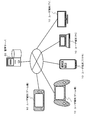
- FIG. 1 is a diagram illustrating an example of a network configuration corresponding to an information processing system that performs the processing of the present embodiment.
- the network configuration shown in FIG. 1 has a configuration in which a plurality of user terminals 10 and a management server 20 can communicate via a network.
- the network configuration shown in FIG. 1 is, for example, a network capable of executing an online game. While a plurality of users who own each user terminal 10 are executing an online game, the user's utterance content is text-input to the user terminal to chat. (Conversation).
- the management server 20 is, for example, a management server that manages online games and chats.
- the user terminal 10 is composed of various electronic devices such as a game machine, a smartphone, a PC, and a television.
- the user terminal 10 can send and receive various data to play an online game or chat through communication between the user terminals or communication via the management server 20.
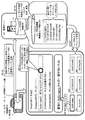
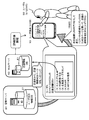
- FIG. 2 is a diagram illustrating the configuration and processing of one user terminal 10 used by one user who is performing a chat with a plurality of users via a network.
- the user terminal 10 has a display unit 11 and a camera 12. Further, the user attention information DB (database) 13 is included in the storage unit inside the user terminal 10.
- a chat window 15, a message creation window 16, and a user ID input menu 17 are displayed on the display unit 11.
- the chat window 15 displays the content of chats with a plurality of users who are executing via the network.
- the user ID of the user who sent the message and the message are displayed.
- the [Alaski G8 +] and the like shown in the figure are the user IDs, and the subsequent text “Wow” and the like are the messages.
- the user ID is required to be unique, so it is often a complex one that combines multiple character types (uppercase letters, lowercase letters, symbols, numbers).
- a message input by the user using this user terminal via the user terminal 10 is displayed.
- the user inputs a message as a comment to a message of a specific user when inputting his / her message in the message creation window 16 in order to clarify which user the message is, the user ID Input is required.
- the following message is input to the message creation window 16. "Finally, the shot of bo2s-ages worked.”
- “bo2s-ages” is the user ID of the message sender who is the comment target.
- the user ID input menu 17 is displayed on the display unit 11, and the user can input the user ID only by selecting the user ID to be input from the user ID input menu 17.
- the message is displayed on the message creation window 16.
- the control unit (data processing unit) of the user terminal 10 executes the process of creating and updating the list of user IDs displayed on the user ID input menu 17, and further executes the process of displaying the latest list on the display unit 11.
- control unit (data processing unit) of the user terminal 10 The processing executed by the control unit (data processing unit) of the user terminal 10 will be described.
- the control unit (data processing unit) of the user terminal 10 executes the processes of steps S01 to S03 shown in FIG.
- step S01 it is detected that the gazing point of the user stays on one message displayed in the chat window 15 of the display unit 11 for a predetermined time or more.
- the predetermined time is, for example, 3 seconds, and this time can be freely set by the user.
- the control unit (data processing unit) of the user terminal 10 analyzes the image captured by the camera 12 to acquire the position of the point of gaze of the user, and the point of gaze of the user is a predetermined time (for example, 3 seconds) or more and one message display area. It is determined whether or not it has stayed in.
- One message display area is, for example, an internal area of a dotted frame shown in the chat window 16 in the figure.
- step S02 the control unit (data processing unit) of the user terminal 10 acquires the user ID of the sender of the message that has stayed at the user's gazing point for a predetermined time (for example, 3 seconds) or more, and the acquired user A user ID list having an ID set at the head is created, updated, and stored in the user attention information DB 13 in the user terminal 10.
- a predetermined time for example, 3 seconds
- the list is, for example, a list configured by the following user IDs. (1) bo2s-ages (2) rc914kfcGcfk (3) GenkiTama09 (4) Alaski G8 + (5) Yamazon 3845 (6) NGT2KqPSk ...
- Each of the user IDs (1) to (6) included in this list is the user ID of the calling user of the message watched by the user for a predetermined time or longer.
- the order of the list is set such that the user's attention timing is newer.
- the control unit sequentially executes the list update processing according to the observation data of the user's gaze situation.
- the user ID of (1) is the sender user ID of the latest attention message, and the following (2) to (6) have a new attention time. From the oldest to the oldest.
- the maximum number of IDs included in the list is, for example, 6 or 10, and can be set by the user.
- step S03 the control unit (data processing unit) of the user terminal 10 selects and displays the user ID at the top of the list from the “user attention information sender user ID list” stored in the user attention information DB 13. It is displayed in the area 17 of the user ID input menu of the section 11.
- the following six user IDs are displayed in the user ID input menu 17 area of the display unit 11.
- bo2s-ages (2) rc914kfcGcfk (3) GenkiTama09 (4) Alaski G8 + (5) Yamazon 3845 (6) NGT2KqPSk
- These six user IDs are the six user IDs corresponding to the six messages that the user using the user terminal 10 has focused on most recently. That is, the user IDs are those in which the user selected six sender user IDs of the message watched by the user for a predetermined time (for example, 3 seconds) or more in order from the newest watch timing.
- the user can freely set the number of user IDs to be displayed in the user ID input menu 17 area of the display unit 11. It is also possible to set not to display the user ID at all in the user ID input menu 17 area. It may be configured to switch between display and non-display by button operation.
- step S04 the control unit (data processing unit) of the user terminal 10 detects the user's selection input for the user ID displayed in the user ID input menu 17 area, and displays the selected user ID in the message creation window 16. indicate. The user can complete the input process of the selected user ID only by selecting the user ID displayed in the user ID input menu 17 area.
- the selection process is performed by a touch process of the user ID display area of the display unit 11 configured as a touch panel, or a user ID selection information input process via another input unit.
- the following user input message is displayed in the message creation window 16. "Finally, the shot of bo2s-ages worked.”
- “bo2s-ages” is the user ID of the user of the message sender who is the comment target.
- This “bo2s-ages” is one user ID selected by the user from the user IDs displayed in the user ID input menu 17 area.
- the control unit (data processing unit) of the user terminal 10 detects the ID selection information of the user and displays the selected user ID in the message creation window 16.
- the user can complete the input process of the selected user ID only by selecting the user ID displayed in the user ID input menu 17 area when inputting the message.
- the user ID displayed in the area of the user ID input menu 17 is a user ID corresponding to a plurality of messages that the user using the user terminal 10 has focused on most recently. That is, a list of the user IDs of the users who are the senders of the messages most recently noticed by the user among the messages sent from other users who are chatting is displayed. Thereby, the user ID input at the time of message input can be accurately executed in a short time, and timely chat progress can be realized.
- the user attention information DB 13 is stored in the user terminal 10, but the user attention information DB is stored in the management server 20 that can communicate with the user terminal 10, for example. It may be configured to be installed.
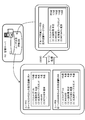
- FIG. 3 shows a configuration example in which the user attention information DB 21 is installed in the management server 20.
- the user attention information DB 21 installed in the management server 20 is the user attention information DB 21 corresponding to each user terminal.
- control unit (data processing unit) of the management server 20 executes generation and update of the user attention information sender user ID list stored in the user attention information DB 21, and further, the user terminal 10 The selection process of the user ID displayed on the user ID input menu 17 and the transmission process for the user terminal 10 are executed.
- step S11 it is detected that the gazing point of the user stays on one message displayed in the chat window 15 of the display unit 11 for a predetermined time or more.
- the predetermined time is, for example, 3 seconds, and this time can be freely set by the user.
- This processing is executed by the control unit (data processing unit) of the user terminal 10.
- step S12 the control unit (data processing unit) of the user terminal 10 acquires the user ID of the sender of the message that has stayed at the user's gazing point for a predetermined time (for example, 3 seconds) or more, and the acquired user The ID is transmitted to the management server 20.
- the transmission data also includes the identifier of the user terminal 10.
- step S13 the management server 20 executes the generation and update processing of the user attention information sender user ID list stored in the user attention information DB 21 based on the user ID received from the user terminal 10.
- the user attention information sender user ID list is generated as data for each user terminal.
- the structure of the list is the same as the list described with reference to FIG. 2, and all the user IDs included in the list are the user IDs of the originating users of the messages that the user has watched for a predetermined time or longer.
- the order of the list is sequentially updated by the control unit (data processing unit) of the management server 20 so that the user's attention timing is newer.
- the user ID of (1) is the sender user ID of the latest attention message, and the following (2) to (6) have a new attention time. From the oldest to the oldest.
- step S14 the management server 20 selects a user ID in the list higher order from the “user attention information sender user ID list” stored in the user attention information DB 21 and transmits it to the user terminal 10.
- the transmission data is displayed in the user ID input menu 17 area of the display unit 11 of the user terminal 10.
- step S15 the control unit (data processing unit) of the user terminal 10 detects the user's selection input for the user ID displayed in the user ID input menu 17 area, and displays the selected user ID in the message creation window 16. indicate. The user can complete the input process of the selected user ID only by selecting the user ID displayed in the user ID input menu 17 area when inputting the message.
- the management server 20 executes the generation and update of the list, which reduces the processing load on the user terminal 10. Therefore, it can be used also in the user terminal 10 having a low processing capacity.
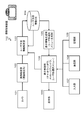
- FIG. 4 is a block diagram showing a configuration example of the information processing device 100.
- the information processing apparatus 100 shown in FIG. 4 is a configuration example of the information processing apparatus 100 corresponding to the user terminal 10 when the configuration described above with reference to FIG. 2, that is, the configuration in which the user terminal 10 performs all the processes. Is. In the case of the configuration described above with reference to FIG. 3, some of the information processing apparatuses 100 shown in FIG. 4 belong to the user terminal 10 and some belong to the management server 20.
- the information processing apparatus 100 includes a camera 101, an image analysis unit 102, a user attention information analysis unit 103, a user attention information DB 104, a display information generation unit (user ID selection menu generation unit) 105, and a display control unit.
- 106 an input unit 107, a communication unit 108, a storage unit 109, and a display unit 110.
- the camera 101 captures a face including eyes of a user who is operating the information processing apparatus 100.
- the image captured by the camera 101 is input to the image analysis unit 102.
- the image analysis unit 102 inputs the captured image of the camera 101 and detects the line-of-sight direction of the user who is operating the information processing apparatus 100.
- the user line-of-sight direction analyzed by the image analysis unit 102 is input to the user attention information analysis unit 103.
- the user attention information analysis unit 103 identifies the information the user is paying attention to based on the user's line-of-sight direction analyzed by the image analysis unit 102 and the display information of the information processing apparatus 100, and specifies a predetermined time (for example, 3 seconds). As described above, it is determined whether or not the user's gazing point stays in one information display area, and if so, that information is selected as user attention information.
- the user attention information analysis unit 103 extracts the user ID, which is a component of the user attention information, that is, the user ID indicating the sender of the message in the user attention information, from the selected user attention information area.
- the attention information sender user ID list "is generated or updated and stored in the user attention information DB 104.
- the “user attention information sender user ID list” stored in the user attention information DB 104 is a list in which the latest attention time (attention timing) is set higher.
- the user attention information analysis unit 103 continuously inputs the user's line-of-sight direction analyzed by the image analysis unit 102, and obtains the user ID from the information area in which the user's gaze point stays for a predetermined time (for example, 3 seconds) or more. It is acquired at any time, and the “user attention information sender user ID list” stored in the user attention information DB 104 is updated according to the acquired information.
- the display information generation unit (user ID selection menu generation unit) 105 selects a plurality of high-order user IDs from the “user attention information sender user ID list” stored in the user attention information DB 104, and displays them on the display unit 110. A user ID selection menu to be displayed is generated.
- the user ID selection menu displayed on the display unit 110 is the user ID selection menu 17 described with reference to FIG.
- the display control unit 106 displays the display data of the display unit described above with reference to FIGS. 2 and 3, that is, various data to be displayed on the display unit 110, such as a chat window, a message creation window, and a user ID input menu. Perform display control.
- the input unit 107 includes an operation unit that executes input processing such as user input to the information processing apparatus 100.
- the display unit 110 When the display unit 110 is configured as a touch panel, the display unit 110 also becomes a part of the input unit.
- the communication unit 108 executes communication between the information processing device 100 and another user terminal or management server.
- the storage unit 109 is a storage unit used as a program for processing executed in the information processing apparatus 100, parameters applied to data processing, and a work area applied to data processing. Note that the storage unit 109 also stores identification information of the information processing apparatus 100 and the like.
- the display unit 110 displays the display data generated by the display control unit 106. Specifically, the chat window, the message creation window, the user ID input menu, etc. described above with reference to FIGS. 2 and 3 are displayed.
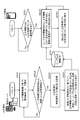
- the process according to the flowchart shown in FIG. 5 can be executed according to a program stored in the storage unit of the information processing apparatus 100, and is performed as a program execution process by a processor such as a CPU having a program execution function. be able to.
- a processor such as a CPU having a program execution function.
- steps S101 to S104 and the processing of steps S121 to S123 in the flow shown in FIG. 5 are executed in parallel. First, the processing of steps S101 to S104 will be described.
- Step S101 First, in step S101, line-of-sight analysis based on a camera-captured image is executed. This process is a process executed by the image analysis unit 102 of the information processing device 100 shown in FIG.
- step S101 the image analysis unit 102 inputs the image captured by the camera 101 and detects the line-of-sight direction of the user who is operating the information processing apparatus 100.
- the detected user gaze direction information is input to the user attention information analysis unit 103.
- Step S102 it is determined whether or not the attention information in which the user's line of sight stays for a specified time or longer is detected.
- This process is a process executed by the user attention information analysis unit 103 shown in FIG.
- the user attention information analysis unit 103 identifies the information the user is paying attention to based on the user's line-of-sight direction analyzed by the image analysis unit 102 and the display information of the information processing apparatus 100, and specifies a predetermined time (for example, 3 seconds). As described above, it is determined whether or not the user's gaze point remains in one information display area.
- step S102 if the attention information that the user's line of sight stays for a specified time or longer is detected, the process proceeds to step S103. If not detected, the processing from step S101 is repeated.
- Step S103 In step S102, when attention information in which the user's line of sight has stayed for a specified time or longer is detected, the process proceeds to step S103. In step S103, the sender user ID of the attention information is acquired.
- This process is also a process executed by the user attention information analysis unit 103 shown in FIG.
- the user attention information analysis unit 103 determines the user ID, which is a component of the user attention information, that is, the user ID indicating the sender of the message in the user attention information, from the user attention information area in which the user's line of sight stays for a specified time or more. Extract.
- Step S104 Next, in step S104, the list of caller user IDs acquired in step S103 is generated, updated, and recorded in the user attention information DB 104.
- This process is also a process executed by the user attention information analysis unit 103 shown in FIG.
- the user attention information analysis unit 103 extracts the user ID indicating the sender of the message in the user attention information, generates or updates the “user attention information sender user ID list”, and stores it in the user attention information DB 104.
- the “user attention information sender user ID list” stored in the user attention information DB 104 is a list in which the latest attention time (attention timing) is set higher.
- Step S121 First, in step S121, the presence or absence of a display request for a user ID selection menu is detected.
- This processing is executed by the display control unit 106 of the information processing device 100 shown in FIG.
- the display control unit 106 determines whether the user has input a display request for the user ID selection menu via the input unit 107. It should be noted that this sequence is a processing example in which the user ID selection menu is displayed only when a user request is made. It is also possible to set to display the user ID selection menu regardless of the user request.
- step S121 If it is determined in step S121 that the display request for the user ID selection menu has been made, the process proceeds to step S122.
- Step S122 If it is determined in step S121 that the display request for the user ID selection menu is made, the process proceeds to step S122, and in step S122, the sender user ID list is read from the user attention information DB 104.
- This process is a process executed by the display information generation unit (user ID selection menu generation unit) 105 shown in FIG.
- the display information generation unit (user ID selection menu generation unit) 105 reads out the sender user ID list from the user attention information DB 104.
- the sender user ID list is a list generated and updated by the user attention information analysis unit 103 in the process of step S104 described above, and the latest update data is read from the user attention information DB 104.
- step S123 Next, in step S123, the read caller user ID list is displayed on the display unit.
- This process is a process executed by the display information generation unit (user ID selection menu generation unit) 105 and the display control unit 106 shown in FIG.
- the display information generation unit (user ID selection menu generation unit) 105 selects a plurality of high-order user IDs from the “user attention information sender user ID list” stored in the user attention information DB 104, and displays them on the display unit 110. A user ID selection menu to be displayed is generated.
- the display control unit 106 displays the user ID selection menu generated by the display information generation unit (user ID selection menu generation unit) 105 on the display unit 110.
- the user ID selection menu is the user ID selection menu 17, which is a component of the display data of the display unit described above with reference to FIGS. 2 and 3.
- the user can complete the input process of the selected user ID only by selecting the user ID displayed in the user ID input menu 17 area when inputting the message.
- Example 2 Example in which attention information of a user is specified based on a user's line of sight, shop information corresponding to the attention information is acquired, and a shop list is displayed]
- the shop information corresponding to the attention information is acquired, and the shop list is displayed.
- the second embodiment is an embodiment using an electronic bulletin board, a so-called digital tunnel signage, as a public terminal placed at an entrance of a building having a large number of restaurants and the like.
- the line-of-sight information of the user with respect to the store information displayed on the digital signage is analyzed to identify the user attention information, and the identified user attention information, specifically, the store name or the like is displayed on the user terminal such as a smartphone. Execute the processing to be displayed.
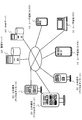
- FIG. 6 is a diagram illustrating an example of a network configuration corresponding to an information processing system that performs the process of the present embodiment.
- the network configuration shown in FIG. 6 is a configuration in which a plurality of user terminals 10, a plurality of public terminals (digital signage) 30, a management server 20, and a Web server 60 can communicate via a network.
- the user terminal 10 includes various devices such as a smartphone and a PC.
- the public terminal (digital signage) 30 is, for example, a public terminal placed at an entrance or the like of a building having a number of restaurants and other stores. On the public terminal (digital signage) 30, guide information such as store information of various restaurants is displayed.
- the management server 20 executes analysis processing of user attention information, for example, attention shop information, generation processing of a user attention information list (attention shop list), and the like.
- the Web server 60 is a server that provides a Web page including detailed information on a store such as a restaurant.
- a smartphone, a PC, or the like as the user terminal 10 can access a Web page of a store such as a restaurant provided by the Web server 60 and confirm detailed information of the store such as a restaurant.
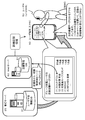
- FIG. 7 shows one public terminal 30.
- the public terminal 30 has a camera 31 and a display unit 32.
- the display unit 32 displays, for example, a floor map and store information of each store on the floor.
- One user A50 is looking at one of the store information displayed on the display unit 32.
- the camera 31 photographs the face of the user who views the information displayed on the display unit 32 of the public terminal 30.
- the control unit (data processing unit) inside the public terminal 30 analyzes the image captured by the camera 31 to acquire the position of the point of gaze of the user, and the point of gaze of the user is equal to or longer than a predetermined time (for example, 3 seconds) It is determined whether or not the image has stayed in the display area.
- control unit (data processing unit) inside the public terminal 30 determines that the user's gazing point has stayed in one store information display area for a predetermined time (for example, 3 seconds) or more in the figure (step S21) .
- the identifier of the store information is transmitted to the management server 20 together with the face image of the user captured by the camera 31.
- the management server 20 performs user identification based on the face image of the user received from the public terminal 30 in step S22 shown in FIG.
- the management server 20 has a user information DB in which face images are registered in advance in association with user IDs, and the registered face images stored in the user information DB and the users received from the public terminal 30 are registered.
- the face image is collated to identify the user.
- a user ID associated with a face image is registered in the user information DB.
- the user ID of the user A50 is U12345.
- the list is a list composed of the following store names. (1) Scott grill (2) Chinese food Hotei (3) Hokkaido soup stand (4) HIKARI (5) KITCHEN Tokuju ...
- the store names (1) to (5) included in this list are all store names corresponding to the store information that the user has watched for a predetermined time or longer.
- the order of the list can be set variously. For example, the user whose attention timing is newer is ranked higher. Alternatively, the setting is such that one having a long gaze time is ranked higher.
- the URL link information of the store information Web page is embedded in the store name included in the list.
- This noted store list can be browsed using the user terminal 10 of the user A50.
- FIG. 8 the browsing process of the focused shop list using the user terminal 10 of the user A50 will be described.
- the user A50 uses the user terminal 10 owned by the user A50 to access and display the "attention shop list" stored in the user attention information DB 21 of the management server 20. You can
- the store name in the list displayed on the user terminal 10 is embedded with the link information of the Web page including the detailed store information.
- the user A50 accesses the web page of the store stored in the store information DB 61 of the web server 60 by designating (for example, tapping) the store name in the list displayed on the user terminal 10, and confirms the detailed information of the store. can do.
- FIG. 9 shows one public terminal 30.
- the public terminal 30 has a camera 31 and a display unit 32.
- the display unit 32 displays, for example, a floor map and store information of each store on the floor.
- Two users A50 and B52 are looking at the store information displayed on the display unit 32.
- the store information viewed by the user A50 and the user B52 are different.
- control unit data processing unit inside the public terminal 30 determines in step S31 shown in the figure that the user's point of gaze has stayed in one store information display area for a predetermined time (for example, 3 seconds) or more.
- the identifier of the store information is transmitted to the management server 20 together with the face image of the user captured by the camera 31.
- the following data (a) and (b) are transmitted from the user terminal 30 to the management server 20.
- (A) The face image of the user A50 and the identifier of the store information that the user A50 gazed at
- (B) The face image of the user B52 and the identifier of the store information that the user B52 is gazing at,
- the management server 20 performs user identification based on the face image of the user received from the public terminal 30 in step S22 shown in the figure, and further generates a noticed store list for each identified user.
- the management server 20 generates the following two lists (a) and (b).
- (A) List of noticed stores corresponding to user A50 (user ID U12345),
- (B) List of noticed stores corresponding to the user B52 (user ID U00888), These correspond to the two lists shown on the right side of FIG.
- the order of the list can be set variously. For example, the user whose attention timing is newer is ranked higher. Alternatively, the setting is such that one having a long gaze time is ranked higher.
- points (0 to 10 points) are set for the store names listed in the target store list.
- Various settings can be made for the score, such as a setting of decreasing the score one by one, such as 10 points, 9 points, 8 points, ..., According to the order of the list.
- the score may be set according to the gaze time.
- the management server 20 When the user A50 and the user B52 are users who belong to one group registered in advance, the management server 20 further executes the merge process of the focused store lists of the users belonging to the same group to generate the focused store merge list. To generate.
- the points corresponding to each store are also added to the noticed store merge list of the users belonging to the group.
- the score is a score obtained by adding the scores set in the target store list of the individual user who is the merge target.
- the attention store merge list generated by the management server 20 is stored in the user attention information DB 21.
- This attention store merge list can be browsed by using a user terminal owned by the user A50, the user B52, or the like. Referring to FIG. 11, a browsing process of the noticed store merge list using the user terminal 10 of the user A50 will be described.
- the user A50 uses the user terminal 10 owned by the user A50 to access and display the “attention store merge list” stored in the user attention information DB 21 of the management server 20. be able to.
- the store name in the list displayed on the user terminal 10 is embedded with the link information of the Web page including the detailed store information.
- the user A50 accesses the web page of the store stored in the store information DB 61 of the web server 60 by designating (for example, tapping) the store name in the list displayed on the user terminal 10, and confirms the detailed information of the store. can do.
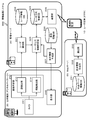
- FIG. 12 is a block diagram showing a configuration example of the information processing device system 200.
- the information processing system 200 shown in FIG. 12 is an example of a system including the public terminal 30, the management server 20, the web server 60, and the user terminal 10 described above with reference to FIGS. 6 to 11.
- the public terminal 30 has a camera 211, an image analysis unit 212, and a display unit 215.
- the image analysis unit 212 includes a face detection unit 213 and a line-of-sight detection unit 214.
- the management server 20 includes a user identification unit 221, a user information DB 222, a user attention information analysis unit 223, a user attention information DB 224, a communication unit 225, a display information DB 226, and a display information generation unit 227.
- the web server 60 has a web page information DB 231, a display information generation part 232, and a communication part 233.
- the camera 211 of the public terminal 30 photographs the face of the user who is looking at the information displayed on the display unit 215 of the public terminal 30.
- the captured image is input to the face detection unit 213 and the line-of-sight detection unit 214.
- the face detection unit 213 of the image analysis unit 212 detects a face area from the image captured by the camera 211 and transmits the image of the detected face area to the management server 20.
- the line-of-sight detection unit 214 of the image analysis unit 212 analyzes the captured image of the camera 211 to acquire the position of the user's gazing point, and the gazing point of the user is displayed in one store information display area for a predetermined time (for example, 3 seconds) or more. It is determined whether or not it has stayed. When it is determined that the user's gazing point has stayed in one store information display area for a predetermined time (for example, 3 seconds) or more, the identifier of the store information is transmitted to the management server 20.
- the display unit 215 of the public terminal 30 displays the display information transmitted from the management server 20. For example, the floor map and store information described with reference to FIG. 7 and the like are displayed.
- the management server 20 includes a user identification unit 221, a user information DB 222, a user attention information analysis unit 223, a user attention information DB 224, a communication unit 225, a display information DB 226, and a display information generation unit 227.
- the user identification unit 221 inputs the image including the face area detected by the face detection unit 213 of the public terminal 30 from the image captured by the camera 211, and executes the user identification process.
- the user identification unit 221 executes collation processing between the face image of the user registered in the user information DB 222 and the face image received from the public terminal 30 to execute user identification.
- the user information DB 222 stores the correspondence data of the registered user's user ID and face image.
- the user attention information analysis unit 223 inputs the identifier of the store information that the user has noticed from the line-of-sight detection unit 214 of the public terminal 30. That is, the identifier of the store information that is determined that the user's point of gaze stays in one store information display area for a predetermined time (for example, 3 seconds) or more is input.
- the user attention information analysis unit 223 generates the user attention store list for each user identified by the user identification unit 221. For example, it is a list composed of the following store names described above with reference to FIG. 7. (1) Scott grill (2) Chinese food Hotei (3) Hokkaido soup stand (4) HIKARI (5) KITCHEN Tokuju ...
- the store names (1) to (5) included in this list are all store names corresponding to the store information that the user has watched for a predetermined time or longer.
- the order of the list can be set variously. For example, the user whose attention timing is newer is ranked higher. Alternatively, the setting is such that one having a long gaze time is ranked higher.
- URL link information of the store information Web page is embedded in the store name included in the list.
- the focused store list generated by the user focused information analysis unit 223 is stored in the user focused information DB 224.
- the focused store list stored in the user focused information DB 224 can be accessed and browsed by the user terminal 10 such as a smartphone.
- the display information DB 226 stores the content displayed on the display unit 215 of the public terminal 30.
- the display usage method generation unit 227 generates data to be displayed on the display unit 215 of the public terminal 30 by combining the contents stored in the display information DB 226 and transmits the data to the public terminal 30.
- the transmission data is displayed on the display unit 215 of the public terminal 30.
- the user terminal 10 can display the focused store list stored in the user focused information DB 224 of the management server 20.
- the URL link information of the store information Web page is embedded in the store name in the target store list displayed on the user terminal 10.
- the user accesses the web page of the store stored in the store information DB 61 of the web server 60 and confirms the detailed information of the store. be able to.
- the display information generation unit 232 of the Web server 60 generates display data based on the Web page of the store stored in the store information DB 61 and transmits it to the user terminal 10 via the communication unit 233.
- various distributions of processing functions between the management server 20 and the public terminal 30 can be set.
- all the execution functions of the management server 20 can be set as the functions in the public terminal 30.
- the management server 20 may have the function of the Web server 60.
- each information processing device such as the public terminal 30, the management server 20, the user terminal 10, the web server 60, which are the information processing devices that configure the information processing system 200. It can be executed according to the stored program, and can be executed as a program execution process by a processor such as a CPU having a program execution function.
- a processor such as a CPU having a program execution function.
- steps S201 to S204 in the flow shown in FIG. 13 are processes executed by the public terminal 30 and the management server 20.
- the processes of steps S221 to S223 are processes executed by the user terminal 10. Each of these processes can be executed in parallel. First, the processing of steps S201 to S204 will be described.
- Step S201 First, in step S201, line-of-sight analysis and user identification based on a camera-captured image of the public terminal 30 are executed. This process is a process executed by the face detection unit 213, the line-of-sight detection unit 214 of the public terminal 30, and the user identification unit 221 of the management server 20 illustrated in FIG.
- the face detection unit 213 of the public terminal 30 detects a face area from the image captured by the camera 211 of the public terminal 30 and transmits the image of the detected face area to the management server 20. Further, the line-of-sight detection unit 214 of the public terminal 30 analyzes the image captured by the camera 211 of the public terminal 30 to acquire the user's gazing point position.
- the user identification unit 221 of the management server 20 inputs the image including the face area detected by the face detection unit 213 of the public terminal 30 from the image captured by the camera 211, and executes the user identification process.
- the user identification unit 221 executes collation processing between the face image of the user registered in the user information DB 222 and the face image received from the public terminal 30 to execute user identification.
- Step S202 Next, in step S202, it is determined whether or not the attention information in which the user's line of sight stays for a specified time or longer is detected.
- This process is a process executed by the line-of-sight detection unit 214 of the public terminal 30 shown in FIG.
- the line-of-sight detection unit 214 of the public terminal 30 illustrated in FIG. 12 determines whether the gazing point of the user stays in one store information display area for a predetermined time (for example, 3 seconds) or more based on the image captured by the camera 211. judge. When it is determined that the user's gazing point has stayed in one store information display area for a predetermined time (for example, 3 seconds) or more, the identifier of the store information is transmitted to the management server 20.
- a predetermined time for example, 3 seconds
- step S202 if attention information that the user's line of sight stays for a specified time or longer is detected, the process proceeds to step S203. If not detected, the processing from step S201 onward is repeated.
- Step S203 In step S202, if attention information in which the user's line of sight has stayed for a specified time or longer is detected, the process proceeds to step S203.
- Step S203 is a process executed by the user attention information analysis unit 223 of the management server 20 shown in FIG.
- the user attention information analysis unit 223 inputs, from the line-of-sight detection unit 214 of the public terminal 30, the identifier of the store information in which the user's gazing point stays for a predetermined time (for example, 3 seconds) or more.
- Step S204 the user focused store list is generated based on the store information identifier acquired in step S203.
- This process is a process executed by the user attention information analysis unit 223 of the management server 20 shown in FIG.
- the user attention information analysis unit 223 generates the user attention store list for each user identified by the user identification unit 221 of the management server 20. For example, it is a list composed of the following store names described above with reference to FIG. 7. (1) Scott grill (2) Chinese food Hotei (3) Hokkaido soup stand (4) HIKARI (5) KITCHEN Tokuju ...
- the store names (1) to (5) included in this list are all store names corresponding to the store information that the user has watched for a predetermined time or longer.
- the order of the list can be set variously. For example, the user whose attention timing is newer is ranked higher. Alternatively, the setting is such that one having a long gaze time is ranked higher.
- URL link information of the store information Web page is embedded in the store name included in the list.
- the focused store list generated by the user focused information analysis unit 223 is stored in the user focused information DB 224.
- the focused store list stored in the user focused information DB 224 can be accessed and browsed by the user terminal 10 such as a smartphone.
- steps S221 to S223 executed in parallel with the processing of steps S201 to S204 will be described.
- the processes of steps S221 to S223 are executed by the user terminal 10 such as a smartphone.
- Step S221 First, in step S221, the presence / absence of a display request for the attention information list, that is, the attention store list for each user is detected. This processing is executed by the control unit (data processing unit) of the user terminal 10.
- step S221 If it is determined in step S221 that there is a request to display the focused store list, the process proceeds to step S222.
- Step S222 If it is determined in step S221 that there is a request to display the focused store list, the process proceeds to step S222, and in step S222, the focused store list stored in the user focused information DB 224 of the management server 20 is read.
- the focused store list is a list generated and updated by the user focused information analysis unit 223 of the management server 20 in the process of step S204 described above, and the latest updated data is read from the user focused information DB 224.
- step S223 Next, in step S223, the read target shop list is displayed on the display unit of the user terminal 10.
- the focused store list is a focused store list for each user, and is the focused store list described above with reference to FIG. 7 and the like. Note that it is also possible to execute the reading of the noticed store merge list obtained by merging the noticed store lists of a plurality of users described with reference to FIGS. 9 to 11.
- the user terminal 10 can display the noticed store list or the noticed store merge list stored in the user notice information DB 224 of the management server 20.
- the URL link information of the store information Web page is embedded in the store name in the list displayed on the user terminal 10.
- the user accesses the web page of the store stored in the store information DB 61 of the web server 60 and confirms the detailed information of the store. be able to.
- the processing example based on the staying time of the gazing point of the user has been described as the method of determining the attention information of the user.
- the method of determining the attention information is not limited to this residence time measurement processing, and other methods may be applied.
- the configuration may be such that the machine learning of the eye movement is performed and the attention information is determined using the result of the learning processing.
- the camera-captured image is used to detect the line of sight of the user, but various other methods can be used as the method of detecting the line of sight of the user.
- a line-of-sight detection may be performed using a sensor such as an EOG (Electro-Oculogram) that measures the electric potential of the eyeball.
- EOG Electro-Oculogram
- the region in which the user's line of sight can be specified may span multiple information regions.
- the display information on the display unit may be enlarged and displayed in an enlarged manner so that display control is performed to facilitate narrowing down the target area of interest of the user's line of sight.
- the user terminal 10 or the like which is an information processing device, reads aloud the chat text or the store name of the display store.
- the user makes a gesture such as nodding at the timing of reading the chat text as the reply target or the name of the shop of interest.
- the information may be included in the list.
- gestures such as a nod, a change in the direction of the head, or a signal by a hand or an arm can be used. Further, it may be configured to recognize the user's voice input by the microphone.
- the user ID list and the shop name list are shown as examples of the created list, but a list including various other information may be generated. For example, it is also possible to generate a song name list, a schedule task list, or the like in the descending order of user's attention or as a list of latest attention.
- the generated list when the generated list is displayed on the user terminal, it may be configured such that the use timing of the information included in the list is taken into consideration and the information corresponding to the timing is narrowed down before being displayed. For example, in the case of displaying store information, if the display time is daytime, the store having lunch is preferentially displayed and the information of the store having the evening course is preferentially displayed at night.
- the configuration has been described in which the order of the list is determined based on the latest attention information and the staying time of the line of sight, and a higher score (weight) is set from the top of the list.
- This score is not limited to such a setting, and various settings are possible.
- the score corresponding to each presentation information may be calculated based on the information provider and the behavior history of the user. For example, it is a process of setting a high score for a dish the user likes. Further, the score may be changed according to the person who browses the list.
- the data to be selected and displayed from the generated list is used as the user ID.
- the user IDs are similar, there is a possibility that the user ID may be wrong at the time of selection.
- a part of the message may be displayed together with the user ID.
- the user ID and store name that cannot be selected for example, the user ID of the user who left the store or the store name of the closed store may be displayed in a different display form from other data, such as being grayed out.
- the setting is such that the list includes the information that has been gazed for a prescribed line-of-sight residence time, for example, 3 seconds or more. This specified time may be changed according to the type of information to be watched. For example, the setting is short for an image and long for a text.
- the information displayed in the display list may be displayed in different colors for each category. Further, not only the list display process but also the process of reading the display data by voice may be performed.
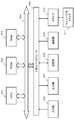
- a CPU (Central Processing Unit) 301 functions as a control unit or a data processing unit that executes various processes according to a program stored in a ROM (Read Only Memory) 302 or a storage unit 308. For example, the processing according to the sequence described in the above embodiment is executed.
- a RAM (Random Access Memory) 303 stores programs and data executed by the CPU 301.
- the CPU 301, the ROM 302, and the RAM 303 are connected to each other by a bus 304.
- the CPU 301 is connected to an input / output interface 305 via a bus 304.
- the input / output interface 305 includes an input unit 306 including various switches, a keyboard, a mouse, a microphone, a camera, a sensor, and an output unit 307 including a display and a speaker. Are connected.
- the CPU 301 executes various kinds of processing in response to a command input from the input unit 306, and outputs the processing result to the output unit 307, for example.
- the storage unit 308 connected to the input / output interface 305 includes, for example, a hard disk, and stores programs executed by the CPU 301 and various data.
- the communication unit 309 functions as a transmission / reception unit for Wi-Fi communication, Bluetooth (registered trademark) (BT) communication, and other data communication via a network such as the Internet or a local area network, and communicates with an external device.
- a drive 310 connected to the input / output interface 305 drives a removable medium 311 such as a magnetic disk, an optical disk, a magneto-optical disk, or a semiconductor memory such as a memory card to record or read data.
- a removable medium 311 such as a magnetic disk, an optical disk, a magneto-optical disk, or a semiconductor memory such as a memory card to record or read data.
- the technique disclosed in this specification can have the following configurations.
- a line-of-sight detection unit that detects a user's gazing point for display information on the display unit
- a user attention information analysis unit that extracts attention information of the user based on the analysis of the user gaze point and generates a list including information corresponding to the attention information
- An information processing apparatus having a display information generation unit that generates a display list composed of the list configuration data.
- the line-of-sight detection unit detects a user gazing point for display information on the display unit based on a camera-captured image, The user attention information analysis unit, The information processing apparatus according to (1), wherein the attention information in which the user gazing point stays for a specified time or longer is extracted, and a list including information corresponding to the attention information is generated.
- the user attention information analysis unit The user gaze point information analyzed by the line-of-sight detection unit is continuously input, and the list update process including the sort process for setting the latest attention information to the higher rank of the list is executed based on the input information (1) or The information processing device according to (2).
- the user attention information analysis unit A list update process involving a sort process of continuously inputting the user gazing point information analyzed by the line-of-sight detection unit and setting attention information having a long dwell time of the user gazing point to a higher rank of the list based on the input information
- the information processing apparatus according to (1) or (2), which is executed.
- the display information generation unit is The information processing apparatus according to any one of (1) to (4), which generates a display list including only upper data of the constituent data of the list.
- the display information is a message on the chat screen
- the line-of-sight detection unit detects a user's gaze message
- the user attention information analysis unit extracts the attention message in which the user gaze point stays for a specified time or more, and generates a user ID list including the user ID of the sender of the attention message
- the information processing apparatus according to any one of (1) to (5), wherein the display information generation unit generates a user ID selection menu including user IDs that can be individually selected.
- the information processing device further includes A display control unit for displaying the user ID selection menu on a user terminal, The information processing device according to (6), wherein the user ID selection menu has a configuration in which a user ID can be input by user selection.
- the display information is store information
- the line-of-sight detection unit detects store information of the user's gaze target
- the user attention information analysis unit extracts attention store information in which the user gaze point stays for a specified time or more, and generates a store list including store names corresponding to the attention store information
- the display information generation unit is the information processing device according to any one of (1) to (5), which generates a display list configured by the store names included in the store list.
- An information processing system having a display device and a management server, The display device, It has a line-of-sight detection unit that detects the user's gazing point for the display information of the display unit,
- the management server is User attention information analysis that inputs user attention point information analyzed on the display device, extracts attention information of the user based on the analysis of the user attention point, and generates a list including information corresponding to the attention information Department,
- An information processing system having a display information generation unit that generates a display list composed of the constituent data of the list.
- the display device is In the line-of-sight detection unit, detects the user gazing point for the display information on the display unit based on the image captured by the camera,
- the management server is The information processing system according to (11), wherein the user attention information analysis unit extracts attention information in which the user gaze point stays for a specified time or more and generates a list including information corresponding to the attention information.
- the display device further includes Sending the image taken by the camera to the management server,
- the management server is The information processing system according to (12), further including a user identification unit that performs user identification based on the camera-captured image input from the display device.
- the management server is In the user attention information analysis unit, a list for each user identified by the user identification unit is generated, The information processing system according to (13), wherein the display information generation unit generates a display list for each user identified by the user identification unit.
- the management server is In the user attention information analysis unit, a list for each user identified by the user identification unit is generated, and a merge list in which a list for each user is merged is generated, The information processing system according to (13), wherein the display information generating unit generates a display list including the constituent data of the merge list.
- the management server is The information processing system according to any one of (11) to (15), wherein the user attention information analysis unit generates a list in which a score is set for each list configuration data in order from the top.
- An information processing method executed by an information processing device A line-of-sight detection unit that detects a user's point of gaze for the display information on the display unit, A user attention information analysis step in which the user attention information analysis unit extracts the user attention information based on the analysis of the user gaze point and generates a list composed of information corresponding to the attention information;
- An information processing method executed in an information processing system having a display device and a management server The display device performs a line-of-sight detection process for detecting a user gazing point for display information on the display unit,
- the management server is User attention information analysis that inputs user attention point information analyzed on the display device, extracts attention information of the user based on the analysis of the user attention point, and generates a list including information corresponding to the attention information Processing and
- a program that causes an information processing device to execute information processing In the line-of-sight detection unit, a line-of-sight detection step of detecting a user's gazing point for the display information of the display unit, A user attention information analysis step of causing a user attention information analysis unit to extract attention information of the user based on analysis of the user gaze point, and generating a list of information corresponding to the attention information; A program for causing a display information generating unit to execute a display information generating step for generating a display list including the constituent data of the list.
- the series of processes described in the specification can be executed by hardware, software, or a composite configuration of both.
- the program in which the processing sequence is recorded is installed in the memory in the computer incorporated in the dedicated hardware and executed, or the program is stored in a general-purpose computer capable of executing various processing. It can be installed and run.
- the program can be recorded in a recording medium in advance.
- the program can be received via a network such as a LAN (Local Area Network) or the Internet and installed in a recording medium such as a built-in hard disk.
- the various processes described in the specification may be executed not only in time series according to the description but also in parallel or individually according to the processing capability of the device that executes the process or the need.
- the system is a logical set configuration of a plurality of devices, and is not limited to one in which the devices of the respective configurations are in the same housing.
- a configuration that detects user attention information and executes various processes based on the detected attention information is realized.
- an image analysis unit that detects a user gazing point for display information on a display unit based on a camera-captured image, and attention information that the user gazing point stays for a specified time or more are extracted to correspond to the attention information.
- the user attention information analysis unit that generates a list including information to be displayed and the display information generation unit that generates a display list including list configuration data.
- the user attention information analysis unit continuously inputs the user attention point information, and executes a sort process of setting the latest attention information or attention information having a long staying time of the user attention point at the top of the list.
- the display information generation unit generates, for example, a display list composed of higher order data of the list configuration data.
- User Terminal 20 Management Server 30 Public Terminal 60 Web Server 100 Information Processing Device 101 Camera 102 Image Analysis Unit 103 User Attention Information Analysis Unit 104 User Attention Information DB 105 Display Information Generation Unit (User ID Selection Menu Generation Unit) 106 display control unit 107 input unit 108 communication unit 109 storage unit 110 display unit 200 information processing system 211 camera 212 image analysis unit 213 face detection unit 214 gaze detection unit 215 display unit 221 user identification unit 222 user information DB 223 User attention information analysis unit 224 User attention information DB 225 Communication unit 226 Display information DB 227 Display information generation unit 231 Web page DB 232 Display information generation unit 233 Communication unit 301 CPU 302 ROM 303 RAM 304 bus 305 input / output interface 306 input unit 307 output unit 308 storage unit 309 communication unit 310 drive 311 removable media
Landscapes
- Engineering & Computer Science (AREA)
- Theoretical Computer Science (AREA)
- General Engineering & Computer Science (AREA)
- Human Computer Interaction (AREA)
- Physics & Mathematics (AREA)
- General Physics & Mathematics (AREA)
- Multimedia (AREA)
- Computer Vision & Pattern Recognition (AREA)
- General Health & Medical Sciences (AREA)
- Psychiatry (AREA)
- Social Psychology (AREA)
- Health & Medical Sciences (AREA)
- Signal Processing (AREA)
- User Interface Of Digital Computer (AREA)
- Information Transfer Between Computers (AREA)
- Position Input By Displaying (AREA)
Abstract
La présente invention réalise une configuration dans laquelle divers processus sont effectués sur la base des informations d'intérêt détectées en détectant des informations d'intérêt d'utilisateur. La présente invention comprend : une unité d'analyse d'image permettant de détecter, en fonction d'une image capturée par caméra, un point de regard d'utilisateur concernant des informations affichées sur une unité d'affichage ; une unité d'analyse d'informations d'intérêt d'utilisateur permettant d'extraire des informations d'intérêt sur lesquelles le point de regard d'utilisateur est resté pendant au moins une durée définie, et produire une liste comprenant des informations correspondant aux informations d'intérêt ; et une unité de production d'informations d'affichage permettant de produire une liste d'affichage comprenant des données de formation de liste. Les informations de l'unité d'analyse d'intérêt d'utilisateur effectuent un processus de tri où des informations de point de regard d'utilisateur sont fournies en continu, et les informations d'intérêt les plus récentes ou les informations d'intérêt sur lesquelles le point de regard d'utilisateur est resté le plus longtemps sont placées en position de tête de la liste. L'unité de production d'informations d'affichage produit une liste d'affichage comprenant, par exemple, les données de position de tête parmi les données formant la liste.
Priority Applications (3)
| Application Number | Priority Date | Filing Date | Title |
|---|---|---|---|
| US17/281,255 US12001604B2 (en) | 2018-11-07 | 2019-09-19 | Information processing device, information processing system, information processing method, and program |
| EP19881909.6A EP3879384A4 (fr) | 2018-11-07 | 2019-09-19 | Dispositif de traitement d'informations, système de traitement d'informations, procédé de traitement d'informations, et programme |
| JP2020556656A JP7363807B2 (ja) | 2018-11-07 | 2019-09-19 | 情報処理装置、情報処理システム、および情報処理方法、並びにプログラム |
Applications Claiming Priority (2)
| Application Number | Priority Date | Filing Date | Title |
|---|---|---|---|
| JP2018-209506 | 2018-11-07 | ||
| JP2018209506 | 2018-11-07 |
Publications (1)
| Publication Number | Publication Date |
|---|---|
| WO2020095546A1 true WO2020095546A1 (fr) | 2020-05-14 |
Family
ID=70612369
Family Applications (1)
| Application Number | Title | Priority Date | Filing Date |
|---|---|---|---|
| PCT/JP2019/036737 Ceased WO2020095546A1 (fr) | 2018-11-07 | 2019-09-19 | Dispositif de traitement d'informations, système de traitement d'informations, procédé de traitement d'informations, et programme |
Country Status (4)
| Country | Link |
|---|---|
| US (1) | US12001604B2 (fr) |
| EP (1) | EP3879384A4 (fr) |
| JP (1) | JP7363807B2 (fr) |
| WO (1) | WO2020095546A1 (fr) |
Cited By (1)
| Publication number | Priority date | Publication date | Assignee | Title |
|---|---|---|---|---|
| JP2021189873A (ja) * | 2020-06-02 | 2021-12-13 | 三菱電機株式会社 | 画面構成制御装置、画面構成制御方法及び画面構成制御プログラム |
Citations (4)
| Publication number | Priority date | Publication date | Assignee | Title |
|---|---|---|---|---|
| JP2004259198A (ja) * | 2003-02-27 | 2004-09-16 | Japan Research Institute Ltd | 情報管理装置、情報管理システム、及びプログラム |
| WO2016006136A1 (fr) * | 2014-07-09 | 2016-01-14 | 株式会社Six | Système de traitement d'informations |
| JP2016063471A (ja) * | 2014-09-19 | 2016-04-25 | ヤマハ株式会社 | コンテンツ再生装置 |
| JP2017156906A (ja) | 2016-02-29 | 2017-09-07 | 株式会社iDEAKITT | チャット表示装置 |
Family Cites Families (7)
| Publication number | Priority date | Publication date | Assignee | Title |
|---|---|---|---|---|
| US9606621B2 (en) * | 2006-07-28 | 2017-03-28 | Philips Lighting Holding B.V. | Gaze interaction for information display of gazed items |
| ES2556678T3 (es) * | 2006-07-28 | 2016-01-19 | Koninklijke Philips N.V. | Distribución automática de vitrinas privadas a lo largo de un escaparate |
| US20100100845A1 (en) * | 2008-10-20 | 2010-04-22 | Ingboo Inc. | Organization and Delivery of Information Updates |
| US20100141552A1 (en) * | 2008-12-04 | 2010-06-10 | Andrew Rodney Ferlitsch | Methods and Systems for Imaging Device and Display Interaction |
| JP2013225226A (ja) * | 2012-04-23 | 2013-10-31 | Kyocera Corp | 情報端末、表示制御プログラムおよび表示制御方法 |
| US8571851B1 (en) | 2012-12-31 | 2013-10-29 | Google Inc. | Semantic interpretation using user gaze order |
| WO2017212610A1 (fr) * | 2016-06-09 | 2017-12-14 | 三菱電機株式会社 | Dispositif de commande d'affichage, dispositif d'affichage, système d'affichage embarqué et procédé de commande d'affichage |
-
2019
- 2019-09-19 US US17/281,255 patent/US12001604B2/en active Active
- 2019-09-19 WO PCT/JP2019/036737 patent/WO2020095546A1/fr not_active Ceased
- 2019-09-19 JP JP2020556656A patent/JP7363807B2/ja active Active
- 2019-09-19 EP EP19881909.6A patent/EP3879384A4/fr not_active Withdrawn
Patent Citations (4)
| Publication number | Priority date | Publication date | Assignee | Title |
|---|---|---|---|---|
| JP2004259198A (ja) * | 2003-02-27 | 2004-09-16 | Japan Research Institute Ltd | 情報管理装置、情報管理システム、及びプログラム |
| WO2016006136A1 (fr) * | 2014-07-09 | 2016-01-14 | 株式会社Six | Système de traitement d'informations |
| JP2016063471A (ja) * | 2014-09-19 | 2016-04-25 | ヤマハ株式会社 | コンテンツ再生装置 |
| JP2017156906A (ja) | 2016-02-29 | 2017-09-07 | 株式会社iDEAKITT | チャット表示装置 |
Cited By (2)
| Publication number | Priority date | Publication date | Assignee | Title |
|---|---|---|---|---|
| JP2021189873A (ja) * | 2020-06-02 | 2021-12-13 | 三菱電機株式会社 | 画面構成制御装置、画面構成制御方法及び画面構成制御プログラム |
| JP7073021B2 (ja) | 2020-06-02 | 2022-05-23 | 三菱電機株式会社 | 画面構成制御装置、画面構成制御方法及び画面構成制御プログラム |
Also Published As
| Publication number | Publication date |
|---|---|
| JP7363807B2 (ja) | 2023-10-18 |
| EP3879384A4 (fr) | 2021-12-22 |
| EP3879384A1 (fr) | 2021-09-15 |
| JPWO2020095546A1 (ja) | 2021-09-24 |
| US12001604B2 (en) | 2024-06-04 |
| US20220221933A1 (en) | 2022-07-14 |
Similar Documents
| Publication | Publication Date | Title |
|---|---|---|
| JP7305011B2 (ja) | メッセージを表示するためのプログラム | |
| JP6335210B2 (ja) | 検索サービスと接続されたメッセージサービスのためのメッセージサービス提供方法及び前記メッセージサービス提供方法を実行するメッセージサーバ及びユーザ端末 | |
| US20200204506A1 (en) | Systems and methods implementing user interface objects | |
| US11256865B2 (en) | Method and apparatus for sending sticker image during chat session | |
| CN112791393B (zh) | 一种信息处理方法、装置、设备及介质 | |
| Buschek et al. | Personal mobile messaging in context: Chat augmentations for expressiveness and awareness | |
| CN111565143B (zh) | 即时通信方法、设备及计算机可读存储介质 | |
| JP2013248292A (ja) | 情報処理プログラム、情報処理装置、情報処理システムおよび表示方法 | |
| US20240406290A1 (en) | Techniques for connecting to external devices | |
| KR20140035160A (ko) | 모바일 메시지 애플리케이션의 이미지 이모티콘 검색 방법 | |
| US9553840B2 (en) | Information sharing system, server device, display system, storage medium, and information sharing method | |
| CN105892631A (zh) | 一种简化虚拟现实应用操作的方法和装置 | |
| CN116089736A (zh) | 一种社交会话的处理方法及相关设备 | |
| JP2013250898A (ja) | 情報処理プログラム、情報処理装置、情報処理システムおよび表示方法 | |
| US12354138B2 (en) | Systems and methods for utilizing augmented reality and voice commands to capture and display product information | |
| US11329939B2 (en) | Spatial topic representation of messages | |
| US10176252B2 (en) | Information-processing device, server device, interaction system, and program | |
| US20170017788A1 (en) | Verification method, method to open a web page and method to open an electronic file | |
| JP7363807B2 (ja) | 情報処理装置、情報処理システム、および情報処理方法、並びにプログラム | |
| US20190173815A1 (en) | Information processing apparatus and non-transitory computer readable medium storing information processing program | |
| Derby | Designing Tomorrow's Reality: The Development and Validation of an Augmented and Mixed Reality Heuristic Checklist | |
| CN113553105A (zh) | 引导页面的生成方法和装置 | |
| US20160054915A1 (en) | Systems and methods for providing information to a user about multiple topics | |
| EP4540691A1 (fr) | Destinataire de message suggéré par groupe commun | |
| CN112667196B (zh) | 信息展示方法及装置、电子设备和介质 |
Legal Events
| Date | Code | Title | Description |
|---|---|---|---|
| 121 | Ep: the epo has been informed by wipo that ep was designated in this application |
Ref document number: 19881909 Country of ref document: EP Kind code of ref document: A1 |
|
| ENP | Entry into the national phase |
Ref document number: 2020556656 Country of ref document: JP Kind code of ref document: A |
|
| NENP | Non-entry into the national phase |
Ref country code: DE |
|
| ENP | Entry into the national phase |
Ref document number: 2019881909 Country of ref document: EP Effective date: 20210607 |