WO2020095900A1 - Liquid crystal orientation agent, liquid crystal orientation film, and liquid crystal display element - Google Patents
Liquid crystal orientation agent, liquid crystal orientation film, and liquid crystal display element Download PDFInfo
- Publication number
- WO2020095900A1 WO2020095900A1 PCT/JP2019/043298 JP2019043298W WO2020095900A1 WO 2020095900 A1 WO2020095900 A1 WO 2020095900A1 JP 2019043298 W JP2019043298 W JP 2019043298W WO 2020095900 A1 WO2020095900 A1 WO 2020095900A1
- Authority
- WO
- WIPO (PCT)
- Prior art keywords
- liquid crystal
- group
- formula
- aligning agent
- crystal aligning
- Prior art date
- Legal status (The legal status is an assumption and is not a legal conclusion. Google has not performed a legal analysis and makes no representation as to the accuracy of the status listed.)
- Ceased
Links
- 0 CC(C(C)(C1C)*=I)C1(C)N Chemical compound CC(C(C)(C1C)*=I)C1(C)N 0.000 description 3
- FCSDOKWQJJJLPA-UHFFFAOYSA-N Cc(cc1)ccc1-c1cnc(-c2ccc(C)cc2)nc1 Chemical compound Cc(cc1)ccc1-c1cnc(-c2ccc(C)cc2)nc1 FCSDOKWQJJJLPA-UHFFFAOYSA-N 0.000 description 1
- QWUROWFAQGWMLL-UHFFFAOYSA-N Cc(cc1)ccc1-c1ncc(C)cn1 Chemical compound Cc(cc1)ccc1-c1ncc(C)cn1 QWUROWFAQGWMLL-UHFFFAOYSA-N 0.000 description 1
- WTBVQXHNQYKPTN-UHFFFAOYSA-N Cc1ccc(-c(ccc(C)c2)c2OC2=O)c2c1 Chemical compound Cc1ccc(-c(ccc(C)c2)c2OC2=O)c2c1 WTBVQXHNQYKPTN-UHFFFAOYSA-N 0.000 description 1
- RHOOLJLEYYXKTK-UHFFFAOYSA-N Cc1cnc(C)nc1 Chemical compound Cc1cnc(C)nc1 RHOOLJLEYYXKTK-UHFFFAOYSA-N 0.000 description 1
Classifications
-
- G—PHYSICS
- G02—OPTICS
- G02F—OPTICAL DEVICES OR ARRANGEMENTS FOR THE CONTROL OF LIGHT BY MODIFICATION OF THE OPTICAL PROPERTIES OF THE MEDIA OF THE ELEMENTS INVOLVED THEREIN; NON-LINEAR OPTICS; FREQUENCY-CHANGING OF LIGHT; OPTICAL LOGIC ELEMENTS; OPTICAL ANALOGUE/DIGITAL CONVERTERS
- G02F1/00—Devices or arrangements for the control of the intensity, colour, phase, polarisation or direction of light arriving from an independent light source, e.g. switching, gating or modulating; Non-linear optics
- G02F1/01—Devices or arrangements for the control of the intensity, colour, phase, polarisation or direction of light arriving from an independent light source, e.g. switching, gating or modulating; Non-linear optics for the control of the intensity, phase, polarisation or colour
- G02F1/13—Devices or arrangements for the control of the intensity, colour, phase, polarisation or direction of light arriving from an independent light source, e.g. switching, gating or modulating; Non-linear optics for the control of the intensity, phase, polarisation or colour based on liquid crystals, e.g. single liquid crystal display cells
- G02F1/133—Constructional arrangements; Operation of liquid crystal cells; Circuit arrangements
- G02F1/1333—Constructional arrangements; Manufacturing methods
- G02F1/1337—Surface-induced orientation of the liquid crystal molecules, e.g. by alignment layers
- G02F1/133711—Surface-induced orientation of the liquid crystal molecules, e.g. by alignment layers by organic films, e.g. polymeric films
- G02F1/133723—Polyimide, polyamide-imide
-
- C—CHEMISTRY; METALLURGY
- C07—ORGANIC CHEMISTRY
- C07C—ACYCLIC OR CARBOCYCLIC COMPOUNDS
- C07C217/00—Compounds containing amino and etherified hydroxy groups bound to the same carbon skeleton
- C07C217/78—Compounds containing amino and etherified hydroxy groups bound to the same carbon skeleton having amino groups and etherified hydroxy groups bound to carbon atoms of six-membered aromatic rings of the same carbon skeleton
- C07C217/80—Compounds containing amino and etherified hydroxy groups bound to the same carbon skeleton having amino groups and etherified hydroxy groups bound to carbon atoms of six-membered aromatic rings of the same carbon skeleton having amino groups and etherified hydroxy groups bound to carbon atoms of non-condensed six-membered aromatic rings
-
- C—CHEMISTRY; METALLURGY
- C08—ORGANIC MACROMOLECULAR COMPOUNDS; THEIR PREPARATION OR CHEMICAL WORKING-UP; COMPOSITIONS BASED THEREON
- C08G—MACROMOLECULAR COMPOUNDS OBTAINED OTHERWISE THAN BY REACTIONS ONLY INVOLVING UNSATURATED CARBON-TO-CARBON BONDS
- C08G73/00—Macromolecular compounds obtained by reactions forming a linkage containing nitrogen with or without oxygen or carbon in the main chain of the macromolecule, not provided for in groups C08G12/00 - C08G71/00
- C08G73/06—Polycondensates having nitrogen-containing heterocyclic rings in the main chain of the macromolecule
- C08G73/10—Polyimides; Polyester-imides; Polyamide-imides; Polyamide acids or similar polyimide precursors
-
- C—CHEMISTRY; METALLURGY
- C08—ORGANIC MACROMOLECULAR COMPOUNDS; THEIR PREPARATION OR CHEMICAL WORKING-UP; COMPOSITIONS BASED THEREON
- C08L—COMPOSITIONS OF MACROMOLECULAR COMPOUNDS
- C08L79/00—Compositions of macromolecular compounds obtained by reactions forming in the main chain of the macromolecule a linkage containing nitrogen with or without oxygen or carbon only, not provided for in groups C08L61/00 - C08L77/00
- C08L79/04—Polycondensates having nitrogen-containing heterocyclic rings in the main chain; Polyhydrazides; Polyamide acids or similar polyimide precursors
- C08L79/08—Polyimides; Polyester-imides; Polyamide-imides; Polyamide acids or similar polyimide precursors
-
- C—CHEMISTRY; METALLURGY
- C09—DYES; PAINTS; POLISHES; NATURAL RESINS; ADHESIVES; COMPOSITIONS NOT OTHERWISE PROVIDED FOR; APPLICATIONS OF MATERIALS NOT OTHERWISE PROVIDED FOR
- C09K—MATERIALS FOR MISCELLANEOUS APPLICATIONS, NOT PROVIDED FOR ELSEWHERE
- C09K19/00—Liquid crystal materials
- C09K19/52—Liquid crystal materials characterised by components which are not liquid crystals, e.g. additives with special physical aspect: solvents, solid particles
- C09K19/54—Additives having no specific mesophase characterised by their chemical composition
- C09K19/542—Macromolecular compounds
-
- C—CHEMISTRY; METALLURGY
- C09—DYES; PAINTS; POLISHES; NATURAL RESINS; ADHESIVES; COMPOSITIONS NOT OTHERWISE PROVIDED FOR; APPLICATIONS OF MATERIALS NOT OTHERWISE PROVIDED FOR
- C09K—MATERIALS FOR MISCELLANEOUS APPLICATIONS, NOT PROVIDED FOR ELSEWHERE
- C09K19/00—Liquid crystal materials
- C09K19/52—Liquid crystal materials characterised by components which are not liquid crystals, e.g. additives with special physical aspect: solvents, solid particles
- C09K19/54—Additives having no specific mesophase characterised by their chemical composition
- C09K19/56—Aligning agents
-
- G—PHYSICS
- G02—OPTICS
- G02F—OPTICAL DEVICES OR ARRANGEMENTS FOR THE CONTROL OF LIGHT BY MODIFICATION OF THE OPTICAL PROPERTIES OF THE MEDIA OF THE ELEMENTS INVOLVED THEREIN; NON-LINEAR OPTICS; FREQUENCY-CHANGING OF LIGHT; OPTICAL LOGIC ELEMENTS; OPTICAL ANALOGUE/DIGITAL CONVERTERS
- G02F1/00—Devices or arrangements for the control of the intensity, colour, phase, polarisation or direction of light arriving from an independent light source, e.g. switching, gating or modulating; Non-linear optics
- G02F1/01—Devices or arrangements for the control of the intensity, colour, phase, polarisation or direction of light arriving from an independent light source, e.g. switching, gating or modulating; Non-linear optics for the control of the intensity, phase, polarisation or colour
- G02F1/13—Devices or arrangements for the control of the intensity, colour, phase, polarisation or direction of light arriving from an independent light source, e.g. switching, gating or modulating; Non-linear optics for the control of the intensity, phase, polarisation or colour based on liquid crystals, e.g. single liquid crystal display cells
- G02F1/133—Constructional arrangements; Operation of liquid crystal cells; Circuit arrangements
- G02F1/1333—Constructional arrangements; Manufacturing methods
- G02F1/1337—Surface-induced orientation of the liquid crystal molecules, e.g. by alignment layers
-
- C—CHEMISTRY; METALLURGY
- C09—DYES; PAINTS; POLISHES; NATURAL RESINS; ADHESIVES; COMPOSITIONS NOT OTHERWISE PROVIDED FOR; APPLICATIONS OF MATERIALS NOT OTHERWISE PROVIDED FOR
- C09K—MATERIALS FOR MISCELLANEOUS APPLICATIONS, NOT PROVIDED FOR ELSEWHERE
- C09K2323/00—Functional layers of liquid crystal optical display excluding electroactive liquid crystal layer characterised by chemical composition
- C09K2323/02—Alignment layer characterised by chemical composition
- C09K2323/027—Polyimide
Definitions
- the present invention relates to a liquid crystal aligning agent used for manufacturing a liquid crystal display element, a liquid crystal aligning film obtained from the liquid crystal aligning agent, and a liquid crystal display element having the liquid crystal aligning film.
- the photo-alignment method is an industrially simple manufacturing process as a rubbingless alignment treatment method.
- a rubbing treatment method can be obtained by using the liquid crystal alignment film obtained by the above optical alignment method.
- the contrast and viewing angle characteristics of the liquid crystal display device can be expected to be improved as compared with the liquid crystal alignment film (Patent Document 1). This makes it possible to improve the performance of the liquid crystal display device, and has been attracting attention as a promising liquid crystal alignment treatment method.
- the liquid crystal alignment film obtained by the optical alignment method has a problem that the anisotropy with respect to the alignment direction of the polymer film is smaller than that obtained by rubbing. If the anisotropy is small, sufficient liquid crystal alignment cannot be obtained, and when a liquid crystal display device is formed, problems such as the occurrence of an afterimage occur (Non-Patent Document 1).
- An object of the present invention is to suppress the occurrence of afterimages after AC driving due to insufficient anisotropy in the alignment direction of the liquid crystal alignment film obtained by the photo-alignment method.
- a liquid crystal aligning agent containing in the main chain at least one polymer selected from the group consisting of a polyimide precursor having a structure represented by the following formula (1) and an imidized polymer of the polyimide precursor.
- R 1 and R 2 are each independently a single bond, —O—, —S—, —NR 12 —, ester bond, amide bond, thioester bond, urea bond, carbonate bond, or carbamate bond.
- R 12 is a hydrogen atom or a methyl group.
- A is an alkylene group having 1 or 2 carbon atoms.
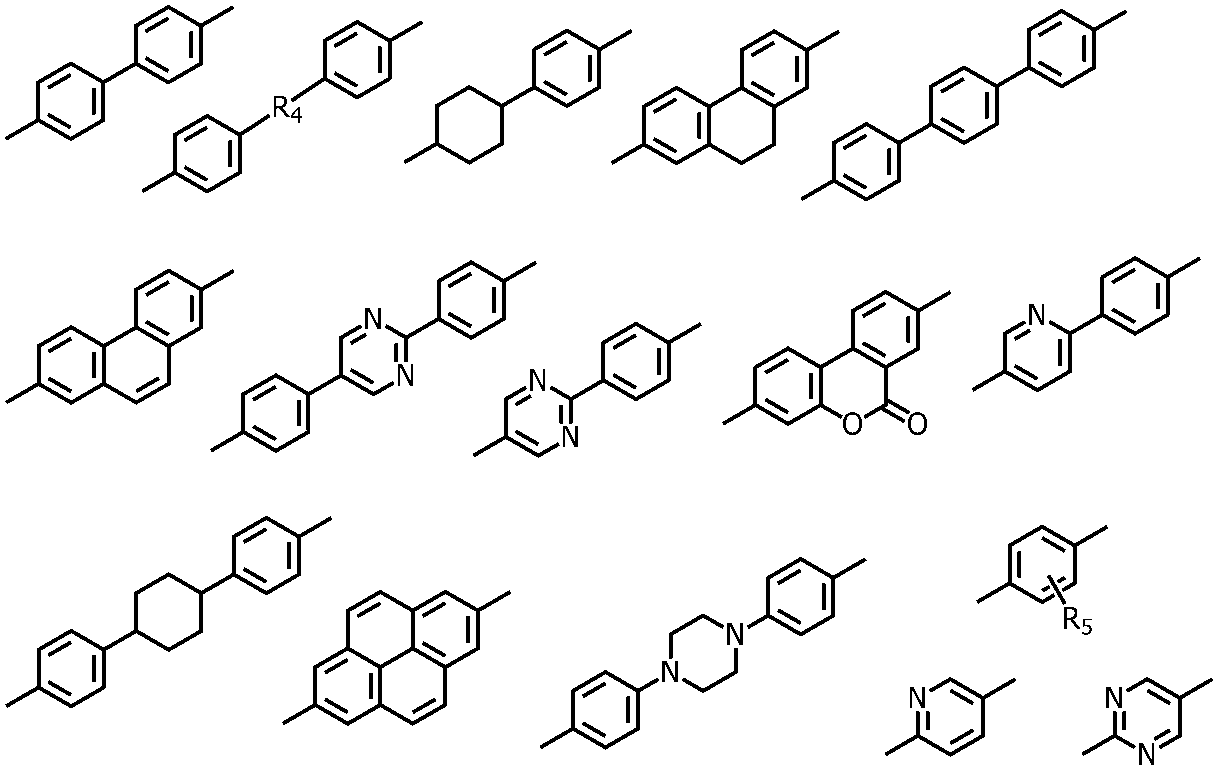
- B 1 and B 2 are divalent organic groups having the same structure and selected from the following structures.
- R 4 is an alkylene group having 1 to 5 carbon atoms.
- R 5 is a hydrogen atom, a methyl group, a hydroxy group or a methoxy group.
- liquid crystal aligning agent of the present invention By using the liquid crystal aligning agent of the present invention, it becomes possible to obtain a liquid crystal aligning film having a high liquid crystal aligning property and capable of suppressing the generation of an AC afterimage.
- the liquid crystal aligning agent of the present invention it is not always clear why the above effects are obtained, but the chemical structure of the diamine used as the raw material of the polymer constituting the liquid crystal aligning material is rigid, and It is presumed that it has a symmetrical structure.
- R 1 and R 2 are each independently a single bond, —O—, —S—, —NR 12 —, ester bond, amide bond, thioester bond, urea bond, carbonate bond, Alternatively, it is a carbamate bond, and R 12 is a hydrogen atom or a methyl group.
- A is an alkylene group having 1 or 2 carbon atoms.
- B 1 and B 2 are divalent organic groups having the same structure and selected from the following structures. Since B 1 and B 2 have the same structure, a liquid crystal alignment film having high liquid crystal alignment can be obtained.
- R 4 is an alkylene group having 1 to 5 carbon atoms.
- R 5 is a hydrogen atom, a methyl group, a hydroxy group or a methoxy group.
- R 1 and R 2 are preferably a single bond, —O—, —S—, —NR 12 —, an ester bond or an amide bond, from the viewpoint of liquid crystal alignment. -O- is particularly preferable.
- R 12 is preferably a hydrogen atom or a methyl group.
- A is preferably an alkylene group having a carbon chain 2 from the viewpoint of liquid crystal alignment.
- B 1 and B 2 are preferably biphenylene groups.
- R 4 is preferably an alkylene group having 1 to 3 carbon atoms from the viewpoint of liquid crystal alignment.
- R 5 is preferably a hydrogen atom or a methyl group.
- the specific structure described above is preferably contained in the diamine which is the raw material of the polyimide precursor.
- the diamine having the above-mentioned specific structure include, but are not limited to, the following diamines.
- the polyimide precursor is preferably obtained by polymerizing a diamine component containing at least one diamine selected from the following diamines and a tetracarboxylic acid component.
- R 5 and R 12 have the same definitions as above, including the respective preferable examples.
- the diamine having the above-mentioned specific structure is preferably a diamine in which amino groups are bound to both ends of the above-mentioned specific structure, and among them, from the viewpoint of alignment properties and reduction of bright spots in a liquid crystal display device, the following diamines are used. Is preferred.
- R 1 , R 2 , and A are as described above, including preferred examples thereof.
- the diamine having the above specific structure the following diamines are preferable.
- the polyimide precursor constituting the liquid crystal aligning agent of the present invention contains a structural unit represented by the following formula (2).
- X 1 is at least one selected from the group consisting of structures represented by the following formulas (X1-1) and (X1-2). Among them, the following formula (X1-2) is preferable from the viewpoint of liquid crystal alignment.
- Y 1 is a divalent organic group represented by the formula (1).
- R 3 is a hydrogen atom or an alkyl group having 1 to 5 carbon atoms. Specific examples thereof include a methyl group, an ethyl group, a propyl group, an i-propyl group, an n-butyl group, an i-butyl group, an s-butyl group, a t-butyl group and an n-pentyl group. From the viewpoint of ease of imidization by heating, R 3 is preferably a hydrogen atom or a methyl group.
- Z 1 and Z 2 are each independently a hydrogen atom or an optionally substituted alkyl group having 1 to 10 carbon atoms, an alkenyl group having 2 to 10 carbon atoms or an alkynyl group having 2 to 10 carbon atoms. It is a base.
- the alkyl group include a methyl group, an ethyl group, a propyl group, a butyl group, a t-butyl group, a hexyl group, an octyl group, a decyl group, a cyclopentyl group, a cyclohexyl group and a bicyclohexyl group.
- Alkenyl groups include those in which one or more CH 2 —CH 2 structures present in the above alkyl groups have been replaced with a CH ⁇ CH structure. Specifically, vinyl group, allyl group, 1-propenyl group, isopropenyl group, 2-butenyl group, 1,3-butadienyl group, 2-pentenyl group, 2-hexenyl group, cyclopropenyl group, cyclopentenyl group, A cyclohexenyl group etc. are mentioned.
- alkynyl group include those in which one or more CH 2 —CH 2 structures present in the above alkyl group are replaced with a C ⁇ C structure. Specific examples thereof include an ethynyl group, a 1-propynyl group and a 2-propynyl group.
- the above alkyl group, alkenyl group, and alkynyl group may have a substituent, and depending on the substituent, a ring structure may be formed.
- forming a ring structure by a substituent means that the substituents are bonded to each other or a part of the mother skeleton to form a ring structure.
- the substituent include a halogen group, a hydroxyl group, a thiol group, a nitro group, an aryl group, an organooxy group, an organothio group, an organosilyl group, an acyl group, an ester group, a thioester group, a phosphoric ester group, an amide group, an alkyl group.
- alkenyl group alkynyl group and the like.
- halogen group examples include a fluorine atom, a chlorine atom, a bromine atom or an iodine atom.
- a phenyl group is mentioned as an aryl group. This aryl group may be further substituted with another substituent described above.
- the organooxy group can have a structure represented by —OR.
- the R may be the same or different, and examples thereof include the above-mentioned alkyl group, alkenyl group, alkynyl group and aryl group. These R may be further substituted with the above-mentioned substituents. Specific examples thereof include a methoxy group, an ethoxy group, a propyloxy group, a butoxy group, a pentyloxy group, a hexyloxy group, a heptyloxy group and an octyloxy group.
- the organothio group can have a structure represented by —SR.
- R examples include the alkyl group, alkenyl group, alkynyl group, and aryl group described above. These R may be further substituted with the above-mentioned substituents. Specific examples thereof include a methylthio group, an ethylthio group, a propylthio group, a butylthio group, a pentylthio group, a hexylthio group, a heptylthio group and an octylthio group.
- the organosilyl group can have a structure represented by —Si— (R) 3 .
- the R's may be the same or different, and examples thereof include the above-mentioned alkyl group, alkenyl group, alkynyl group and aryl group. These R may be further substituted with the above-mentioned substituents. Specific examples include a trimethylsilyl group, a triethylsilyl group, a tripropylsilyl group, a tributylsilyl group, a tripentylsilyl group, a trihexylsilyl group, a pentyldimethylsilyl group and a hexyldimethylsilyl group.
- the acyl group can have a structure represented by —C (O) —R.
- R include the alkyl group, alkenyl group, and aryl group described above. These R may be further substituted with the above-mentioned substituents. Specific examples thereof include a formyl group, an acetyl group, a propionyl group, a butyryl group, an isobutyryl group, a valeryl group, an isovaleryl group and a benzoyl group.
- ester group a structure represented by -C (O) OR or -OC (O) -R can be shown.
- R include the alkyl group, alkenyl group, alkynyl group, and aryl group described above. These R may be further substituted with the above-mentioned substituents.
- the thioester group can have a structure represented by -C (S) OR or -OC (S) -R.
- R include the alkyl group, alkenyl group, alkynyl group, and aryl group described above. These R may be further substituted with the above-mentioned substituents.
- the phosphate group can have a structure represented by —OP (O) — (OR) 2 .
- the R's may be the same or different, and examples thereof include the above-mentioned alkyl group, alkenyl group, alkynyl group and aryl group. These R may be further substituted with the above-mentioned substituents.
- the amide group has a structure represented by -C (O) NH 2 , -C (O) NHR, -NHC (O) R, -C (O) N (R) 2 or -NRC (O) R.
- the R's may be the same or different, and examples thereof include the above-mentioned alkyl group, alkenyl group, alkynyl group and aryl group. These R may be further substituted with the above-mentioned substituents.
- the aryl group the same aryl groups as described above can be mentioned. This aryl group may be further substituted with another substituent described above.
- the alkyl group the same ones as those mentioned above can be mentioned.
- the alkyl group may be further substituted with the other substituent described above.
- the alkenyl group the same alkenyl groups as mentioned above can be mentioned. This alkenyl group may be further substituted with the other substituent described above.
- the alkynyl group the same alkynyl groups as described above can be mentioned. This alkynyl group may be further substituted with the other substituent described above.
- Z 1 and Z 2 each have a hydrogen atom or a carbon number of 1 which may have a substituent.
- Alkyl groups of to 5 are more preferable, and hydrogen atom, methyl group or ethyl group is particularly preferable.
- the structural unit represented by the above formula (2) is preferably contained in an amount of 20 to 100 mol% based on all structural units, and from the viewpoint of liquid crystal alignment, 30 to 100 mol% is particularly preferable.
- X 2 is a tetravalent organic group, and Y 2 is a divalent organic group.
- X 2 is a tetravalent organic group derived from a tetracarboxylic acid derivative, and its structure is not particularly limited. Two or more types of X 2 may be mixed in the polyimide precursor. Specific examples of X 2 include the structures of the following formulas (X-1) to (X-44).
- R 8 to R 11 in the above formula (X-1) are each independently a hydrogen atom, a halogen atom, an alkyl group having 1 to 6 carbon atoms, an alkenyl group having 2 to 6 carbon atoms, or an alkyl group having 2 to 6 carbon atoms. It is an alkynyl group or a phenyl group.
- R 8 to R 11 have a bulky structure, the liquid crystal alignment may be deteriorated, and therefore a hydrogen atom, a methyl group or an ethyl group is more preferable, and a hydrogen atom or a methyl group is particularly preferable.
- Y 2 is a divalent organic group derived from diamine, and its structure is not particularly limited. Specific examples of the structure of Y 2 include the following (Y-1) to (Y-118).
- m and n are each independently an integer of 1 to 11
- m + n is an integer of 2 to 12
- h is 1 to 3
- j is an integer of 0 to 3 in formulas (Y-111) and (Y-117).
- the polyimide precursor used in the present invention is obtained from the reaction of a diamine component and a tetracarboxylic acid derivative, and examples thereof include polyamic acid and polyamic acid ester.
- the polyamic acid which is the polyimide precursor used in the present invention, is produced by the following method. Specifically, tetracarboxylic dianhydride and diamine are reacted in the presence of an organic solvent at ⁇ 20 to 150 ° C., preferably 0 to 50 ° C. for 30 minutes to 24 hours, preferably 1 to 12 hours. Can be synthesized.
- the reaction between the diamine component and the tetracarboxylic acid component is usually performed in an organic solvent.
- the organic solvent used at that time is not particularly limited as long as it can dissolve the generated polyimide precursor. Specific examples of the organic solvent used in the reaction are shown below, but the invention is not limited to these examples. Examples include N-methyl-2-pyrrolidone, N-ethyl-2-pyrrolidone, ⁇ -butyrolactone, N, N-dimethylformamide, N, N-dimethylacetamide, dimethyl sulfoxide or 1,3-dimethyl-imidazolidinone. Be done.
- the polyimide precursor When the polyimide precursor has high solubility, it is represented by methyl ethyl ketone, cyclohexanone, cyclopentanone, 4-hydroxy-4-methyl-2-pentanone or the following formulas [D-1] to [D-3].
- the organic solvent used can be used.
- D 1 represents an alkyl group having 1 to 3 carbon atoms
- D 2 represents an alkyl group having 1 to 3 carbons
- D 3 represents an alkyl group having 1 to 4 carbon atoms.
- solvents may be used alone or in combination. Furthermore, even a solvent that does not dissolve the polyimide precursor may be used as a mixture with the solvent as long as the generated polyimide precursor does not precipitate. Further, water in the solvent inhibits the polymerization reaction and causes hydrolysis of the formed polyimide precursor, and therefore it is preferable to use a dehydrated and dried solvent.
- concentration of the polyamic acid polymer in the reaction system is preferably 1 to 30% by mass, and more preferably 5 to 20% by mass from the viewpoint that polymer precipitation does not easily occur and a high molecular weight polymer is easily obtained.
- the polyamic acid obtained as described above can be recovered by precipitating a polymer by injecting it into a poor solvent while stirring the reaction solution well. Further, by performing precipitation several times, washing with a poor solvent, and drying at room temperature or by heating, a purified polyamic acid powder can be obtained.
- the poor solvent is not particularly limited, and examples thereof include water, methanol, ethanol, hexane, butyl cellosolve, acetone, and toluene.
- the polyamic acid ester which is the polyimide precursor used in the present invention, can be produced by the following production method (1), (2) or (3).
- the polyamic acid ester can be produced by esterifying the polyamic acid produced as described above. Specifically, it is produced by reacting a polyamic acid and an esterifying agent in the presence of an organic solvent at ⁇ 20 to 150 ° C., preferably 0 to 50 ° C. for 30 minutes to 24 hours, preferably 1 to 4 hours. be able to.
- esterifying agent those which can be easily removed by purification are preferable, and N, N-dimethylformamide dimethyl acetal, N, N-dimethylformamide diethyl acetal, N, N-dimethylformamide dipropyl acetal, N, N-dimethylformamide Dineopentylbutyl acetal, N, N-dimethylformamide di-t-butyl acetal, 1-methyl-3-p-tolyltriazene, 1-ethyl-3-p-tolyltriazene, 1-propyl-3-p -Tolyltriazene, 4- (4,6-dimethoxy-1,3,5-triazin-2-yl) -4-methylmorpholinium chloride and the like can be mentioned.
- the addition amount of the esterifying agent is preferably 2 to 6 molar equivalents with respect to 1 mol of the repeating unit of the polyamic acid.
- organic solvent examples include N-methyl-2-pyrrolidone, N-ethyl-2-pyrrolidone or ⁇ -butyrolactone, N, N-dimethylformamide, N, N-dimethylacetamide, dimethyl sulfoxide or 1,3-dimethyl- Examples include imidazolidinone.
- the polyimide precursor has high solubility in a solvent, methyl ethyl ketone, cyclohexanone, cyclopentanone, 4-hydroxy-4-methyl-2-pentanone, or the above formula [D-1] to formula [D-3] is used.
- the indicated solvents can be used. These solvents may be used alone or as a mixture.
- a solvent that does not dissolve the polyimide precursor may be used as a mixture with the solvent as long as the generated polyimide precursor does not precipitate. Further, since water in the solvent hinders the polymerization reaction and causes hydrolysis of the generated polyimide precursor, it is preferable to use a dehydrated and dried solvent.
- the solvent used in the above reaction is preferably N, N-dimethylformamide, N-methyl-2-pyrrolidone, or ⁇ -butyrolactone because of the solubility of the polymer. These are used alone or in combination of two or more. Good.
- the concentration at the time of production is preferably 1 to 30% by mass, more preferably 5 to 20% by mass, because precipitation of a polymer is less likely to occur and a high molecular weight product is easily obtained.
- the polyamic acid ester can be produced from tetracarboxylic acid diester dichloride and diamine. Specifically, tetracarboxylic acid diester dichloride and diamine are added in the presence of a base and an organic solvent at ⁇ 20 to 150 ° C., preferably 0 to 50 ° C. for 30 minutes to 24 hours, preferably 1 to 4 hours. It can be produced by reacting.
- pyridine triethylamine, 4-dimethylaminopyridine and the like can be used, but pyridine is preferable because the reaction proceeds gently.
- the amount of the base added is preferably 2 to 4 times the molar amount of the tetracarboxylic acid diester dichloride from the viewpoints of easy removal and easily obtaining a high molecular weight product.
- the solvent used in the above reaction is preferably N-methyl-2-pyrrolidone or ⁇ -butyrolactone in view of the solubility of the monomer and polymer, and these may be used alone or in combination of two or more.
- the polymer concentration during production is preferably 1 to 30% by mass, and more preferably 5 to 20% by mass, because precipitation of the polymer is less likely to occur and a high molecular weight product is easily obtained.
- the solvent used for the production of the polyamic acid ester is preferably dehydrated as much as possible, and it is preferable to prevent the entry of outside air in a nitrogen atmosphere.
- the polyamic acid ester can be produced by polycondensing the tetracarboxylic acid diester and diamine. Specifically, a tetracarboxylic acid diester and a diamine are mixed in the presence of a condensing agent, a base, and an organic solvent at 0 to 150 ° C., preferably 0 to 100 ° C. for 30 minutes to 24 hours, preferably 3 to It can be produced by reacting for 15 hours.
- condensing agent examples include triphenyl phosphite, dicyclohexylcarbodiimide, 1-ethyl-3- (3-dimethylaminopropyl) carbodiimide hydrochloride, N, N'-carbonyldiimidazole, dimethoxy-1,3,5-triazine.
- Nylmethylmorpholinium O- (benzotriazol-1-yl) -N, N, N ', N'-tetramethyluronium tetrafluoroborate, O- (benzotriazol-1-yl) -N, N , N ′, N′-tetramethyluronium hexafluorophosphate, diphenyl (2,3-dihydro-2-thioxo-3-benzoxazolyl) phosphonate and the like can be used.
- the amount of the condensing agent added is preferably 2 to 3 times the mol of the tetracarboxylic acid diester.
- tertiary amines such as pyridine and triethylamine can be used.
- the amount of the base added is preferably 2 to 4 times the molar amount of the diamine component from the viewpoint of easy removal and easy production of a high molecular weight product.
- the reaction proceeds efficiently by adding Lewis acid as an additive.
- Lewis acid lithium halides such as lithium chloride and lithium bromide are preferable.
- the Lewis acid is preferably added in an amount of 0 to 1.0 times the mol of the diamine component.
- the production method (1) or (2) is particularly preferable because a high molecular weight polyamic acid ester can be obtained.
- the solution of the polyamic acid ester obtained as described above can be poured into a poor solvent while stirring well to precipitate the polymer. Precipitation is carried out several times, and after washing with a poor solvent, it is dried at room temperature or by heating to obtain a purified polyamic acid ester powder.
- the poor solvent is not particularly limited, and examples thereof include water, methanol, ethanol, hexane, butyl cellosolve, acetone, and toluene.
- the polyimide used in the present invention can be produced by imidizing the above-mentioned polyamic acid ester or polyamic acid.
- a polyimide is produced from a polyamic acid ester
- chemical imidization by adding a basic catalyst to a polyamic acid ester solution or a polyamic acid solution obtained by dissolving a polyamic acid ester resin powder in an organic solvent is simple.
- Chemical imidation is preferable because the imidization reaction proceeds at a relatively low temperature and the decrease in the molecular weight of the polymer does not easily occur during the imidization process.
- the chemical imidization can be performed by stirring the polyamic acid ester to be imidized in an organic solvent in the presence of a basic catalyst.
- a basic catalyst include pyridine, triethylamine, trimethylamine, tributylamine, trioctylamine and the like. Of these, triethylamine is preferable because it has a basicity sufficient to allow the reaction to proceed.
- the temperature at which the imidization reaction is carried out is ⁇ 20 to 140 ° C., preferably 0 to 100 ° C., and the reaction time is preferably 1 to 100 hours.
- the amount of the basic catalyst is 0.5 to 30 times, preferably 2 to 20 times the amount of the amic acid ester group.
- the imidation ratio of the obtained polymer can be controlled by adjusting the amount of catalyst, temperature, reaction time and the like. Since the added catalyst and the like remain in the solution after the imidization reaction, the resulting imidized polymer is recovered by the means described below and redissolved in an organic solvent to obtain the liquid crystal alignment of the present invention. It is preferable to use it as an agent.
- a polyimide is produced from a polyamic acid
- chemical imidization by adding a catalyst to a solution of the polyamic acid obtained by the reaction of a diamine component and a tetracarboxylic dianhydride is simple.
- Chemical imidization is preferable because the imidization reaction proceeds at a relatively low temperature and the decrease in the molecular weight of the polymer does not easily occur in the process of imidization.
- the chemical imidization can be performed by stirring the polyamic acid to be imidized in an organic solvent in the presence of a basic catalyst and an acid anhydride.
- the organic solvent the solvent used in the above-mentioned polymerization reaction can be used.
- Examples of the basic catalyst include pyridine, triethylamine, trimethylamine, tributylamine, trioctylamine and the like. Of these, pyridine is preferable because it has a proper basicity for proceeding the reaction.
- Examples of the acid anhydride include acetic anhydride, trimellitic anhydride, pyromellitic anhydride and the like. Of these, acetic anhydride is preferable because it facilitates purification after the reaction.
- the temperature at which the imidization reaction is carried out is ⁇ 20 to 140 ° C., preferably 0 to 100 ° C., and the reaction time is preferably 1 to 100 hours.
- the amount of the basic catalyst is 0.5 to 30 times, preferably 2 to 20 times the amount of the amic acid group, and the amount of the acid anhydride is 1 to 50 times, preferably 3 to the molar amount of the amic acid group. It is 30 mol times.
- the imidation ratio of the obtained polymer can be controlled by adjusting the amount of catalyst, temperature, reaction time and the like.
- the liquid crystal aligning agent of the present invention is preferable.
- the polymer can be precipitated by injecting the solution of the polyimide obtained as described above into a poor solvent while stirring well. Precipitation is performed several times, washed with a poor solvent, and then dried at room temperature or by heating to obtain a purified polyimide powder.
- the poor solvent is not particularly limited, but includes methanol, acetone, hexane, butyl cellosolve, heptane, methyl ethyl ketone, methyl isobutyl ketone, ethanol, toluene, benzene and the like.
- the liquid crystal aligning agent of the present invention contains at least one polymer selected from the group consisting of a polyimide precursor having a specific structure in the main chain and an imidized polymer of the polyimide precursor.
- the weight average molecular weight (Mw) of the polymer is preferably 2,000 to 500,000, more preferably 5,000 to 300,000, and further preferably 10,000 to 100,000.
- the number average molecular weight (Mn) is preferably 1,000 to 250,000, more preferably 2,500 to 150,000, and further preferably 5,000 to 50,000. ..
- the concentration of the polymer in the liquid crystal aligning agent of the present invention can be appropriately changed depending on the setting of the thickness of the coating film to be formed, but from the viewpoint of forming a uniform and defect-free coating film, It is preferably not less than 10% by mass, and more preferably not more than 10% by mass from the viewpoint of storage stability of the solution.
- the concentration of the polymer is preferably 2 to 7% by mass.
- the organic solvent that dissolves the polymer (hereinafter, also referred to as a good solvent) contained in the liquid crystal aligning agent used in the present invention is not particularly limited as long as the polymer can be uniformly dissolved therein.
- a good solvent for example, N, N-dimethylformamide, N, N-dimethylacetamide, N-methyl-2-pyrrolidone, N-ethyl-2-pyrrolidone, dimethyl sulfoxide, ⁇ -butyrolactone, 1,3-dimethyl-imidazolidinone, methyl ethyl ketone , Cyclohexanone, cyclopentanone or 4-hydroxy-4-methyl-2-pentanone.
- N-methyl-2-pyrrolidone, N-ethyl-2-pyrrolidone, or ⁇ -butyrolactone is preferably used.
- the content of the good solvent in the liquid crystal aligning agent of the present invention is preferably 20 to 99 mass% of the whole solvent contained in the liquid crystal aligning agent. Above all, 20 to 90 mass% is preferable. More preferably, it is 30 to 80% by mass.
- a solvent also referred to as a poor solvent
- a poor solvent that improves the coating property and surface smoothness of the liquid crystal aligning film when the liquid crystal aligning agent is applied
- Specific examples of the poor solvent will be given.
- ethanol isopropyl alcohol, 1-butanol, 2-butanol, isobutyl alcohol, tert-butyl alcohol, 1-pentanol, 2-pentanol, 3-pentanol, 2-methyl-1-butanol, isopentyl alcohol, tert-pentyl alcohol, 3-methyl-2-butanol, neopentyl alcohol, 1-hexanol, 2-methyl-1-pentanol, 2-methyl-2-pentanol, 2-ethyl-1-butanol, 1-heptanol , 2-heptanol, 3-heptanol, 1-octanol, 2-octanol, 2-ethyl-1-hexanol, cyclohexanol, 1-methylcyclohexanol, 2-methylcyclohexanol, 3-methylcyclohexanol, 1,2- Etanji 1,2-propanediol, 1,3-propan
- 1-hexanol, cyclohexanol, 1,2-ethanediol, 1,2-propanediol, propylene glycol monobutyl ether, ethylene glycol monobutyl ether or dipropylene glycol dimethyl ether is preferable.
- the content of these poor solvents is preferably 1 to 80% by mass based on the whole solvent contained in the liquid crystal aligning agent. Among them, 10 to 80 mass% is preferable, and 20 to 70 mass% is more preferable.
- the liquid crystal aligning agent of the present invention may be a polymer other than the polymer of the present invention, a dielectric or conductive substance for the purpose of changing the electrical properties such as the dielectric constant and conductivity of the liquid crystal aligning film, and the liquid crystal aligning film.
- a silane coupling agent for the purpose of improving the adhesion to the substrate, a crosslinkable compound for the purpose of increasing the hardness and density of the film when it is formed into a liquid crystal alignment film, and further a polyimide precursor when baking the coating film.
- An imidation promoter for the purpose of efficiently promoting imidization by heating may be added.
- the liquid crystal alignment film of the present invention is a film obtained by applying the above liquid crystal alignment agent to a substrate, drying and baking.
- the substrate on which the liquid crystal aligning agent is applied is not particularly limited as long as it is a highly transparent substrate, and a glass substrate, a silicon nitride substrate, an acrylic substrate, a plastic substrate such as a polycarbonate substrate, or the like can be used for driving the liquid crystal. It is preferable to use a substrate on which the ITO electrode or the like is formed from the viewpoint of simplifying the process. Further, in the reflective liquid crystal display element, an opaque material such as a silicon wafer can be used if only one substrate is used, and in this case, a material such as aluminum that reflects light can be used for the electrode.
- Examples of the method for applying the liquid crystal aligning agent of the present invention include a spin coating method, a printing method and an inkjet method. Any temperature and time can be selected for the drying and firing steps after applying the liquid crystal aligning agent.
- the drying temperature is preferably 50 to 120 ° C., and the drying time is preferably 1 to 10 minutes.
- the firing temperature is preferably 150 to 300 ° C., and the firing time is preferably 5 to 120 minutes.
- the thickness of the film after firing is not particularly limited, but if it is too thin, the reliability of the liquid crystal display element may be impaired, so it is preferably 5 to 300 nm, more preferably 10 to 120 nm.
- the coating film surface is irradiated with radiation polarized in a certain direction, and in some cases, further heat-treated at a temperature of 150 to 250 ° C. to impart liquid crystal alignment ability.
- the coating substrate may be irradiated with radiation while being heated at 50 to 250 ° C.
- the dose of radiation is preferably 1 ⁇ 10,000mJ / cm 2, particularly preferably 100 ⁇ 5,000mJ / cm 2.
- the liquid crystal alignment film manufactured as described above can stably align liquid crystal molecules in a certain direction.
- the extinction ratio of linearly polarized ultraviolet light is preferably 10: 1 or more, more preferably 20: 1 or more.
- the film irradiated with polarized radiation may then be contact-treated with a solvent containing at least one selected from water and organic solvents.
- the solvent used for the contact treatment is not particularly limited as long as it is a solvent that dissolves a decomposition product generated by light irradiation.
- Specific examples include water, methanol, ethanol, 2-propanol, acetone, methyl ethyl ketone, 1-methoxy-2-propanol, 1-methoxy-2-propanol acetate, butyl cellosolve, ethyl lactate, methyl lactate, diacetone alcohol, 3- Methyl methoxypropionate, ethyl 3-ethoxypropionate, propyl acetate, butyl acetate, cyclohexyl acetate and the like can be mentioned. Two or more kinds of these solvents may be used in combination.
- At least one selected from the group consisting of water, 2-propanol, 1-methoxy-2-propanol and ethyl lactate is more preferable.
- Particularly preferred is water, 2-propanol, or a mixed solvent of water and 2-propanol.
- examples of the contact treatment of the film irradiated with polarized radiation and the solution containing an organic solvent include a dipping treatment and a spray (spray) treatment, and treatment for sufficiently contacting the membrane and the liquid. Is preferred. Above all, a method of immersing the membrane in a solution containing an organic solvent for preferably 10 seconds to 1 hour, more preferably 1 to 30 minutes is preferable.
- the contact treatment may be carried out at room temperature or with heating, but is preferably carried out at 10 to 80 ° C, more preferably 20 to 50 ° C.
- a means for enhancing contact with ultrasonic waves or the like can be provided.
- the film subjected to the contact treatment with a solvent may be heated at 150 ° C. or higher for the purpose of drying the solvent and reorienting the molecular chains in the film.
- the heating temperature is preferably 150 to 300 ° C. Higher temperature promotes reorientation of molecular chains, but too high temperature may cause decomposition of molecular chains. Therefore, the heating temperature is more preferably 180 to 250 ° C, particularly preferably 200 to 230 ° C. If the heating time is too short, the effect of reorientation of the molecular chain may not be obtained, and if it is too long, the molecular chain may be decomposed, so that it is preferably 10 seconds to 30 minutes. 10 minutes is more preferred.
- the liquid crystal display device of the present invention is a device obtained by preparing a liquid crystal cell by a known method after obtaining a substrate having a liquid crystal alignment film formed from the liquid crystal aligning agent of the present invention, and using the cell as a device. is there.
- a liquid crystal display element having a passive matrix structure will be described below as an example.
- a liquid crystal display element having an active matrix structure in which a switching element such as a TFT (Thin Film Transistor) is provided in each pixel portion that constitutes image display may be used.
- a transparent glass substrate is prepared, and a common electrode is provided on one substrate and a segment electrode is provided on the other substrate.
- These electrodes can be, for example, ITO electrodes, and are patterned to display a desired image.
- an insulating film is provided on each substrate so as to cover the common electrodes and the segment electrodes.
- the insulating film can be, for example, a film made of SiO 2 —TiO 2 formed by the sol-gel method.
- the liquid crystal alignment film of the present invention is formed on each substrate.
- one substrate is placed on the other substrate so that their alignment film surfaces face each other, and the periphery is bonded with a sealing material.
- a spacer in the sealing material In order to control the substrate gap, it is usually preferable to mix a spacer in the sealing material.
- a part of the sealing material is usually provided with an opening that can
- a liquid crystal material is injected into the space surrounded by the two substrates and the sealing material through the opening provided in the sealing material. Then, this opening is sealed with an adhesive.
- a vacuum injection method may be used, or a method utilizing a capillary phenomenon in the atmosphere may be used.
- a polarizing plate is installed. Specifically, a pair of polarizing plates are attached to the surfaces of the two substrates opposite to the liquid crystal layer.
- the liquid crystal display element of the present invention can be obtained through the above steps.
- the sealant for example, a resin having a reactive group such as an epoxy group, an acryloyl group, a methacryloyl group, a hydroxy group, an allyl group, or an acetyl group, which is cured by ultraviolet irradiation or heating is used.
- a resin having a reactive group such as an epoxy group, an acryloyl group, a methacryloyl group, a hydroxy group, an allyl group, or an acetyl group, which is cured by ultraviolet irradiation or heating is used.
- a cured resin system having both reactive groups of epoxy group and (meth) acryloyl group.
- An inorganic filler may be added to the above-mentioned sealing agent for the purpose of improving adhesiveness, moisture resistance and the like.
- the inorganic filler that can be used is not particularly limited, and specifically, spherical silica, fused silica, crystalline silica, titanium oxide, titanium black, silicon carbide, silicon nitride, boron nitride, calcium carbonate, magnesium carbonate, sulfuric acid.
- spherical silica, fused silica, crystalline silica titanium oxide, titanium black, silicon nitride, boron nitride, calcium carbonate, barium sulfate, calcium sulfate, mica, talc, clay, alumina, aluminum hydroxide, calcium silicate, aluminum silicate. And so on. You may use the said inorganic filler in mixture of 2 or more types.
- NMP N-methyl-2-pyrrolidone
- BCS Butyl cellosolve
- Fmoc represents a 9-fluorenylmethyloxycarbonyl group
- Boc represents a t-butoxycarbonyl group
- a liquid crystal cell having the structure of the FFS mode liquid crystal display device was produced. First, a substrate with electrodes was prepared. The substrate is a 30 mm ⁇ 50 mm rectangular glass plate having a thickness of 0.7 mm. On the substrate, an ITO electrode having a solid pattern, which constitutes a counter electrode as a first layer, is formed. A SiN (silicon nitride) film formed by the CVD method is formed as a second layer on the counter electrode of the first layer. The film thickness of the second-layer SiN film is 500 nm and functions as an interlayer insulating film.
- a comb-teeth-shaped pixel electrode formed by patterning an ITO film as a third layer is arranged on the second-layer SiN film to form two pixels of a first pixel and a second pixel. ing.
- the size of each pixel is 10 mm in length and about 5 mm in width.
- the first-layer counter electrode and the third-layer pixel electrode are electrically insulated by the action of the second-layer SiN film.
- the pixel electrode of the third layer has a comb-tooth shape formed by arranging a plurality of "dogleg” -shaped electrode elements whose central portion is bent at an internal angle of 160 °.
- the width of each electrode element in the lateral direction is 3 ⁇ m, and the distance between the electrode elements is 6 ⁇ m.
- the pixel electrode that forms each pixel is configured by arranging a plurality of curved "dogleg" -shaped electrode elements in the central portion, so the shape of each pixel is not rectangular, but is similar to that of the electrode element. It has a shape that resembles a bold "dogleg" bent at a part.
- Each pixel is divided into upper and lower parts with a central bent portion as a boundary, and has a first region on the upper side and a second region on the lower side of the bent portion.
- the prepared substrate with electrodes and a glass substrate having a columnar spacer with a height of 4 ⁇ m on which an ITO film is formed on the back surface are prepared. It was applied by spin coating. After drying for 2 minutes on a hot plate at 80 ° C., baking was performed for 30 minutes in a hot air circulation type oven at 230 ° C. to form a coating film having a thickness of 100 nm. This coating film surface was irradiated with polarized ultraviolet rays so as to have a dose of 500 mJ / cm 2 and subjected to an alignment treatment to obtain a substrate with a liquid crystal alignment film.
- the liquid crystal alignment film formed on the electrode-attached substrate is a liquid crystal alignment film formed on the second glass substrate by performing alignment treatment so that the direction that equally divides the interior angle of the pixel bend portion and the liquid crystal alignment direction are orthogonal to each other. Is subjected to alignment treatment so that the alignment direction of the liquid crystal on the first substrate and the alignment direction of the liquid crystal on the second substrate coincide with each other when the liquid crystal cell is manufactured.
- Set the above two substrates as a set print the sealant on the substrate, and bond the other substrate so that the alignment direction where the liquid crystal alignment film surfaces face each other becomes 0 °, and then cure the sealant. Then, an empty cell was produced.
- Liquid crystal MLC-3019 (manufactured by Merck Ltd.) was injected into this empty cell by a reduced pressure injection method, and the injection port was sealed to obtain an FFS driven liquid crystal cell. After that, the obtained liquid crystal cell was heated at 110 ° C. for 1 hour, left to stand overnight, and then used for evaluation of afterimage.
- the rotation angle when the liquid crystal cell was rotated from the angle where the second region of the first pixel was darkest to the angle where the first region was darkest was calculated as the angle ⁇ .
- the second region and the first region were compared, and the same angle ⁇ was calculated.
- the average value of the angle ⁇ values of the first pixel and the second pixel was calculated as the angle ⁇ of the liquid crystal cell.
- An angle ⁇ of 0.15 ° or more of the liquid crystal cell obtained above was evaluated as “x”, less than 0.15 ° was evaluated as “ ⁇ ”, and less than 0.1 ° was evaluated as “ ⁇ ”.
- Example 1 6.25 g of the polyamic acid solution (PAA-4) obtained in Synthesis Example 5 was weighed into a 50 mL Erlenmeyer flask containing a stirring bar. Next, 3.50 g of NMP and 4.5 g of BCS were added and stirred overnight with a magnetic stirrer to obtain a liquid crystal aligning agent (AL-4).
- PAA-4 polyamic acid solution
- Example 2 2.50 g of the polyamic acid solution (PAA-4) obtained in Synthesis Example 5 and 3.75 g of the polyamic acid solution (PAA-5) obtained in Synthesis Example 6 were placed in a 50 mL Erlenmeyer flask containing a stirring bar. I took it. 3.50 g of NMP and 4.50 g of BCS were added, 0.75 g of 10% NMP solution of AD-1 and 0.113 g of AD-2 were added, and the mixture was stirred overnight with a magnetic stirrer for liquid crystal aligning agent (AL-5). Got By storing AL-5 in an environment of ⁇ 20 ° C., the stability during frozen storage was confirmed. After 1 month of frozen storage, it was confirmed that there was no precipitation and the filterability was good.
- Comparative example 4 The afterimage of the liquid crystal aligning agent (AL-1) obtained in Comparative Example 1 was evaluated by long-term AC driving as described above. That is, a liquid crystal cell having the configuration of the FFS mode liquid crystal display device was prepared by using the liquid crystal aligning agent (AL-1) as described above, and afterimage evaluation by the long-term AC drive was performed on the FFS driven liquid crystal cell. did. As a result, the value of the angle ⁇ of this liquid crystal cell after long-term AC driving was 0.16 degrees.
- Example 3 An FFS-driven liquid crystal cell was produced in the same manner as in Comparative Example 4 except that the liquid crystal aligning agent (AL-4) obtained in Example 1 was used. Afterimage evaluation of the FFS-driving liquid crystal cell by long-term AC driving was performed, and as a result, the value of the angle ⁇ of the liquid crystal cell after long-term AC driving was 0.05 degrees.
- Example 4 The polymer two-component blend liquid crystal aligning agent (AL-5) obtained in Example 2 was filtered through a filter having a pore size of 1.0 ⁇ m, spin-coated on a glass substrate with a transparent electrode, and then on a hot plate at a temperature of 80 ° C. It was dried for 2 minutes. Then, after baking for 30 minutes in an IR oven at a temperature of 230 ° C., an imidized film having a film thickness of 100 nm was obtained. When the state of the fired film was confirmed, it was confirmed that the film was uniformly formed without unevenness or cissing.
- Table 1 summarizes the results of afterimage evaluation of the liquid crystal aligning agents of Comparative Examples 4 to 6 and Example 3 by long-term AC driving.
Landscapes
- Chemical & Material Sciences (AREA)
- Physics & Mathematics (AREA)
- Organic Chemistry (AREA)
- Nonlinear Science (AREA)
- Crystallography & Structural Chemistry (AREA)
- Health & Medical Sciences (AREA)
- Polymers & Plastics (AREA)
- Medicinal Chemistry (AREA)
- Chemical Kinetics & Catalysis (AREA)
- Mathematical Physics (AREA)
- Optics & Photonics (AREA)
- General Physics & Mathematics (AREA)
- Materials Engineering (AREA)
- Spectroscopy & Molecular Physics (AREA)
- Engineering & Computer Science (AREA)
- Liquid Crystal (AREA)
- Macromolecular Compounds Obtained By Forming Nitrogen-Containing Linkages In General (AREA)
Abstract
Description
本発明は、液晶表示素子の製造に用いられる液晶配向剤、該液晶配向剤から得られる液晶配向膜、及び該液晶配向膜を有する液晶表示素子に関する。 The present invention relates to a liquid crystal aligning agent used for manufacturing a liquid crystal display element, a liquid crystal aligning film obtained from the liquid crystal aligning agent, and a liquid crystal display element having the liquid crystal aligning film.
光配向法は、ラビングレスの配向処理方法として、工業的にも簡便な製造プロセスである。特に、IPS(In-Plane-Switching)駆動方式やFFS(Flinge field Switching)駆動方式の液晶表示素子においては、上記の光配向法で得られる液晶配向膜を用いることで、ラビング処理法で得られる液晶配向膜に比べて、液晶表示素子のコントラストや視野角特性の向上が期待できる(特許文献1)。これにより、液晶表示素子の性能を向上させることが可能であり、有望な液晶配向処理方法として注目されている。 The photo-alignment method is an industrially simple manufacturing process as a rubbingless alignment treatment method. In particular, in a liquid crystal display element of an IPS (In-Plane-Switching) drive system or an FFS (Flinge field Switching) drive system, a rubbing treatment method can be obtained by using the liquid crystal alignment film obtained by the above optical alignment method. The contrast and viewing angle characteristics of the liquid crystal display device can be expected to be improved as compared with the liquid crystal alignment film (Patent Document 1). This makes it possible to improve the performance of the liquid crystal display device, and has been attracting attention as a promising liquid crystal alignment treatment method.
しかし、光配向法により得られる液晶配向膜は、ラビングによるものに比べて、高分子膜の配向方向に対する異方性が小さいという問題がある。異方性が小さいと充分な液晶配向性が得られず、液晶表示素子とした場合に、残像が発生するなどの問題が発生する(非特許文献1)。 However, the liquid crystal alignment film obtained by the optical alignment method has a problem that the anisotropy with respect to the alignment direction of the polymer film is smaller than that obtained by rubbing. If the anisotropy is small, sufficient liquid crystal alignment cannot be obtained, and when a liquid crystal display device is formed, problems such as the occurrence of an afterimage occur (Non-Patent Document 1).
本発明の課題は、光配向法により得られる液晶配向膜の配向方向への異方性不足によるAC駆動後の残像発生を抑制することである。 An object of the present invention is to suppress the occurrence of afterimages after AC driving due to insufficient anisotropy in the alignment direction of the liquid crystal alignment film obtained by the photo-alignment method.
本発明者らは、上記課題を解決するために鋭意検討を行った結果、本発明を完成するに至った。すなわち、本発明は以下に示す通りである。
主鎖中に下記式(1)で表される構造を有するポリイミド前駆体及び該ポリイミド前駆体のイミド化重合体からなる群から選ばれる少なくとも1種の重合体を含有する液晶配向剤。

A liquid crystal aligning agent containing in the main chain at least one polymer selected from the group consisting of a polyimide precursor having a structure represented by the following formula (1) and an imidized polymer of the polyimide precursor.
本発明の液晶配向剤を用いることにより、高い液晶配向性を有し、AC残像の発生を抑制できる液晶配向膜を得ることが可能となる。
本発明の液晶配向剤を用いることで、なぜ上述の効果が得られるのかについては必ずしも明らかではないが、液晶配向材を構成する重合体の原料としているジアミンの化学構造が、剛直であり、かつ対称な構造を有しているためと推察される。
By using the liquid crystal aligning agent of the present invention, it becomes possible to obtain a liquid crystal aligning film having a high liquid crystal aligning property and capable of suppressing the generation of an AC afterimage.
By using the liquid crystal aligning agent of the present invention, it is not always clear why the above effects are obtained, but the chemical structure of the diamine used as the raw material of the polymer constituting the liquid crystal aligning material is rigid, and It is presumed that it has a symmetrical structure.
<特定構造>
本発明の液晶配向剤を構成する重合体の主鎖中には、上記式(1)で表される特定構造(以下、特定構造ともいう。)を含有する。

The specific structure represented by the above formula (1) (hereinafter, also referred to as a specific structure) is contained in the main chain of the polymer constituting the liquid crystal aligning agent of the present invention.

なお、上記式(1)において、なかでも、R1、R2は、液晶配向性の観点から、単結合、-O-、-S-、-NR12-、エステル結合又はアミド結合が好ましく、-O-が特に好ましい。R12は、液晶配向性の観点から、水素原子又はメチル基が好ましい。また、Aは液晶配向性の観点から、炭素鎖2のアルキレン基が好ましい。
B1とB2は、液晶配向性の観点から、ビフェニレン基が好ましい。
上記式中、R4は、液晶配向性の観点から、炭素数1~3のアルキレン基が好ましい。R5は、液晶配向性の観点から、水素原子又はメチル基が好ましい。
上記した特定構造は、ポリイミド前駆体の原料であるジアミン中に含有することが好ましい。上記した特定構造を有するジアミンの具体例としては、下記ジアミンが挙げられるが、これらに限定されない。ポリイミド前駆体は、好ましくは、下記ジアミンから選ばれる少なくとも1種のジアミンを含むジアミン成分とテトラカルボン酸成分とを重合反応させることにより得られる。
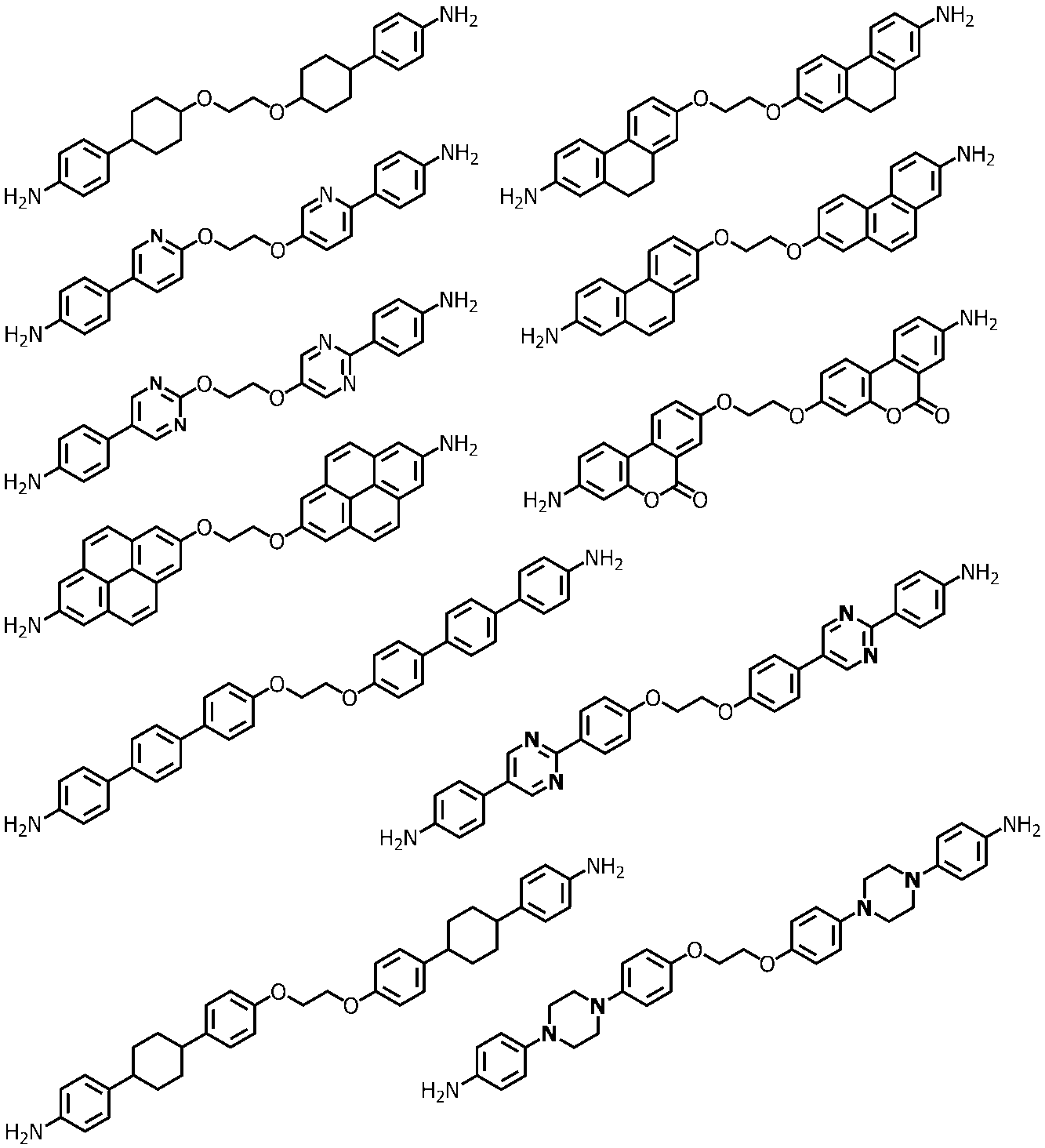
From the viewpoint of liquid crystal orientation, B 1 and B 2 are preferably biphenylene groups.
In the above formula, R 4 is preferably an alkylene group having 1 to 3 carbon atoms from the viewpoint of liquid crystal alignment. From the viewpoint of liquid crystal alignment, R 5 is preferably a hydrogen atom or a methyl group.
The specific structure described above is preferably contained in the diamine which is the raw material of the polyimide precursor. Specific examples of the diamine having the above-mentioned specific structure include, but are not limited to, the following diamines. The polyimide precursor is preferably obtained by polymerizing a diamine component containing at least one diamine selected from the following diamines and a tetracarboxylic acid component.


上記式において、R5及びR12は、それぞれの好ましい例も含めて、前記と同定義である。
In the above formula, R 5 and R 12 have the same definitions as above, including the respective preferable examples.
上記の特定構造を有するジアミンは、上記特定構造の両端にアミノ基が結合したジアミンが好ましく、なかでも、配向性及び液晶表示素子にした際の輝点減少の観点から、以下のジアミンであることが好ましい。

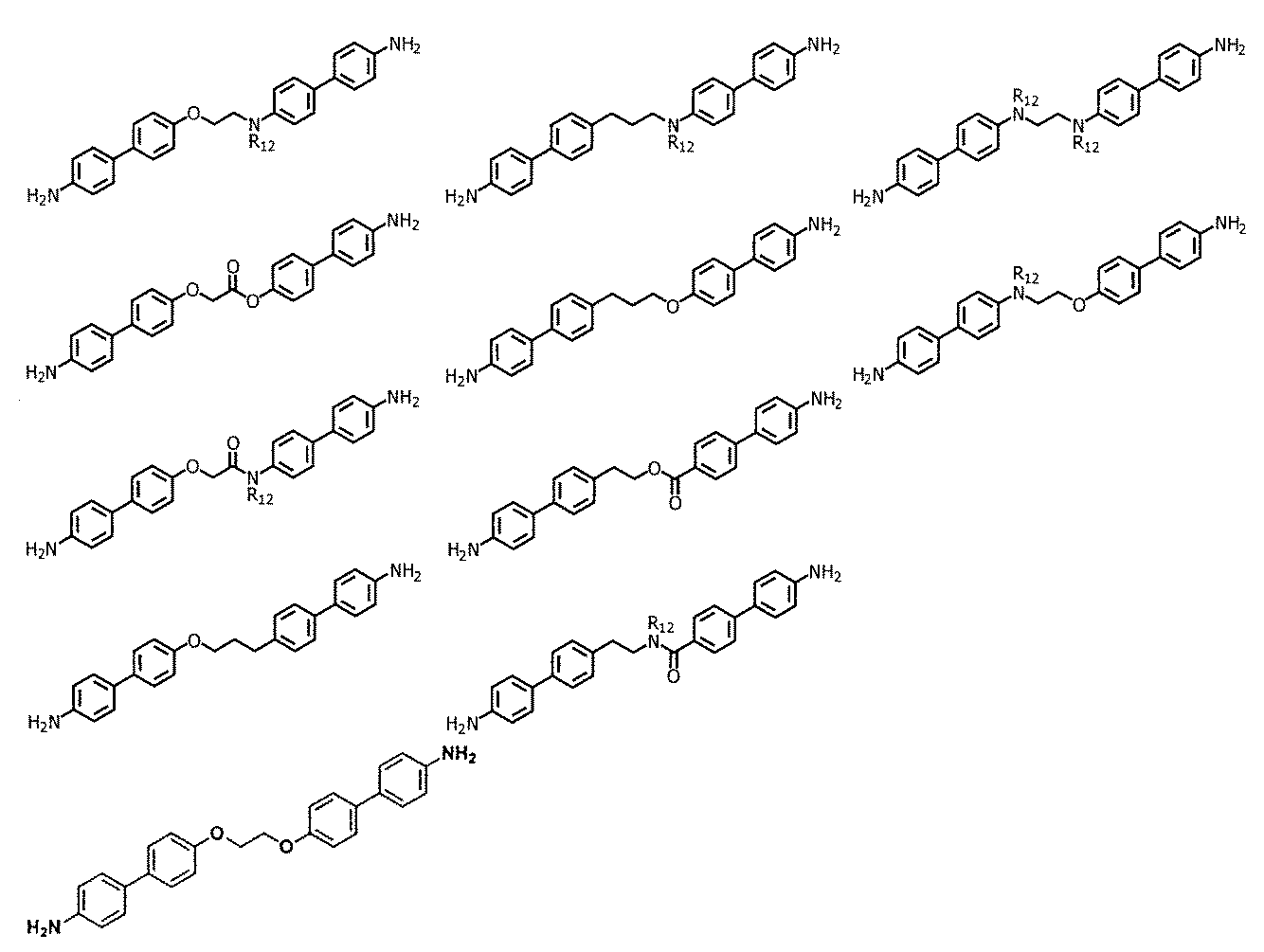
<重合体>
本発明の液晶配向剤を構成するポリイミド前駆体は、下記式(2)の構造単位を含有する。

The polyimide precursor constituting the liquid crystal aligning agent of the present invention contains a structural unit represented by the following formula (2).
X1は、下記式(X1-1)及び(X1-2)で表される構造からなる群から選ばれる少なくとも1種である。その中でも、液晶配向性の観点から、下記式(X1-2)が好ましい。
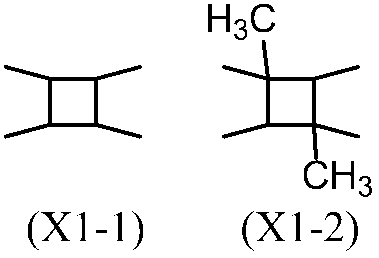
Y1は、式(1)で表される2価の有機基である。
R3は、水素原子又は炭素数1~5のアルキル基である。具体例としては、メチル基、エチル基、プロピル基、i-プロピル基、n-ブチル基、i-ブチル基、s-ブチル基、t-ブチル基、n-ペンチル基などが挙げられる。加熱によるイミド化のしやすさの観点から、R3は、水素原子又はメチル基が好ましい。
Y 1 is a divalent organic group represented by the formula (1).
R 3 is a hydrogen atom or an alkyl group having 1 to 5 carbon atoms. Specific examples thereof include a methyl group, an ethyl group, a propyl group, an i-propyl group, an n-butyl group, an i-butyl group, an s-butyl group, a t-butyl group and an n-pentyl group. From the viewpoint of ease of imidization by heating, R 3 is preferably a hydrogen atom or a methyl group.
Z1及びZ2は、それぞれ独立して、水素原子、又は置換基を有してもよい、炭素数1~10のアルキル基、炭素数2~10のアルケニル基若しくは炭素数2~10のアルキニル基である。アルキル基の具体例としては、メチル基、エチル基、プロピル基、ブチル基、t-ブチル基、ヘキシル基、オクチル基、デシル基、シクロペンチル基、シクロヘキシル基、ビシクロヘキシル基などが挙げられる。アルケニル基としては、上記のアルキル基に存在する1つ以上のCH2-CH2構造を、CH=CH構造に置き換えたものが挙げられる。具体的には、ビニル基、アリル基、1-プロペニル基、イソプロペニル基、2-ブテニル基、1,3-ブタジエニル基、2-ペンテニル基、2-ヘキセニル基、シクロプロペニル基、シクロペンテニル基、シクロヘキセニル基などが挙げられる。アルキニル基としては、前記のアルキル基に存在する1つ以上のCH2-CH2構造を、C≡C構造に置き換えたものが挙げられる。具体的には、エチニル基、1-プロピニル基、2-プロピニル基などが挙げられる。 Z 1 and Z 2 are each independently a hydrogen atom or an optionally substituted alkyl group having 1 to 10 carbon atoms, an alkenyl group having 2 to 10 carbon atoms or an alkynyl group having 2 to 10 carbon atoms. It is a base. Specific examples of the alkyl group include a methyl group, an ethyl group, a propyl group, a butyl group, a t-butyl group, a hexyl group, an octyl group, a decyl group, a cyclopentyl group, a cyclohexyl group and a bicyclohexyl group. Alkenyl groups include those in which one or more CH 2 —CH 2 structures present in the above alkyl groups have been replaced with a CH═CH structure. Specifically, vinyl group, allyl group, 1-propenyl group, isopropenyl group, 2-butenyl group, 1,3-butadienyl group, 2-pentenyl group, 2-hexenyl group, cyclopropenyl group, cyclopentenyl group, A cyclohexenyl group etc. are mentioned. Examples of the alkynyl group include those in which one or more CH 2 —CH 2 structures present in the above alkyl group are replaced with a C≡C structure. Specific examples thereof include an ethynyl group, a 1-propynyl group and a 2-propynyl group.
上記のアルキル基、アルケニル基、及びアルキニル基は置換基を有していてもよく、更には、置換基によっては環構造を形成してもよい。なお、置換基によって環構造を形成するとは、置換基同士又は置換基と母骨格の一部とが結合して環構造となることを意味する。
置換基の例としては、ハロゲン基、水酸基、チオール基、ニトロ基、アリール基、オルガノオキシ基、オルガノチオ基、オルガノシリル基、アシル基、エステル基、チオエステル基、リン酸エステル基、アミド基、アルキル基、アルケニル基、アルキニル基等を挙げることができる。
ハロゲン基としては、フッ素原子、塩素原子、臭素原子又はヨウ素原子が挙げられる。
アリール基としては、フェニル基が挙げられる。このアリール基には前述した他の置換基が、更に置換していてもよい。
The above alkyl group, alkenyl group, and alkynyl group may have a substituent, and depending on the substituent, a ring structure may be formed. In addition, forming a ring structure by a substituent means that the substituents are bonded to each other or a part of the mother skeleton to form a ring structure.
Examples of the substituent include a halogen group, a hydroxyl group, a thiol group, a nitro group, an aryl group, an organooxy group, an organothio group, an organosilyl group, an acyl group, an ester group, a thioester group, a phosphoric ester group, an amide group, an alkyl group. Group, alkenyl group, alkynyl group and the like.
Examples of the halogen group include a fluorine atom, a chlorine atom, a bromine atom or an iodine atom.
A phenyl group is mentioned as an aryl group. This aryl group may be further substituted with another substituent described above.
オルガノオキシ基としては、-O-Rで表される構造を示すことができる。このRは、同一でも異なってもよく、前述したアルキル基、アルケニル基、アルキニル基、アリール基などを例示することができる。これらのRには、前述した置換基が更に置換していてもよい。具体例としては、メトキシ基、エトキシ基、プロピルオキシ基、ブトキシ基、ペンチルオキシ基、ヘキシルオキシ基、ヘプチルオキシ基、オクチルオキシ基などが挙げられる。
オルガノチオ基としては、-S-Rで表される構造を示すことができる。このRとしては、前述したアルキル基、アルケニル基、アルキニル基、アリール基などを例示することができる。これらのRには、前述した置換基が更に置換していてもよい。具体例としては、メチルチオ基、エチルチオ基、プロピルチオ基、ブチルチオ基、ペンチルチオ基、ヘキシルチオ基、ヘプチルチオ基、オクチルチオ基などが挙げられる。
The organooxy group can have a structure represented by —OR. The R may be the same or different, and examples thereof include the above-mentioned alkyl group, alkenyl group, alkynyl group and aryl group. These R may be further substituted with the above-mentioned substituents. Specific examples thereof include a methoxy group, an ethoxy group, a propyloxy group, a butoxy group, a pentyloxy group, a hexyloxy group, a heptyloxy group and an octyloxy group.
The organothio group can have a structure represented by —SR. Examples of R include the alkyl group, alkenyl group, alkynyl group, and aryl group described above. These R may be further substituted with the above-mentioned substituents. Specific examples thereof include a methylthio group, an ethylthio group, a propylthio group, a butylthio group, a pentylthio group, a hexylthio group, a heptylthio group and an octylthio group.
オルガノシリル基としては、-Si-(R)3で表される構造を示すことができる。このRは同一でも異なってもよく、前述したアルキル基、アルケニル基、アルキニル基、アリール基などを例示することができる。これらのRには、前述した置換基が更に置換していてもよい。具体例としては、トリメチルシリル基、トリエチルシリル基、トリプロピルシリル基、トリブチルシリル基、トリペンチルシリル基、トリヘキシルシリル基、ペンチルジメチルシリル基、ヘキシルジメチルシリル基などが挙げられる。
アシル基としては、-C(O)-Rで表される構造を示すことができる。このRとしては、前述したアルキル基、アルケニル基、アリール基などを例示することができる。これらのRには、前述した置換基が更に置換していてもよい。具体例としては、ホルミル基、アセチル基、プロピオニル基、ブチリル基、イソブチリル基、バレリル基、イソバレリル基、ベンゾイル基などが挙げられる。
The organosilyl group can have a structure represented by —Si— (R) 3 . The R's may be the same or different, and examples thereof include the above-mentioned alkyl group, alkenyl group, alkynyl group and aryl group. These R may be further substituted with the above-mentioned substituents. Specific examples include a trimethylsilyl group, a triethylsilyl group, a tripropylsilyl group, a tributylsilyl group, a tripentylsilyl group, a trihexylsilyl group, a pentyldimethylsilyl group and a hexyldimethylsilyl group.
The acyl group can have a structure represented by —C (O) —R. Examples of R include the alkyl group, alkenyl group, and aryl group described above. These R may be further substituted with the above-mentioned substituents. Specific examples thereof include a formyl group, an acetyl group, a propionyl group, a butyryl group, an isobutyryl group, a valeryl group, an isovaleryl group and a benzoyl group.
エステル基としては、-C(O)O-R、又は-OC(O)-Rで表される構造を示すことができる。このRとしては、前述したアルキル基、アルケニル基、アルキニル基、アリール基などを例示することができる。これらのRには、前述した置換基が更に置換していてもよい。
チオエステル基としては、-C(S)O-R、又は-OC(S)-Rで表される構造を示すことができる。このRとしては、前述したアルキル基、アルケニル基、アルキニル基、アリール基などを例示することができる。これらのRには、前述した置換基が更に置換していてもよい。
リン酸エステル基としては、-OP(O)-(OR)2で表される構造を示すことができる。このRは同一でも異なってもよく、前述したアルキル基、アルケニル基、アルキニル基、アリール基などを例示することができる。これらのRには、前述した置換基が更に置換していてもよい。
As the ester group, a structure represented by -C (O) OR or -OC (O) -R can be shown. Examples of R include the alkyl group, alkenyl group, alkynyl group, and aryl group described above. These R may be further substituted with the above-mentioned substituents.
The thioester group can have a structure represented by -C (S) OR or -OC (S) -R. Examples of R include the alkyl group, alkenyl group, alkynyl group, and aryl group described above. These R may be further substituted with the above-mentioned substituents.
The phosphate group can have a structure represented by —OP (O) — (OR) 2 . The R's may be the same or different, and examples thereof include the above-mentioned alkyl group, alkenyl group, alkynyl group and aryl group. These R may be further substituted with the above-mentioned substituents.
アミド基としては、-C(O)NH2、-C(O)NHR、-NHC(O)R、-C(O)N(R)2、又は-NRC(O)Rで表される構造を示すことができる。このRは同一でも異なってもよく、前述したアルキル基、アルケニル基、アルキニル基、アリール基などを例示することができる。これらのRには、前述した置換基が更に置換していてもよい。
アリール基としては、前述したアリール基と同じものを挙げることができる。このアリール基には、前述した他の置換基が更に置換していてもよい。
アルキル基としては、前述したアルキル基と同じものを挙げることができる。このアルキル基には、前述した他の置換基が更に置換していてもよい。
アルケニル基としては、前述したアルケニル基と同じものを挙げることができる。このアルケニル基には、前述した他の置換基が更に置換していてもよい。
アルキニル基としては、前述したアルキニル基と同じものを挙げることができる。このアルキニル基には、前述した他の置換基が更に置換していてもよい。
The amide group has a structure represented by -C (O) NH 2 , -C (O) NHR, -NHC (O) R, -C (O) N (R) 2 or -NRC (O) R. Can be shown. The R's may be the same or different, and examples thereof include the above-mentioned alkyl group, alkenyl group, alkynyl group and aryl group. These R may be further substituted with the above-mentioned substituents.
As the aryl group, the same aryl groups as described above can be mentioned. This aryl group may be further substituted with another substituent described above.
As the alkyl group, the same ones as those mentioned above can be mentioned. The alkyl group may be further substituted with the other substituent described above.
As the alkenyl group, the same alkenyl groups as mentioned above can be mentioned. This alkenyl group may be further substituted with the other substituent described above.
As the alkynyl group, the same alkynyl groups as described above can be mentioned. This alkynyl group may be further substituted with the other substituent described above.
一般に、嵩高い構造を導入すると、アミノ基の反応性や液晶配向性を低下させる可能性があるため、Z1及びZ2としては、水素原子、又は置換基を有してもよい炭素数1~5のアルキル基がより好ましく、水素原子、メチル基又はエチル基が特に好ましい。
上記式(2)で表される構造単位を、全構造単位に対して、20~100モル%有することが好ましく、液晶配向性の観点から、30~100モル%が特に好ましい。
In general, when a bulky structure is introduced, reactivity of an amino group and liquid crystal alignment may be deteriorated. Therefore, Z 1 and Z 2 each have a hydrogen atom or a carbon number of 1 which may have a substituent. Alkyl groups of to 5 are more preferable, and hydrogen atom, methyl group or ethyl group is particularly preferable.
The structural unit represented by the above formula (2) is preferably contained in an amount of 20 to 100 mol% based on all structural units, and from the viewpoint of liquid crystal alignment, 30 to 100 mol% is particularly preferable.
<その他の構造単位>
本発明の液晶配向剤を構成する重合体が、上記式(2)の構造単位以外の構造単位を含む場合、その構造単位は、下記式(3)で表される。

When the polymer constituting the liquid crystal aligning agent of the present invention contains a structural unit other than the structural unit of the above formula (2), the structural unit is represented by the following formula (3).
X2は、4価の有機基であり、Y2は、2価の有機基である。
X2は、テトラカルボン酸誘導体由来の4価の有機基であり、その構造は特に限定されるものではない。ポリイミド前駆体中、X2は2種類以上が混在していてもよい。X2の具体例を示すならば、下記式(X-1)~(X-44)の構造が挙げられる。
X 2 is a tetravalent organic group, and Y 2 is a divalent organic group.
X 2 is a tetravalent organic group derived from a tetracarboxylic acid derivative, and its structure is not particularly limited. Two or more types of X 2 may be mixed in the polyimide precursor. Specific examples of X 2 include the structures of the following formulas (X-1) to (X-44).


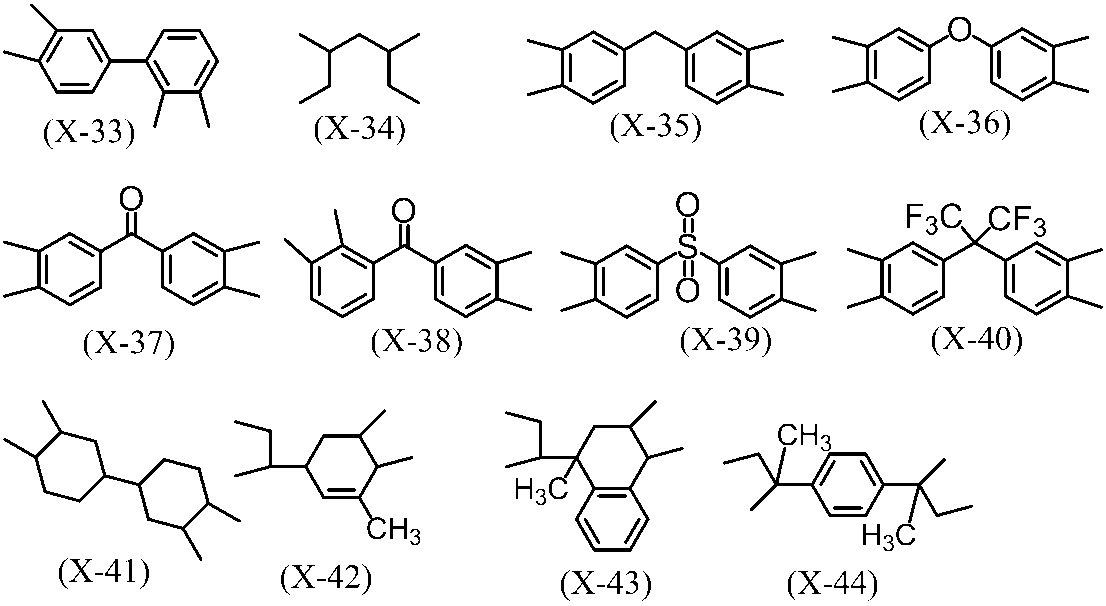
上記式(X-1)におけるR8~R11は、それぞれ独立して、水素原子、ハロゲン原子、炭素数1~6のアルキル基、炭素数2~6のアルケニル基、炭素数2~6のアルキニル基又はフェニル基である。R8~R11が、嵩高い構造である場合、液晶配向性を低下させる可能性があるため、水素原子、メチル基又はエチル基がより好ましく、水素原子又は、メチル基が特に好ましい。 R 8 to R 11 in the above formula (X-1) are each independently a hydrogen atom, a halogen atom, an alkyl group having 1 to 6 carbon atoms, an alkenyl group having 2 to 6 carbon atoms, or an alkyl group having 2 to 6 carbon atoms. It is an alkynyl group or a phenyl group. When R 8 to R 11 have a bulky structure, the liquid crystal alignment may be deteriorated, and therefore a hydrogen atom, a methyl group or an ethyl group is more preferable, and a hydrogen atom or a methyl group is particularly preferable.
式(3)において、Y2は、ジアミン由来の2価の有機基であり、その構造は特に限定されない。Y2の構造の具体例を示すならば、下記の(Y-1)~(Y-118)が挙げられる。


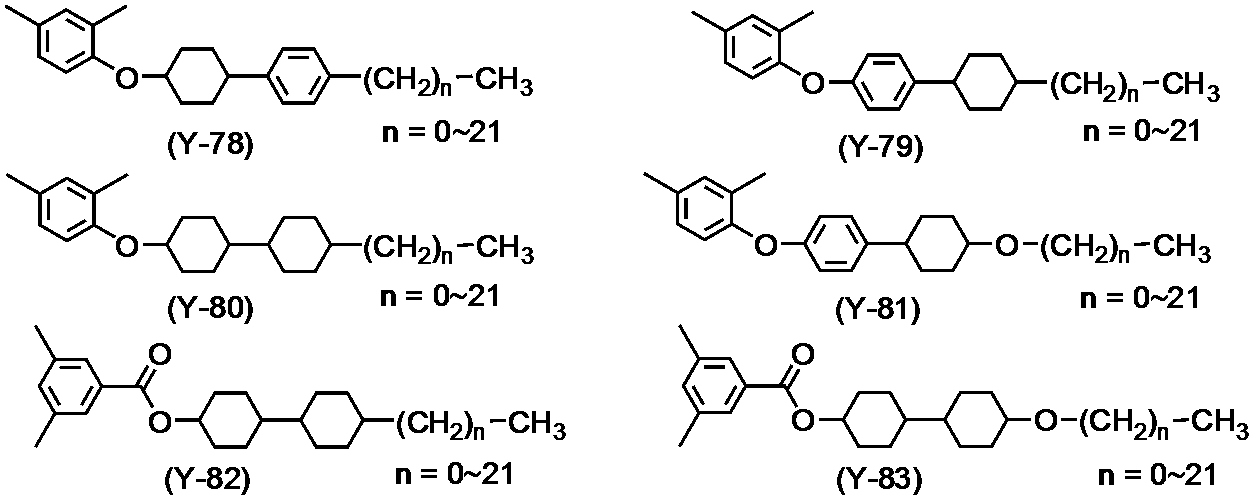
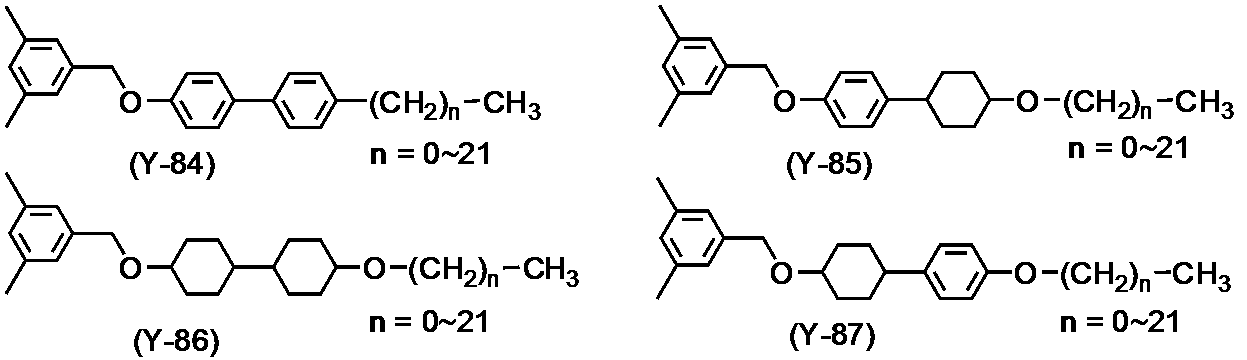


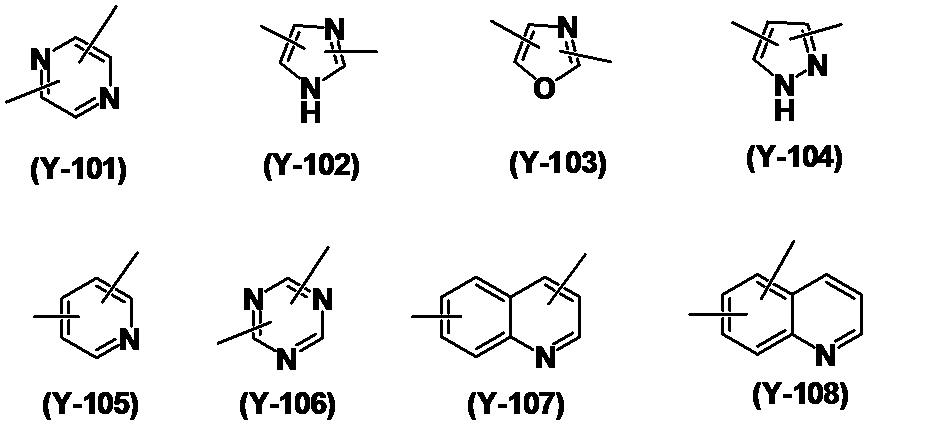
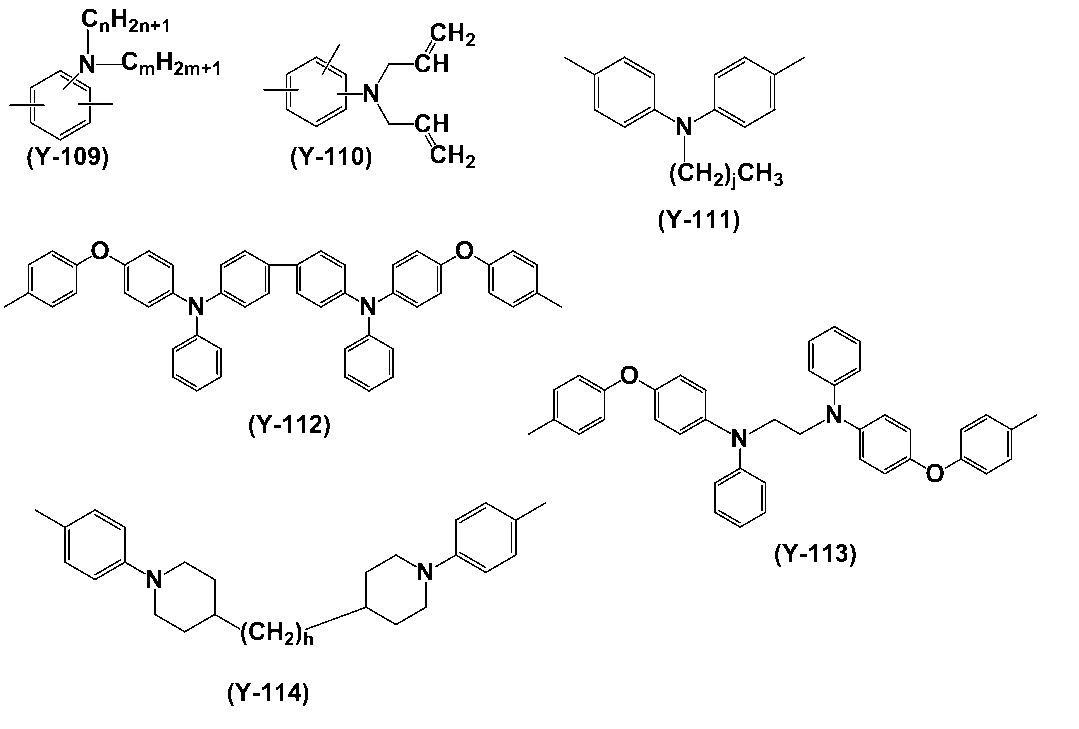

(式(Y-109)中、m、nは、それぞれ独立して、1~11の整数であり、m+nは2~12の整数であり、式(Y-114)中、hは1~3の整数であり、式(Y-111)及び(Y-117)中、jは0~3の整数である。)
本発明に用いるポリイミド前駆体は、ジアミン成分とテトラカルボン酸誘導体との反応から得られるものであり、ポリアミック酸やポリアミック酸エステル等が挙げられる。
(In the formula (Y-109), m and n are each independently an integer of 1 to 11, m + n is an integer of 2 to 12, and in the formula (Y-114), h is 1 to 3 And j is an integer of 0 to 3 in formulas (Y-111) and (Y-117).
The polyimide precursor used in the present invention is obtained from the reaction of a diamine component and a tetracarboxylic acid derivative, and examples thereof include polyamic acid and polyamic acid ester.
<ポリイミド前駆体(ポリアミック酸)>
本発明に用いられるポリイミド前駆体であるポリアミック酸は、以下の方法により製造される。
具体的には、テトラカルボン酸二無水物とジアミンとを、有機溶媒の存在下で、-20~150℃、好ましくは0~50℃において、30分~24時間、好ましくは1~12時間反応させることによって合成できる。
<Polyimide precursor (polyamic acid)>
The polyamic acid, which is the polyimide precursor used in the present invention, is produced by the following method.
Specifically, tetracarboxylic dianhydride and diamine are reacted in the presence of an organic solvent at −20 to 150 ° C., preferably 0 to 50 ° C. for 30 minutes to 24 hours, preferably 1 to 12 hours. Can be synthesized.
ジアミン成分とテトラカルボン酸成分との反応は、通常、有機溶媒中で行う。その際に用いる有機溶媒としては、生成したポリイミド前駆体が溶解するものであれば特に限定されない。下記に、反応に用いる有機溶媒の具体例を挙げるが、これらの例に限定されるものではない。例えば、N-メチル-2-ピロリドン、N-エチル-2-ピロリドン、γ-ブチロラクトン、N,N-ジメチルホルムアミド、N,N-ジメチルアセトアミド、ジメチルスルホキシド又は1,3-ジメチル-イミダゾリジノンが挙げられる。
また、ポリイミド前駆体の溶解性が高い場合は、メチルエチルケトン、シクロヘキサノン、シクロペンタノン、4-ヒドロキシ-4-メチル-2-ペンタノン又は下記の式[D-1]~式[D-3]で示される有機溶媒を用いることができる。
The reaction between the diamine component and the tetracarboxylic acid component is usually performed in an organic solvent. The organic solvent used at that time is not particularly limited as long as it can dissolve the generated polyimide precursor. Specific examples of the organic solvent used in the reaction are shown below, but the invention is not limited to these examples. Examples include N-methyl-2-pyrrolidone, N-ethyl-2-pyrrolidone, γ-butyrolactone, N, N-dimethylformamide, N, N-dimethylacetamide, dimethyl sulfoxide or 1,3-dimethyl-imidazolidinone. Be done.
When the polyimide precursor has high solubility, it is represented by methyl ethyl ketone, cyclohexanone, cyclopentanone, 4-hydroxy-4-methyl-2-pentanone or the following formulas [D-1] to [D-3]. The organic solvent used can be used.
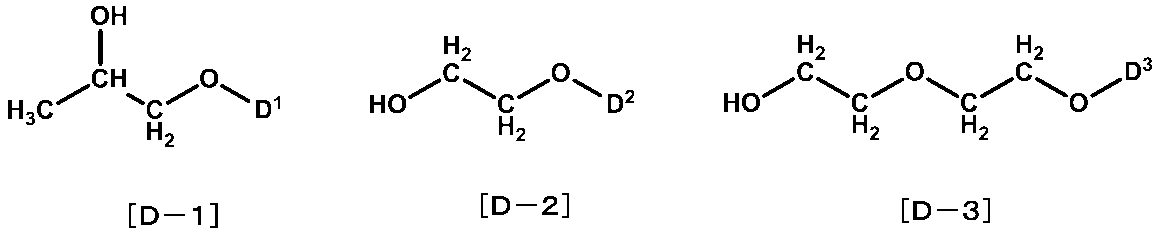
これら溶媒は単独で使用しても、混合して使用してもよい。更に、ポリイミド前駆体を溶解させない溶媒であっても、生成したポリイミド前駆体が析出しない範囲で、前記溶媒に混合して使用してもよい。また、溶媒中の水分は重合反応を阻害し、更には生成したポリイミド前駆体を加水分解させる原因となるので、溶媒は脱水乾燥させたものを用いることが好ましい。
反応系中におけるポリアミック酸ポリマーの濃度は、ポリマーの析出が起こりにくく、かつ高分子量体が得やすいという点から、1~30質量%が好ましく、5~20質量%がより好ましい。
These solvents may be used alone or in combination. Furthermore, even a solvent that does not dissolve the polyimide precursor may be used as a mixture with the solvent as long as the generated polyimide precursor does not precipitate. Further, water in the solvent inhibits the polymerization reaction and causes hydrolysis of the formed polyimide precursor, and therefore it is preferable to use a dehydrated and dried solvent.
The concentration of the polyamic acid polymer in the reaction system is preferably 1 to 30% by mass, and more preferably 5 to 20% by mass from the viewpoint that polymer precipitation does not easily occur and a high molecular weight polymer is easily obtained.
上記のようにして得られたポリアミック酸は、反応溶液をよく撹拌させながら貧溶媒に注入することで、ポリマーを析出させて回収することができる。また、析出を数回行い、貧溶媒で洗浄後、常温あるいは加熱乾燥することで、精製されたポリアミック酸の粉末を得ることができる。貧溶媒は、特に限定されないが、水、メタノール、エタノール、ヘキサン、ブチルセロソルブ、アセトン、トルエン等が挙げられる。 The polyamic acid obtained as described above can be recovered by precipitating a polymer by injecting it into a poor solvent while stirring the reaction solution well. Further, by performing precipitation several times, washing with a poor solvent, and drying at room temperature or by heating, a purified polyamic acid powder can be obtained. The poor solvent is not particularly limited, and examples thereof include water, methanol, ethanol, hexane, butyl cellosolve, acetone, and toluene.
<ポリイミド前駆体(ポリアミック酸エステル)>
本発明に用いられるポリイミド前駆体であるポリアミック酸エステルは、以下に示す(1)、(2)又は(3)の製法で製造することができる。
<Polyimide precursor (polyamic acid ester)>
The polyamic acid ester, which is the polyimide precursor used in the present invention, can be produced by the following production method (1), (2) or (3).
(1)ポリアミック酸から製造する場合
ポリアミック酸エステルは、前記のように製造されたポリアミック酸をエステル化することによって製造できる。具体的には、ポリアミック酸とエステル化剤を有機溶剤の存在下で-20~150℃、好ましくは0~50℃において、30分~24時間、好ましくは1~4時間反応させることによって製造することができる。
(1) When produced from polyamic acid The polyamic acid ester can be produced by esterifying the polyamic acid produced as described above. Specifically, it is produced by reacting a polyamic acid and an esterifying agent in the presence of an organic solvent at −20 to 150 ° C., preferably 0 to 50 ° C. for 30 minutes to 24 hours, preferably 1 to 4 hours. be able to.
エステル化剤としては、精製によって容易に除去できるものが好ましく、N,N-ジメチルホルムアミドジメチルアセタール、N,N-ジメチルホルムアミドジエチルアセタール、N,N-ジメチルホルムアミドジプロピルアセタール、N,N-ジメチルホルムアミドジネオペンチルブチルアセタール、N,N-ジメチルホルムアミドジ-t-ブチルアセタール、1-メチル-3-p-トリルトリアゼン、1-エチル-3-p-トリルトリアゼン、1-プロピル-3-p-トリルトリアゼン、4-(4,6-ジメトキシ-1,3,5-トリアジンー2-イル)-4-メチルモルホリニウムクロリドなどが挙げられる。エステル化剤の添加量は、ポリアミック酸の繰り返し単位1モルに対して、2~6モル当量が好ましい。 As the esterifying agent, those which can be easily removed by purification are preferable, and N, N-dimethylformamide dimethyl acetal, N, N-dimethylformamide diethyl acetal, N, N-dimethylformamide dipropyl acetal, N, N-dimethylformamide Dineopentylbutyl acetal, N, N-dimethylformamide di-t-butyl acetal, 1-methyl-3-p-tolyltriazene, 1-ethyl-3-p-tolyltriazene, 1-propyl-3-p -Tolyltriazene, 4- (4,6-dimethoxy-1,3,5-triazin-2-yl) -4-methylmorpholinium chloride and the like can be mentioned. The addition amount of the esterifying agent is preferably 2 to 6 molar equivalents with respect to 1 mol of the repeating unit of the polyamic acid.
有機溶剤としては、例えば、N-メチル-2-ピロリドン、N-エチル-2-ピロリドン又はγ-ブチロラクトン、N,N-ジメチルホルムアミド、N,N-ジメチルアセトアミド、ジメチルスルホキシド又は1,3-ジメチル-イミダゾリジノンが挙げられる。また、ポリイミド前駆体の溶媒溶解性が高い場合は、メチルエチルケトン、シクロヘキサノン、シクロペンタノン、4-ヒドロキシ-4-メチル-2-ペンタノン、又は前記式[D-1]~式[D-3]で示される溶媒を用いることができる。
これらの溶媒は単独で使用しても、混合して使用してもよい。更に、ポリイミド前駆体を溶解させない溶媒であっても、生成したポリイミド前駆体が析出しない範囲で、前記溶媒に混合して使用してもよい。また、溶媒中の水分は、重合反応を阻害し、更には生成したポリイミド前駆体を加水分解させる原因となるので、溶媒は脱水乾燥させたものを用いることが好ましい。
Examples of the organic solvent include N-methyl-2-pyrrolidone, N-ethyl-2-pyrrolidone or γ-butyrolactone, N, N-dimethylformamide, N, N-dimethylacetamide, dimethyl sulfoxide or 1,3-dimethyl- Examples include imidazolidinone. When the polyimide precursor has high solubility in a solvent, methyl ethyl ketone, cyclohexanone, cyclopentanone, 4-hydroxy-4-methyl-2-pentanone, or the above formula [D-1] to formula [D-3] is used. The indicated solvents can be used.
These solvents may be used alone or as a mixture. Furthermore, even a solvent that does not dissolve the polyimide precursor may be used as a mixture with the solvent as long as the generated polyimide precursor does not precipitate. Further, since water in the solvent hinders the polymerization reaction and causes hydrolysis of the generated polyimide precursor, it is preferable to use a dehydrated and dried solvent.
上記の反応に用いる溶媒は、ポリマーの溶解性から、N,N-ジメチルホルムアミド、N-メチル-2-ピロリドン、又はγ-ブチロラクトンが好ましく、これらは1種又は2種以上を混合して用いてもよい。製造時の濃度は、ポリマーの析出が起こりにくく、かつ高分子量体が得やすいという点から、1~30質量%が好ましく、5~20質量%がより好ましい。 The solvent used in the above reaction is preferably N, N-dimethylformamide, N-methyl-2-pyrrolidone, or γ-butyrolactone because of the solubility of the polymer. These are used alone or in combination of two or more. Good. The concentration at the time of production is preferably 1 to 30% by mass, more preferably 5 to 20% by mass, because precipitation of a polymer is less likely to occur and a high molecular weight product is easily obtained.
(2)テトラカルボン酸ジエステルジクロリドとジアミンとの反応により製造する場合
ポリアミック酸エステルは、テトラカルボン酸ジエステルジクロリドとジアミンから製造することができる。
具体的には、テトラカルボン酸ジエステルジクロリドとジアミンとを、塩基と有機溶剤の存在下で、-20~150℃、好ましくは0~50℃において、30分~24時間、好ましくは1~4時間反応させることによって製造することができる。
(2) When produced by reaction of tetracarboxylic acid diester dichloride and diamine The polyamic acid ester can be produced from tetracarboxylic acid diester dichloride and diamine.
Specifically, tetracarboxylic acid diester dichloride and diamine are added in the presence of a base and an organic solvent at −20 to 150 ° C., preferably 0 to 50 ° C. for 30 minutes to 24 hours, preferably 1 to 4 hours. It can be produced by reacting.
前記塩基としては、ピリジン、トリエチルアミン、4-ジメチルアミノピリジンなどが使用できるが、反応が穏和に進行するためにピリジンが好ましい。塩基の添加量は、除去が容易な量で、かつ高分子量体が得やすいという点から、テトラカルボン酸ジエステルジクロリドに対して、2~4倍モルであることが好ましい。
上記の反応に用いる溶媒は、モノマー及びポリマーの溶解性から、N-メチル-2-ピロリドン、又はγ-ブチロラクトンが好ましく、これらは1種又は2種以上を混合して用いてもよい。製造時のポリマー濃度は、ポリマーの析出が起こりにくく、かつ高分子量体が得やすいという点から、1~30質量%が好ましく、5~20質量%がより好ましい。また、テトラカルボン酸ジエステルジクロリドの加水分解を防ぐため、ポリアミック酸エステルの製造に用いる溶媒は、できるだけ脱水されていることが好ましく、窒素雰囲気中で、外気の混入を防ぐのが好ましい。
As the base, pyridine, triethylamine, 4-dimethylaminopyridine and the like can be used, but pyridine is preferable because the reaction proceeds gently. The amount of the base added is preferably 2 to 4 times the molar amount of the tetracarboxylic acid diester dichloride from the viewpoints of easy removal and easily obtaining a high molecular weight product.
The solvent used in the above reaction is preferably N-methyl-2-pyrrolidone or γ-butyrolactone in view of the solubility of the monomer and polymer, and these may be used alone or in combination of two or more. The polymer concentration during production is preferably 1 to 30% by mass, and more preferably 5 to 20% by mass, because precipitation of the polymer is less likely to occur and a high molecular weight product is easily obtained. Further, in order to prevent the hydrolysis of the tetracarboxylic acid diester dichloride, the solvent used for the production of the polyamic acid ester is preferably dehydrated as much as possible, and it is preferable to prevent the entry of outside air in a nitrogen atmosphere.
(3)テトラカルボン酸ジエステルとジアミンから製造する場合
ポリアミック酸エステルは、テトラカルボン酸ジエステルとジアミンを重縮合することにより製造することができる。
具体的には、テトラカルボン酸ジエステルとジアミンとを、縮合剤、塩基、及び有機溶剤の存在下で、0~150℃、好ましくは0~100℃において、30分~24時間、好ましくは3~15時間反応させることによって製造することができる。
(3) When produced from tetracarboxylic acid diester and diamine The polyamic acid ester can be produced by polycondensing the tetracarboxylic acid diester and diamine.
Specifically, a tetracarboxylic acid diester and a diamine are mixed in the presence of a condensing agent, a base, and an organic solvent at 0 to 150 ° C., preferably 0 to 100 ° C. for 30 minutes to 24 hours, preferably 3 to It can be produced by reacting for 15 hours.
前記縮合剤には、トリフェニルホスファイト、ジシクロヘキシルカルボジイミド、1-エチル-3-(3-ジメチルアミノプロピル)カルボジイミド塩酸塩、N,N’-カルボニルジイミダゾール、ジメトキシ-1,3,5-トリアジニルメチルモルホリニウム、O-(ベンゾトリアゾール-1-イル)-N,N,N’,N’-テトラメチルウロニウム テトラフルオロボラート、O-(ベンゾトリアゾール-1-イル)-N,N,N’,N’-テトラメチルウロニウムヘキサフルオロホスファート、(2,3-ジヒドロ-2-チオキソ-3-ベンゾオキサゾリル)ホスホン酸ジフェニルなどが使用できる。縮合剤の添加量は、テトラカルボン酸ジエステルに対して2~3倍モルが好ましい。 Examples of the condensing agent include triphenyl phosphite, dicyclohexylcarbodiimide, 1-ethyl-3- (3-dimethylaminopropyl) carbodiimide hydrochloride, N, N'-carbonyldiimidazole, dimethoxy-1,3,5-triazine. Nylmethylmorpholinium, O- (benzotriazol-1-yl) -N, N, N ', N'-tetramethyluronium tetrafluoroborate, O- (benzotriazol-1-yl) -N, N , N ′, N′-tetramethyluronium hexafluorophosphate, diphenyl (2,3-dihydro-2-thioxo-3-benzoxazolyl) phosphonate and the like can be used. The amount of the condensing agent added is preferably 2 to 3 times the mol of the tetracarboxylic acid diester.
前記塩基としては、ピリジン、トリエチルアミンなどの3級アミンが使用できる。塩基の添加量は、除去が容易な量で、かつ高分子量体が得やすいという点から、ジアミン成分に対して2~4倍モルが好ましい。
また、上記反応において、ルイス酸を添加剤として加えることで反応が効率的に進行する。ルイス酸としては、塩化リチウム、臭化リチウムなどのハロゲン化リチウムが好ましい。ルイス酸の添加量はジアミン成分に対して0~1.0倍モルが好ましい。
As the base, tertiary amines such as pyridine and triethylamine can be used. The amount of the base added is preferably 2 to 4 times the molar amount of the diamine component from the viewpoint of easy removal and easy production of a high molecular weight product.
Further, in the above reaction, the reaction proceeds efficiently by adding Lewis acid as an additive. As the Lewis acid, lithium halides such as lithium chloride and lithium bromide are preferable. The Lewis acid is preferably added in an amount of 0 to 1.0 times the mol of the diamine component.
上記3つのポリアミック酸エステルの製造方法の中でも、高分子量のポリアミック酸エステルが得られるため、上記(1)又は(2)の製法が特に好ましい。
上記のようにして得られるポリアミック酸エステルの溶液は、よく撹拌させながら貧溶媒に注入することで、ポリマーを析出させることができる。析出を数回行い、貧溶媒で洗浄後、常温あるいは加熱乾燥して、精製されたポリアミック酸エステルの粉末を得ることができる。貧溶媒は、特に限定されないが、水、メタノール、エタノール、ヘキサン、ブチルセロソルブ、アセトン、トルエン等が挙げられる。
Among the above three methods for producing a polyamic acid ester, the production method (1) or (2) is particularly preferable because a high molecular weight polyamic acid ester can be obtained.
The solution of the polyamic acid ester obtained as described above can be poured into a poor solvent while stirring well to precipitate the polymer. Precipitation is carried out several times, and after washing with a poor solvent, it is dried at room temperature or by heating to obtain a purified polyamic acid ester powder. The poor solvent is not particularly limited, and examples thereof include water, methanol, ethanol, hexane, butyl cellosolve, acetone, and toluene.
<ポリイミド>
本発明に用いられるポリイミドは、前記したポリアミック酸エステル又はポリアミック酸をイミド化することにより製造することができる。
ポリアミック酸エステルからポリイミドを製造する場合、ポリアミック酸エステル溶液、又はポリアミック酸エステル樹脂粉末を有機溶媒に溶解させて得られるポリアミック酸溶液に、塩基性触媒を添加する化学的イミド化が簡便である。化学的イミド化は、比較的低温でイミド化反応が進行し、イミド化の課程で重合体の分子量低下が起こりにくいので好ましい。
<Polyimide>
The polyimide used in the present invention can be produced by imidizing the above-mentioned polyamic acid ester or polyamic acid.
When a polyimide is produced from a polyamic acid ester, chemical imidization by adding a basic catalyst to a polyamic acid ester solution or a polyamic acid solution obtained by dissolving a polyamic acid ester resin powder in an organic solvent is simple. Chemical imidation is preferable because the imidization reaction proceeds at a relatively low temperature and the decrease in the molecular weight of the polymer does not easily occur during the imidization process.
化学的イミド化は、イミド化させたいポリアミック酸エステルを、有機溶媒中において、塩基性触媒存在下で撹拌することにより行うことができる。有機溶媒としては、前述した重合反応時に用いる溶媒を使用することができる。塩基性触媒としては、ピリジン、トリエチルアミン、トリメチルアミン、トリブチルアミン、トリオクチルアミン等を挙げることができる。中でもトリエチルアミンは反応を進行させるのに充分な塩基性を持つので好ましい。
イミド化反応を行うときの温度は、-20~140℃、好ましくは0~100℃であり、好ましくは反応時間は1~100時間で行うことができる。塩基性触媒の量は、アミック酸エステル基の0.5~30モル倍、好ましくは2~20モル倍である。得られる重合体のイミド化率は、触媒量、温度、反応時間等を調節することで制御することができる。イミド化反応後の溶液には、添加した触媒等が残存しているので、以下に述べる手段により、得られたイミド化重合体を回収し、有機溶媒で再溶解して、本発明の液晶配向剤とすることが好ましい。
The chemical imidization can be performed by stirring the polyamic acid ester to be imidized in an organic solvent in the presence of a basic catalyst. As the organic solvent, the solvent used in the above-mentioned polymerization reaction can be used. Examples of the basic catalyst include pyridine, triethylamine, trimethylamine, tributylamine, trioctylamine and the like. Of these, triethylamine is preferable because it has a basicity sufficient to allow the reaction to proceed.
The temperature at which the imidization reaction is carried out is −20 to 140 ° C., preferably 0 to 100 ° C., and the reaction time is preferably 1 to 100 hours. The amount of the basic catalyst is 0.5 to 30 times, preferably 2 to 20 times the amount of the amic acid ester group. The imidation ratio of the obtained polymer can be controlled by adjusting the amount of catalyst, temperature, reaction time and the like. Since the added catalyst and the like remain in the solution after the imidization reaction, the resulting imidized polymer is recovered by the means described below and redissolved in an organic solvent to obtain the liquid crystal alignment of the present invention. It is preferable to use it as an agent.
ポリアミック酸からポリイミドを製造する場合、ジアミン成分とテトラカルボン酸二無水物との反応で得られたポリアミック酸の溶液に、触媒を添加する化学的イミド化が簡便である。化学的イミド化は、比較的低温でイミド化反応が進行し、イミド化の過程で重合体の分子量低下が起こりにくいので好ましい。
化学的イミド化は、イミド化させたいポリアミック酸を、有機溶媒中において、塩基性触媒と酸無水物の存在下で攪拌することにより行うことができる。有機溶媒としては、前述した重合反応時に用いる溶媒を使用することができる。塩基性触媒としては、ピリジン、トリエチルアミン、トリメチルアミン、トリブチルアミン、トリオクチルアミン等を挙げることができる。中でもピリジンは反応を進行させるのに適度な塩基性を持つので好ましい。また、酸無水物としては、無水酢酸、無水トリメリット酸、無水ピロメリット酸等が挙げられる。なかでも無水酢酸は、反応終了後の精製が容易となるので好ましい。
When a polyimide is produced from a polyamic acid, chemical imidization by adding a catalyst to a solution of the polyamic acid obtained by the reaction of a diamine component and a tetracarboxylic dianhydride is simple. Chemical imidization is preferable because the imidization reaction proceeds at a relatively low temperature and the decrease in the molecular weight of the polymer does not easily occur in the process of imidization.
The chemical imidization can be performed by stirring the polyamic acid to be imidized in an organic solvent in the presence of a basic catalyst and an acid anhydride. As the organic solvent, the solvent used in the above-mentioned polymerization reaction can be used. Examples of the basic catalyst include pyridine, triethylamine, trimethylamine, tributylamine, trioctylamine and the like. Of these, pyridine is preferable because it has a proper basicity for proceeding the reaction. Examples of the acid anhydride include acetic anhydride, trimellitic anhydride, pyromellitic anhydride and the like. Of these, acetic anhydride is preferable because it facilitates purification after the reaction.
イミド化反応を行うときの温度は、-20~140℃、好ましくは0~100℃であり、反応時間は好ましくは1~100時間で行うことができる。塩基性触媒の量は、アミック酸基の0.5~30モル倍、好ましくは2~20モル倍であり、酸無水物の量は、アミック酸基の1~50モル倍、好ましくは3~30モル倍である。得られる重合体のイミド化率は、触媒量、温度、反応時間等を調節することで制御することができる。 The temperature at which the imidization reaction is carried out is −20 to 140 ° C., preferably 0 to 100 ° C., and the reaction time is preferably 1 to 100 hours. The amount of the basic catalyst is 0.5 to 30 times, preferably 2 to 20 times the amount of the amic acid group, and the amount of the acid anhydride is 1 to 50 times, preferably 3 to the molar amount of the amic acid group. It is 30 mol times. The imidation ratio of the obtained polymer can be controlled by adjusting the amount of catalyst, temperature, reaction time and the like.
ポリアミック酸エステル又はポリアミック酸のイミド化反応後の溶液には、添加した触媒等が残存しているので、以下に述べる手段により、得られたイミド化重合体を回収し、有機溶媒で再溶解して、本発明の液晶配向剤とすることが好ましい。
上記のようにして得られるポリイミドの溶液は、よく撹拌させながら貧溶媒に注入することで、重合体を析出させることができる。析出を数回行い、貧溶媒で洗浄後、常温あるいは加熱乾燥して、精製されたポリイミドの粉末を得ることができる。
貧溶媒としては、特に限定されないが、メタノール、アセトン、ヘキサン、ブチルセルソルブ、ヘプタン、メチルエチルケトン、メチルイソブチルケトン、エタノール、トルエン、ベンゼン等が挙げられる。
In the solution after imidization reaction of polyamic acid ester or polyamic acid, the added catalyst and the like remain, so by the means described below, the obtained imidized polymer is recovered and redissolved in an organic solvent. Therefore, the liquid crystal aligning agent of the present invention is preferable.
The polymer can be precipitated by injecting the solution of the polyimide obtained as described above into a poor solvent while stirring well. Precipitation is performed several times, washed with a poor solvent, and then dried at room temperature or by heating to obtain a purified polyimide powder.
The poor solvent is not particularly limited, but includes methanol, acetone, hexane, butyl cellosolve, heptane, methyl ethyl ketone, methyl isobutyl ketone, ethanol, toluene, benzene and the like.
<液晶配向剤>
本発明の液晶配向剤は、主鎖中に特定構造を有するポリイミド前駆体及び該ポリイミド前駆体のイミド化重合体からなる群から選ばれる少なくとも1種の重合体を含有する。重合体の分子量は、重量平均分子量(Mw)で2,000~500,000が好ましく、より好ましくは5,000~300,000であり、更に好ましくは、10,000~100,000である。また、数平均分子量(Mn)は、好ましくは、1,000~250,000であり、より好ましくは、2,500~150,000であり、更に好ましくは、5,000~50,000である。
<Liquid crystal aligning agent>
The liquid crystal aligning agent of the present invention contains at least one polymer selected from the group consisting of a polyimide precursor having a specific structure in the main chain and an imidized polymer of the polyimide precursor. The weight average molecular weight (Mw) of the polymer is preferably 2,000 to 500,000, more preferably 5,000 to 300,000, and further preferably 10,000 to 100,000. The number average molecular weight (Mn) is preferably 1,000 to 250,000, more preferably 2,500 to 150,000, and further preferably 5,000 to 50,000. ..
本発明の液晶配向剤中の重合体の濃度は、形成させようとする塗膜の厚みの設定によって適宜変更することができるが、均一で欠陥のない塗膜を形成させるという点からは、1質量%以上であることが好ましく、溶液の保存安定性の点からは、10質量%以下とすることが好ましい。重合体の濃度は好ましくは2~7質量%である。 The concentration of the polymer in the liquid crystal aligning agent of the present invention can be appropriately changed depending on the setting of the thickness of the coating film to be formed, but from the viewpoint of forming a uniform and defect-free coating film, It is preferably not less than 10% by mass, and more preferably not more than 10% by mass from the viewpoint of storage stability of the solution. The concentration of the polymer is preferably 2 to 7% by mass.
本発明に用いられる液晶配向剤に含有される、重合体を溶解させる有機溶媒(以下、良溶媒ともいう)は、重合体が均一に溶解するものであれば特に限定されない。
例えば、N,N-ジメチルホルムアミド、N,N-ジメチルアセトアミド、N-メチル-2-ピロリドン、N-エチル-2-ピロリドン、ジメチルスルホキシド、γ-ブチロラクトン、1,3-ジメチル-イミダゾリジノン、メチルエチルケトン、シクロヘキサノン、シクロペンタノン又は4-ヒドロキシ-4-メチル-2-ペンタノンを挙げることができる。なかでも、N-メチル-2-ピロリドン、N-エチル-2-ピロリドン、又はγ-ブチロラクトンを用いることが好ましい。
更に、本発明の重合体の溶媒への溶解性が高い場合は、前記式[D-1]~式[D-3]で示される溶媒を用いることが好ましい。
本発明の液晶配向剤における良溶媒の含有量は、液晶配向剤に含まれる溶媒全体の20~99質量%であることが好ましい。なかでも、20~90質量%が好ましい。より好ましいのは、30~80質量%である。
The organic solvent that dissolves the polymer (hereinafter, also referred to as a good solvent) contained in the liquid crystal aligning agent used in the present invention is not particularly limited as long as the polymer can be uniformly dissolved therein.
For example, N, N-dimethylformamide, N, N-dimethylacetamide, N-methyl-2-pyrrolidone, N-ethyl-2-pyrrolidone, dimethyl sulfoxide, γ-butyrolactone, 1,3-dimethyl-imidazolidinone, methyl ethyl ketone , Cyclohexanone, cyclopentanone or 4-hydroxy-4-methyl-2-pentanone. Among them, N-methyl-2-pyrrolidone, N-ethyl-2-pyrrolidone, or γ-butyrolactone is preferably used.
Further, when the polymer of the present invention has high solubility in a solvent, it is preferable to use the solvent represented by the above formulas [D-1] to [D-3].
The content of the good solvent in the liquid crystal aligning agent of the present invention is preferably 20 to 99 mass% of the whole solvent contained in the liquid crystal aligning agent. Above all, 20 to 90 mass% is preferable. More preferably, it is 30 to 80% by mass.
本発明の液晶配向剤は、液晶配向剤を塗布した際の液晶配向膜の塗膜性や表面平滑性を向上させる溶媒(貧溶媒ともいう)を用いることができる。貧溶媒の具体例を挙げる。
例えば、エタノール、イソプロピルアルコール、1-ブタノール、2-ブタノール、イソブチルアルコール、tert-ブチルアルコール、1-ペンタノール、2-ペンタノール、3-ペンタノール、2-メチル-1-ブタノール、イソペンチルアルコール、tert-ペンチルアルコール、3-メチル-2-ブタノール、ネオペンチルアルコール、1-ヘキサノール、2-メチル-1-ペンタノール、2-メチル-2-ペンタノール、2-エチル-1-ブタノール、1-ヘプタノール、2-ヘプタノール、3-ヘプタノール、1-オクタノール、2-オクタノール、2-エチル-1-ヘキサノール、シクロヘキサノール、1-メチルシクロヘキサノール、2-メチルシクロヘキサノール、3-メチルシクロヘキサノール、1,2-エタンジオール、1,2-プロパンジオール、1,3-プロパンジオール、1,2-ブタンジオール、1,3-ブタンジオール、1,4-ブタンジオール、2,3-ブタンジオール、1,5-ペンタンジオール、2-メチル-2,4-ペンタンジオール、2-エチル-1,3-ヘキサンジオール、ジプロピルエーテル、ジブチルエーテル、ジヘキシルエーテル、ジオキサン、エチレングリコールジメチルエーテル、エチレングリコールジエチルエーテル、エチレングリコールジブチルエーテル、1,2-ブトキシエタン、ジエチレングリコールジメチルエーテル、ジエチレングリコールジエチルエーテル、ジエチレングリコールメチルエチルエーテル、ジエチレングリコールジブチルエーテル、2-ペンタノン、3-ペンタノン、2-ヘキサノン、2-ヘプタノン、4-ヘプタノン、3-エトキシブチルアセタート、1-メチルペンチルアセタート、2-エチルブチルアセタート、2-エチルヘキシルアセタート、エチレングリコールモノアセタート、エチレングリコールジアセタート、プロピレンカーボネート、エチレンカーボネート、2-(メトキシメトキシ)エタノール、エチレングリコールモノブチルエーテル、エチレングリコールモノイソアミルエーテル、エチレングリコールモノヘキシルエーテル、2-(ヘキシルオキシ)エタノール、フルフリルアルコール、ジエチレングリコール、プロピレングリコール、プロピレングリコールモノブチルエーテル、1-(ブトキシエトキシ)プロパノール、プロピレングリコールモノメチルエーテルアセタート、ジプロピレングリコール、ジプロピレングリコールモノメチルエーテル、ジプロピレングリコールモノエチルエーテル、ジプロピレングリコールジメチルエーテル、トリプロピレングリコールモノメチルエーテル、エチレングリコールモノメチルエーテルアセタート、エチレングリコールモノエチルエーテルアセタート、エチレングリコールモノブチルエーテルアセタート、エチレングリコールモノアセタート、エチレングリコールジアセタート、ジエチレングリコールモノエチルエーテルアセタート、ジエチレングリコールモノブチルエーテルアセタート、2-(2-エトキシエトキシ)エチルアセタート、ジエチレングリコールアセタート、トリエチレングリコール、トリエチレングリコールモノメチルエーテル、トリエチレングリコールモノエチルエーテル、乳酸メチル、乳酸エチル、酢酸メチル、酢酸エチル、酢酸n-ブチル、酢酸プロピレングリコールモノエチルエーテル、ピルビン酸メチル、ピルビン酸エチル、3-メトキシプロピオン酸メチル、3-エトキシプロピオン酸メチルエチル、3-メトキシプロピオン酸エチル、3-エトキシプロピオン酸、3-メトキシプロピオン酸、3-メトキシプロピオン酸プロピル、3-メトキシプロピオン酸ブチル、乳酸メチルエステル、乳酸エチルエステル、乳酸n-プロピルエステル、乳酸n-ブチルエステル、乳酸イソアミルエステル、前記式[D-1]~式[D-3]で示される溶媒などを挙げることができる。
As the liquid crystal aligning agent of the present invention, a solvent (also referred to as a poor solvent) that improves the coating property and surface smoothness of the liquid crystal aligning film when the liquid crystal aligning agent is applied can be used. Specific examples of the poor solvent will be given.
For example, ethanol, isopropyl alcohol, 1-butanol, 2-butanol, isobutyl alcohol, tert-butyl alcohol, 1-pentanol, 2-pentanol, 3-pentanol, 2-methyl-1-butanol, isopentyl alcohol, tert-pentyl alcohol, 3-methyl-2-butanol, neopentyl alcohol, 1-hexanol, 2-methyl-1-pentanol, 2-methyl-2-pentanol, 2-ethyl-1-butanol, 1-heptanol , 2-heptanol, 3-heptanol, 1-octanol, 2-octanol, 2-ethyl-1-hexanol, cyclohexanol, 1-methylcyclohexanol, 2-methylcyclohexanol, 3-methylcyclohexanol, 1,2- Etanji 1,2-propanediol, 1,3-propanediol, 1,2-butanediol, 1,3-butanediol, 1,4-butanediol, 2,3-butanediol, 1,5-pentane Diol, 2-methyl-2,4-pentanediol, 2-ethyl-1,3-hexanediol, dipropyl ether, dibutyl ether, dihexyl ether, dioxane, ethylene glycol dimethyl ether, ethylene glycol diethyl ether, ethylene glycol dibutyl ether, 1,2-butoxyethane, diethylene glycol dimethyl ether, diethylene glycol diethyl ether, diethylene glycol methyl ethyl ether, diethylene glycol dibutyl ether, 2-pentanone, 3-pentanone, 2-hexanone, 2 Heptanone, 4-heptanone, 3-ethoxybutyl acetate, 1-methylpentyl acetate, 2-ethylbutyl acetate, 2-ethylhexyl acetate, ethylene glycol monoacetate, ethylene glycol diacetate, propylene carbonate, ethylene carbonate , 2- (methoxymethoxy) ethanol, ethylene glycol monobutyl ether, ethylene glycol monoisoamyl ether, ethylene glycol monohexyl ether, 2- (hexyloxy) ethanol, furfuryl alcohol, diethylene glycol, propylene glycol, propylene glycol monobutyl ether, 1- (Butoxyethoxy) propanol, propylene glycol monomethyl ether acetate, dipropylene glycol, Dipropylene glycol monomethyl ether, dipropylene glycol monoethyl ether, dipropylene glycol dimethyl ether, tripropylene glycol monomethyl ether, ethylene glycol monomethyl ether acetate, ethylene glycol monoethyl ether acetate, ethylene glycol monobutyl ether acetate, ethylene glycol monoacetate Tart, ethylene glycol diacetate, diethylene glycol monoethyl ether acetate, diethylene glycol monobutyl ether acetate, 2- (2-ethoxyethoxy) ethyl acetate, diethylene glycol acetate, triethylene glycol, triethylene glycol monomethyl ether, triethylene glycol Monoethyl ether, milk Methyl, ethyl lactate, methyl acetate, ethyl acetate, n-butyl acetate, propylene glycol monoethyl ether acetate, methyl pyruvate, ethyl pyruvate, methyl 3-methoxypropionate, methyl ethyl 3-ethoxypropionate, 3-methoxypropione Ethyl acid, 3-ethoxypropionic acid, 3-methoxypropionic acid, propyl 3-methoxypropionate, butyl 3-methoxypropionate, lactic acid methyl ester, lactic acid ethyl ester, lactic acid n-propyl ester, lactic acid n-butyl ester, lactic acid Examples thereof include isoamyl ester and the solvents represented by the above formulas [D-1] to [D-3].
なかでも、1-ヘキサノール、シクロヘキサノール、1,2-エタンジオール、1,2-プロパンジオール、プロピレングリコールモノブチルエーテル、エチレングリコールモノブチルエーテル又はジプロピレングリコールジメチルエーテルが好ましい。
これら貧溶媒の含有量は、液晶配向剤に含まれる溶媒全体の1~80質量%であるのが好ましい。なかでも、10~80質量%が好ましく、20~70質量%がより好ましい。
Among them, 1-hexanol, cyclohexanol, 1,2-ethanediol, 1,2-propanediol, propylene glycol monobutyl ether, ethylene glycol monobutyl ether or dipropylene glycol dimethyl ether is preferable.
The content of these poor solvents is preferably 1 to 80% by mass based on the whole solvent contained in the liquid crystal aligning agent. Among them, 10 to 80 mass% is preferable, and 20 to 70 mass% is more preferable.
本発明の液晶配向剤には、上記の他、本発明の重合体以外の重合体、液晶配向膜の誘電率や導電性などの電気特性を変化させる目的の誘電体若しくは導電物質、液晶配向膜と基板との密着性を向上させる目的のシランカップリング剤、液晶配向膜にした際の膜の硬度や緻密度を高める目的の架橋性化合物、更には塗膜を焼成する際にポリイミド前駆体の加熱によるイミド化を効率よく進行させる目的のイミド化促進剤等を添加してもよい。 In addition to the above, the liquid crystal aligning agent of the present invention may be a polymer other than the polymer of the present invention, a dielectric or conductive substance for the purpose of changing the electrical properties such as the dielectric constant and conductivity of the liquid crystal aligning film, and the liquid crystal aligning film. And a silane coupling agent for the purpose of improving the adhesion to the substrate, a crosslinkable compound for the purpose of increasing the hardness and density of the film when it is formed into a liquid crystal alignment film, and further a polyimide precursor when baking the coating film. An imidation promoter for the purpose of efficiently promoting imidization by heating may be added.
<液晶配向膜>
本発明の液晶配向膜は、上記液晶配向剤を基板に塗布し、乾燥し、焼成して得られる膜である。液晶配向剤を塗布する基板としては、透明性の高い基板であれば特に限定されず、ガラス基板、窒化珪素基板、アクリル基板、ポリカーボネート基板等のプラスチック基板等を用いることができ、液晶駆動のためのITO電極等が形成された基板を用いることが、プロセスの簡素化の点から好ましい。また、反射型の液晶表示素子では、片側の基板のみにならば、シリコンウエハー等の不透明な物でも使用でき、この場合の電極はアルミニウム等の光を反射する材料も使用できる。
<Liquid crystal alignment film>
The liquid crystal alignment film of the present invention is a film obtained by applying the above liquid crystal alignment agent to a substrate, drying and baking. The substrate on which the liquid crystal aligning agent is applied is not particularly limited as long as it is a highly transparent substrate, and a glass substrate, a silicon nitride substrate, an acrylic substrate, a plastic substrate such as a polycarbonate substrate, or the like can be used for driving the liquid crystal. It is preferable to use a substrate on which the ITO electrode or the like is formed from the viewpoint of simplifying the process. Further, in the reflective liquid crystal display element, an opaque material such as a silicon wafer can be used if only one substrate is used, and in this case, a material such as aluminum that reflects light can be used for the electrode.
本発明の液晶配向剤の塗布方法としては、スピンコート法、印刷法、インクジェット法などが挙げられる。
液晶配向剤を塗布した後の乾燥、焼成工程は、任意の温度と時間を選択できる。通常は、含有される有機溶媒を十分に除去するために、乾燥温度は好ましくは50~120℃であり、乾燥時間は好ましくは1~10分である。また、焼成温度は好ましくは150~300℃であり、焼成時間は好ましくは5~120分である。
焼成後の膜の厚みは、特に限定されないが、薄すぎると液晶表示素子の信頼性が損なわれる可能性があるので、好ましくは5~300nm、より好ましくは10~120nmである。
Examples of the method for applying the liquid crystal aligning agent of the present invention include a spin coating method, a printing method and an inkjet method.
Any temperature and time can be selected for the drying and firing steps after applying the liquid crystal aligning agent. Usually, in order to sufficiently remove the contained organic solvent, the drying temperature is preferably 50 to 120 ° C., and the drying time is preferably 1 to 10 minutes. The firing temperature is preferably 150 to 300 ° C., and the firing time is preferably 5 to 120 minutes.
The thickness of the film after firing is not particularly limited, but if it is too thin, the reliability of the liquid crystal display element may be impaired, so it is preferably 5 to 300 nm, more preferably 10 to 120 nm.
液晶配向膜の光配向処理の方法としては、塗膜表面に、一定方向に偏向した放射線を照射し、場合によっては、更に150~250℃の温度で加熱処理を行い、液晶配向能を付与する方法が挙げられる。放射線としては、100~800nmの波長を有する紫外線及び可視光線を用いることができる。このうち、100~400nmの波長を有する紫外線が好ましく、200~400nmの波長を有するものが特に好ましい。また、液晶配向性を改善するために、塗膜基板を50~250℃で加熱しつつ、放射線を照射してもよい。放射線の照射量は、1~10,000mJ/cm2が好ましく、100~5,000mJ/cm2が特に好ましい。上記のようにして作製した液晶配向膜は、液晶分子を一定の方向に安定して配向させることができる。
より高い異方性が付与できるため、偏光された紫外線の消光比は高いほど好ましい。具体的には、直線に偏光された紫外線の消光比は、10:1以上が好ましく、20:1以上がより好ましい。
As a method of photo-alignment treatment of the liquid crystal alignment film, the coating film surface is irradiated with radiation polarized in a certain direction, and in some cases, further heat-treated at a temperature of 150 to 250 ° C. to impart liquid crystal alignment ability. There is a method. Ultraviolet rays and visible rays having a wavelength of 100 to 800 nm can be used as the radiation. Among these, ultraviolet rays having a wavelength of 100 to 400 nm are preferable, and those having a wavelength of 200 to 400 nm are particularly preferable. Further, in order to improve the liquid crystal alignment, the coating substrate may be irradiated with radiation while being heated at 50 to 250 ° C. The dose of radiation is preferably 1 ~ 10,000mJ / cm 2, particularly preferably 100 ~ 5,000mJ / cm 2. The liquid crystal alignment film manufactured as described above can stably align liquid crystal molecules in a certain direction.
The higher the extinction ratio of polarized ultraviolet light is, the better, since higher anisotropy can be imparted. Specifically, the extinction ratio of linearly polarized ultraviolet light is preferably 10: 1 or more, more preferably 20: 1 or more.
偏光された放射線を照射した膜は、次いで、水及び有機溶媒から選ばれる少なくとも1種を含む溶媒で接触処理してもよい。
接触処理に使用する溶媒としては、光照射によって生成した分解物を溶解する溶媒であれば、特に限定されるものではない。具体例としては、水、メタノール、エタノール、2-プロパノール、アセトン、メチルエチルケトン、1-メトキシ-2-プロパノール、1-メトキシ-2-プロパノールアセテート、ブチルセロソルブ、乳酸エチル、乳酸メチル、ジアセトンアルコール、3-メトキシプロピオン酸メチル、3-エトキシプロピオン酸エチル、酢酸プロピル、酢酸ブチル、酢酸シクロヘキシルなどが挙げられる。これらの溶媒は2種以上を併用してもよい。汎用性や安全性の点から、水、2-プロパノール、1-メトキシ-2-プロパノール及び乳酸エチルからなる群から選ばれる少なくとも1種がより好ましい。水、2-プロパノール、又は、水と2-プロパノールの混合溶媒が特に好ましい。
The film irradiated with polarized radiation may then be contact-treated with a solvent containing at least one selected from water and organic solvents.
The solvent used for the contact treatment is not particularly limited as long as it is a solvent that dissolves a decomposition product generated by light irradiation. Specific examples include water, methanol, ethanol, 2-propanol, acetone, methyl ethyl ketone, 1-methoxy-2-propanol, 1-methoxy-2-propanol acetate, butyl cellosolve, ethyl lactate, methyl lactate, diacetone alcohol, 3- Methyl methoxypropionate, ethyl 3-ethoxypropionate, propyl acetate, butyl acetate, cyclohexyl acetate and the like can be mentioned. Two or more kinds of these solvents may be used in combination. From the viewpoint of versatility and safety, at least one selected from the group consisting of water, 2-propanol, 1-methoxy-2-propanol and ethyl lactate is more preferable. Particularly preferred is water, 2-propanol, or a mixed solvent of water and 2-propanol.
本発明において、偏光された放射線を照射した膜と有機溶媒を含む溶液との接触処理としては、浸漬処理、噴霧(スプレー)処理などが挙げられ、膜と液とが十分に接触するような処理が好ましい。なかでも、好ましくは10秒~1時間、より好ましくは1~30分、有機溶媒を含む溶液中で、膜を浸漬処理する方法が好ましい。接触処理は、常温でも加温してもよいが、好ましくは10~80℃、より好ましくは20~50℃で実施される。また、必要に応じて、超音波などの接触を高める手段を施すことができる。
接触処理の後に、使用した溶液中の有機溶媒を除去する目的で、水、メタノール、エタノール、2-プロパノール、アセトン、メチルエチルケトンなどの低沸点溶媒によるすすぎ(リンス)や乾燥のいずれか、又は両方を行ってもよい。
In the present invention, examples of the contact treatment of the film irradiated with polarized radiation and the solution containing an organic solvent include a dipping treatment and a spray (spray) treatment, and treatment for sufficiently contacting the membrane and the liquid. Is preferred. Above all, a method of immersing the membrane in a solution containing an organic solvent for preferably 10 seconds to 1 hour, more preferably 1 to 30 minutes is preferable. The contact treatment may be carried out at room temperature or with heating, but is preferably carried out at 10 to 80 ° C, more preferably 20 to 50 ° C. Moreover, if necessary, a means for enhancing contact with ultrasonic waves or the like can be provided.
After the contact treatment, in order to remove the organic solvent in the used solution, either rinsing or drying with a low boiling point solvent such as water, methanol, ethanol, 2-propanol, acetone, or methyl ethyl ketone, or both, is performed. You can go.
更に、溶媒による接触処理をした膜は、溶媒の乾燥及び膜中の分子鎖の再配向を目的に、150℃以上で加熱してもよい。加熱温度としては、150~300℃が好ましい。温度が高いほど、分子鎖の再配向が促進されるが、温度が高すぎると分子鎖の分解を伴う恐れがある。そのため、加熱温度は、180~250℃がより好ましく、200~230℃が特に好ましい。
加熱する時間は、短すぎると分子鎖の再配向の効果が得られない可能性があり、長すぎると分子鎖が分解してしまう可能性があるため、10秒~30分が好ましく、1~10分がより好ましい。
Further, the film subjected to the contact treatment with a solvent may be heated at 150 ° C. or higher for the purpose of drying the solvent and reorienting the molecular chains in the film. The heating temperature is preferably 150 to 300 ° C. Higher temperature promotes reorientation of molecular chains, but too high temperature may cause decomposition of molecular chains. Therefore, the heating temperature is more preferably 180 to 250 ° C, particularly preferably 200 to 230 ° C.
If the heating time is too short, the effect of reorientation of the molecular chain may not be obtained, and if it is too long, the molecular chain may be decomposed, so that it is preferably 10 seconds to 30 minutes. 10 minutes is more preferred.
<液晶表示素子>
本発明の液晶表示素子は、本発明の液晶配向剤から形成された液晶配向膜を有する基板を得た後、公知の方法で液晶セルを作製し、該セルを使用して素子としたものである。
液晶セルの作製方法の一例として、以下に、パッシブマトリクス構造の液晶表示素子を例にとり説明する。なお、画像表示を構成する各画素部分にTFT(Thin Film Transistor)などのスイッチング素子が設けられたアクティブマトリクス構造の液晶表示素子であってもよい。
<Liquid crystal display element>
The liquid crystal display device of the present invention is a device obtained by preparing a liquid crystal cell by a known method after obtaining a substrate having a liquid crystal alignment film formed from the liquid crystal aligning agent of the present invention, and using the cell as a device. is there.
As an example of a method for manufacturing a liquid crystal cell, a liquid crystal display element having a passive matrix structure will be described below as an example. A liquid crystal display element having an active matrix structure in which a switching element such as a TFT (Thin Film Transistor) is provided in each pixel portion that constitutes image display may be used.
まず、透明なガラス製の基板を準備し、一方の基板の上にコモン電極を、他方の基板の上にセグメント電極を設ける。これらの電極は、例えば、ITO電極とすることができ、所望の画像表示ができるようにパターニングされる。次いで、各基板の上に、コモン電極とセグメント電極を被覆するようにして絶縁膜を設ける。絶縁膜は、例えば、ゾル-ゲル法によって形成されたSiO2-TiO2からなる膜とすることができる。
次に、各基板の上に、本発明の液晶配向膜を形成する。次に、一方の基板に他方の基板を、互いの配向膜面が対向するようにして重ね合わせ、周辺をシール材で接着する。シール材には、基板間隙を制御するために、通常、スペーサーを混入することが好ましい。また、シール材を設けない面内部分にも、基板間隙制御用のスペーサーを散布しておくことが好ましい。また、シール材の一部には、通常、外部から液晶を充填可能な開口部が設けられる。
First, a transparent glass substrate is prepared, and a common electrode is provided on one substrate and a segment electrode is provided on the other substrate. These electrodes can be, for example, ITO electrodes, and are patterned to display a desired image. Next, an insulating film is provided on each substrate so as to cover the common electrodes and the segment electrodes. The insulating film can be, for example, a film made of SiO 2 —TiO 2 formed by the sol-gel method.
Next, the liquid crystal alignment film of the present invention is formed on each substrate. Next, one substrate is placed on the other substrate so that their alignment film surfaces face each other, and the periphery is bonded with a sealing material. In order to control the substrate gap, it is usually preferable to mix a spacer in the sealing material. In addition, it is preferable to disperse spacers for controlling the substrate gap also on the in-plane portion where the sealing material is not provided. In addition, a part of the sealing material is usually provided with an opening that can be filled with liquid crystal from the outside.
次に、シール材に設けた開口部を通じて、2枚の基板とシール材で包囲された空間内に液晶材料を注入する。その後、この開口部を接着剤で封止する。注入には、真空注入法を用いてもよいし、大気中で毛細管現象を利用した方法を用いてもよい。次に、偏光板の設置を行う。具体的には、2枚の基板の液晶層とは反対側の面に、一対の偏光板を貼り付ける。以上の工程を経ることにより、本発明の液晶表示素子が得られる。
本発明において、シール剤としては、例えば、エポキシ基、アクリロイル基、メタアクリロイル基、ヒドロキシ基、アリル基、アセチル基などの反応性基を有する紫外線照射や加熱によって硬化する樹脂が用いられる。特に、エポキシ基と(メタ)アクリロイル基の両方の反応性基を有する硬化樹脂系を用いるのが好ましい。
Next, a liquid crystal material is injected into the space surrounded by the two substrates and the sealing material through the opening provided in the sealing material. Then, this opening is sealed with an adhesive. For the injection, a vacuum injection method may be used, or a method utilizing a capillary phenomenon in the atmosphere may be used. Next, a polarizing plate is installed. Specifically, a pair of polarizing plates are attached to the surfaces of the two substrates opposite to the liquid crystal layer. The liquid crystal display element of the present invention can be obtained through the above steps.
In the present invention, as the sealant, for example, a resin having a reactive group such as an epoxy group, an acryloyl group, a methacryloyl group, a hydroxy group, an allyl group, or an acetyl group, which is cured by ultraviolet irradiation or heating is used. In particular, it is preferable to use a cured resin system having both reactive groups of epoxy group and (meth) acryloyl group.
上記のシール剤には、接着性、耐湿性等の向上を目的として、無機充填剤を配合してもよい。使用可能な無機充填剤としては、特に限定されないが、具体的には、球状シリカ、溶融シリカ、結晶シリカ、酸化チタン、チタンブラック、シリコンカーバイド、窒化珪素、窒化ホウ素、炭酸カルシウム、炭酸マグネシウム、硫酸バリウム、硫酸カルシウム、マイカ、タルク、クレー、アルミナ、酸化マグネシウム、酸化ジルコニウム、水酸化アルミニウム、珪酸カルシウム、珪酸アルミニウム、珪酸リチウムアルミニウム、珪酸ジルコニウム、チタン酸バリウム、硝子繊維、炭素繊維、二硫化モリブデン、アスベスト等が挙げられる。好ましくは、球状シリカ、溶融シリカ、結晶シリカ、酸化チタン、チタンブラック、窒化珪素、窒化ホウ素、炭酸カルシウム、硫酸バリウム、硫酸カルシウム、マイカ、タルク、クレー、アルミナ、水酸化アルミニウム、珪酸カルシウム、珪酸アルミニウムなどである。前記の無機充填剤は2種以上を混合して用いてもよい。 An inorganic filler may be added to the above-mentioned sealing agent for the purpose of improving adhesiveness, moisture resistance and the like. The inorganic filler that can be used is not particularly limited, and specifically, spherical silica, fused silica, crystalline silica, titanium oxide, titanium black, silicon carbide, silicon nitride, boron nitride, calcium carbonate, magnesium carbonate, sulfuric acid. Barium, calcium sulfate, mica, talc, clay, alumina, magnesium oxide, zirconium oxide, aluminum hydroxide, calcium silicate, aluminum silicate, lithium aluminum silicate, zirconium silicate, barium titanate, glass fiber, carbon fiber, molybdenum disulfide, Examples include asbestos. Preferably, spherical silica, fused silica, crystalline silica, titanium oxide, titanium black, silicon nitride, boron nitride, calcium carbonate, barium sulfate, calcium sulfate, mica, talc, clay, alumina, aluminum hydroxide, calcium silicate, aluminum silicate. And so on. You may use the said inorganic filler in mixture of 2 or more types.
以下に実施例を挙げ、本発明を更に詳しく説明するが、本発明はこれらに限定されない。なお、下記における化合物の略号、及び各特性の測定方法は、以下のとおりである。
NMP:N-メチル-2-ピロリドン、
BCS:ブチルセロソルブ
Hereinafter, the present invention will be described in more detail with reference to Examples, but the present invention is not limited thereto. In addition, the abbreviations of the compounds and the measuring methods of the respective properties described below are as follows.
NMP: N-methyl-2-pyrrolidone,
BCS: Butyl cellosolve


[1H NMR]
装置:フーリエ変換型超伝導核磁気共鳴装置(FT-NMR)INOVA-400(Varian社製)400MHz
溶媒:重水素化ジメチルスルホキシド(DMSO-d6))
標準物質:テトラメチルシラン(TMS)
積算回数:8、又は、32
[ 1 H NMR]
Apparatus: Fourier transform type superconducting nuclear magnetic resonance apparatus (FT-NMR) INOVA-400 (manufactured by Varian) 400 MHz
Solvent: Deuterated dimethyl sulfoxide (DMSO-d 6 ))
Standard substance: Tetramethylsilane (TMS)
Total number of times: 8 or 32
[粘度]
ポリイミド及びポリアミック酸溶液の粘度は、E型粘度計(東機産業社製、VE-22H)を用い、サンプル量1.1mL、コーンロータTE-1(1°34’、R24)、温度25℃で測定した。
[viscosity]
For the viscosity of the polyimide and polyamic acid solution, an E-type viscometer (VE-22H manufactured by Toki Sangyo Co., Ltd.) was used, and the sample amount was 1.1 mL, cone rotor TE-1 (1 ° 34 ', R24), temperature 25 ° C. It was measured at.
[液晶セルの作製]
FFSモード液晶表示素子の構成を備えた液晶セルを作製した。
始めに、電極付きの基板を準備した。基板は、30mm×50mmの長方形で、厚みが0.7mmのガラス板である。基板上には第1層目として対向電極を構成する、ベタ状のパターンを備えたITO電極が形成されている。第1層目の対向電極の上には第2層目として、CVD法により成膜されたSiN(窒化珪素)膜が形成されている。第2層目のSiN膜の膜厚は500nmであり、層間絶縁膜として機能する。第2層目のSiN膜の上には、第3層目としてITO膜をパターニングして形成された櫛歯状の画素電極が配置され、第1画素及び第2画素の2つの画素を形成している。各画素のサイズは、縦10mmで横約5mmである。このとき、第1層目の対向電極と第3層目の画素電極とは、第2層目のSiN膜の作用により電気的に絶縁されている。
[Production of liquid crystal cell]
A liquid crystal cell having the structure of the FFS mode liquid crystal display device was produced.
First, a substrate with electrodes was prepared. The substrate is a 30 mm × 50 mm rectangular glass plate having a thickness of 0.7 mm. On the substrate, an ITO electrode having a solid pattern, which constitutes a counter electrode as a first layer, is formed. A SiN (silicon nitride) film formed by the CVD method is formed as a second layer on the counter electrode of the first layer. The film thickness of the second-layer SiN film is 500 nm and functions as an interlayer insulating film. A comb-teeth-shaped pixel electrode formed by patterning an ITO film as a third layer is arranged on the second-layer SiN film to form two pixels of a first pixel and a second pixel. ing. The size of each pixel is 10 mm in length and about 5 mm in width. At this time, the first-layer counter electrode and the third-layer pixel electrode are electrically insulated by the action of the second-layer SiN film.
第3層目の画素電極は、中央部分が内角160°に屈曲した「くの字」形状の電極要素を複数配列して構成された櫛歯状の形状を有する。各電極要素の短手方向の幅は3μmであり、電極要素間の間隔は6μmである。各画素を形成する画素電極が、中央部分の屈曲した「くの字」形状の電極要素を複数配列して構成されているため、各画素の形状は長方形状ではなく、電極要素と同様に中央部分で屈曲する、太字の「くの字」に似た形状を備える。そして、各画素は、その中央の屈曲部分を境にして上下に分割され、屈曲部分の上側の第1領域と下側の第2領域を有する。 The pixel electrode of the third layer has a comb-tooth shape formed by arranging a plurality of "dogleg" -shaped electrode elements whose central portion is bent at an internal angle of 160 °. The width of each electrode element in the lateral direction is 3 μm, and the distance between the electrode elements is 6 μm. The pixel electrode that forms each pixel is configured by arranging a plurality of curved "dogleg" -shaped electrode elements in the central portion, so the shape of each pixel is not rectangular, but is similar to that of the electrode element. It has a shape that resembles a bold "dogleg" bent at a part. Each pixel is divided into upper and lower parts with a central bent portion as a boundary, and has a first region on the upper side and a second region on the lower side of the bent portion.
次に、得られた液晶配向剤を孔径1.0μmのフィルターで濾過した後、準備された上記電極付き基板と裏面にITO膜が成膜されている高さ4μmの柱状スペーサーを有するガラス基板に、スピンコートにて塗布した。80℃のホットプレート上で2分間乾燥させた後、230℃の熱風循環式オーブンで30分間焼成を行い、厚み100nmの塗膜を形成させた。この塗膜面に偏光紫外線を500mJ/cm2となるように照射して配向処理を施し、液晶配向膜付き基板を得た。なお、上記電極付き基板に形成する液晶配向膜は、画素屈曲部の内角を等分する方向と液晶の配向方向とが直交するように配向処理し、第2のガラス基板に形成する液晶配向膜は、液晶セルを作製した時に第1の基板上の液晶の配向方向と第2の基板上の液晶の配向方向とが一致するように配向処理する。上記2枚の基板を一組とし、基板上にシール剤を印刷し、もう1枚の基板を、液晶配向膜面が向き合う配向方向が0°になるようにして張り合わせた後、シール剤を硬化させて空セルを作製した。この空セルに減圧注入法によって、液晶MLC-3019(メルク社製)を注入し、注入口を封止して、FFS駆動液晶セルを得た。その後、得られた液晶セルを110℃で1時間加熱し、一晩放置してから残像評価に使用した。 Next, after filtering the obtained liquid crystal aligning agent with a filter having a pore size of 1.0 μm, the prepared substrate with electrodes and a glass substrate having a columnar spacer with a height of 4 μm on which an ITO film is formed on the back surface are prepared. It was applied by spin coating. After drying for 2 minutes on a hot plate at 80 ° C., baking was performed for 30 minutes in a hot air circulation type oven at 230 ° C. to form a coating film having a thickness of 100 nm. This coating film surface was irradiated with polarized ultraviolet rays so as to have a dose of 500 mJ / cm 2 and subjected to an alignment treatment to obtain a substrate with a liquid crystal alignment film. The liquid crystal alignment film formed on the electrode-attached substrate is a liquid crystal alignment film formed on the second glass substrate by performing alignment treatment so that the direction that equally divides the interior angle of the pixel bend portion and the liquid crystal alignment direction are orthogonal to each other. Is subjected to alignment treatment so that the alignment direction of the liquid crystal on the first substrate and the alignment direction of the liquid crystal on the second substrate coincide with each other when the liquid crystal cell is manufactured. Set the above two substrates as a set, print the sealant on the substrate, and bond the other substrate so that the alignment direction where the liquid crystal alignment film surfaces face each other becomes 0 °, and then cure the sealant. Then, an empty cell was produced. Liquid crystal MLC-3019 (manufactured by Merck Ltd.) was injected into this empty cell by a reduced pressure injection method, and the injection port was sealed to obtain an FFS driven liquid crystal cell. After that, the obtained liquid crystal cell was heated at 110 ° C. for 1 hour, left to stand overnight, and then used for evaluation of afterimage.
[長期交流駆動による残像評価]
上記の液晶セルを用い、60℃の恒温環境下、周波数30Hzで±5Vの交流電圧を120時間印加した。その後、液晶セルの画素電極と対向電極との間をショートさせた状態にし、そのまま室温に一日放置した。
放置の後、液晶セルを偏光軸が直交するように配置された2枚の偏光板の間に設置し、電圧無印加の状態でバックライトを点灯させておき、透過光の輝度が最も小さくなるように液晶セルの配置角度を調整した。そして、第1画素の第2領域が最も暗くなる角度から第1領域が最も暗くなる角度まで液晶セルを回転させたときの回転角度を角度Δとして算出した。第2画素でも同様に、第2領域と第1領域とを比較し、同様の角度Δを算出した。そして、第1画素と第2画素の角度Δ値の平均値を液晶セルの角度Δとして算出した。
上記で得られた液晶セルの角度Δが0.15°以上を「×」とし、0.15°未満0.1°以上を「△」、0.1°未満を「〇」と評価した。
[Afterimage evaluation by long-term AC drive]
Using the above liquid crystal cell, an AC voltage of ± 5 V was applied for 120 hours at a frequency of 30 Hz in a constant temperature environment of 60 ° C. Then, the pixel electrode of the liquid crystal cell and the counter electrode were short-circuited and left at room temperature for one day.
After leaving, the liquid crystal cell is placed between two polarizing plates arranged so that their polarization axes are orthogonal to each other, and the backlight is turned on with no voltage applied so that the brightness of the transmitted light is minimized. The arrangement angle of the liquid crystal cell was adjusted. Then, the rotation angle when the liquid crystal cell was rotated from the angle where the second region of the first pixel was darkest to the angle where the first region was darkest was calculated as the angle Δ. Similarly, for the second pixel, the second region and the first region were compared, and the same angle Δ was calculated. Then, the average value of the angle Δ values of the first pixel and the second pixel was calculated as the angle Δ of the liquid crystal cell.
An angle Δ of 0.15 ° or more of the liquid crystal cell obtained above was evaluated as “x”, less than 0.15 ° was evaluated as “Δ”, and less than 0.1 ° was evaluated as “◯”.
(合成例1:DA-5の合成)
以下の手順でDA-5を合成した。

DA-5 was synthesized by the following procedure.
化合物[1]の合成
ジメチルホルムアミド(500g)に対して、エチレングリコールジトシラート(40.6g、110mmol)、4-ヒドロキシ-4’-ニトロビフェニル(49.5g)、及び炭酸カリウム(37.8g)を加え、80℃で23時間撹拌した。室温まで冷却した後、純水(1000g)中に流し入れながら撹拌して結晶を析出させた。結晶を濾過し、濾物をメタノール(500g)でスラリー洗浄し、濾過した後、濾物を乾燥させることで粗体(47.6g)を得た。粗体に対し、ジメチルホルムアミド(333g)を加え、100℃で加熱溶解させた後、メタノール(333g)を加えて冷却し、結晶を析出させた。濾過した後、濾物を乾燥させることで化合物[1]を得た(収量:40.2g、収率:80%、黄色結晶)。
1H-NMR(400MHz, DMSO-d6, δppm):8.28(d, 4H, J = 9.2 Hz), 7.95(d, 4H, J = 9.2 Hz), 7.80(d, 4H, J = 9.2 Hz), 7.17(d, 4H, J = 9.2 Hz), 4.44(s, 4H).
Synthesis of Compound [1] Ethylene glycol ditosylate (40.6 g, 110 mmol), 4-hydroxy-4′-nitrobiphenyl (49.5 g), and potassium carbonate (37.8 g) with respect to dimethylformamide (500 g). ) Was added and the mixture was stirred at 80 ° C. for 23 hours. After cooling to room temperature, the solution was poured into pure water (1000 g) and stirred to precipitate crystals. The crystals were filtered, the filter cake was slurry-washed with methanol (500 g), filtered, and the filter cake was dried to obtain a crude product (47.6 g). Dimethylformamide (333 g) was added to the crude product, and the mixture was heated and dissolved at 100 ° C., then methanol (333 g) was added and cooled to precipitate crystals. After filtration, the residue was dried to obtain compound [1] (yield: 40.2 g, yield: 80%, yellow crystals).
1H-NMR (400MHz, DMSO-d6, δppm): 8.28 (d, 4H, J = 9.2 Hz), 7.95 (d, 4H, J = 9.2 Hz), 7.80 (d, 4H, J = 9.2 Hz), 7.17 (d, 4H, J = 9.2 Hz), 4.44 (s, 4H).
化合物[DA-5]の合成
ジメチルホルムアミド(800g)に対して、化合物[1](40.2g)及び5%パラジウムカーボン(4.0g)を加え、水素雰囲気下、60℃で19時間撹拌した。窒素置換した後、ジメチルホルムアミド(680g)を加えて130℃でジアミンを加熱溶解させ、触媒を熱時濾過し、濾液を一部濃縮して内容量を813gとした。ジメチルホルムアミド(60g)を加え、120℃で溶解させた後、メタノール(838g)を加えて冷却し、結晶を析出させた。濾過した後、濾物を乾燥させることで、化合物[DA-5]を得た(収量:33.6g、収率:96%、黄土色結晶)。
1H-NMR(400MHz, DMSO-d6, δppm):7.46(d, 4H, J = 8.8 Hz), 7.29(d, 4H, J = 8.8 Hz), 7.00(d, 4H, J = 8.8 Hz), 6.61(d, 4H, J = 8.8 Hz), 5.13(br, 4H), 4.32(s, 4H).
Synthesis of Compound [DA-5] Compound [1] (40.2 g) and 5% palladium carbon (4.0 g) were added to dimethylformamide (800 g), and the mixture was stirred at 60 ° C. for 19 hours in a hydrogen atmosphere. .. After purging with nitrogen, dimethylformamide (680 g) was added and the diamine was heated and dissolved at 130 ° C., the catalyst was filtered while hot, and the filtrate was partially concentrated to 813 g in the internal volume. Dimethylformamide (60 g) was added and dissolved at 120 ° C., then methanol (838 g) was added and cooled to precipitate crystals. After filtration, the residue was dried to obtain compound [DA-5] (yield: 33.6 g, yield: 96%, ocher crystals).
1H-NMR (400MHz, DMSO-d6, δppm): 7.46 (d, 4H, J = 8.8Hz), 7.29 (d, 4H, J = 8.8Hz), 7.00 (d, 4H, J = 8.8Hz), 6.61 (d, 4H, J = 8.8 Hz), 5.13 (br, 4H), 4.32 (s, 4H).
(合成例2)
撹拌装置付き及び窒素導入管付きの100mL四つ口フラスコに、DA-1を1.30g(12.0mmol)、DA-2を2.93g(12.0mmol)、DA-6を2.05g(6.00mmol)量り取り、次いで、NMPを77g加えて、窒素を送りながら撹拌し溶解させた。このジアミン溶液を撹拌しながらDAH-1を6.19g(27.6mmol)添加し、更に固形分濃度が12質量%になるようにNMPを加え、40℃で12時間撹拌してポリアミック酸(PAA-1)の溶液(粘度:340mPa・s)を得た。
(Synthesis example 2)
1.30 g (12.0 mmol) of DA-1, 2.93 g (12.0 mmol) of DA-2, and 2.05 g of DA-6 were placed in a 100 mL four-necked flask equipped with a stirrer and a nitrogen introducing tube. (6.00 mmol) was weighed out, and then 77 g of NMP was added and dissolved by stirring while sending nitrogen. While stirring this diamine solution, 6.19 g (27.6 mmol) of DAH-1 was added, NMP was further added so that the solid content concentration was 12% by mass, and the mixture was stirred at 40 ° C. for 12 hours to obtain polyamic acid (PAA-1). A solution of (-1) (viscosity: 340 mPa · s) was obtained.
(合成例3)
撹拌装置付き及び窒素導入管付きの100mLの四つ口フラスコに、DA-1を1.17g(10.8mmol)、DA-3を3.46g(10.8mmol)、DA-6を1.84g(5.39mmol)量り取り、次いで、NMPを75g加えて、窒素を送りながら撹拌し溶解させた。このジアミン溶液を撹拌しながらDAH-1を5.57g(24.8mmol)添加し、更に固形分濃度が12質量%になるようにNMPを加え、40℃で12時間撹拌してポリアミック酸(PAA-2)の溶液(粘度:340mPa・s)を得た。
(Synthesis example 3)
1.17 g (10.8 mmol) of DA-1, 3.46 g (10.8 mmol) of DA-3, and 1.84 g of DA-6 were placed in a 100 mL four-necked flask equipped with a stirrer and a nitrogen introducing tube. (5.39 mmol) was weighed out, and then 75 g of NMP was added and dissolved by stirring while sending nitrogen. While stirring this diamine solution, 5.57 g (24.8 mmol) of DAH-1 was added, NMP was further added so that the solid content concentration was 12% by mass, and the mixture was stirred at 40 ° C. for 12 hours to obtain polyamic acid (PAA-1). A solution of -2) (viscosity: 340 mPa · s) was obtained.
(合成例4)
撹拌装置付き及び窒素導入管付きの200mLの四つ口フラスコに、DA-1を1.17g(10.8mmol)、DA-4を4.43g(10.8mmol)、DA-6を1.84g(5.39mmol)量り取り、次いで、NMPを83g加えて、窒素を送りながら撹拌し溶解させた。このジアミン溶液を撹拌しながらDAH-1を5.75g(25.7mmol)添加し、更に固形分濃度が12質量%になるようにNMPを加え、40℃で12時間撹拌してポリアミック酸(PAA-3)の溶液(粘度:360mPa・s)を得た。
(Synthesis example 4)
1.17 g (10.8 mmol) of DA-1, 4.43 g (10.8 mmol) of DA-4 and 1.84 g of DA-6 were placed in a 200 mL four-necked flask equipped with a stirrer and a nitrogen introducing tube. (5.39 mmol) was weighed out, and then 83 g of NMP was added and dissolved by stirring while feeding nitrogen. 5.75 g (25.7 mmol) of DAH-1 was added to this diamine solution while stirring, and NMP was further added so that the solid content concentration was 12% by mass, and the mixture was stirred at 40 ° C. for 12 hours and then polyamic acid (PAA-1) was added. A solution of (3) (viscosity: 360 mPa · s) was obtained.
(合成例5)
撹拌装置付き及び窒素導入管付きの100mLの四つ口フラスコに、DA-1を0.56g(5.18mmol)、 DA-5を2.06g(5.20mmol)、DA-6を0.89g(2.61mmol)量り取り、次いで、NMPを39g加えて、窒素を送りながら撹拌し溶解させた。このジアミン溶液を撹拌しながらDAH-1を2.68g(12.0mmol)添加し、更に固形分濃度が12質量%になるようにNMPを加え、40℃で12時間撹拌してポリアミック酸(PAA-4)の溶液(粘度:215mPa・s)を得た。
(Synthesis example 5)
In a 100 mL four-necked flask equipped with a stirrer and equipped with a nitrogen introduction tube, DA-1 (0.56 g, 5.18 mmol), DA-5 (2.06 g, 5.20 mmol) and DA-6 (0.89 g) were added. (2.61 mmol) was weighed out, then 39 g of NMP was added, and the mixture was dissolved by stirring while feeding nitrogen. While stirring this diamine solution, 2.68 g (12.0 mmol) of DAH-1 was added, NMP was further added so that the solid content concentration was 12% by mass, and the mixture was stirred at 40 ° C. for 12 hours to obtain polyamic acid (PAA). -4) solution (viscosity: 215 mPa · s) was obtained.
(合成例6)
撹拌装置付き及び窒素導入管付きの100mLの四つ口フラスコに、DA-7を3.83g(19.2mmol)、DA-8を1.43g(4.79mmol)量り取り、次いで、NMPを78g加えて、窒素を送りながら撹拌し溶解させた。このジアミン溶液を撹拌しながらDAH-2を6.56g(22.2mmol)添加し、更に固形分濃度が12質量%になるようにNMPを加え、70℃で20時間撹拌してポリアミック酸(PAA-5)の溶液(粘度:420mPa・s)を得た。
(Synthesis example 6)
3.83 g (19.2 mmol) of DA-7 and 1.43 g (4.79 mmol) of DA-8 were weighed into a 100 mL four-necked flask equipped with a stirrer and a nitrogen introducing tube, and then 78 g of NMP. In addition, it was dissolved by stirring while sending nitrogen. While stirring this diamine solution, 6.56 g (22.2 mmol) of DAH-2 was added, NMP was further added so that the solid content concentration was 12% by mass, and the mixture was stirred at 70 ° C. for 20 hours to obtain polyamic acid (PAA). A solution (-5) (viscosity: 420 mPa · s) was obtained.
(比較例1)
撹拌子を入れた50mLの三角フラスコに、合成例2で得られたポリアミック酸溶液(PAA-1)を6.25g量り取った。次いで、NMPを3.50g、BCSを4.5g加えマグネチックスターラーで終夜撹拌し液晶配向剤(AL-1)を得た。
(Comparative Example 1)
6.25 g of the polyamic acid solution (PAA-1) obtained in Synthesis Example 2 was weighed into a 50 mL Erlenmeyer flask containing a stirring bar. Next, 3.50 g of NMP and 4.5 g of BCS were added and stirred overnight with a magnetic stirrer to obtain a liquid crystal aligning agent (AL-1).
(比較例2)
撹拌子を入れた50mLの三角フラスコに、合成例3で得られたポリアミック酸溶液(PAA-2)を6.25g量り取った。次いで、NMPを3.50g、BCSを4.5g加えマグネチックスターラーで終夜撹拌し液晶配向剤(AL-2)を得た。
(Comparative example 2)
6.25 g of the polyamic acid solution (PAA-2) obtained in Synthesis Example 3 was weighed into a 50 mL Erlenmeyer flask containing a stirring bar. Then, 3.50 g of NMP and 4.5 g of BCS were added and stirred overnight with a magnetic stirrer to obtain a liquid crystal aligning agent (AL-2).
(比較例3)
撹拌子を入れた50mLの三角フラスコに、合成例4で得られたポリアミック酸溶液(PAA-3)を6.25g量り取った。次いで、NMPを3.50g、BCSを4.5g加えマグネチックスターラーで終夜撹拌し液晶配向剤(AL-3)を得た。
(Comparative example 3)
6.25 g of the polyamic acid solution (PAA-3) obtained in Synthesis Example 4 was weighed into a 50 mL Erlenmeyer flask containing a stir bar. Next, 3.50 g of NMP and 4.5 g of BCS were added and stirred overnight with a magnetic stirrer to obtain a liquid crystal aligning agent (AL-3).
(実施例1)
撹拌子を入れた50mLの三角フラスコに、合成例5で得られたポリアミック酸溶液(PAA-4)を6.25g量り取った。次いで、NMPを3.50g、BCSを4.5g加えマグネチックスターラーで終夜撹拌し液晶配向剤(AL-4)を得た。
(Example 1)
6.25 g of the polyamic acid solution (PAA-4) obtained in Synthesis Example 5 was weighed into a 50 mL Erlenmeyer flask containing a stirring bar. Next, 3.50 g of NMP and 4.5 g of BCS were added and stirred overnight with a magnetic stirrer to obtain a liquid crystal aligning agent (AL-4).
(実施例2)
撹拌子を入れた50mLの三角フラスコに、合成例5で得られたポリアミック酸溶液(PAA-4)を2.50g、合成例6で得られたポリアミック酸溶液(PAA-5)を3.75g取った。NMPを3.50g、BCSを4.50g加え、AD-1の10%NMP溶液を0.75g、及びAD-2を0.113g加えマグネチックスターラーで終夜撹拌し液晶配向剤(AL-5)を得た。AL-5について、-20℃環境において保存することで、冷凍保存時の安定性を確認した。冷凍保管1か月後に析出がなく、フィルターろ過性も良好であることを確認した。
(Example 2)
2.50 g of the polyamic acid solution (PAA-4) obtained in Synthesis Example 5 and 3.75 g of the polyamic acid solution (PAA-5) obtained in Synthesis Example 6 were placed in a 50 mL Erlenmeyer flask containing a stirring bar. I took it. 3.50 g of NMP and 4.50 g of BCS were added, 0.75 g of 10% NMP solution of AD-1 and 0.113 g of AD-2 were added, and the mixture was stirred overnight with a magnetic stirrer for liquid crystal aligning agent (AL-5). Got By storing AL-5 in an environment of −20 ° C., the stability during frozen storage was confirmed. After 1 month of frozen storage, it was confirmed that there was no precipitation and the filterability was good.
(比較例4)
比較例1で得られた液晶配向剤(AL-1)について、上記したようにして長期交流駆動による残像評価を行った。すなわち、液晶配向剤(AL-1)を使用し、上記したようにしてFFSモード液晶表示素子の構成を備えた液晶セルを作製し、このFFS駆動液晶セルについて、長期交流駆動による残像評価を実施した。その結果、長期交流駆動後におけるこの液晶セルの角度Δの値は、0.16度であった。
(Comparative example 4)
The afterimage of the liquid crystal aligning agent (AL-1) obtained in Comparative Example 1 was evaluated by long-term AC driving as described above. That is, a liquid crystal cell having the configuration of the FFS mode liquid crystal display device was prepared by using the liquid crystal aligning agent (AL-1) as described above, and afterimage evaluation by the long-term AC drive was performed on the FFS driven liquid crystal cell. did. As a result, the value of the angle Δ of this liquid crystal cell after long-term AC driving was 0.16 degrees.
(比較例5)
比較例2で得られた液晶配向剤(AL-2)を用いた以外は、比較例4と同様の方法でFFS駆動液晶セルを作製した。このFFS駆動液晶セルについて、長期交流駆動による残像評価を実施した結果、長期交流駆動後におけるこの液晶セルの角度Δの値は、0.11度であった。
(Comparative example 5)
An FFS-driving liquid crystal cell was produced in the same manner as in Comparative Example 4 except that the liquid crystal aligning agent (AL-2) obtained in Comparative Example 2 was used. Afterimage evaluation of the FFS-driving liquid crystal cell by long-term AC driving was performed, and as a result, the value of the angle Δ of the liquid crystal cell after long-term AC driving was 0.11 degree.
(比較例6)
比較例3で得られた液晶配向剤(AL-3)を用いた以外は、比較例4と同様の方法でFFS駆動液晶セルを作製した。このFFS駆動液晶セルについて、長期交流駆動による残像評価を実施した結果、長期交流駆動後におけるこの液晶セルの角度Δの値は、0.17度であった。
(Comparative example 6)
An FFS driven liquid crystal cell was produced in the same manner as in Comparative Example 4 except that the liquid crystal aligning agent (AL-3) obtained in Comparative Example 3 was used. The FFS-driving liquid crystal cell was subjected to afterimage evaluation by long-term AC driving, and as a result, the value of the angle Δ of the liquid crystal cell after long-term AC driving was 0.17 degrees.
(実施例3)
実施例1で得られた液晶配向剤(AL-4)を用いた以外は、比較例4と同様の方法でFFS駆動液晶セルを作製した。このFFS駆動液晶セルについて、長期交流駆動による残像評価を実施した結果、長期交流駆動後におけるこの液晶セルの角度Δの値は、0.05度であった。
(Example 3)
An FFS-driven liquid crystal cell was produced in the same manner as in Comparative Example 4 except that the liquid crystal aligning agent (AL-4) obtained in Example 1 was used. Afterimage evaluation of the FFS-driving liquid crystal cell by long-term AC driving was performed, and as a result, the value of the angle Δ of the liquid crystal cell after long-term AC driving was 0.05 degrees.
(実施例4)
実施例2で得られたポリマー2成分ブレンド液晶配向剤(AL-5)を孔径1.0μmのフィルターで濾過した後、透明電極付きガラス基板上にスピンコートし、温度80℃のホットプレート上で2分間乾燥させた。その後、温度230℃のIR式オーブンで30分間の焼成を経て、膜厚100nmのイミド化した膜を得た。焼成膜の状態を確認したところ、ムラやハジキがなく、均一に製膜できていることを確認した。
(Example 4)
The polymer two-component blend liquid crystal aligning agent (AL-5) obtained in Example 2 was filtered through a filter having a pore size of 1.0 μm, spin-coated on a glass substrate with a transparent electrode, and then on a hot plate at a temperature of 80 ° C. It was dried for 2 minutes. Then, after baking for 30 minutes in an IR oven at a temperature of 230 ° C., an imidized film having a film thickness of 100 nm was obtained. When the state of the fired film was confirmed, it was confirmed that the film was uniformly formed without unevenness or cissing.
比較例4~6及び実施例3の液晶配向剤についての長期交流駆動による残像評価の結果を表1にまとめて示す。

なお、2018年11月6日に出願された日本特許出願2018-209060号の明細書、特許請求の範囲、及び要約書の全内容をここに引用し、本発明の明細書の開示として、取り入れるものである。 In addition, the entire contents of the specification, claims and abstract of Japanese Patent Application No. 2018-209060 filed on November 6, 2018 are incorporated herein as disclosure of the specification of the present invention. It is a thing.
Claims (14)


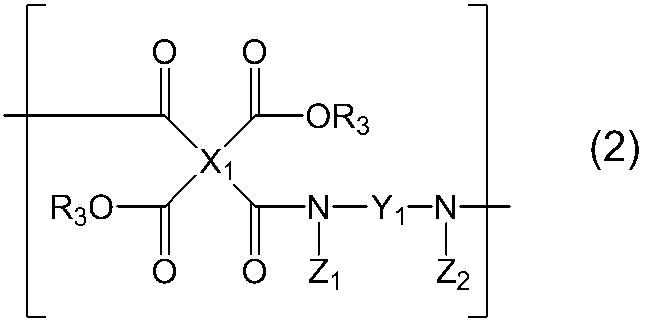


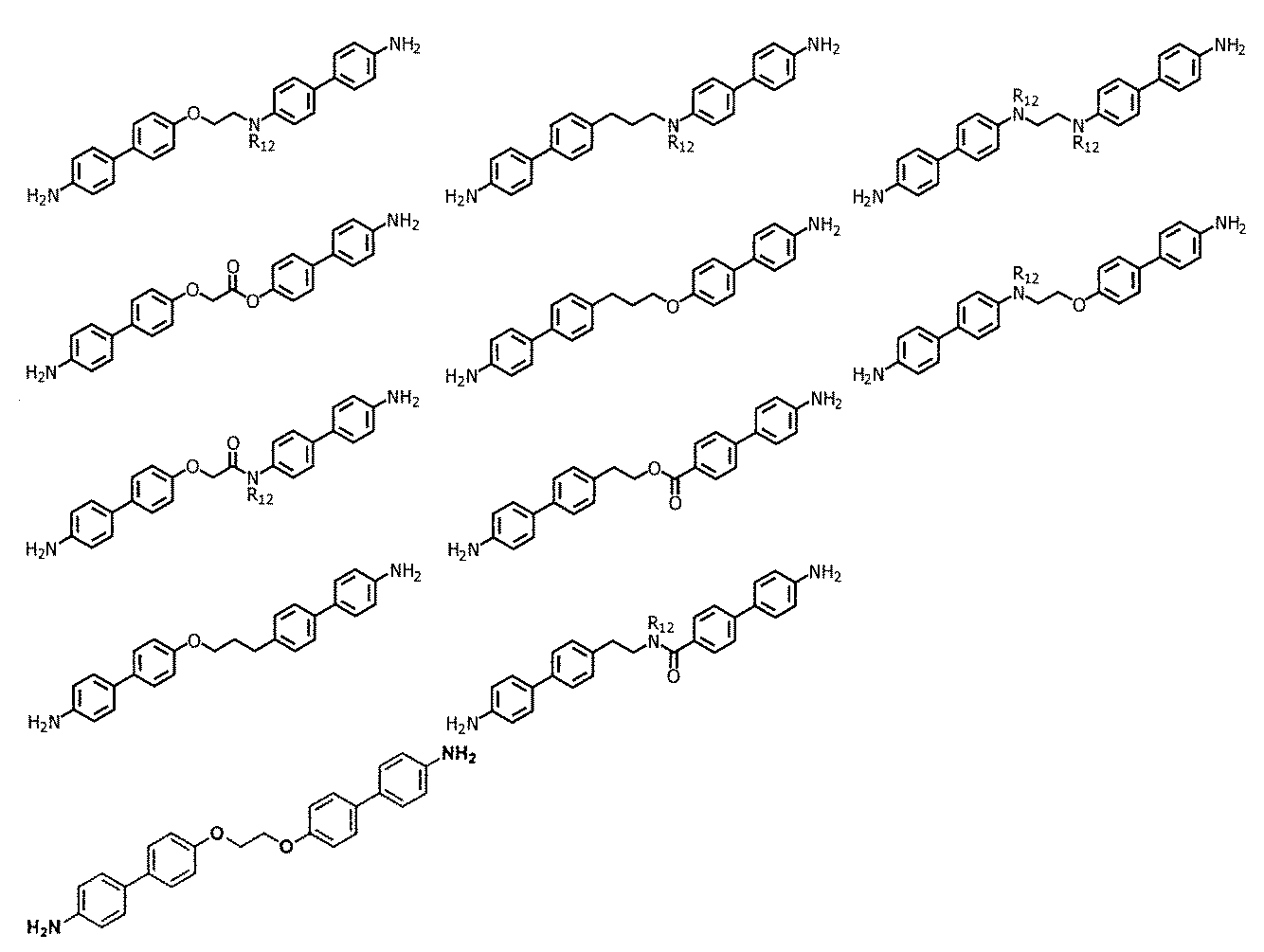


Priority Applications (5)
| Application Number | Priority Date | Filing Date | Title |
|---|---|---|---|
| KR1020217011297A KR102779392B1 (en) | 2018-11-06 | 2019-11-05 | Liquid crystal alignment agent, liquid crystal alignment film and liquid crystal display element |
| JP2020556078A JP7392655B2 (en) | 2018-11-06 | 2019-11-05 | Liquid crystal alignment agent, liquid crystal alignment film and liquid crystal display element |
| CN201980072451.7A CN112969959B (en) | 2018-11-06 | 2019-11-05 | Liquid crystal alignment agent, liquid crystal alignment film, and liquid crystal display element |
| CN202410874943.0A CN118878429A (en) | 2018-11-06 | 2019-11-05 | Liquid crystal alignment agent, liquid crystal alignment film, and liquid crystal display element |
| JP2023156347A JP7673778B2 (en) | 2018-11-06 | 2023-09-21 | New diamines |
Applications Claiming Priority (2)
| Application Number | Priority Date | Filing Date | Title |
|---|---|---|---|
| JP2018209060 | 2018-11-06 | ||
| JP2018-209060 | 2018-11-06 |
Publications (1)
| Publication Number | Publication Date |
|---|---|
| WO2020095900A1 true WO2020095900A1 (en) | 2020-05-14 |
Family
ID=70611826
Family Applications (1)
| Application Number | Title | Priority Date | Filing Date |
|---|---|---|---|
| PCT/JP2019/043298 Ceased WO2020095900A1 (en) | 2018-11-06 | 2019-11-05 | Liquid crystal orientation agent, liquid crystal orientation film, and liquid crystal display element |
Country Status (5)
| Country | Link |
|---|---|
| JP (2) | JP7392655B2 (en) |
| KR (1) | KR102779392B1 (en) |
| CN (2) | CN112969959B (en) |
| TW (1) | TWI816930B (en) |
| WO (1) | WO2020095900A1 (en) |
Families Citing this family (1)
| Publication number | Priority date | Publication date | Assignee | Title |
|---|---|---|---|---|
| TWI906749B (en) * | 2024-01-26 | 2025-12-01 | 奇美實業股份有限公司 | Liquid crystal alignment agent, liquid crystal alignment film, and liquid crystal display element |
Citations (3)
| Publication number | Priority date | Publication date | Assignee | Title |
|---|---|---|---|---|
| JPH05127168A (en) * | 1991-11-07 | 1993-05-25 | Fuji Photo Film Co Ltd | Liquid crystal display element |
| JP2016006473A (en) * | 2013-09-02 | 2016-01-14 | Jsr株式会社 | Liquid crystal aligning agent, liquid crystal aligning film, liquid crystal display element, retardation film and production method thereof, polymer and compound |
| WO2018159284A1 (en) * | 2017-02-28 | 2018-09-07 | Jsr株式会社 | Liquid crystal aligning agent, liquid crystal alignment film, method for producing same, liquid crystal element and polymer |
Family Cites Families (5)
| Publication number | Priority date | Publication date | Assignee | Title |
|---|---|---|---|---|
| JP3893659B2 (en) | 1996-03-05 | 2007-03-14 | 日産化学工業株式会社 | Liquid crystal alignment treatment method |
| CN1945396B (en) | 2005-10-09 | 2012-08-29 | 财团法人工业技术研究院 | Liquid crystal display panel |
| KR102151608B1 (en) * | 2013-09-02 | 2020-09-03 | 제이에스알 가부시끼가이샤 | Liquid crystal aligning agent, liquid crystal alignment film, liquid crystal display device, phase difference film and manufacturing method thereof, polymer and compound |
| KR101668059B1 (en) * | 2014-12-30 | 2016-10-20 | 에스케이씨코오롱피아이 주식회사 | Crosslinking water-soluble thermoplastic polyamic acid and method of preparation thereof |
| JP6669161B2 (en) * | 2015-03-24 | 2020-03-18 | 日産化学株式会社 | Liquid crystal alignment agent, liquid crystal alignment film and liquid crystal display device |
-
2019
- 2019-11-05 KR KR1020217011297A patent/KR102779392B1/en active Active
- 2019-11-05 CN CN201980072451.7A patent/CN112969959B/en active Active
- 2019-11-05 JP JP2020556078A patent/JP7392655B2/en active Active
- 2019-11-05 WO PCT/JP2019/043298 patent/WO2020095900A1/en not_active Ceased
- 2019-11-05 CN CN202410874943.0A patent/CN118878429A/en active Pending
- 2019-11-06 TW TW108140184A patent/TWI816930B/en active
-
2023
- 2023-09-21 JP JP2023156347A patent/JP7673778B2/en active Active
Patent Citations (3)
| Publication number | Priority date | Publication date | Assignee | Title |
|---|---|---|---|---|
| JPH05127168A (en) * | 1991-11-07 | 1993-05-25 | Fuji Photo Film Co Ltd | Liquid crystal display element |
| JP2016006473A (en) * | 2013-09-02 | 2016-01-14 | Jsr株式会社 | Liquid crystal aligning agent, liquid crystal aligning film, liquid crystal display element, retardation film and production method thereof, polymer and compound |
| WO2018159284A1 (en) * | 2017-02-28 | 2018-09-07 | Jsr株式会社 | Liquid crystal aligning agent, liquid crystal alignment film, method for producing same, liquid crystal element and polymer |
Also Published As
| Publication number | Publication date |
|---|---|
| JPWO2020095900A1 (en) | 2021-10-07 |
| CN112969959B (en) | 2025-04-25 |
| KR20210088544A (en) | 2021-07-14 |
| KR102779392B1 (en) | 2025-03-10 |
| JP2023171826A (en) | 2023-12-05 |
| TWI816930B (en) | 2023-10-01 |
| CN112969959A (en) | 2021-06-15 |
| TW202028442A (en) | 2020-08-01 |
| JP7392655B2 (en) | 2023-12-06 |
| CN118878429A (en) | 2024-11-01 |
| JP7673778B2 (en) | 2025-05-09 |
Similar Documents
| Publication | Publication Date | Title |
|---|---|---|
| JP6852771B2 (en) | Liquid crystal alignment agent, liquid crystal alignment film and liquid crystal display element | |
| JP6711443B2 (en) | Liquid crystal alignment agent, liquid crystal alignment film, and liquid crystal alignment element | |
| JP6638396B2 (en) | Liquid crystal alignment agent, liquid crystal alignment film, and liquid crystal display device | |
| JP7259328B2 (en) | Liquid crystal alignment agent, liquid crystal alignment film, and liquid crystal display element | |
| JP7652237B2 (en) | Compound | |
| JPWO2018155674A1 (en) | Liquid crystal alignment agent, liquid crystal alignment film and liquid crystal display device | |
| JP7131384B2 (en) | Liquid crystal alignment agent, liquid crystal alignment film and liquid crystal display element | |
| JP7673778B2 (en) | New diamines | |
| JP7089228B2 (en) | Liquid crystal alignment agent, liquid crystal alignment film, and liquid crystal display element | |
| WO2019181878A1 (en) | Liquid crystal aligning agent, liquid crystal alignment film and liquid crystal display element |
Legal Events
| Date | Code | Title | Description |
|---|---|---|---|
| 121 | Ep: the epo has been informed by wipo that ep was designated in this application |
Ref document number: 19881154 Country of ref document: EP Kind code of ref document: A1 |
|
| ENP | Entry into the national phase |
Ref document number: 2020556078 Country of ref document: JP Kind code of ref document: A |
|
| ENP | Entry into the national phase |
Ref document number: 20217011297 Country of ref document: KR Kind code of ref document: A |
|
| NENP | Non-entry into the national phase |
Ref country code: DE |
|
| 122 | Ep: pct application non-entry in european phase |
Ref document number: 19881154 Country of ref document: EP Kind code of ref document: A1 |
|
| WWG | Wipo information: grant in national office |
Ref document number: 201980072451.7 Country of ref document: CN |