WO2020095975A1 - Timbre transdermique contenant du fentanyl comme principe actif - Google Patents
Timbre transdermique contenant du fentanyl comme principe actif Download PDFInfo
- Publication number
- WO2020095975A1 WO2020095975A1 PCT/JP2019/043585 JP2019043585W WO2020095975A1 WO 2020095975 A1 WO2020095975 A1 WO 2020095975A1 JP 2019043585 W JP2019043585 W JP 2019043585W WO 2020095975 A1 WO2020095975 A1 WO 2020095975A1
- Authority
- WO
- WIPO (PCT)
- Prior art keywords
- solvent
- patch
- solvents
- patch according
- fentanyl
- Prior art date
- Legal status (The legal status is an assumption and is not a legal conclusion. Google has not performed a legal analysis and makes no representation as to the accuracy of the status listed.)
- Ceased
Links
Images


Classifications
-
- A—HUMAN NECESSITIES
- A61—MEDICAL OR VETERINARY SCIENCE; HYGIENE
- A61K—PREPARATIONS FOR MEDICAL, DENTAL OR TOILETRY PURPOSES
- A61K9/00—Medicinal preparations characterised by special physical form
- A61K9/70—Web, sheet or filament bases ; Films; Fibres of the matrix type containing drug
- A61K9/7023—Transdermal patches and similar drug-containing composite devices, e.g. cataplasms
- A61K9/703—Transdermal patches and similar drug-containing composite devices, e.g. cataplasms characterised by shape or structure; Details concerning release liner or backing; Refillable patches; User-activated patches
- A61K9/7038—Transdermal patches of the drug-in-adhesive type, i.e. comprising drug in the skin-adhesive layer
- A61K9/7046—Transdermal patches of the drug-in-adhesive type, i.e. comprising drug in the skin-adhesive layer the adhesive comprising macromolecular compounds
- A61K9/7053—Transdermal patches of the drug-in-adhesive type, i.e. comprising drug in the skin-adhesive layer the adhesive comprising macromolecular compounds obtained by reactions only involving carbon to carbon unsaturated bonds, e.g. polyvinyl, polyisobutylene, polystyrene
-
- A—HUMAN NECESSITIES
- A61—MEDICAL OR VETERINARY SCIENCE; HYGIENE
- A61K—PREPARATIONS FOR MEDICAL, DENTAL OR TOILETRY PURPOSES
- A61K31/00—Medicinal preparations containing organic active ingredients
- A61K31/33—Heterocyclic compounds
- A61K31/395—Heterocyclic compounds having nitrogen as a ring hetero atom, e.g. guanethidine or rifamycins
- A61K31/435—Heterocyclic compounds having nitrogen as a ring hetero atom, e.g. guanethidine or rifamycins having six-membered rings with one nitrogen as the only ring hetero atom
- A61K31/44—Non condensed pyridines; Hydrogenated derivatives thereof
- A61K31/445—Non condensed piperidines, e.g. piperocaine
- A61K31/4468—Non condensed piperidines, e.g. piperocaine having a nitrogen directly attached in position 4, e.g. clebopride, fentanyl
-
- A—HUMAN NECESSITIES
- A61—MEDICAL OR VETERINARY SCIENCE; HYGIENE
- A61K—PREPARATIONS FOR MEDICAL, DENTAL OR TOILETRY PURPOSES
- A61K47/00—Medicinal preparations characterised by the non-active ingredients used, e.g. carriers or inert additives; Targeting or modifying agents chemically bound to the active ingredient
- A61K47/02—Inorganic compounds
-
- A—HUMAN NECESSITIES
- A61—MEDICAL OR VETERINARY SCIENCE; HYGIENE
- A61K—PREPARATIONS FOR MEDICAL, DENTAL OR TOILETRY PURPOSES
- A61K47/00—Medicinal preparations characterised by the non-active ingredients used, e.g. carriers or inert additives; Targeting or modifying agents chemically bound to the active ingredient
- A61K47/06—Organic compounds, e.g. natural or synthetic hydrocarbons, polyolefins, mineral oil, petrolatum or ozokerite
-
- A—HUMAN NECESSITIES
- A61—MEDICAL OR VETERINARY SCIENCE; HYGIENE
- A61K—PREPARATIONS FOR MEDICAL, DENTAL OR TOILETRY PURPOSES
- A61K47/00—Medicinal preparations characterised by the non-active ingredients used, e.g. carriers or inert additives; Targeting or modifying agents chemically bound to the active ingredient
- A61K47/06—Organic compounds, e.g. natural or synthetic hydrocarbons, polyolefins, mineral oil, petrolatum or ozokerite
- A61K47/08—Organic compounds, e.g. natural or synthetic hydrocarbons, polyolefins, mineral oil, petrolatum or ozokerite containing oxygen, e.g. ethers, acetals, ketones, quinones, aldehydes, peroxides
- A61K47/10—Alcohols; Phenols; Salts thereof, e.g. glycerol; Polyethylene glycols [PEG]; Poloxamers; PEG/POE alkyl ethers
-
- A—HUMAN NECESSITIES
- A61—MEDICAL OR VETERINARY SCIENCE; HYGIENE
- A61K—PREPARATIONS FOR MEDICAL, DENTAL OR TOILETRY PURPOSES
- A61K47/00—Medicinal preparations characterised by the non-active ingredients used, e.g. carriers or inert additives; Targeting or modifying agents chemically bound to the active ingredient
- A61K47/06—Organic compounds, e.g. natural or synthetic hydrocarbons, polyolefins, mineral oil, petrolatum or ozokerite
- A61K47/08—Organic compounds, e.g. natural or synthetic hydrocarbons, polyolefins, mineral oil, petrolatum or ozokerite containing oxygen, e.g. ethers, acetals, ketones, quinones, aldehydes, peroxides
- A61K47/12—Carboxylic acids; Salts or anhydrides thereof
-
- A—HUMAN NECESSITIES
- A61—MEDICAL OR VETERINARY SCIENCE; HYGIENE
- A61K—PREPARATIONS FOR MEDICAL, DENTAL OR TOILETRY PURPOSES
- A61K47/00—Medicinal preparations characterised by the non-active ingredients used, e.g. carriers or inert additives; Targeting or modifying agents chemically bound to the active ingredient
- A61K47/06—Organic compounds, e.g. natural or synthetic hydrocarbons, polyolefins, mineral oil, petrolatum or ozokerite
- A61K47/08—Organic compounds, e.g. natural or synthetic hydrocarbons, polyolefins, mineral oil, petrolatum or ozokerite containing oxygen, e.g. ethers, acetals, ketones, quinones, aldehydes, peroxides
- A61K47/14—Esters of carboxylic acids, e.g. fatty acid monoglycerides, medium-chain triglycerides, parabens or PEG fatty acid esters
-
- A—HUMAN NECESSITIES
- A61—MEDICAL OR VETERINARY SCIENCE; HYGIENE
- A61K—PREPARATIONS FOR MEDICAL, DENTAL OR TOILETRY PURPOSES
- A61K9/00—Medicinal preparations characterised by special physical form
- A61K9/70—Web, sheet or filament bases ; Films; Fibres of the matrix type containing drug
- A61K9/7023—Transdermal patches and similar drug-containing composite devices, e.g. cataplasms
- A61K9/703—Transdermal patches and similar drug-containing composite devices, e.g. cataplasms characterised by shape or structure; Details concerning release liner or backing; Refillable patches; User-activated patches
- A61K9/7038—Transdermal patches of the drug-in-adhesive type, i.e. comprising drug in the skin-adhesive layer
- A61K9/7076—Transdermal patches of the drug-in-adhesive type, i.e. comprising drug in the skin-adhesive layer the adhesive comprising ingredients of undetermined constitution or reaction products thereof, e.g. rosin or other plant resins
-
- A—HUMAN NECESSITIES
- A61—MEDICAL OR VETERINARY SCIENCE; HYGIENE
- A61K—PREPARATIONS FOR MEDICAL, DENTAL OR TOILETRY PURPOSES
- A61K9/00—Medicinal preparations characterised by special physical form
- A61K9/70—Web, sheet or filament bases ; Films; Fibres of the matrix type containing drug
- A61K9/7023—Transdermal patches and similar drug-containing composite devices, e.g. cataplasms
- A61K9/703—Transdermal patches and similar drug-containing composite devices, e.g. cataplasms characterised by shape or structure; Details concerning release liner or backing; Refillable patches; User-activated patches
- A61K9/7084—Transdermal patches having a drug layer or reservoir, and one or more separate drug-free skin-adhesive layers, e.g. between drug reservoir and skin, or surrounding the drug reservoir; Liquid-filled reservoir patches
Definitions
- the present invention belongs to the technical field of patches.
- the present invention relates to a patch containing fentanyl as an active ingredient, which is excellent in sustained release and cannot be re-patched.
- Patent Documents 1 and 2 propose a method of using a patch device in which a drug such as fentanyl and a binder that inactivates the drug are mixed to remove them from the skin so that they cannot be reused.
- Patent Document 3 proposes a patch preparation having anti-misuse properties.
- Patent Document 3 also describes a patch preparation containing fentanyl (see paragraphs 0048 to 0051 of Patent Document 3).
- the patch preparation described in Patent Document 3 is excellent in prevention of misuse because it becomes difficult to re-stick it once the release film is removed and the patch is once applied to the skin.
- the patch preparation of Patent Document 3 is basically not drug-limited and versatile, but is not always sufficient for each drug. Especially, the absorption of the drug through the skin is not considered.
- INDUSTRIAL APPLICABILITY The present invention is a patch suitable for fentanyl, and in addition to having the ability to prevent re-patching, it can be used for a long time and is excellent in adjusting the pharmacokinetic profile. The main task is to provide agents.
- Examples of the present invention include the following.
- a patch comprising fentanyl as an active ingredient, A paste containing a fentanyl, an adhesive, a volatile hydrocarbon solvent (A), and a volatile organic solvent (B) containing a hetero atom, wherein the solvent (A) has a boiling point higher than that of the solvent (B).
- a patch wherein the content of the solvent (A) in the body is higher than the content of the solvent (B) in the plaster.
- the content of the solvent (B) in the plaster and the content of the solvent (A) in the plaster are in the range of 1: 1.1 to 1:20 (B: A) by weight ratio.
- the patch according to any one of the above [1] to [4], wherein the content of the solvent (B) in the plaster is in the range of 1 to 30% by weight.
- the solvent (B) is one or more solvents selected from the group consisting of ester solvents, ether solvents, alcohol solvents, amine solvents, ketone solvents, amide solvents and chloride solvents.
- the solvent (A) is one or more solvents selected from the group consisting of n-heptane, toluene, cyclohexane, and n-octane, according to any one of the above [1] to [7].
- Patch. [9] The adhesive patch according to any one of [1] to [8] above, wherein the adhesive is a mixture of an acrylic polymer and a styrene-isoprene-styrene copolymer. [10] The patch according to the above [9], wherein the weight ratio of the acrylic polymer and the styrene-isoprene-styrene copolymer in the mixture is within the range of 5: 1 to 1: 5. [11] The patch according to any one of [1] to [10] above, which further contains a bittering agent. [12] The patch according to any one of [1] to [11] above, which further contains C 8-22 higher alcohol.
- the solvent (C) is an acyclic or cycloaliphatic hydrocarbon solvent
- the solvent (D) is an ester solvent, an ether solvent, an alcohol solvent, an amine solvent, a ketone solvent, an amide solvent.
- the patch according to the above [15] which is one or more solvents selected from the group consisting of solvents and chloride-based solvents.
- the solvent (C) is one or more solvents selected from the group consisting of n-heptane, toluene, cyclohexane, and n-octane, and the solvent (D) is ethyl acetate, ethanol, and isopropanol.
- the patch can be used for a long time and has excellent sustained release properties.
- Reference numeral 1 denotes a plaster having fentanyl
- 2 denotes a support which is a non-woven laminate film
- 3 denotes an adhesive layer of a cover layer
- 4 denotes a support which is a non-woven laminate film.
- 5 indicates the non-woven portion of the support
- 6 indicates the film portion thereof
- 7 indicates the film portion of the support
- 8 indicates the non-woven portion thereof.
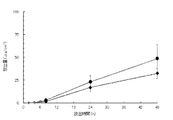
- the vertical axis represents the release amount ( ⁇ g / cm 2 ) and the horizontal axis represents the release time (hour).
- the black diamonds show the results of the patch of the present invention of Example 5
- the black squares show the results of commercial products.
- the vertical axis represents the release amount ( ⁇ g / cm 2 ) and the horizontal axis represents the release time (hour).
- the black circles show the results of commercial products
- the black diamonds show the results of the patch of the invention of Example 5.
- the patches according to the present invention are patches containing fentanyl as an active ingredient, and include fentanyl, an adhesive, and a volatile hydrocarbon solvent.
- the patch of the present invention will be described in detail.
- the plaster is usually a thin layered body containing a drug and an adhesive, and in the present invention, fentanyl, the adhesive, the volatile hydrocarbon solvent (A), and the volatile containing a hetero atom. With a polar organic solvent (B).
- Fentanyl is a known opioid compound whose chemical name is N- (1-phenethylpiperidin-4-yl) -N-phenylpropanamide, and is mainly anesthesia. It is used for pain relief and pain relief.
- the manufacturing method is also known and can be obtained from the market.
- the content of fentanyl in the plaster is usually in the range of 0.5 to 20% by weight based on the total weight of the plaster components. It is preferably within the range of 1 to 10% by weight. More preferably, it is in the range of 1.2 to 8% by weight. More preferably, it is within the range of 1.5 to 7% by weight.
- the content of fentanyl in the plaster may be in the range of 1.7 to 2.5% by weight.
- the pressure-sensitive adhesive according to the present invention is usually non-aqueous, and may include a base and, if necessary, a tackifier.
- the content of the pressure-sensitive adhesive is usually in the range of 20 to 85% by weight, preferably in the range of 30 to 80% by weight, more preferably 40 to 75% by weight, based on the total weight of the plaster component. And more preferably 50 to 70% by weight.
- the base contained in the adhesive may be composed of a polymer.
- polymers include rubber polymers, acrylic polymers, silicone polymers and the like.
- the rubber-based polymer examples include styrene-isoprene-styrene block copolymer (hereinafter sometimes referred to as "SIS"), styrene-butadiene-styrene block copolymer, styrene-ethylene-butadiene rubber-styrene block copolymer.
- SIS styrene-isoprene-styrene block copolymer
- SIS styrene-isoprene-styrene block copolymer
- SIS styrene-ethylene-butadiene rubber-styrene block copolymer
- examples thereof include polymers, styrene-butadiene rubber, polyisoprene, polyisobutylene, polybutene, butyl rubber, and other synthetic rubbers; and natural rubber.
- acrylic polymer examples include polymers or copolymers of acrylic esters such as polyacrylic acid methyl ester and polymethacrylic acid methyl ester.
- acrylic esters such as polyacrylic acid methyl ester and polymethacrylic acid methyl ester.
- examples thereof include DURO-TAK 87-900A, 87-9301, 87-4098, 387. -2051, 87-2051, 387-2287, 87-2287, 87-4287 and GELVA GMS 3083, 3253 (trade name, made by Henkel Japan), Nisetsu KP-77, AS-370 (trade name, Nippon Carbide Industry ( Co., Ltd.).
- silicone polymer examples include dimethyl polysiloxane and diphenyl polysiloxane.
- the above-mentioned base may be one kind or a combination of two or more kinds.
- the base in the present invention preferably contains an acrylic polymer.
- the acrylic polymer can have both high tackiness and re-sticking prevention ability.
- the base in the present invention preferably further contains a rubber polymer. That is, a combination of an acrylic polymer and a rubber polymer (SIS etc.) is preferable.
- the range of 3 is preferable, and the range of 2: 1 to 1: 3 is more preferable.
- the tackifier examples include alicyclic hydrocarbon resin, terpene resin, aliphatic hydrocarbon resin, polystyrene resin, rosin and hydrogenated rosin.
- the tackifier is preferably a terpene resin.
- the content of the tackifier is usually in the range of 2 to 40% by weight, preferably in the range of 5 to 30% by weight, and in the range of 8 to 20% by weight, based on the total weight of the pressure-sensitive adhesive component. Is more preferable.
- the content of the tackifier may be in the range of 13 to 20% by weight based on the total weight of the pressure-sensitive adhesive component.
- volatile hydrocarbon solvent (A) and volatile organic solvent containing a hetero atom (B)
- the volatile hydrocarbon solvent (A) according to the present invention (hereinafter simply referred to as “solvent (A)”) has a vapor pressure at 20 ° C. of 0.1 kPa or more and a boiling point higher than room temperature (25 ° C.). It is not particularly limited as long as it is a hydrogen solvent, but it is preferably a hydrocarbon solvent having a vapor pressure of 1 kPa or more to 1 to 20 kPa and a boiling point in the range of 75 ° C to 140 ° C, and a boiling point of 85 ° C to 125 ° C.
- an acyclic or cycloaliphatic hydrocarbon solvent is preferable, an acyclic aliphatic hydrocarbon solvent is more preferable, and a chain aliphatic hydrocarbon solvent is preferable, and a straight chain aliphatic hydrocarbon is preferable.
- Hydrocarbon solvents are more preferred.
- the number of carbon atoms in the solvent (A) is preferably in the range of 4 to 9, more preferably in the range of 5 to 8, still more preferably in the range of 6 to 8, particularly preferably 7 or 8, and most preferably 7. ..
- the solvent (A) include acyclic or cyclic hydrocarbon solvents such as n-hexane, n-heptane, n-octane, toluene, benzene, cyclohexane and xylene. Of these, n-heptane is preferred. These solvents (A) may be used alone or in any combination of two or more. In the present invention, the sustained release of fentanyl can be controlled by increasing or decreasing the content of the solvent (A).
- the volatile organic solvent (B) containing a hetero atom (hereinafter, simply referred to as “solvent (B)”) has a vapor pressure at 20 ° C. of 0.1 kPa or more and a boiling point higher than room temperature (25 ° C.).
- solvent (B) has a vapor pressure at 20 ° C. of 0.1 kPa or more and a boiling point higher than room temperature (25 ° C.).
- solvent (B) has a vapor pressure at 20 ° C. of 0.1 kPa or more and a boiling point higher than room temperature (25 ° C.).
- solvent (B) has a vapor pressure at 20 ° C. of 0.1 kPa or more and a boiling point higher than room temperature (25 ° C.).
- a solvent (B) which is within the boiling point range on the left and lower than the boiling point of the solvent (A) by 8 ° C. or more, or 10 ° C. or more.
- the hetero atom contained in the solvent (B) include an oxygen atom, a nitrogen atom, a chlorine atom and a sulfur atom, and among them, an oxygen atom is preferable.
- the solvent (B) containing an oxygen atom examples include ester solvents such as ethyl acetate, isobutyl acetate, isopropyl acetate, and formate which are acetic ester solvents; ethers such as ethyl ether, tetrahydrofuran, and 1,4-dioxane.
- ester solvents such as ethyl acetate, isobutyl acetate, isopropyl acetate, and formate which are acetic ester solvents
- ethers such as ethyl ether, tetrahydrofuran, and 1,4-dioxane.
- system solvents examples include system solvents; alcohol solvents such as ethanol, isopropanol, isobutyl alcohol, and 2-butanol; and ketone solvents such as acetone, methyl ethyl ketone, and methyl isobutyl ketone.
- ester solvents acetic acid ester solvents are preferable, and ethyl acetate is particularly preferable.
- Specific examples of the solvent (B) containing a nitrogen atom include amine solvents.
- Specific examples of the solvent (B) containing a chlorine atom include chloride-based solvents. These solvents (B) may be used alone or in any combination of two or more.
- the combination of the solvent (A) and the solvent (B) is arbitrary, but a combination of an acyclic or cyclic aliphatic hydrocarbon solvent and an ester solvent is preferable. Of these, an acyclic aliphatic hydrocarbon solvent and an ester solvent are preferable, and a combination of a chain aliphatic hydrocarbon solvent and an ester solvent is more preferable. Specifically, a combination of n-heptane and ethyl acetate is preferable.
- the content of the solvent (A) in the plaster is higher than the content of the solvent (B) in the plaster.
- the content ratio varies depending on the desired sustained-release property or the like, but the weight ratio is usually within the range of 1: 1.1 to 1:20 (B: A), and the ratio of 1: 1.2 to 1:10.
- a range of (B: A) is preferable, a range of 1: 1.3 to 1: 5 (B: A) is more preferable, and a range of 1: 1.5 to 1: 3 (B: A) is preferable. More preferable.
- the content ratio of the solvent (A) and the solvent (B) may be in the range of 1: 2 to 1: 3 (B: A), or 1: 2.5 to 1: 3 (B: A).
- the content of the solvent (B) in the plaster is usually in the range of 1 to 30% by weight, preferably in the range of 2 to 25% by weight, preferably 5 to 20% by weight, based on the total weight of the plaster components. % Is more preferable, and 5 to 10% by weight is further preferable.
- the total content of the solvent (A) and the solvent (B) is usually in the range of 5 to 45% by weight based on the total weight of the plaster component. If the content of both solvents is less than the above range, the desired adhesiveness-reducing effect may not be obtained, and if it exceeds the above range, poor formulation may occur, which is not preferable.
- the combined content of the solvent (A) and the solvent (B) is preferably in the range of 10 to 40% by weight, more preferably 10 to 30% by weight.
- the contents of the solvent (A) and the solvent (B) mean the contents just before the skin application.
- the content from immediately after the end of the manufacturing process to immediately before application to the skin is kept constant by means such as packaging with a suitable packaging material as necessary.
- the surface of the plaster (the surface opposite to the support) is usually protected by a solvent-impermeable release film (liner) which has been subjected to a release treatment.
- the solvent (A) and the solvent (B) rapidly separate from the plaster, especially at the skin surface temperature (about 32 ° C).
- the adhesive strength of the plaster is reduced or lost when peeled off from the skin after use while maintaining a strong adhesive strength, and accidents due to unintended re-adhesion of the adhesive can be prevented.
- these solvents are rapidly released, so that it is possible to prevent accidental accidents such as a child accidentally adhering the solvent left unsealed.
- aliphatic compound which is solid at room temperature and has a hydrophilic group (hereinafter, simply referred to as “aliphatic compound”) is added as necessary.
- aliphatic compound which is solid at room temperature and has a hydrophilic group
- the aliphatic compound preferably has a melting point higher than room temperature, more preferably has a melting point of 40 ° C. or higher, still more preferably has a melting point of 50 ° C. or higher, and even more preferably has a melting point of 55 ° C. or higher. preferable.
- the melting point of the aliphatic compound is preferably 50 to 80 ° C., more preferably 50 to 70 ° C., further preferably 55 to 70 ° C., and even more preferably 55 to 65 ° C. . By the melting point, it is possible to control the adhesive force at the time of drug administration and the adhesive force at the time of re-adhesion.
- Aliphatic compounds include, but are not limited to, C 8-22 higher alcohols and C 8-22 higher fatty acids.
- the C 8-22 higher alcohol and the C 8-22 higher fatty acid can also be used in combination.
- solid at room temperature means a solid at about 25 ° C. and no fluidity at about 25 ° C., including a petrolatum-like semi-solid state, but a solid state. Those are preferable. Among them, those which are soluble in the solvent (A) and the solvent (B) are preferable.
- Examples of the C 8-22 higher alcohols include octyldodecanol, isostearyl alcohol, stearyl alcohol, lauryl alcohol, cetyl alcohol, palmityl alcohol, cetostearyl alcohol, decyltetradecanol, hexyldecanol, behenyl alcohol, lauryl alcohol, myristyl alcohol and the like. Can be illustrated.
- Examples of the C 8-22 higher fatty acid include lauric acid, myristic acid, palmitic acid, stearic acid and the like.
- the aliphatic compound is preferably C 8-22 higher alcohol, more preferably C 12-20 higher alcohol, further preferably C 16-18 higher alcohol, even more preferably stearyl alcohol, cetyl alcohol or cetostearyl alcohol, and stearyl alcohol. Is particularly preferable.
- the above aliphatic compounds may be used alone or in combination of any two or more kinds.
- the content of the aliphatic compound is usually suitable within the range of 0.2 to 20% by weight, preferably within the range of 0.4 to 10% by weight, and preferably within the range of 0.
- the range of 4 to 5% by weight is more preferable.
- the content of the aliphatic compound may be in the range of 0.4 to 2.5% by weight.
- the plaster according to the present invention may further contain a percutaneous absorption enhancer and other additives, if necessary.
- transdermal absorption enhancer examples include fatty acids, alcohols, esters, and organic amines.
- fatty acids include capric acid, sorbic acid, levulinic acid, and oleic acid
- alcohols include monohydric higher alcohols such as capryl alcohol and oleyl alcohol
- polyhydric alcohols such as propylene glycol, polyethylene glycol, and glycerin.
- esters as propylene carbonate, diethyl sebacate, isopropyl myristate, diisopropyl adipate, myristyl palmitate, stearyl stearate, medium-chain fatty acid triglyceride; organic amines as monoethanolamine, monoisopropanolamine, diethanolamine, diethanol Examples include isopropanolamine, triethanolamine, triisopropanolamine and the like.
- the above-mentioned percutaneous absorption enhancer may be used alone or in any combination of two or more.
- the additives include, for example, known additives commonly used in the field of formulation such as bittering agents, fillers, softeners, antioxidants, pH adjusters, and fragrances. Above all, it is preferable to contain a bittering agent effective for preventing accidental ingestion.
- bittering agent substances having strong bitterness such as denatonium can be exemplified, and denatonium benzoate is preferable.
- the content of the bittering agent is appropriately in the range of 0.005 to 0.1% by weight based on the total weight of the plaster component, and the same is true when denatonium benzoate is contained. With this amount, when the patch is contained in the mouth, strong bitterness is felt, and an effect of preventing accidental ingestion by a child or the like can be exhibited.
- Antioxidants may be included in the present invention.
- antioxidants include water-soluble antioxidants such as sodium sulfite, sodium bisulfite, sodium hyposulfite, sodium pyrosulfite, ascorbic acid and glutathymine; fat-soluble antioxidants such as propyl gallate and ⁇ -tocopherol. Can be mentioned. Of these, sodium sulfite and propyl gallate are preferred.
- the above antioxidants may be used alone or in any combination of two or more. Further, it is preferable to use a water-soluble antioxidant and a fat-soluble antioxidant together.
- the content of the antioxidant is usually appropriate within the range of 0.04 to 5% by weight, preferably within the range of 0.08 to 2% by weight, and preferably within the range of 0. It is more preferably within the range of 1 to 1% by weight.
- the patch of the present invention usually contains a plaster having fentanyl, an adhesive, a solvent (A) and a solvent (B), and a support, and the plaster is on a support. It can be laminated to form a drug layer. Then, usually, in addition to the drug layer mainly composed of the plaster and the support, a release film (liner) is provided, and the support, the plaster and the release film are laminated in this order.
- the support in the drug layer may be either a solvent-permeable material that is permeable to a solvent or a solvent-impermeable material that is not permeable to a solvent. It is preferably made of a solvent impermeable material.
- the solvent-permeable support material examples include resins such as polyester, polypropylene, polyurethane, and vinyl chloride, woven or non-woven fabrics made of pulp, and porous sheets. Above all, a nonwoven fabric made of polyester is preferable.
- the solvent-impermeable support material examples include resin films of polyester, polyamide, vinyl chloride, etc., and composite films obtained by combining a resin film with a woven or non-woven fabric.
- a polyester film is more preferable, and a PET (polyethylene terephthalate) film is further preferable.
- a non-woven laminate film in which a non-woven fabric is laminated is preferable, and a non-woven laminate PET film is more preferable.
- the adhesive patch of the present invention having a cover layer
- the adhesive patch of the present invention may be formed only of a support, a plaster, and a release film, but further has a cover layer containing an adhesive layer. May be.
- the cover layer is usually composed of an adhesive layer and a support. Further, it is preferable that the pressure-sensitive adhesive layer of the cover layer also contains a volatile organic solvent, and the cover layer can enhance the adhesive strength and the ability to prevent re-sticking.
- the cover layer is preferably larger than the plaster (pharmaceutical layer) containing fentanyl.
- the cover layer support, the cover layer pressure-sensitive adhesive layer, the drug layer support, the drug layer plaster, and the release film are laminated in this order.
- the release film is preferably the same as or larger than the cover layer.
- Adhesive Layer in Cover Layer, Support, and Additive contains an adhesive, and the adhesive is usually a base and, if necessary, imparts tackiness. Agents are included.
- the base and tackifier are as defined above.
- the plaster support containing fentanyl is preferably a resin film, more preferably a polyester film, and further preferably a PET film.
- a non-woven laminate film in which a non-woven fabric is laminated is preferable, and a non-woven laminate PET film is more preferable.
- the non-woven fabric portion is preferably on the side of the fentanyl-containing plaster.
- the plaster containing fentanyl is retained on the uneven portion of the nonwoven fabric, the drug can be applied to a predetermined site, and the smooth film surface comes into contact with the adhesive layer of the cover layer to increase the adhesive force and prevent the falling off.
- the support of the pressure-sensitive adhesive layer of the cover layer is also preferably a non-woven laminate film, and the film portion is preferably on the pressure-sensitive adhesive layer side.
- the smooth film surface comes into contact with the pressure-sensitive adhesive layer to increase the adhesive force and prevent the film from falling off, and the non-woven fabric faces outward, reducing the difference in feel and appearance from the surrounding skin. Excellent in usability.
- FIG. 1 shows a preferred embodiment of the constitution of the support in the patch of the invention having a cover layer.
- the pressure-sensitive adhesive layer of the cover layer may also contain a suitable additive, if necessary.
- suitable additives include bittering agents, fillers, softeners, antioxidants, pH adjusters, flavors, and other known and commonly used additives in the field of formulation. Above all, it is preferable to contain a bittering agent useful for preventing accidental ingestion.
- bittering agent substances having strong bitterness such as denatonium can be exemplified, and denatonium benzoate is preferable.
- the content of the bittering agent is appropriately in the range of 0.01 to 0.1% by weight based on the total weight of the cover layer components, and the same is true when denatonium benzoate is contained. With this amount, when the patch is contained in the mouth, strong bitterness is felt, and an effect of preventing accidental ingestion by a child or the like can be exhibited.
- antioxidants include water-soluble antioxidants such as sodium sulfite, sodium bisulfite, sodium hyposulfite, sodium pyrosulfite, ascorbic acid and glutathymine; fat-soluble antioxidants such as propyl gallate and ⁇ -tocopherol. Can be mentioned. Of these, sodium sulfite and propyl gallate are preferred.
- the above antioxidants may be used alone or in any combination of two or more. Further, it is preferable to use a water-soluble antioxidant and a fat-soluble antioxidant together.
- the content of the antioxidant is usually suitable within the range of 0.04 to 5% by weight, preferably within the range of 0.08 to 3% by weight, and preferably within the range of 0. It is more preferably within the range of 1 to 2% by weight.
- Specific examples of other additives include the same ones as described above.
- the “volatile organic solvent” in the pressure-sensitive adhesive layer of the cover layer means that the vapor pressure at 20 ° C. is 0.1 kPa or more, and the boiling point is It means an organic solvent higher than room temperature (25 ° C).
- the volatile organic solvent is not particularly limited, but is not particularly limited as long as the vapor pressure at 20 ° C. is 0.1 kPa or more, but is preferably 1 kPa or more to 1 to 50 kPa and has a boiling point of 65 ° C. or more. Those in the range of 140 ° C., preferably in the range of 75 ° C. to 125 ° C. can be mentioned.
- the volatile organic solvent are the same as the above-mentioned solvent (A) and solvent (B).
- the solvent (A) is referred to as a solvent (C)
- the solvent (B) is referred to as a solvent (D).
- specific examples of the volatile organic solvent include acyclic or cycloaliphatic hydrocarbon solvents such as n-hexane, n-heptane, and cyclohexane; aliphatic solvents such as ethanol, isopropyl alcohol, isobutyl alcohol, and 2-butanol.
- Monoalcohol-based solvents such as isobutyl acetate, isopropyl acetate, ethyl acetate; ketone-based solvents such as acetone, methyl ethyl ketone, methyl isobutyl ketone; ether-based solvents such as diethyl ether, tetrahydrofuran, 1,4-dioxane; benzene, Aromatic hydrocarbon solvents such as xylene can be mentioned.
- the above solvent may be used alone or in any combination of two or more kinds, and it is preferable to use two or more kinds in combination.
- two or more kinds of solvents it is preferable that the solvent (C) and the solvent (D) are contained, and the solvent (C) and the solvent (D) are preferable.
- the volatile organic solvent is preferably an acyclic or cycloaliphatic hydrocarbon solvent related to the solvent (C), an ester solvent related to the solvent (D), or a combination thereof.
- the acyclic aliphatic hydrocarbon solvent relating to the solvent (C) and / or the ester solvent relating to the solvent (D) are preferable, and the acyclic aliphatic hydrocarbon solvent relating to the solvent (C) and the solvent (D) are preferable.
- a combination of such ester solvents is more preferable.
- ethyl acetate and / or n-heptane is preferable, and a combination of ethyl acetate and n-heptane is more preferable.
- the weight ratio thereof is 1: 2. It is preferably ⁇ 10: 1, more preferably 1: 1 to 4: 1, and the acyclic aliphatic hydrocarbon solvent of the solvent (C) is preferably more than the ester solvent of the solvent (D). It is more preferably 0.5: 1 to 3: 1.
- the volatile organic solvent according to the present invention rapidly separates from the cover layer at the skin surface temperature (about 32 ° C).
- the skin surface temperature about 32 ° C.
- the adhesive force of the cover layer is reduced or lost when peeled from the skin after use, and accidents due to unintended re-adhesion of the adhesive can be prevented.
- room temperature about 25 ° C.
- the content of the volatile organic solvent according to the present invention is appropriately in the range of 2 to 35% by weight based on the total weight of the cover layer components. If the content of the solvent is less than the above range, the desired tackiness-reducing effect may not be obtained, and if it exceeds the above range, formulation defects may occur, which is not preferable. In one embodiment, the content of the solvent is preferably 3 to 20% by weight, more preferably 5 to 10% by weight.
- the release film according to the present invention mainly protects the plaster (drug layer) surface and the cover layer surface of the adhesive patch of the present invention before use, and also uses the solvent (A) and ( It suppresses volatilization of B) and the volatile organic solvent.
- the release film is not particularly limited as long as it has the above functions, but is usually paper, a plastic film, a plastic sheet or a laminated film.
- Specific examples include those made of polyester resins such as polyethylene terephthalate (PET) and polybutylene terephthalate, and polyolefin resins such as polyethylene and polypropylene, and a laminate obtained by bonding these with a metal such as aluminum or other resin. It may be a film.
- PET polyethylene terephthalate
- polybutylene terephthalate polybutylene terephthalate
- polyolefin resins such as polyethylene and polypropylene
- a laminate obtained by bonding these with a metal such as aluminum or other resin It may be a film.
- paper is used as a release film, it is usually necessary to treat it with some kind of release agent.
- examples of such a release agent include silicone, and silicone-treated paper obtained by treating paper with a silicone release agent is preferably used.
- the release film may be one sheet, or may be a plurality of sheets which are usually shifted and overlapped. Further, it is preferable that a cut is formed so that it can be easily peeled off during use.
- the patch of the present invention is prepared by, for example, mixing fentanyl, an adhesive, a solvent (A), a solvent (B) and the like to obtain a mixture, and releasing the mixture from a release film or a support. It can be manufactured by coating on the surface, drying, and attaching a support or a release film to the obtained plaster surface. The preferred manufacturing method is shown below.
- the solvent (A) and the solvent (B) are added in a larger amount than the prescribed amount (required amount), fentanyl and the pressure-sensitive adhesive, and if necessary, additives are mixed to prepare a coating liquid, and the coating liquid is prepared. Apply to release film. Upon drying, a surplus portion of the added solvent is evaporated and removed to obtain a plaster, and the support is laminated on the plaster. As a result, a plaster containing the fentanyl and the pressure-sensitive adhesive and further containing the solvent (A) and the solvent (B) in a predetermined amount can be obtained.
- a patch containing the solvent (A) and the solvent (B) in the range of 5 to 45% by weight can be obtained.
- the laminated patch of the present invention which is a more preferable embodiment of the present invention, can be similarly produced. Specifically, a volatile organic solvent is added in an amount larger than the prescribed amount (required amount), an adhesive and, if necessary, additives are mixed to produce a coating liquid, and the coating liquid is applied to a release film. To apply. Upon drying, a surplus portion of the solvent added in a large amount is evaporated and removed to obtain a pressure-sensitive adhesive layer, and the support is laminated on the pressure-sensitive adhesive layer. Next, the release film on the pressure-sensitive adhesive layer is peeled off, the patch (pharmaceutical layer) containing fentanyl obtained by the above method is attached, and the release film is attached again to obtain a patch.
- the adhesive layer of the cover layer preferably has a structure not containing fentanyl, and the content of the solvent (A) and the solvent (B) in the paste is based on the total weight of the paste components. It is appropriate that the amount of the volatile organic solvent in the pressure-sensitive adhesive layer of the cover layer is 2 to 35% by weight based on the total weight of the pressure-sensitive adhesive layer component of the cover layer. The range of is suitable. The above amount is preferred.
- the adhesive patch of the present invention obtained by laminating the adhesive patches thus obtained is obtained.
- the obtained patch of the present invention can be packaged in an appropriate package.
- the package include a bag made of a film, the film is preferably a multilayer film, more preferably an aluminum laminated film, and the innermost layer thereof is preferably polyethylene or PET.
- the excess amount when the solvent (A) and the solvent (B) or two or more kinds of volatile organic solvents are used is a ratio according to the vapor pressure during the drying or evaporation process, and the excess amount of the two or more kinds of excess
- the solvent may be added and dried, and when the predetermined weight is reached, the drying step may be terminated and the weight of the solvent may be adjusted.
- the solvent in the obtained patch may be quantified by gas chromatography or liquid chromatography to adjust the excess amount.
- Test 2 Sustained release test The test formulation was applied to pig skin placed in a Franz cell type diffusion cell, the cumulative amount of fentanyl that had permeated the skin up to each sampling point was measured, and each sampling was performed using the following formula. The ratio of the amount of non-transmission at the point (remaining ratio) was obtained. Each sampling point is at 24 hours, 48 hours, and 72 hours.
- Example 1 and Comparative Example 1 The patches of Example 1 and Comparative Example 1 having the compositions shown in Table 1 were produced as follows. The compositions shown in Table 1 were weighed, and ethyl acetate and heptane were added in a larger amount than the formulation and mixed to prepare a coating liquid. The coating liquid is applied to a silicone-treated PET film (release film) and dried, and the excess portion of the solvent added in a large amount is evaporated, and the PET film side of the non-woven laminate PET film (support) is placed on the plaster. The patches were laminated and laminated at 70 ° C. to obtain each patch of Example 1 and Comparative Example 1. The obtained patch was put in an aluminum laminate bag and sealed.
- Example 1 Each patch of Example 1 and Comparative Example 1 was subjected to a re-sticking adhesiveness test (evaluation 1) and a sustained release test (evaluation 2), and the results shown in Table 1 were obtained.
- Example 1 As shown in Table 1, in each of the formulations of Example 1 and Comparative Example 1, the adhesive force was felt at 0 minutes (immediately after opening) after standing and did not fall off even when applied to the forearm. Further, after 30 minutes of standing, no adhesiveness was felt in any of the preparations, and the preparation could not be applied to the forearm. On the other hand, in Example 1, since the residual amount of fentanyl was larger than that in Comparative Example 1, fentanyl gradually penetrated the skin, and the patch of the present invention according to Example 1 was excellent in terms of sustained release.
- Example 2 The patch of the present invention of Example 2 having the composition shown in Table 2 was produced as follows.
- the compositions shown in the adhesive layer of the drug layer and the adhesive layer of the cover layer in Table 2 were each weighed, and ethyl acetate and heptane were added in a larger amount than the formulation and mixed to prepare each coating solution.
- Each coating solution is applied to a silicone-treated PET film (release film) and dried, and the excess portion of the solvent added in a large amount is evaporated to apply a non-woven laminate PET film (support for the drug layer and cover layer).
- the product was laminated on the body and laminated at 70 ° C. to produce a drug layer composed of the plaster and the support of Example 2 and a cover layer.
- the non-woven fabric side of the drug layer support was laminated on the plaster, and the PET layer side of the cover layer support was laminated on the adhesive layer. Furthermore, the release film of the cover layer is removed, and the adhesive layer surface is attached so that the support of the drug layer is in contact, the release film on the adhesive side of the drug layer is removed, and the adhesive layer of the adhesive layer of the adhesive layer and the cover layer is covered with silicone.
- the treated PET film (release film) was laminated to obtain the patch of the present invention having a laminated structure.
- the obtained patch of the present invention was placed in an aluminum laminate bag and sealed.
- DURO-TAK 387-2287 (trade name, manufactured by Henkel Japan) was used as the acrylic polymer. The same applies to other examples.
- the patch of the present invention of Example 2 felt an adhesive force at 0 minutes after standing (immediately after opening), and did not fall off even after sticking to the forearm. After 30 minutes, the adhesive force was not felt and it could not be attached to the forearm. Then, the 24-hour cumulative skin permeation amount after exposure to air for 30 minutes was significantly smaller than that at 0 minutes after standing (immediately after opening).
- Examples 3 to 6 In the same manner as in Example 1, each patch shown in Table 3 below was obtained. The obtained patch was put in an aluminum laminate bag and sealed.
- Example 4 The patch of Example 4 was subjected to a re-patching skin permeability test (evaluation 3), and the results shown in Table 4 were obtained.
- Example 4 As shown in Table 4, in Example 4, the 48-hour cumulative skin permeation amount after exposure to air for 30 minutes was significantly smaller than that after 0 minutes (immediately after opening). In addition, the patch of the present invention of Example 4 showed sustained release with continued release of fentanyl for a long time immediately after opening.
- the concentrations of heptane and ethyl acetate in the patch of the present invention decreased extremely when left for 30 minutes after opening. It was suggested that this is one of the factors that the adhesive strength of the patch of the present invention decreases and the transdermal absorbability also decreases with the passage of time after opening.
- the patch of the present invention can suppress re-application after use and also reduce transdermal absorbability during re-application, so that the risk of drug abuse or accident can be effectively prevented.
- it is advantageous in the absorption of fentanyl through the skin and the adjustment of the pharmacokinetic profile. Therefore, it is useful as a patch for fentanyl that has excellent sustained release properties and can be used for a long time.
Landscapes
- Health & Medical Sciences (AREA)
- Chemical & Material Sciences (AREA)
- Engineering & Computer Science (AREA)
- Life Sciences & Earth Sciences (AREA)
- Public Health (AREA)
- General Health & Medical Sciences (AREA)
- Medicinal Chemistry (AREA)
- Pharmacology & Pharmacy (AREA)
- Epidemiology (AREA)
- Veterinary Medicine (AREA)
- Animal Behavior & Ethology (AREA)
- Bioinformatics & Cheminformatics (AREA)
- Oil, Petroleum & Natural Gas (AREA)
- Chemical Kinetics & Catalysis (AREA)
- General Chemical & Material Sciences (AREA)
- Dermatology (AREA)
- Inorganic Chemistry (AREA)
- Botany (AREA)
- Medicinal Preparation (AREA)
Abstract
La présente invention aborde principalement le problème de la réalisation d'un nouveau timbre transdermique qui est particulièrement approprié pour le fentanyl, a la capacité d'empêcher une réadhésion, et possède d'excellentes performances de libération prolongée, de sorte que le timbre transdermique peut être utilisé sur une longue période. La solution selon la présente invention porte, par exemple, sur un timbre transdermique contenant du fentanyl en tant que principe actif et caractérisé en ce qu'il comprend un onguent contenant du fentanyl, un agent adhésif, un solvant hydrocarboné volatil (A) et un solvant organique volatil contenant un hétéroatome (B), le point d'ébullition du solvant (A) étant supérieur au point d'ébullition du solvant (B) et la quantité contenue du solvant (A) dans l'onguent étant supérieure à la quantité contenue du solvant (B) dans l'onguent. Le timbre transdermique selon la présente invention peut empêcher une utilisation inappropriée, est avantageux en termes d'absorption transdermique de fentanyl et d'ajustement du profil pharmacocinétique, possède d'excellentes propriétés de libération prolongée de fentanyl et peut être utilisé sur une longue période.
Priority Applications (1)
| Application Number | Priority Date | Filing Date | Title |
|---|---|---|---|
| US17/292,318 US20210393607A1 (en) | 2018-11-09 | 2019-11-07 | Transdermal Patch Containing Fentanyl as Active Ingredient |
Applications Claiming Priority (2)
| Application Number | Priority Date | Filing Date | Title |
|---|---|---|---|
| JP2018-211327 | 2018-11-09 | ||
| JP2018211327 | 2018-11-09 |
Publications (1)
| Publication Number | Publication Date |
|---|---|
| WO2020095975A1 true WO2020095975A1 (fr) | 2020-05-14 |
Family
ID=70611823
Family Applications (1)
| Application Number | Title | Priority Date | Filing Date |
|---|---|---|---|
| PCT/JP2019/043585 Ceased WO2020095975A1 (fr) | 2018-11-09 | 2019-11-07 | Timbre transdermique contenant du fentanyl comme principe actif |
Country Status (2)
| Country | Link |
|---|---|
| US (1) | US20210393607A1 (fr) |
| WO (1) | WO2020095975A1 (fr) |
Cited By (3)
| Publication number | Priority date | Publication date | Assignee | Title |
|---|---|---|---|---|
| WO2022172915A1 (fr) * | 2021-02-10 | 2022-08-18 | コスメディ製薬株式会社 | Préparation transdermique contenant un antioxydant |
| WO2022178008A1 (fr) * | 2021-02-16 | 2022-08-25 | Augusta University Research Institute, Inc. | Cannabidiol permettant de traiter des maladies neurodégénératives |
| JP2024077248A (ja) * | 2022-11-28 | 2024-06-07 | 久光製薬株式会社 | カバー材付き貼付剤 |
Citations (6)
| Publication number | Priority date | Publication date | Assignee | Title |
|---|---|---|---|---|
| US20030060479A1 (en) * | 2001-08-17 | 2003-03-27 | Lavipharm Laboratories Inc. | Compositions and medical device for transdermal delivery of a drug and methods of making and using same |
| JP2006513160A (ja) * | 2002-10-30 | 2006-04-20 | マイラン・ファーマシューティカルズ・インコーポレーテッド | フェンタニル懸濁液をベースにしたシリコーン系粘着剤製剤及びフェンタニルを経皮送達するための装置 |
| JP2010510260A (ja) * | 2006-11-21 | 2010-04-02 | エルテーエス ローマン テラピー−ジステーメ アーゲー | 活性物質の利用率及び用量精度の高い経皮治療システム |
| WO2012057212A1 (fr) * | 2010-10-28 | 2012-05-03 | 久光製薬株式会社 | Formule pour absorption percutanée |
| WO2017164084A1 (fr) * | 2016-03-24 | 2017-09-28 | 株式会社メドレックス | Préparation de timbre présentant des caractéristiques de prévention d'un mauvais usage |
| WO2019059377A1 (fr) * | 2017-09-22 | 2019-03-28 | 株式会社 メドレックス | Timbre adhésif non-recollable |
-
2019
- 2019-11-07 US US17/292,318 patent/US20210393607A1/en not_active Abandoned
- 2019-11-07 WO PCT/JP2019/043585 patent/WO2020095975A1/fr not_active Ceased
Patent Citations (6)
| Publication number | Priority date | Publication date | Assignee | Title |
|---|---|---|---|---|
| US20030060479A1 (en) * | 2001-08-17 | 2003-03-27 | Lavipharm Laboratories Inc. | Compositions and medical device for transdermal delivery of a drug and methods of making and using same |
| JP2006513160A (ja) * | 2002-10-30 | 2006-04-20 | マイラン・ファーマシューティカルズ・インコーポレーテッド | フェンタニル懸濁液をベースにしたシリコーン系粘着剤製剤及びフェンタニルを経皮送達するための装置 |
| JP2010510260A (ja) * | 2006-11-21 | 2010-04-02 | エルテーエス ローマン テラピー−ジステーメ アーゲー | 活性物質の利用率及び用量精度の高い経皮治療システム |
| WO2012057212A1 (fr) * | 2010-10-28 | 2012-05-03 | 久光製薬株式会社 | Formule pour absorption percutanée |
| WO2017164084A1 (fr) * | 2016-03-24 | 2017-09-28 | 株式会社メドレックス | Préparation de timbre présentant des caractéristiques de prévention d'un mauvais usage |
| WO2019059377A1 (fr) * | 2017-09-22 | 2019-03-28 | 株式会社 メドレックス | Timbre adhésif non-recollable |
Cited By (6)
| Publication number | Priority date | Publication date | Assignee | Title |
|---|---|---|---|---|
| WO2022172915A1 (fr) * | 2021-02-10 | 2022-08-18 | コスメディ製薬株式会社 | Préparation transdermique contenant un antioxydant |
| JP2022122784A (ja) * | 2021-02-10 | 2022-08-23 | コスメディ製薬株式会社 | 酸化防止剤含有経皮吸収製剤 |
| CN115551489A (zh) * | 2021-02-10 | 2022-12-30 | 考司美德制药株式会社 | 含有抗氧化剂的经皮吸收制剂 |
| WO2022178008A1 (fr) * | 2021-02-16 | 2022-08-25 | Augusta University Research Institute, Inc. | Cannabidiol permettant de traiter des maladies neurodégénératives |
| JP2024077248A (ja) * | 2022-11-28 | 2024-06-07 | 久光製薬株式会社 | カバー材付き貼付剤 |
| JP7641261B2 (ja) | 2022-11-28 | 2025-03-06 | 久光製薬株式会社 | カバー材付き貼付剤 |
Also Published As
| Publication number | Publication date |
|---|---|
| US20210393607A1 (en) | 2021-12-23 |
Similar Documents
| Publication | Publication Date | Title |
|---|---|---|
| US20080038328A1 (en) | Pasting Preparation | |
| KR102090411B1 (ko) | 첩부제 | |
| WO2020095975A1 (fr) | Timbre transdermique contenant du fentanyl comme principe actif | |
| US11903939B2 (en) | Patch preparations with accidental use prevention features | |
| JP2016069287A (ja) | リバスチグミン含有経皮吸収型貼付製剤 | |
| JP6773897B2 (ja) | 貼付剤 | |
| EP3207923B1 (fr) | Timbre adhésif | |
| WO2014111790A2 (fr) | Système d'administration de médicament pharmaceutique transdermique stable comprenant de la rivastigmine | |
| US20090220580A1 (en) | Percutaneous Absorption Formulation | |
| JP6729584B2 (ja) | 経皮吸収型貼付剤 | |
| US11510882B2 (en) | Non-readherable adhesive patch | |
| WO2018104772A1 (fr) | Préparation de type à absorption percutanée | |
| EP1197212A1 (fr) | Preparation adhesive pour absorption percutanee | |
| JP7399633B2 (ja) | 経皮吸収型製剤の製造方法 | |
| JP6984871B2 (ja) | リバスチグミン経皮吸収型貼付製剤 | |
| EP2371360B1 (fr) | Préparation adhésive contenant de la sélégiline | |
| US6623763B2 (en) | Pharmaceutical preparation adhering to the skin, in particular a transdermal therapeutic system for the release of 17-β-estradiol to the human organism | |
| JP6512905B2 (ja) | フェンタニル含有貼付剤 | |
| JP2018140943A (ja) | リバスチグミンの光分解を抑制した経皮吸収型貼付製剤 | |
| JP2018177758A (ja) | リバスチグミン含有経皮吸収製剤 | |
| JP2017007994A (ja) | 経皮吸収型製剤 | |
| JP2016216384A (ja) | 経皮吸収型製剤 |
Legal Events
| Date | Code | Title | Description |
|---|---|---|---|
| 121 | Ep: the epo has been informed by wipo that ep was designated in this application |
Ref document number: 19881416 Country of ref document: EP Kind code of ref document: A1 |
|
| NENP | Non-entry into the national phase |
Ref country code: DE |
|
| 122 | Ep: pct application non-entry in european phase |
Ref document number: 19881416 Country of ref document: EP Kind code of ref document: A1 |
|
| NENP | Non-entry into the national phase |
Ref country code: JP |