WO2020111211A1 - Procédé de production d'une membrane poreuse et membrane poreuse - Google Patents
Procédé de production d'une membrane poreuse et membrane poreuse Download PDFInfo
- Publication number
- WO2020111211A1 WO2020111211A1 PCT/JP2019/046687 JP2019046687W WO2020111211A1 WO 2020111211 A1 WO2020111211 A1 WO 2020111211A1 JP 2019046687 W JP2019046687 W JP 2019046687W WO 2020111211 A1 WO2020111211 A1 WO 2020111211A1
- Authority
- WO
- WIPO (PCT)
- Prior art keywords
- water
- porous membrane
- membrane
- aqueous solvent
- film
- Prior art date
- Legal status (The legal status is an assumption and is not a legal conclusion. Google has not performed a legal analysis and makes no representation as to the accuracy of the status listed.)
- Ceased
Links
Images
Classifications
-
- B—PERFORMING OPERATIONS; TRANSPORTING
- B01—PHYSICAL OR CHEMICAL PROCESSES OR APPARATUS IN GENERAL
- B01D—SEPARATION
- B01D69/00—Semi-permeable membranes for separation processes or apparatus characterised by their form, structure or properties; Manufacturing processes specially adapted therefor
- B01D69/14—Dynamic membranes
-
- B—PERFORMING OPERATIONS; TRANSPORTING
- B01—PHYSICAL OR CHEMICAL PROCESSES OR APPARATUS IN GENERAL
- B01D—SEPARATION
- B01D67/00—Processes specially adapted for manufacturing semi-permeable membranes for separation processes or apparatus
- B01D67/0002—Organic membrane manufacture
- B01D67/0006—Organic membrane manufacture by chemical reactions
-
- B—PERFORMING OPERATIONS; TRANSPORTING
- B01—PHYSICAL OR CHEMICAL PROCESSES OR APPARATUS IN GENERAL
- B01D—SEPARATION
- B01D67/00—Processes specially adapted for manufacturing semi-permeable membranes for separation processes or apparatus
- B01D67/0002—Organic membrane manufacture
- B01D67/0009—Organic membrane manufacture by phase separation, sol-gel transition, evaporation or solvent quenching
- B01D67/0011—Casting solutions therefor
-
- B—PERFORMING OPERATIONS; TRANSPORTING
- B01—PHYSICAL OR CHEMICAL PROCESSES OR APPARATUS IN GENERAL
- B01D—SEPARATION
- B01D67/00—Processes specially adapted for manufacturing semi-permeable membranes for separation processes or apparatus
- B01D67/0002—Organic membrane manufacture
- B01D67/0009—Organic membrane manufacture by phase separation, sol-gel transition, evaporation or solvent quenching
- B01D67/0013—Casting processes
-
- B—PERFORMING OPERATIONS; TRANSPORTING
- B01—PHYSICAL OR CHEMICAL PROCESSES OR APPARATUS IN GENERAL
- B01D—SEPARATION
- B01D67/00—Processes specially adapted for manufacturing semi-permeable membranes for separation processes or apparatus
- B01D67/0081—After-treatment of organic or inorganic membranes
- B01D67/009—After-treatment of organic or inorganic membranes with wave-energy, particle-radiation or plasma
-
- B—PERFORMING OPERATIONS; TRANSPORTING
- B01—PHYSICAL OR CHEMICAL PROCESSES OR APPARATUS IN GENERAL
- B01D—SEPARATION
- B01D69/00—Semi-permeable membranes for separation processes or apparatus characterised by their form, structure or properties; Manufacturing processes specially adapted therefor
- B01D69/02—Semi-permeable membranes for separation processes or apparatus characterised by their form, structure or properties; Manufacturing processes specially adapted therefor characterised by their properties
-
- B—PERFORMING OPERATIONS; TRANSPORTING
- B01—PHYSICAL OR CHEMICAL PROCESSES OR APPARATUS IN GENERAL
- B01D—SEPARATION
- B01D69/00—Semi-permeable membranes for separation processes or apparatus characterised by their form, structure or properties; Manufacturing processes specially adapted therefor
- B01D69/10—Supported membranes; Membrane supports
- B01D69/107—Organic support material
- B01D69/1071—Woven, non-woven or net mesh
-
- B—PERFORMING OPERATIONS; TRANSPORTING
- B01—PHYSICAL OR CHEMICAL PROCESSES OR APPARATUS IN GENERAL
- B01D—SEPARATION
- B01D69/00—Semi-permeable membranes for separation processes or apparatus characterised by their form, structure or properties; Manufacturing processes specially adapted therefor
- B01D69/12—Composite membranes; Ultra-thin membranes
- B01D69/125—In situ manufacturing by polymerisation, polycondensation, cross-linking or chemical reaction
-
- B—PERFORMING OPERATIONS; TRANSPORTING
- B01—PHYSICAL OR CHEMICAL PROCESSES OR APPARATUS IN GENERAL
- B01D—SEPARATION
- B01D71/00—Semi-permeable membranes for separation processes or apparatus characterised by the material; Manufacturing processes specially adapted therefor
- B01D71/06—Organic material
- B01D71/38—Polyalkenylalcohols; Polyalkenylesters; Polyalkenylethers; Polyalkenylaldehydes; Polyalkenylketones; Polyalkenylacetals; Polyalkenylketals
- B01D71/381—Polyvinylalcohol
-
- B—PERFORMING OPERATIONS; TRANSPORTING
- B01—PHYSICAL OR CHEMICAL PROCESSES OR APPARATUS IN GENERAL
- B01D—SEPARATION
- B01D71/00—Semi-permeable membranes for separation processes or apparatus characterised by the material; Manufacturing processes specially adapted therefor
- B01D71/06—Organic material
- B01D71/44—Polymers obtained by reactions only involving carbon-to-carbon unsaturated bonds, not provided for in a single one of groups B01D71/26-B01D71/42
- B01D71/441—Polyvinylpyrrolidone
-
- B—PERFORMING OPERATIONS; TRANSPORTING
- B01—PHYSICAL OR CHEMICAL PROCESSES OR APPARATUS IN GENERAL
- B01D—SEPARATION
- B01D71/00—Semi-permeable membranes for separation processes or apparatus characterised by the material; Manufacturing processes specially adapted therefor
- B01D71/06—Organic material
- B01D71/66—Polymers having sulfur in the main chain, with or without nitrogen, oxygen or carbon only
- B01D71/68—Polysulfones; Polyethersulfones
-
- C—CHEMISTRY; METALLURGY
- C08—ORGANIC MACROMOLECULAR COMPOUNDS; THEIR PREPARATION OR CHEMICAL WORKING-UP; COMPOSITIONS BASED THEREON
- C08J—WORKING-UP; GENERAL PROCESSES OF COMPOUNDING; AFTER-TREATMENT NOT COVERED BY SUBCLASSES C08B, C08C, C08F, C08G or C08H
- C08J9/00—Working-up of macromolecular substances to porous or cellular articles or materials; After-treatment thereof
- C08J9/36—After-treatment
-
- B—PERFORMING OPERATIONS; TRANSPORTING
- B01—PHYSICAL OR CHEMICAL PROCESSES OR APPARATUS IN GENERAL
- B01D—SEPARATION
- B01D2323/00—Details relating to membrane preparation
- B01D2323/12—Specific ratios of components used
-
- B—PERFORMING OPERATIONS; TRANSPORTING
- B01—PHYSICAL OR CHEMICAL PROCESSES OR APPARATUS IN GENERAL
- B01D—SEPARATION
- B01D2323/00—Details relating to membrane preparation
- B01D2323/15—Use of additives
- B01D2323/218—Additive materials
- B01D2323/2182—Organic additives
- B01D2323/21839—Polymeric additives
- B01D2323/2187—Polyvinylpyrolidone
-
- B—PERFORMING OPERATIONS; TRANSPORTING
- B01—PHYSICAL OR CHEMICAL PROCESSES OR APPARATUS IN GENERAL
- B01D—SEPARATION
- B01D2323/00—Details relating to membrane preparation
- B01D2323/30—Cross-linking
-
- B—PERFORMING OPERATIONS; TRANSPORTING
- B01—PHYSICAL OR CHEMICAL PROCESSES OR APPARATUS IN GENERAL
- B01D—SEPARATION
- B01D2323/00—Details relating to membrane preparation
- B01D2323/34—Use of radiation
-
- B—PERFORMING OPERATIONS; TRANSPORTING
- B01—PHYSICAL OR CHEMICAL PROCESSES OR APPARATUS IN GENERAL
- B01D—SEPARATION
- B01D2325/00—Details relating to properties of membranes
- B01D2325/02—Details relating to pores or porosity of the membranes
- B01D2325/022—Asymmetric membranes
-
- B—PERFORMING OPERATIONS; TRANSPORTING
- B01—PHYSICAL OR CHEMICAL PROCESSES OR APPARATUS IN GENERAL
- B01D—SEPARATION
- B01D2325/00—Details relating to properties of membranes
- B01D2325/02—Details relating to pores or porosity of the membranes
- B01D2325/022—Asymmetric membranes
- B01D2325/023—Dense layer within the membrane
-
- B—PERFORMING OPERATIONS; TRANSPORTING
- B01—PHYSICAL OR CHEMICAL PROCESSES OR APPARATUS IN GENERAL
- B01D—SEPARATION
- B01D2325/00—Details relating to properties of membranes
- B01D2325/02—Details relating to pores or porosity of the membranes
- B01D2325/0283—Pore size
-
- B—PERFORMING OPERATIONS; TRANSPORTING
- B01—PHYSICAL OR CHEMICAL PROCESSES OR APPARATUS IN GENERAL
- B01D—SEPARATION
- B01D2325/00—Details relating to properties of membranes
- B01D2325/04—Characteristic thickness
-
- B—PERFORMING OPERATIONS; TRANSPORTING
- B01—PHYSICAL OR CHEMICAL PROCESSES OR APPARATUS IN GENERAL
- B01D—SEPARATION
- B01D2325/00—Details relating to properties of membranes
- B01D2325/20—Specific permeability or cut-off range
-
- B—PERFORMING OPERATIONS; TRANSPORTING
- B01—PHYSICAL OR CHEMICAL PROCESSES OR APPARATUS IN GENERAL
- B01D—SEPARATION
- B01D2325/00—Details relating to properties of membranes
- B01D2325/36—Hydrophilic membranes
-
- C—CHEMISTRY; METALLURGY
- C08—ORGANIC MACROMOLECULAR COMPOUNDS; THEIR PREPARATION OR CHEMICAL WORKING-UP; COMPOSITIONS BASED THEREON
- C08J—WORKING-UP; GENERAL PROCESSES OF COMPOUNDING; AFTER-TREATMENT NOT COVERED BY SUBCLASSES C08B, C08C, C08F, C08G or C08H
- C08J9/00—Working-up of macromolecular substances to porous or cellular articles or materials; After-treatment thereof
- C08J9/26—Working-up of macromolecular substances to porous or cellular articles or materials; After-treatment thereof by elimination of a solid phase from a macromolecular composition or article, e.g. leaching out
Definitions
- the present invention relates to a method for producing a porous membrane and a porous membrane.
- Patent Document 1 discloses producing a microfiltration membrane by a method including casting a membrane-forming stock solution containing a water-insoluble resin polysulfone and a water-soluble resin polyvinylpyrrolidone on a support. .. According to the method described in Patent Document 1, it is possible to manufacture a microfiltration membrane having different pore diameters in the thickness direction, and for example, it is possible to manufacture a porous membrane having a dense layer having a small pore diameter inside.
- US Pat. No. 6,096,849 discloses a method of making a functionalized membrane comprising applying at least one graftable species to a porous substrate and treating the coated porous substrate by electron beam irradiation. It is disclosed.
- filtration membranes or filter cartridges In the manufacture of filtration membranes or filter cartridges, in general, cleaning and drying are performed to ensure cleanliness and water flow and reduce the elution of filtration membrane components.
- the filter cartridge is subjected to an integrity test to confirm the presence or absence of defects such as pinholes and poor sealing.
- an integrity test water is passed through a filtration membrane attached to a filter to fill pores with water, and then pressure is applied to observe gas leakage.
- the water-soluble resin is used to impart hydrophilicity to the porous membrane.
- the water-soluble resin may flow out to reduce the hydrophilicity in a washing step when manufacturing and processing the membrane as a filtration membrane or a filter cartridge, and the integrity test may not be performed.
- Patent Document 2 there is a description about imparting hydrophilic property to the surface of the porous film by surface modification using a graftable species. However, the surface modification may reduce the water flow rate, and the development of another method is desired.
- An object of the present invention is to provide a method for producing a porous membrane having high water permeability and hydrophilicity that is hardly affected by treatment such as washing.
- the present inventors have made extensive studies, in particular, using a porous membrane that has been hydrophilized with polyvinylpyrrolidone. As a result, it was found that by irradiating the porous film with an electron beam at a relatively high intensity, the hydrophilicity of the porous film is less likely to be lowered by washing, and the present invention was completed based on this finding.
- ⁇ 1> A method for producing a porous membrane, comprising: As a substrate, to prepare a membrane having a plurality of pores containing a water-insoluble resin and a water-soluble resin containing a monomer unit of polyvinylpyrrolidone or a monomer unit of polyvinyl alcohol, and the substrate in the presence of an aqueous solvent
- the above-mentioned production method which comprises irradiating with electron beam to crosslink at least a part of the water-soluble resin.
- the water-insoluble resin contains at least one selected from the group consisting of polysulfone, polyether sulfone, polyphenyl sulfone, polyarylate, polyimide, and polyvinylidene fluoride.
- the water-insoluble resin is polysulfone or polyether sulfone.
- the substrate contains the aqueous solvent in an amount of 50% by mass or more and 500% by mass or less of a dry mass of the substrate when the electron beam is irradiated.
- ⁇ 5> The production method according to any one of ⁇ 1> to ⁇ 4>, wherein the aqueous solvent is applied to the base material by spray coating or die coating.
- ⁇ 6> applying the aqueous solvent to the substrate by immersing the substrate in the aqueous solvent, and removing excess aqueous solvent on the surface of the substrate after applying the aqueous solvent
- ⁇ 7> The production method according to any one of ⁇ 1> to ⁇ 6>, wherein the substrate has a thickness of 40 ⁇ m to 300 ⁇ m.
- ⁇ 8> The manufacturing method according to any one of ⁇ 1> to ⁇ 7>, wherein the electron beam irradiation is performed so as to have an absorbed dose of 50 kGray or more and 300 kGray or less.
- ⁇ 9> In preparing the base material, ⁇ 1> to ⁇ 8> including casting a solution containing the water-insoluble resin and the water-soluble resin on a support to form a film having the plurality of pores on the support The manufacturing method according to any one of 1.
- ⁇ 10> The production method according to ⁇ 9>, wherein the electron beam irradiation is performed from the surface side that was the support side when the substrate was prepared.
- a porous membrane comprising a water-insoluble resin and a water-soluble resin containing a monomer unit of polyvinylpyrrolidone or a monomer unit of polyvinyl alcohol,
- the porous membrane wherein the insoluble component when 60 cm 2 of the porous membrane is immersed in 50 mL of methylene chloride for 24 hours is 0.5% by mass or more of the dry mass of the porous membrane before immersion.
- the water-insoluble resin contains at least one selected from the group consisting of polysulfone, polyether sulfone, polyphenyl sulfone, polyarylate, polyimide, and polyvinylidene fluoride.
- ⁇ 13> The porous membrane according to ⁇ 12>, wherein the water-insoluble resin is polysulfone or polyether sulfone.
- ⁇ 14> The porous membrane according to any one of ⁇ 11> to ⁇ 13>, which contains the water-soluble resin in an amount of 0.5 to 20% by mass based on the dry mass of the porous film.
- ⁇ 15> The porous membrane according to any one of ⁇ 11> to ⁇ 14>, which has a layered dense portion having the smallest pore size in the membrane.
- ⁇ 16> The porous membrane according to any one of ⁇ 11> to ⁇ 15>, having a thickness of 40 ⁇ m to 300 ⁇ m.
- the present invention provides a method for producing a porous membrane having high water permeability and hydrophilicity that is hardly affected by treatment such as washing. According to the production method of the present invention, it is possible to produce a porous membrane having high water permeability, which can pass the integrity test when used as a filtration membrane in a filter cartridge.
- the method for producing a porous membrane of the present invention includes irradiating a substrate with an electron beam in the presence of an aqueous solvent.
- the substrate itself used in the method for producing a porous membrane of the present invention is also a porous membrane, and the method for producing a porous membrane of the present invention is a method of imparting hydrophilicity to the porous membrane, or hydrophilicity of the porous membrane. It is also a way to strengthen sex.
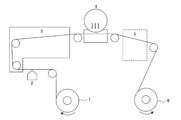
- FIG. 1 shows an example of a process diagram of the manufacturing method of the present invention.
- the base material is prepared in a roll shape and unwound (1). Then, the base material is applied with an aqueous solvent (2) and, if necessary, excess aqueous solvent is removed (3), and then irradiated with an electron beam (4). After an optional post-treatment step (5), it is wound into a roll (6) if necessary.
- the production method of the present invention is preferably carried out while continuously transporting the base material. This is because the irradiation amount of the electron beam or the application amount of the aqueous solvent can be made uniform uniformly.
- the porous membrane is a membrane having a plurality of pores.
- the porous film when simply describing the “porous film”, it means both the porous film as the base material and the porous film obtained by the production method of the present invention.
- a porous membrane containing a water-insoluble resin and a water-soluble resin containing a monomer unit of polyvinylpyrrolidone or a monomer unit of polyvinyl alcohol is used as the porous membrane.
- the porous membrane contains a water-insoluble resin.
- the skeleton of the porous membrane is preferably composed of a water-insoluble resin.
- a porous membrane formed of a water-insoluble resin generally has high water resistance, chemical resistance, and mechanical resistance, and is suitable for industrial use as a filter.
- water-insoluble resins include thermoplastic or thermosetting polymers.
- specific examples of the polymer include polysulfone, polyether sulfone, polyphenyl sulfone, polyarylate, sulfonated polysulfone, sulfonated polyether sulfone, cellulose acylate, nitrocellulose, polyacrylonitrile, styrene-acrylonitrile copolymer, and styrene-butadiene.
- Copolymer saponified product of ethylene-vinyl acetate copolymer, polyvinyl alcohol, polycarbonate, organosiloxane-polycarbonate copolymer, polyester carbonate, organopolysiloxane, polyphenylene oxide, polyamide, polyimide, polyamideimide, polybenzimidazole, ethylene vinyl alcohol copolymer, Examples thereof include polytetrafluoroethylene (PTFE), polyethylene, polypropylene, polyfluoroethylene, polyethylene terephthalate, 6,6-nylon, and polyvinylidene fluoride (PVDF). These may be homopolymers, copolymers, polymer blends, or polymer alloys from the viewpoint of solubility, optical properties, electrical properties, strength, elasticity, and the like.
- PTFE polytetrafluoroethylene
- PVDF polyvinylidene fluoride
- polysulfone, polyether sulfone, polyphenyl sulfone, polyarylate, polyimide and polyvinylidene fluoride are preferable, and polysulfone or polyether sulfone is more preferable.
- a polysulfone-based polymer selected from the group consisting of polysulfone, polyether sulfone, and polyphenyl sulfone is preferable in the case of producing a porous membrane having a layered dense part having a minimum pore size therein.
- Polysulfone is represented by the following general formula (I)
- polyether sulfone is represented by the following general formula (II)
- polyphenyl sulfone is represented by the following general formula (III).
- the water-insoluble resin preferably has a number average molecular weight (Mn) of 1,000 to 10,000,000, more preferably 5,000 to 1,000,000.
- Mn number average molecular weight of the water-insoluble resin is obtained by gel permeation chromatography (GPC).
- the porous film includes a water-insoluble resin and a water-soluble resin containing a monomer unit (repeating unit structure) of polyvinylpyrrolidone (PVP) or a monomer unit (repeating unit structure) of polyvinyl alcohol (PVA).
- PVP polyvinylpyrrolidone
- PVA polyvinyl alcohol
- hydrophilicity is imparted to the hydrophobic porous membrane skeleton made of the water-insoluble resin.
- the water-soluble resin may be retained in the skeleton of the porous membrane.
- the water-soluble resin may be present on the surface of the porous membrane skeleton composed of the water-insoluble resin, that is, on the surface of the pores of the porous membrane.
- the water-soluble resin may partially enter the porous membrane skeleton composed of the water-insoluble resin.
- the hydrophilicity imparted by the water-soluble resin can be made less likely to decrease by treatment such as washing. It is considered that this is because by performing electron beam irradiation in the presence of an aqueous solvent in the production method of the present invention, the water-soluble resin retained in the porous membrane skeleton is crosslinked and becomes difficult to separate from the porous membrane skeleton. .. That the water-soluble resin is crosslinked, as shown in the examples below, in the porous film after electron beam irradiation, insoluble components occur in the solvent that completely dissolves the porous film before electron beam irradiation. Can be estimated from In the present specification, the term “insolubilize” a water-soluble resin means that a solvent that completely dissolves the porous film before electron beam irradiation produces an insoluble component.
- Methylene chloride may be used as a solvent that completely dissolves the porous film before electron beam irradiation.
- the insoluble component when immersed in methylene chloride is 0.5% by mass or more, preferably 0.8% by mass, of the dry mass of the porous film before immersion. It is above, and more preferably 1.2% by mass or more.
- the amount of the above-mentioned insoluble component is, specifically, 60 cm 2 of the porous membrane is sampled, the mass of the insoluble component produced after immersing this in 50 mL of methylene chloride for 24 hours is measured, and the sample of the porous membrane before immersion is sampled. It can be determined by determining the ratio with the dry mass.
- the above immersion may be performed at room temperature (20° C.).
- the water-soluble resin may be contained in the porous membrane by being added to the porous membrane skeleton composed of the water-insoluble resin.
- a water-soluble resin or a solution containing a water-soluble resin to a porous membrane skeleton made of a water-insoluble resin, or a porous membrane skeleton made of a water-insoluble resin in a water-soluble resin or a solution containing a water-soluble resin. May be included in the porous membrane by immersing.
- the water-soluble resin may be already included in the porous membrane in the process of manufacturing the porous membrane skeleton made of the water-insoluble resin.
- polyvinylpyrrolidone is added as a pore-forming agent in a solution for forming a polysulfone film or a polyethersulfone film (see, for example, JP-A-64-34403). Most of the polyvinylpyrrolidone in the film-forming solution is dissolved and removed in the coagulating water during the film-forming process, but part of it remains on the surface of the film, so the resulting porous film contains polyvinylpyrrolidone, which is a water-soluble resin. Will be included.
- the water-soluble resin may contain a monomer unit other than the polyvinylpyrrolidone monomer unit or the polyvinyl alcohol monomer unit, but is preferably a resin including the polyvinylpyrrolidone monomer unit or the polyvinyl alcohol monomer unit. That is, it is preferably a repeating structure of one or two kinds of monomer units selected from the group consisting of a polyvinylpyrrolidone monomer unit and a polyvinyl alcohol monomer unit.
- the water-soluble resin may have a repeating structure composed only of a monomer unit of polyvinylpyrrolidone, a repeating structure composed only of a monomer unit of a polyvinyl alcohol structure, or a repeating structure containing both monomer units.
- the water-soluble resin can be obtained by polymerizing one or two kinds of monomers selected from the group consisting of N-vinylpyrrolidone (NVP) and vinyl alcohol (VA).
- NDP N-vinylpyrrolidone
- VA vinyl alcohol
- the water-soluble resin may be a polymer obtained by carrying out a polymerization reaction using vinyl acetate instead of the above-mentioned vinyl alcohol or part of vinyl alcohol, and then performing hydrolysis. That is, the monomer unit of polyvinyl alcohol may be formed by hydrolyzing the monomer unit of polyvinyl acetate.
- the water-soluble resin is preferably polyvinylpyrrolidone or polyvinyl alcohol.
- the molecular weight of the water-soluble resin can be determined by gel permeation chromatography (GPC, Gel Permeation Chromatography). In the case of a polymer whose molecular weight is difficult to be determined by GPC, such as polyvinylpyrrolidone, it can be determined as the viscosity average molecular weight or the like determined by the capillary viscosity measurement value.
- the molecular weight of the water-soluble resin, as a weight average molecular weight determined by GPC is preferably 5,000 or more and 2,000,000 or less, and more preferably 10,000 or more and 2,000,000 or less.
- the water-soluble resin is preferably contained in an amount of 0.5 to 20% by mass, and preferably 1.0 to 15% by mass, based on the dry mass of the porous film. Is more preferable, and it is further preferable that the content is 2.0 to 10% by mass.
- the water-soluble resin includes those that have been insolubilized and those that have not been insolubilized by electron beam irradiation.
- the substrate In order to obtain the above-mentioned porous film having a water-soluble resin content, it is sufficient that the substrate also contains the same amount of the water-soluble resin.
- the base material may contain a larger amount of the water-soluble resin than the above.
- the porous membrane may contain a component other than the water-insoluble resin and the water-soluble resin as an additive.
- the additives include sodium chloride, lithium chloride, sodium nitrate, potassium nitrate, sodium sulfate, metal salts of inorganic acids such as zinc chloride, metal salts of organic acids such as sodium acetate and sodium formate, polyethylene glycol, polyvinyl pyrrolidone and the like.
- Examples thereof include molecules, polymer electrolytes such as sodium polystyrene sulfonate and polyvinylbenzyl trimethyl ammonium chloride, and ionic surfactants such as sodium dioctyl sulfosuccinate and sodium alkylmethyl taurate.
- the additive may act as a swelling agent for the porous structure.
- the porous membrane refers to a membrane having a plurality of pores.
- the pores can be confirmed by, for example, a scanning electron microscope (SEM) photographed image or a transmission electron microscope (TEM) photographed image of the membrane cross section.
- SEM scanning electron microscope
- TEM transmission electron microscope
- the pore size of the pores of the porous membrane can be appropriately selected depending on the size of the object to be filtered, but may be 0.005 ⁇ m to 25 ⁇ m, and more preferably 0.01 ⁇ m to 20 ⁇ m. When it has a pore size distribution, it may be distributed in this range.
- the pore size may be measured from a photograph of the cross section of the film obtained by an electron microscope.
- the porous membrane is cut with a microtome or the like, and a photograph of the cross section of the porous membrane can be obtained as a section of the thin film whose cross section can be observed.
- the pore diameter of the pores of the porous membrane obtained by the production method of the present invention may be smaller than the pore diameter of the porous membrane of the base material by the treatment, but it can be approximated to be the same as the pore diameter of the base material. ..
- the porous membrane may have a structure having a pore size distribution in the thickness direction or a homogeneous structure having no pore size distribution in the thickness direction. Further, in the structure having a pore size distribution in the thickness direction, a structure having a pore size distribution and having an asymmetric structure in the thickness direction such that the pore size of the front surface and the pore size of the back surface of the film are different may be used. Examples of the asymmetric structure include a structure in which the pore diameter continuously increases in the thickness direction from one membrane surface to the other membrane surface, and a layered dense portion having the smallest pore diameter is provided inside the dense structure. A structure in which the pore diameter continuously increases in the thickness direction from the site toward at least one membrane surface of the porous membrane can be mentioned.
- the porous membrane has a layered dense portion having the smallest pore diameter inside, and the pore diameter continuously increases in the thickness direction from the dense portion toward at least one membrane surface of the porous membrane. It is preferably a structure.
- SEM photographs of the membrane cross section shall be divided in the thickness direction of the membrane.
- the number of divisions can be appropriately selected according to the thickness of the film.
- the number of divisions is at least 5 or more.
- 19 division lines are drawn from the surface X, which will be described later, into 20 divisions, and a hole (closed hole) that intersects or contacts each division line is traced with a digitizer to make a continuous 50
- the average hole diameter of the individual holes is obtained and the measurement is performed.
- the size of the divided width means the width of the film in the thickness direction, and does not mean the width in the photograph.
- the pore diameters are compared as the average pore diameter of each section.
- the average pore diameter of each section may be, for example, the average value of 50 pores in each section of the membrane cross-sectional view.
- the film cross-section in this case may be obtained, for example, with a width of 80 ⁇ m (distance of 80 ⁇ m in the direction parallel to the surface). At this time, with respect to the section where the holes are large and 50 pieces cannot be measured, it is sufficient to measure only the number that can be taken in the section. At this time, if the hole is not large enough to fit in the section, the size of the hole is measured over the other sections.
- the layered dense part having the smallest pore size refers to the layered part of the porous membrane corresponding to the section having the smallest average pore size in the section of the above-mentioned membrane cross section. Even if the dense part consists of parts corresponding to one section, from parts corresponding to a plurality of sections having an average pore size of 1.1 times or less of the section having the smallest average pore size, such as two or three. It may be.
- the dense portion may have a thickness of 0.5 ⁇ m to 50 ⁇ m, and preferably 0.5 ⁇ m to 30 ⁇ m. In this specification, the average pore size of the dense portion is defined as the minimum pore size of the porous membrane.
- the minimum pore diameter of the porous membrane is preferably 0.005 ⁇ m or more, more preferably 0.01 ⁇ m or more, and preferably 10 ⁇ m or less, more preferably 5 ⁇ m or less. This is because such a minimum pore size of the porous membrane can prevent at least ordinary cell permeation.
- ASTM F316-80 the average pore size of the dense part is measured by ASTM F316-80.
- the porous membrane preferably has a dense portion inside. “Inside” means not in contact with the surface of the membrane, and “having a dense portion inside” means that the dense portion is not the closest division to any surface of the membrane.
- the permeability of a substance intended to permeate is lower than that when a porous membrane having the same dense portion in contact with the surface is used. Hateful. Although not bound to any theory, it is considered that the dense parts are inside so that adsorption of substances (proteins, etc.) is less likely to occur.
- the dense part is biased toward one surface side of the central part of the thickness of the porous membrane.
- the dense portion is preferably located within one third of the thickness of the porous film from one surface of the porous film, more preferably within two fifths. More preferably, the distance is within a quarter. This distance may be determined in the above-mentioned film cross-section photograph.
- the surface of the porous film on the side closer to the dense portion is referred to as “surface X”.
- the pore diameter continuously increases in the thickness direction from the dense portion toward at least one surface.
- the pore size may continuously increase in the thickness direction from the dense part to the surface X, and the pore size may continuously increase in the thickness direction from the dense part to the surface opposite to the surface X.
- the pore diameter may continuously increase in the thickness direction when going from the dense portion to any surface of the porous membrane.
- the pore diameter continuously increases in the thickness direction from at least the dense portion toward the surface opposite to the surface X, and the thickness direction can be increased from the dense portion to any surface of the porous membrane. It is more preferable that the pore size is continuously increased.
- the pore diameter continuously increases in the thickness direction means that the difference in average pore diameter between adjacent sections in the thickness direction is 50% or less of the difference between the maximum average pore diameter (maximum pore diameter) and the minimum average pore diameter (minimum pore diameter). , Preferably 40% or less, more preferably 30% or less.
- Continuous increase essentially means that there is no decrease and that the increase is uniform, but the decreasing site may occur by accident. For example, when two divisions are combined from the surface, the average value of the combination is uniformly increasing (uniformly decreasing when going from the surface to the dense part), “from the dense part to the surface of the membrane” It can be judged that the pore diameter continuously increases in the thickness direction.
- the maximum pore size of the porous membrane is preferably more than 0.1 ⁇ m, more preferably 1.0 ⁇ m or more, further preferably more than 1.5 ⁇ m, and preferably 25 ⁇ m or less, 23 ⁇ m It is more preferably not more than 21 ⁇ m, further preferably not more than 21 ⁇ m.
- the average pore size of the segment having the largest average pore size among the above-mentioned cross-sections of the membrane is defined as the maximum pore size of the porous membrane.
- Ratio of the average pore diameter of the dense part and the maximum pore diameter of the porous membrane (a value obtained by dividing the maximum pore diameter by the minimum pore diameter, which is the ratio of the minimum pore diameter and the maximum pore diameter of the porous membrane, and in the present specification, "anisotropic ratio" Is 3) or more, more preferably 4 or more, and even more preferably 5 or more. This is because the average pore size other than the dense part is increased and the substance permeability of the porous membrane is increased.
- the anisotropy ratio is preferably 25 or less, and more preferably 20 or less.
- the effect of the above multistage filtration is because the anisotropic ratio is efficiently obtained in the range of 25 or less.
- the section having the largest average pore size is preferably the section closest to any surface of the membrane or the section in contact with the section.
- the average pore size is preferably more than 0.05 ⁇ m and 25 ⁇ m or less, more preferably more than 0.08 ⁇ m and 23 ⁇ m or less, and more than 0.1 ⁇ m and 21 ⁇ m or less. Is more preferable.
- the ratio of the average pore size of the section closest to any one surface of the membrane to the average pore size of the dense part is preferably 1.2 or more and 20 or less, more preferably 1.5 or more and 15 or less. It is more preferably 2 or more and 13 or less.
- the thickness of the porous membrane is not particularly limited, but from the viewpoint of membrane strength, handleability, and filtration performance, it is preferably 10 ⁇ m to 1000 ⁇ m, more preferably 10 ⁇ m to 500 ⁇ m. Furthermore, considering the electron beam irradiation step in the manufacturing method of the present invention, the thickness of the porous film is preferably 40 ⁇ m to 300 ⁇ m. By setting it to 40 ⁇ m or more, it is possible to prevent the generation of wrinkles due to the influence of electron beam irradiation, and by setting it to 300 ⁇ m or less, insolubilization of the water-soluble resin existing on the surface side opposite to the electron beam irradiation side. Can also be promoted, and hydrophilicity can be enhanced in the entire thickness direction of the porous film.
- the porous membrane is preferably a membrane formed from one composition as a single layer, and is preferably not a laminated structure of a plurality of layers.
- the porous membrane may have a support having no porous structure in order to facilitate transportation in the production method of the present invention.
- the support the one used as the support during the production of the base material described later can be used as it is.
- the porous membrane is preferably elongated. This is because, in the manufacturing method of the present invention, transportation is easy.
- the size of the long porous membrane the width is preferably 100 mm to 1650 mm, and the length is preferably 50 m to 4000 m. This is because the electron beam irradiation apparatus has a size suitable for uniform irradiation over the entire width and continuous processing.
- the base material may be prepared as a film having a constant area, but it is preferably prepared as a long film in a state of being wound into a roll.
- a commercially available porous membrane may be used as the substrate, or may be produced by a known method.
- porous membranes examples include Sumilite FS-1300 (Sumitomo Bakelite Co., Ltd.), Micro PES 1FPH (Membrana Co., Ltd.), PSEUH20 (polysulfone membrane, FUJIFILM Corporation), Durapore (PVDF membrane, Merck Millipore ( Merkmillipore)), 15406 (PES membrane, Sartorius), MS (registered trademark) hydrophobic PVDF membrane, hydrophilic PVDF membrane (PVDF membrane, membrane solution) and the like).
- the method for producing the substrate is not particularly limited as long as the porous film having the above structure can be formed, and any ordinary method for forming a polymer film can be used.
- the polymer film forming method include a stretching method and a casting method, and the casting method is preferable.
- a porous membrane having the above-mentioned structure can be prepared by adjusting the type and amount of the solvent used in the membrane-forming stock solution and the drying method after casting.
- the production of the porous membrane using the casting method can be performed, for example, by a method including the following (1) to (4) in this order.
- a film-forming stock solution containing a polymer, if necessary an additive, and optionally a solvent is cast on a support in a dissolved state.
- a temperature-controlled moist air is applied to the surface of the cast liquid film.
- the support is peeled off if necessary.
- the temperature of the controlled humid air may be 4°C to 60°C, preferably 10°C to 40°C.
- the relative humidity of the temperature-controlled humid air may be 15% to 100%, preferably 25% to 95%.
- the controlled humidity air may be applied at a wind speed of 0.1 m/sec to 10 m/sec for 0.3 seconds to 30 seconds, preferably 1 second to 10 seconds.
- the distribution and amount of the water-soluble resin in the porous membrane include the thickness of the porous membrane, the pore diameter of the porous membrane, the pore diameter of the dense portion, the thickness of the dense portion, the position of the dense portion, the temperature of diethylene glycol at the time of cleaning described below, and It can be controlled by the speed of the base material production line. For example, when a water-soluble resin is added in the manufacturing process of a porous membrane skeleton made of a water-insoluble resin and a part of it remains, the porous membrane is thick or the pore diameter of the porous membrane is small. In this case, a large amount of the water-soluble resin remains, and the amount of the water-soluble resin in the central portion of the porous film in the thickness direction becomes large.
- the base material has a dense part and the water-soluble resin is added in the manufacturing process of the porous membrane skeleton made of a non-water-soluble resin and a part of the water-soluble resin remains, the pore size of the dense part is The smaller is, the more. The thicker the dense part, the more water-soluble resin remains. Further, if the dense portion is in the center of the base material, a large amount of water-soluble resin remains in that portion.
- the amount of the water-soluble resin in the porous membrane can be adjusted by changing the conditions depending on the thickness and the pore diameter of the porous membrane, for example, when washing with diethylene glycol or the like described later.
- the pore size of the porous membrane and the pore size, thickness and position of the dense part can be controlled by the concentration of water contained in the temperature-controlled moist air, the time for which the temperature-controlled moist air is applied, the temperature of the coagulating liquid, and the immersion time. Further, the formation of the dense portion and the average pore diameter and position of the formed dense portion can be controlled by the concentration of water contained in the temperature-controlled humid air and the time for which the temperature-controlled humid air is applied. The average pore size of the dense part can be controlled by the amount of water content in the stock solution for film formation.
- the liquid film on the support is immersed in a coagulation liquid containing a solvent having a low polymer solubility but a compatibility with the solvent of the polymer to fix the above-mentioned coacervation phase as fine pores and to make it fine. Pores other than pores can also be formed.
- the temperature of the coagulation liquid may be -10°C to 80°C in the process of being immersed in the coagulation liquid. By changing the temperature during this period, it is possible to control the time from the formation of the coacervation phase from the dense part to the support surface side until solidification, and to control the size of the pore diameter to reach the support surface side. Is.
- the temperature of the coagulation liquid is increased, the formation of the coacervation phase is accelerated and the time until coagulation is prolonged, so that the pore diameter toward the support surface side tends to be large.
- the temperature of the coagulating liquid is lowered, the formation of the coacervation phase is delayed and the time until the coagulation is shortened, so that the pore diameter toward the support surface side is unlikely to be large.
- a plastic film or a glass plate may be used as the support.
- the material of the plastic film include polyester such as polyethylene terephthalate (PET), polycarbonate, acrylic resin, epoxy resin, polyurethane, polyamide, polyolefin, cellulose derivative and silicone.
- PET polyethylene terephthalate
- the support is preferably a glass plate or PET, more preferably PET.
- the stock solution for film formation may contain a solvent.
- a solvent in which the polymer used has high solubility hereinafter, may be referred to as “good solvent” may be used depending on the polymer used.
- the solvent is preferably one that is quickly replaced with the coagulating liquid when immersed in the coagulating liquid.
- the solvent include N-methyl-2-pyrrolidone, dioxane, tetrahydrofuran, dimethylformamide, dimethylacetamide or a mixed solvent thereof when the polymer is polysulfone and the like, and dioxane and N when the polymer is polyacrylonitrile and the like.
- -Methyl-2-pyrrolidone dimethylformamide, dimethylacetamide, dimethylsulfoxide or a mixed solvent thereof may be mentioned.
- the polymer is polyamide or the like, dimethylformamide, dimethylacetamide or a mixed solvent thereof may be mentioned, and the polymer may be cellulose acetate or the like.
- acetone, dioxane, tetrahydrofuran, N-methyl-2-pyrrolidone or a mixed solvent thereof may be used. Of these, it is preferable to use N-methyl-2-pyrrolidone.
- non-solvent a solvent having low polymer solubility but having compatibility with the polymer solvent
- non-solvent examples include water, cellosolves, methanol, ethanol, 1-propanol, acetone, tetrahydrofuran, polyethylene glycol, glycerin and the like. Of these, it is preferable to use water.
- membrane-forming stock solution a membrane-forming stock solution prepared by dissolving polysulfone and polyvinylpyrrolidone in N-methyl-2-pyrrolidone and adding water is preferable.
- the polymer concentration as the membrane-forming stock solution may be 5% by mass or more and 35% by mass or less, preferably 10% by mass or more and 30% by mass or less.
- the resulting porous film can be provided with sufficient permeability (for example, water permeability), and when the amount is 5% by mass or more, the substance selectively penetrates the porous film. Formation can be secured.
- the amount of the additive added is not particularly limited as long as the uniformity of the stock solution for film formation is not lost by the addition, but is usually 0.5% by mass or more and 10% by mass or less with respect to the solvent.
- the ratio of the non-solvent to the good solvent is not particularly limited as long as the mixed solution can maintain a uniform state, but is 0.2% by mass to 50% by mass.
- the content is preferably 0.4% by mass to 30% by mass, more preferably 0.7% by mass to 10% by mass.
- the non-solvent is preferably 0.2% by mass or more and 10% by mass or less with respect to the film-forming stock solution.
- a film forming stock solution for producing a porous film containing a polymer selected from the group consisting of polysulfone and polyethersulfone and polyvinylpyrrolidone, polyvinylpyrrolidone, relative to the total mass of polysulfone and polyethersulfone The content is preferably 50% by mass to 120% by mass, more preferably 80% by mass to 110% by mass.
- lithium chloride is preferably contained in an amount of 0.5% by mass to 20% by mass based on the total mass of polysulfone and polyethersulfone. % To 15% by mass is more preferable.
- a solvent in which the polymer used has a low solubility examples include alcohols such as water, methanol, ethanol and butanol; glycols such as ethylene glycol and diethylene glycol; aliphatic hydrocarbons such as ether, n-hexane and n-heptane; glycerin and the like. Glycerol and the like can be mentioned.
- preferable coagulating liquid examples include water, alcohols, and a mixture of two or more thereof. Of these, it is preferable to use water.
- washing can be performed by immersing in a solvent.
- the washing solvent include water, alcohols, and a mixture of two or more kinds thereof, and diethylene glycol is particularly preferable.
- diethylene glycol is used as a washing solvent, and by adjusting either or both of the temperature and the dipping time of diethylene glycol for dipping the film, a film of polyvinylpyrrolidone is obtained. You can control the remaining amount to. After washing with diethylene glycol, you may wash with water.
- JP-A-4-349927 JP-B-4-68966, JP-A-04-351645, and JP-A-2010-235808.
- JP-A-4-349927 JP-B-4-68966
- JP-A-04-351645 JP-A-2010-235808.
- the base material may be prepared in a dry state.
- the drying can be performed as a post-treatment by the same method as that described later.
- the substrate may be prepared in the presence of an aqueous solvent.
- the base material may be prepared with the aqueous solvent permeating the inside.
- water used as the coagulating liquid, water used for washing can be the aqueous solvent.
- the substrate is irradiated with an electron beam in the presence of an aqueous solvent.
- an aqueous solvent By irradiation with an electron beam in a state where molecules are easily moved in an aqueous solvent, crosslinking of the water-soluble resin is promoted.
- the crosslinking By promoting the crosslinking, the wettability of the porous film can be maintained or improved, and the wettability can be maintained even after the post-treatment of the porous film described later. Due to the presence of an aqueous solvent, the molecules of the water-soluble resin existing on the surface of the porous membrane skeleton composed of the water-insoluble resin and the water-soluble resin incorporated and present in the skeleton of the water-insoluble resin easily move their molecules.
- the aqueous solvent is preferably present in a state where the aqueous solvent has penetrated into the inside of the porous membrane which is the substrate. More specifically, the aqueous solvent is preferably present in a state of being in communication with substantially all pores existing between at least one surface of the substrate and the inside of the substrate, It is preferable that substantially all pores existing between both surfaces are in communication with each other. Whether or not the aqueous solvent is in communication with the surface of the base material can be judged from the uniformity of wetting of the base material surface, that is, the presence or absence of unevenness. If they are uniform, it can be estimated that they are in communication.
- the aqueous solvent is a solvent containing at least water.
- the aqueous solvent may be water or a solvent containing water and a water-miscible solvent.
- the water-miscible solvent include alcohols (methanol, ethanol, 1-propanol, 2-propanol, 1-butanol, ethylene glycol, diethylene glycol, glycerin, etc.) and acetic acid.
- the aqueous solvent preferably contains water in an amount of 70% by mass or more, more preferably 90% by mass or more, further preferably 95% by mass or more, and particularly preferably 98% by mass or more. Most preferably, the aqueous solvent is water.
- electron irradiation may be performed after applying the aqueous solvent to the base material.
- the method of applying the aqueous solvent include a dipping method, a spray coating method and a die coating method. Of these, the spray coating method or the die coating method is preferable. This is because it is easy to adjust the amount of the aqueous solvent applied.
- the aqueous solvent can be infiltrated in the thickness direction with a uniform distribution for each distance from the one surface.
- an aqueous solvent When an aqueous solvent is applied from either one side of the substrate by a spray coating method or a die coating method, etc., and has a dense portion inside, and the dense portion is larger than the central portion of the thickness of the porous film.
- the application may be performed from the surface X closer to the dense part or from the opposite side, but from the opposite side. Is preferred.
- the opposite side is a side that has a large pore size and is preferably wetted more easily than when used as a filtration membrane, and it is preferable to perform electron beam irradiation from the opposite side.
- the aqueous solvent is communicated with at least the pores between the surface on the opposite side and the dense portion. Further, this is because the aqueous solvent easily reaches the dense portion from the side having a large pore size.
- the aqueous solvent is applied to the porous film formed on the support and then peeled from the support.
- the application may be performed from the surface on the support side or the opposite side, but is preferably performed from the surface on the support side.
- the surface on the support side usually has a large pore size, and it is the side on which it is desirable to make it easier to wet than when it is used as a filtration membrane, and it is preferable to perform electron beam irradiation from this surface. Therefore, at the time of electron beam irradiation, it is preferable to allow the aqueous solvent to communicate at least between the surface side, which was the support side, and the inside of the base material.
- the base material contains excess aqueous solvent, part of the aqueous solvent may be removed before electron beam irradiation. It is possible to prevent problems caused by the substrate containing an excessive amount of an aqueous solvent.
- the base material contains a large amount of aqueous solvent, for example, the base material wrinkles during transportation on the manufacturing line, the base material sags due to the weight of the aqueous solvent, and the rollers for transportation cause slips. Can be a problem.
- the substrate contains an excessive amount of the aqueous solvent, for example, the amount of the aqueous solvent contained in the porous film becomes uneven due to the excess water being partially removed on the rollers during transportation on the production line. In some cases, uneven wetting may occur.
- the aqueous solvent may be removed from the surface of the base material.
- Examples of the method for removing the aqueous solvent include drying, air knife, squeeze and the like. Drying is a method of evaporating the aqueous solvent from the surface of the substrate by heating, air, or both.
- the air knife is a method of blowing gas onto the surface to remove the aqueous solvent on the surface.
- the aqueous solvent can be removed by ejecting a gas in a direction (width direction) perpendicular to the traveling direction of the long film-shaped substrate to form an air curtain having a length substantially equal to this width.
- the gas used for the air knife may be any gas that does not affect the subsequent treatment of the substrate using electron beam irradiation, and for example, air can be used.
- the squeeze is a method of removing a water-based solvent on the surface by winding a cloth or the like around a roller at the time of conveyance or by passing the cloth or the like between the rollers. By winding the cloth around the roller, the excess aqueous solvent on the surface of the porous membrane is contained in the cloth, and the aqueous solvent moves to the outside of the portion where the porous membrane is conveyed, so that the excess aqueous solvent on the surface is lost. The solvent can be removed. By winding a cloth around the roller, the holding power of the roller also increases.
- an air knife or squeeze is preferable as a method of removing the aqueous solvent. This is because it is easier to uniformly remove the aqueous solvent in the width direction and the longitudinal direction of the substrate than by heating and/or drying using air.
- the removal of the aqueous solvent is particularly preferably carried out in combination with the application of the aqueous solvent using the dipping method. This is because, depending on the dipping method, the substrate is likely to contain the aqueous solvent more than necessary, and therefore it is preferable to remove the excess aqueous solvent after applying the aqueous solvent by dipping.
- the amount of the aqueous solvent contained in the electron beam irradiation site of the substrate during electron beam irradiation is 50% by mass or more and 500% by mass or less, preferably 70% by mass or more and 450% by mass or less of the dry mass of the substrate site. It is preferably 100% by mass or more and 400% by mass or less.
- the above amount can be adjusted by a method of applying the aqueous solvent to the substrate and a method of removing it as necessary.
- the present inventors have found that it is possible to easily maintain the hydrophilicity of the substrate by irradiating the substrate containing the aqueous solvent with an electron beam.
- the water-soluble resin contained in the base material is subjected to electron beam treatment in a state of containing water in an aqueous solvent, whereby the surface of the porous membrane skeleton composed of the water-insoluble resin, and the water-insoluble resin It is considered that the mixture was crosslinked at the mixing part and became difficult to separate from the porous membrane skeleton.
- Crosslinking has a structure in which the water-soluble resin has a structural portion of PVP or PVA and is crosslinkable, and, as shown in Examples described later, that the porous film that has been subjected to electron beam irradiation has an insoluble component.
- electron beam irradiation is performed so that at least a part of the water-soluble resin in the base material is crosslinked.
- Electron beam is used for electron beam irradiation.
- the electron beam irradiation is to artificially accelerate electrons and irradiate the object to be processed as a beam.
- By utilizing the high energy and permeability of the electron beam not only the surface of the porous film but also the water-soluble resin present inside can be insolubilized. Since the electron beam can reach the inside of the porous membrane and act thereon, crosslinking inside the porous membrane is also promoted, and the elution amount after washing based on the post-treatment described later can be reduced.
- An electron beam is a type of radiation, and unlike radiation emitted from isotopes, the electron beam can be electrically controlled and can be instantly turned on and off.
- the strong electron beam has the advantage of being easier to control than other energies such as heat ray treatment.
- the high energy of electrons and the amount of energy required by the irradiated body can be easily controlled, so that the absorbed dose (energy received by the irradiated substance) can be managed. Further, the electron beam irradiation can give uniform energy to the plane.
- a general electron beam irradiation device may be used for electron beam irradiation.
- a general electron beam irradiation apparatus mainly includes an irradiation unit, a power supply unit, and a control unit.
- the irradiation part is a part that generates an electron beam, and draws out thermoelectrons generated in the filament in the vacuum chamber by the grid and further accelerates the electrons by the high voltage (70 to 300 kV) loaded between the filament and the window. be able to.
- the irradiation unit can adopt a scanning method, a double scanning method, or a curtain beam method, and preferably a curtain beam method which can obtain a large output at a relatively low cost.
- a high-voltage power supply for acceleration, a filament power supply, etc. are stored in the power supply unit, and a control system, various monitors, etc. are stored in the control unit.
- the electron beam irradiation is performed with such a strength that at least a part of the water-soluble resin in the base material is crosslinked.
- the electron beam irradiation is preferably performed at an absorbed dose of the base material of 50 to 300 kGy, more preferably 80 to 280 kGy, and further preferably 100 to 230 kGy.
- the accelerating voltage may be adjusted, for example, within a range of 70 to 150 kV so that the absorbed dose falls within the above range.
- the electron beam permeability to the porous film changes depending on the accelerating voltage, it is possible to adjust the wettability between the irradiated surface and the non-irradiated surface of the porous film and the crosslinkability of the water-soluble resin by adjusting the accelerating voltage. it can.
- the accelerating voltage may be adjusted depending on the material and thickness of the porous film, the electron beam permeability, the crosslinkability of the water-soluble resin, the state of wrinkling during the electron beam irradiation treatment, and the like.
- the electron beam irradiation is different from the dense part. It may be carried out from the side X closer to the surface or from the opposite side thereof, but it is preferably carried out from the opposite side.
- the reason is as follows.
- a porous membrane is used as a filtration membrane, generally, the surface having a larger pore size is used as the primary side to which the stock solution is applied, and water is passed to the opposite surface (secondary side). Therefore, since the surface having a larger pore size is more hydrophilic, the filtration membrane is more easily wet with the stock solution.
- the surface farther from the dense part has a larger pore size, so this surface side is irradiated with an electron beam to insolubilize the water-soluble resin and strengthen the hydrophilicity, thereby filtering.
- a porous membrane that is easy to use as a membrane can be obtained.
- electron beam irradiation When electron beam irradiation is performed on the porous film formed on the support, electron beam irradiation may be performed from the support side or the opposite side, but it is preferably performed from the support side.
- the electron beam irradiation When electron beam irradiation is performed on the porous film formed on the support and then peeled off from the support, the electron beam irradiation may be performed from the surface on the support side or from the opposite side. However, it is preferable to carry out from the surface on the support side. This is because, for example, in the porous membrane produced as described above using polysulfone as the water-insoluble resin, the surface on the support side usually has a larger pore size.
- the porous film obtained after electron beam irradiation can be subjected to necessary post-treatment depending on the application.
- the post-treatment include washing, drying and sterilization.
- the post-treatment such as washing may be carried out in the same production line after the electron beam irradiation, but it may be carried out on the porous membrane processed into a filter cartridge or the like.
- washing it is possible to remove insufficiently retained water-soluble resin (for example, all or a part of the water-soluble resin that has not been insolubilized) or other unnecessary components in the obtained porous membrane.
- the washing method is not particularly limited, but the washing solvent may be permeated into the membrane surface and the pore surface of the porous membrane by a dipping or press-fitting method and then removed.
- washing solvent examples include water, alcohols such as methanol, ethanol, 1-propanol and 2-propanol, ketones such as acetone, methyl ethyl ketone and methyl isobutyl ketone, ethers such as tetrahydrofuran and dioxane, ethyl acetate, chloroform and the like. Any two or more mixed solvents can be mentioned.
- the washing solvent is preferably water or a mixed solvent of water and a polar organic solvent. In the mixed solvent of water and the polar organic solvent, the amount of the polar organic solvent is preferably 10 to 60% by mass, more preferably 20 to 55% by mass, and further preferably 30 to 50% by mass based on the total mass of the mixed solvent.
- the washing solvent may be permeated and removed twice or more. At this time, in two or more washings, the washing solvent used in each washing may be the same or different, but preferably different.
- the washing solvent used at the end of washing is preferably water. It is particularly preferable to immerse in water. This is to remove organic solvent components such as alcohol.
- the drying means includes heating, air, depressurization and the like, and is not particularly limited, but air drying and heating drying are preferable, and air drying is more preferable because of the simplicity of the manufacturing process. Drying may be accomplished by simply leaving it to stand.
- the sterilization treatment of the porous membrane for example, high-pressure steam sterilization treatment can be mentioned.
- a treatment using steam at high temperature and high pressure using an autoclave.
- the high-pressure steam sterilization treatment for a resin product is performed by treating the resin product with pressurized saturated steam for 10 to 30 minutes in an environment of about 110°C to 140°C.
- the autoclave used for the sterilization treatment include SS325 manufactured by Tommy Seiko Co., Ltd.
- the porous film after post-treatment is further wound into a roll and stored for transportation as a product or processing.
- the porous membrane obtained by the production method of the present invention can be used as a filtration membrane in various applications.
- the filtration membrane is applied to separation, purification, recovery, concentration, etc. of liquids containing or suspending various macromolecules, microorganisms, yeasts, and fine particles, and particularly from liquids containing fine microparticles that require filtration. Can be applied when it is necessary to separate.
- a filtration membrane can be used when separating fine particles from various suspensions containing fine particles, a fermentation solution, a culture solution, etc., or a suspension of pigments.
- the hydrophilic porous membrane of the present invention is specifically required for production of drugs in the pharmaceutical industry, production of alcoholic beverages such as beer in the food industry, fine processing in the electronic industry field, production of purified water, etc. It can be used as a microfiltration membrane.
- a porous membrane having a pore size distribution When a porous membrane having a pore size distribution is used as a filtration membrane, fine particles are efficiently captured by arranging the portion with a smaller pore size closer to the secondary side (outlet side of the filtrate) for filtration. be able to. Further, in a porous membrane having a pore size distribution, fine particles introduced from the surface thereof are removed by adsorption or adhesion before reaching the minimum pore size portion. Therefore, clogging is unlikely to occur, and high filtration efficiency can be maintained for a long period of time.
- the porous membrane can be processed into a shape according to the application and used for various purposes.
- Examples of the shape of the hydrophilic porous membrane include a flat membrane shape, a tubular shape, a hollow fiber shape, a pleated shape, a fibrous shape, a spherical particle shape, a crushed particle shape, and a lumpy continuous shape.
- the porous membrane may be attached to a cartridge that can be easily removed in a device used for various purposes.
- the porous membrane is preferably held in a form capable of functioning as a filtration membrane.
- the cartridge holding the porous membrane obtained by the production method of the present invention can be produced in the same manner as a known porous membrane cartridge, and regarding this production, for example, WO2005/037413, JP2012-045524A. Reference can be made to the publication.
- the filter cartridge can be manufactured as follows.
- it can be usually sandwiched between two membrane supports and pleated by a known method.
- Nonwoven fabric, woven fabric, net or the like may be used as the membrane support.
- the membrane support functions to reinforce the filtration membrane against fluctuations in filtration pressure and at the same time to introduce liquid into the back of the fold.
- the width of the pleat pleats may be, for example, 5 mm to 25 mm.
- the pleated porous membrane may be rolled into a cylindrical shape and the seam may be sealed.
- the cylindrical porous membrane is end-sealed to the end plate.
- the end sealing may be performed by a known method according to the material of the end plate.
- a thermosetting epoxy resin for the end plate, pour the liquid of the prepared epoxy resin adhesive into the potting mold and pre-cure it to increase the viscosity of the adhesive to an appropriate degree.
- One end surface may be inserted into this epoxy adhesive and then heated to completely cure.
- the material of the end plate is a thermoplastic resin such as polypropylene or polyester, a method of inserting one end surface of the cylindrical filter medium into the resin immediately after pouring the heat-melted resin into the mold may be performed.
- the assembled filter cartridge may be further subjected to a known washing process.
- a known washing process Of the water-soluble resin in the porous membrane, all or part of the water-insoluble resin that has not been insolubilized may be dissolved in a solvent used in the washing step or the like in the filter cartridge and removed.
- This mixture was cast on the surface of a PET film (a film having a thickness of 70 ⁇ m and stretched after melt-forming, a roll having a width of 35 cm) so as to have a thickness of 140 ⁇ m.
- a PET film a film having a thickness of 70 ⁇ m and stretched after melt-forming, a roll having a width of 35 cm
- air adjusted to 25° C. and an absolute humidity of 9.9 g/kg (relative humidity of 50%) was applied for 2 seconds at a wind speed of 1.0 m/sec.
- a coagulation bath filled with water The temperature of the coagulation liquid was 25°C.
- the porous film formed in the coagulating liquid tank was peeled from the PET film, and the separated porous film was washed with diethylene glycol solution at 80° C. for 2 minutes and then with pure water at 70° C. for 5 minutes.
- the washed porous film was dried at 80° C. for 2 minutes, and the side separated from the PET film was placed inside, and the film was wound around a paper tube core having an outer diameter of 76 mm (3 inches) and a thickness of 10 mm with a winding tension of 100 N and a width.
- a 30 cm roll-shaped polysulfone porous membrane (Example 1) was obtained.
- the pore size of this porous membrane was 0.2 ⁇ m as a result of measurement by the average pore size measurement described later.
- the polysulfone porous membrane of each example shown in Table 1 was also manufactured in the same manner.
- the thickness of the polysulfone porous film was adjusted by the amount of the film-forming mixture that drooled onto the surface of the PET film.
- the average pore diameter of the polysulfone porous membrane was adjusted by adjusting the water content in the film-forming mixture and the relative humidity of the wind.
- Polyether sulfone (PES) porous membrane Polysulfone (PSf) porous except that polyethersulfone (Sumika Excel 5200P (Sumitomo Chemical Co., Ltd.)) is used in place of polysulfone (Udel P3500, Solvay Co., Ltd.) and the relative humidity of the water and air in the polymer solution is adjusted.
- a polyethersulfone porous membrane was obtained in the same manner as the membrane preparation.
- Polyphenylene sulfide (PPhS) porous film Polyphenylene sulfide (Radel (registered trademark) R-5000 (manufactured by Solvay)) was used instead of polysulfone (Udel P3500, manufactured by Solvay), and polysulfone (PSf) was used except for adjusting the water content and relative humidity of the air in the polymer solution.
- PhS Polyphenylene sulfide
- PVDF Polyvinylidene fluoride
- MS registered trademark
- PVP polyvinylpyrrolidone
- PVDF membrane Polyvinylidene fluoride porous membrane
- MS registered trademark
- PVDF membrane 0.22 ⁇ m manufactured by Membrane Solution
- PVA polyvinyl alcohol
- PVA203 Polyvinylidene fluoride porous film
- Proton NMR was performed using Burker NMR300 at 300 MHz and 256 integrations.
- the polyethersulfone porous membrane, the polyphenylsulfone porous membrane, and the polyvinylidene fluoride porous membrane were also evaluated by the same method with a calibration curve of the water-insoluble resin component and the hydrophilic resin.
- the average pore size (Table 1) was determined by a palm porometer manufactured by POROUS MATERIALS (USA). The dense portion in the thickness direction of the film was determined by the method using the scanning electron microscope described above. As an example, the porous membrane of Example 1 had an average pore size of 0.2 ⁇ m, and the dense portion was located at 130 ⁇ m from the surface separated from the PET film. The pore diameter increased from the dense portion to the surface peeled from the PET film and the surface on the opposite side, and the pore diameter near the surface peeled from the PET film was larger than the pore diameter on the opposite side.
- a quick fogger manufactured by Spraying Systems Japan
- Two nozzles were arranged in the width direction at the portion 2 in FIG. 1 to appropriately adjust the spray amount of the aqueous solvent so that the aqueous solvent could be uniformly applied to the porous membrane.
- the base material (porous film) formed on the PET film was sprayed from the same side as the side on which electron beam irradiation was performed (described in Table 1).
- the die coating method the extrusion type die of Example 1 of JP-A-2003-164788 was used.
- the roller was not in contact with the opposite side of the coated surface for 100 mm after the portion coated with the porous film by die coating.
- the base material (porous film) formed on the PET film was coated from the same side as the side on which electron beam irradiation was performed (described in Table 1).
- the dipping method was performed by setting a water tank in the portion 2 in FIG. A roller was placed in the water tank and the porous membrane was immersed in the aqueous solvent for 1 minute. A Kansai heat transfer high blow nozzle 75SUS-300-1.0 was used as the air knife. After completion of the dipping, one group was arranged on each side of the porous membrane between the roller conveyance parts before electron beam irradiation. The squeeze was performed by winding a nylon cloth around the roller portion immediately after the water tank. The arrangement of the rollers was appropriately adjusted and both sides of the porous membrane were conveyed. Water having a temperature of 25° C. was used as the aqueous solvent.
- wicking property In order to evaluate the wettability (hydrophilicity) of the porous film in the cartridge, the wicking property of the porous film was evaluated.
- One end of the porous membrane was dipped in a commercially available sugar-free coffee liquid (Ajinomoto General Food Co., Blendy (registered trademark) sugar-free coffee, in a PET bottle), and the height of water sucked from the water surface at the one end was 10 It was measured after a minute.
- the primary side (the side to which the undiluted solution is applied) has a large wicking property, and as described above, the porous membrane formed on the support is the surface on the support side. Is preferably the primary side, so that the surface that was the PET side preferably has a high wicking property.
- the porous membrane was immersed for 30 minutes in a mixed liquid of water and ethanol having a mass ratio of 7/3. Then, it was washed with water for 5 minutes and dried at a temperature of 70° C. and a relative humidity of 99% for 26 hours. The dried film was subjected to a wicking test for 10 minutes with water, and then the entire surface was immersed in water to observe unevenness of wettability of the film, and evaluated according to the following criteria.
- the wettability unevenness means a portion which is not uniformly wetted by visual observation of the entire film because the inside of the film in the thickness direction is not wetted even if the surface of the film is wetted.
- B The wettability unevenness is less than 20% of the area of the film.
- C The wettability unevenness is 20% or more of the area of the film. (failure)
- the porous membrane obtained by the production method of the present invention was found to have a reduced elution amount of membrane components.
- Washing The following cleaning and drying were performed assuming the cartridge processing conditions for the porous membrane. First, the porous membrane was immersed in a mixed solution of water and ethanol in a mass ratio of 7:3 for 30 minutes. Then, it was washed with water for 5 minutes and dried at a temperature of 70° C. and a relative humidity of 99% for 26 hours (evaluation of elution amount).
- the washed porous membrane (1600 cm 2 ) was refluxed with a mixed solvent of water and ethanol (mass ratio 5:5) for 6 hours.
- the liquid after reflux was dried at 105° C., the eluate was measured, and the ratio to the original membrane mass was determined.
Landscapes
- Chemical & Material Sciences (AREA)
- Chemical Kinetics & Catalysis (AREA)
- Engineering & Computer Science (AREA)
- Manufacturing & Machinery (AREA)
- Dispersion Chemistry (AREA)
- Medicinal Chemistry (AREA)
- Health & Medical Sciences (AREA)
- Polymers & Plastics (AREA)
- Organic Chemistry (AREA)
- Physics & Mathematics (AREA)
- Plasma & Fusion (AREA)
- Inorganic Chemistry (AREA)
- Materials Engineering (AREA)
- Separation Using Semi-Permeable Membranes (AREA)
- Manufacture Of Porous Articles, And Recovery And Treatment Of Waste Products (AREA)
Abstract
La présente invention concerne un procédé de production d'une membrane poreuse hydrophile qui est hautement perméable à l'eau et résistante aux effets du traitement, par exemple, lavage, le procédé comprenant la préparation, en tant que substrat, d'une membrane qui a une pluralité de pores qui contiennent une résine insoluble dans l'eau, par exemple, du polysulfone, et une résine soluble dans l'eau contenant une unité monomère de polyvinylpyrrolidone ou une unité monomère d'alcool polyvinylique; et à réticuler au moins une partie de la résine soluble dans l'eau par irradiation du substrat avec un faisceau d'électrons en présence d'un solvant aqueux.
Priority Applications (3)
| Application Number | Priority Date | Filing Date | Title |
|---|---|---|---|
| CN201980076400.1A CN113164880A (zh) | 2018-11-30 | 2019-11-29 | 多孔膜的制造方法及多孔膜 |
| JP2020557845A JP7166660B2 (ja) | 2018-11-30 | 2019-11-29 | 多孔質膜の製造方法および多孔質膜 |
| US17/319,730 US12226742B2 (en) | 2018-11-30 | 2021-05-13 | Method for manufacturing porous membrane and porous membrane |
Applications Claiming Priority (2)
| Application Number | Priority Date | Filing Date | Title |
|---|---|---|---|
| JP2018225127 | 2018-11-30 | ||
| JP2018-225127 | 2018-11-30 |
Related Child Applications (1)
| Application Number | Title | Priority Date | Filing Date |
|---|---|---|---|
| US17/319,730 Continuation US12226742B2 (en) | 2018-11-30 | 2021-05-13 | Method for manufacturing porous membrane and porous membrane |
Publications (1)
| Publication Number | Publication Date |
|---|---|
| WO2020111211A1 true WO2020111211A1 (fr) | 2020-06-04 |
Family
ID=70853991
Family Applications (1)
| Application Number | Title | Priority Date | Filing Date |
|---|---|---|---|
| PCT/JP2019/046687 Ceased WO2020111211A1 (fr) | 2018-11-30 | 2019-11-29 | Procédé de production d'une membrane poreuse et membrane poreuse |
Country Status (4)
| Country | Link |
|---|---|
| US (1) | US12226742B2 (fr) |
| JP (1) | JP7166660B2 (fr) |
| CN (1) | CN113164880A (fr) |
| WO (1) | WO2020111211A1 (fr) |
Cited By (2)
| Publication number | Priority date | Publication date | Assignee | Title |
|---|---|---|---|---|
| KR20220050050A (ko) * | 2020-10-15 | 2022-04-22 | 프라임 플래닛 에너지 앤드 솔루션즈 가부시키가이샤 | 수지 다공질체의 제조 방법 |
| US20240024824A1 (en) * | 2022-07-19 | 2024-01-25 | Hantech Co., Ltd. | Method for producing asymmetric porous membrane |
Families Citing this family (3)
| Publication number | Priority date | Publication date | Assignee | Title |
|---|---|---|---|---|
| GB2581969A (en) * | 2019-03-04 | 2020-09-09 | Numatic Int Ltd | Collapsible filter cartridge |
| CN115845641A (zh) * | 2021-09-24 | 2023-03-28 | 中国石油化工股份有限公司 | 均质多孔膜及其制备方法 |
| CN115044093B (zh) * | 2022-06-24 | 2023-08-04 | 厦门安踏体育用品有限公司 | 一种多孔透湿膜及其制备方法、应用 |
Citations (2)
| Publication number | Priority date | Publication date | Assignee | Title |
|---|---|---|---|---|
| JP2010253470A (ja) * | 2009-03-31 | 2010-11-11 | Asahi Kasei Kuraray Medical Co Ltd | 中空糸膜及びその製造方法 |
| WO2016114051A1 (fr) * | 2015-01-16 | 2016-07-21 | 株式会社クラレ | Membrane à fibres creuses, et procédé de fabrication de membrane à fibres creuses |
Family Cites Families (21)
| Publication number | Priority date | Publication date | Assignee | Title |
|---|---|---|---|---|
| DE3149976A1 (de) * | 1981-12-17 | 1983-06-30 | Hoechst Ag, 6230 Frankfurt | Makroporoese asymmetrische hydrophile membran aus synthetischem polymerisat |
| JPH0757825B2 (ja) * | 1985-04-17 | 1995-06-21 | 東レ株式会社 | ポリスルホン系樹脂多孔膜 |
| JPS6227006A (ja) | 1985-07-27 | 1987-02-05 | Fuji Photo Film Co Ltd | 微孔性膜 |
| DE3740871A1 (de) * | 1986-12-02 | 1988-06-16 | Fuji Photo Film Co Ltd | Feinporige membran und verfahren zu ihrer herstellung |
| JP2507456B2 (ja) | 1987-07-28 | 1996-06-12 | 倉敷紡績株式会社 | フィルタ−エレメントとその製法 |
| JP2961629B2 (ja) * | 1991-05-27 | 1999-10-12 | 富士写真フイルム株式会社 | 精密濾過膜の製法 |
| JP3099416B2 (ja) | 1991-05-29 | 2000-10-16 | ダイキン工業株式会社 | 非対称孔径ポリテトラフルオロエチレン多孔膜の製造方法 |
| US5543465A (en) * | 1993-03-19 | 1996-08-06 | Gambro Dialysatoren Gmbh & Co. | Process for the production of hydrophilic membranes |
| DE69623196T3 (de) * | 1995-06-30 | 2019-11-21 | Toray Industries, Inc. | Permselektive Membranen und Verfahren zu ihrer Herstellung |
| JP2003164788A (ja) | 2001-12-03 | 2003-06-10 | Fuji Photo Film Co Ltd | 塗布装置 |
| JP3668772B2 (ja) | 2002-02-28 | 2005-07-06 | 独立行政法人産業技術総合研究所 | 分離膜及びその製造方法 |
| JP3668771B2 (ja) | 2002-02-28 | 2005-07-06 | 独立行政法人産業技術総合研究所 | 分離膜及びその製造方法 |
| AU2003903507A0 (en) | 2003-07-08 | 2003-07-24 | U. S. Filter Wastewater Group, Inc. | Membrane post-treatment |
| JP3594032B1 (ja) * | 2003-08-29 | 2004-11-24 | 東洋紡績株式会社 | 高透水性中空糸膜型血液浄化器 |
| WO2005037413A1 (fr) | 2003-10-17 | 2005-04-28 | Fuji Photo Film Co., Ltd. | Cartouche a film poreux |
| US20080214687A1 (en) * | 2005-06-20 | 2008-09-04 | Heinz-Joachim Muller | Cross Linking Treatment of Polymer Membranes |
| US8741600B2 (en) * | 2007-06-19 | 2014-06-03 | Asahi Kasei Kabushiki Kaisha | Method for separation of immunoglobulin monomers |
| EP2247372A4 (fr) | 2007-12-27 | 2013-12-04 | 3M Innovative Properties Co | Procédé de réalisation d'une membrane fonctionnalisée |
| DE102009004848B3 (de) | 2009-01-16 | 2010-04-15 | Sartorius Stedim Biotech Gmbh | Elektronenstrahlinduzierte Modifizierung von Membranen durch Polymere |
| JP5405175B2 (ja) | 2009-03-31 | 2014-02-05 | 富士フイルム株式会社 | 多孔フィルムの製造方法 |
| JP2012045524A (ja) | 2010-08-30 | 2012-03-08 | Fujifilm Corp | 結晶性ポリマー微孔性膜及びその製造方法、並びに濾過用フィルタ |
-
2019
- 2019-11-29 WO PCT/JP2019/046687 patent/WO2020111211A1/fr not_active Ceased
- 2019-11-29 CN CN201980076400.1A patent/CN113164880A/zh active Pending
- 2019-11-29 JP JP2020557845A patent/JP7166660B2/ja active Active
-
2021
- 2021-05-13 US US17/319,730 patent/US12226742B2/en active Active
Patent Citations (2)
| Publication number | Priority date | Publication date | Assignee | Title |
|---|---|---|---|---|
| JP2010253470A (ja) * | 2009-03-31 | 2010-11-11 | Asahi Kasei Kuraray Medical Co Ltd | 中空糸膜及びその製造方法 |
| WO2016114051A1 (fr) * | 2015-01-16 | 2016-07-21 | 株式会社クラレ | Membrane à fibres creuses, et procédé de fabrication de membrane à fibres creuses |
Cited By (3)
| Publication number | Priority date | Publication date | Assignee | Title |
|---|---|---|---|---|
| KR20220050050A (ko) * | 2020-10-15 | 2022-04-22 | 프라임 플래닛 에너지 앤드 솔루션즈 가부시키가이샤 | 수지 다공질체의 제조 방법 |
| KR102740359B1 (ko) * | 2020-10-15 | 2024-12-10 | 프라임 플래닛 에너지 앤드 솔루션즈 가부시키가이샤 | 수지 다공질체의 제조 방법 |
| US20240024824A1 (en) * | 2022-07-19 | 2024-01-25 | Hantech Co., Ltd. | Method for producing asymmetric porous membrane |
Also Published As
| Publication number | Publication date |
|---|---|
| CN113164880A (zh) | 2021-07-23 |
| JP7166660B2 (ja) | 2022-11-08 |
| JPWO2020111211A1 (ja) | 2021-09-27 |
| US20210260538A1 (en) | 2021-08-26 |
| US12226742B2 (en) | 2025-02-18 |
Similar Documents
| Publication | Publication Date | Title |
|---|---|---|
| US12226742B2 (en) | Method for manufacturing porous membrane and porous membrane | |
| CN103240010B (zh) | 非对称膜 | |
| JP5837394B2 (ja) | シート状分離膜の製造方法 | |
| CN104874304A (zh) | 具有高空隙体积的复合多孔聚合物膜 | |
| CN115041024A (zh) | 非对称再生纤维素除病毒平板过滤膜的制备方法及产品 | |
| CN115315306B (zh) | 亲水性膜 | |
| US12263451B2 (en) | Hydrophilic porous membrane and method for producing hydrophilic porous membrane | |
| US12005401B2 (en) | Hydrophilic porous membrane and method for producing hydrophilic porous membrane | |
| CN112295423B (zh) | 多孔膜及滤芯 | |
| CN110913924A (zh) | 微孔材料及系统及其制造方法 | |
| JP2019130481A (ja) | 親水性多孔質膜の製造方法 | |
| CN113544203A (zh) | 亲水性复合多孔质膜 | |
| WO2022240782A1 (fr) | Membrane polymère et ses procédés de production | |
| WO2019151271A1 (fr) | Membrane poreuse hydrophile | |
| WO2019151272A1 (fr) | Procédé de production d'une membrane poreuse hydrophile | |
| JP2883406B2 (ja) | 親水化膜 | |
| JP2020138118A (ja) | 親水性多孔質膜の製造方法およびコーター | |
| JP2021031626A (ja) | 多孔質膜 | |
| JPH02139020A (ja) | 異方性を有する微孔性濾過膜の製造方法 | |
| JP2002095941A (ja) | 複合逆浸透膜 | |
| JPS62160110A (ja) | 透過水量の大きい微孔性膜の製造方法 | |
| JP2018034110A (ja) | 新規親水性多孔質濾材の製造方法 |
Legal Events
| Date | Code | Title | Description |
|---|---|---|---|
| 121 | Ep: the epo has been informed by wipo that ep was designated in this application |
Ref document number: 19889163 Country of ref document: EP Kind code of ref document: A1 |
|
| ENP | Entry into the national phase |
Ref document number: 2020557845 Country of ref document: JP Kind code of ref document: A |
|
| NENP | Non-entry into the national phase |
Ref country code: DE |
|
| 122 | Ep: pct application non-entry in european phase |
Ref document number: 19889163 Country of ref document: EP Kind code of ref document: A1 |