WO2020114912A2 - Surface décorative rétroéclairée, en particulier pour l'aménagement intérieur de véhicules autmobiles - Google Patents
Surface décorative rétroéclairée, en particulier pour l'aménagement intérieur de véhicules autmobiles Download PDFInfo
- Publication number
- WO2020114912A2 WO2020114912A2 PCT/EP2019/083121 EP2019083121W WO2020114912A2 WO 2020114912 A2 WO2020114912 A2 WO 2020114912A2 EP 2019083121 W EP2019083121 W EP 2019083121W WO 2020114912 A2 WO2020114912 A2 WO 2020114912A2
- Authority
- WO
- WIPO (PCT)
- Prior art keywords
- decorative material
- openings
- diffusing
- scattering elements
- elements
- Prior art date
- Legal status (The legal status is an assumption and is not a legal conclusion. Google has not performed a legal analysis and makes no representation as to the accuracy of the status listed.)
- Ceased
Links
Images

Classifications
-
- B—PERFORMING OPERATIONS; TRANSPORTING
- B29—WORKING OF PLASTICS; WORKING OF SUBSTANCES IN A PLASTIC STATE IN GENERAL
- B29C—SHAPING OR JOINING OF PLASTICS; SHAPING OF MATERIAL IN A PLASTIC STATE, NOT OTHERWISE PROVIDED FOR; AFTER-TREATMENT OF THE SHAPED PRODUCTS, e.g. REPAIRING
- B29C63/00—Lining or sheathing, i.e. applying preformed layers or sheathings of plastics; Apparatus therefor
- B29C63/0073—Lining or sheathing, i.e. applying preformed layers or sheathings of plastics; Apparatus therefor of non-flat surfaces, e.g. curved, profiled
- B29C63/0078—Lining or sheathing, i.e. applying preformed layers or sheathings of plastics; Apparatus therefor of non-flat surfaces, e.g. curved, profiled having local protrusions, e.g. rivet heads
-
- B—PERFORMING OPERATIONS; TRANSPORTING
- B32—LAYERED PRODUCTS
- B32B—LAYERED PRODUCTS, i.e. PRODUCTS BUILT-UP OF STRATA OF FLAT OR NON-FLAT, e.g. CELLULAR OR HONEYCOMB, FORM
- B32B27/00—Layered products comprising a layer of synthetic resin
- B32B27/06—Layered products comprising a layer of synthetic resin as the main or only constituent of a layer, which is next to another layer of the same or of a different material
- B32B27/065—Layered products comprising a layer of synthetic resin as the main or only constituent of a layer, which is next to another layer of the same or of a different material of foam
-
- B—PERFORMING OPERATIONS; TRANSPORTING
- B32—LAYERED PRODUCTS
- B32B—LAYERED PRODUCTS, i.e. PRODUCTS BUILT-UP OF STRATA OF FLAT OR NON-FLAT, e.g. CELLULAR OR HONEYCOMB, FORM
- B32B27/00—Layered products comprising a layer of synthetic resin
- B32B27/12—Layered products comprising a layer of synthetic resin next to a fibrous or filamentary layer
-
- B—PERFORMING OPERATIONS; TRANSPORTING
- B32—LAYERED PRODUCTS
- B32B—LAYERED PRODUCTS, i.e. PRODUCTS BUILT-UP OF STRATA OF FLAT OR NON-FLAT, e.g. CELLULAR OR HONEYCOMB, FORM
- B32B27/00—Layered products comprising a layer of synthetic resin
- B32B27/28—Layered products comprising a layer of synthetic resin comprising synthetic resins not wholly covered by any one of the sub-groups B32B27/30 - B32B27/42
- B32B27/283—Layered products comprising a layer of synthetic resin comprising synthetic resins not wholly covered by any one of the sub-groups B32B27/30 - B32B27/42 comprising polysiloxanes
-
- B—PERFORMING OPERATIONS; TRANSPORTING
- B32—LAYERED PRODUCTS
- B32B—LAYERED PRODUCTS, i.e. PRODUCTS BUILT-UP OF STRATA OF FLAT OR NON-FLAT, e.g. CELLULAR OR HONEYCOMB, FORM
- B32B27/00—Layered products comprising a layer of synthetic resin
- B32B27/30—Layered products comprising a layer of synthetic resin comprising vinyl (co)polymers; comprising acrylic (co)polymers
- B32B27/308—Layered products comprising a layer of synthetic resin comprising vinyl (co)polymers; comprising acrylic (co)polymers comprising acrylic (co)polymers
-
- B—PERFORMING OPERATIONS; TRANSPORTING
- B32—LAYERED PRODUCTS
- B32B—LAYERED PRODUCTS, i.e. PRODUCTS BUILT-UP OF STRATA OF FLAT OR NON-FLAT, e.g. CELLULAR OR HONEYCOMB, FORM
- B32B27/00—Layered products comprising a layer of synthetic resin
- B32B27/36—Layered products comprising a layer of synthetic resin comprising polyesters
- B32B27/365—Layered products comprising a layer of synthetic resin comprising polyesters comprising polycarbonates
-
- B—PERFORMING OPERATIONS; TRANSPORTING
- B32—LAYERED PRODUCTS
- B32B—LAYERED PRODUCTS, i.e. PRODUCTS BUILT-UP OF STRATA OF FLAT OR NON-FLAT, e.g. CELLULAR OR HONEYCOMB, FORM
- B32B3/00—Layered products comprising a layer with external or internal discontinuities or unevennesses, or a layer of non-planar shape; Layered products comprising a layer having particular features of form
- B32B3/26—Layered products comprising a layer with external or internal discontinuities or unevennesses, or a layer of non-planar shape; Layered products comprising a layer having particular features of form characterised by a particular shape of the outline of the cross-section of a continuous layer; characterised by a layer with cavities or internal voids ; characterised by an apertured layer
- B32B3/266—Layered products comprising a layer with external or internal discontinuities or unevennesses, or a layer of non-planar shape; Layered products comprising a layer having particular features of form characterised by a particular shape of the outline of the cross-section of a continuous layer; characterised by a layer with cavities or internal voids ; characterised by an apertured layer characterised by an apertured layer, the apertures going through the whole thickness of the layer, e.g. expanded metal, perforated layer, slit layer regular cells B32B3/12
-
- B—PERFORMING OPERATIONS; TRANSPORTING
- B32—LAYERED PRODUCTS
- B32B—LAYERED PRODUCTS, i.e. PRODUCTS BUILT-UP OF STRATA OF FLAT OR NON-FLAT, e.g. CELLULAR OR HONEYCOMB, FORM
- B32B5/00—Layered products characterised by the non- homogeneity or physical structure, i.e. comprising a fibrous, filamentary, particulate or foam layer; Layered products characterised by having a layer differing constitutionally or physically in different parts
- B32B5/02—Layered products characterised by the non- homogeneity or physical structure, i.e. comprising a fibrous, filamentary, particulate or foam layer; Layered products characterised by having a layer differing constitutionally or physically in different parts characterised by structural features of a fibrous or filamentary layer
- B32B5/026—Knitted fabric
-
- B—PERFORMING OPERATIONS; TRANSPORTING
- B32—LAYERED PRODUCTS
- B32B—LAYERED PRODUCTS, i.e. PRODUCTS BUILT-UP OF STRATA OF FLAT OR NON-FLAT, e.g. CELLULAR OR HONEYCOMB, FORM
- B32B5/00—Layered products characterised by the non- homogeneity or physical structure, i.e. comprising a fibrous, filamentary, particulate or foam layer; Layered products characterised by having a layer differing constitutionally or physically in different parts
- B32B5/18—Layered products characterised by the non- homogeneity or physical structure, i.e. comprising a fibrous, filamentary, particulate or foam layer; Layered products characterised by having a layer differing constitutionally or physically in different parts characterised by features of a layer of foamed material
-
- B—PERFORMING OPERATIONS; TRANSPORTING
- B32—LAYERED PRODUCTS
- B32B—LAYERED PRODUCTS, i.e. PRODUCTS BUILT-UP OF STRATA OF FLAT OR NON-FLAT, e.g. CELLULAR OR HONEYCOMB, FORM
- B32B7/00—Layered products characterised by the relation between layers; Layered products characterised by the relative orientation of features between layers, or by the relative values of a measurable parameter between layers, i.e. products comprising layers having different physical, chemical or physicochemical properties; Layered products characterised by the interconnection of layers
- B32B7/04—Interconnection of layers
- B32B7/12—Interconnection of layers using interposed adhesives or interposed materials with bonding properties
-
- B—PERFORMING OPERATIONS; TRANSPORTING
- B60—VEHICLES IN GENERAL
- B60Q—ARRANGEMENT OF SIGNALLING OR LIGHTING DEVICES, THE MOUNTING OR SUPPORTING THEREOF OR CIRCUITS THEREFOR, FOR VEHICLES IN GENERAL
- B60Q3/00—Arrangement of lighting devices for vehicle interiors; Lighting devices specially adapted for vehicle interiors
- B60Q3/50—Mounting arrangements
- B60Q3/54—Lighting devices embedded in interior trim, e.g. in roof liners
-
- B—PERFORMING OPERATIONS; TRANSPORTING
- B60—VEHICLES IN GENERAL
- B60Q—ARRANGEMENT OF SIGNALLING OR LIGHTING DEVICES, THE MOUNTING OR SUPPORTING THEREOF OR CIRCUITS THEREFOR, FOR VEHICLES IN GENERAL
- B60Q3/00—Arrangement of lighting devices for vehicle interiors; Lighting devices specially adapted for vehicle interiors
- B60Q3/60—Arrangement of lighting devices for vehicle interiors; Lighting devices specially adapted for vehicle interiors characterised by optical aspects
- B60Q3/62—Arrangement of lighting devices for vehicle interiors; Lighting devices specially adapted for vehicle interiors characterised by optical aspects using light guides
- B60Q3/64—Arrangement of lighting devices for vehicle interiors; Lighting devices specially adapted for vehicle interiors characterised by optical aspects using light guides for a single lighting device
-
- B—PERFORMING OPERATIONS; TRANSPORTING
- B60—VEHICLES IN GENERAL
- B60Q—ARRANGEMENT OF SIGNALLING OR LIGHTING DEVICES, THE MOUNTING OR SUPPORTING THEREOF OR CIRCUITS THEREFOR, FOR VEHICLES IN GENERAL
- B60Q3/00—Arrangement of lighting devices for vehicle interiors; Lighting devices specially adapted for vehicle interiors
- B60Q3/70—Arrangement of lighting devices for vehicle interiors; Lighting devices specially adapted for vehicle interiors characterised by the purpose
- B60Q3/74—Arrangement of lighting devices for vehicle interiors; Lighting devices specially adapted for vehicle interiors characterised by the purpose for overall compartment lighting; for overall compartment lighting in combination with specific lighting, e.g. room lamps with reading lamps
- B60Q3/745—Arrangement of lighting devices for vehicle interiors; Lighting devices specially adapted for vehicle interiors characterised by the purpose for overall compartment lighting; for overall compartment lighting in combination with specific lighting, e.g. room lamps with reading lamps using lighting panels or mats, e.g. electro-luminescent panels, LED mats
-
- B—PERFORMING OPERATIONS; TRANSPORTING
- B29—WORKING OF PLASTICS; WORKING OF SUBSTANCES IN A PLASTIC STATE IN GENERAL
- B29C—SHAPING OR JOINING OF PLASTICS; SHAPING OF MATERIAL IN A PLASTIC STATE, NOT OTHERWISE PROVIDED FOR; AFTER-TREATMENT OF THE SHAPED PRODUCTS, e.g. REPAIRING
- B29C63/00—Lining or sheathing, i.e. applying preformed layers or sheathings of plastics; Apparatus therefor
- B29C63/02—Lining or sheathing, i.e. applying preformed layers or sheathings of plastics; Apparatus therefor using sheet or web-like material
- B29C2063/021—Lining or sheathing, i.e. applying preformed layers or sheathings of plastics; Apparatus therefor using sheet or web-like material characterized by the junction of material sections
-
- B—PERFORMING OPERATIONS; TRANSPORTING
- B29—WORKING OF PLASTICS; WORKING OF SUBSTANCES IN A PLASTIC STATE IN GENERAL
- B29C—SHAPING OR JOINING OF PLASTICS; SHAPING OF MATERIAL IN A PLASTIC STATE, NOT OTHERWISE PROVIDED FOR; AFTER-TREATMENT OF THE SHAPED PRODUCTS, e.g. REPAIRING
- B29C2793/00—Shaping techniques involving a cutting or machining operation
- B29C2793/0009—Cutting out
-
- B—PERFORMING OPERATIONS; TRANSPORTING
- B32—LAYERED PRODUCTS
- B32B—LAYERED PRODUCTS, i.e. PRODUCTS BUILT-UP OF STRATA OF FLAT OR NON-FLAT, e.g. CELLULAR OR HONEYCOMB, FORM
- B32B2250/00—Layers arrangement
- B32B2250/05—5 or more layers
-
- B—PERFORMING OPERATIONS; TRANSPORTING
- B32—LAYERED PRODUCTS
- B32B—LAYERED PRODUCTS, i.e. PRODUCTS BUILT-UP OF STRATA OF FLAT OR NON-FLAT, e.g. CELLULAR OR HONEYCOMB, FORM
- B32B2307/00—Properties of the layers or laminate
- B32B2307/40—Properties of the layers or laminate having particular optical properties
- B32B2307/41—Opaque
-
- B—PERFORMING OPERATIONS; TRANSPORTING
- B32—LAYERED PRODUCTS
- B32B—LAYERED PRODUCTS, i.e. PRODUCTS BUILT-UP OF STRATA OF FLAT OR NON-FLAT, e.g. CELLULAR OR HONEYCOMB, FORM
- B32B2307/00—Properties of the layers or laminate
- B32B2307/40—Properties of the layers or laminate having particular optical properties
- B32B2307/412—Transparent
-
- B—PERFORMING OPERATIONS; TRANSPORTING
- B32—LAYERED PRODUCTS
- B32B—LAYERED PRODUCTS, i.e. PRODUCTS BUILT-UP OF STRATA OF FLAT OR NON-FLAT, e.g. CELLULAR OR HONEYCOMB, FORM
- B32B2307/00—Properties of the layers or laminate
- B32B2307/40—Properties of the layers or laminate having particular optical properties
- B32B2307/414—Translucent
-
- B—PERFORMING OPERATIONS; TRANSPORTING
- B32—LAYERED PRODUCTS
- B32B—LAYERED PRODUCTS, i.e. PRODUCTS BUILT-UP OF STRATA OF FLAT OR NON-FLAT, e.g. CELLULAR OR HONEYCOMB, FORM
- B32B2451/00—Decorative or ornamental articles
-
- B—PERFORMING OPERATIONS; TRANSPORTING
- B32—LAYERED PRODUCTS
- B32B—LAYERED PRODUCTS, i.e. PRODUCTS BUILT-UP OF STRATA OF FLAT OR NON-FLAT, e.g. CELLULAR OR HONEYCOMB, FORM
- B32B2605/00—Vehicles
- B32B2605/003—Interior finishings
Definitions
- the present invention relates to a backlit decorative surface, in particular for the interior of motor vehicles.
- carrier parts such as instrument panels, door linings, vehicle headlining or center consoles
- flat decorative materials such as leather, synthetic leather or Alcantara or other textiles.
- the flat decorative material is not laminated directly onto the carrier part, but a spacer fabric or foam is provided between the carrier part and the decorative material in order to convey an appealing haptic impression.
- Solvent, dispersion or hot melt adhesives are generally used to bond the layers.
- a light guide is basically applied to a carrier material, which is illuminated with a light source such as an LED lamp.
- An at least partially transparent layer is provided above the light guide.
- night mode that is when the light source is switched on, the light from the light source is guided through the light guide and then passes through the layer and into the motor vehicle interior at the locations of the partially transparent layer which are permeable to light.
- a diffuser is often provided between the light guide and the partially transparent layer.
- Flat decorative materials for the interior of vehicles are known from documents DE 20 2015 100 321 U1, DE 20 2017 104 984 U1, DE 20 2017 000 777 U1 and DE 20 2014 100 020 U1.
- the decorative materials are illuminated from the back with a lighting device, some of the light passing through holes to the visible side of the decorative material.
- a light-scattering layer is provided on the back of the decorative material. The light-scattering layer can also extend into the holes in the decorative material.
- DE 10 2016 121 042 A1 suggests that a film is glued to the back of the decorative material and the perforation extends through the film to the visible side of the leather.
- Uniform lighting can be achieved with backlit decorative surfaces laminated in this way.
- the sharpness of the contours of the lighting perforations is strongly dependent on the angle.
- the perforations in the decorative material have a sufficiently sharp contour with an approximately constant illumination observed.
- the more you look obliquely at the surface of the backlit decorative material the more washed-out, less contoured and darker the lighting spot becomes.
- DE 10 2016 214 806 A1 proposes to at least partially close the openings with translucent scattering elements for scattering light passing through the decorative skin.
- the scattering elements can be spherical, cylindrical or conical and are arranged in the openings in the perforated decorative surface on the rear side thereof.
- the scattering elements can be held in the openings by gluing or form-fitting, the openings on the visible side having a smaller opening diameter in order to prevent the scattering elements from falling out on the visible side.
- transparent holding means can be provided on the side of the scattering elements facing away from the visible side, for example a transparent laminate layer, which hold the scattering elements in the openings.
- the laminate layer limits the movement of the scattering elements in a direction pointing away from the vehicle interior, so that the scattering elements are held in position in the opening by the carrier layer and the laminate layer. This arrangement does improve the illumination. However, there is a risk that the scattering elements fall out of the openings. As far as they are glued, however, the adhesive affects uniform illumination, since scattering and absorption occur on the adhesive and the adhesive is not always evenly distributed in the openings.
- the object of the present invention is to provide a decorative material in which a sufficiently sharp contour of the opening and a sufficiently clear and uniform illumination can still be observed even when the decorative surface is viewed from an acute angle, and which is simultaneously simple and inexpensive to produce .
- a diffusing screen which has a plate with a first and a second, preferably parallel side face, a plurality of scattering elements protruding from the plane of the plate, their shape and Position essentially correspond to the shape of the openings in the decorative material and their position.
- the spreading disc with the protruding scattering elements can be easily produced by injection molding.
- the protruding scatter elements are simply inserted into the decorative material from the back. This is much easier and cheaper than positioning individual scattering elements in the openings and then gluing them. After the shape of the scattering elements corresponds to the shape of the opening in the decorative material, a positive connection is obtained in each opening. After the protruding scattering elements are also part of the spreading disc, the scattering elements cannot fall out on the visible side of the decorative material.
- the diffusing screen with the protruding diffusing elements is in one piece and the material of the diffusing screen is preferably homogeneous means that all the diffusing elements are optimally and uniformly illuminated.
- a decorative material that has a plurality of through openings results in an increasing loss of stability, so that the decorative material tends to warp and so it is difficult to exactly drape the decorative material with the openings on a light guide.
- Another advantage of the diffusing screen according to the invention is that it stabilizes the perforated decorative material, so that it can be applied to the light guide more easily and without warping.
- the lens according to the invention consists of a plate with two sides which are flat and preferably parallel to each other. On one side, the plate has a large number of scattering elements which protrude from the plate plane.
- the shape of the scattering elements essentially corresponds to the shape of the openings in the decorative material.
- the arrangement of the openings in the decorative material corresponds to the arrangement of the diffusing elements on the plate of the diffusing screen, so that in principle a diffusing element can be inserted into each opening in the decorative material from the rear, which then preferably completely fills it.
- the arrangement of the scattering elements in the opening also has the advantage that no dirt or liquids can penetrate through the opening in the decorative material.
- the scattering elements can be cylindrical, conical, cube-shaped or cuboid, for example.
- the scattering elements can be designed to be rotationally metric along their longitudinal axis.
- the visible side of the scattering elements forms a pattern, for example in the form of triangles, stars, polygons, etc.
- the lateral surfaces of the scattering elements preferably extend orthogonally to the one side surface of the plate.
- the direction of insertion of the scattering elements is generally perpendicular to the plane of the plate and perpendicular to the plane of the decorative material.
- the scattering elements are also cylindrical in a preferred variant.
- the outer ends of the scattering elements, which, when inserted into the decorative material, are visible to the consumer on the visible side of the decorative material, can be flat or rounded, for example.
- the diameter or the width of a scattering element is generally between 0.5 mm and 5 mm, preferably between 0.8 mm and 3 mm.
- the length or height of the protruding scattering elements is between 0.5 mm and 5 mm, preferably between 0.8 mm and 4 mm.
- the length of the protruding scattering elements depends, among other things. on the thickness of the decorative material or the bond with the decorative material.
- the diffusing screen can be inserted, for example, into the openings in the decorative material, which can also have a haptic layer, in particular a knitted spacer, a foam or a fleece, which is laminated onto the back of the decorative material.
- the decorative material composite can also comprise further layers, such as a film.
- the lens should be UV-stable and made of plastic, glass or silicone. It is preferably made of a plastic such as polycarbonate or PMMA (polymethyl methacrylate). Depending on the application, it can be rigid or flexible. Such a lens can be easily and inexpensively manufactured as an injection molded part.
- the spreading disc is integrated in the carrier part, for example the door covering, and the decorative material composite is then pushed onto the scattering elements of the spreading disc integrated in the carrier part.
- the carrier part and the diffusing screen are identical, in this variant the carrier part is essentially transparent and has the diffusing elements on one side.
- the lens should be transparent or semi-transparent or opaque and should preferably not absorb.
- the scattering elements can be roughened on their surface for diffuse illumination.
- the plate is similar to a light guide in its plate, which has the scattering elements on one side.
- the light in the lens can be reflected between the sides and reach the individual scatter elements. As soon as the light reaches a diffusing element, it crosses the diffusing element, whereby it can also be reflected or scattered several times. Part of the light then emerges at the end of the diffusing element from the diffusing element and thus from the opening on the visible side of the decorative material, specifically as diffuse non-directional light, so that the surroundings of the opening are essentially homogeneously illuminated by the diffusing element.
- the ends of the scattering elements which are inserted into the openings of the decorative material, can protrude slightly beyond the visible side of the decorative material. In this way, penetration into the openings is definitely avoided.
- the decorative material is in particular a flat material such as leather, synthetic leather, plastic, Alcantara or a textile material.
- the decorative material is opaque.
- the layer thickness of the decorative material is preferably between 0.5 mm and 3.0 mm and particularly preferably between 0.8 mm and 2.0 mm.
- openings can be made in the decorative material.
- the openings are each spaced the same distance apart, in a further preferred embodiment, the distances between the openings are different.
- openings Arbitrary shapes of the openings are possible, circular openings, rectangular, triangular openings, star-shaped openings, square openings, openings in the form of letters, logos or any other arbitrary pattern etc.
- a brighter central area of the backlighting can be achieved, for example, by arranging the openings in the center to be larger and / or at a smaller distance from one another than in the edge area.
- the diameter D or the width B of an opening in the decorative material should be between 0.5 mm and 5 mm, preferably between 0.8 mm and 3 mm, on the one hand to achieve a minimum light passage through an opening, but on the other hand also the material properties , Look, feel and flatness of the decorative material.
- the openings have a cylindrical shape, i.e. the openings are circular in cross-section and extend at a right angle to the surface of the decorative material.
- the openings can all have the same cross section or a different cross section.
- a conical shape is also possible.
- the lighting device comprises a light source such as an LED lamp.
- the lighting device generally also has a light guide, for example made of silicone or a plastic, a light diffuser and a reflector.
- the light guide is located on the side of the diffuser facing away from the diffusing elements.
- the reflector is located on the side of the light guide facing away from the lens, which causes the light to be guided along the light guide and to reach all the scattering elements.
- a light diffuser which can be, for example, a nonwoven, a spacer fabric, a scattering film or a light-diffusing textile, can be arranged between the diffusing screen and the light guide. It ensures that diffuse light reaches the diffusing elements.
- the light guide and the diffuser or the diffusing screen are preferably separated from one another by a small gap.
- the gap can be provided by spacers or by spot welding at only a few points or otherwise. This allows an even more homogeneous irradiation of the back of the decorative material by the light guide.
- the lens or diffuser can also be glued to the lens between lens and light guide.
- a light source to the side or below the light guide, e.g. an LED lamp whose light is radiated into the light guide.
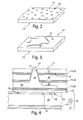
- FIG. 2 a perspective view of the visible side of a flat decorative material with a large number of circular openings
- Figure 3 is a perspective view of the visible side of another flat decorative material with different elongated openings that form a pattern
- FIG. 4 a section through a variant of a decorative material composite with conical openings, the decorative material being glued to a haptic layer, a diffusing screen which is integrated in a carrier part and an optical fiber.
- the flat decorative material 11 in FIGS. 1 and 2 has the visible side 14 facing upward into the vehicle interior.
- the decorative material 11 has a multiplicity of openings 12 which extend through the decorative material 11 from its visible side 14 to its rear side 13 and can be introduced, for example, with a laser.
- the openings 12 extend orthogonally to the visible side 14.
- the openings 12 in FIGS. 1 and 2 are circular, and the openings 12 have the shape of a circular cylinder.
- the distances between the openings 12 can be the same or different.
- the openings 12 are preferably arranged in the form of a pattern.
- the shape and size of the openings 12 can also be the same or different.
- Figure 1b shows a diffuser 31 in section.
- the lens 31 has a plate 35 which has two mutually parallel side surfaces 32, 33.
- the side surfaces 32, 33 are flat.
- a plurality of cylindrical scattering elements 30 extend away from the plate 35 from a side surface 32 at a right angle with respect to the lateral surface 36 of the scattering elements.
- the diameter D of the scattering elements 30 corresponds to the diameter D ⁇ réelleen of the openings 12 in the decorative material 11 in FIG. 1a.
- the lens 31 is an injection molded part made of polycarbonate and is essentially rigid.
- the diffusing screen 31 from FIG. 1b is now inserted with its diffusing elements 30 into the openings 12 in the decorative material 11, cf. Figure 1c. A positive connection of the scattering elements 30 into the opening 12 is obtained.
- the outward end 37 of the diffuser 30 is flat.
- the openings 12 and the diffusing elements 30 can also run slightly conically, the smallest diameter of the diffusing element 30 being on the visible side 14 of the decorative material 11.
- the outward-facing end 37 of the lens 31 can also be curved, cf. Figure 4.
- FIG. 3 shows a decorative material 11, the openings 12 of which have the shape of a pattern.
- the individual openings 12 are shaped differently and on their visible side they are triangular, tapering, angular-V-shaped, etc.
- the arrangement of the differently or identically shaped openings 12 enables the lighting to be achieved in the desired optics.
- a spacer fabric 26 is laminated onto the back 13 of the decorative material 11 by means of an adhesive layer 15 or an adhesive film 20.
- the diffusing screen 31 is integrated in the carrier part 25, which can be a door panel, for example.
- an adhesive layer 15 or an adhesive film 20 is again provided in order to glue the spacer fabric 26 to the side 32 of the lens 31 or the carrier part 25 pointing in the direction of the visible side 14. If the adhesive film 20 laminated onto the lens 31 also has scattering properties, it can also act as a diffuser 23.
- the lighting device 18, which is used to illuminate the decorative material 11 from the rear 13 thereof, comprises a light source 21 such as an LED lamp, a flexible or rigid light guide 22, a diffuser 23 and a reflector 24.
- the diffuser 23 can be a spacer fabric 26, for example or be a fleece. It serves to make the light generated in the light source 21 and fed into the light guide 22 diffuse and thus to prevent a directed dazzling light radiation.
- the illumination takes place through a lateral light source 21, which feeds light into the light guide 22.
- the reflector 24 located on the side of the light guide 22 facing away from the decorative material 11 prevents the light from escaping from the light guide and reflects any light that escapes back into the light guide.
- the diffuser 23 can be laminated onto the back of the lens 31.
- the haptic layer spacer fabric, fleece, foam, etc.
- the diffuser layer can also be omitted in the layer structure.
- the adhesive layer 15 or the adhesive film 20 can also be omitted.
- the lens 31 can also be glued directly to the light guide 22 and the diffuser 23 is omitted.
- a diffuser 23 is laminated onto the back of the diffusing screen 31 and between the diffuser 23 and the light guide 22 there is a gap 27, which causes a more homogeneous and more uniform radiation than when the diffuser 23 is glued directly onto the light guide 22 .
- the gap 27 is obtained, for example, in that the diffuser 23 and the light guide 22 have a spot weld 28 at some points.
- the thickness of the gap 27 is usually between 0.1 mm and 1 mm.
Landscapes
- Engineering & Computer Science (AREA)
- Mechanical Engineering (AREA)
- Manufacturing & Machinery (AREA)
- Textile Engineering (AREA)
- Arrangements Of Lighting Devices For Vehicle Interiors, Mounting And Supporting Thereof, Circuits Therefore (AREA)
- Vehicle Interior And Exterior Ornaments, Soundproofing, And Insulation (AREA)
Abstract
L'invention concerne un matériau décoratif (11) sensiblement plan comprenant des ouvertures (12) destiné à l'équipement intérieur, en particulier pour l'industrie automobile, lequel matériau sert à être éclairé sur sa face arrière (13) par un dispositif d'éclairage (18) et permet à une partie de la lumière du dispositif d'éclairage (18) de passer depuis la face arrière (13) du matériau décoratif (11) à travers les ouvertures (12) jusqu'au côté visible (14) du matériau décoratif (11). Des éléments de diffusion (30) sont prévus dans les ouvertures (12). Un écran diffusant (31) est prévu qui comporte une plaque (35) pourvue de deux surfaces latérales (32, 33) de préférence parallèles l'une à l'autre. Une pluralité d'éléments de diffusion (30) sont prévus sur une surface latérale (32) de la plaque (35) et s'étendent vers l'extérieur depuis le plan de la plaque (35). La forme et l'agencement des éléments de diffusion (30) sur la plaque (35) correspondent à la forme et à l'agencement des ouvertures (12) ménagées dans le matériau décoratif (11) sensiblement plan. L'invention concerne également un procédé de fabrication d'un matériau décoratif rétro-éclairé (11).
Applications Claiming Priority (2)
| Application Number | Priority Date | Filing Date | Title |
|---|---|---|---|
| DE102018130738.1 | 2018-12-03 | ||
| DE102018130738.1A DE102018130738B4 (de) | 2018-12-03 | 2018-12-03 | Hinterleuchtbare Dekorfläche, insbesondere für den Innenausbau von Kraftfahrzeugen |
Publications (2)
| Publication Number | Publication Date |
|---|---|
| WO2020114912A2 true WO2020114912A2 (fr) | 2020-06-11 |
| WO2020114912A3 WO2020114912A3 (fr) | 2020-08-06 |
Family
ID=68766749
Family Applications (1)
| Application Number | Title | Priority Date | Filing Date |
|---|---|---|---|
| PCT/EP2019/083121 Ceased WO2020114912A2 (fr) | 2018-12-03 | 2019-11-29 | Surface décorative rétroéclairée, en particulier pour l'aménagement intérieur de véhicules autmobiles |
Country Status (2)
| Country | Link |
|---|---|
| DE (1) | DE102018130738B4 (fr) |
| WO (1) | WO2020114912A2 (fr) |
Cited By (1)
| Publication number | Priority date | Publication date | Assignee | Title |
|---|---|---|---|---|
| CN113927890A (zh) * | 2021-11-09 | 2022-01-14 | 南通市垲德利光电科技有限公司 | 一种背光板生产用覆膜工艺及加工设备 |
Families Citing this family (11)
| Publication number | Priority date | Publication date | Assignee | Title |
|---|---|---|---|---|
| DE102020110487A1 (de) | 2020-04-17 | 2021-10-21 | Lisa Dräxlmaier GmbH | Lichtsystem für ein kraftfahrzeug und verfahren zum herstellen eines lichtsystems für ein kraftfahrzeug |
| WO2022206540A1 (fr) * | 2021-03-30 | 2022-10-06 | 福耀汽车铝件(福建)有限公司 | Accessoire pour support et ensemble de verre |
| DE102021117675A1 (de) | 2021-07-08 | 2023-01-12 | Novem Car Interior Design Gmbh | Formteil und Verfahren zur Herstellung eines Formteils |
| DE102021117673A1 (de) | 2021-07-08 | 2023-01-12 | Novem Car Interior Design Gmbh | Formteil und Verfahren zur Herstellung eines Formteils |
| EP4140812B1 (fr) * | 2021-08-24 | 2024-01-10 | Grupo Antolin-Ingenieria, S.A. | Habillage de pièces intérieures de véhicule rétroéclairés, procédé et installation pour sa fabrication |
| CN113954610A (zh) * | 2021-09-16 | 2022-01-21 | 福耀玻璃工业集团股份有限公司 | 装饰组件、水切以及车辆 |
| DE102022000939A1 (de) | 2022-03-18 | 2022-06-15 | Mercedes-Benz Group AG | Lichtvorrichtung für ein Kraftfahrzeug |
| DE102022206641A1 (de) * | 2022-06-30 | 2024-01-04 | Joyson Safety Systems Germany Gmbh | Zierelement zur Darstellung einer Zeichenabfolge an einem Interieurbauteil eines Fahrzeuges, Abdeckung für einen Airbag oder ein Airbag-Modul mit so einem Zierelement und Verfahren zur Herstellung einer solchen Abdeckung |
| DE102022003970A1 (de) * | 2022-10-25 | 2024-04-25 | Mercedes-Benz Group AG | Beleuchtetes Exterieur Zierelement mit Chromoptik |
| DE102023122387A1 (de) * | 2023-08-22 | 2025-02-27 | Bayerische Motoren Werke Aktiengesellschaft | Dachhimmel, Fortbewegungsmittel und Verfahren zur Herstellung eines Dachhimmels mit selbstleuchtenden Zierapplikationen |
| DE102023125270A1 (de) * | 2023-09-19 | 2025-03-20 | Lisa Dräxlmaier GmbH | Herstellung eines befüllten dekors mittels konturelement |
Citations (6)
| Publication number | Priority date | Publication date | Assignee | Title |
|---|---|---|---|---|
| DE202014100020U1 (de) | 2014-01-03 | 2015-01-05 | Novem Car Interior Design Gmbh | Dekorteil für einen Fahrzeuginnenraum |
| DE202015100321U1 (de) | 2015-01-23 | 2016-01-27 | Novem Car Interior Design Gmbh | Formteil, insbesondere als Formteil ausgebildetes Dekorteil und/oder Verkleidungsteil für einen Fahrzeuginnenraum |
| DE202017000777U1 (de) | 2017-02-11 | 2017-04-11 | Thorsten Burghardt | Primär galvanisch dekoriertes Zierelement mit Konturlicht und rückseitiger Lichtabschottung |
| DE102016214806A1 (de) | 2016-08-09 | 2018-02-15 | Faurecia Innenraum Systeme Gmbh | Dekorhaut und Fahrzeuginnenverkleidungsteil |
| DE102016121042A1 (de) | 2016-11-04 | 2018-05-09 | Eissmann Automotive Deutschland Gmbh | Hinterleuchbare Dekorfläche, insbesondere für den Innenausbau von Kraftfahrzeugen |
| DE202017104984U1 (de) | 2017-08-18 | 2018-08-21 | Novem Car Interior Design Gmbh | Formteil, insbesondere als Formteil ausgebildetes Dekor- und/oder Verkleidungsteil für einen Fahrzeuginnenraum |
Family Cites Families (1)
| Publication number | Priority date | Publication date | Assignee | Title |
|---|---|---|---|---|
| DE102015004411A1 (de) * | 2015-04-02 | 2016-10-20 | Audi Ag | Beleuchtungssystem für eine Fahrzeugtür |
-
2018
- 2018-12-03 DE DE102018130738.1A patent/DE102018130738B4/de active Active
-
2019
- 2019-11-29 WO PCT/EP2019/083121 patent/WO2020114912A2/fr not_active Ceased
Patent Citations (6)
| Publication number | Priority date | Publication date | Assignee | Title |
|---|---|---|---|---|
| DE202014100020U1 (de) | 2014-01-03 | 2015-01-05 | Novem Car Interior Design Gmbh | Dekorteil für einen Fahrzeuginnenraum |
| DE202015100321U1 (de) | 2015-01-23 | 2016-01-27 | Novem Car Interior Design Gmbh | Formteil, insbesondere als Formteil ausgebildetes Dekorteil und/oder Verkleidungsteil für einen Fahrzeuginnenraum |
| DE102016214806A1 (de) | 2016-08-09 | 2018-02-15 | Faurecia Innenraum Systeme Gmbh | Dekorhaut und Fahrzeuginnenverkleidungsteil |
| DE102016121042A1 (de) | 2016-11-04 | 2018-05-09 | Eissmann Automotive Deutschland Gmbh | Hinterleuchbare Dekorfläche, insbesondere für den Innenausbau von Kraftfahrzeugen |
| DE202017000777U1 (de) | 2017-02-11 | 2017-04-11 | Thorsten Burghardt | Primär galvanisch dekoriertes Zierelement mit Konturlicht und rückseitiger Lichtabschottung |
| DE202017104984U1 (de) | 2017-08-18 | 2018-08-21 | Novem Car Interior Design Gmbh | Formteil, insbesondere als Formteil ausgebildetes Dekor- und/oder Verkleidungsteil für einen Fahrzeuginnenraum |
Cited By (1)
| Publication number | Priority date | Publication date | Assignee | Title |
|---|---|---|---|---|
| CN113927890A (zh) * | 2021-11-09 | 2022-01-14 | 南通市垲德利光电科技有限公司 | 一种背光板生产用覆膜工艺及加工设备 |
Also Published As
| Publication number | Publication date |
|---|---|
| DE102018130738A1 (de) | 2020-06-04 |
| DE102018130738B4 (de) | 2020-08-06 |
| WO2020114912A3 (fr) | 2020-08-06 |
Similar Documents
| Publication | Publication Date | Title |
|---|---|---|
| DE102018130738B4 (de) | Hinterleuchtbare Dekorfläche, insbesondere für den Innenausbau von Kraftfahrzeugen | |
| DE102016009660B4 (de) | Beleuchtetes Zierteil | |
| DE102016007709B4 (de) | Kraftfahrzeugzierteil | |
| DE102016110054B4 (de) | Beleuchtungseinrichtung und Interieurteil für ein Fahrzeug | |
| EP2753501B1 (fr) | Brillance étincelante d'une couche de décoration rétro-éclairée | |
| DE102012215165A1 (de) | Dekorverbund mit dynamischen Lichtstrukturen | |
| DE102012000479A1 (de) | Beleuchtbares Bauteil für den Innenraum eines Fahrzeugs und Beleuchtungsanordnung | |
| DE102011016420A1 (de) | Innenraumbeleuchtung für ein Fahrzeug, Verfahren zur Bereitstellung der Innenraumbeleuchtung im Fahrzeug sowie Fahrzeug mit der Innenraumbeleuchtung | |
| DE102012008976B4 (de) | Lichtelement mit gezielter Beeinflussung der Kantenoptik | |
| EP3866147A1 (fr) | Matériau composite décoratif pouvant être rétroéclairé, en particulier destiné au montage à l'intérieur des véhicules automobile | |
| DE102017207902A1 (de) | Anzeigevorrichtung für ein Fahrzeug | |
| EP2974908B1 (fr) | Dispositif lumineux pour un vehicule automobile et procede de fonctionnement d'un dispositif lumineux | |
| DE102018111072A1 (de) | Hinterleuchtbare Dekorfläche, insbesondere für den Innenausbau von Kraftfahrzeugen | |
| DE102017215367A1 (de) | Lichtdurchlässige Mehrschichtverbundfolie | |
| DE102016214806A1 (de) | Dekorhaut und Fahrzeuginnenverkleidungsteil | |
| WO2013060834A1 (fr) | Élément d'éclairage | |
| DE102013021600A1 (de) | Flächenleuchte | |
| DE102021105326A1 (de) | Leuchtvorrichtung eines Kraftfahrzeugs | |
| EP3631291B1 (fr) | Élément guide de lumière décoratif | |
| WO2019015829A1 (fr) | Composant pour un véhicule | |
| DE102016123203B4 (de) | Beleuchtungsvorrichtung für Fahrzeuge | |
| WO2017067740A1 (fr) | Radôme | |
| EP2152544B1 (fr) | Dispositif d'éclairage conçu pour éclairer l'espace intérieur d'un véhicule | |
| DE202016106006U1 (de) | Fahrzeug-Verkleidungselement | |
| DE102016214805A1 (de) | Verfahren zum Herstellen eines Bauteils zur Verwendung in einem Fahrzeuginnenraum und Bauteil |
Legal Events
| Date | Code | Title | Description |
|---|---|---|---|
| 121 | Ep: the epo has been informed by wipo that ep was designated in this application |
Ref document number: 19813483 Country of ref document: EP Kind code of ref document: A2 |
|
| 122 | Ep: pct application non-entry in european phase |
Ref document number: 19813483 Country of ref document: EP Kind code of ref document: A2 |