WO2020116037A1 - ポリブタジエン、ポリブタジエンの製造方法、ポリブタジエン組成物、タイヤ、及び樹脂部材 - Google Patents
ポリブタジエン、ポリブタジエンの製造方法、ポリブタジエン組成物、タイヤ、及び樹脂部材 Download PDFInfo
- Publication number
- WO2020116037A1 WO2020116037A1 PCT/JP2019/040873 JP2019040873W WO2020116037A1 WO 2020116037 A1 WO2020116037 A1 WO 2020116037A1 JP 2019040873 W JP2019040873 W JP 2019040873W WO 2020116037 A1 WO2020116037 A1 WO 2020116037A1
- Authority
- WO
- WIPO (PCT)
- Prior art keywords
- polybutadiene
- group
- butadiene
- present
- formula
- Prior art date
- Legal status (The legal status is an assumption and is not a legal conclusion. Google has not performed a legal analysis and makes no representation as to the accuracy of the status listed.)
- Ceased
Links
Images


Classifications
-
- B—PERFORMING OPERATIONS; TRANSPORTING
- B60—VEHICLES IN GENERAL
- B60C—VEHICLE TYRES; TYRE INFLATION; TYRE CHANGING; CONNECTING VALVES TO INFLATABLE ELASTIC BODIES IN GENERAL; DEVICES OR ARRANGEMENTS RELATED TO TYRES
- B60C1/00—Tyres characterised by the chemical composition or the physical arrangement or mixture of the composition
- B60C1/0016—Compositions of the tread
-
- C—CHEMISTRY; METALLURGY
- C08—ORGANIC MACROMOLECULAR COMPOUNDS; THEIR PREPARATION OR CHEMICAL WORKING-UP; COMPOSITIONS BASED THEREON
- C08F—MACROMOLECULAR COMPOUNDS OBTAINED BY REACTIONS ONLY INVOLVING CARBON-TO-CARBON UNSATURATED BONDS
- C08F36/00—Homopolymers and copolymers of compounds having one or more unsaturated aliphatic radicals, at least one having two or more carbon-to-carbon double bonds
- C08F36/02—Homopolymers and copolymers of compounds having one or more unsaturated aliphatic radicals, at least one having two or more carbon-to-carbon double bonds the radical having only two carbon-to-carbon double bonds
- C08F36/04—Homopolymers and copolymers of compounds having one or more unsaturated aliphatic radicals, at least one having two or more carbon-to-carbon double bonds the radical having only two carbon-to-carbon double bonds conjugated
- C08F36/06—Butadiene
-
- B—PERFORMING OPERATIONS; TRANSPORTING
- B60—VEHICLES IN GENERAL
- B60C—VEHICLE TYRES; TYRE INFLATION; TYRE CHANGING; CONNECTING VALVES TO INFLATABLE ELASTIC BODIES IN GENERAL; DEVICES OR ARRANGEMENTS RELATED TO TYRES
- B60C1/00—Tyres characterised by the chemical composition or the physical arrangement or mixture of the composition
- B60C1/0008—Compositions of the inner liner
-
- B—PERFORMING OPERATIONS; TRANSPORTING
- B60—VEHICLES IN GENERAL
- B60C—VEHICLE TYRES; TYRE INFLATION; TYRE CHANGING; CONNECTING VALVES TO INFLATABLE ELASTIC BODIES IN GENERAL; DEVICES OR ARRANGEMENTS RELATED TO TYRES
- B60C1/00—Tyres characterised by the chemical composition or the physical arrangement or mixture of the composition
- B60C1/0025—Compositions of the sidewalls
-
- C—CHEMISTRY; METALLURGY
- C08—ORGANIC MACROMOLECULAR COMPOUNDS; THEIR PREPARATION OR CHEMICAL WORKING-UP; COMPOSITIONS BASED THEREON
- C08F—MACROMOLECULAR COMPOUNDS OBTAINED BY REACTIONS ONLY INVOLVING CARBON-TO-CARBON UNSATURATED BONDS
- C08F136/00—Homopolymers of compounds having one or more unsaturated aliphatic radicals, at least one having two or more carbon-to-carbon double bonds
- C08F136/02—Homopolymers of compounds having one or more unsaturated aliphatic radicals, at least one having two or more carbon-to-carbon double bonds the radical having only two carbon-to-carbon double bonds
- C08F136/04—Homopolymers of compounds having one or more unsaturated aliphatic radicals, at least one having two or more carbon-to-carbon double bonds the radical having only two carbon-to-carbon double bonds conjugated
- C08F136/06—Butadiene
-
- C—CHEMISTRY; METALLURGY
- C08—ORGANIC MACROMOLECULAR COMPOUNDS; THEIR PREPARATION OR CHEMICAL WORKING-UP; COMPOSITIONS BASED THEREON
- C08F—MACROMOLECULAR COMPOUNDS OBTAINED BY REACTIONS ONLY INVOLVING CARBON-TO-CARBON UNSATURATED BONDS
- C08F4/00—Polymerisation catalysts
- C08F4/42—Metals; Metal hydrides; Metallo-organic compounds; Use thereof as catalyst precursors
- C08F4/44—Metals; Metal hydrides; Metallo-organic compounds; Use thereof as catalyst precursors selected from light metals, zinc, cadmium, mercury, copper, silver, gold, boron, gallium, indium, thallium, rare earths or actinides
- C08F4/60—Metals; Metal hydrides; Metallo-organic compounds; Use thereof as catalyst precursors selected from light metals, zinc, cadmium, mercury, copper, silver, gold, boron, gallium, indium, thallium, rare earths or actinides together with refractory metals, iron group metals, platinum group metals, manganese, rhenium technetium or compounds thereof
- C08F4/70—Iron group metals, platinum group metals or compounds thereof
-
- C—CHEMISTRY; METALLURGY
- C08—ORGANIC MACROMOLECULAR COMPOUNDS; THEIR PREPARATION OR CHEMICAL WORKING-UP; COMPOSITIONS BASED THEREON
- C08L—COMPOSITIONS OF MACROMOLECULAR COMPOUNDS
- C08L9/00—Compositions of homopolymers or copolymers of conjugated diene hydrocarbons
-
- B—PERFORMING OPERATIONS; TRANSPORTING
- B60—VEHICLES IN GENERAL
- B60C—VEHICLE TYRES; TYRE INFLATION; TYRE CHANGING; CONNECTING VALVES TO INFLATABLE ELASTIC BODIES IN GENERAL; DEVICES OR ARRANGEMENTS RELATED TO TYRES
- B60C1/00—Tyres characterised by the chemical composition or the physical arrangement or mixture of the composition
- B60C2001/0033—Compositions of the sidewall inserts, e.g. for runflat
-
- B—PERFORMING OPERATIONS; TRANSPORTING
- B60—VEHICLES IN GENERAL
- B60C—VEHICLE TYRES; TYRE INFLATION; TYRE CHANGING; CONNECTING VALVES TO INFLATABLE ELASTIC BODIES IN GENERAL; DEVICES OR ARRANGEMENTS RELATED TO TYRES
- B60C1/00—Tyres characterised by the chemical composition or the physical arrangement or mixture of the composition
- B60C2001/005—Compositions of the bead portions, e.g. clinch or chafer rubber or cushion rubber
-
- C—CHEMISTRY; METALLURGY
- C08—ORGANIC MACROMOLECULAR COMPOUNDS; THEIR PREPARATION OR CHEMICAL WORKING-UP; COMPOSITIONS BASED THEREON
- C08F—MACROMOLECULAR COMPOUNDS OBTAINED BY REACTIONS ONLY INVOLVING CARBON-TO-CARBON UNSATURATED BONDS
- C08F236/00—Copolymers of compounds having one or more unsaturated aliphatic radicals, at least one having two or more carbon-to-carbon double bonds
- C08F236/02—Copolymers of compounds having one or more unsaturated aliphatic radicals, at least one having two or more carbon-to-carbon double bonds the radical having only two carbon-to-carbon double bonds
- C08F236/04—Copolymers of compounds having one or more unsaturated aliphatic radicals, at least one having two or more carbon-to-carbon double bonds the radical having only two carbon-to-carbon double bonds conjugated
- C08F236/06—Butadiene
Definitions
- the present invention relates to polybutadiene, a method for producing polybutadiene, a polybutadiene composition, a tire, and a resin member.
- the stereoregularity of a polymer is one of the factors that determine higher-order structures such as crystal morphology and crystallinity. Therefore, if the stereoregularity of the polymer changes, its physical properties also tend to change.
- Patent Document 1 discloses that syndiotactic polybutadiene can be efficiently produced by using a predetermined suspension polymerization method.
- the syndiotactic structure in polybutadiene is a three-dimensional structure in which side chain vinyl groups (—CH ⁇ CH 2 ) are alternately located on the opposite side to the main chain portion formed of 1,2-vinyl bonds.
- side chain vinyl groups —CH ⁇ CH 2
- isotactic structure a steric structure in which the side chain vinyl group (—CH ⁇ CH 2 ) is located on the same side
- side chain vinyl group —CH ⁇ CH 2
- the three-dimensional structure is called an atactic structure.
- Non-Patent Document 1 The isotacticity of polybutadiene that has been present before is 71% at most in the triad display (mm) (Non-Patent Document 1). Under such circumstances, development of new polybutadiene having higher isotacticity is required, and peculiar physical properties of the polybutadiene are expected.
- an object of the present invention is to provide a novel polybutadiene having high isotacticity. Moreover, the objective of this invention is providing the manufacturing method of polybutadiene which can manufacture polybutadiene with high isotacticity. Another object of the present invention is to provide a polybutadiene composition, a tire, and a resin member using the above novel polybutadiene.
- the present inventors have conducted intensive studies to achieve the above object, and as a result, by using a predetermined catalyst system component, it was found that polybutadiene having a high isotacticity which did not exist up to now can be prepared.
- the present invention has been accomplished.
- the polybutadiene of the present invention is characterized by having a triad isotacticity (mm) of 72% or more.
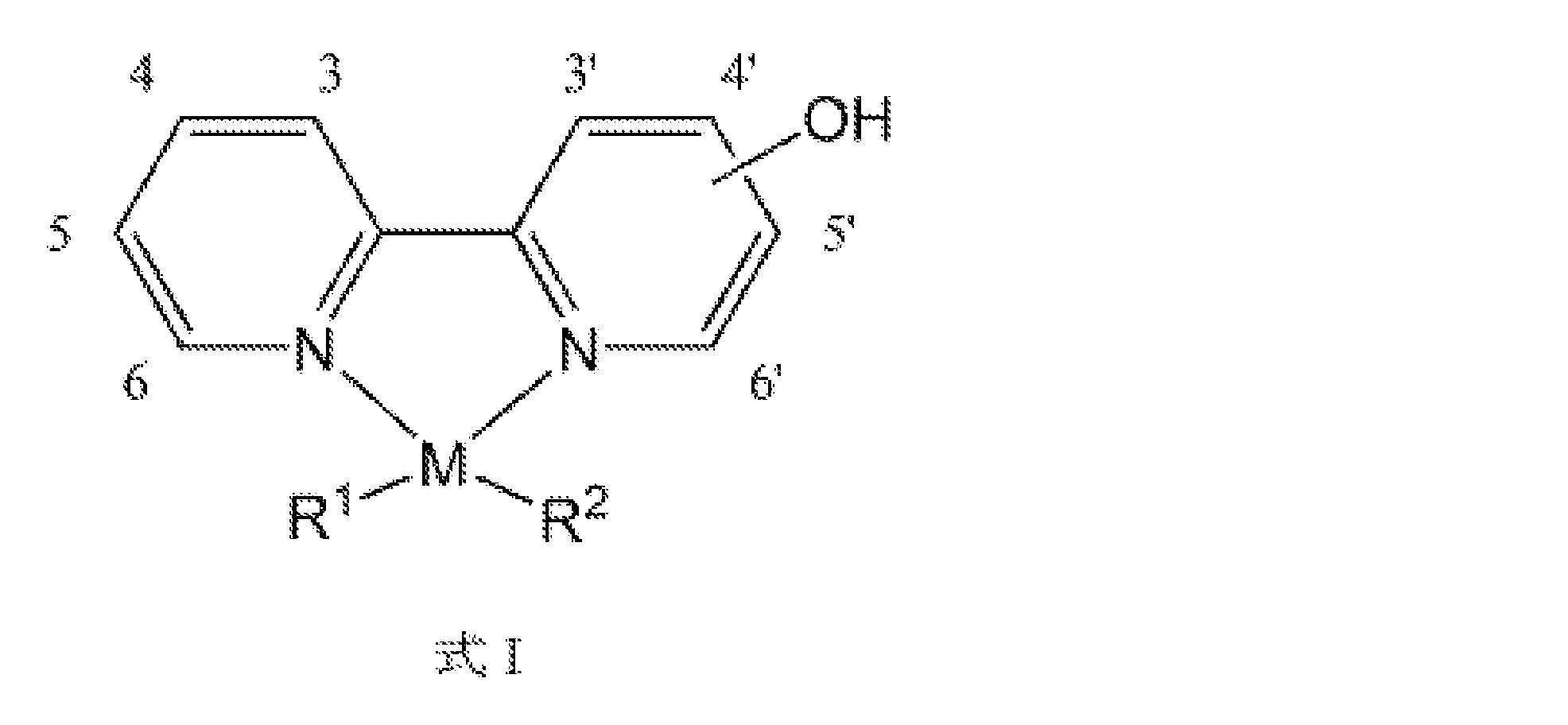
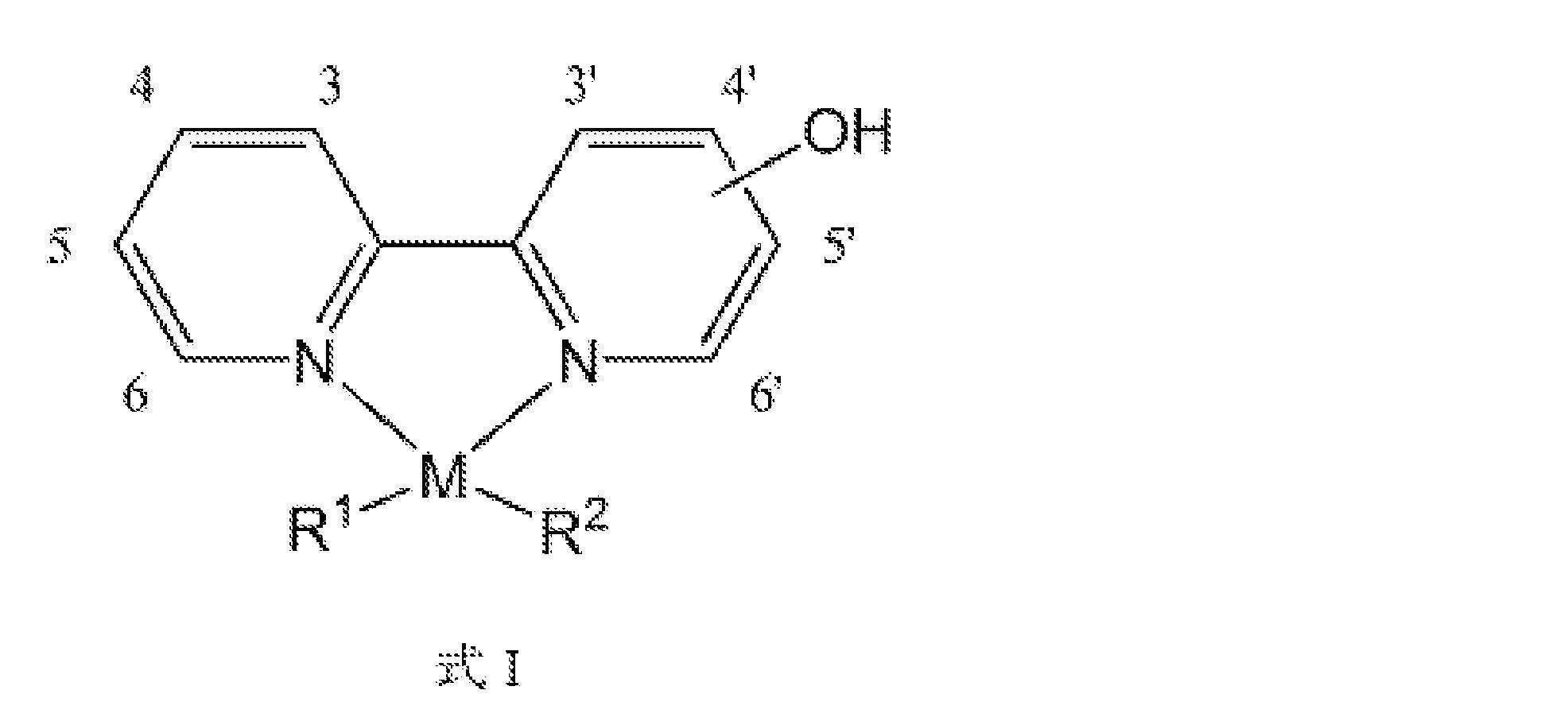
- the method for producing polybutadiene of the present invention has the following structural formula I: (In the formula, the OH group is bonded to at least one of the 3 to 6-position and the 3'to 6'-position of the bipyridyl ring, M is a transition metal, and R 1 and R 2 are carbon. A hydrocarbon group of 1 or more or a halogen atom, and R 1 and R 2 may be the same or different from each other.), and a norbornene derivative is used as a catalyst. And 3-butadiene are polymerized to obtain polybutadiene.
- the polybutadiene composition of the present invention is characterized by containing the above-mentioned polybutadiene.
- the tire of the present invention is characterized by using the above-mentioned polybutadiene composition.
- the resin member of the present invention is characterized by using the above-mentioned polybutadiene composition.
- the present invention it is possible to provide a novel polybutadiene having high isotacticity. Further, according to the present invention, it is possible to provide a method for producing polybutadiene, which is capable of producing polybutadiene having high isotacticity. Further, according to the present invention, it is possible to provide a polybutadiene composition, a tire, and a resin member using the above novel polybutadiene.
- 1 is a schematic view of 13 C-NMR spectrum of polybutadiene of Example 1.
- 1 is a schematic diagram of a DSC curve of polybutadiene of Example 1.
- polybutadiene of one embodiment of the present invention has a triad isotacticity (mm) of 72% or more.
- a triad isotacticity (mm) of polybutadiene can be obtained from 13 C-NMR spectrum. Specifically, the peak area values of [mm], [mr], and [rr] signals were obtained from the 13 C-NMR spectrum, and the triad isotacticity (mm) was obtained as the ratio of [mm] in these. Be done.
- the triad isotacticity (mm) of polybutadiene is obtained by the method described in Examples. Further, the triad isotacticity (mm) of polybutadiene is a term relating to a 1,2-vinyl bond, and there is no concept of isotacticity regarding a cis-1,4 bond and a trans-1,4 bond.
- the polybutadiene of this embodiment can be produced, for example, by the method for producing polybutadiene of one embodiment of the present invention described below.
- the triad isotacticity (mm) of the polybutadiene of this embodiment is preferably 90% or more, more preferably 95% or more, further preferably 99% or more, and particularly preferably 100%. In this case, since the isotacticity of polybutadiene is higher, the specific physical properties of the polybutadiene can be expected more.
- the polybutadiene of the present embodiment preferably has a 1,2-vinyl bond content of 65% or more.
- the polybutadiene according to the present embodiment has a 1,2-vinyl bond content of more preferably 75% or more, further preferably 95% or more, and further preferably 99% or more.
- the amount of 1,2-vinyl bond of polybutadiene can be adjusted, for example, by appropriately selecting the type and amount of each catalyst system component to be used.
- the 1,2-vinyl bond content can be determined from 1 H-NMR spectrum.
- the polybutadiene of the present embodiment preferably has a melting point of 80°C or higher and 130°C or lower.
- the stereoregularity and isotacticity of the polybutadiene tend to be sufficiently high, so that the unique physical properties of the polybutadiene can be expected more.
- the melting point of polybutadiene can be adjusted, for example, by appropriately controlling the molecular weight, polydispersity and the like. Further, the melting point can be determined by using a differential scanning calorimeter (DSC) according to JIS K 7121-1987. When there are a plurality of melting points, the highest melting point is regarded as the melting point in this specification.
- a method for producing polybutadiene according to an embodiment of the present invention includes at least the following structural formula I: (In the formula, the OH group is bonded to at least one of the 3 to 6-position and the 3'to 6'-position of the bipyridyl ring, M is a transition metal, and R 1 and R 2 are carbon.
- a compound hereinafter, referred to as “hydroxybipyridyl complex” represented by a hydrocarbon group of 1 or more or a halogen atom, and R 1 and R 2 may be the same or different from each other.
- a norbornene derivative are used to obtain a polybutadiene by polymerizing 1,3-butadiene (polymerization step).
- other catalyst system components other than the above-mentioned hydroxybipyridyl complex and norbornene derivative can be used if necessary. According to the manufacturing method of the present embodiment, it is possible to manufacture polybutadiene having high isotacticity, particularly the above-mentioned polybutadiene.
- the hydroxybipyridyl-based complex is the first catalyst system component when polymerizing 1,3-butadiene in the production method of the present embodiment.
- the hydroxybipyridyl complex compound represented by Structural Formula I
- two N atoms on the bipyridyl ring are coordinated with the transition metal M. That is, a bipyridyl ring having at least one OH group is a ligand. Having at least one OH group on the bipyridyl ring enhances polymerization activity.
- the hydroxybipyridyl-based complex may be used alone or in combination of two or more.
- the hydroxybipyridyl-based complex acts as a catalyst for the polymerization reaction in the production method of this embodiment.
- the OH group is bonded to at least one of the 3-6 position and the 3'-6' position of the bipyridyl ring.
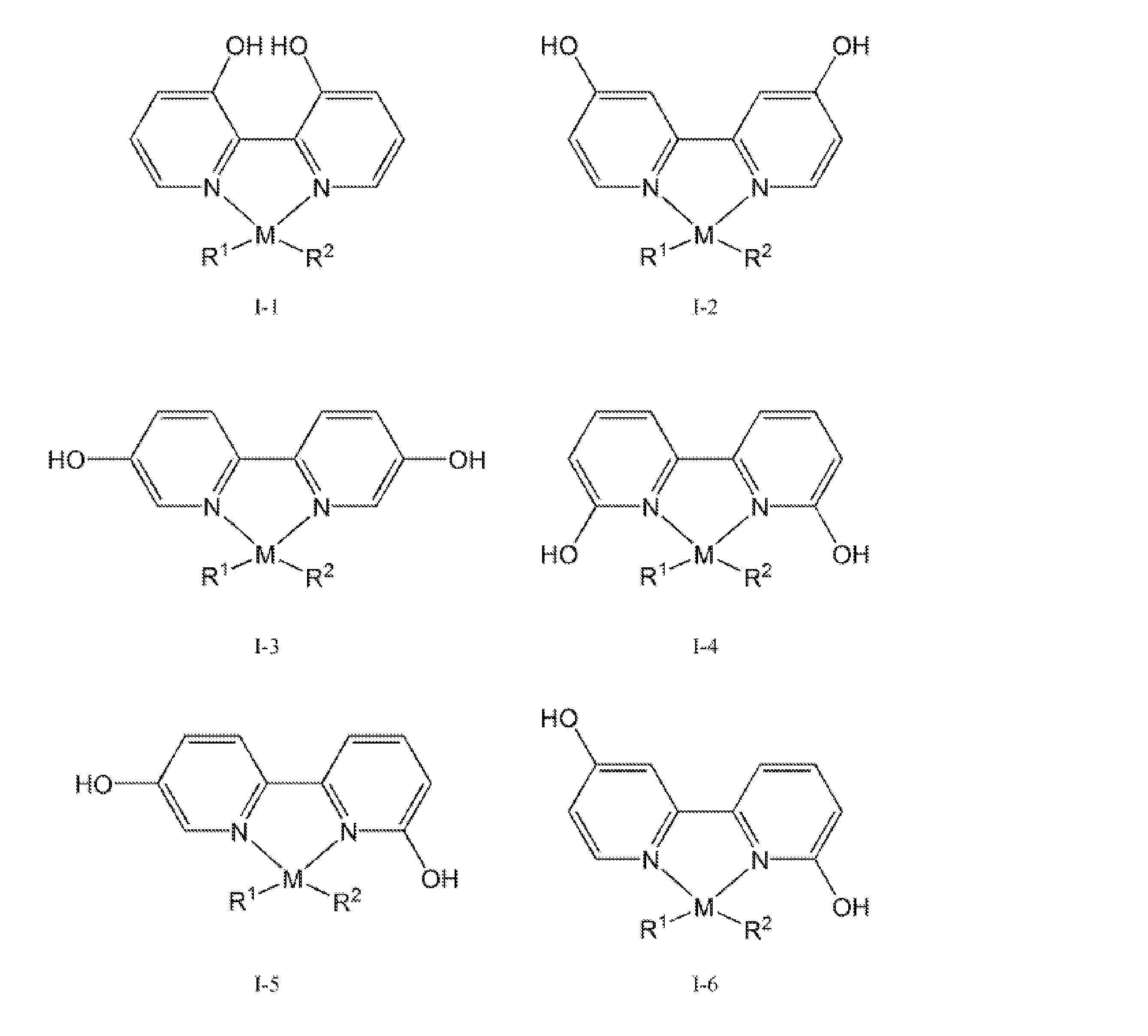
- the number of OH groups is preferably 2 from the viewpoint of polymerization activity.
- the position of the OH group is not particularly limited, and for example, the following formula I-1 (3,3′ position), formula I-2 (4,4′ position) can be used. ), formula I-3 (5,5′ position) and formula I-4 (6,6′ position) and the like, or the following formula I-5 (5,6′ position) ) And formula I-6 (4,6′ position).
- M in Structural Formula I is a transition metal.
- the transition metal include scandium (Sc), titanium (Ti), vanadium (V), chromium (Cr), manganese (Mn), iron (Fe), cobalt (Co), nickel (Ni), copper (Cu). ), zinc (Zn), yttrium (Y), zirconium (Zr), niobium (Nb), molybdenum (Mo), technetium (Tc), ruthenium (Ru), rhodium (Rh), palladium (Pd), silver (Ag). ), cadmium (Cd), lanthanoids (lanthanum (La) with atomic number 57 to lutetium (Lu) with atomic number 71), and the like.
- M in Structural Formula I is preferably iron (Fe), cobalt (Co), nickel (Ni), palladium (Pd) or copper (Cu), and nickel (Ni). Is more preferable.
- R 1 and R 2 in the structural formula I are a hydrocarbon group having 1 or more carbon atoms or a halogen atom.
- R 1 and R 2 may be the same or different from each other.
- hydrocarbon group having 1 or more carbon atoms examples include hydrocarbon groups having 1 to 4 carbon atoms, such as a methyl group and an isopropyl group.
- halogen atom examples include fluorine, chlorine, bromine, iodine and the like.
- R 1 and R 2 in Structural Formula I are preferably halogen atoms, more preferably chlorine or bromine, and even more preferably bromine, from the viewpoint of further increasing the polymerization activity.
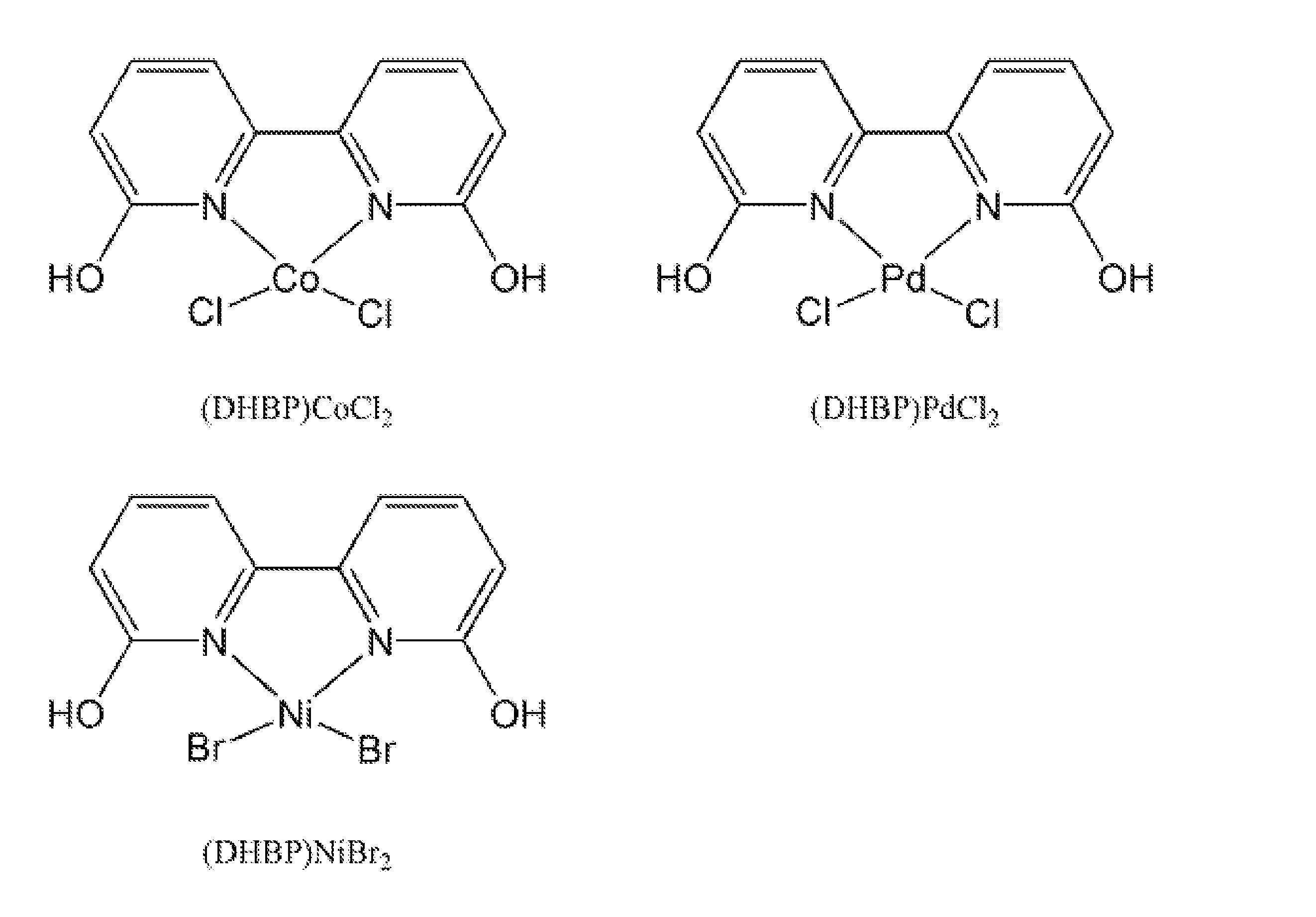
- hydroxybipyridyl-based complex examples include the following dihydroxybipyridyl (hereinafter sometimes simply referred to as “DHBP”) CoCl 2 , (DHBP)PdCl 2 and (DHBP)NiBr 2 .
- DHBP dihydroxybipyridyl
- the mol ratio (monomer/M) of 1,3-butadiene as a monomer and the transition metal M in the hydroxybipyridyl-based complex may be adjusted appropriately.
- the molecular weight of the polymer, and the polydispersity (Mw/Mn) it is preferably 200 or more, more preferably 300 or more, and further preferably 350 or more.
- the method for synthesizing the hydroxybipyridyl-based complex is not particularly limited.
- DHBP that is, 6,6′-dihydroxy-2,2′-bipyridine
- NiBr 2 a solvent such as THF and appropriately filtered, washed and dried.
- a norbornene derivative is used.
- the norbornene derivative is the second catalyst system component when polymerizing 1,3-butadiene in the production method of the present embodiment.
- the norbornene derivative it is possible to obtain polybutadiene having high isotacticity.
- the norbornene derivative refers to a compound having at least a norbornene skeleton, and does not include norbornene itself.
- norbornene when used instead of the norbornene derivative, the norbornene may act as a monomer on polymerization, and as a result, polybutadiene (homopolymer) may not be obtained.
- the norbornene derivative preferably has an amino group.
- the amino group is a group represented by —NR a R b (R a and R b are hydrogen atoms or arbitrary groups, and may be the same or different from each other).
- Examples of the preferable norbornene derivative mentioned above include 5-norbornene-2-methylamine, 5-norbornene-2-ethylamine, 5-norbornene-2-propylamine, 5-norbornene-2-butylamine and the like. Among these, 5-norbornene-2-methylamine is more preferable.
- the amount of the norbornene derivative used is preferably 3 to 40 mol% with respect to 1,3-butadiene as a monomer. In this case, the effect of increasing the isotacticity of the obtained polybutadiene can be more sufficiently obtained.
- the catalyst further comprises the following structural formula II: YR 3 a R 4 b R 5 c Formula II (In the formula, Y is a metal selected from Group 1, Group 2, Group 12 and Group 13 of the periodic table, R 3 and R 4 are a hydrogen atom, or a substituted or unsubstituted group.
- R 5 is a hydrocarbon group having 1 to 20 carbon atoms, an alkoxy group or an aryloxy group, R 5 is a substituted or unsubstituted hydrocarbon group having 1 to 20 carbon atoms, an alkoxy group or an aryloxy group, R 3 R 4 and R 5 may be the same or different from each other, and a, b and c are independently 0 or 1; provided that Y is a metal selected from Group 1 above. In some cases, a is 1 and b and c are 0; when Y is a metal selected from Groups 2 and 12 above, a and b are 1 and c is 0; and when Y is a metal selected from Group 13 above, a, b and c are 1).
- the polymerization activity can be further enhanced by using the compound represented by Structural Formula II as the catalyst system component.
- the compound represented by Structural Formula II may be used alone or in combination of two or more.
- Examples of Y in Structural Formula II include, for example, lithium (Li), sodium (Na), potassium (K), rubidium (Rb), cesium (Cs), francium (Fr), beryllium (Be), magnesium (Mg). , Calcium (Ca), strontium (Sr), barium (Ba), radium (Ra), zinc (Zn), cadmium (Cd), mercury (Hg), boron (B), aluminum (Al), gallium (Ga). , Indium (In), thallium (Ti), and the like.
- Y in the structural formula II is preferably lithium (Li), boron (B) or aluminum (Al), and more preferably aluminum (Al), from the viewpoint of further enhancing the polymerization activity.
- Examples of the hydrocarbon group of R 3 , R 4 and R 5 in the structural formula II include, for example, methyl group, ethyl group, n-propyl group, isopropyl group, n-butyl group, sec-butyl group, isobutyl group and tert. -Butyl group, phenyl group and the like.
- the hydrocarbon group, alkoxy group and aryloxy group of R 3 , R 4 and R 5 in the compound of structural formula II may be substituted with a substituent, and the substituent may be, for example, a straight chain.
- a branched alkyl group eg, methyl group, tert-butyl group
- halogen eg, fluorine
- Structural Formula II Specific examples include tris(pentafluorophenyl)borane, trimethylaluminum, triethylaluminum, triisobutylaluminum (TIBA), lithium 2,6-di-tert-butyl-4. -Methylphenoxide, bis(2,6-di-tert-butyl-4-methylphenoxy)methylaluminum, diisobutylaluminum hydride and the like can be mentioned.
- tris(pentafluorophenyl)borane, trimethylaluminum, triisobutylaluminum (TIBA), lithium 2,6-di-tert-butyl-4-methylphenoxide, bis(2,6-di-tert-butyl-) 4-methylphenoxy)methyl aluminum and the like can be mentioned.
- the amount thereof is preferably 2 to 200 equivalents based on the transition metal M in the hydroxybipyridyl complex, from the viewpoint of polymerization activity, and 10 to 200 equivalents. Is more preferable, and it is further preferable that the amount is 20 to 200 equivalents.
- the catalyst further contains an aluminoxane.
- aluminoxane as the catalyst system component, the polymerization active species can be efficiently generated.
- Aluminoxanes may be used alone or in combination of two or more.
- Aluminoxane is a compound obtained by contacting an organoaluminum compound with a condensing agent such as water.
- aluminoxane examples include a chain aluminoxane or a cyclic aluminoxane having a repeating unit represented by the general formula: (-Al(R')O-).
- R' is a hydrocarbon group having 1 to 10 carbon atoms, and a part of the hydrocarbon group may be substituted with a halogen atom and/or an alkoxy group.
- the repeating unit (degree of polymerization) of aluminoxane is preferably 5 or more, more preferably 10 or more.
- examples of R'in the above general formula include a methyl group, an ethyl group, a propyl group, and an isobutyl group. In one embodiment, R'is a methyl group.
- organoaluminum compound that is a raw material of aluminoxane examples include trialkylaluminum such as trimethylaluminum, triethylaluminum, triisobutylaluminum, and a mixture thereof. In one embodiment, the organoaluminum compound is trimethylaluminum.
- aluminoxane may be used. Examples of such commercially available products include MMAO and TMAO manufactured by Tosoh Finechem Co., Ltd.
- the amount used is preferably an amount such that Al in the aluminoxane is 2 equivalents or more with respect to the transition metal M of the hydroxybipyridyl-based complex.
- the catalyst further contains at least one of an ionic compound and a halogen compound.
- the catalyst system component By using at least one of the ionic compound and the halogen compound as the catalyst system component, the proportion of impurities in the obtained polybutadiene can be reduced.
- the monomer 1,3-butadiene is polymerized in a polymerization system in which the hydroxybipyridyl-based complex, the norbornene derivative, and any of the above-mentioned other catalyst system components are present.
- Obtain polybutadiene polymerization step.
- other steps such as a step of purifying the polybutadiene obtained in the polymerization step (purification step), a step of washing the polybutadiene obtained in the polymerization step (washing step), etc. Steps can be included as appropriate.
- the method of polymerization is not particularly limited, and for example, coordination polymerization, solution polymerization (anionic polymerization) and the like can be used.
- the polymerization may be carried out by any conventionally known method such as continuous polymerization, semi-continuous polymerization, batch polymerization and the like.
- the polymerization temperature is not particularly limited, and may be appropriately set depending on the type of catalyst system component, desired 1,2-vinyl bond amount, number average molecular weight, polydispersity, Mooney viscosity and the like.
- the polymerization temperature can be, for example, ⁇ 100 to 150° C.
- the polymerization step it is preferable to add 1,3-butadiene and a norbornene derivative in this order to the polymerization system.
- 1,3-butadiene and a norbornene derivative By charging the polymerization system in the above order, the stereoregularity of the resulting polybutadiene, and thus the isotacticity, can be further enhanced.
- the polymerization step it is more preferable to add the hydroxybipyridyl complex, 1,3-butadiene, and norbornene derivative in this order to the polymerization system.
- "introducing 1,3-butadiene and a norbornene derivative in this order" may be performed as long as the 1,3-butadiene is introduced before the introduction of the norbornene derivative.
- polybutadiene composition A polybutadiene composition according to an embodiment of the present invention (hereinafter, may be referred to as “polybutadiene composition of the present embodiment”) contains the above-mentioned polybutadiene. Since the polybutadiene composition of the present embodiment contains the novel polybutadiene having high isotacticity described above, it can be appropriately used for various applications.
- the polybutadiene composition of the present embodiment may contain other rubber components in addition to the above-mentioned polybutadiene.
- Other rubber components include, for example, natural rubber, synthetic isoprene rubber, butadiene rubber (other than the polybutadiene of this embodiment), styrene-butadiene rubber, butyl rubber, bromide of a copolymer of isobutylene and p-methylstyrene, halogenated butyl rubber.
- the polybutadiene composition of the present embodiment preferably contains other rubber component when used in the production of a tire described later.
- the polybutadiene composition of this embodiment may include a resin component.
- the resin component is not particularly limited and can be appropriately selected depending on the purpose.
- the resin may be used alone or in combination of two or more.
- the polybutadiene composition of the present embodiment preferably contains a resin component when used in the production of a resin member described later.
- the polybutadiene composition of the present embodiment may appropriately contain known additives to be added to rubber compositions, resin compositions and the like.
- additives include fillers, vulcanizing agents, crosslinking agents, vulcanization accelerators, antioxidants, reinforcing agents, softening agents, vulcanization aids, colorants, flame retardants, lubricants, foaming agents, Examples include plasticizers, processing aids, antioxidants, anti-scorch agents, anti-UV agents, antistatic agents, anti-coloring agents and oils.
- additives include fillers, vulcanizing agents, crosslinking agents, vulcanization accelerators, antioxidants, reinforcing agents, softening agents, vulcanization aids, colorants, flame retardants, lubricants, foaming agents.
- plasticizers processing aids, antioxidants, anti-scorch agents, anti-UV agents, antistatic agents, anti-coloring agents and oils.
- Each of these additives may be used alone or in combination of two or more.
- the method for preparing the polybutadiene composition of this embodiment is not particularly limited, and a known method can be used.
- a polybutadiene composition can be obtained by kneading each component containing the above polybutadiene with a kneading machine such as a Banbury mixer, a roll or an internal mixer.
- a kneading machine such as a Banbury mixer, a roll or an internal mixer.
- the components other than the vulcanizing agent and the vulcanization accelerator may be mixed, and the vulcanizing agent and the vulcanization accelerator may be added to the mixture and mixed to prepare the polybutadiene composition.
- the polybutadiene composition of the present embodiment can be used for manufacturing, for example, rubber articles such as tires, conveyor belts, anti-vibration rubber, seismic isolation rubber, rubber crawlers, rubber hoses, and resin members described below.
- a resin member according to one embodiment of the present invention is characterized by using the above-mentioned polybutadiene composition.
- the resin member include automobile members such as bumpers, dashboards, door trims, instrument panels, building interior parts, general furniture, office furniture, sports equipment, shoes, films, tubes, hoses, and photosensitive materials. Be done.
- DHBP 6,6′-Dihydroxy-2,2′-bipyridine
- NiBr 2 nickel bromide
- TIBA triisobutylaluminum
- DHBP and (DHBP)NiBr 2 each have the following structure.
- cis-1,4 bond amount, trans-1,4 bond amount, and 1,2-vinyl bond amount of polybutadiene can be measured by 1 H-NMR spectrum (1,2-vinyl bond amount) and 13 C-NMR spectrum (cis It was determined from the integral ratio of the ratio of the binding amount of 1,4 and the binding amount of trans-1,4).
- polybutadiene having high isotacticity was obtained. Further, it is understood that such a polybutadiene having high isotacticity can be produced by using at least a hydroxybipyridyl-based complex and a norbornene derivative as a catalyst system component.
- a novel polybutadiene having high isotacticity can be provided. Further, according to the present invention, it is possible to provide a method for producing polybutadiene, which is capable of producing polybutadiene having high isotacticity. Further, according to the present invention, it is possible to provide a polybutadiene composition, a tire, and a resin member using the above novel polybutadiene.
Landscapes
- Chemical & Material Sciences (AREA)
- Health & Medical Sciences (AREA)
- Chemical Kinetics & Catalysis (AREA)
- Medicinal Chemistry (AREA)
- Polymers & Plastics (AREA)
- Organic Chemistry (AREA)
- Engineering & Computer Science (AREA)
- Mechanical Engineering (AREA)
- Materials Engineering (AREA)
- Transition And Organic Metals Composition Catalysts For Addition Polymerization (AREA)
- Addition Polymer Or Copolymer, Post-Treatments, Or Chemical Modifications (AREA)
- Tires In General (AREA)
- Polymerization Catalysts (AREA)
Abstract
Description
本発明の一実施形態のポリブタジエン(以下、「本実施形態のポリブタジエン」と称することがある。)は、トリアッドアイソタクティシティ(mm)が72%以上である。このような、アイソタクティシティが高いポリブタジエンは、従前より存在するポリブタジエンとは異なる物性を発現し得るものとして期待される。
なお、ポリブタジエンのトリアッドアイソタクティシティ(mm)は、13C-NMRスペクトルから求められる。具体的に、13C-NMRスペクトルより、[mm]、[mr]及び[rr]シグナルのピーク面積値をそれぞれ求め、これらにおける[mm]の割合として、トリアッドアイソタクティシティ(mm)が求められる。より具体的に、ポリブタジエンのトリアッドアイソタクティシティ(mm)は、実施例に記載の方法により求められる。
また、ポリブタジエンのトリアッドアイソタクティシティ(mm)は、1,2-ビニル結合に関する用語であり、シス-1,4結合及びトランス-1,4結合に関しては、アイソタクティシティの概念がない。
なお、ポリブタジエンの1,2-ビニル結合量の調整は、例えば、使用する各触媒系成分の種類、量などを適切に選択することにより、行うことができる。
また、1,2-ビニル結合量は、1H-NMRスペクトルから求めることができる。
なお、ポリブタジエンの融点の調整は、例えば、分子量、多分散度などを適切に制御することにより、行うことができる。
また、融点は、示差走査熱量計(DSC)を用い、JIS K 7121-1987に準拠して求めることができる。また、融点が複数存在する場合には、最も高い融点を本明細書中の融点と見なすこととする。
本発明の一実施形態のポリブタジエンの製造方法(以下、「本実施形態の製造方法」と称することがある。)は、少なくとも、以下の構造式I:
本実施形態の製造方法によれば、アイソタクティシティが高いポリブタジエン、特には上述したポリブタジエンを製造することが可能である。
ヒドロキシビピリジル系錯体は、本実施形態の製造方法において、1,3-ブタジエンを重合する際の第1触媒系成分である。ヒドロキシビピリジル系錯体(構造式Iで表される化合物)中、ビピリジル環上の2つのN原子は、遷移金属Mに配位している。即ち、少なくとも1つのOH基を有するビピリジル環が配位子である。ビピリジル環上に少なくとも1つのOH基を有することにより、重合活性が高まる。ヒドロキシビピリジル系錯体は、1種単独で用いてもよく、2種以上を組み合わせて用いてもよい。
ハロゲン原子としては、例えば、フッ素、塩素、臭素、ヨウ素などが挙げられる。
特に、構造式I中のR1及びR2は、重合活性をより高める観点から、ハロゲン原子であることが好ましく、塩素又は臭素であることがより好ましく、臭素であることが更に好ましい。
本実施形態の製造方法では、ノルボルネン誘導体を用いる。ノルボルネン誘導体は、本実施形態の製造方法において、1,3-ブタジエンを重合する際の第2触媒系成分である。ノルボルネン誘導体を用いることにより、高いアイソタクティシティを有するポリブタジエンを得ることができる。
ここで、本明細書において、ノルボルネン誘導体とは、少なくともノルボルネン骨格を有する化合物を指し、ノルボルネン自体を含まないものとする。
なお、アミノ基は、-NRaRb(Ra及びRbは、水素原子又は任意の基であり、互いに同一であっても異なっていてもよい。)で表される基である。
本実施形態の製造方法においては、上記触媒が、更に、以下の構造式II:
YR3 aR4 bR5 c 式II
(式中、Yは、周期表の第1族、第2族、第12族及び第13族から選択される金属であり、R3及びR4は、水素原子、又は、置換若しくは非置換の炭素数1~20の炭化水素基、アルコキシ基もしくはアリールオキシ基であり、R5は、置換又は非置換の炭素数1~20の炭化水素基、アルコキシ基若しくはアリールオキシ基であり、R3、R4及びR5は、それぞれ互いに同一であっても異なっていてもよく、a、b及びcは、独立して0又は1であり;ただし、Yが上記第1族から選択される金属である場合には、aは1であり且つb及びcは0であり;Yが上記第2族及び第12族から選択される金属である場合には、a及びbは1であり且つcは0であり;Yが上記第13族から選択される金属である場合には、a、b及びcは1である。)で表される化合物を含むことが好ましい。触媒系成分として構造式IIで表される化合物を用いることにより、重合活性をより高めることができる。構造式IIで表される化合物は、1種単独で用いてもよく、2種以上を組み合わせて用いてもよい。
そして、本実施形態の製造方法では、ヒドロキシビピリジル系錯体、ノルボルネン誘導体、及び任意の上述したその他の触媒系成分が存在する重合系にて、単量体である1,3-ブタジエンを重合してポリブタジエンを得る(重合工程)。また、本実施形態の製造方法は、必要に応じて、重合工程で得られたポリブタジエンを精製する工程(精製工程)、重合工程で得られたポリブタジエンを洗浄する工程(洗浄工程)等のその他の工程を適宜含むことができる。
また、触媒系成分としてアルミノキサンを用いる場合には、ノルボルネン誘導体の後に当該アルミノキサンを投入することが好ましい。
本発明の一実施形態に係るポリブタジエン組成物(以下、「本実施形態のポリブタジエン組成物」と称することがある。)は、上述したポリブタジエンを含む。本実施形態のポリブタジエン組成物は、上述したアイソタクティシティが高い新規のポリブタジエンを含むため、種々の用途に適宜用いることができる。
本発明の一実施形態のタイヤは、上述したポリブタジエン組成物を用いたことを特徴とする。上述したゴム組成物のタイヤにおける適用部位としては、特に限定されないが、例えば、トレッドゴム、ベーストレッドゴム、サイドウォールゴム、サイド補強ゴム及びビードフィラー、インナーライナーなどが挙げられる。
本発明の一実施形態の樹脂部材は、上述したポリブタジエン組成物を用いたことを特徴とする。樹脂部材としては、バンパー、ダッシュボード、ドアトリム、インストルメントパネル等の自動車の部材、建築内装部品、一般用家具、事務用家具、スポーツ用品、靴、フィルム、チューブ、ホース、感光性材料等が挙げられる。
6、6’-ジヒドロキシ-2,2’-ビピリジン(DHBP):東京化成工業株式会社製
臭化ニッケル(NiBr2):東京化成工業株式会社製
トリイソブチルアルミニウム(TIBA、構造式IIで表される化合物):和光純薬工業株式会社製
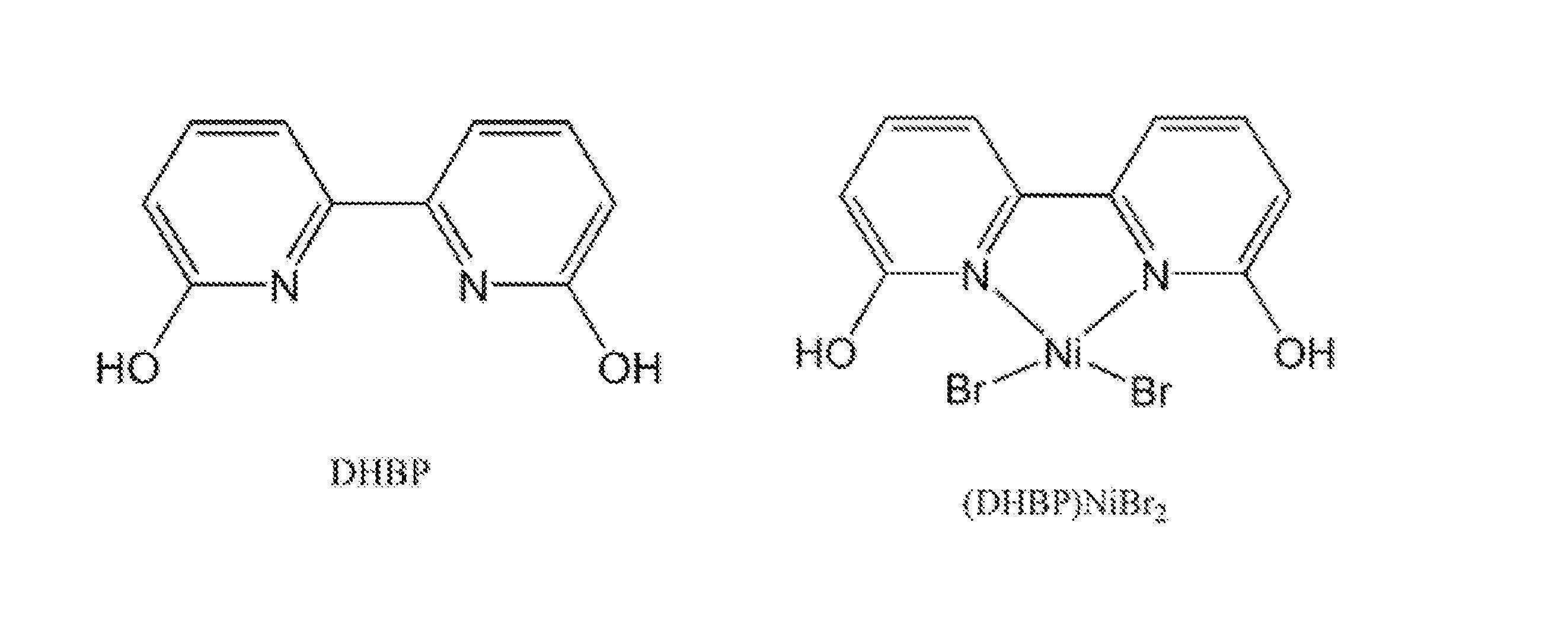
DHBPとNiBr2とを、THF中で、室温下で24時間反応させ、目的物である(DHBP)NiBr2を得た。IR測定及び元素分析により構造解析を行い、得られた化合物が(DHBP)NiBr2であることを確認した。
ガラスボトルに0.02mmolの(DHBP)NiBr2を入れ、ゴム栓で封じ、10分間Arフローすることで、系内をAr雰囲気に置換した。このガラスボトルに、10mLのトルエンを加え、-20℃に冷却した後、1,3-ブタジエン570mg、5-ノルボルネン-2-メチルアミン62mg、メチルアルミノキサン(MAO)(MAO中のAlがNiに対して100当量となるような量)の順に加え、30℃で1時間反応させた。反応終了後、反応混合系を5%塩酸メタノール溶液中に滴下し、吸引ろ過によって白色固体を回収し、この白色固体をクロロホルムで洗浄して、ポリブタジエン(収量:154mg)を得た。
ガラスボトルに0.02mmolの(DHBP)NiBr2を入れ、ゴム栓で封じ、10分間Arフローすることで、系内をAr雰囲気に置換した。このガラスボトルに、10mLのトルエンを加え、-20℃に冷却した後、1,3-ブタジエン550mg、5-ノルボルネン-2-メチルアミン62mg、メチルアルミノキサン(MAO)(MAO中のAlがNiに対して100当量となるような量)の順に加え、30℃で1時間反応させた。反応終了後、反応混合系を5%塩酸メタノール溶液中に滴下し、吸引ろ過によって白色固体を回収し、この白色固体をクロロホルムで洗浄して、ポリブタジエン(収量:119mg)を得た。
ガラスボトルに0.02mmolの(DHBP)NiBr2を入れ、ゴム栓で封じ、10分間Arフローすることで、系内をAr雰囲気に置換した。このガラスボトルに、30mLのトルエンを加え、-20℃に冷却した後、1,3-ブタジエン5520mg、メチルアルミノキサン(MAO)(MAO中のAlがNiに対して100当量となるような量)の順に加え、30℃で1時間反応させた。反応終了後、反応混合系を5%塩酸メタノール溶液中に滴下し、デカンテーションして、無色透明なゴム状固体であるポリブタジエン(収量:4110mg)を得た。
ポリブタジエンのシス-1,4結合量、トランス-1,4結合量、及び1,2-ビニル結合量は、1H-NMRスペクトル(1,2-ビニル結合量)及び13C-NMRスペクトル(シス-1,4結合量とトランス-1,4結合量の比)の積分比などから求めた。
(mm)(%)=(113.65±0.1ppmの積分強度比/105~125ppmの積分強度比の合計)×100
なお、参考までに、実施例1のポリブタジエンの13C-NMRスペクトルを図1に示す。
ポリブタジエンの融点は、JIS K 7121-1987に準拠し、示差走査熱量計(DSC、ティー・エイ・インスツルメント・ジャパン社製、「DSCQ2000」)を用いて測定した。実施例1のポリブタジエンの融点のみを測定したところ、図2に示すように、122.5℃であった。
ゲルパーミエーションクロマトグラフィー[GPC:東ソー社製HLC-8321GPC/HT、カラム:昭和電工社製HT-806M×2本、検出器:示差屈折率計(RI)]で単分散ポリスチレンを基準として、ポリブタジエンのポリスチレン換算の数平均分子量(Mn)を求めた。また、同様のやり方で、重量平均分子量(Mw)を求め、分子量分布(Mw/Mn)を算出した。結果を表1に示す。なお、測定温度は140℃である。
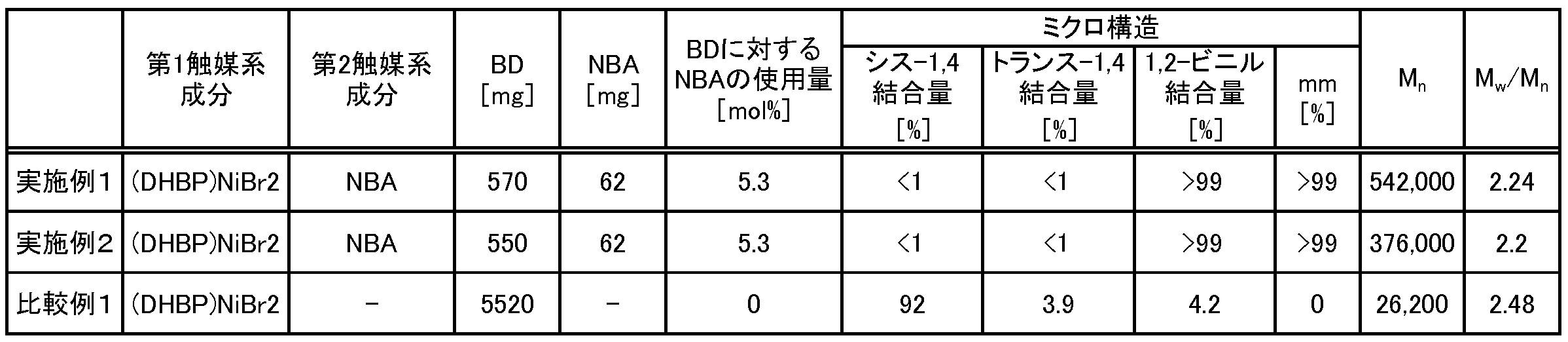
BD:1,3-ブタジエン
NBA:5-ノルボルネン-2-メチルアミン
Claims (15)
- トリアッドアイソタクティシティ(mm)が72%以上である、ことを特徴とする、ポリブタジエン。
- 前記トリアッドアイソタクティシティ(mm)が90%以上である、請求項1に記載のポリブタジエン。
- 1,2-ビニル結合量が65%以上である、請求項1又は2に記載のポリブタジエン。
- 融点が80℃以上130℃以下である、請求項1~3のいずれかに記載のポリブタジエン。
- 以下の構造式I:

- 前記触媒が、更に、以下の構造式II:
YR3 aR4 bR5 c 式II
(式中、Yは、周期表の第1族、第2族、第12族及び第13族から選択される金属であり、R3及びR4は、水素原子、又は、置換若しくは非置換の炭素数1~20の炭化水素基、アルコキシ基若しくはアリールオキシ基であり、R5は、置換又は非置換の炭素数1~20の炭化水素基、アルコキシ基若しくはアリールオキシ基であり、R3、R4及びR5は、それぞれ互いに同一であっても異なっていてもよく、a、b及びcは、独立して0又は1であり;ただし、Yが前記第1族から選択される金属である場合には、aは1であり且つb及びcは0であり;Yが前記第2族及び第12族から選択される金属である場合には、a及びbは1であり且つcは0であり;Yが前記第13族から選択される金属である場合には、a、b及びcは1である。)で表される化合物を含む、請求項5に記載のポリブタジエンの製造方法。 - 前記触媒が、更にアルミノキサンを含む、請求項5又は6に記載のポリブタジエンの製造方法。
- 前記触媒が、更にイオン性化合物及びハロゲン化合物の少なくともいずれかを含む、請求項5~7のいずれかに記載のポリブタジエンの製造方法。
- 前記構造式I中のMが、鉄(Fe)、コバルト(Co)、ニッケル(Ni)、パラジウム(Pd)又は銅(Cu)である、請求項5~8のいずれかに記載のポリブタジエンの製造方法。
- 前記ノルボルネン誘導体が、アミノ基を有する、請求項5~9のいずれかに記載のポリブタジエンの製造方法。
- 前記ノルボルネン誘導体を、前記1,3-ブタジエンに対して3~40mol%の割合で用いる、請求項5~10のいずれかに記載のポリブタジエンの製造方法。
- 前記1,3-ブタジエン、前記ノルボルネン誘導体の順に重合系に投入する、請求項5~11のいずれかに記載のポリブタジエンの製造方法。
- 請求項1~4のいずれかに記載のポリブタジエンを含む、ことを特徴とする、ポリブタジエン組成物。
- 請求項13に記載のポリブタジエン組成物を用いたことを特徴とする、タイヤ。
- 請求項13に記載のポリブタジエン組成物を用いたことを特徴とする、樹脂部材。
Priority Applications (3)
| Application Number | Priority Date | Filing Date | Title |
|---|---|---|---|
| EP19891970.6A EP3892652B1 (en) | 2018-12-05 | 2019-10-17 | Polybutadiene, polybutadiene production method, polybutadiene composition, tire, and resin member |
| US17/287,626 US12084536B2 (en) | 2018-12-05 | 2019-10-17 | Polybutadiene, method of producing polybutadiene, polybutadiene composition, tire, and resin member |
| JP2020559771A JP7402820B2 (ja) | 2018-12-05 | 2019-10-17 | ポリブタジエン、ポリブタジエンの製造方法、ポリブタジエン組成物、タイヤ、及び樹脂部材 |
Applications Claiming Priority (2)
| Application Number | Priority Date | Filing Date | Title |
|---|---|---|---|
| JP2018-228339 | 2018-12-05 | ||
| JP2018228339 | 2018-12-05 |
Publications (1)
| Publication Number | Publication Date |
|---|---|
| WO2020116037A1 true WO2020116037A1 (ja) | 2020-06-11 |
Family
ID=70975334
Family Applications (1)
| Application Number | Title | Priority Date | Filing Date |
|---|---|---|---|
| PCT/JP2019/040873 Ceased WO2020116037A1 (ja) | 2018-12-05 | 2019-10-17 | ポリブタジエン、ポリブタジエンの製造方法、ポリブタジエン組成物、タイヤ、及び樹脂部材 |
Country Status (4)
| Country | Link |
|---|---|
| US (1) | US12084536B2 (ja) |
| EP (1) | EP3892652B1 (ja) |
| JP (1) | JP7402820B2 (ja) |
| WO (1) | WO2020116037A1 (ja) |
Cited By (1)
| Publication number | Priority date | Publication date | Assignee | Title |
|---|---|---|---|---|
| JP2023021829A (ja) * | 2021-08-02 | 2023-02-14 | 株式会社ブリヂストン | 触媒組成物、重合体の製造方法、重合体、ゴム組成物、及びタイヤ |
Families Citing this family (1)
| Publication number | Priority date | Publication date | Assignee | Title |
|---|---|---|---|---|
| CN116041597B (zh) * | 2022-12-05 | 2024-08-13 | 金发科技股份有限公司 | 一种聚丁二烯胶乳和abs树脂及其制备方法 |
Citations (8)
| Publication number | Priority date | Publication date | Assignee | Title |
|---|---|---|---|---|
| JPH10168117A (ja) | 1996-12-06 | 1998-06-23 | Ube Ind Ltd | ポリブタジエンの製造方法 |
| WO2002102861A2 (en) * | 2001-06-15 | 2002-12-27 | Eni S.P.A. | Process for the (co)polymerization of conjugated dienes |
| JP2008546890A (ja) * | 2005-06-24 | 2008-12-25 | エクソンモービル・ケミカル・パテンツ・インク | 可塑化した官能性プロピレンコポリマー接着組成物 |
| US20090115108A1 (en) * | 2007-11-02 | 2009-05-07 | Rodgers Michael B | Ethylene-Propylene Terpolymers in Tire Sidewalls |
| JP2014109729A (ja) | 2012-12-03 | 2014-06-12 | Fujitsu Ltd | 光素子接続方法及び光素子接続装置 |
| US20180105624A1 (en) * | 2016-10-19 | 2018-04-19 | Exxonmobil Chemical Patents Inc. | High Filler Loaded Compositions with High Melt Flow Polyolefins |
| WO2018220538A1 (en) * | 2017-05-31 | 2018-12-06 | Versalis S.P.A. | Butadiene-isoprene diblock copolymers and process for the preparation thereof |
| WO2019044855A1 (ja) * | 2017-09-04 | 2019-03-07 | 株式会社ブリヂストン | 重合触媒組成物、重合体の製造方法、重合体、ゴム組成物およびタイヤ |
Family Cites Families (7)
| Publication number | Priority date | Publication date | Assignee | Title |
|---|---|---|---|---|
| US3536690A (en) * | 1968-06-24 | 1970-10-27 | Firestone Tire & Rubber Co | Process and product |
| US3879367A (en) * | 1973-11-19 | 1975-04-22 | Firestone Tire & Rubber Co | Production of crystalline, high-vinyl polybutadiene |
| JP3463811B2 (ja) * | 1991-04-24 | 2003-11-05 | Jsr株式会社 | ブタジエン系重合体の製造方法 |
| FR2762604B1 (fr) * | 1997-04-10 | 2001-01-05 | Atochem Elf Sa | Procede et systeme d'amorcage pour la (co)polymerisation anionique de monomeres (meth)acryliques, vinylaromatiques et/ou dieniques |
| US5879805A (en) * | 1997-09-09 | 1999-03-09 | Union Carbide Chemicals & Plastics Technology Corporation | Gas phase polymerization of vinylpolybutadiene |
| JP3845187B2 (ja) * | 1997-12-11 | 2006-11-15 | 三菱化学株式会社 | プロピレン系重合体 |
| JP5631589B2 (ja) * | 2007-06-14 | 2014-11-26 | 三井化学株式会社 | 熱可塑性エラストマー組成物 |
-
2019
- 2019-10-17 WO PCT/JP2019/040873 patent/WO2020116037A1/ja not_active Ceased
- 2019-10-17 EP EP19891970.6A patent/EP3892652B1/en active Active
- 2019-10-17 JP JP2020559771A patent/JP7402820B2/ja active Active
- 2019-10-17 US US17/287,626 patent/US12084536B2/en active Active
Patent Citations (8)
| Publication number | Priority date | Publication date | Assignee | Title |
|---|---|---|---|---|
| JPH10168117A (ja) | 1996-12-06 | 1998-06-23 | Ube Ind Ltd | ポリブタジエンの製造方法 |
| WO2002102861A2 (en) * | 2001-06-15 | 2002-12-27 | Eni S.P.A. | Process for the (co)polymerization of conjugated dienes |
| JP2008546890A (ja) * | 2005-06-24 | 2008-12-25 | エクソンモービル・ケミカル・パテンツ・インク | 可塑化した官能性プロピレンコポリマー接着組成物 |
| US20090115108A1 (en) * | 2007-11-02 | 2009-05-07 | Rodgers Michael B | Ethylene-Propylene Terpolymers in Tire Sidewalls |
| JP2014109729A (ja) | 2012-12-03 | 2014-06-12 | Fujitsu Ltd | 光素子接続方法及び光素子接続装置 |
| US20180105624A1 (en) * | 2016-10-19 | 2018-04-19 | Exxonmobil Chemical Patents Inc. | High Filler Loaded Compositions with High Melt Flow Polyolefins |
| WO2018220538A1 (en) * | 2017-05-31 | 2018-12-06 | Versalis S.P.A. | Butadiene-isoprene diblock copolymers and process for the preparation thereof |
| WO2019044855A1 (ja) * | 2017-09-04 | 2019-03-07 | 株式会社ブリヂストン | 重合触媒組成物、重合体の製造方法、重合体、ゴム組成物およびタイヤ |
Non-Patent Citations (2)
| Title |
|---|
| GIOVANNI RICCI ET AL.: "New Chromium (II) Bidentate Phosphine Complexes: Synthesis, Characterization, and Behavior in the Polymerization of 1,3-Butadiene", ORGANOMETALLICS, vol. 23, 2004, pages 3727 - 3732, XP001199985, DOI: 10.1021/om049846s |
| See also references of EP3892652A4 |
Cited By (2)
| Publication number | Priority date | Publication date | Assignee | Title |
|---|---|---|---|---|
| JP2023021829A (ja) * | 2021-08-02 | 2023-02-14 | 株式会社ブリヂストン | 触媒組成物、重合体の製造方法、重合体、ゴム組成物、及びタイヤ |
| JP7759749B2 (ja) | 2021-08-02 | 2025-10-24 | 株式会社ブリヂストン | 触媒組成物、重合体の製造方法、重合体、ゴム組成物、及びタイヤ |
Also Published As
| Publication number | Publication date |
|---|---|
| JP7402820B2 (ja) | 2023-12-21 |
| US20210395407A1 (en) | 2021-12-23 |
| JPWO2020116037A1 (ja) | 2021-10-28 |
| US12084536B2 (en) | 2024-09-10 |
| EP3892652A4 (en) | 2022-09-14 |
| EP3892652B1 (en) | 2025-04-30 |
| EP3892652A1 (en) | 2021-10-13 |
Similar Documents
| Publication | Publication Date | Title |
|---|---|---|
| CN111051360B (zh) | 聚合催化剂组合物、聚合物制造方法、聚合物、橡胶组合物和轮胎 | |
| JP2020045500A (ja) | 多元共重合体、ゴム組成物及びタイヤ | |
| JP5652688B2 (ja) | オレフィンと芳香族ビニル化合物からなる共重合体の製造方法 | |
| JP2018536074A (ja) | 希土類メタロセンを含む触媒予備形成系 | |
| TWI653250B (zh) | 用以製備由立體特異性聚合之具有1,4-順式/對排1,2結構之立體規則性雙嵌段聚丁二烯之方法 | |
| CN103443151B (zh) | 共聚物、橡胶组合物、交联橡胶组合物和轮胎 | |
| CN101400707B (zh) | 用于异戊二烯系化合物聚合的聚合催化剂组合物 | |
| WO2017065300A1 (ja) | 多元共重合体、樹脂組成物、架橋樹脂組成物、及び製品 | |
| JP7402820B2 (ja) | ポリブタジエン、ポリブタジエンの製造方法、ポリブタジエン組成物、タイヤ、及び樹脂部材 | |
| KR102418429B1 (ko) | 지르코늄의 피리딘 착물, 상기 지르코늄의 피리딘 착물을 포함하는 촉매 시스템 및 컨쥬게이션된 디엔의 (공)중합 방법 | |
| US20130116113A1 (en) | Catalyst composition, production process for norbornene base copolymer by using catalyst composition, norbornene base copolymer and heat resistant film prepared by using the same | |
| JP6574190B2 (ja) | 立体特異性重合による1,4−シス/シンジオタクチック1,2構造を有する立体規則性ジブロックポリブタジエン | |
| JP7759749B2 (ja) | 触媒組成物、重合体の製造方法、重合体、ゴム組成物、及びタイヤ | |
| JP7773867B2 (ja) | 触媒組成物、重合体の製造方法、重合体、ゴム組成物、及びタイヤ | |
| JP2011225632A (ja) | ノルボルネン系共重合体の製造方法 | |
| WO2020235285A1 (ja) | 多元共重合体、ゴム組成物、樹脂組成物、タイヤ及び樹脂製品 | |
| JP6464027B2 (ja) | 共役ジエン重合体の製造方法、共重合体の製造方法、重合体組成物の製造方法および共役ジエン重合体組成物 | |
| CN116568718A (zh) | 立构嵌段二烯共聚物及其制备方法 | |
| JP2008056584A (ja) | カチオン錯体、これを含有してなる重合触媒、この重合触媒を用いる重合方法及び重合体 | |
| JP2010076774A (ja) | 食品用シール容器 | |
| JP2017200983A (ja) | 共役ジエン系共重合体及びその製造方法、ゴム組成物、架橋ゴム組成物、並びにタイヤ | |
| JP2016210846A (ja) | ゴム変性耐衝撃性ポリスチレン系樹脂組成物の製造方法 |
Legal Events
| Date | Code | Title | Description |
|---|---|---|---|
| 121 | Ep: the epo has been informed by wipo that ep was designated in this application |
Ref document number: 19891970 Country of ref document: EP Kind code of ref document: A1 |
|
| ENP | Entry into the national phase |
Ref document number: 2020559771 Country of ref document: JP Kind code of ref document: A |
|
| NENP | Non-entry into the national phase |
Ref country code: DE |
|
| ENP | Entry into the national phase |
Ref document number: 2019891970 Country of ref document: EP Effective date: 20210705 |
|
| WWG | Wipo information: grant in national office |
Ref document number: 2019891970 Country of ref document: EP |