WO2020121494A1 - Dispositif arithmétique, procédé de détermination d'action et support lisible par ordinateur non transitoire stockant un programme de commande - Google Patents
Dispositif arithmétique, procédé de détermination d'action et support lisible par ordinateur non transitoire stockant un programme de commande Download PDFInfo
- Publication number
- WO2020121494A1 WO2020121494A1 PCT/JP2018/045947 JP2018045947W WO2020121494A1 WO 2020121494 A1 WO2020121494 A1 WO 2020121494A1 JP 2018045947 W JP2018045947 W JP 2018045947W WO 2020121494 A1 WO2020121494 A1 WO 2020121494A1
- Authority
- WO
- WIPO (PCT)
- Prior art keywords
- state
- information
- degree
- action
- candidate actions
- Prior art date
- Legal status (The legal status is an assumption and is not a legal conclusion. Google has not performed a legal analysis and makes no representation as to the accuracy of the status listed.)
- Ceased
Links
Images


Classifications
-
- G—PHYSICS
- G06—COMPUTING OR CALCULATING; COUNTING
- G06N—COMPUTING ARRANGEMENTS BASED ON SPECIFIC COMPUTATIONAL MODELS
- G06N3/00—Computing arrangements based on biological models
- G06N3/02—Neural networks
- G06N3/08—Learning methods
-
- G—PHYSICS
- G06—COMPUTING OR CALCULATING; COUNTING
- G06N—COMPUTING ARRANGEMENTS BASED ON SPECIFIC COMPUTATIONAL MODELS
- G06N3/00—Computing arrangements based on biological models
- G06N3/02—Neural networks
- G06N3/04—Architecture, e.g. interconnection topology
- G06N3/045—Combinations of networks
-
- G—PHYSICS
- G06—COMPUTING OR CALCULATING; COUNTING
- G06N—COMPUTING ARRANGEMENTS BASED ON SPECIFIC COMPUTATIONAL MODELS
- G06N3/00—Computing arrangements based on biological models
- G06N3/02—Neural networks
- G06N3/08—Learning methods
- G06N3/082—Learning methods modifying the architecture, e.g. adding, deleting or silencing nodes or connections
-
- G—PHYSICS
- G06—COMPUTING OR CALCULATING; COUNTING
- G06N—COMPUTING ARRANGEMENTS BASED ON SPECIFIC COMPUTATIONAL MODELS
- G06N3/00—Computing arrangements based on biological models
- G06N3/02—Neural networks
- G06N3/08—Learning methods
- G06N3/091—Active learning
-
- G—PHYSICS
- G06—COMPUTING OR CALCULATING; COUNTING
- G06N—COMPUTING ARRANGEMENTS BASED ON SPECIFIC COMPUTATIONAL MODELS
- G06N3/00—Computing arrangements based on biological models
- G06N3/02—Neural networks
- G06N3/08—Learning methods
- G06N3/092—Reinforcement learning
-
- G—PHYSICS
- G06—COMPUTING OR CALCULATING; COUNTING
- G06N—COMPUTING ARRANGEMENTS BASED ON SPECIFIC COMPUTATIONAL MODELS
- G06N3/00—Computing arrangements based on biological models
- G06N3/02—Neural networks
- G06N3/06—Physical realisation, i.e. hardware implementation of neural networks, neurons or parts of neurons
- G06N3/063—Physical realisation, i.e. hardware implementation of neural networks, neurons or parts of neurons using electronic means
Definitions
- the present disclosure relates to a computing device, an action determination method, and a control program.
- Non-Patent Document 1 Various researches have been conducted on “reinforcement learning” (for example, Non-Patent Document 1).
- Policy policy
- actions actions
- Non-Patent Document 1 mentions the importance of search, it does not disclose a specific technique for realizing efficient search.
- An object of the present disclosure is to provide an arithmetic device, an action determination method, and a control program that can realize efficient search.
- the arithmetic unit uses a plurality of pieces of transition information indicating a relationship between the first state at the first timing and the second state at the second timing after the first timing, and uses the plurality of transition information.
- Determining means for determining a plurality of second states for each of the plurality of possible candidate actions, calculating means for calculating the degree of variation of the plurality of second states for each of the candidate actions, and based on the degree of variation.
- Selecting means for selecting some candidate actions from the plurality of candidate actions.
- the action determination method uses the information processing apparatus to generate a plurality of pieces of transition information indicating a relationship between the first state at the first timing and the second state at the second timing after the first timing.
- the plurality of second states are determined for each of the plurality of candidate actions that can be performed in the first state, the degree of variation of the plurality of second states is calculated for each of the candidate actions, and based on the degree of variation, , Some candidate actions are selected from the plurality of candidate actions.
- the control program uses a plurality of pieces of transition information indicating the relationship between the first state at the first timing and the second state at the second timing after the first timing, using the first state.
- the arithmetic unit is caused to execute a process of selecting a part of the candidate actions.
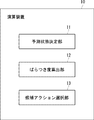
- FIG. 1 is a block diagram showing an example of the arithmetic device of the first embodiment.
- the computing device (action determination device) 10 includes a prediction state determination unit 11, a variation degree calculation unit 12, and a candidate action selection unit 13.
- first timing the state of the control target at a certain timing
- second timing The state of the control target at one timing after a certain timing
- first state and second state do not necessarily have to be mutually different states and may represent the same state.
- first state and the second state will be referred to as “change from the first state to the second state” regardless of the difference between the first state and the second state.
- first timing and the second timing do not represent specific timings, but represent two mutually different timings.
- the predicted state determination unit 11 uses a plurality of state transition information (transition information units) to determine a plurality of “predicted states” for each of a plurality of “candidate actions” possible in the first state.
- Each transition information unit is used to calculate a predicted state after the first timing (for example, the second timing) from the first state and the action in the first state. That is, each transition information unit holds the first state of each transition information unit, and has the function of determining the predicted state according to the combination of the first state and the action.
- each transition information unit includes a set in which a state of the actual environment at a certain timing (actual environment state) and an action actually performed on the actual environment at the certain timing are associated with each other. It is created (trained) based on the history information. The set represents information in which two states and actions between the two states are associated with each other.
- the variation degree calculation unit 12 calculates the “variation degree” of the plurality of prediction states determined for each candidate action by the prediction state determination unit 11.
- the “variation degree” is, for example, a variance value.
- the candidate action selection unit 13 selects a part of the plurality of candidate actions described above based on the plurality of variation levels calculated by the variation calculation unit 12. For example, the candidate action selection unit 13 selects the candidate action corresponding to the maximum value of the plurality of variation degrees calculated by the variation degree calculation unit 12 among the plurality of candidate actions described above.
- the prediction state determination unit 11 in the arithmetic device 10 uses a plurality of transition information units to determine a plurality of possible “candidate actions” in the first state. "Predicted state” of.
- the variation degree calculation unit 12 calculates the “variation degree” of the plurality of prediction states determined by the prediction state determination unit 11 for each candidate action.
- the candidate action selection unit 13 selects some candidate actions from the above plurality of candidate actions based on the plurality of variation degrees calculated by the variation degree calculation unit 12.
- the arithmetic unit 10 By the configuration of the arithmetic unit 10, efficient search can be performed. That is, when the state transition from the first state to the second state due to the candidate action is “state transition with insufficient training” in the transition information unit, the “variation degree” of the predicted state of the state transition tends to be high. It is in. That is, the “variation degree” can be used as an index indicating the training progress degree of the state transition in the transition information unit.
- the above-mentioned “incomplete training state transition” may represent a state transition that is not sufficiently accumulated in the above “history information”, that is, a state transition in which the search is not sufficient in the actual environment.
- the transition information unit can be efficiently trained.
- the second embodiment relates to a more specific embodiment.
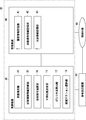
- FIG. 2 is a block diagram showing an example of the control device 20 including the arithmetic device 30 of the second embodiment.
- FIG. 2 shows a command execution device 50 and a controlled object 60.
- the control device 20 turns the steering wheel to the right based on, for example, the number of revolutions of the engine, the speed of the vehicle, the observed value (feature amount) of the surrounding conditions, and the like. Determine the action such as stepping on the accelerator or the brake.
- the command execution device 50 controls the accelerator, the steering wheel, or the brake according to the action determined by the arithmetic device 30.
- control device 20 increases the amount of fuel based on, for example, the rotational speed of the turbine, the temperature of the combustion furnace, the pressure of the combustion furnace, and the like. Decide actions such as reducing the amount of.
- the command execution device 50 executes control such as closing a valve that adjusts the amount of fuel or opening the valve according to the action determined by the control device 20.
- the controlled object 60 is not limited to the example described above, and may be, for example, a production factory or a chemical factory, or a simulator or the like that simulates the operation of a vehicle, the operation of a generator, or the like. ..
- the control device 20 executes “processing phase 1”, “processing phase 2”, and “processing phase 3”, which will be described later. By executing these processes, the control device 20 determines an action so that the state of the controlled object 60 approaches the desired state earlier. At this time, the control device 20 determines an action to be executed with respect to the state of the controlled object 60 based on the policy information and the reward information.
- the policy information represents an action that can be executed when the control target 60 is in a certain state.
- the policy information can be realized using, for example, information in which the certain state and the action are associated with each other.
- the policy information may be, for example, a process of calculating the action when the certain state is given.
- the process may be, for example, a model that represents a relationship between the certain state and the action, which is calculated by a certain function or a statistical method. That is, the policy information is not limited to the above example.
- Reward information indicates the degree to which a certain state is desirable (hereinafter referred to as "reward degree").
- the reward information can be realized using, for example, information in which the certain state and the degree are associated with each other.
- the reward information may be, for example, a process of calculating the degree of reward when the certain state is given.
- the process may be, for example, a model representing a relationship between the certain state and the degree of reward, which is calculated by a certain function or a statistical method. That is, the reward information is not limited to the above example.
- the control target 60 is a vehicle, a generator, or the like (hereinafter, referred to as “actual environment”) for convenience of description.
- the state of the controlled object 60 at a certain timing (hereinafter, referred to as “first timing”) is represented as “first state”.
- the state of the controlled object 60 at the timing next to a certain timing (hereinafter, referred to as “second timing”) is represented as “second state”.
- first timing The state of the controlled object 60 at the timing next to a certain timing
- second timing is represented as “second state”.
- the state of the controlled object 60 changes to the second state after the action according to the first state is performed.
- the first state and the second state do not necessarily have to be mutually different states and may represent the same state.
- the first state and the second state will be referred to as “change from the first state to the second state” regardless of the difference between the first state and the second state.
- the control device 20 determines the action for each timing by performing the processing described below in the processing phase 1 to the processing phase 3 while referring to the observed value of the controlled object 60 for a plurality of timings. That is, the control device 20 executes the process regarding the second timing after executing the process regarding the first timing, and further executes the process regarding the timing after the second timing. Therefore, the first timing and the second timing do not represent specific timings, but represent two consecutive timings regarding the processing in the control device 20.
- the control device 20 estimates the second state of the controlled object 60 after executing the action with respect to the controlled object 60 that is the first state based on the state transition information (described later). The control device 20 executes the process of estimating the second state for each of the plurality of candidate actions. Then, the control device 20 uses the reward information to calculate the degree of reward for each estimated second state. The control device 20 selects one action out of the plurality of candidate actions among the candidate actions having the higher calculated reward degree. The control device 20 may select one action having the largest calculated reward degree from the plurality of candidate actions. The control device 20 outputs a control command indicating the selected action to the command execution device 50.
- Higher ranks represent, for example, 1%, 5%, or 10% within a predetermined ratio, counting from the highest reward level to the highest reward level.
- the state transition information is information indicating the relationship between the first state and the second state.
- the state transition information may be information in which the first state and the second state are associated with each other, or statistical information such as a neural network using training data in which the first state and the second state are associated with each other.
- the information may be calculated by any method.
- the state transition information may further include information indicating an action that can be executed in the first state, and is not limited to the example described above.
- the command execution device 50 receives the control command by the control device 20, and executes the action indicated by the received control command with respect to the control target 60. As a result, the state of the controlled object 60 changes from the first state to the second state.
- a sensor (not shown) observing the controlled object 60 is attached to the controlled object 60. It is assumed that the sensor creates sensor information representing the observed value of the controlled object 60 and outputs the created sensor information. There may be a plurality of sensors observing the controlled object 60.
- the control device 20 receives the sensor information created by the sensor after the action regarding the first state is executed, and determines the second state regarding the received sensor information.
- the control device 20 creates information (hereinafter referred to as “history information”) in which the first state, the action, and the second state are associated with each other.
- the control device 20 may store the created history information in the history information storage unit 41 described later.
- history information at a plurality of timings is stored in the history information storage unit 41 described later.
- the control device 20 updates (or creates) the state transition information using the history information accumulated in the processing phase 1.
- the control device 20 creates the state transition information by using the data included in the history information as described above as the training data.
- the control device 20 creates a plurality of state transition information by using, for example, neural networks whose configurations are different from each other.
- the control device 20 predicts, for each of the plurality of candidate actions, the second state after performing the candidate action on the target based on the state transition information.
- the control device 20 predicts the plurality of second states by using mutually different state transition information (that is, each transition information unit).
- the predicted second state is referred to as “pseudo state”. That is, the control device 20 creates a pseudo state by using different state transition information (that is, each transition information unit).
- the control device 20 sets the state transition information for at least one of the first state and the information indicating the candidate action in the first state. By applying, the pseudo state is created.
- control device 20 creates a plurality of pseudo states for each candidate action.
- the control device 20 calculates the degree of variation in a plurality of pseudo states for each candidate action.
- the control device 20 selects an action from a plurality of candidate actions based on the variation degree.
- the control device 20 identifies a candidate action having a higher degree of variation calculated from a plurality of candidate actions, and selects an action from the identified candidate actions.
- the control device 20 may select, for example, a candidate action having the largest calculated degree of variation from a plurality of candidate actions.
- the upper rank indicates, for example, that the value is within a predetermined ratio such as 1%, 5%, or 10%, counting from the one with the largest variability to the one with the largest variability.
- the control device 20 may use the reward information to obtain the reward degree in the pseudo state after one action, and may select an action based on the obtained reward degree and the degree of variation with respect to the one action.
- the control device 20 obtains the reward degree for the action by, for example, obtaining the average (or median) of the reward degrees for the pseudo states.
- the control device 20 obtains the reward degree for the action by, for example, obtaining a state in which each pseudo state has a higher frequency and obtaining the average (or median value) of the reward degrees for the obtained states.
- the higher rank indicates that the frequency is within a predetermined ratio such as 1%, 5%, or 10%, counting from the highest frequency to the highest frequency.
- the process of obtaining the reward degree related to the action is not limited to the above example.
- the degree of reward and the degree of variation may be added, or the degree of reward may be added. And a weighted average of the variation degree may be calculated.
- the process of selecting an action is not limited to the example described above.
- control device 20 After selecting the action, the control device 20 outputs a control command indicating the selected action to the command execution device 50.
- the command execution device 50 executes the action indicated by the received control command on the control target 60.
- the control device 20 has a computing device 30 and a storage device 40.
- the computing device 30 includes a state estimating unit 31, a state transition information updating unit (state transition information creating unit) 32, a control command computing unit 33, a predicted state determining unit 11, a variation degree calculating unit 12, and a candidate action selection. And a part 13.
- the storage device 40 has a history information storage unit 41, a state transition information storage unit 42, and a policy information storage unit 43.
- the state estimation unit 31 receives an observed value (parameter value, sensor information) representing the first state of the controlled object 60.
- the state estimation unit 31 estimates the second state of the controlled object 60 after performing the action on the controlled object 60 that is the first state, based on the received sensor information and the state transition information.
- the state estimation unit 31 executes a process of estimating the second state for each of the actions in the plurality of candidate actions. That is, the state estimation unit 31 creates a pseudo state for each candidate action.
- the control command calculation unit 33 uses the reward information to calculate the degree of reward for each pseudo state created by the state estimation unit 31.
- the control command calculation unit 33 selects one action from the plurality of candidate actions, out of the candidate actions having the higher calculated reward degree.
- the control command calculation unit 33 creates a control command indicating the selected action and outputs the created control command to the command execution device 50.
- the command execution device 50 receives the control command and executes the action related to the control target 60 according to the action indicated by the received control command. As a result of the action on the controlled object 60, the state of the controlled object 60 changes from the first state to the second state.
- the state estimation unit 31 receives an observation value (parameter value, sensor information) representing the state of the controlled object 60 (in this case, the second state).
- the state estimation unit 31 creates history information in which the first state, the action executed in the first state, and the second state are associated with each other, and stores the created history information in the history information storage unit 41. ..
- the above history information is accumulated in the history information storage unit 41 by repeating the above-described processing regarding the processing phase 1.
- Processing phase 2 For convenience of description, the processing in the processing phase 2 will be described by using an example of creating the state transition information using a statistical method (a predetermined processing procedure) such as a neural network.
- the predetermined processing procedure is, for example, a procedure according to a machine learning method such as a neural network.
- the state transition information update unit 32 uses the history information accumulated in the history information storage unit 41 to create a plurality of transition information units according to a predetermined processing procedure. That is, the state transition information updating unit 32 creates state transition information according to a predetermined processing procedure using the history information as training data, and stores the created state transition information in the state transition information storage unit 42. As described above, the state transition information represents the relationship between the first state and the second state.
- the state transition information updating unit 32 may create a plurality of transition information units using a plurality of neural nets having different configurations.
- the plurality of neural nets having different configurations are, for example, a plurality of neural nets having different numbers of nodes or connection patterns between nodes.
- a plurality of neural networks having different configurations use a certain neural network and a neural network in which some nodes in the certain neural network do not exist (that is, some nodes are dropped out). May have been realized.
- the state transition information updating unit 32 may create a plurality of transition information units using a plurality of neural nets having different initial values of parameters.
- the state transition information updating unit 32 may use, as training data, part of the history information, or data obtained by sampling the history information while allowing duplication. In this case, the plurality of transition information units create state transition information for different training data.
- the predetermined processing procedure is not limited to the neural net.
- the predetermined processing procedure may be a procedure for calculating an SVM (support vector machine), a random forest, bagging (bootstrap aggregating), or a Bayesian network.
- the prediction state determination unit 11 predicts, for each of the plurality of candidate actions, the second state after performing the candidate action on the target based on the state transition information.
- the predicted state determination unit 11 creates a plurality of pseudo states by using mutually different state transition information (that is, each transition information unit).
- the variation degree calculation unit 12 calculates the variation degree (for example, variance value, entropy, etc.) of the plurality of pseudo states created by the prediction state determination unit 11, and outputs the calculated variation degree to the candidate action selection unit 13.
- the variation degree may be, for example, a value obtained by adding a certain number to the variance value, or the like, and is not limited to the example described above.
- the candidate action selection unit 13 selects an action from a plurality of candidate actions based on the degree of variation.
- the candidate action selection unit 13 identifies a candidate action having a higher calculated variation degree from a plurality of candidate actions, and selects an action from the identified candidate actions.
- the candidate action selection unit 13 may select, for example, a candidate action having the largest calculated degree of variation from a plurality of candidate actions.
- the control command calculation unit 33 creates a control command indicating the action selected by the candidate action selection unit 13, and outputs the created control command to the command execution device 50.
- the candidate action selection unit 13 selects an action having a large degree of variation.
- the degree of variability represents that the results calculated according to the state transition information vary. Therefore, if the degree of variation is large, it can be said that the state transition information is unstable. That is, by executing an action having a large degree of variation, it is possible to positively search for a state transition in which the search is insufficient.
- the candidate action selection unit 13 may create state value information indicating the degree of value related to the state based on the state value information.
- the state value information is, for example, a function that represents the degree of value of the state with respect to the state. In this case, the value can be said to be information indicating the degree to which it is desirable to realize the state.
- the state-value information can also be referred to as information indicating how desirable the state of the controlled object 60 after the action is.
- the state value information can also be referred to as information indicating how desirable the action is.
- the candidate action selection unit 13 may use the reward information in the process of creating the state value information. For example, the candidate action selection unit 13 may newly set the degree of variation calculated for each action as state value information. For example, the candidate action selection unit 13 sets the degree of variation calculated for each action as state value information, and then updates the state value information by performing processing such as adding reward information about the action. Good. In this case, the degree of variation can also be said to be an additional reward (pseudo additional reward) for the reward information.
- the process of creating the state value information is not limited to the above-described example, and for example, a value obtained by adding a predetermined value to the reward information, a value obtained by subtracting a predetermined value from the reward information, or a predetermined value to the reward information. It may be executed based on the multiplied value or the like. That is, as the degree of variation is larger, the state value information may be information indicating that the degree of value is higher.
- the candidate action selection unit 13 may select a candidate action having a higher value from the plurality of candidate actions based on the state value information, and may select an action from the selected candidate actions.
- the candidate action selection unit 13 may select the candidate action having the highest calculated value, for example.
- the upper rank indicates that the value is within a predetermined ratio such as 1%, 5%, or 10%, counting from the highest value to the highest value.
- the command execution device 50 receives the control command and executes the action related to the control target 60 according to the action indicated by the received control command. As a result of the action on the controlled object 60, the state of the controlled object 60 changes from the first state to the second state.
- the state estimation unit 31 receives an observation value (parameter value, sensor information) representing the state of the controlled object 60 (in this case, the second state).
- the state estimation unit 31 creates history information in which the first state, the action executed in the first state, and the second state are associated with each other, and stores the created history information in the history information storage unit 41. ..
- history information at a plurality of timings is accumulated in the history information storage unit (not shown).
- FIG. 3 is a flowchart showing an example of the processing operation of the arithmetic unit according to the second embodiment.
- step S101 corresponds to the above processing phase 1
- step S102 corresponds to the processing phase 2
- steps S103 and S104 correspond to the processing phase 3.
- the arithmetic unit 30 acquires the history information by repeating at least one of the processing phase 1 and the processing phase 2 or the processing phase 3 and the processing phase 2 until the history information is accumulated ( Step S101).
- the arithmetic unit 30 updates the state transition information according to the processing shown in the processing phase 2 (step S102).
- the arithmetic unit 30 calculates the degree of variation according to the processing described above in the processing phase 3 (step S103).
- the arithmetic unit 30 updates the policy information based on the history information (step S104). Specifically, the arithmetic device 30 identifies the first state, the action executed in the first state, and the second state based on the history information, and uses the identified information to obtain the policy information. Update. Then, the processing step returns to step S101 (processing phase 1).
- the arithmetic device 30 accumulates the history information in the processing phase 3, updates the policy information, and then immediately returns to the processing phase 1.
- the process described above with reference to FIG. 3 is described as “batch learning”. That is, the batch learning represents a process of updating (or creating) the policy information using the history information after the history information is accumulated to some extent (for convenience of description, referred to as “first accumulation degree”). The first accumulation degree indicates that there are multiple histories.
- the processing in the arithmetic device 30 is not limited to the batch learning described above, and for example, the policy information may be updated (or created) by online learning or updated (or created) by mini-batch learning. Good.
- Online learning represents the process of updating (or creating) policy information using the history information each time one history is added.
- Mini-batch learning refers to a process of updating (or creating) policy information using the history information after the history information is accumulated to some extent (for convenience of explanation, referred to as “second storage degree”).
- the second accumulation degree indicates that there are multiple histories.
- Mini-batch learning is a process similar to batch learning. However, the second accumulation degree is smaller than the first accumulation degree.
- the first accumulation degree and the second accumulation degree do not necessarily have to be constant for each iterative process shown in the processing phases 1 to 3, and may represent different numbers for each iterative process. ..
- the policy information may be updated each time history information is acquired, and the procedure may be modified so as to return to step S101 (processing phase 1). That is, in the case of online learning, the candidate action selection unit 13 updates the policy model every time the sensor information regarding the second state arrives.
- Mini-batch learning is the same as the processing operation of “online learning” except for the update timing of policy information. That is, since the amount of history information used to update the policy information once in the "mini-batch learning” is larger than that in the "online learning", the update cycle of the policy information in the "mini-batch learning” is longer than that in the "online learning”. Become.
- the third embodiment relates to a more specific embodiment. That is, the third embodiment relates to a variation of the second embodiment.
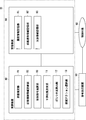
- FIG. 4 is a block diagram showing an example of the control device 70 including the arithmetic device 80 of the third embodiment. In addition to the control device 70, FIG. 4 illustrates the command execution device 50 and the controlled object 60 as in FIG. 2.
- the control device 70 executes "processing phase 1", “processing phase 2", and “processing phase 3" as described later. By executing these processes, the control device 70 learns the policy information so that the state of the controlled object 60 approaches the desired state earlier.
- the policy information represents an action that can be executed when the control target 60 is in a certain state.
- the policy information can be realized using, for example, information in which the certain state and the action are associated with each other.
- the policy information may be, for example, a process of calculating the action when the certain state is given.
- the process may be, for example, a model that represents a relationship between the certain state and the action, which is calculated by a certain function or a statistical method. That is, the policy information is not limited to the above example.
- the control target 60 is a vehicle, a generator, or the like (hereinafter, referred to as “actual environment”) for convenience of description.
- the state of the controlled object 60 at a certain timing (hereinafter, referred to as “first timing”) is represented as “first state”.
- the state of the controlled object 60 at the timing next to a certain timing (hereinafter, referred to as “second timing”) is represented as “second state”.
- first timing The state of the controlled object 60 at the timing next to a certain timing
- second timing is represented as “second state”.
- the state of the controlled object 60 changes to the second state after the action according to the first state is performed.
- the first state and the second state do not necessarily have to be mutually different states and may represent the same state.
- the first state and the second state will be referred to as “change from the first state to the second state” regardless of the difference between the first state and the second state.
- the control device 70 determines an action for each timing by executing a process described below with reference to the state of the control target 60 with respect to a plurality of timings in a “processing phase 1” described later. That is, the control device 70 executes the process for the first timing, then executes the process for the second timing, and further executes the process for the timing after the second timing. Therefore, the first timing and the second timing do not represent specific timings, but represent two consecutive timings regarding the processing in the control device 70.
- the control device 70 determines an action for the controlled object 60 in the first state based on the first state and the policy information, and outputs a control command indicating the determined action to the command execution device 50.
- the command execution device 50 receives the control command by the control device 70, and executes the action indicated by the received control command with respect to the control target 60. As a result, the state of the controlled object 60 changes from the first state to the second state.
- a sensor (not shown) observing the controlled object 60 is attached to the controlled object 60. It is assumed that the sensor creates sensor information representing the observed value of the controlled object 60 and outputs the created sensor information. There may be a plurality of sensors observing the controlled object 60.
- the control device 70 receives the sensor information created by the sensor after the action regarding the first state is executed, and estimates the second state regarding the received sensor information.
- the control device 70 creates information (hereinafter referred to as “history information”) in which the first state, the action, and the second state are associated with each other.
- the control device 70 may store the created history information in the history information storage unit 91 described later.
- history information at a plurality of timings is stored in the history information storage unit 41 described later.
- the control device 70 updates (or creates) the state transition information using the history information accumulated in the processing phase 1.
- the control device 70 creates the state transition information by using the data included in the history information as described above as the training data. As will be described later, the control device 70 creates a plurality of state transition information using, for example, neural networks having mutually different configurations.
- the state transition information is information indicating the relationship between the first state and the second state, and for example, the state transition of the controlled object 60 (that is, the state transition from the first state to the second state by an action). Is modeled using history information. That is, the second state corresponding to the combination of the first state and the action can be predicted by using the state transition information.
- the first state and the second state of the state transition information may be represented as “first pseudo state” and “second pseudo state”. .. Further, the "second pseudo state” may be referred to as a "predicted state”.
- the control device 70 determines a plurality of “predicted states” for each of a plurality of “candidate actions” that are possible in the first pseudo state, based on the state transition information.
- the control device 70 creates a plurality of second pseudo states by using different state transition information (that is, each transition information unit).
- the control device 70 applies the state transition information to the first pseudo state and the information indicating the candidate action in the first pseudo state. , Create a second pseudo state.
- control device 70 creates a plurality of prediction states for each candidate action.
- the control device 70 calculates the degree of variation in a plurality of prediction states for each candidate action.
- the control device 70 selects an action from a plurality of candidate actions based on the variation degree. Since this selected action is used for updating the policy information, as will be described later, it may be hereinafter referred to as “update use action”.
- the control device 70 specifies a candidate action having a higher calculated degree of variation from the plurality of candidate actions, and selects an update use action from the specified candidate actions.
- the control device 70 may select, for example, a candidate action having the largest calculated degree of variation from a plurality of candidate actions.
- the upper rank indicates, for example, that the value is within a predetermined ratio such as 1%, 5%, or 10%, counting from the one with the largest variability to the one with the largest variability.
- the control device 70 obtains the degree of reward in the predicted state after one candidate action using the reward information, and selects the update use action based on the obtained degree of reward and the degree of variation with respect to the one candidate action.
- the reward information represents the degree to which a certain state is desirable (that is, “reward degree”).
- the reward information can be realized using, for example, information in which the certain state and the degree are associated with each other.
- the reward information may be, for example, a process of calculating the degree of reward when the certain state is given.
- the process may be, for example, a model representing a relationship between the certain state and the degree of reward, which is calculated by a certain function or a statistical method. That is, the reward information is not limited to the above example.
- the control device 70 obtains the reward degree relating to the candidate action by, for example, obtaining the average (or median) of the reward degree relating to each prediction state.
- the control device 70 obtains the reward degree regarding the candidate action by, for example, obtaining a state in which the frequency of each predicted state is high and obtaining the average (or median value) of the degree of reward regarding the obtained state.
- the higher rank indicates that the frequency is within a predetermined ratio, such as 1%, 5%, or 10%, counting from the highest frequency to the highest frequency.
- the process of obtaining the degree of reward for the candidate action is not limited to the example described above.
- the reward degree and the variation degree may be added.
- a weighted average of the degree of reward and the degree of variation may be calculated.
- the control device 70 updates the policy information based on the update use action. For example, the control device 70 updates the policy information such that the update use action is selected in the processing phase 1 deterministically or with a higher probability than other actions. This updated policy information will be used in the processing phase 1.
- the control device 70 has a computing device 80 and a storage device 90.
- the computing device 30 includes a state estimating unit 81, a state transition information updating unit (state transition information creating unit) 82, a control command computing unit 83, a predicted state determining unit 11, a variation degree calculating unit 12, and a candidate action selection. And a part 13.
- the storage device 90 has a history information storage unit 91, a state transition information storage unit 92, and a policy information storage unit 93.
- the configuration of the control device 70 will be described for each processing phase.
- the state estimation unit 81 receives an observation value (parameter value, sensor information) representing the state of the controlled object 60.
- the state estimation unit 81 estimates the state of the controlled object 60 based on the received observation value (parameter value, sensor information).
- the control command calculation unit 83 determines an action based on the state estimated by the state estimation unit 81 and the policy information stored in the policy information storage unit 93, and issues a control command indicating the determined action to the command execution device 50. Output to.
- the command execution device 50 receives the control command by the control device 70, and executes the action indicated by the received control command with respect to the control target 60. As a result, the state of the controlled object 60 changes from the first state to the second state.
- the state estimation unit 81 receives an observed value (parameter value, sensor information) representing the state of the controlled object 60 (in this case, the second state).
- the state estimation unit 81 creates history information in which the first state, the action executed in the first state, and the second state are associated with each other, and stores the created history information in the history information storage unit 91. ..
- the above history information is accumulated in the history information storage unit 91 by repeating the above-described processing regarding the processing phase 1.
- Processing phase 2 For convenience of description, the configuration of the control device 70 corresponding to the processing phase 2 will be described by using an example of creating the state transition information using a statistical method (a predetermined processing procedure) such as a neural network.
- the predetermined processing procedure is, for example, a procedure according to a machine learning method such as a neural network.
- the state transition information updating unit 82 uses the history information accumulated in the history information storage unit 91 to create a plurality of state transition information according to a predetermined processing procedure. That is, the state transition information updating unit 82 creates state transition information according to a predetermined processing procedure using the history information as training data, and stores the created state transition information in the state transition information storage unit 92. As described above, the state transition information represents the relationship between the first state and the second state.
- the state transition information updating unit 82 may create a plurality of transition information units by using a plurality of neural nets having different configurations.
- the plurality of neural nets having different configurations are, for example, a plurality of neural nets having different numbers of nodes or connection patterns between nodes.
- a plurality of neural networks having different configurations use a certain neural network and a neural network in which some nodes in the certain neural network do not exist (that is, some nodes are dropped out). May have been realized.
- the state transition information updating unit 82 may create a plurality of transition information units by using a plurality of neural nets having different initial values of parameters.
- the state transition information updating unit 82 may use, as training data, part of the history information, or data obtained by sampling the history information while allowing duplication. In this case, the plurality of transition information units create state transition information for different training data.
- the predetermined processing procedure is not limited to the neural net.
- the predetermined processing procedure may be a procedure for calculating an SVM (support vector machine), a random forest, bagging (bootstrap aggregating), or a Bayesian network.
- the control command calculation unit 83 outputs to the predicted state determination unit 11 a plurality of control commands each indicating a plurality of candidate actions possible in the first pseudo state.
- the predicted state determination unit 11 determines a plurality of predicted states for each of a plurality of "candidate actions" that are possible in the first pseudo state, based on the plurality of candidate actions that are possible in the first pseudo state and the state transition information. To do.
- the control device 70 creates a plurality of second pseudo states for each candidate action by using different state transition information (that is, each transition information unit).
- the control command calculation unit 83 sets each of the second pseudo states created by the prediction state determination unit 11 as a new first pseudo state, and performs a plurality of controls that respectively indicate a plurality of candidate actions possible in the first pseudo state.
- the command is output to the prediction state determination unit 11.
- the control command calculation unit 83 may, for example, set each second state information created by using one of the plurality of state transition information in the predicted state determination unit 11 as a new first pseudo state. Good.
- the candidate action selection unit 13 causes the variation degree corresponding to each combination of the first pseudo state, the second pseudo state, and the candidate action. Will be accumulated.
- the variation degree calculation unit 12 calculates the variation degree (for example, variance value, entropy, etc.) of the plurality of prediction states created by the prediction state determination unit 11, and outputs the calculated variation degree to the candidate action selection unit 13.
- the variation degree may be, for example, a value obtained by adding a certain number to the variance value, or the like, and is not limited to the example described above.
- the candidate action selection unit 13 selects an update use action from a plurality of candidate actions based on the degree of variation.
- the candidate action selection unit 13 specifies, for example, a candidate action having a higher calculated variation degree from a plurality of candidate actions, and selects an update use action from the specified candidate actions.
- the candidate action selection unit 13 may select, for example, a candidate action having the largest calculated degree of variation from a plurality of candidate actions.
- the candidate action selection unit 13 updates the policy information based on the update use action. For example, the candidate action selection unit 13 causes the policy information storage unit 93 to select the update use action deterministically or with a higher probability than other candidate actions by the control command calculation unit 83 in the processing phase 1. Update stored policy information.
- the candidate action selection unit 13 selects a candidate action having a large degree of variation.
- the degree of variability represents that the results calculated according to the state transition information vary. Therefore, if the degree of variation is large, it can be said that the state transition information is unstable. That is, by executing an action having a large degree of variation, it is possible to positively search for a state transition in which the search is insufficient.
- the candidate action selection unit 13 may create state value information indicating the degree of value related to the state based on the state value information.
- the state value information is, for example, a function that represents the degree of value of the state with respect to the state. In this case, the value can be said to be information indicating the degree to which it is desirable to realize the state.
- the state-value information can also be referred to as information indicating how desirable the state of the controlled object 60 after the action is.
- the state value information can also be referred to as information indicating how desirable the action is.
- the candidate action selection unit 13 may use the reward information in the process of creating the state value information. For example, the candidate action selection unit 13 may newly set the degree of variation calculated for each candidate action as state value information. For example, the candidate action selection unit 13 updates the state value information by setting the degree of variation calculated for each candidate action as state value information, and then performing processing such as adding reward information regarding the candidate action. You may. In this case, the degree of variation can also be said to be an additional reward (pseudo additional reward) for the reward information.
- the process of creating the state value information is not limited to the above-described example, and for example, a value obtained by adding a predetermined value to the reward information, a value obtained by subtracting a predetermined value from the reward information, or a predetermined value to the reward information. It may be executed based on the multiplied value or the like. That is, the greater the degree of variation, the more the state value information may be information indicating that the value is higher.
- the candidate action selection unit 13 may select a candidate action having a higher degree of value from a plurality of candidate actions based on the state value information, and may select an update use action from the selected candidate actions.
- the candidate action selection unit 13 may select the candidate action having the highest calculated value, for example.
- the upper rank indicates that the value is within a predetermined ratio such as 1%, 5%, or 10%, counting from the highest value to the highest value.
- FIG. 5 is a flowchart showing an example of the processing operation of the arithmetic unit of the third embodiment.
- step S201 corresponds to the processing phase 1 described above
- step S202 corresponds to the processing phase 2
- steps S203 and S204 correspond to the processing phase 3.
- the arithmetic unit 80 acquires the history information by repeating the processing shown in the processing phase 1 until the history information is accumulated (step S201).
- the arithmetic unit 80 updates the state transition information by the processing shown in the processing phase 2 (step S202).
- the arithmetic unit 80 calculates the variation degree by the processing shown in the processing phase 3 until the variation degree is accumulated (step S203).
- the arithmetic unit 80 updates the policy information based on the degree of variation (step S204). Then, the processing step returns to step S201 (processing phase 1).
- the arithmetic unit 80 has been described as accumulating the degree of variation in the processing phase 3, updating the policy information, and immediately thereafter returning to the processing phase 1. That is, in the above description, the case where the policy information is batch-learned has been described as an example, but the present invention is not limited to this. For example, the policy information may be learned online or in mini-batch.
- step S203 the process of steps S203 and S204 is set as a repeating loop in the flowchart of FIG. 5, and the process is returned to step S201 (processing phase 1) on condition that the loop is repeated a predetermined number of times. May be done. That is, in the case of “online learning”, the candidate action selection unit 13 updates the policy information every time the degree of variation reaches.
- step S201 It may be modified to return to processing phase 1).
- the candidate action selection unit 13 updates the policy information at the timing when a plurality of variations are accumulated.
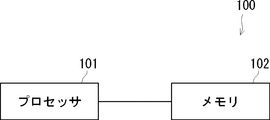
- FIG. 6 is a diagram illustrating a hardware configuration example of the arithmetic device.
- the arithmetic unit 100 includes a processor 101 and a memory 102.
- the state estimation units 31, 81 of the arithmetic devices 10, 30, 80 described in the first embodiment and the second embodiment, the state transition information update units (state transition information creation units) 32, 82, and the control command arithmetic unit 33. , 83, the prediction state determination unit 11, the variation degree calculation unit 12, and the candidate action selection unit 13 may be realized by the processor 101 reading and executing the program stored in the memory 102.
- the program may be stored using various types of non-transitory computer readable medium, and may be supplied to the arithmetic units 10, 30, 80. In addition, the program may be supplied to the arithmetic units 10, 30, and 80 by various types of transitory computer readable mediums.
- the arithmetic device as described above can also function as a control device that controls each device in a manufacturing factory, for example.
- each manufacturing factory is provided with each device and a sensor for measuring a state (for example, temperature, humidity, visibility, etc.) in the manufacturing factory.
- Each sensor measures the state of each device and the manufacturing plant, and creates observation information indicating the measured state.
- the observation information is information indicating the state observed in the manufacturing factory.
- the computing device receives the observation information and controls each device according to the action determined by performing the above-mentioned processing. For example, when the device is a valve that adjusts the amount of material, the arithmetic device performs control such as closing the valve or opening the valve according to the determined action. Alternatively, when the device is a heater that adjusts the temperature, the arithmetic device performs control such as raising the set temperature or lowering the set temperature according to the determined action.
- control example has been described with reference to the example of controlling each device in the manufacturing factory, but the control example is not limited to the above example.
- the arithmetic device can also function as a control device that controls each device in the chemical factory and a control device that controls each device in the power plant by performing the same process as described above.
Landscapes
- Engineering & Computer Science (AREA)
- Theoretical Computer Science (AREA)
- Physics & Mathematics (AREA)
- Data Mining & Analysis (AREA)
- General Health & Medical Sciences (AREA)
- Biomedical Technology (AREA)
- Biophysics (AREA)
- Computational Linguistics (AREA)
- Life Sciences & Earth Sciences (AREA)
- Evolutionary Computation (AREA)
- Artificial Intelligence (AREA)
- Molecular Biology (AREA)
- Computing Systems (AREA)
- General Engineering & Computer Science (AREA)
- General Physics & Mathematics (AREA)
- Mathematical Physics (AREA)
- Software Systems (AREA)
- Health & Medical Sciences (AREA)
- Feedback Control In General (AREA)
Abstract
L'invention concerne un dispositif arithmétique (10) dans lequel une unité de détermination d'état prédictif (11) détermine, à l'aide d'une pluralité d'unités d'informations de transition, une pluralité d'états prédictifs se rapportant à chacune d'une pluralité d'actions candidates possibles dans un premier état. Une unité de calcul de degré de dispersion (12) calcule le degré de dispersion de la pluralité d'états prédictifs déterminés concernant chaque action candidate par l'unité de détermination d'état prédictif (11). Une unité de sélection d'action candidate (13) sélectionne une partie de la pluralité d'actions candidates sur la base de multiples degrés de dispersion calculés par l'unité de calcul de degré de dispersion (12).
Priority Applications (3)
| Application Number | Priority Date | Filing Date | Title |
|---|---|---|---|
| PCT/JP2018/045947 WO2020121494A1 (fr) | 2018-12-13 | 2018-12-13 | Dispositif arithmétique, procédé de détermination d'action et support lisible par ordinateur non transitoire stockant un programme de commande |
| US17/311,752 US20220027708A1 (en) | 2018-12-13 | 2018-12-13 | Arithmetic apparatus, action determination method, and non-transitory computer readable medium storing control program |
| JP2020559651A JP7196935B2 (ja) | 2018-12-13 | 2018-12-13 | 演算装置、アクション決定方法、及び制御プログラム |
Applications Claiming Priority (1)
| Application Number | Priority Date | Filing Date | Title |
|---|---|---|---|
| PCT/JP2018/045947 WO2020121494A1 (fr) | 2018-12-13 | 2018-12-13 | Dispositif arithmétique, procédé de détermination d'action et support lisible par ordinateur non transitoire stockant un programme de commande |
Publications (1)
| Publication Number | Publication Date |
|---|---|
| WO2020121494A1 true WO2020121494A1 (fr) | 2020-06-18 |
Family
ID=71075454
Family Applications (1)
| Application Number | Title | Priority Date | Filing Date |
|---|---|---|---|
| PCT/JP2018/045947 Ceased WO2020121494A1 (fr) | 2018-12-13 | 2018-12-13 | Dispositif arithmétique, procédé de détermination d'action et support lisible par ordinateur non transitoire stockant un programme de commande |
Country Status (3)
| Country | Link |
|---|---|
| US (1) | US20220027708A1 (fr) |
| JP (1) | JP7196935B2 (fr) |
| WO (1) | WO2020121494A1 (fr) |
Cited By (1)
| Publication number | Priority date | Publication date | Assignee | Title |
|---|---|---|---|---|
| CN113112016A (zh) * | 2021-04-07 | 2021-07-13 | 北京地平线机器人技术研发有限公司 | 用于强化学习过程的动作输出方法、网络训练方法及装置 |
Families Citing this family (3)
| Publication number | Priority date | Publication date | Assignee | Title |
|---|---|---|---|---|
| US11645498B2 (en) * | 2019-09-25 | 2023-05-09 | International Business Machines Corporation | Semi-supervised reinforcement learning |
| EP4086813B1 (fr) * | 2021-05-05 | 2025-07-02 | Volvo Autonomous Solutions AB | Gestion de l'incertitude aléatoire et épistémique dans l'apprentissage par renforcement, comprenant des applications pour la commande de véhicules autonomes |
| US12351453B2 (en) * | 2021-10-04 | 2025-07-08 | Saudi Arabian Oil Company | Methods for controlling the temperature of an incinerator |
Family Cites Families (2)
| Publication number | Priority date | Publication date | Assignee | Title |
|---|---|---|---|---|
| EP3593288B1 (fr) * | 2017-05-26 | 2024-06-26 | DeepMind Technologies Limited | Réseaux neuronaux de sélection d'action d'apprentissage utilisant une recherche anticipée |
| US11200489B2 (en) * | 2018-01-30 | 2021-12-14 | Imubit Israel Ltd. | Controller training based on historical data |
-
2018
- 2018-12-13 WO PCT/JP2018/045947 patent/WO2020121494A1/fr not_active Ceased
- 2018-12-13 US US17/311,752 patent/US20220027708A1/en not_active Abandoned
- 2018-12-13 JP JP2020559651A patent/JP7196935B2/ja active Active
Non-Patent Citations (2)
| Title |
|---|
| HAARNOJA, TUOMAS ET AL.: "Reinforcement Learning with Deep Energy-Based Policies", ARXIV.ORG, 21 July 2017 (2017-07-21), XP080748703, Retrieved from the Internet <URL:https://arxiv.org/pdf/1702.08165v2> [retrieved on 20190128] * |
| SAITO, MASANORI ET AL.: "Improving efficiency of Q-learning by using the agent's action history", IEEJ WORKING GROUP MATERIALS, 26 November 2014 (2014-11-26) - 27 November 2014 (2014-11-27), pages 29 - 34 * |
Cited By (2)
| Publication number | Priority date | Publication date | Assignee | Title |
|---|---|---|---|---|
| CN113112016A (zh) * | 2021-04-07 | 2021-07-13 | 北京地平线机器人技术研发有限公司 | 用于强化学习过程的动作输出方法、网络训练方法及装置 |
| CN113112016B (zh) * | 2021-04-07 | 2025-02-11 | 北京地平线机器人技术研发有限公司 | 用于强化学习过程的动作输出方法、网络训练方法及装置 |
Also Published As
| Publication number | Publication date |
|---|---|
| JP7196935B2 (ja) | 2022-12-27 |
| US20220027708A1 (en) | 2022-01-27 |
| JPWO2020121494A1 (ja) | 2021-10-07 |
Similar Documents
| Publication | Publication Date | Title |
|---|---|---|
| JP5768834B2 (ja) | プラントモデル管理装置及び方法 | |
| JP6529096B2 (ja) | シミュレートシステム、シミュレート方法およびシミュレート用プログラム | |
| JP6708204B2 (ja) | 精度推定モデル生成システムおよび精度推定システム | |
| JP7196935B2 (ja) | 演算装置、アクション決定方法、及び制御プログラム | |
| JP6513015B2 (ja) | 機械の動作を制御する方法、および機械の動作を反復的に制御する制御システム | |
| KR101963686B1 (ko) | 타겟 시스템 제어 | |
| JP2016100009A5 (fr) | ||
| JP6902487B2 (ja) | 機械学習システム | |
| JP2019219741A5 (fr) | ||
| JP7036128B2 (ja) | 制御装置、制御方法およびプログラム | |
| JP7179672B2 (ja) | 計算機システム及び機械学習方法 | |
| CN107367929B (zh) | 更新q值矩阵的方法、存储介质和终端设备 | |
| Hester | The TEXPLORE Algorithm | |
| IL294712A (en) | Learning with momentary assessment using different time constants | |
| JP7781728B2 (ja) | シミュレーションモデル構築方法、及び、シミュレーション方法 | |
| JP7710965B2 (ja) | 情報処理装置、情報処理方法およびプログラム | |
| CN117521738A (zh) | 一种基于贝叶斯优化的强化学习策略评估优化方法及系统 | |
| KR20200066740A (ko) | 복합 시스템들의 제어를 위한 무작위화된 강화 학습 | |
| JP2024029816A (ja) | 状態推定装置、状態推定方法及びプログラム | |
| CN107315572A (zh) | 建筑机电系统的控制方法、存储介质和终端设备 | |
| JP7462905B2 (ja) | 制御装置、方法、プログラム及びシステム | |
| Perotto | Looking for the right time to shift strategy in the exploration-exploitation dilemma | |
| JP7777970B2 (ja) | 推定装置、推定方法および推定プログラム | |
| JP7380874B2 (ja) | プランナー装置、プランニング方法、プランニングプログラム記録媒体、学習装置、学習方法および学習プログラム記録媒体 | |
| CN107315573A (zh) | 建筑机电系统的控制方法、存储介质和终端设备 |
Legal Events
| Date | Code | Title | Description |
|---|---|---|---|
| 121 | Ep: the epo has been informed by wipo that ep was designated in this application |
Ref document number: 18943278 Country of ref document: EP Kind code of ref document: A1 |
|
| ENP | Entry into the national phase |
Ref document number: 2020559651 Country of ref document: JP Kind code of ref document: A |
|
| NENP | Non-entry into the national phase |
Ref country code: DE |
|
| 122 | Ep: pct application non-entry in european phase |
Ref document number: 18943278 Country of ref document: EP Kind code of ref document: A1 |