WO2020121631A1 - Machine de revêtement par atomisation électrostatique - Google Patents
Machine de revêtement par atomisation électrostatique Download PDFInfo
- Publication number
- WO2020121631A1 WO2020121631A1 PCT/JP2019/039372 JP2019039372W WO2020121631A1 WO 2020121631 A1 WO2020121631 A1 WO 2020121631A1 JP 2019039372 W JP2019039372 W JP 2019039372W WO 2020121631 A1 WO2020121631 A1 WO 2020121631A1
- Authority
- WO
- WIPO (PCT)
- Prior art keywords
- paint
- branch
- nozzle head
- valve body
- circumferential groove
- Prior art date
- Legal status (The legal status is an assumption and is not a legal conclusion. Google has not performed a legal analysis and makes no representation as to the accuracy of the status listed.)
- Ceased
Links
Images



Classifications
-
- B—PERFORMING OPERATIONS; TRANSPORTING
- B05—SPRAYING OR ATOMISING IN GENERAL; APPLYING FLUENT MATERIALS TO SURFACES, IN GENERAL
- B05B—SPRAYING APPARATUS; ATOMISING APPARATUS; NOZZLES
- B05B1/00—Nozzles, spray heads or other outlets, with or without auxiliary devices such as valves, heating means
- B05B1/30—Nozzles, spray heads or other outlets, with or without auxiliary devices such as valves, heating means designed to control volume of flow, e.g. with adjustable passages
- B05B1/3033—Nozzles, spray heads or other outlets, with or without auxiliary devices such as valves, heating means designed to control volume of flow, e.g. with adjustable passages the control being effected by relative coaxial longitudinal movement of the controlling element and the spray head
- B05B1/304—Nozzles, spray heads or other outlets, with or without auxiliary devices such as valves, heating means designed to control volume of flow, e.g. with adjustable passages the control being effected by relative coaxial longitudinal movement of the controlling element and the spray head the controlling element being a lift valve
- B05B1/3046—Nozzles, spray heads or other outlets, with or without auxiliary devices such as valves, heating means designed to control volume of flow, e.g. with adjustable passages the control being effected by relative coaxial longitudinal movement of the controlling element and the spray head the controlling element being a lift valve the valve element, e.g. a needle, co-operating with a valve seat located downstream of the valve element and its actuating means, generally in the proximity of the outlet orifice
- B05B1/306—Nozzles, spray heads or other outlets, with or without auxiliary devices such as valves, heating means designed to control volume of flow, e.g. with adjustable passages the control being effected by relative coaxial longitudinal movement of the controlling element and the spray head the controlling element being a lift valve the valve element, e.g. a needle, co-operating with a valve seat located downstream of the valve element and its actuating means, generally in the proximity of the outlet orifice the actuating means being a fluid
-
- B—PERFORMING OPERATIONS; TRANSPORTING
- B05—SPRAYING OR ATOMISING IN GENERAL; APPLYING FLUENT MATERIALS TO SURFACES, IN GENERAL
- B05B—SPRAYING APPARATUS; ATOMISING APPARATUS; NOZZLES
- B05B5/00—Electrostatic spraying apparatus; Spraying apparatus with means for charging the spray electrically; Apparatus for spraying liquids or other fluent materials by other electric means
- B05B5/025—Discharge apparatus, e.g. electrostatic spray guns
-
- B—PERFORMING OPERATIONS; TRANSPORTING
- B05—SPRAYING OR ATOMISING IN GENERAL; APPLYING FLUENT MATERIALS TO SURFACES, IN GENERAL
- B05B—SPRAYING APPARATUS; ATOMISING APPARATUS; NOZZLES
- B05B1/00—Nozzles, spray heads or other outlets, with or without auxiliary devices such as valves, heating means
- B05B1/14—Nozzles, spray heads or other outlets, with or without auxiliary devices such as valves, heating means with multiple outlet openings; with strainers in or outside the outlet opening
- B05B1/1421—Nozzles, spray heads or other outlets, with or without auxiliary devices such as valves, heating means with multiple outlet openings; with strainers in or outside the outlet opening the multiple outlet openings arranged in plural groups or rows
- B05B1/1423—Nozzles, spray heads or other outlets, with or without auxiliary devices such as valves, heating means with multiple outlet openings; with strainers in or outside the outlet opening the multiple outlet openings arranged in plural groups or rows comprising concentric or coaxial groups
-
- B—PERFORMING OPERATIONS; TRANSPORTING
- B05—SPRAYING OR ATOMISING IN GENERAL; APPLYING FLUENT MATERIALS TO SURFACES, IN GENERAL
- B05B—SPRAYING APPARATUS; ATOMISING APPARATUS; NOZZLES
- B05B1/00—Nozzles, spray heads or other outlets, with or without auxiliary devices such as valves, heating means
- B05B1/30—Nozzles, spray heads or other outlets, with or without auxiliary devices such as valves, heating means designed to control volume of flow, e.g. with adjustable passages
- B05B1/3026—Gate valves; Sliding valves; Cocks
-
- B—PERFORMING OPERATIONS; TRANSPORTING
- B05—SPRAYING OR ATOMISING IN GENERAL; APPLYING FLUENT MATERIALS TO SURFACES, IN GENERAL
- B05B—SPRAYING APPARATUS; ATOMISING APPARATUS; NOZZLES
- B05B1/00—Nozzles, spray heads or other outlets, with or without auxiliary devices such as valves, heating means
- B05B1/30—Nozzles, spray heads or other outlets, with or without auxiliary devices such as valves, heating means designed to control volume of flow, e.g. with adjustable passages
- B05B1/3033—Nozzles, spray heads or other outlets, with or without auxiliary devices such as valves, heating means designed to control volume of flow, e.g. with adjustable passages the control being effected by relative coaxial longitudinal movement of the controlling element and the spray head
- B05B1/3086—Nozzles, spray heads or other outlets, with or without auxiliary devices such as valves, heating means designed to control volume of flow, e.g. with adjustable passages the control being effected by relative coaxial longitudinal movement of the controlling element and the spray head the controlling element being a grooved body, which is movable in the outlet orifice
-
- B—PERFORMING OPERATIONS; TRANSPORTING
- B05—SPRAYING OR ATOMISING IN GENERAL; APPLYING FLUENT MATERIALS TO SURFACES, IN GENERAL
- B05B—SPRAYING APPARATUS; ATOMISING APPARATUS; NOZZLES
- B05B5/00—Electrostatic spraying apparatus; Spraying apparatus with means for charging the spray electrically; Apparatus for spraying liquids or other fluent materials by other electric means
- B05B5/025—Discharge apparatus, e.g. electrostatic spray guns
- B05B5/035—Discharge apparatus, e.g. electrostatic spray guns characterised by gasless spraying, e.g. electrostatically assisted airless spraying
-
- B—PERFORMING OPERATIONS; TRANSPORTING
- B05—SPRAYING OR ATOMISING IN GENERAL; APPLYING FLUENT MATERIALS TO SURFACES, IN GENERAL
- B05B—SPRAYING APPARATUS; ATOMISING APPARATUS; NOZZLES
- B05B5/00—Electrostatic spraying apparatus; Spraying apparatus with means for charging the spray electrically; Apparatus for spraying liquids or other fluent materials by other electric means
- B05B5/16—Arrangements for supplying liquids or other fluent material
-
- B—PERFORMING OPERATIONS; TRANSPORTING
- B05—SPRAYING OR ATOMISING IN GENERAL; APPLYING FLUENT MATERIALS TO SURFACES, IN GENERAL
- B05B—SPRAYING APPARATUS; ATOMISING APPARATUS; NOZZLES
- B05B15/00—Details of spraying plant or spraying apparatus not otherwise provided for; Accessories
- B05B15/50—Arrangements for cleaning; Arrangements for preventing deposits, drying-out or blockage; Arrangements for detecting improper discharge caused by the presence of foreign matter
- B05B15/58—Arrangements for cleaning; Arrangements for preventing deposits, drying-out or blockage; Arrangements for detecting improper discharge caused by the presence of foreign matter preventing deposits, drying-out or blockage by recirculating the fluid to be sprayed from upstream of the discharge opening back to the supplying means
-
- B—PERFORMING OPERATIONS; TRANSPORTING
- B05—SPRAYING OR ATOMISING IN GENERAL; APPLYING FLUENT MATERIALS TO SURFACES, IN GENERAL
- B05B—SPRAYING APPARATUS; ATOMISING APPARATUS; NOZZLES
- B05B5/00—Electrostatic spraying apparatus; Spraying apparatus with means for charging the spray electrically; Apparatus for spraying liquids or other fluent materials by other electric means
- B05B5/025—Discharge apparatus, e.g. electrostatic spray guns
- B05B5/043—Discharge apparatus, e.g. electrostatic spray guns using induction-charging
-
- B—PERFORMING OPERATIONS; TRANSPORTING
- B05—SPRAYING OR ATOMISING IN GENERAL; APPLYING FLUENT MATERIALS TO SURFACES, IN GENERAL
- B05B—SPRAYING APPARATUS; ATOMISING APPARATUS; NOZZLES
- B05B7/00—Spraying apparatus for discharge of liquids or other fluent materials from two or more sources, e.g. of liquid and air, of powder and gas
- B05B7/02—Spray pistols; Apparatus for discharge
- B05B7/08—Spray pistols; Apparatus for discharge with separate outlet orifices, e.g. to form parallel jets, i.e. the axis of the jets being parallel, to form intersecting jets, i.e. the axis of the jets converging but not necessarily intersecting at a point
- B05B7/0892—Spray pistols; Apparatus for discharge with separate outlet orifices, e.g. to form parallel jets, i.e. the axis of the jets being parallel, to form intersecting jets, i.e. the axis of the jets converging but not necessarily intersecting at a point the outlet orifices for jets constituted by a liquid or a mixture containing a liquid being disposed on a circle
Definitions
- the present invention relates to an electrostatic atomization coating machine, and more specifically, a nozzle head is provided with a plurality of paint ejection ports, a paint chamber is provided inside the nozzle head, and a paint supply passage is provided in the paint chamber.
- the paint is supplied, each of the paint jets communicates with the paint chamber through a separate branch paint passage, and a voltage applying device that applies a potential difference between the nozzle head and the object to be coated is provided,
- the paint sprayed from each of the paint jets through the supply passage, the paint chamber, and the branch paint passage relates to an electrostatic atomizing coater that is charged by voltage application by the voltage applying device.
- the paint in a charged state ejected from a plurality of paint ejection ports is atomized by the action of an electric field formed around each paint ejection port, and thus is atomized.
- the charged electrified paint is electrostatically attracted to the object to be coated by the potential difference between the object to be coated and the nozzle head and flies to the surface of the object to be coated.
- the main problem of the present invention is to effectively solve the above problems by rational improvement.
- the first characteristic configuration of the present invention relates to an electrostatic atomization coating machine, and the characteristic features thereof are:
- the nozzle head has multiple paint outlets, A paint chamber is provided inside the nozzle head, and paint is supplied to the paint chamber through a paint supply passage, Each of the paint outlets communicates with the paint chamber through a separate branch paint passage, A voltage applying device for providing a potential difference between the nozzle head and the object to be coated is provided, The paint sprayed from each of the paint outlets through the paint supply passage, the paint chamber, and the branch paint passage is an electrostatic atomizing coater that is charged by voltage application by the voltage applying device.
- An on-off valve device is provided which opens and closes all the branch paint passages, or opens and closes a plurality of specific branch paint passages of all the branch paint passages.
- the on-off valve device when an on-off valve device that opens and closes all the branch paint passages is provided as the on-off valve device, the on-off valve device is closed and all the branch paint passages are closed when the painting work is interrupted or ended. Therefore, regardless of the attitude of the nozzle header at that time, external air may enter the paint chamber through some paint jets, and the paint remaining in the paint chamber may cause some other paint to flow into the paint chamber when the air enters. It can be reliably prevented from leaking to the outside through the ejection port.
- an on-off valve device that opens and closes a specific part of a plurality of branch paint passages out of all branch paint passages is provided as an on-off valve device
- air intrusion and paint leakage may occur in all paint outlets.
- Specific multiple paint branch passages corresponding to multiple paint jets with high performance If some of the branch paint passages are selected and an on-off valve device is installed, it is possible to By closing the on-off valve device and closing a certain part of the multiple branch paint passages, external air can pass through some paint outlets and paint chambers regardless of the posture of the nozzle header at that time, as described above. It is possible to reliably prevent the residual paint in the paint chamber from leaking to the outside through another part of the paint ejection port due to the air invasion.
- a second characteristic configuration of the present invention specifies an embodiment suitable for carrying out the first characteristic configuration, and the characteristic thereof is:
- the paint ejection ports are arranged in a state in which they are arranged in a line at equal intervals in the circumferential direction on the same circumference of the tip end surface portion of the nozzle head.
- each paint An electric field is uniformly formed around the ejection port without bias.
- the atomized paint sprayed from a plurality of paint jets becomes more uniform, which improves the coating quality of the coated object.
- a third characteristic configuration of the present invention specifies an embodiment suitable for carrying out the second characteristic configuration, and the characteristic thereof is:
- a plurality of paint ejection nozzles each having the paint ejection port are individually arranged on the tip end surface portion of the nozzle head in a protruding state and arranged in a line at equal intervals in the circumferential direction on the same circumference. There is a point.
- each paint ejection nozzle since each paint ejection nozzle is in the protruding state, it is possible to more effectively form an electric field around each paint ejection port, and thus, the charged state ejected from each paint ejection port is increased. It is possible to promote the atomization of the coating composition and further improve the coating quality of the coated object.
- a fourth characteristic configuration of the present invention specifies an embodiment suitable for carrying out the second characteristic configuration, and the characteristic thereof is:
- An annular protrusion is provided on the tip surface of the nozzle head,
- the coating material ejection ports are arranged in the annular protruding portion so as to be aligned in a line at equal intervals in the circumferential direction of the annular protruding portion.
- each paint ejection port since the annular projecting portion in which each paint ejection port is formed is in a protruding state, the paint ejection port can be effectively formed while the electric field is effectively formed around each paint ejection port.
- the structure and shape of the tip surface of the nozzle head can be simplified, compared with the case where a plurality of paint ejection nozzles provided individually are arranged side by side on the tip surface of the nozzle head in an independently protruding state. Can be easily manufactured.
- a fifth characteristic configuration of the present invention specifies an embodiment suitable for carrying out the second characteristic configuration, and the characteristic thereof is:
- the paint ejection ports are arranged so as to be arranged in a line at equal intervals in the circumferential direction on each of a plurality of concentric circles on the tip end surface portion of the nozzle head.
- a sixth characteristic configuration of the present invention specifies an embodiment suitable for carrying out any of the first to fifth characteristic configurations, and its characteristic is
- the on-off valve device includes one common valve body housed in the paint chamber, The common valve body is opened and closed between a valve closed position that simultaneously closes the inlets of the branch paint passages that open to the paint chamber and a valve open position that simultaneously opens the inlets of the branch paint passages. ..
- the structure of the head can be simplified, which facilitates the manufacture of the device, reduces the cost of the device, and also enables the weight and size of the nozzle head to be reduced.
- a seventh characteristic configuration of the present invention specifies an embodiment suitable for carrying out the sixth characteristic configuration, and the characteristic thereof is: Inside the nozzle head, a circumferential groove is formed as the paint chamber, The inlet of the branch paint passage is arranged in a state in which it is arranged at equal intervals in the circumferential direction of the circumferential groove portion on the bottom surface of the circumferential groove portion,
- the common valve body has an annular shape that fits into the circumferential groove portion, The common valve body is located at a point of moving inside the circumferential groove portion like a piston in a perspective direction with respect to a bottom surface of the circumferential groove portion as an opening/closing operation between the valve closing position and the valve opening position.
- An eighth characteristic configuration of the present invention specifies an embodiment suitable for implementing the seventh characteristic configuration, and the characteristic thereof is: A communication groove that communicates from one end surface side to the other end surface side of the common valve body in the annular shape is formed on the inner peripheral surface or the outer peripheral surface of the common valve body in the annular shape.
- the common valve body fitted in the circumferential groove portion when the annular common valve body fitted in the circumferential groove portion is piston-operated in the circumferential groove portion toward and away from the bottom surface of the circumferential groove portion, the common valve is passed through the communication groove.
- the paint can be driven back and forth between the one end face side and the other end face side of the body (that is, between the bottom side region and the anti-bottom side region of the circumferential groove portion), whereby the common valve body It is possible to smooth the piston-like opening/closing operation.
- a ninth characteristic configuration of the present invention specifies an embodiment suitable for carrying out the sixth characteristic configuration, and the characteristic is Inside the nozzle head, a circumferential groove is formed as the paint chamber, The inlet of the branch paint passage is arranged in a state in which it is arranged at equal intervals in the circumferential direction of the circumferential groove portion on the bottom surface of the circumferential groove portion,
- the common valve body has an annular shape that fits into the circumferential groove portion,
- the common valve body is formed with a plurality of communication holes penetrating from one end surface side to the other end surface side in the annular shape of the common valve body, The communication holes are arranged individually corresponding to the inlets of the branch paint paths, respectively, and are arranged in a state in which they are arranged at equal intervals in the circumferential direction in the annular shape of the common valve body,
- the common valve body is configured to rotate inside the circumferential groove portion in a circumferential direction of the circumferential groove portion as an opening/closing operation between the
- the annular common valve body fitted in the circumferential groove portion is rotated in the circumferential direction of the circumferential groove portion inside the circumferential groove portion so that the inlets of the branch paint passages are of the common valve body.
- the branch paint passages are brought into communication with each other, the inlets of the branch paint passages are communicated with the circumferential groove portions as the paint chambers through the communication holes to open the branch paint passages.
- annular common valve element is rotated in the circumferential direction of the circumferential groove portion inside the circumferential groove portion until each communication hole of the common valve element is disengaged from the inlet of each branch paint passage, and the branch coating material is rotated.
- the branch paint passages are closed by closing the inlets of the respective passages with a common valve body.
- the annular common valve element is used as the circumferential groove portion. Since it is only necessary to rotate in the circumferential direction of the circumferential groove portion inside, the space required for the opening/closing operation of the common valve body between the valve closing position and the valve opening position can be reduced, and the nozzle head The size can be further reduced.
- a tenth characteristic configuration of the present invention specifies an embodiment suitable for carrying out the first or second characteristic configuration, and the characteristic is
- Each of the branch paint passages is equipped with an individual on-off valve as the on-off valve device, A common operation means for opening and closing the on-off valves at the same time is provided.
- branch paint passages are simultaneously opened and closed by simultaneously opening and closing the on-off valves equipped in each of the branch paint passages by the common operation means.
- each branch paint passage is equipped with an individual opening/closing valve, compared to simultaneously opening and closing a plurality of branch paint passages by one common valve body, each branch paint passage in the nozzle head is opened.
- the degree of freedom in arranging the nozzles is increased, which facilitates the design of the nozzle head.
- An eleventh characteristic configuration of the present invention specifies an embodiment suitable for carrying out any of the first to tenth characteristic configurations, and the characteristic is
- the nozzle head is formed of an electrically insulating material or a weakly conductive material.
- the electric field formed around each paint jet can be strengthened accordingly, and atomization of the charged paint jetted from the paint jet can be further promoted.
- FIG. 1 is a vertical sectional view of an electrostatic atomization coating machine.
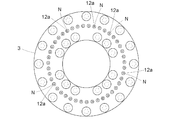
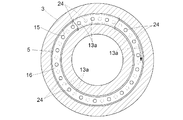
- FIG. 2 is a front view of the tip end surface of the nozzle head.
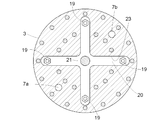
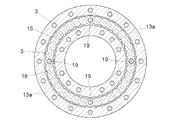
- FIG. 3 is a view taken along the line III-III in FIG. 4 is a sectional view taken along line IV-IV in FIG.
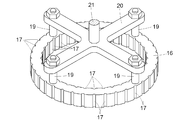
- FIG. 5 is a perspective view of the common valve body.
- FIG. 6 is a front view of a tip end surface portion of a nozzle head showing another embodiment.
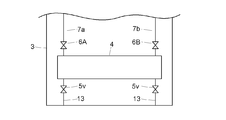
- FIG. 7 is a structural diagram of an on-off valve device showing another embodiment.
- FIG. 8 is a front view of a nozzle head tip surface portion showing another embodiment.
- FIG. 9 is a schematic vertical sectional view of a nozzle head showing another embodiment.
- FIG. 1 shows an electrostatic atomization coating machine 1 for coating an object by paint spraying.
- the electrostatic atomization coating machine 1 includes a main body 2 connected to the tip of a working arm of a coating robot, and a main body 2 thereof.
- the nozzle head 3 is attached to the tip of the main body 2.
- the coating work using the electrostatic atomization coating machine 1 proceeds while sequentially moving the target portion of the paint spray on the object to be coated, but at this time, between the object to be coated and the nozzle head 3.
- the distance and the distance between the nozzles 3 are kept constant, and the position and orientation of the electrostatic atomizer coating machine 1 is maintained so that the tip end surface of the nozzle head 3 faces the object to be coated vertically.
- the operation is sequentially adjusted.
- a paint chamber 4 is formed inside the nozzle head 3, and the paint chamber 4 is arranged concentrically with the cylindrical nozzle head 3. Further, an on-off valve device 5 is installed inside the nozzle head 3.
- a paint supply passage 7a and a paint return passage 7b are formed extending to the paint chamber 4 inside the nozzle head 3, and a supply side switching valve 6A for opening and closing the paint supply passage 7a, and A return-side switching valve 6B for opening and closing the paint return passage 7b is provided.
- annular projecting portion 11 arranged concentrically with the nozzle head 3 is formed on the tip end surface portion of the nozzle head 3 which is directly opposed to the object to be coated.
- a large number of paint jets 12a are formed on the annular projection 11, and the large number of paint jets 12a are arranged in a line at equal intervals in the circumferential direction of the annular projection 11. There is.
- a plurality of paint ejection nozzles N each having a paint ejection port 12a are individually provided. In a protruding state, they may be arranged in a line at equal intervals in the circumferential direction on the same circumference.
- Each paint outlet 12a communicates with the paint chamber 4 through an individual branch paint passage 13, and the paint T supplied to the paint chamber 4 through the paint supply passage 7a passes through each branch paint passage 13 and each paint outlet 12a. Erupted from.
- the paint T is in a state of flowing through the paint supply passage 7a, the paint chamber 4, and the paint return passage 7b.
- the parts are sent from the paint chamber 4 to each paint jet 12a through each branch paint passage 13.
- the electrostatic atomization coating machine 1 is equipped with a voltage application device 14 that applies a potential difference ⁇ V between the object to be coated and the nozzle head 3, and the paint supply passage 7a, the paint chamber 4, and the The paint T ejected from each paint ejection port 12 a via the branch paint passage 13 is charged by the high voltage applied by the voltage application device 14.
- an electric field is formed around each paint ejection port 12a by applying a high voltage by the voltage application device 14, and the charged paint T ejected from each paint ejection port 12a is a so-called electrostatic spray.
- the atomized paint T which is atomized by the action of the electric field formed around the ejection port 12a, is electrostatically attracted to the object to be coated by the potential difference between the nozzle head 3 and the object to be coated. It flies and is applied to the surface of the object to be coated.
- the on-off valve device 5 mounted on the nozzle head 3 is a valve device that opens and closes the branch paint passage 13 with respect to the paint ejection port 12a, and this on-off valve device 5 is constantly urged toward the valve opening side by a spring 18.
- the paint chamber 4 inside the nozzle head 3 is provided with a circumferential groove portion 15 which is concentric with the annular protrusion 11 and has substantially the same diameter, and a large number of paint branches are provided.
- the inlets 13a of each of the passages 13 open in the circumferential groove portion 15 as the paint chamber 4 on the bottom surface of the circumferential groove portion 15, and these many inlets 13a correspond to the circular row of the paint outlets 12a.
- the circumferential groove portions 15 are arranged in a line at equal intervals in the circumferential direction.
- valve element 16 of the on-off valve device 5 is formed in an annular shape that fits in the circumferential groove portion 15, and is housed in the circumferential groove portion 15 in a fitted state.
- the valve body 16 is a common valve body for many branch paint passages 13.
- the annular common valve element 16 moves to the bottom surface side of the circumferential groove portion 15 in a piston shape, and the inlets 13a of all the branch paint passages 13 have the annular common valve.
- the annular common valve body 16 moves in a piston shape to the side away from the bottom surface of the circumferential groove portion 15, so that all By opening the inlet 13a of the branch paint passage 13, all the branch paint passages 13 are simultaneously opened.
- the paint supply passage 7a and the paint return passage 7b are closed in the supply side switching valve 6A and the return side switching valve 6B.
- outside air may enter the paint chamber 4 through the branch paint passage 13 from some of the paint outlets 12a located at the upper part of the plurality of paint outlets 12a. Accordingly, the paint T remaining in the paint chamber 4 may leak to the outside through the branch paint passage 13 and from some other paint outlets 12a located in the lower portion.
- the opening/closing valve device 5 when stopping the spraying of the paint on the object to be coated, the opening/closing valve device 5 is operated to close so that all the branch paint passages 13 are annular common valve bodies. 16 by this, regardless of the posture of the nozzle head 3 at that time, the external air enters through the paint outlets 12a and the other paint outlets 12a as described above. External leakage of the residual paint T is reliably prevented.
- each communication groove 17 has a common annular shape.
- the valve body 16 is formed from one end surface to the other end surface thereof, and at the one end surface of the common valve body 16, each communication groove 17 is opened to a region on the bottom surface side of the circumferential groove portion 15, and at the other end surface of the common valve body 16, Each communication groove 17 is open to the region of the circumferential groove portion 15 on the side opposite to the bottom surface.
- the paint T supplied to the paint chamber 4 is transferred from the area on the side opposite to the bottom surface to the area on the bottom surface side in the circumferential groove portion 15 through the plurality of communication grooves 17.
- the paint T passes between the region on the bottom surface side and the region on the anti-bottom surface side of the circumferential groove portion 15 through the large number of communication grooves 17.
- the annular common valve body 16 is connected to the cross-shaped support member 20 via four connecting rods 19, and the four connecting rods 19 are arranged at equal intervals in the circumferential direction of the circumferential groove portion 15. It is arranged.
- the cross-shaped support member 20 is connected to the valve operating piston 22 via the valve operating shaft 21 arranged on the central axis q of the nozzle head 3.
- a guide hole 23 for the cross-shaped support member 20 is formed inside the nozzle head 3, and the guide hole 23 is formed in a cross shape when viewed from the direction of the central axis q of the nozzle head. Has been done.
- the cross-shaped support member 20 reciprocates inside the guide hole 23 having this cross shape in the direction of the central axis q of the nozzle head.
- the nozzle head 3 is formed of a non-conductive material or a weakly conductive material, which may cause the nozzle head 3 in a state where a high voltage is applied by the voltage applying device 14 to unexpectedly approach another object. Also, the occurrence of discharge between the nozzle head 3 and another object is prevented.
- the opening/closing valve device 5 has a structure in which the inlets 13a of the branch paint passages 13 are simultaneously opened and closed with respect to the paint chamber 4 by the piston-like opening/closing operation of the annular common valve body 16.
- the structure shown in FIG. 7 may be adopted as the structure of the on-off valve device 5.
- Reference numeral 24 is an arrangement that individually corresponds to the inlets 13a of the branch paint passages 13 that open to the bottom surface of the circumferential groove portion 15, and is arranged in a state of being arranged at equal intervals in the circumferential direction in the annular shape of the common valve body 16. Has been done.
- the annular common valve body 16 is configured to rotate in the circumferential direction inside the circumferential groove portion 15 by rotating around the central axis of the annular shape as an opening/closing operation.
- the common valve body 16 is pivotally operated until the inlets 13a of the respective branch paint passages 13 communicate with the respective communication holes 24 of the common valve body 16, whereby the communication holes 24 are formed.
- the inlets 13a of the respective branch paint passages 13 are opened to the paint chamber 4, whereby the respective branch paint passages 13 are simultaneously opened.
- each branch paint passage 13 is closed at the same time.
- the plurality of paint ejection ports 12a is not limited to being formed on the tip surface portion of the nozzle head 3 in an annular row arrangement, but may be formed on the tip surface portion of the nozzle head 3 in a matrix arrangement.
- each of the opening/closing valves 5v may be equipped with an individual opening/closing valve 5v, and these opening/closing valves 5v may be simultaneously opened/closed by a common operating means.
- the electrostatic atomization coating machine of the present invention can be used for coating various bodies in various fields such as coating of automobile bodies and automobile parts, coating of casings of electric appliances and construction materials.
Landscapes
- Electrostatic Spraying Apparatus (AREA)
- Nozzles (AREA)
Abstract
La présente invention concerne une machine de revêtement par atomisation électrostatique dans laquelle : une tête de buse (3) est pourvue d'une pluralité de sorties de pulvérisation de peinture (12a) ; une chambre de peinture (4) est disposée à l'intérieur de la tête de buse (3) ; une peinture (T) est alimentée à la chambre à peinture (4) par l'intermédiaire d'un chemin d'alimentation en peinture (7a) ; les sorties de pulvérisation de peinture respectives (12a) communiquent avec la chambre de peinture (4) par l'intermédiaire de chemins de peinture ramifiés (13) séparés ; un dispositif d'application de tension (14) pour communiquer une différence de potentiel est disposé entre la tête de buse (3) et un objet à revêtir ; et la peinture (T) éjectée de chacune des sorties de pulvérisation de peinture (12a) à travers le chemin d'alimentation de peinture (7a), la chambre de peinture (4) et les chemins de peinture ramifiés (13) est chargée par application d'une tension par le dispositif d'application de tension (14), un dispositif de vanne d'ouverture/de fermeture (5) qui ouvre et ferme tous les chemins de peinture ramifiés (13) ou ouvre et ferme un sous-ensemble spécifique de la pluralité de chemins de peinture ramifiés parmi tous les chemins de peinture de ramifiés (13) étant prévu. L'intrusion d'air extérieur dans la tête de buse (3) et la fuite de peinture à l'extérieur de la tête de buse (3) sont ainsi empêchées.
Priority Applications (3)
| Application Number | Priority Date | Filing Date | Title |
|---|---|---|---|
| US16/637,850 US11192127B2 (en) | 2018-12-11 | 2019-10-04 | Electrostatic atomization coating apparatus |
| CN201980003628.8A CN111556792B (zh) | 2018-12-11 | 2019-10-04 | 静电雾化涂饰机 |
| EP19896911.5A EP3895808B1 (fr) | 2018-12-11 | 2019-10-04 | Dispositif de revêtement par atomisation électrostatique |
Applications Claiming Priority (2)
| Application Number | Priority Date | Filing Date | Title |
|---|---|---|---|
| JP2018-231533 | 2018-12-11 | ||
| JP2018231533A JP6936779B2 (ja) | 2018-12-11 | 2018-12-11 | 静電霧化塗装機 |
Publications (1)
| Publication Number | Publication Date |
|---|---|
| WO2020121631A1 true WO2020121631A1 (fr) | 2020-06-18 |
Family
ID=71077213
Family Applications (1)
| Application Number | Title | Priority Date | Filing Date |
|---|---|---|---|
| PCT/JP2019/039372 Ceased WO2020121631A1 (fr) | 2018-12-11 | 2019-10-04 | Machine de revêtement par atomisation électrostatique |
Country Status (5)
| Country | Link |
|---|---|
| US (1) | US11192127B2 (fr) |
| EP (1) | EP3895808B1 (fr) |
| JP (1) | JP6936779B2 (fr) |
| CN (1) | CN111556792B (fr) |
| WO (1) | WO2020121631A1 (fr) |
Cited By (1)
| Publication number | Priority date | Publication date | Assignee | Title |
|---|---|---|---|---|
| WO2024161810A1 (fr) * | 2023-01-31 | 2024-08-08 | 株式会社大気社 | Tête de buse pour machine de peinture par atomisation électrostatique |
Families Citing this family (2)
| Publication number | Priority date | Publication date | Assignee | Title |
|---|---|---|---|---|
| CN112648343B (zh) * | 2020-09-14 | 2026-04-10 | 上海弦力清洗设备有限公司 | 一种清洗设备用双轴行星旋转喷头 |
| JP6948487B1 (ja) * | 2021-06-23 | 2021-10-13 | アーベーベー・シュバイツ・アーゲーABB Schweiz AG | 静電塗装装置 |
Citations (5)
| Publication number | Priority date | Publication date | Assignee | Title |
|---|---|---|---|---|
| JPS478712B1 (fr) * | 1968-03-23 | 1972-03-13 | ||
| JPS6041563A (ja) * | 1983-07-15 | 1985-03-05 | インペリアル・ケミカル・インダストリ−ズ・ピ−エルシ− | 静電スプレ− |
| JP2015188621A (ja) * | 2014-03-28 | 2015-11-02 | 株式会社Lixil | 吐水装置 |
| JP3200784U (ja) * | 2015-08-25 | 2015-11-05 | Lui株式会社 | 静電式塗布ノズル |
| JP2018008253A (ja) | 2016-07-15 | 2018-01-18 | アネスト岩田株式会社 | 静電噴霧装置 |
Family Cites Families (11)
| Publication number | Priority date | Publication date | Assignee | Title |
|---|---|---|---|---|
| US3870233A (en) * | 1973-09-12 | 1975-03-11 | Nordson Corp | Color change of electrostatic spray apparatus |
| JPS60855A (ja) | 1983-06-18 | 1985-01-05 | Toyota Motor Corp | 回転霧化静電塗装装置 |
| JP3753462B2 (ja) * | 1995-01-10 | 2006-03-08 | マツダ株式会社 | 多色回転霧化塗装装置および洗浄方法 |
| JP4240654B2 (ja) | 1999-05-20 | 2009-03-18 | 本田技研工業株式会社 | 静電塗装装置 |
| CN1842376B (zh) * | 2003-08-27 | 2010-05-12 | 丰田汽车株式会社 | 静电涂装机及其洗净方法 |
| US8286898B2 (en) * | 2005-11-03 | 2012-10-16 | Spraying Systems Co. | Electrostatic spray assembly |
| JP5279452B2 (ja) * | 2008-10-31 | 2013-09-04 | トリニティ工業株式会社 | 多色静電塗装機 |
| CN102712006B (zh) * | 2010-01-06 | 2015-06-17 | 日本兰氏公司 | 静电涂装机的旋转雾化头 |
| CN203778229U (zh) | 2013-06-03 | 2014-08-20 | 江苏大学 | 农用气力式静电雾化喷枪 |
| JP6097438B1 (ja) | 2016-09-06 | 2017-03-15 | Lui株式会社 | 静電型液体塗布装置 |
| JP6681575B2 (ja) | 2017-05-24 | 2020-04-15 | パナソニックIpマネジメント株式会社 | 液体噴霧装置及び携帯型美容機器 |
-
2018
- 2018-12-11 JP JP2018231533A patent/JP6936779B2/ja active Active
-
2019
- 2019-10-04 US US16/637,850 patent/US11192127B2/en active Active
- 2019-10-04 CN CN201980003628.8A patent/CN111556792B/zh active Active
- 2019-10-04 WO PCT/JP2019/039372 patent/WO2020121631A1/fr not_active Ceased
- 2019-10-04 EP EP19896911.5A patent/EP3895808B1/fr active Active
Patent Citations (5)
| Publication number | Priority date | Publication date | Assignee | Title |
|---|---|---|---|---|
| JPS478712B1 (fr) * | 1968-03-23 | 1972-03-13 | ||
| JPS6041563A (ja) * | 1983-07-15 | 1985-03-05 | インペリアル・ケミカル・インダストリ−ズ・ピ−エルシ− | 静電スプレ− |
| JP2015188621A (ja) * | 2014-03-28 | 2015-11-02 | 株式会社Lixil | 吐水装置 |
| JP3200784U (ja) * | 2015-08-25 | 2015-11-05 | Lui株式会社 | 静電式塗布ノズル |
| JP2018008253A (ja) | 2016-07-15 | 2018-01-18 | アネスト岩田株式会社 | 静電噴霧装置 |
Non-Patent Citations (1)
| Title |
|---|
| See also references of EP3895808A4 |
Cited By (3)
| Publication number | Priority date | Publication date | Assignee | Title |
|---|---|---|---|---|
| WO2024161810A1 (fr) * | 2023-01-31 | 2024-08-08 | 株式会社大気社 | Tête de buse pour machine de peinture par atomisation électrostatique |
| JPWO2024161810A1 (fr) * | 2023-01-31 | 2024-08-08 | ||
| JP7881002B2 (ja) | 2023-01-31 | 2026-06-26 | 株式会社大気社 | 静電霧化塗装機用塗料室ユニットおよび静電霧化塗装機用ノズルヘッド |
Also Published As
| Publication number | Publication date |
|---|---|
| EP3895808A1 (fr) | 2021-10-20 |
| JP6936779B2 (ja) | 2021-09-22 |
| US11192127B2 (en) | 2021-12-07 |
| EP3895808A4 (fr) | 2022-08-31 |
| US20200290063A1 (en) | 2020-09-17 |
| EP3895808B1 (fr) | 2025-04-16 |
| JP2020093195A (ja) | 2020-06-18 |
| CN111556792A (zh) | 2020-08-18 |
| CN111556792B (zh) | 2021-09-28 |
Similar Documents
| Publication | Publication Date | Title |
|---|---|---|
| JP4428973B2 (ja) | 回転霧化塗装装置および塗装方法 | |
| RU2752590C2 (ru) | Головка для нанесения покрывающего продукта на поверхность, подлежащую нанесению покрытия, и система нанесения покрывающего продукта, содержащая такую головку для нанесения покрывающего продукта | |
| CA2105838C (fr) | Appareil rotatif de revetement par atomisation electrostatique et methode d'utilisation | |
| KR102686001B1 (ko) | 코팅제 도포용 프린트 헤드 | |
| US11097294B2 (en) | Device for rotating a fluid inside a spray nozzle, assembly comprising such a device and coating device | |
| JPH01130751A (ja) | ロボット取付け用スプレーガン | |
| JP6936779B2 (ja) | 静電霧化塗装機 | |
| JP5654834B2 (ja) | スプレーガン、塗装システム | |
| WO2013111427A1 (fr) | Machine de revêtement de type tête d'atomiseur rotatif | |
| KR100320344B1 (ko) | 회전무화헤드형 도장장치 | |
| CN100522383C (zh) | 静电涂装机 | |
| CN112334235A (zh) | 涂装用喷嘴 | |
| CA2685784A1 (fr) | Vaporisateur de peinture pourvu d'un pulverisateur rotatif | |
| CN107835718A (zh) | 涂覆剂阀 | |
| JP3415458B2 (ja) | 回転霧化頭型塗装装置 | |
| JPH0462787B2 (fr) | ||
| JP6944883B2 (ja) | 塗装用ノズル | |
| JP6871429B2 (ja) | 塗装装置 | |
| EP4628219A1 (fr) | Tête de buse pour machine de peinture par atomisation électrostatique | |
| JPWO2024161810A5 (fr) | ||
| JPS60855A (ja) | 回転霧化静電塗装装置 | |
| TH2001000853A (th) | ชุดเครื่องเคลือบด้วยการพ่นละอองอนุภาคไฟฟ้าสถิต | |
| JPS62114672A (ja) | 塗装用スプレイノズル装置 | |
| JPS60854A (ja) | 回転霧化静電塗装装置 | |
| US9592519B2 (en) | Dual position external charge ring and dual pre-orifice restriction on a dual purge system |
Legal Events
| Date | Code | Title | Description |
|---|---|---|---|
| 121 | Ep: the epo has been informed by wipo that ep was designated in this application |
Ref document number: 19896911 Country of ref document: EP Kind code of ref document: A1 |
|
| NENP | Non-entry into the national phase |
Ref country code: DE |
|
| ENP | Entry into the national phase |
Ref document number: 2019896911 Country of ref document: EP Effective date: 20210712 |
|
| WWG | Wipo information: grant in national office |
Ref document number: 2019896911 Country of ref document: EP |