WO2020121678A1 - Dispositif d'apprentissage de mini-lot, programme de fonctionnement pour dispositif d'apprentissage de mini-lot, procédé de fonctionnement pour dispositif d'apprentissage de mini-lot et dispositif de traitement d'image - Google Patents
Dispositif d'apprentissage de mini-lot, programme de fonctionnement pour dispositif d'apprentissage de mini-lot, procédé de fonctionnement pour dispositif d'apprentissage de mini-lot et dispositif de traitement d'image Download PDFInfo
- Publication number
- WO2020121678A1 WO2020121678A1 PCT/JP2019/042935 JP2019042935W WO2020121678A1 WO 2020121678 A1 WO2020121678 A1 WO 2020121678A1 JP 2019042935 W JP2019042935 W JP 2019042935W WO 2020121678 A1 WO2020121678 A1 WO 2020121678A1
- Authority
- WO
- WIPO (PCT)
- Prior art keywords
- mini
- learning
- batch
- unit
- class
- Prior art date
- Legal status (The legal status is an assumption and is not a legal conclusion. Google has not performed a legal analysis and makes no representation as to the accuracy of the status listed.)
- Ceased
Links
Images


Classifications
-
- G—PHYSICS
- G06—COMPUTING OR CALCULATING; COUNTING
- G06N—COMPUTING ARRANGEMENTS BASED ON SPECIFIC COMPUTATIONAL MODELS
- G06N3/00—Computing arrangements based on biological models
- G06N3/02—Neural networks
- G06N3/08—Learning methods
-
- G—PHYSICS
- G06—COMPUTING OR CALCULATING; COUNTING
- G06F—ELECTRIC DIGITAL DATA PROCESSING
- G06F18/00—Pattern recognition
- G06F18/20—Analysing
- G06F18/21—Design or setup of recognition systems or techniques; Extraction of features in feature space; Blind source separation
- G06F18/214—Generating training patterns; Bootstrap methods, e.g. bagging or boosting
-
- G—PHYSICS
- G06—COMPUTING OR CALCULATING; COUNTING
- G06F—ELECTRIC DIGITAL DATA PROCESSING
- G06F18/00—Pattern recognition
- G06F18/20—Analysing
- G06F18/24—Classification techniques
- G06F18/243—Classification techniques relating to the number of classes
- G06F18/2431—Multiple classes
-
- G—PHYSICS
- G06—COMPUTING OR CALCULATING; COUNTING
- G06N—COMPUTING ARRANGEMENTS BASED ON SPECIFIC COMPUTATIONAL MODELS
- G06N20/00—Machine learning
-
- G—PHYSICS
- G06—COMPUTING OR CALCULATING; COUNTING
- G06N—COMPUTING ARRANGEMENTS BASED ON SPECIFIC COMPUTATIONAL MODELS
- G06N3/00—Computing arrangements based on biological models
- G06N3/02—Neural networks
- G06N3/04—Architecture, e.g. interconnection topology
- G06N3/0464—Convolutional networks [CNN, ConvNet]
-
- G—PHYSICS
- G06—COMPUTING OR CALCULATING; COUNTING
- G06N—COMPUTING ARRANGEMENTS BASED ON SPECIFIC COMPUTATIONAL MODELS
- G06N3/00—Computing arrangements based on biological models
- G06N3/02—Neural networks
- G06N3/08—Learning methods
- G06N3/09—Supervised learning
-
- G—PHYSICS
- G06—COMPUTING OR CALCULATING; COUNTING
- G06T—IMAGE DATA PROCESSING OR GENERATION, IN GENERAL
- G06T7/00—Image analysis
-
- G—PHYSICS
- G06—COMPUTING OR CALCULATING; COUNTING
- G06T—IMAGE DATA PROCESSING OR GENERATION, IN GENERAL
- G06T7/00—Image analysis
- G06T7/10—Segmentation; Edge detection
- G06T7/11—Region-based segmentation
-
- G—PHYSICS
- G06—COMPUTING OR CALCULATING; COUNTING
- G06V—IMAGE OR VIDEO RECOGNITION OR UNDERSTANDING
- G06V10/00—Arrangements for image or video recognition or understanding
- G06V10/70—Arrangements for image or video recognition or understanding using pattern recognition or machine learning
- G06V10/82—Arrangements for image or video recognition or understanding using pattern recognition or machine learning using neural networks
-
- G—PHYSICS
- G06—COMPUTING OR CALCULATING; COUNTING
- G06V—IMAGE OR VIDEO RECOGNITION OR UNDERSTANDING
- G06V20/00—Scenes; Scene-specific elements
- G06V20/60—Type of objects
- G06V20/69—Microscopic objects, e.g. biological cells or cellular parts
- G06V20/698—Matching; Classification
-
- G—PHYSICS
- G06—COMPUTING OR CALCULATING; COUNTING
- G06V—IMAGE OR VIDEO RECOGNITION OR UNDERSTANDING
- G06V30/00—Character recognition; Recognising digital ink; Document-oriented image-based pattern recognition
- G06V30/10—Character recognition
- G06V30/19—Recognition using electronic means
- G06V30/191—Design or setup of recognition systems or techniques; Extraction of features in feature space; Clustering techniques; Blind source separation
- G06V30/19147—Obtaining sets of training patterns; Bootstrap methods, e.g. bagging or boosting
-
- G—PHYSICS
- G06—COMPUTING OR CALCULATING; COUNTING
- G06V—IMAGE OR VIDEO RECOGNITION OR UNDERSTANDING
- G06V30/00—Character recognition; Recognising digital ink; Document-oriented image-based pattern recognition
- G06V30/10—Character recognition
- G06V30/19—Recognition using electronic means
- G06V30/191—Design or setup of recognition systems or techniques; Extraction of features in feature space; Clustering techniques; Blind source separation
- G06V30/19173—Classification techniques
-
- G—PHYSICS
- G06—COMPUTING OR CALCULATING; COUNTING
- G06V—IMAGE OR VIDEO RECOGNITION OR UNDERSTANDING
- G06V30/00—Character recognition; Recognising digital ink; Document-oriented image-based pattern recognition
- G06V30/10—Character recognition
- G06V30/26—Techniques for post-processing, e.g. correcting the recognition result
- G06V30/262—Techniques for post-processing, e.g. correcting the recognition result using context analysis, e.g. lexical, syntactic or semantic context
- G06V30/274—Syntactic or semantic context, e.g. balancing
-
- G—PHYSICS
- G06—COMPUTING OR CALCULATING; COUNTING
- G06N—COMPUTING ARRANGEMENTS BASED ON SPECIFIC COMPUTATIONAL MODELS
- G06N3/00—Computing arrangements based on biological models
- G06N3/02—Neural networks
- G06N3/04—Architecture, e.g. interconnection topology
- G06N3/045—Combinations of networks
-
- G—PHYSICS
- G06—COMPUTING OR CALCULATING; COUNTING
- G06T—IMAGE DATA PROCESSING OR GENERATION, IN GENERAL
- G06T2207/00—Indexing scheme for image analysis or image enhancement
- G06T2207/10—Image acquisition modality
- G06T2207/10056—Microscopic image
-
- G—PHYSICS
- G06—COMPUTING OR CALCULATING; COUNTING
- G06T—IMAGE DATA PROCESSING OR GENERATION, IN GENERAL
- G06T2207/00—Indexing scheme for image analysis or image enhancement
- G06T2207/20—Special algorithmic details
- G06T2207/20081—Training; Learning
-
- G—PHYSICS
- G06—COMPUTING OR CALCULATING; COUNTING
- G06T—IMAGE DATA PROCESSING OR GENERATION, IN GENERAL
- G06T2207/00—Indexing scheme for image analysis or image enhancement
- G06T2207/20—Special algorithmic details
- G06T2207/20084—Artificial neural networks [ANN]
Definitions
- the technique of the present disclosure relates to a mini-batch learning device, an operating program thereof, and an operating method thereof.
- Semantic segmentation is known in which a plurality of classes in an image are discriminated on a pixel-by-pixel basis. Semantic segmentation is realized by a machine learning model (hereinafter, simply model) such as a U-shaped convolutional neural network (U-Net; U-Shaped Neural Network).
- a machine learning model hereinafter, simply model
- U-Net U-shaped convolutional neural network
- U-Shaped Neural Network U-shaped convolutional neural network
- the learning data is composed of a learning input image and an annotation image in which a class in the learning input image is manually designated.
- one learning input image that is the basis of the annotation image is extracted from the plurality of learning input images.
- mini-batch learning There is a method called mini-batch learning for learning.
- mini-batch learning mini-batch data is given to the model as learning data.
- the mini-batch data is a part (for example, 10,000 divided images divided by a frame having a size of 1/100 of the original image) obtained by dividing the learning input image and the annotation image. 100 sheets).
- a plurality of sets (for example, 100 sets) of mini-batch data are generated, and each set is sequentially given to the model.
- the learning input image and the annotation image have class bias.
- the learning input image is a phase-contrast microscope image showing a state of cell culture, and class 1 is classified into differentiated cells, class 2 is undifferentiated cells, class 3 is medium, and class 4 is classified as dead cells. It is an image.
- the area ratio of each class in the entire learning input image and annotation image is 38% differentiated cells, 2% undifferentiated cells, 40% medium, 20% dead cells, and the area ratio of undifferentiated cells is relatively low. Is.
- class bias is likely to occur in the mini-batch data composed of the learning input image and the annotation image.
- the learning is performed without adding the rare class having a relatively small area ratio. As a result, a model with low discrimination accuracy for rare classes is created.
- Patent Document 1 as described above, one learning input image that is the source of the annotation image is extracted from the plurality of learning input images.
- this method if all of the plurality of learning input images have a class bias, a model with a low class discrimination accuracy is eventually created. Therefore, the method described in Patent Document 1 cannot solve the problem that a model with low rare class discrimination accuracy is created.
- the technology of the present disclosure provides a mini-batch learning device capable of suppressing a decrease in class discrimination accuracy of a machine learning model for performing semantic segmentation, an operating program and operating method thereof, and an image processing device implementing the same.
- the purpose is to do.
- a mini-batch learning device of the present disclosure is a mini-batch that performs learning by giving mini-batch data to a machine learning model for performing semantic segmentation for discriminating a plurality of classes in an image on a pixel-by-pixel basis. It is a learning device, in the mini-batch data, a calculation unit that calculates the area ratio of each of a plurality of classes, a specifying unit that specifies a rare class whose area ratio is lower than the set value, and learning using the mini-batch data.
- An update unit that updates the machine learning model according to the result, and an update that reduces the update degree of the machine learning model when the rare class is specified in the specifying unit, compared to when the rare class is not specified in the specifying unit And a section.
- the updating unit preferably reduces the learning coefficient indicating the range of change in the values of various parameters of the machine learning model when the rare class is specified by the specifying unit, as compared with the case where the rare class is not specified by the specifying unit. ..
- the operation program of the mini-batch learning device of the present disclosure is a mini-batch learning device that gives learning by giving mini-batch data to a machine learning model for performing semantic segmentation that performs discrimination of a plurality of classes in an image in pixel units,
- a calculating unit that calculates the area ratio of each of the plurality of classes
- a specifying unit that specifies a rare class whose area ratio is lower than the set value, and according to the result of learning using the mini-batch data
- It is an updating unit that updates the machine learning model
- a computer is used as an updating unit that reduces the update degree of the machine learning model when the rare class is specified in the specifying unit, as compared to when the rare class is not specified in the specifying unit. Make it work.
- the operation method of the mini-batch learning apparatus is an operation method of a mini-batch learning apparatus that applies mini-batch data to a machine learning model for performing semantic segmentation for discriminating a plurality of classes in an image on a pixel-by-pixel basis.
- the calculation step to calculate the area ratio of each of the multiple classes the specific step to identify the rare class whose area ratio is lower than the set value, and the learning result using the mini-batch data. Accordingly, an updating step of updating the machine learning model, and an updating step of reducing the update degree of the machine learning model when the rare class is specified in the specific step, as compared with the case where the rare class is not specified in the specific step. , Is provided.
- a mini-batch learning device capable of suppressing a decrease in the accuracy of class determination of a machine learning model for performing semantic segmentation, an operating program thereof, an operating method, and an image processing device.
- FIG. 6 is a diagram showing that a part of a plurality of divided learning input images constitutes a divided learning input image group.
- segmentation annotation image comprises a division
- the mini-batch learning device 2 uses the mini-batch data 11 for the model 10 in order to improve the discrimination accuracy of the model 10 for performing the semantic segmentation that discriminates a plurality of classes in the input image on a pixel-by-pixel basis. Have the mini-batch learning done.
- the mini-batch learning device 2 is, for example, a desktop personal computer.
- the model 10 is, for example, U-Net.
- the class may be rephrased as the type of object shown in the input image.
- the semantic segmentation discriminates the class of the object and the contour of the object shown in the input image, and the discrimination result is output from the model 10 as the output image.
- the output image is ideally determined to be the class of the cup, the book, and the mobile phone, and the contours of these objects are faithfully reproduced.
- the contour line traced is drawn on each object.
- the classification accuracy of the class of the model 10 can be improved by giving learning data to the model 10 for learning and updating the model 10.
- the learning data is composed of a set of a learning input image input to the model 10 and an annotation image in which a class in the learning input image is manually specified.
- the annotation image is an image for performing so-called answer matching with the learning output image output from the model 10 according to the learning input image, and is compared with the learning output image. The higher the classification accuracy of the model 10 is, the smaller the difference between the annotation image and the learning output image is.
- the mini-batch learning device 2 uses the mini-batch data 11 as learning data.
- the mini-batch data 11 is composed of a divided learning input image group 12 and a divided annotation image group 13.
- the divided learning input image group 12 is given to the model 10.
- the learning output image is output from the model 10 for each divided learning input image 20S (see FIG. 4) of the divided learning input image group 12.
- the learning output image group 14, which is a set of learning output images output from the model 10, and the divided annotation image group 13 are compared, and the class determination accuracy of the model 10 is evaluated.
- the model 10 is updated according to the evaluation result of the discrimination accuracy of this class.
- the mini-batch learning device 2 inputs the divided learning input image group 12 to the model 10, outputs the learning output image group 14 from the model 10, evaluates the class discrimination accuracy of the model 10, and updates the model 10. Is performed while replacing the mini-batch data 11, and is repeated until the class discrimination accuracy of the model 10 reaches a desired level.
- the model 10 whose class discrimination accuracy is increased to a desired level as described above is incorporated into the operation device 15 as a learned machine learning model (hereinafter, learned model) 10T.
- the learned model 10T is provided with the input image 16 in which the class of the reflected object and its contour have not yet been determined.
- the learned model 10T discriminates the class of the object shown in the input image 16 and its contour, and outputs the output image 17 as the discrimination result.
- the operation device 15 is, for example, a desktop personal computer like the mini-batch learning device 2, and displays the input image 16 and the output image 17 side by side on the display.
- the operation device 15 may be a device different from the mini-batch learning device 2 or the same device as the mini-batch learning device 2. Further, even after the learned model 10T is incorporated in the operation device 15, the learned model 10T may be given the mini-batch data 11 for learning.
- the learning input image 20 is, in this example, one image of a phase contrast microscope showing a state of cell culture.
- the learning input image 20 differentiated cells, undifferentiated cells, medium, and dead cells are reflected as objects.
- the annotation image 21 in this case, as shown in FIG. 3B, class 1 differentiated cells, class 2 undifferentiated cells, class 3 medium, and class 4 dead cells are manually designated.
- the input image 16 provided to the learned model 10T is also a phase-contrast microscope image showing the state of cell culture, like the learning input image 20.
- the divided learning input image 20S includes a region surrounded by a rectangular frame 25 that is sequentially moved in the horizontal direction by DX and in the vertical direction by DY in the learning input image 20S. , Each time it was cut out.
- the lateral movement amount DX of the frame 25 is, for example, 1 ⁇ 2 of the lateral size of the frame 25.
- the vertical movement amount DY of the frame 25 is, for example, 1 ⁇ 2 of the vertical size of the frame 25.
- the frame 25 is, for example, 1/50 the size of the learning input image 20. In this case, there are 10,000 input images for divided learning 20S, that is, 20S_1 to 20S_10000.
- the divided annotation image 21S is a region surrounded by a rectangular frame 25 that is sequentially moved in the annotation image 21 by DX in the horizontal direction and DY in the vertical direction. , Each time it was cut out.
- the learning input image 20 and the annotation image 21 are already prepared in the mini-batch learning device 2, and the split learning input image 20S and the split annotation image 21S are already generated.
- the divided learning input image group 12 is a part (for example, 10,000 divided learning input images) of the plurality of divided learning input images 20S generated as shown in FIG. It is composed of 100 sheets of 20S).
- the divided annotation image group 13 is part of the plurality of divided annotation images 21S generated as shown in FIG. 5 (for example, of the 10,000 divided annotation images 21S). 100 sheets).
- the divided learning input image 20S forming the divided learning input image group 12 and the divided annotation image 21S forming the divided annotation image group 13 have the same region cut out by the frame 25.
- the computer configuring the mini-batch learning device 2 includes a storage device 30, a memory 31, a CPU (Central Processing Unit) 32, a communication unit 33, a display 34, and an input device 35. These are interconnected via a data bus 36.
- a storage device 30 a memory 31, a CPU (Central Processing Unit) 32, a communication unit 33, a display 34, and an input device 35.
- a CPU Central Processing Unit
- the storage device 30 is a hard disk drive that is built in the computer that constitutes the mini-batch learning apparatus 2 or that is connected via a cable or a network. Alternatively, the storage device 30 is a disk array in which a plurality of hard disk drives are connected in series. The storage device 30 stores a control program such as an operating system, various application programs, and various data associated with these programs.
- the memory 31 is a work memory for the CPU 32 to execute processing.
- the CPU 32 loads the program stored in the storage device 30 into the memory 31 and executes the process according to the program, thereby centrally controlling each unit of the computer.
- the communication unit 33 is a network interface that controls transmission of various information via a network such as the Internet or a WAN (Wide Area Network) such as a public communication network.
- the display 34 displays various screens. Various screens are provided with an operation function by GUI (Graphical User Interface).
- GUI Graphic User Interface
- the computer configuring the mini-batch learning device 2 receives input of an operation instruction from the input device 35 through various screens.
- the input device 35 is a keyboard, a mouse, a touch panel, or the like.
- the storage device 30 stores a learning input image 20, an annotation image 21, a split learning input image 20S, a split annotation image 21S, and a model 10.
- the operation program 40 is stored in the storage device 30 as an application program.
- the operation program 40 is an application program for causing a computer to function as the mini-batch learning device 2.
- the CPU 32 of the computer constituting the mini-batch learning device 2 cooperates with the memory 31 and the like to generate the generation unit 50, the calculation unit 51, the identification unit 52, the learning unit 53, the evaluation unit 54, And functions as the updating unit 55.
- the generation unit 50 uses the divided learning input image 20S and the divided annotation image 21S generated from the learning input image 20 and the annotation image 21 as shown in FIGS.
- the mini-batch data 11 is generated by selecting a part of them.
- the generation unit 50 generates a plurality of sets (for example, 100 sets) of mini-batch data 11.
- the generation unit 50 outputs the generated mini-batch data 11 to the calculation unit 51, the learning unit 53, and the evaluation unit 54.
- the generation unit 50 may execute a method of increasing the choices of the split learning input image 20S and the split annotation image 21S to be the mini-batch data 11.
- the input image for split learning 20S and the split annotation image 21S are subjected to image processing such as trimming, left-right reversal, and rotation to be made into another image, which is a new option of the mini-batch data 11.
- image processing such as trimming, left-right reversal, and rotation to be made into another image, which is a new option of the mini-batch data 11.
- data augmentation is augmentation.
- the identifying unit 52 identifies a rare class whose area ratio is lower than the set value.
- the identifying unit 52 outputs the identified rare class to the updating unit 55.
- the learning unit 53 gives the input image group 12 for divided learning of the mini-batch data 11 from the generation unit 50 to the model 10 for learning.
- the learning unit 53 outputs the learning output image group 14 output from the model 10 to the evaluation unit 54.
- the evaluation unit 54 compares the divided annotation image group 13 of the mini-batch data 11 from the generation unit 50 and the learning output image group 14 from the learning unit 53, and evaluates the classification accuracy of the class of the model 10.
- the evaluation unit 54 outputs the evaluation result to the update unit 55.
- the evaluation unit 54 evaluates the classification accuracy of the class of the model 10 using the loss function.
- the loss function is a function representing the degree of difference between the divided annotation image group 13 and the learning output image group 14. The closer the calculated value of the loss function is to 0, the higher the classification accuracy of the class of the model 10.
- the update unit 55 updates the model 10 according to the evaluation result from the evaluation unit 54. More specifically, the updating unit 55 changes the values of various parameters of the model 10 by the stochastic gradient descent method with the learning coefficient ⁇ (see FIG. 11).
- the learning coefficient ⁇ indicates the range of change in the values of various parameters of the model 10. That is, as the learning coefficient ⁇ has a relatively large value, the range of change in the values of various parameters increases and the degree of update of the model 10 also increases.
- the updating unit 55 reduces the updating degree of the model 10 when the rare class is specified by the specifying unit 52, as compared to when the rare class is not specified by the specifying unit 52. More specifically, the updating unit 55 reduces the learning coefficient ⁇ B when the identifying unit 52 identifies the rare class from the learning coefficient ⁇ A when the identifying unit 52 does not identify the rare class ( ⁇ B ⁇ ⁇ A). For example, the learning coefficient ⁇ A is 1/10 to be the learning coefficient ⁇ B.
- the calculation unit 51 calculates the area ratio of each class for each set 1, 2, 3,... Of the mini-batch data 11 as shown in Table 60.
- the area ratio of the differentiated cells of class 1 of the first set of mini-batch data 11 is 38%
- the area ratio of the undifferentiated cells of class 2 is 2%
- the area ratio of the medium of class 3 is 40%
- the class ratio is 40%.
- the case where the area ratio of the dead cells of No. 4 is calculated to be 20% or the like is illustrated.
- the identifying unit 52 identifies a rare class whose area ratio is lower than the set value.
- the area ratio is 2%, which is lower than the set value, and the undifferentiated cells of the class 2 of the mini-batch data 11 of the first set are specified as a rare class. doing.
- only one rare class is specified here as an example, if there are a plurality of classes whose area ratio is lower than the set value, the plurality of classes are naturally specified as the rare classes.
- the updating unit 55 sets the learning coefficient in the case of the first set of mini-batch data 11 in which the rare class is specified, to the learning coefficient in the case where the rare class is not specified. Let ⁇ B1 be smaller than ⁇ A1. On the other hand, in the case of the second batch, the third batch, etc., in which the rare class is not specified, the learning coefficients ⁇ A2 and ⁇ A3 when the rare class is not specified are left unchanged. By reducing the learning coefficient ⁇ in this way, the updating unit 55 causes the update degree of the model 10 in the case of the mini-batch data 11 in which the rare class is specified to be greater than the update degree of the model 10 in the case where the rare class is not specified. Also make it smaller.
- the operation program 40 is activated, and as shown in FIG. 9, the CPU 32 of the computer constituting the mini-batch learning device 2 functions as each of the processing units 50 to 55.
- the mini-batch data 11 is generated in the generation unit 50 (step ST100).
- the mini-batch data 11 is output from the generation unit 50 to the calculation unit 51, the learning unit 53, and the evaluation unit 54.
- the calculation unit 51 calculates the area ratio of each class for each set of the mini-batch data 11 (step ST110, calculation step). Subsequently, as also shown in FIG. 10, in the identifying unit 52, a rare class whose area ratio is lower than the set value is identified (step ST120, identifying step).
- the input image group 12 for divided learning of the mini-batch data 11 from the generation unit 50 is given to the model 10 and learning is performed (step ST130). Then, the learning output image group 14 output from the model 10 and the divided annotation image group 13 of the mini-batch data 11 from the generation unit 50 are compared by the evaluation unit 54, and the class determination accuracy of the model 10 is calculated. Is evaluated (step ST140).
- step ST150 If it is determined that the class determination accuracy of the model 10 has reached the desired level based on the evaluation result by the evaluation unit 54 (YES in ST150), the mini-batch learning is ended. On the other hand, if it is determined that the class determination accuracy of the model 10 has not reached the desired level (NO in step ST150), the process proceeds to step ST160.
- step ST130 When the mini-batch data 11 given to the model 10 in step ST130 includes a rare class (YES in step ST160), as shown in Table 61 of FIG.
- the model 10 is updated with a small update degree (step ST170, update step).
- step ST170, update step On the other hand, when there is no rare class in the mini-batch data 11 given to the model 10 in step ST130 (NO in step ST160), the model 10 is updated at the normal update degree without reducing the update degree ( Step ST180, update step) is performed. After steps ST170 and ST180, the process is returned to step ST130, another set of mini-batch data 11 is given to the model 10, and the subsequent steps are repeated.
- the case where the rare class is specified by the specifying unit 52 is that the class is biased in the mini-batch data 11.
- learning is performed without adding rare classes. More specifically, the learning frequency of the rare class is relatively low compared to other classes.
- the model 10 is updated in the updating unit 55 without any restrictions after such biased learning is performed, the biased learning result greatly affects the model 10. As a result, the model 10 having a low discrimination accuracy of the rare class is completed.
- the updating degree of the model 10 in the updating unit 55 when the rare class is specified by the specifying unit 52 is smaller than when the rare class is not specified by the specifying unit 52. doing.
- the mini-batch data 11 has a class bias
- the model 10 is not updated so much, and the learning result using the mini-batch data 11 having a class bias does not significantly affect the model 10. Does not reach. Therefore, it is possible to avoid a situation in which the model 10 having low discrimination accuracy of the rare class is created, and it is possible to suppress the deterioration of the discrimination accuracy of the class of the model 10.
- the degree of updating the model 10 may be decreased.
- the smaller the area ratio the more the degree of updating the model 10 may be increased.
- the smaller the area ratio is, the larger the bias of the classes of the mini-batch data 11 is, so that it is possible to further suppress the deterioration of the class determination accuracy of the model 10. ..
- the CPU of the mini-batch learning device of the second embodiment functions as a reception unit 70 in addition to the processing units 50 to 55 of the first embodiment.
- the identifying unit 52 identifies a rare class
- the receiving unit 70 receives an instruction to select whether to cause the updating unit 55 to perform a process of reducing the update degree.
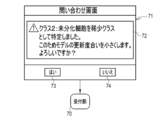
- the inquiry screen 71 is displayed on the display 34.
- a message 72 indicating that a rare class has been specified a message asking whether the update degree of the model 10 may be reduced, a Yes button 73, and a No button 74 are displayed.
- the accepting unit 70 accepts a selection instruction of the Yes button 73 and the No button 74 as a selection instruction of whether or not to cause the updating unit 55 to perform the process of reducing the update degree.
- the Yes button 73 is selected, the updating unit 55 performs a process of reducing the updating degree.
- the No button 74 the updating unit 55 does not perform the process of reducing the updating degree.
- the class is specified manually, so the class may be specified incorrectly.
- the model 10 was designated as a class at the beginning of development, some classes may become less important as the development progresses. In such a case, the rare class is specified by the specifying unit 52, but it may not be necessary to reduce the update degree of the model 10.
- the receiving unit 70 receives a selection instruction as to whether or not the update degree of the model 10 may be reduced. Therefore, it is possible to deal with the case where the rare class is specified by the specifying unit 52, but it is not necessary to reduce the update degree of the model 10.
- the input image 16 and the learning input image 20 are exemplified by images of a phase contrast microscope showing the state of cell culture, and differentiated cells and medium are illustrated as classes, but the invention is not limited thereto.
- an MRI (Magnetic Resonance Imaging) image may be used as the input image 16 and the learning input image 20
- an organ such as a liver or a kidney may be used as a class.
- the model 10 is not limited to U-Net, but may be another convolutional neural network such as SegNet.
- a method of reducing the update degree of the model 10 As a method of reducing the update degree of the model 10, a method other than the method of reducing the learning coefficient ⁇ may be adopted.
- the hardware configuration of the computer that constitutes the mini-batch learning device 2 can be modified in various ways.
- the mini-batch learning device 2 may be composed of a plurality of computers separated as hardware for the purpose of improving processing capacity and reliability.
- the functions of the generation unit 50, the calculation unit 51, and the identification unit 52, and the functions of the learning unit 53, the evaluation unit 54, and the update unit 55 are distributed to two computers. In this case, the two computers form the mini-batch learning device 2.
- the hardware configuration of the computer can be appropriately changed according to the required performance such as processing capacity, safety and reliability.
- the application program such as the operation program 40 can be duplicated or stored in a plurality of storage devices in a distributed manner for the purpose of ensuring safety and reliability. is there.
- the hardware of a processing unit that executes various processes such as the generation unit 50, the calculation unit 51, the identification unit 52, the learning unit 53, the evaluation unit 54, the update unit 55, and the reception unit 70.
- a processing unit Processes
- various processors can be used.
- the CPU which is a general-purpose processor that executes software (operation program 40) and functions as various processing units
- various processors are manufactured after manufacturing FPGA (Field Programmable Gate Array) and the like.
- Programmable Logic Device which is a processor whose circuit configuration can be changed, dedicated processor, which has a circuit configuration specifically designed to execute specific processing such as ASIC (Application Specific Integrated Circuit) An electric circuit etc. are included.
- One processing unit may be configured by one of these various processors, or a combination of two or more processors of the same type or different types (for example, a combination of a plurality of FPGAs or a combination of a CPU and an FPGA). Combination). Further, the plurality of processing units may be configured by one processor.
- one processor is configured with a combination of one or more CPUs and software, as represented by computers such as clients and servers.
- the processor functions as a plurality of processing units.
- SoC system on chip
- a processor that realizes the functions of the entire system including a plurality of processing units by one IC (Integrated Circuit) chip is used. is there.
- the various processing units are configured by using one or more of the various processors as a hardware structure.
- circuitry in which circuit elements such as semiconductor elements are combined can be used.
- [Appendix 1] It is a mini-batch learning device that gives learning by giving mini-batch data to a machine learning model for performing semantic segmentation that performs discrimination of multiple classes in an image in pixel units, A calculation processor for calculating the area ratio of each of the plurality of classes in the mini-batch data, A specific processor for specifying a rare class in which the area ratio is lower than a set value, Depending on the result of the learning using the mini-batch data, an update processor that updates the machine learning model, rather than when the rare class is not specified in the specific processor, the rare class in the specific processor A mini-batch learning device, comprising: an update processor that reduces the degree of update of the machine learning model when the above is specified.
- the technology of the present disclosure can be appropriately combined with the above-described various embodiments and various modifications. Further, it is needless to say that various configurations can be adopted without departing from the scope of the invention, without being limited to the above-mentioned respective embodiments. Further, the technology of the present disclosure extends to a program, a storage medium that stores the program non-temporarily, and a learning device and an image processing device that implements the program.
- Mini batch learning device 10 Machine learning model (model) 10T learned machine learning model (learned model) 11 mini batch data Input image group for 12-division learning 13-divided annotation image group 14 Output image group for learning 15 Operation equipment 16 Input image 17 Output image 20 Input image for learning Input image for 20S split learning 21 Annotation image 21S split annotation image 25 frames 30 storage devices 31 memory 32 CPU 33 Communication unit 34 display 35 Input device 36 data bus 40 operating program 50 Generator 51 calculator 52 Specific Part 53 Learning Department 54 Evaluation Department 55 Update Department 60, 61, 65, 66 table 70 Reception Department 71 Inquiry screen 72 messages 73 Yes button 74 No button Horizontal movement amount of DX frame Amount of vertical movement of DY frame ⁇ learning coefficient ST100 to ST180 steps
Landscapes
- Engineering & Computer Science (AREA)
- Theoretical Computer Science (AREA)
- Physics & Mathematics (AREA)
- General Physics & Mathematics (AREA)
- Computer Vision & Pattern Recognition (AREA)
- Evolutionary Computation (AREA)
- Data Mining & Analysis (AREA)
- Artificial Intelligence (AREA)
- Multimedia (AREA)
- Software Systems (AREA)
- Life Sciences & Earth Sciences (AREA)
- Health & Medical Sciences (AREA)
- General Health & Medical Sciences (AREA)
- General Engineering & Computer Science (AREA)
- Computing Systems (AREA)
- Computational Linguistics (AREA)
- Biomedical Technology (AREA)
- Molecular Biology (AREA)
- Mathematical Physics (AREA)
- Biophysics (AREA)
- Medical Informatics (AREA)
- Evolutionary Biology (AREA)
- Bioinformatics & Computational Biology (AREA)
- Bioinformatics & Cheminformatics (AREA)
- Databases & Information Systems (AREA)
- Image Analysis (AREA)
Abstract
Priority Applications (4)
| Application Number | Priority Date | Filing Date | Title |
|---|---|---|---|
| EP19895917.3A EP3896647B1 (fr) | 2018-12-14 | 2019-10-31 | Dispositif d'apprentissage de mini-lot, programme de fonctionnement pour dispositif d'apprentissage de mini-lot, procédé de fonctionnement pour dispositif d'apprentissage de mini-lot et dispositif de traitement d'image |
| JP2020559800A JP7096361B2 (ja) | 2018-12-14 | 2019-10-31 | ミニバッチ学習装置とその作動プログラム、作動方法、および画像処理装置 |
| CN201980081724.4A CN113168713B (zh) | 2018-12-14 | 2019-10-31 | 小批量学习装置及其工作程序、工作方法及图像处理装置 |
| US17/336,807 US11900249B2 (en) | 2018-12-14 | 2021-06-02 | Mini-batch learning apparatus, operation program of mini-batch learning apparatus, operation method of mini-batch learning apparatus, and image processing apparatus |
Applications Claiming Priority (2)
| Application Number | Priority Date | Filing Date | Title |
|---|---|---|---|
| JP2018234881 | 2018-12-14 | ||
| JP2018-234881 | 2018-12-14 |
Related Child Applications (1)
| Application Number | Title | Priority Date | Filing Date |
|---|---|---|---|
| US17/336,807 Continuation US11900249B2 (en) | 2018-12-14 | 2021-06-02 | Mini-batch learning apparatus, operation program of mini-batch learning apparatus, operation method of mini-batch learning apparatus, and image processing apparatus |
Publications (1)
| Publication Number | Publication Date |
|---|---|
| WO2020121678A1 true WO2020121678A1 (fr) | 2020-06-18 |
Family
ID=71077223
Family Applications (1)
| Application Number | Title | Priority Date | Filing Date |
|---|---|---|---|
| PCT/JP2019/042935 Ceased WO2020121678A1 (fr) | 2018-12-14 | 2019-10-31 | Dispositif d'apprentissage de mini-lot, programme de fonctionnement pour dispositif d'apprentissage de mini-lot, procédé de fonctionnement pour dispositif d'apprentissage de mini-lot et dispositif de traitement d'image |
Country Status (5)
| Country | Link |
|---|---|
| US (1) | US11900249B2 (fr) |
| EP (1) | EP3896647B1 (fr) |
| JP (1) | JP7096361B2 (fr) |
| CN (1) | CN113168713B (fr) |
| WO (1) | WO2020121678A1 (fr) |
Families Citing this family (2)
| Publication number | Priority date | Publication date | Assignee | Title |
|---|---|---|---|---|
| WO2020121678A1 (fr) * | 2018-12-14 | 2020-06-18 | 富士フイルム株式会社 | Dispositif d'apprentissage de mini-lot, programme de fonctionnement pour dispositif d'apprentissage de mini-lot, procédé de fonctionnement pour dispositif d'apprentissage de mini-lot et dispositif de traitement d'image |
| EP3896646A4 (fr) * | 2018-12-14 | 2022-01-26 | FUJIFILM Corporation | Dispositif d'apprentissage de mini-lot, et programme d'exploitation et procédé d'exploitation associés |
Citations (3)
| Publication number | Priority date | Publication date | Assignee | Title |
|---|---|---|---|---|
| JP2017107386A (ja) | 2015-12-09 | 2017-06-15 | 日本電信電話株式会社 | 事例選択装置、分類装置、方法、及びプログラム |
| JP2017162456A (ja) * | 2016-03-11 | 2017-09-14 | 株式会社東芝 | 道路シーンのセマンティックセグメンテーションのための制約付きデコンボリューションネットワークのトレーニング |
| WO2018081537A1 (fr) * | 2016-10-31 | 2018-05-03 | Konica Minolta Laboratory U.S.A., Inc. | Procédé et système de segmentation d'image à l'aide d'une rétroaction commandée |
Family Cites Families (57)
| Publication number | Priority date | Publication date | Assignee | Title |
|---|---|---|---|---|
| US9454823B2 (en) * | 2010-07-28 | 2016-09-27 | arian Medical Systems, Inc. | Knowledge-based automatic image segmentation |
| WO2017106645A1 (fr) * | 2015-12-18 | 2017-06-22 | The Regents Of The University Of California | Interprétation et quantification de caractéristique d'urgence sur une tomographie assistée par ordinateur de tête |
| US20170175169A1 (en) * | 2015-12-18 | 2017-06-22 | Min Lee | Clinical decision support system utilizing deep neural networks for diagnosis of chronic diseases |
| CN105894018B (zh) * | 2016-03-29 | 2019-04-23 | 西安电子科技大学 | 基于深度多示例学习的极化sar图像分类方法 |
| WO2017173100A1 (fr) * | 2016-03-30 | 2017-10-05 | Convenant Eyes, Inc. | Applications, systèmes et procédés permettant de surveiller, filtrer et/ou modifier la sortie d'un dispositif informatique |
| CN109313717A (zh) * | 2016-05-02 | 2019-02-05 | 丹麦Scopito公司 | 一种在神经网络中用于对象检测的模型构建 |
| EP3570753B1 (fr) * | 2017-02-23 | 2024-08-07 | Google LLC | Procédé et système d'aide à l'identification par un pathologiste de cellules tumorales dans des images tissulaires agrandies |
| US10713794B1 (en) * | 2017-03-16 | 2020-07-14 | Facebook, Inc. | Method and system for using machine-learning for object instance segmentation |
| WO2019190576A2 (fr) * | 2017-06-13 | 2019-10-03 | The Trustees Of Princeton University | Prélèvement de particules entièrement automatique, sans gabarit pour la microscopie électronique |
| US10019654B1 (en) * | 2017-06-28 | 2018-07-10 | Accenture Global Solutions Limited | Image object recognition |
| US10062039B1 (en) * | 2017-06-28 | 2018-08-28 | CS Disco, Inc. | Methods and apparatus for asynchronous and interactive machine learning using word embedding within text-based documents and multimodal documents |
| US10586104B2 (en) * | 2017-07-21 | 2020-03-10 | Tata Consultancy Services Limited | System and method for theme extraction |
| WO2019041360A1 (fr) * | 2017-09-04 | 2019-03-07 | 华为技术有限公司 | Procédé de reconnaissance et de localisation d'attribut de piéton et système de réseau neuronal convolutif |
| CN109493347B (zh) * | 2017-09-12 | 2021-03-23 | 深圳科亚医疗科技有限公司 | 在图像中对稀疏分布的对象进行分割的方法和系统 |
| CN108228703B (zh) * | 2017-10-31 | 2020-05-08 | 北京市商汤科技开发有限公司 | 图像问答方法、装置、系统和存储介质 |
| WO2019104003A1 (fr) * | 2017-11-21 | 2019-05-31 | Beth Israel Deaconess Medical Center, Inc | Systèmes et procédés pour interpréter automatiquement des images d'échantillons microbiologiques |
| EP3721373B1 (fr) * | 2017-12-07 | 2025-03-05 | Ventana Medical Systems, Inc. | Systèmes d'apprentissage profond et procédés permettant de classifier conjointement des cellules et des régions d'images biologiques |
| EP3514756A1 (fr) * | 2018-01-18 | 2019-07-24 | Koninklijke Philips N.V. | Procédé d'analyse médicale pour prédire des métastases dans un échantillon de tissu d'essai |
| US10580137B2 (en) * | 2018-01-30 | 2020-03-03 | International Business Machines Corporation | Systems and methods for detecting an indication of malignancy in a sequence of anatomical images |
| US11507800B2 (en) * | 2018-03-06 | 2022-11-22 | Adobe Inc. | Semantic class localization digital environment |
| WO2019172901A1 (fr) * | 2018-03-07 | 2019-09-12 | Google Llc | Coloration virtuelle pour images de lame de tissu |
| CN111837157B (zh) * | 2018-03-08 | 2024-08-23 | 株式会社岛津制作所 | 细胞图像解析方法、细胞图像解析装置、及学习模型创建方法 |
| CN108470159B (zh) * | 2018-03-09 | 2019-12-20 | 腾讯科技(深圳)有限公司 | 车道线数据处理方法、装置、计算机设备和存储介质 |
| CN108416776B (zh) * | 2018-03-16 | 2021-04-30 | 京东方科技集团股份有限公司 | 图像识别方法、图像识别装置、计算机产品和可读存储介质 |
| US10878569B2 (en) * | 2018-03-28 | 2020-12-29 | International Business Machines Corporation | Systems and methods for automatic detection of an indication of abnormality in an anatomical image |
| CN108830277B (zh) * | 2018-04-20 | 2020-04-21 | 平安科技(深圳)有限公司 | 语义分割模型的训练方法、装置、计算机设备和存储介质 |
| CA3041140C (fr) * | 2018-04-26 | 2021-12-14 | NeuralSeg Ltd. | Procedes et systemes de segmentation d'une image |
| JP7678424B2 (ja) * | 2018-05-10 | 2025-05-16 | 学校法人順天堂 | 画像解析方法、装置、コンピュータプログラム、及び深層学習アルゴリズムの生成方法 |
| CN110163834B (zh) * | 2018-05-14 | 2023-08-25 | 腾讯科技(深圳)有限公司 | 对象识别方法和装置及存储介质 |
| WO2019218136A1 (fr) * | 2018-05-15 | 2019-11-21 | 深圳大学 | Procédé de segmentation d'image, dispositif informatique, et support de stockage |
| KR102102161B1 (ko) * | 2018-05-18 | 2020-04-20 | 오드컨셉 주식회사 | 이미지 내 객체의 대표 특성을 추출하는 방법, 장치 및 컴퓨터 프로그램 |
| US10817740B2 (en) * | 2018-06-20 | 2020-10-27 | Zoox, Inc. | Instance segmentation inferred from machine learning model output |
| WO2019243405A1 (fr) * | 2018-06-22 | 2019-12-26 | H-Labs Gmbh | Procédé pour déterminer un degré d'anomalie, support lisible par ordinateur respectif et système d'analyse de cancer distribué |
| CN109191515B (zh) * | 2018-07-25 | 2021-06-01 | 北京市商汤科技开发有限公司 | 一种图像视差估计方法及装置、存储介质 |
| US10902588B2 (en) * | 2018-08-13 | 2021-01-26 | International Business Machines Corporation | Anatomical segmentation identifying modes and viewpoints with deep learning across modalities |
| US11055854B2 (en) * | 2018-08-23 | 2021-07-06 | Seoul National University R&Db Foundation | Method and system for real-time target tracking based on deep learning |
| US10984532B2 (en) * | 2018-08-24 | 2021-04-20 | Ordnance Survey Limited | Joint deep learning for land cover and land use classification |
| CN110866526B (zh) * | 2018-08-28 | 2024-10-01 | 北京三星通信技术研究有限公司 | 图像分割方法、电子设备及计算机可读存储介质 |
| GB201814121D0 (en) * | 2018-08-30 | 2018-10-17 | Liopa Ltd | Liopa |
| US10853934B2 (en) * | 2018-09-19 | 2020-12-01 | Indus.Ai Inc | Patch-based scene segmentation using neural networks |
| JP7129870B2 (ja) * | 2018-10-01 | 2022-09-02 | 富士フイルム株式会社 | 疾患領域を判別する判別器の学習装置、方法及びプログラム、疾患領域を判別する判別器、並びに疾患領域判別装置及びプログラム |
| CN110162644B (zh) * | 2018-10-10 | 2022-12-20 | 腾讯科技(深圳)有限公司 | 一种图像集建立方法、装置和存储介质 |
| KR102500760B1 (ko) * | 2018-10-23 | 2023-02-16 | 삼성전자주식회사 | 이미지 획득 장치 및 그의 제어 방법 |
| US10504027B1 (en) * | 2018-10-26 | 2019-12-10 | StradVision, Inc. | CNN-based learning method, learning device for selecting useful training data and test method, test device using the same |
| JP7300699B2 (ja) * | 2018-11-12 | 2023-06-30 | 株式会社イシダ | 教師データ生成方法、教師データ生成プログラム、教師データ生成装置、及び商品識別装置 |
| US11205086B2 (en) * | 2018-11-13 | 2021-12-21 | Nvidia Corporation | Determining associations between objects and persons using machine learning models |
| CN109685116B (zh) * | 2018-11-30 | 2022-12-30 | 腾讯科技(深圳)有限公司 | 图像描述信息生成方法和装置及电子装置 |
| US11657525B2 (en) * | 2018-12-04 | 2023-05-23 | Yoti Holding Limited | Extracting information from images |
| GB2579583B (en) * | 2018-12-04 | 2021-01-06 | Yoti Holding Ltd | Anti-spoofing |
| US20200193281A1 (en) * | 2018-12-13 | 2020-06-18 | Zebra Technologies Corporation | Method for automating supervisory signal during training of a neural network using barcode scan |
| EP3896646A4 (fr) * | 2018-12-14 | 2022-01-26 | FUJIFILM Corporation | Dispositif d'apprentissage de mini-lot, et programme d'exploitation et procédé d'exploitation associés |
| WO2020121678A1 (fr) * | 2018-12-14 | 2020-06-18 | 富士フイルム株式会社 | Dispositif d'apprentissage de mini-lot, programme de fonctionnement pour dispositif d'apprentissage de mini-lot, procédé de fonctionnement pour dispositif d'apprentissage de mini-lot et dispositif de traitement d'image |
| EP3896648A4 (fr) * | 2018-12-14 | 2022-01-26 | FUJIFILM Corporation | Dispositif d'apprentissage de mini-lot, et programme de fonctionnement et procédé de fonctionnement associés |
| KR20200079581A (ko) * | 2018-12-26 | 2020-07-06 | 오드컨셉 주식회사 | 사용자에게 스와이프 제스처를 이용한 패션 아이템 추천 서비스를 제공하는 방법 |
| CN113678147B (zh) * | 2019-04-09 | 2024-08-27 | 基诺媒体株式会社 | 搜索方法以及信息处理系统 |
| US10607331B1 (en) * | 2019-06-28 | 2020-03-31 | Corning Incorporated | Image segmentation into overlapping tiles |
| EP4036211B1 (fr) * | 2019-09-27 | 2026-04-29 | FUJIFILM Corporation | Appareil de traitement de l'information, procédé de fonctionnement de l'appareil de traitement de l'information et programme de fonctionnement de l'appareil de traitement de l'information |
-
2019
- 2019-10-31 WO PCT/JP2019/042935 patent/WO2020121678A1/fr not_active Ceased
- 2019-10-31 CN CN201980081724.4A patent/CN113168713B/zh active Active
- 2019-10-31 EP EP19895917.3A patent/EP3896647B1/fr active Active
- 2019-10-31 JP JP2020559800A patent/JP7096361B2/ja active Active
-
2021
- 2021-06-02 US US17/336,807 patent/US11900249B2/en active Active
Patent Citations (3)
| Publication number | Priority date | Publication date | Assignee | Title |
|---|---|---|---|---|
| JP2017107386A (ja) | 2015-12-09 | 2017-06-15 | 日本電信電話株式会社 | 事例選択装置、分類装置、方法、及びプログラム |
| JP2017162456A (ja) * | 2016-03-11 | 2017-09-14 | 株式会社東芝 | 道路シーンのセマンティックセグメンテーションのための制約付きデコンボリューションネットワークのトレーニング |
| WO2018081537A1 (fr) * | 2016-10-31 | 2018-05-03 | Konica Minolta Laboratory U.S.A., Inc. | Procédé et système de segmentation d'image à l'aide d'une rétroaction commandée |
Non-Patent Citations (4)
| Title |
|---|
| AIZAWA, HIROAKI : "Application and improvement of Encoder-Decoder CNN for aircraft image segmentation", ITE TECHNICAL REPORT, vol. 40, no. 28, 24 August 2016 (2016-08-24), JP, pages 9 - 10, XP009527783, ISSN: 1342-6893, DOI: 10.11485/itetr.40.28.0_9 * |
| HIRAMATSU, YUKI : "Segmentation of cell image integrated by multiple CNNS", 24TH SYMPOSIUM ON SENSING VIA IMAGE INFORMATION (SSII2018); JUNE 13-15, 2018, vol. 24, 13 June 2018 (2018-06-13), pages 1 - 7, XP009527825 * |
| HIROAKI AIZAWA, KUNITO KATO, TAKAYOSHI YAMASHITA: "IS3-34 Parts segmentation of Encoder-Decoder CNN incorporated multi-resolution", 23RD SYMPOSIUM ON SENSING VIA IMAGE INFORMATION (SSII2017); JUNE 7-9, 2017, vol. 23, 7 June 2017 (2017-06-07), JP, pages SO3-IS3-34_1 - 8, XP009527823 * |
| See also references of EP3896647A4 |
Also Published As
| Publication number | Publication date |
|---|---|
| JPWO2020121678A1 (ja) | 2021-09-27 |
| US20210287042A1 (en) | 2021-09-16 |
| EP3896647A4 (fr) | 2022-01-26 |
| CN113168713B (zh) | 2024-09-06 |
| EP3896647A1 (fr) | 2021-10-20 |
| CN113168713A (zh) | 2021-07-23 |
| JP7096361B2 (ja) | 2022-07-05 |
| EP3896647B1 (fr) | 2026-04-01 |
| US11900249B2 (en) | 2024-02-13 |
Similar Documents
| Publication | Publication Date | Title |
|---|---|---|
| JP7096362B2 (ja) | ミニバッチ学習装置とその作動プログラムおよび作動方法 | |
| US10235761B2 (en) | Method and apparatus for segmenting object in image | |
| CN112150347A (zh) | 从有限的修改后图像集合中学习的图像修改样式 | |
| CN112967381B (zh) | 三维重建方法、设备和介质 | |
| JP7096360B2 (ja) | ミニバッチ学習装置とその作動プログラムおよび作動方法 | |
| CN111553840A (zh) | 图像超分辨的模型训练和处理方法、装置、设备和介质 | |
| WO2020121678A1 (fr) | Dispositif d'apprentissage de mini-lot, programme de fonctionnement pour dispositif d'apprentissage de mini-lot, procédé de fonctionnement pour dispositif d'apprentissage de mini-lot et dispositif de traitement d'image | |
| CN110633595B (zh) | 一种利用双线性插值的目标检测方法和装置 | |
| JP7195220B2 (ja) | 学習装置、学習装置の作動方法、および学習装置の作動プログラム | |
| JP2024512344A (ja) | 反復的改良を通した効率的なポーズ推定 | |
| US12548256B2 (en) | Image processing apparatus for generating surface profile of three-dimensional geometric model, control method therefor, and storage medium | |
| CN115526986A (zh) | 图像处理方法、装置和电子设备 | |
| CN114241092A (zh) | 多图排版方法、多图排版装置及电子设备 | |
| US20250200727A1 (en) | Depth-of-field image rendering | |
| CN114936322B (zh) | 推荐模型训练方法、装置、电子设备及存储介质 | |
| CN117952879B (zh) | 综合退化、估计和恢复的水下图像增强方法、装置、设备 | |
| CN116152623A (zh) | 基于多粒度特征融合的全景图像描述方法与系统 | |
| CN119941532A (zh) | 图像增强模型训练方法、图像增强方法及相关设备 | |
| CN121660912A (zh) | 图像处理方法、计算机终端和存储介质 | |
| CN120031090A (zh) | 图像生成模型的训练方法及装置、图像生成方法及装置 |
Legal Events
| Date | Code | Title | Description |
|---|---|---|---|
| 121 | Ep: the epo has been informed by wipo that ep was designated in this application |
Ref document number: 19895917 Country of ref document: EP Kind code of ref document: A1 |
|
| ENP | Entry into the national phase |
Ref document number: 2020559800 Country of ref document: JP Kind code of ref document: A |
|
| NENP | Non-entry into the national phase |
Ref country code: DE |
|
| ENP | Entry into the national phase |
Ref document number: 2019895917 Country of ref document: EP Effective date: 20210714 |
|
| WWG | Wipo information: grant in national office |
Ref document number: 2019895917 Country of ref document: EP |