WO2020121722A1 - Dispositif, procédé, et programme d'estimation - Google Patents
Dispositif, procédé, et programme d'estimation Download PDFInfo
- Publication number
- WO2020121722A1 WO2020121722A1 PCT/JP2019/044519 JP2019044519W WO2020121722A1 WO 2020121722 A1 WO2020121722 A1 WO 2020121722A1 JP 2019044519 W JP2019044519 W JP 2019044519W WO 2020121722 A1 WO2020121722 A1 WO 2020121722A1
- Authority
- WO
- WIPO (PCT)
- Prior art keywords
- pulse train
- train signal
- time
- unit
- shift amount
- Prior art date
- Legal status (The legal status is an assumption and is not a legal conclusion. Google has not performed a legal analysis and makes no representation as to the accuracy of the status listed.)
- Ceased
Links
Images




Classifications
-
- H—ELECTRICITY
- H04—ELECTRIC COMMUNICATION TECHNIQUE
- H04L—TRANSMISSION OF DIGITAL INFORMATION, e.g. TELEGRAPHIC COMMUNICATION
- H04L43/00—Arrangements for monitoring or testing data switching networks
- H04L43/16—Threshold monitoring
-
- G—PHYSICS
- G05—CONTROLLING; REGULATING
- G05B—CONTROL OR REGULATING SYSTEMS IN GENERAL; FUNCTIONAL ELEMENTS OF SUCH SYSTEMS; MONITORING OR TESTING ARRANGEMENTS FOR SUCH SYSTEMS OR ELEMENTS
- G05B11/00—Automatic controllers
- G05B11/01—Automatic controllers electric
- G05B11/26—Automatic controllers electric in which the output signal is a pulse-train
-
- G—PHYSICS
- G06—COMPUTING OR CALCULATING; COUNTING
- G06F—ELECTRIC DIGITAL DATA PROCESSING
- G06F17/00—Digital computing or data processing equipment or methods, specially adapted for specific functions
- G06F17/10—Complex mathematical operations
- G06F17/15—Correlation function computation including computation of convolution operations
-
- H—ELECTRICITY
- H03—ELECTRONIC CIRCUITRY
- H03K—PULSE TECHNIQUE
- H03K5/00—Manipulating of pulses not covered by one of the other main groups of this subclass
- H03K5/19—Monitoring patterns of pulse trains
Definitions
- the present invention relates to an estimation device, an estimation method, and an estimation program.
- PRI Pulse Repetition Intervals
- a phase term represented by a complex number is added to an autocorrelation function that is a function that measures how well a signal and a signal obtained by time-shifting itself are matched, and that is widely used for period estimation. ..
- a complex number term is added in order to suppress the influence of noise called subharmonics generated in the pulse train signal.
- Ken'ichi Nishiguchi, et al "Improved Algorithm for Estimating Pulse Repetition Intervals", IEEE Transactions on Aerospace and Electronic Systems, April 2000, Volume 36 issue 2, Page 407-421 Ken'ichi Nishiguchi, “Time-Period Analysis for Pulse Train Deinterleaving", Trans. of the Society of Instrument and Control Engineers, 2005, Vol.E-4, No.1, pp.68-78
- the value of the autocorrelation of the pulse train signal is determined by the ratio of the number of pulses that overlap the original signal when the pulse train signal is time-shifted. Therefore, when a signal having a plurality of periods with a large period difference is included in the pulse train signal, the shorter the period of the signal, the larger the autocorrelation value when the time is shifted by the period A, and thus the signal is easily distinguished from the noise. It On the other hand, as the signal included in this pulse train signal has a longer cycle, the value of the autocorrelation becomes smaller, and it becomes more difficult to distinguish it from noise. Therefore, in the PRI conversion, it may be difficult to estimate the cycle of a signal having a long cycle when the pulse train signal includes signals having a plurality of cycles with large differences in cycle.
- the present invention has been made in view of the above, and an object thereof is to accurately estimate each period of a pulse train signal including signals of a plurality of periods.
- the estimation device aggregates a pulse train signal including time-series pulses input for a predetermined observation time into a pulse for each predetermined unit time.
- a detection unit that detects the time shift amount as the cycle of the aggregated pulse train signal when the autocorrelation value exceeds the threshold value, and the detected cycle is the unit. It is characterized by comprising a conversion unit that converts the pulse train signal into a cycle using time, and an exclusion unit that excludes the converted pulse train signal from the input pulse train signal.
- FIG. 1 is a schematic diagram illustrating the schematic configuration of the estimation device according to the present embodiment.
- FIG. 2 is a flowchart showing the estimation processing procedure.
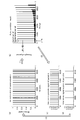
- FIG. 3 is a diagram for explaining the flow of the estimation process.
- FIG. 4 is a diagram for explaining the flow of the estimation process.
- FIG. 5 is a diagram illustrating an example of a computer that executes the estimation program.
- FIG. 1 is a schematic diagram illustrating the schematic configuration of the estimation device according to the present embodiment.
- the estimation device 10 is realized by a general-purpose computer such as a personal computer, and includes an input unit 11, an output unit 12, a communication control unit 13, a storage unit 14, and a control unit 15.
- the input unit 11 is realized by using an input device such as a keyboard and a mouse, and inputs various instruction information such as processing start to the control unit 15 in response to an input operation by an operator.
- the output unit 12 is realized by a display device such as a liquid crystal display and a printing device such as a printer.
- the communication control unit 13 is realized by a NIC (Network Interface Card) or the like, and controls communication between an external device and a control unit 15 via a telecommunication line such as a LAN (Local Area Network) or the Internet.
- a telecommunication line such as a LAN (Local Area Network) or the Internet.
- the communication control unit 13 controls communication between the control unit 15 and a management device or the like that collects and manages pulse train signals used in the estimation process described later.
- the storage unit 14 is realized by a semiconductor memory device such as a RAM (Random Access Memory) or a flash memory (Flash Memory), or a storage device such as a hard disk or an optical disk. For example, the detected period and the like are stored in the estimation process described later.
- the storage unit 14 may be configured to communicate with the control unit 15 via the communication control unit 13.
- the control unit 15 is realized by using a CPU (Central Processing Unit) or the like and executes a processing program stored in the memory. As a result, the control unit 15 functions as the aggregating unit 15a, the calculating unit 15b, the detecting unit 15c, the converting unit 15d, and the excluding unit 15e, as illustrated in FIG. Note that these functional units may be implemented individually or in a part of different hardware.
- a CPU Central Processing Unit
- the control unit 15 functions as the aggregating unit 15a, the calculating unit 15b, the detecting unit 15c, the converting unit 15d, and the excluding unit 15e, as illustrated in FIG. Note that these functional units may be implemented individually or in a part of different hardware.
- the aggregating unit 15a aggregates the input pulse train signal including time-series pulses for a predetermined observation time into a pulse for each predetermined unit time. That is, the aggregating unit 15a sets the scale of a pulse train signal (hereinafter, referred to as an input pulse train signal) for an observation time such as 3 hours, which is input as an estimation processing target by the estimation device 10, from, for example, 1 second unit. It is converted into a predetermined unit time to be described later and used as an aggregated pulse train signal.
- an input pulse train signal a pulse train signal for an observation time such as 3 hours
- the aggregating unit 15a first receives an input of a pulse train signal for a predetermined observation time via the input unit 11 or the communication control unit 13. For example, the aggregating unit 15a receives the collected packets of IP communication as the estimation processing target for each combination of (src IP, dst IP, dst port).
- the aggregating unit 15a uses the received pulse train signal for the observation time to generate an input pulse train signal that is time-series data in which the horizontal axis represents time t and the vertical axis represents the number of packets.
- the observation time is the time from the time of the first pulse generation of the input pulse train signal to the time of the last pulse generation.
- the input pulse train signal is represented by the presence and number of pulses at time t.
- the input pulse train signal is represented by a point corresponding to the number of pulses at the time when the pulse occurs, or a bar having the same number as the number of pulses indicating that the pulse has occurred (see FIG. 3A described later). ..
- the aggregating unit 15a aggregates the pulse intervals of the input pulse train signal and calculates the most frequent value. Then, the aggregating unit 15a determines the unit time based on the most frequent value of the pulse intervals of the input pulse train signal, and aggregates the input pulse train signals for each unit time. That is, the aggregating unit 15a determines the unit time by using the calculated most frequent value and converts the scale of the input pulse train signal by using the determined unit time.
- the aggregating unit 15a sets the unit time to a value that is 20% of the most frequent value of the pulse intervals of the input pulse train signal in order to absorb the deviation (jitter) of the packet generation timing. Then, the aggregating unit 15a aggregates the input pulse train signals for each determined unit time, and sets this as an aggregated pulse train signal.
- the calculation unit 15b calculates the time shift amount of the autocorrelation function using the aggregated pulse train signals that have been aggregated. Specifically, the calculation unit 15b calculates the pulse intervals of all patterns included in the aggregated pulse train signal as the time shift amount.
- the autocorrelation function is a function that measures how well the signal and the signal obtained by shifting the signal by a predetermined time shift match.
- the autocorrelation function is expressed as a function of the time shift amount ⁇ as shown in the following expression (1).
- g(t)g(t+ ⁇ ) represents the number of overlapping pulses among the number of pulses at time t and the number of pulses at time (t+ ⁇ ).
- the autocorrelation value becomes a significantly large value when the time shift amount ⁇ coincides with the period of the periodic function, and therefore can be used for estimating the period of the periodic function. Further, the pulse interval that is not included in the aggregated pulse train signal does not become a cycle. Therefore, in the present embodiment, the calculation unit 15b enumerates the pulse intervals of all patterns of the aggregated pulse train signal as the cycle candidate of the pulse train signal, and sets each as the time shift amount.
- the detection unit 15c calculates an autocorrelation value and a threshold value for each time shift amount selected in ascending order from the calculated time shift amount, and when this autocorrelation value exceeds this threshold value, this time The shift amount is detected as the period of the aggregated pulse train signal.
- the detection unit 15c selects the calculated time shift amount as a processing target in ascending order, and substitutes the selected time shift amount ⁇ in the above equation (1) to obtain the time shift amount ⁇ . Calculate the autocorrelation value.
- the detection unit 15c calculates the threshold value using a value obtained by dividing the observation time by the time shift amount ⁇ . Specifically, since the detection time of the input pulse train signal is equal to the time from the first pulse generation to the last pulse generation of the aggregated pulse train signal, the detection unit 15c uses this time as the observation time and determines this observation time. Divide by the time shift amount ⁇ .
- the autocorrelation value of the pulse train signal with respect to the time shift amount ⁇ matches the number of pulses of the period ⁇ existing in the pulse train signal.
- the value obtained by dividing the observation time by the time shift amount ⁇ is the number of pulses of the pulse train signal having the period ⁇ that should exist in the pulse train signal for the observation time. Therefore, when the pulse train signal of period ⁇ exists in the pulse train signal for the observation time, the autocorrelation value should be larger than this value.
- the detecting unit 15c calculates a value obtained by dividing the observation time by the time shift amount ⁇ by 0.8 as a threshold value. Then, when the autocorrelation value for the time shift amount ⁇ exceeds the threshold value, the detection unit 15c determines that the pulse train with the period ⁇ exists.
- the detection unit 15c has the time shift amount calculated by the calculation unit 15b next to the value to be processed. Select a smaller value and repeat the same process.
- the conversion unit 15d converts the detected cycle into the cycle of the input pulse signal input using the unit time. Specifically, the conversion unit 15d converts the value of the cycle detected by the detection unit 15c into the value of the scale of the input pulse train signal using the unit time determined by the aggregation unit 15a. Further, the conversion unit 15d stores the value of the cycle converted into the scale of the input pulse train signal in the storage unit 14 as the cycle of the detected input pulse train signal.
- the excluding unit 15e excludes the pulse train signal having the converted period from the input pulse train signal. At that time, the exclusion unit 15e calculates the most frequent value of the number of pulses for each time by summing the number of pulses for each time of the period of the converted input pulse train signal, and calculates the most frequent value from the pulse signal at each time. Exclude pulse of value.
- the exclusion unit 15e calculates the most frequent value of the number of pulses per time corresponding to this cycle as the plausible number of pulses of the converted cycle of the input pulse train signal. Then, the exclusion unit 15e excludes the calculated number of the most frequent value pulses from each time pulse. As a result, the pulse train signal having the detected period is excluded from the input pulse train signal.
- the exclusion unit 15e inputs the input pulse train signal excluding the pulse train signal of the detected cycle to the aggregating unit 15a as a new input pulse train signal.
- the estimation device 10 applies the time shift amount ⁇ in ascending order and repeats the above processing. Further, when the calculated autocorrelation value does not exceed the threshold value for all the time shift amounts ⁇ , the estimation device 10 determines that the input pulse train signal no longer has a pulse train with a period ⁇ . .. Then, the estimation apparatus 10 outputs the cycles of all the detected input pulse train signals stored in the storage unit 14 via the output unit 12 or the communication control unit 13.
- the estimation apparatus 10 detects the pulse train signal with a short cycle that can be easily distinguished from noise while sequentially focusing, and separates and detects from the input pulse train signal.
- the new input pulse train signal excluding the detected pulse train signal the noise due to the short pulse train signal is reduced, and the ratio of the number of pulses of the long pulse train signal to the input pulse train signal is increased. .. Therefore, the estimation device 10 can estimate a relatively long cycle of the pulse train signal even when the pulse train signal includes signals with a plurality of cycles having large differences in cycle.
- FIG. 2 is a flowchart showing the estimation processing procedure.
- 3 and 4 are diagrams for explaining the flow of the estimation process.
- the flowchart of FIG. 2 starts, for example, at the timing when the user inputs an operation instructing the start.
- the aggregating unit 15a receives an input of a pulse train signal including time-series pulses for a predetermined observation time via the input unit 11 or the communication control unit 13, and generates an input pulse train signal (step S1).
- the aggregating unit 15a generates an input pulse train signal in which the horizontal axis represents time t and the vertical axis represents the number of pulses, using the received pulse train signal for the observation time.
- the input pulse train signal is represented by, for example, as shown in FIG. 3A, a number of bars equal to the number of pulses indicating that a pulse is generated at the time when the pulse is generated.
- the value of the vertical axis is 1 when there is a pulse
- the value of the vertical axis is 0 when there is no pulse
- the number of pulses at time t is the pulse of which the value of the vertical axis is 1.
- the number of bars is equal to the number (one bar at any time in the illustrated example).
- the aggregating unit 15a aggregates the pulse intervals of the input pulse train signal and calculates the most frequent value. The aggregating unit 15a also determines the unit time based on the most frequent value of the pulse intervals of the input pulse train signal. Further, the aggregating unit 15a aggregates the input pulse train signals every unit time to generate an aggregated pulse train signal (step S2 in FIG. 2).
- the calculation unit 15b calculates the time shift amount of the autocorrelation function using the aggregated pulse train signal (step S3). Specifically, the calculation unit 15b calculates the pulse intervals of all patterns included in the aggregated pulse train signal as the time shift amount.
- the detection unit 15c selects the calculated time shift amount in ascending order and updates the processing target time shift amount ⁇ (step S4).
- the detection unit 15c calculates the threshold value by using the value obtained by dividing the observation time by the time shift amount ⁇ . Further, the detection unit 15c calculates an autocorrelation value with respect to the time shift amount ⁇ (steps S5 to S6 in FIG. 2, (1) in FIG. 3).
- the detection unit 15c confirms whether or not the autocorrelation value for the time shift amount ⁇ exceeds the threshold value (step S7 in FIG. 2).
- the detection unit 15c determines that a pulse train having a period ⁇ exists (step S8 in FIG. 2, FIG. 3B).
- scale conversion of the input pulse train signal by the aggregating unit 15a is not performed for simplification of description. Therefore, the processing by the conversion unit 15d described below is not performed, and the value of the period detected here is used as it is as the period of the detected input pulse train signal.
- the conversion unit 15d converts the value of the cycle detected by the detection unit 15c into the cycle of the input pulse train signal using the unit time determined by the aggregation unit 15a (step S9 in FIG. 2). Further, the conversion unit 15d stores the value of the cycle converted into the scale of the input pulse train signal in the storage unit 14 as the cycle of the detected input pulse train signal.
- the excluding unit 15e separates the converted pulse train signal of the cycle (FIG. 3(c)) and excludes it from the input pulse train signal (step S10 of FIG. 2, FIG. 3(2)).
- the pulse train signal having the period A shown in FIG. 3C is excluded from the input pulse train signal shown in FIG. 3A to obtain the pulse train signal shown in FIG. 3D.
- the exclusion unit 15e calculates the most frequent value of the number of pulses for each time by aggregating the number of pulses at each time of the period as the plausible number of pulses of the period of the converted input pulse train signal.
- the pulse with the most frequent value is excluded from the time pulse signal.
- the pulse train signal having the detected period is excluded from the input pulse train signal.
- the exclusion unit 15e inputs the input pulse train signal shown in FIG. 3(d), which excludes the pulse train signal of the detected cycle, as a new input pulse train signal to the aggregating unit 15a (step S2 in FIG. 2). , FIG. 3 (3)).
- the estimation device 10 repeats the same processing as described above, as shown in FIG.
- the calculation unit 15b calculates the time shift amount ⁇ of the autocorrelation function using the pulse train signal shown in FIG. 3D as the input pulse train signal shown in FIG. 15c calculates the threshold value and the autocorrelation value for the time shift amount ⁇ ((4) in FIG. 4).
- the exclusion unit 15e separates the pulse train signal of the detected cycle (FIG. 4(c)) and excludes it from the input pulse train signal (FIG. 4(5)).
- the exclusion unit 15e separates the pulse train signal of the detected cycle (FIG. 4(c)) and excludes it from the input pulse train signal (FIG. 4(5)).
- FIG. 4D as a result of excluding the pulse train signals of the detected period, all the pulse train signals are excluded, so that the aggregating unit 15a outputs a new input pulse train signal. Not entered.
- the estimation device 10 applies the time shift amount ⁇ in ascending order and repeats the above processing.
- the detection unit 15c calculates the calculation unit 15b. It is confirmed whether the processing has been performed for all the time shift amounts (step S11).
- step S11 If processing has not been performed for all time shift amounts (No in step S11), the detection unit 15c returns to the process of step S4 and updates the time shift amount ⁇ to be processed.
- the detection unit 15c determines that the input pulse train signal does not include the periodic pulse train any more and stores all the stored in the storage unit 14.
- the detected cycle of the input pulse train signal is output via the output unit 12 or the communication control unit 13 (step S12). This completes a series of estimation processes.
- the aggregating unit 15a aggregates the input pulse train signal including time-series pulses for a predetermined observation time into a pulse for each predetermined unit time. ..
- the calculation unit 15b calculates the time shift amount of the autocorrelation function using the aggregated pulse train signal.
- the detection unit 15c calculates an autocorrelation value and a threshold value for each time shift amount selected in ascending order from the calculated time shift amount, and when the autocorrelation value exceeds the threshold value, the time The shift amount is detected as the period of the aggregated pulse train signal.
- the conversion unit 15d converts the detected cycle into the cycle of the input pulse signal using the unit time.
- the excluding unit 15e excludes the pulse train signal having the converted period from the input pulse train signal.
- the estimation apparatus 10 detects the pulse train signal with a short cycle that is easy to distinguish from noise while sequentially focusing, and separates and detects from the input pulse train signal.
- the new input pulse train signal excluding the detected pulse train signal
- the noise due to the short pulse train signal is reduced, and the ratio of the number of pulses of the long pulse train signal to the input pulse train signal is increased. .. Therefore, the estimation device 10 can estimate the relatively long cycle of the pulse train signal even when the pulse train signal includes signals of a plurality of cycles having large differences in cycle. In this way, the estimation device 10 can accurately estimate each period of the pulse train signal including the signals of the plurality of periods.
- the estimation device 10 estimates the communication cycle of the network device in communication and counts the number of different communication cycles to determine the number of cyclic operation programs operating in the network device. It is possible to estimate.
- the estimation device 10 can detect an abnormality by detecting a change in the cycle.
- the estimation apparatus 10 can be implemented by installing an estimation program that executes the above estimation processing as package software or online software in a desired computer.
- the information processing device can be caused to function as the estimation device 10.
- the information processing device mentioned here includes a desktop or notebook personal computer.
- the information processing device includes in its category a mobile communication terminal such as a smartphone, a mobile phone, a PHS (Personal Handyphone System), and a slate terminal such as a PDA (Personal Digital Assistant).
- FIG. 5 is a diagram illustrating an example of a computer that executes an estimation program.
- the computer 1000 has, for example, a memory 1010, a CPU 1020, a hard disk drive interface 1030, a disk drive interface 1040, a serial port interface 1050, a video adapter 1060, and a network interface 1070. These units are connected by a bus 1080.
- the memory 1010 includes a ROM (Read Only Memory) 1011 and a RAM 1012.
- the ROM 1011 stores, for example, a boot program such as BIOS (Basic Input Output System).
- BIOS Basic Input Output System
- the hard disk drive interface 1030 is connected to the hard disk drive 1031.
- the disk drive interface 1040 is connected to the disk drive 1041.
- a removable storage medium such as a magnetic disk or an optical disk is inserted into the disk drive 1041.
- a mouse 1051 and a keyboard 1052 are connected to the serial port interface 1050, for example.
- a display 1061 is connected to the video adapter 1060, for example.
- the hard disk drive 1031 stores, for example, an OS 1091, an application program 1092, a program module 1093, and program data 1094. Each information described in the above embodiment is stored in, for example, the hard disk drive 1031 or the memory 1010.
- the estimation program is stored in the hard disk drive 1031 as a program module 1093 in which a command executed by the computer 1000 is described, for example.
- the program module 1093 in which each process executed by the estimation device 10 described in the above embodiment is described is stored in the hard disk drive 1031.
- data used for information processing by the estimation program is stored in the hard disk drive 1031 as the program data 1094, for example.
- the CPU 1020 reads the program module 1093 and the program data 1094 stored in the hard disk drive 1031 into the RAM 1012 as necessary, and executes the above-described procedures.
- the program module 1093 and the program data 1094 related to the estimation program are not limited to being stored in the hard disk drive 1031 and may be stored in, for example, a removable storage medium and read by the CPU 1020 via the disk drive 1041 or the like. May be done.
- the program module 1093 and the program data 1094 related to the estimation program are stored in another computer connected via a network such as LAN or WAN (Wide Area Network) and read by the CPU 1020 via the network interface 1070. May be.
Landscapes
- Engineering & Computer Science (AREA)
- Physics & Mathematics (AREA)
- General Physics & Mathematics (AREA)
- Computer Networks & Wireless Communication (AREA)
- Signal Processing (AREA)
- Mathematical Optimization (AREA)
- Theoretical Computer Science (AREA)
- Computational Mathematics (AREA)
- Mathematical Physics (AREA)
- Mathematical Analysis (AREA)
- Data Mining & Analysis (AREA)
- Pure & Applied Mathematics (AREA)
- Nonlinear Science (AREA)
- Automation & Control Theory (AREA)
- Algebra (AREA)
- Computing Systems (AREA)
- Databases & Information Systems (AREA)
- Software Systems (AREA)
- General Engineering & Computer Science (AREA)
- Radar Systems Or Details Thereof (AREA)
- Environmental & Geological Engineering (AREA)
- Complex Calculations (AREA)
- Manipulation Of Pulses (AREA)
Abstract
Selon la présente invention, dans chaque impulsion d'un temps unitaire prescrit, une unité d'agrégation (15a) agrège un signal de train d'impulsions entré, qui comprend des impulsions en série chronologique dans un temps d'observation prescrit. Une unité de calcul (15b) utilise le signal de train d'impulsions agrégé pour calculer des quantités de décalage temporel d'une fonction d'autocorrélation. Une unité de détection (15c) calcule une valeur seuil et une valeur d'autocorrélation correspondant à chaque quantité de décalage temporel sélectionnée dans l'ordre croissant à partir des quantités de décalage temporel calculées, et si la valeur d'autocorrélation dépasse la valeur seuil, détecte ladite quantité de décalage temporel en tant que période du signal de train d'impulsions agrégé. Une unité de conversion (15d) convertit la période détectée en période du signal d'impulsion entré à l'aide du temps unitaire. Une unité d'exclusion (15e) exclut le signal de train d'impulsions de période convertie à partir du signal de train d'impulsions entré.
Priority Applications (1)
| Application Number | Priority Date | Filing Date | Title |
|---|---|---|---|
| US17/288,238 US11909619B2 (en) | 2018-12-13 | 2019-11-13 | Estimation device, estimation method and estimation program |
Applications Claiming Priority (2)
| Application Number | Priority Date | Filing Date | Title |
|---|---|---|---|
| JP2018-233810 | 2018-12-13 | ||
| JP2018233810A JP7031573B2 (ja) | 2018-12-13 | 2018-12-13 | 推定装置、推定方法および推定プログラム |
Publications (1)
| Publication Number | Publication Date |
|---|---|
| WO2020121722A1 true WO2020121722A1 (fr) | 2020-06-18 |
Family
ID=71077237
Family Applications (1)
| Application Number | Title | Priority Date | Filing Date |
|---|---|---|---|
| PCT/JP2019/044519 Ceased WO2020121722A1 (fr) | 2018-12-13 | 2019-11-13 | Dispositif, procédé, et programme d'estimation |
Country Status (3)
| Country | Link |
|---|---|
| US (1) | US11909619B2 (fr) |
| JP (1) | JP7031573B2 (fr) |
| WO (1) | WO2020121722A1 (fr) |
Families Citing this family (1)
| Publication number | Priority date | Publication date | Assignee | Title |
|---|---|---|---|---|
| US11449588B2 (en) * | 2019-03-18 | 2022-09-20 | Lg Electronics Inc. | Electronic device and method for controlling the same |
Citations (2)
| Publication number | Priority date | Publication date | Assignee | Title |
|---|---|---|---|---|
| JP2012157212A (ja) * | 2011-01-28 | 2012-08-16 | Toyota Industries Corp | インバータ装置 |
| JP2013038592A (ja) * | 2011-08-08 | 2013-02-21 | Mitsubishi Electric Corp | 信号分離装置及び信号分離方法 |
Family Cites Families (2)
| Publication number | Priority date | Publication date | Assignee | Title |
|---|---|---|---|---|
| JP4776610B2 (ja) * | 2007-11-26 | 2011-09-21 | 三菱電機株式会社 | 監視制御回路を有する車載電子制御装置 |
| JP7151561B2 (ja) * | 2019-03-08 | 2022-10-12 | 日本電信電話株式会社 | パルス列信号の周期推定装置、パルス列信号の周期推定方法およびパルス列信号の周期推定プログラム |
-
2018
- 2018-12-13 JP JP2018233810A patent/JP7031573B2/ja active Active
-
2019
- 2019-11-13 US US17/288,238 patent/US11909619B2/en active Active
- 2019-11-13 WO PCT/JP2019/044519 patent/WO2020121722A1/fr not_active Ceased
Patent Citations (2)
| Publication number | Priority date | Publication date | Assignee | Title |
|---|---|---|---|---|
| JP2012157212A (ja) * | 2011-01-28 | 2012-08-16 | Toyota Industries Corp | インバータ装置 |
| JP2013038592A (ja) * | 2011-08-08 | 2013-02-21 | Mitsubishi Electric Corp | 信号分離装置及び信号分離方法 |
Non-Patent Citations (2)
| Title |
|---|
| NISHIGUCHI, KEN'ICHI: "Time-Period Analysis for Pulse Train Deinterleaving", TRANSACTIONS OF THE SOCIETY OF INSTRUMENT AND CONTROL ENGINEERS, vol. 40, no. 11, 30 November 2004 (2004-11-30), pages 1114 - 1123, ISSN: 1883-8189, Retrieved from the Internet <URL:https://www.jstage.jst.go.jp/article/sicetr1965/40/11/40_11_1114/-article/-char/ja> [retrieved on 20200129] * |
| SUN, HAIBIN ET AL.: "Defending against low-rate TCP attacks: dynamic detection and protection", PROCEEDINGS OF THE 12TH IEEE INTERNATIONAL CONFERENCE ON NETWORK PROTOCOLS, 1 November 2004 (2004-11-01), XP010734822, ISSN: 1092-1648, Retrieved from the Internet <URL:https://ieeexplore.ieee.org/abstract/document/1348110> [retrieved on 20200129] * |
Also Published As
| Publication number | Publication date |
|---|---|
| US20210392067A1 (en) | 2021-12-16 |
| JP7031573B2 (ja) | 2022-03-08 |
| US11909619B2 (en) | 2024-02-20 |
| JP2020095540A (ja) | 2020-06-18 |
Similar Documents
| Publication | Publication Date | Title |
|---|---|---|
| CN109243619B (zh) | 预测模型的生成方法、装置及计算机可读存储介质 | |
| RU2455682C1 (ru) | Цифровое прогнозирующее устройство | |
| JP7031573B2 (ja) | 推定装置、推定方法および推定プログラム | |
| EP3934175B1 (fr) | Procédé et programme de détection d'anomalies | |
| US11663191B2 (en) | Method, device and computer program product for managing log | |
| JP2014211330A (ja) | 目標追尾装置及び目標追尾方法 | |
| JP2000044135A (ja) | エレベータにおける速度制御装置およびエレベータの速度検出プログラムを記録した記録媒体 | |
| RU2517316C1 (ru) | Адаптивное цифровое прогнозирующее устройство | |
| RU2517322C1 (ru) | Адаптивное цифровое прогнозирующее и дифференцирующее устройство | |
| RU2517317C1 (ru) | Адаптивное цифровое прогнозирующее и дифференцирующее устройство | |
| CA2988634A1 (fr) | Systeme et procede de detection d'evenements utilisant des signaux de diffusion en continu | |
| CN115169475A (zh) | 一种航道预警方法、装置、设备及介质 | |
| RU2470359C1 (ru) | Цифровое прогнозирующее и дифференцирующее устройство | |
| JP6733656B2 (ja) | 情報処理装置、情報処理システム、プラントシステム、情報処理方法、及び、プログラム | |
| RU2622852C1 (ru) | Адаптивное цифровое сглаживающее и прогнозирующее устройство | |
| US11365962B2 (en) | Filtering device, sensor device, filtering method and program | |
| WO2018014631A1 (fr) | Procédé et appareil permettant de déterminer une puissance de crête et un rapport puissance de crête sur puissance moyenne | |
| RU2535467C1 (ru) | Адаптивное цифровое дифференцирующее и прогнозирующее устройство | |
| US11349634B2 (en) | Cycle estimation device for pulse train signal, cycle estimation method for pulse train signal, and cycle estimation program for pulse train signal | |
| RU2459241C1 (ru) | Цифровое прогнозирующее устройство | |
| JP5376395B2 (ja) | 波形測定装置 | |
| RU2626338C1 (ru) | Адаптивное цифровое сглаживающее и прогнозирующее устройство | |
| RU2629641C1 (ru) | Цифровое прогнозирующее устройство | |
| CN116107187B (zh) | 时间间隔测量方法、芯片及装置 | |
| RU2622851C1 (ru) | Адаптивное цифровое прогнозирующее устройство |
Legal Events
| Date | Code | Title | Description |
|---|---|---|---|
| 121 | Ep: the epo has been informed by wipo that ep was designated in this application |
Ref document number: 19897476 Country of ref document: EP Kind code of ref document: A1 |
|
| NENP | Non-entry into the national phase |
Ref country code: DE |
|
| 122 | Ep: pct application non-entry in european phase |
Ref document number: 19897476 Country of ref document: EP Kind code of ref document: A1 |