WO2020122015A1 - Procédé de désinfection d'une chambre de machine de remplissage aseptique - Google Patents
Procédé de désinfection d'une chambre de machine de remplissage aseptique Download PDFInfo
- Publication number
- WO2020122015A1 WO2020122015A1 PCT/JP2019/048082 JP2019048082W WO2020122015A1 WO 2020122015 A1 WO2020122015 A1 WO 2020122015A1 JP 2019048082 W JP2019048082 W JP 2019048082W WO 2020122015 A1 WO2020122015 A1 WO 2020122015A1
- Authority
- WO
- WIPO (PCT)
- Prior art keywords
- chamber
- filling machine
- aseptic filling
- aseptic
- sterilizing
- Prior art date
- Legal status (The legal status is an assumption and is not a legal conclusion. Google has not performed a legal analysis and makes no representation as to the accuracy of the status listed.)
- Ceased
Links
Images


Classifications
-
- B—PERFORMING OPERATIONS; TRANSPORTING
- B67—OPENING, CLOSING OR CLEANING BOTTLES, JARS OR SIMILAR CONTAINERS; LIQUID HANDLING
- B67C—CLEANING, FILLING WITH LIQUIDS OR SEMILIQUIDS, OR EMPTYING, OF BOTTLES, JARS, CANS, CASKS, BARRELS, OR SIMILAR CONTAINERS, NOT OTHERWISE PROVIDED FOR; FUNNELS
- B67C3/00—Bottling liquids or semiliquids; Filling jars or cans with liquids or semiliquids using bottling or like apparatus; Filling casks or barrels with liquids or semiliquids
- B67C3/001—Cleaning of filling devices
- B67C3/005—Cleaning outside parts of filling devices
-
- A—HUMAN NECESSITIES
- A61—MEDICAL OR VETERINARY SCIENCE; HYGIENE
- A61L—METHODS OR APPARATUS FOR STERILISING MATERIALS OR OBJECTS IN GENERAL; DISINFECTION, STERILISATION OR DEODORISATION OF AIR; CHEMICAL ASPECTS OF BANDAGES, DRESSINGS, ABSORBENT PADS OR SURGICAL ARTICLES; MATERIALS FOR BANDAGES, DRESSINGS, ABSORBENT PADS OR SURGICAL ARTICLES
- A61L2/00—Disinfection or sterilisation of materials or objects, in general; Accessories therefor
- A61L2/16—Disinfection or sterilisation of materials or objects, in general; Accessories therefor using chemical substances
- A61L2/20—Gaseous substances, e.g. vapours
- A61L2/208—Hydrogen peroxide
-
- A—HUMAN NECESSITIES
- A61—MEDICAL OR VETERINARY SCIENCE; HYGIENE
- A61L—METHODS OR APPARATUS FOR STERILISING MATERIALS OR OBJECTS IN GENERAL; DISINFECTION, STERILISATION OR DEODORISATION OF AIR; CHEMICAL ASPECTS OF BANDAGES, DRESSINGS, ABSORBENT PADS OR SURGICAL ARTICLES; MATERIALS FOR BANDAGES, DRESSINGS, ABSORBENT PADS OR SURGICAL ARTICLES
- A61L2/00—Disinfection or sterilisation of materials or objects, in general; Accessories therefor
- A61L2/02—Disinfection or sterilisation of materials or objects, in general; Accessories therefor using physical processes
- A61L2/04—Heat
- A61L2/06—Hot gas
-
- A—HUMAN NECESSITIES
- A61—MEDICAL OR VETERINARY SCIENCE; HYGIENE
- A61L—METHODS OR APPARATUS FOR STERILISING MATERIALS OR OBJECTS IN GENERAL; DISINFECTION, STERILISATION OR DEODORISATION OF AIR; CHEMICAL ASPECTS OF BANDAGES, DRESSINGS, ABSORBENT PADS OR SURGICAL ARTICLES; MATERIALS FOR BANDAGES, DRESSINGS, ABSORBENT PADS OR SURGICAL ARTICLES
- A61L2/00—Disinfection or sterilisation of materials or objects, in general; Accessories therefor
- A61L2/16—Disinfection or sterilisation of materials or objects, in general; Accessories therefor using chemical substances
- A61L2/18—Liquid substances
-
- A—HUMAN NECESSITIES
- A61—MEDICAL OR VETERINARY SCIENCE; HYGIENE
- A61L—METHODS OR APPARATUS FOR STERILISING MATERIALS OR OBJECTS IN GENERAL; DISINFECTION, STERILISATION OR DEODORISATION OF AIR; CHEMICAL ASPECTS OF BANDAGES, DRESSINGS, ABSORBENT PADS OR SURGICAL ARTICLES; MATERIALS FOR BANDAGES, DRESSINGS, ABSORBENT PADS OR SURGICAL ARTICLES
- A61L2/00—Disinfection or sterilisation of materials or objects, in general; Accessories therefor
- A61L2/16—Disinfection or sterilisation of materials or objects, in general; Accessories therefor using chemical substances
- A61L2/18—Liquid substances
- A61L2/186—Peroxide solutions
-
- A—HUMAN NECESSITIES
- A61—MEDICAL OR VETERINARY SCIENCE; HYGIENE
- A61L—METHODS OR APPARATUS FOR STERILISING MATERIALS OR OBJECTS IN GENERAL; DISINFECTION, STERILISATION OR DEODORISATION OF AIR; CHEMICAL ASPECTS OF BANDAGES, DRESSINGS, ABSORBENT PADS OR SURGICAL ARTICLES; MATERIALS FOR BANDAGES, DRESSINGS, ABSORBENT PADS OR SURGICAL ARTICLES
- A61L2/00—Disinfection or sterilisation of materials or objects, in general; Accessories therefor
- A61L2/26—Accessories
-
- B—PERFORMING OPERATIONS; TRANSPORTING
- B65—CONVEYING; PACKING; STORING; HANDLING THIN OR FILAMENTARY MATERIAL
- B65B—MACHINES, APPARATUS OR DEVICES FOR, OR METHODS OF, PACKAGING ARTICLES OR MATERIALS; UNPACKING
- B65B55/00—Preserving, protecting or purifying packages or package contents in association with packaging
- B65B55/02—Sterilising, e.g. of complete packages
- B65B55/04—Sterilising wrappers or receptacles prior to, or during, packaging
- B65B55/10—Sterilising wrappers or receptacles prior to, or during, packaging by liquids or gases
-
- A—HUMAN NECESSITIES
- A61—MEDICAL OR VETERINARY SCIENCE; HYGIENE
- A61L—METHODS OR APPARATUS FOR STERILISING MATERIALS OR OBJECTS IN GENERAL; DISINFECTION, STERILISATION OR DEODORISATION OF AIR; CHEMICAL ASPECTS OF BANDAGES, DRESSINGS, ABSORBENT PADS OR SURGICAL ARTICLES; MATERIALS FOR BANDAGES, DRESSINGS, ABSORBENT PADS OR SURGICAL ARTICLES
- A61L2101/00—Chemical composition of materials used in disinfecting, sterilising or deodorising
- A61L2101/32—Organic compounds
- A61L2101/36—Carboxylic acids or derivatives thereof
-
- A—HUMAN NECESSITIES
- A61—MEDICAL OR VETERINARY SCIENCE; HYGIENE
- A61L—METHODS OR APPARATUS FOR STERILISING MATERIALS OR OBJECTS IN GENERAL; DISINFECTION, STERILISATION OR DEODORISATION OF AIR; CHEMICAL ASPECTS OF BANDAGES, DRESSINGS, ABSORBENT PADS OR SURGICAL ARTICLES; MATERIALS FOR BANDAGES, DRESSINGS, ABSORBENT PADS OR SURGICAL ARTICLES
- A61L2103/00—Materials or objects being the target of disinfection or sterilisation
- A61L2103/23—Containers other than laboratory or medical, e.g. bottles or mail
-
- A—HUMAN NECESSITIES
- A61—MEDICAL OR VETERINARY SCIENCE; HYGIENE
- A61L—METHODS OR APPARATUS FOR STERILISING MATERIALS OR OBJECTS IN GENERAL; DISINFECTION, STERILISATION OR DEODORISATION OF AIR; CHEMICAL ASPECTS OF BANDAGES, DRESSINGS, ABSORBENT PADS OR SURGICAL ARTICLES; MATERIALS FOR BANDAGES, DRESSINGS, ABSORBENT PADS OR SURGICAL ARTICLES
- A61L2202/00—Aspects relating to methods or apparatus for disinfecting or sterilising materials or objects
- A61L2202/10—Apparatus features
- A61L2202/15—Biocide distribution means, e.g. nozzles, pumps, manifolds, fans, baffles, sprayers
-
- B—PERFORMING OPERATIONS; TRANSPORTING
- B65—CONVEYING; PACKING; STORING; HANDLING THIN OR FILAMENTARY MATERIAL
- B65B—MACHINES, APPARATUS OR DEVICES FOR, OR METHODS OF, PACKAGING ARTICLES OR MATERIALS; UNPACKING
- B65B2210/00—Specific aspects of the packaging machine
- B65B2210/06—Sterilising or cleaning machinery or conduits
-
- B—PERFORMING OPERATIONS; TRANSPORTING
- B65—CONVEYING; PACKING; STORING; HANDLING THIN OR FILAMENTARY MATERIAL
- B65B—MACHINES, APPARATUS OR DEVICES FOR, OR METHODS OF, PACKAGING ARTICLES OR MATERIALS; UNPACKING
- B65B2210/00—Specific aspects of the packaging machine
- B65B2210/06—Sterilising or cleaning machinery or conduits
- B65B2210/08—Cleaning nozzles, funnels or guides through which articles are introduced into containers or wrappers
-
- B—PERFORMING OPERATIONS; TRANSPORTING
- B65—CONVEYING; PACKING; STORING; HANDLING THIN OR FILAMENTARY MATERIAL
- B65B—MACHINES, APPARATUS OR DEVICES FOR, OR METHODS OF, PACKAGING ARTICLES OR MATERIALS; UNPACKING
- B65B55/00—Preserving, protecting or purifying packages or package contents in association with packaging
- B65B55/02—Sterilising, e.g. of complete packages
- B65B55/04—Sterilising wrappers or receptacles prior to, or during, packaging
- B65B55/06—Sterilising wrappers or receptacles prior to, or during, packaging by heat
-
- B—PERFORMING OPERATIONS; TRANSPORTING
- B67—OPENING, CLOSING OR CLEANING BOTTLES, JARS OR SIMILAR CONTAINERS; LIQUID HANDLING
- B67C—CLEANING, FILLING WITH LIQUIDS OR SEMILIQUIDS, OR EMPTYING, OF BOTTLES, JARS, CANS, CASKS, BARRELS, OR SIMILAR CONTAINERS, NOT OTHERWISE PROVIDED FOR; FUNNELS
- B67C3/00—Bottling liquids or semiliquids; Filling jars or cans with liquids or semiliquids using bottling or like apparatus; Filling casks or barrels with liquids or semiliquids
- B67C3/02—Bottling liquids or semiliquids; Filling jars or cans with liquids or semiliquids using bottling or like apparatus
- B67C3/22—Details
- B67C2003/228—Aseptic features
Definitions
- the present invention relates to a method for sterilizing the inside of a chamber of an aseptic filling machine before filling a container such as a PET bottle, a paper container, a cup, a tray or a pouch with a food, a drink or the like.
- Aseptic filling machine for aseptically filling tea bottles, mineral water, juice, soup, nutritional drinks, milk, milk drinks, soups, dashi, etc. into containers such as PET bottles, paper containers, cups, trays, pouches, etc.
- CIP Cosmetic in Place
- SIP Steilizing in Place
- a washing liquid prepared by adding an alkaline chemical such as caustic soda to water was flowed through a flow path from the pipe of the content filling path to the filling nozzle of the filling machine, and then the acidic chemical was added to the water. It is performed by flowing a cleaning liquid. As a result, the residue and the like of the previous contents attached to the contents filling path are removed.
- the SIP process is performed, for example, by flowing steam, hot water, or the like into the flow path cleaned by the CIP process. As a result, the inside of the content filling path is sterilized to be in a sterile state.
- the aseptic filling machine is a sterilizing unit for sterilizing a container for filling contents, a rinsing unit for rinsing a sterilized container, a filling unit for filling a sterilized container with contents sterilized by a contents sterilizer.
- a sealing unit or the like is provided for sealing the container filled with in a sterile atmosphere.
- the inside of the filling chamber and the sealing chamber may have droplets of the contents filled in the previous filling work, so when changing the type of contents to fill, the chamber of the previous filling work
- a COP (Cleaning out of Place) process is performed on the inside of the chamber in order to remove the splashes of the contents adhering to the inner wall and the outer surface of the equipment such as the filling machine inside the chamber.
- the COP treatment is performed by, for example, spraying water or the like into the sterile chamber in a shower shape).
- SOP treatment Steilizing out of Place treatment is also performed on the chamber.
- SOP treatment Conventionally, as a method of SOP treatment in the chamber, it has been attempted to spray peracetic acid, sterile water, heated air, hydrogen peroxide, and heated air into the chamber in order ( See Patent Document 1).
- Patent Document 2 proposes sterilization in a chamber by a process of spraying hot water, spraying a heated peracetic acid germicide, and rinsing by spraying heated sterile water (see Patent Document 2). Furthermore, there is also a chamber sterilization method in which a low concentration sterilizing solution is sprayed and then dried (see Patent Document 3).
- Patent Document 4 it is referred to as peracetic acid injection, aseptic water injection, hydrogen peroxide water injection, hot air blowing, and cooling air blowing after performing a COP process of injecting an alkaline cleaning agent into the chamber and injecting sterile water. It has been proposed to sequentially perform SOP processing (see Patent Document 4).
- SOP processing is performed before the start of production to ensure a sterile atmosphere in the chamber of the aseptic filling machine.
- Patent Documents 2 and 3 describe such SOP processing methods.
- Patent Document 1 and Patent Document 4 propose a two-stage SOP treatment of sterilizing with peracetic acid and then sterilizing with hydrogen peroxide.
- the sterilizing agent containing peracetic acid is a liquid, and the portion wetted by the liquid is sterilized, but sterilization with hydrogen peroxide is effective for the gaps of the packing where the liquid does not penetrate.
- Aseptic heated air is blown into the chamber after the hydrogen peroxide solution is jetted into the chamber. At this time, the hydrogen peroxide solution jetted into the chamber is heated, vaporized and exhausted.
- the hydrogen peroxide in the hydrogen peroxide water is heated and vaporized, and enters into the gap where the disinfectant containing peracetic acid has not penetrated, and it is possible to sterilize the part that has not been disinfected by the disinfectant containing peracetic acid.
- a disinfectant containing peracetic acid is sprayed into the chamber, and then sterile water is continuously sprayed to wash out the disinfectant containing peracetic acid sprayed into the chamber, and then hydrogen peroxide solution is sprayed into the chamber.
- the hydrogen peroxide solution is sprayed into the chamber while the sterile water remains in the chamber, the hydrogen peroxide solution is mixed with the sterile water remaining in the chamber, and the hydrogen peroxide concentration in the mixed liquid is It becomes lower than the hydrogen peroxide concentration of hydrogen peroxide water injected into the chamber. As a result, there is a tendency that the sterilization effect by the injection of hydrogen peroxide solution is reduced.
- the hydrogen peroxide solution is not injected into the chamber until the sterile water remaining in the chamber is naturally dried or is dried by blowing sterile air and removed. After visually confirming that the sterile water in the chamber has been removed by natural drying or drying with sterile air, hydrogen peroxide solution is sprayed into the chamber.
- the concentration of peracetic acid in the bactericide containing peracetic acid remains in the chamber.
- the bactericidal effect of the germicide containing peracetic acid injected into the chamber is lowered.
- the sterilizing method in the aseptic filling machine chamber is a sterile filling machine for filling a sterilized container with sterilized contents in an aseptic atmosphere, and sealing the container filled with the contents.
- a method for sterilizing the inside of the aseptic filling machine chamber before the operation of wherein after cleaning the inside of the chamber by injecting a cleaning liquid into the aseptic filling machine chamber, the conveying device that conveys the container is driven to convey. After removing the cleaning liquid adhering to the device, a sterilizing agent is sprayed into the aseptic filling machine chamber.
- the sterilizing agent contains hydrogen peroxide.
- the sterilizing agent contains peracetic acid.
- the cleaning liquid is sterile water.
- aseptic heated air is blown into the aseptic filling machine chamber when the transfer device is driven.
- the transport devices in the plurality of aseptic filling machine chambers are driven for each of the aseptic filling machine chambers.
- the transport device for transporting the container is driven, and the cleaning attached to the transport device is performed.
- the wash water remaining in the aseptic filling machine chamber can be quickly removed.
- FIG. 1 is a schematic elevational view of an aseptic filling machine for pouches according to an embodiment of the present invention.
- the aseptic filling machine is usually supplied with a container, and a sterilization unit for sterilizing the supplied container, a filling unit for filling the sterilized container with sterilized contents in a sterile atmosphere and a container filled with the contents are sterilized. It is equipped with a sealing unit that seals in an atmosphere.
- the structure of the aseptic filling machine differs depending on the container to be aseptically filled.
- the preform is supplied to the aseptic filling machine, the heating unit that heats the preform to the molding temperature, the molding unit that molds the heated preform into the container, the inspection unit that inspects the molded bottle.
- a bottle sterilization unit that sterilizes the inspected bottle, an air rinse unit that air rinses the sterilized bottle, a filling unit that fills the sterilized bottle with the contents sterilized by the contents sterilizer in a sterile atmosphere, the contents are filled
- the bottle includes a sealing unit for sealing the bottle in a sterile atmosphere with a sterilized lid and a discharging unit for discharging the sealed bottle.
- the bottle aseptic filling machine does not need to include the inspection unit and the air rinse unit.
- the aseptic filling machine having the preform sterilization unit may not have the bottle sterilization unit.
- a sleeve is supplied to an aseptic filling machine, a bottom molding part that sterilizes the outer surface of the paper container and molds the bottom part, a sterilization part that sterilizes the inner surface of the paper container with the bottom part molded, and the inner surface is sterilized.
- the paper container is filled with a sterilized content, and a sealing unit is provided to seal the paper container filled with the content.
- the configuration of the aseptic filling machine also differs for other containers.
- each part that constitutes the aseptic filling machine is shielded by the chamber.
- the heating part and the molding part may be shielded by a single chamber.
- the sealing part and the discharging part may be shielded by a single chamber.
- the filling part, the sealing part and the discharging part may be shielded by a single chamber.
- the bottom molding part, sterilization part, filling part and sealing part are shielded by a single chamber.
- the bottom molding part, the sterilization part, the filling part and the sealing part may be shielded by different chambers.
- the configuration of each part differs depending on the container targeted by the aseptic filling machine, but there are various chambers that shield each part.
- sterile air sterilized by the sterilization filter is supplied to the bottle sterilization unit chamber, air rinse unit chamber, filling unit chamber, sealing unit chamber, and discharge unit chamber.
- the sterility of the aseptic filling machine is maintained by setting the pressure in each chamber to a positive pressure.
- the pressure maintained at the positive pressure is highest in the chamber of the filling section and is set lower toward the upstream of the chamber of the air rinse section and the chamber of the bottle sterilization section. Further, for example, when the pressure in the chamber of the filling section is set to 20 Pa to 40 Pa, the pressure in the other chamber is lower than the pressure in the chamber of the filling section.
- the heating unit and the molding unit are also covered by the chamber, and aseptic air is supplied into the heating unit chamber and the molding unit chamber to maintain a positive pressure.
- the COP process and the SOP process are performed in the chamber of the bottle sterilization unit, the air rinse unit, the filling unit chamber, the sealing unit chamber, and the discharge unit chamber before the aseptic filling machine is operated. Therefore, as shown in FIG. 1, in the chamber 1 of the aseptic filling machine, a rotary nozzle 2 for injecting a cleaning liquid and a disinfectant containing peracetic acid and a two-fluid nozzle 3 for injecting a disinfectant containing hydrogen peroxide are provided. ..
- the rotary nozzle 2 is a nozzle that ejects the liquid supplied while rotating by the liquid supply pressure into the chamber 1.
- the two-fluid nozzle 3 supplies a sterilizing agent containing hydrogen peroxide and compressed air, and injects the sterilizing agent containing hydrogen peroxide into the chamber 1 by the pressure of the compressed air.
- the nozzles provided in the chamber 1 are not limited to the rotary nozzle 2 and the two-fluid nozzle 3, but a cleaning agent, a disinfectant containing peracetic acid, sterile water and a disinfectant containing hydrogen peroxide can be placed in the chamber 1.
- a nozzle having another structure may be used as long as it can eject.
- the sterilizing agent may be sprayed during the operation of the aseptic filling machine in the chamber of the bottle sterilization unit, so SOP treatment is not required.
- SOP treatment is performed in a chamber that covers a heating unit and a molding unit.
- Aseptic filling machines for containers other than bottles have an example in which the sterilization part, the filling part and the sealing part are shielded by a single chamber.
- COP treatment and SOP treatment are performed in the single chamber. Done.
- ⁇ COP processing is performed on the downstream chamber from the chamber of the filling part where the contents are filled before the SOP processing in each chamber.
- the inside of the chamber where the contents are scattered in the chamber and the pollution is severe is washed by spraying a washing liquid such as hot water, hot water, an alkaline washing liquid or an acidic washing liquid.
- a washing liquid such as hot water, hot water, an alkaline washing liquid or an acidic washing liquid.
- the chambers of the molding unit and the bottle sterilization unit do not have to be COP-treated because the contamination is limited.
- the operation of the aseptic filling machine is performed. Stop and perform COP processing and SOP processing in the chamber of the aseptic filling machine. Only SOP processing is performed in the chamber where there is no contamination by the contents.
- an alkaline cleaning liquid is sprayed into the chamber for the COP process of cleaning the chamber 1 contaminated by the contents.
- the alkaline cleaning solution includes an inorganic basic compound such as sodium hydroxide and potassium hydroxide, or an organic basic compound such as ethanolamine and diethylamine.
- Agents, metal salts of acid-based polymers such as polyacrylic acid, corrosion inhibitors, preservatives, antioxidants, dispersants, defoamers and the like.
- the acidic cleaning solution is an inorganic acid such as hydrochloric acid, nitric acid, phosphoric acid or the like, or an organic acid such as acetic acid, formic acid, octanoic acid, oxalic acid, citric acid, succinic acid, gluconic acid, etc., anionic surfactant, cationic interface Activators, nonionic surfactants such as polyoxyethylene alkylphenyl ethers, solubilizers such as sodium cumene sulfonate, acid polymers such as polyacrylic acid, corrosion inhibitors, preservatives, antioxidants, A dispersant, an antifoaming agent, etc.
- inorganic acid such as hydrochloric acid, nitric acid, phosphoric acid or the like
- organic acid such as acetic acid, formic acid, octanoic acid, oxalic acid, citric acid, succinic acid, gluconic acid, etc.
- anionic surfactant
- the contamination with the contents is not cleaned by spraying the alkaline cleaning liquid, spray the acidic cleaning liquid.
- the acidic cleaning liquid may be sprayed without spraying the alkaline cleaning liquid.
- the injection of the alkaline cleaning liquid and the injection of the acidic cleaning liquid may be alternately repeated.
- ⁇ It may be washed with normal temperature water, warm water, or hot water without using alkaline cleaning solution and acidic cleaning solution.
- the alkaline cleaning solution and the acidic cleaning solution may be washed with normal temperature water, warm water, or hot water for the purpose of rinsing.
- any combination and order may be used.
- the hot water is 40° C. or higher and lower than 100° C.
- the hot water is water having a temperature in the range of 100° C. or higher and 130° C.
- Heating the alkaline cleaning liquid to 50°C or higher also has a sterilizing effect. Therefore, by heating the alkaline cleaning liquid to 50°C or higher and injecting the alkaline cleaning liquid into the chamber 1, a bactericidal effect can be expected.
- the transfer device that transfers the container is driven to remove the cleaning liquid adhering to the transfer device.
- the cleaning liquid is, for example, an alkaline cleaning liquid or an acidic cleaning liquid
- normal temperature water, warm water, or hot water may be used as the cleaning liquid
- the alkaline cleaning liquid or the acidic cleaning liquid may be washed away.
- Sterile water may be used as the water here.
- Use of sterile water is preferable in order to prevent the inside of the chamber from being contaminated by the bacteria by spraying water containing the bacteria.
- Aseptic water is water that has been sterilized by heating the water at 121.1° C. or higher for 4 minutes or more, or by passing it through a sterilization filter.
- a disinfectant containing peracetic acid is used for the subsequent spray of the disinfectant, the water may be ordinary water. This is because the water remaining in the chamber 1 is sterilized by the sterilizing agent containing peracetic acid.
- the water sprayed into the chamber has a temperature of 20°C to 100°C, preferably 60°C to 100°C.
- a bactericidal effect is expected for heat-resistant molds and heat-resistant yeasts that have been damaged by chemicals such as alkali due to COP treatment.
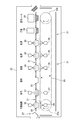
- FIG. 2 is a schematic plan view of the interior of the filling chamber 4 of the bottle aseptic filling machine according to the embodiment of the present invention.
- FIG. 2 shows a part of an aseptic filling machine in which the filling part, the sealing part and the discharging part are shielded by a single filling part chamber 4.
- the bottle 5, which is a sterilized container is conveyed into the filling chamber 4 from the wheel 10 in the air rinsing chamber 6 that shields the air rinsing portion.
- the bottles 5 to be conveyed are arranged in the order of the introduction wheel 11, the filling wheel 12, the intermediate wheel 13, the capper wheel 14, and the discharge wheel 15 from the upstream side to the downstream side. These wheels 11 to 15 are driven so as to perform rotational movement at substantially the same peripheral speed.
- scissor-shaped grippers for clamping/unclamping the neck of the bottle 5 are arranged at a predetermined pitch.
- the gripper is capable of turning together with the wheels 11 to 15 about the central axes of the wheels 11 to 15.
- the gripper has a known structure, it will not be described in detail, but the bottle 5 is transferred from the gripper of the upstream wheel to the gripper of the downstream wheel by opening and closing by the action of a cam or the like at a position adjacent to each other. It is like this. As a result, the bottle 5 continuously travels from the introduction wheel 11 to the discharge wheel 15 via the filling wheel 12, the capper wheel 14, and the like.
- the filling wheel 12 and the filling nozzle that rotates together with the filling wheel 12 are connected to the filling wheel 12 that is mounted horizontally on a vertical axis installed on the base, and a gripper is provided around the filling wheel 12.
- each filling nozzle is arranged vertically so that the mouth of the lower end of the filling nozzle faces the mouth of the bottle 5 held by the gripper.
- the filling nozzle may be fixed to the filling wheel 12, but may be vertically reciprocable. When reciprocating in the vertical direction is possible, the filling nozzle can be inserted into the bottle 5 to supply the beverage or the like as the content into the bottle 5.
- Beverages, etc. are stored in a storage tank (not shown) after being sterilized, and from there, they reach the filling nozzle through a pipeline, and in order to distribute the beverages, etc. supplied from the storage tank to the filling nozzles that rotate.
- the vertical axis is provided with an upper rotary joint and an upper manifold. Beverages and the like in the storage tank enter the empty chamber of the vertical axis, and are discharged from the filling nozzle into the bottle 5 via the upper rotary joint and the upper manifold.
- the filling nozzle is provided with a valve for supplying a desired amount of beverage or the like into the bottle 5.
- the aseptic filling machine is provided with a CIP processing device that performs a CIP process for cleaning the inside of the beverage supply system piping from the storage tank to the filling nozzle and a SIP processing device that performs a SIP process for sterilization.
- a cup-shaped opening/closing body for opening/closing the opening at the lower end of the filling nozzle is provided.
- the opening/closing body is arranged around the filling wheel 12 corresponding to each gripper and the filling nozzle.
- the opening/closing body is movable in the radial direction and the vertical direction of the filling wheel 12 by a cam device, an air cylinder device, etc.
- the opening/closing body retracts inward in the radial direction,
- the filling nozzle is blocked, the filling nozzle is moved to the outer side in the radial direction immediately below the filling nozzle, and then moved upward to close the mouth of the filling nozzle.
- the CIP processing device in addition to the opening/closing body, it is provided with a lower manifold, a lower rotary joint, a cleaning liquid tank, and a pump.
- the lower rotary joint is attached to the vertical axis.
- the lower manifold is fixed to the base side.
- the opening/closing body, the upper manifold, the lower manifold, etc. are connected by a pipe line.
- a capper for screwing the cap into the mouth portion of the bottle 5 filled with the beverage or the like is provided.
- the capper pivots together with the capper wheel 14 to screw a sterilized cap to the mouth of the bottle 5.
- the wheels in each chamber are simultaneously rotated at approximately the same number of rotations. If each chamber is equipped with a motor and the rotation of the wheel can be controlled for each chamber, rotate each chamber. By rotating according to the stage of COP processing and SOP processing of each chamber, COP processing and SOP processing of each chamber can be advanced rapidly. By rotating the wheel, the sterile water adhering to the device and the wall surface in the chamber can be quickly removed.
- the wheel clutch of the filling wheel 12 may be disengaged and the wheels other than the filling wheel 12 may be rotated. ..
- the sterilizing agent is injected into the filling chamber 4 to sterilize the device and the wall surface in the filling chamber 4, but when the sterilizing agent containing peracetic acid is injected, water remaining in the chamber is discharged. Therefore, it is necessary to prevent the concentration of peracetic acid in the bactericide containing peracetic acid from decreasing and the bactericidal effect from decreasing. Before spraying the sterilizing agent containing peracetic acid, it is preferable to further blow heated air into the filling chamber 4 to completely remove the remaining water, but it takes a long time.
- the cleaning liquid adhering to the wheels 11 to 15 and the devices attached to the wheels 11 to 15 is removed, and the bactericidal effect of the disinfectant containing peracetic acid is reduced. Can be suppressed.
- Removing the wash water by driving the transport device that transports the container means that in the aseptic filling machine for bottles, the heating unit, the molding unit, the sterilization unit, the filling unit such as the air rinse unit, the sealing unit, and the discharging unit other than the discharging unit. It is also carried out in a chamber that shields.
- the wheel is rotated in a chamber other than the filling chamber 4, the sterile water adhering to the endless chain and the attached spindle can be removed by operating the endless chain that conveys the preform in the heating unit.
- aseptic water adhering to the wheel, the mold attached to the wheel, the drawing rod, the valve block, etc. can be removed by rotating the wheel.
- the air blown into the chamber is preferably heated. Furthermore, the air blown into the chamber may be sterile air. This is performed by supplying aseptic heated air into the chamber 1 by the aseptic heated air supply device 16 provided at the upper part of the chamber 1 shown in FIG. The sterile heated air is obtained by heating the air from the blower 17 with the heating device 18 and sterilizing it with the filter 19.
- the aseptic heated air supply device 16 includes a blower 17, a heating device 18, and a filter 19.
- the SOP process is performed in the chamber.
- the SOP process may be carried out without the COP process.
- a sterilizing agent containing peracetic acid is sprayed into the chamber, and then a sterilizing agent containing peracetic acid is washed away by spraying sterile water. The contained bactericide is removed by drying.
- the injection of the disinfectant containing peracetic acid and the injection of the disinfectant containing hydrogen peroxide may be alternately performed. For example, after spraying a disinfectant containing peracetic acid, wash away the disinfectant containing peracetic acid with sterile water, drive the transport device that transports the container to remove the sterile water, and then spray a disinfectant containing hydrogen peroxide. Then, the germicide containing hydrogen peroxide is removed by drying.
- An SOP treatment comprising a step of spraying a disinfectant containing hydrogen peroxide, removing the disinfectant containing hydrogen peroxide by drying, spraying a disinfectant containing peracetic acid, and then washing away the disinfectant containing peracetic acid with sterile water.
- the injection of the disinfectant containing peracetic acid and the injection of the disinfectant containing hydrogen peroxide may not only be performed alternately, but may be performed multiple times.
- the injection of the disinfectant containing peracetic acid and the injection of the disinfectant containing hydrogen peroxide may be alternately performed.
- the disinfectant containing peracetic acid is a disinfectant whose main component is peracetic acid, and the peracetic acid concentration is 500 ppm or more, preferably 1000 ppm to 5000 ppm. In addition, it contains at least hydrogen peroxide and acetic acid.
- the bactericidal effect is enhanced by heating the bactericidal agent containing peracetic acid to 40° C. to 95° C., preferably 50° C. to 95° C.
- the germicide containing peracetic acid After injecting a germicide containing peracetic acid into the chamber, inject sterile water into the chamber.
- the germicide containing peracetic acid is washed out from the chamber by spraying sterile water.
- the water used to wash away the disinfectant containing peracetic acid must be sterile water. This is to maintain the sterilized state by the sterilizing agent containing peracetic acid.
- the transfer device that transfers the container in the chamber where the germicide containing peracetic acid has been washed away with sterile water.
- the wheels 11 to 15 for transporting the bottle 5 are rotated after the injection of sterile water into the chamber, and the wheels 11 to 15 and the wheels 11 to 15 are rotated by the centrifugal force generated by rotating the wheels 11 to 15. Sterile water adhering to the device rotating with the wheels 11-15 is removed.
- the germicide containing hydrogen peroxide is injected into the aseptic filling machine chamber. Before spraying the germicide containing hydrogen peroxide into the chamber, it is preferable to dry the inside of the chamber as much as possible. This is because in the wet state, hydrogen peroxide is dissolved in the remaining sterile water and the concentration of hydrogen peroxide is reduced, so that the sterilizing ability may not be exhibited.
- rotation and stop may be repeated.
- Sterile air can be at 50°C to 200°C.
- the downward flow of the sterile water adhering to the wall surface can be promoted, and the removal of the sterile water adhering to the wall surface can be accelerated.
- Aseptic air By supplying aseptic air to increase the pressure in the filling chamber 4 to 30 Pa to 200 Pa, aseptic water is efficiently removed.
- aseptic water is efficiently removed by raising the pressure in the other chambers in the same manner.
- the bactericide containing hydrogen peroxide to be sprayed preferably contains hydrogen peroxide in the range of 20% by mass to 65% by mass. If it is less than 20% by mass, the bactericidal power may be insufficient, and if it exceeds 65% by mass, handling becomes difficult for safety reasons.
- Aseptic heated air is blown into the chamber in order to gasify the hydrogen peroxide and sterilize the chamber after injecting the sterilizing agent containing hydrogen peroxide into the chamber.
- Aseptic heated air may be at 50°C to 200°C.
- the blowing of aseptic heated air into the chamber gasifies the hydrogen peroxide in the sterilizing agent containing hydrogen peroxide remaining in the chamber, and the microscopic gap where the sterilizing agent containing peracetic acid could not enter, or the injection did not reach The non-existent areas and peracetic acid resistant bacteria are sterilized.
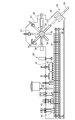
- FIG. 3 shows a schematic elevation view of a tray aseptic filling machine according to an embodiment of the present invention.
- the container to be filled is a tray, but a cup-shaped container having a flange is a similar aseptic filling machine.
- the tray 20 supplied to the aseptic filling machine is held by the retainer 21.
- the retainer 21 has a flat plate portion, and a fitting hole into which the tray 20 is fitted is formed in the flat plate portion.
- the flange portion 22 of the tray 20 is held by the flat plate portion by inserting the container portion into the fitting hole of the retainer 21.
- a large number of retainers 21 are prepared and the tray is continuously conveyed horizontally to the surface of the flange 22.
- the retainer 21 is attached to a transport device that travels continuously.
- the continuously traveling transport device is attached to the endless chain 24 horizontally spanning between the sprocket wheels 23a and 23b at predetermined intervals.
- the tray 20 is transported in the aseptic filling machine by driving the endless chain 24 and continuously running while holding the retainer 21.
- the tray 20 By being transported in the chamber 25 of the aseptic filling machine shown in FIG. 3, the tray 20 is sterilized, filled with the contents, and sealed.
- the chamber 25 includes a sterilizing unit, a filling unit, and a sealing unit inside the chamber 25.
- the tray 20 supplied to the chamber 25 is held by a retainer 21 and preheated by blowing hot air from above and below by a preheating nozzle 26.
- the preheated tray 20 is sterilized by spraying the sterilizing agent from above and below by the sterilizing agent spraying nozzle 27.
- the tray 20 sprayed with the sterilizing agent is held for a predetermined time, and is then sterilized by activating the sterilizing agent attached to the surface of the tray 20 by the aseptic heated air sprayed from the drying air nozzle 28, and the sterilizing agent is dried. Are removed by. Then, the tray 20 is filled with the contents sterilized by the filling device 29, and the tray 20 filled with the contents is sealed by heat-sealing the lid member sterilized by the sealing device to the tray 20. The sealed tray 20 is discharged from the chamber 25.
- the COP process and the SOP process are performed in the chamber 25 before operating the aseptic filling machine.
- the transport device that transports the tray 20 is driven to remove the cleaning liquid and the sterile water attached to the transport device. .. That is, the endless chain 24 that conveys the retainer 21 that does not hold the tray 20 is driven.
- the cleaning liquid or sterile water attached to the endless chain 24 and the retainer 21 can be removed in a short time.
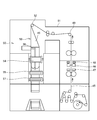
- FIG. 4 shows a schematic elevation view of an aseptic filling machine for paper containers according to an embodiment of the present invention.
- a sleeve supply device 32 introduces a sleeve 31, which is a tubular body having a wall surface formed by stacking at least paper and having a substantially rectangular cross section, into a chamber 33 by a sleeve supply device 32.
- the sleeve 31 is inserted into a mandrel 35 provided on the turret 34, leaving a portion necessary for closing.
- the sterilizing device 36 sterilizes the inner surface of the sleeve 31 on which the mandrel 35 is not inserted and which is closed, and the outer surface of the sleeve 31. After the sterilization, the remaining bactericide is removed by the hot air blown by the drying device 37.
- the sleeve 31 is folded by a folding device that bends the ruled line that forms the bottom of the paper container, and the portion that has been heated by the drying device 37 is pressed by the bottom sealing device 38. In this manner, the sleeve 31 is closed on one surface at the open end, and is molded into a bottomed tubular paper container.
- the germicide gas generated by the germicide gas generator 40 is jetted from the nozzle to the inner surface of the paper container.
- the bactericide sprayed on the paper container is removed by hot air sprayed from the hot air nozzle 41 onto the inner surface of the paper container.
- the sterilized paper container is filled with the contents sterilized by a separately provided device by the filling device 42. Further, the ruled line of the head of the paper container is folded by the head curl folding device, the inner surface is heated by the head heating device 43, and the head sealing device 44 press-bonds the paper container to seal the paper container.
- the sealed paper container is discharged from the chamber 33.
- the paper container is molded by being conveyed through the chamber 33 of the aseptic filling machine shown in FIG. 4, the molded paper container is sterilized, the contents are filled, and the container is sealed.
- the chamber 33 is internally provided with a paper container molding unit, a sterilization unit, a filling unit and a sealing unit.
- the COP process and the SOP process are performed in the chamber 33 before operating the aseptic filling machine.
- the transport device that transports the paper container is driven to remove the cleaning liquid and the sterile water attached to the transport device. That is, the turret 34 provided with the mandrel 35 is rotated in a state where the sleeve is not inserted in the mandrel 35, and the conveyor 39 that conveys the paper container that does not hold the paper container is driven.
- the turret 34 and the conveyor 39 By driving the turret 34 and the conveyor 39, the cleaning liquid or sterile water attached to the turret 34 and the conveyor 39 can be removed in a short time.
- FIG. 5 shows a schematic elevation view of a pouch aseptic filling machine according to an embodiment of the present invention.
- the pouch aseptic filling machine shown in FIG. 5 is a device for supplying a film, sterilizing the supplied film, molding the pouch, filling the pouch with the sterilized contents, and sealing the pouch. Therefore, it is provided with a traveling means for the packaging film 45 and a nozzle 46 for spraying a bactericide on both surfaces of the packaging film 45.
- the traveling means of the packaging film 45 is a drive device for continuously traveling the packaging film 45 from the feeding roll of the packaging film 45, and various guides arranged on the traveling path of the infeed roller and the packaging film 45.
- a roller, a guide roller that sandwiches the packaging film 45 from both sides thereof, and the like are included.
- a heated air blowing device 48 is provided which blows heated air onto both surfaces of the packaging film 45 after spraying the germicide.
- the sterilized packaging film 45 is turned by the roller 49 and conveyed to the bag making and filling unit 50.
- the bag making and filling unit 50 is shielded by the chamber 51, and the COP process and the SOP process are performed in the chamber 51 before operating the aseptic filling machine.
- the transporting direction of the packaging film 45 transported to the bag-making filling section 50 is changed downward by the roller 52.
- the packaging film 45 is folded by the former 53 so that both side edges along the transport direction are overlapped with each other.
- the folded packaging film 45 passes between a pair of vertical sealing rollers 54 (only the front side is shown in FIG. 5).
- the overlapping portions of both side edges of the packaging film 45 are heat-welded by the vertical sealing roller 54, whereby the packaging film 45 is formed into a tubular shape.
- the packaging film 45 is heated and welded at a constant interval in the transport direction by the pair of horizontal sealing rollers 55 to be sealed in the horizontal direction.
- Various sterilized contents are continuously supplied from the supply pipe 56 to the tubular packaging film 45 that is horizontally sealed. Will be done.
- notches are appropriately formed in each pouch, and perforations are further formed in the lateral direction, or the lateral sealing portion is cut by the cutting roller 57 to separate the pouches from each other. The cut pouch falls to the discharge part.
- the inside of the chamber 51 is subjected to COP processing and SOP processing before operating the aseptic filling machine.
- the packaging film 45 is passed through the chamber 51. This is because the packaging film 51 cannot be passed through without opening the chamber 51 in the SOP-treated chamber 51.
- the seal roller 55 and the cutting roller 57 are transporting devices for transporting the packaging film 45, and drive this transporting device to remove the cleaning liquid and sterile water adhering to the transporting device.
- the cleaning liquid or sterile water attached to the roller that is the transport device can be removed in a short time.
- the packaging film 45 is sprayed with a sterilizing agent by the sterilizing agent spraying device 46 and conveyed into the chamber 51.
- the packaging film 45 transported in the chamber 51 must be sterilized and transported in the chamber 51.
Landscapes
- Health & Medical Sciences (AREA)
- Epidemiology (AREA)
- Life Sciences & Earth Sciences (AREA)
- Animal Behavior & Ethology (AREA)
- General Health & Medical Sciences (AREA)
- Public Health (AREA)
- Veterinary Medicine (AREA)
- Chemical & Material Sciences (AREA)
- Chemical Kinetics & Catalysis (AREA)
- General Chemical & Material Sciences (AREA)
- Engineering & Computer Science (AREA)
- Mechanical Engineering (AREA)
- Apparatus For Disinfection Or Sterilisation (AREA)
- Filling Of Jars Or Cans And Processes For Cleaning And Sealing Jars (AREA)
Abstract
Lors de la mise en œuvre d'un traitement COP et d'un traitement SOP à l'intérieur d'une chambre d'une machine de remplissage aseptique, une solution de nettoyage ou l'eau stérile restant dans la chambre est rapidement retirée avant la pulvérisation d'un désinfectant contenant de l'acide peracétique ou du peroxyde d'hydrogène. La solution de nettoyage après le traitement COP ou l'eau stérile du traitement SOP est éliminée par entraînement d'un dispositif de distribution qui délivre un récipient à l'intérieur de la chambre de la machine de remplissage aseptique.
Priority Applications (6)
| Application Number | Priority Date | Filing Date | Title |
|---|---|---|---|
| EP19896507.1A EP3895744B1 (fr) | 2018-12-12 | 2019-12-09 | Procédé de désinfection d'une chambre de machine de remplissage aseptique |
| US17/309,383 US11857690B2 (en) | 2018-12-12 | 2019-12-09 | Method for sterilizing interior of aseptic filler chamber |
| CN202311289143.4A CN117427196A (zh) | 2018-12-12 | 2019-12-09 | 无菌填充机腔室内的杀菌方法 |
| CN201980079679.9A CN113164634B (zh) | 2018-12-12 | 2019-12-09 | 无菌填充机腔室内的杀菌方法 |
| EP25218353.8A EP4678593A3 (fr) | 2018-12-12 | 2019-12-09 | Procédé de stérilisation de l'intérieur d'une chambre de remplissage aseptique |
| US18/507,286 US12208173B2 (en) | 2018-12-12 | 2023-11-13 | Method for sterilizing interior of aseptic filler chamber |
Applications Claiming Priority (2)
| Application Number | Priority Date | Filing Date | Title |
|---|---|---|---|
| JP2018232801A JP6729671B2 (ja) | 2018-12-12 | 2018-12-12 | 無菌充填機チャンバー内の殺菌方法 |
| JP2018-232801 | 2018-12-12 |
Related Child Applications (2)
| Application Number | Title | Priority Date | Filing Date |
|---|---|---|---|
| US17/309,383 A-371-Of-International US11857690B2 (en) | 2018-12-12 | 2019-12-09 | Method for sterilizing interior of aseptic filler chamber |
| US18/507,286 Continuation US12208173B2 (en) | 2018-12-12 | 2023-11-13 | Method for sterilizing interior of aseptic filler chamber |
Publications (1)
| Publication Number | Publication Date |
|---|---|
| WO2020122015A1 true WO2020122015A1 (fr) | 2020-06-18 |
Family
ID=71077270
Family Applications (1)
| Application Number | Title | Priority Date | Filing Date |
|---|---|---|---|
| PCT/JP2019/048082 Ceased WO2020122015A1 (fr) | 2018-12-12 | 2019-12-09 | Procédé de désinfection d'une chambre de machine de remplissage aseptique |
Country Status (5)
| Country | Link |
|---|---|
| US (2) | US11857690B2 (fr) |
| EP (2) | EP4678593A3 (fr) |
| JP (1) | JP6729671B2 (fr) |
| CN (2) | CN113164634B (fr) |
| WO (1) | WO2020122015A1 (fr) |
Cited By (1)
| Publication number | Priority date | Publication date | Assignee | Title |
|---|---|---|---|---|
| EP4362755A4 (fr) * | 2021-06-30 | 2025-06-11 | Adimulam, Suresh Babu | Dispositif de nettoyage de bouteille avec distributeur de fluide |
Families Citing this family (1)
| Publication number | Priority date | Publication date | Assignee | Title |
|---|---|---|---|---|
| CN113650884B (zh) * | 2021-07-27 | 2023-08-29 | 上海观道生物科技有限公司 | 一种中药汤剂包装方法 |
Citations (5)
| Publication number | Priority date | Publication date | Assignee | Title |
|---|---|---|---|---|
| JPH11208782A (ja) | 1998-01-23 | 1999-08-03 | Dainippon Printing Co Ltd | 充填機の滅菌方法及びその滅菌装置 |
| JP2010189034A (ja) | 2009-02-18 | 2010-09-02 | Mitsubishi Heavy Industries Food & Packaging Machinery Co Ltd | 無菌充填機のチャンバー殺菌方法 |
| JP2011147673A (ja) | 2010-01-22 | 2011-08-04 | Toyo Seikan Kaisha Ltd | 空間表面の殺菌方法及び殺菌システム |
| JP2014055026A (ja) | 2012-09-13 | 2014-03-27 | Dainippon Printing Co Ltd | 無菌充填用チャンバ内の滅菌方法及び装置 |
| JP2017154822A (ja) * | 2017-04-20 | 2017-09-07 | 大日本印刷株式会社 | 無菌充填装置及びその浄化方法 |
Family Cites Families (21)
| Publication number | Priority date | Publication date | Assignee | Title |
|---|---|---|---|---|
| JPH0551088A (ja) | 1991-08-29 | 1993-03-02 | Shikoku Kakoki Co Ltd | 無菌充填機 |
| KR100250367B1 (ko) * | 1996-02-20 | 2000-04-01 | 마스다 노부유키 | 캡 살균방법 및 장치 |
| JP3483776B2 (ja) | 1998-08-11 | 2004-01-06 | 株式会社古川製作所 | 真空包装機の洗浄装置 |
| KR20030087803A (ko) * | 2002-05-10 | 2003-11-15 | 삼성전자주식회사 | 반도체장치 제조용 화학기상증착 설비의 콘베이어 벨트세정장치 |
| DE202007018501U1 (de) * | 2007-01-08 | 2008-10-23 | Aquagroup Ag | Reinigung von Getränkeabfüllanlagen |
| US7832185B2 (en) * | 2007-07-11 | 2010-11-16 | Stokely-Van Camp, Inc. | Active sterilization zone for container filling |
| CN101929793B (zh) * | 2010-05-11 | 2012-02-15 | 赫得纳米科技(昆山)有限公司 | 用于喷淋清洗机的自动化除水装置 |
| CN101985318A (zh) * | 2010-09-02 | 2011-03-16 | 上海普丽盛轻工设备有限公司 | 无菌包装系统的消毒杀菌处理装置及消毒杀菌处理方法 |
| CN202107514U (zh) * | 2011-03-29 | 2012-01-11 | 张敦杰 | 啤酒灌装装置的清洗及杀菌系统 |
| DE102011102090B4 (de) * | 2011-05-19 | 2018-02-08 | Khs Corpoplast Gmbh | Verfahren zum Reinigen und/oder Desinfizieren einer Vorrichtung zur Herstellung von mit einem flüssigen Füllgut gefüllten Behältern sowie Vorrichtung |
| EP3620426B1 (fr) * | 2012-11-16 | 2023-03-01 | Dai Nippon Printing Co., Ltd. | Appareil de remplissage d'une boisson comprenant des moyens pour nettoyer et stériliser l'appareil |
| KR101446633B1 (ko) * | 2013-05-29 | 2014-10-06 | 주식회사 텍포러스 | 젖병 살균 세척기 |
| KR101504422B1 (ko) * | 2013-07-23 | 2015-03-19 | 주식회사 포스코 | 벨트 컨베이어용 벨트 청소장치 |
| CN103416482B (zh) * | 2013-08-13 | 2015-06-03 | 常州大学 | 水果保鲜加工的流水线装置及方法 |
| JP6439919B2 (ja) * | 2013-11-14 | 2018-12-19 | 大日本印刷株式会社 | プリフォームの殺菌方法及び装置 |
| CN204842373U (zh) * | 2015-02-05 | 2015-12-09 | 毕节市烟草公司七星关区分公司 | 一种漂浮育苗穴盘清洗消毒设备 |
| EP3351503B1 (fr) * | 2015-09-17 | 2021-07-14 | Dai Nippon Printing Co., Ltd. | Procédé de décontamination d'un appareil de remplissage aseptique |
| JP6213621B1 (ja) * | 2016-07-07 | 2017-10-18 | 大日本印刷株式会社 | スリーブの殺菌方法及び装置 |
| DE102016114273A1 (de) * | 2016-08-02 | 2018-02-08 | Khs Gmbh | Behandlungsvorrichtung für eine Behandlung von Behältern sowie Betätigungsanordnung zur Erzeugung einer Dreh-Hubbewegung in einem aseptischen Reinraum |
| JP7428464B2 (ja) | 2017-05-10 | 2024-02-06 | 大日本印刷株式会社 | 無菌充填機及び無菌充填方法 |
| US11667505B2 (en) | 2017-05-10 | 2023-06-06 | Dai Nippon Printing Co., Ltd. | Aseptic filling machine and aseptic filling method |
-
2018
- 2018-12-12 JP JP2018232801A patent/JP6729671B2/ja active Active
-
2019
- 2019-12-09 WO PCT/JP2019/048082 patent/WO2020122015A1/fr not_active Ceased
- 2019-12-09 CN CN201980079679.9A patent/CN113164634B/zh active Active
- 2019-12-09 EP EP25218353.8A patent/EP4678593A3/fr active Pending
- 2019-12-09 CN CN202311289143.4A patent/CN117427196A/zh active Pending
- 2019-12-09 US US17/309,383 patent/US11857690B2/en active Active
- 2019-12-09 EP EP19896507.1A patent/EP3895744B1/fr active Active
-
2023
- 2023-11-13 US US18/507,286 patent/US12208173B2/en active Active
Patent Citations (5)
| Publication number | Priority date | Publication date | Assignee | Title |
|---|---|---|---|---|
| JPH11208782A (ja) | 1998-01-23 | 1999-08-03 | Dainippon Printing Co Ltd | 充填機の滅菌方法及びその滅菌装置 |
| JP2010189034A (ja) | 2009-02-18 | 2010-09-02 | Mitsubishi Heavy Industries Food & Packaging Machinery Co Ltd | 無菌充填機のチャンバー殺菌方法 |
| JP2011147673A (ja) | 2010-01-22 | 2011-08-04 | Toyo Seikan Kaisha Ltd | 空間表面の殺菌方法及び殺菌システム |
| JP2014055026A (ja) | 2012-09-13 | 2014-03-27 | Dainippon Printing Co Ltd | 無菌充填用チャンバ内の滅菌方法及び装置 |
| JP2017154822A (ja) * | 2017-04-20 | 2017-09-07 | 大日本印刷株式会社 | 無菌充填装置及びその浄化方法 |
Cited By (1)
| Publication number | Priority date | Publication date | Assignee | Title |
|---|---|---|---|---|
| EP4362755A4 (fr) * | 2021-06-30 | 2025-06-11 | Adimulam, Suresh Babu | Dispositif de nettoyage de bouteille avec distributeur de fluide |
Also Published As
| Publication number | Publication date |
|---|---|
| US12208173B2 (en) | 2025-01-28 |
| CN113164634B (zh) | 2023-10-20 |
| EP3895744A4 (fr) | 2022-09-07 |
| EP3895744A1 (fr) | 2021-10-20 |
| US20240075177A1 (en) | 2024-03-07 |
| CN113164634A (zh) | 2021-07-23 |
| JP6729671B2 (ja) | 2020-07-22 |
| US11857690B2 (en) | 2024-01-02 |
| EP4678593A2 (fr) | 2026-01-14 |
| EP3895744B1 (fr) | 2026-01-28 |
| US20220031891A1 (en) | 2022-02-03 |
| CN117427196A (zh) | 2024-01-23 |
| EP4678593A3 (fr) | 2026-03-11 |
| JP2020093813A (ja) | 2020-06-18 |
Similar Documents
| Publication | Publication Date | Title |
|---|---|---|
| CN115849287B (zh) | 无菌填充机及其净化方法 | |
| CN107922177B (zh) | 无菌填充装置及其净化方法 | |
| US11884529B2 (en) | Aseptic filling apparatus and method for cooling filling valve of aseptic filling apparatus | |
| US12208173B2 (en) | Method for sterilizing interior of aseptic filler chamber | |
| JP7434749B2 (ja) | 無菌充填機の無菌水供給配管内殺菌方法及び殺菌装置 | |
| JP7106832B2 (ja) | 無菌充填機における殺菌方法 | |
| JP7563341B2 (ja) | 無菌充填機により密封された容器の外面洗浄装置の洗浄方法及び無菌充填機 | |
| JP6927359B2 (ja) | 無菌充填機及びその浄化方法 | |
| JP6970395B2 (ja) | 無菌充填機チャンバー内の殺菌方法 | |
| JP6970393B2 (ja) | 無菌充填機チャンバー内の殺菌方法 | |
| JP6970394B2 (ja) | 無菌充填機チャンバー内の殺菌方法 | |
| CN115210145B (zh) | 杀菌方法 |
Legal Events
| Date | Code | Title | Description |
|---|---|---|---|
| 121 | Ep: the epo has been informed by wipo that ep was designated in this application |
Ref document number: 19896507 Country of ref document: EP Kind code of ref document: A1 |
|
| NENP | Non-entry into the national phase |
Ref country code: DE |
|
| ENP | Entry into the national phase |
Ref document number: 2019896507 Country of ref document: EP Effective date: 20210712 |
|
| WWG | Wipo information: grant in national office |
Ref document number: 2019896507 Country of ref document: EP |