WO2020122075A1 - Cristal contenant un halogénure de cuivre, et un halogénure de métal et/ou un halogénure d'ammonium, film mince cristallin, solution de précurseur associée, et méthode de production de film mince cristallin - Google Patents
Cristal contenant un halogénure de cuivre, et un halogénure de métal et/ou un halogénure d'ammonium, film mince cristallin, solution de précurseur associée, et méthode de production de film mince cristallin Download PDFInfo
- Publication number
- WO2020122075A1 WO2020122075A1 PCT/JP2019/048340 JP2019048340W WO2020122075A1 WO 2020122075 A1 WO2020122075 A1 WO 2020122075A1 JP 2019048340 W JP2019048340 W JP 2019048340W WO 2020122075 A1 WO2020122075 A1 WO 2020122075A1
- Authority
- WO
- WIPO (PCT)
- Prior art keywords
- copper
- halide
- iodide
- thin film
- precursor solution
- Prior art date
- Legal status (The legal status is an assumption and is not a legal conclusion. Google has not performed a legal analysis and makes no representation as to the accuracy of the status listed.)
- Ceased
Links
Images




Classifications
-
- C—CHEMISTRY; METALLURGY
- C01—INORGANIC CHEMISTRY
- C01G—COMPOUNDS CONTAINING METALS NOT COVERED BY SUBCLASSES C01D OR C01F
- C01G3/00—Compounds of copper
-
- C—CHEMISTRY; METALLURGY
- C01—INORGANIC CHEMISTRY
- C01G—COMPOUNDS CONTAINING METALS NOT COVERED BY SUBCLASSES C01D OR C01F
- C01G3/00—Compounds of copper
- C01G3/04—Halides
-
- C—CHEMISTRY; METALLURGY
- C01—INORGANIC CHEMISTRY
- C01G—COMPOUNDS CONTAINING METALS NOT COVERED BY SUBCLASSES C01D OR C01F
- C01G9/00—Compounds of zinc
Definitions
- the present invention relates to a crystallized product containing a copper halide and a metal halide and/or ammonium halide salt, a crystalline thin film, a precursor solution thereof, and a method for producing the crystalline thin film.
- perovskite-type solar cells Due to the discovery of high photoelectric conversion efficiency, perovskite-type solar cells are being put to practical use research at world level.
- the perovskite crystal film is responsible for photocharge separation.
- ITO and FTO are widely used as electrodes because they are excellent transparent conductive materials that show low specific resistance.
- copper halide particularly CuI [copper iodide]
- CuI copper iodide
- a volume resistivity of 0.01 ⁇ cm is shown by iodidation of a copper thin film produced by a vapor deposition method with iodine vapor.
- Non-Patent Document 2 copper iodide (Non-Patent Document 2) can be laminated by solution coating and low-temperature heat treatment, and is excellent as an electron blocking (hole conduction) layer in a perovskite solar cell or an organic thin film solar cell. It is known to be a p-type semiconductor, and has been receiving attention.
- copper iodide is also expected as a transparent p-type semiconductor thin film for a thin film transistor (TFT) (Non-Patent Document 4) or an organic light emitting diode (OLED) (Non-Patent Document 5) that can be produced by solution coating and low-temperature heat treatment. ..
- TFT thin film transistor
- OLED organic light emitting diode
- Non-Patent Documents 2 to 5 it is necessary to use a special and expensive liquid such as dipropyl sulfide and a large amount of chlorobenzene, which may be toxic. Also, its solubility is not sufficient.
- TMED tetramethylethylenediamine
- SEM image scanning electron microscope image
- the film thickness of the coating film is not shown, it is not possible to judge whether or not a dense film can be produced with a film thickness (100 nm or less) required when used as a transparent p-type semiconductor layer of a solar cell or a thin film transistor.
- Non-Patent Document 7 the utility value of copper iodide typified by CuI has attracted attention as an inexpensive and high-performance transparent p-type semiconductor thin film in solar cells and thin film transistors.
- a powder X-ray diffraction shows a peak derived from copper iodide by a heat treatment at 110° C. or higher by a coordination compound in which ethanolamine and iodide ion are coordinated to +2 valence ion of copper.
- Non-Patent Document 8 a powder X-ray diffraction (XRD) shows a peak derived from copper iodide by a heat treatment at 110° C. or higher by a coordination compound in which ethanolamine and iodide ion are coordinated to +2 valence ion of copper.
- Non-Patent Document 8 Non-Patent Document 8
- the film thus produced has many voids and the like, and its film thickness is 780-850 nm, which satisfies the film thickness (100 nm or less) required when used as a transparent p-type semiconductor layer of a solar cell or a thin film transistor. Absent.
- Non-patent document 9 a thin film at 170° C. is formed by mixing CuBr with a coordination compound in which ethanolamine and iodide ions are coordinated with +2 valence ions of copper.
- the thin film in this case has a thickness of 200 to 300 nm and has a low transmittance. Further, only the change in band gap is described, and the conductivity is not described.
- a coordination compound in which an alkanolamine and an iodide ion are coordinated to a copper +2 valent ion, or a primary or secondary alkylamine and an alcohol, an iodide ion or a copper +2 valent ion is coordinated.
- a uniform precursor solution has been developed by preparing copper iodide, which is coordinated with pseudo-iodide ions. By heating this precursor solution at a temperature of 150 to 200° C. or lower, a crystal exhibiting a low light transmittance of 80% or more at a wavelength of 450 to 800 nm and a volume resistance of 0.08 to 0.3 ⁇ cm.
- Patent Document 1 has been reported on the functional thin film (Patent Document 1).
- this method which has a step involving thermal decomposition at 150° C. or higher, cannot use an inexpensive PET film having a low melting point.
- the present invention can produce copper halides and metal halides and/or ammonium halide salts (hereinafter, referred to as “halogen”) that can be produced at a lower processing temperature than conventional ones and exhibit good conductivity. It is also referred to as “alkali metal oxide etc.”), a transparent crystalline thin film, a precursor solution thereof, and a method for producing a crystalline thin film.
- halogen copper halides and metal halides and/or ammonium halide salts
- a precursor solution in which a copper(II) iodide complex and an alkali metal halide or the like are dissolved is applied to a substrate and treated at a low temperature of, for example, less than 140° C.
- An object of the present invention is to provide a method for producing a uniform thin film containing an alkali metal and the like, and a transparent conductive thin film having a low volume resistivity (specific resistance).
- the present inventors have conducted extensive studies in order to improve the handleability of copper iodide as a copper halide and to enable the production of a thin film at a low temperature by mixing with an alkali metal halide or the like. It was As a result, for example, by using a solution in which an alkali metal halide or the like is dissolved in a solution containing a copper(II) iodide complex as a precursor solution, a transparent crystallized product having a low volume resistance value and a crystalline thin film can be obtained. They have found that they can be obtained at lower processing temperatures and have reached the present invention.
- a crystallized product is obtained by uniformly mixing copper iodide insoluble in a solvent with lithium iodide (LiI), sodium iodide (NaI), potassium iodide (KI), etc., which is soluble in water, alcohol, etc. There is no report that a crystalline thin film could be manufactured.
- LiI lithium iodide
- NaI sodium iodide
- KI potassium iodide
- the present invention in view of the above object, is a crystallized product in one aspect thereof.
- the crystallized product according to the present invention contains a copper halide and a halide and/or ammonium halide of a metal selected from the group consisting of alkali metals, magnesium and zinc, and the copper halide and the halide of the metal. And/or the molar ratio with the ammonium halide salt is in the range of 100:1 to 100:30.
- the present invention in one aspect thereof, is a crystalline thin film.
- the crystalline thin film according to the present invention contains a copper halide and a halide and/or ammonium halide of a metal selected from the group consisting of alkali metals, magnesium and zinc, and the copper halide and the halogen of the metal.
- the molar ratio with the halide and/or ammonium halide salt is in the range of 100:1 to 100:30.
- the copper halide is preferably copper iodide.
- the metal halide may be an alkali metal halide. It is preferable that the crystalline thin film has a film thickness of 100 nm or less, is transparent, and has a volume resistivity (specific resistance) of 0.5 ⁇ cm or less.
- a precursor solution according to the present invention is a precursor solution.
- a precursor solution according to the present invention is a precursor solution for obtaining the crystalline thin film, which is a group consisting of a copper halide salt or a copper halide complex composed of divalent copper, and an alkali metal, magnesium and zinc.
- a metal halide and/or ammonium halide salt selected from the group consisting of a divalent copper halide copper salt or a copper halide complex and a metal halide and/or ammonium halide salt.
- the precursor solution has a molar ratio of 100:1 to 100:30.
- the copper halide salt or copper halide complex made of divalent copper is a copper iodide salt or copper iodide complex made of divalent copper. ..
- the copper iodide complex is preferably a copper(II) iodide complex in which an alkanolamine and an iodide ion are coordinated with a +2 valent ion of copper.
- the alkanolamine is more preferably an alkanolamine represented by the following structural formula 1.
- the metal halide may be an alkali metal halide. (However, n is 1 or 2, and R 1 , R 2 , R 3 and R 4 are each independently hydrogen, a methyl group, an ethyl group or a hydroxymethyl group.)
- the present invention in one aspect thereof, is a method for producing a crystalline thin film.
- the method for producing a crystalline thin film according to the present invention includes a step of applying the precursor solution to a base material and then performing a heat treatment at 100° C. or higher and lower than 140° C.
- a crystallized product containing a copper halide and a metal halide and/or an ammonium halide salt which can be produced at a low processing temperature and exhibits good conductivity, a transparent crystalline thin film.
- precursor solutions thereof as well as a method for producing a crystalline thin film.
- a thin film containing copper iodide and an alkali metal halide is formed from a precursor solution containing a copper(II) iodide complex obtained from copper iodide and an alkanolamine and an alkali metal halide.
- the manufacturing method provides a crystalline thin film made of a crystallized product containing copper iodide and an alkali metal halide.
- a thin film having a film thickness of 100 nm or less, having no voids, being transparent, and having a low specific resistance value of 0.5 ⁇ cm or less can be obtained.
- Such a thin film has a performance as a transparent electrode, a p-type semiconductor, or the like.
- such a thin film can also be used as a film for an electrode of a perovskite solar cell, an electron blocking (hole conduction) film, and the like.
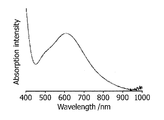
- FIG. 1 is a graph showing a UV-Vis-NIR absorption spectrum of a precursor solution containing copper iodide and potassium iodide (molar ratio 100:5).
- FIG. 2 is a graph showing a UV-Vis-NIR transmission spectrum of a thin film containing copper iodide and potassium iodide (molar ratio 100:5).
- FIG. 3 is a graph showing the weight change of thermogravimetric analysis of a sample after removal of volatile components in a precursor solution of copper(II) iodide complex and potassium iodide (molar ratio 100:5).
- FIG. 1 is a graph showing a UV-Vis-NIR absorption spectrum of a precursor solution containing copper iodide and potassium iodide (molar ratio 100:5).
- FIG. 2 is a graph showing a UV-Vis-NIR transmission spectrum of a thin film containing copper iodide and potassium iodide (molar ratio 100:
- FIG. 4 is an SEM image of a thin film containing copper iodide and potassium iodide (molar ratio 100:5) treated at 120° C. for 1 hour by a scanning electron microscope observation.
- FIG. 5 is a graph showing the results of powder X-ray diffraction (XRD) when the amount of potassium iodide relative to copper iodide was changed in a thin film containing copper iodide and potassium iodide.
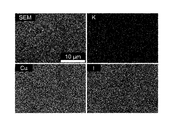
- FIG. 6 is a SEM image of a precursor solution containing a copper(II) iodide complex and potassium iodide (molar ratio 100:5), which was treated at 120° C. for 1 hour, and EDS showing distributions of copper, iodine and potassium elements.
- FIG. 7 is a SEM image obtained by treating a precursor solution containing only a copper(II) iodide complex at 120° C. for 1 hour and an EDS image showing the distribution of copper and iodine elements.
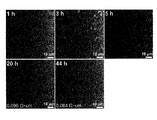
- FIG. 8 is a laser microscope image of a thin film containing copper iodide and potassium iodide (molar ratio 100:5) when the treatment time was changed at 100° C.
- FIG. 9 is a graph showing the intensity change of powder X-ray diffraction (XRD) showing the degree of crystallization when the treatment time was changed at 100° C. containing copper iodide and potassium iodide (molar ratio 100:5). is there.
- XRD powder X-ray diffraction
- Embodiments of a crystallized product, a crystalline thin film, a precursor solution thereof, and a method for producing a crystalline thin film according to the present invention will be described below.
- the present invention is not limited to the embodiments described below.
- a copper(II) iodide complex solution of a precursor solution containing a copper(II) iodide complex, an alkali metal halide, etc. Will be described with reference to the form.
- the copper(II) iodide complex solution is intended to be a solution mainly containing a copper(II) iodide complex, and as described later, mainly contains an alkali metal halide or the like. It can be distinguished from a solution.
- copper iodide is a colorless crystal with a copper oxidation number of +1 and is difficult to dissolve in solvents such as water and alcohol.
- the copper +2 valence ion is characterized by high solubility of the copper ion in a general-purpose solvent such as alcohol and exhibiting blue color.
- Copper iodide crystal powder is added to a solution containing an alkanolamine, and copper or copper iodide complex is prepared by appropriately stirring or heating to oxidize copper to +1 to +2 valent ions.
- copper iodide can be easily dissolved in the solvent in the form of copper(II) iodide.
- alkanolamine is coordinated to the +2+ ion of copper. Through the amino group and hydroxyl group in the alkanolamine molecule, it promotes the air oxidation of copper from +1 valence to +2 valence ions to form a coordination compound.
- Alkanolamine is not limited as long as it can coordinate with copper +2 valence ion. More specifically, the alkanolamine is 2-aminoethanol, 1-amino-2-propanol, 2-amino-1-propanol, 3-amino-2-butanol, 3-amino-2-methyl-2-butanol. , 2-(ethylamino)ethanol, 1-amino-2-methyl-2-propanol, 2-amino-2-methylpropanol, 2-amino-2-methyl-1,3-propanediol, 2-(methylamino ) Ethanol, 1-(methylamino)-2,3-propanediol and the like are preferable.
- an alkanolamine capable of coordinating with a copper +2 valent ion in a stable cyclic chelate structure Is represented by Structural Formula 1 below.
- n is 1 or 2
- R 1 , R 2 , R 3 and R 4 each independently represent hydrogen, a methyl group, an ethyl group or a hydroxymethyl group.
- the alkanolamine is more preferably 2-aminoethanol, 1-amino-2-propanol or 3-aminopropanol.
- Such an alkanolamine can exhibit good solubility in alcohol, good crystal structure due to thermal decomposition at low temperature, and low resistance value.
- the alkanolamine may have a substance amount ratio (molar ratio) of 1 times the copper ion, but since the hydroxyl group (OH) of the alkanolamine promotes the air oxidation reaction of copper from +1 to +2 valence, it can be used at 1 times or more.
- the substance ratio (molar ratio) of alkanolamine to copper ions is preferably 1 to 20 times, and more preferably 1.5 to 5 times.
- the precursor solution according to the present embodiment at least includes preparing a copper (II) iodide complex solution at the time of its preparation.
- a crystal powder of copper iodide was added to a solution of alkanolamine dissolved in a solvent such as alcohol, and the alkanolamine was coordinated to copper iodide, which became a +2 valent ion of copper by air oxidation and was uniformly dissolved.
- a copper(II) iodide complex solution is prepared.
- a powder of an alkali metal halide or the like that can be dissolved in alcohol or the like is added and a solution of the alkali metal halide or the like uniformly dissolved is prepared by stirring.
- a uniform precursor solution containing a copper(II) iodide complex and an alkali metal halide or the like is prepared.
- the molar ratio of the copper(II) iodide complex to the alkali metal halide in the precursor solution is preferably in the range of 100:1 to 100:30.
- the alkali metal halide or the like is dissolved in the precursor solution as it is as +1 valent ions.
- the crystal interface of the copper iodide increases as the crystallinity of the copper iodide deposited after the precursor solution is applied and decomposed by heating increases. And the uniformity of the crystalline thin film is impaired, and the electric conductivity is reduced. Therefore, the molar ratio of the copper(II) iodide complex to the alkali metal halide or the like is preferably 100:1 to 100:30.
- the alkali metal halide or the like is a halide and/or ammonium halide salt of a metal selected from the group consisting of alkali metals, magnesium and zinc.
- alkali metals include alkali metals such as lithium, sodium, potassium, rubidium and cesium.
- ammonium salts include ammonium salts such as ammonium, alkylammonium, dialkylammonium, trialkylammonium, and tetraalkylammonium.
- the metal halide is composed of a combination of a metal selected from the group consisting of the above-mentioned alkali metals, magnesium and zinc and a halogen element such as chlorine, bromine and iodine, and alkali metal halides are preferred.
- the ammonium halide salt is a salt composed of a combination of an ammonium salt and a halogen element such as chlorine, bromine or iodine. At least one alkali metal halide or the like is selected from these.
- the alkyl group of alkylammonium, dialkylammonium, trialkylammonium, and tetraalkylammonium of ammonium salts is preferably selected from a methyl group, an ethyl group, a propyl group, or a butyl group from the viewpoint of solubility in a solvent.
- the alkali metal halide or the like is particularly preferably a chlorine salt, bromine salt, or iodine salt of lithium, sodium, potassium, or ammonium.
- a solvent such as alcohol, which is appropriately selected according to the application, can be used as a solvent.
- a solvent can also be used as a diluting solvent.
- alcohols examples include methanol, ethanol, propanol, butanol, pentanol, hexanol, heptanol, octanol, allyl alcohol, benzyl alcohol, propylene glycol, menthol, pentaerythritol, 2-methoxyethanol, 2-ethoxyethanol,
- alcohol compounds such as polyethylene glycols including triethylene glycol monomethyl ether, pentaerythritol, ethylene glycol, glycerol, triethylene glycol, tetraethylene glycol, and pentaethylene glycol.
- polar solvents such as dimethyl sulfoxide, N,N-dimethylformamide, acetone, water and butyl lactone can be used as the solvent or diluent solvent for the precursor solution.
- water can be added for the purpose of promoting the air oxidation reaction of copper from +1 to +2 valence and shortening the reaction time.
- the concentrations of copper and alkali metal halide in the precursor solution depend on the thickness of the coating film, the properties of the substrate to be coated, the coating method, and the thickness of the thin film containing the generated copper iodide and alkali metal halide. According to need, it can be appropriately adjusted and used.
- the solvent the same solvent used in the precursor solution may be used as it is, or another solvent may be used.
- the molar concentration of copper is preferably 0.03 mol/L or more and 6.5 mol/L or less, and more preferably 0.1 mol/L or more and 0.5 mol/L or less.
- the molar concentration of copper is generally 0.1 to 2.0 mol/L.
- a solvent having a high vapor pressure that can be removed within 1 hour at a temperature of less than 140° C. can be preferably used from the viewpoint of film forming property.
- a solvent containing an alcohol compound when used, if the vapor pressure of the alcohol compound is too high, the alcohol compound of the solvent will evaporate excessively quickly. Therefore, the production process of a thin film containing copper iodide and an alkali metal halide or the like becomes non-uniform, and the thin film may deteriorate (occurrence of cracks or voids).
- the solvent propanol, butanol, pentanol, hexanol, 2-methoxyethanol, 2-ethoxyethanol and the like are preferably used.
- the precursor solution and the method for preparing the same according to the present embodiment have a structure corresponding to the copper(II) iodide complex described above and can dissolve copper in a divalent form in a solvent. It may contain a copper halide salt made of copper or a copper halide complex made of divalent copper.
- the copper halide salt or copper halide complex composed of divalent copper is a copper salt or copper complex composed of a combination of copper and a halogen element such as chlorine, bromine or iodine.
- Examples of such a copper halide salt or a copper halide complex include copper(II) iodide, copper(II) chloride, copper(II) bromide, a +2 valent ion of copper, an alkanolamine and a metal ion of the halogen element. Examples thereof include those complexes in which and are coordinated. Even when a copper halide salt or a copper halide complex composed of such a divalent copper is included, the same configuration as that of the present embodiment including the copper(II) iodide complex can be preferably adopted.
- the thin film according to the present embodiment is manufactured by applying a precursor solution containing a copper(II) iodide complex and an alkali metal halide to a substrate and performing heat treatment at 100° C. or higher and lower than 140° C. Including. In such a temperature range, the alcohol compound used as a solvent evaporates, the ligand alkanolamine is eliminated, and the reduction of copper forms a crystalline thin film containing copper iodide and an alkali metal halide. To be done.
- the +2 valent ion of copper is reduced to +1 valent ion, so that the blue film applied to the substrate changes to colorless by heating.
- the alkali metal halide and the like still exist as +1 valent ions.
- the heat treatment is a treatment for causing a thermal decomposition reaction, and the temperature is 100°C or higher, preferably 120°C or higher.
- the temperature of the heat treatment is 140°C or lower, preferably 120°C or higher. Within such a temperature range, a crystallized product and a thin film having desired characteristics can be formed.
- the role of the alkali metal halide, etc. is to accelerate the thermogravimetric change at low temperature in thermogravimetric analysis and to promote the crystallization of copper iodide by powder X-ray diffraction (XRD). It can be seen that the formation of a thin film containing copper iodide and an alkali metal halide or the like is assisted by the formation of copper iodide at a low temperature.
- XRD powder X-ray diffraction
- the method for forming the thin film may be any method capable of forming a desired film thickness, and for example, a spin coating method can be adopted from the viewpoint of simplicity.
- the thickness of the thin film depends on the application, but when used as a transparent p-type semiconductor layer for solar cells and thin film transistors, 100 nm or less is required.
- the thickness of the thin film is 10 nm or more, preferably 50 nm or more. When the thickness of the thin film exceeds 100 nm, the transmittance decreases. When the film thickness of the thin film is less than 10 nm, voids are formed.
- the molar ratio of copper iodide to the alkali metal halide or the like in the thin film the molar ratio of the copper (II) iodide complex to the alkali metal halide or the like in the precursor solution described above can be suitably adopted.
- the distribution of the iodine (I) atoms based on the density of the copper (Cu) atoms was measured by measuring the distribution with an energy dispersive X-ray spectrometer. On the contrary to the high density part, the low part can be observed.
- FIG. 7 it is shown that the distribution state of copper (Cu) atoms and iodine (I) atoms has unevenness, and when measuring the electric conductivity by changing the measurement points, there are variations in places such as low and high resistance values. Can be seen. Further, since it is not uniform such as generation of voids by an electron microscope, it is understood that the effect of adding the alkali metal halide or the like extends to the thin film performance.
- a thin film and a crystallized product having the above-mentioned characteristics and containing copper iodide as a main component have been found out as a result of intensive studies by the present inventors.
- copper iodide is difficult to dissolve in a solvent, it has been impossible to uniformly mix it with an alkali metal halide or the like which is well soluble in water or alcohol at the molecular level.
- the present inventors used a precursor solution as a solution obtained by dissolving and mixing a copper(II) iodide complex and an alkali metal halide.
- the copper(II) iodide complex has a ring structure formed of an alkanolamine and copper, and has a structure having at least one methyl group, ethyl group, or hydroxymethyl group on the exocyclic ring. Allows uniform dissolution.
- alkali metal halides are also highly soluble in solvents, prepare a system in which the copper(II) iodide complex and alkali metal halides are uniformly mixed at the molecular level through the solvent. It became possible to do.
- a solution obtained by dissolving and mixing a copper(II) iodide complex and an alkali metal halide was removed from the precursor solution on the substrate by removing the solvent, and the copper(II) iodide complex was pyrolyzed to obtain the iodide.
- a crystallized product and a transparent crystalline thin film in which copper and an alkali metal halide were uniformly dispersed were found. It was also found that a transparent thin film having conductivity can be formed at a temperature of 100° C. or higher and lower than 140° C., which is lower than the case where the copper(II) iodide complex is used alone.
- an alkali metal halide or the like forms a crystallized product containing copper iodide as a main component and a crystalline thin film at a low temperature of 100° C. or higher and lower than 140° C. , which is considered as follows.
- a precursor solution containing a copper(II) iodide complex and an alkali metal halide is spread on the surface of a glass substrate or the like on a thin film by a method such as spin coating, and then the solvent is vaporized by heating.
- Alkali metal halides which were crystals before the preparation of the precursor solution, become crystals before copper iodide, so that reduction occurs simultaneously with the removal of the ligand due to the heat of the copper(II) iodide complex.
- the reaction promotes precipitation of copper iodide and stabilization due to crystallization, or the rogen ion acts as a reducing agent. As a result, it is considered that it induces the formation of a crystallized product and a crystalline thin film at a low temperature.
- the form using the precursor solution containing the copper(II) iodide complex has been illustrated.
- the present invention is not limited to this.
- the method for producing a crystalline thin film according to the present invention has a structure corresponding to the above-mentioned copper(II) iodide complex and is capable of dissolving copper in a divalent form in a solvent.
- the crystallized product and the crystalline thin film according to the present embodiment have exemplified the form including copper iodide.
- the present invention is not limited to this.
- the crystallized product and the crystalline thin film according to the present invention have a structure corresponding to the above-mentioned copper iodide and are formed from a copper halide salt or a copper halide complex composed of divalent copper described in the present specification. It can include copper.
- Examples of such a copper halide include copper iodide, copper chloride, copper bromide and the like. Even when such a copper halide is included, the same configuration as that of the present embodiment including copper iodide can be preferably adopted.
- a uniform precursor solution containing a copper(II) iodide complex and an alkali metal halide or the like is prepared by mixing two liquids.
- the preparation was illustrated.
- the precursor solution and the method for preparing the same according to the present invention are not limited to this.
- a solution obtained by dissolving alkanolamine in a solvent such as alcohol is charged with crystal powder of copper iodide, whereby alkanolamine is coordinated with copper iodide and copper is oxidized by air oxidation.
- Example 1 Precursor solution for thin film preparation containing copper(II) iodide complex and potassium iodide 1.33 g (7.00 ⁇ 10 ⁇ 3 mol, Wako Pure Chemical Industries first-class (95% or more)) ) was dissolved in 1.32 g of 2-methoxyethanol (99.0% or more manufactured by Kanto Chemical Co., Inc.) and 2.69 g of 1-amino-2-propanol (3.58 ⁇ 10 ⁇ 2 mol, 90 manufactured by Kanto Chemical Co., Ltd.). (1.0% or more) and stirred for 1 hour, and then 2-methoxyethanol is added again to adjust to 10 mL to obtain a copper(II) iodide complex solution (7.00 ⁇ 10 -1 mol/L). It was
- Potassium iodide (KI) 0.291 g (1.75 ⁇ 10 ⁇ 3 mol, 99.5% or more manufactured by Kanto Chemical Co., Inc.) was dissolved in 2-methoxyethanol and the volume was adjusted to 5 mL to obtain potassium iodide. A solution (3.50 ⁇ 10 ⁇ 1 mol/L) was obtained.
- the volume was adjusted to 2 mL by adding 1 mL of the above copper(II) iodide complex solution, 0.1 mL of the above potassium iodide solution, and 2-methoxyethanol, and adjusting the volume to 2 mL of the copper(II) iodide complex and potassium iodide (molar ratio 100 : 5) (a copper ion concentration of 3.50 ⁇ 10 ⁇ 1 mol/L) was obtained as a blue solution.
- Example 2 UV-Vis-NIR absorption spectrum of precursor solution containing copper(II) iodide complex and potassium iodide (molar ratio 100:5) Copper(II) iodide complex and potassium iodide (mol) prepared in Example 1
- the visible/infrared spectrum of the precursor solution containing the ratio of 100:5) was measured by Shimadzu UV-3600, a broad absorption band extending in the region having an absorption maximum wavelength near 600 nm was observed as shown in FIG. Was done.
- This absorption band is a dd absorption band characteristic of +2 valent copper ions coordinated with 1-amino-2-propanol
- the precursor solution is a solution of a coordination compound consisting of +2 valent copper ions. I found out.
- Example 3 Dynamic light scattering of precursor solution containing copper(II) iodide complex and potassium iodide (molar ratio 100:5) Particle size distribution Copper(II) iodide complex prepared in Example 1 and potassium iodide (molar ratio) The precursor solution containing 100:5) was diluted with 2-methoxyethanol, and the dynamic light scattering particle size distribution was measured by Otsuka Electronics ELSZ-1000. Particles larger than 1 nm as reported in Non-Patent Document 6 were obtained. Was not observed. It was found to be a precursor solution in which the copper(II) iodide complex and potassium iodide were uniformly dissolved.
- Example 4 Method for forming thin film containing copper iodide and potassium iodide (molar ratio 100:5) (120° C.) 75 ⁇ L of the precursor solution prepared in Example 1 was spin-coated on a glass substrate of 2.5 cm ⁇ 2.5 cm (Kyowa RIKEN K-35951, condition: 1000 rpm for 5 seconds, 1500 rpm for 30 seconds). The spin-coated glass substrate was heated in a forced convection oven (Yamato DKM300) at 120° C. for 1 hour to form thin films containing copper iodide and potassium iodide on the glass substrate, respectively. The liquid film, which had been colored blue before heating, was discolored by heating and became colorless, so that it could be visually confirmed that +2 valent copper ions were reduced to +1 valence.
- Yamato DKM300 forced convection oven
- Example 5 UV-Vis-NIR Transmission Spectrum of Thin Film Containing Copper Iodide and Potassium Iodide (100:5 Molar Ratio)
- the thin film containing copper iodide and potassium iodide (100:5 molar ratio) obtained in Example 4 The transmission spectrum was measured with Shimadzu UV-2600. The results are shown in Figure 2. As shown in FIG. 2, it was found that the absorption band near 600 nm disappeared and that high transmittance was exhibited in a wide visible range (high colorless transparency). Further, sharp absorption characteristic of copper iodide having a maximum at 404 nm was observed.
- Example 6 Infrared absorption spectrum of a thin film containing copper iodide and potassium iodide (molar ratio 100:5).
- the thin film containing copper iodide and potassium iodide (molar ratio 100:5) obtained in Example 5 was replaced with Thermosien Tiffic Nicolet 6700, measured by Diamond ATR.
- Thermosien Tiffic Nicolet 6700 measured by Diamond ATR.
- no infrared absorption derived from organic substances such as 1-amino-2-propanol coexisting in the precursor solution was observed, so heating at 120° C. for 1 hour Thus, it was confirmed that the solvent and the organic substance as the ligand disappeared.
- Example 7 Thermogravimetric analysis of precursor solution containing copper(II) iodide complex and potassium iodide (molar ratio 100:5) Precursor solution containing copper(II) iodide complex and potassium iodide (molar ratio 100:5) After removing volatile components such as 2-methoxyethanol, the Shimadzu TGA50 was used to increase potassium iodide in the copper(II) iodide complex alone and in the copper(II) iodide complex at a temperature rising rate of 10° C./min. The thermogravimetric changes when 5 mol% was added were compared. Results are shown in FIG. As shown in FIG.
- Example 8 Scanning electron microscope image (SEM image) of a thin film containing copper iodide and potassium iodide (molar ratio 100:5).
- FIG. 4 shows the SEM image (JEOL JSM-7600F) of the thin film surface containing copper iodide and potassium iodide (molar ratio 100:5) obtained in Example 5, taken by a field emission scanning electron microscope. Show. As shown in FIG. 4, although grain boundaries were observed, cracks and pinholes were not observed on the glass substrate, and a uniform thin film was formed. The film thickness of the thin film containing copper iodide and potassium iodide (molar ratio 100:5) measured by a cross-sectional SEM image was 98 nm.
- Example 9 Evaluation of crystallinity of thin film containing copper iodide and potassium iodide (molar ratio 100:0 to 20) Powder X-ray diffraction (XRD) of the thin film containing copper iodide and potassium iodide obtained in Example 4 ( From Rigaku MiniFlexII) measurement, a signal of (111) derived from the crystal structure of ⁇ -CuI was observed. Results are shown in FIG.
- XRD Powder X-ray diffraction
- Example 10 Measurement of element distribution by energy dispersive X-ray spectroscopy (EDS) of a thin film containing copper iodide and potassium iodide (molar ratio 100:5) containing copper iodide and potassium iodide obtained in Example 4
- EDS energy dispersive X-ray spectroscopy
- the distribution of copper atoms, iodine atoms, and potassium atoms was measured from SEM-EDS (JEOL JSM-7600F, Oxford X-act) measurement of the thin film. Results are shown in FIG. As shown in FIG. 6, it was observed that copper atoms, iodine atoms, and potassium atoms were evenly distributed.
- Comparative Example 1 For comparison, in the same manner as in Example 10, the EDS of the copper iodide thin film obtained by treating the precursor solution containing only the copper(II) iodide complex at 120° C. for 1 hour is also shown in FIG. .. As shown in FIG. 7, a portion where the density of iodine (I) atoms is low and a portion where the density of iodine (I) atoms is low is observed based on the density of copper (Cu) atoms. The distribution of copper (Cu) atoms and iodine (I) atoms is uneven, and uniform copper iodide is not formed. It seems that the high density area of copper atoms is the center of crystallization, and the boundary area during crystal growth has a high iodine atom density.
- Example 11 Solubility of a thin film containing copper iodide and potassium iodide (molar ratio 100:5)
- the thin film containing copper iodide and lithium iodide obtained in Example 4 was washed with methanol, acetone, and water, respectively, No dissolution or peeling of the film occurred.
- dissolution of potassium ion in the cleaning liquid was not observed, it is assumed that potassium iodide is uniformly incorporated in the crystal structure.
- Example 12 Volume resistivity of thin film containing copper iodide and potassium iodide (molar ratio 100:5)
- the sheet resistance of the thin film containing copper iodide and potassium iodide obtained in Example 4 was measured by Kyowa RIKEN K-705RS (4 probe). It was measured by the needle method).
- the volume resistivity (specific resistance) was ⁇ 0.083 ⁇ cm, indicating good conductivity.
- the conductivity of Comparative Example 1 could not be confirmed.
- Example 13 Method for forming thin film containing copper iodide and potassium iodide (molar ratio 100:5) (100° C.) Under the same conditions except that the heat treatment condition in Example 4 was 100° C., the heating time was changed and the process of forming the crystalline thin film was observed with a laser microscope Lasertec OPTELICS HYBRID. The results are shown in Fig. 8.
- Example 14 Other Diluting Solvent
- the precursor solution containing the copper(II) iodide complex and potassium iodide (molar ratio 100:5) prepared in Example 1 was diluted with N,N-dimethylformamide or acetone in addition to the alcohol compound. We were able to.
- Examples 15-18 A precursor solution for forming a thin film containing a copper(II) iodide complex and lithium iodide, and potassium iodide in the thin film Example 1 was replaced with lithium iodide, and the ratio of the copper(II) iodide complex to the lithium iodide was changed. Precursor solutions with different values were prepared. Further, as in Example 4, a thin film was formed by a thermal decomposition method at 120° C. for 1 hour, and the thickness was measured by observing the crystal structure (denseness) by a scanning electron microscope and observing the cross section in the same manner as in Example 8. The volume resistance value was measured by the same method as in Example 10. The transparency was judged visually. The results are shown in Table 1.
- Comparative Example 1 For comparison, the thin film of Comparative Example 1 was used.
- the crystal of Comparative Example 1 was dense and had good transparency, but no conductivity could be confirmed.
- Examples 19-21 A precursor solution for forming a thin film containing a copper(II) iodide complex and another iodide salt, and potassium iodide used in the thin film Example 1 was replaced with sodium iodide, cesium iodide, or methylammonium iodide iodide salt.
- the precursor solution changed to was adjusted so that the molar ratio of the copper(II) iodide complex to the iodide salt was 100:5.
- a film was formed by the method of Example 4, and the denseness of the crystal, the film thickness, and the volume resistance value were measured by the scanning electron microscope observation by the method of Example 8 and the method of Example 10. The transparency was judged visually. The results are shown in Table 2.
- Examples 22-25 A precursor solution for forming a thin film containing a copper(II) iodide complex and other chlorinated salts and brominated salts, and the potassium iodide used in the thin film Example 1 to chlorinated salts of lithium chloride and potassium chloride,
- the precursor solution in which the bromine salts of lithium bromide and potassium bromide were changed was adjusted so that the molar ratio of the copper(II) iodide complex and the halide salt was 100:5.
- a film was formed by the method of Example 4, and the density of the crystal, the film thickness, and the volume resistance value were measured by the method of Example 8 and the same method as the scanning electron microscope observation and the method of Example 10. The transparency was judged visually.
- Examples 26, 27 A precursor solution of copper(II) iodide complex and potassium iodide (molar ratio 100:5) in which the amino alcohol compound is replaced, and the amino alcohol compound of the thin film Example 1 are replaced with 2-aminoethanol and 3-aminopropanol.
- a precursor solution containing each copper iodide and potassium iodide was obtained.
- the film was formed by the same method as in Example 4, and the density of the crystal, the film thickness, and the volume resistance value were measured by the scanning electron microscope observation by the method in Example 8 and the same method as in Example 10. The transparency was judged visually. The results are shown in Table 4.
- Examples 28, 29 A precursor solution for forming a thin film containing a copper(II) iodide complex and another metal halide salt and a precursor solution in which the potassium iodide used in Example 1 was changed to magnesium bromide or zinc iodide were used. It was adjusted so that the molar ratio of the copper(II) complex complex to the halide salt was 100:5. Further, a film was formed by the method of Example 4, and the density of the crystal, the film thickness, and the volume resistance value were measured by the method of Example 8 and the same method as the scanning electron microscope observation and the method of Example 10. The transparency was judged visually. The results are shown in Table x.
- Example 30 A precursor solution for forming a thin film containing a copper(II) iodide complex and lithium iodide, and except that the molar ratio of lithium iodide when the thin film copper(II) iodide complex was 100 was 30.
- a precursor solution was prepared in the same manner as in Examples 14-18. Further, as in Example 4, a thin film was formed by a thermal decomposition method at 120° C. for 1 hour, and the thickness was measured and observed by observing the crystal structure (denseness) by a scanning electron microscope and observing the cross section in the same manner as in Example 8. The volume resistance value was measured by the same method as in Example 10. The transparency was judged visually. The results are shown in Table 6.
- the present invention can be applied to perovskite solar cells.
- the raw material is dissolved in an organic solvent at room temperature and can be treated like an ink, and by coating the raw material, a methylammonium lead iodide (CH 3 NH 3 PbI 3 ) photovoltaic layer is provided as a perovskite film.
- a perovskite film is provided on an n-type semiconductor layer such as TiO 2 or ZnO coated on an ITO or FTO transparent electrode, and the copper iodide and the alkali metal halide and/or ammonium halide salt of the present invention are provided thereon.
- the thin film containing the p-type semiconductor layer can be formed as a p-type semiconductor layer (hole conduction layer) by a solution coating method.
- a thin film containing copper iodide and an alkali metal halide and/or ammonium halide salt of the present invention is formed as a p-type semiconductor layer on an ITO or FTO transparent electrode by a solution coating method, and the thin film is formed. It is also possible to form a perovskite film by solution coating on the above and to provide the n-type semiconductor layer thereon.
- a solution coating method using a thin film containing copper iodide and an alkali metal halide and/or ammonium halide salt as a p-type semiconductor film on a metal thin film electrode such as aluminum or silver.
- the perovskite film is applied onto the thin film by solution coating.
- mesh wiring can be used for the purpose of imparting light transmittance to the metal electrode.
- the electrode composed of a thin film containing a coating type copper iodide composited with a metal mesh and an alkali metal halide and/or an ammonium halide salt as a basic structure is not limited to a perovskite solar cell, and an ITO or FTO transparent electrode. It can also be used as an alternative.
- the present invention functions as a pn junction semiconductor by simply joining a thin film containing ZnO, which is an n-type semiconductor layer, copper iodide, which is a p-type semiconductor, and an alkali metal halide and/or ammonium halide salt. To do. It can be similarly used as a transparent semiconductor layer of a thin film transistor (TFT) or an organic EL (OLED), which is important in a printed electronic device and requires a thin film to be produced by printing or coating at a low temperature of 100 to 140°C.
- TFT thin film transistor
- OLED organic EL
- it is used as an antistatic film by forming a thin film containing copper iodide with low specific resistance and alkali metal halides and/or ammonium halide salts on a general-purpose resin film such as PET by the coating method and low-temperature heating. You can also do it.
Landscapes
- Chemical & Material Sciences (AREA)
- Organic Chemistry (AREA)
- Inorganic Chemistry (AREA)
Abstract
La présente invention concerne un cristal qui présente une conductivité favorable, qui peut être produit à une température de traitement qui est inférieure à celle de l'état actuel de la technique, et contient un halogénure de cuivre et contient également un halogénure d'un métal choisi dans le groupe constitué par les métaux alcalins, le magnésium et le zinc et/ou un halogénure d'ammonium. La présente invention concerne également un film mince cristallin transparent, une solution précurseur de celui-ci, et une méthode de production d'un film mince cristallin. Ce film mince cristallin contient un halogénure de cuivre et contient également un halogénure d'un métal choisi dans le groupe constitué par les métaux alcalins, le magnésium et le zinc et/ou un halogénure d'ammonium. Le rapport molaire de l'halogénure de cuivre à l'halogénure métallique et/ou à l'halogénure d'ammonium est dans la plage comprise entre 100:1 et 100:30.
Applications Claiming Priority (2)
| Application Number | Priority Date | Filing Date | Title |
|---|---|---|---|
| JP2018-232936 | 2018-12-12 | ||
| JP2018232936 | 2018-12-12 |
Publications (1)
| Publication Number | Publication Date |
|---|---|
| WO2020122075A1 true WO2020122075A1 (fr) | 2020-06-18 |
Family
ID=71077329
Family Applications (1)
| Application Number | Title | Priority Date | Filing Date |
|---|---|---|---|
| PCT/JP2019/048340 Ceased WO2020122075A1 (fr) | 2018-12-12 | 2019-12-10 | Cristal contenant un halogénure de cuivre, et un halogénure de métal et/ou un halogénure d'ammonium, film mince cristallin, solution de précurseur associée, et méthode de production de film mince cristallin |
Country Status (1)
| Country | Link |
|---|---|
| WO (1) | WO2020122075A1 (fr) |
Cited By (2)
| Publication number | Priority date | Publication date | Assignee | Title |
|---|---|---|---|---|
| CN116969499A (zh) * | 2022-04-21 | 2023-10-31 | 松山湖材料实验室 | 高x射线响应发光强度的碘化亚铜薄膜及其制备方法以及x射线探测成像装置 |
| CN118419963A (zh) * | 2024-04-10 | 2024-08-02 | 武汉大学 | 一种碘化亚铜及其制备方法和反式钙钛矿太阳能电池 |
Citations (5)
| Publication number | Priority date | Publication date | Assignee | Title |
|---|---|---|---|---|
| JPS4627367B1 (fr) * | 1966-09-20 | 1971-08-09 | ||
| JPS494626B1 (fr) * | 1964-11-27 | 1974-02-01 | ||
| JPS5212158B1 (fr) * | 1966-09-21 | 1977-04-05 | ||
| JPS5322079B1 (fr) * | 1966-01-08 | 1978-07-06 | ||
| JP2018076220A (ja) * | 2016-10-28 | 2018-05-17 | 国立大学法人山形大学 | ハロゲン化銅(i)又は疑ハロゲン化銅(i)を含む薄膜の作製用前駆体溶液、ハロゲン化銅(i)又は疑ハロゲン化銅(i)を含む薄膜の作製用前駆体溶液の調製方法、ハロゲン化銅(i)又は疑ハロゲン化銅(i)を含む薄膜の成膜方法、及びハロゲン化銅(i)又は疑ハロゲン化銅(i)を含む薄膜 |
-
2019
- 2019-12-10 WO PCT/JP2019/048340 patent/WO2020122075A1/fr not_active Ceased
Patent Citations (5)
| Publication number | Priority date | Publication date | Assignee | Title |
|---|---|---|---|---|
| JPS494626B1 (fr) * | 1964-11-27 | 1974-02-01 | ||
| JPS5322079B1 (fr) * | 1966-01-08 | 1978-07-06 | ||
| JPS4627367B1 (fr) * | 1966-09-20 | 1971-08-09 | ||
| JPS5212158B1 (fr) * | 1966-09-21 | 1977-04-05 | ||
| JP2018076220A (ja) * | 2016-10-28 | 2018-05-17 | 国立大学法人山形大学 | ハロゲン化銅(i)又は疑ハロゲン化銅(i)を含む薄膜の作製用前駆体溶液、ハロゲン化銅(i)又は疑ハロゲン化銅(i)を含む薄膜の作製用前駆体溶液の調製方法、ハロゲン化銅(i)又は疑ハロゲン化銅(i)を含む薄膜の成膜方法、及びハロゲン化銅(i)又は疑ハロゲン化銅(i)を含む薄膜 |
Non-Patent Citations (1)
| Title |
|---|
| KURIHARA, MASATO ET AL., CHEMICAL ENGINEERING, vol. 63, no. 10, 1 October 2018 (2018-10-01), pages 712 - 719 * |
Cited By (2)
| Publication number | Priority date | Publication date | Assignee | Title |
|---|---|---|---|---|
| CN116969499A (zh) * | 2022-04-21 | 2023-10-31 | 松山湖材料实验室 | 高x射线响应发光强度的碘化亚铜薄膜及其制备方法以及x射线探测成像装置 |
| CN118419963A (zh) * | 2024-04-10 | 2024-08-02 | 武汉大学 | 一种碘化亚铜及其制备方法和反式钙钛矿太阳能电池 |
Similar Documents
| Publication | Publication Date | Title |
|---|---|---|
| Hoang et al. | Towards the environmentally friendly solution processing of metal halide perovskite technology | |
| Ma et al. | Crystallization kinetics modulation and defect suppression of all-inorganic CsPbX 3 perovskite films | |
| Pai et al. | Enhancement of the intrinsic light harvesting capacity of Cs 2 AgBiBr 6 double perovskite via modification with sulphide | |
| US10777364B2 (en) | Mixed organic-inorganic perovskite formulations | |
| Zhang et al. | Enhanced optoelectronic quality of perovskite thin films with hypophosphorous acid for planar heterojunction solar cells | |
| Fateev et al. | Solution processing of methylammonium lead iodide perovskite from γ-butyrolactone: crystallization mediated by solvation equilibrium | |
| Grancini et al. | The impact of the crystallization processes on the structural and optical properties of hybrid perovskite films for photovoltaics | |
| Ju et al. | Tellurium-based double perovskites A2TeX6 with tunable band gap and long carrier diffusion length for optoelectronic applications | |
| Suazo et al. | Solar cell using spray casted Cs2SnI6 perovskite thin films on chemical bath deposited CdS yielding high open circuit voltage | |
| Creutz et al. | Colloidal nanocrystals of lead-free double-perovskite (elpasolite) semiconductors: synthesis and anion exchange to access new materials | |
| Sharenko et al. | Relationships between lead halide perovskite thin-film fabrication, morphology, and performance in solar cells | |
| Alharbi et al. | Formation of high‐performance multi‐cation halide perovskites photovoltaics by δ‐CsPbI3/δ‐RbPbI3 seed‐assisted heterogeneous nucleation | |
| Jabeen et al. | Synthesis, characterization, band gap tuning and applications of Cd-doped ZnS nanoparticles in hybrid solar cells | |
| JP2017506000A (ja) | Uv光検出器を製造する方法 | |
| Du et al. | Incorporation of Cesium Ions into MA1–x Cs x PbI3 Single Crystals: Crystal Growth, Enhancement of Stability, and Optoelectronic Properties | |
| Shah et al. | Optical and morphological studies of transition metal doped ZnO nanorods and their applications in hybrid bulk heterojunction solar cells | |
| KR20220021118A (ko) | 와이드 밴드갭을 가지는 페로브스카이트 박막의 제조 방법, 이에 의해 제조된 페로브스카이트 박막, 이를 포함하는 태양전지 | |
| Zhang et al. | Large Grain Growth and Energy Alignment Optimization by Diethylammonium Iodide Substitution at A Site in Lead‐Free Tin Halide Perovskite Solar Cells | |
| WO2020122075A1 (fr) | Cristal contenant un halogénure de cuivre, et un halogénure de métal et/ou un halogénure d'ammonium, film mince cristallin, solution de précurseur associée, et méthode de production de film mince cristallin | |
| JP2018076220A (ja) | ハロゲン化銅(i)又は疑ハロゲン化銅(i)を含む薄膜の作製用前駆体溶液、ハロゲン化銅(i)又は疑ハロゲン化銅(i)を含む薄膜の作製用前駆体溶液の調製方法、ハロゲン化銅(i)又は疑ハロゲン化銅(i)を含む薄膜の成膜方法、及びハロゲン化銅(i)又は疑ハロゲン化銅(i)を含む薄膜 | |
| Tsevas et al. | Controlling PbI2 stoichiometry during synthesis to improve the performance of perovskite photovoltaics | |
| WO2021182431A1 (fr) | Matériau semi-conducteur de pérovskite contenant de l'étain hautement purifié | |
| Grincienė et al. | Spray pyrolysis approach to CZTSSe thin films. Influence of solvents on film characteristics | |
| Senthil et al. | Improved performance of ZnO thin film solar cells by doping magnesium ions | |
| Öcebe et al. | From particles to films: production of Cs 2 AgBiBr 6-based perovskite solar cells and enhancement of cell performance via ionic liquid utilization at the TiO 2/perovskite interface |
Legal Events
| Date | Code | Title | Description |
|---|---|---|---|
| 121 | Ep: the epo has been informed by wipo that ep was designated in this application |
Ref document number: 19894986 Country of ref document: EP Kind code of ref document: A1 |
|
| NENP | Non-entry into the national phase |
Ref country code: DE |
|
| 122 | Ep: pct application non-entry in european phase |
Ref document number: 19894986 Country of ref document: EP Kind code of ref document: A1 |
|
| NENP | Non-entry into the national phase |
Ref country code: JP |